EP1560972B1 - Teilquaternierte, aminofunktionelle organopolysiloxane und deren verwendung in w ssrigen systemen - Google Patents
Teilquaternierte, aminofunktionelle organopolysiloxane und deren verwendung in w ssrigen systemen Download PDFInfo
- Publication number
- EP1560972B1 EP1560972B1 EP03779915A EP03779915A EP1560972B1 EP 1560972 B1 EP1560972 B1 EP 1560972B1 EP 03779915 A EP03779915 A EP 03779915A EP 03779915 A EP03779915 A EP 03779915A EP 1560972 B1 EP1560972 B1 EP 1560972B1
- Authority
- EP
- European Patent Office
- Prior art keywords
- weight
- amino
- percent
- organopolysiloxanes
- groups
- Prior art date
- Legal status (The legal status is an assumption and is not a legal conclusion. Google has not performed a legal analysis and makes no representation as to the accuracy of the status listed.)
- Expired - Lifetime
Links
- 0 C**O**(NCNC)O Chemical compound C**O**(NCNC)O 0.000 description 2
Classifications
-
- C—CHEMISTRY; METALLURGY
- C08—ORGANIC MACROMOLECULAR COMPOUNDS; THEIR PREPARATION OR CHEMICAL WORKING-UP; COMPOSITIONS BASED THEREON
- C08G—MACROMOLECULAR COMPOUNDS OBTAINED OTHERWISE THAN BY REACTIONS ONLY INVOLVING UNSATURATED CARBON-TO-CARBON BONDS
- C08G77/00—Macromolecular compounds obtained by reactions forming a linkage containing silicon with or without sulfur, nitrogen, oxygen or carbon in the main chain of the macromolecule
- C08G77/04—Polysiloxanes
- C08G77/38—Polysiloxanes modified by chemical after-treatment
- C08G77/382—Polysiloxanes modified by chemical after-treatment containing atoms other than carbon, hydrogen, oxygen or silicon
- C08G77/388—Polysiloxanes modified by chemical after-treatment containing atoms other than carbon, hydrogen, oxygen or silicon containing nitrogen
-
- C—CHEMISTRY; METALLURGY
- C08—ORGANIC MACROMOLECULAR COMPOUNDS; THEIR PREPARATION OR CHEMICAL WORKING-UP; COMPOSITIONS BASED THEREON
- C08G—MACROMOLECULAR COMPOUNDS OBTAINED OTHERWISE THAN BY REACTIONS ONLY INVOLVING UNSATURATED CARBON-TO-CARBON BONDS
- C08G77/00—Macromolecular compounds obtained by reactions forming a linkage containing silicon with or without sulfur, nitrogen, oxygen or carbon in the main chain of the macromolecule
- C08G77/04—Polysiloxanes
- C08G77/22—Polysiloxanes containing silicon bound to organic groups containing atoms other than carbon, hydrogen and oxygen
- C08G77/26—Polysiloxanes containing silicon bound to organic groups containing atoms other than carbon, hydrogen and oxygen nitrogen-containing groups
-
- C—CHEMISTRY; METALLURGY
- C08—ORGANIC MACROMOLECULAR COMPOUNDS; THEIR PREPARATION OR CHEMICAL WORKING-UP; COMPOSITIONS BASED THEREON
- C08L—COMPOSITIONS OF MACROMOLECULAR COMPOUNDS
- C08L83/00—Compositions of macromolecular compounds obtained by reactions forming in the main chain of the macromolecule a linkage containing silicon with or without sulfur, nitrogen, oxygen or carbon only; Compositions of derivatives of such polymers
- C08L83/04—Polysiloxanes
- C08L83/08—Polysiloxanes containing silicon bound to organic groups containing atoms other than carbon, hydrogen and oxygen
-
- D—TEXTILES; PAPER
- D06—TREATMENT OF TEXTILES OR THE LIKE; LAUNDERING; FLEXIBLE MATERIALS NOT OTHERWISE PROVIDED FOR
- D06M—TREATMENT, NOT PROVIDED FOR ELSEWHERE IN CLASS D06, OF FIBRES, THREADS, YARNS, FABRICS, FEATHERS OR FIBROUS GOODS MADE FROM SUCH MATERIALS
- D06M15/00—Treating fibres, threads, yarns, fabrics, or fibrous goods made from such materials, with macromolecular compounds; Such treatment combined with mechanical treatment
- D06M15/19—Treating fibres, threads, yarns, fabrics, or fibrous goods made from such materials, with macromolecular compounds; Such treatment combined with mechanical treatment with synthetic macromolecular compounds
- D06M15/37—Macromolecular compounds obtained otherwise than by reactions only involving carbon-to-carbon unsaturated bonds
- D06M15/643—Macromolecular compounds obtained otherwise than by reactions only involving carbon-to-carbon unsaturated bonds containing silicon in the main chain
- D06M15/6436—Macromolecular compounds obtained otherwise than by reactions only involving carbon-to-carbon unsaturated bonds containing silicon in the main chain containing amino groups
-
- D—TEXTILES; PAPER
- D06—TREATMENT OF TEXTILES OR THE LIKE; LAUNDERING; FLEXIBLE MATERIALS NOT OTHERWISE PROVIDED FOR
- D06M—TREATMENT, NOT PROVIDED FOR ELSEWHERE IN CLASS D06, OF FIBRES, THREADS, YARNS, FABRICS, FEATHERS OR FIBROUS GOODS MADE FROM SUCH MATERIALS
- D06M2200/00—Functionality of the treatment composition and/or properties imparted to the textile material
- D06M2200/50—Modified hand or grip properties; Softening compositions
-
- Y—GENERAL TAGGING OF NEW TECHNOLOGICAL DEVELOPMENTS; GENERAL TAGGING OF CROSS-SECTIONAL TECHNOLOGIES SPANNING OVER SEVERAL SECTIONS OF THE IPC; TECHNICAL SUBJECTS COVERED BY FORMER USPC CROSS-REFERENCE ART COLLECTIONS [XRACs] AND DIGESTS
- Y10—TECHNICAL SUBJECTS COVERED BY FORMER USPC
- Y10T—TECHNICAL SUBJECTS COVERED BY FORMER US CLASSIFICATION
- Y10T428/00—Stock material or miscellaneous articles
- Y10T428/31504—Composite [nonstructural laminate]
- Y10T428/31652—Of asbestos
- Y10T428/31663—As siloxane, silicone or silane
Definitions
- the invention relates to partially quaternized, amino-functional organopolysiloxanes and their use in aqueous systems on textile substrates.
- Amino-containing organopolysiloxanes have long been used as Texfilaus armor. In the treated textiles good soft-grip effects are achieved. Preference is given to using organopolysiloxanes having the amino-functional group - (CH 2 ) 3 NH (CH 2 ) 2 NH 2 .
- Such amino group-containing organopolysiloxanes are usually in the form of aqueous microemulsions for use in textile finishing, their preparation being exemplified in US Pat WO 88/08436 is described.
- clear microemulsions are prepared by heating a mixture of acid-neutralized, amino-containing organopolysiloxane, water and emulsifier.
- EP-A 0138192 described method to achieve this goal by shear emulsification in concentrated, low water-containing form by starting from the basic materials amino-containing organopolysiloxane in neutralized form, emulsifier and water.
- organopolysiloxanes whose amino functions are in the form of the mentioned aminoethylaminopropyl groups. Due to the morphological molecular structure of this side chain, a special affinity to the fiber molecules of the textile substrate is postulated by their partial looping. This results in a specific orientation of the polymer molecule, which causes the good soft touch. This is corroborated indirectly by the fact that in acylation (acetylation) of the outer, primary amino functions, the soft feel of the treated textile substrates suffers significantly, because the different molecular structure no longer allows sufficient looping of the fiber molecules and the associated specific orientation.
- the described amino group-containing and the acylated amino groups containing organopolysiloxanes are in the form of their microemulsions usually before as well dissociable ammonium salts of organic or inorganic acids. At pH values above 7, the salts are converted to the free bases. The stability of the microemulsions is thereby reduced due to the weaker dissociation in the alkaline range, resulting in insufficient acidified textile material and thereby caused pH values above 7 for coalescence of the microemulsion particles and their floating as oil droplets on the surface of the treatment liquor. In the further finishing process, the oil droplets can be transferred to the textile or even deposited on the rollers of the treatment units. This creates on the textiles silicone stains, which can not or only very difficult to wash out again.
- Another disadvantage of the above-mentioned aminofunctional polysiloxanes is a tendency to yellow, which may occur in the treated, white and light-colored textile substrates at drying temperatures above 120 ° C.
- amino-functional polysiloxanes is carried out according to the prior art on all textile substrates.
- woven and knitted fabrics of native fibers such as cotton or wool, as well as synthetic fibers such as rayon, polyester, polyamide or polyacrylonitrile are successfully treated with such products on a large scale.
- hydrophobicity is undesirable.
- bathing and towels are expected to have excellent absorbency in order to achieve an optimal drying effect.
- underwear is often also good absorbency desired.
- the use of amino-functional polysiloxanes is therefore limited or completely excluded in the cases mentioned.
- microemulsions of organopolysiloxanes bearing quaternary ammonium groups do not have the described disadvantages with regard to thermal yellowing and with respect to stabilities in alkaline aqueous dilutions. As described below, good hydrophilicity and associated good absorbency can sometimes be achieved, depending on the method of preparation and the composition used. Quaternary ammonium-bearing organopolysiloxanes thus represent an improvement with respect to these properties compared to the amino-containing organopolysiloxanes.
- organopolysiloxanes carrying quaternary ammonium groups are known.
- the quaternary ammonium groups may be bonded at different positions on the polymer back of the polysiloxane. In this case, lateral (terminal), terminal (terminal) and polymer-internal positioning of the functional groups and mixed forms thereof are possible.
- organosiloxane compounds or compound mixtures starting from the corresponding methylhydrogenpolysiloxanes. These are generally equilibrated siloxane mixtures in which the number of methylhydrogensiloxy and dimethylsiloxy units corresponds to a statistical distribution.
- the organosiloxanes containing quaternary ammonium groups are prepared in a manner known per se by reacting an epoxysiloxane with dimethylamine, and the resulting dimethylaminoorganosiloxane is converted into the quaternary ammonium compound with a hydrogen halide or with a methyl halide.
- modified organopolysiloxanes are obtained in which the quaternary ammonium groups are positioned laterally on the polysiloxane chain.
- the compounds mentioned are recommended for the water-repellent treatment of eg glass or aluminum surfaces.
- organopolysiloxanes with lateral, quaternary ammonium groups is in DE 19 652 524 A1 described.
- aminoethylaminopropyl rule Lanka organopolysiloxanes in the presence of water and suitable Emulsifiers reacted with methyl p-toluenesulfonate as alkylating agent to the corresponding quaternary organopolysiloxanes, wherein simultaneously forms a microemulsion.
- the disadvantage of these preparations is the weaker softness of the textiles treated with respect to the polysiloxanes modified exclusively with lateral amino groups.
- diquaternary polysiloxanes Preparation and use of diquaternary polysiloxanes are described in US Pat U.S. 4,891,166 described.
- the synthesis is carried out by reaction of terminal epoxy groups containing polysiloxanes with tertiary amines in proportions such that each epoxy group corresponds to at least one tertiary amino group and the reaction takes place in the presence of an acid equivalent, based on the nitrogen atoms to be quaternized at elevated temperature.
- the resulting diquatemdidic polysiloxanes have due to this particular preparation exclusively terminally positioned quaternary ammonium groups.
- the compounds thus prepared are recommended for use in hair treatment agents and cosmetics.
- a disadvantage of these preparations as the Applicant has found, compared to the polysiloxanes modified only with lateral amino groups weaker softness, when treated with it textiles.
- WO 02/10259-A1 describe quaternary modified organopolysiloxanes in which the quaternary ammonium groups are also positioned within the polymer backbone and have terminal tertiary amino functions. They are recommended for textile original equipment as well as for cosmetic formulations.
- WO 02/10501-A1 describes organopolysiloxanes for use as low foam tendency soft-grip agents which carry laterally-arranged alkylated amino-functional groups.
- organopolysiloxanes having laterally arranged, tertiary amino-functional groups They are intended to provide improved resistance to yellowing when used on textile substrates.
- FR 1 184 198 A organofunctional alkylaminoalkylsilanes and organopolysiloxanes prepared therefrom are described whose laterally arranged amino-functional groups are present in tertiary form.
- Silanes and siloxanes with a terminal quaternary ammonium group are generated in GB 1 006 729 described, which are useful for the treatment of glass surfaces.
- Cationic organopolysiloxanes are according to JP 021157285-A produced. They possess surface-active properties because of the quaternary ammonium group, which is only terminally arranged on one side, and are used as surfactants.
- Cationic siloxane copolymers which will carry quaternary ammonium groups in the main chain Journal of Polymer Science: Part A: Polymer Chemistry, Vol. 40, 3570-3578 (2002 ). They are highly branched and are recommended for use as ion exchangers or in the sanitary sector.
- the object was therefore to provide a preparation for the treatment of textile substrates from aqueous media, in which on the one hand the advantages of the quaternary amino-functional organopolysiloxanes, such as hydrophilicity, stability at high pH values and yellowing resistance On the other hand, the good soft-grip effects of organopolysiloxanes modified laterally with non-alkylated amino-functional groups are retained.
- this object can be achieved according to the invention by the use of partially quaternized, amino-functional organopolysiloxanes.
- the quaternary ammonium groups are laterally positioned on the polysiloxane back in ⁇ , ⁇ position and the amino-functional groups laterally.
- good stabilities are obtained under conditions of use in a broad pH range (in particular between pH 7 and 12), and high yellowing resistance.
- an excellent softening is obtained with the preparations according to the invention.
- the resulting softening is even significantly better than the softness of the exclusively terminal polysiloxanes carrying quaternary ammonium groups.
- the textiles finished with the preparations according to the invention in particular bath and hand towels as well as underwear and sportswear, are distinguished by high absorbency.
- All weights of the preparations according to the invention relate to the total composition of the preparation according to the invention.
- Preferred ranges for component (1) are 10 to 40% by weight, for component (2) 10 to 20% by weight. If component (3) is added, its concentration is preferably in the range from 1 to 10, in particular from 3 to 7, percent by weight.
- the preferred range of component (4) is 70-90, but especially between 60-90 weight percent.
- the nitrogen content of component (1) is preferably 0.1 to 1.5 weight percent, but more preferably 0.1 to 1.0 weight percent, based on the total composition of component (1).
- the anions are derived from inorganic or organic acids.
- inorganic anions include chloride, bromide, iodide and sulfate; preferred are chloride and sulfate.
- organic anions are tosylate and acetate; preferred is tosylate.
- the preparation of the partially quaternized, amino-functional organopolysiloxanes of component (1) is carried out by methods which are known to the person skilled in the art.
- the components (1) according to the invention can be synthesized in the presence of known equilibration catalysts.
- Aminoethylaminopropylsilanhydrolisate are commercially available.
- boron trifluoride, trifluoromethanesulfonic acid and sulfuric acid may be mentioned as known equilibration catalysts.
- emulsifiers those based on anionic, cationic, nonionic or amphoteric or mixtures of these compounds can be used.
- emulsifiers those based on anionic, cationic, nonionic or amphoteric or mixtures of these compounds can be used.
- ethoxylation products of aliphatic alcohols having 6 to 22 carbon atoms used, which contain up to 50 moles of ethylene oxide attached.
- the alcohols may preferably contain from 8 to 16 carbon atoms; they may be saturated, linear or preferably branched and may be used alone or in mixture.
- alcohols of the mentioned composition when the alkylene oxide is composed of ethylene oxide and 1,2-propylene oxide in random distribution and preferably in a block-like distribution.
- Nonionic emulsifiers from the group of the ethoxylated, branched aliphatic alcohols have proved to be particularly suitable because of their favorable overall properties. Therefore, e.g. Ethoxilates of 2,6,8-trimethyl-4-nonanol, of isodecyl alcohol or Isotridecylalkoholes each having 2 to 50 molecules, in particular 3 to 15 molecules of attached ethylene oxide for the preparation of the inventive preparations preferred.
- the optionally used component (3) can usually be selected from the group of polyfunctional alcohols.
- dialcohols having 2 to 10, preferably 2 to 6, but especially 2 to 4 carbon atoms per molecule can be used.
- mono- and diethers and the mono- and diesters of these dialcohols.
- Particularly preferred examples of component (3) to be used are butyldiglycol, 1,2-propylene glycol and dipropylene glycol.
- amino-functional organopolysiloxanes In order to bring the claimed partially quaternized, amino-functional organopolysiloxanes into a form which can be used from aqueous medium, macro- or microemulsions thereof can be prepared by stirring the components (1) to (4) at high temperatures between 20 and 70 ° C.
- Another object of the invention is the use of the formulations according to claim 1 in the refinement of textile substrates in aqueous baths and application liquors, optionally together with further Reparationsmittein.
- Woven and knitted fabrics of native fibers, such as cotton or wool, but also of synthetic fibers, such as viscose, polyester, polyamide or polyacrylonitrile can be treated with the amino-functional polysiloxanes according to the invention.
- the optionally additionally used spin finish agents may be, for example, chemicals for wrinkle-free finishing, those for improving the selectability of the textile substrate or other products commonly used in textile application liquors.
- the concentration of the preparations according to the invention in the application liquors is granted so that the treated substrates contain between 0.3 and 0.6 percent by weight of the claimed partially quaternized, amino-functional organopolysiloxanes, based on the weight of the substrate.
- a preferred application with the preparations according to the invention is as compulsory application by impregnation of the substrate with the application liquor, subsequent squeezing on the padder and a final drying passage.
- Example 1 (not according to the invention):
- the preparation consists of an aqueous microemulsion containing 20% by weight of an organopolysiloxane having laterally positioned amino groups of the formula 10 weight percent of an isodecyl alcohol with 7 ethylene oxide groups, 3 weight percent butyl diglycol and 0.4 weight percent acetic acid 60%.
- the total nitrogen content of the organopolysiloxane is 0.44 weight percent.
- the total nitrogen content of the organopolysiloxane is 0.78 weight percent.
- the total nitrogen content of the organopolysiloxane is 0.80 weight percent.
- the preparation of the organopolysiloxane of the formula (I) is carried out analogously WO 02/10256-A1 , Example 1, part 1a) using a polydimethylsitoxane having terminal epoxy groups and an average chain length of 120 units, prepared analogously DE 3705121-A1 Example 1
- the resulting intermediate becomes analogous DE 19652524-A1 Quaternized in isopropanolic solution with p-toluenesulfonate and treated after distillative removal of the solvent with 2 weight percent of Aminoethylaminopropylsilanhydrolisates.
- the total nitrogen content of the organopolysiloxane is 1.13 percent by weight.
- the preparation of the organopolysiloxane of the formula (II) is carried out analogously to Example 3 using a polydimethylsiloxane having terminal epoxy groups and an average chain length of 80 units. The result is a clear, yellowish organopolysiloxane.
- the total nitrogen content of the organopolysiloxane is 1.03 weight percent.
- the organopolysiloxane of the formula (III) is prepared analogously WO 02/10501 A1 , Example 4, using a polydimethylsiloxane having terminal epoxy groups and an average chain length of 120 units, prepared analogously DE 3705121-A1 Example 1
- the resulting intermediate becomes analogous DE 19652524-A1 quaternized in isopropanolic solution with p-toluenesulfonate and treated after removal of the solvent by distillation with 2 weight percent of Aminoethylaminopropylsilanhydrolisates.
- Sections of a bleached, non-optically brightened cotton terry toweling were impregnated with an aqueous liquor containing 20 g / l of the microemulsions prepared according to the examples and 0.5 g / l acetic acid 60% on a laboratory pad with a wet pickup of 80% and then 2 Dried at 120 ° C for a few minutes.
- Sections of a bleached, non-optically brightened cotton terry toweling were impregnated with an aqueous liquor containing 20 g / l of the microemulsions prepared according to the examples and 0.5 g / l acetic acid 60% on a laboratory pad with a wet pickup of 80% and then 2 Dried at 120 ° C for a few minutes. Subsequently, the evaluation of the hydrophilicity according to the TEGEWA-dropping test ( Melliand Textile Reports 68 (1987), 581-583 ). Sinking time (sec) Microemulsion according to Example 1 Over 180 Microemulsion according to Example 2 10 Microemulsion according to Example 3 Under 1 Microemulsion according to Example 4 1 Microemulsion according to Example 5 3 untreated Under 1
- Sections of a bleached, non-optically brightened cotton modal knit fabric were impregnated with an aqueous liquor containing 20 g / l of the microemulsions prepared according to the examples and 0.5 g / l acetic acid 60% on a laboratory pad with a wet pickup of 80%, Dried for 2 minutes at 120 ° C and then heat-set at 170 ° C for 2 minutes. Subsequently, the whiteness of the samples was measured whole on the whiteness meter "texflash 2000" from the company "datacolor international" (Switzerland). Whiteness to whole Microemulsion according to Example 1 141.5 Microemulsion according to Example 2 151.0 Microemulsion according to Example 3 150.1 Microemulsion according to Example 4 147.8 Microemulsion, according to Example 5 150.5 untreated 151.8
Landscapes
- Chemical & Material Sciences (AREA)
- Chemical Kinetics & Catalysis (AREA)
- Health & Medical Sciences (AREA)
- Medicinal Chemistry (AREA)
- Polymers & Plastics (AREA)
- Organic Chemistry (AREA)
- Engineering & Computer Science (AREA)
- Textile Engineering (AREA)
- General Chemical & Material Sciences (AREA)
- Treatments For Attaching Organic Compounds To Fibrous Goods (AREA)
- Silicon Polymers (AREA)
- Compositions Of Macromolecular Compounds (AREA)
Description
- Die Erfindung betrifft teilquaternierte, aminofunktionelle Organopolysiloxane und deren Verwendung in wässrigen Systemen auf textilen Substraten.
- Aminogruppen enthaltende Organopolysiloxane werden schon seit längerer Zeit als Texfilaus-rüstungsmittel eingesetzt. Bei den damit behandelten Textilien werden gute Weichgriffeffekte erreicht. Bevorzugt verwendet werden Organopolysiloxane mit der aminofunktionellen Gruppe
-(CH2)3NH(CH2)2NH2.
- Derartige aminogruppenhaltige Organopolysiloxane liegen für die Verwendung in der Textilausrüstung üblicherweise in Form von wässrigen Mikroemulsionen vor, deren Herstellung beispielhaft in der
WO 88/08436 EP-A 0138 192 beschriebenen Verfahren erreicht man dieses Ziel durch Scheremulgierung in konzentrierter, wenig Wasser enthaltender Form, indem man von den Grundstoffen aminogruppenhaltiges Organopolysiloxan in neutralisierter Form, Emulgator und Wasser ausgeht. - Vorteilhafte Weichgriffeffekte werden mit Organopolysiloxanen erzielt, deren Aminofunktionen in Form der erwähnten Aminoethylaminopropylgruppen vorliegen. Dabei wird aufgrund der morphologischen Molekülstruktur dieser Seitenkette eine besondere Affinität zu den Faser molekülen des textilen Substrates durch deren partielle Umschlingung postuliert. Hieraus resultiert eine spezifische Orientierung des Polymermoleküls, welche den guten Weichgriff verursacht. Dies wird indirekt durch die Tatsache erhärtet, dass bei Acylierung (Acetylierung) der äußeren, primären Aminofunktionen der weiche Griffcharakter der damit behandelten textilen Substrate erheblich leidet, weil die andersgeartete Molekülstruktur eine ausreichende Umschlingung der Fasermoleküle und die damit verbundene spezifische Orientierung nicht mehr zulässt.
- Die beschriebenen aminogruppenhaltigen und die acylierte Aminogruppen enthaltenden Organopolysiloxane liegen in Form ihrer Mikroemulsionen üblicherweise als gut dissozüerbare Ammoniumsalze organischer oder anorganischer Säuren vor. Bei pH-Werten oberhalb 7 werden die Salze in die freien Basen umgewandelt. Dabei wird die Stabilität der Mikroemulsionen aufgrund der schwächeren Dissoziation im alkalischen Bereich reduziert, was bei ungenügend abgesäuertem Textilgut und dadurch verursachten pH-Werten oberhalb 7 zur Koaleszenz der Mikroemulsionspartikel und deren Aufschwimmen als Öltröpfchen auf der Oberfläche der Behandlungsflotte führt. Im weiteren Veredelungsablauf können die Öltröpfchen auf das Textilgut transferiert oder auch auf den Walzen der Behandlungsaggregate niedergeschlagen werden. Dabei entstehen auf den Textilien Silikonflecken, welche sich nicht oder nur sehr schwer wieder auswaschen lassen.
- Dieses Verhalten ist in der Textilausrüstung ein erheblicher Nachteil, weil sehr viele Behandlungsschritte während der Ausrüstung von textilen Substraten in stark alkalischem Milieu durchgeführt werden. Durch ungenügend sorgfältig durchgeführte Waschprozesse können Restmengen von Alkalien auf dem Substrat verbleiben und während der nachfolgenden Veredelungsschritte in die Behandlungsbäder eingeschleppt werden. Insbesondere auf Anlagen mit wenig Behandlungsflotte wie z.B. dem Foulard, kann dabei der pH-Wert in kürzester Zeit auf oberhalb 9 ansteigen und zu den erwähnten Emulsionsspaltungen führen.
- Ein weiterer Nachteil der genannten aminofunktionellen Polysiloxane liegt in einer Vergilbungstendenz, welche bei den damit behandelten, weißen und hellfarbigen textilen Substraten bei Trocknungstemperaturen über 120°C auftreten kann.
- Die Verwendung der genannten aminofunktionellen Polysiloxane erfolgt gemäß des Standes der Technik auf allen textilen Substraten. So werden Gewebe und Gewirke aus nativen Fasern, wie beispielsweise Baumwolle oder Wolle, als auch aus synthetischen Fasern, wie beispielsweise Viskose, Polyester, Polyamid oder Polyacrylnitril erfolgreich in großem Umfang mit derartigen Produkten behandelt.
- In einigen Fällen spielt bei den erzielbaren Ausrüstungseffekten die Tatsache eine eher untergeordnete Rolle, dass aminofunktionelle Polysiloxane den Textilien zwar einen guten Weichgriff, gleichzeitig aber auch einen mehr oder weniger stark ausgeprägten, hydrophoben Charakter verleihen. Es gibt jedoch textile Anwendungen, wo Hydrophobie unerwünscht ist. So wird beispielsweise von Bade- und Handtüchern neben einem guten, flauschigen Weichgriff eine hervorragende Saugfähigkeit erwartet, um einen optimalen Abtrocknungseffekt zu erreichen. Bei Unterwäsche ist häufig ebenfalls gute Saugfähigkeit erwünscht. Auch bei vielen Bekleidungsartikeln im Sport- und Outdoorbereich, wie beispielsweise bei Fahrrad- oder Fußballertrikots, ist neben gutem Weichgriff die Saugfähigkeit des textilen Grundmaterials Voraussetzung. Die Anwendung von aminofunktionellen Polysiloxanen ist daher in den genannten Fällen limitiert oder völlig ausgeschlossen.
- Es ist ferner auch bekannt, dass Mikroemulsionen von quaternäre Ammoniumgruppen tragenden Organopolysiloxanen die beschriebenen Nachteile hinsichtlich der thermischen Vergilbung und hinsichtlich der Stabilitäten in alkalischen wässrigen Verdünnungen nicht aufweisen. Wie nachfolgend beschrieben, kann je nach angewendetem Herstellungsverfahren und der Zusammensetzung teilweise auch gute Hydrophilie und damit verbunden eine gute Saugfähigkeit erreicht werden. Quaternäre Ammoniumgruppen tragende-Organopolysiloxane stellen damit bezüglich dieser genannten Eigenschaften eine Verbesserung gegenüber den aminogruppenhaltigen Organopolysiloxanen dar. Den genannten Vorteilen der quaternäre Ammoniumgruppen tragenden Polysiloxane steht jedoch der Nachteil gegenüber, dass sie, verglichen mit den ausschließlich mit lateralen Aminogruppen modifizierten Polysiloxanen, einen schwächeren Weichgriff auf den damit ausgerüsteten Textilien erzeugen.
- Aus der Literatur sind quaternäre Ammoniumgruppen tragende Organopolysiloxane bekannt. Für die Herstellung werden dabei unterschiedliche Wege beschrieben, wobei abhängig von den jeweils verwendeten Edukten und den Herstellungsverfahren Polysiloxane erhalten werden, deren quaternäre Ammoniumgruppen an unterschiedlichen Positionen auf dem Polymerrücken der Polysiloxankette gebunden sein können. Hierbei sind seitenständige (laterale), endständige (terminale) und polymerrückeninterne Positionierungen der funktionellen Gruppen sowie Mischformen hiervon möglich.
- So wird in der
DE-AS 14 93 384 ein Verfahren zur Herstellung von Organosiloxanverbindungen oder Verbindungsgemischen beschrieben, bei welchem man von den entsprechenden Methylwasserstoffpolysiloxanen ausgeht. Bei diesen handelt es sich im allgemeinen um equilibrierte Siloxangemische, bei denen die Anzahl der Methylwasserstoffsiloxi- und Dimethylsiloxieinheiten einer statistischen Verteilung entsprechen. Die Organosiloxane mit quaternären Ammoniumgruppen werden dabei auf an sich bekannte Weise durch Umsetzung eines Epoxisiloxanes mit Dimethylamin hergestellt und das erhaltene Dimethylaminoorganosiloxan mit einem Halogenwasserstoff oder mit einem Methylhalogenid in die quaternäre Ammoniumverbindung übergeführt. Bei den solcherart hergestellten Verbindungen werden modifizierte Organopolysiloxane erhalten, bei welchen die quaternären Ammoniumgruppen lateral an der Polysiloxankette positioniert sind. Die genannten Verbindungen werden für die wasserabweisende Behandlung von z.B. Glas- oder Aluminiumoberflächen empfohlen. - Eine weitere Möglichkeit zur Herstellung von Organopolysiloxanen mit lateralen, quaternären Ammoniumgruppen ist in
DE 19 652 524 A1 beschrieben. Dabei werden beispielsweise aminoethylaminopropylgruppenhaltige Organopolysiloxane in Gegenwart von Wasser und geeigneten Emulgatoren mit p-Toluolsulfonsäuremethylester als Alkylierungsmittel zu den entsprechenden quaternären Organopolysiloxanen umgesetzt, wobei sich gleichzeitig eine Mikroemulsion ausbildet. Nachteilig ist an diesen Zubereitungen der gegenüber den ausschließlich mit lateralen Aminogruppen modifizierten Polysiloxanen schwächer ausgeprägte Weichgriff der damit ausgerüsteten Textilien. - Herstellung und Anwendung von diquaternären Polysiloxanen werden in der
US 4 891 166 beschrieben. Die Synthese erfolgt dabei durch Umsetzung von terminale Epoxigruppen enthaltenden Polysiloxanen mit tertiären Aminen in solchen Mengenverhältnissen, dass jeder Epoxigruppe mindestens eine tertiäre Aminogruppe entspricht und die Umsetzung in Gegenwart eines Säureequivalents, bezogen auf die zu quatemierenden Stickstoffatome bei erhöhter Temperatur stattfindet. Die resultierenden diquatemären Polysiloxane besitzen aufgrund dieser besonderen Herstellungsweise ausschließlich terminal positionierte quaternäre Ammoniumgruppen. Die so hergestellten Verbindungen werden für die Anwendung in Haarbehandlungsmitteln und Kosmetika empfohlen. Nachteilig ist bei diesen Zubereitungen, wie die Anmelderin festgestellt hat, der gegenüber den ausschließlich mit lateralen Aminogruppen modifizierten Polysiloxanen schwächer ausgeprägte Weichgriff, wenn man damit Textilien behandelt. - Eine weitere Möglichkeit zur Herstellung quaternär modifizierter Organopolysiloxane ist in
DE 37 05 121-A1 beschrieben. Die quaternären Ammoniumgruppen sind dabei aufgrund des Herstellungsverfahrens ausschließlich innerhalb der Polymerhauptkette positioniert. Die Herstellung erfolgt beispielsweise durch platin katalysierte Addition von Allylglycidether an α,ω- . Wasserstoffdimethylpolysiloxan und anschließende Umsetzung des so erhaltenen α,ω-Diepoxipolysiloxanes mit einem ditertiärem Alkyldiamin unter sauren Bedingungen. Als Anwendung ist Haarpflege vorgesehen. Nachteilig ist bei diesen Zubereitungen wiederum, wie die Anmelderin festgestellt hat, der gegenüber den ausschließlich mit lateralen Aminogruppen modifizierten Polysiloxanen schwächer ausgeprägte Weichgriff, wenn man damit Textilien behandelt. - In
WO 02/10259-A1 - Weitere polyquaternäre Polysiloxanpolymere mit innerhalb der Polymerhauptkette angeordneten quaternären Gruppen werden in
US 4 533 714 beschrieben. Diese finden Anwendung in kosmetischen Formulierungen zur Haarbehandlung. -
US 3 207 707 beschreibt die Herstellung von Polymeren mit Stickstoff in der Hauptkette, wobei der Stickstoff in Form von tertiären Aminogruppen vorliegt, jedoch keine quaternären Ammoniumgruppen entstehen. Die so hergestellten Produkte sind unter anderem für die Anwendung als Verpackungs- und Isoliermaterial beschrieben. - In
US 3 033 815 wird die Herstellung von Organopolysiloxanen mit lateral angeordneten, aminofunktionellen Gruppen beschrieben, welche für die Verwendung als Schlichte für die Behandlung von Fasern, insbesondere Glasfasern empfohlen werden. -
WO 02/10501-A1 - Gemäß
US 5 039 738 lassen sich ebenfalls Organopolysiloxane mit lateral angeordneten, tertiären aminofunktionellen Gruppen herstellen. Sie sollen bei der Anwendung auf textilen Substraten eine verbesserte Beständigkeit gegen Vergilbung bewirken. - In
FR 1 184 198 A - Silane und Siloxane mit einer endständigen quaternären Ammoniumgruppe werden in
GB 1 006 729 - Kationische Organopolysiloxane werden gemäß
JP 021157285-A - Kationische Siloxancopolymere, welche quaternäre Ammoniumgruppen in der Hauptkette tragen werden im Journal of Polymer Science: Teil A: Polymer Chemistry, Vol. 40, 3570-3578 (2002) beschrieben. Sie sind hochverzweigt und werden für die Anwendung als lonenaustauscher oder im Sanitärbereich empfohlen.
- Es bestand nun die Aufgabe, eine Zubereitung zur Behandlung textiler Substrate aus wässrigen Medien bereitzustellen, bei welcher einerseits die Vorteile der quaternären aminofunktionellen Organopolysiloxane, wie Hydrophilie, Stabilität bei hohen pH-Werten und Vergilbungsresistenz sichergestellt sind, andererseits die guten Weichgriffeffekte der lateral mit nicht alkylierten aminofunktionellen Gruppen modifizierten Organopolysiloxane erhalten bleiben.
- In unerwarteter Weise hat sich gezeigt, dass diese Aufgabe erfindungsgemäß durch die Verwendung von teilquatemierten, aminofunktionellen Organopolysiloxanen gelöst werden kann. Dabei werden die quaternären Ammoniumgruppen auf dem Polysiloxanrücken terminal in α,ω-Stellung und die aminofunktionellen Gruppen lateral positioniert. Man erhält einerseits gute-Stabilitäten unter Anwendungsbedingungen in einem breiten pH-Wertbereich (insbesondere zwischen pH 7 und 12), sowie hohe Vergilbungsresistenz. Ferner erhält man mit den erfindungsgemäßen Zubereitungen einen hervorragenden Weichgriff. Überraschenderweise hat sich gezeigt, dass der resultierende Weichgriff sogar deutlich besser ist als der Weichgriff der ausschließlich terminale, quaternäre Ammoniumgruppen tragenden Polysiloxane. Weiterhin zeichnen sich die mit den erfindungsgemäßen Zubereitungen ausgerüsteten Textilien, insbesondere Bade- und Handtücher sowie Unterwäsche und Sportbekleidung durch hohe Saugfähigkeiten aus.
- Sofern die erfindungsgemäßen Zubereitungen in Form von Mikroemulsionen Anwendung finden, wird auf cellulosischen Substraten bevorzugt eine innere Weichheit erzielt, weil aufgrund der niedrigen Emulsionspartikelgröße unterhalb 50 nm die teilquaternierten, aminofunktionellen Polysiloxanverbindungen tief in das Garn- und Faserinnere eindringen können. Werden Zubereitungen in Form von Makroemulsionen mit Teilchengrößen oberhalb 50 nm verwendet, wird bevorzugt eine Ablagerung in den äußeren Faser und Fadenschichten durch Filtrationseffekte erreicht. Dies führt zu einem andersartigen Griffcharakter mit größerer Oberflächenglätte und mehr Fülle.
- Der erste Gegenstand der Erfindung sind Zubereitungen, gekennzeichnet durch einen Gehalt, bezogen auf die Gesamtzusammensetzung, an
- (1) 2 bis 60 Gewichtsprozent eines teilquatemierten aminofunktionellen Organopolysiloxanes der allgemeinen Formel

- R1=


- R2= -(CH2)o - NH (CH2)p - NH2 oder -(CH2)p-NH2
- R3= -(CH2)q-H oder
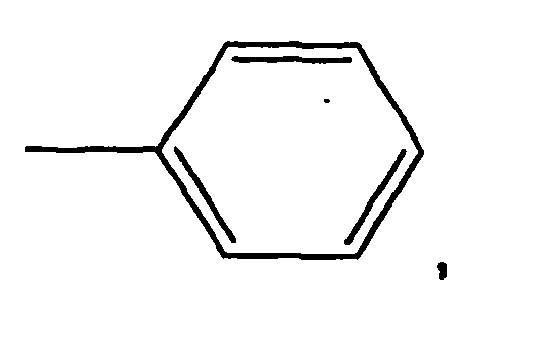
- R4=


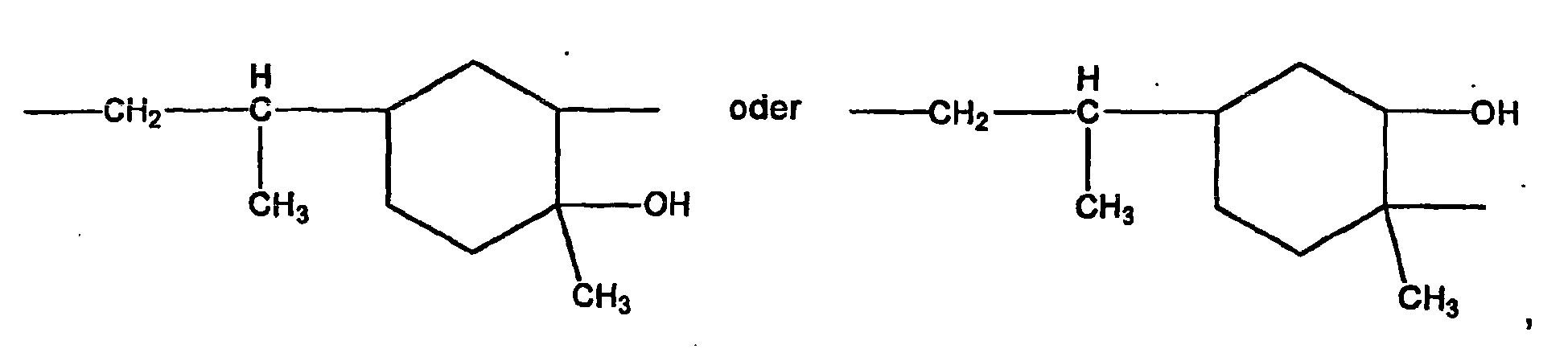
- R5= (CH2)r-H,
- R6= -(CH2)s -,
- R7 = (CH2)t -,
- A-
- anorganische oder organische Anionen,
- n
- eine ganze Zahl von 1 - 20, vorzugsweise 1 -14, besonders bevorzugt 1 - 5,
- m
- eine ganze Zahl von 20 - 2000, vorzugsweise 40 -1000, besonders bevorzugt 40 -120,
- o und p
- jeweils eine ganze Zahl von 1 -10, vorzugsweise 2 - 4,
- q
- eine ganze Zahl von 1 -10, vorzugsweise 1,
- r
- eine ganze Zahl von 1 -18, vorzugsweise 1,
- s
- eine ganze Zahl von 2 - 3, vorzugsweise 2 und
- t
- eine ganze Zahl von 2 - 5, vorzugsweise 2 - 4
- R1=
- (2) 2 bis 40 Gewichtsprozent eines Emulgators,
- (3) 0 bis 15 Gewichtsprozent eines Hydrotropikums und
- (4) 20 bis 95 Gewichtsprozent Wasser.
- Sämtliche Gewichtsangaben der erfindungsgemäßen Zubereitungen beziehen sich auf die Gesamtzusammensetzung der erfindungsgemäßen Zubereitung. Als bevorzugte Bereiche sind für die Komponente (1) ein Bereich von 10 - 40 Gewichtsprozent, für die Komponente (2) 10 - 20 Gewichtsprozent zu nennen. Sofern die Komponente (3) zugesetzt wird, liegt deren Konzentration bevorzugt im Bereich von 1 -10, insbesondere von 3 - 7 Gewichtsprozent. Der bevorzugte Bereich der Komponente (4) liegt bei 70 - 90, insbesondere jedoch zwischen 60 - 90 Gewichtsprozent.
- Der Stickstoffgehalt der Komponente (1) liegt bevorzugt bei 0,1 - 1,5 Gewichtsprozent, insbesondere jedoch bei 0,1 -1,0 Gewichtsprozent bezogen auf die Gesamtzusammensetzung von Komponente (1).
- Die Anionen sind von anorganischen oder organischen Säuren abgeleitet. Als Beispiele für anorganische Anionen sind Chlorid, Bromid, Jodid und Sulfat zu nennen; bevorzugt sind Chlorid und Sulfat. Beispiele für organische Anionen sind Tosylat und Acetat; bevorzugt ist Tosylat.
- Die Herstellung der teilquatemierten, aminofunktionellen Organopolysiloxane der Komponente (1) erfolgt nach Methoden, welche dem Fachmann bekannt sind. So können durch Equilibrierung von terminal quaternierten, aminofunktionellen Organopolysiloxanen (herstellbar aus terminal epoxifunktionellen Organopolysiloxanen) mit bekannten Silanhydrolisaten, welche laterale Aminogruppen tragen, in Gegenwart bekannter Equilibrierungskatalysatoren die erfindungsgemäßen Komponenten (1) synthetisiert werden.
- Verfahren zur analogen Herstellung der dabei als Ausgangsverbindung verwendeten, terminal epoxifunktionellen Organopolysiloxane sind beispielsweise in
DE 3705121-A1 , solche zur Herstellung der daraus erhaltenen aminofunktionellen Zwischenstufen beispielsweise inWO 02110256-A1 DE 19652524-A1 beschrieben. Die Herstellung der verwendeten, bekannten Silanhydrolisate ist beispielsweise von W. Noll in "Chemie und Technologie der Silicone", 2. Auflage 1968, S. 168 ff. und von M. A. Brook in "Silicon in Organic, Organometallic, and Polymer Chemistry", 2000, S. 258 ff. beschrieben; Aminoethylaminopropylsilanhydrolisate sind kommerziell erhältlich. Als bekannte Equilibrierungskatalysatoren sind beispielsweise Bortrifluorid, Trifluormethansulfonsäure und Schwefelsäure zu nennen. - Als Emulgatoren (Komponente (2)) können solche auf anionischer, kationischer, nichtionogener oder amphoterer Basis oder Mischungen dieser Verbindungen eingesetzt werden. Vorzugsweise werden Ethoxilierungsprodukte aliphatischer Alkohole mit 6 bis 22 Kohlenstoflatome verwendet, die bis zu 50 Mol Ethylenoxid angelagert enthalten. Die Alkohole können bevorzugt 8 bis 16 Kohlenstoffatome enthalten; sie können gesättigt, linear oder vorzugsweise verzweigt sein und können allein oder in Mischung zur Anwendung gelangen.
- Von besonderem Vorteil hinsichtlich niedriger Schaumentwicklung in den Anwendungsflotten sind Alkohole der erwähnten Zusammensetzung, wenn deren Alkylenoxidrest aus Ethylenoxid und 1,2-Propylenoxid in statistischer Verteilung und vorzugsweise in blockartiger Verteilung aufgebaut ist.
- Nichtionogene Emulgatoren aus der Gruppe der ethoxilierten, verzweigten aliphatischen Alkohole haben sich aufgrund ihrer günstigen Gesamteigenschaften ganz besonders bewährt. Deshalb werden z.B. Ethoxilate des 2,6,8-Trimethyl-4-nonanols, des Isodecylalkoholes oder des Isotridecylalkoholes mit jeweils 2 bis 50 Molekülen, insbesondere 3 bis 15 Molekülen angelagertem Ethylenoxid für die Herstellung der erfindungsgemäßen Zubereitungen bevorzugt.
- Die optional einzusetzende Komponente (3), ein Hydrotropikum, kann üblicherweise aus der Gruppe der polyfunktionellen Alkohole ausgewählt werden. So können Dialkohole mit 2 - 10, bevorzugt 2 - 6, insbesondere jedoch 2 - 4 Kohlenstoffatomen pro Molekül eingesetzt werden. Gut geeignet sind auch deren Mono- und Diether sowie die Mono- und Diester dieser Dialkohole. Als besonders bevorzugt zu verwendende Beispiele für die Komponente (3) sind Butyldiglykol, 1,2-Propylenglykol und Dipropylenglykol zu nennen.
- Um die anspruchsgemäßen teilquatemierten, aminofunktionellen Organopolysiloxane in eine aus wässrigem Medium anwendbare Form zu bringen, können hiervon Makro- oder Mikroemulsionen durch scherkraftreiches Verrühren der Komponenten (1) bis (4) bei Temperaturen zwischen 20 und 70°C hergestellt werden.
- Weiterer Gegenstand der Erfindung ist die Verwendung der Zubereitungen gemäß Anspruch 1 bei der Veredelung textiler Substrate in wässrigen Bädern und Anwendungsflotten, gegebenenfalls zusammen mit weiteren Präparationsmittein. Gewebe und Gewirke aus nativen Fasern, wie beispielsweise Baumwolle oder Wolle, aber auch aus synthetischen Fasern, wie beispielsweise Viskose, Polyester, Polyamid oder Polyacrylnitril können mit den erfindungsgemäßen aminofunktionellen Polysiloxanen behandelt werden. Bei den gegebenenfalls zusätzlich mitverwendeten Präparationsmitteln kann es sich beispielsweise um Chemikalien zur Knitterfreiausrüstung, um solche zur Verbesserung der Vemähbarkeit des textilen Substrates oder um andere, üblicherweise in textilen Applikationsflotten zur Anwendung gelangende Produkte handeln.
- Die Konzentration der erfindungsgemäßen Zubereitungen in den Anwendungsflotten wird so gewährt, dass die behandelten Substrate zwischen 0,3 und 0,6 Gewichtsprozent der anspruchsgemäßen teilquaternierten, aminofunktionellen Organopolysiloxane, bezogen auf das Gewicht des Substrates enthalten.
- Eine bevorzugte Anwendung mit den erfindungsgemäßen Zubereitungen erfolgt als Zwangsapplikation durch Tränken des Substrates mit der Anwendungsflotte, anschließendes Abquetschen auf dem Foulard und einer abschließenden Trocknungspassage.
- Die Erfindung wird mit den nachfolgenden Beispielen näher erläutert. Bei den Kettenlängenangaben, die in den Formeln dieser Beispiele für die anspruchsgemäßen Indizes n und m erscheinen, handelt es sich jeweils um Durchschnittswerte. Die in den Beispielen eingesetzten Zubereitungen werden durch einfaches Verrühren der Einzelkomponenten bei 70°C hergestellt.
- Die Zubereitung besteht aus einer wässrigen Mikroemulsion, enthaltend 20 Gewichtsprozent eines Organopolysiloxanes mit lateral positionierten Aminogruppen der Formel

- Die Zubereitung besteht aus einer wässrigen Mikroemulsion, enthaltend 20 Gewichtsprozent eines Organopolysiloxanes mit terminal positionierten und quaternierten Aminogruppen der Formel

R8=
ist, 5 Gewichtsprozent eines Isotridecylalkoholes mit 6 Ethylenoxidgruppen, 5 Gewichtsprozent eines Isodecylalkoholes mit 7 Ethylenoxidgruppen und 7 Gewichtsprozent Butyldiglykol. Der Gesamtstickstoffgehalt des Organopolysiloxanes beträgt 0,78 Gewichtsprozent. - Die Zubereitung besteht aus einer wässrigen Mikroemulsion, enthaltend 20 Gewichtsprozent eines Organopolysiloxanes mit lateral positionierten Aminogruppen sowie terminal positionierten und Quaternierten Aminogruppen der Formel (I)

R9=

- Die Herstellung des Organopolysiloxanes der Formel (I) erfolgt analog
WO 02/10256-A1 DE 3705121-A1 , Beispiel 1. Das erhaltene Zwischenprodukt wird analogDE 19652524-A1 in isopropanolischer Lösung mit p-Toluolsulfonsäuremethylester quaterniert und nach destillativer Entfernung des Lösemittels mit 2 Gewichtsprozent eines Aminoethylaminopropylsilanhydrolisates versetzt. Nach Zugabe von 0,15 Gewichtsprozent Trifluormethansulfonsäure wird während 2 Stunden bei 115°C gerührt, wobei aus der ursprünglich inhomogenen, trüben Mischung ein klares, gelbliches Organopolysiloxan der Formel (I) entsteht. - Die Zubereitung besteht aus einer wässrigen Mikroemulsion, enthaltend 20 Gewichtsprozent eines Organopolysiloxanes mit lateral positionierten Aminogruppen sowie terminal positionierten und quaternierten Aminogruppen der Formel (II)

R9=
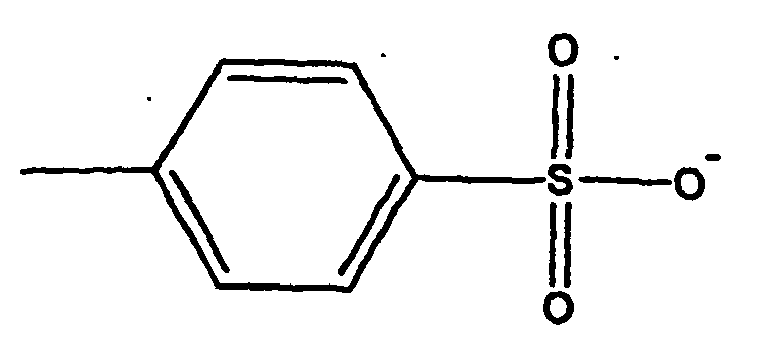
- Die Herstellung des Organopolysiloxanes der Formel (II) erfolgt analog Beispiel 3 unter Verwendung eines Polydimethylsiloxanes mit terminalen Epoxigruppen und einer durchschnittlichen Kettenlänge von 80 Einheiten. Es entsteht ein klares, gelbliches Organopolysiloxan.
- Die Zubereitung besteht aus einer wässrigen Mikroemulsion, enthaltend 20 Gewichtsprozent eines Organopolysiloxanes mit lateral positionierten Aminogruppen sowie terminal positionierten und quaternierten Aminogruppen der Formel (III)
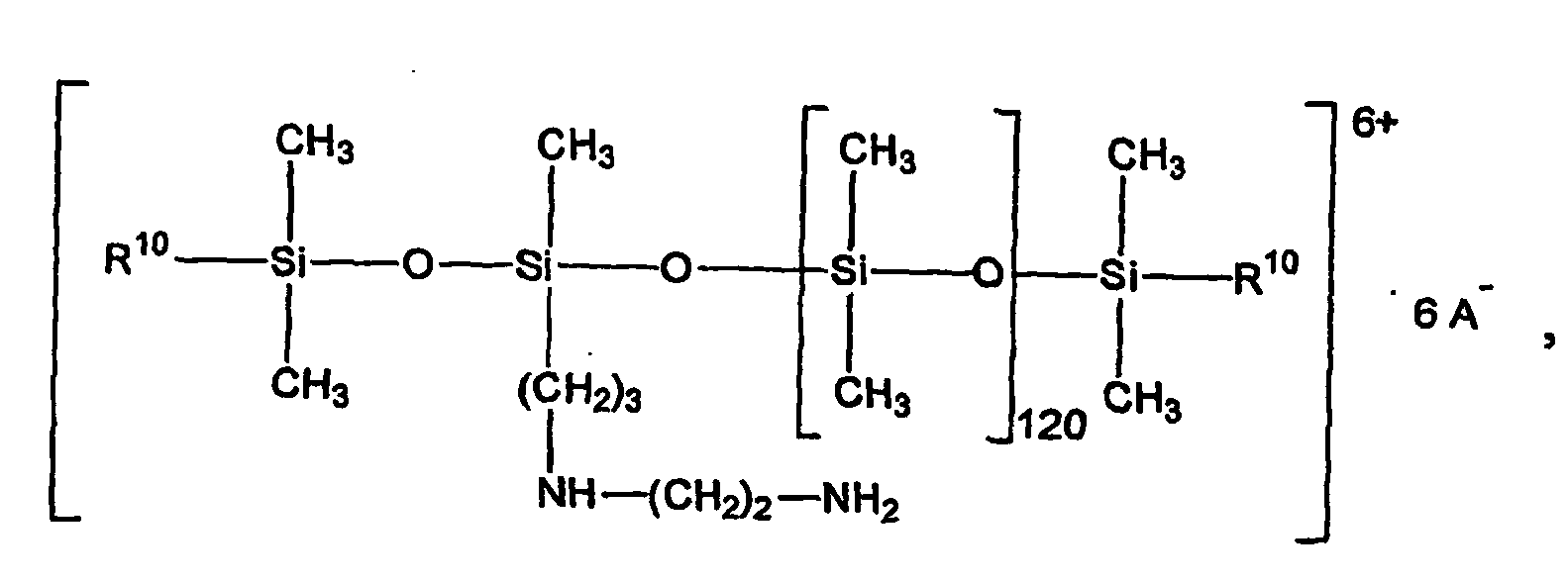
R10 =

- Die Herstellung des Organopolysiloxanes der Formel (III) erfolgt analog
WO 02/10501 A1 DE 3705121-A1 , Beispiel 1. Das erhaltene Zwischenprodukt wird analogDE 19652524-A1 in isopropanolischer Lösung mit p-Toluolsulfonsäuremethylester quatemiert und nach destillativer Entfernung des Lösemittels mit 2 Gewichtsprozent eines Aminoethylaminopropylsilanhydrolisates versetzt. Nach Zugabe von 0,15 Gewichtsprozent Trifluormethansulfonsäure wird während 2 Stunden bei 115°C gerührt, wobei aus der ursprünglich inhomogenen, trüben Mischung ein klares, gelbliches Organopolysiloxan der Formel (III) entsteht. - Abschnitte einer gebleichten, nicht optisch aufgehellten Baumwoll-Frotteeware wurden mit einer wässrigen Flotte, enthaltend 20 g/l der gemäß den Beispielen hergestellten Mikroemulsionen und 0,5 g/l Essigsäure 60 % auf einem Laborfoulard mit einer Nassaufnahme von 80 % imprägniert und anschließend 2 Minuten bei 120°C getrocknet. Anschließend erfolgte die Beurteilung des Griffcharakters der mit den Mikroemulsionen behandelten Testgewebe. Diese unterliegt individuell unterschiedlichen, subjektiven Kriterien. Um trotzdem zu aussagekräftigen Ergebnissen zu kommen, ist eine Beurteilung durch mindestens 5 Testpersonen erforderlich. Die Auswertung der Ergebnisse erfolgte nach statistischen Methoden, wobei die Notenstufe 1 den weichsten, angenehmsten Griff, die Notenstufe 10 den härtesten, am wenigsten oberflächenglatten und unangenehmsten Griff innerhalb der Testreihe darstellt.
Griffbewertungsnote innerhalb der Testreihe Mikroemulsion nach Beispiel 1 1,5 Mikroemulsion nach Beispiel 2 7,2 Mikroemulsion nach Beispiel 3 2,1 Mikroemulsion nach Beispiel 4 2,6 Mikroemulsion nach Beispiel 5 3,4 Unbehandelt 10 - Abschnitte einer gebleichten, nicht optisch aufgehellten Baumwoll-Frotteeware wurden mit einer wässrigen Flotte, enthaltend 20 g/l der gemäß den Beispielen hergestellten Mikroemulsionen und 0,5 g/l Essigsäure 60 % auf einem Laborfoulard mit einer Nassaufnahme von 80 % imprägniert und anschließend 2 Minuten bei 120°C getrocknet. Anschließend erfolgte die Beurteilung der Hydrophilie gemäß des TEGEWA-Tropftestes (Melliand Textilberichte 68 (1987), 581 - 583).
Einsinkzeit (sec) Mikroemulsion nach Beispiel 1 Über 180 Mikroemulsion nach Beispiel 2 10 Mikroemulsion nach Beispiel 3 Unter 1 Mikroemulsion nach Beispiel 4 1 Mikroemulsion nach Beispiel 5 3 Unbehandelt Unter 1 - Abschnitte einer gebleichten, nicht optisch aufgehellten Baumwoll-Modal-Maschenware wurden mit einer wässrigen Flotte, enthaltend 20 g/l der gemäß den Beispielen hergestellten Mikroemulsionen und 0,5 g/l Essigsäure 60 % auf einem Laborfoulard mit einer Nassaufnahme von 80 % imprägniert, 2 Minuten bei 120°C getrocknet und anschließend 2 Minuten bei 170°C thermofixiert. Anschließend wurde der Weißgrad der Muster nach Ganz auf dem Weißgradmeßgerät "texflash 2000" der Firma "datacolor international" (Schweiz) gemessen.
Weißgrad nach Ganz Mikroemulsion nach Beispiel 1 141,5 Mikroemulsion nach Beispiel 2 151,0 Mikroemulsion nach Beispiel 3 150,1 Mikroemulsion nach Beispiel 4 147,8 Mikroemulsion, nach Beispiel 5 150,5 unbehandelt 151,8 - Die Stabilität der Organopolysiloxanemulsionen gegen Alkalien in Ausrüstüngsflotten wurde gemäß dem nachfolgend beschriebenen Test durchgeführt:
- 500 ml einer Lösung der zu untersuchenden Organopolysiloxanemulsion mit einer Konzentration von 40 g/l wurden in einem 1000 ml Becherglas vorgelegt und mit Natriumhydroxidlösung (w(NaOH) = 10 %) auf einen pH-Wert von 12 eingestellt. Anschließend wurde die Flotte zwanzig Minuten mit einem Flügelrührer bei zweitausend Umdrehungen pro Minute gerührt. Nach dem Ablauf dieser Zeit wurde der Rührer abgestellt, der entstandene Schaum zerfallen gelassen und die Flüssigkeitsoberfläche nach 1 Stunde hinsichtlich Abscheidungen beurteift.
| Beurteilung nach 1 Stunde | |
| Mikroemulsion nach Beispiel 1 | Starke Silikonabscheidungen |
| Mikroemulsion nach Beispiel 2 | Dünner Ölfilm auf der Oberfläche |
| Mikroemulsion nach Beispiel 3 | keine Abscheidungen |
| Mikroemulsion nach Beispiel 4 | keine Abscheidungen |
| Mikroemulsion nach Beispiel 5 | keine Abscheidungen |
Claims (3)
- Zubereitungen, gekennzeichnet durch einen Gehalt, bezogen auf die Gesamtzusammensetzung, an(1) 2 bis 60 Gewichtsprozent eines teilquaternierten aminofunktionellen Organopolysiloxanes der allgemeinen Formel
 R1=
R1=
 R2= (CH2)o-NH-(CH2)p-NH2 oder -(CH2)p-NH2R3= -(CH2)q-H oder
 R4=
R4=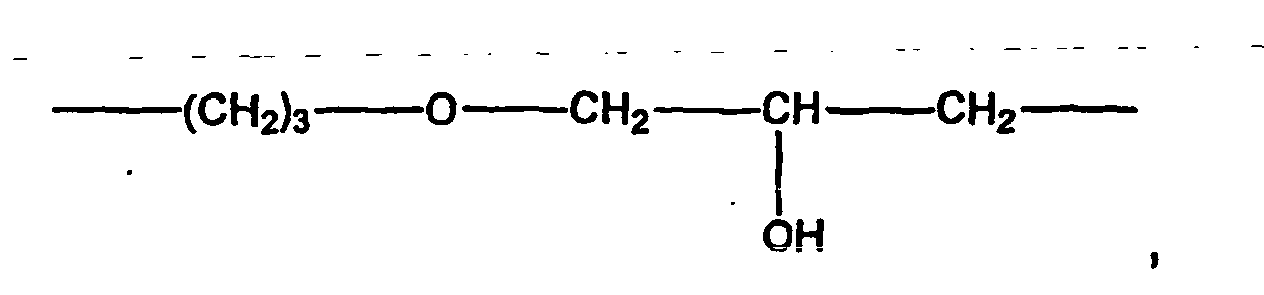


 R5= -(CH2)r-H,R6= -(CH2)s-,R7= -(CH2)t-,bedeuten, mit der Maßgabe, dass der Gesamtstickstoffgehalt der Komponente (1) 0,05 bis 2,0 Gewichtsprozent, bezogen auf die Gesamtzusammensetzung von Komponente (1) beträgt,A- anorganische oder organische Anionen,n eine ganze Zahl von 1 - 20,m eine ganze Zahl von 20 - 2000,o, p und q jeweils eine ganze Zahl von 1 -10,r eine ganze Zahl von 1 -18,s eine ganze Zahl von 2 - 3 undt eine ganze Zahl von 2 - 5(2) 2 bis 40 Gewichtsprozent eines Emulgators,(3) 0 bis 15 Gewichtsprozent eines Hydrotropikums und(4) 20 bis 95-Gewichtsprozent Wasser.
 - Verwendung der Zubereitungen gemäß Anspruch 1 bei der Veredelung textiler Substrate in wässrigen Bädern und Anwendungsflotten, gegebenenfalls zusammen mit weiteren Präparationsmitteln.
- Textile Substrate, welche gemäß Anspruch 2 veredelt sind.
Applications Claiming Priority (3)
| Application Number | Priority Date | Filing Date | Title |
|---|---|---|---|
| DE2002153152 DE10253152A1 (de) | 2002-11-14 | 2002-11-14 | Teilquaternierte, aminofunktionelle Organopolysiloxane und deren Verwendung in wässrigen Systemen |
| DE10253152 | 2002-11-14 | ||
| PCT/EP2003/012703 WO2004044306A1 (de) | 2002-11-14 | 2003-11-13 | Teilquaternierte, aminofunktionelle organopolysiloxane und deren verwendung in wässrigen systemen |
Publications (2)
| Publication Number | Publication Date |
|---|---|
| EP1560972A1 EP1560972A1 (de) | 2005-08-10 |
| EP1560972B1 true EP1560972B1 (de) | 2009-04-08 |
Family
ID=32240058
Family Applications (1)
| Application Number | Title | Priority Date | Filing Date |
|---|---|---|---|
| EP03779915A Expired - Lifetime EP1560972B1 (de) | 2002-11-14 | 2003-11-13 | Teilquaternierte, aminofunktionelle organopolysiloxane und deren verwendung in w ssrigen systemen |
Country Status (6)
| Country | Link |
|---|---|
| US (1) | US7329707B2 (de) |
| EP (1) | EP1560972B1 (de) |
| AT (1) | ATE428017T1 (de) |
| AU (1) | AU2003288053A1 (de) |
| DE (2) | DE10253152A1 (de) |
| WO (1) | WO2004044306A1 (de) |
Cited By (1)
| Publication number | Priority date | Publication date | Assignee | Title |
|---|---|---|---|---|
| DE102016207603A1 (de) | 2016-05-03 | 2017-11-09 | Wacker Chemie Ag | Wässrige Emulsionen enthaltend aminofunktionelle Organopolysiloxane und nicht-ionische Emulgatoren |
Families Citing this family (21)
| Publication number | Priority date | Publication date | Assignee | Title |
|---|---|---|---|---|
| DE10259291B4 (de) * | 2002-12-18 | 2006-02-23 | Rudolf Gmbh & Co. Kg Chemische Fabrik | Hochkonzentrierte, selbstemulgierende Zubereitungen, enthaltend Organopolysiloxane und Alkylammoniumverbindungen und deren Verwendung in wässrigen Systemen |
| JP2009513742A (ja) * | 2003-07-04 | 2009-04-02 | チバ ホールディング インコーポレーテッド | ポリオルガノシロキサン |
| DE102005014312A1 (de) * | 2005-03-30 | 2006-10-19 | Ge Bayer Silicones Gmbh & Co. Kg | Zusammensetzung enhaltend Polyamino- und/oder Polyammonium-Polysiloxan-Verbindungen auf einem Substrat |
| DE102005036602A1 (de) * | 2005-08-01 | 2007-02-08 | Ge Bayer Silicones Gmbh & Co. Kg | Polyammonium-Polysiloxancopolymere |
| CN101675095B (zh) * | 2007-04-11 | 2012-11-28 | 陶氏康宁公司 | 具有有机基官能的封端基的硅氧烷聚醚嵌段共聚物 |
| DE102007037345A1 (de) | 2007-08-08 | 2009-02-12 | Wacker Chemie Ag | Quaternäre Ammoniumgruppen aufweisende Organosiliciumverbindungen und deren Herstellung |
| DE102008001867A1 (de) | 2008-05-19 | 2009-11-26 | Wacker Chemie Ag | Verfahren zur Herstellung von quartäre Ammoniumgruppen aufweisenden Organopolysiloxanen |
| CN101956324B (zh) * | 2010-09-14 | 2012-07-04 | 辽宁恒星精细化工有限公司 | 染色棉织物增深增艳整理剂及制备方法 |
| WO2013034705A1 (en) | 2011-09-09 | 2013-03-14 | Momentive Performance Materials Gmbh | Use of ionic polysiloxanes as a solvent in organic reactions |
| US9718087B1 (en) * | 2013-03-15 | 2017-08-01 | The Sherwin-Williams Company | Treated applicator to increase performance |
| DE102013219046A1 (de) | 2013-09-23 | 2015-03-26 | Rudolf Gmbh | Polysiloxane mit quaternierten heterocyclischen Gruppen |
| DE102015209627A1 (de) | 2015-05-26 | 2016-12-01 | Rudolf Gmbh | Polyurethan-Organopolysiloxane |
| US11179312B2 (en) | 2017-06-05 | 2021-11-23 | Momentive Performance Materials Inc. | Aqueous compositions for the treatment of hair |
| US10982051B2 (en) | 2017-06-05 | 2021-04-20 | Momentive Performance Materials Inc. | Aqueous compositions for hair treatment comprising polyorganosiloxanes with polyhydroxyaromatic moieties |
| CN108797105B (zh) * | 2018-06-30 | 2020-09-08 | 江南大学 | 一种赋予织物多功能的整理剂的制备方法及整理方法 |
| CN109180949A (zh) * | 2018-10-09 | 2019-01-11 | 浙江科峰新材料有限公司 | 一种梳状结构亲水性氨基硅油 |
| US20200163850A1 (en) | 2018-11-24 | 2020-05-28 | Momentive Performance Materials Gmbh | Use of polyhydroxyaromatic compounds for the treatment of fibrous amino acid based substrates |
| US10617617B1 (en) | 2018-12-04 | 2020-04-14 | Momentive Performance Materials Inc. | Polycarboxylic acid compounds for the treatment of fibrious amino acid based substrates, especially hair |
| US11090255B2 (en) | 2018-12-04 | 2021-08-17 | Momentive Performance Materials Inc. | Use of polycarboxylic acid compounds for the treatment of fibrious amino acid based substrates, especially hair |
| JP7686744B2 (ja) * | 2020-09-08 | 2025-06-02 | ワッカー ケミー アクチエンゲゼルシャフト | シリコーンコポリマー、それらの調製及び繊維状基材の処理のためのそれらの使用 |
| EP4166710A1 (de) | 2021-10-12 | 2023-04-19 | Rudolf GmbH | Weichgriffzusammensetzung |
Family Cites Families (23)
| Publication number | Priority date | Publication date | Assignee | Title |
|---|---|---|---|---|
| FR1184198A (fr) * | 1956-10-12 | 1959-07-17 | Union Carbide Corp | Composés organiques du silicium et leur procédé de production |
| US3033815A (en) * | 1959-08-28 | 1962-05-08 | Union Carbide Corp | Organosilicon compounds and process for producing same |
| GB1006729A (en) * | 1963-04-22 | 1965-10-06 | Ici Ltd | Production of organo-silicon compounds |
| US3207707A (en) * | 1963-04-29 | 1965-09-21 | Gen Electric | Nitrogen containing polymers |
| BE666745A (de) | 1964-07-14 | 1966-01-12 | ||
| LU84463A1 (fr) * | 1982-11-10 | 1984-06-13 | Oreal | Polymeres polysiloxanes polyquaternaires |
| US4620878A (en) | 1983-10-17 | 1986-11-04 | Dow Corning Corporation | Method of preparing polyorganosiloxane emulsions having small particle size |
| DE3705121A1 (de) * | 1987-02-18 | 1988-09-01 | Goldschmidt Ag Th | Polyquaternaere polysiloxan-polymere, deren herstellung und verwendung in kosmetischen zubereitungen |
| DE3723697A1 (de) | 1987-04-24 | 1988-11-17 | Pfersee Chem Fab | Waessrige, feinteilige bis optisch klare, thermisch und mechanisch stabile silikonemulsionen, verfahren zu deren herstellung und deren verwendung |
| US4892918A (en) * | 1987-05-29 | 1990-01-09 | Basf Corporation | Secondary amine terminated siloxanes, methods for their preparation and use |
| DE3719086C1 (de) * | 1987-06-06 | 1988-10-27 | Goldschmidt Ag Th | Diquartaere Polysiloxane,deren Herstellung und Verwendung in kosmetischen Zubereitungen |
| JPH0686467B2 (ja) * | 1988-12-09 | 1994-11-02 | 信越化学工業株式会社 | カチオン型シリコーン界面活性物質 |
| US5039738A (en) * | 1990-12-14 | 1991-08-13 | Union Carbide Chemicals And Plastics Technology Corporation | Emulsions containing modified aminoorganosiloxane impart reduced yellowing when used as fabric softeners |
| EP0824563B1 (de) * | 1996-03-04 | 2005-06-15 | General Electric Company | Blockcopolymere auf basis von silikonen und aminopolyalkylenoxiden |
| US5707435A (en) * | 1996-10-16 | 1998-01-13 | Dow Corning Corporation | Ammonium siloxane emulsions and their use as fiber treatment agents |
| DE19652524C2 (de) | 1996-12-17 | 2003-08-14 | Rudolf Gmbh & Co Kg Chem Fab | Organopolysiloxane enthaltende Emulsionen, deren Herstellung und Verwendung in wäßrigen Systemen |
| DE19802069A1 (de) * | 1998-01-21 | 1999-07-22 | Huels Silicone Gmbh | Aminofunktionelle Polyorganosiloxane, deren Herstellung und Verwendung |
| DE10004321A1 (de) | 2000-02-01 | 2001-08-09 | Wacker Chemie Gmbh | Quarternäre Ammonium- und tertiäre Aminogruppen enthaltende Organosiliciumverbindungen, deren Herstellung und Verwendung |
| AU2001291687A1 (en) * | 2000-07-27 | 2002-02-13 | Ge Bayer Silicones Gmbh And Co. Kg | Polyammonium-polysiloxane compounds, methods for the production and use thereof |
| EP1309648B1 (de) | 2000-07-27 | 2006-09-20 | GE Bayer Silicones GmbH & Co. KG | Ein- oder mehrfachquartäre polysiloxane |
| DE10036694A1 (de) * | 2000-07-27 | 2002-02-14 | Wacker Chemie Gmbh | Verfahren zur Behandlung von organischen Fasern mit aminofunktionellen Organosiliciumverbindungen |
| US7041767B2 (en) * | 2000-07-27 | 2006-05-09 | Ge Bayer Silicones Gmbh & Co. Kg | Polysiloxane polymers, method for their production and the use thereof |
| US6904392B1 (en) | 2000-10-13 | 2005-06-07 | Dassault Systemes | Annotation management |
-
2002
- 2002-11-14 DE DE2002153152 patent/DE10253152A1/de not_active Withdrawn
-
2003
- 2003-11-13 US US10/534,879 patent/US7329707B2/en not_active Expired - Fee Related
- 2003-11-13 EP EP03779915A patent/EP1560972B1/de not_active Expired - Lifetime
- 2003-11-13 WO PCT/EP2003/012703 patent/WO2004044306A1/de not_active Ceased
- 2003-11-13 AU AU2003288053A patent/AU2003288053A1/en not_active Abandoned
- 2003-11-13 AT AT03779915T patent/ATE428017T1/de not_active IP Right Cessation
- 2003-11-13 DE DE50311399T patent/DE50311399D1/de not_active Expired - Lifetime
Cited By (1)
| Publication number | Priority date | Publication date | Assignee | Title |
|---|---|---|---|---|
| DE102016207603A1 (de) | 2016-05-03 | 2017-11-09 | Wacker Chemie Ag | Wässrige Emulsionen enthaltend aminofunktionelle Organopolysiloxane und nicht-ionische Emulgatoren |
Also Published As
| Publication number | Publication date |
|---|---|
| EP1560972A1 (de) | 2005-08-10 |
| ATE428017T1 (de) | 2009-04-15 |
| US7329707B2 (en) | 2008-02-12 |
| US20060128880A1 (en) | 2006-06-15 |
| WO2004044306A1 (de) | 2004-05-27 |
| DE50311399D1 (de) | 2009-05-20 |
| DE10253152A1 (de) | 2004-06-03 |
| AU2003288053A1 (en) | 2004-06-03 |
Similar Documents
| Publication | Publication Date | Title |
|---|---|---|
| WO2004044306A1 (de) | Teilquaternierte, aminofunktionelle organopolysiloxane und deren verwendung in wässrigen systemen | |
| EP0417047B1 (de) | Mikroemulsionen von Aminopolysiloxanen | |
| DE102004002208B4 (de) | Zubereitungen auf Basis von Organopolysiloxan-Polyammonium-Blockcopolymeren und deren Anwendung auf textilen Substraten | |
| EP0339179B1 (de) | Zubereitung zum Ausrüsten von Textilfasern oder aus Textilfasern bestehenden Produkten | |
| DE3519601C2 (de) | ||
| DE69102552T2 (de) | Verfahren zur Behandlung von Fasermaterialien. | |
| DE69003009T2 (de) | Verfahren zur Behandlung von Fasermaterialien. | |
| EP1892327B1 (de) | Verwendung von polyethermodifizierten Siloxanblockcopolymeren als hydrophile silikonhaltige Weichmacher für Gewebe, Non-wovens und/oder Fasern aus natürlichen und/oder synthetischen Rohstoffen | |
| DE102007015372A1 (de) | Polysiloxan und Textilhilfsmittel enthaltend ein Polysiloxan | |
| EP0692567B1 (de) | Aminofunktionelle Organopolysiloxane | |
| DE4332607A1 (de) | Wäßrige Wachs- und Silicon-Dispersionen, deren Herstellung und Verwendung | |
| DE10259291B4 (de) | Hochkonzentrierte, selbstemulgierende Zubereitungen, enthaltend Organopolysiloxane und Alkylammoniumverbindungen und deren Verwendung in wässrigen Systemen | |
| EP0641833B1 (de) | Wässrige Wachs- und Silicondispersionen, deren Herstellung und Verwendung | |
| DE102015209627A1 (de) | Polyurethan-Organopolysiloxane | |
| EP1448648B1 (de) | Polysiloxan und textilhilfsmittel enthaltend ein polysiloxan | |
| EP3049488B1 (de) | Polysiloxane mit quaternierten heterocyclischen gruppen | |
| EP1076078B1 (de) | Silikonhaltige Zusammensetzungen für die Behandlung von Wollematerialien | |
| DE19835227A1 (de) | Wäßrige Mikroemulsionen, enthaltend Organopolysiloxane | |
| WO2009115412A1 (de) | Verwendung von polyamino- und/oder polyammonium-polysiloxan-copolymer-verbindungen | |
| DE102005056864B4 (de) | Zubereitungen auf Basis von ammonium- und polyethermodifizierten Organopolysiloxanen und deren Verwendung zur Veredlung textiler Substrate | |
| DE3933971C2 (de) | Flüssige Weichspülzusammensetzung und deren Verwendung | |
| EP1388571A1 (de) | Polyorganosiloxanzusammensetzung enthaltend quaternäre Ammoniumgruppen | |
| DE3929757A1 (de) | Waessrige aminopolysiloxanmikroemulsionen, deren herstellung und verwendung | |
| EP0047922A1 (de) | Zubereitung zum Schrumpffestmachen von Wolle | |
| WO2022053137A1 (de) | Verwendung von cyclenarmen derivatisierten aminofunktionellen siliconpolymeren zur behandlung von faserigen substraten |
Legal Events
| Date | Code | Title | Description |
|---|---|---|---|
| PUAI | Public reference made under article 153(3) epc to a published international application that has entered the european phase |
Free format text: ORIGINAL CODE: 0009012 |
|
| 17P | Request for examination filed |
Effective date: 20050525 |
|
| AK | Designated contracting states |
Kind code of ref document: A1 Designated state(s): AT BE BG CH CY CZ DE DK EE ES FI FR GB GR HU IE IT LI LU MC NL PT RO SE SI SK TR |
|
| AX | Request for extension of the european patent |
Extension state: AL LT LV MK |
|
| REG | Reference to a national code |
Ref country code: HK Ref legal event code: DE Ref document number: 1073873 Country of ref document: HK |
|
| DAX | Request for extension of the european patent (deleted) | ||
| GRAP | Despatch of communication of intention to grant a patent |
Free format text: ORIGINAL CODE: EPIDOSNIGR1 |
|
| GRAS | Grant fee paid |
Free format text: ORIGINAL CODE: EPIDOSNIGR3 |
|
| RAP1 | Party data changed (applicant data changed or rights of an application transferred) |
Owner name: RUDOLF GMBH |
|
| GRAA | (expected) grant |
Free format text: ORIGINAL CODE: 0009210 |
|
| AK | Designated contracting states |
Kind code of ref document: B1 Designated state(s): AT BE BG CH CY CZ DE DK EE ES FI FR GB GR HU IE IT LI LU MC NL PT RO SE SI SK TR |
|
| REG | Reference to a national code |
Ref country code: GB Ref legal event code: FG4D Free format text: NOT ENGLISH |
|
| REG | Reference to a national code |
Ref country code: CH Ref legal event code: EP |
|
| REG | Reference to a national code |
Ref country code: IE Ref legal event code: FG4D |
|
| REF | Corresponds to: |
Ref document number: 50311399 Country of ref document: DE Date of ref document: 20090520 Kind code of ref document: P |
|
| REG | Reference to a national code |
Ref country code: HK Ref legal event code: WD Ref document number: 1073873 Country of ref document: HK |
|
| PG25 | Lapsed in a contracting state [announced via postgrant information from national office to epo] |
Ref country code: SI Free format text: LAPSE BECAUSE OF FAILURE TO SUBMIT A TRANSLATION OF THE DESCRIPTION OR TO PAY THE FEE WITHIN THE PRESCRIBED TIME-LIMIT Effective date: 20090408 |
|
| NLV1 | Nl: lapsed or annulled due to failure to fulfill the requirements of art. 29p and 29m of the patents act | ||
| REG | Reference to a national code |
Ref country code: IE Ref legal event code: FD4D |
|
| PG25 | Lapsed in a contracting state [announced via postgrant information from national office to epo] |
Ref country code: ES Free format text: LAPSE BECAUSE OF FAILURE TO SUBMIT A TRANSLATION OF THE DESCRIPTION OR TO PAY THE FEE WITHIN THE PRESCRIBED TIME-LIMIT Effective date: 20090719 Ref country code: PT Free format text: LAPSE BECAUSE OF FAILURE TO SUBMIT A TRANSLATION OF THE DESCRIPTION OR TO PAY THE FEE WITHIN THE PRESCRIBED TIME-LIMIT Effective date: 20090908 Ref country code: FI Free format text: LAPSE BECAUSE OF FAILURE TO SUBMIT A TRANSLATION OF THE DESCRIPTION OR TO PAY THE FEE WITHIN THE PRESCRIBED TIME-LIMIT Effective date: 20090408 |
|
| PG25 | Lapsed in a contracting state [announced via postgrant information from national office to epo] |
Ref country code: SE Free format text: LAPSE BECAUSE OF FAILURE TO SUBMIT A TRANSLATION OF THE DESCRIPTION OR TO PAY THE FEE WITHIN THE PRESCRIBED TIME-LIMIT Effective date: 20090708 Ref country code: NL Free format text: LAPSE BECAUSE OF FAILURE TO SUBMIT A TRANSLATION OF THE DESCRIPTION OR TO PAY THE FEE WITHIN THE PRESCRIBED TIME-LIMIT Effective date: 20090408 |
|
| PG25 | Lapsed in a contracting state [announced via postgrant information from national office to epo] |
Ref country code: CZ Free format text: LAPSE BECAUSE OF FAILURE TO SUBMIT A TRANSLATION OF THE DESCRIPTION OR TO PAY THE FEE WITHIN THE PRESCRIBED TIME-LIMIT Effective date: 20090408 Ref country code: DK Free format text: LAPSE BECAUSE OF FAILURE TO SUBMIT A TRANSLATION OF THE DESCRIPTION OR TO PAY THE FEE WITHIN THE PRESCRIBED TIME-LIMIT Effective date: 20090408 Ref country code: IE Free format text: LAPSE BECAUSE OF FAILURE TO SUBMIT A TRANSLATION OF THE DESCRIPTION OR TO PAY THE FEE WITHIN THE PRESCRIBED TIME-LIMIT Effective date: 20090408 Ref country code: EE Free format text: LAPSE BECAUSE OF FAILURE TO SUBMIT A TRANSLATION OF THE DESCRIPTION OR TO PAY THE FEE WITHIN THE PRESCRIBED TIME-LIMIT Effective date: 20090408 Ref country code: RO Free format text: LAPSE BECAUSE OF FAILURE TO SUBMIT A TRANSLATION OF THE DESCRIPTION OR TO PAY THE FEE WITHIN THE PRESCRIBED TIME-LIMIT Effective date: 20090408 |
|
| PLBE | No opposition filed within time limit |
Free format text: ORIGINAL CODE: 0009261 |
|
| STAA | Information on the status of an ep patent application or granted ep patent |
Free format text: STATUS: NO OPPOSITION FILED WITHIN TIME LIMIT |
|
| PG25 | Lapsed in a contracting state [announced via postgrant information from national office to epo] |
Ref country code: SK Free format text: LAPSE BECAUSE OF FAILURE TO SUBMIT A TRANSLATION OF THE DESCRIPTION OR TO PAY THE FEE WITHIN THE PRESCRIBED TIME-LIMIT Effective date: 20090408 |
|
| 26N | No opposition filed |
Effective date: 20100111 |
|
| PG25 | Lapsed in a contracting state [announced via postgrant information from national office to epo] |
Ref country code: BG Free format text: LAPSE BECAUSE OF FAILURE TO SUBMIT A TRANSLATION OF THE DESCRIPTION OR TO PAY THE FEE WITHIN THE PRESCRIBED TIME-LIMIT Effective date: 20090708 |
|
| BERE | Be: lapsed |
Owner name: RUDOLF G.M.B.H. Effective date: 20091130 |
|
| PG25 | Lapsed in a contracting state [announced via postgrant information from national office to epo] |
Ref country code: MC Free format text: LAPSE BECAUSE OF NON-PAYMENT OF DUE FEES Effective date: 20091130 |
|
| REG | Reference to a national code |
Ref country code: CH Ref legal event code: PL |
|
| GBPC | Gb: european patent ceased through non-payment of renewal fee |
Effective date: 20091113 |
|
| REG | Reference to a national code |
Ref country code: FR Ref legal event code: ST Effective date: 20100730 |
|
| PG25 | Lapsed in a contracting state [announced via postgrant information from national office to epo] |
Ref country code: BE Free format text: LAPSE BECAUSE OF NON-PAYMENT OF DUE FEES Effective date: 20091130 Ref country code: CH Free format text: LAPSE BECAUSE OF NON-PAYMENT OF DUE FEES Effective date: 20091130 Ref country code: FR Free format text: LAPSE BECAUSE OF NON-PAYMENT OF DUE FEES Effective date: 20091130 Ref country code: GR Free format text: LAPSE BECAUSE OF FAILURE TO SUBMIT A TRANSLATION OF THE DESCRIPTION OR TO PAY THE FEE WITHIN THE PRESCRIBED TIME-LIMIT Effective date: 20090709 Ref country code: LI Free format text: LAPSE BECAUSE OF NON-PAYMENT OF DUE FEES Effective date: 20091130 |
|
| PG25 | Lapsed in a contracting state [announced via postgrant information from national office to epo] |
Ref country code: GB Free format text: LAPSE BECAUSE OF NON-PAYMENT OF DUE FEES Effective date: 20091113 |
|
| PG25 | Lapsed in a contracting state [announced via postgrant information from national office to epo] |
Ref country code: AT Free format text: LAPSE BECAUSE OF NON-PAYMENT OF DUE FEES Effective date: 20091113 |
|
| PG25 | Lapsed in a contracting state [announced via postgrant information from national office to epo] |
Ref country code: IT Free format text: LAPSE BECAUSE OF FAILURE TO SUBMIT A TRANSLATION OF THE DESCRIPTION OR TO PAY THE FEE WITHIN THE PRESCRIBED TIME-LIMIT Effective date: 20090408 |
|
| PG25 | Lapsed in a contracting state [announced via postgrant information from national office to epo] |
Ref country code: LU Free format text: LAPSE BECAUSE OF NON-PAYMENT OF DUE FEES Effective date: 20091113 |
|
| PG25 | Lapsed in a contracting state [announced via postgrant information from national office to epo] |
Ref country code: HU Free format text: LAPSE BECAUSE OF FAILURE TO SUBMIT A TRANSLATION OF THE DESCRIPTION OR TO PAY THE FEE WITHIN THE PRESCRIBED TIME-LIMIT Effective date: 20091009 |
|
| PG25 | Lapsed in a contracting state [announced via postgrant information from national office to epo] |
Ref country code: TR Free format text: LAPSE BECAUSE OF FAILURE TO SUBMIT A TRANSLATION OF THE DESCRIPTION OR TO PAY THE FEE WITHIN THE PRESCRIBED TIME-LIMIT Effective date: 20090408 |
|
| PG25 | Lapsed in a contracting state [announced via postgrant information from national office to epo] |
Ref country code: CY Free format text: LAPSE BECAUSE OF FAILURE TO SUBMIT A TRANSLATION OF THE DESCRIPTION OR TO PAY THE FEE WITHIN THE PRESCRIBED TIME-LIMIT Effective date: 20090408 |
|
| PGFP | Annual fee paid to national office [announced via postgrant information from national office to epo] |
Ref country code: DE Payment date: 20180831 Year of fee payment: 16 |
|
| REG | Reference to a national code |
Ref country code: DE Ref legal event code: R119 Ref document number: 50311399 Country of ref document: DE |
|
| PG25 | Lapsed in a contracting state [announced via postgrant information from national office to epo] |
Ref country code: DE Free format text: LAPSE BECAUSE OF NON-PAYMENT OF DUE FEES Effective date: 20200603 |