EP1558652B1 - Modifizierte hydrogele und ihre verwendung - Google Patents
Modifizierte hydrogele und ihre verwendung Download PDFInfo
- Publication number
- EP1558652B1 EP1558652B1 EP03778489A EP03778489A EP1558652B1 EP 1558652 B1 EP1558652 B1 EP 1558652B1 EP 03778489 A EP03778489 A EP 03778489A EP 03778489 A EP03778489 A EP 03778489A EP 1558652 B1 EP1558652 B1 EP 1558652B1
- Authority
- EP
- European Patent Office
- Prior art keywords
- polymeric material
- derivatisation
- polymeric
- hydrogel
- groups
- Prior art date
- Legal status (The legal status is an assumption and is not a legal conclusion. Google has not performed a legal analysis and makes no representation as to the accuracy of the status listed.)
- Expired - Lifetime
Links
- 239000000017 hydrogel Substances 0.000 title claims abstract description 61
- 239000000463 material Substances 0.000 claims abstract description 213
- 238000000034 method Methods 0.000 claims abstract description 60
- 238000001212 derivatisation Methods 0.000 claims abstract description 54
- XLYOFNOQVPJJNP-UHFFFAOYSA-N water Substances O XLYOFNOQVPJJNP-UHFFFAOYSA-N 0.000 claims abstract description 42
- 229920002451 polyvinyl alcohol Polymers 0.000 claims abstract description 15
- 239000004372 Polyvinyl alcohol Substances 0.000 claims abstract description 14
- 235000019422 polyvinyl alcohol Nutrition 0.000 claims abstract description 14
- 150000001413 amino acids Chemical class 0.000 claims abstract description 6
- 102000004169 proteins and genes Human genes 0.000 claims abstract description 6
- 108090000623 proteins and genes Proteins 0.000 claims abstract description 6
- 239000011149 active material Substances 0.000 claims abstract description 5
- 108090000765 processed proteins & peptides Proteins 0.000 claims abstract description 3
- 238000006243 chemical reaction Methods 0.000 claims description 21
- 229920000642 polymer Polymers 0.000 claims description 21
- 238000004132 cross linking Methods 0.000 claims description 19
- 125000000524 functional group Chemical group 0.000 claims description 17
- 206010052428 Wound Diseases 0.000 claims description 16
- 208000027418 Wounds and injury Diseases 0.000 claims description 16
- 150000001875 compounds Chemical class 0.000 claims description 15
- 125000001072 heteroaryl group Chemical group 0.000 claims description 12
- 125000003277 amino group Chemical group 0.000 claims description 10
- 125000005647 linker group Chemical group 0.000 claims description 8
- 125000003118 aryl group Chemical group 0.000 claims description 7
- 125000002887 hydroxy group Chemical group [H]O* 0.000 claims description 6
- 125000002915 carbonyl group Chemical group [*:2]C([*:1])=O 0.000 claims description 4
- 238000001035 drying Methods 0.000 claims description 4
- 238000004519 manufacturing process Methods 0.000 claims description 4
- 150000001732 carboxylic acid derivatives Chemical class 0.000 claims description 3
- 239000003960 organic solvent Substances 0.000 claims description 3
- 239000004593 Epoxy Chemical group 0.000 claims description 2
- 125000003178 carboxy group Chemical group [H]OC(*)=O 0.000 claims description 2
- 239000002322 conducting polymer Substances 0.000 claims description 2
- 229920001940 conductive polymer Polymers 0.000 claims description 2
- 229910052736 halogen Inorganic materials 0.000 claims description 2
- 150000002367 halogens Chemical group 0.000 claims description 2
- 238000012544 monitoring process Methods 0.000 claims description 2
- 125000002924 primary amino group Chemical group [H]N([H])* 0.000 claims description 2
- 102000004196 processed proteins & peptides Human genes 0.000 claims description 2
- 239000004065 semiconductor Substances 0.000 claims description 2
- 229920002554 vinyl polymer Polymers 0.000 claims description 2
- 239000000499 gel Substances 0.000 description 34
- CSCPPACGZOOCGX-UHFFFAOYSA-N Acetone Chemical compound CC(C)=O CSCPPACGZOOCGX-UHFFFAOYSA-N 0.000 description 24
- 210000004027 cell Anatomy 0.000 description 17
- 239000000203 mixture Substances 0.000 description 13
- 239000000243 solution Substances 0.000 description 13
- 102000016359 Fibronectins Human genes 0.000 description 9
- 108010067306 Fibronectins Proteins 0.000 description 9
- 230000015572 biosynthetic process Effects 0.000 description 8
- -1 hydroxy, amino Chemical group 0.000 description 8
- 125000000217 alkyl group Chemical group 0.000 description 7
- 239000000178 monomer Substances 0.000 description 7
- 210000001519 tissue Anatomy 0.000 description 7
- IJGRMHOSHXDMSA-UHFFFAOYSA-N Atomic nitrogen Chemical compound N#N IJGRMHOSHXDMSA-UHFFFAOYSA-N 0.000 description 6
- 125000003172 aldehyde group Chemical group 0.000 description 6
- 125000004435 hydrogen atom Chemical group [H]* 0.000 description 6
- 230000008569 process Effects 0.000 description 6
- 125000003368 amide group Chemical group 0.000 description 5
- 239000007864 aqueous solution Substances 0.000 description 5
- 125000004429 atom Chemical group 0.000 description 5
- 239000000560 biocompatible material Substances 0.000 description 5
- 125000005842 heteroatom Chemical group 0.000 description 5
- VEXZGXHMUGYJMC-UHFFFAOYSA-N Hydrochloric acid Chemical compound Cl VEXZGXHMUGYJMC-UHFFFAOYSA-N 0.000 description 4
- 239000002253 acid Substances 0.000 description 4
- 230000032823 cell division Effects 0.000 description 4
- 230000012292 cell migration Effects 0.000 description 4
- 238000006482 condensation reaction Methods 0.000 description 4
- 125000001997 phenyl group Chemical group [H]C1=C([H])C([H])=C(*)C([H])=C1[H] 0.000 description 4
- 238000002360 preparation method Methods 0.000 description 4
- 235000018102 proteins Nutrition 0.000 description 4
- 230000003321 amplification Effects 0.000 description 3
- ZPFKRQXYKULZKP-UHFFFAOYSA-N butylidene Chemical group [CH2+]CC[CH-] ZPFKRQXYKULZKP-UHFFFAOYSA-N 0.000 description 3
- 238000013461 design Methods 0.000 description 3
- 229910052757 nitrogen Inorganic materials 0.000 description 3
- 238000003199 nucleic acid amplification method Methods 0.000 description 3
- 238000000059 patterning Methods 0.000 description 3
- 229920002120 photoresistant polymer Polymers 0.000 description 3
- 239000000047 product Substances 0.000 description 3
- 239000000376 reactant Substances 0.000 description 3
- 125000001424 substituent group Chemical group 0.000 description 3
- RYLOLRAYISQACV-UHFFFAOYSA-N 4-[2-(1-methylpyridin-1-ium-4-yl)ethenyl]benzaldehyde Chemical compound C1=C[N+](C)=CC=C1C=CC1=CC=C(C=O)C=C1 RYLOLRAYISQACV-UHFFFAOYSA-N 0.000 description 2
- 102000010834 Extracellular Matrix Proteins Human genes 0.000 description 2
- 108010037362 Extracellular Matrix Proteins Proteins 0.000 description 2
- VYPSYNLAJGMNEJ-UHFFFAOYSA-N Silicium dioxide Chemical compound O=[Si]=O VYPSYNLAJGMNEJ-UHFFFAOYSA-N 0.000 description 2
- 125000004036 acetal group Chemical group 0.000 description 2
- 239000003125 aqueous solvent Substances 0.000 description 2
- 125000003710 aryl alkyl group Chemical group 0.000 description 2
- QVGXLLKOCUKJST-UHFFFAOYSA-N atomic oxygen Chemical compound [O] QVGXLLKOCUKJST-UHFFFAOYSA-N 0.000 description 2
- 230000008901 benefit Effects 0.000 description 2
- 125000004432 carbon atom Chemical group C* 0.000 description 2
- PFKFTWBEEFSNDU-UHFFFAOYSA-N carbonyldiimidazole Chemical compound C1=CN=CN1C(=O)N1C=CN=C1 PFKFTWBEEFSNDU-UHFFFAOYSA-N 0.000 description 2
- 239000003054 catalyst Substances 0.000 description 2
- 238000010382 chemical cross-linking Methods 0.000 description 2
- 230000001684 chronic effect Effects 0.000 description 2
- 230000006378 damage Effects 0.000 description 2
- 239000003599 detergent Substances 0.000 description 2
- 201000010099 disease Diseases 0.000 description 2
- 208000037265 diseases, disorders, signs and symptoms Diseases 0.000 description 2
- 229920001971 elastomer Polymers 0.000 description 2
- 239000000806 elastomer Substances 0.000 description 2
- 210000002744 extracellular matrix Anatomy 0.000 description 2
- 238000009472 formulation Methods 0.000 description 2
- 125000002485 formyl group Chemical group [H]C(*)=O 0.000 description 2
- 239000005350 fused silica glass Substances 0.000 description 2
- 230000035876 healing Effects 0.000 description 2
- 208000014674 injury Diseases 0.000 description 2
- 125000002496 methyl group Chemical group [H]C([H])([H])* 0.000 description 2
- 238000002156 mixing Methods 0.000 description 2
- QJGQUHMNIGDVPM-UHFFFAOYSA-N nitrogen group Chemical group [N] QJGQUHMNIGDVPM-UHFFFAOYSA-N 0.000 description 2
- 239000001301 oxygen Substances 0.000 description 2
- 229910052760 oxygen Inorganic materials 0.000 description 2
- 230000035515 penetration Effects 0.000 description 2
- 150000003839 salts Chemical group 0.000 description 2
- 238000002411 thermogravimetry Methods 0.000 description 2
- 238000002054 transplantation Methods 0.000 description 2
- 125000004178 (C1-C4) alkyl group Chemical group 0.000 description 1
- QLAJNZSPVITUCQ-UHFFFAOYSA-N 1,3,2-dioxathietane 2,2-dioxide Chemical compound O=S1(=O)OCO1 QLAJNZSPVITUCQ-UHFFFAOYSA-N 0.000 description 1
- QTBSBXVTEAMEQO-UHFFFAOYSA-M Acetate Chemical compound CC([O-])=O QTBSBXVTEAMEQO-UHFFFAOYSA-M 0.000 description 1
- 102000009027 Albumins Human genes 0.000 description 1
- 108010088751 Albumins Proteins 0.000 description 1
- LYZQCYIUJTZBHU-RMKNXTFCSA-N CCOc1ccc(/C=C/c2ncccc2)cc1 Chemical compound CCOc1ccc(/C=C/c2ncccc2)cc1 LYZQCYIUJTZBHU-RMKNXTFCSA-N 0.000 description 1
- OKTJSMMVPCPJKN-UHFFFAOYSA-N Carbon Chemical compound [C] OKTJSMMVPCPJKN-UHFFFAOYSA-N 0.000 description 1
- 102000008186 Collagen Human genes 0.000 description 1
- 108010035532 Collagen Proteins 0.000 description 1
- 102000004127 Cytokines Human genes 0.000 description 1
- 108090000695 Cytokines Proteins 0.000 description 1
- CPELXLSAUQHCOX-UHFFFAOYSA-N Hydrogen bromide Chemical class Br CPELXLSAUQHCOX-UHFFFAOYSA-N 0.000 description 1
- 229910019142 PO4 Inorganic materials 0.000 description 1
- JUJWROOIHBZHMG-UHFFFAOYSA-N Pyridine Chemical group C1=CC=NC=C1 JUJWROOIHBZHMG-UHFFFAOYSA-N 0.000 description 1
- DBMJMQXJHONAFJ-UHFFFAOYSA-M Sodium laurylsulphate Chemical compound [Na+].CCCCCCCCCCCCOS([O-])(=O)=O DBMJMQXJHONAFJ-UHFFFAOYSA-M 0.000 description 1
- 239000004141 Sodium laurylsulphate Substances 0.000 description 1
- NINIDFKCEFEMDL-UHFFFAOYSA-N Sulfur Chemical group [S] NINIDFKCEFEMDL-UHFFFAOYSA-N 0.000 description 1
- RAHZWNYVWXNFOC-UHFFFAOYSA-N Sulphur dioxide Chemical group O=S=O RAHZWNYVWXNFOC-UHFFFAOYSA-N 0.000 description 1
- DHKHKXVYLBGOIT-UHFFFAOYSA-N acetaldehyde Diethyl Acetal Natural products CCOC(C)OCC DHKHKXVYLBGOIT-UHFFFAOYSA-N 0.000 description 1
- 125000002777 acetyl group Chemical class [H]C([H])([H])C(*)=O 0.000 description 1
- 239000003377 acid catalyst Substances 0.000 description 1
- 230000002378 acidificating effect Effects 0.000 description 1
- 230000001154 acute effect Effects 0.000 description 1
- 125000002252 acyl group Chemical group 0.000 description 1
- 230000001464 adherent effect Effects 0.000 description 1
- 239000000853 adhesive Substances 0.000 description 1
- 230000001070 adhesive effect Effects 0.000 description 1
- 125000003545 alkoxy group Chemical group 0.000 description 1
- 125000004453 alkoxycarbonyl group Chemical group 0.000 description 1
- 125000003282 alkyl amino group Chemical group 0.000 description 1
- 125000004448 alkyl carbonyl group Chemical group 0.000 description 1
- 125000004644 alkyl sulfinyl group Chemical group 0.000 description 1
- 125000004390 alkyl sulfonyl group Chemical group 0.000 description 1
- 150000001412 amines Chemical class 0.000 description 1
- 150000001450 anions Chemical class 0.000 description 1
- 210000001188 articular cartilage Anatomy 0.000 description 1
- JXLHNMVSKXFWAO-UHFFFAOYSA-N azane;7-fluoro-2,1,3-benzoxadiazole-4-sulfonic acid Chemical compound N.OS(=O)(=O)C1=CC=C(F)C2=NON=C12 JXLHNMVSKXFWAO-UHFFFAOYSA-N 0.000 description 1
- 238000001574 biopsy Methods 0.000 description 1
- 229910052799 carbon Inorganic materials 0.000 description 1
- 239000011203 carbon fibre reinforced carbon Substances 0.000 description 1
- BVKZGUZCCUSVTD-UHFFFAOYSA-N carbonic acid Chemical compound OC(O)=O BVKZGUZCCUSVTD-UHFFFAOYSA-N 0.000 description 1
- 239000005018 casein Substances 0.000 description 1
- BECPQYXYKAMYBN-UHFFFAOYSA-N casein, tech. Chemical compound NCCCCC(C(O)=O)N=C(O)C(CC(O)=O)N=C(O)C(CCC(O)=N)N=C(O)C(CC(C)C)N=C(O)C(CCC(O)=O)N=C(O)C(CC(O)=O)N=C(O)C(CCC(O)=O)N=C(O)C(C(C)O)N=C(O)C(CCC(O)=N)N=C(O)C(CCC(O)=N)N=C(O)C(CCC(O)=N)N=C(O)C(CCC(O)=O)N=C(O)C(CCC(O)=O)N=C(O)C(COP(O)(O)=O)N=C(O)C(CCC(O)=N)N=C(O)C(N)CC1=CC=CC=C1 BECPQYXYKAMYBN-UHFFFAOYSA-N 0.000 description 1
- 235000021240 caseins Nutrition 0.000 description 1
- 238000006555 catalytic reaction Methods 0.000 description 1
- 238000004113 cell culture Methods 0.000 description 1
- 230000010261 cell growth Effects 0.000 description 1
- 230000009087 cell motility Effects 0.000 description 1
- 230000033077 cellular process Effects 0.000 description 1
- 229920001436 collagen Polymers 0.000 description 1
- 230000007748 combinatorial effect Effects 0.000 description 1
- 239000007859 condensation product Substances 0.000 description 1
- 210000004087 cornea Anatomy 0.000 description 1
- 229920006037 cross link polymer Polymers 0.000 description 1
- 125000004093 cyano group Chemical group *C#N 0.000 description 1
- 230000007547 defect Effects 0.000 description 1
- 230000001419 dependent effect Effects 0.000 description 1
- 239000012153 distilled water Substances 0.000 description 1
- 238000010894 electron beam technology Methods 0.000 description 1
- 238000005516 engineering process Methods 0.000 description 1
- 210000000981 epithelium Anatomy 0.000 description 1
- 150000002148 esters Chemical class 0.000 description 1
- 125000001495 ethyl group Chemical group [H]C([H])([H])C([H])([H])* 0.000 description 1
- 239000003517 fume Substances 0.000 description 1
- 239000007789 gas Substances 0.000 description 1
- 238000007429 general method Methods 0.000 description 1
- 239000003102 growth factor Substances 0.000 description 1
- 239000000122 growth hormone Substances 0.000 description 1
- 125000001188 haloalkyl group Chemical group 0.000 description 1
- 125000004997 halocarbonyl group Chemical group 0.000 description 1
- 125000005843 halogen group Chemical group 0.000 description 1
- 238000010438 heat treatment Methods 0.000 description 1
- 150000002373 hemiacetals Chemical class 0.000 description 1
- 229940088597 hormone Drugs 0.000 description 1
- 150000003840 hydrochlorides Chemical class 0.000 description 1
- XMBWDFGMSWQBCA-UHFFFAOYSA-N hydrogen iodide Chemical class I XMBWDFGMSWQBCA-UHFFFAOYSA-N 0.000 description 1
- 238000000338 in vitro Methods 0.000 description 1
- 238000007689 inspection Methods 0.000 description 1
- 230000003993 interaction Effects 0.000 description 1
- 150000002500 ions Chemical class 0.000 description 1
- 230000003902 lesion Effects 0.000 description 1
- AFVFQIVMOAPDHO-UHFFFAOYSA-M methanesulfonate group Chemical class CS(=O)(=O)[O-] AFVFQIVMOAPDHO-UHFFFAOYSA-M 0.000 description 1
- 125000005528 methosulfate group Chemical group 0.000 description 1
- AGJSNMGHAVDLRQ-HUUJSLGLSA-N methyl (2s)-2-[[(2r)-2-[[(2s)-2-[[(2r)-2-amino-3-sulfanylpropanoyl]amino]-3-methylbutanoyl]amino]-3-(4-hydroxy-2,3-dimethylphenyl)propanoyl]amino]-4-methylsulfanylbutanoate Chemical compound SC[C@H](N)C(=O)N[C@@H](C(C)C)C(=O)N[C@@H](C(=O)N[C@@H](CCSC)C(=O)OC)CC1=CC=C(O)C(C)=C1C AGJSNMGHAVDLRQ-HUUJSLGLSA-N 0.000 description 1
- 238000004377 microelectronic Methods 0.000 description 1
- 125000000449 nitro group Chemical group [O-][N+](*)=O 0.000 description 1
- 210000004789 organ system Anatomy 0.000 description 1
- 125000004430 oxygen atom Chemical group O* 0.000 description 1
- 230000001575 pathological effect Effects 0.000 description 1
- VLTRZXGMWDSKGL-UHFFFAOYSA-N perchloric acid Chemical class OCl(=O)(=O)=O VLTRZXGMWDSKGL-UHFFFAOYSA-N 0.000 description 1
- 235000021317 phosphate Nutrition 0.000 description 1
- 150000003013 phosphoric acid derivatives Chemical class 0.000 description 1
- 238000006552 photochemical reaction Methods 0.000 description 1
- 238000001020 plasma etching Methods 0.000 description 1
- 239000011505 plaster Substances 0.000 description 1
- 229920003229 poly(methyl methacrylate) Polymers 0.000 description 1
- 229920001515 polyalkylene glycol Polymers 0.000 description 1
- 239000004926 polymethyl methacrylate Substances 0.000 description 1
- 229920001451 polypropylene glycol Polymers 0.000 description 1
- 229920002689 polyvinyl acetate Polymers 0.000 description 1
- 239000011118 polyvinyl acetate Substances 0.000 description 1
- 125000004076 pyridyl group Chemical group 0.000 description 1
- 230000005855 radiation Effects 0.000 description 1
- 230000009467 reduction Effects 0.000 description 1
- 230000000717 retained effect Effects 0.000 description 1
- 229920006395 saturated elastomer Polymers 0.000 description 1
- 239000012047 saturated solution Substances 0.000 description 1
- 230000037390 scarring Effects 0.000 description 1
- 238000000926 separation method Methods 0.000 description 1
- 230000011664 signaling Effects 0.000 description 1
- 210000003491 skin Anatomy 0.000 description 1
- 210000004927 skin cell Anatomy 0.000 description 1
- 235000019333 sodium laurylsulphate Nutrition 0.000 description 1
- 125000000547 substituted alkyl group Chemical group 0.000 description 1
- 150000003467 sulfuric acid derivatives Chemical class 0.000 description 1
- 239000004094 surface-active agent Substances 0.000 description 1
- 230000008961 swelling Effects 0.000 description 1
- 230000001225 therapeutic effect Effects 0.000 description 1
- JOXIMZWYDAKGHI-UHFFFAOYSA-N toluene-4-sulfonic acid Chemical class CC1=CC=C(S(O)(=O)=O)C=C1 JOXIMZWYDAKGHI-UHFFFAOYSA-N 0.000 description 1
- 238000012876 topography Methods 0.000 description 1
- 238000012546 transfer Methods 0.000 description 1
- 230000008733 trauma Effects 0.000 description 1
- 230000008736 traumatic injury Effects 0.000 description 1
- 230000037314 wound repair Effects 0.000 description 1
Images

Classifications
-
- C—CHEMISTRY; METALLURGY
- C08—ORGANIC MACROMOLECULAR COMPOUNDS; THEIR PREPARATION OR CHEMICAL WORKING-UP; COMPOSITIONS BASED THEREON
- C08J—WORKING-UP; GENERAL PROCESSES OF COMPOUNDING; AFTER-TREATMENT NOT COVERED BY SUBCLASSES C08B, C08C, C08F, C08G or C08H
- C08J3/00—Processes of treating or compounding macromolecular substances
- C08J3/02—Making solutions, dispersions, lattices or gels by other methods than by solution, emulsion or suspension polymerisation techniques
- C08J3/03—Making solutions, dispersions, lattices or gels by other methods than by solution, emulsion or suspension polymerisation techniques in aqueous media
- C08J3/075—Macromolecular gels
-
- A—HUMAN NECESSITIES
- A61—MEDICAL OR VETERINARY SCIENCE; HYGIENE
- A61L—METHODS OR APPARATUS FOR STERILISING MATERIALS OR OBJECTS IN GENERAL; DISINFECTION, STERILISATION OR DEODORISATION OF AIR; CHEMICAL ASPECTS OF BANDAGES, DRESSINGS, ABSORBENT PADS OR SURGICAL ARTICLES; MATERIALS FOR BANDAGES, DRESSINGS, ABSORBENT PADS OR SURGICAL ARTICLES
- A61L15/00—Chemical aspects of, or use of materials for, bandages, dressings or absorbent pads
-
- C—CHEMISTRY; METALLURGY
- C08—ORGANIC MACROMOLECULAR COMPOUNDS; THEIR PREPARATION OR CHEMICAL WORKING-UP; COMPOSITIONS BASED THEREON
- C08F—MACROMOLECULAR COMPOUNDS OBTAINED BY REACTIONS ONLY INVOLVING CARBON-TO-CARBON UNSATURATED BONDS
- C08F116/00—Homopolymers of compounds having one or more unsaturated aliphatic radicals, each having only one carbon-to-carbon double bond, and at least one being terminated by an alcohol, ether, aldehydo, ketonic, acetal or ketal radical
- C08F116/02—Homopolymers of compounds having one or more unsaturated aliphatic radicals, each having only one carbon-to-carbon double bond, and at least one being terminated by an alcohol, ether, aldehydo, ketonic, acetal or ketal radical by an alcohol radical
- C08F116/04—Acyclic compounds
- C08F116/06—Polyvinyl alcohol ; Vinyl alcohol
-
- C—CHEMISTRY; METALLURGY
- C08—ORGANIC MACROMOLECULAR COMPOUNDS; THEIR PREPARATION OR CHEMICAL WORKING-UP; COMPOSITIONS BASED THEREON
- C08F—MACROMOLECULAR COMPOUNDS OBTAINED BY REACTIONS ONLY INVOLVING CARBON-TO-CARBON UNSATURATED BONDS
- C08F16/00—Homopolymers and copolymers of compounds having one or more unsaturated aliphatic radicals, each having only one carbon-to-carbon double bond, and at least one being terminated by an alcohol, ether, aldehydo, ketonic, acetal or ketal radical
- C08F16/02—Homopolymers and copolymers of compounds having one or more unsaturated aliphatic radicals, each having only one carbon-to-carbon double bond, and at least one being terminated by an alcohol, ether, aldehydo, ketonic, acetal or ketal radical by an alcohol radical
- C08F16/04—Acyclic compounds
- C08F16/06—Polyvinyl alcohol ; Vinyl alcohol
-
- C—CHEMISTRY; METALLURGY
- C08—ORGANIC MACROMOLECULAR COMPOUNDS; THEIR PREPARATION OR CHEMICAL WORKING-UP; COMPOSITIONS BASED THEREON
- C08F—MACROMOLECULAR COMPOUNDS OBTAINED BY REACTIONS ONLY INVOLVING CARBON-TO-CARBON UNSATURATED BONDS
- C08F16/00—Homopolymers and copolymers of compounds having one or more unsaturated aliphatic radicals, each having only one carbon-to-carbon double bond, and at least one being terminated by an alcohol, ether, aldehydo, ketonic, acetal or ketal radical
- C08F16/34—Homopolymers and copolymers of compounds having one or more unsaturated aliphatic radicals, each having only one carbon-to-carbon double bond, and at least one being terminated by an alcohol, ether, aldehydo, ketonic, acetal or ketal radical by an aldehydo radical
-
- C—CHEMISTRY; METALLURGY
- C08—ORGANIC MACROMOLECULAR COMPOUNDS; THEIR PREPARATION OR CHEMICAL WORKING-UP; COMPOSITIONS BASED THEREON
- C08F—MACROMOLECULAR COMPOUNDS OBTAINED BY REACTIONS ONLY INVOLVING CARBON-TO-CARBON UNSATURATED BONDS
- C08F20/00—Homopolymers and copolymers of compounds having one or more unsaturated aliphatic radicals, each having only one carbon-to-carbon double bond, and only one being terminated by only one carboxyl radical or a salt, anhydride, ester, amide, imide or nitrile thereof
- C08F20/02—Monocarboxylic acids having less than ten carbon atoms, Derivatives thereof
- C08F20/52—Amides or imides
- C08F20/54—Amides, e.g. N,N-dimethylacrylamide or N-isopropylacrylamide
-
- C—CHEMISTRY; METALLURGY
- C08—ORGANIC MACROMOLECULAR COMPOUNDS; THEIR PREPARATION OR CHEMICAL WORKING-UP; COMPOSITIONS BASED THEREON
- C08F—MACROMOLECULAR COMPOUNDS OBTAINED BY REACTIONS ONLY INVOLVING CARBON-TO-CARBON UNSATURATED BONDS
- C08F26/00—Homopolymers and copolymers of compounds having one or more unsaturated aliphatic radicals, each having only one carbon-to-carbon double bond, and at least one being terminated by a single or double bond to nitrogen or by a heterocyclic ring containing nitrogen
- C08F26/06—Homopolymers and copolymers of compounds having one or more unsaturated aliphatic radicals, each having only one carbon-to-carbon double bond, and at least one being terminated by a single or double bond to nitrogen or by a heterocyclic ring containing nitrogen by a heterocyclic ring containing nitrogen
-
- C—CHEMISTRY; METALLURGY
- C08—ORGANIC MACROMOLECULAR COMPOUNDS; THEIR PREPARATION OR CHEMICAL WORKING-UP; COMPOSITIONS BASED THEREON
- C08F—MACROMOLECULAR COMPOUNDS OBTAINED BY REACTIONS ONLY INVOLVING CARBON-TO-CARBON UNSATURATED BONDS
- C08F8/00—Chemical modification by after-treatment
-
- C—CHEMISTRY; METALLURGY
- C08—ORGANIC MACROMOLECULAR COMPOUNDS; THEIR PREPARATION OR CHEMICAL WORKING-UP; COMPOSITIONS BASED THEREON
- C08J—WORKING-UP; GENERAL PROCESSES OF COMPOUNDING; AFTER-TREATMENT NOT COVERED BY SUBCLASSES C08B, C08C, C08F, C08G or C08H
- C08J3/00—Processes of treating or compounding macromolecular substances
- C08J3/24—Crosslinking, e.g. vulcanising, of macromolecules
-
- C—CHEMISTRY; METALLURGY
- C08—ORGANIC MACROMOLECULAR COMPOUNDS; THEIR PREPARATION OR CHEMICAL WORKING-UP; COMPOSITIONS BASED THEREON
- C08L—COMPOSITIONS OF MACROMOLECULAR COMPOUNDS
- C08L29/00—Compositions of homopolymers or copolymers of compounds having one or more unsaturated aliphatic radicals, each having only one carbon-to-carbon double bond, and at least one being terminated by an alcohol, ether, aldehydo, ketonic, acetal or ketal radical; Compositions of hydrolysed polymers of esters of unsaturated alcohols with saturated carboxylic acids; Compositions of derivatives of such polymers
- C08L29/02—Homopolymers or copolymers of unsaturated alcohols
- C08L29/04—Polyvinyl alcohol; Partially hydrolysed homopolymers or copolymers of esters of unsaturated alcohols with saturated carboxylic acids
-
- C—CHEMISTRY; METALLURGY
- C08—ORGANIC MACROMOLECULAR COMPOUNDS; THEIR PREPARATION OR CHEMICAL WORKING-UP; COMPOSITIONS BASED THEREON
- C08J—WORKING-UP; GENERAL PROCESSES OF COMPOUNDING; AFTER-TREATMENT NOT COVERED BY SUBCLASSES C08B, C08C, C08F, C08G or C08H
- C08J2329/00—Characterised by the use of homopolymers or copolymers of compounds having one or more unsaturated aliphatic radicals, each having only one carbon-to-carbon double bond, and at least one being terminated by an alcohol, ether, aldehydo, ketonic, acetal, or ketal radical; Hydrolysed polymers of esters of unsaturated alcohols with saturated carboxylic acids; Derivatives of such polymer
- C08J2329/02—Homopolymers or copolymers of unsaturated alcohols
- C08J2329/04—Polyvinyl alcohol; Partially hydrolysed homopolymers or copolymers of esters of unsaturated alcohols with saturated carboxylic acids
Definitions
- This invention relates to polymeric materials and particularly, although not exclusively, relates to such materials in the form of hydrogels.
- Preferred embodiments relate to the use of a polymeric material in a biological application, such as in tissue engineering, for example to support cell amplification; as a vehicle for cell or tissue grafting or transplantation; and/or as a basis for "smart" wound dressings.
- One object of the invention is to provide a polymeric material that can support cell growth/amplification.
- So called “smart” dressings which are adapted to facilitate the two cellular processes which are pivotal to successful wound repair, namely cell division and cell migration. Both of the processes are substratum dependent. Pathological conditions that impair or impede either of the processes can lead to the formation of chronic, poorly healing wounds and possibly significant scarring.
- Another object of the present invention is to provide a polymeric material that can be used in a "smart" dressing.
- hydrogels Polymeric materials in the form of hydrogels are known for a range of uses.
- WO98/12239 Universality of Bradford
- Hydrogels comprising polyvinylalcohol cross-linked by glutaraldelyde are also known.
- such known hydrogels are not in themselves generally suitable for use in cell amplification or smart dressings. It is one object of the present invention to provide a hydrogel which has a wide range of useful applications.
- a method of derivatising a polymeric material of a type which includes encapsulated water comprising:
- Said first hydrated polymeric material is preferably a hydrogel.
- a said hydrogel may be defined as a cross-linked, water insoluble, water containing material.
- Said first polymeric material or hydrogel suitably contains at least 40wt%, preferably at least 55wt%, more preferably at least 70wt%, especially at least 80wt% water.
- the amount of water may be less than 95wt%, preferably less than 90wt%.
- the level of water may be determined by any suitable means, for example by thermogravimetric analysis.
- the difference between the wt% of water in said first polymeric material and that in said second polymeric material may be at least 40wt%, preferably at least 55wt%, more preferably at least 70wt%.
- the ratio of the amount (wt%) of water in the first polymeric material to that in said second polymeric material may be at least 10, suitably at least 20, preferably at least 30, more preferably at least 40, especially at least 50. The ratio is preferably less than 1000.
- Said second polymeric material suitably includes less than 10wt%, preferably less than 5wt%, more preferably less than 2wt%, especially less than 1wt% of encapsulated water.
- Said second polymeric material may include a trace, for example at least 0.01wt% of encapsulated water.
- Said first hydrated polymeric material preferably comprises a third polymeric material which is cross-linked by a cross-linking means.
- Said first polymeric material may be prepared by selecting a third polymeric material and treating it with a said cross-linking means.
- said third polymeric material may include functional groups selected from hydroxy, carboxylic acid, carboxylic acid derivatives (e.g. ester) and amine groups.
- Said third polymeric material preferably includes a backbone comprising, preferably consisting essentially of carbon atoms. The backbone is preferably saturated. Pendent from the backbone are one or more said functional groups described.
- Said third polymeric material may have a molecular weight of at least 10,000.
- Said third polymeric material is preferably a polyvinyl polymer.
- Preferred third polymeric materials include optionally substituted, preferably unsubstituted, polyvinylalcohol, polyvinylacetate, polyalkylene glycols, for example polypropylene glycol, and collagen (and any component thereof).
- Polyvinylalcohol is an especially preferred third polymeric material.
- said first polymeric material include cross-linked polyvinyl alcohol.
- a preferred cross-linking means comprises a chemical cross-linking material.
- a material is preferably a polyfunctional compound having at least two functional groups capable of reacting with functional groups of said third polymeric material.
- said cross-linking material includes one or more of carbonyl, carboxyl, hydroxy, epoxy, halogen or amino functional groups which are capable of reacting with groups present along the polymer backbone or in the polymer structure of the third polymeric material.
- Preferred cross-linking materials include at least two aldehyde groups.
- said first polymeric material includes a material formed by cross-linking polyvinylalcohol using a material having at least two aldehyde groups.
- said first polymeric material preferably includes a moiety of formula I. wherein L 1 is a residue of said cross-linking material.
- Said cross-linking material preferably comprises a fourth polymeric material.
- Said fourth polymeric material preferably includes a repeat unit of formula wherein A and B are the same or different, are selected from optionally-substituted aromatic and heteroaromatic groups and at least one comprises a relatively polar atom or group and R 1 and R 2 independently comprise relatively non-polar atoms or groups.
- a and/or B could be multi-cyclic aromatic or heteroaromatic groups.
- a and B are independently selected from optionally-substituted five or more preferably six-membered aromatic and heteroaromatic groups.
- Preferred heteroatoms of said heteroaromatic groups include nitrogen, oxygen and sulphur atoms of which oxygen and especially nitrogen, are preferred.
- Preferred heteroaromatic groups include only one heteroatom.
- a or said heteroatom is positioned furthest away from the position of attachment of the heteroaromatic group to the polymer backbone.
- the heteroatom comprises a six-membered ring
- the heteroatom is preferably provided at the 4-position relative to the position of the bond of the ring with the polymeric backbone.
- a and B represent different groups.
- one of A or B represents an optionally-substituted aromatic group and the other one represents an optionally-substituted heteroaromatic group.
- A represents an optionally-substituted aromatic group and B represents an optionally-substituted heteroaromatic group especially one including a nitrogen heteroatom such as a pyridinyl group.
- optionally-substituted groups described herein, for example groups A and B may be substituted by halogen atoms, and optionally substituted alkyl, acyl, acetal, hemiacetal, acetalalkyloxy, hemiacetalalkyloxy, nitro, cyano, alkoxy, hydroxy, amino, alkylamino, sulphinyl, alkylsulphinyl, sulphonyl, alkylsulphonyl, sulphonate, amido, alkylamido, alkylcarbonyl, alkoxycarbonyl, halocarbonyl and haloalkyl groups.
- up to 3 more preferably up to 1 optional substituents may be provided on an optionally substituted group.
- an alkyl group may have up to 10, preferably up to 6, more preferably up to 4 carbon atoms, with methyl and ethyl groups being especially preferred.
- a and B each represent polar atoms or group -that is, there is preferably some charge separation in groups A and B and/or groups A and B do not include carbon and hydrogen atoms only.
- At least one of A or B includes a functional group which can undergo a condensation reaction, for example on reaction with said third polymeric material.
- A includes a said functional group which can undergo a condensation reaction.
- one of groups A and B includes an optional substituent which includes a carbonyl or acetal group with a formyl group being especially preferred.
- the other one of groups A and B may include an optional substituent which is an alkyl group, with an optionally substituted, preferably, unsubstituted, C 1-4 alkyl group, for example a methyl group, being especially preferred.
- A represents a group, for example an aromatic group, especially a phenyl group, substituted (preferably at the 4-position relative to polymeric backbone when A represents an optionally-substituted phenyl group) by a formyl group or a group of general formula where x is an integer from 1 to 6 and each R 3 is independently an alkyl or phenyl group or together form an alkalene group.
- B represents an optionally-substituted heteroaromatic group, especially a nitrogen-containing heteraromatic group, substituted on the heteroatom with a hydrogen atom or an alkyl or aralkyl group. More preferably, B represents a group of general formula wherein R 4 represents a hydrogen atom or an alkyl or aralkyl group, R 5 represents a hydrogen atom or an alkyl group and X - represents a strongly acidic ion.
- R 1 and R 2 are independently selected from a hydrogen atom or an optionally-substituted, preferably unsubstituted, alkyl group.
- R 1 and R 2 represent the same atom or group.
- R 1 and R 2 represent a hydrogen atom.
- Preferred fourth polymeric materials may be prepared from any of the following monomers by the method described in WO98/12239 and the content of the aforementioned document is incorporated herein by reference:
- the monomer compounds may be styrylpyridinium salts possessing an acetal group, including the following:
- Said fourth polymeric material may be of formula wherein A, B, R 1 and R 2 are as described above and n is an integer.
- Integer n is suitably 10 or less, preferably 8 or less, more preferably 6 or less, especially 5 or less.
- Integer n is suitably at least 1, preferably at least 2, more preferably at least 3.
- formation of said first polymeric material from said third and fourth polymeric materials involves a condensation reaction.
- formation of said first polymeric material involves an acid catalysed reaction.
- said third and fourth polymeric materials include functional groups which are arranged to react, for example to undergo a condensation reaction, thereby to form said first polymeric material.
- said third and fourth polymeric materials include functional groups which are arranged to react for example to undergo an acid catalysted reaction thereby to form said first polymeric material.
- Said first polymeric material may be prepared by providing a mixture of said third polymeric material and said cross-linking material, especially said fourth polymeric material described, and causing the two materials to react.
- said mixture includes at least 2wt%, more preferably at least 3wt% of said third polymeric material.
- the maximum amount of said third polymeric material in the mixture may be up to 40wt%.
- the maximum amount may be less, for example up to 30wt%, or up to 20wt%.
- Said mixture may include at least 0.05wt%, preferably at least 0.1 wt% of said cross-linking means, especially said fourth polymeric material.
- the amount of said cross-linking means may be up to 3wt%.
- Said third polymeric material and said cross-linking means are preferably provided in water.
- Said mixture may include at least 80wt%, suitably includes at least 85wt%, preferably includes at least 92wt%, more preferably includes at least 95wt%, especially includes at least 96wt% water.
- Said mixture may include other minor components, for example a catalyst, especially an acid, for catalysing the formation of said first polymeric material from said third polymeric material and said cross-linking means.
- Said first polymeric material suitably includes a moiety of formula wherein R 1 , R 2 and B are as described above, A 1 represents a residue of group A described above after the reaction involving said third and fourth polymeric materials, Y represents a residue of said third polymeric material after said reaction involving said third and fourth polymeric materials and X represents a linking atom or group extending between the residues of said third and fourth polymeric materials.
- a 1 represents an optionally-substituted phenyl group
- X represents a group which is bonded via the oxygen atoms to a residue of said third polymeric material.
- group X may be bonded to the polymer backbone of said third polymeric material.
- the level of water may be reduced by any suitable means in step (b).
- drying is undertaken at a temperature within the range 10°C to 60°C under atmospheric pressure or a lower pressure such as in a vacuum.
- step (c) the second polymeric containing a relatively low level of encapsulated water is treated with said derivatisation means.
- Derivatisation of said second polymeric material preferably includes a series of steps.
- said second polymeric material may be treated with a first derivatisation material which suitably reacts with said second polymeric material.
- a complex may be formed between the second polymeric material and said first derivatisation material or, preferably, reaction involves the formation of covalent bonds between the second polymeric material and the first derivatisation material.
- the reaction of said second polymeric material and said first derivatisation material is carried out in the presence of less than 5wt%, preferably less than 1 wt% water.
- the reaction is carried out in an organic solvent (e.g. acetone).
- the reaction is carried out substantially in the absence of water.
- the reaction may predominantly take place on the surface of the second polymeric material with little penetration and reaction of reactants in microvoids in the polymeric material from which microvoids encapsulated water has been removed in step (b) of the method.
- Said first derivatisation material may have any feature of the chemical cross-linking materials referred to above.
- a first derivatisation material should not (in the first derivatisation step) cross-link parts of the second polymeric material to any significant degree.
- Said first derivatisation material is preferably di-functional and preferably only one functional group of each molecule of the material reacts with the second polymeric material in said first derivatisation step.
- said first derivatisation material includes at least one aldehyde group.
- Said first derivatisation material may be selected from the monomers described above from which said fourth polymeric material may be prepared.
- Derivatisation of the second polymeric material may include one or more derivatisation steps (including said first step described) arranged to introduce a linking moiety on said second polymeric material.
- the linking moiety is suitably arranged to link the second polymeric material to an active moiety.
- An active moiety may be selected to have desired properties and thereby provide a means whereby the desired properties may be associated with the derivatised material produced in the method.
- the active material may be bio-compatible (and may therefore be arranged to increase the bio-compatibility of the first polymeric material) and/or it may be arranged to increase adhesion to cells.
- Preferred active materials include amino acid containing moieties, peptides and proteins.
- an active moiety may comprise a conducting polymer, organic semi-conductor or another material relevant to microelectronics interfacing technologies. In this case, the active moiety may be part of a sensor for monitoring cell chemistry or biology.
- an active moiety of the type described as part of said first step may be introduced in a step subsequent to said first step.
- said first derivatisation step is suitably carried out substantially in the absence of water.
- One or more subsequent steps may also be carried out substantially in the absence of water.
- a subsequent derivatisation step may be carried out in the presence of water. Since it may be preferred that reactants in such a subsequent derivatisation step do not substantially penetrate into microvoids and react with functional groups other than those produced by derivatisation of said second polymeric material by said derivatisation means, when a derivatisation step is carried out in the presence of water, reactants and/or conditions are selected so the derivatisation step involves reaction with functional groups formed in an earlier derivatisation step.
- derivatisation may involve use of a material having a functional group which is unable to react with functional groups of the polymeric material other than those formed in an earlier derivatisation step or the speed of reaction of a selected material with groups formed in an earlier derivatisation step may be quicker than for other functional groups of the particular polymeric material.
- Derivatisation of the second polymeric material preferably include a derivatisation step in which a compound having a amine group is reacted with the second polymeric material or a derivative thereof, for example a derivative which includes a linking group as described above. Derivatisation with an amine group containing compound is preferably carried out in an aqueous solvent.
- the method of the first aspect may involve increasing the level of encapsulated water after step (b).
- the level may be increased during treatment with derivatisation means in step (c) or subsequently.
- the strength of the first polymeric material after derivatisation and rehydration as described is comparable (in some cases it may be higher in some respects) to that of the first polymeric material selected in step (a).
- the first polymeric material selected in step (a) may include predetermined microtopography and/or surface patterning and/or shape.
- the microtopography, surface patterning and/or shape may be substantially retained after derivatisation of the material.
- a method of making a polymeric material comprising:
- the method of the first and second aspects may be used to introduce micropatterned surface chemistry on surfaces of a polymeric material derivatised in the methods.
- polymeric materials may be derivatised with a first moiety at predetermined positions on their surfaces with other positions on the surfaces being underivatised or dervatised with a different second moiety.
- the first moiety may be arranged to render positions of the surface highly bio-compatible (e.g. adhesive of cells) whereas remaining areas of the surface may be less bio-compatible and/or may be arranged to block cell attachment.
- Micropatterned surface chemistry may be produced by contacting the surface of the polymeric material at predetermined positions with a derivatisation means, for example a compound have an amine group as described above.
- a derivatised polymeric material prepared or preparable in a method according to said first aspect or said second aspect.
- a derivatised hydrogel there is provided a derivatised hydrogel.
- the hydrogel may be as described according to the first or second aspects.
- Said hydrogel of the fourth aspect is preferably predominantly derivatised on surface regions thereof, in preference to macrovoids of the gel.
- the derivatised polymeric material or hydrogel of the third and fourth aspects may include amide groups.
- Said amide groups are preferably part of a moiety pendent from a polymeric backbone.
- the amide groups preferably link a derivatisation means to the polymeric backbone.
- the amide groups preferably link an active material, for example an amino acid containing material, to a part of a moiety pendent from said polymeric backbone.
- a method of preparing a material for a biological application comprising forming microtopographical features in a surface of a first or second polymeric material according to said first aspect; or a fifth polymeric material according to said second aspect.
- Said microtopographical features are preferably predetermined.
- the polymeric material treated according to the third aspect may encapsulate water prior to, during and/or after formation of said microtopographical features.
- the method may include a step of reducing the level of encapsulated water after microtopographical features have been formed and optionally derivatising the polymeric material which includes said microtopographical features as described according to step (c) of the first aspect and step (b) of the second aspect.
- derivatisation may be restricted to predetermined positions on the surface of the polymeric material thereby to introduce micropatterned surface chemistry.
- the material produced may therefore incorporate both three dimensional surface patterning and patterned surface chemistry which may have benefits in certain biological applications such as dressings for wounds (or the like).
- the formation of microtopographical features as described according to the fifth aspect may involve forming a template, for example a grating slide, incorporating a desired topography and contacting the template with a polymeric material in which the microtopographic features are to be formed.
- a polymeric material in which microtopographic features are to be formed is made from said third and fourth polymeric materials described above, the method may involve: mixing the third and fourth polymeric materials with any catalyst required, contacting the mixture with the template, and effecting reaction of the third and fourth polymeric materials; or a mixture comprising the third and fourth polymeric materials may be at least partially reacted prior to contact with the template. Thereafter, the reaction of the third and fourth polymeric materials may be completed.
- Said microtopographical features may be predetermined by the provision of a template which is used to define the features in the method.
- the template may represent a negative of features produced in the first polymeric materials treated in the method of the fifth aspect.
- Microtopographical features formed in accordance with said fifth aspect may comprise uniform shapes in the surface, for example channels or grooves which may have dimensions of less than 100 ⁇ m.
- a polymeric material preferably for a biological application, the material comprising a polymeric material or hydrogel as described herein having microtopographical features.
- the polymeric material or hydrogel may be as described according to the third or fourth aspects.
- the invention provides a hydrogel having microtopographical features wherein said hydrogel is derivatised and preferably is derivated by an amino acid containing material.
- a wound care product comprising a derivatised polymeric material or hydrogel according to any of the third, fourth, fifth or sixth aspects.
- the wound care product may be a plaster or bandage (or the like) or, when usable internally, could be an implantable prosthesis (or the like).
- wound is intended to encompass defects caused by damage and/or disease.
- a polymeric material or hydrogel according to the third, fourth, fifth or sixth aspects for the manufacture of a material for treatment of damaged and/or diseased tissues and/or wounds.
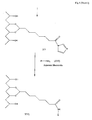
- Figure 1 is a schematic representation of the derivatisation of a hydrogel with fibronectin.
- hydrogel may be prepared and manipulated for use as a "smart" dressing.
- An objective in the preparation of a smart dressing is to recreate using microengineering techniques the microenvironmental conditions of the remodelling extracellular matrix of various types of wound which can then serve as an alternative highly permissive substratum for cell migration and cell division.
- To achieve oriented cell migration and division it is important to present adherent cells with oriented surface shape in the form of microtopograhic guidance cues or micropatterned surface chemistry, in particular that required to initiate and accelerate cell motility.
- microtopography of a surface of a hydrogel can be manipulated in a predetermined manner and, thereafter, the chemistry at the surface can be adjusted thereby to provide a material which can be used to achieve oriented cell migration and division.
- Step (a) Preparation of poly (1,4-di(4-(N-methylpyridinyl))_-2,3-di(4-(1-formylphenyl)butylidene
- a predetermined amount of 88% hydrolysed poly (vinylalcohol) of molecular weight 300,000 is dissolved in water by heating to 60°C for 6 hours. Then this is allowed to cool and a predetermined amount of the butylidene polymer of Step (a) is dissolved in the solution.
- An acid catalyst is added to the blend of Step (b) suitably to produce a pH of about 2.
- the mixture is then left to polymerise whereby the butylidene polymer of Step (a) cross-links the polyvinylalcohol according to the scheme below.
- the concentration of the acid affects the speed of the cross-linking reaction.
- a hydrogel is formed which can be treated and/or manipulated as described herein.
- the hydrogel prepared may include 80-90wt% of entrapped water.
- Example 2 General methodologies for preparing grating slides incorporating predetermined microtopography.
- Oriented microtopographical cues are presented to cells as sets of grooves and ridges or channels embossed/cast into the surface of the gel using a master usually fabricated in fused silica or similar material.
- a desired microtopographic design is first drawn out as a lithographic resist mask either by photographic reduction or using a specific design package.
- a photoresist is patterned by exposure to UV through the lithographic mask followed by removal of exposed/non-exposed photoresist using a developing solution (either is possible depending on whether a positive or negative photoresist is used). This process may be used to fabricate features in the range of 10-looym in linear dimension. To produce microtopographic features smaller than this (e.g.
- electron beam resists usually of PMMA
- a beam writer whereby the design is directly written into the surface of the resist.
- a grating slide incorporating predetermined microtopography is created by reactive ion etching the surface of a fused silica blank with gases such as C 2 F 6 or equivalent using the patterned resist as an etch mask for sufficient time as is required to achieve a given etch depth.
- Grating slides prepared may then be used to create microtopography on a hydrogel surface.
- a selected grating slide made as described in Example 2 was cleaned with 10% decon (a detergent) solution in an ultrasonic bath for 40 minutes, rinsed copiously in-water, thoroughly dried and allowed to cool. The slide was then rinsed with 100% acetone and again allowed to dry. A petri dish was cleaned with heamosoal (a detergent), rinsed copiously in water, dried, and finally rinsed in 100% acetone, excess acetone being allowed to evaporate off. The slide was then placed in the petri dish, grating side up.
- a hydrogel formulation was prepared generally as described in Example 1 Steps(a)-(c), using 60g of a 10wt% solution of polyvinyl alcohol and 0.1 g of the polymer of Example 1, Step (c).
- the aqueous solution formed contains 10wt% polyvinyl alcohol and 0.5 wt% of the polymer of Example 1, step (c).
- the formulation in the presence of 1ml 20% HCl was mixed slowly, to reduce any air bubbles.
- the polymerising mixture was then poured into the petri dish and allowed to fully polymerise in a fume cupboard overnight.
- the dish was then placed into a vacuum oven overnight, at 50°C and -15mmHg pressure. After full polymerisation had occurred the hydrogel was peeled from the dish (and slide) and the grating formed in the hydrogel was cut out from the surrounding redundant hydrogel. It is found, on microscopic examination, that the hydrogel is able to provide a very good reproduction of the grating.
- a selected grating slide was prepared as described in Example 3 and, after drying, was placed on an inverted petri dish, grating side up.
- the hydrogel was prepared using 20g of a 10wt% solution of polyvinylalcohol and 0.1g of the polymer of Example 1, step (c).
- the aqueous solution formed contains 10wt% polyvinylalcohol and 0.5wt% of the polymer of Example 1, step (c).
- the aqueous solution was then mixed slowly with 0.2ml of 20% HCl, and then poured into a 5 cm petri dish to enable a hydrogel of a few mm thickness to be produced to enable it to be stretched.
- any of the hydrogels described herein may be derivatised to improve their bio-compatibility and/or to increase adhesion to cells, and such derivatised-hydrogels may be used in a wide range of applications.
- gels are dried prior to derivatisation. This may involve drying under vacuum at a temperature in the range 20 to 40°C for about 16 hours.
- the gels are dried so that they contain less than 1wt% of water (measured e.g. by thermogravimetric analysis). It has been found that when dried gels are derivatised, the surface of the gel is predominantly derivatised (in preference to internal regions of the gel) from which a number of advantages may result.
- bio-compatibility and/or the ability of the gels to adhere to cells will be concentrated at the surface of such derivatised gels, thereby restricting penetration into the body of the gel.
- derivatisation may not significantly reduce the strength of the gels but may in some cases increase the strength.
- derivatised dried gels may be rehydrated and the resultant hydrated derivatised gel may have comparable (or greater) strength compared to the non-derivatised version.
- Hydrogels may be derivated using a range of methods. Firstly, a material, for example a bio-compatible material may be covalently bonded to the gel. In this regard, for the gel of Example 1 above, derivatisation may involve reactions involving hydroxyl, acetate or aldehyde groups on the gel. A linking group may be attached to the gel via such groups and then a desired bio-compatible material may be covalently attached to the linking group. Examples of suitable linking groups include the following:
- a bio-compatible material may be associated with the gel by formation of a charge transfer complex. More particularly, a complex may involve interaction with an N + moiety of a pyridinium moiety of the gel or a version of the gel derivatised with a pyridinum containing compound as described above.
- a surfactant such as sodium lauryl sulphate may be attached to the gel using this methodology.
- the derivatised gel is less susceptible to subsequent swelling when hydrated and this may facilitate further reactions of the gel, for example of carbonyl groups thereof.
- the bio-compatible material includes one or more amine groups (e.g. the material may be a protein or amino acid), in which case the material may be covalently bonded to the gel by an amide bond.
- amine groups e.g. the material may be a protein or amino acid
- the material may be covalently bonded to the gel by an amide bond.
- examples of materials that may be bonded to the gel in this way and which may improve the gels compatibility with cells include all known extracellular matrix components, cytokines, growth factors, hormones and other intra- or extracellular signalling molecules. A specific example is fibronectin.
- the hydrogel of Example 1, Step (c) (XI) having polyvinylalcohol moieties at its surface is treated with the butylidene polymer (XII) of Example 1, Step (b) in the presence of acetone and an acid-thereby to produce the condensation product XIII.
- Product XIII is then treated with carbonyl diimidazole (XIV) in acetone to produce XV which is treated with aqueous fibronectin (XVI) to produce the fibronectin derivatised hydrogel XVII.
- step (c) 2g of the polymer of Example 1, step (c) is added to 100ml of acetone and the solution stirred for 2 hours. This produces a saturated solution of the polymer of Example 1, step (c) in acetone (excess un-dissolved polymer is seen at the bottom of the flask). 0.5ml of concentrated hydrochloric acid is added to the solution. The dry hydrogel film is then immersed in the acidified polymer/acetone solution for at least 4 hours but not more than 16 hours. (By way of example, a dry hydrogel film of dimensions approx. 10cm diameter by 0.5mm thick requires 50 ml of the solution). The film is then washed with acetone several times and dried at 25°C under vacuum for approximately 4 hours.
- a first method of achieving this involves the use of an elastomer stamp which has desired microtopography cast (or otherwise formed) into its surface.
- the elastomer is cured and soaked in a solution of an amine group containing compound (e.g. a protein such as fibronectin) for a time (about 20 minutes) for it to absorb sufficient of the protein for the application.
- the stamp is briefly exposed to a nitrogen stream to dry it.
- the stamp may be used to deliver fibronectin (XVI) to a gel derivatised as per compound XV of figure 1 ).
- the stamp is withdrawn, leaving covalently bonded amine compound in predetermined positions on the gel.
- the non-derivatised areas may be treated with an alternative amine-group containing compound.
- the latter compound may be selected on the basis of the combinatorial effects of the two amine compounds to bind cells etc or it may act as a blocker for cell attachment. Examples of blockers are albumin and casein.
- a second method of providing micropatterned surface chemistry involves the use of a stamp as described above except that in this case the stamp is planar.
- the stamp loaded with amine containing compound, is moved by an operator to selected positions and contacted with the gel surface to define desired surface chemistry at the selected positions.
- a gel for example in the form of a film, incorporating microtopography and/or micropatterned surface chemistry may be formed in a suitable size to act as a dressing for a wound.
- the dressing is then applied engineered side down onto the wound itself.
- the wound may optionally be pre-treated by dermabrasion (or the like) to achieve appropriate viable cell-hydrogel contact.
- dermabrasion or the like
Landscapes
- Chemical & Material Sciences (AREA)
- Health & Medical Sciences (AREA)
- Chemical Kinetics & Catalysis (AREA)
- Medicinal Chemistry (AREA)
- Polymers & Plastics (AREA)
- Organic Chemistry (AREA)
- Dispersion Chemistry (AREA)
- General Chemical & Material Sciences (AREA)
- Veterinary Medicine (AREA)
- Epidemiology (AREA)
- Life Sciences & Earth Sciences (AREA)
- Animal Behavior & Ethology (AREA)
- General Health & Medical Sciences (AREA)
- Materials Engineering (AREA)
- Public Health (AREA)
- Engineering & Computer Science (AREA)
- Materials For Medical Uses (AREA)
- Addition Polymer Or Copolymer, Post-Treatments, Or Chemical Modifications (AREA)
- Processes Of Treating Macromolecular Substances (AREA)
- Other Resins Obtained By Reactions Not Involving Carbon-To-Carbon Unsaturated Bonds (AREA)
- Colloid Chemistry (AREA)
- Orthopedics, Nursing, And Contraception (AREA)
- Medicines Containing Material From Animals Or Micro-Organisms (AREA)
Claims (25)
- Verfahren zum Derivatisieren eines polymeren Materials eines Typs, welcher eingekapseltes Wasser einschließt, wobei das Verfahren umfasst:(a) Auswählen eines ersten hydratisierten polymeren Materials, welches eingekapseltes Wasser einschließt;(b) Verringern des Gehalts an eingekapseltem Wasser in dem ersten hydratisierten polymeren Material, um ein zweites polymeres Material zu erzeugen;(c) Behandeln des zweiten polymeren Materials mit Derivatisierungsmitteln zum Derivatisieren des zweiten polymeren Materials.
- Verfahren nach Anspruch 1, wobei der Unterschied zwischen den Gew.-% Wasser in dem ersten polymeren Material und denen in dem zweiten polymeren Material wenigstens 40 Gew.-% beträgt und das zweite polymere Material weniger als 10 Gew.-% eingekapseltes Wasser einschließt.
- Verfahren nach Anspruch 1 oder Anspruch 2, wobei das erste hydratisierte polymere Material ein drittes polymeres Material umfasst, welches durch ein Vernetzungsmittel vernetzt ist.
- Verfahren nach einem der vorangehenden Ansprüche, wobei das erste polymere Material durch Auswählen eines dritten polymeren Materials und Behandeln desselben mit einem besagten Vernetzungsmittel hergestellt wird, wobei das dritte polymere Material funktionelle Gruppen einschließt, die ausgewählt sind aus Hydroxyl, Carbonsäure, Carbonsäurederivaten und Amingruppen.
- Verfahren nach Anspruch 3 oder Anspruch 4, wobei das dritte polymere Material ein Polyvinylpolymer ist.
- Verfahren nach einem der Ansprüche 3 bis 5, wobei das dritte polymere Material Polyvinylalkohol ist.
- Verfahren nach einem der vorangehenden Ansprüche, wobei das erste polymere Material vernetzten Polyvinylalkohol umfasst.
- Verfahren nach einem der vorangehenden Ansprüche, wobei das erste polymere Material eine Einheit der Formel I einschließt

- Verfahren nach Anspruch 3 oder Anspruch 4, wobei das Vernetzungsmittel ein viertes polymeres Material umfasst, welches eine Wiederholungseinheit der folgenden Formel einschließt

- Verfahren nach Anspruch 9, wobei A und B voneinander verschieden sind, aus gegebenenfalls substituierten aromatischen und heteroaromatischen Gruppen ausgewählt sind und wenigstens eines von A oder B ein relativ polares Atom oder eine relativ polare Gruppe umfasst, R1 und R2 unabhängig voneinander relativ unpolare Atome oder Gruppen umfassen.
- Verfahren nach einem der vorangehenden Ansprüche, wobei das erste polymere Material eine Einheit der folgenden Formel einschließt

- Verfahren nach einem der vorangehenden Ansprüche, wobei in Schritt (b) das Trocknen bei einer Temperatur im Bereich von 10°C bis 60 °C erfolgt.
- Verfahren nach einem der vorangehenden Ansprüche, wobei in Schritt (c) das zweite polymere Material in einem ersten Derivatisierungsschritt derivatisiert wird, worin das zweite polymere Material mit einem ersten Derivatisierungsmaterial behandelt wird, welches mit dem zweiten polymeren Material reagiert, wobei die Reaktion in Gegenwart von weniger als 5 Gew.-% Wasser durchgeführt wird und in einem organischen Lösungsmittel durchgeführt wird.
- Verfahren nach Anspruch 13, wobei das erste Derivatisierungsmaterial eine oder mehrere funktionelle Carbonyl-, Carboxyl-, Hydroxyl-, Epoxy-, Halogen- oder Aminogruppen einschließt.
- Verfahren nach Anspruch 13 oder Anspruch 14, wobei das erste Derivatisierungsmaterial ausgewählt ist aus Verbindungen der allgemeinen Formel

- Verfahren nach einem der vorangehenden Ansprüche, wobei die Derivatisierung des zweiten polymeren Materials einen oder mehrere Derivatisierungsschritte einschließt, die so angeordnet sind, dass eine Verbindungseinheit an dem zweiten polymeren Material eingeführt wird, wobei die Verbindungseinheit so angeordnet ist, dass sie das zweite polymere Material mit einer aktiven Einheit verbindet.
- Verfahren nach Anspruch 16, wobei die aktive Einheit biokompatibel ist.
- Verfahren nach Anspruch 16 oder Anspruch 17, wobei das aktive Material ausgewählt ist aus Aminosäure enthaltenden Einheiten, Peptiden, Proteinen, leitenden Polymeren und organischen Halbleitern oder die aktive Einheit ein Teil eines Sensors zum Überwachen der Zellchemie oder -biologie sein kann.
- Verfahren nach einem der vorangehenden Ansprüche, welches das Erhöhen des Gehalts an eingekapseltem Wasser in irgendeiner Stufe nach Schritt (b) umfasst.
- Verfahren zum Herstellen eines polymeren Materials, wobei das Verfahren umfasst:(a) Auswählen eines fünften polymeren Materials, welches umfasst:(i) ein drittes polymeres Material, wie in den Ansprüchen 3 bis 6 beschrieben, vernetzt durch ein viertes polymeres Material, wie in den Ansprüchen 9 oder 10 beschrieben; oder(ii) ein polymeres Material, welches eine Einheit der Formel VI, wie in Anspruch 11 beschrieben, einschließt; und(b) Behandeln des fünften polymeren Materials mit Derivatisierungsmitteln zum Derivatisieren des fünften polymeren Materials.
- Derivatisiertes polymeres Material, hergestellt oder herstellbar in einem Verfahren nach einem der Ansprüche 1 bis 19.
- Verfahren zum Herstellen eines Materials für eine biologische Anwendung, wobei das Verfahren das Bilden von mikrotopografischen Merkmalen in einer Oberfläche eines ersten, zweiten oder fünften polymeren Materials gemäß einem der vorangehenden Ansprüche umfasst.
- Polymeres Material, ausgewählt aus den ersten, zweiten oder fünften polymeren Materialien oder ein Hydrogel gemäß einem der vorangehenden Ansprüche mit mikrotopografischen Merkmalen.
- Wundbehandlungsprodukt, umfassend ein derivatisiertes polymeres Material oder Hydrogel gemäß einem der vorangehenden Ansprüche.
- Verwendung eines polymeren Materials oder Hydrogels gemäß einem der vorangehenden Ansprüche für die Herstellung eines Materials zur Behandlung von beschädigten und/oder erkrankten Geweben und/oder Wunden.
Applications Claiming Priority (3)
| Application Number | Priority Date | Filing Date | Title |
|---|---|---|---|
| GB0225761 | 2002-11-05 | ||
| GBGB0225761.6A GB0225761D0 (en) | 2002-11-05 | 2002-11-05 | Polymeric materials |
| PCT/GB2003/004791 WO2004041872A1 (en) | 2002-11-05 | 2003-11-05 | Derivatised hydrogels and their use |
Publications (2)
| Publication Number | Publication Date |
|---|---|
| EP1558652A1 EP1558652A1 (de) | 2005-08-03 |
| EP1558652B1 true EP1558652B1 (de) | 2009-02-11 |
Family
ID=9947228
Family Applications (1)
| Application Number | Title | Priority Date | Filing Date |
|---|---|---|---|
| EP03778489A Expired - Lifetime EP1558652B1 (de) | 2002-11-05 | 2003-11-05 | Modifizierte hydrogele und ihre verwendung |
Country Status (9)
| Country | Link |
|---|---|
| US (1) | US20060058459A1 (de) |
| EP (1) | EP1558652B1 (de) |
| JP (1) | JP2006505648A (de) |
| CN (1) | CN1729211A (de) |
| AT (1) | ATE422507T1 (de) |
| AU (1) | AU2003285488A1 (de) |
| DE (1) | DE60326161D1 (de) |
| GB (3) | GB0225761D0 (de) |
| WO (1) | WO2004041872A1 (de) |
Families Citing this family (4)
| Publication number | Priority date | Publication date | Assignee | Title |
|---|---|---|---|---|
| GB2408330B (en) * | 2003-11-22 | 2008-12-03 | Advanced Gel Technology Ltd | Polymeric materials comprising pH indicators for use in wound dressings |
| GB0608342D0 (en) * | 2006-04-27 | 2006-06-07 | Agt Sciences Ltd | Conduits |
| GB0609778D0 (en) * | 2006-05-17 | 2006-06-28 | Agt Sciences Ltd | Delivery means |
| GB0812940D0 (en) * | 2008-07-16 | 2008-08-20 | Agt Sciences Ltd | Medical implant |
Family Cites Families (8)
| Publication number | Priority date | Publication date | Assignee | Title |
|---|---|---|---|---|
| US3658745A (en) * | 1970-01-14 | 1972-04-25 | Massachusetts Inst Technology | Acetalated cross-linked polyvinyl alcohol hydrogels |
| US4272620A (en) * | 1978-08-09 | 1981-06-09 | Agency Of Industrial Science And Technology | Polyvinyl alcohol-styrylpyridinium photosensitive resins and method for manufacture thereof |
| US4779376A (en) * | 1983-10-25 | 1988-10-25 | Plant Genetics, Inc. | Delivery system for seeds |
| FR2590501B1 (fr) * | 1985-11-22 | 1994-01-14 | Beghin Say Sa | Composition absorbant les liquides |
| GB9619419D0 (en) * | 1996-09-18 | 1996-10-30 | Univ Bradford | Polymeric material |
| FR2790391B1 (fr) * | 1999-03-02 | 2002-11-15 | Flamel Tech Sa | Moyen pour la prevention des adherences post-chirurgicales,a base de peptides collagenique reticule |
| FR2806629B1 (fr) * | 2000-03-22 | 2003-01-24 | Lhd Lab Hygiene Dietetique | Compresse antiseptique |
| AU2003209204A1 (en) * | 2002-01-10 | 2003-07-30 | University Of Washington | Hydrogels formed by non-covalent linkages |
-
2002
- 2002-11-05 GB GBGB0225761.6A patent/GB0225761D0/en not_active Ceased
-
2003
- 2003-11-05 EP EP03778489A patent/EP1558652B1/de not_active Expired - Lifetime
- 2003-11-05 AU AU2003285488A patent/AU2003285488A1/en not_active Abandoned
- 2003-11-05 CN CNA2003801069818A patent/CN1729211A/zh active Pending
- 2003-11-05 GB GB0613528A patent/GB2428241B/en not_active Expired - Fee Related
- 2003-11-05 DE DE60326161T patent/DE60326161D1/de not_active Expired - Fee Related
- 2003-11-05 AT AT03778489T patent/ATE422507T1/de not_active IP Right Cessation
- 2003-11-05 WO PCT/GB2003/004791 patent/WO2004041872A1/en not_active Ceased
- 2003-11-05 US US10/533,899 patent/US20060058459A1/en not_active Abandoned
- 2003-11-05 JP JP2004549354A patent/JP2006505648A/ja active Pending
- 2003-11-05 GB GB0325790A patent/GB2396617B/en not_active Expired - Fee Related
Also Published As
| Publication number | Publication date |
|---|---|
| CN1729211A (zh) | 2006-02-01 |
| AU2003285488A1 (en) | 2004-06-07 |
| DE60326161D1 (de) | 2009-03-26 |
| GB2396617A (en) | 2004-06-30 |
| EP1558652A1 (de) | 2005-08-03 |
| GB0325790D0 (en) | 2003-12-10 |
| WO2004041872A1 (en) | 2004-05-21 |
| JP2006505648A (ja) | 2006-02-16 |
| GB0613528D0 (en) | 2006-08-16 |
| GB2396617B (en) | 2007-04-25 |
| GB2428241A (en) | 2007-01-24 |
| US20060058459A1 (en) | 2006-03-16 |
| GB0225761D0 (en) | 2002-12-11 |
| GB2428241B (en) | 2007-08-15 |
| ATE422507T1 (de) | 2009-02-15 |
Similar Documents
| Publication | Publication Date | Title |
|---|---|---|
| JP4727812B2 (ja) | 重合開始剤基を担持する架橋可能なマクロマー | |
| CN113713179B (zh) | 高综合性能光固化生物3d打印复合水凝胶及其制备方法和应用 | |
| CN101622020B (zh) | 亲水性涂层 | |
| Lim et al. | New visible-light photoinitiating system for improved print fidelity in gelatin-based bioinks | |
| WO2002096978A1 (en) | Crosslinked elastin and process for producing the same | |
| Suzuki et al. | Manufacturing micropatterned collagen scaffolds with chemical-crosslinking for development of biomimetic tissue-engineered oral mucosa | |
| Zhang et al. | A bioactive composite sponge based on biomimetic collagen fibril and oxidized alginate for noncompressible hemorrhage and wound healing | |
| CN112835268B (zh) | 一种生物基水溶性负性光刻胶及其在飞秒激光直写加工方法中的应用 | |
| KR20110062804A (ko) | Ipn 하이드로젤 및 그 제조방법 | |
| CA2546055A1 (en) | Polymeric materials incorporating a ph indicator dye | |
| JP2002541070A (ja) | メルカプト官能基をグラフトすることで改変したコラーゲンペプチド、それを得る方法および生体材料としてのその使用 | |
| EP1558652B1 (de) | Modifizierte hydrogele und ihre verwendung | |
| EP3305339B1 (de) | Verfahren zur herstellung eines kollagenfilms mittels ultraviolettem licht, durch verwendung davon hergestellter kollagenfilm und unter verwendung des kollagenfilms hergestelltes biomaterial | |
| CN102940903B (zh) | 一种多聚糖海绵体医用敷料的制备方法 | |
| JPH11349643A (ja) | 感温性高分子化合物およびその製造方法、感温性高分子組成物、細胞培養基材 | |
| CN121378564A (zh) | 一种用于胃穿孔修复的水凝胶贴片及其制备方法 | |
| CN107349464B (zh) | 一种新型医用止血凝胶敷料的制备方法 | |
| KR20210006195A (ko) | 생체적합성 고분자-하이드로젤 복합체 및 이의 제조방법 | |
| CN105879102B (zh) | 一种羽毛角蛋白接枝海藻酸海绵敷料及其制备方法 | |
| CN113999630A (zh) | 一种粘合剂及其制备方法与应用 | |
| KR101667404B1 (ko) | 광반응성 젤라틴 유도체에 단백질 약물이 고정되어 있는 창상피복재 및 그 제조방법 | |
| EP0472936B1 (de) | Verfahren zur Modifizierung von Oberflächen | |
| CN107137752A (zh) | 一种丝瓜络抗粘连创面敷料的制备方法 | |
| CN108686266A (zh) | 一种三维多孔微支架组装单元的制备方法 | |
| JP6111013B2 (ja) | 腱細胞シート及びその製造方法 |
Legal Events
| Date | Code | Title | Description |
|---|---|---|---|
| PUAI | Public reference made under article 153(3) epc to a published international application that has entered the european phase |
Free format text: ORIGINAL CODE: 0009012 |
|
| 17P | Request for examination filed |
Effective date: 20050503 |
|
| AK | Designated contracting states |
Kind code of ref document: A1 Designated state(s): AT BE BG CH CY CZ DE DK EE ES FI FR GB GR HU IE IT LI LU MC NL PT RO SE SI SK TR |
|
| AX | Request for extension of the european patent |
Extension state: AL LT LV MK |
|
| 17Q | First examination report despatched |
Effective date: 20060915 |
|
| RAP1 | Party data changed (applicant data changed or rights of an application transferred) |
Owner name: AGT SCIENCES LIMITED |
|
| GRAP | Despatch of communication of intention to grant a patent |
Free format text: ORIGINAL CODE: EPIDOSNIGR1 |
|
| GRAS | Grant fee paid |
Free format text: ORIGINAL CODE: EPIDOSNIGR3 |
|
| GRAA | (expected) grant |
Free format text: ORIGINAL CODE: 0009210 |
|
| AK | Designated contracting states |
Kind code of ref document: B1 Designated state(s): AT BE BG CH CY CZ DE DK EE ES FI FR GB GR HU IE IT LI LU MC NL PT RO SE SI SK TR |
|
| AX | Request for extension of the european patent |
Extension state: AL LT LV MK |
|
| REG | Reference to a national code |
Ref country code: GB Ref legal event code: FG4D |
|
| REG | Reference to a national code |
Ref country code: CH Ref legal event code: EP |
|
| REG | Reference to a national code |
Ref country code: IE Ref legal event code: FG4D |
|
| REF | Corresponds to: |
Ref document number: 60326161 Country of ref document: DE Date of ref document: 20090326 Kind code of ref document: P |
|
| LTIE | Lt: invalidation of european patent or patent extension |
Effective date: 20090211 |
|
| PG25 | Lapsed in a contracting state [announced via postgrant information from national office to epo] |
Ref country code: SI Free format text: LAPSE BECAUSE OF FAILURE TO SUBMIT A TRANSLATION OF THE DESCRIPTION OR TO PAY THE FEE WITHIN THE PRESCRIBED TIME-LIMIT Effective date: 20090211 Ref country code: NL Free format text: LAPSE BECAUSE OF FAILURE TO SUBMIT A TRANSLATION OF THE DESCRIPTION OR TO PAY THE FEE WITHIN THE PRESCRIBED TIME-LIMIT Effective date: 20090211 Ref country code: ES Free format text: LAPSE BECAUSE OF FAILURE TO SUBMIT A TRANSLATION OF THE DESCRIPTION OR TO PAY THE FEE WITHIN THE PRESCRIBED TIME-LIMIT Effective date: 20090522 Ref country code: FI Free format text: LAPSE BECAUSE OF FAILURE TO SUBMIT A TRANSLATION OF THE DESCRIPTION OR TO PAY THE FEE WITHIN THE PRESCRIBED TIME-LIMIT Effective date: 20090211 |
|
| NLV1 | Nl: lapsed or annulled due to failure to fulfill the requirements of art. 29p and 29m of the patents act | ||
| PG25 | Lapsed in a contracting state [announced via postgrant information from national office to epo] |
Ref country code: AT Free format text: LAPSE BECAUSE OF FAILURE TO SUBMIT A TRANSLATION OF THE DESCRIPTION OR TO PAY THE FEE WITHIN THE PRESCRIBED TIME-LIMIT Effective date: 20090211 Ref country code: SE Free format text: LAPSE BECAUSE OF FAILURE TO SUBMIT A TRANSLATION OF THE DESCRIPTION OR TO PAY THE FEE WITHIN THE PRESCRIBED TIME-LIMIT Effective date: 20090511 |
|
| PG25 | Lapsed in a contracting state [announced via postgrant information from national office to epo] |
Ref country code: BE Free format text: LAPSE BECAUSE OF FAILURE TO SUBMIT A TRANSLATION OF THE DESCRIPTION OR TO PAY THE FEE WITHIN THE PRESCRIBED TIME-LIMIT Effective date: 20090211 |
|
| PG25 | Lapsed in a contracting state [announced via postgrant information from national office to epo] |
Ref country code: CZ Free format text: LAPSE BECAUSE OF FAILURE TO SUBMIT A TRANSLATION OF THE DESCRIPTION OR TO PAY THE FEE WITHIN THE PRESCRIBED TIME-LIMIT Effective date: 20090211 Ref country code: EE Free format text: LAPSE BECAUSE OF FAILURE TO SUBMIT A TRANSLATION OF THE DESCRIPTION OR TO PAY THE FEE WITHIN THE PRESCRIBED TIME-LIMIT Effective date: 20090211 Ref country code: DK Free format text: LAPSE BECAUSE OF FAILURE TO SUBMIT A TRANSLATION OF THE DESCRIPTION OR TO PAY THE FEE WITHIN THE PRESCRIBED TIME-LIMIT Effective date: 20090211 Ref country code: PT Free format text: LAPSE BECAUSE OF FAILURE TO SUBMIT A TRANSLATION OF THE DESCRIPTION OR TO PAY THE FEE WITHIN THE PRESCRIBED TIME-LIMIT Effective date: 20090713 |
|
| PG25 | Lapsed in a contracting state [announced via postgrant information from national office to epo] |
Ref country code: SK Free format text: LAPSE BECAUSE OF FAILURE TO SUBMIT A TRANSLATION OF THE DESCRIPTION OR TO PAY THE FEE WITHIN THE PRESCRIBED TIME-LIMIT Effective date: 20090211 Ref country code: RO Free format text: LAPSE BECAUSE OF FAILURE TO SUBMIT A TRANSLATION OF THE DESCRIPTION OR TO PAY THE FEE WITHIN THE PRESCRIBED TIME-LIMIT Effective date: 20090211 |
|
| PLBE | No opposition filed within time limit |
Free format text: ORIGINAL CODE: 0009261 |
|
| STAA | Information on the status of an ep patent application or granted ep patent |
Free format text: STATUS: NO OPPOSITION FILED WITHIN TIME LIMIT |
|
| 26N | No opposition filed |
Effective date: 20091112 |
|
| PG25 | Lapsed in a contracting state [announced via postgrant information from national office to epo] |
Ref country code: BG Free format text: LAPSE BECAUSE OF FAILURE TO SUBMIT A TRANSLATION OF THE DESCRIPTION OR TO PAY THE FEE WITHIN THE PRESCRIBED TIME-LIMIT Effective date: 20090511 |
|
| PG25 | Lapsed in a contracting state [announced via postgrant information from national office to epo] |
Ref country code: MC Free format text: LAPSE BECAUSE OF NON-PAYMENT OF DUE FEES Effective date: 20091130 |
|
| REG | Reference to a national code |
Ref country code: CH Ref legal event code: PL |
|
| GBPC | Gb: european patent ceased through non-payment of renewal fee |
Effective date: 20091105 |
|
| REG | Reference to a national code |
Ref country code: FR Ref legal event code: ST Effective date: 20100730 |
|
| PG25 | Lapsed in a contracting state [announced via postgrant information from national office to epo] |
Ref country code: LI Free format text: LAPSE BECAUSE OF NON-PAYMENT OF DUE FEES Effective date: 20091130 Ref country code: GR Free format text: LAPSE BECAUSE OF FAILURE TO SUBMIT A TRANSLATION OF THE DESCRIPTION OR TO PAY THE FEE WITHIN THE PRESCRIBED TIME-LIMIT Effective date: 20090512 Ref country code: IE Free format text: LAPSE BECAUSE OF NON-PAYMENT OF DUE FEES Effective date: 20091105 Ref country code: FR Free format text: LAPSE BECAUSE OF NON-PAYMENT OF DUE FEES Effective date: 20091130 Ref country code: CH Free format text: LAPSE BECAUSE OF NON-PAYMENT OF DUE FEES Effective date: 20091130 |
|
| PG25 | Lapsed in a contracting state [announced via postgrant information from national office to epo] |
Ref country code: DE Free format text: LAPSE BECAUSE OF NON-PAYMENT OF DUE FEES Effective date: 20100601 |
|
| PG25 | Lapsed in a contracting state [announced via postgrant information from national office to epo] |
Ref country code: GB Free format text: LAPSE BECAUSE OF NON-PAYMENT OF DUE FEES Effective date: 20091105 |
|
| PG25 | Lapsed in a contracting state [announced via postgrant information from national office to epo] |
Ref country code: IT Free format text: LAPSE BECAUSE OF FAILURE TO SUBMIT A TRANSLATION OF THE DESCRIPTION OR TO PAY THE FEE WITHIN THE PRESCRIBED TIME-LIMIT Effective date: 20090211 |
|
| PG25 | Lapsed in a contracting state [announced via postgrant information from national office to epo] |
Ref country code: LU Free format text: LAPSE BECAUSE OF NON-PAYMENT OF DUE FEES Effective date: 20091105 |
|
| PG25 | Lapsed in a contracting state [announced via postgrant information from national office to epo] |
Ref country code: HU Free format text: LAPSE BECAUSE OF FAILURE TO SUBMIT A TRANSLATION OF THE DESCRIPTION OR TO PAY THE FEE WITHIN THE PRESCRIBED TIME-LIMIT Effective date: 20090812 |
|
| PG25 | Lapsed in a contracting state [announced via postgrant information from national office to epo] |
Ref country code: TR Free format text: LAPSE BECAUSE OF FAILURE TO SUBMIT A TRANSLATION OF THE DESCRIPTION OR TO PAY THE FEE WITHIN THE PRESCRIBED TIME-LIMIT Effective date: 20090211 |
|
| PG25 | Lapsed in a contracting state [announced via postgrant information from national office to epo] |
Ref country code: CY Free format text: LAPSE BECAUSE OF FAILURE TO SUBMIT A TRANSLATION OF THE DESCRIPTION OR TO PAY THE FEE WITHIN THE PRESCRIBED TIME-LIMIT Effective date: 20090211 |