EP1557675B1 - Dispensing device and analyzing apparatus - Google Patents
Dispensing device and analyzing apparatus Download PDFInfo
- Publication number
- EP1557675B1 EP1557675B1 EP05001106A EP05001106A EP1557675B1 EP 1557675 B1 EP1557675 B1 EP 1557675B1 EP 05001106 A EP05001106 A EP 05001106A EP 05001106 A EP05001106 A EP 05001106A EP 1557675 B1 EP1557675 B1 EP 1557675B1
- Authority
- EP
- European Patent Office
- Prior art keywords
- chip
- base
- syringe
- dispensing device
- attaching member
- Prior art date
- Legal status (The legal status is an assumption and is not a legal conclusion. Google has not performed a legal analysis and makes no representation as to the accuracy of the status listed.)
- Expired - Lifetime
Links
- 230000033001 locomotion Effects 0.000 claims abstract description 34
- 230000001105 regulatory effect Effects 0.000 claims description 20
- 238000012546 transfer Methods 0.000 claims description 20
- 239000007788 liquid Substances 0.000 claims description 13
- 238000007599 discharging Methods 0.000 claims description 3
- 238000012544 monitoring process Methods 0.000 claims description 3
- 239000003153 chemical reaction reagent Substances 0.000 description 57
- 230000006835 compression Effects 0.000 description 57
- 238000007906 compression Methods 0.000 description 57
- 108090000790 Enzymes Proteins 0.000 description 25
- 102000004190 Enzymes Human genes 0.000 description 25
- 230000007246 mechanism Effects 0.000 description 25
- 108010076876 Keratins Proteins 0.000 description 13
- 102000011782 Keratins Human genes 0.000 description 13
- 230000004544 DNA amplification Effects 0.000 description 11
- 238000012545 processing Methods 0.000 description 10
- 230000035939 shock Effects 0.000 description 8
- 238000000034 method Methods 0.000 description 6
- 108090000623 proteins and genes Proteins 0.000 description 6
- 206010028980 Neoplasm Diseases 0.000 description 5
- 201000011510 cancer Diseases 0.000 description 5
- 238000001514 detection method Methods 0.000 description 5
- 230000000694 effects Effects 0.000 description 5
- 238000007397 LAMP assay Methods 0.000 description 4
- 230000003321 amplification Effects 0.000 description 4
- 238000003199 nucleic acid amplification method Methods 0.000 description 4
- 238000003825 pressing Methods 0.000 description 4
- 239000011347 resin Substances 0.000 description 4
- 229920005989 resin Polymers 0.000 description 4
- 102000007469 Actins Human genes 0.000 description 3
- 108010085238 Actins Proteins 0.000 description 3
- 108020004999 messenger RNA Proteins 0.000 description 3
- 230000005540 biological transmission Effects 0.000 description 2
- 230000008859 change Effects 0.000 description 2
- 238000010586 diagram Methods 0.000 description 2
- 238000007865 diluting Methods 0.000 description 2
- 238000001914 filtration Methods 0.000 description 2
- 239000000758 substrate Substances 0.000 description 2
- OKTJSMMVPCPJKN-UHFFFAOYSA-N Carbon Chemical compound [C] OKTJSMMVPCPJKN-UHFFFAOYSA-N 0.000 description 1
- 206010027476 Metastases Diseases 0.000 description 1
- 230000002411 adverse Effects 0.000 description 1
- 230000008901 benefit Effects 0.000 description 1
- 229910052799 carbon Inorganic materials 0.000 description 1
- 238000004891 communication Methods 0.000 description 1
- 230000008602 contraction Effects 0.000 description 1
- 230000001276 controlling effect Effects 0.000 description 1
- 230000003413 degradative effect Effects 0.000 description 1
- 238000003745 diagnosis Methods 0.000 description 1
- XZTWHWHGBBCSMX-UHFFFAOYSA-J dimagnesium;phosphonato phosphate Chemical compound [Mg+2].[Mg+2].[O-]P([O-])(=O)OP([O-])([O-])=O XZTWHWHGBBCSMX-UHFFFAOYSA-J 0.000 description 1
- 238000010894 electron beam technology Methods 0.000 description 1
- 230000001678 irradiating effect Effects 0.000 description 1
- 238000007834 ligase chain reaction Methods 0.000 description 1
- 238000004519 manufacturing process Methods 0.000 description 1
- 239000000463 material Substances 0.000 description 1
- 230000009401 metastasis Effects 0.000 description 1
- 238000004848 nephelometry Methods 0.000 description 1
- 230000003287 optical effect Effects 0.000 description 1
- 238000012856 packing Methods 0.000 description 1
- 238000003752 polymerase chain reaction Methods 0.000 description 1
- 230000008569 process Effects 0.000 description 1
- 210000003296 saliva Anatomy 0.000 description 1
- 238000003860 storage Methods 0.000 description 1
Images





Classifications
-
- G—PHYSICS
- G01—MEASURING; TESTING
- G01N—INVESTIGATING OR ANALYSING MATERIALS BY DETERMINING THEIR CHEMICAL OR PHYSICAL PROPERTIES
- G01N35/00—Automatic analysis not limited to methods or materials provided for in any single one of groups G01N1/00 - G01N33/00; Handling materials therefor
- G01N35/10—Devices for transferring samples or any liquids to, in, or from, the analysis apparatus, e.g. suction devices, injection devices
- G01N35/1009—Characterised by arrangements for controlling the aspiration or dispense of liquids
- G01N35/1011—Control of the position or alignment of the transfer device
-
- G—PHYSICS
- G01—MEASURING; TESTING
- G01N—INVESTIGATING OR ANALYSING MATERIALS BY DETERMINING THEIR CHEMICAL OR PHYSICAL PROPERTIES
- G01N35/00—Automatic analysis not limited to methods or materials provided for in any single one of groups G01N1/00 - G01N33/00; Handling materials therefor
- G01N35/10—Devices for transferring samples or any liquids to, in, or from, the analysis apparatus, e.g. suction devices, injection devices
- G01N2035/1027—General features of the devices
- G01N2035/103—General features of the devices using disposable tips
Definitions
- the Japanese Laid-Open Patent Publication No. 2003-344427 has disclosed a dispensing device in which the chip attaching member can be moved in a downward direction and a spring for energizing the chip attaching member in the downward direction is provided.
- the dispensing device detects the amount of a movement when the chip attaching member is moved in an upward direction against the energizing force of the spring in the collision of the chip attaching member, thereby detecting the contact of the chip attaching member with the bottom face of the well.
- JP 10-038 896 A also discloses a dispensing device in which the chip attaching member can be moved in a downward direction and two springs for energizing the chip attaching member in the downward direction are provided.
- a dispensing device comprising: a base which can be moved in a first direction; a chip attaching member, which is provided movably within a predetermined moving range in a second direction opposite to the first direction with respect to the base, and to which a dispensing chip can be removably attached by a movement of the base in the first direction; effort applying means for applying an effort to the chip attaching member in the first direction and changing the magnitude of the effort when the chip attaching member is moved a first distance (X1) in the second direction with respect to the base; a detector for detecting that the chip attaching member has been moved said first distance (X1) in the second direction with respect to the base, and for detecting that the chip attaching member has been moved a second distance (X1+X2) greater than the first distance (X1) in the second direction with respect to the base; a driving source for moving the base; and a controller for monitoring whether or not the dispensing chip is normally attached to the chip attaching member, wherein: the controller is
- An analyzing apparatus comprising a dispensing device according to the invention for dispensing a sample; and a transfer device for transferring the dispensing device is also provided.
- a dispensing device comprising a base; a chip attaching member which is provided movably with respect to the base and to which a dispensing chip is attached removably; a first elastic member for suppressing a movement of the chip attaching member with respect to the base; a second elastic member serving to suppress the movement of the chip attaching member with respect to the base and having a greater elastic constant than an elastic constant of the first elastic member; and a detector for detecting that the chip attaching member is moved with respect to the base.
- a dispensing device comprising a base which can be moved in a first direction; a chip attaching member which is provided movably in a second direction to be an opposite direction to the first direction with respect to the base and to which a dispensing chip is attached by a movement of the base in the first direction; first energizing means for giving a first energizing force directed at the first direction to the chip attaching member; second energizing means for giving a second energizing force directed at the first direction to the chip attaching member, the second energizing force being greater than the first energizing force; and a detector for detecting that the chip attaching member is moved in the second direction with respect to the base.
- An analyzing apparatus comprising a base; a chip attaching member which is provided movably with respect to the base and to which a dispensing chip is attached removably; a first elastic member for suppressing a movement of the chip attaching member with respect to the base; a second elastic member serving to suppress the movement of the chip attaching member with respect to the base and having a greater elastic constant than an elastic constant of the first elastic member; and a detector for detecting that the chip attaching member is moved with respect to the base.
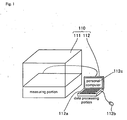
- Fig. 1 is a perspective view showing the whole structure of one embodiment of an analyzing apparatus and a data processing portion thereof.
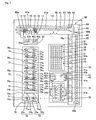
- Fig. 2 is a perspective view showing the whole structure of the measuring portion of the analyzing apparatus illustrated in Fig. 1
- Fig. 3 is a schematic plan view of Fig. 2 .
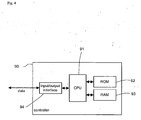
- Fig. 4 is a block diagram showing the structure of a controller illustrated in Fig. 2
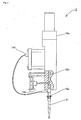
- Fig. 5 is a view showing the syringe portion of the measuring portion of the analyzing apparatus illustrated in Fig. 2
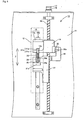
- Fig. 6 is a schematic view showing the syringe up-down portion of the measuring portion of the analyzing apparatus illustrated in Fig. 2
- Fig. 1 is a perspective view showing the whole structure of one embodiment of an analyzing apparatus and a data processing portion thereof.
- Fig. 2 is a perspective view showing the whole structure of the measuring portion of the analyzing apparatus illustrated in Fig. 1
- Fig. 3 is a schematic plan view of Fig. 2 .
- FIG. 7 is a schematic top view showing the syringe up-down portion in Fig. 6 .
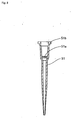
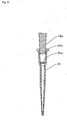
- Figs. 8 and 9 are views showing a pipette chip and a rack in the measuring portion of the analyzing apparatus illustrated in Fig. 2 .
- description will be given to a gene amplification detecting apparatus as an example of the analysing apparatus including a dispensing device.
- the gene amplification detecting apparatus is an analyzing apparatus for supporting the cancer metastasis diagnosis of an excised tissue in a cancer operation and serves to amplify a gene (mRNA) caused by a cancer present in the excised tissue by using a LAMP (Loop-mediated Isothermal Amplification) method and to measure the turbidity of a solution generated with the amplification, thereby carrying out a detection.
- LAMP Loop-mediated Isothermal Amplification
- an analyzing apparatus (a gene amplification detecting apparatus) 110 is constituted by a measuring portion 111 and a data processing portion 112 connected to the measuring portion 111 through a communication circuit.
- the data processing portion 112 is constituted by a personal computer including a keyboard 112a, a mouse 112b and a display portion 112c.
- the measuring portion 111 includes a dispensing mechanism portion 10, a sample vessel set portion 30, a reagent vessel set portion 40, a chip set portion 50, a chip discarding portion 60, a reaction detecting portion 70 formed by five reaction detecting blocks 70a, and a transfer portion 80 for transferring the dispensing mechanism portion 10 in an XY-axis direction.
- the measuring portion 111 includes a controller 90 and a power supply portion 100 for supplying a power to the whole apparatus including the controller 90 as shown in Fig. 2 .
- an emergency stop switch 101 is provided in the predetermined part of the front face of the measuring portion 111. As shown in Fig.
- the dispensing mechanism portion 10 includes an arm portion 11 to be moved in the X-axis and Y-axis directions (a plane direction) by means of the transfer portion 80, two syringe portions 12 which can be moved in a Z-axis direction (a perpendicular direction) independently with respect to the arm portion 11 respectively and are arranged in a transverse direction, and a syringe up-down portion 13 for moving the syringe portion 12 in the Z-axis direction.
- the syringe portion 12 further includes a nozzle 12a to/from which a pipette chip 51 to be described below is attached/removed at a tip, a pump 12b for carrying out a suction and a discharge through the nozzle 12a, a motor 12c for driving the pump 12b, an electrostatic capacity sensor 12d, and a pressure detecting sensor 12e as shown in Fig. 5 .
- the pump 12b moreover, it is possible to obtain the sucking and discharging functions of the syringe portion 12 by converting the rotation of the motor 12c into a piston motion.
- the electrostatic capacity sensor 12d is a sensor of an electrostatic capacity type and serves to detect the electrostatic capacities of the pipette chip 51 formed of a conductive resin and a liquid.
- the pressure detecting sensor 12e serves to detect a pressure in the suction and discharge to be carried out by the pump 12b. By the electrostatic capacity sensor 12d and the pressure detecting sensor 12e, whether the suction and discharge is surely carried out is detected.
- the syringe portion 13 is constituted by a base 14, a linear motion guide 15, a ball screw 16, a pulley 17 on a ball screw side, a pulley 18 on a motor side, a driving belt 19, a stepping motor 20, a syringe support portion 21, a lower compression coiled spring 22, an upper compression coiled spring 23, a stopper 24, a light transmission type sensor 25, and a shielding plate 26.
- the base 14 is attached to the front face of the arm portion 11 through a rail 15a and a slider 15b which constitute the linear motion guide 15.
- the base 14 is engaged with the ball screw 16.
- the ball screw 16 is provided to be extended in the Z-axis direction (vertical direction).
- the pulley 17 on the ball screw side is attached to the upper end of the ball screw 16 as shown in Figs. 6 and 7 .
- the stepping motor 20 is provided on the back face of the arm portion 11, and furthermore, the pulley 18 on the motor side is attached to the shaft of the stepping motor 20.
- the driving belt 19 is attached between the pulley 17 on the ball screw side and the pulley 18 on the motor side. Consequently, the base 14 is constituted to be moved in the Z-axis direction (the vertical direction) along the rail 15a with the rotation of the ball screw 16 by the driving operation of the stepping motor 20.
- the syringe support portion 21 is provided below the base 14 and supports the syringe portion 12 as shown in Fig. 6 .
- the syringe support portion 21 is fixed to a slider (not shown) attached slidably to the rail 15a in the same manner as the base 14. Consequently, the syringe support portion 21 is constituted movably in the Z-axis direction (the vertical direction) along the rail 15a.
- the syringe portion 12 is also moved integrally with the syringe support portion 21.
- a regulating portion 21a is provided to be protruded from the front face of the syringe support portion 21.
- a support shaft 21b extended upward is provided integrally with the upper face of the regulating portion 21a.
- the support shaft 21b includes a cylindrical spring support portion 21c having a predetermined diameter and a cylindrical slip stopping portion 21d provided on the upper side of the spring support portion 21c and having a larger diameter than the diameter of the spring support portion 21c.
- the base 14 is provided with a U-shaped nick portion 14a seen from above.
- the spring support portion 21c of the support shaft 21b is engaged with the nick portion 14a movably in the Z-axis direction and is constituted in such a manner that the support shaft 21b can be prevented from slipping from the nick portion 14a downward by the slip stopping portion 21d.
- the lower compression coiled spring 22, the upper compression coiled spring 23 and the stopper 24 are attached to the spring support portion 21c of the support shaft 21b, and the lower compression coiled spring 22 and the upper compression coiled spring 23 are provided in series through the stopper 24.
- a spring constant k1 of the lower compression coiled spring 22 is set to have a smaller value than the value of a spring constant k2 of the upper compression coiled spring 23.
- the upper end of the upper compression coiled spring 23 abuts on the lower face of the base 14, and furthermore, the lower end of the lower compression coiled spring 22 abuts on the upper face of the regulating portion 21a of the syringe support portion 21.
- the stopper 24 is provided with a concave portion 24a and a through hole 24b is formed on the bottom face of the concave portion 24a. Moreover, the stopper 24 is provided in such a manner that the opening portion side of the concave portion 24a is set to be a lower side, and the spring support portion 21c of the support shaft 21b is inserted in the through hole 24b. Furthermore, the stopper 24 is constituted to be relatively movable in the vertical direction with respect to the spring support portion 21c of the support shaft 21b. Furthermore, a part of the lower compression coiled spring 22 is accommodated in the concave portion 24a of the stopper 24.
- the lower compression coiled spring 22 is provided between the bottom face of the concave portion 24a of the stopper 24 and the upper face of the regulating portion 21a of the syringe support portion 21. Consequently, the lower end of the stopper 24 abuts on the upper face of the regulating portion 21a when the lower compression coiled spring 22 contracts, and the range of the contraction of the lower compression coiled spring 22 is thus regulated. More specifically, if the lower end of the stopper 24 abuts on the upper face of the regulating portion 21a when the lower compression coiled spring 22 contracts, the lower compression coiled spring 22 does not contract any more.
- the light transmission type sensor 25 is provided for detecting that the syringe portion 12 and the syringe support portion 21 are moved with respect to the base 14.
- the sensor 25 is attached to the side face of the base 14.
- the sensor 25 includes a light source portion 25a for irradiating a light and a light receiving portion 25b provided opposite to the light source portion 25a and serving to receive the light irradiated from the light source portion 25a as shown in Fig. 7 .
- the sensor 25 is constituted to output an ON signal when the light receiving portion 25b receives a light irradiated from the light source portion 25a and to output an OFF signal when the light receiving portion 25b does not receive the light irradiated from the light source portion 25a.
- the shielding plate 26 is provided to shield the light irradiated from the light source portion 25a of the sensor 25.
- the shielding plate 26 is attached to the syringe support portion 21 as shown in Fig. 6 .
- the shielding plate 26 has a rectangular nick portion 26a. A portion including the nick portion 26a of the shielding plate 26 is provided between the light source portion 25a and the light receiving portion 25b in the sensor 25 as shown in Fig. 7 .
- the nick portion 26a is provided in such a manner that the light irradiated from the light source portion 25a of the sensor 25 is incident on the light receiving portion 25b through the nick portion 26a when the syringe support portion 21 is moved in an upward direction so that the lower end of the stopper 24 abuts on the upper face of the regulating portion 21a of the syringe support portion 21.
- the controller 90 serves to detect positions in the Z-axis direction (the vertical direction) of the syringe support portion 21 and the syringe portion 12 based on the number of driving pulses (the amount of driving) of the stepping motor 20. Moreover, the controller 90 is constituted to detect whether the nozzle 12a of the syringe portion 12 is normally attached to the pipette chip 51 based on the output signal (ON/OFF signal) of the sensor 25 and the amount of driving of the stepping motor 20 (the number of driving pulses).
- a sample vessel set table 31 having five sample vessel set holes 31a and a holding portion 31b is removably fitted in a concave portion (not shown) of the sample vessel set portion 30.
- a sample vessel 32 accommodating a soluble extracted solution (sample) prepared by pretreating (homogenizing, filtering and diluting) an excised tissue is set to the five sample vessel set holes 31 a of the sample vessel set table 31.
- a reagent vessel set table 41 having two primer reagent vessel set holes 41a and one enzyme reagent vessel set hole 41b, and a holding portion 41c is removably fitted in a concave portion (not shown) of the reagent vessel set portion 40.
- the primer reagent vessel set hole 41 a of the reagent vessel set table 41 is provided at a predetermined interval in the Y-axis direction, and the enzyme reagent vessel set hole 41b is provided on only the left side of a front face.
- a primer reagent vessel 42a accommodating the primer reagent of ⁇ -actin and an enzyme reagent vessel 42b accommodating a common enzyme reagent to cytokeratin (CK19) and the ⁇ -actin are provided in the primer reagent vessel set hole 41a and the enzyme reagent vessel set hole 41b which are provided on the left side of the front face (see Fig. 3 ), respectively.
- a primer reagent vessel 42a accommodating a CK19 primer reagent is provided in the primer reagent vessel set hole 41a provided on the right side of the front face.
- two racks 52 are removably fitted in two concave portions (not shown) of the chip set portion 50.
- Each of the racks 52 has housing holes 52a capable of accommodating 36 pipette chips 51.
- two removal buttons 53 are provided on the chip set portion 50. By pressing the removal button 53, it is possible to bring a state in which the rack 52 can be removed.
- the pipette chip 51 is formed by a conductive resin material containing carbon, and furthermore, a filter 51a is attached to an inner part as shown in Fig. 8 .
- the filter 51 a has a function of preventing an erroneous flow into the pump 12b for a liquid.
- An electron beam irradiation is carried out in a packing state before shipment in such a manner that a degradative enzyme such as human saliva which might be stuck in a process for manufacturing the pipette chip 51 does not adversely influence the amplification of a gene.
- the rack 52 accommodating the pipette chip 51 is stored in a state in which a lower cover 54 and an upper cover 55 are attached as shown in Fig. 9 before setting to the chip set portion 50.
- a chip discarding portion 60 is provided with two chip discarding holes 60a for discarding the used pipette chip 51.
- a trench portion 60b having a smaller width than that of the chip discarding hole 60a is provided continuously with the chip discarding hole 60a.
- each reaction detecting block 70a of a reaction detecting portion 70 is constituted by a reacting portion 71, two turbidity detecting portions 72, and a cover closing mechanism portion 73 as shown in Fig. 2 .
- each reacting portion 71 is provided with two detecting cell set holes 71 a for setting a detecting cell 75.
- the turbidity detecting portion 72 is constituted by an LED light source portion 72a formed by a blue LED having a wavelength of 465 nm which is attached to a substrate 74a provided on one of the side faces of the reacting portion 71, and a photodiode light receiving portion 72b attached to the substrate 74b which is provided on the other side face of the reacting portion 71.
- Each reaction detecting block 70a is provided with two sets of turbidity detecting portions 72, each of which is constituted by an LED light source portion 72a and a photodiode light receiving portion 72b.
- reaction detecting blocks 70a are provided with ten sets of turbidity detecting portions 72 including the LED light source portions 72a and the photodiode light receiving portions 72b in total.
- the LED light source portion 72a and the photodiode light receiving portion 72b corresponding thereto are provided in such a manner that a light having a diameter of approximately 1 mm is irradiated from the LED light source portion 72a onto the lower part of the detecting cell 75 and a light can be thus received by the photodiode light receiving portion 72b.
- the LED light source portion 72a and the photodiode light receiving portion 72b have a function of detecting the presence of the detecting cell 75 depending on the intensity of a light received by the photodiode light receiving portion 72b and detecting (monitoring) the turbidity of a solution accommodated in the detecting cell 75 in real time.
- the transfer portion 80 includes a linear motion guide 81 and a ball screw 82 for transferring the dispensing mechanism portion 10 in the Y-axis direction, a stepping motor 83 for driving the ball screw 82, a linear motion guide 84 and a ball screw 85 for transferring the dispensing mechanism portion 10 in the X-axis direction, and a stepping motor 86 for driving the ball screw 85.
- a rail portion 81 a of the linear motion guide 81 and a support portion 82a of the ball screw 82 in the Y-axis direction are attached to a frame 87.
- the other support portion 82b of the ball screw 82 is attached to the frame 87 through the stepping motor 83.
- a slide portion 81b of the linear motion guide 81 in the Y-axis direction and a straight moving portion (not shown) of the ball screw 82 are attached to the arm portion 11 of the dispensing mechanism portion 10.
- a rail portion 84a of the linear motion guide 84 in the X-axis direction and a support portion 85a of the ball screw 85 are attached to a support table 88.
- a slide portion (not shown) of the linear motion guide 84 in the X-axis direction and the other support portion 85b of the ball screw 85 are attached to the frame 87.
- a stepping motor 86 is attached to the other support portion 85b of the ball screw 85.
- a transfer in the XY-axis direction of the dispensing mechanism portion 10 is carried out by rotating the ball screws 82 and 85 through the stepping motors 83 and 86, respectively.
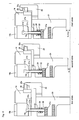
- Figs. 10 to 15 are views for explaining the operation of the above described analyzing apparatus.
- a "first state”, a “second state” and a “third state” in Fig. 11 correspond to the states of the base and the syringe support portion in Figs. 6 , 12 and 13 , respectively.
- Figs. 1 to 15 next, description will be given to the operation of the analyzing apparatus (gene amplification detecting apparatus) according to the present embodiment.
- a gene (mRNA) caused by a cancer present in an excised tissue in a cancer operation is amplified by using a LAMP method and the turbidity of a solution generated with the amplification is measured to carry out a detection.
- the sample vessel 32 accommodating a soluble extracted solution (sample) prepared by pretreating (homogenizing, filtering and diluting) an excised tissue is set to the sample vessel set hole 31 a of the sample vessel set table 31.
- the primer reagent vessel 42a accommodating the primer reagent of the ⁇ -actin
- the enzyme reagent vessel 42b accommodating a common enzyme reagent to the cytokeratin (CK19) and the ⁇ -actin are set to the primer reagent vessel set hole 41a and the enzyme reagent vessel set hole 41b which are provided on the left side of the front face, respectively.
- the primer reagent vessel 42a accommodating the primer reagent of the CK19 is set to the primer reagent vessel set hole 41a provided on the right side of the front face.
- each of the two racks 52 which accommodates 36 disposable pipette chips 51 is fitted in the concave portion (not shown) of the chip set portion 50.
- the initial position (origin position) of the arm portion 11 of the dispensing mechanism portion 10 is shifted from the upper part of the chip set portion 50 as shown in Figs. 2 and 3 . Therefore, the two racks 52 can easily be fitted in the concave portion (not shown) of the chip set portion 50.
- two cell portions 76a of the detecting cell 75 are set to two detecting cell set holes 71 a of the reacting portion 71 of each reaction detecting block 70a.
- the operation of the measuring portion 111 is started by means of the keyboard 112a or the mouse 112b.
- the arm portion 11 of the dispensing mechanism portion 10 is first moved from the initial position to the chip set portion 50 by means of the transfer portion 80. Then, the stepping motor 20 of the syringe up-down portion 13 (see Fig. 7 ) is driven so that the ball screw 16 is rotated. Consequently, the base 14 of the syringe up-down portion 13 is moved in a downward direction. In the chip set portion 50 (see Fig. 2 ), consequently, the two syringe portions 12 of the dispensing mechanism portion 10 and the syringe support portion 21 are moved in the downward direction.
- the nozzle 12a of the syringe portion 12 in the case in which the tip of the nozzle 12a of the syringe portion 12 is normally inserted in the opening portion of the upper part of the pipette chip 51 as shown in Fig. 10 , the nozzle 12a abuts on the internal wall surface of the pipette chip 51 when the tip of the nozzle 12a reaches a downward position from the upper face of a flange portion 51b of the pipette chip 51 by approximately 2 mm to 3 mm. Consequently, the nozzle 12a receives an upward force. Therefore, the syringe portion 12 and the syringe support portion 21 are moved in an upward direction by a distance x1 (see Fig.
- the syringe portion 12 and the syringe support portion 21 are changed from a first state (see Figs. 6 and 11 ) in which the nozzle 12a does not abut on the pipette chip 51 to a second state (see Figs. 11 and 12 ).
- the lower compression coiled spring 22 contracts by the distance x1 so that the lower end of the stopper 24 abuts on the upper face of the regulating portion 21a of the syringe support portion 21. Consequently, the lower compression coiled spring 22 contracts by the distance x1 or less.
- the controller 90 decides whether or not the output of the sensor 25 is set into the ON state when the nozzle 12a of the syringe portion 12 reaches a preset normal downward position based on the number of the driving pulses of the stepping motor 20 and the output of the sensor 25. If the controller 90 decides that the sensor 25 is set into the ON state when the nozzle 12a of the syringe portion 12 reaches the preset normal downward position (see Fig. 10 ), it is decided that the nozzle 12a of the syringe portion 12 is brought down to a position in which it is normally pressed into the pipette chip 51.
- the controller 90 decides that the sensor 25 is set into the ON state before the nozzle 12a of the syringe portion 12 reaches the preset normal downward position based on the number of the driving pulses of the stepping motor 20 and the output of the sensor 25, and furthermore, decides that the nozzle 12a of the syringe portion 12 comes in contact with the flange portion 51b of the pipette chip 51.
- the spring constant k1 of the lower compression coiled spring 22 is much smaller than the spring constant k2 of the upper compression coiled spring 23.
- the controller 90 stops the movement of the base 14 in the downward direction and then causes the display portion 112c of the data processing portion 112 to display an error message. Thereafter an error return processing is carried out by a user.
- the spring constant k2 of the upper compression coiled spring 23 is greater than the spring constant of the lower compression coiled spring. Therefore, the elastic force F2 generated by the lower compression coiled spring and the upper compression coiled spring becomes comparatively great.
- the nozzle 12a of the syringe portion 12 is pressed into the opening portion of the upper part of the pipette chip 51 by the elastic force F2. As shown in Fig.
- the nozzle 12a is pressed into a position in which a distance from the tip of the nozzle 12a to the filter 51 a of the pipette chip 51 is approximately 1 mm.
- a portion between the light source portion 25a (see Fig. 7 ) and the light receiving portion 25b (see Fig. 7 ) in the sensor 25 is blocked by a lower part from the nick portion 26a of the shielding plate 26. Therefore, the sensor 25 is brought into the OFF state.
- the pipette chip 51 is attached to the tip of the nozzle 12a in each of the two syringe portions 12 as shown in Fig. 5 .
- the arm portion 11 of the dispensing mechanism portion 10 is moved in the X-axis direction toward the upper parts of the two primer reagent vessels 42a accommodating the primer reagents of the CK19 and the ⁇ -actin which are set onto the reagent vessel set table 41 by means of the transfer portion 80.
- the stepping motor 20 is driven so that the two syringe portions 12 are moved in the downward direction. Consequently, the tips of the two pipette chips 51 attached to the nozzles 12a of the two syringe portions 12 are inserted into the liquid levels of the primer reagents of the CK19 and the ⁇ -actin in the two primer reagent vessels 42a, respectively. Thereafter, the primer reagents of the CK19 and the ⁇ -actin in the two primer reagent vessels 42a are sucked by the pump 12b of the syringe portion 12.
- the controller 90 detects whether or not the suction is reliably carried out.
- the stepping motor 20 is driven so that the two syringe portions 12 are moved upward and the arm portion 11 of the dispensing mechanism portion 10 is then moved toward the upper part of the reaction detecting block 70a positioned on an innermost side (the inner side of the front face of the apparatus) by means of the transfer portion 80.
- the two syringe portions 12 positioned in the upper part of the reaction detecting block 70a on the innermost side are moved in the downward direction by the operation of the stepping motor 20. Consequently, the two pipette chips 51 attached to the nozzles 12a of the two syringe portions 12 are inserted into the two cell portions 76a of the detecting cell 75, respectively.
- the two primer reagents of the CK19 and the ⁇ -actin are discharged to the two cell portions 76a, respectively. Also in case of the discharge (exhaust), in the same manner as in the case of the suction, it is detected that the tip of the pipette chip 41 formed by the conductive resin comes in contact with the liquid level by means of the electrostatic capacity sensor 12d (see Fig. 5 ) (liquid level detection), and furthermore, a pressure in the discharge of the pump 12b is detected by means of the pressure detecting sensor 12e.
- the signals output from the electrostatic capacity sensor 12d and the pressure detecting sensor 12e are given to the controller 90 so that the controller 90 detects whether or not the discharge is reliably carried out. Also in the suction and discharge of the following enzyme reagent and sample, a liquid level is detected by means of the electrostatic capacity sensor 12d and a pressure in a suction and discharge is detected by means of the pressure detecting sensor 12e in the same manner as described above.
- the two syringe portions 12 are moved upward by the operation of the stepping motor 20. Then, the arm portion 11 of the dispensing mechanism portion 10 is moved in the X-axis direction toward the upper part of the chip discarding portion 60 by means of the transfer portion 80. Thereafter, the pipette chip 51 is discarded in the chip discarding portion 60. More specifically, the two syringe portions 12 are moved in the downward direction by the operation of the stepping motor 20 so that the pipette chip 51 is inserted into the two chip discarding holes 60a (see Fig. 3 ) of the chip discarding portion 60.
- the arm portion 11 of the dispensing mechanism portion 10 is moved in the Y-axis direction by means of the transfer portion 80. Consequently, the pipette chip 51 is moved to the lower part of the trench portion 60b. Then, the stepping motor 20 is driven so that the two syringe portions 12 are moved in the upward direction. Therefore, the collar portion of the upper face of the pipette chip 51 abuts on lower faces at both sides of the trench portion 60b and receives a force in the downward direction from the lower faces thereof. Consequently, the pipette chip 51 is automatically separated from the nozzles 12a of the two syringe portions 12. Thus, the pipette chip 51 is discarded into the chip discarding portion 60. While the pipette chip 51 discarded into the chip discarding portion 60 is exactly discarded in the present embodiment, it is not restricted thereto but the pipette chip 51 collected in the chip discarding portion 60 may be washed and recycled.
- the arm portion 11 of the dispensing mechanism portion 10 is moved to the chip set portion 50 by means of the transfer portion 80 again.
- the syringe portion 12 is moved to the chip set portion 50, two new pipette chips 51 are automatically attached to the tips of the nozzles 12a of the two syringe portions 12 by the same operation as described above in the chip set portion 50.
- the arm portion 11 of the dispensing mechanism portion 10 is moved in the X-axis direction by means of the transfer portion 80 toward the upper part of the enzyme reagent vessel 42b accommodating a common enzyme reagent to the CK19 and the ⁇ -actin which is set to the reagent vessel set table 41, and the enzyme reagent in the enzyme reagent vessel 42b is then sucked.
- the stepping motor 20 and the pump 12b are driven so that one of the syringe portions 12 positioned in the upper part of the enzyme reagent vessel 42b is moved in the downward direction to suck the enzyme reagent and the same syringe portion 12 is then moved in the upward direction.
- the arm portion 11 of the dispensing mechanism portion 10 is moved in the Y-axis direction by means of the transfer portion 80 in such a manner that the other syringe portion 12 is positioned above the same enzyme reagent vessel 42b.
- the stepping motor 20 and the pump 12b are driven so that the other syringe portion 12 is moved in the downward direction to suck the enzyme reagent from the same enzyme reagent vessel 42b, and then, the other syringe portion 12 is moved in the upward direction.
- the arm portion 11 of the dispensing mechanism portion 10 is moved toward the upper part of the reaction detecting block 70a on an innermost side by means of the transfer portion 80, the common enzyme reagent to the CK19 and the ⁇ -actin is discharged to the two cell portions 76a of the detecting cell 75.
- the arm portion 11 of the dispensing mechanism portion 10 is moved toward the upper part of the chip discarding portion 60 by means of the transfer portion 80 and the pipette chip 51 is then discarded.
- the arm portion 11 of the dispensing mechanism portion 10 is moved to the chip set portion 50 by means of the transfer portion 80 again. Then, two new pipette chips 51 are automatically attached to the tips of the nozzles 12a of the two syringe portions 12 by the same operation as described above. Thereafter, the arm portion 11 of the dispensing mechanism portion 10 is moved in the X-axis direction toward the upper part of the sample vessel 32 accommodating a sample which is set to the sample vessel set table 31 by means of the transfer portion 80. By the same operation as the operation for sucking the enzyme reagent, thereafter, the sample in the sample vessel 32 is sucked.
- the arm portion 11 of the dispensing mechanism portion 10 is moved toward the upper part of the reaction detecting block 70a on the innermost side by means of the transfer portion 80. Then, the two syringe portions 12 are moved in the downward direction so that the same sample is discharged to the two cell portions 76a of the detecting cell 75.
- the sucking and discharging operations are repeated at plural times by using the pumps 12b of the two syringe portions 12 so that the primer reagent and the enzyme reagent of the CK19 and the ⁇ -actin accommodated in the two cell portions 76a and the sample are stirred.
- the temperature of a liquid in the detecting cell 75 is held at approximately 20°C. Then, the arm portion 11 of the dispensing mechanism portion 10 is moved toward the upper part of the chip discarding portion 60 by means of the transfer portion 80 and the pipette chip 51 is thereafter discarded.
- the cover closing operation of the cover portion 77a of the detecting cell 75 is carried out.
- the temperature of the liquid in the detecting cell 75 is raised from approximately 20°C to approximately 65°C, thereby amplifying a target gene (mRNA) by a LAMP (gene amplification) reaction.
- mRNA target gene
- LAMP gene amplification
- a liquid turbidity in the detecting cell 75 in the amplifying reaction is detected (monitored) in real time by using the LED light source portion 72a and the photodiode light receiving portion 72b shown in Fig. 3 , thereby detecting the liquid turbidity.
- the lower compression coiled spring 22 and the upper compression coiled spring 23 for suppressing the movement of the syringe portion 12 and the syringe support portion 21 with respect to the base 14 are provided and the lower compression coiled spring 22 has the smaller spring constant k1 than the spring constant k2 of the upper compression coiled spring 23 as described above.
- the analyzing apparatus including the dispensing device according to the present invention is applied to the gene amplification detecting apparatus for amplifying a target gene by a LAMP method in the above embodiment.
- the present invention is not restricted thereto, and the same analyzing apparatus may be applied to a gene amplification detecting apparatus for amplifying a target gene by a polymerase chain reaction method (PCR method) or a ligase chain reaction method (LCR method).
- PCR method polymerase chain reaction method
- LCR method a ligase chain reaction method
- the analyzing apparatus including the dispensing device according to the present invention may be applied to an analyzing apparatus other than the gene amplification detecting apparatus.
- the present invention is not restricted thereto but an elastic member other than the compression coiled spring, for example, rubber may be used. Furthermore, it is also possible to use means for generating an energizing force with respect to the movement of the syringe portion 12 other than the elastic member, for example, an energizing force generating mechanism for generating the energizing force by an actuator such as a motor or a cylinder.
- a holding member for holding the support shaft 21b to the base 14 and to cause a force in a downward direction to act on the syringe support portion 21 when the syringe support portion 21 is moved upward with respect to the base 14 by the holding force of the holding member.
- the lower compression coiled spring 22 having a small elastic constant is provided on the underside of the upper compression coiled spring 23 having a great elastic constant in the above embodiment, moreover, it is not restricted thereto but the compression coiled spring having a great elastic constant may be provided on the underside of the compression coiled spring having a small elastic constant.
- the present invention is not restricted thereto but the lower compression coiled spring 22 and the upper compression coiled spring 23 may be provided along separate axes, respectively.
- the diameters and lengths of the two compression coiled springs may be different from each other and one of the compression coiled springs may be provided to surround the outside of the other compression coiled spring. In this case, after the longer compression coiled spring contracts earlier and the lengths of both of the compression coiled springs become equal to each other, both of the compression coiled springs contract at the same time.
- an energizing force acting on the syringe portion 12 is small while only the longer compression coiled spring contracts. Therefore, the contact of the syringe portion 12 with the pipette chip 51 can be detected with high precision for the time. Moreover, the energizing force acting on the syringe portion 12 is great while both of the compression coiled springs contract. Therefore, it is possible to sufficiently relieve a shock caused by the contact of the nozzle 12a with the pipette chip 51 for the time.
- the optical sensor is used as the detector in the above embodiment, furthermore, the apparatus is not restricted thereto but an electrical sensor such as a microswitch may be used as the detector.
- the apparatus is not restricted thereto but the apparatus can also be applied when the chip attaching member having the dispensing chip attached thereto is detected to come in contact with another predetermined object in a movement in a downward direction.
Landscapes
- Physics & Mathematics (AREA)
- Health & Medical Sciences (AREA)
- Life Sciences & Earth Sciences (AREA)
- Chemical & Material Sciences (AREA)
- Analytical Chemistry (AREA)
- Biochemistry (AREA)
- General Health & Medical Sciences (AREA)
- General Physics & Mathematics (AREA)
- Immunology (AREA)
- Pathology (AREA)
- Automatic Analysis And Handling Materials Therefor (AREA)
- Sampling And Sample Adjustment (AREA)
Applications Claiming Priority (2)
| Application Number | Priority Date | Filing Date | Title |
|---|---|---|---|
| JP2004013914 | 2004-01-22 | ||
| JP2004013914A JP4320266B2 (ja) | 2004-01-22 | 2004-01-22 | 分注装置およびそれを備えた分析装置 |
Publications (3)
| Publication Number | Publication Date |
|---|---|
| EP1557675A2 EP1557675A2 (en) | 2005-07-27 |
| EP1557675A3 EP1557675A3 (en) | 2006-05-03 |
| EP1557675B1 true EP1557675B1 (en) | 2008-10-08 |
Family
ID=34631918
Family Applications (1)
| Application Number | Title | Priority Date | Filing Date |
|---|---|---|---|
| EP05001106A Expired - Lifetime EP1557675B1 (en) | 2004-01-22 | 2005-01-20 | Dispensing device and analyzing apparatus |
Country Status (5)
| Country | Link |
|---|---|
| US (1) | US7344048B2 (enExample) |
| EP (1) | EP1557675B1 (enExample) |
| JP (1) | JP4320266B2 (enExample) |
| AT (1) | ATE410698T1 (enExample) |
| DE (1) | DE602005010130D1 (enExample) |
Families Citing this family (23)
| Publication number | Priority date | Publication date | Assignee | Title |
|---|---|---|---|---|
| DE102004040886A1 (de) * | 2004-08-24 | 2006-03-02 | Volkswagen Ag | Bedienvorrichtung für ein Kraftfahrzeug |
| USD525714S1 (en) * | 2004-10-12 | 2006-07-25 | Sysmex Corporation | Rack for pipettes |
| DE102005030196B3 (de) * | 2005-06-29 | 2007-02-01 | Eppendorf Ag | Mehrkanaldosiervorrichtung |
| JP2007139469A (ja) * | 2005-11-15 | 2007-06-07 | Aloka Co Ltd | ノズル装置、及びその制御装置 |
| JP4949788B2 (ja) * | 2006-09-22 | 2012-06-13 | 富士フイルム株式会社 | 液体吸引装置 |
| JP2008076275A (ja) * | 2006-09-22 | 2008-04-03 | Fujifilm Corp | 分注装置 |
| JP4231522B2 (ja) * | 2006-12-07 | 2009-03-04 | 株式会社アイディエス | 回転式分取分注装置 |
| US8900878B2 (en) | 2008-11-28 | 2014-12-02 | Roche Molecular Systems Inc. | Pipetting device, modular pipetting unit, pipetting system and method for pipetting of fluid samples |
| JP5331824B2 (ja) * | 2009-01-30 | 2013-10-30 | 株式会社日立ハイテクノロジーズ | 自動分析装置、及び検体処理装置 |
| JP5275182B2 (ja) | 2009-09-11 | 2013-08-28 | 株式会社日立ハイテクノロジーズ | 分注装置及び分析装置 |
| US8231842B2 (en) | 2010-01-22 | 2012-07-31 | Tecan Trading Ag | Positive displacement pump with pressure sensor |
| CN105699677A (zh) * | 2011-07-01 | 2016-06-22 | 贝克曼考尔特公司 | 用于自动分析器的低延滞液体处理探针 |
| CN103575925B (zh) * | 2013-11-14 | 2015-04-01 | 宋筱亮 | 一种具有自动检测功能的加样针 |
| US9945883B2 (en) * | 2014-04-08 | 2018-04-17 | Life Technologies Corporation | Pipette system |
| CN105445485B (zh) * | 2015-12-26 | 2017-08-29 | 嘉兴凯实生物科技有限公司 | 一种吸样装置及流式荧光检测器 |
| EP3454987B1 (en) * | 2016-05-12 | 2021-06-30 | Siemens Healthcare Diagnostics Inc. | Clinical analyzer probe crash detection mechanism and process |
| JP6917702B2 (ja) * | 2016-11-30 | 2021-08-11 | シスメックス株式会社 | チップラック、検体処理装置、ラック本体およびノズルチップ装着方法 |
| JP6824237B2 (ja) * | 2018-10-30 | 2021-02-03 | 日本電子株式会社 | 分注ユニット及び自動分析装置 |
| JP7525069B2 (ja) * | 2021-07-28 | 2024-07-30 | 株式会社島津製作所 | 生化学用前処理装置及びその制御方法 |
| JP7559965B2 (ja) | 2021-09-08 | 2024-10-02 | 株式会社島津製作所 | 生化学用前処理装置及びその制御方法 |
| JP7768818B2 (ja) * | 2022-04-04 | 2025-11-12 | アークレイ株式会社 | 試料採取装置の製造方法 |
| KR102804979B1 (ko) | 2023-10-16 | 2025-05-08 | 이상복 | 의료 폐기물 수납용 지관 |
| KR102816073B1 (ko) | 2023-12-14 | 2025-06-04 | 이상복 | 의료 폐기물 수납용 지관 |
Family Cites Families (7)
| Publication number | Priority date | Publication date | Assignee | Title |
|---|---|---|---|---|
| JPH03183958A (ja) * | 1989-12-13 | 1991-08-09 | Shimadzu Corp | サンプリング装置 |
| US5406699A (en) * | 1992-09-18 | 1995-04-18 | Matsushita Electric Industrial Co., Ltd. | Method of manufacturing an electronics package |
| DE69637838D1 (de) * | 1995-10-13 | 2009-04-02 | Nordson Corp | System und Verfahren zur Beschichtung der Unterseite von Flip-Chips |
| JP2969083B2 (ja) * | 1996-07-29 | 1999-11-02 | アロカ株式会社 | ノズルチップ装着機構 |
| JPH10246690A (ja) * | 1997-02-28 | 1998-09-14 | Shimadzu Corp | 試料導入装置 |
| EP1020534B2 (en) | 1998-11-09 | 2011-01-05 | Eiken Kagaku Kabushiki Kaisha | Process for synthesizing nucleic acid |
| JP2003344427A (ja) * | 2002-05-22 | 2003-12-03 | Aloka Co Ltd | 分注装置 |
-
2004
- 2004-01-22 JP JP2004013914A patent/JP4320266B2/ja not_active Expired - Lifetime
-
2005
- 2005-01-20 DE DE602005010130T patent/DE602005010130D1/de not_active Expired - Lifetime
- 2005-01-20 EP EP05001106A patent/EP1557675B1/en not_active Expired - Lifetime
- 2005-01-20 AT AT05001106T patent/ATE410698T1/de not_active IP Right Cessation
- 2005-01-21 US US11/040,961 patent/US7344048B2/en not_active Expired - Lifetime
Also Published As
| Publication number | Publication date |
|---|---|
| EP1557675A3 (en) | 2006-05-03 |
| DE602005010130D1 (de) | 2008-11-20 |
| US20050194394A1 (en) | 2005-09-08 |
| JP2005207850A (ja) | 2005-08-04 |
| US7344048B2 (en) | 2008-03-18 |
| JP4320266B2 (ja) | 2009-08-26 |
| EP1557675A2 (en) | 2005-07-27 |
| ATE410698T1 (de) | 2008-10-15 |
Similar Documents
| Publication | Publication Date | Title |
|---|---|---|
| US7344048B2 (en) | Dispensing device and analyzing apparatus | |
| US7906075B2 (en) | Pipette tip rack and pipette tip assembly | |
| US8580210B2 (en) | Sample aspirating apparatus and sample analyzer | |
| US11333675B2 (en) | Method and sample analyzer for detecting that a tip end of a pipette contacts a surface of a liquid | |
| EP1890156B1 (en) | Sample analyzer | |
| JP5513487B2 (ja) | 検体処理のための方法および装置 | |
| JP6546374B2 (ja) | 自動分析装置 | |
| US20050042138A1 (en) | Sample analyzer, nucleic acid detector and nucleic acid detection method | |
| US20100124518A1 (en) | Transporting apparatus and specimen analyzing apparatus | |
| CN108117032B (zh) | 吸头架、样本处理装置、架主体、以及喷嘴吸头安装方法 | |
| US20180348247A1 (en) | Dispensing apparatus | |
| US9500577B2 (en) | Sample analyzer | |
| EP1557674B1 (en) | Analyzer and analyzing method using disposable tips | |
| US7355194B2 (en) | Optical device and turbidity detection apparatus using same | |
| WO2011093347A1 (ja) | 自動分析装置 | |
| JP2022070138A (ja) | 解析装置および試薬キット | |
| JP6644513B2 (ja) | ノズル先端位置決め機構およびマイクロプレート処理装置 | |
| CN214539652U (zh) | 试样放置装置和免疫分析仪 | |
| CN214895359U (zh) | 免疫分析仪 | |
| EP4234677A1 (en) | Analysis apparatus | |
| JP2005201784A (ja) | 分注装置およびそれを備えた分析装置ならびに液体の吸引または吐出の異常判定方法 | |
| US20240033731A1 (en) | Test apparatus | |
| JP7836695B2 (ja) | 自動分析装置及び自動分析装置において試料容器を押さえる方法 | |
| JP7559965B2 (ja) | 生化学用前処理装置及びその制御方法 | |
| CN119224344A (zh) | 样本分析仪 |
Legal Events
| Date | Code | Title | Description |
|---|---|---|---|
| PUAI | Public reference made under article 153(3) epc to a published international application that has entered the european phase |
Free format text: ORIGINAL CODE: 0009012 |
|
| AK | Designated contracting states |
Kind code of ref document: A2 Designated state(s): AT BE BG CH CY CZ DE DK EE ES FI FR GB GR HU IE IS IT LI LT LU MC NL PL PT RO SE SI SK TR |
|
| AX | Request for extension of the european patent |
Extension state: AL BA HR LV MK YU |
|
| PUAL | Search report despatched |
Free format text: ORIGINAL CODE: 0009013 |
|
| AK | Designated contracting states |
Kind code of ref document: A3 Designated state(s): AT BE BG CH CY CZ DE DK EE ES FI FR GB GR HU IE IS IT LI LT LU MC NL PL PT RO SE SI SK TR |
|
| AX | Request for extension of the european patent |
Extension state: AL BA HR LV MK YU |
|
| 17P | Request for examination filed |
Effective date: 20060720 |
|
| 17Q | First examination report despatched |
Effective date: 20060831 |
|
| AKX | Designation fees paid |
Designated state(s): AT BE BG CH CY CZ DE DK EE ES FI FR GB GR HU IE IS IT LI LT LU MC NL PL PT RO SE SI SK TR |
|
| 17Q | First examination report despatched |
Effective date: 20060831 |
|
| GRAP | Despatch of communication of intention to grant a patent |
Free format text: ORIGINAL CODE: EPIDOSNIGR1 |
|
| RAP1 | Party data changed (applicant data changed or rights of an application transferred) |
Owner name: SYSMEX CORPORATION |
|
| GRAS | Grant fee paid |
Free format text: ORIGINAL CODE: EPIDOSNIGR3 |
|
| GRAA | (expected) grant |
Free format text: ORIGINAL CODE: 0009210 |
|
| AK | Designated contracting states |
Kind code of ref document: B1 Designated state(s): AT BE BG CH CY CZ DE DK EE ES FI FR GB GR HU IE IS IT LI LT LU MC NL PL PT RO SE SI SK TR |
|
| REG | Reference to a national code |
Ref country code: GB Ref legal event code: FG4D |
|
| REG | Reference to a national code |
Ref country code: CH Ref legal event code: EP |
|
| REG | Reference to a national code |
Ref country code: IE Ref legal event code: FG4D |
|
| REF | Corresponds to: |
Ref document number: 602005010130 Country of ref document: DE Date of ref document: 20081120 Kind code of ref document: P |
|
| PG25 | Lapsed in a contracting state [announced via postgrant information from national office to epo] |
Ref country code: SI Free format text: LAPSE BECAUSE OF FAILURE TO SUBMIT A TRANSLATION OF THE DESCRIPTION OR TO PAY THE FEE WITHIN THE PRESCRIBED TIME-LIMIT Effective date: 20081008 |
|
| NLV1 | Nl: lapsed or annulled due to failure to fulfill the requirements of art. 29p and 29m of the patents act | ||
| PG25 | Lapsed in a contracting state [announced via postgrant information from national office to epo] |
Ref country code: ES Free format text: LAPSE BECAUSE OF FAILURE TO SUBMIT A TRANSLATION OF THE DESCRIPTION OR TO PAY THE FEE WITHIN THE PRESCRIBED TIME-LIMIT Effective date: 20090119 Ref country code: AT Free format text: LAPSE BECAUSE OF FAILURE TO SUBMIT A TRANSLATION OF THE DESCRIPTION OR TO PAY THE FEE WITHIN THE PRESCRIBED TIME-LIMIT Effective date: 20081008 Ref country code: BG Free format text: LAPSE BECAUSE OF FAILURE TO SUBMIT A TRANSLATION OF THE DESCRIPTION OR TO PAY THE FEE WITHIN THE PRESCRIBED TIME-LIMIT Effective date: 20090108 Ref country code: LT Free format text: LAPSE BECAUSE OF FAILURE TO SUBMIT A TRANSLATION OF THE DESCRIPTION OR TO PAY THE FEE WITHIN THE PRESCRIBED TIME-LIMIT Effective date: 20081008 |
|
| PG25 | Lapsed in a contracting state [announced via postgrant information from national office to epo] |
Ref country code: IS Free format text: LAPSE BECAUSE OF FAILURE TO SUBMIT A TRANSLATION OF THE DESCRIPTION OR TO PAY THE FEE WITHIN THE PRESCRIBED TIME-LIMIT Effective date: 20090208 Ref country code: FI Free format text: LAPSE BECAUSE OF FAILURE TO SUBMIT A TRANSLATION OF THE DESCRIPTION OR TO PAY THE FEE WITHIN THE PRESCRIBED TIME-LIMIT Effective date: 20081008 Ref country code: PL Free format text: LAPSE BECAUSE OF FAILURE TO SUBMIT A TRANSLATION OF THE DESCRIPTION OR TO PAY THE FEE WITHIN THE PRESCRIBED TIME-LIMIT Effective date: 20081008 Ref country code: PT Free format text: LAPSE BECAUSE OF FAILURE TO SUBMIT A TRANSLATION OF THE DESCRIPTION OR TO PAY THE FEE WITHIN THE PRESCRIBED TIME-LIMIT Effective date: 20090218 Ref country code: NL Free format text: LAPSE BECAUSE OF FAILURE TO SUBMIT A TRANSLATION OF THE DESCRIPTION OR TO PAY THE FEE WITHIN THE PRESCRIBED TIME-LIMIT Effective date: 20081008 |
|
| PG25 | Lapsed in a contracting state [announced via postgrant information from national office to epo] |
Ref country code: RO Free format text: LAPSE BECAUSE OF FAILURE TO SUBMIT A TRANSLATION OF THE DESCRIPTION OR TO PAY THE FEE WITHIN THE PRESCRIBED TIME-LIMIT Effective date: 20081008 Ref country code: EE Free format text: LAPSE BECAUSE OF FAILURE TO SUBMIT A TRANSLATION OF THE DESCRIPTION OR TO PAY THE FEE WITHIN THE PRESCRIBED TIME-LIMIT Effective date: 20081008 Ref country code: DK Free format text: LAPSE BECAUSE OF FAILURE TO SUBMIT A TRANSLATION OF THE DESCRIPTION OR TO PAY THE FEE WITHIN THE PRESCRIBED TIME-LIMIT Effective date: 20081008 Ref country code: BE Free format text: LAPSE BECAUSE OF FAILURE TO SUBMIT A TRANSLATION OF THE DESCRIPTION OR TO PAY THE FEE WITHIN THE PRESCRIBED TIME-LIMIT Effective date: 20081008 |
|
| PLBE | No opposition filed within time limit |
Free format text: ORIGINAL CODE: 0009261 |
|
| STAA | Information on the status of an ep patent application or granted ep patent |
Free format text: STATUS: NO OPPOSITION FILED WITHIN TIME LIMIT |
|
| PG25 | Lapsed in a contracting state [announced via postgrant information from national office to epo] |
Ref country code: SE Free format text: LAPSE BECAUSE OF FAILURE TO SUBMIT A TRANSLATION OF THE DESCRIPTION OR TO PAY THE FEE WITHIN THE PRESCRIBED TIME-LIMIT Effective date: 20090108 Ref country code: CZ Free format text: LAPSE BECAUSE OF FAILURE TO SUBMIT A TRANSLATION OF THE DESCRIPTION OR TO PAY THE FEE WITHIN THE PRESCRIBED TIME-LIMIT Effective date: 20081008 Ref country code: IT Free format text: LAPSE BECAUSE OF FAILURE TO SUBMIT A TRANSLATION OF THE DESCRIPTION OR TO PAY THE FEE WITHIN THE PRESCRIBED TIME-LIMIT Effective date: 20081008 Ref country code: MC Free format text: LAPSE BECAUSE OF NON-PAYMENT OF DUE FEES Effective date: 20090131 |
|
| REG | Reference to a national code |
Ref country code: CH Ref legal event code: PL |
|
| 26N | No opposition filed |
Effective date: 20090709 |
|
| GBPC | Gb: european patent ceased through non-payment of renewal fee |
Effective date: 20090120 |
|
| PG25 | Lapsed in a contracting state [announced via postgrant information from national office to epo] |
Ref country code: SK Free format text: LAPSE BECAUSE OF FAILURE TO SUBMIT A TRANSLATION OF THE DESCRIPTION OR TO PAY THE FEE WITHIN THE PRESCRIBED TIME-LIMIT Effective date: 20081008 |
|
| PG25 | Lapsed in a contracting state [announced via postgrant information from national office to epo] |
Ref country code: CH Free format text: LAPSE BECAUSE OF NON-PAYMENT OF DUE FEES Effective date: 20090131 Ref country code: LI Free format text: LAPSE BECAUSE OF NON-PAYMENT OF DUE FEES Effective date: 20090131 |
|
| PG25 | Lapsed in a contracting state [announced via postgrant information from national office to epo] |
Ref country code: GB Free format text: LAPSE BECAUSE OF NON-PAYMENT OF DUE FEES Effective date: 20090120 |
|
| PG25 | Lapsed in a contracting state [announced via postgrant information from national office to epo] |
Ref country code: IE Free format text: LAPSE BECAUSE OF NON-PAYMENT OF DUE FEES Effective date: 20090120 |
|
| PG25 | Lapsed in a contracting state [announced via postgrant information from national office to epo] |
Ref country code: GR Free format text: LAPSE BECAUSE OF FAILURE TO SUBMIT A TRANSLATION OF THE DESCRIPTION OR TO PAY THE FEE WITHIN THE PRESCRIBED TIME-LIMIT Effective date: 20090109 |
|
| PG25 | Lapsed in a contracting state [announced via postgrant information from national office to epo] |
Ref country code: LU Free format text: LAPSE BECAUSE OF NON-PAYMENT OF DUE FEES Effective date: 20090120 |
|
| PG25 | Lapsed in a contracting state [announced via postgrant information from national office to epo] |
Ref country code: HU Free format text: LAPSE BECAUSE OF FAILURE TO SUBMIT A TRANSLATION OF THE DESCRIPTION OR TO PAY THE FEE WITHIN THE PRESCRIBED TIME-LIMIT Effective date: 20090409 |
|
| PG25 | Lapsed in a contracting state [announced via postgrant information from national office to epo] |
Ref country code: TR Free format text: LAPSE BECAUSE OF FAILURE TO SUBMIT A TRANSLATION OF THE DESCRIPTION OR TO PAY THE FEE WITHIN THE PRESCRIBED TIME-LIMIT Effective date: 20081008 |
|
| PG25 | Lapsed in a contracting state [announced via postgrant information from national office to epo] |
Ref country code: CY Free format text: LAPSE BECAUSE OF FAILURE TO SUBMIT A TRANSLATION OF THE DESCRIPTION OR TO PAY THE FEE WITHIN THE PRESCRIBED TIME-LIMIT Effective date: 20081008 |
|
| REG | Reference to a national code |
Ref country code: FR Ref legal event code: PLFP Year of fee payment: 12 |
|
| REG | Reference to a national code |
Ref country code: FR Ref legal event code: PLFP Year of fee payment: 13 |
|
| REG | Reference to a national code |
Ref country code: FR Ref legal event code: PLFP Year of fee payment: 14 |
|
| PGFP | Annual fee paid to national office [announced via postgrant information from national office to epo] |
Ref country code: FR Payment date: 20171211 Year of fee payment: 14 |
|
| PG25 | Lapsed in a contracting state [announced via postgrant information from national office to epo] |
Ref country code: FR Free format text: LAPSE BECAUSE OF NON-PAYMENT OF DUE FEES Effective date: 20190131 |
|
| PGFP | Annual fee paid to national office [announced via postgrant information from national office to epo] |
Ref country code: DE Payment date: 20221130 Year of fee payment: 19 |
|
| REG | Reference to a national code |
Ref country code: DE Ref legal event code: R119 Ref document number: 602005010130 Country of ref document: DE |
|
| PG25 | Lapsed in a contracting state [announced via postgrant information from national office to epo] |
Ref country code: DE Free format text: LAPSE BECAUSE OF NON-PAYMENT OF DUE FEES Effective date: 20240801 |
|
| PG25 | Lapsed in a contracting state [announced via postgrant information from national office to epo] |
Ref country code: DE Free format text: LAPSE BECAUSE OF NON-PAYMENT OF DUE FEES Effective date: 20240801 |