EP1554474B2 - Abgasreinigungsanlage einer brennkraftmaschine und verfahren zur reinigung deren abgase - Google Patents
Abgasreinigungsanlage einer brennkraftmaschine und verfahren zur reinigung deren abgase Download PDFInfo
- Publication number
- EP1554474B2 EP1554474B2 EP03808672A EP03808672A EP1554474B2 EP 1554474 B2 EP1554474 B2 EP 1554474B2 EP 03808672 A EP03808672 A EP 03808672A EP 03808672 A EP03808672 A EP 03808672A EP 1554474 B2 EP1554474 B2 EP 1554474B2
- Authority
- EP
- European Patent Office
- Prior art keywords
- exhaust
- catalytic converter
- oxidation catalytic
- internal combustion
- reducing agent
- Prior art date
- Legal status (The legal status is an assumption and is not a legal conclusion. Google has not performed a legal analysis and makes no representation as to the accuracy of the status listed.)
- Expired - Lifetime
Links
Images


Classifications
-
- F—MECHANICAL ENGINEERING; LIGHTING; HEATING; WEAPONS; BLASTING
- F01—MACHINES OR ENGINES IN GENERAL; ENGINE PLANTS IN GENERAL; STEAM ENGINES
- F01N—GAS-FLOW SILENCERS OR EXHAUST APPARATUS FOR MACHINES OR ENGINES IN GENERAL; GAS-FLOW SILENCERS OR EXHAUST APPARATUS FOR INTERNAL-COMBUSTION ENGINES
- F01N3/00—Exhaust or silencing apparatus having means for purifying, rendering innocuous, or otherwise treating exhaust
- F01N3/08—Exhaust or silencing apparatus having means for purifying, rendering innocuous, or otherwise treating exhaust for rendering innocuous
- F01N3/10—Exhaust or silencing apparatus having means for purifying, rendering innocuous, or otherwise treating exhaust for rendering innocuous by thermal or catalytic conversion of noxious components of exhaust
- F01N3/18—Exhaust or silencing apparatus having means for purifying, rendering innocuous, or otherwise treating exhaust for rendering innocuous by thermal or catalytic conversion of noxious components of exhaust characterised by methods of operation; Control
- F01N3/20—Exhaust or silencing apparatus having means for purifying, rendering innocuous, or otherwise treating exhaust for rendering innocuous by thermal or catalytic conversion of noxious components of exhaust characterised by methods of operation; Control specially adapted for catalytic conversion
- F01N3/206—Adding periodically or continuously substances to exhaust gases for promoting purification, e.g. catalytic material in liquid form, NOx reducing agents
- F01N3/2066—Selective catalytic reduction [SCR]
-
- B—PERFORMING OPERATIONS; TRANSPORTING
- B01—PHYSICAL OR CHEMICAL PROCESSES OR APPARATUS IN GENERAL
- B01D—SEPARATION
- B01D53/00—Separation of gases or vapours; Recovering vapours of volatile solvents from gases; Chemical or biological purification of waste gases, e.g. engine exhaust gases, smoke, fumes, flue gases, aerosols
- B01D53/34—Chemical or biological purification of waste gases
- B01D53/74—General processes for purification of waste gases; Apparatus or devices specially adapted therefor
- B01D53/86—Catalytic processes
- B01D53/90—Injecting reactants
-
- B—PERFORMING OPERATIONS; TRANSPORTING
- B01—PHYSICAL OR CHEMICAL PROCESSES OR APPARATUS IN GENERAL
- B01D—SEPARATION
- B01D53/00—Separation of gases or vapours; Recovering vapours of volatile solvents from gases; Chemical or biological purification of waste gases, e.g. engine exhaust gases, smoke, fumes, flue gases, aerosols
- B01D53/34—Chemical or biological purification of waste gases
- B01D53/92—Chemical or biological purification of waste gases of engine exhaust gases
- B01D53/94—Chemical or biological purification of waste gases of engine exhaust gases by catalytic processes
- B01D53/9404—Removing only nitrogen compounds
- B01D53/9409—Nitrogen oxides
- B01D53/9431—Processes characterised by a specific device
-
- F—MECHANICAL ENGINEERING; LIGHTING; HEATING; WEAPONS; BLASTING
- F01—MACHINES OR ENGINES IN GENERAL; ENGINE PLANTS IN GENERAL; STEAM ENGINES
- F01N—GAS-FLOW SILENCERS OR EXHAUST APPARATUS FOR MACHINES OR ENGINES IN GENERAL; GAS-FLOW SILENCERS OR EXHAUST APPARATUS FOR INTERNAL-COMBUSTION ENGINES
- F01N13/00—Exhaust or silencing apparatus characterised by constructional features
- F01N13/009—Exhaust or silencing apparatus characterised by constructional features having two or more separate purifying devices arranged in series
-
- F—MECHANICAL ENGINEERING; LIGHTING; HEATING; WEAPONS; BLASTING
- F01—MACHINES OR ENGINES IN GENERAL; ENGINE PLANTS IN GENERAL; STEAM ENGINES
- F01N—GAS-FLOW SILENCERS OR EXHAUST APPARATUS FOR MACHINES OR ENGINES IN GENERAL; GAS-FLOW SILENCERS OR EXHAUST APPARATUS FOR INTERNAL-COMBUSTION ENGINES
- F01N13/00—Exhaust or silencing apparatus characterised by constructional features
- F01N13/009—Exhaust or silencing apparatus characterised by constructional features having two or more separate purifying devices arranged in series
- F01N13/0097—Exhaust or silencing apparatus characterised by constructional features having two or more separate purifying devices arranged in series the purifying devices are arranged in a single housing
-
- F—MECHANICAL ENGINEERING; LIGHTING; HEATING; WEAPONS; BLASTING
- F01—MACHINES OR ENGINES IN GENERAL; ENGINE PLANTS IN GENERAL; STEAM ENGINES
- F01N—GAS-FLOW SILENCERS OR EXHAUST APPARATUS FOR MACHINES OR ENGINES IN GENERAL; GAS-FLOW SILENCERS OR EXHAUST APPARATUS FOR INTERNAL-COMBUSTION ENGINES
- F01N2610/00—Adding substances to exhaust gases
- F01N2610/02—Adding substances to exhaust gases the substance being ammonia or urea
-
- F—MECHANICAL ENGINEERING; LIGHTING; HEATING; WEAPONS; BLASTING
- F02—COMBUSTION ENGINES; HOT-GAS OR COMBUSTION-PRODUCT ENGINE PLANTS
- F02B—INTERNAL-COMBUSTION PISTON ENGINES; COMBUSTION ENGINES IN GENERAL
- F02B29/00—Engines characterised by provision for charging or scavenging not provided for in groups F02B25/00, F02B27/00 or F02B33/00 - F02B39/00; Details thereof
- F02B29/04—Cooling of air intake supply
- F02B29/0406—Layout of the intake air cooling or coolant circuit
- F02B29/0437—Liquid cooled heat exchangers
-
- F—MECHANICAL ENGINEERING; LIGHTING; HEATING; WEAPONS; BLASTING
- F02—COMBUSTION ENGINES; HOT-GAS OR COMBUSTION-PRODUCT ENGINE PLANTS
- F02B—INTERNAL-COMBUSTION PISTON ENGINES; COMBUSTION ENGINES IN GENERAL
- F02B37/00—Engines characterised by provision of pumps driven at least for part of the time by exhaust
-
- F—MECHANICAL ENGINEERING; LIGHTING; HEATING; WEAPONS; BLASTING
- F02—COMBUSTION ENGINES; HOT-GAS OR COMBUSTION-PRODUCT ENGINE PLANTS
- F02M—SUPPLYING COMBUSTION ENGINES IN GENERAL WITH COMBUSTIBLE MIXTURES OR CONSTITUENTS THEREOF
- F02M26/00—Engine-pertinent apparatus for adding exhaust gases to combustion-air, main fuel or fuel-air mixture, e.g. by exhaust gas recirculation [EGR] systems
- F02M26/02—EGR systems specially adapted for supercharged engines
- F02M26/04—EGR systems specially adapted for supercharged engines with a single turbocharger
- F02M26/05—High pressure loops, i.e. wherein recirculated exhaust gas is taken out from the exhaust system upstream of the turbine and reintroduced into the intake system downstream of the compressor
-
- F—MECHANICAL ENGINEERING; LIGHTING; HEATING; WEAPONS; BLASTING
- F02—COMBUSTION ENGINES; HOT-GAS OR COMBUSTION-PRODUCT ENGINE PLANTS
- F02M—SUPPLYING COMBUSTION ENGINES IN GENERAL WITH COMBUSTIBLE MIXTURES OR CONSTITUENTS THEREOF
- F02M26/00—Engine-pertinent apparatus for adding exhaust gases to combustion-air, main fuel or fuel-air mixture, e.g. by exhaust gas recirculation [EGR] systems
- F02M26/13—Arrangement or layout of EGR passages, e.g. in relation to specific engine parts or for incorporation of accessories
- F02M26/22—Arrangement or layout of EGR passages, e.g. in relation to specific engine parts or for incorporation of accessories with coolers in the recirculation passage
- F02M26/23—Layout, e.g. schematics
-
- Y—GENERAL TAGGING OF NEW TECHNOLOGICAL DEVELOPMENTS; GENERAL TAGGING OF CROSS-SECTIONAL TECHNOLOGIES SPANNING OVER SEVERAL SECTIONS OF THE IPC; TECHNICAL SUBJECTS COVERED BY FORMER USPC CROSS-REFERENCE ART COLLECTIONS [XRACs] AND DIGESTS
- Y02—TECHNOLOGIES OR APPLICATIONS FOR MITIGATION OR ADAPTATION AGAINST CLIMATE CHANGE
- Y02T—CLIMATE CHANGE MITIGATION TECHNOLOGIES RELATED TO TRANSPORTATION
- Y02T10/00—Road transport of goods or passengers
- Y02T10/10—Internal combustion engine [ICE] based vehicles
- Y02T10/12—Improving ICE efficiencies
Definitions
- the invention relates to an exhaust gas purification system of an internal combustion engine with a device for selective catalytic reduction.
- the invention further relates to a method for purifying exhaust gases of an internal combustion engine, in which an exhaust gas stream is passed through a device for selective catalytic reduction.
- a reducing agent is, for example, NH 3 , which can be introduced as a gas in the exhaust stream.
- SCR selective catalytic reduction
- the ammonia is selectively converted into molecular nitrogen and water by the nitrogen oxides contained in the exhaust gas.
- pure ammonia gas is not suitable for use in motor vehicles.
- One known method involves the use of aqueous urea solution as a reducing agent. In this case, the actual reducing agent ammonia is liberated only by thermolysis and subsequent catalyzed hydrolysis of the urea.
- the known SCR systems have an insufficient activity at exhaust gas temperatures below about 250 ° C.
- An upstream connection of an oxidation catalyst on the one hand ensures a reduction in the proportions of deactivating hydrocarbons and on the other hand for an oxidation of NO to NO 2 , which leads to a significant increase in overall NO x conversion at exhaust gas temperatures above about 200 ° C.
- Below about 180 ° C the system offers due to the relatively long decomposition time of urea to NH 3, an insufficient activity.
- phases with such low exhaust gas temperatures occur relatively frequently, which illustrates an average catalyst temperature of less than 180 ° C. in the so-called MVEG test cycle.
- a mixing section of about 40 cm may be provided, which is optionally provided with a mixing device.
- a mixing device for an emission control system is in the earlier German patent application with the file number 101 31 803.0 described.
- a mixing body arranged in the exhaust pipe has a gas impingement surface and a jet impingement surface so that reducing agent flowing from the internal combustion engine can impinge on the gas impingement surface and on the jet impact surface which can be supplied to the exhaust gas flow.
- the EP 1174599 describes a filter assembly with incorporated therein catalyst films, wherein a part of the films has an oxidation-catalytic effect and another part of the film has a nitrogen-reducing effect. Both types of catalyst sheets are loaded with dosing agent.
- the EP 1052009 describes methods for the thermal hydrolysis and metering of urea or an aqueous urea solution in which the hydrolysis takes place in a hydrolysis reactor arranged upstream of an SCR catalyst.
- an exhaust gas purification system for cleaning the exhaust gas of an internal combustion engine, at least one arranged in an exhaust passage of the internal combustion engine oxidation catalyst and at least one arranged behind this device for selective catalytic reduction (SCR catalyst) is provided.
- a feed device integrated in the at least one oxidation catalytic converter is provided for feeding a reducing agent into the exhaust gas flow of the internal combustion engine.
- the mixing distance of about 40 cm which is usually necessary for a good distribution of the reducing agent on the SCR catalyst, can be significantly reduced without an undesirable pressure drop occurring in the system. Due to the omission of the usually required long mixing section, the SCR catalytic converter does not necessarily have to be installed in the underbody area of the vehicle, but can optionally be moved closer to the exhaust gas outlet of the internal combustion engine. In this way, a more favorable temperature profile results in the emission control system, which has an advantageous effect on the cleaning effect.
- the injection of the reducing agent is advantageously carried out directly in the oxidation catalyst.
- a recess or bore of the oxidation catalyst is necessary because the reducing agent should not come into contact with the oxidation catalyst as possible, otherwise an undesired oxidation to molecular nitrogen, nitrogen dioxide or nitrogen monoxide can take place.
- An embodiment of the invention provides that the feed device has a nozzle for atomizing the reducing agent.
- One embodiment of the invention provides a mixing device arranged downstream of the feed device for better distribution of the reducing agent in the exhaust gas stream. In this way, an even better mixing of the reducing agent with the exhaust gas stream and thus an even better cleaning effect of the exhaust gas in the following SCR catalyst can be achieved.
- the exit of the nozzle may optionally be arranged approximately centrally or off-center in the oxidation catalyst.
- An off-center injection can for example be done with a lateral twist, so that nevertheless a good mixing with the exhaust gas flow is ensured.
- the oxidation catalyst can optionally not be recessed over its entire length, but only downstream of the injection point.
- the thermal reductant beneficiation benefits from the exothermicity of the oxidation catalyst, which occurs due to the oxidation of hydrocarbons and carbon monoxide.
- An embodiment according to the invention provides that the at least one oxidation catalytic converter with the reducing agent supply device integrated therein has a first housing and that the selective catalytic reduction device has an adjoining second housing. Between the two housings a connecting tube is preferably provided, which may have a different length depending on the structural conditions in the vehicle. Preferably, however, the connecting tube is designed as short as possible in order to prevent cooling of the exhaust gas flow as far as possible before reaching the device for selective catalytic reduction.
- the cleaning effect of the SCR catalyst reaches only at temperatures of about 300 ° C satisfactory orders of magnitude.
- An alternative embodiment provides that the at least one oxidation catalytic converter and the device for selective catalytic reduction have a common housing. This ensures that the exhaust gas flow subjected to reducing agent has an ideal temperature for conversion and NO x reduction in the SCR catalytic converter. Overall, the structural integrity of the two components ensures a compact design and a favorable emission control effect.
- a preferred embodiment of the invention provides that at least one further oxidation catalytic converter is arranged upstream of the at least one oxidation catalytic converter in the exhaust gas stream of the internal combustion engine.
- the at least one oxidation catalytic converter is preferably arranged in the immediate vicinity of the combustion chambers of the internal combustion engine and can, for example, in each case consist of a further oxidation catalytic converter at each exhaust gas outlet of each combustion chamber of the internal combustion engine.
- the SCR catalyst can be largely protected against occupancy with hydrocarbons and carbon monoxide.
- the additional near-engine oxidation catalysts which can also be referred to as cylinder head or pre-turbocharger catalysts, provide for a large extent. Implementation of the hydrocarbons contained in the exhaust gas and the carbon monoxide and thus significantly improve the cleaning effect of the SCR catalyst.
- the pre-catalysts may preferably be arranged in front of an exhaust gas turbine of an exhaust gas turbocharger.
- Suitable reducing agents are preferably all ammonia-containing or ammonia-releasing substances, for example HWL, ammonium carbamate, ammonia gas, etc.
- a method for purifying exhaust gases of an internal combustion engine, in particular an internal combustion engine with auto-ignition and / or direct fuel injection, in which an exhaust gas flow through at least one arranged in the exhaust gas oxidation catalyst and at least one of these downstream selective catalytic reduction device (SCR catalyst) is directed sees
- a reducing agent is supplied to the exhaust gas stream within the at least one oxidation catalyst. Due to the injection of the reducing agent at the beginning of the catalyst section eliminates the previously required mixing section. Even without the mixing section, an optimal admission of the following SCR catalyst is ensured, since the reducing agent is ideally mixed by passing the two transition funnel of the exhaust system with the exhaust stream. This makes it possible to significantly reduce the overall length of the system and to accelerate the heating of the catalysts. Furthermore, this allows a relatively close-coupled installation of the SCR catalyst, so that the catalyst can possibly be accommodated in the engine compartment and can account for the unfavorable to achieve a fast working temperature installation position in the underbody area of the vehicle.
- An embodiment of the method provides that the supply and / or atomization of the reducing agent by means of a nozzle which is arranged approximately centrally or optionally off-center within the oxidation catalyst and which ensures a fine distribution of the reducing agent in the oxidation catalyst.
- the preparation of the reducing agent corresponds to a side or
- Partial flow arrangement The spray cone of the injection can be kept substantially smaller than in previously known systems, which is advantageous for the reactions taking place in the catalysts.
- the injection point is much closer to the engine and the reducing agent is thereby better preconditioned for the hydrolysis on the SCR catalyst. This may be of crucial importance, especially at low catalyst temperatures.
- the size of the oxidation catalyst through the recess of the dosing slightly lower, which reduces the risk of the occurrence of high NO 2 levels especially at temperatures around 300 ° C in conjunction with low exhaust gas velocities.
- the slightly smaller size has hardly any negative influence on the NO 2 content during cold start or at low catalyst temperatures (low engine load).
- FIG. 1 shows a schematic representation of an internal combustion engine 2 with an inlet channel 21 for supplying fresh gas 22 and with an exhaust duct 29 with disposed therein exhaust gas purification elements.
- a charge air cooler 23 is arranged, which is not absolutely necessary.
- an optional exhaust gas recirculation system 24 is provided between intake passage 21 and exhaust passage 29.
- the internal combustion engine has an exhaust gas turbocharger 25, which has an exhaust gas turbine 26 in the exhaust gas duct, which is coupled via a shaft 27 to a compressor 28 in the inlet duct 21.
- An outlet of each combustion chamber of the internal combustion engine 2 has an outlet channel 30, which are brought together in a subsequent collector 31 to the common exhaust duct 29.
- an oxidation catalyst 4 is provided, which is followed by a device for selective catalytic reduction 8.
- This selective catalytic reduction device is also referred to below as an SCR catalyst.
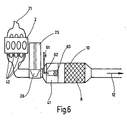
- a connecting tube 44 is provided, which may be omitted if necessary (see. FIG. 6 ), so that oxidation catalyst 4 and SCR catalyst 8 can be accommodated in a common housing.
- An exhaust gas flow 32 polluted with pollutants leaves the SCR catalytic converter as largely purified exhaust gas 12, then preferably passes through a silencer and is led out into the open air.
- oxidation catalyst 4 and SCR catalyst 8 are sometimes referred to as VR system, where the "V” denotes a precatalyst and the "R” the SCR catalyst.
- V denotes a precatalyst
- R the SCR catalyst.
- NO + 1 ⁇ 2 O 2 ⁇ NO 2 the following oxidation reaction takes place: NO + 1 ⁇ 2 O 2 ⁇ NO 2 .
- the SCR catalyst may optionally be preceded by a urea decomposition catalyst ("H") in which the following reaction takes place: (NH 2 ) 2 CO + H 2 O ⁇ 2 NH 3 + CO 2 .
- H urea decomposition catalyst
- the SCR catalyst may optionally be followed by another oxidation catalyst ("O") in which the following reaction takes place: 2 NH 3 + 3/2 O 2 ⁇ N 2 + 3 H 2 O.
- O oxidation catalyst
- VHRO systems The systems modified by an oxidation catalyst are commonly referred to as VHRO systems, whereby the individual components are designated in their order.
- the use of the oxidation catalyst ("O") acting as NH 3 blocking catalyst behind the SCR catalyst is also optional.
- the invention is described with reference to the simplified VR system, which can optionally be supplemented by the mentioned components to the VHRO system.
- a supply means 6 for supplying reducing agent 61 is provided in the exhaust gas stream 32, which will be described below with reference to FIGS. 2 to 6 is explained in more detail.
- the embodiments of the invention are described, according to the invention, the task of accelerating the decomposition of urea is taken over by the SCR catalyst.
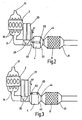
- FIG. 2 shows a first embodiment of the emission control system according to the invention, in which in the oxidation catalyst 4 in approximately central position, a nozzle 62 is arranged, by means of which the reducing agent 61 atomized into the oxidation catalyst 4 and in this way the exhaust gas stream 32 is supplied. Behind the nozzle 62, in the spray cone or slightly behind it, a mixing device 63 may be provided, which, however, may optionally be omitted. After passing through a connecting pipe 44, the exhaust gases enter the SCR catalytic converter 8, in which the nitrogen oxides are converted to molecular nitrogen with the addition of NH 3 and water.
- FIG. 3 shows an alternative embodiment of the arrangement of the nozzle 62, which is located off-center in the oxidation catalyst 4.
- the mixing device 63 is also located off-center in the oxidation catalyst 4, so that a thorough mixing of the reducing agent 61 in the exhaust gas stream 32 can take place.
- FIG. 4 shows a further alternative embodiment of the exhaust gas cleaning system according to the invention, in which each of the exhaust ports 30 of the internal combustion engine 2 individual oxidation catalysts are arranged, which are referred to here as second oxidation catalysts 42.
- These second oxidation catalytic converters 42 are known as so-called cylinder head or pre-turbocharger catalytic converters and ensure that the SCR catalytic converter 8 is largely protected from being contaminated with hydrocarbons and carbon monoxide.
- the arrangement of the feed device 6 with the centrally arranged in the first oxidation catalyst 41 nozzle 62 largely corresponds to the embodiment according to FIG. 2 ,
- FIG. 5 shows a corresponding arrangement of the second oxidation catalysts 42 in the exhaust ports 30 of the internal combustion engine 2, as in the embodiment according to FIG. 4 is provided.
- the off-center arrangement of the feed device 6 with the nozzle 62 and the optional mixing device corresponds to the embodiment according to FIG FIG. 3 ,
- the first oxidation catalytic converter 4 or 41 is arranged in a housing 43 which is separated from a housing 81 of the SCR catalytic converter 8 by a connecting tube 44.
- the embodiment of the emission control system according to FIG. 6 shows an integrated housing 10, in which along the exhaust gas flow of the first oxidation catalyst 41 and downstream of the SCR catalyst 8 is arranged.
- This design leads to an extremely compact emission control system, which also causes a very effective emission control, as the exhaust gases remain at a high temperature level due to the omitted connecting pipe.
- the second oxidation catalysts in the exhaust ducts 30 of the internal combustion engine can optionally also be omitted in this embodiment with the integrated housing 10 (cf. FIGS. 2 and 3 ).
Landscapes
- Engineering & Computer Science (AREA)
- Chemical & Material Sciences (AREA)
- Chemical Kinetics & Catalysis (AREA)
- Combustion & Propulsion (AREA)
- Health & Medical Sciences (AREA)
- Environmental & Geological Engineering (AREA)
- Mechanical Engineering (AREA)
- General Engineering & Computer Science (AREA)
- Analytical Chemistry (AREA)
- General Chemical & Material Sciences (AREA)
- Oil, Petroleum & Natural Gas (AREA)
- Biomedical Technology (AREA)
- Toxicology (AREA)
- Exhaust Gas After Treatment (AREA)
Description
- Die Erfindung betrifft eine Abgasreinigungsanlage einer Brennkraftmaschine mit einer Vorrichtung zur selektiven katalytischen Reduktion. Die Erfindung betrifft ferner ein Verfahren zur Reinigung von Abgasen einer Brennkraftmaschine, bei dem ein Abgasstrom durch eine Vorrichtung zur selektiven katalytischen Reduktion geleitet wird.
- Zur Minderung der Stickoxidanteile in sauerstoffreichem Abgas, wie es insbesondere von Dieselbrennkraftmaschinen und von Brennkraftmaschinen mit Benzin-Direkteinspritzung emittiert wird, ist es bekannt, ein Reduktionsmittel in einen Abgastrakt einzuführen. Als Reduktionsmittel eignet sich bspw. NH3, das als Gas in den Abgasstrom eingebracht werden kann. Bei dieser sog. selektiven katalytischen Reduktion (SCR, "selective catalytic reduction") wird das Ammoniak mit den im Abgas enthaltenen Stickoxiden selektiv zu molekularem Stickstoff und Wasser umgesetzt. Wegen seiner Toxizität eignet sich reines Ammoniakgas allerdings nicht für den Einsatz im Kraftfahrzeug. Ein bekanntes Verfahren sieht die Verwendung von wässriger Harnstofflösung als Reduktionsmittel vor. Hierbei wird erst durch Thermolyse und anschließende katalysierte Hydrolyse des Harnstoffs das eigentliche Reduktionsmittel Ammoniak freigesetzt.
- Die bekannten SCR-Systeme weisen bei Abgastemperaturen unterhalb ca. 250 °C eine ungenügende Aktivität auf. Eine Vorschaltung eines Oxidationskatalysators sorgt einerseits für eine Minderung der Anteile an deaktivierend wirkenden Kohlenwasserstoffen und andererseits für eine Oxidation von NO zu NO2, was insgesamt zu einer deutlichen Steigerung des NOx-Umsatzes bei Abgastemperaturen oberhalb von ca. 200 °C führt. Unterhalb von ca. 180 °C bietet das System aufgrund der relativ langen Zersetzungsdauer von Harnstoff zu NH3 eine nur ungenügende Aktivität. Insbesondere beim Einsatz in PKW treten allerdings Phasen mit derart niedrigen Abgastemperaturen relativ häufig auf, was eine mittlere Katalysatortemperatur von weniger als 180 °C im sog. MVEG-Testzyklus verdeutlicht.
- Um eine gute Verteilung des Reduktionsmittels im SCR-Katalysator zu gewährleisten, kann eine Mischstrecke von ca. 40 cm vorgesehen sein, die ggf. mit einer Mischeinrichtung versehen ist. Eine derartige Mischeinrichtung für eine Abgasreinigungsanlage ist in der älteren deutschen Patentanmeldung mit dem Aktenzeichen
101 31 803.0 beschrieben. Hierbei weist ein im Abgasrohr angeordneter Mischkörper eine Gasaufprallfläche sowie eine Strahlaufprallfläche auf, so dass aus der Brennkraftmaschine strömendes.Abgas auf die Gasaufprallfläche und quer zum Abgasstrom zuführbares Reduktionsmittel auf die Strahlaufprallfläche treffen kann. - Die
EP 1174599 beschreibt eine Filteranordnung mit darin eingebrachten Katalysatorfolien, wobei ein Teil der Folien eine oxydationskatalytische Wirkung und ein anderer Teil der Folie eine Stickstoff-reduzierende Wirkung hat. Beide Typen von Katalysatorfolien werden mit Dosiermittel beaufschlagt. - Die
EP 1052009 beschreibt Verfahren zur thermischen Hydrolyse und Dosierung von Harnstoff bzw. einer wässrigen Harnstofflösung, bei denen die Hydrolyse in einem stromaufwärts eines SCR-Katalysators angeordneten Hydrolysereaktor stattfindet. - Bei einer Abgasreinigungsanlage zur Reinigung des Abgases einer Brennkraftmaschine ist wenigstens ein in einem Abgaskanal der Brennkraftmaschine angeordneter Oxidationskatalysator sowie wenigstens eine hinter diesem angeordnete Vorrichtung zur selektiven katalytischen Reduktion (SCR-Katalysator) vorgesehen. Erfindungsgemäß ist eine in dem wenigstens einen Oxidationskatalysator integrierte Zuführeinrichtung zur Zuführung eines Reduktionsmittels in den Abgasstrom der Brennkraftmaschine vorgesehen. Mit der erfindungsgemäßen Abgasreinigungsanlage können insbesondere relativ sauerstoffreiche Abgase von Dieselmotoren bzw. von Benzinmotoren Kraftstoffdirekteinspritzung wirksam von Stickoxiden (NOx) gereinigt werden. Mit Hilfe der Erfindung ist es möglich, die Baulänge des Abgasreinigungssystems deutlich zu verringern, wobei gleichzeitig eine gute Umsetzung des Reduktionsmittels im Abgasstrom gewährleistet ist. Die für eine gute Verteilung des Reduktionsmittels auf dem SCR-Katalysator üblicherweise notwendig Mischstrecke von ca. 40 cm kann deutlich reduziert werden, ohne dass ein unerwünschter Druckabfall im System auftritt. Der SCR-Katalysator muss aufgrund des Entfalls der üblicherweise notwendigen langen Mischstrecke nicht unbedingt im Unterbodenbereich des Fahrzeugs eingebaut werden, sondern kann gegebenenfalls näher zum Abgasauslass der Brennkraftmaschine gerückt werden. Auf diese Weise ergibt sich ein günstigerer Temperaturverlauf in der Abgasreinigungsanlage, der sich vorteilhaft auf die Reinigungswirkung auswirkt. Die Eindüsung des Reduktionsmittels erfolgt vorteilhafterweise direkt in den Oxidationskatalysator. Zu diesem Zweck ist eine Aussparung bzw. Ausbohrung des Oxidationskatalysators notwendig, da das Reduktionsmittel möglichst nicht mit dem Oxidationskatalysator in Kontakt kommen sollte, da ansonsten eine unerwünschte Oxydation zu molekularem Stickstoff, Stickstoffdioxid oder Stickstoffmonoxid stattfinden kann.
- Eine Ausführungsform der Erfindung sieht vor, dass die Zuführeinrichtung eine Düse zur Zerstäubung des Reduktionsmittels aufweist.
- Eine Ausgestaltung der Erfindung sieht eine der Zufiihreinrichtung nachgeordnete Mischvorrichtung zur besseren Verteilung des Reduktionsmittels im Abgasstrom vor. Auf diese Weise kann eine noch bessere Durchmischung des Reduktionsmittels mit dem Abgasstrom und damit eine noch bessere Reinigungswirkung des Abgases im nachfolgenden SCR-Katalysator erreicht werden.
- Der Austritt der Düse kann wahlweise ungefähr mittig oder außermittig im Oxidationskatalysator angeordnet sein. Eine außermittige Eindüsung kann beispielsweise mit einem seitlichen Drall erfolgen, so dass trotzdem eine gute Durchmischung mit dem Abgasstrom gewährleistet ist. Falls die Verwendung von motornahen Katalysatoren nicht möglich ist, bzw. die Verminderung der HC- und CO-Emissionen nicht ausreicht, kann der Oxidationskatalysator wahlweise nicht über seine gesamte Länge, sondern nur stromabwärts der Eindüsstelle ausgespart sein. Somit werden auch ohne motornahen Oxidationskatalysator die Kohlenwasserstoffe und Kohlenmonoxide in ausreichendem Maße oxidiert. Zusätzlich profitiert die thermische Reduktionsmittelaufbereitung von der Exothermie am Oxidationskatalysator, welche durch die Oxidation der Kohlenwasserstoffe und Kohlenmonoxide auftritt.
- Eine erfindungsgemäße Ausgestaltung sieht vor, dass der wenigstens eine Oxidationskatalysator mit der darin integrierten Zuführeinrichtung für das Reduktionsmittel ein erstes Gehäuse und dass die Vorrichtung zur selektiven katalytischen Reduktion ein daran anschließendes zweites Gehäuse aufweist. Zwischen beiden Gehäusen ist vorzugsweise ein Verbindungsrohr vorgesehen, das eine unterschiedliche Länge je nach baulichen Randbedingungen im Fahrzeug aufweisen kann. Vorzugsweise ist das Verbindungsrohr jedoch möglichst kurz ausgeführt, um eine Abkühlung des Abgasstroms vor Erreichen der Vorrichtung zur selektiven katalytischen Reduktion möglichst zu verhindern. Die Reinigungswirkung des SCR-Katalysators erreicht erst bei Temperaturen von ca. 300 °C befriedigende Größenordnungen.
- Eine alternative Ausgestaltung sieht vor, dass der wenigstens eine Oxidationskatalysator und die Vorrichtung zur selektiven katalytischen Reduktion ein gemeinsames Gehäuse aufweisen. Dadurch wird gewährleistet, dass der mit Reduktionsmittel beaufschlagte Abgasstrom eine ideale Temperatur zur Umsetzung und NOx-Reduktion im SCR-Katalysator aufweist. Die bauliche Einheit der beiden Komponenten sorgt insgesamt für eine kompakte Bauweise und eine günstige Abgasreinigungswirkung.
- Eine bevorzugte Ausgestaltung der Erfindung sieht vor, dass stromaufwärts des wenigstens einen Oxidationskatalysators im Abgasstrom der Brennkraftmaschine wenigstens ein weiterer Oxidationskatalysator angeordnet ist. Der wenigstens eine Oxidationskatalysator ist vorzugsweise in unmittelbarer Nähe der Brennräume der Brennkraftmaschine angeordnet und kann beispielsweise in jeweils einem weiteren Oxidationskatalysator- an jedem Abgasauslass eines jeden Brennraums der Brennkraftmaschine bestehen. Auf diese Weise kann der SCR-Katalysator vor einer Belegung mit Kohlenwasserstoffen und Kohlenmonoxid weitgehend geschützt werden. Die zusätzlichen motornahen Oxidationskatalysatoren, die auch als Zylinderkopf oder Vorturbolader-Katalysatoren bezeichnet werden können, sorgen für eine weitgehende. Umsetzung der im Abgas enthaltenen Kohlenwasserstoffe und des Kohlenmonoxids und verbessern somit deutlich die Reinigungswirkung des SCR-Katalysators.
- Die Vorkatalysatoren können bevorzugt vor einer Abgasturbine eines Abgasturboladers angeordnet sein.
- Als Reduktionsmittel kommen vorzugsweise alle ammoniakhaltigen bzw. ammoniakabspaltenden Substanzen in Frage, beispielsweise HWL, Ammoniumkarbamat, Ammoniakgas, etc.
- Ein Verfahren zur Reinigung von Abgasen einer Brennkraftmaschine, insbesondere einer Brennkraftmaschine mit Selbstzündung und/oder mit Kraftstoffdirekteinspritzung, bei dem ein Abgasstrom durch wenigstens einen im Abgaskanal angeordneten Oxidationskatalysator und wenigstens einer dieser nachgeordneten Vorrichtung zur selektiven katalytischen Reduktion (SCR-Katalysator) geleitet wird, sieht erfindungsgemäß vor, dass dem Abgasstrom innerhalb des wenigstens einen Oxidationskatalysators ein Reduktionsmittel zugeführt wird. Durch die Eindüsung des Reduktionsmittels am Anfang der Katalysatorstrecke entfällt die bislang benötigte Mischstrecke. Auch ohne die Mischstrecke wird eine optimale Beaufschlagung des nachfolgenden SCR-Katalysators gewährleistet, da sich das Reduktionsmittel durch das Passieren der beiden Übergangstrichter der Abgasanlage ideal mit dem Abgasstrom vermischt. Somit wird ermöglicht, die Baulänge des Systems erheblich zu verringern und das Aufheizen der Katalysatoren zu beschleunigen. Weiterhin wird dadurch ein relativ motornaher Einbau des SCR-Katalysators ermöglicht, so dass der Katalysator unter Umständen im Motorraum untergebracht werden kann und die für die Erreichung einer schnellen Arbeitstemperatur ungünstigere Einbaulage im Unterbodenbereich des Fahrzeugs entfallen kann.
- Eine Ausgestaltung des Verfahrens sieht vor, dass die Zuführung und/oder Zerstäubung des Reduktionsmittels mittels einer Düse erfolgt, die ungefähr mittig oder wahlweise außermittig innerhalb des Oxidationskatalysators angeordnet ist und die für eine feine Verteilung der Reduktionsmittel im Oxidationskatalysator sorgt. Die Aufbereitung des Reduktionsmittels entspricht dabei einer Neben- bzw.
- Teilstromanordnung. Der Sprühkegel der Eindüsung kann wesentlich kleiner gehalten werden als bei bisher bekannten Systemen, was für die in den Katalysatoren ablaufenden Reaktionen von Vorteil ist. Die Eindüsestelle ist wesentlich näher am Motor und das Reduktionsmittel wird dadurch besser für die Hydrolyse auf dem SCR-Katalysator vorkonditioniert. Dies kann insbesondere bei niedrigen Katalysatortemperaturen von entscheidender Bedeutung sein. Zudem wird bei optimaler Auslegung die Baugröße des Oxidationskatalysators durch die Aussparung der Dosierstelle etwas geringer, was insbesondere bei Temperaturen um 300°C in Verbindung mit geringen Abgasgeschwindigkeiten die Gefahr des Auftretens zu hoher NO2-Anteile vermindert. Die etwas geringere Baugröße hat dagegen im Kaltstart bzw. bei niedrigen Katalysatortemperaturen (geringe Motorlast) kaum einen negativen Einfluss auf den NO2-Anteil.
- Die Erfindung wird nachfolgend in bevorzugten Ausführungsbeispielen anhand der zugehörigen Zeichnungen näher erläutert. Dabei zeigt:
- Figur 1
- eine schematische Darstellung einer Brennkraftmaschine mit einer Abgasnachbehandlungseinheit in einem Abgaskanal und
- Figuren 2 bis 6
- verschiedene Ausführungsbeispiele der erfindungsgemäßen Abgasreinigungsanlage.
-
Figur 1 zeigt in einer schematischen Darstellung eine Brennkraftmaschine 2 mit einem Einlasskanal 21 zur Zufuhr von Frischgas 22 und mit einem Abgaskanal 29 mit darin angeordneten Abgasreinigungselementen. Im Einlasskanal 21 ist ein Ladeluftkühler 23 angeordnet, der jedoch nicht zwingend erforderlich ist. Weiterhin ist ein optionales Abgasrückführungssystem 24 zwischen Einlasskanal 21 und Abgaskanal 29 vorgesehen. Schließlich weist die Brennkraftmaschine einen Abgasturbolader 25 auf, der eine Abgasturbine 26 im Abgaskanal aufweist, die über eine Welle 27 mit einem Verdichter 28 im Einlasskanal 21 gekoppelt ist. Ein Auslass jedes Brennraums der Brennkraftmaschine 2 verfügt über einen Auslasskanal 30, die in einem nachfolgenden Sammler 31 auf den gemeinsamen Abgaskanal 29 zusammengeführt werden. - Im Abgaskanal 29 hinter der Abgasturbine 26 ist ein Oxidationskatalysator 4 vorgesehen, dem eine Vorrichtung zur selektiven katalytischen Reduktion 8 nachgeschaltet ist. Diese Vorrichtung zur selektiven katalytischen Reduktion wird im Folgenden auch als SCR-Katalysator bezeichnet. Zwischen Oxidationskatalysator 4 und SCR-Katalysator 8 ist ein Verbindungsrohr 44 vorgesehen, das ggf auch entfallen kann (vgl.
Figur 6 ), so dass Oxidationskatalysator 4 und SCR-Katalysator 8 in einem gemeinsamen Gehäuse untergebracht sein können. Ein mit Schadstoffen belasteter Abgasstrom 32 verlässt den SCR-Katalysator als weitgehend gereinigtes Abgas 12, passiert anschließend vorzugsweise einen Schalldämpfer und wird nach diesem ins Freie geleitet. - Die gezeigte Anordnung aus Oxidationskatalysator 4 und SCR-Katalysator 8 wird teilweise auch als VR-System bezeichnet, wobei das "V" einen Vorkatalysator und das "R" den SCR-Katalysator bezeichnet. Im Vor- bzw. Oxidationskatalysator erfolgt die folgende Oxidationsreaktion:
NO + ½ O2 → NO2.
- Dem SCR-Katalysator kann ggf. ein Harnstoffzersetzungskatalysator ("H") vorgeschaltet sein, in dem folgende Reaktion abläuft:
(NH2)2CO + H2O→ 2 NH3 + CO2.
- Im SCR-Katalysator ("R") selbst erfolgt die folgende selektive katalytische Reduktionsreaktion:
2 NH3 + NO + NO2 → 2 N2 + 3 H2O.
- Dem SCR-Katalysator kann optional ein weiterer Oxidationskatalysator ("O") nachgeschaltet sein, in dem folgende Reaktion stattfindet:
2 NH3 + 3/2 O2 → N2 + 3 H2O.
- Die durch einen Oxidationskatalysator modifizierten Systeme werden üblicherweise als VHRO-Systeme bezeichnet, wodurch die einzelnen Komponenten in ihrer Reihenfolge bezeichnet sind. Der Einsatz des "H"-Katalysators, welcher die Zersetzung des zugefüllten Harnstoffs beschleunigen soll, ist dabei als optional zu betrachten, da diese Aufgabe vom SCR-Katalysator übernommen werden kann. Auch die Verwendung des als NH3-Sperrkatalysator fungierenden Oxidationskatalysators ("O") hinter dem SCR-Katalysator ist optional. Im vorliegenden Zusammenhang wird die Erfindung anhand des vereinfachten VR-Systems beschrieben, das wahlweise um die erwähnten Komponenten zum VHRO-System ergänzt werden kann.
- Im Oxidations-Katalysator 4 ist eine Zuführeinrichtung 6 zur Zufuhr von Reduktionsmittel 61 in den Abgasstrom 32 vorgesehen, die nachfolgend anhand der
Figuren 2 bis 6 näher erläutert wird. Dort sind die erfindungsgemäßen Ausführungsbeispiele beschrieben, wobei erfindungsgemäß die Aufgabe der Beschleunigung der Zersetzung des Harnstoffs vom SCR-Katalysator übernommen wird. -
Figur 2 zeigt ein erstes Ausführungsbeispiel der erfindungsgemäßen Abgasreinigungsanlage, bei der im Oxidationskatalysator 4 in ungefähr mittiger Position eine Düse 62 angeordnet ist, mittels derer das Reduktionsmittel 61 in den Oxidations-Katalysator 4 zerstäubt und auf diese Weise dem Abgasstrom 32 zugeführt wird. Hinter der Düse 62, in deren Sprühkegel oder leicht dahinter, kann eine Mischvorrichtung 63 vorgesehen sein, die jedoch wahlweise auch entfallen kann. Nach Passieren eines Verbindungsrohrs 44 treten die Abgase in den SCR-Katalysator 8 ein, in dem eine Umsetzung der Stickoxide zu molekularem Stickstoff unter Zugabe von NH3 und Wasser erfolgt. -
Figur 3 zeigt eine alternative Ausgestaltung der Anordnung der Düse 62, die sich hierbei außermittig im Oxidationskatalysator 4 befindet. Die Mischvorrichtung 63 befindet sich ebenfalls außermittig im Oxidationskatalysator 4, so dass eine gute Durchmischung des Reduktionsmittels 61 im Abgasstrom 32 erfolgen kann. -
Figur 4 zeigt eine weitere alternative Ausgestaltung der erfindungsgemäßen Abgasreinigungsanlage, bei der jeweils in den Auslasskanälen 30 der Brennkraftmaschine 2 einzelne Oxidationskatalysatoren angeordnet sind, die hier als zweite Oxidationskatalysatoren 42 bezeichnet sind. Diese zweiten Oxidationskatalysatoren 42 sind als sogenannte Zylinderkopf- oder Vorturboladerkatalysatoren bekannt und sorgen dafür, dass der SCR-Katalysator 8 weitgehend vor einer Belegung mit Kohlenwasserstoffen und Kohlenmonoxid geschützt wird. Die Anordnung der Zuführeinrichtung 6 mit der mittig im ersten Oxidationskatalysator 41 angeordneten Düse 62 entspricht weitgehend der Ausführungsform gemäßFigur 2 . -
Figur 5 zeigt eine entsprechende Anordnung der zweiten Oxidationskatalysatoren 42 in den Auslasskanälen 30 der Brennkraftmaschine 2, wie dies im Ausführungsbeispiel gemäßFigur 4 vorgesehen ist. Die außermittige Anordnung der Zuführeinrichtung 6. mit der Düse 62 sowie der optionalen Mischvorrichtung entspricht der Ausführungsform gemäßFigur 3 . - In den Ausführungsbeispielen gemäß den
Figuren 1 bis 5 ist jeweils der erste Oxidationskatalysator 4 bzw. 41 in einem Gehäuse 43 angeordnet, das durch ein Verbindungsrohr 44 von einem Gehäuse 81 des SCR-Katalysators 8 getrennt ist. Die Ausgestaltung der Abgasreinigungsanlage gemäßFigur 6 zeigt ein integriertes Gehäuse 10, in dem entlang des Abgasstroms der erste Oxidationskatalysator 41 und diesem nachgeschaltet der SCR-Katalysator 8 angeordnet ist. Diese Bauweise führt zu einer äußerst kompakten Abgasreinigungsanlage, die zudem eine sehr effektive Abgasreinigung bewirkt, da die Abgase durch das entfallene Verbindungsrohr auf einem hohen Temperaturniveau bleiben. Die zweiten Oxidationskatalysatoren in den Auslasskanälen 30 der Brennkraftmaschine können bei diesem Ausführungsbeispiel mit dem integrierten Gehäuse 10 wahlweise auch entfallen (vgl.Figuren 2 und 3 ).
Claims (16)
- Abgasreinigungsanlage zur Reinigung des Abgases einer Brennkraftmaschine, insbesondere einer Brennkraftmaschine mit Selbstzündung und/ oder mit Kraftstoffdirekteinspritzung, mit wenigstens einem in einem Abgaskanal der Brennkraftmaschine angeordneten Oxidationskatalysator und mit wenigstens einer hinter diesem angeordneten Vorrichtung zur selektiven katalytischen Reduktion der Abgase, gekennzeichnet durch eine in den wenigstens einen Oxidationskatalysator (4) integrierte Zuführeinrichtung (6) zur Zuführung eines Reduktionsmittels (61) in den Abgasstrom (32) der Brennkraftmaschine (2), wobei die Zuführeinrichtung eine Aussparung beziehungsweise eine Ausbohrung in dem Oxidationskatalysator umfasst, sodass das Reduktionsmittel in den Abgasstrom gelangen kann, ohne mit dem Oxidationskatalysator in Kontakt zu kommen, wobei im Falle der Verwendung eines Harnstoff enthaltenden Reduktionsmittels die beschleunigte Zersetzung des Harnstoffs der Aussparung bzw. Ausbohrung nachgelagert in der Vorrichtung zur selektiven katalytischen Reduktion erfolgt, wobei eine Eindüsestelle der Zuführeinrichtung motornah angeordnet ist.
- Abgasreinigungsanlage nach Anspruch 1, dadurch gekennzeichnet, dass die Zuführeinrichtung (6) eine Düse (62) zur Zerstäubung des Reduktionsmittels (61) aufweist.
- Abgasreinigungsanlage nach Anspruch 1 oder 2, gekennzeichnet durch eine der Zuführeinrichtung (6) nachgeordnete Mischvorrichtung (63) zur Verteilung des Reduktionsmittels (61) im Abgasstrom (32).
- Abgasreinigungsanlage nach Anspruch 2 oder 3, dadurch gekennzeichnet, dass ein Austritt der Düse (62) ungefähr mittig im Oxidationskatalysator (4) angeordnet ist.
- Abgasreinigungsanlage nach Anspruch 2 oder 3, dadurch gekennzeichnet, dass der Austritt der Düse (62) in einem äußeren Randbereich des Oxidationskatalysators (4) angeordnet ist.
- Abgasreinigungsanlage nach einem der vorhergehenden Ansprüche, dadurch gekennzeichnet, dass der wenigstens eine Oxidationskatalysator (4) mit der darin integrierten Zuführeinrichtung (6) ein erstes Gehäuse (43) und dass die Vorrichtung zur selektiven katalytischen Reduktion (8) ein daran anschließendes zweites Gehäuse (81) aufweist.
- Abgasreinigungsanlage nach einem der Ansprüche 1 bis 5, dadurch gekennzeichnet, dass der wenigstens eine Oxidationskatalysator (4) und die Vorrichtung zur selektiven katalytischen Reduktion (8) ein gemeinsames Gehäuse (10) aufweisen.
- Abgasreinigungsanlage nach einem der vorhergehenden Ansprüche, dadurch gekennzeichnet, dass stromaufwärts des wenigstens einen Oxidationskatalysators (4) im Abgasstrom (32) der Brennkraftmaschine (2) wenigstens ein weiterer Oxidationskatalysator (41) angeordnet ist.
- Abgasreinigungsanlage nach Anspruch 8, dadurch gekennzeichnet, dass der wenigstens eine weitere Oxidationskatalysator (41) in unmittelbarer Nähe der Brennräume der Brennkraftmaschine (2) angeordnet ist.
- Abgasreinigungsanlage nach Anspruch 8 oder 9, gekennzeichnet durch jeweils wenigstens einen weiteren Oxidationskatalysator (41) an jedem Abgasauslass (29) jeden Brennraums der Brennkraftmaschine (2).
- Verfahren zur Reinigung von Abgasen einer Brennkraftmaschine, insbesondere einer Brennkraftmaschine mit Selbstzündung und/ oder mit Kraftstoffdirekteinspritzung, bei dem ein Abgasstrom durch wenigstens einen im Abgaskanal angeordneten Oxidationskatalysator und wenigstens einer, diesem nachgeordneten Vorrichtung zur selektiven katalytischen Reduktion geleitet wird, dadurch gekennzeichnet, dass dem Abgasstrom (32) innerhalb des wenigstens einen Oxidationskatalysators (4) ein Reduktionsmittel (61) zugeführt wird, wobei die Zuführung dadurch innerhalb des Oxidationskatalysators erfolgt, dass das Reduktionsmittel über eine Aussparung beziehungsweise eine Ausbohrung in dem Oxidationskatalysator in den Abgasstrom gelangen kann, ohne mit dem Oxidationskatalysator in Kontakt zu kommen, wobei im Falle der Verwendung eines Harnstoff enthaltenden Reduktionsmittels die beschleunigte Zersetzung des Harnstoffs der Aussparung bzw. Ausbohrung nachgelagert in der Vorrichtung zur selektiven katalytischen Reduktion erfolgt, wobei eine Eindüsestelle der Zuführeinrichtung motornah angeordnet ist.
- Verfahren nach Anspruch 11, gekennzeichnet durch eine Zuführung und/oder Zerstäubung des Reduktionsmittels (61) mittels einer Düse (62).
- Verfahren nach Anspruch 11 oder 12, gekennzeichnet durch eine Zuführung des Reduktionsmittels (61) ungefähr mittig innerhalb des Oxidationskatalysators (4).
- Verfahren nach Anspruch 11 oder 12, gekennzeichnet durch eine Zuführung des Reduktionsmittels (61) außermittig innerhalb des Oxidationskatalysators (4).
- Verfahren nach einem der Ansprüche 11 bis 14, dadurch gekennzeichnet, dass der Abgasstrom (32) durch wenigstens einen weiteren Oxidationskatalysator (41) stromaufwärts des ersten Oxidationskatalysators (4) geleitet wird.
- Verfahren nach einem der Ansprüche 11 bis 15, dadurch gekennzeichnet, dass der Abgasstrom (32) durch jeweils wenigstens einen weiteren Oxidationskatalysator (41) in jedem Abgaskanal (29) unmittelbar hinter den Brennräumen der Brennkraftmaschine (2) geleitet wird.
Applications Claiming Priority (3)
| Application Number | Priority Date | Filing Date | Title |
|---|---|---|---|
| DE10247989 | 2002-10-15 | ||
| DE10247989A DE10247989A1 (de) | 2002-10-15 | 2002-10-15 | Abgasreinigung einer Brennkraftmaschine und Verfahren zur Reinigung deren Abgase |
| PCT/DE2003/003196 WO2004036005A2 (de) | 2002-10-15 | 2003-09-25 | Abgasreinigungsanlage einer brennkraftmaschine und verfahren zur reinigung deren abgase |
Publications (3)
| Publication Number | Publication Date |
|---|---|
| EP1554474A2 EP1554474A2 (de) | 2005-07-20 |
| EP1554474B1 EP1554474B1 (de) | 2006-08-23 |
| EP1554474B2 true EP1554474B2 (de) | 2009-11-18 |
Family
ID=32049277
Family Applications (1)
| Application Number | Title | Priority Date | Filing Date |
|---|---|---|---|
| EP03808672A Expired - Lifetime EP1554474B2 (de) | 2002-10-15 | 2003-09-25 | Abgasreinigungsanlage einer brennkraftmaschine und verfahren zur reinigung deren abgase |
Country Status (5)
| Country | Link |
|---|---|
| US (1) | US7200989B2 (de) |
| EP (1) | EP1554474B2 (de) |
| JP (1) | JP4445866B2 (de) |
| DE (2) | DE10247989A1 (de) |
| WO (1) | WO2004036005A2 (de) |
Cited By (1)
| Publication number | Priority date | Publication date | Assignee | Title |
|---|---|---|---|---|
| CN104121071A (zh) * | 2013-04-28 | 2014-10-29 | 常州市利众环保科技有限公司 | 汽车尾气循环燃烧绿色排放 |
Families Citing this family (22)
| Publication number | Priority date | Publication date | Assignee | Title |
|---|---|---|---|---|
| DE102006003786A1 (de) * | 2005-09-26 | 2007-04-05 | Faurecia Abgastechnik Gmbh | Abgasanlage mit Einspritzdüse |
| DE102006004170A1 (de) * | 2006-01-27 | 2007-08-02 | Pierburg Gmbh | Vorrichtung zur Reduktion von Stickoxiden im Abgas von Brennkraftmaschinen |
| EP2010762B1 (de) * | 2006-04-13 | 2016-09-28 | Mack Trucks, Inc. | Motor mit abgassteuerungsanordnung und verfahren zur steuerung von motorabgasen |
| JP2008127997A (ja) * | 2006-11-16 | 2008-06-05 | Mitsubishi Fuso Truck & Bus Corp | 内燃機関の排気浄化装置 |
| JP4592816B2 (ja) * | 2007-05-03 | 2010-12-08 | エムエーエヌ・ディーゼル・アンド・ターボ・フィリアル・アフ・エムエーエヌ・ディーゼル・アンド・ターボ・エスイー・ティスクランド | Scr反応器を備える大型ターボ過給型ディーゼルエンジン |
| WO2008144385A2 (en) * | 2007-05-15 | 2008-11-27 | Donaldson Company, Inc. | Exhaust gas flow device |
| JP4949152B2 (ja) * | 2007-07-20 | 2012-06-06 | 三菱ふそうトラック・バス株式会社 | 内燃機関の排気浄化装置 |
| JP4949151B2 (ja) * | 2007-07-20 | 2012-06-06 | 三菱ふそうトラック・バス株式会社 | 内燃機関の排気浄化装置 |
| US20090094966A1 (en) * | 2007-10-15 | 2009-04-16 | International Engine Intellectual Property Company, Llc | Aftertreatment device |
| JP2011012564A (ja) * | 2009-06-30 | 2011-01-20 | Toyota Industries Corp | 排気ガス浄化装置 |
| US8347611B2 (en) | 2009-12-23 | 2013-01-08 | Ford Global Technologies, Llc | Methods and systems for emission system control |
| US8347609B2 (en) | 2009-12-23 | 2013-01-08 | Ford Global Technologies, Llc | Methods and systems for emission system control |
| US8516799B2 (en) | 2009-12-23 | 2013-08-27 | Ford Global Technologies, Llc | Methods and systems for emission system control |
| US8096125B2 (en) | 2009-12-23 | 2012-01-17 | Ford Global Technologies, Llc | Methods and systems for emission system control |
| WO2011087527A1 (en) | 2010-01-12 | 2011-07-21 | Donaldson Company, Inc. | Flow device for exhaust treatment system |
| US8042527B2 (en) | 2010-08-05 | 2011-10-25 | Ford Global Technologies, Llc | Coordination of HP and LP EGR |
| JP5609795B2 (ja) * | 2011-07-12 | 2014-10-22 | 株式会社デンソー | 車両用過給装置 |
| DE102011115328A1 (de) * | 2011-10-07 | 2013-04-11 | Mtu Friedrichshafen Gmbh | Verfahren zum Überwachen einer Abgasanlage |
| DE102012010991A1 (de) | 2012-06-02 | 2013-12-05 | Volkswagen Aktiengesellschaft | Verfahren zum Betreiben einer Reduktionsmitteldosierung eines SCR-Katalysatorsystems sowie SCR-Katalysatorsystem |
| JP2015110928A (ja) * | 2013-12-06 | 2015-06-18 | 株式会社日本自動車部品総合研究所 | 排気ガス浄化装置 |
| CN105944569A (zh) * | 2016-06-30 | 2016-09-21 | 山西都宝清洁能源投资有限公司 | 一种强化烟气脱硝工艺方法 |
| DE102017219570A1 (de) | 2017-11-03 | 2019-05-09 | Robert Bosch Gmbh | Abgasstrang für einen Verbrennungsmotor und Verfahren des Betreibens eines Verbrennungsmotors |
Citations (4)
| Publication number | Priority date | Publication date | Assignee | Title |
|---|---|---|---|---|
| DE19755703A1 (de) † | 1997-12-15 | 1999-06-17 | Emitec Emissionstechnologie | Katalysatorträgeranordnung für einen motornahen Einbau |
| EP1052009A1 (de) † | 1999-03-25 | 2000-11-15 | Man Nutzfahrzeuge Ag | Verfahren zur Behandlung von Abgasen einer Brennkraftmaschine unter Verwendung von Harnstoff |
| DE10020170C1 (de) † | 2000-04-25 | 2001-09-06 | Emitec Emissionstechnologie | Verfahren zum Entfernen von Rußpartikeln aus einem Abgas und zugehöriges Auffangelement |
| WO2002043837A1 (en) † | 2000-12-01 | 2002-06-06 | Fuel Tech, Inc. | Selective catalytic reduction of no, enabled by side stream urea decomposition |
Family Cites Families (16)
| Publication number | Priority date | Publication date | Assignee | Title |
|---|---|---|---|---|
| JPH05106430A (ja) * | 1991-10-16 | 1993-04-27 | Toyota Central Res & Dev Lab Inc | 内燃機関の窒素酸化物低減装置 |
| DE4315278A1 (de) * | 1993-05-07 | 1994-11-10 | Siemens Ag | Verfahren und Einrichtung zur Dosierung eines Reduktionsmittels in ein stickoxidhaltiges Abgas |
| JPH07100335A (ja) * | 1993-10-01 | 1995-04-18 | Nippon Oil Co Ltd | 窒素酸化物の除去方法 |
| US5611198A (en) * | 1994-08-16 | 1997-03-18 | Caterpillar Inc. | Series combination catalytic converter |
| DE19546482A1 (de) * | 1995-12-13 | 1997-06-26 | Basf Ag | Verfahren zum Betreiben einer Reinigungsanlage, eine Reinigungsanlage und eine Verwendung derselben |
| DE19731865C2 (de) * | 1997-07-24 | 1999-05-06 | Siemens Ag | Abgasreinigungsanlage für das Abgas eines Dieselmotors |
| DE19740702C1 (de) * | 1997-09-16 | 1998-11-19 | Siemens Ag | Verfahren und Vorrichtung zum Betrieb einer mit Luftüberschuß arbeitenden Brennkraftmaschine |
| DE19902207A1 (de) * | 1999-01-21 | 2000-07-27 | Man Nutzfahrzeuge Ag | Verfahren zur Dosierung eines Reduktionsmittels, sowie Vorrichtung zur Durchführung des Verfahrens |
| US6293096B1 (en) * | 1999-06-23 | 2001-09-25 | Southwest Research Institute | Multiple stage aftertreatment system |
| US6293097B1 (en) * | 1999-08-16 | 2001-09-25 | Ford Global Technologies, Inc. | On-board reductant delivery system |
| US6314722B1 (en) * | 1999-10-06 | 2001-11-13 | Matros Technologies, Inc. | Method and apparatus for emission control |
| DE10035544B4 (de) | 2000-07-21 | 2012-01-05 | Daimler Ag | Filteranordnung für eine Abgasreinigungsanlage |
| DE10059427A1 (de) * | 2000-11-30 | 2002-06-06 | Bosch Gmbh Robert | Einrichtung und Verfahren zur Nachbehandlung von Abgasen |
| DE10130054B4 (de) * | 2001-06-21 | 2014-05-28 | Volkswagen Ag | Abgasanlage einer mehrzylindrigen Verbrennungskraftmaschine und Verfahren zur Reinigung eines Abgases |
| US6449947B1 (en) * | 2001-10-17 | 2002-09-17 | Fleetguard, Inc. | Low pressure injection and turbulent mixing in selective catalytic reduction system |
| WO2004046514A1 (en) * | 2002-11-15 | 2004-06-03 | Catalytica Energy Systems, Inc. | Devices and methods for reduction of nox emissions from lean burn engines |
-
2002
- 2002-10-15 DE DE10247989A patent/DE10247989A1/de not_active Withdrawn
-
2003
- 2003-09-25 US US10/527,584 patent/US7200989B2/en not_active Expired - Fee Related
- 2003-09-25 JP JP2004543947A patent/JP4445866B2/ja not_active Expired - Fee Related
- 2003-09-25 EP EP03808672A patent/EP1554474B2/de not_active Expired - Lifetime
- 2003-09-25 DE DE50304782T patent/DE50304782D1/de not_active Expired - Lifetime
- 2003-09-25 WO PCT/DE2003/003196 patent/WO2004036005A2/de not_active Ceased
Patent Citations (4)
| Publication number | Priority date | Publication date | Assignee | Title |
|---|---|---|---|---|
| DE19755703A1 (de) † | 1997-12-15 | 1999-06-17 | Emitec Emissionstechnologie | Katalysatorträgeranordnung für einen motornahen Einbau |
| EP1052009A1 (de) † | 1999-03-25 | 2000-11-15 | Man Nutzfahrzeuge Ag | Verfahren zur Behandlung von Abgasen einer Brennkraftmaschine unter Verwendung von Harnstoff |
| DE10020170C1 (de) † | 2000-04-25 | 2001-09-06 | Emitec Emissionstechnologie | Verfahren zum Entfernen von Rußpartikeln aus einem Abgas und zugehöriges Auffangelement |
| WO2002043837A1 (en) † | 2000-12-01 | 2002-06-06 | Fuel Tech, Inc. | Selective catalytic reduction of no, enabled by side stream urea decomposition |
Cited By (2)
| Publication number | Priority date | Publication date | Assignee | Title |
|---|---|---|---|---|
| CN104121071A (zh) * | 2013-04-28 | 2014-10-29 | 常州市利众环保科技有限公司 | 汽车尾气循环燃烧绿色排放 |
| CN104121071B (zh) * | 2013-04-28 | 2019-01-29 | 常州市利众环保科技有限公司 | 一种汽车尾气循环燃烧绿色排放方法 |
Also Published As
| Publication number | Publication date |
|---|---|
| WO2004036005A3 (de) | 2004-08-05 |
| US7200989B2 (en) | 2007-04-10 |
| US20060053773A1 (en) | 2006-03-16 |
| EP1554474B1 (de) | 2006-08-23 |
| JP4445866B2 (ja) | 2010-04-07 |
| EP1554474A2 (de) | 2005-07-20 |
| DE50304782D1 (de) | 2006-10-05 |
| JP2006503208A (ja) | 2006-01-26 |
| WO2004036005A2 (de) | 2004-04-29 |
| DE10247989A1 (de) | 2004-04-29 |
Similar Documents
| Publication | Publication Date | Title |
|---|---|---|
| EP1554474B1 (de) | Abgasreinigungsanlage einer brennkraftmaschine und verfahren zur reinigung deren abgase | |
| EP2691618B1 (de) | Kompakte abgasbehandlungseinheit mit mischbereich und verfahren zur vermischung eines abgases | |
| EP1892395B1 (de) | Abgasnachbehandlungssystem | |
| DE102014103678B4 (de) | Kompaktes abgasbehandlungssystem für einen dieselmotor | |
| EP0852512B1 (de) | Verfahren und einrichtung zum abbau von stickoxiden in einem abgas eines verbrennungsmotors | |
| EP2266681B1 (de) | Abgasanlage mit Reduktionsmittelzufuhr und Filterelement mit SCR-Katalysator | |
| EP2568137B1 (de) | Beheiztes Injektionssystem für Dieselmotor-Abgassysteme | |
| DE102009053950A1 (de) | Vorrichtung zur Nachbehandlung von Abgasen von Brennkraftmaschinen | |
| EP1892394A1 (de) | Abgasnachbehandlungssystem | |
| EP1900916A2 (de) | Abgasnachbehandlungssystem | |
| EP2101049A2 (de) | Kompaktes Abgasnachbehandlungssystem | |
| DE102010021438A1 (de) | Abgasnachbehandlungsvorrichtung | |
| DE102009038835A1 (de) | Abgasreinigungsanlage für eine Brennkraftmaschine | |
| DE10243270A1 (de) | Abgasreinigungsanlage einer Brennkraftmaschine und Verfahren zur Reinigung deren Abgase | |
| DE10324013A1 (de) | Vorrichtung zur Reinigung des Abgases einer Brennkraftmaschine und Verfahren hierzu | |
| EP2811130B1 (de) | Verfahren und Vorrichtung zum Entschwefeln eines Abgasrückstroms | |
| DE102008048428A1 (de) | Vorrichtung und Verfahren zur Reinigung eines Abgasstroms einer Brennkraftmaschine, insbesondere einer magerlauffähigen Brennkraftmaschine | |
| DE102014221322A1 (de) | Abgasbehandlungseinrichtung für eine Abgasanlage einer Brennkraftmaschine | |
| DE102017118214A1 (de) | Abgasnachbehandlungssystem sowie Verfahren zur Abgasnachbehandlung eines Verbrennungsmotors | |
| DE102018127643A1 (de) | Abgasnachbehandlungssystem und Verfahren zur Abgasnachbehandlung eines Verbrennungsmotors | |
| EP1859131B1 (de) | Verfahren zur abgasnachbehandlung bei dieselmotoren oder dergleichen, und vorrichtung zur durchführung dieses verfahrens | |
| DE102013225256B4 (de) | Fahrzeug | |
| EP1957767B1 (de) | Verfahren zur abgasnachbehandlung bei verbrennungsmotoren, und vorrichtung zur durchführung dieses verfahrens | |
| EP3428414B1 (de) | Vorrichtung und verfahren für abgasreinigungssysteme von dieselfahrzeugen, insbesondere zur nachrüstung von diesel-bestandsfahrzeugen mit einem dieselpartikelfilter, insbesondere für den innerstädtischen fahrbetrieb | |
| EP2573340B1 (de) | Abgasanlage für eine Brennkraftmaschine |
Legal Events
| Date | Code | Title | Description |
|---|---|---|---|
| PUAI | Public reference made under article 153(3) epc to a published international application that has entered the european phase |
Free format text: ORIGINAL CODE: 0009012 |
|
| 17P | Request for examination filed |
Effective date: 20050517 |
|
| AK | Designated contracting states |
Kind code of ref document: A2 Designated state(s): AT BE BG CH CY CZ DE DK EE ES FI FR GB GR HU IE IT LI LU MC NL PT RO SE SI SK TR |
|
| RBV | Designated contracting states (corrected) |
Designated state(s): DE FR IT |
|
| GRAP | Despatch of communication of intention to grant a patent |
Free format text: ORIGINAL CODE: EPIDOSNIGR1 |
|
| GRAS | Grant fee paid |
Free format text: ORIGINAL CODE: EPIDOSNIGR3 |
|
| GRAA | (expected) grant |
Free format text: ORIGINAL CODE: 0009210 |
|
| AK | Designated contracting states |
Kind code of ref document: B1 Designated state(s): DE FR IT |
|
| REF | Corresponds to: |
Ref document number: 50304782 Country of ref document: DE Date of ref document: 20061005 Kind code of ref document: P |
|
| ET | Fr: translation filed | ||
| PLBI | Opposition filed |
Free format text: ORIGINAL CODE: 0009260 |
|
| PLAX | Notice of opposition and request to file observation + time limit sent |
Free format text: ORIGINAL CODE: EPIDOSNOBS2 |
|
| 26 | Opposition filed |
Opponent name: MAN NUTZFAHRZEUGE AG Effective date: 20070518 |
|
| PLBB | Reply of patent proprietor to notice(s) of opposition received |
Free format text: ORIGINAL CODE: EPIDOSNOBS3 |
|
| PUAH | Patent maintained in amended form |
Free format text: ORIGINAL CODE: 0009272 |
|
| STAA | Information on the status of an ep patent application or granted ep patent |
Free format text: STATUS: PATENT MAINTAINED AS AMENDED |
|
| 27A | Patent maintained in amended form |
Effective date: 20091118 |
|
| AK | Designated contracting states |
Kind code of ref document: B2 Designated state(s): DE FR IT |
|
| PGFP | Annual fee paid to national office [announced via postgrant information from national office to epo] |
Ref country code: IT Payment date: 20120922 Year of fee payment: 10 |
|
| PGFP | Annual fee paid to national office [announced via postgrant information from national office to epo] |
Ref country code: DE Payment date: 20121122 Year of fee payment: 10 Ref country code: FR Payment date: 20121008 Year of fee payment: 10 |
|
| REG | Reference to a national code |
Ref country code: DE Ref legal event code: R119 Ref document number: 50304782 Country of ref document: DE Effective date: 20140401 |
|
| REG | Reference to a national code |
Ref country code: FR Ref legal event code: ST Effective date: 20140530 |
|
| PG25 | Lapsed in a contracting state [announced via postgrant information from national office to epo] |
Ref country code: DE Free format text: LAPSE BECAUSE OF NON-PAYMENT OF DUE FEES Effective date: 20140401 Ref country code: FR Free format text: LAPSE BECAUSE OF NON-PAYMENT OF DUE FEES Effective date: 20130930 Ref country code: IT Free format text: LAPSE BECAUSE OF NON-PAYMENT OF DUE FEES Effective date: 20130925 |