EP1554295B1 - Herstellung von teilweise hydrierten rac-ansa-metallocen-komplexen - Google Patents
Herstellung von teilweise hydrierten rac-ansa-metallocen-komplexen Download PDFInfo
- Publication number
- EP1554295B1 EP1554295B1 EP03758037A EP03758037A EP1554295B1 EP 1554295 B1 EP1554295 B1 EP 1554295B1 EP 03758037 A EP03758037 A EP 03758037A EP 03758037 A EP03758037 A EP 03758037A EP 1554295 B1 EP1554295 B1 EP 1554295B1
- Authority
- EP
- European Patent Office
- Prior art keywords
- alkyl
- formula
- aryl
- carbon atoms
- ethanediylbis
- Prior art date
- Legal status (The legal status is an assumption and is not a legal conclusion. Google has not performed a legal analysis and makes no representation as to the accuracy of the status listed.)
- Expired - Lifetime
Links
- 238000002360 preparation method Methods 0.000 title description 63
- 229910052739 hydrogen Inorganic materials 0.000 claims abstract description 58
- 239000001257 hydrogen Substances 0.000 claims abstract description 57
- UFHFLCQGNIYNRP-UHFFFAOYSA-N Hydrogen Chemical compound [H][H] UFHFLCQGNIYNRP-UHFFFAOYSA-N 0.000 claims abstract description 40
- 239000003054 catalyst Substances 0.000 claims abstract description 38
- 238000005984 hydrogenation reaction Methods 0.000 claims abstract description 38
- -1 alkaline earth metal cation Chemical class 0.000 claims abstract description 34
- 238000000034 method Methods 0.000 claims abstract description 33
- 125000003118 aryl group Chemical group 0.000 claims abstract description 28
- 238000006243 chemical reaction Methods 0.000 claims abstract description 27
- 125000000217 alkyl group Chemical group 0.000 claims abstract description 24
- 230000008569 process Effects 0.000 claims abstract description 24
- 125000002877 alkyl aryl group Chemical group 0.000 claims abstract description 18
- 125000000753 cycloalkyl group Chemical group 0.000 claims abstract description 18
- 229910052801 chlorine Inorganic materials 0.000 claims abstract description 13
- 125000003710 aryl alkyl group Chemical group 0.000 claims abstract description 11
- 229910052794 bromium Inorganic materials 0.000 claims abstract description 11
- 125000004122 cyclic group Chemical group 0.000 claims abstract description 11
- 125000000058 cyclopentadienyl group Chemical group C1(=CC=CC1)* 0.000 claims abstract description 11
- 229910052731 fluorine Inorganic materials 0.000 claims abstract description 9
- 125000005842 heteroatom Chemical group 0.000 claims abstract description 8
- 229910052732 germanium Inorganic materials 0.000 claims abstract description 7
- 229910052710 silicon Inorganic materials 0.000 claims abstract description 7
- 229910052718 tin Inorganic materials 0.000 claims abstract description 7
- 229910052799 carbon Inorganic materials 0.000 claims abstract description 6
- 238000004519 manufacturing process Methods 0.000 claims abstract description 6
- 229910052735 hafnium Inorganic materials 0.000 claims abstract description 5
- 229910052740 iodine Inorganic materials 0.000 claims abstract description 4
- 229910052719 titanium Inorganic materials 0.000 claims abstract description 4
- 125000004429 atom Chemical group 0.000 claims abstract description 3
- 229910052804 chromium Inorganic materials 0.000 claims abstract description 3
- 229910052747 lanthanoid Inorganic materials 0.000 claims abstract description 3
- 150000002602 lanthanoids Chemical class 0.000 claims abstract description 3
- 229910052750 molybdenum Inorganic materials 0.000 claims abstract description 3
- 229910052758 niobium Inorganic materials 0.000 claims abstract description 3
- 229910052715 tantalum Inorganic materials 0.000 claims abstract description 3
- 229910052721 tungsten Inorganic materials 0.000 claims abstract description 3
- 229910052720 vanadium Inorganic materials 0.000 claims abstract description 3
- QCWXUUIWCKQGHC-UHFFFAOYSA-N Zirconium Chemical group [Zr] QCWXUUIWCKQGHC-UHFFFAOYSA-N 0.000 claims description 50
- 229910052726 zirconium Inorganic materials 0.000 claims description 50
- VPGLGRNSAYHXPY-UHFFFAOYSA-L zirconium(2+);dichloride Chemical compound Cl[Zr]Cl VPGLGRNSAYHXPY-UHFFFAOYSA-L 0.000 claims description 43
- 125000004432 carbon atom Chemical group C* 0.000 claims description 42
- KDLHZDBZIXYQEI-UHFFFAOYSA-N palladium Substances [Pd] KDLHZDBZIXYQEI-UHFFFAOYSA-N 0.000 claims description 38
- 150000001875 compounds Chemical class 0.000 claims description 37
- 150000003254 radicals Chemical group 0.000 claims description 30
- 125000001424 substituent group Chemical group 0.000 claims description 28
- BPRYUXCVCCNUFE-UHFFFAOYSA-M 2,4,6-trimethylphenolate Chemical compound CC1=CC(C)=C([O-])C(C)=C1 BPRYUXCVCCNUFE-UHFFFAOYSA-M 0.000 claims description 25
- 239000003446 ligand Substances 0.000 claims description 24
- 125000000008 (C1-C10) alkyl group Chemical group 0.000 claims description 23
- YBYIRNPNPLQARY-UHFFFAOYSA-N 1H-indene Natural products C1=CC=C2CC=CC2=C1 YBYIRNPNPLQARY-UHFFFAOYSA-N 0.000 claims description 18
- 239000000460 chlorine Substances 0.000 claims description 18
- 239000000203 mixture Substances 0.000 claims description 17
- ICKWICRCANNIBI-UHFFFAOYSA-N 2,4-di-tert-butylphenol Chemical compound CC(C)(C)C1=CC=C(O)C(C(C)(C)C)=C1 ICKWICRCANNIBI-UHFFFAOYSA-N 0.000 claims description 14
- ZAMOUSCENKQFHK-UHFFFAOYSA-N Chlorine atom Chemical compound [Cl] ZAMOUSCENKQFHK-UHFFFAOYSA-N 0.000 claims description 12
- 125000003837 (C1-C20) alkyl group Chemical group 0.000 claims description 11
- 229920006395 saturated elastomer Polymers 0.000 claims description 11
- WKBOTKDWSSQWDR-UHFFFAOYSA-N Bromine atom Chemical compound [Br] WKBOTKDWSSQWDR-UHFFFAOYSA-N 0.000 claims description 10
- GDTBXPJZTBHREO-UHFFFAOYSA-N bromine Substances BrBr GDTBXPJZTBHREO-UHFFFAOYSA-N 0.000 claims description 10
- 229910052736 halogen Inorganic materials 0.000 claims description 10
- 150000002367 halogens Chemical class 0.000 claims description 10
- 238000010438 heat treatment Methods 0.000 claims description 10
- PXGOKWXKJXAPGV-UHFFFAOYSA-N Fluorine Chemical compound FF PXGOKWXKJXAPGV-UHFFFAOYSA-N 0.000 claims description 8
- 239000011737 fluorine Substances 0.000 claims description 8
- 238000002955 isolation Methods 0.000 claims description 8
- OKTJSMMVPCPJKN-UHFFFAOYSA-N Carbon Chemical compound [C] OKTJSMMVPCPJKN-UHFFFAOYSA-N 0.000 claims description 7
- 239000002879 Lewis base Substances 0.000 claims description 7
- 150000007527 lewis bases Chemical class 0.000 claims description 7
- 230000007704 transition Effects 0.000 claims description 6
- XUIMIQQOPSSXEZ-UHFFFAOYSA-N Silicon Chemical compound [Si] XUIMIQQOPSSXEZ-UHFFFAOYSA-N 0.000 claims description 5
- ATJFFYVFTNAWJD-UHFFFAOYSA-N Tin Chemical compound [Sn] ATJFFYVFTNAWJD-UHFFFAOYSA-N 0.000 claims description 5
- 229910001413 alkali metal ion Inorganic materials 0.000 claims description 5
- GNPVGFCGXDBREM-UHFFFAOYSA-N germanium atom Chemical compound [Ge] GNPVGFCGXDBREM-UHFFFAOYSA-N 0.000 claims description 5
- 239000000543 intermediate Substances 0.000 claims description 5
- BASFCYQUMIYNBI-UHFFFAOYSA-N platinum Substances [Pt] BASFCYQUMIYNBI-UHFFFAOYSA-N 0.000 claims description 5
- 150000003839 salts Chemical class 0.000 claims description 5
- 239000010703 silicon Substances 0.000 claims description 5
- ISWSIDIOOBJBQZ-UHFFFAOYSA-N Phenol Chemical group OC1=CC=CC=C1 ISWSIDIOOBJBQZ-UHFFFAOYSA-N 0.000 claims description 4
- 229910001420 alkaline earth metal ion Inorganic materials 0.000 claims description 4
- QVGXLLKOCUKJST-UHFFFAOYSA-N atomic oxygen Chemical compound [O] QVGXLLKOCUKJST-UHFFFAOYSA-N 0.000 claims description 4
- VBJZVLUMGGDVMO-UHFFFAOYSA-N hafnium atom Chemical group [Hf] VBJZVLUMGGDVMO-UHFFFAOYSA-N 0.000 claims description 4
- 239000001301 oxygen Substances 0.000 claims description 4
- 229910052760 oxygen Inorganic materials 0.000 claims description 4
- 229910052763 palladium Inorganic materials 0.000 claims description 4
- 150000003623 transition metal compounds Chemical class 0.000 claims description 4
- ZCYVEMRRCGMTRW-UHFFFAOYSA-N 7553-56-2 Chemical compound [I] ZCYVEMRRCGMTRW-UHFFFAOYSA-N 0.000 claims description 3
- RTAQQCXQSZGOHL-UHFFFAOYSA-N Titanium Chemical group [Ti] RTAQQCXQSZGOHL-UHFFFAOYSA-N 0.000 claims description 3
- 230000005595 deprotonation Effects 0.000 claims description 3
- 238000010537 deprotonation reaction Methods 0.000 claims description 3
- 239000002638 heterogeneous catalyst Substances 0.000 claims description 3
- 239000011630 iodine Substances 0.000 claims description 3
- 239000010936 titanium Substances 0.000 claims description 3
- 229910052727 yttrium Inorganic materials 0.000 claims description 3
- 125000000027 (C1-C10) alkoxy group Chemical group 0.000 claims description 2
- 125000006374 C2-C10 alkenyl group Chemical group 0.000 claims description 2
- 125000000041 C6-C10 aryl group Chemical group 0.000 claims description 2
- VYZAMTAEIAYCRO-UHFFFAOYSA-N Chromium Chemical group [Cr] VYZAMTAEIAYCRO-UHFFFAOYSA-N 0.000 claims description 2
- ZOKXTWBITQBERF-UHFFFAOYSA-N Molybdenum Chemical group [Mo] ZOKXTWBITQBERF-UHFFFAOYSA-N 0.000 claims description 2
- PXHVJJICTQNCMI-UHFFFAOYSA-N Nickel Chemical compound [Ni] PXHVJJICTQNCMI-UHFFFAOYSA-N 0.000 claims description 2
- 239000011651 chromium Chemical group 0.000 claims description 2
- 239000002815 homogeneous catalyst Substances 0.000 claims description 2
- 239000011733 molybdenum Chemical group 0.000 claims description 2
- 239000010955 niobium Chemical group 0.000 claims description 2
- GUCVJGMIXFAOAE-UHFFFAOYSA-N niobium atom Chemical group [Nb] GUCVJGMIXFAOAE-UHFFFAOYSA-N 0.000 claims description 2
- 229910052762 osmium Inorganic materials 0.000 claims description 2
- 230000000737 periodic effect Effects 0.000 claims description 2
- 229910052697 platinum Inorganic materials 0.000 claims description 2
- 229910052703 rhodium Inorganic materials 0.000 claims description 2
- 229910052707 ruthenium Inorganic materials 0.000 claims description 2
- GUVRBAGPIYLISA-UHFFFAOYSA-N tantalum atom Chemical group [Ta] GUVRBAGPIYLISA-UHFFFAOYSA-N 0.000 claims description 2
- WFKWXMTUELFFGS-UHFFFAOYSA-N tungsten Chemical group [W] WFKWXMTUELFFGS-UHFFFAOYSA-N 0.000 claims description 2
- 239000010937 tungsten Chemical group 0.000 claims description 2
- GPPXJZIENCGNKB-UHFFFAOYSA-N vanadium Chemical group [V]#[V] GPPXJZIENCGNKB-UHFFFAOYSA-N 0.000 claims description 2
- 125000004435 hydrogen atom Chemical class [H]* 0.000 claims 5
- LMBFAGIMSUYTBN-MPZNNTNKSA-N teixobactin Chemical compound C([C@H](C(=O)N[C@@H]([C@@H](C)CC)C(=O)N[C@@H](CO)C(=O)N[C@H](CCC(N)=O)C(=O)N[C@H]([C@@H](C)CC)C(=O)N[C@@H]([C@@H](C)CC)C(=O)N[C@@H](CO)C(=O)N[C@H]1C(N[C@@H](C)C(=O)N[C@@H](C[C@@H]2NC(=N)NC2)C(=O)N[C@H](C(=O)O[C@H]1C)[C@@H](C)CC)=O)NC)C1=CC=CC=C1 LMBFAGIMSUYTBN-MPZNNTNKSA-N 0.000 claims 2
- 229910052723 transition metal Inorganic materials 0.000 abstract description 11
- 150000003624 transition metals Chemical class 0.000 abstract description 11
- 229910052784 alkaline earth metal Inorganic materials 0.000 abstract description 5
- 125000005843 halogen group Chemical group 0.000 abstract 3
- 125000001153 fluoro group Chemical group F* 0.000 abstract 2
- 101000621511 Potato virus M (strain German) RNA silencing suppressor Proteins 0.000 abstract 1
- 125000003342 alkenyl group Chemical group 0.000 abstract 1
- 125000003545 alkoxy group Chemical group 0.000 abstract 1
- 125000005018 aryl alkenyl group Chemical group 0.000 abstract 1
- 239000003999 initiator Substances 0.000 abstract 1
- YXFVVABEGXRONW-UHFFFAOYSA-N Toluene Chemical compound CC1=CC=CC=C1 YXFVVABEGXRONW-UHFFFAOYSA-N 0.000 description 204
- WYURNTSHIVDZCO-UHFFFAOYSA-N Tetrahydrofuran Chemical compound C1CCOC1 WYURNTSHIVDZCO-UHFFFAOYSA-N 0.000 description 81
- IJGRMHOSHXDMSA-UHFFFAOYSA-N Atomic nitrogen Chemical compound N#N IJGRMHOSHXDMSA-UHFFFAOYSA-N 0.000 description 74
- 239000000725 suspension Substances 0.000 description 63
- YLQBMQCUIZJEEH-UHFFFAOYSA-N tetrahydrofuran Natural products C=1C=COC=1 YLQBMQCUIZJEEH-UHFFFAOYSA-N 0.000 description 40
- 229910052757 nitrogen Inorganic materials 0.000 description 37
- 230000015572 biosynthetic process Effects 0.000 description 33
- 238000003786 synthesis reaction Methods 0.000 description 33
- 239000000706 filtrate Substances 0.000 description 27
- 239000002904 solvent Substances 0.000 description 26
- 239000002244 precipitate Substances 0.000 description 25
- MZRVEZGGRBJDDB-UHFFFAOYSA-N N-Butyllithium Chemical compound [Li]CCCC MZRVEZGGRBJDDB-UHFFFAOYSA-N 0.000 description 23
- WETWJCDKMRHUPV-UHFFFAOYSA-N acetyl chloride Chemical compound CC(Cl)=O WETWJCDKMRHUPV-UHFFFAOYSA-N 0.000 description 22
- 239000012346 acetyl chloride Substances 0.000 description 22
- 238000000425 proton nuclear magnetic resonance spectrum Methods 0.000 description 22
- IMNFDUFMRHMDMM-UHFFFAOYSA-N N-Heptane Chemical compound CCCCCCC IMNFDUFMRHMDMM-UHFFFAOYSA-N 0.000 description 20
- 239000011261 inert gas Substances 0.000 description 18
- DUNKXUFBGCUVQW-UHFFFAOYSA-J zirconium tetrachloride Chemical compound Cl[Zr](Cl)(Cl)Cl DUNKXUFBGCUVQW-UHFFFAOYSA-J 0.000 description 18
- 239000011541 reaction mixture Substances 0.000 description 15
- 239000012065 filter cake Substances 0.000 description 14
- RTZKZFJDLAIYFH-UHFFFAOYSA-N Diethyl ether Chemical compound CCOCC RTZKZFJDLAIYFH-UHFFFAOYSA-N 0.000 description 12
- 229910007932 ZrCl4 Inorganic materials 0.000 description 12
- KWGKDLIKAYFUFQ-UHFFFAOYSA-M lithium chloride Chemical compound [Li+].[Cl-] KWGKDLIKAYFUFQ-UHFFFAOYSA-M 0.000 description 12
- XTHFKEDIFFGKHM-UHFFFAOYSA-N Dimethoxyethane Chemical compound COCCOC XTHFKEDIFFGKHM-UHFFFAOYSA-N 0.000 description 11
- 150000002431 hydrogen Chemical class 0.000 description 11
- 125000002496 methyl group Chemical group [H]C([H])([H])* 0.000 description 10
- 238000006116 polymerization reaction Methods 0.000 description 10
- ZMANZCXQSJIPKH-UHFFFAOYSA-N Triethylamine Chemical compound CCN(CC)CC ZMANZCXQSJIPKH-UHFFFAOYSA-N 0.000 description 9
- 238000003756 stirring Methods 0.000 description 9
- 239000000047 product Substances 0.000 description 8
- 0 CCCCCC(C)C(*)C(C(CCCC)NC(C(CCCCICCCCC1)C1C(*)C1*)C1*(C)([C@@](*)CC1C(*2)C(*)C(*)C(*)C1*)SC1C2C(*)C(*)C(*)C1*)[U] Chemical compound CCCCCC(C)C(*)C(C(CCCC)NC(C(CCCCICCCCC1)C1C(*)C1*)C1*(C)([C@@](*)CC1C(*2)C(*)C(*)C(*)C1*)SC1C2C(*)C(*)C(*)C1*)[U] 0.000 description 7
- 150000001412 amines Chemical class 0.000 description 7
- 239000003153 chemical reaction reagent Substances 0.000 description 7
- 239000007858 starting material Substances 0.000 description 7
- 230000000707 stereoselective effect Effects 0.000 description 7
- BPRYUXCVCCNUFE-UHFFFAOYSA-N 2,4,6-trimethylphenol Chemical compound CC1=CC(C)=C(O)C(C)=C1 BPRYUXCVCCNUFE-UHFFFAOYSA-N 0.000 description 6
- UHOVQNZJYSORNB-UHFFFAOYSA-N Benzene Chemical compound C1=CC=CC=C1 UHOVQNZJYSORNB-UHFFFAOYSA-N 0.000 description 6
- RDOXTESZEPMUJZ-UHFFFAOYSA-N anisole Chemical compound COC1=CC=CC=C1 RDOXTESZEPMUJZ-UHFFFAOYSA-N 0.000 description 6
- 125000001495 ethyl group Chemical group [H]C([H])([H])C([H])([H])* 0.000 description 6
- 239000011521 glass Substances 0.000 description 6
- CXWXQJXEFPUFDZ-UHFFFAOYSA-N tetralin Chemical compound C1=CC=C2CCCCC2=C1 CXWXQJXEFPUFDZ-UHFFFAOYSA-N 0.000 description 6
- YMWUJEATGCHHMB-UHFFFAOYSA-N Dichloromethane Chemical compound ClCCl YMWUJEATGCHHMB-UHFFFAOYSA-N 0.000 description 5
- CTQNGGLPUBDAKN-UHFFFAOYSA-N O-Xylene Chemical compound CC1=CC=CC=C1C CTQNGGLPUBDAKN-UHFFFAOYSA-N 0.000 description 5
- 150000001336 alkenes Chemical class 0.000 description 5
- 238000006467 substitution reaction Methods 0.000 description 5
- 125000000999 tert-butyl group Chemical group [H]C([H])([H])C(*)(C([H])([H])[H])C([H])([H])[H] 0.000 description 5
- PYADVBBPPYGPGF-UHFFFAOYSA-N 3,3-dimethylbutane-2,2-diamine Chemical compound CC(C)(C)C(C)(N)N PYADVBBPPYGPGF-UHFFFAOYSA-N 0.000 description 4
- XKRFYHLGVUSROY-UHFFFAOYSA-N Argon Chemical compound [Ar] XKRFYHLGVUSROY-UHFFFAOYSA-N 0.000 description 4
- URLKBWYHVLBVBO-UHFFFAOYSA-N Para-Xylene Chemical group CC1=CC=C(C)C=C1 URLKBWYHVLBVBO-UHFFFAOYSA-N 0.000 description 4
- PPBRXRYQALVLMV-UHFFFAOYSA-N Styrene Chemical compound C=CC1=CC=CC=C1 PPBRXRYQALVLMV-UHFFFAOYSA-N 0.000 description 4
- 150000004703 alkoxides Chemical class 0.000 description 4
- 125000001449 isopropyl group Chemical group [H]C([H])([H])C([H])(*)C([H])([H])[H] 0.000 description 4
- IVSZLXZYQVIEFR-UHFFFAOYSA-N m-xylene Chemical group CC1=CC=CC(C)=C1 IVSZLXZYQVIEFR-UHFFFAOYSA-N 0.000 description 4
- 229910052749 magnesium Inorganic materials 0.000 description 4
- 239000011777 magnesium Substances 0.000 description 4
- 238000000655 nuclear magnetic resonance spectrum Methods 0.000 description 4
- ISWSIDIOOBJBQZ-UHFFFAOYSA-M phenolate Chemical compound [O-]C1=CC=CC=C1 ISWSIDIOOBJBQZ-UHFFFAOYSA-M 0.000 description 4
- YARHKKPNVOLRNL-UHFFFAOYSA-N 2,4-ditert-butylphenol hydrochloride Chemical compound Cl.CC(C)(C)C1=CC=C(O)C(C(C)(C)C)=C1 YARHKKPNVOLRNL-UHFFFAOYSA-N 0.000 description 3
- FGUUSXIOTUKUDN-IBGZPJMESA-N C1(=CC=CC=C1)N1C2=C(NC([C@H](C1)NC=1OC(=NN=1)C1=CC=CC=C1)=O)C=CC=C2 Chemical compound C1(=CC=CC=C1)N1C2=C(NC([C@H](C1)NC=1OC(=NN=1)C1=CC=CC=C1)=O)C=CC=C2 FGUUSXIOTUKUDN-IBGZPJMESA-N 0.000 description 3
- XEKOWRVHYACXOJ-UHFFFAOYSA-N Ethyl acetate Chemical compound CCOC(C)=O XEKOWRVHYACXOJ-UHFFFAOYSA-N 0.000 description 3
- BZLVMXJERCGZMT-UHFFFAOYSA-N Methyl tert-butyl ether Chemical compound COC(C)(C)C BZLVMXJERCGZMT-UHFFFAOYSA-N 0.000 description 3
- 150000001342 alkaline earth metals Chemical class 0.000 description 3
- 239000013078 crystal Substances 0.000 description 3
- 238000002425 crystallisation Methods 0.000 description 3
- 230000008025 crystallization Effects 0.000 description 3
- RWGFKTVRMDUZSP-UHFFFAOYSA-N cumene Chemical compound CC(C)C1=CC=CC=C1 RWGFKTVRMDUZSP-UHFFFAOYSA-N 0.000 description 3
- 125000000113 cyclohexyl group Chemical group [H]C1([H])C([H])([H])C([H])([H])C([H])(*)C([H])([H])C1([H])[H] 0.000 description 3
- 125000001511 cyclopentyl group Chemical group [H]C1([H])C([H])([H])C([H])([H])C([H])(*)C1([H])[H] 0.000 description 3
- 125000001559 cyclopropyl group Chemical group [H]C1([H])C([H])([H])C1([H])* 0.000 description 3
- UAOMVDZJSHZZME-UHFFFAOYSA-N diisopropylamine Chemical compound CC(C)NC(C)C UAOMVDZJSHZZME-UHFFFAOYSA-N 0.000 description 3
- 230000000694 effects Effects 0.000 description 3
- 150000002170 ethers Chemical class 0.000 description 3
- 239000006260 foam Substances 0.000 description 3
- 229930195733 hydrocarbon Natural products 0.000 description 3
- 150000002430 hydrocarbons Chemical class 0.000 description 3
- 150000002500 ions Chemical class 0.000 description 3
- XAVQZBGEXVFCJI-UHFFFAOYSA-M lithium;phenoxide Chemical compound [Li+].[O-]C1=CC=CC=C1 XAVQZBGEXVFCJI-UHFFFAOYSA-M 0.000 description 3
- UZKWTJUDCOPSNM-UHFFFAOYSA-N methoxybenzene Substances CCCCOC=C UZKWTJUDCOPSNM-UHFFFAOYSA-N 0.000 description 3
- VLKZOEOYAKHREP-UHFFFAOYSA-N n-Hexane Chemical compound CCCCCC VLKZOEOYAKHREP-UHFFFAOYSA-N 0.000 description 3
- 125000004123 n-propyl group Chemical group [H]C([H])([H])C([H])([H])C([H])([H])* 0.000 description 3
- 239000012454 non-polar solvent Substances 0.000 description 3
- 125000002868 norbornyl group Chemical group C12(CCC(CC1)C2)* 0.000 description 3
- JRZJOMJEPLMPRA-UHFFFAOYSA-N olefin Natural products CCCCCCCC=C JRZJOMJEPLMPRA-UHFFFAOYSA-N 0.000 description 3
- XOJVVFBFDXDTEG-UHFFFAOYSA-N pristane Chemical compound CC(C)CCCC(C)CCCC(C)CCCC(C)C XOJVVFBFDXDTEG-UHFFFAOYSA-N 0.000 description 3
- 238000000926 separation method Methods 0.000 description 3
- 239000011877 solvent mixture Substances 0.000 description 3
- 150000007944 thiolates Chemical class 0.000 description 3
- 125000002023 trifluoromethyl group Chemical group FC(F)(F)* 0.000 description 3
- FKTXDTWDCPTPHK-UHFFFAOYSA-N 1,1,1,2,3,3,3-heptafluoropropane Chemical group FC(F)(F)[C](F)C(F)(F)F FKTXDTWDCPTPHK-UHFFFAOYSA-N 0.000 description 2
- KVNYFPKFSJIPBJ-UHFFFAOYSA-N 1,2-diethylbenzene Chemical compound CCC1=CC=CC=C1CC KVNYFPKFSJIPBJ-UHFFFAOYSA-N 0.000 description 2
- AFZZYIJIWUTJFO-UHFFFAOYSA-N 1,3-diethylbenzene Chemical compound CCC1=CC=CC(CC)=C1 AFZZYIJIWUTJFO-UHFFFAOYSA-N 0.000 description 2
- DSNHSQKRULAAEI-UHFFFAOYSA-N 1,4-Diethylbenzene Chemical compound CCC1=CC=C(CC)C=C1 DSNHSQKRULAAEI-UHFFFAOYSA-N 0.000 description 2
- HYFLWBNQFMXCPA-UHFFFAOYSA-N 1-ethyl-2-methylbenzene Chemical compound CCC1=CC=CC=C1C HYFLWBNQFMXCPA-UHFFFAOYSA-N 0.000 description 2
- JRLPEMVDPFPYPJ-UHFFFAOYSA-N 1-ethyl-4-methylbenzene Chemical compound CCC1=CC=C(C)C=C1 JRLPEMVDPFPYPJ-UHFFFAOYSA-N 0.000 description 2
- LIKMAJRDDDTEIG-UHFFFAOYSA-N 1-hexene Chemical compound CCCCC=C LIKMAJRDDDTEIG-UHFFFAOYSA-N 0.000 description 2
- KWKAKUADMBZCLK-UHFFFAOYSA-N 1-octene Chemical compound CCCCCCC=C KWKAKUADMBZCLK-UHFFFAOYSA-N 0.000 description 2
- KUFFULVDNCHOFZ-UHFFFAOYSA-N 2,4-xylenol Chemical compound CC1=CC=C(O)C(C)=C1 KUFFULVDNCHOFZ-UHFFFAOYSA-N 0.000 description 2
- NXXYKOUNUYWIHA-UHFFFAOYSA-N 2,6-Dimethylphenol Chemical compound CC1=CC=CC(C)=C1O NXXYKOUNUYWIHA-UHFFFAOYSA-N 0.000 description 2
- ZLCSFXXPPANWQY-UHFFFAOYSA-N 3-ethyltoluene Chemical compound CCC1=CC=CC(C)=C1 ZLCSFXXPPANWQY-UHFFFAOYSA-N 0.000 description 2
- 241000478345 Afer Species 0.000 description 2
- VEXZGXHMUGYJMC-UHFFFAOYSA-M Chloride anion Chemical compound [Cl-] VEXZGXHMUGYJMC-UHFFFAOYSA-M 0.000 description 2
- FYYHWMGAXLPEAU-UHFFFAOYSA-N Magnesium Chemical compound [Mg] FYYHWMGAXLPEAU-UHFFFAOYSA-N 0.000 description 2
- OFBQJSOFQDEBGM-UHFFFAOYSA-N Pentane Chemical compound CCCCC OFBQJSOFQDEBGM-UHFFFAOYSA-N 0.000 description 2
- JUJWROOIHBZHMG-UHFFFAOYSA-N Pyridine Chemical compound C1=CC=NC=C1 JUJWROOIHBZHMG-UHFFFAOYSA-N 0.000 description 2
- KEAYESYHFKHZAL-UHFFFAOYSA-N Sodium Chemical compound [Na] KEAYESYHFKHZAL-UHFFFAOYSA-N 0.000 description 2
- YKIOKAURTKXMSB-UHFFFAOYSA-N adams's catalyst Chemical compound O=[Pt]=O YKIOKAURTKXMSB-UHFFFAOYSA-N 0.000 description 2
- 150000001408 amides Chemical class 0.000 description 2
- 229910052786 argon Inorganic materials 0.000 description 2
- 229910052788 barium Inorganic materials 0.000 description 2
- 125000001797 benzyl group Chemical group [H]C1=C([H])C([H])=C(C([H])=C1[H])C([H])([H])* 0.000 description 2
- 229910052790 beryllium Inorganic materials 0.000 description 2
- 229910052792 caesium Inorganic materials 0.000 description 2
- 229910052791 calcium Inorganic materials 0.000 description 2
- 239000007795 chemical reaction product Substances 0.000 description 2
- 239000003795 chemical substances by application Substances 0.000 description 2
- 150000002148 esters Chemical class 0.000 description 2
- 238000005658 halogenation reaction Methods 0.000 description 2
- 125000006343 heptafluoro propyl group Chemical group 0.000 description 2
- 125000003454 indenyl group Chemical group C1(C=CC2=CC=CC=C12)* 0.000 description 2
- PNDPGZBMCMUPRI-UHFFFAOYSA-N iodine Chemical compound II PNDPGZBMCMUPRI-UHFFFAOYSA-N 0.000 description 2
- 125000000959 isobutyl group Chemical group [H]C([H])([H])C([H])(C([H])([H])[H])C([H])([H])* 0.000 description 2
- 229910052744 lithium Inorganic materials 0.000 description 2
- 229910052751 metal Inorganic materials 0.000 description 2
- 239000002184 metal Substances 0.000 description 2
- 239000012452 mother liquor Substances 0.000 description 2
- 125000004108 n-butyl group Chemical group [H]C([H])([H])C([H])([H])C([H])([H])C([H])([H])* 0.000 description 2
- 125000001624 naphthyl group Chemical group 0.000 description 2
- 239000003960 organic solvent Substances 0.000 description 2
- 125000001037 p-tolyl group Chemical group [H]C1=C([H])C(=C([H])C([H])=C1*)C([H])([H])[H] 0.000 description 2
- 125000006340 pentafluoro ethyl group Chemical group FC(F)(F)C(F)(F)* 0.000 description 2
- 125000001997 phenyl group Chemical group [H]C1=C([H])C([H])=C(*)C([H])=C1[H] 0.000 description 2
- 229910052700 potassium Inorganic materials 0.000 description 2
- 125000001436 propyl group Chemical group [H]C([*])([H])C([H])([H])C([H])([H])[H] 0.000 description 2
- 229910052701 rubidium Inorganic materials 0.000 description 2
- 125000002914 sec-butyl group Chemical group [H]C([H])([H])C([H])([H])C([H])(*)C([H])([H])[H] 0.000 description 2
- 229910052708 sodium Inorganic materials 0.000 description 2
- 239000011734 sodium Substances 0.000 description 2
- 229910000104 sodium hydride Inorganic materials 0.000 description 2
- 239000012312 sodium hydride Substances 0.000 description 2
- 229910052712 strontium Inorganic materials 0.000 description 2
- FYSNRJHAOHDILO-UHFFFAOYSA-N thionyl chloride Chemical compound ClS(Cl)=O FYSNRJHAOHDILO-UHFFFAOYSA-N 0.000 description 2
- 239000008096 xylene Substances 0.000 description 2
- 125000004169 (C1-C6) alkyl group Chemical group 0.000 description 1
- RYHBNJHYFVUHQT-UHFFFAOYSA-N 1,4-Dioxane Chemical compound C1COCCO1 RYHBNJHYFVUHQT-UHFFFAOYSA-N 0.000 description 1
- DURPTKYDGMDSBL-UHFFFAOYSA-N 1-butoxybutane Chemical compound CCCCOCCCC DURPTKYDGMDSBL-UHFFFAOYSA-N 0.000 description 1
- UAGSWZGMVQXQKB-UHFFFAOYSA-N 1-cyclopenta-2,4-dien-1-yl-1H-indene zirconium(2+) Chemical compound [Zr++].C1=Cc2ccccc2C1[c-]1cccc1.C1=Cc2ccccc2C1[c-]1cccc1 UAGSWZGMVQXQKB-UHFFFAOYSA-N 0.000 description 1
- JVSFQJZRHXAUGT-UHFFFAOYSA-N 2,2-dimethylpropanoyl chloride Chemical compound CC(C)(C)C(Cl)=O JVSFQJZRHXAUGT-UHFFFAOYSA-N 0.000 description 1
- NQLJLTOEKBNLCO-UHFFFAOYSA-J 2,4-ditert-butylphenolate;dichlorozirconium(2+) Chemical compound Cl[Zr+2]Cl.CC(C)(C)C1=CC=C([O-])C(C(C)(C)C)=C1.CC(C)(C)C1=CC=C([O-])C(C(C)(C)C)=C1 NQLJLTOEKBNLCO-UHFFFAOYSA-J 0.000 description 1
- NXXYKOUNUYWIHA-UHFFFAOYSA-M 2,6-dimethylphenolate Chemical compound CC1=CC=CC(C)=C1[O-] NXXYKOUNUYWIHA-UHFFFAOYSA-M 0.000 description 1
- UZUYKYNVSJTWEH-UHFFFAOYSA-N 2-(3-methoxyphenyl)acetyl chloride Chemical compound COC1=CC=CC(CC(Cl)=O)=C1 UZUYKYNVSJTWEH-UHFFFAOYSA-N 0.000 description 1
- UMQUIRYNOVNYPA-UHFFFAOYSA-N 2-(4-chlorophenyl)acetyl chloride Chemical compound ClC(=O)CC1=CC=C(Cl)C=C1 UMQUIRYNOVNYPA-UHFFFAOYSA-N 0.000 description 1
- LSTRKXWIZZZYAS-UHFFFAOYSA-N 2-bromoacetyl bromide Chemical compound BrCC(Br)=O LSTRKXWIZZZYAS-UHFFFAOYSA-N 0.000 description 1
- VMZCDNSFRSVYKQ-UHFFFAOYSA-N 2-phenylacetyl chloride Chemical compound ClC(=O)CC1=CC=CC=C1 VMZCDNSFRSVYKQ-UHFFFAOYSA-N 0.000 description 1
- AJYXPNIENRLELY-UHFFFAOYSA-N 2-thiophen-2-ylacetyl chloride Chemical compound ClC(=O)CC1=CC=CS1 AJYXPNIENRLELY-UHFFFAOYSA-N 0.000 description 1
- BUTKIHRNYUEGKB-UHFFFAOYSA-N 3,3-dimethylbutanoyl chloride Chemical compound CC(C)(C)CC(Cl)=O BUTKIHRNYUEGKB-UHFFFAOYSA-N 0.000 description 1
- CBGOSXIIXOXOFI-UHFFFAOYSA-J 3,5-ditert-butylphenolate;dichlorozirconium(2+) Chemical compound Cl[Zr+2]Cl.CC(C)(C)C1=CC([O-])=CC(C(C)(C)C)=C1.CC(C)(C)C1=CC([O-])=CC(C(C)(C)C)=C1 CBGOSXIIXOXOFI-UHFFFAOYSA-J 0.000 description 1
- VXEGSRKPIUDPQT-UHFFFAOYSA-N 4-[4-(4-methoxyphenyl)piperazin-1-yl]aniline Chemical compound C1=CC(OC)=CC=C1N1CCN(C=2C=CC(N)=CC=2)CC1 VXEGSRKPIUDPQT-UHFFFAOYSA-N 0.000 description 1
- JQSLQFQMLLKJES-UHFFFAOYSA-J 4-bromo-2,6-dimethylphenolate;dichlorozirconium(2+) Chemical compound Cl[Zr+2]Cl.CC1=CC(Br)=CC(C)=C1[O-].CC1=CC(Br)=CC(C)=C1[O-] JQSLQFQMLLKJES-UHFFFAOYSA-J 0.000 description 1
- LMIRQRILLQPHSC-UHFFFAOYSA-J 4-chloro-2,6-dimethylphenolate;dichlorozirconium(2+) Chemical compound Cl[Zr+2]Cl.CC1=CC(Cl)=CC(C)=C1[O-].CC1=CC(Cl)=CC(C)=C1[O-] LMIRQRILLQPHSC-UHFFFAOYSA-J 0.000 description 1
- HBAQYPYDRFILMT-UHFFFAOYSA-N 8-[3-(1-cyclopropylpyrazol-4-yl)-1H-pyrazolo[4,3-d]pyrimidin-5-yl]-3-methyl-3,8-diazabicyclo[3.2.1]octan-2-one Chemical class C1(CC1)N1N=CC(=C1)C1=NNC2=C1N=C(N=C2)N1C2C(N(CC1CC2)C)=O HBAQYPYDRFILMT-UHFFFAOYSA-N 0.000 description 1
- ZOXJGFHDIHLPTG-UHFFFAOYSA-N Boron Chemical compound [B] ZOXJGFHDIHLPTG-UHFFFAOYSA-N 0.000 description 1
- XEZLFNHQVAZJQY-UHFFFAOYSA-L C1CC2CC=CC=C2C1[Zr](Cl)(Cl)(=[Si](C)C)C1C2=CC=CCC2CC1 Chemical compound C1CC2CC=CC=C2C1[Zr](Cl)(Cl)(=[Si](C)C)C1C2=CC=CCC2CC1 XEZLFNHQVAZJQY-UHFFFAOYSA-L 0.000 description 1
- DEBAGFBVPUJVIV-UHFFFAOYSA-L CC1=CC(CCCC2)=C2C1[Zr](Cl)(Cl)(=[Si](C)C)C1C(CCCC2)=C2C=C1C Chemical compound CC1=CC(CCCC2)=C2C1[Zr](Cl)(Cl)(=[Si](C)C)C1C(CCCC2)=C2C=C1C DEBAGFBVPUJVIV-UHFFFAOYSA-L 0.000 description 1
- 239000004215 Carbon black (E152) Substances 0.000 description 1
- KZBUYRJDOAKODT-UHFFFAOYSA-N Chlorine Chemical compound ClCl KZBUYRJDOAKODT-UHFFFAOYSA-N 0.000 description 1
- VGCXGMAHQTYDJK-UHFFFAOYSA-N Chloroacetyl chloride Chemical compound ClCC(Cl)=O VGCXGMAHQTYDJK-UHFFFAOYSA-N 0.000 description 1
- VEXZGXHMUGYJMC-UHFFFAOYSA-N Hydrochloric acid Chemical compound Cl VEXZGXHMUGYJMC-UHFFFAOYSA-N 0.000 description 1
- 238000005481 NMR spectroscopy Methods 0.000 description 1
- 239000004743 Polypropylene Substances 0.000 description 1
- 239000007868 Raney catalyst Substances 0.000 description 1
- 229910000564 Raney nickel Inorganic materials 0.000 description 1
- 229910006124 SOCl2 Inorganic materials 0.000 description 1
- 238000004639 Schlenk technique Methods 0.000 description 1
- BLRPTPMANUNPDV-UHFFFAOYSA-N Silane Chemical compound [SiH4] BLRPTPMANUNPDV-UHFFFAOYSA-N 0.000 description 1
- JGMRTNMKYAPNAV-UHFFFAOYSA-L [Cl-].[Cl-].C1=CC(CCCC2)=C2C1[Zr+2](=C(C)C)C1C(CCCC2)=C2C=C1 Chemical compound [Cl-].[Cl-].C1=CC(CCCC2)=C2C1[Zr+2](=C(C)C)C1C(CCCC2)=C2C=C1 JGMRTNMKYAPNAV-UHFFFAOYSA-L 0.000 description 1
- QWNLZLFPURFXNX-UHFFFAOYSA-L [Cl-].[Cl-].C1CCCC2=C1C([Zr+2])C=C2 Chemical compound [Cl-].[Cl-].C1CCCC2=C1C([Zr+2])C=C2 QWNLZLFPURFXNX-UHFFFAOYSA-L 0.000 description 1
- SSRONAWWIJDDFV-UHFFFAOYSA-L [Cl-].[Cl-].C[Si](=[Hf+2](C1C(=CC=2C(CC(CC1=2)C)C)C)C1C(=CC=2C(CC(CC1=2)C)C)C)C Chemical compound [Cl-].[Cl-].C[Si](=[Hf+2](C1C(=CC=2C(CC(CC1=2)C)C)C)C1C(=CC=2C(CC(CC1=2)C)C)C)C SSRONAWWIJDDFV-UHFFFAOYSA-L 0.000 description 1
- DRWYFQYFAQMXMK-UHFFFAOYSA-L [Cl-].[Cl-].C[Si](=[Hf+2](C1C(=CC=2C(CCCC1=2)C1=CC=CC2=CC=CC=C12)C)C1C(=CC=2C(CCCC1=2)C1=CC=CC2=CC=CC=C12)C)C Chemical compound [Cl-].[Cl-].C[Si](=[Hf+2](C1C(=CC=2C(CCCC1=2)C1=CC=CC2=CC=CC=C12)C)C1C(=CC=2C(CCCC1=2)C1=CC=CC2=CC=CC=C12)C)C DRWYFQYFAQMXMK-UHFFFAOYSA-L 0.000 description 1
- DKXFSMVJWIXLKJ-UHFFFAOYSA-L [Cl-].[Cl-].C[Si](=[Hf+2](C1C(=CC=2C(CCCC1=2)C1=CC=CC=C1)CC)C1C(=CC=2C(CCCC1=2)C1=CC=CC=C1)CC)C Chemical compound [Cl-].[Cl-].C[Si](=[Hf+2](C1C(=CC=2C(CCCC1=2)C1=CC=CC=C1)CC)C1C(=CC=2C(CCCC1=2)C1=CC=CC=C1)CC)C DKXFSMVJWIXLKJ-UHFFFAOYSA-L 0.000 description 1
- QMHOUHDPACMERQ-UHFFFAOYSA-L [Cl-].[Cl-].C[Si](=[Zr+2](C1C(=CC=2C(CC(CC1=2)C(C)C)C(C)C)C)C1C(=CC=2C(CC(CC1=2)C(C)C)C(C)C)C)C Chemical compound [Cl-].[Cl-].C[Si](=[Zr+2](C1C(=CC=2C(CC(CC1=2)C(C)C)C(C)C)C)C1C(=CC=2C(CC(CC1=2)C(C)C)C(C)C)C)C QMHOUHDPACMERQ-UHFFFAOYSA-L 0.000 description 1
- IDQFEXNXKPEWJW-UHFFFAOYSA-L [Cl-].[Cl-].C[Si](=[Zr+2](C1C(=CC=2C(CC(CC1=2)C(C)C)C(C)C)CC)C1C(=CC=2C(CC(CC1=2)C(C)C)C(C)C)CC)C Chemical compound [Cl-].[Cl-].C[Si](=[Zr+2](C1C(=CC=2C(CC(CC1=2)C(C)C)C(C)C)CC)C1C(=CC=2C(CC(CC1=2)C(C)C)C(C)C)CC)C IDQFEXNXKPEWJW-UHFFFAOYSA-L 0.000 description 1
- TXEXPOIVBYSRPY-UHFFFAOYSA-L [Cl-].[Cl-].C[Si](=[Zr+2](C1C(=CC=2C(CC(CC1=2)C)C)CC)C1C(=CC=2C(CC(CC1=2)C)C)CC)C Chemical compound [Cl-].[Cl-].C[Si](=[Zr+2](C1C(=CC=2C(CC(CC1=2)C)C)CC)C1C(=CC=2C(CC(CC1=2)C)C)CC)C TXEXPOIVBYSRPY-UHFFFAOYSA-L 0.000 description 1
- UZFOHQPSRFAWRH-UHFFFAOYSA-L [Cl-].[Cl-].C[Si](=[Zr+2](C1C(=CC=2C(CCCC1=2)C1=CC=CC2=CC=CC=C12)C)C1C(=CC=2C(CCCC1=2)C1=CC=CC2=CC=CC=C12)C)C Chemical compound [Cl-].[Cl-].C[Si](=[Zr+2](C1C(=CC=2C(CCCC1=2)C1=CC=CC2=CC=CC=C12)C)C1C(=CC=2C(CCCC1=2)C1=CC=CC2=CC=CC=C12)C)C UZFOHQPSRFAWRH-UHFFFAOYSA-L 0.000 description 1
- DYZQHVPBAOTESI-UHFFFAOYSA-L [Cl-].[Cl-].C[Si](=[Zr+2](C1C(=CC=2C(CCCC1=2)C1=CC=CC2=CC=CC=C12)CC)C1C(=CC=2C(CCCC1=2)C1=CC=CC2=CC=CC=C12)CC)C Chemical compound [Cl-].[Cl-].C[Si](=[Zr+2](C1C(=CC=2C(CCCC1=2)C1=CC=CC2=CC=CC=C12)CC)C1C(=CC=2C(CCCC1=2)C1=CC=CC2=CC=CC=C12)CC)C DYZQHVPBAOTESI-UHFFFAOYSA-L 0.000 description 1
- BXFCZDGFZUQUGQ-UHFFFAOYSA-L [Cl-].[Cl-].C[Si](=[Zr+2](C1C(=CC=2C(CCCC1=2)C1=CC=CC=C1)C)C1C(=CC=2C(CCCC1=2)C1=CC=CC=C1)C)C Chemical compound [Cl-].[Cl-].C[Si](=[Zr+2](C1C(=CC=2C(CCCC1=2)C1=CC=CC=C1)C)C1C(=CC=2C(CCCC1=2)C1=CC=CC=C1)C)C BXFCZDGFZUQUGQ-UHFFFAOYSA-L 0.000 description 1
- DQVFAQYWMNQLRE-UHFFFAOYSA-L [Cl-].[Cl-].C[Si](=[Zr+2](C1C(=CC=2CCCCC1=2)CC)C1C(=CC=2CCCCC1=2)CC)C Chemical compound [Cl-].[Cl-].C[Si](=[Zr+2](C1C(=CC=2CCCCC1=2)CC)C1C(=CC=2CCCCC1=2)CC)C DQVFAQYWMNQLRE-UHFFFAOYSA-L 0.000 description 1
- MRCKMGPUKSBEET-UHFFFAOYSA-L [F-].[F-].C[Si](=[Zr+2](C1C(=CC=2C(CC(CC1=2)C(C)C)C(C)C)C)C1C(=CC=2C(CC(CC1=2)C(C)C)C(C)C)C)C Chemical compound [F-].[F-].C[Si](=[Zr+2](C1C(=CC=2C(CC(CC1=2)C(C)C)C(C)C)C)C1C(=CC=2C(CC(CC1=2)C(C)C)C(C)C)C)C MRCKMGPUKSBEET-UHFFFAOYSA-L 0.000 description 1
- INKDAKMSOSCDGL-UHFFFAOYSA-N [O].OC1=CC=CC=C1 Chemical compound [O].OC1=CC=CC=C1 INKDAKMSOSCDGL-UHFFFAOYSA-N 0.000 description 1
- FXXACINHVKSMDR-UHFFFAOYSA-N acetyl bromide Chemical compound CC(Br)=O FXXACINHVKSMDR-UHFFFAOYSA-N 0.000 description 1
- 239000002253 acid Substances 0.000 description 1
- 239000012190 activator Substances 0.000 description 1
- 230000002411 adverse Effects 0.000 description 1
- 125000001931 aliphatic group Chemical group 0.000 description 1
- 150000001338 aliphatic hydrocarbons Chemical class 0.000 description 1
- 229910052783 alkali metal Inorganic materials 0.000 description 1
- 150000001340 alkali metals Chemical class 0.000 description 1
- 229910052782 aluminium Inorganic materials 0.000 description 1
- XAGFODPZIPBFFR-UHFFFAOYSA-N aluminium Chemical compound [Al] XAGFODPZIPBFFR-UHFFFAOYSA-N 0.000 description 1
- VSCWAEJMTAWNJL-UHFFFAOYSA-K aluminium trichloride Chemical compound Cl[Al](Cl)Cl VSCWAEJMTAWNJL-UHFFFAOYSA-K 0.000 description 1
- 150000004945 aromatic hydrocarbons Chemical class 0.000 description 1
- 239000003849 aromatic solvent Substances 0.000 description 1
- 150000005840 aryl radicals Chemical class 0.000 description 1
- 239000002585 base Substances 0.000 description 1
- 230000008901 benefit Effects 0.000 description 1
- UWCPYKQBIPYOLX-UHFFFAOYSA-N benzene-1,3,5-tricarbonyl chloride Chemical compound ClC(=O)C1=CC(C(Cl)=O)=CC(C(Cl)=O)=C1 UWCPYKQBIPYOLX-UHFFFAOYSA-N 0.000 description 1
- HPMLGNIUXVXALD-UHFFFAOYSA-N benzoyl fluoride Chemical compound FC(=O)C1=CC=CC=C1 HPMLGNIUXVXALD-UHFFFAOYSA-N 0.000 description 1
- 238000009835 boiling Methods 0.000 description 1
- 229910052796 boron Inorganic materials 0.000 description 1
- 125000002915 carbonyl group Chemical group [*:2]C([*:1])=O 0.000 description 1
- 239000012018 catalyst precursor Substances 0.000 description 1
- 238000009903 catalytic hydrogenation reaction Methods 0.000 description 1
- 239000003638 chemical reducing agent Substances 0.000 description 1
- 150000001805 chlorine compounds Chemical class 0.000 description 1
- 230000000052 comparative effect Effects 0.000 description 1
- 239000000470 constituent Substances 0.000 description 1
- 229920001577 copolymer Polymers 0.000 description 1
- 230000007797 corrosion Effects 0.000 description 1
- 238000005260 corrosion Methods 0.000 description 1
- 125000002933 cyclohexyloxy group Chemical group C1(CCCCC1)O* 0.000 description 1
- 230000006378 damage Effects 0.000 description 1
- 238000000354 decomposition reaction Methods 0.000 description 1
- FBCCMZVIWNDFMO-UHFFFAOYSA-N dichloroacetyl chloride Chemical compound ClC(Cl)C(Cl)=O FBCCMZVIWNDFMO-UHFFFAOYSA-N 0.000 description 1
- JWHVTPSIRQJMGW-UHFFFAOYSA-J dichlorozirconium(2+);2,4,6-trimethylphenolate Chemical compound Cl[Zr+2]Cl.CC1=CC(C)=C([O-])C(C)=C1.CC1=CC(C)=C([O-])C(C)=C1 JWHVTPSIRQJMGW-UHFFFAOYSA-J 0.000 description 1
- QSUQCCZPQVTWCR-UHFFFAOYSA-J dichlorozirconium(2+);2,6-dimethyl-4-[(2-methylpropan-2-yl)oxy]phenolate Chemical compound Cl[Zr+2]Cl.CC1=CC(OC(C)(C)C)=CC(C)=C1[O-].CC1=CC(OC(C)(C)C)=CC(C)=C1[O-] QSUQCCZPQVTWCR-UHFFFAOYSA-J 0.000 description 1
- SBGLLNIJAFRGJS-UHFFFAOYSA-J dichlorozirconium(2+);2,6-dimethylphenolate Chemical compound Cl[Zr+2]Cl.CC1=CC=CC(C)=C1[O-].CC1=CC=CC(C)=C1[O-] SBGLLNIJAFRGJS-UHFFFAOYSA-J 0.000 description 1
- VZMUBJWKTCXSGX-UHFFFAOYSA-J dichlorozirconium(2+);4-ethoxy-2,6-dimethylphenolate Chemical compound Cl[Zr+2]Cl.CCOC1=CC(C)=C([O-])C(C)=C1.CCOC1=CC(C)=C([O-])C(C)=C1 VZMUBJWKTCXSGX-UHFFFAOYSA-J 0.000 description 1
- KNMNFVLVEKINBZ-UHFFFAOYSA-J dichlorozirconium(2+);4-methoxy-2,6-dimethylphenolate Chemical compound Cl[Zr+2]Cl.COC1=CC(C)=C([O-])C(C)=C1.COC1=CC(C)=C([O-])C(C)=C1 KNMNFVLVEKINBZ-UHFFFAOYSA-J 0.000 description 1
- 229940043279 diisopropylamine Drugs 0.000 description 1
- JGHYBJVUQGTEEB-UHFFFAOYSA-M dimethylalumanylium;chloride Chemical compound C[Al](C)Cl JGHYBJVUQGTEEB-UHFFFAOYSA-M 0.000 description 1
- AOMUALOCHQKUCD-UHFFFAOYSA-N dodecyl 4-chloro-3-[[3-(4-methoxyphenyl)-3-oxopropanoyl]amino]benzoate Chemical compound CCCCCCCCCCCCOC(=O)C1=CC=C(Cl)C(NC(=O)CC(=O)C=2C=CC(OC)=CC=2)=C1 AOMUALOCHQKUCD-UHFFFAOYSA-N 0.000 description 1
- 238000001035 drying Methods 0.000 description 1
- KSCFJBIXMNOVSH-UHFFFAOYSA-N dyphylline Chemical group O=C1N(C)C(=O)N(C)C2=C1N(CC(O)CO)C=N2 KSCFJBIXMNOVSH-UHFFFAOYSA-N 0.000 description 1
- 229920001971 elastomer Polymers 0.000 description 1
- 239000000806 elastomer Substances 0.000 description 1
- 230000007613 environmental effect Effects 0.000 description 1
- UAIZDWNSWGTKFZ-UHFFFAOYSA-L ethylaluminum(2+);dichloride Chemical compound CC[Al](Cl)Cl UAIZDWNSWGTKFZ-UHFFFAOYSA-L 0.000 description 1
- 238000001704 evaporation Methods 0.000 description 1
- 230000008020 evaporation Effects 0.000 description 1
- 238000001914 filtration Methods 0.000 description 1
- 125000003709 fluoroalkyl group Chemical group 0.000 description 1
- 125000004407 fluoroaryl group Chemical group 0.000 description 1
- 150000004795 grignard reagents Chemical class 0.000 description 1
- PDPJQWYGJJBYLF-UHFFFAOYSA-J hafnium tetrachloride Chemical compound Cl[Hf](Cl)(Cl)Cl PDPJQWYGJJBYLF-UHFFFAOYSA-J 0.000 description 1
- 150000004820 halides Chemical class 0.000 description 1
- 239000012433 hydrogen halide Substances 0.000 description 1
- 229910000039 hydrogen halide Inorganic materials 0.000 description 1
- 239000012535 impurity Substances 0.000 description 1
- 150000002576 ketones Chemical class 0.000 description 1
- UBJFKNSINUCEAL-UHFFFAOYSA-N lithium;2-methylpropane Chemical compound [Li+].C[C-](C)C UBJFKNSINUCEAL-UHFFFAOYSA-N 0.000 description 1
- 150000002681 magnesium compounds Chemical class 0.000 description 1
- KJJBSBKRXUVBMX-UHFFFAOYSA-N magnesium;butane Chemical compound [Mg+2].CCC[CH2-].CCC[CH2-] KJJBSBKRXUVBMX-UHFFFAOYSA-N 0.000 description 1
- AUHZEENZYGFFBQ-UHFFFAOYSA-N mesitylene Substances CC1=CC(C)=CC(C)=C1 AUHZEENZYGFFBQ-UHFFFAOYSA-N 0.000 description 1
- 125000001827 mesitylenyl group Chemical group [H]C1=C(C(*)=C(C([H])=C1C([H])([H])[H])C([H])([H])[H])C([H])([H])[H] 0.000 description 1
- 150000002739 metals Chemical class 0.000 description 1
- CPOFMOWDMVWCLF-UHFFFAOYSA-N methyl(oxo)alumane Chemical compound C[Al]=O CPOFMOWDMVWCLF-UHFFFAOYSA-N 0.000 description 1
- YSTQWZZQKCCBAY-UHFFFAOYSA-L methylaluminum(2+);dichloride Chemical compound C[Al](Cl)Cl YSTQWZZQKCCBAY-UHFFFAOYSA-L 0.000 description 1
- 125000001570 methylene group Chemical group [H]C([H])([*:1])[*:2] 0.000 description 1
- 230000004048 modification Effects 0.000 description 1
- 238000012986 modification Methods 0.000 description 1
- 239000002808 molecular sieve Substances 0.000 description 1
- TVMXDCGIABBOFY-UHFFFAOYSA-N n-Octanol Natural products CCCCCCCC TVMXDCGIABBOFY-UHFFFAOYSA-N 0.000 description 1
- 229940078552 o-xylene Drugs 0.000 description 1
- 239000003921 oil Substances 0.000 description 1
- 150000002902 organometallic compounds Chemical class 0.000 description 1
- 125000002524 organometallic group Chemical group 0.000 description 1
- TWNQGVIAIRXVLR-UHFFFAOYSA-N oxo(oxoalumanyloxy)alumane Chemical compound O=[Al]O[Al]=O TWNQGVIAIRXVLR-UHFFFAOYSA-N 0.000 description 1
- MUMZUERVLWJKNR-UHFFFAOYSA-N oxoplatinum Chemical compound [Pt]=O MUMZUERVLWJKNR-UHFFFAOYSA-N 0.000 description 1
- 125000000538 pentafluorophenyl group Chemical group FC1=C(F)C(F)=C(*)C(F)=C1F 0.000 description 1
- DLRJIFUOBPOJNS-UHFFFAOYSA-N phenetole Chemical compound CCOC1=CC=CC=C1 DLRJIFUOBPOJNS-UHFFFAOYSA-N 0.000 description 1
- 229940031826 phenolate Drugs 0.000 description 1
- 229910003446 platinum oxide Inorganic materials 0.000 description 1
- 229920000098 polyolefin Polymers 0.000 description 1
- 229920001155 polypropylene Polymers 0.000 description 1
- LPNYRYFBWFDTMA-UHFFFAOYSA-N potassium tert-butoxide Chemical compound [K+].CC(C)(C)[O-] LPNYRYFBWFDTMA-UHFFFAOYSA-N 0.000 description 1
- 239000000843 powder Substances 0.000 description 1
- ZYNMJJNWXVKJJV-UHFFFAOYSA-N propan-2-yloxybenzene Chemical compound CC(C)OC1=CC=CC=C1 ZYNMJJNWXVKJJV-UHFFFAOYSA-N 0.000 description 1
- HUAZGNHGCJGYNP-UHFFFAOYSA-N propyl butyrate Chemical compound CCCOC(=O)CCC HUAZGNHGCJGYNP-UHFFFAOYSA-N 0.000 description 1
- QQONPFPTGQHPMA-UHFFFAOYSA-N propylene Natural products CC=C QQONPFPTGQHPMA-UHFFFAOYSA-N 0.000 description 1
- 125000004805 propylene group Chemical group [H]C([H])([H])C([H])([*:1])C([H])([H])[*:2] 0.000 description 1
- UMJSCPRVCHMLSP-UHFFFAOYSA-N pyridine Natural products COC1=CC=CN=C1 UMJSCPRVCHMLSP-UHFFFAOYSA-N 0.000 description 1
- 238000010992 reflux Methods 0.000 description 1
- 230000000717 retained effect Effects 0.000 description 1
- 239000010948 rhodium Substances 0.000 description 1
- 229910000077 silane Inorganic materials 0.000 description 1
- 239000005049 silicon tetrachloride Substances 0.000 description 1
- URGAHOPLAPQHLN-UHFFFAOYSA-N sodium aluminosilicate Chemical compound [Na+].[Al+3].[O-][Si]([O-])=O.[O-][Si]([O-])=O URGAHOPLAPQHLN-UHFFFAOYSA-N 0.000 description 1
- 238000011915 stereoselective alkylation Methods 0.000 description 1
- 238000011916 stereoselective reduction Methods 0.000 description 1
- 239000000126 substance Substances 0.000 description 1
- 239000000758 substrate Substances 0.000 description 1
- 125000001981 tert-butyldimethylsilyl group Chemical group [H]C([H])([H])[Si]([H])(C([H])([H])[H])[*]C(C([H])([H])[H])(C([H])([H])[H])C([H])([H])[H] 0.000 description 1
- XJDNKRIXUMDJCW-UHFFFAOYSA-J titanium tetrachloride Chemical compound Cl[Ti](Cl)(Cl)Cl XJDNKRIXUMDJCW-UHFFFAOYSA-J 0.000 description 1
- PVFOMCVHYWHZJE-UHFFFAOYSA-N trichloroacetyl chloride Chemical compound ClC(=O)C(Cl)(Cl)Cl PVFOMCVHYWHZJE-UHFFFAOYSA-N 0.000 description 1
- 125000000026 trimethylsilyl group Chemical group [H]C([H])([H])[Si]([*])(C([H])([H])[H])C([H])([H])[H] 0.000 description 1
- XLYOFNOQVPJJNP-UHFFFAOYSA-N water Substances O XLYOFNOQVPJJNP-UHFFFAOYSA-N 0.000 description 1
- 150000003738 xylenes Chemical class 0.000 description 1
- HBHGYYRJPVXCQQ-UHFFFAOYSA-L zirconium(2+);diphenoxide Chemical compound [Zr+2].[O-]C1=CC=CC=C1.[O-]C1=CC=CC=C1 HBHGYYRJPVXCQQ-UHFFFAOYSA-L 0.000 description 1
Classifications
-
- B—PERFORMING OPERATIONS; TRANSPORTING
- B01—PHYSICAL OR CHEMICAL PROCESSES OR APPARATUS IN GENERAL
- B01J—CHEMICAL OR PHYSICAL PROCESSES, e.g. CATALYSIS OR COLLOID CHEMISTRY; THEIR RELEVANT APPARATUS
- B01J31/00—Catalysts comprising hydrides, coordination complexes or organic compounds
- B01J31/16—Catalysts comprising hydrides, coordination complexes or organic compounds containing coordination complexes
- B01J31/22—Organic complexes
- B01J31/2204—Organic complexes the ligands containing oxygen or sulfur as complexing atoms
- B01J31/2208—Oxygen, e.g. acetylacetonates
- B01J31/2226—Anionic ligands, i.e. the overall ligand carries at least one formal negative charge
- B01J31/223—At least two oxygen atoms present in one at least bidentate or bridging ligand
- B01J31/2234—Beta-dicarbonyl ligands, e.g. acetylacetonates
-
- B—PERFORMING OPERATIONS; TRANSPORTING
- B01—PHYSICAL OR CHEMICAL PROCESSES OR APPARATUS IN GENERAL
- B01J—CHEMICAL OR PHYSICAL PROCESSES, e.g. CATALYSIS OR COLLOID CHEMISTRY; THEIR RELEVANT APPARATUS
- B01J31/00—Catalysts comprising hydrides, coordination complexes or organic compounds
- B01J31/16—Catalysts comprising hydrides, coordination complexes or organic compounds containing coordination complexes
- B01J31/22—Organic complexes
- B01J31/2282—Unsaturated compounds used as ligands
- B01J31/2295—Cyclic compounds, e.g. cyclopentadienyls
-
- C—CHEMISTRY; METALLURGY
- C07—ORGANIC CHEMISTRY
- C07B—GENERAL METHODS OF ORGANIC CHEMISTRY; APPARATUS THEREFOR
- C07B53/00—Asymmetric syntheses
-
- C—CHEMISTRY; METALLURGY
- C07—ORGANIC CHEMISTRY
- C07F—ACYCLIC, CARBOCYCLIC OR HETEROCYCLIC COMPOUNDS CONTAINING ELEMENTS OTHER THAN CARBON, HYDROGEN, HALOGEN, OXYGEN, NITROGEN, SULFUR, SELENIUM OR TELLURIUM
- C07F17/00—Metallocenes
-
- C—CHEMISTRY; METALLURGY
- C08—ORGANIC MACROMOLECULAR COMPOUNDS; THEIR PREPARATION OR CHEMICAL WORKING-UP; COMPOSITIONS BASED THEREON
- C08F—MACROMOLECULAR COMPOUNDS OBTAINED BY REACTIONS ONLY INVOLVING CARBON-TO-CARBON UNSATURATED BONDS
- C08F10/00—Homopolymers and copolymers of unsaturated aliphatic hydrocarbons having only one carbon-to-carbon double bond
-
- B—PERFORMING OPERATIONS; TRANSPORTING
- B01—PHYSICAL OR CHEMICAL PROCESSES OR APPARATUS IN GENERAL
- B01J—CHEMICAL OR PHYSICAL PROCESSES, e.g. CATALYSIS OR COLLOID CHEMISTRY; THEIR RELEVANT APPARATUS
- B01J2531/00—Additional information regarding catalytic systems classified in B01J31/00
- B01J2531/30—Complexes comprising metals of Group III (IIIA or IIIB) as the central metal
-
- B—PERFORMING OPERATIONS; TRANSPORTING
- B01—PHYSICAL OR CHEMICAL PROCESSES OR APPARATUS IN GENERAL
- B01J—CHEMICAL OR PHYSICAL PROCESSES, e.g. CATALYSIS OR COLLOID CHEMISTRY; THEIR RELEVANT APPARATUS
- B01J2531/00—Additional information regarding catalytic systems classified in B01J31/00
- B01J2531/40—Complexes comprising metals of Group IV (IVA or IVB) as the central metal
- B01J2531/46—Titanium
-
- B—PERFORMING OPERATIONS; TRANSPORTING
- B01—PHYSICAL OR CHEMICAL PROCESSES OR APPARATUS IN GENERAL
- B01J—CHEMICAL OR PHYSICAL PROCESSES, e.g. CATALYSIS OR COLLOID CHEMISTRY; THEIR RELEVANT APPARATUS
- B01J2531/00—Additional information regarding catalytic systems classified in B01J31/00
- B01J2531/40—Complexes comprising metals of Group IV (IVA or IVB) as the central metal
- B01J2531/48—Zirconium
-
- B—PERFORMING OPERATIONS; TRANSPORTING
- B01—PHYSICAL OR CHEMICAL PROCESSES OR APPARATUS IN GENERAL
- B01J—CHEMICAL OR PHYSICAL PROCESSES, e.g. CATALYSIS OR COLLOID CHEMISTRY; THEIR RELEVANT APPARATUS
- B01J2531/00—Additional information regarding catalytic systems classified in B01J31/00
- B01J2531/40—Complexes comprising metals of Group IV (IVA or IVB) as the central metal
- B01J2531/49—Hafnium
-
- B—PERFORMING OPERATIONS; TRANSPORTING
- B01—PHYSICAL OR CHEMICAL PROCESSES OR APPARATUS IN GENERAL
- B01J—CHEMICAL OR PHYSICAL PROCESSES, e.g. CATALYSIS OR COLLOID CHEMISTRY; THEIR RELEVANT APPARATUS
- B01J2531/00—Additional information regarding catalytic systems classified in B01J31/00
- B01J2531/50—Complexes comprising metals of Group V (VA or VB) as the central metal
- B01J2531/56—Vanadium
-
- B—PERFORMING OPERATIONS; TRANSPORTING
- B01—PHYSICAL OR CHEMICAL PROCESSES OR APPARATUS IN GENERAL
- B01J—CHEMICAL OR PHYSICAL PROCESSES, e.g. CATALYSIS OR COLLOID CHEMISTRY; THEIR RELEVANT APPARATUS
- B01J2531/00—Additional information regarding catalytic systems classified in B01J31/00
- B01J2531/50—Complexes comprising metals of Group V (VA or VB) as the central metal
- B01J2531/57—Niobium
-
- B—PERFORMING OPERATIONS; TRANSPORTING
- B01—PHYSICAL OR CHEMICAL PROCESSES OR APPARATUS IN GENERAL
- B01J—CHEMICAL OR PHYSICAL PROCESSES, e.g. CATALYSIS OR COLLOID CHEMISTRY; THEIR RELEVANT APPARATUS
- B01J2531/00—Additional information regarding catalytic systems classified in B01J31/00
- B01J2531/50—Complexes comprising metals of Group V (VA or VB) as the central metal
- B01J2531/58—Tantalum
-
- B—PERFORMING OPERATIONS; TRANSPORTING
- B01—PHYSICAL OR CHEMICAL PROCESSES OR APPARATUS IN GENERAL
- B01J—CHEMICAL OR PHYSICAL PROCESSES, e.g. CATALYSIS OR COLLOID CHEMISTRY; THEIR RELEVANT APPARATUS
- B01J2531/00—Additional information regarding catalytic systems classified in B01J31/00
- B01J2531/60—Complexes comprising metals of Group VI (VIA or VIB) as the central metal
-
- Y—GENERAL TAGGING OF NEW TECHNOLOGICAL DEVELOPMENTS; GENERAL TAGGING OF CROSS-SECTIONAL TECHNOLOGIES SPANNING OVER SEVERAL SECTIONS OF THE IPC; TECHNICAL SUBJECTS COVERED BY FORMER USPC CROSS-REFERENCE ART COLLECTIONS [XRACs] AND DIGESTS
- Y10—TECHNICAL SUBJECTS COVERED BY FORMER USPC
- Y10S—TECHNICAL SUBJECTS COVERED BY FORMER USPC CROSS-REFERENCE ART COLLECTIONS [XRACs] AND DIGESTS
- Y10S526/00—Synthetic resins or natural rubbers -- part of the class 520 series
- Y10S526/943—Polymerization with metallocene catalysts
Definitions
- the present invention relates to a process for preparing partially hydrogenated, racemic ansa-metallocene complexes and derivatives thereof, which can be used as catalysts or as a constituent of catalysts for the polymerization of olefinically unsaturated compounds or as reagents or catalysts in stereoselective synthesis.
- racemoselective syntheses of ansa-metallocenes and corresponding synthetic routes of a general nature are described, for example, in WO 99/15538 and in DE 10030638 .
- the racemoselective synthesis of ansa-metallocenes proceeds via the intermediate of an ansa-metallocene bisphenoxide or an ansa-metallocene biphenoxide.
- Hydrogenated metallocenes such as ethylenebis(tetrahydroindenyl)zirconium dichloride and di-methylsilanediylbis(tetrahydroindenyl)zirconium dichloride are known from J. Am. Chem. Soc. (1996), 118, 2105 , J. Mol. Katal. A. Chem. (1995). 102, 59 , EPA 0643079 and JPA 07292019 . They are suitable for the preparation of polyolefins such as isotactic polypropylene, copolymers and elastomers. In addition, a series of further, hydrogenated metallocenes are also known, cf.
- Hydrogentated and partically hydrogenated metallocenes have likewise been described as catalyst precursors for the polymerization of olefins, cf., for example, EPA 0344887 , EPA 0185918 and EPA 0537686 .
- Hydrogenated and partially hydrogenated metallocenes have a different three-dimensional structure and different polymerization properties compared to their unsaturated analogues, and this altered structure and properties leads to advantageous effects and possible uses in particular applications.
- WO 92/09545 A2 refers to a process whereby organic carbonyl substrates, including esters, ketones, and amides are reduced in a reaction with a silane reducing agent and a catalyst.
- WO 02/00672 A1 discloses a method for producing racemic metallocene complexes by reacting bridged or non-bridged transition metal complexes with cyclopentadienyl derivatives od alkaline or alkaline earth metals and optionally, subsequently substituting the phenolate ligands.
- a cyclopentadienyl derivative of alkaline or alkaline earth metals is dimtheylsilanediylbis(2-methyl-4,5,6,7-tetrahydro-1-indenyl) magnesium.
- US 5,883,275 A relates to a process for the hydrogenation of metallocenes, which comprises treating at least one metallocene containing at least one double bond and/or at least one aromatic substituent in at least one nonhalogenated solvent with hydrogen in the presence of at least one hydrogenating catalyst.
- ansa-metallocene dichloride complexes is normally carried out via the general route using zirconium tetrachloride as metal source: here, the ansa-ligand is dissolved in ene, deprotonated by means of strong bases and then reacted with zirconium tetrachloride to give the corresponding ansa-metallocene dichloride (plus two equivalents of lithium chloride).
- the ansa-metallocene dichloride which mostly precipitates during its formation, is separated off from the lithium chloride by known methods and the complex is, if appropriate, purified further by crystallization.
- a particular object of the present invention is to find a racemoselective synthetic route to hydrogenated and/or partially hydrogenated metallocene complexes which leads in a simple and inexpensive manner to end products which can be isolated in pure form.
- a further object is to find hydrogenated or partially hydrogenated, racemic metallocene complexes which can either be used directly as catalysts, primarily for olefin polymerization, or be used after modification, for example after substitution of an "auxiliary ligand", as or in catalysts, primarily for olefin polymerization, or which can be used as reagents or catalysts in stereoselective synthesis.
- meso form means that more than 80%, preferably at least 90%, of a compound are present in the form of the racemate, particularly preferably at least 95%.
- the term "partially hydrogenated” means that at least one pair or a plurality of pairs of the unsaturated carbon atoms, i.e. sp 2 -hybridized carbon atoms, present in the ligand system prior to the hydrogenation step are hydrogenated, i.e., are present after the hydrogenation in hydrogen-saturated form, namely as sp 3 -hybridized carbon atoms.
- the process of the present invention for preparing partially hydrogenated, racemic ansa-metallocene complexes of formula (VIa) comprises the following seps:
- the partially hydrogenated, racemic biphenoxide- or bisphenoxide-substituted ansa-metallocenes can be used as catalysts after conversion into the corresponding partially hydrogenated ansa-metallocene dichloride complexes by replacement of the phenoxide ligands. Since the biphenoxide- or bisphenoxide-substituted ansa-metallocenes are, in contrast to the corresponding partially hydrogenated ansa-metallocene dichloride complexes, relatively readily soluble in organic solvents, separating them from LiCl or other salts or the hydrogenation catalyst is considerably simpler. Furthermore, the synthesis can be carried out in highly concentrated solutions, which further improves the economics of this reaction route.
- R 1 to R 8 are identical or different and are each preferably hydrogen, fluorine, chlorine, bromine, iodine, C 1 -C 20 -alkyl, -OR 10 , -SR 10 , -N(R 10 ) 2 , -P(R 10 ) 2 or Si(R 9 ) 3 , where R 9 and R 10 are identical or different and are each C 1 -C 10 -alkyl, C 6 -C 15 -aryl, C 3 -C 10 -cycloalkyl, alkylaryl.
- R 1 to R 8 may each be 3- to 8-membered cycloalkyl which may in turn bear a C 1 -C 10 -alkyl radical such as methyl, ethyl or propyl as substituent.
- cycloalkyl radicals are cyclopropyl, cyclopentyl, preferably cyclohexyl, norbornyl.
- R 1 to R 8 may also be C 6 -C 15 -aryl such as phenyl or naphthyl or alkylaryl having from 1 to 10 carbon atoms in the alkyl part and from 6 to 20 carbon atoms in the aryl part, e.g.
- arylalkyl having from 1 to 10 carbon atoms in the alkyl part and from 6 to 20 carbon atoms in the aryl part, e.g. benzyl, neophyl; or triorganosilyl such as Si(R 9 ) 3 , where R 9 are identical or different and are each C 1 -C 20 -alkyl, C 3 -C 10 -cycloalkyl, C 6 -C 15 -aryl, for example trimethylsilyl, tertbutyldimethylsilyl, triphenylsilyl.
- radicals mentioned can of course also be partially or fully substituted by heteroatoms, for example by S-, N-, O- or halogen-containing structural elements.
- substituted radicals R 1 to R 8 are the trifluoromethyl, pentafluoroethyl, heptafluoropropyl, heptafluoroisopropyl and pentafluorophenyl groups.
- Preferred substituents R 1 and R 8 for bridging Y and R 1 , R', R" and R 8 for nonbridging Y are, independently of one another, C 1 -C 10 -alkyl groups such as methyl, ethyl, n-propyl, isopropyl, n-butyl, sec-butyl, i-butyl, tert-butyl, preferably simply methyl.
- Particular preference is given to all substituents R 1 , R', R" and R 8 for nonbridging Y being identical and each being methyl and the substituents R 1 and R 8 in the case of bridging Y being identical and each being tert-butyl groups.
- R 1 , R', R" and R 8 for nonbridging Y are all methyl, particulary preferably with Y 1 being -O-, i.e. 2 molecules of 2,6-dimethylphenol are used as ligands in formula (IV).
- Y 1 being -O-, i.e. 2 molecules of 2,6-dimethylphenol are used as ligands in formula (IV).
- 2,4,6-trimethylphenol and 2,4-di-tert-butylphenol is also preferred according to the present invention.
- the substituents R 3 and R 6 can be varied within a wide range to alter the solubility of the metallocene complexes (III) and (VI) resulting from the process of the present invention and, according to the present invention, are identical or different and are each hydrogen, fluorine, chlorine, bromine, iodine, preferably chlorine, alkoxide -OR 10 , thiolate -SR 10 , amine -N(R 10 ) 2 , -P(R 10 ) 2 or Si(R 9 ) 3 , where R 9 and R 10 are identical or different and are each C 1 -C 10 -alkyl, C 3 -C 10 -cycloalkyl, in particular 3- to 8-membered cycloalkyl which may in turn bear a C 1 -C 10 -alkyl radical such as methyl, ethyl or propyl as substituent.
- cycloalkyl radicals examples include cyclopropyl, cyclopentyl, preferably cyclohexyl, norbornyl.
- R 9 and R 10 may also be halogen-substituted alkyl or cycloalkyl radicals, for example trifluoromethyl, pentafluoroethyl, heptafluoropropyl or heptafluoroisopropyl.
- alkyl, cycloalkyl or aromatic substituents R 3 and R 6 to increase the solubility of the metallocene complexes in nonpolar solvents and will choose polar substituents R 3 and R 6 , for example halogen, alkoxide, thiolate, amine and the like, to reduce the solubility of the complexes in nonpolar solvents.
- R 3 and R 6 are preferably halogens such as chlorine or bromine, alkoxides -OR 10 , thiolates -SR 10 or amines -N(R 10 ) 2 , where R 10 is methyl, ethyl, n-propyl, isopropyl, tert-butyl, cyclopropyl, cyclopentyl, cyclohexyl, norbornyl.
- R 10 being methyl.
- R 3 and R 6 in formula (I) are particularly preferably chlorine, bromine, methoxy, ethoxy, isopropyloxy, tert-butyloxy, cyclopropyloxy or cyclohexyloxy.
- Variation of the substituents R 3 and R 6 over a wide range does not have an adverse effect on the racemoselectivity of the synthesis, so that appropriate choice of the substituents, taking account of the chosen reaction conditions, enables the yield of the synthesis to be increased and improved in a targeted manner.
- phenoxides, biphenoxides or bisphenoxides are all compounds of the formula IV and their analogous derivatives claimed according to the present invention, i.e. both those particular compounds and ligands having this basic structure and other elements or groups as defined for Y 1 in place of the phenol oxygen in the position Y 1 .
- bridges Y and Y 1 preferred bridges in particular embodiments of the invention are methylene -CH 2 -, -S-, -O-, -C(CH 3 ) 2 -; very particular preference is given to the bridges Y 1 being identical and each being oxygen -O-. Furthermore, particular preference is given to biphenoxides in which m is zero and both Y 1 are oxygen.
- R' and R are preferably defined as for R 1 to R 8 , including the radicals indicated as preferred there.
- R', R" together with adjacent radicals R 4 , R 5 can form saturated, partially saturated or unsaturated cyclic groups having from 4 to 15 carbon atoms.
- Suitable deprotonating agents for the deprotonation of (IV) are, for example, n-butyllithium, tert-butyllithium, sodium hydride, potassium tert-butoxide, Grignard reagents derived from magnesium, magnesium compounds such as di-n-butylmagnesium, (n,s)-dibutylmagnesium or other suitable alkyl compounds of alkaline earth metals or alkali metals.
- bridged or unbridged transition metal complexes of the formula (I) are subsequently reacted with cyclopentadienyl derivatives of the formula (II): where the substituents and indices are as defined above, using methods which are generally known to those skilled in the art.
- a well suited procedure has been found to be the following, which is generally carried out in the temperature range from -78 to 110°C, preferably initially at about 20°C, and in which the reaction may, if necessary, be completed by boiling under reflux.
- the compounds of the formula (IV) are firstly deprotonated in a suitable solvent or solvent mixture, for example toluene or tetrahydrofuran (THF), by means of, for example, sodium hydride or n-butyllithium and the transition metal compound, for example the halide such as titanium tetrachloride, zirconium tetrachloride or hafnium tetrachloride, is subsequently added, advantageously in the form of the bis-THF adduct or the DME adduct of the formula (V).
- the deprotonated compound of the formula (IV) can be added to a solution of the transition metal compound.
- the product (I) can generally be obtained by crystallization after salts have been separated off. However, preference is given to using the reaction mixture which has been freed of salts for the further procedure without isolation of (I).
- the bridged or unbridged transition metal complexes (I) generally still contain from 1 to 4 equivalents of the Lewis base which is generally introduced via the synthetic route.
- Lewis bases are ethers such as diethyl ether or tetrahydrofuran (THF) and also amines such as TMEDA.
- THF diethyl ether
- TMEDA amines
- transition metal complexes of the formula (I) are reacted as described above with cyclopentadienyl derivatives of the formula (II), with or without subsequent heating of the reaction mixture obtained and in the presence or absence of free radicals or free radical formers, as described below.
- transition metal complexes (I) in which M is zirconium and the radicals R 1 to R 8 have the above-described preferred meanings and in which Y 1 are each oxygen.
- Very well suited complexes are dichlorozirconium bis(2,6-dimethylphenoxide), dichlorozirconium bis(2,4,6-trimethylphenoxide), dichlorozirconium bis(2,6-dimethyl-4-chlorophenoxide), dichlorozirconium bis(2,6-dimethyl-4-bromophenoxide), dichlorozirconium bis(2,6-dimethyl-4-methoxyphenoxide), dichlorozirconium bis(2,6-dimethyl-4-ethoxyphenoxide), dichlorozirconium bis(2,6-dimethyl-4-tert-butoxyphenoxide), dichlorozirconium bis(2,4-di-tert-butylphenoxide), dichlorozirconium bis(3,5-
- the complexes of the formula (III) are partially hydrogenated in the presence of a suitable catalyst to give partially hydrogenated, racemic ansa-metallocene complexes of the formula (VI): where the substituents and indices have the abovementioned meanings, in particular the preferred meanings, and: is a divalent group such as and is a divalent group such as where:
- R 17 -R 20 , R 17' -R 20' are identical or different and are each preferably hydrogen, C 1 -C 10 -alkyl, where adjacent radicals may together also form cyclic groups having from 4 to 15 carbon atoms.
- the hydrogenation can be carried out in the presence of a homogeneous or heterogeneous catalyst, preferably a heterogeneous catalyst.
- Suitable catalysts are Pt, Pd, Rh, Ru, Os and also nikkel, Raney nickel, their oxides, salts or complexes, mixtures thereof, if desired on suitable catalyst supports.
- Particular preference is given to carrying out the hydrogenation in the presence of heterogeneous palladium catalysts, in particular palladium on carbon or activated carbon.
- hydrogenation catalysts which are suitable for the purposes of the present invention are palladium on barium sulfate, palladium on aluminum oxide, palladium black, palladium sponge, platinum oxide, platinum black, platinum sponge, platinum dioxide, etc.
- Suitable hydrogenation catalysts are in principle those compounds or elements which do not hydrogenate or only partly hydrogenate the solvent under the hydrogenation conditions employed.
- the catalytic hydrogenation is preferably carried out in the temperature range from 0°C to 150°C, in particular in the range from 15°C to 100°C.
- the solvents used in the reaction are suitable hydrogenation-stable solvents, particularly preferably halogen-free solvents.
- Solvents which are suitable for this purpose are aromatic solvents such as benzene, toluene, xylene (as an isomer mixture), o-xylene, m-xylene, p-xylene, mesitylene, tetralin, anisole, cumene, 1,2-diethylbenzene, 1,3-diethylbenzene, 1,4-diethylbenzene, 1-ethyl-2-methylbenzene, 1-ethyl-3-methylbenzene, 1-ethyl-4-methylbenzene.
- aromatic solvents such as benzene, toluene, xylene (as an isomer mixture), o-xylene, m-xylene, p-xylene, mesitylene, tetralin, anisole, cumene, 1,2-diethylbenzene, 1,3-diethylbenzene, 1,4-diethylbenzene, 1-ethyl-2
- solvents are aromatic or aliphatic ethers such as anisole, ethyl phenyl ether, isopropyl phenyl ether, diethyl ether, di-n-butyl ether, tert-butyl methyl ether, tetrahydrofuran, dioxane and dimethoxyethane (DME). It is also possible to use esters of aliphatic or aromatic carboxylic acids as solvents, for example ethyl acetate and propyl butyrate.
- aromatic or aliphatic ethers such as anisole, ethyl phenyl ether, isopropyl phenyl ether, diethyl ether, di-n-butyl ether, tert-butyl methyl ether, tetrahydrofuran, dioxane and dimethoxyethane (DME).
- esters of aliphatic or aromatic carboxylic acids as solvents, for example
- halogenated solvents such as dichloromethane.
- hydrogenation catalysts having a low activity e.g. platinum black or platinum dioxide, can be used in chlorinated solvents if halogenation reactions are to be avoided. The halogenation reactions lead to decomposition of the product and to corrosion problems in the apparatuses used.
- the heterogeneously catalyzed hydrogenation in the process of the present invention is generally carried out in appropriate pressure vessels, i.e. autoclaves, which are pressurized with hydrogen gas (H 2 ).
- Suitable hydrogen pressures are in the range up to 100 bar, preferably up to 30 bar, particularly preferably up to 20 bar.
- the phenoxide ligands or the single biphenoxide ligand in the complex (VI) is replaced by substitution before further use.
- Suitable substitution methods are reaction of the racemic metallocene complexes of the formula (VI) with SOCl 2 , silicon tetrachloride, methylaluminum dichloride, dimethylaluminum chloride, aluminum trichloride, dialkylaluminum chlorides, aluminum sesquichlorides, particularly preferably ethylaluminum dichloride, de, or a Brönsted acid such as hydrogen halide, i.e.
- HF, HBr, HI preferably HCl
- organic solvent such as diethyl ether or THF.
- solvents are aliphatic hydrocarbons such as pentane, hexane, heptane, aromatic hydrocarbons such as toluene, ortho-, meta- or para-xylene or isopropylbenzene (cumene), ethers such as tetrahydrofuran (THF), diethyl ether, methyl tert-butyl ether or dimethoxyethane (DME), amines such as diisopropylamine, tetramethylethanediamine (TMEDA) or pyridine.
- THF tetrahydrofuran
- DME dimethoxyethane
- amines such as diisopropylamine, tetramethylethanediamine (TMEDA) or pyridine.
- Lewis-base-containing solvent mixtures comprising hydrocarbons and ethers or amines or both, for example mixtures of toluene and THF, toluene and DME or toluene and TMEDA, with the Lewis base generally being present in an amount of 0.01-50 mol%, preferably 0.1-10 mol%, based on the solvent mixture.
- substitution reagents are carboxylic acid halides such as acetyl chloride, phenylacetyl chloride, 2-thiophenacetyl chloride, trichloroacetyl chloride, trimethylacetyl chloride, O-acetylmandelyl chloride, 1,3,5-benzenetricarboxylic chloride, 2,6-pyridinecarboxylic chloride, tert-butylacetyl chloride, chloroacetyl chloride, 4-chlorophenylacetyl chloride, dichloroacetyl chloride, 3-methoxyphenylacetyl chloride, acetyl bromide, bromoacetyl bromide, acetyl fluoride, benzoyl fluoride, with these generally being used in the abovementioned solvents or as such.
- carboxylic acid halides such as acetyl chloride, phenylacetyl chloride, 2-thiophenacety
- Preferred metallocenes of the formula VIa which can be prepared by the process of the present invention are, without being restricted thereto:
- the components are usually used in a stoichiometric ratio, which depends on whether a monosubstituted or disubstituted product is to be obtained.
- rac-ethanediylbis(4,5,6,7-tetrahydroindenyl)zirconium dichloride is prepared in the process of the present invention by reacting a dihalozirconium bis(2,4,6-trimethylphenoxide) compound or a dihalozirconium bis(2,6-dimethylphenoxide) compound or a dihalozirconium bis(2,4-di-tert-butylphenoxide) compound with ethane-1,2-diylbisindenyldilithium to form ethanediylbis(indenyl)zirconium bis(2,4,6-trimethylphenoxide) or ethanediylbis(indenyl)zirconium bis(2,4-dimethylphenoxide) or ethanediylbis(indenyl)zirconium bis(2,4-dimethylphenoxide) which is subsequently hydrogen
- the process of the present invention makes it possible to obtain the rac form of the metallocene complexes (III), and also the partially hydrogenated complexes (VI) obtainable therefrom and the corresponding dihalides (VIa) obtainable there- from and analogous compounds, very selectively.
- the partially hydrogenated, racemic metallocene complexes (VI) and downstream compounds can be obtained selectively and in high yields by the present novel process. Furthermore, the process of the present invention makes it possible for the solubility of the resulting products to be controlled in a simple fashion by selection of suitable substituents on the phenoxide or biphenoxide ligands, which makes isolation of the products easier and increases the yields of the synthesis.
- the good solubility of the complexes (III) to be hydrogenated in nonpolar solvents also makes it possible to work in concentrated solutions, which significantly improves the economics and efficiency of the synthesis described compared to the processes of the prior art.
- a further significant advantage is that the process of the present invention can be carried out racemoselectively in a single-vessel process.
- a single-vessel process means that no intermediates are isolated after the individual process steps.
- the further reaction can be carried out directly using the reaction product mixture from the preceding step.
- the partially hydrogenated racemic metallocene complexes obtained according to the present invention can be used as catalysts or in catalyst systems for the polymerization of olefinically unsaturated compounds such as ethylene, propylene, 1-butene, 1-hexene, 1-octene, styrene. They are particularly advantageous in the stereoselective polymerization of prochiral, olefinically unsaturated compounds such as propylene, styrene.
- Suitable catalysts or catalyst systems in which the racemic metallocene complexes obtainable according to the present invention can function as "metallocene component" are usually obtained by means of compounds which form metallocenium ions, for example as described in EP-A-0 700 935 , page 7, line 34, to page 8, line 21, and the formulae (IV) and (V) therein.
- Further compounds capable of forming metallocenium ions are aluminoxanes (RAIO) n such as methylaluminoxane, or else boron activators.
- RAIO aluminoxanes
- solvents and reagents used in the examples were obtained commercially, for example: toluene analytical reagent, Merck; THF 99.9%, anhydrous, from Acros; n-butyllithium 20% by weight in toluene, from Chemmetall; biphenol 99%+, from Aldrich ZrCl 4 98%, from Cezus Chemie; 2,4,6-trimethylphenol 97%, from Aldrich.
- the preparation of the bridged bisindenyl ligands was carried out by customary methods known to those skilled in the art from the prior art; some of the bisindenyls used are also commercially available compounds.
- the BuLi solution used had a concentration of about 20% by weight of butyllithium in toluene (about 2.6 molar).
- step b) The solution from step b) was added via a syringe over a period of a number of minutes to the suspension from step a) at room temperature under nitrogen. Residual lithium phenoxide remaining in the round-bottom flask were rinsed out using 10 ml of toluene.
- step c) The suspension from step c) was added via a syringe to the suspension from step d) under nitrogen. Residues remaining in the round-bottom flask were rinsed out using 10 ml of toluene.
- the combined suspension was stirred overnight at room temperature and subsequently heated to 60°C and placed by means of a syringe under nitrogen on a glass filter frit No. 4 which had been flushed with inert gas.
- the suspension was filtered into a 1000 ml round-bottom flask with stopcock and the filter cake was washed with 10 g of toluene.
- step e The solution obtained in step e) was transferred under nitrogen into a 1000 ml autoclave provided with a hydrogen connection. 2.3 g of palladium on carbon and 2.8 g of NHEt 2 were added to this solution.
- the stirrer was started and the reactor was flushed three times with nitrogen and subsequently three times with hydrogen.
- the reactor was heated to 60°C and pressured with 20 bar of H 2 . After two hours, the pressure had dropped to about 17 bar and was increased again to 20 bar. After 4.5 hours, the pressure had dropped to 19 bar and was again brought back to 20 bar. Stirring and heating were stopped and the reactor was allowed to stand overnight. After 12 hours, the hydrogen pressure had dropped to 17 bar and was once again increased to 20 bar.
- the NMR spectrum indicated incomplete reaction.
- Part two had a mass of 172.5 g and contained approximately 20 mmol of the hydrogenated target complex ethanediylbis(4,5,6,7-tetrahydroindenyl)zirconium bis(2,4,6-trimethylphenoxide).
- the 1 H-NMR spectrum indicated purely racemic ethanediylbis(4,5,6,7-tetrahydro-indenyl)zirconium dichloride. The total yield is about 35%. The filtrate had a mass of 188.7 g.
- Example 1A The filtrate was subsequently concentrated to 21.7 g, with a small quantity of precipitate forming. Small quantities of heptane were added, but no further precipitate was formed.
- step b) The solution from step b) was added under nitrogen by means of a syringe to the suspension from step a) at room temperature over a period of several minutes and the resulting suspension was stirred for a further 2.5 hours at room temperature.
- step c) The suspension obtained in step c) was added under nitrogen by means of a syringe to the suspension from step d).
- the suspension was stirred for 48 hours at room temperature and subsequently placed under nitrogen by means of a syringe on a glass filter frit No. 4 which had been flushed with inert gas.
- the suspension was filtered into a 1000 ml round-bottom flask with stopcock.
- step e The suspension obtained in step e) was transferred under nitrogen into a 1000 ml autoclave provided with a hydrogen connection. 2.3 g of palladium on carbon and 7.7 g of triethylamine were added to this solution. The stirrer was started and the reactor was flushed three times with nitrogen and then three times with hydrogen. The reactor was heated to 80°C and subsequently pressurized with 20 bar of hydrogen. After 2.5 hours, the pressure had dropped to about 17.5 bar. An NMR spectrum showed complete hydrogenation of the starting compound. Stirring and heating were stopped, and the reactor was cooled to room temperature over a period four hours. To separate off the hydrogenation catalyst, the suspension was filtered through a Seitz filter. The filtrate had a mass of 290 g and was concentrated to 131.5 g at 50°C and 150 - 200 mbar.
- the precipitate which formed was filtred off and washed three times with 20 g of heptane and once with 10 g of heptane.
- the precipitate was dried under reduced pressure for a number of hours and had a final mass of 8.3 g.
- a 1 H-NMR spectrum showed that the precipitate which had been filtered off consisted of pure rac-ethanediylbis(4,5,6,7-tetrahydroindenyl)zirconium dichloride. Total yield: 50% (based on amount of ligand).
- Example 2 The preparation was carried out as described in step e) of Example 2 by combining the suspensions from steps c) and d). Residues which remained were washed out with 10 ml of toluene. The suspension was stirred for two hours at room temperature and filtered under nitrogen through a glass filter frit No. 4; the filter cake was washed with 50 g of toluene. The total mass of the filtrate was 1097.4 g, and the mass of the filter cake was 31 g. The filtrate was divided into three parts.
- the reactor was allowed to cool over a period of 1.5 hours and the suspension was transferred to a round-bottom flask; the reactor was rinsed out with 20 g of toluene. To separate off the hydrogenation catalyst, the suspension was filtered through a Seitz filter and the filter was washed with 20 g of toluene. The filtrate had a mass of 390.8 g.
- the reaction mixture was then heated at 45°C for four hours and subsequently stirred at room temperature for another 96 hours.
- the mixture was then concentrated and 100 ml were distilled.
- the mixture was filtered through a filter No. 3 and the filter cake was washed with 15 g of toluene.
- the filter cake was dried under reduced pressure for a number of hours and had a mass of 11.4 g.
- the 1 H-NMR spectrum showed purely racemic ethanediylbis(4,5,6,7-tetrahydroindenyl)zirconium dichloride.
- the filtrate was concentrated to 260 g and stored at -20°C for 12 hours.
- the precipitate which formed was filtered off and the filter cake was washed with small amounts of toluene.
- the precipitate was dried under reduced pressure and gave a further 1.7 g.
- the 1 H-NMR spectrum showed a purely racemic product.
- the filtrate had a mass of 94 g and its 1 H-NMR spectrum indicated only small traces of the complex. Total yield: 44% based on the amount of ligand
- the reactor was subsequently cooled to room temperature under a hydrogen pressure of 10 bar over a period of half an hour.
- the suspension was transferred to a flask and filtered through a Seitz filter to separate off the hydrogenation catalyst. The filtrate was retained.
- the filtrate had a mass of 331.5 g and was concentrated to 97.2 g at 40°C and 100-150 mbar. Heptane was added to the concentrated filtrate. A white precipitate formed immediately and was filtered off and dried under reduced pressure for a number of hours. It had a mass of 0.5 g. The 1 H-NMR spectrum showed the pure racemic complex. Total yield: 42% based on the amount of ligand.
- step g3a The preparation was carried out as in step g3a), except that the total amount of acetyl chloride (3.7 g) was added via the dropping funnel in one step at room temperature and the reaction mixture was stirred for five hours at 45°C instead of room temperature. A precipitate formed after about two hours.
- the suspension was concentrated to 46% of the original mass and subsequently filtered through a filter No. 3.
- the precipitate was washed with small amounts of toluene and subsequently dried under reduced pressure for a number of hours. This gave a mass of 2.3 g.
- the 1 H-NMR spectrum showed the formation of the pure racemic complex.
- the filtrate had a mass of 89.7 g. Total yield: 26% based on amount of ligand.
- the preparation was carried out as in step a) of the preceding examples.
- the amounts used were 46.6 g of ZrCl 4 (199.97 mmol), 80 g of toluene and 30.3 g of THF.
- the preparation was carried out as in step b) of the preceding example.
- the amounts used were 56.3 g (413.42 mmol) of 2,4,6-trimethylphenol, 100 g of toluene, 29 g of THF and 124.3 g of BuLi solution.
- the preparation was carried out as in step d) of the preceding example.
- the amounts used were 46.5 g (179.98 mmol) of 1,2-ethanediylbisindenyl, 80 g of toluene, 17.1 g of THF, 112.5 g of BuLi solution.
- the 1 H-NMR spectrum showed complete hydrogenation to ethanediylbis(4,5,6,7-tetrahydroindenyl)zirconium bis(2,4,6-trimethylphenoxide) with only small traces of impurities.
- the reactor was cooled to 37°C over a period of 1.5 hours.
- the suspension was transferred to a round-bottom flask and filtered through a Seitz filter to separate off the hydrogenation catalyst.
- the filter was washed with 20 g of toluene.
- the filtrate had a mass of 567.9 g.
- 155.36 g of the solution obtained in step f1) were concentrated to a considerable degree (to about 30 ml of solvent).
- the complex crystallized slowly at room temperature from the solution after a number of hours.
- the solution was concentrated further to about 20 ml and left a sticky oil.
- 50 ml of heptane were added at room temperature.
- the complex precipitated as white crystals.
- the flask was stored at -20°C for three days and the precipitate was subsequently filtered off. Only 7.34 g of the complex could be isolated because of its very high solubility even in hydrocarbons. Yield: 7.34 g (32.5%).
- the preparation was carried out as in step a) of the preceding examples.
- the amounts used were 8.93 g of ZrCl 4 (38.32 mmol), 130 ml of toluene and 8.0 g of THF.
- step b) The solution from step b) was introduced under nitrogen by means of a syringe into the suspension from step a) over a period of several minutes at room temperature. The suspension was stirred for a further four hours.
- the suspension from step c) was introduced under nitrogen by means of a syringe into the suspension from step d). Residues which remained were washed out with 10 ml of toluene.
- the reaction mixture was stirred at room temperature for 12 hours, after which it was warmed to 80°C. At this temperature, the suspension was placed under nitrogen on a glass frit No. 4 and filtered into a round-bottom flask with stopcock.
- the filtrate was concentrated under reduced pressure with evaporation of 370 ml of solvent.
- the concentrated filtrate was allowed to stand at room temperature for a number of days without the complex crystallizing out. The solvent of the filtrate was removed completely under reduced pressure, giving a foam which was crushed to a powder.
- step b) The solution from step b) was added via a canula over a period of a number of minutes to the suspension from step a) at room temperature under nitrogen. Residual lithium phenoxide remaining in the round-bottom flask was rinsed out using 10 ml of toluene.
- step c) The suspension from step c) was added via a canula to the suspension from step d) under nitrogen. Residues remaining in the round-bottom flask were rinsed out using 10 ml of toluene.
- the resulting suspension was stirred overnight at room temperature and subsequently placed by means of a canula under nitrogen on a glass filter frit No. 4 which had been flushed with inert gas.
- the suspension was filtered into a 1000 ml round-bottom flask with stopcock and the filter cake was washed with 10 g of toluene.
- step e The solution obtained in step e) was transferred under nitrogen into a 1000 ml autoclave provided with a hydrogen connection. 4.2 g of palladium on carbon were added to this solution.
- the stirrer was started and the reactor was flushed three times with nitrogen and subsequently three times with hydrogen.
- the reactor was heated to 80°C and pressured with 20 bar of H 2 . After one hour, the pressure had dropped to about 8 bar and was increased again to 20 bar. Afer two hours, the pressure had dropped to about 12 bar and was increased again to 20 bar. After 3 hours, the pressure had dropped to 10 bar and was again brought back to 20 bar. After 4 hours, the pressure had dropped to 11 bar and stirring and heating were stopped.
- the 1 H-NMR spectrum showed complete hydrogenation of the starting compound to the target complex.
- the resulting solution was filtered.
- the filtrate had a mass of 306.4 g.
- step b) The solution from step b) was added via a canula over a period of a number of minutes to the suspension from step a) at room temperature under nitrogen. Residual lithium phenoxide remaining in the round-bottom flask was rinsed out using 10 ml of toluene.
- step c) The suspension from step c) was added via a canula to the suspension from step d) under nitrogen. Residues remaining in the round-bottom flask were rinsed out using 10 ml of toluene.
- the resulting suspension was stirred overnight at room temperature and subsequently placed by means of a canula under nitrogen on a glass filter frit No. 4 which had been flushed with inert gas.
- the suspension was filtered into a 1000 ml round-bottom flask with stopcock and the filter cake was washed with 10 g of toluene.
- step e The solution obtained in step e) was transferred under nitrogen into a 1000 ml autoclave provided with a hydrogen connection. 4.2 g of palladium on carbon were added to this solution.
- the stirrer was started and the reactor was flushed three times with nitrogen and subsequently three times with hydrogen.
- the reactor was heated to 80°C and pressured with 20 bar of H 2 . After one hour, the pressure had dropped to about 10 bar and was increased again to 20 bar. Afer two hours, the pressure had dropped to about 12 bar and was increased again to 20 bar. After 3 hours, the pressure had dropped to 16 bar, and subsequently stirring and heating were stopped.
- the 1 H-NMR spectrum showed complete hydrogenation of the starting compound to the target complex.
- the resulting solution was filtered.
- the filtrate had a mass of 248 g.
Landscapes
- Chemical & Material Sciences (AREA)
- Organic Chemistry (AREA)
- Chemical Kinetics & Catalysis (AREA)
- Inorganic Chemistry (AREA)
- Engineering & Computer Science (AREA)
- Materials Engineering (AREA)
- Health & Medical Sciences (AREA)
- Medicinal Chemistry (AREA)
- Polymers & Plastics (AREA)
- Organic Low-Molecular-Weight Compounds And Preparation Thereof (AREA)
- Low-Molecular Organic Synthesis Reactions Using Catalysts (AREA)
Claims (6)
- Verfahren zur Herstellung teilhydrierter, racemischer ansa-Metallocenkomplexe der allgemeinen Formel VIa

 M Titan, Zirkonium, Hafnium, Vanadium, Niob, Tantal, Chrom, Molybdän, Wolfram, sowie Elemente der III. Nebengruppe des Periodensystems und der Lanthaniden,X gleich oder verschieden Fluor, Chlor, Brom, Iod, Wasserstoff, C1- bis C10-Alkyl, C6- bis C15-Aryl, Alkylaryl mit 1 bis 10 C-Atomen im Alkylrest und 6 bis 20 C-Atomen im Arylrest, -OR10 oder -NR10R11,n eine ganze Zahl zwischen 1 und 4, wobei n der Wertigkeit von M minus der Zahl 2 entspricht,R1 bis R8 gleich oder verschieden Wasserstoff, Halogen, C1- bis C20-Alkyl, 3- bis 8-gliedriges Cycloalkyl - das seinerseits ein C1- bis C10-Alkyl als Substituenten tragen kann -, C6- bis C15-Aryl, Alkylaryl mit 1 bis 10 C-Atomen im Alkylrest und 6 bis 20 C-Atomen im Arylrest, Arylalkyl mit 1 bis 10 C-Atomen in Alkylrest und 6 bis 20 C-Atomen im Arylrest, wobei benachbarte Reste aus R2 bis R7 auch für 4 bis 15 C-Atome aufweisende, gesättigte, teilweise gesättigte oder ungesättigte cyclische Gruppen stehen können, Si(R9)3, - OR10, -SR10, -N(R10)2, -P(R10)2, und alle vorgenannten Reste vollständig oder teilweise mit Heteroatomen substituiert sein können,R9 gleich oder verschieden C1- bis C20-Alkyl, C3- bis C10-Cycloalkyl, C6- bis C15-Aryl, wobei die genannten Reste teilweise oder vollständig mit Heteroatomen substituiert sein können,R10 gleich oder verschieden C1- bis C10-Alkyl, C6- bis C15-Aryl, C3- bis C10-Cycloalkyl, Alkylaryl oder Si(R11)3, R11 gleich oder verschieden C1- bis C10-Alkyl, C6- bis C15-Aryl, C3- bis C10-Cycloalkyl, Alkylaryl;Y, Y1 gleich oder verschieden

wobeiR12 gleich oder verschieden Wasserstoff, Halogen, C1-C10-Alkyl, C1-C10-Fluoralkyl, C6-C10-Fluoraryl, C6-C10-Aryl, C1-C10-Alkoxy, C2-C10-Alkenyl, C7-C40-Arylalkyl, C8-C40-Arylalkenyl, C7-C40-Alkylaryl bedeuten, oder wobei zwei Reste R12 mit den sie verbindenden Atomen einen Ring bilden,M1 Silizium, Germanium oder Zinn ist, undm für die Zahlen 0, 1, 2 oder 3 steht, oderY nicht verbrückend ist und für zwei Reste R' und R" steht, wobeiR', R" wie R1 bis R8 definiert sind und R', R" mit benachbarten Resten R4, R5 auch für 4 bis 15 C-Atome aufweisende, gesättigte, teilweise gesättigte oder ungesättigte cyclische Gruppen stehen können,mit Cyclopentadienylderivaten der Formel II

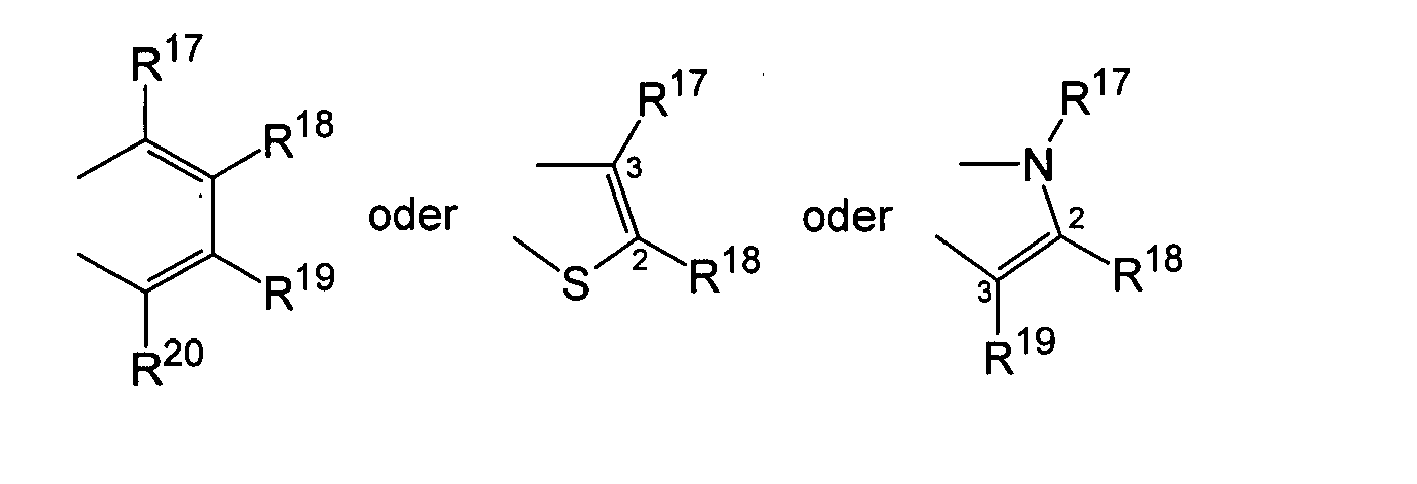

 R13, R13', R14, R14' , gleich oder verschieden Wasserstoff, Halogen, C1- bis C20-Alkyl, 3- bis 8-gliedriges Cycloalkyl - das seinerseits ein C1- bis C10-Alkyl als Substituenten tragen kann -, C6- bis C15-Aryl, Alkylaryl mit 1 bis 10 C-Atomen im Alkylrest und 6 bis 20 C-Atomen im Arylrest, Arylalkyl mit 1 bis 10 C-Atomen in Alkylrest und 6 bis 20 C-Atomen im Arylrest, -OR10, -SR10, -N(R10)2, -P(R10)2 oder Si(R9)3,Z für eine Gruppe -[Q(R15)(R16)]q- steht, worinQ gleich oder verschieden sein kann und für Silizium, Germanium, Zinn oder Kohlenstoff steht,R15, R16 für Wasserstoff, C1- bis C10-Alkyl, C3- bis C10-Cycloalkyl oder C6- bis C15-Aryl stehen, undq für die Zahlen 1, 2, 3 oder 4 steht;R17-R20, R17'-R20' gleich oder verschieden Wasserstoff, C1-bis C20-Alkyl, 3- bis 8-gliedriges Cycloalkyl, - das seinerseits ein C1- bis C10-Alkyl als Substituenten tragen kann -, C6- bis C15-Aryl oder Arylalkyl, wobei benachbarte Reste gemeinsam für 4 bis 15 C-Atome aufweisende cyclische Gruppen stehen können, oder Si(R11)3, undM2 ein Alkali- oder Erdalkalimetallion,
wobeip 1 ist, wenn M2 ein Erdalkalimetallion ist, und 2 ist, wenn M2 ein Alkalimetallion ist;und Erwärmen des so erhaltenen Reaktionsgemisches auf eine Temperatur im Bereich von minus 78°C bis 250°C, ggf. unter Zusatz von Radikalen oder Radikalbildnern,
wobei ein Komplex der Formel III erhalten wird

worin
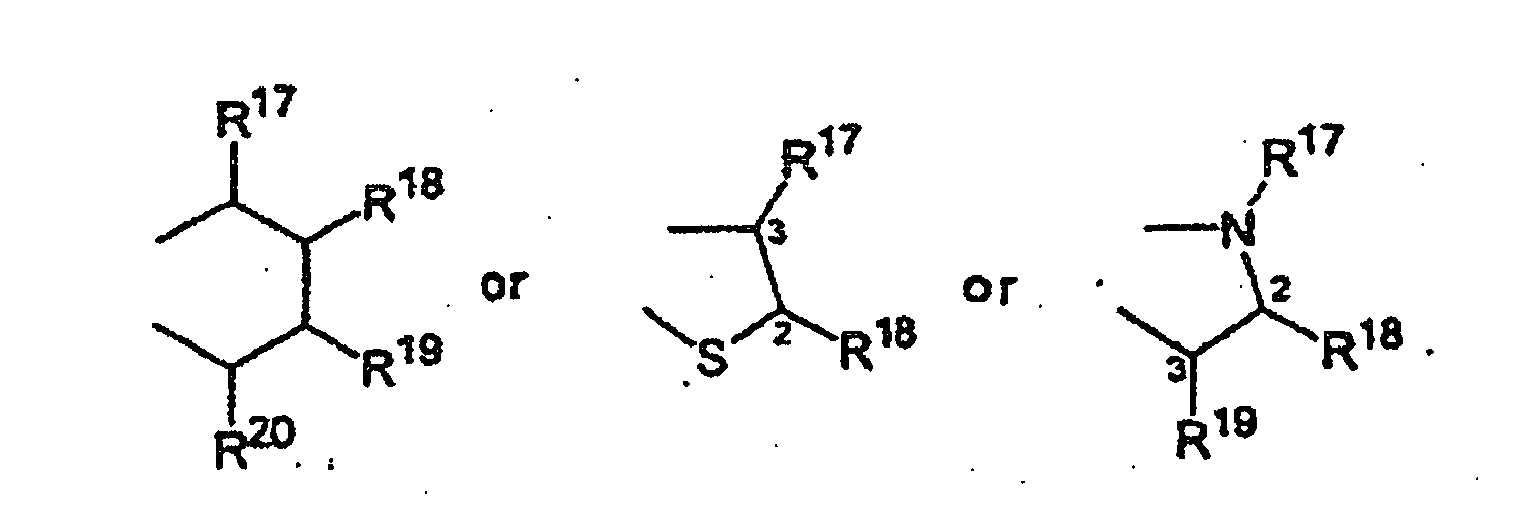


Hal Fluor, Chlor, Brom oder Iod bedeutet. - Verfahren nach Anspruch 1,
dadurch gekennzeichnet, dass die Y1 gleich sind und Sauerstoff bedeuten. - Verfahren nach einem der Ansprüche 1 oder 2,
dadurch gekennzeichnet, dass die Hydrierung homogenkatalytisch oder heterogenkatalytisch in Gegenwart von Katalysatoren wie Pt, Pd, Rh, Ru, Os, sowie Nickel, Raney-Nickel, deren Oxiden, Salzen oder Komplexen, Mischungen davon, ggf. auf geeigneten Katalysatorträgern, erfolgt, besonders bevorzugt in Gegenwart von Pd auf Aktivkohle. - Verfahren nach einem der Ansprüche 1 bis 3,
dadurch gekennzeichnet, dass zunächst der Komplex der allgemeinen Formel I durch Deprotonierung von Verbindungen der allgemeinen Formel IV
MX4(Lewis-Base)k (V)
hergestellt wird, wobei alle Reste wie in Anspruch 1 definiert sind, und k für eine Zahl von 0, 1 oder 2 steht, und der so hergestellte Komplex gemäß Formel I ohne Isolierung von Zwischenprodukten in der Reaktionslösung bis zum Komplex der Formel IV umgesetzt wird. - Verfahren nach einem der Ansprüche 1 bis 4 zur Herstellung von Ethandiylbis(4,5,6,7-tetrahydroindenyl)zirkoniumdichlorid (Verbindung der Formel VIa),
dadurch gekennzeichnet, dass eine Dihalogenozirkonium-bis(2,4,6-trimethylphenolat)-Verbindung (Verbindung der Formel I) mit Ethan-1,2-diyl-bisindenyl-dilithium (Verbindung der Formel II) zu Ethandiylbis(indenyl)-zirkoniumbis(2,4,6-trimethylphenolat) (Verbindung der Formel III) umgesetzt wird, welches nachfolgend zu Ethandiylbis(4,5,6,7-tetrahydroindenyl)zirkonium-bis(2,4,6-trimethylphenolat) (Verbindung der Formel VI) hydriert wird, und anschließende Substitution der Phenolate. - Verfahren nach einem der Ansprüche 1 bis 4 zur Herstellung von Ethandiylbis(4,5,6,7-tetrahydroindenyl)zirkoniumdichlorid (Verbindung der Formel VIa),
dadurch gekennzeichnet, dass eine Dihalogenozirkonium-bis(2,4-di-tert.-butylphenolat)-Verbindung (Verbindung der Formel I) mit Ethan-1,2-diyl-bisindenyl-dilithium (Verbindung der Formel II) zu Ethandiylbis(indenyl)-zirkoniumbis(2,4-di-tert.-butylphenolat) (Verbindung der Formel III) umgesetzt wird, welches nachfolgend zu Ethandiylbis(4,5,6,7-tetrahydroindenyl)zirkonium-bis(2,4-di-tert.-butylphenolat) (Verbindung der Formel VI) hydriert wird, und anschließende Substitution der Phenolate.
Applications Claiming Priority (5)
| Application Number | Priority Date | Filing Date | Title |
|---|---|---|---|
| DE10250025 | 2002-10-25 | ||
| DE10250025A DE10250025A1 (de) | 2002-10-25 | 2002-10-25 | Verfahren zur Darstellung teilweise hydrierter rac-ansa-Metallocen-Komplexe |
| US43180602P | 2002-12-09 | 2002-12-09 | |
| US431806P | 2002-12-09 | ||
| PCT/EP2003/011679 WO2004037838A1 (en) | 2002-10-25 | 2003-10-22 | Preparation of partially hydrogenated rac-ansa-metallocene complexes |
Publications (2)
| Publication Number | Publication Date |
|---|---|
| EP1554295A1 EP1554295A1 (de) | 2005-07-20 |
| EP1554295B1 true EP1554295B1 (de) | 2008-07-02 |
Family
ID=32087228
Family Applications (1)
| Application Number | Title | Priority Date | Filing Date |
|---|---|---|---|
| EP03758037A Expired - Lifetime EP1554295B1 (de) | 2002-10-25 | 2003-10-22 | Herstellung von teilweise hydrierten rac-ansa-metallocen-komplexen |
Country Status (12)
| Country | Link |
|---|---|
| US (1) | US7619106B2 (de) |
| EP (1) | EP1554295B1 (de) |
| JP (1) | JP4579155B2 (de) |
| CN (1) | CN100363372C (de) |
| AT (1) | ATE399789T1 (de) |
| AU (1) | AU2003274058A1 (de) |
| BR (1) | BR0315584B1 (de) |
| DE (2) | DE10250025A1 (de) |
| ES (1) | ES2307973T3 (de) |
| MX (1) | MXPA05002338A (de) |
| RU (1) | RU2333215C2 (de) |
| WO (1) | WO2004037838A1 (de) |
Families Citing this family (5)
| Publication number | Priority date | Publication date | Assignee | Title |
|---|---|---|---|---|
| WO2010077163A1 (en) | 2008-12-30 | 2010-07-08 | Gosudarstvennoe Uchebno-Nauchnoe Uchrezhdenie Khimichesky Fakultet Moskovskogo Gosudarstvennogo Universiteta Im. M.V.Lomonosova | Synthesis of substituted tetrahydroindenyl complexes, metallocenes produced therefrom and use of the metallocenes in polymerisation processes |
| JP6336870B2 (ja) * | 2013-09-30 | 2018-06-06 | 日本ポリプロ株式会社 | ビフェノール化合物及びそれを用いるオレフィン重合用触媒並びにオレフィン重合体の製造方法 |
| WO2015103703A1 (en) * | 2014-01-08 | 2015-07-16 | The Governing Council Of The University Of Toronto | Iron(ii) catalysts containing tridentate pnp ligands, their synthesis, and use thereof |
| KR101826253B1 (ko) | 2015-07-15 | 2018-02-06 | 한화케미칼 주식회사 | 메탈로센 화합물 및 이의 제조방법 |
| JP7624986B2 (ja) | 2019-10-28 | 2025-01-31 | 中国石油化工股▲ふん▼有限公司 | ビフェノール金属錯体、その製造方法およびその使用 |
Family Cites Families (19)
| Publication number | Priority date | Publication date | Assignee | Title |
|---|---|---|---|---|
| DE3443087A1 (de) | 1984-11-27 | 1986-05-28 | Hoechst Ag, 6230 Frankfurt | Verfahren zur herstellung von polyolefinen |
| IL89525A0 (en) | 1988-03-21 | 1989-09-10 | Exxon Chemical Patents Inc | Silicon-bridged transition metal compounds |
| USRE39532E1 (en) * | 1990-11-12 | 2007-03-27 | Basell Polyolefine Gmbh | Metallocenes containing ligands of 2-substituted indenyl derivatives, process for their preparation, and their use as catalysts |
| DE59107926D1 (de) * | 1990-11-12 | 1996-07-18 | Hoechst Ag | Metallocene mit Liganden aus 2-substituierten Indenylderivaten, Verfahren zu ihrer Herstellung und ihre Verwendung als Katalysatoren |
| WO1992009545A2 (en) * | 1990-11-21 | 1992-06-11 | Massachusetts Institute Of Technology | New methods for the catalytic reduction of organic substrates |
| US5442119A (en) * | 1990-11-21 | 1995-08-15 | Massachusetts Institute Of Technology | Catalytic asymmetric reduction of trisubstituted olefins |
| DE59210001D1 (de) * | 1991-10-15 | 2005-02-17 | Basell Polyolefine Gmbh | Verfahren zur Herstellung eines Olefinpolymers unter Verwendung von Metallocenen mit speziell substituierten Indenylliganden |
| JPH072936A (ja) | 1992-07-10 | 1995-01-06 | Fina Technol Inc | アイソタクチツクポリオレフイン製造のための方法及び触媒 |
| JPH0741521A (ja) | 1993-07-30 | 1995-02-10 | Mitsui Toatsu Chem Inc | 環状オレフィンの重合方法 |
| IT1271407B (it) * | 1993-09-13 | 1997-05-28 | Spherilene Srl | Procedimento per la preparazione di copolimeri elastomerici dell'etilene e prodotti ottenuti |
| JPH07292019A (ja) | 1994-04-28 | 1995-11-07 | Mitsubishi Chem Corp | オレフィン重合用触媒およびオレフィン重合体の製造法 |
| DE4431837A1 (de) | 1994-09-07 | 1996-03-14 | Basf Ag | Geträgerte Metallocen-Katalysatorsysteme |
| DE19644040A1 (de) | 1996-10-31 | 1998-05-07 | Hoechst Ag | Verfahren zur Hydrierung von Metallocenen |
| DE19741876A1 (de) * | 1997-09-23 | 1999-03-25 | Basf Ag | Verfahren zur selektiven Herstellung racemischer Metallocenkomplexe |
| ES2192408T3 (es) * | 1998-11-25 | 2003-10-01 | Basell Polyolefine Gmbh | Procedimiento para la fabricacion de monoariloxi-ansa-metalocenos. |
| DE10030638A1 (de) * | 2000-06-29 | 2002-01-10 | Basell Polyolefine Gmbh | Verfahren zur selektiven Herstellung racemischer Metallocenkomplexe |
| DE10200422A1 (de) * | 2002-01-08 | 2003-07-17 | Basell Polyolefine Gmbh | Verfahren zur Herstellung von Dialkyl-ansa-Metallocenen |
| US20050182266A1 (en) * | 2002-06-12 | 2005-08-18 | Schulte Jorg L. | Transition metal componds their preparation and their use in catalyst systems for the polymerization and copolymerization of olefins |
| RU2329272C2 (ru) * | 2002-10-25 | 2008-07-20 | Базелль Полиолефине Гмбх | Рацемоселективное получение поддающихся выделению анса-металлоценовых бифеноксидных комплексов, имеющих относительно короткое время изомеризации |
-
2002
- 2002-10-25 DE DE10250025A patent/DE10250025A1/de not_active Withdrawn
-
2003
- 2003-10-22 RU RU2005115850/04A patent/RU2333215C2/ru not_active IP Right Cessation
- 2003-10-22 DE DE60321941T patent/DE60321941D1/de not_active Expired - Lifetime
- 2003-10-22 JP JP2005501528A patent/JP4579155B2/ja not_active Expired - Lifetime
- 2003-10-22 EP EP03758037A patent/EP1554295B1/de not_active Expired - Lifetime
- 2003-10-22 MX MXPA05002338A patent/MXPA05002338A/es active IP Right Grant
- 2003-10-22 BR BRPI0315584-6A patent/BR0315584B1/pt active IP Right Grant
- 2003-10-22 WO PCT/EP2003/011679 patent/WO2004037838A1/en not_active Ceased
- 2003-10-22 CN CNB2003801007737A patent/CN100363372C/zh not_active Expired - Fee Related
- 2003-10-22 US US10/532,523 patent/US7619106B2/en not_active Expired - Lifetime
- 2003-10-22 AT AT03758037T patent/ATE399789T1/de not_active IP Right Cessation
- 2003-10-22 ES ES03758037T patent/ES2307973T3/es not_active Expired - Lifetime
- 2003-10-22 AU AU2003274058A patent/AU2003274058A1/en not_active Abandoned
Also Published As
| Publication number | Publication date |
|---|---|
| CN100363372C (zh) | 2008-01-23 |
| WO2004037838A1 (en) | 2004-05-06 |
| RU2333215C2 (ru) | 2008-09-10 |
| ES2307973T3 (es) | 2008-12-01 |
| MXPA05002338A (es) | 2005-05-23 |
| JP4579155B2 (ja) | 2010-11-10 |
| BR0315584B1 (pt) | 2013-06-04 |
| EP1554295A1 (de) | 2005-07-20 |
| US7619106B2 (en) | 2009-11-17 |
| AU2003274058A1 (en) | 2004-05-13 |
| RU2005115850A (ru) | 2006-01-20 |
| CN1694892A (zh) | 2005-11-09 |
| US20080200708A1 (en) | 2008-08-21 |
| ATE399789T1 (de) | 2008-07-15 |
| BR0315584A (pt) | 2005-08-30 |
| DE10250025A1 (de) | 2004-05-06 |
| JP2006503910A (ja) | 2006-02-02 |
| DE60321941D1 (de) | 2008-08-14 |
Similar Documents
| Publication | Publication Date | Title |
|---|---|---|
| JP4371573B2 (ja) | メタロセンの合成方法 | |
| EP0763044B1 (de) | Verfahren zur herstellung von ansa - metallocenkatalysatoren | |
| US5627247A (en) | Organometallic fluorenyl compounds and use thereof in olefin polymerization | |
| US6262286B1 (en) | Method for selective production of racemic metallocene complexes | |
| US5912373A (en) | Process for converting the achiral meso form of an ansa-metallocene complex into the chiral racemic form | |
| JP4454225B2 (ja) | ラセミメタロセン錯体の製造方法 | |
| US7619106B2 (en) | Preparation of partially hydrogenated rac-ansa-metallocene complexes | |
| WO1996019488A1 (en) | A method of preparing high purity racemic metallocene alkyls and use thereof | |
| EP1554297B1 (de) | Racemoselektive herstellung rac-diorganosilylbis(2-methylbenzo¬e|indenyl)zirconium-verbindungen | |
| EP1554296B1 (de) | Razemoselektive herstellung isolierbarer ansa-metallocen-biphenoxid-komplexe | |
| EP1556417B1 (de) | Racemoselektive herstellung verbrückter metallocenkomplexe mit unsubstituierten or in der position 2 substituierten indenylliganden | |
| US5859276A (en) | Organotransition metal compounds | |
| US5004820A (en) | Preparation of chiral metallocene dihalides | |
| RU2335504C2 (ru) | Способ получения галогенидметаллоценовых соединений | |
| CN100457764C (zh) | 可异构化的柄型金属茂二酚盐络合物的外消旋选择性制备 | |
| AU2020300124A1 (en) | Title of the invention:a new process for synthesizing C2 bridged cyclopentadienyl ligands and corresponding ansa-metallocene catalysts | |
| CA2343948A1 (en) | Preparation of titanium(ii) or zirconium(ii) complexes |
Legal Events
| Date | Code | Title | Description |
|---|---|---|---|
| PUAI | Public reference made under article 153(3) epc to a published international application that has entered the european phase |
Free format text: ORIGINAL CODE: 0009012 |
|
| 17P | Request for examination filed |
Effective date: 20050405 |
|
| AK | Designated contracting states |
Kind code of ref document: A1 Designated state(s): AT BE BG CH CY CZ DE DK EE ES FI FR GB GR HU IE IT LI LU MC NL PT RO SE SI SK TR |
|
| AX | Request for extension of the european patent |
Extension state: AL LT LV MK |
|
| DAX | Request for extension of the european patent (deleted) | ||
| RIN1 | Information on inventor provided before grant (corrected) |
Inventor name: TELLIER, CHRISTIAN Inventor name: DUCHIRON, STEPHANIE Inventor name: SIDOT, CHRISTIAN Inventor name: LELONG, JEAN-FRANCOIS Inventor name: DAMRAU, HANS-ROBERT-HELLMUTH Inventor name: MUELLER, PATRIK Inventor name: GARCIA, VALERIE |
|
| RIN1 | Information on inventor provided before grant (corrected) |
Inventor name: TELLIER, CHRISTIAN Inventor name: DAMRAU, HANS-ROBERT-HELLMUTH Inventor name: SIDOT, CHRISTIAN Inventor name: LELONG, JEAN-FRANCOIS Inventor name: DUCHIRON, STEPHANIE Inventor name: GARCIA, VALERIE Inventor name: MUELLER, PATRIK |
|
| 17Q | First examination report despatched |
Effective date: 20061117 |
|
| GRAP | Despatch of communication of intention to grant a patent |
Free format text: ORIGINAL CODE: EPIDOSNIGR1 |
|
| GRAS | Grant fee paid |
Free format text: ORIGINAL CODE: EPIDOSNIGR3 |
|
| GRAA | (expected) grant |
Free format text: ORIGINAL CODE: 0009210 |
|
| AK | Designated contracting states |
Kind code of ref document: B1 Designated state(s): AT BE BG CH CY CZ DE DK EE ES FI FR GB GR HU IE IT LI LU MC NL PT RO SE SI SK TR |
|
| REG | Reference to a national code |
Ref country code: GB Ref legal event code: FG4D |
|
| REG | Reference to a national code |
Ref country code: CH Ref legal event code: EP Ref country code: CH Ref legal event code: NV Representative=s name: SCHMAUDER & PARTNER AG PATENTANWALTSBUERO |
|
| REF | Corresponds to: |
Ref document number: 60321941 Country of ref document: DE Date of ref document: 20080814 Kind code of ref document: P |
|
| REG | Reference to a national code |
Ref country code: IE Ref legal event code: FG4D |
|
| PG25 | Lapsed in a contracting state [announced via postgrant information from national office to epo] |
Ref country code: SI Free format text: LAPSE BECAUSE OF FAILURE TO SUBMIT A TRANSLATION OF THE DESCRIPTION OR TO PAY THE FEE WITHIN THE PRESCRIBED TIME-LIMIT Effective date: 20080702 |
|
| REG | Reference to a national code |
Ref country code: ES Ref legal event code: FG2A Ref document number: 2307973 Country of ref document: ES Kind code of ref document: T3 |
|
| PG25 | Lapsed in a contracting state [announced via postgrant information from national office to epo] |
Ref country code: PT Free format text: LAPSE BECAUSE OF FAILURE TO SUBMIT A TRANSLATION OF THE DESCRIPTION OR TO PAY THE FEE WITHIN THE PRESCRIBED TIME-LIMIT Effective date: 20081202 |
|
| PG25 | Lapsed in a contracting state [announced via postgrant information from national office to epo] |
Ref country code: FI Free format text: LAPSE BECAUSE OF FAILURE TO SUBMIT A TRANSLATION OF THE DESCRIPTION OR TO PAY THE FEE WITHIN THE PRESCRIBED TIME-LIMIT Effective date: 20080702 Ref country code: BG Free format text: LAPSE BECAUSE OF FAILURE TO SUBMIT A TRANSLATION OF THE DESCRIPTION OR TO PAY THE FEE WITHIN THE PRESCRIBED TIME-LIMIT Effective date: 20081002 Ref country code: AT Free format text: LAPSE BECAUSE OF FAILURE TO SUBMIT A TRANSLATION OF THE DESCRIPTION OR TO PAY THE FEE WITHIN THE PRESCRIBED TIME-LIMIT Effective date: 20080702 |
|
| PG25 | Lapsed in a contracting state [announced via postgrant information from national office to epo] |
Ref country code: BE Free format text: LAPSE BECAUSE OF FAILURE TO SUBMIT A TRANSLATION OF THE DESCRIPTION OR TO PAY THE FEE WITHIN THE PRESCRIBED TIME-LIMIT Effective date: 20080702 |
|
| PG25 | Lapsed in a contracting state [announced via postgrant information from national office to epo] |
Ref country code: DK Free format text: LAPSE BECAUSE OF FAILURE TO SUBMIT A TRANSLATION OF THE DESCRIPTION OR TO PAY THE FEE WITHIN THE PRESCRIBED TIME-LIMIT Effective date: 20080702 Ref country code: EE Free format text: LAPSE BECAUSE OF FAILURE TO SUBMIT A TRANSLATION OF THE DESCRIPTION OR TO PAY THE FEE WITHIN THE PRESCRIBED TIME-LIMIT Effective date: 20080702 |
|
| PLBE | No opposition filed within time limit |
Free format text: ORIGINAL CODE: 0009261 |
|
| STAA | Information on the status of an ep patent application or granted ep patent |
Free format text: STATUS: NO OPPOSITION FILED WITHIN TIME LIMIT |
|
| PG25 | Lapsed in a contracting state [announced via postgrant information from national office to epo] |
Ref country code: SK Free format text: LAPSE BECAUSE OF FAILURE TO SUBMIT A TRANSLATION OF THE DESCRIPTION OR TO PAY THE FEE WITHIN THE PRESCRIBED TIME-LIMIT Effective date: 20080702 Ref country code: MC Free format text: LAPSE BECAUSE OF NON-PAYMENT OF DUE FEES Effective date: 20081031 Ref country code: CZ Free format text: LAPSE BECAUSE OF FAILURE TO SUBMIT A TRANSLATION OF THE DESCRIPTION OR TO PAY THE FEE WITHIN THE PRESCRIBED TIME-LIMIT Effective date: 20080702 Ref country code: RO Free format text: LAPSE BECAUSE OF FAILURE TO SUBMIT A TRANSLATION OF THE DESCRIPTION OR TO PAY THE FEE WITHIN THE PRESCRIBED TIME-LIMIT Effective date: 20080702 |
|
| 26N | No opposition filed |
Effective date: 20090403 |
|
| REG | Reference to a national code |
Ref country code: IE Ref legal event code: MM4A |
|
| REG | Reference to a national code |
Ref country code: CH Ref legal event code: PCAR Free format text: SCHMAUDER & PARTNER AG PATENT- UND MARKENANWAELTE VSP;ZWAENGIWEG 7;8038 ZUERICH (CH) |
|
| PG25 | Lapsed in a contracting state [announced via postgrant information from national office to epo] |
Ref country code: IE Free format text: LAPSE BECAUSE OF NON-PAYMENT OF DUE FEES Effective date: 20081022 |
|
| PG25 | Lapsed in a contracting state [announced via postgrant information from national office to epo] |
Ref country code: SE Free format text: LAPSE BECAUSE OF FAILURE TO SUBMIT A TRANSLATION OF THE DESCRIPTION OR TO PAY THE FEE WITHIN THE PRESCRIBED TIME-LIMIT Effective date: 20081002 |
|
| PGFP | Annual fee paid to national office [announced via postgrant information from national office to epo] |
Ref country code: CH Payment date: 20091026 Year of fee payment: 7 |
|
| REG | Reference to a national code |
Ref country code: CH Ref legal event code: NV Representative=s name: DR. GILLES REISS |
|
| PGFP | Annual fee paid to national office [announced via postgrant information from national office to epo] |
Ref country code: GB Payment date: 20091026 Year of fee payment: 7 |
|
| PG25 | Lapsed in a contracting state [announced via postgrant information from national office to epo] |
Ref country code: LU Free format text: LAPSE BECAUSE OF NON-PAYMENT OF DUE FEES Effective date: 20081022 Ref country code: HU Free format text: LAPSE BECAUSE OF FAILURE TO SUBMIT A TRANSLATION OF THE DESCRIPTION OR TO PAY THE FEE WITHIN THE PRESCRIBED TIME-LIMIT Effective date: 20090103 Ref country code: CY Free format text: LAPSE BECAUSE OF FAILURE TO SUBMIT A TRANSLATION OF THE DESCRIPTION OR TO PAY THE FEE WITHIN THE PRESCRIBED TIME-LIMIT Effective date: 20080702 |
|
| PG25 | Lapsed in a contracting state [announced via postgrant information from national office to epo] |
Ref country code: TR Free format text: LAPSE BECAUSE OF FAILURE TO SUBMIT A TRANSLATION OF THE DESCRIPTION OR TO PAY THE FEE WITHIN THE PRESCRIBED TIME-LIMIT Effective date: 20080702 |
|
| PG25 | Lapsed in a contracting state [announced via postgrant information from national office to epo] |
Ref country code: GR Free format text: LAPSE BECAUSE OF FAILURE TO SUBMIT A TRANSLATION OF THE DESCRIPTION OR TO PAY THE FEE WITHIN THE PRESCRIBED TIME-LIMIT Effective date: 20081003 |
|
| REG | Reference to a national code |
Ref country code: CH Ref legal event code: PCAR Free format text: DR. GILLES REISS-HUERLIMANN OFFICE CENTER,5 ST.;INNERE MARGARETHENSTRASSE 5;4051 BASEL (CH) |
|
| REG | Reference to a national code |
Ref country code: CH Ref legal event code: PL |
|
| GBPC | Gb: european patent ceased through non-payment of renewal fee |
Effective date: 20101022 |
|
| PG25 | Lapsed in a contracting state [announced via postgrant information from national office to epo] |
Ref country code: CH Free format text: LAPSE BECAUSE OF NON-PAYMENT OF DUE FEES Effective date: 20101031 Ref country code: LI Free format text: LAPSE BECAUSE OF NON-PAYMENT OF DUE FEES Effective date: 20101031 |
|
| PG25 | Lapsed in a contracting state [announced via postgrant information from national office to epo] |
Ref country code: GB Free format text: LAPSE BECAUSE OF NON-PAYMENT OF DUE FEES Effective date: 20101022 |
|
| REG | Reference to a national code |
Ref country code: FR Ref legal event code: PLFP Year of fee payment: 14 |
|
| REG | Reference to a national code |
Ref country code: FR Ref legal event code: PLFP Year of fee payment: 15 |
|
| REG | Reference to a national code |
Ref country code: FR Ref legal event code: PLFP Year of fee payment: 16 |
|
| PGFP | Annual fee paid to national office [announced via postgrant information from national office to epo] |
Ref country code: NL Payment date: 20210920 Year of fee payment: 19 Ref country code: FR Payment date: 20210921 Year of fee payment: 19 |
|
| PGFP | Annual fee paid to national office [announced via postgrant information from national office to epo] |
Ref country code: ES Payment date: 20211112 Year of fee payment: 19 |
|
| PGFP | Annual fee paid to national office [announced via postgrant information from national office to epo] |
Ref country code: IT Payment date: 20211012 Year of fee payment: 19 |
|
| PGFP | Annual fee paid to national office [announced via postgrant information from national office to epo] |
Ref country code: DE Payment date: 20220914 Year of fee payment: 20 |
|
| REG | Reference to a national code |
Ref country code: NL Ref legal event code: MM Effective date: 20221101 |
|
| P01 | Opt-out of the competence of the unified patent court (upc) registered |
Effective date: 20230507 |
|
| PG25 | Lapsed in a contracting state [announced via postgrant information from national office to epo] |
Ref country code: NL Free format text: LAPSE BECAUSE OF NON-PAYMENT OF DUE FEES Effective date: 20221101 Ref country code: FR Free format text: LAPSE BECAUSE OF NON-PAYMENT OF DUE FEES Effective date: 20221031 |
|
| REG | Reference to a national code |
Ref country code: DE Ref legal event code: R071 Ref document number: 60321941 Country of ref document: DE |
|
| PG25 | Lapsed in a contracting state [announced via postgrant information from national office to epo] |
Ref country code: IT Free format text: LAPSE BECAUSE OF NON-PAYMENT OF DUE FEES Effective date: 20221022 |
|
| REG | Reference to a national code |
Ref country code: ES Ref legal event code: FD2A Effective date: 20231201 |
|
| PG25 | Lapsed in a contracting state [announced via postgrant information from national office to epo] |
Ref country code: ES Free format text: LAPSE BECAUSE OF NON-PAYMENT OF DUE FEES Effective date: 20221023 |
|
| PG25 | Lapsed in a contracting state [announced via postgrant information from national office to epo] |
Ref country code: ES Free format text: LAPSE BECAUSE OF NON-PAYMENT OF DUE FEES Effective date: 20221023 |