EP1553792A2 - Bild-Digitalisierungssystem, tragbares Endgerät und Verfahren zur Ablieferung von Figurdaten - Google Patents
Bild-Digitalisierungssystem, tragbares Endgerät und Verfahren zur Ablieferung von Figurdaten Download PDFInfo
- Publication number
- EP1553792A2 EP1553792A2 EP04030286A EP04030286A EP1553792A2 EP 1553792 A2 EP1553792 A2 EP 1553792A2 EP 04030286 A EP04030286 A EP 04030286A EP 04030286 A EP04030286 A EP 04030286A EP 1553792 A2 EP1553792 A2 EP 1553792A2
- Authority
- EP
- European Patent Office
- Prior art keywords
- portable terminal
- character data
- terminal unit
- data
- unit
- Prior art date
- Legal status (The legal status is an assumption and is not a legal conclusion. Google has not performed a legal analysis and makes no representation as to the accuracy of the status listed.)
- Withdrawn
Links
Images



Classifications
-
- H—ELECTRICITY
- H04—ELECTRIC COMMUNICATION TECHNIQUE
- H04L—TRANSMISSION OF DIGITAL INFORMATION, e.g. TELEGRAPHIC COMMUNICATION
- H04L67/00—Network arrangements or protocols for supporting network services or applications
- H04L67/01—Protocols
- H04L67/131—Protocols for games, networked simulations or virtual reality
-
- A—HUMAN NECESSITIES
- A63—SPORTS; GAMES; AMUSEMENTS
- A63F—CARD, BOARD, OR ROULETTE GAMES; INDOOR GAMES USING SMALL MOVING PLAYING BODIES; VIDEO GAMES; GAMES NOT OTHERWISE PROVIDED FOR
- A63F13/00—Video games, i.e. games using an electronically generated display having two or more dimensions
- A63F13/30—Interconnection arrangements between game servers and game devices; Interconnection arrangements between game devices; Interconnection arrangements between game servers
- A63F13/33—Interconnection arrangements between game servers and game devices; Interconnection arrangements between game devices; Interconnection arrangements between game servers using wide area network [WAN] connections
- A63F13/332—Interconnection arrangements between game servers and game devices; Interconnection arrangements between game devices; Interconnection arrangements between game servers using wide area network [WAN] connections using wireless networks, e.g. cellular phone networks
-
- A—HUMAN NECESSITIES
- A63—SPORTS; GAMES; AMUSEMENTS
- A63F—CARD, BOARD, OR ROULETTE GAMES; INDOOR GAMES USING SMALL MOVING PLAYING BODIES; VIDEO GAMES; GAMES NOT OTHERWISE PROVIDED FOR
- A63F13/00—Video games, i.e. games using an electronically generated display having two or more dimensions
- A63F13/20—Input arrangements for video game devices
- A63F13/21—Input arrangements for video game devices characterised by their sensors, purposes or types
- A63F13/213—Input arrangements for video game devices characterised by their sensors, purposes or types comprising photodetecting means, e.g. cameras, photodiodes or infrared cells
-
- A—HUMAN NECESSITIES
- A63—SPORTS; GAMES; AMUSEMENTS
- A63F—CARD, BOARD, OR ROULETTE GAMES; INDOOR GAMES USING SMALL MOVING PLAYING BODIES; VIDEO GAMES; GAMES NOT OTHERWISE PROVIDED FOR
- A63F13/00—Video games, i.e. games using an electronically generated display having two or more dimensions
- A63F13/30—Interconnection arrangements between game servers and game devices; Interconnection arrangements between game devices; Interconnection arrangements between game servers
- A63F13/33—Interconnection arrangements between game servers and game devices; Interconnection arrangements between game devices; Interconnection arrangements between game servers using wide area network [WAN] connections
- A63F13/335—Interconnection arrangements between game servers and game devices; Interconnection arrangements between game devices; Interconnection arrangements between game servers using wide area network [WAN] connections using Internet
-
- A—HUMAN NECESSITIES
- A63—SPORTS; GAMES; AMUSEMENTS
- A63F—CARD, BOARD, OR ROULETTE GAMES; INDOOR GAMES USING SMALL MOVING PLAYING BODIES; VIDEO GAMES; GAMES NOT OTHERWISE PROVIDED FOR
- A63F13/00—Video games, i.e. games using an electronically generated display having two or more dimensions
- A63F13/30—Interconnection arrangements between game servers and game devices; Interconnection arrangements between game devices; Interconnection arrangements between game servers
- A63F13/35—Details of game servers
-
- A—HUMAN NECESSITIES
- A63—SPORTS; GAMES; AMUSEMENTS
- A63F—CARD, BOARD, OR ROULETTE GAMES; INDOOR GAMES USING SMALL MOVING PLAYING BODIES; VIDEO GAMES; GAMES NOT OTHERWISE PROVIDED FOR
- A63F13/00—Video games, i.e. games using an electronically generated display having two or more dimensions
- A63F13/40—Processing input control signals of video game devices, e.g. signals generated by the player or derived from the environment
-
- A—HUMAN NECESSITIES
- A63—SPORTS; GAMES; AMUSEMENTS
- A63F—CARD, BOARD, OR ROULETTE GAMES; INDOOR GAMES USING SMALL MOVING PLAYING BODIES; VIDEO GAMES; GAMES NOT OTHERWISE PROVIDED FOR
- A63F13/00—Video games, i.e. games using an electronically generated display having two or more dimensions
- A63F13/60—Generating or modifying game content before or while executing the game program, e.g. authoring tools specially adapted for game development or game-integrated level editor
- A63F13/65—Generating or modifying game content before or while executing the game program, e.g. authoring tools specially adapted for game development or game-integrated level editor automatically by game devices or servers from real world data, e.g. measurement in live racing competition
-
- A—HUMAN NECESSITIES
- A63—SPORTS; GAMES; AMUSEMENTS
- A63F—CARD, BOARD, OR ROULETTE GAMES; INDOOR GAMES USING SMALL MOVING PLAYING BODIES; VIDEO GAMES; GAMES NOT OTHERWISE PROVIDED FOR
- A63F13/00—Video games, i.e. games using an electronically generated display having two or more dimensions
- A63F13/70—Game security or game management aspects
- A63F13/77—Game security or game management aspects involving data related to game devices or game servers, e.g. configuration data, software version or amount of memory
-
- A—HUMAN NECESSITIES
- A63—SPORTS; GAMES; AMUSEMENTS
- A63F—CARD, BOARD, OR ROULETTE GAMES; INDOOR GAMES USING SMALL MOVING PLAYING BODIES; VIDEO GAMES; GAMES NOT OTHERWISE PROVIDED FOR
- A63F2300/00—Features of games using an electronically generated display having two or more dimensions, e.g. on a television screen, showing representations related to the game
- A63F2300/10—Features of games using an electronically generated display having two or more dimensions, e.g. on a television screen, showing representations related to the game characterized by input arrangements for converting player-generated signals into game device control signals
- A63F2300/1087—Features of games using an electronically generated display having two or more dimensions, e.g. on a television screen, showing representations related to the game characterized by input arrangements for converting player-generated signals into game device control signals comprising photodetecting means, e.g. a camera
-
- A—HUMAN NECESSITIES
- A63—SPORTS; GAMES; AMUSEMENTS
- A63F—CARD, BOARD, OR ROULETTE GAMES; INDOOR GAMES USING SMALL MOVING PLAYING BODIES; VIDEO GAMES; GAMES NOT OTHERWISE PROVIDED FOR
- A63F2300/00—Features of games using an electronically generated display having two or more dimensions, e.g. on a television screen, showing representations related to the game
- A63F2300/40—Features of games using an electronically generated display having two or more dimensions, e.g. on a television screen, showing representations related to the game characterised by details of platform network
- A63F2300/406—Transmission via wireless network, e.g. pager or GSM
-
- A—HUMAN NECESSITIES
- A63—SPORTS; GAMES; AMUSEMENTS
- A63F—CARD, BOARD, OR ROULETTE GAMES; INDOOR GAMES USING SMALL MOVING PLAYING BODIES; VIDEO GAMES; GAMES NOT OTHERWISE PROVIDED FOR
- A63F2300/00—Features of games using an electronically generated display having two or more dimensions, e.g. on a television screen, showing representations related to the game
- A63F2300/40—Features of games using an electronically generated display having two or more dimensions, e.g. on a television screen, showing representations related to the game characterised by details of platform network
- A63F2300/407—Data transfer via internet
-
- A—HUMAN NECESSITIES
- A63—SPORTS; GAMES; AMUSEMENTS
- A63F—CARD, BOARD, OR ROULETTE GAMES; INDOOR GAMES USING SMALL MOVING PLAYING BODIES; VIDEO GAMES; GAMES NOT OTHERWISE PROVIDED FOR
- A63F2300/00—Features of games using an electronically generated display having two or more dimensions, e.g. on a television screen, showing representations related to the game
- A63F2300/50—Features of games using an electronically generated display having two or more dimensions, e.g. on a television screen, showing representations related to the game characterized by details of game servers
-
- A—HUMAN NECESSITIES
- A63—SPORTS; GAMES; AMUSEMENTS
- A63F—CARD, BOARD, OR ROULETTE GAMES; INDOOR GAMES USING SMALL MOVING PLAYING BODIES; VIDEO GAMES; GAMES NOT OTHERWISE PROVIDED FOR
- A63F2300/00—Features of games using an electronically generated display having two or more dimensions, e.g. on a television screen, showing representations related to the game
- A63F2300/50—Features of games using an electronically generated display having two or more dimensions, e.g. on a television screen, showing representations related to the game characterized by details of game servers
- A63F2300/55—Details of game data or player data management
- A63F2300/552—Details of game data or player data management for downloading to client devices, e.g. using OS version, hardware or software profile of the client device
-
- A—HUMAN NECESSITIES
- A63—SPORTS; GAMES; AMUSEMENTS
- A63F—CARD, BOARD, OR ROULETTE GAMES; INDOOR GAMES USING SMALL MOVING PLAYING BODIES; VIDEO GAMES; GAMES NOT OTHERWISE PROVIDED FOR
- A63F2300/00—Features of games using an electronically generated display having two or more dimensions, e.g. on a television screen, showing representations related to the game
- A63F2300/60—Methods for processing data by generating or executing the game program
- A63F2300/69—Involving elements of the real world in the game world, e.g. measurement in live races, real video
Definitions
- the present invention relates to an image digitization system, a portable terminal unit, and a character data delivery method, and more particularly to application software that runs on a portable terminal unit using character data.
- a portable terminal unit has the basic performance and the function that have improved significantly from those of a terminal unit a few years ago and, now, various types of application software can be run on the portable terminal unit.
- a portable terminal unit now provided with short-range wireless means for an infrared ray and Bluetooth (registered trademark) communication, uses the short-range wireless communication means for easily communicating with other devices.
- Character data used by the application software described above is fixed in many cases for each application program, and few application programs allow the user to carry out communication with other users using character data itself. Even if character data can be changed, the user has to set up the character change and, therefore, changing data does not give any gaming pleasure.
- an object of the present invention to provide an image digitization system, a portable terminal unit, and a character data delivery method that solve the problem described above, that implement application software allowing the user to use character data itself to find amusement in communication with other users, and that allow the user to change character data to increase their gaming pleasure.
- An image digitization system comprises a data delivery server including an accumulation unit (i.e. memory unit) in which character data, which is used by application software running on a portable terminal unit, is accumulated, wherein the portable terminal unit comprises a shooting unit for shooting an image; a converting unit for converting the shot image to a numeric value corresponding to character data; a downloading unit for downloading a character data, corresponding to the converted numeric value, from the data delivery server; and a memory in which the downloaded character data is saved.
- an accumulation unit i.e. memory unit
- character data which is used by application software running on a portable terminal unit
- the portable terminal unit comprises a shooting unit for shooting an image; a converting unit for converting the shot image to a numeric value corresponding to character data; a downloading unit for downloading a character data, corresponding to the converted numeric value, from the data delivery server; and a memory in which the downloaded character data is saved.
- a portable terminal unit comprises a shooting unit for shooting an image; a converting unit for converting the shot image to a numeric value corresponding to character data used by application software running in the portable terminal unit; a downloading unit for downloading character data, corresponding to the converted numeric value, from a data delivery server that includes an accumulation unit in which the character data is accumulated; and a memory in which the downloaded character data is saved.
- the image digitization system provides a method for diversifying character data used by application software and allowing a user to find a new use through the communication with other units.
- the image digitization system converts image data, shot (photographed) by a (digital) camera contained in or external to the portable terminal unit, to a numeric value according to an appropriate algorithm, associates the numeric value with character data stored in a server, and delivers the character data from the server.
- the image digitization system allows users to exchange character data between themselves.
- character data is exchanged between the users, the existing data owned by one user is deleted and a new data owned by the other user is saved in the former user's portable terminal unit.
- the image digitization system makes character data, which is used by the application software, diversified data that corresponds to a shot image. This makes the user feel as if the system was a game in which character data itself is used.
- the application software in the image digitization system according to the present invention designed with character data collection as one of purposes, increases the amount of communication with the servers to obtain the rare and valuable character data described above and, as a result, leads to an increase in the sales.
- the image digitization system allows users to exchange character data among themselves. This operation increases the recognition of the application software and encourages users to get it.
- the image digitization system according to the present invention which has the configuration and performs the operation as described below, has an effect of implementing application software that allows a user to enjoy communication with other users using character data itself as well as an effect of changing the character data of the application software to increase gaming pleasure or gaming nature.
- FIG. 1 is a block diagram showing the configuration of an image digitization system in one embodiment of the present invention.
- the image digitization system in one embodiment of the present invention comprises portable terminal units 1 and 2, a wireless base station 3, data delivery servers 4-1 to 4-4, a wireless network 100, and the Internet 200.
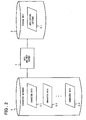
- FIG. 2 is a block diagram showing an example of the arrangement of storage units and so on in each of the data delivery servers 4-1 to 4-4 shown in FIG. 1.
- the data delivery server 4 has a storage unit (accumulation unit) 5 in which application software 51 is stored and a character database 6 in which character data 61 to 6N is accumulated.
- the application software 51 comprises a mechanism for controlling a camera (not shown) for shooting an image, a mechanism for converting shot image data to a numeric value according to a specific algorithm, and a mechanism for managing character data 61 to 6N.
- the character data 61 to 6N contain the elements of the drawing image of a character. That is, the character data 61 to 6N is data representing the name and visual data by which the user identifies a character used by the application software 51.
- the software is collection type application software for collecting monsters appearing in a game
- the character data is composed of the name of a monster, the appearance (image) of the monster, and so on.
- the software is a program that delivers a calendar featuring idols
- the character data is composed of the pictures of idols etc.
- the application software 51 includes the function to display a list of character data 61 to 6N in the album format, the function to exchange character data with other terminals, and so on.
- the data delivery servers 4-1 to 4-4 are configured in the same manner as the data delivery server 4 described above.
- the description of the internal structure of the communication unit and the delivery unit of the data delivery server 4 is omitted here because they are well known.
- FIG. 3 is a block diagram showing the internal configuration of the portable terminal units 1 and 2 shown in FIG. 1.
- the portable terminal unit 1 comprises an antenna 12, a transmitter/receiver 13 that modulates and demodulates signals, a communication controller 14 that controls communication, a CPU (central processing unit) 15 that controls display and user operations, a memory 16 in which transmission/reception data and programs are stored, a camera IF (interface) 17 that acts as an interface with a camera 11 connected externally, an image processor 18 that digitizes an image shot by the camera 11, a display unit 19 such as an LCD (Liquid Crystal Display), an operation unit 20 such as dial key switches operated by the user, and short-range wireless communication unit 21 for infrared ray communication or Bluetooth (registered trademark) communication.
- a display unit 19 such as an LCD (Liquid Crystal Display)
- an operation unit 20 such as dial key switches operated by the user
- short-range wireless communication unit 21 for infrared ray communication or Bluetooth (registered trademark) communication.
- the portable terminal unit 2 is configured in the same manner as the portable terminal unit 1 described above.
- the portable terminal units 1 and 2 are connected to the wireless base station 3 via the antenna 12, the transmitter/receiver 13, and the communication controller 14.
- the portable terminal unit downloads the application software 51 and the character data 61 to 6N from the data delivery servers 4-1 to 4-4 via the wireless network 100 and the Internet 200 and stores the application software 51 and the character data 61 to 6N into the memory 16.
- the portable terminal units 1 and 2 can communicate each other via the short-range wireless communication unit 21.
- FIG. 4 is a sequence chart showing how the portable terminal unit 1 shown in FIG. 1 downloads the application software 51 and the character data 61 to 6N.
- FIG. 5 is a diagram showing how the portable terminal unit 1 shown in FIG. 1 saves the character data 61 to 6N.
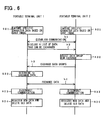
- FIG. 6 is a sequence chart showing how the portable terminal units 1 and 2 shown in FIG. 1 exchange character data 61 to 6N between them.
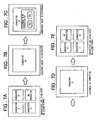
- FIG. 7 is a diagram showing how the screen of the portable terminal unit 1 shown in FIG. 1 changes when the character data 61 to 6N in is exchanged. With reference to FIG. 1 to FIG. 7, the following describes the operation of the embodiment.
- the portable terminal unit 1 downloads the application software 51 from the data delivery server 4-1 via the wireless base station 3 and the wireless network 100 (a1 and a2 in FIG. 4).
- the camera 11 is started via the camera IF 17 and the camera 11 shots an image (a3 in FIG. 4).
- the CPU 15 executes the application software 51 and uses the image processor 18 to digitize shot image data 11a, composed of a plurality of bytes, into a numeric value from "0" to "255" according to a pre-set algorithm (a4 in FIG. 4 and step S1 in FIG. 5).
- An example of the algorithm used in this processing is that the values of all bytes, each containing one of numeric values 0 to 255 corresponding to hexadecimal values 00 to FF, in the data are added up and the low-order one byte is obtained from the calculation result.
- the CPU 15 executes the application software 51 and uses the antenna 12, the transmitter/receiver 13, and the communication controller 14 to download character data, corresponding to numeric data 11b, from the data delivery server 4-1 via the wireless base station 3 and the wireless network 100 (a5 and a6 in FIG. 4 and steps S11, S12, and S2 in FIG. 5). The CPU 15 then saves downloaded character data 11c into the memory 16 (a7 in FIG. 4, steps S21 and S31 in FIG. 6).
- each of the values "0" to "15" obtained based on the digitization algorithm is associated with one type of data, respectively.
- the numeric values need not correspond to character data on a one-to-one basis; instead, number of character data units may be reduced to establish an N-to-one correspondence. If there is a variation in the numeric values generated by the digitization algorithm, the correspondence becomes uneven. In such a case, when the value of N is large, it results in a case where a correspondence with some pieces of character data occurs less frequently.
- the data delivery servers 4-1 to 4-4 can deliver character data in the push-type mode if a numeric value, derived from the shot image data 11a, is registered in the data delivery servers 4-1 to 4-4.
- a service that delivers calendars featuring idols can deliver character data, created by combining a picture corresponding to the registered numeric value with a schedule part, on a monthly, weekly, or even daily basis.
- Another advantage is that a content provider can replace shots in the data delivery servers 4-1 to 4-4 any time the content provider wants. For example, when the season changes from summer to fall, the content provider can replace shots of idols in their summer dresses with shots of idols in their fall dresses and replace character data on summer dresses with character data on fall dresses.
- the only thing the data delivery servers 4-1 to 4-4 are required to do is to simply send character data corresponding to the numeric value.
- the CPU 15 executes the application software 51 and uses the image processor 18 to display a list of character data 11c, which is saved in the memory 16, in the album format on the display unit 19 (a8 in FIG. 4). [See FIG. 7A]
- the user exchanges an existing character data, saved in the portable terminal unit 1, with other user's (new) character data using the short-range wireless communication unit 21.
- the exchange operation refers to an operation in which a predetermined number of character data units are exchanged between the users.
- the existing character data used for the exchange is deleted from the user's portable terminal unit.
- characters A to C are displayed on the display unit 19 in the album format as shown in FIG. 7A.
- character B is selected as shown in FIG. 7B
- character D other user's character data
- the screen of the display unit 19 changes to indicate that character D and character B have been exchanged as shown in FIG. 7D.
- characters A, C, and D are displayed in the album format as shown in FIG. 7E.
- the character data exchange processing described above is performed as follows.
- specific character data is downloaded from the data delivery servers 4-1 to 4-4 based on an image shot by the camera 11 and the downloaded character data is captured into the memory 16 (steps S21 and S31 in FIG. 6).
- the exchange operation is performed when the user of the portable terminal unit 1 and another user of the portable terminal unit 2 want to have any of the character data 61 to 6N that is owned, not by one of the users, but by the other user.
- the portable terminal unit 1 and the portable terminal unit 2 use the short-range wireless communication unit 21 to establish communication between the terminals (b1 in FIG. 6).
- the portable terminal unit 1 discloses, via communication, a list of character data that is stored in the terminal and that can be exchanged with the portable terminal unit 2 (b2 in FIG. 6).
- the user of the portable terminal unit 2 selects a data group from its data owned by the terminal itself that can be exchanged with a data group included in the disclosed list and that the user of the portable terminal unit 2 wants to get (step S32 in FIG. 6). Then, the terminal 2 communicates with the portable terminal unit 1 to send an exchange data group list to the portable terminal unit 1 (b3 in FIG. 6).
- the data group described above may be a subset or the total set of the list disclosed by the user.
- the user of the portable terminal unit 1 compares the data that can be sent from the terminal itself with the data from the portable terminal unit 2 and, if no problem is found, determines to exchange the character data (step S22 in FIG. 6). Once the exchange of data is determined, the character data is exchanged between the portable terminal unit 1 and the portable terminal unit 2 (b4 in FIG. 6). In this case, the application software 51 is executed by the CPU 15 to exchange the character data.
- the portable terminal unit 1 and the portable terminal unit 2 disconnect communication (steps S23 and S33 in FIG. 6), register the new data, and delete the old data (steps S24 and S34 in FIG. 6).
- the user of the portable terminal unit 1 operates the portable terminal unit 1 to download character data from the data delivery servers 4-1 to 4-4 or exchange character data with other users to collect all the desired types (e.g., 256 types) of character data.
- the purpose of the application software 51 is accomplished by collecting character data.
- the application software 51 designed with character data collection as one of purposes, communicates with the data delivery servers 4-1 to 4-4 frequently to obtain rare and valuable character data.
- An increase in the communication amount leads to an increase in the sales of operators that manage and sell the application software 51 and the character data 61 to 6N.
- this embodiment which allows users to exchange character data 61 to 6N among themselves, increases the recognition of the application software 51 and encourages users, incentive to get it.
- numeric values and character data is one to one or N to 1 in this embodiment and, once the numeric value is determined, the character data is determined uniquely. This is very convenient for a character data exchange among users who use collection-type application software.
- character data derived from an image shot by the portable terminal unit, on which the application software described above is executed can be obtained any number of times as long as the data is stored in the data delivery server or the shot data is stored in the terminal.
- this capability allows the user to exchange character data, derived from an image shot by the terminal, without worrying about the number of remaining number of data pieces.
- the conversion from an image to a numeric value used in the system according to the present invention could generate character data that is difficult to obtain.
- the character data is not only a drawing image but may be any information unique to the application software.
- application software such as a fighting game may include a value representing the ability or the like of a character appearing in the game.
- the algorithm for digitizing image data used in the present invention need not be a fixed method such as the one described above but may be a method that varies or differs according to application software from one to another. It should be noted that other objects, features and aspects of the present invention will become apparent in the entire disclosure and that modifications may be done without departing the gist and scope of the present invention as disclosed herein and claimed as appended herewith. Also it should be noted that any combination of the disclosed and/or claimed elements, matters and/or items may fall under the modifications aforementioned.
Landscapes
- Engineering & Computer Science (AREA)
- Multimedia (AREA)
- Computer Networks & Wireless Communication (AREA)
- Human Computer Interaction (AREA)
- Signal Processing (AREA)
- Business, Economics & Management (AREA)
- Computer Security & Cryptography (AREA)
- General Business, Economics & Management (AREA)
- Information Transfer Between Computers (AREA)
- Mobile Radio Communication Systems (AREA)
- Telephonic Communication Services (AREA)
- Telephone Function (AREA)
Applications Claiming Priority (2)
| Application Number | Priority Date | Filing Date | Title |
|---|---|---|---|
| JP2004001528 | 2004-01-07 | ||
| JP2004001528A JP4632667B2 (ja) | 2004-01-07 | 2004-01-07 | 画像数値化システム、携帯端末装置及びキャラクタデータ配信方法 |
Publications (2)
| Publication Number | Publication Date |
|---|---|
| EP1553792A2 true EP1553792A2 (de) | 2005-07-13 |
| EP1553792A3 EP1553792A3 (de) | 2006-04-05 |
Family
ID=34587674
Family Applications (1)
| Application Number | Title | Priority Date | Filing Date |
|---|---|---|---|
| EP04030286A Withdrawn EP1553792A3 (de) | 2004-01-07 | 2004-12-21 | Bild-Digitalisierungssystem, tragbares Endgerät und Verfahren zur Ablieferung von Figurdaten |
Country Status (4)
| Country | Link |
|---|---|
| US (1) | US20050157927A1 (de) |
| EP (1) | EP1553792A3 (de) |
| JP (1) | JP4632667B2 (de) |
| CN (1) | CN100440233C (de) |
Families Citing this family (3)
| Publication number | Priority date | Publication date | Assignee | Title |
|---|---|---|---|---|
| WO2006119070A1 (en) * | 2005-04-29 | 2006-11-09 | Wms Gaming Inc. | Asset management of downloadable gaming components in a gaming system |
| JP2007295521A (ja) * | 2006-03-29 | 2007-11-08 | Namco Bandai Games Inc | 無線ネットワークシステム、無線通信機器、無線通信機器設定装置、プログラム、情報記憶媒体及び携帯型電子機器 |
| JP2019030687A (ja) * | 2018-10-01 | 2019-02-28 | 株式会社セガゲームス | 情報処理装置及びゲームプログラム |
Citations (2)
| Publication number | Priority date | Publication date | Assignee | Title |
|---|---|---|---|---|
| US20020061781A1 (en) * | 2000-11-17 | 2002-05-23 | Casio Computer Co., Ltd. | Electronic game device, data processing method and storage medium for the same |
| US20030021591A1 (en) * | 2001-07-27 | 2003-01-30 | Grosvenor David Arthur | Synchronised cameras with auto-exchange |
Family Cites Families (7)
| Publication number | Priority date | Publication date | Assignee | Title |
|---|---|---|---|---|
| US5491777A (en) * | 1992-12-14 | 1996-02-13 | Casio Computer Co., Ltd. | Image data processor |
| US6285995B1 (en) * | 1998-06-22 | 2001-09-04 | U.S. Philips Corporation | Image retrieval system using a query image |
| US6741271B1 (en) * | 2000-07-31 | 2004-05-25 | Hewlett-Packard Development Company, L.P. | Thumbnail address book for linked family of imaging appliances |
| GB2375970B (en) * | 2001-05-31 | 2005-11-23 | Nokia Corp | Electronic gaming |
| JP2003323620A (ja) * | 2002-05-01 | 2003-11-14 | Nippon Telegr & Teleph Corp <Ntt> | 画像認識装置 |
| JP2003345815A (ja) * | 2002-05-28 | 2003-12-05 | Jiishisu:Kk | Url検索サーバ及びurl検索システム並びに画像加工サーバ及び画像加工システム |
| JP4001568B2 (ja) * | 2003-05-21 | 2007-10-31 | 株式会社バンダイナムコゲームス | 占いゲームシステム、プログラム、情報記憶媒体および占いゲーム画像生成方法 |
-
2004
- 2004-01-07 JP JP2004001528A patent/JP4632667B2/ja not_active Expired - Lifetime
- 2004-12-21 EP EP04030286A patent/EP1553792A3/de not_active Withdrawn
- 2004-12-27 US US11/020,263 patent/US20050157927A1/en not_active Abandoned
-
2005
- 2005-01-07 CN CNB2005100037346A patent/CN100440233C/zh not_active Expired - Fee Related
Patent Citations (2)
| Publication number | Priority date | Publication date | Assignee | Title |
|---|---|---|---|---|
| US20020061781A1 (en) * | 2000-11-17 | 2002-05-23 | Casio Computer Co., Ltd. | Electronic game device, data processing method and storage medium for the same |
| US20030021591A1 (en) * | 2001-07-27 | 2003-01-30 | Grosvenor David Arthur | Synchronised cameras with auto-exchange |
Also Published As
| Publication number | Publication date |
|---|---|
| JP4632667B2 (ja) | 2011-02-16 |
| CN100440233C (zh) | 2008-12-03 |
| CN1637767A (zh) | 2005-07-13 |
| EP1553792A3 (de) | 2006-04-05 |
| US20050157927A1 (en) | 2005-07-21 |
| JP2005197981A (ja) | 2005-07-21 |
Similar Documents
| Publication | Publication Date | Title |
|---|---|---|
| US8041291B2 (en) | Delivering content to mobile electronic communications devices | |
| CN109661686A (zh) | 对象显示系统、用户终端装置、对象显示方法及程序 | |
| JP3365289B2 (ja) | ネットワークシステム、このシステムに用いるサーバ装置、及びサービス提供プログラムが記録された記録媒体 | |
| JP2001318852A (ja) | 電子データ配信システム及びそれに使用されるビデオゲーム機並びに腕時計 | |
| US8926437B2 (en) | Device and system for playing a game and a method for controlling a game | |
| JP2004266575A (ja) | 画像配信システム、画像配信装置、端末、これらの制御方法及びプログラム | |
| JP2001259216A (ja) | ゲーム装置、サーバ装置 | |
| EP1684220A1 (de) | Kompilierungssystem | |
| EP1553792A2 (de) | Bild-Digitalisierungssystem, tragbares Endgerät und Verfahren zur Ablieferung von Figurdaten | |
| EP1452990A2 (de) | Werbungssystem für Funkgeräte | |
| JP5348067B2 (ja) | ゲーム管理装置、ゲーム管理装置の制御方法、制御プログラム、記録媒体、端末装置、および、ゲームシステム | |
| JP4720093B2 (ja) | 試着システム並びにそれに用いるサーバ装置、ユーザ端末及び携帯通信端末 | |
| JP3418620B2 (ja) | 家庭用ゲーム機等のゲーム広告課金システム、ゲーム広告課金制御方法及びプログラム | |
| KR20040040999A (ko) | 화상 정보 관리 방법 | |
| JP2002259668A (ja) | 電子機器、サーバ、画像提供システム及びその方法 | |
| KR100451644B1 (ko) | 게임의 유료 전환 방법 | |
| CN113301418A (zh) | 一种语音铃声的定制方法、相关装置、设备以及存储介质 | |
| JP3418619B2 (ja) | 家庭用ゲーム機等のゲーム広告課金システム、ゲーム広告課金制御方法及びプログラム | |
| US20070162585A1 (en) | Cyber farm system and managing method thereof | |
| JP7241408B2 (ja) | ゲームシステム及びそれに用いるコンピュータプログラム | |
| JP4228544B2 (ja) | メニューサービス方法及びメニューサービスシステム | |
| GB2423890A (en) | Cameraphone | |
| KR20040077171A (ko) | 네트워크 게임 상의 영상에 대한 모바일 기기로의 제공 방법 | |
| JP3491758B2 (ja) | 家庭用ゲーム機等のゲーム広告課金システム、ゲーム広告課金制御方法及びプログラム | |
| CN105279664A (zh) | 一种本地自助换票方法和系统 |
Legal Events
| Date | Code | Title | Description |
|---|---|---|---|
| PUAI | Public reference made under article 153(3) epc to a published international application that has entered the european phase |
Free format text: ORIGINAL CODE: 0009012 |
|
| AK | Designated contracting states |
Kind code of ref document: A2 Designated state(s): AT BE BG CH CY CZ DE DK EE ES FI FR GB GR HU IE IS IT LI LT LU MC NL PL PT RO SE SI SK TR |
|
| AX | Request for extension of the european patent |
Extension state: AL BA HR LV MK YU |
|
| PUAL | Search report despatched |
Free format text: ORIGINAL CODE: 0009013 |
|
| AK | Designated contracting states |
Kind code of ref document: A3 Designated state(s): AT BE BG CH CY CZ DE DK EE ES FI FR GB GR HU IE IS IT LI LT LU MC NL PL PT RO SE SI SK TR |
|
| AX | Request for extension of the european patent |
Extension state: AL BA HR LV MK YU |
|
| RIC1 | Information provided on ipc code assigned before grant |
Ipc: H04Q 7/32 20060101ALI20060210BHEP Ipc: H04M 1/725 20060101AFI20060210BHEP Ipc: H04L 29/06 20060101ALI20060210BHEP |
|
| 17P | Request for examination filed |
Effective date: 20060222 |
|
| AKX | Designation fees paid |
Designated state(s): DE FR GB IT |
|
| RAP1 | Party data changed (applicant data changed or rights of an application transferred) |
Owner name: APPLE INC. |
|
| STAA | Information on the status of an ep patent application or granted ep patent |
Free format text: STATUS: EXAMINATION IS IN PROGRESS |
|
| STAA | Information on the status of an ep patent application or granted ep patent |
Free format text: STATUS: THE APPLICATION IS DEEMED TO BE WITHDRAWN |
|
| 18D | Application deemed to be withdrawn |
Effective date: 20170823 |