EP1553105B1 - Blockcopolymere mit funktionellen gruppen - Google Patents
Blockcopolymere mit funktionellen gruppen Download PDFInfo
- Publication number
- EP1553105B1 EP1553105B1 EP03741620A EP03741620A EP1553105B1 EP 1553105 B1 EP1553105 B1 EP 1553105B1 EP 03741620 A EP03741620 A EP 03741620A EP 03741620 A EP03741620 A EP 03741620A EP 1553105 B1 EP1553105 B1 EP 1553105B1
- Authority
- EP
- European Patent Office
- Prior art keywords
- block copolymer
- styrene
- monomer
- initiator
- polystyrene
- Prior art date
- Legal status (The legal status is an assumption and is not a legal conclusion. Google has not performed a legal analysis and makes no representation as to the accuracy of the status listed.)
- Expired - Lifetime
Links
Images

Classifications
-
- C—CHEMISTRY; METALLURGY
- C08—ORGANIC MACROMOLECULAR COMPOUNDS; THEIR PREPARATION OR CHEMICAL WORKING-UP; COMPOSITIONS BASED THEREON
- C08F—MACROMOLECULAR COMPOUNDS OBTAINED BY REACTIONS ONLY INVOLVING CARBON-TO-CARBON UNSATURATED BONDS
- C08F293/00—Macromolecular compounds obtained by polymerisation on to a macromolecule having groups capable of inducing the formation of new polymer chains bound exclusively at one or both ends of the starting macromolecule
- C08F293/005—Macromolecular compounds obtained by polymerisation on to a macromolecule having groups capable of inducing the formation of new polymer chains bound exclusively at one or both ends of the starting macromolecule using free radical "living" or "controlled" polymerisation, e.g. using a complexing agent
Definitions
- the present invention pertains to a synthesis of and a process for making block copolymers of styrene and an unsaturated cyclic anhydride, such as maleic anhydride or itaconic anhydride, via free radical polymerization, in the presence of a stable free radical, a composition of matter comprising block copolymers of styrene and an unsaturated cyclic anhydride, and use of the composition of matter as a compatibilizer in blending polymers.
- an unsaturated cyclic anhydride such as maleic anhydride or itaconic anhydride
- UCA unsaturated cyclic anhydride
- MA maleic anhydride
- the content of maleic anhydride in the copolymer, and the copolymer molecular weight, play an important role in the ability of these materials to act as effective compatibilizers.
- U.S. Patent No. 6,531,547 B1 discloses a polymerization procedure in the presence of a stable free radical, for the preparation of a block copolymer formed of a vinyl aromatic monomer (which can be styrene) in the first block and a copolymer of a vinyl aromatic monomer and an acrylic monomer (which can be maleic anhydride) in the second block, to be used as an additive for lubricating oil compositions.
- a stable free radical for the preparation of a block copolymer formed of a vinyl aromatic monomer (which can be styrene) in the first block and a copolymer of a vinyl aromatic monomer and an acrylic monomer (which can be maleic anhydride) in the second block, to be used as an additive for lubricating oil compositions.
- a stable free radical for the preparation of a block copolymer formed of a vinyl aromatic monomer (which can be styrene) in the first block and a copolymer of
- a related way of synthesizing chain end-maleic anhydride functionalized polystyrenes is to add trimellitic anhydride chloride in order to terminate living chains of polystyrene growing via anionic polymerization, as disclosed by I. Park et al., J. Polym. Sci., Polym. Chem. Ed., 29, 1329 (1991 ). This creates a single functional group at one end of a polymeric chain.
- this approach suffers from the deficiencies mentioned before and common to all anionic polymerization processes, and it cannot add more than one maleic anhydride unit, limiting the compatibilization versatility of the materials produced.
- Random copolymers of styrene-maleic anhydride (rSMA) have been used as compatibilizers in polymer blends.
- the maleic anhydride groups are randomly distributed along the chain of the copolymer. Consequently, the structure of such a compatibilizer cannot be controlled.
- the key to achieve the desired performance has been the reaction of the maleic anhydride units of the copolymer with a functional group or moiety of one of the polymers included in the blend as well as the miscibility or compatibility of the rSMA with the other components of the blend.
- thermoplastics such as polyamides, polyphenylene ethers, polycarbonates and polyesters have excellent physical properties such as strength and stiffness, but it is often required to blend or alloy these with other thermoplastics in order to improve their impact toughness or to reduce their overall cost.
- the components of such blends are usually highly incompatible. It is thus common practice to include a compatibilizer that functions to improve the adhesion between the incompatible components and/or to modify the surface tension at the phase boundaries.
- U.S. Patent No. 6,444,754 discloses the use of an epoxy functionalized oligomer prepared by free radical polymerization of an ethyllenically unsaturated monomer or oligomer in the presence of a glycidyl-functionalized nitroxyl initiator.
- U.S. Patent No. 4,748,203 discloses a polymer mixture of aromatic polycarbonate and rubber modified polystyrene.
- the agent to improve bonding is a polymer or copolymer of a vinyl aromatic with free carboxyl groups obtained by polymerization in the presence of an unsaturated carboxylic monomer (eg. maleic anhydride, acrylic/methacrylic acid or acrylate esters).
- an unsaturated carboxylic monomer eg. maleic anhydride, acrylic/methacrylic acid or acrylate esters.
- U.S. Patent No. 5,204,394 illustrates mixtures comprising an aromatic polycarbonate, a copolymer containing styrene and a polymer grafted with polystyrene.
- U.S. Patent No. 6,066,686 describes the use of epoxidized SBS copolymer as the compatibilizer and optionally polyesters such as PET, PBT or polyphenylene ether.
- U.S. Patent No. 6,069,206 describes the use of a styrene-acrylonitrile copolymer with low acrylonitrile content and with a particular range of solubility parameter as a compatibilizer.
- Compatibilizers for the blends of interest described in the prior art are based on copolymers where it is not possible to control microstructure (functionalized polymers are usually a random copolymer or melt functionalized polymer).
- the miscibility of such copolymers is compromised by its composition, limiting its application as a compatibilizer as in the case of random copolymers of styrene and maleic anhydride ( Gan et. al., J. Appl. Polym. Sci., 54, 317 (1994 )).
- US 6,239,226 discloses tri-block copolymers and processes for making them in the presence of a free radical initiator and a stable free radical.
- the block copolymers are generally made of a first block comprising monomers selected from the group consisting of styrene, alpha-methylstyrene, acrylonitrile, methacrylonitrile, methyl methacrylate and maleic anhydride (block A) and a second block which is formed by acrylate derivatives or mixtures of acrylate derivatives (block B).
- the polymers described in US 6,239,226 generally have the structure A-B-A or B-A-B.
- a compatibilizer for the above mentioned blends and others is a block copolymer based on styrene and an unsaturated cyclic anhydride (UCA).
- This copolymer is produced in a one-chemical step polymerization process and has a controlled microstructure that allows one block to be reactive toward several chemical moieties available in engineering polymers and the other block to be fully miscible with polystyrene or polymers miscible with polystyrene such as polyphenylene ether.
- the copolymers of the present invention provide a straight forward path to obtain compatibilizers for polymer blends where both reactivity and miscibility can be controlled separately.
- control of microstructure and molecular weight in the block copolymer is maintained by adjusting the ratio of initiator to monomer and/or by adjusting the ratio of stable free radical to initator.
- the present invention provides an efficient process by which it is possible to create polymers rich in styrene that possess a few maleic anhydride or itaconic anhydride units located near one end of the chain, resulting in better compatibilizer compounds, that can be obtained in existing polymerization facilities with minimal changes and using raw materials that are readily available in commercial markets.
- the present invention provides a process and a block copolymer therefrom, based on styrene and an unsaturated cyclic anhydride (UCA), such as maleic or itaconic anhydride, in which the composition, microstructure and molecular weight of the copolymer is carefully controlled.
- a first embodiment of the present invention is a block copolymer comprising a first block comprising a random copolymer of styrene and UCA having a total length between 1 and 720 monomeric units, a second block comprising polystyrene having between 100 and 2000 monomeric units, wherein the polydispersity can be relatively narrow.
- the first block of random copolymer of styrene and UCA preferably has some degree of alternating character given by the reactivity ratios of the monomers.
- the polydispersity is between 1.2 and 3.0. These copolymers are better compatibilizers for blends of styrenic polymers and some polar polymers than random copolymers of the same global composition.
- the present invention further provides a one chemical step process using a stable free radical, a traditional free radical initiator, optionally a solvent, styrene and maleic or itaconic anhydride; these last components in the proportions established in the first embodiment of this invention, all preferably added simultaneously in a reactor and heated for several hours to produce the block copolymer mentioned in the first embodiment of this invention.
- the present invention also provides a one chemical step batch process similar to the one described in the immediately previous paragraph, but performed in two process stages as follows:
- the present invention further provides a bulk or solution continuous process, which is chemically similar to the one just described, including three sequential process steps: An optional step for heating and passing the reaction mixture through a tubular type reactor in which the exit fractional monomer conversion is numerically twice or larger than the mass fraction of UCA in the feed (with respect to total monomer) to form a first intermediate; and a reacting of the first intermediate in a continuous stirred tank reactor with exit conversions between 10 and 50 % by weight to form a second intermediate; and passing the second intermediate through a tubular type reactor in which the final conversion is between 60 and 100 % by weight.
- the present invention provides a method of using a block copolymer of styrene and an unsaturated cyclic anhydride (UCA), which has been made according to the present invention, as a compatibilizer for thermoplastic blends including polystyrene or a polymer miscible or compatible with polystyrene and an engineering thermoplastic with functional groups or moieties capable of reacting with the dicarboxylic moiety of the UCA units.
- UCA unsaturated cyclic anhydride
- the location of the UCA units is controlled as part of an initial block of the copolymer provides an advantage over a random copolymers of styrene and maleic anhydride.
- the dicarboxylic moieties of the UCA react with functional groups of several engineering thermoplastic polymers, yielding a graft copolymer that works as a compatibilizer for an otherwise incompatible blend.
- the location and average number of UCA units per chain can be precisely controlled, and thus, the structure of the graft copolymer formed in-situ during melt compounding with functionalized thermoplastics can also be controlled.
- This control allows the newly formed graft copolymer to be a better compatibilizer because there is a large portion of the chain that remains essentially a pure polystyrene block that is miscible and compatible with other polymers.
- polymers miscible or compatible with the polystyrene block are polyphenylene ether, tetra methyl polycarbonate, high impact polystyrene (polystyrene modified with rubber), and styrene block and random copolymers.
- the thermoplastics with functional groups capable of reacting with maleic anhydride include, polyamides, polycarbonate, poly(ethylene terephtalate), and poly(butylene terephtalate).
- the present invention provides a method for using a block styrene-UCA copolymer as a coupling agent for polystyrene and copolymers of styrene and various fillers including polystyrene or a polymer miscible or compatible with polystyrene and a filler with chemical affinity and/or functional moieties capable of reacting with the dicarboxylic moiety of the UCA units.
- the present invention provides a process and a block copolymer therefrom, based on styrene and an unsaturated cyclic anhydride (UCA), such as maleic or itaconic anhydride, in which the composition, microstructure and molecular weight of the copolymer are carefully controlled.
- UCA unsaturated cyclic anhydride
- microstructure refers to a detailed sequence or arrangement of units of each of the monomers in an average or typical copolymer chain.
- composition refers to the overall average relative amount of monomer 1 and monomer 2 in copolymer chains, and can be expressed in a molar or weight basis.
- one embodiment of the invention comprises block copolymers having a first block of a random copolymer of styrene and an unsaturated cyclic anhydride (UCA), such as maleic or itaconic anhydride, with some degree of alternating character given by the reactivity ratios of the monomers, and a total length between 1 and 720 monomeric units and a second block of essentially pure polystyrene with a length between 100 and 2000 monomeric units, wherein the polydispersity is relatively narrow, preferably between 1.2 and 3.0.
- UCA unsaturated cyclic anhydride
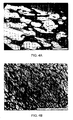
- FIG. 1A is a schematic representation of a block copolymer of styrene and maleic anhydride forming poly ((styrene-alt-maleic anhydride) - b- styrene) according to the present invention.
- FIG. 1B is a schematic representation of a block copolymer of styrene and maleic anhydride forming poly ((styrene-r-maleic anhydride) - b- styrene) according to the present invention.
- random copolymer is well known in the art and refers to a copolymer in which the monomer units of different chemical nature are located in a random sequence along the polymeric chain.
- block copolymer is also well known in the art and refers to a copolymer in which there are at least two segments of the chain having each one of them a distinct and given composition. Usually one segment, or block, is made of units of identical chemical nature and another segment, or block, is made of units of identical chemical nature too, but different from that of the first block.
- block copolymers include segments formed by units having more than one chemical identity, and their sequence in the segment can be arranged in virtually any specific way, well known in the art, such as random or alternating, for example.
- the feature that characterizes a block copolymer is that it has at least two segments of distinct and well defined chemical composition and/or microstructure.
- polydispersity is also well known in the art as the ratio of weight average to number average molecular weight of the copolymer. Polymers are not materials formed by molecules with a unique and well established molecular weight, but rather by molecules of different lengths, giving rise to a molecular weight distribution. This distribution is characterized by number and weight averages, and its broadness is characterized by the polydispersity. The greater the polydispersity is, the broader the molecular weight distribution is. Traditional free radical polymerization processes provide polymers with relatively broad molecular weight distributions, ranging from 1.5 to 3.5 or higher, depending on the specific polymer and polymerization process used for the synthesis.
- Polymers provided by this invention which are produced via quasi-living or controlled free radical polymerization, have polydispersities starting at values well below 1.5 and thus have relatively narrow molecular weight distributions. Consequently different individual chains in a polymer sample tend to possess similar total lengths, composition and microstructure, rendering a more homogeneous polymer that performs in a more uniform way when used as compatibilizer or coupling agent.
- a block copolymer can be made according to the present invention using a one chemical step (or single step) process for polymerizing the copolymer using a stable free radical and a traditional free radical initiator.
- a preferred stable free radical contains the group •O-N ⁇ and is selected from the family of nitroxy radical compounds. Typical examples of nitroxy radical compounds include, where X is H, Cl or MeO.
- TEMPO derivatives such as 4-oxo-TEMPO and 4-hidroxy-TEMPO have long been used for inhibiting polymerization of monomers in distillation columns. Since they are commercially available at reasonable prices from a number of sources, they are primary candidates to be used as stable free radicals in the process of the present invention. However, care must be exerted not to use grades of these materials that have high level of impurities, which may cause low reproducibility in the polymerization of the present invention.
- Preferred free radical initiators include peroxide and azo compounds. Typical examples include, but are not limited to, 2,2'-Azobis (2 -Methylpropanenitrile), 2,2'-Azobis (2-Methylbutanenitrile), dibenzoyl peroxide (BPO), Tert-Amyl peroxy-2-ethylhexanoate, Ter-Butyl peroxy-2-ethylhexanoate, 2,5-Bis(2-ethylhexanoylperoxy)-2,5-dimethylhexane and ter-Butyl peroxydiethylacetate.
- BPO dibenzoyl peroxide
- any solvent that forms a solution with styrene, UCA, initiator and stable free radical can be used.
- Typical solvents include aromatic or substituted aromatic hydrocarbons, as well as aliphatic and substituted aliphatic hydrocarbons. If used, the preferred solvents are substituted aromatics, more preferably toluene, xylene or ethyl benzene or polar solvents like acetone, chloroform or ethyl acetate.
- the solvent is preferably present in amounts of 5 to 95 % by weight on the basis of the mixture of monomers and solvent.
- the pressure of the reaction vessel can be adjusted by adding an inert gas such as nitrogen, carbon dioxide or argon, in such a way that the reaction is performed at a pressure higher than the vapor pressure of the reaction mixture and therefore most of the solvent remains in the liquid phase. Since the calculation of the vapor pressure of the reaction mixture can become complicated with polar solvents and its experimental evaluation is time consuming, a simpler rule to estimate the required pressure for the process, which also ensures that most of the solvent will remain in the liquid phase is given by the formula:
- the solvent process is similar to the bulk process, and the solvent is mainly used to control the reaction rate, to better remove the heat of reaction, to lower the viscosity and to allow for larger compositions of maleic anhydride in the copolymer without having phase separation.
- a low percentage of solvent is preferably 10-30 % by weight and more preferably 15-25% by weight with respect to the mixture of monomers and solvent.
- a solvent percentage of less than 5% is of practically no use as the advantages of using solvent are not apparent, and then it is better to switch to a bulk process.
- a high solvent percentage preferably ranges between 60 and 95 % by weight, more preferably between 70 and 90 weight % and most preferably between 75 and 88% by weight with respect to the mixture of monomers and solvent.
- a solvent percentage larger than 95 % leaves too little polymer to be produced and then the process becomes inefficient.
- Solvent percentages between 30 and 60 % can be used, but they are too diluted to present the high productivity advantage of a bulk process and too concentrated to have the benefits given by the low viscosity of a typical solution process.
- Preferred process temperatures are in the range of 110 to 200°C, but more preferably in the range of 120 to 170°C and most preferably between 120 and 150°C. Temperatures lower than 110°C do not allow the nitroxide-type radical to act as a live polymer capping-decapping moiety, as is further explained below, because at these temperatures the nitroxide-type radical hinders the living character of the polymerization. Temperatures higher than 200°C promote too many side reactions, and the living character of the polymerization is also hindered under these conditions.
- the initiator is typically used in a proportion of 1 part of initiator to 100 to 12,000 parts in moles of monomer, more preferably 1 mole of initiator to 200 to 3000 moles of monomer and most preferably 1 mole of initiator to 400 to 1500 moles of monomer.
- Mole proportions of 1 part of initiator to less than 100 parts of monomer yield polymer of very low molecular weight, which is not very good for applications involving compatibilization of polymer blends.
- mole proportions of 1 part of initiator to more than 12,000 parts of monomer lead to polymerizations essentially thermally autoinitiated by styrene, with a corresponding loss of control of the polymer final molecular weight and loss of the living character of the polymerization.
- the aforementioned initiators have half-life times in the order of a few minutes (less than 10) or less, at the preferred process temperatures.
- the amount of stable free radical (SFR) with respect to initiator is preferably in the range of 1.3 to 3.0 moles per mole of initiator, more preferably between 1.6 and a 2.5 moles per mole of initiator and most preferably between 1.9 and 2.5 moles per mole of initiator. Ratios of SFR to initiator smaller than 1.3 mole of SFR per mole of initiator lead to loss of the living character of the polymerization. On the other hand, ratios larger than 3.0 moles of SFR per mole of initiator can slow down the reaction too much and make the process uneconomical.
- the molar ratio of SFR to initiator for assuring the living character of the polymerization depends on the concentration of UCA.
- concentration of UCA the higher the recommended molar ratio of SFR to initiator for obtaining living character in the polymerization. This is believed to be due to the fact that the larger the concentration of UCA, the larger the reaction rate of the polymerization, and therefore, the greater the difficulty to achieve living character.
- the molar ratio of stable free radical to initiator should be at least about the result of the calculation:
- the percentage of UCA, for example maleic or itaconic anhydride, in the combined styrene - UCA amount is in the range of 0.09 to 18 % in weight, more preferably from 0.3 to 5 % and most preferably from about 0.9 to 2 % in weight.
- Compositions of UCA smaller than 0.09% in weight may lead to poor functionalization of the copolymer, possibly with some polymer chains not having even one UCA unit, and with overall poor polymer blend compatibilization properties.
- compositions of UCA, in particular maleic anhydride, larger than 18 % can lead to very fast reaction rates and difficult-to-control reactions, as well as serious loss of the living character of the polymerization.
- each living (growing or active) polymer chain will become dormant (deactivation) after being capped by the stable free radical, which will be present in a slight excess with respect to the number of growing or living chains.
- the dormant chain will remain in that state for some time until the stable free radical is released again (activation) and the chain becomes active or living again, and capable of adding one or more monomeric units until it becomes again dormant.
- the cycle of states living - dormant -living -dormant repeats itself a number of times until no more monomer is available for reaction, or the temperature is lowered below the minimum temperature for activation of the stable free radical (below around 100°C for most of the available nitroxy radicals).
- Irreversible termination reactions such as those occurring by coupling reactions between two living chains, are hindered due to the lower effective concentration of living polymer.
- the resulting process is similar to a true living process (for example, anionic polymerization) and it is therefore considered to be quasi-living (also called "controlled"). Since all the chains grow at approximately the same rate and are initiated at about the same time, the molecular weight distribution tends to be narrow, with relatively low polydispersity.
- the degree of livingness of such polymerizations can be measured by the degree of linearity of the polymer number average molecular weight growth with conversion, and by the shifting of curves of the molecular weight distribution toward larger values as the polymerization proceeds.
- UCA unsaturated cyclic anhydride
- S styrene
- the chains since the chains are still capable of growing in a stepwise fashion due to the dormant -living repetitive cycles, and given that most of the styrene is still unreacted, the chains will continue growing, adding styrene units and forming a second styrenic block along the polymeric chains until the monomer is depleted or the reaction is terminated otherwise.
- the resulting polymeric material has the structure described in the first embodiment of the present invention.
- the process just described can be regarded as a one chemical step process, since all the ingredients are charged at the beginning of the reaction, as opposed to other processes for building block copolymers, in which a second monomer mixture is added until the monomer mixture forming the first block is consumed.
- the temperature can be constant and set in one of the values mentioned in the preferred embodiments of the present invention, or can be changed in an increasing fashion, still in the range given in the preferred embodiments of this invention, in order to accelerate the monomer depletion after the initial conversion stages.
- Yet another important feature of the inventive polymerization is the control of the total molecular weight and of the global composition of the polymer.
- the moles of effective primary radicals of initiator can be estimated as the number of free radicals generated by the initiator decomposition multiplied by the initiator efficiency. Since every effective primary radical generates a polymeric chain that grows throughout the polymerization, the number of polymer moles equals the number of moles of effective primary radicals.
- the number of UCA groups per polymer molecule equals the number of moles of UCA charged to the reactor divided by the number of polymer moles, which are estimated as stated in the previous paragraph.
- one of the simplest but most effective models that correlates the relative rates of monomer incorporation in a copolymer is the terminal model, which assumes that the reactivity of a polymeric radical towards a specific monomer only depends on the chemical nature of the terminal or active unit in the radical.
- this model there are four possible propagation reaction rate constants of relevance; that is, the kinetic constants of propagation of a polymeric radical ending in monomer i, that reacts with monomer j. These are represented by kij, with i,j assuming the values of 1 or 2 corresponding to monomer 1 or monomer 2.
- M n * represents the polymeric radical ending in monomeric unit n (n being i or j) and M n represents monomer n (n being i or j).
- the relative magnitudes of r 1 and r 2 determine the copolymer type that is going to be formed (for example random or alternating).
- styrene and maleic anhydride reported reactivity ratios experimentally measured are close to zero at temperatures below 80°C and the inventors are not aware of any data reported in the open literature at higher temperatures.
- the reactivity ratios are also close to zero although the one corresponding to itaconic anhydride is slightly larger than the styrene one. It is pertinent to say that there is some evidence that the terminal model may not adequately describe the mechanism of copolymerization of the two pairs of monomers mentioned; however, the reactivity ratios are used anyway to describe the observed behavior even for these systems.
- the present invention also provides a one chemical step batch process to perform the polymerization reaction, but performed in two process stages as follows:
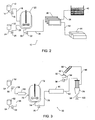
- a one-step batch process 10 is shown schematically.
- a solution of nitroxy radical and an unsaturated cyclic anhydride (UCA) in styrene are added to a tank 12, which is connected through a line 14 to a pump 16.
- the mixture in tank 12 is pumped through line 18 into a reactor 20.
- a catalyst or initiator is placed in tank 22, which is connected by a line 24 to a pump 26.
- Pump 26 pumps the catalyst or initiator through a line 28 into reactor 20.
- Reactor 20 is a continuous stirred tank reactor and is connected by a line 30 to a pump 32.
- a block copolymer is formed in reactor 20, and the copolymer and unreacted monomer, which is mainly styrene, are pumped by pump 32 through a line 34 to slab molds 36. Conversion in reactor 20 is typically in the range of from 10 to 50%. Slab molds 36 provide a second reactor vessel, which is without agitation, and heat is shown removed schematically through a line 38 to a thermal bath 40. Various methods can be used to remove heat, such as by a jacketed reactor or by circulation of reactants through a heat exchanger. Block copolymer from reactor 36 flows through a line 42 to an oven 44. Residual monomer is removed from the block copolymer in oven 44 and recycled.
- Block copolymer from reactor 36 flows through a line 42 to an oven 44. Residual monomer is removed from the block copolymer in oven 44 and recycled.
- Block copolymer is removed from the oven and ground in a mechanical mill, which is not shown.
- the unsaturated cyclic anhydride, styrene, nitroxy radical and initiator can be charged directly to reactor 20.
- the molecular weight of the block copolymer can be controlled. Examples are provided below, which provide further insight on the impact of these ratios on molecular weight. In this manner, the microstructure of the block copolymer can be controlled and thus made as desired.
- Reactor 20 has been shown as a continuous stirred tank reactor, but other types of reactors can be used, preferably providing some type of agitation.
- Reactor 36 has been shown as a slab mold reactor, but other types of reactors, such as a tubular reactor, can be used, preferably providing a quiescent reaction zone.
- the present invention further provides a bulk or solution continuous process to perform the polymerization reaction, comprising three process steps in series as follows:
- the first reactor is a tubular type reactor in order to achieve better heat removal during the polymerization stage in which the UCA is still reacting and the reaction rate is faster.
- a conversion numerically less than twice the mass fraction of UCA in the monomer mixture in this stage may lead to molecular architectures of the polymer in which the UCA is not preferably located in a block of nearly alternating styrene-UCA structure.
- the reactor used in the second step is similar to the one just described for the batch process; that is, a well agitated reactor supplied with a helical-type or anchor-type impeller and provided with some means of exchanging heat with the exterior.
- the preferred conversions are between 10 and 50 % at the temperatures preferred in this invention.
- the third reactor is a tubular type reactor to provide further conversion without broadening too much the molecular weight distribution, and allowing for easier polymer transport and heat removal.
- Tubular type reactors exhibit narrower residence time distributions than their agitated tank counterparts, and it is well known in the art that, for living or quasi-living polymerization reactions, the molecular weight distribution of the polymer is determined by the residence time distribution of the reactor.
- the viscosity will also be very high and in these conditions tubular reactors provide a better way to transport the polymer and remove the heat of reaction, since these reactors generally do not require agitation and have a better area-to-volume ratio for heat exchange. Conversions smaller than 60 % at the exit result in an inefficient use of the third reactor and leave too much unreacted monomer.
- the process must provide some means of removing the unreacted monomer, such as a devolatilizer equipment or a extruder with venting. Unreacted monomer can be recovered and recycled to the process.
- a process 50 is shown schematically according to the present invention.
- a solution of nitroxy radical and unsaturated cyclic anhydride in styrene are added to a tank 52.
- the contents of tank 52 flow through a line 54 to a pump 56, which pumps the contents through a line 58 to a tubular reactor 60.
- a catalyst or initiator is placed in tank 62, and the contents of tank 62 flow through a line 64 into a pump 66, which pumps the catalyst or initiator through a line 68 into tubular reactor 60.
- Block copolymer and unreacted monomer which is mainly styrene, flow out of tubular reactor 60 through a line 70 into a reactor 72, which can be a continuous stirred tank reactor.
- a reactor with agitation is preferred.
- the conversion in tubular reactor 60 is preferably about twice the mass fraction of unsaturated cyclic anhydride, such as maleic anhydride.
- Conversion in reactor 72 is preferably in the range of from 10 to 50%, and block copolymer and unreactor monomer, which is mainly styrene, flow out of reactor 72 through a line 74 into a pump 76, which pumps the fluid through a line 78 into a tubular reactor 80.
- a conversion ranging from 60 to 90% is achieved in tubular reactor 80, and block copolymer and unreacted monomer, which is mainly styrene, flow out of tubular reactor 80 through a line 82 into a devolatilizer 84.
- Monomer, mainly styrene is recovered from devolatilizer 84 through a line 86, which flows into a condenser 88.
- a condensate is formed and flows through a line 90 into a condensate tank 92, and through a line 94 to a pump 96, the monomer can be recycled to tank 52.
- Bleck copolymer is withdrawn from devolatilizer 84 through a line 98 into a pump 100.
- the process of the present invention can be thought of in general terms as including the steps of heating styrene and an unsaturated cyclic anhydride at temperatures between 110 and 200°C and adding a free radical initiator to the reactor in a molar ratio of monomer to initiator of 100 to 12,000.
- Stable free radical is added to the reactor, and the molecular weight and microstructure of the product block copolymer can be controlled in part by adjusting the molar ratio of stable free radical to initiator according the formula 1.3 + 0.25 times the weight percent of unsaturated cyclic anhydride with respect to total monomer content.
- the weight percent of UCA with respect to total monomer is preferably between 0.1 and 6%.
- the reaction mixture is cooled, and a block copolymer according to the present invention is recovered by isolating the block copolymer from unreacted monomer.
- This process typically produces a molecular weight greater than 25,000, and molecular weights in the range of from 50,000 to 100,000 can be controllably achieved. It is further believed that molecular weights of up to 200,000 can also be achieved with the process of the present invention.
- a solvent can be used.
- the same ratio of monomer to initiator works with the solvent-based process, and the same ratio of stable free radical to initiator can be used according to the formula above, but the rate percentage of UCA with respect to total monomer is preferably between 0.1 and 16%. Similar molecular weight for the block copolymer is achieved using the solvent-based process.
- Another embodiment of this invention is the use of the styrene-unsaturated cyclic anhydride (UCA) block copolymer as a compatibilizer in compositions comprising a polymer miscible or compatible with the polystyrene block and an engineering thermoplastic containing functional moieties that can react with the dicarboxylic moiety of the UCA units in the styrene/UCA block copolymer.
- UCA styrene-unsaturated cyclic anhydride
- a further embodiment is the composition of matter resulting from this method of use.
- Styrene-based polymers miscible or compatible with the polystyrene block of the aforementioned block copolymer include those which may be described as hydrogenated or partially hydrogenated homopolymers, and random, tapered, or block polymers (copolymers, including terpolymers, tetrapolymers,) of conjugated dienes and/or monovinyl aromatic compounds.
- the conjugated dienes include isoprene, butadiene, 2,3-dimethylbutadiene and/or mixtures thereof, such as isoprene and butadiene.
- the monovinyl aromatic compounds include any of the following and mixtures thereof: monovinyl monoaromatic compounds, such as styrene or alkylated styrenes substituted at the alpha-carbon atoms of the styrene, such as alpha-methylstyrene, or at ring carbons, such as o-, m-, p- methylstyrene, ethylstyrene, propylstyrene, isopropylstyrene, butylstyrene, isobutylstyrene, tert-butylstyrene (e.g., p-tertbutylstyrene).
- monovinyl monoaromatic compounds such as styrene or alkylated styrenes substituted at the alpha-carbon atoms of the styrene, such as alpha-methylstyrene, or at
- vinylxylenes methylethyl styrenes, and ethylvinylstyrenes.
- Specific examples include random polymers of butadiene and/or isoprene and polymers of isoprene and/or butadiene and styrene and also estero-specific polymers such as syndiotactic polystyrene.
- Typical block copolymers include polystyrene-polyisoprene, polystyrene-polybutadiene, polystyrene-polybutadiene-polystyrene, polystyrene-ethylene butylene-polystyrene, polyvinyl cyclohexane-hydrogenated polyisoprene, and polyvinyl cyclohexane-hydrogenated polybutadiene.
- Tapered polymers include those of the previous monomers prepared by methods known in the art.
- non-styrenic polymers miscible or compatible with the polystyrene block of the styrene-UCA copolymer include, but are not limited to, polyphenylene ether (PPE), polyvinyl methyl ether and tetramethyl polycarbonate.
- the engineering thermoplastic to be modified in accordance with this invention will include: aliphatic and aromatic polycarbonates (such as bisphenol A polycarbonate), polyesters (such as poly(butylene terephthalate) and poly(ethylene terephthalate)), polyamides, polyacetal, polyphenylene ether or mixtures thereof. All these engineering thermoplastics are prepared according to well known commercial processes. Reference to such processes can be found in technical publications such as Encyclopedia of Polymer Science and Engineering, John Wiley and Sons, 1988 , under the respective engineering thermoplastic polymer topic heading. Specific details on polycondensation engineering thermoplastics follow.
- polyphenylene ethers and polyamides of the present invention are as described in U.S. Pat. No. 5,290,863 , which is incorporated herein by reference.
- the polyphenylene ethers comprise a plurality of structural units having the formula:
- each independent Q 1 is independently halogen, primary or secondary lower alkyl (i.e. alkyl containing up to 7 carbon atoms), phenyl, haloalkyl, aminoalkyl, hydrocarbonoxy, or halohydrocarbonoxy wherein at least two carbon atoms separate the halogen and oxygen atoms; and each Q 2 is independently hydrogen, halogen, primary or secondary lower alkyl, phenyl, haloalkyl, hydrocarbonoxy or halohydrocarbonoxy as defined for Q 1 .
- suitable primary or lower alkyl groups are methyl, ethyl, n-propyl, n-butyl, isobutyl, n-amyl, isoamyl, 2-methylbutyl, n-hexyl, 2,3-dimethylbutyl, 2-, 3- or 4-methylpentyl and the corresponding heptyl groups.
- secondary lower alkyl are isopropyl and sec-butyl.
- any alkyl radicals are straight chain rather than branched.
- each Q 1 is alkyl or phenyl, especially C 1-4 alkyl, and each Q 2 is hydrogen.
- Suitable polyphenylene ethers are disclosed in a large number of patents.
- the polyphenylene ethers are typically prepared by the oxidative coupling of at least one corresponding monohydroxyaromatic compound.
- Particularly useful and readily available monohydroxyaromatic compounds are 2,6-xylenol, wherein each Q 1 is methyl and each Q 2 is hydrogen and wherein the resultant polymer is characterized as a poly(2,6-dimethyl-1,4-phenylene ether), and 2,3,6-trimethylphenol, wherein each Q 1 and one Q 2 are methyl and the other Q 2 is hydrogen.
- Suitable homopolymers are those containing, for example, 2,6-dimethyl-1,4-phenylene ether units.
- Suitable copolymers include random copolymers containing such units in combination with, for example, 2,3,6-trimethyl-1,4-phenylene ether units. Many suitable random copolymers, as well as homopolymers, are disclosed in the patent literature.
- polyphenylene ethers containing moieties which modify properties such as molecular weight, melt viscosity and/or impact strength.
- Such polymers are described in the patent literature and may be prepared by grafting onto the polyphenylene ether in known manner such vinyl monomers as acrylonitrile and vinyl aromatic compounds (e.g. styrene), or such polymers as polystyrenes or elastomers. The product typically contains both grafted and ungrafted moieties.
- Other suitable polymers are the coupled polyphenylene ethers in which the coupling agent is reacted in known manner with the hydroxy groups of two polyphenylene ether chains to produce a higher molecular weight polymer containing the reaction product of the hydroxy groups and the coupling agent.
- Illustrative coupling agents are low molecular weight polycarbonates quinones, heterocycles and formals.
- the polyphenylene ether generally has a number average molecular weight within the range of 3,000-40,000 and a weight average molecular weight within the range of 20,000-80,000, as determined by gel permeation chromatography. Its intrinsic viscosity is most often in the range of 0.15-0.6 dl/g, as measured in chloroform at 25°C.
- polyphenylene ethers which may be employed for the purposes of this invention include those which comprise molecules having at least one of the end groups of the formulae wherein Q 1 and Q 2 are as previously defined; each R 1 is independently hydrogen or alkyl, with the proviso that the total number of carbon atoms in both R 1 radicals is 6 or less; and each R 2 is independently hydrogen or a C 1-6 primary alkyl radical.
- each R 1 is hydrogen and each R 2 is alkyl, especially methyl or n-butyl.
- Polymers containing the aminoalkyl-substituted end groups of formula (II) may be obtained by incorporating an appropriate primary or secondary monoamine as one of the constituents of the oxidative coupling reaction mixture, especially when a copper- or manganese-containing catalyst is used.
- Such amines, especially the dialkylamines and preferably di-n-butylamine and dimethylamine frequently become chemically bound to the polyphenylene ether, most often by replacing one of the ⁇ -hydrogen atoms on one or more Q 1 radicals.
- the principal site of reaction is the Q 1 radical adjacent to the hydroxy group on the terminal unit of the polymer chain.
- the aminoalkyl-substituted end groups may undergo various reactions, probably involving a quinone methide-type intermediate of the formula with numerous beneficial effects often including an increase in impact strength and compatibilization with other blend components, as pointed out in references cited in U.S. Pat. No. 5,290,863 .
- polyphenylene ethers contemplated for use in the present invention include all those presently known, irrespective of variations in structural units or ancillary chemical features.
- Polyamides included in the present invention are those prepared by the polymerization of a monoamino-monocarboxylic acid or a lactam thereof having at least 2 carbon atoms between the amino and carboxylic acid group, of substantially equimolar proportions of a diamine which contains at least 2 carbon atoms between the amino groups and a dicarboxylic acid, or of a monoaminocarboxylic acid or a lactam thereof as defined above together with substantially equimolar proportions of a diamine and a dicarboxylic acid.
- substantially equimolar proportions includes both strictly equimolar proportions and slight departures therefrom which are involved in conventional techniques for stabilizing the viscosity of the resultant polyamides.
- the dicarboxylic acid may be used in the form of a functional derivative thereof, for example, an ester or acid chloride.
- Examples of the aforementioned monoamino-monocarboxylic acids or lactams thereof which are useful in preparing the polyamides include those compounds containing from 2 to 16 carbon atoms between the amino and carboxylic acid groups, said carbon atoms forming a ring containing the CO(NH) group in the case of a lactam.
- aminocarboxylic acids and lactams there may be mentioned -aminocaproic acid, butyrolactam, pivalolactam, -caprolactam, capryllactam, enantholactam, undecanolactam, dodecanolactam and 3- and 4-aminobenzoic acids.
- Diamines suitable for use in the preparation of the polyamides include the straight chain and branched chain alkyl, aryl and alkaryl diamines.
- Illustrative diamines are trimethylenediamine, tetramethylenediamine, pentamethylenediamine, octamethylenediamine, hexamethylenediamine (which is often preferred), trimethylhexamethylenediamine, m-phenylenediamine and m-xylylenediamine.
- the dicarboxylic acids may be represented by the formula HOOC-B-COOH (V) wherein B is a divalent aliphatic or aromatic group containing at least 2 carbon atoms.
- B is a divalent aliphatic or aromatic group containing at least 2 carbon atoms.
- aliphatic acids are sebacic acid, octadecanedioic acid, suberic acid, glutaric acid, pimelic acid and adipic acid.
- Both crystalline and amorphous polyamides may be employed, with the crystalline species often being preferred by reason of their solvent resistance.
- Typical examples of the polyamides or nylons, as these are often called, include, for example, polyamide-6 (polycaprolactam), 6,6 (polyhexamethylene adipamide), 11, 12, 4,6, 6,10 and 6,12 as well as polyamides from terephthalic acid and/or isophthalic acid and trimethylhexamethylenediamine; from adipic acid and m-xylylenediamines; from adipic acid, azelaic acid and 2,2-bis(p-aminophenyl)propane or 2,2-bis-(p-aminocyclohexyl)propane and from terephthalic acid and 4,4'-diaminodicyclohexylmethane.
- polyamides are polyamide-6, 4,6, 6,6, 6,9, 6,10, 6,12, 11 and 12, most preferably polyamide-6,6.
- thermoplastic polyamides may be advantageously used in the practice of this invention, with linear crystalline polyamides having a melting point between 165 and 230 °C being preferred.
- Polyesters which may be employed as a component in compositions of the invention are, in general, relatively high in molecular weight and may be branched or linear polymers. These include polyesters such as polyethylene terephthalate (PET), polybutylene terephthalate (PBT), polycyclohexane-bis-methylene terephthalate (PCT) and thermoplastic elastomeric, or combinations of these thermoplastic elastomeric polyesters with other above polyesters such as PBT.
- Polyesters suitable for compositions of the present invention include, in general, linear saturated condensation products of diols and dicarboxylic acids, or reactive derivatives thereof. Preferably, they are polymeric glycol esters of terephthalic acid and isophthalic acid.
- polymers are available commercially or can be prepared by known techniques, such as by the alcoholysis of esters of the phthalic acid with a glycol and subsequent polymerization, by heating glycols with the free acids or with halide derivatives thereof, and similar processes.
- Such polymers and methods for their preparation are described further in references cited in U.S. Pat. No. 5, 290, 863 , and elsewhere.
- Preferred polyesters are of the family comprising high molecular weight, polymeric glycol terephthalates or isophthalates having repeating units of the formula where n is a whole number from two to ten, and more usually from two to four, and mixtures of such esters, including copolyesters of terephthalic and isophthalic acids of up to 30 mol percent isophthalic units.
- polyesters are poly(ethylene terephthalate) and poly(1,4-butylene terephthalate).
- branched high melt viscosity poly(1,4-butylene terephthalate) resins which include small amounts, for example, up to 5 mol percent based on the terephthalate units, of a branching component containing at least three ester forming groups.
- the branching component can be one which provides branching in the acid unit portion of the polyester, or in the glycol unit portion, or it can be a hybrid.
- branching components are tri- or tetracarboxylic acids, such as trimesic acid, pyromellitic acid, and lower alkyl esters thereof, or preferably, tetrols, such as pentaerythritol, triols, such as trimethylolpropane, or dihydroxy carboxylic acids and hydroxydicarboxylic acids and derivatives, such as dimethyl hydroxyterephthalate.
- tetrols such as pentaerythritol
- triols such as trimethylolpropane
- dihydroxy carboxylic acids and hydroxydicarboxylic acids and derivatives such as dimethyl hydroxyterephthalate.
- a polyepoxide such as triglycidyl isocyanurate, which is known to increase the viscosity of the polyester phase through branching can aid in improving the physical properties of the present blends.
- the high molecular weight polyesters useful in the practice of this invention have an intrinsic viscosity of at least 0.2 deciliters per gram, and more usually from 0.4 to 1.5 deciliters per gram as measured in solution in ortho-chlorophenol or a 60/40 phenol/tetrachloroethane mixture at 25° to 30°C.
- the linear polyesters include thermoplastic poly(alkylene dicarboxylates) and alicyclic analogs thereof. They typically comprise structural units of the formula: wherein R8 is a saturated divalent aliphatic or alicyclic hydrocarbon radical containing 2 to 10 and usually 2 to 8 carbon atoms and A2 is a divalent aromatic radical containing 6 to 20 carbon atoms. They are ordinarily prepared by the reaction of at least one diol such as ethylene glycol, 1,4-butanediol or 1,4-cyclohexanedimethanol with at least one aromatic dicarboxylic acid such as isophthalic or terephthalic acid, or lower alkyl ester thereof.
- the polyalkylene terephthalates, particularly polyethylene and polybutylene terephthalate and especially the latter, are preferred.
- Such polyesters are known in the art as illustrated by references cited in U.S. Pat. No. 5,290,863 .
- the linear polyesters generally have number average molecular weights in the range of 20,000 to 70,000, as determined by intrinsic viscosity (IV) at 30°C in a mixture of 60% (by weight) phenol and 40% 1,1,2,2-tetrachloroethane.
- IV intrinsic viscosity
- the polyester molecular weight should be relatively high, typically above about 40,000.
- the polycarbonates suitable to be used in the present compositions include aliphatic and aromatic polycarbonates.
- Starting materials for aliphatic polycarbonates are diols and carbonates, eg, diethyl of diphenyl carbonate which are obtained by phosgentaion of hydroxy compounds or 1,3-dioxolan-2-ones formed from CO 2 and oxiranes.
- Aliphatic polycarbonates may also be prepared from 1,3-dioxan-2-ones obtained by thermal depolymerization of the corresponding polycarbonates.
- the molecular weights of linear aliphatic polycarbonates are process-dependent and are between 500 and 5000. Polycarbonates with molecular weights up to 30,000 are obtained by transesterification, whereas those with a molecular weight greater than 50,000 are prepared by polymerization of carbonates possessing six-membered rings.
- a 3 is an aromatic radical.
- Suitable A 3 radicals include m-phenylene, p-phenylene, 4,4'-biphenylene, 2,2-bis(4-phenylene)propane, 2,2-bis(3,5-dimethyl-4-phenylene)propane and similar radicals such as those which correspond to the dihydroxyaromatic compounds disclosed by name or formula, generically or specifically, in U.S. Pat. No. 4,217,438 .
- radicals containing non-hydrocarbon moieties are also included.
- substituents such as chloro, nitro, and alkoxy and also linking radicals such as thio, sulfoxy, sulfone, ester, amide, ether and carbonyl. Most often, however, all A 3 radicals are hydrocarbon radicals.
- the A 3 radicals preferably have the formula -A 4 -Y-A 5 - (IX) wherein each of A 4 and A 5 is a single-ring divalent aromatic radical and Y is a bridging radical in which one or two atoms separate A 4 from A 5 .
- the free valence bonds in formula IX are usually in the meta or para positions of A 4 and A 5 in relation to Y.
- Such A 3 values may be considered as being derived from bisphenols of the formula HO -A 4 -Y-A 5 - OH. Frequent reference to bisphenols will be made hereinafter, but it should be understood that A 3 values derived from suitable compounds other than bisphenols may be employed as appropriate.
- the A 4 and A 5 values may be unsubstituted phenylene or substituted derivatives thereof, illustrative substituents being one or more alkyl, alkenyl (e.g., crosslinkable-graftable moieties such as vinyl and allyl), halo (especially chloro and/or bromo), nitro and, alkoxy. Unsubstituted phenylene radicals are preferred.
- Both A 4 and A 5 are preferably p-phenylene, although both may be o- or m-phenylene, or one may be o-phenylene or m-phenylene and the other p-phenylene.
- the bridging radical, Y is one in which one or two atoms, preferably one, separate A 4 from A 5 . It is most often a hydrocarbon radical, and particularly a saturated radical such as methylene, cyclohexylmethylene, 2-[2.2.1]-bicycloheptylmethylene, ethylene, 2,2-propylene, 1,1-(2,2-dimethylpropylene), 1,1-cyclohexylene, 1,1-cyclopentadecylene, 1,1-cyclododecylene or 2,2-adamantylene, especially a gemalkylene radical. Also included, however, are unsaturated radicals and radicals which are entirely or partially composed of atoms other than carbon and hydrogen.
- radicals examples include 2,2-dichloroethylidene, carbonyl, thio, oxy, and sulfone.
- the preferred radical of formula IX is the 2,2-bis(4-phenylene)propane radical, which is derived from bisphenol-A and in which Y is isopropylidene and A 4 and A 5 are each p-phenylene.
- a preferred polyhydric phenol is a dihydric phenol such as bisphenol A.
- Suitable polycarbonate resins for the practice of the present invention may be any commercial polycarbonate resin.
- the weight average molecular weight of suitable polycarbonate resins (as determined by gel permeation chromatography relative to polystyrene) may range from 20,000 to 500,000, preferably from 40,000 to 400,000. However, compositions in which polycarbonates have a molecular weight in the range of 80,000-200,000 often have favorable properties.
- polystyrene resin it is also possible in the polymer mixture according to the invention to use a mixture of different polycarbonates as mentioned hereinbefore as an aromatic polycarbonate.
- styrene-UCA block copolymer of the invention will be sufficient to observe compatibilization effects on the engineering thermoplastic blend compositions in which used, such as improvements on mechanical properties.
- the block copolymer can also be used in amounts higher than the minimum but limited to a range so that it will positively affect the blend characteristics without substantially degrading other sought characteristics.
- typical blends will comprise the following: (a) engineering thermoplastic, 98-1 wt % (b) thermoplastic polymer, 1-98 wt % ; and (c) styrene-UCA copolymer, 1-20 wt %.
- Preferred engineering thermoplastic blends of this invention comprise from 40 to 90 wt% engineering thermoplastic, 10-60 wt% thermoplastic miscible or compatible with polystyrene and 2 to 5 wt% of the styrene-UCA block copolymer. This range of compositions will usually yield materials with improved impact properties and mechanical strength.
- the blend compositions of the invention can be prepared by mixing the engineering thermoplastic, the thermoplastic miscible/compatible with polystyrene and the block copolymer of the invention (styrene-UCA), in any order and subjecting the mixture to temperatures sufficient to melt the mixture, for example, 180 °C and up.
- mixing and heating can be accomplished using conventional polymer processing equipment known in the art, such as batch mixers, single or multiple screw extruders, continuous kneaders.
- the compatibilized compositions of the present invention may contain various additives, for example, stabilizers, flame retardants, anti-oxidants, fillers, processing aids and pigments in normal and conventional amounts, dependent upon the desired end-use.
- fillers there may be mentioned, e.g., metal oxides such as iron and nickel oxide, nonmetals such as carbon fiber, silicates (e.g. mica, aluminum silicate (clay)), titanium dioxide, glass flakes, glass beads, glass fibers, polymer fibers. If used, the conventional additives and fillers are mechanically blended and the compositions of the invention are then molded in known methods.
- Another aspect of this invention is the use of the styrene-unsaturated cyclic anhydride (UCA) block copolymer as a coupling agent for polystyrene, copolymers of styrene and polymers miscible or compatible with the polystyrene block and various fillers containing functional moieties that show strong chemical affinity or can react with the dicarboxylic moiety of the UCA units in the styrene/UCA block copolymer.
- UCA styrene-unsaturated cyclic anhydride
- compositions will comprise the following: (a) polystyrene, copolymers of styrene or polymers miscible with the polystyrene block of the block, 40-98 wt % (b) filler, 1-50 wt % ; and (c) styrene-UCA copolymer, 1-20 wt %.
- Preferred compositions of this invention will comprise 60-89 wt% of (a), 10-30% of (b) and 2-10 wt % of (c).
- Styrene-based polymers miscible or compatible with the polystyrene block of the above mentioned block copolymer include those which may be described as hydrogenated or partially hydrogenated homopolymers, and random, tapered, or block polymers (copolymers, including terpolymers, tetrapolymers,) of conjugated dienes and/or monovinyl aromatic compounds.
- the conjugated dienes including isoprene, butadiene, 2,3-dimethylbutadiene and/or mixtures thereof, such as isoprene and butadiene.
- the monovinyl aromatic compounds include any of the following or mixtures thereof monovinyl monoaromatic compounds, such as styrene or alkylated styrenes substituted at the alpha-carbon atoms of the styrene, such as alpha-methylstyrene, or at ring carbons, such as o-, m-, p- methylstyrene, ethylstyrene, propylstyrene, isopropylstyrene, butylstyrene, isobutylstyrene, tert-butylstyrene (e.g., p-tertbutylstyrene).
- monovinyl monoaromatic compounds such as styrene or alkylated styrenes substituted at the alpha-carbon atoms of the styrene, such as alpha-methylstyrene, or at ring
- vinylxylenes methylethyl styrenes, and ethylvinylstyrenes.
- Specific examples include random polymers of butadiene and/or isoprene and polymers of isoprene and/or butadiene and styrene and also estero-specific polymers such as syndiotactic polystyrene.
- Typical block copolymers include polystyrene-polyisoprene, polystyrene-polybutadiene, polystyrene-polybutadiene-polystyrene, polystyrene-ethylene butylene-polystyrene, polyvinyl cyclohexane-hydrogenated polyisoprene, and polyvinyl cyclohexane-hydrogenated polybutadiene.
- Tapered polymers include those of the previous monomers prepared by methods known in the art.
- non-styrenic polymers miscible or compatible with the polystyrene block of the styrene-UCA copolymer include, but are not limited to, polyphenylene ether (PPE), polyvinyl methyl ether and tetramethyl polycarbonate.
- the fillers there may be mentioned, e.g., metal oxides such as iron and nickel oxide, nonmetals such as carbon fiber, silicates (e.g. mica, aluminum silicate (clay)), titanium dioxide, glass flakes, glass beads, glass fibers, polymer fibers.
- the preferred filler is glass fiber containing epoxy and/or amino sizing due to great affinity of these type of compounds for the double carboxylic moieties of the UCA units.
- glass fiber include types E, C, A, S and M in any combinations of number of filament per strand, strand configurations and fiber length-to-weight ratio as possible.
- the preferred form of the glass fiber is chopped strands in lengths ranging from 3.18 to 25.4 mm (one-eighth inch to 1 inch,)
- Vials with identical formulations were removed from the oil bath at different time intervals as indicated in Table I, and the reaction quenched by immersing the vials in a water bath maintained at freezing temperature. Average molecular weight and its distribution were measured using GPC [Waters 410, RI detector, THF eluent, 1.0 mL/min, at 40°C; Styragel linear columns HR 5, HR 4, HR 3, employing polystyrene as a standard].
- Styrene (Pemex, industrial grade) was copolymerized with maleic anhydride (Aldrich, 95 %) in the presence of 4-oxo 2,2,6,6 tetramethyl-piperidine-N-oxyl (oxo-TEMPO from Crompton Corp., Middlebury, CT) as stable free radical agent and BPO (Akzo, 75%) as initiator at 120°C and 130 °C, to prepare copolymer poly ((styrene-r-MA)-co-styrene) in a Parallel Polymerization Reactor (PPR, Symyx TM ). The reaction volume in each mini-reactor was 3 ml. Table II shows the change of average molecular weight with time.
- the resulting styrene / MA copolymer was characterized by 1 H NMR spectra, recorded at room temperature on a Bruker AC-250 FT NMR spectrometer. Ten milligrams of the copolymer were dissolved in 0.5 mL of CDCl 3 (20 wt/vol%) and the solution subjected to 1 H NMR measurements.
- Table III shows copolymer composition by 1 H NMR spectra for styrene/MA copolymers produced from reaction 13 (120°C, 0.5 wt % of MA, samples 13a-13e in Table II), as well as from reactions 14 (120°C, 0.3 wt % of MA) and 15 (130 °C, 0.3 wt % of MA). Notice how as each reaction proceeds, the MA composition decreases, indicating MA consumption early in the reaction. NMR calculated compositions below 1% are not quantitatively reliable, but they can be used to indicate trends. The most reliable value (sample 13a, 1 hr.) is close to the theoretically expected value. TABLE III.
- Reaction proceeds up to 20-30 % conversion in a jacketed 2 L stirred (106 rpm) glass reactor connected to an oil bath recirculator, and then the syrup is emptied into quiescent cylindrical, 0.2 L, stainless steel (SS) reactors, placed in a 120°C constant temperature oil bath to prepare copolymer poly ((styrene-r-MA)-co-styrene) in a quasi-living process.
- Final conversions after 24 hrs were close to 100 % in all cases.
- Table IV shows the final average molecular weight after 24 hrs of reaction in the SS reactors, for 8 different reactions in which different total lengths and levels of functionalization were aimed at.
- Table V shows results for varying concentrations of benzoyl peroxide (BPO) and two different initial concentrations of maleic anhydride.
- BPO benzoyl peroxide
- Tables VI and VII correspond to similar results but for molar ratios of HO-TEMPO to initiator of 1.6 and 1.9, respectively.
- Molecular weight distributions were measured in a rapid GPC from Symyx, with Evaporative Light Scattering Detector (ELSD), THF eluent, 40°C and 3 serial columns Plgel 10 ⁇ m mixed-B from Polymer Labs. TABLE V.
- Polydispersity is lower at lower levels of maleic anhydride, higher levels of HO-TEMPO and higher levels of initiator (at constant HO-TEMPO/initiator ratio)
- Solution polymerization was performed using styrene (Aldrich, 99%) and maleic anhydride (Aldrich, 95%) as monomers, in the presence of solvent (toluene, see Table VIII and xylene, see Table IX), hydroxy-TEMPO (Ciba, Puebla, México, 99%) as stable free radical agent and BPO (Akzo, 75 %) as initiator (0.0065 M) at 120°C.
- solvent toluene, see Table VIII and xylene, see Table IX
- hydroxy-TEMPO Ciba, Puebla, México, 99%
- BPO Alkzo, 75 %
- initiator 0.0065 M
- Copolymers of styrene (Aldrich, 99 %) and maleic anhydride (Aldrich, 95%) were prepared by bulk polymerization at 120°C, in presence of a special stable free radical nitroxide (3,3-dimethyl-1,1-diphenyl azabutane-N-oxide, 99%) which was synthesized by the group of Prof. Martha Albores at the Facultad de Qu ⁇ mica (School of Chemistry) of the National Autonomous University of Mexico. BPO (Akzo, 75 %) was used as initiator (0.0065 M).
- Styrene (Aldrich, 99%) with 5 % maleic anhydride (Aldrich, 99%) were copolymerized with benzoyl peroxide (BPO, Akzo purified to 99 %), 0.005M, as initiator and 6 hydroxi, 2,2,6,6 tetramethyl-piperidine-N-oxyl (HO-TEMPO, 99 %, Ciba, Puebla, México) as stable free radical.
- BPO benzoyl peroxide
- HO-TEMPO 2,2,6,6 tetramethyl-piperidine-N-oxyl
- the molar ratio of HO-TEMPO to BPO was 2.5.
- Polymerization was carried out in a Parallel Polymerization Reactor (PPR Symyx TM ). The reaction was carried out at 120 °C. Monomer conversion was determined at different times by gravimetry.
- the molecular weight of the polymer was measured by GPC (Waters model 610, RI detector, THF eluent, 1 ml/min, at 60°C, Styragel columns, linear, HR5, HR6, HR3). Results are shown in Table XI. Polydispersities below 2 are obtained at a ratio of HO-TEMPO to BPO of 2.5. TABLE XI. Sample Name Maleic Anhydride (%) Time (min) Conversion (%) Mn Mw PD 57a 5 30 23.86 21591 34082 1.58 57b 5 60 34.02 30007 50086 1.67 57c 5 120 45.47 32140 55394 1.72 57d 5 300 42.83 40145 77219 1.92
- the bisphenol-A (BPA) polycarbonate which was utilized in the following examples was Lexan 141 obtained from General Electric Plastics.
- the polyethylene terephthalate (PET) was a recycled resin with characteristics equivalent to grade 1101 from KOSA.
- the polyamide (PA-6) was a commercial polyamide-6 ZYTEL 7300 NC010 available from DuPont.
- Blendex HPP830 is a blend of polyphenylene ether and polystyrene.
- the impact modifier was a hydrogenated linear triblock copolymer (SEBS) Calprene CH 6110 from Dynasol containing 30% styrene and having a Brookfield viscosity (20wt% solids in toluene) of 400 cps.
- the glass fiber was type E chopped in strands of 5 mm in length containing an amine sizing.
- Styrene-UCA block copolymers used in the following examples correspond to samples 17,18,19,20,22,23 synthesized in Example III.
- All blends were prepared by dry mixing the components followed by extrusion on a WP ZSK 30 mm. co-rotating, fully intermeshing, twin-screw extruder at 150 rpm.
- the barrel segment temperatures were dependant on the system to evaluate, in the case of the polycarbonate and polyester blends the profile was 260 °C (throat), 270°C, 270 °C, 275°C.
- the profile was 220°C (throat), 230°C, 230 °C, 240°C.
- the profile was 160 °C (throat), 180 °C, 190 °C, 195°C.
- the extrudate was quenched in water, pelletized, and dried in a circulating air oven at 100-110 °C before molding into test specimens using a Demag Ergotech 80/420 injection molder at barrel set temperatures of 275 °C for polycarbonate and polyester blend, 240 °C for polyamide 6 blends, and 210°C for polystyrene-glass fiber compositions.
- the mold temperature was 50°C in all cases. Izod impact values were determined as per ASTM #D256. Tensile properties were determined as per ASTM #D638. Flexural properties were determine as per ASTM #D790. Heat Deflection Temperature (HDT) was determined as per ASTM #D648. TABLE XII.
- Sample Composition (parts by weight) 58 59 60 61 62 63 64 65 Polycarbonate 70 70 70 - - - - - - Polyethylene Terephtalate (PET) - - - 70 70 70 - - Polyamide 6 - - - - - - - 70 70 HIPS 30 27 25 30 25 27 30 30 30 SMA sample 18-Example III - 3 5 - - 3 - - SMA sample 19-Example III - - - - 5 - - 5 Properties - - - - - - - - Yield Strength bar (psi) 500 ( 7250 ) 521 ( 7560 ) 527 ( 7640 ) 434 ( 6300 ) 446 ( 6470 ) 448 ( 6500 ) 496 ( 7189 ) 520 ( 7540 ) Elongation at Break (%) 82.3 93.1 85.8 10.4 12.9 17 14 22
- Samples 59-60 and Comparison Sample 58 show that there is an improvement in the yield strength and elongation at break for blends containing the SMA copolymer, this improvement seemed to vary with the amount of SMA in the polycarbonate/HIPS blends.
- Samples 62-63 and Comparison Sample 61 show a similar trend blends of PET and HIPS. In this case the degree of improvement is also correlated with the type of SMA used in the blend.
- Sample 65 also shows improvements in the same properties with respect to Comparative Sample 64 for blends of PA6 and HIPS. TABLE XIII.
- Sample Composition (parts by weight) 66 67 68 69 70 PPE HPP820 50 50 PPE HPP830 50 50 50 Polyamide 6 50 50 50 50 50 50 SEBS 10 10 10 SMA sample 17 Example III 3 SMA sample 20 Example III 5 SMA sample 23 Example III 5 Properties Notched lzod Impact J/m (ft-lb/in) 16.0 ) 16.0 ( 0.3 ) 48.1 ( 0.9 ) 64.1 ( 1.2 ) 58.7 ( 1.1 ) Izod Impact without notch J/m (ft-lb/in) 246 ( 4.6 ) 304 ( 5.7 ) 1404 ( 26.3 ) NB* NB* Tensile Strength bar (psi) 500 ( 7250 ) 384 ( 5570 ) 464 ( 6730 ) 560 ( 8130 ) 596 ( 8640 ) Elongation at Break (%) 8.5 6.1 11 70 62 Flexural Strength bar (psi) 712 ( 10330 ) 783 ( 11360
- Sample 67 and Comparison Sample 66 show that there is an improvement in the flexural strength, flexural modulus and unnotched impact strength for PPE and HIPS blends containing the SMA copolymer, this improvement is also seen in the unnotched impact properties.
- Samples 69-70 and Comparison Sample 68 show a similar trend blends of PPE and HIPS containing the impact modifier (SEBS). In this case the improvement in properties can be observed across all properties but it is extremely evident in the elongation at break. The improvement in properties is also dependant on the type of SMA used in the blend.
- Samples 72-74 and Comparison Sample 71 show that there is a considerable improvement in the flexural strength, flexural modulus, tensile strength and heat deflection temperature for polystyrene and glass fiber compositions containing the SMA block copolymer. The improvement in properties seems to be independent of the type of SMA block copolymer used in the composition.
Landscapes
- Chemical & Material Sciences (AREA)
- Health & Medical Sciences (AREA)
- Chemical Kinetics & Catalysis (AREA)
- Medicinal Chemistry (AREA)
- Polymers & Plastics (AREA)
- Organic Chemistry (AREA)
- Graft Or Block Polymers (AREA)
- Addition Polymer Or Copolymer, Post-Treatments, Or Chemical Modifications (AREA)
Claims (47)
- Verfahren zur Herstellung eines Blockcopolymers, umfassend:das Erhitzen von Styrol und einem ungesättigten zyklischen Anhydrid (UCA) in Anwesenheit eines Radikalstarters und eines stabilen freien Radikals bei Temperaturen zwischen 110 und 200°C, das Anpassen des Verhältnisses von Initiator zu Monomer, um die Gesamtlänge der Kette zu steuern, das Abkühlen der Reaktionsmischung und die Gewinnung eines Blockcopolymers durch Isolieren des Blockcopolymers aus unreagiertem Monomer, wobei die Zusammensetzung des Blockcopolymers umfasst:einen ersten Block, umfassend ein Zufalls-Copolymer aus Styrol und ungesättigtem zyklischen Anhydrid mit einer Gesamtlänge zwischen einer und 720 monomeren Einheiten, undeinen zweiten Block, umfassend einen im Wesentlichen reinen Polystyrolblock mit einer Länge zwischen 100 und 2000 monomeren Einheiten, wobeidie Polydispersität zwischen 1,2 und 3 liegt.
- Verfahren zur Herstellung eines Blockcopolymers, umfassend:das Erhitzen von Styrolmonomer und einem ungesättigten-zyklischen-Anhydrid-(UCA-)Monomer auf einen Temperaturbereich zwischen 110 und 200°C in einem Reaktor,das Hinzugeben eines Radikalstarters zum Reaktor,das Hinzugeben eines stabilen freien Radikals zum Reaktor unddie Gewinnung eines Blockcopolymers,wobei der prozentuale Anteil an UCA in der kombinierten Styrol-UCA-Menge im Bereich von 0,09 bis 18 Gew.-% liegt, und wobei man das gewünschte Molekulargewicht des Blockcopolymers durch Beeinflussung oder Anpassung des Molverhältnisses von Radikalstarter zu Gesamtmonomer erhält.
- Verfahren nach Anspruch 1 oder 2, wobei die Menge an stabilem freien Radikal gegenüber dem Starter im Bereich von 1,3 bis 3,0 Mol pro Mol Starter liegt, vorzugsweise im Bereich von 1,6 bis 2,5, mehr bevorzugt im Bereich von 1,9 bis 2,5.
- Verfahren nach einem der Ansprüche 1 bis 3, wobei der Starter in einem Verhältnis von 1 Teil Starter zu 100 bis 12000 Teilen Monomer verwendet wird, vorzugsweise in einem Verhältnis von 1 Teil Starter zu 200 bis 3000 Teilen Monomer und mehr bevorzugt in einem Verhältnis von 1 Teil Starter zu 400 bis 500 Teilen Monomer.
- Verfahren nach einem der Ansprüche 1 bis 4, wobei der erste Block ein gewisses Maß an alternierendem Charakter aufweist, der durch die Reaktivitätsverhältnisse der Monomere vorgegeben ist.
- Verfahren nach einem der Ansprüche 1 bis 5, wobei das UCA Maleinanhydrid oder Itaconanhydrid ist.
- Verfahren nach einem der Ansprüche 1 bis 6, wobei der Temperaturbereich zwischen 120°C und 170°C liegt, vorzugsweise zwischen 120°C und 150°C.
- Verfahren nach einem der Ansprüche 1 bis 7, wobei das Verfahren in einem einstufigen chemischen Polymerisationsverfahren durchgeführt wird.
- Verfahren nach einem der Ansprüche 1 bis 8, wobei der prozentuale Anteil an UCA in der kombinierten Styrol-UCA-Menge im Bereich von 0,3 bis 5 Gew.-%, vorzugsweise von 0,9 bis 2 Gew.-% liegt.
- Verfahren nach einem der Ansprüche 1 bis 9,
wobei das Verhältnis von ungesättigtem zyklischen Anhydrid in der Mischung aus Styrol und ungesättigtem zyklischen Anhydrid im Bereich von 0,1 bis 16 Gew.-% liegt, und des Weiteren,
wobei dem Reaktor ein Radikalstarter in einem Molverhältnis von Monomer zu Starter von 100 zu 12000 hinzugegeben wird,
ein stabiles freies Radikal hinzugegeben wird, wenn das Molverhältnis von stabilem freiem Radikal zu Radikalstarter mindestens das 1,3 + 0,25-fache des Gew.-%-Anteils des UCA bezogen auf den Gesamtmonomergehalt beträgt,
das Reaktionsgemisch gekühlt wird, und
ein Blockcopolymer durch Isolieren des Blockcopolymers aus unreagiertem Monomer gewonnen wird,
und wobei das gewonnene Blockcopolymer ein Molekulargewicht größer als 25 000 aufweist. - Verfahren nach Anspruch 10, wobei das Molekulargewicht des Blockcopolymers zwischen 50 000 und 100 000 liegt.
- Verfahren nach Anspruch 10 oder Anspruch 11, wobei der Radikalstarter dem Reaktor in einem Molverhältnis von Monomer zu Starter von 100 zu 12 000 hinzugegeben wird, das Molverhältnis von stabilem freien Radikal entsprechend der Formel 1,3 + 0,25-facher Gew.-%-Anteil an ungesättigtem zyklischen Anhydrid gegenüber dem Gesamtmonomergehalt angepasst wird, wobei der prozentuale Gewichtsanteil von UCA gegenüber dem Gesamtmonomer
zwischen 0,1 und 6 % liegt, wenn es sich bei dem Verfahren um ein Bulk-Verfahren handelt, und
zwischen 0,1 und 16% liegt, wenn es sich bei dem Verfahren um ein lösungsmittelbasiertes Verfahren handelt. - Verfahren nach einem der Ansprüche 1 bis 12, wobei das zahlenmittlere Molekulargewicht der Kette durch Anpassen der molaren Konzentration des Starters gesteuert wird auf einen Wert vonA - (5x10⁻⁸ Mn), wenn das gewünschte Molekulargewicht größer ist als 61500, undB - (3,33x10⁻⁷ Mn), wenn das gewünschte Molekulargewicht kleiner ist als 61500,wobei Mn ein Zielwert für zahlenmittleres Molekulargewicht ist; A liegt zwischen 0,005 und 0,01, und B liegt zwischen 0,016 und 0,042.
- Verfahren nach einem der Ansprüche 1 bis 13, wobei der Wert des Molverhältnisses von stabilem freien Radikal zu Starter mindestens
1,3 + 0,10 x (Gew.-% UCA gegenüber dem Gesamtmonomer),
vorzugsweise mindestens etwa 1,3 + 0,25 x (Gew.-% UCA gegenüber dem Gesamtmonomer) beträgt, - Verfahren nach einem der Ansprüche 1 bis 14, wobei der Radikalstarter ausgewählt ist aus der Gruppe, bestehend aus:
2,2'-Azobis(2-methylpropannitril), 2,2'-Azobis(2-methylbutannitril), Dibenzoylperoxid (BPO), Tert-amylperoxy-2-ethylhexanoat, Tert-butylperoxy-2-ethylhexanoat, 2,5-Bis(2-ethylhexanoylperoxy)-2,5-dimethylhexan und Tert-butylperoxydiethylacetat. - Verfahren nach einem der Ansprüche 1 bis 15, wobei das stabile freie Radikal ein freies Nitroxylradikal ist, wobei das freie Nitroxylradikal vorzugsweise ausgewählt ist aus der Gruppe, bestehend aus:


- Verfahren nach einem der Ansprüche 1 bis 16, wobei das Reaktionsgemisch des Weiteren ein Lösungsmittel umfasst, wobei es sich bei dem Lösungsmittel vorzugsweise um Aceton, Ethylacetat, Chloroform, Toluol, Xylen, Ethylbenzol oder Gemische daraus handelt.
- Verfahren nach Anspruch 17, wobei der Druck des Verfahrens so angepasst wird, dass er über dem Dampfdruck des Reaktionsgemisches liegt.
- Verfahren nach Anspruch 18, wobei der Druck des Verfahrens so angepasst wird, dass er größer oder gleich dem durch die folgende Formel vorgegebenen ist:
2,5 P0xs, wenn xs kleiner als 0,2 ist, oder
1,4 P0 xs,. wenn xs größer oder gleich 0,2 ist,
wobei P0 der Dampfdruck des Lösungsmittels bei Reaktionstemperatur ist, und xs der Molanteil an Lösungsmittel in dem Gemisch aus Lösungsmittel und Monomer ist. - Verfahren nach einem der Ansprüche 17 bis 19, wobei das Lösungsmittel in einer Menge von 5-95 Gew.-% vorliegt, wobei das Lösungsmittel vorzugsweise ein einer Menge von 10-30 Gew.-% vorliegt, mehr bevorzugt in einer Menge von 15-25 Gew.-%, basierend auf dem Gemisch von Monomeren und Lösungsmittel.
- Verfahren nach einem der Ansprüche 17 bis 19, wobei das Lösungsmittel in einer Menge von 60-95 Gew.-% vorliegt, vorzugsweise ein einer Menge von 70-90 Gew.-%, mehr bevorzugt in einer Menge von 75-88 Gew.-%, basierend auf dem Gemisch von Monomeren und Lösungsmittel.
- Verfahren nach einem der Ansprüche 1 bis 21, wobei das Verfahren ein Batch-Verfahren ist und des Weiteren umfasst:das Schütteln der Reaktanten in einem ersten Reaktor, bis eine Umwandlung von 10 bis 50 % erreicht ist;das Belassen der Reaktanten im ersten Reaktor oder in einem zweiten Reaktor ohne Schütteln, bis eine Umwandlung von 90 bis 100 % erreicht ist.
- Verfahren nach einem der Ansprüche 1 bis 22, wobei das Verfahren ein kontinuierliches Verfahren ist und folgende Schritte umfasst:a) das optionale Erhitzen des Reaktionsgemisches in einem Reaktor vom Rohrtyp, in welchem der Austrittsumwandlungsanteil des Monomers numerisch etwa doppelt so hoch ist wie, oder höher ist als der Massenanteil an UCA bei der Zufuhr (gegenüber dem Gesamtmonomer);b) das Erhitzen des Reaktionsgemisches in einem kontinuierlich gerührten Tankreaktor mit Austrittsumwandlungen zwischen 10 und 50 Gew.-%, undc) das Erhitzen in einem Reaktor vom Rohrtyp, in welchem die Austrittsumwandlung zwischen 60 und 100% ausmacht.
- Verfahren nach Anspruch 23, wobei Schritt (a) ausgelassen wird und das erste Zwischenprodukt, auf welches sich Schritt (b) bezieht, frisch zugeführt wird.
- Verfahren nach Anspruch 23 oder Anspruch 24, wobei der zweite Reaktor vom Rohrtyp ein vertikaler Pfropfenstromreaktor ist, der vom Boden her gespeist wird.
- Blockcopolymer, umfassend:einen Block aus einem Copolymer aus Styrol und einem ungesättigten zyklischen Anhydrid undeinen Polystyrolblock mit einer Länge zwischen 100 und 2000 monomeren Einheiten, wobeidie Polydispersität zwischen 1,2 und 3,0 liegt.
- Blockcopolymer nach Anspruch 26, wobei die Länge des ersten Blocks zwischen 1 und 720 monomeren Einheiten beträgt.
- Blockcopolymer nach Anspruch 27, wobei der erste Block ein Zufalls-Copolymer aus Styrol und einem ungesättigten zyklischen Anhydrid mit einer Gesamtlänge zwischen 1 und 720 monomeren Einheiten umfasst.
- Blockcopolymer nach Anspruch 28, wobei der erste Block ein gewisses Maß an alternierendem Charakter aufweist, der durch die Reaktivitätsverhältnisse der Monomere vorgegeben ist
- Zusammensetzung nach Anspruch 28 oder 29, wobei der Polystyrolblock einen kovalent gebundenen Nitroxyl-Terminus einer nur einzigen chemischen Formel enthält.
- Blockcopolymer nach einem der Ansprüche 26 bis 30, wobei das ungesättigte zyklische Anhydrid Maleinanhydrid oder Itaconanhydrid ist.
- Blockcopolymer, erhältlich durch ein Verfahren nach einem der Ansprüche 1 bis 25.
- Verfahren zur Kompatibilisierung eines technischen Thermoplasts mit einem thermoplastischen Polymer, welches kompatibel oder mischbar ist mit Polystyrol, umfassend: Das Vermischen der beiden Polymere mit einem Blockcopolymer aus Styrol- und ungesättigtem-zyklischen-Anhydrid-Monomer in relativen Anteilen in einem Reaktionsgefäß, vorzugsweise einem Extruder, wobei das Blockcopolymer in einem Verfahren nach einem der Ansprüche 1 bis 25 hergestellt wird.
- Eine thermoplastische Polymerzusammensetzung, umfassend:(a) 1-98 Gew.-% technisches Thermoplast mit funktionellen Gruppen, die in der Lage sind, mit einem Blockcopolymer aus Styrol und einem ungesättigten zyklischen Anhydrid zu reagieren oder mit diesem kompatibel sind(b) 1-98 Gew.-% thermoplastisches Polymer mit Polymersegmenten, die kompatibel oder mischbar mit dem Polystyrolblock des Blockcopolymers sind, und(c) 1-20 Gew.-% des Blockcopolymers nach einem der Ansprüche 26 bis 32.
- Thermoplastische Polymerzusammensetzung nach Anspruch 34, wobei
die funktionelle Gruppe des technischen Thermoplasts ausgewählt ist aus der Gruppe, bestehend aus Amino- (NH2), Amid- (NH), Carboxyl- (COOH) und Hydroxyl- (OH) Gruppe, und das Blockcopolymer Styrol-Maleinanhydrid-Blockcopolymer ist. - Zusammensetzung nach Anspruch 34 oder Anspruch 35, wobei das Blockcopolymer erhältlich ist durch ein Verfahren nach einem der Ansprüche 1 bis 25.
- Thermoplastische Polymerzusammensetzung nach Anspruch 35 oder Anspruch 36,
wobei das Molekulargewicht des Styrol-Maleinanhydrid-Blockcopolymers zwischen 10 000 und 200 000 liegt. - Thermoplastische Polymerzusammensetzung nach einem der Ansprüche 35 bis 37,
wobei das Styrol-Maleinanhydrid-Blockcopolymer zwischen 0,1 und 18 Gew.-% Maleinanhydrid umfasst. - Verfahren nach einem der Ansprüche 34 bis 38, wobei das technische thermoplastische Polymer ausgewählt ist aus der Gruppe, bestehend aus:aliphatischen oder aromatischen Polycarbonaten, Polyestern, Polyamiden, Polyphenylenether und Mischungen daraus.
- Zusammensetzung nach einem der Ansprüche 34 bis 39, wobei das thermoplastische Polymer hochschlagzähes Polystyrol oder ein Blockcopolymer aus Styrol und Butadien oder ein Styrol-Methylmethacrylat-Copolymer ist.
- Zusammensetzung nach einem der Ansprüche 34 bis 40, wobeia) das technische Thermoplast ein Polyamid ist, und das thermoplastische Polymer Polyphenylenether ist, allein oder in Mischungen mit Polystyrol und/oder hochschlagzähem Polystyrol und/oder einem Styrol-Butadien-Blockcopolymer, oderb) das technische Thermoplast ein Polyamid ist, und das thermoplastische Polymer hochschlagzähes Polystyrol ist und/oder ein Styrol-Butadien-Blockcopolymer, oderc) das technische Thermoplast ein aromatisches Polycarbonat ist, und das thermoplastische Polymer Polystyrol und/oder hochschlagzähes Polystyrol und/oder ein Styrol-Butadien-Blockcopolymer ist, oderd) das technische Thermoplast ein Polyethylenterephtalat ist, und das thermoplastische Polymer Polystyrol ist und/ oder hochschlagzähes Polystyrol und/oder ein Styrol-Butadien-Blockcopolymer, odere) das technische Thermoplast ein Polybutylenterephtalat ist und das thermoplastische Polymer Polystyrol ist und/ oder hochschlagzähes Polystyrol und/oder ein Styrol-Butadien-Blockcopolymer.
- Thermoplastische Polymerzusammensetzung, umfassend:(a) 40-98 Gew.-% thermoplastisches Polymer mit Polymersegmenten, die kompatibel oder mischbar mit dem Polystyrolblock eines Styrol-Maleinanhydrid-Blockcopolymers sind,(b) 1-40 Gew.-% eines Füllstoffs, enthaltend funktionelle Teile, die eine starke chemische Affinität zu dem Dicarbonteil des Styrol-Maleinanhydrid-Blockcopolymers aufweisen oder mit diesem reagieren können, und(c) 1-20 Gew.-% Styrol-ungesättigtes-zyklisches-Anhydrid-Blockcopolymer.
- Zusammensetzung nach Anspruch 42, wobei das Styrol-ungesättigtes-zyklisches-Anhydrid-Blockcopolymer durch ein Verfahren nach einem der Ansprüche 1 bis 25 hergestellt wird.
- Zusammensetzung nach Anspruch 42 oder 43, wobei das thermoplastische Polymer Polystyrol und/oder hochschlagzähes Polystyrol und/oder ein Styrol-Butadien-Blockcopolymer ist.
- Zusammensetzung nach einem der Ansprüche 42 bis 44, wobei der Füllstoff glasfaserverstärkter Kunststoff ist.
- Verfahren zur Herstellung einer Polymerzusammensetzung, umfassend:Das Vermischen eines thermoplastischen Polymers, welches kompatibel oder mischbar ist mit Polystyrol und einem Füllstoff, in relativen Anteilen mit einem Blockcopolymer aus Styrol- und ungesättigtem-zyklischen-Anhydrid-Monomer in einem Reaktionsgefäß,wobei das Blockcopolymer entsprechend einem Verfahren nach einem der Ansprüche 1 bis 25 hergestellt wird.
- Verfahren nach Anspruch 46, wobei das Reaktionsgefäß ein Extruder ist.
Applications Claiming Priority (5)
| Application Number | Priority Date | Filing Date | Title |
|---|---|---|---|
| US39742002P | 2002-07-19 | 2002-07-19 | |
| US397420P | 2002-07-19 | ||
| US10/621,929 US7323528B2 (en) | 2002-07-19 | 2003-07-16 | Block copolymers containing functional groups |
| US621929 | 2003-07-16 | ||
| PCT/MX2003/000058 WO2004009645A2 (es) | 2002-07-19 | 2003-07-18 | Copolímeros en bloque que contienen grupos funcionales |
Publications (3)
| Publication Number | Publication Date |
|---|---|
| EP1553105A2 EP1553105A2 (de) | 2005-07-13 |
| EP1553105A4 EP1553105A4 (de) | 2005-11-09 |
| EP1553105B1 true EP1553105B1 (de) | 2009-09-09 |
Family
ID=30773019
Family Applications (1)
| Application Number | Title | Priority Date | Filing Date |
|---|---|---|---|
| EP03741620A Expired - Lifetime EP1553105B1 (de) | 2002-07-19 | 2003-07-18 | Blockcopolymere mit funktionellen gruppen |
Country Status (8)
| Country | Link |
|---|---|
| US (2) | US7323528B2 (de) |
| EP (1) | EP1553105B1 (de) |
| AT (1) | ATE442389T1 (de) |
| AU (1) | AU2003281535A1 (de) |
| CA (1) | CA2495213C (de) |
| DE (1) | DE60329206D1 (de) |
| ES (1) | ES2333418T3 (de) |
| WO (1) | WO2004009645A2 (de) |
Families Citing this family (20)
| Publication number | Priority date | Publication date | Assignee | Title |
|---|---|---|---|---|
| WO2004000890A2 (en) * | 2002-06-20 | 2003-12-31 | Ciba Specialty Chemicals Holding Inc. | Grafting of nitroxyl terminated oligomers or polymers onto thermoplastic polymers |
| MXPA03008714A (es) | 2002-09-26 | 2004-09-10 | Oreal | Polimeros secuenciados y composiciones cosmeticas que comprenden tales polimeros. |
| AU2003299071A1 (en) * | 2002-09-26 | 2004-04-19 | L'oreal | Glossy non-transfer composition comprising a sequenced polymer |
| FR2860142B1 (fr) * | 2003-09-26 | 2007-08-17 | Oreal | Produit cosmetique bicouche, ses utilisations et kit de maquillage contenant ce produit |
| FR2860143B1 (fr) * | 2003-09-26 | 2008-06-27 | Oreal | Composition cosmetique comprenant un polymere sequence et une huile siliconee non volatile |
| US20050220731A1 (en) * | 2004-03-23 | 2005-10-06 | Philippe Ilekti | Nail varnish composition comprising at least one polymer and at least one plasticizer |
| US8728451B2 (en) | 2004-03-25 | 2014-05-20 | L'oreal | Styling composition comprising, in a predominantly aqueous medium, a pseudo-block polymer, processes employing same and uses thereof |
| JP4315866B2 (ja) * | 2004-06-29 | 2009-08-19 | 横浜ゴム株式会社 | 硬化性エポキシ樹脂組成物 |
| US20060173142A1 (en) * | 2005-02-01 | 2006-08-03 | Hildeberto Nava | Functionalized thermosetting resin systems |
| US20100311920A1 (en) * | 2005-08-26 | 2010-12-09 | Cid Centro De Investigacion Y Desarrollo Tecnologico Sa De Cv | Using Reactive Block Copolymers as Chain Extenders and Surface Modifiers |
| US8357759B2 (en) | 2005-08-26 | 2013-01-22 | CID Centro de Investigación y Desarrollo Tecnológico S.A. de C.V. | Reactive block copolymers |
| US8344058B2 (en) * | 2005-08-26 | 2013-01-01 | CID Centro de Investigación y Desarrollo Technológico S.A. de C.V. | Reactive block copolymers as additives for the preparation of silicate-polymer composites |
| US7651791B2 (en) | 2005-12-15 | 2010-01-26 | Idemitsu Kosan Co., Ltd. | Material for organic electroluminescence device and electroluminescence device employing the same |
| FR2904320B1 (fr) * | 2006-07-27 | 2008-09-05 | Oreal | Polymeres sequences, et leur procede de preparation |
| US20100311849A1 (en) * | 2006-08-23 | 2010-12-09 | Cid Centro De Investigacion Y Desarrollo Tecnologico Sa De Cv | Using Reactive Block Copolymers as Chain Extenders and Surface Modifiers |
| JP2008189856A (ja) * | 2007-02-06 | 2008-08-21 | Seiko Epson Corp | グラフト重合層の形成方法、電子デバイスおよび電子機器 |
| FR2933978B1 (fr) * | 2008-07-18 | 2012-12-21 | Arkema France | Fabrication d'anhydride maleique a partir de matieres renouvelables, anhydride maleique obtenu et utilisations |
| US12447464B2 (en) * | 2016-12-22 | 2025-10-21 | Duke University | Polycationic microfibers and methods of using the same |
| AU2018203941B2 (en) * | 2017-06-27 | 2024-04-18 | Dow Global Technologies Llc | Glycidyl ether alkoxylate block copolymers |
| CN112279966B (zh) * | 2020-11-12 | 2021-09-24 | 大连理工大学 | 一类含二苯基乙基的苯乙烯衍生物共聚物及其接枝聚合物的制备方法 |
Family Cites Families (33)
| Publication number | Priority date | Publication date | Assignee | Title |
|---|---|---|---|---|
| US3953404A (en) * | 1974-02-07 | 1976-04-27 | General Electric Company | Solid state polymerization of poly(1,4-butylene terephthalate) |
| US4217438A (en) * | 1978-12-15 | 1980-08-12 | General Electric Company | Polycarbonate transesterification process |
| US4315086A (en) * | 1979-08-08 | 1982-02-09 | Sumitomo Chemical Company, Limited | Resin compositions |
| JPS5655410A (en) * | 1979-10-15 | 1981-05-16 | Daicel Chem Ind Ltd | Continuous bulk polymerization of styrene type copolymer |
| KR930000892B1 (ko) * | 1983-07-11 | 1993-02-11 | 커몬웰스 사이언티픽 앤드 인더스트리얼 리셔치 오가니제이숀 | 신규의 개시제를 사용하여 중합체 또는 공중합체를 제조하는방법 |
| US4644053A (en) * | 1984-05-11 | 1987-02-17 | General Electric Company | Cyclic polycarbonate oligomers and methods for their preparation and use |
| US4600741A (en) * | 1984-09-27 | 1986-07-15 | General Electric Company | Polyphenylene ether-polyamide blends |
| US4605731A (en) * | 1985-04-16 | 1986-08-12 | General Electric Company | Method for preparing linear polycarbonate from cyclic oligomer with aryl carbanion generating catalyst |
| NL8600671A (nl) * | 1986-03-17 | 1987-10-16 | Gen Electric | Polymeermengsel met pc en hips. |
| US4732937A (en) * | 1986-05-27 | 1988-03-22 | General Electric Company | Epoxide-functionalized polyphenylene ethers and method of preparation |
| CA1332015C (en) * | 1987-08-17 | 1994-09-13 | Yuichi Orikasa | Thermoplastic resin composition and method for preparing the same |
| US4844163A (en) | 1987-12-29 | 1989-07-04 | Mobil Oil Corporation | In-situ foaming of polymer profile control gels |
| US5204394A (en) * | 1988-09-22 | 1993-04-20 | General Electric Company | Polymer mixture having aromatic polycarbonate, styrene I containing copolymer and/or graft polymer and a flame-retardant, articles formed therefrom |
| US5231146A (en) * | 1990-09-20 | 1993-07-27 | General Electric Company | Polyphenylene ether-polyetheramide blends |
| US5189114A (en) * | 1990-12-31 | 1993-02-23 | General Electric Company | Compatibilization of polyphenylene ether with polyester using polystyrene-polycarbonate copolymer |
| DE69108020T2 (de) * | 1991-06-19 | 1995-10-12 | Gen Electric | Polymerzusammensetzung, und daraus hergestellte Formkörper. |
| EP0546497A3 (en) * | 1991-12-10 | 1993-11-18 | Idemitsu Kosan Co | Thermoplastic resin composition |
| US5322912A (en) * | 1992-11-16 | 1994-06-21 | Xerox Corporation | Polymerization processes and toner compositions therefrom |
| TW377367B (en) * | 1994-06-21 | 1999-12-21 | Asahi Kasei Corp | Aromatic polycarbonate-styrene polymer resin composition |
| SE503841C2 (sv) * | 1994-09-07 | 1996-09-16 | Bofors Ab | Laddsystem |
| US5449724A (en) * | 1994-12-14 | 1995-09-12 | Xerox Corporation | Stable free radical polymerization process and thermoplastic materials produced therefrom |
| US6066686A (en) * | 1996-07-05 | 2000-05-23 | Daicel Chemical Industries, Ltd. | Polycarbonate compositions |
| WO1997027233A1 (de) * | 1996-01-25 | 1997-07-31 | Basf Aktiengesellschaft | Blockcopolymere |
| US5910549A (en) * | 1996-08-22 | 1999-06-08 | Carnegie-Mellon University | Method for preparation of alkoxyamines from nitroxyl radicals |
| US6281311B1 (en) * | 1997-03-31 | 2001-08-28 | Pmd Holdings Corp. | Controlled free radical polymerization process |
| EP0996643B1 (de) * | 1997-07-15 | 2003-03-26 | Ciba SC Holding AG | Von nitrone- oder nitroso-verbindungen abgeleitete alkoxyaminverbindungen-enthaltende polymerisierbare zusammensetzungen |
| US6143848A (en) * | 1997-10-23 | 2000-11-07 | The B.F.Goodrich Company | End-functionalized polymers by controlled free-radical polymerization process and polymers made therefrom |
| FR2773158B1 (fr) * | 1997-12-30 | 2000-02-04 | Atochem Elf Sa | Procede de polymerisation radicalaire controlee faisant intervenir une faible quantite de radical libre stable |
| TW400337B (en) | 1998-03-17 | 2000-08-01 | Akzo Nobel Nv | Process to make low-molecular weight sma |
| CA2265345A1 (en) * | 1998-03-25 | 1999-09-25 | The Lubrizol Corporation | Vinyl aromatic-(vinyl aromatic-co-acrylic) block copolymers prepared by stabilized free radical polymerization |
| WO2000002932A1 (en) * | 1998-07-10 | 2000-01-20 | S. C. Johnson Commercial Markets, Inc. | Process for producing polymers by free radical polymerization and condensation reaction, and apparatus and products related thereto |
| JP4607403B2 (ja) * | 1999-08-12 | 2011-01-05 | チバ ホールディング インコーポレーテッド | 改善された耐衝撃性を有するポリマーブレンド |
| ATE327281T1 (de) * | 2002-12-18 | 2006-06-15 | Chemtura Corp | Styrolpolymerverbundwerkstoffe |
-
2003
- 2003-07-16 US US10/621,929 patent/US7323528B2/en not_active Expired - Fee Related
- 2003-07-18 WO PCT/MX2003/000058 patent/WO2004009645A2/es not_active Ceased
- 2003-07-18 CA CA2495213A patent/CA2495213C/en not_active Expired - Fee Related
- 2003-07-18 EP EP03741620A patent/EP1553105B1/de not_active Expired - Lifetime
- 2003-07-18 ES ES03741620T patent/ES2333418T3/es not_active Expired - Lifetime
- 2003-07-18 AU AU2003281535A patent/AU2003281535A1/en not_active Abandoned
- 2003-07-18 AT AT03741620T patent/ATE442389T1/de not_active IP Right Cessation
- 2003-07-18 DE DE60329206T patent/DE60329206D1/de not_active Expired - Lifetime
-
2007
- 2007-10-25 US US11/977,487 patent/US8030409B2/en not_active Expired - Lifetime
Also Published As
| Publication number | Publication date |
|---|---|
| CA2495213C (en) | 2011-05-31 |
| US8030409B2 (en) | 2011-10-04 |
| ES2333418T3 (es) | 2010-02-22 |
| US20080108752A1 (en) | 2008-05-08 |
| EP1553105A4 (de) | 2005-11-09 |
| ATE442389T1 (de) | 2009-09-15 |
| AU2003281535A1 (en) | 2004-02-09 |
| DE60329206D1 (de) | 2009-10-22 |
| EP1553105A2 (de) | 2005-07-13 |
| AU2003281535A8 (en) | 2004-02-09 |
| WO2004009645A2 (es) | 2004-01-29 |
| US20040077788A1 (en) | 2004-04-22 |
| US7323528B2 (en) | 2008-01-29 |
| WO2004009645A3 (es) | 2004-05-06 |
| CA2495213A1 (en) | 2004-01-29 |
Similar Documents
| Publication | Publication Date | Title |
|---|---|---|
| US8030409B2 (en) | Block copolymers containing functional groups | |
| US8865840B2 (en) | Reactive block copolymers | |
| US20100311920A1 (en) | Using Reactive Block Copolymers as Chain Extenders and Surface Modifiers | |
| US20100311849A1 (en) | Using Reactive Block Copolymers as Chain Extenders and Surface Modifiers | |
| CA2617547C (en) | Methods of producing vinyl aromatic polymers using (meth)acrylic macroinitiators | |
| EP1572802B1 (de) | Styrolpolymerverbundwerkstoffe | |
| EP0211467A2 (de) | Schlagfeste Polymerzusammensetzungen | |
| JPH04236261A (ja) | 組成物 | |
| WO1990002156A1 (en) | Impact modified polyamide/aromatic polycarbonate blends | |
| JP3899178B2 (ja) | 難燃性樹脂組成物 | |
| JPH0318648B2 (de) | ||
| MXPA05000654A (es) | Copolimeros en bloque que contienen grupos funcionales. | |
| JPS63234057A (ja) | 耐溶剤性、相容性ポリフェニレンエーテル−線状ポリエステルブレンド | |
| WO1993019128A2 (en) | Polymers and polymer blends modified with poly(phenylene ether) | |
| JP4290414B2 (ja) | 末端封止ポリカーボネート及びその方法 | |
| JPH06122762A (ja) | 変性ポリフェニレンエーテルとその製造方法および熱可塑性樹脂組成物 | |
| JPH07102169A (ja) | 熱可塑性樹脂組成物 | |
| SK11742000A3 (sk) | Spôsob na prípravu polymérnych zmesí z aminonitrilov a termoplastických polymérov | |
| JPH02272062A (ja) | アリールオキシトリアジンでキャッピングされたポリフェニレンエーテルから得られるポリフェニレンエーテル‐ポリアミド組成物 | |
| JPS6383163A (ja) | ポリフエニレンオキシド系樹脂組成物 | |
| JPH07188486A (ja) | 熱可塑性樹脂組成物 |
Legal Events
| Date | Code | Title | Description |
|---|---|---|---|
| PUAI | Public reference made under article 153(3) epc to a published international application that has entered the european phase |
Free format text: ORIGINAL CODE: 0009012 |
|
| 17P | Request for examination filed |
Effective date: 20050216 |
|
| AK | Designated contracting states |
Kind code of ref document: A2 Designated state(s): AT BE BG CH CY CZ DE DK EE ES FI FR GB GR HU IE IT LI LU MC NL PT RO SE SI SK TR |
|
| AX | Request for extension of the european patent |
Extension state: AL LT LV MK |
|
| A4 | Supplementary search report drawn up and despatched |
Effective date: 20050927 |
|
| DAX | Request for extension of the european patent (deleted) | ||
| RIC1 | Information provided on ipc code assigned before grant |
Ipc: 7C 08F 222/06 B Ipc: 7C 08F 293/00 B Ipc: 7C 08F 212/08 B Ipc: 7C 08F 2/38 A |
|
| 17Q | First examination report despatched |
Effective date: 20070326 |
|
| R17C | First examination report despatched (corrected) |
Effective date: 20080310 |
|
| GRAP | Despatch of communication of intention to grant a patent |
Free format text: ORIGINAL CODE: EPIDOSNIGR1 |
|
| GRAS | Grant fee paid |
Free format text: ORIGINAL CODE: EPIDOSNIGR3 |
|
| GRAA | (expected) grant |
Free format text: ORIGINAL CODE: 0009210 |
|
| AK | Designated contracting states |
Kind code of ref document: B1 Designated state(s): AT BE BG CH CY CZ DE DK EE ES FI FR GB GR HU IE IT LI LU MC NL PT RO SE SI SK TR |
|
| REG | Reference to a national code |
Ref country code: GB Ref legal event code: FG4D |
|
| REG | Reference to a national code |
Ref country code: CH Ref legal event code: EP |
|
| REG | Reference to a national code |
Ref country code: IE Ref legal event code: FG4D |
|
| REF | Corresponds to: |
Ref document number: 60329206 Country of ref document: DE Date of ref document: 20091022 Kind code of ref document: P |
|
| REG | Reference to a national code |
Ref country code: CH Ref legal event code: NV Representative=s name: SCHMAUDER & PARTNER AG PATENT- UND MARKENANWAELTE |
|
| PG25 | Lapsed in a contracting state [announced via postgrant information from national office to epo] |
Ref country code: SE Free format text: LAPSE BECAUSE OF FAILURE TO SUBMIT A TRANSLATION OF THE DESCRIPTION OR TO PAY THE FEE WITHIN THE PRESCRIBED TIME-LIMIT Effective date: 20090909 Ref country code: FI Free format text: LAPSE BECAUSE OF FAILURE TO SUBMIT A TRANSLATION OF THE DESCRIPTION OR TO PAY THE FEE WITHIN THE PRESCRIBED TIME-LIMIT Effective date: 20090909 |
|
| REG | Reference to a national code |
Ref country code: ES Ref legal event code: FG2A Ref document number: 2333418 Country of ref document: ES Kind code of ref document: T3 |
|
| PG25 | Lapsed in a contracting state [announced via postgrant information from national office to epo] |
Ref country code: SI Free format text: LAPSE BECAUSE OF FAILURE TO SUBMIT A TRANSLATION OF THE DESCRIPTION OR TO PAY THE FEE WITHIN THE PRESCRIBED TIME-LIMIT Effective date: 20090909 |
|
| PG25 | Lapsed in a contracting state [announced via postgrant information from national office to epo] |
Ref country code: CY Free format text: LAPSE BECAUSE OF FAILURE TO SUBMIT A TRANSLATION OF THE DESCRIPTION OR TO PAY THE FEE WITHIN THE PRESCRIBED TIME-LIMIT Effective date: 20090909 |
|
| PG25 | Lapsed in a contracting state [announced via postgrant information from national office to epo] |
Ref country code: EE Free format text: LAPSE BECAUSE OF FAILURE TO SUBMIT A TRANSLATION OF THE DESCRIPTION OR TO PAY THE FEE WITHIN THE PRESCRIBED TIME-LIMIT Effective date: 20090909 Ref country code: CZ Free format text: LAPSE BECAUSE OF FAILURE TO SUBMIT A TRANSLATION OF THE DESCRIPTION OR TO PAY THE FEE WITHIN THE PRESCRIBED TIME-LIMIT Effective date: 20090909 Ref country code: PT Free format text: LAPSE BECAUSE OF FAILURE TO SUBMIT A TRANSLATION OF THE DESCRIPTION OR TO PAY THE FEE WITHIN THE PRESCRIBED TIME-LIMIT Effective date: 20100111 Ref country code: RO Free format text: LAPSE BECAUSE OF FAILURE TO SUBMIT A TRANSLATION OF THE DESCRIPTION OR TO PAY THE FEE WITHIN THE PRESCRIBED TIME-LIMIT Effective date: 20090909 |
|
| PG25 | Lapsed in a contracting state [announced via postgrant information from national office to epo] |
Ref country code: SK Free format text: LAPSE BECAUSE OF FAILURE TO SUBMIT A TRANSLATION OF THE DESCRIPTION OR TO PAY THE FEE WITHIN THE PRESCRIBED TIME-LIMIT Effective date: 20090909 |
|
| PG25 | Lapsed in a contracting state [announced via postgrant information from national office to epo] |
Ref country code: BE Free format text: LAPSE BECAUSE OF FAILURE TO SUBMIT A TRANSLATION OF THE DESCRIPTION OR TO PAY THE FEE WITHIN THE PRESCRIBED TIME-LIMIT Effective date: 20090909 Ref country code: AT Free format text: LAPSE BECAUSE OF FAILURE TO SUBMIT A TRANSLATION OF THE DESCRIPTION OR TO PAY THE FEE WITHIN THE PRESCRIBED TIME-LIMIT Effective date: 20090909 |
|
| PLBE | No opposition filed within time limit |
Free format text: ORIGINAL CODE: 0009261 |
|
| STAA | Information on the status of an ep patent application or granted ep patent |
Free format text: STATUS: NO OPPOSITION FILED WITHIN TIME LIMIT |
|
| PG25 | Lapsed in a contracting state [announced via postgrant information from national office to epo] |
Ref country code: DK Free format text: LAPSE BECAUSE OF FAILURE TO SUBMIT A TRANSLATION OF THE DESCRIPTION OR TO PAY THE FEE WITHIN THE PRESCRIBED TIME-LIMIT Effective date: 20090909 |
|
| 26N | No opposition filed |
Effective date: 20100610 |
|
| PG25 | Lapsed in a contracting state [announced via postgrant information from national office to epo] |
Ref country code: GR Free format text: LAPSE BECAUSE OF FAILURE TO SUBMIT A TRANSLATION OF THE DESCRIPTION OR TO PAY THE FEE WITHIN THE PRESCRIBED TIME-LIMIT Effective date: 20091210 |
|
| PG25 | Lapsed in a contracting state [announced via postgrant information from national office to epo] |
Ref country code: MC Free format text: LAPSE BECAUSE OF NON-PAYMENT OF DUE FEES Effective date: 20100731 |
|
| GBPC | Gb: european patent ceased through non-payment of renewal fee |
Effective date: 20100718 |
|
| PG25 | Lapsed in a contracting state [announced via postgrant information from national office to epo] |
Ref country code: IE Free format text: LAPSE BECAUSE OF NON-PAYMENT OF DUE FEES Effective date: 20100718 Ref country code: GB Free format text: LAPSE BECAUSE OF NON-PAYMENT OF DUE FEES Effective date: 20100718 |
|
| REG | Reference to a national code |
Ref country code: DE Ref legal event code: R082 Ref document number: 60329206 Country of ref document: DE Representative=s name: DF-MP, DE |
|
| REG | Reference to a national code |
Ref country code: DE Ref legal event code: R082 Ref document number: 60329206 Country of ref document: DE Representative=s name: DF-MP DOERRIES FRANK-MOLNIA & POHLMAN PATENTAN, DE Effective date: 20120604 Ref country code: DE Ref legal event code: R081 Ref document number: 60329206 Country of ref document: DE Owner name: RESIRENE S.A. DE C.V., STO. TORIBIO XICOHTZINC, MX Free format text: FORMER OWNER: CID CENTRO DE INVESTIGACION Y DESARROLLO, TECNOLOGICO S.A. DE C.V., ESTADO DE MEXICO, MX Effective date: 20120604 |
|
| REG | Reference to a national code |
Ref country code: CH Ref legal event code: PUE Owner name: MACRO-M, S.A. DE C.V. Free format text: CID CENTRO DE INVESTIGACION Y DESARROLLO TECNOLOGICO, S.A. DE C.V.#AVENIDA DE LOS SAUCES NO 87, MANZANA 6, PARQUE INDUSTRIAL#LERMA ESTADO DE MEXICO C.P. 52000 (MX) -TRANSFER TO- MACRO-M, S.A. DE C.V.#PASEO DE LOS TAMARINDOS NO. 400 B PISO 26, COL. BOSQUES DE LAS LOMAS, DISTRITO FEDERAL,#05120 MEXICO (MX) |
|
| REG | Reference to a national code |
Ref country code: NL Ref legal event code: SD Effective date: 20120912 |
|
| PG25 | Lapsed in a contracting state [announced via postgrant information from national office to epo] |
Ref country code: LU Free format text: LAPSE BECAUSE OF NON-PAYMENT OF DUE FEES Effective date: 20100718 Ref country code: BG Free format text: LAPSE BECAUSE OF FAILURE TO SUBMIT A TRANSLATION OF THE DESCRIPTION OR TO PAY THE FEE WITHIN THE PRESCRIBED TIME-LIMIT Effective date: 20090909 Ref country code: HU Free format text: LAPSE BECAUSE OF FAILURE TO SUBMIT A TRANSLATION OF THE DESCRIPTION OR TO PAY THE FEE WITHIN THE PRESCRIBED TIME-LIMIT Effective date: 20100310 |
|
| REG | Reference to a national code |
Ref country code: ES Ref legal event code: PC2A Owner name: MACRO-M S.A. DE C.V. Effective date: 20120927 |
|
| PG25 | Lapsed in a contracting state [announced via postgrant information from national office to epo] |
Ref country code: TR Free format text: LAPSE BECAUSE OF FAILURE TO SUBMIT A TRANSLATION OF THE DESCRIPTION OR TO PAY THE FEE WITHIN THE PRESCRIBED TIME-LIMIT Effective date: 20090909 |
|
| REG | Reference to a national code |
Ref country code: DE Ref legal event code: R082 Ref document number: 60329206 Country of ref document: DE Representative=s name: DF-MP DOERRIES FRANK-MOLNIA & POHLMAN PATENTAN, DE |
|
| REG | Reference to a national code |
Ref country code: DE Ref legal event code: R082 Ref document number: 60329206 Country of ref document: DE Representative=s name: DF-MP DOERRIES FRANK-MOLNIA & POHLMAN PATENTAN, DE Effective date: 20140707 Ref country code: DE Ref legal event code: R081 Ref document number: 60329206 Country of ref document: DE Owner name: RESIRENE S.A. DE C.V., STO. TORIBIO XICOHTZINC, MX Free format text: FORMER OWNER: MACRO-M S.A. DE C.V., MEXICO, MX Effective date: 20140707 |
|
| REG | Reference to a national code |
Ref country code: FR Ref legal event code: PLFP Year of fee payment: 14 |
|
| PGFP | Annual fee paid to national office [announced via postgrant information from national office to epo] |
Ref country code: NL Payment date: 20160727 Year of fee payment: 14 |
|
| PGFP | Annual fee paid to national office [announced via postgrant information from national office to epo] |
Ref country code: CH Payment date: 20160727 Year of fee payment: 14 Ref country code: IT Payment date: 20160727 Year of fee payment: 14 Ref country code: DE Payment date: 20160727 Year of fee payment: 14 |
|
| PGFP | Annual fee paid to national office [announced via postgrant information from national office to epo] |
Ref country code: FR Payment date: 20160727 Year of fee payment: 14 |
|
| PGFP | Annual fee paid to national office [announced via postgrant information from national office to epo] |
Ref country code: ES Payment date: 20160727 Year of fee payment: 14 |
|
| REG | Reference to a national code |
Ref country code: DE Ref legal event code: R119 Ref document number: 60329206 Country of ref document: DE |
|
| REG | Reference to a national code |
Ref country code: CH Ref legal event code: PL |
|
| REG | Reference to a national code |
Ref country code: NL Ref legal event code: MM Effective date: 20170801 |
|
| REG | Reference to a national code |
Ref country code: FR Ref legal event code: ST Effective date: 20180330 |
|
| PG25 | Lapsed in a contracting state [announced via postgrant information from national office to epo] |
Ref country code: NL Free format text: LAPSE BECAUSE OF NON-PAYMENT OF DUE FEES Effective date: 20170801 Ref country code: LI Free format text: LAPSE BECAUSE OF NON-PAYMENT OF DUE FEES Effective date: 20170731 Ref country code: DE Free format text: LAPSE BECAUSE OF NON-PAYMENT OF DUE FEES Effective date: 20180201 Ref country code: CH Free format text: LAPSE BECAUSE OF NON-PAYMENT OF DUE FEES Effective date: 20170731 |
|
| PG25 | Lapsed in a contracting state [announced via postgrant information from national office to epo] |
Ref country code: FR Free format text: LAPSE BECAUSE OF NON-PAYMENT OF DUE FEES Effective date: 20170731 |
|
| PG25 | Lapsed in a contracting state [announced via postgrant information from national office to epo] |
Ref country code: IT Free format text: LAPSE BECAUSE OF NON-PAYMENT OF DUE FEES Effective date: 20170718 |
|
| REG | Reference to a national code |
Ref country code: ES Ref legal event code: FD2A Effective date: 20181030 |
|
| PG25 | Lapsed in a contracting state [announced via postgrant information from national office to epo] |
Ref country code: ES Free format text: LAPSE BECAUSE OF NON-PAYMENT OF DUE FEES Effective date: 20170719 |