EP1547804A1 - Blockanordnung - Google Patents
Blockanordnung Download PDFInfo
- Publication number
- EP1547804A1 EP1547804A1 EP03029852A EP03029852A EP1547804A1 EP 1547804 A1 EP1547804 A1 EP 1547804A1 EP 03029852 A EP03029852 A EP 03029852A EP 03029852 A EP03029852 A EP 03029852A EP 1547804 A1 EP1547804 A1 EP 1547804A1
- Authority
- EP
- European Patent Office
- Prior art keywords
- edge
- band
- sheets
- sheet
- adhesive
- Prior art date
- Legal status (The legal status is an assumption and is not a legal conclusion. Google has not performed a legal analysis and makes no representation as to the accuracy of the status listed.)
- Withdrawn
Links
- 239000004820 Pressure-sensitive adhesive Substances 0.000 claims abstract description 38
- 230000002093 peripheral effect Effects 0.000 claims abstract description 7
- 239000000853 adhesive Substances 0.000 claims description 86
- 230000001070 adhesive effect Effects 0.000 claims description 86
- 238000000034 method Methods 0.000 claims description 8
- 230000001681 protective effect Effects 0.000 claims description 5
- 238000012360 testing method Methods 0.000 description 22
- 239000004005 microsphere Substances 0.000 description 15
- 239000000178 monomer Substances 0.000 description 10
- 238000006073 displacement reaction Methods 0.000 description 6
- 239000007900 aqueous suspension Substances 0.000 description 5
- 230000000712 assembly Effects 0.000 description 4
- 238000000429 assembly Methods 0.000 description 4
- 239000010410 layer Substances 0.000 description 4
- 238000006116 polymerization reaction Methods 0.000 description 4
- 238000010998 test method Methods 0.000 description 4
- -1 alkyl acrylate ester Chemical class 0.000 description 3
- 125000005250 alkyl acrylate group Chemical group 0.000 description 3
- 239000011248 coating agent Substances 0.000 description 3
- 238000000576 coating method Methods 0.000 description 3
- 238000004945 emulsification Methods 0.000 description 3
- 238000009423 ventilation Methods 0.000 description 3
- 239000007762 w/o emulsion Substances 0.000 description 3
- XLYOFNOQVPJJNP-UHFFFAOYSA-N water Substances O XLYOFNOQVPJJNP-UHFFFAOYSA-N 0.000 description 3
- NIXOWILDQLNWCW-UHFFFAOYSA-M Acrylate Chemical compound [O-]C(=O)C=C NIXOWILDQLNWCW-UHFFFAOYSA-M 0.000 description 2
- 150000001252 acrylic acid derivatives Chemical class 0.000 description 2
- 238000004140 cleaning Methods 0.000 description 2
- 230000000052 comparative effect Effects 0.000 description 2
- 150000001875 compounds Chemical class 0.000 description 2
- 238000005520 cutting process Methods 0.000 description 2
- 239000003599 detergent Substances 0.000 description 2
- 230000000694 effects Effects 0.000 description 2
- 239000003995 emulsifying agent Substances 0.000 description 2
- 238000002474 experimental method Methods 0.000 description 2
- 239000000463 material Substances 0.000 description 2
- 238000010557 suspension polymerization reaction Methods 0.000 description 2
- 125000000391 vinyl group Chemical group [H]C([*])=C([H])[H] 0.000 description 2
- 229920002554 vinyl polymer Polymers 0.000 description 2
- CERQOIWHTDAKMF-UHFFFAOYSA-M Methacrylate Chemical compound CC(=C)C([O-])=O CERQOIWHTDAKMF-UHFFFAOYSA-M 0.000 description 1
- NIXOWILDQLNWCW-UHFFFAOYSA-N acrylic acid group Chemical group C(C=C)(=O)O NIXOWILDQLNWCW-UHFFFAOYSA-N 0.000 description 1
- 125000000217 alkyl group Chemical group 0.000 description 1
- 125000005233 alkylalcohol group Chemical group 0.000 description 1
- 239000008346 aqueous phase Substances 0.000 description 1
- 239000007864 aqueous solution Substances 0.000 description 1
- 125000004432 carbon atom Chemical group C* 0.000 description 1
- 239000000084 colloidal system Substances 0.000 description 1
- 238000010276 construction Methods 0.000 description 1
- 238000001035 drying Methods 0.000 description 1
- 229920001198 elastomeric copolymer Polymers 0.000 description 1
- 230000003203 everyday effect Effects 0.000 description 1
- 239000004744 fabric Substances 0.000 description 1
- 238000009472 formulation Methods 0.000 description 1
- 230000009477 glass transition Effects 0.000 description 1
- 230000005484 gravity Effects 0.000 description 1
- 229920001519 homopolymer Polymers 0.000 description 1
- 230000000977 initiatory effect Effects 0.000 description 1
- 239000007788 liquid Substances 0.000 description 1
- FPYJFEHAWHCUMM-UHFFFAOYSA-N maleic anhydride Chemical compound O=C1OC(=O)C=C1 FPYJFEHAWHCUMM-UHFFFAOYSA-N 0.000 description 1
- 238000004519 manufacturing process Methods 0.000 description 1
- 150000002734 metacrylic acid derivatives Chemical class 0.000 description 1
- 239000000693 micelle Substances 0.000 description 1
- 239000000203 mixture Substances 0.000 description 1
- 239000007764 o/w emulsion Substances 0.000 description 1
- 239000003973 paint Substances 0.000 description 1
- 239000012071 phase Substances 0.000 description 1
- 230000005855 radiation Effects 0.000 description 1
- 238000000926 separation method Methods 0.000 description 1
- 239000000344 soap Substances 0.000 description 1
- 239000011800 void material Substances 0.000 description 1
Images


Classifications
-
- B—PERFORMING OPERATIONS; TRANSPORTING
- B42—BOOKBINDING; ALBUMS; FILES; SPECIAL PRINTED MATTER
- B42D—BOOKS; BOOK COVERS; LOOSE LEAVES; PRINTED MATTER CHARACTERISED BY IDENTIFICATION OR SECURITY FEATURES; PRINTED MATTER OF SPECIAL FORMAT OR STYLE NOT OTHERWISE PROVIDED FOR; DEVICES FOR USE THEREWITH AND NOT OTHERWISE PROVIDED FOR; MOVABLE-STRIP WRITING OR READING APPARATUS
- B42D5/00—Sheets united without binding to form pads or blocks
- B42D5/003—Note-pads
-
- Y—GENERAL TAGGING OF NEW TECHNOLOGICAL DEVELOPMENTS; GENERAL TAGGING OF CROSS-SECTIONAL TECHNOLOGIES SPANNING OVER SEVERAL SECTIONS OF THE IPC; TECHNICAL SUBJECTS COVERED BY FORMER USPC CROSS-REFERENCE ART COLLECTIONS [XRACs] AND DIGESTS
- Y10—TECHNICAL SUBJECTS COVERED BY FORMER USPC
- Y10T—TECHNICAL SUBJECTS COVERED BY FORMER US CLASSIFICATION
- Y10T428/00—Stock material or miscellaneous articles
- Y10T428/14—Layer or component removable to expose adhesive
-
- Y—GENERAL TAGGING OF NEW TECHNOLOGICAL DEVELOPMENTS; GENERAL TAGGING OF CROSS-SECTIONAL TECHNOLOGIES SPANNING OVER SEVERAL SECTIONS OF THE IPC; TECHNICAL SUBJECTS COVERED BY FORMER USPC CROSS-REFERENCE ART COLLECTIONS [XRACs] AND DIGESTS
- Y10—TECHNICAL SUBJECTS COVERED BY FORMER USPC
- Y10T—TECHNICAL SUBJECTS COVERED BY FORMER US CLASSIFICATION
- Y10T428/00—Stock material or miscellaneous articles
- Y10T428/24—Structurally defined web or sheet [e.g., overall dimension, etc.]
- Y10T428/24777—Edge feature
- Y10T428/24793—Comprising discontinuous or differential impregnation or bond
-
- Y—GENERAL TAGGING OF NEW TECHNOLOGICAL DEVELOPMENTS; GENERAL TAGGING OF CROSS-SECTIONAL TECHNOLOGIES SPANNING OVER SEVERAL SECTIONS OF THE IPC; TECHNICAL SUBJECTS COVERED BY FORMER USPC CROSS-REFERENCE ART COLLECTIONS [XRACs] AND DIGESTS
- Y10—TECHNICAL SUBJECTS COVERED BY FORMER USPC
- Y10T—TECHNICAL SUBJECTS COVERED BY FORMER US CLASSIFICATION
- Y10T428/00—Stock material or miscellaneous articles
- Y10T428/24—Structurally defined web or sheet [e.g., overall dimension, etc.]
- Y10T428/24802—Discontinuous or differential coating, impregnation or bond [e.g., artwork, printing, retouched photograph, etc.]
- Y10T428/24851—Intermediate layer is discontinuous or differential
- Y10T428/2486—Intermediate layer is discontinuous or differential with outer strippable or release layer
Definitions
- the present invention relates to pad assemblies comprising a plurality of flexible sheets. More particularly the invention relates to note pad assemblies comprising a plurality of aligned discrete flexible rectangular sheets in a pad, which are attached together so that the uppermost individual sheet in the pad can be separated from the pad.
- the individual sheets have a band of repositionable pressure sensitive adhesive coated on the rear surface, so that the separated sheets can be used elsewhere, e.g. can be positioned, typically on letters, files or vertical surfaces or walls in a room by means of the adhesive coated rear side, so that the separated sheets with any information on it can be easily viewed.
- US-A-5,153,041 describes a pad assembly primarily to be used as a flip chart, wherein the flip chart consists of a number of sheets which at one end are held together by a layer of padding compound, from which in a conventional manner the individual sheets can be removed.
- Each sheet has a band of repositionable pressure sensitive adhesive coated on its rear surface adjacent and spaced by a small predetermined spacing from a first edge, this spacing providing a tactile feel restricting the inadvertent separation of the sheet from the pad held together by the layer of the padding-compound.
- a purpose of this construction is to allow a permanent removal of an individual sheet and to apply it separately at some other location utilizing the repositionable pressure sensitive adhesive layer.
- US-A-5,299,833 relates to a flip chart or easel pad, wherein the individual sheets of the flip chart are held together through the use of staples or screws. Additionally, the individual layers are provided with stripes of adhesive, which are placed towards the edge at the end where the staples or screws hold the sheets together. The stripes of adhesive have a spacing towards the edge of the individual sheets. The sheets are provided with perforation lines, wherein the purpose of these perforation lines is to remove the individual sheets of the flip chart on either side of the adhesive stripe.
- US-A-5,618,062 relates to a method for making custom printed notes or note pads.
- One or more sheet assemblies are provided which have first and second sheets and a pattern of pressure-sensitive adhesive on the rear major surface of each of the sheets that contacts and is releasably adhered to the rear major surface of the other sheet only in non-adhesive areas.
- the sheets can either be cut along predetermined lines to form the custom printed notes, or the sheets of a plurality of such printed sheet assemblies can be separated, stacked to adhere the patterns of pressure-sensitive adhesive on the rear major surfaces of the sheets to the front major surfaces of the sheets with the edges of the sheets in a predetermined orientation with respect to each other, and the stacked sheets can be cut along predetermined lines to form custom printed note pads.
- US-A-5,011,186 relates to a pad of regular hexagonal flexible sheets each having a front surface adapted to be written on, and a coating of repositionable pressure sensitive adhesive over a portion of its rear surface releasably adhering the sheet to an underlying sheet in the pad.
- Information can be written on the front surfaces of the sheets, and the individual written on sheets can be adhered to a planar surface in side-by-side relationship with edge portions of up to six adjacent sheets in contact to represent relationships between the information on the sheets.
- a widely used note pad assembly of the commercial brand "Post-it®” is available from 3M Company, comprising a plurality of paper sheets disposed in a pad with the corresponding edges of the sheets aligned and with each sheet having a band of repositionable pressure sensitive adhesive coated on its rear surface along aligned first edges of the sheets, and the band of repositionable pressure sensitive adhesive on each sheet adhering it to the front surface of the adjacent sheet in the pad.
- Sheets removed from the "Post-it® " note pad assembly can be releasably adhered to a support surface by the bands of repositionable pressure sensitive adhesive on the sheets.
- the wall-hang performance of a sheet with an adhesive band at its edge may further be reduced when the upper most sheet is removed from the pad at an angle of e.g. 180°, which may cause a curling of the sheet.
- the curling particularly arises at the edge portion, where the adhesive is coated at the rear side of the sheet.
- the curling has the effect that the opposite edge of the sheet has a certain distance from the wall.
- a pad assembly comprising a plurality of rectangular flexible sheets, preferably paper sheets, each having a band of repositionable pressure sensitive adhesive coated on its rear surface, said band being spaced by a first predetermined spacing from a first or upper edge and spaced by a second predetermined spacing from a second or lower opposite edge.
- the sheets are disposed in a pad with the corresponding edges of the sheets aligned, the front and rear surfaces of adjacent sheets facing each other, and the band of repositionable pressure sensitive adhesive on each sheet adhering it to the adjacent sheet in the pad.
- This first and second predetermined spacings define at the rear surface of the sheets portions free of adhesive along the first and second edge, to allow removal of the sheets from the pad by peeling the upper most sheet from the underlying sheets in the pad, wherein the peeling off can be selectively initiated either at the first or second edge.
- the first and second predetermined spacings between the band of repositionable pressure sensitive adhesive and the first and second edge of each sheet according to the invention provide good to excellent wall-hang performance when the sheet has been separated from the pad and adhered to a non-horizontal, e.g. vertical surface.
- vertical surface is meant to embrace any surface from which a sheet of the pad assembly may fall down under the ultimate effect of gravity, e.g.
- the front surface of some or all of the sheets is preferably adapted to be written on. Additionally the front surface of a sheet can have indicia defining areas of the sheet on which information is to be provided, if desired. Also, the front surface may be provided with indicia such as graphics to improve attractiveness of the sheets and/or the indicia may define an advertisement message.
- the band of pressure sensitive adhesive may comprise a plurality of repositionable pressure sensitive adhesive stripes. These stripes are preferably substantially parallel to the first and second edges of the sheets, and adhesive stripes are spaced from neighboring stripes by areas which comprise no adhesive.
- the neighboring areas which comprise no adhesive have a substantially rectangular shape due to the rectangular shape of the sheets, of the band and of each of the pressure sensitive adhesive stripes.
- the coating of pressure sensitive adhesive in a band and/or an individual stripe of a band on each sheet may extend continuously or discontinuously across the rear surface of the sheet between the two side edges. When the adhesive is applied discontinuously it is preferred that the pattern of adhesive is such that there is adhesive present adjacent to the two side edges.
- An improved wall-hang performance can be achieved by a displaced band of pressure sensitive adhesive according to the invention, which is spaced by first and second predetermined spacings from both edges of each sheet.
- Good wall-hang performance can be achieved, as later discussed in detail, when the ratio between the first predetermined spacing from the edge of the band closest to the first edge to said first edge and the second predetermined spacing from the edge of the band closest to the second edge to said second edge is in the range of 0.1 to 10, preferably in the range of 0.25 to 4, more preferably in the range from 0.5 to 2, from 0.8 to 1.2, from 0.9 to 1.1, and most preferably about 1.
- a ratio of "1" corresponds to a band centered in the middle of the rectangular sheet.
- the band of repositionable pressure sensitive adhesive may be substantially centered or only slightly displaced from the centered position. Test methods for the wall-hang performance will be described later in detail.
- the coating of repositionable pressure sensitive adhesive on each sheet extends parallel to the first and second edges continuously across the rear surface of the sheet between the two side edges, which are perpendicular to the first and second edges.
- the rear surface has at least two portions free of adhesive adjacent to the first and second edges.
- the adhesive band being displaced from the first and second edge of the sheet.
- the customer may take or peel the pad in two directions. Due to the absence of adhesive adjacent to the two edges the sheets can be easily peeled off from the pad either starting from the first edge or from the second edge. Further advantages are a good or excellent wall-hang performance without affecting compatibility with papers and without the need for a special adhesive formulation. Moreover, the sheets can easily be applied in all directions. Furthermore, the principle of having the adhesive band displaced from the first and second edges can be applied to any format of flexible sheets.
- the invention provides further advantages from a manufacturing standpoint. For instance, during the cutting step the guillotines or blade will cut through the paper alone instead of cutting through the adhesive. This will reduce blades cleaning time and will further reduce the sheet removal force.
- the pad assembly may further include a protective back sheet or back card, which could be any type of paper or other material which could also be stiff.
- the bottom-most sheet in the pad is attached to the back sheet or back card, and the back sheet is preferably at least coextensive or aligned with the sheets in the pad and can have a top edge aligned with the first edge of the sheets.
- the back sheet or back card can have a top portion projecting past the aligned first edges of the sheets, which top portion has a peripheral support edge generally parallel to the first edges of the sheets.
- a pad assembly according to the present invention generally designated by the reference numeral 10 (Fig. 3), which pad assembly 10 may in same embodiments, depending on the size of the flexible sheets, be called a "note pad”.
- the pad assembly 10 comprises a plurality of flexible rectangular sheets 42 (e.g., hundred sheets 42) as shown in Fig. 1 and Fig. 2 from the front and rear side.
- Each sheet 42 is generally of the same size, having a front surface 41 and a rear surface 43 and peripheral edges 13, 14, 15, 16 including first and second opposite edges 15, 16 and first and second side edges 13, 14 perpendicular to the said first edge 15 and said second edge 16.
- a band 40 (FIG. 2, 3, 4) of repositionable pressure sensitive adhesive is coated on the rear surface spaced by a first predetermined spacing 1 from the first edge 15 and spaced by a second predetermined spacing 2 from the second edge 16.
- the first predetermined spacing 1 is defined as the spacing between the edge 19 of the band 40 closest to the first edge 15 and said first edge 15.
- the second predetermined spacing 2 is defined as the spacing between the edge 20 of the band 40 closest to the second edge 16 and said second end 16.
- the length and the width of the sheets are defined with respect to the pressure sensitive adhesive band 40, wherein the length is defined parallel to the direction in which the adhesive band 40 extends between the side edges 13 and 14.
- the width of the sheets 62 is defined parallel to the width of the adhesive band 40.
- the sheets 42 are disposed in a pad 10 with the corresponding peripheral edges of the sheets 42 aligned, the front 41 and rear 43 surfaces of adjacent sheets 42 facing each other, and the band 40 of repositionable pressure sensitive adhesive on each sheet 42 adhering said sheet to the adjacent sheet 42 in the pad. Due to the adhesive band 40 at each sheet, which adheres each sheet to the adjacent lower sheet, there is no need for any further padding compound disposed at any of the aligned peripheral edges to form a pad assembly.
- Fig. 3 depicts a schematic side view of a pad assembly 10, wherein the height of the adhesive band 40 is depicted oversized and not to scale. From this side view, it can be seen that, due to the portion free of adhesive adjacent to the first edge 15 and to the second edge 16, the user can peel off the upper most sheet either from the first edge 15, which corresponds to the left hand side of Fig. 3, or from the opposite second edge 16, which corresponds to the right hand side of Fig. 3. Furthermore, it can be seen that each adhesive band 40 of a sheet is aligned with the bands 40 of the adjacent sheets.
- Fig. 4 shows the rear side of another embodiment of the sheet according to the present invention, wherein the adhesive band 40 comprises a plurality of repositionable pressure sensitive adhesive stripes 45. These adhesive stripes 45 are substantially parallel to the first edge 15 and the second edge 16. The stripes of the plurality of adhesive stripes 45 are spaced by neighboring areas 46 which do not comprise adhesive. The adhesive stripes 45 and the interval areas 46 without adhesive together define the adhesive band 40 with a width 3, with the edges 19 and 20 being defined as the edges of the band 40.
- the band 40 of repositionable pressure sensitive adhesive extends parallel to the first edge 15.
- the band 40 is continuous and has a width 3 in a direction perpendicular to the first edge 15.
- the band may comprise intervals without pressure sensitive adhesive and extend discontinuously between the side edges.
- the ratio between the area of the rear side which is coated with adhesive to the area without adhesive is preferably in the range of 0.1 to 0.4, more preferably in the range of 0.2 to 0.3 and most preferably about 0.27.
- the width 3 of the band 40 is selected such that the ratio between said width 3 and the sum of the first predetermined spacing 1 and the second predetermined spacing 2 is preferably in the range of 0.1 to 0.4, more preferably in the range of 0.2 to 0.3 and most preferably about 0.27.
- the repositionable pressure sensitive adhesive used to form the band 40 can be of the type as described in US-A-3,691,140, the content whereof is incorporated herein by reference, in the following also referred as "first adhesive".
- the repositionable pressure sensitive adhesive described in US-A-3,691,140 comprises infusible, solvent-dispersible, solvent-insoluble, inherently tacky, elastomeric copolymer microspheres.
- the microspheres preferably consist essentially of about 90 percent to about 99.5 percent by weight of at least one alkyl acrylate ester and about 10 to about 0.5 percent by weight of at least one monomer selected from the group consisting of substantially oil-insoluble, water-soluble, ionic monomers and maleic anhydride.
- the microspheres may be prepared by aqueous suspension polymerization utilizing emulsifier in an amount greater than the critical micelle concentration in the absence of externally added protective colloids or the like.
- Another preferred pressure sensitive adhesive for use in the present invention can be of the type described in US-A-5,053,436, the content whereof is incorporated herein by reference, in the following also referred as "second adhesive".
- the adhesive described in US-A-5,053,436 comprises or essentially consists of hollow, polymeric, acrylate, inherently tacky, infusible, solvent-insoluble, solvent-dispersible, elastomeric pressure-sensitive adhesive microspheres having diameters of at least about one micrometer.
- a majority of the hollow microspheres contain one or more interior voids having diameters at least 10% of the diameter of the hollow microspheres.
- the pressure-sensitive adhesive consists essentially of hollow, polymeric, acrylate, inherently tacky, infusible, solvent-insoluble, solvent-dispersible, elastomeric microspheres comprising at least about 85 parts by weight of at least one alkyl acrylate or alkyl methacrylate ester, and up to about 15 parts by weight of at least one polar monomer, a majority of the microspheres having one or more interior voids having a diameter of at least about 10% of the diameter of the microsphere.
- Aqueous suspensions of these hollow microspheres may be prepared by a two-step emulsification process comprising the steps of, forming a water-in-oil emulsion of an aqueous solution of polar monomer(s) in oil phase monomer(s), forming a water-in-oil-in-water emulsion by dispersing the water-in-oil emulsion into an aqueous phase, and initiating polymerization preferably by application of heat or radiation.
- Aqueous suspensions of hollow microspheres which contain moderately ionized polar monomer(s) may also be prepared by a simpler ("one-step") emulsification process comprising aqueous suspension polymerization of at least one alkyl acrylate or alkyl methacrylate ester monomer and at least one non-ionic polar monomer in the presence of at least one emulsifier which is capable of producing a water-in-oil emulsion inside the droplets, i.e., the liquid stage of the microspheres prior to the completion of polymerization, which is substantially stable during emulsification and polymerization.
- Alkyl acrylate or methacrylate monomers particularly useful in preparing the hollow microspheres and pressure-sensitive adhesives described in US-A-5,053,436 are those monofunctional unsaturated acrylate or methacrylate esters of non-tertiary alkyl alcohols, the alkyl groups of which have from 4 to about 14 carbon atoms.
- Such acrylates are oleophilic, water emulsifiable, have restricted water solubility, and as homopolymers, generally have glass transition temperatures below about -20° C.
- the sheets 42 can be of any desired format, wherein the preferred width of the sheets 42, defined parallel to the width of the band 40, is in the range of 30mm to 150mm.
- the sheet may be rectangular or square.
- the size of sheets 42 may be for instance in sizes like the typical note pads from the commercial brand "Post-it®" pads available from 3M Company, e.g. a width of 38mm x a length of 51mm, 76mm x 51mm, 76mm x 76mm, 76mm x 127 mm or 152mm x 100mm.
- the width 3 of the adhesive band depends inter alia on the size of the sheets and is typically about 10 to 20mm, preferably about 15-18mm for note pads.
- the note pad assembly 10 may further include a protective back sheet or back card (not shown in Fig. 3) made of paper or made of a stiff material having a front surface to which the rear surface of the bottom most sheet 42 in the pad is attached.
- the front surface of the back sheet is preferably coextensive with the sheets 42 in the pad, and the protective back sheet or back card may have a top portion projecting past the aligned first edges 15 of the sheets 42.
- the top portion may have a peripheral support edge generally parallel to the first edges 15 of the sheets 42.
- test methods which allow defining the wall-hang performance of a product.
- sheets according to the invention are applied to five different types of surfaces.
- the five different surfaces are: (i) wall paper painted with low-cost vinyl; (ii) an acrylic surface with a green paint; (iii) an ABS; (iv) wall paper painted with high-cost vinyl; (v) a wall carpet.
- the sheets are subjected to ventilation.
- the sheets according to the invention are not subjected to ventilation.
- the sheets are applied onto the surfaces using rollers having a weight of 2 kg or 160 g. All test sheets have the same size (76mm x 76mm).
- the distance from the wall to the ventilator is about one meter, wherein the ventilator is a standard commercially available ventilator with a maximum power of 45 Watts (for example the "Desk Fan VL 45.0" from White & Brown Electromenager, France) that can be set to 3 different speeds (Velocitiy 1 "low", Velocity 2 "medium” and Velocity 3 "high”) and which rotates back and forth around a vertical axis at an angle of about 90-100 degrees and about 5-6 times per minute.
- the entire test setup is arranged in an enclosed room which has dimensions of about 3m by 3m.
- the test sequence had a duration of seven days with a change of the velocity of ventilation.
- the ventilators were arranged so that they blowed in a vertical direction and were turned on simultaneously. At the end of every day the number of notes remaining on the panel were counted. This was then recorded in tables, which indicated the different samples, the different surfaces and the individual days. At the end of the sequence of seven days, the number of notes for each sample were counted and compared to the reference. At the end of the entire test, the panels were cleaned as described above.
- the purpose of the tests is to demonstrate the behavior of sheets having an adhesive band 40 directly at the edge of the sheet as compared to sheets having a displaced band 40.
- the band width 3 in a number of typical experiments is about 14 to 16 mm.
- the first and second predetermined spacings 1 and 2 are about 30 mm for a completely centralized adhesive band 40.
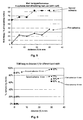
- the graph of Figure 5 shows the dependency of the wall-hang performance on the displacement of the adhesive band 40, i.e. the first predetermined spacing 1, for two different adhesives.
- the first adhesive corresponds to the adhesive according to U.S. Patent 3,691,140 and the second adhesive corresponds to the adhesive according to U.S. Patent 5,053,436.
- the wall-hang performance is measured according to the test as described above. In the graph of Fig. 5, the wall-hang performance is indicated in percent, i.e. if all sheets remain on the respective surfaces at the end of a test sequence, a value 100 % is reached. It can be seen that location of the adhesive band 40, i.e., displacement by a first predetermined spacing 1 from the first edge, dramatically improves the wall-hang performance.
- the highest wall-hang performance can be achieved with a centered adhesive band 40, wherein the first and second predetermined spacings 1 and 2 are 30 mm for a 76mm x 76mm sheet with 16 mm width 3 of the adhesive band 40.
- the combination of the second adhesive with a centered adhesive band 40 achieves the best results.
- Figure 6 shows, like Figure 5, the dependency of the wall-hang performance on the displacement, i.e. the first predetermined spacing 1 of the adhesive band 40, for the two different adhesives.
- Fig.6 shows the influence of two different band widths 3, which are 10 mm and 15 mm for each of the two tested adhesive bands 40 as indicated.
- the wall-hang performance is again indicated in percent.
- Fig. 6 shows that the sheets having broader adhesive bands show similar or only slightly better performance.
- the displacement of the adhesive pressure sensitive band from the edge of the sheet according to the invention provides an enhanced wall-hang performance for different adhesives and different band widths of the adhesive and different arrangements of the adhesive within the band.
Landscapes
- Adhesive Tapes (AREA)
- Adhesives Or Adhesive Processes (AREA)
Priority Applications (3)
| Application Number | Priority Date | Filing Date | Title |
|---|---|---|---|
| EP03029852A EP1547804A1 (de) | 2003-12-24 | 2003-12-24 | Blockanordnung |
| PCT/US2004/042555 WO2005065931A1 (en) | 2003-12-24 | 2004-12-17 | Pad assembly |
| US10/583,819 US20070148392A1 (en) | 2003-12-24 | 2004-12-17 | Pad assembly |
Applications Claiming Priority (1)
| Application Number | Priority Date | Filing Date | Title |
|---|---|---|---|
| EP03029852A EP1547804A1 (de) | 2003-12-24 | 2003-12-24 | Blockanordnung |
Publications (1)
| Publication Number | Publication Date |
|---|---|
| EP1547804A1 true EP1547804A1 (de) | 2005-06-29 |
Family
ID=34530739
Family Applications (1)
| Application Number | Title | Priority Date | Filing Date |
|---|---|---|---|
| EP03029852A Withdrawn EP1547804A1 (de) | 2003-12-24 | 2003-12-24 | Blockanordnung |
Country Status (3)
| Country | Link |
|---|---|
| US (1) | US20070148392A1 (de) |
| EP (1) | EP1547804A1 (de) |
| WO (1) | WO2005065931A1 (de) |
Cited By (2)
| Publication number | Priority date | Publication date | Assignee | Title |
|---|---|---|---|---|
| EP2532528A1 (de) * | 2011-06-10 | 2012-12-12 | Taiwan Hopax Chemicals Mfg. Co., Ltd. | Haftnotizblock |
| US9944108B2 (en) | 2011-06-10 | 2018-04-17 | Taiwan Hopax Chemicals Mfg. Co., Ltd. | Sticky note pad |
Families Citing this family (4)
| Publication number | Priority date | Publication date | Assignee | Title |
|---|---|---|---|---|
| USD679753S1 (en) | 2010-02-08 | 2013-04-09 | Avery Dennison Corporation | Note sheets and related pads of note sheets |
| CA137791S (en) | 2010-02-08 | 2011-06-13 | Avery Dennison Corp | Note sheet pad |
| US8778474B2 (en) | 2010-02-08 | 2014-07-15 | Ccl Label, Inc. | Repositionable medium and stack thereof |
| USD1096938S1 (en) | 2022-08-11 | 2025-10-07 | ACCO Brands Corporation | Pocket with surface indicia |
Citations (3)
| Publication number | Priority date | Publication date | Assignee | Title |
|---|---|---|---|---|
| US4822074A (en) * | 1988-03-21 | 1989-04-18 | Hueffman Jennifer R | Record keeping pad and page therefor |
| US5299833A (en) * | 1993-04-26 | 1994-04-05 | Moore Business Forms, Inc. | Paper sheets with pressure sensitive adhesive forming an easel pad |
| FR2839009A1 (fr) * | 2002-04-30 | 2003-10-31 | Philippe Ormezzano | Blocs-notes comprenant une pluralite de feuilles reversibles |
Family Cites Families (7)
| Publication number | Priority date | Publication date | Assignee | Title |
|---|---|---|---|---|
| US3691140A (en) * | 1970-03-09 | 1972-09-12 | Spencer Ferguson Silver | Acrylate copolymer microspheres |
| US5011186A (en) * | 1990-02-14 | 1991-04-30 | Minnesota Mining & Manufacturing Company | Hexagonal pad |
| US5153041A (en) * | 1990-10-10 | 1992-10-06 | Minnesota Mining And Manufacturing Company | Pad assembly |
| US5618062A (en) * | 1992-11-09 | 1997-04-08 | Minnesota Mining And Manufacturing Company | Note or note pad preparation method |
| US5989667A (en) * | 1997-02-10 | 1999-11-23 | Tayebi; Amad | Opaque sticker for temporary posting applications and subsequent saving without exhibiting inconvenient sticking to other surfaces |
| US5965225A (en) * | 1997-09-17 | 1999-10-12 | Torres; Carlos A. | Note sheet with pressure-sensitive adhesive and method of fabrication |
| US6053436A (en) * | 1999-04-30 | 2000-04-25 | Morford; Marvin | Particulate powder dispenser |
-
2003
- 2003-12-24 EP EP03029852A patent/EP1547804A1/de not_active Withdrawn
-
2004
- 2004-12-17 US US10/583,819 patent/US20070148392A1/en not_active Abandoned
- 2004-12-17 WO PCT/US2004/042555 patent/WO2005065931A1/en not_active Ceased
Patent Citations (3)
| Publication number | Priority date | Publication date | Assignee | Title |
|---|---|---|---|---|
| US4822074A (en) * | 1988-03-21 | 1989-04-18 | Hueffman Jennifer R | Record keeping pad and page therefor |
| US5299833A (en) * | 1993-04-26 | 1994-04-05 | Moore Business Forms, Inc. | Paper sheets with pressure sensitive adhesive forming an easel pad |
| FR2839009A1 (fr) * | 2002-04-30 | 2003-10-31 | Philippe Ormezzano | Blocs-notes comprenant une pluralite de feuilles reversibles |
Cited By (3)
| Publication number | Priority date | Publication date | Assignee | Title |
|---|---|---|---|---|
| EP2532528A1 (de) * | 2011-06-10 | 2012-12-12 | Taiwan Hopax Chemicals Mfg. Co., Ltd. | Haftnotizblock |
| CN102815114A (zh) * | 2011-06-10 | 2012-12-12 | 聚和国际股份有限公司 | 可重复黏贴的自黏性便签 |
| US9944108B2 (en) | 2011-06-10 | 2018-04-17 | Taiwan Hopax Chemicals Mfg. Co., Ltd. | Sticky note pad |
Also Published As
| Publication number | Publication date |
|---|---|
| WO2005065931A1 (en) | 2005-07-21 |
| US20070148392A1 (en) | 2007-06-28 |
Similar Documents
| Publication | Publication Date | Title |
|---|---|---|
| AU659614B2 (en) | Pad assembly | |
| KR0119544Y1 (ko) | 시이트 어셈블리의 스택 | |
| AU715594B2 (en) | Attachment strips | |
| JP4387794B2 (ja) | テープシートパッドおよびディスペンサ | |
| US5382055A (en) | Note or note pad preparation method | |
| WO2009048176A1 (ja) | 粘着シート及びその製造方法 | |
| JP3858082B2 (ja) | 共接着性接着シートを含むパッド | |
| CA2292548A1 (en) | Pad including adhesively adhered sheets | |
| EP0442217B1 (de) | Hexagonaler Block | |
| WO2005077672A1 (en) | Sheet with selectively activated adhesive | |
| EP1547804A1 (de) | Blockanordnung | |
| WO2006019691A2 (en) | Dry erase substrate | |
| US6703096B2 (en) | Combination sheet pad | |
| AU728662B2 (en) | A method for transferring vinyl designs from a host backing material to a substrate | |
| JPH06199074A (ja) | パッド組体 | |
| WO2008027816A1 (en) | Protective article and method of making | |
| JP4372925B2 (ja) | くじ類 | |
| EP2701854B1 (de) | Folie aus einem maskierungsmittel | |
| EP0871154B1 (de) | Klebebefestigungssystem und dessen Verwendung | |
| JPH08120232A (ja) | 仮止め用接着シート | |
| JPH10158609A (ja) | 水系粘着剤塗布シート | |
| JP3008228U (ja) | 室内表装材 | |
| JPH079669A (ja) | フレキソ版固定用両面粘着テープ及びフレキソ版固定構造 | |
| EP1094433A3 (de) | Plakate | |
| AU746299B2 (en) | Attachment strips |
Legal Events
| Date | Code | Title | Description |
|---|---|---|---|
| PUAI | Public reference made under article 153(3) epc to a published international application that has entered the european phase |
Free format text: ORIGINAL CODE: 0009012 |
|
| AK | Designated contracting states |
Kind code of ref document: A1 Designated state(s): AT BE BG CH CY CZ DE DK EE ES FI FR GB GR HU IE IT LI LU MC NL PT RO SE SI SK TR |
|
| AX | Request for extension of the european patent |
Extension state: AL LT LV MK |
|
| 17P | Request for examination filed |
Effective date: 20051212 |
|
| AKX | Designation fees paid |
Designated state(s): AT BE BG CH CY CZ DE DK EE ES FI FR GB GR HU IE IT LI LU MC NL PT RO SE SI SK TR |
|
| 17Q | First examination report despatched |
Effective date: 20070921 |
|
| STAA | Information on the status of an ep patent application or granted ep patent |
Free format text: STATUS: THE APPLICATION IS DEEMED TO BE WITHDRAWN |
|
| 18D | Application deemed to be withdrawn |
Effective date: 20080202 |