EP1545800B1 - Mehrschichtbeschichtungsverfahren zur erzielung eines erscheinungsbilds mit hoher farbsättigung auf einem fahrzeug - Google Patents
Mehrschichtbeschichtungsverfahren zur erzielung eines erscheinungsbilds mit hoher farbsättigung auf einem fahrzeug Download PDFInfo
- Publication number
- EP1545800B1 EP1545800B1 EP03785038A EP03785038A EP1545800B1 EP 1545800 B1 EP1545800 B1 EP 1545800B1 EP 03785038 A EP03785038 A EP 03785038A EP 03785038 A EP03785038 A EP 03785038A EP 1545800 B1 EP1545800 B1 EP 1545800B1
- Authority
- EP
- European Patent Office
- Prior art keywords
- basecoat
- transparent
- color
- clearcoat
- composition
- Prior art date
- Legal status (The legal status is an assumption and is not a legal conclusion. Google has not performed a legal analysis and makes no representation as to the accuracy of the status listed.)
- Expired - Lifetime
Links
Images

Classifications
-
- B—PERFORMING OPERATIONS; TRANSPORTING
- B05—SPRAYING OR ATOMISING IN GENERAL; APPLYING FLUENT MATERIALS TO SURFACES, IN GENERAL
- B05D—PROCESSES FOR APPLYING FLUENT MATERIALS TO SURFACES, IN GENERAL
- B05D1/00—Processes for applying liquids or other fluent materials
- B05D1/36—Successively applying liquids or other fluent materials, e.g. without intermediate treatment
- B05D1/38—Successively applying liquids or other fluent materials, e.g. without intermediate treatment with intermediate treatment
-
- B—PERFORMING OPERATIONS; TRANSPORTING
- B05—SPRAYING OR ATOMISING IN GENERAL; APPLYING FLUENT MATERIALS TO SURFACES, IN GENERAL
- B05D—PROCESSES FOR APPLYING FLUENT MATERIALS TO SURFACES, IN GENERAL
- B05D7/00—Processes, other than flocking, specially adapted for applying liquids or other fluent materials to particular surfaces or for applying particular liquids or other fluent materials
- B05D7/50—Multilayers
- B05D7/56—Three layers or more
- B05D7/57—Three layers or more the last layer being a clear coat
- B05D7/574—Three layers or more the last layer being a clear coat at least some layers being let to dry at least partially before applying the next layer
-
- B—PERFORMING OPERATIONS; TRANSPORTING
- B05—SPRAYING OR ATOMISING IN GENERAL; APPLYING FLUENT MATERIALS TO SURFACES, IN GENERAL
- B05D—PROCESSES FOR APPLYING FLUENT MATERIALS TO SURFACES, IN GENERAL
- B05D1/00—Processes for applying liquids or other fluent materials
- B05D1/36—Successively applying liquids or other fluent materials, e.g. without intermediate treatment
-
- B—PERFORMING OPERATIONS; TRANSPORTING
- B05—SPRAYING OR ATOMISING IN GENERAL; APPLYING FLUENT MATERIALS TO SURFACES, IN GENERAL
- B05D—PROCESSES FOR APPLYING FLUENT MATERIALS TO SURFACES, IN GENERAL
- B05D7/00—Processes, other than flocking, specially adapted for applying liquids or other fluent materials to particular surfaces or for applying particular liquids or other fluent materials
- B05D7/14—Processes, other than flocking, specially adapted for applying liquids or other fluent materials to particular surfaces or for applying particular liquids or other fluent materials to metal, e.g. car bodies
Definitions
- This invention is directed to a process and materials for applying a multi-layer coating over a substrate that achieves a highly saturated color appearance.
- this invention is directed to a process for coating motor vehicles such as automobiles or trucks during their original manufacture with a multi-layer coating that achieves excellent color saturation with depth of color and glamour, without sacrificing weatherability.
- tinted clear coats Unfortunately, the durability of these tinted clear coats has left much to be desired, since the pigments used therein are subject to UV degradation. Often, chalking, cracking and flaking occur after relatively short periods of exposure to weathering, necessitating costly refinishing.
- Various ideas have been proposed to solve the durability problems.
- One approach employs higher levels and different types of UV fortification but this has been met with only limited success.
- Another approach is to apply an additional layer of a regular clearcoat on top of the basecoat/ tinted clearcoat finish, in order to avoid potential warranty claims. This approach, however, dramatically increases manufacturing costs and results in lost production, since the vehicle must be sent through the painting process a second time.
- a separate paint circulation system is also needed to accommodate a tinted clearcoat in an auto manufacturer's paint shop. Since tinted clearcoats are used only for a limited number of high-end colors and the rest of the color range in a basecoat/clearcoat process still requires the application of a regular untinted clearcoat, contamination of the regular clearcoat lines must be avoided. Redundant clearcoat circulation systems are therefore needed which are extremely expensive and occupy valuable floor space.
- US 2002 090461 proposes to increase the viscosity of the basecoat composition by evaporating the volatile components in the applied paint.
- the present invention is directed to a process for coating an automotive substrate with a multi-layer tricoat finish to achieve a highly saturated color appearance, comprising:
- the process of this invention can be operated in a single pass continuous in-line paint application process or in stationary batch process.
- the present invention eliminates the use of tinted clearcoats and their associated problems, while at the same time providing a finish that is of automotive quality and appearance and has high color saturation, with excellent depth of color and desired sparkle.
- tricoat finish it is meant that three different, consecutive coating layers are applied over the substrate.
- color saturation is determined according to Ullmann's Encyclopedia of Industrial Chemistry, Vol. A20, page 259.
- the claimed invention further includes coating materials and waterborne basecoats compositions in particular that enable the process to be run in a continuous wet-on-wet-on-wet fashion through a standard continuous automotive coatings line, while at the same time meeting current low overall solvent emission requirements, and a coated , automotive substrate prepared according to the present process.
- the present invention relates to the application of tricoat finishes on automotive substrates during their original manufacture. More particularly, it provides a process for coating the exterior of an automotive substrate such as an auto or truck body or parts thereof with a multi-layer tricoat coating, which eliminates the use of tinted clearcoats and their associated problems, while at the same time providing a finish that is of automotive quality and appearance that achieves high color saturation with excellent depth of color and desired glamour, without sacrificing durability and weatherability.
- the process of the present invention can be run in a batch or continuous process. Ideally, it is designed to be run in existing basecoat/clear coat painting facilities, such as continuous in-line or modular batch facilities, located at an automotive assembly plant without the need to reconfigure (e.g., spur) or slow down the line or extend the painting time.
- the process of this invention is suitable for coating a variety of metallic and non-metallic substrates in a batch or continuous process.
- a batch process also referred to as a modular process
- the substrate is stationary during each treatment step of the process, whereas in a continuous process the substrate is in continuous movement along the paint line in an assembly line fashion.
- Useful substrates that can be coated according to the process of the present invention include a variety of metallic and non-metallic substrates such as plastic substrates, and combinations thereof.
- Useful metallic substrates include unprimed substrates or previously painted substrates, cold rolled steel, phosphatized steel, and steel coated with conventional primers by electrodeposition.
- Useful plastic materials include polyester reinforced fiberglass, reaction-injection molded urethanes, partially crystalline polyamides, and the like or mixtures thereof and their associated primers.
- the substrates that are coated according to the process of the present invention are used as components to fabricate automotive vehicles, including but not limited to automobiles, trucks, and tractors.
- the substrates can have any shape, but are usually in the form of automotive body components such as bodies, hoods, doors, fenders, bumpers and/or trim for automotive vehicles.
- the invention is most useful in the context of coating automotive bodies and components thereof traveling in continuous movement along an automotive assembly line.
- the substrate Prior to treatment according to the process of this invention, the substrate may be previously primed or otherwise treated as conventional in the art.
- the three different coatings employed herein are then applied consecutively over the substrate in the manner described below.
- the three different coating compositions that are used in the process of the present invention include: a first pigmented basecoat (groundcoat) which is formulated as either a solid color or as an effect color composition based on flake and/or other effect pigments; a second transparent or semi-transparent basecoat (midcoat) which is preferably free of flake or other effect pigments and is used to enrich the color shade of the first basecoat; and a regular untinted clearcoat as the topcoat.
- the first basecoat and the second basecoat are preferably, but not necessarily, formed from water borne compositions and the untinted clearcoat is formed from either a solvent borne, water borne or powder composition.
- the first basecoat (or groundcoat) composition employed in the present invention is a pigmented composition which may be formulated as a solid color (straight shade) or effect color coating of appropriate color, effect, and optional, but preferable hiding.
- the first basecoat (effect or solid shade) used is a waterborne composition in order to meet the current low overall solvent emission requirements.
- "Effect" coatings as are known in the art, generally contain one or more special effect flakes or other effect pigments and optionally other colored pigments or spheres which give the desired color, effect and optional, but preferable hiding.
- special effect flakes pigment flakes that have the ability to impart visible flop or two tone (e.g., metallic or pearlescent) effect to a coating film.
- the first basecoat composition employed could also be formulated as a solid color or straight shade coating of appropriate color and optional, but preferable hiding. "Straight shade” or “solid shade” coatings, as are known in the art, primarily contain colored pigments and exhibit no visible flop or two tone metallic effect.
- the first basecoat (effect or solid shade) composition is also preferably formulated as a crosslinkable composition, which comprises mixtures of film-forming material or binder, volatile material, and pigment.
- the film forming binder preferably contains one or more water-compatible film forming materials such as an aqueous microgel, polyol polymer, or mixtures thereof, and a crosslinking agent such as an aminoplast resin.
- the microgel preferably contains appropriate functional groups, such as hydroxy groups, whereby they can become crosslinked, after application of the composition to the substrate by means of a crosslinking agent, e.g., the amino resin.
- the aqueous polymer microgel suitable for use in this invention may be composed of various types of crosslinked polymers. Of particular interest for the purposes of this invention are crosslinked acrylic microgel particles. Preparation of such acrylic microgels may be carried out by methods which are well known and routinely practiced by those of ordinary skill in the art.
- the microgels are acrylic addition polymers mainly derived from one or more alkyl acrylates or methacrylates, optionally together with other ethylenically unsaturated copolymerizable monomers like styrene and vinyl esters.
- Suitable alkyl acrylates or methacrylates include, without limitation, alkyl acrylates and methacrylates each having 1-18 carbon atoms in the alkyl group.
- the polymer is required to be formed with internal crosslinking, there may be included in the monomers from which the polymer is derived a minor proportion of a monomer which is polyfunctional with respect to the polymerization reaction, such as ethylene glycol dimethacrylate, allyl methacrylate or divinylbenzene.
- a monomer which is polyfunctional with respect to the polymerization reaction such as ethylene glycol dimethacrylate, allyl methacrylate or divinylbenzene.
- two other monomers carrying pairs of functional groups which can be caused to react with one another either during or after polymerization, such as epoxy and carboxyl (as for example, in glycidyl methacrylate and methacrylic acid), anhydride and hydroxyl, or isocyanate and hydroxyl.
- hydroxy containing monomer for crosslinking purposes after application of the composition to the substrate from the following group: hydroxy alkyl acrylates or methacrylates, and any mixtures of other ethylenically unsaturated hydroxy monomers.
- Acid functional monomers such as acrylic acid or methacrylic acid are also preferably included in the monomer mix to sterically stabilize the crosslinked microparticles in the aqueous dispersion medium by converting such groups to a suitable salt by reaction with a base, such as dimethylaminoethanol, dissolved in the aqueous medium.
- a base such as dimethylaminoethanol
- the required stability in the aqueous medium can be achieved by using an acrylate or methacrylate monomer containing basic groups, for example, dimethylaminoethyl methacrylate, which are neutralized with a suitable acid, such as lactic acid.
- Stability in the aqueous medium can also be achieved by use of surfactants or macromonomers which contain water soluble nonionic stabilizers such as materials which contain polyethylene glycol structures.
- aqueous medium it is meant either water alone or water admixed with a water-miscible organic co-solvent such as an alcohol.
- the crosslinked microgel particles so produced are provided in colloidal dimensions.
- the microgel particles that are particularly useful in this invention generally have a colloidal size from about 80 to 400 nanometers, in diameter, preferably from about 90 to 200 nanometers.
- Suitable polyols useful for preparing the basecoat composition include water-compatible acrylic, polyester, polyester, polyurethane, polyether, or other polyol having a hydroxyl number of 50-200, as are conventional in the art.
- Suitable crosslinking materials include aminoplast resins soluble or partially in the aqueous medium of the composition, such as melamine-formaldehyde condensates and in particular alkylated melamine-formaldehyde condensates.
- Other contemplated crosslinking materials are alkylated urea formaldehyde condensates, benzoquanamine formaldehyde condensates and blocked polyisocyanates or compatible, mixtures of any of the forgoing.
- Additional water-compatible film-forming and/or crosslinking polymers may be included in the basecoat employed in the present invention.
- examples include water compatible acrylics, polyurethane, epoxies, or mixtures thereof.
- film-forming filler materials such as polyether glycols of low volatility, for e.g., low molecular polypropylene and/or polyethylene glycol, can be used to fill the voids formed by the microgel particles upon drying and improve the physical properties of the resulting film or finish.
- These oligomeric substances can be converted to high molecular weight polymer, after application of the basecoat composition, by linking them through their hydroxyl groups or other reactive groups to the aminoplast crosslinking resin.
- the first basecoat according to the present invention in addition to special effect pigments and flakes and/or other optional pigments, comprises by weight of binder solids, aqueous microgel for rheology control from about 20-80%, preferably 40 -70%, such as but not limited to the crosslinked acrylic microparticle aqueous dispersions disclosed in aforementioned U.S.
- Patent 4,403,003 water-soluble or partially water-soluble aminoplast resin, preferably a methylated melamine formaldehyde, from 10-40%, preferably 15-25%, water dispersible polyester polyol resin from about 0-40%, polyurethane polyol aqueous dispersion from 0-30%, preferably 5-15%, water-soluble polyether filler from 0-10%, water-soluble acid catalyst from about 0-2%, such as but not limited to a volatile amine blocked sulfonic acid catalyst, to promote melamine or other crosslinking reaction.
- the composition also includes 0.1-3%, preferably 0.3-1.0%, based on the weight of the total composition, sheet silicate particle, such as those disclosed in Berg et al. U.S. Patent 5,198,490 issued Mar. 30, 1993, to help give the desired holdout or resistance to strike-in and intermixing.
- the overall solids content of the first basecoat composition typically ranges from about 10 to 35% by weight (for e.g., a metallic or pearlcoat typically has 15-30% solids by weight, and a red solid color typically has 25-40% solids by weight).
- the first basecoat generally contains one or more special effect flake and other effect pigments, and/or optionally one or more color pigments, depending on if it is formulated as an effect color or a solid shade.
- Typical special effect flakes that can be used include metallic flakes such as aluminum flake, copper bronze flakes, pearlescent (e.g., mica) flakes, vacuum metalized flakes, glass flakes, and the like.
- Other effect pigments that can be used include holographic flakes, glass spheres, micro titanium dioxide pigments, Graphitan® pigments, and higher degree effect pigments including, for instance, Xirallic®, Colorstream®, Mearlite®BBT, Chromaflair®, Variochrome®, and Helicone® pigments, and the like.
- Typical colored pigments that can be used include metal oxides such as titanium dioxide, zinc oxide, iron oxides of various colors, carbon black, and a wide variety of organic colored pigments such as quinacridones, phthalocyanines, perylenes, azo pigments, indanthrone blues, carbazoles such as carbozole violet, isoindolinones, isoindolones, thioindigo reds, benzimidazolinones, diketo-pyrrolo-pyrroles (DPP) and the like.
- organic colored pigments such as quinacridones, phthalocyanines, perylenes, azo pigments, indanthrone blues, carbazoles such as carbozole violet, isoindolinones, isoindolones, thioindigo reds, benzimidazolinones, diketo-pyrrolo-pyrroles (DPP) and the like.
- DPP diketo-pyrrol
- the specific pigment to binder ratio can vary widely so long as it provides the requisite color, effect and hiding at the desired film thickness and application solids.
- the pigments can be introduced into the basecoat by first forming a mill base or pigment dispersion with any of the aforementioned polymers used in the coating composition or with another compatible polymer or dispersant by conventional techniques, such as mixing/slurrying (i.e., for flakes), high speed mixing, media milling, sand grinding, ball milling, attritor grinding or two/three roll milling. The pigment dispersion is then blended with the other constituents used in the coating composition.
- the second basecoat employed in this invention is formulated to be transparent or semi-transparent and is differently pigmented than the first basecoat composition.
- the second basecoat usually contains only colored and/or uncolored inorganic and/or organic pigments, preferably transparent.
- uncolored it is meant pigments such as extender pigments that do not impart a color to the coating but provide a functional effect such as improved adhesion.
- special effect flakes or effect pigments can be included to impart the desired color and effect.
- it may contain no pigments whatsoever.
- This intermediate basecoat is used to enrich or enhance the color shade of the first basecoat, without the use of a tinted clearcoat and all its associated problems.
- the second basecoat is a pigmented composition and is in the same color area (e.g., red over red, blue over blue, yellow over yellow, etc.) as the first basecoat, in order to provide the desired enhanced color saturation and depth of color effect.
- the second basecoat may be formulated in different color area (e.g., red over silver, yellow over blue, etc.) for a different color effect.
- the second basecoat is also formulated as a waterborne formulation and any of the ingredients listed above for use in the first basecoat may be included in the second basecoat, usually except for the special effect flakes.
- the second, differently pigmented, transparent basecoat comprises according to the present invention by weight of binder solids, aqueous microgel for rheology control from about 20-80%, preferably 50-70%, water-soluble or partially water-soluble aminoplast resin, preferably a methylated melamine formaldehyde, from about 10-40%, preferably 15-25%, water dispersible polyester polyol resin from about 0-40%, aqueous polyurethane polyol dispersion from about 0-30%, preferably 15-15%, water-soluble polyether filler from 0-10%, blocked acid catalyst from about 0-2%, such as but not limited to amine blocked sulfonic acid catalyst, to promote melamine or other crosslinking reaction.
- the composition also includes 0.1-3%, preferably 0.3-1.0%,
- the overall solids content of the second basecoat composition typically ranges from about 15 to 40% by weight (for e.g., a colored transparent basecoat typically has 20-30% solids by weight).
- Both basecoat compositions employed in the present invention may also include other conventional formulation additives such as wetting aids, surfactants, defoamers, UV fortifiers, and rheology control agents, such as fumed silica, alkali swellable emulsions, associative thickeners, or water compatible cellulosics.
- wetting aids such as surfactants, defoamers, UV fortifiers, and rheology control agents, such as fumed silica, alkali swellable emulsions, associative thickeners, or water compatible cellulosics.
- Both basecoat compositions employed in this invention also include volatile materials.
- the volatile materials generally include water alone or water in admixture with conventional water-miscible organic solvents and diluents, to disperse and/or dilute the above mentioned polymers and facilitate formulation and spray application.
- Typical water-miscible organic co-solvents and diluents include toluene, xylene, butyl acetate, acetone, methyl isobutyl ketone, methyl ethyl ketone, methanol, isopropanol, butanol, butoxyethanol, hexane, acetone, ethylene glycol, monoethyl ether, VM and P naptha, mineral spirits, heptane and other aliphatic, cycloaliphatic, aromatic hydrocarbons, esters, ethers and ketones and the like.
- water is used as the major diluent.
- Amines such as alkanolamine can also be used as a diluent.
- the nature of the clearcoat composition employed in the process of the present invention is in no way critical.
- an untinted transparent clearcoat is used.
- untinted it is meant that the clearcoat contains no pigments.
- Any of a wide variety of commercially available automotive clearcoats may be employed in the present invention, including standard solvent borne, waterborne or powdered clears. High solids solvent borne clear coats which have low VOC (volatile organic content) and meet current pollution regulations are generally preferred.
- useful solventbome clearcoats include but are not limited to 2K (two component) systems of polyol polymers crosslinked with isocyanate and 1K systems of acrylic polyol crosslinked with melamine or 1K acrylosilane systems in combination with polyol and melamine.
- Epoxy acid clearcoat systems can also be used. Such finishes can provide automobiles and trucks with a mirror-like exterior finish having an attractive aesthetic appearance, including high gloss and DOI (distinctness of image).
- Suitable 1K solvent borne acrylosilane clearcoat systems that can be used in the process of the present invention are disclosed in U.S. Patent 5,162,426, hereby incorporated by reference.
- Suitable 1K solvent borne acrylic/melamine clearcoat systems are disclosed in U.S. Patent 4,591,533, hereby incorporated by reference.
- the three coating compositions described above can be applied by, but is not limited to, conventional techniques such as spraying, electrostatic spraying, high rotational electrostatic bells, and the like.
- the preferred techniques for applying all three coatings are air atomized spraying with or without electrostatic enhancement, and high speed rotational electrostatic bells, since these techniques are typically employed in a continuous paint application process.
- FIG. 1 a flow diagram of a multi-stage tricoat process for coating a substrate according to the present invention.
- the present invention will now be discussed generally in the context of coating an automotive substrate in continuous movement along a standard continuous automotive coatings line with waterborne basecoats and high solids solvent borne clearcoats.
- One skilled in the art would understand that the process of the present invention is also useful in other types of continuous or batch processes and with other types of basecoat and clearcoat systems.
- the automotive substrate 10 Prior to treatment according to the process of this invention, the automotive substrate 10 may be previously primed or otherwise treated as conventional in the art.
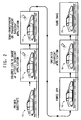
- the first liquid waterborne basecoat or groundcoat composition is then applied to the surface of the primed automotive substrate (such as the automobile body shown in FIG. 2), preferably over an electrodeposited coating or primer surfacer.
- the first liquid basecoat can be applied to the surface of the substrate in this step by any suitable coating process well known to those skilled in the art, such as by any of the techniques described above.
- the method and apparatus for applying the liquid basecoat composition to the substrate is determined in part by the configuration and type of substrate material.
- the process of the present invention includes a second step 14 of directly applying the second liquid waterborne transparent basecoat composition (midcoat) over the first waterborne basecoat composition, as the vehicle travels along the assembly line, by means of a wet-on-wet application, i.e., the second basecoat is applied to the first basecoat without curing or completely drying the first basecoat.
- the second liquid basecoat can be applied in this step by any suitable coating process known to those skilled in the art, such as by any of the techniques described above.
- the second basecoat is applied within about 30 seconds to 5 minutes of the first basecoat application, preferably within about 2-4 minutes of application, which is the typical dwell time in a conventional basecoat spray booth for basecoat/clearcoat systems.
- FIG. 3 To demonstrate how the present invention can be run in existing basecoat/clearcoat vehicle paint lines, a traditional single pass basecoat/clearcoat continuous paint application process is shown in FIG. 3.
- an automobile steel panel or plastic substrate 10 which may be previously primed or otherwise treated as conventional in the art, is moved to a continuous in-line basecoat/ clearcoat application area.
- a basecoat color is applied first to the surface of the substrate typically in two steps 22, 24 separated by 30-300 seconds between the first and second coats.
- Typical basecoats comprise a mixture of pigments, which may include special effect flake pigments, film-forming binder polymers and optionally crosslinking agents and others additives and solvents necessary for application.
- the basecoats are waterbased systems, as is conventional in the art, it is also necessary to have a forced drying step 26 for removal of some of the water and any other organic liquid diluent contained therein before the clearcoat is applied in the next step 28.
- a clearcoat is then applied to the semi-dried pigmented basecoat. This is still commonly called a wet-on-wet process because the basecoat is not completely dried or cured before application of the clearcoat.
- the coated substrate is then baked in step 30 under standard conditions to simultaneously cure the basecoat and clearcoat composition on the surface and produce a finish of automotive quality and appearance.
- the first and second basecoats of the present invention must be formulated to have acceptable hold-out or resistance to strike-in and intermixing after about 30 seconds to 5 minutes at ambient conditions between coats, preferably after 1 to 4 minutes at ambient conditions.
- the present process can take advantage of the two existing basecoat stations found in existing continuous basecoat/clearcoat paint application lines (normally used to apply the same basecoat in two steps separated by 30-300 seconds) without the need to reconfigure the line.
- the process of the present invention preferably includes a third step 16 of subjecting the combined basecoat layers to a drying step to volatilize at least a portion of the volatile materials from the liquid coating compositions and set the basecoats on the substrate.
- set it is meant that the basecoat is not disturbed or marred (waved or rippled) by air currents which may blow past the basecoated surface.
- the volatilization or evaporation of volatiles from the basecoat can be carried out in open air, but is preferably carried out in a forced drying chamber ("tunnel") as shown in FIG. 2 in which heated air (40-100°C) or dehydrated air is circulated at low velocity to minimize airborne particle contamination.
- This step is commonly referred to as a flash drying step.
- the automobile body is positioned at the entrance to the drying chamber and slowly moved therethrough in assembly-line manner at a rate which permits the volatilization of the basecoat as discussed above.
- the rate at which the auto is moved through the drying chamber depends in part upon the length and configuration of the drying chamber. Overall, this intermediate drying step may last for 30 seconds to 10 minutes, although in normal assembly plants, this step should take from about 2-5 minutes.
- the dried basecoat that is formed upon the surface of the automobile body is dried sufficiently to enable application of the clear topcoat such that the quality of the topcoat will not be affected adversely by further drying of the basecoat.
- the dried basecoats after application to the surface of the substrate, form a multilayer film which is substantially uncrosslinked, i.e., is not heated to a temperature sufficient to induce significant crosslinking and there is substantially no chemical reaction between the film-forming polymers and crosslinking material therein. If too much water is present, the topcoat can crack, bubble or pop during drying of the topcoat as water vapor form the basecoat attempts to pass through the topcoat.
- the process of the present invention comprises a next step 18 of applying a liquid or powder clear, untinted, transparent topcoat composition over the dried composite basecoat layers.
- the clearcoat can be applied by any of the methods described above. With liquid clearcoats, it has become customary, particularly in the auto industry, to apply the clear topcoat over a basecoat by means of a wet-on-wet application, i.e., the topcoat is applied to the basecoat without curing or completely drying the basecoat. As indicated above, the clearcoat is preferably applied over a basecoat which has been dried, preferably flash dried for a short period, before the clearcoat is applied. This is still commonly called a wet-on-wet process because the basecoat is not completely dried or cured. Although less preferred, the basecoat can be cured, if desired, before the liquid clear coat is applied.
- the process of the present invention preferably comprises a curing step 20 in which the coated substrate is heated for a predetermined time period to allow simultaneous curing of the base and clear coats.
- the curing step can be carried out using hot air convection drying, infrared radiation, or a combination thereof.
- the three layer composite coating composition is preferably baked at 100-150°C for about 15-30 minutes to form a cured tricoat finish on the substrate.
- cured means that the crosslinkable components of the coatings are substantially crosslinked.
- substantially crosslinked it is meant that, although at least most curing has occurred, further curing may occur over time.
- the process of the invention may also include a subsequent cooling step (not shown) to cool the tricoat finish to ambient temperatures before the vehicle is further worked on during its manufacture.
- the thickness of the dried and cured composite tricoat finish is generally about 40-150 ⁇ m (1.5-6 mils) and preferably 60-1 00 ⁇ m (2.5-4 mils).
- the basecoats and clearcoat are preferably deposited to have thicknesses of about 3.0-40 ⁇ m (0.1-1.6 mils) and 25-75 ⁇ m (1.0-3.0 mils), respectively.
- the following pigment slurry was prepared, 38.0 g of de-ionized water, 1.0 g of acrylic microgel dispersion (as described in U.S. Patent 4,403,003, Example 4), 30.5 g butoxyethanol, 7.5 g Cymel® 303 (alkylated melamine formaldehyde resin), 2.0 g of 10% dimethylethanol amine solution and 1.0 g Surfynol® 104 (surfactant).
- the above components were mixed together, 20.0 g of Bayferrox® 3910 (yellow iron oxide) was added and the resulting slurry was then pre-dispersed using a Cowles blade. The mixture was then ground in a horizontal beadmill until the desired particle size of less than 0.5 micron was achieved.
- the following pigment slurry was prepared, 7.0 g of de-ionized water, 10.0 g of acrylic microgel dispersion (as described in U.S. Patent 4,403,003, Example 4), 10.0 g butoxyethanol, 7.0 g Cymel® 303, 0.5 g of 10% dimethylethanol amine solution and 1.0 g Surfynol® 104.
- the above components were mixed together, 40.0 g of Bayferrox® 130M (red iron oxide) was added and the resulting slurry was then pre-dispersed using a Cowles blade.
- the mixture was then ground in a horizontal beadmill until the desired particle size of less than 0.5 micron was achieved before it was stabilized by adding a letdown solution containing 10.0 g of acrylic microgel dispersion (as described above) and 14.5 g of de-ionized water.
- the following pigment slurry was prepared, 61.6 g of de-ionized water, 5.0 g of acrylic microgel dispersion (as described in U.S. Patent 4,403,003, Example 4), 5.0 g butoxyethanol, 5.0 g Cymel® 303, 2.5 g Solsperse® 20000 (dispersant), 0.4 g of 10% dimethylethanol amine solution and 0.5 g Surfynol® 104.
- the above components were mixed together, 20.0 g of Irgazin® Red DPP BO was added and the resulting slurry was then pre-dispersed using a Cowles blade. The mixture was then ground in a horizontal beadmill until the desired particle size of less than 0.5 micron was achieved.
- the following pigment slurry was prepared, 55.3 g of de-ionized water, 10.0 g of acrylic microgel dispersion (as described in U.S. Patent 4,403,003, Example 4), 18.0 g butoxyethanol, 8.0 g Cymel® 303, 2.0 g Solsperse® 20000, 0.2 g of 10% dimethylethanol amine solution and 0.5 g SurFynol® 104.
- the above components were mixed together, 6.0 g of Cinquasia® Magenta RV 6843 was added and the resulting slurry was then pre-dispersed using a Cowles blade. The mixture was then ground in a horizontal beadmill until the desired particle size of less than 0.5 micron was achieved.
- the following pigment slurry was prepared, 46.3 g of de-ionized water, 15.0 g of acrylic microgel dispersion (as described in U.S. Patent 4,403,003, Example 4), 20.0 g butoxyethanol, 8.0 g Cymel® 303, 2.0 g Solsperse® 20000), 0.2 g of 10% dimethylethanol amine solution and 0.5 g Surfynol® 104.
- the above components were mixed together, 8.0 g of Paliogen® Red L 3885 was added and the resulting slurry was then pre-dispersed using a Cowles blade. The mixture was then ground in a horizontal beadmill until the desired particle size of less than 0.5 micron was achieved.
- the following pigment slurry was prepared, 50.5 g of de-ionized water, 5.0 g of acrylic microgel dispersion (as described in U.S. Patent 4,403,003, Example 4), 5.0 g butoxyethanol, 5.0 g Cymel® 303, 2.5 g Solsperse® 20000, 1.0 g of 10% dimethylethanol amine solution and 1.0 g Surfynol® 104.
- the above components were mixed together, 30.0 g of Irgacolor® Yellow 3 GLM was added and the resulting slurry was then pre-dispersed using a Cowles blade. The mixture was then ground in a horizontal beadmill until the desired particle size of less than 0.5 micron was achieved.
- the following pigment slurry was prepared, 35.5 g of de-ionized water, 10.0 g of acrylic microgel dispersion (as described in U.S. Patent 4,403,003, Example 4), 20.0 g butoxyethanol, 15.0 g Cymel® 303, 5.0 g Solsperse® 20000, 7.0 g of 10% dimethylethanol amine solution and 0.5 g Surfynol® 104.
- the above components were mixed together, 7.0 g of Carbon Black FW 200® was added and the resulting slurry was then pre-dispersed using a Cowles blade. The mixture was then ground in a horizontal beadmill until the desired particle size of less than 0.5 micron was achieved.
- the following pigment slurry was prepared, 53.5 g of de-ionized water, 5.0 g of acrylic microgel dispersion (as described in U.S. Patent 4,403,003, Example 4), 20.0 g butoxyethanol, 8.0 g Cymel® 303, 2.0 g Solsperse® 20000, 1.0 g of 10% dimethylethanol amine solution and 0.5 g Surfynol® 104.
- the above components were mixed together, 10.0 g of Cromophtal® Red A2B was added and the resulting slurry was then pre-dispersed using a Cowles blade. The mixture was then ground in a horizontal beadmill until the desired particle size of less than 0.5 micron was achieved.
- a homogeneous blend of the following was prepared by mixing together and stirring: 47.5 g of acrylic microgel dispersion (as described under A. above), 2.0 g of buthoxyethanol and 0.5 g of Surfynol 104. 50.0 g of a 3% Laponite® RD (layered silicate) solution in de-ionized water was added under stirring and homogenized and dispersed using a horizontal beadmill.
- a waterborne red effect color basecoating composition was prepared by mixing together the following constituents under constant agitation in the order stated: Acrylic microgel dispersion as described in (1,A.), above - 15.7 parts. Black pigment dispersion as described in (1,I.), above - 1.6 parts. Magenta pigment dispersion as described in (1,F.), above -15.5 parts. Red pigment dispersion as described in (1,G.), above - 30.2 parts. Cymel® 303 - 1.7 parts. Effect pigment concentrate "C” (Xirallic®) as described in (1,C.), above - 15.3 parts. Effect pigment concentrate "D” (Iriodin®) as described in (1,D.), above - 8.1 parts.
- EXAMPLE 3 Preparation of Waterborne Red Solid Color Basecoat (a "1 st Layer") Composition.
- a waterborne red solid color basecoating composition was prepared by mixing together the following constituents under constant agitation in the order stated: Acrylic microgel dispersion as described in (1,A.), above - 36.5 parts. Red pigment dispersion as described in (1,E.), above - 22.8 parts. Red pigment dispersion as described in (1,J.), above - 11.4 parts. Yellow pigment dispersion as described in (1,H.), above - 5.3 parts. Red pigment dispersion as described in (1,B.), above - 3.4 parts. Yellow pigment dispersion as described in (1,A.), above - 2.3 parts. Cymel® 303 - 5.3 parts. Rheology base as described in (1,K.), above - 9.2 parts.
- Surfynol® 104 1.8 parts.
- EXAMPLE 4 Preparation of Waterborne Transparent Red Color Basecoat (a "2nd Layer") Composition.
- Example 5 Solventborne Clearcoat.
- the clearcoat composition used for the examples was a collision baking clear, which is commercially available from Du Pont Performance Coatings (Standox), Christbusch 25, D-42285 Wuppertal/Germany, with following details: Standocryl 2K-HS Klarlack, 020-82497 (in the US, code number is Standox HS Clear 14580), to be activated at a ratio of 2:1 with Standox 2K Haerter HS 15-25, 020-82403.
- Example 6 Application of 2 different Basecoats and Clearcoat (wet-on-wet-on-wet).
- Standard automotive metal car doors have been processed and prepared with standard automotive pre-treatment and coatings systems, up to the primer/surfacer layer. They were then processed through a standard continuous basecoat/clearcoat automotive type application line at a continuous line speed of approximately 4 m/min, whereby the 1 st layer coat (effect color or solid color respectively - as described in examples 2 and 3 above) was applied with an electrostatic bell at a flow rate of 120 cc/min. After 2 minutes under ambient conditions (i.e.
- the 2 nd layer coat (as described in example 4 above) was applied on top of the respective 1 st layer coats, effect color or solid color, wet on wet, by pneumatic atomization with robots, at a flow rate of 520 cc/min. This was then followed by a standard force dry in a drying tunnel for approximately 5 minutes @ 60°C, after which, following the normal automotive line procedures, a commercial clearcoat (in this case, a 2K isocyanate solvent based clearcoat, Standox® HS Clear 14580, commercially available from DuPont Company) was applied electrostatically, and the entire system was stoved @ 10 minutes/ 120°C. Film builds were as follows: 1 st layer coats: 10 - 12 microns (effect and solid shade respectively) 2 nd layer coat: 7 - 10 microns Clearcoat: 40 - 45 microns
Landscapes
- Life Sciences & Earth Sciences (AREA)
- Engineering & Computer Science (AREA)
- Wood Science & Technology (AREA)
- Application Of Or Painting With Fluid Materials (AREA)
- Laminated Bodies (AREA)
Claims (11)
- Verfahren zur Beschichtung eines Substrats eines Automobils mit einer aus drei Beschichtungen bestehenden Endbearbeitung, um ein Erscheinungsbild mit einer hohen Farbsättigung zu erzielen, Verfahren welches die folgenden Schritte umfasst:(a) Auftragen einer ersten Grundbeschichtungszusammensetzung aus fester Farbe oder Effektfarbe auf eine Oberfläche eines Substrats eines Automobils;(b) danach Auftragen einer zweiten, verschiedenen, durchsichtigen oder halbdurchsichtigen Grundbeschichtungszusammensetzung, welche frei von Flockenpigmenten ist;c) Aussetzen der kombinierten Grundbeschichtungen an einen Trocknen-Zwischenschritt;d) Auftragen einer ungetönten Klarbeschichtungszusammensetzung über die Grundbeschichtungsschicht; unde) gleichzeitiges Härten der drei Beschichtungen der Endbearbeitung in einem einzigen Backvorgang,dadurch gekennzeichnet, dass die erste und die zweite Grundbeschichtung aus Grundbeschichtungen auf Wasserbasis bestehen und dass jede Grundbeschichtung vemetzte, wässrige Mikrogelpartikel in einer Menge zwischen 20 und 80 Gewichtsprozent der Bindemittelfeststoffe enthält.
- Verfahren gemäß Anspruch 1, bei dem die zweite durchsichtige oder halbdurchsichtige Grundbeschichtung nicht pigmentiert ist.
- Verfahren gemäß Anspruch 1, bei dem die zweite durchsichtige oder halbdurchsichtige Grundbeschichtung in demselben Farbbereich liegt wie die erste Grundbeschichtung.
- Verfahren gemäß Anspruch 1, bei dem die zweite durchsichtige oder halbdurchsichtige Grundbeschichtung in einem verschiedenen Farbbereich liegt wie die erste Grundbeschichtung.
- Verfahren gemäß Anspruch 1, bei dem die erste Grundbeschichtungsschicht mit oder ohne Flockenpigmenten oder einem bzw. mehreren anderen Effektpigmenten ausgeführt ist.
- Verfahren gemäß Anspruch 1, bei dem das Verfahren auf einer kontinuierlichen in-line Fertigungsstrasse zur Farbauftragung betrieben wird.
- Verfahren gemäß Anspruch 1, bei dem die Klarbeschichtung ein Melamin- und Polyolsystem; ein Polyol- und Isocyanatsystem; ein Melamin-, Polyol- und Silansystem; oder ein Epoxysäuresystem aufweist.
- Verfahren gemäß Anspruch 1, bei dem die Klarbeschichtung aus einer Klarbeschichtung auf der Basis von Lösungsmitteln, Wasser oder Pulver besteht.
- Verfahren gemäß Anspruch 1, bei dem die erste Grundbeschichtung Deckkraft besitzt.
- Verfahren gemäß Anspruch 1, bei dem die erste und zweite Grundbeschichtung übereinander ohne ein Trocknen-Zwischerischritt aufgetragen werden.
- Verfahren gemäß Anspruch 1, bei dem das Verfahren in einem einzigen Nass-auf-Nass-auf-Nass-Durchgang auf einer sich kontinuierlich bewegenden in-line Beschichtungsstrasse für Automobile betrieben wird.
Applications Claiming Priority (3)
| Application Number | Priority Date | Filing Date | Title |
|---|---|---|---|
| US216257 | 2002-08-08 | ||
| US10/216,257 US20040028823A1 (en) | 2002-08-08 | 2002-08-08 | Multi-layer coating process to achieve a highly saturated color appearance on a vehicle |
| PCT/US2003/024849 WO2004014572A1 (en) | 2002-08-08 | 2003-08-06 | Multi-layer coating process to achieve a highly saturated color appearance on a vehicle |
Publications (2)
| Publication Number | Publication Date |
|---|---|
| EP1545800A1 EP1545800A1 (de) | 2005-06-29 |
| EP1545800B1 true EP1545800B1 (de) | 2006-07-26 |
Family
ID=31495025
Family Applications (1)
| Application Number | Title | Priority Date | Filing Date |
|---|---|---|---|
| EP03785038A Expired - Lifetime EP1545800B1 (de) | 2002-08-08 | 2003-08-06 | Mehrschichtbeschichtungsverfahren zur erzielung eines erscheinungsbilds mit hoher farbsättigung auf einem fahrzeug |
Country Status (13)
| Country | Link |
|---|---|
| US (1) | US20040028823A1 (de) |
| EP (1) | EP1545800B1 (de) |
| JP (1) | JP4596912B2 (de) |
| KR (1) | KR100996533B1 (de) |
| CN (1) | CN1675002A (de) |
| AT (1) | ATE333954T1 (de) |
| AU (1) | AU2003259069A1 (de) |
| BR (1) | BR0313350A (de) |
| CA (1) | CA2494966C (de) |
| DE (1) | DE60307116T2 (de) |
| MX (1) | MX255204B (de) |
| TW (1) | TW200414939A (de) |
| WO (1) | WO2004014572A1 (de) |
Families Citing this family (28)
| Publication number | Priority date | Publication date | Assignee | Title |
|---|---|---|---|---|
| US7445816B2 (en) * | 1999-11-15 | 2008-11-04 | Ppg Industries Ohio, Inc. | Method and apparatus for coating a substrate |
| DE10059886A1 (de) * | 2000-12-01 | 2002-06-20 | Basf Coatings Ag | Verwendung von wässrigen, physikalisch härtbaren Beschichtungsstoffen auf Polyurethanbasis als Haftgrundierung von Lackierungen |
| KR100671590B1 (ko) * | 2002-02-13 | 2007-01-19 | 피피지 인더스트리즈 오하이오 인코포레이티드 | 기판상에 다층 복합 코팅을 형성하기 위한 코팅 라인 및 방법 |
| JP4324705B2 (ja) * | 2002-12-10 | 2009-09-02 | 日本ビー・ケミカル株式会社 | 樹脂部品の塗装方法 |
| US7981505B2 (en) * | 2004-06-24 | 2011-07-19 | Ppg Industries Ohio, Inc. | Coated articles and multi-layer coatings |
| US20060099334A1 (en) * | 2004-11-08 | 2006-05-11 | O'brien Joseph | Apparatus and method for applying a coating to a windshield |
| DE102006060398A1 (de) * | 2006-12-20 | 2008-06-26 | Mankiewicz Gebr. & Co (Gmbh & Co Kg) | Verfahren zur Applikation einer Flüssigfolie nach wässriger Vorbehandlung der zu beschichtenden Oberfläche |
| DE102006032804A1 (de) * | 2006-07-14 | 2008-01-17 | Dürr Systems GmbH | Lackieranlage und zugehöriges Betriebsverfahren |
| EP2104716B1 (de) * | 2007-01-15 | 2018-02-21 | Basf Se | Getönte klare beschichtungen uv stabilisiert mit 2-hydroxy phenyl triazin |
| US7959981B2 (en) * | 2007-08-27 | 2011-06-14 | Ppg Industries Ohio, Inc. | Process for depositing multiple coatings layers on a substrate |
| US20090061081A1 (en) * | 2007-08-28 | 2009-03-05 | Eibon William E | Process for depositing a coating layer system onto a substrate |
| US8512802B2 (en) | 2007-11-28 | 2013-08-20 | Axalta Coating Systems IP Co. LLC | Method of producing a polished metal effect finish on a vehicle |
| JP5037419B2 (ja) * | 2008-04-22 | 2012-09-26 | 日本ペイント株式会社 | 複層塗膜の形成方法 |
| CN101796149B (zh) * | 2008-05-26 | 2012-10-10 | Dic株式会社 | 涂布剂及其制备方法 |
| US20090300919A1 (en) * | 2008-06-09 | 2009-12-10 | Boulanger Peter D | Method of manufacturing a vehicle frame assembly including an integrated hitch having a coating |
| EP2323777B1 (de) | 2008-09-15 | 2020-05-06 | Coatings Foreign IP Co. LLC | Verfahren zur herstellung einer mehrschichtigen beschichtung in einer dunklen farbe |
| CN102167941B (zh) * | 2010-02-26 | 2012-12-19 | 温州邦轩科技有限公司 | 一种水性塑料涂装漆 |
| FR2965192B1 (fr) * | 2010-09-28 | 2013-04-26 | Faurecia Bloc Avant | Dispositif perfectionne de peinture, notamment pour la peinture d'elements de carrosserie d'un vehicule automobile |
| US8951613B2 (en) * | 2011-04-27 | 2015-02-10 | Ford Motor Company | Method of coating a workpiece incorporating a color contributing primer layer |
| US9751107B2 (en) * | 2012-03-21 | 2017-09-05 | Valspar Sourcing, Inc. | Two-coat single cure powder coating |
| DE102013002433A1 (de) | 2013-02-11 | 2014-08-14 | Dürr Systems GmbH | Lackierverfahren und Lackieranlage für Zierstreifen |
| CN104668167A (zh) * | 2015-02-04 | 2015-06-03 | 安徽永昌金属制品有限公司 | 高饱和度喷漆工艺方法 |
| JP6360809B2 (ja) * | 2015-03-31 | 2018-07-18 | 関西ペイント株式会社 | 複層塗膜形成方法 |
| ES2913540T3 (es) * | 2016-05-19 | 2022-06-02 | Valspar B V | Pintura de color caramelo y método de repintado |
| US11565281B2 (en) | 2017-09-18 | 2023-01-31 | Kansai Paint Co., Ltd. | Method for forming multilayer coating film |
| DE102018207815A1 (de) | 2018-05-18 | 2019-11-21 | Karl Wörwag Lack- Und Farbenfabrik Gmbh & Co. Kg | Mehrschichtige, farb- und/oder effektgebende Lackierung sowie Verfahren zur Bildung einer Basislackschicht |
| FR3102190A1 (fr) * | 2019-10-18 | 2021-04-23 | Psa Automobiles Sa | Procédé de réalisation d’un revêtement de peinture à couleur fortement saturée sur un support |
| CN117259154A (zh) * | 2023-09-20 | 2023-12-22 | 东风汽车集团股份有限公司 | 一种低voc排放的汽车车身涂层结构及其制备方法 |
Family Cites Families (18)
| Publication number | Priority date | Publication date | Assignee | Title |
|---|---|---|---|---|
| DE3166673D1 (en) * | 1980-04-14 | 1984-11-22 | Ici Plc | Multi-layer coating process involving use of aqueous basecoat composition containing crosslinked polymer microparticles and having a pseudoplastic or thixotropic character |
| US4652470A (en) * | 1983-09-06 | 1987-03-24 | Ppg Industries, Inc. | Color plus clear coating system utilizing inorganic microparticles |
| AU565336B2 (en) * | 1983-10-26 | 1987-09-10 | Nippon Paint Co., Ltd. | Clear top coat for use on color base |
| US4539258A (en) * | 1984-07-23 | 1985-09-03 | Inmont Corporation | Substrate coated with opalescent coating and method of coating |
| EP0358949A3 (de) * | 1988-09-15 | 1991-04-17 | BASF Corporation | Mehrlagige opalisierende Überzüge, die Perlglanzpigmente und Farbstoffe enthalten |
| DE4418490C2 (de) * | 1994-05-27 | 1997-05-28 | Wacker Chemie Gmbh | Verfahren zur Herstellung von Effektmehrschichtlackierungen |
| DE4437841A1 (de) * | 1994-10-22 | 1996-04-25 | Basf Lacke & Farben | Füllstoffkomponente zur Verwendung in wäßrigen Basislacken |
| DE19512017C1 (de) * | 1995-03-31 | 1996-07-18 | Herberts Gmbh | Verfahren zur Mehrschichtlackierung |
| DE69623949T2 (de) * | 1995-04-27 | 2003-02-20 | Kansai Paint Co., Ltd. | Verfahren zum mehrschichtbeschichten |
| US5817827A (en) * | 1995-11-21 | 1998-10-06 | Hoffmann-La Roche Inc. | Method for the dehydration of amides to nitriles |
| KR100240897B1 (ko) * | 1996-06-14 | 2000-07-01 | 사사키 요시오 | 다층 금속 도막 형성방법 |
| JPH10244218A (ja) * | 1997-03-03 | 1998-09-14 | Kansai Paint Co Ltd | 自動車上塗塗装法 |
| EP1038935A4 (de) * | 1997-10-20 | 2001-08-29 | Kansai Paint Co Ltd | Beschichtung und zusammensetzung für beschichtungen |
| DE19748792A1 (de) * | 1997-11-05 | 1999-05-06 | Herberts Gmbh | Verfahren zur Herstellung von Mehrschichtlackierungen |
| US6291018B1 (en) * | 1999-11-15 | 2001-09-18 | Ppg Industries Ohio, Inc. | Method for applying a composite coating having a polychromatic effect onto a substrate |
| JP2001225006A (ja) * | 2000-02-17 | 2001-08-21 | Kansai Paint Co Ltd | 自動車車体の塗装方法 |
| JP4589512B2 (ja) * | 2000-10-05 | 2010-12-01 | 関西ペイント株式会社 | 塗膜形成方法 |
| DE10155709C1 (de) * | 2001-11-13 | 2003-02-13 | Basf Coatings Ag | Verfahren zur Herstellung farb- und effektgebender Mehrschichtlackierungen |
-
2002
- 2002-08-08 US US10/216,257 patent/US20040028823A1/en not_active Abandoned
-
2003
- 2003-08-06 MX MXPA05001463 patent/MX255204B/es active IP Right Grant
- 2003-08-06 WO PCT/US2003/024849 patent/WO2004014572A1/en not_active Ceased
- 2003-08-06 AT AT03785038T patent/ATE333954T1/de not_active IP Right Cessation
- 2003-08-06 EP EP03785038A patent/EP1545800B1/de not_active Expired - Lifetime
- 2003-08-06 BR BR0313350-8A patent/BR0313350A/pt not_active Application Discontinuation
- 2003-08-06 CN CNA038192322A patent/CN1675002A/zh active Pending
- 2003-08-06 JP JP2004527874A patent/JP4596912B2/ja not_active Expired - Fee Related
- 2003-08-06 DE DE60307116T patent/DE60307116T2/de not_active Expired - Lifetime
- 2003-08-06 AU AU2003259069A patent/AU2003259069A1/en not_active Abandoned
- 2003-08-06 CA CA2494966A patent/CA2494966C/en not_active Expired - Fee Related
- 2003-08-06 KR KR1020057001827A patent/KR100996533B1/ko not_active Expired - Fee Related
- 2003-08-08 TW TW092121853A patent/TW200414939A/zh unknown
Also Published As
| Publication number | Publication date |
|---|---|
| US20040028823A1 (en) | 2004-02-12 |
| DE60307116D1 (de) | 2006-09-07 |
| ATE333954T1 (de) | 2006-08-15 |
| CA2494966C (en) | 2011-04-26 |
| EP1545800A1 (de) | 2005-06-29 |
| JP4596912B2 (ja) | 2010-12-15 |
| WO2004014572A1 (en) | 2004-02-19 |
| MXPA05001463A (es) | 2005-06-06 |
| TW200414939A (en) | 2004-08-16 |
| KR100996533B1 (ko) | 2010-11-24 |
| CA2494966A1 (en) | 2004-02-19 |
| DE60307116T2 (de) | 2007-02-15 |
| MX255204B (es) | 2008-03-10 |
| CN1675002A (zh) | 2005-09-28 |
| KR20050026557A (ko) | 2005-03-15 |
| AU2003259069A1 (en) | 2004-02-25 |
| JP2005535442A (ja) | 2005-11-24 |
| BR0313350A (pt) | 2005-07-12 |
Similar Documents
| Publication | Publication Date | Title |
|---|---|---|
| CA2494966C (en) | Multi-layer coating process to achieve a highly saturated color appearance on a vehicle | |
| EP1545801B1 (de) | Kontinuierlicher prozess zum auftragen einer tricoat-lackierung auf einem fahrzeug | |
| US8512802B2 (en) | Method of producing a polished metal effect finish on a vehicle | |
| EP2323777B1 (de) | Verfahren zur herstellung einer mehrschichtigen beschichtung in einer dunklen farbe | |
| US8877295B2 (en) | Process for the production of multi-layer coatings | |
| EP2212031B1 (de) | Verfahren zur herstellung eines lacks mit dem erscheinungsbild polierten metalls auf einem fahrzeug | |
| JP2001225006A (ja) | 自動車車体の塗装方法 | |
| US20050084628A1 (en) | Method for achieving a two-tone finish on a vehicle | |
| JP2001162220A (ja) | 自動車車体外板の模様塗装方法 | |
| JPH1176937A (ja) | 複層塗膜形成法 | |
| KR100679444B1 (ko) | 복수층 도막 형성방법 | |
| WO2022167173A1 (en) | Method for forming a multilayer coating and object coated with such a multilayer coating | |
| JP2003093965A (ja) | 鱗片状光輝性顔料を含む塗料を用いた塗膜形成方法及び得られる塗膜 | |
| JPH10128222A (ja) | 塗膜形成方法 | |
| Knight et al. | Low Bake Waterborne Basecoat for Heavy Trucks and Rigid, Low Bake Plastics | |
| JPH10216624A (ja) | メタリック複層塗膜 |
Legal Events
| Date | Code | Title | Description |
|---|---|---|---|
| PUAI | Public reference made under article 153(3) epc to a published international application that has entered the european phase |
Free format text: ORIGINAL CODE: 0009012 |
|
| 17P | Request for examination filed |
Effective date: 20050127 |
|
| AK | Designated contracting states |
Kind code of ref document: A1 Designated state(s): AT BE BG CH CY CZ DE DK EE ES FI FR GB GR HU IE IT LI LU MC NL PT RO SE SI SK TR |
|
| AX | Request for extension of the european patent |
Extension state: AL LT LV MK |
|
| 17Q | First examination report despatched |
Effective date: 20050705 |
|
| DAX | Request for extension of the european patent (deleted) | ||
| GRAP | Despatch of communication of intention to grant a patent |
Free format text: ORIGINAL CODE: EPIDOSNIGR1 |
|
| GRAS | Grant fee paid |
Free format text: ORIGINAL CODE: EPIDOSNIGR3 |
|
| GRAA | (expected) grant |
Free format text: ORIGINAL CODE: 0009210 |
|
| AK | Designated contracting states |
Kind code of ref document: B1 Designated state(s): AT BE BG CH CY CZ DE DK EE ES FI FR GB GR HU IE IT LI LU MC NL PT RO SE SI SK TR |
|
| PG25 | Lapsed in a contracting state [announced via postgrant information from national office to epo] |
Ref country code: IT Free format text: LAPSE BECAUSE OF FAILURE TO SUBMIT A TRANSLATION OF THE DESCRIPTION OR TO PAY THE FEE WITHIN THE PRESCRIBED TIME-LIMIT;WARNING: LAPSES OF ITALIAN PATENTS WITH EFFECTIVE DATE BEFORE 2007 MAY HAVE OCCURRED AT ANY TIME BEFORE 2007. THE CORRECT EFFECTIVE DATE MAY BE DIFFERENT FROM THE ONE RECORDED. Effective date: 20060726 Ref country code: FI Free format text: LAPSE BECAUSE OF FAILURE TO SUBMIT A TRANSLATION OF THE DESCRIPTION OR TO PAY THE FEE WITHIN THE PRESCRIBED TIME-LIMIT Effective date: 20060726 Ref country code: LI Free format text: LAPSE BECAUSE OF FAILURE TO SUBMIT A TRANSLATION OF THE DESCRIPTION OR TO PAY THE FEE WITHIN THE PRESCRIBED TIME-LIMIT Effective date: 20060726 Ref country code: NL Free format text: LAPSE BECAUSE OF FAILURE TO SUBMIT A TRANSLATION OF THE DESCRIPTION OR TO PAY THE FEE WITHIN THE PRESCRIBED TIME-LIMIT Effective date: 20060726 Ref country code: SK Free format text: LAPSE BECAUSE OF FAILURE TO SUBMIT A TRANSLATION OF THE DESCRIPTION OR TO PAY THE FEE WITHIN THE PRESCRIBED TIME-LIMIT Effective date: 20060726 Ref country code: SI Free format text: LAPSE BECAUSE OF FAILURE TO SUBMIT A TRANSLATION OF THE DESCRIPTION OR TO PAY THE FEE WITHIN THE PRESCRIBED TIME-LIMIT Effective date: 20060726 Ref country code: RO Free format text: LAPSE BECAUSE OF FAILURE TO SUBMIT A TRANSLATION OF THE DESCRIPTION OR TO PAY THE FEE WITHIN THE PRESCRIBED TIME-LIMIT Effective date: 20060726 Ref country code: CH Free format text: LAPSE BECAUSE OF FAILURE TO SUBMIT A TRANSLATION OF THE DESCRIPTION OR TO PAY THE FEE WITHIN THE PRESCRIBED TIME-LIMIT Effective date: 20060726 Ref country code: BE Free format text: LAPSE BECAUSE OF FAILURE TO SUBMIT A TRANSLATION OF THE DESCRIPTION OR TO PAY THE FEE WITHIN THE PRESCRIBED TIME-LIMIT Effective date: 20060726 Ref country code: AT Free format text: LAPSE BECAUSE OF FAILURE TO SUBMIT A TRANSLATION OF THE DESCRIPTION OR TO PAY THE FEE WITHIN THE PRESCRIBED TIME-LIMIT Effective date: 20060726 Ref country code: CZ Free format text: LAPSE BECAUSE OF FAILURE TO SUBMIT A TRANSLATION OF THE DESCRIPTION OR TO PAY THE FEE WITHIN THE PRESCRIBED TIME-LIMIT Effective date: 20060726 |
|
| REG | Reference to a national code |
Ref country code: GB Ref legal event code: FG4D |
|
| PG25 | Lapsed in a contracting state [announced via postgrant information from national office to epo] |
Ref country code: IE Free format text: LAPSE BECAUSE OF NON-PAYMENT OF DUE FEES Effective date: 20060808 |
|
| REG | Reference to a national code |
Ref country code: CH Ref legal event code: EP |
|
| REG | Reference to a national code |
Ref country code: IE Ref legal event code: FG4D |
|
| PG25 | Lapsed in a contracting state [announced via postgrant information from national office to epo] |
Ref country code: MC Free format text: LAPSE BECAUSE OF NON-PAYMENT OF DUE FEES Effective date: 20060831 |
|
| REF | Corresponds to: |
Ref document number: 60307116 Country of ref document: DE Date of ref document: 20060907 Kind code of ref document: P |
|
| REG | Reference to a national code |
Ref country code: DE Ref legal event code: R096 Ref document number: 60307116 Country of ref document: DE Effective date: 20060907 |
|
| PG25 | Lapsed in a contracting state [announced via postgrant information from national office to epo] |
Ref country code: BG Free format text: LAPSE BECAUSE OF FAILURE TO SUBMIT A TRANSLATION OF THE DESCRIPTION OR TO PAY THE FEE WITHIN THE PRESCRIBED TIME-LIMIT Effective date: 20061026 Ref country code: SE Free format text: LAPSE BECAUSE OF FAILURE TO SUBMIT A TRANSLATION OF THE DESCRIPTION OR TO PAY THE FEE WITHIN THE PRESCRIBED TIME-LIMIT Effective date: 20061026 Ref country code: DK Free format text: LAPSE BECAUSE OF FAILURE TO SUBMIT A TRANSLATION OF THE DESCRIPTION OR TO PAY THE FEE WITHIN THE PRESCRIBED TIME-LIMIT Effective date: 20061026 |
|
| PG25 | Lapsed in a contracting state [announced via postgrant information from national office to epo] |
Ref country code: ES Free format text: LAPSE BECAUSE OF FAILURE TO SUBMIT A TRANSLATION OF THE DESCRIPTION OR TO PAY THE FEE WITHIN THE PRESCRIBED TIME-LIMIT Effective date: 20061106 |
|
| PG25 | Lapsed in a contracting state [announced via postgrant information from national office to epo] |
Ref country code: PT Free format text: LAPSE BECAUSE OF FAILURE TO SUBMIT A TRANSLATION OF THE DESCRIPTION OR TO PAY THE FEE WITHIN THE PRESCRIBED TIME-LIMIT Effective date: 20061226 |
|
| NLV1 | Nl: lapsed or annulled due to failure to fulfill the requirements of art. 29p and 29m of the patents act | ||
| ET | Fr: translation filed | ||
| PLBI | Opposition filed |
Free format text: ORIGINAL CODE: 0009260 |
|
| PLAX | Notice of opposition and request to file observation + time limit sent |
Free format text: ORIGINAL CODE: EPIDOSNOBS2 |
|
| 26 | Opposition filed |
Opponent name: BASF COATINGS AG Effective date: 20070425 |
|
| PLBB | Reply of patent proprietor to notice(s) of opposition received |
Free format text: ORIGINAL CODE: EPIDOSNOBS3 |
|
| PLBP | Opposition withdrawn |
Free format text: ORIGINAL CODE: 0009264 |
|
| PLBD | Termination of opposition procedure: decision despatched |
Free format text: ORIGINAL CODE: EPIDOSNOPC1 |
|
| REG | Reference to a national code |
Ref country code: DE Ref legal event code: R100 Ref document number: 60307116 Country of ref document: DE |
|
| PLBM | Termination of opposition procedure: date of legal effect published |
Free format text: ORIGINAL CODE: 0009276 |
|
| STAA | Information on the status of an ep patent application or granted ep patent |
Free format text: STATUS: OPPOSITION PROCEDURE CLOSED |
|
| GBPC | Gb: european patent ceased through non-payment of renewal fee |
Effective date: 20070806 |
|
| PG25 | Lapsed in a contracting state [announced via postgrant information from national office to epo] |
Ref country code: GR Free format text: LAPSE BECAUSE OF FAILURE TO SUBMIT A TRANSLATION OF THE DESCRIPTION OR TO PAY THE FEE WITHIN THE PRESCRIBED TIME-LIMIT Effective date: 20061027 |
|
| 27C | Opposition proceedings terminated |
Effective date: 20080108 |
|
| REG | Reference to a national code |
Ref country code: DE Ref legal event code: R026 Ref document number: 60307116 Country of ref document: DE Effective date: 20070425 |
|
| PLAB | Opposition data, opponent's data or that of the opponent's representative modified |
Free format text: ORIGINAL CODE: 0009299OPPO |
|
| PG25 | Lapsed in a contracting state [announced via postgrant information from national office to epo] |
Ref country code: EE Free format text: LAPSE BECAUSE OF FAILURE TO SUBMIT A TRANSLATION OF THE DESCRIPTION OR TO PAY THE FEE WITHIN THE PRESCRIBED TIME-LIMIT Effective date: 20060726 |
|
| PG25 | Lapsed in a contracting state [announced via postgrant information from national office to epo] |
Ref country code: LU Free format text: LAPSE BECAUSE OF NON-PAYMENT OF DUE FEES Effective date: 20060806 Ref country code: TR Free format text: LAPSE BECAUSE OF FAILURE TO SUBMIT A TRANSLATION OF THE DESCRIPTION OR TO PAY THE FEE WITHIN THE PRESCRIBED TIME-LIMIT Effective date: 20060726 Ref country code: HU Free format text: LAPSE BECAUSE OF FAILURE TO SUBMIT A TRANSLATION OF THE DESCRIPTION OR TO PAY THE FEE WITHIN THE PRESCRIBED TIME-LIMIT Effective date: 20070127 |
|
| PG25 | Lapsed in a contracting state [announced via postgrant information from national office to epo] |
Ref country code: GB Free format text: LAPSE BECAUSE OF NON-PAYMENT OF DUE FEES Effective date: 20070806 Ref country code: CY Free format text: LAPSE BECAUSE OF FAILURE TO SUBMIT A TRANSLATION OF THE DESCRIPTION OR TO PAY THE FEE WITHIN THE PRESCRIBED TIME-LIMIT Effective date: 20060726 |
|
| PGFP | Annual fee paid to national office [announced via postgrant information from national office to epo] |
Ref country code: FR Payment date: 20140818 Year of fee payment: 12 |
|
| REG | Reference to a national code |
Ref country code: FR Ref legal event code: ST Effective date: 20160429 |
|
| PG25 | Lapsed in a contracting state [announced via postgrant information from national office to epo] |
Ref country code: FR Free format text: LAPSE BECAUSE OF NON-PAYMENT OF DUE FEES Effective date: 20150831 |
|
| PGFP | Annual fee paid to national office [announced via postgrant information from national office to epo] |
Ref country code: DE Payment date: 20220829 Year of fee payment: 20 |
|
| REG | Reference to a national code |
Ref country code: DE Ref legal event code: R081 Ref document number: 60307116 Country of ref document: DE Owner name: AXALTA COATING SYSTEMS GMBH, CH Free format text: FORMER OWNER: E.I. DU PONT DE NEMOURS AND COMPANY, WILMINGTON, DEL., US |
|
| P01 | Opt-out of the competence of the unified patent court (upc) registered |
Effective date: 20230510 |
|
| REG | Reference to a national code |
Ref country code: DE Ref legal event code: R071 Ref document number: 60307116 Country of ref document: DE |