EP1540062B1 - Extrem flüssigkeitsundurchlässiges gewebe - Google Patents
Extrem flüssigkeitsundurchlässiges gewebe Download PDFInfo
- Publication number
- EP1540062B1 EP1540062B1 EP03754729A EP03754729A EP1540062B1 EP 1540062 B1 EP1540062 B1 EP 1540062B1 EP 03754729 A EP03754729 A EP 03754729A EP 03754729 A EP03754729 A EP 03754729A EP 1540062 B1 EP1540062 B1 EP 1540062B1
- Authority
- EP
- European Patent Office
- Prior art keywords
- nonwoven fabric
- barrier
- fibers
- hydrohead
- fabric
- Prior art date
- Legal status (The legal status is an assumption and is not a legal conclusion. Google has not performed a legal analysis and makes no representation as to the accuracy of the status listed.)
- Expired - Lifetime
Links
- 230000004888 barrier function Effects 0.000 title claims abstract description 105
- 239000004744 fabric Substances 0.000 title claims description 80
- 239000007788 liquid Substances 0.000 title description 22
- 230000035699 permeability Effects 0.000 claims abstract description 46
- 239000004745 nonwoven fabric Substances 0.000 claims abstract description 29
- 239000000835 fiber Substances 0.000 claims description 142
- 239000011148 porous material Substances 0.000 claims description 30
- 229920000642 polymer Polymers 0.000 claims description 15
- XLYOFNOQVPJJNP-UHFFFAOYSA-N water Substances O XLYOFNOQVPJJNP-UHFFFAOYSA-N 0.000 claims description 14
- 239000007787 solid Substances 0.000 claims description 13
- 230000002209 hydrophobic effect Effects 0.000 claims description 12
- 239000002121 nanofiber Substances 0.000 claims description 12
- 239000011248 coating agent Substances 0.000 claims description 11
- 238000000576 coating method Methods 0.000 claims description 11
- -1 ethylene, propylene, butenes Chemical class 0.000 claims description 11
- 229920001577 copolymer Polymers 0.000 claims description 7
- 229920001600 hydrophobic polymer Polymers 0.000 claims description 7
- 239000000463 material Substances 0.000 claims description 7
- WSSSPWUEQFSQQG-UHFFFAOYSA-N 4-methyl-1-pentene Chemical compound CC(C)CC=C WSSSPWUEQFSQQG-UHFFFAOYSA-N 0.000 claims description 2
- NBVXSUQYWXRMNV-UHFFFAOYSA-N fluoromethane Chemical compound FC NBVXSUQYWXRMNV-UHFFFAOYSA-N 0.000 claims description 2
- 229920002313 fluoropolymer Polymers 0.000 claims description 2
- 125000004836 hexamethylene group Chemical class [H]C([H])([*:2])C([H])([H])C([H])([H])C([H])([H])C([H])([H])C([H])([H])[*:1] 0.000 claims description 2
- 229920000098 polyolefin Polymers 0.000 claims description 2
- 150000003440 styrenes Chemical class 0.000 claims description 2
- 239000003570 air Substances 0.000 description 51
- 230000000694 effects Effects 0.000 description 12
- 229920000728 polyester Polymers 0.000 description 9
- WYURNTSHIVDZCO-UHFFFAOYSA-N Tetrahydrofuran Chemical compound C1CCOC1 WYURNTSHIVDZCO-UHFFFAOYSA-N 0.000 description 8
- 238000000151 deposition Methods 0.000 description 8
- 230000001681 protective effect Effects 0.000 description 7
- 230000002829 reductive effect Effects 0.000 description 7
- 230000008021 deposition Effects 0.000 description 6
- 238000001523 electrospinning Methods 0.000 description 6
- 230000008642 heat stress Effects 0.000 description 6
- 229910052751 metal Inorganic materials 0.000 description 6
- 239000002184 metal Substances 0.000 description 6
- 238000000034 method Methods 0.000 description 6
- 230000007423 decrease Effects 0.000 description 5
- 239000012530 fluid Substances 0.000 description 5
- 238000004519 manufacturing process Methods 0.000 description 5
- 239000000155 melt Substances 0.000 description 5
- CSCPPACGZOOCGX-UHFFFAOYSA-N Acetone Chemical compound CC(C)=O CSCPPACGZOOCGX-UHFFFAOYSA-N 0.000 description 4
- 239000002033 PVDF binder Substances 0.000 description 4
- 239000004743 Polypropylene Substances 0.000 description 4
- 230000003247 decreasing effect Effects 0.000 description 4
- 238000005516 engineering process Methods 0.000 description 4
- 230000002706 hydrostatic effect Effects 0.000 description 4
- 238000005259 measurement Methods 0.000 description 4
- 229920001155 polypropylene Polymers 0.000 description 4
- 229920002981 polyvinylidene fluoride Polymers 0.000 description 4
- 229920003048 styrene butadiene rubber Polymers 0.000 description 4
- 238000009736 wetting Methods 0.000 description 4
- 239000002174 Styrene-butadiene Substances 0.000 description 3
- 238000004458 analytical method Methods 0.000 description 3
- 230000008901 benefit Effects 0.000 description 3
- MTAZNLWOLGHBHU-UHFFFAOYSA-N butadiene-styrene rubber Chemical compound C=CC=C.C=CC1=CC=CC=C1 MTAZNLWOLGHBHU-UHFFFAOYSA-N 0.000 description 3
- 238000003490 calendering Methods 0.000 description 3
- 238000010276 construction Methods 0.000 description 3
- 238000012937 correction Methods 0.000 description 3
- 238000001914 filtration Methods 0.000 description 3
- 230000006870 function Effects 0.000 description 3
- 229920001477 hydrophilic polymer Polymers 0.000 description 3
- 230000035515 penetration Effects 0.000 description 3
- 230000037081 physical activity Effects 0.000 description 3
- 239000002904 solvent Substances 0.000 description 3
- 239000011115 styrene butadiene Substances 0.000 description 3
- 239000000126 substance Substances 0.000 description 3
- 238000012360 testing method Methods 0.000 description 3
- 239000011800 void material Substances 0.000 description 3
- VGGSQFUCUMXWEO-UHFFFAOYSA-N Ethene Chemical compound C=C VGGSQFUCUMXWEO-UHFFFAOYSA-N 0.000 description 2
- 239000005977 Ethylene Substances 0.000 description 2
- FXHOOIRPVKKKFG-UHFFFAOYSA-N N,N-Dimethylacetamide Chemical compound CN(C)C(C)=O FXHOOIRPVKKKFG-UHFFFAOYSA-N 0.000 description 2
- MHABMANUFPZXEB-UHFFFAOYSA-N O-demethyl-aloesaponarin I Natural products O=C1C2=CC=CC(O)=C2C(=O)C2=C1C=C(O)C(C(O)=O)=C2C MHABMANUFPZXEB-UHFFFAOYSA-N 0.000 description 2
- 229910052782 aluminium Inorganic materials 0.000 description 2
- XAGFODPZIPBFFR-UHFFFAOYSA-N aluminium Chemical compound [Al] XAGFODPZIPBFFR-UHFFFAOYSA-N 0.000 description 2
- 230000033228 biological regulation Effects 0.000 description 2
- 230000005540 biological transmission Effects 0.000 description 2
- 230000015572 biosynthetic process Effects 0.000 description 2
- 239000008280 blood Substances 0.000 description 2
- 210000004369 blood Anatomy 0.000 description 2
- 239000002131 composite material Substances 0.000 description 2
- 238000001816 cooling Methods 0.000 description 2
- 230000002596 correlated effect Effects 0.000 description 2
- 230000001419 dependent effect Effects 0.000 description 2
- 229940113088 dimethylacetamide Drugs 0.000 description 2
- 230000007613 environmental effect Effects 0.000 description 2
- 230000005484 gravity Effects 0.000 description 2
- 230000036541 health Effects 0.000 description 2
- 230000007246 mechanism Effects 0.000 description 2
- 239000012046 mixed solvent Substances 0.000 description 2
- 230000008569 process Effects 0.000 description 2
- 238000004626 scanning electron microscopy Methods 0.000 description 2
- 238000000926 separation method Methods 0.000 description 2
- 238000009987 spinning Methods 0.000 description 2
- BFKJFAAPBSQJPD-UHFFFAOYSA-N tetrafluoroethene Chemical group FC(F)=C(F)F BFKJFAAPBSQJPD-UHFFFAOYSA-N 0.000 description 2
- YLQBMQCUIZJEEH-UHFFFAOYSA-N tetrahydrofuran Natural products C=1C=COC=1 YLQBMQCUIZJEEH-UHFFFAOYSA-N 0.000 description 2
- 238000012546 transfer Methods 0.000 description 2
- 239000002759 woven fabric Substances 0.000 description 2
- 229910001369 Brass Inorganic materials 0.000 description 1
- 206010009866 Cold sweat Diseases 0.000 description 1
- 208000008454 Hyperhidrosis Diseases 0.000 description 1
- 229920004142 LEXAN™ Polymers 0.000 description 1
- 229920001410 Microfiber Polymers 0.000 description 1
- 239000004952 Polyamide Substances 0.000 description 1
- 239000004698 Polyethylene Substances 0.000 description 1
- 239000004772 Sontara Substances 0.000 description 1
- NIXOWILDQLNWCW-UHFFFAOYSA-N acrylic acid group Chemical group C(C=C)(=O)O NIXOWILDQLNWCW-UHFFFAOYSA-N 0.000 description 1
- 230000009471 action Effects 0.000 description 1
- 239000012080 ambient air Substances 0.000 description 1
- 239000010425 asbestos Substances 0.000 description 1
- 244000078885 bloodborne pathogen Species 0.000 description 1
- 238000007664 blowing Methods 0.000 description 1
- 239000010951 brass Substances 0.000 description 1
- 230000008859 change Effects 0.000 description 1
- UUAGAQFQZIEFAH-UHFFFAOYSA-N chlorotrifluoroethylene Chemical group FC(F)=C(F)Cl UUAGAQFQZIEFAH-UHFFFAOYSA-N 0.000 description 1
- 239000000084 colloidal system Substances 0.000 description 1
- 230000000052 comparative effect Effects 0.000 description 1
- 230000002860 competitive effect Effects 0.000 description 1
- 238000011109 contamination Methods 0.000 description 1
- 230000000875 corresponding effect Effects 0.000 description 1
- 230000001627 detrimental effect Effects 0.000 description 1
- GXGAKHNRMVGRPK-UHFFFAOYSA-N dimagnesium;dioxido-bis[[oxido(oxo)silyl]oxy]silane Chemical compound [Mg+2].[Mg+2].[O-][Si](=O)O[Si]([O-])([O-])O[Si]([O-])=O GXGAKHNRMVGRPK-UHFFFAOYSA-N 0.000 description 1
- 238000009826 distribution Methods 0.000 description 1
- 238000009510 drug design Methods 0.000 description 1
- 238000001035 drying Methods 0.000 description 1
- 239000000428 dust Substances 0.000 description 1
- 238000010041 electrostatic spinning Methods 0.000 description 1
- HQQADJVZYDDRJT-UHFFFAOYSA-N ethene;prop-1-ene Chemical group C=C.CC=C HQQADJVZYDDRJT-UHFFFAOYSA-N 0.000 description 1
- 238000001704 evaporation Methods 0.000 description 1
- 230000008020 evaporation Effects 0.000 description 1
- 239000002657 fibrous material Substances 0.000 description 1
- 239000004811 fluoropolymer Substances 0.000 description 1
- 239000011888 foil Substances 0.000 description 1
- 239000003365 glass fiber Substances 0.000 description 1
- 239000000383 hazardous chemical Substances 0.000 description 1
- 238000011835 investigation Methods 0.000 description 1
- 238000009940 knitting Methods 0.000 description 1
- 239000004750 melt-blown nonwoven Substances 0.000 description 1
- 239000003658 microfiber Substances 0.000 description 1
- 238000010422 painting Methods 0.000 description 1
- 239000002245 particle Substances 0.000 description 1
- 230000000149 penetrating effect Effects 0.000 description 1
- 229920002647 polyamide Polymers 0.000 description 1
- 229920000573 polyethylene Polymers 0.000 description 1
- 229920000139 polyethylene terephthalate Polymers 0.000 description 1
- 239000005020 polyethylene terephthalate Substances 0.000 description 1
- 229920001296 polysiloxane Polymers 0.000 description 1
- 239000004810 polytetrafluoroethylene Substances 0.000 description 1
- 229920001343 polytetrafluoroethylene Polymers 0.000 description 1
- 229920002635 polyurethane Polymers 0.000 description 1
- 239000004814 polyurethane Substances 0.000 description 1
- 238000012545 processing Methods 0.000 description 1
- 230000005180 public health Effects 0.000 description 1
- 238000005086 pumping Methods 0.000 description 1
- 239000004180 red 2G Substances 0.000 description 1
- 238000007670 refining Methods 0.000 description 1
- 238000009877 rendering Methods 0.000 description 1
- 230000004044 response Effects 0.000 description 1
- 229910052895 riebeckite Inorganic materials 0.000 description 1
- 238000005070 sampling Methods 0.000 description 1
- 230000035807 sensation Effects 0.000 description 1
- 229910001220 stainless steel Inorganic materials 0.000 description 1
- 239000010935 stainless steel Substances 0.000 description 1
- 230000003068 static effect Effects 0.000 description 1
- 239000000758 substrate Substances 0.000 description 1
- 230000002459 sustained effect Effects 0.000 description 1
- 210000004243 sweat Anatomy 0.000 description 1
- 208000013460 sweaty Diseases 0.000 description 1
- 230000000007 visual effect Effects 0.000 description 1
- 238000009941 weaving Methods 0.000 description 1
Images




Classifications
-
- B—PERFORMING OPERATIONS; TRANSPORTING
- B32—LAYERED PRODUCTS
- B32B—LAYERED PRODUCTS, i.e. PRODUCTS BUILT-UP OF STRATA OF FLAT OR NON-FLAT, e.g. CELLULAR OR HONEYCOMB, FORM
- B32B5/00—Layered products characterised by the non- homogeneity or physical structure, i.e. comprising a fibrous, filamentary, particulate or foam layer; Layered products characterised by having a layer differing constitutionally or physically in different parts
- B32B5/22—Layered products characterised by the non- homogeneity or physical structure, i.e. comprising a fibrous, filamentary, particulate or foam layer; Layered products characterised by having a layer differing constitutionally or physically in different parts characterised by the presence of two or more layers which are next to each other and are fibrous, filamentary, formed of particles or foamed
- B32B5/24—Layered products characterised by the non- homogeneity or physical structure, i.e. comprising a fibrous, filamentary, particulate or foam layer; Layered products characterised by having a layer differing constitutionally or physically in different parts characterised by the presence of two or more layers which are next to each other and are fibrous, filamentary, formed of particles or foamed one layer being a fibrous or filamentary layer
- B32B5/26—Layered products characterised by the non- homogeneity or physical structure, i.e. comprising a fibrous, filamentary, particulate or foam layer; Layered products characterised by having a layer differing constitutionally or physically in different parts characterised by the presence of two or more layers which are next to each other and are fibrous, filamentary, formed of particles or foamed one layer being a fibrous or filamentary layer another layer next to it also being fibrous or filamentary
-
- D—TEXTILES; PAPER
- D04—BRAIDING; LACE-MAKING; KNITTING; TRIMMINGS; NON-WOVEN FABRICS
- D04H—MAKING TEXTILE FABRICS, e.g. FROM FIBRES OR FILAMENTARY MATERIAL; FABRICS MADE BY SUCH PROCESSES OR APPARATUS, e.g. FELTS, NON-WOVEN FABRICS; COTTON-WOOL; WADDING ; NON-WOVEN FABRICS FROM STAPLE FIBRES, FILAMENTS OR YARNS, BONDED WITH AT LEAST ONE WEB-LIKE MATERIAL DURING THEIR CONSOLIDATION
- D04H3/00—Non-woven fabrics formed wholly or mainly of yarns or like filamentary material of substantial length
- D04H3/016—Non-woven fabrics formed wholly or mainly of yarns or like filamentary material of substantial length characterised by the fineness
-
- A—HUMAN NECESSITIES
- A41—WEARING APPAREL
- A41D—OUTERWEAR; PROTECTIVE GARMENTS; ACCESSORIES
- A41D31/00—Materials specially adapted for outerwear
- A41D31/04—Materials specially adapted for outerwear characterised by special function or use
- A41D31/10—Impermeable to liquids, e.g. waterproof; Liquid-repellent
- A41D31/102—Waterproof and breathable
-
- A—HUMAN NECESSITIES
- A61—MEDICAL OR VETERINARY SCIENCE; HYGIENE
- A61F—FILTERS IMPLANTABLE INTO BLOOD VESSELS; PROSTHESES; DEVICES PROVIDING PATENCY TO, OR PREVENTING COLLAPSING OF, TUBULAR STRUCTURES OF THE BODY, e.g. STENTS; ORTHOPAEDIC, NURSING OR CONTRACEPTIVE DEVICES; FOMENTATION; TREATMENT OR PROTECTION OF EYES OR EARS; BANDAGES, DRESSINGS OR ABSORBENT PADS; FIRST-AID KITS
- A61F13/00—Bandages or dressings; Absorbent pads
- A61F13/15—Absorbent pads, e.g. sanitary towels, swabs or tampons for external or internal application to the body; Supporting or fastening means therefor; Tampon applicators
- A61F13/51—Absorbent pads, e.g. sanitary towels, swabs or tampons for external or internal application to the body; Supporting or fastening means therefor; Tampon applicators characterised by the outer layers of the pads
- A61F13/514—Backsheet, i.e. the impermeable cover or layer furthest from the skin
- A61F13/51456—Backsheet, i.e. the impermeable cover or layer furthest from the skin characterised by its properties
- A61F13/51458—Backsheet, i.e. the impermeable cover or layer furthest from the skin characterised by its properties being air-pervious or breathable
- A61F13/51462—Backsheet, i.e. the impermeable cover or layer furthest from the skin characterised by its properties being air-pervious or breathable being defined by a value or parameter
-
- B—PERFORMING OPERATIONS; TRANSPORTING
- B32—LAYERED PRODUCTS
- B32B—LAYERED PRODUCTS, i.e. PRODUCTS BUILT-UP OF STRATA OF FLAT OR NON-FLAT, e.g. CELLULAR OR HONEYCOMB, FORM
- B32B5/00—Layered products characterised by the non- homogeneity or physical structure, i.e. comprising a fibrous, filamentary, particulate or foam layer; Layered products characterised by having a layer differing constitutionally or physically in different parts
- B32B5/02—Layered products characterised by the non- homogeneity or physical structure, i.e. comprising a fibrous, filamentary, particulate or foam layer; Layered products characterised by having a layer differing constitutionally or physically in different parts characterised by structural features of a fibrous or filamentary layer
- B32B5/022—Non-woven fabric
-
- D—TEXTILES; PAPER
- D04—BRAIDING; LACE-MAKING; KNITTING; TRIMMINGS; NON-WOVEN FABRICS
- D04H—MAKING TEXTILE FABRICS, e.g. FROM FIBRES OR FILAMENTARY MATERIAL; FABRICS MADE BY SUCH PROCESSES OR APPARATUS, e.g. FELTS, NON-WOVEN FABRICS; COTTON-WOOL; WADDING ; NON-WOVEN FABRICS FROM STAPLE FIBRES, FILAMENTS OR YARNS, BONDED WITH AT LEAST ONE WEB-LIKE MATERIAL DURING THEIR CONSOLIDATION
- D04H1/00—Non-woven fabrics formed wholly or mainly of staple fibres or like relatively short fibres
- D04H1/40—Non-woven fabrics formed wholly or mainly of staple fibres or like relatively short fibres from fleeces or layers composed of fibres without existing or potential cohesive properties
- D04H1/54—Non-woven fabrics formed wholly or mainly of staple fibres or like relatively short fibres from fleeces or layers composed of fibres without existing or potential cohesive properties by welding together the fibres, e.g. by partially melting or dissolving
- D04H1/559—Non-woven fabrics formed wholly or mainly of staple fibres or like relatively short fibres from fleeces or layers composed of fibres without existing or potential cohesive properties by welding together the fibres, e.g. by partially melting or dissolving the fibres being within layered webs
-
- D—TEXTILES; PAPER
- D04—BRAIDING; LACE-MAKING; KNITTING; TRIMMINGS; NON-WOVEN FABRICS
- D04H—MAKING TEXTILE FABRICS, e.g. FROM FIBRES OR FILAMENTARY MATERIAL; FABRICS MADE BY SUCH PROCESSES OR APPARATUS, e.g. FELTS, NON-WOVEN FABRICS; COTTON-WOOL; WADDING ; NON-WOVEN FABRICS FROM STAPLE FIBRES, FILAMENTS OR YARNS, BONDED WITH AT LEAST ONE WEB-LIKE MATERIAL DURING THEIR CONSOLIDATION
- D04H1/00—Non-woven fabrics formed wholly or mainly of staple fibres or like relatively short fibres
- D04H1/40—Non-woven fabrics formed wholly or mainly of staple fibres or like relatively short fibres from fleeces or layers composed of fibres without existing or potential cohesive properties
- D04H1/54—Non-woven fabrics formed wholly or mainly of staple fibres or like relatively short fibres from fleeces or layers composed of fibres without existing or potential cohesive properties by welding together the fibres, e.g. by partially melting or dissolving
- D04H1/56—Non-woven fabrics formed wholly or mainly of staple fibres or like relatively short fibres from fleeces or layers composed of fibres without existing or potential cohesive properties by welding together the fibres, e.g. by partially melting or dissolving in association with fibre formation, e.g. immediately following extrusion of staple fibres
-
- D—TEXTILES; PAPER
- D04—BRAIDING; LACE-MAKING; KNITTING; TRIMMINGS; NON-WOVEN FABRICS
- D04H—MAKING TEXTILE FABRICS, e.g. FROM FIBRES OR FILAMENTARY MATERIAL; FABRICS MADE BY SUCH PROCESSES OR APPARATUS, e.g. FELTS, NON-WOVEN FABRICS; COTTON-WOOL; WADDING ; NON-WOVEN FABRICS FROM STAPLE FIBRES, FILAMENTS OR YARNS, BONDED WITH AT LEAST ONE WEB-LIKE MATERIAL DURING THEIR CONSOLIDATION
- D04H3/00—Non-woven fabrics formed wholly or mainly of yarns or like filamentary material of substantial length
- D04H3/005—Synthetic yarns or filaments
- D04H3/007—Addition polymers
-
- D—TEXTILES; PAPER
- D06—TREATMENT OF TEXTILES OR THE LIKE; LAUNDERING; FLEXIBLE MATERIALS NOT OTHERWISE PROVIDED FOR
- D06M—TREATMENT, NOT PROVIDED FOR ELSEWHERE IN CLASS D06, OF FIBRES, THREADS, YARNS, FABRICS, FEATHERS OR FIBROUS GOODS MADE FROM SUCH MATERIALS
- D06M7/00—Treating fibres, threads, yarns, fabrics, or fibrous goods made of other substances with subsequent freeing of the treated goods from the treating medium, e.g. swelling, e.g. polyolefins
-
- B—PERFORMING OPERATIONS; TRANSPORTING
- B32—LAYERED PRODUCTS
- B32B—LAYERED PRODUCTS, i.e. PRODUCTS BUILT-UP OF STRATA OF FLAT OR NON-FLAT, e.g. CELLULAR OR HONEYCOMB, FORM
- B32B2255/00—Coating on the layer surface
- B32B2255/02—Coating on the layer surface on fibrous or filamentary layer
-
- B—PERFORMING OPERATIONS; TRANSPORTING
- B32—LAYERED PRODUCTS
- B32B—LAYERED PRODUCTS, i.e. PRODUCTS BUILT-UP OF STRATA OF FLAT OR NON-FLAT, e.g. CELLULAR OR HONEYCOMB, FORM
- B32B2255/00—Coating on the layer surface
- B32B2255/26—Polymeric coating
-
- B—PERFORMING OPERATIONS; TRANSPORTING
- B32—LAYERED PRODUCTS
- B32B—LAYERED PRODUCTS, i.e. PRODUCTS BUILT-UP OF STRATA OF FLAT OR NON-FLAT, e.g. CELLULAR OR HONEYCOMB, FORM
- B32B2307/00—Properties of the layers or laminate
- B32B2307/70—Other properties
- B32B2307/724—Permeability to gases, adsorption
-
- B—PERFORMING OPERATIONS; TRANSPORTING
- B32—LAYERED PRODUCTS
- B32B—LAYERED PRODUCTS, i.e. PRODUCTS BUILT-UP OF STRATA OF FLAT OR NON-FLAT, e.g. CELLULAR OR HONEYCOMB, FORM
- B32B2307/00—Properties of the layers or laminate
- B32B2307/70—Other properties
- B32B2307/73—Hydrophobic
-
- Y—GENERAL TAGGING OF NEW TECHNOLOGICAL DEVELOPMENTS; GENERAL TAGGING OF CROSS-SECTIONAL TECHNOLOGIES SPANNING OVER SEVERAL SECTIONS OF THE IPC; TECHNICAL SUBJECTS COVERED BY FORMER USPC CROSS-REFERENCE ART COLLECTIONS [XRACs] AND DIGESTS
- Y10—TECHNICAL SUBJECTS COVERED BY FORMER USPC
- Y10T—TECHNICAL SUBJECTS COVERED BY FORMER US CLASSIFICATION
- Y10T442/00—Fabric [woven, knitted, or nonwoven textile or cloth, etc.]
- Y10T442/20—Coated or impregnated woven, knit, or nonwoven fabric which is not [a] associated with another preformed layer or fiber layer or, [b] with respect to woven and knit, characterized, respectively, by a particular or differential weave or knit, wherein the coating or impregnation is neither a foamed material nor a free metal or alloy layer
- Y10T442/2164—Coating or impregnation specified as water repellent
-
- Y—GENERAL TAGGING OF NEW TECHNOLOGICAL DEVELOPMENTS; GENERAL TAGGING OF CROSS-SECTIONAL TECHNOLOGIES SPANNING OVER SEVERAL SECTIONS OF THE IPC; TECHNICAL SUBJECTS COVERED BY FORMER USPC CROSS-REFERENCE ART COLLECTIONS [XRACs] AND DIGESTS
- Y10—TECHNICAL SUBJECTS COVERED BY FORMER USPC
- Y10T—TECHNICAL SUBJECTS COVERED BY FORMER US CLASSIFICATION
- Y10T442/00—Fabric [woven, knitted, or nonwoven textile or cloth, etc.]
- Y10T442/20—Coated or impregnated woven, knit, or nonwoven fabric which is not [a] associated with another preformed layer or fiber layer or, [b] with respect to woven and knit, characterized, respectively, by a particular or differential weave or knit, wherein the coating or impregnation is neither a foamed material nor a free metal or alloy layer
- Y10T442/2164—Coating or impregnation specified as water repellent
- Y10T442/2189—Fluorocarbon containing
-
- Y—GENERAL TAGGING OF NEW TECHNOLOGICAL DEVELOPMENTS; GENERAL TAGGING OF CROSS-SECTIONAL TECHNOLOGIES SPANNING OVER SEVERAL SECTIONS OF THE IPC; TECHNICAL SUBJECTS COVERED BY FORMER USPC CROSS-REFERENCE ART COLLECTIONS [XRACs] AND DIGESTS
- Y10—TECHNICAL SUBJECTS COVERED BY FORMER USPC
- Y10T—TECHNICAL SUBJECTS COVERED BY FORMER US CLASSIFICATION
- Y10T442/00—Fabric [woven, knitted, or nonwoven textile or cloth, etc.]
- Y10T442/60—Nonwoven fabric [i.e., nonwoven strand or fiber material]
-
- Y—GENERAL TAGGING OF NEW TECHNOLOGICAL DEVELOPMENTS; GENERAL TAGGING OF CROSS-SECTIONAL TECHNOLOGIES SPANNING OVER SEVERAL SECTIONS OF THE IPC; TECHNICAL SUBJECTS COVERED BY FORMER USPC CROSS-REFERENCE ART COLLECTIONS [XRACs] AND DIGESTS
- Y10—TECHNICAL SUBJECTS COVERED BY FORMER USPC
- Y10T—TECHNICAL SUBJECTS COVERED BY FORMER US CLASSIFICATION
- Y10T442/00—Fabric [woven, knitted, or nonwoven textile or cloth, etc.]
- Y10T442/60—Nonwoven fabric [i.e., nonwoven strand or fiber material]
- Y10T442/608—Including strand or fiber material which is of specific structural definition
-
- Y—GENERAL TAGGING OF NEW TECHNOLOGICAL DEVELOPMENTS; GENERAL TAGGING OF CROSS-SECTIONAL TECHNOLOGIES SPANNING OVER SEVERAL SECTIONS OF THE IPC; TECHNICAL SUBJECTS COVERED BY FORMER USPC CROSS-REFERENCE ART COLLECTIONS [XRACs] AND DIGESTS
- Y10—TECHNICAL SUBJECTS COVERED BY FORMER USPC
- Y10T—TECHNICAL SUBJECTS COVERED BY FORMER US CLASSIFICATION
- Y10T442/00—Fabric [woven, knitted, or nonwoven textile or cloth, etc.]
- Y10T442/60—Nonwoven fabric [i.e., nonwoven strand or fiber material]
- Y10T442/608—Including strand or fiber material which is of specific structural definition
- Y10T442/614—Strand or fiber material specified as having microdimensions [i.e., microfiber]
-
- Y—GENERAL TAGGING OF NEW TECHNOLOGICAL DEVELOPMENTS; GENERAL TAGGING OF CROSS-SECTIONAL TECHNOLOGIES SPANNING OVER SEVERAL SECTIONS OF THE IPC; TECHNICAL SUBJECTS COVERED BY FORMER USPC CROSS-REFERENCE ART COLLECTIONS [XRACs] AND DIGESTS
- Y10—TECHNICAL SUBJECTS COVERED BY FORMER USPC
- Y10T—TECHNICAL SUBJECTS COVERED BY FORMER US CLASSIFICATION
- Y10T442/00—Fabric [woven, knitted, or nonwoven textile or cloth, etc.]
- Y10T442/60—Nonwoven fabric [i.e., nonwoven strand or fiber material]
- Y10T442/608—Including strand or fiber material which is of specific structural definition
- Y10T442/614—Strand or fiber material specified as having microdimensions [i.e., microfiber]
- Y10T442/621—Including other strand or fiber material in a different layer not specified as having microdimensions
-
- Y—GENERAL TAGGING OF NEW TECHNOLOGICAL DEVELOPMENTS; GENERAL TAGGING OF CROSS-SECTIONAL TECHNOLOGIES SPANNING OVER SEVERAL SECTIONS OF THE IPC; TECHNICAL SUBJECTS COVERED BY FORMER USPC CROSS-REFERENCE ART COLLECTIONS [XRACs] AND DIGESTS
- Y10—TECHNICAL SUBJECTS COVERED BY FORMER USPC
- Y10T—TECHNICAL SUBJECTS COVERED BY FORMER US CLASSIFICATION
- Y10T442/00—Fabric [woven, knitted, or nonwoven textile or cloth, etc.]
- Y10T442/60—Nonwoven fabric [i.e., nonwoven strand or fiber material]
- Y10T442/608—Including strand or fiber material which is of specific structural definition
- Y10T442/614—Strand or fiber material specified as having microdimensions [i.e., microfiber]
- Y10T442/626—Microfiber is synthetic polymer
-
- Y—GENERAL TAGGING OF NEW TECHNOLOGICAL DEVELOPMENTS; GENERAL TAGGING OF CROSS-SECTIONAL TECHNOLOGIES SPANNING OVER SEVERAL SECTIONS OF THE IPC; TECHNICAL SUBJECTS COVERED BY FORMER USPC CROSS-REFERENCE ART COLLECTIONS [XRACs] AND DIGESTS
- Y10—TECHNICAL SUBJECTS COVERED BY FORMER USPC
- Y10T—TECHNICAL SUBJECTS COVERED BY FORMER US CLASSIFICATION
- Y10T442/00—Fabric [woven, knitted, or nonwoven textile or cloth, etc.]
- Y10T442/60—Nonwoven fabric [i.e., nonwoven strand or fiber material]
- Y10T442/659—Including an additional nonwoven fabric
-
- Y—GENERAL TAGGING OF NEW TECHNOLOGICAL DEVELOPMENTS; GENERAL TAGGING OF CROSS-SECTIONAL TECHNOLOGIES SPANNING OVER SEVERAL SECTIONS OF THE IPC; TECHNICAL SUBJECTS COVERED BY FORMER USPC CROSS-REFERENCE ART COLLECTIONS [XRACs] AND DIGESTS
- Y10—TECHNICAL SUBJECTS COVERED BY FORMER USPC
- Y10T—TECHNICAL SUBJECTS COVERED BY FORMER US CLASSIFICATION
- Y10T442/00—Fabric [woven, knitted, or nonwoven textile or cloth, etc.]
- Y10T442/60—Nonwoven fabric [i.e., nonwoven strand or fiber material]
- Y10T442/659—Including an additional nonwoven fabric
- Y10T442/66—Additional nonwoven fabric is a spun-bonded fabric
-
- Y—GENERAL TAGGING OF NEW TECHNOLOGICAL DEVELOPMENTS; GENERAL TAGGING OF CROSS-SECTIONAL TECHNOLOGIES SPANNING OVER SEVERAL SECTIONS OF THE IPC; TECHNICAL SUBJECTS COVERED BY FORMER USPC CROSS-REFERENCE ART COLLECTIONS [XRACs] AND DIGESTS
- Y10—TECHNICAL SUBJECTS COVERED BY FORMER USPC
- Y10T—TECHNICAL SUBJECTS COVERED BY FORMER US CLASSIFICATION
- Y10T442/00—Fabric [woven, knitted, or nonwoven textile or cloth, etc.]
- Y10T442/60—Nonwoven fabric [i.e., nonwoven strand or fiber material]
- Y10T442/68—Melt-blown nonwoven fabric
-
- Y—GENERAL TAGGING OF NEW TECHNOLOGICAL DEVELOPMENTS; GENERAL TAGGING OF CROSS-SECTIONAL TECHNOLOGIES SPANNING OVER SEVERAL SECTIONS OF THE IPC; TECHNICAL SUBJECTS COVERED BY FORMER USPC CROSS-REFERENCE ART COLLECTIONS [XRACs] AND DIGESTS
- Y10—TECHNICAL SUBJECTS COVERED BY FORMER USPC
- Y10T—TECHNICAL SUBJECTS COVERED BY FORMER US CLASSIFICATION
- Y10T442/00—Fabric [woven, knitted, or nonwoven textile or cloth, etc.]
- Y10T442/60—Nonwoven fabric [i.e., nonwoven strand or fiber material]
- Y10T442/681—Spun-bonded nonwoven fabric
Definitions
- This invention relates to nonwoven fibrous structures and more particularly to breathable fabrics and sheet structures formed by fibers which are held together without weaving or knitting.
- Nonwoven fibrous structures have existed for many years and today there are a number of different nonwoven technologies in commercial use. To illustrate the breadth of nonwoven technologies, paper is probably one of the earliest developed nonwoven fibrous structures. Nonwoven technologies continue to be developed by those seeking new applications and competitive advantages.
- One broad market area that has proven to be highly desirable because of its large volume and economics is the protective apparel market. This market comprises protection from hazardous chemicals such as in chemical spill clean up, from liquids such as blood in the medical field and from dry particulates or other hazards such as painting or asbestos removal.
- Clothing provides protection from hazards in the environment.
- the degree of protection clothing imparts is dependent upon the effectiveness of the barrier characteristics of the clothing.
- barrier is easily correlated with fabric pore size.
- the most effective barriers generally have the smallest pore size.
- Hydrostatic head or “hydrohead” (AATCC TM 127-194) is a convenient measure of the ability of a fabric to prevent water penetration. It is presented as the pressure, in centimeters of water column (cmwc) required to force liquid water through a hydrophobic fabric. It is known that hydrohead depends inversely on pore size. Lower pore size produces higher hydrohead and higher pore size produces lower hydrohead.
- Fabric air flow permeability is commonly measured using the Frazier measurement (ASTM D737). In this measurement, a pressure difference of 124.5 N/m 2 (0.5 inches of water column) is applied to a suitably clamped fabric sample and the resultant air flow rate is measured as Frazier permeability or more simply as "Frazier".
- Frazier permeability is reported in units of m 3 /m 2 -min. High Frazier, corresponds to high air flow permeability and low air flow resistance while low Frazier corresponds to low air flow permeability and high air flow resistance.
- Microporous films have been used in barrier materials to achieve extremely high hydrostatic head liquid barrier properties, but at the expense of breathability, such that their Frazier permeabilities are unacceptably low, rendering fabrics containing such films uncomfortable for the wearer.
- melt-spun fibers have diameters on the order of several tens of micrometers
- melt-blown fibers are known to have fiber diameters on the order of from about 1 to 10 micrometers.
- researchers have made efforts to decrease fiber sizes in order to obtain different benefits, as compared to conventional fibers.
- U.S. Pat. No. 5,885,909 discloses low or sub-denier nonwoven fibrous structures which demonstrate an unusual combination of high Frazier permeability and high hydrostatic head liquid barrier properties.
- nanofibers have been produced by the technique of electrospinning, as described in " Electrostatic Spinning of Acrylic Microfibers", P.K. Baumgarten, Journal of Colloid and Interface Science, Vol. 36, No. 1, May, 1971 .
- an electric potential is applied to a drop of a polymer in solution hanging from a metal tube, for example a syringe needle, which results in elongation of the drop of the solution to form very fine fibers which are directed to a grounded collector. Fibers with diameters in the range of 0.05 to 1.1 micrometers (50 to 1100 nm) are reported.
- An example of a suitable electrospinning apparatus for forming the nanofiber-containing fabrics of the present invention is disclosed in U.S. Pat. No. 4,127,706 .
- One embodiment of the invention is a nonwoven fabric comprising at least one support web of fibers, and a hydrophobic barrier web with a basis weight from 5 g/m 2 to 51.1 g/m 2 and fibers having diameters of less than 1.0 micrometer, said nonwoven fabric having a hydrohead of at least 145 cm and a Frazier permeability of at least 0.3 m 3 /m 2 -min.
- references to fiber diameters herein are intended to be directed to the number average fiber diameter of the fibers.
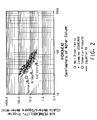
- Figure 1 illustrates the inverse relationship between air permeability and hydrohead for three sets of data.
- the first set is taken from U.S. Patent No. 5,585,909
- the second presents data measured on samples of melt-blown nonwoven fabric
- the third presents data measured on three commercial nonwoven products: K-C Ultra ® unreinforced surgical gown, available from Kimberly Clark Health Care, Roswell, GA; Trimax ® unreinforced surgical gown and DuPont Sontara ® Optima ® unreinforced surgical gown, both available from Allegiance Health Care, Mc Gaw Park, IL.
- Figure 1 shows that nonwoven barrier fabrics have a hydrohead typically lower than about 100 centimeters of water column.
- ⁇ is the surface tension of water (0.072 N/m) and ⁇ is the wetting angle, i.e., the angle of intersection of the fluid surface with the solid surface.
- ⁇ ⁇ P cmwc 1468 R microns . From which it is concluded that hydrohead lower than about 100 cmwc in Figure 1 corresponds to largest pores of radius, R ⁇ 15 micrometers.
- Microporous films with pores radii typically less than 1 micrometer satisfy this criterion. Such films can be effective liquid barriers, but they are very impermeable to air flow as well. Typical microporous film air permeabilities, e.g., in the range of Frazier ⁇ 0.008 m 3 /m 2 -min , are too low to provide effective air exchange in a protective garment. This often leads to heat buildup and discomfort. In the extreme, it can even impair or limit work performance.
- Fibrous porous media are inherently more permeable than microporous films and a good choice for protective fabrics, but the relationship of Figure 1 shows, in general, that significant increases in barrier function resulting from reduced pore size will also significantly reduce air permeability.
- Hydrohead as a measure of liquid barrier is related to pore size as discussed above, and pore size is determined by structural characteristics of the fabric, including fiber size and void fraction.
- Fabric air permeability is also determined by fundamental structural characteristics, including fiber size, void fraction and basis weight.
- the size of the pore space between fibers in a random fiber web is proportional to fiber diameter, D f , as a determinant of the number of fibers which can occupy a space. It is inversely proportional to the solids volume fraction , c, which is the ratio of web volume occupied by fibers to the total web volume (i.e., (1 - void fraction)).
- D f fiber diameter
- c solids volume fraction
- ⁇ P is the pressure drop across the fibrous pad of thickness
- h is the viscosity of the flowing fluid.
- the Davies correlation is valid for 0.006 ⁇ c ⁇ 0.3 when the flow around fibers in the medium is laminar.
- Q A ⁇ f ⁇ ⁇ ⁇ P ⁇ D f 2 ⁇ c Bwt ⁇ ⁇ ⁇ f c .
- ⁇ is taken to be 0.065 micrometers.
- Model 1 Constant basis weight as fiber size is decreased to increase liquid barrier.
- Model 2 Constant air permeability (Frazier) as fiber size is decreased to increase liquid barrier.
- FIG. 6 shows a liquid interface advancing against a fibrous barrier layer.
- the barrier layer consists of a layer of small fibers with characteristically small pores supported by a layer of large fibers with characteristically larger pores.
- the pressure required to force a nonwetting fluid through the small pores of the barrier layer is given by Equation 5. This pressure force is distributed across all the small fibers of the barrier layer.
- a representative small fiber e.g., Fiber AB
- the span over which the small fiber must carry the pressure load is determined by the pore size of the support layer as given by Equation 4. If the span is too great, the tension in the small fibers can exceed the strength of the fibers, causing them to break.
- the hydrohead is limited by a relationship between the strength of the barrier fiber, and the basis weight of the barrier fiber layer, which determine the strength of the barrier layer, and the pore size of the support layer which determines the force load on the barrier fibers.
- a relationship can be developed between the maximum force load a barrier fiber can sustain just before breaking and the force loading that the barrier fiber would have to sustain to achieve maximum hydrohead.
- Hydrohead act Hydrohead max 613 ⁇ D fS D fL ⁇ GPD ⁇ Bwt g / m 2 1 + 0.0867 ⁇ D fL / D fS 2 c 2 , ( Higdon, A., Stiles, W.B., Engineering Mechanics Statics and Dynamics, Vector Edition, Prentice-Hall, 1962 ).
- Hydrohead act is the hydrohead actually achieved.
- Hydrohead max is the maximum hydrohead the barrier layer can achieve, given by Equation 5.
- D fS and D fL are the diameters of the small barrier layer fibers and the large support fibers respectively.
- GPD is the tensile strength of the barrier layer fibers in grams per denier.
- Bwt is the basis weight of the barrier layer.
- the solids volume fraction is c.
- Model 3 Illustration of the problem of low barrier layer strength when barrier layer basis weight is reduced to maintain air permeability
- the maximum potential hydrohead for the barrier layer as obtained from Equation 5 is 415 cmwc, but at a basis weight of 1g/m 2 , the layer is strong enough to withstand only about half of that pressure before collapsing.
- the maximum hydrohead could be realized by doubling the basis weight of the barrier layer, but doubling the basis weight would reduce the air permeability of the composite fabric by half. There would be an economic penalty as well for the higher basis weight.
- Hydrohead can be increased by calendering the fabric to increase solids fraction (Equation 5).
- the dependence of hydrohead and Frazier on solids fractions is such that calendering the barrier layer to increase the solids fraction will increase barrier more than it decreases Frazier.
- basis weight can be adjusted within bounds to achieve the desired air permeability. Other such tradeoffs can be assessed based on economics and the practicalities of fabric processing.
- the model presented is based on the geometry of a random fiber web made of rigid, straight, continuous fibers, of which a glass fiber mat is a good example. This is perhaps the simplest, most open and ideal web geometry. Certainly many deviations from this ideal exist in practice. A common deviation is due to non-random fiber deposition associated with fiber bunching or clumping. As discussed by Davies (cited above), the resulting structure acts as if it is made of fibers of an effective fiber size somewhat larger than the actual fiber size.
- the present invention is a nonwoven fabric comprising a support web and a barrier web, having a hydrohead of at least about 145 cm and a Frazier permeability of at least about 0.3 m 3 /m 2 -min.
- the nonwoven barrier sheet can be hydrophobic, said hydrophobicity being derived from either coating a hydrophilic sheet with a hydrophobic coating material, such as a fluorocarbon- or silicone-based coating material, or by forming the sheet from hydrophobic polymers or copolymers, such as polyolefins, including but not limited to those having repeating units derived from ethylene, propylene, butenes, hexenes, octenes, styrenes, 4-methylpentene-1 and combinations thereof, and partially fluorinated or perfluorinated polymers or copolymers, including but not limited to ethylene/tetrafluoroethylene (E/TFE), ethylene/chlorotrifluoroethylene, polyvinylidene flu
- the diameter of the barrier web fibers is usually less than about 2 micrometers, more usually less than about 1 micrometer and can even be in the "nanofiber" range, having diameters of less than about 0.5 micrometer, wherein the diameter is the number average fiber size.
- the fibers in the support webs for the barrier webs are usually less than 20 times, more usually less than 15 times and most usually less than 10 times the diameter of the corresponding barrier web fibers.
- the support web fibers can have diameters greater than about 13 micrometers, which roughly corresponds to the diameter of conventional spunbond fibers, about 12 micrometers or less, which roughly corresponds to the diameter of micro-denier spunbond fibers, or about 5 micrometers or less, which roughly corresponds to the diameter of melt blown fibers.
- the support web can be any fabric which is configured to provide suitable support to the very fine fiber web.
- suitable support webs are conventional spunbond and melt-blown webs, micro-denier spunbond webs such as disclosed in U.S. Patent No. 5,885,909 , and various combinations of such different conventional nonwoven webs with one or more of the very fine fiber webs.
- hydrophobic nonwoven sheet containing nanofibers by depositing a nonwoven web of conventional hydrophilic polymer nanofibers onto a collecting/supporting web and coating the web's nanofibers with a hydrophobic coating material, such as a fluorocarbon coating material.
- a hydrophobic coating material such as a fluorocarbon coating material.
- the support layer basis weight can be less than 17 g/m 2 , or less than 14 g/m 2 , or less than 11 g/m 2 , or less than 7 g/m 2 , or less than 3 g/m 2 , or even less than 1 g/m 2 .
- the nonwoven fabrics of the present invention have hydroheads of at least about 145 cmwc and Fraziers of at least about 0.3 m 3 /m 2 -min, or at least about 1 m 3 /m 2 -min, or at least about 3 m 3 /m 2 -min, or at least about 5 m 3 /m 2 -min, or even at least about 10 m 3 /m 2 -min.
- the hydroheads of the inventive fabrics can be greater than or equal to 150 cmwc, greater than or equal to 200 cmwc, greater than or equal to 300 cmwc, or even greater than or equal to 400 cmwc.
- the nonwoven fabrics of the present invention have maximum pore size between fibers, as measured by bubble point (ASTM E128), of less than about 23 micrometers, or less than about 20 micrometers, or less than about 15 micrometers, or even less than about 12 micrometers.
- Sample fabrics were made by dissolving various polymers in suitable solvents which were then fed into an electrospinning apparatus, such as that described in U.S. Patent no. 4,127,706 .
- the fine fibers formed were deposited onto a melt blown fabric support layer to form a barrier layer of the fine fibers, and mechanical strength was imparted to the samples by sandwiching the fine fiber/melt blown layers between layers of spunbond polyester fibers, to form a four-layer laminate of spunbond/melt blown/fine fiber/spunbond configuration.
- KratonTM fine fibers were spun from solutions of 9 wt.% polymer in a mixed solvent of 88/12 wt% tetrahydrofuran/dimethyl acetamide (THF/DMAC) and KynarTM fine fibers were spun from solutions of 14-15 wt.% polymer in acetone.
- a SageTM Model 362 syringe pump by Orion was used to pump solution through a standard syringe with a blunt 27 gauge needle.
- High voltage was supplied to the needle by inserting the needle through an insulated aluminum foil strip connected to a Spellman SL300 negative high voltage power supply.
- Spellman SL300 negative high voltage power supply To assure reliable syringe pump operation in a high voltage environment it was necessary to isolate the pump electrically and then to ground the power supply reference lead, the metal case, and the support jack of the syringe pump.
- the deposition target was a brass disk 89 mm in diameter by 64 mm thick with a fully radiused edge.
- the disk was mounted on an electrically insulating stand, for example, make of Lexan®, such that it was suspended about 4mm in front of the stand and connected via a screw through the stand to ground.
- a spunbond shroud (18 g/m 2 Remay polyester) covered the face of the disk and stand to keep fibers from accumulating on the back side of the disk.
- a 76mm diameter circle was cut out of the shroud over the face of the disk to expose the target area.
- a circular portion of melt blown substrate was mounted in the target area.
- For KratonTM spins uniform deposition of fibers was aided by insulating the target area with a polymeric film.
- a 15 x 15 cm fabric was made by depositing fibers directly onto stainless steel cylinder 48 mm in diameter by 148 mm long. The melt blown layer was wrapped around the cylinder and the two layers were cut and peeled away to form the core laminate.
- Fabric properties were measured on 25 mm diameter circular areas of each fabric.
- Air permeability and Bubble Point were measured on a Porous Media, Inc. Capillary Flow Porometer, according to the principles of ASTM F778 and ASTM F316-03, respectively, and are reported as Frazier Permeability in units of m 3 /m 2 -min and pore size in micrometers, respectively.
- Hydrohead measurements were run on an Aspull Mk III Hydrostatic Head tester per method AATC TM 127, modified by using aluminum plates and an O-ring seal to hold the small fabric samples. Hydrohead was recorded at the first water penetration and is reported in centimeters of water column (cmwc).
- Fine fiber loading was measured gravimetrically by the mass difference of the sample before and after fine fiber deposition, and is reported as an average over the surface area of the sample (total grams fine fibers deposited/sample area).
- KratonTM D1133x copolymer was dissolved in a mixed solvent of 88 wt.% tetrahydrofuran/12 wt.% dimethyl acetamide at a polymer concentration of 9 wt.%, and electrospun at -18 KV at a rate of 0.5 ml/hr. Fine fibers were deposited onto samples of 18 g/m 2 bicomponent melt blown fabric described in the Control Examples at a collection distance of approximately 22 cm. The fine fiber layer was then covered with a layer of spunbonded polyester, removed from the sample target. The layer of melt blown collection fabric was also covered with a layer of spunbonded polyester and all four layers were consolidated into a laminate. The barrier properties of the Examples were measured and are reported below in Table 4.
- KynarTM polymer was dissolved in acetone solvent at a polymer concentration of 15 wt.%, and electrospun at -20 KV at a rate of 5 ml/hr. Fine fibers were deposited onto samples of 18 g/m 2 bicomponent melt blown fabric described in the Control Examples at a collection distances of approximately 22-30 cm. The fine fiber layer was then covered with a layer of spunbonded polyester, removed from the sample target. The layer of melt blown collection fabric was also covered with a layer of spunbonded polyester and all four layers were consolidated into a laminate. The barrier properties of the Examples were measured and are reported below in Table 5.
- Example 13 was a portion of the fabric sample of Example 12 which was calendered using a metal roll on a metal plate with a linear pressure estimated to be about 2-4 kg/cm.
- the barrier fabrics containing the KynarTM fine fibers exhibited much greater hydrohead values than those of either the Control Samples or Examples 1-9. It is believed that the more hydrophobic nature of the polyvinylidene fluoride polymer in Examples 10-19, relative to the styrene-butadiene polymer of Examples 1-9, is a major reason for the improved hydrohead values. However, those of skill in the art will recognize that the hydrohead of the styrene-butadiene polymer fabrics of Examples 1-9 could be enhanced by treatment with a water-repellant chemical finish, such as a fluorochemical finish, without appreciable detriment to the Frazier permeability of the fabrics.
- a water-repellant chemical finish such as a fluorochemical finish
- Typical spunbond fiber diameter size is 10 micrometers and above.
- Suitable support layers must have pore sizes scaled to the mechanical strength of the barrier layer. The weaker the barrier layer, the smaller the support layer pore size must be for adequate support. Smaller pores sizes, in turn, require smaller fiber diameter sizes. Hence, as barrier layer basis weight is reduced to facilitate high air permeability, suitable support layers must have fiber diameter sizes smaller than typical spunbond fiber sizes.
- Such smaller fibers could be micro-denier spunbond (mSB), as discussed in U.S. Patent No. 5,885,909 , e.g., 6 ⁇ D f ⁇ 10 micrometers which are strong enough to meet the mechanical strength requirements for the fabric as a whole.
- Micro-denier spunbond support would give rise to two fabric configurations: FF/mSB and mSB/FF/mSB.
- Non-self-supporting support layers with fiber diameters in the range of 1 ⁇ D f ⁇ 10 micrometers can be made by the melt blowing process. Typically these fibers are not strong ( 0.3 ⁇ GPD ⁇ 0.6). They are used to provide barrier properties with a support layer of spunbond fibers to provide strength. If melt blown fibers are used to support the Fine Fiber barrier layer, the melt blown fiber layer still requires a support layer to maintain over all fabric mechanical strength. A spunbond fiber layer is well suited to be the support layer.
- SB/FF/MB/SB asymmetrical combination of these layer types, e.g., SB/FF/MB/SB, which could have asymmetrical barrier performance, which might provide unusual but useful function to fabrics of such constructions.
- SB/FF/MB/SB asymmetrical barrier performance
- the barrier will be high and equal to the maximum barrier capability of the FF layer.
- the spunbond layer will not provide adequate support for the FF layer which will break at some hydrohead lower than FF layer capability.
Landscapes
- Engineering & Computer Science (AREA)
- Textile Engineering (AREA)
- Health & Medical Sciences (AREA)
- Dermatology (AREA)
- Epidemiology (AREA)
- Biomedical Technology (AREA)
- Heart & Thoracic Surgery (AREA)
- Vascular Medicine (AREA)
- Life Sciences & Earth Sciences (AREA)
- Animal Behavior & Ethology (AREA)
- General Health & Medical Sciences (AREA)
- Public Health (AREA)
- Veterinary Medicine (AREA)
- Nonwoven Fabrics (AREA)
- Laminated Bodies (AREA)
Claims (19)
- Vliesstoff, umfassend mindestens eine Trägerbahn aus Fasern und eine hydrophobe Barrierebahn mit einer Masse je Flächeneinheit von 5 g/m2 bis 51,1 g/m2 und Fasern, die Durchmesser von weniger als 1,0 Mikrometern aufweisen, wobei der Vliesstoff eine hydrostatische Druckfestigkeit von mindestens 145 cm und eine Durchlässigkeit nach Frazier von mindestens 0,3 m3/m2-min aufweist.
- Vliesstoff nach Anspruch 1, wobei die Barrierebahnfasern Durchmesser von weniger als 0,5 Mikrometern aufweisen.
- Vliesstoff nach Anspruch 1, wobei die Barrierebahn Nanofasern aus hydrophobem Polymer oder Copolymer umfasst.
- Vliesstoff nach Anspruch 3, wobei das hydrophobe Polymer oder Copolymer ein Polyolefin, ein teilweise fluoriertes Polymer oder ein perfluoriertes Polymer ist.
- Vliesstoff nach Anspruch 4, wobei das hydrophobe Polymer oder Copolymer Wiederholungseinheiten aufweist, die von Ethylen, Propylen, Butenen, Hexenen, Octenen, Styrolen, 4-Methylpenten-1 und Kombinationen derselben derivatisiert sind.
- Vliesstoff nach Anspruch 1, wobei die Barrierebahn durch Beschichten mit einer hydrophoben Beschichtung hydrophob gemacht wird.
- Vliesstoff nach Anspruch 6, wobei die hydrophobe Beschichtung ein Fluorkohlenstoff-Beschichtungsmaterial ist.
- Vliesstoff nach Anspruch 1, wobei die Barrierebahn eine maximale Porengröße zwischen Fasern von nicht mehr als 23 Mikrometern aufweist.
- Vliesstoff nach Anspruch 1, wobei die Barrierebahn eine Feststofffraktion von nicht weniger als 0,03 aufweist.
- Barrierevliesstoff nach Anspruch 1, der ein Verhältnis zwischen der Masse je Flächeneinheit der Barnerebahn und der hydrostatischen Druckfestigkeit und der Durchlässigkeit nach Frazier aufweist, das durch die Formel:

wobei
pf die Dichte der Barrierefasern in kg/m3, c die Feststoffvolumenfraktion der Barrierebahn ist;
die Durchlässigkeit nach Frazier in Einheiten von m3/m2-min angegeben ist und die hydrostatische Druckfestigkeit in Einheiten von Zentimetern Wassersäule angegeben ist. - Vliesstoff nach Anspruch 1, umfassend eine Struktur von FF/mSB, wobei FF eine Barrierebahn ist.
- Vliesstoff nach Anspruch 1, umfassend eine Struktur von FF/SB, wobei FF eine Barrierebahn ist.
- Vliesstoff nach Anspruch 1, umfassend eine Struktur von mSB/FF/mSB, wobei FF eine Barrierebahn ist.
- Vliesstoff nach Anspruch 1, umfassend eine Struktur von FF/MB/SB, wobei FF eine Barrierebahn ist.
- Vliesstoff nach Anspruch 1, umfassend eine Struktur von SB/MB/FF/MB/SB, wobei FF eine Barrierebahn ist.
- Vliesstoff nach Anspruch 1, umfassend eine Struktur von FF/MB/mSB, wobei FF eine Barrierebahn ist.
- Vliesstoff nach Anspruch 1, umfassend eine Struktur von mSB/MB/FF/MB/mSB, wobei FF eine Barrierebahn ist.
- Vliesstoff nach Anspruch 1, umfassend eine Struktur von SB/MB/FF/SB, wobei FF eine Barrierebahn ist.
- Vliesstoff nach Anspruch 1, wobei die Trägerbahn Fasern umfasst, die Durchmesser von weniger als dem 20-fachen der Durchmesser der Barrierebahnfasern aufweisen.
Applications Claiming Priority (3)
| Application Number | Priority Date | Filing Date | Title |
|---|---|---|---|
| US41142202P | 2002-09-17 | 2002-09-17 | |
| US411422P | 2002-09-17 | ||
| PCT/US2003/029407 WO2004027140A1 (en) | 2002-09-17 | 2003-09-17 | Extremely high liquid barrier fabrics |
Publications (2)
| Publication Number | Publication Date |
|---|---|
| EP1540062A1 EP1540062A1 (de) | 2005-06-15 |
| EP1540062B1 true EP1540062B1 (de) | 2009-11-04 |
Family
ID=32030675
Family Applications (1)
| Application Number | Title | Priority Date | Filing Date |
|---|---|---|---|
| EP03754729A Expired - Lifetime EP1540062B1 (de) | 2002-09-17 | 2003-09-17 | Extrem flüssigkeitsundurchlässiges gewebe |
Country Status (10)
| Country | Link |
|---|---|
| US (3) | US20040116028A1 (de) |
| EP (1) | EP1540062B1 (de) |
| JP (1) | JP4336651B2 (de) |
| KR (1) | KR101049667B1 (de) |
| CN (1) | CN1681988B (de) |
| AU (1) | AU2003272542A1 (de) |
| CA (1) | CA2499065C (de) |
| DE (1) | DE60329922D1 (de) |
| ES (1) | ES2333315T3 (de) |
| WO (1) | WO2004027140A1 (de) |
Families Citing this family (90)
| Publication number | Priority date | Publication date | Assignee | Title |
|---|---|---|---|---|
| US6743273B2 (en) | 2000-09-05 | 2004-06-01 | Donaldson Company, Inc. | Polymer, polymer microfiber, polymer nanofiber and applications including filter structures |
| US7985475B2 (en) * | 2003-04-28 | 2011-07-26 | Nanosys, Inc. | Super-hydrophobic surfaces, methods of their construction and uses therefor |
| US8487156B2 (en) | 2003-06-30 | 2013-07-16 | The Procter & Gamble Company | Hygiene articles containing nanofibers |
| US8395016B2 (en) * | 2003-06-30 | 2013-03-12 | The Procter & Gamble Company | Articles containing nanofibers produced from low melt flow rate polymers |
| WO2005040495A1 (en) * | 2003-10-22 | 2005-05-06 | E.I. Dupont De Nemours And Company | Porous fibrous sheets of nanofibers |
| JP2007526806A (ja) * | 2004-02-11 | 2007-09-20 | ザ プロクター アンド ギャンブル カンパニー | 疎水性表面コーティングされた吸収性物品 |
| PL1738006T3 (pl) * | 2004-04-19 | 2011-07-29 | Procter & Gamble | Wyroby zawierające nanowłókna do stosowania jako bariery |
| PL1740748T3 (pl) * | 2004-04-19 | 2013-12-31 | Procter & Gamble | Włókna, włókniny i artykuły zawierające nanowłókna produkowane z polimerów o szerokim rozkładzie mas cząsteczkowych |
| US7390760B1 (en) | 2004-11-02 | 2008-06-24 | Kimberly-Clark Worldwide, Inc. | Composite nanofiber materials and methods for making same |
| US20060094320A1 (en) * | 2004-11-02 | 2006-05-04 | Kimberly-Clark Worldwide, Inc. | Gradient nanofiber materials and methods for making same |
| US7235122B2 (en) | 2004-11-08 | 2007-06-26 | E. I. Du Pont De Nemours And Company | Filtration media for filtering particulate material from gas streams |
| US8092566B2 (en) * | 2004-12-28 | 2012-01-10 | E.I. Du Pont De Nemours And Company | Filtration media for filtering particulate material from gas streams |
| EP1856314B1 (de) * | 2005-03-10 | 2012-05-16 | Massachusetts Institute of Technology (MIT) | Superhydrophobe faservliese |
| US8689985B2 (en) * | 2005-09-30 | 2014-04-08 | E I Du Pont De Nemours And Company | Filtration media for liquid filtration |
| US20070074628A1 (en) * | 2005-09-30 | 2007-04-05 | Jones David C | Coalescing filtration medium and process |
| US8268395B2 (en) | 2005-12-05 | 2012-09-18 | E. I. Du Pont De Nemours And Company | Method for providing resistance to biofouling in a porous support |
| US20070125700A1 (en) * | 2005-12-05 | 2007-06-07 | Jiang Ding | Nanoweb composite material and gelling method for preparing same |
| US20100136865A1 (en) * | 2006-04-06 | 2010-06-03 | Bletsos Ioannis V | Nonwoven web of polymer-coated nanofibers |
| US9072633B2 (en) * | 2006-06-07 | 2015-07-07 | The Procter & Gamble Company | Biaxially stretchable outer cover for an absorbent article |
| US7947142B2 (en) * | 2006-07-31 | 2011-05-24 | 3M Innovative Properties Company | Pleated filter with monolayer monocomponent meltspun media |
| US20080070463A1 (en) * | 2006-09-20 | 2008-03-20 | Pankaj Arora | Nanowebs |
| DE102006044495A1 (de) * | 2006-09-21 | 2008-04-17 | Fiberweb Corovin Gmbh | Leichtgewichtiges Spinnvlies mit besonderen Sperreigenschaften |
| US20110092122A1 (en) * | 2006-11-03 | 2011-04-21 | Conley Jill A | Wind resistant and water vapor permeable garments |
| US20080108263A1 (en) * | 2006-11-03 | 2008-05-08 | Conley Jill A | Breathable waterproof fabrics with a dyed and welded microporous layer |
| US8470722B2 (en) * | 2006-11-03 | 2013-06-25 | E I Du Pont De Nemours And Company | Breathable waterproof fabrics with a dyed and welded microporous layer |
| US20080104738A1 (en) * | 2006-11-03 | 2008-05-08 | Conley Jill A | Liquid water resistant and water vapor permeable garments |
| US7473658B2 (en) | 2006-11-13 | 2009-01-06 | E. I. Du Pont Nemours And Company | Partially fluorinated amino acid derivatives as gelling and surface active agents |
| US20090071114A1 (en) * | 2007-03-05 | 2009-03-19 | Alan Smithies | Gas turbine inlet air filtration filter element |
| US8765255B2 (en) * | 2007-03-06 | 2014-07-01 | E I Du Pont De Nemours And Company | Breathable waterproof garment |
| DE102007011365B4 (de) * | 2007-03-07 | 2009-02-12 | Carl Freudenberg Kg | Lage zur Verwendung in einem HEPA-Filterelement sowie Filterelement |
| US20080220676A1 (en) * | 2007-03-08 | 2008-09-11 | Robert Anthony Marin | Liquid water resistant and water vapor permeable garments |
| JP5309040B2 (ja) * | 2007-03-23 | 2013-10-09 | ソルベイ スペシャルティ ポリマーズ ユーエスエー エルエルシー | 石炭燃焼煙道ガスフィルタ |
| CN101755108B (zh) * | 2007-07-13 | 2012-08-01 | N.V.贝卡特股份有限公司 | 过滤元件 |
| US8679217B2 (en) | 2007-09-07 | 2014-03-25 | E I Du Pont De Nemours And Company | Pleated nanoweb structures |
| US8986432B2 (en) * | 2007-11-09 | 2015-03-24 | Hollingsworth & Vose Company | Meltblown filter medium, related applications and uses |
| EP2205109B1 (de) * | 2007-11-09 | 2011-12-21 | E. I. du Pont de Nemours and Company | Kleidungsstücke mit verschmutzungskontrolle |
| WO2009062009A2 (en) * | 2007-11-09 | 2009-05-14 | Hollingsworth & Vose Company | Meltblown filter medium |
| KR20100108515A (ko) * | 2007-11-13 | 2010-10-07 | 이 아이 듀폰 디 네모아 앤드 캄파니 | 통기성 방수 의복 |
| CA2705566A1 (en) * | 2007-11-19 | 2009-05-28 | The Procter & Gamble Company | Outer cover for a disposable absorbent article |
| WO2009067365A2 (en) | 2007-11-20 | 2009-05-28 | Clarcor Inc. | Filtration medias, fine fibers under 100 nanofibers, and methods |
| WO2009076064A1 (en) * | 2007-12-06 | 2009-06-18 | 3M Innovative Properties Company | Electret webs with charge-enhancing additives |
| WO2009088564A1 (en) * | 2008-01-08 | 2009-07-16 | E. I. Du Pont De Nemours And Company | Liquid water resistant and water vapor permeable garments comprising hydrophobic treated nonwoven made from nanofibers |
| KR20100120650A (ko) * | 2008-01-18 | 2010-11-16 | 엠엠아이-아이피씨오, 엘엘씨 | 복합 직물 |
| US8282712B2 (en) * | 2008-04-07 | 2012-10-09 | E I Du Pont De Nemours And Company | Air filtration medium with improved dust loading capacity and improved resistance to high humidity environment |
| WO2009136395A1 (en) * | 2008-05-05 | 2009-11-12 | Avgol Industries 1953 Ltd | Nonwoven material |
| WO2009148869A1 (en) | 2008-05-30 | 2009-12-10 | 3M Innovative Properties Company | Method of making ligand functionalized substrates |
| WO2009146321A1 (en) | 2008-05-30 | 2009-12-03 | 3M Innovative Properties Company | Ligand functionalized substrates |
| US7998885B2 (en) * | 2008-06-30 | 2011-08-16 | E. I. Du Pont De Nemours And Company | Fine-fiber nonwoven-supported coating structure |
| US10167137B2 (en) * | 2008-09-24 | 2019-01-01 | Efip Holdings Lp | Flame resistant viscose filter apparatus and method |
| US8277530B2 (en) | 2008-09-24 | 2012-10-02 | Ellis Fibre Usa | Grease removal apparatus, systems and methods |
| US11434068B2 (en) | 2008-09-24 | 2022-09-06 | Restaurant Technologies, Inc. | Flame resistant filter apparatus and method |
| US9599350B2 (en) * | 2008-09-24 | 2017-03-21 | Ellis Fibre Usa | Flame resistant filter apparatus and method |
| US8540889B1 (en) | 2008-11-19 | 2013-09-24 | Nanosys, Inc. | Methods of generating liquidphobic surfaces |
| US8470236B2 (en) | 2008-11-25 | 2013-06-25 | E I Du Pont De Nemours And Company | Process of making a non-woven web |
| KR102156278B1 (ko) * | 2008-12-05 | 2020-09-15 | 이 아이 듀폰 디 네모아 앤드 캄파니 | 나노웨브 층을 가진 필터 매체 |
| CN102317523B (zh) * | 2008-12-23 | 2014-08-06 | 3M创新有限公司 | 官能化非织造制品 |
| US20100212272A1 (en) * | 2009-02-24 | 2010-08-26 | Hollingsworth & Vose Company | Filter media suitable for ashrae applications |
| US8333748B2 (en) * | 2009-03-05 | 2012-12-18 | The Procter & Gamble Company | Outer cover for a disposable absorbent article |
| US9043662B2 (en) * | 2009-03-30 | 2015-05-26 | Cadence Design Systems, Inc. | Double data rate memory physical interface high speed testing using self checking loopback |
| US8950587B2 (en) | 2009-04-03 | 2015-02-10 | Hollingsworth & Vose Company | Filter media suitable for hydraulic applications |
| JP5319380B2 (ja) * | 2009-04-24 | 2013-10-16 | 北越紀州製紙株式会社 | 低坪量エアフィルタ用濾材 |
| US8083828B2 (en) * | 2009-06-19 | 2011-12-27 | Hollingsworth & Vose Company | Fiber web having a high stiffness |
| CN102803593A (zh) | 2009-06-23 | 2012-11-28 | 3M创新有限公司 | 官能化非织造制品 |
| DE202009009176U1 (de) * | 2009-07-02 | 2009-12-03 | X-Technology Swiss Gmbh | Wasserdichte und wasserdampfdurchlässige Membran |
| WO2011028828A1 (en) * | 2009-09-03 | 2011-03-10 | First Quality Nonwovens, Inc. | Two-sided hydrophilic/hydrophobic nonwoven and method of manufacturing thereof |
| US8377672B2 (en) | 2010-02-18 | 2013-02-19 | 3M Innovative Properties Company | Ligand functionalized polymers |
| WO2011109151A1 (en) | 2010-03-03 | 2011-09-09 | 3M Innovative Properties Company | Ligand guanidinyl functionalized polymers |
| US8679218B2 (en) * | 2010-04-27 | 2014-03-25 | Hollingsworth & Vose Company | Filter media with a multi-layer structure |
| FR2959759B1 (fr) * | 2010-05-05 | 2012-07-06 | Zodiac Automotive Division | Membrane composite permeable a l'air et a la vapeur d'eau. |
| JP2011236526A (ja) * | 2010-05-11 | 2011-11-24 | Ibiden Co Ltd | マット、マットの製造方法、及び、排ガス浄化装置 |
| US20110289894A1 (en) * | 2010-05-28 | 2011-12-01 | General Electric Company | Filter element of microglass & nonwoven support layer media |
| US20120152821A1 (en) | 2010-12-17 | 2012-06-21 | Hollingsworth & Vose Company | Fine fiber filter media and processes |
| US10155186B2 (en) | 2010-12-17 | 2018-12-18 | Hollingsworth & Vose Company | Fine fiber filter media and processes |
| US8709120B2 (en) * | 2010-12-22 | 2014-04-29 | Hollingsworth & Vose Company | Filter media including glass fibers |
| WO2013043397A2 (en) * | 2011-09-21 | 2013-03-28 | Mmi-Ipco, Llc | Composite fabrics |
| US9694306B2 (en) | 2013-05-24 | 2017-07-04 | Hollingsworth & Vose Company | Filter media including polymer compositions and blends |
| KR102031142B1 (ko) | 2013-07-12 | 2019-10-11 | 삼성전자주식회사 | 영상 디스플레이를 제어하는 전자 장치 및 방법 |
| US20150182898A1 (en) * | 2013-12-31 | 2015-07-02 | Bha Altair, Llc | Ridgid porous plastic filters incorporating polymeric particles and polymeric fibers |
| CN104452287B (zh) * | 2014-11-20 | 2017-06-16 | 江西先材纳米纤维科技有限公司 | 高透气超疏水聚乙烯醇纳米纤维非织造布、其制备方法及应用 |
| EP3901345A1 (de) * | 2014-11-21 | 2021-10-27 | DuPont Safety & Construction, Inc. | Schmelzgesponnene filtermedien für beatmungsvorrichtungen und gesichtsmasken |
| CN112387007A (zh) * | 2015-08-22 | 2021-02-23 | 奥斯龙明士克公司 | 具有提高效率的用于从水-烃乳液中除去水的燃料水分离过滤介质 |
| US11014030B2 (en) | 2016-02-17 | 2021-05-25 | Hollingsworth & Vose Company | Filter media including flame retardant fibers |
| US10252200B2 (en) | 2016-02-17 | 2019-04-09 | Hollingsworth & Vose Company | Filter media including a filtration layer comprising synthetic fibers |
| EP3348393B1 (de) | 2016-04-14 | 2023-06-21 | Sefar AG | Kompositmembran und verfahren zum herstellen einer kompositmembran |
| US11633682B2 (en) * | 2016-04-18 | 2023-04-25 | Cummins Filtration Ip, Inc. | Nanofiber filter media for high performance applications |
| ES2875608T3 (es) | 2017-02-23 | 2021-11-10 | Sefar Ag | Medio de ventilación protector y procedimiento de producción de medio de ventilación protector |
| WO2020219275A1 (en) * | 2019-04-22 | 2020-10-29 | Parker-Hannifin Corporation | Waterproof and breathable composite nanofiber membrane and methods of manufacture |
| EP4028256A1 (de) * | 2019-09-13 | 2022-07-20 | The North Face Apparel Corp. | Kompositmaterialien mit membran |
| EP4092184A1 (de) | 2021-05-18 | 2022-11-23 | Sefar AG | Verfahren zur herstellung einer trägerschicht mit einer hydrophilen polymeren nanobeschichtung |
| US11583014B1 (en) | 2021-07-27 | 2023-02-21 | Top Solutions Co Ltd | Ultra-light nanotechnology breathable gowns and method of making same |
Family Cites Families (50)
| Publication number | Priority date | Publication date | Assignee | Title |
|---|---|---|---|---|
| US106294A (en) * | 1870-08-09 | Improvement in wheel-plows | ||
| US129909A (en) * | 1872-07-30 | Improvement in apparatus for showing latitude, longitude, and difference of time | ||
| US63950A (en) * | 1867-04-16 | Frederick j | ||
| US1177782A (en) * | 1914-04-16 | 1916-04-04 | Union Switch & Signal Co | Printing-telegraph apparatus. |
| US4069026A (en) * | 1970-06-29 | 1978-01-17 | Bayer Aktiengesellschaft | Filter made of electrostatically spun fibres |
| US4011067A (en) * | 1974-01-30 | 1977-03-08 | Minnesota Mining And Manufacturing Company | Filter medium layered between supporting layers |
| GB1527592A (en) | 1974-08-05 | 1978-10-04 | Ici Ltd | Wound dressing |
| GB1522605A (en) * | 1974-09-26 | 1978-08-23 | Ici Ltd | Preparation of fibrous sheet product |
| FR2511014B1 (fr) * | 1981-08-10 | 1987-02-06 | Ethicon Inc | Procede de preparation d'une resine de polyurethanne convenant pour le filage electrostatique |
| GB2138738B (en) * | 1983-04-01 | 1986-10-22 | Kureha Chemical Ind Co Ltd | Ultrafine fiber of an ethylene tetrafluoride copolymer and a porous membrane thereof |
| US5484645A (en) * | 1991-10-30 | 1996-01-16 | Fiberweb North America, Inc. | Composite nonwoven fabric and articles produced therefrom |
| US5522879A (en) * | 1991-11-12 | 1996-06-04 | Ethicon, Inc. | Piezoelectric biomedical device |
| US5679379A (en) * | 1995-01-09 | 1997-10-21 | Fabbricante; Anthony S. | Disposable extrusion apparatus with pressure balancing modular die units for the production of nonwoven webs |
| US5695849A (en) * | 1996-02-20 | 1997-12-09 | Kimberly-Clark Worldwide Inc. | Elastic, breathable, barrier fabric |
| US5885909A (en) * | 1996-06-07 | 1999-03-23 | E. I. Du Pont De Nemours And Company | Low or sub-denier nonwoven fibrous structures |
| AU5691198A (en) * | 1996-12-06 | 1998-06-29 | Bba Nonwovens Simpsonville, Inc. | Nonwoven web laminate having relatively hydrophilic zone and related method for its manufacture |
| US6114017A (en) * | 1997-07-23 | 2000-09-05 | Fabbricante; Anthony S. | Micro-denier nonwoven materials made using modular die units |
| US6183670B1 (en) * | 1997-09-23 | 2001-02-06 | Leonard Torobin | Method and apparatus for producing high efficiency fibrous media incorporating discontinuous sub-micron diameter fibers, and web media formed thereby |
| US6315806B1 (en) * | 1997-09-23 | 2001-11-13 | Leonard Torobin | Method and apparatus for producing high efficiency fibrous media incorporating discontinuous sub-micron diameter fibers, and web media formed thereby |
| CA2346011C (en) | 1997-10-10 | 2009-01-20 | Drexel University | Hybrid nanofibril matrices for use as tissue engineering devices |
| US6106913A (en) * | 1997-10-10 | 2000-08-22 | Quantum Group, Inc | Fibrous structures containing nanofibrils and other textile fibers |
| US6187696B1 (en) * | 1997-12-03 | 2001-02-13 | E. I. Du Pont De Nemours And Company | Breathable composite sheet structure |
| US6110590A (en) * | 1998-04-15 | 2000-08-29 | The University Of Akron | Synthetically spun silk nanofibers and a process for making the same |
| US6265333B1 (en) * | 1998-06-02 | 2001-07-24 | Board Of Regents, University Of Nebraska-Lincoln | Delamination resistant composites prepared by small diameter fiber reinforcement at ply interfaces |
| US6269513B1 (en) * | 1998-08-28 | 2001-08-07 | Leonard B. Torobin | Wipe pads with superior solids removal ability using sub-micron filaments |
| AU2705600A (en) | 1998-10-01 | 2000-05-01 | University Of Akron, The | Process and apparatus for the production of nanofibers |
| US6723669B1 (en) * | 1999-12-17 | 2004-04-20 | Kimberly-Clark Worldwide, Inc. | Fine multicomponent fiber webs and laminates thereof |
| AU2711900A (en) * | 1998-12-19 | 2000-07-12 | Kimberly-Clark Worldwide, Inc. | Fine multicomponent fiber webs and laminates thereof |
| DE19919809C2 (de) * | 1999-04-30 | 2003-02-06 | Fibermark Gessner Gmbh & Co | Staubfilterbeutel, enthaltend Nanofaservlies |
| JP4917227B2 (ja) * | 1999-08-02 | 2012-04-18 | イー・アイ・デュポン・ドウ・ヌムール・アンド・カンパニー | 不織複合シート材料 |
| US6753454B1 (en) | 1999-10-08 | 2004-06-22 | The University Of Akron | Electrospun fibers and an apparatus therefor |
| DE60044747D1 (de) | 1999-10-08 | 2010-09-09 | Univ Akron | Gesichtsmaske aus elektrogesponnenen fasern und ihre verwendung |
| ATE417660T1 (de) * | 1999-10-29 | 2009-01-15 | Hollingsworth & Vose Co | Filtermaterial |
| US6673136B2 (en) * | 2000-09-05 | 2004-01-06 | Donaldson Company, Inc. | Air filtration arrangements having fluted media constructions and methods |
| US6743273B2 (en) | 2000-09-05 | 2004-06-01 | Donaldson Company, Inc. | Polymer, polymer microfiber, polymer nanofiber and applications including filter structures |
| US6746517B2 (en) * | 2000-09-05 | 2004-06-08 | Donaldson Company, Inc. | Filter structure with two or more layers of fine fiber having extended useful service life |
| AU2001290679A1 (en) | 2000-09-06 | 2002-03-22 | Colorado Altitude Training Llc | Altitude simulation method and system |
| DE10051186B4 (de) * | 2000-10-16 | 2005-04-07 | Fibermark Gessner Gmbh & Co. Ohg | Staubfilterbeutel mit hochporöser Trägermateriallage |
| US6936554B1 (en) | 2000-11-28 | 2005-08-30 | Kimberly-Clark Worldwide, Inc. | Nonwoven fabric laminate with meltblown web having a gradient fiber size structure |
| US6613268B2 (en) * | 2000-12-21 | 2003-09-02 | Kimberly-Clark Worldwide, Inc. | Method of increasing the meltblown jet thermal core length via hot air entrainment |
| KR100514572B1 (ko) | 2001-06-07 | 2005-09-14 | 이 아이 듀폰 디 네모아 앤드 캄파니 | 초극세 단섬유의 제조방법 |
| KR100453670B1 (ko) | 2001-06-07 | 2004-10-20 | 이 아이 듀폰 디 네모아 앤드 캄파니 | 초극세 단섬유의 제조방법 |
| US6520425B1 (en) * | 2001-08-21 | 2003-02-18 | The University Of Akron | Process and apparatus for the production of nanofibers |
| JP2005509546A (ja) * | 2001-11-16 | 2005-04-14 | ポリマー・グループ・インコーポレーテツド | 重量性能に関して増進された障壁を有する不織障壁布 |
| US6872311B2 (en) * | 2002-01-31 | 2005-03-29 | Koslow Technologies Corporation | Nanofiber filter media |
| KR100549140B1 (ko) | 2002-03-26 | 2006-02-03 | 이 아이 듀폰 디 네모아 앤드 캄파니 | 일렉트로-브로운 방사법에 의한 초극세 나노섬유 웹제조방법 |
| JP3790496B2 (ja) | 2002-05-20 | 2006-06-28 | 株式会社クラレ | 防護衣料用複合不織布及びその製造方法 |
| WO2004026055A2 (en) | 2002-09-18 | 2004-04-01 | Polymer Group Inc. | Medical fabrics with improved barrier performance |
| AU2003272603A1 (en) | 2002-09-18 | 2004-04-08 | Polymer Group, Inc. | Improved barrier performance of absorbent article components |
| CN1705558A (zh) | 2002-09-19 | 2005-12-07 | 帕里莫集团有限公司 | 具有改进阻隔性能的无纺工业织物 |
-
2003
- 2003-09-17 CA CA2499065A patent/CA2499065C/en not_active Expired - Lifetime
- 2003-09-17 US US10/664,708 patent/US20040116028A1/en not_active Abandoned
- 2003-09-17 KR KR1020057004393A patent/KR101049667B1/ko not_active Expired - Lifetime
- 2003-09-17 AU AU2003272542A patent/AU2003272542A1/en not_active Abandoned
- 2003-09-17 WO PCT/US2003/029407 patent/WO2004027140A1/en not_active Ceased
- 2003-09-17 DE DE60329922T patent/DE60329922D1/de not_active Expired - Lifetime
- 2003-09-17 JP JP2004538186A patent/JP4336651B2/ja not_active Expired - Lifetime
- 2003-09-17 ES ES03754729T patent/ES2333315T3/es not_active Expired - Lifetime
- 2003-09-17 CN CN038220105A patent/CN1681988B/zh not_active Expired - Lifetime
- 2003-09-17 EP EP03754729A patent/EP1540062B1/de not_active Expired - Lifetime
-
2009
- 2009-08-10 US US12/538,303 patent/US20090298373A1/en not_active Abandoned
-
2011
- 2011-03-28 US US13/072,870 patent/US8658548B2/en active Active
Also Published As
| Publication number | Publication date |
|---|---|
| CA2499065C (en) | 2011-05-17 |
| CN1681988B (zh) | 2010-08-11 |
| JP4336651B2 (ja) | 2009-09-30 |
| US8658548B2 (en) | 2014-02-25 |
| DE60329922D1 (de) | 2009-12-17 |
| US20040116028A1 (en) | 2004-06-17 |
| EP1540062A1 (de) | 2005-06-15 |
| CN1681988A (zh) | 2005-10-12 |
| CA2499065A1 (en) | 2004-04-01 |
| WO2004027140A1 (en) | 2004-04-01 |
| US20090298373A1 (en) | 2009-12-03 |
| KR101049667B1 (ko) | 2011-07-14 |
| JP2005539157A (ja) | 2005-12-22 |
| AU2003272542A1 (en) | 2004-04-08 |
| US20110177741A1 (en) | 2011-07-21 |
| KR20050057330A (ko) | 2005-06-16 |
| ES2333315T3 (es) | 2010-02-19 |
Similar Documents
| Publication | Publication Date | Title |
|---|---|---|
| EP1540062B1 (de) | Extrem flüssigkeitsundurchlässiges gewebe | |
| DK2809433T3 (en) | ELECTROSPUNDED POROST MEDIA | |
| JP3615549B2 (ja) | 調節された多孔度のカレンダー加工された紡糸結合/溶融吹き込み成形ラミネート | |
| EP3421388B1 (de) | Verpackungsmaterial zur sterilisation | |
| KR100277554B1 (ko) | 탄성 금속화 부직물, 및 그의 제조방법 및 다층재료 | |
| EP2180932B1 (de) | Hochgeladene, ladungsstabile nanofaserbahn | |
| BRPI0714094A2 (pt) | manta de não-tecido monocomponente porosa e processo para formação de uma manta de não-tecido monocomponente | |
| EP3824987B1 (de) | Filtermedium für luftfilter, filterpaket und luftfiltereinheit | |
| US20100292664A1 (en) | Garment having a fluid drainage layer | |
| EP1932575A1 (de) | Vliesstoff für filter | |
| JP2019206351A (ja) | 耐表面摩耗性を有する滅菌用包装材料 | |
| JP7161300B2 (ja) | ピール適性を有する滅菌包装材料用不織布 | |
| EP0619393A1 (de) | Vliesstoff hergestellt aus Kardierbaren Polyolefinfasern von kleinen Decitex | |
| CN117621583A (zh) | 一种防水透气材料 | |
| JP2020108883A (ja) | フィルタプリーツパック及びエアフィルタユニット | |
| JP2020108884A (ja) | フィルタプリーツパック及びエアフィルタユニット |
Legal Events
| Date | Code | Title | Description |
|---|---|---|---|
| PUAI | Public reference made under article 153(3) epc to a published international application that has entered the european phase |
Free format text: ORIGINAL CODE: 0009012 |
|
| 17P | Request for examination filed |
Effective date: 20050314 |
|
| AK | Designated contracting states |
Kind code of ref document: A1 Designated state(s): AT BE BG CH CY CZ DE DK EE ES FI FR GB GR HU IE IT LI LU MC NL PT RO SE SI SK TR |
|
| AX | Request for extension of the european patent |
Extension state: AL LT LV MK |
|
| DAX | Request for extension of the european patent (deleted) | ||
| RBV | Designated contracting states (corrected) |
Designated state(s): DE ES FR GB IT |
|
| 17Q | First examination report despatched |
Effective date: 20070209 |
|
| GRAP | Despatch of communication of intention to grant a patent |
Free format text: ORIGINAL CODE: EPIDOSNIGR1 |
|
| GRAS | Grant fee paid |
Free format text: ORIGINAL CODE: EPIDOSNIGR3 |
|
| GRAA | (expected) grant |
Free format text: ORIGINAL CODE: 0009210 |
|
| AK | Designated contracting states |
Kind code of ref document: B1 Designated state(s): DE ES FR GB IT |
|
| REG | Reference to a national code |
Ref country code: GB Ref legal event code: FG4D |
|
| REF | Corresponds to: |
Ref document number: 60329922 Country of ref document: DE Date of ref document: 20091217 Kind code of ref document: P |
|
| REG | Reference to a national code |
Ref country code: ES Ref legal event code: FG2A Ref document number: 2333315 Country of ref document: ES Kind code of ref document: T3 |
|
| PLBE | No opposition filed within time limit |
Free format text: ORIGINAL CODE: 0009261 |
|
| STAA | Information on the status of an ep patent application or granted ep patent |
Free format text: STATUS: NO OPPOSITION FILED WITHIN TIME LIMIT |
|
| 26N | No opposition filed |
Effective date: 20100805 |
|
| PGFP | Annual fee paid to national office [announced via postgrant information from national office to epo] |
Ref country code: ES Payment date: 20150810 Year of fee payment: 13 |
|
| PGFP | Annual fee paid to national office [announced via postgrant information from national office to epo] |
Ref country code: IT Payment date: 20150925 Year of fee payment: 13 |
|
| REG | Reference to a national code |
Ref country code: FR Ref legal event code: PLFP Year of fee payment: 14 |
|
| REG | Reference to a national code |
Ref country code: FR Ref legal event code: PLFP Year of fee payment: 15 |
|
| PG25 | Lapsed in a contracting state [announced via postgrant information from national office to epo] |
Ref country code: IT Free format text: LAPSE BECAUSE OF NON-PAYMENT OF DUE FEES Effective date: 20160917 |
|
| PG25 | Lapsed in a contracting state [announced via postgrant information from national office to epo] |
Ref country code: ES Free format text: LAPSE BECAUSE OF NON-PAYMENT OF DUE FEES Effective date: 20160918 |
|
| REG | Reference to a national code |
Ref country code: FR Ref legal event code: PLFP Year of fee payment: 16 |
|
| REG | Reference to a national code |
Ref country code: ES Ref legal event code: FD2A Effective date: 20181126 |
|
| REG | Reference to a national code |
Ref country code: DE Ref legal event code: R081 Ref document number: 60329922 Country of ref document: DE Owner name: DUPONT SAFETY & CONSTRUCTION, INC., WILMINGTON, US Free format text: FORMER OWNER: E.I. DU PONT DE NEMOURS AND CO., WILMINGTON, DEL., US |
|
| PGFP | Annual fee paid to national office [announced via postgrant information from national office to epo] |
Ref country code: GB Payment date: 20220804 Year of fee payment: 20 Ref country code: DE Payment date: 20220609 Year of fee payment: 20 |
|
| REG | Reference to a national code |
Ref country code: GB Ref legal event code: 732E Free format text: REGISTERED BETWEEN 20221027 AND 20221102 |
|
| PGFP | Annual fee paid to national office [announced via postgrant information from national office to epo] |
Ref country code: FR Payment date: 20220808 Year of fee payment: 20 |
|
| P01 | Opt-out of the competence of the unified patent court (upc) registered |
Effective date: 20230528 |
|
| REG | Reference to a national code |
Ref country code: DE Ref legal event code: R071 Ref document number: 60329922 Country of ref document: DE |
|
| REG | Reference to a national code |
Ref country code: GB Ref legal event code: PE20 Expiry date: 20230916 |
|
| PG25 | Lapsed in a contracting state [announced via postgrant information from national office to epo] |
Ref country code: GB Free format text: LAPSE BECAUSE OF EXPIRATION OF PROTECTION Effective date: 20230916 |