EP1539648B1 - A method for the preparation of doped oxide material - Google Patents
A method for the preparation of doped oxide material Download PDFInfo
- Publication number
- EP1539648B1 EP1539648B1 EP03735740A EP03735740A EP1539648B1 EP 1539648 B1 EP1539648 B1 EP 1539648B1 EP 03735740 A EP03735740 A EP 03735740A EP 03735740 A EP03735740 A EP 03735740A EP 1539648 B1 EP1539648 B1 EP 1539648B1
- Authority
- EP
- European Patent Office
- Prior art keywords
- reactants
- gas flow
- glass
- particles
- oxide
- Prior art date
- Legal status (The legal status is an assumption and is not a legal conclusion. Google has not performed a legal analysis and makes no representation as to the accuracy of the status listed.)
- Expired - Lifetime
Links
Images

Classifications
-
- C—CHEMISTRY; METALLURGY
- C03—GLASS; MINERAL OR SLAG WOOL
- C03B—MANUFACTURE, SHAPING, OR SUPPLEMENTARY PROCESSES
- C03B37/00—Manufacture or treatment of flakes, fibres, or filaments from softened glass, minerals, or slags
- C03B37/01—Manufacture of glass fibres or filaments
- C03B37/012—Manufacture of preforms for drawing fibres or filaments
- C03B37/014—Manufacture of preforms for drawing fibres or filaments made entirely or partially by chemical means, e.g. vapour phase deposition of bulk porous glass either by outside vapour deposition [OVD], or by outside vapour phase oxidation [OVPO] or by vapour axial deposition [VAD]
- C03B37/018—Manufacture of preforms for drawing fibres or filaments made entirely or partially by chemical means, e.g. vapour phase deposition of bulk porous glass either by outside vapour deposition [OVD], or by outside vapour phase oxidation [OVPO] or by vapour axial deposition [VAD] by glass deposition on a glass substrate, e.g. by inside-, modified-, plasma- or plasma modified- chemical vapour deposition [ICVD, MCVD, PCVD, PMCVD], i.e. by thin layer coating on the inside or outside of a glass tube or on a glass rod
- C03B37/01807—Reactant delivery systems, e.g. reactant deposition burners
-
- C—CHEMISTRY; METALLURGY
- C01—INORGANIC CHEMISTRY
- C01G—COMPOUNDS CONTAINING METALS NOT COVERED BY SUBCLASSES C01D OR C01F
- C01G23/00—Compounds of titanium
- C01G23/003—Titanates
- C01G23/006—Alkaline earth titanates
-
- C—CHEMISTRY; METALLURGY
- C01—INORGANIC CHEMISTRY
- C01G—COMPOUNDS CONTAINING METALS NOT COVERED BY SUBCLASSES C01D OR C01F
- C01G25/00—Compounds of zirconium
- C01G25/006—Compounds containing zirconium, with or without oxygen or hydrogen, and containing two or more other elements
-
- C—CHEMISTRY; METALLURGY
- C03—GLASS; MINERAL OR SLAG WOOL
- C03B—MANUFACTURE, SHAPING, OR SUPPLEMENTARY PROCESSES
- C03B19/00—Other methods of shaping glass
- C03B19/10—Forming beads
- C03B19/1005—Forming solid beads
- C03B19/106—Forming solid beads by chemical vapour deposition; by liquid phase reaction
-
- C—CHEMISTRY; METALLURGY
- C03—GLASS; MINERAL OR SLAG WOOL
- C03B—MANUFACTURE, SHAPING, OR SUPPLEMENTARY PROCESSES
- C03B19/00—Other methods of shaping glass
- C03B19/14—Other methods of shaping glass by gas- or vapour- phase reaction processes
- C03B19/1415—Reactant delivery systems
-
- C—CHEMISTRY; METALLURGY
- C03—GLASS; MINERAL OR SLAG WOOL
- C03B—MANUFACTURE, SHAPING, OR SUPPLEMENTARY PROCESSES
- C03B37/00—Manufacture or treatment of flakes, fibres, or filaments from softened glass, minerals, or slags
- C03B37/01—Manufacture of glass fibres or filaments
- C03B37/012—Manufacture of preforms for drawing fibres or filaments
- C03B37/014—Manufacture of preforms for drawing fibres or filaments made entirely or partially by chemical means, e.g. vapour phase deposition of bulk porous glass either by outside vapour deposition [OVD], or by outside vapour phase oxidation [OVPO] or by vapour axial deposition [VAD]
- C03B37/01413—Reactant delivery systems
-
- C—CHEMISTRY; METALLURGY
- C03—GLASS; MINERAL OR SLAG WOOL
- C03B—MANUFACTURE, SHAPING, OR SUPPLEMENTARY PROCESSES
- C03B2201/00—Type of glass produced
- C03B2201/06—Doped silica-based glasses
- C03B2201/08—Doped silica-based glasses doped with boron or fluorine or other refractive index decreasing dopant
-
- C—CHEMISTRY; METALLURGY
- C03—GLASS; MINERAL OR SLAG WOOL
- C03B—MANUFACTURE, SHAPING, OR SUPPLEMENTARY PROCESSES
- C03B2201/00—Type of glass produced
- C03B2201/06—Doped silica-based glasses
- C03B2201/20—Doped silica-based glasses doped with non-metals other than boron or fluorine
- C03B2201/28—Doped silica-based glasses doped with non-metals other than boron or fluorine doped with phosphorus
-
- C—CHEMISTRY; METALLURGY
- C03—GLASS; MINERAL OR SLAG WOOL
- C03B—MANUFACTURE, SHAPING, OR SUPPLEMENTARY PROCESSES
- C03B2201/00—Type of glass produced
- C03B2201/06—Doped silica-based glasses
- C03B2201/30—Doped silica-based glasses doped with metals, e.g. Ga, Sn, Sb, Pb or Bi
- C03B2201/31—Doped silica-based glasses doped with metals, e.g. Ga, Sn, Sb, Pb or Bi doped with germanium
-
- C—CHEMISTRY; METALLURGY
- C03—GLASS; MINERAL OR SLAG WOOL
- C03B—MANUFACTURE, SHAPING, OR SUPPLEMENTARY PROCESSES
- C03B2201/00—Type of glass produced
- C03B2201/06—Doped silica-based glasses
- C03B2201/30—Doped silica-based glasses doped with metals, e.g. Ga, Sn, Sb, Pb or Bi
- C03B2201/32—Doped silica-based glasses doped with metals, e.g. Ga, Sn, Sb, Pb or Bi doped with aluminium
-
- C—CHEMISTRY; METALLURGY
- C03—GLASS; MINERAL OR SLAG WOOL
- C03B—MANUFACTURE, SHAPING, OR SUPPLEMENTARY PROCESSES
- C03B2201/00—Type of glass produced
- C03B2201/06—Doped silica-based glasses
- C03B2201/30—Doped silica-based glasses doped with metals, e.g. Ga, Sn, Sb, Pb or Bi
- C03B2201/34—Doped silica-based glasses doped with metals, e.g. Ga, Sn, Sb, Pb or Bi doped with rare earth metals, i.e. with Sc, Y or lanthanides, e.g. for laser-amplifiers
-
- C—CHEMISTRY; METALLURGY
- C03—GLASS; MINERAL OR SLAG WOOL
- C03B—MANUFACTURE, SHAPING, OR SUPPLEMENTARY PROCESSES
- C03B2201/00—Type of glass produced
- C03B2201/06—Doped silica-based glasses
- C03B2201/30—Doped silica-based glasses doped with metals, e.g. Ga, Sn, Sb, Pb or Bi
- C03B2201/34—Doped silica-based glasses doped with metals, e.g. Ga, Sn, Sb, Pb or Bi doped with rare earth metals, i.e. with Sc, Y or lanthanides, e.g. for laser-amplifiers
- C03B2201/36—Doped silica-based glasses doped with metals, e.g. Ga, Sn, Sb, Pb or Bi doped with rare earth metals, i.e. with Sc, Y or lanthanides, e.g. for laser-amplifiers doped with rare earth metals and aluminium, e.g. Er-Al co-doped
-
- C—CHEMISTRY; METALLURGY
- C03—GLASS; MINERAL OR SLAG WOOL
- C03B—MANUFACTURE, SHAPING, OR SUPPLEMENTARY PROCESSES
- C03B2207/00—Glass deposition burners
- C03B2207/30—For glass precursor of non-standard type, e.g. solid SiH3F
- C03B2207/32—Non-halide
Definitions
- the invention relates to a method for the preparation of a doped oxide material according to the preamble of the appended claim 1.
- doped glass materials are light amplification waveguides, for example active optical fibres, whose light amplifying properties are based on utilizing stimulated emission.
- the glass material in the core of the active optical fiber, and possibly the cladding layer surrounding the core are doped with dopants, which are rare earth metals, for example erbium.
- the doped glass materials can also be used in different kinds of optical planar waveguides.
- the active optical fibers are prepared by drawing glass into optical fiber from a fiber preform, which fiber preform can be created in several different ways.
- a generally used manner for preparing a fiber preform is to grow glass material around a mandrel, or a corresponding substrate arranged to rotate, by flame hydrolysis deposition, FHD.
- FHD flame hydrolysis deposition
- OVD outer vapour deposition
- the FHD method is also applied in forming glass layers required in optical planar waveguides on a planar substrate.
- a hydrogen-oxygen flame is typically used as a thermal reactor, and the glass forming base materials used in the preparation of glass material, for example silicon or germanium tetrachloride, are directed to the burner and the flame typically in a vapour form.
- the dopants of glass material such as, for example, erbium, are directed to the burner and the flame typically with carrier gas as vapour or aerosol droplets, which are formed of the liquid containing dopants correspondingly either by vaporizing or by spraying.
- the dopants can be directed all the way to the burner in liquid form and be atomised as aerosol droplets, for example by using hydrogen flow, not until in the immediate vicinity of the flame.
- This method which is described more in detail, for example, in the applicant's earlier publication WO 00/20346 A1 and which can be considered a further development of the conventional FHD method, is later referred to as liquid flame spraying.
- the base materials and dopants further form aerosol particles, which aerosol particles are guided onto the substrate to be coated, thus forming a doped porous glass material coating.
- aerosol particles are often in literature referred to as "glass soot" in English.
- a so-called solution doping method is also known, in which method a fiber preform grown of only base materials is dipped into a solution containing dopants only after growing the fiber preform, before sintering.
- Rare earth metals dissolve poorly into quartz glass and require that, for example, the structure of SiO 2 -based glass is changed by adding an appropriate oxide to the glass.
- Oxides suitable for the purpose are, for example, Al 2 O 3 , La 2 O 3 , Yb 2 O 3 , GeO 2 or P 2 O 5 .
- this oxide is aluminium oxide Al 2 O 3 , which at the same time increases the refractive index of the glass.
- the aluminium is added by atomising aluminium chloride dissolved in a suitable liquid to the flame.
- Liquids suitable for the purpose are, for example, water, organic solvents, such as ethanol, methanol, acetone, or mixtures of the above.
- nitrate or chloride based sources dissolved in a liquid are used for rare earth metals, such as erbium.
- the fiber preform forming in the process typically includes at least two types of glass soot particles. Firstly, small Si-containing (or Ge-containing) particles, which are formed via condensation from vaporous base materials and the evaporation/drying following it. Secondly, aluminium and erbium containing residual particles, which are typically larger than these Si-particles. Because of these different types of particles, there is a crystallizing tendency in the glass material when it is sintered.
- the temperatures used in sintering are more limited than in the case of a fiber preform meant for optical fiber.
- unwanted crystals causing scattering unavoidably remain in the ready glass coating even after sintering and because of the inhomogeneous composition of the glass material also the light amplifying properties of glass are unideal.
- the method according to the invention it is possible to produce different oxide materials.
- multicomponent oxide materials wherein there are several reactants, whose respective parts are substantially equal respectively, such as, for example, bariumtitanate (BaTiO 3 ).
- the method can also be used in producing such multicomponent oxide materials, wherein there are several reactants, whose respective portions are of substantially different sizes respectively, such as, for example, piezoelectric PZT (Pb(Zr 1-x Ti x )O 3 ), which has a high dielectric constant.
- PZT Pb(Zr 1-x Ti x )O 3
- the parameter x determines the ratio of zircon and titanium, and a typical value is, for example, 0.45).
- doped oxide materials wherein there are larger portions of base materials and smaller portions of dopants, such as, for example, titanium oxide (TiO 2 ) doped with molybdenum (Mo), as well as some doped glass materials.
- dopants such as, for example, titanium oxide (TiO 2 ) doped with molybdenum (Mo), as well as some doped glass materials.
- the aim of the invention is thus to make it possible to prepare doped oxide material, which is more equal in quality than before, in which oxide material the composition is on the micro level more homogeneous than before and wherein the crystal structure is as desired.
- the different kind of properties of oxide material become more optimal than before with the invention, in which case it is possible to manufacture better products than before from the oxide material.
- the aim of an embodiment of the invention is to make it possible to prepare doped glass material, which is more equal in quality than before, in which glass material there is no harmful crystallization and the composition of the glass is also on the micro level more homogeneous than before, In glass material formed in this manner, there is thus less unwanted light scattering, which scattering causes attenuation/loss of light in the light guides prepared from the glass material in question.
- the light reinforcing properties of the glass material also become more optimal than before with the invention, in which case it is possible to manufacture better active light guides than before from the glass material, for example active optical fibers.
- a substantial basic idea of the invention can be considered to be that all the reactants required in the preparation of doped oxide material, as well as the base materials and dopants are first brought to a vaporous form, i.e. a gas phase. Condensation of reaction products from the gas phase to a liquid phase is performed extremely fast in such a manner that all reaction products forming the doped oxide material are brought substantially simultaneously to a supersaturated state, in which case the composition of liquid droplets forming in this manner and solid particles forming immediately from them is made very homogeneous.
- the homogeneous composition of particles refers here to that, first of all, different particles have the same composition respectively, but also that the local inner composition of an individual particle is homogeneous, i.e. in an individual particle all the components are equally divided over the entire volume of the particle.
- the above-mentioned fast condensation of the components of the reactants is achieved either by fast oxidation of reactants and/or by fast adiabatic expansion of the gas flow of the reactants.
- the conditions according to the invention are arranged so that the particles also solidify immediately after condensation, in which case there is no time to reach chemical phase equilibrium.
- a doped oxide material such as, for example, doped glass material
- a doped oxide material such as, for example, doped glass material
- the amplifying properties can be optimised better than in prior art.
- erbium as a dopant
- the problems resulting from crystallization of glass material and the unwanted scattering properties resulting from crystallization are avoided.
- the doped oxide material produced in the embodiment according to the example presented by means of the figures is a doped glass material, and on the basis of the description connected to it, a man skilled in the art can apply the invention also in producing other doped oxide materials by possibly implementing minor changes in the embodiment according to the example.
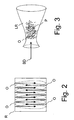
- the invention will be described with reference to the appended figures, in which
- All the reactants required in the preparation of doped glass material according to the invention, as well as the base materials (for example Si or Ge) and dopants (for example Al and rare earth metals) are in the beginning brought to a vaporous form i.e. the gas phase, by appropriately increasing the temperature of said materials and by choosing an appropriate chemical composition for each reactant. Heating the reactants can be implemented with any manner apparent as such to a man skilled in the art.
- silicon tetrachloride SiCl 4 can be used as the base material of glass material and aluminium and erbium as the dopant, the latter either as nitrates or chlorides.
- the compounds used as the sources of aluminium and erbium can be, for example, dissolved in appropriate liquids and evaporated further to a gas phase by heating the solutions in question. In conveying the reactants brought to the gas phase, it is possible to utilize appropriate carrier gases.
- the base materials and dopants in a gaseous form are next guided mixed together or still as separate gas flows B, D to the reactor R functioning as a flow channel by at the same time retaining their temperature such that the base materials and dopants B, D remain in a vaporous form.
- the ratio between the base materials and dopants can be adjusted by changing the ratio of the gas flows B, D, for example, by means of adjustable valves, such as mass flow controllers, or some other appropriate manner.
- reactor R the gas flow B of base materials and the gas flow D of dopants is mixed (in Fig. 1 at point M) together by combining them as the gas flow BD of reactants.
- combining and mixing the gas flows B, D can have been performed already before the reactor R. It is obvious to a man skilled in the art that the pipelines and the like conveying the gas flows, B, D, BD, as well as the walls of reactor R are advantageously warmed in order to prevent the reactants from significantly condensing on their walls.
- the hot gases/vapours of the gas flow BD which are mixed together in the reactor R, are oxidized and thus at the same time condensated very fast into oxides forming glass material.
- Oxidation/ condensation is performed in such a temperature, wherein a multiple supersaturated state is formed to all reactants.
- the condensation takes place instantaneously so that when all the reactant and dopant components are in a supersaturated state, droplets are formed as a result of condensation and instantaneously further glass particles P, whose mutual and inner composition is homogeneous.
- the inner homogeneous composition of the particles P refers here to that the different components are equally divided in relation to the entire volume of the particles without layered or other type of locally inhomogeneous structures,
- the ratio of the concentrations of the reactants in the particles is determined substantially according to what the ratio of the concentrations of the reactants was in the gas phase in the gas flow BD before condensation.
- condensation should here be understood widely. In other words, depending on the situation, either a liquid or solid glass particle can be understood to form as a result of condensation.
- the saturated vapour pressure of the oxidized forms of the reactants in a certain temperature being examined, is significantly lower than in connection with corresponding forms before the oxidation. Because of this, the fast condensation of the reactants in the gas phase can be performed by mixing fast oxidative gases to the gas flow of the reactants.
- the condensation/oxidation is performed by conducting intensive jets O of oxidative gases to the reactor, which jets are advantageously located transverse to the gas flow BD of the reactants.
- jets O of oxidative gases are further located on the two opposite walls of the reactor according to Fig. 2 in such a manner that the gas jets O, which are opposite and adjacent in the cross-direction of the reactor, are located overlapping each other. This intensifies the turbulence created by the jets 0 of oxidative gases to the gas flow BD of the reactants, which turbulence mixes the oxidative gases 0 and the reactant gases BD effectively together.
- Jets O of oxidative gases can also be arranged onto more walls of the reactor R, or they can be directed in some other manner promoting turbulence and mixing in relation to the gas flow B, D of reactants.
- Oxidative gases O can, when entering the reactor, be in the same temperature as the reactant gases, in other words hot, thus, the condensation is mainly caused by the change in the vapour tension experienced by the reactants when they oxidize to oxides.
- the oxidative gases are, however, "cold", which intensifies and accelerates the condensation.
- reaction temperatures which are typically around 1000 - 2000 °C. In these temperatures, the progress of chemical reactions is determined by the mixing rate of gases.
- the oxidation takes place in the mixing zones (reaction zones) forming on the junctions between these gas flows, the "thickness" of which zones is typically around a few millimetres.
- the reactor R can be used in normal pressure, but in order to intensify the reactions, the pressure of the reactor, the flow rate or the reactants and oxidative gases, as well as the temperature of the reactor can be adjusted in order to optimise the process.
- condensation is induced by means of adiabatic expansion of the gas flow BD of reactants.
- the gas flow BD of reactants is directed, for example, through a so-called Lavall nozzle LR, well known as such.
- the gas flow BD can be accelerated to supersonic velocity.
- the oxidative gases O required in the oxidation of reactants can be directed to the gas flow BD of reactants, for example, in the narrowest part of the nozzle LR, in which case the turbulence caused by the expansion of gases will intensify the mixing of gases.
- the form of the Lavall nozzle LR shown for the purposes of illustration does not necessarily correspond to the exact shape of the nozzle used in reality.
- oxidative gases it is possible to prevent impurities from condensing and ending up in particles.
- different kind of mixtures of carbon monoxide, carbon dioxide and water can be used as oxidative gases.
- the structure of the reactor R, LR can be oven-like in such a manner that the walls of the reactor are heated.
- materials resistant to high temperatures such as quartz, are used as the material of the reactor.
- the walls of the reactor can be partly or entirely porous, in which case, for example, different kinds of shielding gases can be directed through the walls inside the reactor.
- the shape of the cross section of the flow channel formed by the reactor R, LR can be a rectangle, circle, or some other shape appropriate for the purpose.
- doped glass materials When forming doped glass materials, it is also possible to use chlorine-free reactants, such as TEOS (tetraethylortosilicate) or GEOS (tetraethoxygermanium) in an appropriate form as base materials B.
- TEOS tetraethylortosilicate
- GEOS tetraethoxygermanium
- dopants D such as, for example, neodymium, and further also phosphorus, borium and/or fluorine.
- the glass particles formed by using the method according to the invention can be collected according to prior art onto an appropriate substrate, for example, around a rotating mandrel or on a planar substrate, on which surface is thus formed a porous glass layer, which can in later stages of process be sintered into a compact glass layer.
- the glass particles can, however, also be collected by other means, for example as dusty powder, which can later be used as desired in preparing glass components.
Landscapes
- Chemical & Material Sciences (AREA)
- Engineering & Computer Science (AREA)
- Organic Chemistry (AREA)
- Chemical Kinetics & Catalysis (AREA)
- Manufacturing & Machinery (AREA)
- Materials Engineering (AREA)
- General Life Sciences & Earth Sciences (AREA)
- Life Sciences & Earth Sciences (AREA)
- General Chemical & Material Sciences (AREA)
- Geochemistry & Mineralogy (AREA)
- Inorganic Chemistry (AREA)
- Environmental & Geological Engineering (AREA)
- Geology (AREA)
- Glass Compositions (AREA)
- Glass Melting And Manufacturing (AREA)
- Manufacture, Treatment Of Glass Fibers (AREA)
- Pharmaceuticals Containing Other Organic And Inorganic Compounds (AREA)
- Catalysts (AREA)
- Organic Low-Molecular-Weight Compounds And Preparation Thereof (AREA)
Applications Claiming Priority (3)
| Application Number | Priority Date | Filing Date | Title |
|---|---|---|---|
| FI20021269 | 2002-06-28 | ||
| FI20021269A FI115134B (fi) | 2002-06-28 | 2002-06-28 | Menetelmä seostetun lasimateriaalin valmistamiseksi |
| PCT/FI2003/000522 WO2004002907A1 (en) | 2002-06-28 | 2003-06-27 | A method for the preparation of doped oxide material |
Publications (2)
| Publication Number | Publication Date |
|---|---|
| EP1539648A1 EP1539648A1 (en) | 2005-06-15 |
| EP1539648B1 true EP1539648B1 (en) | 2006-12-13 |
Family
ID=8564253
Family Applications (1)
| Application Number | Title | Priority Date | Filing Date |
|---|---|---|---|
| EP03735740A Expired - Lifetime EP1539648B1 (en) | 2002-06-28 | 2003-06-27 | A method for the preparation of doped oxide material |
Country Status (9)
| Country | Link |
|---|---|
| US (1) | US7624596B2 (enExample) |
| EP (1) | EP1539648B1 (enExample) |
| JP (1) | JP2005531481A (enExample) |
| CN (1) | CN1301925C (enExample) |
| AT (1) | ATE348079T1 (enExample) |
| AU (1) | AU2003238120A1 (enExample) |
| DE (1) | DE60310420T2 (enExample) |
| FI (1) | FI115134B (enExample) |
| WO (1) | WO2004002907A1 (enExample) |
Families Citing this family (11)
| Publication number | Priority date | Publication date | Assignee | Title |
|---|---|---|---|---|
| US20040132101A1 (en) | 2002-09-27 | 2004-07-08 | Xencor | Optimized Fc variants and methods for their generation |
| US20090010920A1 (en) | 2003-03-03 | 2009-01-08 | Xencor, Inc. | Fc Variants Having Decreased Affinity for FcyRIIb |
| FI116619B (fi) * | 2004-07-02 | 2006-01-13 | Liekki Oy | Menetelmä ja laite optisen materiaalin tuottamiseksi sekä optinen aaltojohde |
| US20070116896A1 (en) * | 2005-11-23 | 2007-05-24 | Samsung Electro-Mechanics Co., Ltd. | Method for manufacturing front scattering film having no wavelength dependency |
| FI121336B (fi) * | 2006-03-27 | 2010-10-15 | Beneq Oy | Hydrofobinen lasipinta |
| FR2939246B1 (fr) * | 2008-12-02 | 2010-12-24 | Draka Comteq France | Fibre optique amplificatrice et procede de fabrication |
| GB2478307A (en) | 2010-03-02 | 2011-09-07 | Heraeus Quartz Uk Ltd | Manufacture of silica glass |
| CN102626614B (zh) * | 2012-03-21 | 2013-12-25 | 陕西科技大学 | 一种光催化型光导材料的制备方法 |
| GB201520548D0 (en) | 2015-11-23 | 2016-01-06 | Immunocore Ltd & Adaptimmune Ltd | Peptides |
| GB201520542D0 (en) | 2015-11-23 | 2016-01-06 | Immunocore Ltd & Adaptimmune Ltd | Peptides |
| GB201520539D0 (en) | 2015-11-23 | 2016-01-06 | Immunocore Ltd & Adaptimmune Ltd | Peptides |
Family Cites Families (16)
| Publication number | Priority date | Publication date | Assignee | Title |
|---|---|---|---|---|
| US3698936A (en) * | 1969-12-19 | 1972-10-17 | Texas Instruments Inc | Production of very high purity metal oxide articles |
| US3737292A (en) * | 1972-01-03 | 1973-06-05 | Corning Glass Works | Method of forming optical waveguide fibers |
| US4212663A (en) * | 1978-01-26 | 1980-07-15 | Corning Glass Works | Reactants delivery system for optical waveguide manufacturing |
| US4278458A (en) * | 1979-02-07 | 1981-07-14 | Bell Telephone Laboratories, Incorporated | Optical fiber fabrication method and apparatus |
| CA1166527A (en) * | 1979-09-26 | 1984-05-01 | Shiro Takahashi | Method and apparatus for producing multi-component glass fiber preform |
| US4501602A (en) | 1982-09-15 | 1985-02-26 | Corning Glass Works | Process for making sintered glasses and ceramics |
| US5188648A (en) * | 1985-07-20 | 1993-02-23 | U.S. Philips Corp. | Method of manufacturing optical fibres |
| JPS6283324A (ja) | 1985-10-07 | 1987-04-16 | Kogyo Kaihatsu Kenkyusho | 光学ガラスの製造方法 |
| US5059230A (en) * | 1990-01-22 | 1991-10-22 | At&T Bell Laboratories | Fabrication of doped filament optical fibers |
| US5043002A (en) * | 1990-08-16 | 1991-08-27 | Corning Incorporated | Method of making fused silica by decomposing siloxanes |
| JP2669976B2 (ja) * | 1991-09-24 | 1997-10-29 | 国際電信電話株式会社 | 光増幅器用エルビウムド−プファイバ |
| JPH05105471A (ja) | 1991-10-11 | 1993-04-27 | Fujikura Ltd | 光フアイバ母材の製造方法 |
| KR100342189B1 (ko) * | 1995-07-12 | 2002-11-30 | 삼성전자 주식회사 | 휘발성복합체를사용한희토류원소첨가광섬유제조방법 |
| DE19725955C1 (de) * | 1997-06-19 | 1999-01-21 | Heraeus Quarzglas | Verfahren zur Herstellung eines Quarzglasrohlings und dafür geeignete Vorrichtung |
| FI116469B (fi) | 1998-10-05 | 2005-11-30 | Liekki Oy | Liekkiruiskutusmenetelmä ja -laitteisto monikomponenttilasin valmistamiseksi |
| US20020005051A1 (en) * | 2000-04-28 | 2002-01-17 | Brown John T. | Substantially dry, silica-containing soot, fused silica and optical fiber soot preforms, apparatus, methods and burners for manufacturing same |
-
2002
- 2002-06-28 FI FI20021269A patent/FI115134B/fi not_active IP Right Cessation
-
2003
- 2003-06-27 JP JP2004516824A patent/JP2005531481A/ja active Pending
- 2003-06-27 CN CNB03815238XA patent/CN1301925C/zh not_active Expired - Lifetime
- 2003-06-27 AU AU2003238120A patent/AU2003238120A1/en not_active Abandoned
- 2003-06-27 DE DE60310420T patent/DE60310420T2/de not_active Expired - Lifetime
- 2003-06-27 AT AT03735740T patent/ATE348079T1/de not_active IP Right Cessation
- 2003-06-27 EP EP03735740A patent/EP1539648B1/en not_active Expired - Lifetime
- 2003-06-27 WO PCT/FI2003/000522 patent/WO2004002907A1/en not_active Ceased
- 2003-06-27 US US10/518,006 patent/US7624596B2/en not_active Expired - Lifetime
Also Published As
| Publication number | Publication date |
|---|---|
| FI115134B (fi) | 2005-03-15 |
| AU2003238120A1 (en) | 2004-01-19 |
| FI20021269A7 (fi) | 2003-12-29 |
| EP1539648A1 (en) | 2005-06-15 |
| US7624596B2 (en) | 2009-12-01 |
| WO2004002907A1 (en) | 2004-01-08 |
| CN1665747A (zh) | 2005-09-07 |
| CN1301925C (zh) | 2007-02-28 |
| JP2005531481A (ja) | 2005-10-20 |
| US20050241341A1 (en) | 2005-11-03 |
| ATE348079T1 (de) | 2007-01-15 |
| FI20021269A0 (fi) | 2002-06-28 |
| DE60310420D1 (de) | 2007-01-25 |
| DE60310420T2 (de) | 2007-09-20 |
Similar Documents
| Publication | Publication Date | Title |
|---|---|---|
| EP1808417B1 (en) | Method for fabricating glass bodies using an aerosol delivery system | |
| KR100930557B1 (ko) | 광학 물질 및 광학 소자 | |
| US5397372A (en) | MCVD method of making a low OH fiber preform with a hydrogen-free heat source | |
| EP1778597B1 (en) | Method for producing an optical waveguide material | |
| US8865271B2 (en) | High rate deposition for the formation of high quality optical coatings | |
| EP0978486A1 (en) | Method and burner for forming silica-containing soot | |
| US7624596B2 (en) | Method for the preparation of doped oxide material | |
| JPH0575704B2 (enExample) | ||
| Morse et al. | Aerosol techniques for glass formation | |
| KR20000052506A (ko) | 무연소 가수분해에 의한 광섬유 예비성형품 형성 방법 및장치 | |
| US20050069638A1 (en) | System for forming a gas flow of reactants for a doped glass material | |
| CN1972880B (zh) | 掺杂材料的方法和掺杂的材料 | |
| JPS6135846A (ja) | エーロゾル流の製法 | |
| Morse et al. | Aerosol transport for optical fiber core doping: a new technique for glass formation | |
| KR101424998B1 (ko) | 에어로졸 전달 시스템을 사용하여 유리 바디를 제조하기 위한 장치 및 방법 | |
| US20240134113A1 (en) | Controlling refractive index profile during fiber preform manufacturing | |
| Morse et al. | A High Temperature Sol-Gel Process for Glass Formation: Aerosol Doping in Modified Chemical Vapor Deposition | |
| KR20060093671A (ko) | 다중 모드 광섬유 및 이의 제조방법 |
Legal Events
| Date | Code | Title | Description |
|---|---|---|---|
| PUAI | Public reference made under article 153(3) epc to a published international application that has entered the european phase |
Free format text: ORIGINAL CODE: 0009012 |
|
| 17P | Request for examination filed |
Effective date: 20050125 |
|
| AK | Designated contracting states |
Kind code of ref document: A1 Designated state(s): AT BE BG CH CY CZ DE DK EE ES FI FR GB GR HU IE IT LI LU MC NL PT RO SE SI SK TR |
|
| AX | Request for extension of the european patent |
Extension state: AL LT LV MK |
|
| DAX | Request for extension of the european patent (deleted) | ||
| GRAP | Despatch of communication of intention to grant a patent |
Free format text: ORIGINAL CODE: EPIDOSNIGR1 |
|
| GRAS | Grant fee paid |
Free format text: ORIGINAL CODE: EPIDOSNIGR3 |
|
| GRAA | (expected) grant |
Free format text: ORIGINAL CODE: 0009210 |
|
| AK | Designated contracting states |
Kind code of ref document: B1 Designated state(s): AT BE BG CH CY CZ DE DK EE ES FI FR GB GR HU IE IT LI LU MC NL PT RO SE SI SK TR |
|
| PG25 | Lapsed in a contracting state [announced via postgrant information from national office to epo] |
Ref country code: SK Free format text: LAPSE BECAUSE OF FAILURE TO SUBMIT A TRANSLATION OF THE DESCRIPTION OR TO PAY THE FEE WITHIN THE PRESCRIBED TIME-LIMIT Effective date: 20061213 Ref country code: CH Free format text: LAPSE BECAUSE OF FAILURE TO SUBMIT A TRANSLATION OF THE DESCRIPTION OR TO PAY THE FEE WITHIN THE PRESCRIBED TIME-LIMIT Effective date: 20061213 Ref country code: BE Free format text: LAPSE BECAUSE OF FAILURE TO SUBMIT A TRANSLATION OF THE DESCRIPTION OR TO PAY THE FEE WITHIN THE PRESCRIBED TIME-LIMIT Effective date: 20061213 Ref country code: DK Free format text: LAPSE BECAUSE OF FAILURE TO SUBMIT A TRANSLATION OF THE DESCRIPTION OR TO PAY THE FEE WITHIN THE PRESCRIBED TIME-LIMIT Effective date: 20061213 Ref country code: LI Free format text: LAPSE BECAUSE OF FAILURE TO SUBMIT A TRANSLATION OF THE DESCRIPTION OR TO PAY THE FEE WITHIN THE PRESCRIBED TIME-LIMIT Effective date: 20061213 Ref country code: RO Free format text: LAPSE BECAUSE OF FAILURE TO SUBMIT A TRANSLATION OF THE DESCRIPTION OR TO PAY THE FEE WITHIN THE PRESCRIBED TIME-LIMIT Effective date: 20061213 Ref country code: SI Free format text: LAPSE BECAUSE OF FAILURE TO SUBMIT A TRANSLATION OF THE DESCRIPTION OR TO PAY THE FEE WITHIN THE PRESCRIBED TIME-LIMIT Effective date: 20061213 Ref country code: AT Free format text: LAPSE BECAUSE OF FAILURE TO SUBMIT A TRANSLATION OF THE DESCRIPTION OR TO PAY THE FEE WITHIN THE PRESCRIBED TIME-LIMIT Effective date: 20061213 Ref country code: CZ Free format text: LAPSE BECAUSE OF FAILURE TO SUBMIT A TRANSLATION OF THE DESCRIPTION OR TO PAY THE FEE WITHIN THE PRESCRIBED TIME-LIMIT Effective date: 20061213 Ref country code: FI Free format text: LAPSE BECAUSE OF FAILURE TO SUBMIT A TRANSLATION OF THE DESCRIPTION OR TO PAY THE FEE WITHIN THE PRESCRIBED TIME-LIMIT Effective date: 20061213 |
|
| REG | Reference to a national code |
Ref country code: GB Ref legal event code: FG4D |
|
| REG | Reference to a national code |
Ref country code: CH Ref legal event code: EP |
|
| REG | Reference to a national code |
Ref country code: IE Ref legal event code: FG4D |
|
| REF | Corresponds to: |
Ref document number: 60310420 Country of ref document: DE Date of ref document: 20070125 Kind code of ref document: P |
|
| PG25 | Lapsed in a contracting state [announced via postgrant information from national office to epo] |
Ref country code: SE Free format text: LAPSE BECAUSE OF FAILURE TO SUBMIT A TRANSLATION OF THE DESCRIPTION OR TO PAY THE FEE WITHIN THE PRESCRIBED TIME-LIMIT Effective date: 20070313 Ref country code: BG Free format text: LAPSE BECAUSE OF FAILURE TO SUBMIT A TRANSLATION OF THE DESCRIPTION OR TO PAY THE FEE WITHIN THE PRESCRIBED TIME-LIMIT Effective date: 20070313 |
|
| PG25 | Lapsed in a contracting state [announced via postgrant information from national office to epo] |
Ref country code: ES Free format text: LAPSE BECAUSE OF FAILURE TO SUBMIT A TRANSLATION OF THE DESCRIPTION OR TO PAY THE FEE WITHIN THE PRESCRIBED TIME-LIMIT Effective date: 20070324 |
|
| PG25 | Lapsed in a contracting state [announced via postgrant information from national office to epo] |
Ref country code: PT Free format text: LAPSE BECAUSE OF FAILURE TO SUBMIT A TRANSLATION OF THE DESCRIPTION OR TO PAY THE FEE WITHIN THE PRESCRIBED TIME-LIMIT Effective date: 20070514 |
|
| REG | Reference to a national code |
Ref country code: CH Ref legal event code: PL |
|
| ET | Fr: translation filed | ||
| PLBE | No opposition filed within time limit |
Free format text: ORIGINAL CODE: 0009261 |
|
| STAA | Information on the status of an ep patent application or granted ep patent |
Free format text: STATUS: NO OPPOSITION FILED WITHIN TIME LIMIT |
|
| 26N | No opposition filed |
Effective date: 20070914 |
|
| PG25 | Lapsed in a contracting state [announced via postgrant information from national office to epo] |
Ref country code: MC Free format text: LAPSE BECAUSE OF NON-PAYMENT OF DUE FEES Effective date: 20070630 |
|
| PG25 | Lapsed in a contracting state [announced via postgrant information from national office to epo] |
Ref country code: GR Free format text: LAPSE BECAUSE OF FAILURE TO SUBMIT A TRANSLATION OF THE DESCRIPTION OR TO PAY THE FEE WITHIN THE PRESCRIBED TIME-LIMIT Effective date: 20070314 |
|
| PG25 | Lapsed in a contracting state [announced via postgrant information from national office to epo] |
Ref country code: IE Free format text: LAPSE BECAUSE OF NON-PAYMENT OF DUE FEES Effective date: 20070627 |
|
| PG25 | Lapsed in a contracting state [announced via postgrant information from national office to epo] |
Ref country code: EE Free format text: LAPSE BECAUSE OF FAILURE TO SUBMIT A TRANSLATION OF THE DESCRIPTION OR TO PAY THE FEE WITHIN THE PRESCRIBED TIME-LIMIT Effective date: 20061213 |
|
| PG25 | Lapsed in a contracting state [announced via postgrant information from national office to epo] |
Ref country code: LU Free format text: LAPSE BECAUSE OF NON-PAYMENT OF DUE FEES Effective date: 20070627 Ref country code: CY Free format text: LAPSE BECAUSE OF FAILURE TO SUBMIT A TRANSLATION OF THE DESCRIPTION OR TO PAY THE FEE WITHIN THE PRESCRIBED TIME-LIMIT Effective date: 20061213 |
|
| PG25 | Lapsed in a contracting state [announced via postgrant information from national office to epo] |
Ref country code: TR Free format text: LAPSE BECAUSE OF FAILURE TO SUBMIT A TRANSLATION OF THE DESCRIPTION OR TO PAY THE FEE WITHIN THE PRESCRIBED TIME-LIMIT Effective date: 20061213 Ref country code: HU Free format text: LAPSE BECAUSE OF FAILURE TO SUBMIT A TRANSLATION OF THE DESCRIPTION OR TO PAY THE FEE WITHIN THE PRESCRIBED TIME-LIMIT Effective date: 20070614 |
|
| REG | Reference to a national code |
Ref country code: FR Ref legal event code: PLFP Year of fee payment: 14 |
|
| REG | Reference to a national code |
Ref country code: FR Ref legal event code: PLFP Year of fee payment: 15 |
|
| REG | Reference to a national code |
Ref country code: FR Ref legal event code: PLFP Year of fee payment: 16 |
|
| PGFP | Annual fee paid to national office [announced via postgrant information from national office to epo] |
Ref country code: NL Payment date: 20220620 Year of fee payment: 20 Ref country code: IT Payment date: 20220627 Year of fee payment: 20 Ref country code: GB Payment date: 20220622 Year of fee payment: 20 Ref country code: DE Payment date: 20220620 Year of fee payment: 20 |
|
| PGFP | Annual fee paid to national office [announced via postgrant information from national office to epo] |
Ref country code: FR Payment date: 20220628 Year of fee payment: 20 |
|
| REG | Reference to a national code |
Ref country code: DE Ref legal event code: R071 Ref document number: 60310420 Country of ref document: DE |
|
| REG | Reference to a national code |
Ref country code: NL Ref legal event code: MK Effective date: 20230626 |
|
| REG | Reference to a national code |
Ref country code: GB Ref legal event code: PE20 Expiry date: 20230626 |
|
| PG25 | Lapsed in a contracting state [announced via postgrant information from national office to epo] |
Ref country code: GB Free format text: LAPSE BECAUSE OF EXPIRATION OF PROTECTION Effective date: 20230626 |