EP1538181A1 - Polymer mit dispergierten feinen metallteilchen, herstellungsverfahren dafür, metallionen enthaltendes polymer zur verwendung bei der herstellung und herstellungsverfahren dafür - Google Patents
Polymer mit dispergierten feinen metallteilchen, herstellungsverfahren dafür, metallionen enthaltendes polymer zur verwendung bei der herstellung und herstellungsverfahren dafür Download PDFInfo
- Publication number
- EP1538181A1 EP1538181A1 EP03795381A EP03795381A EP1538181A1 EP 1538181 A1 EP1538181 A1 EP 1538181A1 EP 03795381 A EP03795381 A EP 03795381A EP 03795381 A EP03795381 A EP 03795381A EP 1538181 A1 EP1538181 A1 EP 1538181A1
- Authority
- EP
- European Patent Office
- Prior art keywords
- polymer
- metal ion
- organic polymer
- crystalline organic
- ion
- Prior art date
- Legal status (The legal status is an assumption and is not a legal conclusion. Google has not performed a legal analysis and makes no representation as to the accuracy of the status listed.)
- Withdrawn
Links
Images




Classifications
-
- C—CHEMISTRY; METALLURGY
- C08—ORGANIC MACROMOLECULAR COMPOUNDS; THEIR PREPARATION OR CHEMICAL WORKING-UP; COMPOSITIONS BASED THEREON
- C08F—MACROMOLECULAR COMPOUNDS OBTAINED BY REACTIONS ONLY INVOLVING CARBON-TO-CARBON UNSATURATED BONDS
- C08F2/00—Processes of polymerisation
- C08F2/44—Polymerisation in the presence of compounding ingredients, e.g. plasticisers, dyestuffs, fillers
-
- C—CHEMISTRY; METALLURGY
- C08—ORGANIC MACROMOLECULAR COMPOUNDS; THEIR PREPARATION OR CHEMICAL WORKING-UP; COMPOSITIONS BASED THEREON
- C08F—MACROMOLECULAR COMPOUNDS OBTAINED BY REACTIONS ONLY INVOLVING CARBON-TO-CARBON UNSATURATED BONDS
- C08F36/00—Homopolymers and copolymers of compounds having one or more unsaturated aliphatic radicals, at least one having two or more carbon-to-carbon double bonds
-
- C—CHEMISTRY; METALLURGY
- C08—ORGANIC MACROMOLECULAR COMPOUNDS; THEIR PREPARATION OR CHEMICAL WORKING-UP; COMPOSITIONS BASED THEREON
- C08K—Use of inorganic or non-macromolecular organic substances as compounding ingredients
- C08K3/00—Use of inorganic substances as compounding ingredients
- C08K3/02—Elements
- C08K3/08—Metals
-
- C—CHEMISTRY; METALLURGY
- C23—COATING METALLIC MATERIAL; COATING MATERIAL WITH METALLIC MATERIAL; CHEMICAL SURFACE TREATMENT; DIFFUSION TREATMENT OF METALLIC MATERIAL; COATING BY VACUUM EVAPORATION, BY SPUTTERING, BY ION IMPLANTATION OR BY CHEMICAL VAPOUR DEPOSITION, IN GENERAL; INHIBITING CORROSION OF METALLIC MATERIAL OR INCRUSTATION IN GENERAL
- C23C—COATING METALLIC MATERIAL; COATING MATERIAL WITH METALLIC MATERIAL; SURFACE TREATMENT OF METALLIC MATERIAL BY DIFFUSION INTO THE SURFACE, BY CHEMICAL CONVERSION OR SUBSTITUTION; COATING BY VACUUM EVAPORATION, BY SPUTTERING, BY ION IMPLANTATION OR BY CHEMICAL VAPOUR DEPOSITION, IN GENERAL
- C23C18/00—Chemical coating by decomposition of either liquid compounds or solutions of the coating forming compounds, without leaving reaction products of surface material in the coating; Contact plating
- C23C18/14—Decomposition by irradiation, e.g. photolysis, particle radiation or by mixed irradiation sources
- C23C18/143—Radiation by light, e.g. photolysis or pyrolysis
-
- C—CHEMISTRY; METALLURGY
- C23—COATING METALLIC MATERIAL; COATING MATERIAL WITH METALLIC MATERIAL; CHEMICAL SURFACE TREATMENT; DIFFUSION TREATMENT OF METALLIC MATERIAL; COATING BY VACUUM EVAPORATION, BY SPUTTERING, BY ION IMPLANTATION OR BY CHEMICAL VAPOUR DEPOSITION, IN GENERAL; INHIBITING CORROSION OF METALLIC MATERIAL OR INCRUSTATION IN GENERAL
- C23C—COATING METALLIC MATERIAL; COATING MATERIAL WITH METALLIC MATERIAL; SURFACE TREATMENT OF METALLIC MATERIAL BY DIFFUSION INTO THE SURFACE, BY CHEMICAL CONVERSION OR SUBSTITUTION; COATING BY VACUUM EVAPORATION, BY SPUTTERING, BY ION IMPLANTATION OR BY CHEMICAL VAPOUR DEPOSITION, IN GENERAL
- C23C18/00—Chemical coating by decomposition of either liquid compounds or solutions of the coating forming compounds, without leaving reaction products of surface material in the coating; Contact plating
- C23C18/16—Chemical coating by decomposition of either liquid compounds or solutions of the coating forming compounds, without leaving reaction products of surface material in the coating; Contact plating by reduction or substitution, e.g. electroless plating
- C23C18/1601—Process or apparatus
- C23C18/1633—Process of electroless plating
- C23C18/1635—Composition of the substrate
- C23C18/1639—Substrates other than metallic, e.g. inorganic or organic or non-conductive
- C23C18/1641—Organic substrates, e.g. resin, plastic
-
- C—CHEMISTRY; METALLURGY
- C23—COATING METALLIC MATERIAL; COATING MATERIAL WITH METALLIC MATERIAL; CHEMICAL SURFACE TREATMENT; DIFFUSION TREATMENT OF METALLIC MATERIAL; COATING BY VACUUM EVAPORATION, BY SPUTTERING, BY ION IMPLANTATION OR BY CHEMICAL VAPOUR DEPOSITION, IN GENERAL; INHIBITING CORROSION OF METALLIC MATERIAL OR INCRUSTATION IN GENERAL
- C23C—COATING METALLIC MATERIAL; COATING MATERIAL WITH METALLIC MATERIAL; SURFACE TREATMENT OF METALLIC MATERIAL BY DIFFUSION INTO THE SURFACE, BY CHEMICAL CONVERSION OR SUBSTITUTION; COATING BY VACUUM EVAPORATION, BY SPUTTERING, BY ION IMPLANTATION OR BY CHEMICAL VAPOUR DEPOSITION, IN GENERAL
- C23C18/00—Chemical coating by decomposition of either liquid compounds or solutions of the coating forming compounds, without leaving reaction products of surface material in the coating; Contact plating
- C23C18/16—Chemical coating by decomposition of either liquid compounds or solutions of the coating forming compounds, without leaving reaction products of surface material in the coating; Contact plating by reduction or substitution, e.g. electroless plating
- C23C18/1601—Process or apparatus
- C23C18/1633—Process of electroless plating
- C23C18/1655—Process features
- C23C18/1658—Process features with two steps starting with metal deposition followed by addition of reducing agent
-
- C—CHEMISTRY; METALLURGY
- C23—COATING METALLIC MATERIAL; COATING MATERIAL WITH METALLIC MATERIAL; CHEMICAL SURFACE TREATMENT; DIFFUSION TREATMENT OF METALLIC MATERIAL; COATING BY VACUUM EVAPORATION, BY SPUTTERING, BY ION IMPLANTATION OR BY CHEMICAL VAPOUR DEPOSITION, IN GENERAL; INHIBITING CORROSION OF METALLIC MATERIAL OR INCRUSTATION IN GENERAL
- C23C—COATING METALLIC MATERIAL; COATING MATERIAL WITH METALLIC MATERIAL; SURFACE TREATMENT OF METALLIC MATERIAL BY DIFFUSION INTO THE SURFACE, BY CHEMICAL CONVERSION OR SUBSTITUTION; COATING BY VACUUM EVAPORATION, BY SPUTTERING, BY ION IMPLANTATION OR BY CHEMICAL VAPOUR DEPOSITION, IN GENERAL
- C23C18/00—Chemical coating by decomposition of either liquid compounds or solutions of the coating forming compounds, without leaving reaction products of surface material in the coating; Contact plating
- C23C18/16—Chemical coating by decomposition of either liquid compounds or solutions of the coating forming compounds, without leaving reaction products of surface material in the coating; Contact plating by reduction or substitution, e.g. electroless plating
- C23C18/31—Coating with metals
- C23C18/42—Coating with noble metals
- C23C18/44—Coating with noble metals using reducing agents
Definitions
- the present invention relates to a polymer with dispersed fine metal particles, in which the fine metal particles are dispersed in an organic polymer and which is suitably applicable as an antibacterial agent, antifungal agent, oxidation catalyst, reaction catalyst (such as an isomerization catalyst, hydrogenation catalyst, hydroformylation catalyst, hydrosilylation catalyst and the like), optical material, electronic material and the like.
- the present invention also relates to a method for producing the polymer with dispersed fine metal particles.
- the present invention relates to a metal ion-containing organic polymer (in which a metal ion is contained) which is suitable as an intermediate product used in the production of the polymer with dispersed fine metal particles, and which itself is also suitably applicable an antibacterial agent, antifungal agent, oxidation catalyst, and reaction catalysts, and the like.
- the present invention furthermore relates to a method for producing the metal ion-containing organic polymer.
- organic polymers capable of containing a metal ion as a guest substance it has been widely known that polyethylene oxide, compounds similar thereto, and graft polymers containing, as its side chain, polyethylene oxide or a compound similar to polyethylene oxide are organic polymers capable of containing, as a guest substance, a metal ion such as an alkali metal ion.
- Polyethylene oxide, compounds similar thereto, and graft polymers containing, as its side chain, polyethylene oxide or a compound similar to polyethylene are utilized as ion-conducting materials (Reference 1: Electronic Materials, ed. by the Society of Polymer Science Japan, Kyoritsu Shuppan Co., Ltd., pp. 279-290 (1992)).
- an organic polymer containing fine metal particles by forming a complex with an organic polymer and fine particles of silver or gold are known. For example, (1) producing super lattice structure having a distinct structure by way of absorbing gold colloid and a cationic polymer alternatively, (2) physically synthesizing a polymer-metal nanoparticle complex by (i) preparing a metal nanoparticle through vacuum deposition, (ii) trapping the metal nanoparticle under a low temperature, and then (iii) stabilizing the metal nanoparticle by using the polymers, and (3) chemically synthesizing a polymer-metal nanoparticle complex by reducing a metal ion such as a gold ion, platinum ion, palladium ion, rhodium ion or iridium ion, using a reducing agent in the presence of a polymer stabilizer such as poly(N-vinyl-2-pyrrollidone)(PVP) or the like, (4) and other methods (
- organic/inorganic composite materials containing a lamellar structure produced through intercalation are also known, though they are not many.
- organic/inorganic composite materials are also known wherein an inorganic lamellar substance such as graphite, a clay mineral, a metal oxide or the like is used and an organic substance is intercalated therein as guest molecules.
- a lamellar crystalline organic polymer containing a carboxyl group can work as a host compound during intercalation and that the lamellar crystalline organic polymer can reversibly take (intercalate) an organic guest molecule such as an alkyl amine into a crystal thereof, the lamellar crystalline organic polymer obtained by crystalline polymerization of a muconic acid derivative or a sorbic acid derivative (Reference 5: Toru ODANI and Akikazu MATSUMOTO, Synthesis of Organic Lamellar Compounds by solvent-free process, Material Stage, vol. 1, No. 11, February 2002, Technical Information Institute Co., Ltd. pp. 48-52).
- All of the conventional organic/inorganic composite materials mentioned in References 1 to 4 are, however, prepared by using amorphous or partial crystalline organic polymers as their organic polymer or their organic compound with relatively high molecular weight.
- Amorphous or partial crystalline organic polymers are inferior to crystalline organic polymers in terms of thermostability, flame retardance, elastic constant, tensile strength, flexural strength, impact resistance, mar resistance, linear expansion coefficient, dimensional stability, shaping processability, electric properties, dielectric breakdown strength, dielectric constant, properties under high temperature, weatherability, resistance against hydrolysis, and the like property. Therefore the conventional organic/inorganic composite materials including the amorphous or partial crystalline organic polymer are inferior and need be improved in these properties.
- organic/inorganic composite materials having a lamellar structure prepared by intercalation inorganic substances are used as host compounds and organic substances are intercalated as guest molecules.
- An organic/inorganic composite material prepared by intercalating an inorganic substance intercalated as guest molecules in an organic polymer having a lamellar structure has not been known.
- the intercalation into the lamellar crystalline organic polymer which intercalation reported by the inventors of the present invention in the Reference 5, is to intercalate organic compounds as guest molecules. Intercalation of metal ion into a lamellar crystalline structure of an organic polymer is not known.
- An object of the present invention which is accomplished in view of the problems mentioned above, it to provide a novel polymer with dispersed fine metal particles, a method for producing the same, a novel metal ion-containing polymer suitably used in the production as an intermediate product, and a method for producing the same, wherein nano-sized fine metal particles are dispersed in the organic polymer, so that various improved characteristics are achieved, compared with the characteristics of the conventional organic/inorganic composite materials containing the amorphous or partial crystalline organic polymers.
- the present invention is based on finding that alkali metal ions, which are metal ions, and the like can be introduced between layers of a lamellar crystalline organic polymer through intercalation reaction, that the alkali metal ions can be ion-exchanged with noble metal ions such as silver ion and the like, and that fine metal particles are produced through reduction thereof.
- a metal ion is introduced as a guest substance into a lamellar crystalline organic polymer by way of intercalation reaction, subsequently metal ion exchange reaction is conducted if necessary, and then the metal ion is reduced, thereby obtaining fine metal particles in the crystalline organic polymer so as to provide a novel inorganic/organic composite material with dispersed nano-sized (from about several nanometers to over ten nanometers) fine metal particles in the crystalline organic polymer.
- the polymer with dispersed fine metal particles of the present invention is a polymer with dispersed fine metal particles in which fine metal particles are dispersed in an organic polymer and which is obtained by intercalation of a metal ion between layers of a lamellar crystalline organic polymer having an acidic group, and subsequent reduction.
- the polymer of the above-mentioned arrangement utilizes the property of intercalation in which the reaction proceeds while retaining the molecular-level lamellar structure of a solid body. Due to the property, the metal ion is introduced in the lamellar structure of the crystalline organic polymer, while the crystalline organic polymer retaining its lamellar structure, and then the metal ion is reduced so as to produce nano-sized fine metal particles dispersed homogeneously in the lamellar structure of the crystalline organic polymer. Therefore the polymer with dispersed fine metal particles of the above-mentioned arrangement is regarded to be highly antibacterial and highly catalytic.
- the polymer with dispersed fine metal particles of the above-mentioned arrangement is regarded to be suitable for an optical or electronic material because the fine metal particles in the polymer with dispersed fine metal particles of the above-mentioned arrangement have a size of several nanometers and shows characteristic absorption properties in visible areas depending on the size of the fine metal particles.
- the material of the above-mentioned arrangement is a novel organic/inorganic composite material in forming the complex of fine metal particles with a lamellar crystalline organic polymer
- thermostability flame retardance, elastic constant, tensile strength, flexural strength, impact resistance, mar resistance, linear expansion coefficient, dimensional stability, shaping processability, electric properties, dielectric breakdown strength, dielectric constant, properties under high temperature, weatherability, resistance against hydrolysis and the like, compared with the conventional organic/inorganic composite materials containing amorphous or partial crystalline organic polymers.
- the above-mentioned arrangement enables the production of a novel polymer with dispersed fine metal particles in which nano-sized fine metal particles are dispersed in an organic polymer, and which improves various properties, compared with the conventional organic/inorganic composite materials containing amorphous or partial crystalline organic polymers.
- the method for producing the polymer with dispersed fine metal particles of the invention is provided to produce a polymer with dispersed fine metal particles in which fine metal particles are dispersed in an organic polymer.
- the method comprises step of preparing a metal ion-containing polymer having a structure in which the metal ion is intercalated between the layers of a lamellar crystalline organic polymer having acidic groups, by mixing, with a substance containing a metal ion, lamellar crystalline organic polymer containing acidic groups and/or ammonium salt thereof; and step of reducing the metal ion in the metal ion-containing polymer to produce fine metal particles.
- the metal ion can be introduced in the lamellar structure of the crystalline organic polymer through intercalation. Then by the photoreduction of the metal ion, nano-sized fine metal particles are produced in the crystalline organic polymer so as to produce the polymer with dispersed fine metal particles. Accordingly, it is possible to produce a polymer with dispersed fine metal particles in which fine metal particles are dispersed homogeneously in the lamellar structure of the crystalline organic polymer.
- the metal ion-containing polymer with the metal ion dispersed homogeneously can be prepared merely by mixing a lamellar crystalline organic polymer with a metal ion-containing material.
- the metal ion-containing polymer of the present invention comprises a structure where metal ion is intercalated between the layers of a lamellar crystalline organic polymer containing acidic groups.
- a novel metal ion-containing polymer can be provided as an intermediate product used in the production of the polymer with dispersed fine metal particles.
- the metal ion-containing polymer itself is useful as an antibacterial agent, antifungal agent, oxidation catalyst, reaction catalyst (such as an isomerization catalyst, hydrogenation catalyst, hydroformylation catalyst, hydrosilylation catalyst and the like catalyst), optical material, electronic material and the like.
- the metal ion-containing polymer is also a novel organic/inorganic composite material in forming the complex of metal ion with a lamellar crystalline organic polymer like the polymer with dispersed fine metal particles, it is advantageous, compared with organic/inorganic composite materials with amorphous or partial crystalline organic polymers, in terms of thermostability, flame retardance, elastic constant, tensile strength, flexural strength, impact resistance, mar resistance, linear expansion coefficient, dimensional stability, shaping processability, electric properties, dielectric breakdown strength, dielectric constant, properties under high temperature, weatherability, resistance against hydrolysis and the like.
- the above-mentioned arrangement can provide a novel metal ion-containing polymer, which is suitable as an intermediate product used in the production of a polymer with dispersed fine metal particles, and which is advantageously available in various applications.
- the method for producing metal ion-containing polymer of the present invention comprises the step of mixing, with a substance containing a metal ion, a lamellar crystalline organic polymer containing acidic groups or ammonium salt thereof.
- a metal ion-containing polymer homogeneously dispersed with metal ion can be produced merely by mixing the lamellar crystalline organic polymer with a metal ion-containing substance.
- the method mentioned above enables production of a novel metal ion-containing polymer suitable as an intermediate product used in the production of the above-mentioned polymer with dispersed fine metal particles, and also advantageously available for a variety of applications.
- a "crystalline organic polymer” as used herein indicates an organic polymer consisting of almost exclusively crystallized parts with no or little non-crystalline parts (amorphous parts), even though in general an organic polymer with some crystallized parts is called as a crystalline organic polymer regardless of the ratio of the crystallized parts within the polymer. Types of organic polymers made up of almost exclusively crystalline parts are not many, and are obtained typically by topochemical polymerization.
- a "partial crystalline organic polymer” corresponds to many organic polymers with some crystalline parts, which are conventionally called as crystalline polymers.
- non-crystallized parts i.e., amorphous parts because the entire organic polymer cannot be crystallized completely and non-crystallized parts or amorphous parts remain when it is solidified (crystallized) by evaporating or cooling a solution of the organic polymer or the organic polymer melted.
- the crystalline organic polymer and the partial crystalline organic polymer can be distinguished from each other clearly by powder X-ray diffraction measurement.
- a powder X-ray diffraction profile of the partial crystalline organic polymer has sharp peaks for the crystalline parts and broad peaks for the amorphous parts.
- a profile for the crystalline organic polymer used in the present invention has only sharp peaks for the crystalline parts and no broad peak for the amorphous parts.
- a "lamellar crystalline organic polymer” used herein indicates a crystalline organic polymer with a lamellar crystalline structure.
- a polymer with dispersed fine metal particles of the present invention is a polymer in which fine metal particles are dispersed in an organic polymer.
- the polymer with dispersed fine metal particles is obtained by intercalating a metal ion between the layers of the lamellar crystalline organic polymer having an acidic group, and subsequently performing reduction.
- the aforementioned lamellar crystalline organic polymer containing an acidic group is preferably a lamellar crystalline organic polymer comprising a carboxyl group, more preferably a diene polymer comprising a carboxyl group, most preferably polymuconic acid crystal and crystallized polysorbic acid crystal.
- the fine metal particles are preferably at least one kind of transition metals such as silver, gold, platinum group (ruthenium, rhodium, palladium, osmium, iridium and platinum), nickel, copper, zinc and the like metals, and particularly preferably fine metal particles of at least one kind of noble metals such as silver, gold and platinum group (ruthenium, rhodium, palladium, osmium, iridium and platinum).
- the polymer with dispersed fine metal particles suitable as an antibacterial agent, antifungal agent, oxidation catalyst, reaction catalyst (such as isomeric catalyst, hydrogenation catalyst, hydroformylation catalyst, hydrosilylation catalyst and the other catalysts) can be provided.
- noble metal nanoparticles are known to show different electric and optical properties from noble metals in the bulk state, the noble metal nanoparticles are expected to have unique functions. Therefore, it is expected that the noble metal nanoparticles are also applicable as optical and electronic materials.
- the metal ions corresponding to the fine metal particles may be used.
- the polymer with dispersed fine metal particles according to the present invention is produced by a method comprising: preparing a metal ion-containing polymer having a structure in which the metal ion is intercalated between layers of a lamellar crystalline organic polymer having an acidic group; and reducing the metal ion in the metal ion-containing polymer so as to produce fine metal particles.
- the lamellar crystalline organic polymer containing the acidic group is preferably a lamellar crystalline organic polymer comprising a carboxyl group, and more preferably a polymer of a diene comprising a carboxyl group.
- polymuconic acid crystal and polysorbic acid crystal are most preferable as the lamellar crystalline organic polymer containing an acidic group.
- the metal ion-containing crystalline organic polymer of the present invention it is preferable to mix, with a metal ion-containing substance, a lamellar crystalline organic polymer containing an acidic group and/or an ammonium salt thereof.
- the metal ion-containing substance is not particularly limited but preferably a metal hydroxide, because a metal ion is introduced efficiently between the layers of the crystalline organic polymer.
- the crystalline organic polymer is preferably impregnated with or dispersed in a solvent, and more preferably the crystalline organic polymer is impregnated or dispersed in the solution of a metal ion-containing substance.
- the metal ions can be efficiently introduced between the layers of the crystalline organic polymer. Any solvents can be employed as far as the metal ion can be separated from a counter ion and as far as the crystalline organic polymer is not soluble therein.
- the solvents are organic solvents such as alcohols such as methanol, isopropanol and the like, and ketones such as acetone, methylethylketone and the like; ethers such as t-butylmethylether and the like; halogen solvents such as 1, 2-dichloroethane and the like; aromatic hydrocarbons such as toluene and the like; and aliphatic hydrocarbons such as hexane and the like; and the other organic solvents.
- alcohol is preferable, and methanol is particularly preferable.
- the solution of a substance containing the metal ion preferably has a concentration of 0.25mol/L or more, and particularly preferably lmol/L or more, in order to attain a highly efficient introduction of the metal ion.
- the metal ion-containing polymer in which the alkali metal ion is intercalated between the layers of the lamellar crystalline organic polymer having the acidic group is prepared by mixing a lamellar crystalline organic polymer containing an ammonium carboxylate group or a lamellar crystalline organic polymer containing a carboxylic group with a substance containing substance containing the alkali metal ion, and subsequently the alkali metal ion in the metal ion-containing polymer is ion-exchanged with the metal ion other than alkali metal ions.
- the metal ion exchange reaction the metal ion is more efficiently introduced between the layers of the crystalline organic polymer, compared with the direct introduction of the metal ion.
- a metal ion-containing polymer intercalated with an alkali metal ion may be impregnated with a solution in which a material containing a metal ion other than alkali metal ions is dissolved in a solvent such as for example water, an alcohol, and the like.
- the substance containing the metal ion other than alkali metal ions is preferably a solution of silver nitrate if the metal ion is silver ion.
- the solution of silver nitrate preferably has a concentration of 0.25mol/L or more, and particularly preferably of lmol/L or more.
- lamellar crystalline organic polymer containing the acidic group and/or ammonium salt thereof a lamellar crystalline organic polymer containing sulfonic acid group and/or ammonium salt thereof, carboxylic acid group and/or ammonium salt thereof and the like may be used.
- a crystalline organic polymer containing ammonium carboxylate group may be any crystalline organic polymer having a lamellar structure and ammonium carboxylate group.
- Preferable examples of a crystalline organic polymer are a polymer of a conjugated diene containing ammonium carboxylate group, such as, for example, ammonium polymuconate, ammonium polysorbate, polybutadiene ammonium carboxylate, and more preferably ammonium polymuconate and ammonium polysorbate.
- the crystalline organic polymer containing ammonium carboxylate group is obtained by polymerizing, in its crystalline state, a crystalline monomer having ammonium carboxylate group.
- the crystalline monomer having ammonium carboxylate group may be any crystalline monomers containing at least one unsaturated bond, which allows additional polymerization, and preferably the crystalline monomer containing a conjugated diene portion.
- the above-mentioned monomer is preferably a conjugated diene containing carboxylic group.
- Z + have been mentioned above.
- part of the hydrogen atoms directly bonded with a carbon atom in the portion of the conjugated diene may be substituted for a hydrocarbon group.
- the above-mentioned monomer containing ammonium carboxylate group can be obtained by mixing the conjugated diene containing a carboxylic group with an amine in a liquid medium such as a solvent or in the absence of a liquid medium in order to ion-bond carboxylate ion and ammonium ion.
- a liquid medium such as a solvent or in the absence of a liquid medium in order to ion-bond carboxylate ion and ammonium ion.
- the mixing in the absence of a liquid medium is preferable because it does not require separation of the liquid medium or the recrystallization so that the production of a monomer containing ammonium carboxylate group is easier.
- crystals be ground in a mortar so as to raise the reaction rate.
- conjugated diene containing the carboxylic group examples include ⁇ , ⁇ -unsaturated dibasic carboxylic acid such as muconic acid (e.g. (Z,Z)-muconic acid, (E,E)-muconic acid and (E,Z)-muconic acid) and the like acid; ⁇ , ⁇ -unsaturated monobasic carboxylic acid, such as sorbic acid, butadiene carboxylic acid and butadiene carboxylic acid with alkyl substituent; and the like.
- muconic acid e.g. (Z,Z)-muconic acid, (E,E)-muconic acid and (E,Z)-muconic acid
- monobasic carboxylic acid such as sorbic acid, butadiene carboxylic acid and butadiene carboxylic acid with alkyl substituent
- the amine is not particularly limited and may be primary amines, such as methylamine, ethylamine, n-propylamine, n-butylamine, isobutyl amine, sec-butyl amine, tert-butyl amine, octyl amine, cyclohexyl amine, ethanol amine, benzyl amine, dodecyl amine, 1-naphthymethylamine and the like; secondary amines; ammonium; and the like.
- the primary amines are preferable because they easily constitute a column structure.
- the amines are preferably amines having a molecular structure that enables easy formation of a column structure (the molecular structure may be, e.g., a group with a benzene ring, a group with a naphthalene ring, group with a long chain alkyl, and the like).
- the molecular structure may be, e.g., a group with a benzene ring, a group with a naphthalene ring, group with a long chain alkyl, and the like.
- long chain alkyl amines having 7 or more (preferably 9 or more) carbon number, and amines with an aryl group are preferable.
- More preferable is at least one compound selected from the group consisting of benzyl amine, dodecyl amine and 1-naphthalene methylamine, and particularly preferable is 1-naphthalene methylamine.
- the lamellar crystalline organic polymer containing ammonium carboxylate group is obtained by polymerizing, in its crystalline state, the crystalline monomer containing ammonium carboxylate group.
- the monomer molecules are polymerized though topochemical polymerization with minimum molecular movement under the control of the crystalline lattice of the lamellar crystals.
- a crystalline organic polymer having a lamellar crystalline structure generally having 10 to 10,000,000 recurring units, and typically from 100 to 100,000 recurring units are produced.
- the polymerization in the absence of a liquid medium is preferable because it does not require separation of the liquid medium or recrystallization so that the production of a lamellar crystalline organic polymer containing ammonium carboxylate group is easy.
- crystals are preferably ground in the mortar so as to raise the reaction rate.
- radiation-induced polymerization or solid state photopolymerization may be used in which visible light (sunlight), ultraviolet rays, X-ray, or radioactive rays such as ⁇ -ray is radiated onto the crystalline monomer containing the carboxylic group.
- Thermal polymerization may be also used in which the polymerization is induced by heat.
- the radiation-induced polymerization utilizing X-ray and ⁇ -ray with high transmittancy enables starting reaction homogenously in the entire crystal, so that resultant polymer crystal has remarkably less distortion and defects. Therefore the radiation-induced polymerization, especially that using X-ray and ⁇ -ray is more advantageous in terms of purity of the resultant crystal.
- the thermal polymerization on the other hand, only requires a much simpler apparatus compared with that for the radiation-induced polymerization using ultraviolet ray, X-ray, ⁇ -ray and the like. It is also safer compared with the radiation-induced polymerization using X-ray, ⁇ -ray and the like which involves risk of radiation exposure.
- the thermal polymerization enables producing crystalline organic polymer easily merely by controlling the temperature.
- the thermal polymerization if the monomers are polymerized under a constant temperature, the crystalline monomer could remain under a constant temperature, thus enabling the entire crystal to be polymerized homogeneously, so that a homogeneous and thus high-quality crystalline organic polymer without much distortion is produced.
- the thermal polymerization and the radiation-induced polymerization may be combined so as to raise the polymerization rate remarkably.
- the polymerization temperature may be any temperature where the obtained monomers start polymerization, but is preferably below a melting point or a decomposition point of the monomer, that is, below a temperature where the crystalline structures of the monomers are not changed. Under such temperature, monomers can be polymerized by the thermal polymerization while retaining the crystalline state of the monomers.
- the temperature below the melting point of the monomer is preferably lower than a temperature where the monomer starts to be melted.
- the temperature below a decomposition point of (Z,Z)-ammonium muconate is preferably lower than the temperature in which the monomer starts to be decomposed.
- the polymerization temperature is higher than the temperature in which the monomer starts to be decomposed, the polymerization temperature is preferably such temperature at which the monomer is polymerized at a high rate and which the polymerization rate and the decomposition rate differ greatly.
- the crystalline organic polymer containing the carboxylic group may be, without limitation, any crystalline organic polymer with a lamellar structure containing the carboxylic group.
- Preferable examples of the crystalline organic polymer containing the carboxylic group are a polymer of the conjugated diene containing a carboxylic group, such as polymuconic acid, polysorbic acid, polybutadiene carboxylic acid, and more preferable examples are polymuconic acid and polysorbic acid.
- the crystalline organic polymer containing the carboxylic group is prepared by polymerizing, in its crystalline state, a crystalline monomer containing at least one decomposable group derived from carboxylic group and by subsequent hydrolyzing the polymer.
- the decomposable group of the monomer, which is derived from carboxylic group is a substituent that is derived from carboxylic group and that can be converted to a carboxylic group through hydrolysis or thermolysis.
- Examples of the decomposable group derived from carboxylic group include, ester group (general formula: -COOR, where R is a substituent expressed by hydrocarbon group) which can be obtained through reaction of a carboxylic group and an alcohol; ammonium carboxylate group obtained through reaction of a carboxylic group and an amine or ammonium; and the like.
- the monomer containing the decomposable group derived from carboxylic group is, in other words, decomposable group derived from carboxylic acid, the decomposable group derived from carboxylic acid containing at least one unsaturated bond that allows addition polymerization.
- the derivative may be an ester containing at least one unsaturated bond, that allows addition polymerization, an ammonium carboxylate containing at least one unsaturated bond, that allows addition polymerization, and the like compound.
- the monomer containing the decomposable group derived from carboxylic group may contain more than two different groups derived from carboxylic group in one molecule.
- the monomer containing the decomposable group derived from carboxylic group may contain at least one unsaturated bond that allows addition polymerization, but preferably has a conjugated diene portion. Therefore the monomer is preferably a conjugated diene containing the decomposable group derived from carboxylic group.
- the groups derived from carboxylic group such as ester group, ammonium salt and the like can be expressed, for example, as COOR 1 , COONH 4 , COONH 3 R 2 and the like, where R 1 and R 2 are independently hydrocarbon groups with or without a functional group.
- R 1 and R 2 contain groups with a molecular structure that enables easy formation of a column structure in the crystalline state, such as a group having a benzene ring, a group having a naphthalene ring, a group having a long chain alkyl (particularly preferably having 8 or more carbon numbers).
- part of the hydrogen atoms directly bonded to the carbon atoms of the conjugated diene may be substituted for a hydrocarbon group.
- the monomer containing decomposable group derived from carboxylic group can be obtained by mixing, with alcohol, a conjugated diene containing a carboxylic group, such as muconic acid, sorbic acid, butadiene carboxylic acid, butadiene carboxylic acid with alkyl substituent, and the like compound, and by subsequently condensing the conjugated diene and the alcohol in a conventional known manner. In that case the condensation is preferably conducted without heating.
- a condensing agent or the like may be used, for example.
- Preferred examples of the alcohol include, without limitation, primary alcohols such as methanol, ethanol, chloroethanol, bromoethanol, methoxyethanol, ethoxyethanol, n-propanol, n-butanol, isobutanol, benzyl alcohol, chlorobenzyl alcohol, bromobenzyl alcohol, methylbenzyl alcohol, ethylbenzyl alcohol, methoxybenzyl alcohol, ethoxybenzyl alcohol, phenoxybenzyl alcohol, naphthylmethyl alcohol, dodecyl alcohol, tetradecyl alcohol, hexadecyl alcohol, octadecyl alcohol, and other primary alcohols; secondary alcohols; tertiary alcohols; and the other alcohols.
- primary alcohols such as methanol, ethanol, chloroethanol, bromoethanol, methoxyethanol, ethoxyethanol, n-propanol, n-butanol, isobutanol
- the primary alcohols are preferred. Among them primary alcohols having a molecular structure that allows easy formation of a column structure in the crystalline state are preferable. Specifically, the preferred primary alcohols are primary alcohols having at least one of the compounds selected from the group consisting of benzyl alcohol, chlorobenzyl alcohol, bromobenzyl alcohol, methylbenzyl alcohol, ethylbenzyl alcohol, methoxybenzyl alcohol, ethoxybenzyl alcohol and phenoxybenzyl alcohol. Particularly, chlorobenzyl alcohol, bromobenzyl alcohol, and methoxybenzyl alcohol are preferable.
- the monomer containing the decomposable group derived from carboxylic group can be produced by the method mentioned above if X is ammonium carboxylate group, i.e., a monomer containing ammonium carboxylate group.
- the crystalline organic polymer containing the decomposable group derived from carboxylic group can be obtained by polymerizing, in its crystalline state, the above-mentioned crystalline monomer containing at least one decomposable group derived from carboxylic group.
- the polymerization method may employ the above-mentioned radiation-induced polymerization and/or thermal polymerization.
- the lamellar crystalline organic polymer thus obtained through the above-mentioned polymerization is carried out, the lamellar crystalline organic polymer containing a group derived from carboxylic group.
- the lamellar crystalline organic polymer is converted into the lamellar crystalline organic polymer containing carboxylic group.
- amine or alcohol detached from the crystalline organic polymer are removed so as to isolate the lamellar crystalline organic polymer containing the carboxylic group.
- any method may be employed as far as the method allows keeping the lamellar crystalline structure.
- thermolysis in which the crystals are decomposed by heating
- a method of solid-state hydrolysis in which the lamellar crystalline organic polymer containing a group derived from carboxylic group is hydrolyzed using an acid such as hydrochloric acid or the like acid.
- the thermal decomposition is preferred because it does not use a liquid medium.
- An example of the method of hydrolysis with acids is to impregnate the crystals of 2,5-ammonium polymuconate with methanol solution of hydrochloric acid, the methanol solution containing water or with aqueous solution of hydrochloric acid.
- the metal ion-containing crystalline organic polymer is thus obtained from the lamellar crystalline organic polymer containing ammonium carboxylate group or from the lamellar crystalline organic polymer containing a carboxylic group.
- the obtained metal ion-containing crystalline organic polymer is subjected to reduction so as to reduce the metal ion in the metal ion-containing polymer, thereby producing fine metal particles.
- the reduction reaction of the metal ion may be carried out, for example, by a method using alcohol as a reducing agent; a method using hydrogen gas as a reducing agent; a method using a chemical reducing agent such as NaBH 4 , hydrazine, alkylborane or the like; decomposition reduction using energy of various types (e.g. photoreduction using visible light, ultraviolet rays or the like, ⁇ -ray irradiation, and thermolysis; electrochemical method; method using ultrasonic wave; and the like), and the like methods.
- a method using alcohol as a reducing agent
- a method using hydrogen gas as a reducing agent
- a chemical reducing agent such as NaBH 4 , hydrazine, alkylborane or the like
- decomposition reduction using energy of various types e.g. photoreduction using visible light, ultraviolet rays or the like, ⁇ -ray irradiation, and thermolysis
- electrochemical method method using ultrasonic wave; and the
- the reduction is preferably conducted through photoreduction by using visible light or ultraviolet rays.
- the metal ion is a cation of platinum group, such as platinum, palladium, rhodium, iridium and the like, reduction is preferably conducted under gentle conditions such as using alcohol as a reducing agent.
- the polymer with dispersed fine metal particles of the invention is attained in the manner described above.
- the polymer with dispersed fine metal particles of the invention is expected to be applicable to a variety of fields; e.g. as polymeric materials, organic synthesis, catalysts, electric and electronic materials.
- the polymer with dispersed fine metal particles containing silver particles as metal particles is available as an antibacterial agent, antifungal agent, oxidation catalyst, optical material, electronic material and the like.
- the polymer with dispersed fine metal particles containing fine metal particles other than silver fine particles are advantageously available as an antibacterial agent, antifungal agent, oxidation catalyst, reaction catalyst (e.g. an isomerization catalyst, hydrogenation catalyst, hydroformylation catalyst, and hydrosilylation catalyst), optical material, electronic material and the like.
- fine metal particles other than silver fine particles such as fine particles of gold, platinum group (ruthenium, rhodium, palladium, osmium, iridium and platinum), nickel, copper, zinc and the like.
- the metal ion-containing polymer of the invention is used as an intermediate product used in the production of the polymer with dispersed fine metal particles.
- the metal ion-containing polymer of the invention can be used in a variety of applications by itself.
- the metal ion-containing polymer containing silver ion as the metal ion can be used as an antibacterial agent, antifungal agent, oxidation catalyst and the like.
- the metal ion-containing polymer containing the metal ion other than silver ion, such as gold ion, platinum group ion, copper ion, zinc ion and the like ions can be used as an antibacterial agent, antifungal agent, reaction catalyst (e.g. an isomerization catalyst, hydrogenation catalyst, hydroformylation catalyst, hydrosilylation catalyst and the like) and the like.
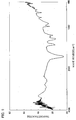
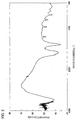
- IR spectrums Infrared absorption spectrums
- Herchel FT-IR-430 a Fourier transform infrared spectroscopy manufactured by JASCO Corporation.
- EPMA Electro Probe MicroAnalyser analysis in the following examples employed an EPMA provided with energy disperse X-ray spectrometer.
- the EPMA used was "JSM-5800" manufactured by JEOL ltd.
- An acceleration voltage was 20kV.
- SEM (Scanning Electron Microscope) images in the following example were picked up by an SEM "S-3500” manufactured by Hitachi Ltd.
- the SEM image was picked up with an acceleration voltage 25kV.
- TEM (transmission electron microscope) images in the following example were taken by a TEM "type JEM-2000FX" manufactured by JEOL ltd.
- the TEM image was taken with an acceleration voltage 200kV.
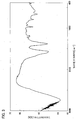
- ultraviolet-visible region diffuse reflection spectrum was measured by an ultraviolet-visible region spectrophotometer "V-550DS” provided with an integrating sphere, the "V-550DS” manufactured by JASCO Corporation.
- crystal of (Z,Z)-benzyl ammonium muconate was synthesized.
- the crystal was such crystal that allowed topochemical polymerization (in which material were polymerized in its crystalline state) via solid-state photopolymerization, and was of a monomer containing ammonium carboxylate.
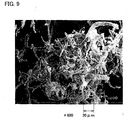
- the ultraviolet ray was irradiated to the crystal of the synthesized (Z,Z)-benzyl ammonium muconate by using a high-pressure mercury arc lamp at 30 °C for 72 hours. This caused solid-state photopolymerization of (Z,Z)-benzyl ammonium muconate so as to produce a product insoluble in the solvent. After the irradiation, unreacted monomer ((Z,Z)-benzyl ammonium muconate) was extracted with methanol. As a result, needle-shaped crystal was obtained.
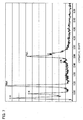
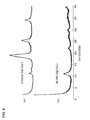
- a diffraction peak was, as illustrated in Fig.5c, obtained in the powder X-ray diffraction measurement. This confirmed that the product retained the crystalline state (i.e., lamellar crystalline structure) even after the reaction.
- the sodium polymuconate thus obtained as the mentioned above was dissolved in water or an aqueous sodium hydroxide solution having a concentration of 0.1mol/L or less, so the sodium polymuconate did not retain the crystalline structure in water and the aqueous sodium hydroxide solution.
- the sodium polymuconate remained, however, insoluble, in a high concentrated aqueous solution in which sodium hydroxide was contained at a concentration of 0.25mol/L or more.
- the sodium polymuconate can allow ion exchange retaining its lamellar structure in the high concentrated aqueous solution in which sodium hydroxide was contained at a concentration of 0.25mol/L or more.
- a reason why the sodium polymuconate was soluble in the aqueous solution with low concentration is supposed that the water goes in between the layers by osmotic pressure, due to the high ion concentration between the layers of the crystalline organic polymer.
- Sodium polymuconate was also obtained by carrying out the similar reaction after converting the crystals of benzyl ammonium polymuconate into the crystals of polymuconic acid by the solid-state hydrolysis or the thermal decomposition and subsequently isolating the crystals of polymuconic acid.
- a diffraction peak was, as illustrated in Fig.5d, obtained in the powder X-ray diffraction measurement. This confirmed that the product retained the crystalline state (i.e., lamellar crystalline structure) even after the reaction.
- Ion exchange reaction similar to that in the example 4 was carried out under the same conditions except that the concentration of silver nitrate was low.
- methanol solution in which silver nitrate was contained at a concentration of 0.1mol/L was used instead of 10ml of the aqueous solution in which silver nitrate was contained at a concentration of 1mol/L.
- 2,5-silver polymuconate obtained in Example 4 was irradiated by using a high-pressure mercury arc lamp for one hour so as to conduct photoreduction of the silver ion. As a result, silver fine particles were produced. This changes color of the crystalline organic polymer into deep purple. Therefore it was confirmed that the crystalline organic polymer with dispersed silver fine particles in the crystals of 2,5-polymuconic acid (i.e. polymer with dispersed fine silver particles) was obtained.
- a TEM image photomacrograph of a transmission electron microscope
- the needle-shaped crystal portion of the polymer with dispersed fine silver particles i.e., the portion of the crystalline organic polymer was confirmed as a deep colored portion, as illustrated in Fig. 10.
- a TEM image illustrating, with magnification the portion of the crystalline organic polymer of the polymer dispersed with the silver particles, many black silver fine particles were found, as illustrated in Fig. 11. From the TEM image, it was confirmed that the silver fine particles were dispersed homogeneously in the entire crystalline organic polymer. Further, it was showed that their diameters were from about several nanometers to over ten nanometers. It was supposed that the silver fine particles were prevented from growing excessively under the production of the silver fine particles through photoreduction in the crystalline organic polymer.
- the polymer with dispersed fine metal particles of the above-mentioned arrangement is regarded to have high antibacterial activity and high catalytic activity, because it contains fine metal particles, and can be suitably used as an antibacterial agent, antifungal agent, oxidation catalyst, reaction catalyst and the like.
- the polymer with dispersed fine metal particles of the above-mentioned arrangement is suitable for an optical material or electronic material because the polymer with dispersed fine metal particles show characteristic absorption properties in visible areas depending on the size of the fine metal particles in which they are produced.
- the present invention provides a polymer with dispersed fine metal particles as an improved organic/inorganic composite material which is more advantageous in thermostability, flame retardance, elastic constant, tensile strength, flexural strength, impact resistance, mar resistance, linear expansion coefficient, dimensional stability, shaping processability, electric properties, dielectric breakdown strength, dielectric constant, properties under high temperature, weatherability, resistance against hydrolysis and the like, compared with the conventional organic/inorganic composite materials containing amorphous or partial crystalline organic polymers.
- the metal ion-containing polymer itself is also applicable as an antibacterial agent, antifungal agent, oxidation catalyst, reaction catalyst, optical material, electronic material and the like.
- the metal ion-containing polymer provides improved properties in thermostability, flame retardance, elastic constant, tensile strength, flexural strength, impact resistance, mar resistance, linear expansion coefficient, dimensional stability, shaping processability, electric properties, dielectric breakdown strength, dielectric constant, properties under high temperature, weatherability, resistance against hydrolysis and the like, compared with conventional organic/inorganic composite materials with amorphous or partial crystalline organic polymers.
Landscapes
- Chemical & Material Sciences (AREA)
- Organic Chemistry (AREA)
- Chemical Kinetics & Catalysis (AREA)
- Metallurgy (AREA)
- Materials Engineering (AREA)
- Mechanical Engineering (AREA)
- Engineering & Computer Science (AREA)
- General Chemical & Material Sciences (AREA)
- Health & Medical Sciences (AREA)
- Medicinal Chemistry (AREA)
- Polymers & Plastics (AREA)
- Inorganic Chemistry (AREA)
- Toxicology (AREA)
- Compositions Of Macromolecular Compounds (AREA)
- Addition Polymer Or Copolymer, Post-Treatments, Or Chemical Modifications (AREA)
Applications Claiming Priority (3)
| Application Number | Priority Date | Filing Date | Title |
|---|---|---|---|
| JP2002267341A JP4135887B2 (ja) | 2002-09-12 | 2002-09-12 | 金属微粒子分散高分子およびその製造方法、並びにその製造に用いる金属イオン含有高分子およびその製造方法 |
| JP2002267341 | 2002-09-12 | ||
| PCT/JP2003/011597 WO2004024817A1 (ja) | 2002-09-12 | 2003-09-10 | 金属微粒子分散高分子およびその製造方法、並びにその製造に用いる金属イオン含有高分子およびその製造方法 |
Publications (2)
| Publication Number | Publication Date |
|---|---|
| EP1538181A1 true EP1538181A1 (de) | 2005-06-08 |
| EP1538181A4 EP1538181A4 (de) | 2010-12-15 |
Family
ID=31986697
Family Applications (1)
| Application Number | Title | Priority Date | Filing Date |
|---|---|---|---|
| EP03795381A Withdrawn EP1538181A4 (de) | 2002-09-12 | 2003-09-10 | Polymer mit dispergierten feinen metallteilchen, herstellungsverfahren dafür, metallionen enthaltendes polymer zur verwendung bei der herstellung und herstellungsverfahren dafür |
Country Status (4)
| Country | Link |
|---|---|
| US (2) | US7645811B2 (de) |
| EP (1) | EP1538181A4 (de) |
| JP (1) | JP4135887B2 (de) |
| WO (1) | WO2004024817A1 (de) |
Families Citing this family (5)
| Publication number | Priority date | Publication date | Assignee | Title |
|---|---|---|---|---|
| JP5002804B2 (ja) * | 2005-05-10 | 2012-08-15 | 国立大学法人三重大学 | 高分子固体電解質 |
| KR100980452B1 (ko) | 2008-08-05 | 2010-09-07 | 한국과학기술원 | 초음파 가진을 통해 제조한 균일 은나노입자를 갖는 은이온용액 및 그 제조방법과 이를 이용한 은형상물의 제작방법 |
| JP5468091B2 (ja) * | 2009-02-27 | 2014-04-09 | 延世大學校産學協力財団 | 構造物の変形測定用装置及びそれを用いた構造物の変形測定方法 |
| JP5275498B1 (ja) * | 2012-07-03 | 2013-08-28 | 石原薬品株式会社 | 導電膜形成方法及び焼結進行剤 |
| CN110818824B (zh) * | 2019-11-08 | 2021-12-28 | 深圳大学 | 一种液态金属辅助的超声聚合方法 |
Family Cites Families (7)
| Publication number | Priority date | Publication date | Assignee | Title |
|---|---|---|---|---|
| US4710403A (en) * | 1986-05-05 | 1987-12-01 | Minnesota Mining And Manufacturing Company | Metallized polymers |
| US5187209A (en) * | 1986-07-01 | 1993-02-16 | Hidefumi Hirai | Colloidal metal dispersion, and a colloidal metal complex |
| JP4167357B2 (ja) * | 1999-09-03 | 2008-10-15 | 積水化学工業株式会社 | 高分子−金属クラスタ複合体及びその製造方法 |
| KR100379250B1 (ko) | 2000-12-04 | 2003-04-08 | 한국과학기술연구원 | 나노 단위 크기의 금속 입자가 함유된 고분자 복합 소재및 그 제조 방법 |
| JP2002192648A (ja) * | 2000-12-27 | 2002-07-10 | Learonal Japan Inc | 接合強度が向上された複合材料およびその形成方法 |
| JP4229262B2 (ja) | 2001-08-27 | 2009-02-25 | 独立行政法人科学技術振興機構 | 光応答性高分子、カルボン酸アンモニウムの結晶の製造方法およびカルボキシル基を有する重合体とアミンとの層状結晶の製造方法 |
| EP1431266B1 (de) * | 2001-08-27 | 2006-07-19 | Japan Science and Technology Agency | Photoreaktives polymer, diacetylen-aufbaupolymer, ammoniumcarboxylatkristalle und verfahren zu deren herstellung |
-
2002
- 2002-09-12 JP JP2002267341A patent/JP4135887B2/ja not_active Expired - Fee Related
-
2003
- 2003-09-10 US US10/527,711 patent/US7645811B2/en not_active Expired - Fee Related
- 2003-09-10 EP EP03795381A patent/EP1538181A4/de not_active Withdrawn
- 2003-09-10 WO PCT/JP2003/011597 patent/WO2004024817A1/ja not_active Ceased
-
2009
- 2009-11-24 US US12/591,578 patent/US7763667B2/en not_active Expired - Fee Related
Also Published As
| Publication number | Publication date |
|---|---|
| US20060154999A1 (en) | 2006-07-13 |
| WO2004024817A1 (ja) | 2004-03-25 |
| US20100076141A1 (en) | 2010-03-25 |
| US7763667B2 (en) | 2010-07-27 |
| JP4135887B2 (ja) | 2008-08-20 |
| JP2004099839A (ja) | 2004-04-02 |
| US7645811B2 (en) | 2010-01-12 |
| EP1538181A4 (de) | 2010-12-15 |
Similar Documents
| Publication | Publication Date | Title |
|---|---|---|
| Basuny et al. | A fast green synthesis of Ag nanoparticles in carboxymethyl cellulose (CMC) through UV irradiation technique for antibacterial applications | |
| Ogawa et al. | Homogeneous precipitation of uniform hydrotalcite particles | |
| Maleki et al. | Facile in situ synthesis and characterization of a novel PANI/Fe 3 O 4/Ag nanocomposite and investigation of catalytic applications | |
| US7763667B2 (en) | Polymer with dispersed fine metal particles, method for producing same, metal ion-containing polymer for use in same production, and method for producing same | |
| Ramesan et al. | Structural characterization, material properties and sensor application study of in situ polymerized polypyrrole/silver doped titanium dioxide nanocomposites | |
| CA2711790A1 (en) | Method for preparing dispersions of precious metal nanoparticles and for isolating such nanoparticles from said dispersions | |
| Beyli et al. | Synthesis, characterization and their antimicrobial activities of boron oxide/poly (acrylic acid) nanocomposites: thermal and antimicrobial properties | |
| Vodnik et al. | Anisotropic silver nanoparticles as filler for the formation of hybrid nanocomposites | |
| US8703235B2 (en) | Preparation of metal nanowire decorated carbon allotropes | |
| US10858327B2 (en) | Method of hydrogenating a compound having an N-heterocyclic aromatic ring | |
| El-Nahhal et al. | Synthesis and characterization of silica-, meso-silica-and their functionalized silica-coated copper oxide nanomaterials | |
| Singh et al. | Synthesis, characterization and evaluation of thermal, adsorption and antioxidant studies of amino functionalized poly (methyl methacrylate)/titanium dioxide nanocomposites | |
| Adewuyi et al. | Synthesis, spectroscopic, surface and catalytic reactivity of chitosan supported Co (II) and its zerovalentcobalt nanobiocomposite | |
| CN1359853A (zh) | 针状或薄片状纳米氢氧化镁及其制备方法 | |
| Musza et al. | Mechanochemically modified hydrazine reduction method for the synthesis of nickel nanoparticles and their catalytic activities in the Suzuki–Miyaura cross-coupling reaction | |
| Attia et al. | Microwave‐assisted synthesis of 1, 4‐disubstituted 1, 2, 3‐triazole derivatives utilizing NiO/Cu2O nano‐photocatalyst | |
| CN1817799A (zh) | 一种TiO2纳米颗粒和纳米棒的合成方法 | |
| Ma et al. | A novel colloidal deposition method to prepare copper nanoparticles/polystyrene nanocomposite with antibacterial activity and its comparison to the liquid-phase in situ reduction method | |
| Mallakpour et al. | Production of NiAl-layered double hydroxide intercalated with bio-safe amino acid containing organic dianion and its utilization in formation of LDH/poly (amide-imide) nanocomposites | |
| Sudha et al. | Facile green strategy for micro/nano structured conducting polyaniline‐clay nanocomposite via template polymerization using amphiphilic dopant, 3‐pentadecyl phenol 4‐sulphonic acid | |
| Okhrimenko et al. | Post-synthetic functionalization and ligand exchange reactions in gold (i) phenylthiolate-based coordination polymers | |
| KR101936274B1 (ko) | 구리합금 나노 입자, 나노 분산액, 및 스퍼터링 타겟의 제조 방법 | |
| Foruzin et al. | Preparation of two-color photoluminescence emission based on azo dye-layered double hydroxide systems and controlling photoluminescence properties of Allura Red AC | |
| Zhang et al. | Preparation and characterization of Ag/AgO nanoshells on carboxylated polystyrene latex particles | |
| Khan et al. | Synthesis and characterization of composites of ceramic nano-particles with non-conducting polymers for dielectric materials production |
Legal Events
| Date | Code | Title | Description |
|---|---|---|---|
| PUAI | Public reference made under article 153(3) epc to a published international application that has entered the european phase |
Free format text: ORIGINAL CODE: 0009012 |
|
| 17P | Request for examination filed |
Effective date: 20050317 |
|
| AK | Designated contracting states |
Kind code of ref document: A1 Designated state(s): AT BE BG CH CY CZ DE DK EE ES FI FR GB GR HU IE IT LI LU MC NL PT RO SE SI SK TR |
|
| RIC1 | Information provided on ipc code assigned before grant |
Ipc: C08F 2/44 20060101ALI20101006BHEP Ipc: C08F 36/00 20060101ALI20101006BHEP Ipc: C08L 47/00 20060101AFI20040401BHEP Ipc: C08K 3/08 20060101ALI20101006BHEP |
|
| A4 | Supplementary search report drawn up and despatched |
Effective date: 20101111 |
|
| 17Q | First examination report despatched |
Effective date: 20110221 |
|
| STAA | Information on the status of an ep patent application or granted ep patent |
Free format text: STATUS: THE APPLICATION IS DEEMED TO BE WITHDRAWN |
|
| 18D | Application deemed to be withdrawn |
Effective date: 20110702 |