EP1537994A1 - Kaschierverfahren und Anlage zur Herstellung von mehrschichtigen Produkten - Google Patents
Kaschierverfahren und Anlage zur Herstellung von mehrschichtigen Produkten Download PDFInfo
- Publication number
- EP1537994A1 EP1537994A1 EP03293039A EP03293039A EP1537994A1 EP 1537994 A1 EP1537994 A1 EP 1537994A1 EP 03293039 A EP03293039 A EP 03293039A EP 03293039 A EP03293039 A EP 03293039A EP 1537994 A1 EP1537994 A1 EP 1537994A1
- Authority
- EP
- European Patent Office
- Prior art keywords
- support
- layer
- wear layer
- wear
- temperature
- Prior art date
- Legal status (The legal status is an assumption and is not a legal conclusion. Google has not performed a legal analysis and makes no representation as to the accuracy of the status listed.)
- Withdrawn
Links
- 238000000034 method Methods 0.000 title claims description 20
- 238000004519 manufacturing process Methods 0.000 title claims description 11
- 238000009434 installation Methods 0.000 title claims description 8
- 238000003475 lamination Methods 0.000 title 1
- 239000010410 layer Substances 0.000 claims description 98
- 229920000642 polymer Polymers 0.000 claims description 36
- -1 polyethylene Polymers 0.000 claims description 9
- 229920000573 polyethylene Polymers 0.000 claims description 9
- 239000004698 Polyethylene Substances 0.000 claims description 8
- VYPSYNLAJGMNEJ-UHFFFAOYSA-N Silicium dioxide Chemical compound O=[Si]=O VYPSYNLAJGMNEJ-UHFFFAOYSA-N 0.000 claims description 7
- 238000010438 heat treatment Methods 0.000 claims description 7
- 238000005096 rolling process Methods 0.000 claims description 7
- 238000007664 blowing Methods 0.000 claims description 6
- VGGSQFUCUMXWEO-UHFFFAOYSA-N Ethene Chemical compound C=C VGGSQFUCUMXWEO-UHFFFAOYSA-N 0.000 claims description 5
- 239000005977 Ethylene Substances 0.000 claims description 5
- 239000000654 additive Substances 0.000 claims description 4
- 238000001816 cooling Methods 0.000 claims description 3
- 235000014113 dietary fatty acids Nutrition 0.000 claims description 3
- 239000000194 fatty acid Substances 0.000 claims description 3
- 229930195729 fatty acid Natural products 0.000 claims description 3
- 150000004665 fatty acids Chemical class 0.000 claims description 3
- 229920000098 polyolefin Polymers 0.000 claims description 3
- 239000000377 silicon dioxide Substances 0.000 claims description 3
- 239000002344 surface layer Substances 0.000 claims description 3
- 229920001169 thermoplastic Polymers 0.000 claims description 3
- 238000002844 melting Methods 0.000 claims description 2
- 230000008018 melting Effects 0.000 claims description 2
- 229920002635 polyurethane Polymers 0.000 claims description 2
- 239000004814 polyurethane Substances 0.000 claims description 2
- 239000000758 substrate Substances 0.000 abstract description 8
- 150000001336 alkenes Chemical class 0.000 abstract description 2
- 239000000543 intermediate Substances 0.000 description 14
- 229920001577 copolymer Polymers 0.000 description 13
- 239000007789 gas Substances 0.000 description 7
- 229920001519 homopolymer Polymers 0.000 description 7
- 239000000126 substance Substances 0.000 description 6
- 229920001684 low density polyethylene Polymers 0.000 description 5
- 230000016571 aggressive behavior Effects 0.000 description 4
- 239000000463 material Substances 0.000 description 4
- 239000000203 mixture Substances 0.000 description 4
- 238000005299 abrasion Methods 0.000 description 3
- 150000001768 cations Chemical class 0.000 description 3
- 230000007547 defect Effects 0.000 description 3
- 229920000554 ionomer Polymers 0.000 description 3
- 239000004800 polyvinyl chloride Substances 0.000 description 3
- QQONPFPTGQHPMA-UHFFFAOYSA-N propylene Natural products CC=C QQONPFPTGQHPMA-UHFFFAOYSA-N 0.000 description 3
- 125000004805 propylene group Chemical group [H]C([H])([H])C([H])([*:1])C([H])([H])[*:2] 0.000 description 3
- 238000003860 storage Methods 0.000 description 3
- 206010001488 Aggression Diseases 0.000 description 2
- IJGRMHOSHXDMSA-UHFFFAOYSA-N Atomic nitrogen Chemical compound N#N IJGRMHOSHXDMSA-UHFFFAOYSA-N 0.000 description 2
- VTYYLEPIZMXCLO-UHFFFAOYSA-L Calcium carbonate Chemical compound [Ca+2].[O-]C([O-])=O VTYYLEPIZMXCLO-UHFFFAOYSA-L 0.000 description 2
- OSGAYBCDTDRGGQ-UHFFFAOYSA-L calcium sulfate Chemical compound [Ca+2].[O-]S([O-])(=O)=O OSGAYBCDTDRGGQ-UHFFFAOYSA-L 0.000 description 2
- 125000002843 carboxylic acid group Chemical group 0.000 description 2
- 230000007613 environmental effect Effects 0.000 description 2
- 238000001125 extrusion Methods 0.000 description 2
- 238000010101 extrusion blow moulding Methods 0.000 description 2
- 230000004927 fusion Effects 0.000 description 2
- 229920001903 high density polyethylene Polymers 0.000 description 2
- 150000002430 hydrocarbons Chemical class 0.000 description 2
- 229910052500 inorganic mineral Inorganic materials 0.000 description 2
- 239000011707 mineral Substances 0.000 description 2
- 239000004014 plasticizer Substances 0.000 description 2
- 229920000915 polyvinyl chloride Polymers 0.000 description 2
- 230000035939 shock Effects 0.000 description 2
- 125000000383 tetramethylene group Chemical group [H]C([H])([*:1])C([H])([H])C([H])([H])C([H])([H])[*:2] 0.000 description 2
- 239000005995 Aluminium silicate Substances 0.000 description 1
- OKTJSMMVPCPJKN-UHFFFAOYSA-N Carbon Chemical compound [C] OKTJSMMVPCPJKN-UHFFFAOYSA-N 0.000 description 1
- 239000004215 Carbon black (E152) Substances 0.000 description 1
- ZAMOUSCENKQFHK-UHFFFAOYSA-N Chlorine atom Chemical compound [Cl] ZAMOUSCENKQFHK-UHFFFAOYSA-N 0.000 description 1
- WNROFYMDJYEPJX-UHFFFAOYSA-K aluminium hydroxide Chemical compound [OH-].[OH-].[OH-].[Al+3] WNROFYMDJYEPJX-UHFFFAOYSA-K 0.000 description 1
- 235000012211 aluminium silicate Nutrition 0.000 description 1
- QVGXLLKOCUKJST-UHFFFAOYSA-N atomic oxygen Chemical compound [O] QVGXLLKOCUKJST-UHFFFAOYSA-N 0.000 description 1
- TZCXTZWJZNENPQ-UHFFFAOYSA-L barium sulfate Chemical compound [Ba+2].[O-]S([O-])(=O)=O TZCXTZWJZNENPQ-UHFFFAOYSA-L 0.000 description 1
- AYJRCSIUFZENHW-DEQYMQKBSA-L barium(2+);oxomethanediolate Chemical compound [Ba+2].[O-][14C]([O-])=O AYJRCSIUFZENHW-DEQYMQKBSA-L 0.000 description 1
- 229910000019 calcium carbonate Inorganic materials 0.000 description 1
- 150000001732 carboxylic acid derivatives Chemical class 0.000 description 1
- 150000001735 carboxylic acids Chemical class 0.000 description 1
- 238000006243 chemical reaction Methods 0.000 description 1
- 239000000460 chlorine Substances 0.000 description 1
- 229910052801 chlorine Inorganic materials 0.000 description 1
- 239000011248 coating agent Substances 0.000 description 1
- 238000000576 coating method Methods 0.000 description 1
- 150000001875 compounds Chemical class 0.000 description 1
- 230000001143 conditioned effect Effects 0.000 description 1
- 239000000470 constituent Substances 0.000 description 1
- 239000000945 filler Substances 0.000 description 1
- 239000004088 foaming agent Substances 0.000 description 1
- 229910021485 fumed silica Inorganic materials 0.000 description 1
- 238000001879 gelation Methods 0.000 description 1
- 239000010439 graphite Substances 0.000 description 1
- 229910002804 graphite Inorganic materials 0.000 description 1
- 229930195733 hydrocarbon Natural products 0.000 description 1
- 239000011261 inert gas Substances 0.000 description 1
- NLYAJNPCOHFWQQ-UHFFFAOYSA-N kaolin Chemical compound O.O.O=[Al]O[Si](=O)O[Si](=O)O[Al]=O NLYAJNPCOHFWQQ-UHFFFAOYSA-N 0.000 description 1
- 229920000092 linear low density polyethylene Polymers 0.000 description 1
- 239000004707 linear low-density polyethylene Substances 0.000 description 1
- 239000000314 lubricant Substances 0.000 description 1
- 229920002521 macromolecule Polymers 0.000 description 1
- ZLNQQNXFFQJAID-UHFFFAOYSA-L magnesium carbonate Chemical compound [Mg+2].[O-]C([O-])=O ZLNQQNXFFQJAID-UHFFFAOYSA-L 0.000 description 1
- 239000001095 magnesium carbonate Substances 0.000 description 1
- 229910000021 magnesium carbonate Inorganic materials 0.000 description 1
- 229910052751 metal Inorganic materials 0.000 description 1
- 239000002184 metal Substances 0.000 description 1
- 239000012968 metallocene catalyst Substances 0.000 description 1
- 239000012764 mineral filler Substances 0.000 description 1
- 229910052757 nitrogen Inorganic materials 0.000 description 1
- 230000003647 oxidation Effects 0.000 description 1
- 238000007254 oxidation reaction Methods 0.000 description 1
- 239000001301 oxygen Substances 0.000 description 1
- 229910052760 oxygen Inorganic materials 0.000 description 1
- 239000000049 pigment Substances 0.000 description 1
- 230000005855 radiation Effects 0.000 description 1
- 238000004064 recycling Methods 0.000 description 1
- 238000012552 review Methods 0.000 description 1
- 238000003856 thermoforming Methods 0.000 description 1
Images
Classifications
-
- B—PERFORMING OPERATIONS; TRANSPORTING
- B32—LAYERED PRODUCTS
- B32B—LAYERED PRODUCTS, i.e. PRODUCTS BUILT-UP OF STRATA OF FLAT OR NON-FLAT, e.g. CELLULAR OR HONEYCOMB, FORM
- B32B37/00—Methods or apparatus for laminating, e.g. by curing or by ultrasonic bonding
- B32B37/04—Methods or apparatus for laminating, e.g. by curing or by ultrasonic bonding characterised by the partial melting of at least one layer
-
- B—PERFORMING OPERATIONS; TRANSPORTING
- B32—LAYERED PRODUCTS
- B32B—LAYERED PRODUCTS, i.e. PRODUCTS BUILT-UP OF STRATA OF FLAT OR NON-FLAT, e.g. CELLULAR OR HONEYCOMB, FORM
- B32B37/00—Methods or apparatus for laminating, e.g. by curing or by ultrasonic bonding
- B32B37/10—Methods or apparatus for laminating, e.g. by curing or by ultrasonic bonding characterised by the pressing technique, e.g. using action of vacuum or fluid pressure
-
- Y—GENERAL TAGGING OF NEW TECHNOLOGICAL DEVELOPMENTS; GENERAL TAGGING OF CROSS-SECTIONAL TECHNOLOGIES SPANNING OVER SEVERAL SECTIONS OF THE IPC; TECHNICAL SUBJECTS COVERED BY FORMER USPC CROSS-REFERENCE ART COLLECTIONS [XRACs] AND DIGESTS
- Y10—TECHNICAL SUBJECTS COVERED BY FORMER USPC
- Y10T—TECHNICAL SUBJECTS COVERED BY FORMER US CLASSIFICATION
- Y10T156/00—Adhesive bonding and miscellaneous chemical manufacture
- Y10T156/17—Surface bonding means and/or assemblymeans with work feeding or handling means
- Y10T156/1702—For plural parts or plural areas of single part
- Y10T156/1744—Means bringing discrete articles into assembled relationship
Definitions
- the subject of the invention is a dubbing process and an installation doubling process to produce multilayer products, used in particular for making floor coverings or wall coverings, as well as for the interior lining of vehicles used for the transport of persons, such as motor cars, railway cars, ship cabins and cockpits of planes.
- Multilayer products comprising a polymeric support and a wearing layer containing ionomeric copolymer are particularly targeted.
- multilayer sheets comprising a support layer or substrate and a surface layer of wear.
- the support layer generally has a decorative face on which the wear layer is applied. This is used to protect the decorative side of the substrate. It is usually transparent and must have adequate resistance to mechanical aggression (shock, abrasion) and chemical attack under normal conditions of use.
- the functions of multilayer products determine the choice of materials used to make them. This choice is further conditioned by considerations health, environmental and implementation.
- the products multilayers must accommodate a rolling implementation or thermoforming, which involves the use of thermoplastic polymers.
- the adhesion of the superimposed layers must be sufficient to ensure cohesion multilayer product in the applications for which it is intended. He is in Furthermore, it is desirable to select materials which allow recycling of used multilayer products. In addition, avoid or limit the exudation of volatile materials (such as plasticizers) during the use of these multilayer products.
- Polyvinyl chloride has long been used for manufacture of multilayer products in sheets for making carpets, wall coverings or vehicle interior trim.
- Environmental protection considerations militate for the replacing polyvinyl chloride with polymers or copolymers free of chlorine.
- the choice naturally fell on polymers and olefinic copolymers, especially polymers and copolymers of ethylene and propylene, given their relatively low cost and their good chemical and thermal properties.
- a disadvantage of olefinic polymers in such applications lies in the difficulties encountered when doubling layers to form a multilayer product. Indeed, olefinic products do not lend themselves to rolling, since products tend to adhere to rolling cylinders.
- the technique conventionally used in floor coverings PVC that is to say a coating followed by a gelation is not feasible in the the case of olefinic and / or ionomeric products
- the invention aims to create a new technique of doubling sheets to obtain a multilayer product having sufficient adhesion between the layers that constitute it and an aspect of high quality surface.
- the layer wear is not in contact with rolling cylinders.
- the problems appearance of surfaces resulting from a localized adhesion on the rolling cylinder are thus avoided.
- the adhesion of the wear layer is obtained by a fusion thereof in a furnace by blowing hot air on the upper surface of the produces the adhesion of the wear layer.
- air is used as the gas, preferably preheated air at a temperature close to that inside the oven.
- inert gases such as e.g. Nitrogen or oxygen-depleted air to minimize possible reactions oxidation.
- the wear layer is melted controlled way during the passage in the oven. As a result, the gas pressure applied on the surface of the wear layer is not likely to create defects in surface appearing in the finished product.
- This process is particularly well suited to the manufacture of products wide-width multilayer (+/- 4 m) comprising, on a polymeric substrate, a wear layer made of polymer of the ionomeric or PO type. Products can furthermore, between the substrate and the wear layer, a layer intermediate of an olefinic polymer containing a metallocene.
- multilayer product support serves as mechanical support. It may include a decorative print on one of its faces or on both sides. Printing can also be done on the wear layer if it is transparent. Support can also include a mineral charge. It essentially comprises a polymeric compound, usually olefinic. The polymeric compound can be a homopolymer or an olefinic copolymer.
- polymer will denote either a homopolymer or a copolymer.
- the olefinic polymer used in the constitution of the carrier of products according to the invention may be selected from ethylene polymers, propylene and butylene. It can be a homopolymer or a copolymer, for example example a copolymer of ethylene and propylene or a copolymer of ethylene and butylene. Standard polyethylenes and / or polyethylenes metallocene are preferred. High density polyethylenes (HDPE), Low density polyethylenes (LDPE), low density linear polyethylenes (LLDPE) and very low density linear polyethylenes (VLDPE) are specially recommended.
- HDPE High density polyethylenes
- LDPE Low density polyethylenes
- LLDPE low density linear polyethylenes
- VLDPE very low density linear polyethylenes
- the olefinic polymer of the support is advantageously free of ionic bonds.
- free from binding ionic means that the number of carboxylic acid groups in the polymer does not exceed 25% and is for example between 0 and 15%.
- the polymer of the support may comprise mineral fillers intended to give it special mechanical properties.
- Charges minerals that can be used in the carrier include calcium carbonate, magnesium carbonate, calcium sulfate, barium carbonate, sulfate barium, kaolin, fumed silica, aluminum hydrate and graphite expanded.
- the function of the wear layer is to protect the support against mechanical and chemical aggressions in the applications to which the products multilayers according to the invention are intended. It preferably includes a ionomer type polymer.
- Polymers of the ionomeric type of the wear layer are well known in technique. These are ionically bonded copolymers comprising a chain hydrocarbon containing neutralized carboxylic acid side groups partially or totally by cations.
- the hydrocarbon chain is a olefinic chain, for example ethylenic.
- Carboxylic acid groups include, for example, ethylenically unsaturated carboxylic acids in ⁇ and ⁇ and the cations can for example comprise metal cations or amine cations.
- the optimal thickness of the wear layer depends on various parameters, such as the material used for said wear layer and the applications to which the multilayer products are intended. In practice, we usually get good results with wear layers of at least 30 ⁇ m (preferably 60 ⁇ m) thicknesses, the thicknesses between 40 and 300 ⁇ m being especially advantageous.
- the wear layer can be coated with a layer superficial polyurethane, to enhance resistance to abrasion wear.
- the wear layer may comprise one or more layers intermediates of a metallocene-containing olefinic polymer.
- This layer intermediate is attached to the wear layer so that it lies in the finished product between the support and the wear layer.
- this layer intermediate is transparent.
- the intermediate layer comprises a polymer olefinic which can be indifferently a homopolymer or a copolymer.
- the Homopolymers are well suited. Homopolymers of ethylene are preferred and of these, low density polyethylenes (LDPE) are especially Recommended.
- the intermediate layer (s) can (may) include a single olefinic polymer or a blend of polymers different olefins, as defined above.
- the term olefinic polymer of the intermediate layer designate either a single olefinic polymer or a mixture of at least one two different olefinic polymers, the or each polymer being indifferently be a homopolymer or a copolymer.
- the olefinic polymer of the intermediary also serves to enable the manufacture of diapers wear by the extrusion blow molding technique or to improve its performance. he more particularly, in the implementation of this extrusion technique blowing, stabilize bubbles of large size and sufficient thickness.
- the wear layer thus obtained may therefore comprise a layer external product that serves to form the surface layer of the multilayer product, an intermediate layer of an olefinic polymer comprising, where appropriate, additives such as fatty acids and / or silica and a layer of a polymer olefinic compound comprising a metallocene.
- metallocene is meant the polyolefins respectively the polyethylenes manufactured using metallocene catalysts which are well known in technique.
- the usable metallocene is advantageously selected from among the polyolefins and more particularly among polyethylenes having a density less than 0.900.
- Multilayer products may include a metallocene single or a mixture of different metallocenes, as defined in previous. Subsequently, unless otherwise indicated, the expression metallocene designate either a single metallocene or a mixture of at least two different metallocenes.
- the function of the metallocene is to achieve even more effective adhesion of the intermediate layer to the layer wear and support.
- it is present in the intermediate layer in one amount which is preferably greater than 1 part (more preferably 5 parts) by weight per 100 parts by weight of olefinic polymer.
- the amount of metallocene in the olefinic polymer of the intermediate layer does not exceed 40 parts by weight per 100 parts by weight of polymer and is preferably less than 30 parts by weight per 100 parts by weight. weight of the olefinic polymer. Quantities of metallocene from 5 to 20 (from preferably from 8 to 15 parts by weight per 100 parts by weight of polymer olefinic are generally suitable.
- the metallocene can be introduced into the olefinic polymer of the intermediate layer in the form of a filler.
- an additional layer of polyethylene with low density (LDPE) is interposed between the support and the intermediate layer supra.
- This additional layer may also contain fatty acids and / or silica.
- Polymers used in the constitution of multilayer products may possibly contain additives commonly present in multilayer products to give them specific properties or to facilitate their for example, lubricants, plasticisers, pigments or foaming agents.
- Multilayer products combine a set of properties interesting, previously considered to be incompatible, in particular high resistance to abrasion wear and other mechanical aggression, high resistance to chemical attack and great cohesion.
- the invention therefore also relates to a dubbing installation comprising a device for feeding a support, a station for preheating the support, a device for supplying a wear layer, a device for setting contact of the support and the wear layer, a heating furnace comprising a or more blowing nozzles for a gas and a transport device transporting the support and the wear layer through said heating furnace.
- the support is routed via the feeder - which can be a rollers eg - in the preheating station in which it is preheated to a temperature of between 100 and 130 ° C.
- the preheating station can eg be an infrared radiation oven.
- the preheated support is then brought into contact with the wear layer in the contacting device after having been conveyed using the device supplying the wear layer. It should be noted that the contacting device of the wear layer and the support exerts a certain pressure on the surface of the wear layer, in particular to minimize the air trapped between the support and the wear layer.
- the contacting device is advantageously a presser which presses the wear layer at ambient temperature onto the preheated support.
- the presser is located above the transport device which brings the support and the wear layer into the oven. Since the transport device is flexible, it can be ensured that the wear layer is applied to the support with a low pressure of between 100 and 1000 g / cm 2 . Since the wear layer is not preheated, this operation will not create surface defects. However, since the support is preheated and its surface softened, the support has a certain degree of adhesiveness and a certain viscosity and thus the wear layer applied against the support will adhere to it.
- the support on which the wear layer is applied is then routed through the heating furnace inside which the entire layer of wear - support is heated to a temperature between 120 ° C and 180 ° C on the transport device. During this transport, the wear layer is melted and slight pressure is exerted on the support assembly - wear layer by means of the gas blast nozzle - preferably a hot gas.
- the installation according to the invention makes it possible to obtain multilayer products large dimensions, the width of which can reach several meters. More especially, the installation according to the invention allows the manufacture of products multilayer strips with a width exceeding 4 m with a thickness of wear layer exceeding 60 ⁇ m and up to 200 ⁇ m and even more.
- the products obtained have multiple applications. They find applications in the building industry, for making carpets, carpets and wall coverings. They are also used in the automotive industry, aviation, the navy and the railway, for the manufacture of carpets as well as for covering walls of cockpits, cockpits and cabins of vehicles.
- the subject of the invention is therefore also the use of products according to the invention for the manufacture of floor or wall coverings as well as for the covering of passenger compartment walls of vehicles, especially vehicles intended for the transport of persons.
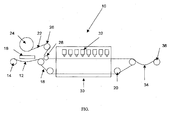
- Reference 10 indicates the dubbing installation.
- the support 12 is unrolled from the storage roll 14 and is led under an infrared lamp 16 where the support is heated to a temperature of about 120 ° C so that soften its upper surface.
- the preheated support is then placed on a conveyor belt 18 which can transport it through the oven.
- the band conveyor 18 is stretched on a series of rollers 20 which advance it and the maintain under a certain tension.
- the wear layer 22 is also unwound from its roll of storage 24 and is brought into a stretcher 26 to obtain a smooth product without creases and other surface defects.
- the wear layer is then guided over of the conveyor belt 18 and is brought into contact with the support preheated by means of a presser 28 which exerts a slight pressure on the support 12 and the wear layer 22 so as to minimize air entrapment between both.
- the support 12 and the wear layer 22 are then conveyed through the heating furnace 30 inside which the support assembly - wearing layer is heated to a temperature of between 120 and 180 ° C.
- the residence time inside the oven is 2 to 3 minutes-, the wear layer is melted by means of a preheated gas injected over the band conveyor 18 by means of blowing nozzles 32 installed in the part oven. 30.
- the gases heat the substrate and the wear layer and the merge together so as to have an appropriate cohesion between the layer at the outlet of the oven 30.
- the product obtained 34 is wound on a storage roll 36.
Landscapes
- Physics & Mathematics (AREA)
- Fluid Mechanics (AREA)
- Laminated Bodies (AREA)
- Metal Rolling (AREA)
- Vehicle Interior And Exterior Ornaments, Soundproofing, And Insulation (AREA)
Priority Applications (6)
| Application Number | Priority Date | Filing Date | Title |
|---|---|---|---|
| EP03293039A EP1537994A1 (de) | 2003-12-04 | 2003-12-04 | Kaschierverfahren und Anlage zur Herstellung von mehrschichtigen Produkten |
| PCT/EP2004/053266 WO2005053957A1 (fr) | 2003-12-04 | 2004-12-03 | Procédé de doublage et installation de doublage pour fabriquer des produits multicouches |
| UAA200607339A UA88289C2 (ru) | 2003-12-04 | 2004-12-03 | способ сдваивания и оборудование сдваивания для производства многослойных изделий |
| RU2006123433/04A RU2352468C2 (ru) | 2003-12-04 | 2004-12-03 | Способ дублирования и дублировочная установка для производства многослойных изделий |
| US10/596,142 US8524031B2 (en) | 2003-12-04 | 2004-12-03 | Lining method and lining installation for the production of multi-layer products |
| EP04804676A EP1697136B1 (de) | 2003-12-04 | 2004-12-03 | Laminierungsverfahren und -anlage zur herstellung von mehrlagigen produkten |
Applications Claiming Priority (1)
| Application Number | Priority Date | Filing Date | Title |
|---|---|---|---|
| EP03293039A EP1537994A1 (de) | 2003-12-04 | 2003-12-04 | Kaschierverfahren und Anlage zur Herstellung von mehrschichtigen Produkten |
Publications (1)
| Publication Number | Publication Date |
|---|---|
| EP1537994A1 true EP1537994A1 (de) | 2005-06-08 |
Family
ID=34443118
Family Applications (2)
| Application Number | Title | Priority Date | Filing Date |
|---|---|---|---|
| EP03293039A Withdrawn EP1537994A1 (de) | 2003-12-04 | 2003-12-04 | Kaschierverfahren und Anlage zur Herstellung von mehrschichtigen Produkten |
| EP04804676A Expired - Lifetime EP1697136B1 (de) | 2003-12-04 | 2004-12-03 | Laminierungsverfahren und -anlage zur herstellung von mehrlagigen produkten |
Family Applications After (1)
| Application Number | Title | Priority Date | Filing Date |
|---|---|---|---|
| EP04804676A Expired - Lifetime EP1697136B1 (de) | 2003-12-04 | 2004-12-03 | Laminierungsverfahren und -anlage zur herstellung von mehrlagigen produkten |
Country Status (5)
| Country | Link |
|---|---|
| US (1) | US8524031B2 (de) |
| EP (2) | EP1537994A1 (de) |
| RU (1) | RU2352468C2 (de) |
| UA (1) | UA88289C2 (de) |
| WO (1) | WO2005053957A1 (de) |
Families Citing this family (3)
| Publication number | Priority date | Publication date | Assignee | Title |
|---|---|---|---|---|
| ES2853675T3 (es) | 2010-06-30 | 2021-09-17 | Flooring Ind Ltd Sarl | Un panel que comprende una capa de material compuesto polimérico y un método de fabricación de tal panel |
| ES2982433T3 (es) | 2017-10-27 | 2024-10-16 | Ppg Advanced Surface Tech Llc | Método para aplicar una película polimérica a un sustrato y los artículos resultantes |
| ES3034536T3 (en) | 2017-10-27 | 2025-08-19 | Ppg Advanced Surface Tech Llc | Method for applying a polymeric film to a substrate |
Citations (3)
| Publication number | Priority date | Publication date | Assignee | Title |
|---|---|---|---|---|
| JPH054248A (ja) * | 1991-06-27 | 1993-01-14 | Hitachi Chem Co Ltd | 積層板の連続製造方法 |
| EP1004432A2 (de) * | 1998-11-27 | 2000-05-31 | Armstrong World Industries, Inc. | Heissschmelz-kalandrierte oder -extrudierte Nutzschicht für geprägte Substrate und Herstellungsverfahren |
| US6287706B1 (en) * | 1994-08-04 | 2001-09-11 | Forbo International S.A. | Floor coverings |
Family Cites Families (10)
| Publication number | Priority date | Publication date | Assignee | Title |
|---|---|---|---|---|
| AT312904B (de) * | 1971-02-19 | 1974-01-25 | Koepp Ag | Verfahren zum Kaschieren eines Schaumstoffkörpers |
| JPS5725315A (en) * | 1980-07-23 | 1982-02-10 | Mitui Toatsu Chem Inc | Production of flexible polyurethane foam |
| US4384904A (en) * | 1981-08-24 | 1983-05-24 | Armstrong World Industries, Inc. | Process of forming an embossed surface covering having a wear layer attached uniformly thereto |
| CA1229543A (en) * | 1983-08-24 | 1987-11-24 | Merrill M. Smith | Printed and embossed floor covering and method and apparatus for its manufacture |
| JPS6119886A (ja) * | 1984-07-09 | 1986-01-28 | Nippon Oil Co Ltd | 寸法安定性に優れたタイルカ−ペツトの製造方法 |
| US5278275A (en) * | 1990-07-02 | 1994-01-11 | Toyo Boseki Kabushiki Kaisha | Polyurethane resin composition |
| JP3720354B2 (ja) * | 1993-09-20 | 2005-11-24 | ザ アムティコ カンパニー リミティド | 床仕上材 |
| NL1006109C2 (nl) * | 1997-05-22 | 1998-11-25 | Hoogovens Staal Bv | Werkwijze voor met thermoplastisch bekledingsmateriaal bekleden van een metallisch substraat. |
| US6114046A (en) * | 1997-07-24 | 2000-09-05 | Evergreen Solar, Inc. | Encapsulant material for solar cell module and laminated glass applications |
| DE19941214A1 (de) * | 1999-08-30 | 2001-03-01 | Bayer Ag | Mehrschichtige Kunststoffverbunde und ein Verfahren zu deren Herstellung |
-
2003
- 2003-12-04 EP EP03293039A patent/EP1537994A1/de not_active Withdrawn
-
2004
- 2004-12-03 US US10/596,142 patent/US8524031B2/en not_active Expired - Fee Related
- 2004-12-03 RU RU2006123433/04A patent/RU2352468C2/ru not_active IP Right Cessation
- 2004-12-03 WO PCT/EP2004/053266 patent/WO2005053957A1/fr not_active Ceased
- 2004-12-03 UA UAA200607339A patent/UA88289C2/ru unknown
- 2004-12-03 EP EP04804676A patent/EP1697136B1/de not_active Expired - Lifetime
Patent Citations (3)
| Publication number | Priority date | Publication date | Assignee | Title |
|---|---|---|---|---|
| JPH054248A (ja) * | 1991-06-27 | 1993-01-14 | Hitachi Chem Co Ltd | 積層板の連続製造方法 |
| US6287706B1 (en) * | 1994-08-04 | 2001-09-11 | Forbo International S.A. | Floor coverings |
| EP1004432A2 (de) * | 1998-11-27 | 2000-05-31 | Armstrong World Industries, Inc. | Heissschmelz-kalandrierte oder -extrudierte Nutzschicht für geprägte Substrate und Herstellungsverfahren |
Non-Patent Citations (1)
| Title |
|---|
| PATENT ABSTRACTS OF JAPAN vol. 0172, no. 68 (M - 1416) 25 May 1993 (1993-05-25) * |
Also Published As
| Publication number | Publication date |
|---|---|
| EP1697136B1 (de) | 2013-02-13 |
| RU2352468C2 (ru) | 2009-04-20 |
| UA88289C2 (ru) | 2009-10-12 |
| US20070039693A1 (en) | 2007-02-22 |
| US8524031B2 (en) | 2013-09-03 |
| EP1697136A1 (de) | 2006-09-06 |
| WO2005053957A1 (fr) | 2005-06-16 |
| RU2006123433A (ru) | 2008-01-20 |
Similar Documents
| Publication | Publication Date | Title |
|---|---|---|
| US5851610A (en) | Shrink films and articles including the same | |
| JP4977694B2 (ja) | 少なくとも1つのエチレン−ビニルアルコール−共重合体(evoh)から成るフィルム層を備え同時押出成形された多層保護フィルム、その製造方法及びその使用方法 | |
| JP7374267B2 (ja) | フィルム、及び二軸延伸ポリプロピレンフィルムを製造する方法 | |
| CN1213854C (zh) | 用于保护基料的可热成型的多层薄膜和所得到的物品 | |
| EP1829017B1 (de) | Forminterne label und verwendung dafür | |
| EP2401149B1 (de) | Verfahren zur herstellung von mehrlagigen druckmedien durch extrusionsbeschichtung | |
| CN1058451C (zh) | 复合膜及其生产方法 | |
| US5811185A (en) | Low temperature heat sealable biaxially oriented polypropylene films comprising propylene/butylene resin | |
| CN1162528A (zh) | 具有对烃类低渗透性的薄膜 | |
| JPH10510488A (ja) | 熱シール性多層フィルム及びその製造方法 | |
| EP0862991B1 (de) | Kunststofffolien | |
| US20050227030A1 (en) | Composition comprising ethylene copolymer | |
| EP1567336B1 (de) | Mehrlagige produkte, herstellungsverfahren dafür und ihre verwendung | |
| CN114311898A (zh) | 一种冷裱复合膜用聚丙烯薄膜及其制备方法和冷裱复合膜 | |
| US5484633A (en) | Heat-sealable, oriented, multilayer polyolefin film, process for the production thereof, and the use thereof | |
| HU224258B1 (hu) | Polietilénfólia, előállítási eljárása és felhasználása | |
| EP1697136B1 (de) | Laminierungsverfahren und -anlage zur herstellung von mehrlagigen produkten | |
| WO2020203836A1 (ja) | ポリアミド系積層フィルム及びその製造方法 | |
| EP0717676B1 (de) | Verbundprodukte als fussbodenbeläge, wandbekleidungen oder innenverkleidung im automobilsektor und verfahren zu ihrer herstellung | |
| NZ292443A (en) | Biaxially oriented copolymer shrink film with high shrinkage in machine direction compared to transverse direction | |
| JPH06134942A (ja) | 積層体およびその製造方法 | |
| US20060257646A1 (en) | Lap sealable films | |
| CN1284027A (zh) | 机器加工性能改善的挠性的、可热成形的多层膜 | |
| JPH07285158A (ja) | 熱可塑性樹脂シートの製造方法 | |
| TW202128438A (zh) | 可雷射印字之膜以及使用該膜之包裝體 |
Legal Events
| Date | Code | Title | Description |
|---|---|---|---|
| PUAI | Public reference made under article 153(3) epc to a published international application that has entered the european phase |
Free format text: ORIGINAL CODE: 0009012 |
|
| AK | Designated contracting states |
Kind code of ref document: A1 Designated state(s): AT BE BG CH CY CZ DE DK EE ES FI FR GB GR HU IE IT LI LU MC NL PT RO SE SI SK TR |
|
| AX | Request for extension of the european patent |
Extension state: AL LT LV MK |
|
| 17P | Request for examination filed |
Effective date: 20051208 |
|
| AKX | Designation fees paid |
Designated state(s): AT BE BG CH CY CZ DE DK EE ES FI FR GB GR HU IE IT LI LU MC NL PT RO SE SI SK TR |
|
| D17P | Request for examination filed (deleted) | ||
| REG | Reference to a national code |
Ref country code: DE Ref legal event code: 8566 |
|
| STAA | Information on the status of an ep patent application or granted ep patent |
Free format text: STATUS: THE APPLICATION IS DEEMED TO BE WITHDRAWN |
|
| 18D | Application deemed to be withdrawn |
Effective date: 20051209 |