EP1536602A2 - Elektronisches Kommunikationsgerät, -verfahren und -programm zum Empfangen von elektronischen Nachrichten auf einem elektronischen Kommunikationsgerät - Google Patents
Elektronisches Kommunikationsgerät, -verfahren und -programm zum Empfangen von elektronischen Nachrichten auf einem elektronischen Kommunikationsgerät Download PDFInfo
- Publication number
- EP1536602A2 EP1536602A2 EP04018637A EP04018637A EP1536602A2 EP 1536602 A2 EP1536602 A2 EP 1536602A2 EP 04018637 A EP04018637 A EP 04018637A EP 04018637 A EP04018637 A EP 04018637A EP 1536602 A2 EP1536602 A2 EP 1536602A2
- Authority
- EP
- European Patent Office
- Prior art keywords
- specified
- communication device
- electronic communication
- deleting
- Prior art date
- Legal status (The legal status is an assumption and is not a legal conclusion. Google has not performed a legal analysis and makes no representation as to the accuracy of the status listed.)
- Withdrawn
Links
Images

Classifications
-
- G—PHYSICS
- G06—COMPUTING OR CALCULATING; COUNTING
- G06Q—INFORMATION AND COMMUNICATION TECHNOLOGY [ICT] SPECIALLY ADAPTED FOR ADMINISTRATIVE, COMMERCIAL, FINANCIAL, MANAGERIAL OR SUPERVISORY PURPOSES; SYSTEMS OR METHODS SPECIALLY ADAPTED FOR ADMINISTRATIVE, COMMERCIAL, FINANCIAL, MANAGERIAL OR SUPERVISORY PURPOSES, NOT OTHERWISE PROVIDED FOR
- G06Q10/00—Administration; Management
- G06Q10/10—Office automation; Time management
- G06Q10/107—Computer-aided management of electronic mailing [e-mailing]
Definitions
- the present invention relates to an electronic communication device, a method and a program for receiving email by the electronic communication device and more particularly to a mobile tele- communication device, a method and a program for receiving email by the mobile telecommunication device.
- a mobile telecommunication device as a portable cellular phone and/or a PHS (Personal Handy-phone System) or a portable communication device.
- PHS Personal Handy-phone System
- a portable communication device By using such the mobile telecommunication device or the portable communication device, not only private email but also information email and advertising email transmitted in a form of Internet contents are received and distributed.
- a conventional portable cellular phone is disclosed in Japanese Patent Application Laid-open No. 2003-157218 in which received junk email is automatically deleted, that is, received email, if the number of keywords exceeding the pre-set number of keywords is contained in a body of the received email, is deleted as junk email.
- the first problem is that, though information about weather or news is current on the day when it is distributed, it becomes obsolete as time elapses and the information is left within a mobile terminal unless it is deleted by a user, which causes memory being used in the mobile terminal to be exhausted and causes the terminal to be unable to receive other email.
- the second problem is that, despite increases in an amount of distributed email information, a mobile terminal repeats simply the same incoming call operations in a uniform manner and, therefore, a user cannot recognize priority of the information unless the user makes a check of a screen of the mobile terminal.
- the third problem is that, if a user has to repeat operations of deleting distributed email by manipulating the limited number of keys and small keys of a portable cellular phone, the user feels a stress.
- an object of the present invention to provide an electronic communication device (such as a mobile telecommunication device) , a method and a program for receiving email by the mobile telecommunication device, which are capable of improving a way of using email applications and of enhancing efficiency of using memory.
- a method for receiving email by an electronic communication device including:
- a preferable mode is one, wherein the search condition is a "sender name”, "item name”, or "search letter".
- a preferable mode is one wherein the action is "deleting”, “movement of email to a specified folder", or "email transfer”.
- a method for receiving email by the electronic communication device including:
- a preferable mode is one wherein timing of deleting the specified email saved in the arbitrary folder can be set by arbitrarily selecting one of items including "at a time of date change", “on a specified day in every week”, “on a specified day in every month”, “at a specified hour and minute in every day”, or "not deleted” as contents of the schedule for deleting the specified email.
- an electronic communication device including:
- a preferable mode is one wherein the search condition is a "sender name”, "item name”, or "search letter”.
- a preferable mode is one wherein the action is "deleting”, “movement of email to a specified folder", or "email transfer”.
- an electronic communication device including:
- a preferable mode is one wherein timing of deleting the specified email saved in the arbitrary folder can be set by arbitrarily selecting one of items including "at a time of date change", “on a specified day in every week”, “on a specified day in every month”, “at a specified hour and minute in every day”, or "not deleted”.
- a program of receiving email by an electronic communication device having a control section execute processing including:
- a preferable mode is one wherein the search condition is a "sender name”, "item name”, or "search letter”.
- a preferable mode is one wherein the action is "deleting”, “movement of email to a specified folder", or "email transfer”.
- a program of receiving email by an electronic communication device having a control section execute processing including:
- a preferable mode is one wherein timing of deleting the specified email saved in the arbitrary folder can be set by arbitrarily selecting one of items including "at a time of date change", “on a specified day in every week”, “on a specified day in every month”, “at a specified hour and minute in every day”, or "not deleted”.
- arrived email and/or email received by making an inquiry about content of email at a center when conforming to email whose item name and/or whose destination address have been registered, are automatically deleted and, therefore, unwanted email is not left within the mobile terminal, thus enhancing efficiency of using memory.
- a user can arbitrarily designate and freely set execution of incoming call operations so that incoming call operations are not performed on email having low priority and, therefore, the user can recognize, by incoming call operations, priority of email information without actually seeing email contents on a screen
- a user can designate date and/or time when even stored email is to be erased and, therefore, a user interface that enables email to be erased depending on importance and/or degrees of freshness of email information and with timing desired by the user or to be renewed by an incoming call can be provided.
- a user can arbitrarily designate a letter contained in information about an item name and/or destination name of email and can also designate actions (deleting of valid date, moving of email to a folder, and designation of incoming call operations) to be taken within a mobile terminal at a time of receiving email and, therefore, a user interface that enables a user to recognize importance and degrees of freshness of received email information is provided which solves various problems associated with conventional technology.
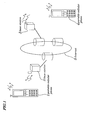
- FIG. 1 is a diagram schematically illustrating a relation between mobile telecommunication terminals (devices) , such as portable cellular phones 1, 4 and a network.
- Email transmitted from a portable cellular phone 1 enters a base station 2 and then passes through the Internet 5 and reaches another base station 3 existing near to a portable cellular phone 4 to which the email is transferred and the portable cellular phone 4 receives the email by exchanging electromagnetic waves with the base station 3.
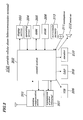
- FIG. 2 is a diagram showing configurations of the mobile telecommunication terminal (device), such as the portable cellular phone 1(4) according to the first embodiment of the present invention.
- a wireless communication section 201 manages a position storing slot, a signal transmitting slot, and a signal receiving slot (All not shown).
- the control section 202 transmits and receives email according to a program saved in a ROM (Read Only Memory) 206 and stores contents of each of the transmitted and received emails in a nonvolatile memory 213.
- ROM Read Only Memory
- the control section 202 has also a function of having a display section 203, VIB (vibrator) 208, LED (Light Emitting Diode) 209, speaker 210 inform a user of arrival of email when the mobile telecommunication terminal receives email.
- the mobile telecommunication terminal of the present invention which serves as a portable cellular phone, enables voice communications by being equipped with a microphone 211 and a receiver 212.
- FIG. 3 shows a flow of displaying on an email setting screen.
- "Email setting" 302 has setting items of "Email rule” 303 and "Folder setting” 304.
- the search condition includes a name of an email sender, an item name, or a search letter.
- an item of "deleting schedule” 306 can be programmed and by arbitrarily selecting one of items “at a time of date change", “on X day every week”, “on X day every month”, X hour Y minute every day", or "Not to be deleted", proper timing for deleting can be set.
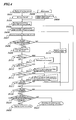
- Figure 4 shows operations to be performed when the mobile telecommunication terminal receives email on a waiting screen and operations to be performed when it makes an inquiry about contents of center mail at a server using the setting of "email menu" 301 (Fig. 3).
- the mobile telecommunication terminal after having received email from the server (S405), performs loop processing (S406) by the number of received pieces of email (that is, it repeats processes from S406 to S418) and another loop processing (S407) of the set rules A to H (that is, it repeats processes from S407 to S417) .
- the control section 202 makes a search as to whether there exists email that satisfies a search condition being designated by the rule X (S408) and, if there exists the email satisfying the condition, performs operations of deleting the email, of moving the email to a specified folder to which the email is to be moved, or of transferring the email (S409 to S418). Moreover, the control section 202, after having completed all the loop processing, if there is at least one rule whose condition are met while the loop processing is being performed and all the rules whose conditions are met are set so as not to perform incoming call operations (S419), does not perform the incoming call operations and returns the display to a previous state (S420). If even one rule by which incoming call operations are to be performed exists, the mobile telecommunication terminal moves to incoming call operations and displays an incoming call screen (S421).
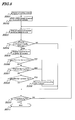
- Figure 5 is a flowchart explaining software operations for processing received email being stored to be performed when a clock within the mobile terminal is renewed by one minute.
- the mobile telecommunication terminal when a clock within the mobile terminal is renewed by one minute (S502), performs loop processing (S503) of contents saved in the folders A to H (that is, repeats the processings from S503 to S510).
- the mobile terminal judges whether or not a schedule of deleting email saved in the folder X is set (S504) and, if the schedule is set, reads contents preset in the deleting schedule (S505) and then compares present time within the mobile terminal with contents about time specified in the preset schedule and, if there is conformity between them, performs deleting of email saved in the corresponding folder (S506 to S509).
- Operations of a microprocessor in the control section 202 are controlled according to an email receiving operation program written in the ROM 206 (Fig. 2) within the mobile terminal and the microprocessor in the control section 202 controlled by program performs processing of receiving email, which is specified according to the program of email receiving operations.
- the present invention is applied to email to be received.
- the present invention is applied to email to be transmitted. That is, by specifying search conditions and actions, efficiency of using memory can be improved as well.
- the incoming call operations can be specified depending on importance of information. That is, according to the third embodiment, ringing sounds of the mobile terminal can be made when private information has arrived and no ringing sounds are made when information email contained in contents has arrived.
- the present invention is not limited to the above embodiments but may be changed and modified without departing from the scope and spirit of the invention.
- the present invention may be applied to not only a mobile telecommunication terminal, but the other electronic communication device such as a desktop type of Personal computer, a note type of Personal computer and a like.
Landscapes
- Engineering & Computer Science (AREA)
- Business, Economics & Management (AREA)
- Human Resources & Organizations (AREA)
- Entrepreneurship & Innovation (AREA)
- Strategic Management (AREA)
- Quality & Reliability (AREA)
- Physics & Mathematics (AREA)
- Economics (AREA)
- Marketing (AREA)
- Operations Research (AREA)
- Computer Hardware Design (AREA)
- Tourism & Hospitality (AREA)
- Data Mining & Analysis (AREA)
- General Business, Economics & Management (AREA)
- General Physics & Mathematics (AREA)
- Theoretical Computer Science (AREA)
- Information Transfer Between Computers (AREA)
- Telephonic Communication Services (AREA)
- Telephone Function (AREA)
- Data Exchanges In Wide-Area Networks (AREA)
Applications Claiming Priority (2)
| Application Number | Priority Date | Filing Date | Title |
|---|---|---|---|
| JP2003287589A JP2005056233A (ja) | 2003-08-06 | 2003-08-06 | 移動体通信装置、移動体通信装置の電子メールの受信動作方法及びその電子メールの受信動作プログラム |
| JP2003287589 | 2003-08-06 |
Publications (2)
| Publication Number | Publication Date |
|---|---|
| EP1536602A2 true EP1536602A2 (de) | 2005-06-01 |
| EP1536602A3 EP1536602A3 (de) | 2010-12-01 |
Family
ID=34190901
Family Applications (1)
| Application Number | Title | Priority Date | Filing Date |
|---|---|---|---|
| EP04018637A Withdrawn EP1536602A3 (de) | 2003-08-06 | 2004-08-05 | Elektronisches Kommunikationsgerät, -verfahren und -programm zum Empfangen von elektronischen Nachrichten auf einem elektronischen Kommunikationsgerät |
Country Status (4)
| Country | Link |
|---|---|
| US (1) | US20050043015A1 (de) |
| EP (1) | EP1536602A3 (de) |
| JP (1) | JP2005056233A (de) |
| CN (1) | CN1581193A (de) |
Families Citing this family (59)
| Publication number | Priority date | Publication date | Assignee | Title |
|---|---|---|---|---|
| US6826729B1 (en) * | 2001-06-29 | 2004-11-30 | Microsoft Corporation | Gallery user interface controls |
| US9715678B2 (en) * | 2003-06-26 | 2017-07-25 | Microsoft Technology Licensing, Llc | Side-by-side shared calendars |
| US7716593B2 (en) * | 2003-07-01 | 2010-05-11 | Microsoft Corporation | Conversation grouping of electronic mail records |
| US8799808B2 (en) * | 2003-07-01 | 2014-08-05 | Microsoft Corporation | Adaptive multi-line view user interface |
| US7392249B1 (en) * | 2003-07-01 | 2008-06-24 | Microsoft Corporation | Methods, systems, and computer-readable mediums for providing persisting and continuously updating search folders |
| US20050005249A1 (en) * | 2003-07-01 | 2005-01-06 | Microsoft Corporation | Combined content selection and display user interface |
| US7707255B2 (en) | 2003-07-01 | 2010-04-27 | Microsoft Corporation | Automatic grouping of electronic mail |
| US10437964B2 (en) | 2003-10-24 | 2019-10-08 | Microsoft Technology Licensing, Llc | Programming interface for licensing |
| US7580921B2 (en) * | 2004-07-26 | 2009-08-25 | Google Inc. | Phrase identification in an information retrieval system |
| US7711679B2 (en) | 2004-07-26 | 2010-05-04 | Google Inc. | Phrase-based detection of duplicate documents in an information retrieval system |
| US7567959B2 (en) | 2004-07-26 | 2009-07-28 | Google Inc. | Multiple index based information retrieval system |
| US7702618B1 (en) | 2004-07-26 | 2010-04-20 | Google Inc. | Information retrieval system for archiving multiple document versions |
| US9015621B2 (en) * | 2004-08-16 | 2015-04-21 | Microsoft Technology Licensing, Llc | Command user interface for displaying multiple sections of software functionality controls |
| US8255828B2 (en) | 2004-08-16 | 2012-08-28 | Microsoft Corporation | Command user interface for displaying selectable software functionality controls |
| US8146016B2 (en) * | 2004-08-16 | 2012-03-27 | Microsoft Corporation | User interface for displaying a gallery of formatting options applicable to a selected object |
| US7895531B2 (en) * | 2004-08-16 | 2011-02-22 | Microsoft Corporation | Floating command object |
| US7703036B2 (en) | 2004-08-16 | 2010-04-20 | Microsoft Corporation | User interface for displaying selectable software functionality controls that are relevant to a selected object |
| US8117542B2 (en) * | 2004-08-16 | 2012-02-14 | Microsoft Corporation | User interface for displaying selectable software functionality controls that are contextually relevant to a selected object |
| US7747966B2 (en) * | 2004-09-30 | 2010-06-29 | Microsoft Corporation | User interface for providing task management and calendar information |
| US9288078B2 (en) * | 2005-03-25 | 2016-03-15 | Qualcomm Incorporated | Apparatus and methods for managing content exchange on a wireless device |
| US7886290B2 (en) * | 2005-06-16 | 2011-02-08 | Microsoft Corporation | Cross version and cross product user interface |
| US8239882B2 (en) * | 2005-08-30 | 2012-08-07 | Microsoft Corporation | Markup based extensibility for user interfaces |
| US8689137B2 (en) * | 2005-09-07 | 2014-04-01 | Microsoft Corporation | Command user interface for displaying selectable functionality controls in a database application |
| US9542667B2 (en) | 2005-09-09 | 2017-01-10 | Microsoft Technology Licensing, Llc | Navigating messages within a thread |
| US7739259B2 (en) * | 2005-09-12 | 2010-06-15 | Microsoft Corporation | Integrated search and find user interface |
| US8627222B2 (en) | 2005-09-12 | 2014-01-07 | Microsoft Corporation | Expanded search and find user interface |
| US7627561B2 (en) * | 2005-09-12 | 2009-12-01 | Microsoft Corporation | Search and find using expanded search scope |
| KR100728686B1 (ko) | 2005-09-29 | 2007-06-15 | 엘지전자 주식회사 | 이동통신 단말기를 이용한 스케줄 관리방법 |
| US8321381B2 (en) * | 2005-12-19 | 2012-11-27 | Oracle International Corporation | Facilitating a sender of email communications to specify policies with which the email communication are to be managed as a record |
| US9727989B2 (en) | 2006-06-01 | 2017-08-08 | Microsoft Technology Licensing, Llc | Modifying and formatting a chart using pictorially provided chart elements |
| US8605090B2 (en) * | 2006-06-01 | 2013-12-10 | Microsoft Corporation | Modifying and formatting a chart using pictorially provided chart elements |
| US8208610B2 (en) | 2006-09-01 | 2012-06-26 | Research In Motion Limited | Handheld electronic device having service-specific message management feature support and associated method |
| EP1898347A1 (de) * | 2006-09-01 | 2008-03-12 | Research In Motion Limited | Tragbares elektronisches Gerät mit dienstspezifischen Nachrichtenmanagementsystem und Verfahren dazu |
| US8484578B2 (en) * | 2007-06-29 | 2013-07-09 | Microsoft Corporation | Communication between a document editor in-space user interface and a document editor out-space user interface |
| US8201103B2 (en) * | 2007-06-29 | 2012-06-12 | Microsoft Corporation | Accessing an out-space user interface for a document editor program |
| US8762880B2 (en) | 2007-06-29 | 2014-06-24 | Microsoft Corporation | Exposing non-authoring features through document status information in an out-space user interface |
| US8117223B2 (en) | 2007-09-07 | 2012-02-14 | Google Inc. | Integrating external related phrase information into a phrase-based indexing information retrieval system |
| US9588781B2 (en) * | 2008-03-31 | 2017-03-07 | Microsoft Technology Licensing, Llc | Associating command surfaces with multiple active components |
| US9665850B2 (en) * | 2008-06-20 | 2017-05-30 | Microsoft Technology Licensing, Llc | Synchronized conversation-centric message list and message reading pane |
| US8402096B2 (en) * | 2008-06-24 | 2013-03-19 | Microsoft Corporation | Automatic conversation techniques |
| WO2010107476A1 (en) * | 2009-03-19 | 2010-09-23 | Duke University | Inhibiting gsnor |
| US8799353B2 (en) * | 2009-03-30 | 2014-08-05 | Josef Larsson | Scope-based extensibility for control surfaces |
| US9046983B2 (en) | 2009-05-12 | 2015-06-02 | Microsoft Technology Licensing, Llc | Hierarchically-organized control galleries |
| JP2011055371A (ja) * | 2009-09-03 | 2011-03-17 | Fujitsu Ltd | 携帯端末装置、携帯端末制御方法及び携帯端末制御プログラム |
| US20110213845A1 (en) * | 2010-02-26 | 2011-09-01 | Research In Motion Limited | Automatic deletion of electronic messages |
| US8302014B2 (en) | 2010-06-11 | 2012-10-30 | Microsoft Corporation | Merging modifications to user interface components while preserving user customizations |
| US9148302B2 (en) | 2010-06-14 | 2015-09-29 | Blackberry Limited | Automatic full download of important emails |
| KR101735614B1 (ko) * | 2010-08-12 | 2017-05-15 | 엘지전자 주식회사 | 휴대 단말기 및 그 동작 제어방법 |
| US8650324B2 (en) * | 2011-04-27 | 2014-02-11 | Skype | System and method for reliable distributed communication with guaranteed service levels |
| KR101255223B1 (ko) * | 2011-08-22 | 2013-04-23 | 한국과학기술연구원 | 통신 단말기를 이용한 파일 업로드 시스템 및 그 방법 |
| CN102685334A (zh) * | 2012-06-08 | 2012-09-19 | 青岛海信移动通信技术股份有限公司 | 邮件删除方法、删除装置及手机 |
| US9729695B2 (en) | 2012-11-20 | 2017-08-08 | Dropbox Inc. | Messaging client application interface |
| US9935907B2 (en) | 2012-11-20 | 2018-04-03 | Dropbox, Inc. | System and method for serving a message client |
| US9654426B2 (en) | 2012-11-20 | 2017-05-16 | Dropbox, Inc. | System and method for organizing messages |
| CN104579923B (zh) * | 2014-12-27 | 2017-12-12 | 北京奇虎科技有限公司 | 邮件的接收处理方法与系统 |
| CN107800607A (zh) * | 2016-08-31 | 2018-03-13 | 腾讯科技(深圳)有限公司 | 一种清理邮箱数据的方法及装置 |
| US11985103B1 (en) | 2023-03-17 | 2024-05-14 | Mark Lambert | Electronic message client including dynamic prioritization based on sender features and serial undo functionality |
| US12574341B2 (en) | 2024-02-23 | 2026-03-10 | Mark Lambert | Generative artificial intelligence email client that is sender centric |
| US12651236B1 (en) | 2025-01-21 | 2026-06-09 | Mark Lambert | Visually representing various attributes of an electronic message for quick overview |
Family Cites Families (9)
| Publication number | Priority date | Publication date | Assignee | Title |
|---|---|---|---|---|
| US6073142A (en) * | 1997-06-23 | 2000-06-06 | Park City Group | Automated post office based rule analysis of e-mail messages and other data objects for controlled distribution in network environments |
| US20010054115A1 (en) * | 1998-05-29 | 2001-12-20 | Tabitha Ferguson | System and method for bundling information |
| US20020087649A1 (en) * | 2000-03-16 | 2002-07-04 | Horvitz Eric J. | Bounded-deferral policies for reducing the disruptiveness of notifications |
| US6772143B2 (en) * | 2001-01-02 | 2004-08-03 | Sprint Spectrum L.P. | Method and system for managing messages |
| JP2002318770A (ja) * | 2001-04-20 | 2002-10-31 | Nec Corp | 受信メール自動振り分け装置、受信メール自動振り分け方法、および受信メール自動振り分けプログラム |
| US20040240642A1 (en) * | 2001-06-18 | 2004-12-02 | Crandell Jeffrey L. | Apparatus, systems and methods for managing incoming and outgoing communication |
| US20030195937A1 (en) * | 2002-04-16 | 2003-10-16 | Kontact Software Inc. | Intelligent message screening |
| US7698276B2 (en) * | 2002-06-26 | 2010-04-13 | Microsoft Corporation | Framework for providing a subscription based notification system |
| US7200636B2 (en) * | 2002-11-01 | 2007-04-03 | Sun Microsystems, Inc. | Method and apparatus for applying personalized rules to e-mail messages at an e-mail server |
-
2003
- 2003-08-06 JP JP2003287589A patent/JP2005056233A/ja active Pending
-
2004
- 2004-08-05 EP EP04018637A patent/EP1536602A3/de not_active Withdrawn
- 2004-08-05 US US10/911,616 patent/US20050043015A1/en not_active Abandoned
- 2004-08-06 CN CN200410056018.XA patent/CN1581193A/zh active Pending
Non-Patent Citations (1)
| Title |
|---|
| None |
Also Published As
| Publication number | Publication date |
|---|---|
| US20050043015A1 (en) | 2005-02-24 |
| CN1581193A (zh) | 2005-02-16 |
| JP2005056233A (ja) | 2005-03-03 |
| EP1536602A3 (de) | 2010-12-01 |
Similar Documents
| Publication | Publication Date | Title |
|---|---|---|
| US20050043015A1 (en) | Electronic communication device, method and program for receiving email by electronic communication device | |
| US7212808B2 (en) | Unified message box for wireless mobile communication devices | |
| CN105955592B (zh) | 信息终端、用于信息终端的信息呈现方法、及信息呈现程序 | |
| US8116745B2 (en) | Method for displaying caller information of portable device | |
| US8103262B2 (en) | Method and system for forwarding calls placed to a telecommunications destination | |
| US7606599B2 (en) | Mobile terminal device | |
| JP4073365B2 (ja) | 通信端末 | |
| JP2004178294A (ja) | 関連する電子メールを表示する携帯端末、電子メール表示方法、及びプログラム | |
| EP1655932A2 (de) | Tragbares Mobiltelefon, tragbares zellulares Telefonsystem, Verfahren zur Steuerung von Nachrichtenformaten und Programm zur Nachrichtenformatsteuerung | |
| CN101605308A (zh) | 一种短消息的管理方法 | |
| US7792521B2 (en) | Method, apparatus, and computer program product for managing content items | |
| JP2009135855A (ja) | メール送受信機能を有する通信端末、メール返信催促方法およびシステム | |
| JP2007249372A (ja) | 電子メール送受信システム及び電子メール送受信方法並びにメール送信端末装置,メール受信端末装置 | |
| JP2004062788A (ja) | 携帯端末、電子メール管理方法および電子メール管理プログラム | |
| JP2004147070A (ja) | 通信端末および通信端末の電子メール検索方法 | |
| JP2005149372A (ja) | 携帯端末 | |
| KR101246866B1 (ko) | 멀티미디어 메시지 서비스를 이용한 다수의 비쥬얼오브젝트 전송방법 및 이를 수행하기 위한 이동통신단말기 | |
| KR100693427B1 (ko) | 이동통신 단말기의 메시지 표시 방법 | |
| JP2000197131A (ja) | 文字メッセ―ジ機能付き携帯電話機 | |
| JP2008225719A (ja) | 携帯端末及びメール表示方法 | |
| JP2002351798A (ja) | 携帯無線機及び該携帯無線機を用いた電子メールの受信方法 | |
| KR100662102B1 (ko) | 메시지 전송 방법 및 메시지 전송 기능을 구비한 휴대형 단말기 | |
| KR20050052173A (ko) | 이동 통신 단말기의 메시지 수신 방법 | |
| JP2006227898A (ja) | 携帯通信端末 | |
| JP2008205798A (ja) | 情報通信端末 |
Legal Events
| Date | Code | Title | Description |
|---|---|---|---|
| PUAI | Public reference made under article 153(3) epc to a published international application that has entered the european phase |
Free format text: ORIGINAL CODE: 0009012 |
|
| AK | Designated contracting states |
Kind code of ref document: A2 Designated state(s): AT BE BG CH CY CZ DE DK EE ES FI FR GB GR HU IE IT LI LU MC NL PL PT RO SE SI SK TR |
|
| AX | Request for extension of the european patent |
Extension state: AL HR LT LV MK |
|
| PUAL | Search report despatched |
Free format text: ORIGINAL CODE: 0009013 |
|
| AK | Designated contracting states |
Kind code of ref document: A3 Designated state(s): AT BE BG CH CY CZ DE DK EE ES FI FR GB GR HU IE IT LI LU MC NL PL PT RO SE SI SK TR |
|
| AX | Request for extension of the european patent |
Extension state: AL HR LT LV MK |
|
| 17P | Request for examination filed |
Effective date: 20101217 |
|
| AKX | Designation fees paid |
Designated state(s): DE FR GB IT |
|
| 17Q | First examination report despatched |
Effective date: 20111219 |
|
| STAA | Information on the status of an ep patent application or granted ep patent |
Free format text: STATUS: THE APPLICATION IS DEEMED TO BE WITHDRAWN |
|
| 18D | Application deemed to be withdrawn |
Effective date: 20160301 |