EP1534404B1 - Verwendung eines clathratmodifizierers zur forderung des durchgangs von proteinen bei nanofiltration - Google Patents
Verwendung eines clathratmodifizierers zur forderung des durchgangs von proteinen bei nanofiltration Download PDFInfo
- Publication number
- EP1534404B1 EP1534404B1 EP03734372A EP03734372A EP1534404B1 EP 1534404 B1 EP1534404 B1 EP 1534404B1 EP 03734372 A EP03734372 A EP 03734372A EP 03734372 A EP03734372 A EP 03734372A EP 1534404 B1 EP1534404 B1 EP 1534404B1
- Authority
- EP
- European Patent Office
- Prior art keywords
- protein
- buffer
- polyol
- concentration
- sugar
- Prior art date
- Legal status (The legal status is an assumption and is not a legal conclusion. Google has not performed a legal analysis and makes no representation as to the accuracy of the status listed.)
- Expired - Lifetime
Links
- 102000004169 proteins and genes Human genes 0.000 title claims description 48
- 108090000623 proteins and genes Proteins 0.000 title claims description 48
- 238000001728 nano-filtration Methods 0.000 title claims description 14
- 239000003607 modifier Substances 0.000 title description 11
- 239000000463 material Substances 0.000 claims abstract description 17
- 238000000034 method Methods 0.000 claims description 28
- 239000000872 buffer Substances 0.000 claims description 27
- 239000012528 membrane Substances 0.000 claims description 23
- 108060003951 Immunoglobulin Proteins 0.000 claims description 17
- 102000018358 immunoglobulin Human genes 0.000 claims description 17
- 239000002245 particle Substances 0.000 claims description 14
- 229920005862 polyol Polymers 0.000 claims description 14
- 150000003077 polyols Chemical class 0.000 claims description 13
- 150000005846 sugar alcohols Chemical class 0.000 claims description 12
- 125000002887 hydroxy group Chemical group [H]O* 0.000 claims description 11
- CZMRCDWAGMRECN-UGDNZRGBSA-N Sucrose Chemical compound O[C@H]1[C@H](O)[C@@H](CO)O[C@@]1(CO)O[C@@H]1[C@H](O)[C@@H](O)[C@H](O)[C@@H](CO)O1 CZMRCDWAGMRECN-UGDNZRGBSA-N 0.000 claims description 8
- 229930006000 Sucrose Natural products 0.000 claims description 8
- 239000005720 sucrose Substances 0.000 claims description 8
- 235000000346 sugar Nutrition 0.000 claims description 8
- 230000003612 virological effect Effects 0.000 claims description 7
- 230000003993 interaction Effects 0.000 claims description 5
- 150000002772 monosaccharides Chemical class 0.000 claims description 5
- 150000002016 disaccharides Chemical class 0.000 claims description 4
- 239000002736 nonionic surfactant Substances 0.000 claims description 4
- 239000007853 buffer solution Substances 0.000 claims description 3
- 238000011045 prefiltration Methods 0.000 claims description 2
- 239000013014 purified material Substances 0.000 claims description 2
- 239000004094 surface-active agent Substances 0.000 claims description 2
- 239000011148 porous material Substances 0.000 abstract description 20
- 230000007717 exclusion Effects 0.000 abstract description 6
- 239000000356 contaminant Substances 0.000 abstract description 3
- 244000052613 viral pathogen Species 0.000 abstract description 3
- 238000001742 protein purification Methods 0.000 abstract description 2
- 238000011084 recovery Methods 0.000 abstract description 2
- 238000001914 filtration Methods 0.000 description 15
- 239000000047 product Substances 0.000 description 14
- 230000008569 process Effects 0.000 description 10
- 239000000126 substance Substances 0.000 description 10
- 241000700605 Viruses Species 0.000 description 9
- 150000003839 salts Chemical class 0.000 description 7
- 239000000243 solution Substances 0.000 description 7
- 230000002776 aggregation Effects 0.000 description 6
- 238000004220 aggregation Methods 0.000 description 6
- 229940072221 immunoglobulins Drugs 0.000 description 6
- 238000000926 separation method Methods 0.000 description 6
- 150000001875 compounds Chemical class 0.000 description 5
- 239000012530 fluid Substances 0.000 description 5
- 229920000053 polysorbate 80 Polymers 0.000 description 5
- 238000012545 processing Methods 0.000 description 5
- 230000009467 reduction Effects 0.000 description 5
- SRBFZHDQGSBBOR-IOVATXLUSA-N D-xylopyranose Chemical compound O[C@@H]1COC(O)[C@H](O)[C@H]1O SRBFZHDQGSBBOR-IOVATXLUSA-N 0.000 description 4
- 230000008859 change Effects 0.000 description 4
- 230000007423 decrease Effects 0.000 description 4
- 239000003599 detergent Substances 0.000 description 4
- 238000012544 monitoring process Methods 0.000 description 4
- 235000010482 polyoxyethylene sorbitan monooleate Nutrition 0.000 description 4
- 239000012465 retentate Substances 0.000 description 4
- 238000007873 sieving Methods 0.000 description 4
- XSQUKJJJFZCRTK-UHFFFAOYSA-N Urea Chemical compound NC(N)=O XSQUKJJJFZCRTK-UHFFFAOYSA-N 0.000 description 3
- PYMYPHUHKUWMLA-UHFFFAOYSA-N arabinose Natural products OCC(O)C(O)C(O)C=O PYMYPHUHKUWMLA-UHFFFAOYSA-N 0.000 description 3
- SRBFZHDQGSBBOR-UHFFFAOYSA-N beta-D-Pyranose-Lyxose Natural products OC1COC(O)C(O)C1O SRBFZHDQGSBBOR-UHFFFAOYSA-N 0.000 description 3
- 102000034238 globular proteins Human genes 0.000 description 3
- 108091005896 globular proteins Proteins 0.000 description 3
- 230000002209 hydrophobic effect Effects 0.000 description 3
- 229920000136 polysorbate Polymers 0.000 description 3
- 238000000746 purification Methods 0.000 description 3
- WQZGKKKJIJFFOK-GASJEMHNSA-N Glucose Natural products OC[C@H]1OC(O)[C@H](O)[C@@H](O)[C@@H]1O WQZGKKKJIJFFOK-GASJEMHNSA-N 0.000 description 2
- DHMQDGOQFOQNFH-UHFFFAOYSA-N Glycine Chemical compound NCC(O)=O DHMQDGOQFOQNFH-UHFFFAOYSA-N 0.000 description 2
- QIGBRXMKCJKVMJ-UHFFFAOYSA-N Hydroquinone Chemical compound OC1=CC=C(O)C=C1 QIGBRXMKCJKVMJ-UHFFFAOYSA-N 0.000 description 2
- LKDRXBCSQODPBY-AMVSKUEXSA-N L-(-)-Sorbose Chemical compound OCC1(O)OC[C@H](O)[C@@H](O)[C@@H]1O LKDRXBCSQODPBY-AMVSKUEXSA-N 0.000 description 2
- 239000006057 Non-nutritive feed additive Substances 0.000 description 2
- 238000005411 Van der Waals force Methods 0.000 description 2
- 239000000654 additive Substances 0.000 description 2
- 230000008901 benefit Effects 0.000 description 2
- WQZGKKKJIJFFOK-VFUOTHLCSA-N beta-D-glucose Chemical compound OC[C@H]1O[C@@H](O)[C@H](O)[C@@H](O)[C@@H]1O WQZGKKKJIJFFOK-VFUOTHLCSA-N 0.000 description 2
- 239000013078 crystal Substances 0.000 description 2
- 230000003247 decreasing effect Effects 0.000 description 2
- 239000008103 glucose Substances 0.000 description 2
- 230000001965 increasing effect Effects 0.000 description 2
- 238000004519 manufacturing process Methods 0.000 description 2
- 238000005259 measurement Methods 0.000 description 2
- 238000005374 membrane filtration Methods 0.000 description 2
- -1 polyol sugars Chemical class 0.000 description 2
- 239000000244 polyoxyethylene sorbitan monooleate Substances 0.000 description 2
- 230000004845 protein aggregation Effects 0.000 description 2
- 241000894007 species Species 0.000 description 2
- 150000008163 sugars Chemical class 0.000 description 2
- UMGDCJDMYOKAJW-UHFFFAOYSA-N thiourea Chemical compound NC(N)=S UMGDCJDMYOKAJW-UHFFFAOYSA-N 0.000 description 2
- OWEGMIWEEQEYGQ-UHFFFAOYSA-N 100676-05-9 Natural products OC1C(O)C(O)C(CO)OC1OCC1C(O)C(O)C(O)C(OC2C(OC(O)C(O)C2O)CO)O1 OWEGMIWEEQEYGQ-UHFFFAOYSA-N 0.000 description 1
- HOSGXJWQVBHGLT-UHFFFAOYSA-N 6-hydroxy-3,4-dihydro-1h-quinolin-2-one Chemical group N1C(=O)CCC2=CC(O)=CC=C21 HOSGXJWQVBHGLT-UHFFFAOYSA-N 0.000 description 1
- GUBGYTABKSRVRQ-XLOQQCSPSA-N Alpha-Lactose Chemical compound O[C@@H]1[C@@H](O)[C@@H](O)[C@@H](CO)O[C@H]1O[C@@H]1[C@@H](CO)O[C@H](O)[C@H](O)[C@H]1O GUBGYTABKSRVRQ-XLOQQCSPSA-N 0.000 description 1
- 102000007592 Apolipoproteins Human genes 0.000 description 1
- 108010071619 Apolipoproteins Proteins 0.000 description 1
- 102000015081 Blood Coagulation Factors Human genes 0.000 description 1
- 108010039209 Blood Coagulation Factors Proteins 0.000 description 1
- BTBUEUYNUDRHOZ-UHFFFAOYSA-N Borate Chemical compound [O-]B([O-])[O-] BTBUEUYNUDRHOZ-UHFFFAOYSA-N 0.000 description 1
- YTBSYETUWUMLBZ-UHFFFAOYSA-N D-Erythrose Natural products OCC(O)C(O)C=O YTBSYETUWUMLBZ-UHFFFAOYSA-N 0.000 description 1
- FBPFZTCFMRRESA-FSIIMWSLSA-N D-Glucitol Natural products OC[C@H](O)[C@H](O)[C@@H](O)[C@H](O)CO FBPFZTCFMRRESA-FSIIMWSLSA-N 0.000 description 1
- FBPFZTCFMRRESA-KVTDHHQDSA-N D-Mannitol Chemical compound OC[C@@H](O)[C@@H](O)[C@H](O)[C@H](O)CO FBPFZTCFMRRESA-KVTDHHQDSA-N 0.000 description 1
- YTBSYETUWUMLBZ-IUYQGCFVSA-N D-erythrose Chemical compound OC[C@@H](O)[C@@H](O)C=O YTBSYETUWUMLBZ-IUYQGCFVSA-N 0.000 description 1
- FBPFZTCFMRRESA-JGWLITMVSA-N D-glucitol Chemical compound OC[C@H](O)[C@@H](O)[C@H](O)[C@H](O)CO FBPFZTCFMRRESA-JGWLITMVSA-N 0.000 description 1
- HMFHBZSHGGEWLO-SOOFDHNKSA-N D-ribofuranose Chemical compound OC[C@H]1OC(O)[C@H](O)[C@@H]1O HMFHBZSHGGEWLO-SOOFDHNKSA-N 0.000 description 1
- 102000004190 Enzymes Human genes 0.000 description 1
- 108090000790 Enzymes Proteins 0.000 description 1
- 239000004386 Erythritol Substances 0.000 description 1
- UNXHWFMMPAWVPI-UHFFFAOYSA-N Erythritol Natural products OCC(O)C(O)CO UNXHWFMMPAWVPI-UHFFFAOYSA-N 0.000 description 1
- 206010056474 Erythrosis Diseases 0.000 description 1
- 229930091371 Fructose Natural products 0.000 description 1
- RFSUNEUAIZKAJO-ARQDHWQXSA-N Fructose Chemical compound OC[C@H]1O[C@](O)(CO)[C@@H](O)[C@@H]1O RFSUNEUAIZKAJO-ARQDHWQXSA-N 0.000 description 1
- 239000005715 Fructose Substances 0.000 description 1
- 239000004471 Glycine Substances 0.000 description 1
- 241000702617 Human parvovirus B19 Species 0.000 description 1
- GUBGYTABKSRVRQ-QKKXKWKRSA-N Lactose Natural products OC[C@H]1O[C@@H](O[C@H]2[C@H](O)[C@@H](O)C(O)O[C@@H]2CO)[C@H](O)[C@@H](O)[C@H]1O GUBGYTABKSRVRQ-QKKXKWKRSA-N 0.000 description 1
- GUBGYTABKSRVRQ-PICCSMPSSA-N Maltose Natural products O[C@@H]1[C@@H](O)[C@H](O)[C@@H](CO)O[C@@H]1O[C@@H]1[C@@H](CO)OC(O)[C@H](O)[C@H]1O GUBGYTABKSRVRQ-PICCSMPSSA-N 0.000 description 1
- 229930195725 Mannitol Natural products 0.000 description 1
- 229920003171 Poly (ethylene oxide) Polymers 0.000 description 1
- 239000004743 Polypropylene Substances 0.000 description 1
- PYMYPHUHKUWMLA-LMVFSUKVSA-N Ribose Natural products OC[C@@H](O)[C@@H](O)[C@@H](O)C=O PYMYPHUHKUWMLA-LMVFSUKVSA-N 0.000 description 1
- VMHLLURERBWHNL-UHFFFAOYSA-M Sodium acetate Chemical compound [Na+].CC([O-])=O VMHLLURERBWHNL-UHFFFAOYSA-M 0.000 description 1
- TVXBFESIOXBWNM-UHFFFAOYSA-N Xylitol Natural products OCCC(O)C(O)C(O)CCO TVXBFESIOXBWNM-UHFFFAOYSA-N 0.000 description 1
- 239000008351 acetate buffer Substances 0.000 description 1
- HMFHBZSHGGEWLO-UHFFFAOYSA-N alpha-D-Furanose-Ribose Natural products OCC1OC(O)C(O)C1O HMFHBZSHGGEWLO-UHFFFAOYSA-N 0.000 description 1
- WQZGKKKJIJFFOK-PHYPRBDBSA-N alpha-D-galactose Chemical group OC[C@H]1O[C@H](O)[C@H](O)[C@@H](O)[C@H]1O WQZGKKKJIJFFOK-PHYPRBDBSA-N 0.000 description 1
- 238000001286 analytical centrifugation Methods 0.000 description 1
- 125000000089 arabinosyl group Chemical group C1([C@@H](O)[C@H](O)[C@H](O)CO1)* 0.000 description 1
- GUBGYTABKSRVRQ-QUYVBRFLSA-N beta-maltose Chemical compound OC[C@H]1O[C@H](O[C@H]2[C@H](O)[C@@H](O)[C@H](O)O[C@@H]2CO)[C@H](O)[C@@H](O)[C@@H]1O GUBGYTABKSRVRQ-QUYVBRFLSA-N 0.000 description 1
- 230000015572 biosynthetic process Effects 0.000 description 1
- 239000003114 blood coagulation factor Substances 0.000 description 1
- 229940019700 blood coagulation factors Drugs 0.000 description 1
- 230000003139 buffering effect Effects 0.000 description 1
- 239000004202 carbamide Substances 0.000 description 1
- 238000005341 cation exchange Methods 0.000 description 1
- 238000012512 characterization method Methods 0.000 description 1
- 239000007795 chemical reaction product Substances 0.000 description 1
- 239000013626 chemical specie Substances 0.000 description 1
- 239000007979 citrate buffer Substances 0.000 description 1
- 239000000084 colloidal system Substances 0.000 description 1
- 238000004891 communication Methods 0.000 description 1
- 239000012141 concentrate Substances 0.000 description 1
- 230000001276 controlling effect Effects 0.000 description 1
- 229920001577 copolymer Polymers 0.000 description 1
- 230000002596 correlated effect Effects 0.000 description 1
- 238000006471 dimerization reaction Methods 0.000 description 1
- 230000003467 diminishing effect Effects 0.000 description 1
- 230000000694 effects Effects 0.000 description 1
- 238000010828 elution Methods 0.000 description 1
- 230000002708 enhancing effect Effects 0.000 description 1
- 230000007613 environmental effect Effects 0.000 description 1
- UNXHWFMMPAWVPI-ZXZARUISSA-N erythritol Chemical compound OC[C@H](O)[C@H](O)CO UNXHWFMMPAWVPI-ZXZARUISSA-N 0.000 description 1
- 235000019414 erythritol Nutrition 0.000 description 1
- 229940009714 erythritol Drugs 0.000 description 1
- 238000009472 formulation Methods 0.000 description 1
- 239000012634 fragment Substances 0.000 description 1
- 229930182830 galactose Natural products 0.000 description 1
- 239000007789 gas Substances 0.000 description 1
- 238000001879 gelation Methods 0.000 description 1
- 150000004676 glycans Chemical class 0.000 description 1
- 239000000122 growth hormone Substances 0.000 description 1
- 208000005252 hepatitis A Diseases 0.000 description 1
- 208000002672 hepatitis B Diseases 0.000 description 1
- 239000001257 hydrogen Substances 0.000 description 1
- 229910052739 hydrogen Inorganic materials 0.000 description 1
- 230000007062 hydrolysis Effects 0.000 description 1
- 238000006460 hydrolysis reaction Methods 0.000 description 1
- 229940027941 immunoglobulin g Drugs 0.000 description 1
- 238000002347 injection Methods 0.000 description 1
- 239000007924 injection Substances 0.000 description 1
- 238000009434 installation Methods 0.000 description 1
- 239000008101 lactose Substances 0.000 description 1
- 239000007788 liquid Substances 0.000 description 1
- 238000012423 maintenance Methods 0.000 description 1
- 239000000594 mannitol Substances 0.000 description 1
- 235000010355 mannitol Nutrition 0.000 description 1
- 238000009285 membrane fouling Methods 0.000 description 1
- HEBKCHPVOIAQTA-UHFFFAOYSA-N meso ribitol Natural products OCC(O)C(O)C(O)CO HEBKCHPVOIAQTA-UHFFFAOYSA-N 0.000 description 1
- 239000000203 mixture Substances 0.000 description 1
- 238000012986 modification Methods 0.000 description 1
- 230000004048 modification Effects 0.000 description 1
- 238000006386 neutralization reaction Methods 0.000 description 1
- 244000309711 non-enveloped viruses Species 0.000 description 1
- 244000052769 pathogen Species 0.000 description 1
- 230000001717 pathogenic effect Effects 0.000 description 1
- 239000012466 permeate Substances 0.000 description 1
- 239000000546 pharmaceutical excipient Substances 0.000 description 1
- 239000008363 phosphate buffer Substances 0.000 description 1
- 230000010287 polarization Effects 0.000 description 1
- 229920001983 poloxamer Polymers 0.000 description 1
- 229920000642 polymer Polymers 0.000 description 1
- 229920001184 polypeptide Polymers 0.000 description 1
- 229920001155 polypropylene Polymers 0.000 description 1
- 229920001282 polysaccharide Polymers 0.000 description 1
- 239000005017 polysaccharide Substances 0.000 description 1
- 229950008882 polysorbate Drugs 0.000 description 1
- 229940068968 polysorbate 80 Drugs 0.000 description 1
- 229940068965 polysorbates Drugs 0.000 description 1
- 238000001556 precipitation Methods 0.000 description 1
- 102000004196 processed proteins & peptides Human genes 0.000 description 1
- 108090000765 processed proteins & peptides Proteins 0.000 description 1
- 238000003672 processing method Methods 0.000 description 1
- 230000004850 protein–protein interaction Effects 0.000 description 1
- 238000001223 reverse osmosis Methods 0.000 description 1
- 238000004062 sedimentation Methods 0.000 description 1
- 239000001632 sodium acetate Substances 0.000 description 1
- 235000017281 sodium acetate Nutrition 0.000 description 1
- 239000007974 sodium acetate buffer Substances 0.000 description 1
- 239000000600 sorbitol Substances 0.000 description 1
- 238000001179 sorption measurement Methods 0.000 description 1
- 230000001225 therapeutic effect Effects 0.000 description 1
- 238000005829 trimerization reaction Methods 0.000 description 1
- 238000000108 ultra-filtration Methods 0.000 description 1
- 229920002554 vinyl polymer Polymers 0.000 description 1
- 239000013621 viresolve pro solution Substances 0.000 description 1
- XLYOFNOQVPJJNP-UHFFFAOYSA-N water Substances O XLYOFNOQVPJJNP-UHFFFAOYSA-N 0.000 description 1
- 239000000811 xylitol Substances 0.000 description 1
- HEBKCHPVOIAQTA-SCDXWVJYSA-N xylitol Chemical compound OC[C@H](O)[C@@H](O)[C@H](O)CO HEBKCHPVOIAQTA-SCDXWVJYSA-N 0.000 description 1
- 235000010447 xylitol Nutrition 0.000 description 1
- 229960002675 xylitol Drugs 0.000 description 1
Images
Classifications
-
- C—CHEMISTRY; METALLURGY
- C07—ORGANIC CHEMISTRY
- C07K—PEPTIDES
- C07K1/00—General methods for the preparation of peptides, i.e. processes for the organic chemical preparation of peptides or proteins of any length
- C07K1/14—Extraction; Separation; Purification
- C07K1/36—Extraction; Separation; Purification by a combination of two or more processes of different types
-
- B—PERFORMING OPERATIONS; TRANSPORTING
- B01—PHYSICAL OR CHEMICAL PROCESSES OR APPARATUS IN GENERAL
- B01D—SEPARATION
- B01D61/00—Processes of separation using semi-permeable membranes, e.g. dialysis, osmosis or ultrafiltration; Apparatus, accessories or auxiliary operations specially adapted therefor
- B01D61/02—Reverse osmosis; Hyperfiltration ; Nanofiltration
- B01D61/027—Nanofiltration
-
- B—PERFORMING OPERATIONS; TRANSPORTING
- B01—PHYSICAL OR CHEMICAL PROCESSES OR APPARATUS IN GENERAL
- B01D—SEPARATION
- B01D61/00—Processes of separation using semi-permeable membranes, e.g. dialysis, osmosis or ultrafiltration; Apparatus, accessories or auxiliary operations specially adapted therefor
- B01D61/02—Reverse osmosis; Hyperfiltration ; Nanofiltration
- B01D61/04—Feed pretreatment
-
- C—CHEMISTRY; METALLURGY
- C07—ORGANIC CHEMISTRY
- C07K—PEPTIDES
- C07K1/00—General methods for the preparation of peptides, i.e. processes for the organic chemical preparation of peptides or proteins of any length
- C07K1/14—Extraction; Separation; Purification
- C07K1/34—Extraction; Separation; Purification by filtration, ultrafiltration or reverse osmosis
-
- B—PERFORMING OPERATIONS; TRANSPORTING
- B01—PHYSICAL OR CHEMICAL PROCESSES OR APPARATUS IN GENERAL
- B01D—SEPARATION
- B01D2311/00—Details relating to membrane separation process operations and control
- B01D2311/04—Specific process operations in the feed stream; Feed pretreatment
-
- Y—GENERAL TAGGING OF NEW TECHNOLOGICAL DEVELOPMENTS; GENERAL TAGGING OF CROSS-SECTIONAL TECHNOLOGIES SPANNING OVER SEVERAL SECTIONS OF THE IPC; TECHNICAL SUBJECTS COVERED BY FORMER USPC CROSS-REFERENCE ART COLLECTIONS [XRACs] AND DIGESTS
- Y10—TECHNICAL SUBJECTS COVERED BY FORMER USPC
- Y10T—TECHNICAL SUBJECTS COVERED BY FORMER US CLASSIFICATION
- Y10T436/00—Chemistry: analytical and immunological testing
- Y10T436/25—Chemistry: analytical and immunological testing including sample preparation
- Y10T436/25375—Liberation or purification of sample or separation of material from a sample [e.g., filtering, centrifuging, etc.]
-
- Y—GENERAL TAGGING OF NEW TECHNOLOGICAL DEVELOPMENTS; GENERAL TAGGING OF CROSS-SECTIONAL TECHNOLOGIES SPANNING OVER SEVERAL SECTIONS OF THE IPC; TECHNICAL SUBJECTS COVERED BY FORMER USPC CROSS-REFERENCE ART COLLECTIONS [XRACs] AND DIGESTS
- Y10—TECHNICAL SUBJECTS COVERED BY FORMER USPC
- Y10T—TECHNICAL SUBJECTS COVERED BY FORMER US CLASSIFICATION
- Y10T436/00—Chemistry: analytical and immunological testing
- Y10T436/25—Chemistry: analytical and immunological testing including sample preparation
- Y10T436/25375—Liberation or purification of sample or separation of material from a sample [e.g., filtering, centrifuging, etc.]
- Y10T436/255—Liberation or purification of sample or separation of material from a sample [e.g., filtering, centrifuging, etc.] including use of a solid sorbent, semipermeable membrane, or liquid extraction
Definitions
- the invention relates to the field of protein purification and the recovery of large proteinaceous material through small, nanometer sized, pore exclusion filters for removal of contaminants such as viral pathogens.
- the invention relates to the use of additives to promote solubility of proteins in solutions being filtered for the purpose of removing pathogens, particularly viral pathogens, and has particular applicability to the purification of large proteinaceous biomolecules such as immunoglobulins.
- Liquid and gas separation processes are well known in the art. Most common separation processes involve a phase change, which increases the cost of the processes and often requires excessive temperature changes which can alter the product. Membrane separations, however, can achieve desired levels of separation without a change in the substances' phase. In essence, membrane separation selectively forces one or more substances through pores of a filter, leaving one or more larger substances behind. This process is often repeated with diminishing filter pore sizes until a satisfactory level of separation is achieved.
- nanofiltration to remove contaminants such as virus particles from parenteral protein products is based upon the ability of a filter of defined pore size to allow a soluble protein to pass through while denying passage of the larger viral particles (DiLeo, AJ, et al, BioTechnology 1992, 10: 182, 188.) Removal of virus from large biomolecules such as immunoglobulins (monoclonal or polyclonal antibodies), by size exclusion, is hindered by the difficulty of passing the large biomolecules through pore sizes of nanometer size, typically 12-15 nm.
- WO 9600237 describes methods for successful nanofiltration using pore sizes as small as 15 nm to filter purified proteins of molecular weight less than 150 kDa.
- WO 9600237 discloses the use of salt concentrations lying in the range from about 0.2 M up to saturation of the solution in virus-filtering of proteins, polysaccharides, and polypeptides to increase sieving coefficients.
- the advantage of the salt is stated by the applicants to be because the "protein contracts" and more easily passes through the filter.
- the use of a high salt content according to this method is also suggested to enable the use of "dead-end" filtering with membranes having pore sizes of 5 - 30 nm.
- Dead-end filtering refers to the practice of using a single pump to force fluid through the membrane from the surface. Dead-end filtration is simpler and more cost effective than tangential filtering process wherein a first pump maintains constant flow rate at the surface of the membrane and a second pump draws the protein through the filter by creating a negative pressure (suction) at the back of the membrane.
- U.S. 6,096,872 recognized the utility of adding surfactants along with high ionic strength buffering during nanofiltration to remove viruses from immunoglobulin containing solutions in order to reduce protein dimerization, trimerization and aggregation, the teachings of which are hereby incorporated herein by reference.
- WO 9837086 teaches the addition of buffer to the retentate in order to maintain transmembrane pressure during tangential flow of a pretreatment step to remove proteins having a molecular weight greater than that of the product protein(s). WO 9837086 further notes that nanofiltration is limited to therapeutic proteins having a molecular weight up to 150 kDa.
- Immunoglobulin G molecules are composed of two heavy chains and two light chain polypetides all covalently linked and have an average molecular weight of about 180 kDa.
- 6,096,872 seeks to address the problem of how to filter viruses from IgG products by including a non-ionic excipient with relatively high (physiological which is about 300 mOsm) ionic strength buffer.
- the use of high ionic strength buffers may lead to protein aggregation or create the problem of salt removal from the product formulation.
- U.S. 6,096,872 teaches and claims a second nanofiltration step to concentrate the immunoglobulin and collect it in a low ionic strength buffer.
- the molecular configuration or size of a protein species has been predicted by changes in the partial specific volume and self-association of proteins.
- the change in partial specific volume of proteins so modified has been demonstrated by the independent measurements of sedimentation coefficients using analytical centrifugation.
- the method described herein uses the addition of a clathrate modifying substance to modify the molecular configuration of the protein to minimize specific volume and aggregation thereby enhancing passage of the protein through the membrane in a nanofiltration process.
- the method of the invention maximizes protein passage during membrane filtration by using buffer additives aimed to increase the hydrophobicity of the membrane surface and decrease the hydrodynamic radius of the protein as well as reduce the tendency for the self-association of the protein desired to be filtered.
- the method of the invention first maximizes protein passage by decreasing the pH and the salt of the buffer which increases the hydrophobicity of the membrane surface and decreases the hydrodynamic radius of the protein.
- a clathrate modifer is included in the buffer which modifier decreases the hydrodynamic radius of the protein while minimizing the tendencies for the protein to associate with either itself or the membrane filter.
- the clathrate modifier is a polyol sugar or sugar alcohol having from 4 to 8 hydroxyl groups.
- the process optionally includes continuous in-line monitoring of the filtration in order to maintain the above parameters of pH and clathrate modifier constant while maintaining low local levels of soluble protein.
- the use of the methods of the invention result in an increase in sieving coefficient and the ability to maintain reduced trans-membrane pressure during virus particle filtration.
- the process is applicable to the purification of any large proteinaceous biomolecule, particularly immunoglobulins.
- the immunoglobulins may be a monoclonal or polyclonal immunoglobulin.
- the clathrate modifier of the present invention is a polyol sugar or sugar alcohol having from 4 to 8 hydroxyl groups.
- preferred polyols are sugars, including mono-saccharides and disaccharides preferably sucrose.
- the concentration of the polyol used as the clathrate modifier will generally be 5% w/v or greater.
- sucrose causes a decrease in the size of the molecule and a reduction in the tendency for self-association of the protein desired to be freed from virus particles.
- the invention contemplates a method for purifying a proteinacious material such as an immunoglobulin comprising the steps of:
- the method of the invention may also include conducting an in-line pre-filtering step and monitoring the concentration of the material by installing an in-line concentration controlling monitor to maintain the parameters of pH, and protein concentration within pre-set ranges optimal for the material being purified.
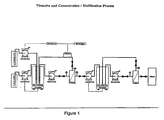
- Fig. 1. Is a schematic representation of the vessels and monitoring equipment used in nanofiltration and the direction of fluid flow.
- the instant invention uses a combination of selection of buffer, non-ionic surfactant and the use of the clathrate modifier of the present invention as processing aids during viral reduction or viral clearances using size exclusion nanofiltration for purification of large proteinaceous biomolecules.
- the invention allows a small pore size exclusion nanofilter to be used with a globular protein molecule such as an immunoglobulin in a manner which allows for efficient flowthrough, minimal yield loss and no significant change in the immunoglobulin characterization aggregate level or stability.
- Virus removed from the proteinaceous material by the nanofiltration method of the invention include all potential categories of virus, both enveloped (for example HIV, Hepatitis B) and non-enveloped (for example Hepatitis A, Parvovirus B19).
- a clathrate is a molecular association in which the result may form a particle.
- Clathrates are included among those complexes in which one component (the host) forms a cavity or, in the case of a crystal, a crystal lattice containing spaces in the shape of long tunnels or channels in which molecular entities of a second chemical species (the guest) are located. There is no covalent bonding between guest and host, the attraction being generally due to van der Waals forces. If the spaces in the host lattice are enclosed on all sides so that the guest species is "trapped" as in a cage, such compounds are known as “clathrates" or "cage” compounds”.
- van der Waals forces and hydrophobic interactions bind the guest to the host molecule in clathrates and inclusion compounds.
- Examples of hydrogen-bonded molecules that form clathrates are hydroquinone and water, and host molecules Of inclusion compounds, urea or thiourea.
- clathrate modifier means a substance that is capable of modifying the clathrate structure of a protein in an aqueous environment and reducing its overall specific volume. Substance such as large globular proteins are good candidates for clathrate modifiers because of their capability of forming hydrogen bonds in an aqueous environment.
- the polyol clathrate modifier of the present invention modifies the clathrate complex of the proteinaceous material thereby reducing its specific volume and allowing for a reduction in processing time and greater flowthrough in the nanofiltration process.
- polyol sugars and sugar alcohols are meant a group of polyols having from 4 to 8 hydroxyl groups.
- preferred polyols are sugars, including monosaccharides and disaccharides, and sugar alcohols as well as derivatives thereof having from 4 to 8 hydroxyl groups.
- Examples of monosaccharides having 4 hydroxyl groups are arabinose, ribose and xylose.
- An example of a sugar alcohol having 4 hydroxyl groups is the sugar alcohol derived from erythrose, i.e. erythritol.
- Examples of monosaccharides having 5 hydroxyl groups are galactose, fructose, glucose and sorbose.
- An example of a sugar alcohol having 5 hydroxyl groups is the sugar alcohol derived from xylose, i.e. xylitol.
- sugar alcohols having 6 hydroxyl groups are those derived from glucose and sorbose as well as from the hydrolysis products of sucrose, e.g. sorbitol and mannitol.
- disaccharides are maltose, lactose and sucrose, the latter being preferred, all of which contain 8 hydroxyl groups.
- the large proteinaceous material which may be processed in accordance with the present invention include large globular proteins such as immunoglobulins (for example IgG) and fragments thereof, blood coagulation factors, growth hormones, apolipoproteins, enzymes and similar protein biomolecules, whether naturally occurring or genetically engineered.
- large globular proteins such as immunoglobulins (for example IgG) and fragments thereof, blood coagulation factors, growth hormones, apolipoproteins, enzymes and similar protein biomolecules, whether naturally occurring or genetically engineered.
- z-potential means surface charge.
- the surface charge of a particle is sometimes referred to as its z-potential, a measurement of charge which falls off with distance.
- the z-potential is directly correlated with the polarity or net charge of a compound.
- nanofiltration refers to filtration using size exclusion means where the pore size is of nanometer size.
- the pore size of the nanofiltering units also referred to as UF filters, employed in the production of substantially pure, virus-free immunoglobulin products of the instant invention is less than about 30 nm, most preferably less than about 15 nm.
- any membrane having the filter cutoff rating sufficient to reduce or eliminate non-enveloped virus from a proteinaceous solution can be employed in the processing methods of the invention.
- VIRESOLVE® 180 SYSTEM Ultrafiltration System (Millipore Corporation, Bedford, Mass.) unit may be employed, such unit having a molecular weight pore size rating of less than about 180 KD molecular weight or about 12 nm.
- nonionic surfactant or detergents which may be used in the present invention include the nonionic polyoxyethylene detergents for example the polysorbates, TWEENS; vinyl polymers, PLURONICS; polyoxyethylene-polypropylene polymers or co-polymers; Brij, Sterox-AJ, and Tritons. Most preferred is polyoxyethylene sorbitan monooleate, polysorbate 80 (TWEEN 80).
- the buffer employed in the invention is selected from any suitable low pH, low conductivity buffer such as phosphate buffers, citrate buffers, borate buffers, acetate buffers and glycine buffers at a pH of about 5.0.
- the buffer is employed to maintain the pH below 6 and reduce aggregation of the protein thereby allowing more efficient flow, through the nanofilter.
- a buffer with a low ionic strength of 50 mM+/- 20% is employed, preferably a sodium acetate buffer, pH 5.0.
- the method involves transferring the protein of interest into a low pH (pH 5.0 -6.0), low conductivity buffer (10-20 mS/cm), containing a non-ionic detergent such as TWEEN 80 at a concentration of 0.01 % and sucrose at a concentration of between 5 and 10% w/v.
- the tangential flow apparatus is in fluid communication with several other vessels: a product tank, a buffer tank, and a feed/recirculation tank equipped with an agitator. The relationship of these vessels and the fluid flow between is shown in Fig. 1.
- the protein concentration used in the processing of the instant invention will be in the range of about 0.1 % to about 1% by weight. Up to about 1 % can be used when the protein is monomeric or monoclonal.
- the initial protein concentration used for processing is about 1 to 10mg/ml.
- the protein concentration is preferably monitored to maintain optimal levels. As shown in Fig. 1, this can be accomplished by the installation of an in line concentration monitor.
- a dead-end prefilter may be placed in the line between the feed/recirculation tank and the UF filter.
- a UV monitor is placed in-line between the UF filter and recirculation tank, on the retentate line. to provide a feed-back to the feed and buffer addition tanks to allow maintenance of the target protein concentration..
- Adjustment of the prefiltered product containing solution is achieved by the addition of buffer into the feed/recirculation tank to achieve the desired pH, conductivity, detergent concentration, and sucrose concentration.
- Fig. 1 shows the fluid flow from the feed/recirculation tank.
- the concentration of the retentate is kept constant by the addition of buffer in order to minimize protein-protein interaction. In the example shown, this is accomplished by control of the pumps supplying the product into the recirculation tank. By increasing/decreasing the speed of the pump, the concentration can be kept within a narrow specified range.
- a load cell under the recirculation tank is used as an addition feedback to the buffer pump to avoid overflowing the tank.
- the transmembrane pressure is preferably in the range of 0.2 to about 2.0 bar, most preferably maintained at less then about 1.0 bar.
- the sieving coefficient will preferably be in the range of 75-95% with excursions no lower than 60%.
- a working example of this invention is demonstrated in the production of a chimeric human/mouse IgG1.
- the protein after elution from a cation exchange column at pH 5.0, is placed in the product tank.
- the buffer tank is filled with 50 mM Sodium acetate, 6% sucrose, 0.01 % polysorbate (tween) 80.
- the protein and buffer are mixed to achieve a final protein concentration of 2.0 ⁇ 0.2 mg/mL in the feed tank.
- the filtration is started with a cross flow rate of xx mL/min/cm 2 and a permeate rate of no greater than yy mL/min/cm 2 .
- Transmembrane pressure and retentate concentration is monitored to ensure that the process remains within the prescribed limits.
- the filters are rinsed with 3x the hold-up volume of the system to maximize the yield.
Landscapes
- Chemical & Material Sciences (AREA)
- Engineering & Computer Science (AREA)
- Water Supply & Treatment (AREA)
- Organic Chemistry (AREA)
- Nanotechnology (AREA)
- Analytical Chemistry (AREA)
- Medicinal Chemistry (AREA)
- Life Sciences & Earth Sciences (AREA)
- Biochemistry (AREA)
- Biophysics (AREA)
- General Health & Medical Sciences (AREA)
- Genetics & Genomics (AREA)
- Health & Medical Sciences (AREA)
- Molecular Biology (AREA)
- Proteomics, Peptides & Aminoacids (AREA)
- Chemical Kinetics & Catalysis (AREA)
- Peptides Or Proteins (AREA)
- Medicines Containing Antibodies Or Antigens For Use As Internal Diagnostic Agents (AREA)
- Polysaccharides And Polysaccharide Derivatives (AREA)
- Separation Using Semi-Permeable Membranes (AREA)
Claims (6)
- Verfahren zur Reinigung eines proteinhaltigen Materials, welches die Schritte umfaßt:(a) Vermischen des proteinhaltigen Materials mit:(i) einer Pufferlösung mit niedrigem pH und niedriger Leitfähigkeit, die so formuliert ist, daß der pH auf zwischen 5,0 und 6,0 verringert ist und daß eine Ionenstärke von weniger als 30 mS/cm erreicht wird;(ii) einem nicht-ionischen Tensid; und(iii) einem Polyolzucker oder Zuckeralkohol mit von 4 bis 8 Hydroxylgruppen;und(b) Durchführen einer Nanofiltration am proteinhaltigen Material, um ein gereinigtes Material zu erhalten, das im wesentlichen von Virusteilchen frei ist.
- Verfahren nach Anspruch 1, dadurch gekennzeichnet, daß das proteinhaltige Material ein Immunglobulin ist.
- Verfahren nach Anspruch 1 oder 2, dadurch gekennzeichnet, daß das Polyol ein Monosaccharid oder Disaccharid ist.
- Verfahren nach Anspruch 3, dadurch gekennzeichnet, daß das Polyol Saccharose ist.
- Verfahren nach einem der vorangehenden Ansprüche, dadurch gekennzeichnet, daß die Konzentration des Polyols etwa 5% w/v oder mehr beträgt.
- Verfahren nach Anspruch 1, welches die Schritte umfaßt:(a) Vermischen des proteinhaltigen Materials mit einer Pufferlösung;(b) Einstellen des pHs und der Ionenstärke des Puffers, so daß der pH 5,0-6,0 beträgt und die Ionenstärke weniger als 30 mS/cm beträgt;(c) Zugeben eines Tensids zum Puffer, um Protein-Protein- und Protein-Membran-Wechselwirkungen zu minimieren;(d) Zugeben eines Polyolzuckers oder Zuckeralkohols mit von 4 bis 8 Hydroxylgruppen zum Puffer, wobei der Polyolzucker oder Zuckeralkohol(i) den hydrodynamischen Radius des Proteins verringert und(ii) die Selbstassoziation des Proteins minimiert;(e) Installieren eines In-Line-Vorfilters in das System;(f) Installieren eines In-Line-Konzentrationskontrollmonitors in das System; und(g) Verwendung von Informationen vom In-Line-Konzentrationskontrollmonitor, um den Pufferparameter von pH und Proteinkonzentration innerhalb des pH-Bereiches von 5,0-6,0 und die Ionenstärke bei weniger als 30 mS/cm zu halten.
Applications Claiming Priority (3)
| Application Number | Priority Date | Filing Date | Title |
|---|---|---|---|
| US39473302P | 2002-06-14 | 2002-06-14 | |
| US394733P | 2002-06-14 | ||
| PCT/US2003/017482 WO2003105989A1 (en) | 2002-06-14 | 2003-06-04 | Use of a clathrate modifier to promote passage of proteins during nanofiltration |
Publications (3)
| Publication Number | Publication Date |
|---|---|
| EP1534404A1 EP1534404A1 (de) | 2005-06-01 |
| EP1534404A4 EP1534404A4 (de) | 2005-09-28 |
| EP1534404B1 true EP1534404B1 (de) | 2007-02-21 |
Family
ID=29736709
Family Applications (1)
| Application Number | Title | Priority Date | Filing Date |
|---|---|---|---|
| EP03734372A Expired - Lifetime EP1534404B1 (de) | 2002-06-14 | 2003-06-04 | Verwendung eines clathratmodifizierers zur forderung des durchgangs von proteinen bei nanofiltration |
Country Status (11)
| Country | Link |
|---|---|
| US (1) | US6773600B2 (de) |
| EP (1) | EP1534404B1 (de) |
| JP (1) | JP2005529948A (de) |
| AT (1) | ATE354418T1 (de) |
| AU (1) | AU2003239959A1 (de) |
| CA (1) | CA2489123C (de) |
| DE (1) | DE60312002T2 (de) |
| DK (1) | DK1534404T3 (de) |
| ES (1) | ES2282638T3 (de) |
| PT (1) | PT1534404E (de) |
| WO (1) | WO2003105989A1 (de) |
Families Citing this family (12)
| Publication number | Priority date | Publication date | Assignee | Title |
|---|---|---|---|---|
| AU2007264735B2 (en) * | 2006-06-26 | 2012-11-08 | Omrix Biopharmaceuticals Inc. | Virus removal by nanofiltration |
| WO2008139439A2 (en) * | 2007-05-14 | 2008-11-20 | Gilbert Gal Ben Lulu | Systems and methods for a controlled process for producing mixtures of lightweight construction materials and systems for automatic production of lightweight bricks |
| US7681732B2 (en) | 2008-01-11 | 2010-03-23 | Cryovac, Inc. | Laminated lidstock |
| US8354132B2 (en) * | 2008-06-06 | 2013-01-15 | Cryovac, Inc. | Laminated lidstock and package made therefrom |
| PL2697369T3 (pl) * | 2011-03-25 | 2018-12-31 | F.Hoffmann-La Roche Ag | Nowe sposoby oczyszczania białek |
| HK1225737B (en) | 2013-08-08 | 2017-09-15 | Csl Limited | Ways to remove contaminants |
| EP3119412A1 (de) * | 2014-03-21 | 2017-01-25 | Boreal Invest | Endgültige nanofiltration von gelösten proteinzusammensetzungen zur entfernung von immunogenen aggregaten |
| KR102707370B1 (ko) | 2014-05-13 | 2024-09-13 | 암겐 인코포레이티드 | 필터 및 여과 공정과 함께 사용하기 위한 공정 제어 시스템 및 방법 |
| EP3187582B1 (de) * | 2014-08-27 | 2025-07-23 | Godo Shusei Co., Ltd. | Laktaselösung |
| US10991942B2 (en) | 2018-03-23 | 2021-04-27 | EnPower, Inc. | Electrochemical cells having one or more multilayer electrodes |
| US10998553B1 (en) | 2019-10-31 | 2021-05-04 | EnPower, Inc. | Electrochemical cell with integrated ceramic separator |
| US11594784B2 (en) | 2021-07-28 | 2023-02-28 | EnPower, Inc. | Integrated fibrous separator |
Family Cites Families (4)
| Publication number | Priority date | Publication date | Assignee | Title |
|---|---|---|---|---|
| US4789482A (en) * | 1986-02-10 | 1988-12-06 | Millipore Corporation | Method for separating liquid compositions on the basis of molecular weight |
| SE9500724D0 (sv) | 1994-06-23 | 1995-02-24 | Pharmacia Ab | Filtrering |
| AT401595B (de) | 1995-05-18 | 1996-10-25 | Viennatone Ag | Hörgerät |
| US6096872A (en) * | 1997-10-14 | 2000-08-01 | Ortho Diagnostic Systems, Inc. | Viral clearance process |
-
2003
- 2003-06-04 CA CA2489123A patent/CA2489123C/en not_active Expired - Lifetime
- 2003-06-04 AU AU2003239959A patent/AU2003239959A1/en not_active Abandoned
- 2003-06-04 AT AT03734372T patent/ATE354418T1/de active
- 2003-06-04 JP JP2004512880A patent/JP2005529948A/ja active Pending
- 2003-06-04 US US10/454,089 patent/US6773600B2/en not_active Expired - Lifetime
- 2003-06-04 DK DK03734372T patent/DK1534404T3/da active
- 2003-06-04 ES ES03734372T patent/ES2282638T3/es not_active Expired - Lifetime
- 2003-06-04 PT PT03734372T patent/PT1534404E/pt unknown
- 2003-06-04 WO PCT/US2003/017482 patent/WO2003105989A1/en not_active Ceased
- 2003-06-04 EP EP03734372A patent/EP1534404B1/de not_active Expired - Lifetime
- 2003-06-04 DE DE60312002T patent/DE60312002T2/de not_active Expired - Lifetime
Also Published As
| Publication number | Publication date |
|---|---|
| PT1534404E (pt) | 2007-03-30 |
| EP1534404A4 (de) | 2005-09-28 |
| WO2003105989A1 (en) | 2003-12-24 |
| CA2489123A1 (en) | 2003-12-24 |
| US20030230532A1 (en) | 2003-12-18 |
| JP2005529948A (ja) | 2005-10-06 |
| DK1534404T3 (da) | 2007-05-07 |
| ATE354418T1 (de) | 2007-03-15 |
| US6773600B2 (en) | 2004-08-10 |
| DE60312002T2 (de) | 2007-08-23 |
| EP1534404A1 (de) | 2005-06-01 |
| DE60312002D1 (de) | 2007-04-05 |
| CA2489123C (en) | 2011-03-15 |
| AU2003239959A1 (en) | 2003-12-31 |
| ES2282638T3 (es) | 2007-10-16 |
Similar Documents
| Publication | Publication Date | Title |
|---|---|---|
| KR102253465B1 (ko) | 정제 공정의 용량을 증가시키는 방법 | |
| JP3746223B2 (ja) | 蛋白質溶液から蛋白質凝集体及びウイルスを除去する方法 | |
| CA2489123C (en) | Use of a clathrate modifier to promote passage of proteins during nanofiltration | |
| JP5755136B2 (ja) | 高濃度モノクローナル抗体溶液中のウイルス除去方法 | |
| EP2855504B1 (de) | Chromatografische reinigung von immunglobulin-g-zubereitungen mit teilchen mit multimodalen funktionalitäten | |
| US7465397B2 (en) | Process for removing protein aggregates and virus from a protein solution | |
| US9109015B2 (en) | Method of isolating biomacromolecules using low pH and divalent cations | |
| CN102272146A (zh) | 用带负电的聚合物沉淀生物分子 | |
| WO2014133459A1 (en) | Chromatographic purification of antibodies from chromatin-deficient cell culture harvests | |
| KR20190135489A (ko) | 세포 배양물 정화 | |
| KR20130131352A (ko) | 단일 유닛 이온 교환 크로마토그래피 항체 정제 | |
| KR102932208B1 (ko) | 정용여과 완충제를 사용한 강화된 바이러스 여과 | |
| Baruah et al. | Purification of monoclonal antibodies derived from transgenic goat milk by ultrafiltration | |
| CA2772846C (en) | Pre-filtration adjustment of buffer solutes | |
| Wang et al. | Purification of equine IgG using membrane based enhanced hybrid bioseparation technique: a potential method for manufacturing hyperimmune antibody | |
| CN114555622A (zh) | 蛋白质的纯化和病毒灭活 | |
| JP2012214408A (ja) | 澄明液中に分散した不純物凝集体を除去することによるタンパク質の精製方法 | |
| WO2024110444A1 (en) | Method for purification of a target product using affinity purification technology | |
| JP2954414B2 (ja) | 免疫グロブリンmの分取方法 | |
| Bhiman | Optimisation of ultrafiltration for human serum albumin at NBI |
Legal Events
| Date | Code | Title | Description |
|---|---|---|---|
| PUAI | Public reference made under article 153(3) epc to a published international application that has entered the european phase |
Free format text: ORIGINAL CODE: 0009012 |
|
| 17P | Request for examination filed |
Effective date: 20050110 |
|
| AK | Designated contracting states |
Kind code of ref document: A1 Designated state(s): AT BE BG CH CY CZ DE DK EE ES FI FR GB GR HU IE IT LI LU MC NL PT RO SE SI SK TR |
|
| AX | Request for extension of the european patent |
Extension state: AL LT LV MK |
|
| A4 | Supplementary search report drawn up and despatched |
Effective date: 20050812 |
|
| DAX | Request for extension of the european patent (deleted) | ||
| GRAP | Despatch of communication of intention to grant a patent |
Free format text: ORIGINAL CODE: EPIDOSNIGR1 |
|
| GRAS | Grant fee paid |
Free format text: ORIGINAL CODE: EPIDOSNIGR3 |
|
| GRAA | (expected) grant |
Free format text: ORIGINAL CODE: 0009210 |
|
| AK | Designated contracting states |
Kind code of ref document: B1 Designated state(s): AT BE BG CH CY CZ DE DK EE ES FI FR GB GR HU IE IT LI LU MC NL PT RO SE SI SK TR |
|
| PG25 | Lapsed in a contracting state [announced via postgrant information from national office to epo] |
Ref country code: SI Free format text: LAPSE BECAUSE OF FAILURE TO SUBMIT A TRANSLATION OF THE DESCRIPTION OR TO PAY THE FEE WITHIN THE PRESCRIBED TIME-LIMIT Effective date: 20070221 Ref country code: FI Free format text: LAPSE BECAUSE OF FAILURE TO SUBMIT A TRANSLATION OF THE DESCRIPTION OR TO PAY THE FEE WITHIN THE PRESCRIBED TIME-LIMIT Effective date: 20070221 |
|
| REG | Reference to a national code |
Ref country code: GB Ref legal event code: FG4D |
|
| REG | Reference to a national code |
Ref country code: CH Ref legal event code: EP |
|
| REG | Reference to a national code |
Ref country code: PT Ref legal event code: SC4A Free format text: AVAILABILITY OF NATIONAL TRANSLATION Effective date: 20070321 |
|
| REF | Corresponds to: |
Ref document number: 60312002 Country of ref document: DE Date of ref document: 20070405 Kind code of ref document: P |
|
| REG | Reference to a national code |
Ref country code: IE Ref legal event code: FG4D |
|
| REG | Reference to a national code |
Ref country code: DK Ref legal event code: T3 |
|
| PG25 | Lapsed in a contracting state [announced via postgrant information from national office to epo] |
Ref country code: BG Free format text: LAPSE BECAUSE OF EXPIRATION OF PROTECTION Effective date: 20070522 |
|
| REG | Reference to a national code |
Ref country code: SE Ref legal event code: TRGR |
|
| REG | Reference to a national code |
Ref country code: CH Ref legal event code: NV Representative=s name: E. BLUM & CO. AG PATENT- UND MARKENANWAELTE VSP |
|
| ET | Fr: translation filed | ||
| REG | Reference to a national code |
Ref country code: ES Ref legal event code: FG2A Ref document number: 2282638 Country of ref document: ES Kind code of ref document: T3 |
|
| PG25 | Lapsed in a contracting state [announced via postgrant information from national office to epo] |
Ref country code: SK Free format text: LAPSE BECAUSE OF FAILURE TO SUBMIT A TRANSLATION OF THE DESCRIPTION OR TO PAY THE FEE WITHIN THE PRESCRIBED TIME-LIMIT Effective date: 20070221 |
|
| PLBE | No opposition filed within time limit |
Free format text: ORIGINAL CODE: 0009261 |
|
| STAA | Information on the status of an ep patent application or granted ep patent |
Free format text: STATUS: NO OPPOSITION FILED WITHIN TIME LIMIT |
|
| PG25 | Lapsed in a contracting state [announced via postgrant information from national office to epo] |
Ref country code: RO Free format text: LAPSE BECAUSE OF FAILURE TO SUBMIT A TRANSLATION OF THE DESCRIPTION OR TO PAY THE FEE WITHIN THE PRESCRIBED TIME-LIMIT Effective date: 20070221 Ref country code: CZ Free format text: LAPSE BECAUSE OF FAILURE TO SUBMIT A TRANSLATION OF THE DESCRIPTION OR TO PAY THE FEE WITHIN THE PRESCRIBED TIME-LIMIT Effective date: 20070221 |
|
| 26N | No opposition filed |
Effective date: 20071122 |
|
| PG25 | Lapsed in a contracting state [announced via postgrant information from national office to epo] |
Ref country code: MC Free format text: LAPSE BECAUSE OF NON-PAYMENT OF DUE FEES Effective date: 20070630 |
|
| PG25 | Lapsed in a contracting state [announced via postgrant information from national office to epo] |
Ref country code: GR Free format text: LAPSE BECAUSE OF FAILURE TO SUBMIT A TRANSLATION OF THE DESCRIPTION OR TO PAY THE FEE WITHIN THE PRESCRIBED TIME-LIMIT Effective date: 20070522 |
|
| PG25 | Lapsed in a contracting state [announced via postgrant information from national office to epo] |
Ref country code: EE Free format text: LAPSE BECAUSE OF FAILURE TO SUBMIT A TRANSLATION OF THE DESCRIPTION OR TO PAY THE FEE WITHIN THE PRESCRIBED TIME-LIMIT Effective date: 20070221 |
|
| PG25 | Lapsed in a contracting state [announced via postgrant information from national office to epo] |
Ref country code: CY Free format text: LAPSE BECAUSE OF FAILURE TO SUBMIT A TRANSLATION OF THE DESCRIPTION OR TO PAY THE FEE WITHIN THE PRESCRIBED TIME-LIMIT Effective date: 20070221 |
|
| PG25 | Lapsed in a contracting state [announced via postgrant information from national office to epo] |
Ref country code: LU Free format text: LAPSE BECAUSE OF NON-PAYMENT OF DUE FEES Effective date: 20070604 |
|
| PG25 | Lapsed in a contracting state [announced via postgrant information from national office to epo] |
Ref country code: TR Free format text: LAPSE BECAUSE OF FAILURE TO SUBMIT A TRANSLATION OF THE DESCRIPTION OR TO PAY THE FEE WITHIN THE PRESCRIBED TIME-LIMIT Effective date: 20070221 Ref country code: HU Free format text: LAPSE BECAUSE OF FAILURE TO SUBMIT A TRANSLATION OF THE DESCRIPTION OR TO PAY THE FEE WITHIN THE PRESCRIBED TIME-LIMIT Effective date: 20070822 |
|
| REG | Reference to a national code |
Ref country code: FR Ref legal event code: PLFP Year of fee payment: 14 |
|
| REG | Reference to a national code |
Ref country code: FR Ref legal event code: PLFP Year of fee payment: 15 |
|
| REG | Reference to a national code |
Ref country code: FR Ref legal event code: PLFP Year of fee payment: 16 |
|
| PGFP | Annual fee paid to national office [announced via postgrant information from national office to epo] |
Ref country code: NL Payment date: 20220513 Year of fee payment: 20 |
|
| PGFP | Annual fee paid to national office [announced via postgrant information from national office to epo] |
Ref country code: SE Payment date: 20220510 Year of fee payment: 20 Ref country code: PT Payment date: 20220603 Year of fee payment: 20 Ref country code: IT Payment date: 20220510 Year of fee payment: 20 Ref country code: IE Payment date: 20220510 Year of fee payment: 20 Ref country code: GB Payment date: 20220428 Year of fee payment: 20 Ref country code: FR Payment date: 20220510 Year of fee payment: 20 Ref country code: DK Payment date: 20220610 Year of fee payment: 20 Ref country code: DE Payment date: 20220505 Year of fee payment: 20 |
|
| PGFP | Annual fee paid to national office [announced via postgrant information from national office to epo] |
Ref country code: BE Payment date: 20220526 Year of fee payment: 20 Ref country code: AT Payment date: 20220525 Year of fee payment: 20 |
|
| PGFP | Annual fee paid to national office [announced via postgrant information from national office to epo] |
Ref country code: ES Payment date: 20220706 Year of fee payment: 20 |
|
| PGFP | Annual fee paid to national office [announced via postgrant information from national office to epo] |
Ref country code: CH Payment date: 20220702 Year of fee payment: 20 |
|
| REG | Reference to a national code |
Ref country code: DE Ref legal event code: R071 Ref document number: 60312002 Country of ref document: DE |
|
| REG | Reference to a national code |
Ref country code: DK Ref legal event code: EUP Expiry date: 20230604 |
|
| REG | Reference to a national code |
Ref country code: NL Ref legal event code: MK Effective date: 20230603 |
|
| REG | Reference to a national code |
Ref country code: CH Ref legal event code: PL |
|
| REG | Reference to a national code |
Ref country code: ES Ref legal event code: FD2A Effective date: 20230626 |
|
| REG | Reference to a national code |
Ref country code: BE Ref legal event code: MK Effective date: 20230604 |
|
| REG | Reference to a national code |
Ref country code: GB Ref legal event code: PE20 Expiry date: 20230603 |
|
| REG | Reference to a national code |
Ref country code: AT Ref legal event code: MK07 Ref document number: 354418 Country of ref document: AT Kind code of ref document: T Effective date: 20230604 |
|
| PG25 | Lapsed in a contracting state [announced via postgrant information from national office to epo] |
Ref country code: PT Free format text: LAPSE BECAUSE OF EXPIRATION OF PROTECTION Effective date: 20230616 Ref country code: ES Free format text: LAPSE BECAUSE OF EXPIRATION OF PROTECTION Effective date: 20230605 |
|
| REG | Reference to a national code |
Ref country code: SE Ref legal event code: EUG |
|
| REG | Reference to a national code |
Ref country code: IE Ref legal event code: MK9A |
|
| PG25 | Lapsed in a contracting state [announced via postgrant information from national office to epo] |
Ref country code: IE Free format text: LAPSE BECAUSE OF EXPIRATION OF PROTECTION Effective date: 20230604 Ref country code: GB Free format text: LAPSE BECAUSE OF EXPIRATION OF PROTECTION Effective date: 20230603 |