EP1531003B1 - Mikrostrukturierte Trennvorrichtung und Verfahren zum Abtrennen von flüssigen Bestandteilen aus einer Partikel enthaltenden Flüssigkeit - Google Patents
Mikrostrukturierte Trennvorrichtung und Verfahren zum Abtrennen von flüssigen Bestandteilen aus einer Partikel enthaltenden Flüssigkeit Download PDFInfo
- Publication number
- EP1531003B1 EP1531003B1 EP04025985.5A EP04025985A EP1531003B1 EP 1531003 B1 EP1531003 B1 EP 1531003B1 EP 04025985 A EP04025985 A EP 04025985A EP 1531003 B1 EP1531003 B1 EP 1531003B1
- Authority
- EP
- European Patent Office
- Prior art keywords
- section
- particles
- separation
- complexes
- separation device
- Prior art date
- Legal status (The legal status is an assumption and is not a legal conclusion. Google has not performed a legal analysis and makes no representation as to the accuracy of the status listed.)
- Expired - Lifetime
Links
- 238000000926 separation method Methods 0.000 title claims description 180
- 239000007791 liquid phase Substances 0.000 title 1
- 239000000725 suspension Substances 0.000 title 1
- 239000002245 particle Substances 0.000 claims description 145
- 239000007788 liquid Substances 0.000 claims description 117
- 239000000126 substance Substances 0.000 claims description 54
- 238000011534 incubation Methods 0.000 claims description 33
- 238000000034 method Methods 0.000 claims description 31
- 210000004027 cell Anatomy 0.000 claims description 21
- 230000033001 locomotion Effects 0.000 claims description 17
- 230000015572 biosynthetic process Effects 0.000 claims description 13
- 230000002776 aggregation Effects 0.000 claims description 11
- 230000004520 agglutination Effects 0.000 claims description 9
- 238000004220 aggregation Methods 0.000 claims description 8
- 238000004458 analytical method Methods 0.000 claims description 7
- 239000000427 antigen Substances 0.000 claims description 6
- 102000036639 antigens Human genes 0.000 claims description 6
- 108091007433 antigens Proteins 0.000 claims description 6
- 230000015271 coagulation Effects 0.000 claims description 5
- 238000005345 coagulation Methods 0.000 claims description 5
- 238000004519 manufacturing process Methods 0.000 claims description 5
- 241000700605 Viruses Species 0.000 claims description 4
- 230000007423 decrease Effects 0.000 claims description 4
- 238000013461 design Methods 0.000 claims description 4
- 102000004856 Lectins Human genes 0.000 claims description 3
- 108090001090 Lectins Proteins 0.000 claims description 3
- 238000005054 agglomeration Methods 0.000 claims description 3
- 239000002523 lectin Substances 0.000 claims description 3
- 230000003287 optical effect Effects 0.000 claims description 3
- 210000003463 organelle Anatomy 0.000 claims description 3
- 229920000642 polymer Polymers 0.000 claims description 3
- 230000001737 promoting effect Effects 0.000 claims description 3
- 239000003153 chemical reaction reagent Substances 0.000 claims description 2
- 239000012528 membrane Substances 0.000 claims description 2
- 239000008188 pellet Substances 0.000 claims description 2
- 239000000843 powder Substances 0.000 claims description 2
- QXJJQWWVWRCVQT-UHFFFAOYSA-K calcium;sodium;phosphate Chemical compound [Na+].[Ca+2].[O-]P([O-])([O-])=O QXJJQWWVWRCVQT-UHFFFAOYSA-K 0.000 claims 1
- 238000000835 electrochemical detection Methods 0.000 claims 1
- 230000032258 transport Effects 0.000 description 87
- 210000004369 blood Anatomy 0.000 description 22
- 239000008280 blood Substances 0.000 description 22
- 210000002381 plasma Anatomy 0.000 description 20
- 239000000523 sample Substances 0.000 description 14
- 210000003743 erythrocyte Anatomy 0.000 description 13
- 230000000717 retained effect Effects 0.000 description 13
- 238000005534 hematocrit Methods 0.000 description 10
- 239000000470 constituent Substances 0.000 description 9
- 210000000601 blood cell Anatomy 0.000 description 8
- 230000003111 delayed effect Effects 0.000 description 8
- 230000004523 agglutinating effect Effects 0.000 description 6
- 238000006243 chemical reaction Methods 0.000 description 6
- 239000012530 fluid Substances 0.000 description 6
- 230000000694 effects Effects 0.000 description 5
- 238000011049 filling Methods 0.000 description 4
- 239000011521 glass Substances 0.000 description 4
- 239000000969 carrier Substances 0.000 description 3
- 210000000265 leukocyte Anatomy 0.000 description 3
- 239000007787 solid Substances 0.000 description 3
- 238000013022 venting Methods 0.000 description 3
- 241000894006 Bacteria Species 0.000 description 2
- 230000001413 cellular effect Effects 0.000 description 2
- 238000005119 centrifugation Methods 0.000 description 2
- 230000008859 change Effects 0.000 description 2
- 150000001875 compounds Chemical class 0.000 description 2
- 238000001514 detection method Methods 0.000 description 2
- 239000012065 filter cake Substances 0.000 description 2
- 239000004615 ingredient Substances 0.000 description 2
- 238000002955 isolation Methods 0.000 description 2
- 230000014759 maintenance of location Effects 0.000 description 2
- 238000005259 measurement Methods 0.000 description 2
- 230000007246 mechanism Effects 0.000 description 2
- 238000002156 mixing Methods 0.000 description 2
- 239000000203 mixture Substances 0.000 description 2
- 239000012488 sample solution Substances 0.000 description 2
- 238000000638 solvent extraction Methods 0.000 description 2
- 229930191084 Agglomerin Natural products 0.000 description 1
- 102000004506 Blood Proteins Human genes 0.000 description 1
- 108010017384 Blood Proteins Proteins 0.000 description 1
- 102000008946 Fibrinogen Human genes 0.000 description 1
- 108010049003 Fibrinogen Proteins 0.000 description 1
- 102000014702 Haptoglobin Human genes 0.000 description 1
- 108050005077 Haptoglobin Proteins 0.000 description 1
- 239000004793 Polystyrene Substances 0.000 description 1
- 238000009825 accumulation Methods 0.000 description 1
- 230000009471 action Effects 0.000 description 1
- 230000001154 acute effect Effects 0.000 description 1
- 239000000910 agglutinin Substances 0.000 description 1
- 238000003556 assay Methods 0.000 description 1
- 230000001580 bacterial effect Effects 0.000 description 1
- 238000005842 biochemical reaction Methods 0.000 description 1
- 230000009918 complex formation Effects 0.000 description 1
- 230000000536 complexating effect Effects 0.000 description 1
- 238000007796 conventional method Methods 0.000 description 1
- 230000001419 dependent effect Effects 0.000 description 1
- 238000009792 diffusion process Methods 0.000 description 1
- 238000006073 displacement reaction Methods 0.000 description 1
- 229940079593 drug Drugs 0.000 description 1
- 238000007876 drug discovery Methods 0.000 description 1
- 238000005516 engineering process Methods 0.000 description 1
- 229940012952 fibrinogen Drugs 0.000 description 1
- 238000005429 filling process Methods 0.000 description 1
- 238000001914 filtration Methods 0.000 description 1
- 239000012634 fragment Substances 0.000 description 1
- 230000005661 hydrophobic surface Effects 0.000 description 1
- 238000005286 illumination Methods 0.000 description 1
- 230000001771 impaired effect Effects 0.000 description 1
- 230000002427 irreversible effect Effects 0.000 description 1
- 239000004816 latex Substances 0.000 description 1
- 229920000126 latex Polymers 0.000 description 1
- 229920002521 macromolecule Polymers 0.000 description 1
- 239000000463 material Substances 0.000 description 1
- 102000039446 nucleic acids Human genes 0.000 description 1
- 108020004707 nucleic acids Proteins 0.000 description 1
- 150000007523 nucleic acids Chemical class 0.000 description 1
- 230000036961 partial effect Effects 0.000 description 1
- 230000035515 penetration Effects 0.000 description 1
- 239000004033 plastic Substances 0.000 description 1
- 229920003023 plastic Polymers 0.000 description 1
- 229920002223 polystyrene Polymers 0.000 description 1
- 238000002360 preparation method Methods 0.000 description 1
- 230000008569 process Effects 0.000 description 1
- 102000004169 proteins and genes Human genes 0.000 description 1
- 108090000623 proteins and genes Proteins 0.000 description 1
- 230000002829 reductive effect Effects 0.000 description 1
- 229920005989 resin Polymers 0.000 description 1
- 239000011347 resin Substances 0.000 description 1
- 230000002441 reversible effect Effects 0.000 description 1
- 238000005096 rolling process Methods 0.000 description 1
- 210000002966 serum Anatomy 0.000 description 1
- 238000001179 sorption measurement Methods 0.000 description 1
- 238000012360 testing method Methods 0.000 description 1
- 230000007704 transition Effects 0.000 description 1
- 230000001960 triggered effect Effects 0.000 description 1
Images



Classifications
-
- G—PHYSICS
- G01—MEASURING; TESTING
- G01N—INVESTIGATING OR ANALYSING MATERIALS BY DETERMINING THEIR CHEMICAL OR PHYSICAL PROPERTIES
- G01N1/00—Sampling; Preparing specimens for investigation
- G01N1/28—Preparing specimens for investigation including physical details of (bio-)chemical methods covered elsewhere, e.g. G01N33/50, C12Q
- G01N1/40—Concentrating samples
- G01N1/4077—Concentrating samples by other techniques involving separation of suspended solids
-
- B—PERFORMING OPERATIONS; TRANSPORTING
- B01—PHYSICAL OR CHEMICAL PROCESSES OR APPARATUS IN GENERAL
- B01F—MIXING, e.g. DISSOLVING, EMULSIFYING OR DISPERSING
- B01F25/00—Flow mixers; Mixers for falling materials, e.g. solid particles
- B01F25/40—Static mixers
- B01F25/42—Static mixers in which the mixing is affected by moving the components jointly in changing directions, e.g. in tubes provided with baffles or obstructions
- B01F25/43—Mixing tubes, e.g. wherein the material is moved in a radial or partly reversed direction
- B01F25/431—Straight mixing tubes with baffles or obstructions that do not cause substantial pressure drop; Baffles therefor
- B01F25/4317—Profiled elements, e.g. profiled blades, bars, pillars, columns or chevrons
-
- B—PERFORMING OPERATIONS; TRANSPORTING
- B01—PHYSICAL OR CHEMICAL PROCESSES OR APPARATUS IN GENERAL
- B01L—CHEMICAL OR PHYSICAL LABORATORY APPARATUS FOR GENERAL USE
- B01L3/00—Containers or dishes for laboratory use, e.g. laboratory glassware; Droppers
- B01L3/50—Containers for the purpose of retaining a material to be analysed, e.g. test tubes
- B01L3/502—Containers for the purpose of retaining a material to be analysed, e.g. test tubes with fluid transport, e.g. in multi-compartment structures
- B01L3/5027—Containers for the purpose of retaining a material to be analysed, e.g. test tubes with fluid transport, e.g. in multi-compartment structures by integrated microfluidic structures, i.e. dimensions of channels and chambers are such that surface tension forces are important, e.g. lab-on-a-chip
- B01L3/502753—Containers for the purpose of retaining a material to be analysed, e.g. test tubes with fluid transport, e.g. in multi-compartment structures by integrated microfluidic structures, i.e. dimensions of channels and chambers are such that surface tension forces are important, e.g. lab-on-a-chip characterised by bulk separation arrangements on lab-on-a-chip devices, e.g. for filtration or centrifugation
-
- B—PERFORMING OPERATIONS; TRANSPORTING
- B01—PHYSICAL OR CHEMICAL PROCESSES OR APPARATUS IN GENERAL
- B01F—MIXING, e.g. DISSOLVING, EMULSIFYING OR DISPERSING
- B01F25/00—Flow mixers; Mixers for falling materials, e.g. solid particles
- B01F25/40—Static mixers
- B01F25/42—Static mixers in which the mixing is affected by moving the components jointly in changing directions, e.g. in tubes provided with baffles or obstructions
- B01F25/43—Mixing tubes, e.g. wherein the material is moved in a radial or partly reversed direction
- B01F25/431—Straight mixing tubes with baffles or obstructions that do not cause substantial pressure drop; Baffles therefor
- B01F25/4316—Straight mixing tubes with baffles or obstructions that do not cause substantial pressure drop; Baffles therefor the baffles being flat pieces of material, e.g. intermeshing, fixed to the wall or fixed on a central rod
-
- B—PERFORMING OPERATIONS; TRANSPORTING
- B01—PHYSICAL OR CHEMICAL PROCESSES OR APPARATUS IN GENERAL
- B01F—MIXING, e.g. DISSOLVING, EMULSIFYING OR DISPERSING
- B01F33/00—Other mixers; Mixing plants; Combinations of mixers
- B01F33/30—Micromixers
-
- B—PERFORMING OPERATIONS; TRANSPORTING
- B01—PHYSICAL OR CHEMICAL PROCESSES OR APPARATUS IN GENERAL
- B01L—CHEMICAL OR PHYSICAL LABORATORY APPARATUS FOR GENERAL USE
- B01L2200/00—Solutions for specific problems relating to chemical or physical laboratory apparatus
- B01L2200/06—Fluid handling related problems
- B01L2200/0647—Handling flowable solids, e.g. microscopic beads, cells, particles
- B01L2200/0668—Trapping microscopic beads
-
- B—PERFORMING OPERATIONS; TRANSPORTING
- B01—PHYSICAL OR CHEMICAL PROCESSES OR APPARATUS IN GENERAL
- B01L—CHEMICAL OR PHYSICAL LABORATORY APPARATUS FOR GENERAL USE
- B01L2200/00—Solutions for specific problems relating to chemical or physical laboratory apparatus
- B01L2200/10—Integrating sample preparation and analysis in single entity, e.g. lab-on-a-chip concept
-
- B—PERFORMING OPERATIONS; TRANSPORTING
- B01—PHYSICAL OR CHEMICAL PROCESSES OR APPARATUS IN GENERAL
- B01L—CHEMICAL OR PHYSICAL LABORATORY APPARATUS FOR GENERAL USE
- B01L2300/00—Additional constructional details
- B01L2300/06—Auxiliary integrated devices, integrated components
- B01L2300/0681—Filter
-
- B—PERFORMING OPERATIONS; TRANSPORTING
- B01—PHYSICAL OR CHEMICAL PROCESSES OR APPARATUS IN GENERAL
- B01L—CHEMICAL OR PHYSICAL LABORATORY APPARATUS FOR GENERAL USE
- B01L2300/00—Additional constructional details
- B01L2300/18—Means for temperature control
-
- B—PERFORMING OPERATIONS; TRANSPORTING
- B01—PHYSICAL OR CHEMICAL PROCESSES OR APPARATUS IN GENERAL
- B01L—CHEMICAL OR PHYSICAL LABORATORY APPARATUS FOR GENERAL USE
- B01L2400/00—Moving or stopping fluids
- B01L2400/04—Moving fluids with specific forces or mechanical means
- B01L2400/0403—Moving fluids with specific forces or mechanical means specific forces
- B01L2400/0406—Moving fluids with specific forces or mechanical means specific forces capillary forces
-
- B—PERFORMING OPERATIONS; TRANSPORTING
- B01—PHYSICAL OR CHEMICAL PROCESSES OR APPARATUS IN GENERAL
- B01L—CHEMICAL OR PHYSICAL LABORATORY APPARATUS FOR GENERAL USE
- B01L2400/00—Moving or stopping fluids
- B01L2400/08—Regulating or influencing the flow resistance
- B01L2400/084—Passive control of flow resistance
- B01L2400/086—Passive control of flow resistance using baffles or other fixed flow obstructions
Definitions
- the present invention relates to a microstructured separating device for separating parts of a liquid having the features of the preamble of claim 1, comprising liquid components and the at least one type of particles and / or at least one complex of interconnected particles of at least one type.
- a device which comprises an inlet for the liquid, a collecting section and a transport path from the inlet to the collecting section.
- the transport path in turn comprises in the transport direction a first separation section for retaining at least a part of the complexes and / or for delaying the movement of at least part of the complexes and / or at least part of the particles and a second separation section for retaining at least part of the complexes and / or at least part of the particles and / or delaying the movement of the particles.
- Both the first separation section and the second separation section have a microstructure with one or more microstructure elements.
- WO 99/35497 A2 and EP 1 450 159 A2 disclose a microstructured device (see there FIG. 4 and 5 with an inlet region and a resuspension region, in which agglutinating reagents are presented, an incubation region between resuspension region and subsequent several separation regions, the incubation region being designed such that the flow velocity and the residence time are such that complexes form in the incubation region that are present in the incubation region Separation areas slowed down or retained.
- the separation areas have microstructured elements.
- a microstructured separating device for separating hematocrit from whole blood is in addition to the patent already mentioned patent number US 5,837,115 for example, from the document US 6,319,719 B1 known.
- This document discloses a separation device having an inlet, followed by a capillary transport path to a reaction region. Along the transport route many obstacles are arranged. To separate the hematocrit from a sample the size of a drop of blood, the capillary transport path contains about 10 5 obstacles. Each obstacle has a concave shape on its downstream side with respect to the flow direction of the liquid. In the concave area of each obstacle is a volume of 10 -4 to 10 -5 microliters, in which hematocrit is selectively retained.
- the volume of all concave areas corresponds approximately to the volume of the hematocrit to be separated.
- the distance between the obstacles is on the one hand large enough to produce no filter effect, on the other hand, the distance is small enough to minimize the volume of liquid contained in the capillary transport path.
- the smallest distance between two obstacles is preferably about 10 -5 meters.
- the obstacles are preferably arranged hexagonal-dense.
- the object of the invention is to propose a separation device with which the separation process can be carried out quickly.
- Another object of the invention is to propose a separation device with which liquid and particulate components can be separated from a liquid containing certain particles. For example, it is intended to be able to separate a portion of the blood plasma and white blood cells from the remainder of the blood when white blood cells and blood plasma alone are needed for particular analysis purposes. It should continue, for example be possible to separate in the blood contained cellular components, bacteria or viruses from the remaining particles in the blood or to examine the blood plasma depleted liquid in which the particles are present in enriched form.
- the object of the invention is achieved by a separating device according to claim 1.
- the disclosed in the documents devices do not disclose the features stated in the characterizing part of claim 1.
- the devices disclosed there have no open pockets.
- no first or second passage openings are provided, which are delimited by microstructure elements of the first and second separation section and have dimensions, as provided in a device according to the invention.
- the transport path of the device according to the invention comprises in addition to the first separation section for retaining the complexes and / or delaying the movement of the complexes and / or at least parts of the particles and the second separation section for retaining the complexes and / or at least parts of the particles and / or for delaying the movement of at least parts of the particles, a resuspension section and an incubation section, which are arranged in the transport direction in front of the first separation section.
- Both the first separation section and the second separation section have a microstructure with one or more microstructure elements.
- the Indian The separation device according to the invention provided according to claim 1 serves to give the liquid added substances the opportunity to contribute to the formation of the complexes before the liquid reaches the first separation section.
- At least one substance for the preparation of the complexes from the particles and / or for promoting the production of the complexes from the particles is arranged in the resuspension section of the transport path.
- the substance is added to the liquid before filling the separator. Rather, the liquid is filled directly into the separation device, and after reaching the resuspension section, the liquid takes up the substance arranged in the resuspension section or, if several different substances are arranged there, the substances.
- the transport path is advantageously designed so that the liquid is moved by capillary force.
- other drive mechanisms such as the electroosmotic force (EOF) can be used to transport liquids.
- EEF electroosmotic force
- the transport path of the device through which the liquid is to be transported designed accordingly. This applies with regard to its cross-sectional areas, Cross-sectional shapes and surface properties.
- particles may be, for example, solid particles of materials such as glass, plastics, resins or particles of biological origin such as prokaryotic and eukaryotic biological cells, cell aggregates, cell fragments, organelles, macromolecules such as nucleic acids, proteins, etc. or a Combination of solid particles and particles of biological origin such.
- Complexes within the meaning of the invention are any accumulation of several interconnected particles in the liquid. These may be regularly arranged particles or randomly connected particles.
- the compound can be made by acting between the particles forces. However, the compound can also be produced by an additional substance for the connection of individual particles.
- the particles of a complex may be the same or different types.
- the complexes can in principle be generated by naturally occurring processes. According to the invention, however, they are formed or their formation accelerated by the displacement of the liquid with the substance or with a plurality of substances in the resuspension region.
- the separator according to the invention according to claim 1 satisfies the demands made on it. In particular, it allows a significantly faster drainage of the separation process.
- first separation section first complexes and / or z. B. retarded larger particles or their movement is delayed so that the liquid components and individual, not bound in complexes particles can quickly enter the second separation device in which the remaining particles that are not to be collected in the collection section, stopped or delayed ,
- the collecting section ultimately only liquid components and optionally parts of the particles to be separated from the remaining liquid to collect. Since, after a complete filling of the collecting area, no further liquid constituents with other particles or even complexes contained therein can enter the completely filled collecting area, such a rapid and reliable separation can be achieved.
- a separating device according to the invention in contrast to the separation device known from the prior art, a small number of 5 to 100 microstructure elements suffice for a successful separation process.
- the separation device has in the transport path to the incubation section, which is arranged in the transport direction in front of the first separation section.
- a liquid which has taken up a substance in the resuspension section is transported into the incubation section through which the liquid flows at such a rate that during the residence time of the liquid in the incubation section the substance causes or accelerates the desired formation of the complexes. This can ensure that the complexes are formed by the liquid when reaching the first separation section or predominantly formed. Due to the design of the incubation section (cross-sectional area, length, surface properties such as roughness and wettability), the flow rate and thus also the residence time of the liquid in the incubation section is set reproducibly.
- the microstructure elements of the first separation section point in the direction of the inlet d. h., Opposite the transport direction on open pockets and / or the microstructure elements include at least partially open to the microstructure adjacent to the boundary surfaces of the transport path in the direction of the inlet pockets.
- a preferred device allows the separation of blood into plasma and hematocrit without adding substances by exploiting the intrinsic properties of the blood cell aggregates, ie form complexes.
- An example of a complex formation occurring under natural conditions is the erythrocyte aggregation, in particular the Rouleau formation, in slowly flowing or noncirculating blood.
- the approximately eight thousandths of a millimeter ( ⁇ m) large red blood cells (erythrocytes) lie like a cube, partly branched, with the flat sides together and form long chains. These can be shown with normal microscope techniques (dark field or phase contrast illumination) without much effort under a light microscope with attached video camera.
- the structures of the device are designed so that the flow rates and thus the shear forces are so low that this rouleau formation can occur.
- the microstructure elements of the first separation section may at least partially be columns or steles which may have a circular, hexagonal, square, rectangular or oval cross-section. Furthermore, the microstructure elements may at least partially comprise one or more webs.
- the web or webs may be arranged transversely or obliquely to the transport direction.
- the webs may also be U-shaped or V-shaped bent or angled so that they have against the transport direction open pockets.
- the microstructure elements of the first separation section define one or more first passages having geometric dimensions that allow a portion of the particles and at least smaller complexes and the liquid components of the liquid to pass therethrough.
- first passages formed in this way allow the passage of the part of the particles and / or at least the smaller complexes, but slow the transport of the particles and / or complexes, since these are temporarily stopped at the microstructures or partially only after a deformation, so Example of red blood cells, can pass through the first passages.
- Liquid components can pass through the first passages unhindered. A collision of several such complexes can lead to the formation of larger complexes within one of the first passage openings.
- the microstructure elements of the first separation section also define second passage openings that have geometric dimensions that allow only the particles or certain types of particles as well as the liquid components of the liquid to pass through. By thus formed second passage openings complexes are retained while the Particles or the specific types of particles slowed down or only after a deformation that slows down the transport of these particles can happen. Liquid constituents can pass through these first and / or second passage openings unhindered.
- the second passage openings may be partially provided in or on the pockets of the microstructure elements of the first separation section.
- the first passage openings have a width and / or a height of 1 .mu.m to 500 .mu.m.
- the passage area of the first passage openings can decrease in the transport direction.
- the width of the second passage openings according to the invention can be 1 ⁇ m to 500 ⁇ m, while the height can be from 0.1 ⁇ m to 100 ⁇ m.
- the passage area of the second passage openings can decrease as well as the passage area of the first passage openings in the transport direction.
- One way of attaching the substances in the resuspension section of a device according to the invention is that the substances or the substance adheres dried on at least one boundary surface of the Resuspensionsabitess.
- Another possibility is that at least one of the substances in the form of a pellet, a tablet or a powder is arranged in the resuspension section.
- the substance or the carrier can be mounted in a recess in one of the boundary surfaces of the Resuspensionsabroughs.
- the particles may be at least partly of biological origin, for example cells or their organelles, viruses or the like.
- the formation of complexes of particles is generated, promoted or accelerated by means of one or more substances, by aggregation, agglutination or coagulation, etc.
- aggregation is the reversible aggregation of red blood cells through relative (fluid loss) or absolute increase, especially of larger blood protein bodies (agglomerins, eg fibrinogen, haptoglobin).
- Agglutination refers to the usually irreversible adhesion of antigen-carrying particles (erythrocytes, bacteria or in the case of passive indirect agglutination of latex, polystyrene particles) by means of appropriate agglutinins such as antibodies or lectins.
- antigen-antibody reaction causes clumping of particulate antigens.
- the agglutinating antibodies are directed against bacterial or cell-bound antigens; in indirect agglutination, soluble antigens are coupled to a solid support.
- the particles in question are usually large enough to be visible microscopically.
- agglutinating antibodies can also be used as agglutinating substances, and the antigen-carrying particles in the sample can be complexed with one another stick together (agglutinate).
- a reaction may be used, on the one hand, as an isolation method to remove certain particles from a solution containing particles or, on the other hand, as an analytical method for detecting a particular particle in the sample solution.
- the separating section can be used simultaneously as a detection area. Optically difficult to identify particles are made visible by aggregation into complexes and enriched in the separation area (concentrated). They can be so easily and simply via optical methods, such. As scattering or turbidity measurements or light microscopic procedures identify.
- These antibodies belonging to the substances according to the invention can also be applied to spherical carriers.
- These spherical carriers are often polymer or glass particles with a diameter of 0.05 .mu.m to 100 .mu.m.
- the microstructure elements of the second separation section may comprise a staircase, spaced-apart columns and / or one or more webs, which form a gap with an upper part or cover of the device or create one or more passage openings.
- the second separating section may be formed as described, for example, for the separating region of a German patent application with the file reference 103 13 201.5 / 44 disclosed separation device is described.
- a further embodiment of the separating device may comprise, before the first separating section or between the first separating section and the second separating section, a branching section, starting from which a second transporting path branches off from the first transporting path.
- a branching section starting from which a second transporting path branches off from the first transporting path.
- the branching section and the second transport path starting from the branch section allow the inflowing liquid to automatically rinse the first or second separation section upon clogging of the first or second separation section by forming a so-called "filter cake".
- the particles or complexes deposited in front of the entrance or in the entrance area of the first or second separation section are diverted into the second transport path by the continuously flowing fluid. This ensures that the first or second separation section is always kept free for the separation process.
- the length of the first transport path to the second transport section is dimensioned such that due to the limited mobility of the complexes, the liquid constituents or liquid constituents and particles first reach the second separation section.
- the transport path with respect to length, cross-section, surface texture and design of the microstructure elements can be designed so that only liquid constituents optionally reach the collecting area with certain particles.
- the more mobile liquid components of the sample fill the collection area faster than the particles or complexes that are retained due to their mass, volume and size, partially or completely in the separation area.
- the inventive method for separating parts of a liquid is given in claim 20.
- the method for separating parts of a liquid, the liquid components and at least one type of particles and / or at least one complex Having at least one type of interconnected particles has the following steps: At the latest after an incubation period during which at least individual complexes have formed, the liquid is added to a first separation section of a separation device, for example a separation device according to the invention. In the first separation section, the complexes are retained and / or the movement of the complexes and / or of certain types of particles or of all particles is delayed.
- the separated portions of the liquid collected in the collection area may be analyzed in the collection section or removed from the collection area for further analysis outside the separation device. Also, the depleted particles and / or complexes may be analyzed in the separation section itself or in the remainder of the transport routes.
- the complexes and / or the particles can be retained and / or the movement of certain types of particles or of all particles can be delayed.
- At least one substance can be added to the liquid, which effects the production and / or the promotion of the production of complexes of particles which are bound together.
- the liquid can be incubated in an incubation section of the separation device. Further, it is possible that the substance is added to the liquid in a resuspension section of the separation device and resuspended from the liquid.
- the complexes can be formed, at least in part, by agglomeration, agglutination and / or coagulation of the particles.
- the substance which may be added to the liquid may contain antibodies or lectins coated carriers (parts) which may be replaced by e.g. B. Antigen-antibody reaction with surface antigens of the particles cause the formation of agglutinates (complexes).
- the mobility of the complexes and / or the particles may be at least partially restricted by the microstructure elements in the first separation section, and the complexes may be retained at least in part by the microstructure elements of the first separation section.
- the complexes may be retained by the microstructure elements of the second separation device and / or the particles may be partially retained by these microstructure elements and / or the movement of at least a portion of the particles may be retarded by these microstructure elements.
- the liquid or the separated parts of the liquid can be transported by capillary force and / or another comparable in magnitude force.
- the device may comprise a sample carrier in which the inlet, the transport path and the collecting section are formed, which device may comprise an upper part or a lid which advantageously comprises the transport path and the collecting section, ie the microstructured side of the sample carrier covered by the inlet.
- the structured side of the sample carrier can at least partially be hydrophilized when the device for samples with hydrophilic properties, eg. As aqueous samples or blood is provided.
- the methods of the invention can also be applied to other complexing fluids than blood.
- certain particles in a liquid can be complexed and enriched (concentrated) and detected.
- the complexes enriched in the separation regions can also be used, for example. be of interest for analysis purposes.
- agglutinating substances it is also possible to use agglutinating antibodies which bond together (agglutinate) the antigen-carrying particles present in the liquid to form complexes.
- agglutinating antibodies which bond together (agglutinate) the antigen-carrying particles present in the liquid to form complexes.
- Such a reaction can be used as an isolation method to remove certain particles from a particle-containing solution, or as an analytical method for detecting a particular particle in the sample solution.
- the separation area is simultaneously used as a detection area. Optically difficult to identify particles are made visible by aggregation into complexes, enriched in the separation area (concentrated) and can be conveniently and easily identified by optical methods.
- These substances can also be applied to spherical support.
- These spherical supports are often polymer or glass particles with a diameter of 0.005 ⁇ m to 100 ⁇ m.
- first embodiment has a lower part 1 a, in which an inlet 2 is formed with a circular cross-sectional area. From this inlet 2 branches off laterally from a first transport path 15, which extends to a collecting portion 11.
- the collecting section 11 is connected via a venting channel 9 with the environment.
- a capillary stop in the transport channel 9 can prevent the leakage of collected in the collecting portion 11 liquid ingredients.
- Such a capillary stop can be realized by leaps and bounds geometric dimensions of the transport channel 9.
- surface properties of the transport channel 9 can change abruptly, for example from hydrophilic to hydrophobic surfaces.
- the transport path 15 between the inlet 2 and the collecting section 11 is divided into various sections.
- a resuspension section 3 In the transport direction of the liquid, that is to say in the direction from the inlet 2 to the collection section 11, a resuspension section 3, an incubation section 4, a first separation section 5 and a second separation section 8 are arranged one behind the other.
- Both the first separating section 5 and the second separating section 8 have a microstructure with microstructure elements 53, 54, first separating section 5 or microstructure elements 83 in the second separating section 8.
- FIGS. 1 to 3 In addition to the lower part 1 a, which may be a sample carrier, has in the FIGS. 1 to 3 partial illustrated first separator on a cover 1 b, which covers the transport path 15, the collecting portion 11 and the venting channel 9 and leaves only the inlet 2.
- the in the FIGS. 1 to 3 The first separation device shown is suitable for obtaining blood plasma from blood, the hematocrit remaining in the first separation section 5 and the second separation section 8 of the transport path 15 during transport along the transport path 15, so that only blood plasma collects in the collection section 11.
- the hematocrit is separated from the blood plasma, inter alia because of the surface effects occurring during transport of the blood along the transport path 15.
- the particle-containing liquid is separated in the first separation section 5 according to the following principle:
- the mobility of particles and complexes is limited in comparison to the other liquid so that they are transported more slowly through a capillary than the other components of the liquid.
- the particles bound in complexes are once again less mobile in volume flow than the unbound particles.
- erythrocytes Due to their viscoelastic properties, erythrocytes can also flow through gaps or capillaries that are smaller than their diameter or their thickness.
- the passage of an erythrocyte through capillary gaps with a gap opening smaller than 5 microns is complex and occurs delayed by a rolling motion that can not be described by Hagen-Poiseuille.
- the gap height between the web 83 of the second separation section 8 and the upper part of the device, when plasma is to be isolated from blood is preferred smaller than 5 ⁇ m to retain individual unbound blood cells from the sample liquid in the separation section 8. While the separation section 8 for the plasma is no or only a slight obstacle, the red blood cells are stopped or slowed down in the separation section and can penetrate this only slowly.
- the penetration depth of the red blood cells is dependent on the height of the gap and the time until the collection chamber 11 is completely filled with liquid.
- the length of the separating section 8 in the flow direction is selected so that the collecting chamber 11 is already completely filled with the mobile plasma before the first individual red blood cells have completely overcome the separating section 8.
- the microstructure elements 53, 54 form in particular in the first separation section 5 counter to the transport direction, that is, in the direction of the inlet 2 open pockets 6a, 6b.
- the microstructure elements 54 are formed as in plan view U-shaped webs, the two legs point in the direction of the inlet 2. Between the U-shaped legs, the pocket 6a is formed.
- the microstructure elements 53 of the first separation section 5 are designed as webs 53 pointing obliquely in the direction of the inlet, which are connected to the lateral boundary surface of the transport path 15.
- the acute-angled region formed between the webs 53 and the lateral boundary surface of the transport path 15 forms the pocket 6b of these second microstructure elements 53.
- the pockets 6a, 6b of the microstructure elements 54, 53 collect complexes and particles of the blood (hematocrit), their transport along the Transport path thereby prevented or at least delayed, while smaller particles of blood possibly delayed, the first separation section 5 can happen. However, these smaller particles are retained in the second separation section 8, in which a Ridge 83 causes a retention or at least delaying the movement of the smaller particles of the hematocrit. Larger particles which, although delayed, nevertheless pass through the first separating section 5 of the transport path 15, are retained in each case by the microstructure element of the second separating section 8.
- the transport path 15 before the first separation section comprises the incubation section 4.
- substances previously added to the blood or to another liquid to be treated may act on the liquid. These substances are selected to cause or at least accelerate the formation of complexes of particles contained in the fluid, for example the formation of complexes of red blood cells.
- these complexes can be produced by aggregation, agglutination or coagulation of red and / or white blood cells or other cells or viruses contained in the blood.
- the substances or the substance which causes or favors the formation of the complexes is taken up in a resuspension region 3 of the first separation device. While the liquid flows through the incubation section 4 in the transport direction, the substance acts on the liquid, so that the complexes are formed or substantially formed when the liquid reaches the first separation section 5.
- the complexes of the particles or blood cells are partly stopped by the microstructure elements 53, 54 and partially slowed down.
- the complexes that are stopped are z. B. in the pockets 6a, 6b of the microstructure elements collected.
- the total volume of all pockets preferably corresponds to the volume of the particles contained in the fluid, that is to say of the hematocrit.
- the first Separation section 5 arrives at a liquid which contains substantially only individual particles or blood cells which are not bound in complexes. These last particles or blood cells are stopped or slowed down in the second separating section 8 by the web 83 arranged there, so that in the collecting section only blood plasma without cellular components or the like arrives until the collecting section is completely filled.
- the substance 3a arranged in the resuspension section 3 can be applied in tablet form to the lower boundary surface of the transport path 15 or the resuspension section 3.
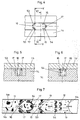
- the in 4, 5 and 6 shown section of a first separation section of a second separation device shows a U-shaped web 54 and arranged obliquely to the transport direction webs 53 as microstructure elements, which in the first separation section 5 of the first embodiment of a separation device according to the FIGS. 1 to 3 are similar.
- the first passages 16 are located between two webs 53 lying opposite each other, between a web 54 and the lateral boundary surface of the transport path 15 and between two adjacent webs 53, 53 or 54, 54 or 53, 54.
- the webs 53, 54 in FIG 4 to 6 differ from the respective webs 53, 54 according to the FIGS. 1 to 3 in that the webs in the region of the pockets 6a, 6b are provided with second passage openings 17.
- the second passage openings 17 have geometrical dimensions which allow only the at least individual smaller particles and / or the blood plasma contained in the blood to pass through while retaining complexes from the particles.
- the second passage openings 17 are smaller than the first passage openings 16.
- the first Through openings 16 allow both complexes of particles and individual particles and the blood plasma to pass through.
- the air escapes from the pockets in the direction of collection chamber 11, while liquid and particles or complexes of particles enter the pockets.
- Fig. 7 It is shown how blood plasma in the third separation device can be obtained from the blood by means of the method.
- Fig. 7 a part of the transport path 15, namely the incubation section 4 and the first separation section 5 shown.
- the blood plasma 12 is shown with a liquid front 12a, wherein in the blood plasma individual cells 13, cell clusters 14a or so-called Roulaus 14b float from blood cells.
- the cell clusters 14 a and Roulaus 14 b are formed in the incubation section under the influence of substances not supplied to the resuspension section.
- the capillary force acting along the transport path transports the blood from the incubation section 4 into the first separation section 5.
- Cell clusters 14a, Roulaus 14b or individual cells 13 accumulate in the pockets 6a and 6b of the microstructure elements 53 and 54. Through the second passage openings 17, the blood plasma 12 also flowing into the pockets 6a, 6b can emerge from the pockets in the transport direction.
- the first passage openings 16 between two adjacent microstructure elements 53 and 54 and between the microstructure elements 54 and the lateral boundary surfaces of the transport path 15 allow both passage of individual cells 13 and the passage of complexes, such as the cell cluster 14a or Roulaus 14b. Due to the complete or temporary retention of the complexes or individual cells formed by cell aggregates, an area is formed in the anterior flow front of the blood which essentially contains blood plasma and only a few cells.
- This mixture of blood plasma 12 and individual cells 13 is transported by the transport forces from the first separating section 5 into the second separating section 8, which is no longer shown.
- the microstructure elements a are webs or pillars having a substantially oval cross section, which extend from a lower boundary surface of the first separation section 5 to the top of a separation device.
- the microstructure elements b are columns which are staggered in three rows one behind the other.
- First through openings 16 are located between two adjacent microstructure elements a or between two adjacent microstructure elements b.
- the microstructure elements c are horseshoe-shaped webs, each defining first through openings 16 with adjacent horseshoe-shaped webs or with a lateral boundary surface of the first separating section 5.
- the webs may extend from the lower boundary surface to the upper part 1 b of a separating device, or between the top of the horseshoe-shaped webs and the upper part 1 b may remain a gap.
- the latter also applies to the microstructure elements a and b as well as the microstructure elements d, which are angled webs which extend in the first separation section counter to the transport direction. Between the ends of two adjacent angled webs is a first passage opening 16th
- the microstructure element e is a web which extends over the entire width of the transport path 15 from a first lateral boundary surface to a second lateral boundary surface. In this jetty are second Passages 17 included.
- a variant of the microstructure element e forms the microstructure element f, which is a single horseshoe-shaped web which, like the web f, contains second passage openings 17 and extends from a first lateral boundary surface to the second lateral boundary surface of the transport path.
- the microstructure elements g are webs which are arranged at an acute angle to the transport direction in order to arrest and / or slow down the complexes and to slow down individual particles, but to allow liquid components to pass through as undisturbed as possible.
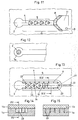
- the fourth embodiment of a separation device has, in addition to the inlet 2 and the collecting section 11, a transport path 15 which has an incubation section 4, a first separation section 5, a second separation section 8 and a branch section 19 between the first separation section 5 and the second separation section 8.
- the transport path 15 bends off from the branching section 19 at a right angle, while the branching section 19 is followed by a second transporting path 18 which lies in a line with the incubation section 4 and the first separating section 5. From this second transport path 18 performs a vent channel 9 to the outside.
- a volume flow from the branch point toward the second transport path 18 and the second separation section 8 is present throughout the separation process.
- the liquid to be filtered flows parallel to the second separating section 8. A portion of the liquid is drawn off correspondingly transversely in the direction of the collecting section 11. Due to the continuous flow of the liquid to be separated at the branching portion 19 are particles with the Volume flow in the second transport path 18 washed away, and the occupancy of the surface of the second separation section 8 is reduced.
- the occupancy rate can be varied according to the volume flow. However, the volume flow is always laminar with Reynolds numbers less than 100. In embodiments in which the liquid is driven exclusively by capillary force, the volume flow over the channel dimensions and surface properties can be adjusted accordingly.
- the fifth separation device according to the fourth embodiment Fig. 9 is very similar, is in Fig. 10 shown.
- the branching section 19 is arranged in front of the first separating section.
- Both the first separation section 5 and the second separation section 8 are arranged parallel to the branching section 19 and parallel to the transport direction of the liquid from the branching section 19 to the second transporting path 18.
- the second transport path 18 is arranged in a linear extension to the incubation section 4.
- the sixth embodiment of a separating device according to Fig. 11 is similar to the embodiment according to Fig. 1 , wherein, in contrast to the first embodiment according to Fig. 1 no Resuspensionsabêt 3 is provided in the transport path 15.
- the microstructure element of the second separation section 8 is a web (such as, for example, the microstructure element e or f in FIG Fig. 8 ) provided with perpendicular to the lower boundary surface slots. Behind this second separating section 8, the liquid constituents of the liquid accumulate in a collecting section 11. From the collecting section 11, a venting channel 9 is passed through a lower boundary surface of the collecting section 11.
- Fig. 12 is a section of a separator shown.
- the resuspension portion 3a is provided as a circular area on the lower boundary surface of the inlet 2.
- the liquid filled in the inlet 2 impinges directly on the substance of the resuspension section 3a, by which chemical or biochemical reactions between the substance and the particles in the liquid are triggered or accelerated in order to produce complexes with identical or different particles from the particles.
- FIGS. 13, 14 and 15 illustrated seventh embodiment of a separation device also has an inlet 2, a transport path 15 and a collecting portion, wherein the second separating portion and the collecting portion are not shown. It is in the Fig. 13 only the inlet and the first separation section 5 are shown.
- This first separation section 5 has a U-shaped web in plan view, which extends from the lower boundary surface of the first separation section 5 to the upper part 1 b of the separation device. This web separates two aerodynamically seen in the flow direction one behind the other lying areas of the separator from each other. A first region A is disposed between the legs of the web and directly connected to the inlet 2.
- the second area B is formed by a collecting channel, the U-shaped in plan view web on the Outside surrounds and is connected via a transport channel 22 with the second separating section, not shown.
- microstructural elements such as arranged obliquely to the transport direction webs 53, U-shaped webs 54 or columns 55 arranged to prevent or slow down the transport of complexes in the manner already described and the transport of individual particles slow it down.
- the U-shaped web has a passage opening 21 in its arc.
- the arc and the legs of the U-shaped web are slotted at regular intervals from the lower boundary surface of the first separating section 5 to the upper part 1 b of the separating device.
- the width of the slots 23 is dimensioned so that individual particles and liquid components of the liquid can pass.
- the slots 23 form second passage openings in the sense of the invention.
- the separator shown works as follows.
- the liquid is introduced into the inlet 2, from where it is transported by capillary force from the beginning to the end of the first region A of the first separation section 5.
- individual complexes and / or particles are stopped or slowed down by the microstructure elements 53, 54, 55 in the first region A.
- the liquid ingredients and individual particles enter the slots 23 in the U-shaped land. Since the transition from the slots 23 to the second region B of the liquid component separation section 5 constitutes a capillary stop, the liquid is initially not transported into the second region B via the slots 23.
- the passage opening 21 provided in the arch is not designed as a capillary stop, and the liquid entering this passage opening 21 can enter the second area B unhindered.
- the U-shaped web can be configured with its microstructure elements (slots) such that this U-shaped web already forms the second separating section of the separating device, and that the second region outside the U-shaped web serves as the collecting section of the separating device.
- the in the FIGS. 16 and 17 The device shown is similar to that in the FIGS. 13 to 15 illustrated device formed.
- the first separating section is completely enclosed by a web 103 and also includes this web 103.
- the web 103 is pierced by a multiplicity of slots 12 which form the first separating section with a parallel to the first separating section arranged as a collection area formed channel 102 connect.
- the slots 23 preferably have the same depth as the collecting channel 102.
- the slots form a capillary stop for the liquid in the transport direction from the first separating section in the direction of collection channel 102.
- the slots 23 have a depth of 1 .mu.m to 100 .mu.m, a width of 1 mm to 500 ⁇ m and a length of at least 50 ⁇ m.
- the passage opening 21 has the same depth as the collecting channel 102 and does not constitute a capillary stop for the incoming liquid.
- the separating section After adding the particle-containing liquid into the filling area, the separating section is completely filled by capillary action. Particles and complexes are in this case partially retained by the microstructure elements 53 and 54.
- the liquid flows into the collecting channel 102 and fills it in the direction of the inlet opening (see arrow 104).
- the cross section of the collecting channel 102 is smaller than the cross section of the collecting channel 100, whereby the liquid entering via the passage opening 21 preferably fills only the collecting region 102 and then continues to flow via the collecting channel 100.
- the individual slots 23 are wetted, whereby their Kapillarstoppfunktion is canceled, so that the present within the ridge 103 initially practically dormant liquid, can flow over the individual slots 23 in the direction of the collecting channel 100.
- particles or complexes are partially retained in the microstructures 54 now lying in the flow direction and by the slots 23, so that a substantially low-particle solution flows via the collecting region 102 in the direction of collecting channel 100, which leads to the second separating section (not shown).
- the in Fig. 18 shown sample carrier, as well as the other devices shown in the previous figures, suitable for carrying out a method.
- the sample carrier has, in addition to the inlet 2, only the first separating region 5 with microstructure elements and the collecting region 11.
Landscapes
- Chemical & Material Sciences (AREA)
- Health & Medical Sciences (AREA)
- Life Sciences & Earth Sciences (AREA)
- Analytical Chemistry (AREA)
- General Health & Medical Sciences (AREA)
- Chemical Kinetics & Catalysis (AREA)
- Dispersion Chemistry (AREA)
- Clinical Laboratory Science (AREA)
- Hematology (AREA)
- Molecular Biology (AREA)
- Physics & Mathematics (AREA)
- Biochemistry (AREA)
- General Physics & Mathematics (AREA)
- Immunology (AREA)
- Pathology (AREA)
- Investigating Or Analysing Biological Materials (AREA)
- Apparatus Associated With Microorganisms And Enzymes (AREA)
- Micro-Organisms Or Cultivation Processes Thereof (AREA)
Applications Claiming Priority (2)
| Application Number | Priority Date | Filing Date | Title |
|---|---|---|---|
| DE10352535 | 2003-11-07 | ||
| DE10352535A DE10352535A1 (de) | 2003-11-07 | 2003-11-07 | Mikrostrukturierte Trennvorrichtung und Verfahren zum Abtrennen von flüssigen Bestandteilen aus einer Partikel enthaltenden Flüssigkeit |
Publications (2)
| Publication Number | Publication Date |
|---|---|
| EP1531003A1 EP1531003A1 (de) | 2005-05-18 |
| EP1531003B1 true EP1531003B1 (de) | 2016-08-17 |
Family
ID=34428663
Family Applications (1)
| Application Number | Title | Priority Date | Filing Date |
|---|---|---|---|
| EP04025985.5A Expired - Lifetime EP1531003B1 (de) | 2003-11-07 | 2004-11-02 | Mikrostrukturierte Trennvorrichtung und Verfahren zum Abtrennen von flüssigen Bestandteilen aus einer Partikel enthaltenden Flüssigkeit |
Country Status (5)
| Country | Link |
|---|---|
| US (1) | US20050106756A1 (enExample) |
| EP (1) | EP1531003B1 (enExample) |
| JP (1) | JP2005140790A (enExample) |
| CN (1) | CN100453182C (enExample) |
| DE (1) | DE10352535A1 (enExample) |
Cited By (1)
| Publication number | Priority date | Publication date | Assignee | Title |
|---|---|---|---|---|
| WO2025166149A1 (en) * | 2024-02-02 | 2025-08-07 | Life Technologies Corporation | Microfluidic devices |
Families Citing this family (44)
| Publication number | Priority date | Publication date | Assignee | Title |
|---|---|---|---|---|
| GB0329220D0 (en) * | 2003-12-17 | 2004-01-21 | Inverness Medical Switzerland | System |
| WO2007026963A1 (en) * | 2005-08-31 | 2007-03-08 | Nissan Chemical Industries, Ltd. | Microchip for cell response evaluation |
| GB2430393A (en) * | 2005-09-23 | 2007-03-28 | Univ Aston | Micro Device for Automatic Spermatozoa Selection and Cell Sorting |
| EP1949098A2 (en) * | 2005-11-09 | 2008-07-30 | Koninklijke Philips Electronics N.V. | Device for testing a fluid |
| EP2017000B1 (en) * | 2007-07-11 | 2012-09-05 | Corning Incorporated | Process intensified microfluidic devices |
| WO2009029561A2 (en) * | 2007-08-24 | 2009-03-05 | Advanced Liquid Logic, Inc. | Bead manipulations on a droplet actuator |
| TW200920841A (en) * | 2007-09-25 | 2009-05-16 | Cytyc Corp | Microfluidic apparatus for manipulating imaging and analyzing cells of a cytological specimen |
| JP5231782B2 (ja) * | 2007-10-26 | 2013-07-10 | 学校法人常翔学園 | 固液分離機能を有する装置及びその製造方法 |
| EP2268405B1 (de) | 2008-02-27 | 2017-01-04 | Boehringer Ingelheim Microparts Gmbh | Vorrichtung zur plasmaseparation |
| EP2172260A1 (en) * | 2008-09-29 | 2010-04-07 | Corning Incorporated | Multiple flow path microfluidic devices |
| EP2350652A2 (en) * | 2008-10-10 | 2011-08-03 | Cnrs-Dae | Cell sorting device |
| SG184592A1 (en) * | 2011-03-18 | 2012-10-30 | Univ Singapore | Isolating target cells from a biological fluid |
| CN102665847A (zh) * | 2009-12-25 | 2012-09-12 | 学校法人常翔学园 | 具有固液分离功能的装置、μ-TAS设备及固液分离方法 |
| CA2791529C (en) * | 2010-03-05 | 2019-04-30 | Xtralis Technologies Ltd | Filter bypass |
| JP5583269B2 (ja) * | 2010-04-15 | 2014-09-03 | サイトゲン カンパニー リミテッド | 微細流体装置及びこれを用いたターゲットの分離方法 |
| ITTO20100068U1 (it) * | 2010-04-20 | 2011-10-21 | Eltek Spa | Dispositivi microfluidici e/o attrezzature per dispositivi microfluidici |
| AU2011292239A1 (en) * | 2010-08-15 | 2013-03-21 | Gpb Scientific, Llc | Microfluidic cell separation in the assay of blood |
| KR101768123B1 (ko) | 2010-12-03 | 2017-08-16 | 삼성전자주식회사 | 수력학 필터, 이를 구비한 필터링 장치 및 이에 의한 필터링 방법 |
| CN116179323A (zh) * | 2011-05-27 | 2023-05-30 | 不列颠哥伦比亚大学 | 用于高通量分析的微流控细胞捕获和分析设备 |
| KR101911435B1 (ko) | 2011-09-26 | 2018-10-25 | 삼성전자주식회사 | 유체 제어 장치, 이를 포함하는 필터 및 바이오칩 |
| KR101890743B1 (ko) * | 2011-10-05 | 2018-08-23 | 삼성전자주식회사 | 유체 제어 장치 및 이를 사용하는 유체 제어 방법 |
| DE102011122579A1 (de) * | 2011-12-29 | 2013-07-04 | Fraunhofer-Gesellschaft zur Förderung der angewandten Forschung e.V. | Verfahren zum Trennen von Suspensions- oder Kolloidbestandteilen und Vorrichtung zum Trennen von Suspensions- oder Kolloidbestandteilen |
| KR101517091B1 (ko) | 2012-05-10 | 2015-05-04 | 단국대학교 산학협력단 | 미세입자 분리장치 및 미세입자 분리수거방법 |
| USD978375S1 (en) | 2013-03-13 | 2023-02-14 | Abbott Laboratories | Reagent container |
| US10058866B2 (en) * | 2013-03-13 | 2018-08-28 | Abbott Laboratories | Methods and apparatus to mitigate bubble formation in a liquid |
| US9535082B2 (en) | 2013-03-13 | 2017-01-03 | Abbott Laboratories | Methods and apparatus to agitate a liquid |
| USD962471S1 (en) | 2013-03-13 | 2022-08-30 | Abbott Laboratories | Reagent container |
| CN107831324B (zh) | 2013-03-15 | 2021-11-19 | 雅培制药有限公司 | 具有后面可进入轨道系统的自动化诊断分析仪及相关方法 |
| EP3067412A4 (en) * | 2013-11-06 | 2017-07-26 | Japan Science and Technology Agency | Substrate for controlling movement direction of animal cells, and cell identification method and cell separation method which use said substrate |
| KR101996078B1 (ko) * | 2014-11-28 | 2019-07-03 | 도요세이칸 그룹 홀딩스 가부시키가이샤 | 미세 액체 이송 구조체 및 분석 장치 |
| KR102360072B1 (ko) * | 2014-12-08 | 2022-02-08 | 삼성전자주식회사 | 미세입자 분리 장치 |
| KR101850852B1 (ko) | 2016-01-08 | 2018-04-23 | 재단법인차세대융합기술연구원 | 미세유체채널장치 및 이의 사용방법 |
| KR102593919B1 (ko) * | 2016-03-21 | 2023-10-27 | 주식회사 지노바이오 | 세포 포획 카트리지 |
| EP3471424A4 (en) | 2016-06-13 | 2020-07-01 | LG Electronics Inc. -1- | DISPLAY DEVICE AND DISPLAY SYSTEM INCLUDING THE SAME |
| CN106311368B (zh) * | 2016-07-29 | 2018-06-15 | 大连理工大学 | 一种用于微量进样器的液滴无损脱离装置 |
| GB2577536A (en) * | 2018-09-28 | 2020-04-01 | Acxel Tech Ltd | Droplet actuation |
| EP3983127B1 (en) * | 2019-06-12 | 2025-04-23 | Siemens Healthcare Diagnostics, Inc. | Plasma separation and sample metering device and methods of use related thereto |
| DE102020004660B4 (de) * | 2020-07-31 | 2022-06-15 | Evorion Biotechnologies Gmbh | Vorrichtung zur sequentiellen Positionierung von Partikeln |
| CN116018522B (zh) * | 2020-09-29 | 2025-09-16 | Nok株式会社 | 白细胞捕获设备 |
| WO2023144192A1 (de) * | 2022-01-25 | 2023-08-03 | Evorion Biotechnologies Gmbh | Vorrichtung zur sequentiellen positionierung von partikeln |
| CN118922704A (zh) * | 2022-03-28 | 2024-11-08 | 国立大学法人茨城大学 | 白血球捕捉设备 |
| JP2025520644A (ja) * | 2022-06-23 | 2025-07-03 | ソルベンタム インテレクチュアル プロパティズ カンパニー | 流体から粒子を除去するための方法及びデバイス |
| US20240108545A1 (en) | 2022-10-03 | 2024-04-04 | West Pharmaceutical Services, Inc. | Methods and adapters for mixing pharmaceutical complexes |
| JP2025536225A (ja) * | 2022-10-03 | 2025-11-05 | ウエスト ファーマスーティカル サービシーズ インコーポレイテッド | マイクロ流体混合及び/又は分離器 |
Citations (3)
| Publication number | Priority date | Publication date | Assignee | Title |
|---|---|---|---|---|
| WO1999035497A2 (en) * | 1998-01-08 | 1999-07-15 | Bio-Diagnostics Limited | A device for testing liquids |
| US20020196435A1 (en) * | 2000-11-22 | 2002-12-26 | Cohen David Samuel | Apparatus and methods for separating agglutinants and disperse particles |
| EP1450159A2 (en) * | 2003-02-24 | 2004-08-25 | Ortho-Clinical Diagnostics, Inc. | Method and apparatus for the detection of agglutination of assays |
Family Cites Families (19)
| Publication number | Priority date | Publication date | Assignee | Title |
|---|---|---|---|---|
| US3827555A (en) * | 1973-03-05 | 1974-08-06 | Bio Physics Systems Inc | Particle sorter with segregation indicator |
| US4271119A (en) * | 1979-07-23 | 1981-06-02 | Eastman Kodak Company | Capillary transport device having connected transport zones |
| IT1212882B (it) * | 1983-07-29 | 1989-11-30 | Della Valle Francesco | Derivati basici della cumarina |
| US5135719A (en) * | 1986-10-29 | 1992-08-04 | Biotrack, Inc. | Blood separation device comprising a filter and a capillary flow pathway exiting the filter |
| US5304487A (en) * | 1992-05-01 | 1994-04-19 | Trustees Of The University Of Pennsylvania | Fluid handling in mesoscale analytical devices |
| US5726026A (en) * | 1992-05-01 | 1998-03-10 | Trustees Of The University Of Pennsylvania | Mesoscale sample preparation device and systems for determination and processing of analytes |
| US6156270A (en) * | 1992-05-21 | 2000-12-05 | Biosite Diagnostics, Inc. | Diagnostic devices and apparatus for the controlled movement of reagents without membranes |
| US6019944A (en) * | 1992-05-21 | 2000-02-01 | Biosite Diagnostics, Inc. | Diagnostic devices and apparatus for the controlled movement of reagents without membranes |
| US5427663A (en) * | 1993-06-08 | 1995-06-27 | British Technology Group Usa Inc. | Microlithographic array for macromolecule and cell fractionation |
| US5905028A (en) * | 1994-05-17 | 1999-05-18 | Gamma Biologicals, Inc. | Method and apparatus useful for detecting bloodgroup antigens and antibodies |
| US5938923A (en) * | 1997-04-15 | 1999-08-17 | The Regents Of The University Of California | Microfabricated filter and capsule using a substrate sandwich |
| DE19733108C2 (de) * | 1997-07-31 | 1999-06-02 | Bartels Mikrotechnik Gmbh | Trennvorrichtung im submum Bereich |
| US6762059B2 (en) * | 1999-08-13 | 2004-07-13 | U.S. Genomics, Inc. | Methods and apparatuses for characterization of single polymers |
| US6319719B1 (en) * | 1999-10-28 | 2001-11-20 | Roche Diagnostics Corporation | Capillary hematocrit separation structure and method |
| US6451264B1 (en) * | 2000-01-28 | 2002-09-17 | Roche Diagnostics Corporation | Fluid flow control in curved capillary channels |
| US6919046B2 (en) * | 2001-06-07 | 2005-07-19 | Nanostream, Inc. | Microfluidic analytical devices and methods |
| US7456025B2 (en) * | 2001-08-28 | 2008-11-25 | Porex Corporation | Sintered polymer membrane for analyte detection device |
| US7459127B2 (en) * | 2002-02-26 | 2008-12-02 | Siemens Healthcare Diagnostics Inc. | Method and apparatus for precise transfer and manipulation of fluids by centrifugal and/or capillary forces |
| US7312085B2 (en) * | 2002-04-01 | 2007-12-25 | Fluidigm Corporation | Microfluidic particle-analysis systems |
-
2003
- 2003-11-07 DE DE10352535A patent/DE10352535A1/de not_active Withdrawn
-
2004
- 2004-11-02 EP EP04025985.5A patent/EP1531003B1/de not_active Expired - Lifetime
- 2004-11-08 CN CNB2004100923056A patent/CN100453182C/zh not_active Expired - Fee Related
- 2004-11-08 US US10/983,096 patent/US20050106756A1/en not_active Abandoned
- 2004-11-08 JP JP2004324376A patent/JP2005140790A/ja not_active Ceased
Patent Citations (3)
| Publication number | Priority date | Publication date | Assignee | Title |
|---|---|---|---|---|
| WO1999035497A2 (en) * | 1998-01-08 | 1999-07-15 | Bio-Diagnostics Limited | A device for testing liquids |
| US20020196435A1 (en) * | 2000-11-22 | 2002-12-26 | Cohen David Samuel | Apparatus and methods for separating agglutinants and disperse particles |
| EP1450159A2 (en) * | 2003-02-24 | 2004-08-25 | Ortho-Clinical Diagnostics, Inc. | Method and apparatus for the detection of agglutination of assays |
Cited By (1)
| Publication number | Priority date | Publication date | Assignee | Title |
|---|---|---|---|---|
| WO2025166149A1 (en) * | 2024-02-02 | 2025-08-07 | Life Technologies Corporation | Microfluidic devices |
Also Published As
| Publication number | Publication date |
|---|---|
| US20050106756A1 (en) | 2005-05-19 |
| CN1628907A (zh) | 2005-06-22 |
| DE10352535A1 (de) | 2005-06-16 |
| JP2005140790A (ja) | 2005-06-02 |
| CN100453182C (zh) | 2009-01-21 |
| EP1531003A1 (de) | 2005-05-18 |
Similar Documents
| Publication | Publication Date | Title |
|---|---|---|
| EP1531003A1 (de) | Mikrostrukturierte Trennvorrichtung und Verfahren zum Abtrennen von flüssigen Bestandteilen aus einer Partikel enthaltenden Flüssigkeit | |
| DE69728269T2 (de) | Absorbtionsverbessertes differentielles extraktionsverfahren | |
| EP2506959B1 (de) | Mikrofluidisches element zur analyse einer flüssigkeitsprobe | |
| DE69530855T2 (de) | Verfahren zur herstellung einer probe in einer scan-kapillare für immunofluoreszenzuntersuchung | |
| EP1459773B1 (de) | Mikrostrukturierte Trennvorrichtung und mikrofluidisches Verfahren zum Abtrennen von flüssigen Bestandteilen aus einer Flüssigkeit, die Partikel enthält | |
| DE60019228T2 (de) | Struktur und Verfahren zur kapillaren Hämatokritabtrennung | |
| EP0634215A1 (de) | Vorrichtung zur gleichzeitigen Bestimmung von Analyten | |
| EP1566215A2 (de) | Mikrostrukturierte Plattform und Verfahren zum Handhaben einer Flüssigkeit | |
| DE102018212930B3 (de) | Vorrichtung und Verfahren zum Leiten einer Flüssigkeit durch ein poröses Medium | |
| EP1315553B1 (de) | Vorrichtung und verfahren zur separation von ungelösten bestandteilen aus biologischen flüssigkeiten | |
| EP2632591B1 (de) | Mikrofluidisches element zur analyse einer probenflüssigkeit | |
| EP1495799A2 (de) | Vorrichtung zum Handhaben von begrenzten Flüssigkeitsmengen | |
| EP3524982A1 (de) | Rotierbares testelement | |
| DE3044385A1 (de) | Verfahren zur durchfuehrung analytischer bestimmungen und hierfuer geeignetes rotoreinsatzelement | |
| EP0340562B1 (de) | Testelement für Agglutinationsuntersuchungen, Verfahren zu seiner Herstellung und dessen Verwendung | |
| WO2023110944A1 (de) | REAKTIONSGEFÄßEINHEIT, VERFAHREN ZUM SELEKTIVEN ENTFERNEN EINER FLÜSSIGKEIT SOWIE ZUM EINBRINGEN EINER EINEN ZIELSTOFF ENTHALTENDEN FLÜSSIGKEIT AUS EINEM BZW. IN EIN REAKTIONSGEFÄß EINER REAKTIONSGEFÄßEINHEIT | |
| EP1522343A1 (de) | Analytisches Testelement umfassend ein Netzwerk zur Bildung eines Kapillarkanals | |
| EP1685900A1 (de) | Vorrichtung und Verfahren zur Untersuchung von Probenflüssigkeit | |
| EP1802396B1 (de) | Partikelsedimentationsvorrichtung und verfahren zum durchführen einer partikelsedimentation | |
| DE102009047802B4 (de) | Vorrichtung zum Filtern eines oder mehrerer nachzuweisender Partikel aus einem Fluid | |
| EP0797097B1 (de) | Partikel-Immunoassay mit kompakter Matrix | |
| WO2013072110A1 (de) | Mikrofluidisches filterelement zum abscheiden von probenbestandteilen aus einem biologischen probenfluid | |
| EP1815230A1 (de) | Mikrofluidisches system mit einer kanalaufweitung | |
| EP1545781B1 (de) | Trägerelement für diagnostische tests | |
| DE102006024927B4 (de) | Verfahren zum Nachweis von Antikörpern und/oder Antigenen sowie zur Blutgruppenbestimmung in einer Testsubstanz |
Legal Events
| Date | Code | Title | Description |
|---|---|---|---|
| PUAI | Public reference made under article 153(3) epc to a published international application that has entered the european phase |
Free format text: ORIGINAL CODE: 0009012 |
|
| AK | Designated contracting states |
Kind code of ref document: A1 Designated state(s): AT BE BG CH CY CZ DE DK EE ES FI FR GB GR HU IE IS IT LI LU MC NL PL PT RO SE SI SK TR |
|
| AX | Request for extension of the european patent |
Extension state: AL HR LT LV MK YU |
|
| 17P | Request for examination filed |
Effective date: 20051022 |
|
| AKX | Designation fees paid |
Designated state(s): AT BE BG CH CY CZ DE DK EE ES FI FR GB GR HU IE IS IT LI LU MC NL PL PT RO SE SI SK TR |
|
| RAP1 | Party data changed (applicant data changed or rights of an application transferred) |
Owner name: BOEHRINGER INGELHEIM MICROPARTS GMBH |
|
| 17Q | First examination report despatched |
Effective date: 20071219 |
|
| GRAP | Despatch of communication of intention to grant a patent |
Free format text: ORIGINAL CODE: EPIDOSNIGR1 |
|
| RIC1 | Information provided on ipc code assigned before grant |
Ipc: B01F 13/00 20060101ALN20160203BHEP Ipc: B01F 5/06 20060101ALN20160203BHEP Ipc: G01N 1/40 20060101ALI20160203BHEP Ipc: B01L 3/00 20060101AFI20160203BHEP |
|
| RIC1 | Information provided on ipc code assigned before grant |
Ipc: B01F 13/00 20060101ALN20160208BHEP Ipc: G01N 1/40 20060101ALI20160208BHEP Ipc: B01F 5/06 20060101ALN20160208BHEP Ipc: B01L 3/00 20060101AFI20160208BHEP |
|
| INTG | Intention to grant announced |
Effective date: 20160226 |
|
| GRAS | Grant fee paid |
Free format text: ORIGINAL CODE: EPIDOSNIGR3 |
|
| GRAA | (expected) grant |
Free format text: ORIGINAL CODE: 0009210 |
|
| AK | Designated contracting states |
Kind code of ref document: B1 Designated state(s): AT BE BG CH CY CZ DE DK EE ES FI FR GB GR HU IE IS IT LI LU MC NL PL PT RO SE SI SK TR |
|
| REG | Reference to a national code |
Ref country code: GB Ref legal event code: FG4D Free format text: NOT ENGLISH |
|
| REG | Reference to a national code |
Ref country code: CH Ref legal event code: EP |
|
| REG | Reference to a national code |
Ref country code: IE Ref legal event code: FG4D Free format text: LANGUAGE OF EP DOCUMENT: GERMAN |
|
| REG | Reference to a national code |
Ref country code: AT Ref legal event code: REF Ref document number: 820536 Country of ref document: AT Kind code of ref document: T Effective date: 20160915 |
|
| REG | Reference to a national code |
Ref country code: DE Ref legal event code: R096 Ref document number: 502004015278 Country of ref document: DE |
|
| REG | Reference to a national code |
Ref country code: NL Ref legal event code: MP Effective date: 20160817 |
|
| PG25 | Lapsed in a contracting state [announced via postgrant information from national office to epo] |
Ref country code: FI Free format text: LAPSE BECAUSE OF FAILURE TO SUBMIT A TRANSLATION OF THE DESCRIPTION OR TO PAY THE FEE WITHIN THE PRESCRIBED TIME-LIMIT Effective date: 20160817 Ref country code: NL Free format text: LAPSE BECAUSE OF FAILURE TO SUBMIT A TRANSLATION OF THE DESCRIPTION OR TO PAY THE FEE WITHIN THE PRESCRIBED TIME-LIMIT Effective date: 20160817 Ref country code: IT Free format text: LAPSE BECAUSE OF FAILURE TO SUBMIT A TRANSLATION OF THE DESCRIPTION OR TO PAY THE FEE WITHIN THE PRESCRIBED TIME-LIMIT Effective date: 20160817 |
|
| PG25 | Lapsed in a contracting state [announced via postgrant information from national office to epo] |
Ref country code: SE Free format text: LAPSE BECAUSE OF FAILURE TO SUBMIT A TRANSLATION OF THE DESCRIPTION OR TO PAY THE FEE WITHIN THE PRESCRIBED TIME-LIMIT Effective date: 20160817 Ref country code: ES Free format text: LAPSE BECAUSE OF FAILURE TO SUBMIT A TRANSLATION OF THE DESCRIPTION OR TO PAY THE FEE WITHIN THE PRESCRIBED TIME-LIMIT Effective date: 20160817 Ref country code: PT Free format text: LAPSE BECAUSE OF FAILURE TO SUBMIT A TRANSLATION OF THE DESCRIPTION OR TO PAY THE FEE WITHIN THE PRESCRIBED TIME-LIMIT Effective date: 20161219 Ref country code: BE Free format text: LAPSE BECAUSE OF NON-PAYMENT OF DUE FEES Effective date: 20161130 Ref country code: GR Free format text: LAPSE BECAUSE OF FAILURE TO SUBMIT A TRANSLATION OF THE DESCRIPTION OR TO PAY THE FEE WITHIN THE PRESCRIBED TIME-LIMIT Effective date: 20161118 Ref country code: PL Free format text: LAPSE BECAUSE OF FAILURE TO SUBMIT A TRANSLATION OF THE DESCRIPTION OR TO PAY THE FEE WITHIN THE PRESCRIBED TIME-LIMIT Effective date: 20160817 |
|
| PG25 | Lapsed in a contracting state [announced via postgrant information from national office to epo] |
Ref country code: RO Free format text: LAPSE BECAUSE OF FAILURE TO SUBMIT A TRANSLATION OF THE DESCRIPTION OR TO PAY THE FEE WITHIN THE PRESCRIBED TIME-LIMIT Effective date: 20160817 Ref country code: EE Free format text: LAPSE BECAUSE OF FAILURE TO SUBMIT A TRANSLATION OF THE DESCRIPTION OR TO PAY THE FEE WITHIN THE PRESCRIBED TIME-LIMIT Effective date: 20160817 |
|
| REG | Reference to a national code |
Ref country code: DE Ref legal event code: R097 Ref document number: 502004015278 Country of ref document: DE |
|
| PG25 | Lapsed in a contracting state [announced via postgrant information from national office to epo] |
Ref country code: DK Free format text: LAPSE BECAUSE OF FAILURE TO SUBMIT A TRANSLATION OF THE DESCRIPTION OR TO PAY THE FEE WITHIN THE PRESCRIBED TIME-LIMIT Effective date: 20160817 Ref country code: CZ Free format text: LAPSE BECAUSE OF FAILURE TO SUBMIT A TRANSLATION OF THE DESCRIPTION OR TO PAY THE FEE WITHIN THE PRESCRIBED TIME-LIMIT Effective date: 20160817 Ref country code: SK Free format text: LAPSE BECAUSE OF FAILURE TO SUBMIT A TRANSLATION OF THE DESCRIPTION OR TO PAY THE FEE WITHIN THE PRESCRIBED TIME-LIMIT Effective date: 20160817 Ref country code: BG Free format text: LAPSE BECAUSE OF FAILURE TO SUBMIT A TRANSLATION OF THE DESCRIPTION OR TO PAY THE FEE WITHIN THE PRESCRIBED TIME-LIMIT Effective date: 20161117 |
|
| REG | Reference to a national code |
Ref country code: DE Ref legal event code: R119 Ref document number: 502004015278 Country of ref document: DE |
|
| PLBE | No opposition filed within time limit |
Free format text: ORIGINAL CODE: 0009261 |
|
| STAA | Information on the status of an ep patent application or granted ep patent |
Free format text: STATUS: NO OPPOSITION FILED WITHIN TIME LIMIT |
|
| REG | Reference to a national code |
Ref country code: CH Ref legal event code: PL |
|
| 26N | No opposition filed |
Effective date: 20170518 |
|
| GBPC | Gb: european patent ceased through non-payment of renewal fee |
Effective date: 20161117 |
|
| PG25 | Lapsed in a contracting state [announced via postgrant information from national office to epo] |
Ref country code: LI Free format text: LAPSE BECAUSE OF NON-PAYMENT OF DUE FEES Effective date: 20161130 Ref country code: CH Free format text: LAPSE BECAUSE OF NON-PAYMENT OF DUE FEES Effective date: 20161130 |
|
| REG | Reference to a national code |
Ref country code: IE Ref legal event code: MM4A |
|
| REG | Reference to a national code |
Ref country code: FR Ref legal event code: ST Effective date: 20170731 |
|
| PG25 | Lapsed in a contracting state [announced via postgrant information from national office to epo] |
Ref country code: SI Free format text: LAPSE BECAUSE OF FAILURE TO SUBMIT A TRANSLATION OF THE DESCRIPTION OR TO PAY THE FEE WITHIN THE PRESCRIBED TIME-LIMIT Effective date: 20160817 |
|
| PG25 | Lapsed in a contracting state [announced via postgrant information from national office to epo] |
Ref country code: LU Free format text: LAPSE BECAUSE OF NON-PAYMENT OF DUE FEES Effective date: 20161130 |
|
| PG25 | Lapsed in a contracting state [announced via postgrant information from national office to epo] |
Ref country code: FR Free format text: LAPSE BECAUSE OF NON-PAYMENT OF DUE FEES Effective date: 20161130 |
|
| PG25 | Lapsed in a contracting state [announced via postgrant information from national office to epo] |
Ref country code: IE Free format text: LAPSE BECAUSE OF NON-PAYMENT OF DUE FEES Effective date: 20161102 Ref country code: DE Free format text: LAPSE BECAUSE OF NON-PAYMENT OF DUE FEES Effective date: 20170601 Ref country code: GB Free format text: LAPSE BECAUSE OF NON-PAYMENT OF DUE FEES Effective date: 20161117 |
|
| REG | Reference to a national code |
Ref country code: AT Ref legal event code: MM01 Ref document number: 820536 Country of ref document: AT Kind code of ref document: T Effective date: 20161102 |
|
| PG25 | Lapsed in a contracting state [announced via postgrant information from national office to epo] |
Ref country code: AT Free format text: LAPSE BECAUSE OF NON-PAYMENT OF DUE FEES Effective date: 20161102 |
|
| REG | Reference to a national code |
Ref country code: BE Ref legal event code: MM Effective date: 20161130 |
|
| PG25 | Lapsed in a contracting state [announced via postgrant information from national office to epo] |
Ref country code: HU Free format text: LAPSE BECAUSE OF FAILURE TO SUBMIT A TRANSLATION OF THE DESCRIPTION OR TO PAY THE FEE WITHIN THE PRESCRIBED TIME-LIMIT; INVALID AB INITIO Effective date: 20041102 Ref country code: CY Free format text: LAPSE BECAUSE OF FAILURE TO SUBMIT A TRANSLATION OF THE DESCRIPTION OR TO PAY THE FEE WITHIN THE PRESCRIBED TIME-LIMIT Effective date: 20160817 |
|
| PG25 | Lapsed in a contracting state [announced via postgrant information from national office to epo] |
Ref country code: IS Free format text: LAPSE BECAUSE OF FAILURE TO SUBMIT A TRANSLATION OF THE DESCRIPTION OR TO PAY THE FEE WITHIN THE PRESCRIBED TIME-LIMIT Effective date: 20160817 Ref country code: MC Free format text: LAPSE BECAUSE OF FAILURE TO SUBMIT A TRANSLATION OF THE DESCRIPTION OR TO PAY THE FEE WITHIN THE PRESCRIBED TIME-LIMIT Effective date: 20160817 Ref country code: TR Free format text: LAPSE BECAUSE OF FAILURE TO SUBMIT A TRANSLATION OF THE DESCRIPTION OR TO PAY THE FEE WITHIN THE PRESCRIBED TIME-LIMIT Effective date: 20160817 |