EP1529942A2 - Verminderung der Motorrauhheit während Mager-Fett-Übergängen - Google Patents
Verminderung der Motorrauhheit während Mager-Fett-Übergängen Download PDFInfo
- Publication number
- EP1529942A2 EP1529942A2 EP04026079A EP04026079A EP1529942A2 EP 1529942 A2 EP1529942 A2 EP 1529942A2 EP 04026079 A EP04026079 A EP 04026079A EP 04026079 A EP04026079 A EP 04026079A EP 1529942 A2 EP1529942 A2 EP 1529942A2
- Authority
- EP
- European Patent Office
- Prior art keywords
- engine
- fueling
- data value
- output torque
- nox adsorber
- Prior art date
- Legal status (The legal status is an assumption and is not a legal conclusion. Google has not performed a legal analysis and makes no representation as to the accuracy of the status listed.)
- Granted
Links
Images

Classifications
-
- F—MECHANICAL ENGINEERING; LIGHTING; HEATING; WEAPONS; BLASTING
- F02—COMBUSTION ENGINES; HOT-GAS OR COMBUSTION-PRODUCT ENGINE PLANTS
- F02D—CONTROLLING COMBUSTION ENGINES
- F02D41/00—Electrical control of supply of combustible mixture or its constituents
- F02D41/02—Circuit arrangements for generating control signals
- F02D41/021—Introducing corrections for particular conditions exterior to the engine
- F02D41/0235—Introducing corrections for particular conditions exterior to the engine in relation with the state of the exhaust gas treating apparatus
- F02D41/027—Introducing corrections for particular conditions exterior to the engine in relation with the state of the exhaust gas treating apparatus to purge or regenerate the exhaust gas treating apparatus
- F02D41/0275—Introducing corrections for particular conditions exterior to the engine in relation with the state of the exhaust gas treating apparatus to purge or regenerate the exhaust gas treating apparatus the exhaust gas treating apparatus being a NOx trap or adsorbent
-
- F—MECHANICAL ENGINEERING; LIGHTING; HEATING; WEAPONS; BLASTING
- F01—MACHINES OR ENGINES IN GENERAL; ENGINE PLANTS IN GENERAL; STEAM ENGINES
- F01N—GAS-FLOW SILENCERS OR EXHAUST APPARATUS FOR MACHINES OR ENGINES IN GENERAL; GAS-FLOW SILENCERS OR EXHAUST APPARATUS FOR INTERNAL-COMBUSTION ENGINES
- F01N3/00—Exhaust or silencing apparatus having means for purifying, rendering innocuous, or otherwise treating exhaust
- F01N3/08—Exhaust or silencing apparatus having means for purifying, rendering innocuous, or otherwise treating exhaust for rendering innocuous
- F01N3/0807—Exhaust or silencing apparatus having means for purifying, rendering innocuous, or otherwise treating exhaust for rendering innocuous by using absorbents or adsorbents
- F01N3/0871—Exhaust or silencing apparatus having means for purifying, rendering innocuous, or otherwise treating exhaust for rendering innocuous by using absorbents or adsorbents using means for controlling, e.g. purging, the absorbents or adsorbents
-
- F—MECHANICAL ENGINEERING; LIGHTING; HEATING; WEAPONS; BLASTING
- F01—MACHINES OR ENGINES IN GENERAL; ENGINE PLANTS IN GENERAL; STEAM ENGINES
- F01N—GAS-FLOW SILENCERS OR EXHAUST APPARATUS FOR MACHINES OR ENGINES IN GENERAL; GAS-FLOW SILENCERS OR EXHAUST APPARATUS FOR INTERNAL-COMBUSTION ENGINES
- F01N2430/00—Influencing exhaust purification, e.g. starting of catalytic reaction, filter regeneration, or the like, by controlling engine operating characteristics
- F01N2430/06—Influencing exhaust purification, e.g. starting of catalytic reaction, filter regeneration, or the like, by controlling engine operating characteristics by varying fuel-air ratio, e.g. by enriching fuel-air mixture
-
- F—MECHANICAL ENGINEERING; LIGHTING; HEATING; WEAPONS; BLASTING
- F02—COMBUSTION ENGINES; HOT-GAS OR COMBUSTION-PRODUCT ENGINE PLANTS
- F02D—CONTROLLING COMBUSTION ENGINES
- F02D2200/00—Input parameters for engine control
- F02D2200/02—Input parameters for engine control the parameters being related to the engine
- F02D2200/10—Parameters related to the engine output, e.g. engine torque or engine speed
- F02D2200/1002—Output torque
- F02D2200/1004—Estimation of the output torque
-
- F—MECHANICAL ENGINEERING; LIGHTING; HEATING; WEAPONS; BLASTING
- F02—COMBUSTION ENGINES; HOT-GAS OR COMBUSTION-PRODUCT ENGINE PLANTS
- F02D—CONTROLLING COMBUSTION ENGINES
- F02D2250/00—Engine control related to specific problems or objectives
- F02D2250/18—Control of the engine output torque
- F02D2250/21—Control of the engine output torque during a transition between engine operation modes or states
-
- F—MECHANICAL ENGINEERING; LIGHTING; HEATING; WEAPONS; BLASTING
- F02—COMBUSTION ENGINES; HOT-GAS OR COMBUSTION-PRODUCT ENGINE PLANTS
- F02D—CONTROLLING COMBUSTION ENGINES
- F02D2250/00—Engine control related to specific problems or objectives
- F02D2250/28—Control for reducing torsional vibrations, e.g. at acceleration
-
- F—MECHANICAL ENGINEERING; LIGHTING; HEATING; WEAPONS; BLASTING
- F02—COMBUSTION ENGINES; HOT-GAS OR COMBUSTION-PRODUCT ENGINE PLANTS
- F02D—CONTROLLING COMBUSTION ENGINES
- F02D41/00—Electrical control of supply of combustible mixture or its constituents
- F02D41/02—Circuit arrangements for generating control signals
- F02D41/14—Introducing closed-loop corrections
- F02D41/1438—Introducing closed-loop corrections using means for determining characteristics of the combustion gases; Sensors therefor
- F02D41/1444—Introducing closed-loop corrections using means for determining characteristics of the combustion gases; Sensors therefor characterised by the characteristics of the combustion gases
- F02D41/1446—Introducing closed-loop corrections using means for determining characteristics of the combustion gases; Sensors therefor characterised by the characteristics of the combustion gases the characteristics being exhaust temperatures
-
- F—MECHANICAL ENGINEERING; LIGHTING; HEATING; WEAPONS; BLASTING
- F02—COMBUSTION ENGINES; HOT-GAS OR COMBUSTION-PRODUCT ENGINE PLANTS
- F02D—CONTROLLING COMBUSTION ENGINES
- F02D41/00—Electrical control of supply of combustible mixture or its constituents
- F02D41/02—Circuit arrangements for generating control signals
- F02D41/14—Introducing closed-loop corrections
- F02D41/1497—With detection of the mechanical response of the engine
-
- F—MECHANICAL ENGINEERING; LIGHTING; HEATING; WEAPONS; BLASTING
- F02—COMBUSTION ENGINES; HOT-GAS OR COMBUSTION-PRODUCT ENGINE PLANTS
- F02D—CONTROLLING COMBUSTION ENGINES
- F02D41/00—Electrical control of supply of combustible mixture or its constituents
- F02D41/30—Controlling fuel injection
- F02D41/38—Controlling fuel injection of the high pressure type
- F02D41/40—Controlling fuel injection of the high pressure type with means for controlling injection timing or duration
- F02D41/402—Multiple injections
- F02D41/403—Multiple injections with pilot injections
-
- Y—GENERAL TAGGING OF NEW TECHNOLOGICAL DEVELOPMENTS; GENERAL TAGGING OF CROSS-SECTIONAL TECHNOLOGIES SPANNING OVER SEVERAL SECTIONS OF THE IPC; TECHNICAL SUBJECTS COVERED BY FORMER USPC CROSS-REFERENCE ART COLLECTIONS [XRACs] AND DIGESTS
- Y02—TECHNOLOGIES OR APPLICATIONS FOR MITIGATION OR ADAPTATION AGAINST CLIMATE CHANGE
- Y02T—CLIMATE CHANGE MITIGATION TECHNOLOGIES RELATED TO TRANSPORTATION
- Y02T10/00—Road transport of goods or passengers
- Y02T10/10—Internal combustion engine [ICE] based vehicles
- Y02T10/12—Improving ICE efficiencies
Definitions
- This invention relates to motor vehicles that are powered by internal combustion engines whose operation may for any of various reasons temporarily transition from running lean to running rich, one reason being to purge a NOx adsorber in the engine exhaust system of adsorbed NOx so that it can continue to be effective as the engine continues running. More particularly, the invention relates to systems and methods for attenuating fluctuations in engine output torque that contribute to harness in the operation of such vehicles during lean-rich transitions such as those for regenerating a NOx adsorber.
- An exhaust system of a diesel engine that comprises a NOx adsorber is capable of adsorbing significant amounts of NOx in exhaust gas passing through the exhaust system from the engine, thereby reducing the amount of NOx that otherwise would enter the atmosphere. From time to time, such a device must be regenerated in order to purge it of adsorbed NOx so that it can continue to be effective in adsorbing NOx as the engine continues to run.
- a known technique for regenerating a NOx adsorber comprises creating an excess of CO for reaction with adsorbed NOx to reduce the NOx to molecular nitrogen (N 2 ) while the CO oxidizes to CO 2 during the process.
- One known method for creating excess CO comprises injecting fuel in proper amount into the exhaust leaving engine combustion chambers. Because that fuel does not contribute to the thermal energy of combustion that is converted by thermodynamic processes in the combustion chambers acting on the engine's kinematic mechanism to create engine torque, it has essentially no influence on engine torque.
- post-injection of fuel that does contribute to the thermal energy of combustion that produces engine torque may be considered a more desirable alternative, although both methods require the injection of extra fuel to purge the NOx adsorber.
- the post-injection alternative has consequences on engine torque output that can lead to undesirable torque fluctuations that contribute to engine and vehicle harshness as the engine continues to run during NOx adsorber regeneration.
- a known electronic engine control system comprises a processor-based engine controller that processes data from various sources to develop control data for controlling certain functions of the engine.
- the amount and the timing of engine fueling are two functions that are controlled by an engine control system.
- a typical diesel engine that comprises fuel injectors for injecting fuel into the engine cylinders under control of an engine control system controls both the duration and the timing of each fuel injection to set both the amount and the timing of engine fueling.
- it is also capable of pre-injection of fuel (pilot-injection) in advance of a main injection and post-injection after the main injection, although the use of either typically depends on how the engine is being operated.
- the present invention relates to engine systems and methods for accomplishing regeneration of a NOx adsorber using in-cylinder post-injection in a way that creates a lean-rich transition for regenerating the NOx adsorber while attenuating engine torque output fluctuations during the transition without the necessity of using torque sensing to attenuate the fluctuations.
- one generic aspect of the present invention relates to a method for control of output torque developed by an internal combustion engine during lean-rich modulation of engine operation.
- data values of certain parameters are processed to develop a data value for desired engine fueling for causing the engine to develop a corresponding desired output torque at a given engine speed.
- engine output torque is maintained substantially at the corresponding desired output torque at the given engine speed by processing i) the data value for desired engine fueling resulting from the processing of certain parameters, ii) a data value for engine speed, and iii) a data value for actual air-fuel ratio at which the engine is operating, to thereby develop a data value for desired engine fueling for causing the engine to run rich while striving to maintain engine output torque at the corresponding desired output torque at the given engine speed when the engine was running lean.
- Another generic aspect relates to an engine incorporating a control strategy for implementing the foregoing generic method.
- Still another generic aspect relates to a method for regenerating a NOx adsorber in an exhaust system of an internal combustion engine that is fueled in accordance with a data value for desired engine fueling.
- the method comprises processing data values of certain parameters to develop a data value for desired engine fueling for causing the engine to develop a corresponding desired output torque without conditioning engine exhaust passing into the exhaust system for NOx adsorber regeneration.
- NOx adsorber regeneration is initiated by changing engine fueling so as to condition engine exhaust passing into the exhaust system for regenerating the NOx adsorber.
- the method develops a data value for desired engine fueling that is effective to condition the exhaust gas for NOx adsorber regeneration at a given engine speed while striving to maintain the output torque at the corresponding output torque that desired engine fueling would develop at the given engine speed without conditioning engine exhaust passing into the exhaust system for NOx adsorber regeneration. This is accomplished by processing data values for i) the desired engine fueling that would develop that corresponding output torque without conditioning engine exhaust passing into the exhaust system for NOx adsorber regeneration, ii) engine speed, and iii) actual air-fuel ratio at which the engine is operating.
- Figure 1 shows a schematic diagram of an exemplary diesel engine 20 for powering a motor vehicle.
- Engine 20 has a processor-based engine control system 22 that processes data from various sources to develop various control data for controlling various aspects of engine operation.
- the data processed by control system 22 may originate at external sources, such as sensors, and/or be generated internally.
- Control system 22 controls the operation of electric-actuated fuel injectors that inject fuel into engine combustion chambers.
- a processor of control system 22 can process data sufficiently fast to calculate, in real time, the timing and duration of injector actuation to set both the timing and the amount of fueling.
- the injection process comprises a main injection, and under certain conditions, a pilot injection and/or a post-injection.
- Control system 22 calculates a data value VF_des_m that represents the amount of fuel that is to be injected into a combustion chamber during an engine cycle.
- Engine 20 further comprises an intake system 24 through which charge air enters the combustion chambers, and an exhaust system 26 through which exhaust gases resulting from combustion leave the engine.
- Exhaust system 26 includes a NOx adsorber 28 that adsorbs significant amounts of NOx in exhaust gas passing from engine 26, thereby reducing the amount of NOx that otherwise would enter the atmosphere.
- NOx adsorber 28 From time to time, NOx adsorber 28 must be regenerated in order to purge it of adsorbed NOx so that it can remain effective as the engine continues to run.
- a known technique for regenerating a NOx adsorber comprises creating an excess of CO for reaction with adsorbed NOx to reduce the NOx to molecular nitrogen (N 2 ) while the CO oxidizes to CO 2 during the process.
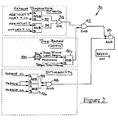
- Figure 2 discloses a strategy 30 that is executed by control system 22 to determine when regeneration can be performed.
- the strategy is premised on the general factors: exhaust gas temperature; elapse of time since the previous regeneration; and driveability of the vehicle.
- the data value for ADS_INLET_T is compared by a comparison function 32 with a data value INLET_T_LL representing a lower temperature limit at or above which it would be appropriate to regenerate NOx adsorber 28.
- the data value for ADS_OUTLET_T is compared by a comparison function 34 with a data value OUTLET_T_LL representing a lower temperature limit at or above which it would be appropriate to regenerate NOx adsorber 28.
- Time elapsed since the last regeneration is measured by a timer function 38.
- the data value for elapsed time is compared by a comparison function 40 with the data value for a minimum interval between regenerations. Once elapsed time equals or exceeds the minimum, regeneration is enabled.
- An AND logic function 42 assures that both a temperature minimum and a time minimum have been satisfied before regeneration is enabled.
- Driveability refers to acceptable vehicle vibration and harshness during lean/rich transition.
- a torque lower limit and upper limit have been set to minimize vibration and harshness during the transition.
- the lower limit requires the engine to be running with some load, while the upper limit keeps the engine away from severe acceleration conditions.
- the data value for a parameter TORQUE represents the torque which engine 20 is producing.
- the data value for TORQUE is compared by a comparison function 44 with a data value TORQUE_UL representing an upper torque limit above which regeneration would be inappropriate.
- the data value for TORQUE is compared by a comparison function 46 with a data value TORQUE_ LL representing a lower torque limit below which regeneration would be inappropriate.
- An AND logic function 48 processes the results of both comparisons to assure that torque is within the allowable range for NOx adsorber regeneration.
- a further AND function 50 processes outputs from both AND functions 42, 48 to allow regeneration when the three general factors of exhaust gas temperature, elapse of time since the previous regeneration, and driveability of the vehicle are satisfied.
- a diesel engine runs cooler, slower, and leaner than a spark-ignition engine.
- engine 20 generates NOx that is adsorbed by NOx adsorber 28.
- the adsorber is to be regenerated, engine operation transitions from running lean to running rich in order to condition the exhaust for purging NOx adsorber 28 by generating the needed excess CO.
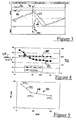
- a trace 60 in Figure 3 represents air-fuel ratio.
- Figure 4 shows a trace 80 of engine torque versus air-fuel ratio where, for a given engine speed, the torque remains substantially constant.
- a trace 82 shows the corresponding fueling that engine 20 needs in order to develop the torque represented by trace 80.
- Figure 5 shows a piecewise linear approximation 90 of trace 82 to comprise a first linear segment 92 extending between data points marked AFR_r and AFR_c and a second linear segment 94 extending between data points marked AFR_c and AFR_1 .
- AFR symbolizes air-fuel ratio.
- These functional relationships define a control algorithm for desired engine fueling over a range of air-fuel ratios that will cause engine 20 to develop substantially constant torque, although it is to be appreciated that the engine may not necessarily operate all such ratios.
- engine 20 In order to generate the excess CO needed for NOx adsorber regeneration, engine 20 needs to run at an AFR below stoichiometric (an AFR of approximately 13). Hence for a given torque, a fueling transition from lean to rich that strives to maintain that torque will take place along segment 92. As can be appreciated, the specific parameters for a transition will be governed by a specific regeneration strategy for a particular engine.
- Control algorithm in control system 22 is accomplished by entering data values for AFR_r, AFR_c, and AFR_1 for each pair of data values for engine torque and engine speed. A sufficient number of pairs of such torque and speed data values are programmed into control system 22 to adequately cover the range of engine operation with sufficient resolution within the range.
- control system 22 For given data values of torque and speed representing current engine torque and current engine speed, control system 22 operates to select from the closest pair of torque and speed data values that have been programmed into it, the corresponding data values for AFR_r, AFR_c, and AFR_1 for use in calculating a data value for VF_des_m.
- a data value for the variable AFR is obtained in any suitably appropriate way and processed according to the algorithm to develop the data value for VF_des_m. The processing occurs sufficiently fast in real time to allow variables like AFR to be updated fast enough to follow changing engine operation.
- control system 22 determines whether actual AFR is above or below the AFR represented by the corresponding break point AFR_c (step 100 in Figure 7).
- VF_des_m ⁇ VF_des_m_1 + (1- ⁇ )VF_des_m_c corresponding to step 102 in Figure 7.
- VF_des_m ⁇ VF_des_m_c + (1- ⁇ )VF_des m_r corresponding to step 104 in Figure 7.
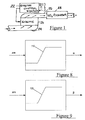
- the algorithm calculates the data value for desired engine fueling by what amounts to interpolation, as graphically portrayed by the function 110 in Figure 8 for ⁇ , and the function 120 in Figure 9 for ⁇ .
- the implementation in control system 22 is represented by Figure 6.
- Data values for engine speed (parameter N) and accelerator pedal position (parameter APS) determine, via a map or look-up table 130, a data value for engine output torque (parameter Torque_des).
- Control system 22 processes Torque_des according to an operating strategy for causing engine 20 to develop that torque at that speed.
- Torque_des that controls desired engine fueling by a different portion of the strategy that is not shown here.
- Torque_des is still a factor in controlling desired engine fueling, but not the sole factor because the control algorithm that is used during regeneration takes AFR into account.
- Another look-up table 132 contains data values for VF_des_c correlated with the pair of the data value for engine speed (N) and the data value for Torque_des that would be essentially exclusively controlling desired engine fueling if regeneration were not occurring.
- Still another look-up table 134 contains data values for VF_des_r correlated with the pair of the data value for engine speed (N) and the data value for Torque_des that would be essentially exclusively controlling desired engine fueling if regeneration were not occurring.
- the control algorithm then utilizes those data values for its calculation. Because data values for N and Torque_des can change during regeneration, the execution rate of the control algorithm is sufficiently fast to follow those changes so that data values for VF_des_m_c and VF_des_m_r can be changed accordingly as called for by the maps.
Landscapes
- Engineering & Computer Science (AREA)
- Chemical & Material Sciences (AREA)
- Combustion & Propulsion (AREA)
- Mechanical Engineering (AREA)
- General Engineering & Computer Science (AREA)
- Exhaust Gas After Treatment (AREA)
- Electrical Control Of Air Or Fuel Supplied To Internal-Combustion Engine (AREA)
- Exhaust Gas Treatment By Means Of Catalyst (AREA)
Applications Claiming Priority (2)
| Application Number | Priority Date | Filing Date | Title |
|---|---|---|---|
| US10/702,889 US7191591B2 (en) | 2003-11-06 | 2003-11-06 | Attenuation of engine harshness during lean-to rich transitions |
| US702889 | 2003-11-06 |
Publications (3)
| Publication Number | Publication Date |
|---|---|
| EP1529942A2 true EP1529942A2 (de) | 2005-05-11 |
| EP1529942A3 EP1529942A3 (de) | 2006-12-06 |
| EP1529942B1 EP1529942B1 (de) | 2015-03-04 |
Family
ID=34435556
Family Applications (1)
| Application Number | Title | Priority Date | Filing Date |
|---|---|---|---|
| EP04026079.6A Expired - Lifetime EP1529942B1 (de) | 2003-11-06 | 2004-11-03 | Verminderung der Motorrauhheit während Mager-Fett-Übergängen |
Country Status (3)
| Country | Link |
|---|---|
| US (2) | US7191591B2 (de) |
| EP (1) | EP1529942B1 (de) |
| JP (1) | JP4564824B2 (de) |
Families Citing this family (10)
| Publication number | Priority date | Publication date | Assignee | Title |
|---|---|---|---|---|
| WO2005028838A1 (ja) * | 2003-09-24 | 2005-03-31 | A & D Company, Ltd. | 多信号解析装置 |
| US7191591B2 (en) * | 2003-11-06 | 2007-03-20 | International Engine Intellectual Property Company, Llc | Attenuation of engine harshness during lean-to rich transitions |
| US6990951B1 (en) * | 2004-07-12 | 2006-01-31 | International Engine Intellectual Property Company, Llc | Torque control strategy for a diesel engine during lean-rich modulation using independent fuel injection maps |
| US20080078176A1 (en) * | 2006-10-02 | 2008-04-03 | International Engine Intellectual Property Company | Strategy for control of recirculated exhaust gas to null turbocharger boost error |
| US8150576B2 (en) | 2007-06-25 | 2012-04-03 | International Engine Intellectual Property Company Llc | Engine glow plug diagnosis using crankshaft sensor data |
| US20100318276A1 (en) * | 2009-06-10 | 2010-12-16 | Zhengbai Liu | Control Strategy For A Diesel Engine During Lean-Rich Modulation |
| US8010276B2 (en) | 2009-08-31 | 2011-08-30 | International Engine Intellectual Property Company, Llc | Intake manifold oxygen control |
| US8306710B2 (en) | 2010-04-14 | 2012-11-06 | International Engine Intellectual Property Company, Llc | Method for diesel particulate filter regeneration in a vehicle equipped with a hybrid engine background of the invention |
| US11867112B1 (en) | 2023-03-07 | 2024-01-09 | International Engine Intellectual Property Company, Llc | Logic for improved delta pressure based soot estimation on low restriction particulate filters |
| US11994056B1 (en) | 2023-03-07 | 2024-05-28 | International Engine Intellectual Property Company, Llc | Logic for improved delta pressure based soot estimation on low restriction particulate filters |
Citations (3)
| Publication number | Priority date | Publication date | Assignee | Title |
|---|---|---|---|---|
| JPS63105256A (ja) | 1986-10-20 | 1988-05-10 | Japan Electronic Control Syst Co Ltd | 電子制御燃料噴射式内燃機関の空燃比制御装置 |
| US20020189580A1 (en) | 2001-06-19 | 2002-12-19 | Gopichandra Surnilla | Method and system for transitioning between lean and stoichiometric operation of a lean-burn engine |
| US20030110760A1 (en) | 2001-09-18 | 2003-06-19 | Takashi Shirakawa | Excess air factor control of diesel engine |
Family Cites Families (16)
| Publication number | Priority date | Publication date | Assignee | Title |
|---|---|---|---|---|
| GB8425657D0 (en) * | 1984-10-10 | 1984-11-14 | Austin Rover Group | Exhaust system |
| JP2687836B2 (ja) * | 1992-11-02 | 1997-12-08 | トヨタ自動車株式会社 | 内燃機関の空燃比制御装置 |
| JP3067685B2 (ja) * | 1997-03-31 | 2000-07-17 | 三菱自動車工業株式会社 | 火花点火式筒内噴射型内燃機関の排気浄化装置 |
| JPH11351020A (ja) * | 1998-06-04 | 1999-12-21 | Fuji Heavy Ind Ltd | リーンバーンエンジンの制御装置 |
| JP2000027710A (ja) * | 1998-07-08 | 2000-01-25 | Yanmar Diesel Engine Co Ltd | 内燃機関の空気過剰率制御装置 |
| JP3225957B2 (ja) * | 1999-02-02 | 2001-11-05 | トヨタ自動車株式会社 | 内燃機関 |
| US6321157B1 (en) * | 1999-04-27 | 2001-11-20 | Ford Global Technologies, Inc. | Hybrid modeling and control of disc engines |
| US6481200B1 (en) * | 1999-10-22 | 2002-11-19 | Toyota Jidosha Kabushiki Kaisha | Catalyst warming apparatus of internal combustion engine |
| DE10026806C1 (de) * | 2000-05-31 | 2001-09-20 | Daimler Chrysler Ag | Verfahren zum Betreiben eines Dieselmotors und Dieselmotor |
| JP3991619B2 (ja) * | 2000-12-26 | 2007-10-17 | 日産自動車株式会社 | 内燃機関の空燃比制御装置 |
| KR100627594B1 (ko) * | 2001-01-29 | 2006-09-25 | 미쓰비시 지도샤 고교(주) | 내연기관의 배기 정화 장치 |
| JP2002227692A (ja) * | 2001-02-01 | 2002-08-14 | Nissan Motor Co Ltd | エンジンの空燃比制御装置 |
| JP3979066B2 (ja) * | 2001-03-30 | 2007-09-19 | 日産自動車株式会社 | エンジンの空燃比制御装置 |
| US6931837B2 (en) * | 2003-11-06 | 2005-08-23 | International Engine Intellectual Property Company, Llc | Control strategy for lean-to-rich transitions in an internal combustion engine |
| US7191591B2 (en) * | 2003-11-06 | 2007-03-20 | International Engine Intellectual Property Company, Llc | Attenuation of engine harshness during lean-to rich transitions |
| US6990951B1 (en) * | 2004-07-12 | 2006-01-31 | International Engine Intellectual Property Company, Llc | Torque control strategy for a diesel engine during lean-rich modulation using independent fuel injection maps |
-
2003
- 2003-11-06 US US10/702,889 patent/US7191591B2/en not_active Expired - Lifetime
-
2004
- 2004-11-03 EP EP04026079.6A patent/EP1529942B1/de not_active Expired - Lifetime
- 2004-11-08 JP JP2004323274A patent/JP4564824B2/ja not_active Expired - Fee Related
-
2007
- 2007-02-08 US US11/672,580 patent/US7292930B2/en not_active Expired - Lifetime
Patent Citations (3)
| Publication number | Priority date | Publication date | Assignee | Title |
|---|---|---|---|---|
| JPS63105256A (ja) | 1986-10-20 | 1988-05-10 | Japan Electronic Control Syst Co Ltd | 電子制御燃料噴射式内燃機関の空燃比制御装置 |
| US20020189580A1 (en) | 2001-06-19 | 2002-12-19 | Gopichandra Surnilla | Method and system for transitioning between lean and stoichiometric operation of a lean-burn engine |
| US20030110760A1 (en) | 2001-09-18 | 2003-06-19 | Takashi Shirakawa | Excess air factor control of diesel engine |
Also Published As
| Publication number | Publication date |
|---|---|
| EP1529942B1 (de) | 2015-03-04 |
| JP4564824B2 (ja) | 2010-10-20 |
| JP2005140118A (ja) | 2005-06-02 |
| US7292930B2 (en) | 2007-11-06 |
| EP1529942A3 (de) | 2006-12-06 |
| US20070129876A1 (en) | 2007-06-07 |
| US20050102091A1 (en) | 2005-05-12 |
| US7191591B2 (en) | 2007-03-20 |
Similar Documents
| Publication | Publication Date | Title |
|---|---|---|
| US7292930B2 (en) | Attenuation of engine harshness during lean-to-rich transitions | |
| US8001767B2 (en) | Engine controller | |
| US7159391B2 (en) | Method for restricting excessive temperature rise of filter in internal combustion engine | |
| EP1333163B1 (de) | Kraftstoffeinspritzungssteuerung für einen Dieselmotor | |
| US20090070014A1 (en) | Control system for internal combustion engine | |
| CN111140389B (zh) | 一种汽油机催化器清氧方法 | |
| GB2342465A (en) | Method of purging a lean NOx trap | |
| US6253546B1 (en) | Torque control scheme for low emission lean burn vehicle | |
| US20060005805A1 (en) | Torque control strategy for a diesel engine during lean-rich modulation using independent fuel injection maps | |
| JPS6165038A (ja) | 空燃比制御装置 | |
| US6978600B2 (en) | Secondary air supply system and secondary air supply method | |
| JP4166779B2 (ja) | 内燃機関制御装置 | |
| EP1529943B1 (de) | Regelungsstrategie für Mager-Fett-Übergänge in einer Brennkraftmaschine | |
| KR100749195B1 (ko) | 엔진, 특히 차량 엔진의 작동 방법 | |
| US6650991B2 (en) | Closed-loop method and system for purging a vehicle emission control | |
| JP7580889B2 (ja) | 内燃機関の制御装置 | |
| US12146433B2 (en) | Controller for hydrogen engine | |
| JP7750633B2 (ja) | 内燃機関の制御装置 | |
| JP3876625B2 (ja) | 内燃機関空燃比制御装置 | |
| JPH07259609A (ja) | 内燃機関の空燃比制御装置 | |
| JPH11351080A (ja) | 希薄燃焼内燃機関の蒸発燃料供給制御装置 | |
| JPH08312428A (ja) | 内燃機関の制御装置 | |
| JPH11107864A (ja) | エンジンの制御装置 | |
| JPH0791298A (ja) | 内燃機関の空燃比制御装置 | |
| JPH06336940A (ja) | エンジンの空燃比制御装置 |
Legal Events
| Date | Code | Title | Description |
|---|---|---|---|
| PUAI | Public reference made under article 153(3) epc to a published international application that has entered the european phase |
Free format text: ORIGINAL CODE: 0009012 |
|
| AK | Designated contracting states |
Kind code of ref document: A2 Designated state(s): AT BE BG CH CY CZ DE DK EE ES FI FR GB GR HU IE IS IT LI LU MC NL PL PT RO SE SI SK TR |
|
| AX | Request for extension of the european patent |
Extension state: AL HR LT LV MK YU |
|
| PUAL | Search report despatched |
Free format text: ORIGINAL CODE: 0009013 |
|
| RIC1 | Information provided on ipc code assigned before grant |
Ipc: F02D 41/02 20060101AFI20050203BHEP Ipc: F02D 35/00 20060101ALI20061026BHEP Ipc: F02D 41/18 20060101ALI20061026BHEP |
|
| AK | Designated contracting states |
Kind code of ref document: A3 Designated state(s): AT BE BG CH CY CZ DE DK EE ES FI FR GB GR HU IE IS IT LI LU MC NL PL PT RO SE SI SK TR |
|
| AX | Request for extension of the european patent |
Extension state: AL HR LT LV MK YU |
|
| 17P | Request for examination filed |
Effective date: 20061228 |
|
| AKX | Designation fees paid |
Designated state(s): DE FR GB IT SE |
|
| 17Q | First examination report despatched |
Effective date: 20071123 |
|
| GRAP | Despatch of communication of intention to grant a patent |
Free format text: ORIGINAL CODE: EPIDOSNIGR1 |
|
| INTG | Intention to grant announced |
Effective date: 20140916 |
|
| GRAS | Grant fee paid |
Free format text: ORIGINAL CODE: EPIDOSNIGR3 |
|
| GRAA | (expected) grant |
Free format text: ORIGINAL CODE: 0009210 |
|
| AK | Designated contracting states |
Kind code of ref document: B1 Designated state(s): DE FR GB IT SE |
|
| REG | Reference to a national code |
Ref country code: GB Ref legal event code: FG4D |
|
| REG | Reference to a national code |
Ref country code: DE Ref legal event code: R096 Ref document number: 602004046718 Country of ref document: DE Effective date: 20150416 |
|
| PG25 | Lapsed in a contracting state [announced via postgrant information from national office to epo] |
Ref country code: SE Free format text: LAPSE BECAUSE OF FAILURE TO SUBMIT A TRANSLATION OF THE DESCRIPTION OR TO PAY THE FEE WITHIN THE PRESCRIBED TIME-LIMIT Effective date: 20150304 |
|
| REG | Reference to a national code |
Ref country code: FR Ref legal event code: PLFP Year of fee payment: 12 |
|
| REG | Reference to a national code |
Ref country code: DE Ref legal event code: R097 Ref document number: 602004046718 Country of ref document: DE |
|
| PG25 | Lapsed in a contracting state [announced via postgrant information from national office to epo] |
Ref country code: IT Free format text: LAPSE BECAUSE OF FAILURE TO SUBMIT A TRANSLATION OF THE DESCRIPTION OR TO PAY THE FEE WITHIN THE PRESCRIBED TIME-LIMIT Effective date: 20150304 |
|
| PLBE | No opposition filed within time limit |
Free format text: ORIGINAL CODE: 0009261 |
|
| STAA | Information on the status of an ep patent application or granted ep patent |
Free format text: STATUS: NO OPPOSITION FILED WITHIN TIME LIMIT |
|
| 26N | No opposition filed |
Effective date: 20151207 |
|
| PGFP | Annual fee paid to national office [announced via postgrant information from national office to epo] |
Ref country code: FR Payment date: 20151027 Year of fee payment: 12 |
|
| GBPC | Gb: european patent ceased through non-payment of renewal fee |
Effective date: 20151103 |
|
| PG25 | Lapsed in a contracting state [announced via postgrant information from national office to epo] |
Ref country code: GB Free format text: LAPSE BECAUSE OF NON-PAYMENT OF DUE FEES Effective date: 20151103 |
|
| REG | Reference to a national code |
Ref country code: FR Ref legal event code: ST Effective date: 20170731 |
|
| PG25 | Lapsed in a contracting state [announced via postgrant information from national office to epo] |
Ref country code: FR Free format text: LAPSE BECAUSE OF NON-PAYMENT OF DUE FEES Effective date: 20161130 |
|
| PGFP | Annual fee paid to national office [announced via postgrant information from national office to epo] |
Ref country code: DE Payment date: 20171130 Year of fee payment: 14 |
|
| REG | Reference to a national code |
Ref country code: DE Ref legal event code: R119 Ref document number: 602004046718 Country of ref document: DE |
|
| PG25 | Lapsed in a contracting state [announced via postgrant information from national office to epo] |
Ref country code: DE Free format text: LAPSE BECAUSE OF NON-PAYMENT OF DUE FEES Effective date: 20190601 |