EP1529500B1 - Dispositif pour remplacer les articulations osseuses de la hanche - Google Patents
Dispositif pour remplacer les articulations osseuses de la hanche Download PDFInfo
- Publication number
- EP1529500B1 EP1529500B1 EP03078517A EP03078517A EP1529500B1 EP 1529500 B1 EP1529500 B1 EP 1529500B1 EP 03078517 A EP03078517 A EP 03078517A EP 03078517 A EP03078517 A EP 03078517A EP 1529500 B1 EP1529500 B1 EP 1529500B1
- Authority
- EP
- European Patent Office
- Prior art keywords
- family
- collar
- anchoring element
- dimension
- length
- Prior art date
- Legal status (The legal status is an assumption and is not a legal conclusion. Google has not performed a legal analysis and makes no representation as to the accuracy of the status listed.)
- Expired - Lifetime
Links
- 210000004394 hip joint Anatomy 0.000 title claims description 3
- 238000004873 anchoring Methods 0.000 claims abstract description 24
- 210000004197 pelvis Anatomy 0.000 claims abstract description 8
- 210000003205 muscle Anatomy 0.000 claims description 20
- 210000000988 bone and bone Anatomy 0.000 claims description 12
- 210000000689 upper leg Anatomy 0.000 claims description 9
- 238000013519 translation Methods 0.000 claims description 5
- 210000000527 greater trochanter Anatomy 0.000 claims description 3
- 239000000560 biocompatible material Substances 0.000 claims description 2
- 238000006073 displacement reaction Methods 0.000 claims description 2
- 239000000463 material Substances 0.000 claims description 2
- 230000003387 muscular Effects 0.000 claims description 2
- 239000007943 implant Substances 0.000 description 10
- 210000003414 extremity Anatomy 0.000 description 7
- 210000001624 hip Anatomy 0.000 description 6
- 101100328895 Caenorhabditis elegans rol-8 gene Proteins 0.000 description 5
- 208000031968 Cadaver Diseases 0.000 description 3
- 240000008042 Zea mays Species 0.000 description 3
- 206010020772 Hypertension Diseases 0.000 description 2
- 206010061307 Neck deformity Diseases 0.000 description 2
- 230000008901 benefit Effects 0.000 description 2
- 230000008602 contraction Effects 0.000 description 2
- 210000003275 diaphysis Anatomy 0.000 description 2
- 238000011540 hip replacement Methods 0.000 description 2
- 230000033001 locomotion Effects 0.000 description 2
- 210000003141 lower extremity Anatomy 0.000 description 2
- 230000007246 mechanism Effects 0.000 description 2
- 239000004429 Calibre Substances 0.000 description 1
- 241000906034 Orthops Species 0.000 description 1
- 241001080024 Telles Species 0.000 description 1
- 238000005452 bending Methods 0.000 description 1
- 230000005540 biological transmission Effects 0.000 description 1
- 210000003679 cervix uteri Anatomy 0.000 description 1
- 230000008859 change Effects 0.000 description 1
- 230000009194 climbing Effects 0.000 description 1
- 230000007547 defect Effects 0.000 description 1
- 230000001419 dependent effect Effects 0.000 description 1
- 238000013461 design Methods 0.000 description 1
- 238000010586 diagram Methods 0.000 description 1
- 229940082150 encore Drugs 0.000 description 1
- 230000005484 gravity Effects 0.000 description 1
- 210000001981 hip bone Anatomy 0.000 description 1
- 230000001939 inductive effect Effects 0.000 description 1
- 238000003780 insertion Methods 0.000 description 1
- 230000037431 insertion Effects 0.000 description 1
- 210000003127 knee Anatomy 0.000 description 1
- 208000030175 lameness Diseases 0.000 description 1
- 238000000034 method Methods 0.000 description 1
- 230000004048 modification Effects 0.000 description 1
- 238000012986 modification Methods 0.000 description 1
- 230000007935 neutral effect Effects 0.000 description 1
- 201000008482 osteoarthritis Diseases 0.000 description 1
- 230000004044 response Effects 0.000 description 1
- 238000004904 shortening Methods 0.000 description 1
- 230000003068 static effect Effects 0.000 description 1
Images



Classifications
-
- A—HUMAN NECESSITIES
- A61—MEDICAL OR VETERINARY SCIENCE; HYGIENE
- A61F—FILTERS IMPLANTABLE INTO BLOOD VESSELS; PROSTHESES; DEVICES PROVIDING PATENCY TO, OR PREVENTING COLLAPSING OF, TUBULAR STRUCTURES OF THE BODY, e.g. STENTS; ORTHOPAEDIC, NURSING OR CONTRACEPTIVE DEVICES; FOMENTATION; TREATMENT OR PROTECTION OF EYES OR EARS; BANDAGES, DRESSINGS OR ABSORBENT PADS; FIRST-AID KITS
- A61F2/00—Filters implantable into blood vessels; Prostheses, i.e. artificial substitutes or replacements for parts of the body; Appliances for connecting them with the body; Devices providing patency to, or preventing collapsing of, tubular structures of the body, e.g. stents
- A61F2/02—Prostheses implantable into the body
- A61F2/30—Joints
- A61F2/32—Joints for the hip
- A61F2/36—Femoral heads ; Femoral endoprostheses
-
- A—HUMAN NECESSITIES
- A61—MEDICAL OR VETERINARY SCIENCE; HYGIENE
- A61F—FILTERS IMPLANTABLE INTO BLOOD VESSELS; PROSTHESES; DEVICES PROVIDING PATENCY TO, OR PREVENTING COLLAPSING OF, TUBULAR STRUCTURES OF THE BODY, e.g. STENTS; ORTHOPAEDIC, NURSING OR CONTRACEPTIVE DEVICES; FOMENTATION; TREATMENT OR PROTECTION OF EYES OR EARS; BANDAGES, DRESSINGS OR ABSORBENT PADS; FIRST-AID KITS
- A61F2/00—Filters implantable into blood vessels; Prostheses, i.e. artificial substitutes or replacements for parts of the body; Appliances for connecting them with the body; Devices providing patency to, or preventing collapsing of, tubular structures of the body, e.g. stents
- A61F2/02—Prostheses implantable into the body
- A61F2/30—Joints
- A61F2/32—Joints for the hip
-
- A—HUMAN NECESSITIES
- A61—MEDICAL OR VETERINARY SCIENCE; HYGIENE
- A61F—FILTERS IMPLANTABLE INTO BLOOD VESSELS; PROSTHESES; DEVICES PROVIDING PATENCY TO, OR PREVENTING COLLAPSING OF, TUBULAR STRUCTURES OF THE BODY, e.g. STENTS; ORTHOPAEDIC, NURSING OR CONTRACEPTIVE DEVICES; FOMENTATION; TREATMENT OR PROTECTION OF EYES OR EARS; BANDAGES, DRESSINGS OR ABSORBENT PADS; FIRST-AID KITS
- A61F2/00—Filters implantable into blood vessels; Prostheses, i.e. artificial substitutes or replacements for parts of the body; Appliances for connecting them with the body; Devices providing patency to, or preventing collapsing of, tubular structures of the body, e.g. stents
- A61F2/02—Prostheses implantable into the body
- A61F2/30—Joints
- A61F2/32—Joints for the hip
- A61F2/34—Acetabular cups
-
- A—HUMAN NECESSITIES
- A61—MEDICAL OR VETERINARY SCIENCE; HYGIENE
- A61F—FILTERS IMPLANTABLE INTO BLOOD VESSELS; PROSTHESES; DEVICES PROVIDING PATENCY TO, OR PREVENTING COLLAPSING OF, TUBULAR STRUCTURES OF THE BODY, e.g. STENTS; ORTHOPAEDIC, NURSING OR CONTRACEPTIVE DEVICES; FOMENTATION; TREATMENT OR PROTECTION OF EYES OR EARS; BANDAGES, DRESSINGS OR ABSORBENT PADS; FIRST-AID KITS
- A61F2/00—Filters implantable into blood vessels; Prostheses, i.e. artificial substitutes or replacements for parts of the body; Appliances for connecting them with the body; Devices providing patency to, or preventing collapsing of, tubular structures of the body, e.g. stents
- A61F2/02—Prostheses implantable into the body
- A61F2/30—Joints
- A61F2/32—Joints for the hip
- A61F2/36—Femoral heads ; Femoral endoprostheses
- A61F2/3662—Femoral shafts
-
- A—HUMAN NECESSITIES
- A61—MEDICAL OR VETERINARY SCIENCE; HYGIENE
- A61F—FILTERS IMPLANTABLE INTO BLOOD VESSELS; PROSTHESES; DEVICES PROVIDING PATENCY TO, OR PREVENTING COLLAPSING OF, TUBULAR STRUCTURES OF THE BODY, e.g. STENTS; ORTHOPAEDIC, NURSING OR CONTRACEPTIVE DEVICES; FOMENTATION; TREATMENT OR PROTECTION OF EYES OR EARS; BANDAGES, DRESSINGS OR ABSORBENT PADS; FIRST-AID KITS
- A61F2/00—Filters implantable into blood vessels; Prostheses, i.e. artificial substitutes or replacements for parts of the body; Appliances for connecting them with the body; Devices providing patency to, or preventing collapsing of, tubular structures of the body, e.g. stents
- A61F2/02—Prostheses implantable into the body
- A61F2/30—Joints
- A61F2002/30001—Additional features of subject-matter classified in A61F2/28, A61F2/30 and subgroups thereof
- A61F2002/30316—The prosthesis having different structural features at different locations within the same prosthesis; Connections between prosthetic parts; Special structural features of bone or joint prostheses not otherwise provided for
- A61F2002/30329—Connections or couplings between prosthetic parts, e.g. between modular parts; Connecting elements
- A61F2002/30331—Connections or couplings between prosthetic parts, e.g. between modular parts; Connecting elements made by longitudinally pushing a protrusion into a complementarily-shaped recess, e.g. held by friction fit
- A61F2002/30332—Conically- or frustoconically-shaped protrusion and recess
-
- A—HUMAN NECESSITIES
- A61—MEDICAL OR VETERINARY SCIENCE; HYGIENE
- A61F—FILTERS IMPLANTABLE INTO BLOOD VESSELS; PROSTHESES; DEVICES PROVIDING PATENCY TO, OR PREVENTING COLLAPSING OF, TUBULAR STRUCTURES OF THE BODY, e.g. STENTS; ORTHOPAEDIC, NURSING OR CONTRACEPTIVE DEVICES; FOMENTATION; TREATMENT OR PROTECTION OF EYES OR EARS; BANDAGES, DRESSINGS OR ABSORBENT PADS; FIRST-AID KITS
- A61F2/00—Filters implantable into blood vessels; Prostheses, i.e. artificial substitutes or replacements for parts of the body; Appliances for connecting them with the body; Devices providing patency to, or preventing collapsing of, tubular structures of the body, e.g. stents
- A61F2/02—Prostheses implantable into the body
- A61F2/30—Joints
- A61F2002/30001—Additional features of subject-matter classified in A61F2/28, A61F2/30 and subgroups thereof
- A61F2002/30316—The prosthesis having different structural features at different locations within the same prosthesis; Connections between prosthetic parts; Special structural features of bone or joint prostheses not otherwise provided for
- A61F2002/30329—Connections or couplings between prosthetic parts, e.g. between modular parts; Connecting elements
- A61F2002/30331—Connections or couplings between prosthetic parts, e.g. between modular parts; Connecting elements made by longitudinally pushing a protrusion into a complementarily-shaped recess, e.g. held by friction fit
- A61F2002/30332—Conically- or frustoconically-shaped protrusion and recess
- A61F2002/30345—Multiple conical connection, i.e. the protrusion and recess having several tapered sections of different complementary conicities
-
- A—HUMAN NECESSITIES
- A61—MEDICAL OR VETERINARY SCIENCE; HYGIENE
- A61F—FILTERS IMPLANTABLE INTO BLOOD VESSELS; PROSTHESES; DEVICES PROVIDING PATENCY TO, OR PREVENTING COLLAPSING OF, TUBULAR STRUCTURES OF THE BODY, e.g. STENTS; ORTHOPAEDIC, NURSING OR CONTRACEPTIVE DEVICES; FOMENTATION; TREATMENT OR PROTECTION OF EYES OR EARS; BANDAGES, DRESSINGS OR ABSORBENT PADS; FIRST-AID KITS
- A61F2/00—Filters implantable into blood vessels; Prostheses, i.e. artificial substitutes or replacements for parts of the body; Appliances for connecting them with the body; Devices providing patency to, or preventing collapsing of, tubular structures of the body, e.g. stents
- A61F2/02—Prostheses implantable into the body
- A61F2/30—Joints
- A61F2002/30001—Additional features of subject-matter classified in A61F2/28, A61F2/30 and subgroups thereof
- A61F2002/30316—The prosthesis having different structural features at different locations within the same prosthesis; Connections between prosthetic parts; Special structural features of bone or joint prostheses not otherwise provided for
- A61F2002/30535—Special structural features of bone or joint prostheses not otherwise provided for
- A61F2002/30604—Special structural features of bone or joint prostheses not otherwise provided for modular
- A61F2002/30616—Sets comprising a plurality of prosthetic parts of different sizes or orientations
-
- A—HUMAN NECESSITIES
- A61—MEDICAL OR VETERINARY SCIENCE; HYGIENE
- A61F—FILTERS IMPLANTABLE INTO BLOOD VESSELS; PROSTHESES; DEVICES PROVIDING PATENCY TO, OR PREVENTING COLLAPSING OF, TUBULAR STRUCTURES OF THE BODY, e.g. STENTS; ORTHOPAEDIC, NURSING OR CONTRACEPTIVE DEVICES; FOMENTATION; TREATMENT OR PROTECTION OF EYES OR EARS; BANDAGES, DRESSINGS OR ABSORBENT PADS; FIRST-AID KITS
- A61F2/00—Filters implantable into blood vessels; Prostheses, i.e. artificial substitutes or replacements for parts of the body; Appliances for connecting them with the body; Devices providing patency to, or preventing collapsing of, tubular structures of the body, e.g. stents
- A61F2/02—Prostheses implantable into the body
- A61F2/30—Joints
- A61F2/30767—Special external or bone-contacting surface, e.g. coating for improving bone ingrowth
- A61F2/30771—Special external or bone-contacting surface, e.g. coating for improving bone ingrowth applied in original prostheses, e.g. holes or grooves
- A61F2002/3082—Grooves
- A61F2002/30822—Circumferential grooves
-
- A—HUMAN NECESSITIES
- A61—MEDICAL OR VETERINARY SCIENCE; HYGIENE
- A61F—FILTERS IMPLANTABLE INTO BLOOD VESSELS; PROSTHESES; DEVICES PROVIDING PATENCY TO, OR PREVENTING COLLAPSING OF, TUBULAR STRUCTURES OF THE BODY, e.g. STENTS; ORTHOPAEDIC, NURSING OR CONTRACEPTIVE DEVICES; FOMENTATION; TREATMENT OR PROTECTION OF EYES OR EARS; BANDAGES, DRESSINGS OR ABSORBENT PADS; FIRST-AID KITS
- A61F2/00—Filters implantable into blood vessels; Prostheses, i.e. artificial substitutes or replacements for parts of the body; Appliances for connecting them with the body; Devices providing patency to, or preventing collapsing of, tubular structures of the body, e.g. stents
- A61F2/02—Prostheses implantable into the body
- A61F2/30—Joints
- A61F2/32—Joints for the hip
- A61F2/36—Femoral heads ; Femoral endoprostheses
- A61F2/3609—Femoral heads or necks; Connections of endoprosthetic heads or necks to endoprosthetic femoral shafts
- A61F2002/3611—Heads or epiphyseal parts of femur
-
- A—HUMAN NECESSITIES
- A61—MEDICAL OR VETERINARY SCIENCE; HYGIENE
- A61F—FILTERS IMPLANTABLE INTO BLOOD VESSELS; PROSTHESES; DEVICES PROVIDING PATENCY TO, OR PREVENTING COLLAPSING OF, TUBULAR STRUCTURES OF THE BODY, e.g. STENTS; ORTHOPAEDIC, NURSING OR CONTRACEPTIVE DEVICES; FOMENTATION; TREATMENT OR PROTECTION OF EYES OR EARS; BANDAGES, DRESSINGS OR ABSORBENT PADS; FIRST-AID KITS
- A61F2/00—Filters implantable into blood vessels; Prostheses, i.e. artificial substitutes or replacements for parts of the body; Appliances for connecting them with the body; Devices providing patency to, or preventing collapsing of, tubular structures of the body, e.g. stents
- A61F2/02—Prostheses implantable into the body
- A61F2/30—Joints
- A61F2/32—Joints for the hip
- A61F2/36—Femoral heads ; Femoral endoprostheses
- A61F2/3609—Femoral heads or necks; Connections of endoprosthetic heads or necks to endoprosthetic femoral shafts
- A61F2002/3625—Necks
-
- A—HUMAN NECESSITIES
- A61—MEDICAL OR VETERINARY SCIENCE; HYGIENE
- A61F—FILTERS IMPLANTABLE INTO BLOOD VESSELS; PROSTHESES; DEVICES PROVIDING PATENCY TO, OR PREVENTING COLLAPSING OF, TUBULAR STRUCTURES OF THE BODY, e.g. STENTS; ORTHOPAEDIC, NURSING OR CONTRACEPTIVE DEVICES; FOMENTATION; TREATMENT OR PROTECTION OF EYES OR EARS; BANDAGES, DRESSINGS OR ABSORBENT PADS; FIRST-AID KITS
- A61F2/00—Filters implantable into blood vessels; Prostheses, i.e. artificial substitutes or replacements for parts of the body; Appliances for connecting them with the body; Devices providing patency to, or preventing collapsing of, tubular structures of the body, e.g. stents
- A61F2/02—Prostheses implantable into the body
- A61F2/30—Joints
- A61F2/32—Joints for the hip
- A61F2/36—Femoral heads ; Femoral endoprostheses
- A61F2/3609—Femoral heads or necks; Connections of endoprosthetic heads or necks to endoprosthetic femoral shafts
- A61F2002/365—Connections of heads to necks
-
- A—HUMAN NECESSITIES
- A61—MEDICAL OR VETERINARY SCIENCE; HYGIENE
- A61F—FILTERS IMPLANTABLE INTO BLOOD VESSELS; PROSTHESES; DEVICES PROVIDING PATENCY TO, OR PREVENTING COLLAPSING OF, TUBULAR STRUCTURES OF THE BODY, e.g. STENTS; ORTHOPAEDIC, NURSING OR CONTRACEPTIVE DEVICES; FOMENTATION; TREATMENT OR PROTECTION OF EYES OR EARS; BANDAGES, DRESSINGS OR ABSORBENT PADS; FIRST-AID KITS
- A61F2220/00—Fixations or connections for prostheses classified in groups A61F2/00 - A61F2/26 or A61F2/82 or A61F9/00 or A61F11/00 or subgroups thereof
- A61F2220/0025—Connections or couplings between prosthetic parts, e.g. between modular parts; Connecting elements
- A61F2220/0033—Connections or couplings between prosthetic parts, e.g. between modular parts; Connecting elements made by longitudinally pushing a protrusion into a complementary-shaped recess, e.g. held by friction fit
Definitions
- the present invention relates to a device for the replacement of bone joints of the hip according to the precharacterising portion of claim 1.
- Femoral prostheses are commonly used and are implanted in the upper end of the femur to replace the femoral head, especially in case of fracture or severe osteoarthritis.
- PAUWELS is based on the transmission of forces to a spine depending on whether the load is applied in the axis of the column or with a lever arm.
- the load applied in the vertical axis of the column determines vertical pressure stresses, against applied with a lever arm the observed stresses are pressure stresses and lateral bending stresses (inflection forces, shear) at the column level.
- the present invention is defined by claim 1.
- the object of the invention is obtained on the one hand between the neck of said prosthesis which is smooth to allow the smooth friction free of wear, and between the chamfer located at the opening of the cup, and this opening narrows towards the center of said joint cup, and the chamfer angle is designed to fit perfectly with the neck of the prosthesis, in the extreme positions of the pieces when the neck comes into contact with the flared edge of the cup, in case of large amplitude deflection - and secondly by the precise adjustment of the relative position of the center of the spherical joint and the axis of the anchor bolt to respect the iso-tension of the gluteal muscles during the changes of the mono-podal / bi-podal support characteristics of the walking phases to realize a musculo-ligament balance close to the balance of PAUWELS natural.
- this equilibrium is well known to specialists in biomechanics who have shown that the posture changes by lateral tilting and rotation of the iliac wings around anatomical (or prosthetic) f
- the bone hip replacement device is defined in the characterizing part of claim 1.
- the device or prosthesis to replace the hip bone joints consists of a set of parts made of bio-compatible materials and comprises a rod or anchor stud 2 extended by a neck 6, preferably flared from its outer end to the anchor bolt.
- This neck receives a polished head or ball 4, which yields a substantially hemispherical articular cup which is housed in a bone anchor shell 1 which is fixed in the pelvis.
- the number of anchor pitons 2 is preferably variable in each family 10 to 50.
- this articulating system makes it possible, even in the case of revision or poor bone quality, to ensure a precise choice of the position of the diaphysis both in horizontal translation and in lengthening of the limb and therefore setting balanced tension of the gluteal muscles 12 between the single-podal and bi-podal support, to obtain a stable and durable replacement allowing large-amplitude movements without dislocation or wear for the hip joints.
- the device for the replacement of bone joints of the hip is also characterized in that the size of the reference neck 6 in each family of anchor bolt 2 is related to the top of the greater trochanter both in height, in translation side to respect the balance of the Pauwels balance in mono-podal support.
- the height dimension of the reference neck 6 in an anchoring piton family 2 is determined by a theoretical line passing through the apex of the major trochanters of the two femurs in order to respect the overall balance of the pelvis in bi-lateral support. podal.
Landscapes
- Health & Medical Sciences (AREA)
- Orthopedic Medicine & Surgery (AREA)
- Vascular Medicine (AREA)
- Life Sciences & Earth Sciences (AREA)
- Transplantation (AREA)
- Engineering & Computer Science (AREA)
- Biomedical Technology (AREA)
- Heart & Thoracic Surgery (AREA)
- Cardiology (AREA)
- Oral & Maxillofacial Surgery (AREA)
- Animal Behavior & Ethology (AREA)
- General Health & Medical Sciences (AREA)
- Public Health (AREA)
- Veterinary Medicine (AREA)
- Prostheses (AREA)
- Looms (AREA)
- Surgical Instruments (AREA)
Description
- La présente invention concerne un dispositif pour le remplacement des articulations osseuses de la hanche selon la partie précaractérisante de la revendication 1.
- Les prothèses fémorales sont d'usage courant et sont implantées dans l'extrémité supérieure du fémur pour remplacer la tête fémorale, en cas notamment de fracture ou d'arthrose sévère.
- Ainsi qu'il est bien connu le fémur et essentiellement sa région trochantéro-céphalique subit des contraintes mécaniques, et l'axe mécanique de cette région correspond à la face postérieure de l'os. Ces contraintes mécaniques sont sous la dépendance des puissants muscles péri-articulaires et de la pesanteur avec des différences notables selon la position du membre inférieur et au cours des différentes phases de la marche:
- a)Au repos en station allongée: la contraction statique des muscles psoas iliaque, grand et moyen fessiers qui forment un couple autour de l'axe longitudinal du fémur constitue la seule source de contrainte.
- b)Au cours de la marche il apparaît des forces de pression et d'inflexion internes du fémur pour l'équilibre de la hanche en appui bi- et unipodal.
- Ces notions ont été mieux cernées grâce aux travaux de PAUWELS: ainsi parle t-on des colonnes de PAUWELS ou de la balance de PAUWELS.
- La théorie de PAUWELS est basée sur la transmission des forces à une colonne vertébrale selon que la charge est appliquée dans l'axe de la colonne ou avec un bras de levier. La charge appliquée dans l'axe vertical de la colonne (axe neutre) détermine des contraintes de pression verticale, par contre appliquée avec un bras de levier les contraintes observées sont des contraintes de pression et des contraintes de flexion latérale (forces d'inflexion, voire de cisaillement) au niveau de la colonne. Cette théorie de la balance de Pauwels est bien connue de ces spécialistes et ne nécessite pas d'explications plus détaillées ici. On se référera par exemple à la publication de Pauwels dans Z. Orthop. Ihre Grenzgeb. 1975 Feb.; 113 (1) : 1-5.
- Les dispositifs connus à ce jour pour remplacer les articulations du membre inférieur de type sphérique permettant de corriger la position relative entre l'axe de la cavité recevant le piton d'ancrage de la prothèse et la position du centre de rotation idéal de l'articulation sphérique sont de trois types:
- 1. La publication FR-A-2619005 décrit des implants dits «homothétiques» dont le col reliant le piton d'ancrage et la tête ou sphère articulaire présente une longueur proportionnelle à la grosseur du piton d'ancrage. Ce principe corrélant la longueur du col à la grosseur du piton d'ancrage ne permet pas de régler correctement la tension des muscles fessiers en cas de morphologie atypique du membre ou lorsque le canal médullaire de l'os est étroit ou très large. En effet le choix chirurgicale du piton est en relation avec ladite cavité médullaire, donc, en cas de canal très large, par exemple sur un patient âgé et de morphologie moyenne, l'opérateur doit implanter un piton de gros calibre, donc par homothétie avec un col trop long qui va créer une tension excessive sur les muscles fessiers, source de douleurs et de boiterie.
- 2. La publication FR-A-2666737 décrit des implants dit «varisés ou valgisés» dont le col reliant le piton d'ancrage et la sphère articulaire présente une longueur constante mais est plus ou moins incliné par rapport à l'axe du piton d'ancrage. (Voir aussi la publication FR-A-2631543). Par sa conception, un col valgisé (ou verticalisé), s'il permet effectivement de tendre les muscles fessiers, rapproche le membre opéré de l'axe médian du corps tout en l'allongeant ce qui oblige souvent le port d'un talon de semelle corrective sur le membre non opéré d'une hauteur compensant l'allongement chirurgical. A l'inverse un col varisé (ou horizontalisé) raccourcit légèrement le membre tout en l'écartant de l'axe médian du corps; le col ainsi abaissé risque également de venir précocement en contact avec le bord de la coquille d'ancrage osseux en position assise.
- 3. La publication FR-A-2638350 décrit des implants dits «médialisés ou latéralisés» dont le col reliant le piton d'ancrage et la sphère articulaire présente un angle et une longueur constante mais est translaté pour éloigner plus ou moins l'axe du piton d'ancrage du centre de rotation et donc rapproche ou écarte le membre de l'axe médian du corps. Ce principe présente l'avantage de ne pas allonger ni raccourcir le membre, mais crée un déséquilibre de face en appui bipodal, avec parfois un frottement des genoux dû à la médialisation, ou encore une rotation externe du membre par hypertension des muscles fessiers en cas de latéralisation excessive.
- Ces différents types d'implants bien que séduisants par leurs principes respectifs sont assez décevants à moyen terme car ils ne tiennent pas compte du changement d'inclinaison dans le plan frontal du bassin selon la position d'appui lors de la marche, pouvant conduire à un conflit entre le col de la prothèse fémorale et le bord de la cupule avec pour conséquence une luxation ou un descellement nécessitant le remplacement des implants.
- Il est nécessaire d'offrir aux patients des implants pour le remplacement des articulations de hanches, indolores, stables, exempts de luxation même en cas de grande mobilité, afin de réduire les remplacements de prothèses sur une population âgée, pour laquelle les interventions de reprise sont lourdes de conséquences.
- La présente invention est définie par la revendication 1. L'objet de l'invention est obtenu d'une part entre le col de ladite prothèse qui est lisse pour permettre le frottement doux exempt d'usure, et entre le chanfrein situé à l'ouverture de la cupule, et cette ouverture se rétrécit vers le centre de ladite cupule articulaire, et l'angle du chanfrein est conçu pour s'adapter parfaitement avec le col de la prothèse, dans les positions extrêmes des pièces lorsque le col vient en contact avec le bord évasé de la cupule, en cas de débattement de grande amplitude - et d'autre part par le réglage précis de la position relative du centre de l'articulation sphérique et de l'axe du piton d'ancrage afin de respecter l'iso-tension des muscles fessiers lors des changements de l'appui mono-podal/bi-podal caractéristiques des phases de marche pour réaliser un équilibre musculo-ligamentaire proche de la balance de PAUWELS naturelle. Ainsi qu'on l'a dit plus haut cet équilibre est bien connu des spécialistes de la biomécanique qui, ont montré que la posture change par bascule latérale et rotation des ailes iliaques autour des têtes fémorales anatomiques (ou prothétiques).
- Ce pivotement de l'ensemble du bassin avec ses insertions musculaires se répercute sur la colonne vertébrale et les membres inférieurs en y induisant des torsions, en particulier lors de la montée ou de la descente d'escaliers.
- Lors de ce mécanisme de bascule-rotation du bassin en position debout, le col de la prothèse vient précocement en contact avec le bord de la cupule avec un risque accru d'usure, de luxation et/ou de descellement de ladite cupule.
- D'autre part en cas de modification ou de non respect des bras de levier décrits dans la balance de Pauwels, par exemple si une prothèse médialisée ou de col trop court est mise en place, le patient doit compenser par une augmentation de l'effort des muscles fessiers - ceci devient critique pour les patients âgés et/ou à faible musculature.
- Il s'agit donc d'un mécanisme auquel les systèmes décrits ci-dessus n'apportent aucune réponse face aux problèmes fonctionnels tels que l'amplitude réduite de mouvements, la luxation ou le descellement, pour les articulations de la hanche.
- Les caractéristiques les plus importantes de l'invention permettant de corriger ces défauts sont présentées dans la description et réitérées dans les revendications.
- Le dispositif de remplacement des articulations osseuses de la hanche est défini dans la partie caractérisante de la revendication 1.
- D'autres avantages et aspects de l'invention ressortiront à la lecture de la description suivante faite à titre d'exemple et en référence aux dessins annexés dans lesquels:
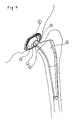
- La figure 1 est une vue en perspective du dispositif selon l'invention comportant un système d'articulation osseuse constitué de trois composants articulaires, à savoir une coquille d'ancrage osseux et sa cupule articulaire glissant sur une tête ou bille fixée au moyen du col sur une tige ou piton d'ancrage d'une prothèse fémorale de hanche.
- La figure 2 est une vue plus en détail montrant une position articulaire extrême avec les caractéristiques revendiquées pour le col et pour l'évasement interne de l'ouverture de la cupule articulaire.
- La figure 3 est un schéma décrivant les principes d'iso-tension que l'on cherche à restaurer en fonction de la balance de PAUWELS, celle-ci étant calculée en relation avec la largeur du bassin.
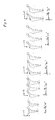
- Les figures 4 et 5 montrent à titre d'exemples les différents modèles de cols 6 en relation avec la taille du piton d'ancrage 2 dans chaque famille, permettant de réaliser l'iso-tension des muscles fessiers, tout en évitant un conflit avec ledit évasement interne de l'ouverture 8 de la cupule articulaire 7.
- L'invention n'est pas limitée aux formes de réalisation représentées dans les dessins annexés qui ont un but purement illustratif.
- Le dispositif ou prothèse pour remplacer les articulations osseuses de la hanche est constitué d'un ensemble de pièces réalisées en matériaux bio-compatibles et comprend une tige ou piton d'ancrage 2 prolongé par un col 6, de préférence évasé depuis son extrémité extérieure vers le piton d'ancrage. Ce col reçoit une tête ou bille 4 polie, laquelle rapporte une cupule articulaire sensiblement hémisphérique qui vient se loger dans une coquille d'ancrage 1 osseux se fixant dans le bassin.
- Le dispositif selon l'invention se caractérise en ce qu'il comprend au moins trois composants avec deux surfaces de contact et de glissement concourant au déplacement.
- La coquille d'ancrage osseux 1 est en matériau rigide et se caractérise en ce que le début du bord évasé de son ouverture 10 est situé à une distance comprise entre 0.5 et 3mm au-delà de l'équateur 3 de la cupule articulaire 7 de manière à réaliser un guidage cylindrique dont l'évasement est conçu pour s'adapter parfaitement avec le col 6 évasé de la prothèse de hanche, dans toutes les positions respectives des pièces.
- La partie du piton d'ancrage 2 opposée au piton d'ancrage reçoit la bille 4 polie et le col 6 qui est caractérisé en ce qu'il est lisse de préférence légèrement évasé, pour correspondre à l'évasement interne de l'ouverture 8 de la cupule articulaire 7 pour permettre un contact exempt d'usure.
- Une tête ou bille 4 polie fixée sur le col 6 du piton d'ancrage 2 par un moyen d'assemblage de préférence conique.
- Du fait de la distribution gaussienne (c-à-d selon la courbe de Gauss) des tailles de fémur chez les patients, le nombre de pitons d'ancrage 2 est de préférence variable dans chaque famille 10 à 50.
- Ce système d'articulation permet grâce à ses caractéristiques particulières d'assurer avec succès, même en cas de révision ou de mauvaise qualité osseuse, un choix précis de la position de la diaphyse tant en translation horizontale qu'en allongement du membre et donc un réglage équilibré de la tension des muscles fessiers 12 entre l'appui mono-podal et bi-podal, pour obtenir un remplacement stable et durable permettant des mouvements de grande amplitude sans luxation ni usure pour les articulations de hanche.
- Le dispositif pour le remplacement des articulations osseuses de la hanche se caractérise également en ce que la dimension du col 6 de référence dans chaque famille de piton d'ancrage 2 est en relation avec le sommet du grand trochanter tant en hauteur, qu'en translation latérale afin de respecter l'équilibre de la balance de Pauwels en appui mono-podal.
- En outre, la dimension en hauteur du col 6 de référence dans une famille de piton d'ancrage 2 est déterminée par une ligne théorique passant par le sommet des grands trochanters des deux fémurs afin de respecter l'équilibre global du bassin en appui bi-podal.
- Bien que l'invention a été décrite et illustrée en rapport avec un mode de réalisation particulier, il est bien entendu qu'elle n'est pas limitée à celui-ci et qu'elle doit être considérée dans le cadre des revendications annexées.
Claims (11)
- Dispositif de remplacement des articulations de hanche, en matériaux bio-compatibles, comprenant au moins trois composants articulaires avec deux surfaces de contact de glissement concourant aux déplacements, à savoir:- une coquille d'ancrage osseux (1) en matériau rigide recevant à sa face interne concave une cupule articulaire lisse (7) sensiblement hémisphérique polie;- une prothèse (5) comportant un piton d'ancrage (2) ayant une longueur et à la partie opposée de ce piton d'ancrage diaphysaire (2) un col (6) lisse, pour permettre un frottement exempt d'usure et de préférence légèrement évasé, le col ayant une dimension (61,62) prédéterminée;- une tête ou bille (4) polie fixée sur le col (6) du piton d'ancrage (2) par un moyen d'assemblage de préférence conique connu en soi;caractérisé en ce qu'il comporte pour chaque longueur du piton d'ancrage (2) au moins deux familles (10 à 50) ayant chacune au moins deux tailles de piton d'ancrage et au moins deux dimensions (61, 62) de col (6) différentes telles que la plus longue dimension de col d'une famille (10 à 50) corresponde à la plus courte dimension de col de la famille (10 à 50) de piton d'ancrage (2) de longueur immédiatement supérieure, afin de permettre un choix précis de la position de la diaphyse tant en translation horizontale qu'en allongement du membre et donc un réglage équilibré de la tension des muscles fessiers (12) entre l'appui mono-podal et bi-podal.
- Dispositif selon la revendication 1, caractérisée en ce que le début du bord évasé de l'ouverture (10) de cette cupule articulaire lisse (7) est situé à une distance comprise entre de 0.5 et 3 mm au-delà de l'équateur (3) de cette cupule articulaire de manière à réaliser un guidage (11) de préférence cylindrique et son évasement est conçu pour s'adapter parfaitement ensemble avec le col (6) évasé de la prothèse (5), dans toutes les positions respectives des pièces.
- Dispositif selon la revendication 1 caractérisé en ce que ce col (6) est caractérisé par une progression non homothétique de sa dimension entre chaque famille (10 à 50) .
- Dispositif selon l'une quelconque des revendications 1 à 3 dont le piton d'ancrage (6) est caractérisé en ce qu'il est décliné en familles de taille, selon la distribution gaussienne des tailles des fémurs chez les patients, chaque famille comprenant une dimension de col (6) dite de référence, propre à ladite famille.
- Dispositif selon l'une quelconque des revendications 1 à 4 caractérisé en ce que le piton d'ancrage (2) est décliné pour chaque famille (10 à 50) en au moins deux dimensions de col (6) de manière à permettre de choisir la tension idéale des muscles fessiers (12) tout en restaurant le déport de la diaphyse fémorale pour respecter la balance de Pauwels.
- Dispositif selon la revendication 5 caractérisé en ce que le nombre de pitons d'ancrage (2) est de préférence variable dans chaque famille (10 à 50) en tenant compte de la distribution selon la courbe de Gauss des tailles de fémur des patients.
- Dispositif selon l'une des revendications 1 à 5 caractérisé en ce que la dimension du col (6) de référence dans chaque famille de piton d'ancrage (2) est en relation avec le sommet du grand trochanter (13) tant en hauteur, qu'en translation latérale afin de respecter la longueur des bras de leviers déterminant l'équilibre de la balance de Pauwels en appui mono-podal.
- Dispositif selon la revendication 7 caractérisé en ce que la dimension en hauteur du col (6) de référence dans une famille de piton d'ancrage (2) est déterminée par une ligne théorique (14) passant par le sommet des grands trochanter (13) de deux fémurs afin de respecter l'équilibre global du bassin en appui bi-podal.
- Dispositif selon la revendication 7 caractérisé en ce que la dimension en translation latérale du col (6) de référence dans la famille de piton d'ancrage (2) est déterminée par une symétrie selon le plan sagittal du corps, la position étant déterminée pour la balance de PAUWELS sur le membre opposé afin de respecter l'équilibre musculaire du bassin en appui mono-podal.
- Dispositif selon l'une quelconque des revendications 1 à 9 caractérisé en ce que la longueur du col (6) augmente de préférence de façon non homothétique pour chaque famille (10 à 50) de tailles du piton d'ancrage (2) et est déclinée pour chaque famille (10 à 50) en au moins deux longueurs (61 et 62) telles que la plus longue d'une famille (10 à 50) corresponde à la plus courte de la famille (10 à 50) de piton d'ancrage (2) de taille immédiatement supérieure.
- Dispositif selon la revendication 10 caractérisé en ce que la longueur du petit col (L3) d'une famille (30) est égale à celle du col long (L2) de la famille (20) de piton d'ancrage (2) de longueur immédiatement inférieure et le col long (L3) de la même famille (30) est égal au col court (L4) de la famille (40) de piton d'ancrage (2) de longueur immédiatement supérieure.
Priority Applications (3)
| Application Number | Priority Date | Filing Date | Title |
|---|---|---|---|
| EP03078517A EP1529500B1 (fr) | 2003-11-07 | 2003-11-07 | Dispositif pour remplacer les articulations osseuses de la hanche |
| AT03078517T ATE349980T1 (de) | 2003-11-07 | 2003-11-07 | Vorrichtung zum ersatz des hüftgelenks |
| DE60310945T DE60310945D1 (de) | 2003-11-07 | 2003-11-07 | Vorrichtung zum Ersatz des Hüftgelenks |
Applications Claiming Priority (1)
| Application Number | Priority Date | Filing Date | Title |
|---|---|---|---|
| EP03078517A EP1529500B1 (fr) | 2003-11-07 | 2003-11-07 | Dispositif pour remplacer les articulations osseuses de la hanche |
Publications (2)
| Publication Number | Publication Date |
|---|---|
| EP1529500A1 EP1529500A1 (fr) | 2005-05-11 |
| EP1529500B1 true EP1529500B1 (fr) | 2007-01-03 |
Family
ID=34429441
Family Applications (1)
| Application Number | Title | Priority Date | Filing Date |
|---|---|---|---|
| EP03078517A Expired - Lifetime EP1529500B1 (fr) | 2003-11-07 | 2003-11-07 | Dispositif pour remplacer les articulations osseuses de la hanche |
Country Status (3)
| Country | Link |
|---|---|
| EP (1) | EP1529500B1 (fr) |
| AT (1) | ATE349980T1 (fr) |
| DE (1) | DE60310945D1 (fr) |
Families Citing this family (2)
| Publication number | Priority date | Publication date | Assignee | Title |
|---|---|---|---|---|
| US20140257510A1 (en) * | 2013-03-05 | 2014-09-11 | Howmedica Osteonics Corp. | Anatomic monolithic hip implant system |
| FR3050107B1 (fr) * | 2016-04-19 | 2018-04-27 | Hip Hip Hip | Gamme de protheses femorales |
Family Cites Families (4)
| Publication number | Priority date | Publication date | Assignee | Title |
|---|---|---|---|---|
| FR2639820B1 (fr) * | 1988-12-07 | 1994-09-02 | Implants Instr Ch Fab | Tiges femorales pour protheses totales de hanches |
| PL189246B1 (pl) * | 1996-02-13 | 2005-07-29 | Gen Hospital Corp | Sposób otrzymywania usieciowanego polietylenu o ultrawysokim ciężarze cząsteczkowym, medyczna proteza do stosowania wewnątrz ciała oraz zastosowanie poddanego działaniu promieniowania polietylenu o ultrawysokim ciężarze cząsteczkowym |
| FR2784576B1 (fr) * | 1998-10-16 | 2001-03-09 | Medical Solution | Prothese femorale |
| DE19928709B4 (de) * | 1999-06-23 | 2005-02-03 | Plus-Endoprothetik Ag | Hüftgelenk-Endoprothesensystem |
-
2003
- 2003-11-07 AT AT03078517T patent/ATE349980T1/de not_active IP Right Cessation
- 2003-11-07 EP EP03078517A patent/EP1529500B1/fr not_active Expired - Lifetime
- 2003-11-07 DE DE60310945T patent/DE60310945D1/de not_active Expired - Lifetime
Also Published As
| Publication number | Publication date |
|---|---|
| ATE349980T1 (de) | 2007-01-15 |
| EP1529500A1 (fr) | 2005-05-11 |
| DE60310945D1 (de) | 2007-02-15 |
Similar Documents
| Publication | Publication Date | Title |
|---|---|---|
| EP1380274A1 (fr) | Prothèse d'épaule ou de hanche facilitant l'abduction | |
| EP0127503B1 (fr) | Prothèse d'épaule | |
| EP0201407B1 (fr) | Jeu de pièces pour la réalisation d'une prothèse fémorale | |
| CA2466661C (fr) | Prothese d'articulation vertebrale posterieure | |
| CA2726034C (fr) | Prothese totale de genou | |
| EP0196258B1 (fr) | Composant fémoral de prothèse de hanche, non cimenté | |
| US20070225818A1 (en) | Non-spherical articulating surfaces in shoulder and hip replacement | |
| EP1781214B1 (fr) | Système d'implants à triple articulation du type sphérique pour membre supérieur ou inférieur | |
| FR2619708A1 (fr) | Composant femoral destine a une prothese de hanche | |
| FR2697996A1 (fr) | Ensemble modulaire pour prothèse de hanche. | |
| CH618874A5 (fr) | ||
| EP0617934A1 (fr) | Tête pour prothèse modulaire d'épaule | |
| WO2007122327A2 (fr) | Prothese d'epaule ou de hanche et methode de pose d'une telle prothese | |
| FR3081099A1 (fr) | Prothese de cheville avec un meplat | |
| FR2786390A1 (fr) | Cotyle de correction pour emploi dans le traitement de pathologies de la hanche | |
| EP1529500A1 (fr) | Dispositif pour remplacer les articulations osseuses de la hanche | |
| EP0322493B1 (fr) | Prothèse articulaire | |
| FR2683717A1 (fr) | Tige femorale pour prothese totale de hanche. | |
| FR2753081A1 (fr) | Prothese femorale de hanche a embase antepulsee | |
| WO2020178494A1 (fr) | Gamme de systemes d'implants articulaires a double mobilite | |
| FR2793675A1 (fr) | Jeu de tiges femorales | |
| FR2917963A3 (fr) | Ensemble prothetique pour l'articulation de l'epaule. | |
| FR2681239A1 (fr) | Tige pour prothese totale de hanche. | |
| FR2677879A1 (fr) | Systeme d'accrochage mecanique pour adjonction de pieces a angulation variable et hauteur variable dit multi-angulaire et plus particulierement destine a la prothese totale de hanche. | |
| FR2879917A1 (fr) | Ensemble femoral pour prothese de hanche |
Legal Events
| Date | Code | Title | Description |
|---|---|---|---|
| PUAI | Public reference made under article 153(3) epc to a published international application that has entered the european phase |
Free format text: ORIGINAL CODE: 0009012 |
|
| AK | Designated contracting states |
Kind code of ref document: A1 Designated state(s): AT BE BG CH CY CZ DE DK EE ES FI FR GB GR HU IE IT LI LU MC NL PT RO SE SI SK TR |
|
| AX | Request for extension of the european patent |
Extension state: AL LT LV MK |
|
| 17P | Request for examination filed |
Effective date: 20050615 |
|
| AKX | Designation fees paid |
Designated state(s): AT BE BG CH CY CZ DE DK EE ES FI FR GB GR HU IE IT LI LU MC NL PT RO SE SI SK TR |
|
| GRAP | Despatch of communication of intention to grant a patent |
Free format text: ORIGINAL CODE: EPIDOSNIGR1 |
|
| GRAS | Grant fee paid |
Free format text: ORIGINAL CODE: EPIDOSNIGR3 |
|
| GRAA | (expected) grant |
Free format text: ORIGINAL CODE: 0009210 |
|
| AK | Designated contracting states |
Kind code of ref document: B1 Designated state(s): AT BE BG CH CY CZ DE DK EE ES FI FR GB GR HU IE IT LI LU MC NL PT RO SE SI SK TR |
|
| PG25 | Lapsed in a contracting state [announced via postgrant information from national office to epo] |
Ref country code: NL Free format text: LAPSE BECAUSE OF FAILURE TO SUBMIT A TRANSLATION OF THE DESCRIPTION OR TO PAY THE FEE WITHIN THE PRESCRIBED TIME-LIMIT Effective date: 20070103 Ref country code: DK Free format text: LAPSE BECAUSE OF FAILURE TO SUBMIT A TRANSLATION OF THE DESCRIPTION OR TO PAY THE FEE WITHIN THE PRESCRIBED TIME-LIMIT Effective date: 20070103 Ref country code: IE Free format text: LAPSE BECAUSE OF FAILURE TO SUBMIT A TRANSLATION OF THE DESCRIPTION OR TO PAY THE FEE WITHIN THE PRESCRIBED TIME-LIMIT Effective date: 20070103 Ref country code: AT Free format text: LAPSE BECAUSE OF FAILURE TO SUBMIT A TRANSLATION OF THE DESCRIPTION OR TO PAY THE FEE WITHIN THE PRESCRIBED TIME-LIMIT Effective date: 20070103 Ref country code: SI Free format text: LAPSE BECAUSE OF FAILURE TO SUBMIT A TRANSLATION OF THE DESCRIPTION OR TO PAY THE FEE WITHIN THE PRESCRIBED TIME-LIMIT Effective date: 20070103 Ref country code: FI Free format text: LAPSE BECAUSE OF FAILURE TO SUBMIT A TRANSLATION OF THE DESCRIPTION OR TO PAY THE FEE WITHIN THE PRESCRIBED TIME-LIMIT Effective date: 20070103 |
|
| REG | Reference to a national code |
Ref country code: GB Ref legal event code: FG4D Free format text: NOT ENGLISH |
|
| REF | Corresponds to: |
Ref document number: 60310945 Country of ref document: DE Date of ref document: 20070215 Kind code of ref document: P |
|
| REG | Reference to a national code |
Ref country code: IE Ref legal event code: FG4D Free format text: LANGUAGE OF EP DOCUMENT: FRENCH |
|
| PG25 | Lapsed in a contracting state [announced via postgrant information from national office to epo] |
Ref country code: SE Free format text: LAPSE BECAUSE OF FAILURE TO SUBMIT A TRANSLATION OF THE DESCRIPTION OR TO PAY THE FEE WITHIN THE PRESCRIBED TIME-LIMIT Effective date: 20070403 |
|
| PG25 | Lapsed in a contracting state [announced via postgrant information from national office to epo] |
Ref country code: BG Free format text: LAPSE BECAUSE OF EXPIRATION OF PROTECTION Effective date: 20070404 |
|
| PG25 | Lapsed in a contracting state [announced via postgrant information from national office to epo] |
Ref country code: ES Free format text: LAPSE BECAUSE OF FAILURE TO SUBMIT A TRANSLATION OF THE DESCRIPTION OR TO PAY THE FEE WITHIN THE PRESCRIBED TIME-LIMIT Effective date: 20070414 |
|
| PG25 | Lapsed in a contracting state [announced via postgrant information from national office to epo] |
Ref country code: PT Free format text: LAPSE BECAUSE OF FAILURE TO SUBMIT A TRANSLATION OF THE DESCRIPTION OR TO PAY THE FEE WITHIN THE PRESCRIBED TIME-LIMIT Effective date: 20070604 |
|
| NLV1 | Nl: lapsed or annulled due to failure to fulfill the requirements of art. 29p and 29m of the patents act | ||
| GBV | Gb: ep patent (uk) treated as always having been void in accordance with gb section 77(7)/1977 [no translation filed] |
Effective date: 20070103 |
|
| REG | Reference to a national code |
Ref country code: IE Ref legal event code: FD4D |
|
| PLBE | No opposition filed within time limit |
Free format text: ORIGINAL CODE: 0009261 |
|
| STAA | Information on the status of an ep patent application or granted ep patent |
Free format text: STATUS: NO OPPOSITION FILED WITHIN TIME LIMIT |
|
| PG25 | Lapsed in a contracting state [announced via postgrant information from national office to epo] |
Ref country code: GB Free format text: LAPSE BECAUSE OF FAILURE TO SUBMIT A TRANSLATION OF THE DESCRIPTION OR TO PAY THE FEE WITHIN THE PRESCRIBED TIME-LIMIT Effective date: 20070103 Ref country code: SK Free format text: LAPSE BECAUSE OF FAILURE TO SUBMIT A TRANSLATION OF THE DESCRIPTION OR TO PAY THE FEE WITHIN THE PRESCRIBED TIME-LIMIT Effective date: 20070103 |
|
| 26N | No opposition filed |
Effective date: 20071005 |
|
| PG25 | Lapsed in a contracting state [announced via postgrant information from national office to epo] |
Ref country code: RO Free format text: LAPSE BECAUSE OF FAILURE TO SUBMIT A TRANSLATION OF THE DESCRIPTION OR TO PAY THE FEE WITHIN THE PRESCRIBED TIME-LIMIT Effective date: 20070103 Ref country code: CZ Free format text: LAPSE BECAUSE OF FAILURE TO SUBMIT A TRANSLATION OF THE DESCRIPTION OR TO PAY THE FEE WITHIN THE PRESCRIBED TIME-LIMIT Effective date: 20070103 |
|
| PG25 | Lapsed in a contracting state [announced via postgrant information from national office to epo] |
Ref country code: DE Free format text: LAPSE BECAUSE OF FAILURE TO SUBMIT A TRANSLATION OF THE DESCRIPTION OR TO PAY THE FEE WITHIN THE PRESCRIBED TIME-LIMIT Effective date: 20070404 |
|
| PG25 | Lapsed in a contracting state [announced via postgrant information from national office to epo] |
Ref country code: IT Free format text: LAPSE BECAUSE OF FAILURE TO SUBMIT A TRANSLATION OF THE DESCRIPTION OR TO PAY THE FEE WITHIN THE PRESCRIBED TIME-LIMIT Effective date: 20070103 Ref country code: GR Free format text: LAPSE BECAUSE OF FAILURE TO SUBMIT A TRANSLATION OF THE DESCRIPTION OR TO PAY THE FEE WITHIN THE PRESCRIBED TIME-LIMIT Effective date: 20070404 |
|
| PG25 | Lapsed in a contracting state [announced via postgrant information from national office to epo] |
Ref country code: MC Free format text: LAPSE BECAUSE OF NON-PAYMENT OF DUE FEES Effective date: 20071130 |
|
| PG25 | Lapsed in a contracting state [announced via postgrant information from national office to epo] |
Ref country code: CH Free format text: LAPSE BECAUSE OF NON-PAYMENT OF DUE FEES Effective date: 20071130 Ref country code: LI Free format text: LAPSE BECAUSE OF NON-PAYMENT OF DUE FEES Effective date: 20071130 |
|
| REG | Reference to a national code |
Ref country code: CH Ref legal event code: PL |
|
| PG25 | Lapsed in a contracting state [announced via postgrant information from national office to epo] |
Ref country code: EE Free format text: LAPSE BECAUSE OF FAILURE TO SUBMIT A TRANSLATION OF THE DESCRIPTION OR TO PAY THE FEE WITHIN THE PRESCRIBED TIME-LIMIT Effective date: 20070103 |
|
| PG25 | Lapsed in a contracting state [announced via postgrant information from national office to epo] |
Ref country code: CY Free format text: LAPSE BECAUSE OF FAILURE TO SUBMIT A TRANSLATION OF THE DESCRIPTION OR TO PAY THE FEE WITHIN THE PRESCRIBED TIME-LIMIT Effective date: 20070103 |
|
| PG25 | Lapsed in a contracting state [announced via postgrant information from national office to epo] |
Ref country code: TR Free format text: LAPSE BECAUSE OF FAILURE TO SUBMIT A TRANSLATION OF THE DESCRIPTION OR TO PAY THE FEE WITHIN THE PRESCRIBED TIME-LIMIT Effective date: 20070103 Ref country code: HU Free format text: LAPSE BECAUSE OF FAILURE TO SUBMIT A TRANSLATION OF THE DESCRIPTION OR TO PAY THE FEE WITHIN THE PRESCRIBED TIME-LIMIT Effective date: 20070704 |
|
| PGFP | Annual fee paid to national office [announced via postgrant information from national office to epo] |
Ref country code: LU Payment date: 20111130 Year of fee payment: 9 |
|
| PG25 | Lapsed in a contracting state [announced via postgrant information from national office to epo] |
Ref country code: LU Free format text: LAPSE BECAUSE OF NON-PAYMENT OF DUE FEES Effective date: 20121107 |
|
| REG | Reference to a national code |
Ref country code: FR Ref legal event code: PLFP Year of fee payment: 13 |
|
| REG | Reference to a national code |
Ref country code: FR Ref legal event code: PLFP Year of fee payment: 14 |
|
| REG | Reference to a national code |
Ref country code: FR Ref legal event code: PLFP Year of fee payment: 15 |
|
| PGFP | Annual fee paid to national office [announced via postgrant information from national office to epo] |
Ref country code: FR Payment date: 20220420 Year of fee payment: 19 |
|
| PGFP | Annual fee paid to national office [announced via postgrant information from national office to epo] |
Ref country code: BE Payment date: 20220421 Year of fee payment: 19 |
|
| REG | Reference to a national code |
Ref country code: BE Ref legal event code: MM Effective date: 20221130 |
|
| PG25 | Lapsed in a contracting state [announced via postgrant information from national office to epo] |
Ref country code: FR Free format text: LAPSE BECAUSE OF NON-PAYMENT OF DUE FEES Effective date: 20221130 Ref country code: BE Free format text: LAPSE BECAUSE OF NON-PAYMENT OF DUE FEES Effective date: 20221130 |