EP1528670B1 - Transkonduktanzverstärker - Google Patents
Transkonduktanzverstärker Download PDFInfo
- Publication number
- EP1528670B1 EP1528670B1 EP03292679A EP03292679A EP1528670B1 EP 1528670 B1 EP1528670 B1 EP 1528670B1 EP 03292679 A EP03292679 A EP 03292679A EP 03292679 A EP03292679 A EP 03292679A EP 1528670 B1 EP1528670 B1 EP 1528670B1
- Authority
- EP
- European Patent Office
- Prior art keywords
- type fet
- current
- fet
- input circuit
- resistor
- Prior art date
- Legal status (The legal status is an assumption and is not a legal conclusion. Google has not performed a legal analysis and makes no representation as to the accuracy of the status listed.)
- Expired - Lifetime
Links
- 101100112673 Rattus norvegicus Ccnd2 gene Proteins 0.000 claims 1
- XUIMIQQOPSSXEZ-UHFFFAOYSA-N Silicon Chemical compound [Si] XUIMIQQOPSSXEZ-UHFFFAOYSA-N 0.000 description 1
- 229910052710 silicon Inorganic materials 0.000 description 1
- 239000010703 silicon Substances 0.000 description 1
Images


Classifications
-
- H—ELECTRICITY
- H03—ELECTRONIC CIRCUITRY
- H03F—AMPLIFIERS
- H03F3/00—Amplifiers with only discharge tubes or only semiconductor devices as amplifying elements
- H03F3/45—Differential amplifiers
- H03F3/45071—Differential amplifiers with semiconductor devices only
- H03F3/45479—Differential amplifiers with semiconductor devices only characterised by the way of common mode signal rejection
- H03F3/45632—Differential amplifiers with semiconductor devices only characterised by the way of common mode signal rejection in differential amplifiers with FET transistors as the active amplifying circuit
- H03F3/45744—Differential amplifiers with semiconductor devices only characterised by the way of common mode signal rejection in differential amplifiers with FET transistors as the active amplifying circuit by offset reduction
- H03F3/45766—Differential amplifiers with semiconductor devices only characterised by the way of common mode signal rejection in differential amplifiers with FET transistors as the active amplifying circuit by offset reduction by using balancing means
-
- H—ELECTRICITY
- H03—ELECTRONIC CIRCUITRY
- H03F—AMPLIFIERS
- H03F3/00—Amplifiers with only discharge tubes or only semiconductor devices as amplifying elements
- H03F3/45—Differential amplifiers
- H03F3/45071—Differential amplifiers with semiconductor devices only
- H03F3/45076—Differential amplifiers with semiconductor devices only characterised by the way of implementation of the active amplifying circuit in the differential amplifier
- H03F3/45179—Differential amplifiers with semiconductor devices only characterised by the way of implementation of the active amplifying circuit in the differential amplifier using MOSFET transistors as the active amplifying circuit
- H03F3/45183—Long tailed pairs
-
- H—ELECTRICITY
- H03—ELECTRONIC CIRCUITRY
- H03F—AMPLIFIERS
- H03F2203/00—Indexing scheme relating to amplifiers with only discharge tubes or only semiconductor devices as amplifying elements covered by H03F3/00
- H03F2203/45—Indexing scheme relating to differential amplifiers
- H03F2203/45288—Differential amplifier with circuit arrangements to enhance the transconductance
Definitions
- the present invention relates to a transconductance amplifier.
- Transconductance amplifiers are used for converting an input voltage into an output current.
- transconductance amplifier that has linear transfer characteristics and operates over a wide bandwidth.
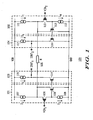
- FIG. 1 shows a transconductance amplifier 100 having a first input circuit 101, a second input circuit 102, a first output circuit 103 and a second output circuit 104, with the first input circuit 101 and the second input circuit 102 being coupled via a resistor 105.
- the first input circuit 101 has a first P-type FET 106 that has its source coupled to a first current source 107, which in turn is coupled to a supply line V DD , and its drain coupled to a second current source 108, which in turn is coupled to a reference line GND, for example ground.
- the gate of the P-type FET 106 acts as the input V in1 for the first input circuit 101.
- the input circuit 101 includes a first N-type FET 109 in which the source is coupled to the reference line GND, the gate is coupled to a point between the first P-type FET drain and the second current source 108, and the drain is coupled to a point between the P-type FET source and the first current source 107 to form a feedback loop.
- the drain of the first N-type FET 109 is additionally coupled to a first interface of the resistor 105.
- the second input circuit 102 is of similar design to the first input circuit 101 having a second P-type FET 110 that has its source coupled to a third current source 111, which in turn is coupled to the supply line V DD , and its drain coupled to a fourth current source 112, which in turn is coupled to the reference line GND, for example ground.
- the gate of the P-type FET 110 acts as the input V in2 for the second input circuit 102.
- the second input circuit 102 includes a second N-type FET 113 in which the source is coupled to the reference line GND, the gate is coupled to a point between the second P-type FET drain and the fourth current source 112, and the drain is coupled to a point between the second P-type FET source and the third current source 111 to form a feedback loop.
- the drain of the second N-type FET 113 is additionally coupled to a second interface of the resistor 105.
- the first output circuit 103 has a third N-type FET 114 that is arranged to form a current mirror with the feedback loop formed by the first N-type FET 109 where the third N-type FET 114 has its source coupled to the reference line GND, its drain couple to a fifth current source 115, which in turn is couple to the supply line V DD , and its gate is coupled to a point between the drain of the first P-type FET 106 and the second current source 108.
- the output I out1 for the first output circuit 103 is formed at a point between the drain of the third N-type FET 114 and the fifth current source 115.
- the second output circuit 104 is of similar design to the first output circuit 103 having a fourth N-type FET 116 that is arranged to form a current mirror with the feedback loop formed by the second N-type FET 113 where the fourth N-type FET 116 has its source coupled to the reference line GND, its drain couple to a sixth current source 117, which in turn is couple to the supply line V DD , and its gate is coupled to a point between the drain of the second P-type FET 110 and the fourth current source 112.
- the output I out2 for the second output circuit 104 is formed at a point between the drain of the fourth N-type FET 116 and the sixth current source 117.
- the voltage across the resistor 105 should be kept equal to the input voltage difference (i.e. V in1 - V in2 ). This is achieved by keeping the drain-source current of the first P-type FET 106 and the second P-type FET 110 constant by means of the feedback loops formed by the first N-type FET 109 and the second N-type FET 113 respectively.
- the feedback loops compensates for current diverted from the first current source 107 and third current source 111 through the resistor 105, thereby ensuring that the drain-source current of the first P-type FET 106 and the second P-type FET 110 is maintained.
- the third N-type FET 114 and fourth N-type FET 116 form current mirrors with the feedback loops their drain-source current will be identical to that for the first N-type FET 109 and second N-type FET 113 respectively, which forms the transconductance amplifier output current I out1 , I out2 .
- the transconductance of the transconductance amplifier 100 is given by 1/R.
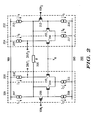
- Figure 2 shows a transconductance amplifier 200 having a fixed transconductance value.
- the transconductance amplifier 200 includes a first input circuit 201, a second input circuit 202, a first output circuit 203 and a second output circuit 204, with the first input circuit 201 and the second input circuit 202 being coupled via a resistor 205.
- the first input circuit 201 has a first P-type FET 206 that has its source coupled to a first current source 207, which in turn is coupled to a supply line V DD , and its drain coupled to a second current source 208, which in turn is coupled to a reference line GND, for example ground.
- the gate of the P-type FET 206 acts as the input V in1 for the first input circuit 201.
- the input circuit 201 includes a first N-type FET 209 that forms a first differential pair with a second N-type FET 210.
- the source of the first N-type FET 209 is coupled to the source of the second N-type FET 210 and to a third current source 211, which in turn is coupled to the reference line GND.
- the gate of the first N-type FET 209 is coupled to a point between the first P-type FET drain and the second current source 208, and the drain is coupled to a point between the P-type FET source and the first current source 207 to form a feedback loop.
- the drain of the first N-type FET 209 is additionally coupled to a first interface of the resistor 205.
- the second input circuit 202 is of similar design to the first input circuit 201 having a second P-type FET 212 that has its source coupled to a fourth current source 213, which in turn is coupled to the supply line V DD , and its drain coupled to a fifth current source 214, which in turn is coupled to the reference line GND, for example ground.
- the gate of the P-type FET 212 acts as the input V in2 for the second input circuit 202.
- the second input circuit 202 includes a third N-type FET 215 that forms a second differential pair with a fourth N-type FET 216.
- the source of the third N-type FET 215 is coupled to the source of the fourth N-type FET 216 and to a sixth current source 217, which in turn is coupled to the reference line GND.
- the gate of the third N-type FET 215 is coupled to a point between the second P-type FET drain and the fifth current source 214, and the drain is coupled to a point between the second P-type FET source and the fourth current source 213 to form a feedback loop.
- the drain of the third N-type FET 215 is additionally coupled to a second interface of the resistor 205.
- the first output circuit includes the second N-type FET 210 that forms a differential pair with the first N-type FET 209.
- the second N-type FET 210 has its source coupled to the source of the first N-type FET 209 and to the third current source 211.
- the gate of the second N-type FET 210 is coupled to a biasing voltage V g where V g is selected to accommodate the desired input voltage and required gain.
- the drain of the second N-type FET 210 is coupled to a seventh current source 218, which in turn is coupled to the supply line V DD .
- the output I out1 for the first output circuit 203 is formed at a point between the drain of the second N-type FET 210 and the seventh current source 218.
- the second output circuit 204 includes the fourth N-type FET 216 that forms a differential pair with the third N-type FET 215.
- the fourth N-type FET 216 has its source coupled to the source of the third N-type FET 215 and to the sixth current source 217.
- the gate of the fourth N-type FET 216 is coupled to the biasing voltage V g .
- the drain of the fourth N-type FET 216 is coupled to an eighth current source 219, which in turn is coupled to the supply line V DD .
- the output for the second output circuit 209 is formed at a point between the drain of the fourth N-type FET 216 and the eighth current source 219.
- the voltage across the resistor 205 should be kept equal to the input voltage difference (i.e. V in1 - V in2 ) to obtain a linear voltage to current transfer function.
- V in1 - V in2 the input voltage difference
- the feedback loops compensate for current diverted from the first current source (207) and fourth current source 213 through the resistor 205, thereby ensuring that the drain-source current of the first P-type FET 206 and the second P-type FET 212 is maintained.
- the output current is based upon current difference with respect to the feedback loops. Consequently, due to the use of the differential pairs the first output circuit current flow will be the negative of the current flow in the first feedback loop and the second output circuit current flow will be the negative of the current flow in the second feedback loop, thereby improving transfer linearity and bandwidth compared to the prior art.
- the fourth N-type FET 216 i.e. the other half of the second differential pair
- the output current I out2 in the second output circuit 204 is equal to -((V in1 - V in2 )/R).
- the output current in the second output circuit 204 is equal to -((V in1 - V in2 )/R) the current flowing into the first N-type FET 209 is reduced by (V in1 - V in2 )/R and this reduced current causes an opposite current flow to flow in the second N-type FET 210 (i.e. the other half of the first differential pair) that is equal to (V in1 - V in2 )/R. Accordingly, the output current I out1 in the first output circuit 203 is equal to (V in1 - V in2 ) /R.
- the transconductance of the transconductance amplifier 200 is given by 1/R.
- Figure 3 shows a transconductance amplifier 300 having a variable transconductance value.
- the transconductance amplifier 300 includes a first input circuit 201, a second input circuit 202, a first output circuit 203 and a second output circuit 204, which are the same as those shown in figure 2 and described above.
- the same reference numerals used in figure 3 as those in figure 1 represent the same features.
- the first input circuit 201 and the second input circuit 202 are coupled via a variable resistor 301 where the variable resistor 301 has a control input V gv .
- the variable resistor is a P-type FET, however, other forms of variable resistor can be used.
- the source and drain of the P-type FET act as the resistors first interface and second interface respectively.
- the gate of the P-type FET acts as the input for the control input V gv , wherein the resistance of the variable resistor is varied via a control voltage applied to the P-type FET gate.
- the transconductance of the transconductance amplifier 300 shown in figure 3 corresponds to the inverse of the resistance of the resistor 301. Accordingly, by varying the value of the resistance, via the control voltage V gv applied to the P-type FET gate, the transconductance of the transconductance amplifier 300 can be varied.
- Figure 4 shows an embodiment of a transconductance amplifier 400 having a variable transconductance value according to the present invention.
- the transconductance amplifier 400 includes a first input circuit 201, a second input circuit 202, a first output circuit 203 and a second output circuit 204, which are the same as shown in figure 2 and 3 and described above where the same reference numerals used in figure 4 as those in figure 2 and 3 represent the same features.
- the source of a fifth N-type FET 401 is coupled to the source of the first N-type FET 209 and the second N-type FET 210, which form the first differential pair
- the source of a sixth N-type FET 402 is coupled to the source of the third N-type FET 215 and the fourth N-type FET 216, which form the second differential pair.
- the drains of the fifth N-type FET 401 and the sixth N-type FET 402 are coupled to the supply line V DD .
- the gates of the fifth N-type FET 401 and the sixth N-type FET 402 are both coupled to a control voltage V c .
- the first N-type FET 209, the second N-type FET 210 and the fifth N-type FET 401 form a first differential pair and the third N-type FET 215, the fourth N-type FET 216 and the seventh N-type FET 402 form a second differential pair.
- a common mode loop 403 is coupled to the seventh current source 218 and eighth current source 219.
- the common mode loop 403 is an amplifier that corrects the current flow in the seventh current source 218 and the eighth current source 219 if the output common mode voltage moves away from an input reference voltage Vref.
- the transconductance amplifier 400 shown in figure 4 operates in a similar matter to the transconductance amplifier 200 shown in figure 2, however, by changing the control voltage V c applied to the gates of the fifth N-type FET 401 and the sixth N-type FET 402 the amount of current that flows in the fifth N-type FET 401 and the sixth N-type FET 402 correspondingly changes, thereby changing the amount of current that flows in the first N-type FET 209, the second N-type FET 210, the third N-type FET 215 and the fourth N-type FET 216.
- the higher the control voltage V c applied to the gates of the fifth N-type FET 401 and the sixth N-type FET 402 the higher the current flow through the fifth N-type FET 401 and the sixth N-type FET 402 and correspondingly the less current flow through the first N-type FET 209, the second N-type FET 210, the third N-type FET 215 and the fourth N-type FET 216, thereby reducing the transconductance of the transconductance amplifier 400.
- control voltage V c applied to the gates of the fifth N-type FET 401 and the sixth N-type FET 402 is set low then no current will flow through the fifth N-type FET 401 and the sixth N-type FET 402 and the transconductance amplifier 400 will operate in the same manner as that shown and described in figure 2.
- the common mode loop 403 is used to maintain the current flow from the seventh current source 218 equal to the DC current in the second N-type FET 210 and correspondingly the current flow from the eighth current source 219 equal to the DC current in the fourth N-type FET 216.
Landscapes
- Engineering & Computer Science (AREA)
- Power Engineering (AREA)
- Amplifiers (AREA)
- Networks Using Active Elements (AREA)
Claims (5)
- Transkonduktanzverstärker (400) mit einer ersten Eingangsschaltung (201), die eine erste Rückkopplungsschleife aufweist; einer zweiten Eingangsschaltung (202), die eine zweite Rückkopplungsschleife aufweist; einem Widerstandselement (205), das eine mit der ersten Eingangsschaltung (201) verbundene erste Schnittstelle und eine mit der zweiten Eingangschaltung (202) verbundene zweite Schnittstelle aufweist; einem ersten Differential-Paar mit einem zum Steuern bzw. Regeln eines Stromflusses in der ersten Rückkopplungsschleife ausgelegten ersten FET (209), um eine Spannung an der ersten Schnittstelle des Widerstandselements (205) auf einer relativ zu einer an die erste Eingangsschaltung (201) angelegten ersten Eingangsspannung (Vin1) im Wesentlichen konstanten Spannung zu halten, einem zum Steuern bzw. Regeln eines Stromflusses für einen ersten Ausgang ausgelegten zweiten FET (210); und einem zweiten Differential-Paar mit einem zum Steuern bzw. Regeln eines Stromflusses in der zweiten Rückkopplungsschleife ausgelegten dritten FET (215), um eine Spannung an der zweiten Schnittstelle des Widerstandselements (205) auf einer relativ zu einer an die zweite Eingangsschaltung (202) angelegten zweiten Eingangsspannung (Vin2) im Wesentlichen konstanten Spannung zu halten, einem zum Steuern bzw. Regeln eines Stromflusses für einen zweiten Ausgang ausgelegten vierten FET (216), und einem fünften FET (401), der einen Source-Anschluss aufweist, der mit einem Source-Anschluss des ersten FET (209) und des zweiten FET (210) gekoppelt ist, und einem sechsten FET (402), der einen Source-Anschluss aufweist, der mit einem Source-Anschluss des dritten FET (215) und des vierten FET (216) gekoppelt ist, wobei der Transkonduktanzverstärker (400) dadurch gekennzeichnet ist, dass der fünfte FET (401) und der sechste FET (402) einen Gate-Anschluss aufweisen, der an ein variables Steuersignal (Vc) zum Variieren des Stromflusses für den ersten Ausgang beziehungsweise des Stromflusses für den zweiten Ausgang gekoppelt ist, wodurch ermöglicht wird, die Transkonduktanz des Transkonduktanzverstärkers (400) zu variieren.
- Transkonduktanzverstärker (400) gemäß Anspruch 1, wobei die Transkonduktanz das Inverse des Widerstands des Widerstandselements (205) ist.
- Transkonduktanzverstärker (400) gemäß Anspruch 1 oder Anspruch 2, wobei das Widerstandelement (205) ein festes Widerstandselement ist.
- Transkonduktanzverstärker (400) gemäß Anspruch 1 oder Anspruch 2, wobei das Widerstandelement (205) ein variables Widerstandselement ist, das ermöglicht die Transkonduktanz des Transkonduktanzverstärkers (400) zu variieren.
- Transkonduktanzverstärker (400) gemäß Anspruch 1, der weiterhin eine Gleichtaktschleife umfasst, die ausgelegt ist, um einen Ausgangsstrom im Wesentlichen gleich Null zu halten, wenn die Spannungsdifferenz zwischen der an die erste Eingangsschaltung angelegten Eingangsspannung und der an die zweite Eingangsschaltung angelegten Eingangsspannung im Wesentlichen Null ist.
Priority Applications (4)
| Application Number | Priority Date | Filing Date | Title |
|---|---|---|---|
| DE60314754T DE60314754T2 (de) | 2003-10-27 | 2003-10-27 | Transkonduktanzverstärker |
| AT03292679T ATE366482T1 (de) | 2003-10-27 | 2003-10-27 | Transkonduktanzverstärker |
| EP03292679A EP1528670B1 (de) | 2003-10-27 | 2003-10-27 | Transkonduktanzverstärker |
| US10/973,728 US7183848B2 (en) | 2003-10-27 | 2004-10-26 | Transconductance amplifier |
Applications Claiming Priority (1)
| Application Number | Priority Date | Filing Date | Title |
|---|---|---|---|
| EP03292679A EP1528670B1 (de) | 2003-10-27 | 2003-10-27 | Transkonduktanzverstärker |
Publications (2)
| Publication Number | Publication Date |
|---|---|
| EP1528670A1 EP1528670A1 (de) | 2005-05-04 |
| EP1528670B1 true EP1528670B1 (de) | 2007-07-04 |
Family
ID=34400583
Family Applications (1)
| Application Number | Title | Priority Date | Filing Date |
|---|---|---|---|
| EP03292679A Expired - Lifetime EP1528670B1 (de) | 2003-10-27 | 2003-10-27 | Transkonduktanzverstärker |
Country Status (4)
| Country | Link |
|---|---|
| US (1) | US7183848B2 (de) |
| EP (1) | EP1528670B1 (de) |
| AT (1) | ATE366482T1 (de) |
| DE (1) | DE60314754T2 (de) |
Families Citing this family (2)
| Publication number | Priority date | Publication date | Assignee | Title |
|---|---|---|---|---|
| JP5315981B2 (ja) * | 2008-12-24 | 2013-10-16 | 富士通セミコンダクター株式会社 | 電流生成回路、電流生成方法及び電子機器 |
| CN108900169A (zh) * | 2018-09-18 | 2018-11-27 | 上海新进半导体制造有限公司 | 一种霍尔放大器 |
Family Cites Families (2)
| Publication number | Priority date | Publication date | Assignee | Title |
|---|---|---|---|---|
| US5307024A (en) * | 1992-07-27 | 1994-04-26 | Tektronix, Inc. | Linearized level-shifting amplifier |
| JP2002076800A (ja) * | 2000-08-30 | 2002-03-15 | Nec Corp | 電圧減算・加算回路及びそれを実現するmos差動増幅回路 |
-
2003
- 2003-10-27 DE DE60314754T patent/DE60314754T2/de not_active Expired - Lifetime
- 2003-10-27 EP EP03292679A patent/EP1528670B1/de not_active Expired - Lifetime
- 2003-10-27 AT AT03292679T patent/ATE366482T1/de not_active IP Right Cessation
-
2004
- 2004-10-26 US US10/973,728 patent/US7183848B2/en not_active Expired - Lifetime
Also Published As
| Publication number | Publication date |
|---|---|
| EP1528670A1 (de) | 2005-05-04 |
| US20050088234A1 (en) | 2005-04-28 |
| DE60314754T2 (de) | 2007-12-06 |
| US7183848B2 (en) | 2007-02-27 |
| DE60314754D1 (de) | 2007-08-16 |
| ATE366482T1 (de) | 2007-07-15 |
Similar Documents
| Publication | Publication Date | Title |
|---|---|---|
| US7911244B2 (en) | Differential drive circuit and communication device | |
| US7292101B2 (en) | Digitally adjustable variable gain amplifier (VGA) using switchable differential pairs | |
| US20020089377A1 (en) | Constant transconductance differential amplifier | |
| US7652535B2 (en) | Continuous time common mode feedback circuit, system, and method | |
| CN116009641B (zh) | 一种电流镜电路、保护电路、偏置电路及电子设备 | |
| JP2008288900A (ja) | 差動増幅器 | |
| US6756841B2 (en) | Variable offset amplifier circuits and their applications | |
| US20090184752A1 (en) | Bias circuit | |
| US10224886B2 (en) | Operational amplifier circuit using variable bias control | |
| CN1132306C (zh) | 差分放大器电路 | |
| US6653894B2 (en) | Integrated current mirror in output stage of operational amplifier | |
| US6249153B1 (en) | High slew rate input differential pair with common mode input to ground | |
| US11742812B2 (en) | Output pole-compensated operational amplifier | |
| US6181195B1 (en) | Impedance transport circuit | |
| US5978241A (en) | Wide-linear range tunable transconductor using MOS | |
| JP2003099135A (ja) | ロードロップ電圧調整装置 | |
| US7183848B2 (en) | Transconductance amplifier | |
| US6803819B2 (en) | Variable gain amplifier having improved gain slope characteristic and linearity | |
| US6707322B2 (en) | Transconductor having structure of crossing pairs | |
| EP1017164A2 (de) | Stromspiegel mit einem konstanten Strom über einen weiten Bereich der Ausgangslastimpedanz | |
| WO2002043242A1 (en) | Differential amplifier having active load device scaling | |
| US20080106247A1 (en) | Trimmed current mirror | |
| US20260100685A1 (en) | Current mirror operational transconductance amplifier | |
| US20260098879A1 (en) | Current sense amplifier | |
| JP4819583B2 (ja) | Ota回路 |
Legal Events
| Date | Code | Title | Description |
|---|---|---|---|
| PUAI | Public reference made under article 153(3) epc to a published international application that has entered the european phase |
Free format text: ORIGINAL CODE: 0009012 |
|
| AK | Designated contracting states |
Kind code of ref document: A1 Designated state(s): AT BE BG CH CY CZ DE DK EE ES FI FR GB GR HU IE IT LI LU MC NL PT RO SE SI SK TR |
|
| AX | Request for extension of the european patent |
Extension state: AL LT LV MK |
|
| 17P | Request for examination filed |
Effective date: 20051104 |
|
| AKX | Designation fees paid |
Designated state(s): AT BE BG CH CY CZ DE DK EE ES FI FR GB GR HU IE IT LI LU MC NL PT RO SE SI SK TR |
|
| GRAP | Despatch of communication of intention to grant a patent |
Free format text: ORIGINAL CODE: EPIDOSNIGR1 |
|
| 17Q | First examination report despatched |
Effective date: 20060213 |
|
| GRAS | Grant fee paid |
Free format text: ORIGINAL CODE: EPIDOSNIGR3 |
|
| GRAA | (expected) grant |
Free format text: ORIGINAL CODE: 0009210 |
|
| AK | Designated contracting states |
Kind code of ref document: B1 Designated state(s): AT BE BG CH CY CZ DE DK EE ES FI FR GB GR HU IE IT LI LU MC NL PT RO SE SI SK TR |
|
| REG | Reference to a national code |
Ref country code: GB Ref legal event code: FG4D |
|
| REG | Reference to a national code |
Ref country code: CH Ref legal event code: EP |
|
| REG | Reference to a national code |
Ref country code: IE Ref legal event code: FG4D |
|
| REF | Corresponds to: |
Ref document number: 60314754 Country of ref document: DE Date of ref document: 20070816 Kind code of ref document: P |
|
| ET | Fr: translation filed | ||
| NLV1 | Nl: lapsed or annulled due to failure to fulfill the requirements of art. 29p and 29m of the patents act | ||
| REG | Reference to a national code |
Ref country code: CH Ref legal event code: PL |
|
| PG25 | Lapsed in a contracting state [announced via postgrant information from national office to epo] |
Ref country code: PT Free format text: LAPSE BECAUSE OF FAILURE TO SUBMIT A TRANSLATION OF THE DESCRIPTION OR TO PAY THE FEE WITHIN THE PRESCRIBED TIME-LIMIT Effective date: 20071204 Ref country code: BG Free format text: LAPSE BECAUSE OF FAILURE TO SUBMIT A TRANSLATION OF THE DESCRIPTION OR TO PAY THE FEE WITHIN THE PRESCRIBED TIME-LIMIT Effective date: 20071004 Ref country code: SI Free format text: LAPSE BECAUSE OF FAILURE TO SUBMIT A TRANSLATION OF THE DESCRIPTION OR TO PAY THE FEE WITHIN THE PRESCRIBED TIME-LIMIT Effective date: 20070704 Ref country code: ES Free format text: LAPSE BECAUSE OF FAILURE TO SUBMIT A TRANSLATION OF THE DESCRIPTION OR TO PAY THE FEE WITHIN THE PRESCRIBED TIME-LIMIT Effective date: 20071015 Ref country code: FI Free format text: LAPSE BECAUSE OF FAILURE TO SUBMIT A TRANSLATION OF THE DESCRIPTION OR TO PAY THE FEE WITHIN THE PRESCRIBED TIME-LIMIT Effective date: 20070704 Ref country code: NL Free format text: LAPSE BECAUSE OF FAILURE TO SUBMIT A TRANSLATION OF THE DESCRIPTION OR TO PAY THE FEE WITHIN THE PRESCRIBED TIME-LIMIT Effective date: 20070704 |
|
| PG25 | Lapsed in a contracting state [announced via postgrant information from national office to epo] |
Ref country code: LI Free format text: LAPSE BECAUSE OF FAILURE TO SUBMIT A TRANSLATION OF THE DESCRIPTION OR TO PAY THE FEE WITHIN THE PRESCRIBED TIME-LIMIT Effective date: 20070704 Ref country code: AT Free format text: LAPSE BECAUSE OF FAILURE TO SUBMIT A TRANSLATION OF THE DESCRIPTION OR TO PAY THE FEE WITHIN THE PRESCRIBED TIME-LIMIT Effective date: 20070704 Ref country code: CH Free format text: LAPSE BECAUSE OF FAILURE TO SUBMIT A TRANSLATION OF THE DESCRIPTION OR TO PAY THE FEE WITHIN THE PRESCRIBED TIME-LIMIT Effective date: 20070704 |
|
| PG25 | Lapsed in a contracting state [announced via postgrant information from national office to epo] |
Ref country code: BE Free format text: LAPSE BECAUSE OF FAILURE TO SUBMIT A TRANSLATION OF THE DESCRIPTION OR TO PAY THE FEE WITHIN THE PRESCRIBED TIME-LIMIT Effective date: 20070704 |
|
| PG25 | Lapsed in a contracting state [announced via postgrant information from national office to epo] |
Ref country code: GR Free format text: LAPSE BECAUSE OF FAILURE TO SUBMIT A TRANSLATION OF THE DESCRIPTION OR TO PAY THE FEE WITHIN THE PRESCRIBED TIME-LIMIT Effective date: 20071005 Ref country code: DK Free format text: LAPSE BECAUSE OF FAILURE TO SUBMIT A TRANSLATION OF THE DESCRIPTION OR TO PAY THE FEE WITHIN THE PRESCRIBED TIME-LIMIT Effective date: 20070704 |
|
| PLBE | No opposition filed within time limit |
Free format text: ORIGINAL CODE: 0009261 |
|
| STAA | Information on the status of an ep patent application or granted ep patent |
Free format text: STATUS: NO OPPOSITION FILED WITHIN TIME LIMIT |
|
| PG25 | Lapsed in a contracting state [announced via postgrant information from national office to epo] |
Ref country code: MC Free format text: LAPSE BECAUSE OF NON-PAYMENT OF DUE FEES Effective date: 20071031 Ref country code: SK Free format text: LAPSE BECAUSE OF FAILURE TO SUBMIT A TRANSLATION OF THE DESCRIPTION OR TO PAY THE FEE WITHIN THE PRESCRIBED TIME-LIMIT Effective date: 20070704 Ref country code: CZ Free format text: LAPSE BECAUSE OF FAILURE TO SUBMIT A TRANSLATION OF THE DESCRIPTION OR TO PAY THE FEE WITHIN THE PRESCRIBED TIME-LIMIT Effective date: 20070704 |
|
| 26N | No opposition filed |
Effective date: 20080407 |
|
| PG25 | Lapsed in a contracting state [announced via postgrant information from national office to epo] |
Ref country code: SE Free format text: LAPSE BECAUSE OF FAILURE TO SUBMIT A TRANSLATION OF THE DESCRIPTION OR TO PAY THE FEE WITHIN THE PRESCRIBED TIME-LIMIT Effective date: 20071004 Ref country code: RO Free format text: LAPSE BECAUSE OF FAILURE TO SUBMIT A TRANSLATION OF THE DESCRIPTION OR TO PAY THE FEE WITHIN THE PRESCRIBED TIME-LIMIT Effective date: 20070704 |
|
| PG25 | Lapsed in a contracting state [announced via postgrant information from national office to epo] |
Ref country code: IE Free format text: LAPSE BECAUSE OF NON-PAYMENT OF DUE FEES Effective date: 20071030 |
|
| PG25 | Lapsed in a contracting state [announced via postgrant information from national office to epo] |
Ref country code: EE Free format text: LAPSE BECAUSE OF FAILURE TO SUBMIT A TRANSLATION OF THE DESCRIPTION OR TO PAY THE FEE WITHIN THE PRESCRIBED TIME-LIMIT Effective date: 20070704 |
|
| PG25 | Lapsed in a contracting state [announced via postgrant information from national office to epo] |
Ref country code: CY Free format text: LAPSE BECAUSE OF FAILURE TO SUBMIT A TRANSLATION OF THE DESCRIPTION OR TO PAY THE FEE WITHIN THE PRESCRIBED TIME-LIMIT Effective date: 20070704 |
|
| PG25 | Lapsed in a contracting state [announced via postgrant information from national office to epo] |
Ref country code: LU Free format text: LAPSE BECAUSE OF NON-PAYMENT OF DUE FEES Effective date: 20071027 |
|
| PG25 | Lapsed in a contracting state [announced via postgrant information from national office to epo] |
Ref country code: HU Free format text: LAPSE BECAUSE OF FAILURE TO SUBMIT A TRANSLATION OF THE DESCRIPTION OR TO PAY THE FEE WITHIN THE PRESCRIBED TIME-LIMIT Effective date: 20080105 Ref country code: TR Free format text: LAPSE BECAUSE OF FAILURE TO SUBMIT A TRANSLATION OF THE DESCRIPTION OR TO PAY THE FEE WITHIN THE PRESCRIBED TIME-LIMIT Effective date: 20070704 |
|
| PG25 | Lapsed in a contracting state [announced via postgrant information from national office to epo] |
Ref country code: IT Free format text: LAPSE BECAUSE OF NON-PAYMENT OF DUE FEES Effective date: 20071031 |
|
| PGFP | Annual fee paid to national office [announced via postgrant information from national office to epo] |
Ref country code: FR Payment date: 20131017 Year of fee payment: 11 Ref country code: GB Payment date: 20131028 Year of fee payment: 11 |
|
| GBPC | Gb: european patent ceased through non-payment of renewal fee |
Effective date: 20141027 |
|
| PG25 | Lapsed in a contracting state [announced via postgrant information from national office to epo] |
Ref country code: GB Free format text: LAPSE BECAUSE OF NON-PAYMENT OF DUE FEES Effective date: 20141027 |
|
| REG | Reference to a national code |
Ref country code: FR Ref legal event code: ST Effective date: 20150630 |
|
| PG25 | Lapsed in a contracting state [announced via postgrant information from national office to epo] |
Ref country code: FR Free format text: LAPSE BECAUSE OF NON-PAYMENT OF DUE FEES Effective date: 20141031 |
|
| REG | Reference to a national code |
Ref country code: DE Ref legal event code: R082 Ref document number: 60314754 Country of ref document: DE Representative=s name: SCHUMACHER & WILLSAU PATENTANWALTSGESELLSCHAFT, DE Ref country code: DE Ref legal event code: R081 Ref document number: 60314754 Country of ref document: DE Owner name: NXP USA, INC. (N.D.GES.D.STAATES DELAWARE), AU, US Free format text: FORMER OWNER: FREESCALE SEMICONDUCTOR, INC., AUSTIN, TEX., US |
|
| PGFP | Annual fee paid to national office [announced via postgrant information from national office to epo] |
Ref country code: DE Payment date: 20200917 Year of fee payment: 18 |
|
| REG | Reference to a national code |
Ref country code: DE Ref legal event code: R119 Ref document number: 60314754 Country of ref document: DE |
|
| PG25 | Lapsed in a contracting state [announced via postgrant information from national office to epo] |
Ref country code: DE Free format text: LAPSE BECAUSE OF NON-PAYMENT OF DUE FEES Effective date: 20220503 |