EP1528429A2 - Optimierung von Strukturen auf Photomasken mittels Simulation des projezierten Musters - Google Patents
Optimierung von Strukturen auf Photomasken mittels Simulation des projezierten Musters Download PDFInfo
- Publication number
- EP1528429A2 EP1528429A2 EP04256714A EP04256714A EP1528429A2 EP 1528429 A2 EP1528429 A2 EP 1528429A2 EP 04256714 A EP04256714 A EP 04256714A EP 04256714 A EP04256714 A EP 04256714A EP 1528429 A2 EP1528429 A2 EP 1528429A2
- Authority
- EP
- European Patent Office
- Prior art keywords
- eigenfunction
- mask
- assist features
- mathematical expression
- interference map
- Prior art date
- Legal status (The legal status is an assumption and is not a legal conclusion. Google has not performed a legal analysis and makes no representation as to the accuracy of the status listed.)
- Withdrawn
Links
Images


Classifications
-
- G—PHYSICS
- G03—PHOTOGRAPHY; CINEMATOGRAPHY; ANALOGOUS TECHNIQUES USING WAVES OTHER THAN OPTICAL WAVES; ELECTROGRAPHY; HOLOGRAPHY
- G03F—PHOTOMECHANICAL PRODUCTION OF TEXTURED OR PATTERNED SURFACES, e.g. FOR PRINTING, FOR PROCESSING OF SEMICONDUCTOR DEVICES; MATERIALS THEREFOR; ORIGINALS THEREFOR; APPARATUS SPECIALLY ADAPTED THEREFOR
- G03F1/00—Originals for photomechanical production of textured or patterned surfaces, e.g., masks, photo-masks, reticles; Mask blanks or pellicles therefor; Containers specially adapted therefor; Preparation thereof
- G03F1/36—Masks having proximity correction features; Preparation thereof, e.g. optical proximity correction [OPC] design processes
-
- G—PHYSICS
- G03—PHOTOGRAPHY; CINEMATOGRAPHY; ANALOGOUS TECHNIQUES USING WAVES OTHER THAN OPTICAL WAVES; ELECTROGRAPHY; HOLOGRAPHY
- G03F—PHOTOMECHANICAL PRODUCTION OF TEXTURED OR PATTERNED SURFACES, e.g. FOR PRINTING, FOR PROCESSING OF SEMICONDUCTOR DEVICES; MATERIALS THEREFOR; ORIGINALS THEREFOR; APPARATUS SPECIALLY ADAPTED THEREFOR
- G03F7/00—Photomechanical, e.g. photolithographic, production of textured or patterned surfaces, e.g. printing surfaces; Materials therefor, e.g. comprising photoresists; Apparatus specially adapted therefor
- G03F7/70—Microphotolithographic exposure; Apparatus therefor
- G03F7/70425—Imaging strategies, e.g. for increasing throughput or resolution, printing product fields larger than the image field or compensating lithography- or non-lithography errors, e.g. proximity correction, mix-and-match, stitching or double patterning
- G03F7/70433—Layout for increasing efficiency or for compensating imaging errors, e.g. layout of exposure fields for reducing focus errors; Use of mask features for increasing efficiency or for compensating imaging errors
- G03F7/70441—Optical proximity correction [OPC]
-
- G—PHYSICS
- G03—PHOTOGRAPHY; CINEMATOGRAPHY; ANALOGOUS TECHNIQUES USING WAVES OTHER THAN OPTICAL WAVES; ELECTROGRAPHY; HOLOGRAPHY
- G03F—PHOTOMECHANICAL PRODUCTION OF TEXTURED OR PATTERNED SURFACES, e.g. FOR PRINTING, FOR PROCESSING OF SEMICONDUCTOR DEVICES; MATERIALS THEREFOR; ORIGINALS THEREFOR; APPARATUS SPECIALLY ADAPTED THEREFOR
- G03F7/00—Photomechanical, e.g. photolithographic, production of textured or patterned surfaces, e.g. printing surfaces; Materials therefor, e.g. comprising photoresists; Apparatus specially adapted therefor
- G03F7/70—Microphotolithographic exposure; Apparatus therefor
- G03F7/70483—Information management; Active and passive control; Testing; Wafer monitoring, e.g. pattern monitoring
- G03F7/70491—Information management, e.g. software; Active and passive control, e.g. details of controlling exposure processes or exposure tool monitoring processes
- G03F7/705—Modelling or simulating from physical phenomena up to complete wafer processes or whole workflow in wafer productions
Definitions
- the present invention relates of a photolithographic method for optimizing the intensity profile of a pattern to be formed on a surface of a substrate to minimize undesired printing (i.e., imaging).
- Lithographic apparatus can be used, for example, in the manufacture of integrated circuits (ICs).
- the mask may contain a circuit pattern corresponding to an individual layer of the IC, and this pattern can be imaged onto a target portion (e.g. , comprising one or more dies) on a substrate (silicon wafer) that has been coated with a layer of radiation-sensitive material (resist).
- a target portion e.g. , comprising one or more dies
- a substrate silicon wafer
- a layer of radiation-sensitive material resist
- a single wafer will contain a whole network of adjacent target portions that are successively irradiated via the projection system, one at a time.
- each target portion is irradiated by exposing the entire mask pattern onto the target portion in one go; such an apparatus is commonly referred to as a wafer stepper.
- each target portion is irradiated by progressively scanning the mask pattern under the projection beam in a given reference direction (the "scanning" direction) while synchronously scanning the substrate table parallel or anti-parallel to this direction; since, in general, the projection system will have a magnification factor M (generally ⁇ 1), the speed V at which the substrate table is scanned will be a factor M times that at which the mask table is scanned.
- M magnification factor
- a mask pattern is imaged onto a substrate that is at least partially covered by a layer of radiation-sensitive material (resist).
- the substrate Prior to this imaging step, the substrate may undergo various procedures, such as priming, resist coating and a soft bake. After exposure, the substrate may be subjected to other procedures, such as a post-exposure bake (PEB), development, a hard bake and measurement/inspection of the imaged features.
- PEB post-exposure bake
- This array of procedures is used as a basis to pattern an individual layer of a device, e.g., an IC.
- Such a patterned layer may then undergo various processes such as etching, ion-implantation (doping), metallization, oxidation, chemo-mechanical polishing, etc., all intended to finish off an individual layer. If several layers are required, then the whole procedure, or a variant thereof, will have to be repeated for each new layer. Eventually, an array of devices will be present on the substrate (wafer). These devices are then separated from one another by a technique such as dicing or sawing, whence the individual devices can be mounted on a carrier, connected to pins, etc.
- the projection system may hereinafter be referred to as the "lens"; however, this term should be broadly interpreted as encompassing various types of projection systems, including refractive optics, reflective optics, and catadioptric systems, for example.
- the radiation system may also include components operating according to any of these design types for directing, shaping or controlling the projection beam of radiation, and such components may also be referred to below, collectively or singularly, as a "lens".
- the lithographic apparatus may be of a type having two or more substrate tables (and/or two or more mask tables). In such "multiple stage” devices the additional tables may be used in parallel, or preparatory steps may be carried out on one or more tables while one or more other tables are being used for exposures. Twin stage lithographic apparatus are described, for example, in US 5,969,441 and WO 98/40791, incorporated herein by reference.
- the photolithographic masks referred to above comprise geometric patterns corresponding to the circuit components to be integrated onto a silicon wafer.
- the patterns used to create such masks are generated utilizing CAD (computer-aided design) programs, this process often being referred to as EDA (electronic design automation).
- EDA electronic design automation
- Most CAD programs follow a set of predetermined design rules in order to create functional masks. These rules are set by processing and design limitations.
- design rules define the space tolerance between circuit devices (such as gates, capacitors, etc.) or interconnect lines, so as to ensure that the circuit devices or lines do not interact with one another in an undesirable way.
- the design rule limitations are typically referred to as "critical dimensions" (CD).
- a critical dimension of a circuit can be defined as the smallest width of a line or the smallest space between two lines. Thus, the CD determines the overall size and density of the designed circuit.
- one of the goals in integrated circuit fabrication is to faithfully reproduce the original circuit design on the wafer (via the mask).
- Another goal is to use as much of the semiconductor wafer real estate as possible.
- Even another goal is to optimize illumination and enhance the contrast of an image on a wafer.
- Even yet another goal is to increase Depth of Focus (DOF) and Exposure Latitude (EL).
- DOE Depth of Focus
- EL Exposure Latitude
- Conventional techniques to overcome this problem include placing assist features on the mask so as to increase intensity of the light on the feature being created which also will increase DOF and EL.
- assist features are placed after human inspection of test substrates.
- the correction offered utilizing assist features is often limited by the skill and ability of person/designer responsible for placement of the assist features.
- the disclosed concepts include a method and program product for optimizing an intensity profile of a pattern to be formed in a surface of a substrate relative to a given mask using an optical system. This is accomplished by mathematically representing resolvable feature(s) from the given mask and generating an interference map representation therefore.
- characteristics of the optical system may be represented by eigenfunctions. Assist feature definition based directly on these eigenfunctions will have the greatest benefit in terms of maximizing intensity at the contact centers, but undesirable printing often results. None in this direct method prevents such printing, which may be exacerbated by approximation errors introduced by converting from the intrinsically continuous-tone interference map to a discrete-tone mask. Undesired printing is minimized because the enhanced interference map, and the mask generated therefrom, minimize local imbalances of assist features that cause undesired printing.
- the '830 application describes novel methods for determining assist features, which simultaneously optimizes the desired feature imaging while minimizing the unwanted printing of assist features themselves. Specifically, it teaches a method which allows a fullpitch range of deep sub-wavelength mask patterns to be imaged using substantially any illumination condition, including highly coherent on-axis (partial coherence ⁇ 0.4) and strong off-axis illuminations (such as, for example, Quasar, double dipole, and single dipole illumination). Assist features are added to a mask pattern that do not print on the wafer (i.e., sub-resolution or non-printing features), but which enhance the aerial image of the intended mask features resulting in higher printing resolution with greater process latitudes. Importantly, the placement of the assist features is determined based on an "Interference Map", which defines whether each point in an optical area of interest interferes constructively or destructively with the desired target pattern.
- Interference Map defines whether each point in an optical area of interest interferes constructively or destructively with the desired target pattern.
- the '829 application describes ways in which the desired feature printing can be enhanced by determining assist features through generating an interference map that takes into account certain characteristics of an illumination system.
- Such an interference map may be generated by first developing a "goal function" that captures the essence of the desired imaging behavior of a given mask.
- the goal function may consist of impulse functions, each representing a contact or bright spot.
- the eigenfunction that represents the natural response for a given optical system is convolved with the goal function.
- the resulting image corresponds to an enhanced interference map (taking into account optical system characteristics) that may be used for determining assist features, for focusing light intensity in the areas that will be printed.
- CPL Chrome Phase Lithography
- some assist features will be in-phase and others will be out of phase with the primary feature to be printed in order to constructively interfere.
- the aerial image of the primary feature for example, a contact hole
- the aerial image intensity can be increased further by placing 180° assist features (transmission of -100%) where destructive interference occurs in the interference map; hence creating a CPL mask.
- 180° assist features reverse the phase of destructive interference and cause destructive interference areas to contribute constructively to the intensity. This phase reversal of the destructive interference areas causes all areas of the mask to be used constructively which maximizes the intensity for creating the feature/pattern.
- assist features may be determined, at times, there may be some undesired printing caused by increased intensity or bright spots in the aerial image in the area(s) outside of the feature to be printed caused by the assist features.
- novel concepts discussed herein overcome undesirable printing caused by assist features while maintaining the benefits of utilizing assist features.
- the method described herein further differs from previous methods in that the assist features are relatively large, and the 0-degree and 180-degree assist features abut each other directly, rather than being small openings in an opaque (chrome) background. These larger features may be easier to render accurately in a mask making process, although this advantage is offset by the disadvantage that the positioning of the edges between assist features is more critical than that between an assist feature and its chrome border.
- the eigenfunction for a given optical system represents the natural response of the optical system. It has been shown that a partially coherent imaging system can be decomposed into a series of independent coherent imaging systems. While many different decompositions methods are possible, the often called "optimal coherent decomposition" utilizes the coherent kernels, which are eigenfunctions of a characteristic integral function. The optimal coherent decomposition method utilized herein shall not be limiting to this invention.
- the operator of the integral equation is entirely determined by the optical imaging system - wavelength, NA, illumination profile, etc. Using this decomposition, the intensity function is as follows: where
- the eigenfunctions are conventionally numbered in order of decreasing eigenvalue.
- An interference map can be computed using any eigenfunction, and the assist features derived therefrom will "stimulate" the component of the imaging system that the particular eigenfunction represents. However, the efficiency of this "stimulation" decreases as the eigenvalue decreases, which makes the first eigenfunction, ⁇ 1 , be the one of greatest interest.
- more than one eigenfunction (preferably including the first eigenfunction) may be utilized for generating an interference map.
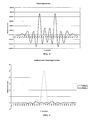
- Fig. 1 illustrates the eigenfunction for a cut line through the single isolated contact.
- the eigenfunction has side lobes 10, which can be seen in the second, third, etc., eigenfunctions (not shown).
- These side lobes relate to the placement of either the in-phase assist feature or out-of-phase assist feature, in order to focus as much intensity as possible on the main lobe, corresponding to the feature to be printed.
- in-phase assist features are "out of balance" with the out-of-phase assist features, there occurs constructive interference in the aerial image outside of the main lobe, or feature to be printed. This causes the undesirable printing to occur and is the result of local imbalances.
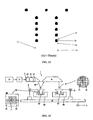
- Fig. 2 illustrates a combination image of an exemplary pattern of contacts, corresponding mask pattern and the simulated predicted printing utilizing the first eigenfunction illustrated by Fig. 1.
- the in-phase mask area is designated by 12, out-of-phase mask area by 14, chrome mask area by 16, contact pattern by 18 and predicted printing by 20.
- the eigenfunction of Fig. 1 is not balanced: the positive side-lobes are larger than the negative ones. This fact, combined with constructive interference from groups of closely-spaced contacts, results in an interference map that causes more of the assist-feature area to be covered by 0-degree assist features than by 180-degree assist features. This causes undesired printing on the substrate which corresponds to the predicted printing area 20 outside of the intended contact pattern 18 as shown in Fig. 2.
- the eigenfunction may be modified to encapsulate the preference of not printing undesirable features, such as those caused by assist features.
- finely balancing in-phase assist features and out-of-phase assist features local imbalances are minimized that may cause undesired features to print. This may be accomplished by filtering the eigenfunction so that the entire assist feature areas computed from the filtered function will be approximately balanced. This will retain most of the desired feature printing enhancements developed and described in the '829 and '830 applications.
- assist features are no different from a contact.
- the assist features create areas on the mask that are in-phase or out-of-phase (assuming a two discrete transmission level mask).
- assist features may be primarily in balance. But, considering localized areas of the mask, often it is found that assist features are out of balance.
- the goal is to consider the in-phase assist features and out-of-phase assist features that contribute to the local imbalances.
- These local imbalances are primarily the result of low spatial frequencies in the eigenfunction.
- local imbalances can be minimized by examining the high spatial frequencies and removing the low spatial frequencies from the eigenfunction.
- the low spatial frequencies correspond to relatively large areas of the same phase that contribute significantly to the local imbalances.
- "Local" relates to an average over a range on the order of ⁇ /NA.
- the DC component is also removed.
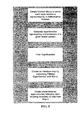
- This filtering will result in approximately an equal area of in-phase and out-of-phase assist features, and can be seen in Fig. 3 illustrating a plot of a filtered first eigenfunction. It should be noted that while tall peaks above zero result, the area of the peaks are balanced by the wide shallow peaks below zero.
- Filtering may be performed by utilizing a Gaussian spatial filter which nulls out the area at the origin and then apply a Gaussian spectral filter to remove the low frequencies.
- Other filters can be used, such as a brick wall filter.
- filters with abrupt cutoffs, such as brick wall filters tend to exhibit "ringing" effects, unduly emphasizing certain frequencies or positions while suppressing others.
- a Gaussian filter is preferred because it is a "well-behaved" mathematical function.
- Fig. 4 illustrates a plot of the filtered first eigenfunction and the unfiltered first eigenfunction.
- the filtered eigenfunction is convolved with the mask transmission function.
- Fig. 5 illustrates a flow chart of the steps for generating a mask utilizing a filtered eigenfunction.
- the mask pattern is represented by a mathematical expression M(x,y), i.e, the effective complex mask transmission function
- Step 2 the eigenfunction for a given optical system is generated.
- the eigenfunction is filtered in the side lobe areas to remove the DC component and low spatial frequencies.
- Step 3 more than one eigenfunction may be filtered, depending on the accuracy desired.
- the filtered eigenfunction from Step 3 is convolved with M(x,y) determined in Step 1 to create an interference map.
- the interference map identifies the areas in which in-phase assist features and out-of-phase assist features are needed.
- the in-phase and out-of-phase assist features are created with edges that follow the boundaries between the positive and negative areas of the interference map.
- the interference map derives from a filtered eigenfunction, it lacks the low spatial frequencies that produce local imbalances between positive and negative areas.
- the assist features so generated ideally have complex, curved shapes. These can be simplified into polygonal approximations without great loss of effect, provided the simplification is "unbiased" -- that is, provided it introduces no net imbalance between in-phase and out-of-phase assist features.
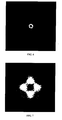
- FIG. 6 An image of the first eigenfunction, unfiltered, in the spatial domain is illustrated by Fig. 6, and an image of the first eigenfunction, unfiltered, in the spectral domain is illustrated by Fig. 7. It can be seen that the positive and negative side-lobes are not well mixed -- along the x- and y-axes, after a first positive side-lobe, there is a pair of negative side-lobes that almost merge into one large lobe. Similar behavior can be seen along the diagonals.
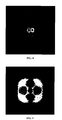
- FIG. 8 An image of the second eigenfunction, unfiltered, in the spatial domain is illustrated by Fig. 8, and an image of the first eigenfunction, unfiltered, in the spectral domain is illustrated by Fig. 9.
- the second eigenfunction (along with the third eigenfunction, which is exactly a copy of the second eigenfunction, but rotated 90 degrees) is a possible candidate for generating an interference map.
- the second eigenvalue is 0.41 times the first eigenvalue, making the second eigenfunction much less useful for determining assist features. Without filtering, this eigenfunction also has large areas where the sign remains nearly constant.
- the first eigenfunction illustrated by Figs. 6 and 7 was filtered spatially with a radius of 0.25 ⁇ m and spectrally with a radius of 20 radians/ ⁇ m.
- Fig. 10 illustrates the filtered first eigenfunction in the spectral domain
- Fig. 11 illustrates the filtered first eigenfunction in the spatial domain.
- the filtered function shows a much more homogeneous mixing of positive and negative lobes; this is due to the spectral high-pass filtering.
- the function value was exactly zero at the origin after the spatial filtering step, but the following spectral filtering step changed this slightly.
- Fig. 12 illustrates a combination image of the desired pattern of contacts, the mask pattern and the simulated predicted printing.
- the desired pattern of contacts correspond to that illustrated by Fig. 2.
- in-phase mask area is designated by 12
- out-of-phase mask area is designated by 14
- chrome mask area by 16
- intended contact pattern by 18
- predicted printing 20.
- undesired printing has been eliminated from the simulated predicted printing, and this has been accomplished by filtering the eigenfunction as described herein, thus producing more nearly equal areas of 0-degree and 180-degree assist features.
- Fig. 13 schematically depicts a lithographic projection apparatus suitable for use with a mask designed with the aid of the current invention.
- the apparatus comprises:
- the apparatus is of a transmissive type (i.e. , has a transmissive mask). However, in general, it may also be of a reflective type, for example (with a reflective mask). Alternatively, the apparatus may employ another kind of patterning means as an alternative to the use of a mask; examples include a programmable mirror array or LCD matrix.
- the source LA (e.g. , a mercury lamp or excimer laser) produces a beam of radiation.
- This beam is fed into an illumination system (illuminator) IL, either directly or after having traversed conditioning means, such as a beam expander Ex, for example.
- the illuminator IL may comprise adjusting means AM for setting the outer and/or inner radial extent (commonly referred to as ⁇ -outer and ⁇ -inner, respectively) of the intensity distribution in the beam.
- ⁇ -outer and ⁇ -inner commonly referred to as ⁇ -outer and ⁇ -inner, respectively
- it will generally comprise various other components, such as an integrator IN and a condenser CO.
- the beam PB impinging on the mask MA has a desired uniformity and intensity distribution in its cross-section.
- the source LA may be within the housing of the lithographic projection apparatus (as is often the case when the source LA is a mercury lamp, for example), but that it may also be remote from the lithographic projection apparatus, the radiation beam that it produces being led into the apparatus ( e.g. , with the aid of suitable directing mirrors); this latter scenario is often the case when the source LA is an excimer laser ( e.g. , based on KrF, ArF or F 2 lasing).
- the current invention encompasses at least both of these scenarios.
- the beam PB subsequently intercepts the mask MA, which is held on a mask table MT. Having traversed the mask MA, the beam PB passes through the lens PL, which focuses the beam PB onto a target portion C of the substrate W. With the aid of the second positioning means (and interferometric measuring means IF), the substrate table WT can be moved accurately, e.g. , so as to position different target portions C in the path of the beam PB. Similarly, the first positioning means can be used to accurately position the mask MA with respect to the path of the beam PB, e.g. , after mechanical retrieval of the mask MA from a mask library, or during a scan.
- the mask table MT may just be connected to a short stroke actuator, or may be fixed.
- the depicted tool can be used in two different modes:
- the concepts disclosed herein may simulate or mathematically model any generic imaging system for imaging sub wavelength features, and may be especially useful with emerging imaging technologies capable of producing wavelengths of an increasingly smaller size.
- Emerging technologies already in use include a 193nm wavelength generated by an ArF laser, and 157n wavelength generated by a fluorine laser.
- EUV (extreme ultraviolet) lithorgraphy is capable of producing wavelengths within a range of 20-5nm by using a synchrotron or by hitting a material (either solid or a plasma) with high energy electrons in order to produce photons within this range. Because most materials are absorptive within this range, illumination may be produced by reflective mirrors with a multi-stack of Molybdenum and Silicon.
- the multi-stack mirror has a 40 layer pairs of Molybdenum and Silicon where the thickness of each layer is a quarter wavelength. Even smaller wavelengths may be produced with X-ray lithography. Typically, a synchrotron is used to produce an X-ray wavelength.
- Software functionalities of a computer system involve programming, including executable code, may be used to implement the above described imaging model.
- the software code is executable by the general-purpose computer.
- the code and possibly the associated data records are stored within a general-purpose computer platform.
- the software may be stored at other locations and/or transported for loading into the appropriate general-purpose computer systems.
- the embodiments discussed above involve one or more software products in the form of one or more modules of code carried by at least one machine-readable medium. Execution of such code by a processor of the computer system enables the platform to implement the catalog and/or software downloading functions, in essentially the manner performed in the embodiments discussed and illustrated herein.
- Non-volatile media include, for example, optical or magnetic disks, such as any of the storage devices in any computer(s) operating as one of the server platform, discussed above.
- Volatile media include dynamic memory, such as main memory of such a computer platform.
- Physical transmission media include coaxial cables; copper wire and fiber optics, including the wires that comprise a bus within a computer system.
- Carrier-wave transmission media can take the form of electric or electromagnetic signals, or acoustic or light waves such as those generated during radio frequency (RF) and infrared (IR) data communications.
- Common forms of computer-readable media therefore include, for example: a floppy disk, a flexible disk, hard disk, magnetic tape, any other magnetic medium, a CD-ROM, DVD, any other optical medium, less commonly used media such as punch cards, paper tape, any other physical medium with patterns of holes, a RAM, a PROM, and EPROM, a FLASH-EPROM, any other memory chip or cartridge, a carrier wave transporting data or instructions, cables or links transporting such a carrier wave, or any other medium from which a computer can read programming code and/or data.
- Many of these forms of computer readable media may be involved in carrying one or more sequences of one or more instructions to a processor for execution.
Landscapes
- Physics & Mathematics (AREA)
- General Physics & Mathematics (AREA)
- Exposure And Positioning Against Photoresist Photosensitive Materials (AREA)
- Preparing Plates And Mask In Photomechanical Process (AREA)
- Exposure Of Semiconductors, Excluding Electron Or Ion Beam Exposure (AREA)
Applications Claiming Priority (2)
| Application Number | Priority Date | Filing Date | Title |
|---|---|---|---|
| US51570803P | 2003-10-31 | 2003-10-31 | |
| US515708P | 2003-10-31 |
Publications (2)
| Publication Number | Publication Date |
|---|---|
| EP1528429A2 true EP1528429A2 (de) | 2005-05-04 |
| EP1528429A3 EP1528429A3 (de) | 2006-04-12 |
Family
ID=34421829
Family Applications (1)
| Application Number | Title | Priority Date | Filing Date |
|---|---|---|---|
| EP04256714A Withdrawn EP1528429A3 (de) | 2003-10-31 | 2004-10-29 | Optimierung von Strukturen auf Photomasken mittels Simulation des projezierten Musters |
Country Status (7)
| Country | Link |
|---|---|
| US (1) | US7231629B2 (de) |
| EP (1) | EP1528429A3 (de) |
| JP (1) | JP5121117B2 (de) |
| KR (1) | KR100927454B1 (de) |
| CN (1) | CN100576066C (de) |
| SG (1) | SG111285A1 (de) |
| TW (1) | TWI377438B (de) |
Cited By (1)
| Publication number | Priority date | Publication date | Assignee | Title |
|---|---|---|---|---|
| EP2019332A1 (de) * | 2007-07-24 | 2009-01-28 | Canon Kabushiki Kaisha | Erzeugungsverfahren für Fotomaskendaten, Herstellungsverfahren für Fotomasken, Belichtungsverfahren und Herstellungsverfahren für Bauelemente |
Families Citing this family (30)
| Publication number | Priority date | Publication date | Assignee | Title |
|---|---|---|---|---|
| KR20050043713A (ko) * | 2003-11-05 | 2005-05-11 | 에이에스엠엘 마스크툴즈 비.브이. | 고유 분해 기반 opc 모델 |
| US7057709B2 (en) * | 2003-12-04 | 2006-06-06 | International Business Machines Corporation | Printing a mask with maximum possible process window through adjustment of the source distribution |
| US7506299B2 (en) * | 2003-12-19 | 2009-03-17 | Asml Holding N.V. | Feature optimization using interference mapping lithography |
| US7310796B2 (en) * | 2004-08-27 | 2007-12-18 | Applied Materials, Israel, Ltd. | System and method for simulating an aerial image |
| US7331033B2 (en) * | 2004-08-27 | 2008-02-12 | Applied Materials, Israel, Ltd. | Simulation of aerial images |
| US7509621B2 (en) * | 2005-01-03 | 2009-03-24 | Synopsys, Inc. | Method and apparatus for placing assist features by identifying locations of constructive and destructive interference |
| US7200835B2 (en) * | 2005-02-24 | 2007-04-03 | Texas Instruments Incorporated | Method of locating sub-resolution assist feature(s) |
| US8037429B2 (en) * | 2005-03-02 | 2011-10-11 | Mentor Graphics Corporation | Model-based SRAF insertion |
| JP4790350B2 (ja) * | 2005-08-31 | 2011-10-12 | 富士通セミコンダクター株式会社 | 露光用マスク及び露光用マスクの製造方法 |
| US7614034B2 (en) * | 2005-11-08 | 2009-11-03 | Asml Masktools B.V. | Method and apparatus for generating OPC rules for placement of scattering bar features utilizing interface mapping technology |
| JP2008076683A (ja) * | 2006-09-20 | 2008-04-03 | Canon Inc | 原版データ作成プログラム、原版データ作成方法、原版作成方法、露光方法及びデバイスの製造方法 |
| JP4804294B2 (ja) | 2006-09-20 | 2011-11-02 | キヤノン株式会社 | 原版データ作成プログラム、原版データ作成方法、原版作成方法、露光方法及びデバイスの製造方法 |
| KR100881184B1 (ko) | 2006-12-12 | 2009-02-05 | 삼성전자주식회사 | 마스크 패턴을 배치하는 방법 및 이를 이용한 장치 |
| KR100874913B1 (ko) | 2006-12-12 | 2008-12-19 | 삼성전자주식회사 | 마스크 패턴을 배치하는 방법 및 이를 이용한 장치 |
| US8341561B2 (en) | 2006-12-12 | 2012-12-25 | Samsung Electronics Co., Ltd. | Methods of arranging mask patterns and associated apparatus |
| US7799487B2 (en) * | 2007-02-09 | 2010-09-21 | Ayman Yehia Hamouda | Dual metric OPC |
| US7882480B2 (en) * | 2007-06-04 | 2011-02-01 | Asml Netherlands B.V. | System and method for model-based sub-resolution assist feature generation |
| KR101096145B1 (ko) * | 2007-06-04 | 2011-12-19 | 에이에스엠엘 네델란즈 비.브이. | 모델-기반 리소그래피 안내 레이아웃 설계를 수행하는 방법들 |
| US9779186B2 (en) | 2007-08-28 | 2017-10-03 | Asml Netherlands B.V. | Methods for performing model-based lithography guided layout design |
| US7930657B2 (en) | 2008-01-23 | 2011-04-19 | Micron Technology, Inc. | Methods of forming photomasks |
| US7954071B2 (en) * | 2008-10-31 | 2011-05-31 | Synopsys, Inc. | Assist feature placement based on a focus-sensitive cost-covariance field |
| JP5185235B2 (ja) * | 2009-09-18 | 2013-04-17 | 株式会社東芝 | フォトマスクの設計方法およびフォトマスクの設計プログラム |
| DE102010004939A1 (de) * | 2010-01-18 | 2011-07-21 | EQUIcon Software GmbH Jena, 07745 | Verfahren zur Steuerung der Elektronenstrahl-Belichtung von Wafern und Masken mit Proximity-Korrektur |
| US8846273B2 (en) | 2012-06-04 | 2014-09-30 | Micron Technology, Inc. | Photomasks, methods of forming a photomask, and methods of photolithographically patterning a substrate |
| KR101991380B1 (ko) | 2012-07-26 | 2019-06-20 | 삼성전자주식회사 | 반도체 소자의 레이아웃 생성 방법 |
| CN106556974B (zh) * | 2015-09-30 | 2019-04-26 | 中芯国际集成电路制造(上海)有限公司 | 光刻照明系统以及光刻设备 |
| US10657213B2 (en) * | 2017-12-22 | 2020-05-19 | D2S, Inc. | Modeling of a design in reticle enhancement technology |
| US11301610B2 (en) | 2017-12-22 | 2022-04-12 | D2S, Inc. | Methods for modeling of a design in reticle enhancement technology |
| WO2020154978A1 (zh) * | 2019-01-30 | 2020-08-06 | 深圳晶源信息技术有限公司 | 一种Hessian-Free的光刻掩模优化方法、装置及电子设备 |
| CN113378412B (zh) * | 2021-08-12 | 2021-11-02 | 南京科远智慧科技集团股份有限公司 | 一种应用于tdlas线形拟合算法的激光器特性变化修正方法 |
Family Cites Families (25)
| Publication number | Priority date | Publication date | Assignee | Title |
|---|---|---|---|---|
| JPH04216548A (ja) | 1990-12-18 | 1992-08-06 | Mitsubishi Electric Corp | フォトマスク |
| KR960002536A (de) | 1994-06-29 | 1996-01-26 | ||
| US5682323A (en) | 1995-03-06 | 1997-10-28 | Lsi Logic Corporation | System and method for performing optical proximity correction on macrocell libraries |
| NL1005841C2 (nl) | 1997-04-18 | 1998-10-20 | Dsm Nv | Can- en coilcoatingharsen. |
| JPH1115130A (ja) * | 1997-06-24 | 1999-01-22 | Matsushita Electron Corp | 半導体製造用ハーフトーンマスクおよびその製造方法 |
| US6223139B1 (en) | 1998-09-15 | 2001-04-24 | International Business Machines Corporation | Kernel-based fast aerial image computation for a large scale design of integrated circuit patterns |
| JP3275863B2 (ja) | 1999-01-08 | 2002-04-22 | 日本電気株式会社 | フォトマスク |
| US6214497B1 (en) | 1999-06-29 | 2001-04-10 | Micron Technology, Inc. | Method to eliminate side lobe printing of attenuated phase shift masks |
| US6303253B1 (en) | 2000-03-16 | 2001-10-16 | International Business Machines Corporation | Hierarchy and domain-balancing method and algorithm for serif mask design in microlithography |
| US6777141B2 (en) | 2000-07-05 | 2004-08-17 | Numerical Technologies, Inc. | Phase shift mask including sub-resolution assist features for isolated spaces |
| US6787271B2 (en) | 2000-07-05 | 2004-09-07 | Numerical Technologies, Inc. | Design and layout of phase shifting photolithographic masks |
| US6503666B1 (en) | 2000-07-05 | 2003-01-07 | Numerical Technologies, Inc. | Phase shift masking for complex patterns |
| TW552561B (en) | 2000-09-12 | 2003-09-11 | Asml Masktools Bv | Method and apparatus for fast aerial image simulation |
| US6901575B2 (en) | 2000-10-25 | 2005-05-31 | Numerical Technologies, Inc. | Resolving phase-shift conflicts in layouts using weighted links between phase shifters |
| TWI285295B (en) | 2001-02-23 | 2007-08-11 | Asml Netherlands Bv | Illumination optimization in lithography |
| US6792591B2 (en) | 2001-02-28 | 2004-09-14 | Asml Masktools B.V. | Method of identifying an extreme interaction pitch region, methods of designing mask patterns and manufacturing masks, device manufacturing methods and computer programs |
| US6519760B2 (en) | 2001-02-28 | 2003-02-11 | Asml Masktools, B.V. | Method and apparatus for minimizing optical proximity effects |
| US7175940B2 (en) | 2001-10-09 | 2007-02-13 | Asml Masktools B.V. | Method of two dimensional feature model calibration and optimization |
| JP3592666B2 (ja) * | 2001-12-04 | 2004-11-24 | 株式会社東芝 | 露光用マスクパターンの補正方法、プログラム、マスクパターン形成方法、及び半導体装置の製造方法 |
| US6749970B2 (en) | 2001-12-11 | 2004-06-15 | Advanced Micro Devices, Inc. | Method of enhancing clear field phase shift masks with border regions around phase 0 and phase 180 regions |
| US7023528B2 (en) | 2002-06-10 | 2006-04-04 | International Business Machines Corporation | Hybrid electronic mask |
| US6807662B2 (en) | 2002-07-09 | 2004-10-19 | Mentor Graphics Corporation | Performance of integrated circuit components via a multiple exposure technique |
| US7266480B2 (en) | 2002-10-01 | 2007-09-04 | The Regents Of The University Of California | Rapid scattering simulation of objects in imaging using edge domain decomposition |
| JP3992688B2 (ja) | 2003-01-14 | 2007-10-17 | エーエスエムエル マスクツールズ ビー.ブイ. | コンタクト・ホール・マスクの光学的近接補正設計の方法 |
| TWI290262B (en) | 2003-01-14 | 2007-11-21 | Asml Masktools Bv | Method and apparatus for providing optical proximity features to a reticle pattern for deep sub-wavelength optical lithography |
-
2004
- 2004-10-29 EP EP04256714A patent/EP1528429A3/de not_active Withdrawn
- 2004-10-29 CN CN200410103875A patent/CN100576066C/zh not_active Expired - Fee Related
- 2004-10-29 TW TW093133057A patent/TWI377438B/zh not_active IP Right Cessation
- 2004-10-29 KR KR1020040087192A patent/KR100927454B1/ko not_active Expired - Fee Related
- 2004-10-29 US US10/976,306 patent/US7231629B2/en not_active Expired - Lifetime
- 2004-10-29 JP JP2004344913A patent/JP5121117B2/ja not_active Expired - Fee Related
- 2004-11-01 SG SG200406371A patent/SG111285A1/en unknown
Cited By (3)
| Publication number | Priority date | Publication date | Assignee | Title |
|---|---|---|---|---|
| EP2019332A1 (de) * | 2007-07-24 | 2009-01-28 | Canon Kabushiki Kaisha | Erzeugungsverfahren für Fotomaskendaten, Herstellungsverfahren für Fotomasken, Belichtungsverfahren und Herstellungsverfahren für Bauelemente |
| US8239787B2 (en) | 2007-07-24 | 2012-08-07 | Canon Kabushiki Kaisha | Method of generating original plate data by repeatedly calculating approximate aerial image |
| TWI412880B (zh) * | 2007-07-24 | 2013-10-21 | 佳能股份有限公司 | 原始版資料產生方法、原始版產生方法、曝光方法、裝置製造方法、及用於產生原始版資料之電腦可讀取儲存媒體 |
Also Published As
| Publication number | Publication date |
|---|---|
| SG111285A1 (en) | 2005-05-30 |
| US7231629B2 (en) | 2007-06-12 |
| KR20050041958A (ko) | 2005-05-04 |
| EP1528429A3 (de) | 2006-04-12 |
| JP2005141241A (ja) | 2005-06-02 |
| CN100576066C (zh) | 2009-12-30 |
| CN1629735A (zh) | 2005-06-22 |
| TW200527152A (en) | 2005-08-16 |
| KR100927454B1 (ko) | 2009-11-19 |
| TWI377438B (en) | 2012-11-21 |
| US20050149900A1 (en) | 2005-07-07 |
| JP5121117B2 (ja) | 2013-01-16 |
Similar Documents
| Publication | Publication Date | Title |
|---|---|---|
| US7231629B2 (en) | Feature optimization using enhanced interference mapping lithography | |
| US7506299B2 (en) | Feature optimization using interference mapping lithography | |
| US7594199B2 (en) | Method of optical proximity correction design for contact hole mask | |
| US8060842B2 (en) | Method, program product and apparatus for model based geometry decomposition for use in a multiple exposure process | |
| EP1513012B1 (de) | Methode und Vorrichtung für modellgestützte Plazierung phasenbalancierter Hilfsstrukturen für optische Lithographie mit Auflösungsgrenzen unterhalb der Belichtungswellenlänge | |
| EP1712954B1 (de) | Verfahren und Programmprodukt zur Durchführung von Doppelbelichtungslithografie | |
| EP1439419B1 (de) | Methode und Gerät zur Erstellung von optischen Näherungseffekt-Korrekturelementen für ein Maskenmuster in der Optischen Lithographie | |
| US7864301B2 (en) | Source and mask optimization by changing intensity and shape of the illumination source | |
| EP1843202B1 (de) | Verfahren zur Durchführung von Dunkelfeld-Doppeldipollithografie | |
| CN100561348C (zh) | 使用干涉成像光刻法的部件优化 | |
| EP1530083A2 (de) | Korrektur optischer Naheffekte basiert auf Zerlegung in Eigenfunktionen | |
| EP1630601A2 (de) | Maskenherstellungsverfahren, Verfahren zur optischen Naheffektkorrektur (OPC), Verfahren zur Herstellung einer Vorrichtung, Computerprogramm und computerlesbares Speichermedium | |
| EP1420294A2 (de) | Methode und Gerät zur Regel-basierten Übertragung von Layoutdaten für eine Dipol-Belichtung | |
| EP1530084A1 (de) | Methode zur Abstimmung der optischen Durchlässigkeit von Maskenstrukturen um den Prozessspielraum zu vergrössern | |
| US20070122719A1 (en) | Method and apparatus for generating OPC rules for placement of scattering bar features utilizing interface mapping technology |
Legal Events
| Date | Code | Title | Description |
|---|---|---|---|
| PUAI | Public reference made under article 153(3) epc to a published international application that has entered the european phase |
Free format text: ORIGINAL CODE: 0009012 |
|
| AK | Designated contracting states |
Kind code of ref document: A2 Designated state(s): AT BE BG CH CY CZ DE DK EE ES FI FR GB GR HU IE IT LI LU MC NL PL PT RO SE SI SK TR |
|
| AX | Request for extension of the european patent |
Extension state: AL HR LT LV MK |
|
| PUAL | Search report despatched |
Free format text: ORIGINAL CODE: 0009013 |
|
| AK | Designated contracting states |
Kind code of ref document: A3 Designated state(s): AT BE BG CH CY CZ DE DK EE ES FI FR GB GR HU IE IT LI LU MC NL PL PT RO SE SI SK TR |
|
| AX | Request for extension of the european patent |
Extension state: AL HR LT LV MK |
|
| 17P | Request for examination filed |
Effective date: 20060710 |
|
| 17Q | First examination report despatched |
Effective date: 20060905 |
|
| AKX | Designation fees paid |
Designated state(s): DE FR GB IT NL |
|
| STAA | Information on the status of an ep patent application or granted ep patent |
Free format text: STATUS: THE APPLICATION IS DEEMED TO BE WITHDRAWN |
|
| 18D | Application deemed to be withdrawn |
Effective date: 20090505 |