EP1527335B1 - Gassensor eines kraftfahrtwagens bestehend aus hochtemperaturbeständigen sowie oleophoben werkstoffen - Google Patents
Gassensor eines kraftfahrtwagens bestehend aus hochtemperaturbeständigen sowie oleophoben werkstoffen Download PDFInfo
- Publication number
- EP1527335B1 EP1527335B1 EP03784764A EP03784764A EP1527335B1 EP 1527335 B1 EP1527335 B1 EP 1527335B1 EP 03784764 A EP03784764 A EP 03784764A EP 03784764 A EP03784764 A EP 03784764A EP 1527335 B1 EP1527335 B1 EP 1527335B1
- Authority
- EP
- European Patent Office
- Prior art keywords
- vent
- sensor
- porous
- oleophobic
- oil
- Prior art date
- Legal status (The legal status is an assumption and is not a legal conclusion. Google has not performed a legal analysis and makes no representation as to the accuracy of the status listed.)
- Expired - Lifetime
Links
- 239000000463 material Substances 0.000 title claims description 57
- BFKJFAAPBSQJPD-UHFFFAOYSA-N tetrafluoroethene Chemical group FC(F)=C(F)F BFKJFAAPBSQJPD-UHFFFAOYSA-N 0.000 claims abstract description 41
- 239000000758 substrate Substances 0.000 claims abstract description 30
- 239000008199 coating composition Substances 0.000 claims abstract description 23
- 229920001577 copolymer Polymers 0.000 claims abstract description 10
- 239000007789 gas Substances 0.000 claims description 51
- 239000012530 fluid Substances 0.000 claims description 10
- BLTXWCKMNMYXEA-UHFFFAOYSA-N 1,1,2-trifluoro-2-(trifluoromethoxy)ethene Chemical compound FC(F)=C(F)OC(F)(F)F BLTXWCKMNMYXEA-UHFFFAOYSA-N 0.000 claims description 9
- QVGXLLKOCUKJST-UHFFFAOYSA-N atomic oxygen Chemical group [O] QVGXLLKOCUKJST-UHFFFAOYSA-N 0.000 claims description 9
- 239000001301 oxygen Substances 0.000 claims description 9
- 229910052760 oxygen Inorganic materials 0.000 claims description 9
- 229920000295 expanded polytetrafluoroethylene Polymers 0.000 claims 2
- XLYOFNOQVPJJNP-UHFFFAOYSA-N water Substances O XLYOFNOQVPJJNP-UHFFFAOYSA-N 0.000 abstract description 28
- 230000035515 penetration Effects 0.000 abstract description 6
- 229920000642 polymer Polymers 0.000 description 40
- 239000000243 solution Substances 0.000 description 26
- 238000000576 coating method Methods 0.000 description 23
- 239000011148 porous material Substances 0.000 description 22
- 239000003570 air Substances 0.000 description 21
- 239000011248 coating agent Substances 0.000 description 21
- 239000012528 membrane Substances 0.000 description 18
- 239000000839 emulsion Substances 0.000 description 13
- 230000000052 comparative effect Effects 0.000 description 12
- 238000009736 wetting Methods 0.000 description 12
- 239000007788 liquid Substances 0.000 description 11
- 238000012360 testing method Methods 0.000 description 11
- 230000007774 longterm Effects 0.000 description 9
- 238000000034 method Methods 0.000 description 8
- KFZMGEQAYNKOFK-UHFFFAOYSA-N Isopropanol Chemical compound CC(C)O KFZMGEQAYNKOFK-UHFFFAOYSA-N 0.000 description 7
- 239000000203 mixture Substances 0.000 description 7
- 239000000356 contaminant Substances 0.000 description 6
- 239000006185 dispersion Substances 0.000 description 5
- 229920002313 fluoropolymer Polymers 0.000 description 5
- -1 perfluoroalkyl vinyl ether Chemical compound 0.000 description 5
- 238000011282 treatment Methods 0.000 description 5
- 238000007720 emulsion polymerization reaction Methods 0.000 description 4
- 230000007613 environmental effect Effects 0.000 description 4
- 229920001973 fluoroelastomer Polymers 0.000 description 4
- RVZRBWKZFJCCIB-UHFFFAOYSA-N perfluorotributylamine Chemical compound FC(F)(F)C(F)(F)C(F)(F)C(F)(F)N(C(F)(F)C(F)(F)C(F)(F)C(F)(F)F)C(F)(F)C(F)(F)C(F)(F)C(F)(F)F RVZRBWKZFJCCIB-UHFFFAOYSA-N 0.000 description 4
- 230000035699 permeability Effects 0.000 description 4
- 239000002904 solvent Substances 0.000 description 4
- 238000010998 test method Methods 0.000 description 4
- 230000015556 catabolic process Effects 0.000 description 3
- 238000006731 degradation reaction Methods 0.000 description 3
- 239000004744 fabric Substances 0.000 description 3
- 238000010438 heat treatment Methods 0.000 description 3
- 229920001343 polytetrafluoroethylene Polymers 0.000 description 3
- 239000004810 polytetrafluoroethylene Substances 0.000 description 3
- 239000007787 solid Substances 0.000 description 3
- JWKJOADJHWZCLL-UHFFFAOYSA-N 1,2,3,4,5,5,6,6,6-nonafluoro-1-(1,2,3,4,5,5,6,6,6-nonafluorohexa-1,3-dienoxy)hexa-1,3-diene Chemical compound FC(OC(F)=C(F)C(F)=C(F)C(F)(F)C(F)(F)F)=C(F)C(F)=C(F)C(F)(F)C(F)(F)F JWKJOADJHWZCLL-UHFFFAOYSA-N 0.000 description 2
- VZSRBBMJRBPUNF-UHFFFAOYSA-N 2-(2,3-dihydro-1H-inden-2-ylamino)-N-[3-oxo-3-(2,4,6,7-tetrahydrotriazolo[4,5-c]pyridin-5-yl)propyl]pyrimidine-5-carboxamide Chemical compound C1C(CC2=CC=CC=C12)NC1=NC=C(C=N1)C(=O)NCCC(N1CC2=C(CC1)NN=N2)=O VZSRBBMJRBPUNF-UHFFFAOYSA-N 0.000 description 2
- DEXFNLNNUZKHNO-UHFFFAOYSA-N 6-[3-[4-[2-(2,3-dihydro-1H-inden-2-ylamino)pyrimidin-5-yl]piperidin-1-yl]-3-oxopropyl]-3H-1,3-benzoxazol-2-one Chemical compound C1C(CC2=CC=CC=C12)NC1=NC=C(C=N1)C1CCN(CC1)C(CCC1=CC2=C(NC(O2)=O)C=C1)=O DEXFNLNNUZKHNO-UHFFFAOYSA-N 0.000 description 2
- LFQSCWFLJHTTHZ-UHFFFAOYSA-N Ethanol Chemical compound CCO LFQSCWFLJHTTHZ-UHFFFAOYSA-N 0.000 description 2
- 230000000903 blocking effect Effects 0.000 description 2
- 239000003795 chemical substances by application Substances 0.000 description 2
- 238000005352 clarification Methods 0.000 description 2
- ZYMKZMDQUPCXRP-UHFFFAOYSA-N fluoro prop-2-enoate Chemical compound FOC(=O)C=C ZYMKZMDQUPCXRP-UHFFFAOYSA-N 0.000 description 2
- 230000002209 hydrophobic effect Effects 0.000 description 2
- 239000004816 latex Substances 0.000 description 2
- 229920000126 latex Polymers 0.000 description 2
- 238000004519 manufacturing process Methods 0.000 description 2
- 230000037361 pathway Effects 0.000 description 2
- 238000006116 polymerization reaction Methods 0.000 description 2
- 239000011347 resin Substances 0.000 description 2
- 229920005989 resin Polymers 0.000 description 2
- 125000006850 spacer group Chemical group 0.000 description 2
- 239000000126 substance Substances 0.000 description 2
- 239000004094 surface-active agent Substances 0.000 description 2
- BZPCMSSQHRAJCC-UHFFFAOYSA-N 1,2,3,3,4,4,5,5,5-nonafluoro-1-(1,2,3,3,4,4,5,5,5-nonafluoropent-1-enoxy)pent-1-ene Chemical compound FC(F)(F)C(F)(F)C(F)(F)C(F)=C(F)OC(F)=C(F)C(F)(F)C(F)(F)C(F)(F)F BZPCMSSQHRAJCC-UHFFFAOYSA-N 0.000 description 1
- YSYRISKCBOPJRG-UHFFFAOYSA-N 4,5-difluoro-2,2-bis(trifluoromethyl)-1,3-dioxole Chemical compound FC1=C(F)OC(C(F)(F)F)(C(F)(F)F)O1 YSYRISKCBOPJRG-UHFFFAOYSA-N 0.000 description 1
- OKTJSMMVPCPJKN-UHFFFAOYSA-N Carbon Chemical compound [C] OKTJSMMVPCPJKN-UHFFFAOYSA-N 0.000 description 1
- 229920000914 Metallic fiber Polymers 0.000 description 1
- 229920006362 Teflon® Polymers 0.000 description 1
- QYKIQEUNHZKYBP-UHFFFAOYSA-N Vinyl ether Chemical compound C=COC=C QYKIQEUNHZKYBP-UHFFFAOYSA-N 0.000 description 1
- 239000012080 ambient air Substances 0.000 description 1
- 239000012736 aqueous medium Substances 0.000 description 1
- 239000012298 atmosphere Substances 0.000 description 1
- 238000005266 casting Methods 0.000 description 1
- 239000000919 ceramic Substances 0.000 description 1
- 230000008859 change Effects 0.000 description 1
- 238000002485 combustion reaction Methods 0.000 description 1
- 239000002131 composite material Substances 0.000 description 1
- 230000007797 corrosion Effects 0.000 description 1
- 238000005260 corrosion Methods 0.000 description 1
- 238000004132 cross linking Methods 0.000 description 1
- 238000005520 cutting process Methods 0.000 description 1
- 230000007547 defect Effects 0.000 description 1
- 230000001419 dependent effect Effects 0.000 description 1
- 238000009792 diffusion process Methods 0.000 description 1
- 238000007598 dipping method Methods 0.000 description 1
- 239000012153 distilled water Substances 0.000 description 1
- 238000005516 engineering process Methods 0.000 description 1
- 238000001914 filtration Methods 0.000 description 1
- 239000004811 fluoropolymer Substances 0.000 description 1
- 239000003365 glass fiber Substances 0.000 description 1
- 229910002804 graphite Inorganic materials 0.000 description 1
- 239000010439 graphite Substances 0.000 description 1
- 238000012994 industrial processing Methods 0.000 description 1
- 238000002347 injection Methods 0.000 description 1
- 239000007924 injection Substances 0.000 description 1
- 238000001746 injection moulding Methods 0.000 description 1
- 229910010272 inorganic material Inorganic materials 0.000 description 1
- 239000011147 inorganic material Substances 0.000 description 1
- 238000005259 measurement Methods 0.000 description 1
- 230000007246 mechanism Effects 0.000 description 1
- 238000012703 microemulsion polymerization Methods 0.000 description 1
- 238000002156 mixing Methods 0.000 description 1
- 238000012544 monitoring process Methods 0.000 description 1
- 239000000178 monomer Substances 0.000 description 1
- 239000004745 nonwoven fabric Substances 0.000 description 1
- 239000011368 organic material Substances 0.000 description 1
- 230000000149 penetrating effect Effects 0.000 description 1
- 229920005548 perfluoropolymer Polymers 0.000 description 1
- 239000004033 plastic Substances 0.000 description 1
- 229920003023 plastic Polymers 0.000 description 1
- 229920000098 polyolefin Polymers 0.000 description 1
- 230000008569 process Effects 0.000 description 1
- 230000004044 response Effects 0.000 description 1
- 239000008149 soap solution Substances 0.000 description 1
- 238000005507 spraying Methods 0.000 description 1
- 239000000080 wetting agent Substances 0.000 description 1
- 239000002759 woven fabric Substances 0.000 description 1
Images
Classifications
-
- G—PHYSICS
- G01—MEASURING; TESTING
- G01N—INVESTIGATING OR ANALYSING MATERIALS BY DETERMINING THEIR CHEMICAL OR PHYSICAL PROPERTIES
- G01N27/00—Investigating or analysing materials by the use of electric, electrochemical, or magnetic means
- G01N27/26—Investigating or analysing materials by the use of electric, electrochemical, or magnetic means by investigating electrochemical variables; by using electrolysis or electrophoresis
- G01N27/403—Cells and electrode assemblies
- G01N27/406—Cells and probes with solid electrolytes
- G01N27/407—Cells and probes with solid electrolytes for investigating or analysing gases
- G01N27/4077—Means for protecting the electrolyte or the electrodes
-
- G—PHYSICS
- G01—MEASURING; TESTING
- G01N—INVESTIGATING OR ANALYSING MATERIALS BY DETERMINING THEIR CHEMICAL OR PHYSICAL PROPERTIES
- G01N27/00—Investigating or analysing materials by the use of electric, electrochemical, or magnetic means
- G01N27/26—Investigating or analysing materials by the use of electric, electrochemical, or magnetic means by investigating electrochemical variables; by using electrolysis or electrophoresis
- G01N27/28—Electrolytic cell components
- G01N27/40—Semi-permeable membranes or partitions
Definitions
- This invention relates to materials that are gas permeable, oleophobic, and resistant to penetration by liquids for use in automotive gas sensors. More particularly, this invention relates to gas permeable materials that are resistant to penetration by liquids, and that are oleophobic at high temperatures.
- WO 96/22315 relates to an aqueous micro emulsion polymerization process for preparing coating composition for use in gas permeable articles, such as gas filter, vent filters, etc.
- a microporous PTFE substrate By coating a microporous PTFE substrate with the composition, articles of enhanced oleophobicity and increased thermal stability can be obtained.
- the composition comprises a copolymer of TFE and perfluoropropyl vinyl ether, PPVE.
- US 6,196,708 describes a gas sensor comprising a vent, wherein the vent comprises a porous, expanded PTFE (ePTFE) substrate and an oleophobic enhancement agent, especially a fluoropolymer.
- ePTFE expanded PTFE
- EP0754630 relates to a screw cap that forms a releasable closure for e.g. vessels, packages and bottles containing fluid or solids.
- the cap includes a pressure equalisation device, with a one or more membranes made of material that is impermeable to fluid and solids.
- the membranes allow the passage of gas and comprise a liquid anti-surge element of gas permeable material to protect the membrane from the contents.
- the cap is a plastic pressure injection moulding and the membrane is integrated into it by injection into or onto part of its top cover.
- US 4 670 328 relates to an impregnated material comprising an organic or inorganic material selected from the group consisting of a woven fabric, a non-woven fabric and an open cell porous material which is impregnated with a copolymer.
- the copolymer comprises 50 to 95% by mole of repeating units derived from tetrafluoroethylene and 5 to 50% by mole of repeating units derived from perfluoroalkyl vinyl ether.
- the copolymer has good chemical, corrosion, solvent and oil resistance as well as water- and oil-repellence.
- EP 0 159 268 relates to a fluoroplastic resin dispersion modified by the addition of a fluoroelastomer latex to yield a fluid coating or casting composition.
- the fluoroplastic resin dispersion preferably an aqueous dispersion of a perfluoroplastic, such as ploytetrafluoroethylene (PTFE)
- PTFE ploytetrafluoroethylene
- the fluoroelastomer component comprises at least about 5% by weight of the blend.
- the fluid compositions according to the invention may preferably comprise from about 10-95% by weight fluoroplastic and from about 5-95% fluoroelastomer.
- JP 7023936 relates to improvements to the stable response time and replacement life of a membrane and a spacer of a sensor in monitoring of a heaing power type skin through gas pressure detector.
- a specific modified fluororesin film is disclosed as a membrane to be installed on a sensor body and for a spacer.
- Porous materials are used in various high temperature applications, such as industrial processing and the automotive industry. Some applications require resistance or impermeability to low surface tension fluids for extended use. For example, porous vents are known for various uses in the automotive industry, and allow for gas flow-through while providing protection to sensors by minimizing entry of water.
- the automotive oxygen sensor which measures oxygen content in the exhaust gas of an internal combustion engine, allows outside ambient air into the sensor's ceramic electrode assembly. Since liquid water entering the sensor will interfere with the functioning of the sensor, it is crucial that water is kept out of the interior of the sensor.
- Bosch teach a membrane made of a gas permeable and liquid impermeable material that covers a vent hole in the body of an electrode assembly.
- the membrane may be made of porous Teflon®, but Bosch does not describe an oleophobic coating that may provide oil resistance.
- a water-repelling porous material is taught to protect vent holes of an oxygen sensor from water ingress.
- the water-repelling porous material may include compacted glass fiber, compressed graphite, and metallic fibers each treated with water repellant, however, specific water repellants are not taught.
- Gas filters and vent filters have been made from polymers such as polyolefins or polytetrafluoroethylene. Vents comprised of polytetrafluoroethylene generally have water entry pressure of greater than about 3 psi requiring a material with a porosity of about 20 %-90 % and an airflow of less than about 300 Gurley seconds. However, the oleophobicity of such materials is limited. Liquids with low surface tension such as oil or soap solutions can penetrate porous PTFE membranes over time. A number of treatments such as Scotchguard0 from 3M and Zone) @ products from Dupont are known to make fabrics oil and water-resistant. Additionally, U. S. Patent No.
- 5.116, 650 teach coating a porous material, preferably PTFE, with a copolymer of perfluoro-2, 2-dimethyl-1, 3-dioxole and tetrafluoroethylene to form a hydrophobic and oleophobic gas permeable material.
- Buerger DE 197 30 245 teach an oleophobic treatment for microporous membranes which can be used in applications at temperatures in the range of about 180 C. However, this is considerably lower than the temperature required for some high temperature applications.
- Automotive oxygen sensors are located in the exhaust manifold where the temperature of exhaust gas may reach approximately 850 C to greater than about 1000 C.
- the vent material may reach temperatures of 200 C to 300 C.
- gas permeable materials which are oleophobic and resistant to penetration by water, and which maintain these properties upon long-term, high temperature exposure. Such materials would be advantageous over the currently available technology.
- the present invention is directed to an automotive gas sensor, according to claim 1. Preferred embodiments are described in the dependent claims.
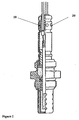
- an automotive gas sensor having an automotive gas sensor vent 10 to reduce the exposure of a gas sensor from water and contaminants such as oil and dirt which may enter a sensor by way of vent holes 20.
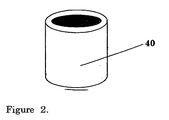
- the vent illustrated in Fig. 2 having an external surface 40 comprises a porous substrate and a coating composition to provide gas permeability and oleophobicity to the automotive gas sensor in high temperature applications.
- the gas permeable, oleophobic materials of the present invention comprise a porous substrate and a coating comprising a polymer which at least partially coats the porous substrate.
- the porous material can be a fabric or film, such as a nonwoven, woven, or knit fabric, or a scrim, that permits the flow of gas, such as air.
- porous is meant a substrate that allows the passage of gases, especially air, and that comprises pores and voids that form passages extending through the thickness of the material. The passages preferably open on both sides of the substrate and may be interconnected internally.
- gas-permeable material is meant a porous material that permits the flow of air or other gases through it, in contrast to a non-porous material in which gas permeation is controlled by solution/diffusion mechanisms.
- Preferred gas permeable materials have a Gurley number of less than about 1000 seconds.
- the porous substrate is made of polymer.
- the substrates can be used singly or multiply, such as in layered or laminated composite articles.
- Suitable substrates may be in a form such as a sheet, tube or plug. Forms may be prepared by any suitable method such as extruding, cutting, expanding or wrapping the porous material. Selection of appropriate forms and materials will be made according to end use requirements such as filtration requirements, physical, chemical, and mechanical properties required, environmental conditions, costs, manufacturing, etc.
- a vent for automotive gas sensors may be in any form suitable for providing adequate protection to sensors including, but not limited to tube, circular disk, or other porous member.
- a preferred embodiment comprises a membrane vent for an automotive oxygen sensor according to Fig. 2 having an appropriate shape and measure sufficient to protect the sensor from environmental contaminants while allowing sufficient gas flow-through.
- the substrate is hydrophobic and temperature resistant, so porous polytetrafluoroethylene (PTFE) is employed.
- PTFE polytetrafluoroethylene
- ePTFE microporous expanded PTFE
- ePTFE expanded PTFE
- ePTFE expanded PTFE
- ePTFE substrates preferably having a Gurley number of 1000 or less, have interstices or pores that form passages and pathways suitable for air flow and that comprise internal surfaces extending from one surface of the substrate to another surface of the substrate.
- One preferred substrate material comprises a laminate of at least one layer of ePTFE and at least one polymer layer.
- porous substrates can be coated with a coating composition comprising a polymer which comprises tetrafluoroethylene (TFE) and perfluormethyl vinyl ether (PMVE), to produce a material which is gas permeable, and which is resistant to both water and oil, and which surprisingly retains these resistant properties at high temperatures for extended periods of time. It has been surprisingly found that materials and articles of the present invention remain flexible and pliable, and do not become brittle after long-term exposure to high temperatures.
- TFE tetrafluoroethylene
- PMVE perfluormethyl vinyl ether
- the oleophobic material comprises a porous substrate and a coating composition comprising a polymer of TFE and perfluoromethyl vinyl ether (PMVE), wherein the coating composition coats internal surfaces of the porous membrane.
- the porous substrate comprises a porous ePTFE membrane.
- Polymers comprise PMVE and TFE monomers that are present at about 10 and 90 weight percent PMVE and complementally about 90 and 10 weight percent TFE.
- Preferred polymers comprise between about 30 and 80 weight percent PMVE and complementally between about 70 and 20 weight percent TFE. More preferred are polymers having between about 30 and 70 weight percent PMVE and complementally between about 70 and 30 weight percent TFE.
- Polymers or copolymers of TFE and PMVE can be made by any method known in the art, such as by emulsion polymerization.
- the coating composition may be prepared as a solution, emulsion or dispersion of TFE/PMVE polymer.
- the coating composition may comprise a solution of the polymer and a fluorinated solvent. A dilute solution is preferred to maintain the gas permeable nature of the porous material.
- Coating compositions may comprise solutions having, for example, from about 0.01% to about 10% by weight of the TFE/PMVE polymer.
- Preferred coating compositions comprise solutions having from about 0.1% to about 10%, or from about 0.1 to about 2%, or alternately from about 0.1 % to about 1 %, by weight of the TFE/PMVE polymer.
- the coating composition comprises an emulsion of TFE/PMVE polymer
- the emulsion may be obtained directly from the polymerization reaction where the polymerization process was by emulsion polymerization.
- Coating compositions comprising emulsions have about 0.01% to about 20% by weight of the polymer in an aqueous medium; preferably from about 0.1 % to about 20%, most preferably from about 0.1% to about 4%, or alternately from about 0.1 % to about 2% by weight of the polymer.
- the coating composition may comprise additional components, such as crosslinking and/or curing agents. Further, the coating composition may comprise wetting components that enable the coating to easily wet and penetrate the porous material.
- Wetting agents include but are not limited to surfactants, alcohol such as isopropyl alcohol, or other low surface tension liquids. Alcohol or other low surface tension liquids may also be applied to prewet the porous material prior to application of the coating composition.
- the coating composition may be applied to the porous substrate by any of these known methods, for example, dipping, spraying or other roll coating processes, and may be applied to one or more external and internal surfaces of the porous substrate.
- the coating is applied without substantially blocking the pores.
- without substantially blocking the pores it is meant that the gas permeable nature of the material is maintained.
- the coated material is dried, for example, in air or by heating to remove the water or solvent, and may be further heat-treated to improve the performance of the coated material. In one embodiment of the present invention it is believed that heating may orient the CF 3 groups of the coating composition toward the surface of the coated material thereby maximizing the oleophobic nature of the coating and imparting oleophobicity to the porous material.
- the coated material may also be heated to soften the polymer coating, causing the coating to flow over the surface of the porous substrate to achieve coating uniformity while maintaining its gas-permeable characteristic. This is useful for eliminating coating defects such as from an improperly coated area.
- a method for protecting an automotive gas sensor ( Fig. 1 ) from environmental contaminants.
- the method comprises 1) providing an automotive gas sensor for sensing gas in a system, and 2) providing a high temperature oleophobic, gas permeable vent.
- Automotive gas sensor vents ( Fig. 1 at 10, and Fig. 2 ) made according to the present invention reduce exposure of a sensor to low surface tension fluids such as oil by providing an oleophobic material which resists wetting by and repels oil.
- a preferred method comprises 1) providing an automotive gas sensor for sensing gas in a system, 2) providing a vent comprising an oleophobic gas permeable material comprising a porous ePTFE polymer and a coating having a polymer comprising TFE and PMVE, and 3) positioning the vent in relation to the gas sensor to reduce exposure of the gas sensor from the ingress of water and contaminants, such as low surface tension fluids including oil, which may enter an automotive sensor by way of vent holes ( Fig. 1 at 20 ).
- the oleophobicity of a material can be rated as described in the Oil Rating test method described below (according to AATCC test 118-1997), which evaluates a material's resistance to wetting by oil. Failure occurs when wetting of the material, as determined by clarification of the material, occurs within about 30 seconds. The higher the value achieved from the oil rating test, the greater the oleophobicity of the material being tested.
- Preferred materials and articles of the present invention are characterized as "oleophobic" or “oil resistant” materials by having oil values of 3 or greater than three (3), and preferably 5 or greater than five (5), and most preferably 6 or greater than six (6).
- oleophobic materials resist degradation and have stable oil ratings upon exposure to elevated temperatures.
- oleophobic materials are considered having stable oil ratings where the oil rating achieved after thermal exposure remains unchanged when compared to the initial oil rating prior to heating.
- Temperature ranges suitable for many automotive uses in or near the engine generally include temperatures greater than about 160°C; however, other automotive uses in or near an engine have increased temperature requirement.
- Materials of the present invention are oleophobic and have stable oil ratings at temperatures at or greater than about 220 °C, more preferably at or greater than about 250 °C, even more preferred at or greater than about 275 °C.
- Particularly preferred materials of the present invention are considered "high temperature materials', and are resistant to degradation and are oleophobic, having stable oil ratings at temperatures at or greater than about 300 °C.
- preferred materials resist degradation and have stable oil ratings.
- high temperature materials of the present invention remain oil resistant after exposure to about 250° and 300 °C for at least 14 days, or longer.
- preferred high temperature materials When heated to about 250° and 300 °C for about 14 days, preferred high temperature materials have stable oil ratings of 3 or greater, more preferably, 5 or greater, and further preferred, 6 or greater. The most preferred materials can withstand high temperature exposure for 4000 hours or longer and remain oleophobic.
- Oleophobic, gas permeable materials of the present invention were compared to uncoated substrates and substrates coated with other coatings.
- Materials of the present invention are oleophobic and have stable oil ratings upon long-term high temperature exposure.
- Tables 1, 2, and 3 illustrate properties of materials of the present invention in comparison to other materials.
- Gurley densometer manufactured by Gurley Precision Instruments (Troy, New York) in accordance with the procedure described in ASTM Test Method D726-58.
- Gurley seconds which is defined as the time in seconds for 100 cubic centimeters of air to pass through 1 square inch (6.45 cm 2 ) of a test sample at a pressure drop of 4.88 inches of water (12.39 cm).
- Orifices of different area may be used; for the purposes of the measurements reported here, an orifice having an area of 0.1 square inches was used, and the results are calculated and reported as an equivalent Gurley that would be obtained using a 1 square inch orifice plate. In this test a sample is placed between two clamping plates.
- Each plate contains an orifice of the reported size to allow air to pass through.
- a cylinder providing the desired pressure is lowered over the sample. The downward movement of the cylinder is a measure of the airflow rate. Specific markings on the cylinder indicate the amount of air that has passed through the sample. The time for 100 cc of air to pass through the sample sandwiched between the plates having the given orifice is measured.
- the resistance to wetting with oil or the degree of oleophobicity is measured using an oil rating test (AATCC test method 118-1997). In this test drops of n-alkane are placed on the substrate and viewed for about 30 seconds for wetting as indicated by clarification of the substrate. Fully wet-out areas become translucent to transparent. This indicates that the test fluid has entered sample pores. Samples that retain the original opacity have not wet-out. A higher oil rating number indicates a higher degree of oleophobicity.
- the water entry pressure represents the pressure at which water penetrates the substrate and passes through to the opposite side.
- the WEP tester was manufactured by W.L Gore & Associates. The test sample is clamped between a pair of testing plates taking care not to damage the sample. The lower plate has the ability to pressurize a section of the sample with water. The top plate has a transparent window vented to the atmosphere allowing the tester to view the sample.
- a piece of pH paper is placed on top of the sample between the sample and top plate on the non pressurized side of the sample as an indicator of evidence for water entry or breakthrough. The sample is pressurized in small increments with the pressure being increased until a color change in the pH paper indicates the first sign of water breakthrough. The pressure at breakthrough is recorded as the WEP of the material. Color changes in the pH paper, as a result of water vapor is not considered as evidence of water breakthrough.
- the test results are taken from the center of the sample to avoid erroneous results that may occur from damaged edges.
- Uncoated porous expanded PTFE tubes having a length of about 13 mm, diameter of about 14 mm, a porosity of about 60%, and a wall thickness of 0.8 mm (manufactured by W. L. Gore & Associates, Elkton, MD) were compared to coated porous PTFE materials described in the following examples. Coated and uncoated materials were tested for air permeability (reported in Gurley seconds), water entry pressure (WEP), and resistance to wetting with oil (Oil Rating), the results of which may be found in the tables below.
- Porous PTFE tubes were coated with a solution of tetrafluoroethylene /perfluoromethyl vinyl ether (TFE/PMVE) polymer.
- TFE/PMVE tetrafluoroethylene /perfluoromethyl vinyl ether
- a TFE/PMVE polymer having about 60 % by weight PMVE and about 40% by weight TFE was prepared by an emulsion polymerization reaction; the resulting polymer from the emulsion was coagulated and purified.
- a coating solution was prepared by dissolving approximately 1.0 gram of ground, powdered TFE/PMVE polymer into about 200 grams in FLUORINERT® FC-75 obtained from the 3M Company (St. Paul, MN). The solution was heated to about 80 °C for about two hours to dissolve the polymer.
- Expanded PTFE tubes according to Example 1 were cut in 10 mm lengths and dipped into the coating solution for about one minute. The samples were removed and dried in air. The samples were tested and the results were reported in the tables below.
- Porous PTFE tubes were coated with a solution of perfluoromethyl vinyl ether / tetrafluoroethylene (TFE/PMVE) polymer.
- TFE/PMVE perfluoromethyl vinyl ether / tetrafluoroethylene
- a 0.25 weight % coating solution was prepared by dissolving ground, powdered TFE/PMVE polymer prepared as described in Example 2, in FLUORINERT® FC-75 obtained from the 3M Company (St. Paul, MN). The solution was heated to about 80 °C for about two hours to dissolve the polymer.
- Expanded PTFE tubes according to Example 1 were cut in 10 mm lengths and dipped into the coating solution for about one minute. The samples were removed and dried in air. The samples were tested, the results of which were reported in the tables below.
- Porous PTFE tubes were coated with a solution of perfluoromethyl vinyl ether / tetrafluoroethylene (TFE/PMVE) polymer.
- TFE/PMVE perfluoromethyl vinyl ether / tetrafluoroethylene
- a 1.0 weight % coating solution was prepared by dissolving ground, powdered TFE/PMVE polymer prepared as described in Example 2, in FLUORINERT® FC-75 obtained from the 3M Company (St. Paul, MN). The solution was heated to about 80 °C for about two hours to dissolve the polymer.
- Expanded PTFE tubes according to Example 1 were cut in 10 mm lengths and dipped into the coating solution for about one minute. The samples were removed and dried in air. The samples were tested, the results of which may be found in the tables below.
- Porous PTFE tubes were prewetted and coated with an emulsion of tetrafluoroethylene/perfluoromethyl vinyl ether (TFE/PMVE) polymer.
- TFE/PMVE tetrafluoroethylene/perfluoromethyl vinyl ether
- a coating composition comprising an emulsion containing TFE/PMVE polymer having about 60% by weight of PMVE and about 40% by weight TFE was obtained by the emulsion polymerization reaction of TFE and PMVE.
- the polymer solids content of the emulsion was about 1.7 weight %.
- Expanded PTFE tubes according to Example 1 were cut in 10 mm lengths and dipped into isopropanol for about one hour. The tubes were removed and place in distilled water for about 12 hours to displace the isopropanol from the pores of the tube. The tubes were then placed into 50 milliliters of the coating composition.
- the tubes were emersed in the emulsion for about 12 hours.
- the tubes were removed and air dried, and subsequently dried in a convection oven (model # CSP-400A-C, Blue M Electric, Watertown, WI) at about 125 °C for about one hour.
- Porous PTFE tubes were coated with an emulsion of tetrafluoroethylene/ perfluoromethyl vinyl ether (TFE/PMVE) polymer.
- TFE/PMVE tetrafluoroethylene/ perfluoromethyl vinyl ether
- a coating composition was prepared comprising about 1.7% weight TFE/PMVE emulsion, the polymer having about 60% by weight of PMVE and about 40% by weight TFE in water.
- FLUORADTM FC-4430 surfactant (3M Company, St. Paul, MN) was added to the emulsion in an amount sufficient to obtain a final concentration of about 5% FC 4430.
- Expanded PTFE tubes according to Example 1 were cut in 10mm lengths.
- the expanded PTFE tubes were dipped into the emulsion for about 12 hours.
- the tubes were removed and dried in a convection oven (model # CSP-400A-C, Blue M Electric, Watertown, WI) for about 3 hours at about 150 °C.
- Porous PTFE tubes were coated with a solution of fluoroacrylate and perfluorobutenyl vinyl ether.
- a 0.5% solution of approximately 40% fluoroacrylate and 60% of a polymer of perfluorobutenyl vinyl ether was made with FLUORINERT® FC-75 (3M Company, St. Paul, MN) substantially according to US Patent No. 5,462,586 .
- the solution was heated at about 80 °C for about one hour to dissolve the polymer in solution.
- Porous PTFE tubes according to Example 1 were dipped into the solution for about one minute and dried in air. The samples were tested and the results were reported in the tables below.
- Porous PTFE tubes were coated with a solution of poly (silsesquioxane).
- a coating solution of poly (silsesquioxane) was prepared according to German Patent DE 19730245 . Expanded PTFE tubes according to Example 1 were dipped for about one minute in the coating solution and allowed to air dry.
Landscapes
- Chemical & Material Sciences (AREA)
- Life Sciences & Earth Sciences (AREA)
- Health & Medical Sciences (AREA)
- Biochemistry (AREA)
- General Physics & Mathematics (AREA)
- Electrochemistry (AREA)
- Physics & Mathematics (AREA)
- Analytical Chemistry (AREA)
- Molecular Biology (AREA)
- General Health & Medical Sciences (AREA)
- Chemical Kinetics & Catalysis (AREA)
- Immunology (AREA)
- Pathology (AREA)
- Manufacture Of Porous Articles, And Recovery And Treatment Of Waste Products (AREA)
- Laminated Bodies (AREA)
- Measuring Oxygen Concentration In Cells (AREA)
- Paints Or Removers (AREA)
- Investigating Or Analyzing Materials By The Use Of Fluid Adsorption Or Reactions (AREA)
Claims (4)
- Kraftfahrzeug-Gassensor, der aufweist:eine Entlüftung, um die Einwirkung von Fluiden mit niedriger Oberflächenspannung auf den Sensor zu vermindern, wobei die Entlüftung ein oleophobes gasdurchlässiges Material umfasst, das aufweist:ein Substrat aus porösem expandiertem Polytetrafluorethylen (ePTFE) und eine Beschichtungszusammensetzung, die eine Innenfläche des porösen Substrats überzieht und ein Copolymer aus Tetrafluorethylen und einem Perfluormethylvinylether aufweist;wobei das oleophobe gasdurchlässige Material, wenn es 14 Tage auf 250°C erhitzt wird, eine stabile Öleinstufung von 5 oder mehr aufweist.
- Sensor nach Anspruch 1, wobei das Copolymer zwischen 10 und 90 Gew.-% Perfluormethylvinylether und komplementär dazu zwischen 90 und 10 Gew.-% Tetrafluorethylen aufweist.
- Sensor nach Anspruch 1 oder 2, wobei das Copolymer zwischen 30 und 80 Gew.-% Perfluormethylvinylether und komplementär dazu zwischen 70 und 20 Gew.-% Tetrafluorethylen aufweist.
- Artikel nach einem der vorstehenden Ansprüche, wobei die Kraftfahrzeug-Gassensorentlüftung eine Sauerstoffsensorentlüftung ist.
Applications Claiming Priority (3)
| Application Number | Priority Date | Filing Date | Title |
|---|---|---|---|
| US10/215,654 US20040026245A1 (en) | 2002-08-09 | 2002-08-09 | High temperature oleophobic materials |
| US215654 | 2002-08-09 | ||
| PCT/US2003/021867 WO2004015409A1 (en) | 2002-08-09 | 2003-07-11 | High temperature oleophobic materials |
Publications (2)
| Publication Number | Publication Date |
|---|---|
| EP1527335A1 EP1527335A1 (de) | 2005-05-04 |
| EP1527335B1 true EP1527335B1 (de) | 2012-07-04 |
Family
ID=31494916
Family Applications (1)
| Application Number | Title | Priority Date | Filing Date |
|---|---|---|---|
| EP03784764A Expired - Lifetime EP1527335B1 (de) | 2002-08-09 | 2003-07-11 | Gassensor eines kraftfahrtwagens bestehend aus hochtemperaturbeständigen sowie oleophoben werkstoffen |
Country Status (6)
| Country | Link |
|---|---|
| US (2) | US20040026245A1 (de) |
| EP (1) | EP1527335B1 (de) |
| JP (1) | JP4598524B2 (de) |
| AU (1) | AU2003249192A1 (de) |
| CA (1) | CA2494096C (de) |
| WO (1) | WO2004015409A1 (de) |
Families Citing this family (33)
| Publication number | Priority date | Publication date | Assignee | Title |
|---|---|---|---|---|
| DE502005000562D1 (de) * | 2004-02-23 | 2007-05-24 | Grob Gmbh & Co Kg | Transportbahn mit einer Antriebsrolle |
| CN102386877B (zh) | 2006-03-08 | 2014-12-10 | 维斯普瑞公司 | 微机电系统(mems)可变电容器、激励部件及相关方法 |
| US8075669B2 (en) * | 2007-04-23 | 2011-12-13 | Gore Enterprise Holdings, Inc. | Composite material |
| US7927405B2 (en) * | 2007-04-23 | 2011-04-19 | Gore Enterprise Holdings, Inc | Porous composite article |
| PL1985355T3 (pl) * | 2007-04-23 | 2011-10-31 | Gore W L & Ass Gmbh | Materiał kompozytowy |
| US9283072B2 (en) | 2012-07-25 | 2016-03-15 | W. L. Gore & Associates, Inc. | Everting transcatheter valve and methods |
| US10376360B2 (en) | 2012-07-27 | 2019-08-13 | W. L. Gore & Associates, Inc. | Multi-frame prosthetic valve apparatus and methods |
| US10039638B2 (en) | 2012-12-19 | 2018-08-07 | W. L. Gore & Associates, Inc. | Geometric prosthetic heart valves |
| US10321986B2 (en) | 2012-12-19 | 2019-06-18 | W. L. Gore & Associates, Inc. | Multi-frame prosthetic heart valve |
| US10966820B2 (en) | 2012-12-19 | 2021-04-06 | W. L. Gore & Associates, Inc. | Geometric control of bending character in prosthetic heart valve leaflets |
| US9968443B2 (en) | 2012-12-19 | 2018-05-15 | W. L. Gore & Associates, Inc. | Vertical coaptation zone in a planar portion of prosthetic heart valve leaflet |
| US9101469B2 (en) | 2012-12-19 | 2015-08-11 | W. L. Gore & Associates, Inc. | Prosthetic heart valve with leaflet shelving |
| US9144492B2 (en) | 2012-12-19 | 2015-09-29 | W. L. Gore & Associates, Inc. | Truncated leaflet for prosthetic heart valves, preformed valve |
| US9737398B2 (en) | 2012-12-19 | 2017-08-22 | W. L. Gore & Associates, Inc. | Prosthetic valves, frames and leaflets and methods thereof |
| US10314697B2 (en) | 2014-08-18 | 2019-06-11 | W. L. Gore & Associates, Inc. | Frame with integral sewing cuff for prosthetic valves |
| US20160075914A1 (en) * | 2014-09-12 | 2016-03-17 | W. L. Gore & Associates, Inc. | Porous Air Permeable Polytetrafluoroethylene Composites with Improved Mechanical and Thermal Properties |
| US9862859B2 (en) | 2014-09-12 | 2018-01-09 | W. L. Gore & Associates, Inc. | Porous air permeable polytetrafluoroethylene composites with improved mechanical and thermal properties |
| US9827094B2 (en) | 2014-09-15 | 2017-11-28 | W. L. Gore & Associates, Inc. | Prosthetic heart valve with retention elements |
| EP3173331B1 (de) * | 2015-11-30 | 2019-04-24 | Airbus Operations GmbH | Abdeckplatte für ein strukturbauteil |
| US20190322830A1 (en) * | 2016-12-22 | 2019-10-24 | Sumitomo Electric Fine Polymer, Inc. | Porous material, gas sensor, and method for producing porous material |
| CA3182971A1 (en) | 2017-09-12 | 2019-03-21 | W.L. Gore & Associates, Inc. | Leaflet frame attachment for prosthetic valves |
| US11020221B2 (en) | 2017-09-27 | 2021-06-01 | W. L. Gore & Associates, Inc. | Prosthetic valve with expandable frame and associated systems and methods |
| WO2019067220A1 (en) | 2017-09-27 | 2019-04-04 | W. L. Gore & Associates, Inc. | PROSTHETIC VALVES WITH MECHANICALLY COUPLED VALVULAR BLADES |
| US11090153B2 (en) * | 2017-10-13 | 2021-08-17 | W. L. Gore & Associates, Inc. | Telescoping prosthetic valve and delivery system |
| JP7052032B2 (ja) | 2017-10-31 | 2022-04-11 | ダブリュ.エル.ゴア アンド アソシエイツ,インコーポレイティド | 組織内方成長を促進する医療用弁及び弁膜 |
| ES2988847T3 (es) | 2017-10-31 | 2024-11-21 | Gore & Ass | Sistemas de despliegue por catéter y métodos asociados |
| US11154397B2 (en) | 2017-10-31 | 2021-10-26 | W. L. Gore & Associates, Inc. | Jacket for surgical heart valve |
| CN111295156B (zh) | 2017-10-31 | 2022-05-27 | W.L.戈尔及同仁股份有限公司 | 假体心脏瓣膜 |
| JP6933984B2 (ja) * | 2018-01-11 | 2021-09-08 | 住友電気工業株式会社 | 撥油性シート材の製造方法及びガスセンサ |
| USD926322S1 (en) | 2018-11-07 | 2021-07-27 | W. L. Gore & Associates, Inc. | Heart valve cover |
| US11497601B2 (en) | 2019-03-01 | 2022-11-15 | W. L. Gore & Associates, Inc. | Telescoping prosthetic valve with retention element |
| JP7381601B2 (ja) | 2019-04-12 | 2023-11-15 | エドワーズ ライフサイエンシーズ コーポレイション | マルチパートフレーム及び関連するレジリエントブリッジ特徴部を備えた弁 |
| CN115819822B (zh) * | 2023-02-09 | 2023-04-28 | 四川省众望科希盟科技有限公司 | 一种耐介质改性膨化聚四氟乙烯密封材料 |
Family Cites Families (28)
| Publication number | Priority date | Publication date | Assignee | Title |
|---|---|---|---|---|
| CA962021A (en) * | 1970-05-21 | 1975-02-04 | Robert W. Gore | Porous products and process therefor |
| US4555543A (en) * | 1984-04-13 | 1985-11-26 | Chemical Fabrics Corporation | Fluoropolymer coating and casting compositions and films derived therefrom |
| JPS61201078A (ja) * | 1985-02-28 | 1986-09-05 | ダイキン工業株式会社 | 新規な含浸物品 |
| JP2610679B2 (ja) * | 1989-03-13 | 1997-05-14 | 日本碍子株式会社 | 防水型酸素センサ |
| US4954256A (en) * | 1989-05-15 | 1990-09-04 | Pall Corporation | Hydrophobic membranes |
| US5156780A (en) * | 1989-07-24 | 1992-10-20 | Gelman Sciences Inc. | process for treating a porous substrate to achieve improved water and oil repellency |
| US5560986A (en) * | 1990-04-27 | 1996-10-01 | W. L. Gore & Associates, Inc. | Porous polytetrafluoroethylene sheet composition |
| US5116650A (en) * | 1990-12-03 | 1992-05-26 | W. L. Gore & Associates, Inc. | Dioxole/tfe copolymer composites |
| JPH063319A (ja) * | 1992-06-17 | 1994-01-11 | Ngk Spark Plug Co Ltd | センサの封止機構 |
| US5286279A (en) * | 1992-12-14 | 1994-02-15 | W. L. Gore & Associates, Inc. | Gas permeable coated porous membranes |
| DE4397309B4 (de) * | 1993-03-26 | 2006-10-26 | W.L. Gore & Associates, Inc., Newark | Beschichteter Gegenstand und Verfahren zu dessen Herstellung |
| JPH0723936A (ja) * | 1993-07-14 | 1995-01-27 | Kooken Medical Kk | 経皮ガス分圧測定器用センサ |
| JP2854223B2 (ja) * | 1993-09-08 | 1999-02-03 | ジャパンゴアテックス株式会社 | 撥油防水性通気フィルター |
| EP0804493B1 (de) | 1995-01-18 | 1999-08-18 | W.L. Gore & Associates, Inc. | Microemulsionspolymerisation-systeme für fluor-enthaltende monomere |
| US5988414A (en) * | 1995-07-19 | 1999-11-23 | Schwarz; Robert | Lid for containers, housings, bottles or similar structures |
| DE29511683U1 (de) * | 1995-07-19 | 1995-09-28 | W.L. Gore & Associates Gmbh, 85640 Putzbrunn | Verschlußkappe für Behälter, Gehäuse, Flaschen o.dgl |
| JP3539031B2 (ja) * | 1996-01-18 | 2004-06-14 | 株式会社デンソー | 空燃比センサ |
| US5919878A (en) * | 1996-09-13 | 1999-07-06 | E. I. Du Pont De Nemours And Company | Amorphous fluoropolymer containing perfluoro(ethyl vinyl ether) |
| DE19730245B4 (de) * | 1997-07-15 | 2007-08-30 | W.L. Gore & Associates Gmbh | Beschichtungsmaterial, beschichtetes Material und Verfahren zu deren Herstellung |
| JPH11183426A (ja) * | 1997-12-25 | 1999-07-09 | Ngk Spark Plug Co Ltd | 酸素センサ |
| US6196708B1 (en) | 1998-05-14 | 2001-03-06 | Donaldson Company, Inc. | Oleophobic laminated articles, assemblies of use, and methods |
| JP4358393B2 (ja) * | 1998-12-28 | 2009-11-04 | 日本特殊陶業株式会社 | ガスセンサ |
| JP4190694B2 (ja) * | 2000-02-29 | 2008-12-03 | 日本特殊陶業株式会社 | ガスセンサ及びシール構造 |
| JP4190126B2 (ja) * | 2000-02-29 | 2008-12-03 | 日本特殊陶業株式会社 | リード線封止構造、その製造方法及びリード線封止構造を用いたガスセンサ |
| JP3519049B2 (ja) * | 2000-10-26 | 2004-04-12 | コ−ケンメディカル株式会社 | 経皮ガス分圧測定センサ用スペーサー |
| JP2002181765A (ja) * | 2000-12-12 | 2002-06-26 | Ngk Spark Plug Co Ltd | ガスセンサ |
| JP4312949B2 (ja) * | 2000-12-13 | 2009-08-12 | 日本特殊陶業株式会社 | ガスセンサ |
| JP2003065998A (ja) * | 2001-08-24 | 2003-03-05 | Daikin Ind Ltd | ブッシュ、リード線ユニット及び自動車用酸素センサー |
-
2002
- 2002-08-09 US US10/215,654 patent/US20040026245A1/en not_active Abandoned
-
2003
- 2003-07-11 CA CA002494096A patent/CA2494096C/en not_active Expired - Lifetime
- 2003-07-11 JP JP2004527603A patent/JP4598524B2/ja not_active Expired - Lifetime
- 2003-07-11 WO PCT/US2003/021867 patent/WO2004015409A1/en not_active Ceased
- 2003-07-11 EP EP03784764A patent/EP1527335B1/de not_active Expired - Lifetime
- 2003-07-11 AU AU2003249192A patent/AU2003249192A1/en not_active Abandoned
-
2005
- 2005-04-18 US US11/109,194 patent/US20050173266A1/en not_active Abandoned
Also Published As
| Publication number | Publication date |
|---|---|
| WO2004015409A1 (en) | 2004-02-19 |
| US20050173266A1 (en) | 2005-08-11 |
| JP4598524B2 (ja) | 2010-12-15 |
| WO2004015409B1 (en) | 2004-04-08 |
| JP2005535877A (ja) | 2005-11-24 |
| CA2494096A1 (en) | 2004-02-19 |
| AU2003249192A1 (en) | 2004-02-25 |
| EP1527335A1 (de) | 2005-05-04 |
| US20040026245A1 (en) | 2004-02-12 |
| CA2494096C (en) | 2008-09-23 |
Similar Documents
| Publication | Publication Date | Title |
|---|---|---|
| EP1527335B1 (de) | Gassensor eines kraftfahrtwagens bestehend aus hochtemperaturbeständigen sowie oleophoben werkstoffen | |
| US8088445B2 (en) | Process to increase the oleophobicity of PTFE, and resulting oleophobic articles | |
| CN101678284B (zh) | 多孔复合制品 | |
| EP0561875B1 (de) | Dioxol/tetrafluorethylen-copolymermaterialien | |
| KR101049212B1 (ko) | 다공성 ptfe 재료 및 그로부터 생산되는 물품 | |
| KR101917546B1 (ko) | 개선된 기계적 및 열적 특성을 지닌 다공성의 공기 투과성 폴리테트라플루오로에틸렌 복합재 | |
| US6355081B1 (en) | Oleophobic filter materials for filter venting applications | |
| US20020144595A1 (en) | Oleophobic membrane materials by oligomer polymerization for filter venting applications | |
| EP1921702A1 (de) | Befeuchtungsmembran | |
| WO2003086595A1 (en) | Hydrophobic membrane materials for filter venting applications | |
| CN107438518A (zh) | 复合膜和用于制备复合膜的方法 | |
| CN103402615A (zh) | 赋予了拒油性的透气过滤器 | |
| JP2012099574A (ja) | フィルムの製造方法および該製造方法で得られたフィルム | |
| EP0729380B1 (de) | Hydrophile zusammensetzungen mit hoher wärmebeständigkeit | |
| KR20180115812A (ko) | 유체 분리용 복합 다공질막, 이의 제조 방법 및 필터 | |
| KR101812787B1 (ko) | 방수성 통기 시트 및 이의 제조 방법 | |
| WO2022138491A1 (ja) | 樹脂膜及び耐水透湿膜 | |
| KR100682367B1 (ko) | 자동차 기체 센서 및 이의 보호 방법 | |
| JPH09155169A (ja) | 気体透過性膜 | |
| RU2790163C1 (ru) | Барьерная пленка на основе гетероциклического сополиарамида | |
| JP2022103063A (ja) | 樹脂膜及び耐水透湿膜 |
Legal Events
| Date | Code | Title | Description |
|---|---|---|---|
| PUAI | Public reference made under article 153(3) epc to a published international application that has entered the european phase |
Free format text: ORIGINAL CODE: 0009012 |
|
| 17P | Request for examination filed |
Effective date: 20050201 |
|
| AK | Designated contracting states |
Kind code of ref document: A1 Designated state(s): AT BE BG CH CY CZ DE DK EE ES FI FR GB GR HU IE IT LI LU MC NL PT RO SE SI SK TR |
|
| AX | Request for extension of the european patent |
Extension state: AL LT LV MK |
|
| DAX | Request for extension of the european patent (deleted) | ||
| 17Q | First examination report despatched |
Effective date: 20090618 |
|
| GRAP | Despatch of communication of intention to grant a patent |
Free format text: ORIGINAL CODE: EPIDOSNIGR1 |
|
| RTI1 | Title (correction) |
Free format text: AUTOMOTIVE GAS SENSOR COMPRISING HIGH TEMPERATURE OLEOPHOBIC MATERIALS |
|
| GRAS | Grant fee paid |
Free format text: ORIGINAL CODE: EPIDOSNIGR3 |
|
| GRAA | (expected) grant |
Free format text: ORIGINAL CODE: 0009210 |
|
| AK | Designated contracting states |
Kind code of ref document: B1 Designated state(s): AT BE BG CH CY CZ DE DK EE ES FI FR GB GR HU IE IT LI LU MC NL PT RO SE SI SK TR |
|
| REG | Reference to a national code |
Ref country code: GB Ref legal event code: FG4D |
|
| REG | Reference to a national code |
Ref country code: DE Ref legal event code: R081 Ref document number: 60341462 Country of ref document: DE Owner name: W.L. GORE & ASSOCIATES, INC., NEWARK, US Free format text: FORMER OWNER: GORE ENTERPRISE HOLDINGS, INC., NEWARK, DEL., US |
|
| REG | Reference to a national code |
Ref country code: CH Ref legal event code: EP |
|
| REG | Reference to a national code |
Ref country code: AT Ref legal event code: REF Ref document number: 565349 Country of ref document: AT Kind code of ref document: T Effective date: 20120715 |
|
| REG | Reference to a national code |
Ref country code: IE Ref legal event code: FG4D |
|
| REG | Reference to a national code |
Ref country code: DE Ref legal event code: R096 Ref document number: 60341462 Country of ref document: DE Effective date: 20120830 |
|
| REG | Reference to a national code |
Ref country code: AT Ref legal event code: MK05 Ref document number: 565349 Country of ref document: AT Kind code of ref document: T Effective date: 20120704 |
|
| REG | Reference to a national code |
Ref country code: NL Ref legal event code: VDEP Effective date: 20120704 |
|
| PG25 | Lapsed in a contracting state [announced via postgrant information from national office to epo] |
Ref country code: SI Free format text: LAPSE BECAUSE OF FAILURE TO SUBMIT A TRANSLATION OF THE DESCRIPTION OR TO PAY THE FEE WITHIN THE PRESCRIBED TIME-LIMIT Effective date: 20120704 |
|
| PG25 | Lapsed in a contracting state [announced via postgrant information from national office to epo] |
Ref country code: CY Free format text: LAPSE BECAUSE OF FAILURE TO SUBMIT A TRANSLATION OF THE DESCRIPTION OR TO PAY THE FEE WITHIN THE PRESCRIBED TIME-LIMIT Effective date: 20120704 Ref country code: BE Free format text: LAPSE BECAUSE OF FAILURE TO SUBMIT A TRANSLATION OF THE DESCRIPTION OR TO PAY THE FEE WITHIN THE PRESCRIBED TIME-LIMIT Effective date: 20120704 Ref country code: FI Free format text: LAPSE BECAUSE OF FAILURE TO SUBMIT A TRANSLATION OF THE DESCRIPTION OR TO PAY THE FEE WITHIN THE PRESCRIBED TIME-LIMIT Effective date: 20120704 Ref country code: AT Free format text: LAPSE BECAUSE OF FAILURE TO SUBMIT A TRANSLATION OF THE DESCRIPTION OR TO PAY THE FEE WITHIN THE PRESCRIBED TIME-LIMIT Effective date: 20120704 |
|
| PG25 | Lapsed in a contracting state [announced via postgrant information from national office to epo] |
Ref country code: PT Free format text: LAPSE BECAUSE OF FAILURE TO SUBMIT A TRANSLATION OF THE DESCRIPTION OR TO PAY THE FEE WITHIN THE PRESCRIBED TIME-LIMIT Effective date: 20121105 Ref country code: MC Free format text: LAPSE BECAUSE OF NON-PAYMENT OF DUE FEES Effective date: 20120731 Ref country code: SE Free format text: LAPSE BECAUSE OF FAILURE TO SUBMIT A TRANSLATION OF THE DESCRIPTION OR TO PAY THE FEE WITHIN THE PRESCRIBED TIME-LIMIT Effective date: 20120704 Ref country code: GR Free format text: LAPSE BECAUSE OF FAILURE TO SUBMIT A TRANSLATION OF THE DESCRIPTION OR TO PAY THE FEE WITHIN THE PRESCRIBED TIME-LIMIT Effective date: 20121005 |
|
| REG | Reference to a national code |
Ref country code: CH Ref legal event code: PL |
|
| PG25 | Lapsed in a contracting state [announced via postgrant information from national office to epo] |
Ref country code: NL Free format text: LAPSE BECAUSE OF FAILURE TO SUBMIT A TRANSLATION OF THE DESCRIPTION OR TO PAY THE FEE WITHIN THE PRESCRIBED TIME-LIMIT Effective date: 20120704 |
|
| PG25 | Lapsed in a contracting state [announced via postgrant information from national office to epo] |
Ref country code: EE Free format text: LAPSE BECAUSE OF FAILURE TO SUBMIT A TRANSLATION OF THE DESCRIPTION OR TO PAY THE FEE WITHIN THE PRESCRIBED TIME-LIMIT Effective date: 20120704 Ref country code: DK Free format text: LAPSE BECAUSE OF FAILURE TO SUBMIT A TRANSLATION OF THE DESCRIPTION OR TO PAY THE FEE WITHIN THE PRESCRIBED TIME-LIMIT Effective date: 20120704 Ref country code: CH Free format text: LAPSE BECAUSE OF NON-PAYMENT OF DUE FEES Effective date: 20120731 Ref country code: LI Free format text: LAPSE BECAUSE OF NON-PAYMENT OF DUE FEES Effective date: 20120731 Ref country code: CZ Free format text: LAPSE BECAUSE OF FAILURE TO SUBMIT A TRANSLATION OF THE DESCRIPTION OR TO PAY THE FEE WITHIN THE PRESCRIBED TIME-LIMIT Effective date: 20120704 Ref country code: RO Free format text: LAPSE BECAUSE OF FAILURE TO SUBMIT A TRANSLATION OF THE DESCRIPTION OR TO PAY THE FEE WITHIN THE PRESCRIBED TIME-LIMIT Effective date: 20120704 Ref country code: ES Free format text: LAPSE BECAUSE OF FAILURE TO SUBMIT A TRANSLATION OF THE DESCRIPTION OR TO PAY THE FEE WITHIN THE PRESCRIBED TIME-LIMIT Effective date: 20121015 |
|
| REG | Reference to a national code |
Ref country code: IE Ref legal event code: MM4A |
|
| PLBE | No opposition filed within time limit |
Free format text: ORIGINAL CODE: 0009261 |
|
| STAA | Information on the status of an ep patent application or granted ep patent |
Free format text: STATUS: NO OPPOSITION FILED WITHIN TIME LIMIT |
|
| PG25 | Lapsed in a contracting state [announced via postgrant information from national office to epo] |
Ref country code: SK Free format text: LAPSE BECAUSE OF FAILURE TO SUBMIT A TRANSLATION OF THE DESCRIPTION OR TO PAY THE FEE WITHIN THE PRESCRIBED TIME-LIMIT Effective date: 20120704 |
|
| 26N | No opposition filed |
Effective date: 20130405 |
|
| PG25 | Lapsed in a contracting state [announced via postgrant information from national office to epo] |
Ref country code: IE Free format text: LAPSE BECAUSE OF NON-PAYMENT OF DUE FEES Effective date: 20120711 Ref country code: BG Free format text: LAPSE BECAUSE OF FAILURE TO SUBMIT A TRANSLATION OF THE DESCRIPTION OR TO PAY THE FEE WITHIN THE PRESCRIBED TIME-LIMIT Effective date: 20121004 |
|
| REG | Reference to a national code |
Ref country code: DE Ref legal event code: R097 Ref document number: 60341462 Country of ref document: DE Effective date: 20130405 |
|
| PG25 | Lapsed in a contracting state [announced via postgrant information from national office to epo] |
Ref country code: TR Free format text: LAPSE BECAUSE OF FAILURE TO SUBMIT A TRANSLATION OF THE DESCRIPTION OR TO PAY THE FEE WITHIN THE PRESCRIBED TIME-LIMIT Effective date: 20120704 |
|
| PG25 | Lapsed in a contracting state [announced via postgrant information from national office to epo] |
Ref country code: LU Free format text: LAPSE BECAUSE OF NON-PAYMENT OF DUE FEES Effective date: 20120711 |
|
| PG25 | Lapsed in a contracting state [announced via postgrant information from national office to epo] |
Ref country code: HU Free format text: LAPSE BECAUSE OF FAILURE TO SUBMIT A TRANSLATION OF THE DESCRIPTION OR TO PAY THE FEE WITHIN THE PRESCRIBED TIME-LIMIT Effective date: 20030711 |
|
| REG | Reference to a national code |
Ref country code: FR Ref legal event code: PLFP Year of fee payment: 13 |
|
| REG | Reference to a national code |
Ref country code: GB Ref legal event code: 732E Free format text: REGISTERED BETWEEN 20150723 AND 20150729 |
|
| REG | Reference to a national code |
Ref country code: DE Ref legal event code: R082 Ref document number: 60341462 Country of ref document: DE Representative=s name: MARKS & CLERK (LUXEMBOURG) LLP, LU Ref country code: DE Ref legal event code: R081 Ref document number: 60341462 Country of ref document: DE Owner name: W.L. GORE & ASSOCIATES, INC., NEWARK, US Free format text: FORMER OWNER: GORE ENTERPRISE HOLDINGS, INC., NEWARK, DEL., US |
|
| REG | Reference to a national code |
Ref country code: FR Ref legal event code: TP Owner name: W.L. GORE & ASSOCIATES, INC., US Effective date: 20160510 |
|
| REG | Reference to a national code |
Ref country code: FR Ref legal event code: PLFP Year of fee payment: 14 |
|
| REG | Reference to a national code |
Ref country code: FR Ref legal event code: PLFP Year of fee payment: 15 |
|
| PGFP | Annual fee paid to national office [announced via postgrant information from national office to epo] |
Ref country code: MC Payment date: 20170620 Year of fee payment: 15 |
|
| PGFP | Annual fee paid to national office [announced via postgrant information from national office to epo] |
Ref country code: IT Payment date: 20170621 Year of fee payment: 15 |
|
| PG25 | Lapsed in a contracting state [announced via postgrant information from national office to epo] |
Ref country code: FR Free format text: LAPSE BECAUSE OF NON-PAYMENT OF DUE FEES Effective date: 20180731 |
|
| PG25 | Lapsed in a contracting state [announced via postgrant information from national office to epo] |
Ref country code: IT Free format text: LAPSE BECAUSE OF NON-PAYMENT OF DUE FEES Effective date: 20180711 |
|
| PGFP | Annual fee paid to national office [announced via postgrant information from national office to epo] |
Ref country code: GB Payment date: 20220621 Year of fee payment: 20 |
|
| PGFP | Annual fee paid to national office [announced via postgrant information from national office to epo] |
Ref country code: DE Payment date: 20220621 Year of fee payment: 20 |
|
| REG | Reference to a national code |
Ref country code: DE Ref legal event code: R071 Ref document number: 60341462 Country of ref document: DE |
|
| REG | Reference to a national code |
Ref country code: GB Ref legal event code: PE20 Expiry date: 20230710 |
|
| PG25 | Lapsed in a contracting state [announced via postgrant information from national office to epo] |
Ref country code: GB Free format text: LAPSE BECAUSE OF EXPIRATION OF PROTECTION Effective date: 20230710 |