EP1524097A1 - Kunststoffform und Verfahren zu ihrer Herstellung - Google Patents
Kunststoffform und Verfahren zu ihrer Herstellung Download PDFInfo
- Publication number
- EP1524097A1 EP1524097A1 EP20040021238 EP04021238A EP1524097A1 EP 1524097 A1 EP1524097 A1 EP 1524097A1 EP 20040021238 EP20040021238 EP 20040021238 EP 04021238 A EP04021238 A EP 04021238A EP 1524097 A1 EP1524097 A1 EP 1524097A1
- Authority
- EP
- European Patent Office
- Prior art keywords
- resin
- filling
- laser beam
- resin member
- filling member
- Prior art date
- Legal status (The legal status is an assumption and is not a legal conclusion. Google has not performed a legal analysis and makes no representation as to the accuracy of the status listed.)
- Withdrawn
Links
- 229920005989 resin Polymers 0.000 title claims abstract description 233
- 239000011347 resin Substances 0.000 title claims abstract description 233
- 238000000034 method Methods 0.000 title claims abstract description 56
- 238000004519 manufacturing process Methods 0.000 title claims abstract description 19
- 230000001678 irradiating effect Effects 0.000 claims abstract description 4
- 238000010030 laminating Methods 0.000 claims abstract description 4
- 239000000463 material Substances 0.000 claims description 28
- 238000003466 welding Methods 0.000 claims description 27
- 230000000704 physical effect Effects 0.000 claims description 16
- 239000004743 Polypropylene Substances 0.000 claims description 6
- -1 poly propylene Polymers 0.000 claims description 6
- 229920005992 thermoplastic resin Polymers 0.000 claims description 5
- 239000004734 Polyphenylene sulfide Substances 0.000 claims description 4
- XECAHXYUAAWDEL-UHFFFAOYSA-N acrylonitrile butadiene styrene Chemical compound C=CC=C.C=CC#N.C=CC1=CC=CC=C1 XECAHXYUAAWDEL-UHFFFAOYSA-N 0.000 claims description 4
- 229920000122 acrylonitrile butadiene styrene Polymers 0.000 claims description 4
- 239000004676 acrylonitrile butadiene styrene Substances 0.000 claims description 4
- 239000004417 polycarbonate Substances 0.000 claims description 4
- 229920000069 polyphenylene sulfide Polymers 0.000 claims description 4
- 239000004065 semiconductor Substances 0.000 claims description 4
- 229920001748 polybutylene Polymers 0.000 claims description 3
- 229920000515 polycarbonate Polymers 0.000 claims description 3
- 229920000642 polymer Polymers 0.000 claims description 3
- 229920001155 polypropylene Polymers 0.000 claims description 3
- KKEYFWRCBNTPAC-UHFFFAOYSA-L terephthalate(2-) Chemical compound [O-]C(=O)C1=CC=C(C([O-])=O)C=C1 KKEYFWRCBNTPAC-UHFFFAOYSA-L 0.000 claims description 3
- UFHFLCQGNIYNRP-UHFFFAOYSA-N Hydrogen Chemical compound [H][H] UFHFLCQGNIYNRP-UHFFFAOYSA-N 0.000 claims description 2
- 229910052779 Neodymium Inorganic materials 0.000 claims description 2
- 229910052739 hydrogen Inorganic materials 0.000 claims description 2
- 239000001257 hydrogen Substances 0.000 claims description 2
- 239000010979 ruby Substances 0.000 claims description 2
- 229910001750 ruby Inorganic materials 0.000 claims description 2
- 230000007547 defect Effects 0.000 abstract description 16
- 239000011800 void material Substances 0.000 abstract description 10
- 238000003825 pressing Methods 0.000 description 7
- 229920001971 elastomer Polymers 0.000 description 3
- 239000011521 glass Substances 0.000 description 3
- 239000000155 melt Substances 0.000 description 3
- 238000002844 melting Methods 0.000 description 3
- 230000008018 melting Effects 0.000 description 3
- 238000010276 construction Methods 0.000 description 2
- 238000001746 injection moulding Methods 0.000 description 2
- 230000000149 penetrating effect Effects 0.000 description 2
- 230000035515 penetration Effects 0.000 description 2
- 230000008646 thermal stress Effects 0.000 description 2
- OKTJSMMVPCPJKN-UHFFFAOYSA-N Carbon Chemical compound [C] OKTJSMMVPCPJKN-UHFFFAOYSA-N 0.000 description 1
- 238000010521 absorption reaction Methods 0.000 description 1
- 230000004308 accommodation Effects 0.000 description 1
- 229910052799 carbon Inorganic materials 0.000 description 1
- 238000006243 chemical reaction Methods 0.000 description 1
- 239000003086 colorant Substances 0.000 description 1
- 239000000806 elastomer Substances 0.000 description 1
- 230000020169 heat generation Effects 0.000 description 1
- 230000001788 irregular Effects 0.000 description 1
- 239000007788 liquid Substances 0.000 description 1
- 238000012986 modification Methods 0.000 description 1
- 230000004048 modification Effects 0.000 description 1
- 239000013307 optical fiber Substances 0.000 description 1
- 239000012744 reinforcing agent Substances 0.000 description 1
Images



Classifications
-
- B—PERFORMING OPERATIONS; TRANSPORTING
- B29—WORKING OF PLASTICS; WORKING OF SUBSTANCES IN A PLASTIC STATE IN GENERAL
- B29C—SHAPING OR JOINING OF PLASTICS; SHAPING OF MATERIAL IN A PLASTIC STATE, NOT OTHERWISE PROVIDED FOR; AFTER-TREATMENT OF THE SHAPED PRODUCTS, e.g. REPAIRING
- B29C66/00—General aspects of processes or apparatus for joining preformed parts
- B29C66/80—General aspects of machine operations or constructions and parts thereof
- B29C66/81—General aspects of the pressing elements, i.e. the elements applying pressure on the parts to be joined in the area to be joined, e.g. the welding jaws or clamps
- B29C66/812—General aspects of the pressing elements, i.e. the elements applying pressure on the parts to be joined in the area to be joined, e.g. the welding jaws or clamps characterised by the composition, by the structure, by the intensive physical properties or by the optical properties of the material constituting the pressing elements, e.g. constituting the welding jaws or clamps
- B29C66/8126—General aspects of the pressing elements, i.e. the elements applying pressure on the parts to be joined in the area to be joined, e.g. the welding jaws or clamps characterised by the composition, by the structure, by the intensive physical properties or by the optical properties of the material constituting the pressing elements, e.g. constituting the welding jaws or clamps characterised by the intensive physical properties or by the optical properties of the material constituting the pressing elements, e.g. constituting the welding jaws or clamps
- B29C66/81266—Optical properties, e.g. transparency, reflectivity
- B29C66/81267—Transparent to electromagnetic radiation, e.g. to visible light
-
- B—PERFORMING OPERATIONS; TRANSPORTING
- B29—WORKING OF PLASTICS; WORKING OF SUBSTANCES IN A PLASTIC STATE IN GENERAL
- B29C—SHAPING OR JOINING OF PLASTICS; SHAPING OF MATERIAL IN A PLASTIC STATE, NOT OTHERWISE PROVIDED FOR; AFTER-TREATMENT OF THE SHAPED PRODUCTS, e.g. REPAIRING
- B29C65/00—Joining or sealing of preformed parts, e.g. welding of plastics materials; Apparatus therefor
- B29C65/02—Joining or sealing of preformed parts, e.g. welding of plastics materials; Apparatus therefor by heating, with or without pressure
- B29C65/14—Joining or sealing of preformed parts, e.g. welding of plastics materials; Apparatus therefor by heating, with or without pressure using wave energy, i.e. electromagnetic radiation, or particle radiation
- B29C65/16—Laser beams
- B29C65/1629—Laser beams characterised by the way of heating the interface
- B29C65/1635—Laser beams characterised by the way of heating the interface at least passing through one of the parts to be joined, i.e. laser transmission welding
-
- B—PERFORMING OPERATIONS; TRANSPORTING
- B29—WORKING OF PLASTICS; WORKING OF SUBSTANCES IN A PLASTIC STATE IN GENERAL
- B29C—SHAPING OR JOINING OF PLASTICS; SHAPING OF MATERIAL IN A PLASTIC STATE, NOT OTHERWISE PROVIDED FOR; AFTER-TREATMENT OF THE SHAPED PRODUCTS, e.g. REPAIRING
- B29C65/00—Joining or sealing of preformed parts, e.g. welding of plastics materials; Apparatus therefor
- B29C65/02—Joining or sealing of preformed parts, e.g. welding of plastics materials; Apparatus therefor by heating, with or without pressure
- B29C65/14—Joining or sealing of preformed parts, e.g. welding of plastics materials; Apparatus therefor by heating, with or without pressure using wave energy, i.e. electromagnetic radiation, or particle radiation
- B29C65/16—Laser beams
- B29C65/1629—Laser beams characterised by the way of heating the interface
- B29C65/1654—Laser beams characterised by the way of heating the interface scanning at least one of the parts to be joined
-
- B—PERFORMING OPERATIONS; TRANSPORTING
- B29—WORKING OF PLASTICS; WORKING OF SUBSTANCES IN A PLASTIC STATE IN GENERAL
- B29C—SHAPING OR JOINING OF PLASTICS; SHAPING OF MATERIAL IN A PLASTIC STATE, NOT OTHERWISE PROVIDED FOR; AFTER-TREATMENT OF THE SHAPED PRODUCTS, e.g. REPAIRING
- B29C65/00—Joining or sealing of preformed parts, e.g. welding of plastics materials; Apparatus therefor
- B29C65/02—Joining or sealing of preformed parts, e.g. welding of plastics materials; Apparatus therefor by heating, with or without pressure
- B29C65/14—Joining or sealing of preformed parts, e.g. welding of plastics materials; Apparatus therefor by heating, with or without pressure using wave energy, i.e. electromagnetic radiation, or particle radiation
- B29C65/16—Laser beams
- B29C65/1677—Laser beams making use of an absorber or impact modifier
-
- B—PERFORMING OPERATIONS; TRANSPORTING
- B29—WORKING OF PLASTICS; WORKING OF SUBSTANCES IN A PLASTIC STATE IN GENERAL
- B29C—SHAPING OR JOINING OF PLASTICS; SHAPING OF MATERIAL IN A PLASTIC STATE, NOT OTHERWISE PROVIDED FOR; AFTER-TREATMENT OF THE SHAPED PRODUCTS, e.g. REPAIRING
- B29C65/00—Joining or sealing of preformed parts, e.g. welding of plastics materials; Apparatus therefor
- B29C65/48—Joining or sealing of preformed parts, e.g. welding of plastics materials; Apparatus therefor using adhesives, i.e. using supplementary joining material; solvent bonding
- B29C65/4805—Joining or sealing of preformed parts, e.g. welding of plastics materials; Apparatus therefor using adhesives, i.e. using supplementary joining material; solvent bonding characterised by the type of adhesives
- B29C65/481—Non-reactive adhesives, e.g. physically hardening adhesives
- B29C65/4815—Hot melt adhesives, e.g. thermoplastic adhesives
-
- B—PERFORMING OPERATIONS; TRANSPORTING
- B29—WORKING OF PLASTICS; WORKING OF SUBSTANCES IN A PLASTIC STATE IN GENERAL
- B29C—SHAPING OR JOINING OF PLASTICS; SHAPING OF MATERIAL IN A PLASTIC STATE, NOT OTHERWISE PROVIDED FOR; AFTER-TREATMENT OF THE SHAPED PRODUCTS, e.g. REPAIRING
- B29C65/00—Joining or sealing of preformed parts, e.g. welding of plastics materials; Apparatus therefor
- B29C65/48—Joining or sealing of preformed parts, e.g. welding of plastics materials; Apparatus therefor using adhesives, i.e. using supplementary joining material; solvent bonding
- B29C65/50—Joining or sealing of preformed parts, e.g. welding of plastics materials; Apparatus therefor using adhesives, i.e. using supplementary joining material; solvent bonding using adhesive tape, e.g. thermoplastic tape; using threads or the like
- B29C65/5057—Joining or sealing of preformed parts, e.g. welding of plastics materials; Apparatus therefor using adhesives, i.e. using supplementary joining material; solvent bonding using adhesive tape, e.g. thermoplastic tape; using threads or the like positioned between the surfaces to be joined
-
- B—PERFORMING OPERATIONS; TRANSPORTING
- B29—WORKING OF PLASTICS; WORKING OF SUBSTANCES IN A PLASTIC STATE IN GENERAL
- B29C—SHAPING OR JOINING OF PLASTICS; SHAPING OF MATERIAL IN A PLASTIC STATE, NOT OTHERWISE PROVIDED FOR; AFTER-TREATMENT OF THE SHAPED PRODUCTS, e.g. REPAIRING
- B29C65/00—Joining or sealing of preformed parts, e.g. welding of plastics materials; Apparatus therefor
- B29C65/72—Joining or sealing of preformed parts, e.g. welding of plastics materials; Apparatus therefor by combined operations or combined techniques, e.g. welding and stitching
-
- B—PERFORMING OPERATIONS; TRANSPORTING
- B29—WORKING OF PLASTICS; WORKING OF SUBSTANCES IN A PLASTIC STATE IN GENERAL
- B29C—SHAPING OR JOINING OF PLASTICS; SHAPING OF MATERIAL IN A PLASTIC STATE, NOT OTHERWISE PROVIDED FOR; AFTER-TREATMENT OF THE SHAPED PRODUCTS, e.g. REPAIRING
- B29C66/00—General aspects of processes or apparatus for joining preformed parts
- B29C66/01—General aspects dealing with the joint area or with the area to be joined
- B29C66/05—Particular design of joint configurations
- B29C66/10—Particular design of joint configurations particular design of the joint cross-sections
- B29C66/11—Joint cross-sections comprising a single joint-segment, i.e. one of the parts to be joined comprising a single joint-segment in the joint cross-section
- B29C66/112—Single lapped joints
- B29C66/1122—Single lap to lap joints, i.e. overlap joints
-
- B—PERFORMING OPERATIONS; TRANSPORTING
- B29—WORKING OF PLASTICS; WORKING OF SUBSTANCES IN A PLASTIC STATE IN GENERAL
- B29C—SHAPING OR JOINING OF PLASTICS; SHAPING OF MATERIAL IN A PLASTIC STATE, NOT OTHERWISE PROVIDED FOR; AFTER-TREATMENT OF THE SHAPED PRODUCTS, e.g. REPAIRING
- B29C66/00—General aspects of processes or apparatus for joining preformed parts
- B29C66/01—General aspects dealing with the joint area or with the area to be joined
- B29C66/05—Particular design of joint configurations
- B29C66/301—Three-dimensional joints, i.e. the joined area being substantially non-flat
-
- B—PERFORMING OPERATIONS; TRANSPORTING
- B29—WORKING OF PLASTICS; WORKING OF SUBSTANCES IN A PLASTIC STATE IN GENERAL
- B29C—SHAPING OR JOINING OF PLASTICS; SHAPING OF MATERIAL IN A PLASTIC STATE, NOT OTHERWISE PROVIDED FOR; AFTER-TREATMENT OF THE SHAPED PRODUCTS, e.g. REPAIRING
- B29C66/00—General aspects of processes or apparatus for joining preformed parts
- B29C66/01—General aspects dealing with the joint area or with the area to be joined
- B29C66/342—Preventing air-inclusions
-
- B—PERFORMING OPERATIONS; TRANSPORTING
- B29—WORKING OF PLASTICS; WORKING OF SUBSTANCES IN A PLASTIC STATE IN GENERAL
- B29C—SHAPING OR JOINING OF PLASTICS; SHAPING OF MATERIAL IN A PLASTIC STATE, NOT OTHERWISE PROVIDED FOR; AFTER-TREATMENT OF THE SHAPED PRODUCTS, e.g. REPAIRING
- B29C66/00—General aspects of processes or apparatus for joining preformed parts
- B29C66/40—General aspects of joining substantially flat articles, e.g. plates, sheets or web-like materials; Making flat seams in tubular or hollow articles; Joining single elements to substantially flat surfaces
- B29C66/41—Joining substantially flat articles ; Making flat seams in tubular or hollow articles
- B29C66/43—Joining a relatively small portion of the surface of said articles
-
- B—PERFORMING OPERATIONS; TRANSPORTING
- B29—WORKING OF PLASTICS; WORKING OF SUBSTANCES IN A PLASTIC STATE IN GENERAL
- B29C—SHAPING OR JOINING OF PLASTICS; SHAPING OF MATERIAL IN A PLASTIC STATE, NOT OTHERWISE PROVIDED FOR; AFTER-TREATMENT OF THE SHAPED PRODUCTS, e.g. REPAIRING
- B29C66/00—General aspects of processes or apparatus for joining preformed parts
- B29C66/70—General aspects of processes or apparatus for joining preformed parts characterised by the composition, physical properties or the structure of the material of the parts to be joined; Joining with non-plastics material
- B29C66/71—General aspects of processes or apparatus for joining preformed parts characterised by the composition, physical properties or the structure of the material of the parts to be joined; Joining with non-plastics material characterised by the composition of the plastics material of the parts to be joined
- B29C66/712—General aspects of processes or apparatus for joining preformed parts characterised by the composition, physical properties or the structure of the material of the parts to be joined; Joining with non-plastics material characterised by the composition of the plastics material of the parts to be joined the composition of one of the parts to be joined being different from the composition of the other part
-
- B—PERFORMING OPERATIONS; TRANSPORTING
- B29—WORKING OF PLASTICS; WORKING OF SUBSTANCES IN A PLASTIC STATE IN GENERAL
- B29C—SHAPING OR JOINING OF PLASTICS; SHAPING OF MATERIAL IN A PLASTIC STATE, NOT OTHERWISE PROVIDED FOR; AFTER-TREATMENT OF THE SHAPED PRODUCTS, e.g. REPAIRING
- B29C66/00—General aspects of processes or apparatus for joining preformed parts
- B29C66/80—General aspects of machine operations or constructions and parts thereof
- B29C66/81—General aspects of the pressing elements, i.e. the elements applying pressure on the parts to be joined in the area to be joined, e.g. the welding jaws or clamps
- B29C66/812—General aspects of the pressing elements, i.e. the elements applying pressure on the parts to be joined in the area to be joined, e.g. the welding jaws or clamps characterised by the composition, by the structure, by the intensive physical properties or by the optical properties of the material constituting the pressing elements, e.g. constituting the welding jaws or clamps
- B29C66/8122—General aspects of the pressing elements, i.e. the elements applying pressure on the parts to be joined in the area to be joined, e.g. the welding jaws or clamps characterised by the composition, by the structure, by the intensive physical properties or by the optical properties of the material constituting the pressing elements, e.g. constituting the welding jaws or clamps characterised by the composition of the material constituting the pressing elements, e.g. constituting the welding jaws or clamps
-
- B—PERFORMING OPERATIONS; TRANSPORTING
- B29—WORKING OF PLASTICS; WORKING OF SUBSTANCES IN A PLASTIC STATE IN GENERAL
- B29C—SHAPING OR JOINING OF PLASTICS; SHAPING OF MATERIAL IN A PLASTIC STATE, NOT OTHERWISE PROVIDED FOR; AFTER-TREATMENT OF THE SHAPED PRODUCTS, e.g. REPAIRING
- B29C66/00—General aspects of processes or apparatus for joining preformed parts
- B29C66/80—General aspects of machine operations or constructions and parts thereof
- B29C66/83—General aspects of machine operations or constructions and parts thereof characterised by the movement of the joining or pressing tools
- B29C66/832—Reciprocating joining or pressing tools
- B29C66/8322—Joining or pressing tools reciprocating along one axis
-
- B—PERFORMING OPERATIONS; TRANSPORTING
- B29—WORKING OF PLASTICS; WORKING OF SUBSTANCES IN A PLASTIC STATE IN GENERAL
- B29C—SHAPING OR JOINING OF PLASTICS; SHAPING OF MATERIAL IN A PLASTIC STATE, NOT OTHERWISE PROVIDED FOR; AFTER-TREATMENT OF THE SHAPED PRODUCTS, e.g. REPAIRING
- B29C66/00—General aspects of processes or apparatus for joining preformed parts
- B29C66/80—General aspects of machine operations or constructions and parts thereof
- B29C66/83—General aspects of machine operations or constructions and parts thereof characterised by the movement of the joining or pressing tools
- B29C66/836—Moving relative to and tangentially to the parts to be joined, e.g. transversely to the displacement of the parts to be joined, e.g. using a X-Y table
-
- B—PERFORMING OPERATIONS; TRANSPORTING
- B29—WORKING OF PLASTICS; WORKING OF SUBSTANCES IN A PLASTIC STATE IN GENERAL
- B29C—SHAPING OR JOINING OF PLASTICS; SHAPING OF MATERIAL IN A PLASTIC STATE, NOT OTHERWISE PROVIDED FOR; AFTER-TREATMENT OF THE SHAPED PRODUCTS, e.g. REPAIRING
- B29C65/00—Joining or sealing of preformed parts, e.g. welding of plastics materials; Apparatus therefor
- B29C65/02—Joining or sealing of preformed parts, e.g. welding of plastics materials; Apparatus therefor by heating, with or without pressure
- B29C65/14—Joining or sealing of preformed parts, e.g. welding of plastics materials; Apparatus therefor by heating, with or without pressure using wave energy, i.e. electromagnetic radiation, or particle radiation
- B29C65/16—Laser beams
- B29C65/1629—Laser beams characterised by the way of heating the interface
- B29C65/1635—Laser beams characterised by the way of heating the interface at least passing through one of the parts to be joined, i.e. laser transmission welding
- B29C65/1638—Laser beams characterised by the way of heating the interface at least passing through one of the parts to be joined, i.e. laser transmission welding focusing the laser beam on the interface
-
- B—PERFORMING OPERATIONS; TRANSPORTING
- B29—WORKING OF PLASTICS; WORKING OF SUBSTANCES IN A PLASTIC STATE IN GENERAL
- B29C—SHAPING OR JOINING OF PLASTICS; SHAPING OF MATERIAL IN A PLASTIC STATE, NOT OTHERWISE PROVIDED FOR; AFTER-TREATMENT OF THE SHAPED PRODUCTS, e.g. REPAIRING
- B29C65/00—Joining or sealing of preformed parts, e.g. welding of plastics materials; Apparatus therefor
- B29C65/02—Joining or sealing of preformed parts, e.g. welding of plastics materials; Apparatus therefor by heating, with or without pressure
- B29C65/14—Joining or sealing of preformed parts, e.g. welding of plastics materials; Apparatus therefor by heating, with or without pressure using wave energy, i.e. electromagnetic radiation, or particle radiation
- B29C65/16—Laser beams
- B29C65/1629—Laser beams characterised by the way of heating the interface
- B29C65/1654—Laser beams characterised by the way of heating the interface scanning at least one of the parts to be joined
- B29C65/1658—Laser beams characterised by the way of heating the interface scanning at least one of the parts to be joined scanning once, e.g. contour laser welding
-
- B—PERFORMING OPERATIONS; TRANSPORTING
- B29—WORKING OF PLASTICS; WORKING OF SUBSTANCES IN A PLASTIC STATE IN GENERAL
- B29C—SHAPING OR JOINING OF PLASTICS; SHAPING OF MATERIAL IN A PLASTIC STATE, NOT OTHERWISE PROVIDED FOR; AFTER-TREATMENT OF THE SHAPED PRODUCTS, e.g. REPAIRING
- B29C65/00—Joining or sealing of preformed parts, e.g. welding of plastics materials; Apparatus therefor
- B29C65/02—Joining or sealing of preformed parts, e.g. welding of plastics materials; Apparatus therefor by heating, with or without pressure
- B29C65/14—Joining or sealing of preformed parts, e.g. welding of plastics materials; Apparatus therefor by heating, with or without pressure using wave energy, i.e. electromagnetic radiation, or particle radiation
- B29C65/16—Laser beams
- B29C65/1687—Laser beams making use of light guides
-
- B—PERFORMING OPERATIONS; TRANSPORTING
- B29—WORKING OF PLASTICS; WORKING OF SUBSTANCES IN A PLASTIC STATE IN GENERAL
- B29C—SHAPING OR JOINING OF PLASTICS; SHAPING OF MATERIAL IN A PLASTIC STATE, NOT OTHERWISE PROVIDED FOR; AFTER-TREATMENT OF THE SHAPED PRODUCTS, e.g. REPAIRING
- B29C66/00—General aspects of processes or apparatus for joining preformed parts
- B29C66/01—General aspects dealing with the joint area or with the area to be joined
- B29C66/343—Making tension-free or wrinkle-free joints
-
- B—PERFORMING OPERATIONS; TRANSPORTING
- B29—WORKING OF PLASTICS; WORKING OF SUBSTANCES IN A PLASTIC STATE IN GENERAL
- B29C—SHAPING OR JOINING OF PLASTICS; SHAPING OF MATERIAL IN A PLASTIC STATE, NOT OTHERWISE PROVIDED FOR; AFTER-TREATMENT OF THE SHAPED PRODUCTS, e.g. REPAIRING
- B29C66/00—General aspects of processes or apparatus for joining preformed parts
- B29C66/70—General aspects of processes or apparatus for joining preformed parts characterised by the composition, physical properties or the structure of the material of the parts to be joined; Joining with non-plastics material
- B29C66/71—General aspects of processes or apparatus for joining preformed parts characterised by the composition, physical properties or the structure of the material of the parts to be joined; Joining with non-plastics material characterised by the composition of the plastics material of the parts to be joined
-
- B—PERFORMING OPERATIONS; TRANSPORTING
- B29—WORKING OF PLASTICS; WORKING OF SUBSTANCES IN A PLASTIC STATE IN GENERAL
- B29K—INDEXING SCHEME ASSOCIATED WITH SUBCLASSES B29B, B29C OR B29D, RELATING TO MOULDING MATERIALS OR TO MATERIALS FOR MOULDS, REINFORCEMENTS, FILLERS OR PREFORMED PARTS, e.g. INSERTS
- B29K2023/00—Use of polyalkenes or derivatives thereof as moulding material
- B29K2023/10—Polymers of propylene
- B29K2023/12—PP, i.e. polypropylene
-
- B—PERFORMING OPERATIONS; TRANSPORTING
- B29—WORKING OF PLASTICS; WORKING OF SUBSTANCES IN A PLASTIC STATE IN GENERAL
- B29K—INDEXING SCHEME ASSOCIATED WITH SUBCLASSES B29B, B29C OR B29D, RELATING TO MOULDING MATERIALS OR TO MATERIALS FOR MOULDS, REINFORCEMENTS, FILLERS OR PREFORMED PARTS, e.g. INSERTS
- B29K2307/00—Use of elements other than metals as reinforcement
-
- B—PERFORMING OPERATIONS; TRANSPORTING
- B29—WORKING OF PLASTICS; WORKING OF SUBSTANCES IN A PLASTIC STATE IN GENERAL
- B29K—INDEXING SCHEME ASSOCIATED WITH SUBCLASSES B29B, B29C OR B29D, RELATING TO MOULDING MATERIALS OR TO MATERIALS FOR MOULDS, REINFORCEMENTS, FILLERS OR PREFORMED PARTS, e.g. INSERTS
- B29K2909/00—Use of inorganic materials not provided for in groups B29K2803/00 - B29K2807/00, as mould material
- B29K2909/08—Glass
-
- B—PERFORMING OPERATIONS; TRANSPORTING
- B29—WORKING OF PLASTICS; WORKING OF SUBSTANCES IN A PLASTIC STATE IN GENERAL
- B29K—INDEXING SCHEME ASSOCIATED WITH SUBCLASSES B29B, B29C OR B29D, RELATING TO MOULDING MATERIALS OR TO MATERIALS FOR MOULDS, REINFORCEMENTS, FILLERS OR PREFORMED PARTS, e.g. INSERTS
- B29K2995/00—Properties of moulding materials, reinforcements, fillers, preformed parts or moulds
- B29K2995/0018—Properties of moulding materials, reinforcements, fillers, preformed parts or moulds having particular optical properties, e.g. fluorescent or phosphorescent
- B29K2995/0026—Transparent
- B29K2995/0027—Transparent for light outside the visible spectrum
-
- Y—GENERAL TAGGING OF NEW TECHNOLOGICAL DEVELOPMENTS; GENERAL TAGGING OF CROSS-SECTIONAL TECHNOLOGIES SPANNING OVER SEVERAL SECTIONS OF THE IPC; TECHNICAL SUBJECTS COVERED BY FORMER USPC CROSS-REFERENCE ART COLLECTIONS [XRACs] AND DIGESTS
- Y10—TECHNICAL SUBJECTS COVERED BY FORMER USPC
- Y10T—TECHNICAL SUBJECTS COVERED BY FORMER US CLASSIFICATION
- Y10T428/00—Stock material or miscellaneous articles
- Y10T428/31504—Composite [nonstructural laminate]
-
- Y—GENERAL TAGGING OF NEW TECHNOLOGICAL DEVELOPMENTS; GENERAL TAGGING OF CROSS-SECTIONAL TECHNOLOGIES SPANNING OVER SEVERAL SECTIONS OF THE IPC; TECHNICAL SUBJECTS COVERED BY FORMER USPC CROSS-REFERENCE ART COLLECTIONS [XRACs] AND DIGESTS
- Y10—TECHNICAL SUBJECTS COVERED BY FORMER USPC
- Y10T—TECHNICAL SUBJECTS COVERED BY FORMER US CLASSIFICATION
- Y10T428/00—Stock material or miscellaneous articles
- Y10T428/31504—Composite [nonstructural laminate]
- Y10T428/31507—Of polycarbonate
-
- Y—GENERAL TAGGING OF NEW TECHNOLOGICAL DEVELOPMENTS; GENERAL TAGGING OF CROSS-SECTIONAL TECHNOLOGIES SPANNING OVER SEVERAL SECTIONS OF THE IPC; TECHNICAL SUBJECTS COVERED BY FORMER USPC CROSS-REFERENCE ART COLLECTIONS [XRACs] AND DIGESTS
- Y10—TECHNICAL SUBJECTS COVERED BY FORMER USPC
- Y10T—TECHNICAL SUBJECTS COVERED BY FORMER US CLASSIFICATION
- Y10T428/00—Stock material or miscellaneous articles
- Y10T428/31504—Composite [nonstructural laminate]
- Y10T428/31786—Of polyester [e.g., alkyd, etc.]
-
- Y—GENERAL TAGGING OF NEW TECHNOLOGICAL DEVELOPMENTS; GENERAL TAGGING OF CROSS-SECTIONAL TECHNOLOGIES SPANNING OVER SEVERAL SECTIONS OF THE IPC; TECHNICAL SUBJECTS COVERED BY FORMER USPC CROSS-REFERENCE ART COLLECTIONS [XRACs] AND DIGESTS
- Y10—TECHNICAL SUBJECTS COVERED BY FORMER USPC
- Y10T—TECHNICAL SUBJECTS COVERED BY FORMER US CLASSIFICATION
- Y10T428/00—Stock material or miscellaneous articles
- Y10T428/31504—Composite [nonstructural laminate]
- Y10T428/31855—Of addition polymer from unsaturated monomers
- Y10T428/31931—Polyene monomer-containing
-
- Y—GENERAL TAGGING OF NEW TECHNOLOGICAL DEVELOPMENTS; GENERAL TAGGING OF CROSS-SECTIONAL TECHNOLOGIES SPANNING OVER SEVERAL SECTIONS OF THE IPC; TECHNICAL SUBJECTS COVERED BY FORMER USPC CROSS-REFERENCE ART COLLECTIONS [XRACs] AND DIGESTS
- Y10—TECHNICAL SUBJECTS COVERED BY FORMER USPC
- Y10T—TECHNICAL SUBJECTS COVERED BY FORMER US CLASSIFICATION
- Y10T428/00—Stock material or miscellaneous articles
- Y10T428/31504—Composite [nonstructural laminate]
- Y10T428/31855—Of addition polymer from unsaturated monomers
- Y10T428/31938—Polymer of monoethylenically unsaturated hydrocarbon
Definitions
- the present invention relates to a resin mold manufactured by welding with using a laser beam and a method for manufacturing the same.
- a laser beam welding method is used for a bonding between resin members.
- the method is, for example, disclosed in Japanese Patent Application Publications No. 2001-105500, No. 2001-71384, and No. S60-214931 (which corresponds to U.S. Patent No. 4,636,609).
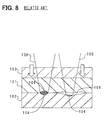
- Fig. 8 is a schematic view explaining a method for manufacturing a resin mold by using a conventional laser beam welding method.
- the first resin member 101 and the second resin member 102 are laminated.
- the first resin member 101 is capable of transmitting a laser beam 100.
- the second resin member is capable of absorbing the laser beam 100.
- the laser beam 100 is irradiated from a first resin member 101 side.
- the irradiated laser beam 100 transmits through the first resin member 100, and reaches the second resin member 102.
- the second resin member 102 absorbs energy of the laser beam 100.
- the second resin member 102 is heated and melted by the absorbed energy so that a melt region 104 is formed.
- the heat generated in the second resin member 102 conducts the first resin member 101.
- the first resin member 101 is also melted by the conducted heat so that another melt region 105 is formed.
- the melt regions 104, 105 of the first and second resin members 101, 102 are mutually diffused so that high bonding strength is obtained by using the laser beam welding method. Accordingly, the laser beam welding method is used widely, for example, for manufacturing a resin mold such as a part of an automotive vehicle.
- the first or second resin member 101, 102 when the first or second resin member 101, 102 is preliminary formed, the first or second resin member 101, 102 may have a forming defect such as warpage or shrinkage. Further, the interface between the first and second resin members 101, 102 may not have flatness so that the interface has an irregular shape such as a rounded surface. Therefore, even when the first resin member 101 is pressed by the glass plate 103, a clamp or the like, it is difficult to contact the first resin member 101 with the second resin member 102 completely when the first and second resin members 101, 102 are welded. Accordingly, a clearance 106 is formed between the first and second resin members 101, 102. As shown by a dotted line in Fig.
- forming accuracy is improved to eliminate the clearance 106.
- the improvement of the forming accuracy causes to increase a manufacturing cost, for example, to increase a cost of forming a mold.
- an applying pressure of the glass plate 103 becomes larger.
- a defect caused by the applying pressure may be generated in the resin mold after welding.
- a method for manufacturing a resin mold includes the steps of: laminating a second resin member, a filling member and a first resin member in this order; and irradiating with the laser beam from a first resin member side so that the first resin member and the second resin member are welded.
- the first resin member is capable of transmitting a laser beam.
- the laser beam works as a heat source.
- the second resin member is capable of absorbing the laser beam.
- the filling member fills a clearance between the first and second resin members when the first and second members are attached.
- the method provides the resin mold without a defect such as a void. Thus, the high bonding strength between the first and second resin members is obtained.
- a resin mold includes: a first resin member capable of transmitting a laser beam, wherein the laser beam works as a heat source; a second resin member capable of absorbing the laser beam; and a filling member for filling a clearance between the first and second resin members. At least the first resin member and the second resin member are welded by the laser beam.
- the resin mold has no defect such as a void. Thus, the high bonding strength between the first and second resin members is obtained.
- a method for manufacturing a resin mold according to a preferred embodiment of the present invention includes the steps of: laminating and disposing a second resin member, a filling member and a first resin member in this order, and irradiating with a laser beam from a first resin member side so that at least the first resin member and the second resin member are welded.
- the first resin member is capable of transmitting a laser beam.
- the laser beam works as a heat source.
- the second resin member is capable of absorbing the laser beam.
- the filling member fills a clearance between the first and second resin members when the first and second members are attached.
- the preferred embodiment is not to eliminate the clearance itself disposed between the first and second resin members by increasing forming accuracy or by increasing an applying pressure.
- the preferred embodiment is to fill the clearance with the filling member although the clearance exists between the first and second resin members.
- the clearance is filled with the filling member in a part mounting process. Therefore, the air is prevented from penetrating into the clearance from the outside. Further, since the clearance is filled with the filling member, the expanded and melted resin is prevented from penetrating into the clearance. Thus, no defect such as a void is generated in the resin mold after the resin mold is formed by welding.
- the method permits to form the clearance. Even if the clearance is disposed between the first and second resin members, the resin mold has no defect. Therefore, it is no need to improve the forming accuracy of the first and second resin members for reducing the defect. Therefore, the manufacturing cost is not increased. Further, it is no need to increase the applying pressure to squish the clearance completely in the welding process. Thus, a defect caused by the large applying pressure is prevented from being generated in the resin mold after welding.
- a small pressure for inserting the filling member into the clearance may be applied as described later.
- a resin mold according to the preferred embodiment of the present invention includes: a first resin member capable of transmitting a laser beam; a second resin member capable of absorbing the laser beam; and a filling member for filling a clearance between the first and second resin members.
- the laser beam works as a heat source. At least the first resin member and the second resin member are welded by the laser beam. In the resin mold, the clearance is filled with the filling member so that a defect such as a void is prevented from being generated.
- the method for manufacturing a resin mold capable of filling a clearance is provided. Further, the resin mold without a defect such as a void is provided.
- a filling member may not have compatibility with both of the first resin member and the second resin member. The reason is that penetration of the air and penetration of the melted resin can be prevented only by filling the clearance with the filling member. Further, no defect such as a void is generated in the resin mold after welding.
- the compatibility is such that two materials are melted and mixed each other.
- the filling member has the compatibility with at least one of the first resin member and the second resin member.
- the filling member and the first resin member or the filling member and the second resin member are welded.
- the bonding strength of a part of the interface, at which the clearance is disposed is prevented from being reduced.
- the filling member itself can be made of material having the compatibility with at least one of the first and second resin members. Further, the material having the compatibility can be added into the filling member.
- physical properties of the filling member are approximate to physical properties of at least one of the first and second resin members. For example, when a melting point of the filling member is approximate to a melting point of the one, it is easy to set a welding condition. When a linear coefficient of expansion of the filling member is approximate to a linear coefficient of expansion of the one, a defect caused by a thermal stress is prevented from forming at the interface after welding.
- the filling member has a single layered construction
- the filling member can have a multi-layered construction.
- the filling member includes a layer disposed on the first resin member side and having the compatibility with the first resin member or having physical properties approximate to those of the first resin member; and another layer disposed on the second resin member side and having the compatibility with the second resin member or having physical properties approximate to those of the second resin member.
- the filling member can be capable transmitting a laser beam.
- the heat conducts from the second resin member, which absorbs the energy of the laser beam, to the filling member and the first resin member.
- the filling member can be capable of absorbing the laser beam. In this case, the heat conducts from the filling member to the first resin member and the second resin member.
- the material of the filling member is not limited particularly.
- the material of the filling member is a fluidized material so that the filling member disposed between the first and second resin members is fluidized to fill the clearance therebetween.
- the fluidized material can be liquid or gel.
- the fluidized material can be applied or sprayed on at least one of the bottom of the first resin member and the top of the second resin member so that the fluidized material is inserted between the first and second resin members in a case where the laser beam is irradiated from the top of the first resin member.
- the fluidized material is injected into the interface between the first and second resin members by an injector so that the fluidized material is inserted between the first and second resin members.
- the pressure can be applied to the resin members.
- the fluidized material is diffused along with the interface between the resin members. Therefore, the filling member can fill into the clearance sufficiently, the clearance which is disposed dispersively between the resin members.
- the filling member is diffused by applying the pressure, the filling member can be diffused by the first resin member's own weight.
- the fluidized material is, for example, a gel including a resin material having physical properties approximate to both physical properties of the first and second resin members or having physical properties approximate to physical properties of at least one of the first and second resin members.
- the fluidized material has the compatibility with at least one of the first and second resin members.
- the filling member is a buffer material so that the filling member is deformed elastically or visco-elastically between the first and second resin members to fill the clearance therebetween.
- the buffer material is sandwiched between the first and second resin members so that the buffer material is inserted between the resin members. Further, after the buffer material is inserted, the pressure can be applied to the resin members. In this case, the buffer material can fill into the clearance deeply and sufficiently.
- the buffer material is pressurized with the applying pressure, the buffer material can be pressurized with the first resin member's own weight.
- the buffer material is, for example, rubber such as elastomer. This is because the rubber works as not only the buffer material but also a releasing material for releasing a thermal stress at the interface after welding.
- the materials of the first and second resin members are not limited particularly.
- they are thermoplastic resin such as PP (i.e., poly propylene), PC (i.e., poly carbonate), ABS (i.e., acrylonitrile-butadiene styrene polymer), PBT (i.e., poly butylenes terephthalate), and PPS (i.e., poly phenylene sulfide).
- PP i.e., poly propylene
- PC i.e., poly carbonate
- ABS i.e., acrylonitrile-butadiene styrene polymer
- PBT i.e., poly butylenes terephthalate
- PPS i.e., poly phenylene sulfide
- the resin members can include several artificial colors, reinforcing agent or the like, appropriately.
- a sort of the laser beam is not limited particularly as long as the laser beam has a certain wavelength for transmitting the first resin member.
- the laser equipment is a semiconductor laser, Nd:YAG laser, glass-neodymium laser, ruby laser, hydrogen laser or the like. It is preferred that the laser equipment is the semiconductor laser, which has high energy conversion efficiency and has small equipment accommodation space.
- a laser beam power, an irradiation density, a scanning speed in case of scanning and welding, and an irradiation time in case of spot welding are not limited particularly. They can be determined appropriately in view of a cycle time of manufacturing the resin mold and the like.
- a manner of the laser welding method is not limited particularly. Every manner of the laser welding method such as a butt welding method and an overlap welding method can be available.
- the filling member may not be disposed on all areas of the interface between the first and second resin members.
- the filling member can be disposed dispersively and dotted at the interface after welding.
- the resin mold is cut in a vertical direction perpendicular to the interface so that the cross section is observed with a microscope. Instead, a sample of the interface is obtained from the cross section so that the components of the sample are analyzed by several analyzers.
- the resin mold and the method for manufacturing the resin mold are described in detail as follows.
- the method for manufacturing the resin mold includes a part mounting process and a laser beam irradiation process.
- Fig. 1 is a schematic view explaining the pert mounting process according to the preferred embodiment.
- the first resin member 1 is a plate formed from PP by an injection molding method.
- the first resin member 1 is capable of transmitting a laser beam.
- the second resin member 2 is a plate formed from PP by an injection molding method. Therefore, the first resin member 1 and the second resin member 2 have compatibility each other.
- a carbon is added appropriately into the second resin member 2 so that the second resin member 2 is capable of absorbing the laser beam.
- a buffer member 3 is a plate having elasticity.
- the buffer member 3 is capable of transmitting the laser beam. Further, the buffer member 3 has compatibility with the first and second resin members 1, 2, respectively.
- Fig. 2 is a schematic cross sectional view showing each member 1, 2, 3 in the part mounting process.
- the buffer member 3 is mounted on the second resin member 2, and the first resin member 1 is mounted on the buffer member 3, respectively, as shown in Fig. 2A.
- the pressure is applied from the upside of the first resin member 1.
- the clearance 9 disposed between the first resin member 1 and the second resin member 2 is filled with the deformed buffer member 3 by the applied pressure.
- an intermediate 5 before welding is formed.
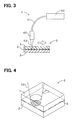
- Fig. 3 is a schematic view showing laser equipment for using in the laser beam irradiation process.
- the laser equipment 4 includes a laser beam generation unit 40, an optical fiber 41 and a condenser lens 42.
- the laser beam generation unit 40 generates the semiconductor laser beam.
- the laser beam 43 is irradiated on the intermediate 5 from the first resin member 1 side.
- the laser beam 43 is scanned in a direction shown by an outline arrow in Fig. 3.
- Fig. 4 is a schematic view showing a portion, which is irradiated with the laser beam.
- the laser beam 43 transmits the first resin member 1 and the buffer member 3, and reaches the surface of the second resin member 2.
- Fig. 5 is a schematic cross sectional view showing the intermediate 5 in the scanning direction before welding.
- the laser beam 43 reaches the surface of the second resin member 2
- the laser beam 43 is absorbed in the second resin member 2 so that a portion near the surface of the second resin member 2 generates heat and the portion is melted.
- a melt region 20 as the second melt region 20 is formed near the surface of the second resin member 2.
- Fig. 6 is a schematic cross sectional view showing the intermediate 5 in the scanning direction after welding.
- the heat generated in the second resin member 2 conducts the buffer member 3, which fills into the clearance 9.
- the buffer member 3 is also melted by the heat.
- another melt region 30 as the third melt region 30 is formed in the buffer member 3.
- the heat is conducted from the buffer member 3 to the first resin member 1.
- the first resin member 1 is also melted by the heat.
- further another melt region 10 as the first melt region 10 is formed in the first resin member 1.
- Fig. 7 is a schematic cross sectional view showing the resin mold 7.
- the resin mold 7 having the cross section shown in Fig. 7 is obtained.
- the second melt region 20, the third melt region 30 and the first melt region 10 are mixed closely together; and then, they are cooled and solidified (not shown) .
- the clearance 9 is filled in the part mounting process. Therefore, in the part mounting process, no air penetrates into the clearance 9 from the outside. Furthermore, the melted and expanded resin does not penetrate into the clearance 9. Accordingly, no defect such as a void is generated in the completed resin mold 7.
Landscapes
- Engineering & Computer Science (AREA)
- Mechanical Engineering (AREA)
- Physics & Mathematics (AREA)
- Electromagnetism (AREA)
- Optics & Photonics (AREA)
- Health & Medical Sciences (AREA)
- Toxicology (AREA)
- Lining Or Joining Of Plastics Or The Like (AREA)
- Laser Beam Processing (AREA)
Applications Claiming Priority (2)
| Application Number | Priority Date | Filing Date | Title |
|---|---|---|---|
| JP2003354245 | 2003-10-14 | ||
| JP2003354245A JP2005119051A (ja) | 2003-10-14 | 2003-10-14 | 樹脂成形品およびその製造方法 |
Publications (1)
| Publication Number | Publication Date |
|---|---|
| EP1524097A1 true EP1524097A1 (de) | 2005-04-20 |
Family
ID=34373561
Family Applications (1)
| Application Number | Title | Priority Date | Filing Date |
|---|---|---|---|
| EP20040021238 Withdrawn EP1524097A1 (de) | 2003-10-14 | 2004-09-07 | Kunststoffform und Verfahren zu ihrer Herstellung |
Country Status (4)
| Country | Link |
|---|---|
| US (1) | US20050079360A1 (de) |
| EP (1) | EP1524097A1 (de) |
| JP (1) | JP2005119051A (de) |
| CN (1) | CN1608830A (de) |
Cited By (3)
| Publication number | Priority date | Publication date | Assignee | Title |
|---|---|---|---|---|
| WO2007047789A1 (en) * | 2005-10-19 | 2007-04-26 | E. I. Du Pont De Nemours And Company | Process for laser welding three polymeric layers and article produced by the process |
| FR2962361A1 (fr) * | 2010-07-12 | 2012-01-13 | Bosch Gmbh Robert | Procede de fabrication d'un systeme multicouche et systeme multicouche obtenu |
| EP1669186A4 (de) * | 2003-10-02 | 2012-12-26 | Ube Industries | Material zum laserschweissen und laserschweissverfahren |
Families Citing this family (7)
| Publication number | Priority date | Publication date | Assignee | Title |
|---|---|---|---|---|
| JP4724527B2 (ja) * | 2005-10-19 | 2011-07-13 | イー・アイ・デュポン・ドウ・ヌムール・アンド・カンパニー | レーザー溶着法を用いた樹脂成形品の製造方法 |
| EP2070685A4 (de) * | 2006-10-05 | 2011-06-15 | Okayama Prefectural Government | Zwischenglied zur laserverbindung und dieses verwendende verbindungsverfahren |
| JP5327937B2 (ja) * | 2007-12-25 | 2013-10-30 | 旭化成ケミカルズ株式会社 | レーザー溶着接合用接着剤 |
| JP5595799B2 (ja) * | 2010-06-11 | 2014-09-24 | 株式会社小糸製作所 | レーザ溶着構造 |
| JP6192887B2 (ja) * | 2010-08-02 | 2017-09-06 | 早川ゴム株式会社 | レーザー光を用いた接合方法 |
| CA2980530C (en) | 2015-03-30 | 2020-06-16 | Nippon Steel Corporation | Method of joining metal, plastic member, and carbon fiber reinforced plastic member by means of a laser beam |
| JP7303758B2 (ja) * | 2020-01-20 | 2023-07-05 | 株式会社ミツバ | 射出成形体の製造方法 |
Citations (4)
| Publication number | Priority date | Publication date | Assignee | Title |
|---|---|---|---|---|
| US4029837A (en) * | 1975-08-14 | 1977-06-14 | William C. Heller, Jr. | Composite plastic-metallic bonding means and method |
| JPH07323482A (ja) * | 1994-06-02 | 1995-12-12 | Stanley Electric Co Ltd | 誘導加熱溶着シート |
| DE19962613A1 (de) * | 1999-12-23 | 2001-07-05 | Hella Kg Hueck & Co | Verfahren zum Schweißverbinden von Kunststoffteilen |
| EP1238781A1 (de) * | 2001-03-04 | 2002-09-11 | INPRO Innovationsgesellschaft für fortgeschrittene Produktionssysteme in der Fahrzeugindustrie mbH | Verfahren zum Verschweissen thermoplastischer Fügeteile mittels Diodenlaserstrahlung |
Family Cites Families (1)
| Publication number | Priority date | Publication date | Assignee | Title |
|---|---|---|---|---|
| JPS60214931A (ja) * | 1984-04-10 | 1985-10-28 | Toyota Motor Corp | 異種合成樹脂材料の接合方法 |
-
2003
- 2003-10-14 JP JP2003354245A patent/JP2005119051A/ja active Pending
-
2004
- 2004-09-07 US US10/934,437 patent/US20050079360A1/en not_active Abandoned
- 2004-09-07 EP EP20040021238 patent/EP1524097A1/de not_active Withdrawn
- 2004-10-14 CN CNA2004100881443A patent/CN1608830A/zh active Pending
Patent Citations (4)
| Publication number | Priority date | Publication date | Assignee | Title |
|---|---|---|---|---|
| US4029837A (en) * | 1975-08-14 | 1977-06-14 | William C. Heller, Jr. | Composite plastic-metallic bonding means and method |
| JPH07323482A (ja) * | 1994-06-02 | 1995-12-12 | Stanley Electric Co Ltd | 誘導加熱溶着シート |
| DE19962613A1 (de) * | 1999-12-23 | 2001-07-05 | Hella Kg Hueck & Co | Verfahren zum Schweißverbinden von Kunststoffteilen |
| EP1238781A1 (de) * | 2001-03-04 | 2002-09-11 | INPRO Innovationsgesellschaft für fortgeschrittene Produktionssysteme in der Fahrzeugindustrie mbH | Verfahren zum Verschweissen thermoplastischer Fügeteile mittels Diodenlaserstrahlung |
Non-Patent Citations (1)
| Title |
|---|
| PATENT ABSTRACTS OF JAPAN vol. 1996, no. 04 30 April 1996 (1996-04-30) * |
Cited By (4)
| Publication number | Priority date | Publication date | Assignee | Title |
|---|---|---|---|---|
| EP1669186A4 (de) * | 2003-10-02 | 2012-12-26 | Ube Industries | Material zum laserschweissen und laserschweissverfahren |
| WO2007047789A1 (en) * | 2005-10-19 | 2007-04-26 | E. I. Du Pont De Nemours And Company | Process for laser welding three polymeric layers and article produced by the process |
| FR2962361A1 (fr) * | 2010-07-12 | 2012-01-13 | Bosch Gmbh Robert | Procede de fabrication d'un systeme multicouche et systeme multicouche obtenu |
| US8790484B2 (en) | 2010-07-12 | 2014-07-29 | Robert Bosch Gmbh | Method for producing a multilayer system and corresponding multilayer system |
Also Published As
| Publication number | Publication date |
|---|---|
| US20050079360A1 (en) | 2005-04-14 |
| JP2005119051A (ja) | 2005-05-12 |
| CN1608830A (zh) | 2005-04-27 |
Similar Documents
| Publication | Publication Date | Title |
|---|---|---|
| US7527760B2 (en) | Resin mold and method for manufacturing the same | |
| US6478451B2 (en) | Vehicular lamp unit and method for manufacturing same | |
| US6464374B2 (en) | Vehicular lamp unit and method for manufacturing same | |
| EP1524097A1 (de) | Kunststoffform und Verfahren zu ihrer Herstellung | |
| US20050218123A1 (en) | Laser welding method of resin materials | |
| US20110200791A1 (en) | Method for producing a composite part by transmission laser welding | |
| US20080254242A1 (en) | Method for producing welded resin material and welded resin material | |
| JP2005508262A (ja) | 溶接するための方法 | |
| JPWO2013069491A1 (ja) | 燃料電池用組立体及びその製造方法と、接合品の製造方法及びその装置 | |
| EP2130637A1 (de) | Verfahren zur Herstellung eines plattenverbundenen Körpers unter Verwendung von geblasenen Gas und Laserlicht | |
| JP2002283457A (ja) | 樹脂部品のレーザ溶着方法 | |
| EP2087989B1 (de) | Verfahren zum Schweißen von Gegenständen aus thermoplastischen Kunststoffen | |
| JP2002018961A (ja) | 樹脂成形品の接合方法 | |
| JP2004188802A (ja) | 樹脂部材のレーザー溶着方法 | |
| JP2011240669A (ja) | 高圧タンク用ライナーの製造装置、高圧タンク用ライナーの製造方法及び高圧タンク | |
| JP2010214730A (ja) | 樹脂材のレーザー溶着方法 | |
| JP4103843B2 (ja) | 樹脂材のレーザ溶着方法 | |
| KR20080063507A (ko) | 레이저 용접을 위한 방법 및 조성물 | |
| JP2007276305A (ja) | レーザ溶着用治具及び樹脂成型品 | |
| KR20210104005A (ko) | 이종 소재 접합체의 제조방법 | |
| JP4089441B2 (ja) | レーザーによる熱可塑性樹脂の接合方法 | |
| JP2007210203A (ja) | レーザー溶着方法およびレーザー溶着された樹脂部材 | |
| JPS6246621A (ja) | 合成樹脂材料の接合方法 | |
| EP4153404A1 (de) | Verfahren zur herstellung eines metall-polymer-hybridteils und metall-polymer-hybridteil | |
| JP2004058581A (ja) | 樹脂部材のレーザー溶着方法 |
Legal Events
| Date | Code | Title | Description |
|---|---|---|---|
| PUAI | Public reference made under article 153(3) epc to a published international application that has entered the european phase |
Free format text: ORIGINAL CODE: 0009012 |
|
| AK | Designated contracting states |
Kind code of ref document: A1 Designated state(s): AT BE BG CH CY CZ DE DK EE ES FI FR GB GR HU IE IT LI LU MC NL PL PT RO SE SI SK TR |
|
| AX | Request for extension of the european patent |
Extension state: AL HR LT LV MK |
|
| AKX | Designation fees paid |
Designated state(s): DE FR GB |
|
| STAA | Information on the status of an ep patent application or granted ep patent |
Free format text: STATUS: THE APPLICATION IS DEEMED TO BE WITHDRAWN |
|
| 18D | Application deemed to be withdrawn |
Effective date: 20051021 |