EP1521252B1 - Visible image forming method, program, and visible image forming system - Google Patents
Visible image forming method, program, and visible image forming system Download PDFInfo
- Publication number
- EP1521252B1 EP1521252B1 EP04023344A EP04023344A EP1521252B1 EP 1521252 B1 EP1521252 B1 EP 1521252B1 EP 04023344 A EP04023344 A EP 04023344A EP 04023344 A EP04023344 A EP 04023344A EP 1521252 B1 EP1521252 B1 EP 1521252B1
- Authority
- EP
- European Patent Office
- Prior art keywords
- data
- visible image
- image forming
- optical disk
- recording
- Prior art date
- Legal status (The legal status is an assumption and is not a legal conclusion. Google has not performed a legal analysis and makes no representation as to the accuracy of the status listed.)
- Expired - Lifetime
Links
- 238000000034 method Methods 0.000 title claims description 34
- 230000003287 optical effect Effects 0.000 claims description 160
- 230000004044 response Effects 0.000 claims description 9
- 230000001131 transforming effect Effects 0.000 claims description 6
- 239000000284 extract Substances 0.000 claims description 5
- 230000015572 biosynthetic process Effects 0.000 description 30
- 238000012545 processing Methods 0.000 description 20
- 230000002596 correlated effect Effects 0.000 description 4
- 239000000470 constituent Substances 0.000 description 3
- 238000012986 modification Methods 0.000 description 3
- 230000004048 modification Effects 0.000 description 3
- 238000012546 transfer Methods 0.000 description 3
- 239000000758 substrate Substances 0.000 description 2
- 238000012935 Averaging Methods 0.000 description 1
- 238000004891 communication Methods 0.000 description 1
- 230000001276 controlling effect Effects 0.000 description 1
- 230000000875 corresponding effect Effects 0.000 description 1
- 230000003111 delayed effect Effects 0.000 description 1
- 230000001419 dependent effect Effects 0.000 description 1
- 238000002474 experimental method Methods 0.000 description 1
- 238000000605 extraction Methods 0.000 description 1
- 230000002035 prolonged effect Effects 0.000 description 1
- 238000012360 testing method Methods 0.000 description 1
Images




Classifications
-
- G—PHYSICS
- G11—INFORMATION STORAGE
- G11B—INFORMATION STORAGE BASED ON RELATIVE MOVEMENT BETWEEN RECORD CARRIER AND TRANSDUCER
- G11B7/00—Recording or reproducing by optical means, e.g. recording using a thermal beam of optical radiation by modifying optical properties or the physical structure, reproducing using an optical beam at lower power by sensing optical properties; Record carriers therefor
- G11B7/004—Recording, reproducing or erasing methods; Read, write or erase circuits therefor
- G11B7/0045—Recording
-
- G—PHYSICS
- G11—INFORMATION STORAGE
- G11B—INFORMATION STORAGE BASED ON RELATIVE MOVEMENT BETWEEN RECORD CARRIER AND TRANSDUCER
- G11B7/00—Recording or reproducing by optical means, e.g. recording using a thermal beam of optical radiation by modifying optical properties or the physical structure, reproducing using an optical beam at lower power by sensing optical properties; Record carriers therefor
- G11B7/24—Record carriers characterised by shape, structure or physical properties, or by the selection of the material
- G11B7/24094—Indication parts or information parts for identification
Definitions
- the present invention relates to a visible image forming method, a program, and a visible image forming system for forming a visible image in addition to the data recording on an optical disk.
- the optical disk recording apparatus capable of forming the visible image such as the character, the pattern, or the like apart from the essential data recording onto the optical disk such as CD-R (Compact Disc-Recordable), or the like is provided currently.
- the optical disk recording apparatus of this type optically denatures a part of the unrecorded area by applying the laser beam onto the unrecorded area onto which the data recording was not applied, to thus form the character or the pattern as the visible image (For example, see Non-Patent Literature 1).
- Non-Patent Literature 1
- the format of the signal used to modulate the laser beam that is applied onto the optical disk at the time of recording the data for example, EFM modulation signal: Eight To Fourteen Modulated Signal
- the signal processing circuit used in the data recording and the signal processing circuit used in the visible image formation must be provided respectively. For this reason, a scale of the signal processing circuit must be enlarged, a control LSI must be newly designed/manufactured, and a control program must be largely varied.
- the data-recording signal processing circuit in the up-to-date optical disk recording apparatus is designed to make possible the high-speed transfer processing by using the parallel processing.
- the visible-image recording signal processing circuit is similarly constructed such that the processing circuit can deal with the high-speed transfer processing, there existed not only the problem such that the overall circuit scale is expanded but also the problem such that the wirings are complicated.
- the visible-image forming signal processing circuit is designed as the serial processing type, there existed the problem such that the visible image formation is delayed.
- the data writing system is constructed as the CLV data writing system having the constant linear velocity. Therefore, it is difficult to realize the polar coordinate system that permits such writing system to form the visible image with good precision.
- EP-A-1143426 discloses a method of forming a visible image on an optical disk wherein a pit art generating part supplies the pit art data to an encoder whenever it is determined that the pickup is at an address at which pit art is to be recorded.
- the present invention has been made to overcome above respects, and it is an object of the present invention to provide a visible image forming method capable of executing the visible image formation on an optical disk on a polar coordinate system by which the visible image can be drawn quickly with good precision, a program used therein, and a visible image forming system for implementing the method. Accordingly, expansion of the circuit scale and complication of the wirings in a signal processing circuit of the optical disk recording apparatus can be avoided.
- the invention is characterized by having the following arrangement.
- the visible image formation can be applied onto the optical disk to neither expand the circuit scale nor complicate the wirings.
- a visible image forming system 700 constructed by applying the present invention will be explained hereinafter.
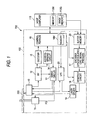
- FIG.1 A configurative view of a visible image forming system 700 is shown in FIG.1 .
- the visible image forming system 700 comprises an optical disk recording apparatus 100.and a host computer 110, and can apply the data recording and the visible image formation on an optical disk 200 that is guided in the optical disk recording apparatus 100.
- a configuration of the optical disk recording apparatus 100 is almost identical to the normal optical disk recording apparatus that can record/play the data, and is able to form the visible image by utilizing the conventional configuration to the maximum and adding the new configuration to the minimum. It is supposed in the present embodiment that the CD-R is used as the optical disk 200.
- the host computer 110 is constructed by a personal computer, or the like, and has a displaying means, and an inputting means such as a keyboard, or the like.
- a running program of executing data recording and visible image formation by utilizing the present system 700 is stored previously in the host computer 110.
- the host computer 110 when executes the data recording by using this running program, outputs the data (audio data, document data, or the like) to be recorded onto the optical disk 200 to the optical disk recording apparatus 100.
- the host computer 110 when executes the visible image formation, outputs the visible image forming data to be formed on the optical disk 200 (details will be described later) to the optical disk recording apparatus 100.
- the audio data, the document data, or the like are stored in a memory 110M and the visible image forming data are stored in an image memory 110G.
- the optical disk 200 will be explained hereunder.
- the CD-R disk is supposed as the optical disk 200.
- other optical disks e.g., DVD-R (Digital Versatile Disc Recordable) may be employed.
- the double-layer or multi-layered disk, the double-faced disk, the optical disk whose label surface can be drawn by the laser, or the like may be employed.
- an encoder 17 should be operated in an aggregate of data units in which a predetermined quantity of data is used as a unit.
- the EFM frame is used as a data unit and a data format is constructed by an aggregate of the EFM frames.
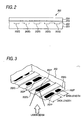
- FIG.2 is a sectional view of the optical disk 200.
- the optical disk 200 has a structure in which respective layers composed of a protection substrate layer 201, a recording layer 202, a reflecting layer 203, and a protection layer 204 are laminated.
- a visible image recording layer may be provided between the protection layer 204 and the reflecting layer 203.
- a groove 202G for guiding the laser beam is formed spirally on one face of the protection substrate layer 201.
- the recording layer 202, the reflecting layer 203, and the protection layer 204 are laminated on the groove 202G.
- the laser beam is applied onto the groove 202G from the opposite face to the face on which the groove 202G is formed, and records the image on the groove 202G while being guided along the groove 202G (on-groove recording).
- the recording layer 202 is constructed such that its reflectance is changed when a temperature reaches a predetermined temperature or more by applying the laser beam.
- An area whose reflectance becomes different from other areas when whose temperature reaches the predetermined temperature or more by applying the laser beam acts as a pit 202P.
- An area between the pits 202P is called a land.
- the reflecting layer 203 is provided to increase the reflectance of the optical disk 200 up to a predetermined value or more.
- the protection layer 204 is provided to protect the reflecting layer 203 and the recording layer 202.
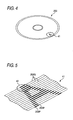
- FIG.3 is a view showing a state in which the pits 202P and the lands are formed on the grooves 202G as the result that the laser beam is applied along the groove 202G.
- Individual lengths of the pits 202P and the lands correspond to lengths defined by the recording data. In detail, the length is set to almost several hundreds nm to several ⁇ m.
- the reflectance of the pit 202P is different from that of the land, and normally the reflectance of the pit 202P is set lower than the land.
- a reflected beam having an intensity in answer to a difference between the reflectances can be obtained by applying the reproducing laser beam along the groove 202G.
- the reproduced data can be obtained by sensing an interval between changes in the intensity of the reflected beam.
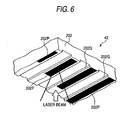
- FIG.4, FIG.5 , and FIG.6 show a state that the visible image is formed by forming the pit 202P on the optical disk 200.
- an alphabetical character "A" is formed as the visible image is shown.
- FIG.4 shows the overall image of the optical disk 200 when viewed from the recording face side.
- FIG. 5 is an enlarged view of an area 41 in FIG.4 .
- FIG.6 is an enlarged view of an area 42 in FIG.5 .
- the pit 202P is formed on the grooves 202G positioned between profiles of the character "A" respectively.
- the pits 202P can be recognized as the visible image as shown in FIG.4 .
- the length of the pit 202P formed on the grooves 202G positioned between profiles of the visible image may set arbitrarily. As shown in FIG.5 , the pit having a length almost equal to a profile interval may be formed. The pit having the same length may be formed successively between the profiles, as shown in FIG.7 , otherwise the pit may be formed between the profiles by utilizing the data-writing EFM data signals, as shown in FIG.8 . In all cases, the character "A" can be visibly recognized when the optical disk 200 is looked at as a whole.
- a configuration of the optical disk recording apparatus 100 is almost identical to the normal optical disk recording apparatus that can record/play the data, and is able to form the visible image by utilizing the conventional configuration as much as possible and adding the new configuration as small as possible.
- a control portion 16 controls respective portions of the system in compliance with programs stored previously in a memory (storing portion) 16M.
- a spindle motor 11 turns and drives the optical disk (CD-R) 200.
- An optical pickup 10 is composed of a laser diode, an optical system such as an objective lens, a mirror, etc., a light receiving element for a return light, a monitor diode, and so forth.
- the optical pickup 10 applies the laser beam onto the optical disk 200 or receives the return light reflected from the optical disk 200. Irradiation of the laser beam is carried out in response to a driving current that is fed from a laser driver 19 to the laser diode. Such driving current is modulated based on the recording data or the visible image data.
- the return light is received by the light receiving element, then converted into an electric signal, and then output to an RF amplifier 12.
- a part of the laser beam applied onto the optical disk 200 is separated by the optical system, then received by the monitor diode and converted into an electric signal, and then output to a laser power control circuit (LPC) 20.
- LPC laser power control circuit
- the RF amplifier 12 amplifies the electric signal that is received from the light receiving element, and then outputs it to a decoder 15, an address sensing circuit 14, and a servo circuit 13.
- the decoder 15 demodulates the electric signal that is received from the RF amplifier 12 to generate reproduced data, and then outputs the data to the control portion 16. More particularly, the laser beam applied onto the optical disk 200 to reproduce the data is modulated by the pits 202P and reaches the light receiving element as the return light, and the pits 202P are formed in accordance with the recorded data. Therefore, the return light is given as the EFM-modulated RF signal, and the RF signal is EFM-demodulated by the decoder 15 to give the reproduced data.
- the address sensing circuit 14 Upon executing the data recording or the visible image formation, the address sensing circuit 14 acquires address information and the synchronizing signal from the electric signal received from the RF amplifier 12, and outputs them to the control portion 16.
- the groove 202G is formed to wobble based on the frequency of the modulated wave that is obtained by frequency-modulating the fundamental wave (sinusoidal wave) by the address information, so that the component modulated by the grooves 202G (wobble signal) is contained in the RF signal. Therefore, the address signal, etc. can be acquired by extracting the fundamental wave component from the RF signal and then FM-demodulating such component.
- the servo circuit 13 executes rotation control of the spindle motor 11, focus control, tracking control, etc. of the optical pickup 10, and so on.
- the laser power control circuit 20 adjusts an intensity of the laser beam emitted from the laser diode in the optical pickup 10.
- the laser power control circuit 20 controls the laser driver 19 in response to a difference between the electric current value supplied from the monitor diode in the optical pickup 10 and a target control value as optimum laser power information supplied from the control portion 16 in such a way that the laser beam having an optimum laser power can be applied onto the optical disk 200 from the optical pickup 10.
- the optimum laser power value is derived in advance by executing the recording experiment.
- a buffer memory 29 stores the data transferred from the host computer 110, i.e., the data to be recorded onto the optical disk 200 (the audio data, the document data, etc. as main data, and the address information, etc. as subcode data), in the FIFO (First-In First-Out) manner.
- the encoder 17 executes the addition of an error correcting code (in the case of CD-R, CIRC: Cross Interleaved Reed-Solomon Code process) to the main data read from the buffer memory 29, etc., and applies the EFM modulation to the main data and the subcode data.
- the data modulated by the encoder 17 is referred to as first recording data in this application.
- the first recording data are output to a strategy circuit 18.
- the optical disk recording apparatus 100 applies the data recording to the optical disk 200, the pit 202P whose length is defined by the first recording data is formed onto the optical disk 200
- the strategy circuit 18 changes a waveform of the signal that is received from the encoder 17.
- a signal waveform of the first recording data that the encoder 17 outputs represents an irradiation period and a power level of the laser beam that is applied onto the optical disk 200.
- the pit is formed like a teardrop due to the uneven heat distribution or the remaining heat or the pit is formed to have the prolonged length when the laser irradiation is carried out for a period that is equivalent to the length defined by the first recording data.
- the power at the head portion of the laser irradiation period must be enhanced or the rear portion of the laser irradiation period must be early ended.
- the strategy circuit 18 changes the laser irradiation period and the irradiation power level of the signal of the first recording data, and then outputs the signal to the laser driver 19.
- the laser driver 19 supplies the current that is modulated by the signal received from the strategy circuit 18, i.e., the signal whose waveform represents the laser irradiation period and the irradiation power level, to the laser diode in the optical pickup 10.
- the laser diode applies the laser beam onto the optical disk 200 in accordance with the supplied current.
- the feedback loop control is applied to stabilize the output level.
- the monitor diode in the optical pickup 10 monitors the power level of the laser beam.
- the laser power control circuit 20 compares the monitored power level with the target power level.
- the laser driver 19 supplies the driving current having the output level that is adjusted based on the compared result to the laser diode.
- the laser diode can emit the laser beam as the stable output.
- the spindle motor 11 controls the optical disk 200 to get a constant rotation (CAV: Constant Angular Velocity).
- CAV Constant Angular Velocity
- the optical disk 200 is controlled by using a rotation monitor (FG) signal output from this spindle motor 11, which rotates the optical disk, and a rotation reference clock to rotate at the constant rotation and then the first recording data are generated at a frequency that has a predetermined ratio to this rotation reference clock, the visible image can be formed with good precision on the polar coordinate system.
- FG rotation monitor
- the first recording data signifies the data which are generated by the encoder equipped with the optical disk recording apparatus and whose bit alignment is arranged to construct a predetermined format that is associated with the optical disk as the recording object.
- a data unit having a predetermined quantity of data is the aggregate that consists of an EFM frame (referred to as "one frame” or the "EFM frame” hereinafter).
- FIG.9 represents a data format of one frame.
- One frame corresponds to 588 channel bits.
- a 24-bit frame synchronization data Dframe is arranged at a head of one frame.
- the frame synchronization data Dframe is a signal having a predetermined bit pattern, and is used as the synchronization data indicating the head of one frame when the data reproduction is carried out.
- the frame synchronization data Dframe serves as the site to check the power level of the applied laser beam when the data recording is carried out.
- a subcode data Dsub is arranged subsequently to the frame synchronization data Dframe.
- the subcode data Dsub consists of 14 bits.
- the 8-bit data prepared in the host computer 110 is subjected to the EFM-modulation by the encoder 17 and converted into this 14-bit data.
- the subcode data Dsub will be described later.
- Amain data Dmain is arranged subsequently to the subcode data Dsub. Normally the music data, the document data, etc. correspond to the main data.
- the main data Dmain is subjected to the addition of parity data for the data security and interleaved by the encoder 17.
- the main data is converted into a 14-bit sample by the EFM-modulation. In this case, 3 bits positioned between the 14-bit samples are margin bits that are added as the DSV countermeasure.
- the subcode data Dsub consists of 8 bits, but each bit has no meaning solely. Respective bits out of 8 bits are indicated by P, Q, R, S, T, U, V, W as indices. Respective indices have one meaning by 96 pieces.
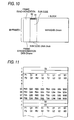
- FIG.10 shows one block data which consists of 98 EFM frames and which is a unit by which the signal processing is executed. The data on the optical disk 200 is handled in unit of 1 block, and the number of 1 block is identified by the subcode in the block.
- the subcode data in the first EFM frame and the second EFM frame in the subcode data in the 98 EFM frames are assigned as synchronization data S0, S1, and the subcode block is constructed by remaining 96 frames.
- FIG.11 shows a subcode data Dsub portion in one block data.
- the 98 EFM frames are represented by affixing the serial numbers (frame numbers).
- the subcode data in the frame numbers 1 and 2 are synchronization data S0 and S1, as described above. Respective indices are assigned to the subcode data in the frame numbers 3 to 98 like P1, ..., P96, Q1, ..., Q96, ...
- the P data and the Q data do not have their meanings until 96 frames from the frame numbers 3 to 98 are arranged properly.
- the Q data represent the information about the block or the main data Dmain, and represent the block number and the data type.
- the first recording data is constructed by the main data Dmain, the subcode data Dsub, and the frame synchronization data Dframe.
- the visible image forming data is formed by replacing at least a part of the first recording data with the visible image forming data.
- the visible image forming data may be prepared as at least a part of the subcode data Dsub and the main data Dmain.
- a quantity of replaced data depends on a resolution of the visible image to be formed and a performance of the visible image forming system 700.
- the visible image forming data signifies both the visible image forming data itself and the first recording data at least a part of which is replaced with the visible image forming data.
- the data derived before the process in the encoder 17 correspond to the visible image forming data
- the data derived after the process in the encoder 17 correspond to the first recording data at least a part of which is replaced with the visible image forming data. Any data may be employed as the data derived before the replacement. Either the dummy data prepared by the host computer 110 or the music data, the document data, or the like may be employed.
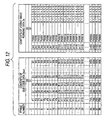
- the visible image forming data Dx and the subcode data Dsub to be compared is shown in FIG.12 .
- the left part shows the frame number and the subcode data Dsub to be compared
- the right part shows the visible image forming data Dx.
- the same synchronization data S0, S1 as the subcode data Dsub are assigned to the visible image forming data Dx in the frame numbers 1 and 2. Accordingly, the head portion of the 98 frames (head portion of one block data) can be detected in the visible image forming data Dx by sensing the data S0 and S1.
- the visible image forming data Dx in the frame numbers 3 to 98 designates a range in which the pits 202P are to be formed on the optical disk 200.
- Cmx is command data and is used in various applications.
- PWMx is data used to designate the range in which the pits 202P are to be formed on the optical disk 200. Now, a PWMx generating method will be explained hereunder.
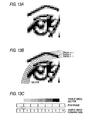
- FIG.13a is an enlarged view of a part of the visible image.
- the visible image is expressed by a density of the cells that are aligned on the XY-coordinates.
- the density of cells is expressed by a density of dots in the cell.
- FIG.13b shows positional relationships between the grooves 202G and respective cells when the bit map data are arranged on the optical disk 200 by sectors on the polar coordinate system that employs a radius position (track position) and a rotating angle position.
- a certain cell on the bit map data can be correlated with a certain sector on the groove 202G of the optical disk 200
- all cells can be correlated with all sectors. This is because respective areas occupied by all sectors on the optical disk 200 can be decided based on an equal track pitch and an equal rotating angle range. For example, assume now that a track pitch is 1.6 ⁇ m and a linear velocity on the radius position is 1.2 m/s, a length of one sector is given as 163 ⁇ m. This 1.6 ⁇ m ⁇ 163 ⁇ m area yields one cell on the optical disk 200.
- the polar coordinate system employing the radius position and the rotating angle position on the optical disk 200 is called the CAV coordinate system.
- the visible image forming data are prepared by averaging the densities contained in the correlated sector areas.
- the visible image forming data generated by correlating the visible image with the sectors are shown in FIG.13c . If a ratio between a generating frequency of the EFM data as the first recording data and the rotation frequency of the optical disk 200 is controlled at a predetermined ratio, the EFM frame writing area can be employed as the sector.
- the visible image forming data are in the lowest tone when all the visible images contained in the areas of the EFM frame cells are white, the visible image forming data are in the highest tone when all the visible images contained in the same are black, and the visible image forming data are in the intermediate tone when all the visible images contained in the same are others.
- PWMx consists of 7 bits, the lowest tone is represented as 0000000 and the highest tone is represented as 1111111.
- the visible image forming data are constructed by the command data Cmx and the tone data PWMx. Then, the subcode data Dsub in the first recording data are replaced.
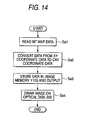
- the steps of forming the visible image on the optical disk 200 are shown in FIG.14 .
- the host computer 110 starts the dedicated running program for the visible image forming system 700 in answer to the user's predetermined operation.
- a data communication channel is established between the host computer 110 and the optical disk recording apparatus 100 when this program is started.
- the host computer 110 reads the bit map data from the image memory 110G (step Sa1). Then, the host computer 110 executes the data converting process of this bit map data, i.e., executes the data converting process from the XY coordinate system to the CAV coordinate system (step Sa2). Then, the host computer 110 stores the visible image forming data converted into the CAV coordinate system in the image memory 110G (step Sa3).
- the host computer 110 transfers the visible image forming data as the subcode data Dsub from the image memory 110G and the dummy data as the main data Dmain to the optical disk recording apparatus 100. Then, the optical disk recording apparatus 100 decides the pit 202P forming area in the EFM frame based on the received visible image forming data, and forms the pit 202P in the decided area (step Sa4).
- the EFM frame period can be employed as the minimum sector on the optical disk 200.
- the operating clock is given to the optical disk such that the optical disk 200 is turned at 10 Hz and the EFM frame frequency is operated at 10 kHz
- the minimum sector is formed as 360 degree/1000 and has a angular resolution of 0.36 degree.
- the frequency of 10 Hz is generated by dividing the frequency of the master clock and given as the spindle reference clock.
- the clock of 10 kHz may be generated from the master clock and given to the encoder 17.
- the spindle motor 11 is turned at any rotation frequency and then the FG output is given to the encoder 17 via the multiplexer such as PLL, or the like, the EFM frame whose frequency is 1000 times the FG signal may be produced.
- the visible image can be formed on the polar coordinate system on the optical disk 200.
- step Sa4 will be explained in more detail.
- FIG.15 shows the relationship between the EFM frame and the pit forming area.
- the visible image forming data Dx in a certain EFM frame represents the pit forming area in the next EFM frame.
- the subcode data Dsub portion of the first recording data as the EFM signal being output from the encoder 17 is replaced with the visible image forming data Dx.
- the visible image forming data Dx are extracted from the EFM data, and transformed into the signal designating the pit forming area.
- the pit 202P whose length is defined by the main data Dmain is formed in the designated area.
- the visible image forming data Dx represents the tone by using a width of the pit forming area. The pit forming area becomes wider as the tone becomes higher, while the pit forming area becomes narrower as the tone becomes lower.
- the command data Cmx (see FIG.12 ) are utilized as the solution of this.
- the command data Cm1 to Cm7 are employed in the frame number 1 and the command data Cm8 to Cm13 are employed in the frame number 2, and such data may be held by the register, or the like.
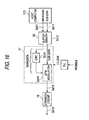
- FIG.16 is a view showing a flow of the data in the optical disk recording apparatus 100 upon executing the data recording.
- the main data and the subcode data to be recorded on the optical disk 200 are transferred from the host computer 110 to the optical disk recording apparatus 100 (step Sd11).
- the main data and the subcode data after transferred are stored once in the buffer memory 29 under control of the control portion 16 in the optical disk recording apparatus 100 (step Sd12).
- the main data and the subcode data after stored are read sequentially and output to the encoder 17.
- the main data are output to CIRC in which the error correcting code is added, the interleaving to distribute the data to a plurality of frames is applied, and others are applied (step Sd13), and are subjected to the EFM modulation (step Sd14).
- the subcode data are subjected directly to the EFM modulation (step Sd14).
- Both data constitute the first recording data and are output to the strategy circuit 18 (step Sd15).
- the first recording data are subjected to the waveform modification in the strategy circuit 18 and then output to the laser driver 19 (step Sd16). Because the encoder 17 employs at this time the wobble signal recorded on the pregroove and the clock being multiplexed from the synchronizing signal, the width of the EFM frame after recorded is constant irrespective of the radius position.
- FIG.17 shows a flow of the data in the optical disk recording apparatus 100 upon executing the visible image formation.
- This configuration is different from the conventional configuration in a respect that a subcode extraction circuit and a gate circuit are provided to the strategy circuit 18.
- the spindle reference clock and the clock supplied to the encoder are different.
- the main data as the dummy data are stored in the memory 110M in the host computer 110.
- the visible image forming data are stored in the image memory 110G.
- both data are transferred to the buffer memory 29 (steps Se11, Se12, Se13).
- the main data as the dummy data and the visible image forming data stored in the buffer memory 29 are read in sequence.
- the main data as the dummy data are output to the CIRC where the addition of the error correcting code, etc. are executed (step Se14), and are subjected to the EFM modulation (step Se15).
- the visible image forming data are subjected directly to the EFM modulation (step Se15).
- the gate circuit extracts the signal being output from the strategy circuit 18 only for an ON period of the pit forming area signal (step Se19), and then outputs such signal to the laser driver 19 (step Se20). In this way, the laser beam irradiation onto the optical disk 200 is applied and the visible image formation is executed. Since the encoder 17 employs the clock having a predetermined ratio to the reference clock of the spindle motor 11, the EFM frame after recorded has a constant angular width regardless of the radius position and thus can be handled as the sector in the polar coordinate representation.
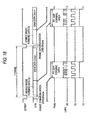
- FIG.18 shows a timing chart of processing signals in the strategy circuit 18 when the visible image formation is executed. Respective terms given on the left side are signal names.
- a signal "/EFMSY” is a negative logic signal indicating the position of the frame synchronization data Dframe. A period required until the signal "/EFMSY" goes to a low level subsequently after it went to the low level corresponds to one frame period.
- a signal "EFM” is a signal indicating the first recording data.
- the subcode data Dsub subsequent to the frame synchronization data Dframe is replaced with the visible image forming data Dx.
- a signal "tone PWM” is a signal indicating the pit forming area that is pointed by the visible image forming data Dx that are extracted from the first recording data.
- the visible image forming data Dx are information indicating the tone, and the tone is represented by varying the width of the pit forming area.
- the tone PWM signal is generated from the visible image forming data Dx in a certain frame, and is used as the gate signal designating the pit forming area in the next frame.
- a signal “LMP0” is a signal that is output to the laser driver 19.
- a signal “LMP0(a)” is a signal that is obtained by gate-processing the first recording data, which were subjected to the waveform modification by the strategy circuit, by the tone PWM signal.
- the pit 202P having the length defined by the first recording data is formed in the area that is designated by the tone PWM signal.
- a signal "LMP0(b)" indicates the case that second recording data are employed as the recording data instead of the first recording data.
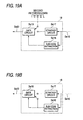
- FIG.19a shows the case that a pulse signal with any duty cycle is employed as the second recording data and the gate processing is carried out by using the tone PWM signal. Any signal such as the clock signal, a test recording signal, or the like, which is provided to the optical disk recording apparatus 100, can be utilized.
- a signal "LMP0(c)" indicates the case that the tone PWM signal is employed as the recording data in place of the first recording data.
- FIG.19B shows the case where the tone PWM signal is employed as the second recording data and the gate processing is executed by using the tone PWM signal. In this case, the visible image in the highest tone can be formed.
- the configuration in which the tone PWM signal passes through the gate circuit is employed by way of comparison. In this case, the tone PWM signal may be output directly to the laser driver 19.
Landscapes
- Optical Recording Or Reproduction (AREA)
- Optical Record Carriers And Manufacture Thereof (AREA)
- Signal Processing For Digital Recording And Reproducing (AREA)
Applications Claiming Priority (2)
| Application Number | Priority Date | Filing Date | Title |
|---|---|---|---|
| JP2003342243 | 2003-09-30 | ||
| JP2003342243A JP4066927B2 (ja) | 2003-09-30 | 2003-09-30 | 可視画像形成方法、プログラムおよび可視画像形成システム |
Publications (3)
| Publication Number | Publication Date |
|---|---|
| EP1521252A2 EP1521252A2 (en) | 2005-04-06 |
| EP1521252A3 EP1521252A3 (en) | 2006-12-06 |
| EP1521252B1 true EP1521252B1 (en) | 2008-09-24 |
Family
ID=34309089
Family Applications (1)
| Application Number | Title | Priority Date | Filing Date |
|---|---|---|---|
| EP04023344A Expired - Lifetime EP1521252B1 (en) | 2003-09-30 | 2004-09-30 | Visible image forming method, program, and visible image forming system |
Country Status (5)
| Country | Link |
|---|---|
| US (1) | US7656779B2 (enExample) |
| EP (1) | EP1521252B1 (enExample) |
| JP (1) | JP4066927B2 (enExample) |
| CN (1) | CN100431015C (enExample) |
| DE (1) | DE602004016713D1 (enExample) |
Families Citing this family (10)
| Publication number | Priority date | Publication date | Assignee | Title |
|---|---|---|---|---|
| JP4066927B2 (ja) * | 2003-09-30 | 2008-03-26 | ヤマハ株式会社 | 可視画像形成方法、プログラムおよび可視画像形成システム |
| US20090028030A1 (en) * | 2006-02-10 | 2009-01-29 | Pioneer Corporation | Apparatus and Method for Driving Optical Disc and Optical Disc Recording Apparatus |
| JP2007280510A (ja) * | 2006-04-06 | 2007-10-25 | Sony Corp | 記録媒体処理装置,印刷方法およびコンピュータプログラム |
| JP2008077797A (ja) * | 2006-09-25 | 2008-04-03 | Yamaha Corp | 光ディスク記録・描画方法 |
| JP4367483B2 (ja) | 2006-12-25 | 2009-11-18 | ヤマハ株式会社 | 光ディスク描画装置、ホストコンピュータ及び光ディスク描画方法 |
| JP5023793B2 (ja) * | 2007-04-27 | 2012-09-12 | ヤマハ株式会社 | 光ディスク記録装置、光ディスク記録装置の制御方法、及び制御プログラム |
| US8369198B2 (en) * | 2008-02-05 | 2013-02-05 | Mediatek Inc. | System and method for printing visible image onto optical disc through tuning driving signal of optical pick-up unit |
| US9056422B2 (en) * | 2013-04-09 | 2015-06-16 | Massachusetts Institute Of Technology | Methods and apparatus for encoded textures |
| WO2014186738A2 (en) | 2013-05-17 | 2014-11-20 | Doug Carson & Associates, Inc. | Image archive disc |
| GB2577675B (en) * | 2018-08-20 | 2023-07-05 | Iq Structures Sro | Gramophone plate with recorded image |
Family Cites Families (30)
| Publication number | Priority date | Publication date | Assignee | Title |
|---|---|---|---|---|
| US4967286A (en) * | 1988-12-12 | 1990-10-30 | Disctronics Manufacturing, Inc. | Method and apparatus for forming a digital image on an optical recording disc |
| JPH06140910A (ja) | 1992-10-24 | 1994-05-20 | Nec Ic Microcomput Syst Ltd | データ出力回路 |
| DE69422870T2 (de) * | 1993-09-07 | 2000-10-05 | Hitachi, Ltd. | Informationsaufzeichnungsträger, optische Platten und Wiedergabesystem |
| JP3037562B2 (ja) | 1994-05-31 | 2000-04-24 | 日本コロムビア株式会社 | 光記録媒体記録装置 |
| JP3503767B2 (ja) * | 1994-10-21 | 2004-03-08 | 日本ビクター株式会社 | 光記録媒体 |
| US5751690A (en) * | 1994-12-15 | 1998-05-12 | Pioneer Video Corporation | Optical disk having pattern displayed thereon and apparatus for manufacturing same |
| JPH08194972A (ja) * | 1995-01-12 | 1996-07-30 | Pioneer Video Corp | 光ディスク及びその製造装置 |
| JP3861269B2 (ja) * | 1996-07-16 | 2006-12-20 | ソニー株式会社 | 光ディスク装置、光ディスクの記録方法、光ディスク及び光ディスクの製造方法 |
| US5946286A (en) * | 1997-03-20 | 1999-08-31 | Imation Corp. | Customized graphics for dual layer optical discs |
| AU6766098A (en) * | 1997-03-20 | 1998-10-12 | Imation Corp. | Customized graphics for optical discs |
| JP4040152B2 (ja) * | 1997-12-17 | 2008-01-30 | ソニー株式会社 | 光情報記録装置、光情報記録方法、光情報記録媒体及び光ディスク製造方法 |
| JP4265002B2 (ja) * | 1998-10-02 | 2009-05-20 | ソニー株式会社 | 光情報記録装置及び光情報記録方法 |
| JP2000242925A (ja) | 1999-02-17 | 2000-09-08 | Canon Inc | 光学的情報記録装置 |
| JP3227138B2 (ja) | 1999-03-01 | 2001-11-12 | 日本圧着端子製造株式会社 | 高電圧用コネクタ |
| JP2001283470A (ja) * | 2000-03-31 | 2001-10-12 | Pioneer Electronic Corp | 情報記録システム及び情報記録方法 |
| JP4278820B2 (ja) * | 2000-03-31 | 2009-06-17 | パイオニア株式会社 | 光ディスク |
| US7268794B2 (en) * | 2000-10-30 | 2007-09-11 | Yamaha Corporation | Method of printing label on optical disk, optical disk unit, and optical disk |
| JP2002288836A (ja) | 2001-03-23 | 2002-10-04 | Hitachi Ltd | 情報記録媒体及び情報記録方法、情報記録装置、情報再生装置 |
| JP3956756B2 (ja) | 2001-10-31 | 2007-08-08 | ヤマハ株式会社 | 光ディスク記録装置 |
| JP4016667B2 (ja) * | 2002-02-15 | 2007-12-05 | ヤマハ株式会社 | 光ディスク装置、フォーカス制御方法およびプログラム |
| JP4062976B2 (ja) * | 2002-05-31 | 2008-03-19 | ヤマハ株式会社 | 光ディスクへの画像形成装置および画像形成方法 |
| JP4019819B2 (ja) * | 2002-06-28 | 2007-12-12 | ヤマハ株式会社 | 光ディスク記録装置 |
| JP2004039029A (ja) | 2002-06-28 | 2004-02-05 | Yamaha Corp | データ管理方法、データ管理プログラム、データ管理装置、光ディスク記録方法、光ディスク記録プログラム、及び光ディスク記録装置 |
| JP4003691B2 (ja) * | 2002-11-15 | 2007-11-07 | ヤマハ株式会社 | 可視画像形成方法、プログラムおよび可視画像形成システム |
| JP3888289B2 (ja) * | 2002-11-15 | 2007-02-28 | ヤマハ株式会社 | 画像描画方法、プログラムおよび画像描画システム |
| US7215625B2 (en) * | 2002-12-27 | 2007-05-08 | Ricoh Company, Ltd. | Optical disk recording apparatus that records a visible image on an optical disk |
| US7219840B2 (en) * | 2003-01-17 | 2007-05-22 | Hewlett-Packard Development Company, L.P. | Calibrating fine actuator using a reference pattern |
| US7196715B2 (en) * | 2003-01-17 | 2007-03-27 | Hewlett-Packard Development Company, L.P. | Speed control using drive current profile |
| US6862033B2 (en) * | 2003-02-14 | 2005-03-01 | Hewlett-Packard Development Company, L.P. | Disc media marking |
| JP4066927B2 (ja) * | 2003-09-30 | 2008-03-26 | ヤマハ株式会社 | 可視画像形成方法、プログラムおよび可視画像形成システム |
-
2003
- 2003-09-30 JP JP2003342243A patent/JP4066927B2/ja not_active Expired - Fee Related
-
2004
- 2004-09-30 CN CNB200410085736XA patent/CN100431015C/zh not_active Expired - Fee Related
- 2004-09-30 DE DE602004016713T patent/DE602004016713D1/de not_active Expired - Lifetime
- 2004-09-30 US US10/956,403 patent/US7656779B2/en not_active Expired - Fee Related
- 2004-09-30 EP EP04023344A patent/EP1521252B1/en not_active Expired - Lifetime
Also Published As
| Publication number | Publication date |
|---|---|
| US7656779B2 (en) | 2010-02-02 |
| DE602004016713D1 (de) | 2008-11-06 |
| CN1604203A (zh) | 2005-04-06 |
| EP1521252A3 (en) | 2006-12-06 |
| JP2005108354A (ja) | 2005-04-21 |
| EP1521252A2 (en) | 2005-04-06 |
| US20050121416A1 (en) | 2005-06-09 |
| CN100431015C (zh) | 2008-11-05 |
| JP4066927B2 (ja) | 2008-03-26 |
Similar Documents
| Publication | Publication Date | Title |
|---|---|---|
| JP2001283464A (ja) | 情報記録再生媒体 | |
| JP2002352469A (ja) | 多層情報記録媒体及び情報記録再生装置 | |
| US7656779B2 (en) | Method for forming visible images on optical recording medium | |
| US7496023B2 (en) | Method, program and system of forming visual image on optical disk | |
| CA2465864C (en) | Reproduction-only recording medium, reproduction device, reproduction method | |
| TWI232442B (en) | Recording disc and apparatus for playing back recorded information | |
| CN1853221B (zh) | 记录光学记录载体的方法 | |
| US7260036B2 (en) | Data processor used in a plurality of optical disk recording mediums | |
| JPH03237631A (ja) | 記録媒体 | |
| JP2005196917A (ja) | 光情報記録装置及び情報処理装置 | |
| US20050268180A1 (en) | Method and apparatus for recording information in concatenated manner | |
| KR100576661B1 (ko) | 정보 기록 방법 및 광 디스크 장치 | |
| US20070025225A1 (en) | Information storage medium, information recording/reproducing apparatus and information recording/reproducing method | |
| JP4356712B2 (ja) | 光ディスクへの可視画像記録方法及び光ディスク記録装置 | |
| JP4315171B2 (ja) | 光ディスクへの可視画像記録方法及び光ディスク記録装置 | |
| JP2004326958A (ja) | 光ディスク記録装置 | |
| JP3058467B2 (ja) | 情報記録再生装置 | |
| JP3306934B2 (ja) | 光記録媒体とアドレス検出装置 | |
| KR20060006930A (ko) | 광학적 데이터 기록 방법 및 광디스크 장치 | |
| JP2003346337A (ja) | 光ディスク記録方法および装置 | |
| JPH10275363A (ja) | 光記録媒体 | |
| HK1075120B (en) | Reproduction-only recording medium, reproduction device, reproduction method |
Legal Events
| Date | Code | Title | Description |
|---|---|---|---|
| PUAI | Public reference made under article 153(3) epc to a published international application that has entered the european phase |
Free format text: ORIGINAL CODE: 0009012 |
|
| AK | Designated contracting states |
Kind code of ref document: A2 Designated state(s): AT BE BG CH CY CZ DE DK EE ES FI FR GB GR HU IE IT LI LU MC NL PL PT RO SE SI SK TR |
|
| AX | Request for extension of the european patent |
Extension state: AL HR LT LV MK |
|
| PUAL | Search report despatched |
Free format text: ORIGINAL CODE: 0009013 |
|
| AK | Designated contracting states |
Kind code of ref document: A3 Designated state(s): AT BE BG CH CY CZ DE DK EE ES FI FR GB GR HU IE IT LI LU MC NL PL PT RO SE SI SK TR |
|
| AX | Request for extension of the european patent |
Extension state: AL HR LT LV MK |
|
| 17P | Request for examination filed |
Effective date: 20070315 |
|
| RAP1 | Party data changed (applicant data changed or rights of an application transferred) |
Owner name: YAMAHA CORPORATION |
|
| AKX | Designation fees paid |
Designated state(s): DE FR GB |
|
| GRAP | Despatch of communication of intention to grant a patent |
Free format text: ORIGINAL CODE: EPIDOSNIGR1 |
|
| GRAS | Grant fee paid |
Free format text: ORIGINAL CODE: EPIDOSNIGR3 |
|
| GRAA | (expected) grant |
Free format text: ORIGINAL CODE: 0009210 |
|
| AK | Designated contracting states |
Kind code of ref document: B1 Designated state(s): DE FR GB |
|
| REG | Reference to a national code |
Ref country code: GB Ref legal event code: FG4D |
|
| REF | Corresponds to: |
Ref document number: 602004016713 Country of ref document: DE Date of ref document: 20081106 Kind code of ref document: P |
|
| PLBE | No opposition filed within time limit |
Free format text: ORIGINAL CODE: 0009261 |
|
| STAA | Information on the status of an ep patent application or granted ep patent |
Free format text: STATUS: NO OPPOSITION FILED WITHIN TIME LIMIT |
|
| 26N | No opposition filed |
Effective date: 20090625 |
|
| REG | Reference to a national code |
Ref country code: FR Ref legal event code: PLFP Year of fee payment: 13 |
|
| PGFP | Annual fee paid to national office [announced via postgrant information from national office to epo] |
Ref country code: GB Payment date: 20160928 Year of fee payment: 13 |
|
| PGFP | Annual fee paid to national office [announced via postgrant information from national office to epo] |
Ref country code: FR Payment date: 20160816 Year of fee payment: 13 |
|
| PGFP | Annual fee paid to national office [announced via postgrant information from national office to epo] |
Ref country code: DE Payment date: 20160927 Year of fee payment: 13 |
|
| REG | Reference to a national code |
Ref country code: DE Ref legal event code: R119 Ref document number: 602004016713 Country of ref document: DE |
|
| GBPC | Gb: european patent ceased through non-payment of renewal fee |
Effective date: 20170930 |
|
| REG | Reference to a national code |
Ref country code: FR Ref legal event code: ST Effective date: 20180531 |
|
| PG25 | Lapsed in a contracting state [announced via postgrant information from national office to epo] |
Ref country code: GB Free format text: LAPSE BECAUSE OF NON-PAYMENT OF DUE FEES Effective date: 20170930 Ref country code: DE Free format text: LAPSE BECAUSE OF NON-PAYMENT OF DUE FEES Effective date: 20180404 |
|
| PG25 | Lapsed in a contracting state [announced via postgrant information from national office to epo] |
Ref country code: FR Free format text: LAPSE BECAUSE OF NON-PAYMENT OF DUE FEES Effective date: 20171002 |