EP1520069B1 - Câbles hybrides couches utilisables pour renforcer des pneumatiques - Google Patents
Câbles hybrides couches utilisables pour renforcer des pneumatiques Download PDFInfo
- Publication number
- EP1520069B1 EP1520069B1 EP03740305A EP03740305A EP1520069B1 EP 1520069 B1 EP1520069 B1 EP 1520069B1 EP 03740305 A EP03740305 A EP 03740305A EP 03740305 A EP03740305 A EP 03740305A EP 1520069 B1 EP1520069 B1 EP 1520069B1
- Authority
- EP
- European Patent Office
- Prior art keywords
- cable
- hybrid layered
- layered cable
- strands
- internal layer
- Prior art date
- Legal status (The legal status is an assumption and is not a legal conclusion. Google has not performed a legal analysis and makes no representation as to the accuracy of the status listed.)
- Expired - Lifetime
Links
- 239000002131 composite material Substances 0.000 claims abstract description 26
- 239000011324 bead Substances 0.000 claims abstract description 17
- 239000000463 material Substances 0.000 claims abstract description 11
- 229910052799 carbon Inorganic materials 0.000 claims description 35
- 229920001971 elastomer Polymers 0.000 claims description 27
- 239000004744 fabric Substances 0.000 claims description 26
- 230000002787 reinforcement Effects 0.000 claims description 26
- 229920001577 copolymer Polymers 0.000 claims description 20
- 239000005060 rubber Substances 0.000 claims description 20
- 229920003244 diene elastomer Polymers 0.000 claims description 18
- 239000000203 mixture Substances 0.000 claims description 18
- 229920000139 polyethylene terephthalate Polymers 0.000 claims description 14
- 239000005020 polyethylene terephthalate Substances 0.000 claims description 14
- 229920003232 aliphatic polyester Polymers 0.000 claims description 9
- 229920000297 Rayon Polymers 0.000 claims description 8
- -1 polyethylene terephthalate Polymers 0.000 claims description 8
- 239000002964 rayon Substances 0.000 claims description 8
- 244000043261 Hevea brasiliensis Species 0.000 claims description 7
- 229920003052 natural elastomer Polymers 0.000 claims description 7
- 229920001194 natural rubber Polymers 0.000 claims description 7
- 238000004804 winding Methods 0.000 claims description 7
- 239000004953 Aliphatic polyamide Substances 0.000 claims description 6
- 229920003231 aliphatic polyamide Polymers 0.000 claims description 6
- 229920003051 synthetic elastomer Polymers 0.000 claims description 6
- 230000003014 reinforcing effect Effects 0.000 claims description 5
- 239000004952 Polyamide Substances 0.000 claims description 4
- 229920002647 polyamide Polymers 0.000 claims description 4
- 229920002857 polybutadiene Polymers 0.000 claims description 4
- 239000007769 metal material Substances 0.000 claims description 3
- 239000011112 polyethylene naphthalate Substances 0.000 claims description 3
- 229920003207 poly(ethylene-2,6-naphthalate) Polymers 0.000 claims 2
- ROGIWVXWXZRRMZ-UHFFFAOYSA-N 2-methylbuta-1,3-diene;styrene Chemical compound CC(=C)C=C.C=CC1=CC=CC=C1 ROGIWVXWXZRRMZ-UHFFFAOYSA-N 0.000 claims 1
- VLLYOYVKQDKAHN-UHFFFAOYSA-N buta-1,3-diene;2-methylbuta-1,3-diene Chemical compound C=CC=C.CC(=C)C=C VLLYOYVKQDKAHN-UHFFFAOYSA-N 0.000 claims 1
- MTAZNLWOLGHBHU-UHFFFAOYSA-N butadiene-styrene rubber Chemical compound C=CC=C.C=CC1=CC=CC=C1 MTAZNLWOLGHBHU-UHFFFAOYSA-N 0.000 claims 1
- 230000001681 protective effect Effects 0.000 abstract description 24
- 239000010410 layer Substances 0.000 description 76
- 229910052751 metal Inorganic materials 0.000 description 31
- 239000002184 metal Substances 0.000 description 25
- 229910000831 Steel Inorganic materials 0.000 description 23
- 239000010959 steel Substances 0.000 description 23
- 239000011295 pitch Substances 0.000 description 18
- 102100028253 Breast cancer anti-estrogen resistance protein 3 Human genes 0.000 description 14
- 101710144128 Non-structural protein 2 Proteins 0.000 description 14
- 101710144127 Non-structural protein 1 Proteins 0.000 description 12
- 102100031776 SH2 domain-containing protein 3A Human genes 0.000 description 12
- 150000001993 dienes Chemical class 0.000 description 10
- 239000000806 elastomer Substances 0.000 description 7
- 102100031497 Heparan sulfate N-sulfotransferase 1 Human genes 0.000 description 6
- 102100031496 Heparan sulfate N-sulfotransferase 2 Human genes 0.000 description 6
- 101000588589 Homo sapiens Heparan sulfate N-sulfotransferase 1 Proteins 0.000 description 6
- 101000588595 Homo sapiens Heparan sulfate N-sulfotransferase 2 Proteins 0.000 description 6
- 239000004372 Polyvinyl alcohol Substances 0.000 description 6
- 229920002451 polyvinyl alcohol Polymers 0.000 description 6
- 238000005260 corrosion Methods 0.000 description 5
- 238000000034 method Methods 0.000 description 5
- KAKZBPTYRLMSJV-UHFFFAOYSA-N vinyl-ethylene Natural products C=CC=C KAKZBPTYRLMSJV-UHFFFAOYSA-N 0.000 description 5
- RRHGJUQNOFWUDK-UHFFFAOYSA-N Isoprene Natural products CC(=C)C=C RRHGJUQNOFWUDK-UHFFFAOYSA-N 0.000 description 4
- 238000007664 blowing Methods 0.000 description 4
- 230000007797 corrosion Effects 0.000 description 4
- 229920001778 nylon Polymers 0.000 description 4
- 230000035515 penetration Effects 0.000 description 4
- 238000005096 rolling process Methods 0.000 description 4
- 229920006395 saturated elastomer Polymers 0.000 description 4
- OKTJSMMVPCPJKN-UHFFFAOYSA-N Carbon Chemical compound [C] OKTJSMMVPCPJKN-UHFFFAOYSA-N 0.000 description 3
- 229920002302 Nylon 6,6 Polymers 0.000 description 3
- VYPSYNLAJGMNEJ-UHFFFAOYSA-N Silicium dioxide Chemical compound O=[Si]=O VYPSYNLAJGMNEJ-UHFFFAOYSA-N 0.000 description 3
- 239000004760 aramid Substances 0.000 description 3
- 229920003235 aromatic polyamide Polymers 0.000 description 3
- 239000012792 core layer Substances 0.000 description 3
- 238000010348 incorporation Methods 0.000 description 3
- 238000004519 manufacturing process Methods 0.000 description 3
- 239000000178 monomer Substances 0.000 description 3
- 239000004753 textile Substances 0.000 description 3
- 238000003466 welding Methods 0.000 description 3
- MYRTYDVEIRVNKP-UHFFFAOYSA-N 1,2-Divinylbenzene Chemical compound C=CC1=CC=CC=C1C=C MYRTYDVEIRVNKP-UHFFFAOYSA-N 0.000 description 2
- PPBRXRYQALVLMV-UHFFFAOYSA-N Styrene Chemical compound C=CC1=CC=CC=C1 PPBRXRYQALVLMV-UHFFFAOYSA-N 0.000 description 2
- NINIDFKCEFEMDL-UHFFFAOYSA-N Sulfur Chemical compound [S] NINIDFKCEFEMDL-UHFFFAOYSA-N 0.000 description 2
- 239000000654 additive Substances 0.000 description 2
- 125000001931 aliphatic group Chemical group 0.000 description 2
- 239000012298 atmosphere Substances 0.000 description 2
- 238000003490 calendering Methods 0.000 description 2
- 239000003795 chemical substances by application Substances 0.000 description 2
- 238000004132 cross linking Methods 0.000 description 2
- 239000000835 fiber Substances 0.000 description 2
- 238000005259 measurement Methods 0.000 description 2
- 239000012763 reinforcing filler Substances 0.000 description 2
- 239000011347 resin Substances 0.000 description 2
- 229920005989 resin Polymers 0.000 description 2
- 150000003839 salts Chemical class 0.000 description 2
- 239000000377 silicon dioxide Substances 0.000 description 2
- 229910052717 sulfur Inorganic materials 0.000 description 2
- 239000011593 sulfur Substances 0.000 description 2
- 238000012360 testing method Methods 0.000 description 2
- 230000001052 transient effect Effects 0.000 description 2
- 229920002554 vinyl polymer Polymers 0.000 description 2
- XLYOFNOQVPJJNP-UHFFFAOYSA-N water Substances O XLYOFNOQVPJJNP-UHFFFAOYSA-N 0.000 description 2
- QEDJMOONZLUIMC-UHFFFAOYSA-N 1-tert-butyl-4-ethenylbenzene Chemical compound CC(C)(C)C1=CC=C(C=C)C=C1 QEDJMOONZLUIMC-UHFFFAOYSA-N 0.000 description 1
- IGGDKDTUCAWDAN-UHFFFAOYSA-N 1-vinylnaphthalene Chemical compound C1=CC=C2C(C=C)=CC=CC2=C1 IGGDKDTUCAWDAN-UHFFFAOYSA-N 0.000 description 1
- SBYMUDUGTIKLCR-UHFFFAOYSA-N 2-chloroethenylbenzene Chemical class ClC=CC1=CC=CC=C1 SBYMUDUGTIKLCR-UHFFFAOYSA-N 0.000 description 1
- PDELBHCVXBSVPJ-UHFFFAOYSA-N 2-ethenyl-1,3,5-trimethylbenzene Chemical group CC1=CC(C)=C(C=C)C(C)=C1 PDELBHCVXBSVPJ-UHFFFAOYSA-N 0.000 description 1
- CTHJQRHPNQEPAB-UHFFFAOYSA-N 2-methoxyethenylbenzene Chemical class COC=CC1=CC=CC=C1 CTHJQRHPNQEPAB-UHFFFAOYSA-N 0.000 description 1
- JLBJTVDPSNHSKJ-UHFFFAOYSA-N 4-Methylstyrene Chemical compound CC1=CC=C(C=C)C=C1 JLBJTVDPSNHSKJ-UHFFFAOYSA-N 0.000 description 1
- 229910000975 Carbon steel Inorganic materials 0.000 description 1
- 229920002943 EPDM rubber Polymers 0.000 description 1
- 239000004606 Fillers/Extenders Substances 0.000 description 1
- 229910000760 Hardened steel Inorganic materials 0.000 description 1
- 239000000370 acceptor Substances 0.000 description 1
- 239000012190 activator Substances 0.000 description 1
- 239000002318 adhesion promoter Substances 0.000 description 1
- 230000016571 aggressive behavior Effects 0.000 description 1
- 230000003712 anti-aging effect Effects 0.000 description 1
- 239000003963 antioxidant agent Substances 0.000 description 1
- 229920005549 butyl rubber Polymers 0.000 description 1
- 125000004432 carbon atom Chemical group C* 0.000 description 1
- 239000006229 carbon black Substances 0.000 description 1
- 239000011203 carbon fibre reinforced carbon Substances 0.000 description 1
- 239000010962 carbon steel Substances 0.000 description 1
- 239000000969 carrier Substances 0.000 description 1
- 239000003518 caustics Substances 0.000 description 1
- 229920003211 cis-1,4-polyisoprene Polymers 0.000 description 1
- 229910017052 cobalt Inorganic materials 0.000 description 1
- 239000010941 cobalt Substances 0.000 description 1
- GUTLYIVDDKVIGB-UHFFFAOYSA-N cobalt atom Chemical class [Co] GUTLYIVDDKVIGB-UHFFFAOYSA-N 0.000 description 1
- 230000003750 conditioning effect Effects 0.000 description 1
- 239000000470 constituent Substances 0.000 description 1
- 238000010276 construction Methods 0.000 description 1
- 238000007334 copolymerization reaction Methods 0.000 description 1
- 238000005520 cutting process Methods 0.000 description 1
- 238000001035 drying Methods 0.000 description 1
- 230000000694 effects Effects 0.000 description 1
- 229940082150 encore Drugs 0.000 description 1
- 238000001125 extrusion Methods 0.000 description 1
- 229920001519 homopolymer Polymers 0.000 description 1
- 230000008595 infiltration Effects 0.000 description 1
- 238000001764 infiltration Methods 0.000 description 1
- 239000004615 ingredient Substances 0.000 description 1
- 239000011256 inorganic filler Substances 0.000 description 1
- 229910003475 inorganic filler Inorganic materials 0.000 description 1
- 238000002955 isolation Methods 0.000 description 1
- 239000011159 matrix material Substances 0.000 description 1
- 125000000325 methylidene group Chemical group [H]C([H])=* 0.000 description 1
- 238000000465 moulding Methods 0.000 description 1
- CLNYHERYALISIR-UHFFFAOYSA-N nona-1,3-diene Chemical compound CCCCCC=CC=C CLNYHERYALISIR-UHFFFAOYSA-N 0.000 description 1
- 239000003921 oil Substances 0.000 description 1
- 238000000399 optical microscopy Methods 0.000 description 1
- 150000002978 peroxides Chemical class 0.000 description 1
- 229920003023 plastic Polymers 0.000 description 1
- 239000004033 plastic Substances 0.000 description 1
- 239000004014 plasticizer Substances 0.000 description 1
- 229920001195 polyisoprene Polymers 0.000 description 1
- 229920000642 polymer Polymers 0.000 description 1
- 238000002360 preparation method Methods 0.000 description 1
- 238000011160 research Methods 0.000 description 1
- 230000035945 sensitivity Effects 0.000 description 1
- 238000000926 separation method Methods 0.000 description 1
- 238000010008 shearing Methods 0.000 description 1
- 239000002689 soil Substances 0.000 description 1
- 239000003381 stabilizer Substances 0.000 description 1
- 238000003860 storage Methods 0.000 description 1
- 238000005482 strain hardening Methods 0.000 description 1
- 229920001169 thermoplastic Polymers 0.000 description 1
- 210000001519 tissue Anatomy 0.000 description 1
- YXFVVABEGXRONW-UHFFFAOYSA-N toluene Substances CC1=CC=CC=C1 YXFVVABEGXRONW-UHFFFAOYSA-N 0.000 description 1
- 238000010396 two-hybrid screening Methods 0.000 description 1
- 238000004073 vulcanization Methods 0.000 description 1
- 238000005303 weighing Methods 0.000 description 1
- 239000004711 α-olefin Substances 0.000 description 1
Images
Classifications
-
- D—TEXTILES; PAPER
- D02—YARNS; MECHANICAL FINISHING OF YARNS OR ROPES; WARPING OR BEAMING
- D02G—CRIMPING OR CURLING FIBRES, FILAMENTS, THREADS, OR YARNS; YARNS OR THREADS
- D02G3/00—Yarns or threads, e.g. fancy yarns; Processes or apparatus for the production thereof, not otherwise provided for
- D02G3/44—Yarns or threads characterised by the purpose for which they are designed
- D02G3/48—Tyre cords
-
- D—TEXTILES; PAPER
- D07—ROPES; CABLES OTHER THAN ELECTRIC
- D07B—ROPES OR CABLES IN GENERAL
- D07B1/00—Constructional features of ropes or cables
- D07B1/06—Ropes or cables built-up from metal wires, e.g. of section wires around a hemp core
-
- B—PERFORMING OPERATIONS; TRANSPORTING
- B60—VEHICLES IN GENERAL
- B60C—VEHICLE TYRES; TYRE INFLATION; TYRE CHANGING; CONNECTING VALVES TO INFLATABLE ELASTIC BODIES IN GENERAL; DEVICES OR ARRANGEMENTS RELATED TO TYRES
- B60C9/00—Reinforcements or ply arrangement of pneumatic tyres
- B60C9/005—Reinforcements made of different materials, e.g. hybrid or composite cords
-
- D—TEXTILES; PAPER
- D07—ROPES; CABLES OTHER THAN ELECTRIC
- D07B—ROPES OR CABLES IN GENERAL
- D07B1/00—Constructional features of ropes or cables
- D07B1/06—Ropes or cables built-up from metal wires, e.g. of section wires around a hemp core
- D07B1/0606—Reinforcing cords for rubber or plastic articles
- D07B1/0613—Reinforcing cords for rubber or plastic articles the reinforcing cords being characterised by the rope configuration
-
- B—PERFORMING OPERATIONS; TRANSPORTING
- B60—VEHICLES IN GENERAL
- B60C—VEHICLE TYRES; TYRE INFLATION; TYRE CHANGING; CONNECTING VALVES TO INFLATABLE ELASTIC BODIES IN GENERAL; DEVICES OR ARRANGEMENTS RELATED TO TYRES
- B60C9/00—Reinforcements or ply arrangement of pneumatic tyres
- B60C9/18—Structure or arrangement of belts or breakers, crown-reinforcing or cushioning layers
- B60C9/20—Structure or arrangement of belts or breakers, crown-reinforcing or cushioning layers built-up from rubberised plies each having all cords arranged substantially parallel
- B60C2009/2074—Physical properties or dimension of the belt cord
- B60C2009/2077—Diameters of the cords; Linear density thereof
-
- B—PERFORMING OPERATIONS; TRANSPORTING
- B60—VEHICLES IN GENERAL
- B60C—VEHICLE TYRES; TYRE INFLATION; TYRE CHANGING; CONNECTING VALVES TO INFLATABLE ELASTIC BODIES IN GENERAL; DEVICES OR ARRANGEMENTS RELATED TO TYRES
- B60C9/00—Reinforcements or ply arrangement of pneumatic tyres
- B60C9/18—Structure or arrangement of belts or breakers, crown-reinforcing or cushioning layers
- B60C9/20—Structure or arrangement of belts or breakers, crown-reinforcing or cushioning layers built-up from rubberised plies each having all cords arranged substantially parallel
- B60C2009/2074—Physical properties or dimension of the belt cord
- B60C2009/2093—Elongation of the reinforcements at break point
-
- D—TEXTILES; PAPER
- D07—ROPES; CABLES OTHER THAN ELECTRIC
- D07B—ROPES OR CABLES IN GENERAL
- D07B2201/00—Ropes or cables
- D07B2201/10—Rope or cable structures
- D07B2201/1012—Rope or cable structures characterised by their internal structure
- D07B2201/102—Rope or cable structures characterised by their internal structure including a core
-
- D—TEXTILES; PAPER
- D07—ROPES; CABLES OTHER THAN ELECTRIC
- D07B—ROPES OR CABLES IN GENERAL
- D07B2201/00—Ropes or cables
- D07B2201/10—Rope or cable structures
- D07B2201/1028—Rope or cable structures characterised by the number of strands
- D07B2201/1032—Rope or cable structures characterised by the number of strands three to eight strands respectively forming a single layer
-
- D—TEXTILES; PAPER
- D07—ROPES; CABLES OTHER THAN ELECTRIC
- D07B—ROPES OR CABLES IN GENERAL
- D07B2201/00—Ropes or cables
- D07B2201/10—Rope or cable structures
- D07B2201/104—Rope or cable structures twisted
-
- D—TEXTILES; PAPER
- D07—ROPES; CABLES OTHER THAN ELECTRIC
- D07B—ROPES OR CABLES IN GENERAL
- D07B2201/00—Ropes or cables
- D07B2201/20—Rope or cable components
- D07B2201/2001—Wires or filaments
- D07B2201/2002—Wires or filaments characterised by their cross-sectional shape
-
- D—TEXTILES; PAPER
- D07—ROPES; CABLES OTHER THAN ELECTRIC
- D07B—ROPES OR CABLES IN GENERAL
- D07B2201/00—Ropes or cables
- D07B2201/20—Rope or cable components
- D07B2201/2015—Strands
- D07B2201/2022—Strands coreless
-
- D—TEXTILES; PAPER
- D07—ROPES; CABLES OTHER THAN ELECTRIC
- D07B—ROPES OR CABLES IN GENERAL
- D07B2201/00—Ropes or cables
- D07B2201/20—Rope or cable components
- D07B2201/2015—Strands
- D07B2201/2023—Strands with core
-
- D—TEXTILES; PAPER
- D07—ROPES; CABLES OTHER THAN ELECTRIC
- D07B—ROPES OR CABLES IN GENERAL
- D07B2201/00—Ropes or cables
- D07B2201/20—Rope or cable components
- D07B2201/2015—Strands
- D07B2201/2024—Strands twisted
- D07B2201/2025—Strands twisted characterised by a value or range of the pitch parameter given
-
- D—TEXTILES; PAPER
- D07—ROPES; CABLES OTHER THAN ELECTRIC
- D07B—ROPES OR CABLES IN GENERAL
- D07B2201/00—Ropes or cables
- D07B2201/20—Rope or cable components
- D07B2201/2015—Strands
- D07B2201/2038—Strands characterised by the number of wires or filaments
- D07B2201/2039—Strands characterised by the number of wires or filaments three to eight wires or filaments respectively forming a single layer
-
- D—TEXTILES; PAPER
- D07—ROPES; CABLES OTHER THAN ELECTRIC
- D07B—ROPES OR CABLES IN GENERAL
- D07B2201/00—Ropes or cables
- D07B2201/20—Rope or cable components
- D07B2201/2047—Cores
- D07B2201/2051—Cores characterised by a value or range of the dimension given
-
- D—TEXTILES; PAPER
- D07—ROPES; CABLES OTHER THAN ELECTRIC
- D07B—ROPES OR CABLES IN GENERAL
- D07B2201/00—Ropes or cables
- D07B2201/20—Rope or cable components
- D07B2201/2047—Cores
- D07B2201/2052—Cores characterised by their structure
- D07B2201/2055—Cores characterised by their structure comprising filaments or fibers
-
- D—TEXTILES; PAPER
- D07—ROPES; CABLES OTHER THAN ELECTRIC
- D07B—ROPES OR CABLES IN GENERAL
- D07B2205/00—Rope or cable materials
- D07B2205/20—Organic high polymers
- D07B2205/2039—Polyesters
-
- D—TEXTILES; PAPER
- D07—ROPES; CABLES OTHER THAN ELECTRIC
- D07B—ROPES OR CABLES IN GENERAL
- D07B2205/00—Rope or cable materials
- D07B2205/20—Organic high polymers
- D07B2205/2046—Polyamides, e.g. nylons
-
- D—TEXTILES; PAPER
- D07—ROPES; CABLES OTHER THAN ELECTRIC
- D07B—ROPES OR CABLES IN GENERAL
- D07B2401/00—Aspects related to the problem to be solved or advantage
- D07B2401/20—Aspects related to the problem to be solved or advantage related to ropes or cables
- D07B2401/2005—Elongation or elasticity
-
- D—TEXTILES; PAPER
- D07—ROPES; CABLES OTHER THAN ELECTRIC
- D07B—ROPES OR CABLES IN GENERAL
- D07B2401/00—Aspects related to the problem to be solved or advantage
- D07B2401/20—Aspects related to the problem to be solved or advantage related to ropes or cables
- D07B2401/2005—Elongation or elasticity
- D07B2401/201—Elongation or elasticity regarding structural elongation
-
- D—TEXTILES; PAPER
- D07—ROPES; CABLES OTHER THAN ELECTRIC
- D07B—ROPES OR CABLES IN GENERAL
- D07B2501/00—Application field
- D07B2501/20—Application field related to ropes or cables
- D07B2501/2046—Tyre cords
Definitions
- the present invention relates to layered hybrid cables, some of which can be used to reinforce at least one tire cover ply for heavy goods vehicles or civil engineering vehicles, and others for reinforcing tires for light motor vehicle tires, such as motorcycles.
- the invention also relates to a composite fabric that can be used as a crown ply for protecting such tires for heavy goods vehicles or civil engineering, a bead wire for reinforcing these tire beads and the aforementioned tires.
- Tire steel cables are generally made of carbon perlitic (or ferrito-pearlitic) steel, hereinafter referred to as "carbon steel", whose carbon content is generally between 0.2% and 1.2%, the diameter of these son is most often between about 0.10 and 0.40 mm.
- carbon steel carbon perlitic
- These yarns are required to have a very high tensile strength, generally greater than 2000 MPa, preferably greater than 2500 MPa, obtained by virtue of the structural hardening occurring during the phase of strain hardening of the yarns.
- These wires are then assembled in the form of cables or strands, which requires steels used that they also have sufficient torsional ductility to support the various wiring operations.
- the heavy goods vehicles, civil vehicles and light motor vehicles tires usually comprise a carcass reinforcement which is anchored in two beads and which is radially surmounted by a crown reinforcement comprising one or more working crown plies, this crown reinforcement being itself surmounted by a tread which is joined to the beads by two flanks.
- the crown reinforcement further comprises one or more protective crown plies surmounting the working crown ply or plies.
- layered cords For the reinforcement of the carcass reinforcement and the working crown of radial tires, such as heavy-duty tires, "layered cords” or “layered cords” are usually used. "multilayer” consisting of a central core and one or more layers of concentric son disposed around this core, so that the rigidity of the cable is substantially equal to the sum of the stiffness son constituting it.
- layered cables there are in particular, in a known manner, compact structure cables and cables with tubular or cylindrical layers.
- the most common layered cables in the carcass reinforcement and in the working crown of the radial tires are essentially cables of formula [M + N] or [M + N + P], the latter generally being intended for the larger ones tires.
- These cables are formed in known manner of a core of M wire (s) surrounded by at least one layer of N son possibly itself surrounded by an outer layer of P son, with in general M varying from 1 to 4 , N varying from 3 to 12, P ranging from 8 to 20 if necessary, the assembly being optionally shrunk by an outer hoop thread wound helically around the last layer.
- the US patent document US-A-4,176,705 discloses a hybrid layered cable which is in particular intended to reinforce the carcass reinforcement of a heavy-vehicle or civil engineering tire.
- the inner layer of this cable consists of a multifilament core of a non-metallic material of tensile strength equivalent to that of steel, and the outer layer of this unsaturated cable, for example consists of 6 metal strands comprising each 4 yarns twisted in a direction opposite that of said strands, according to a construction SZ.
- the non-metallic material constituting this multifilament core preferably aramid
- aramid is chosen specifically to provide the cable with a rigidity close to the sum of the stiffnesses of its constituents and not to reduce the overall tensile strength of the cable, unlike materials such as aliphatic polyesters which have a breaking strength much lower than that of steel.
- This aramid core is further intended to fill the interstices between the strands to minimize corrosion of the cable by infiltration of water and, for this purpose, the diameter of this core is chosen equal to or greater than that of each metal strand.
- EP-A-1,033,435 and US-A-6,007,912 cited as US-A-4,176,705 in the European search report, they concern hybrid steel cables (composites) very different from those of the present invention, for different use. These cables have in particular a saturated outer layer and a total elongation at break ( ⁇ t) which is very much lower than that (greater than 7%) reached by the cables of the present invention.
- EP-A-1,033,435 described for example on page 5 (Table 2) composite cables whose elongation at break values At are less than 3%.
- US-A-6,007,912 described in turn cables whose compact structure and saturated outer layer are clearly incompatible, obviously for anyone skilled in the art, with elongations at break as high as those of the cables of the present invention.
- strand cords For the reinforcement of the top layers of protection for heavy goods vehicles or civil engineering, non-layered cables are generally used today ("strand cords" ) which are assembled by the known stranding technique and which consist by definition of a plurality of metal strands wound together helically, each strand having a plurality of steel wires also wound together in a helix.
- these strand cables must be impregnated as far as possible by the rubber, so that the latter penetrates all the spaces between the wires constituting the cables. Indeed, if this penetration is insufficient, then empty channels are formed along the cables, and corrosive agents, for example water, likely to penetrate the tires for example as a result of cuts or other aggression of the tire crown reinforcement, walk along these channels through said armature. The presence of this moisture plays an important role in causing corrosion and accelerating fatigue processes (phenomena known as "fatigue-corrosion”), compared to use in a dry atmosphere.
- the purpose of the present invention is to propose a new cable
- the layered cables according to the invention can advantageously be used as a replacement for the aforementioned strand-assembled cables which are currently used today to reinforce these protective crown plies, because they have a relative elongation at break At (ie a total elongation At, sum of the structural elongations As, elastic Ae and plastic Ap) much higher than that of the known cables.
- the aforementioned strand cable of formula 4 x 6 has an elongation relative to the fracture At, measured in tension according to ISO 6892 of 1984, which is equal to 5.4% (equal to the sum of said relative elongations As, Ae and Ap which are respectively equal to 1.9%, 2.3% and 1.2%).
- this high value of ⁇ t is obtained by the use in the inner layer of a material of much lower stiffness than that of the steel used for the strands, such as a textile material for example consisting of a polyamide aliphatic, an aliphatic polyester or rayon (unlike aramid for example, which is not used in the present invention because of its elongation relative to the rupture Ar at 20 ° C of about 3% , close to that of hardened steel which is about 1.8%).
- a textile material for example consisting of a polyamide aliphatic, an aliphatic polyester or rayon (unlike aramid for example, which is not used in the present invention because of its elongation relative to the rupture Ar at 20 ° C of about 3% , close to that of hardened steel which is about 1.8%).
- the inner layer is used to form at least one textile material having a relative elongation at break Ar at 20 ° C which is greater than 10%.
- the inner layer of the cables according to the invention essentially makes it possible to confer on the protective crown ply reinforced by these cables, on the one hand, an elastic nature during the manufacture of the tire and, on the other hand, a reduced rigidity when it is requested when driving.
- the outer layer of the cables according to the invention is a tubular layer of N strands which is said to be "unsaturated” or "incomplete”, that is to say that, by definition, there is sufficient room in this tubular layer for add at least one (N + 1) th strand of the same diameter as the previous ones, several of the N strands possibly being in contact with each other. Conversely, this tubular layer would be called “saturated” or “complete” if there was not enough room in this layer to add at least one (N + 1) th strand of the same diameter.
- this unsaturated outer layer promotes the penetration of the rubber around said inner layer (i.e. between the strands), thereby further minimizing corrosion damage.
- hybrid layered cables according to the invention may have an elongation relative to the fracture At, still measured in tension according to ISO 6892 of 1984, which is equal to or greater than 10% and, even more advantageously, which is equal to or greater than 12%.
- monofilament means here in known manner a unit filament whose diameter or thickness D (ie the smallest transverse dimension of its cross section when it is not circular) is greater than 100 microns.
- This definition therefore covers both monofilaments of substantially cylindrical shape (ie circular section) and oblong monofilaments, of flattened shape, or strips or thick films D.
- each non-metallic element such as said inner layer or core
- the title of each non-metallic element is determined on at least three samples, each corresponding to a length of 50 m, by weighing this length of non-metallic element.
- the title is given in tex (weight in g of 1000 m of non-metallic element - booster: 0.111 tex equal to 1 denier), after prior conditioning consisting of storage of each non-metallic element (after drying) for at least 24 hours. hours, in a standard atmosphere according to the European standard DIN EN 20139 (temperature of 20 ⁇ 2 ° C, hygrometry of 65 ⁇ 2%).
- each non-metallic element The mechanical properties in extension (toughness, initial modulus, elongation relative to break Ar) of each non-metallic element are measured in a known manner using a traction machine "ZWICK GmbH & Co" (Germany) type 1435 or 1445. Each non-metallic element is pulled over an initial length of 400 mm at a nominal speed of 50 mm / min. All the results given in the remainder of the present description are an average of 10 measurements, made after the preceding preconditioning.
- the initial modulus is defined as the slope of the linear part of the force-elongation curve, which occurs just after a standard pretension of 0.5 cN / tex.
- the elongation relative to the rupture is indicated in percentage.
- the parameter D which then represents the smallest dimension of the monofilament in a plane normal to the axis of the latter, is determined not by calculation but experimentally by optical microscopy on a cross section of the monofilament, the latter being for example previously coated in a resin to facilitate cutting.
- said inner layer forming the core of a cable according to the invention consists of an aliphatic polyamide, preferably a polyamide 6,6.
- this inner layer consists of an aliphatic polyester, preferably a polyethylene terephthalate (PET) or a polyethylene naphthalate (PEN).
- PET polyethylene terephthalate
- PEN polyethylene naphthalate
- this inner layer consists of rayon.
- this inner layer is made of polyvinyl alcohol (PVA).
- said inner core layer consists of a monofilament.
- this inner layer is multifilamentary, which can consist of the choice of one or more yarn (s) each based on a multitude of elementary filaments, or one or more surtors which are each obtained by assembling a plurality of yarns, or one or more yarns which are each made up of several twisted surtors together, or of a textile cord.
- this multifilament core has the advantage of remaining axially behind the outer layer of the cable according to the invention, which facilitates welding operations between two ends of cables as well as the manufacture of "straight wire” cable plies. . In addition, the cost of this multifilament core is reduced.
- each of the strands of said outer layer comprises at least 3 wires which are all metallic or not and which are helically wound at a pitch equal to or less than not winding said strands on said inner layer.
- Said metal son that comprise the strands are for example made of steel whose carbon content ranges from 0.2 to 1.2% and preferably this content is between 0.5 and 1.0%.
- a cable according to the invention is such that said son of each strand, on the one hand, and said strands, on the other hand, are wound in the same direction of twist (S / S or Z / Z direction) .
- This cable thus meets the formula 1 + 4 x (1 + 5).
- the inner layer of this cable may advantageously consist of a monofilament of aliphatic polyamide, of aliphatic polyester, of PVA or of rayon, this monofilament having a diameter of between 0.6 mm and 0.8 mm.
- This cable thus meets the formula 1 + 5 x (1 + 5).
- the inner layer of this cable may consist of a polyamide monofilament aliphatic, aliphatic polyester, PVA or rayon, this monofilament having a diameter of between 0.9 mm and 1.1 mm.
- This cable thus meets the formula 1 + 7 x 3.
- the inner layer of this cable may consist of a monofilament of aliphatic polyamide, aliphatic polyester, PVA or rayon, this monofilament having a diameter between 0.7 and 0.9 mm.
- This cable thus meets the formula 1 + 3 x (1 + 6).
- the inner layer of this cable and said core wire may advantageously consist of a monofilament of aliphatic polyamide, of aliphatic polyester, of PVA or of rayon.
- the hybrid cables with layers according to the invention have a total diameter which is preferably greater than 2 mm for their use in the protective crown plies and, even more preferably, this cable diameter can vary from 2, 2 mm to 4 mm.
- the aforementioned twisting method which is implemented to obtain a cable according to the invention gives the outer strand layer of said cable a curvature. excessive distance from the inner layer.
- This curvature is defined, on the one hand, by the helical diameter of this outer layer and, on the other hand, by the pitch of the helix or by the helix angle of said outer layer (angle measured at from the axis of the cable).
- the inner layer of the cables according to the invention makes it possible to increase both the helix diameter and the helix angle.
- this helix angle is relatively high, being between 25 ° and 45 °.
- said elastic nature of said inner layer makes it possible to keep in the cable finally obtained a portion of the initial tension applied to it, because of the aforementioned method, for compressing said outer layer, which contributes to a significant increase the structural elongation As of the cable (which is proportional to tg 2 (helix angle)). It will also be noted that this elongation As is further increased because said outer layer consists of strands.
- a composite fabric according to the invention can be used as a protective crown ply of a heavy-duty tire or civil engineering tire, and it comprises a rubber composition based on at least one diene elastomer which is reinforced by elements of reinforcement constituted by said cables according to the invention.
- This rubber composition is based (ie formed) of at least one diene elastomer and comprises, in addition to this diene elastomer, all the usual ingredients such as reinforcing filler, crosslinking system and other additives for use in tire rubber compositions. .
- iene elastomer in known manner an elastomer derived at least in part (i.e. a homopolymer or a copolymer) of monomers dienes that is to say carriers of two carbon-carbon double bonds, conjugated or not.
- die elastomer is used herein to mean a diene elastomer derived at least in part from conjugated diene monomers having a level of units or units of diene origin (conjugated dienes) which is greater than 15% (%). in moles).
- conjugated diene monomers having a level of units or units of diene origin (conjugated dienes) which is greater than 15% (%). in moles).
- diene elastomers such as butyl rubbers or copolymers of dienes and alpha-olefins of the EPDM type do not fall within the above definition and may in particular be described as "essentially saturated” diene elastomers. "(low or very low diene origin, always less than 15%).
- the term “highly unsaturated” diene elastomer is particularly understood to mean a diene elastomer having a content of units of diene origin (conjugated dienes) which is greater than 50%.
- the diene elastomer of the composite according to the invention is preferably chosen from the group consisting of polybutadienes, natural rubber, synthetic polyisoprenes, the various butadiene copolymers, the various isoprene copolymers, and mixtures of these elastomers.
- polystyrene resin those having a content of -1.2 units of between 4% and 80% or those having a cis-1,4 content of greater than 80% are particularly suitable.
- synthetic polyisoprenes cis-1,4-polyisoprenes are particularly suitable, preferably those having a cis-1,4 bond ratio greater than 90%.
- copolymers of butadiene or isoprene is meant in particular the copolymers obtained by copolymerization of at least one of these two monomers with one or more vinyl-aromatic compounds having from 8 to 20 carbon atoms.
- Suitable vinyl aromatic compounds are, for example, styrene, ortho-, meta-, para-methylstyrene, the commercial "vinyl-toluene" mixture, para-tert-butylstyrene, methoxystyrenes, chlorostyrenes, vinylmesitylene and divinylbenzene. vinyl naphthalene.
- the copolymers may contain between 99% and 20% by weight of diene units and between 1% and 80% by weight of vinyl aromatic units.
- butadiene or isoprene copolymers mention will preferably be made of butadiene-styrene copolymers, isoprene-butadiene copolymers, isoprene-styrene copolymers or isoprene-butadiene-styrene copolymers.
- a diene elastomer chosen from the group of highly unsaturated diene elastomers consisting of polybutadienes (BR), natural rubber (NR), synthetic polyisoprenes (IR) and butadiene-styrene copolymers (SBR) is preferably used.
- BR polybutadienes
- NR natural rubber
- IR synthetic polyisoprenes
- SBR butadiene-styrene copolymers
- BIR isoprene-butadiene copolymers
- SIR isoprene-styrene copolymers
- SBIR butadiene-styrene-isoprene copolymers
- the elastomer matrix of the rubber composition according to the invention is suitable in majority (ie, more than 50% by weight) for a diene elastomer consisting of natural rubber or of a synthetic polyisoprene and even more preferential, consisting of natural rubber.
- blends of these polyisoprenes with other highly unsaturated diene elastomers in particular with SBR or BR elastomers as mentioned above.
- the rubber matrices of the composite fabrics of the invention may contain one or more diene elastomers, this latter one (s) can be used in combination with any type of non-diene synthetic elastomer, or even with polymers other than elastomers, for example thermoplastic polymers.
- the rubber compositions of the composite fabrics according to the invention also comprise all or part of the additives normally used in the manufacture of tires, such as reinforcing fillers such as carbon black and / or a reinforcing inorganic filler such as silica, anti-aging agents, for example antioxidants, extender oils, plasticizers or agents facilitating the use of the compositions in the green state, a crosslinking system based on either sulfur or sulfur donors, and and / or peroxide, accelerators, activators or vulcanization retarders, methylene acceptors and donors, resins, known adhesion promoter systems of the "RFS" type (resorcinol-formaldehyde-silica) or metal salts, in particular salts of cobalt.
- the additives normally used in the manufacture of tires such as reinforcing fillers such as carbon black and / or a reinforcing inorganic filler such as silica, anti-aging agents, for example antioxidants, extender oils, plasticizers or agents facilitating
- the composite fabric according to the invention can be in various forms, for example in the form of a sheet, a strip, a strip or a rubber block in which the metal reinforcement is incorporated by means of various means known to those skilled in the art, such as, for example, molding, calendering or extrusion means.
- said rubber composition has, in the crosslinked state and measured according to ASTM D 412, a secant modulus M10 of between 5 and 12 MPa and, preferably, this module M 10 is between 6 and 11 MPa.
- the cables according to the invention are arranged parallel to each other in the composite fabric, on the one hand, according to a density (denoted “d") of cables per dm of fabric and, on the other hand, according to a width of "bridge” of rubber between two adjacent cables (this width hereinafter denoted “ ⁇ L”, expressed in mm, represents in a known manner the difference between the pitch of calendering or no laying of the cable in the fabric and the diameter of said cable), d and ⁇ L being specifically fixed in view of the specific reinforcement sought in the present invention, ie for the reinforcement of a protective crown ply of a heavy-vehicle or civil engineering tire.
- the distance between two adjacent cables, axis to axis is for example between 3 and 4 mm.
- the rubber bridge which is too narrow, risks being degraded mechanically during the working of the sheet, in particular during the deformations undergone in its own plane by extension or shearing. Beyond the maximum indicated, there is risk of perforation between the cables.
- the composite fabric according to the invention is such that its cable density is preferably between 20 and 40 cables per dm of fabric.
- the width ⁇ L of the rubber composition bridge between two adjacent cables is between 0.5 and 1.3 mm and, preferably, this width ⁇ L is between 0.6 and 0.9 mm.
- a tire of heavy-vehicle or civil engineering tire according to the invention comprising, in a known manner, a carcass reinforcement which is anchored in two beads and which is radially surmounted by a crown reinforcement comprising, on the one hand, one or more plies work top and, on the other hand, one or more protective crown plies surmounting said at least one working crown ply, said crown reinforcement itself being surmounted by a tread which is joined to said beads by two flanks, is such that at least one of said protective crown plies comprises said composite fabric according to the invention.
- a tire envelope for a light-duty motor vehicle such as a motorcycle, which comprises a carcass reinforcement anchored in two beads, is such that each of said beads is reinforced by said rod according to the invention.
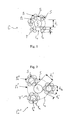
- the Fig. 1 illustrates a first embodiment of a C-layer hybrid cable according to the invention, with reference to the above-mentioned case (a) in which said outer layer is entirely metallic.
- This cable C has a coreless inner core layer C i and an unsaturated outer layer C e having N-shaped strands T (only 5 strands have been shown for reasons of clarity) which are each entirely metallic and which are wound helically in a pitch p i on the inner layer C i , of diameter d i .
- each strand has n T metal son f m of diameter d e which are wound together in a helix at a pitch p e.
- the inner layer C i consists of said material having a relative elongation at break at 20 ° C of greater than 6%.
- Cable C of the Fig. 1 is therefore in accordance with said third exemplary embodiment of the case (a) above corresponding to the formula 1 + 7 x 3.
- the pitch p e and p i of this cable C are respectively equal to 5.5 and 10 mm in the winding directions S / S (see arrows S at Fig. 1 ).
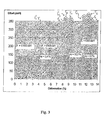
- a first variant according to the invention of this cable C (denoted C 1 ) is represented in the upper part of the graph of FIG. Fig. 3 , opposite the stress - strain curve which characterizes this cable C 1 .
- each strand T 1 of the cable C 1 comprises n-1 metal son f m wound on a core wire f has a step p e '.
- This cable C 1 is in accordance with said first embodiment of the above-mentioned case (a), being of formula 1 + 4 x (1 + 5).
- a second variant according to the invention of the cable C of the Fig. 1 (noted C 2 ) is also shown in the upper part of the graph of the Fig. 3 , opposite the stress - strain curve which characterizes this cable C 2 .
- each strand T 2 of the cable C 2 comprises n-1 metal son f m wound on a core wire f has a step p e '.
- This cable C 2 is in accordance with said second exemplary embodiment of the above-mentioned case (a), being of formula 1 + 5 x (1 + 5).
- the 6 threads f m , f a of each strand T 2 have a diameter equal to 0.26 mm, and the pitches p e 'and p i mentioned above are respectively equal to 5.5 and 10 mm in the winding directions S / S.
- the Fig. 2 illustrates a second embodiment of a hybrid cable C 'layers according to the invention, with reference to the case (b) above, wherein said outer layer is only partly metallic.
- This cable C ' also comprises a coreless inner core layer C i and an unsaturated outer layer C e with N' -shaped strands T 'which are helically wound in a pitch p i ' on the inner layer C i , of diameter d i '.
- each strand T ' comprises metal son m f m of diameter d e' wound in helix of pitch p e "on a core yarn f nonmetallic diameter d fa.
- the inner layer C i f and the core wire a ' are composed of identical or different materials each having a relative elongation at break at 20 ° C which is higher than 6%.
- the inner layer C i, of diameter d i 'equal to 1 mm, and the core yarn f a', of diameter d fa equal to 0.6 mm, for example are each a polyethylene terephthalate monofilament type "regular".
- steps p e "and p i ' they are for example respectively equal to 4.4 and 6.6 mm.
- This "control" cable C T is represented in the upper part of the graph of the Fig. 3 , opposite the stress-strain curve that characterizes it, and we see that it consists of 4 strands T “comprising 6 steel wires f m 'of diameter equal to 0.26 mm (this cable C T known under the name "24.26” is currently used by the plaintiff in civil engineering tires of dimensions “40.00 R57” it sells).
- said inner layer C i consists of a monofilament glued with PET (diameter d i equal to 1 mm), the 5 strands T 2 each consist of 6 steel wires of diameter equal to 0, 26 mm, and the steps p e 'and p i above are respectively equal to 5.3 and 9.9 mm in the direction of winding S / S.
- said inner layer C i of multifilament type, consists of two PET surtors twisted together, each surtors having a title of 440 tex and being obtained by assembling two yarns of 220 tex each.
- Each of the 5 strands T 2 consists of 6 steel wires of diameter equal to 0.26 mm, and the pitches p e 'and p i mentioned above are respectively equal to 5 and 9.4 mm in the S / S directions.
- said inner layer C i of multifilament type, consists of two PET surtors twisted together, each surtors having a title of 440 tex and being obtained by assembling two yarns of 220 tex each.
- Each of the 5 strands T 2 consists of 6 steel wires with a diameter of 0.26 mm, and the pitches p e 'and p i mentioned above are respectively equal to 5.8 and 11.5 mm in the S directions. S.
- said inner layer C i of multifilament type, consists of two PET surtors twisted together, each surtors having a title of 334 tex and being obtained by assembling two yarns of 167 tex each.
- Each of the 5 strands T 2 consists of 6 steel wires with a diameter of 0.26 mm, and the pitches p e 'and p i mentioned above are respectively equal to 5.2 and 9.5 mm in the S directions. S.
- Table 1 below shows the mechanical characteristics of each C T cable, C 1, C 2, C 2a, C 2b, C 2c, C 2d, the measurements have been performed on these cables in isolation (ie before incorporation into the composite fabric).
- each of the cables according to the invention having a core C i multifilament C 2b, C 2c and C 2d is such that the core C i is set back from the outer layer formed by the strands T 2 in the direction axial cable, unlike cables according to the invention monofilament core C i , such as C 2bis , which have an axial extension of this core C i .
- Tire rolling tests including protective top plies are reinforced by C cables 1 and C 2 of the invention or by the "control" cable C T :
- Tests were carried out of vehicles equipped with civil engineering tires of dimensions "18.00R33 YP51", initially, on a ground covered with sharp pebbles and, in a second time, on a ground covered with more rounded pebbles , in order to evaluate the impact and impact resistance of the tires tested "control” P T and according to the invention P 1 and P 2 .
- the "control" tires P T comprise, in each of their two protective crown plies NSP1 and NSP2, the aforementioned "control” cables C T (of formula "24.26"), according to a density d of cables per dm of fabric equal to 40 and according to a width ⁇ L of "bridge” rubber between two adjacent cables equal to 0.6 mm (the distance between the respective axes of two cables C T adjacent being 2.5 mm, for a cable diameter C T of 1.9 mm).
- the first tires according to the invention P 1 comprise, in each of their two protective crown plies NSP1 and NSP2, the cables according to the invention C 1 above (of formula 1 + 4 x (1 + 5)), according to a density d equal to 31 and with a rubber bridge width ⁇ L equal to 0.8 mm (the distance between the respective axes of two adjacent cables C 1 being 3.2 mm, for a cable diameter C 1 of 2 , 4 mm).
- the second tires according to the invention P 2 comprise, in each of their two protective crown plies NSP1 and NSP2, the cables according to the invention C 2 above (of formula 1 + 5 x (1 + 5)), according to a density d equal to 28 and with a rubber bridge width ⁇ L equal to 0.6 mm (the distance between the respective axes of two adjacent cables C 2 being 3.5 mm, for a cable diameter C 2 of 2 , 9 mm).
Landscapes
- Engineering & Computer Science (AREA)
- Mechanical Engineering (AREA)
- Textile Engineering (AREA)
- Ropes Or Cables (AREA)
- Tires In General (AREA)
- Reinforced Plastic Materials (AREA)
Applications Claiming Priority (3)
| Application Number | Priority Date | Filing Date | Title |
|---|---|---|---|
| FR0207971 | 2002-06-26 | ||
| FR0207971A FR2841573A1 (fr) | 2002-06-26 | 2002-06-26 | Cables hybrides a couches utilisables pour renforcer des pneumatiques |
| PCT/EP2003/006572 WO2004003287A1 (fr) | 2002-06-26 | 2003-06-23 | Câbles hybrides à couches utilisables pour renforcer des pneumatiques |
Publications (2)
| Publication Number | Publication Date |
|---|---|
| EP1520069A1 EP1520069A1 (fr) | 2005-04-06 |
| EP1520069B1 true EP1520069B1 (fr) | 2009-11-25 |
Family
ID=29724918
Family Applications (1)
| Application Number | Title | Priority Date | Filing Date |
|---|---|---|---|
| EP03740305A Expired - Lifetime EP1520069B1 (fr) | 2002-06-26 | 2003-06-23 | Câbles hybrides couches utilisables pour renforcer des pneumatiques |
Country Status (12)
| Country | Link |
|---|---|
| EP (1) | EP1520069B1 (enExample) |
| JP (2) | JP4507185B2 (enExample) |
| KR (1) | KR101014546B1 (enExample) |
| CN (1) | CN100395402C (enExample) |
| AT (1) | ATE449880T1 (enExample) |
| AU (1) | AU2003279780B2 (enExample) |
| CA (1) | CA2489297C (enExample) |
| DE (1) | DE60330244D1 (enExample) |
| FR (1) | FR2841573A1 (enExample) |
| RU (1) | RU2314376C2 (enExample) |
| WO (1) | WO2004003287A1 (enExample) |
| ZA (1) | ZA200410039B (enExample) |
Families Citing this family (24)
| Publication number | Priority date | Publication date | Assignee | Title |
|---|---|---|---|---|
| DE102004036129A1 (de) * | 2004-07-24 | 2006-02-16 | Continental Aktiengesellschaft | Verstärkungscord für elastomere Erzeugnisse |
| JP4568132B2 (ja) * | 2005-02-07 | 2010-10-27 | 株式会社ブリヂストン | ゴム物品補強用スチールコード及びそれを用いた空気入りタイヤ |
| FR2915620B1 (fr) * | 2007-04-27 | 2011-02-11 | Nexans | Cable de controle electrique |
| JP5237868B2 (ja) * | 2009-04-06 | 2013-07-17 | 東京製綱株式会社 | スチールコード |
| FR2944227B1 (fr) | 2009-04-09 | 2013-08-16 | Soc Tech Michelin | Stratifie multicouches pour bandage pneumatique |
| FR2947575B1 (fr) | 2009-07-03 | 2011-08-19 | Michelin Soc Tech | Cable multitorons dont les torons elementaires sont des cables a deux couches gommes in situ. |
| FR2959517B1 (fr) | 2010-04-28 | 2012-09-21 | Michelin Soc Tech | Cable metallique multitorons elastique a haute permeabilite. |
| US8800257B2 (en) * | 2010-07-16 | 2014-08-12 | E I Du Pont De Nemours And Company | Composite cord and method of making and support structure and tire containing same |
| FR2987310B1 (fr) | 2012-02-29 | 2014-03-21 | Michelin & Cie | Stratifie multicouche utilisable pour le renforcement d'une ceinture de pneumatique |
| PL2841642T3 (pl) * | 2012-04-24 | 2017-01-31 | Bekaert Sa Nv | Lina hybrydowa lub splotka hybrydowa |
| JP6343872B2 (ja) * | 2013-04-11 | 2018-06-20 | 横浜ゴム株式会社 | スチールコードおよびゴム製品の製造方法 |
| HUE053814T2 (hu) * | 2013-08-01 | 2021-07-28 | Bekaert Sa Nv | Nagy fajlagos nyúlású acélkord és ilyen kordot tartalmazó légabroncs |
| CN105934354B (zh) * | 2013-12-23 | 2019-01-01 | 倍耐力轮胎股份公司 | 用于重载车轮的轮胎 |
| CN105346336A (zh) * | 2015-12-14 | 2016-02-24 | 刘安林 | 一种轮胎及其缆型胎圈 |
| CN105346335A (zh) * | 2015-12-14 | 2016-02-24 | 刘安林 | 一种轮胎及其缆型胎圈 |
| JP2018070137A (ja) | 2016-10-26 | 2018-05-10 | クムホ タイヤ カンパニー インコーポレーテッド | 空気入りタイヤ用ケーブルビード及びこれを備えた空気入りタイヤ |
| JP6369588B1 (ja) * | 2017-03-27 | 2018-08-08 | 横浜ゴム株式会社 | 空気入りタイヤ |
| CN114729504B (zh) * | 2019-11-15 | 2023-07-11 | 米其林集团总公司 | 具有包覆的内层和改善的渗透性的双层多线股帘线 |
| CN114929963B (zh) * | 2020-01-07 | 2023-07-21 | 米其林集团总公司 | 具有改进的断裂能和改进的总伸长的单层多线股帘线 |
| FR3106530B1 (fr) | 2020-01-29 | 2022-01-07 | Michelin & Cie | architecture optimisée de pneumatique de type poids-lourd, agricole ou génie civil |
| IT202000014512A1 (it) * | 2020-06-17 | 2021-12-17 | Pirelli | Pneumatico per ruote di veicoli |
| FR3125254A1 (fr) * | 2021-07-19 | 2023-01-20 | Compagnie Generale Des Etablissements Michelin | Pneumatique dont l’armature de sommet comporte une couche d’elements de renforcement circonferentiels |
| FR3129409B1 (fr) * | 2021-11-25 | 2023-10-20 | Michelin & Cie | Produit renforcé à géométrie de câble fixé présentant un comportement bimodule à rigidité adaptée |
| JP2024125941A (ja) * | 2023-03-06 | 2024-09-19 | 株式会社ブリヂストン | タイヤ |
Family Cites Families (17)
| Publication number | Priority date | Publication date | Assignee | Title |
|---|---|---|---|---|
| JPS5126361A (ja) * | 1974-08-27 | 1976-03-04 | Teijin Ltd | Waiyaaroopu |
| US4176705A (en) * | 1976-01-16 | 1979-12-04 | The Goodyear Tire & Rubber Company | Tire cord with a synthetic fiber core |
| ZA767438B (en) * | 1976-01-16 | 1977-11-30 | Goodyear Tire & Rubber | A tire cord with a synthetic fiber core |
| FR2426580A1 (fr) * | 1978-05-24 | 1979-12-21 | Michelin & Cie | Pneumatique a carcasse radiale |
| WO1980002572A1 (fr) * | 1979-05-23 | 1980-11-27 | Sumitomo Rubber Ind | Corde pour pneux |
| JPS58188201U (ja) * | 1982-06-04 | 1983-12-14 | 株式会社ブリヂストン | ラジアルタイヤ |
| JPS63131798U (enExample) * | 1987-02-16 | 1988-08-29 | ||
| JPH0538075Y2 (enExample) * | 1988-01-20 | 1993-09-27 | ||
| JP2958703B2 (ja) * | 1990-07-19 | 1999-10-06 | 横浜ゴム株式会社 | 空気入りタイヤ |
| FR2671030A1 (fr) * | 1990-12-27 | 1992-07-03 | Michelin Rech Tech | Assemblages de renfort avec monofilaments en polymeres organiques. |
| JPH06108386A (ja) * | 1992-09-21 | 1994-04-19 | Bridgestone Corp | 空気入りラジアルタイヤ |
| JPH06163686A (ja) * | 1992-11-16 | 1994-06-10 | Mitsubishi Materials Corp | ダイシング装置 |
| JPH08176976A (ja) * | 1994-12-21 | 1996-07-09 | Tokyo Seiko Co Ltd | 部分めっきワイヤロープ |
| JPH08291482A (ja) * | 1995-04-20 | 1996-11-05 | Tokyo Seiko Co Ltd | 識別ロープ |
| DE19535597A1 (de) * | 1995-09-25 | 1997-03-27 | Drahtcord Saar Gmbh & Co Kg | Drahtseil zur Verstärkung von Gummiartikeln |
| EP1033435A1 (en) * | 1999-03-04 | 2000-09-06 | N.V. Bekaert S.A. | Steel cord with polymer core |
| FR2795751A1 (fr) * | 1999-06-29 | 2001-01-05 | Michelin Soc Tech | Cable d'acier multicouches pour carcasse de pneumatique |
-
2002
- 2002-06-26 FR FR0207971A patent/FR2841573A1/fr active Pending
-
2003
- 2003-06-23 CN CNB038149524A patent/CN100395402C/zh not_active Expired - Fee Related
- 2003-06-23 RU RU2005101756/12A patent/RU2314376C2/ru not_active IP Right Cessation
- 2003-06-23 DE DE60330244T patent/DE60330244D1/de not_active Expired - Lifetime
- 2003-06-23 CA CA2489297A patent/CA2489297C/fr not_active Expired - Fee Related
- 2003-06-23 EP EP03740305A patent/EP1520069B1/fr not_active Expired - Lifetime
- 2003-06-23 AT AT03740305T patent/ATE449880T1/de not_active IP Right Cessation
- 2003-06-23 KR KR1020047020949A patent/KR101014546B1/ko not_active Expired - Fee Related
- 2003-06-23 WO PCT/EP2003/006572 patent/WO2004003287A1/fr not_active Ceased
- 2003-06-23 JP JP2004516637A patent/JP4507185B2/ja not_active Expired - Fee Related
- 2003-06-23 AU AU2003279780A patent/AU2003279780B2/en not_active Ceased
-
2004
- 2004-12-13 ZA ZA200410039A patent/ZA200410039B/en unknown
-
2009
- 2009-09-14 JP JP2009211644A patent/JP5098047B2/ja not_active Expired - Fee Related
Also Published As
| Publication number | Publication date |
|---|---|
| CA2489297A1 (fr) | 2004-01-08 |
| JP2005530935A (ja) | 2005-10-13 |
| DE60330244D1 (de) | 2010-01-07 |
| FR2841573A1 (fr) | 2004-01-02 |
| WO2004003287A1 (fr) | 2004-01-08 |
| EP1520069A1 (fr) | 2005-04-06 |
| JP2010024611A (ja) | 2010-02-04 |
| KR101014546B1 (ko) | 2011-02-16 |
| ATE449880T1 (de) | 2009-12-15 |
| RU2314376C2 (ru) | 2008-01-10 |
| CN100395402C (zh) | 2008-06-18 |
| CN1662702A (zh) | 2005-08-31 |
| KR20050016618A (ko) | 2005-02-21 |
| JP4507185B2 (ja) | 2010-07-21 |
| AU2003279780B2 (en) | 2009-12-17 |
| AU2003279780A1 (en) | 2004-01-19 |
| ZA200410039B (en) | 2005-10-17 |
| RU2005101756A (ru) | 2005-06-27 |
| JP5098047B2 (ja) | 2012-12-12 |
| CA2489297C (fr) | 2013-03-12 |
Similar Documents
| Publication | Publication Date | Title |
|---|---|---|
| EP1520069B1 (fr) | Câbles hybrides couches utilisables pour renforcer des pneumatiques | |
| EP1554427B1 (fr) | Cables utilisables pour renforcer des pneumatiques poids-lourd | |
| EP1699973B1 (fr) | Cable metallique a trois couches pour armature de carcasse de pneumatique | |
| EP1984560B1 (fr) | Cable composite elastique pour pneumatique | |
| EP2507071B1 (fr) | Pneumatique comportant des cables d'armature de carcasse hybrides | |
| EP2507070B1 (fr) | Pneumatique comportant des cables d'armature de carcasse presentant des permeabilites differentes | |
| EP2379796B1 (fr) | Pneumatique comportant des cables d'armature de carcasse presentant une faible permeabilite, et des fils textiles associes a l'armature de carcasse | |
| EP3728731B1 (fr) | Câbles multi-torons à deux couches à très bas, bas et moyen modules | |
| EP3728730B1 (fr) | Câbles multi-torons à deux couches à très bas, bas et moyen modules | |
| EP3728729B1 (fr) | Câbles multi-torons à deux couches à très bas, bas et moyen modules | |
| WO2019122721A1 (fr) | Câbles multi-torons à deux couches à très bas, bas et moyen modules | |
| EP1466048B1 (fr) | Cable metallique utilisable dans une armature de carcasse d'un pneumatique | |
| EP3426503B1 (fr) | Pneu radial avec structure de ceinture améliorée | |
| EP2507072B1 (fr) | Pneumatique comportant des cables d'armature de carcasse frettes | |
| EP2501560B1 (fr) | Pneumatique comportant des cables d'armature de carcasse presentant des permeabilites differentes | |
| EP2507073B1 (fr) | Pneumatique comportant une armature de carcasse constituée de câbles et de tubes capillaires | |
| FR3130858A1 (fr) | Câble multi-torons à deux couches à endurance sous flexion améliorée |
Legal Events
| Date | Code | Title | Description |
|---|---|---|---|
| PUAI | Public reference made under article 153(3) epc to a published international application that has entered the european phase |
Free format text: ORIGINAL CODE: 0009012 |
|
| 17P | Request for examination filed |
Effective date: 20050126 |
|
| AK | Designated contracting states |
Kind code of ref document: A1 Designated state(s): AT BE BG CH CY CZ DE DK EE ES FI FR GB GR HU IE IT LI LU MC NL PT RO SE SI SK TR |
|
| AX | Request for extension of the european patent |
Extension state: AL LT LV MK |
|
| DAX | Request for extension of the european patent (deleted) | ||
| RIN1 | Information on inventor provided before grant (corrected) |
Inventor name: POTTIER, THIBAUD Inventor name: DUCOURANT, LAURENCE Inventor name: VO, LE TU ANH Inventor name: BARGUET, HENRI |
|
| 17Q | First examination report despatched |
Effective date: 20061109 |
|
| GRAP | Despatch of communication of intention to grant a patent |
Free format text: ORIGINAL CODE: EPIDOSNIGR1 |
|
| GRAS | Grant fee paid |
Free format text: ORIGINAL CODE: EPIDOSNIGR3 |
|
| GRAA | (expected) grant |
Free format text: ORIGINAL CODE: 0009210 |
|
| AK | Designated contracting states |
Kind code of ref document: B1 Designated state(s): AT BE BG CH CY CZ DE DK EE ES FI FR GB GR HU IE IT LI LU MC NL PT RO SE SI SK TR |
|
| REG | Reference to a national code |
Ref country code: GB Ref legal event code: FG4D Free format text: NOT ENGLISH |
|
| REG | Reference to a national code |
Ref country code: CH Ref legal event code: EP |
|
| REG | Reference to a national code |
Ref country code: IE Ref legal event code: FG4D |
|
| REF | Corresponds to: |
Ref document number: 60330244 Country of ref document: DE Date of ref document: 20100107 Kind code of ref document: P |
|
| REG | Reference to a national code |
Ref country code: NL Ref legal event code: VDEP Effective date: 20091125 |
|
| PG25 | Lapsed in a contracting state [announced via postgrant information from national office to epo] |
Ref country code: FI Free format text: LAPSE BECAUSE OF FAILURE TO SUBMIT A TRANSLATION OF THE DESCRIPTION OR TO PAY THE FEE WITHIN THE PRESCRIBED TIME-LIMIT Effective date: 20091125 Ref country code: SE Free format text: LAPSE BECAUSE OF FAILURE TO SUBMIT A TRANSLATION OF THE DESCRIPTION OR TO PAY THE FEE WITHIN THE PRESCRIBED TIME-LIMIT Effective date: 20091125 Ref country code: PT Free format text: LAPSE BECAUSE OF FAILURE TO SUBMIT A TRANSLATION OF THE DESCRIPTION OR TO PAY THE FEE WITHIN THE PRESCRIBED TIME-LIMIT Effective date: 20100325 |
|
| PG25 | Lapsed in a contracting state [announced via postgrant information from national office to epo] |
Ref country code: CY Free format text: LAPSE BECAUSE OF FAILURE TO SUBMIT A TRANSLATION OF THE DESCRIPTION OR TO PAY THE FEE WITHIN THE PRESCRIBED TIME-LIMIT Effective date: 20091125 Ref country code: SI Free format text: LAPSE BECAUSE OF FAILURE TO SUBMIT A TRANSLATION OF THE DESCRIPTION OR TO PAY THE FEE WITHIN THE PRESCRIBED TIME-LIMIT Effective date: 20091125 |
|
| REG | Reference to a national code |
Ref country code: IE Ref legal event code: FD4D |
|
| PG25 | Lapsed in a contracting state [announced via postgrant information from national office to epo] |
Ref country code: AT Free format text: LAPSE BECAUSE OF FAILURE TO SUBMIT A TRANSLATION OF THE DESCRIPTION OR TO PAY THE FEE WITHIN THE PRESCRIBED TIME-LIMIT Effective date: 20091125 |
|
| PG25 | Lapsed in a contracting state [announced via postgrant information from national office to epo] |
Ref country code: RO Free format text: LAPSE BECAUSE OF FAILURE TO SUBMIT A TRANSLATION OF THE DESCRIPTION OR TO PAY THE FEE WITHIN THE PRESCRIBED TIME-LIMIT Effective date: 20091125 Ref country code: NL Free format text: LAPSE BECAUSE OF FAILURE TO SUBMIT A TRANSLATION OF THE DESCRIPTION OR TO PAY THE FEE WITHIN THE PRESCRIBED TIME-LIMIT Effective date: 20091125 Ref country code: DK Free format text: LAPSE BECAUSE OF FAILURE TO SUBMIT A TRANSLATION OF THE DESCRIPTION OR TO PAY THE FEE WITHIN THE PRESCRIBED TIME-LIMIT Effective date: 20091125 Ref country code: BG Free format text: LAPSE BECAUSE OF FAILURE TO SUBMIT A TRANSLATION OF THE DESCRIPTION OR TO PAY THE FEE WITHIN THE PRESCRIBED TIME-LIMIT Effective date: 20100225 Ref country code: EE Free format text: LAPSE BECAUSE OF FAILURE TO SUBMIT A TRANSLATION OF THE DESCRIPTION OR TO PAY THE FEE WITHIN THE PRESCRIBED TIME-LIMIT Effective date: 20091125 Ref country code: ES Free format text: LAPSE BECAUSE OF FAILURE TO SUBMIT A TRANSLATION OF THE DESCRIPTION OR TO PAY THE FEE WITHIN THE PRESCRIBED TIME-LIMIT Effective date: 20100308 Ref country code: IE Free format text: LAPSE BECAUSE OF FAILURE TO SUBMIT A TRANSLATION OF THE DESCRIPTION OR TO PAY THE FEE WITHIN THE PRESCRIBED TIME-LIMIT Effective date: 20091125 |
|
| PG25 | Lapsed in a contracting state [announced via postgrant information from national office to epo] |
Ref country code: SK Free format text: LAPSE BECAUSE OF FAILURE TO SUBMIT A TRANSLATION OF THE DESCRIPTION OR TO PAY THE FEE WITHIN THE PRESCRIBED TIME-LIMIT Effective date: 20091125 Ref country code: CZ Free format text: LAPSE BECAUSE OF FAILURE TO SUBMIT A TRANSLATION OF THE DESCRIPTION OR TO PAY THE FEE WITHIN THE PRESCRIBED TIME-LIMIT Effective date: 20091125 |
|
| PLBE | No opposition filed within time limit |
Free format text: ORIGINAL CODE: 0009261 |
|
| STAA | Information on the status of an ep patent application or granted ep patent |
Free format text: STATUS: NO OPPOSITION FILED WITHIN TIME LIMIT |
|
| PG25 | Lapsed in a contracting state [announced via postgrant information from national office to epo] |
Ref country code: GR Free format text: LAPSE BECAUSE OF FAILURE TO SUBMIT A TRANSLATION OF THE DESCRIPTION OR TO PAY THE FEE WITHIN THE PRESCRIBED TIME-LIMIT Effective date: 20100226 |
|
| 26N | No opposition filed |
Effective date: 20100826 |
|
| PG25 | Lapsed in a contracting state [announced via postgrant information from national office to epo] |
Ref country code: MC Free format text: LAPSE BECAUSE OF NON-PAYMENT OF DUE FEES Effective date: 20100630 |
|
| REG | Reference to a national code |
Ref country code: CH Ref legal event code: PL |
|
| GBPC | Gb: european patent ceased through non-payment of renewal fee |
Effective date: 20100623 |
|
| PG25 | Lapsed in a contracting state [announced via postgrant information from national office to epo] |
Ref country code: CH Free format text: LAPSE BECAUSE OF NON-PAYMENT OF DUE FEES Effective date: 20100630 Ref country code: LI Free format text: LAPSE BECAUSE OF NON-PAYMENT OF DUE FEES Effective date: 20100630 |
|
| PG25 | Lapsed in a contracting state [announced via postgrant information from national office to epo] |
Ref country code: GB Free format text: LAPSE BECAUSE OF NON-PAYMENT OF DUE FEES Effective date: 20100623 |
|
| PGFP | Annual fee paid to national office [announced via postgrant information from national office to epo] |
Ref country code: LU Payment date: 20110708 Year of fee payment: 9 |
|
| PG25 | Lapsed in a contracting state [announced via postgrant information from national office to epo] |
Ref country code: HU Free format text: LAPSE BECAUSE OF FAILURE TO SUBMIT A TRANSLATION OF THE DESCRIPTION OR TO PAY THE FEE WITHIN THE PRESCRIBED TIME-LIMIT Effective date: 20100526 |
|
| PG25 | Lapsed in a contracting state [announced via postgrant information from national office to epo] |
Ref country code: TR Free format text: LAPSE BECAUSE OF FAILURE TO SUBMIT A TRANSLATION OF THE DESCRIPTION OR TO PAY THE FEE WITHIN THE PRESCRIBED TIME-LIMIT Effective date: 20091125 |
|
| PGFP | Annual fee paid to national office [announced via postgrant information from national office to epo] |
Ref country code: BE Payment date: 20120621 Year of fee payment: 10 |
|
| PGFP | Annual fee paid to national office [announced via postgrant information from national office to epo] |
Ref country code: IT Payment date: 20120627 Year of fee payment: 10 |
|
| BERE | Be: lapsed |
Owner name: MICHELIN RECHERCHE ET TECHNIQUE S.A. Effective date: 20130630 Owner name: SOC. DE TECHNOLOGIE MICHELIN Effective date: 20130630 |
|
| PG25 | Lapsed in a contracting state [announced via postgrant information from national office to epo] |
Ref country code: BE Free format text: LAPSE BECAUSE OF NON-PAYMENT OF DUE FEES Effective date: 20130630 |
|
| PG25 | Lapsed in a contracting state [announced via postgrant information from national office to epo] |
Ref country code: IT Free format text: LAPSE BECAUSE OF NON-PAYMENT OF DUE FEES Effective date: 20130623 |
|
| PG25 | Lapsed in a contracting state [announced via postgrant information from national office to epo] |
Ref country code: LU Free format text: LAPSE BECAUSE OF NON-PAYMENT OF DUE FEES Effective date: 20130623 |
|
| REG | Reference to a national code |
Ref country code: FR Ref legal event code: PLFP Year of fee payment: 14 |
|
| PGFP | Annual fee paid to national office [announced via postgrant information from national office to epo] |
Ref country code: FR Payment date: 20160627 Year of fee payment: 14 |
|
| REG | Reference to a national code |
Ref country code: FR Ref legal event code: ST Effective date: 20180228 |
|
| PG25 | Lapsed in a contracting state [announced via postgrant information from national office to epo] |
Ref country code: FR Free format text: LAPSE BECAUSE OF NON-PAYMENT OF DUE FEES Effective date: 20170630 |
|
| PGFP | Annual fee paid to national office [announced via postgrant information from national office to epo] |
Ref country code: DE Payment date: 20180625 Year of fee payment: 16 |
|
| REG | Reference to a national code |
Ref country code: DE Ref legal event code: R119 Ref document number: 60330244 Country of ref document: DE |
|
| PG25 | Lapsed in a contracting state [announced via postgrant information from national office to epo] |
Ref country code: DE Free format text: LAPSE BECAUSE OF NON-PAYMENT OF DUE FEES Effective date: 20200101 |