EP1519641A2 - Module and method of manufacturing module - Google Patents
Module and method of manufacturing module Download PDFInfo
- Publication number
- EP1519641A2 EP1519641A2 EP04022953A EP04022953A EP1519641A2 EP 1519641 A2 EP1519641 A2 EP 1519641A2 EP 04022953 A EP04022953 A EP 04022953A EP 04022953 A EP04022953 A EP 04022953A EP 1519641 A2 EP1519641 A2 EP 1519641A2
- Authority
- EP
- European Patent Office
- Prior art keywords
- green sheet
- ceramic green
- ceramic
- electrode
- recess
- Prior art date
- Legal status (The legal status is an assumption and is not a legal conclusion. Google has not performed a legal analysis and makes no representation as to the accuracy of the status listed.)
- Granted
Links
Images



Classifications
-
- H—ELECTRICITY
- H10—SEMICONDUCTOR DEVICES; ELECTRIC SOLID-STATE DEVICES NOT OTHERWISE PROVIDED FOR
- H10W—GENERIC PACKAGES, INTERCONNECTIONS, CONNECTORS OR OTHER CONSTRUCTIONAL DETAILS OF DEVICES COVERED BY CLASS H10
- H10W90/00—Package configurations
-
- H—ELECTRICITY
- H03—ELECTRONIC CIRCUITRY
- H03H—IMPEDANCE NETWORKS, e.g. RESONANT CIRCUITS; RESONATORS
- H03H9/00—Networks comprising electromechanical or electro-acoustic elements; Electromechanical resonators
- H03H9/02—Details
- H03H9/05—Holders or supports
- H03H9/0538—Constructional combinations of supports or holders with electromechanical or other electronic elements
- H03H9/0542—Constructional combinations of supports or holders with electromechanical or other electronic elements consisting of a lateral arrangement
-
- H—ELECTRICITY
- H03—ELECTRONIC CIRCUITRY
- H03H—IMPEDANCE NETWORKS, e.g. RESONANT CIRCUITS; RESONATORS
- H03H9/00—Networks comprising electromechanical or electro-acoustic elements; Electromechanical resonators
- H03H9/02—Details
- H03H9/05—Holders or supports
- H03H9/0538—Constructional combinations of supports or holders with electromechanical or other electronic elements
- H03H9/0547—Constructional combinations of supports or holders with electromechanical or other electronic elements consisting of a vertical arrangement
- H03H9/0557—Constructional combinations of supports or holders with electromechanical or other electronic elements consisting of a vertical arrangement the other elements being buried in the substrate
-
- H—ELECTRICITY
- H03—ELECTRONIC CIRCUITRY
- H03H—IMPEDANCE NETWORKS, e.g. RESONANT CIRCUITS; RESONATORS
- H03H9/00—Networks comprising electromechanical or electro-acoustic elements; Electromechanical resonators
- H03H9/02—Details
- H03H9/05—Holders or supports
- H03H9/10—Mounting in enclosures
- H03H9/1064—Mounting in enclosures for surface acoustic wave [SAW] devices
- H03H9/1085—Mounting in enclosures for surface acoustic wave [SAW] devices the enclosure being defined by a non-uniform sealing mass covering the non-active sides of the SAW device
-
- H—ELECTRICITY
- H05—ELECTRIC TECHNIQUES NOT OTHERWISE PROVIDED FOR
- H05K—PRINTED CIRCUITS; CASINGS OR CONSTRUCTIONAL DETAILS OF ELECTRIC APPARATUS; MANUFACTURE OF ASSEMBLAGES OF ELECTRICAL COMPONENTS
- H05K3/00—Apparatus or processes for manufacturing printed circuits
- H05K3/22—Secondary treatment of printed circuits
- H05K3/28—Applying non-metallic protective coatings
- H05K3/284—Applying non-metallic protective coatings for encapsulating mounted components
-
- H—ELECTRICITY
- H05—ELECTRIC TECHNIQUES NOT OTHERWISE PROVIDED FOR
- H05K—PRINTED CIRCUITS; CASINGS OR CONSTRUCTIONAL DETAILS OF ELECTRIC APPARATUS; MANUFACTURE OF ASSEMBLAGES OF ELECTRICAL COMPONENTS
- H05K3/00—Apparatus or processes for manufacturing printed circuits
- H05K3/30—Assembling printed circuits with electric components, e.g. with resistors
- H05K3/303—Assembling printed circuits with electric components, e.g. with resistors with surface mounted components
- H05K3/305—Affixing by adhesive
-
- H—ELECTRICITY
- H10—SEMICONDUCTOR DEVICES; ELECTRIC SOLID-STATE DEVICES NOT OTHERWISE PROVIDED FOR
- H10W—GENERIC PACKAGES, INTERCONNECTIONS, CONNECTORS OR OTHER CONSTRUCTIONAL DETAILS OF DEVICES COVERED BY CLASS H10
- H10W70/00—Package substrates; Interposers; Redistribution layers [RDL]
- H10W70/01—Manufacture or treatment
- H10W70/05—Manufacture or treatment of insulating or insulated package substrates, or of interposers, or of redistribution layers
-
- H—ELECTRICITY
- H10—SEMICONDUCTOR DEVICES; ELECTRIC SOLID-STATE DEVICES NOT OTHERWISE PROVIDED FOR
- H10W—GENERIC PACKAGES, INTERCONNECTIONS, CONNECTORS OR OTHER CONSTRUCTIONAL DETAILS OF DEVICES COVERED BY CLASS H10
- H10W70/00—Package substrates; Interposers; Redistribution layers [RDL]
- H10W70/60—Insulating or insulated package substrates; Interposers; Redistribution layers
- H10W70/67—Insulating or insulated package substrates; Interposers; Redistribution layers characterised by their insulating layers or insulating parts
- H10W70/68—Shapes or dispositions thereof
-
- H—ELECTRICITY
- H10—SEMICONDUCTOR DEVICES; ELECTRIC SOLID-STATE DEVICES NOT OTHERWISE PROVIDED FOR
- H10W—GENERIC PACKAGES, INTERCONNECTIONS, CONNECTORS OR OTHER CONSTRUCTIONAL DETAILS OF DEVICES COVERED BY CLASS H10
- H10W70/00—Package substrates; Interposers; Redistribution layers [RDL]
- H10W70/60—Insulating or insulated package substrates; Interposers; Redistribution layers
- H10W70/67—Insulating or insulated package substrates; Interposers; Redistribution layers characterised by their insulating layers or insulating parts
- H10W70/68—Shapes or dispositions thereof
- H10W70/685—Shapes or dispositions thereof comprising multiple insulating layers
-
- H—ELECTRICITY
- H10—SEMICONDUCTOR DEVICES; ELECTRIC SOLID-STATE DEVICES NOT OTHERWISE PROVIDED FOR
- H10W—GENERIC PACKAGES, INTERCONNECTIONS, CONNECTORS OR OTHER CONSTRUCTIONAL DETAILS OF DEVICES COVERED BY CLASS H10
- H10W74/00—Encapsulations, e.g. protective coatings
- H10W74/01—Manufacture or treatment
- H10W74/012—Manufacture or treatment of encapsulations on active surfaces of flip-chip devices, e.g. forming underfills
-
- H—ELECTRICITY
- H10—SEMICONDUCTOR DEVICES; ELECTRIC SOLID-STATE DEVICES NOT OTHERWISE PROVIDED FOR
- H10W—GENERIC PACKAGES, INTERCONNECTIONS, CONNECTORS OR OTHER CONSTRUCTIONAL DETAILS OF DEVICES COVERED BY CLASS H10
- H10W74/00—Encapsulations, e.g. protective coatings
- H10W74/10—Encapsulations, e.g. protective coatings characterised by their shape or disposition
- H10W74/15—Encapsulations, e.g. protective coatings characterised by their shape or disposition on active surfaces of flip-chip devices, e.g. underfills
-
- H—ELECTRICITY
- H05—ELECTRIC TECHNIQUES NOT OTHERWISE PROVIDED FOR
- H05K—PRINTED CIRCUITS; CASINGS OR CONSTRUCTIONAL DETAILS OF ELECTRIC APPARATUS; MANUFACTURE OF ASSEMBLAGES OF ELECTRICAL COMPONENTS
- H05K1/00—Printed circuits
- H05K1/02—Details
- H05K1/03—Use of materials for the substrate
- H05K1/0306—Inorganic insulating substrates, e.g. ceramic, glass
-
- H—ELECTRICITY
- H05—ELECTRIC TECHNIQUES NOT OTHERWISE PROVIDED FOR
- H05K—PRINTED CIRCUITS; CASINGS OR CONSTRUCTIONAL DETAILS OF ELECTRIC APPARATUS; MANUFACTURE OF ASSEMBLAGES OF ELECTRICAL COMPONENTS
- H05K2201/00—Indexing scheme relating to printed circuits covered by H05K1/00
- H05K2201/09—Shape and layout
- H05K2201/09009—Substrate related
- H05K2201/09036—Recesses or grooves in insulating substrate
-
- H—ELECTRICITY
- H05—ELECTRIC TECHNIQUES NOT OTHERWISE PROVIDED FOR
- H05K—PRINTED CIRCUITS; CASINGS OR CONSTRUCTIONAL DETAILS OF ELECTRIC APPARATUS; MANUFACTURE OF ASSEMBLAGES OF ELECTRICAL COMPONENTS
- H05K2201/00—Indexing scheme relating to printed circuits covered by H05K1/00
- H05K2201/10—Details of components or other objects attached to or integrated in a printed circuit board
- H05K2201/10613—Details of electrical connections of non-printed components, e.g. special leads
- H05K2201/10621—Components characterised by their electrical contacts
- H05K2201/10636—Leadless chip, e.g. chip capacitor or resistor
-
- H—ELECTRICITY
- H05—ELECTRIC TECHNIQUES NOT OTHERWISE PROVIDED FOR
- H05K—PRINTED CIRCUITS; CASINGS OR CONSTRUCTIONAL DETAILS OF ELECTRIC APPARATUS; MANUFACTURE OF ASSEMBLAGES OF ELECTRICAL COMPONENTS
- H05K2201/00—Indexing scheme relating to printed circuits covered by H05K1/00
- H05K2201/10—Details of components or other objects attached to or integrated in a printed circuit board
- H05K2201/10613—Details of electrical connections of non-printed components, e.g. special leads
- H05K2201/10621—Components characterised by their electrical contacts
- H05K2201/10674—Flip chip
-
- H—ELECTRICITY
- H10—SEMICONDUCTOR DEVICES; ELECTRIC SOLID-STATE DEVICES NOT OTHERWISE PROVIDED FOR
- H10W—GENERIC PACKAGES, INTERCONNECTIONS, CONNECTORS OR OTHER CONSTRUCTIONAL DETAILS OF DEVICES COVERED BY CLASS H10
- H10W70/00—Package substrates; Interposers; Redistribution layers [RDL]
- H10W70/60—Insulating or insulated package substrates; Interposers; Redistribution layers
- H10W70/62—Insulating or insulated package substrates; Interposers; Redistribution layers characterised by their interconnections
- H10W70/63—Vias, e.g. via plugs
-
- H—ELECTRICITY
- H10—SEMICONDUCTOR DEVICES; ELECTRIC SOLID-STATE DEVICES NOT OTHERWISE PROVIDED FOR
- H10W—GENERIC PACKAGES, INTERCONNECTIONS, CONNECTORS OR OTHER CONSTRUCTIONAL DETAILS OF DEVICES COVERED BY CLASS H10
- H10W70/00—Package substrates; Interposers; Redistribution layers [RDL]
- H10W70/60—Insulating or insulated package substrates; Interposers; Redistribution layers
- H10W70/67—Insulating or insulated package substrates; Interposers; Redistribution layers characterised by their insulating layers or insulating parts
- H10W70/68—Shapes or dispositions thereof
- H10W70/681—Shapes or dispositions thereof comprising holes not having chips therein, e.g. for outgassing, underfilling or bond wire passage
-
- H—ELECTRICITY
- H10—SEMICONDUCTOR DEVICES; ELECTRIC SOLID-STATE DEVICES NOT OTHERWISE PROVIDED FOR
- H10W—GENERIC PACKAGES, INTERCONNECTIONS, CONNECTORS OR OTHER CONSTRUCTIONAL DETAILS OF DEVICES COVERED BY CLASS H10
- H10W72/00—Interconnections or connectors in packages
- H10W72/071—Connecting or disconnecting
- H10W72/072—Connecting or disconnecting of bump connectors
- H10W72/07231—Techniques
- H10W72/07236—Soldering or alloying
-
- H—ELECTRICITY
- H10—SEMICONDUCTOR DEVICES; ELECTRIC SOLID-STATE DEVICES NOT OTHERWISE PROVIDED FOR
- H10W—GENERIC PACKAGES, INTERCONNECTIONS, CONNECTORS OR OTHER CONSTRUCTIONAL DETAILS OF DEVICES COVERED BY CLASS H10
- H10W72/00—Interconnections or connectors in packages
- H10W72/851—Dispositions of multiple connectors or interconnections
- H10W72/853—On the same surface
- H10W72/856—Bump connectors and die-attach connectors
-
- H—ELECTRICITY
- H10—SEMICONDUCTOR DEVICES; ELECTRIC SOLID-STATE DEVICES NOT OTHERWISE PROVIDED FOR
- H10W—GENERIC PACKAGES, INTERCONNECTIONS, CONNECTORS OR OTHER CONSTRUCTIONAL DETAILS OF DEVICES COVERED BY CLASS H10
- H10W72/00—Interconnections or connectors in packages
- H10W72/90—Bond pads, in general
- H10W72/921—Structures or relative sizes of bond pads
- H10W72/923—Bond pads having multiple stacked layers
-
- H—ELECTRICITY
- H10—SEMICONDUCTOR DEVICES; ELECTRIC SOLID-STATE DEVICES NOT OTHERWISE PROVIDED FOR
- H10W—GENERIC PACKAGES, INTERCONNECTIONS, CONNECTORS OR OTHER CONSTRUCTIONAL DETAILS OF DEVICES COVERED BY CLASS H10
- H10W72/00—Interconnections or connectors in packages
- H10W72/90—Bond pads, in general
- H10W72/941—Dispositions of bond pads
- H10W72/9415—Dispositions of bond pads relative to the surface, e.g. recessed, protruding
-
- H—ELECTRICITY
- H10—SEMICONDUCTOR DEVICES; ELECTRIC SOLID-STATE DEVICES NOT OTHERWISE PROVIDED FOR
- H10W—GENERIC PACKAGES, INTERCONNECTIONS, CONNECTORS OR OTHER CONSTRUCTIONAL DETAILS OF DEVICES COVERED BY CLASS H10
- H10W74/00—Encapsulations, e.g. protective coatings
-
- H—ELECTRICITY
- H10—SEMICONDUCTOR DEVICES; ELECTRIC SOLID-STATE DEVICES NOT OTHERWISE PROVIDED FOR
- H10W—GENERIC PACKAGES, INTERCONNECTIONS, CONNECTORS OR OTHER CONSTRUCTIONAL DETAILS OF DEVICES COVERED BY CLASS H10
- H10W74/00—Encapsulations, e.g. protective coatings
- H10W74/10—Encapsulations, e.g. protective coatings characterised by their shape or disposition
- H10W74/111—Encapsulations, e.g. protective coatings characterised by their shape or disposition the semiconductor body being completely enclosed
- H10W74/114—Encapsulations, e.g. protective coatings characterised by their shape or disposition the semiconductor body being completely enclosed by a substrate and the encapsulations
-
- H—ELECTRICITY
- H10—SEMICONDUCTOR DEVICES; ELECTRIC SOLID-STATE DEVICES NOT OTHERWISE PROVIDED FOR
- H10W—GENERIC PACKAGES, INTERCONNECTIONS, CONNECTORS OR OTHER CONSTRUCTIONAL DETAILS OF DEVICES COVERED BY CLASS H10
- H10W90/00—Package configurations
- H10W90/701—Package configurations characterised by the relative positions of pads or connectors relative to package parts
- H10W90/721—Package configurations characterised by the relative positions of pads or connectors relative to package parts of bump connectors
- H10W90/724—Package configurations characterised by the relative positions of pads or connectors relative to package parts of bump connectors between a chip and a stacked insulating package substrate, interposer or RDL
-
- H—ELECTRICITY
- H10—SEMICONDUCTOR DEVICES; ELECTRIC SOLID-STATE DEVICES NOT OTHERWISE PROVIDED FOR
- H10W—GENERIC PACKAGES, INTERCONNECTIONS, CONNECTORS OR OTHER CONSTRUCTIONAL DETAILS OF DEVICES COVERED BY CLASS H10
- H10W90/00—Package configurations
- H10W90/701—Package configurations characterised by the relative positions of pads or connectors relative to package parts
- H10W90/731—Package configurations characterised by the relative positions of pads or connectors relative to package parts of die-attach connectors
- H10W90/734—Package configurations characterised by the relative positions of pads or connectors relative to package parts of die-attach connectors between a chip and a stacked insulating package substrate, interposer or RDL
-
- Y—GENERAL TAGGING OF NEW TECHNOLOGICAL DEVELOPMENTS; GENERAL TAGGING OF CROSS-SECTIONAL TECHNOLOGIES SPANNING OVER SEVERAL SECTIONS OF THE IPC; TECHNICAL SUBJECTS COVERED BY FORMER USPC CROSS-REFERENCE ART COLLECTIONS [XRACs] AND DIGESTS
- Y02—TECHNOLOGIES OR APPLICATIONS FOR MITIGATION OR ADAPTATION AGAINST CLIMATE CHANGE
- Y02P—CLIMATE CHANGE MITIGATION TECHNOLOGIES IN THE PRODUCTION OR PROCESSING OF GOODS
- Y02P70/00—Climate change mitigation technologies in the production process for final industrial or consumer products
- Y02P70/50—Manufacturing or production processes characterised by the final manufactured product
-
- Y—GENERAL TAGGING OF NEW TECHNOLOGICAL DEVELOPMENTS; GENERAL TAGGING OF CROSS-SECTIONAL TECHNOLOGIES SPANNING OVER SEVERAL SECTIONS OF THE IPC; TECHNICAL SUBJECTS COVERED BY FORMER USPC CROSS-REFERENCE ART COLLECTIONS [XRACs] AND DIGESTS
- Y10—TECHNICAL SUBJECTS COVERED BY FORMER USPC
- Y10T—TECHNICAL SUBJECTS COVERED BY FORMER US CLASSIFICATION
- Y10T29/00—Metal working
- Y10T29/43—Electric condenser making
-
- Y—GENERAL TAGGING OF NEW TECHNOLOGICAL DEVELOPMENTS; GENERAL TAGGING OF CROSS-SECTIONAL TECHNOLOGIES SPANNING OVER SEVERAL SECTIONS OF THE IPC; TECHNICAL SUBJECTS COVERED BY FORMER USPC CROSS-REFERENCE ART COLLECTIONS [XRACs] AND DIGESTS
- Y10—TECHNICAL SUBJECTS COVERED BY FORMER USPC
- Y10T—TECHNICAL SUBJECTS COVERED BY FORMER US CLASSIFICATION
- Y10T29/00—Metal working
- Y10T29/43—Electric condenser making
- Y10T29/435—Solid dielectric type
-
- Y—GENERAL TAGGING OF NEW TECHNOLOGICAL DEVELOPMENTS; GENERAL TAGGING OF CROSS-SECTIONAL TECHNOLOGIES SPANNING OVER SEVERAL SECTIONS OF THE IPC; TECHNICAL SUBJECTS COVERED BY FORMER USPC CROSS-REFERENCE ART COLLECTIONS [XRACs] AND DIGESTS
- Y10—TECHNICAL SUBJECTS COVERED BY FORMER USPC
- Y10T—TECHNICAL SUBJECTS COVERED BY FORMER US CLASSIFICATION
- Y10T29/00—Metal working
- Y10T29/49—Method of mechanical manufacture
- Y10T29/49002—Electrical device making
- Y10T29/49117—Conductor or circuit manufacturing
- Y10T29/49124—On flat or curved insulated base, e.g., printed circuit, etc.
- Y10T29/49126—Assembling bases
-
- Y—GENERAL TAGGING OF NEW TECHNOLOGICAL DEVELOPMENTS; GENERAL TAGGING OF CROSS-SECTIONAL TECHNOLOGIES SPANNING OVER SEVERAL SECTIONS OF THE IPC; TECHNICAL SUBJECTS COVERED BY FORMER USPC CROSS-REFERENCE ART COLLECTIONS [XRACs] AND DIGESTS
- Y10—TECHNICAL SUBJECTS COVERED BY FORMER USPC
- Y10T—TECHNICAL SUBJECTS COVERED BY FORMER US CLASSIFICATION
- Y10T29/00—Metal working
- Y10T29/49—Method of mechanical manufacture
- Y10T29/49002—Electrical device making
- Y10T29/49117—Conductor or circuit manufacturing
- Y10T29/49124—On flat or curved insulated base, e.g., printed circuit, etc.
- Y10T29/49155—Manufacturing circuit on or in base
- Y10T29/49163—Manufacturing circuit on or in base with sintering of base
-
- Y—GENERAL TAGGING OF NEW TECHNOLOGICAL DEVELOPMENTS; GENERAL TAGGING OF CROSS-SECTIONAL TECHNOLOGIES SPANNING OVER SEVERAL SECTIONS OF THE IPC; TECHNICAL SUBJECTS COVERED BY FORMER USPC CROSS-REFERENCE ART COLLECTIONS [XRACs] AND DIGESTS
- Y10—TECHNICAL SUBJECTS COVERED BY FORMER USPC
- Y10T—TECHNICAL SUBJECTS COVERED BY FORMER US CLASSIFICATION
- Y10T29/00—Metal working
- Y10T29/49—Method of mechanical manufacture
- Y10T29/49002—Electrical device making
- Y10T29/49117—Conductor or circuit manufacturing
- Y10T29/49124—On flat or curved insulated base, e.g., printed circuit, etc.
- Y10T29/49155—Manufacturing circuit on or in base
- Y10T29/49165—Manufacturing circuit on or in base by forming conductive walled aperture in base
-
- Y—GENERAL TAGGING OF NEW TECHNOLOGICAL DEVELOPMENTS; GENERAL TAGGING OF CROSS-SECTIONAL TECHNOLOGIES SPANNING OVER SEVERAL SECTIONS OF THE IPC; TECHNICAL SUBJECTS COVERED BY FORMER USPC CROSS-REFERENCE ART COLLECTIONS [XRACs] AND DIGESTS
- Y10—TECHNICAL SUBJECTS COVERED BY FORMER USPC
- Y10T—TECHNICAL SUBJECTS COVERED BY FORMER US CLASSIFICATION
- Y10T29/00—Metal working
- Y10T29/49—Method of mechanical manufacture
- Y10T29/49002—Electrical device making
- Y10T29/49117—Conductor or circuit manufacturing
- Y10T29/49169—Assembling electrical component directly to terminal or elongated conductor
- Y10T29/49171—Assembling electrical component directly to terminal or elongated conductor with encapsulating
Definitions
- the present invention relates to a module including a ceramic substrate having a wiring pattern thereon, and electronic components, such as ICs, SAW filters, resistors, capacitors, and coils, mounted on the ceramic substrate, and to a method of manufacturing the module.
- electronic components such as ICs, SAW filters, resistors, capacitors, and coils
- Ceramic modules including electronic components, such as ICs, SAW filters, resistors, capacitors, and coils, mounted on a ceramic substrate having a wiring pattern thereon is disclosed in Japanese Patent Laid-Open Publication Nos.3-205857 and 4-252041.
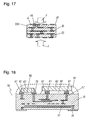
- Fig. 18 is a cross sectional view of a conventional ceramic module 50.
- the ceramic module 50 includes a component 60, such as a capacitor and an inductor, an active component 80, such as an IC and a SAW filter, and a ceramic substrate 70.
- the ceramic substrate 70 includes internal electrodes 51, via electrodes 52 connecting between the internal electrodes 51, land electrodes 55 connected with the active component 80 and the component 60 for surface-mounting them, and back electrodes 56 for mounting the ceramic module 50 on a mother board.
- the end electrodes 62 of the component 60 are connected to land electrodes 55 corresponding to them with a conductive adhesive 61, such as solder, while the back electrodes 81 of the active component 80 are connected to land electrodes 55 corresponding to them with a conductive adhesive 61.
- a gap between the active component 80 and the substrate 70 is filled with a resin 90 for increasing reliability of surface mounting of the active component 80.
- the component 60 and the active component 80 are mounted on the ceramic substrate 70 which has been baked, and may be molded with a resin 91 according to requirement.
- the conventional module 50 includes a small amount of the conductive adhesive 61 for avoiding short-circuit between the electrodes during the surface mounting.
- the resin 91 may fail to flow into beneath the component 60, and may produce a gap 92.
- the conductive adhesive 61 such as solder, may melt and flow into the gap 92 between the component 60 and the ceramic substrate 70, hence causing a short-circuit between the land electrodes 55 and disturbing the performance and the operational reliability of the ceramic module 50.
- the resin 90 is also applied to between the component 80 and the substrate 70 for mounting and securing the component 80 onto the substrate 70.
- the resin 90 upon not being applied sufficiently between the component 80 and the substrate 70, may reduce the bonding strength and the operational reliability.
- a module includes a ceramic substrate, first and second electrodes provided on the ceramic substrate, a component having third and fourth electrodes connected to the first and second electrodes, respectively, and a resin filled in a space between the component and the ceramic substrate.
- the ceramic substrate has a surface thereof having a recess formed therein.
- the first and second electrodes are provided on the surface of the ceramic substrate so that the recess is located between the first and second electrodes.
- the component is located over the recess and spaced from the ceramic substrate with a space including the recess. The space including the recess is filled with the resin.
- the module allows each component to be surface mounted at higher bonding strength, thus preventing short-circuit between the electrodes on the substrate and improving the operation reliability.
- Fig. 1 is a cross sectional view of a ceramic module 1 according to an exemplary embodiment of the present invention.
- Fig. 2 is an upper view of a ceramic substrate 13 of the module 1.
- the ceramic module 1 includes the ceramic substrate 13.
- the ceramic substrate 13 includes internal electrodes 2 provided as layers, via-electrodes 3 connecting between the internal electrodes 2, and a ceramic base 14 made of electrically-insulating material.
- a component 6, such as a chip resistor, a multi-layer ceramic capacitor, and a chip inductor, includes a main body 6A and end electrodes 15.
- the end electrode 15 and the bump electrodes 16 are connected by solders 7 to land electrodes 4, and the components 6 and 8 are provided on the upper surface 13A of the substrate 13.
- Back electrodes 5 are provided on the lower surface 13B of the ceramic substrate 13 for allowing the ceramic module 1 to be mounted on a mother board 40.
- the ceramic substrate 13 has a recess 10B in a portion of the surface of substrate 13 facing the component 6, and has a recess 10A in a portion of the surface of substrate 13 facing the component 8.
- the component 6 and the active component 8 are encapsulated with a resin molding 12 on the upper surface 13A of the ceramic substrate 13 having the components 6 and 9 mounted thereon.
- the electrodes 2 and the via-electrodes 3 in the ceramic substrate 13 are baked simultaneously together with the ceramic substrate 13 and are conductive, the electrodes are made of Ag paste having a large conductivity.
- the ceramic base 14 of the ceramic substrate 13 including the internal electrodes 2 of Ag is preferably baked substantially at 900°C.
- the ceramic base 14 may be made preferably of glass-ceramic mixture of Al 2 O 3 and glass.
- the materials of the internal electrodes 2 and the ceramic substrate 13 are not limited to the foregoing materials.
- the resin molding 12 is made of electrically-insulating resin material, such as epoxy, phenol, or epoxy-silicone resin, and secures a bonding strength and a resistance against impact of the components 6 and 8 in the module 1.
- the solders 7 may be replaced by electrically-conductive adhesives made of conductive resin.
- the component 6 and the active component 8 are mounted and electrically connected on the ceramic substrate 13. After the component 6 is placed on the ceramic substrate 13 and connected to the land electrodes 4, the space 10C including the recess 10B between the component 6 and the ceramic substrate 13 is filled with the resin 11.
- the recess 10B enables the resin 11 to be easily filled between the component 6 and the ceramic substrate 13. This arrangement produces no gap between the component 6 and the ceramic substrate 13, and the solders 7 can be prevented from flowing when the solders are heated while the module 1 is mounted on the mother board 40, thus preventing the electrodes 4 from short-circuit. Particularly if the component 6 has such a small size that the electrodes 4 is spaced a little from each other, the recess 10B is useful for receiving the resin 11.
- the resin 9 of insulating resin material such as epoxy resin
- the resin 9 may be made of material selected from various resins.
- the recess 10A allows the resin 9 to be filled between the component 8 and the substrate 13 even if the distance between the component 8 and the substrate 13 is small. This arrangement produces no gap between the component 8 and the substrate 13, hence providing the ceramic module 1 with large bonding strength and reliability for the surface mounting.
- a distance W1 between the land electrodes 4 of the component 6 or 8 and a distance W2 of the recess 10B or 10A satisfy W1 ⁇ W2 as shown in Fig. 2, and depths of the recess 10B and 10A are preferably not smaller than 10 ⁇ m.
- This arrangement prevents the solders or the conductive adhesive for mounting the component 6 or 8 on the substrate 13 from causing short-circuit between the electrodes 4 due to the flowing of the solder or adhesive, and prevents the resin 11 and 9 from being applied with insufficient amounts beneath the component 6 or 8. Accordingly, the ceramic module 1 has large bonding strength and reliability for the surface mounting of the components 6 and 8.
- Figs. 3 to 13 are cross sectional views of the ceramic substrate 13 for illustrating a procedure of manufacturing the substrate 13.
- the ceramic substrate 13 is formed by baking a green sheet of glass ceramic material, such as mixture of Al 2 O 3 and glass powder.
- the glass powder is preferably selected from SiO 2 , B 2 O 3 , Al 2 O 3 , CaCO 3 , SrCO 3 , SrCO 3 , BaCO 3 , La 2 O 3 , ZrO 2 , TiO 2 , MgO, PbO, ZnO, Li 2 O 3 , Na 2 CO 3 , and K 2 CO 3 .
- the mixture of Al 2 O 3 and glass powder is added with poly vinyl butylal binder, plasticizer, and organic solvent for dispersion, thus providing slurry.
- the above described composition is illustrative, and may be replaced with any other appropriate example for providing slurry.
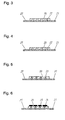
- the slurry is applied on a base film 21 made of, for example, PET material with a doctor blade or the like, and is dried, thus providing a ceramic green sheet 20 having predetermined desired thickness and size, as shown in Fig. 3.
- the base film 21 is not limited to the PET material but may be made of any other appropriate material.
- the green sheet 20 is perforated by punching or laser beam machining to have through-holes 22 formed therein, as shown in Fig. 4. Pilot holes 27 may be provided in the base film 21 for multi-layer assembly if necessary.
- the through-holes 22 are then filled with silver paste to develop via-electrodes 23, as shown in Fig. 5.
- a pattern of the internal electrodes 24 are formed by, for example, screen printing, as shown in Fig. 6.
- the internal electrodes 24 are patterned with paste made of Ag-based conductive material, however the paste may be made of any conductive material other than the Ag-based material which can be baked simultaneously with the green sheet 20.
- the base films 21 having green sheets 20A-20D, the via electrodes 23, and the internal electrodes 24 are aligned by inserting guide pins through the pilot holes 27, as shown in Fig. 7. Then, the green sheet 20A is placed on a stack pallet 25. Then, the green sheet 20B is placed on the green sheet 20A on the stack pallet 25 while pilot holes 27 aligned with the guide pins 26 inserted. Then, similarly, the green sheet 20C is stacked on the green sheet 20B, and the green sheet 20D is stacked on the green sheet 20C.
- a multi-layer block 28 including the green sheets 20A-20D is provided, as shown in Fig. 8.
- the land electrodes 4 are provided on the upper surface of the multi-layer block 28.
- the pilot holes 27 are provided in the base film 21 according to the embodiment, however, may be provided in the green sheets 20A-20D. Then, pressures F are applied to the multi-layer block 28 for having the green sheets 20A-20D have an uniform density and for eliminating de-lamination between any adjacent ones of the green sheets 20A-20D. Accordingly, the green sheets 20A-20D are pressed and joined together.
- the multi-layer block 28 is then degreased at a temperature ranging from 350°C to 600°C, and baked at a temperature ranging from 850°C to 950°C, hence providing the ceramic substrate 13 including the internal electrodes 24 of the Ag-based material, as shown in Fig. 9.
- a recess 30 is formed by applying laser beam 29 at a portion of the ceramic substrate 13 between the land electrodes 4, as shown in Fig. 10.
- the laser beam 29 forms the recess 30 in a short period of time.
- the end electrodes 15 of the component 6 are connected to the electrodes 4 with solders 7. Then, the recess 30 is filled with the resin 11, such as epoxy resin or silicone resin, and the resin 11 is cured. This allows the resin 11 filled in the recess 30 to prevents short-circuit between the electrodes 4 since the resin prevents the solders 7 from flowing between the electrodes 4 when being heated for mounting another component on the substrate 13 at a succeeding step.
- the resin 11 such as epoxy resin or silicone resin
- a recess 30 is formed at beneath the component 8 and in the substrate 13, and filled with the resin 9 for improving the bonding strength and reliability of the mounting.
- This arrangement allows the resin 9 to be filled and cured between the component 8 and the substrate 13 with producing of no gap, hence contributing to the improvement in the bonding strength and operational reliability of the ceramic module 1.
- a land electrode 4A having a large size may be formed on the ceramic substrate 13, and is then baked. Then, the land electrode 4A is divided into the electrodes 4 at the same time when the recess 30 is formed by the laser beam 29 in the substrate 13, as shown in Fig. 12. That is, the electrodes 4 and the recess 30 can be formed simultaneously. This operation allows the recess 30 to be formed precisely between the land electrodes 4 without consideration of thinning of the conductive paste or accuracy of the patterning even when the land electrodes 4 have small sizes.
- the component 6 and the active component 8 (not shown) are mounted while the resin 11 is filled in the recess 30 as well as beneath the component 6, as shown in Fig. 13. They are molded with a resin molding 12 and cut by dicing into the ceramic modules 1 having a predetermined size.
- the electrodes 4 and 4A may be baked together with the ceramic substrate 13 or after the ceramic substrate 13 is baked.
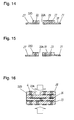
- Figs. 14 to 16 are cross sectional views of the ceramic module for illustrating another method for manufacturing the module according to the embodiment.
- a though-hole 22A may be formed in the green sheet 20D, which is to be placed at the outermost layer, at a portion where the recesses 10A and 10B is to be provided, as shown in Fig. 14.
- the via-electrodes 23 is formed in the through-holes 22, as shown in Fig. 15, and the internal electrodes 24 are formed, as shown in Fig. 16.
- the green sheets 20A-20D are stacked and baked.
- the through-hole 22A serves as the recesses 10A and 10B in the multi-layer block 28.
- the components 6 and 8 are mounted, as shown in Fig. 13, and the resins 9 and 10 are then applied. Finally, they are encapsulated in the resin molding 12, thus providing the ceramic module 1.
- the recesses 10A and 10B can be provided without forming recesses after the green sheets 20A-20D are baked.
- the recess 30 may be formed in the multi-layer block 28 by laser beam machining before the block is baked. After the baking of the multi-layer block 28, the components 6 and 8 are mounted, the resins 9 and 11 are applied, and the resin molding 12 is provided, thus providing the ceramic module 1.
- the recess 30 between the land electrodes 4 may be formed by locating a die 41 between the land electrodes 4 and pressing the die downwardly while the multi-layer block 28 is pressed.
- the recess 30 may be formed by laser beam between the land electrodes 4. The recess 30 can be formed before and after the pressing of the block. After the baking of the multi-layer block 28, the components 6 and 8 are mounted, the resins 9 and 11 are applied, and the resin molding 12 is formed, thus providing the ceramic module 1 having the recesses 10A and 10B between the land electrodes 4 readily and easily.
Landscapes
- Engineering & Computer Science (AREA)
- Physics & Mathematics (AREA)
- Acoustics & Sound (AREA)
- Manufacturing & Machinery (AREA)
- Microelectronics & Electronic Packaging (AREA)
- Structures For Mounting Electric Components On Printed Circuit Boards (AREA)
- Fixed Capacitors And Capacitor Manufacturing Machines (AREA)
- Production Of Multi-Layered Print Wiring Board (AREA)
- Non-Metallic Protective Coatings For Printed Circuits (AREA)
- Structures Or Materials For Encapsulating Or Coating Semiconductor Devices Or Solid State Devices (AREA)
- Printing Elements For Providing Electric Connections Between Printed Circuits (AREA)
Abstract
Description
- The present invention relates to a module including a ceramic substrate having a wiring pattern thereon, and electronic components, such as ICs, SAW filters, resistors, capacitors, and coils, mounted on the ceramic substrate, and to a method of manufacturing the module.
- Ceramic modules including electronic components, such as ICs, SAW filters, resistors, capacitors, and coils, mounted on a ceramic substrate having a wiring pattern thereon is disclosed in Japanese Patent Laid-Open Publication Nos.3-205857 and 4-252041.
- Fig. 18 is a cross sectional view of a conventional
ceramic module 50. Theceramic module 50 includes acomponent 60, such as a capacitor and an inductor, anactive component 80, such as an IC and a SAW filter, and aceramic substrate 70. Theceramic substrate 70 includesinternal electrodes 51, viaelectrodes 52 connecting between theinternal electrodes 51,land electrodes 55 connected with theactive component 80 and thecomponent 60 for surface-mounting them, andback electrodes 56 for mounting theceramic module 50 on a mother board. Theend electrodes 62 of thecomponent 60 are connected toland electrodes 55 corresponding to them with aconductive adhesive 61, such as solder, while theback electrodes 81 of theactive component 80 are connected toland electrodes 55 corresponding to them with aconductive adhesive 61. A gap between theactive component 80 and thesubstrate 70 is filled with aresin 90 for increasing reliability of surface mounting of theactive component 80. - In the
conventional module 50, thecomponent 60 and theactive component 80 are mounted on theceramic substrate 70 which has been baked, and may be molded with aresin 91 according to requirement. - When the
component 60 has a small size, such as 1005 size or 0603 size, theconventional module 50 includes a small amount of theconductive adhesive 61 for avoiding short-circuit between the electrodes during the surface mounting. When being applied for molding thecomponent 60 mounted, theresin 91 may fail to flow into beneath thecomponent 60, and may produce agap 92. When theceramic module 50 is mounted on the mother board, theconductive adhesive 61, such as solder, may melt and flow into thegap 92 between thecomponent 60 and theceramic substrate 70, hence causing a short-circuit between theland electrodes 55 and disturbing the performance and the operational reliability of theceramic module 50. - The
resin 90 is also applied to between thecomponent 80 and thesubstrate 70 for mounting and securing thecomponent 80 onto thesubstrate 70. Theresin 90, upon not being applied sufficiently between thecomponent 80 and thesubstrate 70, may reduce the bonding strength and the operational reliability. - A module includes a ceramic substrate, first and second electrodes provided on the ceramic substrate, a component having third and fourth electrodes connected to the first and second electrodes, respectively, and a resin filled in a space between the component and the ceramic substrate. The ceramic substrate has a surface thereof having a recess formed therein. The first and second electrodes are provided on the surface of the ceramic substrate so that the recess is located between the first and second electrodes. The component is located over the recess and spaced from the ceramic substrate with a space including the recess. The space including the recess is filled with the resin.
- Accordingly, the module allows each component to be surface mounted at higher bonding strength, thus preventing short-circuit between the electrodes on the substrate and improving the operation reliability.
-
- Fig. 1 is a cross sectional view of a ceramic module according to an exemplary embodiment of the present invention.
- Fig. 2 is an upper view of a ceramic substrate of the ceramic module according to the embodiment;
- Fig. 3 is a cross sectional view of the module for illustrating a method of manufacturing the module according to the embodiment.
- Fig. 4 is a cross sectional view of the module for illustrating the method of manufacturing the module according to the embodiment.
- Fig. 5 is a cross sectional view of the module for illustrating the method of manufacturing the module according to the embodiment.
- Fig. 6 is a cross sectional view of the module for illustrating the method of manufacturing the module according to the embodiment.
- Fig. 7 is a cross sectional view of the module for illustrating the method of manufacturing the module according to the embodiment.
- Fig. 8 is a cross sectional view of the module for illustrating the method of manufacturing the module according to the embodiment.
- Fig. 9 is a cross sectional view of the module for illustrating the method of manufacturing the module according to the embodiment.
- Fig. 10 is a cross sectional view of the module for illustrating the method of manufacturing the module according to the embodiment.
- Fig. 11 is a cross sectional view of the module for illustrating the method of manufacturing the module according to the embodiment.
- Fig. 12 is a cross sectional view of the module for illustrating the method of manufacturing the module according to the embodiment.
- Fig. 13 is a cross sectional view of the module for illustrating the method of manufacturing the module according to the embodiment.
- Fig. 14 is a cross sectional view of the module for illustrating another method of manufacturing the module according to the embodiment.
- Fig. 15 is a cross sectional view of the module for illustrating the another method of manufacturing the module according to the embodiment.
- Fig. 16 is a cross sectional view of the module for illustrating the another method of manufacturing the module according to the embodiment.
- Fig. 17 is a cross sectional view of the module for illustrating a further method of manufacturing the module according to the embodiment.
- Fig. 18 is a cross sectional view of a conventional ceramic module.
-
- Fig. 1 is a cross sectional view of a
ceramic module 1 according to an exemplary embodiment of the present invention. Fig. 2 is an upper view of aceramic substrate 13 of themodule 1. Theceramic module 1 includes theceramic substrate 13. Theceramic substrate 13 includesinternal electrodes 2 provided as layers, via-electrodes 3 connecting between theinternal electrodes 2, and aceramic base 14 made of electrically-insulating material. Acomponent 6, such as a chip resistor, a multi-layer ceramic capacitor, and a chip inductor, includes amain body 6A andend electrodes 15. Anactive component 8, such as an IC and a SAW filter, includes amain body 8A andbump electrodes 16. Theend electrode 15 and thebump electrodes 16 are connected bysolders 7 toland electrodes 4, and thecomponents substrate 13.Back electrodes 5 are provided on thelower surface 13B of theceramic substrate 13 for allowing theceramic module 1 to be mounted on amother board 40. Theceramic substrate 13 has arecess 10B in a portion of the surface ofsubstrate 13 facing thecomponent 6, and has arecess 10A in a portion of the surface ofsubstrate 13 facing thecomponent 8. Aninsulating resin 11, such as epoxy resin, filled between thecomponent 6 and thesubstrate 13 while aresin 9 is filled between theactive component 8 and thesubstrate 13. Thecomponent 6 and theactive component 8 are encapsulated with aresin molding 12 on the upper surface 13A of theceramic substrate 13 having thecomponents - Since the
internal electrodes 2 and the via-electrodes 3 in theceramic substrate 13 are baked simultaneously together with theceramic substrate 13 and are conductive, the electrodes are made of Ag paste having a large conductivity. Theceramic base 14 of theceramic substrate 13 including theinternal electrodes 2 of Ag is preferably baked substantially at 900°C. Theceramic base 14 may be made preferably of glass-ceramic mixture of Al2O3 and glass. The materials of theinternal electrodes 2 and theceramic substrate 13 are not limited to the foregoing materials. - The
resin molding 12 is made of electrically-insulating resin material, such as epoxy, phenol, or epoxy-silicone resin, and secures a bonding strength and a resistance against impact of thecomponents module 1. Thesolders 7 may be replaced by electrically-conductive adhesives made of conductive resin. - The
component 6 and theactive component 8 are mounted and electrically connected on theceramic substrate 13. After thecomponent 6 is placed on theceramic substrate 13 and connected to theland electrodes 4, thespace 10C including therecess 10B between thecomponent 6 and theceramic substrate 13 is filled with theresin 11. Therecess 10B enables theresin 11 to be easily filled between thecomponent 6 and theceramic substrate 13. This arrangement produces no gap between thecomponent 6 and theceramic substrate 13, and thesolders 7 can be prevented from flowing when the solders are heated while themodule 1 is mounted on themother board 40, thus preventing theelectrodes 4 from short-circuit. Particularly if thecomponent 6 has such a small size that theelectrodes 4 is spaced a little from each other, therecess 10B is useful for receiving theresin 11. - For improving a bonding strength and reliability of the
component 8 for the surface mounting, theresin 9 of insulating resin material, such as epoxy resin, is often applied between thecomponent 8 and thesubstrate 13. Theresin 9 may be made of material selected from various resins. Therecess 10A allows theresin 9 to be filled between thecomponent 8 and thesubstrate 13 even if the distance between thecomponent 8 and thesubstrate 13 is small. This arrangement produces no gap between thecomponent 8 and thesubstrate 13, hence providing theceramic module 1 with large bonding strength and reliability for the surface mounting. - In order to fill spaces beneath the
components resins land electrodes 4 of thecomponent recess recess component substrate 13 from causing short-circuit between theelectrodes 4 due to the flowing of the solder or adhesive, and prevents theresin component ceramic module 1 has large bonding strength and reliability for the surface mounting of thecomponents - Figs. 3 to 13 are cross sectional views of the
ceramic substrate 13 for illustrating a procedure of manufacturing thesubstrate 13. - The
ceramic substrate 13 is formed by baking a green sheet of glass ceramic material, such as mixture of Al2O3 and glass powder. The glass powder is preferably selected from SiO2, B2O3, Al2O3, CaCO3, SrCO3, SrCO3, BaCO3, La2O3, ZrO2, TiO2, MgO, PbO, ZnO, Li2O3, Na2CO3, and K2CO3. The mixture of Al2O3 and glass powder is added with poly vinyl butylal binder, plasticizer, and organic solvent for dispersion, thus providing slurry. The above described composition is illustrative, and may be replaced with any other appropriate example for providing slurry. - The slurry is applied on a
base film 21 made of, for example, PET material with a doctor blade or the like, and is dried, thus providing a ceramicgreen sheet 20 having predetermined desired thickness and size, as shown in Fig. 3. Thebase film 21 is not limited to the PET material but may be made of any other appropriate material. - Next, the
green sheet 20 is perforated by punching or laser beam machining to have through-holes 22 formed therein, as shown in Fig. 4. Pilot holes 27 may be provided in thebase film 21 for multi-layer assembly if necessary. - The through-
holes 22 are then filled with silver paste to develop via-electrodes 23, as shown in Fig. 5. Then, a pattern of theinternal electrodes 24 are formed by, for example, screen printing, as shown in Fig. 6. Theinternal electrodes 24 are patterned with paste made of Ag-based conductive material, however the paste may be made of any conductive material other than the Ag-based material which can be baked simultaneously with thegreen sheet 20. - The
base films 21 havinggreen sheets 20A-20D, the viaelectrodes 23, and theinternal electrodes 24 are aligned by inserting guide pins through the pilot holes 27, as shown in Fig. 7. Then, thegreen sheet 20A is placed on astack pallet 25. Then, thegreen sheet 20B is placed on thegreen sheet 20A on thestack pallet 25 whilepilot holes 27 aligned with the guide pins 26 inserted. Then, similarly, thegreen sheet 20C is stacked on thegreen sheet 20B, and thegreen sheet 20D is stacked on thegreen sheet 20C. - As above, a
multi-layer block 28 including thegreen sheets 20A-20D is provided, as shown in Fig. 8. Theland electrodes 4 are provided on the upper surface of themulti-layer block 28. The pilot holes 27 are provided in thebase film 21 according to the embodiment, however, may be provided in thegreen sheets 20A-20D. Then, pressures F are applied to themulti-layer block 28 for having thegreen sheets 20A-20D have an uniform density and for eliminating de-lamination between any adjacent ones of thegreen sheets 20A-20D. Accordingly, thegreen sheets 20A-20D are pressed and joined together. - The
multi-layer block 28 is then degreased at a temperature ranging from 350°C to 600°C, and baked at a temperature ranging from 850°C to 950°C, hence providing theceramic substrate 13 including theinternal electrodes 24 of the Ag-based material, as shown in Fig. 9. - Then, a
recess 30 is formed by applyinglaser beam 29 at a portion of theceramic substrate 13 between theland electrodes 4, as shown in Fig. 10. Thelaser beam 29 forms therecess 30 in a short period of time. - The
end electrodes 15 of thecomponent 6 are connected to theelectrodes 4 withsolders 7. Then, therecess 30 is filled with theresin 11, such as epoxy resin or silicone resin, and theresin 11 is cured. This allows theresin 11 filled in therecess 30 to prevents short-circuit between theelectrodes 4 since the resin prevents thesolders 7 from flowing between theelectrodes 4 when being heated for mounting another component on thesubstrate 13 at a succeeding step. - In order to mount the
component 8, arecess 30 is formed at beneath thecomponent 8 and in thesubstrate 13, and filled with theresin 9 for improving the bonding strength and reliability of the mounting. This arrangement allows theresin 9 to be filled and cured between thecomponent 8 and thesubstrate 13 with producing of no gap, hence contributing to the improvement in the bonding strength and operational reliability of theceramic module 1. - As shown in Fig. 11, for forming the
land electrodes 4, aland electrode 4A having a large size may be formed on theceramic substrate 13, and is then baked. Then, theland electrode 4A is divided into theelectrodes 4 at the same time when therecess 30 is formed by thelaser beam 29 in thesubstrate 13, as shown in Fig. 12. That is, theelectrodes 4 and therecess 30 can be formed simultaneously. This operation allows therecess 30 to be formed precisely between theland electrodes 4 without consideration of thinning of the conductive paste or accuracy of the patterning even when theland electrodes 4 have small sizes. - Then, the
component 6 and the active component 8 (not shown) are mounted while theresin 11 is filled in therecess 30 as well as beneath thecomponent 6, as shown in Fig. 13. They are molded with aresin molding 12 and cut by dicing into theceramic modules 1 having a predetermined size. - The
electrodes ceramic substrate 13 or after theceramic substrate 13 is baked. - Figs. 14 to 16 are cross sectional views of the ceramic module for illustrating another method for manufacturing the module according to the embodiment. When the through-
holes 22 are formed in the green sheet shown in Fig. 4 by punching or laser beam, a though-hole 22A may be formed in thegreen sheet 20D, which is to be placed at the outermost layer, at a portion where therecesses electrodes 23 is formed in the through-holes 22, as shown in Fig. 15, and theinternal electrodes 24 are formed, as shown in Fig. 16. Then, thegreen sheets 20A-20D are stacked and baked. That is, the through-hole 22A serves as therecesses multi-layer block 28. Then, thecomponents resins 9 and 10 are then applied. Finally, they are encapsulated in theresin molding 12, thus providing theceramic module 1. According to the above method, therecesses green sheets 20A-20D are baked. - The
recess 30 may be formed in themulti-layer block 28 by laser beam machining before the block is baked. After the baking of themulti-layer block 28, thecomponents resins resin molding 12 is provided, thus providing theceramic module 1. - As shown in Fig. 17, the
recess 30 between theland electrodes 4 may be formed by locating a die 41 between theland electrodes 4 and pressing the die downwardly while themulti-layer block 28 is pressed. Alternatively, as shown in Fig. 12, therecess 30 may be formed by laser beam between theland electrodes 4. Therecess 30 can be formed before and after the pressing of the block. After the baking of themulti-layer block 28, thecomponents resins resin molding 12 is formed, thus providing theceramic module 1 having therecesses land electrodes 4 readily and easily.
Claims (19)
- A module comprising:a ceramic substrate having a first surface thereof, the first surface having a recess formed therein;a first electrode and a second electrode provided on the first surface of the ceramic substrate, the recess being located between the first electrode and the second electrode;a component provided over the recess of the ceramic substrate so as to produce a space between the component and the ceramic substrate, the space including the recess, the component including a third electrode and a fourth electrode connected to the first electrode and the second electrode, respectively; anda resin filled in the space between the component and the ceramic substrate.
- The module according to claim 1, further comprising a resin molding encapsulating the component.
- The module according to claim 2, wherein the resin molding covers the first surface of the ceramic substrate and the component.
- The module according to claim 1, wherein the recess has a depth not smaller than 10µm.
- The module according to claim 1, wherein the ceramic substrate further has a second surface thereof, said module further comprising a fifth electrode provided on the second surface of the ceramic substrate.
- A method of manufacturing a module, comprising:providing a ceramic substrate having a first surface thereof having a recess formed in the first surface of the ceramic substrate;providing a first electrode and a second electrode on the first surface of the ceramic substrate, wherein the recesses is located between the first electrode and the second electrode;providing a component including a main body and a third electrode and a fourth electrode;providing the component over the recess of the ceramic substrate and connecting the third electrode and the fourth electrode to the first electrode and the second electrode, respectively, so that a space including the recess is provided between the component and the ceramic substrate; andfilling the space between the component and the ceramic substrate with a resin.
- The method according to claim 6, further comprisingcovering the component and the first surface of the ceramic substrate with a resin molding.
- The method according to claim 6, wherein the recess has a depth not smaller than 10µm.
- The method according to claim 6, wherein the ceramic substrate has a second surface thereof, said method further comprisingproviding a fifth electrode on the second surface of the ceramic substrate.
- The method according to claim 6, wherein said providing the ceramic substrate comprises:baking a ceramic green sheet having a first surface corresponding to the first surface of the ceramic substrate; andforming the recess in the first surface of the baked ceramic green sheet.
- The method according to claim 10, wherein said forming the recess in the first surface of the baked ceramic green sheet comprises forming the recess in the first surface of the baked ceramic green sheet with laser beam.
- The method according to claim 6,
wherein said providing the ceramic substrate having the first surface thereof having the recess formed in the first surface comprises forming the recess in the first surface of the ceramic substrate, and
wherein said providing the first electrode and the second electrode on the first surface of the ceramic substrate comprises:providing a fifth electrode on a portion of the first surface of the ceramic substrate where the first electrode and the second electrode are to be provided; anddividing the fifth electrode so as to provide the first electrode and the second electrode simultaneously to said forming the recess in the first surface of the ceramic substrate. - The method according to claim 6, wherein said providing the ceramic substrate comprises:providing a first ceramic green sheet having a first surface and a second surface opposite to the first surface of the first ceramic green sheet, the first surface corresponding to the first substrate of the ceramic substrate;forming a certain recess in the first surface of the first ceramic green sheet, the certain recess corresponding to the recess provided in the ceramic substrate; andbaking the first ceramic green sheet having the certain recess formed therein.
- The method according to claim 13, wherein said forming the certain recess in the first surface of the first ceramic green sheet comprises forming the certain recess in the first surface of the first ceramic green sheet with laser beam.
- The method according to claim 13,
wherein said providing the ceramic substrate further comprises stacking a second ceramic green sheet on the second surface of the first ceramic green sheet having the certain recess formed in the first surface thereof, and
wherein said baking the first ceramic green sheet having the certain recess comprises baking the first ceramic green sheet having the second ceramic green sheet stacked thereon. - The method according to claim 13,
wherein said providing the ceramic substrate further comprisesstacking a second ceramic green sheet on the second surface of the first ceramic green sheet to provide a multi-layer block, andapplying a pressure to the multi-layer block to join the first ceramic green sheet to the second ceramic green sheet, and
wherein said forming the certain recess in the first surface of the first ceramic green sheet comprises forming the certain recess in the first surface of the first ceramic green sheet simultaneously to said applying the pressure to the multi-layer block to join the first ceramic green sheet to the second ceramic green sheet. - The method according to claim 6, wherein said providing the ceramic substrate comprises:providing a first ceramic green sheet having a first surface and a second surface opposite to the first surface of the first ceramic green sheet, the first surface of the first ceramic green sheet corresponding to the first surface of the ceramic substrate;forming a first through-hole in the first ceramic green sheet from the first surface to the second surface of the first ceramic green sheet;forming a second through-hole in the first ceramic green sheet from the first surface to the second surface of the first ceramic green sheet, the second through-hole being positioned at a portion where the recess is to be provided;filling the first through-hole with electrically-conductive paste;stacking a second ceramic green sheet on the second surface of the first ceramic green sheet to provide a multi-layer block; andbaking the multi-layer block.
- The method according to claim 17,
wherein said forming the first through-hole in the first ceramic green sheet comprises forming the first through-hole in the first ceramic green sheet by punching, and
wherein said forming the second through-hole in the first ceramic green sheet comprises forming the second through-hole in the first ceramic green sheet by punching. - The method according to claim 17,
wherein said forming the first through-hole in the first ceramic green sheet comprises forming the first through-hole in the first ceramic green sheet by laser beam, and
wherein said forming the second through-hole in the first ceramic green sheet comprises forming the second through-hole in the first ceramic green sheet by laser beam.
Applications Claiming Priority (2)
| Application Number | Priority Date | Filing Date | Title |
|---|---|---|---|
| JP2003337180 | 2003-09-29 | ||
| JP2003337180A JP2005108950A (en) | 2003-09-29 | 2003-09-29 | Ceramic module component and manufacturing method thereof |
Publications (3)
| Publication Number | Publication Date |
|---|---|
| EP1519641A2 true EP1519641A2 (en) | 2005-03-30 |
| EP1519641A3 EP1519641A3 (en) | 2005-08-24 |
| EP1519641B1 EP1519641B1 (en) | 2010-11-17 |
Family
ID=34191559
Family Applications (1)
| Application Number | Title | Priority Date | Filing Date |
|---|---|---|---|
| EP04022953A Expired - Lifetime EP1519641B1 (en) | 2003-09-29 | 2004-09-27 | Module and method of manufacturing a module |
Country Status (5)
| Country | Link |
|---|---|
| US (1) | US7231712B2 (en) |
| EP (1) | EP1519641B1 (en) |
| JP (1) | JP2005108950A (en) |
| CN (1) | CN100369532C (en) |
| DE (1) | DE602004030081D1 (en) |
Cited By (1)
| Publication number | Priority date | Publication date | Assignee | Title |
|---|---|---|---|---|
| EP1628509A3 (en) * | 2004-08-16 | 2006-10-04 | Delphi Technologies, Inc. | Electronic module with form in-place pedestal |
Families Citing this family (19)
| Publication number | Priority date | Publication date | Assignee | Title |
|---|---|---|---|---|
| KR100857011B1 (en) * | 2005-03-04 | 2008-09-04 | 가부시키가이샤 무라타 세이사쿠쇼 | Ceramic multilayer board and method for manufacturing same |
| JP4145902B2 (en) * | 2005-07-19 | 2008-09-03 | セイコーエプソン株式会社 | Semiconductor device and manufacturing method thereof |
| CN101091312B (en) * | 2005-11-02 | 2011-12-28 | 松下电器产业株式会社 | Electronic component assembly |
| JP4946565B2 (en) * | 2007-03-27 | 2012-06-06 | 株式会社デンソー | Mold package and manufacturing method thereof |
| KR101011199B1 (en) * | 2007-11-01 | 2011-01-26 | 파나소닉 주식회사 | Mount structure |
| JP2011100718A (en) * | 2009-10-05 | 2011-05-19 | Yazaki Corp | Connector |
| JP5711472B2 (en) * | 2010-06-09 | 2015-04-30 | 新光電気工業株式会社 | WIRING BOARD, MANUFACTURING METHOD THEREOF, AND SEMICONDUCTOR DEVICE |
| JP5772970B2 (en) * | 2011-10-21 | 2015-09-02 | 株式会社村田製作所 | Multilayer wiring board, probe card, and method for manufacturing multilayer wiring board |
| TWI527505B (en) * | 2013-01-10 | 2016-03-21 | 元太科技工業股份有限公司 | A circuit substrate structure and a method for manufacturing thereof |
| CN105051888B (en) | 2013-03-27 | 2018-01-23 | 株式会社村田制作所 | Insulating ceramic paste, ceramic electronic device and manufacturing method thereof |
| WO2015170539A1 (en) * | 2014-05-08 | 2015-11-12 | 株式会社村田製作所 | Resin multilayer substrate and method for producing same |
| US9902006B2 (en) * | 2014-07-25 | 2018-02-27 | Raytheon Company | Apparatus for cleaning an electronic circuit board |
| WO2016098628A1 (en) * | 2014-12-17 | 2016-06-23 | 株式会社 村田製作所 | Laminate ceramic electronic component and method for manufacturing same |
| JP6589301B2 (en) * | 2015-03-10 | 2019-10-16 | セイコーエプソン株式会社 | Liquid ejecting head and method of manufacturing liquid ejecting head |
| WO2017077837A1 (en) * | 2015-11-05 | 2017-05-11 | 株式会社村田製作所 | Component-mounted substrate |
| CN105428508B (en) | 2015-12-02 | 2018-08-24 | 开发晶照明(厦门)有限公司 | Package substrate and LED flip-chip packaged structures |
| TWI562410B (en) * | 2015-12-02 | 2016-12-11 | Kaistar Lighting Xiamen Co Ltd | Packaging Substrate and LED Flip Chip Packaging structure |
| EP3468312B1 (en) * | 2017-10-06 | 2023-11-29 | AT & S Austria Technologie & Systemtechnik Aktiengesellschaft | Method of manufacturing a component carrier having a three dimensionally printed wiring structure |
| JP7632173B2 (en) * | 2021-08-24 | 2025-02-19 | トヨタ紡織株式会社 | Resin-sealed electronic substrate and method for manufacturing the same |
Family Cites Families (16)
| Publication number | Priority date | Publication date | Assignee | Title |
|---|---|---|---|---|
| JPH01303791A (en) * | 1988-05-31 | 1989-12-07 | Aisin Seiki Co Ltd | Printed wiring board and prevention of bubble generation in sealing same with resin |
| JPH03205857A (en) | 1990-01-06 | 1991-09-09 | Fujitsu Ltd | Resin-sealed electronic component |
| JPH0483392A (en) * | 1990-07-25 | 1992-03-17 | Narumi China Corp | Manufacture of electronic ceramic board |
| JPH04252041A (en) | 1991-01-28 | 1992-09-08 | Nec Corp | Manufacture of hybrid integrated circuit |
| JP2945291B2 (en) * | 1994-12-27 | 1999-09-06 | 株式会社住友金属エレクトロデバイス | Ceramic multilayer substrate |
| JP3648277B2 (en) * | 1995-01-12 | 2005-05-18 | 株式会社東芝 | Semiconductor device |
| JPH10233463A (en) * | 1997-01-27 | 1998-09-02 | Toshiba Corp | Semiconductor device and manufacturing method thereof |
| DE19729073A1 (en) * | 1997-07-08 | 1999-01-14 | Bosch Gmbh Robert | Method for producing an adhesive connection between an electronic component and a carrier substrate |
| JPH11346056A (en) * | 1998-06-01 | 1999-12-14 | Murata Mfg Co Ltd | Ceramic multilayered board with cavity and manufacture thereof |
| JP3565724B2 (en) * | 1998-10-06 | 2004-09-15 | 沖電気工業株式会社 | Flip chip type semiconductor package and resin injection method in the device |
| JP2001244376A (en) * | 2000-02-28 | 2001-09-07 | Hitachi Ltd | Semiconductor device |
| JP2001244578A (en) * | 2000-02-29 | 2001-09-07 | Fuji Xerox Co Ltd | Multilayer substrate |
| JP3531573B2 (en) * | 2000-03-17 | 2004-05-31 | 株式会社村田製作所 | Multilayer ceramic electronic component, method of manufacturing the same, and electronic device |
| JP3511982B2 (en) * | 2000-06-14 | 2004-03-29 | 株式会社村田製作所 | Method for manufacturing multilayer wiring board |
| TW523857B (en) * | 2001-12-06 | 2003-03-11 | Siliconware Precision Industries Co Ltd | Chip carrier configurable with passive components |
| JP2003273156A (en) * | 2002-03-18 | 2003-09-26 | Denso Corp | Electronic device and method of manufacturing the same |
-
2003
- 2003-09-29 JP JP2003337180A patent/JP2005108950A/en active Pending
-
2004
- 2004-09-27 DE DE602004030081T patent/DE602004030081D1/en not_active Expired - Lifetime
- 2004-09-27 EP EP04022953A patent/EP1519641B1/en not_active Expired - Lifetime
- 2004-09-29 CN CNB2004100831181A patent/CN100369532C/en not_active Expired - Fee Related
- 2004-09-29 US US10/952,476 patent/US7231712B2/en not_active Expired - Fee Related
Non-Patent Citations (1)
| Title |
|---|
| None |
Cited By (2)
| Publication number | Priority date | Publication date | Assignee | Title |
|---|---|---|---|---|
| EP1628509A3 (en) * | 2004-08-16 | 2006-10-04 | Delphi Technologies, Inc. | Electronic module with form in-place pedestal |
| US7202571B2 (en) | 2004-08-16 | 2007-04-10 | Delphi Technologies, Inc. | Electronic module with form in-place pedestal |
Also Published As
| Publication number | Publication date |
|---|---|
| JP2005108950A (en) | 2005-04-21 |
| DE602004030081D1 (en) | 2010-12-30 |
| US7231712B2 (en) | 2007-06-19 |
| EP1519641B1 (en) | 2010-11-17 |
| US20050067177A1 (en) | 2005-03-31 |
| CN1604721A (en) | 2005-04-06 |
| EP1519641A3 (en) | 2005-08-24 |
| CN100369532C (en) | 2008-02-13 |
Similar Documents
| Publication | Publication Date | Title |
|---|---|---|
| EP1519641B1 (en) | Module and method of manufacturing a module | |
| CN100485910C (en) | Electronic component and its manufacturing method | |
| US6760227B2 (en) | Multilayer ceramic electronic component and manufacturing method thereof | |
| US7808796B2 (en) | Electronic component module and method for manufacturing the same | |
| US9788424B2 (en) | Wiring substrate, electronic device, and electronic module | |
| US9674970B2 (en) | Module board and manufacturing method thereof | |
| CN100419924C (en) | Composite electronic component and method of producing the same | |
| WO2008053956A1 (en) | Ceramic substrate, electronic device and method for producing ceramic substrate | |
| US20130050957A1 (en) | Electronic component incorporating board and composite module | |
| KR20090051627A (en) | Multilayer Ceramic Substrate and Manufacturing Method Thereof | |
| JP2967215B2 (en) | Manufacturing method of chip-type electronic components | |
| JP2014049482A (en) | Wiring board, electronic device, and electronic module | |
| JP2946261B2 (en) | Manufacturing method of laminated electronic components | |
| JPWO2006040941A1 (en) | Multilayer ceramic component and manufacturing method thereof | |
| JPWO2006090827A1 (en) | Electronic device and manufacturing method thereof | |
| JP4369732B2 (en) | Electronic equipment | |
| JP2005159227A (en) | Circuit component built-in module and manufacturing method thereof | |
| CN114175233B (en) | Electronic component mounting substrate, electronic device, electronic module, and manufacturing method of electronic component mounting substrate | |
| JP4558058B2 (en) | Electronic components | |
| JP2003007367A (en) | Resin sheet for mounting surface of composite ceramic component, composite ceramic component and method of manufacturing the same | |
| JP2004207592A (en) | Method of producing multilayer ceramics substrate | |
| JP2005108886A (en) | Mother board for plural pieces and method for manufacturing electronic device using the same | |
| JP4986500B2 (en) | Laminated substrate, electronic device and manufacturing method thereof. | |
| KR101060906B1 (en) | Method of manufacturing multilayer LTC substrate | |
| JP4276284B2 (en) | Manufacturing method of electronic component and mother substrate for electronic component |
Legal Events
| Date | Code | Title | Description |
|---|---|---|---|
| PUAI | Public reference made under article 153(3) epc to a published international application that has entered the european phase |
Free format text: ORIGINAL CODE: 0009012 |
|
| AK | Designated contracting states |
Kind code of ref document: A2 Designated state(s): AT BE BG CH CY CZ DE DK EE ES FI FR GB GR HU IE IT LI LU MC NL PL PT RO SE SI SK TR |
|
| AX | Request for extension of the european patent |
Extension state: AL HR LT LV MK |
|
| PUAL | Search report despatched |
Free format text: ORIGINAL CODE: 0009013 |
|
| AK | Designated contracting states |
Kind code of ref document: A3 Designated state(s): AT BE BG CH CY CZ DE DK EE ES FI FR GB GR HU IE IT LI LU MC NL PL PT RO SE SI SK TR |
|
| AX | Request for extension of the european patent |
Extension state: AL HR LT LV MK |
|
| 17P | Request for examination filed |
Effective date: 20051227 |
|
| AKX | Designation fees paid |
Designated state(s): DE FR GB |
|
| RAP1 | Party data changed (applicant data changed or rights of an application transferred) |
Owner name: PANASONIC CORPORATION |
|
| 17Q | First examination report despatched |
Effective date: 20090716 |
|
| GRAP | Despatch of communication of intention to grant a patent |
Free format text: ORIGINAL CODE: EPIDOSNIGR1 |
|
| RTI1 | Title (correction) |
Free format text: MODULE AND METHOD OF MANUFACTURING A MODULE |
|
| GRAS | Grant fee paid |
Free format text: ORIGINAL CODE: EPIDOSNIGR3 |
|
| GRAA | (expected) grant |
Free format text: ORIGINAL CODE: 0009210 |
|
| AK | Designated contracting states |
Kind code of ref document: B1 Designated state(s): DE FR GB |
|
| REG | Reference to a national code |
Ref country code: GB Ref legal event code: FG4D |
|
| REF | Corresponds to: |
Ref document number: 602004030081 Country of ref document: DE Date of ref document: 20101230 Kind code of ref document: P |
|
| PLBE | No opposition filed within time limit |
Free format text: ORIGINAL CODE: 0009261 |
|
| STAA | Information on the status of an ep patent application or granted ep patent |
Free format text: STATUS: NO OPPOSITION FILED WITHIN TIME LIMIT |
|
| 26N | No opposition filed |
Effective date: 20110818 |
|
| REG | Reference to a national code |
Ref country code: DE Ref legal event code: R097 Ref document number: 602004030081 Country of ref document: DE Effective date: 20110818 |
|
| PGFP | Annual fee paid to national office [announced via postgrant information from national office to epo] |
Ref country code: DE Payment date: 20140923 Year of fee payment: 11 |
|
| PGFP | Annual fee paid to national office [announced via postgrant information from national office to epo] |
Ref country code: GB Payment date: 20140924 Year of fee payment: 11 |
|
| PGFP | Annual fee paid to national office [announced via postgrant information from national office to epo] |
Ref country code: FR Payment date: 20140906 Year of fee payment: 11 |
|
| REG | Reference to a national code |
Ref country code: DE Ref legal event code: R119 Ref document number: 602004030081 Country of ref document: DE |
|
| GBPC | Gb: european patent ceased through non-payment of renewal fee |
Effective date: 20150927 |
|
| REG | Reference to a national code |
Ref country code: FR Ref legal event code: ST Effective date: 20160531 |
|
| PG25 | Lapsed in a contracting state [announced via postgrant information from national office to epo] |
Ref country code: GB Free format text: LAPSE BECAUSE OF NON-PAYMENT OF DUE FEES Effective date: 20150927 Ref country code: DE Free format text: LAPSE BECAUSE OF NON-PAYMENT OF DUE FEES Effective date: 20160401 |
|
| PG25 | Lapsed in a contracting state [announced via postgrant information from national office to epo] |
Ref country code: FR Free format text: LAPSE BECAUSE OF NON-PAYMENT OF DUE FEES Effective date: 20150930 |