EP1519429A2 - Alkalin-Trockenbatterie - Google Patents
Alkalin-Trockenbatterie Download PDFInfo
- Publication number
- EP1519429A2 EP1519429A2 EP04255849A EP04255849A EP1519429A2 EP 1519429 A2 EP1519429 A2 EP 1519429A2 EP 04255849 A EP04255849 A EP 04255849A EP 04255849 A EP04255849 A EP 04255849A EP 1519429 A2 EP1519429 A2 EP 1519429A2
- Authority
- EP
- European Patent Office
- Prior art keywords
- grease
- negative electrode
- metal case
- sealing body
- battery
- Prior art date
- Legal status (The legal status is an assumption and is not a legal conclusion. Google has not performed a legal analysis and makes no representation as to the accuracy of the status listed.)
- Withdrawn
Links
Images
Classifications
-
- H—ELECTRICITY
- H01—ELECTRIC ELEMENTS
- H01M—PROCESSES OR MEANS, e.g. BATTERIES, FOR THE DIRECT CONVERSION OF CHEMICAL ENERGY INTO ELECTRICAL ENERGY
- H01M6/00—Primary cells; Manufacture thereof
- H01M6/04—Cells with aqueous electrolyte
- H01M6/06—Dry cells, i.e. cells wherein the electrolyte is rendered non-fluid
- H01M6/08—Dry cells, i.e. cells wherein the electrolyte is rendered non-fluid with cup-shaped electrodes
-
- H—ELECTRICITY
- H01—ELECTRIC ELEMENTS
- H01M—PROCESSES OR MEANS, e.g. BATTERIES, FOR THE DIRECT CONVERSION OF CHEMICAL ENERGY INTO ELECTRICAL ENERGY
- H01M50/00—Constructional details or processes of manufacture of the non-active parts of electrochemical cells other than fuel cells, e.g. hybrid cells
- H01M50/10—Primary casings; Jackets or wrappings
- H01M50/147—Lids or covers
- H01M50/148—Lids or covers characterised by their shape
- H01M50/154—Lid or cover comprising an axial bore for receiving a central current collector
-
- H—ELECTRICITY
- H01—ELECTRIC ELEMENTS
- H01M—PROCESSES OR MEANS, e.g. BATTERIES, FOR THE DIRECT CONVERSION OF CHEMICAL ENERGY INTO ELECTRICAL ENERGY
- H01M50/00—Constructional details or processes of manufacture of the non-active parts of electrochemical cells other than fuel cells, e.g. hybrid cells
- H01M50/10—Primary casings; Jackets or wrappings
- H01M50/183—Sealing members
- H01M50/186—Sealing members characterised by the disposition of the sealing members
-
- H—ELECTRICITY
- H01—ELECTRIC ELEMENTS
- H01M—PROCESSES OR MEANS, e.g. BATTERIES, FOR THE DIRECT CONVERSION OF CHEMICAL ENERGY INTO ELECTRICAL ENERGY
- H01M50/00—Constructional details or processes of manufacture of the non-active parts of electrochemical cells other than fuel cells, e.g. hybrid cells
- H01M50/10—Primary casings; Jackets or wrappings
- H01M50/183—Sealing members
- H01M50/19—Sealing members characterised by the material
- H01M50/191—Inorganic material
-
- H—ELECTRICITY
- H01—ELECTRIC ELEMENTS
- H01M—PROCESSES OR MEANS, e.g. BATTERIES, FOR THE DIRECT CONVERSION OF CHEMICAL ENERGY INTO ELECTRICAL ENERGY
- H01M50/00—Constructional details or processes of manufacture of the non-active parts of electrochemical cells other than fuel cells, e.g. hybrid cells
- H01M50/10—Primary casings; Jackets or wrappings
- H01M50/183—Sealing members
- H01M50/19—Sealing members characterised by the material
- H01M50/193—Organic material
-
- H—ELECTRICITY
- H01—ELECTRIC ELEMENTS
- H01M—PROCESSES OR MEANS, e.g. BATTERIES, FOR THE DIRECT CONVERSION OF CHEMICAL ENERGY INTO ELECTRICAL ENERGY
- H01M50/00—Constructional details or processes of manufacture of the non-active parts of electrochemical cells other than fuel cells, e.g. hybrid cells
- H01M50/10—Primary casings; Jackets or wrappings
- H01M50/183—Sealing members
- H01M50/19—Sealing members characterised by the material
- H01M50/195—Composite material consisting of a mixture of organic and inorganic materials
-
- H—ELECTRICITY
- H01—ELECTRIC ELEMENTS
- H01M—PROCESSES OR MEANS, e.g. BATTERIES, FOR THE DIRECT CONVERSION OF CHEMICAL ENERGY INTO ELECTRICAL ENERGY
- H01M50/00—Constructional details or processes of manufacture of the non-active parts of electrochemical cells other than fuel cells, e.g. hybrid cells
- H01M50/10—Primary casings; Jackets or wrappings
- H01M50/183—Sealing members
- H01M50/19—Sealing members characterised by the material
- H01M50/198—Sealing members characterised by the material characterised by physical properties, e.g. adhesiveness or hardness
-
- Y—GENERAL TAGGING OF NEW TECHNOLOGICAL DEVELOPMENTS; GENERAL TAGGING OF CROSS-SECTIONAL TECHNOLOGIES SPANNING OVER SEVERAL SECTIONS OF THE IPC; TECHNICAL SUBJECTS COVERED BY FORMER USPC CROSS-REFERENCE ART COLLECTIONS [XRACs] AND DIGESTS
- Y02—TECHNOLOGIES OR APPLICATIONS FOR MITIGATION OR ADAPTATION AGAINST CLIMATE CHANGE
- Y02E—REDUCTION OF GREENHOUSE GAS [GHG] EMISSIONS, RELATED TO ENERGY GENERATION, TRANSMISSION OR DISTRIBUTION
- Y02E60/00—Enabling technologies; Technologies with a potential or indirect contribution to GHG emissions mitigation
- Y02E60/10—Energy storage using batteries
Definitions
- the present invention relates to an alkaline dry battery, and especially to an alkaline dry battery in which a sealant, intervening between a metal case for housing a power generating element and a sealing body for sealing the opening of the metal case, has been improved.
- a sealant is provided between a metal case and a resin-made sealing body for sealing the opening of the case.
- the sealant is required to have both stability to an electrolyte and the function of preventing creeping of the electrolyte due to capillarity.
- this sealant blown asphalt, polybutene or the like has hitherto been used, and as a solvent for diluting the sealant, an organic solvent such as xylene or toluene needs to be used.
- an aspect of the present invention is to provide an alkaline dry battery which is usable without an organic solvent, and comprises a sealant capable of stably preventing creeping of an electrolyte between a metal case and a sealing body.
- the present invention relates to an alkaline dry battery comprising: (a) a metal case housing a power generating element; and (b) an assembled sealing plate for sealing the opening of the metal case.
- the assembled sealing plate comprises a negative electrode terminal plate, a negative electrode current collector electrically connected to the negative electrode terminal plate, and a sealing body.
- the sealing body comprises a central cylindrical portion having a through hole into which the negative electrode current collector is inserted, and an outer ring portion pinched between the peripheral end of the negative electrode terminal plate and the opening end of the metal case.
- Grease is disposed between the opening end of the metal case and a peripheral end of the outer ring portion of the sealing body, the grease having a worked penetration of from 175 to 475.
- the grease mentioned here is a semisolid or solid material obtained by adding a thickener to a base oil (lubricating oil).
- the grease have a worked penetration of from 265 to 475.
- the present invention further relates to an alkaline dry battery comprising: (a) a metal case housing a power generating element; and (b) an assembled sealing plate for sealing the opening of the metal case.
- the assembled sealing plate comprises a negative electrode terminal plate, a negative electrode current collector electrically connected to the negative electrode terminal plate, a sealing body, and a metal base material.
- the sealing body comprises a central cylindrical portion having a through hole into which the negative electrode current collector is inserted, and an outer ring portion.
- the opening end of the metal case is cramped onto the negative electrode terminal plate and the metal base material via the outer ring portion of the sealing body.
- Grease is disposed between the opening end of the metal case and a peripheral end of the outer ring portion of the sealing body, the grease having a worked penetration of from 175 to 475.
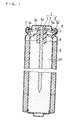
- FIG. 1 is a vertical sectional view illustrating one embodiment of an alkaline dry battery in accordance with the present invention.
- FIG. 1 is a vertical sectional view illustrating one embodiment of an alkaline dry battery in accordance with the present invention.
- An alkaline dry battery of the present embodiment comprises a metal case 1 which functions as a positive electrode terminal, and an assembled sealing plate 2 for sealing the opening of the metal case 1.
- the assembled sealing plate 2 comprises a disc-like negative electrode terminal plate 3 having a brim-like peripheral end 3a, a nail-like negative electrode current collector 4 electrically connected to the inner bottom 3b of the negative electrode terminal plate 3 at the flat top 4a, and a sealing body 5.
- the sealing body 5 comprises a central cylindrical portion 5a having a through hole into which the negative electrode current collector 4 is inserted, and an outer ring portion 5b pinched between the brim-like peripheral end of the negative electrode terminal plate and the opening end of the metal case.
- a concave groove portion is formed, and a metal base material 6 is fitted in the groove portion.
- grease 7 is disposed as a sealant between the opening end of the metal case 1 and the peripheral end of the outer ring portion 5b of the sealing body 5.
- the metal case 1 contains, as power generating elements, a hollow cylindrical positive electrode material mixture 8 disposed so as to be in contact with the inner wall of the metal case 1, a closed-bottomed cylindrical separator 9 disposed so as to be in contact with the inner wall of the positive electrode material mixture 8, a gel negative electrode 10 filled inside the separator 9, and an alkaline electrolyte (not shown).
- the negative electrode terminal plate 3 As the metal case 1, the negative electrode terminal plate 3, the negative electrode current collecting 4, the sealing body 5 and the metal base material 6, those known in the art can be used.
- the separator 9, the gel negative electrode 10 and the alkaline electrolyte which are the power generating elements housed in the metal case 1, those known in the art can be used.
- the positive electrode material mixture 8 for example, a mixture of manganese dioxide serving as a positive electrode active material and graphite serving as a conductive material, or the like, can be used.
- the separator 9 a non-woven fabric obtained by mixing of mainly a polyvinyl alcohol fiber and a rayon fiber, or the like, can be used.
- the gel negative electrode 10 a mixture of a zinc powder serving as a negative electrode active material, sodium polyacrylate serving as a gelling agent and an aqueous potassium hydroxide solution serving as the alkaline electrolyte, or the like, can be used.
- Grease to be used in the present invention needs to have the function of preventing creeping of the alkaline electrolyte due to capillarity, and a favorable pumpability (flowability when the grease flows through a tube, a nozzle and the like during the supply thereof).
- the grease can be applied uniformly by adjusting the worked penetration thereof a predetermined range which is preferable. Meanwhile, the resistance to an alkaline electrolyte can be controlled by varying the kind and amount of a base oil and a thickener, which constitute the grease.
- the base oil for use in obtaining grease with a favorable worked penetration and a favorable resistance to an alkaline electrolyte, may be exemplified by a diester oil and a silicone oil.
- the thickener may be exemplified by metal soaps (e.g. a castor oil based calcium soap, a castor oil based aluminum soap, a castor oil based lithium soap), complex soaps (e.g. a complex calcium soap, a complex aluminum soap, a complex lithium soap), diurea compounds (e.g. aromatic diurea, aliphatic diurea, alicyclic diurea), and organic compounds (e.g. polytetrafluoroethylene (PTFE) and sodium terephthalamate).
- metal soaps e.g. a castor oil based calcium soap, a castor oil based aluminum soap, a castor oil based lithium soap
- complex soaps e.g. a complex calcium soap, a complex aluminum soap, a complex lithium soap
- Examples of the diester oil may include polyethylene glycol distearate, octyl stearate, octyl palmitate, isopropyl palmitate, and glycerol tri-2-ethyl hexanoate.
- examples of the silicone oil may include a dimetyl silicone oil, a methyl phenyl silicone oil, and a methyl hydrogen silicone oil.
- the productivity deteriorates when the grease has a poor pumpability in application on the metal case although the uniform application of the grease on the metal case is possible.
- the grease have a worked penetration (ASTM D217 or JIS K2220) of from 175 to 475, preferably from 265 to 475.
- the worked penetration is arbitrarily adjustable by varying the kinds of the base oil and the thickener, a mixing ratio of the base oil and the thickener, and the like. It is to be noted that the mixing ratio of the base oil and the thickener is preferably from 98:2 to 80:20, and more preferably from 98:2 to 90:10.
- the pumpability becomes insufficient and the uniform application of the grease on the metal case becomes difficult, thereby decreasing the function of preventing the creeping of the alkaline electrolyte.
- the worked penetration exceeds 475, the flowability increases to cause the grease to drip off from a nozzle or an amount of the grease applied to vary, thereby deteriorating the productivity.
- a worked penetration expresses apparent hardness of grease.
- a worked penetration is obtained by reciprocating a stirrer 60 times while keeping grease at 25°C in a predetermined mixing device, immediately followed by measurement of the depth of a predetermined cone having entered into the grease by means of a cone penetrometer, and then decupling the obtained depth value (expressed by the "mm” unit).
- a worked penetration can be measured according to "JIS K2220".
- a sample is prepared according to JIS K2220, and thereafter, a cone held by a holding fixture (total weight of the cone and the holding fixture: 148 g) is vertically penetrated into the sample from the sample surface having been made flat, in a cone penetrometer for 5 seconds. Subsequently, the depth of penetration of the cone is measured and the obtained value is decupled. Such a measurement is repeated three times and the obtained values are averaged to determine a worked penetration.
- a dry battery as illustrated in FIG. 1 was fabricated.
- a hollow cylindrical positive electrode material mixture 8 was inserted into an iron-made metal case 1 serving as a positive electrode terminal, and then molded using a pressurizing jig to be brought into close contact with the inner wall of the metal case 1.
- a closed-bottomed separator 9 was disposed so as to be in contact with the positive electrode material mixture 8, and a predetermined amount of an alkaline electrolyte was poured inside the separator 9. Thereafter, a gel negative electrode 10 was filled inside the separator 9.
- grease comprising a diester oil as a base oil and a lithium soap as a thickener was applied on the opening end of the metal case 1.
- the worked penetrations of the greases are adjusted by the mixing ratio of diester oil, lithium soap, and the like.
- greases having seven kinds of worked penetrations of No. 000 to 4 according to JIS classification which are in the range of 175 to 475, as shown in Table 1. It is to be noted that, for example, grease having an actual worked penetration of 191 can be regarded as being equivalent to grease of No. 4 according to the JIS classification (worked penetration of from 175 to 205), that is, greases having a worked penetration of from 175 to 205 can be regarded as having the equivalent property.
- Table 1 also shows actual worked penetrations of the greases used.
- polyethylene glycol distearate was used as the diester oil
- a castor oil based lithium soap was used as the lithium soap.
- the larger the worked penetration the smaller the hardness.
- the respective mixing ratios (weight ratios) of polyethylene glycol distearate and the castor oil based lithium soap, which constituted the grease were 98:2, 96:4, 94:6, 92:8, 90:10, 85:15 and 80:20.
- the grease was produced by mixed the base oil with the thickener, and cooling the obtained mixture at a predetermined rate.
- batteries respectively comprising greases with worked penetrations of No. 5 and 6 according to JIS classification, which are in the range of 160 to 85, were fabricated in the same manner as above and referred to as Comparative Batteries A and B.
- the respective mixing ratios (weight ratios) of polyethylene glycol distearate and the castor oil based lithium soap, which constituted the grease, in Comparative Examples A and B were 80:20. It should be noted that when the worked penetration is not higher than 175, the worked penetration also varies depending on the cooling rate at which the mixture is cooled. Namely, when the cooling rate is slowed, the worked penetration decreases and the grease becomes harder.
- the grease to be used in Comparative Battery A was produced using a slower cooling rate than the cooling rate to be used for production of the grease for use in Battery 7.
- the grease to be used in Comparative Battery B was produced using a slower cooling rate than the cooling rate to be used for production of the grease for use in Comparative Battery A.
- An AA alkaline dry battery was fabricated in the same manner as Example 1, except that blown asphalt was used as the sealant in place of the grease; the blown asphalt was dissolved in toluene and the resultant solution was applied on the iron-made metal case, followed by evaporation of toluene, to form a sealant film.
- the alkaline dry battery as thus fabricated was referred to as Comparative Battery C.
- 100 articles of Comparative Battery C were stored under conditions of a temperature of 45°C and a humidity of 90%RH, and the number of batteries in which liquid leakage had occurred was counted. The obtained results are shown in Table 2.
- Comp.Battery C (conventional battery) 0/100 0/100 0/100 Battery 1 0/100 0/100 0/100 Battery 2 0/100 0/100 0/100 Battery 3 0/100 0/100 0/100 Battery 4 0/100 0/100 0/100 Battery 5 0/100 0/100 0/100 Battery 6 0/100 0/100 0/100 Battery 7 0/100 0/100 0/100 0/100 Comp.Battery A 0/100 1/100 5/100 Comp.Battery B 0/100 3/100 10/100
- Batteries 1 to 7 exhibited the same level of liquid-leakage resistance property as that of the conventional battery (Comparative Battery C). As for each of Batteries 6 and 7, although the productivity slightly decreases due to the grease having the low worked penetration and high viscosity, a predetermined liquid-leakage resistance property is satisfied. It can thereby be understood that a worked penetration of grease needs to be from 175 to 475. In particular, a preferable worked penetration of grease is from 265 to 475 so as to prevent a decrease in productivity of the alkaline dry battery.
- grease comprising a silicone oil as the base oil, and another metal soap, a diurea compound (e.g. aromatic diurea, aliphatic diurea, alicyclic diurea), or an organic compound (e.g. polytetrafluoroethylene (PTFE) and sodium terephthalamate), as the thickener, has the same level of the liquid-leakage resistance property as that of the conventional sealing body by making the range of the worked penetration of the grease from 175 to 475; the grease has a lowered liquid-leakage resistance property when the worked penetration thereof is below 175.
- a diurea compound e.g. aromatic diurea, aliphatic diurea, alicyclic diurea
- organic compound e.g. polytetrafluoroethylene (PTFE) and sodium terephthalamate
- an alkaline dry battery using, as a sealant, grease with a worked penetration of from 175 to 475 exhibits an excellent liquid-leakage resistance property and has no problem with the productivity.
- the use of grease having a worked penetration of from 175 to 475, preferably 265 to 475 allows fabrication of an alkaline dry battery excellent in liquid-leakage resistance property.
- the sealant has an excellent pumpability when applied on a metal case by means of an application device, even without dilution of the sealant with an organic solvent before the application.
- the use of predetermined grease eliminates the need for using an organic solvent during fabrication of an alkaline dry battery, and the productivity of the battery is excellent. Furthermore, according to the present invention, it is possible to provide a battery excellent in liquid-leakage resistance property by the use of the above grease.
Landscapes
- Chemical & Material Sciences (AREA)
- Chemical Kinetics & Catalysis (AREA)
- Electrochemistry (AREA)
- General Chemical & Material Sciences (AREA)
- Engineering & Computer Science (AREA)
- Inorganic Chemistry (AREA)
- Manufacturing & Machinery (AREA)
- Composite Materials (AREA)
- Materials Engineering (AREA)
- Sealing Battery Cases Or Jackets (AREA)
- Primary Cells (AREA)
Applications Claiming Priority (2)
| Application Number | Priority Date | Filing Date | Title |
|---|---|---|---|
| JP2003331806 | 2003-09-24 | ||
| JP2003331806A JP2005100761A (ja) | 2003-09-24 | 2003-09-24 | アルカリ乾電池 |
Publications (2)
| Publication Number | Publication Date |
|---|---|
| EP1519429A2 true EP1519429A2 (de) | 2005-03-30 |
| EP1519429A3 EP1519429A3 (de) | 2007-10-17 |
Family
ID=34191455
Family Applications (1)
| Application Number | Title | Priority Date | Filing Date |
|---|---|---|---|
| EP04255849A Withdrawn EP1519429A3 (de) | 2003-09-24 | 2004-09-24 | Alkalin-Trockenbatterie |
Country Status (3)
| Country | Link |
|---|---|
| US (1) | US20050064284A1 (de) |
| EP (1) | EP1519429A3 (de) |
| JP (1) | JP2005100761A (de) |
Families Citing this family (3)
| Publication number | Priority date | Publication date | Assignee | Title |
|---|---|---|---|---|
| JP4713550B2 (ja) * | 2007-08-02 | 2011-06-29 | パナソニック株式会社 | アルカリ乾電池および電池パック |
| KR101693294B1 (ko) * | 2013-01-21 | 2017-01-05 | 삼성에스디아이 주식회사 | 이차 전지 |
| AU2021273919A1 (en) | 2020-05-22 | 2022-10-06 | Duracell U.S. Operations, Inc. | Seal assembly for a battery cell |
Family Cites Families (15)
| Publication number | Priority date | Publication date | Assignee | Title |
|---|---|---|---|---|
| US3493513A (en) * | 1969-06-18 | 1970-02-03 | Dilectrix Corp Of Delaware | Lubricating composition comprising polytetrafluoroethylene |
| JPS5225132B2 (de) * | 1974-01-31 | 1977-07-06 | ||
| JPS5184038A (ja) * | 1975-01-20 | 1976-07-23 | Hitachi Maxell | Arukaridenchi |
| US4020241A (en) * | 1976-03-29 | 1977-04-26 | Union Carbide Corporation | Galvanic cell having a resealable vent closure |
| JPS53143938A (en) * | 1977-05-20 | 1978-12-14 | Japan Storage Battery Co Ltd | Battery |
| JPS5743358A (en) * | 1980-08-27 | 1982-03-11 | Toshiba Battery Co Ltd | Alkaline battery |
| US4331748A (en) * | 1980-12-03 | 1982-05-25 | Hardigg Industries, Inc. | Sliding seal battery cover |
| JPS62154555A (ja) * | 1985-12-27 | 1987-07-09 | Nippon Petrochem Co Ltd | 電池 |
| JPH0644021U (ja) * | 1992-11-09 | 1994-06-10 | 株式会社ユアサコーポレーション | 鉛蓄電池 |
| JPH0955195A (ja) * | 1994-11-24 | 1997-02-25 | Fuji Elelctrochem Co Ltd | アルカリ電池 |
| JP3601120B2 (ja) * | 1995-07-25 | 2004-12-15 | 新神戸電機株式会社 | 密閉形蓄電池 |
| US5932371A (en) * | 1997-06-30 | 1999-08-03 | Eveready Battery Company, Inc. | Snap-through gasket for galvanic cells |
| US6589918B2 (en) * | 2000-06-22 | 2003-07-08 | Nsk Ltd. | Conductive grease and rolling apparatus packed with the same |
| JP4853935B2 (ja) * | 2000-09-01 | 2012-01-11 | 日立マクセルエナジー株式会社 | アルカリ乾電池 |
| AU2002223126A1 (en) * | 2000-11-17 | 2002-05-27 | Toshiba Battery Co., Ltd. | Enclosed nickel-zinc primary battery, its anode and production methods for them |
-
2003
- 2003-09-24 JP JP2003331806A patent/JP2005100761A/ja active Pending
-
2004
- 2004-09-21 US US10/944,776 patent/US20050064284A1/en not_active Abandoned
- 2004-09-24 EP EP04255849A patent/EP1519429A3/de not_active Withdrawn
Also Published As
| Publication number | Publication date |
|---|---|
| JP2005100761A (ja) | 2005-04-14 |
| EP1519429A3 (de) | 2007-10-17 |
| US20050064284A1 (en) | 2005-03-24 |
Similar Documents
| Publication | Publication Date | Title |
|---|---|---|
| US6280883B1 (en) | Bis (perfluoralkanesulfonyl)imide surfactant salts in electrochemical systems | |
| US8080336B2 (en) | Alkaline dry battery | |
| JP3708183B2 (ja) | 有機電解液電池 | |
| EP1287578B1 (de) | Luftzelle ohne quecksilber | |
| JP2002530812A5 (de) | ||
| JP2008288079A (ja) | 無水銀アルカリ乾電池 | |
| CA2126071A1 (en) | Low mercury or mercury free alkaline manganese dioxide-zinc cell | |
| CN1993848A (zh) | 用于电化学能源装置的非水电解溶液 | |
| US4329405A (en) | Electrochemical cell having a safety vent closure | |
| US20190204194A1 (en) | Apparatus to measure mechanical properties of electrodes during electrochemical reactions and method of using the same | |
| EP1519429A2 (de) | Alkalin-Trockenbatterie | |
| US20060183020A1 (en) | Sealing assembly for electrochemical cell | |
| US9040196B2 (en) | Alkaline primary battery | |
| US8338023B2 (en) | AA alkaline battery | |
| US4437231A (en) | Method of making an electrochemical cell having a safety vent closure | |
| US3981748A (en) | Non-aqueous, primary battery having a blended cathode active material | |
| CN1371141A (zh) | 一种含锂加成化合物的锂离子电解质 | |
| JP2017069097A (ja) | アルカリ電池 | |
| JPS5919414B2 (ja) | 非水電解液電池の製造方法 | |
| JP7117574B2 (ja) | アルカリ乾電池 | |
| CN106784650A (zh) | 一种新型快充电长寿命镍氢电池 | |
| JP2017068905A (ja) | アルカリ電池用正極合剤およびインサイドアウト型アルカリ電池 | |
| JP2005019349A (ja) | 亜鉛アルカリ電池 | |
| JPH07122248A (ja) | 筒形アルカリ電池 | |
| JPH0357003Y2 (de) |
Legal Events
| Date | Code | Title | Description |
|---|---|---|---|
| PUAI | Public reference made under article 153(3) epc to a published international application that has entered the european phase |
Free format text: ORIGINAL CODE: 0009012 |
|
| AK | Designated contracting states |
Kind code of ref document: A2 Designated state(s): AT BE BG CH CY CZ DE DK EE ES FI FR GB GR HU IE IT LI LU MC NL PL PT RO SE SI SK TR |
|
| AX | Request for extension of the european patent |
Extension state: AL HR LT LV MK |
|
| PUAL | Search report despatched |
Free format text: ORIGINAL CODE: 0009013 |
|
| AK | Designated contracting states |
Kind code of ref document: A3 Designated state(s): AT BE BG CH CY CZ DE DK EE ES FI FR GB GR HU IE IT LI LU MC NL PL PT RO SE SI SK TR |
|
| AX | Request for extension of the european patent |
Extension state: AL HR LT LV MK |
|
| 17P | Request for examination filed |
Effective date: 20080215 |
|
| 17Q | First examination report despatched |
Effective date: 20080327 |
|
| AKX | Designation fees paid |
Designated state(s): BE DE FR GB IT |
|
| RAP1 | Party data changed (applicant data changed or rights of an application transferred) |
Owner name: PANASONIC CORPORATION |
|
| STAA | Information on the status of an ep patent application or granted ep patent |
Free format text: STATUS: THE APPLICATION IS DEEMED TO BE WITHDRAWN |
|
| 18D | Application deemed to be withdrawn |
Effective date: 20080729 |