EP1517985B1 - Procede de culture de micro-organismes et bioreacteur - Google Patents
Procede de culture de micro-organismes et bioreacteur Download PDFInfo
- Publication number
- EP1517985B1 EP1517985B1 EP03704654A EP03704654A EP1517985B1 EP 1517985 B1 EP1517985 B1 EP 1517985B1 EP 03704654 A EP03704654 A EP 03704654A EP 03704654 A EP03704654 A EP 03704654A EP 1517985 B1 EP1517985 B1 EP 1517985B1
- Authority
- EP
- European Patent Office
- Prior art keywords
- bed
- solid
- trickle
- bioreactor
- fluidized bed
- Prior art date
- Legal status (The legal status is an assumption and is not a legal conclusion. Google has not performed a legal analysis and makes no representation as to the accuracy of the status listed.)
- Expired - Lifetime
Links
- 244000005700 microbiome Species 0.000 title claims abstract description 33
- 238000012364 cultivation method Methods 0.000 title abstract description 5
- 238000000034 method Methods 0.000 claims abstract description 87
- 230000008569 process Effects 0.000 claims description 52
- 238000006243 chemical reaction Methods 0.000 claims description 38
- 102000004190 Enzymes Human genes 0.000 claims description 33
- 108090000790 Enzymes Proteins 0.000 claims description 33
- 239000000047 product Substances 0.000 claims description 27
- 239000000463 material Substances 0.000 claims description 23
- 239000007787 solid Substances 0.000 claims description 22
- XLYOFNOQVPJJNP-UHFFFAOYSA-N water Substances O XLYOFNOQVPJJNP-UHFFFAOYSA-N 0.000 claims description 21
- 239000012429 reaction media Substances 0.000 claims description 19
- 239000000758 substrate Substances 0.000 claims description 19
- 241000233866 Fungi Species 0.000 claims description 18
- 241000196324 Embryophyta Species 0.000 claims description 17
- 238000004519 manufacturing process Methods 0.000 claims description 15
- 235000015097 nutrients Nutrition 0.000 claims description 15
- 238000000926 separation method Methods 0.000 claims description 15
- 230000015556 catabolic process Effects 0.000 claims description 14
- 238000006731 degradation reaction Methods 0.000 claims description 14
- 238000005273 aeration Methods 0.000 claims description 11
- 229930000044 secondary metabolite Natural products 0.000 claims description 11
- 239000002351 wastewater Substances 0.000 claims description 11
- 239000000203 mixture Substances 0.000 claims description 10
- 239000002023 wood Substances 0.000 claims description 10
- 239000002245 particle Substances 0.000 claims description 9
- 239000000872 buffer Substances 0.000 claims description 8
- 239000011148 porous material Substances 0.000 claims description 8
- 238000000108 ultra-filtration Methods 0.000 claims description 8
- 239000002676 xenobiotic agent Substances 0.000 claims description 8
- 241001465754 Metazoa Species 0.000 claims description 7
- VYPSYNLAJGMNEJ-UHFFFAOYSA-N Silicium dioxide Chemical compound O=[Si]=O VYPSYNLAJGMNEJ-UHFFFAOYSA-N 0.000 claims description 7
- 239000007857 degradation product Substances 0.000 claims description 7
- 238000011049 filling Methods 0.000 claims description 7
- 238000012856 packing Methods 0.000 claims description 7
- 239000007795 chemical reaction product Substances 0.000 claims description 6
- 238000012258 culturing Methods 0.000 claims description 6
- 238000013341 scale-up Methods 0.000 claims description 6
- 239000000126 substance Substances 0.000 claims description 6
- 238000003786 synthesis reaction Methods 0.000 claims description 6
- 241000894006 Bacteria Species 0.000 claims description 5
- 238000011010 flushing procedure Methods 0.000 claims description 5
- 102000004169 proteins and genes Human genes 0.000 claims description 5
- 108090000623 proteins and genes Proteins 0.000 claims description 5
- 102000004157 Hydrolases Human genes 0.000 claims description 4
- 108090000604 Hydrolases Proteins 0.000 claims description 4
- 108090000854 Oxidoreductases Proteins 0.000 claims description 4
- 102000004316 Oxidoreductases Human genes 0.000 claims description 4
- 240000004808 Saccharomyces cerevisiae Species 0.000 claims description 4
- 239000011942 biocatalyst Substances 0.000 claims description 4
- 230000000694 effects Effects 0.000 claims description 4
- 239000011521 glass Substances 0.000 claims description 4
- 230000014759 maintenance of location Effects 0.000 claims description 4
- 238000005086 pumping Methods 0.000 claims description 4
- 238000000746 purification Methods 0.000 claims description 4
- 229930013930 alkaloid Natural products 0.000 claims description 3
- 239000000919 ceramic Substances 0.000 claims description 3
- 239000003245 coal Substances 0.000 claims description 3
- 238000001914 filtration Methods 0.000 claims description 3
- 239000003864 humus Substances 0.000 claims description 3
- 229910052500 inorganic mineral Inorganic materials 0.000 claims description 3
- 238000002955 isolation Methods 0.000 claims description 3
- 238000005259 measurement Methods 0.000 claims description 3
- 239000011707 mineral Substances 0.000 claims description 3
- 150000007524 organic acids Chemical class 0.000 claims description 3
- 235000005985 organic acids Nutrition 0.000 claims description 3
- 239000010815 organic waste Substances 0.000 claims description 3
- 239000000049 pigment Substances 0.000 claims description 3
- 239000004033 plastic Substances 0.000 claims description 3
- 229920003023 plastic Polymers 0.000 claims description 3
- 238000012545 processing Methods 0.000 claims description 3
- 239000000377 silicon dioxide Substances 0.000 claims description 3
- 239000002893 slag Substances 0.000 claims description 3
- XJLXINKUBYWONI-NNYOXOHSSA-O NADP(+) Chemical compound NC(=O)C1=CC=C[N+]([C@H]2[C@@H]([C@H](O)[C@@H](COP(O)(=O)OP(O)(=O)OC[C@@H]3[C@H]([C@@H](OP(O)(O)=O)[C@@H](O3)N3C4=NC=NC(N)=C4N=C3)O)O2)O)=C1 XJLXINKUBYWONI-NNYOXOHSSA-O 0.000 claims description 2
- 150000001298 alcohols Chemical class 0.000 claims description 2
- 150000001299 aldehydes Chemical class 0.000 claims description 2
- 238000004587 chromatography analysis Methods 0.000 claims description 2
- 230000006872 improvement Effects 0.000 claims description 2
- 239000000543 intermediate Substances 0.000 claims description 2
- 150000002576 ketones Chemical class 0.000 claims description 2
- 238000011218 seed culture Methods 0.000 claims description 2
- AYEKOFBPNLCAJY-UHFFFAOYSA-O thiamine pyrophosphate Chemical compound CC1=C(CCOP(O)(=O)OP(O)(O)=O)SC=[N+]1CC1=CN=C(C)N=C1N AYEKOFBPNLCAJY-UHFFFAOYSA-O 0.000 claims description 2
- 238000005406 washing Methods 0.000 claims description 2
- 238000011112 process operation Methods 0.000 claims 16
- 238000012544 monitoring process Methods 0.000 claims 2
- 230000001473 noxious effect Effects 0.000 claims 2
- 239000003610 charcoal Substances 0.000 claims 1
- 230000003247 decreasing effect Effects 0.000 claims 1
- 239000000796 flavoring agent Substances 0.000 claims 1
- 235000013355 food flavoring agent Nutrition 0.000 claims 1
- 230000002503 metabolic effect Effects 0.000 claims 1
- 238000003825 pressing Methods 0.000 claims 1
- 239000007788 liquid Substances 0.000 description 22
- 239000000243 solution Substances 0.000 description 22
- 230000000903 blocking effect Effects 0.000 description 12
- 238000009423 ventilation Methods 0.000 description 12
- KRKNYBCHXYNGOX-UHFFFAOYSA-N citric acid Chemical compound OC(=O)CC(O)(C(O)=O)CC(O)=O KRKNYBCHXYNGOX-UHFFFAOYSA-N 0.000 description 9
- 239000002028 Biomass Substances 0.000 description 8
- 239000012530 fluid Substances 0.000 description 8
- 239000007789 gas Substances 0.000 description 8
- 238000004140 cleaning Methods 0.000 description 7
- 238000003860 storage Methods 0.000 description 7
- 239000000969 carrier Substances 0.000 description 6
- 239000010408 film Substances 0.000 description 6
- 239000002054 inoculum Substances 0.000 description 5
- 238000003973 irrigation Methods 0.000 description 5
- 230000002262 irrigation Effects 0.000 description 5
- HEMHJVSKTPXQMS-UHFFFAOYSA-M sodium hydroxide Inorganic materials [OH-].[Na+] HEMHJVSKTPXQMS-UHFFFAOYSA-M 0.000 description 5
- OKTJSMMVPCPJKN-UHFFFAOYSA-N Carbon Chemical compound [C] OKTJSMMVPCPJKN-UHFFFAOYSA-N 0.000 description 4
- 108010029541 Laccase Proteins 0.000 description 4
- 108010059896 Manganese peroxidase Proteins 0.000 description 4
- 239000003344 environmental pollutant Substances 0.000 description 4
- 238000003306 harvesting Methods 0.000 description 4
- 238000010979 pH adjustment Methods 0.000 description 4
- 231100000719 pollutant Toxicity 0.000 description 4
- 229920002635 polyurethane Polymers 0.000 description 4
- 239000004814 polyurethane Substances 0.000 description 4
- WQZGKKKJIJFFOK-GASJEMHNSA-N Glucose Natural products OC[C@H]1OC(O)[C@H](O)[C@@H](O)[C@@H]1O WQZGKKKJIJFFOK-GASJEMHNSA-N 0.000 description 3
- 239000002253 acid Substances 0.000 description 3
- 238000010586 diagram Methods 0.000 description 3
- 238000004401 flow injection analysis Methods 0.000 description 3
- 239000008103 glucose Substances 0.000 description 3
- 239000002207 metabolite Substances 0.000 description 3
- 238000002156 mixing Methods 0.000 description 3
- 235000018102 proteins Nutrition 0.000 description 3
- 238000010926 purge Methods 0.000 description 3
- 238000010008 shearing Methods 0.000 description 3
- IJGRMHOSHXDMSA-UHFFFAOYSA-N Atomic nitrogen Chemical compound N#N IJGRMHOSHXDMSA-UHFFFAOYSA-N 0.000 description 2
- LFQSCWFLJHTTHZ-UHFFFAOYSA-N Ethanol Chemical compound CCO LFQSCWFLJHTTHZ-UHFFFAOYSA-N 0.000 description 2
- 102000004882 Lipase Human genes 0.000 description 2
- 108090001060 Lipase Proteins 0.000 description 2
- FAPWRFPIFSIZLT-UHFFFAOYSA-M Sodium chloride Chemical compound [Na+].[Cl-] FAPWRFPIFSIZLT-UHFFFAOYSA-M 0.000 description 2
- PPBRXRYQALVLMV-UHFFFAOYSA-N Styrene Chemical compound C=CC1=CC=CC=C1 PPBRXRYQALVLMV-UHFFFAOYSA-N 0.000 description 2
- 241000222355 Trametes versicolor Species 0.000 description 2
- 238000004887 air purification Methods 0.000 description 2
- 238000004458 analytical method Methods 0.000 description 2
- 238000010923 batch production Methods 0.000 description 2
- 239000007853 buffer solution Substances 0.000 description 2
- 239000012295 chemical reaction liquid Substances 0.000 description 2
- 238000004132 cross linking Methods 0.000 description 2
- 238000012136 culture method Methods 0.000 description 2
- 238000000605 extraction Methods 0.000 description 2
- 239000000945 filler Substances 0.000 description 2
- 239000012535 impurity Substances 0.000 description 2
- 230000002479 lignolytic effect Effects 0.000 description 2
- 239000000523 sample Substances 0.000 description 2
- 238000011146 sterile filtration Methods 0.000 description 2
- 238000003756 stirring Methods 0.000 description 2
- 238000012546 transfer Methods 0.000 description 2
- 238000004065 wastewater treatment Methods 0.000 description 2
- 241000235349 Ascomycota Species 0.000 description 1
- DCXYFEDJOCDNAF-UHFFFAOYSA-N Asparagine Natural products OC(=O)C(N)CC(N)=O DCXYFEDJOCDNAF-UHFFFAOYSA-N 0.000 description 1
- 241000228212 Aspergillus Species 0.000 description 1
- 241000228245 Aspergillus niger Species 0.000 description 1
- 240000006439 Aspergillus oryzae Species 0.000 description 1
- 235000002247 Aspergillus oryzae Nutrition 0.000 description 1
- KRKNYBCHXYNGOX-UHFFFAOYSA-K Citrate Chemical compound [O-]C(=O)CC(O)(CC([O-])=O)C([O-])=O KRKNYBCHXYNGOX-UHFFFAOYSA-K 0.000 description 1
- 206010010774 Constipation Diseases 0.000 description 1
- JOYRKODLDBILNP-UHFFFAOYSA-N Ethyl urethane Chemical compound CCOC(N)=O JOYRKODLDBILNP-UHFFFAOYSA-N 0.000 description 1
- 238000012369 In process control Methods 0.000 description 1
- DCXYFEDJOCDNAF-REOHCLBHSA-N L-asparagine Chemical compound OC(=O)[C@@H](N)CC(N)=O DCXYFEDJOCDNAF-REOHCLBHSA-N 0.000 description 1
- 239000004367 Lipase Substances 0.000 description 1
- 231100000678 Mycotoxin Toxicity 0.000 description 1
- 208000012868 Overgrowth Diseases 0.000 description 1
- 241000228150 Penicillium chrysogenum Species 0.000 description 1
- 239000001888 Peptone Substances 0.000 description 1
- 108010080698 Peptones Proteins 0.000 description 1
- 241000222393 Phanerochaete chrysosporium Species 0.000 description 1
- 241000222354 Trametes Species 0.000 description 1
- 102000004357 Transferases Human genes 0.000 description 1
- 108090000992 Transferases Proteins 0.000 description 1
- 230000009471 action Effects 0.000 description 1
- 230000000274 adsorptive effect Effects 0.000 description 1
- 229920000615 alginic acid Polymers 0.000 description 1
- 235000010443 alginic acid Nutrition 0.000 description 1
- 238000004873 anchoring Methods 0.000 description 1
- 239000003242 anti bacterial agent Substances 0.000 description 1
- 229940088710 antibiotic agent Drugs 0.000 description 1
- 229960001230 asparagine Drugs 0.000 description 1
- 235000009582 asparagine Nutrition 0.000 description 1
- QVGXLLKOCUKJST-UHFFFAOYSA-N atomic oxygen Chemical compound [O] QVGXLLKOCUKJST-UHFFFAOYSA-N 0.000 description 1
- 230000008901 benefit Effects 0.000 description 1
- 239000010796 biological waste Substances 0.000 description 1
- 229920001222 biopolymer Polymers 0.000 description 1
- 230000015572 biosynthetic process Effects 0.000 description 1
- 229940041514 candida albicans extract Drugs 0.000 description 1
- 239000012876 carrier material Substances 0.000 description 1
- 230000008859 change Effects 0.000 description 1
- 230000005465 channeling Effects 0.000 description 1
- 239000005515 coenzyme Substances 0.000 description 1
- 238000010276 construction Methods 0.000 description 1
- 239000000356 contaminant Substances 0.000 description 1
- 238000011109 contamination Methods 0.000 description 1
- 238000010924 continuous production Methods 0.000 description 1
- 238000007334 copolymerization reaction Methods 0.000 description 1
- 230000006735 deficit Effects 0.000 description 1
- 230000003111 delayed effect Effects 0.000 description 1
- 238000013461 design Methods 0.000 description 1
- 238000011161 development Methods 0.000 description 1
- 230000018109 developmental process Effects 0.000 description 1
- 230000035622 drinking Effects 0.000 description 1
- 239000003651 drinking water Substances 0.000 description 1
- 238000001035 drying Methods 0.000 description 1
- 239000011552 falling film Substances 0.000 description 1
- 230000002349 favourable effect Effects 0.000 description 1
- 238000000855 fermentation Methods 0.000 description 1
- 230000004151 fermentation Effects 0.000 description 1
- 239000000835 fiber Substances 0.000 description 1
- 230000002538 fungal effect Effects 0.000 description 1
- 150000004676 glycans Chemical class 0.000 description 1
- 230000005484 gravity Effects 0.000 description 1
- 238000005984 hydrogenation reaction Methods 0.000 description 1
- 238000010965 in-process control Methods 0.000 description 1
- 238000002347 injection Methods 0.000 description 1
- 239000007924 injection Substances 0.000 description 1
- 238000009434 installation Methods 0.000 description 1
- 238000005304 joining Methods 0.000 description 1
- 239000002655 kraft paper Substances 0.000 description 1
- 235000019421 lipase Nutrition 0.000 description 1
- 150000002632 lipids Chemical class 0.000 description 1
- 238000004811 liquid chromatography Methods 0.000 description 1
- 239000011159 matrix material Substances 0.000 description 1
- 230000004060 metabolic process Effects 0.000 description 1
- 239000011859 microparticle Substances 0.000 description 1
- 238000005065 mining Methods 0.000 description 1
- 239000002636 mycotoxin Substances 0.000 description 1
- 229910052757 nitrogen Inorganic materials 0.000 description 1
- 239000004006 olive oil Substances 0.000 description 1
- 235000008390 olive oil Nutrition 0.000 description 1
- 239000001301 oxygen Substances 0.000 description 1
- 229910052760 oxygen Inorganic materials 0.000 description 1
- 229910001562 pearlite Inorganic materials 0.000 description 1
- 235000019319 peptone Nutrition 0.000 description 1
- 239000010451 perlite Substances 0.000 description 1
- 235000019362 perlite Nutrition 0.000 description 1
- 239000008363 phosphate buffer Substances 0.000 description 1
- 229920001282 polysaccharide Polymers 0.000 description 1
- 239000005017 polysaccharide Substances 0.000 description 1
- 238000011045 prefiltration Methods 0.000 description 1
- 238000002203 pretreatment Methods 0.000 description 1
- 238000004886 process control Methods 0.000 description 1
- 238000011084 recovery Methods 0.000 description 1
- 230000000630 rising effect Effects 0.000 description 1
- 238000005070 sampling Methods 0.000 description 1
- 230000003248 secreting effect Effects 0.000 description 1
- 238000004062 sedimentation Methods 0.000 description 1
- 230000011218 segmentation Effects 0.000 description 1
- 239000010865 sewage Substances 0.000 description 1
- 239000011780 sodium chloride Substances 0.000 description 1
- 239000011122 softwood Substances 0.000 description 1
- 239000002904 solvent Substances 0.000 description 1
- 239000003549 soybean oil Substances 0.000 description 1
- 235000012424 soybean oil Nutrition 0.000 description 1
- 241000894007 species Species 0.000 description 1
- 239000000725 suspension Substances 0.000 description 1
- 238000013022 venting Methods 0.000 description 1
- 239000002912 waste gas Substances 0.000 description 1
- 239000012138 yeast extract Substances 0.000 description 1
Images


Classifications
-
- B—PERFORMING OPERATIONS; TRANSPORTING
- B01—PHYSICAL OR CHEMICAL PROCESSES OR APPARATUS IN GENERAL
- B01D—SEPARATION
- B01D53/00—Separation of gases or vapours; Recovering vapours of volatile solvents from gases; Chemical or biological purification of waste gases, e.g. engine exhaust gases, smoke, fumes, flue gases, aerosols
- B01D53/34—Chemical or biological purification of waste gases
- B01D53/74—General processes for purification of waste gases; Apparatus or devices specially adapted therefor
- B01D53/84—Biological processes
-
- C—CHEMISTRY; METALLURGY
- C12—BIOCHEMISTRY; BEER; SPIRITS; WINE; VINEGAR; MICROBIOLOGY; ENZYMOLOGY; MUTATION OR GENETIC ENGINEERING
- C12M—APPARATUS FOR ENZYMOLOGY OR MICROBIOLOGY; APPARATUS FOR CULTURING MICROORGANISMS FOR PRODUCING BIOMASS, FOR GROWING CELLS OR FOR OBTAINING FERMENTATION OR METABOLIC PRODUCTS, i.e. BIOREACTORS OR FERMENTERS
- C12M21/00—Bioreactors or fermenters specially adapted for specific uses
- C12M21/18—Apparatus specially designed for the use of free, immobilized or carrier-bound enzymes
-
- C—CHEMISTRY; METALLURGY
- C12—BIOCHEMISTRY; BEER; SPIRITS; WINE; VINEGAR; MICROBIOLOGY; ENZYMOLOGY; MUTATION OR GENETIC ENGINEERING
- C12M—APPARATUS FOR ENZYMOLOGY OR MICROBIOLOGY; APPARATUS FOR CULTURING MICROORGANISMS FOR PRODUCING BIOMASS, FOR GROWING CELLS OR FOR OBTAINING FERMENTATION OR METABOLIC PRODUCTS, i.e. BIOREACTORS OR FERMENTERS
- C12M25/00—Means for supporting, enclosing or fixing the microorganisms, e.g. immunocoatings
- C12M25/16—Particles; Beads; Granular material; Encapsulation
- C12M25/18—Fixed or packed bed
-
- C—CHEMISTRY; METALLURGY
- C12—BIOCHEMISTRY; BEER; SPIRITS; WINE; VINEGAR; MICROBIOLOGY; ENZYMOLOGY; MUTATION OR GENETIC ENGINEERING
- C12M—APPARATUS FOR ENZYMOLOGY OR MICROBIOLOGY; APPARATUS FOR CULTURING MICROORGANISMS FOR PRODUCING BIOMASS, FOR GROWING CELLS OR FOR OBTAINING FERMENTATION OR METABOLIC PRODUCTS, i.e. BIOREACTORS OR FERMENTERS
- C12M25/00—Means for supporting, enclosing or fixing the microorganisms, e.g. immunocoatings
- C12M25/16—Particles; Beads; Granular material; Encapsulation
- C12M25/20—Fluidized bed
-
- C—CHEMISTRY; METALLURGY
- C12—BIOCHEMISTRY; BEER; SPIRITS; WINE; VINEGAR; MICROBIOLOGY; ENZYMOLOGY; MUTATION OR GENETIC ENGINEERING
- C12M—APPARATUS FOR ENZYMOLOGY OR MICROBIOLOGY; APPARATUS FOR CULTURING MICROORGANISMS FOR PRODUCING BIOMASS, FOR GROWING CELLS OR FOR OBTAINING FERMENTATION OR METABOLIC PRODUCTS, i.e. BIOREACTORS OR FERMENTERS
- C12M41/00—Means for regulation, monitoring, measurement or control, e.g. flow regulation
- C12M41/30—Means for regulation, monitoring, measurement or control, e.g. flow regulation of concentration
- C12M41/36—Means for regulation, monitoring, measurement or control, e.g. flow regulation of concentration of biomass, e.g. colony counters or by turbidity measurements
-
- C—CHEMISTRY; METALLURGY
- C12—BIOCHEMISTRY; BEER; SPIRITS; WINE; VINEGAR; MICROBIOLOGY; ENZYMOLOGY; MUTATION OR GENETIC ENGINEERING
- C12M—APPARATUS FOR ENZYMOLOGY OR MICROBIOLOGY; APPARATUS FOR CULTURING MICROORGANISMS FOR PRODUCING BIOMASS, FOR GROWING CELLS OR FOR OBTAINING FERMENTATION OR METABOLIC PRODUCTS, i.e. BIOREACTORS OR FERMENTERS
- C12M41/00—Means for regulation, monitoring, measurement or control, e.g. flow regulation
- C12M41/40—Means for regulation, monitoring, measurement or control, e.g. flow regulation of pressure
-
- C—CHEMISTRY; METALLURGY
- C02—TREATMENT OF WATER, WASTE WATER, SEWAGE, OR SLUDGE
- C02F—TREATMENT OF WATER, WASTE WATER, SEWAGE, OR SLUDGE
- C02F3/00—Biological treatment of water, waste water, or sewage
- C02F3/02—Aerobic processes
- C02F3/04—Aerobic processes using trickle filters
-
- Y—GENERAL TAGGING OF NEW TECHNOLOGICAL DEVELOPMENTS; GENERAL TAGGING OF CROSS-SECTIONAL TECHNOLOGIES SPANNING OVER SEVERAL SECTIONS OF THE IPC; TECHNICAL SUBJECTS COVERED BY FORMER USPC CROSS-REFERENCE ART COLLECTIONS [XRACs] AND DIGESTS
- Y02—TECHNOLOGIES OR APPLICATIONS FOR MITIGATION OR ADAPTATION AGAINST CLIMATE CHANGE
- Y02A—TECHNOLOGIES FOR ADAPTATION TO CLIMATE CHANGE
- Y02A50/00—TECHNOLOGIES FOR ADAPTATION TO CLIMATE CHANGE in human health protection, e.g. against extreme weather
- Y02A50/20—Air quality improvement or preservation, e.g. vehicle emission control or emission reduction by using catalytic converters
-
- Y—GENERAL TAGGING OF NEW TECHNOLOGICAL DEVELOPMENTS; GENERAL TAGGING OF CROSS-SECTIONAL TECHNOLOGIES SPANNING OVER SEVERAL SECTIONS OF THE IPC; TECHNICAL SUBJECTS COVERED BY FORMER USPC CROSS-REFERENCE ART COLLECTIONS [XRACs] AND DIGESTS
- Y02—TECHNOLOGIES OR APPLICATIONS FOR MITIGATION OR ADAPTATION AGAINST CLIMATE CHANGE
- Y02W—CLIMATE CHANGE MITIGATION TECHNOLOGIES RELATED TO WASTEWATER TREATMENT OR WASTE MANAGEMENT
- Y02W10/00—Technologies for wastewater treatment
- Y02W10/10—Biological treatment of water, waste water, or sewage
Definitions
- the invention relates to a cultivation method for microorganisms and a bioreactor suitable for this purpose.
- the principle of the trickle bed process is combined with that of the fluidized bed process and a completely new cultivation principle with the aid of this bioreactor type is provided.
- trickle film process e.g. biological wastewater treatment, biological waste air purification and application for hydrogenation, etc. and the fluidized bed process (sometimes referred to as fluidized bed process), z.
- biological wastewater treatment biological waste air purification and application for hydrogenation, etc.
- fluidized bed process sometimes referred to as fluidized bed process
- DE 19608805 describes a process which describes a loosening by means of screw stirring and flooding, wherein the stirring time is between 5 and a maximum of 60 minutes and the rotational speed is between 3 and a maximum of 30 rpm. At the same time, a water flow of at least 0.05 m 3 per m 2 and hour up to a maximum of 5 m 3 per m 2 and hour is used for flooding the reactor space.
- the duration and strength of the shear forces generated in the above-mentioned processes for loosening up the packed bed may be sufficient for specific applications (waste gas purification primarily with the aid of bacteria), but this is not generally the case.
- the biotechnological use of some filamentous fungi in trickle bed processes not only leads to overgrowth of the microparticles, but also - due to the formation of hyphae - to cross-linking of the particles with one another, whereby the degree of blocking is substantially increased.
- the fluidized bed is externally gassed during the fluidized bed procedure and optionally additionally added at the beginning or during the fluidized bed procedure pressure gas pulses to loosen the packed bed. Above all, it prevents blocking of the corresponding crops in batch, fedbatch and above all continuous cultivation with long service life (as usually required for economic reasons).
- the bioreactor (2) according to the invention for growing microorganism cultures which is particularly suitable for carrying out the method according to the invention described above, has a reaction vessel.
- a fixed bed is arranged on a fixed bed support, such as a sieve or a grid.
- a trickle bed reactor for sprinkling the fixed bed with nutrient solution trickle nozzles are arranged.
- the trickle nozzles are preferably distributed regularly over the entire surface of the fixed bed.
- the bioreactor further comprises a ventilation device, which may be arranged above, inside and / or below the fixed bed.
- the reactor can be operated in the fluidized bed process.
- air or other gases for example at regular intervals or depending on a pressure drop over the fixed bed, clogging or blocking of the fixed bed and the resulting impairment of the reaction processes can be avoided.
- a pressure-generating device is connected to the reaction vessel.
- Pressure can be generated, through which the reaction medium formed in the fixed bed can be pushed through the retaining element and possibly further, arranged within the reaction vessel screens or grids.
- the two embodiments described above preferably have a removal device arranged above the fixed bed support, in particular above the fixed bed, and a retention device (eg a sieve or the like) for the fluidized bed reactor guide.
- a retention device eg a sieve or the like
- the discharged medium can be pumped in the circulation. This is particularly advantageous when flooding the reactor, wherein the flooding of the reactor, the cleaning of the retaining element and possibly provided filters and sieves and preventing clogging of the fixed bed can be supported.
- At least one filter element is arranged below the fixed-bed support. Through the filter element, the reaction medium can still be filtered or purified within the reactor.
- a plurality of filter elements are arranged one behind the other in the flow direction of the reaction medium, wherein the mesh size or pore size in the flow direction, i. reduced towards an outlet of the bioreactor.
- the filter elements associated with a purging device for cleaning the filter elements has a separate flushing device.
- a rinsing liquid can be moved over the filter element. This can be done for example by nozzles, which injects a rinsing liquid on the filter elements.
- the risk of clogging of the filter elements is reduced.
- an additional outlet can be provided for each filter element in order to be able to remove rinsing liquid together with contaminants washed out. Due to the inclination of the filter elements, the risk of clogging is also reduced during the reaction process, as well as the reaction medium flows partly over the filter elements and this transported away impurities.
- the microorganism cultures are preferably selected from bacteria, yeasts, fungi, animal or plant cells (including recombinant and immortalized cells) which may be immobilized, and immobilized plant and animal tissues. Particularly preferred are filamentous fungi.
- the medium is pumped in a circle.
- the fluid bed procedure prevents overflow of overgrown packing or overgrown fixed bed components.
- the growth of the microorganism culture (ie the process step before the actual cultivation) can be carried out under trickle bed or fluidized bed reactor guidance.
- the reaction medium which can be used for the process according to the invention is preferably selected from water, nutrient solution (such as, for example, Czapek Dox Broth medium) and solution with substrate to be reacted.
- reaction medium such as filamentous fungi (especially Penicilli, Aspergilli, Fusaria, Trichodermen), yeasts and bacteria
- the reaction / degradation products of microorganism cultures proteins including enzymes and antibodies, secondary metabolites, converted substrates including alcohols, aldehydes , Ketones, organic acids, alkaloids, pigments and flavorings, treated wastewaters or converted xenobiotics.
- Particularly preferred reaction / degradation products are enzymes (in particular hydrolases, oxidases, transferases) and secondary metabolites (in particular alkaloids).
- the process of the invention may further comprise further separation, separation of solid particles and microorganisms by filtration or sedimentation and / or separation by ultrafiltration and / or chromatography. It is further preferred that when exceeding a pressure drop above the filling of the fluidized bed of> 100 Pa / m, bed height or fixed bed filling, preferably> 50 Pa / m, is switched from the trickle bed reactor process management in the fluidized bed reactor process management.
- the period in which the fluidized-bed reactor process is carried out is preferably selected such that the excess of the pressure loss is attributed to the subsequent trickle-bed reactor process procedure. It preferably lasts at least 1 minute, in particular 10 minutes to 4 hours.
- the fluidized-bed procedure can also be used to achieve desired production, material conversion, degradation effects and separation effects of the products from the fluidized bed.
- the cultivation process of the invention may further comprise the application of pressure, the reaction medium being forced through sieve and filter trays optionally present under the fixed bed.
- These sieve and filter trays can have different mesh sizes / pore sizes, in particular descending, depending on the bed material, between 1 mm and the ultrafiltration range of about 5000 daltons. Through the use of such sieve and filter floors, a successive isolation of particles of different sizes can be achieved. Further preferred is an oblique arrangement of the filter and sieve plates, which makes it possible to elute the products individually by washing through water / buffer and collect separately for further processing.
- a fixed bed there may be preferably used all kinds of organic solid substrates including wood, annual plants, other plant material, humus, coal, organic wastes of both plant and animal origin as individual substances or mixtures for growing microorganism pure cultures or mixtures be used.
- organic solid substrates including wood, annual plants, other plant material, humus, coal, organic wastes of both plant and animal origin as individual substances or mixtures for growing microorganism pure cultures or mixtures be used.
- a fixed-bed packing in particular those made of plastics, ceramics, glass and mineral materials, activated carbon, silica or slags can be used, after which the microorganism cultures are made to grow as pure cultures or mixtures free or immobilized.
- enzymes preferably hydrolases and / or oxidoreductases, free or immobilized (preferably via the reaction medium) can be added to the microorganisms present on the fixed bed. It is also preferable to add co-enzymes to the microorganism when culturing, which may be free or immobilized or co-immobilized with the respective enzyme.
- co-enzymes are preferably selected from NAD, NADP, FAD, CoA, PAL, TPP and ATP.
- a separation, partial purification or concentration during culturing of the formed products or converted substrates is furthermore particularly preferred that different organisms or organism mixed cultures are used in the trickle bed reactor process procedure than in the fluidized bed reactor process procedure and in particular also different enzymes and coenzymes are added to the various reactor procedures.
- the process according to the invention is used for the production of enzymes, for the production of secondary metabolites, for the treatment of plant material, in particular wood and annual plants, as a biocatalyst system in chemical synthesis, in the removal of pollutants from wastewater and for the degradation of xenobiotics.
- the corresponding products in the case of a successive production of enzymes, secondary metabolites, chemical intermediates or end products in the trickle bed reactor process management and / or the fluidized bed reactor process management, the corresponding products can be prepurified by the existing separation possibilities of the bioreactor.
- plant material wood, annual plants
- a reactor control is carried out by existing sensors in the reactor for pH, pO 2 measurement, for measuring humidity, temperature and pressure via setpoint / actual value control.
- a plurality of the bioreactors may be connected in series, so that the products of the first bioreactor are fed to the second or the following as substrates.
- the trickle bed culture segmented in the fluidized bed reactor process regime may serve as seed culture for the next scale-up stage of the trickle bed and / or fluid bed by being partially or fully upgraded to the next scale-up stage.
- a fixed bed 12 is arranged in a reaction vessel 10 .
- the fixed bed 12 is held by a fixed bed support 14, such as a grid or sieve, and is disposed within the reaction vessel 10. Due to the shape of the reaction vessel 10, which tapers in Fig. 1 downwards, ie in the direction of an outlet 16, the fixed-bed support 14 can be inserted in a simple manner in the triangular reaction vessel in cross-section. A separate attachment or receptacle for the fixed bed support 14 may be provided. It is thus possible to remove the retaining element 14 by simply lifting it out of the reaction vessel.
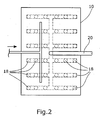
- a plurality of trickle nozzles 18 are arranged, which are supplied via a common feed line 20.
- the individual trickle nozzles 18 are arranged distributed from the top (FIG. 2) over the entire cross section of the reaction vessel 10 substantially regularly.
- the trickle nozzles 18 are connected via the pipeline 20 with different tanks 22, 24, 26, 28. In these, for example, an acid, a lye, water, a buffer solution and / or a nutrient solution may be provided.
- these liquids can be supplied to the reactor 10 in predetermined amounts and / or ratios via the trickle nozzles 18.
- a ventilation device 30 with a plurality of ventilation nozzles 32, 34, 36 is provided.
- the nozzles 32 in Rieselbettvonmaschinen
- the nozzles 34 are disposed within the fixed bed 12 and the nozzles 36 are disposed below the fixed bed 12.
- air or another gas can be introduced into the reaction vessel 10 in order to prevent clogging of the fixed bed 12.
- a gas influencing the reaction in the bioreactor can be supplied.
- a removal device 38 which has suitable shut-off valves and optionally a pump, medium can be removed from the reactor 10 above the fixed bed 12 in the illustrated embodiment.
- the medium is then removed via a pipe 40, it being possible to supply the discharged medium again via the tube 20 and the shower nozzles 18 to the container 10, but preferably for the fluidized bed operation via pipe 40, 42 by 16 to feed back to the bioreactor.
- a filter 50 can be interposed.
- the discharged medium can also be supplied to a storage tank 54.
- reaction medium 56 is collected.
- the reaction medium 56 can be supplied via the outlet 16 and the pipes 46, 52 to the storage tank 54 or via the pipe 48 to a further process, etc.
- the conveying direction of the fluid is reversed and, for example, pumped from the storage tank 54 through the tubes 52, 42 and then serving as an inlet outlet 16 reaction liquid 56 into the bioreactor. If necessary, the reaction liquid can be removed via the removal device 38 and be returned to the bioreactor 10 via the tube 42.
- compressed air can be pumped into or under the fixed bed in order to destroy the mycelial braid, which has arisen particularly in filamentous fungi, and the Fixed bed so unblock.
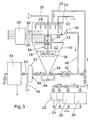
- the bioreactor according to the invention has a measured value acquisition device 58, which is connected to one or more measuring probes 60.
- the measuring probes 60 are arranged, for example, within the fixed bed 12 and serve, for example, to absorb the moisture content, the pH, etc.
- an exhaust air pipe 62 is connected to the interior of the bioreactor, which optionally can be closed by a valve and serves to regulate the pressure prevailing inside the bioreactor 10.
- Fig. 3 corresponds in principle to Fig. 1, wherein in addition the required pumps and valves are shown schematically.
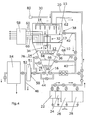
- FIGS. 4 and 5 represents an extension of the invention described with reference to FIGS. 1-3. Identical or similar components are therefore designated by the same reference numerals.
- filter elements 64, 66 are additionally provided below the retaining element 14.
- the filter elements 64, 66 serve to filter the reaction medium produced, wherein the pore size of the filter element 66 is smaller than the pore size of the filter element 64.
- the filter elements 64, 66 are arranged inclined (Fig. 5).
- the Filter elements 64, 66 each have a purging device 68, 70 is provided. With this it is possible, via inlets 72, 74 to guide a rinsing liquid to the filter elements 64, 66.
- discharge means 76, 78 are provided, through which the products and the cleaning liquid can be discharged again.
- medium can be removed via the removal device 38 and the tube 42 as flushing fluid and used to flush the filter device 64, 66.
- a pressure generating device 80 is provided, which is connected to the aeration device 30.
- a pressure can be generated within the bioreactor 10, wherein the pressure above the fixed bed 12 is higher, so that reaction medium can be pressed by the retaining element 14 and the filter elements 64, 66.
- a cleaning of the retaining element 14 and the filter elements 64, 66 can additionally take place.
- the filter elements 64, 66 are inserted into the tapered part of the bioreactor 10.
- appropriate supports may be provided on the inner wall of the bioreactor. It is also possible to design the bioreactor in steps in this area, so that the filter elements can be placed on corresponding steps.
- a corresponding pressure generating device can also be provided in the invention described with reference to FIGS. 1-3.
- the cultures additionally enzymes from all classes according to the "International Enzyme Nomenclature: Committee of the International Union of Biochemistry and Molecular Biology (Enzyme Nomenclature, Academic Press, Inc., 1992)", preferably hydrolases and / or Oxidoreductases are added and added as free enzymes or immobilized.
- the immobilization by all common methods of the prior art, such as. covalent binding, adsorptive binding, cross-linking to carrier molecules or carriers, by matrix binding in z.
- polysaccharide matrices algin, etc.
- copolymerization of enzymes to cells and by microencapsulation are performed.
- the cultures on fillers (carriers) (mainly annular, round) from z.
- plastics ceramics or glass and mineral materials such.
- activated carbon, silica or slags, etc. are applied and are brought to grow freely or immobilized, the nutrient supply is provided mainly via the liquid supply.
- enzymes and / or co-enzymes free, immobilized or co-immobilized possible.
- the organism-grown substrates or carriers may not be necessary for the organism-grown substrates or carriers to have a density above the density of water in order to be held in suspension by the buoyancy, since rising and falling of the vegetated substrates / carriers another desired detachment of organisms takes place.
- Another important characteristic of the present invention is the possibility of further separation / purification of the products formed during the culture period, e.g. Enzymes, metabolites or converted, i. chemically modified substrates.
- a) (depending on the task and the pressure behavior of the overgrown Rieselfestbettes) by pumping or pumping the liquid collected under the trickle bed is pumped through a prefilter and sterile filtration unit in an additional vessel and either After measuring the culture-relevant product parameters, the solution is further processed (ultrafiltration / liquid chromatography / analytics, etc.) or, if product quality and / or concentration are not sufficient, returned to the fermentation unit via the trickle unit.
- the corresponding measurements in the additional vessel can be made manually after sampling or continuously by FIA (flow injection analysis).
- the collected liquid can also be concentrated directly without passing through an additional vessel after particle and sterile filtration through an ultrafiltration module.
- the products can be individually eluted by lateral injection of water / buffer and collected separately for further processing. This is additional cleaning the filters. Clogging of the filter is additionally remedied by introducing medium from below into the bioreactor 10 and flushing the filters 64, 66 under pressure from below. Unreacted substrates which deposit over the filters 64, 66 may be returned to the reactor 10 after rinsing.
- This new methodology is of very great importance as it allows the successive harvesting of e.g. Enzyme allowed.
- lignolytic enzymes in many white rot fungi for example Phanerochaete chrysosporium, Trametes versicolor u.a. be formed on many nutrient media and also on growth on solid substrates in succession e.g. in the order: manganese peroxidase ⁇ laccase (e.g., Trametes).
- the culture can be carried out as a batch process, as a fed-batch process or continuously (depending on the carrier material and the question).
- process control parameters pH, temperature, pO 2 , humidity, biomass and pressure can be measured.
- Another feature of the present invention is that, by cascading or juxtaposing (with different width and / or height dimensions of the reactor vessels) of the bioreactor assembly shown in Figure I, one can come to a multiple bioreactor system with the trickle bed of variable capacity trickle bed and corresponding Wirbelbette a completely new way of scaling up this reactor mode is possible.
- several reactors can be connected in parallel, in which fixed beds and Wirbelbette alternate and the formed products of one are processed by the other in a continuous process.
- Nutrient solution can be pumped out of the nutrient solution tank 28 or water / buffer via the water or buffer tank 26 onto the fixed bed 12 via the trickle nozzles 18.
- acid can be added from the tank 24 or liquor from the tank 22 via the trickle nozzles 18.
- the air is supplied via the ventilation device 30.
- the exhaust air is discharged via the outlet 62.
- the emerging from the fixed bed 12 liquid 56 enters a bottom tank and can be recycled via the trickle 18 via a line 42, 20 back to the fixed bed 12.
- the liquid 56 from the bottom tank can also be pumped through a pump through the particulate filter 50 and the sterile filter 51 into the storage tank 54. If necessary, higher pressure for the filtrations, this is done by the discharge port 32nd
- the liquid parameters in the storage tank 54 can be measured manually or determined automatically by FIA, for example.
- FIA FIA
- an immediate constriction of the liquid by ultrafiltration before filling the storage tank 54 is possible.
- pH, pO 2 temperature, humidity and pressure outside or in the reactor bed 12 are detected by corresponding sensors 60, and the addition of acid / base, oxygen supply, temperature adjustment (double-walled tempered reactor jacket, controlled air pulses, tempered sprinkling), humidity (Amount of sprinkling in the case of lack of moisture or supply of dry air if the humidity is too high) and pressure (change in process control: trickle bed ⁇ fluidized bed).
- the fixed bed 12 When changing the process of Rieselbett to fluidized bed, the fixed bed 12 is dissolved by air via pressure increase via the ventilation supply 30, 32, 34, 36 with possibly simultaneous flooding of the fixed bed 12 with (optional) nutrient solution / water / buffer and the air supply 30, 32, 34, 36 maintain the fluidized bed process. Via the line 40, the liquid is circulated. By terminating the aeration, terminating the liquid supply via the bottom tank and starting the irrigation via the trickle nozzles 18, the trickle bed procedure can be restarted after optional drying of the bed 12 by means of the aeration device 30.
- the bioreactor variant shown in FIGS. 4 and 5 with sieve and filter compartmentalization under the fixed bed 12 permits the possibility of particle separation in the liquid conducted through the fixed bed.
- sieves / filters 64, 66 are installed under the fixed bed 12. Emptying of the individual stages is possible via the outputs 76 or 78 (bottom tank) by pressurization or pumping. Clogging of the filters 64, 66 is achieved by a) freeing the filters 64, 66, and / or (b) successively flooding the compartments underneath the filters 64, 66 and flushing the filters from below under pressure ,
- the reactor with a fixed bed volume of about 8 l is filled with pulp (Softwood / Kraft) in such a way that after mixing with a blended with the aid of a Waring Blendor's stand culture of Trametes versicolor and pH adjustment to pH 4.5 about 4 - 6% consistency results. It is given as much amount of pulp / inoculum on the screen plate (13, Fig. 1-3) that a fixed bed height of about 5 - 8 cm is obtained. The ratio pulp / inoculum is about 30: 1 to 10: 1.
- the culture is started with the start of irrigation and aeration.
- the irrigation fluid contains 0.05 to 0.5% glucose and 0.01 to 0.1% nitrogen in the form of asparagine at pH 4.5.
- the effluent liquid is detected after transfer to the storage vessel after laccase and manganese peroxidase. After about 3 to 5 days, first the manganese peroxidase and between day 5 and 8, the laccase is harvested, which is contaminated by this successive harvesting only about 10 - 20% with the other enzyme. After about 10 days of culture a relatively strong blocking of the fatty bed (> 100 Pa / m fixed bed) is observed.
- the Waring Blender Serving Vial is steam sterilized and the parts of a Starmixer or Hobart Mixer used to mix culture / inoculum, pH adjustment, etc., which come into contact with the mix are ethanol (75%) ) or 2 M NaOH sterilized overnight. Mixing, mixing and transfer of the mix into the fixed bed of the fermenter can be done under a sterile workbench.
- Example 2 The use of the fluid bed mode is not limited to the deblocking of the packed bed.
- the medium in the inventive embodiment of the bioreactor can be pumped in circulation and externally aerated (with O 2 -enriched).
- a support eg., Polyurethane, perlite, sintered glass, biopolymers
- the microorganisms secreted products eg enzymes, secondary metabolites, organic Acids.
- Method A A Conidiosporenset (10 5 spores / ml) of Aspergillus niger is in the fluidized bed mode, in a 14% glucose, 0.04% (NH 3 ) x (NH 3 SO 4 ), 0.25% KH 2 PO 4 , 0.05% MgSO 4 .7H 2 O, 0.001% FeSO 4 , 0.00025% ZnSO 4 , pH 5.5) containing solution, slowly recirculated.
- the bioreactor (10 liter fixed bed volume) consists of a fluidized bed of Pulyurethan pieces (edge length 0.2 - 1 cm). The spores settle after a few hours on the polyurethane carrier.
- the further circulated medium is aerated in an external bubble column to promote the gentle growth of the fungus.
- the process is switched to the trickle film mode.
- the grown fungus begins to sporulate on the polyurethane and form citric acid.
- the citric acid is washed off the fixed bed at defined intervals (10 - 30 h) through the trickling nozzles with 200 ml.
- citric acid concentrations of up to 3% are obtained in the trickle fluid.
- the trickle fluid can be pumped in the circulation until citrate concentrations are reached by 5%.
- Method B A conidiosporenous solution (10 5 spores / ml) of Aspergillus oryzae is fluidized in a 2% glucose, 1% peptone, 1% yeast extract, 0.6% Na-acetate solution, 0.2% MgSO 4 .7H 2 O 0.01% KH 2 PO 4 , 0.05% KCl, 0.01% MnSO 4 .5H 2 O, 0.01% FeSO 4 .7H 2 O 0.01% NaCl solution slowly circulated.
- the bioreactor (8 liter fixed bed volume) consists of a fluidized bed of pearlite spheres (diameter 0.1 - 0.5 cm). The spores settle after a few hours in the pores of the inert carrier.
- the further circulated medium is aerated in an external bubble column to promote the growth of the fungus.
- the process is switched to the trickle film mode.
- liquid lipids eg olive oil, soybean oil
- the fungus reacts with the production of the enzyme lipase, which is rinsed daily from the fixed bed in 24 to 48-hour intervals by 300 ml buffer solutions (eg phosphate buffer 50 mM, pH 7) using the trickle-bed method.
- Per ml of buffer can be recovered via 30 U lipase.
- a blocking of the packed bed after about 10 days is resolved by the strong shearing forces that occur after media flow reversal and compressed air supply between the support materials.
- Method C A homogenized mycelial solution of a secondary metabolite-secreting (eg antibiotics, mycotoxins, pigments) ascomycetes, eg Penicillium chrysogenum, is suspended in fluidized bed mode through the fluidized bed (volume 1 L, consisting of a mixture of wood shavings, rye, lignocellulose (weight ratio 1: 1 : 2)) and aerated externally until no microscopic mycelium is visible in the inoculum solution. Due to the low-shear trickle film process, the fungus grows with external ventilation. To produce the metabolites is switched to the trickle film mode.
- a secondary metabolite-secreting eg antibiotics, mycotoxins, pigments
- ascomycetes eg Penicillium chrysogenum
- the fixed bed is dried by the ventilation device located in the reactor to adjust if necessary for fungi favorable lower water activity of the fixed bed.
- the metabolites are washed off the fixed bed via the buffers or solvents added through the trickle-free nozzles.
- a blocking of the packed bed after about 8 days is resolved by the strong shearing forces that occur after media flow reversal and compressed air supply between the support materials.
Landscapes
- Health & Medical Sciences (AREA)
- Engineering & Computer Science (AREA)
- Chemical & Material Sciences (AREA)
- Life Sciences & Earth Sciences (AREA)
- Bioinformatics & Cheminformatics (AREA)
- Organic Chemistry (AREA)
- Zoology (AREA)
- Wood Science & Technology (AREA)
- Biomedical Technology (AREA)
- Genetics & Genomics (AREA)
- Biotechnology (AREA)
- Biochemistry (AREA)
- General Health & Medical Sciences (AREA)
- Microbiology (AREA)
- Sustainable Development (AREA)
- General Engineering & Computer Science (AREA)
- Analytical Chemistry (AREA)
- Environmental & Geological Engineering (AREA)
- Molecular Biology (AREA)
- Immunology (AREA)
- Chemical Kinetics & Catalysis (AREA)
- General Chemical & Material Sciences (AREA)
- Oil, Petroleum & Natural Gas (AREA)
- Apparatus Associated With Microorganisms And Enzymes (AREA)
- Micro-Organisms Or Cultivation Processes Thereof (AREA)
- Immobilizing And Processing Of Enzymes And Microorganisms (AREA)
Claims (14)
- Procédé de culture de micro-organismes, comportant une combinaison d'étapes de procédé caractéristiques d'un réacteur à lit de ruissellement et d'étapes de procédé caractéristiques d'un réacteur à lit fluidisé, dans lequel(a) des cultures de micro-organismes sont cultivées sur un lit fixe selon une conduite de procédé à réacteur à lit de ruissellement, le milieu de réaction étant fourni par des buses de ruissellement, la ventilation étant assurée en dessous et/ou à l'intérieur du lit fixe, et dans lequel la solution qui passe à travers la couche en lit fixe, solution qui contient des produits de réaction/décomposition des cultures de micro-organismes, soit est recyclée jusqu'à ce que la productivité désirée, le produit désiré ou le produit de décomposition désiré ou le degré de décomposition désiré soient atteints, soit la solution effluente est re-traitée directement pour séparation ultérieure, et(b) en cas de dépassement d'une certaine perte de pression à travers le garnissage du lit fixe par introduction d'eau ou de bouillon de culture et par introduction d'air, la conduite de la culture passe, pour un certain laps de temps, de la conduite de procédé à réacteur à lit de ruissellement à une conduite de procédé à réacteur à lit fluidisé.
- Procédé de culture selon la revendication 1, dans lequel(i) les cultures de micro-organismes sont choisies parmi les bactéries, levures, champignons, cellules animales ou végétales et tissus végétaux et animaux immobilisés et sont, en particulier, des champignons filamenteux ; et/ou(ii) dans le cas du régime en lit fluidisé, le milieu est pompé en boucle pour éviter un débordement de corps de remplissage développé ou de composants de lit fixe développés ; et/ou(iii) l'enracinement de la culture de micro-organismes s'effectue au cours de la conduite en réacteur à lit de ruissellement ou en réacteur à lit fluidisé ; et/ou(iv) le milieu de réaction choisi parmi l'eau, un bouillon de culture et une solution à substrat à convertir ; et/ou(v) les produits de réaction/décomposition des cultures de micro-organismes sont des protéines y compris enzymes et anti-corps, des produits du métabolisme secondaire, des substrats convertis y compris alcools, aldéhydes, cétones, alcaloïdes, acides organiques, pigments et substances aromatiques, des effluents épurés ou des xénobiotiques convertis et sont, en particulier, des protéines et des métabolites secondaires ; et/ou(vi) la séparation ultérieure comprend la séparation de particules solides et de microorganismes par filtration ou sédimentation et/ou séparation par ultrafiltration ou chromatographie ; et/ou(vii) en cas de dépassement d'une perte de pression à travers le garnissage du lit fluidisé de > 100 Pa/m de hauteur de remplissage ou garnissage du lit fixe, de préférence de > 50 Pa/m, on passe de la conduite de procédé à réacteur à lit de ruissellement à la conduite de procédé à réacteur à lit fluidisé ; et/ou(viii) la période pendant laquelle se déroule la conduite de procédé à réacteur à lit fluidisé est choisie de telle façon que, lors de la conduite de procédé à réacteur à lit de ruissellement subséquente, le dépassement de la perte de pression est repris, dure de préférence au moins 1 minute, en particulier 10 minutes à 4 heures, et/ou les effets de production, conversion de substances, décomposition attendus de ce régime additionnel, sont atteints.
- Procédé de culture selon la revendication 1 ou 2, dans lequel(i) le procédé comprend l'alimentation en pression, le milieu de réaction étant pressé à travers des fonds à tamis et fonds à filtre éventuellement existants sous le lit fixe ; et(ii) les fonds à tamis et fonds à filtre de (i) présentent différentes largeurs de maille/grosseurs de pores, en particulier allant en décroissant, en fonction du matériau du lit, depuis 1 mm jusqu'à la plage d'ultrafiltration d'env. 5000 dalton, ce qui permet une isolation successive de particules de différents ordres de grandeur ; et(iii) une disposition oblique des fonds à filtre et à tamis de (i) et (ii) permet d'éluer individuellement les produits par lavage à l'eau/tampon et de les collecter séparément pour traitement ultérieur.
- Procédé de culture selon une ou plusieurs des revendications 1 à 3, dans lequel(i) on met en oeuvre comme lit fixe tous les substrats solides organiques possibles, y compris bois, plantes annuelles, autre matériau végétal, humus, charbon, déchets organiques de toute nature d'origine tant végétale qu'animale sous forme de substances isolées ou de mélanges pour la production de cultures pures ou mélanges de microorganismes; et/ou(ii) on met en oeuvre comme lit fixe des corps de remplissage, en particulier en matières plastiques, céramique, verre et matériaux minéraux, charbon actif, silice ou scories, sur lesquels on fait croître, sous forme libre ou immobilisée, les cultures de microorganismes en tant que cultures pures ou mélanges ; et/ou(iii) dans la conduite de procédé à réacteur à lit de ruissellement, on met en oeuvre des organismes ou cultures mixtes d'organismes différents de ceux utilisés dans la conduite de procédé à réacteur à lit fluidisé ; et/ou(iv) aux microorganismes du lit fixe on ajoute sous forme libre ou immobilisée, des enzymes supplémentaires, de préférence des hydrolases et/ou oxydoréductases ; et/ou(v) lors de la culture on ajoute des co-enzymes qui peuvent être libres ou immobilisés ou co-immobilisés avec l'enzyme respectif ; et/ou(vi) les co-enzymes de (v) sont choisis, de préférence, parmi NAD, NADP, FAD, CoA, PAL, TPP et ATP.
- Procédé de culture selon une ou plusieurs des revendications 1 à 4, dans lequel(i) lors de la culture s'opère une séparation, une purification partielle ou concentration des produits formés ou substrats convertis ; et/ou(ii) au cours de la conduite de procédé à réacteur à lit de ruissellement, on met en oeuvre des organismes ou cultures mixtes d'organismes différents de ceux utilisés dans la conduite de procédé à réacteur à lit fluidisé et, en particulier, on ajoute aussi différents enzymes et co-enzymes aux différents modes de fonctionnement des réacteurs ; et/ou(iii) le procédé de production d'enzymes, de production de métabolites secondaires, de traitement de matériau végétal, en particulier bois, plantes annuelles, est utilisable en tant que système biocatalyseur dans la synthèse chimique, dans l'élimination des substances nocives des effluents et pour la décomposition de la xénobiotique ; et/ou(iv) lors d'une production successive d'enzymes, métabolites secondaires, produits chimiques intermédiaires ou finis dans la conduite de procédé à réacteur à lit de ruissellement et/ou dans la conduite de procédé à réacteur à lit fluidisé, les produits correspondants sont pré-épurés par les moyens de séparation existants du bioréacteur ; et/ou(v) dans le traitement de matériau végétal, en particulier bois et plantes annuelles, en cas de mise en oeuvre dans l'élimination des substances nocives des effluents et lors de la décomposition de xénobiotique, la possibilité de conduire différents procédés permet une amélioration de la performance de traitement ou de la performance de décomposition.
- Procédé de culture selon la revendication 1, dans lequel(i) une commande du réacteur avec régulation de valeur de consigne/valeur réelle est réalisée par des capteurs existant dans le réacteur pour mesurer le pH, la pO2, l'humidité, la température et la pression ; et/ou(ii) plusieurs des bioréacteurs sont montés en série, dans lesquels les produits du premier bioréacteur sont introduits dans le second ou respectivement aux suivants sous forme de substrats ; et/ou(iii) la culture à lit de ruissellement segmentée lors de la conduite de procédé du réacteur à lit fluidisé sert de culture d'inoculation pour l'étape suivante de montée en puissance du lit de ruissellement et/ou du lit fluidisé en étant transférée partiellement ou totalement dans l'étape de montée en puissance suivante.
- Bioréacteur de culture de microorganismes comportantun récipient de réaction (10),un support de lit fixe (14) disposé dans le récipient de réaction (10) pour disposer un lit fixe (12) sur le support de lit fixe (14),des buses de ruissellement (18) disposées au-dessus du support de lit fixe (14) pour l'arrosage du lit fixe (12) avec du bouillon de culture afin de permettre au bioréacteur de fonctionner selon le procédé à lit de ruissellement,un dispositif de ventilation (30, 32, 34, 36) pour la ventilation du lit fixe (12) ou de l'espace intérieur du réacteur (10) afin de permettre au bioréacteur de fonctionner selon le procédé à lit fluidisé, etune détection des valeurs de mesure (58) pour détecter la pression à l'extérieur du ou dans le lit fixe (12).
- Bioréacteur selon la revendication 7 comportantun récipient de réaction (10),un support de lit fixe (14) disposé dans le récipient de réaction (10) pour disposer un lit fixe (12) sur le support de lit fixe (14),des buses de ruissellement (18) disposées au-dessus du support de lit fixe (14) pour l'arrosage du lit fixe (12) avec du bouillon de culture afin dé permettre au bioréacteur de fonctionner selon le procédé à lit de ruissellement,un dispositif (80) de génération de pression raccordé au récipient de réaction (10) pour presser le milieu de réaction (56) à travers le support de lit fixe (14).
- Bioréacteur selon la revendication 7 ou 8, apte à mettre en oeuvre un procédé selon l'une des revendications 1 à 6.
- Bioréacteur selon une ou plusieurs des revendications 7 à 9, caractérisé par un dispositif de retenue (15) disposé au-dessus du support de lit fixe (14) pour la conduite de réaction en lit fluidisé et/ou par un dispositif de prélèvement (38) disposé au-dessus du support de lit fixe (14) et au-dessus des éléments de retenue (15) pour l'évacuation du milieu, en particulier à l'état noyé.
- Bioréacteur selon une ou plusieurs des revendications 7 à 10, caractérisé en ce que le récipient de réaction (10) s'effile au moins au-dessous du support de lit fixe (14) en direction d'une sortie (16).
- Bioréacteur selon une ou plusieurs des revendications 7 à 11, caractérisé par au moins un élément filtrant (64, 66) disposé au-dessous du support de lit fixe (14).
- Bioréacteur selon la revendication 12, caractérisé en ce que(i) sont prévus plusieurs éléments filtrants (64, 66) dont la largeur de maille/grosseur de pores décroît en direction de la sortie (16) ; et/ou(ii) un dispositif de rinçage (68, 70) associé à l'élément filtrant (64, 66) est prévu pour le nettoyage de l'élément filtrant (64, 66) ; et/ou(iii) l'élément filtrant (64, 66) est disposé incliné dans le récipient de réaction (10).
- Bioréacteur selon une ou plusieurs des revendications 8 à 13, caractérisé en ce que le dispositif (80) de génération de pression est raccordé au récipient de réaction (10) de façon telle que le milieu de réaction (56) peut, en outre, être pressé à travers le ou les élément(s) filtrant(s) (64, 66).
Applications Claiming Priority (3)
| Application Number | Priority Date | Filing Date | Title |
|---|---|---|---|
| DE2002106772 DE10206772A1 (de) | 2002-02-19 | 2002-02-19 | Neuartiger Rieselbett-Bioreaktor mit Wirbelbett-Regeneration |
| DE10206772 | 2002-02-19 | ||
| PCT/EP2003/001663 WO2003070873A2 (fr) | 2002-02-19 | 2003-02-19 | Procede de culture de micro-organismes et bioreacteur |
Publications (2)
| Publication Number | Publication Date |
|---|---|
| EP1517985A2 EP1517985A2 (fr) | 2005-03-30 |
| EP1517985B1 true EP1517985B1 (fr) | 2007-05-23 |
Family
ID=27674722
Family Applications (1)
| Application Number | Title | Priority Date | Filing Date |
|---|---|---|---|
| EP03704654A Expired - Lifetime EP1517985B1 (fr) | 2002-02-19 | 2003-02-19 | Procede de culture de micro-organismes et bioreacteur |
Country Status (5)
| Country | Link |
|---|---|
| EP (1) | EP1517985B1 (fr) |
| AT (1) | ATE362974T1 (fr) |
| AU (1) | AU2003206926A1 (fr) |
| DE (2) | DE10206772A1 (fr) |
| WO (1) | WO2003070873A2 (fr) |
Cited By (1)
| Publication number | Priority date | Publication date | Assignee | Title |
|---|---|---|---|---|
| CN107487850A (zh) * | 2017-09-27 | 2017-12-19 | 大连大学 | 一种污水生物除氮反应器及其使用方法 |
Families Citing this family (9)
| Publication number | Priority date | Publication date | Assignee | Title |
|---|---|---|---|---|
| DE102004009161A1 (de) * | 2004-02-25 | 2005-09-15 | HöFer Bioreact GmbH | Optimierte Induktion und gerichtete selektive Festphasen-Kultivierung stabiler, mikrobieller Mischkulturen zur kontinuierlichen Herstellung definierter Enzym- und Metabolitgemische und Verfahren und Vorrichtung dazu |
| DE102004032318B4 (de) * | 2004-07-02 | 2015-08-20 | Technische Hochschule Mittelhessen | Herstellung einer konzentrierten Lösung aus biologischen Substanzen |
| DE102008004726A1 (de) * | 2008-01-16 | 2009-07-23 | Evonik Goldschmidt Gmbh | Verfahren zur enzymatischen Herstellung von Carbonsäureestern |
| CN102294204B (zh) | 2011-07-07 | 2013-07-10 | 南京大学 | 一种固定床和喷射浮动床与分离单元耦合的集成系统工艺 |
| AU2015388682A1 (en) * | 2015-03-30 | 2017-11-16 | Ecoglobe Gmbh | Wastewater treatment plant and method for treating wastewater |
| CN111186902A (zh) * | 2018-11-14 | 2020-05-22 | 中国环境科学研究院 | 一种生物巢水体净化系统及其方法 |
| CN111964993B (zh) * | 2020-08-21 | 2022-08-05 | 水利部交通运输部国家能源局南京水利科学研究院 | 模拟原位水压的深水底泥流动培养系统 |
| CN112742147A (zh) * | 2020-12-14 | 2021-05-04 | 湖南福千府生物科技有限公司 | 一种亚硫酸钠制备用炉气净化除尘装置 |
| CN218561467U (zh) * | 2022-08-24 | 2023-03-03 | 博瑞德环境集团股份有限公司 | 一种化工废水处理微生物污泥颗粒的菌群培养/检测装置 |
Family Cites Families (16)
| Publication number | Priority date | Publication date | Assignee | Title |
|---|---|---|---|---|
| US4351729A (en) * | 1980-02-06 | 1982-09-28 | Celanese Corporation | Biological filter and process |
| DE3227678A1 (de) * | 1982-07-24 | 1984-01-26 | Bayer Ag, 5090 Leverkusen | Verfahren zur biologischen reinigung von abluft |
| JPS60232295A (ja) * | 1984-04-28 | 1985-11-18 | Kurita Water Ind Ltd | 嫌気性流動床式廃水処理装置 |
| JPS62277195A (ja) * | 1986-05-23 | 1987-12-02 | Sanki Eng Co Ltd | 水の生物的浄化方法 |
| DE3625698A1 (de) * | 1986-07-30 | 1988-02-18 | Hoechst Ag | Sterilisierbarer wirbelschichtfermenter |
| JPH02184398A (ja) * | 1989-01-10 | 1990-07-18 | Nkk Corp | 移動床型脱窒装置 |
| DE4004030A1 (de) * | 1990-02-10 | 1991-08-14 | Bayer Ag | Verfahren zur biologischen abluftreinigung mit einem tropfkoerpersystem |
| JPH03242222A (ja) * | 1990-02-16 | 1991-10-29 | Kubota Corp | ろ床式生物脱臭装置 |
| US5262320A (en) * | 1990-06-18 | 1993-11-16 | Massachusetts Institute Of Technology | Cell-culturing apparatus and method employing a macroporous support |
| DE4204190C2 (de) * | 1991-02-08 | 1994-06-16 | Herbst Umwelttech Gmbh | Verfahren und Vorrichtung zur Gasreinigung |
| SE9101149D0 (sv) * | 1991-04-17 | 1991-04-17 | Pharmacia Lkb Biotech | Beads for down stream processing |
| DE4308832C1 (de) * | 1993-03-19 | 1994-04-07 | Buna Ag | Verfahren zur Entfernung organischer Verunreinigungen aus Rohwässern |
| DE19511159C1 (de) * | 1995-03-27 | 1996-12-05 | Peter M Prof Dr Kunz | Verfahrenstechnische Optimierung von Kleinkläranlagen |
| DE19609053C1 (de) * | 1996-03-08 | 1997-09-11 | Carbo Consult Ges Fuer Umwelt | Verfahren zur in-situ-Reinigung von Rieselbettreaktoren |
| AU4637300A (en) * | 1999-07-01 | 2001-01-22 | Skandinavisk Ecotech Ab | Device and method for purification of waste water |
| JP3877482B2 (ja) * | 2000-01-28 | 2007-02-07 | 三洋電機株式会社 | 生ごみ処理装置 |
-
2002
- 2002-02-19 DE DE2002106772 patent/DE10206772A1/de not_active Withdrawn
-
2003
- 2003-02-19 WO PCT/EP2003/001663 patent/WO2003070873A2/fr not_active Ceased
- 2003-02-19 EP EP03704654A patent/EP1517985B1/fr not_active Expired - Lifetime
- 2003-02-19 DE DE50307332T patent/DE50307332D1/de not_active Expired - Lifetime
- 2003-02-19 AT AT03704654T patent/ATE362974T1/de not_active IP Right Cessation
- 2003-02-19 AU AU2003206926A patent/AU2003206926A1/en not_active Abandoned
Non-Patent Citations (1)
| Title |
|---|
| None * |
Cited By (1)
| Publication number | Priority date | Publication date | Assignee | Title |
|---|---|---|---|---|
| CN107487850A (zh) * | 2017-09-27 | 2017-12-19 | 大连大学 | 一种污水生物除氮反应器及其使用方法 |
Also Published As
| Publication number | Publication date |
|---|---|
| DE10206772A1 (de) | 2003-09-04 |
| AU2003206926A8 (en) | 2003-09-09 |
| ATE362974T1 (de) | 2007-06-15 |
| DE50307332D1 (de) | 2007-07-05 |
| WO2003070873A2 (fr) | 2003-08-28 |
| EP1517985A2 (fr) | 2005-03-30 |
| AU2003206926A1 (en) | 2003-09-09 |
| WO2003070873A3 (fr) | 2004-04-08 |
Similar Documents
| Publication | Publication Date | Title |
|---|---|---|
| DE69602010T2 (de) | Verfahren zur aeroben abwasserreinigung | |
| EP2491112B1 (fr) | Procédé de culture d'algues | |
| DE2757826C2 (de) | Verfahren zur Durchführung von biochemischen Reaktionen mit Hilfe von Mikroorganismen | |
| DE69814317T2 (de) | Verfahren für die Reduzierung von Klärschlamm aus den aeroben Abwasserkläranlagen | |
| EP0132649B1 (fr) | Procédé pour la purification biologique anaérobie d'eau usée | |
| DE69630236T2 (de) | Methode und vorrichtung zur biologischen behandlung von organisch belastetem abwasser | |
| EP0046901A1 (fr) | Procédé et dispositif pour l'épuration biologique anaérobe d'eau usée | |
| EP0335825B1 (fr) | Procédé et dispositif pour le traitement anarérobe des substrats liquides en deux étapes | |
| DE3818776C2 (de) | Verfahren zur Kultivierung von Zellen in einem Fermenter und zur Durchführung des Verfahrens bestimmter Fermenter | |
| DE2835979A1 (de) | Verfahren zum durchfuehren enzymatischer umwandlungen | |
| EP0073079A1 (fr) | Méthode et appareil pour la culture de micro-organismes | |
| EP1517985A2 (fr) | Procede de culture de micro-organismes et bioreacteur | |
| DE2216887B2 (de) | Verfahren zum einblasen von gas in eine suspension von mikroorganismen | |
| DE3715952A1 (de) | Hochleistungs-mehrkammer-festbett-fermenter zum abbau von biomasse und verfahren zum betreiben desselben | |
| DE2820086A1 (de) | Verfahren zur biologischen reinigung von fluessigen abfaellen | |
| EP0193969B1 (fr) | Réacteur en colonne à lit fixe pour les procédés de digestion anaérobie | |
| DE2550818B2 (de) | Verfahren und vorrichtung zur biologischen abwasserreinigung nach dem schlammbelebungsverfahren | |
| EP0667319B1 (fr) | Procédé et réacteur pour le traitement microbiologique de l'eau avec forte demande en oxygène | |
| DE69219870T2 (de) | Verfahren zur biologischen Reinigung von mit Verunreinigungen belasteten Flüssigkeiten | |
| DE69626730T2 (de) | Zwischenflächige Bioreaktor-System | |
| EP0232853A2 (fr) | Procédé et réacteur à étages multiples pour la transformation de substances au moyen de catalyseurs | |
| CA1160171A (fr) | Bioreacteur a tour de recirculation assurant la fermentation a l'etat solide | |
| EP0208253B1 (fr) | Procédé et dispositif de purification biologique d'eau usée | |
| DE3345691C2 (de) | Verfahren zum kontinuierlichen anaeroben Abbau organischer Verbindungen | |
| US20210371311A1 (en) | Method of purifying lake water using nano and micro bubble |
Legal Events
| Date | Code | Title | Description |
|---|---|---|---|
| PUAI | Public reference made under article 153(3) epc to a published international application that has entered the european phase |
Free format text: ORIGINAL CODE: 0009012 |
|
| 17P | Request for examination filed |
Effective date: 20041029 |
|
| AK | Designated contracting states |
Kind code of ref document: A2 Designated state(s): AT BE BG CH CY CZ DE DK EE ES FI FR GB GR HU IE IT LI LU MC NL PT SE SI SK TR |
|
| AX | Request for extension of the european patent |
Extension state: AL LT LV MK RO |
|
| GRAP | Despatch of communication of intention to grant a patent |
Free format text: ORIGINAL CODE: EPIDOSNIGR1 |
|
| GRAS | Grant fee paid |
Free format text: ORIGINAL CODE: EPIDOSNIGR3 |
|
| GRAA | (expected) grant |
Free format text: ORIGINAL CODE: 0009210 |
|
| AK | Designated contracting states |
Kind code of ref document: B1 Designated state(s): AT BE BG CH CY CZ DE DK EE ES FI FR GB GR HU IE IT LI LU MC NL PT SE SI SK TR |
|
| PG25 | Lapsed in a contracting state [announced via postgrant information from national office to epo] |
Ref country code: FI Free format text: LAPSE BECAUSE OF FAILURE TO SUBMIT A TRANSLATION OF THE DESCRIPTION OR TO PAY THE FEE WITHIN THE PRESCRIBED TIME-LIMIT Effective date: 20070523 |
|
| REG | Reference to a national code |
Ref country code: GB Ref legal event code: FG4D Free format text: NOT ENGLISH |
|
| REG | Reference to a national code |
Ref country code: CH Ref legal event code: EP |
|
| REG | Reference to a national code |
Ref country code: IE Ref legal event code: FG4D Free format text: LANGUAGE OF EP DOCUMENT: GERMAN |
|
| REF | Corresponds to: |
Ref document number: 50307332 Country of ref document: DE Date of ref document: 20070705 Kind code of ref document: P |
|
| PG25 | Lapsed in a contracting state [announced via postgrant information from national office to epo] |
Ref country code: SE Free format text: LAPSE BECAUSE OF FAILURE TO SUBMIT A TRANSLATION OF THE DESCRIPTION OR TO PAY THE FEE WITHIN THE PRESCRIBED TIME-LIMIT Effective date: 20070823 |
|
| PG25 | Lapsed in a contracting state [announced via postgrant information from national office to epo] |
Ref country code: ES Free format text: LAPSE BECAUSE OF FAILURE TO SUBMIT A TRANSLATION OF THE DESCRIPTION OR TO PAY THE FEE WITHIN THE PRESCRIBED TIME-LIMIT Effective date: 20070903 |
|
| NLV1 | Nl: lapsed or annulled due to failure to fulfill the requirements of art. 29p and 29m of the patents act | ||
| GBV | Gb: ep patent (uk) treated as always having been void in accordance with gb section 77(7)/1977 [no translation filed] |
Effective date: 20070523 |
|
| REG | Reference to a national code |
Ref country code: IE Ref legal event code: FD4D |
|
| EN | Fr: translation not filed | ||
| PG25 | Lapsed in a contracting state [announced via postgrant information from national office to epo] |
Ref country code: CZ Free format text: LAPSE BECAUSE OF FAILURE TO SUBMIT A TRANSLATION OF THE DESCRIPTION OR TO PAY THE FEE WITHIN THE PRESCRIBED TIME-LIMIT Effective date: 20070523 Ref country code: DK Free format text: LAPSE BECAUSE OF FAILURE TO SUBMIT A TRANSLATION OF THE DESCRIPTION OR TO PAY THE FEE WITHIN THE PRESCRIBED TIME-LIMIT Effective date: 20070523 Ref country code: NL Free format text: LAPSE BECAUSE OF FAILURE TO SUBMIT A TRANSLATION OF THE DESCRIPTION OR TO PAY THE FEE WITHIN THE PRESCRIBED TIME-LIMIT Effective date: 20070523 Ref country code: BG Free format text: LAPSE BECAUSE OF FAILURE TO SUBMIT A TRANSLATION OF THE DESCRIPTION OR TO PAY THE FEE WITHIN THE PRESCRIBED TIME-LIMIT Effective date: 20070823 Ref country code: IE Free format text: LAPSE BECAUSE OF FAILURE TO SUBMIT A TRANSLATION OF THE DESCRIPTION OR TO PAY THE FEE WITHIN THE PRESCRIBED TIME-LIMIT Effective date: 20070523 Ref country code: SI Free format text: LAPSE BECAUSE OF FAILURE TO SUBMIT A TRANSLATION OF THE DESCRIPTION OR TO PAY THE FEE WITHIN THE PRESCRIBED TIME-LIMIT Effective date: 20070523 Ref country code: PT Free format text: LAPSE BECAUSE OF FAILURE TO SUBMIT A TRANSLATION OF THE DESCRIPTION OR TO PAY THE FEE WITHIN THE PRESCRIBED TIME-LIMIT Effective date: 20071023 |
|
| PG25 | Lapsed in a contracting state [announced via postgrant information from national office to epo] |
Ref country code: SK Free format text: LAPSE BECAUSE OF FAILURE TO SUBMIT A TRANSLATION OF THE DESCRIPTION OR TO PAY THE FEE WITHIN THE PRESCRIBED TIME-LIMIT Effective date: 20070523 |
|
| PLBE | No opposition filed within time limit |
Free format text: ORIGINAL CODE: 0009261 |
|
| STAA | Information on the status of an ep patent application or granted ep patent |
Free format text: STATUS: NO OPPOSITION FILED WITHIN TIME LIMIT |
|
| 26N | No opposition filed |
Effective date: 20080226 |
|
| PG25 | Lapsed in a contracting state [announced via postgrant information from national office to epo] |
Ref country code: IT Free format text: LAPSE BECAUSE OF FAILURE TO SUBMIT A TRANSLATION OF THE DESCRIPTION OR TO PAY THE FEE WITHIN THE PRESCRIBED TIME-LIMIT Effective date: 20070523 Ref country code: GB Free format text: LAPSE BECAUSE OF FAILURE TO SUBMIT A TRANSLATION OF THE DESCRIPTION OR TO PAY THE FEE WITHIN THE PRESCRIBED TIME-LIMIT Effective date: 20070523 Ref country code: GR Free format text: LAPSE BECAUSE OF FAILURE TO SUBMIT A TRANSLATION OF THE DESCRIPTION OR TO PAY THE FEE WITHIN THE PRESCRIBED TIME-LIMIT Effective date: 20070824 |
|
| PG25 | Lapsed in a contracting state [announced via postgrant information from national office to epo] |
Ref country code: FR Free format text: LAPSE BECAUSE OF FAILURE TO SUBMIT A TRANSLATION OF THE DESCRIPTION OR TO PAY THE FEE WITHIN THE PRESCRIBED TIME-LIMIT Effective date: 20080118 |
|
| BERE | Be: lapsed |
Owner name: HOFER BIOREACT G.M.B.H. Effective date: 20080228 |
|
| REG | Reference to a national code |
Ref country code: CH Ref legal event code: PL |
|
| PG25 | Lapsed in a contracting state [announced via postgrant information from national office to epo] |
Ref country code: CH Free format text: LAPSE BECAUSE OF NON-PAYMENT OF DUE FEES Effective date: 20080229 Ref country code: LI Free format text: LAPSE BECAUSE OF NON-PAYMENT OF DUE FEES Effective date: 20080229 Ref country code: MC Free format text: LAPSE BECAUSE OF NON-PAYMENT OF DUE FEES Effective date: 20080228 |
|
| PG25 | Lapsed in a contracting state [announced via postgrant information from national office to epo] |
Ref country code: EE Free format text: LAPSE BECAUSE OF FAILURE TO SUBMIT A TRANSLATION OF THE DESCRIPTION OR TO PAY THE FEE WITHIN THE PRESCRIBED TIME-LIMIT Effective date: 20070523 |
|
| PG25 | Lapsed in a contracting state [announced via postgrant information from national office to epo] |
Ref country code: BE Free format text: LAPSE BECAUSE OF NON-PAYMENT OF DUE FEES Effective date: 20080228 |
|
| PG25 | Lapsed in a contracting state [announced via postgrant information from national office to epo] |
Ref country code: AT Free format text: LAPSE BECAUSE OF NON-PAYMENT OF DUE FEES Effective date: 20080219 |
|
| PG25 | Lapsed in a contracting state [announced via postgrant information from national office to epo] |
Ref country code: CY Free format text: LAPSE BECAUSE OF FAILURE TO SUBMIT A TRANSLATION OF THE DESCRIPTION OR TO PAY THE FEE WITHIN THE PRESCRIBED TIME-LIMIT Effective date: 20070523 |
|
| PG25 | Lapsed in a contracting state [announced via postgrant information from national office to epo] |
Ref country code: LU Free format text: LAPSE BECAUSE OF NON-PAYMENT OF DUE FEES Effective date: 20080219 Ref country code: HU Free format text: LAPSE BECAUSE OF FAILURE TO SUBMIT A TRANSLATION OF THE DESCRIPTION OR TO PAY THE FEE WITHIN THE PRESCRIBED TIME-LIMIT Effective date: 20071124 |
|
| PG25 | Lapsed in a contracting state [announced via postgrant information from national office to epo] |
Ref country code: TR Free format text: LAPSE BECAUSE OF FAILURE TO SUBMIT A TRANSLATION OF THE DESCRIPTION OR TO PAY THE FEE WITHIN THE PRESCRIBED TIME-LIMIT Effective date: 20070523 |
|
| REG | Reference to a national code |
Ref country code: DE Ref legal event code: R081 Ref document number: 50307332 Country of ref document: DE Owner name: SENZYME GMBH, DE Free format text: FORMER OWNER: HOEFER BIOREACT GMBH, 53115 BONN, DE Effective date: 20110921 Ref country code: DE Ref legal event code: R082 Ref document number: 50307332 Country of ref document: DE Representative=s name: VON KREISLER SELTING WERNER - PARTNERSCHAFT VO, DE Effective date: 20110921 Ref country code: DE Ref legal event code: R082 Ref document number: 50307332 Country of ref document: DE Representative=s name: DOMPATENT VON KREISLER SELTING WERNER - PARTNE, DE Effective date: 20110921 |
|
| PGFP | Annual fee paid to national office [announced via postgrant information from national office to epo] |
Ref country code: DE Payment date: 20180301 Year of fee payment: 16 |
|
| REG | Reference to a national code |
Ref country code: DE Ref legal event code: R119 Ref document number: 50307332 Country of ref document: DE |
|
| PG25 | Lapsed in a contracting state [announced via postgrant information from national office to epo] |
Ref country code: DE Free format text: LAPSE BECAUSE OF NON-PAYMENT OF DUE FEES Effective date: 20190903 |