EP1517499A2 - Gerät und Verfahren zum Senden und Empfangen von Hochgeschwindigkeitspaketdaten in einem mobilen Kommunikationssystem - Google Patents
Gerät und Verfahren zum Senden und Empfangen von Hochgeschwindigkeitspaketdaten in einem mobilen Kommunikationssystem Download PDFInfo
- Publication number
- EP1517499A2 EP1517499A2 EP20040022044 EP04022044A EP1517499A2 EP 1517499 A2 EP1517499 A2 EP 1517499A2 EP 20040022044 EP20040022044 EP 20040022044 EP 04022044 A EP04022044 A EP 04022044A EP 1517499 A2 EP1517499 A2 EP 1517499A2
- Authority
- EP
- European Patent Office
- Prior art keywords
- bits
- scrambling
- bit
- data packet
- crc
- Prior art date
- Legal status (The legal status is an assumption and is not a legal conclusion. Google has not performed a legal analysis and makes no representation as to the accuracy of the status listed.)
- Ceased
Links
Images

Classifications
-
- H—ELECTRICITY
- H04—ELECTRIC COMMUNICATION TECHNIQUE
- H04L—TRANSMISSION OF DIGITAL INFORMATION, e.g. TELEGRAPHIC COMMUNICATION
- H04L1/00—Arrangements for detecting or preventing errors in the information received
- H04L1/004—Arrangements for detecting or preventing errors in the information received by using forward error control
- H04L1/0056—Systems characterized by the type of code used
- H04L1/0057—Block codes
-
- H—ELECTRICITY
- H04—ELECTRIC COMMUNICATION TECHNIQUE
- H04B—TRANSMISSION
- H04B7/00—Radio transmission systems, i.e. using radiation field
- H04B7/24—Radio transmission systems, i.e. using radiation field for communication between two or more posts
- H04B7/26—Radio transmission systems, i.e. using radiation field for communication between two or more posts at least one of which is mobile
-
- H—ELECTRICITY
- H04—ELECTRIC COMMUNICATION TECHNIQUE
- H04L—TRANSMISSION OF DIGITAL INFORMATION, e.g. TELEGRAPHIC COMMUNICATION
- H04L1/00—Arrangements for detecting or preventing errors in the information received
- H04L1/0001—Systems modifying transmission characteristics according to link quality, e.g. power backoff
- H04L1/0002—Systems modifying transmission characteristics according to link quality, e.g. power backoff by adapting the transmission rate
- H04L1/0003—Systems modifying transmission characteristics according to link quality, e.g. power backoff by adapting the transmission rate by switching between different modulation schemes
-
- H—ELECTRICITY
- H04—ELECTRIC COMMUNICATION TECHNIQUE
- H04L—TRANSMISSION OF DIGITAL INFORMATION, e.g. TELEGRAPHIC COMMUNICATION
- H04L1/00—Arrangements for detecting or preventing errors in the information received
- H04L1/0001—Systems modifying transmission characteristics according to link quality, e.g. power backoff
- H04L1/0009—Systems modifying transmission characteristics according to link quality, e.g. power backoff by adapting the channel coding
-
- H—ELECTRICITY
- H04—ELECTRIC COMMUNICATION TECHNIQUE
- H04L—TRANSMISSION OF DIGITAL INFORMATION, e.g. TELEGRAPHIC COMMUNICATION
- H04L1/00—Arrangements for detecting or preventing errors in the information received
- H04L1/004—Arrangements for detecting or preventing errors in the information received by using forward error control
- H04L1/0056—Systems characterized by the type of code used
- H04L1/0061—Error detection codes
-
- H—ELECTRICITY
- H04—ELECTRIC COMMUNICATION TECHNIQUE
- H04L—TRANSMISSION OF DIGITAL INFORMATION, e.g. TELEGRAPHIC COMMUNICATION
- H04L1/00—Arrangements for detecting or preventing errors in the information received
- H04L1/004—Arrangements for detecting or preventing errors in the information received by using forward error control
- H04L1/0072—Error control for data other than payload data, e.g. control data
-
- H—ELECTRICITY
- H04—ELECTRIC COMMUNICATION TECHNIQUE
- H04L—TRANSMISSION OF DIGITAL INFORMATION, e.g. TELEGRAPHIC COMMUNICATION
- H04L1/00—Arrangements for detecting or preventing errors in the information received
- H04L1/12—Arrangements for detecting or preventing errors in the information received by using return channel
- H04L1/16—Arrangements for detecting or preventing errors in the information received by using return channel in which the return channel carries supervisory signals, e.g. repetition request signals
- H04L1/18—Automatic repetition systems, e.g. Van Duuren systems
- H04L1/1812—Hybrid protocols; Hybrid automatic repeat request [HARQ]
-
- H—ELECTRICITY
- H04—ELECTRIC COMMUNICATION TECHNIQUE
- H04L—TRANSMISSION OF DIGITAL INFORMATION, e.g. TELEGRAPHIC COMMUNICATION
- H04L25/00—Baseband systems
- H04L25/02—Details ; arrangements for supplying electrical power along data transmission lines
- H04L25/03—Shaping networks in transmitter or receiver, e.g. adaptive shaping networks
- H04L25/03828—Arrangements for spectral shaping; Arrangements for providing signals with specified spectral properties
- H04L25/03866—Arrangements for spectral shaping; Arrangements for providing signals with specified spectral properties using scrambling
-
- H—ELECTRICITY
- H04—ELECTRIC COMMUNICATION TECHNIQUE
- H04L—TRANSMISSION OF DIGITAL INFORMATION, e.g. TELEGRAPHIC COMMUNICATION
- H04L1/00—Arrangements for detecting or preventing errors in the information received
- H04L1/12—Arrangements for detecting or preventing errors in the information received by using return channel
- H04L1/16—Arrangements for detecting or preventing errors in the information received by using return channel in which the return channel carries supervisory signals, e.g. repetition request signals
- H04L1/18—Automatic repetition systems, e.g. Van Duuren systems
- H04L1/1829—Arrangements specially adapted for the receiver end
- H04L1/1835—Buffer management
- H04L1/1845—Combining techniques, e.g. code combining
Definitions
- the present invention relates to an apparatus and a method for transceiving high speed packet data in a mobile communication system. More particularly, the present invention relates to an apparatus and a method for transceiving high speed packet data by scrambling the high speed packet data using a predetermined scrambling code.
- a radio channel environment may seriously influence the high-speed and high-quality multimedia services.
- the radio channel environment may frequently vary depending on white noise, variation of signal power caused by fading, shadowing, a Doppler effect according to the movement and speed variation of the user equipment, and interference caused by other UEs and multipath signals. Therefore, in order to provide the high-speed and high-quality data packet services, it is necessary to provide an advanced technology system having superior adaptive capability with respect to variation of the radio channel environment in addition to conventional technologies.
- a high-speed power control scheme employed in a conventional mobile communication system may improve the adaptive capability of the mobile communication system with regard to variation of the radio channel environment.
- the 3GPP and the 3GPP2 performing standardization work for the high-speed data packet systems commonly suggest an adaptive modulation and coding scheme (AMCS) and a hybrid automatic repeat request (HARQ) scheme.
- AMCS adaptive modulation and coding scheme
- HARQ hybrid automatic repeat request
- a modulation scheme and a coding rate are varied according to the variation in the channel environment of a downlink.
- the channel environment of the downlink is revealed by measuring an NSR (noise to signal ratio) at a user equipment (UE) and transmitting NSR information to a base station through an uplink.
- the base station estimates the channel environment of the downlink based on the NSR information and determines the modulation scheme and the coding rate based on the estimated channel environment of the downlink.
- Modulation schemes used for the high-speed packet data transmission systems include QPSK, 8PSK, 16QAM and 64QAM, and the coding rate used for the high-speed packet data transmission systems is 1/2 or 3/4.
- a mobile communication system employing the AMCS applies a higher modulation scheme of 16QAM or 640QAM and a higher coding rate of 3/4 to a user equipment, which is positioned adjacent to a base station so that the user equipment has a superior channel environment.
- the mobile communication system employing the AMCS applies a lower modulation scheme of QPSK or 8PSK and a lower coding rate of 1/2 to the user equipment, which is positioned at a boundary area of cells so that the user equipment has an inferior channel environment.
- the AMCS may reduce interference signals as compared with a conventional high-speed power control scheme, thereby improving performance of the mobile communication system.
- the HARQ scheme is a link control scheme for requesting retransmission of a data packet when an error occurs in the data packet.
- the HARQ includes a chase combining (CC) scheme, a full incremental redundancy (FIR) scheme, and a partial incremental redundancy (PIR) scheme.
- CC chase combining
- FIR full incremental redundancy
- PIR partial incremental redundancy
- a packet identical to a packet previously transmitted at an initial stage is retransmitted.
- the retransmitted packet is combined with the previously transmitted packet at a receiver.
- the reliability of coded bits input into a decoder may be improved as well as the performance of the mobile communication system.
- an effect similar to a repetition coding effect may occur, so a performance gain of about 3dB in average may be achieved.
- new parity bits are transmitted when retransmitting the packet so that performance of the decoder installed at the receiver can be improved. That is, coding work is carried out by using not only information obtained through an early stage transmission, but also new parity bits obtained through the retransmission of the packet, so that the coding rate can be reduced, thereby improving performance of the decoder.
- the performance gain based on a low coding rate is larger than a performance gain based on a repetition coding. Accordingly, when taking only the performance gain into consideration, the FIR scheme represents performance superior to that of the CC scheme.
- the PIR scheme retransmits the packet by using a combination of systematic bits and new parity bits. Accordingly, the retransmitted systematic bits are combined with previously transmitted systematic bits when coding the systematic bits so that the PIR scheme represents an effect similar to that of the CC scheme. In addition, since the PIR scheme uses the new parity bits, the PIR scheme also represents an effect similar to that of the FIR scheme.
- the coding rate of the PIR scheme is slightly higher than the coding rate of the FIR scheme, so the PIR scheme represents an intermediate performance gain as compared with performance gain of the FIR scheme and the CC scheme.
- a buffer size and a signaling of a receiver (or UE) must be considered in addition to performance thereof, so it is not easy for a UE to select one of the AMCS and the HARQ scheme.
- Both of the AMCS and HARQ may increase adaptive capability of the mobile communication system with respect to channel variation of the link in a separate way. Thus, performance of the mobile communication system may be significantly improved if the mobile communication system employs a combination of the AMCS and HARQ.
- the modulation scheme and the coding rate adaptable for a channel environment of a downlink channel are determined based on the AMCS, corresponding data packets are transmitted.
- a receiver sends a signal requesting retransmission of the data packets if it fails to decode the data packets.
- the base station Upon receiving the signal from the receiver, the base station retransmits the data packets according to the AMCS.
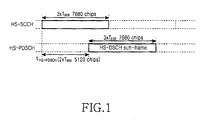
- FIG. 1 is a view illustrating channels used for high speed packet transmission in a conventional asynchronous mobile communication system.
- FIG. 1 illustrates a timing-relationship between a high speed-shared control channel (HS-SCCH) and a high speed-physical downlink shared channel (HS-PDSCH), which are adopted in a downlink for the purpose of HSDPA services.
- HS-SCCH high speed-shared control channel
- HS-PDSCH high speed-physical downlink shared channel
- the HS-SCCH has a Transmission Time Interval(TTI) of 7680 chips (3x T slot ) and receives control information required for receiving the HS-PDSCH.
- the HS-PDSCH includes the HS-SCCH and an offset ( ⁇ HS-PDSCH ) of 5120 chips (2x T slot ) and receives high speed packets according to the HSDPA service.
- the HS-PDSCH has a TTI having a length identical to the length of the TTI of the HS-SCCH.
- the HS-SCCH is divided into two parts including information shown in Table 1.
- Table 1. indicates the number of information bits. 1 st part 2nd part Channelization code set (7) Transport block size (6) Modulation scheme (1) Hybrid ARQ process (3) Redundancy and constellation version (3) New data indicator (1) UE identity (16)
- the user equipment decodes the HS-SCCH and obtains the control information required for decoding the HS-PDSCH.
- a current asynchronous mobile communication system one UE can monitor four HS-SCCHs. Accordingly, the UE checks whether or not there is control information related to the HS-DPSCH to be received in the UE after decoding all of the four HS-SCCHs. If there is control information related to the HS-DPSCH received in the UE, the UE decodes the HS-PDSCH based on the control information. If there is no control information related to the HS-DPSCH received in the UE, the UE receives a next HS-SCCH.
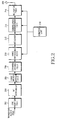
- FIG. 2 is a view illustrating a structure of a transmitter for transmitting an HS-PDSCH in a conventional asynchronous mobile communication system.
- a transport block 200 is input into a bit scrambler 204 through a cyclic redundancy check (CRC) insertion field 202 in which a CRC is added to the transport block 200.
- the bit scrambler 204 performs a bit scrambling with respect to the transport block 200 having the CRC in order to solve an unevenness of average power of a transport symbol generated in a higher modulation scheme.
- output bits including the CRC are scrambled by means of the bit scrambler 204.
- Input bits of the bit scrambler 204 are represented as b im,1 , b im,2 , b im,3 ,..., b im,B
- output bits of the bit scrambler 204 are represented as d im,1 , d im,1 , d im,1 ,..., d im,B .
- B is the number of input bits of the bit scrambler 204.
- Equation 2 y k is obtained through Equation 2.
- Bits which have passed through the bit scrambler 204 are output in the form of a code block by passing through a code block division field 206. If the size of the transport block having the CRC exceeds the maximum input bit number for channel coding, the code block division field 206 divides the bits into several code blocks for the purpose of the channel coding. For instance, in a case of a convolution code, the number of bits is 504, and in a case of a turbo code, the number of bits is 5114.
- transport blocks are output in the form of coded bits by passing through a channel coding field 208.
- the channel coding field 208 has at least one coding rate in order to code each of transport blocks.
- the coding rate includes 1/2 or 3/4.
- the HARQ processing field 210 is a rate matching field capable of outputting the coded bits while rate matching the coded bits.
- the rate matching is carried out when a transport channel multiplexing occurs or the coded bits do not match with the number of bits transmitted through a radio network. That is, according to the rate matching, the number of output bits matches with the number of bits to be transmitted through the radio network by performing repetition and puncturing processes with respect to coded bits.
- the coded bits are input into an interleaver 212.
- the coded bits are interleaved by means of the interleaver 212.
- the interleaver 212 transmits the coded bits after interleaving the coded bits, so that any damage to the coded bits can be distributed over the whole area of the coded bits without being concentrated onto one spot of the coded bits. Therefore, the coded bits may randomly undergo a fading phenomenon so that burst error is prevented, thereby improving the channel coding effect.
- the modulation scheme includes an M_ary PSK and an M_ary QAM.
- a control unit 218 controls the rate matching of the HARQ processing field 210 and the modulation scheme of the modulation field 216 based on a present radio channel state. That is, in a case of a mobile communication system providing the HSDPA service, the control unit 218 provides an effective coding rate for performing the rate matching and an adaptive modulation and coding scheme (AMCS) for selectively using the QPSK or 16 QAM based on the radio channel environment.
- AMCS adaptive modulation and coding scheme
- the coded bits output from a turbo coder of the transmitter are divided into systematic bits and parity bits.
- the systematic bits and the parity bits have their own priority.
- the systematic bits are actual data bits and the parity bits are supplementary bits which are provided for correcting the error when coding the bits. For this reason, the systematic bits selected from among bits mapped with one modulation symbol have higher reliability and the parity bits selected from among the bits mapped with one modulation symbol have lower reliability in order to reduce the error occurring in the systematic bits which are more important than the parity bits.
- the constellation rearrangement field 214 will be described.
- 16 QAM four coded bits are mapped with one modulation symbol.
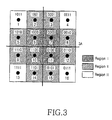
- the modulation symbol is transmitted to one spot of 16 signal points as shown in FIG. 3.
- the 16 signal points are divided into three fields including a first region having a highest error probability, a second region having an intermediate error probability, and a third region having a lowest error probability.
- the retransmitted symbol is constantly mapped with a predetermined signal point, so the symbols transmitted to signal points 6, 7, 10 and 11 of the first region have a relatively higher error probability as compared with that of symbols transmitted to other signal points. If symbols are transmitted to the signal points having an inferior environment, system performance may be deteriorated.
- the bits are inverted when retransmitting a packet in such a manner that the bits are mapped with another modulation symbol different from the modulation symbol of initial transmission, thereby improving system performance.
- the symbol undergoing the M_ary modulation includes log2M bits having a reliability probability different from each other. For instance, in a case of 16 QAM, four coded bits are mapped with one symbol. At this time, the fore two bits are mapped with the symbol with higher reliability and the aft two bits are mapped with the symbol with lower reliability.
- the bits transmitted with higher reliability can be retransmitted with higher reliability and the bits transmitted with lower reliability can be retransmitted with lower reliability so that the error probability may increase at specific bits.
- the packet is moved by a predetermined bit unit during retransmission of the packet, the bit transmitted with lower reliability can be retransmitted with higher reliability.
- an LLR (log likelihood ratio) value of an input bit becomes homogeneous so that decoding performance of a turbo decoder can be improved.
- the coded symbol which has undergone the above processes, is transmitted to a channel through an antenna.
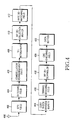
- FIG. 4 is a view illustrating a structure of a receiver for receiving the HS-PDSCH in a conventional asynchronous mobile communication system.
- a ratio of pilot power to traffic power of a signal received through an antenna 400 is estimated by means of a blind power ratio detection (BPD) field 402.
- BPD blind power ratio detection
- a base station transmits a predetermined pilot signal through a common pilot channel (PICH or CPICH) capable of transmitting signals to all UEs.
- PICH or CPICH common pilot channel
- the UEs estimate the state of a radio channel by using the pilot signal, in particular, by using a channel estimation scheme for estimating the fading phenomenon.
- the UEs may restore the signal distorted by the channel fading to a normal signal through the channel estimation.
- the UEs can estimate the ratio of pilot power to traffic power through the channel estimation.
- Such an estimation for the ratio of pilot power to traffic power is necessary for decoding signal which has been modulated through a high-level modulation scheme, such as 16 QAM or 64QAM. If the transmitter notifies the receiver of the ratio of pilot power to traffic power, the above estimation process is not necessary.
- a receiver estimates the ratio of pilot power to traffic power in order to reduce the burden of signaling.
- a blind power ratio detection scheme signifies a scheme in which the ratio of pilot power to traffic power cannot be communicated through the signaling or the receiver estimates the ratio of pilot power to traffic power.
- a decoding field 404 extracts a bit array from a symbol array by using the power ratio estimated from the BPD field 402 and inputs the bit array into a constellation rearrangement field 406.
- the constellation rearrangement field 406 rearranges bits forming the bit array.
- the coded bits passing through the constellation rearrangement field 406 are de-interleaved through a de-interleaver 408 which corresponds to an interleaver of a transmitter. Then, an array of the coded bits is transmitted to a bit de-collection buffer 410 so that the coded bit array is de-collected. After that, the coded bit array is transmitted to a rate de-matching field 412 which performs a rate de-matching with respect to the coded bit array.
- the coded bits passing through the rate de-matching field 412 are input into a code block division buffer 414 so that the coded bits are divided in the form of code block units by means of the code block division buffer 414. Then, the coded bits are input into a channel decoding field 416.
- the channel decoding field 416 performs channel decoding with respect to the coded bit array input into the channel decoding field 416 so that information bits are extracted from the coded bit array.
- the extracted information bits are de-scrambled through a bit de-scrambler 418 and input into a CRC checking field 420 in order to check a CRC error of the information bits.
- received data is transmitted to an upper layer and an ACK signal is transmitted into the transmitter. If the CRC error occurs in the information bits, received data are stored in a data buffer 422 so as to combine the received data with retransmission data and a NACK signal is transmitted into the transmitter.
- FIG. 3 is view illustrating a signal constellation when a modulation scheme of 16 QAM is employed in a conventional mobile communication system.
- modulation symbols have mutually different power levels.
- a modulation symbol is represented as "S i "
- the power of the modulation symbol is represented as " ⁇ S i >”.
- i can be replaced with d or p in order to discriminate power of a data symbol from power of a pilot symbol.
- W d is the Walsh spreading code for discriminating the data channel from the pilot channel
- W p is the Walsh spreading code for discriminating the pilot channel from the data channel
- a d is a channel gain of the data channel
- a p is a channel gain of the pilot channel
- S d represents data symbols forming a packet
- S p represents pilot symbols forming a packet.
- S p is predetermined between a transmitter and a receiver. The above symbols also represent the same data in the following equations.
- the high speed packet transport system may transmit T x in a packet unit and the packet includes various slots.
- a slot has a size of 0.667ms, and the number of slots per one slot may vary depending on a spreading factor (SF) applied to the slot.
- SF spreading factor
- a packet includes three slots with the SF of 16 so that a total of 480 symbols can be transmitted per one packet.
- 16 QAM one symbol includes four bits, so 1920 bits are generated.
- one symbol includes two bits, so 960 bits are generated.
- the arrangement of the symbols may be irregularly formed due to the characteristics of the data. For instance, if all of the 1920 bits have values of "0", all the symbols become inner symbols in the form of "A+jA”. In this case, the total average power P total of the symbols is "0.2". Thus, the receiver may estimate the total average power P total of the symbols as "0.2" instead of "1", even if noise or distortion does not occur in the radio channel. In contrast, if all of bits have values of "1", all symbols will have "3A+j3A” patterns so that the receiver may estimate the total average power P total of the symbols as "1.8".
- PDF probability density function
- the symbols are uniformly transmitted based on the signal constellation of 16QAM, it is possible to effectively estimate the ratio of pilot power to traffic power. If the HS-PDSCH symbols are unevenly transmitted, an estimation error may occur so that system performance will be degraded. In particular, if bits having values of "0" or "1" are generated, inner symbols or outer symbols are only transmitted, resulting in a serious performance degradation.
- a performance degradation is estimated as a level of 1.0 to 1.5 dB.
- a bit scrambler is necessary in the 3GPP standardization for a transport block having the CRC as shown in FIG. 2.
- a UE when data is transmitted through the HS-PDSCH, control information is provided through the HS-SCCH in order to demodulate or decode the HS-PDSCH. Accordingly, a UE can decode the HS-PDSCH based on the control information transmitted thereto through the HS-SCCH. At this time, the currently available UE may check the transmission of control information related to UEs after demodulating all of the four HS-SCCHs. In addition, the UE may demodulate the HS-PDSCH after checking the control information. Thus, if the UE erroneously analyzes the HS-SCCH, a receiver may modulate the HS-PDSCH through a series of processes even if data is not UE data. Such an error may not frequently occur. However, if the error occurs, system performance may be seriously degraded.
- an object of the present invention is to provide an apparatus and a method for transceiving data while preventing problems caused by a detection error of control information in a wireless mobile communication system.
- Another object of the present invention is to provide an apparatus and a method for performing a channel coding with respect to information bits after bit-scrambling the information bits by using a UE identifier.
- Still another object of the present invention is to provide an apparatus and a method for performing a bit de-scrambling with respect to channel decoded information bits by using a UE identifier.
- a method for transmitting information bits by using a transmitter in a mobile communication system providing a high speed packet data service comprising the steps of: inserting a CRC bit into a transport block transmitted from an upper layer; scrambling bits of the transport block having the CRC bit by receiving a scrambling code from the upper layer, in which the scrambling code is selected to match with a receiver used for receiving the transport block from among scrambling codes assigned to receivers with different values; channel-coding the scrambled bits; and modulating the channel-coded bits.
- an apparatus for transmitting information bits in a mobile communication system providing a high speed packet data service comprising: a CRC insertion field for inserting a CRC bit into a transport block transmitted from an upper layer; a bit scrambler for scrambling bits of the transport block having the CRC bit by receiving a scrambling code from the upper layer, in which the scrambling code is selected to match with a receiver used for receiving the transport block from among scrambling codes assigned to receivers with different values; a channel coding field for performing a channel coding with respect to the scrambled bits; and a modulation field for modulating the channel-coded bits.
- a method for receiving information bits for a high speed packet transmission service from a transmitter by using a receiver having one of scrambling codes in a mobile communication system providing the high speed packet transmission service, the scrambling codes being previously assigned to the mobile communication system with different values comprising the steps of: monitoring a plurality of control channels for the high speed packet transmission service and receiving control information required for receiving information symbol bits; decoding demodulated and coded bits of the information symbol bits into information bits in response to the control information based on a coding rate used by the transmitter; de-scrambling the information bits by receiving a predetermined scrambling code from an upper layer; and performing a CRC checking with respect to the information bits by using CRC bits included in the de-scrambled information bits.
- an apparatus for receiving information bits for a high speed packet transmission service from a transmitter by using a receiver having one of scrambling codes in a mobile communication system providing the high speed packet transmission service, the scrambling codes being previously assigned to the mobile communication system with different values comprising: a channel decoding field for decoding demodulated and coded bits of information symbol bits into information bits based on a coding rate used by the transmitter; a bit de-scrambler for de-scrambling the information bits by receiving a predetermined scrambling code from an upper layer; and a CRC checking field for performing a CRC checking with respect to the information bits by using CRC bits included in the de-scrambled information bits.
- a transmitter scrambles information bits by using a UE identifier before a channel decoding and a receiver performs a de-scrambling with respect to channel-decoded information bits by using the UE identifier.
- the present invention can prevent not only an unevenness of the transmission power, which can be generated when a high-level modulation scheme is used, but also data transmission toward an upper layer caused by an unnecessary decoding of an HS-PDSCH derived from a decoding error for an HS-SCCH.
- FIG. 5 is a view illustrating a structure of a transmitter for transmitting an HS-PDSCH in a mobile communication system according to an embodiment of the present invention.
- a transport block 500 is input into a UE-specific bit scrambler 504 through a CRC insertion field 502 in which a CRC is added to the transport block 500.
- the UE-specific bit scrambler 504 performs a bit scrambling with respect to the transport block 500 having the CRC.
- input bits of the UE-specific bit scrambler 504 are represented as b im,1 , b im,2 , b im,3 ,..., b im,B
- output bits of the UE-specific bit scrambler 504 are represented as d im,1 , d im,1 , d im,1 ,..., d im,B .
- B is a number of input bits of the UE-specific bit scrambler 504.
- Equation 8 y k is obtained through Equation 8.
- ue ⁇ ue 1 , ue 2 ,..., ue 16 ⁇ is a UE identifier parameter which is differently assigned to UEs.
- a bit scrambling is carried out in a different way according to the UE identifier (UE ID) assigned to UEs so that a CRC checking determines an NACK if an HS-PDSCH is demodulated without UE data caused by a detection error in an HS-SCCH.
- the present invention can prevent data from being transmitted to an upper layer.
- Bits scrambled by means of the UE-specific bit scrambler 504 are divided in the form of a code block by means of a code block division field 506 and inputted into a channel coding field 508. Then, bits forming the transport block are outputted in the form of coded bits by passing through the channel coding field 508.
- the channel coding field 508 has at least one coding rate in order to code each of transport blocks.
- the coding rate includes 1/2 or 3/4.
- the channel coding field 508 includes a mother code having a mother coding rate of 1/6 or 1/5. Repetition and puncturing processes can be carried out with respect to the coded bits based on the mother coding rate in order to provide a plurality of coding rates. In this case, it is necessary to determine an available coding rate from among the plurality of coding rates.
- the coded bits are input into a HARQ processing field 510.
- the HARQ processing field 510 is a rate matching field for performing rate matching with respect to coded bits.
- the rate matching signifies the repetition and puncturing processes for the coded bits, which may be carried out when transport channel multiplexing occurs or the coded bits do not match with the number of bits transmitted through a radio network.
- the coded bits are input into an interleaver 512.
- the coded bits are interleaved and output by means of the interleaver 512. The interleaving is necessary to minimize data loss during data transmission.
- the coded bits are rearranged through a constellation rearrangement field 514 and input into a modulation field 516.
- the modulation field 516 transmits the coded bits by mapping the coded bits with symbols according to the modulation schemes, such as an M_ary PSK and an M_ary QAM.
- a control unit 518 controls the rate matching of the HARQ processing field 510 and the modulation scheme of the modulation field 516 based on the present radio channel state. That is, in a case of a mobile communication system providing the HSDPA service, the control unit 518 provides an adaptive modulation and coding scheme (AMCS) based on the radio channel environment.
- AMCS adaptive modulation and coding scheme
- a receiver used for receiving the HSPDA service must monitor at least one HS-SCCH (maximum of four HS-SCCHs). Each HS-SCCH is divided into two parts. Two parts of the HS-SCCH include information represented in Table 1. Thus, the receiver demodulates four HS-SCCHs, and then, demodulates the HS-DSCHs when it is checked that the control information has been transmitted to the UE.
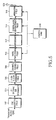
- FIG. 6 is a view illustrating a structure of the receiver for receiving the HS-PDSCH according to one embodiment of the present invention.
- a signal received through an antenna 600 is transmitted to a blind power ratio detection (BPD) field 602.
- the BDP field 602 estimates the ratio of pilot power to traffic power of the signal.
- a channel estimation scheme is carried out by using a pilot signal of a common pilot channel (PICH or CPICH) capable of transmitting signals to all UEs. That is, a base station transmits a predetermined pilot signal through the common pilot channel so that the UE estimates the state of a radio channel, in particular, the fading phenomenon by using the pilot signal.
- the UEs may restore the signal distorted by the channel fading to a normal signal through the channel estimation.
- the UEs can estimate the ratio of pilot power to traffic power through the channel estimation.
- the ratio of pilot power to traffic power obtained through the PDP field 602 is transmitted to a demodulation field 604.
- the demodulation field 604 extracts a bit array from a symbol array by using the power ratio estimated from the BPD field 602.
- the bit array extracted by the demodulation field 604 is input into a constellation rearrangement field 606 so that the constellation rearrangement field 606 rearranges bits forming the bit array.
- an operation of the constellation rearrangement field 606 is identical to an operation of a constellation rearrangement field of a transmitter.
- the constellation rearrangement field 606 of the receiver rearranges the signals (s 3 , s 4 , s 1 and s 2 ,) in the sequence of s 1 , s 2 , s 3 and s 4 . That is, the constellation rearrangement field 606 of the receiver operates corresponding to the constellation rearrangement field of the transmitter.
- the transmitter may rearrange the signals in four ways as shown in Table 2.
- Constellation conversion parameter Output bit sequence Operation 0 s 1 , s 2 , s 3 , s 4 None 1 s 3 , s 4 , s 1 , s 2 , Swapping MSBs with LSBs 2 s 1 , s 2 , s 3 , s 4 Inversion of the logical values of LSBs 3 s 3 , s 4 , s 1 , s 2 1&2 above
- the rearrangement way is transmitted to the receiver through the HS-SCCH.
- the receiver may perform the bit rearrangement process by means of the constellation rearrangement field 606 in order to obtain a bit array having an arrangement of s 1 , s 2 , s 3 and s 4 .
- the coded bit array rearranged through the constellation rearrangement field 606 is input into a de-interleaver 608.
- the de-interleaver 608 de-interleaves the coded bits in a manner corresponding to that of the interleaver 512 of the transmitter.
- the coded bit array is transmitted to a bit de-collection buffer 610.
- the bit de-collection buffer 610 outputs the coded bits by dividing the coded bits into systematic bits and parity bits.
- the systematic bits and parity bits are input into a rate de-matching field 612 which performs a rate de-matching with respect to the systematic bits and parity bits and transmits the systematic bits and parity bits to a code block division buffer 614.
- the systematic bits and parity bits are divided in the form of code block units by means of the code block division buffer 614 and transmitted to a channel decoding field 616.
- the channel decoding field 616 performs channel decoding with respect to the systematic bits and parity bits so that the information bits are extracted from the systematic bits and parity bits.
- the extracted information bits are input into a UE-specific bit de-scrambler 618, which descrambles the extracted information bits by using codes corresponding to predetermined UE-Ids. Then, the information bits are transferred to a CRC checking field 620.
- the CRC checking field 620 checks a CRC error of the information bits by using CRC bits included in the information bits. In addition, the CRC checking field 620 determines whether or not it is necessary to request a signal retransmission based on the CRC error of the information bits. If the CRC error occurs in the information bits, the CRC checking field 620 stores information bits in a data buffer 622 and transmits a NACK signal to the transmitter to request the signal retransmission. If the CRC error does not occur in the information bits, the information bits are transferred to an upper layer and an ACK signal is transmitted to the transmitter.
- the bit de-scrambling is preferably carried out after transmitting a transport block having the CRC bit in order to solve an unevenness of transmission power derived from a high-level modulation scheme.
- the UE performs the bit de-scrambling by using a 16-bit UE-ID received from the upper layer.
- Equation 10 y k is obtained through Equation 10.
- a value of y' ⁇ is preset in the receiver and the transmitter and various values can be used for y' ⁇ .
- ue ⁇ ue 1 , ue 2 ,..., ue 16 ⁇ is used because the UE identifier is a common parameter recognized by both of the base station and the UE, and because the UE identifier has a value, which may vary depending on UEs.
- the UE-specific bit de-scrambler 618 performs a bit de-scrambling with respect to the bit array after the bit array has passed through the channel decoding field 616 without requiring any additional signaling or an increase of hardware.
- CRC checking is carried out by means of the CRC checking field 620.
- the UE may check the error through the CRC checking because the CRC is transmitted while being scrambled with a UE ID and is received while being de-scrambled with a corresponding UE ID. If the HS-PDSCH is demodulated without UE data, the CRC checking is carried out by means of the CRC checking field, which is de-scrambled by means of other UE ID. Thus, if the error is detected, the UE transmits the NACK signal to the transmitter without transmitting the UE data to the upper layer.
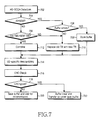
- FIG. 7 is a flowchart illustrating a control flow of the UE according to an embodiment of the present invention.
- the UE detects HS-SCCHs (a maximum of four HS-SCCHs) and demodulates the HS-SCCHs (step 702).
- the UE can check whether or not the HS-PDSCH is transmitted to the UE through the above demodulation.
- the UE determines whether the packet is a new packet or a retransmitted packet based on a new data indicator (NI) transmitted to the HS-SCCHs. If it is determined that the packet is the new packet in step 704, step 708 is carried out. In addition, if it is determined that the packet is the retransmitted packet in step 704, step 706 is carried out.
- the UE checks whether or not data exists in the buffer in which received packets are stored. If the data exists in the buffer, the UE replaces the old data with new data (step 710). If the buffer has no data, the UE stores the new data in the buffer (step 709).
- step 706 the UE compares an old transport block size (TBS) with a new TBS. If it is determined that the old TBS is different from the new TBS, step 710 is carried out. In addition, if it is determined that the old TBS is equal to the new TBS, step 712 is carried out. In step 710, the UE replaces old data with new data. In step 712, the UE combines an old packet with a new packet.
- TBS transport block size
- step 714 the UE performs the de-scrambling with respect to newly stored data or combined data by using the UE ID.
- the above de-scrambling is carried out for solving an unevenness problem of transmission power generated when the high-level modulation scheme is used.
- the UE performs step 716 in order to carry out the CRC checking with respect to the de-scrambled data.
- the UE checks whether or not the result of the CRC checking is good. If the result of the CRC checking is good, step 722 is carried out.
- step 722 the UE transmits data stored in the buffer to an upper layer buffer and deletes data stored in the buffer. If the result of the CRC checking is not good, step 720 is carried out.
- step 720 the UE stores data in the buffer and waits for the retransmission of data.
- the UE ID is used as a scrambling code for the bit scrambling
- other code arrays also can be assigned to UEs.
- an unevenness of a power ratio between pilot power and traffic power can be solved by providing a UE-specific bit scrambler, which performs bit scrambling of the bit array without requiring any additional signaling or an increase in hardware.
- the present invention can prevent data from being transferred to an upper layer even if an HS-PDSCH is demodulated without the UE data due to a detection error in an HS-SCCH. That is, according to an embodiment of the present invention, if the UE receives other UE data due to the detection error in the HS-SCCH, the data are de-scrambled by means of other de-scrambler having a scrambling scheme different from a scrambling scheme of a scrambler used in a transmitter. Thus, a NACK signal is generated, even if the CRC is subject to an environment for generating an ACK signal, so that data is not transferred to the upper layer.
- the present invention compares the TBS stored in the buffer with the new TBS and replaces the old TBS with the new TBS, so other UE data cannot be combined with data stored in the buffer.
Landscapes
- Engineering & Computer Science (AREA)
- Computer Networks & Wireless Communication (AREA)
- Signal Processing (AREA)
- Quality & Reliability (AREA)
- Physics & Mathematics (AREA)
- Spectroscopy & Molecular Physics (AREA)
- Power Engineering (AREA)
- Mobile Radio Communication Systems (AREA)
- Detection And Prevention Of Errors In Transmission (AREA)
Applications Claiming Priority (2)
| Application Number | Priority Date | Filing Date | Title |
|---|---|---|---|
| KR2003064038 | 2003-09-16 | ||
| KR1020030064038A KR20050027679A (ko) | 2003-09-16 | 2003-09-16 | 이동통신시스템에서 고속 패킷 데이터 송/수신장치 및 방법 |
Publications (2)
| Publication Number | Publication Date |
|---|---|
| EP1517499A2 true EP1517499A2 (de) | 2005-03-23 |
| EP1517499A3 EP1517499A3 (de) | 2006-11-15 |
Family
ID=34192228
Family Applications (1)
| Application Number | Title | Priority Date | Filing Date |
|---|---|---|---|
| EP20040022044 Ceased EP1517499A3 (de) | 2003-09-16 | 2004-09-16 | Gerät und Verfahren zum Senden und Empfangen von Hochgeschwindigkeitspaketdaten in einem mobilen Kommunikationssystem |
Country Status (5)
| Country | Link |
|---|---|
| US (1) | US20050094615A1 (de) |
| EP (1) | EP1517499A3 (de) |
| JP (1) | JP4072529B2 (de) |
| KR (1) | KR20050027679A (de) |
| CN (1) | CN100382480C (de) |
Cited By (7)
| Publication number | Priority date | Publication date | Assignee | Title |
|---|---|---|---|---|
| WO2006126079A3 (en) * | 2005-05-27 | 2007-04-05 | Nokia Corp | Expanded signalling capability for network element, user equipment and system |
| EP1804448A1 (de) * | 2005-12-28 | 2007-07-04 | Fujitsu Limited | Mobiles Endgerät und dazu gehörige Methode zur Kanalkompensation |
| WO2008136574A1 (en) * | 2007-05-02 | 2008-11-13 | Electronics And Telecommunications Research Institute | Method and apparatus for transmitting signal |
| US7593694B2 (en) | 2003-09-29 | 2009-09-22 | Siemens Aktiengesellschaft | Data transmission method with a lower probability of erroneous rejection of data |
| EP2014005A4 (de) * | 2006-04-25 | 2013-11-20 | Lg Electronics Inc | Verfahren zum senden von daten durch verwendung von betriebsmitteln bei harq-operationen |
| EP2222041A4 (de) * | 2007-11-30 | 2014-01-08 | Zte Corp | Verfahren zur angabe des modulationsmodus bei hsdpa |
| EP2380389A4 (de) * | 2008-12-29 | 2014-05-07 | Lg Electronics Inc | Steuerkanalerkennung für mehrere implizite identifikatoren |
Families Citing this family (38)
| Publication number | Priority date | Publication date | Assignee | Title |
|---|---|---|---|---|
| AU2002315928A1 (en) * | 2002-04-09 | 2003-10-23 | Nec Australia Pty Ltd | Improved signalling scheme for high speed downlink packet access |
| KR20070084434A (ko) * | 2004-11-24 | 2007-08-24 | 마츠시타 덴끼 산교 가부시키가이샤 | 레이트 매칭 장치, 무선 송신 장치, 무선 수신 장치 및레이트 매칭 방법 |
| JP4689316B2 (ja) * | 2005-03-28 | 2011-05-25 | 富士通株式会社 | 無線通信の下りリンクチャネルを伝送する制御情報のエラー検出方法及び移動端末 |
| KR20130033463A (ko) * | 2005-08-24 | 2013-04-03 | 인터디지탈 테크날러지 코포레이션 | 업링크 용량을 증가시키기 위해 채널 품질 표시자 피드백 주기를 조정하는 방법 및 장치 |
| KR100876791B1 (ko) * | 2006-01-13 | 2009-01-07 | 삼성전자주식회사 | 주파수 분할 다중 접속 시스템에서 부호화 심볼을 매핑하여 전송하는 방법 및 장치 |
| US9088389B2 (en) | 2006-06-13 | 2015-07-21 | Qualcomm Incorporated | Reverse link pilot transmission for a wireless communication system |
| TW200810456A (en) * | 2006-06-21 | 2008-02-16 | Qualcomm Inc | Wireless resource allocation methods and apparatus |
| EP2039044A2 (de) * | 2006-06-21 | 2009-03-25 | Qualcomm Incorporated | Verfahren und vorrichtung zur messung, weiterleitung und/oder verwendung von interferenzinformationen |
| TWI372539B (en) * | 2006-06-23 | 2012-09-11 | Qualcomm Inc | Methods and systems for processing overhead reduction for control channel packets |
| CN101098299B (zh) * | 2006-06-27 | 2010-08-18 | 中兴通讯股份有限公司 | 一种比特加扰的并行方法及装置 |
| US7876808B2 (en) * | 2006-11-30 | 2011-01-25 | Broadcom Corp. | Method and apparatus for adaptive noise and/or signal filtering in an HSDPA channel quality indicator (CQI) selection |
| WO2008075890A1 (en) | 2006-12-18 | 2008-06-26 | Samsung Electronics Co., Ltd. | Method and apparatus for transmitting/receiving data and control information through an uplink in a wireless communication system |
| KR101002247B1 (ko) * | 2006-12-18 | 2010-12-20 | 삼성전자주식회사 | 무선통신 시스템에서 상향링크를 통해 데이터 및 제어정보를 송수신하는 방법 및 장치 |
| EP1986364A1 (de) * | 2007-04-25 | 2008-10-29 | Mitsubishi Electric Information Technology Centre Europe B.V. | Verfahren und Vorrichtung zur Zuweisung mittels Telekommunikationsvorrichtung von mindestens einem ersten und einem zweiten aufeinander folgenden Kanalelement einer Gruppe von Kanalelementen einer Kanalressource zu einem Ziel |
| EP2111005A1 (de) * | 2007-06-18 | 2009-10-21 | Mitsubishi Electric R&D Centre Europe B.V. | Verfahren zur über eine Telekommunikationsvorrichtung erfolgenden Zuordnung mindestens eines Kanalelements aus einer Gruppe von Kanalelementen einer Kanalressource zu einem Ziel |
| US9209937B2 (en) * | 2007-06-28 | 2015-12-08 | Telefonaktiebolaget L M Ericsson (Publ) | Reliable decoding of a high-speed shared control channel |
| KR100926563B1 (ko) * | 2007-08-23 | 2009-11-12 | 한국전자통신연구원 | 로그우도비 산출 방법, 송신 신호 검출 방법 및 수신기 |
| JPWO2009069638A1 (ja) * | 2007-11-27 | 2011-04-14 | 日本電気株式会社 | 無線信号送信装置、無線信号送信方法、無線信号受信装置、無線信号受信方法および無線信号受信プログラム |
| CN101483441A (zh) | 2008-01-07 | 2009-07-15 | 三星电子株式会社 | 通信系统中添加循环冗余校验的设备 |
| US8737517B2 (en) * | 2008-03-26 | 2014-05-27 | Qualcomm Incorporated | Scrambling and modulation to constrain the constellation size of ACK/NAK transmission on the data channel |
| WO2010016669A2 (en) | 2008-08-04 | 2010-02-11 | Samsung Electronics Co., Ltd. | Signal transmission method and apparatus for user equipment in mobile communication system |
| US9215035B2 (en) | 2008-12-08 | 2015-12-15 | Lg Electronics Inc. | Method of transmitting and receiving physical downlink shared channel in wireless communication system |
| US8458559B2 (en) * | 2009-01-09 | 2013-06-04 | Nec Corporation | Method and apparatus for encoding and decoding |
| JP4737306B2 (ja) * | 2009-02-13 | 2011-07-27 | 富士ゼロックス株式会社 | 露光装置、画像形成装置、及び露光制御プログラム |
| CN101938340B (zh) * | 2009-06-29 | 2014-04-09 | 中兴通讯股份有限公司 | 扰码选择方法及加扰装置 |
| US9030977B2 (en) * | 2009-10-15 | 2015-05-12 | Qualcomm Incorporated | Methods and apparatus for transport block size determination |
| TW201206195A (en) * | 2010-07-26 | 2012-02-01 | Gemtek Technology Co Ltd | Digital monitoring device |
| KR101125933B1 (ko) | 2011-02-25 | 2012-03-21 | 제주대학교 산학협력단 | 그리드형 무선 프로세스 제어 네트워크에서 버퍼링 재전송을 기반으로 하는 메시지 전송 방법 및 노드들 |
| KR101608573B1 (ko) * | 2011-06-29 | 2016-04-01 | 닛본 덴끼 가부시끼가이샤 | 무선 송수신기 디바이스, 통신 시스템, 및 그 디바이스 및 시스템에서 이용되는 채널 코딩 프로세싱 방법 |
| CN104333405B (zh) * | 2011-12-26 | 2018-07-20 | 华为技术有限公司 | 控制信息发送方法及基站 |
| CN106134242B (zh) * | 2014-03-18 | 2019-09-06 | Lg电子株式会社 | 用于接收数据的方法和使用该方法的装置 |
| WO2015168873A1 (zh) * | 2014-05-07 | 2015-11-12 | 华为技术有限公司 | 发送设备、接收设备、无线通信方法及系统 |
| US9350570B2 (en) * | 2014-09-19 | 2016-05-24 | Alcatel Lucent | Method of operating a receiver and a receiver |
| DE102015103809B3 (de) * | 2015-03-16 | 2016-07-07 | Intel IP Corporation | Verfahren und Vorrichtung zum Schützen eines Datentransportblocks gegen Speicherfehler und Übertragungsfehler |
| WO2016157178A1 (en) * | 2015-03-30 | 2016-10-06 | E.K.Salt Ltd. | Novel and useful edible salt and methods of use and production thereof |
| US11419004B2 (en) * | 2016-11-08 | 2022-08-16 | Telefonaktiebolaget Lm Ericsson (Publ) | Optimization of logical channel processing for multiple transport blocks |
| WO2019036864A1 (en) * | 2017-08-21 | 2019-02-28 | Qualcomm Incorporated | USER EQUIPMENT IDENTIFIER INFORMATION |
| DE102020113451A1 (de) * | 2020-05-18 | 2021-11-18 | Bayerische Motoren Werke Aktiengesellschaft | Sendeeinheit und Empfangseinheit zum Senden und Empfangen von Datenpaketen |
Citations (1)
| Publication number | Priority date | Publication date | Assignee | Title |
|---|---|---|---|---|
| US6201811B1 (en) * | 1998-03-24 | 2001-03-13 | Telefonaktiebolaget Lm Ericsson (Publ) | Transferring Identifier information in a telecommunications system |
Family Cites Families (18)
| Publication number | Priority date | Publication date | Assignee | Title |
|---|---|---|---|---|
| GB1553027A (en) * | 1977-05-12 | 1979-09-19 | Marconi Co Ltd | Message signal scrambling apparatus |
| JP3581377B2 (ja) * | 1993-04-06 | 2004-10-27 | ソニー株式会社 | ディジタル多重伝送方法と装置 |
| US5909434A (en) * | 1996-05-31 | 1999-06-01 | Qualcomm Incorporated | Bright and burst mode signaling data transmission in an adjustable rate wireless communication system |
| US5751741A (en) * | 1996-11-20 | 1998-05-12 | Motorola, Inc. | Rate-adapted communication system and method for efficient buffer utilization thereof |
| JP3060996B2 (ja) * | 1997-05-30 | 2000-07-10 | 日本電気株式会社 | 無線データ通信装置 |
| US6038263A (en) * | 1997-07-31 | 2000-03-14 | Motorola, Inc. | Method and apparatus for transmitting signals in a communication system |
| US6285655B1 (en) * | 1997-09-08 | 2001-09-04 | Qualcomm Inc. | Method and apparatus for providing orthogonal spot beams, sectors, and picocells |
| US6263443B1 (en) * | 1997-10-11 | 2001-07-17 | Agere Systems Guardian Corp. | Simplified data link protocol processor |
| US6728202B1 (en) * | 1998-12-24 | 2004-04-27 | Agere Systems Inc. | Code division multiplex satellite broadcasting system |
| US7110351B2 (en) * | 2000-12-19 | 2006-09-19 | Nortel Networks Limited | Enhanced ARQ with OFDM modulation symbols |
| KR100442603B1 (ko) * | 2001-03-20 | 2004-08-02 | 삼성전자주식회사 | 고속 패킷 데이터 전송 이동통신시스템에서 패킷 데이터채널 및 패킷 데이터 제어 채널을 스크램블링하기 위한장치 및 방법 |
| US7012911B2 (en) * | 2001-05-31 | 2006-03-14 | Qualcomm Inc. | Method and apparatus for W-CDMA modulation |
| EP1326398A1 (de) * | 2001-10-09 | 2003-07-09 | Koninklijke Philips Electronics N.V. | Paketkommunikationssystem |
| CN100590991C (zh) * | 2002-01-30 | 2010-02-17 | Lg电子株式会社 | 利用可变时隙长度扰频分组数据的方法及其设备 |
| US8121292B2 (en) * | 2002-02-26 | 2012-02-21 | Qualcomm Incorporated | Method and apparatus for scrambling information bits on a channel in a communications system |
| US7158635B2 (en) * | 2002-05-07 | 2007-01-02 | Interdigital Technology Corporation | Generation of user equipment identification specific scrambling code for the high speed shared control channel |
| KR100461547B1 (ko) * | 2002-10-22 | 2004-12-16 | 한국전자통신연구원 | 디에스/시디엠에이 미모 안테나 시스템에서 보다 나은수신 다이버시티 이득을 얻기 위한 전송 시스템 |
| JP4032065B2 (ja) * | 2003-05-27 | 2008-01-16 | 富士通株式会社 | 受信装置およびハイブリッドarq通信システム |
-
2003
- 2003-09-16 KR KR1020030064038A patent/KR20050027679A/ko not_active Ceased
-
2004
- 2004-09-15 JP JP2004268867A patent/JP4072529B2/ja not_active Expired - Fee Related
- 2004-09-15 US US10/941,094 patent/US20050094615A1/en not_active Abandoned
- 2004-09-16 CN CNB2004101023562A patent/CN100382480C/zh not_active Expired - Fee Related
- 2004-09-16 EP EP20040022044 patent/EP1517499A3/de not_active Ceased
Patent Citations (1)
| Publication number | Priority date | Publication date | Assignee | Title |
|---|---|---|---|---|
| US6201811B1 (en) * | 1998-03-24 | 2001-03-13 | Telefonaktiebolaget Lm Ericsson (Publ) | Transferring Identifier information in a telecommunications system |
Non-Patent Citations (5)
| Title |
|---|
| "NIST 802.11 Wireless LAN Security Workshop, Agenda", Retrieved from the Internet <URL:http://csrc.nist.gov/archive/wireless/> [retrieved on 20121011] * |
| IEEE VEHICULAR TECHNOLOGY CONFERENCE, vol. 1, 24 September 2002 (2002-09-24), pages 1259 - 1263 |
| KUNISAWA ET AL.: "High Speed Wireless Access System using 4,9GHz Band", VTC 2002-FALL. 2002 IEEE 56TH VEHICULAR TECHNOLOGY CONFERENCE PROCEEDINGS, 24 September 2002 (2002-09-24) |
| MOFFAT MATHEWS: "Evolution of Wireless LAN Security Architecture to IEEE 802.11i (WPA2)", 2007, pages 1 - 6, Retrieved from the Internet <URL:http://www.csse.canterbury.ac.nz/moffat.mathews/> [retrieved on 20121011] * |
| NANCY CAM-WINGET: "IEEE 802.11i Overview", 4 December 2002 (2002-12-04), pages 1,12, Retrieved from the Internet <URL:http://csrc.nist.gov/archive/wireless/S10_802.11i%20Overview-jw1.pdf> [retrieved on 20121011] * |
Cited By (20)
| Publication number | Priority date | Publication date | Assignee | Title |
|---|---|---|---|---|
| US7593694B2 (en) | 2003-09-29 | 2009-09-22 | Siemens Aktiengesellschaft | Data transmission method with a lower probability of erroneous rejection of data |
| USRE43630E1 (en) | 2003-09-29 | 2012-09-04 | Siemens Aktiengesellschaft | Data transmission method with a lower probability of erroneous rejection of data |
| WO2006126079A3 (en) * | 2005-05-27 | 2007-04-05 | Nokia Corp | Expanded signalling capability for network element, user equipment and system |
| AP2217A (en) * | 2005-05-27 | 2011-03-17 | Nokia Corp | Expanded signalling capability for network element, user equipment and system. |
| US8483141B2 (en) | 2005-05-27 | 2013-07-09 | Nokia Corporation | Expanded signalling capability for network element, user equipment and system |
| US7532595B2 (en) | 2005-12-28 | 2009-05-12 | Fujitus Limited | Mobile terminal apparatus and channel compensation method of the same |
| EP1804448A1 (de) * | 2005-12-28 | 2007-07-04 | Fujitsu Limited | Mobiles Endgerät und dazu gehörige Methode zur Kanalkompensation |
| US9641305B2 (en) | 2006-04-25 | 2017-05-02 | Lg Electronics Inc. | Method of transmitting and receiving acknowledgment signal in a wireless communication system |
| EP2014005A4 (de) * | 2006-04-25 | 2013-11-20 | Lg Electronics Inc | Verfahren zum senden von daten durch verwendung von betriebsmitteln bei harq-operationen |
| US9077502B2 (en) | 2006-04-25 | 2015-07-07 | Lg Electronics Inc. | Method of transmitting and receiving acknowledgment signal in a wireless communication system |
| US9118449B2 (en) | 2006-04-25 | 2015-08-25 | Lg Electronics Inc. | Method of transmitting and receiving acknowledgment signal in a wireless communication system |
| US8787265B2 (en) | 2006-04-25 | 2014-07-22 | Lg Electronics Inc. | Method of transmitting and receiving acknowledgment signal in a wireless communication system |
| US8917694B2 (en) | 2006-04-25 | 2014-12-23 | Lg Electronics Inc. | Method of transmitting and receiving acknowledgment signal in a wireless communication system |
| US9143256B2 (en) | 2007-05-02 | 2015-09-22 | Electronics And Telecommunications Research Institute | Method and apparatus for transmitting signal |
| US9143257B2 (en) | 2007-05-02 | 2015-09-22 | Electronics And Telecommunications Research Institute | Method and apparatus for transmitting signal |
| WO2008136574A1 (en) * | 2007-05-02 | 2008-11-13 | Electronics And Telecommunications Research Institute | Method and apparatus for transmitting signal |
| US9894595B2 (en) | 2007-05-02 | 2018-02-13 | Electronics And Telecommunications Research Institute | Method and apparatus for transmitting signal |
| EP2222041A4 (de) * | 2007-11-30 | 2014-01-08 | Zte Corp | Verfahren zur angabe des modulationsmodus bei hsdpa |
| EP2380389A4 (de) * | 2008-12-29 | 2014-05-07 | Lg Electronics Inc | Steuerkanalerkennung für mehrere implizite identifikatoren |
| KR101565419B1 (ko) | 2008-12-29 | 2015-11-03 | 엘지전자 주식회사 | 다수의 암시 식별자를 위한 제어 채널 검출 |
Also Published As
| Publication number | Publication date |
|---|---|
| JP4072529B2 (ja) | 2008-04-09 |
| KR20050027679A (ko) | 2005-03-21 |
| EP1517499A3 (de) | 2006-11-15 |
| JP2005102210A (ja) | 2005-04-14 |
| CN100382480C (zh) | 2008-04-16 |
| US20050094615A1 (en) | 2005-05-05 |
| CN1627677A (zh) | 2005-06-15 |
Similar Documents
| Publication | Publication Date | Title |
|---|---|---|
| US20050094615A1 (en) | Apparatus and method for transceiving high speed packet data in mobile communication system | |
| JP3566273B2 (ja) | 符号分割多重接続(cdma)移動通信システムにおける高速データの効率的再伝送及び復号化のための送受信装置及びその方法 | |
| KR100474682B1 (ko) | 무선통신시스템에서 패킷 재전송을 위한 송수신 장치 및 방법 | |
| EP1482667B1 (de) | Vorrichtung und Verfahren zum Übertragen/Empfangen von Daten mit Mehrantennendiversität in einem Mobilkommunikationssystem | |
| US7400607B2 (en) | Method and apparatus for bit scrambling for packet transmission/reception in a wireless communication system | |
| US7676732B2 (en) | Transceiver apparatus and method for efficient retransmission of high-speed packet data | |
| US7949924B2 (en) | Apparatus and method for transmitting/receiving high speed shared control channel in wideband wireless communication system | |
| AU2002301470B2 (en) | Transmitting/receiving apparatus and method for packet retransmission in a mobile communication system | |
| JP4205379B2 (ja) | 符号分割多重接続移動通信システムでの高速データの再伝送装置及び方法 | |
| EP1594247A2 (de) | Verfahren und Gerät zur Bestimmung von Ratenanpassungsparametern für einen Transportkanal in einem Mobiltelekommunikationssystem | |
| US20030072292A1 (en) | Transmitting/receiving apparatus and method for packet retransmission in a mobile communication system | |
| EP1432261A1 (de) | Empfängerspezifische Manipulation von Daten in einem Kommunikationssystem | |
| US7178089B1 (en) | Two stage date packet processing scheme | |
| JPWO2006114855A1 (ja) | 送信局、受信局および無線通信方法 | |
| US7792134B2 (en) | Method and apparatus for detecting an uplink packet data channel in a CDMA wireless communications system | |
| Woltering et al. | Link level performance assessment of reliability-based HARQ schemes in LTE | |
| EP1724959B1 (de) | Mehrfachzugriffsübertragungssystem mit ARQ und Interferenzauslöschung |
Legal Events
| Date | Code | Title | Description |
|---|---|---|---|
| PUAI | Public reference made under article 153(3) epc to a published international application that has entered the european phase |
Free format text: ORIGINAL CODE: 0009012 |
|
| 17P | Request for examination filed |
Effective date: 20040916 |
|
| AK | Designated contracting states |
Kind code of ref document: A2 Designated state(s): AT BE BG CH CY CZ DE DK EE ES FI FR GB GR HU IE IT LI LU MC NL PL PT RO SE SI SK TR |
|
| AX | Request for extension of the european patent |
Extension state: AL HR LT LV MK |
|
| RIN1 | Information on inventor provided before grant (corrected) |
Inventor name: JUNG, HEA-KYOUNG Inventor name: KIM, HUN-KEE Inventor name: KIM, NOH-SUN |
|
| RIN1 | Information on inventor provided before grant (corrected) |
Inventor name: CHOI, GIN-KYU Inventor name: JUNG, HEA-KYOUNG Inventor name: KIM, HUN-KEE Inventor name: KIM, NOH-SUN |
|
| PUAL | Search report despatched |
Free format text: ORIGINAL CODE: 0009013 |
|
| AK | Designated contracting states |
Kind code of ref document: A3 Designated state(s): AT BE BG CH CY CZ DE DK EE ES FI FR GB GR HU IE IT LI LU MC NL PL PT RO SE SI SK TR |
|
| AX | Request for extension of the european patent |
Extension state: AL HR LT LV MK |
|
| AKX | Designation fees paid |
Designated state(s): DE FR GB IT |
|
| 17Q | First examination report despatched |
Effective date: 20070807 |
|
| RAP1 | Party data changed (applicant data changed or rights of an application transferred) |
Owner name: SAMSUNG ELECTRONICS CO., LTD. |
|
| STAA | Information on the status of an ep patent application or granted ep patent |
Free format text: STATUS: THE APPLICATION HAS BEEN REFUSED |
|
| 18R | Application refused |
Effective date: 20130202 |