EP1517107B1 - Procédé pour un fonctionnement optimal d'un four de réchauffage - Google Patents
Procédé pour un fonctionnement optimal d'un four de réchauffage Download PDFInfo
- Publication number
- EP1517107B1 EP1517107B1 EP04020371A EP04020371A EP1517107B1 EP 1517107 B1 EP1517107 B1 EP 1517107B1 EP 04020371 A EP04020371 A EP 04020371A EP 04020371 A EP04020371 A EP 04020371A EP 1517107 B1 EP1517107 B1 EP 1517107B1
- Authority
- EP
- European Patent Office
- Prior art keywords
- optimization
- furnace
- temperature
- rolling stock
- calculated
- Prior art date
- Legal status (The legal status is an assumption and is not a legal conclusion. Google has not performed a legal analysis and makes no representation as to the accuracy of the status listed.)
- Expired - Lifetime
Links
- 238000000034 method Methods 0.000 title claims description 49
- 230000008569 process Effects 0.000 title description 6
- 238000003303 reheating Methods 0.000 title 1
- 238000005457 optimization Methods 0.000 claims description 52
- 238000010438 heat treatment Methods 0.000 claims description 30
- 238000005096 rolling process Methods 0.000 claims description 21
- 238000004364 calculation method Methods 0.000 claims description 6
- 238000009826 distribution Methods 0.000 claims description 5
- 238000013178 mathematical model Methods 0.000 claims description 4
- 239000002737 fuel gas Substances 0.000 claims description 3
- 230000007257 malfunction Effects 0.000 claims description 3
- 230000015572 biosynthetic process Effects 0.000 claims description 2
- 238000009529 body temperature measurement Methods 0.000 claims description 2
- 101100348084 Drosophila melanogaster CDase gene Proteins 0.000 description 25
- 238000004519 manufacturing process Methods 0.000 description 5
- 230000008030 elimination Effects 0.000 description 3
- 238000003379 elimination reaction Methods 0.000 description 3
- 239000007789 gas Substances 0.000 description 3
- 238000005098 hot rolling Methods 0.000 description 3
- MWUXSHHQAYIFBG-UHFFFAOYSA-N nitrogen oxide Inorganic materials O=[N] MWUXSHHQAYIFBG-UHFFFAOYSA-N 0.000 description 3
- 239000000243 solution Substances 0.000 description 3
- CURLTUGMZLYLDI-UHFFFAOYSA-N Carbon dioxide Chemical compound O=C=O CURLTUGMZLYLDI-UHFFFAOYSA-N 0.000 description 2
- 230000008901 benefit Effects 0.000 description 2
- 238000003780 insertion Methods 0.000 description 2
- 230000037431 insertion Effects 0.000 description 2
- YJQZYXCXBBCEAQ-UHFFFAOYSA-N ractopamine Chemical compound C=1C=C(O)C=CC=1C(O)CNC(C)CCC1=CC=C(O)C=C1 YJQZYXCXBBCEAQ-UHFFFAOYSA-N 0.000 description 2
- 238000010792 warming Methods 0.000 description 2
- UGFAIRIUMAVXCW-UHFFFAOYSA-N Carbon monoxide Chemical compound [O+]#[C-] UGFAIRIUMAVXCW-UHFFFAOYSA-N 0.000 description 1
- 229910002092 carbon dioxide Inorganic materials 0.000 description 1
- 239000001569 carbon dioxide Substances 0.000 description 1
- 229910002091 carbon monoxide Inorganic materials 0.000 description 1
- 230000008859 change Effects 0.000 description 1
- 230000007547 defect Effects 0.000 description 1
- 238000011143 downstream manufacturing Methods 0.000 description 1
- 230000000694 effects Effects 0.000 description 1
- 230000007613 environmental effect Effects 0.000 description 1
- 230000006872 improvement Effects 0.000 description 1
- 238000002347 injection Methods 0.000 description 1
- 239000007924 injection Substances 0.000 description 1
- 239000000463 material Substances 0.000 description 1
- 239000000203 mixture Substances 0.000 description 1
- 238000004393 prognosis Methods 0.000 description 1
- 230000005855 radiation Effects 0.000 description 1
- 230000009467 reduction Effects 0.000 description 1
- 239000000126 substance Substances 0.000 description 1
- XTQHKBHJIVJGKJ-UHFFFAOYSA-N sulfur monoxide Chemical class S=O XTQHKBHJIVJGKJ-UHFFFAOYSA-N 0.000 description 1
- 229910052815 sulfur oxide Inorganic materials 0.000 description 1
- 230000007704 transition Effects 0.000 description 1
Images
Classifications
-
- F—MECHANICAL ENGINEERING; LIGHTING; HEATING; WEAPONS; BLASTING
- F27—FURNACES; KILNS; OVENS; RETORTS
- F27D—DETAILS OR ACCESSORIES OF FURNACES, KILNS, OVENS OR RETORTS, IN SO FAR AS THEY ARE OF KINDS OCCURRING IN MORE THAN ONE KIND OF FURNACE
- F27D19/00—Arrangements of controlling devices
-
- F—MECHANICAL ENGINEERING; LIGHTING; HEATING; WEAPONS; BLASTING
- F27—FURNACES; KILNS; OVENS; RETORTS
- F27B—FURNACES, KILNS, OVENS OR RETORTS IN GENERAL; OPEN SINTERING OR LIKE APPARATUS
- F27B9/00—Furnaces through which the charge is moved mechanically, e.g. of tunnel type; Similar furnaces in which the charge moves by gravity
- F27B9/30—Details, accessories or equipment specially adapted for furnaces of these types
- F27B9/40—Arrangements of controlling or monitoring devices
Definitions
- the invention relates to a method for optimizing a heating furnace, in particular a pusher or a Hubbalkenofens, for further treatment of rolling stock.
- a disadvantage of this method is especially that special cases, such as furnace malfunctions or the mixed use of hot and cold slabs (hot or cold use) can not be mapped by the Soller stiirmungskurven or only very insufficient with great compromise.
- the invention is characterized in that an objective function is formed, which, taking into account at least one mathematical model as a secondary condition of a mathematical optimization, such. B. an extreme value formation, is applied, and the thus determined function values of the objective function for controlling the Ofenfahrweise and critical rolling, which is still before the furnace entry, is determined and the optimization based on a calculated objective function, with the elimination of the critical Walzguts takes place, the elimination of a slab on the basis of evaluated costs for the failure of this slab takes place.
- the effects in terms of production costs e.g. between keeping a drawing order and rescheduling it, taking into account these changes in production costs in the decision to reschedule or not.
- economic and technological criteria are taken into account and allow the operator a particularly economical operation of the heating furnace.
- Another novelty of this invention is that not only the rolling stock, e.g. Slabs that are already in the oven, for which the heating process has already begun, but also rolling stock, which is still in front of the furnace, is taken into account.
- a possible embodiment of the method according to the invention is achieved in that the objective function is a function of state variables of the rolling stock, such as the rolling stock surface temperature or the temperature distribution, and / or control variables, such as the batch time or the oven temperature of individual furnace zones.
- state variables of the rolling stock such as the rolling stock surface temperature or the temperature distribution
- control variables such as the batch time or the oven temperature of individual furnace zones.
- a maximization of the furnace throughput is achieved by the optimization. This makes it possible to operate kiln aggregates very efficiently and economically.
- furnaces can according to the technical equipment conditions or the production requirements with regard to their driving, so e.g. the furnace operating parameters. It is thereby achieved a particularly economical operation and concomitantly a reduction of process costs, based on the rolling stock. Since the energy costs for heating have a high proportion of rolling stock produced per unit weight of production, so very high savings can be achieved.
- the oven temperature setpoints and the discharge times are calculated with the method according to the invention. By this calculation, it is possible to determine directly usable quantities for the control of the furnace.
- setpoint values for fuel gas quantities and air quantities are calculated with the method according to the invention.
- the furnace temperature can be calculated, which then forms the basis for the heating process.
- a particular embodiment of the method according to the invention provides that at least one condition imposed on the setpoint values in the form of a limit value is taken into account as a secondary condition in the optimization.
- plant technical or technological limits are easily included in the optimization.
- the constraint is represented mathematically as inequality.
- a further embodiment of the invention provides that at least one condition which specifies a fixed value for a control or state variable is taken into account as a secondary condition in the optimization, as a result of which fixed variables are taken into account in a simple manner.
- a particular embodiment of the method according to the invention provides that in the case of the insolubility of the mathematical optimization under predetermined secondary conditions, the solution with the smallest violation of the secondary conditions, in particular the limit-related secondary conditions, is calculated. This ensures that optimized setpoints are determined, which deviate very little from the specified conditions.
- a priority order of the secondary conditions to be abandoned and / or alternative secondary conditions is specified. This makes it possible to adapt the process very individually to the circumstances and to find optimal conditions.
- the optimization is carried out offline for the calculation of throughput times for temporally subsequent furnace allocations. These calculated throughput times can be used, for example, for designing plants or for rolling program creation.
- the optimization is carried out online immediately before and / or during the heating process and the results of the optimization used to control the heating process. In doing so, during the heating process, using current measured values of the furnace, the optimization can be used to calculate setpoints for the control of the heating process.
- the optimization is carried out online and the results used for the optimization of the drawing order and / or the insertion order.
- a further improvement of the furnace operation or the heating process can be achieved.
- the determination of the drawing order or the insertion order can also be carried out in an offline version.
- the starting solution for the optimization uses values, ie furnace parameters, with similar characteristics.
- the results of the last optimization can be used as starting values.
- the method according to the invention is used for controlling a plurality of heating furnaces, in particular with different furnace types.
- a plurality of heating furnaces in particular with different furnace types.
- two pushers and a walking beam furnace can be optimized in joint operation. This is a significant advantage of the invention, since such system configurations often occur and therefore must be technically controlled.
- each slab has its own parameter set (e.g., oven temperature or other parameters) determined by the particular oven.
- a relationship between several heating furnaces results from the drawing sequence, since all subsequent slabs are influenced by the discharge times of a previous slab.
- the optimization in the case of planned or unplanned disturbances, to maximize the furnace throughput or to minimize the energy demand is performed, the optimization using at least one disturbance again.
- Planned malfunctions include roller change in a subsequent rolling mill. These can be at least largely planned in advance and also taken into account in the kiln mode.
- the optimization can be used to calculate and optimize the sequence times for drawing the rolling stock by means of preliminary calculation.
- Such disturbances can be taken into account in the optimization, with disturbances characterizing the disturbance being carried out a new optimization for the changed situation.
- a fault in the subsequent hot rolling mill e.g. takes into account the expected duration of the disruption in the optimization. For longer disturbances this can lead to a lowering of the furnace temperature and thus to an energy saving.
- the drawing sequence for the rolling stock recalculated so that a synchronization with the rolling program is achieved. If there is only a limited furnace operation, taking into account the type and duration of the fault, ie taking into account a lower max. Oven temperature optimization and forecasting performed.
- these emissions are taken into account in the objective function and / or as a secondary condition.
- Emissions are to be complied with with regard to the applicable environmental regulations that define limit values.
- Such emissions are z. B. proportions and / or absolute amounts of sulfur oxides, nitrogen oxides, carbon dioxide and carbon monoxide, etc. in the exhaust gas.
- the emissions can be calculated from the knowledge of the chemical composition and the operating parameters. Another way of determining emissions is based on past emission levels and current furnace parameters. With the help of these values, a prognosis can be calculated.
- a possible embodiment of the method according to the invention provides that the optimization determines critical rolling stock so that control specifications for the drawing temperature or other secondary conditions for the critical rolling stock are adjusted can. These specifications can be used, for example, for the control or as information for the operating personnel of the heating furnace.
- critical rolling stock such as critical slabs
- critical slabs are to be understood as those for which the constraints are most difficult to comply. In other words, compliance with the limits for critical rolling has a strong impact on the target function, so it changes a lot.
- a critical slab would be, for example, a cold slab between warm slabs.
- At least one temperature measurement is used for adapting the mathematical model in order to achieve a higher model accuracy, the temperature at the kiln discharge and / or in the roughing road, combined with a recalculation to the discharge temperature, being used. Due to the increased model accuracy an even higher optimization potential can be achieved.
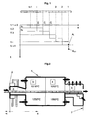
- the remaining residence time in the furnace is determined by the discharge times, such as A i , A i + 1 , the previous slabs, since with each discharge of a slab, the slab i moves forward (see Fig. 1 and 2 )
- Each slab i ⁇ n still has i-1 stages up to the output 7, which are designated by the run variable k i .
- the state of the slab is changed under the influence of control variables, such as the furnace temperature, from the state k to the state k + 1.
- the state variables which are identified by the running variable k, describe the entry parameters on entry into the step k.
- the state variables defined by the run variable k + 1, describe the exit parameters at the exit from the step k and at the same time the entry parameters at entry into the step (k + 1).
- the transition from state k i to state k i +1 is described by a model in the form of equations.
- the heating model contains the associated material laws of the slabs.
- a target function which can be continuously differentiated according to the variables is determined, with the general form ⁇ ⁇ k f k x k y k + ⁇ ⁇ k G k t k x denotes the state variables, such as T, and y the control variables, such as To fen , and t the discharge times.
- Each slab delivers a contribution, with all contributions added to the objective function.
- the setpoint values for a heating process with maximum throughput or with minimum energy can be calculated.
- the weighting factors ⁇ and ⁇ combinations of these must also be calculated.
- the setpoint values for the temperature determined by the optimization, in the different zones of the furnace and the setpoints for the discharge times, represent optimum values.
- At least one constraint is changed as the next step, such as a limit or a fixed value for a control variable, and an optimization is performed again with this changed constraint. It can be specified which constraint should be changed first and to what extent. If no valid solution can be found again, the optimization process is repeated changing at least one constraint.
- the method can be used in all heating furnaces regardless of the type of furnace, for example in pusher and Hubbalkenöfen, for optimizing the heating of slabs, billets and the like.
Landscapes
- Engineering & Computer Science (AREA)
- Mechanical Engineering (AREA)
- General Engineering & Computer Science (AREA)
- Control Of Heat Treatment Processes (AREA)
Claims (19)
- Procédé d'optimisation d'un four de chauffage, en particulier d'un four à poussoir ou d'un four à longerons mobiles, destiné au traitement de produits laminés,
caractérisé en ce que
une fonction cible qui subit une optimisation mathématique, par exemple la formation d'une valeur extrême est formée en tenant compte d'au moins un module mathématique comme condition secondaire, les valeurs ainsi déterminées de la fonction cible étant utilisées pour commander le mode de conduite du four et
en ce que des produits laminés critiques sont déterminés pendant qu'ils sont encore situés en amont de l'entrée du four et l'optimisation est effectuée sur base d'une fonction cible calculée en rejetant le produit laminé critique, une brame étant rejetée sur base de l'évaluation du coût de la mise au rebut du produit laminé. - Procédé selon la revendication 1, caractérisé en ce que la fonction cible est une fonction de variables d'état du produit laminé, par exemple la température de surface du produit laminé ou la répartition de la température, et/ou de variables de contrôle, par exemple la cadence de succession des pièces ou la température de certaines zones du four.
- Procédé selon l'une des revendications 1 et 2, caractérisé en ce que l'optimisation a pour effet une maximisation du débit du four.
- Procédé selon l'une des revendications 1 et 2, caractérisé en ce que l'optimisation a pour effet une minimisation des besoins en énergie du four.
- Procédé selon l'une des revendications 1 à 4, caractérisé en ce que le procédé permet de calculer les valeurs de consigne de température et les instants d'extraction hors du four.
- Procédé selon l'une des revendications 1 à 5, caractérisé en ce que le procédé permet de calculer les valeurs de consigne du débit de gaz combustible et du débit d'air.
- Procédé selon l'une des revendications 1 à 6, caractérisé en ce qu'au moins une condition imposée aux valeurs de consigne sous la forme d'une valeur limite est prise en compte comme condition secondaire lors de l'optimisation.
- Procédé selon l'une des revendications 1 à 7, caractérisé en ce qu'au moins une condition qui donne une valeur fixe d'une variable de contrôle ou d'état est prise en compte comme condition secondaire dans l'optimisation.
- Procédé selon l'une des revendications 1 à 8, caractérisé en ce que comme algorithme d'optimisation, il utilise un procédé d'optimisation quadratique séquentiel, par exemple le procédé de Schittkowski.
- Procédé selon l'une des revendications 1 à 9, caractérisé en ce qu'au cas où l'optimisation mathématique ne peut être résolue dans des conditions secondaires prédéterminées, la solution calculée est celle qui contrevient le moins aux conditions secondaires et en particulier aux conditions secondaires qui concernent les valeurs limites.
- Procédé selon l'une des revendications 1 à 10, caractérisé en ce qu'un ordre de priorité des conditions secondaires à prévoir et/ou des conditions secondaires alternatives sont prédéterminés.
- Procédé selon l'une des revendications 1 à 11, caractérisé en ce que l'optimisation est réalisée hors ligne pour le calcul de la durée du passage pour des occupations successives du four.
- Procédé selon l'une des revendications 1 à 12, caractérisé en ce que l'optimisation est réalisée en ligne directement avant et/ou pendant l'opération de chauffage et en ce que les résultats de l'optimisation sont utilisés pour commander l'opération de chauffage.
- Procédé selon l'une des revendications 1 à 13, caractérisé en ce que l'optimisation est réalisée en ligne et en ce que les résultats sont utilisés pour l'optimisation de la succession d'extractions et/ou la succession de poussées.
- Procédé selon l'une des revendications 1 à 14, caractérisé en ce que comme solution initiale de l'optimisation, il utilise des paramètres de four qui présentent une caractéristique similaire.
- Procédé selon l'une des revendications 1 à 15, caractérisé en ce qu'il est utilisé pour commander plusieurs fours de chauffage qui comptent en particulier différents types de fours.
- Procédé selon l'une des revendications 1 à 16, caractérisé en ce qu'en cas de perturbations planifiées et/ou non planifiées, l'optimisation est de nouveau réalisée en recourant à au moins une grandeur perturbatrice pour maximiser le débit du four et/ou minimiser ses besoins en énergie.
- Procédé selon l'une des revendications 1 à 17, caractérisé en ce qu'en utilisant un modèle de détermination de diverses émissions, l'optimisation tient compte de ces émissions dans la fonction cible et/ou comme condition secondaire.
- Procédé selon l'une des revendications 1 à 18, caractérisé en ce que pour adapter le modèle mathématique en vue d'augmenter la précision du modèle, il utilise au moins une mesure de température, la température utilisée étant celle qui règne à l'extraction du four et/ou dans le parcours amont, avec un recalcul de la température d'extraction.
Applications Claiming Priority (2)
| Application Number | Priority Date | Filing Date | Title |
|---|---|---|---|
| AT0145703A AT413456B (de) | 2003-09-17 | 2003-09-17 | Verfahren zum optimalen betrieb eines erwärmungsofens |
| AT14572003 | 2003-09-17 |
Publications (2)
| Publication Number | Publication Date |
|---|---|
| EP1517107A1 EP1517107A1 (fr) | 2005-03-23 |
| EP1517107B1 true EP1517107B1 (fr) | 2009-12-30 |
Family
ID=34140228
Family Applications (1)
| Application Number | Title | Priority Date | Filing Date |
|---|---|---|---|
| EP04020371A Expired - Lifetime EP1517107B1 (fr) | 2003-09-17 | 2004-08-27 | Procédé pour un fonctionnement optimal d'un four de réchauffage |
Country Status (4)
| Country | Link |
|---|---|
| EP (1) | EP1517107B1 (fr) |
| CN (1) | CN1614039A (fr) |
| AT (2) | AT413456B (fr) |
| DE (1) | DE502004010576D1 (fr) |
Families Citing this family (5)
| Publication number | Priority date | Publication date | Assignee | Title |
|---|---|---|---|---|
| CN102392122A (zh) * | 2011-12-05 | 2012-03-28 | 济南钢铁股份有限公司 | 一种基于钢温的待轧炉温优化系统 |
| CN103146906A (zh) * | 2013-02-28 | 2013-06-12 | 首钢总公司 | 一种步进梁式加热炉二级控制模型参数调控方法 |
| CN108580824B (zh) * | 2018-03-30 | 2020-11-06 | 中冶华天工程技术有限公司 | 轴承钢棒材连铸系统及工艺 |
| CN108646681B (zh) * | 2018-05-11 | 2019-09-24 | 北京铁科特种工程技术有限公司 | 用于沥青混凝土施工质量的智能管理方法及系统 |
| CN110686522B (zh) * | 2019-09-26 | 2021-02-09 | 北京国电龙源环保工程有限公司 | 一种基于有限温度测点的炉膛截面温度场构建方法 |
Family Cites Families (14)
| Publication number | Priority date | Publication date | Assignee | Title |
|---|---|---|---|---|
| BE789264A (fr) * | 1971-09-27 | 1973-03-26 | Westinghouse Electric Corp | Commande de chauffage par calculateur numerique |
| US4223385A (en) * | 1978-09-21 | 1980-09-16 | Westinghouse Electric Corp. | Control of workpiece heating |
| JPS5848011B2 (ja) * | 1979-11-26 | 1983-10-26 | 日本鋼管株式会社 | 加熱炉燃焼制御方法 |
| KR900005989B1 (ko) * | 1985-02-27 | 1990-08-18 | 미쓰비시전기 주식회사 | 가열로의 로온도 설정 및 가열제어방법 |
| JPS61199018A (ja) * | 1985-02-27 | 1986-09-03 | Kobe Steel Ltd | 加熱炉の加熱制御方法 |
| EP0417993B1 (fr) * | 1989-09-12 | 1997-06-04 | Hitachi, Ltd. | Méthode et appareil pour l'optimalisation non linéaire commandée par ordinateur |
| DD289119B3 (de) * | 1989-11-16 | 1993-03-18 | Maxhuette Unterwellenborn Gmbh | Verfahren zum erwaermen von vorbloecken fuer ein warmwalzwerk |
| US5930136A (en) * | 1990-06-04 | 1999-07-27 | Hitachi, Ltd. | Control device for controlling a controlled apparatus, and a control method therefor |
| DE4137148A1 (de) * | 1991-11-12 | 1993-05-13 | Transtec | Verfahren zur steuerung eines tunnelofens |
| JPH05239461A (ja) * | 1992-03-03 | 1993-09-17 | Nkk Corp | コークス炉の燃焼制御装置 |
| DE4340940A1 (de) * | 1993-12-01 | 1995-06-08 | Innovatherm Prof Dr Leisenberg Gmbh & Co Kg | Verfahren zur Steuerung von Trocknern in Ziegelwerken |
| EP1014239B1 (fr) * | 1998-12-16 | 2003-06-04 | VOEST-ALPINE INDUSTRIEANLAGENBAU GESELLSCHAFT m.b.H. | Procédé de calcul d' un patron de réduction |
| JP2000331040A (ja) * | 1999-05-14 | 2000-11-30 | Nippon Sheet Glass Co Ltd | 数値解析による解析方法 |
| DE10112681B4 (de) * | 2000-03-31 | 2004-02-12 | International Business Machines Corp. | Computersystem mit Verfahren zum Planen von Vorgängen in einem Stahlwerk und Programmspeichereinrichtung zum Durchführen des Verfahrens |
-
2003
- 2003-09-17 AT AT0145703A patent/AT413456B/de not_active IP Right Cessation
-
2004
- 2004-08-27 DE DE502004010576T patent/DE502004010576D1/de not_active Expired - Lifetime
- 2004-08-27 AT AT04020371T patent/ATE453847T1/de not_active IP Right Cessation
- 2004-08-27 EP EP04020371A patent/EP1517107B1/fr not_active Expired - Lifetime
- 2004-09-16 CN CN200410085523.7A patent/CN1614039A/zh active Pending
Also Published As
| Publication number | Publication date |
|---|---|
| DE502004010576D1 (de) | 2010-02-11 |
| EP1517107A1 (fr) | 2005-03-23 |
| CN1614039A (zh) | 2005-05-11 |
| ATE453847T1 (de) | 2010-01-15 |
| ATA14572003A (de) | 2005-07-15 |
| AT413456B (de) | 2006-03-15 |
Similar Documents
| Publication | Publication Date | Title |
|---|---|---|
| EP1624982B2 (fr) | Procede de regulation de la temperature d'une bande metallique, en particulier dans un train finisseur pour le laminage a chaud de bandes metalliques | |
| EP2456897B1 (fr) | Procédé de commande et/ou de réglage d'un four à induction pour un laminoir, dispositif de commande et/ou de réglage pour un laminoir et laminoir destiné à la fabrication d'un produit de laminage | |
| DE2059977C2 (de) | Verfahren und Vorrichtung zur Regelung einer Heizeinrichtung für einen Nachwärm- oder Wiedererwärmungsofen für Brammen | |
| DE3044358C2 (de) | Verfahren zum Regeln der Temperatur eines Wärmebehandlungsofens | |
| DE102016222644A1 (de) | Verfahren zum Walzen und/oder zur Wärmebehandlung eines metallischen Produkts | |
| EP3642372B1 (fr) | Procédé permettant de faire fonctionner un four de recuit | |
| EP2386365A1 (fr) | Méthode d'optimisation d'un processus de production biopharmaceutique | |
| EP1596999B2 (fr) | Procede de regulation de la temperature d'une bande metallique, en particulier dans un parcours de refroidissement | |
| WO2017050311A1 (fr) | Procédé et détermination de constituants structuraux d'une ligne de recuit | |
| EP1517107B1 (fr) | Procédé pour un fonctionnement optimal d'un four de réchauffage | |
| DE19618995C2 (de) | Verfahren und Einrichtung zur Beeinflussung relevanter Güteparameter, insbesondere des Profils oder der Planheit eines Walzbandes | |
| DE3142992A1 (de) | Verfahren zur regelung eines durchlauf-waermeofens | |
| DE69224596T2 (de) | Verfahren und Vorrichtung zur automatischen Steuerung von mit Strahlrohren beheizten Durchlauföfen | |
| EP4577361B1 (fr) | Procédé, produit de programme informatique et cage de laminage à froid pour le laminage à froid d'une bande métallique | |
| DE19623671C2 (de) | Verfahren und Einrichtung zum Führen eines Prozesses in der Grundstoffindustrie | |
| DE2040148B2 (de) | Verfahren und vorrichtung zum betreiben eines stossofens mit nachgeschalteten breitbandwalzwerk | |
| EP1014239A1 (fr) | Procédé de calcul d' un patron de réduction | |
| DE102023200055A1 (de) | Verfahren, Computerprogrammprodukt und Kaltwalzgerüst zum Kaltwalzen eines Metallbandes | |
| DE10321791A1 (de) | Verfahren zur Regelung der Temperatur eines Metallbandes, insbesondere in einer Fertigstraße zum Walzen von Metall-Warmband | |
| DE102019209163A1 (de) | Verfahren zur Wärmebehandlung eines metallischen Produkts | |
| EP3494239B1 (fr) | Procédé de fonctionnement d'un four de recuit pour recuire une bande métallique | |
| DE102023211721A1 (de) | Verfahren zur Regelung der Umformtemperatur in einem Warmwalzwerk sowie Warmwalzwerk | |
| EP4311606A1 (fr) | Procédé de régulation d'un train de laminage ainsi que train de laminage | |
| AT388234B (de) | Aufwaerm- und/oder waermebehandlungsofen | |
| EP4364867A1 (fr) | Laminage d'acier avec détection technique de mesure de la conversion de phase |
Legal Events
| Date | Code | Title | Description |
|---|---|---|---|
| PUAI | Public reference made under article 153(3) epc to a published international application that has entered the european phase |
Free format text: ORIGINAL CODE: 0009012 |
|
| AK | Designated contracting states |
Kind code of ref document: A1 Designated state(s): AT BE BG CH CY CZ DE DK EE ES FI FR GB GR HU IE IT LI LU MC NL PL PT RO SE SI SK TR |
|
| AX | Request for extension of the european patent |
Extension state: AL HR LT LV MK |
|
| 17P | Request for examination filed |
Effective date: 20050713 |
|
| R17P | Request for examination filed (corrected) |
Effective date: 20050713 |
|
| AKX | Designation fees paid |
Designated state(s): AT BE BG CH CY CZ DE DK EE ES FI FR GB GR HU IE IT LI LU MC NL PL PT RO SE SI SK TR |
|
| 17Q | First examination report despatched |
Effective date: 20070906 |
|
| RAP1 | Party data changed (applicant data changed or rights of an application transferred) |
Owner name: SIEMENS VAI METALS TECHNOLOGIES GMBH & CO |
|
| GRAP | Despatch of communication of intention to grant a patent |
Free format text: ORIGINAL CODE: EPIDOSNIGR1 |
|
| GRAS | Grant fee paid |
Free format text: ORIGINAL CODE: EPIDOSNIGR3 |
|
| GRAA | (expected) grant |
Free format text: ORIGINAL CODE: 0009210 |
|
| AK | Designated contracting states |
Kind code of ref document: B1 Designated state(s): AT BE BG CH CY CZ DE DK EE ES FI FR GB GR HU IE IT LI LU MC NL PL PT RO SE SI SK TR |
|
| REG | Reference to a national code |
Ref country code: GB Ref legal event code: FG4D Free format text: NOT ENGLISH |
|
| REG | Reference to a national code |
Ref country code: CH Ref legal event code: EP |
|
| REG | Reference to a national code |
Ref country code: IE Ref legal event code: FG4D |
|
| REF | Corresponds to: |
Ref document number: 502004010576 Country of ref document: DE Date of ref document: 20100211 Kind code of ref document: P |
|
| PG25 | Lapsed in a contracting state [announced via postgrant information from national office to epo] |
Ref country code: SE Free format text: LAPSE BECAUSE OF FAILURE TO SUBMIT A TRANSLATION OF THE DESCRIPTION OR TO PAY THE FEE WITHIN THE PRESCRIBED TIME-LIMIT Effective date: 20091230 Ref country code: FI Free format text: LAPSE BECAUSE OF FAILURE TO SUBMIT A TRANSLATION OF THE DESCRIPTION OR TO PAY THE FEE WITHIN THE PRESCRIBED TIME-LIMIT Effective date: 20091230 |
|
| REG | Reference to a national code |
Ref country code: NL Ref legal event code: VDEP Effective date: 20091230 |
|
| PG25 | Lapsed in a contracting state [announced via postgrant information from national office to epo] |
Ref country code: SI Free format text: LAPSE BECAUSE OF FAILURE TO SUBMIT A TRANSLATION OF THE DESCRIPTION OR TO PAY THE FEE WITHIN THE PRESCRIBED TIME-LIMIT Effective date: 20091230 Ref country code: PL Free format text: LAPSE BECAUSE OF FAILURE TO SUBMIT A TRANSLATION OF THE DESCRIPTION OR TO PAY THE FEE WITHIN THE PRESCRIBED TIME-LIMIT Effective date: 20091230 |
|
| REG | Reference to a national code |
Ref country code: IE Ref legal event code: FD4D |
|
| PG25 | Lapsed in a contracting state [announced via postgrant information from national office to epo] |
Ref country code: RO Free format text: LAPSE BECAUSE OF FAILURE TO SUBMIT A TRANSLATION OF THE DESCRIPTION OR TO PAY THE FEE WITHIN THE PRESCRIBED TIME-LIMIT Effective date: 20091230 Ref country code: NL Free format text: LAPSE BECAUSE OF FAILURE TO SUBMIT A TRANSLATION OF THE DESCRIPTION OR TO PAY THE FEE WITHIN THE PRESCRIBED TIME-LIMIT Effective date: 20091230 Ref country code: BG Free format text: LAPSE BECAUSE OF FAILURE TO SUBMIT A TRANSLATION OF THE DESCRIPTION OR TO PAY THE FEE WITHIN THE PRESCRIBED TIME-LIMIT Effective date: 20100330 Ref country code: ES Free format text: LAPSE BECAUSE OF FAILURE TO SUBMIT A TRANSLATION OF THE DESCRIPTION OR TO PAY THE FEE WITHIN THE PRESCRIBED TIME-LIMIT Effective date: 20100410 Ref country code: PT Free format text: LAPSE BECAUSE OF FAILURE TO SUBMIT A TRANSLATION OF THE DESCRIPTION OR TO PAY THE FEE WITHIN THE PRESCRIBED TIME-LIMIT Effective date: 20100430 Ref country code: EE Free format text: LAPSE BECAUSE OF FAILURE TO SUBMIT A TRANSLATION OF THE DESCRIPTION OR TO PAY THE FEE WITHIN THE PRESCRIBED TIME-LIMIT Effective date: 20091230 |
|
| PG25 | Lapsed in a contracting state [announced via postgrant information from national office to epo] |
Ref country code: CZ Free format text: LAPSE BECAUSE OF FAILURE TO SUBMIT A TRANSLATION OF THE DESCRIPTION OR TO PAY THE FEE WITHIN THE PRESCRIBED TIME-LIMIT Effective date: 20091230 Ref country code: SK Free format text: LAPSE BECAUSE OF FAILURE TO SUBMIT A TRANSLATION OF THE DESCRIPTION OR TO PAY THE FEE WITHIN THE PRESCRIBED TIME-LIMIT Effective date: 20091230 |
|
| PG25 | Lapsed in a contracting state [announced via postgrant information from national office to epo] |
Ref country code: CY Free format text: LAPSE BECAUSE OF FAILURE TO SUBMIT A TRANSLATION OF THE DESCRIPTION OR TO PAY THE FEE WITHIN THE PRESCRIBED TIME-LIMIT Effective date: 20091230 Ref country code: IE Free format text: LAPSE BECAUSE OF FAILURE TO SUBMIT A TRANSLATION OF THE DESCRIPTION OR TO PAY THE FEE WITHIN THE PRESCRIBED TIME-LIMIT Effective date: 20091230 Ref country code: GR Free format text: LAPSE BECAUSE OF FAILURE TO SUBMIT A TRANSLATION OF THE DESCRIPTION OR TO PAY THE FEE WITHIN THE PRESCRIBED TIME-LIMIT Effective date: 20100331 |
|
| PLBE | No opposition filed within time limit |
Free format text: ORIGINAL CODE: 0009261 |
|
| STAA | Information on the status of an ep patent application or granted ep patent |
Free format text: STATUS: NO OPPOSITION FILED WITHIN TIME LIMIT |
|
| 26N | No opposition filed |
Effective date: 20101001 |
|
| PG25 | Lapsed in a contracting state [announced via postgrant information from national office to epo] |
Ref country code: DK Free format text: LAPSE BECAUSE OF FAILURE TO SUBMIT A TRANSLATION OF THE DESCRIPTION OR TO PAY THE FEE WITHIN THE PRESCRIBED TIME-LIMIT Effective date: 20091230 |
|
| BERE | Be: lapsed |
Owner name: SIEMENS VAI METALS TECHNOLOGIES GMBH & CO Effective date: 20100831 |
|
| PG25 | Lapsed in a contracting state [announced via postgrant information from national office to epo] |
Ref country code: IT Free format text: LAPSE BECAUSE OF FAILURE TO SUBMIT A TRANSLATION OF THE DESCRIPTION OR TO PAY THE FEE WITHIN THE PRESCRIBED TIME-LIMIT Effective date: 20091230 Ref country code: MC Free format text: LAPSE BECAUSE OF NON-PAYMENT OF DUE FEES Effective date: 20100831 |
|
| REG | Reference to a national code |
Ref country code: CH Ref legal event code: PL |
|
| GBPC | Gb: european patent ceased through non-payment of renewal fee |
Effective date: 20100827 |
|
| PG25 | Lapsed in a contracting state [announced via postgrant information from national office to epo] |
Ref country code: CH Free format text: LAPSE BECAUSE OF NON-PAYMENT OF DUE FEES Effective date: 20100831 Ref country code: LI Free format text: LAPSE BECAUSE OF NON-PAYMENT OF DUE FEES Effective date: 20100831 |
|
| REG | Reference to a national code |
Ref country code: FR Ref legal event code: ST Effective date: 20110502 |
|
| REG | Reference to a national code |
Ref country code: DE Ref legal event code: R119 Ref document number: 502004010576 Country of ref document: DE Effective date: 20110301 |
|
| PG25 | Lapsed in a contracting state [announced via postgrant information from national office to epo] |
Ref country code: DE Free format text: LAPSE BECAUSE OF NON-PAYMENT OF DUE FEES Effective date: 20110301 Ref country code: BE Free format text: LAPSE BECAUSE OF NON-PAYMENT OF DUE FEES Effective date: 20100831 Ref country code: FR Free format text: LAPSE BECAUSE OF NON-PAYMENT OF DUE FEES Effective date: 20100831 |
|
| PG25 | Lapsed in a contracting state [announced via postgrant information from national office to epo] |
Ref country code: GB Free format text: LAPSE BECAUSE OF NON-PAYMENT OF DUE FEES Effective date: 20100827 |
|
| PG25 | Lapsed in a contracting state [announced via postgrant information from national office to epo] |
Ref country code: AT Free format text: LAPSE BECAUSE OF NON-PAYMENT OF DUE FEES Effective date: 20100827 |
|
| PG25 | Lapsed in a contracting state [announced via postgrant information from national office to epo] |
Ref country code: LU Free format text: LAPSE BECAUSE OF NON-PAYMENT OF DUE FEES Effective date: 20100827 Ref country code: HU Free format text: LAPSE BECAUSE OF FAILURE TO SUBMIT A TRANSLATION OF THE DESCRIPTION OR TO PAY THE FEE WITHIN THE PRESCRIBED TIME-LIMIT Effective date: 20100701 |
|
| PG25 | Lapsed in a contracting state [announced via postgrant information from national office to epo] |
Ref country code: TR Free format text: LAPSE BECAUSE OF FAILURE TO SUBMIT A TRANSLATION OF THE DESCRIPTION OR TO PAY THE FEE WITHIN THE PRESCRIBED TIME-LIMIT Effective date: 20091230 |