EP1515970B1 - Alkynylpurine und verfahren zu deren herstellung - Google Patents
Alkynylpurine und verfahren zu deren herstellung Download PDFInfo
- Publication number
- EP1515970B1 EP1515970B1 EP03733333A EP03733333A EP1515970B1 EP 1515970 B1 EP1515970 B1 EP 1515970B1 EP 03733333 A EP03733333 A EP 03733333A EP 03733333 A EP03733333 A EP 03733333A EP 1515970 B1 EP1515970 B1 EP 1515970B1
- Authority
- EP
- European Patent Office
- Prior art keywords
- group
- compound
- formula
- hydrogen atom
- salt
- Prior art date
- Legal status (The legal status is an assumption and is not a legal conclusion. Google has not performed a legal analysis and makes no representation as to the accuracy of the status listed.)
- Expired - Lifetime
Links
- 0 CC(C)(C#Cc(nc(*)nc1NC2)c1N2C1C(C)(*)CCCCCC1)O Chemical compound CC(C)(C#Cc(nc(*)nc1NC2)c1N2C1C(C)(*)CCCCCC1)O 0.000 description 5
Classifications
-
- C—CHEMISTRY; METALLURGY
- C07—ORGANIC CHEMISTRY
- C07H—SUGARS; DERIVATIVES THEREOF; NUCLEOSIDES; NUCLEOTIDES; NUCLEIC ACIDS
- C07H19/00—Compounds containing a hetero ring sharing one ring hetero atom with a saccharide radical; Nucleosides; Mononucleotides; Anhydro-derivatives thereof
- C07H19/02—Compounds containing a hetero ring sharing one ring hetero atom with a saccharide radical; Nucleosides; Mononucleotides; Anhydro-derivatives thereof sharing nitrogen
- C07H19/04—Heterocyclic radicals containing only nitrogen atoms as ring hetero atom
- C07H19/16—Purine radicals
-
- C—CHEMISTRY; METALLURGY
- C07—ORGANIC CHEMISTRY
- C07D—HETEROCYCLIC COMPOUNDS
- C07D473/00—Heterocyclic compounds containing purine ring systems
-
- C—CHEMISTRY; METALLURGY
- C07—ORGANIC CHEMISTRY
- C07D—HETEROCYCLIC COMPOUNDS
- C07D473/00—Heterocyclic compounds containing purine ring systems
- C07D473/26—Heterocyclic compounds containing purine ring systems with an oxygen, sulphur, or nitrogen atom directly attached in position 2 or 6, but not in both
- C07D473/28—Oxygen atom
- C07D473/30—Oxygen atom attached in position 6, e.g. hypoxanthine
-
- C—CHEMISTRY; METALLURGY
- C07—ORGANIC CHEMISTRY
- C07D—HETEROCYCLIC COMPOUNDS
- C07D473/00—Heterocyclic compounds containing purine ring systems
- C07D473/26—Heterocyclic compounds containing purine ring systems with an oxygen, sulphur, or nitrogen atom directly attached in position 2 or 6, but not in both
- C07D473/32—Nitrogen atom
- C07D473/34—Nitrogen atom attached in position 6, e.g. adenine
-
- Y—GENERAL TAGGING OF NEW TECHNOLOGICAL DEVELOPMENTS; GENERAL TAGGING OF CROSS-SECTIONAL TECHNOLOGIES SPANNING OVER SEVERAL SECTIONS OF THE IPC; TECHNICAL SUBJECTS COVERED BY FORMER USPC CROSS-REFERENCE ART COLLECTIONS [XRACs] AND DIGESTS
- Y02—TECHNOLOGIES OR APPLICATIONS FOR MITIGATION OR ADAPTATION AGAINST CLIMATE CHANGE
- Y02P—CLIMATE CHANGE MITIGATION TECHNOLOGIES IN THE PRODUCTION OR PROCESSING OF GOODS
- Y02P20/00—Technologies relating to chemical industry
- Y02P20/50—Improvements relating to the production of bulk chemicals
- Y02P20/55—Design of synthesis routes, e.g. reducing the use of auxiliary or protecting groups
Definitions
- the present invention relates to an alkynylpurine compound (particularly, an alkynylpurine compound having an alkynyl moiety at the 2-, 6- or 8-position of its purine nucleus), which is a key intermediate for the production of medicaments, a salt thereof and a production method thereof.
- Alkynylpurine compound is a key intermediate for the production of medicaments such as ischemia-reperfusion injury inhibitors (JP-A-2001-64183), therapeutic agents of diabetes (WO99/35147), therapeutic agents of tuberculosis (A.K. Bakkestuen et al., Bioorg. Med. Chem. Lett., 10 (2000), 1207-1210) and the like.
- medicaments such as ischemia-reperfusion injury inhibitors (JP-A-2001-64183), therapeutic agents of diabetes (WO99/35147), therapeutic agents of tuberculosis (A.K. Bakkestuen et al., Bioorg. Med. Chem. Lett., 10 (2000), 1207-1210) and the like.
- references (1) and (2) both utilize a coupling reaction (Stille reaction) between Ph-C ⁇ C-SnBu 3 (alkynylating agent), which is stable as a metal acetylide, and a halogenopurine by the use of a palladium catalyst.
- the alkynylating agent has extremely high toxicity, because it is an organotin reagent, and the use of the alkynylating agent for the production of medicaments is not preferable.
- the methods described in references (1) and (2) are also associated with the problem that the production cost of alkynylpurine compound becomes high because the synthesis of the alkynylating agent is extremely difficult.
- the above-mentioned methods require Ph-C ⁇ C-SnBu 3 in an amount of at least 1 equivalent, generally not less than 1 equivalent, relative to a halogenopurine compound, which is a substrate, and organotin compounds, which are to be wasted after the reaction, are produced in an amount of not less than 1 equivalent. Therefore, the above-mentioned methods are not environmentally or economically superior.
- references (1), (2) and (3) are based on an idea that a halogenopurine compound and an alkynylating agent or alkynyl compound are coupled for each objective product, further modification of the alkynyl moiety of the alkynylpurine compound obtained according to the method described in references (1), (2) or (3) is not assumed. Therefore, the methods described in references (1), (2) and (3) are problematic in that many alkynylpurine derivatives useful as a medicament cannot be synthesized conveniently from the obtained alkynylpurine compounds, and the like.
- an alkynylpurine compound useful as an intermediate for the production of medicaments i.e., alkynylpurine compound whose alkynyl moiety can be easily modified, and as a result, a number of alkynylpurine derivatives can be derived
- an alkynyl purine compound useful as an intermediate for medicament production are desired.
- an ethynylpurine compound having an ethynyl group as an alkynyl moiety can be converted to various alkynylpurine compounds, as a result of which found a method that can produce a purine compound having an alkynyl moiety at the 2-, 6- or 8-position (i.e., alkynylpurine compound whose alkynyl moiety can be easily modified and can derive a number of alkynylpurine derivatives), which is a key intermediate for medicaments, safely, conveniently and economically, which resulted in the completion of the invention.
- the present invention relates to the following [1] - [23].
- the present invention relates to an alkynylpurine compound represented by the following formula (I) wherein an alkynyl moiety is attached to any of the 2-, 6- and 8-positions of the purine nucleus shown with arrows ( ⁇ ), which is useful as an intermediate for the production of medicaments, (this compound encompasses isomers such as tautomer and the like, and optionally further has substituents to be described in detail in the following), a salt thereof, and a production method thereof.
- formula (I) wherein an alkynyl moiety is attached to any of the 2-, 6- and 8-positions of the purine nucleus shown with arrows ( ⁇ ), which is useful as an intermediate for the production of medicaments, (this compound encompasses isomers such as tautomer and the like, and optionally further has substituents to be described in detail in the following), a salt thereof, and a production method thereof.
- this invention relates to a production method of an alkynylpurine compound represented by the formula (I-1) and the formula (I-2) (hereinafter to be referred to as compound (I-1) and compound (I-2)) and a salt thereof.
- X 1 is an alkyl group, an alkoxy group, an aryl group, an optionally protected amino group, a halogen atom or a hydrogen atom
- one of Y 1 has, as an alkynyl moiety, a group represented by the formula: R-C ⁇ C-, wherein R is a hydrogen atom, the other Y 1 is a hydrogen atom, and Z 1 is an alkyl group, an amino-protecting group or a hydrogen atom, which is attached to a nitrogen atom at the 7-or 9-position of the purine nucleus.
- R-C ⁇ C- a group represented by the formula: R-C ⁇ C-, wherein R is a hydrogen atom or a hydrocarbon group optionally having substituents, is attached to the 6-position of the purine nucleus
- X 2 is an alkyl group, an alkoxy group, an aryl group, an optionally protected amino group or a halogen atom
- Z 2 is an alkyl group, an amino-protecting group or a hydrogen atom, which is attached to a nitrogen atom at the 7- or 9-position of the purine nucleus.
- R is a hydrogen atom or a hydrocarbon group optionally having substituents.
- hydrocarbon group of the “hydrocarbon group optionally having substituents” denoted by R, for example, C 1-10 alkyl (e.g., methyl, ethyl, n-propyl, isopropyl, n-butyl, isobutyl, tert-butyl, pentyl, hexyl, heptyl, octyl, nonyl, decyl etc.) and the like can be mentioned. Of these, C 1-6 alkyl is preferable.
- C 1-6 alkyl e.g., methyl, ethyl, n-propyl, isopropyl, n-butyl, isobutyl, tert-butyl etc.
- the kind, position and number of the substituents are not particularly limited.
- C 1-6 alkyl optionally having substituents is preferable.
- C 1-6 alkyl having hydroxy at the 1-position as a substituent is preferable.
- 1-methyl-1-hydroxyethyl i.e., Me 2 (OH)C-
- Me 2 (OH)C- 1-methyl-1-hydroxyethyl
- R preferred are hydrogen atom and C 1-6 alkyl optionally having substituents.
- hydrogen atom and C 1-6 alkyl having hydroxy at the 1-position as a substituent are particularly preferable as R.
- C 1-6 alkyl having hydroxy at the 1-position is that, when R is -C 1-6 alkyl having hydroxy at the 1-position", the alkynyl moiety represented by R-C ⁇ C- can be easily converted to an ethynyl group via ⁇ -elimination by a treatment with a base [see the treatment with base (2) in Step B explained in the following].
- X 1 is an alkyl group, an alkoxy group, an aryl group, an optionally protected amino group, a halogen atom or a hydrogen atom
- X 2 is an alkyl group, an alkoxy group, an aryl group, an optionally protected amino group or a halogen atom.
- alkyl group denoted by “X 1 " and “X 2 ", for example, C 1-10 alkyl (e.g., methyl, ethyl, n-propyl, isopropyl, n-butyl, isobutyl, tert-butyl, pentyl, hexyl, heptyl, octyl, nonyl, decyl etc.) and the like are mentioned for both.
- C 1-10 alkyl e.g., methyl, ethyl, n-propyl, isopropyl, n-butyl, isobutyl, tert-butyl, pentyl, hexyl, heptyl, octyl, nonyl, decyl etc.
- alkoxy group denoted by “X 1 " and “X 2 ", for example, C 1-6 alkoxy (e.g., methoxy, ethoxy, n-propoxy, isopropoxy, n-butoxy, tert-butoxy etc.) and the like are mentioned for both.
- aryl group denoted by “X 1 " and “X 2 ", for example, C 6-12 aryl (e.g., phenyl, biphenylyl, naphthyl etc.) and the like are mentioned for both.
- the "protecting group" of the "optionally protected amino group” denoted by "X 1 " and “X 2 " is not particularly limited as long as it is an amino-protecting group known to those of ordinary skill in the art of the organic chemistry, and, for example, a hetero ring group (e.g., a 5 to 8-membered hetero ring group containing, besides carbon atoms, 1 to 3 hetero atoms selected from the group consisting of nitrogen atom, oxygen atom and sulfur atom, such as tetrahydropyranyl (e.g., tetrahydropyran-2-yl etc.) and the like), C 7-15 aralkyl (e.g., benzyl etc.), C 1-5 acyl (e.g., acetyl etc.), trialkylsilyl (e.g., trimethylsilyl etc.), carbamate (e.g., tert-butylcarbamate) and the like are mentioned.
- amino group of the "optionally protected amino group” denoted by "X 1 " and “X 2 " is optionally substituted by 1 or 2 substituents.
- substituents for example, C 1-6 alkyl (e.g., methyl, ethyl, n-propyl, isopropyl, n-butyl, isobutyl, tert-butyl, pentyl, hexyl etc.), C 6-12 aryl (e.g., phenyl, naphthyl etc.) and the like are mentioned.
- the amino group has two substituents, the substituents may be the same or different.
- halogen atom denoted by "X 1 " and “X 2 ", for example, fluorine atom, chlorine atom, bromine atom, iodine atom and the like are mentioned, particularly preferably chlorine atom.
- the "Z 1 " and “Z 2 " are each an alkyl group, an amino-protecting group or a hydrogen atom, which is attached to a nitrogen atom at the 7- or 9-position of the purine nucleus.
- alkyl group denoted by “Z 1 " and “Z 2 ", for example, C 1-6 alkyl (e.g., methyl, ethyl, n-propyl, isopropyl, n-butyl, isobutyl, tert-butyl etc.) and the like are mentioned for both.
- C 1-6 alkyl e.g., methyl, ethyl, n-propyl, isopropyl, n-butyl, isobutyl, tert-butyl etc.
- amino-protecting group As the “amino-protecting group” denoted by “Z 1 " and “Z 2 ", amino-protecting groups well known to those of ordinary skill in the art of the organic synthesis can be used.
- amino-protecting group for example, hetero ring group (e.g., 5 to 8-membered hetero ring group containing, besides carbon atoms, 1 to 3 hetero atoms selected from the group consisting of nitrogen atom, oxygen atom and sulfur atom, such as tetrahydropyranyl (e.g., tetrahydropyran-2-yl etc.) and the like), C 7-15 aralkyl (e.g., benzyl etc.), C 1-5 acyl (e.g. , acetyl etc.), trialkylsilyl (e.g., trimethylsilyl etc.), carbamate (e.g., tert-butylcarbamate) and the like are mentioned.
- hetero ring group e.
- the "Z 1 " and “Z 2 " are each preferably a hydrogen atom and an amino-protecting group, and as the amino-protecting group, a hetero ring group is preferable, and tetrahydropyranyl (e.g., tetrahydropyran-2-yl etc.) is particularly preferable.
- the amino-protecting group C 7-15 aralkyl is also preferable, and benzyl is particularly preferable.
- one of “L 1 " is a halogen atom (e.g., fluorine atom, chlorine atom, bromine atom, iodine atom etc.), and the other “L 1 " is a hydrogen atom.
- X 1 is a halogen atom
- one of L 1 is a "halogen atom having higher leaving ability than the halogen atom represented by X 1 ".
- L 2 is a halogen atom (e.g., fluorine atom, chlorine atom, bromine atom, iodine atom etc.).
- X 2 is a halogen atom
- L 2 is a "halogen atom having higher leaving ability than the halogen atom represented by X 2 ", or the "same halogen atom as X 2 ".
- L 2 may be the "same halogen atom as X 2 " because, when the same halogen atoms are present at the 2- and 6-positions of the purine nucleus, the halogen atom at the 6-position generally has higher leaving ability than the halogen atom at the 2-position.
- halogen atom having higher leaving ability than the halogen atom represented by X 1 and "halogen atom having higher leaving ability than the halogen atom represented by X 2 " each mean a halogen atom having higher leaving ability than the halogen atom represented by X 1 or X 2 , according to the leaving ability of halogen atom: F ⁇ Cl ⁇ Br ⁇ I.
- L 1 and L 2 are each selected from the group consisting of chlorine atom, bromine atom and iodine atom, when X 1 and X 2 are each a chlorine atom, L 1 and L 2 are each a bromine atom or an iodine atom, when X 1 and X 2 are each a bromine atom and L 1 and L 2 are each an iodine atom.
- X 1 and X 2 are each a halogen atom, it is particularly preferable that X 1 and X 2 be each a chlorine atom and L 1 and L 2 be each an iodine atom, in view of the difference in leaving ability and easiness of modification thereafter.
- L 1 and L 2 are not particularly limited, and a halogen atom generally having higher leaving ability, particularly an iodine atom, is preferable.
- aryl group of the “aryl group optionally having substituents” denoted by “A” for example, C 6-12 aryl (e.g., phenyl, biphenylyl, naphthyl etc.) and the like are mentioned, with preference given to phenyl.
- substituents for example, halogen atoms (e.g., fluorine atom, chlorine atom, bromine atom, iodine atom etc.), C 1-6 alkyl (e.g., methyl, ethyl, n-propyl, isopropyl, n-butyl, isobutyl, tert-butyl, pentyl, hexyl etc.), C 1-6 alkoxy (e.g., methoxy, ethoxy, n-propoxy, isopropoxy, n-butoxy, tert-butoxy etc.), nitro and the like are mentioned.
- the kind, position and number of the substituents are not particularly limited.
- aryl group optionally having substituents for example, phenyl; halophenyl such as chlorophenyl (e.g., 2- or 4-chlorophenyl etc.), fluorophenyl (e.g., 2- or 4-fluorophenyl etc.), bromophenyl (e.g., 2- or 4-bromophenyl etc.) and the like; C 1-6 alkylphenyl (e.g., 3- or 4-methylphenyl etc.); C 1-6 alkoxyphenyl (e.g., 4-methoxyphenyl etc.); nitrophenyl (e.g., 4-nitrophenyl etc.) and the like are preferable.
- chlorophenyl e.g., 2- or 4-chlorophenyl etc.
- fluorophenyl e.g., 2- or 4-fluorophenyl etc.
- bromophenyl e.g., 2- or 4-bromophenyl etc.
- heterocyclic group of the “heterocyclic group optionally having substituents” denoted by “A”, for example, 5 to 8-membered heterocyclic groups containing, besides carbon atoms, 1 to 3 hetero atoms selected from the group consisting of nitrogen, oxygen and sulfur atom are mentioned.
- nitrogen-containing heterocyclic groups such as pyridyl (e.g., pyridin-3-yl etc.), pyrimidyl (e.g., pyrimidin-2-yl, pyrimidin-3-yl, pyrimidin-5-yl etc.) and the like are particularly preferable.
- substituents for example, halogen atoms (e.g., fluorine atom, chlorine atom, bromine atom, iodine atom etc.), oxo and the like are mentioned.
- halogen atoms e.g., fluorine atom, chlorine atom, bromine atom, iodine atom etc.
- oxo e.g., oxo and the like.
- the kind, position and number of the substituents are not particularly limited.
- heterocyclic group optionally having substituents for example, pyridin-3-yl, 2,4-dioxopyrimidin-5-yl and the like are preferable.
- halogen atom denoted by "X"
- X for example, fluorine atom, chlorine atom, bromine atom, iodine atom and the like are mentioned, with preference given to bromine atom and iodine atom from the aspect of reactivity.
- A-X dihalobenzene (e.g., 1-bromo-4-chlorobenzene, 2-chloro-4-iodobenzene, 1-chloro-2-iodobenzene, 1-fluoro-2-iodobenzene etc.), C 1-6 alkylhalobenzene (e.g., 4-bromotoluene, 4-iodotoluene, 3-bromotoluene, 3-iodotoluene etc.), C 1-6 alkoxyhalobenzene (e.g., 4-bromoanisole, 4-iodoanisole etc.), nitrohalobenzene (e.g., 1-bromo-4-nitrobenzene, 1-iodo-4-nitrobenzene etc.), halopyridine (e.g., 3-bromopyridine, 3-iodopyridine etc.) and dioxohalopyrimidine (e.g.,
- metal catalyst As the “metal catalyst” to be used in the present invention, a palladium compound and a combination of a palladium compound and a copper compound are mentioned.
- bis(triphenylphosphine)palladium dichloride i.e. (Ph 3 P) 2 PdCl 2 ]
- tetrakis (triphenylphosphine) palladium i.e. (Ph 3 P) 4 Pd
- palladium acetate i.e. Pd(OAc) 2
- bis (acetylacetonato) palladium i.e. Pd(acac) 2
- [1,1'-bis (diphenylphosphino) ferrocene]palladium(II) chloride i.e. PdCl 2 (dppf) 2
- bis(triphenylphosphine)palladium dichloride and tetrakis(triphenylphosphine)palladium are preferable, from the aspect of solubility in a solvent.
- the palladium compound includes by the aforementioned palladium catalysts and, from the aspect of solubility in a solvent, bis(triphenylphosphine)palladium dichloride is particularly preferable.
- the "copper compound” for example, cuprous halide such as cuprous iodide, cuprous bromide, cuprous chloride and the like and cuprous cyanide are mentioned. Of these, cuprous halide is preferable, and cuprous iodide is particularly preferable in view of the catalytic ability.
- two or more kinds of copper compounds may be used.
- the kind of the palladium compound and copper compound to be used is not particularly limited, and from the above-mentioned aspects, a combination of bis(triphenylphosphine)palladium dichloride and cuprous iodide is particularly preferable.
- base (1) for example, amine compound, alkali metal hydroxide, alkali metal carbonate, basic heterocyclic compound and the like are mentioned.
- amine compound for example, trialkylamine and the like are mentioned, wherein the alkyl moiety of the trialkylamine is, for example, C 1-6 alkyl (e.g., methyl, ethyl, n-propyl, isopropyl, n-butyl etc.), and the alkyl groups may be the same or different.
- trialkylamine for example, triethylamine, ethyldiisopropylamine and the like are mentioned.
- alkali metal hydroxide for example, sodium hydroxide, potassium hydroxide and the like are mentioned.
- alkali metal carbonate for example, sodium carbonate, potassium carbonate and the like are mentioned.
- amine compound is preferable.
- trialkylamine is preferable, and particularly preferred therefrom are triethylamine and ethyldiisopropylamine.
- base (2) for example, alkali metal hydroxide, alkali metal carbonate, amine and the like are mentioned.
- alkali metal hydroxide for example, sodium hydroxide, potassium hydroxide and the like are mentioned.
- alkali metal carbonate for example, sodium carbonate, potassium carbonate, sodium hydrogencarbonate and the like are mentioned.
- amine for example, triethylamine and the like are mentioned.
- alkali metal hydroxide and alkali metal carbonate are preferable.
- alkali metal hydroxide is preferable, and sodium hydroxide and potassium hydroxide are particularly preferable, in view of the solubility in water.
- the salts of the compound according to the present invention are not particularly limited, and, for example, a salt of the compound according to the present invention with an organic acid (e.g., methanesulfonic acid, trifluoromethanesulfonic acid, p-toluenesulfonic acid etc.), a salt of the compound according to the present invention with an inorganic acid (e.g., hydrochloric acid, sulfuric acid, phosphoric acid, nitric acid etc.), and ammonium salt of the compound according to the present invention (e.g., tetraalkylammonium salt etc.) and the like are mentioned.
- an organic acid e.g., methanesulfonic acid, trifluoromethanesulfonic acid, p-toluenesulfonic acid etc.
- an inorganic acid e.g., hydrochloric acid, sulfuric acid, phosphoric acid, nitric acid etc.
- Step A1 a compound represented by the formula (I-1') wherein one of Y 1' is Me 2 (OH)C-C ⁇ C- and the other Y 1' is a hydrogen atom (hereinafter sometimes to be referred to as compound (I-1')) or a salt thereof is obtained by reacting a compound represented by the formula (II-1) wherein one of L 1 is a halogen atom and the other L 1 is a hydrogen atom (hereinafter sometimes to be referred to as compound (II-1)) or a salt thereof, with a compound represented by the formula (III) (hereinafter sometimes to be referred to as compound (III)), in the presence of a metal catalyst and a base (1).
- a palladium compound may be used alone as a metal catalyst, as defined above.
- the palladium compound is particularly preferably bis(triphenylphosphine)palladium dichloride.
- the amount of the palladium compound to be used is not particularly limited as long as a catalytic amount relative to compound (II-1) or a salt thereof is used. It is generally 0.01-1.0 mmole, preferably 0.05-0.2 mmole, per 1 mmole of compound (II-1) or a salt thereof.
- the metal catalyst a combination of a palladium compound and a copper compound is preferable, in view of the activity of the catalyst.
- the palladium compound and the copper compound are to be used in combination, bis(triphenylphosphine)palladium dichloride is particularly preferable as the palladium compound, and cuprous iodide is particularly preferable as the copper compound.
- the amount of the palladium compound to be used and the amount of the copper compound to be used are not particularly limited as long as a catalytic amount relative to compound (II-1) or a salt thereof is used.
- the amount of the palladium compound to be used is generally 0.01-1.0 mmole, preferably 0.05-0.2 mmole, per 1 mmole of compound (II-1) or a salt thereof, and the amount of the copper compound to be used is generally 0.01-1.0 mmole, preferably 0.05-0.2 mmole, per 1 mmole of compound (II-1) or a salt thereof.
- an amine compound is preferably used as the base (1), as defined above.
- trialkylamine is preferably used as an amine compound.
- the trialkylamine triethylamine and ethyldiisopropylamine are preferable.
- the amount of the base (1) to be used is generally 1.0-5.0 mmole, preferably 1.0-1.5 mmole, per 1 mmole of compound (II-1) or a salt thereof.
- the compound (II-1) or a salt thereof to be used in Step A1 can be synthesized according to the method described in, for example, US 4,719,295 to Cook et al., and a method analogous thereto.
- the compound (III) to be used in Step A1 is commercially available.
- the salt of compound (II-1) to be used in Step A1 is not particularly limited, and, for example, a salt of compound (II-1) with an organic acid (e.g., methanesulfonic acid, trifluoromethanesulfonic acid, p-toluenesulfonic acid etc.), a salt of compound (II-1) with an inorganic acid (e.g., hydrochloric acid, sulfuric acid, phosphoric acid, nitric acid etc.), and ammonium salt thereof (e.g., tetraalkylammonium salt etc.) and the like are mentioned.
- an organic acid e.g., methanesulfonic acid, trifluoromethanesulfonic acid, p-toluenesulfonic acid etc.
- an inorganic acid e.g., hydrochloric acid, sulfuric acid, phosphoric acid, nitric acid etc.
- ammonium salt thereof e.g.
- the amount of compound (III) to be used is generally 1.0-5.0 mmole, preferably 1.0-1.5 mmole, per 1 mmole of compound (II-1) or a salt thereof.
- the solvent is not particularly limited as long as the reaction is not adversely affected by the solvent, and, for example, aprotic solvents such as DMF (N,N-dimethylformamide), DMSO (dimethyl sulfoxide), N,N-dimethylacetamide, THF (tetrahydrofuran) and the like, and the like are mentioned. Of these, DMF is preferable.
- the amount of the solvent to be used is not particularly limited and it is generally 1.5-100 mL, preferably 1.5-50 mL, per 1 mmole of compound (II-1) or a salt thereof.
- reaction time varies depending on the reagents and the solvent to be used, and is generally 1-5 hrs.
- the reaction temperature varies depending on the reagents and the solvent to be used, and is generally 40°C-150°C, preferably 80°C-100°C.
- Step B1 a compound represented by the formula (I-1") wherein one of Y 1" is HC ⁇ C- and the other Y 1" is a hydrogen atom (hereinafter sometimes to be referred to as compound (I-1")) or a salt thereof is obtained by treating compound (I-1') obtained in the above-mentioned Step A1, wherein one of Y 1' is Me 2 (OH)C-C ⁇ C-, and the other Y 1' is a hydrogen atom, or a salt thereof with a base (2).
- alkali metal hydroxide is particularly preferably used as the base (2), as defined above.
- sodium hydroxide and potassium hydroxide are preferable.
- the amount of the base (2) to be used is generally 1-20 mmole, preferably 3-10 mmole, per 1 mmole of compound (I-1') or a salt thereof.
- the solvent is not particularly limited as long as the reaction is not adversely affected by the solvent, and, for example, aprotic solvents such as toluene, xylene, THF, MTBE (tert-butylmethyl ether) and the like, and the like are mentioned, with particular preference given to toluene.
- the amount of the solvent to be used is not particularly limited, and is generally 10-500 mL, preferably 50-200 mL, per 1 mmole of compound (I-1') or a salt thereof.
- Step B1 the reaction time varies depending on the reagents and the solvent to be used, and is generally 1-5 hrs.
- the reaction temperature varies depending on the substrate as well as the reagents and the solvent to be used, and is generally 30°C-150°C, preferably 60°C-110°C. Particularly when compound (I-1') has Me 2 (OH)C-C ⁇ C- at the 8-position, the reaction temperature is preferably 60°C-80°C, because the reaction rate becomes higher.
- Step C1 a compound represented by the formula (I-1"') wherein one of Y 1"' is A-C ⁇ C- and the other Y 1"' is a hydrogen atom (hereinafter sometimes to be referred to as compound (I-1"')) or a salt thereof is obtained by reacting, in the presence of a metal catalyst and a base (1), compound (I-1") obtained in Step B1, wherein one of Y 1" is HC ⁇ C- and the other Y 1" is a hydrogen atom, or a salt thereof with a halide compound represented by the formula (IV) (hereinafter sometimes to be referred to as compound (IV)) .
- a halide compound represented by the formula (IV) hereinafter sometimes to be referred to as compound (IV)
- a palladium compound may be used alone as a metal catalyst, as defined above.
- a palladium compound is particularly preferably bis(triphenylphosphine)palladium dichloride.
- the amount of the palladium compound to be used is not particularly limited as long as a catalytic amount relative to compound (I-1") or a salt thereof is used, and is generally 0.01-1.0 mmole, preferably 0.05-0.2 mmole, per 1 mmole of compound (I-1") or a salt thereof.
- a metal catalyst a combination of a palladium compound and a copper compound is preferable.
- bis(triphenylphosphine)palladium dichloride is a particularly preferable palladium compound
- cuprous iodide is a particularly preferable copper compound.
- the amount of the palladium compound to be used and the amount of the copper compound to be used are not particularly limited as long as a catalytic amount is used relative to compound (I-1") or a salt thereof.
- the amount of the palladium compound to be used is generally 0.01-1.0 mmole, preferably 0.05-0.2 mmole, per 1 mmole of compound (I-1") or a salt thereof
- the amount of the copper compound to be used is generally 0.01-1.0 mmole, preferably 0.05-0.2 mmole, per 1 mmole of compound (I-1") or a salt thereof.
- an amine compound is preferably used as a base (1), as defined above.
- a base (1) As the amine compound, trialkylamine is preferable.
- the trialkylamine triethylamine and ethyldiisopropylamine are preferable.
- the amount of the base (1) to be used is generally 1.0-5.0 mmole, preferably 1.0-3.0 mmole, per 1 mmole of compound (I-1") or a salt thereof.
- the amount of compound (IV) to be used is generally 1.0-2.0 mmole, preferably 1.0-1.3 mmole, per 1 mmole of compound (I-1") or a salt thereof.
- the solvent is not particularly limited as long as the reaction is not adversely affected by the solvent, and, for example, aprotic solvents such as DMF, N,N-dimethylacetamide, DMSO, THF and the like, and the like are mentioned, with preference given to DMF.
- the amount of the solvent to be used is not particularly limited, and is generally 1-200 mL, preferably 5-20 mL, per 1 mmole of compound (I-1") or a salt thereof.
- Step C1 the reaction time varies depending on the reagents and solvent to be used, and is generally 2-8 hrs.
- the reaction temperature varies depending on the reagents and the solvent to be used, and is generally 50°C-150°C, preferably 80°C-100°C.
- alkynylpurine compound represented by the formula (I-1) is considered to encompass compounds (I-1'), (I-1"), (I-1"') (including isomers such as tautomer and the like, obtainable in each step) and salts thereof obtained by the reactions described in Scheme 1, as well as compounds and salts thereof obtained by the methods according to Scheme 1.
- Step A2 a compound represented by the formula (I-2') (hereinafter sometimes to be referred to as compound (I-2')) or a salt thereof is obtained by reacting a compound represented by the formula (II-2) wherein L 2 is a halogen atom (hereinafter sometimes to be referred to as compound (II-2)) or a salt thereof with compound (III), in the presence of a metal catalyst and a base (1).
- a palladium compound may be used alone as a metal catalyst, as defined above.
- the palladium compound is particularly preferably bis(triphenylphosphine)palladium dichloride.
- the amount of the palladium compound to be used is not particularly limited as long as a catalytic amount is used relative to compound (II-2) or a salt thereof, and is generally 0.01-1.0 mmole, preferably 0.05-0.2 mmole, per 1 mmole of compound (II-2) or a salt thereof.
- a metal catalyst a combination of a palladium compound and a copper compound is preferable.
- bis(triphenylphosphine)palladium dichloride is particularly preferable as a palladium compound
- cuprous iodide is particularly preferable as a copper compound.
- the amount of the palladium compound to be used and the amount of the copper compound to be used are not particularly limited as long as a catalytic amount is used relative to compound (II-2) or a salt thereof, and the amount of the palladium compound to be used is generally 0.01-1.0 mmole, preferably 0.05-0.2 mmole, per 1 mmole of compound (II-2) or a salt thereof, and the amount of the copper compound to be used is generally 0.01-1.0 mmole, preferably 0.05-0.2 mmole, per 1 mmole of compound (II-2) or a salt thereof.
- an amine compound is preferably used as a base (1), as defined above.
- a base (1) As the amine compound, trialkylamine is preferable.
- the trialkylamine triethylamine and ethyldiisopropylamine are preferable.
- the amount of the base (1) to be used is generally 1.0-5.0 mmole, preferably 1.0-1.5 mmole, per 1 mmole of compound (II-2) or a salt thereof.
- the salt of compound (II-2) used in Step A2 is not particularly limited and, for example, a salt of compound (II-2) with an organic acid (e.g., methanesulfonic acid, trifluoromethanesulfonic acid, p-toluenesulfonic acid etc.), a salt of compound (II-2) with an inorganic acid (e.g., hydrochloric acid, sulfuric acid, phosphoric acid, nitric acid etc.), ammonium salt thereof (e.g., tetraalkylammonium salt etc.) and the like are mentioned.
- an organic acid e.g., methanesulfonic acid, trifluoromethanesulfonic acid, p-toluenesulfonic acid etc.
- an inorganic acid e.g., hydrochloric acid, sulfuric acid, phosphoric acid, nitric acid etc.
- ammonium salt thereof e.g., te
- the amount of compound (III) to be used is, generally 1.0-5.0 mmole, preferably 1.0-1.5 mmole, per 1 mmole of compound (II-2) or a salt thereof.
- the solvent is not particularly limited as long as the reaction is not adversely affected by the solvent, and, for example, aprotic solvents such as DMF, DMSO, N,N-dimethylacetamide, THF and the like, and the like are mentioned, with preference given to DMF.
- the amount of the solvent to be used is not particularly limited, and is generally 0.5-10 mL, preferably 1-5 mL, per 1 mmole of compound (II-2) or a salt thereof.
- reaction time varies depending on the reagents and the solvent to be used, and is generally 1-5 hrs.
- the reaction temperature varies depending on the reagents and the solvent to be used, and is generally 40°C-150°C, preferably 80°C-100°C.
- Step B2 a compound represented by the formula (I-2") (hereinafter sometimes to be referred to as compound (I-2")) or a salt thereof is obtained by treating compound (I-2') obtained in the above-mentioned Step A2 or a salt thereof with a base (2).
- alkali metal hydroxide is particularly preferably used as the base (2), as defined above, with preference given to sodium hydroxide and potassium hydroxide.
- the amount of base (2) to be used is generally 1-20 mmole, preferably 3-10 mmole, per 1 mmole of compound (I-2') or a salt thereof.
- the solvent is not particularly limited as long as the reaction is not adversely affected by the solvent, and, for example, aprotic solvents such as toluene, xylene, THF, MTBE and the like, and the like are mentioned, with preference given to toluene.
- the amount of the solvent to be used is not particularly limited, and is generally 10-500 mL, preferably 50-200 mL, per 1 mmole of compound (I-2') or a salt thereof.
- Step B2 the reaction time varies depending on the reagents and the solvent to be used, and is generally 1-5 hrs.
- the reaction temperature varies depending on the reagents and the solvent to be used, and is generally 60°C-150°C, preferably 90°C-110°C.
- Step C2 a compound represented by the formula (I-2"') (hereinafter sometimes to be referred to as compound (I-2"')) or a salt thereof is obtained by reacting compound (I-2") obtained in the above-mentioned Step B2 or a salt thereof with compound (IV), in the presence of a metal catalyst and a base (1).
- a palladium compound may be used alone as a metal catalyst, as defined above.
- a palladium compound is used alone, bis(triphenylphosphine)palladium dichloride is particularly preferable as the palladium compound.
- the amount of the palladium compound to be used is not particularly limited as long as a catalytic amount is used, relative to compound (I-2") or a salt thereof. It is generally 0.01-1.0 mmole, preferably 0.05-0.2 mmole, per 1 mmole of compound (I-2") or a salt thereof.
- a metal catalyst a combination of a palladium compound and a copper compound is preferable.
- the palladium compound is particularly preferably bis(triphenylphosphine)palladium dichloride and the copper compound is particularly preferably cuprous iodide.
- the amount of the palladium compound to be used and the amount of the copper compound to be used are not particularly limited as long as a catalytic amount is used relative to compound (I-2") or a salt thereof.
- the amount of the palladium compound to be used is generally 0.01-1.0 mmole, preferably 0.05-0.2 mmole, per 1 mmole of compound (I-2") or a salt thereof
- the amount of the copper compound to be used is generally 0.01-1.0 mmole, preferably 0.05-0.2 mmole, per 1 mmole of compound (I-2") or a salt thereof.
- an amine compound is preferably used as a base (1), as defined above, and as the amine compound, trialkylamine is preferable.
- the trialkylamine triethylamine and ethyldiisopropylamine are preferable.
- the amount of the base (1) to be used is generally 1.0-5.0 mmole, preferably 1.0-3.0 mmole, per 1 mmole of compound (I-2") or a salt thereof.
- the amount of the compound (IV) to be used is generally 1.0-2.0 mmole, preferably 1.0-1.3 mmole, per 1 mmole of compound (1-2") or a salt thereof.
- the solvent is not particularly limited as long as the reaction is not adversely affected by the solvent, and, for example, aprotic solvents such as DMF, N,N-dimethylacetamide, DMSO, THF and the like, and the like are mentioned, with preference given to DMF.
- the amount of the solvent to be used is not particularly limited, and is generally 1-200 mL, preferably 5-20 mL, per 1 mmole of compound (I-2") or a salt thereof.
- Step C2 the reaction time varies depending on the reagents and solvent to be used, and is generally 2-8 hrs.
- the reaction temperature varies depending on the reagents and solvent to be used, and is generally 50°C-150°C, preferably 80°C-100°C.
- alkynylpurine compound represented by the formula (I-2) is considered to encompass compounds (I-2'), (I-2"), (I-2"') (including isomers such as tautomer and the like, obtainable in each step) and salts thereof obtained by the reactions described in Scheme 2, as well as compounds and salts thereof obtained by the methods according to Scheme 2.
- Steps A1-C1 and A2-C2 may further include steps of protecting a hydroxy group and an amino group with a suitable protecting group as necessary, and removing the protecting group, by a known means for those of ordinary skill in the art of the organic synthesis.
- each product may be isolated and/or purified by an isolation or purification means known to those of ordinary skill in the art of the organic synthesis (e.g., crystallization, recrystallization, distillation, chromatography etc.).
- an alkynylpurine compound represented by the formula (I) (specifically, compounds of the formula (I-1) and the formula (I-2)) and salts thereof can be produced.
- alkynylpurine compounds represented by the formula (I) a compound wherein the alkynyl moiety is Me 2 (OH)C-C ⁇ C- is preferable as an intermediate for the production of medicaments.
- the reason therefor is that the alkynyl moiety [Me 2 (OH)C-C ⁇ C-] can be easily converted to ethynyl [HC ⁇ C-] by a treatment with a base (2) in the above-mentioned Step B1 or B2 (i.e., elimination of acetone via ⁇ -elimination).
- alkynylpurine compounds wherein the alkynyl moiety is Me 2 (OH)C-C ⁇ C-
- the following three compounds having amino-protecting group such as tetrahydropyran-2-yl, benzyl and the like where necessary) are particularly preferable.
- the compound according to the present invention wherein the alkynyl moiety is ethynyl [HC ⁇ C-] can lead many alkynylpurine compounds wherein the alkynyl moiety is A-C ⁇ C- (A is as defined above) by further modification of the ethynyl (see the above-mentioned Step C).
- a greater number of alkynylpurine derivatives can be also provided by further modification of A, X 1 or X 2 , Z 1 or Z 2 of compound (I-1"') or compound (I-2"').
- the present invention is characterized in that various alkynylpurine compounds can be derived via an ethynylpurine compound (i.e., compound (I-1) and (I-2) having an alkynyl moiety (R-C ⁇ C-) wherein R is hydrogen atom) as a key intermediate.
- an ethynylpurine compound i.e., compound (I-1) and (I-2) having an alkynyl moiety (R-C ⁇ C-) wherein R is hydrogen atom
- the ethynylpurine compound particularly the following three compounds (having an amino-protecting group, as necessary, such as tetrahydropyran-2-yl, benzyl and the like) are preferable.
- 6-Chloro-2-iodo-9-(tetrahydropyran-2-yl)-9H-purine (2.80 g, 7.8 mmole), triethylamine (0.96 g, 9.5 mmole), bis(triphenylphosphine)palladium dichloride (0.28 g, 0.40 mmole), 2-methylbutan-3-yn-2-ol (0.83 g, 9.9 mmole) and cuprous iodide (0.10 g, 0.53 mmole) were mixed in DMF (15 mL) and the mixture was heated at 90°C for 5 hrs. under a nitrogen atmosphere.
- 6-Chloro-8-iodo-9-(tetrahydropyran-2-yl)-9H-purine (0.8 g, 2.2 mmole) synthesized according to the method described in Synth. Commun., 1998, 28 (23), 4303-4315, 2-methylbutan-3-yn-2-ol (0.28 g, 3.3 mmole), triethylamine (0.30 g, 3.0 mmole), bis(triphenylphosphine)palladium dichloride (0.14 g, 0.20 mmole) and cuprous iodide (0.06 g, 0.32 mmole) were mixed in DMF (100 mL), and the mixture was heated at 80°C for 3 hrs.
- 2-Amino-9-benzyl-6-iodo-9H-purine (1.8 g, 5.1 mmole), 2-methylbutan-3-yn-2-ol (0.50 g, 5.9 mmole), ethyldiisopropylamine (0.78 g, 6.0 mmole), bis(triphenylphosphine)palladium dichloride (0.18 g, 0.26 mmole) and cuprous iodide (0.048 g, 0.25 mmole) were mixed in DMF (20 mL), and the mixture was heated at 80°C for 3 hrs. under a nitrogen atmosphere.
- a method for producing an alkynylpurine compound and a salt thereof useful as an intermediate for medicament production safely, conveniently and economically from the corresponding purine compound and a salt thereof, as well as an alkynylpurine compound and a salt thereof useful as an intermediate for medicament production can be provided.
Landscapes
- Chemical & Material Sciences (AREA)
- Organic Chemistry (AREA)
- Engineering & Computer Science (AREA)
- Health & Medical Sciences (AREA)
- Biochemistry (AREA)
- Biotechnology (AREA)
- General Health & Medical Sciences (AREA)
- Genetics & Genomics (AREA)
- Molecular Biology (AREA)
- Life Sciences & Earth Sciences (AREA)
- Pharmaceuticals Containing Other Organic And Inorganic Compounds (AREA)
- Low-Molecular Organic Synthesis Reactions Using Catalysts (AREA)
- Saccharide Compounds (AREA)
- Steroid Compounds (AREA)
- Preparation Of Compounds By Using Micro-Organisms (AREA)
Claims (22)
- Verbindung, wiedergegeben durch die Formel (I-1):
 X1 eine Alkylgruppe ist, eine Alkoxygruppe, eine Arylgruppe, eine optional geschützte Aminogruppe, ein Halogenatom oder ein Wasserstoffatom,eine von Y1 eine Gruppe ist, wiedergegeben durch die Formel: R-C≡C-, worin R ein Wasserstoffatom ist und der andere Y1-Gruppe ein Wasserstoffatom, undZ1 eine Alkylgruppe ist, eine Aminoschutzgruppe oder ein Wasserstoffatom, welche an ein Stickstoffatom an der 7- oder 9-Position des Purinkerns gebunden ist,oder ein Salz derselben.
 - Verbindung nach Anspruch 1, worin X1 ein Halogenatom ist und Z1 eine Aminoschutzgruppe oder ein Wasserstoffatom.
- Verbindung nach Anspruch 1 oder 2, worin X1 ein Chloratom ist.
- Verbindung nach einem der Ansprüche 1 bis 3, worin Z1 Tetrahydropyran-2-yl, Benzyl oder ein Wasserstoffatom ist.
- Verbindung, wiedergegeben durch die Formel (I-2):
 R ein Wasserstoffatom ist oder eine Kohlenwasserstoffgruppe mit optionalen Substituenten,X2 eine Alkylgruppe ist, eine Alkoxygruppe, eine Arylgruppe, eine optional geschützte Aminogruppe oder ein Halogenatom, undZ2 eine Alkylgruppe ist, eine Aminoschutzgruppe oder ein Wasserstoffatom, welche an ein Stickstoffatom an der 7- oder 9-Position des Purinkerns gebunden ist,oder ein Salz derselben.
 - Verbindung nach Anspruch 5, worin R ein Wasserstoffatom ist oder Me2(OH)C-, X2 eine optional geschützte Aminogruppe und Z2 eine Aminoschutzgruppe oder ein Wasserstoffatom.
- Verbindung nach Anspruch 5 oder 6, worin Z2 Tetrahydropyran-2-yl, Benzyl oder ein Wasserstoffatom ist.
- Verfahren zur Herstellung einer Verbindung, wiedergegeben durch die Formel (I-1"):
 X1 eine Alkylgruppe ist, eine Alkoxygruppe, eine Arylgruppe, eine optional geschützte Aminogruppe, ein Halogenatom oder ein Wasserstoffatom,Z1 eine Alkylgruppe ist, eine Aminoschutzgruppe oder ein Wasserstoffatom, welche an ein Stickstoffatom an der 7- oder 9-Position des Purinkerns gebunden ist, und einer der Y1" ein Wasserstoffatom ist, oder ein Salz derselben,wobei das Verfahren das Behandeln der Verbindung, wiedergegeben durch die Formel (I-1'):
 X1 und Z1 wie oben definiert sind, undeiner der Y1' eine Gruppe ist, wiedergegeben durch die Formel: Me2(OH)C-C≡C-, und die andere Y1'-Gruppe ein Wasserstoffatom ist,oder ein Salz derselben mit einer Base (2).
 - Verfahren zur Herstellung einer Verbindung, wiedergegeben durch die Formel (I-1"'):
 X1 eine Alkylgruppe ist, eine Alkoxygruppe, eine Arylgruppe, eine optional geschützte Aminogruppe, ein Halogenatom oder ein Wasserstoffatom,Z1 eine Alkylgruppe ist, eine Aminoschutzgruppe oder ein Wasserstoffatom, welche(s) an ein Stickstoffatom an der 7- oder 9-Position des Purinkerns gebunden ist, undeine der Y1"' eine Gruppe ist, wiedergegeben durch die Formel: A-C≡C-, worin A eine Arylgruppe ist, optional mit Substituenten, oder eine heterocyclische Gruppe, optional mit Substituenten, und die andere Y1"'-Gruppe ein Wasserstoffatom ist,oder ein Salz derselben, wobei das Verfahren das Umsetzen einer Verbindung, wiedergegeben durch die Formel (I-1"):
 X1 und Z1 wie oben definiert sind, undeine von Y1" eine Gruppe ist, wiedergegeben durch die Formel: HC≡C-, und die andere Y1"-Gruppe ein Wasserstoffatom ist,oder ein Salz derselben, mit einer Verbindung, wiedergegeben durch die Formel (IV): A-X, wobei A wie oben definiert und X ein Halogenatom ist, in der Gegenwart eine Metallkatalysators und einer Base (1) umfasst.
 - Verfahren zur Herstellung einer Verbindung, wiedergegeben durch die Formel (I-1"'):
 X1 eine Alkylgruppe ist, eine Alkoxygruppe, eine Arylgruppe, eine optional geschützte Aminogruppe, a Halogenatom oder ein Wasserstoffatom,eine der Y1"' eine Gruppe ist, wiedergegeben durch die Formel: A-C≡C-, worin A eine Arylgruppe ist, optional mit Substituenten, oder eine heterocyclische Gruppe, optional mit Substituenten, und die andere Y1"'-Gruppe ein Wasserstoffatom ist, undZ1 eine Alkylgruppe ist, eine Aminoschutzgruppe oder ein Wasserstoffatom, welche an ein Stickstoffatom an der 7- oder 9-Position des Purinkerns gebunden ist,oder ein Salz derselben, wobei das Verfahren die folgenden Schritte (a) - (c) umfasst:(a) einen Schritt des Gewinnens einer Verbindung, wiedergegeben durch die Formel (I-1'):
 X1 eine Alkylgruppe ist, eine Alkoxygruppe, eine Arylgruppe, eine optional geschützte Aminogruppe, ein Halogenatom oder ein Wasserstoffatom,Z1 eine Alkylgruppe ist, eine Aminoschutzgruppe oder ein Wasserstoffatom, welche(s) an ein Stickstoffatom an der 7- oder 9-Position des Purinkerns gebunden ist, undeine von Y1' eine Gruppe ist, wiedergegeben durch die Formel: Me2(OH)C-C≡C-, und die andere Gruppe Y1' ein Wasserstoffatom ist,oder ein Salz derselben, welches das Umsetzen einer Verbindung, wiedergegeben durch die Formel (II-1):Formel (II-1) einfügenumfasst, worinX1 und Z1 wie oben definiert sind, undeine von L1 ein Halogenatom ist und die andere Gruppe L1 ein Wasserstoffatom, vorausgesetzt dass, wenn X1 ein Wasserstoffatom ist, L1 ein Halogenatom mit größerer Abgangsfähigkeit ist als das durch X1 wiedergegebene Halogenatom, oder ein Salz derselben, mit einer Verbindung, wiedergegeben durch die Formel (III): Me2(OH)C-C≡CH, in der Gegenwart eines Metallkatalysators und einer Base (1),(b) einen Schritt des Gewinnens einer Verbindung, wiedergegeben durch die Formel (I-1"):
Formel (I-1") einfügen
worinX1 und Z1 wie oben definiert sind, undeine von Y1" eine Gruppe ist, wiedergegeben durch die Formel: HC≡C-, und die andere Gruppe Y1" ist ein Wasserstoffatom, oder ein Salz derselben, welcher das Behandeln einer in Schritt (a) erhaltenen Verbindung der Formel (I-1') oder eines Salzes derselben mit einer Base (2) umfasst, und(c) einen Schritt des Umsetzens einer Verbindung der Formel (I-1"), erhalten in Schritt (b), oder eines Salzes derselben, mit einer durch die Formel (IV): A-X wiedergegebenen Verbindung, worin A eine Arylgruppe, optional mit Substituenten, oder eine heterocyclische Gruppe, optional mit Substituenten, und X ein Halogenatom ist, in der Gegenwart eines Metallkatalysators und einer Base (1). - Verfahren zur Herstellung einer Verbindung, wiedergegeben durch die Formel (I-2'):
 X2 eine Alkylgruppe ist, eine Alkoxygruppe, eine Arylgruppe, eine optional geschützte Aminogruppe, ein Halogenatom oder ein Wasserstoffatom, undZ2 eine Alkylgruppe ist, eine Aminoschutzgruppe oder ein Wasserstoffatom, welche an ein Stickstoffatom an der 7- oder 9-Position des Purinkerns gebunden ist,oder ein Salz derselben, wobei das Verfahren ein Umsetzten der Verbindung umfasst, wiedergegeben durch die Formel (II-2'):
 X2 und Z2 wie oben definiert sind, undL2 ein Halogenatom ist, unter der Vorraussetzung dass, wenn X2 ein Halogenatom ist, L2 ein Halogenatom mit einem größeren Abgangsvermögen als das durch X2 wiedergegebene Halogenatom ist, oder das gleiche Halogenatom wie X2 ist, oder ein Salz derselben, mit einer Verbindung, wiedergegeben durch die Formel (III): Me2C-C≡CH, in der Gegenwart eines Metallkatalysators und einer Base (1).
 - Verfahren zur Herstellung einer Verbindung, wiedergegeben durch die Formel (I-2"):
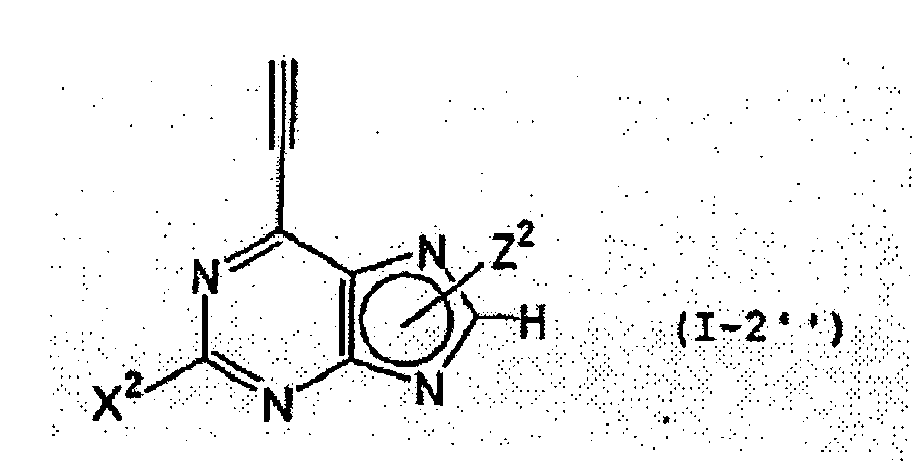 X2 eine Alkylgruppe ist, eine Alkoxygruppe, eine Arylgruppe, eine optional geschützte Aminogruppe, ein Halogenatom oder ein Wasserstoffatom, undZ2 eine Alkylgruppe ist, eine Aminoschutzgruppe oder ein Wasserstoffatom, welche an ein Stickstoffatom an der 7- oder 9-Position des Purinkerns gebunden ist,oder ein Salz derselben, wobei das Verfahren ein Umsetzten der Verbindung, wiedergegeben durch die Formel (I-2'):
 X2 und Z2 wie oben definiert sind,oder ein Salz derselben mit einer Base (2) umfasst.
 - Verfahren zur Herstellung einer Verbindung, wiedergegeben durch die Formel (I-2"'):
 A eine Arylgruppe ist, optional mit Substituenten, oder eine heterocyclische Gruppe, optional mit Substituenten,X2 eine Alkylgruppe ist, eine Alkoxygruppe, eine Arylgruppe, eine optional geschützte Aminogruppe, ein Halogenatom oder ein Wasserstoffatom, undZ2 eine Alkylgruppe ist, eine Aminoschutzgruppe oder ein Wasserstoffatom, welche an ein Stickstoffatom an der 7- oder 9-Position des Purinkerns gebunden ist,oder ein Salz derselben, wobei das Verfahren ein Umsetzten der Verbindung umfasst, wiedergegeben durch die Formel (I-2"):
 X2 und Z2 wie oben definiert sind,oder ein Salz derselben mit einer Verbindung, wiedergegeben durch die Formel (IV): A-X, wobei A wie oben definiert ist und X ein Halogenatom, in der Gegenwart eines Metallkatalysators und einer Base (1) umfasst.
 - Verfahren zur Herstellung einer Verbindung, wiedergegeben durch die Formel (I-2"'):
 A eine Arylgruppe ist, optional mit Substituenten, oder eine heterocyclische Gruppe, optional mit Substituenten,X2 eine Alkylgruppe ist, eine Alkoxygruppe, eine Arylgruppe, eine optional geschützte Aminogruppe, a Halogenatom oder ein Wasserstoffatom, undZ2 eine Alkylgruppe ist, eine Aminoschutzgruppe oder ein Wasserstoffatom, welche an ein Stickstoffatom an der 7- oder 9-Position des Purinkerns gebunden ist,oder ein Salz derselben, wobei das Verfahren die folgenden Schritte (a) bis (c) umfasst:(a) einen Schritt des Gewinnens einer Verbindung, wiedergegeben durch die Formel (I-2'):
 X2 eine Alkylgruppe ist, eine Alkoxygruppe, eine Arylgruppe, eine optional geschützte Aminogruppe, a Halogenatom oder ein Wasserstoffatom, undZ2 eine Alkylgruppe ist, eine Aminoschutzgruppe oder ein Wasserstoffatom, welche(s) an ein Stickstoffatom an der 7- oder 9-Position des Purinkerns gebunden ist,oder ein Salz derselben, welches ein Umsetzen einer Vernindung, wiedergegeben durch die Formel (II-2):
Formel (II-2) einfügen
umfasst, worinX2 und Z2 wie oben definiert sind, undL2 ein Halogenatom ist, vorausgesetzt dass, wenn X2 ein Halogenatom ist, L2 ein Halogenatom mit einem größeren Abgangsvermögen als das durch X2 wiedergegebene Halogenatom ist, oder dasselbe Halogenatom wie X2, oder ein Salz derselben, mit einer Verbindung, wiedergegeben durch die Formel (III): Me2(OH)C-C≡CH, in der Gegenwart eines Metallkatalysators und einer Base (1),(b) einen Schritt des Gewinnens einer Verbindung, wiedergegeben durch die Formel (II-2"):Formel (II-2") einfügenworinX2 und Z2 wie oben definiert sind,oder ein Salz derselben, welches das Behandeln einer Verbindung der Formel (I-2'), erhalten in Schritt (a), oder eines Salzes derselben mit einer Base (2) umfasst, und(c) einen Schritt des Umsetzens einer Verbindung der Formel (I-2"), erhalten in Schritt (b), oder eines Salzes derselben mit einer Verbundung, wiedergegeben durch die Formel (IV): A-X, worin A eine Arylgruppe ist, optional mit Substituenten, oder eine heterocyclische Gruppe, optional mit Substituenten, und X ein Halogenatom in der Gegenwart eines Metallkatalysators und einer Base (1). - Verfahren nach einem der Ansprüche 9, 10, 11, 13 and 14, wobei der Metallkatalysator einer Palladiumverbindung ist.
- Verfahren nach einem der Ansprüche 9, 10, 11, 13 und 14, wobei der Metallkatalysator eine Kombination einer Palladiumverbindung und einer Kupferverbindung ist.
- Verfahren nach Anspruch 15 oder 16, wobei die Palladiumverbindung Bis(triphenylphosphin)palladiumdichlorid oder Tetrakis(triphenlyphosphin)-palladium ist.
- Verfahren nach Anspruch 16, wobei die Kupferverbindung wenigstens eine ist, ausgewählt aus Kupfer(I)jodid, Kupfer(I)bromid und Kupfer(I)chlorid.
- Verfahren nach einem der Ansprüche 9, 10, 11, 13 und 14 bis 18, wobei die Base (1) eine Aminverbindung ist.
- Verfahren nach Anspruch 19, wobei die Aminverbindung Trialkylamin ist.
- Verfahren nach Anspruch 20, wobei das Trialkylamin Triethylamin oder Ethyldiisopropylamin ist.
- Verfahren nach einem der Ansprüche 8, 10, 12 und 14 bis 21, wobei die Base (2) ein Alkylimetallhydroxid oder Alkalimetallcarbonat ist.
Applications Claiming Priority (3)
| Application Number | Priority Date | Filing Date | Title |
|---|---|---|---|
| JP2002175015 | 2002-06-14 | ||
| JP2002175015A JP2004018453A (ja) | 2002-06-14 | 2002-06-14 | アルキニルプリン化合物およびその製造方法 |
| PCT/JP2003/007317 WO2003106458A1 (en) | 2002-06-14 | 2003-06-10 | Alkynylpurine compounds and production methods thereof |
Publications (2)
| Publication Number | Publication Date |
|---|---|
| EP1515970A1 EP1515970A1 (de) | 2005-03-23 |
| EP1515970B1 true EP1515970B1 (de) | 2006-10-18 |
Family
ID=29728009
Family Applications (1)
| Application Number | Title | Priority Date | Filing Date |
|---|---|---|---|
| EP03733333A Expired - Lifetime EP1515970B1 (de) | 2002-06-14 | 2003-06-10 | Alkynylpurine und verfahren zu deren herstellung |
Country Status (9)
| Country | Link |
|---|---|
| US (1) | US20060100429A1 (de) |
| EP (1) | EP1515970B1 (de) |
| JP (1) | JP2004018453A (de) |
| CN (1) | CN1662536A (de) |
| AT (1) | ATE342902T1 (de) |
| AU (1) | AU2003238696A1 (de) |
| CA (1) | CA2489468A1 (de) |
| DE (1) | DE60309171D1 (de) |
| WO (1) | WO2003106458A1 (de) |
Families Citing this family (3)
| Publication number | Priority date | Publication date | Assignee | Title |
|---|---|---|---|---|
| MXPA06002997A (es) | 2003-09-18 | 2007-02-08 | Conforma Therapeutics Corp | Novedosos compuestos heterociclicos como inhibidores- hsp90. |
| AU2005231440B9 (en) * | 2004-04-02 | 2012-02-23 | Dogwood Pharmaceuticals, Inc. | Selective antagonists of A2A adenosine receptors |
| AU2006230447A1 (en) | 2005-03-30 | 2006-10-05 | Conforma Therapeutics Corporation | Alkynyl pyrrolopyrimidines and related analogs as HSP90-inhibitors |
Family Cites Families (2)
| Publication number | Priority date | Publication date | Assignee | Title |
|---|---|---|---|---|
| US5189027A (en) * | 1990-11-30 | 1993-02-23 | Yamasa Shoyu Kabushiki Kaisha | 2-substituted adenosine derivatives and pharmaceutical compositions for circulatory diseases |
| AU1688599A (en) * | 1998-01-05 | 1999-07-26 | Eisai Co. Ltd. | Purine derivatives and adenosine a2 receptor antagonists serving as preventives/remedies for diabetes |
-
2002
- 2002-06-14 JP JP2002175015A patent/JP2004018453A/ja active Pending
-
2003
- 2003-06-10 DE DE60309171T patent/DE60309171D1/de not_active Expired - Lifetime
- 2003-06-10 US US10/517,599 patent/US20060100429A1/en not_active Abandoned
- 2003-06-10 CA CA002489468A patent/CA2489468A1/en not_active Abandoned
- 2003-06-10 AT AT03733333T patent/ATE342902T1/de not_active IP Right Cessation
- 2003-06-10 AU AU2003238696A patent/AU2003238696A1/en not_active Abandoned
- 2003-06-10 EP EP03733333A patent/EP1515970B1/de not_active Expired - Lifetime
- 2003-06-10 CN CN038138859A patent/CN1662536A/zh active Pending
- 2003-06-10 WO PCT/JP2003/007317 patent/WO2003106458A1/en not_active Ceased
Also Published As
| Publication number | Publication date |
|---|---|
| CN1662536A (zh) | 2005-08-31 |
| WO2003106458A1 (en) | 2003-12-24 |
| EP1515970A1 (de) | 2005-03-23 |
| DE60309171D1 (de) | 2006-11-30 |
| US20060100429A1 (en) | 2006-05-11 |
| JP2004018453A (ja) | 2004-01-22 |
| CA2489468A1 (en) | 2003-12-24 |
| ATE342902T1 (de) | 2006-11-15 |
| AU2003238696A1 (en) | 2003-12-31 |
Similar Documents
| Publication | Publication Date | Title |
|---|---|---|
| EP2691408B1 (de) | Synthese von 5-azacytidin | |
| CN107771178A (zh) | 杂环化合物的合成 | |
| MXPA00004532A (es) | Proceso para la sistesis de analogos de nucleosidos. | |
| JPWO2012043730A1 (ja) | モルホリノ核酸誘導体 | |
| EP3980013B1 (de) | Verfahren zur herstellung von aminopyrimidinverbindungen | |
| US8288526B2 (en) | Inosine derivatives and production methods therefor | |
| UA125595C2 (uk) | Проміжні сполуки, корисні для синтезу селективного інгібітора щодо протеїнкінази, і способи їх отримання | |
| EP0577304A1 (de) | Verfahren zur Stereoselektivanionglycosylierung | |
| EP1515970B1 (de) | Alkynylpurine und verfahren zu deren herstellung | |
| AU2018332214A1 (en) | Modified nucleoside phosphoramidites | |
| JPH08245685A (ja) | 2−デオキシ−2,2−ジフルオロ−β−D−リボ−ペントピラノースからの1−(2’−デオキシ−2’,2’−ジフルオロ−D−リボ−ペントフラノシル)−シトシンの製造法 | |
| JP3985103B2 (ja) | 新規複合体及びオリゴヌクレオチドの合成方法 | |
| US20170313735A1 (en) | Improved Fluorination Process | |
| Nagy | i, Patent Application Publication to, Pub. No: US 2006/0100429 A1 | |
| KR20190002779A (ko) | 알콕시알렌 화합물로부터 금속 촉매를 사용하여 n-글리코사이드 화합물을 위치선택적 및 입체선택적으로 제조하는 방법 | |
| WO2010079813A1 (ja) | イノシン誘導体の製造方法 | |
| US8252919B2 (en) | 2′-hydroxy-protected ribonucleoside derivative and production method thereof | |
| AU659008B2 (en) | Stereoselective anion glycosylation process | |
| JP2002293792A (ja) | ヌクレオシド又は糖のフッ素化誘導体の製造方法 | |
| JP2018184351A (ja) | ヌクレオシド又はそのヌクレオチドの誘導体、それを構成単位として含むrna誘導体、核酸医薬、及びrna誘導体若しくはrnaの製造方法 | |
| JPH0296589A (ja) | ヌクレオシド類 | |
| WO2025115034A1 (en) | A process for the preparation of a triaminopyrimidine compound and novel intermediates thereof | |
| GB2096596A (en) | 8-quinolinesulfonyl derivatives and their synthesis and use as coupling agents in nucleotide chemistry | |
| JPH01100190A (ja) | ヌクレオシド類 | |
| JP2007137843A (ja) | リボフラノース化合物およびプリンヌクレオシド化合物の製造方法 |
Legal Events
| Date | Code | Title | Description |
|---|---|---|---|
| PUAI | Public reference made under article 153(3) epc to a published international application that has entered the european phase |
Free format text: ORIGINAL CODE: 0009012 |
|
| 17P | Request for examination filed |
Effective date: 20050110 |
|
| AK | Designated contracting states |
Kind code of ref document: A1 Designated state(s): AT BE BG CH CY CZ DE DK EE ES FI FR GB GR HU IE IT LI LU MC NL PT RO SE SI SK TR |
|
| AX | Request for extension of the european patent |
Extension state: AL LT LV MK |
|
| 17Q | First examination report despatched |
Effective date: 20050317 |
|
| DAX | Request for extension of the european patent (deleted) | ||
| GRAP | Despatch of communication of intention to grant a patent |
Free format text: ORIGINAL CODE: EPIDOSNIGR1 |
|
| GRAS | Grant fee paid |
Free format text: ORIGINAL CODE: EPIDOSNIGR3 |
|
| RIN1 | Information on inventor provided before grant (corrected) |
Inventor name: HAYASHI, TAKETO,C/O SUMITOMO CHEMICAL CO., LTD Inventor name: KAWAKAMI, TAKEHIKO,C/O SUMITOMO CHEMICAL CO.,LTD Inventor name: CSAMPAI, ANTALC/O DEP. OF GEN. AND INORG. CHEM. Inventor name: KUMAZAWA, HIROHARU,C/O SUMITOMO CHEMICAL CO.,LTD Inventor name: NAGY, ANDRASC/O DEP. OF GEN. AND INORG. CHEM. Inventor name: KOTSCHY, ANDRAS,C/O DEPT GENERAL & INORGANIC CHEM |
|
| GRAA | (expected) grant |
Free format text: ORIGINAL CODE: 0009210 |
|
| AK | Designated contracting states |
Kind code of ref document: B1 Designated state(s): AT BE BG CH CY CZ DE DK EE ES FI FR GB GR HU IE IT LI LU MC NL PT RO SE SI SK TR |
|
| PG25 | Lapsed in a contracting state [announced via postgrant information from national office to epo] |
Ref country code: IT Free format text: LAPSE BECAUSE OF FAILURE TO SUBMIT A TRANSLATION OF THE DESCRIPTION OR TO PAY THE FEE WITHIN THE PRESCRIBED TIME-LIMIT;WARNING: LAPSES OF ITALIAN PATENTS WITH EFFECTIVE DATE BEFORE 2007 MAY HAVE OCCURRED AT ANY TIME BEFORE 2007. THE CORRECT EFFECTIVE DATE MAY BE DIFFERENT FROM THE ONE RECORDED. Effective date: 20061018 Ref country code: LI Free format text: LAPSE BECAUSE OF FAILURE TO SUBMIT A TRANSLATION OF THE DESCRIPTION OR TO PAY THE FEE WITHIN THE PRESCRIBED TIME-LIMIT Effective date: 20061018 Ref country code: SI Free format text: LAPSE BECAUSE OF FAILURE TO SUBMIT A TRANSLATION OF THE DESCRIPTION OR TO PAY THE FEE WITHIN THE PRESCRIBED TIME-LIMIT Effective date: 20061018 Ref country code: RO Free format text: LAPSE BECAUSE OF FAILURE TO SUBMIT A TRANSLATION OF THE DESCRIPTION OR TO PAY THE FEE WITHIN THE PRESCRIBED TIME-LIMIT Effective date: 20061018 Ref country code: CH Free format text: LAPSE BECAUSE OF FAILURE TO SUBMIT A TRANSLATION OF THE DESCRIPTION OR TO PAY THE FEE WITHIN THE PRESCRIBED TIME-LIMIT Effective date: 20061018 Ref country code: NL Free format text: LAPSE BECAUSE OF FAILURE TO SUBMIT A TRANSLATION OF THE DESCRIPTION OR TO PAY THE FEE WITHIN THE PRESCRIBED TIME-LIMIT Effective date: 20061018 Ref country code: BE Free format text: LAPSE BECAUSE OF FAILURE TO SUBMIT A TRANSLATION OF THE DESCRIPTION OR TO PAY THE FEE WITHIN THE PRESCRIBED TIME-LIMIT Effective date: 20061018 Ref country code: FI Free format text: LAPSE BECAUSE OF FAILURE TO SUBMIT A TRANSLATION OF THE DESCRIPTION OR TO PAY THE FEE WITHIN THE PRESCRIBED TIME-LIMIT Effective date: 20061018 Ref country code: AT Free format text: LAPSE BECAUSE OF FAILURE TO SUBMIT A TRANSLATION OF THE DESCRIPTION OR TO PAY THE FEE WITHIN THE PRESCRIBED TIME-LIMIT Effective date: 20061018 Ref country code: SK Free format text: LAPSE BECAUSE OF FAILURE TO SUBMIT A TRANSLATION OF THE DESCRIPTION OR TO PAY THE FEE WITHIN THE PRESCRIBED TIME-LIMIT Effective date: 20061018 Ref country code: CZ Free format text: LAPSE BECAUSE OF FAILURE TO SUBMIT A TRANSLATION OF THE DESCRIPTION OR TO PAY THE FEE WITHIN THE PRESCRIBED TIME-LIMIT Effective date: 20061018 |
|
| REG | Reference to a national code |
Ref country code: GB Ref legal event code: FG4D |
|
| REG | Reference to a national code |
Ref country code: CH Ref legal event code: EP Ref country code: IE Ref legal event code: FG4D |
|
| REF | Corresponds to: |
Ref document number: 60309171 Country of ref document: DE Date of ref document: 20061130 Kind code of ref document: P |
|
| PG25 | Lapsed in a contracting state [announced via postgrant information from national office to epo] |
Ref country code: BG Free format text: LAPSE BECAUSE OF FAILURE TO SUBMIT A TRANSLATION OF THE DESCRIPTION OR TO PAY THE FEE WITHIN THE PRESCRIBED TIME-LIMIT Effective date: 20070118 Ref country code: SE Free format text: LAPSE BECAUSE OF FAILURE TO SUBMIT A TRANSLATION OF THE DESCRIPTION OR TO PAY THE FEE WITHIN THE PRESCRIBED TIME-LIMIT Effective date: 20070118 Ref country code: DK Free format text: LAPSE BECAUSE OF FAILURE TO SUBMIT A TRANSLATION OF THE DESCRIPTION OR TO PAY THE FEE WITHIN THE PRESCRIBED TIME-LIMIT Effective date: 20070118 |
|
| PG25 | Lapsed in a contracting state [announced via postgrant information from national office to epo] |
Ref country code: DE Free format text: LAPSE BECAUSE OF FAILURE TO SUBMIT A TRANSLATION OF THE DESCRIPTION OR TO PAY THE FEE WITHIN THE PRESCRIBED TIME-LIMIT Effective date: 20070119 |
|
| PG25 | Lapsed in a contracting state [announced via postgrant information from national office to epo] |
Ref country code: ES Free format text: LAPSE BECAUSE OF FAILURE TO SUBMIT A TRANSLATION OF THE DESCRIPTION OR TO PAY THE FEE WITHIN THE PRESCRIBED TIME-LIMIT Effective date: 20070129 |
|
| PG25 | Lapsed in a contracting state [announced via postgrant information from national office to epo] |
Ref country code: PT Free format text: LAPSE BECAUSE OF FAILURE TO SUBMIT A TRANSLATION OF THE DESCRIPTION OR TO PAY THE FEE WITHIN THE PRESCRIBED TIME-LIMIT Effective date: 20070319 |
|
| NLV1 | Nl: lapsed or annulled due to failure to fulfill the requirements of art. 29p and 29m of the patents act | ||
| REG | Reference to a national code |
Ref country code: CH Ref legal event code: PL |
|
| EN | Fr: translation not filed | ||
| PLBE | No opposition filed within time limit |
Free format text: ORIGINAL CODE: 0009261 |
|
| STAA | Information on the status of an ep patent application or granted ep patent |
Free format text: STATUS: NO OPPOSITION FILED WITHIN TIME LIMIT |
|
| 26N | No opposition filed |
Effective date: 20070719 |
|
| PG25 | Lapsed in a contracting state [announced via postgrant information from national office to epo] |
Ref country code: MC Free format text: LAPSE BECAUSE OF NON-PAYMENT OF DUE FEES Effective date: 20070630 |
|
| GBPC | Gb: european patent ceased through non-payment of renewal fee |
Effective date: 20070610 |
|
| PG25 | Lapsed in a contracting state [announced via postgrant information from national office to epo] |
Ref country code: FR Free format text: LAPSE BECAUSE OF FAILURE TO SUBMIT A TRANSLATION OF THE DESCRIPTION OR TO PAY THE FEE WITHIN THE PRESCRIBED TIME-LIMIT Effective date: 20070601 Ref country code: GR Free format text: LAPSE BECAUSE OF FAILURE TO SUBMIT A TRANSLATION OF THE DESCRIPTION OR TO PAY THE FEE WITHIN THE PRESCRIBED TIME-LIMIT Effective date: 20070119 |
|
| PG25 | Lapsed in a contracting state [announced via postgrant information from national office to epo] |
Ref country code: GB Free format text: LAPSE BECAUSE OF NON-PAYMENT OF DUE FEES Effective date: 20070610 Ref country code: IE Free format text: LAPSE BECAUSE OF NON-PAYMENT OF DUE FEES Effective date: 20070611 |
|
| PG25 | Lapsed in a contracting state [announced via postgrant information from national office to epo] |
Ref country code: FR Free format text: LAPSE BECAUSE OF FAILURE TO SUBMIT A TRANSLATION OF THE DESCRIPTION OR TO PAY THE FEE WITHIN THE PRESCRIBED TIME-LIMIT Effective date: 20061018 |
|
| PG25 | Lapsed in a contracting state [announced via postgrant information from national office to epo] |
Ref country code: EE Free format text: LAPSE BECAUSE OF FAILURE TO SUBMIT A TRANSLATION OF THE DESCRIPTION OR TO PAY THE FEE WITHIN THE PRESCRIBED TIME-LIMIT Effective date: 20061018 |
|
| PG25 | Lapsed in a contracting state [announced via postgrant information from national office to epo] |
Ref country code: CY Free format text: LAPSE BECAUSE OF FAILURE TO SUBMIT A TRANSLATION OF THE DESCRIPTION OR TO PAY THE FEE WITHIN THE PRESCRIBED TIME-LIMIT Effective date: 20061018 Ref country code: LU Free format text: LAPSE BECAUSE OF NON-PAYMENT OF DUE FEES Effective date: 20070610 |
|
| PG25 | Lapsed in a contracting state [announced via postgrant information from national office to epo] |
Ref country code: HU Free format text: LAPSE BECAUSE OF FAILURE TO SUBMIT A TRANSLATION OF THE DESCRIPTION OR TO PAY THE FEE WITHIN THE PRESCRIBED TIME-LIMIT Effective date: 20070419 Ref country code: TR Free format text: LAPSE BECAUSE OF FAILURE TO SUBMIT A TRANSLATION OF THE DESCRIPTION OR TO PAY THE FEE WITHIN THE PRESCRIBED TIME-LIMIT Effective date: 20061018 |