EP1512185B1 - Method for making electrode - Google Patents
Method for making electrode Download PDFInfo
- Publication number
- EP1512185B1 EP1512185B1 EP03747572A EP03747572A EP1512185B1 EP 1512185 B1 EP1512185 B1 EP 1512185B1 EP 03747572 A EP03747572 A EP 03747572A EP 03747572 A EP03747572 A EP 03747572A EP 1512185 B1 EP1512185 B1 EP 1512185B1
- Authority
- EP
- European Patent Office
- Prior art keywords
- extruder
- ionically
- polymer
- active material
- conductive
- Prior art date
- Legal status (The legal status is an assumption and is not a legal conclusion. Google has not performed a legal analysis and makes no representation as to the accuracy of the status listed.)
- Expired - Lifetime
Links
- 238000000034 method Methods 0.000 title claims abstract description 65
- 229920000642 polymer Polymers 0.000 claims abstract description 62
- 239000011149 active material Substances 0.000 claims description 51
- 239000002904 solvent Substances 0.000 claims description 47
- 229920001940 conductive polymer Polymers 0.000 claims description 40
- 239000004020 conductor Substances 0.000 claims description 40
- 150000003839 salts Chemical class 0.000 claims description 39
- 239000000203 mixture Substances 0.000 claims description 35
- OKTJSMMVPCPJKN-UHFFFAOYSA-N Carbon Chemical compound [C] OKTJSMMVPCPJKN-UHFFFAOYSA-N 0.000 claims description 25
- 239000003792 electrolyte Substances 0.000 claims description 21
- 238000012545 processing Methods 0.000 claims description 21
- 229910002804 graphite Inorganic materials 0.000 claims description 13
- 239000010439 graphite Substances 0.000 claims description 13
- 229910052799 carbon Inorganic materials 0.000 claims description 11
- 229910003002 lithium salt Inorganic materials 0.000 claims description 9
- 159000000002 lithium salts Chemical class 0.000 claims description 9
- 239000004615 ingredient Substances 0.000 claims description 7
- 239000000178 monomer Substances 0.000 claims description 7
- 239000006229 carbon black Substances 0.000 claims description 6
- 239000002245 particle Substances 0.000 claims description 6
- 229920001577 copolymer Polymers 0.000 claims description 3
- QVGXLLKOCUKJST-UHFFFAOYSA-N atomic oxygen Chemical compound [O] QVGXLLKOCUKJST-UHFFFAOYSA-N 0.000 claims description 2
- QJGQUHMNIGDVPM-UHFFFAOYSA-N nitrogen group Chemical group [N] QJGQUHMNIGDVPM-UHFFFAOYSA-N 0.000 claims description 2
- 229910052760 oxygen Inorganic materials 0.000 claims description 2
- 239000001301 oxygen Substances 0.000 claims description 2
- 239000011365 complex material Substances 0.000 claims 1
- 229910044991 metal oxide Inorganic materials 0.000 claims 1
- 150000004706 metal oxides Chemical class 0.000 claims 1
- 229920000233 poly(alkylene oxides) Polymers 0.000 claims 1
- 229910052744 lithium Inorganic materials 0.000 abstract description 12
- WHXSMMKQMYFTQS-UHFFFAOYSA-N Lithium Chemical compound [Li] WHXSMMKQMYFTQS-UHFFFAOYSA-N 0.000 abstract description 9
- 238000001125 extrusion Methods 0.000 abstract description 7
- 239000000463 material Substances 0.000 description 32
- -1 V6O13 Inorganic materials 0.000 description 17
- 230000008569 process Effects 0.000 description 15
- 239000000843 powder Substances 0.000 description 13
- 210000004027 cell Anatomy 0.000 description 7
- 238000002156 mixing Methods 0.000 description 7
- ZMXDDKWLCZADIW-UHFFFAOYSA-N N,N-Dimethylformamide Chemical compound CN(C)C=O ZMXDDKWLCZADIW-UHFFFAOYSA-N 0.000 description 6
- 230000015556 catabolic process Effects 0.000 description 6
- 239000011248 coating agent Substances 0.000 description 6
- 238000000576 coating method Methods 0.000 description 6
- 238000006731 degradation reaction Methods 0.000 description 6
- 238000011068 loading method Methods 0.000 description 6
- WYURNTSHIVDZCO-UHFFFAOYSA-N Tetrahydrofuran Chemical compound C1CCOC1 WYURNTSHIVDZCO-UHFFFAOYSA-N 0.000 description 5
- 239000007772 electrode material Substances 0.000 description 5
- 239000010408 film Substances 0.000 description 5
- 230000010006 flight Effects 0.000 description 5
- 239000000446 fuel Substances 0.000 description 5
- 238000004519 manufacturing process Methods 0.000 description 5
- 229910052751 metal Inorganic materials 0.000 description 5
- 239000002184 metal Substances 0.000 description 5
- 239000000758 substrate Substances 0.000 description 5
- YEJRWHAVMIAJKC-UHFFFAOYSA-N 4-Butyrolactone Chemical compound O=C1CCCO1 YEJRWHAVMIAJKC-UHFFFAOYSA-N 0.000 description 4
- RYGMFSIKBFXOCR-UHFFFAOYSA-N Copper Chemical compound [Cu] RYGMFSIKBFXOCR-UHFFFAOYSA-N 0.000 description 4
- PXHVJJICTQNCMI-UHFFFAOYSA-N Nickel Chemical compound [Ni] PXHVJJICTQNCMI-UHFFFAOYSA-N 0.000 description 4
- 239000002033 PVDF binder Substances 0.000 description 4
- 239000004698 Polyethylene Substances 0.000 description 4
- 239000002202 Polyethylene glycol Substances 0.000 description 4
- XHCLAFWTIXFWPH-UHFFFAOYSA-N [O-2].[O-2].[O-2].[O-2].[O-2].[V+5].[V+5] Chemical compound [O-2].[O-2].[O-2].[O-2].[O-2].[V+5].[V+5] XHCLAFWTIXFWPH-UHFFFAOYSA-N 0.000 description 4
- GNTDGMZSJNCJKK-UHFFFAOYSA-N divanadium pentaoxide Chemical compound O=[V](=O)O[V](=O)=O GNTDGMZSJNCJKK-UHFFFAOYSA-N 0.000 description 4
- 229910003473 lithium bis(trifluoromethanesulfonyl)imide Inorganic materials 0.000 description 4
- QSZMZKBZAYQGRS-UHFFFAOYSA-N lithium;bis(trifluoromethylsulfonyl)azanide Chemical compound [Li+].FC(F)(F)S(=O)(=O)[N-]S(=O)(=O)C(F)(F)F QSZMZKBZAYQGRS-UHFFFAOYSA-N 0.000 description 4
- 229920000573 polyethylene Polymers 0.000 description 4
- 229920001223 polyethylene glycol Polymers 0.000 description 4
- 229920002981 polyvinylidene fluoride Polymers 0.000 description 4
- 229910001935 vanadium oxide Inorganic materials 0.000 description 4
- HBBGRARXTFLTSG-UHFFFAOYSA-N Lithium ion Chemical compound [Li+] HBBGRARXTFLTSG-UHFFFAOYSA-N 0.000 description 3
- 239000004743 Polypropylene Substances 0.000 description 3
- 230000009471 action Effects 0.000 description 3
- 229910052782 aluminium Inorganic materials 0.000 description 3
- XAGFODPZIPBFFR-UHFFFAOYSA-N aluminium Chemical compound [Al] XAGFODPZIPBFFR-UHFFFAOYSA-N 0.000 description 3
- 239000011230 binding agent Substances 0.000 description 3
- 239000002131 composite material Substances 0.000 description 3
- 229910052802 copper Inorganic materials 0.000 description 3
- 239000010949 copper Substances 0.000 description 3
- 239000011888 foil Substances 0.000 description 3
- 229910001416 lithium ion Inorganic materials 0.000 description 3
- 239000000155 melt Substances 0.000 description 3
- 229920001155 polypropylene Polymers 0.000 description 3
- IJGRMHOSHXDMSA-UHFFFAOYSA-N Atomic nitrogen Chemical compound N#N IJGRMHOSHXDMSA-UHFFFAOYSA-N 0.000 description 2
- 229920000049 Carbon (fiber) Polymers 0.000 description 2
- BVKZGUZCCUSVTD-UHFFFAOYSA-L Carbonate Chemical compound [O-]C([O-])=O BVKZGUZCCUSVTD-UHFFFAOYSA-L 0.000 description 2
- XTHFKEDIFFGKHM-UHFFFAOYSA-N Dimethoxyethane Chemical compound COCCOC XTHFKEDIFFGKHM-UHFFFAOYSA-N 0.000 description 2
- UDSFAEKRVUSQDD-UHFFFAOYSA-N Dimethyl adipate Chemical compound COC(=O)CCCCC(=O)OC UDSFAEKRVUSQDD-UHFFFAOYSA-N 0.000 description 2
- KMTRUDSVKNLOMY-UHFFFAOYSA-N Ethylene carbonate Chemical compound O=C1OCCO1 KMTRUDSVKNLOMY-UHFFFAOYSA-N 0.000 description 2
- IAYPIBMASNFSPL-UHFFFAOYSA-N Ethylene oxide Chemical compound C1CO1 IAYPIBMASNFSPL-UHFFFAOYSA-N 0.000 description 2
- 229910014149 LixNiO2 Inorganic materials 0.000 description 2
- 239000006057 Non-nutritive feed additive Substances 0.000 description 2
- GOOHAUXETOMSMM-UHFFFAOYSA-N Propylene oxide Chemical compound CC1CO1 GOOHAUXETOMSMM-UHFFFAOYSA-N 0.000 description 2
- 239000003963 antioxidant agent Substances 0.000 description 2
- 239000004917 carbon fiber Substances 0.000 description 2
- 239000003054 catalyst Substances 0.000 description 2
- 239000000571 coke Substances 0.000 description 2
- IEJIGPNLZYLLBP-UHFFFAOYSA-N dimethyl carbonate Chemical compound COC(=O)OC IEJIGPNLZYLLBP-UHFFFAOYSA-N 0.000 description 2
- 230000008030 elimination Effects 0.000 description 2
- 238000003379 elimination reaction Methods 0.000 description 2
- 230000005484 gravity Effects 0.000 description 2
- 230000002779 inactivation Effects 0.000 description 2
- 150000002500 ions Chemical class 0.000 description 2
- 239000007788 liquid Substances 0.000 description 2
- 239000011159 matrix material Substances 0.000 description 2
- 239000012528 membrane Substances 0.000 description 2
- JKQOBWVOAYFWKG-UHFFFAOYSA-N molybdenum trioxide Chemical compound O=[Mo](=O)=O JKQOBWVOAYFWKG-UHFFFAOYSA-N 0.000 description 2
- 229910052759 nickel Inorganic materials 0.000 description 2
- 239000004014 plasticizer Substances 0.000 description 2
- BASFCYQUMIYNBI-UHFFFAOYSA-N platinum Chemical compound [Pt] BASFCYQUMIYNBI-UHFFFAOYSA-N 0.000 description 2
- 229920002239 polyacrylonitrile Polymers 0.000 description 2
- 239000005077 polysulfide Substances 0.000 description 2
- 229920001021 polysulfide Polymers 0.000 description 2
- 150000008117 polysulfides Polymers 0.000 description 2
- 239000011148 porous material Substances 0.000 description 2
- RUOJZAUFBMNUDX-UHFFFAOYSA-N propylene carbonate Chemical compound CC1COC(=O)O1 RUOJZAUFBMNUDX-UHFFFAOYSA-N 0.000 description 2
- APSBXTVYXVQYAB-UHFFFAOYSA-M sodium docusate Chemical group [Na+].CCCCC(CC)COC(=O)CC(S([O-])(=O)=O)C(=O)OCC(CC)CCCC APSBXTVYXVQYAB-UHFFFAOYSA-M 0.000 description 2
- 239000007787 solid Substances 0.000 description 2
- HXJUTPCZVOIRIF-UHFFFAOYSA-N sulfolane Chemical compound O=S1(=O)CCCC1 HXJUTPCZVOIRIF-UHFFFAOYSA-N 0.000 description 2
- YLQBMQCUIZJEEH-UHFFFAOYSA-N tetrahydrofuran Natural products C=1C=COC=1 YLQBMQCUIZJEEH-UHFFFAOYSA-N 0.000 description 2
- 239000010409 thin film Substances 0.000 description 2
- 238000011144 upstream manufacturing Methods 0.000 description 2
- XLYOFNOQVPJJNP-UHFFFAOYSA-N water Substances O XLYOFNOQVPJJNP-UHFFFAOYSA-N 0.000 description 2
- STMDPCBYJCIZOD-UHFFFAOYSA-N 2-(2,4-dinitroanilino)-4-methylpentanoic acid Chemical compound CC(C)CC(C(O)=O)NC1=CC=C([N+]([O-])=O)C=C1[N+]([O-])=O STMDPCBYJCIZOD-UHFFFAOYSA-N 0.000 description 1
- 229910017656 Ag2V4O11 Inorganic materials 0.000 description 1
- ZOXJGFHDIHLPTG-UHFFFAOYSA-N Boron Chemical compound [B] ZOXJGFHDIHLPTG-UHFFFAOYSA-N 0.000 description 1
- 229920002943 EPDM rubber Polymers 0.000 description 1
- 229910002539 EuFeO3 Inorganic materials 0.000 description 1
- WSFSSNUMVMOOMR-UHFFFAOYSA-N Formaldehyde Chemical compound O=C WSFSSNUMVMOOMR-UHFFFAOYSA-N 0.000 description 1
- 229910002328 LaMnO3 Inorganic materials 0.000 description 1
- 229910002340 LaNiO3 Inorganic materials 0.000 description 1
- 229910012670 LiTi5O12 Inorganic materials 0.000 description 1
- 229910012867 LiWO2 Inorganic materials 0.000 description 1
- 229910001091 LixCoO2 Inorganic materials 0.000 description 1
- 229910015329 LixMn2O4 Inorganic materials 0.000 description 1
- 229910003007 LixMnO2 Inorganic materials 0.000 description 1
- 229910014708 LixTi5O12 Inorganic materials 0.000 description 1
- 229910015084 LixV3O8 Inorganic materials 0.000 description 1
- 229920000557 Nafion® Polymers 0.000 description 1
- 229920003171 Poly (ethylene oxide) Polymers 0.000 description 1
- 229910006024 SO2Cl2 Inorganic materials 0.000 description 1
- XUIMIQQOPSSXEZ-UHFFFAOYSA-N Silicon Chemical compound [Si] XUIMIQQOPSSXEZ-UHFFFAOYSA-N 0.000 description 1
- 229910021607 Silver chloride Inorganic materials 0.000 description 1
- KEAYESYHFKHZAL-UHFFFAOYSA-N Sodium Chemical compound [Na] KEAYESYHFKHZAL-UHFFFAOYSA-N 0.000 description 1
- 239000004902 Softening Agent Substances 0.000 description 1
- NINIDFKCEFEMDL-UHFFFAOYSA-N Sulfur Chemical compound [S] NINIDFKCEFEMDL-UHFFFAOYSA-N 0.000 description 1
- 239000004480 active ingredient Substances 0.000 description 1
- 239000013543 active substance Substances 0.000 description 1
- 239000000654 additive Substances 0.000 description 1
- 229910052783 alkali metal Inorganic materials 0.000 description 1
- 125000000217 alkyl group Chemical group 0.000 description 1
- 229910045601 alloy Inorganic materials 0.000 description 1
- 239000000956 alloy Substances 0.000 description 1
- 229910003481 amorphous carbon Inorganic materials 0.000 description 1
- 230000003078 antioxidant effect Effects 0.000 description 1
- 125000003710 aryl alkyl group Chemical group 0.000 description 1
- 125000003118 aryl group Chemical group 0.000 description 1
- 229910052796 boron Inorganic materials 0.000 description 1
- 239000003990 capacitor Substances 0.000 description 1
- 239000003575 carbonaceous material Substances 0.000 description 1
- 238000005266 casting Methods 0.000 description 1
- 239000003795 chemical substances by application Substances 0.000 description 1
- 238000013329 compounding Methods 0.000 description 1
- 239000002322 conducting polymer Substances 0.000 description 1
- 238000010276 construction Methods 0.000 description 1
- 238000010924 continuous production Methods 0.000 description 1
- 238000007796 conventional method Methods 0.000 description 1
- 238000001816 cooling Methods 0.000 description 1
- OMZSGWSJDCOLKM-UHFFFAOYSA-N copper(II) sulfide Chemical compound [S-2].[Cu+2] OMZSGWSJDCOLKM-UHFFFAOYSA-N 0.000 description 1
- 238000004132 cross linking Methods 0.000 description 1
- 230000000593 degrading effect Effects 0.000 description 1
- 210000001787 dendrite Anatomy 0.000 description 1
- 230000008021 deposition Effects 0.000 description 1
- 239000003085 diluting agent Substances 0.000 description 1
- 238000006073 displacement reaction Methods 0.000 description 1
- 239000011262 electrochemically active material Substances 0.000 description 1
- 230000005518 electrochemistry Effects 0.000 description 1
- 230000007613 environmental effect Effects 0.000 description 1
- 239000000835 fiber Substances 0.000 description 1
- 239000012530 fluid Substances 0.000 description 1
- 229920002313 fluoropolymer Polymers 0.000 description 1
- 239000004811 fluoropolymer Substances 0.000 description 1
- 238000009472 formulation Methods 0.000 description 1
- 238000005227 gel permeation chromatography Methods 0.000 description 1
- 238000010438 heat treatment Methods 0.000 description 1
- 229920001519 homopolymer Polymers 0.000 description 1
- 229910010272 inorganic material Inorganic materials 0.000 description 1
- 239000011147 inorganic material Substances 0.000 description 1
- 238000004898 kneading Methods 0.000 description 1
- 239000006233 lamp black Substances 0.000 description 1
- MHCFAGZWMAWTNR-UHFFFAOYSA-M lithium perchlorate Chemical compound [Li+].[O-]Cl(=O)(=O)=O MHCFAGZWMAWTNR-UHFFFAOYSA-M 0.000 description 1
- 229910001486 lithium perchlorate Inorganic materials 0.000 description 1
- ACFSQHQYDZIPRL-UHFFFAOYSA-N lithium;bis(1,1,2,2,2-pentafluoroethylsulfonyl)azanide Chemical compound [Li+].FC(F)(F)C(F)(F)S(=O)(=O)[N-]S(=O)(=O)C(F)(F)C(F)(F)F ACFSQHQYDZIPRL-UHFFFAOYSA-N 0.000 description 1
- QVXQYMZVJNYDNG-UHFFFAOYSA-N lithium;bis(trifluoromethylsulfonyl)methylsulfonyl-trifluoromethane Chemical compound [Li+].FC(F)(F)S(=O)(=O)[C-](S(=O)(=O)C(F)(F)F)S(=O)(=O)C(F)(F)F QVXQYMZVJNYDNG-UHFFFAOYSA-N 0.000 description 1
- PDECINHTUQHWJM-UHFFFAOYSA-N lithium;trifluoroborane Chemical compound [Li].FB(F)F PDECINHTUQHWJM-UHFFFAOYSA-N 0.000 description 1
- MCVFFRWZNYZUIJ-UHFFFAOYSA-M lithium;trifluoromethanesulfonate Chemical compound [Li+].[O-]S(=O)(=O)C(F)(F)F MCVFFRWZNYZUIJ-UHFFFAOYSA-M 0.000 description 1
- 230000007246 mechanism Effects 0.000 description 1
- 150000002739 metals Chemical class 0.000 description 1
- VNWKTOKETHGBQD-UHFFFAOYSA-N methane Chemical compound C VNWKTOKETHGBQD-UHFFFAOYSA-N 0.000 description 1
- QLOAVXSYZAJECW-UHFFFAOYSA-N methane;molecular fluorine Chemical compound C.FF QLOAVXSYZAJECW-UHFFFAOYSA-N 0.000 description 1
- 125000002496 methyl group Chemical group [H]C([H])([H])* 0.000 description 1
- 239000011325 microbead Substances 0.000 description 1
- 238000001000 micrograph Methods 0.000 description 1
- 238000012544 monitoring process Methods 0.000 description 1
- 125000001624 naphthyl group Chemical group 0.000 description 1
- 229910052757 nitrogen Inorganic materials 0.000 description 1
- 239000011368 organic material Substances 0.000 description 1
- 238000007254 oxidation reaction Methods 0.000 description 1
- 230000035515 penetration Effects 0.000 description 1
- 125000001997 phenyl group Chemical group [H]C1=C([H])C([H])=C(*)C([H])=C1[H] 0.000 description 1
- 239000011295 pitch Substances 0.000 description 1
- 229920003023 plastic Polymers 0.000 description 1
- 239000004033 plastic Substances 0.000 description 1
- 229910052697 platinum Inorganic materials 0.000 description 1
- 229920002627 poly(phosphazenes) Polymers 0.000 description 1
- 229920000058 polyacrylate Polymers 0.000 description 1
- 229920000728 polyester Polymers 0.000 description 1
- 229920000570 polyether Polymers 0.000 description 1
- 229920000098 polyolefin Polymers 0.000 description 1
- 229920000128 polypyrrole Polymers 0.000 description 1
- 229920001296 polysiloxane Polymers 0.000 description 1
- 229920001343 polytetrafluoroethylene Polymers 0.000 description 1
- 239000004810 polytetrafluoroethylene Substances 0.000 description 1
- 238000002360 preparation method Methods 0.000 description 1
- 238000003825 pressing Methods 0.000 description 1
- 238000005086 pumping Methods 0.000 description 1
- 230000003134 recirculating effect Effects 0.000 description 1
- 239000013557 residual solvent Substances 0.000 description 1
- 238000004626 scanning electron microscopy Methods 0.000 description 1
- 238000007493 shaping process Methods 0.000 description 1
- 238000010008 shearing Methods 0.000 description 1
- 229910052710 silicon Inorganic materials 0.000 description 1
- 239000010703 silicon Substances 0.000 description 1
- HKZLPVFGJNLROG-UHFFFAOYSA-M silver monochloride Chemical compound [Cl-].[Ag+] HKZLPVFGJNLROG-UHFFFAOYSA-M 0.000 description 1
- 239000000243 solution Substances 0.000 description 1
- 239000010935 stainless steel Substances 0.000 description 1
- 229910001220 stainless steel Inorganic materials 0.000 description 1
- 229920003048 styrene butadiene rubber Polymers 0.000 description 1
- 229910052717 sulfur Inorganic materials 0.000 description 1
- 239000011593 sulfur Substances 0.000 description 1
- YBBRCQOCSYXUOC-UHFFFAOYSA-N sulfuryl dichloride Chemical compound ClS(Cl)(=O)=O YBBRCQOCSYXUOC-UHFFFAOYSA-N 0.000 description 1
- 239000004094 surface-active agent Substances 0.000 description 1
- 229920001897 terpolymer Polymers 0.000 description 1
- 238000012360 testing method Methods 0.000 description 1
- XOLBLPGZBRYERU-UHFFFAOYSA-N tin dioxide Chemical compound O=[Sn]=O XOLBLPGZBRYERU-UHFFFAOYSA-N 0.000 description 1
- 229910001887 tin oxide Inorganic materials 0.000 description 1
- 229910000314 transition metal oxide Inorganic materials 0.000 description 1
- 239000011345 viscous material Substances 0.000 description 1
- 239000002699 waste material Substances 0.000 description 1
Images


Classifications
-
- H—ELECTRICITY
- H01—ELECTRIC ELEMENTS
- H01M—PROCESSES OR MEANS, e.g. BATTERIES, FOR THE DIRECT CONVERSION OF CHEMICAL ENERGY INTO ELECTRICAL ENERGY
- H01M4/00—Electrodes
- H01M4/02—Electrodes composed of, or comprising, active material
- H01M4/04—Processes of manufacture in general
- H01M4/0483—Processes of manufacture in general by methods including the handling of a melt
-
- B—PERFORMING OPERATIONS; TRANSPORTING
- B29—WORKING OF PLASTICS; WORKING OF SUBSTANCES IN A PLASTIC STATE IN GENERAL
- B29B—PREPARATION OR PRETREATMENT OF THE MATERIAL TO BE SHAPED; MAKING GRANULES OR PREFORMS; RECOVERY OF PLASTICS OR OTHER CONSTITUENTS OF WASTE MATERIAL CONTAINING PLASTICS
- B29B7/00—Mixing; Kneading
- B29B7/002—Methods
- B29B7/007—Methods for continuous mixing
-
- B—PERFORMING OPERATIONS; TRANSPORTING
- B29—WORKING OF PLASTICS; WORKING OF SUBSTANCES IN A PLASTIC STATE IN GENERAL
- B29B—PREPARATION OR PRETREATMENT OF THE MATERIAL TO BE SHAPED; MAKING GRANULES OR PREFORMS; RECOVERY OF PLASTICS OR OTHER CONSTITUENTS OF WASTE MATERIAL CONTAINING PLASTICS
- B29B7/00—Mixing; Kneading
- B29B7/30—Mixing; Kneading continuous, with mechanical mixing or kneading devices
- B29B7/58—Component parts, details or accessories; Auxiliary operations
- B29B7/60—Component parts, details or accessories; Auxiliary operations for feeding, e.g. end guides for the incoming material
-
- B—PERFORMING OPERATIONS; TRANSPORTING
- B29—WORKING OF PLASTICS; WORKING OF SUBSTANCES IN A PLASTIC STATE IN GENERAL
- B29B—PREPARATION OR PRETREATMENT OF THE MATERIAL TO BE SHAPED; MAKING GRANULES OR PREFORMS; RECOVERY OF PLASTICS OR OTHER CONSTITUENTS OF WASTE MATERIAL CONTAINING PLASTICS
- B29B7/00—Mixing; Kneading
- B29B7/74—Mixing; Kneading using other mixers or combinations of mixers, e.g. of dissimilar mixers ; Plant
- B29B7/7476—Systems, i.e. flow charts or diagrams; Plants
- B29B7/7485—Systems, i.e. flow charts or diagrams; Plants with consecutive mixers, e.g. with premixing some of the components
-
- B—PERFORMING OPERATIONS; TRANSPORTING
- B29—WORKING OF PLASTICS; WORKING OF SUBSTANCES IN A PLASTIC STATE IN GENERAL
- B29C—SHAPING OR JOINING OF PLASTICS; SHAPING OF MATERIAL IN A PLASTIC STATE, NOT OTHERWISE PROVIDED FOR; AFTER-TREATMENT OF THE SHAPED PRODUCTS, e.g. REPAIRING
- B29C48/00—Extrusion moulding, i.e. expressing the moulding material through a die or nozzle which imparts the desired form; Apparatus therefor
- B29C48/03—Extrusion moulding, i.e. expressing the moulding material through a die or nozzle which imparts the desired form; Apparatus therefor characterised by the shape of the extruded material at extrusion
- B29C48/04—Particle-shaped
-
- B—PERFORMING OPERATIONS; TRANSPORTING
- B29—WORKING OF PLASTICS; WORKING OF SUBSTANCES IN A PLASTIC STATE IN GENERAL
- B29C—SHAPING OR JOINING OF PLASTICS; SHAPING OF MATERIAL IN A PLASTIC STATE, NOT OTHERWISE PROVIDED FOR; AFTER-TREATMENT OF THE SHAPED PRODUCTS, e.g. REPAIRING
- B29C48/00—Extrusion moulding, i.e. expressing the moulding material through a die or nozzle which imparts the desired form; Apparatus therefor
- B29C48/25—Component parts, details or accessories; Auxiliary operations
- B29C48/36—Means for plasticising or homogenising the moulding material or forcing it through the nozzle or die
- B29C48/395—Means for plasticising or homogenising the moulding material or forcing it through the nozzle or die using screws surrounded by a cooperating barrel, e.g. single screw extruders
-
- B—PERFORMING OPERATIONS; TRANSPORTING
- B29—WORKING OF PLASTICS; WORKING OF SUBSTANCES IN A PLASTIC STATE IN GENERAL
- B29C—SHAPING OR JOINING OF PLASTICS; SHAPING OF MATERIAL IN A PLASTIC STATE, NOT OTHERWISE PROVIDED FOR; AFTER-TREATMENT OF THE SHAPED PRODUCTS, e.g. REPAIRING
- B29C48/00—Extrusion moulding, i.e. expressing the moulding material through a die or nozzle which imparts the desired form; Apparatus therefor
- B29C48/25—Component parts, details or accessories; Auxiliary operations
- B29C48/36—Means for plasticising or homogenising the moulding material or forcing it through the nozzle or die
- B29C48/395—Means for plasticising or homogenising the moulding material or forcing it through the nozzle or die using screws surrounded by a cooperating barrel, e.g. single screw extruders
- B29C48/40—Means for plasticising or homogenising the moulding material or forcing it through the nozzle or die using screws surrounded by a cooperating barrel, e.g. single screw extruders using two or more parallel screws or at least two parallel non-intermeshing screws, e.g. twin screw extruders
-
- B—PERFORMING OPERATIONS; TRANSPORTING
- B29—WORKING OF PLASTICS; WORKING OF SUBSTANCES IN A PLASTIC STATE IN GENERAL
- B29C—SHAPING OR JOINING OF PLASTICS; SHAPING OF MATERIAL IN A PLASTIC STATE, NOT OTHERWISE PROVIDED FOR; AFTER-TREATMENT OF THE SHAPED PRODUCTS, e.g. REPAIRING
- B29C48/00—Extrusion moulding, i.e. expressing the moulding material through a die or nozzle which imparts the desired form; Apparatus therefor
- B29C48/25—Component parts, details or accessories; Auxiliary operations
- B29C48/36—Means for plasticising or homogenising the moulding material or forcing it through the nozzle or die
- B29C48/395—Means for plasticising or homogenising the moulding material or forcing it through the nozzle or die using screws surrounded by a cooperating barrel, e.g. single screw extruders
- B29C48/40—Means for plasticising or homogenising the moulding material or forcing it through the nozzle or die using screws surrounded by a cooperating barrel, e.g. single screw extruders using two or more parallel screws or at least two parallel non-intermeshing screws, e.g. twin screw extruders
- B29C48/402—Means for plasticising or homogenising the moulding material or forcing it through the nozzle or die using screws surrounded by a cooperating barrel, e.g. single screw extruders using two or more parallel screws or at least two parallel non-intermeshing screws, e.g. twin screw extruders the screws having intermeshing parts
-
- B—PERFORMING OPERATIONS; TRANSPORTING
- B29—WORKING OF PLASTICS; WORKING OF SUBSTANCES IN A PLASTIC STATE IN GENERAL
- B29C—SHAPING OR JOINING OF PLASTICS; SHAPING OF MATERIAL IN A PLASTIC STATE, NOT OTHERWISE PROVIDED FOR; AFTER-TREATMENT OF THE SHAPED PRODUCTS, e.g. REPAIRING
- B29C48/00—Extrusion moulding, i.e. expressing the moulding material through a die or nozzle which imparts the desired form; Apparatus therefor
- B29C48/25—Component parts, details or accessories; Auxiliary operations
- B29C48/36—Means for plasticising or homogenising the moulding material or forcing it through the nozzle or die
- B29C48/395—Means for plasticising or homogenising the moulding material or forcing it through the nozzle or die using screws surrounded by a cooperating barrel, e.g. single screw extruders
- B29C48/40—Means for plasticising or homogenising the moulding material or forcing it through the nozzle or die using screws surrounded by a cooperating barrel, e.g. single screw extruders using two or more parallel screws or at least two parallel non-intermeshing screws, e.g. twin screw extruders
- B29C48/404—Means for plasticising or homogenising the moulding material or forcing it through the nozzle or die using screws surrounded by a cooperating barrel, e.g. single screw extruders using two or more parallel screws or at least two parallel non-intermeshing screws, e.g. twin screw extruders the screws having non-intermeshing parts
-
- H—ELECTRICITY
- H01—ELECTRIC ELEMENTS
- H01M—PROCESSES OR MEANS, e.g. BATTERIES, FOR THE DIRECT CONVERSION OF CHEMICAL ENERGY INTO ELECTRICAL ENERGY
- H01M4/00—Electrodes
- H01M4/02—Electrodes composed of, or comprising, active material
- H01M4/04—Processes of manufacture in general
- H01M4/0402—Methods of deposition of the material
- H01M4/0404—Methods of deposition of the material by coating on electrode collectors
-
- H—ELECTRICITY
- H01—ELECTRIC ELEMENTS
- H01M—PROCESSES OR MEANS, e.g. BATTERIES, FOR THE DIRECT CONVERSION OF CHEMICAL ENERGY INTO ELECTRICAL ENERGY
- H01M4/00—Electrodes
- H01M4/02—Electrodes composed of, or comprising, active material
- H01M4/04—Processes of manufacture in general
- H01M4/0402—Methods of deposition of the material
- H01M4/0411—Methods of deposition of the material by extrusion
-
- H—ELECTRICITY
- H01—ELECTRIC ELEMENTS
- H01M—PROCESSES OR MEANS, e.g. BATTERIES, FOR THE DIRECT CONVERSION OF CHEMICAL ENERGY INTO ELECTRICAL ENERGY
- H01M4/00—Electrodes
- H01M4/02—Electrodes composed of, or comprising, active material
- H01M4/13—Electrodes for accumulators with non-aqueous electrolyte, e.g. for lithium-accumulators; Processes of manufacture thereof
- H01M4/139—Processes of manufacture
- H01M4/1391—Processes of manufacture of electrodes based on mixed oxides or hydroxides, or on mixtures of oxides or hydroxides, e.g. LiCoOx
-
- B—PERFORMING OPERATIONS; TRANSPORTING
- B29—WORKING OF PLASTICS; WORKING OF SUBSTANCES IN A PLASTIC STATE IN GENERAL
- B29B—PREPARATION OR PRETREATMENT OF THE MATERIAL TO BE SHAPED; MAKING GRANULES OR PREFORMS; RECOVERY OF PLASTICS OR OTHER CONSTITUENTS OF WASTE MATERIAL CONTAINING PLASTICS
- B29B7/00—Mixing; Kneading
- B29B7/30—Mixing; Kneading continuous, with mechanical mixing or kneading devices
- B29B7/34—Mixing; Kneading continuous, with mechanical mixing or kneading devices with movable mixing or kneading devices
- B29B7/38—Mixing; Kneading continuous, with mechanical mixing or kneading devices with movable mixing or kneading devices rotary
- B29B7/46—Mixing; Kneading continuous, with mechanical mixing or kneading devices with movable mixing or kneading devices rotary with more than one shaft
- B29B7/48—Mixing; Kneading continuous, with mechanical mixing or kneading devices with movable mixing or kneading devices rotary with more than one shaft with intermeshing devices, e.g. screws
-
- B—PERFORMING OPERATIONS; TRANSPORTING
- B29—WORKING OF PLASTICS; WORKING OF SUBSTANCES IN A PLASTIC STATE IN GENERAL
- B29C—SHAPING OR JOINING OF PLASTICS; SHAPING OF MATERIAL IN A PLASTIC STATE, NOT OTHERWISE PROVIDED FOR; AFTER-TREATMENT OF THE SHAPED PRODUCTS, e.g. REPAIRING
- B29C48/00—Extrusion moulding, i.e. expressing the moulding material through a die or nozzle which imparts the desired form; Apparatus therefor
- B29C48/25—Component parts, details or accessories; Auxiliary operations
- B29C48/285—Feeding the extrusion material to the extruder
-
- B—PERFORMING OPERATIONS; TRANSPORTING
- B29—WORKING OF PLASTICS; WORKING OF SUBSTANCES IN A PLASTIC STATE IN GENERAL
- B29C—SHAPING OR JOINING OF PLASTICS; SHAPING OF MATERIAL IN A PLASTIC STATE, NOT OTHERWISE PROVIDED FOR; AFTER-TREATMENT OF THE SHAPED PRODUCTS, e.g. REPAIRING
- B29C48/00—Extrusion moulding, i.e. expressing the moulding material through a die or nozzle which imparts the desired form; Apparatus therefor
- B29C48/25—Component parts, details or accessories; Auxiliary operations
- B29C48/285—Feeding the extrusion material to the extruder
- B29C48/297—Feeding the extrusion material to the extruder at several locations, e.g. using several hoppers or using a separate additive feeding
-
- B—PERFORMING OPERATIONS; TRANSPORTING
- B29—WORKING OF PLASTICS; WORKING OF SUBSTANCES IN A PLASTIC STATE IN GENERAL
- B29K—INDEXING SCHEME ASSOCIATED WITH SUBCLASSES B29B, B29C OR B29D, RELATING TO MOULDING MATERIALS OR TO MATERIALS FOR MOULDS, REINFORCEMENTS, FILLERS OR PREFORMED PARTS, e.g. INSERTS
- B29K2023/00—Use of polyalkenes or derivatives thereof as moulding material
- B29K2023/04—Polymers of ethylene
- B29K2023/06—PE, i.e. polyethylene
-
- B—PERFORMING OPERATIONS; TRANSPORTING
- B29—WORKING OF PLASTICS; WORKING OF SUBSTANCES IN A PLASTIC STATE IN GENERAL
- B29K—INDEXING SCHEME ASSOCIATED WITH SUBCLASSES B29B, B29C OR B29D, RELATING TO MOULDING MATERIALS OR TO MATERIALS FOR MOULDS, REINFORCEMENTS, FILLERS OR PREFORMED PARTS, e.g. INSERTS
- B29K2023/00—Use of polyalkenes or derivatives thereof as moulding material
- B29K2023/10—Polymers of propylene
- B29K2023/12—PP, i.e. polypropylene
-
- B—PERFORMING OPERATIONS; TRANSPORTING
- B29—WORKING OF PLASTICS; WORKING OF SUBSTANCES IN A PLASTIC STATE IN GENERAL
- B29K—INDEXING SCHEME ASSOCIATED WITH SUBCLASSES B29B, B29C OR B29D, RELATING TO MOULDING MATERIALS OR TO MATERIALS FOR MOULDS, REINFORCEMENTS, FILLERS OR PREFORMED PARTS, e.g. INSERTS
- B29K2027/00—Use of polyvinylhalogenides or derivatives thereof as moulding material
- B29K2027/12—Use of polyvinylhalogenides or derivatives thereof as moulding material containing fluorine
- B29K2027/16—PVDF, i.e. polyvinylidene fluoride
-
- B—PERFORMING OPERATIONS; TRANSPORTING
- B29—WORKING OF PLASTICS; WORKING OF SUBSTANCES IN A PLASTIC STATE IN GENERAL
- B29K—INDEXING SCHEME ASSOCIATED WITH SUBCLASSES B29B, B29C OR B29D, RELATING TO MOULDING MATERIALS OR TO MATERIALS FOR MOULDS, REINFORCEMENTS, FILLERS OR PREFORMED PARTS, e.g. INSERTS
- B29K2067/00—Use of polyesters or derivatives thereof, as moulding material
-
- B—PERFORMING OPERATIONS; TRANSPORTING
- B29—WORKING OF PLASTICS; WORKING OF SUBSTANCES IN A PLASTIC STATE IN GENERAL
- B29K—INDEXING SCHEME ASSOCIATED WITH SUBCLASSES B29B, B29C OR B29D, RELATING TO MOULDING MATERIALS OR TO MATERIALS FOR MOULDS, REINFORCEMENTS, FILLERS OR PREFORMED PARTS, e.g. INSERTS
- B29K2105/00—Condition, form or state of moulded material or of the material to be shaped
- B29K2105/0005—Condition, form or state of moulded material or of the material to be shaped containing compounding ingredients
- B29K2105/0044—Stabilisers, e.g. against oxydation, light or heat
-
- H—ELECTRICITY
- H01—ELECTRIC ELEMENTS
- H01M—PROCESSES OR MEANS, e.g. BATTERIES, FOR THE DIRECT CONVERSION OF CHEMICAL ENERGY INTO ELECTRICAL ENERGY
- H01M10/00—Secondary cells; Manufacture thereof
- H01M10/05—Accumulators with non-aqueous electrolyte
- H01M10/052—Li-accumulators
-
- H—ELECTRICITY
- H01—ELECTRIC ELEMENTS
- H01M—PROCESSES OR MEANS, e.g. BATTERIES, FOR THE DIRECT CONVERSION OF CHEMICAL ENERGY INTO ELECTRICAL ENERGY
- H01M10/00—Secondary cells; Manufacture thereof
- H01M10/05—Accumulators with non-aqueous electrolyte
- H01M10/056—Accumulators with non-aqueous electrolyte characterised by the materials used as electrolytes, e.g. mixed inorganic/organic electrolytes
- H01M10/0564—Accumulators with non-aqueous electrolyte characterised by the materials used as electrolytes, e.g. mixed inorganic/organic electrolytes the electrolyte being constituted of organic materials only
- H01M10/0565—Polymeric materials, e.g. gel-type or solid-type
-
- Y—GENERAL TAGGING OF NEW TECHNOLOGICAL DEVELOPMENTS; GENERAL TAGGING OF CROSS-SECTIONAL TECHNOLOGIES SPANNING OVER SEVERAL SECTIONS OF THE IPC; TECHNICAL SUBJECTS COVERED BY FORMER USPC CROSS-REFERENCE ART COLLECTIONS [XRACs] AND DIGESTS
- Y02—TECHNOLOGIES OR APPLICATIONS FOR MITIGATION OR ADAPTATION AGAINST CLIMATE CHANGE
- Y02E—REDUCTION OF GREENHOUSE GAS [GHG] EMISSIONS, RELATED TO ENERGY GENERATION, TRANSMISSION OR DISTRIBUTION
- Y02E60/00—Enabling technologies; Technologies with a potential or indirect contribution to GHG emissions mitigation
- Y02E60/10—Energy storage using batteries
-
- Y—GENERAL TAGGING OF NEW TECHNOLOGICAL DEVELOPMENTS; GENERAL TAGGING OF CROSS-SECTIONAL TECHNOLOGIES SPANNING OVER SEVERAL SECTIONS OF THE IPC; TECHNICAL SUBJECTS COVERED BY FORMER USPC CROSS-REFERENCE ART COLLECTIONS [XRACs] AND DIGESTS
- Y10—TECHNICAL SUBJECTS COVERED BY FORMER USPC
- Y10T—TECHNICAL SUBJECTS COVERED BY FORMER US CLASSIFICATION
- Y10T29/00—Metal working
- Y10T29/49—Method of mechanical manufacture
- Y10T29/49002—Electrical device making
- Y10T29/49108—Electric battery cell making
-
- Y—GENERAL TAGGING OF NEW TECHNOLOGICAL DEVELOPMENTS; GENERAL TAGGING OF CROSS-SECTIONAL TECHNOLOGIES SPANNING OVER SEVERAL SECTIONS OF THE IPC; TECHNICAL SUBJECTS COVERED BY FORMER USPC CROSS-REFERENCE ART COLLECTIONS [XRACs] AND DIGESTS
- Y10—TECHNICAL SUBJECTS COVERED BY FORMER USPC
- Y10T—TECHNICAL SUBJECTS COVERED BY FORMER US CLASSIFICATION
- Y10T29/00—Metal working
- Y10T29/49—Method of mechanical manufacture
- Y10T29/49002—Electrical device making
- Y10T29/49108—Electric battery cell making
- Y10T29/49115—Electric battery cell making including coating or impregnating
Definitions
- the invention relates to methods of making electrodes for electrochemical systems, especially cathodes for lithium polymer batteries,.
- Electrodes are typically made up of materials including an active material (i.e., an electrochemically-active material capable of undergoing reduction-oxidation), e.g., an oxide such as vanadium oxide, disposed in a polymeric matrix which may include an ionically-conductive polymer.
- an active material i.e., an electrochemically-active material capable of undergoing reduction-oxidation
- oxide such as vanadium oxide
- Battery electrodes may further contain other useful materials including an electrically-conductive material (sometimes referred to as an “electrically-conductive diluent”) such as carbon, and an electrolyte salt such as lithium bis(trifluoromethanesulfonyl)imide, among various others.
- an electrically-conductive material sometimes referred to as an "electrically-conductive diluent”
- an electrolyte salt such as lithium bis(trifluoromethanesulfonyl)imide
- Electrodes are often produced using standard coating techniques by dissolving or dispersing the active component, the electrically-conductive material, the electrolyte salt, and the polymer in a solvent and coating the solution onto a substrate. The materials are generally milled prior to being dispersed into the solvent and coated.
- electrochemical components by extrusion methods. Such methods may include conditions of high shear and high temperature, making them prone to degrade materials of the electrochemical components, especially the polymer. See, e.g., United States Patent Numbers 4,976,904 , 5,804,116 and 5,749,927 . Some of these have used solvents, plasticizers, liquids, or softening agents to avoid these conditions.
- electrochemical components such as electrodes, e.g., cathodes.
- Particularly desirable methods would allow the production of electrochemical components without degrading the components, most preferably could be accomplished with minimal or no use of solvents, and would produce an electrochemical component having useful properties, including, preferably, a high loading of active material.
- the invention relates to methods for producing components of electrochemical systems such as electrodes, using a multi-screw extruder. Specifically, it has been found that electrode components can be processed, e.g., combined, melted, and/or extruded, using a multi-screw extruder to form electrodes useful in electrochemical systems such as batteries. According to the invention, a multi-screw extruder is used to combine electrode components into an electrode, with excellent distributive mixing, with very useful properties, and preferably without the use of additional solvents.
- the temperature and shear conditions of the multi-screw extruder can be sufficiently vigorous to provide a useful and well-mixed, uniform mixture while still being sufficiently mild to avoid significant degradation of the electrode components, such as the polymer.
- the process should be mild enough so as not to reduce the particle size of the active material, as this may lead to inactivation of the active material.
- the method can be used in a continuous process of producing electrodes, e.g., by mixing continuous streams of feed materials in a constant, continuous fashion to produce a continuous stream of extrudate.
- Extrusion is a desirable alternative to conventional methods of preparing electrochemical components, such as methods involving solvent coating.
- Multi-screw extruders are known machinery for extruding plastic materials, and commonly take the form of twin screw extruders.
- a twin screw extruder includes a pair of screw components each extending along one of a pair of parallel, co-joined channels of the extruder barrel. In a co-rotating twin screw extruder, the screw components rotate in the same direction. The degree of intermeshing for a twin screw extruder can vary from fully intermeshing to non-intermeshing.
- a common form of twin screw extruder is a co-rotating, fully intermeshing twin screw extruder.
- solvents i.e., "softening solvents.”
- solvents or “softening solvents” that have been used are ethylene carbonate, propylene carbonate, dimethyl carbonate, dietheyl carbonate, dimethyl adipate, tetramethylene sulfone, gamma-butyrolactone, dimethylformamide, dioctyl phthlate, tetrahydrofuran, polyethylene glycol dimethyl ether, and polyethylene glycol.
- Electrodes Materials used to produce electrodes, especially cathodes, may preferably include an active agent, an electrically-conductive material, 'ionically-conductive" polymer, and an electrolyte salt. Other optional ingredients such as additional polymer or other additives may of course also be included.
- an electrode can be produced with solventless ("neat") forms of materials, and without the addition of a separate solvent ingredient. That is, the invention contemplates processing the electrode components through a multi-screw extruder without any added solvent, and preferably with essentially no solvent or absolutely no solvent at all.
- solvent is given its generally accepted and understood meaning, and includes organic and inorganic liquids or plasticizers known to be used or useful to dissolve or soften other organic or inorganic materials, and specifically includes water. Reducing or eliminating solvent from a method of producing battery electrodes has obvious advantages, including environmental advantages in the production of less waste, and elimination of processing steps that are designed to remove the solvent after deposition of the electrode materials onto a substrate, with elimination of attendant costs, time, and labor. Furthermore, if the solvent is not essentially fully removed from the electrode it may also reduce mechanical integrity or stability of the electrode.
- Electrodes can be produced according to the invention to exhibit excellent mixing of the active ingredient, electrically-conductive material, polymer, and salt, and can advantageously be prepared to have relatively high active material loadings of greater than about 50 weight percent, e.g., about 60 to 68, or up to 86 weight percent active material.
- an embodiment of the invention involves a continuous, solventless process for compounding a well-mixed, highly filled polymeric material for an electrochemical electrode, e.g., a cathode.
- the process includes extruding the materials using a co-rotating, fully intermeshing twin screw extruder such as the type sold under the trademark Berstorff®.
- the feed arrangement of the different components into the extruder can be any arrangement that proves useful.
- the components are fed to the extruder according to the following arrangement: an electrolyte salt is fed at the extruder's feed throat; polymer is fed slightly downstream, and an electrically-conductive material and active material are fed further downstream.
- An extrudate of the processed components is removed from the far downstream end of the extruder, in a shape conducive to the end use application.
- the invention relates to a method for combining electrode components.
- the electrode components include an active material, an electrically-conductive material, an ionically-conductive polymer, an electrolyte salt, and no added solvent wherein said electrically-conductive material is not a blend of carbon and graphite.
- the method includes processing the electrode components using a multi-screw extruder.
- the individual electrode components and their combined mixture will contain essentially no solvent.
- the method may further include processing an electrode components using a twin screw extruder and processing ionically-conductive polymer salt complex in a molten state. This is in contrast, for example, to methods of using an extruder to process a solvent-containing mixture for coating.
- the method may further include processing a mixture of ingredients that include greater than about 50 weight percent active material; from about 1 to about 10 weight percent electrically-conductive material comprising carbon black or graphite, ; from about 10 to about 40 weight percent polymer comprising ionically-conductive, e.g., polyalkylenoxide, polymer; and from about 3 to about 15 weight percent fluorinated lithium salt.
- the mixture can include a total of less than about 0.5 percent by weight solvent.
- the method involves a twin screw extruder and an ionically-conductive polymer salt complex which is processed in a molten state.
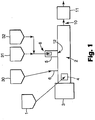
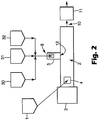
- FIGS. 1 , 2 , and 3 each schematically illustrate top views of illustrative embodiments of a multi-screw extruder used to practice the invention.
- FIG. 4 is a photograph of a scanning electron microscope image of an exemplary electrode of the invention.
- an electrode of an electrochemical cell can be produced by processing with a multi-screw extruder, and more preferably, with a co-rotating, fully intermeshing twin screw extruder.
- the electrode may be any type of electrode, such as a cathode.
- the materials processed to produce the electrode can be any materials that are generally known and useful for electrodes or other components of an electrochemical cell.
- the electrode components include an active material, an electrically-conductive material, an ionically-conductive polymer, and an electrolyte salt.
- the electrode materials include solvent (i.e., each is essentially solvent-free), and no solvent is added for processing in the extruder.
- the active material can be any of a variety of active materials known to be useful ionically-conductive in electrodes, including oxide materials. The exact material used can be chosen based on various factors. As one example, the active material for use in lithium polymer batteries should be capable of storing lithium ion.
- Suitable active materials include graphite, amorphous carbon, Li x CoO 2 , Li x NiO 2 , Co-doped Li x NiO 2 , Li x Mn 2 O 4 , Li x MnO 2 , V 2 O 5 , V 6 O 13 , Li x V 3 O 8 , Ba 2 SmNiO 5 , SmMnO 3 , Sm 3 Fe 5 O 12 , EuFeO 3 , EuFe 5 O 12 , EuMnO 3 , LaNiO 3 , La 2 CoO 4 and LaMnO 3 (including the charged and discharged forms of these materials), and conducting polymers such as polypyrrole, polysulfides and polyvinylferrocene.
- the cathode can be fluorinated carbon, SO 2 Cl 2 , Ag 2 V 4 O 11 , Ag 2 CrO 4 , V 2 O 5 , AgCl, MoO 3 , FeS, CuS, sulfur and polysulfide.
- Particularly preferred electrode active materials include vanadium oxide and lithiated vanadium oxide.
- the amount of active material used can be any useful amount, as will be understood by one of ordinary skill. It is typically desired to include as high of a loading of active material as possible, because a relatively higher loading of active material compared to the other non-active materials such as polymer, salt, etc., will provide a battery with a higher capacity.
- the present invention allows the production of electrodes of a relatively high loading of active material, e.g., greater than about 50 percent by weight active material based on the total weight of all electrode components.
- Preferred amounts of vanadium oxide active material can be, for example, in the range up to about 86 percent by weight, based on the total weight of all electrode components, e.g., from about 55 to about 80 weight percent, or from about 60 to about 68 percent by weight.
- Electrically-conductive material can be included in the electrode to aid in electrical conductivity of the electrode.
- Useful electrically-conductive materials are well known, and can include, for example, carbon, e.g., carbon black or graphite, lamp black, coke, carbon microbeads, carbon fibers, carbon flakes, copper powder, or other metal powders.
- the actual electrically-conductive material used in any particular electrode can be chosen based on various factors, such as the other materials of the electrode, or the electrochemical system. Often, carbon black or graphite are preferred.
- Useful amounts of the electrically-conductive material will be understood by the skilled artisan, for any particular electrode, and can be any amount that aids in electronic conductivity of the electrode.
- An example of a useful amount of electrically-conductive material can be in the range from about 1 to about 10 weight percent electrically-conductive material, based on the total weight of all electrode components.
- An ionically-conductive polymer is included as an electrode component as a binder to hold the electrode components together in the form of a functioning mass that is ionically-conductive.
- the polymer can be chosen to provide desired adhesion and conductivity properties.
- the ionically-conductive polymer may be a single type of polymer, or may be a mixture of two or more ionically-conductive polymers.
- the electrode may include a mixture of one or more ionically-conductive polymers with another polymer that is not ionically-conductive.
- Ionically-conductive polymers for use in electrode materials are well known and commercially available.
- One exemplary class of ionically-conductive polymers is the class of polymers that are derivatives of monomers comprising an oxygen-containing monomer or a nitrogen-containing monomer.
- Preferred ionically-conductive polymers are capable of conducting ions at room temperature, and are capable of dissociating alkali metal salts.
- Suitable ionically-conductive polymers include polyethers of the general formula HO(CH 2 CH 2 O) x (CH 2 CHRO) y H, where
- ionically-conductive polymers include polysiloxanes, polyphosphazenes, polyacrylates.
- One class of preferred ionically-conductive polymers include polyalkylenoxide homopolymers or copolymers derived from monomers such as ethylene oxide, propylene oxide, butylene oxide, and allyl glycidyl ether. Such polymers are commercially available under such designations as DAP and polyethyleneoxide available from Union Carbide under the designation Polyox. Examples of such ionically-conductive polymers and their preparation are also described, for example, in United States Patent Number 4,303,708 , the entirety of which is incorporated herein by reference.
- Useful amounts of ionically-conductive polymer used in an electrode can be any amount that will act to bind the other ingredients into a useful electrode, as well as provide desired conductivity. Exemplary amounts may be, for example, in the range from about 10 to about 40 weight percent ionically-conductive polymer, based on the total amount of all electrode components, more preferably from about 26 to about 32 weight percent.
- PVDF polyvinylidenefluoride
- PAN polyacrylonitrile
- PVP polyvinylpyrrolidinone
- EPDM ethylene-propylene-diene
- non-ionically-conductive polymer is included in an electrode, it can be used in any amount that is useful, e.g., to provide a desired property, such as mechanical integrity, and is preferably included in an amount in the range from about 0 to about 50 percent by weight of the total weight of polymer (the total amount of ionically-conductive and non-ionically-conductive polymer).
- the electrolyte salt is a highly dissociated salt capable of being dissolved in the ionically-conductive polymer.
- the salt is typically a lithium salt.
- Electrolyte salts are well known in the arts relating to electrochemistry and electrochemical systems. Specific examples of preferred lithium salts are also well known and include lithium hexafluoroarsenate, lithium perchlorate, lithium hexafluorophosphate, lithium trifluoroborate, lithium trifluoromethanesulfonate, lithium bis(trifluoromethanesulfonyl)imide, lithium bis(perfluoroethanesulfonyl)imide, lithium tris(trifluoromethanesulfonyl)methide.
- lithium hexafluorophosphate and lithium bis(trifluoromethanesulfonyl)imide.
- the amount of electrolyte salt included in the electrode components should be enough to provide for a functioning electrode, e.g., to result in a sufficient level of ionic conductivity.
- amounts of the salt that will be useful in electrodes prepared by methods described herein can depend on a variety of factors such as the particular salt chosen and the types and amounts of the other electrode components. While other amounts may be found to be useful, examples of useful amounts of electrolyte salt can be in the range from about 3 to about 15 weight percent based on the total weight of all electrode components, preferably from about 5 to about 10 weight percent.
- optional ingredients may also be included in the electrode components, as will be understood by those of ordinary skill. These optional ingredients may include materials such as pore formers, surfactants, flow agents, and antioxidants.
- a solvent e.g., a "softening solvent”
- a solvent e.g., a "softening solvent”
- Examples of these solvents may include ethylene carbonate, propylene carbonate, dimethyl carbonate, dietheyl carbonate, dimethyl adipate, tetramethylene sulfone, gamma-butyrolactone, dimethylformamide, dioctyl phthlate, tetrahydrofuran, polyethylene glycol dimethyl ether, and polyethylene glycol.
- electrode components can be combined together in their dry, solvent-free, or "neat” forms, and extruded without adding separate solvent, by using a multi-screw extruder.
- each one of the individual electrode components can be essentially free of solvent, meaning that each component contains an amount of solvent that is insufficient to act as a processing aid, for example that each electrode component contains less than one half of one percent solvent ( ⁇ 0.5 wt. %) by weight. Furthermore, no solvent needs to be added to any single component or to the combined components for processing.
- the combined electrode materials can be processed in a neat, essentially solventless form that contains an amount of solvent that is insufficient to act as a processing aid, e.g., the total amount of solvent contained in the combined electrode components, if any, is less than one half of one percent by weight ( ⁇ 0.5 weight percent). Still more preferably, the combined electrode components during processing can contain less than about 0.1 weight percent solvent based on the total weight of all electrode components, and most preferably the combined electrode components contain no solvent at all.
- the electrode components are processed using a co-rotating, fully intermeshing twin screw extruder.
- a co-rotating, fully intermeshing twin screw extruder includes an extrusion device that includes two axially parallel screws that are rotated within parallel and joined channels and are able to process materials in the space between the screws themselves and the channel walls by kneading and mixing the materials, (which may be introduced into the channels via any location along the length of the channels).
- the screws are rotated in the same direction about their respective axes (i.e., co-rotating), and the flights on each screw overlap radially to the greatest extent possible (i.e., fully intermeshing).
- Co-rotating, fully intermeshing twin screw extruders are very common, and are commercially available in various sizes and configurations.
- Twin screw extruders comprise a pair of screws rotatably mounted inside a temperature controlled pair of coextensive channels, and feed ports or openings along the channels for introducing one or a number of different feed components into the channels at various positions along the length of the channels.
- the channels can consist of one or several independently and precisely controlled temperature zones.
- Each screw includes a series of flights or flighted elements thereon to advance and mix the material along the length of the channel while producing a desired amount of shear.
- the flights are angled at a pitch which facilitates a pumping action during rotation of the screws.
- a wide variety of flighted elements are commercially available which mix, knead, or pump in various proportions. These various flighted elements can be arranged, as is known, in various combinations to facilitate a combination of mixing and advancing action.
- a forming or extruding end e.g., a die, chosen to produce an output stream of the mixed feed materials in a desired form, such as a film or layer.
- heat is transferred to the feed components in the extruder from two sources: (1) heating fluid or resistive heaters enclosed in the walls of the extruder channels and the extruding end; and (2) from the shearing action generated between the screw flights and their respective channels during rotation of the screws in their channels.
- the total heat supplied from both sources can be controlled to melt one or more of the feed components, preferably without substantial degradation of any of the components.
- the revolution rates of the screws can be adjusted to be equal or higher than the rate at which a given size extruder can extrude a desired mass flow rate of combined feed components.
- Co-rotating, fully intermeshing twin screw extruders are typically sized based on channel cross-sectional area and typically range from 18mm to 100mm or larger.
- the length of each channel is typically expressed as a multiple of the diameter, and stated as a length to diameter (L/D) ratio.
- Co-rotating, fully, intermeshing twin screw extruders typically have a length ranging from 10 to over 70 L/D ratio.
- the operating conditions including the temperature at the different locations of the extruder, the amount of shear exerted on the feed components (controlled, e.g., by the speed of rotation and the size and scope of the flights), the order of introduction of feed components and the state of each component (e.g., temperature and morphology) at the feed, etc., should be sufficient to produce a well-mixed (uniform), preferably paste-like mixture of the electrode components as an extrudate. Also, the conditions should not cause excessive degradation of any electrode component such as the polymer.
- the degree of uniformity of the extrudate can be monitored, for example, visually, by scanning electron microscopy, or even indirectly, by considering electric or other properties of the mixture.
- the amount of degradation of components such as a polymer can be monitored, for example, by monitoring molecular weight of a polymer before and after processing in the extruder. This may be performed by various methods, include gel permeation chromatography.
- the electrode components can be processed through the extruder using minimal amounts of solvent, e.g., essentially no solvent, most preferably using no solvent.
- the polymer salt complex (the ionic complex formed between the ionically-conductive polymer and the salt) should be processed through the extruder above its melt temperature, with other electrode components being distributed in the molten polymer salt complex.
- the term "molten” or "in the melt” means having a sufficiently low viscosity to permit uniform mixing of the feed components and allow the mixture to maintain a paste-like consistency.
- a polymer such as the ionically-conductive polymer can be processed in the extruder in a melt state, e.g., molten.
- any temperature that will cause polymer salt complex to exist in a molten state without causing substantial degradation or crosslinking of the polymer or other electrode components, can be useful.
- Specific examples of useful temperatures can depend on the polymer used.
- preferred temperatures can be in the range from about 60 to about 120C, e.g., from about 80 to about 100C.
- Each feed stream can be provided to the extruder in any useful form, in any useful order, with each preferably being provided as a continuous, consistent feed flow.
- Equipment useful for providing a feed flow into the extruder is well known and commercially available, with examples being loss in weight screw feeders, vibratory feeders, metering pumps, gear pumps, other extrusion devices, and volumetric feeders.
- feed configuration that will result in a useful process and a useful extrudate can be used, as will be understood by a skilled artisan.
- a particular feed method for any given process can be selected to provide consistent continuous flow of the feed components through processing.
- Components can be fed in a starve fed fashion, meaning that the total mass flow is less than the maximum capacity of the extruder for mass flow at a given set of operating conditions (temperature, revolution rate, etc.). Further, the feed methods ideally maximize throughput, while minimizing polymeric degradation.
- the electrolyte salt is fed first, and the polymer and other components are fed downstream from the salt.
- This configuration can be preferred because the electrolyte salt spontaneously chemically complexes at ambient conditions with the polymer (in preferred formulations) to form a viscous material which, if the polymer were fed upstream with the salt, would adhere to the feed throat walls and block the feed opening causing the process to fail. Therefore, the polymer is preferably fed downstream.
- the polymer can preferably be fed before or with (as opposed to after) the electrically conductive material and active material because those materials do not melt, or melt at temperatures much higher than the polymer.
- the polymer provides the matrix into which the electrically conductive material and the active material can be distributed, which facilitates flow in the extruder.
- the lithium salt is preferably fed in a powder form.
- the electrically conductive material can be fed in the form of a powder, flake, or a fiber, but is preferably in the form of a powder.
- the active material is preferably fed in the form of a powder having an average particle size (diameter) in the range from about 0.5 to about 5 microns. The processing conditions should not cause the particle size of the active material to be reduced, since this may lead to inactivation of the active material.
- the feed streams can take the form of multiple solventless, i.e., neat, electrode feed components.
- the arrangement of the feed streams into the extruder can vary, and can be chosen to be any useful configuration, but in one preferred embodiment the components of an electrode are fed to an extruder according to the following arrangement: an electrolyte salt, e.g., a lithium salt, is fed at the extruder's feed throat (the most upstream position in the extruder where a feed such as solid particulates can be fed into the extruder by gravity); polymer, including at least some or optionally entirely ionically-conductive polymer, is fed downstream; and a mixture of active material and electrically-conductive material is fed further downstream.
- an electrolyte salt e.g., a lithium salt
- FIG. 1 shows an extruder 2 having an electrolyte salt (not shown) being fed through feeder 1 at first feed 4 (shown as the feed throat of the extruder 2).
- Polymer is fed at second feed location 6 using feeder 30.
- a mixture of active material and electrically-conductive material is fed further downstream. Each of these respectively is first fed through feeder 31 (for the active material) and feeder 32 (for the electrically-conductive material), and the two are mixed together and fed as a mixture into a port 8 of side feeder side feeder 5 which then feeds the mixture into extruder 2 at location 12.
- Sidefeeder 5 is mounted directly on the side of the extruder at position 12.
- the sidefeeder 5 feeds the particulates in a positive displacement fashion directly into the inside of the extruder. Alternatively, the mixture could be fed by gravity.
- Motor 3 operates the extruder screws at a desired speed, causing the feed , electrode components to be carried through the extruder 2 to the exit end 10, which optionally includes a die or some type of shaping mechanism.
- Additional equipment shown generically as block 11, can be used to further shape or process the extrudate into a desired shape or form; such additional equipment can include one or more of, for example, calendar rolls, another extruder, or a die, etc.
- each electrode component can be introduced to the extruder in any form and by any technique that will provide a continuous, consistent flow of the component.
- the polymer may be provided in some circumstances, for example, through a non-reciprocating single screw extruder 30 that melts the polymer prior to the polymer being introduced to the multi-screw extruder 2. This is one preferred way of providing a consistent, smooth flow of the polymer to the extruder 2.
- the non-reciprocating extruder 30 would be operated at a temperature and rotation rate that provide a desired mass flow rate of polymer in a melted state to the extruder 2.
- Other continuous extruders could also be used.
- the flow rate of polymer fed to the extruder 2 can be chosen based on factors including the capacity of the extruder 2 and the relative amounts of the other electrode components. While it may be preferred in some situations to feed a melted polymer, it may also be useful in other embodiments of the method to feed a polymer in a solid state, e.g., as granular particulates which are a typical form of polymers.
- FIG. 1 shows a mixture of active material and electrically-conductive material being fed at feed 8.
- the active material and electrically conductive material can be fed simultaneously after being preblended or can be fed by separate feeders 31 and 32 into the single feed location 8.
- One way to preblend is to use a jet mill. See, e.g., Example 1 of U.S. Patent No. 6,136,476 . Both materials are preferably fed as particulates ranging in size from 0.1-5.0 microns.
- an extrudate 10 of the processed electrode components is discharged from the end of the extruder 2, for further processing, e.g., with a die, calendar rolls, another extruder, or any other useful piece of equipment.
- the extrudate may be formed into a desired configuration, such as a film or coating deposited onto a substrate, and combined with other components of an electrochemical system, such as a battery, e.g., a lithium polymer battery.
- the extrudate is placed onto a substrate which allows further processing of the extrudate into an electrode.
- the substrate can be a liner, electrolyte, current collector, or other useful material, as will be appreciated by the skilled artisan.
- a liner can be made of various known materials, including, for example, polypropylene, polyester, polyethylene, or polytetrafluoroethylene;
- a current collector may be made of, for example, copper, aluminum, or stainless steel; and
- a separator may be made up of, for example polyethylene or polypropylene.
- FIG. 2 illustrates a configuration wherein the electrolyte salt is still fed into the extruder 2 at the extruder's feed throat 4, and a single feed mixture containing polymer, active material, and electrically-conductive material, is fed into the extruder 2 somewhere downstream.
- FIG. 2 shows, more specifically, an embodiment where all three of a polymer, an active material, and an electrically-conductive material, are fed with separate feeders 30, 31, and 32, and combined into a mixture and fed into the extruder 2 to port 8 of sidefeeder 5 and then to extruder 2 at position 12.
- the electrolyte salt is fed into the extruder 2 at the extruder's feed throat 4.
- a mixture containing only portions of the total amounts of active material and electrically-conducting material in the electrode, and the entire amount of ionically-conductive polymer, is fed into the extruder 2 at a downstream feed position 6.
- each of feeders 30, 33, and 34 separately feed polymer, active material, and electrically-conductive material into a combined mixture that is fed into the extruder 2 at position 6 of extruder 2.
- Further downstream is fed a mixture of the remaining amounts of active material and electrically-conductive material.
- active material and electrically-conductive material are each fed separately with feeders 31 and 32, and are combined into a mixture and fed to port 8 of sidefeeder 5 and then to extruder 2 at position 12.
- a preferred electrochemical system relates to a battery that includes at least one cathode, at least one anode, a separator, and/or electrolyte.
- the anode of, for example, a lithium battery generally can consist of composite or film.
- the anode is generally applied to an expanded metal screen or metal foil (preferably aluminum, copper, or nickel) current collector using any one of a variety of processes such as coating, casting, pressing or extrusion.
- suitable battery anodes include lithium metal, lithium metal alloys, sodium metal, carbon-based materials such as graphite, coke, carbon fiber, pitch, transition metal oxides (such as LiTi 5 O 12 and LiWO 2 ), and lithiated tin oxide.
- the lithium may be intercalated into a host material such as carbon (i.e., to give lithiated carbon) or carbon alloyed with other elements (such as silicon, boron or nitrogen), a conductive polymer, or an inorganic host that is intercalatable (such as Li x Ti 5 O 12 ).
- a host material such as carbon (i.e., to give lithiated carbon) or carbon alloyed with other elements (such as silicon, boron or nitrogen), a conductive polymer, or an inorganic host that is intercalatable (such as Li x Ti 5 O 12 ).
- the material comprising the anode may be carried on foil (e.g., nickel and copper) backing or pressed into expanded metal screen and alloyed with various other metals. Also, in the case of a lithium metal foil, no current collector may be required.
- Lithium batteries and supercapacitors may contain a separator to prevent short-circuiting between the cathode and anode.
- the separator of a battery usually consists of a single-ply or multi-ply sheet of microporous polymer (typically polyolefin, e.g., polyethylene, polypropylene, polytetrafluoroethyelene or combinations thereof) having a predetermined length and width and having a thickness of less than 10 mils (0.025 cm).
- polyolefin typically polyethylene, polypropylene, polytetrafluoroethyelene or combinations thereof
- the separator may comprise an ionically-conductive polymer and salt similar to that described for the electrode composition.
- An anode of a conventional lithium ion battery typically comprises a graphite composite with a binder such as polyvinylidenefluoride (PVDF).
- PVDF polyvinylidenefluoride
- the graphite in this case is the active material that intercalates lithium.
- the anode could be manufactured according to the invention by alternately using an ionically-conductive polymer such as polyethylenoxide along with an electrolyte salt in the composite with the graphite.
- the inventive method may also be employed to form electrochemical components for fuel cells.
- the process is performed in the same manner, except that no salt is added to the extruder in forming the electrochemical components being extruded.
- the “active” material is defined as the catalyst in either the anode or cathode.
- Fuel cells are of many types. In one type of fuel cell known as the "PEM” type (Proton Exchange Membrane) as described in US 5,879,828 and incorporated herein by reference, the catalyst typically comprises platinum, the electrically conductive material comprises carbon and the ionically-conductive polymer comprises a sulfonated fluoropolymer such as NAFION (DuPont).
- the process used a Berstorff® ZE 25 (Berstorff Corporation, Florence, Kentucky) co-rotating, fully intermeshing twin-screw extruder (TSE) with internal loop water-cooling of all zones.
- the TSE has a 25mm diameter screw and 32 L/D ratio (length/diameter). Overall throughput was 2.72 kg/hr. (6.0 lbs./hr.).
- the TSE barrel near the feed throat was cooled with recirculating chilled water.
- the TSE barrel from the feed throat to an L/D location of 32 was heated to a temperature setpoint of 176F.
- the TSE operated at 150 rpm.
- a twin-screw sidefeeder was attached to the side of the TSE at the L/D location of 23.
Landscapes
- Engineering & Computer Science (AREA)
- Mechanical Engineering (AREA)
- Chemical & Material Sciences (AREA)
- Manufacturing & Machinery (AREA)
- Chemical Kinetics & Catalysis (AREA)
- Electrochemistry (AREA)
- General Chemical & Material Sciences (AREA)
- Materials Engineering (AREA)
- Battery Electrode And Active Subsutance (AREA)
- Secondary Cells (AREA)
- Electrical Discharge Machining, Electrochemical Machining, And Combined Machining (AREA)
Applications Claiming Priority (3)
| Application Number | Priority Date | Filing Date | Title |
|---|---|---|---|
| US138278 | 1993-10-18 | ||
| US10/138,278 US6939383B2 (en) | 2002-05-03 | 2002-05-03 | Method for making electrode |
| PCT/US2003/009049 WO2003094262A1 (en) | 2002-05-03 | 2003-03-25 | Method for making electrode |
Publications (2)
| Publication Number | Publication Date |
|---|---|
| EP1512185A1 EP1512185A1 (en) | 2005-03-09 |
| EP1512185B1 true EP1512185B1 (en) | 2012-05-09 |
Family
ID=29269295
Family Applications (1)
| Application Number | Title | Priority Date | Filing Date |
|---|---|---|---|
| EP03747572A Expired - Lifetime EP1512185B1 (en) | 2002-05-03 | 2003-03-25 | Method for making electrode |
Country Status (8)
| Country | Link |
|---|---|
| US (1) | US6939383B2 (enExample) |
| EP (1) | EP1512185B1 (enExample) |
| JP (1) | JP2005524936A (enExample) |
| AT (1) | ATE557439T1 (enExample) |
| AU (1) | AU2003225972A1 (enExample) |
| CA (1) | CA2484361A1 (enExample) |
| TW (1) | TW200400281A (enExample) |
| WO (1) | WO2003094262A1 (enExample) |
Cited By (3)
| Publication number | Priority date | Publication date | Assignee | Title |
|---|---|---|---|---|
| CN108365193A (zh) * | 2018-02-02 | 2018-08-03 | 杨高品 | 锂离子电池正负极浆料的连续生产工艺和设备 |
| EP3586950B1 (en) | 2017-08-28 | 2023-05-03 | Foshan Gold-silver River Intelligent Equipment Co., Ltd. | Continuous efficient production process for lithium battery slurry |
| EP4641645A1 (de) | 2024-04-24 | 2025-10-29 | Bühler AG | Kontinuierliches produktionssystem und verfahren zur herstellung von elektrodenmassen sowie bindemitteldosiersystem und dosierverfahren dafür |
Families Citing this family (73)
| Publication number | Priority date | Publication date | Assignee | Title |
|---|---|---|---|---|
| WO2004050747A1 (ja) * | 2002-11-29 | 2004-06-17 | Zeon Corporation | ポリエーテル重合体組成物の製造方法、ポリエーテル重合体組成物および固体電解質フィルム |
| US7295423B1 (en) * | 2003-07-09 | 2007-11-13 | Maxwell Technologies, Inc. | Dry particle based adhesive electrode and methods of making same |
| KR100601090B1 (ko) * | 2003-10-14 | 2006-07-14 | 주식회사 엘지화학 | 다공성 템플레이트를 이용하여 제조된 고표면적 전극시스템 및 이를 이용한 전기 소자 |
| EP1732846A2 (en) * | 2004-03-17 | 2006-12-20 | California Institute Of Technology | Methods for purifying carbon materials |
| US20070243409A1 (en) * | 2004-03-19 | 2007-10-18 | Denki Kagaku Kogyo Kabushiki Kaisha | Process for Producing Ceramic Sheet, Ceramic Substrate Utilizing The Same and Use Thereof |
| WO2006025602A1 (ja) * | 2004-09-03 | 2006-03-09 | Nippon Shokubai Co., Ltd. | リチウム2次電池用正極材料組成物の製造方法 |
| US20060179643A1 (en) * | 2005-02-15 | 2006-08-17 | Herbert Naarmann | Rechargeable lithium polymer cell and process for the production of rechargeable lithium polymer batteries |
| US20070218364A1 (en) * | 2005-10-05 | 2007-09-20 | Whitacre Jay F | Low temperature electrochemical cell |
| US7794880B2 (en) | 2005-11-16 | 2010-09-14 | California Institute Of Technology | Fluorination of multi-layered carbon nanomaterials |
| US8232007B2 (en) | 2005-10-05 | 2012-07-31 | California Institute Of Technology | Electrochemistry of carbon subfluorides |
| US7563542B2 (en) * | 2005-10-05 | 2009-07-21 | California Institute Of Technology | Subfluorinated graphite fluorides as electrode materials |
| US8377586B2 (en) | 2005-10-05 | 2013-02-19 | California Institute Of Technology | Fluoride ion electrochemical cell |
| US8658309B2 (en) * | 2006-08-11 | 2014-02-25 | California Institute Of Technology | Dissociating agents, formulations and methods providing enhanced solubility of fluorides |
| US20090111021A1 (en) * | 2007-03-14 | 2009-04-30 | Rachid Yazami | High discharge rate batteries |
| CN101657921B (zh) | 2007-04-12 | 2013-06-12 | 3M创新有限公司 | 高性能、高耐用非贵重金属燃料电池催化剂 |
| BRPI0823190B1 (pt) * | 2008-10-03 | 2019-07-30 | Steer Engineering Private Limited | Sistema de transmissão de torque |
| FR2949907B1 (fr) * | 2009-09-09 | 2011-11-25 | Batscap Sa | Procede de preparation d'un materiau composite pour electrode positive par extrusion en presence d'un solvant aqueux, electrode positive obtenue par le procede et applications |
| MX2012005459A (es) | 2009-11-11 | 2012-11-23 | Amtek Res Int Llc | Separador de material compuesto para bateria. |
| WO2013036802A1 (en) | 2011-09-07 | 2013-03-14 | 24M Technologies, Inc. | Stationary semi-solid battery module and method of manufacture |
| CN104025343A (zh) * | 2011-12-16 | 2014-09-03 | 3M创新有限公司 | 用于制造电极的方法 |
| FR2985857B1 (fr) | 2012-01-17 | 2014-01-03 | Hutchinson | Cathode pour cellule de batterie lithium-ion, son procede de fabrication et cette batterie l'incorporant. |
| DE102012203019A1 (de) * | 2012-02-28 | 2013-08-29 | Technische Universität Dresden | Kathode für Lithium-haltige Batterien und lösungsmittelfreies Verfahren zu deren Herstellung |
| FR2988225B1 (fr) | 2012-03-13 | 2014-03-28 | Hutchinson | Anode pour cellule de batterie lithium-ion, son procede de fabrication et cette batterie l'incorporant. |
| CN102629681B (zh) * | 2012-04-12 | 2013-10-23 | 海博瑞恩电子科技无锡有限公司 | 一种基于粉体的电极成型方法 |
| US11011737B2 (en) * | 2012-05-16 | 2021-05-18 | Eskra Technical Products, Inc. | System and method of fabricating an electrochemical device |
| US11050121B2 (en) | 2012-05-16 | 2021-06-29 | Eskra Technical Products, Inc. | System and method for fabricating an electrode with separator |
| US9401501B2 (en) | 2012-05-18 | 2016-07-26 | 24M Technologies, Inc. | Electrochemical cells and methods of manufacturing the same |
| WO2014008422A1 (en) * | 2012-07-03 | 2014-01-09 | Amtek Research International Llc | Method of making a rubber-containing polyolefin separator |
| CN103093969B (zh) * | 2012-12-17 | 2015-09-30 | 海博瑞恩电子科技无锡有限公司 | 一种全程无污染的含有电解液盐的电极制造方法 |
| US20140210129A1 (en) * | 2013-01-25 | 2014-07-31 | Corning Incorporated | Method for manufacturing carbon electrode material |
| US9590233B2 (en) | 2013-04-05 | 2017-03-07 | Duracell U.S. Operations, Inc. | Method of making a cathode |
| CN103268931B (zh) * | 2013-05-24 | 2015-06-10 | 佛山市金银河智能装备股份有限公司 | 一种锂电池正负电极浆料生产工艺及系统 |
| CN104752731B (zh) * | 2013-12-25 | 2018-05-08 | 比亚迪股份有限公司 | 一种柔性锂离子电池集流体、柔性锂离子电池及其制备方法 |
| KR101592658B1 (ko) | 2013-12-30 | 2016-02-12 | 현대자동차주식회사 | 표면 처리된 양극 활물질 및 이를 이용한 리튬이차전지 |
| DE102014210249A1 (de) * | 2014-05-28 | 2015-12-03 | Volkswagen Aktiengesellschaft | Verfahren zum Herstellen einer Kathode, Kathode, Lithium-Schwefel-Batterie |
| EP3207579B1 (en) | 2014-10-13 | 2020-01-29 | 24M Technologies, Inc. | Systems and methods for series battery charging and forming |
| KR102793671B1 (ko) | 2014-11-05 | 2025-04-10 | 24엠 테크놀로지즈, 인크. | 반고체 전극을 갖는 전기화학 전지 및 그것의 제조 방법 |
| US10115970B2 (en) | 2015-04-14 | 2018-10-30 | 24M Technologies, Inc. | Semi-solid electrodes with porous current collectors and methods of manufacture |
| JP6764677B2 (ja) * | 2015-05-11 | 2020-10-07 | 出光興産株式会社 | 電極合材の製造方法 |
| CN113300029A (zh) | 2015-06-18 | 2021-08-24 | 24M技术公司 | 单袋电池单元以及制造方法 |
| EP3329538A4 (en) | 2015-07-27 | 2019-01-23 | 3M Innovative Properties Company | GRAPHITE-MODIFIED METAL LITHIUM ELECTRODE |
| CN105563980B (zh) * | 2015-12-31 | 2017-12-15 | 浙江新达经编有限公司 | 一种抗静电纤维面料及其制备方法 |
| US9972838B2 (en) | 2016-07-29 | 2018-05-15 | Blue Current, Inc. | Solid-state ionically conductive composite electrodes |
| FR3058834B1 (fr) | 2016-11-15 | 2019-05-10 | Commissariat A L'energie Atomique Et Aux Energies Alternatives | Procede de fabrication d'une electrode pour accumulateur |
| KR102081397B1 (ko) * | 2016-12-12 | 2020-02-25 | 주식회사 엘지화학 | 리튬 이차전지용 전극의 제조방법 |
| US10457781B2 (en) | 2017-03-03 | 2019-10-29 | Blue Current, Inc. | Polymerized in-situ hybrid solid ion-conductive compositions |
| US20180254518A1 (en) * | 2017-03-03 | 2018-09-06 | Blue Current, Inc. | Polymerized in-situ hybrid solid ion-conductive compositions |
| DE102017216570A1 (de) | 2017-09-19 | 2019-03-21 | Robert Bosch Gmbh | Verfahren zur Herstellung einer Elektrodenanordnung |
| FR3072214A1 (fr) | 2017-10-09 | 2019-04-12 | Hutchinson | Composition d'electrode et procede de preparation pour batterie lithium-ion, electrode et batterie l'incorporant |
| FR3072213A1 (fr) | 2017-10-09 | 2019-04-12 | Hutchinson | Composition de cathode pour batterie lithium-ion, son procede de preparation, cathode et batterie lithium-ion l'incorporant |
| KR102536633B1 (ko) * | 2018-03-14 | 2023-05-25 | 주식회사 엘지에너지솔루션 | 양극의 제조 방법 |
| MX2021004694A (es) | 2018-11-06 | 2021-08-24 | Quantumscape Battery Inc | Celdas electroquimicas con aditivos catolitos y separadores de granate relleno de litio. |
| US11581570B2 (en) | 2019-01-07 | 2023-02-14 | Blue Current, Inc. | Polyurethane hybrid solid ion-conductive compositions |
| FR3094371B1 (fr) * | 2019-03-29 | 2025-09-12 | Arkema France | Formulation d’électrode pour BATTERIE LI-ION et procede de fabrication d’electrode par extrusion à faible temps de séjour |
| KR20220003547A (ko) * | 2019-05-03 | 2022-01-10 | 솔베이(소시에떼아노님) | 전극의 제조 방법 |
| FR3100930B1 (fr) * | 2019-09-17 | 2021-09-17 | Commissariat Energie Atomique | Procédé de fabrication d’une électrode comprenant une matrice polymérique piégeant un électrolyte |
| US11394054B2 (en) | 2019-12-20 | 2022-07-19 | Blue Current, Inc. | Polymer microspheres as binders for composite electrolytes |
| US12166239B2 (en) | 2019-12-20 | 2024-12-10 | Blue Current, Inc. | Polymer microspheres as binders for composite electrolytes |
| EP4078698A4 (en) | 2019-12-20 | 2024-08-14 | Blue Current, Inc. | COMPOSITE ELECTROLYTES WITH BINDERS |
| US11742525B2 (en) | 2020-02-07 | 2023-08-29 | 24M Technologies, Inc. | Divided energy electrochemical cell systems and methods of producing the same |
| US12381277B2 (en) | 2020-06-17 | 2025-08-05 | 24M Technologies, Inc. | Electrochemical cells with flame retardant mechanism and methods of producing the same |
| EP4152430A4 (en) | 2020-09-15 | 2024-07-10 | Eve Energy Co., Ltd. | Extrusion head for molding pole piece and molding device comprising same, and molding method and preparation method therefor |
| US12224422B2 (en) * | 2020-12-01 | 2025-02-11 | Nano And Advanced Materials Institute Limited | Fabrication of lithium battery dry electrodes |
| US20230178754A1 (en) * | 2021-01-27 | 2023-06-08 | Lg Energy Solution, Ltd. | Free-Standing Film For Dry Electrode, Manufacturing Apparatus Thereof, Dry Electrode Including The Same, And Secondary Battery |
| JP7155360B1 (ja) * | 2021-08-02 | 2022-10-18 | 株式会社日本製鋼所 | 反応装置、反応システム、材料製造システム、電池用材料製造システム、電池製造システム、反応生成物製造方法、電池用材料製造方法および電池製造方法 |
| CN114050235B (zh) * | 2021-11-01 | 2023-06-13 | 深圳市善营自动化科技有限公司 | 电池极片制备方法及系统 |
| JP2024541188A (ja) | 2021-11-30 | 2024-11-08 | クアンタムスケープ バッテリー,インコーポレイテッド | 固体電池用カソライト |
| EP4309222A1 (en) | 2021-12-17 | 2024-01-24 | QuantumScape Battery, Inc. | Cathode materials having oxide surface species |
| US20230246159A1 (en) | 2022-01-31 | 2023-08-03 | AM Batteries, Inc. | Electrode for Energy Storage Device |
| CN115207286A (zh) * | 2022-08-17 | 2022-10-18 | 深圳市合壹新能技术有限公司 | 干电极锂金属固态电池正极片及其制作方法和应用 |
| WO2024167933A1 (en) * | 2023-02-06 | 2024-08-15 | Ionic Materials, Inc. | Extrusion of high-energy density polymer electrodes using gel electrolytes and solid polymer electrolytes |
| CN117101506B (zh) * | 2023-08-03 | 2024-07-09 | 广东嘉尚新能源科技有限公司 | 一种软包电池的电极材料混合工艺 |
| GB202316396D0 (en) * | 2023-10-26 | 2023-12-13 | Lina Energy Ltd | Electrochemical cell production |
Family Cites Families (16)
| Publication number | Priority date | Publication date | Assignee | Title |
|---|---|---|---|---|
| DE3841728C1 (de) * | 1988-12-10 | 1990-03-01 | Hermann Berstorff Maschinenbau Gmbh, 30627 Hannover | Ein- oder Doppelschneckenextruder zum Einarbeiten von pulverförmigen oder faserförmigen Additiven in eine thermoplastische Kunststoffschmelze |
| US4976904A (en) * | 1989-04-20 | 1990-12-11 | Energy Research Corporation | Method and apparatus for continuous formation of fibrillated polymer binder electrode component |
| FR2712733B1 (fr) * | 1993-11-16 | 1996-02-09 | Bollore Technologies | Procédé de fabrication d'un ensemble électrochimique multicouche comprenant un électrolyte entre deux électrodes et ensemble ainsi réalisé. |
| IT1277375B1 (it) * | 1995-07-28 | 1997-11-10 | Eniricerche Spa | Catodo composito procedimento per la sua preparazione e suo utilizzo in celle elettrochimiche solide |
| DE19542721A1 (de) * | 1995-11-16 | 1997-05-22 | Sgl Technik Gmbh | Verfahren zur Herstellen von Formkörpern aus Kunststoff-Füllstoff-Mischungen mit einem hohen Gehalt an Füllstoffen |
| US5725822A (en) * | 1996-05-24 | 1998-03-10 | W. R. Grace & Co.-Conn. | Extrusion of electrode material by liquid injection into extruder barrel |
| US5749927A (en) * | 1996-05-24 | 1998-05-12 | W. R. Grace & Co. -Conn. | Continuous process to produce lithium-polymer batteries |
| US5698147A (en) * | 1996-05-24 | 1997-12-16 | W. R. Grace & Co.-Conn. | Fabrication methods for low impedance lithium polymer electrodes |
| DE19713072A1 (de) | 1997-03-27 | 1998-10-01 | Basf Ag | Verfahren zur Herstellung von Formkörpern für Lithiumionenbatterien |
| JP2000123879A (ja) * | 1998-10-15 | 2000-04-28 | Sony Corp | 正極合剤の製造方法とリチウムイオン2次電池 |
| US6284192B1 (en) * | 1998-11-02 | 2001-09-04 | Corning Incorporated | Extruding electrode material |
| TW568928B (en) * | 1999-03-03 | 2004-01-01 | Du Pont | Continuous melt process for fabricating ionically conductive articles |
| JP4277367B2 (ja) * | 1999-06-09 | 2009-06-10 | ソニー株式会社 | 非水電解質二次電池の製造方法 |
| US6533955B1 (en) * | 2000-11-20 | 2003-03-18 | 3M Innovative Properties Company | Conductive fluoropolymers |
| US6589299B2 (en) * | 2001-02-13 | 2003-07-08 | 3M Innovative Properties Company | Method for making electrode |
| EP1479119B1 (en) * | 2002-03-07 | 2012-08-01 | Bathium Canada Inc. | Positive electrode films for alkali metal polymer batteries and method for making same |
-
2002
- 2002-05-03 US US10/138,278 patent/US6939383B2/en not_active Expired - Lifetime
-
2003
- 2003-03-25 JP JP2004502382A patent/JP2005524936A/ja active Pending
- 2003-03-25 AU AU2003225972A patent/AU2003225972A1/en not_active Abandoned
- 2003-03-25 WO PCT/US2003/009049 patent/WO2003094262A1/en not_active Ceased
- 2003-03-25 EP EP03747572A patent/EP1512185B1/en not_active Expired - Lifetime
- 2003-03-25 AT AT03747572T patent/ATE557439T1/de active
- 2003-03-25 CA CA002484361A patent/CA2484361A1/en not_active Abandoned
- 2003-04-08 TW TW092108009A patent/TW200400281A/zh unknown
Cited By (4)
| Publication number | Priority date | Publication date | Assignee | Title |
|---|---|---|---|---|
| EP3586950B1 (en) | 2017-08-28 | 2023-05-03 | Foshan Gold-silver River Intelligent Equipment Co., Ltd. | Continuous efficient production process for lithium battery slurry |
| CN108365193A (zh) * | 2018-02-02 | 2018-08-03 | 杨高品 | 锂离子电池正负极浆料的连续生产工艺和设备 |
| EP4641645A1 (de) | 2024-04-24 | 2025-10-29 | Bühler AG | Kontinuierliches produktionssystem und verfahren zur herstellung von elektrodenmassen sowie bindemitteldosiersystem und dosierverfahren dafür |
| WO2025224144A1 (de) | 2024-04-24 | 2025-10-30 | Bühler AG | Kontinuierliches produktionssystem und verfahren zur herstellung von elektrodenmassen sowie bindemitteldosiersystem und dosierverfahren dafür |
Also Published As
| Publication number | Publication date |
|---|---|
| AU2003225972A1 (en) | 2003-11-17 |
| JP2005524936A (ja) | 2005-08-18 |
| US20030205835A1 (en) | 2003-11-06 |
| TW200400281A (en) | 2004-01-01 |
| EP1512185A1 (en) | 2005-03-09 |
| US6939383B2 (en) | 2005-09-06 |
| WO2003094262A1 (en) | 2003-11-13 |
| ATE557439T1 (de) | 2012-05-15 |
| CA2484361A1 (en) | 2003-11-13 |
Similar Documents
| Publication | Publication Date | Title |
|---|---|---|
| EP1512185B1 (en) | Method for making electrode | |
| EP1360732B1 (en) | Method for making electrode | |
| US6503432B1 (en) | Process for forming multilayer articles by melt extrusion | |
| US5725822A (en) | Extrusion of electrode material by liquid injection into extruder barrel | |
| US8241541B2 (en) | Cathode material for polymer batteries and method of preparing same | |
| US20040130061A1 (en) | Positive electrode films for alkali metal polymer batteries and method for making same | |
| US11502302B2 (en) | Process for producing a composite material | |
| WO1999019924A1 (en) | Batteries with porous components | |
| WO1997044847A1 (en) | Continuous process to produce lithium-polymer batteries and battery components formed thereby | |
| EP4550455A1 (en) | Membrane preparation device, plate manufacturing apparatus and membrane preparation method | |
| GB2622037A (en) | Energy storage devices and components thereof | |
| WO2025086014A1 (en) | A self-supporting film and a method of fabricating discrete particles into a self-supporting film | |
| Platen | Dry and thermal processing of PEO-based solid electrolytes for all solid-state batteries |
Legal Events
| Date | Code | Title | Description |
|---|---|---|---|
| PUAI | Public reference made under article 153(3) epc to a published international application that has entered the european phase |
Free format text: ORIGINAL CODE: 0009012 |
|
| 17P | Request for examination filed |
Effective date: 20041202 |
|
| AK | Designated contracting states |
Kind code of ref document: A1 Designated state(s): AT BE BG CH CY CZ DE DK EE ES FI FR GB GR HU IE IT LI LU MC NL PT RO SE SI SK TR |
|
| AX | Request for extension of the european patent |
Extension state: AL LT LV MK |
|
| DAX | Request for extension of the european patent (deleted) | ||
| 17Q | First examination report despatched |
Effective date: 20080115 |
|
| REG | Reference to a national code |
Ref country code: DE Ref legal event code: R079 Ref document number: 60340912 Country of ref document: DE Free format text: PREVIOUS MAIN CLASS: H01M0004040000 Ipc: H01M0004139100 |
|
| GRAP | Despatch of communication of intention to grant a patent |
Free format text: ORIGINAL CODE: EPIDOSNIGR1 |
|
| RIC1 | Information provided on ipc code assigned before grant |
Ipc: H01M 4/1391 20100101AFI20111104BHEP Ipc: B29C 47/40 20060101ALI20111104BHEP Ipc: B29C 47/38 20060101ALI20111104BHEP Ipc: H01M 4/04 20060101ALI20111104BHEP Ipc: H01M 4/139 20100101ALI20111104BHEP |
|
| GRAS | Grant fee paid |
Free format text: ORIGINAL CODE: EPIDOSNIGR3 |
|
| GRAA | (expected) grant |
Free format text: ORIGINAL CODE: 0009210 |
|
| AK | Designated contracting states |
Kind code of ref document: B1 Designated state(s): AT BE BG CH CY CZ DE DK EE ES FI FR GB GR HU IE IT LI LU MC NL PT RO SE SI SK TR |
|
| REG | Reference to a national code |
Ref country code: GB Ref legal event code: FG4D |
|
| REG | Reference to a national code |
Ref country code: CH Ref legal event code: EP Ref country code: AT Ref legal event code: REF Ref document number: 557439 Country of ref document: AT Kind code of ref document: T Effective date: 20120515 |
|
| REG | Reference to a national code |
Ref country code: IE Ref legal event code: FG4D |
|
| REG | Reference to a national code |
Ref country code: DE Ref legal event code: R096 Ref document number: 60340912 Country of ref document: DE Effective date: 20120712 |
|
| REG | Reference to a national code |
Ref country code: NL Ref legal event code: VDEP Effective date: 20120509 |
|
| PG25 | Lapsed in a contracting state [announced via postgrant information from national office to epo] |
Ref country code: FI Free format text: LAPSE BECAUSE OF FAILURE TO SUBMIT A TRANSLATION OF THE DESCRIPTION OR TO PAY THE FEE WITHIN THE PRESCRIBED TIME-LIMIT Effective date: 20120509 Ref country code: SE Free format text: LAPSE BECAUSE OF FAILURE TO SUBMIT A TRANSLATION OF THE DESCRIPTION OR TO PAY THE FEE WITHIN THE PRESCRIBED TIME-LIMIT Effective date: 20120509 Ref country code: CY Free format text: LAPSE BECAUSE OF FAILURE TO SUBMIT A TRANSLATION OF THE DESCRIPTION OR TO PAY THE FEE WITHIN THE PRESCRIBED TIME-LIMIT Effective date: 20120509 |
|
| REG | Reference to a national code |
Ref country code: AT Ref legal event code: MK05 Ref document number: 557439 Country of ref document: AT Kind code of ref document: T Effective date: 20120509 |
|
| PG25 | Lapsed in a contracting state [announced via postgrant information from national office to epo] |
Ref country code: GR Free format text: LAPSE BECAUSE OF FAILURE TO SUBMIT A TRANSLATION OF THE DESCRIPTION OR TO PAY THE FEE WITHIN THE PRESCRIBED TIME-LIMIT Effective date: 20120810 Ref country code: SI Free format text: LAPSE BECAUSE OF FAILURE TO SUBMIT A TRANSLATION OF THE DESCRIPTION OR TO PAY THE FEE WITHIN THE PRESCRIBED TIME-LIMIT Effective date: 20120509 Ref country code: PT Free format text: LAPSE BECAUSE OF FAILURE TO SUBMIT A TRANSLATION OF THE DESCRIPTION OR TO PAY THE FEE WITHIN THE PRESCRIBED TIME-LIMIT Effective date: 20120910 |
|
| PG25 | Lapsed in a contracting state [announced via postgrant information from national office to epo] |
Ref country code: BE Free format text: LAPSE BECAUSE OF FAILURE TO SUBMIT A TRANSLATION OF THE DESCRIPTION OR TO PAY THE FEE WITHIN THE PRESCRIBED TIME-LIMIT Effective date: 20120509 |
|
| PG25 | Lapsed in a contracting state [announced via postgrant information from national office to epo] |
Ref country code: DK Free format text: LAPSE BECAUSE OF FAILURE TO SUBMIT A TRANSLATION OF THE DESCRIPTION OR TO PAY THE FEE WITHIN THE PRESCRIBED TIME-LIMIT Effective date: 20120509 Ref country code: RO Free format text: LAPSE BECAUSE OF FAILURE TO SUBMIT A TRANSLATION OF THE DESCRIPTION OR TO PAY THE FEE WITHIN THE PRESCRIBED TIME-LIMIT Effective date: 20120509 Ref country code: EE Free format text: LAPSE BECAUSE OF FAILURE TO SUBMIT A TRANSLATION OF THE DESCRIPTION OR TO PAY THE FEE WITHIN THE PRESCRIBED TIME-LIMIT Effective date: 20120509 Ref country code: AT Free format text: LAPSE BECAUSE OF FAILURE TO SUBMIT A TRANSLATION OF THE DESCRIPTION OR TO PAY THE FEE WITHIN THE PRESCRIBED TIME-LIMIT Effective date: 20120509 Ref country code: NL Free format text: LAPSE BECAUSE OF FAILURE TO SUBMIT A TRANSLATION OF THE DESCRIPTION OR TO PAY THE FEE WITHIN THE PRESCRIBED TIME-LIMIT Effective date: 20120509 Ref country code: SK Free format text: LAPSE BECAUSE OF FAILURE TO SUBMIT A TRANSLATION OF THE DESCRIPTION OR TO PAY THE FEE WITHIN THE PRESCRIBED TIME-LIMIT Effective date: 20120509 Ref country code: CZ Free format text: LAPSE BECAUSE OF FAILURE TO SUBMIT A TRANSLATION OF THE DESCRIPTION OR TO PAY THE FEE WITHIN THE PRESCRIBED TIME-LIMIT Effective date: 20120509 |
|
| PLBE | No opposition filed within time limit |
Free format text: ORIGINAL CODE: 0009261 |
|
| STAA | Information on the status of an ep patent application or granted ep patent |
Free format text: STATUS: NO OPPOSITION FILED WITHIN TIME LIMIT |
|
| 26N | No opposition filed |
Effective date: 20130212 |
|
| PG25 | Lapsed in a contracting state [announced via postgrant information from national office to epo] |
Ref country code: ES Free format text: LAPSE BECAUSE OF FAILURE TO SUBMIT A TRANSLATION OF THE DESCRIPTION OR TO PAY THE FEE WITHIN THE PRESCRIBED TIME-LIMIT Effective date: 20120820 |
|
| REG | Reference to a national code |
Ref country code: DE Ref legal event code: R097 Ref document number: 60340912 Country of ref document: DE Effective date: 20130212 |
|
| PG25 | Lapsed in a contracting state [announced via postgrant information from national office to epo] |
Ref country code: BG Free format text: LAPSE BECAUSE OF FAILURE TO SUBMIT A TRANSLATION OF THE DESCRIPTION OR TO PAY THE FEE WITHIN THE PRESCRIBED TIME-LIMIT Effective date: 20120809 |
|
| PG25 | Lapsed in a contracting state [announced via postgrant information from national office to epo] |
Ref country code: MC Free format text: LAPSE BECAUSE OF NON-PAYMENT OF DUE FEES Effective date: 20130331 |
|
| REG | Reference to a national code |
Ref country code: CH Ref legal event code: PL |
|
| REG | Reference to a national code |
Ref country code: IE Ref legal event code: MM4A |
|
| PG25 | Lapsed in a contracting state [announced via postgrant information from national office to epo] |
Ref country code: LI Free format text: LAPSE BECAUSE OF NON-PAYMENT OF DUE FEES Effective date: 20130331 Ref country code: CH Free format text: LAPSE BECAUSE OF NON-PAYMENT OF DUE FEES Effective date: 20130331 Ref country code: IE Free format text: LAPSE BECAUSE OF NON-PAYMENT OF DUE FEES Effective date: 20130325 |
|
| PG25 | Lapsed in a contracting state [announced via postgrant information from national office to epo] |
Ref country code: TR Free format text: LAPSE BECAUSE OF FAILURE TO SUBMIT A TRANSLATION OF THE DESCRIPTION OR TO PAY THE FEE WITHIN THE PRESCRIBED TIME-LIMIT Effective date: 20120509 |
|
| PG25 | Lapsed in a contracting state [announced via postgrant information from national office to epo] |
Ref country code: LU Free format text: LAPSE BECAUSE OF NON-PAYMENT OF DUE FEES Effective date: 20130325 Ref country code: HU Free format text: LAPSE BECAUSE OF FAILURE TO SUBMIT A TRANSLATION OF THE DESCRIPTION OR TO PAY THE FEE WITHIN THE PRESCRIBED TIME-LIMIT; INVALID AB INITIO Effective date: 20030325 |
|
| REG | Reference to a national code |
Ref country code: FR Ref legal event code: PLFP Year of fee payment: 14 |
|
| REG | Reference to a national code |
Ref country code: FR Ref legal event code: PLFP Year of fee payment: 15 |
|
| REG | Reference to a national code |
Ref country code: FR Ref legal event code: PLFP Year of fee payment: 16 |
|
| PGFP | Annual fee paid to national office [announced via postgrant information from national office to epo] |
Ref country code: IT Payment date: 20190326 Year of fee payment: 17 Ref country code: DE Payment date: 20190312 Year of fee payment: 17 Ref country code: GB Payment date: 20190320 Year of fee payment: 17 |
|
| PGFP | Annual fee paid to national office [announced via postgrant information from national office to epo] |
Ref country code: FR Payment date: 20190213 Year of fee payment: 17 |
|
| REG | Reference to a national code |
Ref country code: DE Ref legal event code: R119 Ref document number: 60340912 Country of ref document: DE |
|
| PG25 | Lapsed in a contracting state [announced via postgrant information from national office to epo] |
Ref country code: FR Free format text: LAPSE BECAUSE OF NON-PAYMENT OF DUE FEES Effective date: 20200331 Ref country code: DE Free format text: LAPSE BECAUSE OF NON-PAYMENT OF DUE FEES Effective date: 20201001 |
|
| GBPC | Gb: european patent ceased through non-payment of renewal fee |
Effective date: 20200325 |
|
| PG25 | Lapsed in a contracting state [announced via postgrant information from national office to epo] |
Ref country code: GB Free format text: LAPSE BECAUSE OF NON-PAYMENT OF DUE FEES Effective date: 20200325 |
|
| PG25 | Lapsed in a contracting state [announced via postgrant information from national office to epo] |
Ref country code: IT Free format text: LAPSE BECAUSE OF NON-PAYMENT OF DUE FEES Effective date: 20200325 |