EP1511819B1 - Klebeband - Google Patents
Klebeband Download PDFInfo
- Publication number
- EP1511819B1 EP1511819B1 EP03735594A EP03735594A EP1511819B1 EP 1511819 B1 EP1511819 B1 EP 1511819B1 EP 03735594 A EP03735594 A EP 03735594A EP 03735594 A EP03735594 A EP 03735594A EP 1511819 B1 EP1511819 B1 EP 1511819B1
- Authority
- EP
- European Patent Office
- Prior art keywords
- substrate
- yarns
- tape
- adhesive
- weft
- Prior art date
- Legal status (The legal status is an assumption and is not a legal conclusion. Google has not performed a legal analysis and makes no representation as to the accuracy of the status listed.)
- Expired - Lifetime
Links
Images
Classifications
-
- D—TEXTILES; PAPER
- D04—BRAIDING; LACE-MAKING; KNITTING; TRIMMINGS; NON-WOVEN FABRICS
- D04B—KNITTING
- D04B21/00—Warp knitting processes for the production of fabrics or articles not dependent on the use of particular machines; Fabrics or articles defined by such processes
- D04B21/14—Fabrics characterised by the incorporation by knitting, in one or more thread, fleece, or fabric layers, of reinforcing, binding, or decorative threads; Fabrics incorporating small auxiliary elements, e.g. for decorative purposes
- D04B21/16—Fabrics characterised by the incorporation by knitting, in one or more thread, fleece, or fabric layers, of reinforcing, binding, or decorative threads; Fabrics incorporating small auxiliary elements, e.g. for decorative purposes incorporating synthetic threads
-
- C—CHEMISTRY; METALLURGY
- C09—DYES; PAINTS; POLISHES; NATURAL RESINS; ADHESIVES; COMPOSITIONS NOT OTHERWISE PROVIDED FOR; APPLICATIONS OF MATERIALS NOT OTHERWISE PROVIDED FOR
- C09J—ADHESIVES; NON-MECHANICAL ASPECTS OF ADHESIVE PROCESSES IN GENERAL; ADHESIVE PROCESSES NOT PROVIDED FOR ELSEWHERE; USE OF MATERIALS AS ADHESIVES
- C09J7/00—Adhesives in the form of films or foils
- C09J7/20—Adhesives in the form of films or foils characterised by their carriers
- C09J7/21—Paper; Textile fabrics
-
- C—CHEMISTRY; METALLURGY
- C09—DYES; PAINTS; POLISHES; NATURAL RESINS; ADHESIVES; COMPOSITIONS NOT OTHERWISE PROVIDED FOR; APPLICATIONS OF MATERIALS NOT OTHERWISE PROVIDED FOR
- C09J—ADHESIVES; NON-MECHANICAL ASPECTS OF ADHESIVE PROCESSES IN GENERAL; ADHESIVE PROCESSES NOT PROVIDED FOR ELSEWHERE; USE OF MATERIALS AS ADHESIVES
- C09J2400/00—Presence of inorganic and organic materials
- C09J2400/20—Presence of organic materials
- C09J2400/26—Presence of textile or fabric
- C09J2400/263—Presence of textile or fabric in the substrate
-
- D—TEXTILES; PAPER
- D10—INDEXING SCHEME ASSOCIATED WITH SUBLASSES OF SECTION D, RELATING TO TEXTILES
- D10B—INDEXING SCHEME ASSOCIATED WITH SUBLASSES OF SECTION D, RELATING TO TEXTILES
- D10B2403/00—Details of fabric structure established in the fabric forming process
- D10B2403/03—Shape features
- D10B2403/031—Narrow fabric of constant width
- D10B2403/0311—Small thickness fabric, e.g. ribbons, tapes or straps
-
- Y—GENERAL TAGGING OF NEW TECHNOLOGICAL DEVELOPMENTS; GENERAL TAGGING OF CROSS-SECTIONAL TECHNOLOGIES SPANNING OVER SEVERAL SECTIONS OF THE IPC; TECHNICAL SUBJECTS COVERED BY FORMER USPC CROSS-REFERENCE ART COLLECTIONS [XRACs] AND DIGESTS
- Y10—TECHNICAL SUBJECTS COVERED BY FORMER USPC
- Y10T—TECHNICAL SUBJECTS COVERED BY FORMER US CLASSIFICATION
- Y10T442/00—Fabric [woven, knitted, or nonwoven textile or cloth, etc.]
- Y10T442/20—Coated or impregnated woven, knit, or nonwoven fabric which is not [a] associated with another preformed layer or fiber layer or, [b] with respect to woven and knit, characterized, respectively, by a particular or differential weave or knit, wherein the coating or impregnation is neither a foamed material nor a free metal or alloy layer
- Y10T442/2738—Coating or impregnation intended to function as an adhesive to solid surfaces subsequently associated therewith
-
- Y—GENERAL TAGGING OF NEW TECHNOLOGICAL DEVELOPMENTS; GENERAL TAGGING OF CROSS-SECTIONAL TECHNOLOGIES SPANNING OVER SEVERAL SECTIONS OF THE IPC; TECHNICAL SUBJECTS COVERED BY FORMER USPC CROSS-REFERENCE ART COLLECTIONS [XRACs] AND DIGESTS
- Y10—TECHNICAL SUBJECTS COVERED BY FORMER USPC
- Y10T—TECHNICAL SUBJECTS COVERED BY FORMER US CLASSIFICATION
- Y10T442/00—Fabric [woven, knitted, or nonwoven textile or cloth, etc.]
- Y10T442/30—Woven fabric [i.e., woven strand or strip material]
- Y10T442/3179—Woven fabric is characterized by a particular or differential weave other than fabric in which the strand denier or warp/weft pick count is specified
-
- Y—GENERAL TAGGING OF NEW TECHNOLOGICAL DEVELOPMENTS; GENERAL TAGGING OF CROSS-SECTIONAL TECHNOLOGIES SPANNING OVER SEVERAL SECTIONS OF THE IPC; TECHNICAL SUBJECTS COVERED BY FORMER USPC CROSS-REFERENCE ART COLLECTIONS [XRACs] AND DIGESTS
- Y10—TECHNICAL SUBJECTS COVERED BY FORMER USPC
- Y10T—TECHNICAL SUBJECTS COVERED BY FORMER US CLASSIFICATION
- Y10T442/00—Fabric [woven, knitted, or nonwoven textile or cloth, etc.]
- Y10T442/40—Knit fabric [i.e., knit strand or strip material]
Definitions
- This invention relates to an adhesive tape comprising a knitted layer to which adhesive has been applied, in particular it relates to such tapes in which the fabric layer has weft yarns running substantially parallel to one another across the tape to guide the tearing of the tape.
- Adhesive tapes comprising a fabric substrate and adhesive on one surface of the tape are well known. Originally most such tapes employed woven fabrics as the fabric substrate. This substrate was fixed to a film of impermeable material such as polyethylene film and pressure sensitive adhesive was then applied to and through the substrate to bond the substrate to the film and to provide the adhesive for the tape. One function of the film was to prevent adhesive from contacting the next layer of tape when it was wound onto a roll.
- open substrate constructions such as those described in WO01/83632 are known.
- a polymer film is extruded onto an open reinforcement or substrate layer of weft insertion warp knit fabric.
- the adhesive is coated onto the film instead of the substrate these open constructions still suffer from the problem of the sunken adhesive due to the openness of the substrate before it is coated with polymer.
- the open construction substrate fabric may optionally be manufactured such that it includes tape yarns in the weft and / or warp. Reinforcement layers with yarns in tape form, including co-extended tape and filament yarn to which functional sizing has been applied are disclosed.
- the fabric substrate is a woven layer whose warp and weft are thermoplastic resin flat yarns.
- the substrate has a film of polyethylene laminated to one or both surfaces before adhesive is applied to the film. This solves the problem of wastage of adhesive due to it sinking into the fabric substrate because no adhesive is applied to the woven fabric substrate.
- thermoplastic film to the fabric substrate between the time that the substrate is manufactured and the final application of adhesive is a disadvantage because it is an extra process step and the product complexity in also increased due to the presence of one, or even two, films to the fabric substrate.
- US 4654254 describes a medical athletic tape comprised of cotton warp yarns and textured polyester weft yarns having a layer of adhesive disposed thereon.
- the denier of the textured polyester weft yarn may be between 40 to 200.
- the textured yarn is said to fill spaces in the fabric and to prevent the adhesive from penetrating through the fabric.
- the weft yarn count is 20 to 50 and preferably 40 per inch (per cm approx. 8 to 20 and 15.7 preferred)
- a further approach has been to use a closed non-woven material for the substrate.
- These are known for example from US 5631073, DE 29819014, DE19523494, WO01/16245, EP1116764 and EP0668336.
- DE19523494 describes the thermal calendering of spun bonded polypropylene before adhesive is applied. The calendering gives a flatness of 10 to 30%.
- Non-woven substrates suffer from the disadvantage of poor directional tearability due to the absence of any weft yarns to guide a tear across the tape.
- an adhesive tape comprising a weft insertions warp knit substrate in which the weft yarn is a higher decitex than the knit yarn and a layer of adhesive coated onto the substrate, characterized in that the substrate is closed to substantially prevent the passage of adhesive through it, wherein when the tape is unwound substantially no adhesive transfers from the adjacent layer of tape to the exposed, non-adhesive, side of the adjacent substrate.
- the weft count is preferably less than 15 per cm and more preferably lies in the range 1 to 10 per cm, most preferably in the range 1 to 5 per cm.
- the weft is preferably substantially flat.
- substantially flat we mean that the ratio of the thickness to width of the yarn in the adhesive tape is at least 4 and preferably it is at least 8 and more preferably it is at least 20 and using available tape yarns it may be as high as about 100. That is to say the width of the tape yarn is 100 times its thickness.
- a WIWK construction means that all of the weft yarns are on one face of the fabric. This contrasts with woven constructions where the weft yarns are located on both faces of the fabric and are split apart by the warp yarns. Particularly for embodiments where heat calendering is used to close the fabric the advantage of having all the weft yarns lying in the same plane on the same face of the fabric is considerable. In some cases it is even possible to reach a final tape construction where the thin weft yarns meld together to form a layer which is similar to the prior art separate or extruded on polymer layer. However, the advantageous difference is that the knit stitching goes around this "layer" to help to hold it in place.
- Closure of the substrate also significantly reduces the quantity of adhesive that must be applied as it reduces the proportion of the adhesive that "sinks" into the substrate.
- Suitable adhesives for use with the substrate according to the invention may be chosen from the group consisting of rubber based adhesives (both natural and synthetic), acrylic based adhesives, silicone based adhesives and polyurethane based adhesives and combinations thereof.
- the adhesive is selected from group consisting of: Natural Rubber, Polyisoprene, Styrene-Isoprene Block Copolymer, Styrene-Butadiene Block Copolymer, Butyl Rubber, Polystyrene-Poly (ethylene/butylene) - Polystyrene, Polystyrene - Poly(ethylene/propylene) - Polystyrene, Polystyrene - Polyisoprene - Polybutadiene, Polybutene, Polyacrylates, Polydiacrylates, Polytriacrylates, Poly methacrylates, Polydimethacrylates, Polytrimethacrylates, Polytetramethacrylates, Polyacrylamides, Polymethacrylamides, Polyacrylimides,
- the closed substrate may be formed in a number of ways. In one embodiment it may be formed by knitting through an impermeable laminar material into the substrate. Possibly this laminar material is fractured into tapes by being knit into the substrate.
- the closed substrate is created by knitting pre-formed tape-yarns into the substrate during its manufacture and then fusing the tape-yarns and optionally the other yarns in the substrate to create the closed substrate.
- the fusion may be achieved by passing the substrate through rollers, at least one of which is heated. This provides the advantage of flattening the substrate at the same time as it is closed. The use of one heated roller would suffice as the important thing is to produce a relatively flat closed surface on one side of the substrate.
- adhesive this may be the side to which adhesive is applied, for others the adhesive may require to be applied to the less flattened side.
- the side is chosen that best reduces the tendency for adhesive to transfer or bond to the other surface during storage of the adhesive tape on a roll.
- the substrate may alternatively be closed by heating it using hot gas or steam, this technique is particularly effective when shrinkable weft and/or warp yarns are utilised. After such shrinkage the substrate may be flattened by passing it through rollers at least one of which may be heated.
- the substrate may, alternatively, include texturised yarns and/or spun yarns.
- the texturised yarns can be melded and optionally fused to create the closed substrate.
- the melding or fusion is preferably achieved by exposing the substrate to hot gas or steam.
- the substrate may then be flattened by passing the substrate through rollers, at least one of which is heated.
- Other types of yarn suitable for use in the substrate either alone or in combination with the above yarns may be selected from bulked yarn, core yarn, bi-component yarns, spun yarns, coated yarn and combinations thereof.
- the weft yarns are 1000 dtex or less. Weft yarns with 150 dtex or even as low as 20 dtex may be used.
- suitable yarns may be made from any man-made organic materials, any polymers or any blends of polymers, including as examples only and without limitation: silicone grafted polyethylene, poly tetrafluoroethylene (Teflon), fluorinated polyolefins, chlorinated polyolefins, polyethylene (including low density, high density, linear low density, medium density, metallocene catalyzed), polypropylene, EPDM rubber, polyvinyl stearyl carbamate, poly chloro trifluoroethylene (Aclar), polystyrene, polyvinyl chloride, polyamide (including polyamide 4, polyamide 6, polyamide 6,6, polyamide 6,10, polyamide 6,12, polyamide 4,6, polyamide 11, polyamide 12 ), polyurethane (aliphatic: polyether or polyester, aromatic: polyether or polyester), polyvinylidene chloride, polyethylene terephthalate and copolymers of the same, polybutylene terephthalate and copolymers of the same
- the closed substrate may include natural fibers or mixtures of natural and man made fibres such as cotton or rayon. Yarns made from such fibers are conventionally used in the hygiene and medical tape fields. By utilizing such fibers the present invention is capable of providing alternatives to those types of adhesive tapes.
- Particularly important polymers for technical tape applications are polyarylate, polyvinyl alcohol, polyvinyl chloride, polychlal (mix of PVA/PVC), fluorocarbon, phenolic, polyacrylate, poly- benzimidazole, polyetheretherketone, polyetherimide, polyethersulfone, polyphenylenebenzo-bisoxazole and polyphenylene sulphide.
- the closable yarns can also be in warp and/or in one or more bias directions in the fabric.
- the weft yarns could also be at a bias angle to the machine direction of the fabric and the tape. By making the yarns at an angle in this way their apparent width in the machine direction is increased and this assists in the closing of the substrate.
- Spun yarns can, however, only be used in weft. It is possible to alternate the type of yarn used in weft. For example a film-tape weft could be alternated with a spun weft.
- weft yarns which shrink in length during closure of the fabric substrate it is possible to get a further closing effect due to the warp yarns being made to be closer together, thereby effectively increasing the number of warp ends. This is only possible if the fabric is not held in stretching equipment such as a tenter during the closing process. Similarly by use of a shrinkable warp yarn the wefts can be closed up during heat processing.
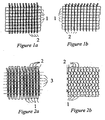
- Figure la shows the stitched side, or face side, or technical side of a WIWK fabric.
- Figure 1b is the back side, or between the stitches, side of the same WIWK fabric.
- Film-tape weft yarns 1 are inserted into the fabric using a weft insertion warp knit process.
- a creel which has a rotating weft bobbin that rotates one turn for each turn of yarn taken from the bobbin.
- a creel is, for example, manufactured by Karl Mayer of Germany.
- the film-tape 1 can be sufficiently modified to form a substantially impermeable surface onto which adhesive can be applied directly by means of a roller or blade or some other conventional adhesive applicator.
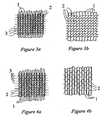
- film-tape 1 can be used in the warp direction (figs 2a, 2b, 3a, 3b, 4a and 4b).
- Figs 2a and 2b show a WIWK fabric made with a tricot stitch 2 with closed stitches 1,0 / 1,2 or opened stitches 0,1/2,1.
- the film-tape is used as an inlay warp (0,0 / 0,0). It is also necessary to use a weft yarn 3, which can be almost any type of yarn normally used to guide the tearability of the fabric.
- Figs 3a and 3b show a similar fabric to that of figs 2a and 2b except that a chain stitch 2 working on two needles with closed stitched (0,2 / 0,2) is used.
- Figs 4a and 4b show another fabric similar to figs 3a and 3b working on a tricot stitch with two needles with open stitches (0,2 / 3,1).
- the film-tapes may be fused together by hot calendering before adhesive is applied.
- the film-tape is used in the warp direction it is more difficult to get the required impermeability from just the film-tape alone. Accordingly it is desirable that the other yarns be of similar thermoplastic material to enable then to fuse to the film-tapes and to provide a higher degree of impermeability.
- figures 1a and 1b are preferred because they allow engineering of the desired property of tearability in the weft direction. They may also eliminate the need for a separate weft yarn.
- the weft yarn is also a tape yarn to give a lattice of tape yarns.
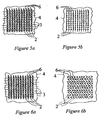
- the tapes can, in effect, be created in situ by the insertion of a plain film 4 during the knitting as shown in figures 5a, 5b, 6a and 6b.
- the stitch through needles will cut the film in parallel tapes corresponding to the width between two needles 6.
- the plain film is shown inserted above the weft inserted and therefore the weft can be seen only on the face side.
- the film tapes, plain film precursors of film tapes, texturised yarns, or spun yarns may be formed of any low melting point thermoplastic materials such as polyolefins: for example polyethylene or polypropylene.
- a weft yarn may be used to define the tearing direction of the technical tape. Use of a sufficiently high denier yarn will ensure that a tear runs across the tape in a straight line, as the tear will not cross the inlaid weft yarn.
- the film tapes or plain film precursors of film tapes can be formed of elastic or deformable material to give stretch or elastic properties to the tape. A maximum elasticity of 35% is desirable. Especially preferred are elastomeric or non-fixed preoriented yarn materials.
- thermoplastic weft yarns in bias direction defines a bias tearing direction for the technical tape.
- the preferred WIWK construction using a film tape yarn in weft is a chain stitch 2 with closed or open stitches and a film tape weft inserted in each stitch as shown in figures 1a and 1b.
- the preferred WIWK construction for a stitched though plain film is a stitching yarn using a tricot stitch 1.0 / 1,2 with closed stitches or with opened stitches 0,1 /2,1 and a weft inserted yarn 3 in each stitch.
- the preferred yarn used in the warp for the stitch yarn should be polyester or polyamide from 20 denier (22 decitex) to 150 denier (167 decitex) with flat or textured continuous filament yarns.
- warp ends will depend on the number of needles per cm or the gauge. 7.1 warp ends per cm is 18 needles per inch or 18 gauge. The preferred number of ends per cm is from 2 to 16.
- the preferred construction has a weft film-tape inserted in each stitch.
- the film tape is advantageously a polypropylene film-tape yarn and the width of the film-tape corresponds to the length of the stitch.
- the length of the stitch is the inverse of the number of stitches per cm (or per inch), and as the preferred constructions in weft are between 1 and 10 wefts per cm.
- the preferred width of the film tape should therefore be 1cm and for 10 wefts per cm the preferred width of film tape should be 1mm.
- the most preferred weft count lies in the range 1 to 5 per cm.
- the width of the weft may be smaller than the length of the stitch. In that case, it is particularly preferred that shrinkable warp yarns are used which, after shrinkage, e.g. after heating using hot gas or steam, provide a length of the stitch that essentially corresponds to the width of the weft.
- the thickness of the film tape will depend on the desired thickness of the eventual adhesive tape product.
- the preferred thickness will be in the range 0.1 to 0.5 mm. But a thickness of from 0.025mm up to 1mm is possible technically.
- One variant desirably combines polypropylene and polyethylene in this way.
- a sample tape was made using a weft insertion yarn of 900 dtex BCF polypropylene. It was calendered at by passing through a hot roller (160deg C) and when viewed optically it was seen to be almost fully closed. Use of higher decitex yarn did not close the substrate so effectively. This is thought to be because it is harder to melt the higher decitex yarn by passing it through a single roller. Use of multiple rollers would solve this problem. For the 900 dtex sample the yarn remained profiled on one side and was flat on the other side due to the action of the roller.
- the flat side was then coated with an adhesive in the manner conventional for tape manufacture.
- the resulting adhesive tape for tested for adhesion to the non-calendered side of the tape. It peeled well leaving no detectable traces of adhesive.
Landscapes
- Engineering & Computer Science (AREA)
- Textile Engineering (AREA)
- Chemical & Material Sciences (AREA)
- Organic Chemistry (AREA)
- Adhesive Tapes (AREA)
- Organic Insulating Materials (AREA)
- Woven Fabrics (AREA)
- Knitting Of Fabric (AREA)
- Laminated Bodies (AREA)
- Manufacturing Of Electric Cables (AREA)
- Cable Accessories (AREA)
Claims (28)
- Klebeband, umfassend ein kettengewirktes (WIWK-) Substrat, wobei das kettengewirkte Substrat ein Schußgarn umfaßt, das einen höheren Titer als das Wirkgarn und eine auf dem Substrat beschichtete Klebeschicht aufweist, dadurch gekennzeichnet, daß das Substrat geschlossen ist, um den Durchgang des Klebstoffs hierdurch im wesentlichen zu verhindern, wobei kein Klebstoff von der angrenzenden Bandlage zu der nicht klebrigen Oberflächenseite des angrenzenden Substrats transferiert wird, wenn das Band entwickelt wird.
- Klebeband nach Anspruch 1, wobei die Schußzahl in dem Bereich von 1 bis 10 pro cm liegt.
- Klebeband nach Anspruch 2, wobei die Schußzahl in dem Bereich von 1 bis 5 pro cm liegt.
- Klebeband nach einem der vorhergehenden Ansprüche, wobei die Garne ausgewählt werden aus der Gruppe bestehend aus synthetischen organischen Materialien, Polymeren oder Mischungen von Polymeren.
- Klebeband nach Anspruch 4, wobei die Garne ausgewählt werden aus der Gruppe bestehend aus: Silicon-gepfropftes Polyethylen, Polytetrafluorethylen (Teflon), fluorierte Polyolefine, chlorierte Polyolefine, Polyethylen (einschließlich solches geringer Dichte, hoher Dichte, lineares hoher Dichte, mittlerer Dichte, Metallocenkatalysierte), Polypropylen, EPDM-Kautschuk, Polyvinylstearylcarbamat, Polychlortrifluorethylen (Aclar), Polystyrol, Polyvinylchlorid, Polyamid (einschließlich Polyamid 4, Polyamid 6, Polyamid 6,6, Polyamid 6,10, Polyamid 6,12, Polyamid 4,6, Polyamid 11, Polyamid 12), Polyurethan (aliphatisch: Polyether oder Polyester, aromatisch: Polyether oder Polyester), Polyvinylidenchlorid, Polyethylenterephthalat und Copolymeren davon, Polybutylenterephthalat und Copolymeren davon, Polytrimethylenterephthalat und Copolymeren davon, Copolymeren von Polyethylen (einschließlich Ionomeren, Ethylenacrylsäure, Ethylenmethylacrylat, Ethylenvinylacetat, Ethylen-n-butylacrylat), Polyacrylonitril, Polymethylmethacrylat, Polycarbonat, Polysulfon und Cellophan und Kombinationen hiervon.
- Klebeband nach Anspruch 4, wobei die Garne ausgewählt werden aus der Gruppe bestehend aus Polyarylat, Polyvinylalkohol, Polyvinylchlorid, Polychlal (Mischung aus PVA/PVC), Fluorkohlenstoff, phenolischen, Polyacrylat, Polybenzimidazol, Polyetheretherketon, Polyetherimid, Polyethersulfon, Polyphenylenbenzobisoxazol und Polyphenylensulfid.
- Klebeband nach einem der vorhergehenden Ansprüche, bei dem zumindest ein Teil der Schußgarne gesponnene Garne sind.
- Klebeband nach Anspruch 7, bei dem die Schußgarne 1.000 dtex oder weniger aufweisen.
- Klebeband nach einem der vorhergehenden Ansprüche, wobei die schließbaren Garne zusätzlich zu der Schußrichtung des Stoffes auch in der Kett- und/oder in einer oder mehreren geneigten Richtungen in dem Stoff vorliegen können.
- Klebeband nach einem der vorhergehenden Ansprüche, wobei der Klebstoff ausgewählt wird aus der Gruppe bestehend aus Klebstoffen auf Kautschukbasis (sowohl natürlich wie auch synthetisch), Acrylatklebstoffen, Siliconklebstoffen und Polyurethanklebstoffen und Kombinationen hiervon.
- Klebeband nach Anspruch 10, bei dem der Klebstoff ausgewählt wird aus der Gruppe bestehend aus: natürlichem Kautschuk, Polyisopren, Styrol-Isopren-Blockcopolymer, Styrol-Butadien-Blockcopolymer, Butylkautschuk, Polystyrol-Poly(ethylen/butylen)-Polystyrol, Polystyrol-Poly(ethylen/propylen)-Polystyrol, Polystyrol-Polyisopren-Polybutadien, Polybuten, Polyacrylaten, Polydiacrylaten, Polytriacrylaten, Polymethacrylaten, Polydimethacrylaten, Polytrimethacrylaten, Polytetramethacrylaten, Polyacrylamiden, Polymethacrylamiden, Polyacrylimiden, Polymethacrylimiden, Polymethacrylsäure, Polyacrolein, Polymethacrylonitril, Poly(maleinsäure) und Derivaten, Poly(fumarsäure) und Derivaten, Poly(krotonsäure) und Derivaten, Poly(itaconsäure) und Derivaten, Poly(ciraconsäure) und Derivaten, Poly(maleaminsäure) und Derivaten, Poly(vinylethern), Polyisocyanaten, Polystyrol und Derivaten, Polylactonen, Polybetainen und kompatiblen Mischung hieraus.
- Verfahren zum Bilden eines Klebebands nach einem der vorhergehenden Ansprüche, wobei das Substrat durch Wirken eines undurchlässigen laminaren Materials in das Substrat gebildet wird.
- Verfahren nach Anspruch 12, bei dem dieses laminare Material durch das Wirken in das Substrat in Bänder geteilt wird.
- Verfahren zum Bilden eines Klebebands nach einem der vorhergehenden Ansprüche, wobei das Substrat durch Wirken vorgeformter Bandgarne in das Substrat während der Herstellung und dann Schmelzen der Bandfolie und teilweise anderer Garne in dem Substrat hergestellt wird, um das geschlossene Substrat zu schaffen.
- Verfahren nach Anspruch 14, bei dem das Schmelzen durch Erhitzen des Substrats vor Auftragen des Klebstoffs erzielt wird.
- Verfahren nach Anspruch 15, bei dem das Erhitzen durch heißes Gas oder Dampf, das/der über das Substrat geleitet wird, erreicht wird.
- Verfahren nach Anspruch 15 oder 16, bei dem zumindest eine Seite des Substrats weiter eingeebnet wird durch Durchführen des Substrats durch Walzen, von der zumindest eine erhitzt ist.
- Kettengewirktes (WIWK-) Substrat, bei dem das kettengewirkte Substrat ein Schußgarn umfaßt, das einen höheren Titer aufweist als das Wirkgarn, zur Verwendung in der Herstellung eines Klebebands nach einem der Ansprüche 1 bis 13, dadurch gekennzeichnet, daß das Substrat texturierte Garne umfaßt.
- Substrat nach Anspruch 18, wobei die texturierten Garne geschmolzen und wahlweise verschmolzen werden, um das geschlossene Substrat zu bilden.
- Substrat nach Anspruch 19, wobei das Schmelzen oder Verschmelzen erzielt wird durch Führen von heißem Gas oder Dampf über das Substrat.
- Substrat nach Anspruch 19 oder 20, wobei das Substrat durch Walzen geleitet wird, von der zumindest eine erhitzt ist, um zumindest eine Seite des Substrats einzuebnen und wahlweise das Schmelzen oder Verschmelzen des Substrats zu unterstützen.
- Kettengewirktes (WIWK-) Substrat, bei dem das kettengewirkte Substrat ein Schußgarn umfaßt, das einen höheren Titer als das Wirkgarn aufweist, zur Verwendung in der Herstellung eines Klebebands nach einem der Ansprüche 1 bis 13, dadurch gekennzeichnet, daß das Substrat eine Bandfolie umfaßt, die in das Substrat gewirkt ist.
- Substrat nach Anspruch 22, bei dem die Bandfolie durch eine Lage gebildet wird, die in Bänder durch Wirken in das Substrat gespalten wird.
- Substrat nach Anspruch 23, bei dem die Bandfolie durch Wirken von vorgeformten Bandgarnen in das Substrat gebildet wird.
- Substrat nach Anspruch 23 oder 24, bei dem das Substrat durch thermisches Verschmelzen der Bandfolie und wahlweise der anderen Substratgarne geschlossen wird.
- Substrat nach Anspruch 25, bei dem die Bandfolie texturierte Garne umfaßt.
- Substrat nach Anspruch 25 oder 26, bei dem die Bandfolie thermoplastisch ist.
- Substrat nach Anspruch 25, bei dem die Verschmelzung durch Durchleiten des Substrats mit der thermoplastischen Bandfolie oder texturierten Garne durch mindestens eine erhitzte Walze erzielt wird.
Applications Claiming Priority (3)
| Application Number | Priority Date | Filing Date | Title |
|---|---|---|---|
| GBGB0213431.0A GB0213431D0 (en) | 2002-06-12 | 2002-06-12 | Adhesive tape |
| GB0213431 | 2002-06-12 | ||
| PCT/EP2003/006059 WO2003106580A1 (en) | 2002-06-12 | 2003-06-10 | Adhesive tape |
Publications (2)
| Publication Number | Publication Date |
|---|---|
| EP1511819A1 EP1511819A1 (de) | 2005-03-09 |
| EP1511819B1 true EP1511819B1 (de) | 2006-03-22 |
Family
ID=9938399
Family Applications (1)
| Application Number | Title | Priority Date | Filing Date |
|---|---|---|---|
| EP03735594A Expired - Lifetime EP1511819B1 (de) | 2002-06-12 | 2003-06-10 | Klebeband |
Country Status (8)
| Country | Link |
|---|---|
| US (1) | US20050227559A1 (de) |
| EP (1) | EP1511819B1 (de) |
| AT (1) | ATE321107T1 (de) |
| AU (1) | AU2003236731A1 (de) |
| CA (1) | CA2487339A1 (de) |
| DE (1) | DE60304186T2 (de) |
| GB (1) | GB0213431D0 (de) |
| WO (1) | WO2003106580A1 (de) |
Families Citing this family (11)
| Publication number | Priority date | Publication date | Assignee | Title |
|---|---|---|---|---|
| GB2408515B (en) * | 2003-11-26 | 2006-01-18 | Milliken Fabrics S A | Adhesive tape and its reinforcement |
| DE102008004713A1 (de) * | 2007-10-19 | 2009-04-23 | Tesa Ag | Klebeband |
| US8227065B2 (en) * | 2010-02-08 | 2012-07-24 | Milliken & Company | Adhesive tape |
| US8221863B2 (en) * | 2010-02-08 | 2012-07-17 | Milliken & Company | Adhesive tape |
| US8679047B2 (en) | 2010-05-21 | 2014-03-25 | Presidium Athletics LLC | Impact resistant, torsion-reducing protective athletic gear using shear thickening fluid |
| DE102011009510A1 (de) * | 2011-01-26 | 2012-07-26 | Tesa Se | Klebeband, das insbesondere zur Transportsicherung eingesetzt werden kann |
| DE202012103442U1 (de) | 2012-09-10 | 2012-09-28 | Certoplast Vorwerk & Sohn Gmbh | Klebeband, insbesondere Wickelband zur Bündelung von Kabeln in Automobilen |
| US11225592B2 (en) * | 2015-03-10 | 2022-01-18 | certoplast Technische Klebebaender GmbH | Method of making adhesive wrapping tape for bundling cables in cars |
| DE202015002525U1 (de) | 2015-04-08 | 2015-05-28 | Leather Components Vertriebs-Ug (Haftungsbeschränkt) | Fixierhilfe zum einfachen Fixieren von Nähkleidern auf Trägerteilen |
| DE102016124608B4 (de) * | 2016-01-07 | 2021-04-29 | Coroplast Fritz Müller Gmbh & Co. Kg | Hochtemperatur- und flammbeständiges farbiges Klebeband sowie Kabelbaum mit einem derartigen Klebeband |
| CN111073528B (zh) * | 2019-12-31 | 2021-09-17 | 宁波大榭开发区综研化学有限公司 | 一种热固性胶黏剂和胶带及其制备方法 |
Family Cites Families (8)
| Publication number | Priority date | Publication date | Assignee | Title |
|---|---|---|---|---|
| US4304813A (en) * | 1980-07-14 | 1981-12-08 | Milliken Research Corporation | Pressure sensitive tape with a warp knit and weft insertion fabric |
| US4654254A (en) * | 1984-10-11 | 1987-03-31 | The Kendall Company | Adhesive tape |
| US5017425A (en) * | 1990-07-12 | 1991-05-21 | Milliken Research Corporation | Tricot knitting machine improvement |
| US5631073A (en) * | 1992-02-03 | 1997-05-20 | Minnesota Mining And Manufacturing Company | Nonwoven sheet materials, tapes and methods |
| US5512354A (en) * | 1993-01-25 | 1996-04-30 | Minnesota Mining And Manufacturing Company | Fabric backing for orthopedic support materials |
| TW290498B (en) * | 1995-07-19 | 1996-11-11 | Andover Coated Products Inc | Elastic bandage |
| US5795834A (en) * | 1995-12-22 | 1998-08-18 | Minnesota Mining & Manufacturing Company | Adhesive tape and method of making |
| US20030162017A1 (en) * | 2001-09-24 | 2003-08-28 | Weir Matthew G. | Composite tape construction and method |
-
2002
- 2002-06-12 GB GBGB0213431.0A patent/GB0213431D0/en not_active Ceased
-
2003
- 2003-06-10 AU AU2003236731A patent/AU2003236731A1/en not_active Abandoned
- 2003-06-10 US US10/514,585 patent/US20050227559A1/en not_active Abandoned
- 2003-06-10 DE DE60304186T patent/DE60304186T2/de not_active Expired - Fee Related
- 2003-06-10 WO PCT/EP2003/006059 patent/WO2003106580A1/en not_active Ceased
- 2003-06-10 AT AT03735594T patent/ATE321107T1/de not_active IP Right Cessation
- 2003-06-10 EP EP03735594A patent/EP1511819B1/de not_active Expired - Lifetime
- 2003-06-10 CA CA002487339A patent/CA2487339A1/en not_active Abandoned
Also Published As
| Publication number | Publication date |
|---|---|
| ATE321107T1 (de) | 2006-04-15 |
| DE60304186D1 (de) | 2006-05-11 |
| DE60304186T2 (de) | 2006-12-28 |
| WO2003106580A1 (en) | 2003-12-24 |
| AU2003236731A1 (en) | 2003-12-31 |
| CA2487339A1 (en) | 2003-12-24 |
| GB0213431D0 (en) | 2002-07-24 |
| US20050227559A1 (en) | 2005-10-13 |
| EP1511819A1 (de) | 2005-03-09 |
| AU2003236731A8 (en) | 2003-12-31 |
Similar Documents
| Publication | Publication Date | Title |
|---|---|---|
| EP1511819B1 (de) | Klebeband | |
| JP5677725B2 (ja) | おむつ用の弾性複合材 | |
| US4304813A (en) | Pressure sensitive tape with a warp knit and weft insertion fabric | |
| US10857565B2 (en) | Self-windable, cross-tearable, textile industrial adhesive tape having a knitted substrate | |
| US5162150A (en) | Duct tape | |
| JP5308828B2 (ja) | 被覆された織布及び/または不織布を含む、微多孔質で通気性の建築及び建設材料、並びに方法 | |
| BR112018005275B1 (pt) | Material fibroso, processo para formar o material fibroso, e tecido reforçado | |
| JPS62131424A (ja) | ラツプアラウンド繊維製品物品製造方法 | |
| AU2004253525A1 (en) | Pressure-sensitive adhesive tapes | |
| BR112016012919B1 (pt) | Método de formação de um laminado elástico não tecido, laminado não tecido elástico, e, artigo absorvente | |
| US8227065B2 (en) | Adhesive tape | |
| CA3061032A1 (en) | Functional fiber reinforced adhesive tape | |
| US8221863B2 (en) | Adhesive tape | |
| US20070010777A1 (en) | Medical tape and bandages | |
| US20040152384A1 (en) | Self-windable adhesive tape | |
| JP7011820B2 (ja) | 粘着テープ及び,粘着テープの製造方法 | |
| AU2687392A (en) | Tape composition utilizing a multi-layer film | |
| KR101158529B1 (ko) | 위사 삽입 방식에 의한 천테이프 원단 및 이를 포함하는 천테이프 | |
| JP2000314062A (ja) | ラミネートテープ用基布 | |
| GB2361881A (en) | Adhesive tape | |
| KR100377029B1 (ko) | 라미네이트 테이프용 바탕천 | |
| WO2005052083A1 (en) | Adhesive tape and its reinforcement | |
| CN221366112U (zh) | 组合织带以及衣物 | |
| JP7610806B2 (ja) | 下敷きテープ | |
| JP2854771B2 (ja) | 伸張可能な防水シートとその製造方法 |
Legal Events
| Date | Code | Title | Description |
|---|---|---|---|
| PUAI | Public reference made under article 153(3) epc to a published international application that has entered the european phase |
Free format text: ORIGINAL CODE: 0009012 |
|
| AK | Designated contracting states |
Kind code of ref document: A1 Designated state(s): AT BE BG CH CY CZ DE DK EE ES FI FR GB GR HU IE IT LI LU MC NL PT RO SE SI SK TR |
|
| AX | Request for extension of the european patent |
Extension state: AL LT LV MK |
|
| 17P | Request for examination filed |
Effective date: 20041104 |
|
| 17Q | First examination report despatched |
Effective date: 20050330 |
|
| GRAP | Despatch of communication of intention to grant a patent |
Free format text: ORIGINAL CODE: EPIDOSNIGR1 |
|
| DAX | Request for extension of the european patent (deleted) | ||
| GRAS | Grant fee paid |
Free format text: ORIGINAL CODE: EPIDOSNIGR3 |
|
| GRAA | (expected) grant |
Free format text: ORIGINAL CODE: 0009210 |
|
| AK | Designated contracting states |
Kind code of ref document: B1 Designated state(s): AT BE BG CH CY CZ DE DK EE ES FI FR GB GR HU IE IT LI LU MC NL PT RO SE SI SK TR |
|
| PG25 | Lapsed in a contracting state [announced via postgrant information from national office to epo] |
Ref country code: SK Free format text: LAPSE BECAUSE OF FAILURE TO SUBMIT A TRANSLATION OF THE DESCRIPTION OR TO PAY THE FEE WITHIN THE PRESCRIBED TIME-LIMIT Effective date: 20060322 Ref country code: CH Free format text: LAPSE BECAUSE OF FAILURE TO SUBMIT A TRANSLATION OF THE DESCRIPTION OR TO PAY THE FEE WITHIN THE PRESCRIBED TIME-LIMIT Effective date: 20060322 Ref country code: LI Free format text: LAPSE BECAUSE OF FAILURE TO SUBMIT A TRANSLATION OF THE DESCRIPTION OR TO PAY THE FEE WITHIN THE PRESCRIBED TIME-LIMIT Effective date: 20060322 Ref country code: RO Free format text: LAPSE BECAUSE OF FAILURE TO SUBMIT A TRANSLATION OF THE DESCRIPTION OR TO PAY THE FEE WITHIN THE PRESCRIBED TIME-LIMIT Effective date: 20060322 Ref country code: SI Free format text: LAPSE BECAUSE OF FAILURE TO SUBMIT A TRANSLATION OF THE DESCRIPTION OR TO PAY THE FEE WITHIN THE PRESCRIBED TIME-LIMIT Effective date: 20060322 Ref country code: AT Free format text: LAPSE BECAUSE OF FAILURE TO SUBMIT A TRANSLATION OF THE DESCRIPTION OR TO PAY THE FEE WITHIN THE PRESCRIBED TIME-LIMIT Effective date: 20060322 Ref country code: BE Free format text: LAPSE BECAUSE OF FAILURE TO SUBMIT A TRANSLATION OF THE DESCRIPTION OR TO PAY THE FEE WITHIN THE PRESCRIBED TIME-LIMIT Effective date: 20060322 |
|
| REG | Reference to a national code |
Ref country code: GB Ref legal event code: FG4D |
|
| REG | Reference to a national code |
Ref country code: CH Ref legal event code: EP |
|
| REG | Reference to a national code |
Ref country code: IE Ref legal event code: FG4D |
|
| REF | Corresponds to: |
Ref document number: 60304186 Country of ref document: DE Date of ref document: 20060511 Kind code of ref document: P |
|
| PG25 | Lapsed in a contracting state [announced via postgrant information from national office to epo] |
Ref country code: IE Free format text: LAPSE BECAUSE OF NON-PAYMENT OF DUE FEES Effective date: 20060612 |
|
| PGFP | Annual fee paid to national office [announced via postgrant information from national office to epo] |
Ref country code: FR Payment date: 20060620 Year of fee payment: 4 |
|
| PG25 | Lapsed in a contracting state [announced via postgrant information from national office to epo] |
Ref country code: BG Free format text: LAPSE BECAUSE OF FAILURE TO SUBMIT A TRANSLATION OF THE DESCRIPTION OR TO PAY THE FEE WITHIN THE PRESCRIBED TIME-LIMIT Effective date: 20060622 Ref country code: DK Free format text: LAPSE BECAUSE OF FAILURE TO SUBMIT A TRANSLATION OF THE DESCRIPTION OR TO PAY THE FEE WITHIN THE PRESCRIBED TIME-LIMIT Effective date: 20060622 Ref country code: SE Free format text: LAPSE BECAUSE OF FAILURE TO SUBMIT A TRANSLATION OF THE DESCRIPTION OR TO PAY THE FEE WITHIN THE PRESCRIBED TIME-LIMIT Effective date: 20060622 |
|
| PG25 | Lapsed in a contracting state [announced via postgrant information from national office to epo] |
Ref country code: MC Free format text: LAPSE BECAUSE OF NON-PAYMENT OF DUE FEES Effective date: 20060630 |
|
| PGFP | Annual fee paid to national office [announced via postgrant information from national office to epo] |
Ref country code: IT Payment date: 20060630 Year of fee payment: 4 |
|
| PG25 | Lapsed in a contracting state [announced via postgrant information from national office to epo] |
Ref country code: ES Free format text: LAPSE BECAUSE OF FAILURE TO SUBMIT A TRANSLATION OF THE DESCRIPTION OR TO PAY THE FEE WITHIN THE PRESCRIBED TIME-LIMIT Effective date: 20060703 |
|
| PGFP | Annual fee paid to national office [announced via postgrant information from national office to epo] |
Ref country code: DE Payment date: 20060731 Year of fee payment: 4 |
|
| PG25 | Lapsed in a contracting state [announced via postgrant information from national office to epo] |
Ref country code: PT Free format text: LAPSE BECAUSE OF FAILURE TO SUBMIT A TRANSLATION OF THE DESCRIPTION OR TO PAY THE FEE WITHIN THE PRESCRIBED TIME-LIMIT Effective date: 20060822 |
|
| REG | Reference to a national code |
Ref country code: CH Ref legal event code: PL |
|
| ET | Fr: translation filed | ||
| PLBE | No opposition filed within time limit |
Free format text: ORIGINAL CODE: 0009261 |
|
| STAA | Information on the status of an ep patent application or granted ep patent |
Free format text: STATUS: NO OPPOSITION FILED WITHIN TIME LIMIT |
|
| 26N | No opposition filed |
Effective date: 20061227 |
|
| GBPC | Gb: european patent ceased through non-payment of renewal fee |
Effective date: 20070610 |
|
| NLV4 | Nl: lapsed or anulled due to non-payment of the annual fee |
Effective date: 20080101 |
|
| REG | Reference to a national code |
Ref country code: FR Ref legal event code: ST Effective date: 20080229 |
|
| PG25 | Lapsed in a contracting state [announced via postgrant information from national office to epo] |
Ref country code: CZ Free format text: LAPSE BECAUSE OF FAILURE TO SUBMIT A TRANSLATION OF THE DESCRIPTION OR TO PAY THE FEE WITHIN THE PRESCRIBED TIME-LIMIT Effective date: 20060322 Ref country code: GR Free format text: LAPSE BECAUSE OF FAILURE TO SUBMIT A TRANSLATION OF THE DESCRIPTION OR TO PAY THE FEE WITHIN THE PRESCRIBED TIME-LIMIT Effective date: 20060623 Ref country code: NL Free format text: LAPSE BECAUSE OF NON-PAYMENT OF DUE FEES Effective date: 20080101 Ref country code: DE Free format text: LAPSE BECAUSE OF NON-PAYMENT OF DUE FEES Effective date: 20080101 |
|
| PG25 | Lapsed in a contracting state [announced via postgrant information from national office to epo] |
Ref country code: GB Free format text: LAPSE BECAUSE OF NON-PAYMENT OF DUE FEES Effective date: 20070610 |
|
| PG25 | Lapsed in a contracting state [announced via postgrant information from national office to epo] |
Ref country code: EE Free format text: LAPSE BECAUSE OF FAILURE TO SUBMIT A TRANSLATION OF THE DESCRIPTION OR TO PAY THE FEE WITHIN THE PRESCRIBED TIME-LIMIT Effective date: 20060322 Ref country code: FI Free format text: LAPSE BECAUSE OF FAILURE TO SUBMIT A TRANSLATION OF THE DESCRIPTION OR TO PAY THE FEE WITHIN THE PRESCRIBED TIME-LIMIT Effective date: 20060322 |
|
| PG25 | Lapsed in a contracting state [announced via postgrant information from national office to epo] |
Ref country code: LU Free format text: LAPSE BECAUSE OF NON-PAYMENT OF DUE FEES Effective date: 20060610 Ref country code: TR Free format text: LAPSE BECAUSE OF FAILURE TO SUBMIT A TRANSLATION OF THE DESCRIPTION OR TO PAY THE FEE WITHIN THE PRESCRIBED TIME-LIMIT Effective date: 20060322 Ref country code: HU Free format text: LAPSE BECAUSE OF FAILURE TO SUBMIT A TRANSLATION OF THE DESCRIPTION OR TO PAY THE FEE WITHIN THE PRESCRIBED TIME-LIMIT Effective date: 20060923 |
|
| PG25 | Lapsed in a contracting state [announced via postgrant information from national office to epo] |
Ref country code: FR Free format text: LAPSE BECAUSE OF NON-PAYMENT OF DUE FEES Effective date: 20070702 |
|
| PG25 | Lapsed in a contracting state [announced via postgrant information from national office to epo] |
Ref country code: CY Free format text: LAPSE BECAUSE OF FAILURE TO SUBMIT A TRANSLATION OF THE DESCRIPTION OR TO PAY THE FEE WITHIN THE PRESCRIBED TIME-LIMIT Effective date: 20060322 |
|
| PG25 | Lapsed in a contracting state [announced via postgrant information from national office to epo] |
Ref country code: IT Free format text: LAPSE BECAUSE OF NON-PAYMENT OF DUE FEES Effective date: 20070610 |