EP1510667B1 - Schalldämpfer - Google Patents
Schalldämpfer Download PDFInfo
- Publication number
- EP1510667B1 EP1510667B1 EP04405497A EP04405497A EP1510667B1 EP 1510667 B1 EP1510667 B1 EP 1510667B1 EP 04405497 A EP04405497 A EP 04405497A EP 04405497 A EP04405497 A EP 04405497A EP 1510667 B1 EP1510667 B1 EP 1510667B1
- Authority
- EP
- European Patent Office
- Prior art keywords
- muffler
- resonator
- flow
- compressor
- slots
- Prior art date
- Legal status (The legal status is an assumption and is not a legal conclusion. Google has not performed a legal analysis and makes no representation as to the accuracy of the status listed.)
- Expired - Lifetime
Links
Images

Classifications
-
- F—MECHANICAL ENGINEERING; LIGHTING; HEATING; WEAPONS; BLASTING
- F01—MACHINES OR ENGINES IN GENERAL; ENGINE PLANTS IN GENERAL; STEAM ENGINES
- F01N—GAS-FLOW SILENCERS OR EXHAUST APPARATUS FOR MACHINES OR ENGINES IN GENERAL; GAS-FLOW SILENCERS OR EXHAUST APPARATUS FOR INTERNAL-COMBUSTION ENGINES
- F01N1/00—Silencing apparatus characterised by method of silencing
- F01N1/02—Silencing apparatus characterised by method of silencing by using resonance
- F01N1/026—Annular resonance chambers arranged concentrically to an exhaust passage and communicating with it, e.g. via at least one opening in the exhaust passage
-
- F—MECHANICAL ENGINEERING; LIGHTING; HEATING; WEAPONS; BLASTING
- F01—MACHINES OR ENGINES IN GENERAL; ENGINE PLANTS IN GENERAL; STEAM ENGINES
- F01N—GAS-FLOW SILENCERS OR EXHAUST APPARATUS FOR MACHINES OR ENGINES IN GENERAL; GAS-FLOW SILENCERS OR EXHAUST APPARATUS FOR INTERNAL-COMBUSTION ENGINES
- F01N1/00—Silencing apparatus characterised by method of silencing
- F01N1/02—Silencing apparatus characterised by method of silencing by using resonance
-
- F—MECHANICAL ENGINEERING; LIGHTING; HEATING; WEAPONS; BLASTING
- F01—MACHINES OR ENGINES IN GENERAL; ENGINE PLANTS IN GENERAL; STEAM ENGINES
- F01N—GAS-FLOW SILENCERS OR EXHAUST APPARATUS FOR MACHINES OR ENGINES IN GENERAL; GAS-FLOW SILENCERS OR EXHAUST APPARATUS FOR INTERNAL-COMBUSTION ENGINES
- F01N1/00—Silencing apparatus characterised by method of silencing
- F01N1/08—Silencing apparatus characterised by method of silencing by reducing exhaust energy by throttling or whirling
-
- F—MECHANICAL ENGINEERING; LIGHTING; HEATING; WEAPONS; BLASTING
- F02—COMBUSTION ENGINES; HOT-GAS OR COMBUSTION-PRODUCT ENGINE PLANTS
- F02M—SUPPLYING COMBUSTION ENGINES IN GENERAL WITH COMBUSTIBLE MIXTURES OR CONSTITUENTS THEREOF
- F02M35/00—Combustion-air cleaners, air intakes, intake silencers, or induction systems specially adapted for, or arranged on, internal-combustion engines
- F02M35/10—Air intakes; Induction systems
- F02M35/10091—Air intakes; Induction systems characterised by details of intake ducts: shapes; connections; arrangements
- F02M35/10137—Flexible ducts, e.g. bellows or hoses
-
- F—MECHANICAL ENGINEERING; LIGHTING; HEATING; WEAPONS; BLASTING
- F02—COMBUSTION ENGINES; HOT-GAS OR COMBUSTION-PRODUCT ENGINE PLANTS
- F02M—SUPPLYING COMBUSTION ENGINES IN GENERAL WITH COMBUSTIBLE MIXTURES OR CONSTITUENTS THEREOF
- F02M35/00—Combustion-air cleaners, air intakes, intake silencers, or induction systems specially adapted for, or arranged on, internal-combustion engines
- F02M35/10—Air intakes; Induction systems
- F02M35/10091—Air intakes; Induction systems characterised by details of intake ducts: shapes; connections; arrangements
- F02M35/10144—Connections of intake ducts to each other or to another device
-
- F—MECHANICAL ENGINEERING; LIGHTING; HEATING; WEAPONS; BLASTING
- F02—COMBUSTION ENGINES; HOT-GAS OR COMBUSTION-PRODUCT ENGINE PLANTS
- F02M—SUPPLYING COMBUSTION ENGINES IN GENERAL WITH COMBUSTIBLE MIXTURES OR CONSTITUENTS THEREOF
- F02M35/00—Combustion-air cleaners, air intakes, intake silencers, or induction systems specially adapted for, or arranged on, internal-combustion engines
- F02M35/10—Air intakes; Induction systems
- F02M35/1015—Air intakes; Induction systems characterised by the engine type
- F02M35/10157—Supercharged engines
-
- F—MECHANICAL ENGINEERING; LIGHTING; HEATING; WEAPONS; BLASTING
- F02—COMBUSTION ENGINES; HOT-GAS OR COMBUSTION-PRODUCT ENGINE PLANTS
- F02M—SUPPLYING COMBUSTION ENGINES IN GENERAL WITH COMBUSTIBLE MIXTURES OR CONSTITUENTS THEREOF
- F02M35/00—Combustion-air cleaners, air intakes, intake silencers, or induction systems specially adapted for, or arranged on, internal-combustion engines
- F02M35/12—Intake silencers ; Sound modulation, transmission or amplification
- F02M35/1205—Flow throttling or guiding
- F02M35/1216—Flow throttling or guiding by using a plurality of holes, slits, protrusions, perforations, ribs or the like; Surface structures; Turbulence generators
-
- F—MECHANICAL ENGINEERING; LIGHTING; HEATING; WEAPONS; BLASTING
- F02—COMBUSTION ENGINES; HOT-GAS OR COMBUSTION-PRODUCT ENGINE PLANTS
- F02M—SUPPLYING COMBUSTION ENGINES IN GENERAL WITH COMBUSTIBLE MIXTURES OR CONSTITUENTS THEREOF
- F02M35/00—Combustion-air cleaners, air intakes, intake silencers, or induction systems specially adapted for, or arranged on, internal-combustion engines
- F02M35/12—Intake silencers ; Sound modulation, transmission or amplification
- F02M35/1255—Intake silencers ; Sound modulation, transmission or amplification using resonance
- F02M35/1266—Intake silencers ; Sound modulation, transmission or amplification using resonance comprising multiple chambers or compartments
-
- F—MECHANICAL ENGINEERING; LIGHTING; HEATING; WEAPONS; BLASTING
- F02—COMBUSTION ENGINES; HOT-GAS OR COMBUSTION-PRODUCT ENGINE PLANTS
- F02B—INTERNAL-COMBUSTION PISTON ENGINES; COMBUSTION ENGINES IN GENERAL
- F02B37/00—Engines characterised by provision of pumps driven at least for part of the time by exhaust
-
- Y—GENERAL TAGGING OF NEW TECHNOLOGICAL DEVELOPMENTS; GENERAL TAGGING OF CROSS-SECTIONAL TECHNOLOGIES SPANNING OVER SEVERAL SECTIONS OF THE IPC; TECHNICAL SUBJECTS COVERED BY FORMER USPC CROSS-REFERENCE ART COLLECTIONS [XRACs] AND DIGESTS
- Y02—TECHNOLOGIES OR APPLICATIONS FOR MITIGATION OR ADAPTATION AGAINST CLIMATE CHANGE
- Y02T—CLIMATE CHANGE MITIGATION TECHNOLOGIES RELATED TO TRANSPORTATION
- Y02T10/00—Road transport of goods or passengers
- Y02T10/10—Internal combustion engine [ICE] based vehicles
- Y02T10/12—Improving ICE efficiencies
Definitions
- the invention relates to the field of exhaust gas turbochargers for internal combustion engines. It relates to a resonator silencer according to the preamble of claim 1. It further relates to an internal combustion engine with a corresponding resonator silencer.
- Silencers based on the principle of a Helmholtz resonator consist of one or more chambers, which are covered by means of a metal sheet with openings embedded therein.
- the air in the chamber serves as a spring to the vibrating Gutmassepfropfen in the openings.
- the high flow rate of the compressed air passed to the muffler results in a significant portion of the oscillating air mass being sheared off.
- the swinging air plug gets smaller. This leads to detuning the Auslegefrequenz and to lessen the damping effect.
- Conventional resonator silencers are therefore not sufficiently effective at flow velocities of the flowing medium of up to 100 m / s.
- US 6158214 discloses a reflection sound absorber of an exhaust system of a motor vehicle, in which long-hole bores are embedded in an outlet pipe surrounded by a reflection chamber.
- the invention is therefore an object of the invention to provide a muffler of the type mentioned, which shows a good damping effect even at high flow velocities.
- the resonator muffler has at least one chamber, which encloses a flow channel or parts of the circumference.
- the chamber is completely covered against the flow channel through a cover plate, wherein the cover plate has a plurality of openings.
- the openings of the cover plate are according to the invention designed as slots, which are aligned substantially in the flow direction.
- the ratio of the sum of the opening areas to the total surface of a chamber directed against the flow channel is chosen to be between 4% and 25%, in particular between 6% and 14%. If the ratio is too small or too large, the effect will be less.
- the length of the slots in the flow direction is chosen to be substantially greater than the width of the slots.
- the damping effect can be tuned to a wider frequency range.
- the number, the length and the total sum of the opening areas of the slots are varied accordingly.
- the inventive muffler which is effective even at high flow velocities is advantageously used for damping the compressor noise of a turbocharger. Particularly in the area of the charge air outlet, in which considerable noise values and the large flow velocities mentioned occur, a substantial contribution can be made to the desired reduction in the noise emissions of the subsequent air-guiding components.
- the compensator is particularly suitable, which represents the connection of the compressor outlet spiral and engine components.
- the compensator By choosing the compensator as an essential installation location, there is also the possibility of retrofitting already delivered or in operation internal combustion engines.
- Fig. 1 schematically shows a part of an internal combustion engine with a turbocharger connected.
- the turbocharger comprises a compressor 1, in which air is sucked in and compressed in order subsequently to be supplied to the internal combustion engine through the compressor outlet 11 and a connecting line 4 to the charge air cooling system 5.
- the compressed air flows in the direction of the arrow through a flow channel 6, which depending on the arrangement of the turbocharger on the internal combustion engine may be shorter or longer and may comprise one or more, tubular intermediate pieces.
- One of these intermediate pieces is the compensator element 2 shown schematically.
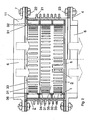
- the compensator element which in Fig. 2 shown enlarged, comprises a formed of an elastic sheet metal compensation element 21 which is arranged between two mounting flanges 22 and 23.
- the compensator element is stretchable in length thanks to the elastic compensation region, as in the right half of FIG Fig. 2 is shown.
- the mounting flanges 22 and 23 are connected by screws 7 or other fastening means with corresponding flanges of the Abströmstutzens 11 and the connecting line 4 to the radiator 5.
- the muffler 3 is arranged. It is a resonator muffler with slot-shaped openings 33 in the cover plate 31, which separate the resonator 32 against the flow channel 6.
- the silencer includes three successively arranged in the flow direction resonator chambers, each with different numbers of slots.
- the chambers may be covered by separate cover plates or by one or more common cover plates.
- the upper chamber is exemplified by its own Cover plate covered, while the two lower chambers are under a common cover plate.
- the individual chambers which can also be arranged alongside one another along the circumference, are subdivided by wall parts 35. Radially outside the chambers are limited by rear wall parts 34. When arranged on the circumference chambers these are separated from each other by corresponding, parallel to the axis used wall parts.
- the slots are aligned substantially in the flow direction and have a length I which is at least three times greater than the width b. Since the flow is not homogeneous in one direction, the individual slots can also be arranged at small angles to each other to better match the flow pattern. Depending on the course of the flow, the slots can also be curved. The depth t of the slots can be realized, for example, over the thickness of the cover plate. All three sizes (length, width and depth of the slots), as well as the number of slots per chamber and the dimensions of the chambers, have a direct impact on the damping capacity of the muffler.
- the muffler 3 is designed as a self-supporting unit.
- a step is integrated, which fits for fixing the muffler to the compensator in a corresponding recess in the mounting flange 22.
- the compensator element is used together with the muffler between the compressor outlet and the motor-side air line and screwed on both sides of the intended mounting flanges.
- the muffler may alternatively be clamped accordingly on the side of the connecting line 4 to the radiator.
- the silencer can project beyond the unloaded compensator element in and / or counter to the flow direction in the length into the inlet and outlet line.
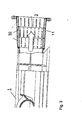
- Fig. 3 shows a second possibility of how the inventive silencer can be arranged in the region of the compressor outflow.
- the muffler is arranged as part of the spiral compressor housing, at the output in so-called outlet or discharge nozzle 11.
- outlet or discharge nozzle 11 By the arrangement of the muffler 3 in the area directly on the spiral outlet, the sound attenuation can be slightly improved.
- the sound contains many parts in this area, which can not propagate unattenuated towards the compressor outlet, but are attenuated by the muffler.
- the slightly smaller diameter of the flow channel in the outlet nozzle also provides for a slightly higher damping.
- the effective bandwidth of the generally narrow-band resonator and thus an effect in two or more frequency ranges can be achieved.
- the muffler in the outflow can also be made as a separate insert, which is used during assembly in a corresponding recess in the housing.
- inventive silencer with the substantially aligned in the flow direction slots is particularly well suited for the area of the compressor discharge, it can also be used in other areas of the flow channels, for example in the intake of the compressor or turbine side.
- the mode of operation of the resonator silencer according to the invention is explained below.
- the mass of the opening approximately corresponds to the mass and the volume of air in the chamber of the spring of a mass-spring system.
- the chamber volume is separated from the flow by the cover plate. If a flow passes the opening at great speed, part of the swinging air plug is sheared off by the flow. The oscillating air plug becomes smaller, resulting in a frequency shift. Further, the radial movement possibility of the plug is hindered by the vorbest moussede air such that additionally results in a reduced damping effect.
Landscapes
- Engineering & Computer Science (AREA)
- Chemical & Material Sciences (AREA)
- Combustion & Propulsion (AREA)
- Mechanical Engineering (AREA)
- General Engineering & Computer Science (AREA)
- Structures Of Non-Positive Displacement Pumps (AREA)
- Exhaust Silencers (AREA)
- Supercharger (AREA)
Description
- Die Erfindung bezieht sich auf das Gebiet der Abgasturbolader für Brennkraftmaschinen. Sie betrifft einen Resonatorschalldämpfer gemäss dem Oberbegriff des Patentanspruchs 1. Sie betrifft ferner eine Brennkraftmaschine mit einem entsprechenden Resonatorschalldämpfer.
- Massgeblich für die Lärmemissionen eines Abgasturboladers für Brennkraftmaschinen ist der Verdichter. Insbesondere werden am druckseitigen Austritt des Verdichters hohe Lärmpegel in die luftführenden Leitungen eingeleitet, für deren Dämpfung es bislang keine zufriedenstellende Lösung gibt.
- Bei im Strömungskanal angeordneten Absorbern ergibt sich das Problem, dass durch die hohen Strömungsgeschwindigkeiten der komprimierten Luft das Absorbermaterial durch die Lochblechabdeckungen ausgeblasen wird. Durch Ablagerung des Materials in den meist nachfolgenden Kühlern können diese verstopft werden. Auch sind die auf mineralische Basis hergestellten Fasermaterialen in den nachfolgenden Motorenkomponenten der Brennkraftmaschinen unerwünscht.
- Auf dem Prinzip eines Helmholtz-Resonators beruhende Schalldämpfer bestehen aus einer oder mehren Kammern, welche mittels einem Blech mit darin eingelassenen Öffnungen abgedeckt werden. Die Luft in der Kammer dient den schwingenden Luftmassepfropfen in den Öffnungen als Feder. Die hohe Strömungsgeschwindigkeit der am Schalldämpfer vorbeigeführten komprimierten Luft führt jedoch dazu, dass ein erheblicher Teil der schwingenden Luftmasse abgeschert wird. Der schwingende Luftpfropfen wird kleiner. Dies führt zu Verstimmung der Auslegefrequenz und zum Nachlassen der Dämpfungswirkung. Herkömmliche Resonatorschalldämpfer sind demzufolge bei Strömungsgeschwindigkeiten des vorbeifliessenden Mediums von bis zu 100 m/s nicht ausreichend wirksam.
- Ein im Strömungskanal angeordneter, herkömmlicher Resonator, wie beispielsweise in
JP 10-318194 -
US 6158214 offenbart einen Reflexionsschalldämpfer einer Abgasanlage eines Kraftfahrzeuges, bei welchem in ein von einer Reflexionskammer umgebenes Auslassrohr Langlochbohrungen eingelassen sind. - Der Erfindung liegt folglich die Aufgabe zugrunde, einen Schalldämpfer der eingangs genannten Art zu schaffen, welcher auch bei hohen Strömungsgeschwindigkeiten eine gute Dämpfungswirkung zeigt.
- Erfindungsgemäss wird diese Aufgabe mit den Merkmalen des Patentanspruchs 1 gelöst.
- Der Resonatorschalldämpfer weist mindestens eine Kammer auf, welche einen Strömungskanal oder Teile des Umfanges umschliesst. Die Kammer ist gegen den Strömungskanal hin durch ein Abdeckblech vollständig abgedeckt, wobei das Abdeckblech mehrere Öffnungen aufweist. Die Öffnungen des Abdeckblechs sind erfindungsgemäss als Schlitze ausgebildet, welche im wesentlichen in Strömungsrichtung ausgerichtet sind.
- Aufgrund der Länge der Schlitze ist es der Strömung nicht möglich, den schwingenden Luftmassepfropfen in den Öffnungen auf der gesamten Länge gleichzeitig abzuscheren bzw. dessen Bewegungsmöglichkeit auf der gesamten Länge synchron einzuschränken. Die Dämpfungswirkung des erfindungsgemässen Schalldämpfers bleibt daher auch bei grosser Strömungsgeschwindigkeit weitgehend erhalten.
- Um eine optimale Dämpfwirkung zu erzielen, wird das Verhältnis der Summe der Öffnungsflächen zur gegen den Strömungskanal gerichteten Gesamtoberfläche einer Kammer zwischen 4% und 25%, insbesondere zwischen 6% und 14% gewählt. Bei zu kleinem respektive zu grossem Verhältnis nimmt die Wirkung ab.
- Die Länge der Schlitze in Strömungsrichtung wird wesentlich grösser als die Breite der Schlitze gewählt. Durch das Anbringen von unterschiedlich lang ausgebildeten Schlitzen im Abdeckblech wird Wirksamkeit des Dämpfers verbessert.
- Werden entlang des Strömungskanals mehrere, voneinander getrennte Kammern angeordnet, kann die Dämpfungswirkung auf einem breiteren Frequenzbereich abgestimmt werden. Hierfür werden die Anzahl, die Länge und die Gesamtsumme der Öffnungsflächen der Schlitze entsprechend variiert.
- Der auch bei hohen Strömungsgeschwindigkeiten wirksame erfindungsgemässe Schalldämpfer wird vorteilhafterweise zur Dämpfung des Verdichterlärmes eines Turboladers verwendet. Besonders im Bereich des Ladeluftauslasses, in dem erhebliche Lärmwerte und die genannt grossen Strömungsgeschwindigkeiten auftreten, kann damit eine wesentlicher Beitrag zur angestrebten Verringerung der Lärmemissionen der nachfolgenden luftführenden Komponenten erreicht werden.
- Zum Einbau des vorliegenden Schalldämpfers eignet sich besonders der Kompensator, welcher die Verbindung von Verdichteraustrittsspirale und Motorkomponenten darstellt. Durch die Wahl des Kompensators als wesentlicher Einbauort ergibt sich auch die Möglichkeit der Nachrüstung bereits gelieferter bzw. in Betrieb stehender Brennkraftmaschinen.
- Ebenfalls günstig ist der Einbau des Schalldämpfers direkt in den Ausgang des spiralenförmigen Verdichtergehäuses. Aufgrund der Lage näher an der Lärmquelle und des etwas engeren Strömungskanals kann die Wirkung des Resonators noch zusätzlich verbessert werden.
- Weitere Vorteile ergeben sich aus den abhängigen Ansprüchen.
- Im folgenden sind anhand der Figuren Ausführungsbeispiele des Einbaus des erfindungsgemässen Schalldämpfers sowie ein Ausführungsbeispiel des Aufbaus des Schalldämpfers schematisch dargestellt und näher erläutert. In allen Figuren sind gleichwirkende Elemente mit gleichen Bezugszeichen versehen. Es zeigen:
- Fig. 1
- eine schematische Darstellung des ladeluftseitigen Einbaus zwischen einem Turbolader und einer Brennkraftmaschine mit einem Kompensatorelement mit einem integrierten Resonatorschalldämpfer,
- Fig. 2
- einen Schnitt in Strömungsrichtung durch das Kompensatorelement und den integrierten Resonatorschalldämpfer nach
Fig.1 , wobei der Kompensator in der linken Hälfte der Figur in normalem und in der rechten Hälfte in leicht gestrecktem Zustand dargestellt ist, und - Fig. 3
- eine Teilschnittansicht auf ein spiralenförmiges Verdichtergehäuse mit einem integrierten Resonatorschalldämpfer in dem Spiralenaustritt.
-
Fig. 1 zeigt schematisch einen Teil einer Brennkraftmaschine mit einem angeschlossenen Turbolader. Bei der Brennkraftmaschine handelt es sich beispielsweise um einen Grossdieselmotor, wie er etwa auf Schiffen oder stationären Anlagen zur Stromerzeugung eingesetzt wird. Der Turbolader umfasst einen Verdichter 1, in welchem Luft angesaugt und verdichtet wird, um anschliessend durch den Verdichteraustritt 11 und eine Verbindungsleitung 4 der Ladeluftkühlung 5 der Brennkraftmaschine zugeführt zu werden. Die verdichtete Luft strömt dabei in Pfeilrichtung durch einen Strömungskanal 6, welcher je nach Anordnung des Turboladers auf der Brennkraftmaschine kürzer oder länger sein und eines oder mehrere, rohrförmige Zwischenstücke umfassen kann. Eines dieser Zwischenstücke ist das schematisch dargestellte Kompensatorelement 2. - Das Kompensatorelement, welches in
Fig. 2 vergrössert dargestellt ist, umfasst einen aus einem elastischen Blech geformtes Kompensationselement 21, welches zwischen zwei Befestigungsflanschen 22 und 23 angeordnet ist. Das Kompensatorelement ist dank dem elastischen Kompensationsbereich in der Länge dehnbar, wie dies in der rechten Hälfte vonFig. 2 dargestellt ist. Damit können Distanzänderungen zwischen dem Turbolader und der Brennkraftmaschine ausgeglichen werden. Die Befestigungsflansche 22 und 23 sind mit Schrauben 7 oder anderen Befestigungsmitteln mit entsprechenden Flanschen des Abströmstutzens 11 und der Verbindungsleitung 4 zum Kühler 5 verbunden. - Im Innem des Kompensators ist erfindungsgemäss der Schalldämpfer 3 angeordnet. Es handelt sich um einen Resonatorschalldämpfer mit schlitzförmigen Öffnungen 33 in dem Abdeckblech 31, welches die Resonatorkammern 32 gegen den Strömungskanal 6 abtrennen. In der dargestellten Ausführungsform umfasst der Schalldämpfer drei in Strömungsrichtung nacheinander angeordnete Resonatorkammern mit jeweils unterschiedlich vielen Schlitzen. Die Kammern können durch separate Abdeckbleche oder aber durch ein oder mehrere gemeinsame Abdeckbleche abgedeckt sein. In der dargestellten Ausführungsform ist beispielhaft die obere Kammer durch ein eigenes Abdeckblech abgedeckt, während sich die beiden unteren Kammern unter einem gemeinsamen Abdeckblech befinden.
- Die einzelnen Kammern, welche auch entlang dem Umfang nebeneinander angeordnet sein können, sind durch Wandteile 35 unterteilt. Radial aussen sind die Kammern durch Rückwandteile 34 begrenzt. Bei am Umfang angeordneten Kammern werden diese gegeneinander durch entsprechende, parallel zur Achse eingesetzte Wandteile abgetrennt.
- Die Schlitze sind im wesentlichen in Strömungsrichtung ausgerichtet und haben eine Länge I, welche mindestens dreimal grösser ist als die Breite b. Da die Strömung nicht homogen in eine Richtung verläuft, können die einzelnen Schlitze auch in kleinen Winkeln zueinander angeordnet sein, um dem Strömungsverlauf besser zu entsprechen. Je nach Strömungsverlauf können die Schlitze auch gebogen ausgebildet sein. Die Tiefe t der Schlitze kann beispielsweise über die Dicke des Abdeckbleches realisiert werden. Alle drei Grössen (Länge, Breite und Tiefe der Schlitze) haben, ebenso wie die Anzahl der Schlitze pro Kammer sowie die Abmessungen der Kammern, einen direkten Einfluss auf das Dämpfvermögen des Schalldämpfers.
- Der Schalldämpfer 3 ist als freitragende Einheit ausgebildet. In die stirnseitige Wand 36 ist ein Absatz integriert, welcher zur Befestigung des Schalldämpfers an dem Kompensatorelement in eine entsprechende Ausnehmung in dem Befestigungsflansch 22 passt. Beim Montieren wird somit zuerst der Schalldämpfer 3 und das Kompensatorelement 2 zusammengestellt. Anschliessend wird das Kompensatorelement mitsamt dem Schalldämpfer zwischen Verdichteraustritt und motorseitiger Luftleitung eingesetzt und beidseitig an den vorgesehenen Befestigungsflanschen festgeschraubt. Auf der Seite des Verdichteraustrittes wird dabei das Stirnwandteil 36 zwischen dem Befestigungsflansch 22 und dem Flansch des Verdichteraustrittes 11 festgeklemmt. Der Schalldämpfer kann alternativ auch auf der Seite der Verbindungsleitung 4 zum Kühler entsprechend festgeklemmt sein.
- Der Schalldämpfer kann das unbelastete Kompensatorelement in und/ oder entgegen der Strömungsrichtung in der Länge in die zu- und abführende Leitung überragen.
-
Fig. 3 zeigt eine zweite Möglichkeit, wie der erfindungsgemässe Schalldämpfer im Bereich der Verdichterabströmung angeordnet werden kann. Der Schalldämpfer ist als Bestandteil des spiralenförmigen Verdichtergehäuses angeordnet, und zwar an dessen Ausgang im sogenannten Austritts- oder Abströmstutzen 11. Durch die Anordnung des Schalldämpfers 3 in dem Bereich direkt am Spiralenaustritt kann die Schalldämpfung noch etwas verbessert werden. Der Schall enthält in diesem Bereich viele Anteile, die sich nicht ungedämpft in Richtung Verdichteraustritt fortpflanzen können, sondern vom Schalldämpfer gedämpft werden. Der etwas geringere Durchmesser des Strömungskanals im Austrittsstutzen sorgt ebenfalls für eine etwas höhere Dämpfung. Auch bei diesem Schalldämpfer kann durch die Kombination von mehreren Resonatorkammern 32 mit verschiedenen Abmessungen (Anzahl, Länge, Breite Tiefe, Form und Anordnung der Schlitze) die wirksame Bandbreite des grundsätzlich schmalbandig wirkenden Resonators vergrössert und so eine Wirkung in zwei oder mehr Frequenzbereichen erreicht werden. Der Schalldämpfer im Abströmstutzen kann auch als separater Einsatz gefertigt sein, welcher bei der Montage in eine entsprechende Ausnehmung im Gehäuse eingesetzt wird. - Obwohl sich der erfindungsgemässe Schalldämpfer mit den im wesentlichen in Strömungsrichtung ausgerichteten Schlitzen besonders gut für den Bereich des Verdichterabströmbereichs eignet, kann er auch in anderen Bereichen der Strömungskanäle eingesetzt werden, beispielsweise im Ansaugbereich des Verdichters oder auch turbinenseitig.
- Die Funktionsweise des erfindungsgemässen Resonatorschalldämpfers wird folgend erläutert. Bei einem herkömmlichen Helmholtz-Resonators mit einer kreisrunden Öffnung entspricht die Masse der Öffnung in etwa der Masse und das Luftvolumen in der Kammer der Feder eines Masse-Federsystems. Das Kammervolumen ist durch das Abdeckblech von der Strömung abgetrennt. Wenn nun eine Strömung mit grosser Geschwindigkeit an der Öffnung vorbeizieht wird ein Teil des schwingenden Luftpfropfens durch die Strömung abgeschert. Der schwingende Luftpfropfen wird kleiner, was zu einer Frequenzverschiebung führt. Weiter wird die radiale Bewegungsmöglichkeit des Pfropfens durch die vorbestreichende Luft derart behindert, dass sich zusätzlich eine reduzierte Dämpfungswirkung ergibt.
- Dieser Effekt wird bei dem erfindungsgemässen Schalldämpfer durch den Einsatz von länglichen Schlitzöffnungen beträchtlich reduziert. Aufgrund der Länge des Schlitzes ist es der Strömung nicht möglich den Massepfropfen auf der gesamten Länge gleichzeitig abzuscheren bzw. dessen Bewegungsmöglichkeit auf der gesamten Länge synchron einzuschränken.
-
- 1
- Verdichter
- 11
- Verdichteraustritt, Abströmstutzen
- 2
- Kompensatorelement
- 21
- Kompensationselement
- 22, 23
- Befestigungsflansch
- 3
- Schalldämpfer
- 31
- Abdeckblech
- 32
- Resonatorkammer
- 33
- Schlitzöffnung
- 34
- Kammerrückwand
- 35
- Kammerunterteilungsstück
- 36
- Schalldämpferstirnwand
- 4
- Verbindungsleitung zum Kühler
- 5
- Kühler
- 6
- Strömungskanal, Strömung
- 7
- Befestigungsmittel, Schrauben
- I
- Länge der Schlitzöffnung
- b
- Breite der Schlitzöffnung
- t
- Tiefe der Schlitzöffnung
Claims (10)
- Resonatorschalldämpfer (3) mit mindestens einer Kammer (32), welche einen Strömungskanal (6) zumindest teilweise umschliesst,
wobei die mindestens eine Kammer (32) gegen den Strömungskanal (6) hin durch ein Abdeckblech (31) vollständig abgedeckt ist,
wobei das Abdeckblech (31) mehrere entlang dem Umfang des Strömungskanals (6) angeordnete Öffnungen aufweist, welche als in Strömungsrichtung ausgerichtet Schlitze (33) ausgebildet sind, wobei das Verhältnis der Länge (l) zur Breite (b) der Schlitze (33) grösser als 3 ist, dadurch gekennzeichnet, dass die Schlitze (33) zumindest teilweise unterschiedlich lang ausgebildet sind. - Resonatorschalldämpfer nach Anspruch 1, dadurch gekennzeichnet, dass das Verhältnis der Summe der Öffnungsflächen (33) zur gegen den Strömungskanal gerichteten Gesamtoberfläche (31) der jeweiligen Kammer zwischen 4% und 25% liegt.
- Resonatorschalldämpfer nach Anspruch 2, dadurch gekennzeichnet, dass das Verhältnis der Summe der Öffnungsflächen (33) zur gegen den Strömungskanal gerichteten Gesamtoberfläche (31) der jeweiligen Kammer zwischen 6% und 14% liegt.
- Resonatorschalldämpfer nach einem der Ansprüche 1 bis 3, dadurch gekennzeichnet, der Schalldämpfer mehrere, in Strömungsrichtung nacheinander angeordnete Kammern (32) umfasst.
- Resonatorschalldämpfer nach Anspruch 4, dadurch gekennzeichnet, dass die Kammern je durch ein separates Abdeckblech abgedeckt sind.
- Resonatorschalldämpfer nach einem der Ansprüche 4 oder 5, dadurch gekennzeichnet, dass die Abdeckungen der mehreren Kammern (32) jeweils eine unterschiedliche Anzahl Schlitze (33) pro Kammer aufweist.
- Brennkraftmaschine, mit wenigstens einem Abgasturbolader, wobei wenigstens ein strömungsführendes Element (2) im Bereich des Abgasturboladers wenigstens einen Resonatorschalldämpfer (3) nach einem der vorhergehenden Ansprüche umfasst.
- Brennkraftmaschine nach Anspruch 7, dadurch gekennzeichnet, dass im Bereich des Verdichteraustrittes (11) ein Kompensatorelement (2) vorgesehen ist, und dass der Schalldämpfer (3) grösstenteils als integraler Teil des Kompensatorelements ausgebildet und montierbar ist.
- Brennkraftmaschine nach einem der Ansprüche 7 oder 8, dadurch gekennzeichnet, dass ein Kompensatorelement (2) zwischen einem Abströmstutzen (11) am Verdichteraustritt und einem in ein Ladeluftkühler (5) mündende Verbindungsleitung (4) angeordnet ist, und dass der Schalldämpfer (3) den Kompensator in und/ oder entgegen der Strömungsrichtung zumindest einseitig derart überragt, dass der Schalldämpfer in die Verbindungsleitung und/ oder den Abströmstutzen hineinragt.
- Brennkraftmaschine nach Anspruch 9, dadurch gekennzeichnet, dass der Abgasturbolader einen Verdichter (1) zum Verdichten eines gasförmigen Mediums umfasst, wobei der Verdichter ein Verdichtergehäuse umfasst, mit einer gaseintrittsseitigen Öffnung und einer gasaustrittsseitigen Öffnung, wobei die gasaustrittsseitige Öffnung einen Abströmstutzen (11) zum Befestigen eines strömungsführenden Elementes umfasst, und dass der Resonatorschalldämpfer (3) in dem Abströmstutzen am Verdichteraustritt angeordnet ist.
Applications Claiming Priority (4)
| Application Number | Priority Date | Filing Date | Title |
|---|---|---|---|
| DE10339539A DE10339539A1 (de) | 2003-08-26 | 2003-08-26 | Schalldämpfer |
| DE10339539 | 2003-08-26 | ||
| CH9512004 | 2004-06-04 | ||
| CH9512004 | 2004-06-04 |
Publications (3)
| Publication Number | Publication Date |
|---|---|
| EP1510667A2 EP1510667A2 (de) | 2005-03-02 |
| EP1510667A3 EP1510667A3 (de) | 2005-08-10 |
| EP1510667B1 true EP1510667B1 (de) | 2008-10-08 |
Family
ID=34105206
Family Applications (1)
| Application Number | Title | Priority Date | Filing Date |
|---|---|---|---|
| EP04405497A Expired - Lifetime EP1510667B1 (de) | 2003-08-26 | 2004-08-05 | Schalldämpfer |
Country Status (6)
| Country | Link |
|---|---|
| EP (1) | EP1510667B1 (de) |
| JP (1) | JP2005069228A (de) |
| KR (1) | KR101126653B1 (de) |
| CN (1) | CN100538028C (de) |
| DE (1) | DE502004008190D1 (de) |
| DK (1) | DK1510667T3 (de) |
Families Citing this family (21)
| Publication number | Priority date | Publication date | Assignee | Title |
|---|---|---|---|---|
| DE102005053118A1 (de) * | 2005-11-08 | 2007-05-10 | Volkswagen Ag | Brennkraftmaschine mit mechanischer Aufladung |
| JP2007192164A (ja) * | 2006-01-20 | 2007-08-02 | Komatsu Ltd | 吸気音低減装置及び作業機械 |
| EP1873364A1 (de) * | 2006-06-29 | 2008-01-02 | ABB Turbo Systems AG | Schalldämpfer |
| CN101165320B (zh) * | 2006-10-18 | 2010-09-01 | 方建升 | 格栅式谐波消声器 |
| DE102009051104A1 (de) * | 2009-10-28 | 2011-05-05 | Mann + Hummel Gmbh | Radialverdichter |
| FR2955900B1 (fr) * | 2010-02-01 | 2013-07-05 | Hutchinson | Dispositif d'attenuation acoustique pour ligne d'admission d'un moteur thermique, tuyau flexible et ligne d'admission l'incorporant |
| DE102010020064B4 (de) * | 2010-05-11 | 2019-10-02 | Bayerische Motoren Werke Aktiengesellschaft | Schalldämpferanordnung für eine insbesondere aufgeladene Kraftfahrzeug-Brennkraftmaschine |
| DE112011102669T5 (de) * | 2010-08-11 | 2013-07-11 | Borgwarner Inc. | Turbolader |
| DE102011002869B4 (de) * | 2011-01-19 | 2014-08-07 | Siemens Aktiengesellschaft | Reflektionsschalldämpfer |
| JP6008495B2 (ja) * | 2011-12-16 | 2016-10-19 | 三菱重工業株式会社 | 排気タービン過給機 |
| CN103291386A (zh) * | 2013-06-14 | 2013-09-11 | 湖南天雁机械有限责任公司 | 涡轮增压器消声器 |
| WO2016177430A1 (en) * | 2015-05-07 | 2016-11-10 | Volvo Truck Corporation | A conduit connection assembly, a turbine inlet conduit, a turbo charger and a vehicle |
| CN106286045A (zh) * | 2015-06-23 | 2017-01-04 | 华晨汽车集团控股有限公司 | 增压发动机降噪进气系统 |
| CN106468211A (zh) * | 2015-08-18 | 2017-03-01 | 上海汽车集团股份有限公司 | 汽车、发动机、设于增压器出气口的消声器及形成方法 |
| JP6629627B2 (ja) * | 2016-02-22 | 2020-01-15 | 三菱重工業株式会社 | 騒音低減構造及び過給装置 |
| CN106014720B (zh) * | 2016-06-27 | 2018-10-12 | 江苏科技大学 | 一种自动调频涡轮增压器进气复合消音器及其消音方法 |
| CN107514325B (zh) * | 2017-10-17 | 2024-04-30 | 天津大创科技有限公司 | 一种应用于汽车进气管道的降噪装置 |
| DE102019201504A1 (de) * | 2019-02-06 | 2020-08-06 | Psa Automobiles Sa | Luftkanal für ein Kraftfahrzeug sowie Verfahren für seine Herstellung |
| CN111058947B (zh) * | 2020-01-09 | 2020-12-18 | 浙江特富发展股份有限公司 | 一种燃气轮机排气利用系统 |
| CN113915441B (zh) * | 2021-10-14 | 2022-08-12 | 哈尔滨理工大学 | 一种通风管道消声器 |
| GB2616609B (en) * | 2022-03-14 | 2024-12-25 | Dyson Technology Ltd | Noise attenuator |
Family Cites Families (13)
| Publication number | Priority date | Publication date | Assignee | Title |
|---|---|---|---|---|
| US2056608A (en) * | 1933-12-22 | 1936-10-06 | C F Burges Lab Inc | Silencer |
| US2124916A (en) * | 1937-06-14 | 1938-07-26 | Buffalo Pressed Steel Company | Muffler |
| US2233341A (en) * | 1938-07-27 | 1941-02-25 | Hayes Ind Inc | Muffler construction |
| US3415336A (en) * | 1966-11-14 | 1968-12-10 | Arvin Ind Inc | Resonator and method of making it |
| JPH068251Y2 (ja) * | 1987-04-02 | 1994-03-02 | マツダ株式会社 | 排気サイレンサ− |
| DE4219249C2 (de) * | 1992-06-12 | 1994-03-31 | Kuehnle Kopp Kausch Ag | Radialverdichter, insbesondere eines Turboladers |
| DE19504223A1 (de) * | 1995-02-09 | 1996-08-14 | Volkswagen Ag | Schalldämpfer für den Ansaugkanal einer Brennkraftmaschine |
| DE19611133A1 (de) * | 1996-03-21 | 1997-09-25 | Eberspaecher J | Schalldämpfer-Anordnung |
| JPH10318194A (ja) * | 1997-05-19 | 1998-12-02 | Mitsui Eng & Shipbuild Co Ltd | ブロア排気騒音の消音装置 |
| DE19818874C2 (de) * | 1998-04-28 | 2001-06-07 | Man B & W Diesel As Kopenhagen | Hubkolbenmaschine |
| DE19818873C2 (de) * | 1998-04-28 | 2001-07-05 | Man B & W Diesel Ag | Hubkolbenbrennkraftmaschine |
| GB0018620D0 (en) * | 2000-07-28 | 2000-09-13 | Draftex Ind Ltd | Noise attenuation arrangements for pressurised-gas conduits |
| DE10058479A1 (de) * | 2000-11-24 | 2002-05-29 | Mann & Hummel Filter | Breitbanddämpfer für den Ansaugtrakt einer Brennkraftmaschine |
-
2004
- 2004-08-05 EP EP04405497A patent/EP1510667B1/de not_active Expired - Lifetime
- 2004-08-05 DE DE502004008190T patent/DE502004008190D1/de not_active Expired - Lifetime
- 2004-08-05 DK DK04405497T patent/DK1510667T3/da active
- 2004-08-19 JP JP2004239538A patent/JP2005069228A/ja active Pending
- 2004-08-24 KR KR1020040066690A patent/KR101126653B1/ko not_active Expired - Lifetime
- 2004-08-26 CN CNB200410057928XA patent/CN100538028C/zh not_active Expired - Lifetime
Also Published As
| Publication number | Publication date |
|---|---|
| KR101126653B1 (ko) | 2012-03-28 |
| CN1590725A (zh) | 2005-03-09 |
| JP2005069228A (ja) | 2005-03-17 |
| CN100538028C (zh) | 2009-09-09 |
| DE502004008190D1 (de) | 2008-11-20 |
| EP1510667A2 (de) | 2005-03-02 |
| KR20050022360A (ko) | 2005-03-07 |
| DK1510667T3 (da) | 2009-02-09 |
| EP1510667A3 (de) | 2005-08-10 |
Similar Documents
| Publication | Publication Date | Title |
|---|---|---|
| EP1510667A2 (de) | Schalldämpfer | |
| DE69727502T2 (de) | Schalldämpfer mit trennwänden | |
| DE60122688T2 (de) | Schalldämpfer mit einem oder mehreren porösen körpern | |
| DE19818873C2 (de) | Hubkolbenbrennkraftmaschine | |
| DE60001089T2 (de) | Veränderbarer Resonator | |
| EP1352172B1 (de) | Schalldämpfer mit einer mehrzahl an resonanzkammern | |
| EP1213538B1 (de) | Abgassystem mit Helmholtz-Resonator | |
| DE10003882C2 (de) | Kältemittelkompressor | |
| EP1715189A1 (de) | Schalldämpfer ausgebildet und bestimmt für einen Kompressor | |
| WO1999047807A1 (de) | Luftansaugeinrichtung für einen verbrennungsmotor | |
| EP0834011A1 (de) | Ansaugschalldämpfer und kraftfahrzeug | |
| EP0791135A1 (de) | Schalldämpfer | |
| EP0713046B1 (de) | Vorrichtung zur Schalldämmung in Rohrleitungen | |
| DE19743446C2 (de) | Abgasanlage für eine Brennkraftmaschine | |
| DE19818874C2 (de) | Hubkolbenmaschine | |
| EP1321639B2 (de) | Schalldämpfungseinrichtung | |
| DE69401264T2 (de) | Schalldämpfer | |
| DE2309571A1 (de) | Auspuff-schalldaempfer fuer zweitaktmotore | |
| DE10339539A1 (de) | Schalldämpfer | |
| DE19520157A1 (de) | Schalldämpfer für Kraftfahrzeuge | |
| EP0674747B1 (de) | Schalldämpfer | |
| EP1400662A1 (de) | Resonatorschalldämpfer | |
| EP1798390B1 (de) | Abgasanlage für Brennkraftmaschinen | |
| EP1873364A1 (de) | Schalldämpfer | |
| DE10103739B4 (de) | Schalldämpfer |
Legal Events
| Date | Code | Title | Description |
|---|---|---|---|
| PUAI | Public reference made under article 153(3) epc to a published international application that has entered the european phase |
Free format text: ORIGINAL CODE: 0009012 |
|
| AK | Designated contracting states |
Kind code of ref document: A2 Designated state(s): AT BE BG CH CY CZ DE DK EE ES FI FR GB GR HU IE IT LI LU MC NL PL PT RO SE SI SK TR |
|
| AX | Request for extension of the european patent |
Extension state: AL HR LT LV MK |
|
| PUAL | Search report despatched |
Free format text: ORIGINAL CODE: 0009013 |
|
| AK | Designated contracting states |
Kind code of ref document: A3 Designated state(s): AT BE BG CH CY CZ DE DK EE ES FI FR GB GR HU IE IT LI LU MC NL PL PT RO SE SI SK TR |
|
| AX | Request for extension of the european patent |
Extension state: AL HR LT LV MK |
|
| 17P | Request for examination filed |
Effective date: 20051202 |
|
| AKX | Designation fees paid |
Designated state(s): DE DK FI GB IT |
|
| 17Q | First examination report despatched |
Effective date: 20070820 |
|
| GRAP | Despatch of communication of intention to grant a patent |
Free format text: ORIGINAL CODE: EPIDOSNIGR1 |
|
| GRAS | Grant fee paid |
Free format text: ORIGINAL CODE: EPIDOSNIGR3 |
|
| GRAA | (expected) grant |
Free format text: ORIGINAL CODE: 0009210 |
|
| AK | Designated contracting states |
Kind code of ref document: B1 Designated state(s): DE DK FI GB IT |
|
| REG | Reference to a national code |
Ref country code: GB Ref legal event code: FG4D Free format text: NOT ENGLISH |
|
| REF | Corresponds to: |
Ref document number: 502004008190 Country of ref document: DE Date of ref document: 20081120 Kind code of ref document: P |
|
| REG | Reference to a national code |
Ref country code: DK Ref legal event code: T3 |
|
| PLBE | No opposition filed within time limit |
Free format text: ORIGINAL CODE: 0009261 |
|
| STAA | Information on the status of an ep patent application or granted ep patent |
Free format text: STATUS: NO OPPOSITION FILED WITHIN TIME LIMIT |
|
| 26N | No opposition filed |
Effective date: 20090709 |
|
| REG | Reference to a national code |
Ref country code: DE Ref legal event code: R081 Ref document number: 502004008190 Country of ref document: DE Owner name: TURBO SYSTEMS SWITZERLAND LTD., CH Free format text: FORMER OWNER: ABB TURBO SYSTEMS AG, BADEN, CH Ref country code: DE Ref legal event code: R082 Ref document number: 502004008190 Country of ref document: DE Representative=s name: ZIMMERMANN & PARTNER PATENTANWAELTE MBB, DE Ref country code: DE Ref legal event code: R081 Ref document number: 502004008190 Country of ref document: DE Owner name: ABB SCHWEIZ AG, CH Free format text: FORMER OWNER: ABB TURBO SYSTEMS AG, BADEN, CH |
|
| REG | Reference to a national code |
Ref country code: FI Ref legal event code: PCE Owner name: ABB SWITZERLAND LTD. |
|
| REG | Reference to a national code |
Ref country code: GB Ref legal event code: 732E Free format text: REGISTERED BETWEEN 20210225 AND 20210303 |
|
| REG | Reference to a national code |
Ref country code: GB Ref legal event code: 732E Free format text: REGISTERED BETWEEN 20210304 AND 20210310 |
|
| REG | Reference to a national code |
Ref country code: GB Ref legal event code: 732E Free format text: REGISTERED BETWEEN 20220922 AND 20220928 |
|
| REG | Reference to a national code |
Ref country code: DE Ref legal event code: R081 Ref document number: 502004008190 Country of ref document: DE Owner name: TURBO SYSTEMS SWITZERLAND LTD., CH Free format text: FORMER OWNER: ABB SCHWEIZ AG, BADEN, CH |
|
| PGFP | Annual fee paid to national office [announced via postgrant information from national office to epo] |
Ref country code: DK Payment date: 20220824 Year of fee payment: 19 |
|
| PGFP | Annual fee paid to national office [announced via postgrant information from national office to epo] |
Ref country code: IT Payment date: 20230825 Year of fee payment: 20 Ref country code: GB Payment date: 20230824 Year of fee payment: 20 Ref country code: FI Payment date: 20230821 Year of fee payment: 20 |
|
| PGFP | Annual fee paid to national office [announced via postgrant information from national office to epo] |
Ref country code: DE Payment date: 20230821 Year of fee payment: 20 |
|
| REG | Reference to a national code |
Ref country code: DK Ref legal event code: EBP Effective date: 20230831 |
|
| PG25 | Lapsed in a contracting state [announced via postgrant information from national office to epo] |
Ref country code: DK Free format text: LAPSE BECAUSE OF NON-PAYMENT OF DUE FEES Effective date: 20230831 |
|
| PG25 | Lapsed in a contracting state [announced via postgrant information from national office to epo] |
Ref country code: DK Free format text: LAPSE BECAUSE OF NON-PAYMENT OF DUE FEES Effective date: 20230831 |
|
| REG | Reference to a national code |
Ref country code: DE Ref legal event code: R071 Ref document number: 502004008190 Country of ref document: DE |
|
| REG | Reference to a national code |
Ref country code: GB Ref legal event code: PE20 Expiry date: 20240804 |
|
| PG25 | Lapsed in a contracting state [announced via postgrant information from national office to epo] |
Ref country code: GB Free format text: LAPSE BECAUSE OF EXPIRATION OF PROTECTION Effective date: 20240804 |
|
| PG25 | Lapsed in a contracting state [announced via postgrant information from national office to epo] |
Ref country code: GB Free format text: LAPSE BECAUSE OF EXPIRATION OF PROTECTION Effective date: 20240804 |