EP1510094B1 - Nutzung eines subscriber identity moduls durch mehrere mobile kommunikationsgeräte - Google Patents
Nutzung eines subscriber identity moduls durch mehrere mobile kommunikationsgeräte Download PDFInfo
- Publication number
- EP1510094B1 EP1510094B1 EP03756949A EP03756949A EP1510094B1 EP 1510094 B1 EP1510094 B1 EP 1510094B1 EP 03756949 A EP03756949 A EP 03756949A EP 03756949 A EP03756949 A EP 03756949A EP 1510094 B1 EP1510094 B1 EP 1510094B1
- Authority
- EP
- European Patent Office
- Prior art keywords
- mobile communication
- sim
- logical
- command
- communication device
- Prior art date
- Legal status (The legal status is an assumption and is not a legal conclusion. Google has not performed a legal analysis and makes no representation as to the accuracy of the status listed.)
- Expired - Lifetime
Links
Images
Classifications
-
- H—ELECTRICITY
- H04—ELECTRIC COMMUNICATION TECHNIQUE
- H04W—WIRELESS COMMUNICATION NETWORKS
- H04W76/00—Connection management
- H04W76/10—Connection setup
- H04W76/14—Direct-mode setup
-
- H—ELECTRICITY
- H04—ELECTRIC COMMUNICATION TECHNIQUE
- H04W—WIRELESS COMMUNICATION NETWORKS
- H04W12/00—Security arrangements; Authentication; Protecting privacy or anonymity
- H04W12/04—Key management, e.g. using generic bootstrapping architecture [GBA]
-
- H—ELECTRICITY
- H04—ELECTRIC COMMUNICATION TECHNIQUE
- H04W—WIRELESS COMMUNICATION NETWORKS
- H04W12/00—Security arrangements; Authentication; Protecting privacy or anonymity
- H04W12/40—Security arrangements using identity modules
- H04W12/43—Security arrangements using identity modules using shared identity modules, e.g. SIM sharing
-
- H—ELECTRICITY
- H04—ELECTRIC COMMUNICATION TECHNIQUE
- H04W—WIRELESS COMMUNICATION NETWORKS
- H04W60/00—Affiliation to network, e.g. registration; Terminating affiliation with the network, e.g. de-registration
-
- H—ELECTRICITY
- H04—ELECTRIC COMMUNICATION TECHNIQUE
- H04W—WIRELESS COMMUNICATION NETWORKS
- H04W92/00—Interfaces specially adapted for wireless communication networks
- H04W92/16—Interfaces between hierarchically similar devices
- H04W92/18—Interfaces between hierarchically similar devices between terminal devices
Definitions
- the present invention relates to a method for realizing access of a first mobile communication device (Mobile Equipment ME) to a Subscriber Identity Module (SIM) or Universal Subscriber Identity Module (USIM) of a second mobile communication device (ME).
- the mobile communication device may be, for example, a mobile phone, a car phone, a modem, a radio modem or a wireless module.
- a SIM card of a mobile communication device stores data for authentication in GSM, GPRS or UMTS mobile networks and other user-related information.
- the network resources used by a mobile communication device are assigned to a user and thus to an account via the SIM.
- a SIM card consists of a processor that, among other things, provides an algorithm for secure authentication in the network.
- This processor is on a map, a so-called smart card, which is inserted into a SIM card reader. This reader is in turn integrated in a mobile communication network.
- any mobile communication device that wants to log on and authenticate in a GSM / UMTS mobile network must have a SIM.
- the use of multiple mobile communication devices is one Users only by an accounting assignment of different logical users, ie different mobile communication devices, possible on an account, for example by means of a "Twin Card" of D1.
- An object of the present invention is to provide a method and an arrangement of mobile communication devices with which a user can use multiple mobile communication devices as quickly and easily log on in a GSM / UMTS mobile network.
- a method for implementing an external access of a first mobile communication device (ME) to a subscriber identity module (SIM) of a second mobile communication device (ME) is provided, wherein a logical interface between the first and the second mobile communication device is defined via which a logical autonomous communication between the first and the second mobile communication device is made possible.
- SIM had to be integrated in each mobile communication device for the identification of a user or subscriber.
- the SIM is part of a mobile communication device.
- twin-cards from some mobile operators. By means of these cards, for example, two mobile communication devices of a user are billed together.
- the present invention now provides a method by means of which an access of a mobile communication device to the Subscriber Identity Module (SIM) of another mobile communication device becomes possible. Access is via an external logical interface. If a SIM is not available to a mobile communication device, the present invention makes it possible to access the data of the SIM card of another mobile communication device via a defined logical interface according to the invention.
- SIM Subscriber Identity Module
- an adaptation layer is provided in the first and the second mobile communication device, which adapts a logical communication between the first and the second mobile communication device to the logical interface. This means providing a SIM service manager that controls access to the external SIM.
- an AT command-based interface is preferably defined as the logical interface.
- Logical communication is independent of the underlying transmission technology.
- the logical interface uses a client / server architecture.
- the inventively provided adaptation layer is part of the already mentioned SIM Service Manager.
- the adaptation layer adapts the logical communication between a client and a server to the logical, preferably AT command-based interface.
- the mobile communication device without SIM assumes the role of the client, whereas the mobile communication device with SIM provides the service "SIM service" and thus assumes the role of the server.
- the server or more precisely the SIM Access Server, allows another mobile communication device access to the data of a SIM card via an external logical interface.
- the server may be, for example, a mobile phone having an integrated SIM card.
- a wireless or cable connection allows the mobile phone as a server to allow other mobile communication devices to access their SIM card.
- the client uses its SIM card via a device connection to a server via an external logical interface.
- the SIM Access Client may be a GSM / GPRS module mounted in an automobile. This module is intended, for example, to adapt the communication over a mobile radio network to the specific environment.
- the client makes a request, a request to the server. This is preferably done by sending the request as an AT command via an external AT command-based interface to the server.
- the server responds with an information response, too preferably sent as an AT command to the client.
- the server can also report events without prior request from the client via so-called Unsolicited Result Codes (URC).
- URC Unsolicited Result Codes
- a major advantage of the present invention is the use of an AT command interface to provide external access to a SIM, i. to enable SIM sharing.
- a mobile communication device which then acts as a server, another mobile communication device, which is then a client and wants to use a service, a SIM available, by means of which the service is available.
- the logical interface uses as transmission technology RS-232, USB, Bluetooth, wireless LAN (WLAN) or ultra wide band (UWB).
- the present invention relates to a corresponding arrangement of at least a first and a second mobile communication device (ME), wherein a logical interface is defined, via which the first mobile communication device has access to a SIM of the second mobile communication device.
- ME mobile communication device
- the logical interface is preferably an AT command-based interface.
- first and the second mobile communication device each have an adaptation layer, which adapts a logical communication between the first and the second mobile communication device to the logical interface.
- the logical interface may use RS-232, USB, Bluetooth, wireless LAN (WLAN) or ultra wide band (UWB) transmission technology.
- WLAN wireless LAN
- UWB ultra wide band
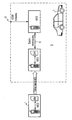
- FIG. 1 shows a possible application of the method according to the invention in a motor vehicle 1.
- the motor vehicle (motor vehicle) 1 is a permanently installed mobile communication device ME 2 in the form of a GSM / GPRS communication module, which is based on the requirements u.a. regarding vibration and temperature resistance to the environment is optimized.
- Tasks of the ME 2 are u.a. for example in accident emergency call, transmission of navigation data, access to vehicle data for service purposes and telemetry.
- the permanently installed ME 2 provides via its outside the passenger compartment 3 arranged antenna 4 wireless access to the mobile network.
- the ME 2 does not have its own SIM card and is therefore configured as a client.
- a user with a mobile phone ME 5 in the passenger compartment 3, he can put the ME 5 in a designated device 6.
- This device provides a data connection, such as a serial data cable, to the built-in GSM / GPRS module ME 2.
- the ME 5 is configured as a server and provides its built-in ME 2 with its SIM.
- the ME 2 takes over the communication to the mobile network after the ME 5 has switched off its GSM / GPRS-Air interface.
- the user receives a communication system optimized for this environment.
Landscapes
- Engineering & Computer Science (AREA)
- Computer Networks & Wireless Communication (AREA)
- Signal Processing (AREA)
- Mobile Radio Communication Systems (AREA)
- Telephone Function (AREA)
Description
- Die vorliegende Erfindung betrifft ein Verfahren zur Realisierung eines Zugriffs eines ersten mobilen Kommunikationsgeräts (Mobile Equipment ME) auf ein Subscriber Identity Modul (SIM) oder Universal Subscriber Identity Modul (USIM) eines zweiten mobilen Kommunikationsgeräts (ME). Bei dem mobilen Kommunikationsgerät kann es sich dabei beispielsweise um ein Mobile Phone, ein Autotelefon, ein Modem, ein Funkmodem oder ein Wireless Modul handeln.
- Aus der US-A-6 141 564 ist bekannt, dass zwei autonome Kommunikationsmodule ("Master-Komponenten"), die jeweils für eine Kommunikation in einem separaten Netzwerk vorgesehen sind, auf eine einzige SIM-Karte zugreifen. Die beiden Kommunikationsmodule sind in einem Multi-Modus-Telefon integriert.
- Aus der US-A-5 887 266 ist bekannt, dass ein mobiles Kommunikationsgerät über eine logische AT-Kommando-basierte Schnittstelle auf ein Applikationsmodul zugreift.
- Auf einer SIM-Karte eines mobilen Kommunikationsgeräts werden Daten für die Authentifizierung in GSM, GPRS oder UMTS-Mobilfunknetzen und andere benutzerbezogene Informationen gespeichert. Zudem werden über die SIM die von einem mobilen Kommunikationsgerät genutzten Netzressourcen einem Nutzer und damit einem Konto zugeordnet.
- Eine SIM-Karte besteht aus einem Prozessor, der unter anderem über einen Algorithmus für eine sichere Authentifizierung im Netz sorgt. Dieser Prozessor befindet sich auf einer Karte, einer so genannten Smart Card, die in ein SIM-Kartenlesegerät eingebracht wird. Dieses Lesegerät ist wiederum in einem mobilen Kommunikationsnetz integriert.
- Das bedeutet, dass jedes mobile Kommunikationsgerät, dass sich in einem GSM/UMTS-Mobilfunknetz anmelden und authentifizieren will, über eine SIM verfügen muss. Da aber das zu i-dentifizierende Konto einem Nutzer zugeordnet ist, ist die Verwendung mehrerer mobiler Kommunikationsgeräte durch einen Nutzer nur durch eine buchhalterische Zuordnung unterschiedlicher logischer Nutzer, d.h. unterschiedlicher mobiler Kommunikationsgeräte, auf ein Konto möglich, beispielsweise mittels einer "Twin Card" von D1.
- Bislang ist es nicht möglich, dass sich ein Nutzer mit unterschiedlichen mobilen Kommunikationsgeräten über eine Identität, d.h. mittels einer SIM, in einem GSM-Mobilfunknetz anmeldet.
- Mit der Erweiterung der möglichen mobilen Dienste, die mit einem mobilen Kommunikationsgerät genutzt werden können, steigen die Anforderungen an die mobilen Kommunikationsgeräte erheblich. Daraus folgt, dass ein Nutzer verschiedene mobile Dienste über mehrere auf den jeweiligen Dienst spezialisierte mobile Kommunikationsgeräte nutzt.
- Um dem Nutzer den Zugang über verschiedene mobile Kommunikationsgeräte zum GSM/UMTS-Mobilfunknetz zu ermöglichen, ist es notwendig, dass sich der Nutzer über jedes mobile Kommunikationsgerät bei dem GSM/UMTS-Mobilfunknetz anmelden kann.
- Eine Aufgabe der vorliegenden Erfindung ist es, ein Verfahren und eine Anordnung von mobilen Kommunikationsgeräten zur Verfügung zu stellen, mit deren Hilfe ein Nutzer unter Nutzung mehrerer mobiler Kommunikationsgeräte sich möglichst schnell und einfach in einem GSM/UMTS-Mobilfunknetz anmelden kann.
- Gelöst wird diese Aufgabe durch ein erfindungsgemäßes Verfahren nach Anspruch 1 bzw. durch eine erfindungsgemäße Anordnung gemäß Anspruch 5. Vorteilhafte Ausgestaltungen sind in den entsprechenden Unteransprüchen aufgezeigt.
- Gemäß Anspruch 1 wird erfindungsgemäß ein Verfahren zur Realisierung eines externen Zugriffs eines ersten mobilen Kommunikationsgeräts (ME) auf ein Subscriber Identity Modul (SIM) eines zweiten mobilen Kommunikationsgeräts (ME) bereit gestellt, wobei eine logische Schnittstelle zwischen dem ersten und dem zweiten mobilen Kommunikationsgerät definiert wird, über die eine logische autonome Kommunikation zwischen dem ersten und dem zweiten mobilen Kommunikationsgerät ermöglicht wird.
- Bisher musste in jedem mobilen Kommunikationsgerät eine SIM zur Identifikation eines Nutzer bzw. Subscribers integriert sein. Die SIM ist Bestandteil eines mobilen Kommunikationsgerätes. Um mehrere SIM-Karten, d.h. im Prinzip mehrere mobile Kommunikationsgeräte einem Nutzer bzw. dessen Konto zuzuordnen, gibt es von einigen Mobilfunkanbietern sogenannte Twin-Cards. Mittels dieser Karten werden beispielsweise zwei mobile Kommunikationsgeräte eines Nutzers zusammen abgerechnet.
- Diese Lösung hat jedoch Nachteile. Da zwei mobile Kommunikationsgeräte mit eigenen SIM-Karten über nur eine Telefonnummer angesprochen werden, ist dem entsprechenden Netzwerk nicht bekannt, an welchem Gerät ankommende Anrufe signalisiert werden sollen. Es erfordert zusätzlichen Koordinationsaufwand durch Netzwerk oder Anwender, das aktive Kommunikationsgerät zu erkennen, z.B. Verwendung des zuletzt im Netzwerk eingebuchten mobilen Kommunikationsgerätes.
- Es besteht keine Möglichkeit für eine automatische Umschaltung zwischen den mobilen Kommunikationsgeräten.
- Zudem ist es einem Nutzer nicht möglich von einem mobilen Kommunikationsgerät auf die SIM eines anderen mobilen Kommunikationsgerät zuzugreifen. Damit stehen ihm Dienste wie Telefonbuch beispielsweise nur über das mobile Kommunikationsgerät zur Verfügung, das unmittelbar mit dem SIM-Kartenleser verbunden ist.
- Ferner ist es auch nachteilig, dass in jedes mobile Kommunikationsgerät eine eigene SIM mit Kartenleser vorzusehen ist. Das ist recht kostenaufwendig.
- Durch die vorliegende Erfindung wird nun ein Verfahren bereit gestellt, mit dessen Hilfe ein Zugriff eines mobilen Kommunikationsgerät auf das Subscriber Identity Module (SIM) eines anderen mobilen Kommunikationsgerätes möglich wird. Der Zugriff erfolgt dabei über eine externe logische Schnittstelle. Steht einem mobilen Kommunikationsgerät keine SIM zur Verfügung, so ermöglicht die vorliegende Erfindung über eine erfindungsgemäße definierte logische Schnittstelle auf die Daten der SIM-Karte eines anderen mobilen Kommunikationsgerätes zuzugreifen.
- In einer bevorzugten Ausführungsform des erfindungsgemäßen Verfahrens wird in dem ersten und dem zweiten mobilen Kommunikationsgerät je eine Adaptionsschicht vorgesehen, die eine logische Kommunikation zwischen dem ersten und dem zweiten mobilen Kommunikationsgerät auf die logische Schnittstelle adaptiert. Das bedeutet, dass ein SIM Service Manager vorgesehen wird, der den Zugriff auf die externe SIM kontrolliert.
- Ferner wird als logische Schnittstelle vorzugsweise eine AT-Kommando-basierte Schnittstelle definiert. Die logische Kommunikation ist unabhängig von der darunter liegenden Übertragungstechnologie.
- In einer weiteren bevorzugten Ausführungsform des erfindungsgemäßen Verfahrens verwendet die logische Schnittstelle eine Client/Server-Architektur. Die erfindungsgemäß vorgesehene Adaptionsschicht ist Bestandteil des bereits erwähnten SIM Service Managers. Die Adaptionsschicht adaptiert die logische Kommunikation zwischen einem Client und einem Server auf die logische, vorzugsweise AT-Kommando-basierte Schnittstelle. Das mobile Kommunikationsgerät ohne SIM übernimmt dabei die Rolle des Client, wogegen das mobile Kommunikationsgerät mit SIM den Dienst "SIM Service" zur Verfügung stellt und so die Rolle des Servers einnimmt. Der Server, bzw. genauer gesagt der SIM Access Server, erlaubt einem anderen mobilen Kommunikationsgerät Zugriff auf die Daten einer SIM-Karte über eine externe logische Schnittstelle. Bei dem Server kann es sich dabei beispielsweise um ein Mobiltelefon handeln, das über eine integrierte SIM-Karte verfügt. Über eine Funk- oder Kabelverbindung kann das Mobiltelefon als Server anderen mobilen Kommunikationsgeräten ermöglichen, auf seine SIM-Karte zuzugreifen.
- Der Client, bzw. genauer der SIM Access Client verwendet über eine Geräteverbindung mit einem Server über eine externe logische Schnittstelle dessen SIM-Karte. Bei dem SIM Access Client kann es sich beispielsweise um ein GSM/GPRS-Modul handeln, das in ein Automobil montiert ist. Diese Modul soll beispielsweise die Kommunikation über ein Mobilfunknetz an die spezielle Umgebung anpassen.
- Von dem Client wird beispielsweise eine Anfrage, ein sogenannter Request an den Server gestellt. Dies erfolgt vorzugsweise durch Versenden des Requests als AT-Kommando über eine externe AT-Kommando-basierte Schnittstelle an den Server. Der Server antwortet mit einer Information Response, die ebenfalls vorzugsweise als AT-Kommando zum Client gesendet wird. Der Server kann Ereignisse auch ohne vorherige Aufforderung durch den Client über sogenannte Unsolicited Result Codes (URC) melden.
- Ein großer Vorteil der vorliegenden Erfindung liegt in der Nutzung einer AT-Kommando-Schnittstelle zur Realisierung eines externen Zugriffs auf eine SIM, d.h. um ein SIM-Sharing zu ermöglichen. Dabei stellt ein mobiles Kommunikationsgerät, das dann als Server fungiert, einem anderen mobilen Kommunikationsgerät, das dann ein Client ist und einen Dienst nutzen möchte, eine SIM zur Verfügung, mittels derer der Dienst nutzbar wird.
- In einer weiteren bevorzugten Ausführungsform des erfindungsgemäßen Verfahrens verwendet die logische Schnittstelle als Übertragungstechnologie RS-232, USB, Bluetooth, Wireless-LAN (WLAN) oder Ultra-Wide-Band (UWB).
- Durch die Unabhängigkeit der logischen Schnittstelle von der Übertragungstechnologie ergibt sich beispielhaft der Vorteil, dass das SIM-Sharing leicht auf unterschiedliche Anwendungsfälle übertragen werden kann.
- Ferner betrifft die vorliegende Erfindung eine entsprechende Anordnung von mindestens einem ersten und einem zweiten mobilen Kommunikationsgerät (ME), wobei eine logische Schnittstelle definiert ist, über die das erste mobile Kommunikationsgerät Zugriff auf ein SIM des zweiten mobilen Kommunikationsgerät hat.
- Vorzugsweise ist dabei, wie bereits erläutert, die logische Schnittstelle eine AT-Kommando-basierte Schnittstelle.
- In einer bevorzugten Ausführungsform der erfindungsgemäßen Anordnung ist in dem ersten und dem zweiten mobilen Kommunikationsgerät je eine Adaptionsschicht, die eine logische Kommunikation zwischen dem ersten und dem zweiten mobilen Kommunikationsgerät auf die logische Schnittstelle adaptiert.
- Vorzugsweise kann die logische Schnittstelle als Übertragungstechnologie RS-232, USB, Bluetooth, Wireless-LAN (WLAN) oder Ultra-Wide-Band (UWB) verwenden.
- Weitere Vorteile der vorliegenden Erfindung sollen anhand der folgenden Figur näher erläutert werden.
- Es zeigt:
- Fig.1 schematische Darstellung einer Ausführungsform des Ablaufs des erfindungsgemäßen Verfahrens.
- In Figur 1 ist eine mögliche Anwendung des erfindungsgemäßen Verfahrens in einem Kraftfahrzeug 1 dargestellt. In dem Kraftfahrzeug (KFZ) 1 befindet sich ein fest installiertes mobiles Kommunikationsgerät ME 2 in Form eines GSM/GPRS-Kommunikationsmoduls, das auf die Anforderungen u.a. bzgl. Vibrations- und Temperaturfestigkeit auf die Umgebung optimiert ist. Aufgaben des ME 2 bestehen u.a. beispielsweise in Unfall-Notruf, Übermittlung von Navigationsdaten, Zugriff auf Kfz-Daten für Servicezwecke und Telemetrie.
- Das fest installierte ME 2 stellt über seine außerhalb der Fahrgastzelle 3 angeordnete Antenne 4 den drahtlosen Zugriff auf das Mobilfunknetz bereit. Das ME 2 verfügt aber nicht über eine eigene SIM-Karte und ist daher als Client konfiguriert. Kommt nun ein Nutzer mit einem mobilen Telefon ME 5 in die Fahrgastzelle 3, so kann er das ME 5 in eine dafür vorgesehene Einrichtung 6 stecken. Diese Einrichtung bietet eine Datenverbindung, beispielsweise ein serielles Datenkabel, zu dem eingebauten GSM/GPRS-Modul ME 2. Das ME 5 ist als Server konfiguriert und stellt dem eingebauten ME 2 seine SIM zur Verfügung. Damit übernimmt das ME 2 die Kommunikation zum Mobilfunknetz, nachdem das ME 5 sein GSM/GPRS-Air-Interface abgeschaltet hat. Somit erhält der Nutzer ein auf diese Umgebung optimiertes Kommunikationssystem.
Claims (8)
- Verfahren zur Realisierung eines externen Zugriffs eines ersten mobilen Kommunikationsgeräts (ME2) auf ein Subscriber Identity Modul (SIM) eines zweiten mobilen Kommunikationsgeräts (MES),
dadurch gekennzeichnet, dass
eine logische AT-Kommando-basierte Schnittstelle zwischen dem ersten und dem zweiten mobilen Kommunikationsgerät (ME2, ME5) definiert wird, über die der Zugriff des ersten mobilen Kommunikationsgeräts (ME2) auf das Subscriber Identity Modul (SIM) des zweiten mobilen Kommunikationsgeräts (ME5) ermöglicht wird. - Verfahren nach Anspruch 1,
dadurch gekennzeichnet,
dass in dem ersten und dem zweiten mobilen Kommunikationsgerät (ME2, ME5) je eine Adaptionsschicht vorgesehen wird, die eine logische Kommunikation zwischen dem ersten und dem zweiten mobilen Kommunikationsgerät (ME2, ME5) auf die logische AT-Kommando-basierte Schnittstelle adaptiert. - Verfahren nach einem der vorhergehenden Ansprüche,
dadurch gekennzeichnet,
dass die logische AT-Kommando-basierte Schnittstelle eine Client/Server-Architektur verwendet. - Verfahren nach einem der vorhergehenden Ansprüche,
dadurch gekennzeichnet,
dass die logische AT-Kommando-basierte Schnittstelle unabhängig von einer verwendeten Übertragungstechnologie verwendet wird, wobei RS-232, USB, Bluetooth, Wireless-LAN (WLAN) oder Ultra-Wide-Band (UWB) eingesetzt werden. - Anordnung von mindestens einem ersten und einem zweiten mobilen Kommunikationsgerät (ME2, ME5), wobei eine logische AT-Kommando-basierte Schnittstelle definiert ist, über die das erste mobile Kommunikationsgerät (ME2) Zugriff auf ein SIM des zweiten mobilen Kommunikationsgeräts (ME5) hat.
- Anordnung nach Anspruch 5,
dadurch gekennzeichnet,
dass in dem ersten und dem zweiten mobilen Kommunikationsgerät (ME2, ME5) je eine Adaptionsschicht existiert, die eine logische Kommunikation zwischen dem ersten und dem zweiten mobilen Kommunikationsgerät (ME2, ME5) auf die logische AT-Kommando-basierte Schnittstelle adaptiert. - Anordnung nach einem der Ansprüche 5 oder 6,
dadurch gekennzeichnet,
dass die logische AT-Kommando-basierte Schnittstelle als Übertragungstechnologie RS-232, USB, Bluetooth, Wireless-LAN (WLAN) oder Ultra-Wide-Band (UWB) verwendet. - Anordnung nach einem der Ansprüche 5 bis 7,
dadurch gekennzeichnet,
dass in dem ersten mobilen Kommunikationsgerät (ME2) kein SIM eingesetzt ist.
Applications Claiming Priority (3)
| Application Number | Priority Date | Filing Date | Title |
|---|---|---|---|
| DE10225457 | 2002-06-05 | ||
| DE10225457A DE10225457A1 (de) | 2002-06-05 | 2002-06-05 | Nutzung eines Subscriber Identity Modul durch mehrere mobile Kommunikationsgeräte |
| PCT/DE2003/001688 WO2003105508A1 (de) | 2002-06-05 | 2003-05-21 | Nutzung eines subscriber identity modul durch mehrere mobile kommunikationsgeräte |
Publications (2)
| Publication Number | Publication Date |
|---|---|
| EP1510094A1 EP1510094A1 (de) | 2005-03-02 |
| EP1510094B1 true EP1510094B1 (de) | 2006-04-19 |
Family
ID=29718898
Family Applications (1)
| Application Number | Title | Priority Date | Filing Date |
|---|---|---|---|
| EP03756949A Expired - Lifetime EP1510094B1 (de) | 2002-06-05 | 2003-05-21 | Nutzung eines subscriber identity moduls durch mehrere mobile kommunikationsgeräte |
Country Status (9)
| Country | Link |
|---|---|
| US (1) | US20050255885A1 (de) |
| EP (1) | EP1510094B1 (de) |
| JP (1) | JP4490810B2 (de) |
| KR (1) | KR101002821B1 (de) |
| CN (1) | CN1306839C (de) |
| AU (1) | AU2003232156A1 (de) |
| DE (2) | DE10225457A1 (de) |
| ES (1) | ES2261967T3 (de) |
| WO (1) | WO2003105508A1 (de) |
Families Citing this family (18)
| Publication number | Priority date | Publication date | Assignee | Title |
|---|---|---|---|---|
| US20080254766A1 (en) * | 2007-04-10 | 2008-10-16 | Craven Jeffrey A | Method and system for using an integrated subscriber identity module in a network interface unit |
| DE10351702A1 (de) * | 2003-11-03 | 2005-06-16 | Funkwerk Dabendorf-Gmbh | Zusatzgerät für eine Einrichtung zur Nutzung eines funkgestützten Dienstes |
| DE102004014419A1 (de) * | 2004-03-19 | 2004-12-30 | Siemens Ag | Verfahren zur Bereitstellung von Daten einer in ein Mobilfunkgerät eingelegten SIM-Karte für ein Mobilfunkmodul |
| US20060099991A1 (en) * | 2004-11-10 | 2006-05-11 | Intel Corporation | Method and apparatus for detecting and protecting a credential card |
| KR100735427B1 (ko) * | 2005-02-07 | 2007-07-04 | 삼성전자주식회사 | 이동 통신 단말의 sim 카드 공유 방법 |
| DE102005014982B4 (de) * | 2005-03-24 | 2016-01-21 | Volkswagen Ag | Verfahren und Vorrichtung für ein Umschalten einer SIM-Datenverwendung zwischen zwei Endgeräten eines Mobilfunkstandards, insbesondere von GSM-Endgeräten |
| AU2007229260B2 (en) * | 2006-03-21 | 2011-04-14 | Licania Gmbh | Method and appliance for communication between a large number of mobile stations and a fixed network underground |
| EP2009868B1 (de) * | 2007-06-29 | 2016-09-07 | Alcatel Lucent | Methode und System zur Verbesserung des Erscheinungsbilds einer Person oder von einem Medien-Endgerät kommenden RTP-Stroms |
| EP2215884B1 (de) * | 2007-11-26 | 2013-09-11 | Gemalto M2M GmbH | Verfahren zum auslesen der auf einer chipkarte implementierten applikationen |
| DE102008007085A1 (de) * | 2008-01-31 | 2009-08-06 | T-Mobile Internationale Ag | Verfahren zur Verwaltung der Autorisierung von Mobiltelefonen ohne SIM-Karte |
| DE102008025792A1 (de) * | 2008-05-29 | 2009-12-17 | T-Mobile International Ag | Personalisierung einer SIM mittels einer eindeutigen, personlisierten MasterSIM |
| EP2544432A1 (de) * | 2011-07-05 | 2013-01-09 | Gemalto SA | Datenübertragungssystem zwischen einem Telekommunikationsendgerät und einem versetzten gesicherten Element |
| CN104717720A (zh) * | 2013-12-13 | 2015-06-17 | 香港优克网络技术有限公司 | 一种多通道通信终端 |
| EP2981113B1 (de) * | 2014-07-31 | 2019-07-03 | Samsung Electronics Co., Ltd | Mobiler kommunikationsdienst zwischen mobilen vorrichtungen mit derselben telefonnummer |
| CN105792094B (zh) * | 2014-12-22 | 2019-11-05 | 南京中兴软件有限责任公司 | 一种实现一卡多机的方法及装置 |
| US11432116B2 (en) | 2016-01-20 | 2022-08-30 | Guangdong Oppo Mobile Telecommunications Corp, Ltd. | Method and device for transmitting data in internet of vehicles system |
| WO2022117381A1 (en) * | 2020-12-04 | 2022-06-09 | Shenzhen GOODIX Technology Co., Ltd. | System and method for sim card sharing in local area networks |
| EP4009684A1 (de) * | 2020-12-04 | 2022-06-08 | Shenzhen Goodix Technology Co., Ltd. | System und verfahren zur gemeinsamen benutzung von sim-karten in lokalen netzwerken |
Family Cites Families (13)
| Publication number | Priority date | Publication date | Assignee | Title |
|---|---|---|---|---|
| DE59408822D1 (de) * | 1994-02-23 | 1999-11-18 | Mannesmann Ag | Teilnehmersystem für digitale Telefonnetze, insbesondere Mobilfunknetze |
| JP3266406B2 (ja) * | 1994-03-08 | 2002-03-18 | 富士通株式会社 | ディジタルデータ通信アダプタ装置,ディジタルデータ端末及びディジタル携帯無線機 |
| JPH08140136A (ja) * | 1994-11-07 | 1996-05-31 | Oki Electric Ind Co Ltd | 通信システム |
| FI99071C (fi) * | 1995-02-15 | 1997-09-25 | Nokia Mobile Phones Ltd | Menetelmä sovellusten käyttämiseksi matkaviestimessä ja matkaviestin |
| FR2767626B1 (fr) * | 1997-08-25 | 1999-10-15 | Alsthom Cge Alcatel | Terminal radiotelephonique a carte d'identification d'abonne |
| US6141564A (en) * | 1999-09-30 | 2000-10-31 | Motorola, Inc. | Method of sharing a SIM card between two masters |
| JP2001223760A (ja) * | 1999-11-12 | 2001-08-17 | Sony Corp | 通信制御装置及びそのホスト機器並びに通信方法 |
| FI108977B (fi) * | 1999-11-22 | 2002-04-30 | Nokia Corp | Televiestintäpalveluiden laskuttaminen |
| WO2001043460A2 (de) * | 1999-12-09 | 2001-06-14 | Vodafone Ag | Mobilfunkendgerät für telematikdienste |
| US6466804B1 (en) * | 2000-08-25 | 2002-10-15 | Motorola, Inc. | Method and apparatus for remote multiple access to subscriber identity module |
| GB0021988D0 (en) * | 2000-09-07 | 2000-10-25 | Nokia Mobile Phones Ltd | Management of portable radiotelephones |
| DE10108056A1 (de) * | 2001-02-20 | 2002-08-22 | Siemens Ag | Verfahren zum Betreiben eines mobilen Telekommunikationsgerätes nach mindestens zwei Mobilfunkstandards, ein entsprechendes Telekommunikationsgerät sowie entsprechende Computerprogramme und ein entsprechendes Computerprogramm-Erzeugnis |
| US6937854B2 (en) * | 2002-01-04 | 2005-08-30 | Vtech Telecommunications, Limited | Apparatus for conducting a conference call between a wireless line and a land line using customer premise equipment |
-
2002
- 2002-06-05 DE DE10225457A patent/DE10225457A1/de not_active Withdrawn
-
2003
- 2003-05-21 KR KR1020047019705A patent/KR101002821B1/ko not_active Expired - Lifetime
- 2003-05-21 DE DE50303040T patent/DE50303040D1/de not_active Expired - Lifetime
- 2003-05-21 EP EP03756949A patent/EP1510094B1/de not_active Expired - Lifetime
- 2003-05-21 AU AU2003232156A patent/AU2003232156A1/en not_active Abandoned
- 2003-05-21 US US10/516,774 patent/US20050255885A1/en not_active Abandoned
- 2003-05-21 CN CNB038130416A patent/CN1306839C/zh not_active Expired - Lifetime
- 2003-05-21 JP JP2004512438A patent/JP4490810B2/ja not_active Expired - Lifetime
- 2003-05-21 ES ES03756949T patent/ES2261967T3/es not_active Expired - Lifetime
- 2003-05-21 WO PCT/DE2003/001688 patent/WO2003105508A1/de not_active Ceased
Also Published As
| Publication number | Publication date |
|---|---|
| EP1510094A1 (de) | 2005-03-02 |
| DE10225457A1 (de) | 2004-01-08 |
| KR101002821B1 (ko) | 2010-12-21 |
| AU2003232156A1 (en) | 2003-12-22 |
| CN1659913A (zh) | 2005-08-24 |
| US20050255885A1 (en) | 2005-11-17 |
| DE50303040D1 (de) | 2006-05-24 |
| JP4490810B2 (ja) | 2010-06-30 |
| CN1306839C (zh) | 2007-03-21 |
| WO2003105508A1 (de) | 2003-12-18 |
| ES2261967T3 (es) | 2006-11-16 |
| KR20050004909A (ko) | 2005-01-12 |
| JP2005534214A (ja) | 2005-11-10 |
Similar Documents
| Publication | Publication Date | Title |
|---|---|---|
| EP1510094A1 (de) | Nutzung eines subscriber identity modul durch mehrere mobile kommunikationsger te | |
| DE69734322T2 (de) | Gebrauch von zwei sim-karten mit gleicher msisdn-nummer | |
| DE69732567T2 (de) | Verfahren und vorrichtung zur anonymen datenübetragung in einem kommunikationssystem | |
| EP1033048B1 (de) | Mobilfunksystem mit dynamisch änderbarer Identität eines mobilen Endgerätes | |
| EP0524200B1 (de) | Schaltungsanordnung für aus vermittlungsstellen bestehende fernmeldewählnetze, vorzugsweise fernsprechwählnetze | |
| EP1537755A1 (de) | Verfahren zum betreiben von endgeräten eines mobilfunkkommunikationssystems | |
| WO2009095048A1 (de) | Verfahren zur verwaltung der autorisierung von mobiltelefonen ohne sim-karte | |
| EP1634473A2 (de) | Kraftfahrzeug-mobilfunkanordnung | |
| EP2104394B1 (de) | Verfahren und Telekommunikationsanordnung zum Bereitstellen einer Telekommunikationsverbindung (TK-Verbindung) zu einem gerufenen Mobilfunkendgerät | |
| EP2375843B1 (de) | Betrieb eines Mobilfunknetzes unter Verwendung von Zugriffsberechtigungsdaten | |
| EP0789500A2 (de) | Verfahren zur Veränderung der Berechtigung zur Kontakaufnahme in einem bidirktionalen Mobilfunknetz und Telekommunikationsendgerät | |
| EP3127396B1 (de) | Verfahren zur ressourcen-verwaltung in einer fahrzeugbasierten mobilfunkeinrichtung | |
| WO2021058182A1 (de) | Verfahren und system zum bereitstellen einer kommunikationsfunktion in einem fortbewegungsmittel | |
| DE102020104709B3 (de) | Verfahren, zentrale Einheit und System zum Bereitstellen einer Kommunikationsfunktion in einem Fortbewegungsmittel | |
| DE19827916A1 (de) | Verfahren und Funk-Kommunikationssystem zur Datenübertragung | |
| EP1201073B1 (de) | Verfahren zur herstellung von kommunikationsverbindungen zu einer, einem fahrzeug oder sonstigen mobilen oder ortsfesten einrichtung zugeordneten, vorzugsweise mobilen kommunikationsendeinrichtung mittels kennnummer | |
| EP3395093B1 (de) | Vorrichtung und verfahren zum betreiben eines kommunikationsnetzwerkes | |
| EP0932997B1 (de) | Verfahren zum zugreifen von mobilen kommunikationsendgeräten auf öffentliche, private bzw. heim-kommunikationsbereiche | |
| EP1230779B1 (de) | Verfahren, chipkarte, und vorrichtung für eine logische schnittstelle zwischen zwei anwendungen | |
| EP1519603A1 (de) | Verfahren zur Authentisierung eines Teilnehmers für einen über ein Kommunikationssystem angebotenen Dienst | |
| DE102020104712B4 (de) | Verfahren und System zum Bereitstellen einer Kommunikationsfunktion in einem mobilen Netzwerk | |
| DE102013017082A1 (de) | Zugangs- oder Fahrberechtigungssystem für ein Fahrzeug und Verfahren zum Steuern einer Zugangsberechtigung oder Fahrberechtigung für ein Fahrzeug | |
| DE102013202426A1 (de) | Verfahren zum Ermöglichen einer Datenkommunikation zwischen einer Kommunikationseinrichtung eines Kraftfahrzeugs und einem Internetserver und entsprechendes System | |
| EP1643782B1 (de) | Verfahren zum Bereitstellen von ein Mobilfunkgerät in einem Mobilfunknetzwerk identifizierenden Geräteidentifikationen in dem Mobilfunkgerät | |
| DE10029755B4 (de) | Verfahren zur Betriebssteuerung in einem Mobiltelefonnetz |
Legal Events
| Date | Code | Title | Description |
|---|---|---|---|
| PUAI | Public reference made under article 153(3) epc to a published international application that has entered the european phase |
Free format text: ORIGINAL CODE: 0009012 |
|
| 17P | Request for examination filed |
Effective date: 20041013 |
|
| AK | Designated contracting states |
Kind code of ref document: A1 Designated state(s): AT BE BG CH CY CZ DE DK EE ES FI FR GB GR HU IE IT LI LU MC NL PT RO SE SI SK TR |
|
| AX | Request for extension of the european patent |
Extension state: AL LT LV MK |
|
| 17Q | First examination report despatched |
Effective date: 20050429 |
|
| DAX | Request for extension of the european patent (deleted) | ||
| RBV | Designated contracting states (corrected) |
Designated state(s): DE ES FR GB |
|
| GRAP | Despatch of communication of intention to grant a patent |
Free format text: ORIGINAL CODE: EPIDOSNIGR1 |
|
| GRAS | Grant fee paid |
Free format text: ORIGINAL CODE: EPIDOSNIGR3 |
|
| GRAA | (expected) grant |
Free format text: ORIGINAL CODE: 0009210 |
|
| AK | Designated contracting states |
Kind code of ref document: B1 Designated state(s): DE ES FR GB |
|
| REG | Reference to a national code |
Ref country code: GB Ref legal event code: FG4D Free format text: NOT ENGLISH |
|
| GBT | Gb: translation of ep patent filed (gb section 77(6)(a)/1977) |
Effective date: 20060427 |
|
| REF | Corresponds to: |
Ref document number: 50303040 Country of ref document: DE Date of ref document: 20060524 Kind code of ref document: P |
|
| REG | Reference to a national code |
Ref country code: ES Ref legal event code: FG2A Ref document number: 2261967 Country of ref document: ES Kind code of ref document: T3 |
|
| ET | Fr: translation filed | ||
| PLBE | No opposition filed within time limit |
Free format text: ORIGINAL CODE: 0009261 |
|
| STAA | Information on the status of an ep patent application or granted ep patent |
Free format text: STATUS: NO OPPOSITION FILED WITHIN TIME LIMIT |
|
| 26N | No opposition filed |
Effective date: 20070122 |
|
| REG | Reference to a national code |
Ref country code: FR Ref legal event code: TP |
|
| REG | Reference to a national code |
Ref country code: GB Ref legal event code: 732E Free format text: REGISTERED BETWEEN 20091022 AND 20091028 |
|
| REG | Reference to a national code |
Ref country code: GB Ref legal event code: 732E Free format text: REGISTERED BETWEEN 20091105 AND 20091111 |
|
| REG | Reference to a national code |
Ref country code: FR Ref legal event code: GC |
|
| REG | Reference to a national code |
Ref country code: FR Ref legal event code: RG |
|
| REG | Reference to a national code |
Ref country code: DE Ref legal event code: R082 Ref document number: 50303040 Country of ref document: DE Representative=s name: EISENFUEHR, SPEISER & PARTNER, DE |
|
| REG | Reference to a national code |
Ref country code: DE Ref legal event code: R082 Ref document number: 50303040 Country of ref document: DE Representative=s name: EISENFUEHR, SPEISER & PARTNER, DE Effective date: 20130522 Ref country code: DE Ref legal event code: R081 Ref document number: 50303040 Country of ref document: DE Owner name: GEMALTO M2M GMBH, DE Free format text: FORMER OWNER: CINTERION WIRELESS MODULES GMBH, 81669 MUENCHEN, DE Effective date: 20130522 Ref country code: DE Ref legal event code: R082 Ref document number: 50303040 Country of ref document: DE Representative=s name: GREVIN, EMMANUEL, FR Effective date: 20130522 |
|
| REG | Reference to a national code |
Ref country code: DE Ref legal event code: R082 Ref document number: 50303040 Country of ref document: DE Representative=s name: GREVIN, EMMANUEL, FR |
|
| REG | Reference to a national code |
Ref country code: FR Ref legal event code: PLFP Year of fee payment: 14 |
|
| REG | Reference to a national code |
Ref country code: FR Ref legal event code: PLFP Year of fee payment: 15 |
|
| REG | Reference to a national code |
Ref country code: FR Ref legal event code: PLFP Year of fee payment: 16 |
|
| PGFP | Annual fee paid to national office [announced via postgrant information from national office to epo] |
Ref country code: GB Payment date: 20220426 Year of fee payment: 20 Ref country code: FR Payment date: 20220421 Year of fee payment: 20 Ref country code: ES Payment date: 20220601 Year of fee payment: 20 Ref country code: DE Payment date: 20220420 Year of fee payment: 20 |
|
| REG | Reference to a national code |
Ref country code: DE Ref legal event code: R071 Ref document number: 50303040 Country of ref document: DE |
|
| REG | Reference to a national code |
Ref country code: ES Ref legal event code: FD2A Effective date: 20230526 |
|
| REG | Reference to a national code |
Ref country code: GB Ref legal event code: PE20 Expiry date: 20230520 |
|
| PG25 | Lapsed in a contracting state [announced via postgrant information from national office to epo] |
Ref country code: ES Free format text: LAPSE BECAUSE OF EXPIRATION OF PROTECTION Effective date: 20230522 |
|
| PG25 | Lapsed in a contracting state [announced via postgrant information from national office to epo] |
Ref country code: GB Free format text: LAPSE BECAUSE OF EXPIRATION OF PROTECTION Effective date: 20230520 |