EP1508987A2 - Optisches Wellenlängenmultiplex-Übertragungssystem - Google Patents
Optisches Wellenlängenmultiplex-Übertragungssystem Download PDFInfo
- Publication number
- EP1508987A2 EP1508987A2 EP04016218A EP04016218A EP1508987A2 EP 1508987 A2 EP1508987 A2 EP 1508987A2 EP 04016218 A EP04016218 A EP 04016218A EP 04016218 A EP04016218 A EP 04016218A EP 1508987 A2 EP1508987 A2 EP 1508987A2
- Authority
- EP
- European Patent Office
- Prior art keywords
- channel group
- signal
- signal light
- port
- interleaver
- Prior art date
- Legal status (The legal status is an assumption and is not a legal conclusion. Google has not performed a legal analysis and makes no representation as to the accuracy of the status listed.)
- Withdrawn
Links
Images










Classifications
-
- H—ELECTRICITY
- H04—ELECTRIC COMMUNICATION TECHNIQUE
- H04J—MULTIPLEX COMMUNICATION
- H04J14/00—Optical multiplex systems
- H04J14/02—Wavelength-division multiplex systems
- H04J14/0227—Operation, administration, maintenance or provisioning [OAMP] of WDM networks, e.g. media access, routing or wavelength allocation
-
- H—ELECTRICITY
- H04—ELECTRIC COMMUNICATION TECHNIQUE
- H04J—MULTIPLEX COMMUNICATION
- H04J14/00—Optical multiplex systems
- H04J14/02—Wavelength-division multiplex systems
- H04J14/03—WDM arrangements
- H04J14/0307—Multiplexers; Demultiplexers
Definitions
- the present invention relates to a wavelength division multiplexing transmission system for separating wavelength division multiplexing signals, where signal lights with different signal bandwidths (e.g. bit rates) are wavelength-division multiplexed, according to the signal bandwidth (bit rate), and processing separated signals individually and the relay node (compensating node) thereof.
- signal lights with different signal bandwidths e.g. bit rates
- bit rate the signal bandwidth
- WDM Wavelength Division Multiplexing
- a partial upgrade must be considered in terms of installation cost and upgrade of in-service, such as switching the bit rate of a part of the wavelengths of a conventional 10 Gbit/s WDM transmission system from 10 Gbit/s to 40 Gbit/s, or adding 40 Gbit/s bit rate signal lights to an open channel of the conventional 10 Gbit/s WDM transmission system, rather than switching all of the wavelengths to be multiplexed to a 40 Gbit/s bit rate at one time.
- upgrading to a system where 10 Gbit/s and 40 Gbit/s are mixed is under consideration.
- the wavelength interval of signal lights becomes dense, and in the current 10 Gbit/s systems, systems of which the wavelength interval (frequency interval) of adjacent signal lights is 50 GHz have been commercialized, and the use of a 100 GHz wavelength interval (frequency interval) is under consideration for 40 Gbit/s systems.
- a method often used is multiplexing/demultiplexing lights in the 1:N channel optical multiplex/demultiplex module using an arrayed waveguide grating (AWG) filter or multi-layer film filter, and further multiplexing/demultiplexing these lights using an interleaver.
- AMG arrayed waveguide grating
- spectral efficiency which indicates the bit rate per unit frequency, is used.
- the interleaver is an optical multiplexer/demultiplexer which has a function to demultiplex a signal group with a certain wavelength interval into an odd channel and even channel so as to create a signal group with a double wavelength interval, or to multiplex the odd channel and even channel so as to create a signal group with a 1/2 wavelength interval (e.g. Kito, et al: PLC filter synthesis theory and application to the interleaver filter, NTT R&D, Vol. 50, No. 4, pp. 281 - 287, 2001).
- Kito, et al PLC filter synthesis theory and application to the interleaver filter, NTT R&D, Vol. 50, No. 4, pp. 281 - 287, 2001.
- a system before upgrade that is a system which wavelength-division multiplexes and transmits 10 Gbit/s signal lights with a 50 GHz interval
- WDM wavelength-division multiplexing signals
- the signal spectrum of 40 Gbit/s normally spreads to four times that of 10 Gbit/s, so the required specifications (e.g. transmission characteristics, distribution characteristics) are stricter in a device for 40 Gbit/s than in a device for 10 Gbit/s. Therefore the device for 40 Gbit/s requires higher performance and higher specifications, which increases cost.
- the required specifications e.g. transmission characteristics, distribution characteristics
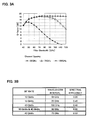
- Fig. 34A shows the transmission characteristics of a multiplexer/demultiplexer for high-speed 40 Gbit/s, and a multiplexer/demultiplexer for low-speed 10 Gbit/s, and since the multiplexer/demultiplexer for high-speed requires a higher flatness and more vertical edges than the multiplexer/demultiplexer for low-speed, price becomes higher.
- Fig. 34A shows the transmission characteristics of a multiplexer/demultiplexer for high-speed 40 Gbit/s, and a multiplexer/demultiplexer for low-speed 10 Gbit/s, and since the multiplexer/demultiplexer for high-speed requires a higher flatness and more vertical edges than the multiplexer/demultiplexer for low-speed, price becomes higher.
- 34B shows the Q factor deterioration with respect to the shift of the central wavelength when the 40 Gbit/s signal (high-speed signal) is input to both the multiplexer/demultiplexer for high-speed and the multiplexer/demultiplexer for low-speed, where the Q factor deterioration is smaller in the multiplexer/demultiplexer for high-speed than in the multiplexer/demultiplexer for low-speed.
- the multiplexer/demultiplexer for high-speed has high performance using high specifications to decrease the Q factor deterioration, so the device cost is higher in the multiplexer/demultiplexer for high-speed.
- the present invention provides a wavelength division multiplexing transmission system which separates the wavelength division multiplexing signals, where signal lights with different signal bandwidths (e.g. bit rates) are wavelength-division multiplexed, according to the signal bandwidth (bit rate), and processes the separated signals individually.
- signal lights with different signal bandwidths e.g. bit rates
- bit rate the signal bandwidth
- the wavelength division multiplexing transmission system is a wavelength division multiplexing transmission system for transmitting wavelength division multiplexing signals comprising a first channel group, that is one of an even channel group and an odd channel group, and a second channel group, that is the other thereof, wherein a first signal light of which the signal bandwidth is relatively large can be allocated to each channel of the first channel group, a second signal light of which the signal bandwidth is relatively small can be allocated to each channel of the second channel group, the first signal light or the second signal light is allocated to the even channel group, and the second signal light is allocated to the second channel group, and this wavelength division multiplexing transmission system further comprises at least one of a demultiplexing module unit and a multiplexing module unit, wherein the demultiplexing module unit further comprises a first interleave filter unit for demultiplexing the wavelength division multiplexing signal that is input, into a signal light of the first channel group and a signal light of the second channel group and outputting these signal lights, and a first demultiplexing unit for de
- the relay node is a relay node for transmitting wavelength division multiplexing signals comprising a first channel group that is one of an even channel group and an odd channel group, and a second channel group, that is the other thereof, wherein a first signal light of which the signal bandwidth is relatively large can be allocated to each channel of the first channel group, and a second signal light of which the signal bandwidth is relatively small can be allocated to each channel of the second channel group, the first signal light or the second signal light is allocated to the even channel group, and the second signal light is allocated to the second channel group, and this relay node further comprises a demultiplexing module unit and a multiplexing module unit, wherein the demultiplexing module unit further comprises a first interleave filter unit for demultiplexing the wavelength division multiplexing signal that is input, into a signal light of the first channel group and a signal light of the second channel group, and outputting these signals, and a first demultiplexing unit for demultiplexing the signal light of the first channel group from the first interle
- the first signal light that has a relatively large signal bandwidth, or a second signal light, that has a relatively small signal bandwidth, is allocated to the first channel group.
- the first signal light is a signal that has a higher speed bit rate than the second signal light.
- the second signal light is allocated to the second channel group.
- the signal light of the first channel group and the signal light of the second channel group are separated by the first interleave filter unit, and the signal light of the first channel group is demultiplexed by the first demultiplexing unit.
- a high performance and high function device can be used for the device which is appropriate for processing the first signal lights (e.g. signal band is large (bit rate is high)), only in the portion where the first signal light is included in the first channel group, and in the portion where the second channel group (second signal lights included in the first channel) is processed, a device which is appropriate for processing the second signal lights, which is different from the first signal lights, can be used.
- a wavelength division multiplexing transmission system where signal lights with different bit rates are mixed, keeping cost down, can be provided.
- a wavelength division multiplexing transmission system where signal lights with different bit rates are mixed, keeping a cost increase caused by high function devices and various compensation devices down, can be provided. Since the first signal light and the second signal light can be individually processed, a wavelength and polarization mode dispersion compensation method, which are optimum for the respective bit rate, can be applied.
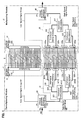
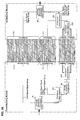
- Fig. 1 is a block diagram depicting the configuration of the optical transmission node according to the first embodiment of the present invention.
- This optical transmission node is a relay node which is installed in the wavelength division multiplexing (WDM) transmission system, and is comprised of a demultiplexing module 1 and a multiplexing module 2.
- WDM wavelength division multiplexing
- the relay node will be described as an example, but the present invention can be applied not only to the relay node of the WDM transmission system but also to the transmission terminal or the reception terminal of the WDM transmission system.
- the multiplexing module 2 is installed, and in the reception terminal, only the demultiplexing module 1 is installed.
- the present invention can be applied to the transmission terminal or the reception terminal in this way, which is the same for the second to twelfth embodiments herein below.
- the demultiplexing module 1 is comprised of an unequal bandwidth interleaver (interleave filter) 10, low-speed demultiplexing unit 11 and high-speed demultiplexing unit 12.
- the low-speed demultiplexing unit 11 has a demultiplexer for low-speed signals 110.
- the high-speed demultiplexing unit 12 has interleavers for high-speed signals (interleave filters) 121 through 123, and demultiplexers for high-speed signals 120a through 120d.
- the multiplexing module 2 is comprised of an unequal bandwidth interleaver (interleave filter) 20, low-speed multiplexing unit 21 and high-speed multiplexing unit 22.
- the low-speed multiplexing unit 21 has a multiplexer for low-speed signals 210.
- the high-speed multiplexing unit 22 has interleavers for high-speed signals (interleave filters) 221 through 223, and multiplexers for high-speed signals 220a through 220d.
- WDM signal W0 will be described as an example of a wavelength-division multiplexed signal light which is input to the demultiplexing module 1, and is output from the multiplexing module 2 (hereafter called "WDM signal").
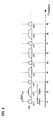
- Fig. 2 shows the arrangement of signal lights with each wavelength that constitutes the WDM signal W0.
- the abscissa indicates the frequencies.
- the WDM signal W0 is a WDM signal where a 10 Gbit/s signal, as an example of a low-speed signal (narrowband signal), and a 40 Gbit/s signal, as an example of a high-speed signal (wideband signal), are mixed.
- the 10 Gbit/s signal is disposed in an odd channel and the 40 Gbit/s signal is disposed in an even channel.
- 44 channels are disposed for both the even channel and the odd channel as an example.
- the signal light of the channel ch1 is disposed in the frequency f1
- the signal light of the channel ch2 is disposed in the frequency f2 respectively.
- the channels of ch3 and later are also sequentially disposed on the ITU-T grid from f3.
- low-speed signals are allocated to an odd channel and the high-speed signals are allocated to an even channel, but high-speed signals may be allocated to an odd channel and low-speed signals may be allocated to an even channel.
- the transmission bandwidth (spectrum width) F1 of the 10 Gbit/s signal is set to 25 GHz
- the transmission bandwidth (spectrum width) F2 of the 40 Gbit/s signal is set to 75 GHz so that the adjacent 10 Gbit/s signal and the 40 Gbit/s signal do not overlap.
- the transmission bandwidth of a 10 Gbit/s signal is generally 50 GHz in the current commercialized 10 Gbit/s WDM transmission systems.
- 100 GHz is being considered as the transmission bandwidth of the 40 Gbit/s signals.
- a narrower bandwidth is assigned, such as 25 GHz for 10 Gbit/s signals and 75 GHz for 40 Gbit/s signals. Due to the following (1) through (3) reasons, signal lights with sufficient quality can be transmitted even with such a bandwidth.
- 10 Gbit/s signal lights and 40 Gbit/s signal lights are transmitted with a 25 GHz and 75 GHz bandwidth respectively.
- each signal light can be arranged on an ITU-T grid and can be transmitted, which is an advantage.
- the spectral efficiency becomes 0.5 Gbit/s/Hz by mixing 10 Gbit/s and 40 Gbit/s, as shown in Fig. 3B, and a spectral efficiency, that is higher than the spectral efficiency 0.4 Gbit/s/Hz when 40 Gbit/s signals are transmitted with a 100 GHz bandwidth, can be achieved.
- 10 Gbit/s signals may be disposed in the even channels where the 40 Gbit/s signals are disposed.
- the even channels signal lights which have a signal bandwidth smaller than the signal bandwidth of the 40 Gbit/s signals may be disposed. Therefore it is not necessary that 40 Gbit/s signals are disposed in all the even channels, but in the transition stage of upgrading, 40 Gbit/s signals may be disposed in a part of the even channels and 10 Gbit/s signals may be disposed in the rest of the even channels.
- the unequal bandwidth interleaver 10 is a demultiplexer for demultiplexing the signal light group (e.g. WDM signals W0) arranged with a 50 GHz frequency interval into even channels and odd channels, so as to be demultiplexed into two signal light groups arranged with a double frequency interval, that is 100 GHz, where the transmission bandwidth and the non-transmission bandwidth of the output ports P1 and P2 are not the same respectively (that is, unequal bandwidths).
- the transmission bandwidth and the non-transmission bandwidth are the same, but the transmission bandwidth and the non-transmission bandwidth of the unequal bandwidth interleaver 10 are not the same.
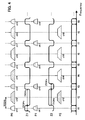
- Fig. 4 shows the transmission characteristics of the unequal bandwidth interleaver 10 and the status when the WDM signal is filtered by the unequal bandwidth interleaver 10.
- the convex portions of the graph of the transmission characteristics in Fig. 4 indicate the frequency band where light transmits (transmission band), and the concave portions of the graph indicate the frequency band where light does not transmit (non-transmission band, filtered band).
- the transmission band has a 25 GHz bandwidth and the non-transmission band has a 75 GHz bandwidth, and both are repeated alternately with a 100 GHz period.
- the central frequency of the transmission band is set (adjusted) so as to match with the frequency of the odd channels.
- the transmission band has a 75 GHz bandwidth and the non-transmission band has a 25 GHz bandwidth, and both are repeated alternately with a 100 GHz period.
- the central frequency of the transmission band is set (adjusted) so as to match with the frequency of the even channels.
- low-speed signal group W1 which is comprised of 10 Gbit/s signals in odd channels, out of the WDM signals W0
- high-speed signal group W2 which is comprised of 40 Gbit/s signals in even channels, out of the WDM signals W0
- the WDM signals W0 are demultiplexed into the low-speed signal group W1 and the high-speed signal group W2.
- Each signal light of the low-speed signal group W1 and each signal light of the high-speed signal group W2 both have a 100 GHz frequency interval after demultiplexing.
- the low-speed signal group W1 is input to the demultiplexer for low-speed signals 110 of the low-speed demultiplexing unit 11.
- the demultiplexer 110 is a 1:44 channel demultiplexer with a 100 GHz frequency interval, for which a known AWG (Arrayed Waveguide Grating) filter and a multi-layer film filter, for example, can be used.
- AWG Arrayed Waveguide Grating
- the low-speed signal group W1 is demultiplexed into 10 Gbit/s signal lights with each wavelength, and the signal lights are output.
- the high-speed signal group W2 is input to the interleaver for high-speed signals 121 of the high-speed demultiplexing unit 12.
- a known 100 GHz/200 GHz interleaver can be used, which demultiplexes the high-speed signals W2 with a 100 GHz frequency interval that are input, into the signal group of odd channels W21 and the signal group of even channels W22 with a 200 GHz frequency interval.
- the odd channels are channels ch2, ch6, ch10 ... (that is channel ch [4i-2] if i is 1 or higher integer)
- the even channels are channels ch4, ch8, ch12 ... (that is channel ch [4i]).
- the signal group W21 is input to the interleaver 122 and the signal group W22 is input to the interleaver 123.
- a known 200 GHz/400 GHz interleaver can be used.
- the interleaver 122 demultiplexes the signal group W21 with a 200 GHz frequency interval which is input, into the signal group W211 in the odd channel and the signal group W212 in the even channel with a 400 GHz frequency interval.
- the odd channel is channel ch [8i-6] in Fig. 4
- the even channel is channel ch [8i-2].
- the interleaver 123 demultiplexes the signal group W22 with a 200 GHz frequency interval which is input, into the signal group W221 of the odd channel and the signal group W222 of the even channel with a 400 GHz frequency interval.
- the odd channel is channel ch [8i-4] in Fig. 4
- the even channel is channel ch [8i].
- the high-speed signal groups W211, W212, W221 and W222 are input to the demultiplexers 120a, 120b, 120c and 120d respectively.
- the demultiplexers 120a through 120d are 1:11 channel demultiplexers with a 400 GHz frequency interval, for which a known AWG (Arrayed Waveguide Grating) filter and a multi-layer film filter can be used.
- AWG Arrayed Waveguide Grating
- the high-speed signal groups W211, W212, W221 and W222 are demultiplexed into 40 Gbit/s signal lights with each wavelength in 11 channels respectively, and the signal lights are output.
- the high-speed demultiplexing unit 12 can be constructed as one demultiplexer for high-speed (frequency interval 100 GHz), just like the low-speed demultiplexing unit 11, but it is preferable to be constructed with a plurality of interleavers as shown in Fig. 1, in order to implement good transmission characteristics so as to demultiplex with less deterioration of each signal light.
- the multiplexer 210 is a 44:1 channel multiplexer, and a same device as the demultiplexer 110 can be used since only the input/output relationship is reversed from the demultiplexer 110.
- the multiplexer 210 multiplexes the signal lights with each wavelength, and the low-speed signal group W10 is input to one input port P1 of the unequal bandwidth interleaver 20 after multiplexing.
- 40 Gbit/s signal lights with each wavelength from the demultiplexers 120a through 120d are input to the multiplexers for high-speed signals 220a through 200d of the high-speed multiplexing unit 22.
- the multiplexers 220a through 220d a same device as the demultiplexers 120a through 120d can be used since only the input/output relationship is reversed from the demultiplexers 120a through 120d.
- the signal light groups multiplexed by the multiplexers 220a and 220b respectively are input to the two input ports of the interleaver 222 respectively.
- the signal light groups multiplexed by the multiplexers 220c and 220d respectively are input to the two input ports of the interleaver 223 respectively.
- the interleaver 222 For the interleaver 222, a same device as the interleaver 122 can be used since only the input/output relationship is reversed. Therefore the interleaver 222 multiplexes the two signal light groups, that is the signal light group, which is input from the multiplexer 220a, as the odd channel, and the signal light group, which is input from the multiplexer 220b, as the even channel, and outputs the multiplexed signal light groups as one signal light group. The signal light group which is output is input to one of the input ports of the interleaver 221.
- the interleaver 223 multiplexes the two signal light groups, that is, the signal light group which is input from the multiplexer 220c, as the odd channel, and the signal light group, which is input from the multiplexer 220d, as the even channel, and outputs the multiplexed signal light groups as one signal light group.
- the signal light group which is output is input to the other input port of the interleaver 221.
- the interleaver 2221 For the interleaver 221, a same device as the interleaver 121 can be used since only the input/output relationship is reversed. Therefore the interleaver 221 multiplexes the two signal light groups, that is, the signal light group which is input from the interleaver 222, as the odd channel, and the signal light group which is input from the interleaver 223, as the even channel, and outputs the multiplexed signal light groups as one high-speed signal light group W20.
- the high-speed signal light group W20 which is output is input to the other input port P2 of the unequal bandwidth interleaver 20.
- the unequal bandwidth interleaver 20 has the same multiplexing/demultiplexing characteristics as the unequal bandwidth interleaver 10, since only the input/output relationship is reversed.
- the transmission bandwidth and the non-transmission bandwidth of the input port P1 and the transmission bandwidth and the non-transmission bandwidth of the input port P2 have unequal intervals respectively, and the input port P1 filters the 10 Gbit/s signal component with each wavelength of the low-speed signal group W10, and the input port P2 filters the 40 Gbit/s signal component with each wavelength of the high-speed signal group W20.
- the unequal bandwidth interleaver 20 multiplexes these signal groups into a signal group similar to the signal group W0, and outputs it.
- the WDM signals are separated into the low-speed signal group and the high-speed signal group, and are multiplexed and demultiplexed respectively, so a device for low-speed signals, which is appropriate for low-speed signals, can be used for the low-speed signal group, and a device for high-speed signals, which is appropriate for high-speed signals, can be used for the high-speed signal group. Because of this, it is unnecessary to install an expensive device for high-speed signals for all the signals with each wavelength, however an expensive device can be installed only for high-speed signals, so optical transmission systems where 10 Gbit/s and 40 Gbit/s are mixed can be implemented keeping device cost down. Also the use of a device that exceeds specifications for low-speed signals can be avoided.
- this configuration allows using an optical multiplexer/demultiplexer for low-speed if 10 Gbit/s is extended, and using a high performance optical multiplexer/demultiplexer for high-speed only when 40 Gbit/s is extended, so extendability is good.
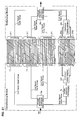
- Fig. 5 is a block diagram depicting the configuration of the optical transmission node according to the second embodiment of the present invention.
- This optical transmission node comprises a demultiplexing module 1a and a multiplexing module 2a.
- the demultiplexing module 1a is comprised of an unequal bandwidth interleaver 10a, low-speed demultiplexing unit 11a, and high-speed demultiplexing unit 12a.
- the low-speed demultiplexing unit 11a is further comprised of multiplexers for low-speed signals 110a and 110b.
- the high-speed demultiplexing unit 12a is further comprised of interleavers for highs-speed signals 122 and 123, and demultiplexers for high-speed signals 120a through 120d.
- the interleavers 122 and 123 and the demultiplexers 120a through 120d are the same as those denoted with the same reference symbols in Fig. 1.
- the multiplexing module 2a is comprised of an unequal bandwidth interleaver 20a, low-speed multiplexing unit 21a and high-speed multiplexing unit 22a.
- the low-speed multiplexing unit 21a is further comprised of the multiplexers for low-speed signals 210a and 210b.
- the high-speed multiplexing unit 22a is further comprised of the interleavers for high-speed signals 222 and 223, and the multiplexers for high-speed signals 220a through 220d.
- the interleavers 222 and 223 and the multiplexers 220a through 220d are the same as those denoted with the same reference symbols in Fig. 1.
- the WDM signal to be input to the unequal bandwidth interleaver 10a of the demultiplexing module 1a is the same as that in the first embodiment, and has the signal arrangement shown in Fig. 2.
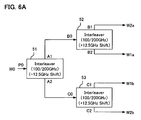
- Fig. 6A is a block diagram depicting a configuration example of the unequal bandwidth interleaver 10a of the demultiplexing module 1a.
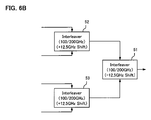
- Fig. 6B is a block diagram depicting a configuration example of the unequal bandwidth interleaver 20a of the multiplexing module 2a.
- the unequal bandwidth interleaver 10a of the demultiplexing module 1a and the unequal bandwidth interleaver 20a of the multiplexing module 2a can be considered in the same way, where only the input/output relationship is reversed. Therefore in the following description, the configuration of the unequal bandwidth interleaver 10a of the demultiplexing module 1a will be explained in detail, and the explanation for the unequal bandwidth interleaver 20a of the multiplexing module 2a will be omitted.
- the unequal bandwidth interleaver 10a is comprised of the interleavers 51 through 53.
- the interleavers 51 through 53 for which a known interleaver can be used, are optical multiplexers/demultiplexers having a function of demultiplexing the WDM signals with a 100 GHz interval which are input, into the signal light group in the even channels and the signal light group in the odd channels with a 200 GHz interval (or multiplexing the signal light group in the even channels and the signal lights group in the odd channels with a 200 GHz interval into WDM signals with a 100 GHz interval, by reversing the input/output relationship).
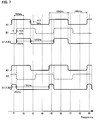
- Fig. 7 shows the transmission characteristics at the port (output port) A1 side when the interleaver 51 is used standalone (graph A1), the transmission characteristics at the port B1 side when the interleaver 52 is used standalone (graph B1), the transmission characteristics at the port B2 side when the interleaver 2 is used standalone (graph B2), the transmission characteristics at the port B1 side of the interleaver 2 when the port A1 of the interleaver 1 is connected to the port B0 of the interleaver 2 and is used (graph A1 A B1), and the transmission characteristics at the port B2 side of the interleaver 2 when the port A1 of the interleaver 1 is connected to the port B0 of the interleaver 2 and is used (graph A1 A B2).
- the abscissa indicates the frequency and the ordinate indicates the light transmittance.
- the interleaver 53 also has the same transmission characteristics as the interleaver 52, although this is not shown in Fig. 7.
- the transmission band and the non-transmission band of the interleavers 51 through 53 both have a 100 GHz bandwidth, and are alternately repeated with a 200 GHz period.
- the two ports (output ports) B1 and B2 of the interleaver 52 have opposite transmission characteristics from each other.
- the ports (output ports) A1 s ⁇ and A2 of the interleaver 51 have opposite transmission characteristics from each other
- the ports C1 and C2 of the interleaver 53 have opposite transmission characteristics from each other.
- the central frequency of the transmission band at the port A1 side of the interleaver 51 is shifted 12.5 GHz to the lower frequency side (that is, - 12.5 GHz) from the frequencies f2, f6, ... (200 GHz interval) of the ITU-T grid (in other words, shifted 37.5 GHz to the higher frequency side (that is +37.5 GHz) from the frequencies f1, f5, ... ).
- the shift amount is -50 GHz ⁇ S ⁇ 50 GHz.
- the central frequency of the non-transmission band at the port A1 side of the interleaver 51 is shifted -12.5 GHz from the frequencies f4, f8, ... (200 GHz interval) (in other words, shifted 37.5 GHz to the higher frequency side (that is +37.5 GHz) from the frequencies f3, f7, ... ).
- the central frequency of the transmission band at the port B1 side of the interleaver 52 is shifted +12.5 GHz from the frequencies f2, f6, ... of the ITU-T grid.
- the central frequency of the non-transmission band at the port B1 side of the interleaver 52 is shifted +12.5 GHz from the frequencies f4, f8, ... of the ITU-T grid.
- Such a positioning of the central frequency can be performed by adjusting the temperature of the interleavers 51 through 53.
- a thermostat for example, can be used for the temperature adjustment of the interleavers 51 through 53.
- graph A1 A B1 shows, by connecting the output port A1 of the interleaver 51 to the input port B0 of the interleaver 52, the transmission band of the output port B1 becomes the overlapping portion of the transmission bands of the interleavers 51 and 52, and the non-transmission band of the output port B1 becomes the portion of the non-transmission band of at least one of the interleavers 51 and 52.
- the transmission bandwidth of the graph A1 A B1 becomes 75 GHz, and the non-transmission bandwidth becomes 125 GHz, and the start frequency (rise edge) of the transmission band shifts +12.5 GHz from the frequencies f1, f5, ... (200 GHz interval) of the ITU-T grid.
- graph A1 A B2 shows, by connecting the output port A1 of the interleaver 51 to the input port B0 of the interleaver 52, the transmission bandwidth of the output port B2 becomes 25 GHz and the non-transmission bandwidth becomes 175 GHz, and the start frequency (rise edge) of the transmission band shifts -12.5 GHz from the frequencies f1, f5, ... (200 GHz interval) of the ITU-T grid.
- a filter which has an arbitrary start frequency and an arbitrary transmission bandwidth, can be constructed.
- an unequal bandwidth interleaver where the transmission bandwidth and the non-transmission bandwidth are not the same, can be constructed.
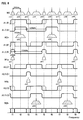
- Fig. 8 shows the transmission characteristics of the interleavers 51 through 53 and the combinations of these interleavers, and the status when the WDM signal W0 to be input to the input port P0 of the interleaver 51 are filtered by the interleavers 51 through 53.
- the abscissa indicates the frequency.
- the WDM signal W0 is shown at the very top level of Fig. 8.
- the transmission characteristics at the output port A1 side of the interleaver 51 is shown by a solid line
- the transmission characteristics at the port B1 side of the interleaver 52 is shown by a broken line.
- the graph for A1 A B1 at the third level shows the transmission characteristics at the output port B1 side of the interleaver 52 when the port A1 of the interleaver 51 is connected to the input port B0 of the interleaver 52, as described with reference to Fig. 7. This is the same in the graph A1 and B2 at the fifth level and the graph A1 A B2 at the sixth level.
- the transmission band of the graph A1 A B1 has a 75 GHz bandwidth with the ITU-T grid (frequencies f2, f6, ... ), where 40 Gbit/s channels ch2, ch6, ... (channel ch [4i-2]) with a 75 GHz bandwidth are arrayed, at the center.
- the transmission band of the graph A1 A B2 has a 25 GHz bandwidth with the ITU-T grid (frequencies f1, f5, ... ), where 10 Gbit/s channels ch1, ch5, ... (channel ch [4i-3]) with a 25 GHz bandwidth are arrayed, at the center.
- the transmission band of the graph A2 A C1 has a 25 GHz bandwidth with the ITU-T grid (frequencies f3, f7, ... ), where 10 Gbit/s channels ch3, ch7, ... (channel ch [4i-1]) with a 25 GHz transmission bandwidth are arrayed, at the center.
- the transmission band of the graph A2 A C2 has a 75 GHz bandwidth with the ITU-T grid (frequencies f4, f8, ... ), where 40 Gbit/s channels ch4, ch8, ... (channel ch [4i]), with a 75 GHz transmission bandwidth are arrayed, at the center.
- 40 Gbit/s signal lights are filtered by the unequal interval interleavers with a 75 GHz transmission bandwidth, which is comprised of two interleavers of which the central frequencies are shifted.
- 10 Gbit/s signal lights are filtered by the unequal interval interleavers with a 25 GHz transmission bandwidth, which is comprised of a combination of two interleavers of which the central frequencies are shifted. Therefore signals in each channel, 40 Gbit/s and 10 Gbit/s, are output in a status without much cross-talk and quality deterioration, such as loss of signal components.
- a 10 Gbit/s and 40 Gbit/s mixed system can be flexibly supported by adjusting the central frequency (central wavelength) of the interleaver. Even a change in the bit rate of the signal lights can be flexibly supported by adjusting the central frequency of the interleaver.
- the high-speed signal groups W2a and W2b which are output from the port B1 (port B1 of the interleaver 52) and port C2 (port C2 of the interleaver 53) of the unequal bandwidth interleaver 10a respectively, are input to the interleavers 122 and 123 respectively.
- the low-speed signal groups W1a and W1b which were output from the port B2 (port B2 of the interleaver 52) and port C1 (port C1 of the interleaver 53) of the unequal bandwidth interleaver 10a respectively, are input to the demultiplexers 110a and 110b respectively.
- the multiplexers 110a and 110b the low-speed signal groups W1a and W1b are demultiplexed into signal lights with each 10 Gbit/s wavelength, and are input to the multiplexing module 2 via the module 3 when necessary.
- the high-speed signal groups W2a and W2b are demultiplexed into an odd channel and an even channel by the interleavers 122 and 123 respectively, then are input to the demultiplexers 120a through 120d to be further demultiplexed into 40 Gbit/s signal lights with each wavelength.
- the 40 Gbit/s signal lights with each wavelength are input to the multiplexing module 2 via the module 3 when necessary.
- the multiplexing module 2 processing, of which the input/output relationship is reversed from that of the demultiplexing module 1, is executed, and the low-speed signals and the high-speed signals are multiplexed respectively, then multiplexed into WDM signals, where low-speed signals and high-speed signals are mixed, by the unequal bandwidth interleaver 20a, and the WDM signals are output.
- a device for low-speed signals which is appropriate for low-speed signals
- a device for high-speed signals which is appropriate for high-speed signals
- can be used for the high-speed signal group just like the first embodiment. Because of this, it is unnecessary to install an expensive device for high-speed signals for all the signals with each wavelength, however an expensive device can be installed only for the high-speed signal side, so an optical transmission system where 10 Gbit/s and 40 Gbit/s are mixed can be implemented keeping the device cost down. Also using a device which exceeds specifications for low-speed signals can be avoided.
- this configuration allows using an optical multiplexer/demultiplexer for low-speed if 10 Gbit/s is extended, and using a high performance optical multiplexer/demultiplexer for high-speed only when 40 Gbit/s is extended, so extendability is good.
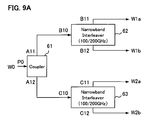
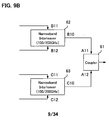
- the unequal bandwidth interleaver 10a (20a) may be comprised of a coupler 61 and narrowband interleavers 62 and 63, as shown in Fig. 9A (9B).
- the coupler 61 outputs the WDM signals W0, which are input to the input port P0, directly to the two output ports A11 and A12.
- the WDM signals W0, which were output, are input to the input port B10 of the narrowband interleaver 62 and to the input port C10 of the narrowband interleaver 63.
- the narrowband interleavers 62 and 63 are interleavers for demultiplexing the signal lights with a 100 GHz interval into even channels and odd channels to generate WDM signals with a 200 GHz interval, allowing only signal components with a predetermined bandwidth to pass by the internally installed narrowband filter (or allowing only signal components with a predetermined bandwidth to pass by the narrowband filter with reversing the input/output relationship, and multiplexing the WDM signals in even channels and odd channels with a 200 GHz interval to generate signal lights with a 100 GHz interval).
- Such a narrowband interleaver can be constructed by integrating a narrowband filter, for filtering each signal light constituting the WDM signals to be light with a predetermined transmission bandwidth, into a known interleaver, for example.
- Fig. 10 shows the transmission characteristics of the interleavers 62 and 63, and the status when the WDM signals W0 are filtered by the interleavers 62 and 63.
- the graph B11 shows the transmission characteristics of the narrowband interleaver 62 at the output port B11 side
- the graph B12 shows the transmission characteristics of the narrowband interleaver 62 at the output port B12 side.
- the central frequency of the transmission band at the port B11 side is set to the frequencies f1, f5, ... of the ITU-T grid.
- the central frequency of the transmission band at the port B12 side is set to the frequencies f3, f7, ... of the ITU-T grid.
- the graph C11 shows the transmission characteristics of the narrowband interleaver 63 at the output port C11 side
- the graph C12 shows the transmission characteristics of the narrowband interleaver 63 at the output port C12 side.
- the bandwidth of the transmission band at the output port C11 side and the C12 side is reduced from 100 GHz to 75 GHz, and the bandwidth of the non-transmission band is expanded from 100 GHz to 125 GHz by the internal narrowband filter.
- the central frequency of the transmission band at the port C11 side is set to the frequencies f2, f6, ... of the ITU-T grid.
- the central frequency of the transmission band at the port C12 side is set to the frequencies f4, f8, ... of the ITU-T grid.
- the unequal bandwidth interleaver can be constructed. And only the WDM signals W1a in the channel ch [4i-3] are output from the output port B11 (port B2 in Fig. 5), and only the WDM signals W1b in the channel ch [4i-1] are output from the output port B12 (port C1 in Fig. 5). Also only the WDM signals W2a in the channel ch [4i-2] are output from the output port C11 (port B1 in Fig. 5), and only the WDM signals W2b in the channel ch [4i] are output from the output port C12 (port C2 in Fig. 5).
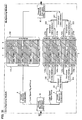
- Fig. 11 is a block diagram depicting the configuration of the optical transmission node according to the third embodiment of the present invention.
- This optical transmission node comprises a demultiplexing module 1b and a multiplexing module 2b.
- the demultiplexing module 1b is comprised of an unequal bandwidth interleaver 10, low-speed demultiplexing unit 11b, and high-speed demultiplexing unit 12b.
- the low-speed demultiplexing unit 11b is further comprised of demultiplexers for low-speed signals 110 and 111.
- the high-speed demultiplexing unit 12b is further comprised of interleavers for high-speed signals 121 and 123, and demultiplexers for high-speed signals 120c and 120d.
- the multiplexing module 2b is comprised of an unequal bandwidth interleaver 20, low-speed multiplexing unit 21b, and high speed multiplexing unit 22b.
- the low-speed multiplexing unit 21b is further comprised of the multiplexers for low-speed signals 210 and 211.
- the high-speed multiplexing unit 22b is further comprised of the interleavers for high-speed signals 221 and 223, and multiplexers for high-speed signals 220c and 220d.
- interleavers 10 and 20 interleavers 121, 123, 221 and 223, demultiplexers 110, 120c and 120d, and multiplexers 210, 220c and 220d are the same as those in Fig. 1 and are denoted with the same reference symbols, so a detailed explanation thereof will be omitted.
- Fig. 12 shows an example of the signal arrangement of the WDM signal W3 which is input to the demultiplexing module 1b (unequal bandwidth interleaver 10).
- the meanings of the abscissa and the frequencies f1, f2, ... are the same as those in Fig. 2.
- the difference of the WDM signal W3 from the WDM signal W0 in Fig. 2 is that 3/4 thereof are 10 Gbit/s signals and 1/4 thereof are 40 Gbit/s signals.
- 40 Gbit/s signals are disposed in the channel ch [4i] and 10 Gbit/s signals are disposed in the other channels.
- the WDM signal W3 When the WDM signal W3 is input to the port P0 of the unequal bandwidth interleaver 10 of the demultiplexing module 1b, 10 Gbit/s signals in the odd channel ch [2i-1], that is the low-speed signal group W1 (same as the signal group denoted with the same reference numeral in Fig. 1) is output from the port P1, and is input to the demultiplexer for low-speed signals 110 of the low-speed demultiplexing unit 11b.
- the demultiplexer 110 demultiplexes the low-speed signal group W1 into signal lights with each wavelength, and outputs the signal lights.
- the signal group W4 in the even channel ch [2i] is output.
- This signal group W4 in the even channel is a signal group where high-speed signals and low-speed signals are mixed, and includes the 10 Gbit/s signals in the channel ch [4i-2] and the 40 Gbit/s signals in the channel ch [4i]. Since the transmission bandwidth of the port P2 of the unequal bandwidth interleaver is 75 GHz, signals of which the transmission bandwidth is less than this bandwidth are output from the port P2. Therefore the mixed signals of 40 Gbit/s signals and 10 Gbit/s signals can be output from the port P2.
- the signal group W4 is input to the interleaver for high-speed signals of the high-speed demultiplexing unit 12b, and is demultiplexed into the signal group in the odd channel ch [4i-2] which is comprised of only 10 Gbit/s signals, and the signal group in the even channel ch [4i] which is comprised of only 40 Gbit/s signals.
- the signal group in the odd channel ch [4i-2] is input to the demultiplexer for low-speed signals 111 of the low-speed demultiplexing unit 11b, demultiplexed into signal lights with each wavelength, and the signal lights are output.
- the signal group in the even channel ch [4i] is input to the interleaver 123, and is demultiplexed into the signal groups in the odd channel [8i-4] and even channel ch [8i]. These signal groups in the odd channel and even channel are input to the demultiplexers for high-speed signals 120c and 120d respectively. In the demultiplexers 120c and 120d, the signal group which is input is demultiplexed into the signal lights with each wavelength, and the signal lights are output.
- the 10 Gbit/s signals with each wavelength which are output from the demultiplexers 110 and 111, and the 40 Gbit/s signals with each wavelength which are output from the demultiplexers 120c and 120d are input to the multiplexing module 2b via the module 3 when necessary.
- multiplexing processing of which the input/output relationship is reversed from the demultiplexing module 1b, is executed, and the signal lights with each wavelength are multiplexed and output as one WDM signal.
- the configuration of the present embodiment allows the high performance optical multiplexer/demultiplexer for high-speed signals to be applied only to the multiplexing/demultiplexing units for 40 Gbit/s signals, therefore a 10 Gbit/s and 40 Gbit/s mixed transmission system can be implemented keeping cost down.
- the fourth embodiment of the present invention is an embodiment of the optical transmission node when the unequal bandwidth interleavers 10a and 20a (Fig. 5, Fig. 6A, 6B, Fig. 9A, 9B) described in the second embodiment are used for the unequal bandwidth interleavers 10 and 20 of the third embodiment respectively.
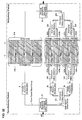
- Fig. 13 is a block diagram depicting the configuration of the optical transmission node according to the fourth embodiment of the present invention.
- This transmission node comprises a demultiplexing module 1c and a multiplexing module 2c.
- the demultiplexing module 1c is comprised of an unequal bandwidth interleaver 10a, low-speed demultiplexing unit 11c, and high-speed demultiplexing unit 12c.
- the low-speed demultiplexing unit 11c is further comprised of three demultiplexers for low-speed signals 111.
- the high-speed demultiplexing unit 12c is further comprised of an interleaver for high-speed signals 123 and demultiplexers for high-speed signals 120c and 120d.
- the multiplexing module 2c is comprised of an unequal bandwidth interleaver 20a, low-speed multiplexing unit 21c and high-speed multiplexing unit 22c.
- the low-speed multiplexing unit 21c is further comprised of three multiplexers for low-speed signals 211.
- the high-speed multiplexing unit 22c is further comprised of the interleaver for high-speed signals 223 and multiplexers for high-speed signals 220c and 220d.
- the unequal bandwidth interleavers 10a and 20a are the same as those in Fig. 5, and are denoted with the same reference symbols, so the interleavers shown in Fig. 6A and 6B or in Fig. 9A and 9B can be used.
- the interleavers 123 and 223, demultiplexers 120c and 120d, and multiplexers 220c and 220d are the same as those in Fig. 1 (Fig. 5, Fig. 11) and are denoted with the same reference symbols, and the multiplexer 111 is denoted with the same reference symbols as in Fig. 11. Therefore a detailed explanation thereof will be omitted here.
- the WDM signal W3 shown in Fig. 12 is input to the unequal bandwidth interleaver 10a of this demodulating module 1c, just like the third embodiment.
- the low-speed signal group W1a which is comprised of the 10 Gbit/s signals in the channel ch [4i-3]
- the low-speed signal group W1b which is comprised of the 10 Gbit/s signals in the channel ch [4i-1]
- the low-speed signal group W1c which is comprised of the 10 Gbit/s signals in channel ch [4i-2] is output.
- the high-speed signal group W2b which is comprised of the 40 Gbit/s signals in the channel ch [4i], is output.
- This high-speed signal group W2b is demultiplexed into the odd channel and even channel by the interleaver for high-speed signals 123 of the high-speed demultiplexing unit 12c, and then demultiplexed into signal lights with each wavelength by the demultiplexers for high-speed signals 120c and 120d.
- the signal lights which are output from the demultiplexer 111, demultiplexer 120c and demultiplexer 120d, are input to the multiplexing module 2c via the module 3 when necessary.
- the multiplexing processing of which the input/output relationship is reversed from the demultiplexing module 1c, is executed, and the signal lights with each wavelength are multiplexed into one WDM signal, and output.
- the signals are separated into the low-speed group and the high-speed signal group, and each signal group can be multiplexed/demultiplexed using the respective device which is appropriate.
- an effect the same as the third embodiment can be implemented.
- Fig. 14 is a block diagram depicting the configuration of the optical transmission node according to the fifth embodiment. As a comparison of Fig. 14 and Fig. 1 shows, the difference is that the fifth embodiment does not comprise the low-speed demultiplexing unit 11 and the low-speed multiplexing unit 21 at the low-speed signal group side shown in Fig. 1, the rest of the configuration is the same as Fig. 1.
- the optical transmission node of the present embodiment can be used when 40 Gbit/s signals are added/dropped while 10 Gbit/s signals are transmitted long distance, or when a compensation node is necessary only for 40 Gbit/s signals.
- WDM signals W0 (see Fig. 2), the same as Fig. 1, are input to the unequal bandwidth interleaver 10 of the demultiplexing module 1d in Fig. 14. Therefore in the present embodiment, the WDM signals W0 are demultiplexed into the low-speed signal group W1 and the high-speed signal group W2 by the unequal bandwidth interleaver 10, then only the high-speed signal group W2 is demultiplexed into signal lights with each wavelength by the high-seed demultiplexing unit 12, which are multiplexed by the high-speed multiplexing unit 22 via the module 3 when necessary. And the low-speed signal group and the high-speed signal group are multiplexed again by the unequal bandwidth interleaver 20 of the multiplexing module 2d, and output as one WDM signal.
- Fig. 15 is a block diagram depicting the configuration of the optical transmission node according to the sixth embodiment of the present invention.
- This sixth embodiment is the same as the fifth embodiment where the unequal bandwidth interleavers 10 and 20 are replaced with the unequal bandwidth interleavers 10a and 20a in the second embodiment (Fig. 5, Fig. 6A, 6B, Fig. 9A, 9B) respectively.
- the only difference in the sixth embodiment is that the low-speed demultiplexing unit 11a and the low-speed multiplexing unit 21a at the low-speed signal group side in the second embodiment shown in Fig. 5 are not installed, and the rest is the same as Fig. 5.
- the signal lights are demultiplexed into the low-speed signal groups W1a and W1b, and the high-speed signal groups W2a and W2b by the unequal bandwidth interleaver 10a of the demultiplexing module 1e, then only the high-speed signal groups W2a and W2b are demultiplexed into the signal lights with each wavelength by the high-speed demultiplexing unit 12a, which are multiplexed by the high-speed multiplexing unit 22a via the module 3 when necessary. And the low-speed signal group and the high-speed signal group are multiplexed again by the unequal bandwidth interleaver 20a of the multiplexing module 2e, and output as one WDM signal.
- Fig. 16 is a block diagram depicting the configuration of the optical transmission node according to the seventh embodiment, where the multiplexer/demultiplexer at the low-speed signal side in the third embodiment is omitted.
- the difference of this embodiment is that the low-speed demultiplexing unit 11b in Fig. 11 is not installed in the demultiplexing module 1f, and the low-speed multiplexing unit 21b in Fig. 11 is not installed in the multiplexing module 2f, and the rest is the same as Fig. 11.
- the WDM signals W3 are demultiplexed into the low-speed signal group and the high-speed signal group by the unequal bandwidth interleaver 10 of the demultiplexing module 1f, then only the high-speed signal group is demultiplexed into signal lights with each wavelength by the high-speed demultiplexing unit 12b, which are multiplexed again by the high-speed multiplexing unit 22b via the module 3 when necessary. And the low-speed signal group and the high-speed signal group are multiplexed again by the unequal bandwidth interleaver 20 of the multiplexing module 2f, and output as one WDM signal.
- a high performance device for high-speed signals can be applied only to a multiplexing/demultiplexing unit (transmission unit) for 40 Gbit/s signals, which is 1/4 of all the WDM signals, so a 10 Gbit/s and 40 Gbit/s mixed transmission system can be implemented keeping cost down.
- FIG. 17 is a block diagram depicting the configuration of the optical transmission node according to the eighth embodiment, where the multiplexer/demultiplexer at the low-speed signal side is omitted in the fourth embodiment.
- the difference of this embodiment is that the low-speed demultiplexing unit 11c in Fig. 13 is not installed in the demultiplexing module 1g, and the low-speed multiplexing unit 21c in Fig. 13 is not installed in the multiplexing unit 2g, and the rest is the same as Fig. 13.
- the WDM signals W3 are demultiplexed into the low-speed signal groups W1a through W1c and the high-speed signal group W2b by the unequal bandwidth interleaver 10a of the demultiplexing module 1g, then only the high-speed signal group W2b is demultiplexed into signal lights with each wavelength by the high-speed demultiplexing unit 12c, which are multiplexed by the high-speed multiplexing unit 22c via the module 3 when necessary. And the low-speed signal groups W1a through W1c and the high-speed signal group are multiplexed again by the unequal bandwidth interleaver 20a of the multiplexing module 2g, and are output as one WDM signal.
- a high performance optical multiplexer/demultiplexer for high-speed signals can be applied only to the multiplexing/demultiplexing unit (transmission unit) for 40 Gbit/s signals, which is 1/4 of all the WDM signals, so a 10 Gbit/s and 40 Gbit/s mixed transmission system can be implemented keeping cost down.
- the WDM signals are demultiplexed into the high-speed signal group and the low-speed signal group, and a variable dispersion compensator is disposed at the high-speed signal side.
- the dispersion tolerance of a 40 Gbit/s signal is much smaller than that of 10 Gbit/s signals, 1/16, and depending on irregularities in the manufacture of transmission lines and the dispersion compensator fibers and/or the temperature change, the dispersion of a 40 Gbit/s signal may exceed the dispersion tolerance thereof. Therefore a variable dispersion compensator is required at the high-speed signal side.
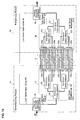
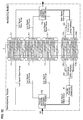
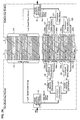
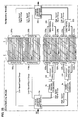
- Fig. 18 to Fig. 22 are block diagrams depicting the configuration of the optical transmission node according to the ninth embodiment of the present invention, where a variable dispersion compensator is applied at the high-speed signal side.
- Fig. 18 the only difference in Fig. 18 is that the variable dispersion compensator 5 is disposed at the high-speed signal side, the rest is the same as Fig. 1.
- Fig. 19 the only difference in Fig. 19 is that the variable dispersion compensators 5a and 5b are disposed at the high-speed signal side, and the rest is the same as Fig. 1.
- Fig. 20 the only difference in Fig. 20 is that the variable dispersion compensators 5a and 5b are disposed at the high-speed signal side, and the rest is the same as Fig. 5.
- Fig. 11 clearly shows, the only difference in Fig.
- variable dispersion compensator 5b is disposed at the high-speed signal side, and the rest is the same as Fig. 11.
- Fig. 13 clearly shows, the only difference in Fig. 22 is that the variable dispersion compensator 5b is disposed at the high-speed side, and the rest is the same as Fig. 13. Therefore description on these same portions in Fig. 18 to Fig. 22 will be omitted.
- Fig. 18 shows, in the present embodiment, the WDM signals W0 are demultiplexed into the low-speed signal group W1 and the high-speed signal group W2 by the unequal bandwidth interleaver 10, then the high-speed signal group W2 is input to the variable dispersion compensator 5.
- the variable dispersion compensator 5 compensates the dispersion of the high-speed signal group W2 in batch.
- the high-speed signal group W2, after dispersion compensation, is demultiplexed by the interleaver 121, and then sent to the multiplexing unit 2.
- variable dispersion compensator can be applied only for 40 Gbit/s signals, so a 10 Gbit/s and 40 Gbit/s mixed transmission system can be implemented keeping cost down.
- Fig. 19 the high-speed signal group W2 is demultiplexed into the odd channel and the even channel by the interleaver 121, then dispersion is compensated by the variable dispersion compensators 5a and 5b respectively.
- the variable dispersion compensators 5a and 5b can have a larger frequency interval than the variable dispersion compensator 5, so the manufacturing cost can be decreased accordingly.
- variable dispersion compensator is applied only for 40 Gbit/s signals, just like Fig. 18 and Fig. 19, therefore a 10 Gbit/s and 40 Gbit/s mixed transmission system can be implemented keeping cost down.
- variable dispersion compensator can be applied for the high-speed signal side, although that illustration is omitted.
- Fig. 23 to Fig. 27 are block diagrams depicting the configuration of the compensation node according to the tenth embodiment of the present invention.
- Fig. 23 corresponds to Fig. 18 in the ninth embodiment
- Fig. 24 to Fig. 27 correspond to Fig. 19 to Fig. 22 in the ninth embodiment respectively. Therefore the same composing elements in the corresponding drawings are denoted with the same reference symbols, for which description is omitted.
- the reference number 6 indicates a gain equalizer (GEQ), which is disposed for low-speed signals with each wavelength (each channel), and high-speed signals with each wavelength (each channel).
- the reference number 7 indicates a polarization mode dispersion compensator (PMDC), which is disposed only for 40 Gbit/s signals in the present embodiment.
- the PMDC 7 must be disposed for each wavelength (each channel), so the PMDC 7 is applied to the high-speed signals demultiplexed into each wavelength by the demultiplexer, between the demultiplexing module and the multiplexing module.
- variable dispersion compensator and the polarization mode dispersion compensator are applied only for 40 Gbit/s signals, so a 10 Gbit/s and 40 Gbit/s mixed transmission system can be implemented keeping cost down.
- variable dispersion compensator may be omitted.
- a device for high-speed signals may be used for 40 Gbit/s signals and a device for low-speed signals for 10 Gbit/s signals may be used.
- a device appropriate for the respective bit rate can be used, which contributes to keeping cost down.
- the eleventh embodiment is same as the ninth embodiment, wherein the variable dispersion compensator is also disposed at the low-speed signal side.
- the dispersion tolerance of 10 Gbit/s signals is larger than that of 40 Gbit/s signals, but in the case of long distance transmission, 10 Gbit/s signals may be influenced by irregularities in the manufacture of transmission fibers and the dispersion compensation fibers, and/or temperature change. Therefore in some cases, a variable dispersion compensator is required for 10 Gbit/s signals as well.
- the characteristics to be required for a variable dispersion compensator for low-speed signals are less strict than those required for high-speed signals, so an inexpensive variable dispersion compensator can be used by decreasing the wavelength interval, or if the wavelength interval is the same as that of the high-speed signals, a more inexpensive variable dispersion compensator than that used for high-speed signals can be used.
- Fig. 28 to Fig. 30 are block diagrams depicting the configuration of the optical transmission node according to the eleventh embodiment of the present invention.
- the variable dispersion compensator 8 is disposed at the low-speed signal side in Fig. 18.
- the variable dispersion compensator 8 is disposed at the low-speed signal side in Fig. 19.
- the variable dispersion compensators 8a and 8b are disposed at the low-speed signal side in Fig. 20.
- the variable dispersion compensator may be disposed at the low-speed signal side in Fig. 21 to Fig. 23 as well.
- a 10 Gbit/s and 40 Gbit/s mixed optical transmission system keeping cost down, while selecting the optimum dispersion compensation for both 10 Gbit/s signals and 40 Gbit/s signals, can be implemented.
- the GEQ 6 is disposed, but GEQ 6 may be omitted.
- the PMDC for compensating the polarization mode dispersion is disposed at the low-speed signal side as well.
- Compensating the polarization mode dispersion is not overly necessary if the transmission distance of 10 Gbit/s signals is short, but in order to transmit 10 Gbit/s signals for a long distance, PMDC is required to compensate the polarization mode dispersion.
- PMDC is required to compensate the polarization mode dispersion.
- the characteristics required for PMDC for 10 Gbit/s signals are not strict compared with those for 40 Gbit/s signals, so the PMDC is less expensive than one for 40 Gbit/s.
- Fig. 31 to Fig. 33 are block diagrams depicting the configuration of the optical transmission node according to the twelfth embodiment of the present invention.
- a variable dispersion compensator 8 and a PMDC 9 are disposed at the low-speed signal side in Fig. 23.
- a variable dispersion compensator 8 and a PMDC 9 are disposed at the low-speed signal side in Fig. 24, and in Fig. 33, variable dispersion compensators 8a and 8b and a PMDC 9 are disposed at the low-speed signal side in Fig. 25.
- the variable dispersion compensators 8 or 8a and 8b can be omitted.
- a PMDC (and variable dispersion compensator) for low-speed signals which has relatively low specifications and are inexpensive, can be used for the low-speed signal group
- a PMDC (and variable dispersion compensator) for high-speed signals which has relatively high specifications, can be used for the high-speed signal group.
- a 10 Gbit/s and 40 Gbit/s mixed transmission system can be implemented keeping cost down, while selecting the optimum dispersion compensation and the polarization mode dispersion compensation for both 10 Gbit/s and 40 Gbit/s.
- the spectrum widths of signal lights with each wavelength are different when the modulation system (e.g. RZ, NRZ, CSRZ) is different, so in this case as well, the present invention can be applied by alternately allocating signals with a small spectrum width and signals with a large spectrum width to an even channel and odd channel.
- the modulation system e.g. RZ, NRZ, CSRZ
- variable dispersion compensator may be a fixed dispersion compensator or a variable or fixed dispersion slope compensator.
- the present invention can be applied to WDM transmission systems, in particular to a transmission terminal, relay node, reception terminal and compensation node of the WDM transmission system.
- the present invention can provide a wavelength division multiplexing transmission system where different bit rate signal lights are mixed, while keeping a cost increase down, caused by high function devices. Also the present invention can provide a wavelength division multiplexing transmission system where different bit rate signal lights are mixed, while keeping a cost increase down, caused by high function devices and various compensation devices. Also the present invention can provide a wavelength division multiplexing transmission system where different bit rate signal lights are mixed, to which wavelength and polarization mode dispersion compensation methods, optimized for the respective bit rate, can be applied.
Landscapes
- Engineering & Computer Science (AREA)
- Computer Networks & Wireless Communication (AREA)
- Signal Processing (AREA)
- Optical Communication System (AREA)
Applications Claiming Priority (2)
| Application Number | Priority Date | Filing Date | Title |
|---|---|---|---|
| JP2003294414 | 2003-08-18 | ||
| JP2003294414A JP2005065019A (ja) | 2003-08-18 | 2003-08-18 | 波長分割多重伝送システム |
Publications (2)
| Publication Number | Publication Date |
|---|---|
| EP1508987A2 true EP1508987A2 (de) | 2005-02-23 |
| EP1508987A3 EP1508987A3 (de) | 2009-09-30 |
Family
ID=34056212
Family Applications (1)
| Application Number | Title | Priority Date | Filing Date |
|---|---|---|---|
| EP04016218A Withdrawn EP1508987A3 (de) | 2003-08-18 | 2004-07-09 | Optisches Wellenlängenmultiplex-Übertragungssystem |
Country Status (3)
| Country | Link |
|---|---|
| US (1) | US7480459B2 (de) |
| EP (1) | EP1508987A3 (de) |
| JP (1) | JP2005065019A (de) |
Cited By (4)
| Publication number | Priority date | Publication date | Assignee | Title |
|---|---|---|---|---|
| EP1608098A1 (de) * | 2004-06-16 | 2005-12-21 | Lucent Technologies Inc. | Optischer Add-Drop-Multiplexer mit einer alternierenden Kanalkonfiguration |
| EP1608097A3 (de) * | 2004-06-16 | 2006-03-22 | Lucent Technologies Inc. | Optischer Add/Drop-Multiplexer mit bändiger Kanalkonfiguration |
| EP2090007A4 (de) * | 2006-12-07 | 2010-01-13 | Huawei Tech Co Ltd | Verfahren und system zur bandabblockung in einem optischen telekommunikationsnetz |
| EP2242191A3 (de) * | 2009-04-15 | 2016-06-15 | Fujitsu Limited | Relaisvorrichtung, Signalverarbeitungsvorrichtung und optisches Kommunikationssystem |
Families Citing this family (13)
| Publication number | Priority date | Publication date | Assignee | Title |
|---|---|---|---|---|
| JP4020809B2 (ja) * | 2003-03-26 | 2007-12-12 | 富士通株式会社 | 波長分割多重伝送システム |
| US20060067704A1 (en) * | 2004-09-30 | 2006-03-30 | Fishman Daniel A | Method and apparatus for dispersion management in optical communication systems |
| WO2006077961A1 (ja) * | 2005-01-21 | 2006-07-27 | Nec Corporation | 光通信モジュールおよび光信号伝送方法 |
| US7869711B2 (en) * | 2005-10-18 | 2011-01-11 | Nec Laboratories America, Inc. | Optical tunable asymmetric interleaver and upgrade for dense wavelength division multiplexed networks |
| JP4850288B2 (ja) * | 2007-08-27 | 2012-01-11 | 富士通株式会社 | ネットワーク管理システム、中継装置及び方法 |
| JP5088191B2 (ja) | 2008-03-21 | 2012-12-05 | 富士通株式会社 | 光伝送システム及びその分散補償方法 |
| JP4937983B2 (ja) * | 2008-10-16 | 2012-05-23 | 日本電信電話株式会社 | 光伝送装置 |
| JP5617503B2 (ja) * | 2010-09-30 | 2014-11-05 | 富士通株式会社 | 光ネットワーク中継装置 |
| US20120087666A1 (en) * | 2010-10-06 | 2012-04-12 | Electronics And Telecommunications Research Institute | Bidirectional wavelength division multiplexed-passive optical network |
| JP5824912B2 (ja) * | 2011-06-29 | 2015-12-02 | 富士通株式会社 | 光伝送装置および光インターリーブ制御方法 |
| JP5842438B2 (ja) * | 2011-07-28 | 2016-01-13 | 富士通株式会社 | 中継装置、中継方法及び光伝送システム |
| WO2018170037A1 (en) * | 2017-03-14 | 2018-09-20 | Ball Aerospace & Technologies Corp. | Systems and methods for multiplexing and demodulation at high frequencies and increased communication bandwidth |
| US11115146B2 (en) * | 2017-03-31 | 2021-09-07 | Nec Corporation | Optical signal demultiplexing device, optical signal reception device, and optical signal demultiplexing method |
Family Cites Families (7)
| Publication number | Priority date | Publication date | Assignee | Title |
|---|---|---|---|---|
| US6208444B1 (en) * | 1996-10-29 | 2001-03-27 | Chorum Technologies Inc. | Apparatus for wavelength demultiplexing using a multi-cavity etalon |
| US6310690B1 (en) * | 1999-02-10 | 2001-10-30 | Avanex Corporation | Dense wavelength division multiplexer utilizing an asymmetric pass band interferometer |
| KR20010061613A (ko) * | 1999-12-28 | 2001-07-07 | 윤종용 | 업그레이드 가능한 파장 분할 다중화 시스템의 노드 구조 |
| US6337770B1 (en) * | 1999-12-31 | 2002-01-08 | Jds Uniphase Corporation | Single-pass folded interleaver/deinterleavers |
| CA2337598A1 (en) | 2000-03-31 | 2001-09-30 | Magaly Spector | Apparatus for demultiplexing/multiplexing optical signals modulated with different data rates in wdm systems |
| JP4592887B2 (ja) * | 2000-08-07 | 2010-12-08 | 富士通株式会社 | 波長分散を補償する方法及びシステム |
| JP4647074B2 (ja) | 2000-10-04 | 2011-03-09 | 富士通株式会社 | 波長多重光通信システム |
-
2003
- 2003-08-18 JP JP2003294414A patent/JP2005065019A/ja active Pending
-
2004
- 2004-07-02 US US10/883,033 patent/US7480459B2/en not_active Expired - Fee Related
- 2004-07-09 EP EP04016218A patent/EP1508987A3/de not_active Withdrawn
Cited By (6)
| Publication number | Priority date | Publication date | Assignee | Title |
|---|---|---|---|---|
| EP1608098A1 (de) * | 2004-06-16 | 2005-12-21 | Lucent Technologies Inc. | Optischer Add-Drop-Multiplexer mit einer alternierenden Kanalkonfiguration |
| EP1608097A3 (de) * | 2004-06-16 | 2006-03-22 | Lucent Technologies Inc. | Optischer Add/Drop-Multiplexer mit bändiger Kanalkonfiguration |
| US7286763B2 (en) | 2004-06-16 | 2007-10-23 | Lucent Technologies Inc. | Optical add/drop multiplexer having a banded channel configuration |
| EP2090007A4 (de) * | 2006-12-07 | 2010-01-13 | Huawei Tech Co Ltd | Verfahren und system zur bandabblockung in einem optischen telekommunikationsnetz |
| US8861966B2 (en) | 2006-12-07 | 2014-10-14 | Futurewei Technologies, Inc. | Method and system for band blocking in an optical telecommunication network |
| EP2242191A3 (de) * | 2009-04-15 | 2016-06-15 | Fujitsu Limited | Relaisvorrichtung, Signalverarbeitungsvorrichtung und optisches Kommunikationssystem |
Also Published As
| Publication number | Publication date |
|---|---|
| EP1508987A3 (de) | 2009-09-30 |
| JP2005065019A (ja) | 2005-03-10 |
| US20050041975A1 (en) | 2005-02-24 |
| US7480459B2 (en) | 2009-01-20 |
Similar Documents
| Publication | Publication Date | Title |
|---|---|---|
| US7437074B2 (en) | Wavelength division multiplexing transmission system | |
| EP1508987A2 (de) | Optisches Wellenlängenmultiplex-Übertragungssystem | |
| US6782203B2 (en) | Scalable optical demultiplexing arrangement for wide band dense wavelength division multiplexed systems | |
| US7088922B2 (en) | Wavelength division multiplexing optical communication system | |
| US8095011B2 (en) | Wavelength division multiplexing filter, wavelength division multiplexing system, and wavelength division multiplexing method | |
| US20040252996A1 (en) | Flexible banded MUX/DEMUX architecture for WDM systems | |
| EP1608097B1 (de) | Optischer Add/Drop-Multiplexer mit bändiger Kanalkonfiguration | |
| US20060146855A1 (en) | Optical wavelength multiplex access system and optical network unit | |
| EP1583269A2 (de) | Grobes WDM optisches Übertragungssystem und -methode | |
| JPH07107069A (ja) | 光波長多重伝送方式および光分散補償方式 | |
| EP1503532B1 (de) | Optisches Netzwerk mit Teilbandsperrung und Bypass | |
| US7519296B2 (en) | Optical demultiplexing method and optical multiplexing method, and optical transmission apparatus using same | |
| EP0964275A1 (de) | Verfahren und Vorrichtung zum Entnehmen von optische Kanälen in einem optischen Übertragungssystem | |
| US6559988B1 (en) | Optical wavelength add/drop multiplexer for dual signal transmission rates | |
| EP1248336A2 (de) | Verfahren und Vorrichtung zur Wellenlängenkonversion | |
| US6608948B2 (en) | Periodic arrayed waveguide grating multiplexer/demultiplexer | |
| CA2443409A1 (en) | High spectral efficiency, high performance optical mux and demux architecture | |
| JP4376014B2 (ja) | 光伝送装置 | |
| EP1819072B1 (de) | Optisches Netzelement mit Dispersionskompensation | |
| EP1608098A1 (de) | Optischer Add-Drop-Multiplexer mit einer alternierenden Kanalkonfiguration | |
| US7613397B2 (en) | Wavelength division multiplexing optical transmission system and wavelength dispersion compensation unit | |
| CN112655161B (zh) | 光学传输装置、光学通信系统和光学信号传输方法 | |
| EP4529054A1 (de) | Teilgefärbter wellenlängenmultiplexer/demultiplexer mit flexgrid | |
| US20150180583A1 (en) | Wavelength division multiplexing optical transmission device |
Legal Events
| Date | Code | Title | Description |
|---|---|---|---|
| PUAI | Public reference made under article 153(3) epc to a published international application that has entered the european phase |
Free format text: ORIGINAL CODE: 0009012 |
|
| AK | Designated contracting states |
Kind code of ref document: A2 Designated state(s): AT BE BG CH CY CZ DE DK EE ES FI FR GB GR HU IE IT LI LU MC NL PL PT RO SE SI SK TR |
|
| AX | Request for extension of the european patent |
Extension state: AL HR LT LV MK |
|
| RIN1 | Information on inventor provided before grant (corrected) |
Inventor name: ISHIKAWA, GEORGE,C/O FUJITSU LIMITED Inventor name: OOI, HIROKI,C/O FUJITSU LIMITED Inventor name: NAKAMURA, KENTARO,C/O FUJITSU LIMITED |
|
| PUAL | Search report despatched |
Free format text: ORIGINAL CODE: 0009013 |
|
| AK | Designated contracting states |
Kind code of ref document: A3 Designated state(s): AT BE BG CH CY CZ DE DK EE ES FI FR GB GR HU IE IT LI LU MC NL PL PT RO SE SI SK TR |
|
| AX | Request for extension of the european patent |
Extension state: AL HR LT LV MK |
|
| STAA | Information on the status of an ep patent application or granted ep patent |
Free format text: STATUS: THE APPLICATION HAS BEEN WITHDRAWN |
|
| 18W | Application withdrawn |
Effective date: 20091209 |