EP1505042A2 - Composition de barrière thermique, pièce mécanique en superalliage munie d'un revêtement ayant une telle composition, revêtement de céramique, et procédé de fabrication du revêtement - Google Patents
Composition de barrière thermique, pièce mécanique en superalliage munie d'un revêtement ayant une telle composition, revêtement de céramique, et procédé de fabrication du revêtement Download PDFInfo
- Publication number
- EP1505042A2 EP1505042A2 EP04291991A EP04291991A EP1505042A2 EP 1505042 A2 EP1505042 A2 EP 1505042A2 EP 04291991 A EP04291991 A EP 04291991A EP 04291991 A EP04291991 A EP 04291991A EP 1505042 A2 EP1505042 A2 EP 1505042A2
- Authority
- EP
- European Patent Office
- Prior art keywords
- oxide
- zirconia
- thermal barrier
- trivalent
- ceramic
- Prior art date
- Legal status (The legal status is an assumption and is not a legal conclusion. Google has not performed a legal analysis and makes no representation as to the accuracy of the status listed.)
- Granted
Links
- 239000000203 mixture Substances 0.000 title claims abstract description 52
- 230000004888 barrier function Effects 0.000 title claims abstract description 38
- 238000005524 ceramic coating Methods 0.000 title claims abstract description 18
- 229910000601 superalloy Inorganic materials 0.000 title claims abstract description 17
- 238000004519 manufacturing process Methods 0.000 title claims abstract description 14
- 239000011248 coating agent Substances 0.000 title description 33
- 238000000576 coating method Methods 0.000 title description 33
- 239000012720 thermal barrier coating Substances 0.000 title description 7
- 239000000919 ceramic Substances 0.000 claims abstract description 30
- QVGXLLKOCUKJST-UHFFFAOYSA-N atomic oxygen Chemical compound [O] QVGXLLKOCUKJST-UHFFFAOYSA-N 0.000 claims abstract description 15
- 239000001301 oxygen Substances 0.000 claims abstract description 15
- 229910052760 oxygen Inorganic materials 0.000 claims abstract description 15
- 230000000930 thermomechanical effect Effects 0.000 claims abstract description 15
- MCMNRKCIXSYSNV-UHFFFAOYSA-N Zirconium dioxide Chemical compound O=[Zr]=O MCMNRKCIXSYSNV-UHFFFAOYSA-N 0.000 claims description 94
- SIWVEOZUMHYXCS-UHFFFAOYSA-N oxo(oxoyttriooxy)yttrium Chemical compound O=[Y]O[Y]=O SIWVEOZUMHYXCS-UHFFFAOYSA-N 0.000 claims description 15
- 239000000758 substrate Substances 0.000 claims description 15
- 230000007547 defect Effects 0.000 claims description 11
- 229910002077 partially stabilized zirconia Inorganic materials 0.000 claims description 11
- 238000000151 deposition Methods 0.000 claims description 10
- 229910052751 metal Inorganic materials 0.000 claims description 10
- 239000002184 metal Substances 0.000 claims description 10
- PXHVJJICTQNCMI-UHFFFAOYSA-N Nickel Chemical compound [Ni] PXHVJJICTQNCMI-UHFFFAOYSA-N 0.000 claims description 8
- VQCBHWLJZDBHOS-UHFFFAOYSA-N erbium(iii) oxide Chemical compound O=[Er]O[Er]=O VQCBHWLJZDBHOS-UHFFFAOYSA-N 0.000 claims description 8
- MRELNEQAGSRDBK-UHFFFAOYSA-N lanthanum(3+);oxygen(2-) Chemical compound [O-2].[O-2].[O-2].[La+3].[La+3] MRELNEQAGSRDBK-UHFFFAOYSA-N 0.000 claims description 6
- PLDDOISOJJCEMH-UHFFFAOYSA-N neodymium(3+);oxygen(2-) Chemical compound [O-2].[O-2].[O-2].[Nd+3].[Nd+3] PLDDOISOJJCEMH-UHFFFAOYSA-N 0.000 claims description 6
- 230000000087 stabilizing effect Effects 0.000 claims description 6
- RUDFQVOCFDJEEF-UHFFFAOYSA-N yttrium(III) oxide Inorganic materials [O-2].[O-2].[O-2].[Y+3].[Y+3] RUDFQVOCFDJEEF-UHFFFAOYSA-N 0.000 claims description 6
- 229910045601 alloy Inorganic materials 0.000 claims description 5
- 239000000956 alloy Substances 0.000 claims description 5
- 229910010293 ceramic material Inorganic materials 0.000 claims description 5
- 229910017052 cobalt Inorganic materials 0.000 claims description 5
- 239000010941 cobalt Substances 0.000 claims description 5
- GUTLYIVDDKVIGB-UHFFFAOYSA-N cobalt atom Chemical compound [Co] GUTLYIVDDKVIGB-UHFFFAOYSA-N 0.000 claims description 5
- 229910003440 dysprosium oxide Inorganic materials 0.000 claims description 5
- NLQFUUYNQFMIJW-UHFFFAOYSA-N dysprosium(iii) oxide Chemical compound O=[Dy]O[Dy]=O NLQFUUYNQFMIJW-UHFFFAOYSA-N 0.000 claims description 5
- 229910052727 yttrium Inorganic materials 0.000 claims description 5
- XEEYBQQBJWHFJM-UHFFFAOYSA-N Iron Chemical compound [Fe] XEEYBQQBJWHFJM-UHFFFAOYSA-N 0.000 claims description 4
- KDLHZDBZIXYQEI-UHFFFAOYSA-N Palladium Chemical compound [Pd] KDLHZDBZIXYQEI-UHFFFAOYSA-N 0.000 claims description 4
- 230000008021 deposition Effects 0.000 claims description 4
- 229910001940 europium oxide Inorganic materials 0.000 claims description 4
- AEBZCFFCDTZXHP-UHFFFAOYSA-N europium(3+);oxygen(2-) Chemical compound [O-2].[O-2].[O-2].[Eu+3].[Eu+3] AEBZCFFCDTZXHP-UHFFFAOYSA-N 0.000 claims description 4
- JYTUFVYWTIKZGR-UHFFFAOYSA-N holmium oxide Inorganic materials [O][Ho]O[Ho][O] JYTUFVYWTIKZGR-UHFFFAOYSA-N 0.000 claims description 4
- OWCYYNSBGXMRQN-UHFFFAOYSA-N holmium(3+);oxygen(2-) Chemical compound [O-2].[O-2].[O-2].[Ho+3].[Ho+3] OWCYYNSBGXMRQN-UHFFFAOYSA-N 0.000 claims description 4
- 150000002739 metals Chemical class 0.000 claims description 4
- 229910052759 nickel Inorganic materials 0.000 claims description 4
- 229910000484 niobium oxide Inorganic materials 0.000 claims description 4
- URLJKFSTXLNXLG-UHFFFAOYSA-N niobium(5+);oxygen(2-) Chemical compound [O-2].[O-2].[O-2].[O-2].[O-2].[Nb+5].[Nb+5] URLJKFSTXLNXLG-UHFFFAOYSA-N 0.000 claims description 4
- 230000003647 oxidation Effects 0.000 claims description 4
- 238000007254 oxidation reaction Methods 0.000 claims description 4
- MMKQUGHLEMYQSG-UHFFFAOYSA-N oxygen(2-);praseodymium(3+) Chemical compound [O-2].[O-2].[O-2].[Pr+3].[Pr+3] MMKQUGHLEMYQSG-UHFFFAOYSA-N 0.000 claims description 4
- BPUBBGLMJRNUCC-UHFFFAOYSA-N oxygen(2-);tantalum(5+) Chemical compound [O-2].[O-2].[O-2].[O-2].[O-2].[Ta+5].[Ta+5] BPUBBGLMJRNUCC-UHFFFAOYSA-N 0.000 claims description 4
- BASFCYQUMIYNBI-UHFFFAOYSA-N platinum Chemical compound [Pt] BASFCYQUMIYNBI-UHFFFAOYSA-N 0.000 claims description 4
- 229910003447 praseodymium oxide Inorganic materials 0.000 claims description 4
- 229910001954 samarium oxide Inorganic materials 0.000 claims description 4
- 229940075630 samarium oxide Drugs 0.000 claims description 4
- FKTOIHSPIPYAPE-UHFFFAOYSA-N samarium(iii) oxide Chemical compound [O-2].[O-2].[O-2].[Sm+3].[Sm+3] FKTOIHSPIPYAPE-UHFFFAOYSA-N 0.000 claims description 4
- HYXGAEYDKFCVMU-UHFFFAOYSA-N scandium oxide Chemical compound O=[Sc]O[Sc]=O HYXGAEYDKFCVMU-UHFFFAOYSA-N 0.000 claims description 4
- 229910001936 tantalum oxide Inorganic materials 0.000 claims description 4
- VWQVUPCCIRVNHF-UHFFFAOYSA-N yttrium atom Chemical compound [Y] VWQVUPCCIRVNHF-UHFFFAOYSA-N 0.000 claims description 4
- 229910052769 Ytterbium Inorganic materials 0.000 claims description 3
- 229940075616 europium oxide Drugs 0.000 claims description 3
- 229910001938 gadolinium oxide Inorganic materials 0.000 claims description 3
- 229940075613 gadolinium oxide Drugs 0.000 claims description 3
- CMIHHWBVHJVIGI-UHFFFAOYSA-N gadolinium(iii) oxide Chemical compound [O-2].[O-2].[O-2].[Gd+3].[Gd+3] CMIHHWBVHJVIGI-UHFFFAOYSA-N 0.000 claims description 3
- 230000006641 stabilisation Effects 0.000 claims description 3
- 238000011105 stabilization Methods 0.000 claims description 3
- 229910003451 terbium oxide Inorganic materials 0.000 claims description 3
- SCRZPWWVSXWCMC-UHFFFAOYSA-N terbium(iii) oxide Chemical compound [O-2].[O-2].[O-2].[Tb+3].[Tb+3] SCRZPWWVSXWCMC-UHFFFAOYSA-N 0.000 claims description 3
- NAWDYIZEMPQZHO-UHFFFAOYSA-N ytterbium Chemical compound [Yb] NAWDYIZEMPQZHO-UHFFFAOYSA-N 0.000 claims description 3
- VYZAMTAEIAYCRO-UHFFFAOYSA-N Chromium Chemical compound [Cr] VYZAMTAEIAYCRO-UHFFFAOYSA-N 0.000 claims description 2
- KJTLSVCANCCWHF-UHFFFAOYSA-N Ruthenium Chemical compound [Ru] KJTLSVCANCCWHF-UHFFFAOYSA-N 0.000 claims description 2
- PNEYBMLMFCGWSK-UHFFFAOYSA-N aluminium oxide Inorganic materials [O-2].[O-2].[O-2].[Al+3].[Al+3] PNEYBMLMFCGWSK-UHFFFAOYSA-N 0.000 claims description 2
- 229910052804 chromium Inorganic materials 0.000 claims description 2
- 239000011651 chromium Substances 0.000 claims description 2
- 229910052735 hafnium Inorganic materials 0.000 claims description 2
- VBJZVLUMGGDVMO-UHFFFAOYSA-N hafnium atom Chemical compound [Hf] VBJZVLUMGGDVMO-UHFFFAOYSA-N 0.000 claims description 2
- 229910052741 iridium Inorganic materials 0.000 claims description 2
- GKOZUEZYRPOHIO-UHFFFAOYSA-N iridium atom Chemical compound [Ir] GKOZUEZYRPOHIO-UHFFFAOYSA-N 0.000 claims description 2
- 229910052742 iron Inorganic materials 0.000 claims description 2
- 229910052762 osmium Inorganic materials 0.000 claims description 2
- SYQBFIAQOQZEGI-UHFFFAOYSA-N osmium atom Chemical compound [Os] SYQBFIAQOQZEGI-UHFFFAOYSA-N 0.000 claims description 2
- 230000001590 oxidative effect Effects 0.000 claims description 2
- 229910052763 palladium Inorganic materials 0.000 claims description 2
- 229910052697 platinum Inorganic materials 0.000 claims description 2
- 230000001681 protective effect Effects 0.000 claims description 2
- 229910052703 rhodium Inorganic materials 0.000 claims description 2
- 239000010948 rhodium Substances 0.000 claims description 2
- MHOVAHRLVXNVSD-UHFFFAOYSA-N rhodium atom Chemical compound [Rh] MHOVAHRLVXNVSD-UHFFFAOYSA-N 0.000 claims description 2
- 229910052707 ruthenium Inorganic materials 0.000 claims description 2
- VSZWPYCFIRKVQL-UHFFFAOYSA-N selanylidenegallium;selenium Chemical compound [Se].[Se]=[Ga].[Se]=[Ga] VSZWPYCFIRKVQL-UHFFFAOYSA-N 0.000 claims description 2
- NPXOKRUENSOPAO-UHFFFAOYSA-N Raney nickel Chemical compound [Al].[Ni] NPXOKRUENSOPAO-UHFFFAOYSA-N 0.000 claims 1
- 229910052771 Terbium Inorganic materials 0.000 claims 1
- 229910000907 nickel aluminide Inorganic materials 0.000 claims 1
- GZCRRIHWUXGPOV-UHFFFAOYSA-N terbium atom Chemical compound [Tb] GZCRRIHWUXGPOV-UHFFFAOYSA-N 0.000 claims 1
- 229910052845 zircon Inorganic materials 0.000 abstract 3
- GFQYVLUOOAAOGM-UHFFFAOYSA-N zirconium(iv) silicate Chemical compound [Zr+4].[O-][Si]([O-])([O-])[O-] GFQYVLUOOAAOGM-UHFFFAOYSA-N 0.000 abstract 3
- 230000003019 stabilising effect Effects 0.000 abstract 1
- 206010021143 Hypoxia Diseases 0.000 description 5
- 239000000463 material Substances 0.000 description 5
- 238000000034 method Methods 0.000 description 5
- 150000001768 cations Chemical class 0.000 description 3
- 230000007423 decrease Effects 0.000 description 3
- 238000001704 evaporation Methods 0.000 description 3
- 230000008020 evaporation Effects 0.000 description 3
- 239000007789 gas Substances 0.000 description 3
- 239000003381 stabilizer Substances 0.000 description 3
- 238000005382 thermal cycling Methods 0.000 description 3
- 238000002485 combustion reaction Methods 0.000 description 2
- 238000001816 cooling Methods 0.000 description 2
- RKTYLMNFRDHKIL-UHFFFAOYSA-N copper;5,10,15,20-tetraphenylporphyrin-22,24-diide Chemical compound [Cu+2].C1=CC(C(=C2C=CC([N-]2)=C(C=2C=CC=CC=2)C=2C=CC(N=2)=C(C=2C=CC=CC=2)C2=CC=C3[N-]2)C=2C=CC=CC=2)=NC1=C3C1=CC=CC=C1 RKTYLMNFRDHKIL-UHFFFAOYSA-N 0.000 description 2
- 230000007812 deficiency Effects 0.000 description 2
- 239000000446 fuel Substances 0.000 description 2
- 238000010348 incorporation Methods 0.000 description 2
- RVTZCBVAJQQJTK-UHFFFAOYSA-N oxygen(2-);zirconium(4+) Chemical compound [O-2].[O-2].[Zr+4] RVTZCBVAJQQJTK-UHFFFAOYSA-N 0.000 description 2
- 238000005240 physical vapour deposition Methods 0.000 description 2
- 238000007750 plasma spraying Methods 0.000 description 2
- 239000011148 porous material Substances 0.000 description 2
- 230000008569 process Effects 0.000 description 2
- 230000009467 reduction Effects 0.000 description 2
- 229910001928 zirconium oxide Inorganic materials 0.000 description 2
- 229910052688 Gadolinium Inorganic materials 0.000 description 1
- 229910052779 Neodymium Inorganic materials 0.000 description 1
- QCWXUUIWCKQGHC-UHFFFAOYSA-N Zirconium Chemical compound [Zr] QCWXUUIWCKQGHC-UHFFFAOYSA-N 0.000 description 1
- 238000013459 approach Methods 0.000 description 1
- 230000015572 biosynthetic process Effects 0.000 description 1
- 230000008859 change Effects 0.000 description 1
- 239000000470 constituent Substances 0.000 description 1
- 230000007797 corrosion Effects 0.000 description 1
- 238000005260 corrosion Methods 0.000 description 1
- 239000013078 crystal Substances 0.000 description 1
- 239000011222 crystalline ceramic Substances 0.000 description 1
- 229910002106 crystalline ceramic Inorganic materials 0.000 description 1
- 230000003247 decreasing effect Effects 0.000 description 1
- 230000032798 delamination Effects 0.000 description 1
- 230000008034 disappearance Effects 0.000 description 1
- 238000009826 distribution Methods 0.000 description 1
- 238000005328 electron beam physical vapour deposition Methods 0.000 description 1
- 230000002349 favourable effect Effects 0.000 description 1
- UIWYJDYFSGRHKR-UHFFFAOYSA-N gadolinium atom Chemical compound [Gd] UIWYJDYFSGRHKR-UHFFFAOYSA-N 0.000 description 1
- 238000009413 insulation Methods 0.000 description 1
- 238000011835 investigation Methods 0.000 description 1
- 150000002500 ions Chemical class 0.000 description 1
- 229910052746 lanthanum Inorganic materials 0.000 description 1
- FZLIPJUXYLNCLC-UHFFFAOYSA-N lanthanum atom Chemical compound [La] FZLIPJUXYLNCLC-UHFFFAOYSA-N 0.000 description 1
- 238000005259 measurement Methods 0.000 description 1
- 230000007246 mechanism Effects 0.000 description 1
- QEFYFXOXNSNQGX-UHFFFAOYSA-N neodymium atom Chemical compound [Nd] QEFYFXOXNSNQGX-UHFFFAOYSA-N 0.000 description 1
- 150000002815 nickel Chemical class 0.000 description 1
- UZLYXNNZYFBAQO-UHFFFAOYSA-N oxygen(2-);ytterbium(3+) Chemical compound [O-2].[O-2].[O-2].[Yb+3].[Yb+3] UZLYXNNZYFBAQO-UHFFFAOYSA-N 0.000 description 1
- 230000035939 shock Effects 0.000 description 1
- 239000000126 substance Substances 0.000 description 1
- 238000012360 testing method Methods 0.000 description 1
- 238000007738 vacuum evaporation Methods 0.000 description 1
- 229910003454 ytterbium oxide Inorganic materials 0.000 description 1
- 229940075624 ytterbium oxide Drugs 0.000 description 1
- -1 yttrium ions Chemical class 0.000 description 1
- 229910052726 zirconium Inorganic materials 0.000 description 1
Images
Classifications
-
- C—CHEMISTRY; METALLURGY
- C23—COATING METALLIC MATERIAL; COATING MATERIAL WITH METALLIC MATERIAL; CHEMICAL SURFACE TREATMENT; DIFFUSION TREATMENT OF METALLIC MATERIAL; COATING BY VACUUM EVAPORATION, BY SPUTTERING, BY ION IMPLANTATION OR BY CHEMICAL VAPOUR DEPOSITION, IN GENERAL; INHIBITING CORROSION OF METALLIC MATERIAL OR INCRUSTATION IN GENERAL
- C23C—COATING METALLIC MATERIAL; COATING MATERIAL WITH METALLIC MATERIAL; SURFACE TREATMENT OF METALLIC MATERIAL BY DIFFUSION INTO THE SURFACE, BY CHEMICAL CONVERSION OR SUBSTITUTION; COATING BY VACUUM EVAPORATION, BY SPUTTERING, BY ION IMPLANTATION OR BY CHEMICAL VAPOUR DEPOSITION, IN GENERAL
- C23C28/00—Coating for obtaining at least two superposed coatings either by methods not provided for in a single one of groups C23C2/00 - C23C26/00 or by combinations of methods provided for in subclasses C23C and C25C or C25D
- C23C28/30—Coatings combining at least one metallic layer and at least one inorganic non-metallic layer
- C23C28/32—Coatings combining at least one metallic layer and at least one inorganic non-metallic layer including at least one pure metallic layer
- C23C28/321—Coatings combining at least one metallic layer and at least one inorganic non-metallic layer including at least one pure metallic layer with at least one metal alloy layer
-
- C—CHEMISTRY; METALLURGY
- C04—CEMENTS; CONCRETE; ARTIFICIAL STONE; CERAMICS; REFRACTORIES
- C04B—LIME, MAGNESIA; SLAG; CEMENTS; COMPOSITIONS THEREOF, e.g. MORTARS, CONCRETE OR LIKE BUILDING MATERIALS; ARTIFICIAL STONE; CERAMICS; REFRACTORIES; TREATMENT OF NATURAL STONE
- C04B35/00—Shaped ceramic products characterised by their composition; Ceramics compositions; Processing powders of inorganic compounds preparatory to the manufacturing of ceramic products
- C04B35/01—Shaped ceramic products characterised by their composition; Ceramics compositions; Processing powders of inorganic compounds preparatory to the manufacturing of ceramic products based on oxide ceramics
- C04B35/48—Shaped ceramic products characterised by their composition; Ceramics compositions; Processing powders of inorganic compounds preparatory to the manufacturing of ceramic products based on oxide ceramics based on zirconium or hafnium oxides, zirconates, zircon or hafnates
- C04B35/486—Fine ceramics
-
- C—CHEMISTRY; METALLURGY
- C23—COATING METALLIC MATERIAL; COATING MATERIAL WITH METALLIC MATERIAL; CHEMICAL SURFACE TREATMENT; DIFFUSION TREATMENT OF METALLIC MATERIAL; COATING BY VACUUM EVAPORATION, BY SPUTTERING, BY ION IMPLANTATION OR BY CHEMICAL VAPOUR DEPOSITION, IN GENERAL; INHIBITING CORROSION OF METALLIC MATERIAL OR INCRUSTATION IN GENERAL
- C23C—COATING METALLIC MATERIAL; COATING MATERIAL WITH METALLIC MATERIAL; SURFACE TREATMENT OF METALLIC MATERIAL BY DIFFUSION INTO THE SURFACE, BY CHEMICAL CONVERSION OR SUBSTITUTION; COATING BY VACUUM EVAPORATION, BY SPUTTERING, BY ION IMPLANTATION OR BY CHEMICAL VAPOUR DEPOSITION, IN GENERAL
- C23C28/00—Coating for obtaining at least two superposed coatings either by methods not provided for in a single one of groups C23C2/00 - C23C26/00 or by combinations of methods provided for in subclasses C23C and C25C or C25D
- C23C28/30—Coatings combining at least one metallic layer and at least one inorganic non-metallic layer
- C23C28/32—Coatings combining at least one metallic layer and at least one inorganic non-metallic layer including at least one pure metallic layer
- C23C28/321—Coatings combining at least one metallic layer and at least one inorganic non-metallic layer including at least one pure metallic layer with at least one metal alloy layer
- C23C28/3215—Coatings combining at least one metallic layer and at least one inorganic non-metallic layer including at least one pure metallic layer with at least one metal alloy layer at least one MCrAlX layer
-
- C—CHEMISTRY; METALLURGY
- C23—COATING METALLIC MATERIAL; COATING MATERIAL WITH METALLIC MATERIAL; CHEMICAL SURFACE TREATMENT; DIFFUSION TREATMENT OF METALLIC MATERIAL; COATING BY VACUUM EVAPORATION, BY SPUTTERING, BY ION IMPLANTATION OR BY CHEMICAL VAPOUR DEPOSITION, IN GENERAL; INHIBITING CORROSION OF METALLIC MATERIAL OR INCRUSTATION IN GENERAL
- C23C—COATING METALLIC MATERIAL; COATING MATERIAL WITH METALLIC MATERIAL; SURFACE TREATMENT OF METALLIC MATERIAL BY DIFFUSION INTO THE SURFACE, BY CHEMICAL CONVERSION OR SUBSTITUTION; COATING BY VACUUM EVAPORATION, BY SPUTTERING, BY ION IMPLANTATION OR BY CHEMICAL VAPOUR DEPOSITION, IN GENERAL
- C23C28/00—Coating for obtaining at least two superposed coatings either by methods not provided for in a single one of groups C23C2/00 - C23C26/00 or by combinations of methods provided for in subclasses C23C and C25C or C25D
- C23C28/30—Coatings combining at least one metallic layer and at least one inorganic non-metallic layer
- C23C28/34—Coatings combining at least one metallic layer and at least one inorganic non-metallic layer including at least one inorganic non-metallic material layer, e.g. metal carbide, nitride, boride, silicide layer and their mixtures, enamels, phosphates and sulphates
- C23C28/345—Coatings combining at least one metallic layer and at least one inorganic non-metallic layer including at least one inorganic non-metallic material layer, e.g. metal carbide, nitride, boride, silicide layer and their mixtures, enamels, phosphates and sulphates with at least one oxide layer
- C23C28/3455—Coatings combining at least one metallic layer and at least one inorganic non-metallic layer including at least one inorganic non-metallic material layer, e.g. metal carbide, nitride, boride, silicide layer and their mixtures, enamels, phosphates and sulphates with at least one oxide layer with a refractory ceramic layer, e.g. refractory metal oxide, ZrO2, rare earth oxides or a thermal barrier system comprising at least one refractory oxide layer
-
- C—CHEMISTRY; METALLURGY
- C23—COATING METALLIC MATERIAL; COATING MATERIAL WITH METALLIC MATERIAL; CHEMICAL SURFACE TREATMENT; DIFFUSION TREATMENT OF METALLIC MATERIAL; COATING BY VACUUM EVAPORATION, BY SPUTTERING, BY ION IMPLANTATION OR BY CHEMICAL VAPOUR DEPOSITION, IN GENERAL; INHIBITING CORROSION OF METALLIC MATERIAL OR INCRUSTATION IN GENERAL
- C23C—COATING METALLIC MATERIAL; COATING MATERIAL WITH METALLIC MATERIAL; SURFACE TREATMENT OF METALLIC MATERIAL BY DIFFUSION INTO THE SURFACE, BY CHEMICAL CONVERSION OR SUBSTITUTION; COATING BY VACUUM EVAPORATION, BY SPUTTERING, BY ION IMPLANTATION OR BY CHEMICAL VAPOUR DEPOSITION, IN GENERAL
- C23C30/00—Coating with metallic material characterised only by the composition of the metallic material, i.e. not characterised by the coating process
-
- C—CHEMISTRY; METALLURGY
- C23—COATING METALLIC MATERIAL; COATING MATERIAL WITH METALLIC MATERIAL; CHEMICAL SURFACE TREATMENT; DIFFUSION TREATMENT OF METALLIC MATERIAL; COATING BY VACUUM EVAPORATION, BY SPUTTERING, BY ION IMPLANTATION OR BY CHEMICAL VAPOUR DEPOSITION, IN GENERAL; INHIBITING CORROSION OF METALLIC MATERIAL OR INCRUSTATION IN GENERAL
- C23C—COATING METALLIC MATERIAL; COATING MATERIAL WITH METALLIC MATERIAL; SURFACE TREATMENT OF METALLIC MATERIAL BY DIFFUSION INTO THE SURFACE, BY CHEMICAL CONVERSION OR SUBSTITUTION; COATING BY VACUUM EVAPORATION, BY SPUTTERING, BY ION IMPLANTATION OR BY CHEMICAL VAPOUR DEPOSITION, IN GENERAL
- C23C4/00—Coating by spraying the coating material in the molten state, e.g. by flame, plasma or electric discharge
- C23C4/02—Pretreatment of the material to be coated, e.g. for coating on selected surface areas
-
- F—MECHANICAL ENGINEERING; LIGHTING; HEATING; WEAPONS; BLASTING
- F01—MACHINES OR ENGINES IN GENERAL; ENGINE PLANTS IN GENERAL; STEAM ENGINES
- F01D—NON-POSITIVE DISPLACEMENT MACHINES OR ENGINES, e.g. STEAM TURBINES
- F01D5/00—Blades; Blade-carrying members; Heating, heat-insulating, cooling or antivibration means on the blades or the members
- F01D5/12—Blades
- F01D5/28—Selecting particular materials; Particular measures relating thereto; Measures against erosion or corrosion
- F01D5/288—Protective coatings for blades
-
- F—MECHANICAL ENGINEERING; LIGHTING; HEATING; WEAPONS; BLASTING
- F05—INDEXING SCHEMES RELATING TO ENGINES OR PUMPS IN VARIOUS SUBCLASSES OF CLASSES F01-F04
- F05D—INDEXING SCHEME FOR ASPECTS RELATING TO NON-POSITIVE-DISPLACEMENT MACHINES OR ENGINES, GAS-TURBINES OR JET-PROPULSION PLANTS
- F05D2230/00—Manufacture
- F05D2230/90—Coating; Surface treatment
-
- F—MECHANICAL ENGINEERING; LIGHTING; HEATING; WEAPONS; BLASTING
- F05—INDEXING SCHEMES RELATING TO ENGINES OR PUMPS IN VARIOUS SUBCLASSES OF CLASSES F01-F04
- F05D—INDEXING SCHEME FOR ASPECTS RELATING TO NON-POSITIVE-DISPLACEMENT MACHINES OR ENGINES, GAS-TURBINES OR JET-PROPULSION PLANTS
- F05D2300/00—Materials; Properties thereof
- F05D2300/20—Oxide or non-oxide ceramics
- F05D2300/21—Oxide ceramics
- F05D2300/2118—Zirconium oxides
-
- F—MECHANICAL ENGINEERING; LIGHTING; HEATING; WEAPONS; BLASTING
- F05—INDEXING SCHEMES RELATING TO ENGINES OR PUMPS IN VARIOUS SUBCLASSES OF CLASSES F01-F04
- F05D—INDEXING SCHEME FOR ASPECTS RELATING TO NON-POSITIVE-DISPLACEMENT MACHINES OR ENGINES, GAS-TURBINES OR JET-PROPULSION PLANTS
- F05D2300/00—Materials; Properties thereof
- F05D2300/60—Properties or characteristics given to material by treatment or manufacturing
- F05D2300/611—Coating
-
- Y—GENERAL TAGGING OF NEW TECHNOLOGICAL DEVELOPMENTS; GENERAL TAGGING OF CROSS-SECTIONAL TECHNOLOGIES SPANNING OVER SEVERAL SECTIONS OF THE IPC; TECHNICAL SUBJECTS COVERED BY FORMER USPC CROSS-REFERENCE ART COLLECTIONS [XRACs] AND DIGESTS
- Y02—TECHNOLOGIES OR APPLICATIONS FOR MITIGATION OR ADAPTATION AGAINST CLIMATE CHANGE
- Y02T—CLIMATE CHANGE MITIGATION TECHNOLOGIES RELATED TO TRANSPORTATION
- Y02T50/00—Aeronautics or air transport
- Y02T50/60—Efficient propulsion technologies, e.g. for aircraft
-
- Y—GENERAL TAGGING OF NEW TECHNOLOGICAL DEVELOPMENTS; GENERAL TAGGING OF CROSS-SECTIONAL TECHNOLOGIES SPANNING OVER SEVERAL SECTIONS OF THE IPC; TECHNICAL SUBJECTS COVERED BY FORMER USPC CROSS-REFERENCE ART COLLECTIONS [XRACs] AND DIGESTS
- Y10—TECHNICAL SUBJECTS COVERED BY FORMER USPC
- Y10T—TECHNICAL SUBJECTS COVERED BY FORMER US CLASSIFICATION
- Y10T428/00—Stock material or miscellaneous articles
- Y10T428/12—All metal or with adjacent metals
- Y10T428/12493—Composite; i.e., plural, adjacent, spatially distinct metal components [e.g., layers, joint, etc.]
- Y10T428/12535—Composite; i.e., plural, adjacent, spatially distinct metal components [e.g., layers, joint, etc.] with additional, spatially distinct nonmetal component
- Y10T428/12611—Oxide-containing component
- Y10T428/12618—Plural oxides
Definitions
- the invention relates to a thermal barrier composition of low thermal conductivity, a superalloy mechanical part protected by a ceramic coating having such a composition, this ceramic coating, and a method of manufacturing such coating ceramic.
- thermal barrier a thermal insulation coating
- This ceramic coating can create on a piece cooled, in steady state of operation, a thermal gradient through the coating, the total amplitude of which may exceed 200 ° C for a coating approximately 150 ⁇ m thick.
- the temperature of operation of the underlying metal forming the substrate for the coating is decreased by the same gradient, which induces gains important on the amount of cooling air required, the duration of room life and the specific consumption of the turbine engine.
- ceramic coatings are deposited on the part to be coated either by a projection technique (in particular plasma spraying) or physical vapor deposition, that is to say by evaporation (in particular by EB-PVD or "Electron Beam Physical Vapor Deposition "forming a coating deposited in a vacuum evaporation chamber under electron bombardment).
- a projection technique in particular plasma spraying
- physical vapor deposition that is to say by evaporation (in particular by EB-PVD or "Electron Beam Physical Vapor Deposition "forming a coating deposited in a vacuum evaporation chamber under electron bombardment).
- an oxide-based deposit of zirconia is carried out by techniques of the plasma projection type, this which leads to the formation of a coating consisting of a stack of droplets melted then quenched by shock, flattened and stacked with to form a densified deposit imperfectly a thickness generally between 50 micrometers and 1 millimeter.
- a coating deposited by the physical route, and in particular by evaporation under electron bombardment, causes a coating consisting of an assembly of columns substantially perpendicular to the surface to be coated, to a thickness of between 20 and 600 micrometers.
- the space between Columns allow the coating to effectively compensate for thermomechanical stresses due to service temperatures, differential expansion with the superalloy substrate. So, we get parts with high lifetimes in thermal fatigue at high temperature.
- thermal barriers therefore create a discontinuity of thermal conductivity between the outer coating of the mechanical part, comprising this thermal barrier, and the substrate of this coating forming the constituent material of the piece.
- thermal barriers which generates a significant discontinuity of thermal conductivity are in return generating a significant risk of delamination between the coating and the substrate, or more precisely at the interface between the underlayer and the ceramic thermal barrier.
- compositions of thermal barriers that allow resistance of parts up to a surface temperature of about 1500 ° C, ie approximately up to 1300 ° C in the substrate.
- Thermal barriers currently used allow resistance of mechanical parts up to a temperature of about 1200-1300 ° C at the surface, ie 1000-1100 ° C in the substrate.
- the present invention aims to provide a new thermal barrier composition based on zirconia making it possible to obtain thermal barrier coating with lower thermal conductivity that yttria zirconia usually used for thermal barriers (or that the composition of FR2798864), while increasing the properties of thermomechanical resistance and thermal stability of this zirconia yttrie (or the composition of FR2798864).
- the present invention therefore aims to provide a new zirconia-based thermal barrier composition to obtain a thermal barrier coating having a conductivity reduced thermal efficiency without affecting the thermomechanical resistance for operating temperatures between 1100 and 1500 ° C.
- the idea behind the present invention is to consider that There is a relationship between the decline in qualities, particularly in terms of thermomechanical resistance, the coating resulting from the thermal barrier and increasing the number of oxygen gaps in the network crystalline ceramic.
- the number of oxygen vacancies is fundamental to stabilize zirconia in its tetragonal allotropic variety t '.
- a level of about 24% by weight (12 mol%) of yttrium oxide Y 2 O 3 is required to completely stabilize zirconium oxide ZrO 2
- a level of 6 to 8% mass (3 to 4 mol%) of yttrium oxide Y 2 O 3 is necessary to partially stabilize zirconium oxide ZrO 2 at a level which corresponds to the highest thermomechanical resistance (a measurement of the lifetime of the coating by subjecting it to cycles of rise and fall in temperature, this test being termed thermal cycling).
- the very good thermal cycling resistance of the partially stabilized zirconia is attributed to its metastable tetragonal structure which transforms under typical conditions of service condition into a very fine two-phase structure [S. Alcherrine, L. Lelait, "Microstructural investigations of plasma-sprayed yttria partially stabilized zirconia TBC in relation to thermomechanical resistance and high temperature oxidation mechanisms", Proc. 37th ASME International Gas Turbine and Aeroengine Congress, GmbH, ASME 92-GT-317 (1992)].
- the thermal barrier coatings are porous ceramic layers forming a heterogeneous assembly of two heat-conducting media (ceramic material and pores or microcracks of the coating filled with air in service condition).
- a first solution for obtaining a coating of low thermal conductivity is to use a ceramic whose ceramic composition is conventional, and to change the morphology of the coating, that is to say the proportion, distribution and orientation of pores and microcracks of the coating, or the arrangement of the material in the form of columns or strata, so as to decrease real ⁇ . It is possible to achieve this result by modifying the deposition parameters of the coating.
- a second solution consists in seeking, by modifying the chemical composition of the coating, to directly decrease ⁇ intr , without altering its morphology, while retaining the other properties of the coating. It is well known, for example, that the introduction of yttrine into zirconia lowers the thermal conductivity by the deformation of the grating (atomic radius Y> atomic radius Zr) and the introduction of oxygen vacancies in the network due to the valences. different from zirconium and yttrium ions. In general, the introduction of point defects in the network, which act as phonon backscatter centers, contributes to reducing the thermal conductivity.
- this invention relates to a low thermal barrier composition thermal conductivity and high thermomechanical resistance in ceramic, characterized in that it comprises a zirconia base, at minus a trivalent oxide (or a mixture of trivalent oxides), allowing to stabilize the zirconia and reduce the thermal conductivity of the zirconia optimally, and at least one pentavalent oxide (or mixture of pentavalent oxides) to reduce the rate of oxygen deficiency to bring it back substantially to that of a zirconia partially stabilized.
- the introduction of trivalent oxide is accompanied by the incorporation of oxygen vacancies to stabilize the zirconia. More precisely, for two introduced trivalent cations, a gap of oxygen is necessarily introduced to preserve neutrality electric zirconia.
- the oxygen deficiency concentration is adjusted by the introduction of pentavalent oxides.
- the introduction of two pentavalent cations is accompanied by the disappearance of a gap of oxygen, also to preserve the electrical neutrality of the zirconia.
- said trivalent oxide is present with a molar proportion consisting of a first part partially stabilizing the zirconia and a second part which introduces point defects into the network and it is expected that said pentavalent oxide is present with a molar proportion equal to molar proportion of said second part of the trivalent oxide.
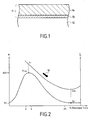
- a thermal barrier composition is available which makes it possible both to obtain a good service life (rate of oxygen vacancies corresponding to the metastable structure of zirconia which ensures good thermomechanical resistance, Nmax in Figure 2) and a minimum thermal conductivity (which is close to ⁇ min in Figure 2, see arrow 10) by the presence of numerous point defects.
- the present invention also relates to a mechanical part in superalloy, characterized in that it comprises a coating of ceramic having a composition of the aforementioned type.
- the mechanical part further comprises a bonding underlayer on which said coating of ceramic.
- the present invention also relates to a coating of ceramic having a bonding underlayer, a first layer ceramic yttria-based ceramic having a molar content of yttrium oxide between 4 and 12% and a second layer of ceramic having a composition of the aforementioned type, said first layer of ceramic material being located between said bonding sub-layer and said second layer of ceramic.
- a barrier coating is obtained thermal system which achieves a first thermal gradient through the first layer of ceramic and a second thermal gradient at through the second ceramic layer having a composition according to the invention.
- thermal barrier coating 11 deposited on a substrate 12 in superalloy, such as superalloys based on nickel and / or cobalt.
- the thermal barrier coating 11 has an underlayer metal 13 deposited on the substrate 12, and a ceramic layer 14 composition according to the invention, deposited on the underlayer 13.
- the underlayer 13 may be an alumino-forming alloy resistant to oxidation corrosion such as an alloy capable of forming a layer of protective alumina by oxidation, an alloy of MCrAlY type (M being a metal chosen from nickel, cobalt, iron or a mixture of these metals) or a modified or unmodified nickel or cobalt the addition of a metal selected from platinum, chromium, palladium, ruthenium, iridium, osmium, rhodium or a mixture of these metals and / or a reactive element chosen from zirconium (Zr), hafnium (Hf) and yttrium (Y).
- Zr zirconium
- Hf hafnium
- Y yttrium
- the ceramic layer 14 consists of a base of zirconia, a trivalent oxide and a pentavalent oxide.
- the trivalent oxide makes it possible, by stabilizing the zirconia, to improve its thermomechanical resistance: resistance is favored thermomechanical maximum, namely a partially stabilized zirconia, therefore a trivalent oxide R203 present with a total content greater than a value of between 4 and 8% by weight (2 and 4 mol%) ( distinguishes a first part equal to a value between 4 and 8% mass or between 2 and 4 mol% and a second part).
- Said trivalent oxide is chosen from the group comprising yttrium oxide, scandium oxide, dysprosium oxide, oxide ytterbium, erbium oxide, gadolinium oxide, europium oxide, samarium oxide, neodymium oxide, praseodymium oxide, oxide lanthanum, terbium oxide, holmium oxide and mixtures thereof, with a preference for yttrium oxide.
- the pentavalent oxide is selected from the group consisting of niobium oxide, tantalum oxide and mixtures thereof.
- said trivalent oxide is present in a molar proportion of between 4 and 30% and said pentavalent oxide is present in a molar proportion of between 2 and 20%, preferably between 4 and 12%, and preferably between 3 and 10%.
- the difference between the molar proportion of the trivalent oxide and the molar proportion of the pentavalent oxide is between 4% and 12%, preferably substantially equal to 4%.
- the said first part of the proportion molar amount of trivalent oxide is between 4 and 12%, and preferably substantially equal to 4%, that is to say, the content which makes it possible to obtain partially stabilized zirconia.
- said second part of the molar proportion of the trivalent oxide exceeds the molar proportion of this first part an amount that is substantially equal to that of the molar proportion pentavalent oxide.
- the superalloy mechanical part illustrated in FIG. be modified by the fact that (not shown) the coating ceramic material 11 further comprises, on said sub-layer 13, a a yttria-based ceramic zirconia layer comprising a content molar yttrium oxide between 4 and 12%.
- the coating is formed by adding, at above a first layer of yttria zirconia ceramic used from classical way (partially stabilized zirconia), a second layer ceramic made according to the composition of the invention.
- said trivalent oxide is present with a molar proportion consisting of a first part allowing to partially stabilize the zirconia and a second part that introduces point defects in the network and in that said pentavalent oxide is present with a molar proportion equal to said molar proportion of said second part of the trivalent oxide.
- said trivalent oxide is chosen in the group comprising yttrium oxide, scandium oxide, dysprosium oxide, ytterbium oxide, erbium oxide, gadolinium, europium oxide, samarium oxide, neodymium, praseodymium oxide, lanthanum oxide, terbium oxide, holmium oxide and mixtures thereof.
- said pentavalent oxide is selected from the group comprising niobium oxide, tantalum oxide and mixtures thereof.
- said trivalent oxide is present in a molar proportion of between 4 and 30 and said pentavalent oxide is present in a molar proportion of between 2 and 20%, preferably between 4 and 12%, and preferably between 3 and 10%.
- This process is preferably carried out with a gap between the molar proportion of the trivalent oxide and the molar proportion of pentavalent oxide which is between 4% and 12%, preferably substantially equal to 4%.
- the manufacturing process according to the invention comprises an additional step of oxidizing the bonding underlayer prior to deposition of the coating ceramic.
Landscapes
- Chemical & Material Sciences (AREA)
- Engineering & Computer Science (AREA)
- Materials Engineering (AREA)
- Mechanical Engineering (AREA)
- Organic Chemistry (AREA)
- Chemical Kinetics & Catalysis (AREA)
- Metallurgy (AREA)
- Inorganic Chemistry (AREA)
- Ceramic Engineering (AREA)
- Physics & Mathematics (AREA)
- General Engineering & Computer Science (AREA)
- Plasma & Fusion (AREA)
- Composite Materials (AREA)
- Manufacturing & Machinery (AREA)
- Structural Engineering (AREA)
- Other Surface Treatments For Metallic Materials (AREA)
- Coating By Spraying Or Casting (AREA)
- Turbine Rotor Nozzle Sealing (AREA)
- Inorganic Compounds Of Heavy Metals (AREA)
- Compositions Of Oxide Ceramics (AREA)
- Physical Vapour Deposition (AREA)
Abstract
Description
- déposer une sous-couche de liaison sur ledit substrat en superalliage,
- déposer sur ladite sous-couche, un revêtement de céramique comportant une base de zircone, au moins un oxyde trivalent (ou un mélange d'oxydes trivalents), permettant de stabiliser la zircone et de réduire la conductivité thermique de la zircone de manière optimale, et au moins un oxyde pentavalent (ou un mélange d'oxydes pentavalents) permettant de diminuer le taux de lacunes d'oxygène pour le ramener sensiblement à celui d'une zircone partiellement stabilisée.
- la figure 1 est une vue en coupe schématique montrant partiellement une pièce mécanique revêtue de la barrière thermique selon l'invention, et
- la figure 2, déjà décrite, est une représentation des courbes relatives à la conductivité thermique et à la tenue mécanique de barrières thermiques en fonction de la teneur en oxyde d'yttrium dans la zircone.
- déposer une sous-couche de liaison sur ledit substrat en superalliage,
- déposer sur ladite sous-couche, un revêtement de céramique comportant une base de zircone, au moins un oxyde trivalent (ou un mélange d'oxydes trivalents), permettant de stabiliser, de préférence partiellement, la zircone et de réduire la conductivité thermique de la zircone de manière optimale, et au moins un oxyde pentavalent (ou un mélange d'oxydes pentavalents) permettant de diminuer le taux de lacunes d'oxygène pour le ramener sensiblement à celui d'une zircone partiellement stabilisée.
Claims (22)
- Composition de barrière thermique de faible conductivité thermique et de forte résistance thermomécanique en céramique, caractérisée en ce qu'elle comporte une base de zircone, au moins un oxyde trivalent, permettant de stabiliser la zircone et de réduire la conductivité thermique de la zircone de manière optimale, et au moins un oxyde pentavalent permettant de diminuer le taux de lacunes d'oxygène pour le ramener sensiblement à celui d'une zircone partiellement stabilisée.
- Composition de barrière thermique selon la revendication 1, caractérisée en ce que ledit oxyde trivalent est présent avec une proportion molaire constituée d'une première partie permettant de stabiliser partiellement la zircone et d'une deuxième partie qui introduit des défauts ponctuels dans le réseau et en ce que ledit oxyde pentavalent est présent avec une proportion molaire égale à ladite proportion molaire de ladite deuxième partie de l'oxyde trivalent.
- Composition de barrière thermique selon l'une quelconque des revendications précédentes, caractérisée en ce que ledit oxyde trivalent est choisi dans le groupe comportant l'oxyde d'yttrium, l'oxyde de scandium, l'oxyde de dysprosium, l'oxyde d'ytterbium, l'oxyde d'erbium, l'oxyde de gadolinium, l'oxyde d'europium, l'oxyde de samarium, l'oxyde de néodyme, l'oxyde de praséodyme, l'oxyde de lanthane, l'oxyde de terbium, l'oxyde d'holmium et leurs mélanges.
- Composition de barrière thermique selon l'une quelconque des revendications précédentes, caractérisée en ce que ledit oxyde pentavalent est choisi dans le groupe comportant l'oxyde de niobium, l'oxyde de tantale et leurs mélanges.
- Composition de barrière thermique selon l'une quelconque des revendications précédentes, caractérisée en ce que ledit oxyde trivalent est présent dans une proportion molaire comprise entre 4 et 30%.
- Composition de barrière thermique selon l'une quelconque des revendications précédentes, caractérisée en ce que ledit oxyde pentavalent est présent dans une proportion molaire comprise entre 2 et 20%, de préférence entre 4 et 12%, et préférentiellement entre 3 et 10%.
- Composition de barrière thermique selon l'une quelconque des revendications précédentes, caractérisée en ce que l'écart entre la proportion molaire de l'oxyde trivalent et la proportion molaire de l'oxyde pentavalent est compris entre 4% et 12%, de préférence sensiblement égal à 4%.
- Pièce mécanique en superalliage, caractérisée en ce qu'elle comporte un revêtement de céramique (11, 14) ayant une composition selon l'une quelconque des revendications précédentes.
- Pièce mécanique en superalliage selon la revendication 8, caractérisée en ce qu'elle comporte en outre une sous-couche de liaison (13) sur laquelle est déposé ledit revêtement de céramique (11, 14).
- Pièce mécanique en superalliage selon la revendication 9, caractérisée en ce que ladite sous-couche de liaison est constituée d'un alliage apte à former une couche d'alumine protectrice par oxydation.
- Pièce mécanique en superalliage selon la revendication 10, caractérisée en ce que ladite sous-couche de liaison (13) est constituée d'un alliage de type MCrAlY, M étant un métal choisi parmi le nickel, le cobalt, le fer ou un mélange de ces métaux.
- Pièce mécanique en superalliage selon la revendication 10, caractérisée en ce que ladite sous-couche de liaison (13) est constituée d'un aluminiure de nickel contenant éventuellement un métal choisi parmi le platine, le chrome, le palladium, le ruthénium, l'iridium, l'osmium, le rhodium, ou un mélange de ces métaux et/ou un élément réactif choisi parmi le zirconium (Zr), le hafnium (Hf) et l'yttrium (Y).
- Pièce mécanique en superalliage selon la revendication 9, caractérisée en ce que ledit revêtement de céramique (11) comporte en outre, sur ladite sous-couche (13), une couche de céramique à base de zircone yttriée comprenant une teneur molaire d'oxyde d'yttrium entre 4 et 12%.
- Revêtement de céramique (11) comportant une sous-couche de liaison, une première couche de céramique à base de zircone yttriée comprenant une teneur molaire d'oxyde d'yttrium entre 4 et 12% et une deuxième couche de céramique présentant une composition selon l'une quelconque des revendications 1 à 7, ladite première couche de céramique étant située entre ladite sous-couche de liaison et ladite deuxième couche de céramique.
- Procédé de fabrication d'un revêtement de céramique comprenant une barrière thermique (11) sur un substrat (12) en superalliage, caractérisé en ce qu'il comporte les étapes suivantes :déposer une sous-couche de liaison (13) sur ledit substrat (12) en superalliage,déposer sur ladite sous-couche (13), un revêtement de céramique (14) comportant une base de zircone, au moins un oxyde trivalent, permettant de stabiliser la zircone et de réduire la conductivité thermique de la zircone de manière optimale, et au moins un oxyde pentavalent permettant de diminuer le taux de lacunes d'oxygène pour le ramener sensiblement à celui d'une zircone partiellement stabilisée.
- Procédé de fabrication selon la revendication 15, caractérisé en ce que ledit oxyde trivalent est présent avec une proportion molaire constituée d'une première partie permettant de stabiliser partiellement la zircone et d'une deuxième partie qui introduit des défauts ponctuels dans le réseau et en ce que ledit oxyde pentavalent est présent avec une proportion molaire égale à ladite proportion molaire de ladite deuxième partie de l'oxyde trivalent.
- Procédé de fabrication selon la revendication 15 ou 16, caractérisé en ce qu'il comporte une étape supplémentaire consistant à oxyder la sous-couche de liaison (13) préalablement au dépôt du revêtement céramique.
- Procédé de fabrication selon l'une quelconque des revendications 15 à 17, caractérisé en ce que ledit oxyde trivalent est choisi dans le groupe comportant l'oxyde de d'yttrium, l'oxyde de scandium, l'oxyde de dysprosium, l'oxyde d'ytterbium, l'oxyde d'erbium, l'oxyde de gadolinium, l'oxyde d'europium, l'oxyde de samarium, l'oxyde de néodyme, l'oxyde de praséodyme, l'oxyde de lanthane, l'oxyde de terbium, l'oxyde d'holmium et leurs mélanges.
- Procédé de fabrication selon l'une quelconque des revendications 15 à 18, caractérisé en ce que ledit oxyde pentavalent est choisi dans le groupe comportant l'oxyde de niobium, l'oxyde de tantale et leurs mélanges.
- Procédé de fabrication selon l'une quelconque des revendications 15 à 19, caractérisé en ce que ledit oxyde trivalent est présent dans une proportion molaire comprise entre 4 et 30%.
- Procédé de fabrication selon l'une quelconque des revendications 15 à 20, caractérisé en ce que ledit oxyde pentavalent est présent dans une proportion molaire comprise entre 2 et 20%, de préférence entre 4 et 12%, et préférentiellement entre 3 et 10%.
- Procédé de fabrication selon l'une quelconque des revendications 15 à 21, caractérisé en ce que l'écart entre la proportion molaire de l'oxyde trivalent et la proportion molaire de l'oxyde pentavalent est compris entre 4% et 12%, de préférence sensiblement égal à 4%.
Applications Claiming Priority (2)
| Application Number | Priority Date | Filing Date | Title |
|---|---|---|---|
| FR0309743A FR2858613B1 (fr) | 2003-08-07 | 2003-08-07 | Composition de barriere thermique, piece mecanique en superalliage munie d'un revetement ayant une telle composition, revetement de ceramique, et procede de fabrication du revetement |
| FR0309743 | 2003-08-07 |
Publications (3)
| Publication Number | Publication Date |
|---|---|
| EP1505042A2 true EP1505042A2 (fr) | 2005-02-09 |
| EP1505042A3 EP1505042A3 (fr) | 2009-06-03 |
| EP1505042B1 EP1505042B1 (fr) | 2013-12-25 |
Family
ID=33548320
Family Applications (1)
| Application Number | Title | Priority Date | Filing Date |
|---|---|---|---|
| EP04291991.0A Expired - Lifetime EP1505042B1 (fr) | 2003-08-07 | 2004-08-04 | Composition de barrière thermique, pièce mécanique en superalliage munie d'un revêtement ayant une telle composition, revêtement de céramique, et procédé de fabrication du revêtement |
Country Status (7)
| Country | Link |
|---|---|
| US (2) | US7374821B2 (fr) |
| EP (1) | EP1505042B1 (fr) |
| JP (1) | JP4538276B2 (fr) |
| CA (1) | CA2478750C (fr) |
| FR (1) | FR2858613B1 (fr) |
| RU (1) | RU2365565C2 (fr) |
| UA (1) | UA93176C2 (fr) |
Families Citing this family (24)
| Publication number | Priority date | Publication date | Assignee | Title |
|---|---|---|---|---|
| US20050036891A1 (en) * | 2003-08-14 | 2005-02-17 | General Electric Company | Thermal barrier coating for reduced sintering and increased impact resistance, and process of making same |
| FR2860790B1 (fr) | 2003-10-09 | 2006-07-28 | Snecma Moteurs | Cible destinee a etre evaporee sous faisceau d'electrons, son procede de fabrication, barriere thermique et revetement obtenus a partir d'une cible, et piece mecanique comportant un tel revetement |
| US7309530B2 (en) * | 2004-08-24 | 2007-12-18 | General Electric Company | Thermal barrier coating with reduced sintering and increased impact resistance, and process of making same |
| US7449254B2 (en) * | 2005-01-21 | 2008-11-11 | General Electric Company | Environmental barrier coating with physical barrier layer for silicon-comprising materials |
| US7115326B2 (en) * | 2005-01-21 | 2006-10-03 | General Electric Company | Thermal/environmental barrier coating with transition layer for silicon-comprising materials |
| US7115327B2 (en) * | 2005-01-21 | 2006-10-03 | General Electric Company | Thermal/environmental barrier coating with transition layer for silicon-comprising materials |
| US7504157B2 (en) * | 2005-11-02 | 2009-03-17 | H.C. Starck Gmbh | Strontium titanium oxides and abradable coatings made therefrom |
| JP4959213B2 (ja) * | 2006-03-31 | 2012-06-20 | 三菱重工業株式会社 | 遮熱コーティング部材及びその製造方法ならびに遮熱コート材料、ガスタービン及び焼結体 |
| US20100098923A1 (en) | 2006-10-05 | 2010-04-22 | United Technologies Corporation | Segmented abradable coatings and process (ES) for applying the same |
| WO2010053687A2 (fr) * | 2008-11-04 | 2010-05-14 | Praxair Technology, Inc. | Revêtements par pulvérisation thermique pour applications à semi-conducteur |
| US8449994B2 (en) * | 2009-06-30 | 2013-05-28 | Honeywell International Inc. | Turbine engine components |
| US8580593B2 (en) * | 2009-09-10 | 2013-11-12 | Micron Technology, Inc. | Epitaxial formation structures and associated methods of manufacturing solid state lighting devices |
| FR2959244B1 (fr) | 2010-04-23 | 2012-06-29 | Commissariat Energie Atomique | Procede de preparation d'un revetement multicouche sur une surface d'un substrat par projection thermique. |
| WO2012142422A1 (fr) | 2011-04-13 | 2012-10-18 | Rolls-Royce Corporation | Couche de barrière à la diffusion interfaciale contenant de l'iridium sur un substrat métallique |
| JP5526098B2 (ja) * | 2011-09-30 | 2014-06-18 | コバレントマテリアル株式会社 | 耐食性部材及びその製造方法 |
| EP2918705B1 (fr) | 2014-03-12 | 2017-05-03 | Rolls-Royce Corporation | Revêtement comprenant une couche barrière de diffusion comprenant iridium et une couche d'oxyde et procédé de revêtement |
| US10808555B2 (en) * | 2018-01-03 | 2020-10-20 | Honeywell International Inc. | Quinary, low-conductivity thermal barrier coatings for turbine engine components |
| US12365803B2 (en) | 2020-06-19 | 2025-07-22 | General Electric Company | Inspectable coatings and methods for using |
| CN114000089B (zh) * | 2021-10-11 | 2022-12-30 | 上海交通大学 | 一种利用aps技术制备的高熵氧化物超高温热障涂层及其方法 |
| US12319834B2 (en) | 2021-12-17 | 2025-06-03 | General Electric Company | Anti-corrosion material and application method |
| CN116477943B (zh) * | 2022-01-17 | 2024-04-12 | 中国人民解放军国防科技大学 | 一种钽酸盐复相陶瓷及其制备方法 |
| CN114804898A (zh) * | 2022-04-22 | 2022-07-29 | 深圳清华大学研究院 | 多元共掺杂氧化锆热障涂层材料及其制备方法 |
| US12394804B2 (en) | 2022-08-16 | 2025-08-19 | General Electric Company | Thermal management of a fuel cell assembly |
| CN118184374B (zh) * | 2024-03-20 | 2025-08-26 | 中国地质大学(武汉) | 一种高断裂韧性的层状钙钛矿结构高熵热障涂层材料及其制备方法 |
Family Cites Families (20)
| Publication number | Priority date | Publication date | Assignee | Title |
|---|---|---|---|---|
| JPS60190580A (ja) * | 1984-03-08 | 1985-09-28 | Hitachi Ltd | 遮熱コ−テイング用粉末および遮熱コ−テイング層を有する金属部材 |
| SU1749311A1 (ru) * | 1990-04-20 | 1992-07-23 | Белорусское республиканское научно-производственное объединение порошковой металлургии | Способ получени теплозащитных покрытий |
| US5238752A (en) * | 1990-05-07 | 1993-08-24 | General Electric Company | Thermal barrier coating system with intermetallic overlay bond coat |
| US5302465A (en) * | 1992-10-26 | 1994-04-12 | The United States Of America As Represented By The Administrator Of The National Aeronautics And Space Administration | Plasma sprayed ceramic thermal barrier coating for NiAl-based intermetallic alloys |
| GB9800511D0 (en) * | 1998-01-13 | 1998-03-11 | Rolls Royce Plc | A metallic article having a thermal barrier coating and a method of application thereof |
| JPH11264082A (ja) * | 1998-03-17 | 1999-09-28 | Toshiba Corp | 耐熱部材および耐熱部材の製造方法 |
| US6210812B1 (en) * | 1999-05-03 | 2001-04-03 | General Electric Company | Thermal barrier coating system |
| DE10008861A1 (de) * | 2000-02-25 | 2001-09-06 | Forschungszentrum Juelich Gmbh | Kombinierte Wärmedämmschichtsysteme |
| JP3872632B2 (ja) * | 2000-06-09 | 2007-01-24 | 三菱重工業株式会社 | 遮熱コーティング材、それを適用したガスタービン部材およびガスタービン |
| JP2002003747A (ja) * | 2000-06-20 | 2002-01-09 | Osaka Gas Co Ltd | コーティング材及びそれを用いた耐熱部材 |
| AU2002226001A1 (en) * | 2000-12-08 | 2002-06-18 | Sulzer Metco (Us) Inc. | Pre-alloyed stabilized zirconia powder and improved thermal barrier coating |
| US6812176B1 (en) * | 2001-01-22 | 2004-11-02 | Ohio Aerospace Institute | Low conductivity and sintering-resistant thermal barrier coatings |
| US6551061B2 (en) * | 2001-03-27 | 2003-04-22 | General Electric Company | Process for forming micro cooling channels inside a thermal barrier coating system without masking material |
| US6607789B1 (en) * | 2001-04-26 | 2003-08-19 | General Electric Company | Plasma sprayed thermal bond coat system |
| JP4031631B2 (ja) * | 2001-10-24 | 2008-01-09 | 三菱重工業株式会社 | 遮熱コーティング材及びガスタービン部材並びにガスタービン |
| JP2003160852A (ja) * | 2001-11-26 | 2003-06-06 | Mitsubishi Heavy Ind Ltd | 遮熱コーティング材、その製造方法、タービン部材及びガスタービン |
| US6682827B2 (en) * | 2001-12-20 | 2004-01-27 | General Electric Company | Nickel aluminide coating and coating systems formed therewith |
| FR2838752B1 (fr) * | 2002-04-22 | 2005-02-25 | Snecma Moteurs | Procede de formation d'un revetement ceramique sur un substrat par depot physique en phase vapeur sous faisceau d'electrons |
| US6686060B2 (en) * | 2002-05-15 | 2004-02-03 | General Electric Company | Thermal barrier coating material |
| US7060365B2 (en) * | 2002-05-30 | 2006-06-13 | General Electric Company | Thermal barrier coating material |
-
2003
- 2003-08-07 FR FR0309743A patent/FR2858613B1/fr not_active Expired - Fee Related
-
2004
- 2004-08-04 EP EP04291991.0A patent/EP1505042B1/fr not_active Expired - Lifetime
- 2004-08-05 JP JP2004229130A patent/JP4538276B2/ja not_active Expired - Lifetime
- 2004-08-05 CA CA2478750A patent/CA2478750C/fr not_active Expired - Lifetime
- 2004-08-05 US US10/911,598 patent/US7374821B2/en not_active Expired - Lifetime
- 2004-08-06 RU RU2004124073/03A patent/RU2365565C2/ru active
- 2004-08-06 UA UA20040806605A patent/UA93176C2/uk unknown
-
2007
- 2007-11-23 US US11/944,508 patent/US20080069959A1/en not_active Abandoned
Non-Patent Citations (1)
| Title |
|---|
| S. ALPÉRINE; L. LELAIT: "Microstructural investigations of plasma-sprayed yttria partially stabilized zirconia TBC in relation with thermomechanical resistance and high temperature oxidation mechanisms", PROC. 37TH ASME INTERNATIONAL GAS TURBINE AND AEROENGINE CONGRES, 1992 |
Also Published As
| Publication number | Publication date |
|---|---|
| US7374821B2 (en) | 2008-05-20 |
| EP1505042B1 (fr) | 2013-12-25 |
| US20050064225A1 (en) | 2005-03-24 |
| US20080069959A1 (en) | 2008-03-20 |
| FR2858613A1 (fr) | 2005-02-11 |
| RU2365565C2 (ru) | 2009-08-27 |
| CA2478750C (fr) | 2013-11-19 |
| CA2478750A1 (fr) | 2005-02-07 |
| UA93176C2 (uk) | 2011-01-25 |
| FR2858613B1 (fr) | 2006-12-08 |
| RU2004124073A (ru) | 2006-01-27 |
| JP2005097727A (ja) | 2005-04-14 |
| EP1505042A3 (fr) | 2009-06-03 |
| JP4538276B2 (ja) | 2010-09-08 |
Similar Documents
| Publication | Publication Date | Title |
|---|---|---|
| CA2478750C (fr) | Composition de barriere thermique, piece mecanique en superalliage munie d'un revetement ayant une telle composition, revetement de ceramique, et procede de fabrication du revetement | |
| CA2318612C (fr) | Composition de barriere thermique, piece mecanique en superalliage protegee par un revetement de ceramique ayant une telle composition, et methode de realisation du revetement de ceramique | |
| EP1522533B1 (fr) | Cible destinée à être évaporée sous faisceau d'électrons et son procédé de fabrication. | |
| EP2396446B1 (fr) | Méthode de fabrication d'une barrière thermique recouvrant un substrat métallique en superalliage et pièce thermomécanique résultant de cette méthode de fabrication | |
| CN103992117B (zh) | 陶瓷粉末及其制备方法 | |
| FR2957358A1 (fr) | Methode de fabrication d'une protection de barriere thermique et revetement multicouche apte a former une barriere thermique | |
| UA74150C2 (uk) | Спосіб формування покриття для створення теплового бар'єра та покриття для створення теплового бар'єра | |
| KR840001683B1 (ko) | 내구성세라믹 열차단피막을 코우팅한 금속제품의 제조방법 | |
| CA2284384C (fr) | Revetement de barriere thermique a faible conductivite thermique, piece metallique protegee par ce revetement, procede de depot de ce revetement | |
| US20160010471A1 (en) | Coating systems and methods therefor | |
| JP2008196040A (ja) | 耐熱部材 | |
| EP0962545B1 (fr) | Revêtement céramique à faible conductivité thermique | |
| FR2946663A1 (fr) | Revetement thermique, piece thermomecanique comportant un tel revetement thermique, turbomachine, moteur d'aeronef, d'astronef ou de fusee comportant une telle piece thermomecanique | |
| EP1327698B1 (fr) | Couche de barrière thermique stabilisée thermiquement et procédé pour sa fabrication | |
| FR2974581A1 (fr) | Piece comportant un revetement sur un substrat metallique en superalliage, le revetement comprenant une sous-couche metallique | |
| FR2941964A1 (fr) | Methode de traitement d'une barriere thermique recouvrant un substrat metallique en superalliage et piece thermomecanique resultant de cette methode de traitement | |
| FR2941967A1 (fr) | Methode de fabrication d'une barriere thermique recouvrant une piece realisee dans un substrat metallique en superalliage et piece thermomecanique resultant de cette methode de traitement | |
| KR100270226B1 (ko) | 새로운 구조의 열차폐 코팅 및 그의 제조방법 | |
| FR3053076A1 (fr) | Piece de turbomachine revetue d'une barriere thermique et d'un revetement de protection contre les cmas et procede pour l'obtenir | |
| FR3154397A1 (fr) | Procédé de revêtement d’un substrat en matériau composite à matrice céramique par au moins un revêtement, et pièce correspondante | |
| FR2999611A1 (fr) | Procede de fabrication d'un revetement et piece thermomecanique en superalliage comprenant un revetement obtenu selon ce procede |
Legal Events
| Date | Code | Title | Description |
|---|---|---|---|
| PUAI | Public reference made under article 153(3) epc to a published international application that has entered the european phase |
Free format text: ORIGINAL CODE: 0009012 |
|
| 17P | Request for examination filed |
Effective date: 20040810 |
|
| AK | Designated contracting states |
Kind code of ref document: A2 Designated state(s): AT BE BG CH CY CZ DE DK EE ES FI FR GB GR HU IE IT LI LU MC NL PL PT RO SE SI SK TR |
|
| AX | Request for extension of the european patent |
Extension state: AL HR LT LV MK |
|
| RIN1 | Information on inventor provided before grant (corrected) |
Inventor name: LECLERCQ, BERANGERE Inventor name: MEVREL, REMY Inventor name: AZZOPARDI, ALBAN Inventor name: MALIE, ANDRE Inventor name: SAINT-RAMOND, BERTRAND |
|
| RAP1 | Party data changed (applicant data changed or rights of an application transferred) |
Owner name: SNECMA SERVICES Owner name: SNECMA |
|
| PUAL | Search report despatched |
Free format text: ORIGINAL CODE: 0009013 |
|
| AK | Designated contracting states |
Kind code of ref document: A3 Designated state(s): AT BE BG CH CY CZ DE DK EE ES FI FR GB GR HU IE IT LI LU MC NL PL PT RO SE SI SK TR |
|
| AX | Request for extension of the european patent |
Extension state: AL HR LT LV MK |
|
| 17Q | First examination report despatched |
Effective date: 20090713 |
|
| RAP1 | Party data changed (applicant data changed or rights of an application transferred) |
Owner name: SNECMA |
|
| AKX | Designation fees paid |
Designated state(s): DE ES FR GB IT SE |
|
| REG | Reference to a national code |
Ref country code: DE Ref legal event code: R079 Ref document number: 602004044062 Country of ref document: DE Free format text: PREVIOUS MAIN CLASS: C04B0035486000 Ipc: C23C0030000000 |
|
| RIC1 | Information provided on ipc code assigned before grant |
Ipc: C23C 30/00 20060101AFI20130417BHEP Ipc: C04B 35/486 20060101ALI20130417BHEP |
|
| GRAP | Despatch of communication of intention to grant a patent |
Free format text: ORIGINAL CODE: EPIDOSNIGR1 |
|
| INTG | Intention to grant announced |
Effective date: 20130708 |
|
| GRAS | Grant fee paid |
Free format text: ORIGINAL CODE: EPIDOSNIGR3 |
|
| GRAA | (expected) grant |
Free format text: ORIGINAL CODE: 0009210 |
|
| AK | Designated contracting states |
Kind code of ref document: B1 Designated state(s): DE ES FR GB IT SE |
|
| REG | Reference to a national code |
Ref country code: GB Ref legal event code: FG4D Free format text: NOT ENGLISH |
|
| REG | Reference to a national code |
Ref country code: DE Ref legal event code: R096 Ref document number: 602004044062 Country of ref document: DE Effective date: 20140220 |
|
| REG | Reference to a national code |
Ref country code: SE Ref legal event code: TRGR |
|
| PG25 | Lapsed in a contracting state [announced via postgrant information from national office to epo] |
Ref country code: ES Free format text: LAPSE BECAUSE OF FAILURE TO SUBMIT A TRANSLATION OF THE DESCRIPTION OR TO PAY THE FEE WITHIN THE PRESCRIBED TIME-LIMIT Effective date: 20131225 |
|
| REG | Reference to a national code |
Ref country code: DE Ref legal event code: R097 Ref document number: 602004044062 Country of ref document: DE |
|
| PLBE | No opposition filed within time limit |
Free format text: ORIGINAL CODE: 0009261 |
|
| STAA | Information on the status of an ep patent application or granted ep patent |
Free format text: STATUS: NO OPPOSITION FILED WITHIN TIME LIMIT |
|
| 26N | No opposition filed |
Effective date: 20140926 |
|
| REG | Reference to a national code |
Ref country code: DE Ref legal event code: R097 Ref document number: 602004044062 Country of ref document: DE Effective date: 20140926 |
|
| REG | Reference to a national code |
Ref country code: FR Ref legal event code: PLFP Year of fee payment: 13 |
|
| REG | Reference to a national code |
Ref country code: FR Ref legal event code: PLFP Year of fee payment: 14 |
|
| REG | Reference to a national code |
Ref country code: FR Ref legal event code: CD Owner name: SAFRAN AIRCRAFT ENGINES, FR Effective date: 20170719 |
|
| REG | Reference to a national code |
Ref country code: FR Ref legal event code: PLFP Year of fee payment: 15 |
|
| PGFP | Annual fee paid to national office [announced via postgrant information from national office to epo] |
Ref country code: IT Payment date: 20230720 Year of fee payment: 20 Ref country code: GB Payment date: 20230720 Year of fee payment: 20 |
|
| PGFP | Annual fee paid to national office [announced via postgrant information from national office to epo] |
Ref country code: SE Payment date: 20230720 Year of fee payment: 20 Ref country code: FR Payment date: 20230720 Year of fee payment: 20 Ref country code: DE Payment date: 20230720 Year of fee payment: 20 |
|
| REG | Reference to a national code |
Ref country code: DE Ref legal event code: R071 Ref document number: 602004044062 Country of ref document: DE |
|
| REG | Reference to a national code |
Ref country code: GB Ref legal event code: PE20 Expiry date: 20240803 |
|
| REG | Reference to a national code |
Ref country code: SE Ref legal event code: EUG |
|
| PG25 | Lapsed in a contracting state [announced via postgrant information from national office to epo] |
Ref country code: GB Free format text: LAPSE BECAUSE OF EXPIRATION OF PROTECTION Effective date: 20240803 |
|
| PG25 | Lapsed in a contracting state [announced via postgrant information from national office to epo] |
Ref country code: GB Free format text: LAPSE BECAUSE OF EXPIRATION OF PROTECTION Effective date: 20240803 |