EP1503966B1 - Bauteile mit kristallinen beschichtungen des systems aluminiumoxid/siliziumoxid und verfahren zu deren herstellung - Google Patents
Bauteile mit kristallinen beschichtungen des systems aluminiumoxid/siliziumoxid und verfahren zu deren herstellung Download PDFInfo
- Publication number
- EP1503966B1 EP1503966B1 EP03732220A EP03732220A EP1503966B1 EP 1503966 B1 EP1503966 B1 EP 1503966B1 EP 03732220 A EP03732220 A EP 03732220A EP 03732220 A EP03732220 A EP 03732220A EP 1503966 B1 EP1503966 B1 EP 1503966B1
- Authority
- EP
- European Patent Office
- Prior art keywords
- aluminum oxide
- substrate
- silicon
- crystalline
- coatings
- Prior art date
- Legal status (The legal status is an assumption and is not a legal conclusion. Google has not performed a legal analysis and makes no representation as to the accuracy of the status listed.)
- Expired - Lifetime
Links
Images

Classifications
-
- C—CHEMISTRY; METALLURGY
- C23—COATING METALLIC MATERIAL; COATING MATERIAL WITH METALLIC MATERIAL; CHEMICAL SURFACE TREATMENT; DIFFUSION TREATMENT OF METALLIC MATERIAL; COATING BY VACUUM EVAPORATION, BY SPUTTERING, BY ION IMPLANTATION OR BY CHEMICAL VAPOUR DEPOSITION, IN GENERAL; INHIBITING CORROSION OF METALLIC MATERIAL OR INCRUSTATION IN GENERAL
- C23C—COATING METALLIC MATERIAL; COATING MATERIAL WITH METALLIC MATERIAL; SURFACE TREATMENT OF METALLIC MATERIAL BY DIFFUSION INTO THE SURFACE, BY CHEMICAL CONVERSION OR SUBSTITUTION; COATING BY VACUUM EVAPORATION, BY SPUTTERING, BY ION IMPLANTATION OR BY CHEMICAL VAPOUR DEPOSITION, IN GENERAL
- C23C14/00—Coating by vacuum evaporation, by sputtering or by ion implantation of the coating forming material
- C23C14/58—After-treatment
- C23C14/5806—Thermal treatment
-
- C—CHEMISTRY; METALLURGY
- C03—GLASS; MINERAL OR SLAG WOOL
- C03C—CHEMICAL COMPOSITION OF GLASSES, GLAZES OR VITREOUS ENAMELS; SURFACE TREATMENT OF GLASS; SURFACE TREATMENT OF FIBRES OR FILAMENTS MADE FROM GLASS, MINERALS OR SLAGS; JOINING GLASS TO GLASS OR OTHER MATERIALS
- C03C17/00—Surface treatment of glass, not in the form of fibres or filaments, by coating
- C03C17/006—Surface treatment of glass, not in the form of fibres or filaments, by coating with materials of composite character
- C03C17/007—Surface treatment of glass, not in the form of fibres or filaments, by coating with materials of composite character containing a dispersed phase, e.g. particles, fibres or flakes, in a continuous phase
-
- C—CHEMISTRY; METALLURGY
- C03—GLASS; MINERAL OR SLAG WOOL
- C03C—CHEMICAL COMPOSITION OF GLASSES, GLAZES OR VITREOUS ENAMELS; SURFACE TREATMENT OF GLASS; SURFACE TREATMENT OF FIBRES OR FILAMENTS MADE FROM GLASS, MINERALS OR SLAGS; JOINING GLASS TO GLASS OR OTHER MATERIALS
- C03C17/00—Surface treatment of glass, not in the form of fibres or filaments, by coating
- C03C17/22—Surface treatment of glass, not in the form of fibres or filaments, by coating with other inorganic material
- C03C17/23—Oxides
- C03C17/245—Oxides by deposition from the vapour phase
-
- C—CHEMISTRY; METALLURGY
- C23—COATING METALLIC MATERIAL; COATING MATERIAL WITH METALLIC MATERIAL; CHEMICAL SURFACE TREATMENT; DIFFUSION TREATMENT OF METALLIC MATERIAL; COATING BY VACUUM EVAPORATION, BY SPUTTERING, BY ION IMPLANTATION OR BY CHEMICAL VAPOUR DEPOSITION, IN GENERAL; INHIBITING CORROSION OF METALLIC MATERIAL OR INCRUSTATION IN GENERAL
- C23C—COATING METALLIC MATERIAL; COATING MATERIAL WITH METALLIC MATERIAL; SURFACE TREATMENT OF METALLIC MATERIAL BY DIFFUSION INTO THE SURFACE, BY CHEMICAL CONVERSION OR SUBSTITUTION; COATING BY VACUUM EVAPORATION, BY SPUTTERING, BY ION IMPLANTATION OR BY CHEMICAL VAPOUR DEPOSITION, IN GENERAL
- C23C14/00—Coating by vacuum evaporation, by sputtering or by ion implantation of the coating forming material
- C23C14/06—Coating by vacuum evaporation, by sputtering or by ion implantation of the coating forming material characterised by the coating material
- C23C14/08—Oxides
- C23C14/081—Oxides of aluminium, magnesium or beryllium
-
- C—CHEMISTRY; METALLURGY
- C23—COATING METALLIC MATERIAL; COATING MATERIAL WITH METALLIC MATERIAL; CHEMICAL SURFACE TREATMENT; DIFFUSION TREATMENT OF METALLIC MATERIAL; COATING BY VACUUM EVAPORATION, BY SPUTTERING, BY ION IMPLANTATION OR BY CHEMICAL VAPOUR DEPOSITION, IN GENERAL; INHIBITING CORROSION OF METALLIC MATERIAL OR INCRUSTATION IN GENERAL
- C23C—COATING METALLIC MATERIAL; COATING MATERIAL WITH METALLIC MATERIAL; SURFACE TREATMENT OF METALLIC MATERIAL BY DIFFUSION INTO THE SURFACE, BY CHEMICAL CONVERSION OR SUBSTITUTION; COATING BY VACUUM EVAPORATION, BY SPUTTERING, BY ION IMPLANTATION OR BY CHEMICAL VAPOUR DEPOSITION, IN GENERAL
- C23C14/00—Coating by vacuum evaporation, by sputtering or by ion implantation of the coating forming material
- C23C14/58—After-treatment
- C23C14/5806—Thermal treatment
- C23C14/5813—Thermal treatment using lasers
-
- C—CHEMISTRY; METALLURGY
- C23—COATING METALLIC MATERIAL; COATING MATERIAL WITH METALLIC MATERIAL; CHEMICAL SURFACE TREATMENT; DIFFUSION TREATMENT OF METALLIC MATERIAL; COATING BY VACUUM EVAPORATION, BY SPUTTERING, BY ION IMPLANTATION OR BY CHEMICAL VAPOUR DEPOSITION, IN GENERAL; INHIBITING CORROSION OF METALLIC MATERIAL OR INCRUSTATION IN GENERAL
- C23C—COATING METALLIC MATERIAL; COATING MATERIAL WITH METALLIC MATERIAL; SURFACE TREATMENT OF METALLIC MATERIAL BY DIFFUSION INTO THE SURFACE, BY CHEMICAL CONVERSION OR SUBSTITUTION; COATING BY VACUUM EVAPORATION, BY SPUTTERING, BY ION IMPLANTATION OR BY CHEMICAL VAPOUR DEPOSITION, IN GENERAL
- C23C14/00—Coating by vacuum evaporation, by sputtering or by ion implantation of the coating forming material
- C23C14/58—After-treatment
- C23C14/5893—Mixing of deposited material
-
- C—CHEMISTRY; METALLURGY
- C03—GLASS; MINERAL OR SLAG WOOL
- C03C—CHEMICAL COMPOSITION OF GLASSES, GLAZES OR VITREOUS ENAMELS; SURFACE TREATMENT OF GLASS; SURFACE TREATMENT OF FIBRES OR FILAMENTS MADE FROM GLASS, MINERALS OR SLAGS; JOINING GLASS TO GLASS OR OTHER MATERIALS
- C03C2217/00—Coatings on glass
- C03C2217/20—Materials for coating a single layer on glass
- C03C2217/21—Oxides
- C03C2217/213—SiO2
-
- C—CHEMISTRY; METALLURGY
- C03—GLASS; MINERAL OR SLAG WOOL
- C03C—CHEMICAL COMPOSITION OF GLASSES, GLAZES OR VITREOUS ENAMELS; SURFACE TREATMENT OF GLASS; SURFACE TREATMENT OF FIBRES OR FILAMENTS MADE FROM GLASS, MINERALS OR SLAGS; JOINING GLASS TO GLASS OR OTHER MATERIALS
- C03C2217/00—Coatings on glass
- C03C2217/20—Materials for coating a single layer on glass
- C03C2217/21—Oxides
- C03C2217/214—Al2O3
-
- C—CHEMISTRY; METALLURGY
- C03—GLASS; MINERAL OR SLAG WOOL
- C03C—CHEMICAL COMPOSITION OF GLASSES, GLAZES OR VITREOUS ENAMELS; SURFACE TREATMENT OF GLASS; SURFACE TREATMENT OF FIBRES OR FILAMENTS MADE FROM GLASS, MINERALS OR SLAGS; JOINING GLASS TO GLASS OR OTHER MATERIALS
- C03C2217/00—Coatings on glass
- C03C2217/20—Materials for coating a single layer on glass
- C03C2217/21—Oxides
- C03C2217/23—Mixtures
-
- C—CHEMISTRY; METALLURGY
- C03—GLASS; MINERAL OR SLAG WOOL
- C03C—CHEMICAL COMPOSITION OF GLASSES, GLAZES OR VITREOUS ENAMELS; SURFACE TREATMENT OF GLASS; SURFACE TREATMENT OF FIBRES OR FILAMENTS MADE FROM GLASS, MINERALS OR SLAGS; JOINING GLASS TO GLASS OR OTHER MATERIALS
- C03C2217/00—Coatings on glass
- C03C2217/40—Coatings comprising at least one inhomogeneous layer
-
- C—CHEMISTRY; METALLURGY
- C03—GLASS; MINERAL OR SLAG WOOL
- C03C—CHEMICAL COMPOSITION OF GLASSES, GLAZES OR VITREOUS ENAMELS; SURFACE TREATMENT OF GLASS; SURFACE TREATMENT OF FIBRES OR FILAMENTS MADE FROM GLASS, MINERALS OR SLAGS; JOINING GLASS TO GLASS OR OTHER MATERIALS
- C03C2217/00—Coatings on glass
- C03C2217/90—Other aspects of coatings
- C03C2217/91—Coatings containing at least one layer having a composition gradient through its thickness
-
- C—CHEMISTRY; METALLURGY
- C03—GLASS; MINERAL OR SLAG WOOL
- C03C—CHEMICAL COMPOSITION OF GLASSES, GLAZES OR VITREOUS ENAMELS; SURFACE TREATMENT OF GLASS; SURFACE TREATMENT OF FIBRES OR FILAMENTS MADE FROM GLASS, MINERALS OR SLAGS; JOINING GLASS TO GLASS OR OTHER MATERIALS
- C03C2218/00—Methods for coating glass
- C03C2218/10—Deposition methods
- C03C2218/15—Deposition methods from the vapour phase
- C03C2218/154—Deposition methods from the vapour phase by sputtering
- C03C2218/156—Deposition methods from the vapour phase by sputtering by magnetron sputtering
-
- C—CHEMISTRY; METALLURGY
- C03—GLASS; MINERAL OR SLAG WOOL
- C03C—CHEMICAL COMPOSITION OF GLASSES, GLAZES OR VITREOUS ENAMELS; SURFACE TREATMENT OF GLASS; SURFACE TREATMENT OF FIBRES OR FILAMENTS MADE FROM GLASS, MINERALS OR SLAGS; JOINING GLASS TO GLASS OR OTHER MATERIALS
- C03C2218/00—Methods for coating glass
- C03C2218/30—Aspects of methods for coating glass not covered above
- C03C2218/32—After-treatment
Definitions
- the invention relates to components with crystalline coatings of the system alumina / silica and processes for their preparation for producing hard coatings on silicon or silicate glass substrates as a material for hard and chemically resistant high-temperature coatings.
- Excellent adhesive properties result from the intergrowth of the layers with the underlays, which is characterized by the presence of extensive structural and / or concentration gradients, especially in the interface region.
- silica is the most important base material for the fabrication of refractive optics (both glassy and crystalline)
- the application of thin alumina layers to these optics can provide, for example, laser antireflective layers or, by combination with silicon oxide layers, dielectric filters for the extended wavelength range of 0.3-5.0 microns are realized, which can be used without destruction at very high power densities.
- Crystalline alumina for example, in a technically particularly interesting modification as corundum ( ⁇ -alumina) before.
- Corundum is mainly because of its high hardness (Mohs hardness 9, for easy determination of hardness according to Mohs and a method, for example, F. Kohlrausch, Practical Physics Volume 1, BG Teubner, Stuttgart, 1968, pp 175 ff.) But also because of its chemical indifference and its high melting point a highly valued material.
- Natural corundum is the second hardest natural mineral after diamond.
- Another modification is the ⁇ -alumina, which has a spinel structure with defects and comparatively less compact. Natural aluminum oxide protective layers on metallic aluminum usually have a NaCl structure with defects.
- Crystalline silicon oxide occurs, for example, in the quartz, cristobalite or tridymite modifications, which can be converted into one another depending on the temperature.
- vitreous silica-based material is often of interest, i. the formation of one of the crystalline modifications should then be avoided.
- Silicon oxide-based glassy materials can be obtained, for example, by the addition of sodium oxide to the melt.
- DE 100 12 316 A1 includes a method for coating quartz components with a firmly adhering layer of aluminum oxide as protection against chemical reactions. For the coating of the quartz components thereby either the application of the protective layer by physical vapor deposition or by chemical vapor deposition or by application of an aluminum layer and subsequent post-oxidation (under atmospheric conditions for 15 min at 800 ° C) is provided. On the formation of a defined modification of the crystal structure DE 100 12 316 A1 is not aligned.
- mullite may form. Due to the equally high hardness (up to 7.5 according to Mohs), the high heat resistance but above all the high resistance to chemical and physical erosion mullite has great importance as a refractory material for chemical reactors and high-temperature furnaces.
- amorphous alumina at room temperature can be converted into crystalline modifications by a suitable heat treatment. If the temperature is increased slowly or stepped in a corresponding regime, ⁇ -alumina is often observed at temperatures in the size of about 1000 ° C as the first crystalline phase, which then after extensive heat treatment at this temperature, but faster at higher temperatures up 1200 ° C. can also be converted into ⁇ -aluminum oxide (zzB TC Chou, D. Adamson, J. Mardinly and TG Nieh, Thin Solid Films, 205 (1991) 131-139), unfortunately there are no details on the printing conditions there / the gas composition of the atmosphere during the heat treatment).
- amorphous alumina layers on sapphire substrates are treated in this way, the crystallization proceeding from the crystalline substrate can be assisted by the thus given structure information by solid phase epitaxy (see, for example, TW Simpson, Q. Wen, N. Yu and DR Clarke, J. Am. Ceram. Soc., 81 (1) (1998) 61-66 ).
- solid phase epitaxy see, for example, TW Simpson, Q. Wen, N. Yu and DR Clarke, J. Am. Ceram. Soc., 81 (1) (1998) 61-66 .
- the object of the invention is to provide components with a hard and chemically resistant coating of the system alumina / silica with high adhesion and a method therefor.
- the object is achieved by components with crystalline coatings of the system alumina / silica, in which the crystalline aluminosilicate coating with the substrate of silicon or silicate glass is grown and has a mixing zone with a concentration and / or structure gradient.
- alumina / silica is obtained so that during or after the application of aluminum oxide layers on substrates or substrates of silicon or silicate glass, a heat treatment under vacuum conditions at temperatures greater than 1100 ° C.
- the heat treatment is preferably carried out at a pressure of less than 5 ⁇ 10 3 Pa.
- the inventive method allows the formation of crystalline modifications of the system aluminum / silicon / oxygen by reaction of the layer with parts of the substrate.
- the substrate thereby provides silicon or silicon oxide (silicon stored in air forms natural silicon oxide layers whose thickness can be extended by thermal oxidation, for example, to the micrometer range) for the formation of crystalline modification of the Al 2 SiO 5 group or mullitization.
- the inventive method leads to a structure of an i.a. thermally stimulated solid state reaction between alumina and the substrate.
- the simultaneous adhesion of the layers to the underlays which is characterized by the presence of extensive structural and concentration gradients, in particular in the interface region, gives rise to very advantageous adhesion properties, which are maintained under very different loads.
- a concentration gradient arises from the inter-diffusion of the components of the aluminum oxide layer and the substrate.
- the transport of individual components may be preferred.
- the concentration gradient can also cause a structural gradient.
- Advantage of such structure gradients is the successive transition between two solids with different crystal structure (in this case can be started by a component of an amorphous structure).
- the adhesion is usually much lower, because there the influence of the mismatch of the two crystal structures or the limited variance of the bonding possibilities is disadvantageous.
- different coefficients of thermal expansion of the layer and underlay during temperature changes in technical use can lead to a flaking of the layer.
- FIGS. 1a and 1b On a substrate (U) made of silicate glass, a layer (S) of aluminum oxide is deposited in a first process step, whereby a sharp boundary surface (U) - (S) arises according to FIG. 1a (formation of a negligible intermixing zone depending on the method used in FIG Size of ⁇ 1nm).
- a temperature treatment according to the invention in a second process step as shown in FIG. 1b, an extended mixing zone (D) of the relevant components is formed, wherein parts of the substrate (U) and the entire layer may be affected.
- a structure gradient is obtained starting from the substrate (this can be amorphous) through the new layer (S 'until the desired crystalline modification is established for the volume ranges sufficiently extended for the desired properties).
- the invention also includes the possibility of adjusting the required parameters during the application of the layers or immediately thereafter.
- a substrate heating effective during the deposition of the layers can be used.
- the method according to the invention can also be realized as aftertreatment of layers. This can be used for the deposition of the primary aluminum oxide layers on inexpensive large-scale implemented process with high process speed, since first the aluminum or Alumina must be deposited only on the substrate (aluminum can be simply oxidized beyond the natural oxide layer formation in air thermally, which is why generalized alumina is named at this point of the pretreatment). With the method according to the invention, it is possible to selectively produce the desired structural modifications on glassy substrates without the required process temperature exceeding the devitrification temperature of important silicate glasses, whereby these documents remain unchanged with regard to their physical properties.
- the heating of the aluminum oxide layers as well as the areas primarily at the interface between layer and substrate and adjacent substrate areas by the absorption of electromagnetic radiation with wavelengths of radiation in the ultraviolet range by the absorption of electromagnetic radiation with wavelengths of radiation in the ultraviolet range.
- the localization of the intensively heated zone in this area succeeds for most silicate glasses, since the degree of absorption of electromagnetic radiation in this wavelength range for alumina is much larger than for these glasses.
- the overall absorption in favor of the layer can be further increased.
- This form of targeted local heating also allows the inventive coating of silicate glasses with a lower devitrification temperature.
- the electromagnetic radiation used is preferably laser radiation having a wavelength in the UV range.
- the laser radiation is grazing, irradiated almost parallel to the substrate surface and thus limits the penetration depth into the substrate.
- a hard and scratch-resistant coating on optical glasses eg in optical lenses and mirrors
- optical glasses eg in optical lenses and mirrors
- a hard and scratch-resistant coating on optical glasses which remains stable even with larger temperature fluctuations (eg due to absorption of certain spectral components of the light in discontinuous operation).
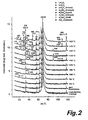
- FIG. 2 shows X-ray diffractograms of the samples treated at different temperatures.
- Each diffractogram is assigned the temperature at which the sample under investigation was treated. Reflexes occur in the presence of a crystalline order, their angular position and also intensity allows statements about the crystalline structure of the investigated materials (by calculation or by comparison with data collections of known structures). Since the layers of the samples (thickness about 70 nm) are well penetrated by the X-ray radiation in the symmetrical beam geometry used, in each diffractogram the very strong contribution of the reflections of the monocrystalline substrate (for comparison, the diffractogram of the uncoated substrate is also indicated) , The sequences of 3 digits in the illustration correspond to reflex indices with respect to the indicated crystalline phases.
- the coated sample without temperature and vacuum treatment has no additional reflections of the layer - the layer appears structurally amorphous from the perspective of X-ray diffraction measurement.
- the onset of crystallization of the layers is observed after a heat treatment of the samples at 750 ° C.
- the reflexes can be assigned to the modifications ⁇ -Al 2 O 3 or ⁇ -Al 2 O 3 .
- reflections can be recognized in the assigned diffractogram which can be assigned to the corundum modification of the aluminum oxide or also to the crystal structures of the Al 2 SiO 5 group. Even if an unambiguous assignment is made difficult here, all possible structures here have a high degree of hardness and also chemical resistance.
- mullite Al 4 SiO 8
- This phase is extremely interesting as a material for hard and chemically resistant high-temperature coatings.
- the silicon oxide modification cristobalite is also observed.
- any embedding of cristobalite in a mullite matrix may be advantageous in terms of the thermal and mechanical stability of the layer (it is known that the addition of cristobalite to glazes can prevent the formation of hairline cracks).
- the required temperatures of the heat treatment are below the devitrification temperature of a number of important glasses with which an undesirable change in the properties of these substrates can be prevented.
- a layer of alumina is deposited by reactive magnetron ion beam sputtering of an alumina target in a plasma containing argon and oxygen (for method, see TC Chou et al., For full text above in the text of the specification).
- the deposited layers and substrates are subjected to the formation of the desired crystalline modifications of the Al 2 SiO 5 group under the conditions mentioned in Application Example 1 for vacuum and temperature of a heat treatment.
Landscapes
- Chemical & Material Sciences (AREA)
- Organic Chemistry (AREA)
- Chemical Kinetics & Catalysis (AREA)
- Engineering & Computer Science (AREA)
- Materials Engineering (AREA)
- Mechanical Engineering (AREA)
- Metallurgy (AREA)
- Physics & Mathematics (AREA)
- Life Sciences & Earth Sciences (AREA)
- Thermal Sciences (AREA)
- General Chemical & Material Sciences (AREA)
- Geochemistry & Mineralogy (AREA)
- Optics & Photonics (AREA)
- Dispersion Chemistry (AREA)
- Composite Materials (AREA)
- Laminated Bodies (AREA)
- Glass Compositions (AREA)
- Physical Vapour Deposition (AREA)
- Application Of Or Painting With Fluid Materials (AREA)
- Silicon Compounds (AREA)
Description
- Die Erfindung betrifft Bauteile mit kristallinen Beschichtungen des Systems Aluminiumoxid/ Siliziumoxid und Verfahren zu deren Herstellung zur Erzeugung harter Schichten auf Silizium oder Silikatglasunterlagen als Material für harte und chemisch resistente Hochtemperaturbeschichtungen. Ausgezeichnete Hafteigenschaften resultieren aus der Verwachsung der Schichten mit den Unterlagen, die durch das Vorliegen von ausgedehnten Struktur- und/oder Konzentrationsgradienten insbesondere im Grenzflächenbereich gekennzeichnet ist.
- Aluminiumoxid und Siliziumoxid sind aufgrund ihrer Eigenschaften auch als Materialien für Beschichtungen interessant. Dabei sind neben der für einzelne kristalline Modifikationen erreichbaren hohen Härte auch die optischen Eigenschaften entscheidend. Während Siliziumdioxid das wichtigste Grundmaterial für die Herstellung refraktiver Optiken bildet (sowohl glasartig als auch im kristallinen Zustand), können durch die Aufbringung von dünnen Aluminiumoxid-Schichten auf diesen Optiken beispielsweise Laser-Anti-Reflexschichten oder, durch Kombination mit SiliziumoxidSchichten, dielektrische Filter für den ausgedehnten Wellenlängenbereich von 0.3-5.0 µm realisiert werden, die bei sehr hohen Leistungsdichten ohne Zerstörung einsetzbar sind.
- Kristallines Aluminiumoxid kommt beispielsweise in einer technisch besonders interessanten Modifikation als Korund (α-Aluminiumoxid) vor. Korund ist vor allem wegen seiner großen Härte (Mohshärte 9, zur einfachen Härtebestimmung nach Mohs sowie a. Verfahren s. z.B. F. Kohlrausch, Praktische Physik Band 1, B.G. Teubner, Stuttgart, 1968, S. 175 ff.) aber auch aufgrund seiner chemischen Indifferenz und seines hohen Schmelzpunktes ein hochgeschätzter Werkstoff. Natürlicher Korund ist nach Diamant das zweithärteste bekannte natürliche Mineral. Eine weitere Modifikation ist das γ-Aluminiumoxid, das eine Spinell-Struktur mit Fehlstellen aufweist und vergleichsweise weniger kompakt ist. Natürliche Aluminumoxid-Schutzschichten auf metallischem Aluminium weisen zumeist eine NaCl-Stsuktur mit Fehlstellen auf.
- Kristallines Siliziumoxid kommt beispielsweise in den Modifikationen Quarz, Cristobalit oder Tridymit vor, die temperaturabhängig ineinander überführt werden können. Für technische Anwendungen ist allerdings häufig glasartiges Material auf Siliziumoxid-Basis von Interesse, d.h. die Bildung einer der kristallinen Modifikationen soll dann vermieden werden. Glasartige Materialien auf der Grundlage von Siliziumoxid können beispielsweise durch die Beimengung von Natriumoxid zur Schmelze erlangt werden.
- DE 100 12 316 A1 beinhaltet ein Verfahren zur Beschichtung von Quarzbauteilen mit einer fest anhaftenden Schicht aus Aluminiumoxid als Schutz gegen chemische Reaktionen. Für die Beschichtung der Quarzbauteile ist dabei entweder die Aufbringung der Schutzschicht durch physikalische Abscheidung aus der Dampfphase oder durch chemische Abscheidung aus der Gasphase oder durch Aufbringung einer Aluminiumschicht und folgende Nachoxidation (unter Atmosphärenbedingungen 15 min bei 800°C) vorgesehen. Auf die Ausbildung einer definierten Modifikation der Kristallstruktur ist DE 100 12 316 A1 nicht ausgerichtet.
- Bei der Aufbringung von Schichten auf Unterlagen oder infolge später wirkender Einflüsse kann es an der Grenzfläche zu Festkörperreaktionen kommen, die nach einer Durchmischung die Ausbildung anderer kristalliner Phasen ermöglichen. Im System Silizium/ Aluminium/ Sauerstoff sind ebenfalls verschiedene Modifikationen der Struktur des kristallinen Zustandes bekannt. Für die Al2SiO5-Gruppe sind die drei Modifikationen Cyanit, Andalusit und Sillimanit gesichert bekannt. Bei natürlichen Vorkommen kann aus der vorliegenden Modifikation auf den bei der Bildung wirksam gewesenen Druck geschlossen werden. Während der trikline Cyanit richtungsabhängige Mohshärten von 4-7 aufweist, erreichen die rhombischen Modifikationen Andalusit und Sillimanit Werte von 7.5 bzw. 6-7 nach Mohs. Damit sind im Sinne obiger Darstellung auch Schichten aus der Al2SiO5 - Gruppe als mechanische Schutzschichten (mit ebenfalls vielseitig technisch nutzbaren optischen Eigenschaften) interessant.
- Werden Festkörper der Al2SiO5-Gruppe bzw. aus Kombinationen von Aluminiumoxid und Siliziumoxid auf hinreichend hohe Temperaturen (zumeist >1000°C) erwärmt, kann es zur Bildung von Mullit kommen. Aufgrund der ebenfalls hohen Härte (bis zu 7.5 nach Mohs), der großen Hitzebeständigkeit aber vor allem auch der hohen Widerstandsfähigkeit gegen chemische und physikalische Erosion hat Mullit große Bedeutung als feuerfester Werkstoff für chemische Reaktoren und Hochtemperaturöfen.
- Es ist bekannt, daß bei Raumtemperatur amorph vorliegendes Aluminiumoxid durch eine geeignete Wärmebehandlung in kristalline Modifikationen überführt werden kann. Wird die Temperatur dabei in einem entsprechenden Regime langsam oder gestuft gesteigert, wird häufig bei Temperaturen in der Größe von ca. 1000°C als erste kristalline Phase γ-Aluminiumoxid beobachtet, welche dann nach ausgedehnter Wärmebehandlung bei dieser Temperatur, schneller aber bei höheren Temperaturen bis ca. 1200°C auch in α-Aluminiumoxid umwandeln kann (z. z.B. T.C. Chou, D. Adamson, J. Mardinly and T.G. Nieh, Thin Solid Films, 205 (1991) 131-139; leider finden sich dort keine Angaben zu den Druckbedingungen/ der Gaszusammensetzung der Atmosphäre während der Wärmebehandlung). Werden amorphe Aluminiumoxid-Schichten auf Saphir-Substraten derart behandelt, kann die Kristallisation ausgehend vom kristallinen Substrat unterstützt durch die somit vorgegeben Strukturinformation durch Festphasen-Epitaxie gelingen (s. z.B. T.W. Simpson, Q. Wen, N. Yu and D.R. Clarke, J. Am. Ceram. Soc., 81(1) (1998) 61-66). Für technische Anwendungen ist dagegen im allgemeinen die Erzeugung einkristalliner oder texturierter Schichten (polylaistalliner Schichten mit Vorzugsorientierung der Kristallite) aus Aluminiumoxid auf Unterlagen aus anderem Material erforderlich.
- Die Aufgabe der Erfindung besteht in der Bereitstellung von Bauteilen mit einer harten und chemisch resistenten Beschichtung des Systems Aluminiumoxid/ Siliziumoxid mit hoher Haftung sowie einem Verfahren dafür.
- Erfindungsgemäß wird die Aufgabe durch Bauteile mit kristallinen Beschichtungen des Systems Aluminiumoxid/ Siliziumoxid gelöst, bei denen die kristalline Aluminiumsilikatbeschichtung mit der Unterlage aus Silizium oder Silikatglas verwachsen ist und eine Durchmischungszone mit einem Konzentrations- und/oder Strukturgradienten aufweist.
- Erfindungsgemäß wird die kristalline Beschichtung des Systems Aluminiumoxid/Siliziumoxid so erhalten, daß bei oder nach der Aufbringung von Aluminiumoxid Schichten auf Unterlagen bzw. Substraten aus Silizium oder Silikatglas eine Wärmebehandlung unter Vakuumbedingungen bei Temperaturen größer 1100 °C erfolgt. Vorzugsweise erfolgt die Wärmebehandlung bei einem Druck kleiner 5x10³ Pa.
- Das erfindungsgemäße Verfahren ermöglicht die Ausbildung kristalliner Modifikationen des Systems Aluminium/ Silizium/ Sauerstoff durch Reaktion der Schicht mit Teilen der Unterlage. Die Unterlage stellt dabei Silizium bzw. Siliziumoxid (an Luft gelagertes Silizium bildet natürliche Siliziumoxidschichten, deren Dicke durch thermische Oxidation z.B. bis in den Mikrometerbereich ausgedehnt werden kann) für die Bildung von kristallinen Modifikation der Al2SiO5-Gruppe bzw. einer Mullitisation bereit.
- Das erfindungsgemäße Verfahren führt zu einer Struktur aus einer i.a. thermisch stimulierten Festkörperreaktion zwischen Aluminiumoxid und der Unterlage. Die damit gleichzeitig erzielte Verwachsung der Schichten mit den Unterlagen, die durch das Vorliegen von ausgedehnten Struktur- und Konzentrationsgradienten insbesondere im Grenzflächenbereich gekennzeichnet ist, ergibt sehr vorteilhafte Haftungseigenschaften, die bei verschiedensten Belastungen erhalten bleiben.
- Ein Konzentrationsgradient entsteht dabei durch die Inter-Diffusion der Komponenten der Aluminiumoxidschicht und der Unterlage. Dabei kann bei gegebenen Randbedingungen der Transport einzelner Komponenten bevorzugt sein. Da die Bildung der einzelnen kristallinen Modifikationen neben der Aktivierungsenergie, die hier vor allem durch die Prozeßtemperatur bereitgestellt wird, bestimmte chemische Zusammensetzungen (zumeist innerhalb bestimmter Intervalle) erfordert, kann für das vorliegende Verfahren der Konzentrationsgradient auch einen Strukturgradienten bedingen. Vorteil solcher Strukturgradienten ist der sukzessive Übergang zwischen zwei Festkörpern mit unterschiedlicher Kristallstruktur (hierbei kann von einer Komponente auch aus einer amorphen Struktur gestartet werden). Für abrupte Übergänge ist das Haftvermögen zumeist deutlich geringer, da dort der Einfluß der Fehlpassung beider Kristallstrukturen bzw. die eingeschränkte Varianz der Bindungsmöglichkeiten nachteilig wirkt. Darüber hinaus können z.B. unterschiedliche thermische Ausdehnungskoeffizienten von Schicht und Unterlage bei Temperaturwechsel in der technischen Nutzung zu einem Abplatzen der Schicht führen.
- Anhand Fig. 1a und 1b wird die Erfindung näher erläutert. Auf einer Unterlage (U) aus Silikatglas wird in einem ersten Prozeßschritt eine Schicht (S) aus Aluminiumoxid abgeschieden, wobei nach Fig. 1a eine scharfe Grenzfläche (U)-(S) entsteht (Ausbildung einer zu vernachlässigenden Durchmischungszone abhängig vom verwendeten Verfahren in der Größe von < 1nm). Nach einer erfindungsgemäßen Temperaturbehandlung in einem zweiten Prozeßschritt bildet sich nach Fig. 1b eine ausgedehnte Durchmischungszone (D) der betreffenden Komponenten aus, wobei Teile der Unterlage (U) und die gesamte Schicht betroffen sein können.
- Unter den erfindungsgemäßen Prozeßbedingungen erhält man neben dem Konzentrationsgradienten einen Strukturgradienten ausgehend von der Unterlage (diese kann amorph sein) durch die neue Schicht (S', bis zur Einstellung der gewünschten kristallinen Modifikation für die für die angestrebten Eigenschaften hinreichend ausgedehnten Volumenbereiche).
- Die Erfindung umfaßt auch die Möglichkeit der Einstellung der erforderlichen Parameter während der Aufbringung der Schichten bzw. im unmittelbaren Anschluß daran. Dafür kann z.B. eine während der Abscheidung der Schichten wirksame Substratheizung eingesetzt werden.
- Das erfindungsgemäße Verfahren kann auch als Nachbehandlung von Schichten realisiert werden. Dadurch kann für die Abscheidung der primären Aluminiumoxidschichten auf preiswerte großtechnisch umgesetzte Verfahren mit hoher Prozeßgeschwindigkeit zurückgegriffen werden, da zunächst das Aluminium oder Aluminiumoxid lediglich auf der Unterlage deponiert werden muß (Aluminium kann über die natürliche Oxidschichtbildung an Luft hinausgehend einfach thermisch oxidiert werden, weshalb nachfolgend verallgemeinernd Aluminiumoxid an dieser Stelle der Vorbehandlung benannt wird). Mit dem erfindungsgemäßen Verfahren gelingt es, gezielt die gewünschten strukturellen Modifikationen auch auf glasartigen Unterlagen zu erzeugen, ohne daß die erforderliche Prozeßtemperatur die Entglasungstemperatur wichtiger Silikatgläser übersteigt, womit diese Unterlagen im Hinblick auf ihre physikalischen Eigenschaften unverändert bleiben.
- In einer vorteilhaften Ausgestaltung kann die Erwärmung der Aluminiumoxid-Schichten sowie der Bereiche vorrangig an der Grenzfläche zwischen Schicht und Substrat sowie angrenzender Substratbereiche durch die Absorption von elektromagnetischer Strahlung mit Wellenlängen der Strahlung im Ultraviolett-Bereich erfolgen. Die Lokalisierung der intensiv erwärmten Zone auf diesen Bereich gelingt für die meisten Silikatgläser, da der Absorptionsgrad für elektromagnetische Strahlung in diesem Wellenlängenbereich für Aluminiumoxid wesentlich größer als für diese Gläser ist. Zusätzlich kann durch streifenden Einfall der Strahlung bezüglich der Schichtoberfläche der Gesamtabsorptionsgrad zugunsten der Schicht weiter erhöht werden. Diese Form der gezielten lokalen Erwärmung ermöglicht auch die erfindungsgemäße Beschichtung von Silikatgläsern mit niedrigerer Entglasungstemperatur.
- Als elektromagnetische Strahlung wird vorzugsweise Laserstrahlung mit einer Wellenlänge im UV-Bereich eingesetzt. Vorteilhaft wird die Laserstrahlung streifend, nahezu parallel zur Substratoberfläche eingestrahlt und damit die Eindringtiefe in das Substrat limitiert.
- Erfindungsgemäß wird eine harte und kratzfeste Beschichtung auf optischen Gläsern (z.B. in optischen Linsen und Spiegeln) erhalten, die auch bei größeren Temperaturschwankungen (z.B. infolge Absorption bestimmter Spektralanteile des Lichtes bei diskontinuierlichem Betrieb) stabil bleibt.
- Anhand nachfolgender Ausführungsbeispiele wird die Erfindung näher erläutert.
- Auf einkristallinen Silizium-Substraten mit natürlicher Oxidschicht wird mittels Elektronenstrahlverdampfung Aluminiumoxid aufgedampft (Schichtdicken ca. 70 nm). Die so beschichteten Ausgangssubstrate werden anschließend einer Temperaturbehandlung im Vakuum (Druck kleiner 5*103 Pa, Rohr-Laborofen der Fa. Linn Elektro Therm, Zeitdauer 2h) unterzogen. Zur Charakterisierung des kristallinen Phasenbestandes werden diese Proben mittels Röntgen-Diffraktometrie (Meßgerät: Röntgen-Diffraktometer URD-6 der Fa. Freiberger Präzisionsmechanik, Cu-Kα-Strahlung) untersucht. Dabei wird mit einem elektronischen Nachweissystem in Abhängigkeit vom Diffraktometer-Winkel 2θ die Intensität der von der Probe gestreuten Strahlung vermessen.
- In Fig. 2 sind Röntgen-Diffraktogramme der bei unterschiedlichen Temperaturen behandelten Proben dargestellt. Jedem Diffraktogramm ist die Temperatur zugeordnet, bei der die untersuchte Probe behandelt wurde. Reflexe treten beim Vorliegen einer kristallinen Ordnung auf, ihre Winkellage und auch Intensität ermöglicht Aussagen über die kristalline Struktur der untersuchten Materialien (durch Rechnung oder durch Vergleich mit Datensammlungen bekannter Strukturen).
Da die Schichten der Proben (Dicke ca. 70nm) bei der verwendeten symmetrischen Strahlgeometrie von der Röntgenstrahlung gut durchdrungen werden, ist in jedem Diffraktogramm der sehr starke Beitrag der Reflexe des einkristallinen Substrats (zum Vergleich ist das Diffraktogramm des unbeschichteten Substrats mit angegeben) zu erkennen. Die Folgen von 3 Ziffern in der Darstellung entsprechen Reflex-Indizierungen bezüglich der angegebenen kristallinen Phasen. Die beschichtete Probe ohne Temperatur- und Vakuumbehandlung weist keine zusätzlichen Reflexe der Schicht auf - die Schicht erscheint aus Sicht der Röntgen-Beugungsmessung strukturell amorph. - Bis zu einer Temperatur von 750 °C treten gegenüber dem unbeschichteten Substrat keine meßbaren Änderungen auf.
- Das Einsetzen einer Kristallisation der Schichten wird nach einer Wärmebehandlung der Proben bei 750°C beobachtet. Die Reflexe können den Modifikationen γ-Al2O3 oder θ-Al2O3 zugeordnet werden. Bei der bei 1100°C behandelten Probe erkennt man in dem zugeordneten Diffraktogramm Reflexe, welche der Korund-Modifikation des Aluminiumoxids oder auch den Kristallstrukturen der Al2SiO5-Gruppe zugeordnet werden können. Auch wenn eine eindeutige Zuordnung hier erschwert ist, weisen alle hier möglichen Strukturen eine hohe Härte und auch chemische Resistenz auf.
- Die bei Temperaturen >1125 °C behandelten Proben haben eine deutlich geringere Intensität der Reflexe. Dies spricht für die geringe Breite des Temperaturintervalls für die optimale Bildung dieser Strukturen. Der Umstand, daß in der gewählten Meßgeometrie nur einzelne Reflexe der betreffenden Phasen identifiziert werden können, wird mit dem Vorliegen einer starken Fasertextur der kristallinen Schichtbereiche erklärt.
- Wärmebehandlungen der Proben bei Temperaturen oberhalb von 1150°C führen zur verstärkten Bildung von Mullit (Al4SiO8). Diese Phase ist als Material für harte und chemisch resistente Hochtemperaturbeschichtungen außerordentlich interessant. Im vorliegenden Fall wird außer Mullit auch die Siliziumoxid-Modifikation Cristobalit beobachtet. Auch eine eventuelle Einbettung des Cristobalit in eine Mullitmatrix kann vorteilhaft im Hinblick auf die thermische und mechanische Standfestigkeit der Schicht sein (es ist bekannt, daß der Zusatz von Cristobalit zu Glasuren die Entstehung von Haarrissen verhindern kann). Wichtig für den praktischen Einsatz ist, daß die erforderlichen Temperaturen der Wärmebehandlung unterhalb der Entglasungstemperatur einer Reihe wichtiger Gläser liegen womit eine unerwünschte Veränderung der Eigenschaften dieser Substrate verhindert werden kann.
- Untersucht man die Beschaffenheit der Grenzfläche zwischen Beschichtung und Substrat mittels Röntgen-Reflektometrie beobachtet man bei Wärmebehandlung bis 1075°C noch eine ausgezeichnete Grenzfläche zwischen Beschichtung und Substrat, was auf einen scharfen Sprung der Konzentration der Komponenten von Schicht und Substrat hinweist. Grundlage für die Methode der Röntgen-Reflektometrie bildet die Interferenz von Teilstrahlen eines unter kleinen Winkeln auf die Oberfläche der Schicht (~ 1°) gerichteten Röntgenstrahls, die durch teilweise Reflexion an der Luft-Schicht-Grenzfläche bzw. der Grenzfläche Schicht-Substrat entstehen. Aus den winkelabhängig vermessenen Interferenzbildern kann dann u.a. auf die Dicke der Schicht und die Qualität der benannten Grenzflächen bzw. auch Grenzschichten geschlossen werden.
- Werden Proben bei Temperaturen ab 1100°C behandelt, finden sich mit der Methode der Röntgen-Reflektometrie keine Hinweise mehr auf eine scharf lokalisierte Grenzfläche. Ersichtlich ist mit dieser Methode eine ausgedehnte Durchmischungszone mit einem Konzentrationsgradienten.
- Auf Unterlagen aus Silikatglas wird durch reaktive Magnetron-Ionenstrahlzerstäubung eines Aluminiumoxid-Targets in einem Plasma, das Argon und Sauerstoff enthält, eine Schicht aus Aluminiumoxid abgeschieden (zur Methode s. z.B. T.C. Chou et al. - vollständiges Zitat weiter oben im Text der Beschreibung).
- Die deponierten Schichten und Substrate werden zur Ausbildung der angestrebten kristallinen Modifikationen der Al2SiO5 - Gruppe unter den im Anwendungsbeispiel 1 genannten Bedingungen für Vakuum und Temperatur einer Wärmebehandlung unterworfen.
- Die Untersuchung der Proben mittels Röntgen-Diffraktometrie und Röntgenreflektometrie erbringt mit Ausführungsbeispiel 1 vergleichbare Versuchsergebnisse. Die im Bereich der dort angegebenen Temperaturen behandelten Proben weisen ebenfalls die angestrebten harten Modifikationen auf. Während im allgemeinen die für das Abscheideverfahren und die Abscheidebedingungen charakteristische Realstruktur der Schichten und die Beschaffenheit der Grenzfläche Einfluß auf anschließende thermisch stimulierte Festkörperreaktionen haben, sind auch bei Wahl von Silikatglas als Unterlage für die beiden für industrietechnische Anwendungen bedeutsamen Verfahren der beiden Ausführungsbeispiele keine signifikanten Unterschiede erkennbar.
Claims (7)
- Bauteile mit kristallinen Beschichtungen des Systems Aluminiumoxid/ Siliziumoxid, bei denen die kristalline Aluminiumsilikatbeschichtung mit der Unterlage aus Silizium oder Silikatglas verwachsen ist und eine Durchmischungszone mit einem Konzentrations- und/oder Strukturgradienten aufweist, erhältlich dadurch, daß bei oder nach der Aufbringung von Aluminiumoxidschichten auf Substraten aus Silizium oder Silikatglas eine Wärmebehandlung der Reaktionszone unter Vakuumbedingungen bei einem Druck kleiner 5x10³ Pa bei Temperaturen größer 1100 °C erfolgt.
- Verfahren zur Erzeugung einer kristallinen Beschichtung des Systems Aluminiumoxid/Siliziumoxid, dadurch gekennzeichnet, daß bei oder nach der Aufbringung von Aluminiumoxidschichten auf Substraten aus Silizium oder Silikatglas eine Wärmebehandlung der Reaktionszone unter Vakuumbedingungen bei einem Druck kleiner 5x10³ Pa bei Temperaturen größer 1100 °C erfolgt.
- Verfahren nach Anspruch 2, dadurch gekennzeichnet, daß die Wärmebehandlung durch Erwärmung der Aluminiumoxidschichten mittels elektromagnetischer Strahlung unter Vermeidung einer signifikanten Substraterwärmung erfolgt.
- Verfahren nach Anspruch 3, dadurch gekennzeichnet, daß als elektromagnetische Strahlung Laserstrahlung eingesetzt wird.
- Verfahren nach Anspruch 4, dadurch gekennzeichnet, daß die Wellenlänge der Laserstrahlung im UV-Bereich liegt.
- Verfahren nach Anspruch 4 oder 5, dadurch gekennzeichnet, daß die Laserstrahlung streifend, nahezu parallel zur Substratoberfläche eingestrahlt und die Eindringtiefe in die Substratunterlage limitiert wird.
- Verfahren nach Anspruch 2, dadurch gekennzeichnet, daß während der Aufbringung der Aluminiumoxidschichten die Substratunterlage beheizt oder mit elektromagnetischer Strahlung geeigneter Wellenlänge lokal erwärmt wird.
Applications Claiming Priority (3)
| Application Number | Priority Date | Filing Date | Title |
|---|---|---|---|
| DE10219812 | 2002-05-02 | ||
| DE10219812A DE10219812A1 (de) | 2002-05-02 | 2002-05-02 | Bauteile mit kristallinen Beschichtungen des Systems Aluminiumoxid/Siliziumoxid und Verfahren zu deren Herstellung |
| PCT/DE2003/001440 WO2003093184A1 (de) | 2002-05-02 | 2003-04-30 | Bauteile mit kristallinen beschichtungen des systems aluminiumoxid/siliziumoxid und verfahren zu deren herstellung |
Publications (2)
| Publication Number | Publication Date |
|---|---|
| EP1503966A1 EP1503966A1 (de) | 2005-02-09 |
| EP1503966B1 true EP1503966B1 (de) | 2007-04-25 |
Family
ID=29225021
Family Applications (1)
| Application Number | Title | Priority Date | Filing Date |
|---|---|---|---|
| EP03732220A Expired - Lifetime EP1503966B1 (de) | 2002-05-02 | 2003-04-30 | Bauteile mit kristallinen beschichtungen des systems aluminiumoxid/siliziumoxid und verfahren zu deren herstellung |
Country Status (6)
| Country | Link |
|---|---|
| US (1) | US20060093833A1 (de) |
| EP (1) | EP1503966B1 (de) |
| AT (1) | ATE360603T1 (de) |
| AU (1) | AU2003238350A1 (de) |
| DE (3) | DE10219812A1 (de) |
| WO (1) | WO2003093184A1 (de) |
Families Citing this family (24)
| Publication number | Priority date | Publication date | Assignee | Title |
|---|---|---|---|---|
| TWI316746B (en) * | 2006-10-03 | 2009-11-01 | Macronix Int Co Ltd | Non-volatile memory and method of manufacturing the same |
| WO2008081828A1 (ja) * | 2007-01-05 | 2008-07-10 | Nippon Electric Glass Co., Ltd. | 固体撮像素子用カバーガラス及びその製造方法 |
| FI120832B (fi) * | 2007-12-03 | 2010-03-31 | Beneq Oy | Menetelmä ohuen lasin lujuuden kasvattamiseksi |
| FI122879B (fi) * | 2008-02-18 | 2012-08-15 | Beneq Oy | Menetelmä lasin pinnan muokkaamiseksi |
| US8592922B2 (en) * | 2008-06-09 | 2013-11-26 | Taiwan Semiconductor Manufacturing Company, Ltd. | Transistor device and a method of manufacturing the same |
| TWI477620B (zh) * | 2011-01-27 | 2015-03-21 | Hon Hai Prec Ind Co Ltd | 殼體及其製造方法 |
| TWI477621B (zh) * | 2011-01-28 | 2015-03-21 | Hon Hai Prec Ind Co Ltd | 殼體及其製造方法 |
| US20140272345A1 (en) * | 2013-03-15 | 2014-09-18 | Rubicon Technology, Inc. | Method of growing aluminum oxide onto substrates by use of an aluminum source in an environment containing partial pressure of oxygen to create transparent, scratch-resistant windows |
| US9110230B2 (en) | 2013-05-07 | 2015-08-18 | Corning Incorporated | Scratch-resistant articles with retained optical properties |
| US9359261B2 (en) | 2013-05-07 | 2016-06-07 | Corning Incorporated | Low-color scratch-resistant articles with a multilayer optical film |
| US9366784B2 (en) | 2013-05-07 | 2016-06-14 | Corning Incorporated | Low-color scratch-resistant articles with a multilayer optical film |
| US9684097B2 (en) * | 2013-05-07 | 2017-06-20 | Corning Incorporated | Scratch-resistant articles with retained optical properties |
| US9703011B2 (en) | 2013-05-07 | 2017-07-11 | Corning Incorporated | Scratch-resistant articles with a gradient layer |
| TWI686620B (zh) * | 2013-09-13 | 2020-03-01 | 美商康寧公司 | 具有保留光學性質的防刮物件 |
| US9335444B2 (en) | 2014-05-12 | 2016-05-10 | Corning Incorporated | Durable and scratch-resistant anti-reflective articles |
| US11267973B2 (en) | 2014-05-12 | 2022-03-08 | Corning Incorporated | Durable anti-reflective articles |
| US9790593B2 (en) | 2014-08-01 | 2017-10-17 | Corning Incorporated | Scratch-resistant materials and articles including the same |
| EP3770649A1 (de) | 2015-09-14 | 2021-01-27 | Corning Incorporated | Kratzfeste antireflexionsartikel mit hoher lichttransmission |
| TWI760445B (zh) * | 2017-02-28 | 2022-04-11 | 美商康寧公司 | 抗刮膜及其製造方法 |
| KR102591065B1 (ko) | 2018-08-17 | 2023-10-19 | 코닝 인코포레이티드 | 얇고, 내구성 있는 반사-방지 구조를 갖는 무기산화물 물품 |
| US12386101B2 (en) | 2020-07-09 | 2025-08-12 | Corning Incorporated | Textured region of a substrate to reduce specular reflectance incorporating surface features with an elliptical perimeter or segments thereof, and method of making the same |
| CN114395750B (zh) * | 2021-10-26 | 2024-01-23 | 西安热工研究院有限公司 | 一种SiO2-莫来石-Al2O3多组分梯度防氧化涂层及其制备方法 |
| CN113957439B (zh) * | 2021-10-26 | 2024-01-23 | 西安热工研究院有限公司 | 一种钛合金用Al2O3_莫来石梯度防氧化涂层及其制备方法 |
| US11959164B2 (en) * | 2022-03-10 | 2024-04-16 | Yimin Hu | High damage threshold and highly reliable broad-band mid-IR coatings for high power fluoride fiber laser |
Family Cites Families (4)
| Publication number | Priority date | Publication date | Assignee | Title |
|---|---|---|---|---|
| US4047067A (en) * | 1974-06-05 | 1977-09-06 | General Electric Company | Sodium halide discharge lamp with an alumina silicate barrier zone in fused silica envelope |
| FR2319594A1 (fr) * | 1975-07-28 | 1977-02-25 | Corning Glass Works | Perfectionnement aux ustensiles de cuisine servant a la cuisson des aliments |
| DE3403378C2 (de) * | 1984-02-01 | 1991-04-18 | Fraunhofer-Gesellschaft zur Förderung der angewandten Forschung e.V., 8000 München | Verfahren zur Oberflächenbehandlung eines Quarzglassubstrates und dessen Anwendung |
| AU4741300A (en) * | 1999-03-13 | 2000-10-04 | Andreas Mucha | Coated quartz glass components and method for coating |
-
2002
- 2002-05-02 DE DE10219812A patent/DE10219812A1/de not_active Withdrawn
-
2003
- 2003-04-30 AU AU2003238350A patent/AU2003238350A1/en not_active Abandoned
- 2003-04-30 WO PCT/DE2003/001440 patent/WO2003093184A1/de not_active Ceased
- 2003-04-30 EP EP03732220A patent/EP1503966B1/de not_active Expired - Lifetime
- 2003-04-30 DE DE50307132T patent/DE50307132D1/de not_active Expired - Lifetime
- 2003-04-30 US US10/513,028 patent/US20060093833A1/en not_active Abandoned
- 2003-04-30 AT AT03732220T patent/ATE360603T1/de not_active IP Right Cessation
- 2003-04-30 DE DE10392009T patent/DE10392009D2/de not_active Expired - Fee Related
Also Published As
| Publication number | Publication date |
|---|---|
| DE10392009D2 (de) | 2005-04-07 |
| ATE360603T1 (de) | 2007-05-15 |
| WO2003093184A1 (de) | 2003-11-13 |
| US20060093833A1 (en) | 2006-05-04 |
| EP1503966A1 (de) | 2005-02-09 |
| DE10219812A1 (de) | 2003-11-13 |
| AU2003238350A1 (en) | 2003-11-17 |
| DE50307132D1 (de) | 2007-06-06 |
Similar Documents
| Publication | Publication Date | Title |
|---|---|---|
| EP1503966A1 (de) | Bauteile mit kristallinen beschichtungen des systems aluminiumoxid/siliziumoxid und verfahren zu deren herstellung | |
| Dragoo et al. | Transitions in Vapor‐Deposited Alumina from 300° to 1200° C | |
| EP2942333B1 (de) | Kratzresistente beschichtungen, substrate mit kratzfesten beschichtungen und verfahren zu deren herstellung | |
| DE102014104798B4 (de) | Harte anti-Reflex-Beschichtungen sowie deren Herstellung und Verwendung | |
| DE69125644T2 (de) | Interferenz-Filter | |
| Hsu et al. | Thermally induced crystallization of amorphous‐titania films | |
| DE60133012T2 (de) | Verfahren zum erhalten von photoaktiven beschichtungen und/oder anataskristallphasen der titanoxide und daraus erzeugte artikel | |
| DE10297443B4 (de) | Verfahren zur Herstellung eines überzogenen Schleifteilchens, nach dem Verfahren hergestelltes Schleifteilchen, dessen Verwendung und glasartiges Verbundelement | |
| DE69018170T2 (de) | Mit Keramik überzogenes Metallblech. | |
| DE60121007T3 (de) | Substrat mit einer photokatalytischen beschichtung | |
| DE2646513C2 (de) | Verfahren zur Herstellung einer wärmereflektierenden Natron-Kalk-Silikatglasscheibe | |
| DE102007025577B4 (de) | Verfahren zur Herstellung von Titanoxidschichten mit hoher photokatalytischer Aktivität | |
| WO2011029603A1 (de) | Substrat aus einer aluminium-silizium-legierung oder kristallinem silizium, metallspiegel, verfahren zu dessen herstellung sowie dessen verwendung | |
| EP2845920A1 (de) | Oxidverbindungen als Beschichtungszusammensetzung | |
| DE102015116644B4 (de) | Substrate mit kratzfesten Beschichtungen mit verbesserter Reinigungsfähigkeit, Verfahren zu deren Herstellung sowie deren Verwendung | |
| DE102015103494A1 (de) | Verfahren zur Herstellung eines Reflektorelements und Reflektorelement | |
| DE19680223B3 (de) | Verfahren zum Schutz eines Wärmesperren-Überzuges und entsprechendes Bauteil | |
| DE4324576C1 (de) | Verfahren zur Herstellung einer mit einer Mehrfachschicht versehenen Glasscheibe | |
| WO2007045225A2 (de) | Mehrlagige wärmedämmschichtsysteme und verfahren zur herstellung | |
| DE10302342A1 (de) | Substrat für die EUV-Mikrolithographie und Herstellverfahren hierfür | |
| Ciosek et al. | Modification of zirconium oxide film microstructure during post-deposition annealing | |
| WO2012013302A1 (de) | Beschichtete produkte und verfahren zur herstellung eines beschichteten produkts | |
| Hacker et al. | Review of structural influences on the laser damage thresholds of oxide coatings | |
| DE102006056088B4 (de) | Verfahren zur Festigkeitssteigerung von Lithium-Alumino-Silikat-Glaskeramik durch Oberflächenmodifikation und durch dieses Verfahren hergestellte Lithium-Alumino-Silikat-Glaskeramik | |
| EP3779526A1 (de) | Verfahren zur herstellung einer aluminiumschicht und optisches element |
Legal Events
| Date | Code | Title | Description |
|---|---|---|---|
| PUAI | Public reference made under article 153(3) epc to a published international application that has entered the european phase |
Free format text: ORIGINAL CODE: 0009012 |
|
| 17P | Request for examination filed |
Effective date: 20041202 |
|
| AK | Designated contracting states |
Kind code of ref document: A1 Designated state(s): AT BE BG CH CY CZ DE DK EE ES FI FR GB GR HU IE IT LI LU MC NL PT RO SE SI SK TR |
|
| AX | Request for extension of the european patent |
Extension state: AL LT LV MK |
|
| 17Q | First examination report despatched |
Effective date: 20050609 |
|
| DAX | Request for extension of the european patent (deleted) | ||
| GRAP | Despatch of communication of intention to grant a patent |
Free format text: ORIGINAL CODE: EPIDOSNIGR1 |
|
| GRAS | Grant fee paid |
Free format text: ORIGINAL CODE: EPIDOSNIGR3 |
|
| GRAA | (expected) grant |
Free format text: ORIGINAL CODE: 0009210 |
|
| AK | Designated contracting states |
Kind code of ref document: B1 Designated state(s): AT BE BG CH CY CZ DE DK EE ES FI FR GB GR HU IE IT LI LU MC NL PT RO SE SI SK TR |
|
| PG25 | Lapsed in a contracting state [announced via postgrant information from national office to epo] |
Ref country code: FI Free format text: LAPSE BECAUSE OF FAILURE TO SUBMIT A TRANSLATION OF THE DESCRIPTION OR TO PAY THE FEE WITHIN THE PRESCRIBED TIME-LIMIT Effective date: 20070425 |
|
| REG | Reference to a national code |
Ref country code: GB Ref legal event code: FG4D Free format text: NOT ENGLISH |
|
| REG | Reference to a national code |
Ref country code: IE Ref legal event code: FG4D Free format text: LANGUAGE OF EP DOCUMENT: GERMAN |
|
| REG | Reference to a national code |
Ref country code: CH Ref legal event code: EP |
|
| REF | Corresponds to: |
Ref document number: 50307132 Country of ref document: DE Date of ref document: 20070606 Kind code of ref document: P |
|
| PG25 | Lapsed in a contracting state [announced via postgrant information from national office to epo] |
Ref country code: SE Free format text: LAPSE BECAUSE OF FAILURE TO SUBMIT A TRANSLATION OF THE DESCRIPTION OR TO PAY THE FEE WITHIN THE PRESCRIBED TIME-LIMIT Effective date: 20070725 |
|
| PG25 | Lapsed in a contracting state [announced via postgrant information from national office to epo] |
Ref country code: ES Free format text: LAPSE BECAUSE OF FAILURE TO SUBMIT A TRANSLATION OF THE DESCRIPTION OR TO PAY THE FEE WITHIN THE PRESCRIBED TIME-LIMIT Effective date: 20070805 |
|
| PG25 | Lapsed in a contracting state [announced via postgrant information from national office to epo] |
Ref country code: PT Free format text: LAPSE BECAUSE OF FAILURE TO SUBMIT A TRANSLATION OF THE DESCRIPTION OR TO PAY THE FEE WITHIN THE PRESCRIBED TIME-LIMIT Effective date: 20070925 |
|
| NLV1 | Nl: lapsed or annulled due to failure to fulfill the requirements of art. 29p and 29m of the patents act | ||
| GBV | Gb: ep patent (uk) treated as always having been void in accordance with gb section 77(7)/1977 [no translation filed] |
Effective date: 20070425 |
|
| REG | Reference to a national code |
Ref country code: IE Ref legal event code: FD4D |
|
| REG | Reference to a national code |
Ref country code: CH Ref legal event code: PL |
|
| EN | Fr: translation not filed | ||
| BERE | Be: lapsed |
Owner name: TECHNISCHE UNIVERSITAT DRESDEN Effective date: 20070430 |
|
| PG25 | Lapsed in a contracting state [announced via postgrant information from national office to epo] |
Ref country code: MC Free format text: LAPSE BECAUSE OF NON-PAYMENT OF DUE FEES Effective date: 20070430 Ref country code: BG Free format text: LAPSE BECAUSE OF FAILURE TO SUBMIT A TRANSLATION OF THE DESCRIPTION OR TO PAY THE FEE WITHIN THE PRESCRIBED TIME-LIMIT Effective date: 20070725 Ref country code: DK Free format text: LAPSE BECAUSE OF FAILURE TO SUBMIT A TRANSLATION OF THE DESCRIPTION OR TO PAY THE FEE WITHIN THE PRESCRIBED TIME-LIMIT Effective date: 20070425 Ref country code: IE Free format text: LAPSE BECAUSE OF FAILURE TO SUBMIT A TRANSLATION OF THE DESCRIPTION OR TO PAY THE FEE WITHIN THE PRESCRIBED TIME-LIMIT Effective date: 20070425 Ref country code: CZ Free format text: LAPSE BECAUSE OF FAILURE TO SUBMIT A TRANSLATION OF THE DESCRIPTION OR TO PAY THE FEE WITHIN THE PRESCRIBED TIME-LIMIT Effective date: 20070425 Ref country code: NL Free format text: LAPSE BECAUSE OF FAILURE TO SUBMIT A TRANSLATION OF THE DESCRIPTION OR TO PAY THE FEE WITHIN THE PRESCRIBED TIME-LIMIT Effective date: 20070425 Ref country code: SI Free format text: LAPSE BECAUSE OF FAILURE TO SUBMIT A TRANSLATION OF THE DESCRIPTION OR TO PAY THE FEE WITHIN THE PRESCRIBED TIME-LIMIT Effective date: 20070425 |
|
| PG25 | Lapsed in a contracting state [announced via postgrant information from national office to epo] |
Ref country code: CH Free format text: LAPSE BECAUSE OF NON-PAYMENT OF DUE FEES Effective date: 20070430 Ref country code: SK Free format text: LAPSE BECAUSE OF FAILURE TO SUBMIT A TRANSLATION OF THE DESCRIPTION OR TO PAY THE FEE WITHIN THE PRESCRIBED TIME-LIMIT Effective date: 20070425 Ref country code: LI Free format text: LAPSE BECAUSE OF NON-PAYMENT OF DUE FEES Effective date: 20070430 |
|
| PLBE | No opposition filed within time limit |
Free format text: ORIGINAL CODE: 0009261 |
|
| STAA | Information on the status of an ep patent application or granted ep patent |
Free format text: STATUS: NO OPPOSITION FILED WITHIN TIME LIMIT |
|
| PG25 | Lapsed in a contracting state [announced via postgrant information from national office to epo] |
Ref country code: BE Free format text: LAPSE BECAUSE OF NON-PAYMENT OF DUE FEES Effective date: 20070430 |
|
| 26N | No opposition filed |
Effective date: 20080128 |
|
| PG25 | Lapsed in a contracting state [announced via postgrant information from national office to epo] |
Ref country code: GR Free format text: LAPSE BECAUSE OF FAILURE TO SUBMIT A TRANSLATION OF THE DESCRIPTION OR TO PAY THE FEE WITHIN THE PRESCRIBED TIME-LIMIT Effective date: 20070726 Ref country code: IT Free format text: LAPSE BECAUSE OF FAILURE TO SUBMIT A TRANSLATION OF THE DESCRIPTION OR TO PAY THE FEE WITHIN THE PRESCRIBED TIME-LIMIT Effective date: 20070425 Ref country code: GB Free format text: LAPSE BECAUSE OF FAILURE TO SUBMIT A TRANSLATION OF THE DESCRIPTION OR TO PAY THE FEE WITHIN THE PRESCRIBED TIME-LIMIT Effective date: 20070425 Ref country code: FR Free format text: LAPSE BECAUSE OF FAILURE TO SUBMIT A TRANSLATION OF THE DESCRIPTION OR TO PAY THE FEE WITHIN THE PRESCRIBED TIME-LIMIT Effective date: 20071221 |
|
| PG25 | Lapsed in a contracting state [announced via postgrant information from national office to epo] |
Ref country code: RO Free format text: LAPSE BECAUSE OF FAILURE TO SUBMIT A TRANSLATION OF THE DESCRIPTION OR TO PAY THE FEE WITHIN THE PRESCRIBED TIME-LIMIT Effective date: 20070425 |
|
| PG25 | Lapsed in a contracting state [announced via postgrant information from national office to epo] |
Ref country code: AT Free format text: LAPSE BECAUSE OF NON-PAYMENT OF DUE FEES Effective date: 20070430 |
|
| PG25 | Lapsed in a contracting state [announced via postgrant information from national office to epo] |
Ref country code: FR Free format text: LAPSE BECAUSE OF FAILURE TO SUBMIT A TRANSLATION OF THE DESCRIPTION OR TO PAY THE FEE WITHIN THE PRESCRIBED TIME-LIMIT Effective date: 20070425 |
|
| PG25 | Lapsed in a contracting state [announced via postgrant information from national office to epo] |
Ref country code: EE Free format text: LAPSE BECAUSE OF FAILURE TO SUBMIT A TRANSLATION OF THE DESCRIPTION OR TO PAY THE FEE WITHIN THE PRESCRIBED TIME-LIMIT Effective date: 20070425 |
|
| PG25 | Lapsed in a contracting state [announced via postgrant information from national office to epo] |
Ref country code: CY Free format text: LAPSE BECAUSE OF FAILURE TO SUBMIT A TRANSLATION OF THE DESCRIPTION OR TO PAY THE FEE WITHIN THE PRESCRIBED TIME-LIMIT Effective date: 20070425 |
|
| PG25 | Lapsed in a contracting state [announced via postgrant information from national office to epo] |
Ref country code: LU Free format text: LAPSE BECAUSE OF NON-PAYMENT OF DUE FEES Effective date: 20070430 |
|
| PG25 | Lapsed in a contracting state [announced via postgrant information from national office to epo] |
Ref country code: TR Free format text: LAPSE BECAUSE OF FAILURE TO SUBMIT A TRANSLATION OF THE DESCRIPTION OR TO PAY THE FEE WITHIN THE PRESCRIBED TIME-LIMIT Effective date: 20070425 Ref country code: HU Free format text: LAPSE BECAUSE OF FAILURE TO SUBMIT A TRANSLATION OF THE DESCRIPTION OR TO PAY THE FEE WITHIN THE PRESCRIBED TIME-LIMIT Effective date: 20071026 |
|
| PGFP | Annual fee paid to national office [announced via postgrant information from national office to epo] |
Ref country code: DE Payment date: 20110214 Year of fee payment: 9 |
|
| REG | Reference to a national code |
Ref country code: DE Ref legal event code: R119 Ref document number: 50307132 Country of ref document: DE Effective date: 20121101 |
|
| PG25 | Lapsed in a contracting state [announced via postgrant information from national office to epo] |
Ref country code: DE Free format text: LAPSE BECAUSE OF NON-PAYMENT OF DUE FEES Effective date: 20121101 |