EP1501466B1 - Orthodontische kleber - Google Patents
Orthodontische kleber Download PDFInfo
- Publication number
- EP1501466B1 EP1501466B1 EP03746913A EP03746913A EP1501466B1 EP 1501466 B1 EP1501466 B1 EP 1501466B1 EP 03746913 A EP03746913 A EP 03746913A EP 03746913 A EP03746913 A EP 03746913A EP 1501466 B1 EP1501466 B1 EP 1501466B1
- Authority
- EP
- European Patent Office
- Prior art keywords
- adhesive
- filler
- fluoride
- bracket
- appliance
- Prior art date
- Legal status (The legal status is an assumption and is not a legal conclusion. Google has not performed a legal analysis and makes no representation as to the accuracy of the status listed.)
- Expired - Lifetime
Links
- 239000003479 dental cement Substances 0.000 title abstract description 13
- 239000000853 adhesive Substances 0.000 claims abstract description 287
- 230000001070 adhesive effect Effects 0.000 claims abstract description 287
- VYPSYNLAJGMNEJ-UHFFFAOYSA-N Silicium dioxide Chemical compound O=[Si]=O VYPSYNLAJGMNEJ-UHFFFAOYSA-N 0.000 claims description 109
- 239000000945 filler Substances 0.000 claims description 93
- 239000000463 material Substances 0.000 claims description 52
- KRHYYFGTRYWZRS-UHFFFAOYSA-M Fluoride anion Chemical compound [F-] KRHYYFGTRYWZRS-UHFFFAOYSA-M 0.000 claims description 49
- 229910021485 fumed silica Inorganic materials 0.000 claims description 44
- XLYOFNOQVPJJNP-UHFFFAOYSA-N water Chemical compound O XLYOFNOQVPJJNP-UHFFFAOYSA-N 0.000 claims description 39
- 239000000758 substrate Substances 0.000 claims description 35
- 230000002378 acidificating effect Effects 0.000 claims description 25
- 239000004848 polyfunctional curative Substances 0.000 claims description 23
- 230000005855 radiation Effects 0.000 claims description 19
- 230000003068 static effect Effects 0.000 claims description 15
- 230000004888 barrier function Effects 0.000 claims description 2
- 230000005540 biological transmission Effects 0.000 claims description 2
- 239000000203 mixture Substances 0.000 description 63
- -1 compound silicon dioxide Chemical class 0.000 description 36
- NIXOWILDQLNWCW-UHFFFAOYSA-M Acrylate Chemical compound [O-]C(=O)C=C NIXOWILDQLNWCW-UHFFFAOYSA-M 0.000 description 32
- 239000000523 sample Substances 0.000 description 32
- 239000002585 base Substances 0.000 description 31
- 230000000052 comparative effect Effects 0.000 description 29
- ATUOYWHBWRKTHZ-UHFFFAOYSA-N Propane Chemical compound CCC ATUOYWHBWRKTHZ-UHFFFAOYSA-N 0.000 description 24
- 239000000975 dye Substances 0.000 description 23
- 239000011521 glass Substances 0.000 description 22
- 239000002253 acid Substances 0.000 description 21
- 239000011347 resin Substances 0.000 description 21
- 229920005989 resin Polymers 0.000 description 21
- KRKNYBCHXYNGOX-UHFFFAOYSA-N citric acid Chemical compound OC(=O)CC(O)(C(O)=O)CC(O)=O KRKNYBCHXYNGOX-UHFFFAOYSA-N 0.000 description 18
- 238000000034 method Methods 0.000 description 17
- 238000005259 measurement Methods 0.000 description 16
- 238000002156 mixing Methods 0.000 description 16
- 238000010998 test method Methods 0.000 description 16
- PEDCQBHIVMGVHV-UHFFFAOYSA-N Glycerine Chemical compound OCC(O)CO PEDCQBHIVMGVHV-UHFFFAOYSA-N 0.000 description 15
- 238000012360 testing method Methods 0.000 description 14
- 229910002012 Aerosil® Inorganic materials 0.000 description 13
- 230000008859 change Effects 0.000 description 13
- 239000001294 propane Substances 0.000 description 12
- 239000002243 precursor Substances 0.000 description 11
- 239000000377 silicon dioxide Substances 0.000 description 11
- LYCAIKOWRPUZTN-UHFFFAOYSA-N Ethylene glycol Chemical compound OCCO LYCAIKOWRPUZTN-UHFFFAOYSA-N 0.000 description 9
- 238000003860 storage Methods 0.000 description 9
- 239000000126 substance Substances 0.000 description 9
- 238000011282 treatment Methods 0.000 description 9
- 229910052751 metal Inorganic materials 0.000 description 8
- 239000002184 metal Substances 0.000 description 8
- 239000002245 particle Substances 0.000 description 8
- 150000007513 acids Chemical class 0.000 description 7
- 210000003296 saliva Anatomy 0.000 description 7
- AMFGWXWBFGVCKG-UHFFFAOYSA-N Panavia opaque Chemical compound C1=CC(OCC(O)COC(=O)C(=C)C)=CC=C1C(C)(C)C1=CC=C(OCC(O)COC(=O)C(C)=C)C=C1 AMFGWXWBFGVCKG-UHFFFAOYSA-N 0.000 description 6
- BLRPTPMANUNPDV-UHFFFAOYSA-N Silane Chemical compound [SiH4] BLRPTPMANUNPDV-UHFFFAOYSA-N 0.000 description 6
- 235000015165 citric acid Nutrition 0.000 description 6
- 239000013065 commercial product Substances 0.000 description 6
- 150000001875 compounds Chemical class 0.000 description 6
- 229920000728 polyester Polymers 0.000 description 6
- 229910000077 silane Inorganic materials 0.000 description 6
- 239000000243 solution Substances 0.000 description 6
- NLZUEZXRPGMBCV-UHFFFAOYSA-N Butylhydroxytoluene Chemical compound CC1=CC(C(C)(C)C)=C(O)C(C(C)(C)C)=C1 NLZUEZXRPGMBCV-UHFFFAOYSA-N 0.000 description 5
- 235000010354 butylated hydroxytoluene Nutrition 0.000 description 5
- 239000012530 fluid Substances 0.000 description 5
- 239000000178 monomer Substances 0.000 description 5
- 239000000047 product Substances 0.000 description 5
- 230000001698 pyrogenic effect Effects 0.000 description 5
- 230000001235 sensitizing effect Effects 0.000 description 5
- 235000012239 silicon dioxide Nutrition 0.000 description 5
- XDLMVUHYZWKMMD-UHFFFAOYSA-N 3-trimethoxysilylpropyl 2-methylprop-2-enoate Chemical compound CO[Si](OC)(OC)CCCOC(=O)C(C)=C XDLMVUHYZWKMMD-UHFFFAOYSA-N 0.000 description 4
- OKTJSMMVPCPJKN-UHFFFAOYSA-N Carbon Chemical compound [C] OKTJSMMVPCPJKN-UHFFFAOYSA-N 0.000 description 4
- CERQOIWHTDAKMF-UHFFFAOYSA-M Methacrylate Chemical compound CC(=C)C([O-])=O CERQOIWHTDAKMF-UHFFFAOYSA-M 0.000 description 4
- XLOMVQKBTHCTTD-UHFFFAOYSA-N Zinc monoxide Chemical compound [Zn]=O XLOMVQKBTHCTTD-UHFFFAOYSA-N 0.000 description 4
- 238000004061 bleaching Methods 0.000 description 4
- 150000001735 carboxylic acids Chemical class 0.000 description 4
- 238000006243 chemical reaction Methods 0.000 description 4
- 239000007822 coupling agent Substances 0.000 description 4
- 239000008367 deionised water Substances 0.000 description 4
- 229910021641 deionized water Inorganic materials 0.000 description 4
- 230000005484 gravity Effects 0.000 description 4
- 239000004615 ingredient Substances 0.000 description 4
- 210000000214 mouth Anatomy 0.000 description 4
- 229920001223 polyethylene glycol Polymers 0.000 description 4
- 229920000139 polyethylene terephthalate Polymers 0.000 description 4
- 239000005020 polyethylene terephthalate Substances 0.000 description 4
- 229920000642 polymer Polymers 0.000 description 4
- 239000011148 porous material Substances 0.000 description 4
- 239000000843 powder Substances 0.000 description 4
- 239000010453 quartz Substances 0.000 description 4
- 150000003839 salts Chemical class 0.000 description 4
- 239000002002 slurry Substances 0.000 description 4
- 238000003756 stirring Methods 0.000 description 4
- TXBCBTDQIULDIA-UHFFFAOYSA-N 2-[[3-hydroxy-2,2-bis(hydroxymethyl)propoxy]methyl]-2-(hydroxymethyl)propane-1,3-diol Chemical compound OCC(CO)(CO)COCC(CO)(CO)CO TXBCBTDQIULDIA-UHFFFAOYSA-N 0.000 description 3
- 241000283690 Bos taurus Species 0.000 description 3
- WOBHKFSMXKNTIM-UHFFFAOYSA-N Hydroxyethyl methacrylate Chemical compound CC(=C)C(=O)OCCO WOBHKFSMXKNTIM-UHFFFAOYSA-N 0.000 description 3
- UKLDJPRMSDWDSL-UHFFFAOYSA-L [dibutyl(dodecanoyloxy)stannyl] dodecanoate Chemical compound CCCCCCCCCCCC(=O)O[Sn](CCCC)(CCCC)OC(=O)CCCCCCCCCCC UKLDJPRMSDWDSL-UHFFFAOYSA-L 0.000 description 3
- 150000001252 acrylic acid derivatives Chemical class 0.000 description 3
- 230000008901 benefit Effects 0.000 description 3
- 229910052799 carbon Inorganic materials 0.000 description 3
- 239000007795 chemical reaction product Substances 0.000 description 3
- 239000011248 coating agent Substances 0.000 description 3
- 238000000576 coating method Methods 0.000 description 3
- 239000003086 colorant Substances 0.000 description 3
- 238000001035 drying Methods 0.000 description 3
- 238000005516 engineering process Methods 0.000 description 3
- 238000005530 etching Methods 0.000 description 3
- 239000006260 foam Substances 0.000 description 3
- XMBWDFGMSWQBCA-UHFFFAOYSA-N hydrogen iodide Chemical class I XMBWDFGMSWQBCA-UHFFFAOYSA-N 0.000 description 3
- 239000007788 liquid Substances 0.000 description 3
- 229910044991 metal oxide Inorganic materials 0.000 description 3
- 150000004706 metal oxides Chemical class 0.000 description 3
- 230000003287 optical effect Effects 0.000 description 3
- WXZMFSXDPGVJKK-UHFFFAOYSA-N pentaerythritol Chemical compound OCC(CO)(CO)CO WXZMFSXDPGVJKK-UHFFFAOYSA-N 0.000 description 3
- 238000006116 polymerization reaction Methods 0.000 description 3
- 238000011002 quantification Methods 0.000 description 3
- 238000011160 research Methods 0.000 description 3
- 238000000926 separation method Methods 0.000 description 3
- 239000002904 solvent Substances 0.000 description 3
- 239000011800 void material Substances 0.000 description 3
- PUPZLCDOIYMWBV-UHFFFAOYSA-N (+/-)-1,3-Butanediol Chemical compound CC(O)CCO PUPZLCDOIYMWBV-UHFFFAOYSA-N 0.000 description 2
- VNQXSTWCDUXYEZ-UHFFFAOYSA-N 1,7,7-trimethylbicyclo[2.2.1]heptane-2,3-dione Chemical compound C1CC2(C)C(=O)C(=O)C1C2(C)C VNQXSTWCDUXYEZ-UHFFFAOYSA-N 0.000 description 2
- RMCCONIRBZIDTH-UHFFFAOYSA-N 2-(2-methylprop-2-enoyloxy)ethyl 1,3-dioxo-2-benzofuran-5-carboxylate Chemical compound CC(=C)C(=O)OCCOC(=O)C1=CC=C2C(=O)OC(=O)C2=C1 RMCCONIRBZIDTH-UHFFFAOYSA-N 0.000 description 2
- PSYGHMBJXWRQFD-UHFFFAOYSA-N 2-(2-sulfanylacetyl)oxyethyl 2-sulfanylacetate Chemical compound SCC(=O)OCCOC(=O)CS PSYGHMBJXWRQFD-UHFFFAOYSA-N 0.000 description 2
- OMIGHNLMNHATMP-UHFFFAOYSA-N 2-hydroxyethyl prop-2-enoate Chemical compound OCCOC(=O)C=C OMIGHNLMNHATMP-UHFFFAOYSA-N 0.000 description 2
- QTBSBXVTEAMEQO-UHFFFAOYSA-N Acetic acid Chemical compound CC(O)=O QTBSBXVTEAMEQO-UHFFFAOYSA-N 0.000 description 2
- 229920002799 BoPET Polymers 0.000 description 2
- 229920000742 Cotton Polymers 0.000 description 2
- IAYPIBMASNFSPL-UHFFFAOYSA-N Ethylene oxide Chemical group C1CO1 IAYPIBMASNFSPL-UHFFFAOYSA-N 0.000 description 2
- TWRXJAOTZQYOKJ-UHFFFAOYSA-L Magnesium chloride Chemical compound [Mg+2].[Cl-].[Cl-] TWRXJAOTZQYOKJ-UHFFFAOYSA-L 0.000 description 2
- 101100412856 Mus musculus Rhod gene Proteins 0.000 description 2
- 239000004677 Nylon Substances 0.000 description 2
- NBIIXXVUZAFLBC-UHFFFAOYSA-N Phosphoric acid Chemical compound OP(O)(O)=O NBIIXXVUZAFLBC-UHFFFAOYSA-N 0.000 description 2
- FEWJPZIEWOKRBE-UHFFFAOYSA-N Tartaric acid Natural products [H+].[H+].[O-]C(=O)C(O)C(O)C([O-])=O FEWJPZIEWOKRBE-UHFFFAOYSA-N 0.000 description 2
- 239000004809 Teflon Substances 0.000 description 2
- 229920006362 Teflon® Polymers 0.000 description 2
- WYURNTSHIVDZCO-UHFFFAOYSA-N Tetrahydrofuran Chemical compound C1CCOC1 WYURNTSHIVDZCO-UHFFFAOYSA-N 0.000 description 2
- GWEVSGVZZGPLCZ-UHFFFAOYSA-N Titan oxide Chemical compound O=[Ti]=O GWEVSGVZZGPLCZ-UHFFFAOYSA-N 0.000 description 2
- DTQVDTLACAAQTR-UHFFFAOYSA-N Trifluoroacetic acid Chemical compound OC(=O)C(F)(F)F DTQVDTLACAAQTR-UHFFFAOYSA-N 0.000 description 2
- NIXOWILDQLNWCW-UHFFFAOYSA-N acrylic acid group Chemical group C(C=C)(=O)O NIXOWILDQLNWCW-UHFFFAOYSA-N 0.000 description 2
- 125000003647 acryloyl group Chemical group O=C([*])C([H])=C([H])[H] 0.000 description 2
- 239000002671 adjuvant Substances 0.000 description 2
- VSCWAEJMTAWNJL-UHFFFAOYSA-K aluminium trichloride Chemical compound Cl[Al](Cl)Cl VSCWAEJMTAWNJL-UHFFFAOYSA-K 0.000 description 2
- 239000012298 atmosphere Substances 0.000 description 2
- IWOUKMZUPDVPGQ-UHFFFAOYSA-N barium nitrate Chemical compound [Ba+2].[O-][N+]([O-])=O.[O-][N+]([O-])=O IWOUKMZUPDVPGQ-UHFFFAOYSA-N 0.000 description 2
- QVQLCTNNEUAWMS-UHFFFAOYSA-N barium oxide Chemical compound [Ba]=O QVQLCTNNEUAWMS-UHFFFAOYSA-N 0.000 description 2
- ISAOCJYIOMOJEB-UHFFFAOYSA-N benzoin Chemical compound C=1C=CC=CC=1C(O)C(=O)C1=CC=CC=C1 ISAOCJYIOMOJEB-UHFFFAOYSA-N 0.000 description 2
- 230000008033 biological extinction Effects 0.000 description 2
- 230000015572 biosynthetic process Effects 0.000 description 2
- IISBACLAFKSPIT-UHFFFAOYSA-N bisphenol A Chemical compound C=1C=C(O)C=CC=1C(C)(C)C1=CC=C(O)C=C1 IISBACLAFKSPIT-UHFFFAOYSA-N 0.000 description 2
- 229930006711 bornane-2,3-dione Natural products 0.000 description 2
- WERYXYBDKMZEQL-UHFFFAOYSA-N butane-1,4-diol Chemical compound OCCCCO WERYXYBDKMZEQL-UHFFFAOYSA-N 0.000 description 2
- 235000012970 cakes Nutrition 0.000 description 2
- ZCCIPPOKBCJFDN-UHFFFAOYSA-N calcium nitrate Chemical compound [Ca+2].[O-][N+]([O-])=O.[O-][N+]([O-])=O ZCCIPPOKBCJFDN-UHFFFAOYSA-N 0.000 description 2
- 150000004696 coordination complex Chemical class 0.000 description 2
- 230000001186 cumulative effect Effects 0.000 description 2
- 230000001419 dependent effect Effects 0.000 description 2
- LIKFHECYJZWXFJ-UHFFFAOYSA-N dimethyldichlorosilane Chemical compound C[Si](C)(Cl)Cl LIKFHECYJZWXFJ-UHFFFAOYSA-N 0.000 description 2
- AHSJNHONMVUMLK-UHFFFAOYSA-L disodium;4',5'-diiodo-3-oxospiro[2-benzofuran-1,9'-xanthene]-3',6'-diolate Chemical compound [Na+].[Na+].O1C(=O)C2=CC=CC=C2C21C1=CC=C([O-])C(I)=C1OC1=C(I)C([O-])=CC=C21 AHSJNHONMVUMLK-UHFFFAOYSA-L 0.000 description 2
- 238000009826 distribution Methods 0.000 description 2
- MCPKSFINULVDNX-UHFFFAOYSA-N drometrizole Chemical compound CC1=CC=C(O)C(N2N=C3C=CC=CC3=N2)=C1 MCPKSFINULVDNX-UHFFFAOYSA-N 0.000 description 2
- 235000021463 dry cake Nutrition 0.000 description 2
- 230000007613 environmental effect Effects 0.000 description 2
- SEACYXSIPDVVMV-UHFFFAOYSA-L eosin Y Chemical compound [Na+].[Na+].[O-]C(=O)C1=CC=CC=C1C1=C2C=C(Br)C(=O)C(Br)=C2OC2=C(Br)C([O-])=C(Br)C=C21 SEACYXSIPDVVMV-UHFFFAOYSA-L 0.000 description 2
- IINNWAYUJNWZRM-UHFFFAOYSA-L erythrosin B Chemical compound [Na+].[Na+].[O-]C(=O)C1=CC=CC=C1C1=C2C=C(I)C(=O)C(I)=C2OC2=C(I)C([O-])=C(I)C=C21 IINNWAYUJNWZRM-UHFFFAOYSA-L 0.000 description 2
- 150000002148 esters Chemical class 0.000 description 2
- 239000000835 fiber Substances 0.000 description 2
- 150000004673 fluoride salts Chemical class 0.000 description 2
- 125000003055 glycidyl group Chemical group C(C1CO1)* 0.000 description 2
- 238000010438 heat treatment Methods 0.000 description 2
- 229920001477 hydrophilic polymer Polymers 0.000 description 2
- 239000003112 inhibitor Substances 0.000 description 2
- 239000011256 inorganic filler Substances 0.000 description 2
- 229910003475 inorganic filler Inorganic materials 0.000 description 2
- 229910010272 inorganic material Inorganic materials 0.000 description 2
- 239000011147 inorganic material Substances 0.000 description 2
- 229920000554 ionomer Polymers 0.000 description 2
- 238000012698 light-induced step-growth polymerization Methods 0.000 description 2
- 230000007774 longterm Effects 0.000 description 2
- YIXJRHPUWRPCBB-UHFFFAOYSA-N magnesium nitrate Chemical compound [Mg+2].[O-][N+]([O-])=O.[O-][N+]([O-])=O YIXJRHPUWRPCBB-UHFFFAOYSA-N 0.000 description 2
- 239000000395 magnesium oxide Substances 0.000 description 2
- CPLXHLVBOLITMK-UHFFFAOYSA-N magnesium oxide Inorganic materials [Mg]=O CPLXHLVBOLITMK-UHFFFAOYSA-N 0.000 description 2
- AXZKOIWUVFPNLO-UHFFFAOYSA-N magnesium;oxygen(2-) Chemical compound [O-2].[Mg+2] AXZKOIWUVFPNLO-UHFFFAOYSA-N 0.000 description 2
- 230000007246 mechanism Effects 0.000 description 2
- RBQRWNWVPQDTJJ-UHFFFAOYSA-N methacryloyloxyethyl isocyanate Chemical compound CC(=C)C(=O)OCCN=C=O RBQRWNWVPQDTJJ-UHFFFAOYSA-N 0.000 description 2
- 239000004570 mortar (masonry) Substances 0.000 description 2
- 229920001778 nylon Polymers 0.000 description 2
- 239000011368 organic material Substances 0.000 description 2
- 239000000123 paper Substances 0.000 description 2
- 150000003009 phosphonic acids Chemical class 0.000 description 2
- 235000011007 phosphoric acid Nutrition 0.000 description 2
- 229910052698 phosphorus Inorganic materials 0.000 description 2
- 229920003023 plastic Polymers 0.000 description 2
- 239000004033 plastic Substances 0.000 description 2
- 239000003505 polymerization initiator Substances 0.000 description 2
- 238000003825 pressing Methods 0.000 description 2
- 239000011164 primary particle Substances 0.000 description 2
- 150000003254 radicals Chemical class 0.000 description 2
- 239000011541 reaction mixture Substances 0.000 description 2
- 239000012488 sample solution Substances 0.000 description 2
- SCPYDCQAZCOKTP-UHFFFAOYSA-N silanol Chemical compound [SiH3]O SCPYDCQAZCOKTP-UHFFFAOYSA-N 0.000 description 2
- DHEQXMRUPNDRPG-UHFFFAOYSA-N strontium nitrate Chemical compound [Sr+2].[O-][N+]([O-])=O.[O-][N+]([O-])=O DHEQXMRUPNDRPG-UHFFFAOYSA-N 0.000 description 2
- 150000003460 sulfonic acids Chemical class 0.000 description 2
- 238000004381 surface treatment Methods 0.000 description 2
- 239000011975 tartaric acid Substances 0.000 description 2
- 235000002906 tartaric acid Nutrition 0.000 description 2
- JIAARYAFYJHUJI-UHFFFAOYSA-L zinc dichloride Chemical compound [Cl-].[Cl-].[Zn+2] JIAARYAFYJHUJI-UHFFFAOYSA-L 0.000 description 2
- 239000011787 zinc oxide Substances 0.000 description 2
- BNGXYYYYKUGPPF-UHFFFAOYSA-M (3-methylphenyl)methyl-triphenylphosphanium;chloride Chemical compound [Cl-].CC1=CC=CC(C[P+](C=2C=CC=CC=2)(C=2C=CC=CC=2)C=2C=CC=CC=2)=C1 BNGXYYYYKUGPPF-UHFFFAOYSA-M 0.000 description 1
- UEMKJEOBPTXNGI-UHFFFAOYSA-N (6-carbamoyloxy-5,6-dimethylheptyl) carbamate Chemical compound NC(=O)OC(C)(C)C(C)CCCCOC(N)=O UEMKJEOBPTXNGI-UHFFFAOYSA-N 0.000 description 1
- BJEPYKJPYRNKOW-REOHCLBHSA-N (S)-malic acid Chemical compound OC(=O)[C@@H](O)CC(O)=O BJEPYKJPYRNKOW-REOHCLBHSA-N 0.000 description 1
- JWTGRKUQJXIWCV-UHFFFAOYSA-N 1,2,3-trihydroxypropyl 2-methylprop-2-enoate Chemical compound CC(=C)C(=O)OC(O)C(O)CO JWTGRKUQJXIWCV-UHFFFAOYSA-N 0.000 description 1
- KWVGIHKZDCUPEU-UHFFFAOYSA-N 2,2-dimethoxy-2-phenylacetophenone Chemical compound C=1C=CC=CC=1C(OC)(OC)C(=O)C1=CC=CC=C1 KWVGIHKZDCUPEU-UHFFFAOYSA-N 0.000 description 1
- HWSSEYVMGDIFMH-UHFFFAOYSA-N 2-[2-[2-(2-methylprop-2-enoyloxy)ethoxy]ethoxy]ethyl 2-methylprop-2-enoate Chemical compound CC(=C)C(=O)OCCOCCOCCOC(=O)C(C)=C HWSSEYVMGDIFMH-UHFFFAOYSA-N 0.000 description 1
- DCQBZYNUSLHVJC-UHFFFAOYSA-N 3-triethoxysilylpropane-1-thiol Chemical compound CCO[Si](OCC)(OCC)CCCS DCQBZYNUSLHVJC-UHFFFAOYSA-N 0.000 description 1
- SJECZPVISLOESU-UHFFFAOYSA-N 3-trimethoxysilylpropan-1-amine Chemical compound CO[Si](OC)(OC)CCCN SJECZPVISLOESU-UHFFFAOYSA-N 0.000 description 1
- ZDTNHRWWURISAA-UHFFFAOYSA-N 4',5'-dibromo-3',6'-dihydroxyspiro[2-benzofuran-3,9'-xanthene]-1-one Chemical compound O1C(=O)C2=CC=CC=C2C21C1=CC=C(O)C(Br)=C1OC1=C(Br)C(O)=CC=C21 ZDTNHRWWURISAA-UHFFFAOYSA-N 0.000 description 1
- JNWPFPFXZSAHGD-UHFFFAOYSA-N 6-carbamoyloxyhexyl carbamate Chemical compound NC(=O)OCCCCCCOC(N)=O JNWPFPFXZSAHGD-UHFFFAOYSA-N 0.000 description 1
- ALJHHTHBYJROOG-UHFFFAOYSA-N 7-(dimethylamino)phenothiazin-3-one Chemical compound C1=CC(=O)C=C2SC3=CC(N(C)C)=CC=C3N=C21 ALJHHTHBYJROOG-UHFFFAOYSA-N 0.000 description 1
- HRPVXLWXLXDGHG-UHFFFAOYSA-N Acrylamide Chemical compound NC(=O)C=C HRPVXLWXLXDGHG-UHFFFAOYSA-N 0.000 description 1
- 229910002014 Aerosil® 130 Inorganic materials 0.000 description 1
- 229910002015 Aerosil® 150 Inorganic materials 0.000 description 1
- 229910002016 Aerosil® 200 Inorganic materials 0.000 description 1
- 229910002020 Aerosil® OX 50 Inorganic materials 0.000 description 1
- 239000005995 Aluminium silicate Substances 0.000 description 1
- CPELXLSAUQHCOX-UHFFFAOYSA-M Bromide Chemical compound [Br-] CPELXLSAUQHCOX-UHFFFAOYSA-M 0.000 description 1
- XQRLVTQUKKOECX-UHFFFAOYSA-N C(N)(O)=O.C(N)(O)=O.CC1=C(C=CC=C1)C Chemical compound C(N)(O)=O.C(N)(O)=O.CC1=C(C=CC=C1)C XQRLVTQUKKOECX-UHFFFAOYSA-N 0.000 description 1
- UUEYEUDSRFNIQJ-UHFFFAOYSA-N CCOC(N)=O.CCOC(N)=O.CC(=C)C(O)=O.CC(=C)C(O)=O Chemical compound CCOC(N)=O.CCOC(N)=O.CC(=C)C(O)=O.CC(=C)C(O)=O UUEYEUDSRFNIQJ-UHFFFAOYSA-N 0.000 description 1
- PHKFJMYEBJWNRD-UHFFFAOYSA-N COC(C(=O)C1=CC=CC=C1)C1=CC=CC=C1.COC(C(=O)C1=CC=CC=C1)C1=CC=CC=C1 Chemical compound COC(C(=O)C1=CC=CC=C1)C1=CC=CC=C1.COC(C(=O)C1=CC=CC=C1)C1=CC=CC=C1 PHKFJMYEBJWNRD-UHFFFAOYSA-N 0.000 description 1
- GAWIXWVDTYZWAW-UHFFFAOYSA-N C[CH]O Chemical group C[CH]O GAWIXWVDTYZWAW-UHFFFAOYSA-N 0.000 description 1
- UXVMQQNJUSDDNG-UHFFFAOYSA-L Calcium chloride Chemical compound [Cl-].[Cl-].[Ca+2] UXVMQQNJUSDDNG-UHFFFAOYSA-L 0.000 description 1
- 229910052684 Cerium Inorganic materials 0.000 description 1
- KRKNYBCHXYNGOX-UHFFFAOYSA-K Citrate Chemical compound [O-]C(=O)CC(O)(CC([O-])=O)C([O-])=O KRKNYBCHXYNGOX-UHFFFAOYSA-K 0.000 description 1
- FEWJPZIEWOKRBE-JCYAYHJZSA-N Dextrotartaric acid Chemical compound OC(=O)[C@H](O)[C@@H](O)C(O)=O FEWJPZIEWOKRBE-JCYAYHJZSA-N 0.000 description 1
- 229920004449 Halon® Polymers 0.000 description 1
- 238000004566 IR spectroscopy Methods 0.000 description 1
- JLVVSXFLKOJNIY-UHFFFAOYSA-N Magnesium ion Chemical compound [Mg+2] JLVVSXFLKOJNIY-UHFFFAOYSA-N 0.000 description 1
- CERQOIWHTDAKMF-UHFFFAOYSA-N Methacrylic acid Chemical compound CC(=C)C(O)=O CERQOIWHTDAKMF-UHFFFAOYSA-N 0.000 description 1
- 238000005481 NMR spectroscopy Methods 0.000 description 1
- 229910019142 PO4 Inorganic materials 0.000 description 1
- 229920005372 Plexiglas® Polymers 0.000 description 1
- 239000004698 Polyethylene Substances 0.000 description 1
- 229920002565 Polyethylene Glycol 400 Polymers 0.000 description 1
- 239000004721 Polyphenylene oxide Chemical group 0.000 description 1
- 229910052581 Si3N4 Inorganic materials 0.000 description 1
- 244000028419 Styrax benzoin Species 0.000 description 1
- 235000000126 Styrax benzoin Nutrition 0.000 description 1
- 235000008411 Sumatra benzointree Nutrition 0.000 description 1
- ZJCCRDAZUWHFQH-UHFFFAOYSA-N Trimethylolpropane Chemical compound CCC(CO)(CO)CO ZJCCRDAZUWHFQH-UHFFFAOYSA-N 0.000 description 1
- 238000002441 X-ray diffraction Methods 0.000 description 1
- HCHKCACWOHOZIP-UHFFFAOYSA-N Zinc Chemical compound [Zn] HCHKCACWOHOZIP-UHFFFAOYSA-N 0.000 description 1
- UKMBKKFLJMFCSA-UHFFFAOYSA-N [3-hydroxy-2-(2-methylprop-2-enoyloxy)propyl] 2-methylprop-2-enoate Chemical compound CC(=C)C(=O)OCC(CO)OC(=O)C(C)=C UKMBKKFLJMFCSA-UHFFFAOYSA-N 0.000 description 1
- 229960000583 acetic acid Drugs 0.000 description 1
- HDYRYUINDGQKMC-UHFFFAOYSA-M acetyloxyaluminum;dihydrate Chemical compound O.O.CC(=O)O[Al] HDYRYUINDGQKMC-UHFFFAOYSA-M 0.000 description 1
- 150000008065 acid anhydrides Chemical class 0.000 description 1
- 239000003929 acidic solution Substances 0.000 description 1
- 239000002318 adhesion promoter Substances 0.000 description 1
- 239000012556 adjustment buffer Substances 0.000 description 1
- BJEPYKJPYRNKOW-UHFFFAOYSA-N alpha-hydroxysuccinic acid Natural products OC(=O)C(O)CC(O)=O BJEPYKJPYRNKOW-UHFFFAOYSA-N 0.000 description 1
- 229910052782 aluminium Inorganic materials 0.000 description 1
- 229910000147 aluminium phosphate Inorganic materials 0.000 description 1
- 235000012211 aluminium silicate Nutrition 0.000 description 1
- 229940009827 aluminum acetate Drugs 0.000 description 1
- 150000001412 amines Chemical class 0.000 description 1
- 150000001413 amino acids Chemical class 0.000 description 1
- 150000001414 amino alcohols Chemical class 0.000 description 1
- 229910052787 antimony Inorganic materials 0.000 description 1
- QVGXLLKOCUKJST-UHFFFAOYSA-N atomic oxygen Chemical compound [O] QVGXLLKOCUKJST-UHFFFAOYSA-N 0.000 description 1
- 229910052788 barium Inorganic materials 0.000 description 1
- 230000009286 beneficial effect Effects 0.000 description 1
- 229960002130 benzoin Drugs 0.000 description 1
- 125000001797 benzyl group Chemical group [H]C1=C([H])C([H])=C(C([H])=C1[H])C([H])([H])* 0.000 description 1
- 230000002902 bimodal effect Effects 0.000 description 1
- 239000005385 borate glass Substances 0.000 description 1
- 235000010338 boric acid Nutrition 0.000 description 1
- 125000005619 boric acid group Chemical class 0.000 description 1
- 239000005388 borosilicate glass Substances 0.000 description 1
- 239000001110 calcium chloride Substances 0.000 description 1
- 229910001628 calcium chloride Inorganic materials 0.000 description 1
- BRPQOXSCLDDYGP-UHFFFAOYSA-N calcium oxide Chemical compound [O-2].[Ca+2] BRPQOXSCLDDYGP-UHFFFAOYSA-N 0.000 description 1
- 239000000292 calcium oxide Substances 0.000 description 1
- ODINCKMPIJJUCX-UHFFFAOYSA-N calcium oxide Inorganic materials [Ca]=O ODINCKMPIJJUCX-UHFFFAOYSA-N 0.000 description 1
- 125000003178 carboxy group Chemical group [H]OC(*)=O 0.000 description 1
- 150000007942 carboxylates Chemical class 0.000 description 1
- 150000001768 cations Chemical class 0.000 description 1
- 239000004568 cement Substances 0.000 description 1
- 239000000919 ceramic Substances 0.000 description 1
- 239000002738 chelating agent Substances 0.000 description 1
- 238000010382 chemical cross-linking Methods 0.000 description 1
- 239000003795 chemical substances by application Substances 0.000 description 1
- 239000008119 colloidal silica Substances 0.000 description 1
- 238000010276 construction Methods 0.000 description 1
- 239000006184 cosolvent Substances 0.000 description 1
- 238000004132 cross linking Methods 0.000 description 1
- 229920003020 cross-linked polyethylene Polymers 0.000 description 1
- 239000004703 cross-linked polyethylene Substances 0.000 description 1
- 230000003247 decreasing effect Effects 0.000 description 1
- 230000003111 delayed effect Effects 0.000 description 1
- 230000002939 deleterious effect Effects 0.000 description 1
- 208000002925 dental caries Diseases 0.000 description 1
- 239000011350 dental composite resin Substances 0.000 description 1
- 230000001627 detrimental effect Effects 0.000 description 1
- 239000012975 dibutyltin dilaurate Substances 0.000 description 1
- PXBRQCKWGAHEHS-UHFFFAOYSA-N dichlorodifluoromethane Chemical compound FC(F)(Cl)Cl PXBRQCKWGAHEHS-UHFFFAOYSA-N 0.000 description 1
- 125000000118 dimethyl group Chemical group [H]C([H])([H])* 0.000 description 1
- RSJLWBUYLGJOBD-UHFFFAOYSA-M diphenyliodanium;chloride Chemical compound [Cl-].C=1C=CC=CC=1[I+]C1=CC=CC=C1 RSJLWBUYLGJOBD-UHFFFAOYSA-M 0.000 description 1
- 239000012153 distilled water Substances 0.000 description 1
- 239000003814 drug Substances 0.000 description 1
- 230000000694 effects Effects 0.000 description 1
- 230000005489 elastic deformation Effects 0.000 description 1
- YQGOJNYOYNNSMM-UHFFFAOYSA-N eosin Chemical compound [Na+].OC(=O)C1=CC=CC=C1C1=C2C=C(Br)C(=O)C(Br)=C2OC2=C(Br)C(O)=C(Br)C=C21 YQGOJNYOYNNSMM-UHFFFAOYSA-N 0.000 description 1
- ZBQZBWKNGDEDOA-UHFFFAOYSA-N eosin B Chemical compound O1C(=O)C2=CC=CC=C2C21C1=CC([N+]([O-])=O)=C(O)C(Br)=C1OC1=C2C=C([N+]([O-])=O)C(O)=C1Br ZBQZBWKNGDEDOA-UHFFFAOYSA-N 0.000 description 1
- QGAYMQGSQUXCQO-UHFFFAOYSA-L eosin b Chemical compound [Na+].[Na+].O1C(=O)C2=CC=CC=C2C21C1=CC([N+]([O-])=O)=C([O-])C(Br)=C1OC1=C2C=C([N+]([O-])=O)C([O-])=C1Br QGAYMQGSQUXCQO-UHFFFAOYSA-L 0.000 description 1
- UKZQEOHHLOYJLY-UHFFFAOYSA-M ethyl eosin Chemical compound [K+].CCOC(=O)C1=CC=CC=C1C1=C2C=C(Br)C(=O)C(Br)=C2OC2=C(Br)C([O-])=C(Br)C=C21 UKZQEOHHLOYJLY-UHFFFAOYSA-M 0.000 description 1
- 125000001495 ethyl group Chemical group [H]C([H])([H])C([H])([H])* 0.000 description 1
- 230000001815 facial effect Effects 0.000 description 1
- 239000010433 feldspar Substances 0.000 description 1
- 239000012847 fine chemical Substances 0.000 description 1
- GNBHRKFJIUUOQI-UHFFFAOYSA-N fluorescein Chemical compound O1C(=O)C2=CC=CC=C2C21C1=CC=C(O)C=C1OC1=CC(O)=CC=C21 GNBHRKFJIUUOQI-UHFFFAOYSA-N 0.000 description 1
- 239000005383 fluoride glass Substances 0.000 description 1
- 235000013305 food Nutrition 0.000 description 1
- 238000009472 formulation Methods 0.000 description 1
- 239000012949 free radical photoinitiator Substances 0.000 description 1
- 238000004817 gas chromatography Methods 0.000 description 1
- 239000000499 gel Substances 0.000 description 1
- 239000012362 glacial acetic acid Substances 0.000 description 1
- 235000019382 gum benzoic Nutrition 0.000 description 1
- XXMIOPMDWAUFGU-UHFFFAOYSA-N hexane-1,6-diol Chemical compound OCCCCCCO XXMIOPMDWAUFGU-UHFFFAOYSA-N 0.000 description 1
- 239000001257 hydrogen Substances 0.000 description 1
- 229910052739 hydrogen Inorganic materials 0.000 description 1
- DOUHZFSGSXMPIE-UHFFFAOYSA-N hydroxidooxidosulfur(.) Chemical group [O]SO DOUHZFSGSXMPIE-UHFFFAOYSA-N 0.000 description 1
- 125000002887 hydroxy group Chemical group [H]O* 0.000 description 1
- 238000011065 in-situ storage Methods 0.000 description 1
- 238000010348 incorporation Methods 0.000 description 1
- 238000002329 infrared spectrum Methods 0.000 description 1
- 239000003999 initiator Substances 0.000 description 1
- 229910001506 inorganic fluoride Inorganic materials 0.000 description 1
- 229910052500 inorganic mineral Inorganic materials 0.000 description 1
- 229910052809 inorganic oxide Inorganic materials 0.000 description 1
- 230000001678 irradiating effect Effects 0.000 description 1
- IQPQWNKOIGAROB-UHFFFAOYSA-N isocyanate group Chemical group [N-]=C=O IQPQWNKOIGAROB-UHFFFAOYSA-N 0.000 description 1
- 125000001449 isopropyl group Chemical group [H]C([H])([H])C([H])(*)C([H])([H])[H] 0.000 description 1
- NLYAJNPCOHFWQQ-UHFFFAOYSA-N kaolin Chemical compound O.O.O=[Al]O[Si](=O)O[Si](=O)O[Al]=O NLYAJNPCOHFWQQ-UHFFFAOYSA-N 0.000 description 1
- 150000002576 ketones Chemical class 0.000 description 1
- 239000012633 leachable Substances 0.000 description 1
- 229910001629 magnesium chloride Inorganic materials 0.000 description 1
- 229910001425 magnesium ion Inorganic materials 0.000 description 1
- 230000014759 maintenance of location Effects 0.000 description 1
- 239000001630 malic acid Substances 0.000 description 1
- 235000011090 malic acid Nutrition 0.000 description 1
- 238000004519 manufacturing process Methods 0.000 description 1
- 150000002739 metals Chemical class 0.000 description 1
- 125000005395 methacrylic acid group Chemical group 0.000 description 1
- 125000002496 methyl group Chemical group [H]C([H])([H])* 0.000 description 1
- CXKWCBBOMKCUKX-UHFFFAOYSA-M methylene blue Chemical compound [Cl-].C1=CC(N(C)C)=CC2=[S+]C3=CC(N(C)C)=CC=C3N=C21 CXKWCBBOMKCUKX-UHFFFAOYSA-M 0.000 description 1
- 229960000907 methylthioninium chloride Drugs 0.000 description 1
- 239000011859 microparticle Substances 0.000 description 1
- 239000011707 mineral Substances 0.000 description 1
- 235000010755 mineral Nutrition 0.000 description 1
- 238000012986 modification Methods 0.000 description 1
- 230000004048 modification Effects 0.000 description 1
- RQAKESSLMFZVMC-UHFFFAOYSA-N n-ethenylacetamide Chemical compound CC(=O)NC=C RQAKESSLMFZVMC-UHFFFAOYSA-N 0.000 description 1
- SLCVBVWXLSEKPL-UHFFFAOYSA-N neopentyl glycol Chemical compound OCC(C)(C)CO SLCVBVWXLSEKPL-UHFFFAOYSA-N 0.000 description 1
- 150000004767 nitrides Chemical class 0.000 description 1
- 231100000252 nontoxic Toxicity 0.000 description 1
- 230000003000 nontoxic effect Effects 0.000 description 1
- 239000012766 organic filler Substances 0.000 description 1
- 239000001301 oxygen Substances 0.000 description 1
- 229910052760 oxygen Inorganic materials 0.000 description 1
- FZUGPQWGEGAKET-UHFFFAOYSA-N parbenate Chemical compound CCOC(=O)C1=CC=C(N(C)C)C=C1 FZUGPQWGEGAKET-UHFFFAOYSA-N 0.000 description 1
- 239000011236 particulate material Substances 0.000 description 1
- 150000002989 phenols Chemical class 0.000 description 1
- 235000021317 phosphate Nutrition 0.000 description 1
- 239000005365 phosphate glass Substances 0.000 description 1
- 150000003013 phosphoric acid derivatives Chemical class 0.000 description 1
- 150000003014 phosphoric acid esters Chemical class 0.000 description 1
- 150000003016 phosphoric acids Chemical class 0.000 description 1
- 230000000704 physical effect Effects 0.000 description 1
- 239000000049 pigment Substances 0.000 description 1
- 229920000191 poly(N-vinyl pyrrolidone) Polymers 0.000 description 1
- 239000004417 polycarbonate Substances 0.000 description 1
- 229920000515 polycarbonate Polymers 0.000 description 1
- 229920000647 polyepoxide Polymers 0.000 description 1
- 229920000570 polyether Chemical group 0.000 description 1
- 229920000573 polyethylene Polymers 0.000 description 1
- 229940068918 polyethylene glycol 400 Drugs 0.000 description 1
- 239000004926 polymethyl methacrylate Substances 0.000 description 1
- 229920000098 polyolefin Polymers 0.000 description 1
- 229920001451 polypropylene glycol Polymers 0.000 description 1
- 229920001296 polysiloxane Polymers 0.000 description 1
- 229920001343 polytetrafluoroethylene Polymers 0.000 description 1
- 229920002635 polyurethane Polymers 0.000 description 1
- 239000004814 polyurethane Substances 0.000 description 1
- 229920000915 polyvinyl chloride Polymers 0.000 description 1
- 239000004800 polyvinyl chloride Substances 0.000 description 1
- 230000002028 premature Effects 0.000 description 1
- 238000002360 preparation method Methods 0.000 description 1
- 239000013615 primer Substances 0.000 description 1
- 239000002987 primer (paints) Substances 0.000 description 1
- 230000008569 process Effects 0.000 description 1
- 230000001737 promoting effect Effects 0.000 description 1
- 125000001436 propyl group Chemical group [H]C([*])([H])C([H])([H])C([H])([H])[H] 0.000 description 1
- 239000008262 pumice Substances 0.000 description 1
- HNJBEVLQSNELDL-UHFFFAOYSA-N pyrrolidin-2-one Chemical compound O=C1CCCN1 HNJBEVLQSNELDL-UHFFFAOYSA-N 0.000 description 1
- 239000012966 redox initiator Substances 0.000 description 1
- 238000000985 reflectance spectrum Methods 0.000 description 1
- 238000009877 rendering Methods 0.000 description 1
- 230000000717 retained effect Effects 0.000 description 1
- 239000006254 rheological additive Substances 0.000 description 1
- 238000000518 rheometry Methods 0.000 description 1
- 239000000565 sealant Substances 0.000 description 1
- 238000004062 sedimentation Methods 0.000 description 1
- 238000010008 shearing Methods 0.000 description 1
- HQVNEWCFYHHQES-UHFFFAOYSA-N silicon nitride Chemical compound N12[Si]34N5[Si]62N3[Si]51N64 HQVNEWCFYHHQES-UHFFFAOYSA-N 0.000 description 1
- CHLCPTJLUJHDBO-UHFFFAOYSA-M sodium;benzenesulfinate Chemical compound [Na+].[O-]S(=O)C1=CC=CC=C1 CHLCPTJLUJHDBO-UHFFFAOYSA-M 0.000 description 1
- 239000007787 solid Substances 0.000 description 1
- 238000009987 spinning Methods 0.000 description 1
- 230000002269 spontaneous effect Effects 0.000 description 1
- 239000007921 spray Substances 0.000 description 1
- 238000013112 stability test Methods 0.000 description 1
- 239000003381 stabilizer Substances 0.000 description 1
- 229910001220 stainless steel Inorganic materials 0.000 description 1
- 239000007858 starting material Substances 0.000 description 1
- 229910052712 strontium Inorganic materials 0.000 description 1
- 238000006467 substitution reaction Methods 0.000 description 1
- 125000001273 sulfonato group Chemical group [O-]S(*)(=O)=O 0.000 description 1
- 239000012756 surface treatment agent Substances 0.000 description 1
- 239000004094 surface-active agent Substances 0.000 description 1
- 230000002459 sustained effect Effects 0.000 description 1
- 229920002994 synthetic fiber Polymers 0.000 description 1
- 239000000454 talc Substances 0.000 description 1
- 229910052623 talc Inorganic materials 0.000 description 1
- YLQBMQCUIZJEEH-UHFFFAOYSA-N tetrahydrofuran Natural products C=1C=COC=1 YLQBMQCUIZJEEH-UHFFFAOYSA-N 0.000 description 1
- 230000009974 thixotropic effect Effects 0.000 description 1
- 229910052718 tin Inorganic materials 0.000 description 1
- 229950003937 tolonium Drugs 0.000 description 1
- HNONEKILPDHFOL-UHFFFAOYSA-M tolonium chloride Chemical compound [Cl-].C1=C(C)C(N)=CC2=[S+]C3=CC(N(C)C)=CC=C3N=C21 HNONEKILPDHFOL-UHFFFAOYSA-M 0.000 description 1
- 230000007704 transition Effects 0.000 description 1
- HVYVMSPIJIWUNA-UHFFFAOYSA-N triphenylstibine Chemical compound C1=CC=CC=C1[Sb](C=1C=CC=CC=1)C1=CC=CC=C1 HVYVMSPIJIWUNA-UHFFFAOYSA-N 0.000 description 1
- 239000012808 vapor phase Substances 0.000 description 1
- 239000004034 viscosity adjusting agent Substances 0.000 description 1
- 238000005406 washing Methods 0.000 description 1
- 229910052725 zinc Inorganic materials 0.000 description 1
- 239000011701 zinc Substances 0.000 description 1
- 239000011592 zinc chloride Substances 0.000 description 1
- 235000005074 zinc chloride Nutrition 0.000 description 1
- 229910052726 zirconium Inorganic materials 0.000 description 1
Images
Classifications
-
- A—HUMAN NECESSITIES
- A61—MEDICAL OR VETERINARY SCIENCE; HYGIENE
- A61K—PREPARATIONS FOR MEDICAL, DENTAL OR TOILETRY PURPOSES
- A61K6/00—Preparations for dentistry
- A61K6/30—Compositions for temporarily or permanently fixing teeth or palates, e.g. primers for dental adhesives
Definitions
- Orthodontic treatment involves movement of malpositioned teeth to orthodontically correct positions.
- Tiny orthodontic appliances known as brackets are connected to exterior surfaces of the patient's teeth, and an archwire is placed in a slot of each bracket.
- the archwire forms a track to guide movement of the teeth to desired positions for correct occlusion.
- End sections of the archwire are often received in appliances known as buccal tubes that are fixed to the patient's molar teeth. In recent years it has become common practice to bond orthodontic appliances directly to the surface of the tooth.
- Adhesive precoated brackets are known and offer significant advantages to the orthodontist.
- Adhesive precoated brackets have a bonding base upon which the manufacturer may apply a precise quantity of adhesive such as a photocurable adhesive. When it is desired to mount the bracket on a tooth, the bracket is simply removed from the package and placed directly onto the tooth surface.
- Photocurable adhesives offer advantages to orthodontic practitioners.
- the exact position of the bracket on the corresponding tooth is highly important in order to facilitate moving the teeth to the desired positions without the need to place bends or twists in the archwire.
- the use of a photocurable orthodontic adhesive is highly beneficial in that the practitioner can take time to position the brackets in precise, appropriate locations. Once the practitioner is satisfied with the bracket positions, the curing light can be activated to quickly harden the adhesive and secure the brackets in place.
- photocurable adhesives provide other desirable functional properties, including, for example, sustained fluoride release.
- brackets with adhesives used adhesives that were more viscous (i.e., less fluid) than other available orthodontic adhesives. Higher viscosity was used to ensure that the adhesive retained its shape and did not separate or distort when the bracket was lifted from the package for use.
- some orthodontists prefer the use of less viscous (i.e., more fluid) adhesives in order to facilitate manipulation of the bracket before the adhesive is cured.
- brackets with less viscous adhesives are relatively easy to slide along the tooth surface when an effort is made to align the bracket in a proper, precise orientation on the tooth before the adhesive is cured.
- the use of an adhesive with too low of a viscosity may be detrimental by causing the bracket to slip in the package or slip on the tooth (i.e., skating).
- Orthodontic brackets precoated with adhesive are commonly sold with a flexible release substrate in contact with the adhesive.
- many release substrates are not suitable for use with all adhesives.
- soft, tacky, less viscous, hydrophilic adhesives it has been found that a portion of the adhesive is sometimes left on the release substrate when an attempt is made to lift the appliance from the container and detach the adhesive from the release substrate. In those instances, sufficient adhesive may not remain on the bracket to provide adequate bond strength to retain the bracket on the tooth during the course of orthodontic treatment.
- adhesives having a relatively low viscosity tend to slowly flow across the release substrate and from the space beneath the bracket over extended periods of time, creating bracket removal and/or liner release problems.
- the shape of the adhesive may distort as the appliance is lifted from the container.
- detaching the adhesive from the release substrate may alter the configuration of the adhesive, resulting in unsatisfactory direct bonding unless additional steps are undertaken to shift the adhesive by hand back to its original, pillow-like shape.
- some of the adhesive may be shifted to one side of the appliance base, such that the opposite side of the base does not have a satisfactory amount of adhesive for bonding.
- the void space may result in premature, spontaneous debonding of the appliance from the tooth, a nuisance that is best avoided. Furthermore, in some instances the void space can establish a pocket that receives food and debris, facilitating the formation of caries.
- WO 02/30363 A2 discloses an adhesive comprising a filler, a hardenable resin, a hardener, and a colorant, wherein the composition has an initial color prior to exposure to actinic radiation and a final color that is different from the initial color subsequent to the composition being exposed to actinic radiation.
- the present invention provides a packaged article including an orthodontic appliance according to the claims.
- the orthodontic appliance has a base for bonding the appliance to a tooth, and an adhesive on the base of the appliance.
- the adhesive includes a polymerizable component, a fluoride-releasing material, a hydrophilic component, a hardener, an acidic component, and a filler including a fumed silica having a surface area of at least 70 m 2 /g.
- a container at least partially surrounds the orthodontic appliance having adhesive on the base thereof.
- the adhesive has a static yield stress at 28°C of at least 0.74 kPa (7000 dynes/cm 2 ).
- the adhesive has a flow-out value of no greater than 0.4 millimeters (mm) after one week at 40°C, wherein flow-out value is a measure of the tendency of an adhesive to flow on a liner as described herein.
- the fumed silica has a surface area of 70 m 2 /g to 1000 m 2 /g, more preferably 90 m 2 /g to 500 m 2 /g and most preferably 100 m 2 /g to 150 m 2 /g.
- the packaged article may be provided in a kit that includes, for example, instructions for using the orthodontic appliance.
- the present invention provides a packaged article including an orthodontic appliance.
- the orthodontic appliance has a base for bonding the appliance to a tooth, and an adhesive on the base of the appliance.
- the adhesive includes a polymerizable component, a fluoride-releasing material, a hydrophilic component, a hardener, an acidic component, a filler, and a photobleachable dye.
- the hardener includes a sensitizing compound different from the photobleachable dye.
- the adhesive has an initial color prior to exposure to actinic radiation and a final color subsequent to exposure to actinic radiation, with the initial color being different than the final color.
- a container at least partially surrounds the orthodontic appliance having adhesive on the base thereof.
- the filler includes fumed silica having a surface area of at least 70 m 2 /g.
- the packaged article may be provided in a kit that includes, for example, instructions for using the orthodontic appliance.
- Also disclosed herein is a method of bonding an orthodontic appliance to a tooth, wherein the method includes providing a packaged article including an orthodontic appliance having a base for bonding the appliance to a tooth, an adhesive on the base of the appliance, and a container at least partially surrounding the orthodontic appliance having adhesive on the base thereof, wherein the adhesive includes a polymerizable component, a fluoride-releasing material, a hydrophilic component, a hardener, an acidic component, a filler comprising a fumed silica having a surface area of at least 70m 2 /g, and a photobleachable dye, and wherein the adhesive has an initial color prior to exposure to actinic radiation and a final color subsequent to exposure to actinic radiation, the initial color being different than the final color; removing the orthodontic appliance having adhesive on the base thereof from the container; applying the base of the appliance to the tooth surface; and exposing the adhesive to actinic radiation.
- the hardener includes a sensitizing compound different from the photobleachable dye.
- the present invention provides a packaged adhesive including an adhesive and a release substrate including a surface in contact with the adhesive.
- the adhesive includes a polymerizable component, a fluoride-releasing material, a hydrophilic component, a hardener, an acidic component, and a filler including a fumed silica having a surface area of at least 70 m 2 /g, wherein the adhesive has a static yield stress at 28°C of at least 0.7 kPa (7000 dynes/cm 2 ) and a flow-out value of no greater than 0.4 millimeters after one week at 40°C.
- the present invention provides a packaged adhesive including an adhesive and a release substrate including a surface in contact with the adhesive.
- the adhesive includes a polymerizable component, a fluoride-releasing material, a hydrophilic component, a hardener, an acidic component, a filler comprising a fumed silica having a surface area of at least 70 m 2 /g and a photobleachable dye, wherein the adhesive has an initial color prior to exposure to actinic radiation and a final color subsequent to exposure to actinic radiation, the initial color being different than the final color, and wherein the adhesive has a static yield stress at 28°C of at least 0.7 kPa (7000 dynes/cm 2 ).
- the hardener includes a sensitizing compound different from the photobleachable dye.
- orthodontic appliance refers to any device intended to be bonded to the teeth, including, but not limited to, orthodontic brackets, buccal tubes, lingual buttons, and cleats.
- the term “orthodontic appliance” encompasses orthodontic bands.
- the appliance has a base for receiving adhesive and it can be made of metal, plastic, ceramic, and combinations thereof
- hardenable is descriptive of a material that can be cured or solidified, for example, by heating to remove solvent, heating to cause polymerization, chemical cross-linking, radiation-induced polymerization, or crosslinking.
- hardener means a system that initiates hardening of a resin.
- a hardener may include, for example, a polymerization initiator.
- photobleachable refers to loss of color upon exposure to actinic radiation.
- filler means a particulate material (e.g., an inorganic oxide) in dry powder form capable of being dispersed in a resin.
- a dental composite preferably includes a powder dispersed in a resin.
- silicon refers to the compound silicon dioxide. See Kirk-Othmer Encyclopedia of Chemical Technology, 4th Ed., Vol. 21, pp. 977-1032 (1977 ).
- amorphous silica refers to silica that does not have a crystalline structure as defined by x-ray diffraction measurements.
- examples of amorphous silica include silica sols, silica gels, precipitated silica, and pyrogenic silica.
- pyrogenic silica and “fumed silica” are used interchangeably and refer to amorphous silicas formed in the vapor phase.
- Pyrogenic silica may contain, for example, a few hundred primary particles fused into branched-chain, three-dimensional aggregates.
- Examples of pyrogenic silica include products available under the trade designations AEROSIL-130, AEROSIL-150, AEROSIL-200, and AEROSIL R-972 available from DeGussa AG, (Hanau, Germany) and CAB-O-SIL M5 and CAB-O-SIL TS720 available from Cabot Corp. (Boston; MA).
- base filler refers to fillers other than fumed silica fillers.
- Base fillers include, for example, non-reactive fillers (e.g., quartz fillers), reactive fillers (e.g., fluoroaluminosilicate glass), and combinations thereof.
- silane treated means that the surface of a particle has been modified by application of a silane (e.g., dichlorodimethylsilane).
- the silane may be a coupling agent that includes a reactive functionality (e.g., ⁇ -methacryloxypropyltrimethoxysilane, A174).
- aggregate length means the longest dimension of the aggregate.
- aggregate is descriptive of strongly associated primary particles often bound together by, for example, by residual chemical treatment, covalent chemical bonds, ionic chemical bonds, or hydrogen bonds.
- slump refers to the phenomenon of flow under the force of gravity. It is desirable that orthodontic adhesives do not slump because after they are placed in the mouth, the practitioner wants the imparted shape to remain unchanged until the materials are cured. It is also preferable that the adhesive can support the weight of the appliance without slumping. Slumping can lead to bracket drift and skating of the adhesive coated bracket on the tooth. Materials with a sufficiently high yield stress will not slump; that is, they will not flow under the stress of gravity. The yield stress of a material is the minimum stress required to cause the material to flow, and is described in Rheology Principles, Measurements, and Applications, C. W. Macosko, VCH Publishers, Inc., New York, 1994, p. 92 .
- the yield stress of an orthodontic adhesive be sufficiently high that the material does not slump in all types and sizes of uses.
- the yield stress of an orthodontic adhesive will be sufficiently high that the material does not substantially slump when supporting a bracket on top of the adhesive. If the adhesive does flow out from underneath the bracket, preferably it will remain on a release substrate when the bracket is removed.
- the pre-cured adhesive be preapplied (e.g., with a syringe) to an orthodontic appliance and the resulting adhesive precoated appliance packaged for later use by a practitioner.
- the adhesive can be preapplied to a release substrate and then packaged for later use by a practitioner to adhere an orthodontic appliance to a tooth.
- the preapplied (or precoated) adhesive does not slump under typical package storage and shipping conditions, for example, storage for up to 6 months, preferably for up to about 1 year, and more preferably for up to about 3 years.
- typical package storage and shipping conditions for example, storage for up to 6 months, preferably for up to about 1 year, and more preferably for up to about 3 years.
- ambient temperature i.e., room temperature
- the adhesive can be evaluated for adhesive/bracket flow-out (or "flow-out”) and/or adhesive/bracket vertical slip (or “slip”) according to the test methods described herein.
- flow-out measures the tendency over time of an adhesive to flow outwardly on a horizontally mounted release substrate beneath an orthodontic bracket
- slip measures the tendency of an adhesive-coated bracket vertically mounted on a release substrate to slip downward over time.
- the flow-out (after one week at 40°C) and slip values are less than 0.4 mm, more X preferable less than 0.25 mm, and most preferable 0 (zero).
- Flow-out or slip values greater than 0.4 mm are readily apparent to the naked eye and can lead to significant problems during storage and/or shipping of the packaged adhesive. Such problems can include, for example, shape distortion of the adhesive on a release liner or, more seriously, separation of an orthodontic appliance from the adhesive when the appliance is removed from the package.
- the adhesive have a static yield stress at 28°C of 0.7 kPa (7000 dynes/cm 2 ) to 10 kPa (100,000 dynes/cm 2 ), and have a steady state viscosity at 28°C of 3 x 10 2 Pascal-seconds (Pa-s) to 7 x 10 4 Pa-s.
- (meth)acrylate is a shorthand reference to acrylate, methacrylate, or combinations thereof
- (meth)acrylic is a shorthand reference to acrylic, methacrylic, or combinations thereof.
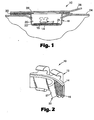
- the present invention provides packaged article 10 including an orthodontic appliance such as bracket 12.
- the bracket 12 has a base 14 for directly bonding the bracket 12 to a patient's tooth structure.
- An adhesive 16 extends across the base 14 of the bracket 12.
- the bracket 12 and the adhesive 16 are at least partially surrounded by a container 18.
- the exemplary container 18 illustrated in Fig. 1 includes an integrally-molded body with internal wall portions that define a recess or well 20.
- the well 20 includes side walls and a bottom 22.
- the side walls of the well 20 include horizontally extending recesses for engagement with edge structure of carrier 24. Additional information regarding a suitable carrier 24 is set out in U.S. Pat. No. 5,328,363 (Chester et al. ).
- the bottom 22 of the well 20 includes a release substrate 25.
- the article 10 also includes a cover 26 with a tab 28, with the cover 28 being connected to the container 18 by, for example, adhesive 30.
- the present invention provides packaged article 10 including orthodontic appliance 12 having a base 14 for bonding the appliance 12 to a tooth, an adhesive 16 on the base, and preferably, a release substrate 25 including a surface 27 in contact with the adhesive 16.
- the adhesive 16 includes a polymerizable component, a fluoride-releasing material, a hydrophilic component, a hardener, an acidic component, and a filler according to claim 1.
- the release substrate 25 may be selected from a number of materials including, for example, polyolefins, poly(vinyl chloride), polyurethanes, and poly(tetrafluoroethylene).
- the surface 27 of the release substrate 25 comprises a number of pores, and preferably no more than about 50% by weight of the adhesive 16 is within the pores.
- the article 10 is preferably packaged in a container that provides barriers to the transmission of light and/or water vapor. In some embodiments of the present invention, the article 10 is preferably provided as a kit. Also disclosed herein is a method of bonding an orthodontic appliance 12 to a tooth.
- the adhesive preferably has a static yield stress at 28°C of at least 0.7 kPa (7000 dynes/cm 2 ). In some embodiments of the present invention, the adhesive preferably has a steady state viscosity of 3 x 10 2 Pa-s to 7 x 10 4 Pa-s at 28°C.
- the adhesive preferably has an initial color prior to exposure to actinic radiation and a final color subsequent to exposure to actinic radiation, with the initial color being different than the final color.
- the adhesive preferably includes a photobleachable dye
- the hardener preferably includes a sensitizing compound different from the photobleachable dye.
- the adhesive includes a filler including a fumed silica having a surface area of at least 70 m 2 /g.
- the filler further includes a base filler.
- the adhesives used in the present invention are preferably substantially free of solvent, and substantially free of added water.
- substantially free of added water means that the composition does not contain water that is intentionally added as a non-complexed or coordinated entity. It is understood that many materials, such as metals or glasses, contain water that is taken up from the atmosphere or is present as a coordination complex in its normal state. Water taken up by hygroscopic materials or present as a hydrate is permissibly present in the compositions described herein. Any water that is present in the composition, regardless of source, should not be present in amounts such that the water will have a deleterious effect on the long term properties of the composition. For example, water should not be present in an amount that would facilitate reaction of an acid-reactive filler with an acidic component so that lumpiness or graininess of the material develops during commercially desired storage times.
- Orthodontic adhesives used in the present invention preferably have the ability to uptake water, and therefore are moisture tolerant. It has been surprisingly found that these adhesives retain their strength even when used in moisture contaminated conditions. In orthodontic bracket bonding procedures, for example, it is not necessary to dry the substrate, as long as a coating of moisture tolerant primer is applied to the tooth, prior to bonding the orthodontic appliance. Teeth primed with moisture tolerant primers may become recontaminated as in situations where bonding has been delayed, or where a patient secretes excessive crevicular fluid.
- the adhesives have the ability to absorb moisture from this recontamination situation.
- the primer may also include an etchant composition. Decreased bracket bond failures are expected using orthodontic appliances having these adhesives.
- Adhesives used in the present invention include a polymerizable component, a fluoride-releasing material, a hydrophilic component, a hardener, and an acidic component as disclosed, for example, in U.S. Pat. No. 6,126,922 (Rozzi et al. ) and International Patent Application Publication No. WO 00/69393 (Brennan et al. ).
- Adhesives used in the present invention include a hydrophilic component.
- the hydrophilic component is a hydrophilic monomer, oligomer, or polymer.
- at least some of the hydrophilic component is relatively lower in steady state viscosity than other ingredients of the composition so that it serves as a viscosity lowering function in the overall uncured material.
- Exemplary hydrophilic components are disclosed, for example, in U.S. Pat. No. 6,126,922 (Rozzi et al. ) and International Patent Application Publication No. WO 00/69393 (Brennan et al. ).
- Preferred hydrophilic components include, for example, 2-hydroxyethyl acrylate, 2-hydroxyethyl methacrylate (HEMA), hydroxypropyl (meth)acrylate, glycerol di(meth)acrylate, poly(ethylene glycol) methacrylate, poly(ethylene glycol) di(meth)acrylate, poly(propylene glycol) (meth)acrylate, tetrahydrofurfuryl (meth)acrylate, glycidyl (meth)acrylate, and combinations thereof.
- HEMA 2-hydroxyethyl methacrylate
- glycerol di(meth)acrylate poly(ethylene glycol) methacrylate
- poly(ethylene glycol) di(meth)acrylate poly(propylene glycol) (meth)acrylate
- tetrahydrofurfuryl (meth)acrylate glycidyl (meth)acrylate
- hydrophilic monomers include glycerol (meth)acrylate, glycerol di(meth)acrylate, ethylene glycol di(meth)acrylate, poly(ethylene glycol) di(meth)acrylate (where the number of repeating ethylene oxide units varies from 2 to 30, including, for example, tri(ethylene glycol) dimethacrylate (TEGDMA)).
- hydrophilic components include monomers and polymers such as pyrrolidone, a moiety containing hydroxy groups and polyether groups, a moiety containing a sulfonate group, a moiety containing a sulfinate group, N-oxysuccinimide, N-vinylacetamide, and acrylamide.
- the adhesive includes at least about 0.05% by weight, more preferably at least about 1% by weight, and most preferably at least about 3% by weight hydrophilic component, based on the total weight of the adhesive.
- the adhesive includes at most about 90% by weight, more preferably at most about 60% by weight, and most preferably at most about 20% by weight hydrophilic component, based on the total weight of the adhesive.
- Adhesives used in the present invention include an acidic component.
- the acidic component is an acidic monomer, oligomer, or polymer.
- the acidic component includes at least one acidic group.
- the acidic group is preferably selected from oxyacids or thio-oxy acids of C and P. More preferably, the acidic component is a compound that is an acid of C or P.
- a precursor to the acid such as an acid anhydride, e.g., 4-methacryloxyethyl trimellitate anhydride (4-META), or ester can be used in place of the acid itself.
- the desired acid may be generated in situ.
- Preferred acids include, for example, carboxylic acids, sulfonic acids, and phenols, with carboxylic acids, alkylsulfonic acids, arylsulfonic acids, and phosphonic acids being more preferred.
- Exemplary hydrophilic components are disclosed, for example, in U.S. Pat. No. 6,126,922 (Rozzi et al. ) and International Patent Application Publication No. WO 00/69393 (Brennan et al. ).
- Preferred acidic groups are carboxylic acids, sulfonic acids, phosphoric acids, phosphonic acids, and boric acids, the salts of the foregoing acids or precursors of the foregoing acids that are easily converted to these acids in conditions encountered during an orthodontic procedure.
- acidic components include, for example, (meth)acryloyl substituted carboxylic acids; phosphoric acid esters of hydroxyethyl (meth)acrylate, hydroxypropyl (meth)acrylate, and glycerol di(meth)acrylate; (meth)acrylates of pentaerythritol (e.g., pentaerythritol di(meth)acrylate); and (meth)acrylates of dipentaerythritol (e.g., dipentaerythritol penta(meth)acrylate), and combinations thereof.
- pentaerythritol e.g., pentaerythritol di(meth)acrylate
- dipentaerythritol e.g., dipentaerythritol penta(meth)acrylate
- Preferred acidic components include, for example, derivatives of amino acids, and acids such as tartaric acid, citric acid, malic acid that have been functionalized with an ethylenically unsaturated functionality.
- citric acid may be functionalized by incorporating an acryloyl or methacryloyl functionality.
- CDMA is the reaction product of citric acid and isocyanatoethyl methacrylate.
- the adhesive includes at least 0.01% by weight, more preferably at least 0.05% by weight, and most preferably at least 1% by weight acidic component, based on the total weight of the adhesive.
- the adhesive includes at most 90% by weight, more preferably at most 60% by weight, and most preferably at most 20% by weight acidic component, based on the total weight of the adhesive.
- Adhesives used in the present invention include a polymerizable component.
- the polymerizable component is a monomer, oligomer, or polymer that includes a polymerizable group.
- Exemplary polymerizable components are disclosed, for example, in U.S. Pat. No. 6,126,922 (Rozzi et al. ) and International Patent Application Publication No. WO 00/69393 (Brennan et al. ).
- the polymerizable component may also be selected from hydrophilic and acidic components disclosed herein that are polymerizable.
- Polymerizable groups may be selected from free radically polymerizable groups, cationically polymerizable groups, or combinations thereof.
- at least some of the polymerizable material is relatively lower in viscosity than other ingredients of the composition so that it serves a viscosity lowering function in the overall uncured material.
- Preferred polymerizable groups are free radically polymerizable groups.
- Preferred free radically polymerizable components are esters of (meth)acrylic acid, including, for example, methyl (meth)acrylate, ethyl (meth)acrylate, propyl (meth)acrylate, isopropyl (meth)acrylate, 2-hydroxyethyl acrylate, 2-hydroxyethyl methacrylate ("HEMA”), hydroxypropyl (meth)acrylate, tetrahydrofurfuryl (meth)acrylate, glycidyl (meth)acrylate, the diglycidyl methacrylate of bisphenol A (“Bis-GMA”), glycerol mono(meth)acrylate, glycerol di(meth)acrylate, ethylene glycol di(meth)acrylate, poly(ethylene glycol) di(meth)acrylate (where the number of repeating ethylene oxide units vary from 2 to 30, including, for example, triethylene glycol
- the adhesive includes at least 0.05% by weight, more preferably at least 0.1 % by weight, and most preferably at least 0.5% by weight polymerizable component, based on the total weight of the adhesive.
- the adhesive includes at most 90% by weight, more preferably at most 60% by weight, and most preferably at most 20% by weight polymerizable component, based on the total weight of the adhesive.
- Fluoride-Releasing Material Adhesives used in the present invention include a fluoride-releasing material.
- the fluoride-releasing material may be a filler.
- the fluoride-releasing material used in the present invention may be naturally occurring or synthetic fluoride minerals, fluoride glass such as fluoroaluminosilicate glass, simple and complex inorganic fluoride salts, simple and complex organic fluoride salts or combinations thereof.
- these fluoride sources can be treated with surface treatment agents.
- the fluoride-releasing material may optionally be a metal complex.
- fluoride-releasing material examples include fluoroaluminosilicate glasses as described, for example, in U.S. Pat. No. 3,814,717 (Wilson et al. ), which may be optionally treated as described, for example, in U.S. Pat. No. 5,332,429 (Mitra et al. ).
- Exemplary fluoride-releasing materials are disclosed, for example, in U.S. Pat. No. 6,126,922 (Rozzi et al. ) and International Patent Application Publication No. WO 00/69393 (Brennan ct al.).
- the adhesive includes at least 10% by weight, more preferably at least 45% by weight, and most preferably at least 75% by weight fluoride-releasing material, based on the total weight of the adhesive.
- the adhesive includes at most 87% by weight, more preferably at most 85% by weight, and most preferably at most 83% by weight fluoride-releasing material, based on the total weight of the adhesive.
- Adhesives used in the present invention include a hardener.
- the hardener will induce hardening upon exposure to actinic radiation (e.g., the hardener includes a photoinitiator).
- the hardener is preferably selected to be a free radical initiator.
- Exemplary hardeners are disclosed, for example, in U.S. Pat. No. 6,126,922 (Rozzi et al. ) and International Patent Application Publication No. WO 00/69393 (Brennan et al. ).
- Preferred free radical photoinitiators include ternary photoinitiator systems as disclosed, for example, in U.S. Pat. No. 5,545,676 (Palazzotto et al. ).
- Useful visible light induced ternary photoinitiator systems preferably include a sensitizing compound (e.g., camphorquinone), an electron donor (e.g., sodium benzene sulfinate, amines, and amino alcohols), and an iodonium salt (e.g., diphenyliodonium chloride, bromide, iodide, or hexafluorophosphate).
- a sensitizing compound e.g., camphorquinone
- an electron donor e.g., sodium benzene sulfinate, amines, and amino alcohols
- an iodonium salt e.g., diphenyliodonium chloride, bromide, iodide, or hexafluorophosphate
- Useful ultraviolet light-induced polymerization initiators preferably include ketones (e.g., benzyl and benzoin), acyloins, and acyloin ethers.
- ketones e.g., benzyl and benzoin
- acyloins e.g., 2,2-dimethoxy-2-phenylacetophenone available under the trade designation IRGACURE 65 and benzoin methyl ether (2-methoxy-2-phenylacetophenone), both available from Ciba Specialty Chemicals, Basel, Switzerland.
- the photoinitator is preferably capable of promoting hardening of the polymerizable components on exposure to light of a suitable wavelength and intensity.
- the photoinitiator is also preferably sufficiently shelf stable and free of undesirable coloration to permit its storage and use under typical orthodontic conditions. Visible light photoinitiators are preferred.
- the photoinitiator should be present in an amount sufficient to provide the desired rate of hardening. This amount will be dependent in part on the light source, the thickness of the layer to be exposed to radiant energy, and the extinction coefficient of the photoinitiator. Typically, the photoinitiator components will be present at a total weight of 0.001% to 5%, more preferably 0.01% to 1%, based on the total weight of the composition.
- the adhesive preferably has an initial color remarkably different than dental structures. Color is preferably imparted to the adhesive through the use of a photobleachable dye.
- the adhesive preferably includes at least 0.001 % by weight photobleachable dye, and more preferably at least 0.002% by weight photobleachable dye, based on the total weight of the adhesive.
- the adhesive preferably includes at most 1% by weight photobleachable dye, and more preferably at most 0.1% by weight photobleachable dye, based on the total weight of the adhesive.
- the amount of photobleachable dye may vary depending on its extinction coefficient, the ability of the human eye to discern the initial color, and the desired color change.
- the color formation and bleaching characteristics of the photobleachable dye varies depending on a variety of factors including, for example, acid strength, dielectric constant, polarity, amount of oxygen, and moisture content in the atmosphere.
- the bleaching properties of the dye can be readily determined by irradiating the adhesive and evaluating the change in color.
- at least one photobleachable dye is at least partially soluble in the hardenable resin.
- Exemplary classes of photobleachable dyes are disclosed, for example, in U.S. Pat. No. 6,331,080 (Cole et al. ) and U.S. Pat. Application Serial Nos. 09/489,612, filed January 21, 2000 , and 09/689,019, filed October 12, 2000 .
- Preferred dyes include, for example, Rose Bengal, Methylene Violet, Methylene Blue, Fluorescein, Eosin Yellow, Eosin Y, Ethyl Eosin, Eosin bluish, Eosin B, Erythrosin B, Erythrosin Yellowish Blend, Toluidine Blue, 4',5'-Dibromofluorescein, and combinations thereof.
- the color change in the inventive adhesive is initiated by light.
- the adhesive's color change is initiated using actinic radiation using, for example, a dental curing light which emits visible or near infrared (IR) light for a sufficient amount of time.
- the mechanism that initiates the color change in the compositions of the invention may be separate from or substantially simultaneous with the hardening mechanism that hardens the resin.
- an adhesive may harden when polymerization is initiated chemically (e.g., redox initiation) or thermally, and the color change from an initial color to a final color may occur subsequent to the hardening process upon exposure to actinic radiation.
- the change in adhesive color from an initial color to a final color is preferably quantified by a Color Test as described below. Using the Color Test, a value of ⁇ E* is determined, which indicates the total color change in a 3-dimensional color space. The human eye can detect a color change of approximately 3 ⁇ E* units in normal lighting conditions.
- the dental compositions of the present invention are preferably capable of having a color change, ⁇ E*, of at least 20; more preferably, ⁇ E* is at least 30; most preferably ⁇ E* is at least 40.
- the components and component levels used in the adhesive may be selected as desired with guidance from the accompanying specification and examples.
- the selection of the hardener to include high levels of iodonium salt, the selection of the acidic component to include high levels of CDMA, and the selection of low levels of photobleachable dye may all tend to reduce the degree of color return.
- Adhesives used in the present invention may optionally include reactive or non-reactive fillers.
- the filler can have a unimodal or polymodal (e.g., bimodal) particle size distribution.
- the filler can be an inorganic material. It can also be a crosslinked organic material that is insoluble in the polymerizable resin, and is optionally filled with inorganic filler.
- the filler is preferably non-toxic and suitable for use in the mouth.
- the filler can be radiopaque, radiolucent, or non-radiopaque.
- Reactive fillers include those that are commonly used with ionomers to form ionomer cements.
- suitable reactive fillers include metal oxides such as zinc oxide and magnesium oxide, and ion-leachable glasses including, for example, those described in U.S. Pat. Nos. 3,655,605 (Smith ); 3,814,717 (Wilson et al. ); 4,143,018 (Crisp ct al.); 4,209,434 (Wilson et al. ); 4,360,605 (Schmitt et al. ), and 4,376,835 (Schmitt et al. ).
- Such reactive fillers may be incorporated to modify the handling characteristics or to affect the setting properties of the ultimate composition.
- the reactive filler is preferably a finely divided reactive filler.
- the filler should be sufficiently finely divided so that it can be conveniently mixed with the other ingredients and used in the mouth.
- Average particle sizes for the filler are preferably at least 0.2 ⁇ m (micron) and more preferably at least about 1 ⁇ m (micron).
- Average particle sizes for the filler are preferably at most 15 ⁇ m (microns) and more preferably at most 10 ⁇ m (microns). Average particle sizes may be measured by using, for example, a sedimentation analyzer.
- Preferred fillers for use in adhesives used in the present invention include acid-reactive fillers.
- Suitable acid-reactive fillers include metal oxides, metal salts, and glasses.
- Preferred metal oxides include barium oxide, calcium oxide, magnesium oxide, and zinc oxide.
- Preferred metal salts include salts of multivalent cations including, for example, aluminum acetate, aluminum chloride, calcium chloride, magnesium chloride, zinc chloride, aluminum nitrate, barium nitrate, calcium nitrate, magnesium nitrate, strontium nitrate, and calcium fluoroborate.
- Preferred glasses include borate glasses, phosphate glasses, and fluoroaluminosilicate glasses.
- acid reactive fillers are those that release fluoride.
- Fluoride releasing glasses in addition to providing good handling and final composition properties as discussed herein, provide the benefit of long-term release of fluoride in use including, for example, use in the oral cavity. Fluoroaluminosilicate glasses are particularly preferred.
- Suitable acid reactive fillers are also available from a variety of commercial sources familiar to those skilled in the art. Mixtures of fillers can be used if desired.
- acid reactive fillers can be subjected to a surface treatment. Suitable surface treatments include acid washing, treatment with phosphates, treatment with chelating agents such as tartaric acid, and treatment with a silane or silanol coupling agent. Particularly preferred acid reactive fillers are silanol treated fluoroaluminosilicate glass fillers, as described in U.S. Patent No. 5,332,429 (Mitra et al. ).
- Non-acid reactive fillers may be selected from one or more of any material suitable for incorporation in compositions used for medical applications, such as fillers currently used in dental restorative compositions and the like.
- suitable non-acid reactive inorganic fillers are naturally-occurring or synthetic materials such as quartz, nitrides (e.g., silicon nitride), glasses derived from, for example Ce, Sb, Sn, Zr, Sr, Ba, and Al, colloidal silica, feldspar, borosilicate glass, kaolin, talc, titania, and zinc glass; low Mohs hardness fillers such as those described in U.S. Pat No.
- submicron silica particles e.g., pyrogenic silicas such as the "Aerosil” Series “OX 50", “130", “150” and “200” silicas sold by Degussa and "Cab-O-Sil M5" and “Cab-O-Sil TS720" silicas sold by Cabot Corp., Boston, MA.
- suitable non-reactive organic filler particles include filled or unfilled pulverized polycarbonates, polyepoxides, and the like.
- Preferred non-acid reactive filler particles include quartz, submicron silica, and non-vitreous microparticles of the type described in U.S. Patent No. 4,503,169 (Randklev ). Mixtures of non-acid reactive fillers are also contemplated, as well as combination fillers made from organic and inorganic materials.
- the surface of the filler particles is treated with a coupling agent in order to enhance the bond between the filler and the polymerizable resin.
- suitable coupling agents include, for example, gamma-methacryloxypropyltrimethoxysilane, gamma-mercaptopropyltriethoxysilane, gamma-aminopropyltrimethoxysilane, and combinations thereof.
- the adhesive includes one or more fumed silica fillers having a surface area of at least 70 m 2 /g, preferably at least 90 m 2 /g, and more preferably at least 100 m 2 /g.
- the adhesive preferably includes one or more fumed silica fillers having a surface area of at most 1000 m 2 /g, more preferably at most 500 m 2 /g, and most preferably at most 150 m 2 /g.
- the adhesive includes at least 10% by weight, more preferably at least 45% by weight, and most preferably at least 75% by weight, based on the total weight of the adhesive, of a base filler.
- the adhesive includes at most about 87% by weight, more preferably at most 85% by weight, and most preferably at most 83% by weight, based on the total weight of the adhesive, of a base filler.
- the adhesive includes at least 0.1% by weight, more preferably at least 0.2% by weight, and most preferably at least 0.5% by weight, based on the total weight of the adhesive, of a fumed silica filler having a surface area of at least 70 m 2 /g.
- the adhesive includes at most 50% by weight, more preferably at most 15% by weight, and most preferably at most 3% by weight, based on the total weight of the adhesive, of a fumed silica filler having a surface area of at least 70 m 2 /g.
- base filler will preferably allow lower levels of fumed silica fillers to reach the desired rheological properties, and likewise lower levels of base filler will preferably allow higher levels of fumed silica fillers to reach the desired rheological properties.
- the adhesive includes a fumed silica filler having an average aggregate length of at least 0.01 ⁇ m (micron), more preferably at least about 0.05 ⁇ m (micron), and most preferably at least 0.1 ⁇ m (micron).
- the adhesive includes a fumed silica filler having an average aggregate length of at most 1 ⁇ m (micron), more preferably at most 0.5 ⁇ m (micron), and most preferably at most 0.4 ⁇ m (micron).
- adhesives used in the present invention may optionally include adjuvants.
- adjuvants include, for example, cosolvents, pigments, inhibitors, accelerators, viscosity modifiers, surfactants, rheology modifiers, colorants, medicaments, adhesion promoters and other ingredients that will be apparent to those skilled in the art.
- the compositions may contain stabilizers. Suitable adjutants include, for example, those disclosed in International Patent Application Publication No. WO 00/69393 (Brennan et al. ).
- Adhesives used in the present invention preferably have physical properties that are desired for precoated and/or packaged orthodontic appliances and/or adhesives. Desirable properties include, for example, adequate handling properties, no slump that would be observable by a practitioner, suitable operatory light stability, no observable slip when placed on liner or tooth, suitable aesthetic color, color stability under office light conditions (e.g., white light stability), and sufficient tack such that the precoated bracket does not fall off the tooth when placed there prior to curing
- Adhesives used in the present invention preferably have no substantial flow-out.
- Flow-out value is a measure of the tendency of an adhesive to flow on a liner, and is measured by a test method as described in the Examples. In brief, flow-out is measured by coating an adhesive on an orthodontic bracket, placing the adhesive on the coated bracket in contact with a release substrate, and holding for a specified time at a specified temperature (e.g., one week at 40°C). The flow-out is measured as flow out of the adhesive from the edge of the bracket in millimeters.
- Adhesives used in the present invention preferably have a steady state viscosity at 28°C of at least 3 x 10 2 Pa-s, more preferably at least 5 x 10 3 Pa-s, and most preferably at least 1 x 10 4 Pa-s.
- Adhesives used in the present invention preferably have a steady state viscosity at 28°C of at most 7 x 10° Pa-s, more preferably at most 2.5 x 10 4 Pa-s, and most preferably at most 2 x 10 4 Pa-s.
- Adhesives used in the present invention preferably have a static yield stress at 28°C of at least 0.7 kPa (7,000 dynes/cm 2 ), more preferably at least 0.8 kPa (8,000 dynes/cm 2 ), and most preferably at least 0.9 kPa (9,000 dynes/cm 2 ).
- Adhesives used in the present invention preferably have a static yield stress at 28°C of at most 10 kPa (100,000 dynes/cm 2 ), more preferably at most 6 kPa (60,000 dynes/cm 2 ), and most preferably at most 2.5 kPa (25,000 dynes/cm 2 ).
- the adhesives used in the present invention may be applied to the base of the orthodontic appliance by methods known in the art. Suitable methods include, for example, application with a syringe or other suitable dispensing devices as disclosed, for example, in U.S. Pat. No. 5,552,177 (Jacobs et al. ).
- Articles of the present invention preferably include a release substrate in contact with the adhesive.
- a surface of the release substrate includes a number or pores, and no more than about 50% by weight of the adhesive is in the pores.
- the release substrate includes a foam.
- Suitable release substrates are disclosed, for example in U.S. Pat. No. 6,183,249 (Brennan et al. ).
- the release substrate is a crosslinked polyethylene foam available under the trade designation MINICEL (e.g., MINICEL M200) from Voltek (Lawrence, MA).
- the release substrate provides for easy release of the appliance and reduced slip and flow-out.
- the release substrates used in the present invention may be applied to the adhesive on the base of the orthodontic appliance by methods known in the art. Suitable methods include, for example, placing the release substrate on the bottom of a container well and then lightly inserting the bracket in the well such that the adhesive is in contact with the release substrate.
- a robotic arm may be used, for example, as described in U.S. Pat. No. 5,552,177 (Jacobs et al. ).
- the articles of the present invention are preferably packaged in a container for storage and distribution.
- Suitable containers include, for example, those disclosed, for example, in U.S. Pat. Nos. 4,978,007 (Jacobs et al. ), 5,172,809 (Jacobs et al. ), 5,328,363 (Chester et al. ), 5,354,199 (Jacobs et al. ), 5,538,129 (Chester et al. ), 5,575,645 (Jacobs et al. ), and in coassigned U.S. Pat. Application Serial No. 10/126804 entitled "CONTAINERS FOR PHOTOCURABLE MATERIALS".
- the container may include a release substrate.
- the release substrate may optionally be part of the container, but preferably the release substrate is a release liner.
- kits may include additional components including, for example, instructions for using the orthodontic appliance, etching compositions, swabs or brush tips for etching compositions, appliance placement guides or jigs, extra quantities of adhesive, primer, sealant, and mix pads.
- Methods of using the presently disclosed article include separating the orthodontic appliance from the release substrate, wherein the adhesive preferably remains on the base of the orthodontic appliance.
- the orthodontic appliance is then applied to the tooth surface and positioned properly by the practitioner so that the adhesive is in intimate contact with the surface of the tooth.
- the adhesive is hardened by exposure to actinic radiation.
- the surface of the tooth may be etched and dried before adhering the adhesive-coated bracket to the tooth.
- a coating of primer may be applied to the tooth prior to adhering the adhesive-coated bracket to the tooth.
- the drying step may or may not be required, depending upon the type of primer applied.
- the etchant may include a primer.
- the appliance is bonded to the tooth with a bond strength of at least 7 MPa, more preferably at least 9 MPa, and most preferably at least 11 MPa.
- the appliance is bonded to the tooth with a bond strength of at most 25MPa.
- WO 00/69393 (Brennan et al. ) S/T FAS Silane-treated fluoroaluminosilicate glass (FAS); prepared as described in Preparatory Example 1 in International Patent Application Publication No. WO 00/69393 (Brennan et al. )
- the rheometer was then programmed to wait for 10 minutes for the temperature to stabilize at 28°C before beginning the measurement. The rheometer was then programmed to shear the adhesive sample at a shear rate of 0.01 second -1 for 30 seconds followed by shearing at 0.1 second -1 for 4.5 minutes. During each of these periods the rheometer collected stress measurements.
- the yield stress of an adhesive sample was defined as the point at which the stress vs. time curve deviated from an initially linear trajectory. Practically, this was determined' by constructing a tangent to the stress vs. time curve. The tangent was then shifted by 0.06 seconds to the right and the intercept with the stress vs. time curve determined. This intercept, being very close to the point of deviation from linearity, was defined as the static yield stress (or as the transition from elastic deformation to viscoelastic flow) and reported as kilopascals (dynes/cm 2 ) for the adhesive sample. Reported values were from single measurements of the samples.
- the adhesive samples were thixotropic, meaning that the viscosity under constant shear rate changes with time. Therefore, the viscosity of an adhesive sample was defined as the viscosity measured after a given time under shear. This time was chosen such that any yield stresses would have been overcome. A period of 3.5 minutes at 28°C under a shear rate of 0.1 second -1 ) was chosen since by that time all of the adhesive samples measured were well beyond yielding. The results were reported as steady state viscosity values (from single measurements) in units of Pa-s (Pascal-seconds).
- a cylinder sample was removed from the vial, the superficial water was removed using a facial tissue or cotton, and the sample was immediately weighed. The weight was recorded and water uptake for 2 samples of each composition was measured and the average reported in % increased water weight (defined as Water Uptake Value).
- the Adhesive/Bracket Flow-Out Test Method was used to determine the tendency of an adhesive to flow on a liner beneath an orthodontic bracket, a phenomenon called "flow-out". If an adhesive exhibits flow-out on a specific liner in this test, then the adhesive would be expected to flow-out within a blister package containing the adhesive precoated on a bracket and covered with the same liner. Flow-out can produce stringing of the adhesive away from the bracket base as the adhesive precoated bracket is removed from the liner. This result can cause difficulties for a practitioner who must then make adjustments to the shape of the adhesive pad (or pillow) prior to placement of the adhesive precoated bracket on the tooth. In the worst case, flow-out prevents full release of the adhesive from the liner, which may even cause separation of the adhesive from the precoated bracket.
- Mini Twin V-slot brackets (3M Unitek, Ref # 017-333 or 017-334) were coated by application from a syringe with about 8 mg of adhesive placed on a SCOTCHPAK 1022 release liner (3M Company) with the adhesive in contact with the liner, and held for one week in a 40°C oven. (Time and temperature of the test was varied depending upon the test sample.) The adhesive precoated brackets were placed on liners that were held to cardboard via double stick tape in order to keep the brackets in a horizontal position in the oven. Special precaution was taken to ensure that no adhesive was visible beyond the bracket base at the start of the test.
- the Adhesive/Bracket Vertical Slip Test Method was developed to determine if adhesive precoated brackets using specific adhesive compositions would slip on specific release liners in blister packages. If an adhesive exhibits slippage on a specific liner in this test, then the adhesive would be expected to slip (e.g., during transit to the customer) within a blister package containing the adhesive precoated on a bracket and covered with the same liner. In the worst case, the adhesive precoated brackets may slip entirely off the liner, destroying the product functionality. Or, the adhesive precoated bracket may rotate in the package, which would result in improper orientation for placement of the bracket on the tooth by the practitioner.
- brackets were coated by application from a syringe with about 8 mg of adhesive (with the exception of buccal tubes which were coated with about 16 mg of adhesive).
- the adhesive precoated brackets were placed on MINICEL M200 foam liner (Voltek Corp, Division of Sekisui America, Lawrence, MA). Each liner containing the adhesive precoated bracket was held to a piece of cardboard via double stick tape. Special precaution was taken to ensure that no adhesive was visible beyond the bracket base at the start of the test.
- a "starting line” was drawn near the top edge of the bracket to ensure measurement of the exact distance of slippage.
- the cardboard containing the brackets was held vertically in an oven (set at a predetermined temperature, typically 40°C or 50°C) for predetermined period of time (typically 3 to 14 days).
- Slippage of the adhesive coated bracket on the liner was measured as flow-out beyond the top edge of the bracket base and was measured using RAM Optical Instrumentation as described in the preceding test method.
- the slippage values reported (in mm) were an average of at least 3 adhesive precoated bracket samples per test.
- Fluoride release was measured by first forming sample compositions into disks 20-mm in diameter and 1-mm thick. Both sides of each disk were covered with polyethylene terephthalate film and light-cured for 60 seconds on each side using two oppositely disposed VISILUX 2 Visible Light Curing Units (3M Company) with a 1-cm distance between the output end of the light guide and the sample disk. The film was then removed from both sides of the disks and the samples allowed to cure for 1 hour at 37° C/95% relative humidity ("RH"). Each disk was weighed and placed in a glass jar to which was added 25 ml of deionized water. The sample solutions were maintained at 37° C for specified time periods at which times the incremental fluoride release was measured as follows.
- a fluoride-selective electrode Orion Model 96-09-00 (Orion Research Inc., Cambridge, MA) was used to quantify the amount of fluoride ion released from the sample disks in water.
- the electrode was calibrated using Fluoride Activity Standards #940907 and #040908, at 100 parts per million ("ppm") and at 10 ppm, respectively, fluoride standard fluid (both from Orion Research Inc.).
- the sample jar was transferred to a 37°C oven for a specified time interval after which the sample jar was removed from the oven and the fluoride released during that time interval was measured as described herein. Fluoride release values were reported as a function of storage time in the water and each reported value represented the average of 3 sample disks.
- Bond strength was tested by adhering metal orthodontic brackets with mesh bases to bovine teeth using an adhesive sample.
- the adhesive sample was applied by syringe to VICTORY SERIES REF 017-401 (or equivalent) upper central brackets (3M Unitek).
- the bovine teeth were first cleaned with a pumice aqueous slurry and rinsed.
- the teeth were then etched with 37% phosphoric acid etching solution, rinsed with water and dried with moisture-free and oil-free air.
- the teeth were then treated with TRANSBOND MIP moisture insensitive primer (3M Unitek) according to manufacture's directions.
- the metal brackets with applied adhesive were seated onto the teeth and pressed firmly to extrude any excess adhesive. The excess was cleaned away.
- the adhesive was then cured with 10-second exposures on both the mesial and distal sides of the brackets using an ORTHOLUX XT Curing Unit.
- the samples of teeth and bonded brackets were stored overnight in 37°C water. Bond strength testing was performed by engaging a 0.50-mm round stainless steel wire loop under the occlusal tie wings. Using an Instron universal load frame, a load was applied in a shear/peel mode until debonding of the bracket from the tooth occurred. The wire attached to the Instron was pulled at a rate of 5 mm/minute. The maximum force (in units of pounds) was recorded as bond strength per bracket and the reported value was an average of 10 measurements using 10 different adhesive-coated brackets. This average was then converted to units of MPa by dividing by the bonding base area (10.9 mm 2 ) and multiplying by 4.4.
- moisture in the form of distilled water by a spray bottle or saliva by a cotton swab
- TRANSBOND MIP primer was applied to the bovine teeth after treatment with TRANSBOND MIP primer and before bonding of the adhesive-coated brackets to the teeth. Results were reported as averages of 5 measurements using 5 different adhesive-coated brackets.
- Quantification of initial and bleached color of adhesive samples was performed with a StellarNet Portable Spectrometer Model EPP2000C equipped with a 400-micron fiber reflectance probe and SpectraWiz CIELAB colorimeter software (StellarNet, Inc., Oldsmar, FL).
- an adhesive sample was extruded onto a polyester release liner, a metal ring was placed around the adhesive, and a second release liner was placed on top of the adhesive.
- the resulting construction was then pressed between two Plexiglas plates with the metal ring controlling the adhesive thickness to 0.51 mm.
- the adhesive sample between the two release liners was placed on top of a white reflectance standard (Part No. RS50, 50-mm diameter, Halon type >97% reflectance, 300-1500 nm, StellarNet, Inc.).
- the fiber optic probe of the spectrometer was positioned 6.3 mm above the sample at a 45° angle.
- Color measurements were taken through the top release liner at an exposure time of 1000 milliseconds and with the center of the adhesive under the beam.
- the software captured the reflectance spectrum and converted the input to L*, a* and b* values.
- the a* value was indicative of the redness of the sample with higher numbers indicative of greater redness.
- Cured adhesive samples were prepared in the same manner described herein, except that the adhesive pressed between the two polyester release liners was cured for 3 minutes in a TRIAD 2000 light curing oven (Dentsply International, Inc., York, PA). The cured adhesive sample with the polyester liners intact was placed directly onto the white reflectance standard. The light source of the spectrometer was switched on and L*, a* and b* values were measured as described herein with each reported value representing the average of 3 measurements.
- Adhesive samples were prepared as described herein for the Color Test Method. Five samples were made by pressing the adhesive between polyester release liners to a disk shape having a thickness of 0.51 mm. One adhesive disk was measured immediately and used as the zero point. The remaining four disks were placed onto a sheet of white paper and placed at desk height directly below a fluorescent light fixture at standard ceiling height. The distance between the fluorescent light and the adhesive samples was approximately 2.0 meters. Adhesive samples were removed from fluorescent light exposure after 2, 5, 10 and 20 minutes exposure and moved to a dark room. Colors of the samples were then measured as described herein for the Color Test Method. Results for a* could then be reported as a function of exposure to fluorescent lighting with each reported value representing a single measurement.
- CDMA is defined as the reaction product of citric acid and IBM as prepared according to the following procedure.
- Citric acid (1870 g; 9.733 moles citrate, 29.2 moles carboxylate) was dissolved in tetrahydrofuran (5.9 liters) in a reaction vessel fitted with a mechanical stirrer, condenser, addition funnel, and air inlet tube.
- BHT 4.69 g
- TPS 4.68 g
- DBTDL DBTDL
- Filler A was a silane-treated quartz filler prepared according to the following procedure.
- a 58.3-g portion of deionized water was weighed into a 1000-ml beaker. The water was preheated to 29° to 33° C.
- 105 g of quartz filler Cold Quartz, Jessieville, AK
- AEROSIL R-972 fumed silica was added to the water followed by the slow addition of 1.7 g of AEROSIL R-972 fumed silica.
- the pH of the resulting slurry was adjusted to between 2.5 and 3.0 with 1% trifluoroacetic acid (Sigma-Aldrich).
- FILLER B (SILANE-TREATED FAS FILLER)
- Filler B was a silane-treated fluoroaluminosilicate glass (FAS) filler prepared according to the following procedure.
- FAS fluoroaluminosilicate glass
- a 6,420-g portion of deionized water was weighed into a 23-liter polyethylene pail.
- the water was stirred with a Premier electric mixer (Premier Mill, Reading, PA) so as to create a vortex of 2.5 mm in depth about the mixer shaft and adjusted to a pH of 3.0 with the addition of 90 g of glacial acetic acid.
- To the resulting acidic solution was added 521 g of 3-methacryloxypropyltrimethoxysilane (United Chemical Technologies, Inc.).
- the solution was stirred for 1 hour and then charged with 5990 g of finely powdered, FAS glass (Schott Glas, Landshut, Germany). The resulting slurry was stirred for 30 minutes and then poured evenly into a tray lined with polyester sheeting. The filled tray was placed in a convection drying oven for 16 hours at 80° C, followed by an additional 2 hours at 100° C to yield a dry cake. The dried cake was crushed using a mortar and pestle and the crushed filler was screened though a 74 micrometer nylon screen to afford the powder filler designated as Filler B.
- compositions e.g., adhesives
- examples 1-10 and Comparative Examples 1-3 were prepared according to the following procedures.
- a resin precursor was first prepared by charging the resin components shown in Tables 1A and 1B into a vessel. The resulting mixture was heated to 45°C and stirred using an electric stirring motor (Fisher Scientific, model #47) fitted with a glass stirring rod and 2.54-cm Teflon stirring blade. Mixing speed was adjusted so as to create a vortex of about 6 mm. The mixing vessel was shielded from light and the mixing continued for 4 hours to dissolve all solid components. Each resin precursor was then combined with the filler components shown in Tables 1A and 1B mixed until a homogeneous, paste like composition was achieved.
- Example 2 3 and 5-9 mixing of the resin precursor with the filler components was accomplished using a planetary mixer (Charles Ross and Co, Hauppauge, NY) of sufficient size (0.95 to 3.785 liters) to accommodate the amounts of materials charged.
- Example 10 and Comparative Example 3 were mixed using a 15-liter planetary mixer (Premier Mill, Reading PA).
- the resin precursor was charged first to the mixing vessel followed by the filler components.
- the entire filler amount was charged at once and then mixed until the desired, paste-like consistency was achieved; or, alternatively, a portion of the total filler was withheld from the initial mixture and incorporated in subsequent mix cycles. Typically, a total of 1 to 4 additional filler mix cycles was utilized.
- Homogeneity of the paste depended on several factors, e.g., mix time, planetary mix speed, resin viscosity, and total amount of filler added. For the examples mixed in a planetary mixer, all were done at 45°C and at a mixing speed of 10 to 12 rpm.
- compositions of Examples 1-10 and Comparative Examples 1 (CE-1) and 2 (CE-2) contained more than one filler component.
- CE-1 and CE-2 filler components could be added independently in the amounts shown in Tables 1A and 1B.
- the filler components could be combined to form a filler precursor prior to charging to the resin precursor in the mixing vessel.
- Such filler precursors were prepared and used to make the compositions of Examples 2-5 and 9-10.
- Such admixing was accomplished by mixing small amounts by hand in a convenient sized beaker or, alternatively, for larger amounts of materials, blending was accomplished using, a Patterson Kelley Twin Shell Blender (Harsco Corp., Camp Hill, PA) as was done for Example 10.
- Examples 11-15 were prepared by blending small quantities of various fumed silica materials of high surface area into the composition designated Comparative Example 1.
- Examples 16-20 were prepared by blending small quantities of various fumed silica materials of high surface area into the composition designated Comparative Example 2.
- the specific fumed silica materials used and the quantities of fumed silica added are shown in Table 2. In each case, the addition of high surface area fumed silica caused a significant change in the physical characteristics of the compositions and the degree of this change was dependent on the amount and type of fumed silica added.
- Static Yield Stress and Steady State Viscosity The Static Yield Stress and Steady State Viscosity were measured for Examples 11-20, Comparative Examples 1-3, and the commercial product TRANSBOND XT orthodontic adhesive (3M Unitek) according to the Test Method described herein. Results are reported in Table 3 and show that the addition of low levels of various high surface area fumed silica materials to adhesive compositions CE-1 and CE-2, which contained the fumed silica OX-50 at levels of 3.95% and 7.90%, respectively, afforded compositions (Examples 11-20) with increased yield stress (with the exception of Example 13 which contained 0.25% fumed silica) and viscosity.
- Water Uptake was measured for Examples2-3 and 5-6, Comparative Example 3, and the commercial product TRANSBOND XT orthodontic adhesive (3M Unitek) according to the Test Method described herein. Results in terms of percent increase in water uptake at Day 2 and Day 10 are reported in Table 4 and show (at Day 2) a significantly greater uptake of water by Examples 2-3 and 5-6 in comparison to the Comparative Example 3 or to the TRANSBOND XT. The enhanced water uptake can be attributed to the presence of substantially more hydrophilic polymers in the invention Examples 2-3 and 5-6.
- the hydrophilic nature of the adhesives used in the present invention facilitates fluoride transport and promotes the uptake of moisture or saliva so as to decrease the likelihood of bond failure (e.g., in the case of adhesive coated brackets bonded to moisture or saliva contaminated teeth).
- Table 4 Water Uptake Value Results Example Water Uptake Value (%) Day 2 Day 10 2 0.61 1.41 3 0.95 2.04 5 1.15 2.43 6 0.79 1.74 CE-3 0.30 NM a TRANSBOND XT 0.20 NM a NM - Not Measured
- Adhesive / Bracket Flow-Out The AdhesiveBracket Flow-Out of Examples 12-15, 17-20, and Comparative Examples 1-3 was measured according to the Test Method described herein. Results are reported in Table 5 and show that the addition of low levels of various fumed silica materials to the adhesive compositions CE-1 and CE-2, which contained the fumed silica OX-50 at levels of 3.95% and 7.90%, respectively, afforded compositions (Examples 12-15 and 17-20) with rheological properties such that little or no flow-out was measured from underneath the coated bracket. In contrast, significant flow-out was measured for Comparative Examples 1-3.
- Adhesive compositions that possess such rheological properties are highly desirable for use as adhesives in adhesive-coated, packaged orthodontic appliances.
- Table 5 Adhesive/Bracket Flow-Out Results Example Fumed Silica Content (Weight %) Time Temp.
- CE-1 OX-50 (3.95) 1 week 40°C 0.48 12 CE-1 + CAB-O-SIL M5 (0.5) 1 week 40°C 0 13 CE-1 + CAB-O-SIL M5 (0.25) 1 week 40°C 0.30 14 CE-1 + AEROSIL R972 (0.5) 1 week 40°C 0 15 CE-1 + CAB-O-SIL TS-720 (0.5) 1 week 40°C 0 CE-2 OX-50 (7.90) 1 week 40°C 0.97 17 CE-2 + CAB-O-SIL M5 (0.5) 1 week 40°C 0 18 CE-2 + CAB-O-SIL M5 (0.25) 1 week 40°C 0.08 19 CE-2 + AEROSIL R972 (0.5) 1 week 40°C 0 20 CE-2 + CAB-O-SIL TS-720 (0.5) 1 week 40°C 0 CE-3 OX-50 (1.94) 89 hours Room Temp. 1.27
- Adhesive / Bracket Vertical Slip The AdhesiveBracket Vertical Slip of Examples 2 and 5, and Comparative Examples 1-3 was measured according to the Test Method described herein. Results are reported in Table 6 and show that brackets coated with the inventive adhesive compositions (Examples 2 and 5 that contained a high surface area fumed silica material, i.e., CAB-O-SIL TS-720, with a surface area of about 105 to about 130 m 2 /g) exhibited essentially no bracket slippage. In contrast, significant bracket slippage was measured for brackets coated with Comparative Examples 1-3 that contained only a fumed silica material of low surface area, i.e.
- Adhesive compositions that possess such rheological properties (i.e., minimal or no slippage over time) are highly desirable for use as adhesives in adhesive-coated, packaged orthodontic appliances.
- Table 6 AdhesiveBracket Vertical Slip Results Example Fumed Silica Content (Weight %) Time Temp.
- Fluoride Release The Fluoride Release of Examples 2-5 and 9 and the commercial product F2000 restorative (3M Company) was measured according to the Test Method described herein. Results in terms of micrograms of fluoride per gram of test sample at Days 1, 2, and 21 are reported in Table 7 and show cumulative fluoride release for Examples 2-5 and 9 and the F2000 restorative product. These results can be attributed to the presence of a fluoride releasing component (i.e., a FAS glass component) in both the inventive Example(s) and in F2000 restorative. Table 7.
- a fluoride releasing component i.e., a FAS glass component
- Bond Strength for Moisture Tolerance The Bond Strength under different moisture conditions for Example 1 and the commercial product TRANSBOND XT orthodontic adhesive (3M Unitek) was measured according to the Test Method described herein. Results in terms of Bond Strength under dry and moist conditions are reported in Table 8 and show, under dry conditions, comparable values for both Example 1 and for the TRANSBOND XT samples. However, under moist conditions, Example 1 showed significantly greater Bond Strength than the commercial product. This enhanced Bond Strength (in comparison to TRANSBOND XT) can be attributed to the presence of hydrophilic polymers in Example 1 of the present invention.
- Example 1 This hydrophilic property of Example 1 promotes the uptake of moisture or saliva so as to decrease the likelihood of bond failure (e.g., in the case of adhesive coated brackets bonded to moisture or saliva contaminated teeth).
- Table 8. Bond Strength Results Example Bond Strength (MPa) Dry Moist with Water Moist with Saliva 1 23 11 (48% of Dry) 12 (56% of Dry) TRANSBOND XT (Sample 1) 22 NM a NM TRANSBOND XT (Sample 2) 19 6.5 (33% of Dry) 1.2 (7% of Dry) a NM - Not Measured
- Color Test The quantification of initial and bleached color of Examples 2-5 and 8-9 were measured according to the Test Method described herein. Results in terms of a* values are reported in Table 9, and show acceptable loss of color (bleaching) following light curing of each of the Example adhesives containing photobleachable dye. Table 9. Color (a*) Value Results Example a* Value Initial After Curing 2 34.28 0.42 3 43.09 0.91 4 41.70 -1.28 5 39.79 -1.62 8 51.30 2.46 9 46.40 -1.54
- White Light Stability The quantification of color stability under white light conditions for Examples 2-3, 5 and 9 were measured according to the White Light Stability Test Method described herein. Results in terms of a* values are reported in Table 10. As expected, a gradual loss of color following exposure to fluorescent light occurred for each of the Example adhesives. However, after 5 minutes light exposure, the color a* values are still greater than 15, indicating that sufficient adhesive color is available for easy clean up of adhesive around a bracket that has been positioned on a tooth. Adhesive-coated brackets are typically removed from their package and ready for clean-up and final cure within about 5 minutes. Table 10.
Landscapes
- Health & Medical Sciences (AREA)
- Oral & Maxillofacial Surgery (AREA)
- Epidemiology (AREA)
- Life Sciences & Earth Sciences (AREA)
- Animal Behavior & Ethology (AREA)
- General Health & Medical Sciences (AREA)
- Public Health (AREA)
- Veterinary Medicine (AREA)
- Dental Tools And Instruments Or Auxiliary Dental Instruments (AREA)
- Dental Preparations (AREA)
- Adhesives Or Adhesive Processes (AREA)
Claims (8)
- Verpackter Gegenstand, umfassend:eine orthodontische Apparatur mit einer Grundfläche, um die Apparatur auf einen Zahn zu kleben;einen Klebstoff auf der Grundfläche der Apparatur, wobei der Klebstoff eine polymerisierbare Komponente, ein Fluorid freisetzendes Material, eine Wasser anziehende Komponente, einen Härter, eine saure Komponente und einen pyrogenes Siliziumdioxid umfassenden Füllstoff umfasst, mit einer Mantelfläche von mindestens 70 m2/g; undeinen Behälter, der die orthodontische Apparatur mit Klebstoff auf ihrer Grundfläche mindestens teilweise umgibt.
- Verpackter Gegenstand nach Anspruch 1, wobei der Klebstoff ferner einen lichtbleichbaren Farbstoff umfasst, wobei der Klebstoff eine Anfangsfarbe aufweist, bevor er einer aktinischen Strahlung ausgesetzt wird, und eine Endfarbe aufweist, nachdem er einer aktinischen Strahlung ausgesetzt wurde, wobei die Anfangsfarbe anders als die Endfarbe ist.
- Gegenstand nach einem der vorhergehenden Ansprüche, wobei der Klebstoff bei 28 °C eine statische Fließgrenze von mindestens 0,7 kPa (7000 dyn/cm2) aufweist.
- Gegenstand nach einem der vorhergehenden Ansprüche, ferner umfassend ein Freigabesubstrat, das eine Fläche in Kontakt mit dem Klebstoff umfasst.
- Gegenstand nach einem der vorhergehenden Ansprüche, wobei der Behälter eine Barriere gegen die Übertragung von Licht und/oder Wasserdampf bereitstellt.
- Gegenstand nach einem der vorhergehenden Ansprüche, wobei das Fluorid freisetzende Material ein Füllstoff ist.
- Gegenstand nach einem der vorhergehenden Ansprüche, wobei der Füllstoff ferner einen Basisfüllstoff umfasst.
- Verpackter Klebstoff, umfassend:einen Klebstoff, der eine polymerisierbare Komponente, ein Fluorid freisetzendes Material, eine Wasser anziehende Komponente, einen Härter, eine saure Komponente und einen pyrogenes Siliziumdioxid umfassenden Füllstoff umfasst, mit einer Mantelfläche von mindestens 70 m2/g, einer statischen Fließgrenze bei 28 °C von mindestens 0,7 kPa (7000 dyn/cm2) und ferner einem Fließfähigkeitswert von nicht mehr als 0,4 Millimetern nach einer Woche auf 40 °C; undein Freigabesubstrat, das eine Fläche in Kontakt mit dem Klebstoff umfasst.
Applications Claiming Priority (3)
| Application Number | Priority Date | Filing Date | Title |
|---|---|---|---|
| US126505 | 1993-09-24 | ||
| US10/126,505 US6960079B2 (en) | 2002-04-18 | 2002-04-18 | Orthodontic adhesives and appliances including an adhesive on the base of the appliance |
| PCT/US2003/003774 WO2003088928A1 (en) | 2002-04-18 | 2003-02-07 | Orthosontic adhesives |
Publications (2)
| Publication Number | Publication Date |
|---|---|
| EP1501466A1 EP1501466A1 (de) | 2005-02-02 |
| EP1501466B1 true EP1501466B1 (de) | 2011-11-30 |
Family
ID=29215043
Family Applications (1)
| Application Number | Title | Priority Date | Filing Date |
|---|---|---|---|
| EP03746913A Expired - Lifetime EP1501466B1 (de) | 2002-04-18 | 2003-02-07 | Orthodontische kleber |
Country Status (6)
| Country | Link |
|---|---|
| US (1) | US6960079B2 (de) |
| EP (1) | EP1501466B1 (de) |
| JP (2) | JP4497929B2 (de) |
| AT (1) | ATE535226T1 (de) |
| AU (1) | AU2003210921A1 (de) |
| WO (1) | WO2003088928A1 (de) |
Families Citing this family (89)
| Publication number | Priority date | Publication date | Assignee | Title |
|---|---|---|---|---|
| US20030196914A1 (en) * | 2002-04-18 | 2003-10-23 | 3M Innovative Properties Company | Containers for photocurable materials |
| US20040122126A1 (en) * | 2002-12-20 | 2004-06-24 | Dong Wu | Free-radical initiator systems containing enzymes, compositions, and methods |
| US20040120901A1 (en) * | 2002-12-20 | 2004-06-24 | Dong Wu | Dental compositions including enzymes and methods |
| DE10261241A1 (de) * | 2002-12-20 | 2004-07-15 | 3M Espe Ag | Dentalmaterial mit bakteriostatischen und/oder bakteriziden Substanzen |
| US20040206932A1 (en) | 2002-12-30 | 2004-10-21 | Abuelyaman Ahmed S. | Compositions including polymerizable bisphosphonic acids and methods |
| US7452924B2 (en) * | 2003-08-12 | 2008-11-18 | 3M Espe Ag | Self-etching emulsion dental compositions and methods |
| US7137812B2 (en) * | 2003-10-03 | 2006-11-21 | 3M Innovative Properties Company | Apparatus for indirect bonding of orthodontic appliances and method of making the same |
| US20050074717A1 (en) * | 2003-10-03 | 2005-04-07 | 3M Innovative Properties Company | Method and apparatus for bonding orthodontic appliances to teeth |
| US7374420B2 (en) * | 2003-12-19 | 2008-05-20 | 3M Innovative Properties Company | Multi-layer adhesives and methods for bonding orthodontic appliances to tooth structure |
| US7264117B2 (en) * | 2004-03-19 | 2007-09-04 | 3M Innovative Properties Company | Orthodontic patient set-up tray |
| AU2005269869B2 (en) * | 2004-07-08 | 2011-12-01 | 3M Innovative Properties Company | Dental methods, compositions, and kits including acid-sensitive dyes |
| AU2005272808B8 (en) | 2004-08-11 | 2011-11-03 | 3M Deutschland Gmbh | Self-adhesive compositions including a plurality of acidic compounds |
| CN101098673B (zh) | 2004-11-16 | 2012-02-29 | 3M创新有限公司 | 包括磷酸盐的牙科填料和组合物 |
| CA2587278A1 (en) | 2004-11-16 | 2006-05-26 | 3M Innovative Properties Company | Dental fillers, methods, compositions including a caseinate |
| AU2005306857A1 (en) | 2004-11-16 | 2006-05-26 | 3M Innovative Properties Company | Dental compositions with calcium phosphorus releasing glass |
| AU2005306869B2 (en) | 2004-11-16 | 2011-11-10 | 3M Innovative Properties Company | Dental fillers including a phosphoruscontaining surface treatment |
| US20060105179A1 (en) * | 2004-11-17 | 2006-05-18 | Hofman Gerald R A | Elastomeric dental article with a protective fluoropolymer layer |
| WO2006058162A2 (en) * | 2004-11-23 | 2006-06-01 | Ormco Corporation | Orthodontic brackets having different adhesives and methods and appliances therewith |
| US8308478B2 (en) | 2005-03-01 | 2012-11-13 | Dentsply International Inc. | Methods for indirect bonding of orthodontic appliances |
| DE102005016763B4 (de) * | 2005-04-11 | 2008-02-14 | Kettenbach Gmbh & Co. Kg | Set zur Herstellung einer provisorischen Zahnkrone oder -brücke |
| ES2642615T3 (es) * | 2005-04-29 | 2017-11-17 | 3M Innovative Properties Company | Coronas dentales simétricas maleables |
| US20070009848A1 (en) * | 2005-06-15 | 2007-01-11 | Tuneberg Lee H | Packaging system for pre-pasted orthodontic bracket |
| CN103767886B (zh) | 2005-11-09 | 2018-04-24 | 科洛斯科技公司 | 使牙齿增白的组合物及方法 |
| EP1787627A1 (de) * | 2005-11-17 | 2007-05-23 | 3M Innovative Properties Company | Antimikrobielles Zahnabdruckmaterial |
| US7776940B2 (en) * | 2005-12-20 | 2010-08-17 | 3M Innovative Properties Company | Methods for reducing bond strengths, dental compositions, and the use thereof |
| US8026296B2 (en) | 2005-12-20 | 2011-09-27 | 3M Innovative Properties Company | Dental compositions including a thermally labile component, and the use thereof |
| US7896650B2 (en) | 2005-12-20 | 2011-03-01 | 3M Innovative Properties Company | Dental compositions including radiation-to-heat converters, and the use thereof |
| US8047839B2 (en) | 2005-12-23 | 2011-11-01 | 3M Innovative Properties Company | Methods of identifying orthodontic adhesives |
| EP1814046A3 (de) * | 2006-01-25 | 2008-12-24 | Océ-Technologies B.V. | System und Verfahren zur Bereitstellung einer Anzeigefunktion für Dateilisten und einer Funktion zur Erzeugung von Dateinamen |
| JP4966301B2 (ja) | 2006-05-26 | 2012-07-04 | 株式会社トクヤマデンタル | 1液型歯科用接着性組成物 |
| US7841464B2 (en) | 2006-06-21 | 2010-11-30 | 3M Innovative Properties Company | Packaged orthodontic appliance with user-applied adhesive |
| US7473096B2 (en) * | 2006-06-21 | 2009-01-06 | 3M Innovative Properties Company | Orthodontic adhesive dispensing assembly |
| EP2068746A2 (de) * | 2006-09-13 | 2009-06-17 | 3M Innovative Properties Company | Vorgeformte und verformbare feststoffkrone |
| EP2077795A1 (de) * | 2006-09-13 | 2009-07-15 | 3M Innovative Properties Company | Vorgeformte formbare mehrschichtige dentalartikel |
| US20080070182A1 (en) * | 2006-09-20 | 2008-03-20 | 3M Innovative Properties Company | Orthodontic elements and other medical devices with a fluorinated polymer, and methods |
| US9539065B2 (en) * | 2006-10-23 | 2017-01-10 | 3M Innovative Properties Company | Assemblies, methods, and kits including a compressible material |
| US20080096150A1 (en) * | 2006-10-23 | 2008-04-24 | 3M Innovative Properties Company | Dental articles, methods, and kits including a compressible material |
| KR101148479B1 (ko) * | 2006-11-01 | 2012-05-21 | 후지쯔 가부시끼가이샤 | 무선 통신 시스템 및 이동국 |
| US20100266989A1 (en) | 2006-11-09 | 2010-10-21 | Klox Technologies Inc. | Teeth whitening compositions and methods |
| EP2101716A2 (de) * | 2006-12-13 | 2009-09-23 | 3M Innovative Properties Company | Verfahren zur verwendung einer dentalen zusammensetzung mit saurer komponente und lichtbleichbarem farbstoff |
| US20080166677A1 (en) * | 2007-01-08 | 2008-07-10 | Neil John Graham | Light directing and amplifying device |
| US7845938B2 (en) * | 2007-03-22 | 2010-12-07 | 3M Innovative Properties Company | Indirect bonding trays for orthodontic treatment and methods for making the same |
| US7726968B2 (en) * | 2007-03-22 | 2010-06-01 | 3M Innovative Properties Company | Methods and assemblies for making an orthodontic bonding tray using rapid prototyping |
| US8439671B2 (en) * | 2007-03-22 | 2013-05-14 | 3M Innovative Properties Company | Methods and apparatus for bonding orthodontic appliances using photocurable adhesive material |
| US20080286724A1 (en) * | 2007-05-18 | 2008-11-20 | Ormco Corporation | Orthodontic adhesives |
| US7726470B2 (en) * | 2007-05-18 | 2010-06-01 | 3M Innovative Properties Company | Packaged orthodontic appliance and adhesive material |
| JP5135564B2 (ja) * | 2007-06-12 | 2013-02-06 | デクセリアルズ株式会社 | 接着剤組成物 |
| US20090013901A1 (en) * | 2007-07-09 | 2009-01-15 | Tohoku Ricoh Co., Ltd. | Active energy beam-curable ink |
| WO2009045752A2 (en) | 2007-10-01 | 2009-04-09 | 3M Innovative Properties Company | Orthodontic composition with polymeric fillers |
| US20090130624A1 (en) | 2007-11-20 | 2009-05-21 | Benjamin Jiemin Sun | Methods and kits for making flexible dental guards |
| JP2011505195A (ja) * | 2007-11-29 | 2011-02-24 | スリーエム イノベイティブ プロパティズ カンパニー | 歯科用シーラントを歯科矯正患者の歯群に付与するための方法及び装置 |
| ATE546107T1 (de) * | 2007-12-13 | 2012-03-15 | 3M Innovative Properties Co | Kieferorthopädische artikel mit einer teilweise gehärteten zusammensetzung und anwendungs- und herstellungsverfahren |
| AU2009281952A1 (en) | 2008-08-13 | 2010-02-18 | Ormco Corporation | Aesthetic orthodontic bracket and method of making same |
| WO2010039395A2 (en) * | 2008-09-30 | 2010-04-08 | 3M Innovative Properties Company | Orthodontic composition with heat modified minerals |
| KR20180023070A (ko) | 2008-11-07 | 2018-03-06 | 클록스 테크놀로지스 인크. | 히알루론산, 글루코사민 또는 알란토인을 포함하는 산화성의 광활성화된 피부 회춘용 조성물 |
| AU2009238317B2 (en) | 2008-11-14 | 2011-10-06 | Ormco Corporation | Surface treated polycrystalline ceramic orthodontic bracket and method of making same |
| WO2010068359A1 (en) | 2008-12-11 | 2010-06-17 | 3M Innovative Properties Company | Surface-treated calcium phosphate particles suitable for oral care and dental compositions |
| SG177635A1 (en) | 2009-07-17 | 2012-03-29 | Klox Technologies Inc | Combination of an oxidant, a photosensitizer and a wound healing agent for oral disinfection and treatment of oral disease |
| CN102639096A (zh) | 2009-12-04 | 2012-08-15 | 株式会社德山齿科 | 牙科用粘接性组合物 |
| EP2575667B1 (de) | 2010-06-02 | 2016-11-23 | 3M Innovative Properties Company | Verpackte orthodontische vorrichtung mit halteelement |
| EP2412361A1 (de) | 2010-07-29 | 2012-02-01 | 3M Innovative Properties Company | Kits aus Teilen, Herstellungsverfahren und Verwendung davon |
| US20120061274A1 (en) * | 2010-09-14 | 2012-03-15 | Tyco Healthcare Group Lp | Hardpack Needle Package Laser Heat Seal |
| US11116841B2 (en) | 2012-04-20 | 2021-09-14 | Klox Technologies Inc. | Biophotonic compositions, kits and methods |
| US20130281913A1 (en) | 2012-04-20 | 2013-10-24 | Klox Technologies Inc. | Biophotonic compositions and methods for providing biophotonic treatment |
| WO2013162975A1 (en) | 2012-04-27 | 2013-10-31 | 3M Innovative Properties Company | Container for orthodontic appliances |
| BR112015005593B1 (pt) | 2012-09-14 | 2019-09-24 | Valeant Pharmaceuticals International, Inc. | Método para branqueamento de dentes |
| ES2874777T3 (es) | 2012-10-30 | 2021-11-05 | Univ Southern California | Aparato de ortodoncia con arco de alambre encajado a presión, antideslizante |
| US20140276354A1 (en) | 2013-03-14 | 2014-09-18 | Klox Technologies Inc. | Biophotonic materials and uses thereof |
| US8925719B2 (en) | 2013-03-14 | 2015-01-06 | Tp Orthodontics, Inc. | Package for prepasted brackets |
| DE102013107665A1 (de) * | 2013-07-18 | 2015-01-22 | Geting Solutions Gmbh | Material zum Abdecken von klebenden Flächen |
| US9113984B2 (en) | 2013-07-18 | 2015-08-25 | Tp Orthodontics, Inc. | Pod for shipping prepasted orthodontic appliances |
| EP3169265B1 (de) * | 2014-07-15 | 2020-05-06 | 3M Innovative Properties Company | Verfahren zur verwendung von härtbaren zahnartikeln |
| JP6702953B2 (ja) | 2014-09-26 | 2020-06-03 | ザ ケマーズ カンパニー エフシー リミテッド ライアビリティ カンパニー | 表面効果組成物のための非フッ素化モノマー及び非フッ素化ポリマー |
| JP2017534713A (ja) | 2014-09-26 | 2017-11-24 | ザ ケマーズ カンパニー エフシー リミテッド ライアビリティ カンパニー | 非フッ素化又は部分フッ素化ポリマーから誘導されるポリウレタン |
| KR20170087479A (ko) | 2014-11-18 | 2017-07-28 | 쓰리엠 이노베이티브 프로퍼티즈 컴파니 | 색-변화 접착제 조성물 |
| JP6796590B2 (ja) | 2015-03-10 | 2020-12-09 | スリーエム イノベイティブ プロパティズ カンパニー | 角度の付いた支持構造を有するパッケージ化された歯列矯正アセンブリ |
| CN113288475B (zh) | 2016-04-18 | 2023-12-26 | 斯威夫特健康系统有限公司 | 具有非滑动的绑扎弓丝的牙齿正畸矫正器 |
| EP3522817B1 (de) | 2016-10-05 | 2021-12-08 | 3M Innovative Properties Company | Anwendungsvorrichtung mit redoxinitiatorsystem, verfahren zur herstellung und verwendung davon |
| CN110177521A (zh) | 2016-12-02 | 2019-08-27 | 斯威夫特健康系统有限公司 | 用于托槽放置的间接正畸粘结系统和方法 |
| US10881489B2 (en) | 2017-01-31 | 2021-01-05 | Swift Health Systems Inc. | Hybrid orthodontic archwires |
| CN110740704B (zh) | 2017-04-21 | 2021-10-29 | 斯威夫特健康系统有限公司 | 间接粘接托盘、非滑动正畸矫正器和使用其的配准系统 |
| US20200275996A1 (en) | 2019-03-01 | 2020-09-03 | Swift Health Systems Inc. | Indirect bonding trays with bite turbo and orthodontic auxiliary integration |
| WO2021087158A1 (en) | 2019-10-31 | 2021-05-06 | Swift Health Systems Inc. | Indirect orthodontic bonding systems and methods |
| US12090025B2 (en) | 2020-06-11 | 2024-09-17 | Swift Health Systems Inc. | Orthodontic appliance with non-sliding archform |
| EP4304519A4 (de) | 2021-03-12 | 2025-01-15 | Swift Health Systems Inc. | Indirekte orthodontische bindungssysteme und verfahren |
| EP4395688A4 (de) | 2021-09-03 | 2025-07-02 | Swift Health Systems Inc | Verfahren zur verabreichung von klebstoff zum verbinden von orthodontischen brackets |
| US12193908B2 (en) | 2021-09-03 | 2025-01-14 | Swift Health Systems, Inc. | Orthodontic appliance with non-sliding archform |
| USD1043994S1 (en) | 2022-01-06 | 2024-09-24 | Swift Health Systems Inc. | Archwire |
| JP2024035964A (ja) * | 2022-09-05 | 2024-03-15 | デクセリアルズ株式会社 | (メタ)アクリル基含有ポリカルボン酸化合物、熱伝導組成物、及び熱伝導シート |
Family Cites Families (33)
| Publication number | Priority date | Publication date | Assignee | Title |
|---|---|---|---|---|
| GB1139430A (en) | 1966-12-30 | 1969-01-08 | Nat Res Dev | Improvements relating to surgical cements |
| US3814717A (en) | 1970-12-04 | 1974-06-04 | Dental Materials Section Labor | Poly(carboxylic acid)-fluoroalumino-silicate glass surgical cement |
| US4209434A (en) | 1972-04-18 | 1980-06-24 | National Research Development Corporation | Dental cement containing poly(carboxylic acid), chelating agent and glass cement powder |
| GB1532954A (en) | 1974-10-24 | 1978-11-22 | Nat Res Dev | Poly-(carboxylate)cements |
| US4180911A (en) * | 1977-09-16 | 1980-01-01 | Applied Science Corporation | Method for direct bonding of orthodontic structures to teeth using flouride pretreatment |
| DE2929121A1 (de) | 1979-07-18 | 1981-02-12 | Espe Pharm Praep | Calciumaluminiumfluorosilikatglas- pulver und seine verwendung |
| DE2932823A1 (de) | 1979-08-13 | 1981-03-12 | Espe Pharm Praep | Anmischkomponente fuer glasionomerzemente |
| US4695251A (en) | 1980-04-07 | 1987-09-22 | Minnesota Mining And Manufacturing Company | Orthodontic bracket adhesive and abrasive for removal thereof |
| US4936775A (en) * | 1981-05-04 | 1990-06-26 | Dentsply Research & Development, Corp. | Dental adhesive system |
| US4503169A (en) | 1984-04-19 | 1985-03-05 | Minnesota Mining And Manufacturing Company | Radiopaque, low visual opacity dental composites containing non-vitreous microparticles |
| CA1323949C (en) | 1987-04-02 | 1993-11-02 | Michael C. Palazzotto | Ternary photoinitiator system for addition polymerization |
| US5015180A (en) * | 1989-03-01 | 1991-05-14 | Minnesota Mining And Manufacturing Company | Dental article containing light-curable paste |
| US4978007A (en) | 1989-05-10 | 1990-12-18 | Minnesota Mining And Manufacturing Company | Packaging curable materials |
| WO1991006257A1 (fr) * | 1989-10-27 | 1991-05-16 | Japan Institute Of Advanced Dentistry | Support orthodontique, kit de support et procede de fixation du support |
| JPH03182240A (ja) * | 1989-12-11 | 1991-08-08 | Sogo Shika Iryo Kenkyusho:Kk | 有機溶剤を含むライナー、並びに該ライナー及び光重合型接着剤から成る歯科矯正用ブラケット接着剤系 |
| DE59103352D1 (de) | 1990-11-17 | 1994-12-01 | Heraeus Kulzer Gmbh | Befestigungszement. |
| US5221202A (en) * | 1991-04-12 | 1993-06-22 | James Jack L | Packaging and adhesive for predispensed orthodontic brackets |
| US5332429A (en) | 1991-05-31 | 1994-07-26 | Minnesota Mining And Manufacturing Company | Method for treating fluoroaluminosilicate glass |
| US5354199A (en) * | 1991-08-02 | 1994-10-11 | Minnesota Mining And Manufacturing Company | Adhesive for packaged orthodontic appliance |
| CA2111975C (en) | 1991-08-02 | 2004-06-22 | Bruce E. Chester | Packaged dental article |
| US5552177A (en) | 1995-03-21 | 1996-09-03 | Minnesota Mining And Manufacturing Company | Method for applying adhesive to the base of an orthodontic appliance |
| US5538129A (en) | 1995-03-21 | 1996-07-23 | Minnesota Mining And Manufacturing Company | Package for adhesive precoated dental appliance |
| DE19520016C2 (de) | 1995-05-26 | 1997-04-30 | Ivoclar Ag | Photochrome Dentalmaterialien |
| US6126922A (en) | 1995-11-17 | 2000-10-03 | 3M Innovative Properties Company | Fluorid-releasing compositions and compositions with improved rheology |
| US6050815A (en) * | 1996-03-15 | 2000-04-18 | 3M Innovative Properties Company | Precoated dental cement |
| US5846075A (en) | 1997-02-28 | 1998-12-08 | Bisco, Inc. | One package, shelf-stable photo-curable band cement |
| JPH11139920A (ja) | 1997-11-06 | 1999-05-25 | Tokuyama Corp | 歯科用重合硬化性組成物 |
| JP3875785B2 (ja) * | 1997-11-26 | 2007-01-31 | 株式会社クラレ | 金属フッ化物および該金属フッ化物を含む歯科用組成物 |
| US6331080B1 (en) | 1998-07-15 | 2001-12-18 | 3M Innovative Properties Company | Optical fiber connector using colored photocurable adhesive |
| WO2000069393A1 (en) | 1999-05-13 | 2000-11-23 | 3M Innovative Properties Company | Fluoride releasing orthodontic adhesive |
| US6183249B1 (en) * | 1999-07-29 | 2001-02-06 | 3M Innovative Properties Company | Release substrate for adhesive precoated orthodontic appliances |
| US6444725B1 (en) | 2000-01-21 | 2002-09-03 | 3M Innovative Properties Company | Color-changing dental compositions |
| US6528555B1 (en) * | 2000-10-12 | 2003-03-04 | 3M Innovative Properties Company | Adhesive for use in the oral environment having color-changing capabilities |
-
2002
- 2002-04-18 US US10/126,505 patent/US6960079B2/en not_active Expired - Lifetime
-
2003
- 2003-02-07 AT AT03746913T patent/ATE535226T1/de active
- 2003-02-07 JP JP2003585681A patent/JP4497929B2/ja not_active Expired - Fee Related
- 2003-02-07 AU AU2003210921A patent/AU2003210921A1/en not_active Abandoned
- 2003-02-07 WO PCT/US2003/003774 patent/WO2003088928A1/en not_active Ceased
- 2003-02-07 EP EP03746913A patent/EP1501466B1/de not_active Expired - Lifetime
-
2009
- 2009-10-02 JP JP2009230945A patent/JP2010017573A/ja not_active Withdrawn
Also Published As
| Publication number | Publication date |
|---|---|
| JP4497929B2 (ja) | 2010-07-07 |
| WO2003088928A1 (en) | 2003-10-30 |
| AU2003210921A1 (en) | 2003-11-03 |
| EP1501466A1 (de) | 2005-02-02 |
| US6960079B2 (en) | 2005-11-01 |
| ATE535226T1 (de) | 2011-12-15 |
| JP2010017573A (ja) | 2010-01-28 |
| JP2005529637A (ja) | 2005-10-06 |
| US20030198914A1 (en) | 2003-10-23 |
Similar Documents
| Publication | Publication Date | Title |
|---|---|---|
| US6960079B2 (en) | Orthodontic adhesives and appliances including an adhesive on the base of the appliance | |
| US6818682B2 (en) | Multi-part dental compositions and kits | |
| EP1494609B1 (de) | Orthodontisches bracket mit zweikomponenten-haftmittel | |
| US9351908B2 (en) | Orthodontic composition with polymeric fillers | |
| US6127451A (en) | Dental restorative compositions | |
| US5814682A (en) | Method of luting a provisional prosthetic device using a glass ionomer cement system and kit therefor | |
| US5883153A (en) | Fluoride ion sustained release preformed glass ionomer filler and dental compositions containing the same | |
| JP2020519674A (ja) | 歯科用接着剤組成物、その調製及び使用 | |
| EP0694298B1 (de) | Vorgefertigter glasionomerfüllstoff mit langzeitabgabe von fluoridionen und den füllstoff enthaltende dentalmasse | |
| US8026296B2 (en) | Dental compositions including a thermally labile component, and the use thereof | |
| BRPI0716365B1 (pt) | artigo odontológico | |
| CA2530481A1 (en) | Remineralizing dental cements | |
| WO2000069393A1 (en) | Fluoride releasing orthodontic adhesive | |
| EP2598101B1 (de) | Teilekit, herstellungsverfahren und verwendung davon | |
| JP2023126911A (ja) | 歯科用複合材料を固定するための一剤型歯科用接着剤組成物 | |
| JPWO1994023687A1 (ja) | フッ素イオン徐放性プレフォームドグラスアイオノマーフィラーおよびこれを含有する歯科用組成物 | |
| CN116710023A (zh) | 可粘合的畸齿矫正组件和用于粘合的方法 | |
| US7776940B2 (en) | Methods for reducing bond strengths, dental compositions, and the use thereof | |
| EP0836468B1 (de) | Verfahren und kit zur befestigung einer provisorischen zahnprothese mittels eines glas-ionomerzements | |
| JP2023505565A (ja) | 歯科用レジン添加型グラスアイオノマー組成物および前記組成物を含むキット | |
| US20250339350A1 (en) | Dental Compositions and Methods of Making and Using Same |
Legal Events
| Date | Code | Title | Description |
|---|---|---|---|
| PUAI | Public reference made under article 153(3) epc to a published international application that has entered the european phase |
Free format text: ORIGINAL CODE: 0009012 |
|
| 17P | Request for examination filed |
Effective date: 20041118 |
|
| AK | Designated contracting states |
Kind code of ref document: A1 Designated state(s): AT BE BG CH CY CZ DE DK EE ES FI FR GB GR HU IE IT LI LU MC NL PT SE SI SK TR |
|
| AX | Request for extension of the european patent |
Extension state: AL LT LV MK RO |
|
| 17Q | First examination report despatched |
Effective date: 20050418 |
|
| RIN1 | Information on inventor provided before grant (corrected) |
Inventor name: BRENNAN, JOAN V., Inventor name: KUEHN, ROBERT D., Inventor name: ROZZI, SHARON M., Inventor name: CINADER, DAVID K., JR. Inventor name: OXMAN, JOEL D., Inventor name: MITRA, SUMITRA B., Inventor name: SCHABERG, MARK S., Inventor name: JAMES, DARRELL S., |
|
| RTI1 | Title (correction) |
Free format text: ORTHODONTIC ADHESIVES |
|
| GRAP | Despatch of communication of intention to grant a patent |
Free format text: ORIGINAL CODE: EPIDOSNIGR1 |
|
| RAP1 | Party data changed (applicant data changed or rights of an application transferred) |
Owner name: 3M INNOVATIVE PROPERTIES COMPANY |
|
| RIN1 | Information on inventor provided before grant (corrected) |
Inventor name: CINADER, DAVID K. JR. Inventor name: ROZZI, SHARON M. Inventor name: JAMES, DARRELL S. Inventor name: OXMAN, JOEL D. Inventor name: KUEHN, ROBERT D. Inventor name: SCHABERG, MARK S. Inventor name: MITRA, SUMITRA B. Inventor name: BRENNAN, JOAN V. |
|
| GRAS | Grant fee paid |
Free format text: ORIGINAL CODE: EPIDOSNIGR3 |
|
| GRAA | (expected) grant |
Free format text: ORIGINAL CODE: 0009210 |
|
| AK | Designated contracting states |
Kind code of ref document: B1 Designated state(s): AT BE BG CH CY CZ DE DK EE ES FI FR GB GR HU IE IT LI LU MC NL PT SE SI SK TR |
|
| REG | Reference to a national code |
Ref country code: GB Ref legal event code: FG4D Ref country code: CH Ref legal event code: EP |
|
| REG | Reference to a national code |
Ref country code: IE Ref legal event code: FG4D |
|
| REG | Reference to a national code |
Ref country code: DE Ref legal event code: R096 Ref document number: 60339283 Country of ref document: DE Effective date: 20120209 |
|
| REG | Reference to a national code |
Ref country code: NL Ref legal event code: VDEP Effective date: 20111130 |
|
| PG25 | Lapsed in a contracting state [announced via postgrant information from national office to epo] |
Ref country code: PT Free format text: LAPSE BECAUSE OF FAILURE TO SUBMIT A TRANSLATION OF THE DESCRIPTION OR TO PAY THE FEE WITHIN THE PRESCRIBED TIME-LIMIT Effective date: 20120330 Ref country code: GR Free format text: LAPSE BECAUSE OF FAILURE TO SUBMIT A TRANSLATION OF THE DESCRIPTION OR TO PAY THE FEE WITHIN THE PRESCRIBED TIME-LIMIT Effective date: 20120301 Ref country code: BE Free format text: LAPSE BECAUSE OF FAILURE TO SUBMIT A TRANSLATION OF THE DESCRIPTION OR TO PAY THE FEE WITHIN THE PRESCRIBED TIME-LIMIT Effective date: 20111130 Ref country code: SE Free format text: LAPSE BECAUSE OF FAILURE TO SUBMIT A TRANSLATION OF THE DESCRIPTION OR TO PAY THE FEE WITHIN THE PRESCRIBED TIME-LIMIT Effective date: 20111130 Ref country code: NL Free format text: LAPSE BECAUSE OF FAILURE TO SUBMIT A TRANSLATION OF THE DESCRIPTION OR TO PAY THE FEE WITHIN THE PRESCRIBED TIME-LIMIT Effective date: 20111130 Ref country code: SI Free format text: LAPSE BECAUSE OF FAILURE TO SUBMIT A TRANSLATION OF THE DESCRIPTION OR TO PAY THE FEE WITHIN THE PRESCRIBED TIME-LIMIT Effective date: 20111130 |
|
| PG25 | Lapsed in a contracting state [announced via postgrant information from national office to epo] |
Ref country code: CY Free format text: LAPSE BECAUSE OF FAILURE TO SUBMIT A TRANSLATION OF THE DESCRIPTION OR TO PAY THE FEE WITHIN THE PRESCRIBED TIME-LIMIT Effective date: 20111130 |
|
| PG25 | Lapsed in a contracting state [announced via postgrant information from national office to epo] |
Ref country code: EE Free format text: LAPSE BECAUSE OF FAILURE TO SUBMIT A TRANSLATION OF THE DESCRIPTION OR TO PAY THE FEE WITHIN THE PRESCRIBED TIME-LIMIT Effective date: 20111130 Ref country code: DK Free format text: LAPSE BECAUSE OF FAILURE TO SUBMIT A TRANSLATION OF THE DESCRIPTION OR TO PAY THE FEE WITHIN THE PRESCRIBED TIME-LIMIT Effective date: 20111130 Ref country code: BG Free format text: LAPSE BECAUSE OF FAILURE TO SUBMIT A TRANSLATION OF THE DESCRIPTION OR TO PAY THE FEE WITHIN THE PRESCRIBED TIME-LIMIT Effective date: 20120229 Ref country code: CZ Free format text: LAPSE BECAUSE OF FAILURE TO SUBMIT A TRANSLATION OF THE DESCRIPTION OR TO PAY THE FEE WITHIN THE PRESCRIBED TIME-LIMIT Effective date: 20111130 Ref country code: SK Free format text: LAPSE BECAUSE OF FAILURE TO SUBMIT A TRANSLATION OF THE DESCRIPTION OR TO PAY THE FEE WITHIN THE PRESCRIBED TIME-LIMIT Effective date: 20111130 |
|
| REG | Reference to a national code |
Ref country code: AT Ref legal event code: MK05 Ref document number: 535226 Country of ref document: AT Kind code of ref document: T Effective date: 20111130 |
|
| PG25 | Lapsed in a contracting state [announced via postgrant information from national office to epo] |
Ref country code: MC Free format text: LAPSE BECAUSE OF NON-PAYMENT OF DUE FEES Effective date: 20120229 |
|
| REG | Reference to a national code |
Ref country code: CH Ref legal event code: PL |
|
| PLBE | No opposition filed within time limit |
Free format text: ORIGINAL CODE: 0009261 |
|
| STAA | Information on the status of an ep patent application or granted ep patent |
Free format text: STATUS: NO OPPOSITION FILED WITHIN TIME LIMIT |
|
| PG25 | Lapsed in a contracting state [announced via postgrant information from national office to epo] |
Ref country code: CH Free format text: LAPSE BECAUSE OF NON-PAYMENT OF DUE FEES Effective date: 20120229 Ref country code: LI Free format text: LAPSE BECAUSE OF NON-PAYMENT OF DUE FEES Effective date: 20120229 |
|
| 26N | No opposition filed |
Effective date: 20120831 |
|
| REG | Reference to a national code |
Ref country code: IE Ref legal event code: MM4A |
|
| REG | Reference to a national code |
Ref country code: DE Ref legal event code: R097 Ref document number: 60339283 Country of ref document: DE Effective date: 20120831 |
|
| PG25 | Lapsed in a contracting state [announced via postgrant information from national office to epo] |
Ref country code: AT Free format text: LAPSE BECAUSE OF FAILURE TO SUBMIT A TRANSLATION OF THE DESCRIPTION OR TO PAY THE FEE WITHIN THE PRESCRIBED TIME-LIMIT Effective date: 20111130 Ref country code: IE Free format text: LAPSE BECAUSE OF NON-PAYMENT OF DUE FEES Effective date: 20120207 |
|
| PG25 | Lapsed in a contracting state [announced via postgrant information from national office to epo] |
Ref country code: ES Free format text: LAPSE BECAUSE OF FAILURE TO SUBMIT A TRANSLATION OF THE DESCRIPTION OR TO PAY THE FEE WITHIN THE PRESCRIBED TIME-LIMIT Effective date: 20120311 |
|
| PG25 | Lapsed in a contracting state [announced via postgrant information from national office to epo] |
Ref country code: FI Free format text: LAPSE BECAUSE OF FAILURE TO SUBMIT A TRANSLATION OF THE DESCRIPTION OR TO PAY THE FEE WITHIN THE PRESCRIBED TIME-LIMIT Effective date: 20111130 |
|
| PG25 | Lapsed in a contracting state [announced via postgrant information from national office to epo] |
Ref country code: TR Free format text: LAPSE BECAUSE OF FAILURE TO SUBMIT A TRANSLATION OF THE DESCRIPTION OR TO PAY THE FEE WITHIN THE PRESCRIBED TIME-LIMIT Effective date: 20111130 |
|
| PG25 | Lapsed in a contracting state [announced via postgrant information from national office to epo] |
Ref country code: LU Free format text: LAPSE BECAUSE OF NON-PAYMENT OF DUE FEES Effective date: 20120207 |
|
| PG25 | Lapsed in a contracting state [announced via postgrant information from national office to epo] |
Ref country code: HU Free format text: LAPSE BECAUSE OF FAILURE TO SUBMIT A TRANSLATION OF THE DESCRIPTION OR TO PAY THE FEE WITHIN THE PRESCRIBED TIME-LIMIT Effective date: 20030207 |
|
| PGFP | Annual fee paid to national office [announced via postgrant information from national office to epo] |
Ref country code: IT Payment date: 20150211 Year of fee payment: 13 |
|
| REG | Reference to a national code |
Ref country code: FR Ref legal event code: PLFP Year of fee payment: 14 |
|
| PG25 | Lapsed in a contracting state [announced via postgrant information from national office to epo] |
Ref country code: IT Free format text: LAPSE BECAUSE OF NON-PAYMENT OF DUE FEES Effective date: 20160207 |
|
| REG | Reference to a national code |
Ref country code: FR Ref legal event code: PLFP Year of fee payment: 15 |
|
| REG | Reference to a national code |
Ref country code: FR Ref legal event code: PLFP Year of fee payment: 16 |
|
| PGFP | Annual fee paid to national office [announced via postgrant information from national office to epo] |
Ref country code: GB Payment date: 20200129 Year of fee payment: 18 |
|
| PGFP | Annual fee paid to national office [announced via postgrant information from national office to epo] |
Ref country code: FR Payment date: 20200113 Year of fee payment: 18 |
|
| PGFP | Annual fee paid to national office [announced via postgrant information from national office to epo] |
Ref country code: DE Payment date: 20210126 Year of fee payment: 19 |
|
| GBPC | Gb: european patent ceased through non-payment of renewal fee |
Effective date: 20210207 |
|
| PG25 | Lapsed in a contracting state [announced via postgrant information from national office to epo] |
Ref country code: FR Free format text: LAPSE BECAUSE OF NON-PAYMENT OF DUE FEES Effective date: 20210228 Ref country code: GB Free format text: LAPSE BECAUSE OF NON-PAYMENT OF DUE FEES Effective date: 20210207 |
|
| REG | Reference to a national code |
Ref country code: DE Ref legal event code: R119 Ref document number: 60339283 Country of ref document: DE |
|
| PG25 | Lapsed in a contracting state [announced via postgrant information from national office to epo] |
Ref country code: DE Free format text: LAPSE BECAUSE OF NON-PAYMENT OF DUE FEES Effective date: 20220901 |