EP1498110A1 - Composition comprenant un polymère conducteur et un composé fluorescent et/ou un azurant optique, procédé de traitement de fibres kératiniques la mettant en oeuvre - Google Patents
Composition comprenant un polymère conducteur et un composé fluorescent et/ou un azurant optique, procédé de traitement de fibres kératiniques la mettant en oeuvre Download PDFInfo
- Publication number
- EP1498110A1 EP1498110A1 EP04291768A EP04291768A EP1498110A1 EP 1498110 A1 EP1498110 A1 EP 1498110A1 EP 04291768 A EP04291768 A EP 04291768A EP 04291768 A EP04291768 A EP 04291768A EP 1498110 A1 EP1498110 A1 EP 1498110A1
- Authority
- EP
- European Patent Office
- Prior art keywords
- composition according
- composition
- radical
- weight
- fibers
- Prior art date
- Legal status (The legal status is an assumption and is not a legal conclusion. Google has not performed a legal analysis and makes no representation as to the accuracy of the status listed.)
- Granted
Links
- 0 Cc1c(-c2c(*)c(I)c(C)[n]2)[n]c(C)c1* Chemical compound Cc1c(-c2c(*)c(I)c(C)[n]2)[n]c(C)c1* 0.000 description 3
Classifications
-
- A—HUMAN NECESSITIES
- A61—MEDICAL OR VETERINARY SCIENCE; HYGIENE
- A61K—PREPARATIONS FOR MEDICAL, DENTAL OR TOILETRY PURPOSES
- A61K8/00—Cosmetics or similar toiletry preparations
- A61K8/18—Cosmetics or similar toiletry preparations characterised by the composition
- A61K8/30—Cosmetics or similar toiletry preparations characterised by the composition containing organic compounds
- A61K8/49—Cosmetics or similar toiletry preparations characterised by the composition containing organic compounds containing heterocyclic compounds
-
- A—HUMAN NECESSITIES
- A61—MEDICAL OR VETERINARY SCIENCE; HYGIENE
- A61K—PREPARATIONS FOR MEDICAL, DENTAL OR TOILETRY PURPOSES
- A61K8/00—Cosmetics or similar toiletry preparations
- A61K8/18—Cosmetics or similar toiletry preparations characterised by the composition
- A61K8/30—Cosmetics or similar toiletry preparations characterised by the composition containing organic compounds
- A61K8/40—Cosmetics or similar toiletry preparations characterised by the composition containing organic compounds containing nitrogen
- A61K8/41—Amines
- A61K8/416—Quaternary ammonium compounds
-
- A—HUMAN NECESSITIES
- A61—MEDICAL OR VETERINARY SCIENCE; HYGIENE
- A61K—PREPARATIONS FOR MEDICAL, DENTAL OR TOILETRY PURPOSES
- A61K8/00—Cosmetics or similar toiletry preparations
- A61K8/18—Cosmetics or similar toiletry preparations characterised by the composition
- A61K8/30—Cosmetics or similar toiletry preparations characterised by the composition containing organic compounds
- A61K8/49—Cosmetics or similar toiletry preparations characterised by the composition containing organic compounds containing heterocyclic compounds
- A61K8/4906—Cosmetics or similar toiletry preparations characterised by the composition containing organic compounds containing heterocyclic compounds with one nitrogen as the only hetero atom
- A61K8/4926—Cosmetics or similar toiletry preparations characterised by the composition containing organic compounds containing heterocyclic compounds with one nitrogen as the only hetero atom having six membered rings
-
- A—HUMAN NECESSITIES
- A61—MEDICAL OR VETERINARY SCIENCE; HYGIENE
- A61K—PREPARATIONS FOR MEDICAL, DENTAL OR TOILETRY PURPOSES
- A61K8/00—Cosmetics or similar toiletry preparations
- A61K8/18—Cosmetics or similar toiletry preparations characterised by the composition
- A61K8/72—Cosmetics or similar toiletry preparations characterised by the composition containing organic macromolecular compounds
- A61K8/84—Cosmetics or similar toiletry preparations characterised by the composition containing organic macromolecular compounds obtained by reactions otherwise than those involving only carbon-carbon unsaturated bonds
-
- A—HUMAN NECESSITIES
- A61—MEDICAL OR VETERINARY SCIENCE; HYGIENE
- A61Q—SPECIFIC USE OF COSMETICS OR SIMILAR TOILETRY PREPARATIONS
- A61Q5/00—Preparations for care of the hair
- A61Q5/06—Preparations for styling the hair, e.g. by temporary shaping or colouring
- A61Q5/065—Preparations for temporary colouring the hair, e.g. direct dyes
-
- A—HUMAN NECESSITIES
- A61—MEDICAL OR VETERINARY SCIENCE; HYGIENE
- A61Q—SPECIFIC USE OF COSMETICS OR SIMILAR TOILETRY PREPARATIONS
- A61Q5/00—Preparations for care of the hair
- A61Q5/10—Preparations for permanently dyeing the hair
-
- A—HUMAN NECESSITIES
- A61—MEDICAL OR VETERINARY SCIENCE; HYGIENE
- A61K—PREPARATIONS FOR MEDICAL, DENTAL OR TOILETRY PURPOSES
- A61K2800/00—Properties of cosmetic compositions or active ingredients thereof or formulation aids used therein and process related aspects
- A61K2800/40—Chemical, physico-chemical or functional or structural properties of particular ingredients
- A61K2800/42—Colour properties
- A61K2800/43—Pigments; Dyes
- A61K2800/434—Luminescent, Fluorescent; Optical brighteners; Photosensitizers
-
- A—HUMAN NECESSITIES
- A61—MEDICAL OR VETERINARY SCIENCE; HYGIENE
- A61K—PREPARATIONS FOR MEDICAL, DENTAL OR TOILETRY PURPOSES
- A61K2800/00—Properties of cosmetic compositions or active ingredients thereof or formulation aids used therein and process related aspects
- A61K2800/40—Chemical, physico-chemical or functional or structural properties of particular ingredients
- A61K2800/54—Polymers characterized by specific structures/properties
Definitions
- the invention relates to a composition
- a composition comprising, in a cosmetically acceptable, at least one conductive polymer and at least one fluorescent dye and / or an optical brightener. It also relates to a fiber treatment process keratin using the aforementioned composition, as well as the use of this composition for imparting an optical effect to keratinous fibers.
- the present invention more particularly relates to the field of fiber treatments keratinic, preferably human, such as in particular the hair.
- the first is the semi-permanent coloration or direct staining which uses dyes capable of providing the natural color of the hair, a more or less marked modification resistant to several shampoos. These dyes are called direct dyes and can be used in two different ways. The first is simply to apply to the keratinous fibers, the composition containing the direct dye (s). The second is to apply the composition in the presence of an oxidizing agent, under conditions of alkaline pH. This is called lightening color. Although improvements have been made in this field, the direct dyes still lead to colorations whose power properties, toughness are perfectible.
- the second is permanent coloring or oxidation coloring.
- oxidation dyes precursors which are colorless compounds or weakly colored. Once mixed with oxidizing products, at the time of use, these precursors lead by a process of oxidative condensation to compounds colored and dyes.
- the fibers can be treated with a delivery agent, for example, gloss to the fibers.
- a delivery agent for example, gloss to the fibers.
- hydrophobic lubricating substances such as organic oils or waxes or silicones.
- This agent may be present in the staining composition itself, or may be provided in a composition applied after staining. It should be noted that it is more advantageous to carry out a post-treatment rather than to use a coloring composition comprising said agent. Indeed, it is not uncommon to observe with these compositions a poorer rise of the dye in the fiber, leading to less intense, less stubborn colorations.
- compositions have the drawback of giving the fibers a greasy feel or tights.
- composition according to the invention provides all the keratin fibers, and so uniform, a particular optical effect, and in particular a more intense shine, more natural, and more aesthetic than with the means of the prior art.
- the presence of fluorescent dyes also provides the keratin fibers with a color that is different from the color before treatment, or even clearer, without requiring the presence of an oxidizing agent used under conditions of basic pH.
- the phenomenon can be further modified when the conductive polymers present in the composition absorb in the visible spectrum
- the keratinous fibers treated in accordance with the invention have a touch sweet and not greasy.
- optical effect covers gloss effects, colored, metallic, goniochromatic, moiré.
- the brightness corresponds to the intensity light reflected at an angle ⁇ when the lock of hair is illuminated under a angle - ⁇ .
- the angle ⁇ conventionally used to measure this specular reflection, in other words, brightness is equal to 20 °. This contribution of brightness can be measured by use of a gloss meter as it is for example described in ISO 2813 - 1994 of AFNOR (August 1994, corrigendum February 1997).
- the term "conducting polymer” means a structure molecular system in which the monomer or monomers exhibit a strong delocalization electronics and whose arrangement in the polymer backbone allows ⁇ orbitals to overlap. This chemical characteristic is reflected in a phenomenon of electrical conduction which is accompanied or not by an absorption phenomenon in the UV-visible spectrum, even in the infrared.
- visible absorbent conductive polymer in the sense of the present invention, any conductive polymer having a non-zero absorbance in the wavelength range of 400 to 800 nm, even if the absorption maxima of the polymer are outside this range.
- the conductive polymers used in the context of the present invention are conductive polymers which are soluble or dispersible in the cosmetic medium suitable for application.
- the polymer is said to be soluble in the medium when it forms a clear isotropic liquid at 25 ° C in the medium comprising water or a water / solvent mixture; this being obtained in all or part of a concentration range of between 0.01 and 50% by weight of conductive polymer.
- the conductive polymers used in the context of this invention are conductive polymers which are soluble or dispersible in a medium aqueous, advantageously in water.
- the polymer is dispersible in the medium comprising water or a water / solvent mixture if, at 0.01% by weight, at 25 ° C., it forms a stable suspension of fine, generally spherical particles.
- the average particle size constituting said dispersion is less than 1 ⁇ m and, more generally, varies between 5 and 400 nm, preferably from 10 to 250 nm. These particle sizes are measured by light scattering. It should be noted that advantageously, these polymers do not require the use of a dispersing agent.
- the conductive polymers are in a form soluble in the middle of the composition.
- the polymers advantageously have a conductivity of between 10 -5 and 5 ⁇ 10 5 siemens / cm, more particularly between 10 -3 and 10 5 siemens / cm, and preferably between 10 -1 and 10 4 siemens. / cm.
- the conductivity is measured using a current generator (RM2 Test Unit marketed by Jandel) equipped with a four-point measuring head (universal four-point probes marketed by Jandel). The four points aligned and distant from the same spacing d are applied by simple pressure on the sample to be analyzed. A current I is injected by the external points with the help of the source of current thus creating a variation of potential. The voltage U is measured between the two internal points connected to the voltmeter of the current generator.
- This expression can only be used when the thickness of the material is negligible in front of the distance between two points (e / d ⁇ 0,25). To obtain thicknesses sufficiently weak and thus to be able to calculate the conductivity of the material, it is recommended to perform the measurement on a non-conducting support (for example, a glass slide) covered with the analyte material obtained by evaporation of a dilute solution. To to improve the homogeneity of the coating to be analyzed, it is also recommended to use the so-called spin coating deposition technique.
- Ar represents at least one radical chosen from the following:
- solubilizing group in the sense of the present invention, a grouping which solubilizes said molecule in the cosmetic medium, so that the polymer has a conductive character after drying of the composition.
- the conductive polymer present in the composition according to the invention can include one or more repetitive units comprising one or more groups solubilizers, and one or more others who do not.
- the carboxylic or sulphonic acid functions may or may not be neutralized with a base, such as sodium hydroxide, 2-amino-2-methylpropanol, triethylamine or tributylamine, for example.
- a base such as sodium hydroxide, 2-amino-2-methylpropanol, triethylamine or tributylamine, for example.
- the amine radicals may or may not be neutralized with a mineral acid, such as hydrochloric acid, or with an organic acid, such as acetic or lactic acid, for example.
- solubilizing radicals can be connected to the ring via a spacer group such as for example a radical -R "-, -OR” -, - OCOR “- or -COOR” with R "representing an alkyl radical, linear or branched C 1 -C 20 , optionally comprising one or more heteroatoms, such as oxygen for example.
- the radicals R, R 1 to R 4 which are identical or different, are chosen from hydrogen, R ', -OR', -OCOR ', -COOR' with R 'representing a linear or branched C 1 - alkyl radical.
- the number of repeating units of the polymer n usually varies from 5 to 10,000, in particular from 5 to 1000, more particularly from 10 to 1000 and preferably from 20 to 700.
- the conductive polymer is such that at least one radical from R, R 1 at R4 denotes a solubilizing group.
- the conducting polymer used comprises at least one solubilizing group per repeating unit.
- at least one radical from R, R 1 to R 4 denotes a solubilizing group.
- the conductive polymer is soluble in the medium of the composition.
- the conductive polymers present in the composition according to the invention are well known to those skilled in the art and described in particular in the book “Handbook of Organic Conductive Molecules and Polymers” - Wiley 1997- New York, Vol 1, 2, 3, but also in the magazine Can. J. Chem. Vol 64, 1986.
- the polythiophenes and their synthesis are more particularly described in the article taken from the journal Chem. Mater. 1998, Vol.10, No. 7 pp.
- oxidation polymerization in addition to chemical or electrochemical oxidation polymerization, they can also be obtained by polycondensation (dihalogenated thiophene, catalysis with nickel or palladium complexes); by Suzuki coupling (coupling between a halogen function, bromine for example and a boronic acid, catalysis: palladium complex and base, then type AA-BB coupling (reaction of monomers of AXA type with B-X'-B ) or of type AB (reaction of several monomers of the AXB type) by coupling of Stille (carbon-carbon bond formation in the presence of a Pd-type AA-BB or AB catalysis) by Reike polymerization ( organozinc in the presence of a nickel complex), by McCulloch type polymerization, etc.
- the conductive polymers present in the composition according to the invention are furthermore described in the international application WO 99/47570.
- the carboxylic or sulphonic acid functions may or may not be neutralized.
- the polymerization can be carried out by chemical or electrochemical oxidation of the corresponding thiophene monomer or else by polycondensation.
- the polythiophenes of formulas (IIIa) and (IIIb) can be obtained by oxidation polymerization (for example with FeCl 3 catalysis); by polycondensation of dihalogenated thiophene catalyzed by nickel or palladium complexes (eg NiCl 2 (dppe) 2 ); by Suzuki coupling (coupling between a halogen function, bromine for example and a boronic acid, catalysis: palladium complex and base, then type AA-BB coupling (reaction of monomers of AXA type with B-X'-B ) or type AB (reaction of several monomers of type AXB)); by Stille coupling (carbon-carbon bond formation in the presence of Pd-type AA-BB or AB catalysis); by Reike polymerization (organozinc in the presence of a nickel complex); by McCulloch type polymerization, etc.
- oxidation polymerization for example with FeCl 3 catalysis
- Ethynylenes polythiophenes of formula (IIIc) with Z representing-C ⁇ C- can be obtained by coupling Heck-Sonogashira (type AA-BB or AB, carbon-carbon bond formation between a terminal acetylenic (or acetylenic) function) and a bromo or iodo function catalyzed by a palladium / copper complex (PdCl 2 (PPh 3 ) 3 , Cul or Cu (Oac) 2) in the presence of a base such as triethylamine, diisopropylamine, piperidine, and the like) ; by metathesis of alkynes in the presence of a molybdenum complex (Mo (CO) 6).
- Heck-Sonogashira type AA-BB or AB, carbon-carbon bond formation between a terminal acetylenic (or acetylenic) function
- a bromo or iodo function catalyzed
- the functionalization of polythiophenes in other words, the contribution of the solubilizing groups or not, is carried out on the monomer before its polymerization.
- obtaining the solubilizing group is obtained as a result of treatment of polymer. This is particularly the case of the carboxylic acid function which can be obtained by hydrolysis of the corresponding ester.
- the carboxylic or sulphonic acid functions may or may not be neutralized.
- the conductive polymer corresponds formulas (IIIa), (IIIb) or (IIIc), in which at least one radical R1 to R4 of the formula (IIIa) or R1 or R2 of formulas (IIIb) or (IIIc) represents a grouping solubilizer of the carboxylic acid type, in neutralized form or otherwise, optionally connected to the ring by a spacer, preferably a linear or branched C1-C20 alkyl radical, the other radical or radicals representing a hydrogen atom.
- Conductive polymers are generally present in the composition in proportions of at least 0.001% by weight, more particularly at least 0.01% by weight weight, preferably at least 0.1% by weight and even more preferably, from less than 0.5% by weight, relative to the total weight of the composition. Moreover, the content the conductive polymer is advantageously at most 50% by weight, more especially at most 30% by weight, preferably at most 20% by weight and even more preferably not more than 10% by weight, based on the total weight of the composition.
- the content of conductive polymer is between 0.1 and 50% by weight, more particularly between 0.1 and 30% by weight, and preferably between 0.5 and 10% by weight, relative to the weight total of the composition.
- composition according to the invention comprises, in addition to said conductive polymer, at least one fluorescent dye, at least one optical brightener or their mixture.
- fluorescent dyes are more precisely selected compounds among those who absorb light in the visible part of the spectrum and eventually in the ultraviolet zone, and re-emit fluorescent light in the spectrum of the visible, longer wavelength than that of absorbed light. So preferred, the wavelength of the light re-emitted by the fluorescent dye is between 500 and 650 nm.
- the fluorescent dye (s) may be in a form that is soluble or not in the medium of the composition, at ambient temperature (between 15 and 25 ° C.).
- the fluorescent dye is chosen from compounds which are soluble in the medium of the composition.
- the solubility of the dye fluorescent in the middle of the composition is at least 0.001g / l, more particularly at least 0.5 g / l, preferably at least 1 g / l, and even more preferably from minus 5 g / l, at a temperature between 15 and 25 ° C.
- the fluorescent dyes suitable for the invention are chosen in particular from naphthalimides; cationic and non-cationic coumarins; xanthenodiquinolizines; the azaxanthenes; naphtholactams; azlactones; oxazines; thiazines; the dioxazines, pyrenes, nitrobenzoxadiazoles, alone or in mixtures.
- radicals R ' which may be identical or different, represent an atom hydrogen or a methyl radical.
- X- may be an anion of mineral origin chosen in particular from the halides, sulphates, bisulphates, nitrates, phosphates, hydrogen phosphates, dihydrogen phosphates, carbonate, bicarbonates.
- the anion X- can also be of organic origin, and in this case, more particularly chosen among those derived from salts of mono- or polycarboxylic, sulphonic acids, saturated or unsaturated, aromatic or not, possibly substituted by at least a hydroxyl radical, amino, or halogen atoms.
- X- is selected from chloride, iodide, sulfate, methosulphate, ethosulfate.
- the fluorescent dye is chosen from the compounds of the following formulas: This compound corresponds to the Brilliant Yellow B6GL sold by SANDOZ This compound corresponds to Basic Yellow 2, or Auraminoe O, marketed by Prolabo, Aldrich or Carlo Erba.
- the content of fluorescent dye is between 0.01 and 20% by weight, more particularly between 0.05 and 10% by weight. weight, preferably between 0.1 and 5% by weight relative to the total weight of the composition.
- the optical brightener that may be present in the composition is more particularly chosen from compounds that absorb light in the ultraviolet portion of the spectrum, essentially in the UVA at a wavelength between 300 and 390 nm. These compounds re-emit fluorescent light in the visible spectrum, between 400 and 525 nm.
- soluble optical brighteners are used in the medium of the composition. More specifically, the optical brightener is chosen from compounds which are soluble in the medium of the composition at least 0.1 g / l and preferably at least minus 0.5 g / l, at a temperature between 15 and 25 ° C
- the stilbene derivatives Of the optical brighteners, the stilbene derivatives, coumarin derivatives, oxazole and benzoxazole derivatives, imidazole derivatives.
- the content of optical brightener present is between 0.01% and 20% by weight, more particularly between 0.05 and 10% by weight, preferably between 0.1 and 5% by weight per relative to the total weight of the composition.
- the composition does not include fluorescein as a compound fluorescent.
- the composition comprises at least one fluorescent dye.
- composition according to the invention may further comprise at least one direct dye non-fluorescent and / or at least one oxidation dye.
- non-fluorescent direct dyes these may be chosen from nonionic, cationic or anionic direct dyes.
- these direct dyes are chosen from nitrobenzene dyes, azo, azomethine, methine, anthraquinone dyes, naphthoquinones, benzoquinones, phenotiazines, indigoids, xanthenics, phenanthridines, phthalocyanines, those derived from triarylmethane, and natural dyes, alone or in mixtures.
- the dye composition comprises such compounds, their content represents preferably from 0.0005 to 12% by weight, preferably from 0.005 to 6% by weight, relative to the weight of the dyeing composition.
- the oxidation dyes are compounds conventionally used in the staining domain and consist of at least one oxidation base optionally associated with at least one coupler.
- Suitable oxidation bases include ortho- and para-phenylenediamines, double bases such as bis-phenylalkylenes diamines, ortho- and para-aminophenols, heterocyclic bases and their addition salts with an acid.
- the oxidation base content is usually from 0.0005 to 12% by weight, preferably from 0.005 to 8% by weight. weight, relative to the weight of the dye composition.
- couplers mention may in particular be made of the meta-aminophenols, meta-phenylenediamines, meta-diphenols, naphthols and heterocyclic couplers and their addition salts with an acid.
- the coupler content often varies from 0.0001 to 10% by weight, preferably from 0.005 to 5% by weight, relative to the weight of the dyeing composition.
- composition may also comprise nonionic, anionic surfactants, cationic, amphoteric or zwitterionic, and among these, mention may be made of alkylsulfates, alkylbenzenesulfates, alkylethersulfates, alkylsulfonates, salts quaternary ammonium compounds, alkylbetaines, oxyethylenated alkylphenols, alkanolamides of fatty acids, esters of oxyethylenated fatty acids, as well as other nonionic surfactants of the hydroxypropyl ether type.
- composition comprises one or more surfactants
- their content is usually less than 30% by weight, and preferably between 0.5 and 10% by weight. weight, relative to the weight of the composition.
- the cosmetically acceptable medium of the composition is advantageously water or a mixture of water and an organic solvent acceptable in the field.
- C 1 -C 4 alcohols such as ethyl alcohol, isopropyl alcohol, aromatic alcohols such as alcohol benzyl alcohol, and phenylethyl alcohol, or glycols or glycol ethers such as, for example, for example, ethylene glycol monomethyl, monoethyl and monobutyl ethers, propylene glycol or its ethers such as, for example, the monomethyl ether of propylene glycol, butylene glycol, dipropylene glycol and the alkyl ethers of diethylene glycol such as, for example, monoethyl ether or monobutyl ether diethylene glycol, or polyols such as glycerol.
- ethylene glycols and polypropylene glycols and mixtures of all these compounds.
- solvents if present, are usually from 1 to 40% by weight, more preferably from 5 to 30% by weight, relative to the total weight of the composition.
- the dye composition of more conventional additives moreover previously known in the treatment of human keratinous fibers, such as antioxidants, perfumes, dispersing agents, conditioning agents of which cationic or amphoteric polymers, opacifying agents, sequestering agents such as EDTA and etidronic acid, UV filters, waxes, volatile or non-volatile silicones, cyclic or linear or branched, organomodified (especially with amine groups) or not, preservatives, ceramides, pseudoceramides, vegetable, mineral or synthetic oils, vitamins or provitamins such as panthenol, non-ionic associative polymers, anionic, amphoteric or cationic.
- additives such as antioxidants, perfumes, dispersing agents, conditioning agents of which cationic or amphoteric polymers, opacifying agents, sequestering agents such as EDTA and etidronic acid, UV filters, waxes, volatile or non-volatile silicones, cyclic or
- composition may also comprise thickening agents such as nonionic associative polymers; anionic or amphoteric polymers water-soluble thickeners of synthetic or natural origin, such as polyvinylpyrrolidone, polyacrylic acid, polyacrylamide, polysaccharides of origin plant or microbial animal.
- thickening agents such as nonionic associative polymers; anionic or amphoteric polymers water-soluble thickeners of synthetic or natural origin, such as polyvinylpyrrolidone, polyacrylic acid, polyacrylamide, polysaccharides of origin plant or microbial animal.
- the content of thickening agents is between 0.01 and 10% by weight, preferably between 0.1 and 5% by weight, relative to the total weight of the composition.
- the pH of the composition is generally between 2 and 12 approximately, and preferably between 4 and 11 approximately.
- the acids minerals such as hydrochloric acid, orthophosphoric acid, sulfuric; organic acids such as sulfonic acids, acids carboxylic acids such as acetic acid, tartaric acid, citric acid, lactic acid.
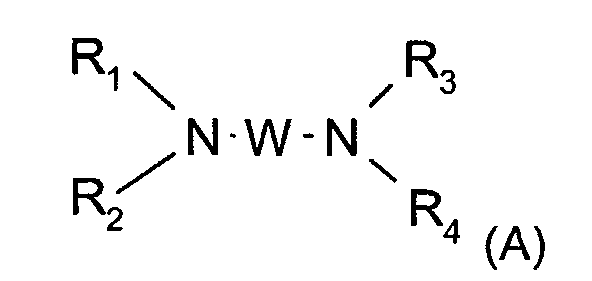
- alkaline agents may be chosen from urea, silicates and phosphates of alkali or alkaline-earth metals, ammonia precursor compounds, alkaline carbonates, alkanolamines such as mono-, di- and triethanolamines and that their derivatives, the hydroxides of sodium or of potassium and the compounds of formula (A) following: wherein W is a propylene residue optionally substituted by a hydroxyl group or a C1-C6 alkyl radical; R1, R2, R3 and R4, which may be identical or different, represent a hydrogen atom, a C1-C6 alkyl radical or a C1-C6 hydroxyalkyl radical.
- the composition comprises an oxidizing agent.
- the oxidizing agent may for example be chosen from hydrogen peroxide and peroxide. urea, alkali metal bromates, persalts such as perborates and persulfates, and enzymes such as peroxidases and oxido-reductases at two or four electrons.
- urea alkali metal bromates
- persalts such as perborates and persulfates
- enzymes such as peroxidases and oxido-reductases at two or four electrons.
- the use of hydrogen peroxide or enzymes is particularly preferred.
- the content of oxidizing agent is 0.001 and 10% by weight relative to the weight of the composition.
- composition according to the invention may be in various forms, such as lotions, shampoos, creams, gels, pasta, or under any other appropriate form.
- composition according to the invention and the oxidizing agent or the composition comprising it can be applied sequentially in any order, or simultaneously. If the latter mode of use is chosen, the composition according to the invention and the oxidizing agent or the composition comprising it, are preferably mixed just before application to the fibers.
- the temperature at which the composition is applied is generally between 15 and 80 ° C and more particularly between 15 and 40 ° C.
- the pause time of the composition is usually between 5 and 60 minutes and more particularly between 5 and 40 minutes.
- composition according to the invention it is possible to store in form separated, on the one hand, the composition according to the invention, and on the other hand, a composition oxidizing.
- This oxidizing composition advantageously comprises, in a medium suitable for dyeing, at least one oxidizing agent.
- the oxidizing composition may of course include other ingredients, such as anionic, cationic or amphoteric nonionic surfactants, as well as any other additive conventionally used in the field. We can thus refer to the additives mentioned in the context of the description of the composition according to the invention
- the mixture of the composition according to the invention and the composition is then mixed. oxidizing at the time of use, before applying this mixture to the fibers keratinic; the other aforementioned steps of the process are then implemented.
- the mixture is stirred for 24 hours under argon at 50 ° C.
- the poly (thiophene-3-ethyl acetate) polymer is then precipitated in heptane.
- the polymer is then dissolved in a solution of tetrahydrofuran
- the polymer obtained above is then hydrolysed by an excess of 50 ml of a aqueous solution of sodium hydroxide (2N) for 48 hours at 70 ° C, followed by acidification with concentrated HCl until precipitation of the product: poly (thiophene-3-acid) acetic).
- the polymer is then filtered and washed several times with distilled water to to eliminate the traces of catalyst.
- the poly (thiophene-3-acetic acid) polymer (2 g) is dissolved in tetrahydrofuran (30 g) and neutralized with 1 mol of sodium hydroxide per mole of carboxylic acid. The water (30 g) is then added. Tetrahydrofuran is evaporated.
- the formula is deposited on dark hair. After waiting for 20 minutes, drying is carried out (free drying).
Landscapes
- Health & Medical Sciences (AREA)
- Life Sciences & Earth Sciences (AREA)
- Public Health (AREA)
- Veterinary Medicine (AREA)
- Animal Behavior & Ethology (AREA)
- General Health & Medical Sciences (AREA)
- Epidemiology (AREA)
- Birds (AREA)
- Cosmetics (AREA)
- Compositions Of Macromolecular Compounds (AREA)
- Treatments For Attaching Organic Compounds To Fibrous Goods (AREA)
- Coloring (AREA)
- Detergent Compositions (AREA)
Abstract
Description
La seconde consiste à appliquer la composition en présence d'un agent oxydant, dans des conditions de pH alcalin. On parle alors de coloration éclaircissante.
Même si des améliorations ont été réalisées dans ce domaine, les colorants directs conduisent encore à des colorations dont les propriétés de puissance, de ténacité sont perfectibles.
Le problème est qu'elles nécessitent la présence d'un agent oxydant employé dans des conditions de pH alcalin. Or à la longue, de telles conditions sont la cause d'une dégradation plus ou moins marquée des fibres traitées, qui peut altérer par exemple, leur aspect brillant.
Il est à noter que l'on peut aussi constater ce phénomène de dégradation des fibres lorsque le colorant direct est employé dans des conditions de coloration éclaircissante.
Précisons qu'il est plus avantageux d'effectuer un post-traitement plutôt qu'employer une composition de coloration comprenant ledit agent. En effet, il n'est pas rare d'observer avec ces compositions une moins bonne montée du colorant dans la fibre, conduisant à des colorations moins intenses, moins tenaces.
Le phénomène peut encore être modifié lorsque les polymères conducteurs présents dans la composition absorbent dans le spectre visible
On dit que le polymère est soluble dans le milieu lorsqu'il forme un liquide limpide isotrope à 25°C dans le milieu comprenant de l'eau ou un mélange eau/solvant ; ceci étant obtenu dans tout ou partie d'une gamme de concentration comprise entre 0,01 et 50 % en poids de polymère conducteur.
Il est à noter que de manière avantageuse, ces polymères ne nécessitent pas l'emploi d'un agent dispersant.
La conductivité est mesurée à l'aide d'un générateur de courant (RM2 Test Unit commercialisé par la société Jandel) muni d'une tête de mesure dite quatre pointes (Universal four-point probes commercialisé par la société Jandel). Les quatre pointes alignées et distantes du même espacement d sont appliquées par simple pression sur l'échantillon à analyser. Un courant I est injecté par les pointes externes à l'aide de la source de courant créant ainsi une variation de potentiel. La tension U est mesurée entre les deux pointes internes reliées au voltmètre du générateur de courant.
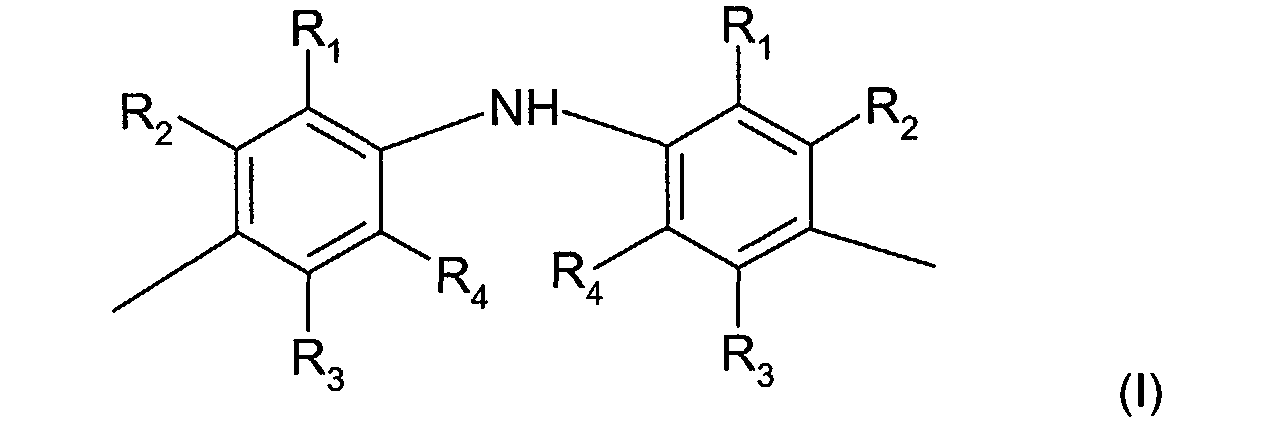
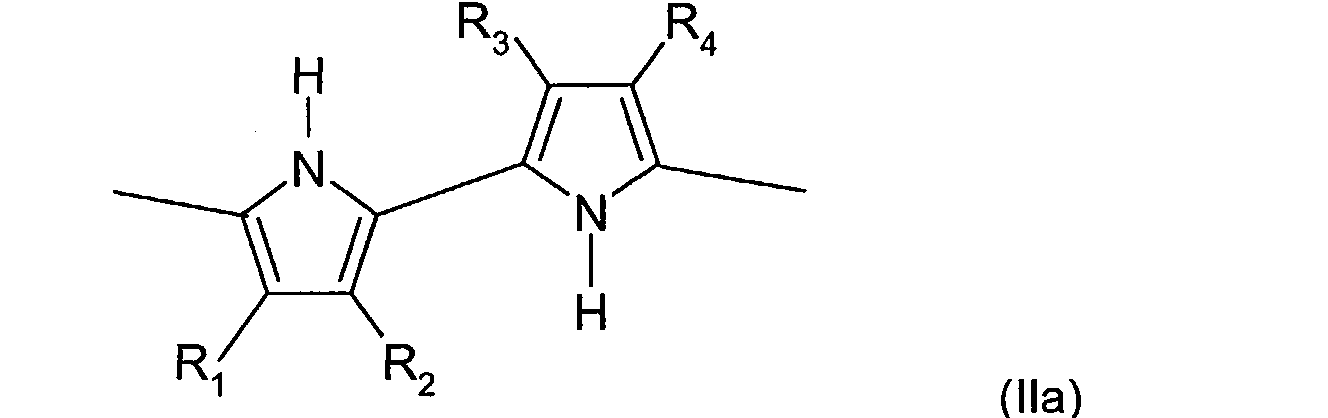
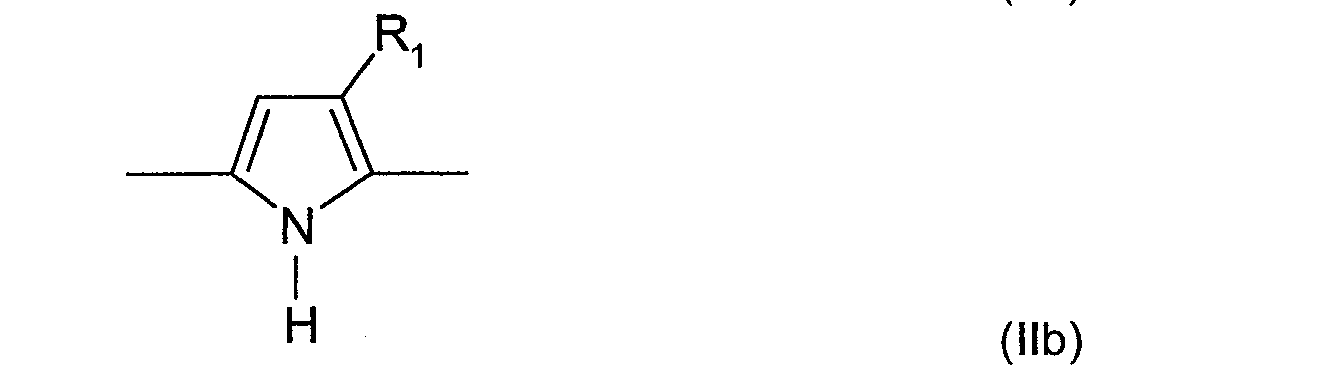
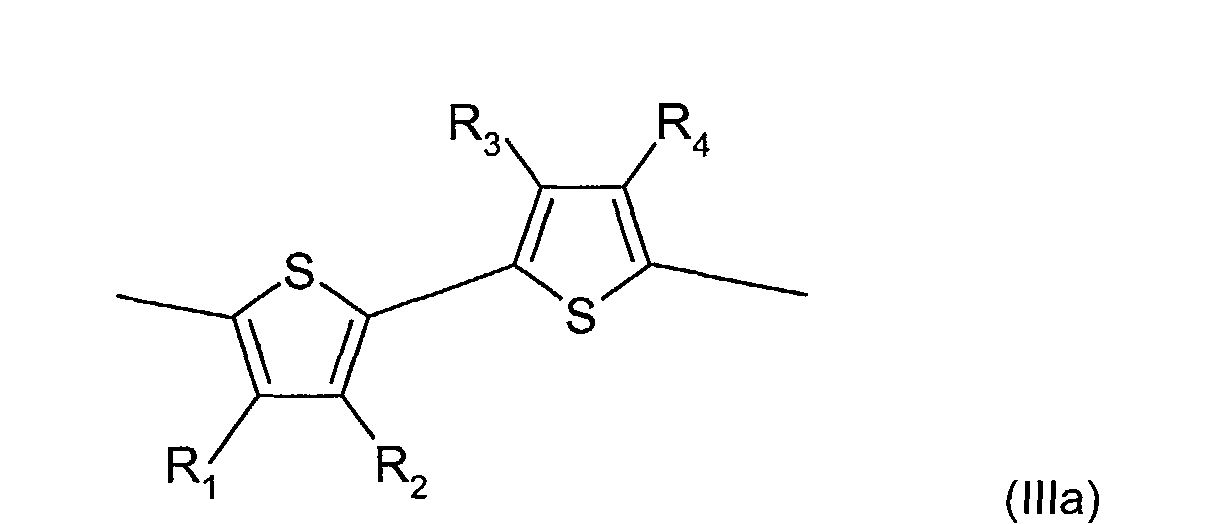
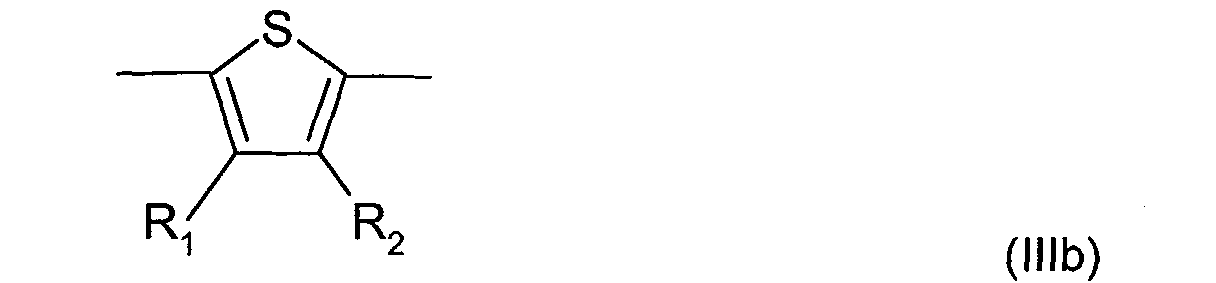
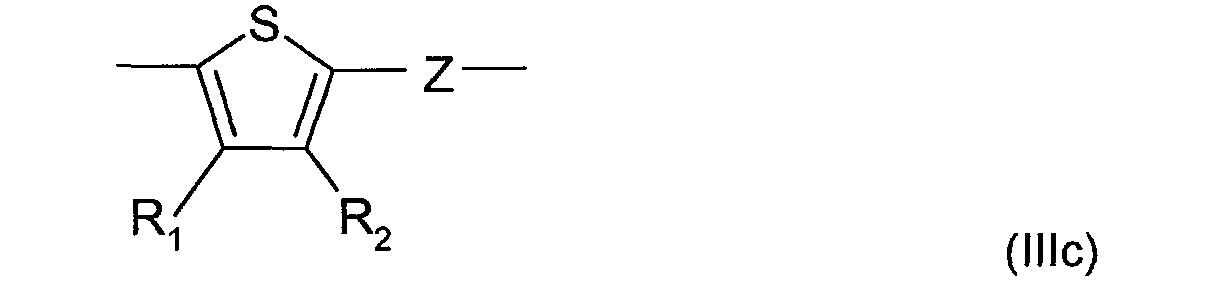


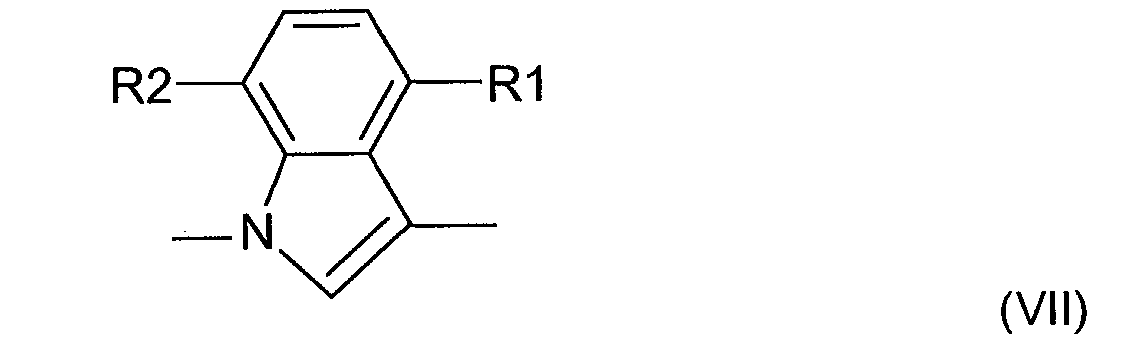









- les radicaux R, R1 à R4 identiques ou différents, sont choisis dans le groupe formé par l'hydrogène, un radical -R', -OR', -COOR', -OCOR', avec R' représentant un radical alkyle linéaire ou ramifié en C1-C20, un atome d'halogène, un radical nitro, un radical cyano, un radical cyanoalkyle, et un groupement solubilisant ;
- Ar représente un radical comprenant un radical monoaromatique ou polyaromatique X = -NHCO-, -O-, -S-, -SO2-, -N=N-, -C(CH3)2-, -CH2-, -CH=CH-, -CH=N- ;
- Z = -CH=CH- ou -C≡C-.

- un radical carboxylique (-COOH), carboxylate (-COO-M+ avec M représentant un métal alcalin comme le sodium, le potassium, un métal alcalino-terreux, une amine organique telle que une amine primaire, secondaire ou tertiaire, une alcanolamine, un acide aminé),
- un radical sulfonique (-SO3H), sulfonate (-SO3 - M+, M ayant la même définition que ci-dessus),
- un radical amine primaire, secondaire, tertiaire,
- un radical ammonium quaternaire tel -NR'3 + Z- avec Z= Br, Cl, alkyl(C1-C4)-OSO3 et R' alkyles identiques ou non, linéaires ou ramifiés en C1 à C20, ou formant un hétérocycle avec l'azote pour deux d'entre eux,
- un radical hydroxyle,
- un radical polyoxyde d'alkylène en C2-C3.
Les radicaux amines peuvent ou non être neutralisés par un acide minéral, tel que l'acide chlorhydrique, ou par un acide organique, tel que les acides acétique ou lactique, par exemple.
Les polythiophènes et leur synthèse sont plus particulièrement décrits dans l'article tiré de la revue Chem. Mater. 1998, Vol.10, N°7 pages 1990-1999 - par les auteurs RASMUSSEN S.C., PICKENS J.C. et HUTCHISON J.E. "A new, general approach to tuning the properties of functionalized polythiophenes : The oxidative polymerization of monosubstituted bithiophenes" ; dans l'article tiré de la revue Macromolecules 1998, 31, pages 933-936, par les mêmes auteurs "Highly conjugated, water-soluble polymers via direct oxidative polymerization of monosubstituted bithiophenes". Outre la polymérisation par oxydation chimique ou électrochimique, ils peuvent être aussi obtenus par polycondensation (thiophène dihalogéné ; catalyse avec des complexes de nickel ou de palladium) ; par couplage de Suzuki (couplage entre une fonction halogène, brome par exemple et un acide boronique, catalyse : complexe de palladium et base ; on a alors couplage de type AA-BB (réaction de monomères de type A-X-A avec B-X'-B) ou de type A-B (réaction de plusieurs monomères de type A-X-B) ; par couplage de Stille (formation de liaison carbone-carbone en présence d'une catalyse à base de Pd- type AA-BB ou A-B) ; par polymérisation de Reike (organozinc en présence d'un complexe de nickel) ; par polymérisation de type McCulloch, etc.
Les polymères conducteurs présents dans la composition selon l'invention sont par ailleurs décrits dans la demande internationale WO 99/47570.
Les fonctions acides carboxyliques ou sulfoniques peuvent ou non être neutralisées.
De préférence, le colorant fluorescent est choisi parmi les composés solubles dans le milieu de la composition.


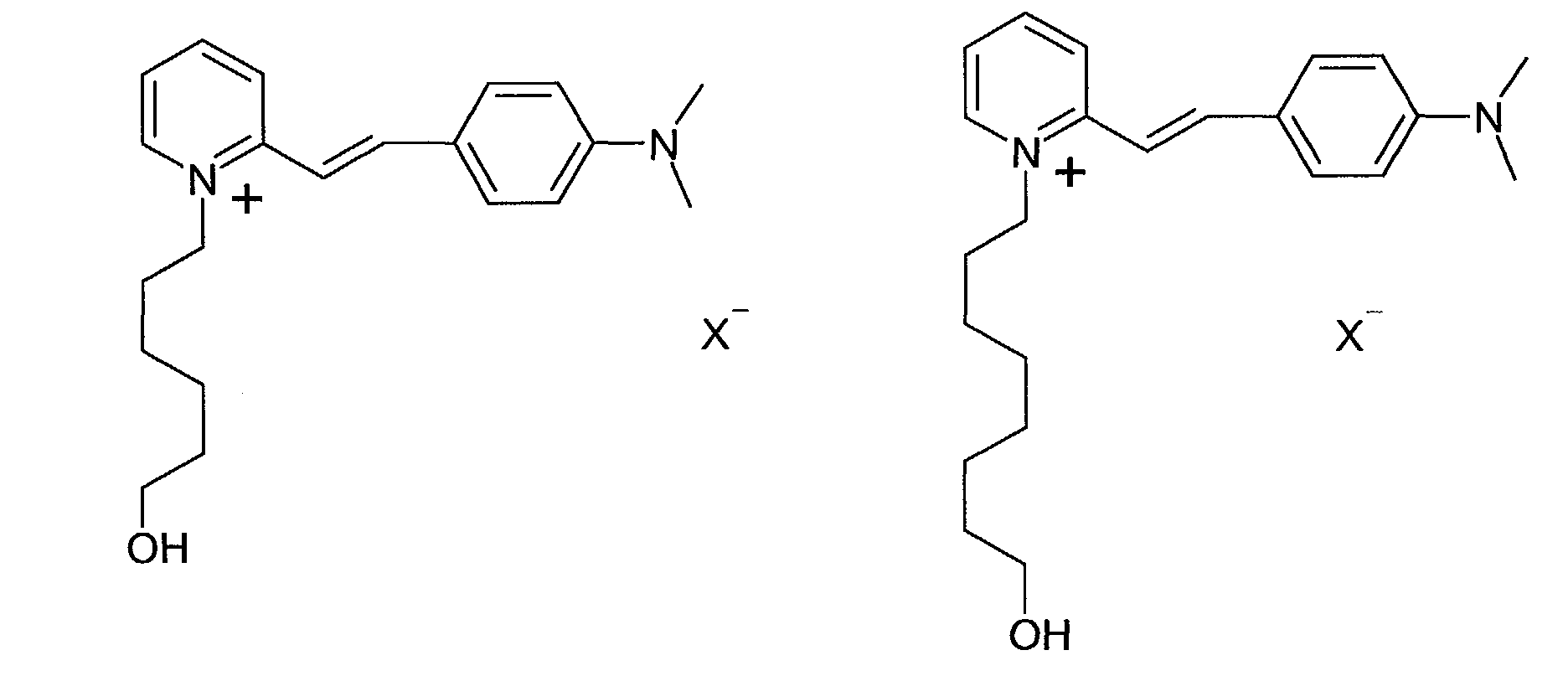
Conviennent aussi les composés de formules ci-dessous :


- le dérivé stilbénique de naphto-triazole (Tinopal GS de Ciba), le di-styryl-4,4' biphényle sulfonate di-sodique (nom CTFA : disodium distyrylbiphenyl disulfonate ; Tinopal CBS-X de Ciba : 4,4'-bis[(4,6-diamilino-1,3,5-triazin-2-yl)amino]stilbène-2,2'-disulfonate de sodium), le dérivé cationique d'aminocoumarine (Tinopal SWN Conc. de Ciba), le diéthylaminométhyl coumarine, le 4-méthyl 7-diéthyl coumarine, le 4,4'-bis[(4,6-dianilino-1,3,5-triazin-2-yl)amino]stilbène-2,2'-disulfonate de sodium (Tinopal SOP de Ciba), le 4,4'-bis-[(4-anilino-6-bis(2-hydroxyéthyl)amino-1,3,5-triazin-2-yl)amino]stilbène-2,2'-disulfonique acide (Tinopal UNPA-GX de Ciba), le 4,4'-bis-[anilino-6-morpholine-1,3,5-triazin-2-yl)amino] stilbène (Tinopal AMS-GX de Ciba), le 4,4'-bis-[(4-anilino-6-(2-hydroxy éthyl) méthylamino-1,3,5-triazin-2-yl)amino]stilbène-2,2'-disodium sulfonate (Tinopal 5BM-GX de Ciba),
- le 2,5 thiophène di-yl bis(5 ter-butyl-1,3 benzoxazole) (Uvitex OB de Ciba),
- le dérivé anionique du di-aminostilbène (dispersion dans l'eau, Leucophor BSB liquide de Clariant,
- les laques d'azurant optique (gamme Covazur de Wackherr).

2,5g de thiophène-3-acétate d'éthyle (14,7 mmol)

Le polymère poly(thiophène-3-acétate d'éthyle) est alors précipité dans l'heptane.
Le polymère est ensuite dissous dans une solution de tétrahydrofuranne
L'eau (30 g) est ensuite additionnée.
Le tétrahydrofuranne est évaporé.
| Formulation comprenant le polymère et procédé la mettant en oeuvre | |
| Poly(thiophène-3-acide acétique) | 5g |
| Aminométhyl propanol qs | pH 7 |
| Iodure de 2-[2-(4-diméthylamino) phényl éthényl]-1-éthyl N Pyridinium (de la société UBICHEM) | 0,15g |
| Alcool éthylique | 20 g |
| Eau qs | 100 g |
Après 20 minutes d'attente, on procède au séchage (séchage libre).
Claims (38)
- Composition comprenant, dans un milieu cosmétiquement acceptable,(a) au moins un colorant fluorescent et/ou au moins un azurant optique,(b) au moins un polymère conducteur.
- Composition selon la revendication précédente, caractérisé en ce que le polymère conducteur comprend au moins une unité répétitive de formules suivantes :formules (I) à (XI) dans lesquelles :les anilines de structure (1) suivante :
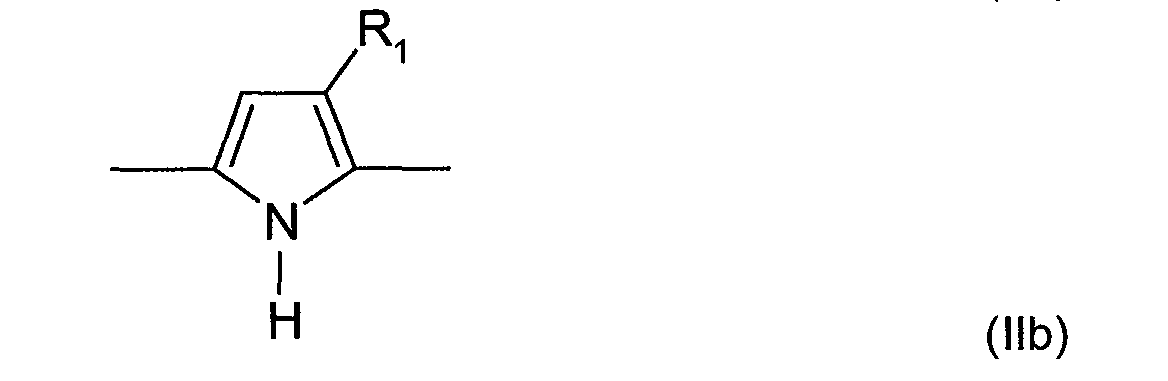
 les pyrroles de structure (IIa) et (IIb) suivantes :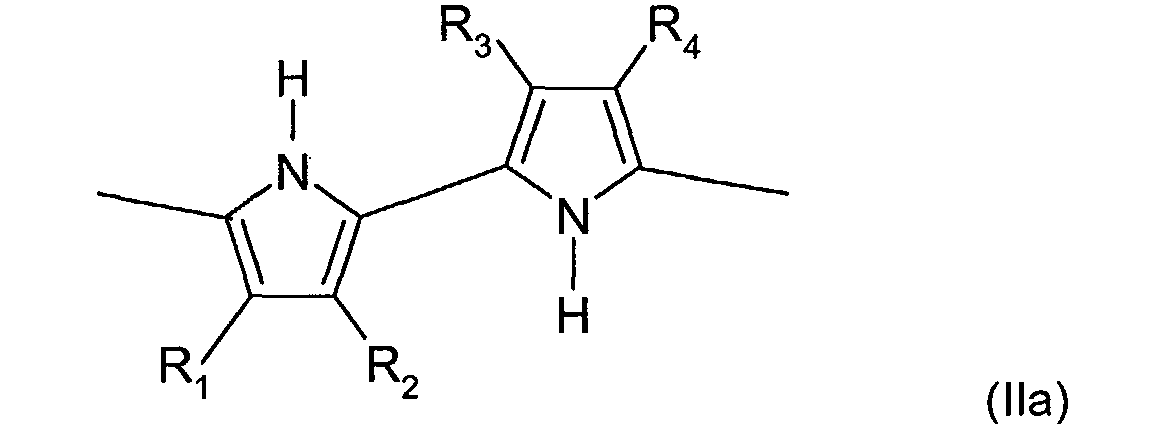
 les thiophènes ou bisthiophènes de formules (IIIa), (IIIb) et (IIIc) suivantes :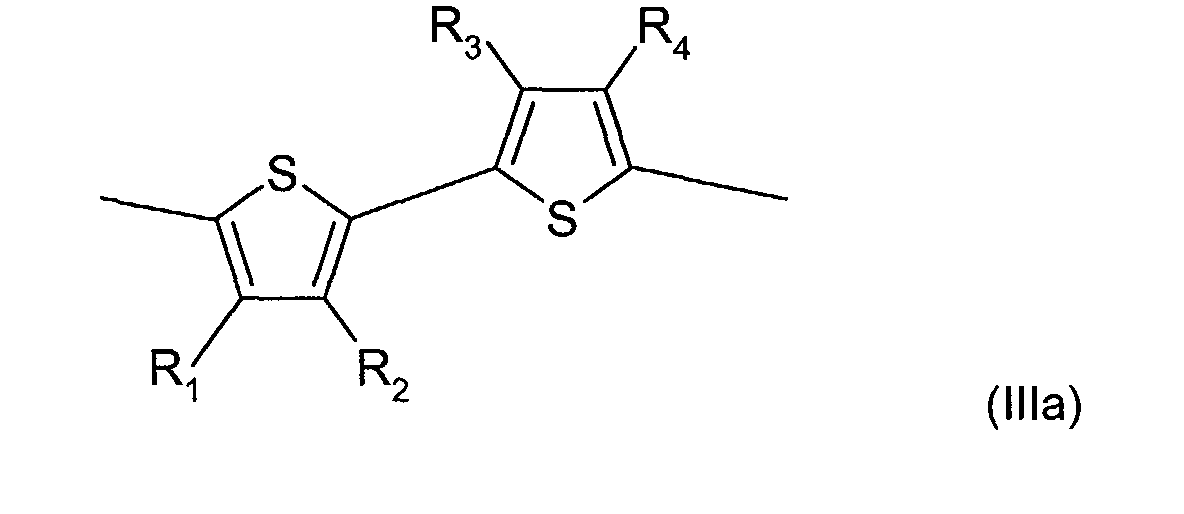

 les furanes de formule (IV) suivante :
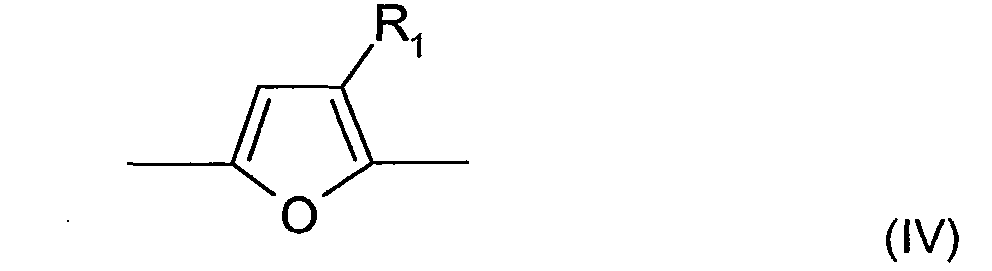 les para-phénylène-sulfure de structure (V) suivante :
 les paraphénylène vinylène de formule (VI) suivante :
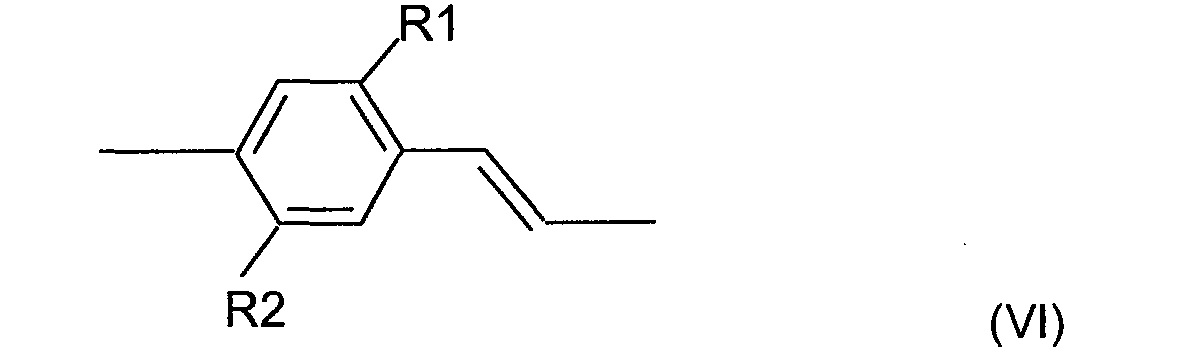 les indoles de formule (VII) suivante :
 les amides aromatiques de formules suivantes (VIIIa), (VIIIb), (VIIIc), (VIIId) :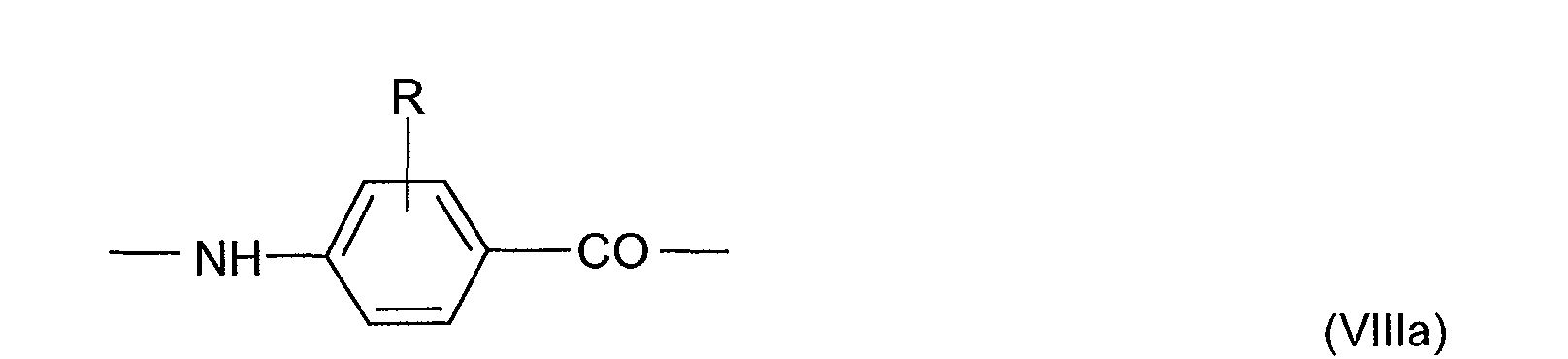


 les hydrazides aromatiques de formules (IXa), (IXb) et (IXc) suivantes :

 les azométhines aromatiques de formules (Xa), (Xb) et (Xc) suivantes :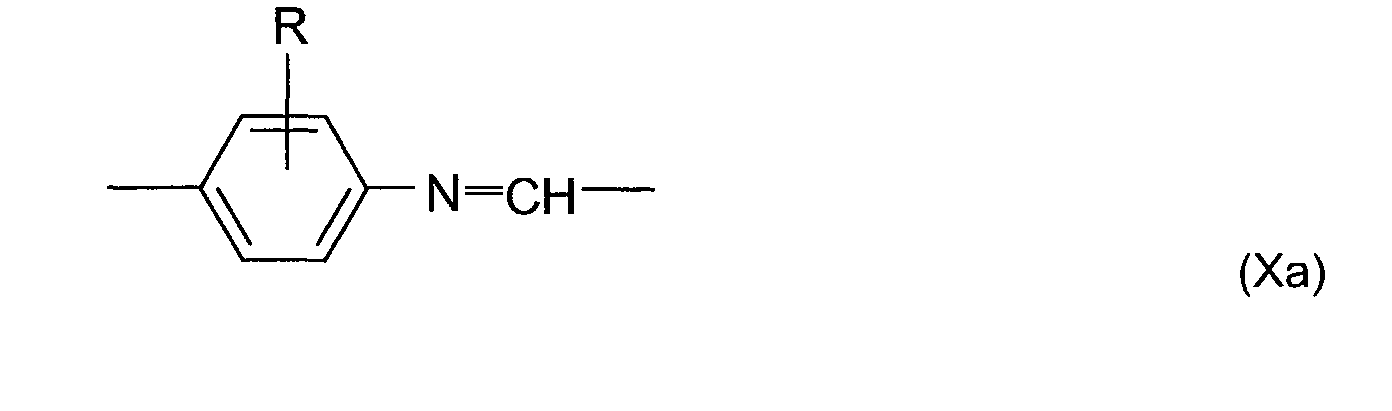
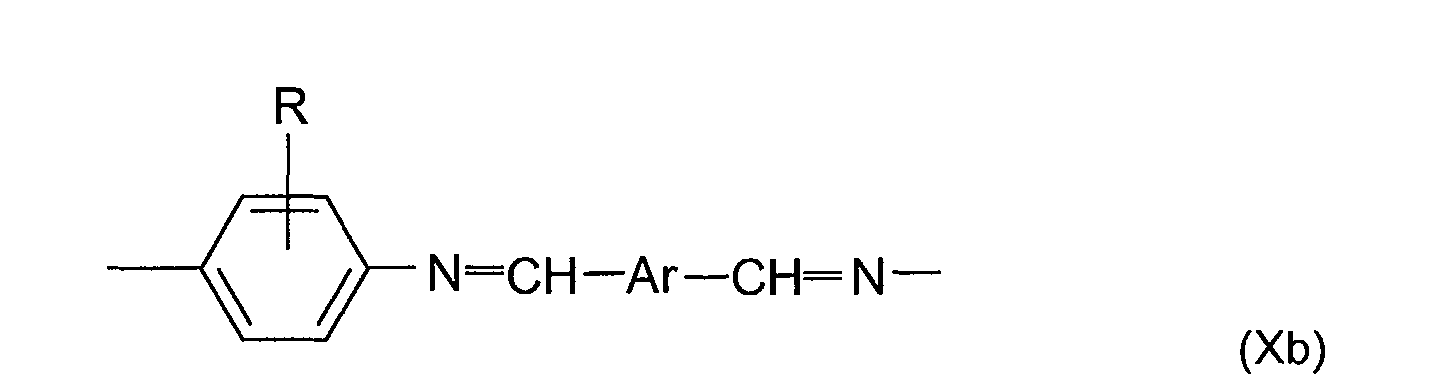
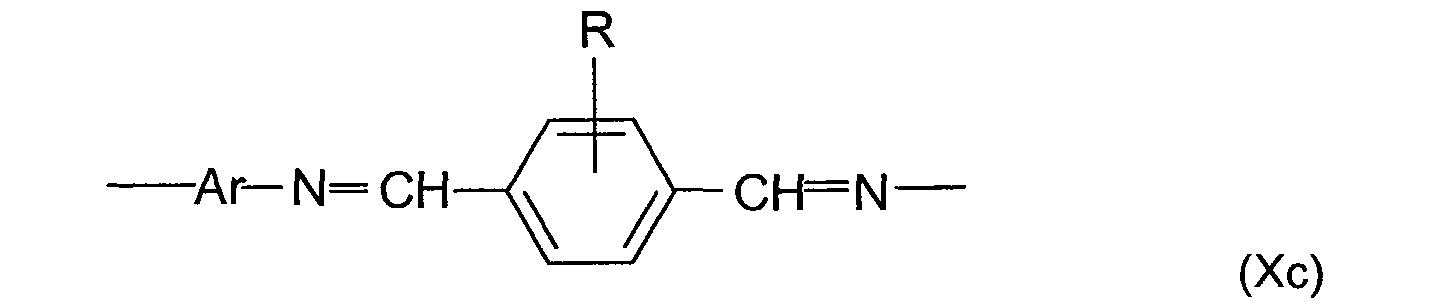 les esters aromatiques de formules (XIa), (XIb) et (Xlc) suivantes :
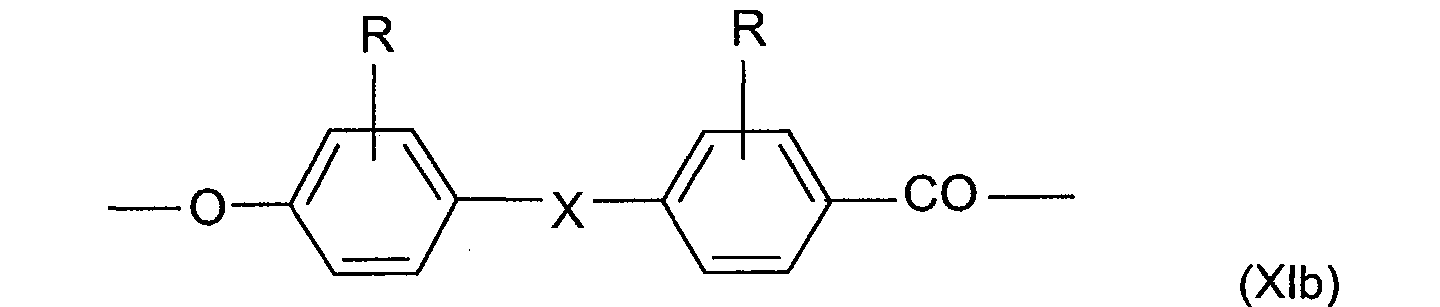
 les radicaux R, R1 à R4 identiques ou différents, sont choisis dans le groupe formé par l'hydrogène, un radical -R', -OR', -COOR', -OCOR', avec R' représentant un radical alkyle linéaire ou ramifié en C1-C20, un atome d'halogène, un radical nitro, un radical cyano, un radical alkylcyano, et des groupements solubilisants ;Ar représente un radical comprenant un radical monoaromatique ou polyaromatique X = -NHCO-, -O-, -S-, -SO2-, -N=N-, -C(CH3)2-, -CH2-, -CH=CH-, -CH=N- ;Z = -CH=CH- ou -C≡C- .
 - Composition selon l'une des revendications 1 ou 2, caractérisée en ce que les groupements solubilisants sont choisis dans le groupe formé par :un radical carboxylique (-COOH), carboxylate (-COO-M+ avec M représentant un métal alcalin, un métal alcalino-terreux, une amine organique, une alcanolamine, un acide aminé),un radical sulfonique (-SO3H), sulfonate (-SO3- M+, M ayant la même définition que ci-dessus),un radical amine primaire, secondaire, tertiaire,un radical ammonium quaternaire tel -NR'3 + Z- avec Z= Br, Cl, alkyl(C1-C4)-OSO3 et R' alkyles identiques ou non, linéaires ou ramifiés en C1 à C20, ou formant un hétérocycle avec l'azote pour deux d'entre eux,un radical hydroxyle,un radical polyoxyde d'alkylène en C2-C3.
- Composition selon l'une quelconque des revendications précédentes, caractérisée en ce que les groupements solubilisants sont reliés au cycle par l'intermédiaire d'un groupement espaceur tel que par exemple un radical -R"-, -OR"-, - OCOR"- ou -COOR"- avec R" représentant un radical alkyle, linéaire ou ramifié en C1-C20, comprenant éventuellement un ou plusieurs hétéroatomes.
- Composition selon l'une quelconque des revendications précédentes, caractérisée en ce que les radicaux R, R1 à R4 identiques ou différents, sont choisis parmi l'hydrogène, R', -OR', -OCOR', -COOR' avec R' représentant un radical alkyle linéaire ou ramifié en C1-C6, et parmi les groupements solubilisants suivants, neutralisés ou non : -COOH, -CH2COOH, -CH2OH, -(CH2)6OH, -(CH2)3SO3H, -O(CH2)3SO3H, -O(CH2)3N(CH2CH3)2, -[(CH2)2O]xCH2CH2OH, -[(CH2)2O]xCH2CH2OCH3 avec x nombre moyen compris entre 0 et 200.
- Composition selon l'une quelconque des revendications 1 à 4 caractérisée en ce que le polymère conducteur est tel qu'au moins un radical parmi R, R1 à R4 désigne un groupement solubilisant
- Composition selon l'une quelconque des revendications précédentes, caractérisée en ce que le polymère conducteur comporte au moins un groupement solubilisant par unité répétitive.
- Composition selon l'une quelconque des revendications précédentes, caractérisée en ce que les groupements solubilisants sont choisis parmi les groupements acide carboxylique ; acide sulfonique ; les radicaux amine tertiaire ; ammonium quaternaire tels que -NR'3 + Z- avec Z= Br, Cl, alkyl(C1-C4)-OSO3 et R', identiques ou non, représentant un radical alkyle linéaire ou ramifié en C1-C20 ; éventuellement relié au cycle par un espaceur, de préférence un radical alkyle en C1-C20 ; ainsi que leurs sels ; les fonctions acides carboxyliques ou sulfoniques peuvent ou non être neutralisées.
- Composition selon l'une des revendications précédentes, caractérisé en ce que le polymère conducteur correspond aux formules (IIIa), (IIIb) ou (IIIc), dans lesquelles au moins un radical R1 à R4 de la formule (IIIa) ou R1 ou R2 des formules (IIIb) ou (IIIc) représente un groupement solubilisant du type acide carboxylique, sous forme neutralisée ou non, éventuellement relié au cycle par un espaceur, de préférence un radical alkyle linéaire ou ramifié en C1-C20, le ou les autres radicaux représentant un atome d'hydrogène.
- Composition selon l'une quelconque des revendications précédentes, caractérisée en ce que le ou les polymères conducteurs sont présents dans des proportions d'au moins 0,001 % en poids par rapport au poids total de la composition.
- Composition selon l'une quelconque des revendications précédentes, caractérisée en ce que le ou les polymères conducteurs sont présents dans des proportions d'au plus 50 % en poids par rapport au poids total de la composition.
- Composition selon l'une quelconque des revendications précédentes, caractérisée en ce que le teneur en polymère conducteur représente 0,1 à 50 % en poids par rapport au poids total de la composition.
- Composition selon l'une quelconque des revendications précédentes, caractérisée en ce que le colorant fluorescent est choisi parmi les composés qui absorbent la lumière dans la partie visible du spectre et éventuellement dans la zone de l'ultraviolet, et ré-émettent une lumière fluorescente dans le spectre du visible, de plus grande longueur d'onde que celle de la lumière absorbée.
- Composition selon l'une quelconque des revendications précédentes, caractérisée en ce que le colorant fluorescent ré-émet une lumière présentant une longueur d'onde comprise entre 500 et 650 nm.
- Composition selon l'une quelconque des revendications précédentes, caractérisée en ce que le colorant fluorescent est choisi parmi les composés solubles dans le milieu de la composition.
- Composition selon l'une quelconque des revendications précédentes caractérisée en ce que les colorants fluorescents sont choisis parmi les naphtalimides ; les coumarines cationiques ou non ; les xanthénodiquinolizines ; les azaxanthènes ; les naphtolactames ; les azlactones ; les oxazines ; les thiazines ; les dioxazines, les pyrènes, les nitrobenzoxadiazoles, seuls ou en mélanges.
- Composition selon l'une quelconque des revendications 13 à 15, caractérisée en ce que le colorant fluorescent correspond à la formule suivante :dans laquelle :
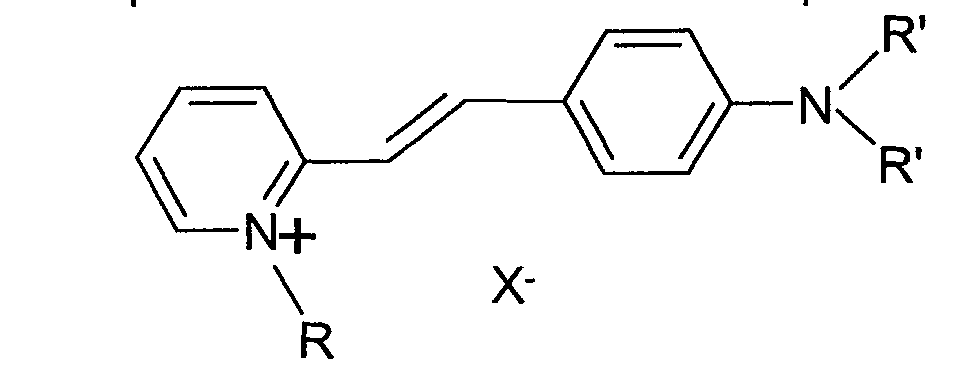 R est un radical alkyle linéaire ou ramifié, comprenant 1 à 22 atomes de carbone, éventuellement substitué par au moins un radical hydroxyle ;R', identiques ou non, représentent un atome d'hydrogène ; radical alkyle, linéaire ou ramifié, comprenant 1 à 22 atomes de carbone, plus particulièrement 1 à 10 atomes, éventuellement substitué par un ou plusieurs radicaux hydroxyle ;X représente un anion organique ou minéral.
 - Composition selon l'une quelconque des revendications 13 à 16, caractérisée en ce que le colorant fluorescent correspond à l'une des formules suivantes :
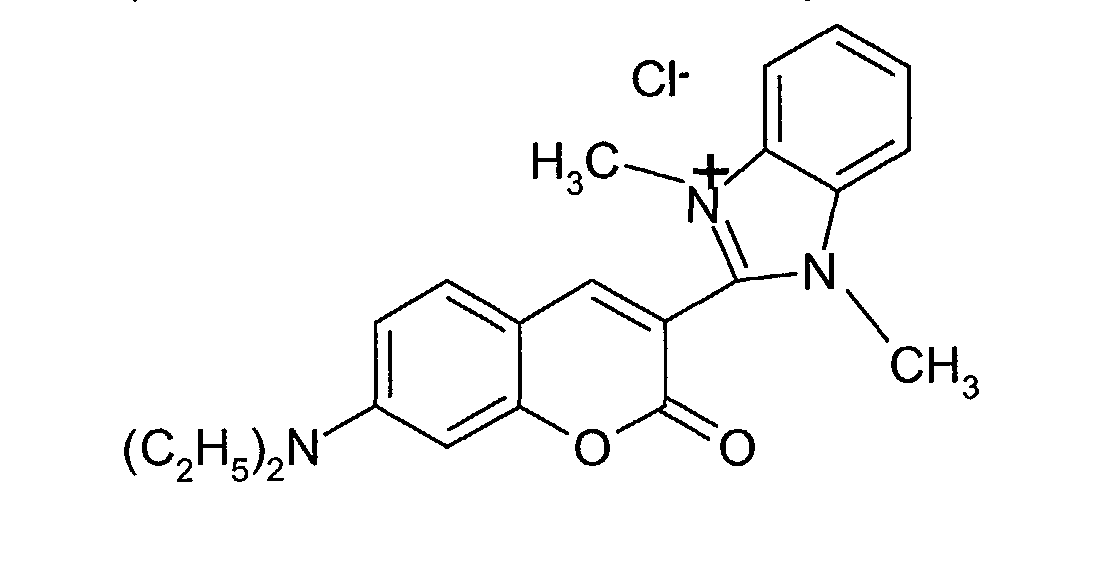
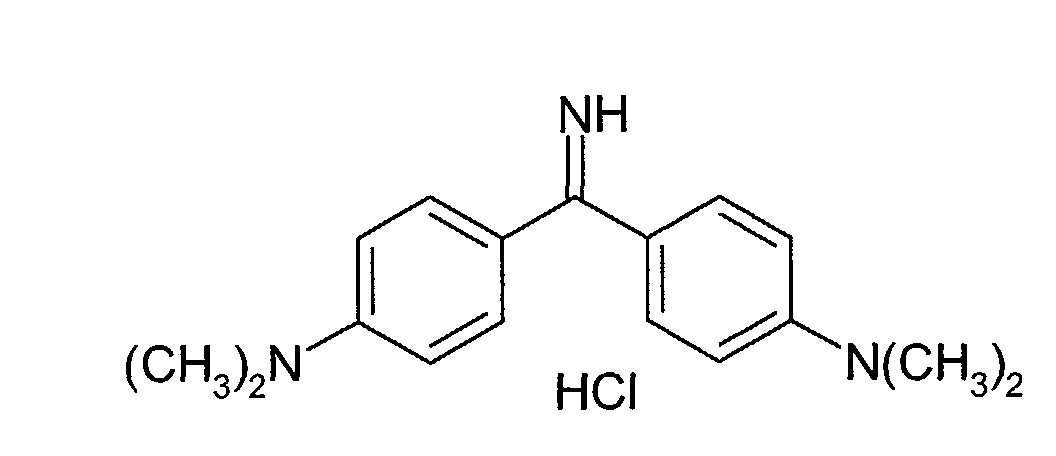
- Composition selon l'une des revendications 13 à 18, caractérisée en ce que la teneur en colorant fluorescent est comprise entre 0,01 et 20% en poids, plus particulièrement entre 0,05 et 10 % en poids, de préférence entre 0,1 et 5 % en poids par rapport au poids total de la composition.
- Composition selon l'une quelconque des revendications précédentes, caractérisée en ce que l'azurant optique est choisi parmi les composés solubles dans le milieu de la composition.
- Composition selon la revendication précédente, caractérisée en ce que l'azurant optique est choisi parmi les dérivés du stilbène, les dérivés coumariniques, les dérivés oxazole et benzoxazole, les dérivés imidazole.
- Composition selon l'une des revendications 20 ou 21, caractérisée en ce que la teneur en composé azurant optique est comprise entre 0,01 et 20% en poids, plus particulièrement entre 0,05 et 10 % en poids, de préférence entre 0,1 et 5 % en poids par rapport au poids total de la composition.
- Composition selon l'une quelconque des revendications précédentes, caractérisée en ce que le milieu cosmétiquement acceptable est constitué par de l'eau ou un mélange d'eau et d'un ou plusieurs solvants organiques acceptables dans le domaine.
- Composition selon la revendication précédente, caractérisée en ce que le ou les solvants sont choisis parmi des alcools, des glycols, des éthers de glycol, des polyols, des polyéthylèneglycols, le polypropylèneglycol et leurs mélanges.
- Composition selon l'une quelconque des revendications précédentes, caractérisée en ce qu'elle comprend en outre au moins un agent tensioactif non ionique, anionique, cationique, amphotère ou zwittérionique.
- Composition selon la revendication précédente, caractérisée en ce que la teneur en tensioactif est de moins de 30% en poids, et de préférence comprise entre 0,5 et 10% en poids, par rapport au poids de la composition.
- Composition selon l'une quelconque des revendications précédentes, caractérisée en ce que la composition comprend au moins un colorant direct non fluorescent de nature non ionique, cationique ou anionique.
- Composition selon la revendication précédente, caractérisée par le fait que le ou les colorants directs non fluorescents sont choisis parmi les colorants benzéniques nitrés, les colorants azoïques, azométhiniques, méthiniques, anthraquinoniques, naphtoquinoniques, benzoquinoniques, phénotiaziniques, indigoïdes, xanthéniques, phénanthridiniques, phtalocyanines, ceux dérivés du triarylméthane, ainsi que des colorants naturels, seuls ou en mélanges.
- Composition selon l'une quelconque des revendications 27 ou 28, caractérisée en ce que le ou les colorants directs non fluorescents représentent de 0,0005 à 12 % en poids par rapport au poids total de la composition.
- Composition selon l'une quelconque des revendications précédentes, caractérisée en ce qu'elle comprend au moins une base d'oxydation choisie parmi les paraphénylène diamines, les bases doubles, les para-aminophénols, les ortho-aminophénols et les bases hétérocycliques ou leurs sels d'addition avec un acide.
- Composition selon la revendication précédente, caractérisée en ce que la teneur en base(s) d'oxydation représente de 0,0005 à 12 % en poids par rapport au poids total de la composition.
- Composition selon l'une quelconque des revendications précédentes, caractérisée en ce qu'elle comprend au moins un coupleur choisi parmi les métaphénylènediamines, les méta-aminophénols, les métadiphénols et les coupleurs hétérocycliques ou leurs sels d'addition avec un acide.
- Composition selon la revendication précédente, caractérisée en ce que la teneur en coupleur(s) représente de 0,0001 à 10 % en poids par rapport au poids total de la composition tinctoriale.
- Composition selon l'une quelconque des revendications précédentes, caractérisée en ce que la composition comprend au moins un agent oxydant.
- Procédé de traitement des fibres kératiniques, notamment humaines et plus particulièrement les cheveux, caractérisé en ce qu'il consiste à effectuer les étapes suivantes :a) on applique sur les fibres kératiniques, sèches ou humides, la composition selon l'une quelconque des revendications 1 à 34, et on laisse pauser pendant une durée suffisante pour avoir l'effet de coloration souhaité,b) on rince éventuellement les fibres,c) éventuellement on lave les fibres et on les rince,d) on sèche ou on laisse sécher les fibres.
- Procédé de traitement des fibres kératiniques, notamment humaines et plus particulièrement les cheveux, caractérisé en ce qu'il consiste à effectuer les étapes suivantes :a) on applique sur des fibres kératiniques, sèches ou humides, la composition selon l'une quelconque des revendications 1 à 29,b) on sèche ou on laisse sécher les fibres.
- Utilisation d'une composition comprenant, dans un milieu cosmétiquement acceptable, au moins un polymère conducteur et au moins un colorant fluorescent et/ou au moins un azurant optique, selon l'une des revendications 1 à 34, pour le traitement de fibres kératiniques, dans le but de leur conférer un effet optique.
- Utilisation selon la revendication précédente, caractérisée en ce que l'effet optique est un effet de brillance.
Applications Claiming Priority (2)
| Application Number | Priority Date | Filing Date | Title |
|---|---|---|---|
| FR0308673 | 2003-07-16 | ||
| FR0308673A FR2857585B1 (fr) | 2003-07-16 | 2003-07-16 | Composition comprenant un polymere conducteur et un compose fuorescent et/ou un azurant optique, procede de traitement de fibres keratiniques la mettant en oeuvre |
Publications (2)
| Publication Number | Publication Date |
|---|---|
| EP1498110A1 true EP1498110A1 (fr) | 2005-01-19 |
| EP1498110B1 EP1498110B1 (fr) | 2006-11-08 |
Family
ID=33462537
Family Applications (1)
| Application Number | Title | Priority Date | Filing Date |
|---|---|---|---|
| EP04291768A Expired - Lifetime EP1498110B1 (fr) | 2003-07-16 | 2004-07-12 | Composition comprenant un polymère conducteur et un composé fluorescent et/ou un azurant optique, procédé de traitement de fibres kératiniques la mettant en oeuvre |
Country Status (6)
| Country | Link |
|---|---|
| EP (1) | EP1498110B1 (fr) |
| JP (1) | JP2005132818A (fr) |
| AT (1) | ATE344657T1 (fr) |
| DE (1) | DE602004003098T2 (fr) |
| ES (1) | ES2275192T3 (fr) |
| FR (1) | FR2857585B1 (fr) |
Cited By (1)
| Publication number | Priority date | Publication date | Assignee | Title |
|---|---|---|---|---|
| WO2007039527A2 (fr) | 2005-10-06 | 2007-04-12 | Ciba Specialty Chemicals Holding Inc. | Colorants thiol |
Families Citing this family (1)
| Publication number | Priority date | Publication date | Assignee | Title |
|---|---|---|---|---|
| JP7784232B2 (ja) * | 2020-02-27 | 2025-12-11 | 保土谷化学工業株式会社 | 染毛用染料、該染料を含有する染毛用組成物および該染料の製造方法 |
Citations (3)
| Publication number | Priority date | Publication date | Assignee | Title |
|---|---|---|---|---|
| WO2001031111A1 (fr) * | 1999-10-25 | 2001-05-03 | Ciba Specialty Chemicals Holding Inc. | Melanges d'agents de blanchiment fluorescents |
| US6313181B1 (en) * | 1999-05-26 | 2001-11-06 | Color Access, Inc. | Cosmetic compositions containing optical brighteners |
| US20020146442A1 (en) * | 2001-02-06 | 2002-10-10 | Gerhard Sendelbach | Cosmetic compositions containing electrically conductive polymers |
-
2003
- 2003-07-16 FR FR0308673A patent/FR2857585B1/fr not_active Expired - Fee Related
-
2004
- 2004-07-12 EP EP04291768A patent/EP1498110B1/fr not_active Expired - Lifetime
- 2004-07-12 ES ES04291768T patent/ES2275192T3/es not_active Expired - Lifetime
- 2004-07-12 DE DE602004003098T patent/DE602004003098T2/de not_active Expired - Fee Related
- 2004-07-12 AT AT04291768T patent/ATE344657T1/de not_active IP Right Cessation
- 2004-07-16 JP JP2004209566A patent/JP2005132818A/ja active Pending
Patent Citations (3)
| Publication number | Priority date | Publication date | Assignee | Title |
|---|---|---|---|---|
| US6313181B1 (en) * | 1999-05-26 | 2001-11-06 | Color Access, Inc. | Cosmetic compositions containing optical brighteners |
| WO2001031111A1 (fr) * | 1999-10-25 | 2001-05-03 | Ciba Specialty Chemicals Holding Inc. | Melanges d'agents de blanchiment fluorescents |
| US20020146442A1 (en) * | 2001-02-06 | 2002-10-10 | Gerhard Sendelbach | Cosmetic compositions containing electrically conductive polymers |
Cited By (3)
| Publication number | Priority date | Publication date | Assignee | Title |
|---|---|---|---|---|
| WO2007039527A2 (fr) | 2005-10-06 | 2007-04-12 | Ciba Specialty Chemicals Holding Inc. | Colorants thiol |
| WO2007039527A3 (fr) * | 2005-10-06 | 2007-06-21 | Ciba Sc Holding Ag | Colorants thiol |
| US7563289B2 (en) | 2005-10-06 | 2009-07-21 | Ciba Corporation | Thiol dyes |
Also Published As
| Publication number | Publication date |
|---|---|
| DE602004003098D1 (de) | 2006-12-21 |
| ES2275192T3 (es) | 2007-06-01 |
| FR2857585A1 (fr) | 2005-01-21 |
| EP1498110B1 (fr) | 2006-11-08 |
| FR2857585B1 (fr) | 2005-09-09 |
| DE602004003098T2 (de) | 2007-04-05 |
| JP2005132818A (ja) | 2005-05-26 |
| ATE344657T1 (de) | 2006-11-15 |
Similar Documents
| Publication | Publication Date | Title |
|---|---|---|
| JP2960209B2 (ja) | メラニン色素含有化粧品 | |
| FR2853229A1 (fr) | Procede de coloration pour matieres keratiniques humaines avec effet eclaircissant, compose fluorescent particulier et composition le comprenant | |
| FR2929112A1 (fr) | Composition de teinture comprenant au moins un derive de cyclanone et au moins un alcoxysilane | |
| EP1498110B1 (fr) | Composition comprenant un polymère conducteur et un composé fluorescent et/ou un azurant optique, procédé de traitement de fibres kératiniques la mettant en oeuvre | |
| FR2915681A1 (fr) | Traitement de fibres keratiniques colorees avec une composition comprenant au moins un tensioactif alkylpolyglucoside | |
| FR2853230A1 (fr) | Composition de coloration pour matieres keratiniques humaines comprenant un colorant auto-oxydable, procede et utilisation | |
| EP1498112A2 (fr) | Composition comprenant un polymere conducteur et un agent oxydant, procede de deformation permanente la mettant en oeuvre | |
| CH648204A5 (fr) | Compositions tinctoriales pour cheveux a base de colorants directs nitres et procede de teinture utilisant lesdites compositions. | |
| FR2857587A1 (fr) | Composition comprenant au moins un polymere conducteur et au moins un colorant direct et procede la mettant en oeuvre | |
| WO2003063811A2 (fr) | Utilisation de polymeres conducteurs solubles pour le traitement des fibres keratiniques humaines | |
| EP1498105A2 (fr) | Composition comprenant au moins un polymère conducteur et des particules rigides non filmogènes, procédé la mettant en oeuvre et utilisation | |
| WO2018115791A1 (fr) | Procédé de coloration capillaire à partir de colorants acides comprenant un prétraitement mettant en œuvre un polymère cationique | |
| EP1464322B2 (fr) | Utilisation de compositions comprenant un colorant fluorescent et un tensioactif amphotère ou non ionique particuliers pour colorer avec un effet eclaircissant des matières kératiniques humaines | |
| EP1498102A2 (fr) | Composition comprenant au moins un polymère conducteur et au moins un propulseur, et procédé la mettant en oeuvre | |
| EP1498108A2 (fr) | Composition comprenant un polymère conducteur et un agent reducteur, procédé de déformation permanente la mettant en oeuvre | |
| WO2003063809A2 (fr) | Utilisation de thiophenes pour le traitement de cheveux et compositions les comprenant | |
| FR3014687A1 (fr) | Procede de coloration des matieres keratiniques a partir d'oligomeres et/ou de polymeres colores issus de coupleurs, composition et agent de coloration | |
| FR2850568A1 (fr) | Utilisation de polythiophenes conducteurs pour le traitement de matieres keratiniques humaines | |
| FR3090379A1 (fr) | Gels aqueux pour la coloration ou le maquillage des sourcils | |
| US20050048023A1 (en) | Composition comprising at least one conductive polymer and at least one fluorescent dye and/or at least one optical brightener, and process for use thereof | |
| FR3131317A1 (fr) | Polymères photodimérisables comprenant au moins un groupement polyoxyalkyléné, composition les comprenant et procédé de traitement cosmétique | |
| FR3064914A1 (fr) | Procede de coloration des cheveux comprenant un pigment et une disper-sion aqueuse de polymere supramoleculaire | |
| WO2024246147A1 (fr) | Agent de blanchiment comprenant une phénalénone | |
| EP1500387B1 (fr) | Utilisation en coloration de dérivés de ninhydrine | |
| FR3163261A1 (fr) | Procédé de coloration des fibres kératiniques mettant en œuvre un composé à fonctions acétoacétates, un composé (poly)aminé et un colorant direct |
Legal Events
| Date | Code | Title | Description |
|---|---|---|---|
| PUAI | Public reference made under article 153(3) epc to a published international application that has entered the european phase |
Free format text: ORIGINAL CODE: 0009012 |
|
| AK | Designated contracting states |
Kind code of ref document: A1 Designated state(s): AT BE BG CH CY CZ DE DK EE ES FI FR GB GR HU IE IT LI LU MC NL PL PT RO SE SI SK TR |
|
| AX | Request for extension of the european patent |
Extension state: AL HR LT LV MK |
|
| 17P | Request for examination filed |
Effective date: 20050719 |
|
| AKX | Designation fees paid |
Designated state(s): AT BE BG CH CY CZ DE DK EE ES FI FR GB GR HU IE IT LI LU MC NL PL PT RO SE SI SK TR |
|
| RIC1 | Information provided on ipc code assigned before grant |
Ipc: A61K 8/40 20060101ALI20060222BHEP Ipc: A61Q 5/00 20060101ALI20060222BHEP Ipc: A61K 8/46 20060101AFI20060222BHEP |
|
| GRAP | Despatch of communication of intention to grant a patent |
Free format text: ORIGINAL CODE: EPIDOSNIGR1 |
|
| GRAS | Grant fee paid |
Free format text: ORIGINAL CODE: EPIDOSNIGR3 |
|
| GRAA | (expected) grant |
Free format text: ORIGINAL CODE: 0009210 |
|
| AK | Designated contracting states |
Kind code of ref document: B1 Designated state(s): AT BE BG CH CY CZ DE DK EE ES FI FR GB GR HU IE IT LI LU MC NL PL PT RO SE SI SK TR |
|
| PG25 | Lapsed in a contracting state [announced via postgrant information from national office to epo] |
Ref country code: AT Free format text: LAPSE BECAUSE OF FAILURE TO SUBMIT A TRANSLATION OF THE DESCRIPTION OR TO PAY THE FEE WITHIN THE PRESCRIBED TIME-LIMIT Effective date: 20061108 Ref country code: CZ Free format text: LAPSE BECAUSE OF FAILURE TO SUBMIT A TRANSLATION OF THE DESCRIPTION OR TO PAY THE FEE WITHIN THE PRESCRIBED TIME-LIMIT Effective date: 20061108 Ref country code: FI Free format text: LAPSE BECAUSE OF FAILURE TO SUBMIT A TRANSLATION OF THE DESCRIPTION OR TO PAY THE FEE WITHIN THE PRESCRIBED TIME-LIMIT Effective date: 20061108 Ref country code: IE Free format text: LAPSE BECAUSE OF FAILURE TO SUBMIT A TRANSLATION OF THE DESCRIPTION OR TO PAY THE FEE WITHIN THE PRESCRIBED TIME-LIMIT Effective date: 20061108 Ref country code: NL Free format text: LAPSE BECAUSE OF FAILURE TO SUBMIT A TRANSLATION OF THE DESCRIPTION OR TO PAY THE FEE WITHIN THE PRESCRIBED TIME-LIMIT Effective date: 20061108 Ref country code: PL Free format text: LAPSE BECAUSE OF FAILURE TO SUBMIT A TRANSLATION OF THE DESCRIPTION OR TO PAY THE FEE WITHIN THE PRESCRIBED TIME-LIMIT Effective date: 20061108 Ref country code: RO Free format text: LAPSE BECAUSE OF FAILURE TO SUBMIT A TRANSLATION OF THE DESCRIPTION OR TO PAY THE FEE WITHIN THE PRESCRIBED TIME-LIMIT Effective date: 20061108 Ref country code: SI Free format text: LAPSE BECAUSE OF FAILURE TO SUBMIT A TRANSLATION OF THE DESCRIPTION OR TO PAY THE FEE WITHIN THE PRESCRIBED TIME-LIMIT Effective date: 20061108 Ref country code: SK Free format text: LAPSE BECAUSE OF FAILURE TO SUBMIT A TRANSLATION OF THE DESCRIPTION OR TO PAY THE FEE WITHIN THE PRESCRIBED TIME-LIMIT Effective date: 20061108 |
|
| REG | Reference to a national code |
Ref country code: GB Ref legal event code: FG4D Free format text: NOT ENGLISH |
|
| REG | Reference to a national code |
Ref country code: CH Ref legal event code: EP |
|
| REG | Reference to a national code |
Ref country code: IE Ref legal event code: FG4D Free format text: LANGUAGE OF EP DOCUMENT: FRENCH |
|
| REF | Corresponds to: |
Ref document number: 602004003098 Country of ref document: DE Date of ref document: 20061221 Kind code of ref document: P |
|
| PG25 | Lapsed in a contracting state [announced via postgrant information from national office to epo] |
Ref country code: SE Free format text: LAPSE BECAUSE OF FAILURE TO SUBMIT A TRANSLATION OF THE DESCRIPTION OR TO PAY THE FEE WITHIN THE PRESCRIBED TIME-LIMIT Effective date: 20070208 Ref country code: BG Free format text: LAPSE BECAUSE OF FAILURE TO SUBMIT A TRANSLATION OF THE DESCRIPTION OR TO PAY THE FEE WITHIN THE PRESCRIBED TIME-LIMIT Effective date: 20070208 Ref country code: DK Free format text: LAPSE BECAUSE OF FAILURE TO SUBMIT A TRANSLATION OF THE DESCRIPTION OR TO PAY THE FEE WITHIN THE PRESCRIBED TIME-LIMIT Effective date: 20070208 |
|
| GBT | Gb: translation of ep patent filed (gb section 77(6)(a)/1977) |
Effective date: 20070131 |
|
| PG25 | Lapsed in a contracting state [announced via postgrant information from national office to epo] |
Ref country code: PT Free format text: LAPSE BECAUSE OF FAILURE TO SUBMIT A TRANSLATION OF THE DESCRIPTION OR TO PAY THE FEE WITHIN THE PRESCRIBED TIME-LIMIT Effective date: 20070409 |
|
| NLV1 | Nl: lapsed or annulled due to failure to fulfill the requirements of art. 29p and 29m of the patents act | ||
| REG | Reference to a national code |
Ref country code: ES Ref legal event code: FG2A Ref document number: 2275192 Country of ref document: ES Kind code of ref document: T3 |
|
| REG | Reference to a national code |
Ref country code: IE Ref legal event code: FD4D |
|
| PGFP | Annual fee paid to national office [announced via postgrant information from national office to epo] |
Ref country code: DE Payment date: 20070705 Year of fee payment: 4 |
|
| PGFP | Annual fee paid to national office [announced via postgrant information from national office to epo] |
Ref country code: ES Payment date: 20070824 Year of fee payment: 4 |
|
| PLBE | No opposition filed within time limit |
Free format text: ORIGINAL CODE: 0009261 |
|
| STAA | Information on the status of an ep patent application or granted ep patent |
Free format text: STATUS: NO OPPOSITION FILED WITHIN TIME LIMIT |
|
| 26N | No opposition filed |
Effective date: 20070809 |
|
| BERE | Be: lapsed |
Owner name: L'OREAL Effective date: 20070731 |
|
| PG25 | Lapsed in a contracting state [announced via postgrant information from national office to epo] |
Ref country code: GR Free format text: LAPSE BECAUSE OF FAILURE TO SUBMIT A TRANSLATION OF THE DESCRIPTION OR TO PAY THE FEE WITHIN THE PRESCRIBED TIME-LIMIT Effective date: 20070209 Ref country code: MC Free format text: LAPSE BECAUSE OF NON-PAYMENT OF DUE FEES Effective date: 20070731 |
|
| PGFP | Annual fee paid to national office [announced via postgrant information from national office to epo] |
Ref country code: FR Payment date: 20070710 Year of fee payment: 4 |
|
| PG25 | Lapsed in a contracting state [announced via postgrant information from national office to epo] |
Ref country code: BE Free format text: LAPSE BECAUSE OF NON-PAYMENT OF DUE FEES Effective date: 20070731 |
|
| PG25 | Lapsed in a contracting state [announced via postgrant information from national office to epo] |
Ref country code: EE Free format text: LAPSE BECAUSE OF FAILURE TO SUBMIT A TRANSLATION OF THE DESCRIPTION OR TO PAY THE FEE WITHIN THE PRESCRIBED TIME-LIMIT Effective date: 20061108 |
|
| REG | Reference to a national code |
Ref country code: CH Ref legal event code: PL |
|
| GBPC | Gb: european patent ceased through non-payment of renewal fee |
Effective date: 20080712 |
|
| PG25 | Lapsed in a contracting state [announced via postgrant information from national office to epo] |
Ref country code: DE Free format text: LAPSE BECAUSE OF NON-PAYMENT OF DUE FEES Effective date: 20090203 |
|
| REG | Reference to a national code |
Ref country code: FR Ref legal event code: ST Effective date: 20090331 |
|
| PG25 | Lapsed in a contracting state [announced via postgrant information from national office to epo] |
Ref country code: LI Free format text: LAPSE BECAUSE OF NON-PAYMENT OF DUE FEES Effective date: 20080731 Ref country code: GB Free format text: LAPSE BECAUSE OF NON-PAYMENT OF DUE FEES Effective date: 20080712 Ref country code: CH Free format text: LAPSE BECAUSE OF NON-PAYMENT OF DUE FEES Effective date: 20080731 |
|
| PG25 | Lapsed in a contracting state [announced via postgrant information from national office to epo] |
Ref country code: FR Free format text: LAPSE BECAUSE OF NON-PAYMENT OF DUE FEES Effective date: 20080731 Ref country code: LU Free format text: LAPSE BECAUSE OF NON-PAYMENT OF DUE FEES Effective date: 20070712 Ref country code: CY Free format text: LAPSE BECAUSE OF FAILURE TO SUBMIT A TRANSLATION OF THE DESCRIPTION OR TO PAY THE FEE WITHIN THE PRESCRIBED TIME-LIMIT Effective date: 20061108 |
|
| REG | Reference to a national code |
Ref country code: ES Ref legal event code: FD2A Effective date: 20080714 |
|
| PG25 | Lapsed in a contracting state [announced via postgrant information from national office to epo] |
Ref country code: TR Free format text: LAPSE BECAUSE OF FAILURE TO SUBMIT A TRANSLATION OF THE DESCRIPTION OR TO PAY THE FEE WITHIN THE PRESCRIBED TIME-LIMIT Effective date: 20061108 Ref country code: HU Free format text: LAPSE BECAUSE OF FAILURE TO SUBMIT A TRANSLATION OF THE DESCRIPTION OR TO PAY THE FEE WITHIN THE PRESCRIBED TIME-LIMIT Effective date: 20070509 |
|
| PG25 | Lapsed in a contracting state [announced via postgrant information from national office to epo] |
Ref country code: ES Free format text: LAPSE BECAUSE OF NON-PAYMENT OF DUE FEES Effective date: 20080714 |
|
| PG25 | Lapsed in a contracting state [announced via postgrant information from national office to epo] |
Ref country code: IT Free format text: LAPSE BECAUSE OF NON-PAYMENT OF DUE FEES Effective date: 20080712 |
|
| PGFP | Annual fee paid to national office [announced via postgrant information from national office to epo] |
Ref country code: IT Payment date: 20070731 Year of fee payment: 4 |