EP1497465B1 - Constant length signatures for parallel sequencing of polynucleotides - Google Patents
Constant length signatures for parallel sequencing of polynucleotides Download PDFInfo
- Publication number
- EP1497465B1 EP1497465B1 EP03728567A EP03728567A EP1497465B1 EP 1497465 B1 EP1497465 B1 EP 1497465B1 EP 03728567 A EP03728567 A EP 03728567A EP 03728567 A EP03728567 A EP 03728567A EP 1497465 B1 EP1497465 B1 EP 1497465B1
- Authority
- EP
- European Patent Office
- Prior art keywords
- signature
- adapter
- tag
- cdna
- library
- Prior art date
- Legal status (The legal status is an assumption and is not a legal conclusion. Google has not performed a legal analysis and makes no representation as to the accuracy of the status listed.)
- Expired - Lifetime
Links
- 238000012163 sequencing technique Methods 0.000 title claims abstract description 27
- 108091033319 polynucleotide Proteins 0.000 title claims description 37
- 239000002157 polynucleotide Substances 0.000 title claims description 36
- 102000040430 polynucleotide Human genes 0.000 title claims description 36
- 238000000034 method Methods 0.000 claims abstract description 80
- 108091034117 Oligonucleotide Proteins 0.000 claims abstract description 57
- 239000007790 solid phase Substances 0.000 claims abstract description 39
- 239000002299 complementary DNA Substances 0.000 claims description 90
- 239000012634 fragment Substances 0.000 claims description 84
- 238000003776 cleavage reaction Methods 0.000 claims description 74
- 230000007017 scission Effects 0.000 claims description 74
- 108091008146 restriction endonucleases Proteins 0.000 claims description 58
- 239000002773 nucleotide Substances 0.000 claims description 56
- 125000003729 nucleotide group Chemical group 0.000 claims description 52
- 239000013598 vector Substances 0.000 claims description 41
- 150000007523 nucleic acids Chemical class 0.000 claims description 21
- 238000010367 cloning Methods 0.000 claims description 20
- 102000039446 nucleic acids Human genes 0.000 claims description 20
- 108020004707 nucleic acids Proteins 0.000 claims description 20
- 108010042407 Endonucleases Proteins 0.000 claims description 16
- 238000012408 PCR amplification Methods 0.000 claims description 11
- 238000003780 insertion Methods 0.000 claims description 6
- 230000037431 insertion Effects 0.000 claims description 6
- 230000003362 replicative effect Effects 0.000 claims description 4
- 102000004533 Endonucleases Human genes 0.000 claims description 3
- 239000012071 phase Substances 0.000 claims description 3
- 101150101095 Mmp12 gene Proteins 0.000 claims description 2
- 230000001172 regenerating effect Effects 0.000 claims description 2
- 238000010839 reverse transcription Methods 0.000 claims description 2
- 108020004999 messenger RNA Proteins 0.000 abstract description 20
- YBJHBAHKTGYVGT-ZKWXMUAHSA-N (+)-Biotin Chemical compound N1C(=O)N[C@@H]2[C@H](CCCCC(=O)O)SC[C@@H]21 YBJHBAHKTGYVGT-ZKWXMUAHSA-N 0.000 description 46
- 108020004414 DNA Proteins 0.000 description 45
- 102000004190 Enzymes Human genes 0.000 description 28
- 108090000790 Enzymes Proteins 0.000 description 28
- 239000000203 mixture Substances 0.000 description 25
- LFQSCWFLJHTTHZ-UHFFFAOYSA-N Ethanol Chemical compound CCO LFQSCWFLJHTTHZ-UHFFFAOYSA-N 0.000 description 24
- 229960002685 biotin Drugs 0.000 description 23
- 235000020958 biotin Nutrition 0.000 description 23
- 239000011616 biotin Substances 0.000 description 23
- 230000000295 complement effect Effects 0.000 description 22
- 239000011859 microparticle Substances 0.000 description 21
- 102100031780 Endonuclease Human genes 0.000 description 16
- 230000015572 biosynthetic process Effects 0.000 description 14
- 239000000872 buffer Substances 0.000 description 14
- 238000003786 synthesis reaction Methods 0.000 description 13
- JLCPHMBAVCMARE-UHFFFAOYSA-N [3-[[3-[[3-[[3-[[3-[[3-[[3-[[3-[[3-[[3-[[3-[[5-(2-amino-6-oxo-1H-purin-9-yl)-3-[[3-[[3-[[3-[[3-[[3-[[5-(2-amino-6-oxo-1H-purin-9-yl)-3-[[5-(2-amino-6-oxo-1H-purin-9-yl)-3-hydroxyoxolan-2-yl]methoxy-hydroxyphosphoryl]oxyoxolan-2-yl]methoxy-hydroxyphosphoryl]oxy-5-(5-methyl-2,4-dioxopyrimidin-1-yl)oxolan-2-yl]methoxy-hydroxyphosphoryl]oxy-5-(6-aminopurin-9-yl)oxolan-2-yl]methoxy-hydroxyphosphoryl]oxy-5-(6-aminopurin-9-yl)oxolan-2-yl]methoxy-hydroxyphosphoryl]oxy-5-(6-aminopurin-9-yl)oxolan-2-yl]methoxy-hydroxyphosphoryl]oxy-5-(6-aminopurin-9-yl)oxolan-2-yl]methoxy-hydroxyphosphoryl]oxyoxolan-2-yl]methoxy-hydroxyphosphoryl]oxy-5-(5-methyl-2,4-dioxopyrimidin-1-yl)oxolan-2-yl]methoxy-hydroxyphosphoryl]oxy-5-(4-amino-2-oxopyrimidin-1-yl)oxolan-2-yl]methoxy-hydroxyphosphoryl]oxy-5-(5-methyl-2,4-dioxopyrimidin-1-yl)oxolan-2-yl]methoxy-hydroxyphosphoryl]oxy-5-(5-methyl-2,4-dioxopyrimidin-1-yl)oxolan-2-yl]methoxy-hydroxyphosphoryl]oxy-5-(6-aminopurin-9-yl)oxolan-2-yl]methoxy-hydroxyphosphoryl]oxy-5-(6-aminopurin-9-yl)oxolan-2-yl]methoxy-hydroxyphosphoryl]oxy-5-(4-amino-2-oxopyrimidin-1-yl)oxolan-2-yl]methoxy-hydroxyphosphoryl]oxy-5-(4-amino-2-oxopyrimidin-1-yl)oxolan-2-yl]methoxy-hydroxyphosphoryl]oxy-5-(4-amino-2-oxopyrimidin-1-yl)oxolan-2-yl]methoxy-hydroxyphosphoryl]oxy-5-(6-aminopurin-9-yl)oxolan-2-yl]methoxy-hydroxyphosphoryl]oxy-5-(4-amino-2-oxopyrimidin-1-yl)oxolan-2-yl]methyl [5-(6-aminopurin-9-yl)-2-(hydroxymethyl)oxolan-3-yl] hydrogen phosphate Polymers Cc1cn(C2CC(OP(O)(=O)OCC3OC(CC3OP(O)(=O)OCC3OC(CC3O)n3cnc4c3nc(N)[nH]c4=O)n3cnc4c3nc(N)[nH]c4=O)C(COP(O)(=O)OC3CC(OC3COP(O)(=O)OC3CC(OC3COP(O)(=O)OC3CC(OC3COP(O)(=O)OC3CC(OC3COP(O)(=O)OC3CC(OC3COP(O)(=O)OC3CC(OC3COP(O)(=O)OC3CC(OC3COP(O)(=O)OC3CC(OC3COP(O)(=O)OC3CC(OC3COP(O)(=O)OC3CC(OC3COP(O)(=O)OC3CC(OC3COP(O)(=O)OC3CC(OC3COP(O)(=O)OC3CC(OC3COP(O)(=O)OC3CC(OC3COP(O)(=O)OC3CC(OC3COP(O)(=O)OC3CC(OC3COP(O)(=O)OC3CC(OC3CO)n3cnc4c(N)ncnc34)n3ccc(N)nc3=O)n3cnc4c(N)ncnc34)n3ccc(N)nc3=O)n3ccc(N)nc3=O)n3ccc(N)nc3=O)n3cnc4c(N)ncnc34)n3cnc4c(N)ncnc34)n3cc(C)c(=O)[nH]c3=O)n3cc(C)c(=O)[nH]c3=O)n3ccc(N)nc3=O)n3cc(C)c(=O)[nH]c3=O)n3cnc4c3nc(N)[nH]c4=O)n3cnc4c(N)ncnc34)n3cnc4c(N)ncnc34)n3cnc4c(N)ncnc34)n3cnc4c(N)ncnc34)O2)c(=O)[nH]c1=O JLCPHMBAVCMARE-UHFFFAOYSA-N 0.000 description 12
- 239000011324 bead Substances 0.000 description 11
- HEDRZPFGACZZDS-UHFFFAOYSA-N Chloroform Chemical compound ClC(Cl)Cl HEDRZPFGACZZDS-UHFFFAOYSA-N 0.000 description 10
- 238000000746 purification Methods 0.000 description 10
- 108010090804 Streptavidin Proteins 0.000 description 9
- 230000008569 process Effects 0.000 description 9
- 108091028043 Nucleic acid sequence Proteins 0.000 description 8
- ISWSIDIOOBJBQZ-UHFFFAOYSA-N Phenol Chemical compound OC1=CC=CC=C1 ISWSIDIOOBJBQZ-UHFFFAOYSA-N 0.000 description 8
- 230000003321 amplification Effects 0.000 description 8
- 238000006243 chemical reaction Methods 0.000 description 8
- 238000011068 loading method Methods 0.000 description 8
- 238000003199 nucleic acid amplification method Methods 0.000 description 8
- 239000008188 pellet Substances 0.000 description 8
- 238000002360 preparation method Methods 0.000 description 8
- 238000012545 processing Methods 0.000 description 8
- XLYOFNOQVPJJNP-UHFFFAOYSA-N water Substances O XLYOFNOQVPJJNP-UHFFFAOYSA-N 0.000 description 8
- 238000004458 analytical method Methods 0.000 description 7
- 238000010804 cDNA synthesis Methods 0.000 description 7
- 238000009396 hybridization Methods 0.000 description 7
- 239000002777 nucleoside Substances 0.000 description 7
- 102000003960 Ligases Human genes 0.000 description 6
- 108090000364 Ligases Proteins 0.000 description 6
- 108090000623 proteins and genes Proteins 0.000 description 6
- 108091032973 (ribonucleotides)n+m Proteins 0.000 description 5
- LRSASMSXMSNRBT-UHFFFAOYSA-N 5-methylcytosine Chemical compound CC1=CNC(=O)N=C1N LRSASMSXMSNRBT-UHFFFAOYSA-N 0.000 description 5
- 241001156002 Anthonomus pomorum Species 0.000 description 5
- 108010014303 DNA-directed DNA polymerase Proteins 0.000 description 5
- 102000016928 DNA-directed DNA polymerase Human genes 0.000 description 5
- 101710163270 Nuclease Proteins 0.000 description 5
- 238000001943 fluorescence-activated cell sorting Methods 0.000 description 5
- 125000003835 nucleoside group Chemical group 0.000 description 5
- 238000005070 sampling Methods 0.000 description 5
- 241000588724 Escherichia coli Species 0.000 description 4
- VMHLLURERBWHNL-UHFFFAOYSA-M Sodium acetate Chemical compound [Na+].CC([O-])=O VMHLLURERBWHNL-UHFFFAOYSA-M 0.000 description 4
- FAPWRFPIFSIZLT-UHFFFAOYSA-M Sodium chloride Chemical compound [Na+].[Cl-] FAPWRFPIFSIZLT-UHFFFAOYSA-M 0.000 description 4
- 239000007850 fluorescent dye Substances 0.000 description 4
- 238000002156 mixing Methods 0.000 description 4
- 239000013612 plasmid Substances 0.000 description 4
- 239000006228 supernatant Substances 0.000 description 4
- 108091093088 Amplicon Proteins 0.000 description 3
- PEDCQBHIVMGVHV-UHFFFAOYSA-N Glycerine Chemical compound OCC(O)CO PEDCQBHIVMGVHV-UHFFFAOYSA-N 0.000 description 3
- 108010092799 RNA-directed DNA polymerase Proteins 0.000 description 3
- 239000013599 cloning vector Substances 0.000 description 3
- HAAZLUGHYHWQIW-KVQBGUIXSA-N dGTP Chemical compound C1=NC=2C(=O)NC(N)=NC=2N1[C@H]1C[C@H](O)[C@@H](COP(O)(=O)OP(O)(=O)OP(O)(O)=O)O1 HAAZLUGHYHWQIW-KVQBGUIXSA-N 0.000 description 3
- 230000029087 digestion Effects 0.000 description 3
- 239000000539 dimer Substances 0.000 description 3
- 230000007614 genetic variation Effects 0.000 description 3
- 238000011534 incubation Methods 0.000 description 3
- 238000002955 isolation Methods 0.000 description 3
- 238000012986 modification Methods 0.000 description 3
- 230000004048 modification Effects 0.000 description 3
- 239000000178 monomer Substances 0.000 description 3
- 238000009987 spinning Methods 0.000 description 3
- 108091029430 CpG site Proteins 0.000 description 2
- 108060002716 Exonuclease Proteins 0.000 description 2
- 229920002527 Glycogen Polymers 0.000 description 2
- 229910019142 PO4 Inorganic materials 0.000 description 2
- 108091093037 Peptide nucleic acid Proteins 0.000 description 2
- 108091028664 Ribonucleotide Proteins 0.000 description 2
- IQFYYKKMVGJFEH-XLPZGREQSA-N Thymidine Chemical compound O=C1NC(=O)C(C)=CN1[C@@H]1O[C@H](CO)[C@@H](O)C1 IQFYYKKMVGJFEH-XLPZGREQSA-N 0.000 description 2
- FTRJELBDCFOMKQ-UHFFFAOYSA-N [5-(4-amino-5-methyl-2-oxopyrimidin-1-yl)-3-hydroxyoxolan-2-yl] [hydroxy(phosphonooxy)phosphoryl] hydrogen phosphate Chemical compound O=C1N=C(N)C(C)=CN1C1OC(OP(O)(=O)OP(O)(=O)OP(O)(O)=O)C(O)C1 FTRJELBDCFOMKQ-UHFFFAOYSA-N 0.000 description 2
- OIRDTQYFTABQOQ-KQYNXXCUSA-N adenosine Chemical compound C1=NC=2C(N)=NC=NC=2N1[C@@H]1O[C@H](CO)[C@@H](O)[C@H]1O OIRDTQYFTABQOQ-KQYNXXCUSA-N 0.000 description 2
- 238000000137 annealing Methods 0.000 description 2
- 208000027697 autoimmune lymphoproliferative syndrome due to CTLA4 haploinsuffiency Diseases 0.000 description 2
- 230000008901 benefit Effects 0.000 description 2
- 239000003153 chemical reaction reagent Substances 0.000 description 2
- 239000005289 controlled pore glass Substances 0.000 description 2
- 238000007796 conventional method Methods 0.000 description 2
- 238000005520 cutting process Methods 0.000 description 2
- OPTASPLRGRRNAP-UHFFFAOYSA-N cytosine Chemical class NC=1C=CNC(=O)N=1 OPTASPLRGRRNAP-UHFFFAOYSA-N 0.000 description 2
- RGWHQCVHVJXOKC-SHYZEUOFSA-J dCTP(4-) Chemical compound O=C1N=C(N)C=CN1[C@@H]1O[C@H](COP([O-])(=O)OP([O-])(=O)OP([O-])([O-])=O)[C@@H](O)C1 RGWHQCVHVJXOKC-SHYZEUOFSA-J 0.000 description 2
- 238000001514 detection method Methods 0.000 description 2
- 230000000694 effects Effects 0.000 description 2
- 102000013165 exonuclease Human genes 0.000 description 2
- 108010055863 gene b exonuclease Proteins 0.000 description 2
- 230000014509 gene expression Effects 0.000 description 2
- 229940096919 glycogen Drugs 0.000 description 2
- 238000000338 in vitro Methods 0.000 description 2
- PHTQWCKDNZKARW-UHFFFAOYSA-N isoamylol Chemical compound CC(C)CCO PHTQWCKDNZKARW-UHFFFAOYSA-N 0.000 description 2
- 238000004519 manufacturing process Methods 0.000 description 2
- 125000002496 methyl group Chemical group [H]C([H])([H])* 0.000 description 2
- 238000010369 molecular cloning Methods 0.000 description 2
- 150000003833 nucleoside derivatives Chemical class 0.000 description 2
- NBIIXXVUZAFLBC-UHFFFAOYSA-K phosphate Chemical compound [O-]P([O-])([O-])=O NBIIXXVUZAFLBC-UHFFFAOYSA-K 0.000 description 2
- 239000010452 phosphate Substances 0.000 description 2
- 239000000047 product Substances 0.000 description 2
- 230000000717 retained effect Effects 0.000 description 2
- 238000012552 review Methods 0.000 description 2
- 239000002336 ribonucleotide Substances 0.000 description 2
- 125000002652 ribonucleotide group Chemical group 0.000 description 2
- 239000011780 sodium chloride Substances 0.000 description 2
- 239000007787 solid Substances 0.000 description 2
- 239000000243 solution Substances 0.000 description 2
- 241000894007 species Species 0.000 description 2
- 238000010561 standard procedure Methods 0.000 description 2
- 238000013518 transcription Methods 0.000 description 2
- 230000035897 transcription Effects 0.000 description 2
- YKBGVTZYEHREMT-KVQBGUIXSA-N 2'-deoxyguanosine Chemical compound C1=NC=2C(=O)NC(N)=NC=2N1[C@H]1C[C@H](O)[C@@H](CO)O1 YKBGVTZYEHREMT-KVQBGUIXSA-N 0.000 description 1
- VGONTNSXDCQUGY-RRKCRQDMSA-N 2'-deoxyinosine Chemical compound C1[C@H](O)[C@@H](CO)O[C@H]1N1C(N=CNC2=O)=C2N=C1 VGONTNSXDCQUGY-RRKCRQDMSA-N 0.000 description 1
- QKNYBSVHEMOAJP-UHFFFAOYSA-N 2-amino-2-(hydroxymethyl)propane-1,3-diol;hydron;chloride Chemical compound Cl.OCC(N)(CO)CO QKNYBSVHEMOAJP-UHFFFAOYSA-N 0.000 description 1
- CKTSBUTUHBMZGZ-ULQXZJNLSA-N 4-amino-1-[(2r,4s,5r)-4-hydroxy-5-(hydroxymethyl)oxolan-2-yl]-5-tritiopyrimidin-2-one Chemical compound O=C1N=C(N)C([3H])=CN1[C@@H]1O[C@H](CO)[C@@H](O)C1 CKTSBUTUHBMZGZ-ULQXZJNLSA-N 0.000 description 1
- NGYHUCPPLJOZIX-XLPZGREQSA-N 5-methyl-dCTP Chemical compound O=C1N=C(N)C(C)=CN1[C@@H]1O[C@H](COP(O)(=O)OP(O)(=O)OP(O)(O)=O)[C@@H](O)C1 NGYHUCPPLJOZIX-XLPZGREQSA-N 0.000 description 1
- 102000002260 Alkaline Phosphatase Human genes 0.000 description 1
- 108020004774 Alkaline Phosphatase Proteins 0.000 description 1
- USFZMSVCRYTOJT-UHFFFAOYSA-N Ammonium acetate Chemical compound N.CC(O)=O USFZMSVCRYTOJT-UHFFFAOYSA-N 0.000 description 1
- DWRXFEITVBNRMK-UHFFFAOYSA-N Beta-D-1-Arabinofuranosylthymine Natural products O=C1NC(=O)C(C)=CN1C1C(O)C(O)C(CO)O1 DWRXFEITVBNRMK-UHFFFAOYSA-N 0.000 description 1
- 108020004635 Complementary DNA Proteins 0.000 description 1
- 102000012410 DNA Ligases Human genes 0.000 description 1
- 108010061982 DNA Ligases Proteins 0.000 description 1
- 102000004594 DNA Polymerase I Human genes 0.000 description 1
- 108010017826 DNA Polymerase I Proteins 0.000 description 1
- 108010008286 DNA nucleotidylexotransferase Proteins 0.000 description 1
- 102100033215 DNA nucleotidylexotransferase Human genes 0.000 description 1
- 230000004543 DNA replication Effects 0.000 description 1
- 102000004163 DNA-directed RNA polymerases Human genes 0.000 description 1
- 108090000626 DNA-directed RNA polymerases Proteins 0.000 description 1
- 241000238557 Decapoda Species 0.000 description 1
- 229920002307 Dextran Polymers 0.000 description 1
- KCXVZYZYPLLWCC-UHFFFAOYSA-N EDTA Chemical compound OC(=O)CN(CC(O)=O)CCN(CC(O)=O)CC(O)=O KCXVZYZYPLLWCC-UHFFFAOYSA-N 0.000 description 1
- 108700039691 Genetic Promoter Regions Proteins 0.000 description 1
- 241000721701 Lynx Species 0.000 description 1
- 241000208125 Nicotiana Species 0.000 description 1
- 235000002637 Nicotiana tabacum Nutrition 0.000 description 1
- 239000004677 Nylon Substances 0.000 description 1
- 108010010677 Phosphodiesterase I Proteins 0.000 description 1
- 102000004160 Phosphoric Monoester Hydrolases Human genes 0.000 description 1
- 108090000608 Phosphoric Monoester Hydrolases Proteins 0.000 description 1
- 239000004793 Polystyrene Substances 0.000 description 1
- 102000009609 Pyrophosphatases Human genes 0.000 description 1
- 108010009413 Pyrophosphatases Proteins 0.000 description 1
- 108091036333 Rapid DNA Proteins 0.000 description 1
- 108700009124 Transcription Initiation Site Proteins 0.000 description 1
- 108010067022 Type III Site-Specific Deoxyribonucleases Proteins 0.000 description 1
- 241000251539 Vertebrata <Metazoa> Species 0.000 description 1
- 239000002253 acid Substances 0.000 description 1
- 229920006243 acrylic copolymer Polymers 0.000 description 1
- 230000001580 bacterial effect Effects 0.000 description 1
- IQFYYKKMVGJFEH-UHFFFAOYSA-N beta-L-thymidine Natural products O=C1NC(=O)C(C)=CN1C1OC(CO)C(O)C1 IQFYYKKMVGJFEH-UHFFFAOYSA-N 0.000 description 1
- 239000006227 byproduct Substances 0.000 description 1
- 244000309466 calf Species 0.000 description 1
- 239000001913 cellulose Substances 0.000 description 1
- 229920002678 cellulose Polymers 0.000 description 1
- 230000008859 change Effects 0.000 description 1
- 230000002860 competitive effect Effects 0.000 description 1
- SUYVUBYJARFZHO-RRKCRQDMSA-N dATP Chemical compound C1=NC=2C(N)=NC=NC=2N1[C@H]1C[C@H](O)[C@@H](COP(O)(=O)OP(O)(=O)OP(O)(O)=O)O1 SUYVUBYJARFZHO-RRKCRQDMSA-N 0.000 description 1
- SUYVUBYJARFZHO-UHFFFAOYSA-N dATP Natural products C1=NC=2C(N)=NC=NC=2N1C1CC(O)C(COP(O)(=O)OP(O)(=O)OP(O)(O)=O)O1 SUYVUBYJARFZHO-UHFFFAOYSA-N 0.000 description 1
- NHVNXKFIZYSCEB-XLPZGREQSA-N dTTP Chemical compound O=C1NC(=O)C(C)=CN1[C@@H]1O[C@H](COP(O)(=O)OP(O)(=O)OP(O)(O)=O)[C@@H](O)C1 NHVNXKFIZYSCEB-XLPZGREQSA-N 0.000 description 1
- 238000012217 deletion Methods 0.000 description 1
- 230000037430 deletion Effects 0.000 description 1
- 239000005549 deoxyribonucleoside Substances 0.000 description 1
- 238000009795 derivation Methods 0.000 description 1
- 238000013461 design Methods 0.000 description 1
- VGONTNSXDCQUGY-UHFFFAOYSA-N desoxyinosine Natural products C1C(O)C(CO)OC1N1C(NC=NC2=O)=C2N=C1 VGONTNSXDCQUGY-UHFFFAOYSA-N 0.000 description 1
- 150000002009 diols Chemical group 0.000 description 1
- 239000003814 drug Substances 0.000 description 1
- 238000001962 electrophoresis Methods 0.000 description 1
- 238000010828 elution Methods 0.000 description 1
- 239000003623 enhancer Substances 0.000 description 1
- 238000012869 ethanol precipitation Methods 0.000 description 1
- 230000002068 genetic effect Effects 0.000 description 1
- 239000001963 growth medium Substances 0.000 description 1
- 230000002779 inactivation Effects 0.000 description 1
- 230000003993 interaction Effects 0.000 description 1
- 230000000968 intestinal effect Effects 0.000 description 1
- 229920000126 latex Polymers 0.000 description 1
- 239000004816 latex Substances 0.000 description 1
- 239000012160 loading buffer Substances 0.000 description 1
- 239000006249 magnetic particle Substances 0.000 description 1
- 238000013507 mapping Methods 0.000 description 1
- 239000000463 material Substances 0.000 description 1
- 238000002844 melting Methods 0.000 description 1
- 230000008018 melting Effects 0.000 description 1
- 235000015097 nutrients Nutrition 0.000 description 1
- 229920001778 nylon Polymers 0.000 description 1
- 239000003973 paint Substances 0.000 description 1
- 230000036961 partial effect Effects 0.000 description 1
- 150000002989 phenols Chemical class 0.000 description 1
- 229920002223 polystyrene Polymers 0.000 description 1
- 238000001556 precipitation Methods 0.000 description 1
- 230000037452 priming Effects 0.000 description 1
- 238000010791 quenching Methods 0.000 description 1
- 230000000171 quenching effect Effects 0.000 description 1
- 239000011541 reaction mixture Substances 0.000 description 1
- 230000001105 regulatory effect Effects 0.000 description 1
- 230000010076 replication Effects 0.000 description 1
- 239000002342 ribonucleoside Substances 0.000 description 1
- 230000009291 secondary effect Effects 0.000 description 1
- 238000000926 separation method Methods 0.000 description 1
- 238000013207 serial dilution Methods 0.000 description 1
- 108010068698 spleen exonuclease Proteins 0.000 description 1
- 239000000126 substance Substances 0.000 description 1
- 239000000725 suspension Substances 0.000 description 1
- 239000005451 thionucleotide Substances 0.000 description 1
- RYYWUUFWQRZTIU-UHFFFAOYSA-K thiophosphate Chemical compound [O-]P([O-])([O-])=S RYYWUUFWQRZTIU-UHFFFAOYSA-K 0.000 description 1
- 229940104230 thymidine Drugs 0.000 description 1
- 238000013519 translation Methods 0.000 description 1
- 238000005406 washing Methods 0.000 description 1
Images




Classifications
-
- C—CHEMISTRY; METALLURGY
- C12—BIOCHEMISTRY; BEER; SPIRITS; WINE; VINEGAR; MICROBIOLOGY; ENZYMOLOGY; MUTATION OR GENETIC ENGINEERING
- C12N—MICROORGANISMS OR ENZYMES; COMPOSITIONS THEREOF; PROPAGATING, PRESERVING, OR MAINTAINING MICROORGANISMS; MUTATION OR GENETIC ENGINEERING; CULTURE MEDIA
- C12N15/00—Mutation or genetic engineering; DNA or RNA concerning genetic engineering, vectors, e.g. plasmids, or their isolation, preparation or purification; Use of hosts therefor
- C12N15/09—Recombinant DNA-technology
- C12N15/10—Processes for the isolation, preparation or purification of DNA or RNA
- C12N15/1034—Isolating an individual clone by screening libraries
- C12N15/1093—General methods of preparing gene libraries, not provided for in other subgroups
-
- C—CHEMISTRY; METALLURGY
- C12—BIOCHEMISTRY; BEER; SPIRITS; WINE; VINEGAR; MICROBIOLOGY; ENZYMOLOGY; MUTATION OR GENETIC ENGINEERING
- C12N—MICROORGANISMS OR ENZYMES; COMPOSITIONS THEREOF; PROPAGATING, PRESERVING, OR MAINTAINING MICROORGANISMS; MUTATION OR GENETIC ENGINEERING; CULTURE MEDIA
- C12N15/00—Mutation or genetic engineering; DNA or RNA concerning genetic engineering, vectors, e.g. plasmids, or their isolation, preparation or purification; Use of hosts therefor
- C12N15/09—Recombinant DNA-technology
- C12N15/10—Processes for the isolation, preparation or purification of DNA or RNA
- C12N15/1096—Processes for the isolation, preparation or purification of DNA or RNA cDNA Synthesis; Subtracted cDNA library construction, e.g. RT, RT-PCR
-
- C—CHEMISTRY; METALLURGY
- C12—BIOCHEMISTRY; BEER; SPIRITS; WINE; VINEGAR; MICROBIOLOGY; ENZYMOLOGY; MUTATION OR GENETIC ENGINEERING
- C12Q—MEASURING OR TESTING PROCESSES INVOLVING ENZYMES, NUCLEIC ACIDS OR MICROORGANISMS; COMPOSITIONS OR TEST PAPERS THEREFOR; PROCESSES OF PREPARING SUCH COMPOSITIONS; CONDITION-RESPONSIVE CONTROL IN MICROBIOLOGICAL OR ENZYMOLOGICAL PROCESSES
- C12Q1/00—Measuring or testing processes involving enzymes, nucleic acids or microorganisms; Compositions therefor; Processes of preparing such compositions
- C12Q1/68—Measuring or testing processes involving enzymes, nucleic acids or microorganisms; Compositions therefor; Processes of preparing such compositions involving nucleic acids
- C12Q1/6813—Hybridisation assays
- C12Q1/6834—Enzymatic or biochemical coupling of nucleic acids to a solid phase
-
- C—CHEMISTRY; METALLURGY
- C12—BIOCHEMISTRY; BEER; SPIRITS; WINE; VINEGAR; MICROBIOLOGY; ENZYMOLOGY; MUTATION OR GENETIC ENGINEERING
- C12Q—MEASURING OR TESTING PROCESSES INVOLVING ENZYMES, NUCLEIC ACIDS OR MICROORGANISMS; COMPOSITIONS OR TEST PAPERS THEREFOR; PROCESSES OF PREPARING SUCH COMPOSITIONS; CONDITION-RESPONSIVE CONTROL IN MICROBIOLOGICAL OR ENZYMOLOGICAL PROCESSES
- C12Q1/00—Measuring or testing processes involving enzymes, nucleic acids or microorganisms; Compositions therefor; Processes of preparing such compositions
- C12Q1/68—Measuring or testing processes involving enzymes, nucleic acids or microorganisms; Compositions therefor; Processes of preparing such compositions involving nucleic acids
- C12Q1/6869—Methods for sequencing
- C12Q1/6874—Methods for sequencing involving nucleic acid arrays, e.g. sequencing by hybridisation
Definitions
- the invention relates generally to methods for sorting and sequencing polynucleotides, and more particularly, to a method for sequencing many polynucleotides simultaneously, e.g. for comparison of source DNA populations.
- Parallel sequencing of large populations of polynucleotides is useful in such areas as genomic mapping, genetic identification, medical diagnostics, and the like. Such sequencing is facilitated by the provision of solid-phase supported libraries of polynucleotide fragments, wherein each fragment is attached to a separate microparticle in a clonal subpopulation, as disclosed, for example, in Brenner, U.S. Pat. No. 5,604,097 , Brenner et al., PCT Pubn. No. WO 96/41011 , and Albrecht et al., U.S. Patent No. 6,265,163 .
- Such libraries for use in the analysis of gene expression in a plurality of cells or tissues, can be constructed from cDNA libraries generated from cells or tissues of interest. For analysis of genetic variations between genomic DNA samples of individuals or populations of individuals, the libraries are derived from genomic DNA extracted from each of the individuals.
- clonal subpopulations of sequences making up such libraries can be formed by a "solid phase cloning" procedure, disclosed in detail in Brenner, U.S. Pat. Nos. 5,604,097 and 5,763,175 and Brenner et al., PCT Pubn. No. WO 96/41 O11 .
- polynucleotide fragments are inserted into a library of tag vectors, which carry a repertoire of oligonucleotide tags, to form a vector library of tag-signature sequence conjugates.
- the vectors containing the tag-signature conjugates are amplified.
- the tags of the tag-DNA conjugates are then rendered single stranded, and the tag-signature conjugates are hybridized and ligated to tag complements attached to microparticles.
- the loaded sequences can then be identified, preferably by a stepwise method which sequentially identifies nucleotides, or short sequences of nucleotides, along the length of the support-bound sequence. For identification, only a portion of the DNAs need be sequenced. In many cases, the portion may be as small as nine or ten nucleotides; see e.g. Velculescu et al. Science 270: 484-486 (1995 ).
- Such sequencing methods include those described, for example, in Brenner, U.S. Patent Nos. 5,604,097 , 5,962,228 , and 5,599,675 .
- sequences are identified simultaneously in parallel by MPSS (massively parallel signature sequencing), as described below and in Brenner, U.S. Pat. No. 6,013,445 and Albrecht et al., PCT Pubn. No. WO 97/46704 .
- MPSS massively parallel signature sequencing
- the above-described methods have been used for signature sequencing of nucleic acid populations, as described, for example, in U.S. Patent No. 6,013,445 .
- the solid-phase sorted libraries of sequences can be sequenced in parallel to provide a signature or "fingerprint" of the nucleic acid population from which the library was derived.
- the libraries can also be used as reference libraries for differential analysis of multiple libraries by competitive hybridization, as described in U.S. Patent No. 6,265,163 .
- the source DNA is first cleaved with a restriction endonuclease to produce fragments, which are then cloned into a tag-vector library, as described above.
- These fragments can vary considerably in length, leading to possible biases in processing, particularly in PCR amplification step(s) and, to some extent, in the loading and ligating of the tag-DNA, conjugates onto the complement-containing microparticles.
- PCR amplification of nucleic acid fragments from a typical restriction digest is expected to introduce bias against longer species, as it is known that short DNA molecules are amplified preferentially in PCR.
- the present invention provides a method of producing tag-DNA constructs or libraries in which the DNA signature components are all of the same length, thus eliminating the above noted bias during amplification of the sequences.
- the invention provides, in one aspect, a method of preparing a library of same-length signature sequences from a source polynucleotide population.
- the method comprises the following steps, which will be described in more detail in succeeding sections:
- the first restriction endonuclease is a type IIs restriction endonuclease, as discussed further below.
- the end to which the first adaptor is attached is selected from: (i) the 5' end of a full length cDNA and (ii) the 3' end of a full length cDNA from which the polyA tract has been removed. In other embodiments, the end to which the first adaptor is attached is selected from: (iii) the 5' end of a cDNA augment produced by cleavage of cDNA with a restriction endonuclease, and (iv) the 3' end of a DNA fragment produced by cleavage of cDNA with a restriction endonuclease.
- a portion of the cDNA fragments of (iii) are preferably derived from the 3' regions of said source nucleic acid population.
- a portion of the cDNA fragments of (iv) are preferably derived from the 5' regions of said source nucleic acid population.
- the Q adapter is attached in solution phase in step (a) above; in other embodiments, one or more components of the reaction is bound to a solid phase support.
- At least one adapter and preferably each adapter, includes a binding site for a primer or polymerase, and the method further comprises, following step (c) and preceding step (d): removing the bottom strand of each adapter-signature construct; and regenerating the bottom strand, by reverse transcription, primer extension, or PCR amplification, preferably by PCR amplification.
- the cleaved end of step a) has a single stranded overhang.
- the overhang is removed from the fragments prior to ligating the first adapter, in which case the first adapter has a blunt end.
- the second adapter typically comprises a set of adapters containing single stranded overhangs of every possible sequence effective to hybridize with the single stranded overhang of the newly cleaved ends generated in step (b).
- the first restriction endonuclease is a type IIs restriction endonuclease having a cleavage site at least 16 nucleotides from its recognition site. Examples include BpmI, MmeI, GsuI, and isoschizomers thereof.
- the second restriction endonuclease is preferably a type IIs endonuclease having a four-base recognition site which produces an overhang of at least 2 nucleotides upon cleavage; more preferably, it produces a 5'-extension of at least 3 nucleotides upon cleavage.
- Examples include SfaNI, BspMI, BbvI, FokI, BsmFI, BbsI, and isoschizomers thereof.
- the signature sequences can be sequenced in parallel by a process which includes:
- the number of different oligonucleotide tags in the tag-vector library is greater than the number of different fragments by a factor of at least 100, and the process further includes the step of taking a sample from the vector library, such that substantially all different polynucleotide fragments within the sample have different tags attached.
- Further processing of the amplified tag-signature constructs may be carried out by loading the constructs onto solid phase supports, as follows: amplifying a sample of the constructs by PCR, preferably using a fluorescently labeled primer and a biotinylated primer, and purifying the amplicon by streptavidin capture; cleaving the tag-signature conjugates from the vector; removing the bottom strand of the tag component of the tag-signature conjugates; contacting the tag-signature conjugates with a library of tag complements, each on a separate solid phase support, thereby hybridizing the single stranded tags to their respective complements; and ligating the bottom strands of the signature fragments to the tag complements; thereby forming a library comprising solid-phase supported clonal subpopulations of each same-length signature sequence from the source polynucleotide population.
- the fluorescent label (incorporated during PCR, above) can be used to sort loaded from unloaded solid phase supports by FACS (fluorescence activated cell sorting), then removed prior to sequencing.
- FACS fluorescence activated cell sorting
- the PCR amplification step is omitted, the tag-signature constructs are cleaved and isolated ( e.g. by electrophoretic separation) from the vector backbone, and a fluorescent adapter is ligated to the tag-signature conjugates, followed by "stripping" of the tag, hybridization and ligation to solid supports as above.
- Still another method of such loading can be carried out as follows:
- the above-noted region 3' of the signature includes a restriction enzyme cleavage site at its 5' end, and the corresponding restriction enzyme is used to cleave the region from the signature, following the ligation of step viii.
- each tag is preferably selected from the same minimally cross-hybridizing set of oligonucleotides; in one embodiment, each tag consists of a plurality of subunits, each subunit consisting of an oligonucleotide of 3 to 9 nucleotides in length, where each subunit is selected from the same minimally cross-hybridizing set of oligonucleotides. Preferably, each of these subunits differs from every other subunit of the same minimally cross-hybridizing set by at least three nucleotides.
- the disclosed methods of preparing same-length signatures and preparing solid phase libraries of such signatures can be used for comparison of one or more source polynucleotide populations, by sequencing a plurality of such solid-phase supported signature sequences, for each source polynucleotide population.
- the sequencing is carried out by massively parallel signature sequencing (MPSS), as described further below.
- MPSS massively parallel signature sequencing
- Such sequencing may be directed to analysis of differentially regulated or expressed genes, where the source populations are cDNA libraries derived from expressed genes of each of a plurality of sources selected from different cells, tissues, or individuals. It may also be directed to analysis of genetic variations among individuals or populations of individuals, where the source populations are genomic DNA libraries derived from different individuals or populations of individuals. In the latter case, the genetic variations preferably occur at known or predictable locations or regions in the genomic DNA.
- kits for use in parallel sequencing of signature sequences from a sample nucleic acid population comprise: (i) an oligonucleotide tag vector library, each tag vector in the library comprising: a left primer binding site, a left restriction cleavage site, an oligonucleotide tag selected from a minimally cross-hybridizing set of oligonucleotides, a cloning site for insertion of a signature fragment, a right restriction cleavage site, and a right primer binding site; (ii) a corresponding set of oligonucleotide tag complements, each bound to a spatially distinct solid phase support; and (iii) a population of signature inserts flanked bye cloning sites, each containing a same-length signature sequence from the sample nucleic acid population.
- kit may further include right and left PCR primers effective to bind to the adapter binding sites.
- the tag vector preferably also comprises plasmid DNA for replicating in E. coli.
- Components of kits for use in preparing same-length signature sequences from a sample nucleic acid population may comprise: a first restriction endonuclease which is a type TIs restriction endonuclease having a cleavage site at least 10 nucleotides from its recognition site; a first double stranded adapter containing a recognition site for the second restriction endonuclease; a second adapter having a single stranded overhang effective to hybridize with an overhang produced by cleavage of a double stranded cDNA or cDNA fragment by said second restriction endonuclease, and containing a recognition and cleavage site for a second restriction endonuclease; and the second restriction endonuclease.
- a first restriction endonuclease which is a type TIs restriction endonuclease having a cleavage site at least 10 nucleotides from its recognition site
- the second adapter preferably comprises a set of adapters containing single stranded 2- to 4-nucleotide overhangs, more preferably 2-nucleotide overhangs, of every possible nucleotide sequence.
- each adapter contains a primer binding site, and the kit further includes PCR primers effective to bind to these binding sites.
- oligonucleotide includes linear oligomers of natural or modified monomers or linkages, including deoxyribonucleosides, ribonucleosides, anomeric forms thereof, peptide nucleic acids (PNAs), and the like, capable of specifically binding to a target polynucleotide by way of a regular pattern of monomer-to-monomer interactions, such as Watson-Crick type of base pairing, base stacking, Hoogsteen or reverse Hoogsteen types of base pairing.
- PNAs peptide nucleic acids
- Monomers are generally linked by phosphodiester bonds or analogs thereof to form oligonucleotides ranging in size from a few monomeric units, e.g. 3-4, to several tens of monomeric units, e.g. 40-60.
- an oligonucleotide is represented by a sequence of letters, such as "ATGCCTG,” it will be understood that the nucleotides are in 5' ⁇ 3' order from left to right, and that "A” denotes deoxyadenosine, "C” denotes deoxycytidine, “G” denotes deoxyguanosine, and "T” denotes thymidine, unless otherwise noted.
- oligonucleotides comprise the four natural nucleotides; however, they may also comprise non-natural nucleotide analogs. It is clear to those skilled in the art when oligonucleotides having natural or non-natural nucleotides may be employed; e.g. , where processing by enzymes is called for, usually oligonucleotides consisting of natural nucleotides are required.
- the oligonucleotide tag may be selected to be either double stranded or single stranded.
- the term “complement” is meant to encompass either a double stranded complement of a single stranded oligonucleotide tag or a single stranded complement of a double stranded oligonucleotide tag.
- Perfectly matched in reference to a duplex means that the poly- or oligonucleotide strands making up the duplex form a double stranded structure with one other such that every nucleotide in each strand undergoes Watson-Crick basepairing with a nucleotide in the other strand.
- the term also comprehends the pairing of nucleoside analogs, such as deoxyinosine, nucleosides with 2-amninopurine bases, and the like, that may be employed.
- the term means that the triplex consists of a perfectly matched duplex and a third strand in which every nucleotide undergoes Hoogsteen or reverse Hoogsteen association with a basepair of the perfectly matched duplex.
- a "mismatch" in a duplex between a tag and an oligonucleotide means that a pair or triplet of nucleotides in the duplex or triplex fails to undergo Watson-Crick and/or Hoogsteen and/or reverse Hoogsteen bonding.
- nucleoside includes the natural nucleosides, including 2'-deoxy and 2'-hydroxyl forms, e.g. as described in Kornberg and Baker, DNA Replication, 2nd Ed. (Freeman), San Francisco, 1992 .
- “Analogs”, in reference to nucleosides includes synthetic nucleosides having modified base moieties and/or modified sugar moieties, e.g. as described by Scheit, Nucleotide Analogs (John Wiley, New York, 1980 ); Uhlman and Peyman, Chemical Reviews 90: 543-584 (1990 ), or the like, with the proviso that they are capable of specific hybridization.
- Such analogs include synthetic nucleosides designed to enhance binding properties, reduce complexity, increase specificity, and the like.
- Attaching an adapter" to an end of a polynucleotide may refer to ligation of the adapter, preferably in solution phase, or it could comprise employing the adapter in a primer used in the synthesis of the polynucleotide, and thus incorporating the adapter at the end of the polynucleotide.
- a fragment "derived from the 5' regions of a source nucleic acid population” preferably includes or consists of DNA that falls within the 5' most fragment of a population of fragments prepared by cleavage of the nucleic acid population, generally by a restriction endonuclease.
- a fragment "derived from the 3' regions of a source nucleic acid population” can be defined similarly, except that in the case of mRNA and cDNA, the 3' polyA/polyT tract is excluded.
- Oligonucleotide tags can be used to construct DNA populations attached to solid phase supports, preferably microparticles, for use in the method of the invention. Such tags and methods of their preparation and use are described in detail in PCT Pubn. Nos. WO 96/41001 and WO 96/12014 and in co-owned U.S. Patent No. 5,604,097 . As described in the above-cited publications, the tags are selected from minimally cross-hybridizing sets of oligonucleotides. The sequences of any two oligonucleotide tags of such a set always differ by at least two nucleotides, and preferably by three nucleotides.
- minimally cross-hybridizing sets comprise subunits that make approximately equivalent contributions to duplex stability as every other subunit in the set. In this way, the stability of perfectly matched duplexes between every subunit and its complement is approximately equal.
- a preferred embodiment of minimally cross-hybridizing sets are those whose subunits are made up of three of the four natural nucleotides.
- the absence of one type of nucleotide in the oligonucleotide tags permits target polynucleotides to be loaded onto solid phase supports by use of the 5' ⁇ 3' exonuclease activity of a DNA polymerase.
- words each comprising four nucleotides selected from the group consisting of A, G, and T: Word: w 1 w 2 w 3 w 4 Sequence: GATT TGAT TAGA TTTG Word: w 5 w 6 w 7 w 8 Sequence: GTAA AGTA ATGT AAAG
- each member would form a duplex having three mismatched bases with the complement of every other member.
- Oligonucleotide tags for sorting and solid phase cloning may range in length from 12 to 60 nucleotides or basepairs, preferably from 18 to 40 nucleotides or basepairs, and more preferably from 25 to 40 nucleotides or basepairs.
- Repertoires of single stranded oligonucleotide tags for sorting and solid phase cloning preferably contain at least 100 members; more preferably at least 1000 members; and most preferably at least 10,000 members.
- oligonucleotide tags and tag complements As used herein in reference to oligonucleotide tags and tag complements, the term “repertoire” means the total number of different oligonucleotide tags or tag complements that are employed for solid phase cloning (sorting) or for identification. When oligonucleotide tags are used for sorting, they are hybridized to tag complements, which are preferably attached to solid phase supports. Such tag complements can be synthesized on the surface of the solid phase support, such as a microscopic bead or a specific location on an array of synthesis locations on a single support, such that populations of identical, or substantially identical, sequences are produced in specific regions.
- tag complements are synthesized combinatorially on microparticles, so that each microparticle has attached many copies of the same tag complement.
- microparticle supports may be used with the invention, including microparticles made of controlled pore glass (CPG), highly cross-linked polystyrene, acrylic copolymers, cellulose, nylon, dextran, latex, polyacrolein, and the like, as known in the art.
- CPG controlled pore glass
- acrylic copolymers cellulose, nylon, dextran, latex, polyacrolein, and the like, as known in the art.
- tag complements in mixtures are selected to have similar duplex or triplex stabilities to one another, so that perfectly matched hybrids have similar or substantially identical melting temperatures.
- This feature permits mismatched tag complements to be more readily distinguished from perfectly matched tag complements in the hybridization steps, e.g. by washing under stringent conditions.
- SEQ ID NO: 1 An exemplary tag library for use in sorting is shown below (SEQ ID NO: 1).
- the tag repertoire is represented by [ 4 (A,G,T) 8 ], which denotes eight concatenated four-nucleotide "words", as described above, containing the three nucleotides shown and selected from a minimally cross-hybridizing set, as described above.
- the flanking regions of the oligonucleotide tag may be engineered to contain restriction sites, as exemplified above, for convenient insertion into and excision from cloning vectors.
- the right or left primers (SEQ ID NOs: 3 AND 2) may be synthesized with a biotin attached (using conventional reagents, e.g.
- the above library is inserted into a conventional cloning vector, such as pUC 19, or the like.
- the vector containing the tag library may contain a "stuffer" region, "XXX ... XXX,” which facilitates isolation of fragments fully digested with, for example, BamHI and BbsI.
- An exemplary tag vector for solid phase cloning of signatures is shown in Example 1, below (SEQ ID NO: 16).
- Sorting and attachment of populations of DNA sequences in a library e.g. a cDNA or genomic library, to microparticles or to separate regions on a solid phase support, is carried out such that each microparticle or region has substantially only one kind of sequence attached; that is, such that the DNA sequences are present in clonal subpopulations.
- At least ninety-five percent of the DNA sequences have unique tags attached. This condition is achieved by employing a repertoire of tags substantially greater than the population of polynucleotides, as noted further below, and by taking a sufficiently small sample of tagged polynucleotides from the full ensemble of tagged polynucleotides.
- sampling can be carried out either overtly, for example, by taking a small volume from a larger mixture, after the tags have been attached to the DNA sequences; it can be carried out inherently as a secondary effect of the techniques used to process the DNA sequences and tags; or sampling can be carried out both overtly and as an inherent part of processing steps.
- DNA sequences are conjugated to oligonucleotide tags by inserting the sequences into a conventional cloning vector carrying a tag library, as described above.
- a sample is taken from this library for amplification and sorting. Sampling may be accomplished by serial dilutions of the library, or by simply picking plasmid-containing bacterial hosts from colonies. After amplification, the tag-DNA conjugates may be excised from the plasmid.
- the DNA-tag conjugates are mixed with microparticles containing the tag complements (e.g. as shown in Fig. 5A , discussed below) under conditions that favor the formation of perfectly matched duplexes between the tags and their complements.
- conditions that favor the formation of perfectly matched duplexes between the tags and their complements.
- the hybridization conditions are sufficiently stringent so that only perfectly matched sequences form stable duplexes.
- the polynucleotides specifically hybridized through their tags may be ligated to the complementary sequences attached to the microparticles. Finally, the microparticles are washed to remove polynucleotides with unligated and/or mismatched tags.
- the signature sequences described herein are generally derived from cDNA.
- mRNA is extracted from each cell or tissue source of interest and converted into cDNA using conventional techniques, as disclosed in, for example, Sambrook et al., Molecular Cloning: A Laboratory Manual, 2nd Edition (Cold Spring Harbor Laboratory, New York ); Schena et al., Science 270: 467-470 (1995 ); DeRisi et al., Science 278: 680-686 (1997 ).
- the first strand of cDNA is synthesized with a reverse transcriptase in the presence of the four dNTP's, using a primer having a 5' biotin and a poly(dT) region for annealing to the mRNA strands.
- the cDNA may be methylated by employing methyl-dCTP in place of dCTP, to prevent unwanted cleavage at later steps by methyl-sensitive restriction endonucleases. Certain other modifications may be employed in accordance with the different protocols for preparing signature sequences described below.
- the methods of the invention employ a first adapter having a recognition site for a restriction enzyme whose cleavage site is within the attached cDNA.
- a restriction enzyme whose cleavage site is within the attached cDNA.
- the most common and widely available of such enzymes are the type IIs restriction enzymes.
- Other classes of enzymes which fall within this definition include the type IIb restriction enzymes, which have bipartite, interrupted recognition sites, and cleave both DNA strands on both side of the recognition site, which is thus excised from the DNA.
- BcgI discussed further below in Section F, is commercially available.
- the type III restriction enzymes have non-palindromic recognition sites, and cleavage occurs approximately 25 bases from the recognition site.
- the type IIe restriction enzymes include enzymes that would be classified as type IIs but which demonstrate slow or resistant cleavage sites. Efficient cleavage at these sites can be achieved by the binding of another (affector) recognition sequence to a distal, noncatalytic site on the enzyme.
- signature sequences are prepared from cDNA restriction fragments which represent the 3' ends of full length cDNA.
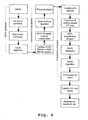
- An exemplary method is illustrated in Fig. 1 . This embodiment is also illustrated in the flow chart shown in Fig. 6 and described in detail in Example 1.
- cDNA is digested (10) with a restriction endonuclease having a two- to four-base recognition site, preferably a four-base recognition site.
- Suitable endonucleases include, for example, NlaIII, DpnII, ChaI, Csp6I, and isoschizomers thereof.
- Other suitable enzymes for this and other steps in the processes described herein could be determined by one skilled in the art.
- This step is effective to produce a population of double stranded fragments having a cleaved end, preferably with a 3' overhang, as shown in Fig. 1 .
- the 3' overhang may be removed, e.g. using T4 DNA polymerase, to produce blunt cleaved ends. As will be apparent from the steps described below, this step results in a longer unique signature sequence. However, for ease of processing, the 3' overhang is generally retained.
- a first adapter termed a Q adapter, is then ligated (12) to the cleaved ends.
- This adapter includes an overhang complementary to that on the cleaved ends, unless the overhang has been removed, in which case a blunt ended adapter is used.
- the Q adapter also comprises a recognition site for a restriction endonuclease having a cleavage site within the DNA, generally a recognition site for a type IIs restriction endonuclease, having a cleavage site at least 10 nucleotides from its recognition site, and preferably at least 16 nucleotides from its recognition site.
- Suitable type IIs enzymes include, for example, BmpI, MmeI, Gsul, and isoschizomers thereof.
- the adapter of Fig. 1 contains a recognition site for MmeI, having a cleavage site 20 nucleotides in the 3' direction, which is in this case 16 nucleotides into the restriction fragment.
- the top strand and bottom strand of an exemplary adapter having an MmeI site are shown below, along with a corresponding PCR primer (SEQ ID NOs: 4-6):
- QM2primer 5'-FAM-CGTTCAGAGTTCTACAGTCCGA SEQ ID NO: 4 QM2top.S: SEQ ID NO: 5 QM2bot.P: 3'- CAAGTCTCAAGATGTCAGGCTGCTAG-p SEQ ID NO: 6
- a second exemplary Q adapter having a partial (see below) Mmel site is shown below, along with a corresponding PCR primer (SEQ ID NOs: 7-8):
- the adapters and restriction endonucleases may be selected such that the recognition site of the type IIs endonuclease overlaps the recognition and cleavage site of the enzyme used for initial digestion of the cDNA.
- the recognition site for MmeI (TCCRAC) overlaps this recognition site by one nucleotide.
- the signature sequence (shown in boldface below) produced upon cleavage, as described further below, extends 17 nucleotides into the fragment, rather than 16 nucleotides (as in the embodiment shown in Fig. 1 ).
- Q adapter & primer Signature R adapter & primer FAM-AGACTTCTACGCATCTCCGACA ⁇ - SEQ ID NO: 7 (The sequence of the Q adapter-signature-R adapter construct above,
- a further exemplary Q adapter, having a BpmI site, is shown below, along with a corresponding PCR primer (SEQ ID NOs: 11-12):
- Q3primer 5'-FAM-GCTACACGATTCTACAGTCTGGA SEQ ID NO: 11
- Q3top.S: Q3bot.P 3'-CGATGTGCTAAGATGTCAGACCTCTAG-p SEQ ID NO: 12
- the top strand of the Q adapter is protected at the 5' end, e.g. by the use of thionucleotides or by a small 5' overhang (as shown for QM2top, above). This prevents digestion of the strand by exonuclease in a later step.
- the fragment-adapter constructs representing the 3' ends of the cDNA are then bound, via the biotin label, to streptavidin supports ( 14 ), e.g. Dynabeads M-280 (Dynal, Oslo, Norway). This operation serves to isolate fragments representing the 3' ends of the cDNA from other fragments, which do not include a biotin label.
- Cleavage with the type IIs restriction endonuclease ( 16 ) produces cleaved fragments each containing a uniform length, or signature sequence, of the source cDNA.
- the newly cleaved end has a 2-base 3' overhang.
- the adapter-signature fragments can then be isolated by eluting from the streptavidin supports.
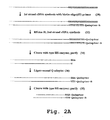
- the polyadenylated region at the 3' end of mRNA is removed, and a Q adapter, as described above, is ligated to the remaining 3' end of the corresponding cDNA.
- first strand cDNA synthesis is carried out using an biotin-adapter-oligo(dT) primer ( 30 ).
- the Q adapter typically contains a type IIs recognition site, such that when the Q adapter-cDNA conjugate is cleaved with the respective type IIs enzyme, cleavage occurs within the cDNA, preferably at least six basepairs into the cDNA.
- a second recognition site may also be included for later cleavage of the Q adapter from the construct, as discussed further below.
- Second strand synthesis is carried out ( 32 ) using 5-methyl cytosine, as above.
- Cleavage of the double stranded cDNA with the type IIs enzyme (34) is effective to remove the polyA region, as shown in Fig. 2A .
- the cleaved polyA-containing fragments can then be removed via the biotin label (34).
- a second adapter containing a type IIs recognition site is then ligated (36) to the cleaved 3' end of the cDNA.
- the enzyme recognizing the recognition site preferably has a cleavage site at least 10 nucleotides from its recognition site, and preferably at least 16 nucleotides from its recognition site. Suitable enzymes include, for example, BmpI, MmeI, GsuI, and isoschizomers thereof.
- the adapter preferably includes a PCR primer site for amplification and/or a biotin for purification. Cleavage with the type IIs enzyme (38) gives the Q adapter linked to a 3' signature.
- the placement of the recognition sites in the two adapters can be varied to produce cleavage at a desired site, allowing signatures to be captured from different regions near the 3' end of the cDNA.
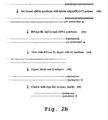
- first strand cDNA synthesis (40) is primed with a biotin-oligo(dT)-(rT) hybrid primer, having a short sequence of ribonucleotides (rT) n (preferably 1-3 rT's, and more preferably a single rT, although up to about 24 rT's could be used) at or near the 3'-end of the primer.
- Second strand synthesis (42) is carried out using 5-methyl cytosine, as above.
- the ribonucleotide site of the adapter is then nicked with RNaseH, and the polyA region is digested with S1 nuclease to generate a blunt end (44).
- a blunt end Q adapter, containing a type IIs recognition site, is ligated at the blunt 3' end (46).
- Cleavage with the respective type IIs enzyme (48) provides a 3' signature linked to the adapter, which can be purified via a biotin incorporated into the adapter.
- signatures are prepared from 5' ends of cDNA, preferably full length cDNA. These 5' signatures can provide sequence information regarding promoter, enhancer, and transcription initiation sites. Combined with information obtained from 3' signatures, 5' sequence information can also facilitate sequencing of full length cDNA, by allowing design of PCR primers which span the complete transcript. Quantitative transcript levels can be determined more accurately.
- the 5' signatures may be prepared by attaching a Q adapter to the 5' ends of cDNA, typically full length cDNA.
- the Q adapter preferably has a type IIs recognition site with a corresponding cleavage site within the cDNA, and may also include a second recognition site for later cleavage of the Q adapter from the construct, as discussed further below.
- Various methods can be used to attach the adapter to 5' ends of mRNA.
- biotin is attached to the 5' end of mRNA, and optionally to the 3' end as well, by utilizing the diol structure present on the 3' and 5' ends of mRNA (see e.g. Y. Hayashizaki et al., U.S. Patent No. 6,174,669 ).
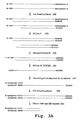
- First strand cDNA synthesis is carried out (50) using an oligo(dT) primer; as above, methyl-dCTP may be employed in place of dCTP, to prevent cleavage of the cDNA by restriction enzymes used in subsequent steps.
- RNAse I 52
- streptavidin beads 54
- RNA strand is then digested with RNAse H (56), and second strand cDNA synthesis is carried out.
- This can be done in various ways; for example, in one method, the first strand cDNA (now released from the beads) is homotailed at the 5' end with oligo(dG) (or (dC)) using terminal deoxynucleotidyl transferase (56).
- Second strand cDNA synthesis is performed (60) using DNA polymerase I.
- RNAse H is used to nick the RNA strand in the hybrid for nick-translation second strand synthesis.
- T4 DNA ligase is then used to seal the fragments primed by the Q adapter-oligo(dC) and nicked RNA.
- the Q adapter includes a binding moiety such as biotin for purification and/or a primer binding site for amplification.
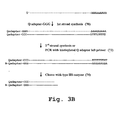
- a second method for producing 5' signatures utilizes a "template switching oligonucleotide", as described, for example, in A. Chenchik et al., U.S. Patent No. 5,962,272 .
- the template-switching oligonucleotide includes a short dG sequence, for binding to a short dC sequence added to the 3' end of the first strand cDNA by reverse transcriptase, and an adapter having a selected sequence, including e.g. a type IIs recognition site and primer site.
- the oligonucleotide e.g. "Q adapter - GGG" in Fig. 3B ) creates an extended template for the reverse transcriptase during first strand synthesis (70), which incorporates the adapter sequence at the 3' end of first strand cDNA.
- a primer complementary to the primer sequence in the adapter is used for second strand synthesis (72), thereby incorporating a Q adapter at the 5' end of the second strand cDNA.
- the Q adapter includes a binding moiety such as biotin for purification.
- biotin can be incorporated via the oligo dT primer during first strand synthesis. The use of biotin on either the 3' or 5' end will be determined by the desired purification scheme.
- cleavage with the type IIs enzyme (74) cleaves within the cDNA and gives the adapter linked to a 5' signature, as shown.
- a third method utilizes a modification of a strategy described by K. Maruyama et al. (Gene 138:171-174, 1994 ) and S. Kato et al. (Gene 150:243-50, 1994 ) for isolating full length cDNA from preparations that also contain incomplete cDNA transcripts.
- any non-capped (non full-length) mRNA species in an mRNA sample are dephosphorylated using calf intestinal phosphatase (80).
- the 5'cap structure of full length mRNA is then removed with tobacco acid pyrophosphatase (TAP), to leave a 5' phosphate (82).
- First strand cDNA synthesis is then carried out (86), according to conventional procedures, with a biotinylated oligo(dT) primer and 5-methyl cytosine.
- the mRNA is removed with RNAse, followed by second strand cDNA synthesis with 5-methyl cytosine (88).
- the double stranded cDNA is then cleaved with the type lIs endonuclease (90), to give the Q adapter linked to a 5' signature.
- the methods described above which employ 5' capture of full length cDNA, can also be modified to provide signatures from fragments representing 5' ends of cDNA, by employing steps analogous to steps shown in Fig. 1 for preparing signatures from fragments representing 3' ends of cDNA.
- An example of a process based on that shown in Fig. 3A is shown in Fig. 4 .
- Fig. 3A The process of Fig. 3A is carried out through the production of 5'-oligo(dG) tailing of first strand cDNA (56/106).
- second strand synthesis is carried out with a biotin-oligo(dC) primer (108), and the double stranded cDNA is digested with a restriction endonuclease (110), preferably a 4-cutter endonuclease, and preferably an endonuclease which generates sticky ends ( e.g. a 2-base or 4-base overhang).
- a restriction endonuclease 110
- 4-cutter endonuclease preferably an endonuclease which generates sticky ends
- sticky ends e.g. a 2-base or 4-base overhang.
- Examples include those discussed in Section 1A, e.g. NlaIII, DpnII, ChaI, and Csp6I.
- a Q adapter containing a recognition site for a type IIs endonuclease, and designed to anneal to the 3' cleaved ends of the fragments, is then ligated to the fragments (112). Fragments representing the 5' ends of the cDNA may then be isolated via the biotinylated primer, e.g. on streptavidin beads, as shown (112). Cleavage with the type IIs endonuclease (114) produces signatures representing the 5' ends of the cDNA linked to the adapter.
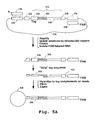
- Clonal subpopulations of signature sequences attached to microparticles can be prepared using the processes illustrated in Figs. 5A-B , which are adapted from processes described in, for example, co-owned U.S. Patent No. 6,265,163 .
- the present methods provide the advantage of same-length signature sequences ( e.g. as illustrated at 140 in Fig. 5A ) in each clonal subpopulation.
- the signatures sequences are preferably at least six, and more preferably at least twelve, nucleotides (or basepairs) in length.
- a second adapter is ligated (18) to the cleaved end produced by the type IIs endonuclease.
- R adapter is ligated (18) to the cleaved end produced by the type IIs endonuclease.
- the R adapter has a single stranded overhang effective to hybridize to an overhang produced by cleavage with the type IIs enzyme. Accordingly, the R adapter is preferably a plurality of adapters containing single stranded overhangs of every possible sequence effective to hybridize with the overhang of the cleaved end (shown in boldface as NN in Fig. 1 ).
- the R adapter also includes a recognition site for a further restriction endonuclease which is preferably also a type IIs enzyme, which preferably produces a 5' extension of at least 2 nucleotides, and more preferably at least 3 nucleotides, upon cleavage.
- This restriction endonuclease may also be a methyl sensitive endonuclease. Suitable examples include SfaNI, BspMI, BbvI, FokI, BsmFI, BbsI, and isoschizomers thereof.
- R adapter having a SfaNI recognition site, is shown below (SEQ ID NOs: 13, 14, and 9, respectively), where NN represents all possible 2-nucleotide sequences.
- Rprimer 3'-TACGAGTTACTACGACTGCCGA
- the adapter may also be designed such that dimers of the adapter, formed as side products during ligation of the adapter to the signatures, can be readily cleaved by treatment with an appropriate restriction endonuclease.
- dimers of the above adapter, having the sequence can be cleaved by the enzyme BsaJI, which has the recognition and cleavage site GGN ⁇ NCC.
- the bottom strand of adapter-signature-adapter construct which may include mismatches at this site, is removed, e.g. by T7 exonuclease (20).
- T7 exonuclease (20).
- the top strand is then replicated, preferably by PCR amplification (22).
- the Q and R adapters include primer binding sites for PCR, as in the exemplary adapters above.
- the strand may be replicated by linear primer extension, or by an RNA polymerase, such as T7 polymerase, in which case one of the adapters includes a polymerase binding site.
- the constructs are then cleaved (24) with the third restriction endonuclease, to cleave the R adapter, and with an endonuclease effective to cleave the construct 5' of the signatures, by cleaving the Q adapter.
- this may be the enzyme initially used for producing cDNA restriction fragments, as discussed below.
- the Q adapter may be designed to include a separate restriction site for cleavage from the signature.
- This step produces same-length signature sequences (represented by NNNN... in Fig. 1 ) flanked by cloning sites.
- the Q adapter may be designed such that cleavage with the third restriction endonuclease cleaves both adapters, as shown for SEQ ID NO: 8 (Q adapter), incorporated into the Q adapter-signature-R adapter construct (SEQ ID NO: 10) below.
- the exemplary Q adapter includes a recognition site for the third restriction endonuclease, SfaNI, positioned such that the enzyme cleaves both adapters.
- signature sequences derived from the source polynucleotide may be flanked by some remaining fragment of the first and/or second adapters; however, the overall constructs, including such adapter fragments, are likewise of a uniform length.
- signature refers to only the sequence derived from the source polynucleotide; “signature fragment” may include one or two short flanking sequences derived from the adapters.
- the excised signature-containing fragments are purified using standard techniques, e.g. ethanol precipitation and/or electrophoresis.
- the PCR amplification of the adapter-signature-adapter construct (penultimate step in Fig. 1 ) is carried out using biotinylated primers.
- the signature fragments are purified by elution from a streptavidin support.
- the signature fragments are directionally ligated into a library of tag vectors ( Fig. 5A ), to form a vector library of tag-signature conjugates (142).
- Each tag vector contains a left restriction cleavage site (144), an oligonucleotide tag ( 146; see Section I above), a cloning site for insertion of the signature fragment, and a right restriction cleavage site (148).
- the vector further comprises plasmid DNA (150) for cloning into E. coli and primer binding sites (152, 154) for later PCR amplification.
- a "tag-signature conjugate” as used herein may also include some residual adapter DNA, as noted for "signature fragments" above.
- a sample of host cells is plated to determine the number of recombinants per unit volume of culture medium.
- a sample is taken for further processing, the size of the sample depending on the size of tag repertoire (see Section I) used in the tag-vector library.
- the sample preferably includes a number of conjugates equivalent to about one percent the size of the tag repertoire, in order to minimize the occurrence of "doubles," i.e. two or more conjugates carrying the same tag but different cDNA fragments.
- the tag-signature conjugates are preferably amplified by PCR, using a biotinylated primer (156) and a labeled primer (158), in the presence of 5-methyl dCTP, after which the resulting amplicon is isolated by streptavidin capture.
- Restriction site (144) in the vector preferably corresponds to a rarecutting restriction endonuclease, e.g. PacI, NotI, FseI, Pmel, or SwaI, which permits the captured amplicon to be released from a support with minimal probability of cleavage occurring at a site internal to the signature fragment.
- the conjugates are loaded from the replicated vectors without PCR amplification
- the conjugates are released from the vectors and isolated, e.g. by electrophoretic purification.
- an adapter having a fluorescent label is ligated to the construct, for later use in FACS sorting, as described below.
- a "stripping" reaction is carried out to render the tags of the tag-signature conjugates single stranded (see e.g. Brenner, U.S. Pat. No. 5,604,097 ). This can be accomplished, for example, by using a DNA polymerase having 3' ⁇ 5' exonuclease activity, preferably T4 DNA polymerase, in the presence of a single dNTP. Junction (160), shown in Fig. 5A , has the sequence 5'-GGGCCC-3' (top strand), and causes the stripping reaction to be halted at the G triplet when the exonuclease reaction is performed in the presence of dGTP.
- a DNA polymerase having 3' ⁇ 5' exonuclease activity preferably T4 DNA polymerase
- the tags are designed to contain only three of the four natural nucleotides, as discussed in Section I, in this case only A's, C's, and T's.
- the released tag-signature conjugates are treated with T4 DNA polymerase in the presence of dGTP, the complementary strands of the tags are stripped away to the first G, as shown in Fig. 5A .
- the tag-signature conjugates are hybridized to tag complements (166) attached to microparticles (168); a fill-in reaction is carried out to fill any gap between the complementary strand of the tag-signature conjugate and the 5' end of the tag complement attached to the microparticle, and the complementary strand of the tag-cDNA conjugate is ligated to the 5' end of tag complement (166), which is phosphorylated for this purpose.
- a sampled set of tag-signature conjugates (as described above) is hybridized to a full repertoire of tag complements, the conjugates will generally hybridize to only about one percent of the microparticles.
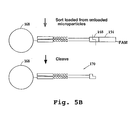
- Loaded microparticles can be separated from unloaded microparticles by use of a fluorescence-activated cell sorter (FACS), which detects the fluorescent label on the amplified conjugates, attached by way of the PCR primer (158).
- FACS fluorescence-activated cell sorter
- the fluorescent label Prior to sequencing, the fluorescent label is preferably removed, by treatment with a restriction endonuclease recognizing cleavage site (148) of the vector ( Fig. 5B ). This cleavage results in microparticle (168) with double stranded tag-signature conjugate (170).
- the first adapter above preferably includes a further restriction site (172), 3' to the type IIs restriction site, for later primer removal, as described below.
- the vectors containing the tag-signature conjugates are linearized, e.g. by cutting with PacI.
- the top strands are replicated, if desired, by in vitro transcription, then the bottom strands are reverse transcribed using a first biotin-labeled primer (174), and second strand synthesis of the top strands is carried out using a second biotin-labeled primer (176).
- the vectors are then cleaved at the left restriction cleavage site, thereby removing the first biotin labels, and the product is loaded onto streptavidin beads (178), thus binding the second biotin labels.
- the top strands (180) are then eluted from the support. (A short 3' region (182) of the bottom strand will also be eluted but should not interfere with further processing).
- a primer (184) preferably fluorescently labeled for FACS sorting of loaded beads, is annealed to the region (186) of each top strand which is 3' of the signature.
- the top strands, bearing a single stranded tag and signature, are then contacted with a library of tag complements (188), each on a separate solid phase support (190), as above, thereby hybridizing the tags to their respective complements.
- the primer is then extended to replicate the bottom strand (192) of the signature, which is then ligated to the tag complement on the solid support.
- the above-referenced further restriction site can then be cleaved to remove the primer label and the portion of the DNA 3' to the signature.
- signatures adjacent to methylated cytosine in genomic DNA can be captured. Sequence data from such signatures could be used to map methylated CpG sites, such as methylated promoter regions, in genomic DNA. About 60-90% of CpG sites in vertebrate DNA are estimated to be methylated ( Bird, A.P., Nature 321:209-213, 1986 ).
- McrBC the enzyme cleaves the DNA between each pair of "half-sites", close to one half-site or the other. Cleavage positions are distributed over several base pairs, approximately 30 base pairs from the methylated base ( Stewart, F.J. and Raleigh, E.A., Biol. Chem. 379, 611-616, 1998 ).
- Cleavage which is believed to produce blunt ended fragments, is followed by ligation of a blunt ended adapter having a type IIs recognition site, as described above. Subsequent steps (cleavage with type IIs enzyme, ligation of "R" adapter, cloning, etc.) are as described above.
- same-length signatures are generated in one step, by cleavage with a "double cutting" enzyme such as the type IIb enzyme BcgI, which recognizes the sequence 5'... (N) 10 CGA(N) 6 TGC(N) 12 ... 3', or the enzyme BaeI, which recognizes the sequence 5'...(N) 10 AC(N) 4 GTAYC(N) 12 ...3' and produces 5-nucleotide overhangs.
- Cleavage thus generates a 32 base pair or 33 base pair signature sequence, respectively, to which adapters can be ligated for cloning.
- the disclosure provides, in one embodiment, a method of massive parallel analysis of expressed genes, allowing detection and isolation of differentially expressed sequences, without requiring prior knowledge of the differentially expressed genes being monitored. More generally, the method allows detection of differentially represented nucleic acids from any two nucleic acid populations, such as variations in genomic DNA.
- the method can be used for analyzing relative gene expression in a plurality of cells and/or tissues; e.g. a diseased tissue or cell type and a healthy tissue or cell type, or a cell or tissue type being subjected to a stimulus or stress, e.g. a change of nutrients, temperature, or the like, and the corresponding cell or tissue type in an unstressed or unstimulated state.
- the method can also be used for identifying differentially represented variations in genomic DNA among individuals, e.g. SNP's, deletions, insertions, or duplications.
- a benefit of the method is that, in many cases, the identity of the nucleic acids being analyzed need not be known prior to analysis. However, in some cases, prior knowledge of the expected location of the differentially represented sequence, e.g. a SNP in genomic DNA, is useful.
- the solid phase cloned signatures can be sequenced by any of a number of stepwise sequencing methods which sequentially identify nucleotides, or short sequences of nucleotides, along the length of the support-bound sequence.
- stepwise sequencing methods include those described, for example, in Brenner, U.S. Patent Nos. 5,604,097 , 5,962,228 , and 5,599,675 .
- Conventional sequencing methods including sequencing by hybridization (SBH) and sequencing by synthesis, can also be used.
- the sequences are identified simultaneously in parallel by MPSS (massively parallel signature sequencing), as described below and in Brenner, U.S. Pat. No. 6,013,445 and Albrecht et al., PCT Pubn. No. WO 97/46704 .
- MPSS massively parallel signature sequencing
- Each encoded adapter of step (a) has a protruding strand and an oligonucleotide tag selected from a minimally cross-hybridizing set of oligonucleotides, as discussed in Section I and further in Albrecht et al., PCT Pubn. No. WO 97/46704 .
- Encoded adapters whose protruding strands form perfectly matched duplexes with the complementary protruding strands of a fragment are ligated. After ligation, the identity and ordering of the nucleotides in the protruding strand is determined, or "decoded,” by specifically hybridizing a labeled tag complement, or "decoder", to its corresponding tag on the ligated adapter.
- the length of single stranded tag complements for delivering labels is between 8 and 20, more preferably between 9 and 15.
- successive sets of tag complements, or decoders are specifically hybridized to the respective tags carried by the ligated encoded adapters.
- the type and sequence of nucleotides in the protruding strands of the polynucleotides are identified by the label carried by the specifically hybridized decoder and the set from which the decoder came, as described in U.S. Patent No. 5,599,675 .
- Rapid Ligation Buffer 1 Rapid Ligation Buffer 2
- Rapid Ligation Ligase are components of the Rapid DNA Ligation Kit, Roche Biochemical #1635379.
- Reagents having the designation NEB are supplied by New England Biolabs, Beverly, MA
- cDNA was prepared from approx. 1 pg mRNA using conventional protocols, precipitated with EtOH, and cleaved with DpnII as follows. To the pellet was added 10 ⁇ l 10 ⁇ Dpn II buffer and 1.5 ⁇ l Dpn II (50 U/ ⁇ l), and the mixture was incubated at 37°C for 2 hours. The mixture was then diluted with water and extracted with 200 ⁇ l buffer-saturated phenol (2x) and 200 ⁇ l chloroform:isoamyl alcohol (24:1), followed by addition of 20 ⁇ l 3M NaOAc and 500 ⁇ l-20° EtOH, and incubated at -20°C overnight. The pellet was washed with -20° 70% EtOH.
- Oligonucleotides designated Q3top.S, Q3bot.P, QM2top.S, QM2bot.P, R4top.FAM and RbotAA...TT were suspended at 200 ⁇ m each in water.
- 30 ⁇ l "top” oligo, 30 ⁇ l “bottom” oligo, 10 ⁇ l 10 ⁇ NEB2 and 30 ⁇ l water were mixed in a 0.5 ml Eppendorf tube, heated in a 95° block for 5 minutes, allowed to cool to room temperature, spun briefly, and stored at -20°C.
- a second digest was prepared using either BpmI or MmeI, depending on which adapter (Q3 or QM2, respectively) was used above.
- the BpmI digest contained 40 ⁇ l 10 ⁇ NEB3 buffer, 10 ⁇ l BSA (10 mg/ml), 6 ⁇ l Bpm I (2U/ ⁇ l), and water to 400 ⁇ l.
- the MmeI digest contained 40 ⁇ l 10 ⁇ Mme I buffer, 40 ⁇ l 10 ⁇ SAM (400 ⁇ M), 10 ⁇ l BSA, 8 ⁇ l Mme I (4U/ ⁇ l), and water to 400 ⁇ l.
- the digest was mixed with the SA beads and incubated under rotation at 37°C for 1.5 h, then transferred to a magnetic particle concentrator for removal of supernatant.
- the mixture was dephosphorylated by addition of 3 ⁇ l shrimp alkaline phosphatase (SAP; 1 U/ ⁇ l; Amersham), which, after 1 h at 37°C, was inactivated by incubating at 70°C for 20 min.
- SAP shrimp alkaline phosphatase
- the mixture was cooled and extracted with buffer-equilibrated phenol (100 ⁇ l) and CHCl 3 :IA.A (24:1) (100 ⁇ l). After addition of 0.1 vol. 3M NaOAc (pH 5.2) and 1 ⁇ l glycogen (20 ⁇ g/ ⁇ l), the mixture was precipitated with 2.5 vol. ethanol.
- the pellet was resuspended in R4 adapter ligation mix, consisting of 1 ⁇ l R4 adapter (60 ⁇ M, see above) and 3 ⁇ l H 2 O.
- the following were added in sequence, with mixing/spinning after each addition: 1 ⁇ l Rapid Ligation Buffer 2 (5 ⁇ ); 5 ⁇ l Rapid Ligation Buffer 1 (2 ⁇ ); and 1 ⁇ l Rapid Ligation Ligase.
- the mixture was incubated 4h at room temperature, followed by addition of 9 ⁇ l 10 ⁇ NEB4 and 79 ⁇ l H 2 O, at which point it was immediately heated to 65°C for 10 min to inactivate the ligase.
- T7 Exonuclease 10 U/ ⁇ l
- water 100 ⁇ l total volume.
- the mixture was incubated for 30 min. at 37°C, then inactivated at 95°C for 5 min.
- the amplification mixture was prepared as follows: 10 ⁇ l Exo-treated DNA, above 10 ⁇ l 10 ⁇ cloned Pfu Buffer 4 ⁇ l 10 ⁇ M Q3primer.FAM or QM2primer.FAM 4 ⁇ l 10 ⁇ M Rprimer.FAM 2 ⁇ l SC dNTP mix (10 mM each dATP + dGTP + dTTP + 5-Me-dCTP) (Note: 5-Me-dCTP is used in both first strand and second strand.) 68 ⁇ l H 2 O 2 ⁇ l Pfu Turbo Hotstart polymerase (2.5U/ ⁇ l) (Stratagene) Water to 100 ⁇ l
- reaction mixture was extracted with phenol and with chloroform, followed by addition of 1 ⁇ l glycogen, 50 ⁇ l 7.5M NH 4 OAc, and 400 ⁇ l ethanol, and precipitation on CO 2 (s) for 30 minutes or at -20°C overnight.
- the pellet was washed with ethanol and resuspended in 12.5 ⁇ l water and 1.5 ⁇ l 10 ⁇ Dpn II-buffer, followed by addition of 1 ⁇ l Dpn II (NEB, 10 U/ ⁇ l) and incubation at 37°C for 1-1.5 h.
- To the restriction reaction was added 13.5 ⁇ l NEB3 and 120.5 ⁇ l H 2 O followed by inactivation at 65 °C for 20 min.
- Loading buffer (50% glycerol + BPB; 4 ⁇ l) was added to the suspension from F, and the mixture was loaded onto 20% PAGE/1 ⁇ TBE 10-well gel (Novex) and electrophoresed for 40 minutes at 200V.
- the relevant bands 29 bp for Bpm I, 32 bp for Mme I were identified and isolated by conventional procedures.
- a ligation mixture was prepared, consisting of 1 ⁇ l vector (MBS1-8-word tag/BamHI/Bbsl/EcoRV/CIAP/gel purified, ⁇ 200 ng/ ⁇ l; SEQ ID NO: 16 below), 2 ⁇ l Rapid Ligation Buffer 2 (5 ⁇ ), and 6 ⁇ l insert (above).
- the oligonucleotide tags are cloned into the BseRI-Bsp120I site of the vector.
- the mixture was spun briefly, followed by addition of 10 ⁇ l Rapid Ligation Buffer 1 (2 ⁇ ), further mixing/spinning, and 1 ⁇ l Rapid Ligation Ligase. The mixture was incubated at room temperature for 4 hours.
Landscapes
- Life Sciences & Earth Sciences (AREA)
- Chemical & Material Sciences (AREA)
- Health & Medical Sciences (AREA)
- Genetics & Genomics (AREA)
- Organic Chemistry (AREA)
- Engineering & Computer Science (AREA)
- Zoology (AREA)
- Wood Science & Technology (AREA)
- Proteomics, Peptides & Aminoacids (AREA)
- Bioinformatics & Cheminformatics (AREA)
- Biotechnology (AREA)
- General Engineering & Computer Science (AREA)
- Molecular Biology (AREA)
- General Health & Medical Sciences (AREA)
- Biophysics (AREA)
- Microbiology (AREA)
- Biomedical Technology (AREA)
- Physics & Mathematics (AREA)
- Biochemistry (AREA)
- Plant Pathology (AREA)
- Crystallography & Structural Chemistry (AREA)
- Analytical Chemistry (AREA)
- Bioinformatics & Computational Biology (AREA)
- Immunology (AREA)
- Measuring Or Testing Involving Enzymes Or Micro-Organisms (AREA)
- Preparation Of Compounds By Using Micro-Organisms (AREA)
Applications Claiming Priority (3)
| Application Number | Priority Date | Filing Date | Title |
|---|---|---|---|
| US37578202P | 2002-04-26 | 2002-04-26 | |
| US375782P | 2002-04-26 | ||
| PCT/US2003/013076 WO2003091416A2 (en) | 2002-04-26 | 2003-04-25 | Constant length signatures for parallel sequencing of polynucleotides |
Publications (3)
| Publication Number | Publication Date |
|---|---|
| EP1497465A2 EP1497465A2 (en) | 2005-01-19 |
| EP1497465A4 EP1497465A4 (en) | 2005-06-08 |
| EP1497465B1 true EP1497465B1 (en) | 2009-02-18 |
Family
ID=29270698
Family Applications (1)
| Application Number | Title | Priority Date | Filing Date |
|---|---|---|---|
| EP03728567A Expired - Lifetime EP1497465B1 (en) | 2002-04-26 | 2003-04-25 | Constant length signatures for parallel sequencing of polynucleotides |
Country Status (8)
| Country | Link |
|---|---|
| US (1) | US20040002104A1 (enExample) |
| EP (1) | EP1497465B1 (enExample) |
| JP (1) | JP4446746B2 (enExample) |
| AT (1) | ATE423224T1 (enExample) |
| AU (1) | AU2003234255A1 (enExample) |
| CA (1) | CA2482425A1 (enExample) |
| DE (1) | DE60326224D1 (enExample) |
| WO (1) | WO2003091416A2 (enExample) |
Families Citing this family (11)
| Publication number | Priority date | Publication date | Assignee | Title |
|---|---|---|---|---|
| US20050250100A1 (en) * | 2002-06-12 | 2005-11-10 | Yoshihide Hayashizaki | Method of utilizing the 5'end of transcribed nucleic acid regions for cloning and analysis |
| PT2644206T (pt) | 2003-05-23 | 2019-07-10 | Nektar Therapeutics | Derivados de peg contendo duas cadeias de peg |
| US7947261B2 (en) | 2003-05-23 | 2011-05-24 | Nektar Therapeutics | Conjugates formed from polymer derivatives having particular atom arrangements |
| US20060228714A1 (en) * | 2004-02-17 | 2006-10-12 | Dana Farber Cancer Institute | Nucleic acid representations utilizing type IIB restriction endonuclease cleavage products |
| EP1582599A1 (en) * | 2004-03-31 | 2005-10-05 | Takara Bio Inc. | Method for purifying microbeads |
| JP4644685B2 (ja) * | 2004-07-02 | 2011-03-02 | 株式会社ダナフォーム | 塩基配列タグの調製方法 |
| EP2171097A2 (en) * | 2007-06-29 | 2010-04-07 | Population Genetics Technologies LTD. | Methods and compositions for isolating nucleic acid sequence variants |
| EP3448868B1 (en) | 2016-04-27 | 2021-12-29 | Bio-Rad Laboratories, Inc. | Mirna transcriptome methods and compositions |
| JP6889769B2 (ja) * | 2016-07-18 | 2021-06-18 | エフ.ホフマン−ラ ロシュ アーゲーF. Hoffmann−La Roche Aktiengesellschaft | 核酸配列決定の非対称な鋳型および非対称な方法 |
| CN108410856A (zh) * | 2018-03-29 | 2018-08-17 | 武汉光谷创赢生物技术开发有限公司 | 一种全长cDNA合成方法及其测序文库的构建 |
| EP4490318A4 (en) * | 2022-03-07 | 2026-06-10 | Twist Bioscience Corp | METHYLATION-MEDIATED ADAPTER ELIMINATION ON NUCLEIC ACID SEQUENCES |
Family Cites Families (13)
| Publication number | Priority date | Publication date | Assignee | Title |
|---|---|---|---|---|
| US5093245A (en) * | 1988-01-26 | 1992-03-03 | Applied Biosystems | Labeling by simultaneous ligation and restriction |
| US6107023A (en) * | 1988-06-17 | 2000-08-22 | Genelabs Technologies, Inc. | DNA amplification and subtraction techniques |
| CA2036946C (en) * | 1990-04-06 | 2001-10-16 | Kenneth V. Deugau | Indexing linkers |
| US5710000A (en) * | 1994-09-16 | 1998-01-20 | Affymetrix, Inc. | Capturing sequences adjacent to Type-IIs restriction sites for genomic library mapping |
| US5604097A (en) * | 1994-10-13 | 1997-02-18 | Spectragen, Inc. | Methods for sorting polynucleotides using oligonucleotide tags |
| US6013445A (en) * | 1996-06-06 | 2000-01-11 | Lynx Therapeutics, Inc. | Massively parallel signature sequencing by ligation of encoded adaptors |
| US5629179A (en) * | 1995-03-17 | 1997-05-13 | Novagen, Inc. | Method and kit for making CDNA library |
| US5866330A (en) * | 1995-09-12 | 1999-02-02 | The Johns Hopkins University School Of Medicine | Method for serial analysis of gene expression |
| US5695937A (en) * | 1995-09-12 | 1997-12-09 | The Johns Hopkins University School Of Medicine | Method for serial analysis of gene expression |
| US6461814B1 (en) * | 1997-01-15 | 2002-10-08 | Dominic G. Spinella | Method of identifying gene transcription patterns |
| US6232067B1 (en) * | 1998-08-17 | 2001-05-15 | The Perkin-Elmer Corporation | Adapter directed expression analysis |
| ATE318932T1 (de) * | 1999-08-13 | 2006-03-15 | Univ Yale | Binär kodierte sequenzmarker |
| US6274320B1 (en) * | 1999-09-16 | 2001-08-14 | Curagen Corporation | Method of sequencing a nucleic acid |
-
2003
- 2003-04-25 AU AU2003234255A patent/AU2003234255A1/en not_active Abandoned
- 2003-04-25 JP JP2003587952A patent/JP4446746B2/ja not_active Expired - Fee Related
- 2003-04-25 CA CA002482425A patent/CA2482425A1/en not_active Abandoned
- 2003-04-25 WO PCT/US2003/013076 patent/WO2003091416A2/en not_active Ceased
- 2003-04-25 US US10/424,281 patent/US20040002104A1/en not_active Abandoned
- 2003-04-25 EP EP03728567A patent/EP1497465B1/en not_active Expired - Lifetime
- 2003-04-25 DE DE60326224T patent/DE60326224D1/de not_active Expired - Lifetime
- 2003-04-25 AT AT03728567T patent/ATE423224T1/de not_active IP Right Cessation
Also Published As
| Publication number | Publication date |
|---|---|
| ATE423224T1 (de) | 2009-03-15 |
| AU2003234255A1 (en) | 2003-11-10 |
| JP4446746B2 (ja) | 2010-04-07 |
| CA2482425A1 (en) | 2003-11-06 |
| EP1497465A4 (en) | 2005-06-08 |
| JP2006506953A (ja) | 2006-03-02 |
| WO2003091416A2 (en) | 2003-11-06 |
| EP1497465A2 (en) | 2005-01-19 |
| WO2003091416A3 (en) | 2004-07-01 |
| US20040002104A1 (en) | 2004-01-01 |
| DE60326224D1 (de) | 2009-04-02 |
Similar Documents
| Publication | Publication Date | Title |
|---|---|---|
| US6897023B2 (en) | Method for determining relative abundance of nucleic acid sequences | |
| JP4124377B2 (ja) | コードアダプターの連結による配列決定 | |
| EP3635114B1 (en) | Creation and use of guide nucleic acids | |
| CN1849401B (zh) | 基因鉴定特征(gis)分析的方法 | |
| US20250066767A1 (en) | Compositions and methods for making guide nucleic acids | |
| CN105018548A (zh) | 用于修饰核酸的试剂盒 | |
| EP1054999A2 (en) | Solid phase selection of differentially expressed genes | |
| EP1038009A1 (en) | Methods for defining cell types | |
| CN113366115B (zh) | 高覆盖率stlfr | |
| US20240384264A1 (en) | Guide Strand Library Construction and Methods of Use Thereof | |
| US20040002104A1 (en) | Constant length signatures for parallel sequencing of polynucleotides | |
| JP2002537774A (ja) | 多型dnaフラグメントおよびその使用 | |
| EP4347872B1 (en) | Oligo-modified nucleotide analogues for nucleic acid preparation | |
| WO2020172199A1 (en) | Guide strand library construction and methods of use thereof | |
| WO2005079357A9 (en) | Nucleic acid representations utilizing type iib restriction endonuclease cleavage products | |
| US6982143B1 (en) | Normalizing and amplifying RNA | |
| WO2004001074A1 (en) | Method for detecting foreign dna in a host genome | |
| JP4344086B2 (ja) | 差次的に発現された遺伝子の固相選択 | |
| HK40051557A (en) | High coverage stlfr | |
| US20050221360A1 (en) | Method for purifying microbeads |
Legal Events
| Date | Code | Title | Description |
|---|---|---|---|
| PUAI | Public reference made under article 153(3) epc to a published international application that has entered the european phase |
Free format text: ORIGINAL CODE: 0009012 |
|
| 17P | Request for examination filed |
Effective date: 20041014 |
|
| AK | Designated contracting states |
Kind code of ref document: A2 Designated state(s): AT BE BG CH CY CZ DE DK EE ES FI FR GB GR HU IE IT LI LU MC NL PT RO SE SI SK TR |
|
| AX | Request for extension of the european patent |
Extension state: AL LT LV MK |
|
| RIN1 | Information on inventor provided before grant (corrected) |
Inventor name: WALKER, ROGER Inventor name: BRENNER, SYDNEY Inventor name: WILLIAMS, STEVEN Inventor name: HIEMISCH, HOLGER Inventor name: FU, RONGDIAN Inventor name: VERMAAS, ERIC Inventor name: FISCHER, ACHIM |
|
| A4 | Supplementary search report drawn up and despatched |
Effective date: 20050427 |
|
| 17Q | First examination report despatched |
Effective date: 20060807 |
|
| RAP1 | Party data changed (applicant data changed or rights of an application transferred) |
Owner name: SOLEXA, INC. |
|
| 17Q | First examination report despatched |
Effective date: 20060807 |
|
| GRAP | Despatch of communication of intention to grant a patent |
Free format text: ORIGINAL CODE: EPIDOSNIGR1 |
|
| GRAS | Grant fee paid |
Free format text: ORIGINAL CODE: EPIDOSNIGR3 |
|
| GRAA | (expected) grant |
Free format text: ORIGINAL CODE: 0009210 |
|
| AK | Designated contracting states |
Kind code of ref document: B1 Designated state(s): AT BE BG CH CY CZ DE DK EE ES FI FR GB GR HU IE IT LI LU MC NL PT RO SE SI SK TR |
|
| AX | Request for extension of the european patent |
Extension state: AL LT LV MK |
|
| REG | Reference to a national code |
Ref country code: GB Ref legal event code: FG4D |
|
| REG | Reference to a national code |
Ref country code: CH Ref legal event code: EP |
|
| REG | Reference to a national code |
Ref country code: IE Ref legal event code: FG4D |
|
| REF | Corresponds to: |
Ref document number: 60326224 Country of ref document: DE Date of ref document: 20090402 Kind code of ref document: P |
|
| LTIE | Lt: invalidation of european patent or patent extension |
Effective date: 20090218 |
|
| PG25 | Lapsed in a contracting state [announced via postgrant information from national office to epo] |
Ref country code: ES Free format text: LAPSE BECAUSE OF FAILURE TO SUBMIT A TRANSLATION OF THE DESCRIPTION OR TO PAY THE FEE WITHIN THE PRESCRIBED TIME-LIMIT Effective date: 20090529 Ref country code: SI Free format text: LAPSE BECAUSE OF FAILURE TO SUBMIT A TRANSLATION OF THE DESCRIPTION OR TO PAY THE FEE WITHIN THE PRESCRIBED TIME-LIMIT Effective date: 20090218 Ref country code: FI Free format text: LAPSE BECAUSE OF FAILURE TO SUBMIT A TRANSLATION OF THE DESCRIPTION OR TO PAY THE FEE WITHIN THE PRESCRIBED TIME-LIMIT Effective date: 20090218 |
|
| PG25 | Lapsed in a contracting state [announced via postgrant information from national office to epo] |
Ref country code: SE Free format text: LAPSE BECAUSE OF FAILURE TO SUBMIT A TRANSLATION OF THE DESCRIPTION OR TO PAY THE FEE WITHIN THE PRESCRIBED TIME-LIMIT Effective date: 20090518 Ref country code: AT Free format text: LAPSE BECAUSE OF FAILURE TO SUBMIT A TRANSLATION OF THE DESCRIPTION OR TO PAY THE FEE WITHIN THE PRESCRIBED TIME-LIMIT Effective date: 20090218 |
|
| PG25 | Lapsed in a contracting state [announced via postgrant information from national office to epo] |
Ref country code: BE Free format text: LAPSE BECAUSE OF FAILURE TO SUBMIT A TRANSLATION OF THE DESCRIPTION OR TO PAY THE FEE WITHIN THE PRESCRIBED TIME-LIMIT Effective date: 20090218 |
|
| PG25 | Lapsed in a contracting state [announced via postgrant information from national office to epo] |
Ref country code: EE Free format text: LAPSE BECAUSE OF FAILURE TO SUBMIT A TRANSLATION OF THE DESCRIPTION OR TO PAY THE FEE WITHIN THE PRESCRIBED TIME-LIMIT Effective date: 20090218 Ref country code: PT Free format text: LAPSE BECAUSE OF FAILURE TO SUBMIT A TRANSLATION OF THE DESCRIPTION OR TO PAY THE FEE WITHIN THE PRESCRIBED TIME-LIMIT Effective date: 20090727 Ref country code: CZ Free format text: LAPSE BECAUSE OF FAILURE TO SUBMIT A TRANSLATION OF THE DESCRIPTION OR TO PAY THE FEE WITHIN THE PRESCRIBED TIME-LIMIT Effective date: 20090218 Ref country code: DK Free format text: LAPSE BECAUSE OF FAILURE TO SUBMIT A TRANSLATION OF THE DESCRIPTION OR TO PAY THE FEE WITHIN THE PRESCRIBED TIME-LIMIT Effective date: 20090218 |
|
| PG25 | Lapsed in a contracting state [announced via postgrant information from national office to epo] |
Ref country code: RO Free format text: LAPSE BECAUSE OF FAILURE TO SUBMIT A TRANSLATION OF THE DESCRIPTION OR TO PAY THE FEE WITHIN THE PRESCRIBED TIME-LIMIT Effective date: 20090218 Ref country code: SK Free format text: LAPSE BECAUSE OF FAILURE TO SUBMIT A TRANSLATION OF THE DESCRIPTION OR TO PAY THE FEE WITHIN THE PRESCRIBED TIME-LIMIT Effective date: 20090218 |
|
| REG | Reference to a national code |
Ref country code: CH Ref legal event code: PL |
|
| PLBE | No opposition filed within time limit |
Free format text: ORIGINAL CODE: 0009261 |
|
| STAA | Information on the status of an ep patent application or granted ep patent |
Free format text: STATUS: NO OPPOSITION FILED WITHIN TIME LIMIT |
|
| 26N | No opposition filed |
Effective date: 20091119 |
|
| PG25 | Lapsed in a contracting state [announced via postgrant information from national office to epo] |
Ref country code: BG Free format text: LAPSE BECAUSE OF FAILURE TO SUBMIT A TRANSLATION OF THE DESCRIPTION OR TO PAY THE FEE WITHIN THE PRESCRIBED TIME-LIMIT Effective date: 20090518 Ref country code: CH Free format text: LAPSE BECAUSE OF NON-PAYMENT OF DUE FEES Effective date: 20090430 Ref country code: LI Free format text: LAPSE BECAUSE OF NON-PAYMENT OF DUE FEES Effective date: 20090430 |
|
| PG25 | Lapsed in a contracting state [announced via postgrant information from national office to epo] |
Ref country code: MC Free format text: LAPSE BECAUSE OF NON-PAYMENT OF DUE FEES Effective date: 20090430 Ref country code: IE Free format text: LAPSE BECAUSE OF NON-PAYMENT OF DUE FEES Effective date: 20090425 |
|
| PG25 | Lapsed in a contracting state [announced via postgrant information from national office to epo] |
Ref country code: GR Free format text: LAPSE BECAUSE OF FAILURE TO SUBMIT A TRANSLATION OF THE DESCRIPTION OR TO PAY THE FEE WITHIN THE PRESCRIBED TIME-LIMIT Effective date: 20090519 |
|
| PG25 | Lapsed in a contracting state [announced via postgrant information from national office to epo] |
Ref country code: IT Free format text: LAPSE BECAUSE OF FAILURE TO SUBMIT A TRANSLATION OF THE DESCRIPTION OR TO PAY THE FEE WITHIN THE PRESCRIBED TIME-LIMIT Effective date: 20090218 |
|
| PG25 | Lapsed in a contracting state [announced via postgrant information from national office to epo] |
Ref country code: LU Free format text: LAPSE BECAUSE OF NON-PAYMENT OF DUE FEES Effective date: 20090425 |
|
| PG25 | Lapsed in a contracting state [announced via postgrant information from national office to epo] |
Ref country code: HU Free format text: LAPSE BECAUSE OF FAILURE TO SUBMIT A TRANSLATION OF THE DESCRIPTION OR TO PAY THE FEE WITHIN THE PRESCRIBED TIME-LIMIT Effective date: 20090819 |
|
| PG25 | Lapsed in a contracting state [announced via postgrant information from national office to epo] |
Ref country code: TR Free format text: LAPSE BECAUSE OF FAILURE TO SUBMIT A TRANSLATION OF THE DESCRIPTION OR TO PAY THE FEE WITHIN THE PRESCRIBED TIME-LIMIT Effective date: 20090218 |
|
| PG25 | Lapsed in a contracting state [announced via postgrant information from national office to epo] |
Ref country code: CY Free format text: LAPSE BECAUSE OF FAILURE TO SUBMIT A TRANSLATION OF THE DESCRIPTION OR TO PAY THE FEE WITHIN THE PRESCRIBED TIME-LIMIT Effective date: 20090218 |
|
| REG | Reference to a national code |
Ref country code: FR Ref legal event code: PLFP Year of fee payment: 14 |
|
| REG | Reference to a national code |
Ref country code: FR Ref legal event code: PLFP Year of fee payment: 15 |
|
| REG | Reference to a national code |
Ref country code: FR Ref legal event code: PLFP Year of fee payment: 16 |
|
| PGFP | Annual fee paid to national office [announced via postgrant information from national office to epo] |
Ref country code: GB Payment date: 20220303 Year of fee payment: 20 |
|
| PGFP | Annual fee paid to national office [announced via postgrant information from national office to epo] |
Ref country code: NL Payment date: 20220314 Year of fee payment: 20 Ref country code: FR Payment date: 20220308 Year of fee payment: 20 |
|
| PGFP | Annual fee paid to national office [announced via postgrant information from national office to epo] |
Ref country code: DE Payment date: 20220302 Year of fee payment: 20 |
|
| REG | Reference to a national code |
Ref country code: DE Ref legal event code: R071 Ref document number: 60326224 Country of ref document: DE |
|
| REG | Reference to a national code |
Ref country code: NL Ref legal event code: MK Effective date: 20230424 |
|
| REG | Reference to a national code |
Ref country code: GB Ref legal event code: PE20 Expiry date: 20230424 |
|
| P01 | Opt-out of the competence of the unified patent court (upc) registered |
Effective date: 20230505 |
|
| PG25 | Lapsed in a contracting state [announced via postgrant information from national office to epo] |
Ref country code: GB Free format text: LAPSE BECAUSE OF EXPIRATION OF PROTECTION Effective date: 20230424 |