EP1495755B1 - Utilisation de la citrulline dans la fabrication d'un médicament pour le traitement de l'insuffisance intestinale liée au vieillissement ou à une irradiation - Google Patents
Utilisation de la citrulline dans la fabrication d'un médicament pour le traitement de l'insuffisance intestinale liée au vieillissement ou à une irradiation Download PDFInfo
- Publication number
- EP1495755B1 EP1495755B1 EP04291738A EP04291738A EP1495755B1 EP 1495755 B1 EP1495755 B1 EP 1495755B1 EP 04291738 A EP04291738 A EP 04291738A EP 04291738 A EP04291738 A EP 04291738A EP 1495755 B1 EP1495755 B1 EP 1495755B1
- Authority
- EP
- European Patent Office
- Prior art keywords
- citrulline
- intestinal
- approximately
- preparation
- pharmaceutical composition
- Prior art date
- Legal status (The legal status is an assumption and is not a legal conclusion. Google has not performed a legal analysis and makes no representation as to the accuracy of the status listed.)
- Expired - Lifetime
Links
- RHGKLRLOHDJJDR-BYPYZUCNSA-N L-citrulline Chemical compound NC(=O)NCCC[C@H]([NH3+])C([O-])=O RHGKLRLOHDJJDR-BYPYZUCNSA-N 0.000 title claims abstract description 141
- 229960002173 citrulline Drugs 0.000 title claims abstract description 84
- 239000003814 drug Substances 0.000 title claims abstract description 4
- 230000032683 aging Effects 0.000 title claims description 8
- RHGKLRLOHDJJDR-UHFFFAOYSA-N Ndelta-carbamoyl-DL-ornithine Natural products OC(=O)C(N)CCCNC(N)=O RHGKLRLOHDJJDR-UHFFFAOYSA-N 0.000 title description 32
- 235000013477 citrulline Nutrition 0.000 title description 32
- 208000037112 Intestinal Failure Diseases 0.000 title 1
- 238000004519 manufacturing process Methods 0.000 title 1
- 230000000968 intestinal effect Effects 0.000 claims abstract description 51
- 238000002360 preparation method Methods 0.000 claims description 17
- 239000008194 pharmaceutical composition Substances 0.000 claims description 15
- 230000007170 pathology Effects 0.000 claims description 14
- 150000001875 compounds Chemical class 0.000 claims description 7
- 108010051696 Growth Hormone Proteins 0.000 claims description 6
- 108090000723 Insulin-Like Growth Factor I Proteins 0.000 claims description 6
- 102000004218 Insulin-Like Growth Factor I Human genes 0.000 claims description 5
- AHLPHDHHMVZTML-BYPYZUCNSA-N L-Ornithine Chemical compound NCCC[C@H](N)C(O)=O AHLPHDHHMVZTML-BYPYZUCNSA-N 0.000 claims description 5
- AHLPHDHHMVZTML-UHFFFAOYSA-N Orn-delta-NH2 Natural products NCCCC(N)C(O)=O AHLPHDHHMVZTML-UHFFFAOYSA-N 0.000 claims description 5
- UTJLXEIPEHZYQJ-UHFFFAOYSA-N Ornithine Natural products OC(=O)C(C)CCCN UTJLXEIPEHZYQJ-UHFFFAOYSA-N 0.000 claims description 5
- 239000000122 growth hormone Substances 0.000 claims description 5
- 229960003104 ornithine Drugs 0.000 claims description 5
- 150000003839 salts Chemical class 0.000 claims description 5
- ZDXPYRJPNDTMRX-VKHMYHEASA-N L-glutamine Chemical compound OC(=O)[C@@H](N)CCC(N)=O ZDXPYRJPNDTMRX-VKHMYHEASA-N 0.000 claims description 3
- 239000007864 aqueous solution Substances 0.000 claims description 3
- ZDXPYRJPNDTMRX-UHFFFAOYSA-N glutamine Natural products OC(=O)C(N)CCC(N)=O ZDXPYRJPNDTMRX-UHFFFAOYSA-N 0.000 claims description 3
- 102000018997 Growth Hormone Human genes 0.000 claims 2
- 238000007912 intraperitoneal administration Methods 0.000 claims 2
- 239000013543 active substance Substances 0.000 claims 1
- 229940079593 drug Drugs 0.000 claims 1
- 230000000694 effects Effects 0.000 abstract description 10
- 230000003110 anti-inflammatory effect Effects 0.000 abstract 1
- 230000000767 anti-ulcer Effects 0.000 abstract 1
- 230000010534 mechanism of action Effects 0.000 abstract 1
- ODKSFYDXXFIFQN-UHFFFAOYSA-N arginine Natural products OC(=O)C(N)CCCNC(N)=N ODKSFYDXXFIFQN-UHFFFAOYSA-N 0.000 description 34
- 241000700159 Rattus Species 0.000 description 29
- 239000004475 Arginine Substances 0.000 description 27
- 235000016709 nutrition Nutrition 0.000 description 26
- IJGRMHOSHXDMSA-UHFFFAOYSA-N Atomic nitrogen Chemical compound N#N IJGRMHOSHXDMSA-UHFFFAOYSA-N 0.000 description 24
- 230000035764 nutrition Effects 0.000 description 24
- 235000009697 arginine Nutrition 0.000 description 20
- 208000015380 nutritional deficiency disease Diseases 0.000 description 16
- 235000018102 proteins Nutrition 0.000 description 16
- 102000004169 proteins and genes Human genes 0.000 description 16
- 108090000623 proteins and genes Proteins 0.000 description 16
- 238000002271 resection Methods 0.000 description 16
- 229940024606 amino acid Drugs 0.000 description 15
- 235000001014 amino acid Nutrition 0.000 description 15
- 150000001413 amino acids Chemical class 0.000 description 15
- 241001465754 Metazoa Species 0.000 description 14
- 210000003205 muscle Anatomy 0.000 description 13
- 206010025476 Malabsorption Diseases 0.000 description 12
- 208000002720 Malnutrition Diseases 0.000 description 12
- 229910052757 nitrogen Inorganic materials 0.000 description 12
- 208000004155 Malabsorption Syndromes Diseases 0.000 description 11
- 210000000936 intestine Anatomy 0.000 description 11
- 235000005911 diet Nutrition 0.000 description 10
- 230000037213 diet Effects 0.000 description 10
- 210000000813 small intestine Anatomy 0.000 description 10
- 239000004474 valine Substances 0.000 description 10
- 230000009469 supplementation Effects 0.000 description 9
- 230000004584 weight gain Effects 0.000 description 7
- 235000019786 weight gain Nutrition 0.000 description 7
- ODKSFYDXXFIFQN-BYPYZUCNSA-N L-arginine Chemical compound OC(=O)[C@@H](N)CCCN=C(N)N ODKSFYDXXFIFQN-BYPYZUCNSA-N 0.000 description 6
- 229930064664 L-arginine Natural products 0.000 description 6
- 235000014852 L-arginine Nutrition 0.000 description 6
- MWUXSHHQAYIFBG-UHFFFAOYSA-N Nitric oxide Chemical compound O=[N] MWUXSHHQAYIFBG-UHFFFAOYSA-N 0.000 description 6
- 238000005259 measurement Methods 0.000 description 6
- 210000001519 tissue Anatomy 0.000 description 6
- 102000008934 Muscle Proteins Human genes 0.000 description 5
- 108010074084 Muscle Proteins Proteins 0.000 description 5
- 239000003797 essential amino acid Substances 0.000 description 5
- 235000020776 essential amino acid Nutrition 0.000 description 5
- 235000000824 malnutrition Nutrition 0.000 description 5
- 230000001071 malnutrition Effects 0.000 description 5
- YNJBWRMUSHSURL-UHFFFAOYSA-N trichloroacetic acid Chemical compound OC(=O)C(Cl)(Cl)Cl YNJBWRMUSHSURL-UHFFFAOYSA-N 0.000 description 5
- 235000000112 undernutrition Nutrition 0.000 description 5
- 108010068370 Glutens Proteins 0.000 description 4
- 206010049416 Short-bowel syndrome Diseases 0.000 description 4
- 102100038803 Somatotropin Human genes 0.000 description 4
- 238000010521 absorption reaction Methods 0.000 description 4
- 230000004075 alteration Effects 0.000 description 4
- 230000015572 biosynthetic process Effects 0.000 description 4
- 201000010099 disease Diseases 0.000 description 4
- 208000037265 diseases, disorders, signs and symptoms Diseases 0.000 description 4
- 235000013305 food Nutrition 0.000 description 4
- 238000010348 incorporation Methods 0.000 description 4
- 238000002347 injection Methods 0.000 description 4
- 239000007924 injection Substances 0.000 description 4
- 238000000034 method Methods 0.000 description 4
- 230000036470 plasma concentration Effects 0.000 description 4
- 239000000700 radioactive tracer Substances 0.000 description 4
- 230000002269 spontaneous effect Effects 0.000 description 4
- 238000003786 synthesis reaction Methods 0.000 description 4
- 208000015943 Coeliac disease Diseases 0.000 description 3
- 208000011231 Crohn disease Diseases 0.000 description 3
- DHMQDGOQFOQNFH-UHFFFAOYSA-N Glycine Chemical compound NCC(O)=O DHMQDGOQFOQNFH-UHFFFAOYSA-N 0.000 description 3
- HEMHJVSKTPXQMS-UHFFFAOYSA-M Sodium hydroxide Chemical compound [OH-].[Na+] HEMHJVSKTPXQMS-UHFFFAOYSA-M 0.000 description 3
- HCHKCACWOHOZIP-UHFFFAOYSA-N Zinc Chemical compound [Zn] HCHKCACWOHOZIP-UHFFFAOYSA-N 0.000 description 3
- 230000037396 body weight Effects 0.000 description 3
- 238000005277 cation exchange chromatography Methods 0.000 description 3
- 230000001684 chronic effect Effects 0.000 description 3
- 230000002496 gastric effect Effects 0.000 description 3
- 238000000227 grinding Methods 0.000 description 3
- 230000008991 intestinal motility Effects 0.000 description 3
- 235000015816 nutrient absorption Nutrition 0.000 description 3
- 235000003715 nutritional status Nutrition 0.000 description 3
- 238000001243 protein synthesis Methods 0.000 description 3
- 230000005855 radiation Effects 0.000 description 3
- 230000009467 reduction Effects 0.000 description 3
- 239000000243 solution Substances 0.000 description 3
- 230000014616 translation Effects 0.000 description 3
- 239000011782 vitamin Substances 0.000 description 3
- 239000011701 zinc Substances 0.000 description 3
- 229910052725 zinc Inorganic materials 0.000 description 3
- MTCFGRXMJLQNBG-REOHCLBHSA-N (2S)-2-Amino-3-hydroxypropansäure Chemical compound OC[C@H](N)C(O)=O MTCFGRXMJLQNBG-REOHCLBHSA-N 0.000 description 2
- IPBNQYLKHUNLQE-UHFFFAOYSA-N 8-anilinonaphthalene-1-sulfonic acid;azane Chemical compound [NH4+].C=12C(S(=O)(=O)[O-])=CC=CC2=CC=CC=1NC1=CC=CC=C1 IPBNQYLKHUNLQE-UHFFFAOYSA-N 0.000 description 2
- 206010003694 Atrophy Diseases 0.000 description 2
- OYPRJOBELJOOCE-UHFFFAOYSA-N Calcium Chemical compound [Ca] OYPRJOBELJOOCE-UHFFFAOYSA-N 0.000 description 2
- 206010012735 Diarrhoea Diseases 0.000 description 2
- LFQSCWFLJHTTHZ-UHFFFAOYSA-N Ethanol Chemical compound CCO LFQSCWFLJHTTHZ-UHFFFAOYSA-N 0.000 description 2
- 206010059017 Intestinal mass Diseases 0.000 description 2
- XEEYBQQBJWHFJM-UHFFFAOYSA-N Iron Chemical compound [Fe] XEEYBQQBJWHFJM-UHFFFAOYSA-N 0.000 description 2
- ONIBWKKTOPOVIA-BYPYZUCNSA-N L-Proline Chemical compound OC(=O)[C@@H]1CCCN1 ONIBWKKTOPOVIA-BYPYZUCNSA-N 0.000 description 2
- DCXYFEDJOCDNAF-REOHCLBHSA-N L-asparagine Chemical compound OC(=O)[C@@H](N)CC(N)=O DCXYFEDJOCDNAF-REOHCLBHSA-N 0.000 description 2
- FYYHWMGAXLPEAU-UHFFFAOYSA-N Magnesium Chemical compound [Mg] FYYHWMGAXLPEAU-UHFFFAOYSA-N 0.000 description 2
- 206010028980 Neoplasm Diseases 0.000 description 2
- ONIBWKKTOPOVIA-UHFFFAOYSA-N Proline Natural products OC(=O)C1CCCN1 ONIBWKKTOPOVIA-UHFFFAOYSA-N 0.000 description 2
- 208000003286 Protein-Energy Malnutrition Diseases 0.000 description 2
- 201000000660 Pyloric Stenosis Diseases 0.000 description 2
- 241001080024 Telles Species 0.000 description 2
- 206010047697 Volvulus Diseases 0.000 description 2
- 240000008042 Zea mays Species 0.000 description 2
- 230000003187 abdominal effect Effects 0.000 description 2
- 230000006978 adaptation Effects 0.000 description 2
- 238000000540 analysis of variance Methods 0.000 description 2
- 125000000637 arginyl group Chemical group N[C@@H](CCCNC(N)=N)C(=O)* 0.000 description 2
- 239000011575 calcium Substances 0.000 description 2
- 229910052791 calcium Inorganic materials 0.000 description 2
- 235000014633 carbohydrates Nutrition 0.000 description 2
- 150000001720 carbohydrates Chemical class 0.000 description 2
- CVSVTCORWBXHQV-UHFFFAOYSA-N creatine Chemical compound NC(=[NH2+])N(C)CC([O-])=O CVSVTCORWBXHQV-UHFFFAOYSA-N 0.000 description 2
- 230000001186 cumulative effect Effects 0.000 description 2
- 230000007812 deficiency Effects 0.000 description 2
- 239000003937 drug carrier Substances 0.000 description 2
- 230000004064 dysfunction Effects 0.000 description 2
- 208000037902 enteropathy Diseases 0.000 description 2
- RTZKZFJDLAIYFH-UHFFFAOYSA-N ether Substances CCOCC RTZKZFJDLAIYFH-UHFFFAOYSA-N 0.000 description 2
- 229940014144 folate Drugs 0.000 description 2
- OVBPIULPVIDEAO-LBPRGKRZSA-N folic acid Chemical compound C=1N=C2NC(N)=NC(=O)C2=NC=1CNC1=CC=C(C(=O)N[C@@H](CCC(O)=O)C(O)=O)C=C1 OVBPIULPVIDEAO-LBPRGKRZSA-N 0.000 description 2
- 235000019152 folic acid Nutrition 0.000 description 2
- 239000011724 folic acid Substances 0.000 description 2
- 235000012631 food intake Nutrition 0.000 description 2
- 230000006870 function Effects 0.000 description 2
- 235000021312 gluten Nutrition 0.000 description 2
- 208000015181 infectious disease Diseases 0.000 description 2
- NOESYZHRGYRDHS-UHFFFAOYSA-N insulin Chemical compound N1C(=O)C(NC(=O)C(CCC(N)=O)NC(=O)C(CCC(O)=O)NC(=O)C(C(C)C)NC(=O)C(NC(=O)CN)C(C)CC)CSSCC(C(NC(CO)C(=O)NC(CC(C)C)C(=O)NC(CC=2C=CC(O)=CC=2)C(=O)NC(CCC(N)=O)C(=O)NC(CC(C)C)C(=O)NC(CCC(O)=O)C(=O)NC(CC(N)=O)C(=O)NC(CC=2C=CC(O)=CC=2)C(=O)NC(CSSCC(NC(=O)C(C(C)C)NC(=O)C(CC(C)C)NC(=O)C(CC=2C=CC(O)=CC=2)NC(=O)C(CC(C)C)NC(=O)C(C)NC(=O)C(CCC(O)=O)NC(=O)C(C(C)C)NC(=O)C(CC(C)C)NC(=O)C(CC=2NC=NC=2)NC(=O)C(CO)NC(=O)CNC2=O)C(=O)NCC(=O)NC(CCC(O)=O)C(=O)NC(CCCNC(N)=N)C(=O)NCC(=O)NC(CC=3C=CC=CC=3)C(=O)NC(CC=3C=CC=CC=3)C(=O)NC(CC=3C=CC(O)=CC=3)C(=O)NC(C(C)O)C(=O)N3C(CCC3)C(=O)NC(CCCCN)C(=O)NC(C)C(O)=O)C(=O)NC(CC(N)=O)C(O)=O)=O)NC(=O)C(C(C)CC)NC(=O)C(CO)NC(=O)C(C(C)O)NC(=O)C1CSSCC2NC(=O)C(CC(C)C)NC(=O)C(NC(=O)C(CCC(N)=O)NC(=O)C(CC(N)=O)NC(=O)C(NC(=O)C(N)CC=1C=CC=CC=1)C(C)C)CC1=CN=CN1 NOESYZHRGYRDHS-UHFFFAOYSA-N 0.000 description 2
- 208000028774 intestinal disease Diseases 0.000 description 2
- 201000007647 intestinal volvulus Diseases 0.000 description 2
- 239000000203 mixture Substances 0.000 description 2
- 230000001575 pathological effect Effects 0.000 description 2
- VLTRZXGMWDSKGL-UHFFFAOYSA-N perchloric acid Chemical compound OCl(=O)(=O)=O VLTRZXGMWDSKGL-UHFFFAOYSA-N 0.000 description 2
- 239000000047 product Substances 0.000 description 2
- 235000020826 protein-energy malnutrition Nutrition 0.000 description 2
- 210000001187 pylorus Anatomy 0.000 description 2
- 239000006228 supernatant Substances 0.000 description 2
- 208000011580 syndromic disease Diseases 0.000 description 2
- 238000012360 testing method Methods 0.000 description 2
- 235000013343 vitamin Nutrition 0.000 description 2
- 229940088594 vitamin Drugs 0.000 description 2
- 229930003231 vitamin Natural products 0.000 description 2
- XLYOFNOQVPJJNP-UHFFFAOYSA-N water Substances O XLYOFNOQVPJJNP-UHFFFAOYSA-N 0.000 description 2
- 208000016261 weight loss Diseases 0.000 description 2
- 230000004580 weight loss Effects 0.000 description 2
- DROVUXYZTXCEBX-WCCKRBBISA-N (2s)-2-amino-5-(carbamoylamino)pentanoic acid;2-hydroxybutanedioic acid Chemical compound OC(=O)C(O)CC(O)=O.OC(=O)[C@@H](N)CCCNC(N)=O DROVUXYZTXCEBX-WCCKRBBISA-N 0.000 description 1
- 0 *C(NCCCC(C(O)=O)NI)=O Chemical compound *C(NCCCC(C(O)=O)NI)=O 0.000 description 1
- HIXDQWDOVZUNNA-UHFFFAOYSA-N 2-(3,4-dimethoxyphenyl)-5-hydroxy-7-methoxychromen-4-one Chemical compound C=1C(OC)=CC(O)=C(C(C=2)=O)C=1OC=2C1=CC=C(OC)C(OC)=C1 HIXDQWDOVZUNNA-UHFFFAOYSA-N 0.000 description 1
- WXHLLJAMBQLULT-UHFFFAOYSA-N 2-[[6-[4-(2-hydroxyethyl)piperazin-1-yl]-2-methylpyrimidin-4-yl]amino]-n-(2-methyl-6-sulfanylphenyl)-1,3-thiazole-5-carboxamide;hydrate Chemical compound O.C=1C(N2CCN(CCO)CC2)=NC(C)=NC=1NC(S1)=NC=C1C(=O)NC1=C(C)C=CC=C1S WXHLLJAMBQLULT-UHFFFAOYSA-N 0.000 description 1
- WIGIZIANZCJQQY-UHFFFAOYSA-N 4-ethyl-3-methyl-N-[2-[4-[[[(4-methylcyclohexyl)amino]-oxomethyl]sulfamoyl]phenyl]ethyl]-5-oxo-2H-pyrrole-1-carboxamide Chemical compound O=C1C(CC)=C(C)CN1C(=O)NCCC1=CC=C(S(=O)(=O)NC(=O)NC2CCC(C)CC2)C=C1 WIGIZIANZCJQQY-UHFFFAOYSA-N 0.000 description 1
- 206010053203 Abdominal strangulated hernia Diseases 0.000 description 1
- DCXYFEDJOCDNAF-UHFFFAOYSA-N Asparagine Natural products OC(=O)C(N)CC(N)=O DCXYFEDJOCDNAF-UHFFFAOYSA-N 0.000 description 1
- 208000017667 Chronic Disease Diseases 0.000 description 1
- 206010067787 Coagulation factor deficiency Diseases 0.000 description 1
- 206010009900 Colitis ulcerative Diseases 0.000 description 1
- 206010010356 Congenital anomaly Diseases 0.000 description 1
- 206010010774 Constipation Diseases 0.000 description 1
- 206010016717 Fistula Diseases 0.000 description 1
- 206010016880 Folate deficiency Diseases 0.000 description 1
- 206010061958 Food Intolerance Diseases 0.000 description 1
- 108010061711 Gliadin Proteins 0.000 description 1
- 102000051325 Glucagon Human genes 0.000 description 1
- 108060003199 Glucagon Proteins 0.000 description 1
- 239000004471 Glycine Substances 0.000 description 1
- HTTJABKRGRZYRN-UHFFFAOYSA-N Heparin Chemical compound OC1C(NC(=O)C)C(O)OC(COS(O)(=O)=O)C1OC1C(OS(O)(=O)=O)C(O)C(OC2C(C(OS(O)(=O)=O)C(OC3C(C(O)C(O)C(O3)C(O)=O)OS(O)(=O)=O)C(CO)O2)NS(O)(=O)=O)C(C(O)=O)O1 HTTJABKRGRZYRN-UHFFFAOYSA-N 0.000 description 1
- 206010019909 Hernia Diseases 0.000 description 1
- 208000003623 Hypoalbuminemia Diseases 0.000 description 1
- 208000013038 Hypocalcemia Diseases 0.000 description 1
- 206010021027 Hypomagnesaemia Diseases 0.000 description 1
- 208000022559 Inflammatory bowel disease Diseases 0.000 description 1
- 102000004877 Insulin Human genes 0.000 description 1
- 108090001061 Insulin Proteins 0.000 description 1
- 206010022680 Intestinal ischaemia Diseases 0.000 description 1
- 206010022971 Iron Deficiencies Diseases 0.000 description 1
- PIWKPBJCKXDKJR-UHFFFAOYSA-N Isoflurane Chemical compound FC(F)OC(Cl)C(F)(F)F PIWKPBJCKXDKJR-UHFFFAOYSA-N 0.000 description 1
- QNAYBMKLOCPYGJ-REOHCLBHSA-N L-alanine Chemical compound C[C@H](N)C(O)=O QNAYBMKLOCPYGJ-REOHCLBHSA-N 0.000 description 1
- HNDVDQJCIGZPNO-YFKPBYRVSA-N L-histidine Chemical compound OC(=O)[C@@H](N)CC1=CN=CN1 HNDVDQJCIGZPNO-YFKPBYRVSA-N 0.000 description 1
- 208000004535 Mesenteric Ischemia Diseases 0.000 description 1
- 206010027402 Mesenteric vein thrombosis Diseases 0.000 description 1
- 208000031481 Pathologic Constriction Diseases 0.000 description 1
- 241000135309 Processus Species 0.000 description 1
- 102100024819 Prolactin Human genes 0.000 description 1
- 108010057464 Prolactin Proteins 0.000 description 1
- 241000700157 Rattus norvegicus Species 0.000 description 1
- MTCFGRXMJLQNBG-UHFFFAOYSA-N Serine Natural products OCC(N)C(O)=O MTCFGRXMJLQNBG-UHFFFAOYSA-N 0.000 description 1
- CDBYLPFSWZWCQE-UHFFFAOYSA-L Sodium Carbonate Chemical compound [Na+].[Na+].[O-]C([O-])=O CDBYLPFSWZWCQE-UHFFFAOYSA-L 0.000 description 1
- 102000013275 Somatomedins Human genes 0.000 description 1
- 206010041969 Steatorrhoea Diseases 0.000 description 1
- 208000007536 Thrombosis Diseases 0.000 description 1
- 201000006704 Ulcerative Colitis Diseases 0.000 description 1
- 229930003448 Vitamin K Natural products 0.000 description 1
- 206010048259 Zinc deficiency Diseases 0.000 description 1
- 239000002253 acid Substances 0.000 description 1
- 239000004480 active ingredient Substances 0.000 description 1
- 230000001154 acute effect Effects 0.000 description 1
- 235000004279 alanine Nutrition 0.000 description 1
- 150000001412 amines Chemical class 0.000 description 1
- 208000007502 anemia Diseases 0.000 description 1
- 235000009582 asparagine Nutrition 0.000 description 1
- 229960001230 asparagine Drugs 0.000 description 1
- 238000003556 assay Methods 0.000 description 1
- 230000037444 atrophy Effects 0.000 description 1
- 230000003416 augmentation Effects 0.000 description 1
- 230000000740 bleeding effect Effects 0.000 description 1
- 239000008280 blood Substances 0.000 description 1
- 210000004369 blood Anatomy 0.000 description 1
- 235000019577 caloric intake Nutrition 0.000 description 1
- 238000005119 centrifugation Methods 0.000 description 1
- 235000013339 cereals Nutrition 0.000 description 1
- 239000003153 chemical reaction reagent Substances 0.000 description 1
- 239000003795 chemical substances by application Substances 0.000 description 1
- 208000014797 chronic intestinal pseudoobstruction Diseases 0.000 description 1
- 230000015271 coagulation Effects 0.000 description 1
- 238000005345 coagulation Methods 0.000 description 1
- 208000014763 coagulation protein disease Diseases 0.000 description 1
- AGVAZMGAQJOSFJ-UHFFFAOYSA-M cobalt(2+);[5-(5,6-dimethylbenzimidazol-1-yl)-4-hydroxy-2-(hydroxymethyl)oxolan-3-yl] 1-[3-[2,13,18-tris(2-amino-2-oxoethyl)-7,12,17-tris(3-amino-3-oxopropyl)-3,5,8,8,13,15,18,19-octamethyl-2,7,12,17-tetrahydro-1h-corrin-21-id-3-yl]propanoylamino]propan-2 Chemical compound [Co+2].N#[C-].OCC1OC(N2C3=CC(C)=C(C)C=C3N=C2)C(O)C1OP(O)(=O)OC(C)CNC(=O)CCC1(C)C(CC(N)=O)C2[N-]\C1=C(C)/C(C(C\1(C)C)CCC(N)=O)=N/C/1=C\C(C(C/1(CC(N)=O)C)CCC(N)=O)=N\C\1=C(C)/C1=NC2(C)C(C)(CC(N)=O)C1CCC(N)=O AGVAZMGAQJOSFJ-UHFFFAOYSA-M 0.000 description 1
- 229960003624 creatine Drugs 0.000 description 1
- 239000006046 creatine Substances 0.000 description 1
- 230000003247 decreasing effect Effects 0.000 description 1
- 230000007547 defect Effects 0.000 description 1
- 230000001419 dependent effect Effects 0.000 description 1
- 238000001212 derivatisation Methods 0.000 description 1
- 238000001514 detection method Methods 0.000 description 1
- 230000006866 deterioration Effects 0.000 description 1
- 235000020805 dietary restrictions Nutrition 0.000 description 1
- 230000001079 digestive effect Effects 0.000 description 1
- 210000002249 digestive system Anatomy 0.000 description 1
- 210000001198 duodenum Anatomy 0.000 description 1
- 230000008030 elimination Effects 0.000 description 1
- 238000003379 elimination reaction Methods 0.000 description 1
- 235000019441 ethanol Nutrition 0.000 description 1
- 238000002474 experimental method Methods 0.000 description 1
- 238000000605 extraction Methods 0.000 description 1
- 239000003925 fat Substances 0.000 description 1
- 235000019197 fats Nutrition 0.000 description 1
- 239000000835 fiber Substances 0.000 description 1
- 230000003890 fistula Effects 0.000 description 1
- 230000037406 food intake Effects 0.000 description 1
- 235000019138 food restriction Nutrition 0.000 description 1
- 201000000117 functional diarrhea Diseases 0.000 description 1
- 238000004817 gas chromatography Methods 0.000 description 1
- 238000002290 gas chromatography-mass spectrometry Methods 0.000 description 1
- 239000011521 glass Substances 0.000 description 1
- MASNOZXLGMXCHN-ZLPAWPGGSA-N glucagon Chemical compound C([C@@H](C(=O)N[C@H](C(=O)N[C@@H](CCC(N)=O)C(=O)N[C@@H](CC=1C2=CC=CC=C2NC=1)C(=O)N[C@@H](CC(C)C)C(=O)N[C@@H](CCSC)C(=O)N[C@@H](CC(N)=O)C(=O)N[C@@H]([C@@H](C)O)C(O)=O)C(C)C)NC(=O)[C@H](CC(O)=O)NC(=O)[C@H](CCC(N)=O)NC(=O)[C@H](C)NC(=O)[C@H](CCCNC(N)=N)NC(=O)[C@H](CCCNC(N)=N)NC(=O)[C@H](CO)NC(=O)[C@H](CC(O)=O)NC(=O)[C@H](CC(C)C)NC(=O)[C@H](CC=1C=CC(O)=CC=1)NC(=O)[C@H](CCCCN)NC(=O)[C@H](CO)NC(=O)[C@H](CC=1C=CC(O)=CC=1)NC(=O)[C@H](CC(O)=O)NC(=O)[C@H](CO)NC(=O)[C@@H](NC(=O)[C@H](CC=1C=CC=CC=1)NC(=O)[C@@H](NC(=O)CNC(=O)[C@H](CCC(N)=O)NC(=O)[C@H](CO)NC(=O)[C@@H](N)CC=1NC=NC=1)[C@@H](C)O)[C@@H](C)O)C1=CC=CC=C1 MASNOZXLGMXCHN-ZLPAWPGGSA-N 0.000 description 1
- 229960004666 glucagon Drugs 0.000 description 1
- 244000144993 groups of animals Species 0.000 description 1
- 229960002897 heparin Drugs 0.000 description 1
- 229920000669 heparin Polymers 0.000 description 1
- HNDVDQJCIGZPNO-UHFFFAOYSA-N histidine Natural products OC(=O)C(N)CC1=CN=CN1 HNDVDQJCIGZPNO-UHFFFAOYSA-N 0.000 description 1
- 239000005556 hormone Substances 0.000 description 1
- 229940088597 hormone Drugs 0.000 description 1
- 230000000705 hypocalcaemia Effects 0.000 description 1
- 208000009326 ileitis Diseases 0.000 description 1
- 230000001771 impaired effect Effects 0.000 description 1
- 230000006872 improvement Effects 0.000 description 1
- 230000004054 inflammatory process Effects 0.000 description 1
- 238000001802 infusion Methods 0.000 description 1
- 208000014674 injury Diseases 0.000 description 1
- 229910052500 inorganic mineral Inorganic materials 0.000 description 1
- 238000009434 installation Methods 0.000 description 1
- 229940125396 insulin Drugs 0.000 description 1
- 230000031891 intestinal absorption Effects 0.000 description 1
- 210000004347 intestinal mucosa Anatomy 0.000 description 1
- 238000007918 intramuscular administration Methods 0.000 description 1
- 238000001990 intravenous administration Methods 0.000 description 1
- 238000004255 ion exchange chromatography Methods 0.000 description 1
- 229910052742 iron Inorganic materials 0.000 description 1
- 229960003284 iron Drugs 0.000 description 1
- 208000002551 irritable bowel syndrome Diseases 0.000 description 1
- 229960002725 isoflurane Drugs 0.000 description 1
- 150000002632 lipids Chemical class 0.000 description 1
- 239000007788 liquid Substances 0.000 description 1
- 238000011068 loading method Methods 0.000 description 1
- 239000011777 magnesium Substances 0.000 description 1
- 229910052749 magnesium Inorganic materials 0.000 description 1
- 238000012423 maintenance Methods 0.000 description 1
- 230000036244 malformation Effects 0.000 description 1
- 238000004949 mass spectrometry Methods 0.000 description 1
- 229940126601 medicinal product Drugs 0.000 description 1
- 230000002503 metabolic effect Effects 0.000 description 1
- 230000037323 metabolic rate Effects 0.000 description 1
- 239000011707 mineral Substances 0.000 description 1
- 239000002366 mineral element Substances 0.000 description 1
- 238000012986 modification Methods 0.000 description 1
- 230000004048 modification Effects 0.000 description 1
- 238000012544 monitoring process Methods 0.000 description 1
- 230000000877 morphologic effect Effects 0.000 description 1
- 235000021590 normal diet Nutrition 0.000 description 1
- 235000021542 oral nutrition Nutrition 0.000 description 1
- 210000000056 organ Anatomy 0.000 description 1
- 238000007911 parenteral administration Methods 0.000 description 1
- 239000008188 pellet Substances 0.000 description 1
- 230000002093 peripheral effect Effects 0.000 description 1
- SHUZOJHMOBOZST-UHFFFAOYSA-N phylloquinone Natural products CC(C)CCCCC(C)CCC(C)CCCC(=CCC1=C(C)C(=O)c2ccccc2C1=O)C SHUZOJHMOBOZST-UHFFFAOYSA-N 0.000 description 1
- 229920001467 poly(styrenesulfonates) Polymers 0.000 description 1
- 229920000768 polyamine Polymers 0.000 description 1
- 230000002980 postoperative effect Effects 0.000 description 1
- 238000001556 precipitation Methods 0.000 description 1
- 239000002243 precursor Substances 0.000 description 1
- 206010036784 proctocolitis Diseases 0.000 description 1
- 229940097325 prolactin Drugs 0.000 description 1
- 238000001959 radiotherapy Methods 0.000 description 1
- 230000004044 response Effects 0.000 description 1
- 230000028327 secretion Effects 0.000 description 1
- 241000894007 species Species 0.000 description 1
- 238000013222 sprague-dawley male rat Methods 0.000 description 1
- 235000000891 standard diet Nutrition 0.000 description 1
- 208000001162 steatorrhea Diseases 0.000 description 1
- 230000036262 stenosis Effects 0.000 description 1
- 208000037804 stenosis Diseases 0.000 description 1
- 230000002966 stenotic effect Effects 0.000 description 1
- 230000000638 stimulation Effects 0.000 description 1
- 238000007920 subcutaneous administration Methods 0.000 description 1
- 238000010254 subcutaneous injection Methods 0.000 description 1
- 239000007929 subcutaneous injection Substances 0.000 description 1
- 230000000153 supplemental effect Effects 0.000 description 1
- 238000001356 surgical procedure Methods 0.000 description 1
- 239000000725 suspension Substances 0.000 description 1
- -1 t-butyldimethylsilyl esters Chemical class 0.000 description 1
- 235000021476 total parenteral nutrition Nutrition 0.000 description 1
- 230000008733 trauma Effects 0.000 description 1
- 210000002700 urine Anatomy 0.000 description 1
- 239000003981 vehicle Substances 0.000 description 1
- 208000002670 vitamin B12 deficiency Diseases 0.000 description 1
- 235000019168 vitamin K Nutrition 0.000 description 1
- 239000011712 vitamin K Substances 0.000 description 1
- 150000003721 vitamin K derivatives Chemical class 0.000 description 1
- 229940046010 vitamin k Drugs 0.000 description 1
Images



Classifications
-
- A—HUMAN NECESSITIES
- A61—MEDICAL OR VETERINARY SCIENCE; HYGIENE
- A61K—PREPARATIONS FOR MEDICAL, DENTAL OR TOILETRY PURPOSES
- A61K38/00—Medicinal preparations containing peptides
- A61K38/16—Peptides having more than 20 amino acids; Gastrins; Somatostatins; Melanotropins; Derivatives thereof
- A61K38/17—Peptides having more than 20 amino acids; Gastrins; Somatostatins; Melanotropins; Derivatives thereof from animals; from humans
- A61K38/22—Hormones
- A61K38/27—Growth hormone [GH], i.e. somatotropin
-
- A—HUMAN NECESSITIES
- A61—MEDICAL OR VETERINARY SCIENCE; HYGIENE
- A61K—PREPARATIONS FOR MEDICAL, DENTAL OR TOILETRY PURPOSES
- A61K31/00—Medicinal preparations containing organic active ingredients
- A61K31/185—Acids; Anhydrides, halides or salts thereof, e.g. sulfur acids, imidic, hydrazonic or hydroximic acids
- A61K31/19—Carboxylic acids, e.g. valproic acid
- A61K31/195—Carboxylic acids, e.g. valproic acid having an amino group
- A61K31/197—Carboxylic acids, e.g. valproic acid having an amino group the amino and the carboxyl groups being attached to the same acyclic carbon chain, e.g. gamma-aminobutyric acid [GABA], beta-alanine, epsilon-aminocaproic acid or pantothenic acid
- A61K31/198—Alpha-amino acids, e.g. alanine or edetic acid [EDTA]
-
- A—HUMAN NECESSITIES
- A61—MEDICAL OR VETERINARY SCIENCE; HYGIENE
- A61K—PREPARATIONS FOR MEDICAL, DENTAL OR TOILETRY PURPOSES
- A61K38/00—Medicinal preparations containing peptides
- A61K38/16—Peptides having more than 20 amino acids; Gastrins; Somatostatins; Melanotropins; Derivatives thereof
- A61K38/17—Peptides having more than 20 amino acids; Gastrins; Somatostatins; Melanotropins; Derivatives thereof from animals; from humans
- A61K38/22—Hormones
- A61K38/30—Insulin-like growth factors, i.e. somatomedins, e.g. IGF-1, IGF-2
-
- A—HUMAN NECESSITIES
- A61—MEDICAL OR VETERINARY SCIENCE; HYGIENE
- A61P—SPECIFIC THERAPEUTIC ACTIVITY OF CHEMICAL COMPOUNDS OR MEDICINAL PREPARATIONS
- A61P1/00—Drugs for disorders of the alimentary tract or the digestive system
-
- A—HUMAN NECESSITIES
- A61—MEDICAL OR VETERINARY SCIENCE; HYGIENE
- A61P—SPECIFIC THERAPEUTIC ACTIVITY OF CHEMICAL COMPOUNDS OR MEDICINAL PREPARATIONS
- A61P1/00—Drugs for disorders of the alimentary tract or the digestive system
- A61P1/14—Prodigestives, e.g. acids, enzymes, appetite stimulants, antidyspeptics, tonics, antiflatulents
Definitions
- the subject of the present invention is the use of citrulline for the preparation of a medicinal product intended for the treatment of pathologies related to intestinal insufficiency, said pathologies being chosen from the group comprising intestinal insufficiency linked to aging or irradiation. .
- Intestinal insufficiency is defined as a decrease in functional intestinal mass below the amount required for nutrient absorption (Fleming and Remington, 1981). It is particularly characterized by a lack of digestive absorption of fats, proteins, carbohydrates, or vitamins; this is called malabsorption, the consequences of which may be undernutrition and weight loss.
- Arginine is an amino acid involved in many functions of the body. It intervenes in particular in the synthesis of proteins, nitric oxide, polyamines, creatine and proline, moreover it has effects of stimulation of the secretion of hormones, such as insulin, prolactin, glucagon and growth hormone.
- the object of the present invention is to provide a means of treating diseases related to intestinal insufficiency, said pathologies being chosen from the group comprising intestinal insufficiency related to aging or irradiation.
- the present invention results in particular from the demonstration by the inventors that the enteral administration of L-citrulline to rats having undergone a severe resection of the small intestine made it possible to increase the weight gain, to increase the Plasma concentration of L-arginine and improve nitrogen balance, compared to rats resected similarly but not receiving L-citrulline.
- the administration of L-citrulline is more effective in increasing weight gain, increasing L-arginine plasma concentration, and improving nitrogen balance than the administration of L-arginine itself.
- the present invention relates to the use of L-citrulline (I) for the preparation of a medicament for the treatment of pathologies related to intestinal insufficiency, said pathologies being chosen from the group comprising intestinal insufficiency associated with aging or irradiation.
- “Intestinal insufficiency” refers to a pathological condition of the intestine, including the small intestine, in which nutrient absorption is reduced from normal, with decreased nutrient absorption related to a decrease in intestinal absorption. the number and / or the functionality of intestinal cells capable of ensuring this absorption, this reduction in the number and / or the functionality of intestinal cells being itself due either to a physical elimination of these cells (in particular by surgery or by radiation), or to pathological dysfunction of these cells.
- intestinal motility is present in functional pathologies such as constipation, irritable bowel syndrome, or functional diarrhea. These pathologies are determined neither by a decrease in the number of intestinal cells capable of performing the absorption functions, nor by a dysfunction of these cells (Isselbacher et al., 1995, Dapoigny et al., 2003).
- pyloric stenosis is a relatively common disease of the infant. It is a congenital malformation in which the pylorus is hypertrophied and constitutes a mechanical obstacle to the passage of food. Its treatment is surgical, it is a pyloromyotomy, simple and fast, after which the child can quickly resume a normal diet. It is therefore a pathology unrelated to intestinal insufficiency (Jacqmarcq et al., 2004, Rambaud and Bouhnik, 2001).
- L-citrulline notably makes it possible to improve the nutritional and weight status of individuals suffering from intestinal insufficiency.
- the present invention relates to the aforementioned use of L-citrulline, for the preparation of a pharmaceutical composition comprising, as active principle, L-citrulline, or a pharmaceutically acceptable salt thereof. ci, in association with a pharmaceutically acceptable vehicle.
- pharmaceutically acceptable salt denotes citrulline salts such as citrulline malate.
- the invention relates in particular to the aforementioned use of L-citrulline, for the preparation of a pharmaceutical composition characterized in that the unit dose of L-citrulline is from about 1 g to about 10 g, in particular about 5 g, for a dosage of about 0.05 g / kg / day to about 0.50 g / kg / day, especially about 0.25 g / kg / day.
- the invention relates more particularly to the aforementioned use of L-citrulline, for the preparation of a pharmaceutical composition in dry form or in the form of aqueous solution.
- the invention relates more particularly to the above-mentioned use of L-citrulline, for the preparation of a pharmaceutical composition in an orally, intraperitoneally, enterally or parenterally administrable form.
- the enteral administration corresponds in particular to a gastric or intestinal tube administration
- the parenteral administration corresponds in particular to administration by central, peripheral or subcutaneous intravenous infusion.
- the invention relates more particularly to the aforementioned use of L-citrulline, for the preparation of a pharmaceutical composition also comprising one or more other compounds for the treatment of intestinal insufficiency, such as glutamine, ornithine, growth hormone, or somatomedin C.
- somatotropin growth hormone
- IGF-1 insulin-like growth factor
- the present invention relates to a pharmaceutical composition characterized in that it comprises, as active ingredient, L-citrulline, or a pharmaceutically acceptable salt thereof, in combination with at least one other compound for the treatment of intestinal insufficiency, such as the compounds defined above, and with a pharmaceutically acceptable carrier.
- the Figure 1 represents the weight gain in grams (ordinate) of intestinal resection-fed rats receiving standard enteral nutrition (NAA), standard enteral nutrition supplemented with arginine (ARG), standard enteral nutrition supplemented with citrulline (CIT) or n have not undergone resection (SHAM) after 10 days of treatment. Each bar is surmounted by the representation of the estimate of the measurement error.
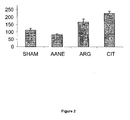
- the Figure 2 represents plasma arginine concentration in ⁇ mol / L (ordinate) of intestinal resection rats receiving standard enteral nutrition (NAA), standard enteral nutrition supplemented with arginine (ARG), standard enteral nutrition supplemented with citrulline ( CIT) or who have not undergone resection (SHAM) after 10 days of treatment. Each bar is surmounted by the representation of the estimate of the measurement error.
- the Figure 3 represents the cumulative nitrogen balance in grams (ordinate) of intestinal resection rats receiving standard enteral nutrition (AANE, black bar), standard enteral nutrition supplemented with arginine (ARG, vertically hatched bar), standard enteral nutrition supplemented with citrulline (CIT, bar hatched obliquely) or without resection (SHAM, white bar), for each of the 10 days of treatment, from 1 to 10 (as abscissa). Each bar is surmounted by the representation of the estimate of the measurement error.
- AANE standard enteral nutrition
- ARG vertically hatched bar
- CIT citrulline
- SHAM white bar
- the Figure 4 represents the protein content of Tibialis muscle in mg / organ (ordinate) of control aged rats (AL), aged malnourished rats (R), aged malnourished rats fed supplemental non-essential amino acid (NSAE) supplementation, and malnourished aged rats fed a diet supplemented with L-citrulline (CIT) (abscissa).
- the star indicates that the measured value for the CIT group is significantly different from those measured for the AL, AANE and R groups.
- the Figure 5A represents the rate of relative protein synthesis (FSR) in Tibialis muscle in percent per hour (ordinate) for control aged (AL) rats, aged malnourished rats (R), aged malnourished rats fed a supplemented acid diet non-essential amines (ANA) and malnourished elderly rats fed a diet supplemented with L-citrulline (CIT) (abscissa).
- FSR relative protein synthesis
- the Figure 5B represents the rate of absolute protein synthesis (ASR) in Tibialis muscle in mg of protein per hour (ordinate) of control aged rats (AL), aged malnourished rats (R), malnourished elderly rats fed a supplemented diet; non-essential amino acids (NAA) and malnourished aged rats fed a diet supplemented with L-citrulline (CIT) (x-axis).
- ASR absolute protein synthesis
- AL control aged rats
- R aged malnourished rats
- NAA non-essential amino acids
- CIT L-citrulline
- the rat was chosen as a model to evaluate the effect of citrulline supplementation in the context of intestinal insufficiency and particularly in the context of short bowel syndrome.
- Wistar rats of about 220-230 g were used. They were acclimated to metabolic cages for 5 days before being operated on; during this period they had free access to water and standard laboratory food.
- the animals were then operated on: 18 of them underwent intestinal resection of about 80% of the total length of the small intestine, the last 6 rats were operated on but did not undergo resection.
- L-arginine and L-citrulline correspond to those used in humans taking into account the difference in metabolic rate between the two species (speed about 10 times higher in the rat).
- Enteral nutrition was performed for 10 days in continuous mode by the installation of a gastric tube. Nitrogen intake was 2 g / kg / day and calorie intake was 290 kcal / kg / day. Food rations were rendered nitrogen-rich by adding a mixture of non-essential amino acids (Gly, Ala, Ser, His, Pro, Asn) (Sigma-Aldrich).
- a daily measurement of the weight of the animals a measurement of the arginine plasma concentration at the end of the experiment by ion exchange chromatography using a JEOL device and a daily monitoring of the cumulative nitrogen balance by summing the daily differences between the amount of nitrogen absorbed and the amount of nitrogen discharged into the urine by pyroluminescence using an ANTEK device.
- citrulline may (i) help to maintain nutritional status, (ii) compensate for the effects of arginine undernutrition by restoring a normal nitrogen balance, and (iii) be absorbed by the intestine in sufficient quantities to exert its effects.
- the rat was chosen as a model to evaluate the effect of L-citrulline supplementation in the treatment of age-related intestinal insufficiency.
- Sprague-Dawley male rats (Charles River Laboratories, Trees, France) aged 19 months were placed in individual cages, in a thermostatic environment (23 ° ⁇ 1 ° C), and subjected to a light-dark cycle of 12h (darkness from 8h to 20h). Their acclimation was carried out for 2 weeks, during which spontaneous food consumption was measured. They were fed a standard diet (A04, UAR, Villemoisson-sur-Orge, France) containing 17% protein, 3% lipids, 59% carbohydrates and 21% water, fiber, vitamins and minerals. The average food intake during this period is 34.4 g / day.
- Inputs from both groups were iso-nitrogenated and isocaloric.
- the 90% limitation of spontaneous intakes makes it possible to be sure that rats consume all the foods offered to them (Walrand et al., 2000).
- the rats in a postabsorptive situation, were anesthetized with isoflurane (3%) and received a subcutaneous injection of 13 C-valine at varying times before being killed by decapitation.
- TIB The 2 Tibialis muscles (TIB) were taken to determine the protein and amino acid content (right TIB) and fractional (FSR) and absolute protein synthesis (ASR) rates (TIB). left). All tissues collected were weighed before being frozen in liquid nitrogen and stored at -80 ° C until final analyzes.
- the blood was collected on heparin and centrifuged (3500 rpm, at + 4 ° C for 15 min). Then, the plasma was deproteinized with 100 ⁇ L of a 30% sulfosalicylic acid solution per 1 mL of plasma. The samples were centrifuged (5000 rpm, + 4 ° C, 5 min). An aliquot of the supernatant was assayed by cation exchange chromatography on an amino acid analyzer (Jeol, Tokyo, Japan). The results were expressed in ⁇ mol / L.
- Protein content was determined at the TIB level. Frozen tissues were crushed and homogenized in a 10% trichloroacetic acid (TCA) solution (1mL per 100 mg of tissue) using an Ultra-Turrax T25® mill (Ika Labotechnik, Staufer, Germany) , keeping the tube in the crushed ice. The homogenate was then centrifuged for 10 min at 3500 rpm. Then, the grinding pellet was delipidated with a mixture of ethyl alcohol / ether (v / v), then dissolved in 1N sodium hydroxide (4 ml per 100 mg of tissue) for 12 hours at 40 ° C. The protein TIB content is measured according to the Gomall method. The results are expressed in mg / muscle.
- TCA trichloroacetic acid
- Determination of amino acid levels was made in the Tibialis. To do this, the intra-tissue amino acids were extracted before their assay. For this, the muscle in question was ground in the presence of a solution of ATC (10% trichloroacetic acid) (1 ml per 100 mg of tissue) in a glass tube immersed in ice. The grinding was carried out with an Ultra-Turrax® apparatus, until a homogeneous suspension was obtained. After centrifugation (10 min at 3500 rpm at + 4 ° C), the supernatant, which contains the free amino acids, was aliquoted and frozen at -80 ° C until assayed. This was performed by cation exchange chromatography, using a model Aminotac analyzer, Jeol, (Tokyo, Japan). The results are expressed in nmol / g of tissue.
- the synthesis rate was determined at the TIB by the injection method of a loading dose of a tracer amino acid.
- the principle of the technique relies on the mass spectrometric detection of the incorporation of this tracer amino acid into the proteins of interest (Guillet et al ., 2004).
- 13 C-Valine 150 ⁇ mol / 100 g body weight, Cambridge Isotope Laboratories, MA, USA
- was injected subcutaneously (3.6 mL per 600 g body weight).
- the animals of the same group were killed at different times: 10, 15, 20, 25, 30, 35, 40, 45, 50 and 55 min post injection.
- the amino acids were eluted with soda (4M) and dried at speedvac (Savant Instrument Inc, USA). They were then converted into N-acetylpropyl derivatives. Furthermore, the 13 C-valine enrichment in the muscle free amino acid compartment was also measured by mass spectrometry coupled to gas chromatography (GC-MS type, Hewlett-Packard 5971A, USA), after extraction. amino acids with perchloric acid and derivatization to t-butyldimethylsilyl esters.
- ASR FSR ⁇ amount of protein in mg / 100
- results are presented in the form of mean ⁇ standard deviation to mean (ESM).
- ESM standard deviation to mean
- the results are analyzed by ANOVA followed by Duncan's posterior test.
- the PCSM software is used (Deltosoft, Grenoble, France). Values of p ⁇ 0.05 are considered significant.
- L-citrulline diet of malnourished aged rats allows to obtain a significant increase in muscle mass and protein accretion, especially in Tibialis . This indicates that L-citrulline is suitable for the treatment of age-related intestinal insufficiency.
Landscapes
- Health & Medical Sciences (AREA)
- Life Sciences & Earth Sciences (AREA)
- Animal Behavior & Ethology (AREA)
- Pharmacology & Pharmacy (AREA)
- Medicinal Chemistry (AREA)
- General Health & Medical Sciences (AREA)
- Public Health (AREA)
- Veterinary Medicine (AREA)
- Chemical & Material Sciences (AREA)
- Epidemiology (AREA)
- Engineering & Computer Science (AREA)
- Endocrinology (AREA)
- Bioinformatics & Cheminformatics (AREA)
- Gastroenterology & Hepatology (AREA)
- Zoology (AREA)
- Immunology (AREA)
- Proteomics, Peptides & Aminoacids (AREA)
- Chemical Kinetics & Catalysis (AREA)
- General Chemical & Material Sciences (AREA)
- Nuclear Medicine, Radiotherapy & Molecular Imaging (AREA)
- Organic Chemistry (AREA)
- Diabetes (AREA)
- Molecular Biology (AREA)
- Nutrition Science (AREA)
- Acyclic And Carbocyclic Compounds In Medicinal Compositions (AREA)
- Medicines Containing Plant Substances (AREA)
Description
- La présente invention a pour objet l'utilisation de citrulline pour la préparation d'un médicament destiné au traitement de pathologies liées à l'insuffisance intestinale , les dites pathologies étant choisies dans le groupe comprenant l'insuffisance intestinale liée au vieillissement ou à une irradiation.
- L'insuffisance intestinale est définie comme étant une diminution de la masse intestinale fonctionnelle en deçà de la quantité nécessaire à l'absorption des nutriments (Fleming et Remington, 1981). Elle se caractérise notamment par un défaut d'absorption digestive des graisses, des protéines, des glucides, ou des vitamines ; on parle alors de malabsorption, dont les répercussions peuvent être une dénutrition et un amaigrissement.
- Une des conséquences de la malabsorption est en particulier de limiter les apports azotés et notamment d'arginine. Il a ainsi été montré chez le rat qu'en cas de résection massive de l'intestin grêle (80%), l'arginine devenait un acide aminé essentiel (Wakabayashi et al., 1994).
- L'arginine est un acide aminé impliqué dans de nombreuses fonctions de l'organisme. Elle intervient en particulier dans la synthèse des protéines, du monoxyde d'azote, des polyamines, de la créatine et de la proline, de plus elle possède des effets de stimulation de la sécrétion des hormones, telles que l'insuline, la prolactine, le glucagon et l'hormone de croissance.
- Il est donc crucial en cas d'insuffisance intestinale de rétablir un apport suffisant en arginine, tant les carences en arginine liées à une insuffisance intestinale ont des répercussions importantes sur l'organisme.
- Le document
US 2001/0056068 décrit une méthode de traitement de pathologies liées à une diminution du taux d'oxyde nitrique endogène, telles que l'altération de la motilité intestinale et la sténose du pylore, comprenant l'administration de citrulline en tant qu'agent augmentant le taux d'oxyde nitrique endogène. Toutefois, il n'est fait aucune mention d'un quelconque traitement de l'insuffisance intestinale dans ce document. - Ainsi, le but de la présente invention est de fournir un moyen de traiter les pathologies liées à l'insuffisance intestinale , les dites pathologies étant choisies dans le groupe comprenant l'insuffisance intestinale liée au vieillissement ou à une irradiation.
- La présente invention découle notamment de la mise en évidence par les Inventeurs que l'administration par voie entérale de L-citrulline à des rats ayant subi une résection sévère de l'intestin grêle permettait d'augmenter le gain de poids, d'augmenter la concentration plasmatique en L-arginine et d'améliorer le bilan azoté, par rapport à des rats ayant subi une résection semblable mais n'ayant pas reçu de L-citrulline. De manière inattendue, l'administration de L-citrulline est plus efficace pour augmenter le gain de poids, augmenter la concentration plasmatique en L-arginine et améliorer le bilan azoté, que l'administration de L-arginine elle-même.
- La présente invention concerne l'utilisation de L-citrulline (I) pour la préparation d'un médicament destiné au traitement de pathologies liées à une insuffisance intestinale, les dites pathologies étant choisies dans le groupe comprenant l'insuffisance intestinale liée au vieillissement ou à une irradiation.

- On désigne par « insuffisance intestinale » un état pathologique de l'intestin, notamment de l'intestin grêle, dans lequel l'absorption des nutriments est réduite par rapport à la normale, la diminution de l'absorption des nutriments étant liée à une diminution du nombre et/ou de la fonctionnalité de cellules intestinales capables d'assurer cette absorption, cette diminution du nombre et/ou de la fonctionnalité de cellules intestinales étant elle-même due soit à une élimination physique de ces cellules (notamment par chirurgie ou par radiations), soit à un dysfonctionnement pathologique de ces cellules.
- A ce titre, il convient de noter que les altérations de la motilité intestinale, ainsi que la sténose du pylore ne font pas partie du champs de l'invention.
- En effet, les altérations de la motilité intestinale sont présentes dans des pathologies fonctionnelles telles que la constipation, le syndrome de l'intestin irritable, ou les diarrhées fonctionnelles. Ces pathologies ne sont déterminées ni par une diminution du nombre de cellules intestinales capables d'assurer les fonctions d'absorption, ni par une dysfonction de ces cellules (Isselbacher et al., 1995 ; Dapoigny et al., 2003).
- Par ailleurs, la sténose du pylore est une maladie relativement fréquente du nourrisson. Il s'agit d'une malformation congénitale dans laquelle le pylore est hypertrophié et constitue un obstacle mécanique au passage de l'alimentation. Son traitement est chirurgical, il s'agit d'une pyloromyotomie, simple et rapide, à l'issue de laquelle l'enfant peut reprendre très vite une alimentation normale. Il s'agit donc d'une pathologie sans rapport avec une insuffisance intestinale (Jacqmarcq et al., 2004 ; Rambaud et Bouhnik, 2001).
- Une des conséquences fréquentes de l'insuffisance intestinale est d'entraîner un état de dénutrition. L'utilisation de L-citrulline permet notamment d'améliorer l'état nutritionnel et pondéral d'individus souffrant d'insuffisance intestinale.
- Les pathologies liées à l'insuffisance intestinale peuvent être:
- le syndrome du grêle court faisant suite à une résection intestinale, notamment dans les cas d'ischémie mésentérique aiguë, de thrombose de la veine mésentérique supérieure, de volvulus du grêle et de hernies étranglées, de pseudo-obstruction intestinale chronique, de grêle radique, de maladie de Crohn, de jéjuno-iléite ulcéreuse non granulomateuse, de traumatisme abdominal ; le syndrome du grêle court fait notamment suite à des résections de l'intestin grêle laissant au maximum 1 mètre d'intestin grêle en plus du duodénum ; ces résections entraînent en période postopératoire immédiate une insuffisance intestinale caractérisée par une malabsorption constante et majeure, parfois aggravée par une hypersécrétion gastrique, qui conduit à la mise en place d'une nutrition parentérale totale, rapidement associée à une nutrition entérale continue, puis à une alimentation orale ; l'adaptation de l'intestin restant est possible entre 2 et 6 mois après l'intervention, mais l'amélioration des capacités d'absorption de l'intestin grêle reste le plus souvent insuffisante (Rambaud et Bouhnik, 2001 ; Colombel et Dupas, 1997) ;
- la maladie coeliaque ; la maladie coeliaque est une entéropathie chronique caractérisée par une intolérance alimentaire au gluten, et plus particulièrement à des protéines contenues dans certaines céréales, telles que la gliadine, l'hordéine ou la sécaline ; cette maladie survient chez des sujets génétiquement prédisposés ; la muqueuse intestinale d'un patient atteint de maladie coeliaque est le siège d'un processus inflammatoire, de nature en partie immunitaire, qui provoque notamment une atrophie des villosités ; l'insuffisance intestinale résultante est caractérisée par une malabsorption intestinale, qui se manifeste par une diarrhée avec stéatorrhée, un amaigrissement et une dénutrition ; les conséquences biologiques de la malabsorption sont notamment une anémie associée à une carence en fer, en folate ou en vitamine B12, un déficit en facteurs de la coagulation dépendant de la vitamine K, une hypoprotidémie, une hypoalbuminémie, une hypocalcémie, une hypomagnésémie et un déficit en zinc (Cellier et Grosdidier, 2001 ; Jadoulle, 2002) ;
- les maladies inflammatoires chroniques de l'intestin, telles que la maladie de Crohn et la recto-colite ulcéreuse, aussi nommée recto-colite hémorragique ; ces maladies sont des maladies chroniques évoluant par poussées, elles sont souvent accompagnées, notamment dans le cas de la maladie de Crohn, d'une insuffisance intestinale chronique ayant pour cause des fistules, des obstacles mécaniques sur l'intestin grêle, ou une entéropathie non sténosante ; la réduction de la masse intestinale fonctionnelle qui s'ensuit ne permet pas le maintien de l'état nutritionnel ; il en résulte en effet une malnutrition protéino-énergétique, qui s'accompagne d'une malabsorption et d'une augmentation des pertes hydro-électrolytiques et d'éléments minéraux, tels que le calcium, le magnésium ou le zinc, ce qui conduit fréquemment à une dénutrition (Rambaud et Bouhnik, 2001 ; Crenn et al., 2001) ;
- l'insuffisance intestinale liée au vieillissement ; la malnutrition protéino-énergétique est fréquente chez les personnes âgées ; en effet environ 40% des personnes âgées de plus de 70 ans sont concernées ; en situation de dénutrition le vieillissement est caractérisé par des modifications morphologiques et fonctionnelles de l'intestin grêle ; ces altérations peuvent conduire à une malabsorption et aggraver la dénutrition préexistante ; de plus cette dénutrition aggrave les altérations de l'appareil digestif liées à l'âge ; par ailleurs, la dégradation de l'état nutritionnel favorise les risques d'infections ; enfin, il est décrit que le sujet âgé dénutri présente un défaut de réponse à la réalimentation standard par rapport à ce qui est observé chez l'adulte ;
- l'insuffisance intestinale liée à une irradiation, aussi nommée grêle radique ; dans ce cas l'insuffisance intestinale est provoquée par l'irradiation de l'intestin grêle, en particulier dans le cas de radiothérapies, et plus particulièrement dans le cadre du traitement de cancers se développant dans la cavité abdomino-pelvienne.
- Selon un autre mode de réalisation, la présente invention concerne l'utilisation susmentionnée de L-citrulline, pour la préparation d'une composition pharmaceutique comprenant, à titre de principe actif, de la L-citrulline, ou un sel pharmaceutiquement acceptable de celle-ci, en association avec un véhicule pharmaceutiquement acceptable.
- On désigne notamment par « sel pharmaceutiquement acceptable » des sels de citrulline tels que le malate de citrulline.
- Les véhicules pharmaceutiquement acceptables apparaîtront de manière évidente à l'homme de l'art.
- L'invention concerne notamment l'utilisation susmentionnée de L-citrulline, pour la préparation d'une composition pharmaceutique caractérisée en ce que la dose unitaire en L-citrulline est d'environ 1 g à environ 10 g, notamment environ 5 g, pour une posologie d'environ 0,05 g/kg/jour à environ 0,50 g/kg/jour, notamment environ 0,25 g/kg/jour.
- L'invention concerne plus particulièrement l'utilisation susmentionnée de L-citrulline, pour la préparation d'une composition pharmaceutique se présentant sous forme sèche ou sous forme de solution aqueuse.
- L'invention concerne plus particulièrement l'utilisation susmentionnée de L-citrulline, pour la préparation d'une composition pharmaceutique se présentant sous une forme administrable par voie orale, intrapéritonéale, entérale ou parentérale.
- L'administration par voie entérale correspond notamment à une administration par sonde gastrique ou intestinale, l'administration par voie parentérale correspond notamment à une administration par perfusion intraveineuse centrale, périphérique ou sous-cutanée.
- L'invention concerne plus particulièrement l'utilisation susmentionnée de L-citrulline, pour la préparation d'une composition pharmaceutique comprenant également un ou plusieurs autres composés destinés au traitement de l'insuffisance intestinale, tels que la glutamine, l'ornithine, l'hormone de croissance, ou la somatomédine C.
- L'hormone de croissance, aussi nommée somatotrophine, est avantageusement sous forme recombinante, la somatomédine C, aussi nommée IGF-1 pour insulin-like growth factor, est également avantageusement sous forme recombinante.
- Selon un autre mode de réalisation la présente invention concerne une composition pharmaceutique caractérisée en ce qu'elle comprend, à titre de principe actif, de la L-citrulline, ou un sel pharmaceutiquement acceptable de celle-ci, en association avec au moins un autre composé destiné au traitement de l'insuffisance intestinale, tels que les composés définis ci-dessus, et avec un véhicule pharmaceutiquement acceptable.
- Selon un autre mode de réalisation l'invention concerne des produits comprenant :
- de la L-citrulline,
- et au moins un autre composé destiné au traitement de l'insuffisance intestinale, tels que les composés définis ci-dessus,
- La
Figure 1 représente le gain pondéral en grammes (en ordonnée) de rats ayant subi une résection intestinale et recevant une nutrition entérale standard (AANE), une nutrition entérale standard supplémentée en arginine (ARG), une nutrition entérale standard supplémentée en citrulline (CIT) ou n'ayant pas subi de résection (SHAM) après 10 jours de traitement. Chaque barre est surmontée de la représentation de l'estimation de l'erreur de mesure. - La
Figure 2 représente la concentration plasmatique en arginine en µmol/L (en ordonnée) de rats ayant subi une résection intestinale et recevant un nutrition entérale standard (AANE), une nutrition entérale standard supplémentée en arginine (ARG), une nutrition entérale standard supplémentée en citrulline (CIT) ou n'ayant pas subi de résection (SHAM) après 10 jours de traitement. Chaque barre est surmontée de la représentation de l'estimation de l'erreur de mesure. - La
Figure 3 représente le bilan azoté cumulé en grammes (en ordonnée) de rats ayant subi une résection intestinale et recevant un nutrition entérale standard (AANE, barre noire), une nutrition entérale standard supplémentée en arginine (ARG, barre hachurée verticalement), une nutrition entérale standard supplémentée en citrulline (CIT, barre hachurée obliquement) ou n'ayant pas subi de résection (SHAM, barre blanche), pour chacun des 10 jours du traitement, de 1 à 10 (en abscisse). Chaque barre est surmontée de la représentation de l'estimation de l'erreur de mesure. - La
Figure 4 représente le contenu protéique du muscle Tibialis en mg/organe (en ordonnées) de rats âgés témoins (AL), de rats âgés dénutris (R), de rats âgés dénutris ayant reçu une alimentation supplémentée en acides aminés non essentiels (AANE) et de rats âgés dénutris ayant reçu une alimentation supplémentée en L-citrulline (CIT) (en abscisses). L'étoile indique que la valeur mesurée pour le groupe CIT est significativement différente de celles mesurées pour les groupes AL, AANE et R. - La
Figure 5A représente la vitesse de synthèse protéique relative (FSR) dans le muscle Tibialis en pourcentage par heure (en ordonnées) pour des rats âgés témoins (AL), de rats âgés dénutris (R), de rats âgés dénutris ayant reçu une alimentation supplémentée en acides aminés non essentiels (AANE) et de rats âgés dénutris ayant reçu une alimentation supplémentée en L-citrulline (CIT) (en abscisses). - La
Figure 5B représente la vitesse de synthèse protéique absolue (ASR) dans le muscle Tibialis en mg de protéines par heure (en ordonnées) de rats âgés témoins (AL), de rats âgés dénutris (R), de rats âgés dénutris ayant reçu une alimentation supplémentée en acides aminés non essentiels (AANE) et de rats âgés dénutris ayant reçu une alimentation supplémentée en L-citrulline (CIT) (en abscisses). L'étoile indique que la valeur mesurée pour le groupe CIT est significativement différente de celles mesurées pour les groupes AANE et R. - Le rat a été choisi comme modèle pour évaluer l'effet d'une supplémentation en citrulline dans le cadre d'une insuffisance intestinale et notamment dans le cadre du syndrome du grêle court.
- 24 rats Wistar d'environ 220-230 g ont été utilisés. Ils ont été acclimatés en cages métaboliques pendant 5 jours avant d'être opérés ; durant cette période ils avaient un accès libre à l'eau et à de la nourriture de laboratoire standard.
- Les animaux ont ensuite été opérés : 18 d'entre eux ont subi une résection intestinale d'environ 80% de la longueur totale de l'intestin grêle, les 6 derniers rats ont été opérés mais n'ont pas subi de résection.
- 4 groupes d'animaux ont été constitués :
- un groupe AANE, formé de 6 animaux ayant subi une résection et recevant une nutrition entérale standard (Sondalis®, Nestlé Clinical Nutrition),
- un groupe ARG, formé de 6 animaux ayant subi une résection et recevant une nutrition entérale standard supplémentée par une dose de L-arginine (Sigma-Aldrich) de 0,994 g/kg/jour ;
- un groupe CIT, formé de 6 animaux ayant subi une résection et recevant une nutrition entérale standard supplémentée par une dose de L-citrulline (Laboratoires Biocodex) de 1 g/kg/jour (i.e. en quantité équimolaire à l'arginine),
- un groupe SHAM témoin, formé de 6 animaux opérés mais n'ayant pas subi de résection, recevant une nutrition entérale standard.
- Les apports en L-arginine et en L-citrulline correspondent à ceux utilisés chez l'homme en tenant compte de la différence de vitesse métabolique entre les deux espèces (vitesse environ 10 fois plus élevée chez le rat).
- La nutrition entérale a été réalisée durant 10 jours en mode continu par la pose d'une sonde gastrique. L'apport azoté était de 2 g/kg/jour et l'apport calorique de 290 kcal/kg/jour. Les rations alimentaires ont été rendues iso-azotées par apport d'un mélange d'acides aminés non-essentiels (Gly, Ala, Ser, His, Pro, Asn) (Sigma-Aldrich).
- Trois types de mesures ont notamment été réalisées : une mesure quotidienne du poids des animaux, une mesure de la concentration plasmatique en arginine au terme de l'expérience par chromatographie d'échange d'ions à l'aide d'un appareil JEOL et un suivi quotidien du bilan azoté cumulé en sommant les différences journalières entre la quantité d'azote absorbée et la quantité d'azote évacuée dans les urines par pyroluminescence à l'aide d'un appareil ANTEK.
- Les résultats présentés dans la
Figure 1 indiquent que le gain de poids du groupe AANE au bout de 10 jours (environ 15 g) est inférieur à celui du groupe témoin SHAM (environ 21 g) ; en revanche le gain de poids du groupe ARG (environ 17 g) est supérieur à celui du groupe AANE mais inférieur à celui du groupe témoin SHAM, et le gain de poids du groupe CIT (environ 21 g) est équivalent à celui du groupe témoin SHAM. La supplémentation en citrulline permet donc de compenser la diminution de prise de poids due à la résection, ce qui indique qu'en cas d'insuffisance intestinale, l'administration de citrulline permet de maintenir l'état nutritionnel des animaux. - Les résultats présentés dans la
Figure 2 indiquent que la concentration plasmatique en arginine est abaissée pour le groupe AANE par rapport au groupe témoin SHAM, ce qui confirme les données de l'art antérieur concernant la carence en arginine consécutive à une résection intestinale sévère. En revanche une supplémentation en arginine (groupe ARG) permet de compenser cet effet, et même d'augmenter la concentration plasmatique en arginine par rapport au témoin. Cet effet est encore plus marqué dans le cas de la citrulline (groupe CIT). - Cependant, les résultats présentés dans la
Figure 3 indiquent que seule la supplémentation en citrulline (groupe CIT) permet de rétablir un bilan azoté des animaux ayant subi une résection, au même niveau que celui du groupe témoin (SHAM), alors que ce n'est pas le cas d'une supplémentation en arginine (groupe ARG). - Globalement ces résultats indiquent qu'en cas d'insuffisance intestinale, la citrulline peut (i) permettre de maintenir l'état nutritionnel, (ii) compenser les effets d'une dénutrition en arginine en restaurant un bilan azoté normal et (iii) être absorbée par l'intestin dans des quantités suffisantes pour pouvoir exercer ses effets.
- Le rat a été choisi comme modèle pour évaluer l'effet d'une supplémentation en L-citrulline dans le cadre du traitement d'une insuffisance intestinale liée au vieillissement.
- Tous les réactifs chimiques utilisés proviennent de Sigma (Saint-Quentin-Fallavier, France). La L-citrulline a été fournie par les Laboratoires Biocodex (Compiègne, France).
- Des rats mâles Sprague-Dawley (Charles River Laboratories, L'arbresles, France) âgés de 19 mois ont été placés dans des cages individuelles, en ambiance thermostatée (23° ± 1°C), et soumis à un cycle lumière-obscurité de 12h (obscurité de 8h à 20h). Leur acclimatation a été effectuée pendant 2 semaines, au cours desquelles la consommation alimentaire spontanée a été mesurée. Ils ont été nourris avec un régime standard (A04, UAR, Villemoisson-sur-Orge, France) contenant 17% de protéines, 3% de lipides, 59% de glucides et 21% d'eau, fibres, vitamines et minéraux. La prise alimentaire moyenne, durant cette période est de 34,4 g/ jour.
- Après la période d'acclimatation, les rats ont été répartis en 4 groupes (cf.
figure 5 ): un groupe contrôle formé de rats (n=10) nourris ad libitum (AL) pendant 12 semaines et 3 autres groupes soumis à une restriction alimentaire durant la même période, c'est à dire nourris avec seulement 50% des ingesta spontanés (soit 17,2 g), avec le régime standard (UAR A04). - A la fin de la période de restriction, les animaux (n=10) d'un groupe ont été sacrifiés (groupe R) et les rats des deux groupes restants ont été nourris pendant une semaine avec 90% des ingesta spontanés (soit 30,9 g), soit avec un régime enrichi en acides aminés non essentiels (groupe AANE : alanine, asparagine, glycine, sérine, histidine, et proline apportés de façon équimolaire) soit avec un régime enrichi en L-citrulline (5g/kg/j) (groupe citrulline). Les apports des deux groupes étaient isoazotés et isocaloriques. La limitation à 90 % des apports spontanés permet d'être certain que les rats consomment l'intégralité des aliments qui leur sont offerts (Walrand et al., 2000).
- Le poids corporel a été mesuré tous les trois jours tout au long de la période d'expérimentation.
- A la fin de la période expérimentale, les rats, en situation postabsorptive, ont été anesthésiés avec de l'isoflurane (3%) et ont reçu une injection sous-cutanée de 13C-valine à des temps variables avant d'être tués par décapitation.
- Les 2 muscles Tibialis (TIB) ont été prélevés pour déterminer d'une part le contenu en protéines et en acides aminés (TIB droit) et d'autre part, les vitesses de synthèse protéique fractionnaire (FSR) et absolue (ASR) (TIB gauche). Tous les tissus prélevés ont préalablement été pesés avant d'être congelés dans de l'azote liquide et stockés à -80°C jusqu'aux analyses finales.
- Le sang a été recueilli sur héparine et centrifugé (3500 tr/min, à + 4°C durant 15 min). Puis, le plasma a été déprotéinisé à l'aide de 100 µL d'une solution d'acide sulfosalicylique à 30% pour 1 mL de plasma. Les échantillons ont été centrifugés (5000 tr/min, + 4°C, 5 min). Une fraction aliquote du surnageant a été dosée par chromatographie échangeuse de cations sur analyseur d'acides aminés (Jéol, Tokyo, Japon). Les résultats ont été exprimés en µmol/L.
- La détermination du contenu protéique a été effectuée au niveau du TIB. Les tissus congelés ont été broyés et homogénéisés dans une solution d'acide trichloroacétique (ATC) à 10% (1mL pour 100 mg de tissus) à l'aide d'un broyeur Ultra-Turrax T25® (Ika Labotechnik, Staufer, Allemagne), en maintenant le tube dans la glace pilée. L'homogénat a ensuite été centrifugé 10 min à 3500 tr/min. Puis, le culot de broyage a été délipidé avec un mélange alcool éthylique/éther (v/v), puis dissous dans la soude 1N (4 mL pour 100 mg de tissus) pendant 12h à 40°C. Le contenu du TIB en protéines est mesuré selon la méthode de Gomall. Les résultats sont exprimés en mg/muscle.
- La détermination des teneurs en acides aminés a été effectuée au niveau du Tibialis. Pour ce faire, les acides aminés intra-tissulaires ont été extraits avant leur dosage. Pour cela, le muscle considéré a été broyé en présence d'une solution d'ATC (acide trichloroacétique) à 10% (1 ml pour 100 mg de tissu) dans un tube en verre plongé dans de la glace. Le broyage a été effectué avec un appareil Ultra-Turrax®, jusqu'à obtention d'une suspension homogène. Après centrifugation (10 min à 3500 tr/min à +4°C), le surnageant, qui contient les acides aminés libres, a été réparti en fractions aliquotes et congelé à -80°C jusqu'au dosage. Celui-ci a été effectué par chromatographie échangeuse de cations, à l'aide d'un analyseur modèle Aminotac, Jéol, (Tokyo, Japon). Les résultats sont exprimés en nmol/g de tissu.
- La vitesse de synthèse a été déterminée au niveau du TIB par la méthode d'injection d'une dose de charge d'un acide aminé traceur. Le principe de la technique repose sur la détection par spectrométrie de masse de l'incorporation de cet acide aminé traceur dans les protéines d'intérêt (Guillet et al., 2004). En pratique, la 13C-Valine (150 µmol/100g de poids corporel, Cambridge Isotope Laboratories, MA, USA) a été injectée par voie sous-cutanée (3,6 mL pour 600 g de poids corporel). Puis, afin de prendre en compte la vitesse d'incorporation du traceur dans les protéines, les animaux d'un même groupe ont été tués à des temps différents : 10, 15, 20, 25, 30, 35, 40, 45, 50 et 55 min post injection. Néanmoins, les effectifs des groupes AL (n=8) et R (n=9) ne permettant pas d'intégrer tous les temps, il a fallu exclure 2 points expérimentaux dans le groupe AL (t=45 et 55 min) et 1 point dans le groupe R (t=55 min). Ceci a permis de déterminer l'incorporation du traceur dans les protéines d'intérêt et d'établir une droite d'incorporation (Breuille et al., 1998). Après broyage de 100 mg de muscle, les protéines ont été extraites par précipitations successives à l'acide trichloracétique (ATC). Elle ont ensuite été hydrolysées par de l'HCl (6M, 110°C, 24h) et les acides aminés ainsi obtenus ont été purifiés par chromatographie échangeuse de cations (Dowex 50W 8X, Bio-Rad, Hercules, CA). Les acides aminés ont été élues par la soude (4M) et séchés au speedvac (Savant Instrument Inc, USA). Ils ont ensuite été transformés en dérivés N-acétyl-propyl. Par ailleurs, l'enrichissement en 13C-valine dans le compartiment des acides aminés libres musculaires a également été mesuré par spectrométrie de masse couplée à une chromatographie en phase gazeuse (type GC-MS, Hewlett-Packard 5971A, USA), après extraction des acides aminés par l'acide perchlorique et dérivation en esters de t-butyldiméthylsilyl.
- La vitesse fractionnaire de synthèse des protéines myofibrillaires (FSR) exprimée en % par heure a été calculée pour chaque point en prenant en compte à la fois l'enrichissement en 13C-valine des protéines musculaires, mais également celui du compartiment précurseur de la synthèse (pool d'acides aminés libres musculaires). Ainsi, la formule suivante est utilisée :

où : - Sb : enrichissement des protéines musculaires en 13C-valine au temps t ;
- Sb0 : enrichissement naturel des protéines musculaires en 13C-valine ;
- Sa: enrichissement en 13C-valine dans le compartiment d'acides aminés libres intramusculaires ;
- t : temps post-injection de prélèvement du muscle en heure.
- Ce paramètre est également exprimé en quantité absolue de protéines musculaires synthétisées par heure (ASR, en mg/h) en prenant en compte la quantité totale de protéines au sein des TIB de chaque rat, selon l'équation :

- Les résultats sont présentés sous la forme de moyenne ± écart standard à la moyenne (ESM). Les résultats sont analysés par une ANOVA suivie d'un test a posteriori de Duncan. Le logiciel PCSM est utilisé (Deltosoft, Grenoble, France). Les valeurs de p<0.05 sont considérées comme significatives.
- Les résultats obtenus indiquent que seule la supplémentation en L-citrulline augmente significativement les concentrations plasmatiques et musculaires en CIT, ORN et ARG (CIT vs AL, R, AANE, p<0.05) (Tableau 1).
Tableau 1 : Concentrations en acides aminés dans le plasma et le TIB Plasma AL R AANE CIT Citrulline 116 ± 7 104 ± 7 155 ± 20 2394 ± 279* Ornithine 46 ± 3 41 ± 3 43 ± 6 223 ± 27* Arginine 114 ± 9 118 ± 4 99 ± 7 561 ± 55* TIB AL R AANE CIT Citrulline 23 ± 4 26 ± 2 50 ± 11 616 ± 104* Ornithine 4 ± 0 6 ± 0 3 ± 0 20 ± 4* Arginine 29 ± 3 66 ± 4 22 ± 3 203 ± 35* MOYENNE ±ESM. Les résultats sont exprimés en µmol/L et nmol/g respectivement
ANOVA+ test de Duncan : *p<0,05 vs AL, R et AANE - Par ailleurs, la restriction alimentaire n'induit pas de diminution significative du contenu protéique musculaire. Toutefois, à la suite de la phase de renutrition, une augmentation significative des concentrations protéiques du TIB est observée uniquement pour le groupe CIT (CIT vs AL, R, AANE, p<0,05) (
Figure 4 ). - Enfin, bien que supérieure pour la L-citrulline par rapport aux autres groupes, la variation de la FSR observée ne semble pas significative (
Figure 5A ). En revanche, il y a une augmentation significative de l'ASR uniquement pour le groupe recevant une nutrition enrichie en L-citrulline (CIT vs R et AANE, p<0,05) (Figure 5B ). - Par conséquent, la supplémentation en L-citrulline du régime alimentaire de rats âgés dénutris permet d'obtenir une augmentation significative de la masse musculaire et de l'accrétion protéique, notamment au niveau du Tibialis. Ceci indique que la L-citrulline est adaptée au traitement de l'insuffisance intestinale liée au vieillissement.
-
- Breuille D et al. Clin.Sci. (1998) 94 : 413-423
- Cellier C et Grosdidier E. Maladie Coeliaque de l'Adulte. Rev. Prat. (2001) 51 : 959-963.
- Colombel JF et Dupas JL. Pathologie du Grêle. In : Progrès en Hépato-gastroentérologie. Paris, Doin, Ed. (1997) 219-220.
- Crenn P et al. Insuffisance Intestinale. Rev. Prat. (2001) 51 : 977-982.
- Dapoigny et al. Troubles fonctionnels intestinaux et consommation de soins. Gastroentérologie Clinique et Biologique, (2003) 27 : 265-271.
- Fleming CR et Remington M. Intestinal Failure. In : Nutrition and the Surgical Patient : Clinical Surgery International. Hill GI, Ed. Edimbourg : Churchill Livingstone, (1981) 219-235.
- Guillet C et al. Exp. Gerontol. (2004) 39 : 745-751
- Isselbacher KJ et al. Trouble de la motricité intestinale. In: Harrison Médecine Interne. Arnette Blackwell S.A. (13ème édition) (1995) 1418-1422.
- Jacqmarcq et al. Prise en charge périopératoire de la sténose du pylore en France en 1999. Annales françaises d'Anesthésie et de Réanimation. (2004) 23 : 31-38.
- Jadoulle J. Interactions Somato-Psychiques dans la Maladie Coeliaque. Gastroentérol. Clin. Biol. (2002) 26 : 1134-1139.
- Wakabayashi Y et al. Arginine Becomes an Essential Amino Acid after Massive Resection of Rat Small Intestine. J. Biol. Chem. (1994) 269 : 32667-32671.
- Rambaud JC et Bouhnik Y. Intestin Grêle. In : Le Livre de l'Interne en Gastroentérologie. Paris : 2ème édition, Flamarion, Ed. (2001) 286-298, 533-536.
- Rambaud JC et Bouhnik Y. sténose hypertrophique du pylore. In : Le Livre de l'Interne en Gastroentérologie. Paris : 2ème édition, Flamarion, Ed. (2001) 202.
- Walrand S et al. Am.J.Clin.Nutr. (2001) 74 : 670-678
Claims (12)
- Utilisation de L-citrulline (I)

- Utilisation de L-citrulline selon la revendication 1, pour la préparation d'une composition pharmaceutique comprenant, à titre de principe actif, de la L-citrulline, ou un sel pharmaceutiquement acceptable de celle-ci, en association avec un véhicule pharmaceutiquement acceptable.
- Utilisation de L-citrulline selon l'une des revendications 1ou 2, pour la préparation d'une composition pharmaceutique caractérisée en ce que la dose unitaire en L-citrulline est d'environ 1 g à environ 10 g, notamment environ 5 g, pour une posologie d'environ 0,05 g/kg/jour à environ 0,50 g/kg/jour, notamment environ 0,25 g/kg/jour.
- Utilisation de L-citrulline selon l'une des revendications 1 à 3, pour la préparation d'une composition pharmaceutique se présentant sous forme sèche ou sous forme de solution aqueuse.
- Utilisation de L-citrulline selon l'une des revendications 1 à 4, pour la préparation d'une composition pharmaceutique se présentant sous une forme administrable par voie orale, intrapéritonéale, entérale ou parentérale.
- Utilisation de L-citrulline selon l'une des revendications 1 à 5 pour la préparation d'une composition pharmaceutique comprenant également un ou plusieurs autres composés destinés au traitement de l'insuffisance intestinale, choisi(s) dans le groupe comprenant la glutamine, l'ornithine, l'hormone de croissance, ou la somatomédine C.
- L-citrulline (I)

- L-citrulline pour son utilisation selon la revendication 7, caractérisée en ce qu'on utilise la L-citrulline, ou un sel pharmaceutiquement acceptable de celle-ci, en association avec un véhicule pharmaceutiquement acceptable.
- L-citrulline pour son utilisation selon l'une des revendications 7 ou 8, caractérisée en ce qu'on utilise la L-citrulline pour la préparation d'une composition pharmaceutique comprenant la dose unitaire en L-citrulline d'environ 1 g à environ 10 g, notamment environ 5 g, pour une posologie d'environ 0,05 g/kg/jour à environ 0,50 g/kg/jour, notamment environ 0,25 g/kg/jour.
- L-citrulline pour son utilisation selon l'une des revendications 7 à 9 caractérisée en ce qu'on utilise la L-citrulline pour la préparation d'une composition pharmaceutique se présentant sous forme sèche ou sous forme de solution aqueuse.
- L-citrulline pour son utilisation selon l'une des revendications 7 à 10 caractérisée en ce qu'on utilise la L-citrulline pour la préparation d'une composition pharmaceutique se présentant sous une forme administrable par voie orale, intrapéritonéale, entérale ou parentérale.
- L-citrulline pour son utilisation selon l'une des revendications 7 à 11 caractérisée en ce qu'on utilise la L-citrulline pour la préparation d'une composition pharmaceutique comprenant également un ou plusieurs autres composés destinés au traitement de l'insuffisance intestinale, choisi(s) dans le groupe comprenant la glutamine, l'ornithine, l'hormone de croissance, ou la somatomédine C.
Applications Claiming Priority (2)
| Application Number | Priority Date | Filing Date | Title |
|---|---|---|---|
| FR0308349A FR2857262B1 (fr) | 2003-07-08 | 2003-07-08 | Utilisation de la citrulline dans le cadre de l'insuffisance intestinale |
| FR0308349 | 2003-07-08 |
Publications (3)
| Publication Number | Publication Date |
|---|---|
| EP1495755A1 EP1495755A1 (fr) | 2005-01-12 |
| EP1495755B1 true EP1495755B1 (fr) | 2009-10-14 |
| EP1495755B8 EP1495755B8 (fr) | 2009-12-23 |
Family
ID=33443247
Family Applications (1)
| Application Number | Title | Priority Date | Filing Date |
|---|---|---|---|
| EP04291738A Expired - Lifetime EP1495755B8 (fr) | 2003-07-08 | 2004-07-08 | Utilisation de la citrulline dans la fabrication d'un médicament pour le traitement de l'insuffisance intestinale liée au vieillissement ou à une irradiation |
Country Status (6)
| Country | Link |
|---|---|
| US (2) | US20050239891A1 (fr) |
| EP (1) | EP1495755B8 (fr) |
| AT (1) | ATE445394T1 (fr) |
| DE (2) | DE04291738T1 (fr) |
| ES (1) | ES2237355T1 (fr) |
| FR (1) | FR2857262B1 (fr) |
Families Citing this family (7)
| Publication number | Priority date | Publication date | Assignee | Title |
|---|---|---|---|---|
| EP1957657A4 (fr) * | 2005-12-01 | 2009-02-18 | Nps Pharma Inc | Biomarqueur de fonction intestinale amelioree |
| WO2007114903A2 (fr) * | 2006-04-04 | 2007-10-11 | Nestec S.A. | Traitements à la citrulline |
| FR2907011B1 (fr) * | 2006-10-17 | 2010-05-14 | Univ Paris Descartes | Utilisation de la citrulline pour le traitement des etats de denutrition |
| WO2008105384A1 (fr) * | 2007-02-26 | 2008-09-04 | Kyowa Hakko Bio Co., Ltd. | Comprimé contenant de la citrulline |
| FR2913885B1 (fr) * | 2007-03-22 | 2012-07-20 | Univ Paris Descartes | Utilisation de la citrulline pour le traitement des pathologies liees a une augmentation de la carbonylation des proteines |
| FR2970414B1 (fr) | 2011-01-14 | 2013-03-22 | Univ Paris Descartes | Action preventive de la citrulline sur le developpement spontane des tumeurs |
| IL246722A0 (en) * | 2016-07-11 | 2016-09-29 | Yeda Res & Dev | Combination therapy to increase endogenous nitric oxide (no) synthesis |
Family Cites Families (5)
| Publication number | Priority date | Publication date | Assignee | Title |
|---|---|---|---|---|
| US5189025A (en) * | 1988-12-09 | 1993-02-23 | Board Of Regenets, The University Of Texas System | Methods for the treatment of malignant disease in patients using citrulline containing amino acid solutions |
| FR2691359B1 (fr) * | 1992-05-20 | 1995-06-23 | Krempf Michel | Nouvelle application therapeutique du malate de 1-citrulline. |
| US5378722A (en) * | 1993-12-03 | 1995-01-03 | Clintec Nutrition Co. | Nutritional compositions for management of nitrogen metabolism |
| US20010056068A1 (en) * | 1998-03-04 | 2001-12-27 | Kristof Chwalisz | Method of treatment and prevention of nitric oxide deficiency-related disorders with citrulline and citrulline derivatives |
| US6864242B2 (en) * | 2001-03-05 | 2005-03-08 | Stephen P. Ernest | Enteral formulation |
-
2003
- 2003-07-08 FR FR0308349A patent/FR2857262B1/fr not_active Expired - Lifetime
-
2004
- 2004-07-08 EP EP04291738A patent/EP1495755B8/fr not_active Expired - Lifetime
- 2004-07-08 AT AT04291738T patent/ATE445394T1/de not_active IP Right Cessation
- 2004-07-08 DE DE04291738T patent/DE04291738T1/de active Pending
- 2004-07-08 ES ES04291738T patent/ES2237355T1/es active Pending
- 2004-07-08 DE DE602004023564T patent/DE602004023564D1/de not_active Expired - Fee Related
- 2004-07-08 US US10/885,574 patent/US20050239891A1/en not_active Abandoned
-
2006
- 2006-06-30 US US11/477,861 patent/US20060247315A1/en not_active Abandoned
Also Published As
| Publication number | Publication date |
|---|---|
| FR2857262B1 (fr) | 2007-10-05 |
| US20050239891A1 (en) | 2005-10-27 |
| US20060247315A1 (en) | 2006-11-02 |
| FR2857262A1 (fr) | 2005-01-14 |
| EP1495755B8 (fr) | 2009-12-23 |
| DE04291738T1 (de) | 2005-08-18 |
| DE602004023564D1 (de) | 2009-11-26 |
| ES2237355T1 (es) | 2005-08-01 |
| ATE445394T1 (de) | 2009-10-15 |
| EP1495755A1 (fr) | 2005-01-12 |
Similar Documents
| Publication | Publication Date | Title |
|---|---|---|
| JP5830030B2 (ja) | 筋タンパク質合成を刺激するための低カロリー高タンパク質栄養組成物 | |
| EP2695528B1 (fr) | Composition nutritionnelle pour améliorer la fonction musculaire et l'activité quotidienne | |
| EP2081564B1 (fr) | Utilisation de la citrulline pour le traitement des etats de denutrition | |
| TWI775921B (zh) | 用於治療和高血氨症或肌肉耗損中之一者或兩者相關之肝疾病及失調之組合物及方法 | |
| US20090142410A1 (en) | Nutritional composition and method for increasing creatine uptake and retention in skeletal muscle, increasing muscle mass and strength, increasing exercise capacity and for aiding recovery following exercise | |
| JP3287842B2 (ja) | 免疫刺激剤としてのアルギニンの用途 | |
| JP2001513487A (ja) | 糖尿病治療用組成物及び治療方法 | |
| CN1195992A (zh) | 增强肠胃外营养用的方法和组合物 | |
| JPWO2004058243A1 (ja) | 肝癌発生・進展抑制剤 | |
| BR112020026431A2 (pt) | Composição para uso na prevenção e/ou no tratamento de uma doença hepática. | |
| EP3081097B1 (fr) | Composition pour le traitement de l'infertilité | |
| EP1495755A1 (fr) | Utilisation de la citrulline dans la fabrication d'un médicament pour le traitement de l'insuffisance intestinale | |
| US20020002198A1 (en) | Chemical synergy to elevate growth hormone release in vertebrates | |
| US5122515A (en) | Nutrient composition containing dipeptides and method for administering the same | |
| EP0655244B2 (fr) | Composition à base d'acides aminés pour le traitement d'infections | |
| KR20060096261A (ko) | 영양실조 또는 높은 혈장 글루코스 상태를 치료하기 위한알파-케토글루타르산의 용도 | |
| Rannem et al. | Selenium depletion in patients on home parenteral nutrition: the effect of selenium supplementation | |
| JPH085791B2 (ja) | 抗白内障剤 | |
| CZ20022978A3 (cs) | Prostředek pro zlepšení syntézy mucinu | |
| EP1475090A1 (fr) | Medicaments pour maladies mitochondriales | |
| JP3756449B2 (ja) | 抗潰瘍剤、抗潰瘍剤の製造方法、α−ラクトアルブミンの使用、及び潰瘍の治療方法 | |
| WO2023094644A1 (fr) | Utilisation d'un muramyl peptide dans le traitement des retards de croissance squelettique | |
| EP4199901A1 (fr) | Formulation effervescente contenant de l'apoaequorine | |
| JPWO2001007077A1 (ja) | 抗潰瘍剤 | |
| EP4061399A1 (fr) | Effets insulinotropes et glucagonotropes de la bêta-lactoglobuline |
Legal Events
| Date | Code | Title | Description |
|---|---|---|---|
| PUAI | Public reference made under article 153(3) epc to a published international application that has entered the european phase |
Free format text: ORIGINAL CODE: 0009012 |
|
| AK | Designated contracting states |
Kind code of ref document: A1 Designated state(s): AT BE BG CH CY CZ DE DK EE ES FI FR GB GR HU IE IT LI LU MC NL PL PT RO SE SI SK TR |
|
| AX | Request for extension of the european patent |
Extension state: AL HR LT LV MK |
|
| GBC | Gb: translation of claims filed (gb section 78(7)/1977) | ||
| 17P | Request for examination filed |
Effective date: 20050420 |
|
| DET | De: translation of patent claims | ||
| AKX | Designation fees paid |
Designated state(s): AT BE BG CH CY CZ DE DK EE ES FI FR GB GR HU IE IT LI LU MC NL PL PT RO SE SI SK TR |
|
| 17Q | First examination report despatched |
Effective date: 20070511 |
|
| GRAP | Despatch of communication of intention to grant a patent |
Free format text: ORIGINAL CODE: EPIDOSNIGR1 |
|
| RTI1 | Title (correction) |
Free format text: USE OF CITRULLINE FOR THE MANUFACTURE OF A MEDICAMENT IN THE TREATMENT OF INTESTINAL FAILURE LINKED TO AGEING OR TO AN IRRADIATION |
|
| GRAS | Grant fee paid |
Free format text: ORIGINAL CODE: EPIDOSNIGR3 |
|
| GRAA | (expected) grant |
Free format text: ORIGINAL CODE: 0009210 |
|
| AK | Designated contracting states |
Kind code of ref document: B1 Designated state(s): AT BE BG CH CY CZ DE DK EE ES FI FR GB GR HU IE IT LI LU MC NL PL PT RO SE SI SK TR |
|
| REG | Reference to a national code |
Ref country code: GB Ref legal event code: FG4D Free format text: NOT ENGLISH |
|
| REG | Reference to a national code |
Ref country code: CH Ref legal event code: EP |
|
| REG | Reference to a national code |
Ref country code: IE Ref legal event code: FG4D |
|
| RAP2 | Party data changed (patent owner data changed or rights of a patent transferred) |
Owner name: UNIVERSITE RENE DESCARTES (PARIS V) Owner name: BIOCODEX |
|
| REF | Corresponds to: |
Ref document number: 602004023564 Country of ref document: DE Date of ref document: 20091126 Kind code of ref document: P |
|
| NLT2 | Nl: modifications (of names), taken from the european patent patent bulletin |
Owner name: BIOCODEX EN UNIVERSITE RENE DESCARTES (PARIS V) Effective date: 20091125 |
|
| NLV1 | Nl: lapsed or annulled due to failure to fulfill the requirements of art. 29p and 29m of the patents act | ||
| PG25 | Lapsed in a contracting state [announced via postgrant information from national office to epo] |
Ref country code: PT Free format text: LAPSE BECAUSE OF FAILURE TO SUBMIT A TRANSLATION OF THE DESCRIPTION OR TO PAY THE FEE WITHIN THE PRESCRIBED TIME-LIMIT Effective date: 20100215 Ref country code: FI Free format text: LAPSE BECAUSE OF FAILURE TO SUBMIT A TRANSLATION OF THE DESCRIPTION OR TO PAY THE FEE WITHIN THE PRESCRIBED TIME-LIMIT Effective date: 20091014 Ref country code: ES Free format text: LAPSE BECAUSE OF FAILURE TO SUBMIT A TRANSLATION OF THE DESCRIPTION OR TO PAY THE FEE WITHIN THE PRESCRIBED TIME-LIMIT Effective date: 20100125 Ref country code: SE Free format text: LAPSE BECAUSE OF FAILURE TO SUBMIT A TRANSLATION OF THE DESCRIPTION OR TO PAY THE FEE WITHIN THE PRESCRIBED TIME-LIMIT Effective date: 20091014 |
|
| REG | Reference to a national code |
Ref country code: IE Ref legal event code: FD4D |
|
| PG25 | Lapsed in a contracting state [announced via postgrant information from national office to epo] |
Ref country code: SI Free format text: LAPSE BECAUSE OF FAILURE TO SUBMIT A TRANSLATION OF THE DESCRIPTION OR TO PAY THE FEE WITHIN THE PRESCRIBED TIME-LIMIT Effective date: 20091014 Ref country code: PL Free format text: LAPSE BECAUSE OF FAILURE TO SUBMIT A TRANSLATION OF THE DESCRIPTION OR TO PAY THE FEE WITHIN THE PRESCRIBED TIME-LIMIT Effective date: 20091014 |
|
| PG25 | Lapsed in a contracting state [announced via postgrant information from national office to epo] |
Ref country code: AT Free format text: LAPSE BECAUSE OF FAILURE TO SUBMIT A TRANSLATION OF THE DESCRIPTION OR TO PAY THE FEE WITHIN THE PRESCRIBED TIME-LIMIT Effective date: 20091014 |
|
| PG25 | Lapsed in a contracting state [announced via postgrant information from national office to epo] |
Ref country code: IE Free format text: LAPSE BECAUSE OF FAILURE TO SUBMIT A TRANSLATION OF THE DESCRIPTION OR TO PAY THE FEE WITHIN THE PRESCRIBED TIME-LIMIT Effective date: 20091014 Ref country code: BG Free format text: LAPSE BECAUSE OF FAILURE TO SUBMIT A TRANSLATION OF THE DESCRIPTION OR TO PAY THE FEE WITHIN THE PRESCRIBED TIME-LIMIT Effective date: 20100114 Ref country code: RO Free format text: LAPSE BECAUSE OF FAILURE TO SUBMIT A TRANSLATION OF THE DESCRIPTION OR TO PAY THE FEE WITHIN THE PRESCRIBED TIME-LIMIT Effective date: 20091014 Ref country code: EE Free format text: LAPSE BECAUSE OF FAILURE TO SUBMIT A TRANSLATION OF THE DESCRIPTION OR TO PAY THE FEE WITHIN THE PRESCRIBED TIME-LIMIT Effective date: 20091014 Ref country code: DK Free format text: LAPSE BECAUSE OF FAILURE TO SUBMIT A TRANSLATION OF THE DESCRIPTION OR TO PAY THE FEE WITHIN THE PRESCRIBED TIME-LIMIT Effective date: 20091014 |
|
| PLBE | No opposition filed within time limit |
Free format text: ORIGINAL CODE: 0009261 |
|
| STAA | Information on the status of an ep patent application or granted ep patent |
Free format text: STATUS: NO OPPOSITION FILED WITHIN TIME LIMIT |
|
| PG25 | Lapsed in a contracting state [announced via postgrant information from national office to epo] |
Ref country code: SK Free format text: LAPSE BECAUSE OF FAILURE TO SUBMIT A TRANSLATION OF THE DESCRIPTION OR TO PAY THE FEE WITHIN THE PRESCRIBED TIME-LIMIT Effective date: 20091014 Ref country code: CZ Free format text: LAPSE BECAUSE OF FAILURE TO SUBMIT A TRANSLATION OF THE DESCRIPTION OR TO PAY THE FEE WITHIN THE PRESCRIBED TIME-LIMIT Effective date: 20091014 |
|
| 26N | No opposition filed |
Effective date: 20100715 |
|
| PG25 | Lapsed in a contracting state [announced via postgrant information from national office to epo] |
Ref country code: GR Free format text: LAPSE BECAUSE OF FAILURE TO SUBMIT A TRANSLATION OF THE DESCRIPTION OR TO PAY THE FEE WITHIN THE PRESCRIBED TIME-LIMIT Effective date: 20100115 |
|
| PG25 | Lapsed in a contracting state [announced via postgrant information from national office to epo] |
Ref country code: MC Free format text: LAPSE BECAUSE OF NON-PAYMENT OF DUE FEES Effective date: 20100731 |
|
| REG | Reference to a national code |
Ref country code: CH Ref legal event code: PL |
|
| GBPC | Gb: european patent ceased through non-payment of renewal fee |
Effective date: 20100708 |
|
| PG25 | Lapsed in a contracting state [announced via postgrant information from national office to epo] |
Ref country code: IT Free format text: LAPSE BECAUSE OF FAILURE TO SUBMIT A TRANSLATION OF THE DESCRIPTION OR TO PAY THE FEE WITHIN THE PRESCRIBED TIME-LIMIT Effective date: 20091014 |
|
| PG25 | Lapsed in a contracting state [announced via postgrant information from national office to epo] |
Ref country code: CH Free format text: LAPSE BECAUSE OF NON-PAYMENT OF DUE FEES Effective date: 20100731 Ref country code: DE Free format text: LAPSE BECAUSE OF NON-PAYMENT OF DUE FEES Effective date: 20110201 Ref country code: LI Free format text: LAPSE BECAUSE OF NON-PAYMENT OF DUE FEES Effective date: 20100731 |
|
| REG | Reference to a national code |
Ref country code: DE Ref legal event code: R119 Ref document number: 602004023564 Country of ref document: DE Effective date: 20110201 |
|
| PG25 | Lapsed in a contracting state [announced via postgrant information from national office to epo] |
Ref country code: GB Free format text: LAPSE BECAUSE OF NON-PAYMENT OF DUE FEES Effective date: 20100708 |
|
| PG25 | Lapsed in a contracting state [announced via postgrant information from national office to epo] |
Ref country code: CY Free format text: LAPSE BECAUSE OF FAILURE TO SUBMIT A TRANSLATION OF THE DESCRIPTION OR TO PAY THE FEE WITHIN THE PRESCRIBED TIME-LIMIT Effective date: 20091014 |
|
| PG25 | Lapsed in a contracting state [announced via postgrant information from national office to epo] |
Ref country code: HU Free format text: LAPSE BECAUSE OF FAILURE TO SUBMIT A TRANSLATION OF THE DESCRIPTION OR TO PAY THE FEE WITHIN THE PRESCRIBED TIME-LIMIT Effective date: 20100415 Ref country code: NL Free format text: LAPSE BECAUSE OF FAILURE TO SUBMIT A TRANSLATION OF THE DESCRIPTION OR TO PAY THE FEE WITHIN THE PRESCRIBED TIME-LIMIT Effective date: 20091014 Ref country code: LU Free format text: LAPSE BECAUSE OF NON-PAYMENT OF DUE FEES Effective date: 20100708 |
|
| PG25 | Lapsed in a contracting state [announced via postgrant information from national office to epo] |
Ref country code: TR Free format text: LAPSE BECAUSE OF FAILURE TO SUBMIT A TRANSLATION OF THE DESCRIPTION OR TO PAY THE FEE WITHIN THE PRESCRIBED TIME-LIMIT Effective date: 20091014 |
|
| REG | Reference to a national code |
Ref country code: FR Ref legal event code: PLFP Year of fee payment: 13 |
|
| REG | Reference to a national code |
Ref country code: FR Ref legal event code: PLFP Year of fee payment: 14 |
|
| REG | Reference to a national code |
Ref country code: FR Ref legal event code: PLFP Year of fee payment: 15 |
|
| REG | Reference to a national code |
Ref country code: BE Ref legal event code: PD Owner name: UNIVERSITE DE PARIS; FR Free format text: DETAILS ASSIGNMENT: CHANGE OF OWNER(S), MERGE; FORMER OWNER NAME: UNIVERSITE RENE DESCARTES (PARIS V) Effective date: 20211013 |
|
| REG | Reference to a national code |
Ref country code: BE Ref legal event code: HC Owner name: BIOCODEX; FR Free format text: DETAILS ASSIGNMENT: CHANGE OF OWNER(S), CHANGE OF OWNER(S) NAME; FORMER OWNER NAME: UNIVERSITE DE PARIS Effective date: 20220812 |
|
| PGFP | Annual fee paid to national office [announced via postgrant information from national office to epo] |
Ref country code: FR Payment date: 20230920 Year of fee payment: 20 Ref country code: BE Payment date: 20230719 Year of fee payment: 20 |
|
| REG | Reference to a national code |
Ref country code: BE Ref legal event code: MK Effective date: 20240708 |