EP1493796A1 - Functional thin film - Google Patents
Functional thin film Download PDFInfo
- Publication number
- EP1493796A1 EP1493796A1 EP03712954A EP03712954A EP1493796A1 EP 1493796 A1 EP1493796 A1 EP 1493796A1 EP 03712954 A EP03712954 A EP 03712954A EP 03712954 A EP03712954 A EP 03712954A EP 1493796 A1 EP1493796 A1 EP 1493796A1
- Authority
- EP
- European Patent Office
- Prior art keywords
- group
- substituted
- optionally
- organic electroluminescent
- groups
- Prior art date
- Legal status (The legal status is an assumption and is not a legal conclusion. Google has not performed a legal analysis and makes no representation as to the accuracy of the status listed.)
- Withdrawn
Links
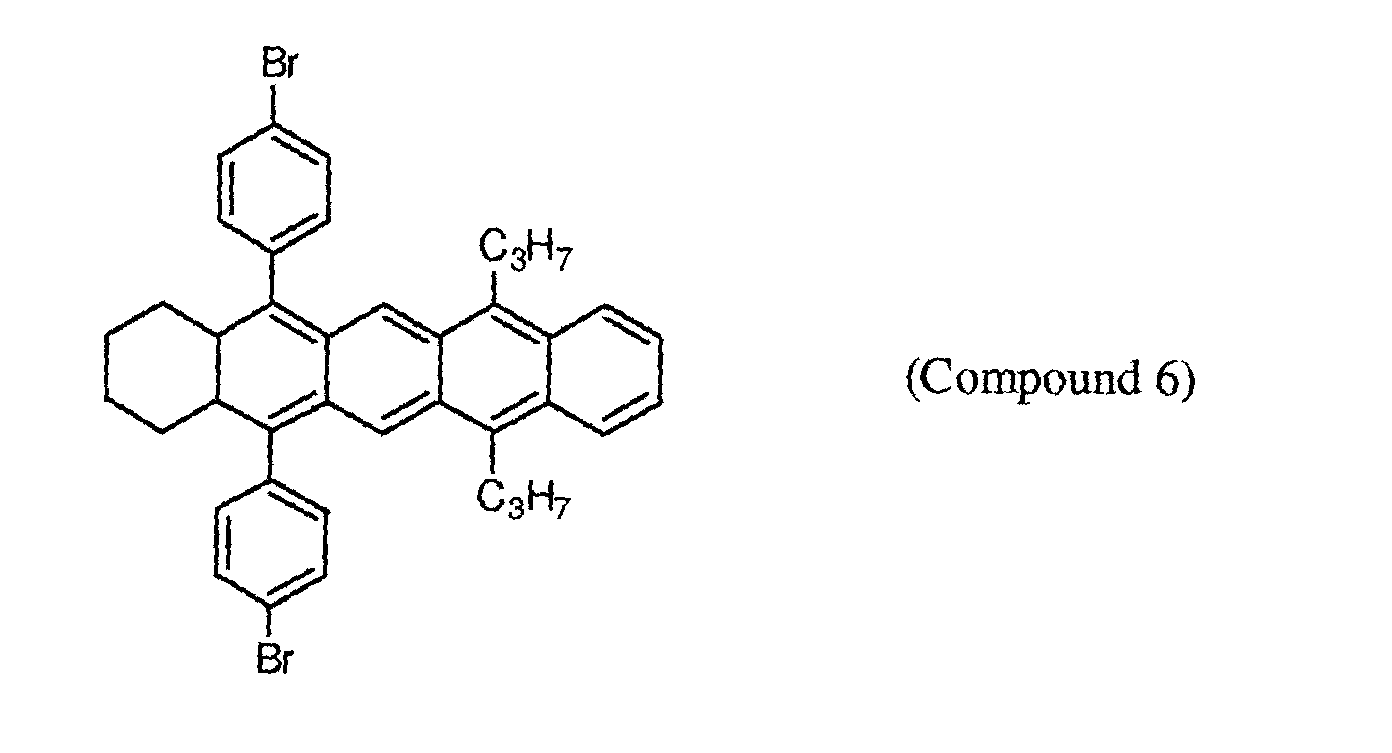
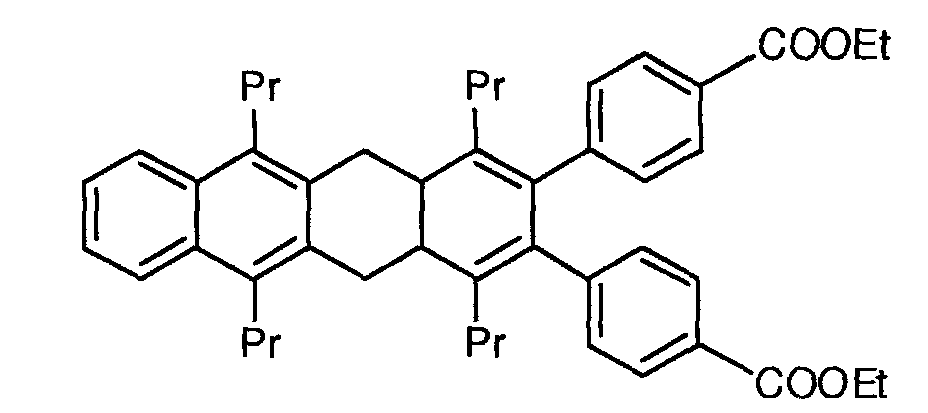
- 0 CCCC(C)(C(c1ccc(*)cc1)C(c1ccc(*)cc1)=C(CCC)C1C#CC2(C)C3C(C)CC)C1=CC2=C(CCC)c1c3cccc1 Chemical compound CCCC(C)(C(c1ccc(*)cc1)C(c1ccc(*)cc1)=C(CCC)C1C#CC2(C)C3C(C)CC)C1=CC2=C(CCC)c1c3cccc1 0.000 description 4
Classifications
-
- H—ELECTRICITY
- H05—ELECTRIC TECHNIQUES NOT OTHERWISE PROVIDED FOR
- H05B—ELECTRIC HEATING; ELECTRIC LIGHT SOURCES NOT OTHERWISE PROVIDED FOR; CIRCUIT ARRANGEMENTS FOR ELECTRIC LIGHT SOURCES, IN GENERAL
- H05B33/00—Electroluminescent light sources
- H05B33/12—Light sources with substantially two-dimensional [2D] radiating surfaces
- H05B33/14—Light sources with substantially two-dimensional [2D] radiating surfaces characterised by the chemical or physical composition or the arrangement of the electroluminescent material, or by the simultaneous addition of the electroluminescent material in or onto the light source
-
- C—CHEMISTRY; METALLURGY
- C09—DYES; PAINTS; POLISHES; NATURAL RESINS; ADHESIVES; COMPOSITIONS NOT OTHERWISE PROVIDED FOR; APPLICATIONS OF MATERIALS NOT OTHERWISE PROVIDED FOR
- C09K—MATERIALS FOR MISCELLANEOUS APPLICATIONS, NOT PROVIDED FOR ELSEWHERE
- C09K11/00—Luminescent materials, e.g. electroluminescent or chemiluminescent
- C09K11/06—Luminescent materials, e.g. electroluminescent or chemiluminescent containing organic luminescent materials
-
- C—CHEMISTRY; METALLURGY
- C07—ORGANIC CHEMISTRY
- C07C—ACYCLIC OR CARBOCYCLIC COMPOUNDS
- C07C15/00—Cyclic hydrocarbons containing only six-membered aromatic rings as cyclic parts
- C07C15/20—Polycyclic condensed hydrocarbons
- C07C15/38—Polycyclic condensed hydrocarbons containing four rings
-
- C—CHEMISTRY; METALLURGY
- C07—ORGANIC CHEMISTRY
- C07C—ACYCLIC OR CARBOCYCLIC COMPOUNDS
- C07C17/00—Preparation of halogenated hydrocarbons
- C07C17/093—Preparation of halogenated hydrocarbons by replacement by halogens
- C07C17/16—Preparation of halogenated hydrocarbons by replacement by halogens of hydroxyl groups
-
- C—CHEMISTRY; METALLURGY
- C07—ORGANIC CHEMISTRY
- C07C—ACYCLIC OR CARBOCYCLIC COMPOUNDS
- C07C17/00—Preparation of halogenated hydrocarbons
- C07C17/26—Preparation of halogenated hydrocarbons by reactions involving an increase in the number of carbon atoms in the skeleton
- C07C17/263—Preparation of halogenated hydrocarbons by reactions involving an increase in the number of carbon atoms in the skeleton by condensation reactions
- C07C17/266—Preparation of halogenated hydrocarbons by reactions involving an increase in the number of carbon atoms in the skeleton by condensation reactions of hydrocarbons and halogenated hydrocarbons
-
- C—CHEMISTRY; METALLURGY
- C07—ORGANIC CHEMISTRY
- C07C—ACYCLIC OR CARBOCYCLIC COMPOUNDS
- C07C17/00—Preparation of halogenated hydrocarbons
- C07C17/35—Preparation of halogenated hydrocarbons by reactions not affecting the number of carbon or of halogen atoms in the reaction
- C07C17/357—Preparation of halogenated hydrocarbons by reactions not affecting the number of carbon or of halogen atoms in the reaction by dehydrogenation
-
- C—CHEMISTRY; METALLURGY
- C07—ORGANIC CHEMISTRY
- C07C—ACYCLIC OR CARBOCYCLIC COMPOUNDS
- C07C25/00—Compounds containing at least one halogen atom bound to a six-membered aromatic ring
- C07C25/18—Polycyclic aromatic halogenated hydrocarbons
- C07C25/22—Polycyclic aromatic halogenated hydrocarbons with condensed rings
-
- C—CHEMISTRY; METALLURGY
- C07—ORGANIC CHEMISTRY
- C07C—ACYCLIC OR CARBOCYCLIC COMPOUNDS
- C07C43/00—Ethers; Compounds having groups, groups or groups
- C07C43/02—Ethers
- C07C43/03—Ethers having all ether-oxygen atoms bound to acyclic carbon atoms
- C07C43/14—Unsaturated ethers
- C07C43/164—Unsaturated ethers containing six-membered aromatic rings
-
- C—CHEMISTRY; METALLURGY
- C07—ORGANIC CHEMISTRY
- C07C—ACYCLIC OR CARBOCYCLIC COMPOUNDS
- C07C67/00—Preparation of carboxylic acid esters
- C07C67/30—Preparation of carboxylic acid esters by modifying the acid moiety of the ester, such modification not being an introduction of an ester group
- C07C67/317—Preparation of carboxylic acid esters by modifying the acid moiety of the ester, such modification not being an introduction of an ester group by splitting-off hydrogen or functional groups; by hydrogenolysis of functional groups
-
- C—CHEMISTRY; METALLURGY
- C07—ORGANIC CHEMISTRY
- C07C—ACYCLIC OR CARBOCYCLIC COMPOUNDS
- C07C67/00—Preparation of carboxylic acid esters
- C07C67/30—Preparation of carboxylic acid esters by modifying the acid moiety of the ester, such modification not being an introduction of an ester group
- C07C67/333—Preparation of carboxylic acid esters by modifying the acid moiety of the ester, such modification not being an introduction of an ester group by isomerisation; by change of size of the carbon skeleton
- C07C67/343—Preparation of carboxylic acid esters by modifying the acid moiety of the ester, such modification not being an introduction of an ester group by isomerisation; by change of size of the carbon skeleton by increase in the number of carbon atoms
- C07C67/347—Preparation of carboxylic acid esters by modifying the acid moiety of the ester, such modification not being an introduction of an ester group by isomerisation; by change of size of the carbon skeleton by increase in the number of carbon atoms by addition to unsaturated carbon-to-carbon bonds
-
- C—CHEMISTRY; METALLURGY
- C07—ORGANIC CHEMISTRY
- C07C—ACYCLIC OR CARBOCYCLIC COMPOUNDS
- C07C69/00—Esters of carboxylic acids; Esters of carbonic or haloformic acids
- C07C69/76—Esters of carboxylic acids having a carboxyl group bound to a carbon atom of a six-membered aromatic ring
-
- H—ELECTRICITY
- H10—SEMICONDUCTOR DEVICES; ELECTRIC SOLID-STATE DEVICES NOT OTHERWISE PROVIDED FOR
- H10K—ORGANIC ELECTRIC SOLID-STATE DEVICES
- H10K85/00—Organic materials used in the body or electrodes of devices covered by this subclass
- H10K85/60—Organic compounds having low molecular weight
- H10K85/615—Polycyclic condensed aromatic hydrocarbons, e.g. anthracene
- H10K85/622—Polycyclic condensed aromatic hydrocarbons, e.g. anthracene containing four rings, e.g. pyrene
-
- H—ELECTRICITY
- H10—SEMICONDUCTOR DEVICES; ELECTRIC SOLID-STATE DEVICES NOT OTHERWISE PROVIDED FOR
- H10K—ORGANIC ELECTRIC SOLID-STATE DEVICES
- H10K85/00—Organic materials used in the body or electrodes of devices covered by this subclass
- H10K85/60—Organic compounds having low molecular weight
- H10K85/615—Polycyclic condensed aromatic hydrocarbons, e.g. anthracene
- H10K85/623—Polycyclic condensed aromatic hydrocarbons, e.g. anthracene containing five rings, e.g. pentacene
-
- C—CHEMISTRY; METALLURGY
- C07—ORGANIC CHEMISTRY
- C07C—ACYCLIC OR CARBOCYCLIC COMPOUNDS
- C07C2603/00—Systems containing at least three condensed rings
- C07C2603/02—Ortho- or ortho- and peri-condensed systems
- C07C2603/40—Ortho- or ortho- and peri-condensed systems containing four condensed rings
- C07C2603/42—Ortho- or ortho- and peri-condensed systems containing four condensed rings containing only six-membered rings
- C07C2603/44—Naphthacenes; Hydrogenated naphthacenes
-
- C—CHEMISTRY; METALLURGY
- C09—DYES; PAINTS; POLISHES; NATURAL RESINS; ADHESIVES; COMPOSITIONS NOT OTHERWISE PROVIDED FOR; APPLICATIONS OF MATERIALS NOT OTHERWISE PROVIDED FOR
- C09K—MATERIALS FOR MISCELLANEOUS APPLICATIONS, NOT PROVIDED FOR ELSEWHERE
- C09K2211/00—Chemical nature of organic luminescent or tenebrescent compounds
- C09K2211/10—Non-macromolecular compounds
- C09K2211/1003—Carbocyclic compounds
-
- C—CHEMISTRY; METALLURGY
- C09—DYES; PAINTS; POLISHES; NATURAL RESINS; ADHESIVES; COMPOSITIONS NOT OTHERWISE PROVIDED FOR; APPLICATIONS OF MATERIALS NOT OTHERWISE PROVIDED FOR
- C09K—MATERIALS FOR MISCELLANEOUS APPLICATIONS, NOT PROVIDED FOR ELSEWHERE
- C09K2211/00—Chemical nature of organic luminescent or tenebrescent compounds
- C09K2211/10—Non-macromolecular compounds
- C09K2211/1003—Carbocyclic compounds
- C09K2211/1011—Condensed systems
-
- H—ELECTRICITY
- H10—SEMICONDUCTOR DEVICES; ELECTRIC SOLID-STATE DEVICES NOT OTHERWISE PROVIDED FOR
- H10K—ORGANIC ELECTRIC SOLID-STATE DEVICES
- H10K50/00—Organic light-emitting devices
- H10K50/10—OLEDs or polymer light-emitting diodes [PLED]
- H10K50/11—OLEDs or polymer light-emitting diodes [PLED] characterised by the electroluminescent [EL] layers
-
- H—ELECTRICITY
- H10—SEMICONDUCTOR DEVICES; ELECTRIC SOLID-STATE DEVICES NOT OTHERWISE PROVIDED FOR
- H10K—ORGANIC ELECTRIC SOLID-STATE DEVICES
- H10K50/00—Organic light-emitting devices
- H10K50/10—OLEDs or polymer light-emitting diodes [PLED]
- H10K50/14—Carrier transporting layers
Definitions
- the present invention relates to materials for organic electroluminescent elements and organic electroluminescent elements.
- organic electroluminescent elements using organic compounds as luminescent materials were developed [Appl. Phys. Lett., 51 , 913 (1987)].
- An organic electroluminescent element is an element having the structure that a thin film containing a fluorescent organic compound is sandwiched between an anode and a cathode, in which electrons and holes are injected into the thin film for recombination to generate excitons, and the light released when the excitons are inactivated is utilized to emit light.
- the organic electroluminescent element enables to emit light with a low voltage of direct current of several to several tens and by selecting the kind of fluorescent organic compounds, are capable of emitting various colors (e.g., red, blue and green colors).
- the organic electroluminescent element having such features are expected to be applied for various luminescent elements, display devices, etc. In general, however, organic electroluminescent elements encounter disadvantages such as poor stability or durability, etc. In addition, these elements are poor in luminance and insufficient for practical applications.
- organic electroluminescent elements that in the luminescent layer bis(2-methyl-8-quinolinolato)(4-phenylphenolato)aluminum was used as a host compound and an acridone derivative (e.g., N-methyl-2-methoxyacridone) was used as a guest compound were proposed (Japanese Laid-Open Publication No. H08-67873). However, it is hard to say that these electroluminescent elements have a sufficient luminance. Now, a more improved organic electroluminescent element has been desired.
- An object of the present invention is to provide a material for an organic electroluminescent element and the organic electroluminescent element, which is excellent in stability, durability, luminance and luminance efficiency.
- the present inventors have made extensive investigations on materials for organic electroluminescent elements and as a result, have come to accomplish the present invention.
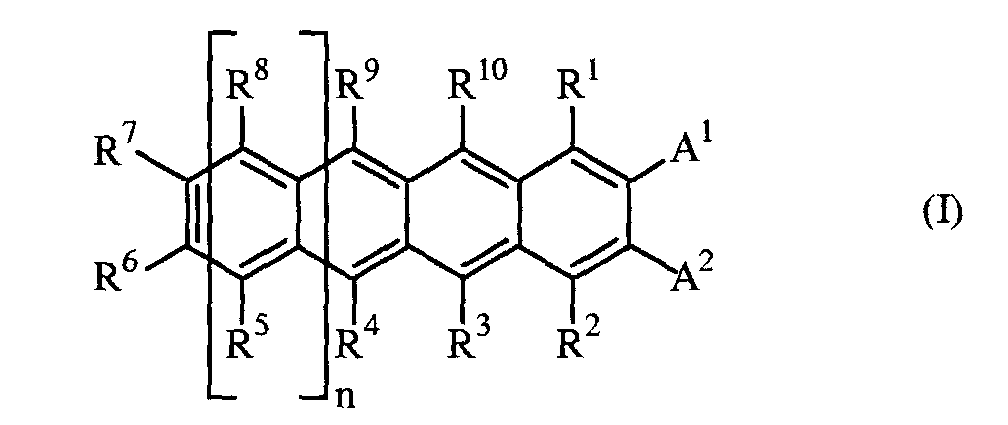
- the present invention provides a material for the organic electroluminescent element selected from a polyacene derivative represented by general formula (I) below:
- a material for the organic electroluminescent element selected from a polyacene derivative represented by general formula (I) below:
- R 1 , R 2 , R 3 , R 4 , R 5 , R 6 , R 7 , R 8 , R 9 and R 10 which may be the same or different, independently represents hydrogen atom; a C 1 -C 40 hydrocarbon group which may optionally be substituted; a C 1 -C 40 alkoxy group which may optionally be substituted, a C 6 -C 40 aryloxy group which may optionally be substituted; an amino group which may optionally be substituted, hydroxy group, or a silyl group which may optionally be substituted; provided that R 6 and R 7 may be cross-bridged with one another to form a C 4 -C 40 saturated or unsaturated ring, and the saturated or unsaturated ring may be intervene
- the present invention further provides the material for organic electroluminescent elements described above, which is represented by general formula (I) wherein n is 1 or 2; when n is 1, the following cases are excluded:
- the present invention further provides the materials for organic electroluminescent elements selected from the polyacene derivatives that in the formula (I), at least 5 of R 1 , R 2 , R 3 , R 4 , R 5 , R 6 , R 7 , R 8 , R 9 , R 10 , A 1 and A 2 are groups other than hydrogen atom.
- the present invention still further provides the materials for organic electroluminescent elements selected from the polyacene derivatives that in the formula (I), at least 6 of R 1 , R 2 , R 3 , R 4 , R 5 , R 6 , R 7 , R 8 , R 9 , R 10 , A 1 and A 2 are groups other than hydrogen atom.
- the present invention still further provides the material for organic electroluminescent elements selected from the polyacene derivatives that the polyacene derivatives are pentacene derivatives represented by the formula (Ia) above wherein at least 5 of R 1 , R 2 , R 3 , R 4 , R 5a , R 5b , R 6 , R 7 , R 8a , R 8b , R 9 , R 10 , A 1 and A 2 are groups other than hydrogen atom.
- the present invention still further provides the materials for organic electroluminescent elements selected from the polyacene derivatives that in the formula (Ia), at least 6 of R 1 , R 2 , R 3 , R 4 , R 5a , R 5b , R 6 , R 7 , R 8a , R 8b , R 9 , R 10 , A 1 and A 2 are groups other than hydrogen atom.
- the present invention still further provides the materials for organic electroluminescent elements selected from the polyacene derivatives that in the formula (Ia), at least 7 of R 1 , R 2 , R 3 , R 4 , R 5a , R 5b , R 6 , R 7 , R 8a , R 8b , R 9 , R 10 , A 1 and A 2 are groups other than hydrogen atom.
- the present invention still further provides the materials for organic electroluminescent elements selected from the polyacene derivatives that in the formula (Ia), at least 8 of R 1 , R 2 , R 3 , R 4 , R 5a , R 5b , R 6 , R 7 , R 8a , R 8b , R 9 , R 10 , A 1 and A 2 are groups other than hydrogen atom.
- the present invention still further provides the materials for organic electroluminescent elements selected from the polyacene derivatives that in the formula (Ia), at least 9 of R 1 , R 2 , R 3 , R 4 , R 5a , R 5b , R 6 , R 7 , R 8a , R 8b , R 9 , R 10 , A 1 and A 2 are groups other than hydrogen atom.
- the present invention still further provides the materials for organic electroluminescent elements selected from the polyacene derivatives that in the formula (Ia), at least 10 of R 1 , R 2 , R 3 , R 4 , R 5a , R 5b , R 6 , R 7 , R 8a , R 8b , R 9 , R 10 , A 1 and A 2 are groups other than hydrogen atom.
- the present invention still further provides the materials for organic electroluminescent elements selected from the polyacene derivatives that in the formula (I), any combination of R 1 and R 2 , R 3 and R 10 , R 4 and R 9 , R 5 and R 8 , R 6 and R 7 as well as A 1 and A 2 is the same substituent.
- the present invention still further provides the materials for organic electroluminescent elements selected from the polyacene derivatives that in the formula (Ia), any combination of R 1 and R 2 , R 3 and R 10 , R 4 and R 9 , R 5a and R 8a , R 5b and R 8b , R 6 and R 7 as well as A 1 and A 2 is the same substituent.
- the present invention still further provides the materials for organic electroluminescent elements selected from the polyacene derivatives that in the formula (I), any one of R 1 , R 2 , R 3 , R 4 , R 5 , R 6 , R 7 , R 8 , R 9 and R 10 is a C 1 -C 40 hydrocarbon group which may optionally be substituted; a C 1 -C 40 alkoxy group which may optionally be substituted, or a C 6 -C 40 aryloxy group which may optionally be substituted.
- the present invention still further provides the materials for organic electroluminescent elements selected from the polyacene derivatives that in the formula (Ia), any one of R 1 , R 2 , R 3 , R 4 , R 5a , R 5b , R 6 , R 7 , R 8a , R 8b , R 9 and R 10 is a C 1 -C 40 hydrocarbon group which may optionally be substituted; a C 1 -C 40 alkoxy group which may optionally be substituted, or a C 6 -C 40 aryloxy group which may optionally be substituted.
- the present invention still further provides the materials for organic electroluminescent elements selected from the polyacene derivatives that in the formula (I), R 1 , R 2 , R 4 and R 9 , which may be the same or different, independently represents a C 1 -C 40 alkyl group which may optionally be substituted or a C 6 -C 18 aryl group which may optionally be substituted; A 1 and A 2 , which may be the same or different, independently represents a C 2 -C 40 alkoxycarbonyl group which may optionally be substituted; and n is 1.
- the present invention still further provides the materials for organic electroluminescent elements selected from the polyacene derivatives that in the formula (I), A 1 , A 2 , R 1 , R 2 , R 4 and R 9 , which may be the same or different, independently represents a C 1 -C 40 alkyl group which may optionally be substituted or a C 6 -C 18 aryl group which may optionally be substituted; and n is 1.
- the present invention still further provides the materials for organic electroluminescent elements selected from the polyacene derivatives that in the formula (I), R 3 , R 5 , R 6 , R 7 , R 8 and R 10 , which may be the same or different, independently represents a C 1 -C 40 alkyl group which may optionally be substituted or a C 6 -C 18 aryl group which may optionally be substituted; A 1 and A 2 , which may be the same or different, independently represents a halogen atom; and n is 1.
- the present invention still further provides the materials for organic electroluminescent elements selected from the polyacene derivatives that, when the polyacene derivatives are the pentacene derivatives represented by the formula (Ia) above, A 1 and A 2 represent a C 2 -C 40 alkoxycarbonyl group which may optionally be substituted, and R 1 , R 2 , R 4 , R 5b , R 6 , R 7 , R 8b , R 9 represent a C 1 -C 40 alkyl group which may optionally be substituted, or a C 6 -C 18 aryl group which may optionally be substituted.
- the present invention still further provides the materials for organic electroluminescent elements selected from the polyacene derivatives that, when the polyacene derivatives are the pentacene derivatives represented by the formula (Ia) above, A 1 , A 2 , R 1 , R 2 , R 4 , R 5b , R 6 , R 7 , R 8b , R 9 represent a C 1 -C 40 alkyl group which may optionally be substituted or a C 6 -C 18 aryl group which may optionally be substituted.
- the present invention still further provides the materials for organic electroluminescent elements selected from the polyacene derivatives, when the polyacene derivatives are the pentacene derivatives represented by the formula (Ia) above, A 1 and A 2 represent a halogen atom and, R 3 , R 5a , R 8a and R 10 represent a C 1 -C 40 alkyl group which may optionally be substituted or a C 6 -C 18 aryl group which may optionally be substituted.
- the present invention still further provides the organic electroluminescent elements comprising a pair of electrodes and at least one layer containing at least one of the polyacene derivatives above, which is sandwiched between the electrodes.
- the present invention still further provides the organic electroluminescent element s, wherein the layer containing at least one of the polyacene derivatives is a luminescent layer.
- the present invention still further provides the organic electroluminescent element s, wherein the layer containing at least one of the polyacene derivatives is a hole injection transport layer.
- the present invention still further provides the organic electroluminescent elements, wherein the layer containing at least one of the polyacene derivatives is an electron injection transport layer.
- the present invention still further provides the organic electroluminescent elements, which further contains at least one of a polycyclic aromatic compound, a luminescent organic metal-complex or a triarylamine derivative.
- the present invention still further provides the organic electroluminescent elements, wherein 0.1 to 40% by weight of the polyacene derivatives described above is contained in at least one layer.
- the material for organic electroluminescent element of the present invention is the polyacene derivative represented by general formula (I).
- the organic electroluminescent element of the present invention comprises a pair of electrodes and at least one of the polyacene derivatives represented by general formula (I), sandwiched between the electrodes.
- the polyacene derivative represented by general formula (I) which is the material for the organic electroluminescent element of the present invention (hereinafter also simply referred to as the polyacene derivative), has the polyacene structure represented by general formula (I): [wherein R 1 , R 2 , R 3 , R 4 , R 5 , R 6 , R 7 , R 8 , R 9 , R 10 , A 1 and A 2 have the same significance as described above].
- R 1 , R 2 , R 3 , R 4 , R 5 , R 6 , R 7 , R 8 , R 9 and R 10 which may be the same or different, independently represents hydrogen atom; a C 1 -C 40 hydrocarbon group which may optionally be substituted; a C 1 -C 40 alkoxy group which may optionally be substituted, a C 6 -C 40 aryloxy group which may optionally be substituted; amino group, hydroxy group or a silyl group.
- the C 1 -C 40 hydrocarbon group may be a saturated or unsaturated non-cyclic group, or may be a saturated or unsaturated cyclic group.
- the C 1 -C 40 hydrocarbon group may be linear or branched.
- the C 1 -C 40 hydrocarbon group includes a C 1 -C 40 alkyl group, a C 2 -C 40 alkenyl group, a C 2 -C 40 alkynyl group, a C 3 -C 40 allyl group, a C 4 -C 40 alkyldienyl group, a C 4 -C 40 polyenyl group, a C 6 -C 18 aryl group, a C 6 -C 40 alkylaryl group, a C 6 -C 40 arylalkyl group, a C 4 -C 40 cycloalkyl group, a C 4 -C 40 cycloalkenyl group, and the like.
- the C 1 -C 40 alkyl group, C 2 -C 40 alkenyl group, C 2 -C 40 alkynyl group, C 3 -C 40 allyl group, C 4 -C 40 alkyldienyl group and C 4 -C 40 polyenyl group are preferably a C 1 -C 20 alkyl group, a C 2 -C 20 alkenyl group, a C 2 -C 20 alkynyl group, a C 3 -C 20 allyl group, a C 4 -C 20 alkyldienyl group and a C 4 -C 20 polyenyl group, respectively, and more preferably, a C 1 -C 10 alkyl group, a C 2 -C 10 alkenyl group, a C 2 -C 10 alkynyl group, a C 3 -C 10 allyl group, a C 4 -C 10 alkyldienyl group and a C 4 -C 10 polyenyl
- alkyl group useful for practicing the present invention which may optionally be substituted include, but not limited to, methyl, ethyl, propyl, n-butyl, t-butyl, dodecanyl, trifluoromethyl, perfluoro-n-butyl, 2,2,2-trifluoroethyl, benzyl, 2-phenoxyethyl, and the like.
- aryl group useful for practicing the present invention which may optionally be substituted include, but not limited to, phenyl, 2-tolyl, 3-tolyl, 4-tolyl, naphthyl, biphenyl, 4-phenoxyphenyl, 4-fluorophenyl, 3-carbomethoxyphenyl, 4-carbomethoxyphenyl, etc.
- alkoxy group useful for practicing the present invention which may optionally be substituted include, but not limited to, methoxy, ethoxy, 2-methoxyethoxy, t-butoxy, etc.
- aryloxy group useful for practicing the present invention, which may optionally be substituted include, but not limited to, phenoxy, naphthoxy, phenylphenoxy, 4-methylphenoxy, etc.
- amino group useful for practicing the present invention which may optionally be substituted include, but not limited to, amino, dimethylamino, methylamino, methylphenylamino, phenylamino, etc.
- the silyl group which may optionally be substituted include group s represented by formula: -Si(R 12 )(R 13 )(R 14 ) [wherein R 12 , R 13 and R 14 , which may be the same or different, independently represents a C 1 -C 40 alkyl group which may optionally be substituted with a halogen atom; a C 6 -C 40 arylalkyl group which may optionally be substituted with a halogen atom; a C 1 -C 40 alkoxy group which may optionally be substituted with a halogen atom; or a C 6 -C 40 arylalkyloxy group which may optionally be substituted with a halogen atom].
- silyl group useful for practicing the present invention which may optionally be substituted include, but not limited to, trimethylsilyl, triethylsilyl, trimethoxysilyl, triethoxysilyl, diphenylmethylsilyl, triphenylsilyl, triphenoxysilyl, dimethylmethoxysilyl, dimethylphenoxysilyl, methylmethoxyphenyl, etc.
- the C 1 -C 40 hydrocarbon group, C 1 -C 40 alkoxy group, C 6 -C 40 aryloxy group, amino group, silyl group, etc. may optionally be substituted with a substituent and the substituent are a halogen atom, hydroxy group, amino group, etc.
- halogen atom examples include fluorine atom, chlorine atom, bromine atom and iodine atom.
- the hydrogen atom(s) of the C 1 -C 40 hydrocarbon group, C 1 -C 40 alkoxy group, C 6 -C 40 aryloxy group, etc. are substituted with fluorine atom(s), the solubility of the polyacene derivatives increases, which is preferred.
- R 6 and R 7 may be cross-bridged with each other to form a C 4 -C 40 saturated or unsaturated ring.
- the unsaturated ring may be an aromatic ring such as a benzene ring, etc.
- the ring formed by linking R 6 and R 7 together is preferably a 4-membered ring to a 16-membered ring, more preferably a 4-membered ring to a 12-membered ring.
- the ring may be an aromatic ring or an aliphatic ring.
- a substituent such as a C 1 -C 20 hydrocarbon group, a C 1 -C 20 alkoxy group, a C 6 -C 20 aryloxy group, amino group, hydroxy group or silyl group, etc. may be introduced.
- the saturated or unsaturated ring may be intervened by oxygen atom, sulfur atom or a group shown by formula: -N(R 11 )- [wherein R 11 is hydrogen atom or a hydrocarbon group].
- R 11 is hydrogen atom or a C 1 -C 6 alkyl group, and more preferably, hydrogen atom or a C 1 -C 4 alkyl group.
- a 1 and A 2 is the alkoxycarbonyl group
- the groups can be converted into carboxy group in a conventional manner of the organic chemistry.
- n is an integer of 1 or more.
- the derivative becomes a 4-membered ring and 5- membered ring, that is, a naphthacene derivative and a pentacene derivative, respectively, etc.
- n is not limited to 1 and 2 but may be an integer of 3 or more, an integer of 4 or more, or an integer of 5 or more.
- n may be 200 or less, 100 or less, 80 or less, 50 or less, 30 or less, 20 or less, 15 or less, or 10 or less. For example, since the number of n increases by 2 at a time by applying the process described below, this scheme may be repeated. As described above, by adequately introducing substituents the solubility can be maintained so that the number of n can be increased.
- the materials for organic electroluminescent elements selected from the polyacene derivatives of formula (I) described above wherein R 1 , R 2 , R 3 , R 4 , R 5 , R 6 , R 7 , R 8 , R 9 , R 10 , A 1 and A 2 are all hydrogen atoms are not included.
- the materials for organic electroluminescent elements selected from the polyacene derivatives of formula (I) described above wherein R 7 and A 1 are methoxy groups or A 2 and R 6 are methoxy groups are not included, either.
- n is 1 in the formula (I) above
- at least R 1 , R 2 , R 4 and R 9 are groups other than hydrogen atom
- at least R 3 , R 5 , R 8 and R 10 are groups other than hydrogen atom.
- the materials for organic electroluminescent elements selected from the polyacene derivatives of the formula (I) above wherein, when n is 1, at least R 3 and R 10 , or R 4 and R 9 are an aryl group which may optionally be substituted are not included in the present invention.
- n is 2 in the formula (I) described above and the formula (I) above is pentacene derivatives represented by the formula (Ia) below: [wherein R 1 , R 2 , R 3 , R 4 , R 5a , R 5b , R 6 , R 7 , R 8a , R 8b , R 9 , R 10 , A 1 and A 2 have the same significance as described above, respectively].
- the materials for organic electroluminescent elements selected from the pentacene derivatives wherein at least one of R 1 , R 2 , R 3 , R 4 , R 5a , R 5b , R 6 , R 7 , R 8a , R 8b , R 9 , R 10 , A 1 and A 2 is a diarylamine group are not included.
- the polyacene derivatives represented by the formula (I) above wherein n is 1 are not intended to include the case wherein R 1 , R 2 , R 3 , R 4 , R 5 , R 6 , R 7 , R 8 , R 9 , R 10 , A 1 and A 2 are all methyl groups; the case wherein R 3 , R 4 , R 9 and R 10 are all aryl groups and R 1 , R 2 , R 5 , R 6 , R 7 , R 8 , A 1 and A 2 are all hydrogen atoms; the case wherein R 1 , R 2 , R 4 and R 9 are all alkoxy groups or aryloxy groups and R 3 , R 5 , R 6 , R 7 , R 8 , R 10 , A 1 and A 2 are all hydrogen atoms; and the case wherein R 3 , R 5 , R 8 and R 10 are all alkoxy groups or aryloxy groups and R 1 , R 2 , R 4
- polyacene derivatives represented by the formula (I) above wherein n is 2 are not intended to include the cases of (a'), (b'), (c') and (d').
- the polyacene derivatives represented by the formula (I) described above are preferably those wherein at least 5 of R 1 , R 2 , R 3 , R 4 , R 5 , R 6 , R 7 , R 8 , R 9 , R 10 , A 1 and A 2 are groups other than hydrogen atom, more preferably at least 6 of them are groups other than hydrogen atom, and most preferably at least 8 of them are groups other than hydrogen atom.
- the polyacene derivatives represented by the formula (I) above wherein the substituents are the same in any combination of R 1 and R 2 , R 3 and R 10 , R 4 and R 9 , R 5 and R 8 , R 6 and R 7 as well as A 1 and A 2 are preferred, and more preferably, the substituents are the same in all of the respective combinations. This is because synthesis of such polyacene derivatives becomes easy and the yield is improved.
- the polyacene derivatives represented by the formula (Ia) above preferred are the polyacene derivatives wherein the substituents are the same in any combination of R 1 and R 2 , R 3 and R 10 , R 4 and R 9 , R 5a and R 8a , R 5b and R 8b , R 6 and R 7 as well as A 1 and A 2 . More preferably, the substituents are the same in any of the respective combinations.
- a 1 and A 2 may be an alkoxycarbonyl group, and R 1 , R 2 , R 4 and R 9 may be an alkyl or aryl group. Also when n is 1, A 1 , A 2 , R 1 , R 2 , R 4 and R 9 may be an alkyl or aryl group. Further when n is 1, A 1 and A 2 are a halogen atom and R 3 , R 5 , R 6 , R 7 , R 8 and R 10 may be an alkyl or aryl group.
- a 1 and A 2 may be an alkoxycarbonyl group and R 1 , R 2 , R 4 , R 5b , R 6 , R 7 , R 8b and R 9 may be an alkyl or aryl group.
- a 1 , A 2 , R 1 , R 2 , R 4 , R 5b , R 6 , R 7 , R 8b and R 9 may be an alkyl or aryl group.
- a 1 and A 2 may be a halogen atom and R 3 , R 5a , R 8a and R 10 may be an alkyl or aryl group.
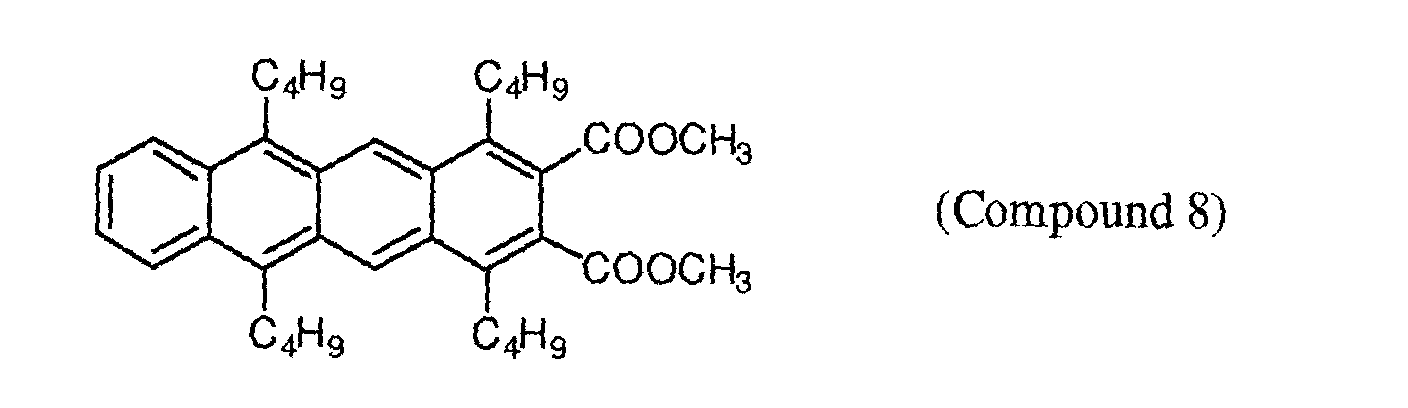
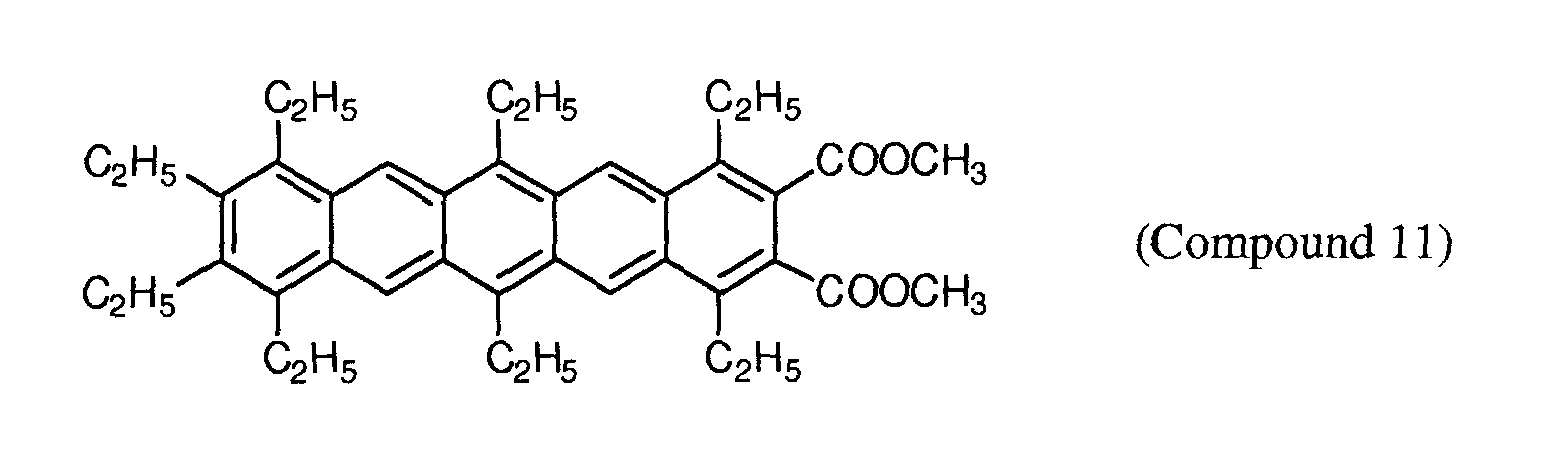
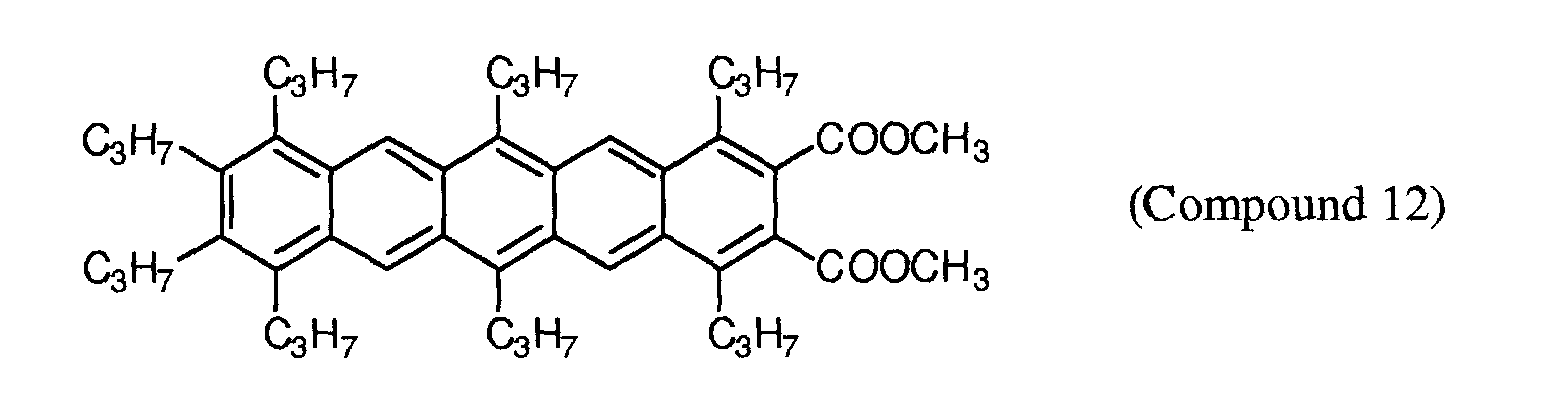
- polyacene derivatives of general formula (I), which are the materials for organic electroluminescent elements of the present invention are listed below.
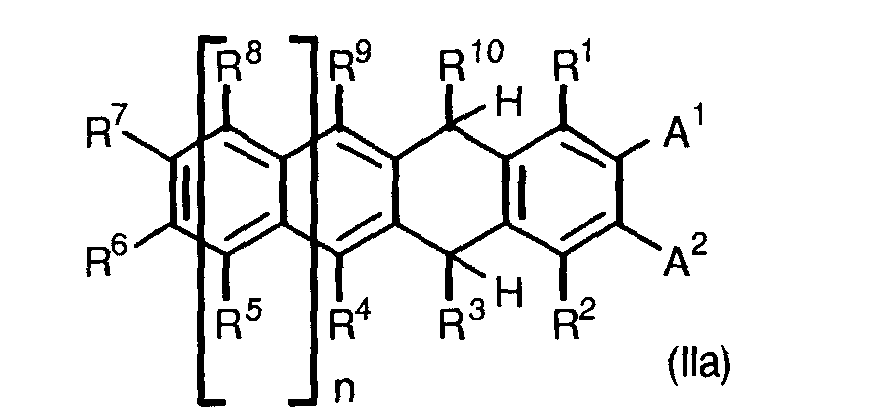
- hydrocarbon condensed rings represented by formula (II) above include, e.g., the following hydrocarbon condensed rings represented by (IIa), (IIb) and (IIc), depending on the kind of bonding: [wherein R 1 , R 2 , R 3 , R 4 , R 5 , R 5a , R 5b , R 6 , R 7 , R 8 , R 8a , R 8b , R 9 , R 10 , A 1 , A 2 , and n have the same significance as described above].
- n is an odd number and the hydrocarbon condensed rings represented by formula (II) described above are those represented by formula (IIb) above, k is an integer shown by (n+1)/2, and when n is an even number and the hydrocarbon condensed rings represented by formula (II) described above are those represented by formula (IIc) above, m is an integer shown by n/2.
- hydrocarbon condensed rings represented by formula (IIa) it means that one ring is aromatized.
- hydrocarbon condensed rings represented by formula (IIb) and formula (IIc) it means that two or more rings are aromatized.
- hydrocarbon condensed rings represented by formula (II) further include the cases wherein the rings in a repeating unit being an aromatic ring and a non-aromatic ring are repeated at random.
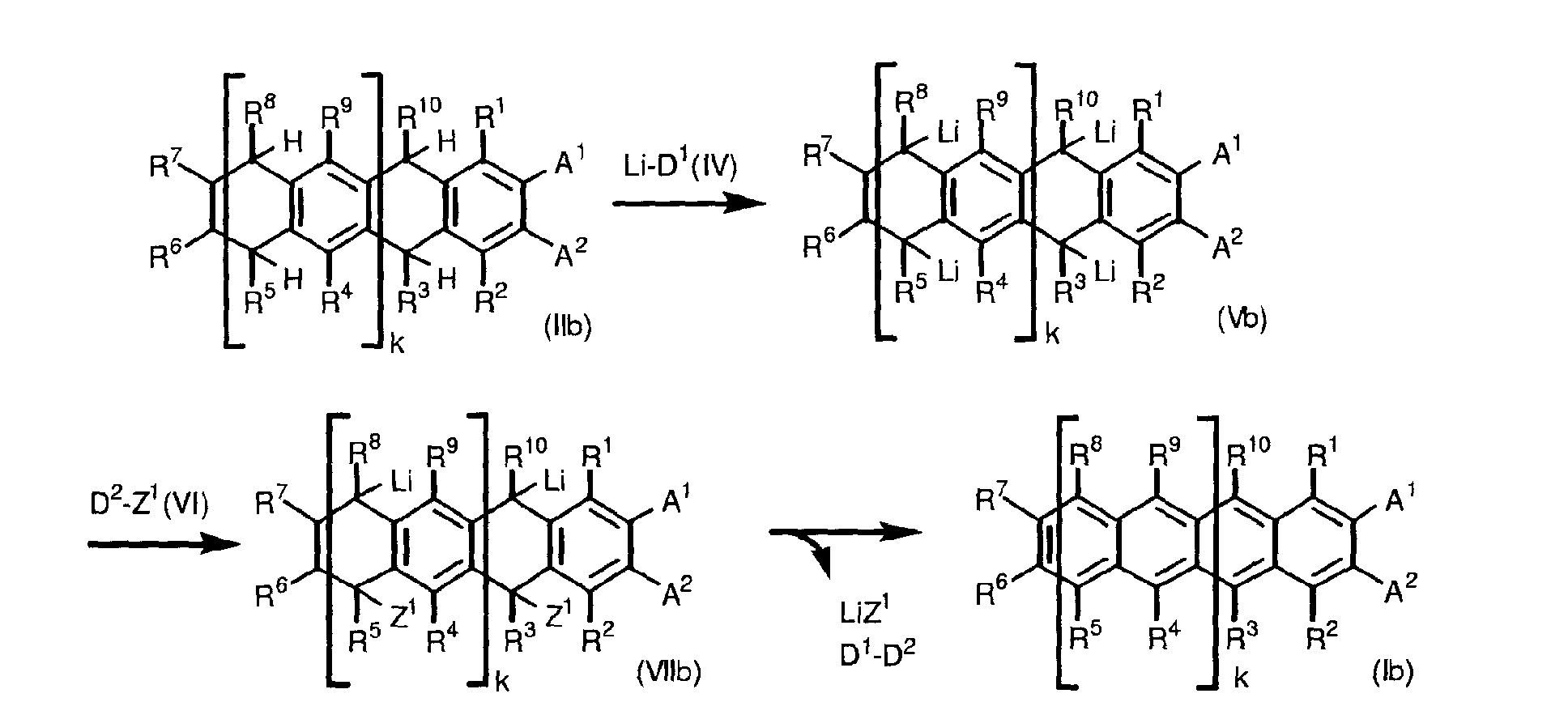
- the dehydrogenation reagent is preferably a combination of a lithium dopant and a lithium-removing reagent. It is preferred to add the lithium dopant first to the hydrocarbon condensed rings followed by adding the lithium-removing reagent thereto.
- R 3 and R 10 in the formula (IIa) are preferably hydrogen atoms, in view of easy synthesis of the polyacene derivatives.
- R 1 , R 2 , R 3 , R 4 , R 5 , R 6 , R 7 , R 8 , R 9 , R 10 , A 1 , A 2 , and k have the same significance as described above;
- D 1 represents a nucleophilic group such as a C 1 -C 6 alkyl group, etc.;
- D 2 represents a C 1 -C 20 hydrocarbon group such as a C 1 -C 6 alkyl group, etc.;
- Z 1 represents an leaving group such as a halogen atom, etc.].
- R 3 , R 5 , R 8 and R 10 in the formula (IIb) are preferably hydrogen atoms, in view of easy synthesis of the polyacene derivatives.
- R 1 , R 2 , R 3 , R 4 , R 5 , R 6 , R 7 , R 8 , R 9 , R 10 , A 1 , A 2 , and m have the same significance as described above;
- D 1 represents a nucleophilic group such as a C 1 -C 6 alkyl group, etc.;
- D 2 represents a C 1 -C 20 hydrocarbon group such as a C 1 -C 6 alkyl group, etc.;
- Z 1 represents an leaving group such as a halogen atom, etc.].
- R 3 , R 5a , R 8a , R 10 in the formula (IIc) are preferably hydrogen atoms, in view of easy synthesis of the polyacene derivatives.
- the hydrocarbon condensed rings represented by formulae (IIa), (IIb) or (IIc) are employed, for the sake of explanation to clarify the carbon atoms on which the lithium dopant (IV) shown by Li-D 1 acts. It goes without saying that the dehydrogenation reagent in the combination of the lithium dopant and the lithium-removing reagent is widely applicable to the hydrocarbon condensed rings shown by formula (II) described above.
- the lithium dopant (IV) is reacted with the hydrocarbon condensed rings represented by the formulae (IIa), (IIb) and (IIc) to obtain the lithium-doped hydrocarbon condensed rings represented by formulae (Va), (Vb) and (Vc), respectively.
- Preferred lithium dopants include a C 1 -C 20 hydrocarbon lithium such as an alkyl lithium, an aryl lithium, etc.
- a C 1 -C 6 alkyl lithium such as butyl lithium, etc.
- a C 6 -C 20 aryl lithium such as phenyl lithium, etc.
- an activator of the lithium dopant co-exists together with the lithium dopant (IV).
- the activator tertiary amines are preferred and for example, N,N,N',N'-tetraalkylalkylenediamines such as N,N,N',N'-tetramethylethylenediamine (TMEDA) are employed. It is likely that the alkyl lithium would be present in a solution as an oligomer like a tetramer.
- a preferred solvent is an organic solvent.
- a non-polar organic solvent is employed.
- an alkane such as hexane, etc.
- an aromatic compound such as benzene, etc. are preferred.
- a preferred reaction temperature is from 0°C to 200°C, more preferably 20°C to 100°C, and most preferably 30°C to 80°C.
- alkyl halides are advantageously used as the lithium-removing reagent (VI), for example.
- alkyl halides are alkyl halides having 6 or less carbon atoms, such as methyl iodide, ethyl bromide, etc.
- lithium dopant (IV) and the lithium-removing reagent (VI) having less carbon atoms such as butyl lithium and methyl iodide are used as the lithium dopant (IV) and the lithium-removing reagent (VI), respectively
- lithium iodide and hexane will be split off. Hexane can be removed at the same time when the solvent is removed. Lithium iodide can be removed by washing the resulting reaction mixture with water.
- the combination of the lithium dopant and the lithium-removing reagent renders purification of the reaction mixture extremely easy and is desirable.
- the yield of the polyacene derivative represented by formula (I) based on the hydrocarbon condensed rings represented by formula (IIa) is approximately 50%.
- the yield tends to increase. For example, the yield occasionally reaches 90% or more, or sometimes becomes 95% or more.
- the dehydrogenation reagent described above is preferably compounds represented by formula (III) below: [wherein X 1 , X 2 , X 3 and X 4 , which may be the same or different, independently represents a halogen atom or cyano group].
- the halogen atom is preferably chlorine atom, bromine atom or iodine atom, more preferably chlorine atom or bromine atom, and most preferably chlorine atom.
- X 1 , X 2 , X 3 and X 4 may be chlorine atoms. That is, the quinone may be chloranil.
- X 1 and X 2 may be cyano group
- X 3 and X 4 may be chlorine atoms. That is, it may be 2,3-dichloro-5,6-dicyanoquinone.
- X 1 , X 2 , X 3 and X 4 may all be cyano groups. That is, it may be 2,3,5,6-tetracyanoquinone.
- the quinones represented by the formula (III) above may occasionally undergo Diels-Alder reaction with the polyacene derivative products to produce by-products. If desired, the by-products are removed by column chromatography, etc.
- the quinones represented by the formula (III) above are used preferably in 0.9 to 1.2 equivalents, more preferably 0.9 to 1.15 equivalents, and most preferably 0.95 to 1.05 equivalents, based on the compounds represented by formula (II) described above.
- an organic solvent is preferred, and an aromatic compound such as benzene, etc. is particularly preferred.
- the reaction temperature is preferably from -80°C to 200°C, more preferably from 0°C to 100°C, and most preferably from 10°C to 80°C. If desired, the reaction may be carried out under light shielding.
- the dehydrogenation reagent described above includes palladium.
- palladium carried on carbon such as activated carbon, which is commercially available as so-called palladium carbon, may preferably be employed.
- Pd/C is a catalyst that has been widely used for dehydrogenation, and can be used in the present invention as in a conventional manner.
- the reaction temperature is, e.g., from 200 to 500°C. Of course, the reaction temperature may appropriately be set, depending upon various conditions including starting materials, etc.
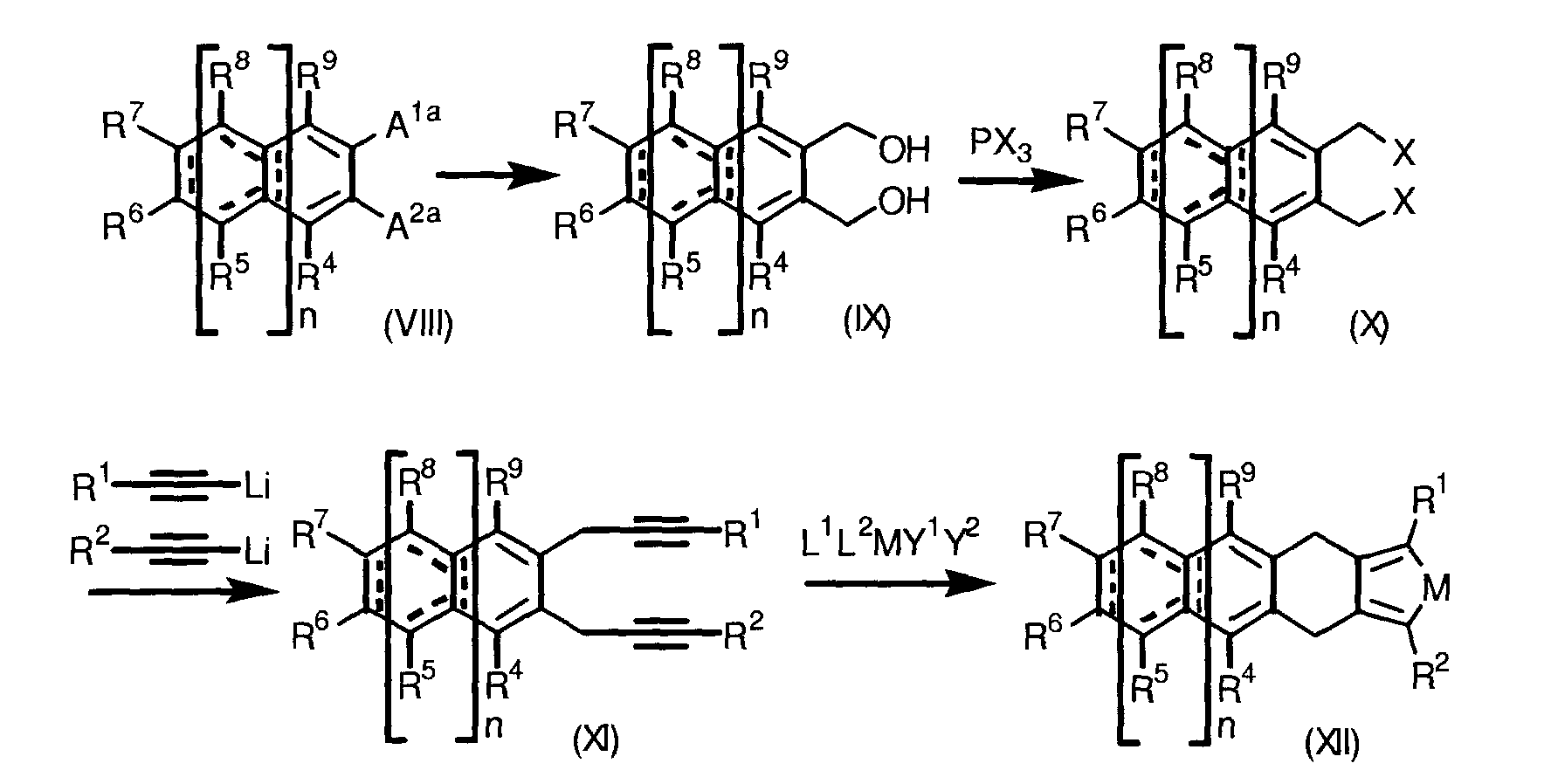
- the hydrocarbon condensed rings can be obtained, e.g., by the following scheme.
- R 1 , R 2 , R 4 , R 5 , R 6 , R 7 , R 8 , R 9 and n have the same significance as defined above;
- a 1a and A 2a which may be the same or different, independently represents a C 6 -C 40 alkoxycarbonyl group which may optionally be substituted with a substituent, including a halogen atom, or a C 6 -C 40 aryloxycarbonyl group which may optionally be substituted a substituent, including a halogen atom; and
- X is an leaving group such as a halogen atom, etc.
- the bond represented by formula below is a single bond or a double bond;
- M represents a metal belonging to the Group III to Group V or a lanthanide metal;
- L 1 and L 2 which may be the same or different, independently represents an anionic ligand, provided that L 1 and L 2
- An organic electroluminescent element normally comprises a pair of electrodes and at least one luminescent layer containing at least one luminescent component, sandwiched between the electrodes. Taking into account the respective functional levels of the hole injection and hole transport of a compound used in the luminescent layer, injection of electrons and transport of electrons, a hole injection transport layer containing a hole injection transport component and/or an electron injection transport layer containing an electron injection transport component can also be provided.
- the luminescent layer can be constructed as an element that the luminescent layer serves as the hole injection transport layer and/or the electron injection transport layer.
- the element may also be a structure type where both the hole injection transport layer and the electron injection transport layer are not provided (a single-layered type element), as the case may be.
- each of the hole injection transport layer, the electron injection transport layer and the luminescent layer may take a single-layered structure or a multi-layered structure.
- the hole injection transport layer and the electron injection transport layer may also be so constructed to have a layer having the injection function and a layer having the transporting function separately in the respective layers.
- the polyacene derivatives represented by the general formula (I) are preferably used as a component for hole injection transporting, light emission or electron injection transporting, more preferably as a component for hole injection transporting or light emission.
- the polyacene derivatives of the present invention may be used alone or with more than one.
- the configuration of the organic electroluminescent element of the present invention is not particularly limited but includes, for example, (A) anode/hole injection transport layer/luminescent layer/electron injection transport layer/anode type element (FIG. 1), (B) anode/hole injection transport layer/luminescent layer/anode type element (FIG. 2), (C) anode/luminescent layer/electron injection transport layer/anode type element (FIG. 3), (D) anode/luminescent layer/anode type element (FIG. 4), etc.
- the element may also be in the configuration of (E) anode/hole injection transport layer/electron injection transport layer/luminescent layer/electron injection transport layer/anode type element (FIG. 5), in which the luminescent layer is sandwiched between the electron injection transport layers.
- the luminescent component is certainly sandwiched between a pair of electrodes in a single-layered structure
- the element includes, for example, (F) the type in which the luminescent component is sandwiched between a pair of electrodes in a single- layered structure wherein the hole injection transporting component, the luminescent component and the electron injection transporting component are mixed (FIG.
- the organic electroluminescent element of the present invention is not limited to these element configurations but in each type of the element, the hole injection transport layer, the luminescent layer and the electron injection transport layer can be provided in a plurality of layers. Furthermore, in each type of the element, a layer of a mixture of the hole injection transporting component and the luminescent component is provided between the hole injection transport layer and the luminescent layer, and/or between the luminescent layer and the electron injection transport layer, a layer of a mixture of the luminescent component and the electron injection transporting component can be provided.
- Preferred configurations of the organic electroluminescent element are the elements of type (A), type (B), type (C), type (E), type (F), type (G) and type (H), more preferably the elements of type (A), type (B), type (C), type (F) and type (G).
- FIG. 1 anode/hole injection transport layer/luminescent layer/electron injection transport layer/cathode type element shown in (FIG. 1)
- the organic electroluminescent element of the present invention is explained.
- 1, 2, 3, 4, 5, 6 and 7 denotes a substrate, an anode, a hole injection transport layer, a luminescent layer, an electron injection transport layer, a cathode and electric source, respectively.
- the organic electroluminescent element of the present invention is preferably supported on the substrate 1.
- the substrate is not particularly limited but preferably transparent or opaque, and includes, for example, a glass plate, a transparent plastic sheet (e.g., a sheet of polyester, polycarbonate, polysulfone, polymethyl methacrylate, polypropylene, polyethylene, etc.), an opaque plastic sheet, quartz, transparent ceramics, or a mixture thereof in a composite sheet.
- the substrate may also be used in combination with, e.g., a color filter film, a color conversion film or a dielectric reflecting film to control the emitting color.
- the electrode material metals, alloys or electroconductive compounds having a relatively large work function are preferably used as the electrode material.
- the electrode material used for the anode include gold, platinum, silver, copper, cobalt, nickel, palladium, vanadium, tungsten, tin oxide, zinc oxide, ITO (indium tin oxide), polythiophene, polypyrrole, etc. These electrode materials may be used solely or in a mixture thereof.
- the anode can be formed on the substrate by treating these electrode materials using methods, e.g., a vapor deposition method, sputtering method, etc.
- the anode may be in a single-layered structure or a multi-layered structure.
- Sheet electric resistance of the anode is set out preferably in several hundreds O/? or less, more preferably in approximately 5 to 50 O/? .
- the thickness of the anode may vary depending on materials used for the electrode material and is generally set in approximately 5 to 1000 nm, preferably approximately 10 to 500 nm.
- the hole injection transport layer 3 is a layer which contains the compound having the function to make the hole injection from the anode easy and the function to transport the injected holes.
- the hole injection transport layer can be formed using at least one of the polyacene derivative of the present invention and/or other compounds having the hole injection transport function (for example, phthalocyanine derivatives, triarylmethane derivatives, triarylamine derivatives, oxazole derivatives, hydrazone derivatives, stilbene derivatives, pyrazoline derivatives, polysilane derivatives, polyphenylenevinylene and its derivatives, polythiophene and its derivatives, poly-N-vinylcarbazole derivatives, etc.).
- the compound having the hole injection transport function may be used alone or with more than one.
- triarylamine derivatives e.g., 4,4'-bis[N-phenyl-N-(4"-methylphenyl)amino]biphenyl, 4,4'-bis[N-phenyl-N-(3"-methylphenyl)amino]biphenyl, 4,4'-bis[N-phenyl-N-(3"-methoxyphenyl)amino]biphenyl, 4,4'-bis[N-phenyl-N-(1"-naphthyl)amino]biphenyl, 3,3'-dimethyl-4,4'-bis[N-phenyl-N-(3"-methylphenyl)amino]biphenyl, 1,1-bis[4'-[ N,N-di-(4"-methylphenyl)amino] phenyl]cyclohexane, 9,10-bis[N-[N-phenyl-N-(4"-methylphenyl)a
- the ratio of the polyacene derivative of the present invention to the hole injection transport layer is preferably 0.1% by weight or more, more preferably about 0.1-99.9% by weight, much more preferably about 1-99% by weight and most preferably about 5-95% by weight.
- the luminescent layer 4 is a layer which contains the compound having the functions to inject holes and electrons, transport them and generate excitons through recombination of the holes and electrons.
- the luminescent layer can be formed using at least one of the polyacene derivatives of the present invention and/or other compounds having the light-emitting function (e.g., acridone derivatives, quinacridone derivatives, diketo-pyrrolopyrrole derivatives, polycyclic aromatic compounds [e.g., rubrene, anthracene, tetracene, pyrene, perylene, chrysene, decacyclene, coronene, tetraphenylcyclopentadiene, pentaphenylcyclopentadiene, 9,10-diphenylanthracene, 9,10-bis(phenylethynyl)anthracene, 1,4-bis(9'-ethynylanthracenyl)benzen
- the luminescent layer preferably contains the polyacene derivative of the present invention.
- the luminescent layer is so prepared that the ratio of the polyacene derivative in the luminescent layer is preferably in about 0.001-99.999% by weight, more preferably in about 0.01-99.99% by weight and most preferably in about 0.1-99.9% by weight.
- the luminescent layer can be formed of a host compound and a guest compound (dopant), as described in J. Appl. Phys., 65 , 3610 (1989) or Japanese Laid-Open Publication No. 5-214332.
- the luminescent layer can be formed by using the polyacene derivative of the present invention as a host compound.
- the polyacene derivative can also be used as a guest compound to form the luminescent layer.
- the other compounds having the light-emitting function described above can be used as the guest compound and polycyclic aromatic compounds are preferred, among others.
- the other compound having the light-emitting function is used in preferably about 0.001-40% by weight, more preferably about 0.01-30% by weight and most preferably about 0.1-20% by weight, based on the polyacene derivative of the present invention.
- the polycyclic aromatic compounds which are used in combination with the polyacene derivatives of the present invention, are not particularly limited but examples include rubrene, anthracene, tetracene, pyrene, perylene, chrysene, decacyclene, coronene, tetraphenylcyclopentadiene, pentaphenylcyclopentadiene, 9,10-diphenylanthracene, 9,10-bis(phenylethynyl)anthracene, 1,4-bis(9'-ethynylanthracenyl)benzene, 4,4'-bis(9'-ethynylanthracenyl)biphenyl, etc.
- the polycyclic aromatic compounds can be used solely or in combination of plural kinds.
- the polyacene derivative of the present invention is used as the guest compound to form the luminescent layer
- the other compound having the light-emitting function described above can be used as the host compound and, for example, the luminescent organic metal complex or triarylamine derivative is more preferred.
- the polyacene derivative of the present invention is used in preferably about 0.001-40% by weight, more preferably about 0.01-30% by weight and most preferably about 0.1-20% by weight, based on the luminescent organic metal complex or triarylamine derivative.
- the luminescent organic metal complexes which are used in combination with the polyacene derivatives of the present invention, are not particularly limited but luminescent organic aluminum complexes are preferred, and more preferred are luminescent organic aluminum complexes having a substituted or unsubstituted 8-quinolinolato ligand.
- the preferred luminescent organic metal complexes there are, for example, luminescent organic aluminum complexes represented by general formulae (a) through (c).
- the luminescent organic metal complex include tris(8-quinolinolato)aluminum, tris(4-methyl-8-quinolinolato)aluminum, tris(5-methyl-8-quinolinolato)aluminum, tris(3,4-dimethyl-8-quinolinolato)aluminum, tris(4,5-dimethyl-8-quinolinolato)aluminum, tris(4,6-dimethyl-8-quinolinolato)aluminum, bis(2-methyl-8-quinolinolato)(phenolato)aluminum, bis(2-methyl-8-quinolinolato)(2-methylphenolato)aluminum, bis(2-methyl-8-quinolinolato)(3-methylphenolato)aluminum, bis(2-methyl-8-quinolinolato)(4-methylphenolato)aluminum, bis(2-methyl-8-quinolinolato)(2-phenylphenol
- the electron injection transport layer 5 is a layer which contains the compound having the functions to render injection of the electrons through the cathode and transport the injected electrons.
- the electron injection transport layer can be formed using at least one of the polyacene derivatives of the present invention and/or the other compounds having the electron injection transport function (for example, organic metal complexes [e.g., tris(8-quinolinolato)aluminum, bis(10-benzo[h]quinolinolato)beryllium, 5-hydroxyflavone beryllium salt, 5-hydroxyflavone aluminum salt], oxadiazole derivatives [e.g., 1,3-bis[ 5'-(p-tert-butylphenyl)-1,3,4-oxadiazol-2'-yl] benzene], triazole derivatives [e.g.
- the polyacene derivative of the present invention and the other compound having the electron injection transport function are used in combination
- the polyacene derivative of the present invention in the electron injection transport layer is adjusted in the ratio of preferably about 0.1-40% by weight.
- the electron injection transport layer is formed preferably by using the polyacene derivatives of the present invention in combination with the organic metal complexes [for example, the compounds represented by formulae (a) to (c) described above].
- the cathode 6 metals, alloys or electroconductive compounds having a relatively small work function are preferably used as the electrode material.
- the electrode material used for the cathode include lithium, lithium-indium alloy, sodium, sodium-potassium alloys, calcium, magnesium, magnesium-silver alloys, magnesium-indium alloys, indium, ruthenium, titanium, manganese, yttrium, aluminum, aluminum-lithium alloys, aluminum-calcium alloys, aluminum- magnesium alloys, graphite thin film, etc. These electrode materials may be used alone or with one or more.
- the cathode can be formed on the electron injection transport layer by means of, e.g., a vapor deposition method, sputtering method, ionized deposition method, ion plating method, cluster ion beam method, etc. Furthermore, the cathode may be a single-layered structure or a multi-layered structure. Sheet electric resistance of the cathode is set preferably in several hundreds O/? or less. The thickness of the cathode may vary depending on materials used for the electrode material and is generally set in approximately 5 to 1000 nm, preferably approximately 10 to 500 nm. To take out the emission of the organic electroluminescent element efficiently, either one of the electrodes for the anode or cathode is preferably transparent or opaque. In general, it is more preferred to choose the material of the anode and control its thickness to have not less than 70% transmittance of the emitted light.
- a singlet oxygen quencher may be contained in at least one layer of the element.
- the singlet oxygen quencher is not particularly limited but includes, e.g., rubrene, a nickel complex, diphenylisobenzofurane, etc., with rubrene being particularly preferred.
- the layer in which the singlet oxygen quencher is contained is not particularly limited but preferably the luminescent layer or the hole injection transport layer, more preferably the hole injection transport layer.
- the quencher may be incorporated uniformly in the hole injection transport layer, or contained near the layer adjacent to the hole injection transport layer (e.g., the luminescent layer, the electron injection transport layer having the light-emitting function).
- the amount of the singlet oxygen quencher contained is 0.01-50% by weight, preferably 0.05-30% by weight, more preferably 0.1-20% by weight, based on the total amount of the layer containing the quencher (e.g., the hole injection transport layer).
- the hole injection transport layer the luminescent layer and the electron injection transport layer.
- These layers can be prepared by forming thin films by means of, e.g., a vacuum deposition method, ionized deposition method or solution-coating process (e.g., spin coating, casting, dip coating, bar coating, roll coating, Langmuir-Blodgett technique, ink jet process, etc.).
- the respective layers are formed by the vacuum deposition method
- conditions for the vacuum deposition are not particularly limited but the deposition is preferably carried out in vacuum of about 10 -5 Torr or less at a boat temperature (deposition source temperature) of approximately 50 to 600°C and a substrate temperature of approximately -50 to 300°C at a deposition rate of approximately 0.005 to 50 nm/sec.
- the respective layers of the hole injection transport layer, the luminescent layer, the electron injection transport layer and the like are formed continuously in vacuum so that the organic electroluminescent element having more excellent properties can be prepared.
- the respective layers of the hole injection transport layer, the luminescent layer, the electron injection transport layer, etc. are formed using a plurality of compounds, it is preferred to perform co-deposition by separately controlling temperatures for the respective boats charged with these compounds.
- the binder resins which can be used for the respective layers of the hole injection transport layer, the luminescent layer and the electron injection transport layer, include high molecular compounds such as poly-N-vinylcarbazole, polyallylate, polystyrene, polyester, polysiloxane, polymethyl acrylate, polymethyl methacrylate, polyether, polycarbonate, polyamide, polyimide, polyamideimide, poly(p-xylene), polyethylene, polyethylene ether, polypropylene ether, polyphenylene oxide, polyether sulfone, polyaniline and its derivatives, polythiophene and its derivatives, polyphenylenevinylene and its derivatives, polyfluorene and its derivatives, polythienylenevinylene and its derivatives,
- the components which constitute the respective layers or the components which constitute the respective layers and binder resins, etc. are dissolved or dispersed in suitable organic solvents (for example, hydrocarbon type solvents such as hexane, octane, decane, toluene, xylene, ethylbenzene, 1-methylnaphthalen, etc.; ketone type solvents such as acetone, methyl ethyl ketone, methyl isobutyl ketone, cyclohexanone, etc.; halogenated hydrocarbon type solvents such as dichloromethane, chloroform, tetrachloromethane, dichloroethane, trichloroethane, tetrachloroethane, chlorobenzene, dichlorobenzene, chlorotoluene, etc.; ester type solvents such as ethyl acetate, butyl a
- Concentration of the coating liquid is not particularly limited but can be set out in a concentration range suitable for preparing a desired thickness, depending on coating methods performed. In general, the concentration of the solution is in the range of about 0.1-50% by weight, preferably about 1-30% by weight.
- the amount of the binder resin is not particularly limited but in general, the amount is set in about 5-99.9% by weight, preferably about 10-99% by weight, and more preferably about 15-90% by weight, based on the total amount of the components which constitute the respective layers (i.e. when a single-layered type element is formed, the amount is set in the range based on the total amount of the components).
- the layer thickness of the hole injection transport layer, the luminescent layer and the electron injection transport layer is not particularly limited but in general, it is preferred to set in about 5 nm to about 5 ⁇ m.
- a protective layer can be provided on the element thus prepared; alternatively, the element can be sealed into an inert substance such as paraffin, liquid paraffin, silicone oil, fluorocarbon oil, zeolite-containing fluorocarbon oil, etc. to protect the element.
- Materials used for the protective layer are, for example, organic high molecular materials (e.g., fluorinated resin, epoxy resin, silicone resin, epoxy-silicone resin, polystyrene, polyester, polycarbonate, polyamide, polyimide, polyamideimide, poly(p-xylene), polyethylene, polyphenylene oxide), inorganic materials (e.g., diamond thin film, amorphous silica, electroinsulative glass, metal oxides, metal nitrides, metal carbides, metal sulfides), and furthermore, photocurable resin, etc.
- These materials used for the protective layer may be used solely or with more than one.
- the protective layer may be a single-layered structure or a multi- layered structure.
- a metal oxide film e.g., an aluminum oxide film
- a metal fluoride film may be provided on the electrode as a protective layer.
- an interface layer intermediate layer
- an organophosphorous compound, polysilane, an aromatic amine derivative, a phthalocyanine derivative (e.g., copper phthalocyanine) or carbon can be provided on the anode.
- the electrodes, e.g., the anode can be surface-treated with, e.g., an acid, ammonia/hydrogen peroxide or plasma, and then provided for use.
- the organic electroluminescent element of the present invention is generally used as an element of direct current-driven type but can also be used as an element of pulse-driven type or alternating current-driven type.
- the voltage applied is generally about 2-30 V.
- the organic electroluminescent element of the present invention can be used for panel type light sources, various luminescent devices, various display devices, various markings, various sensors, etc.
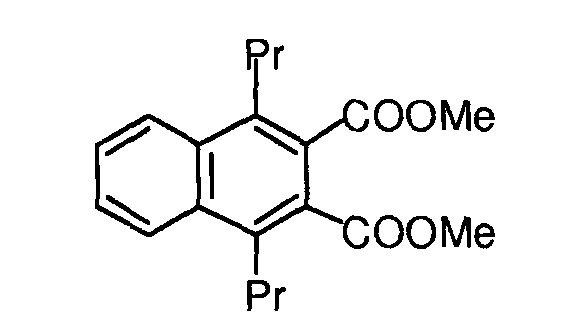
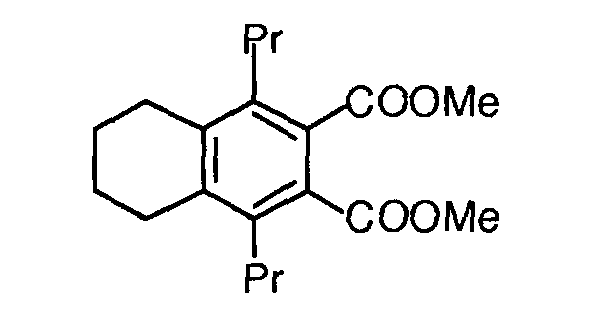
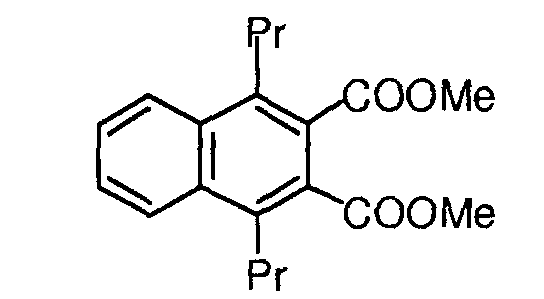
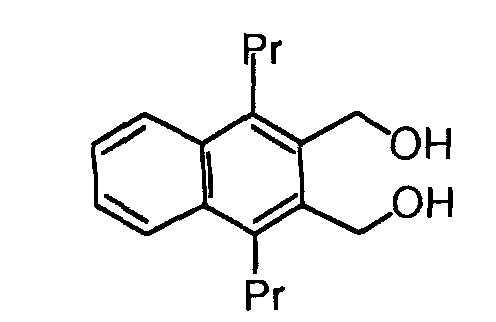
- Lithium aluminum hydride was added to a diethyl ether solution of dimethyl 1,4-dipropylnaphthalene-2,3-dicarboxylate obtained in Reference Compound 1 at 0°C. The mixture was then warmed to room temperature and stirred for an hour. Water was added thereto at room temperature to terminate the reaction. Thus, 0.219 g (0.898 mmol) of the title compound was obtained as a white solid. By recrystallization from ether/hexane, a small quantity of the title compound was obtained. The isolation yield was 90%.
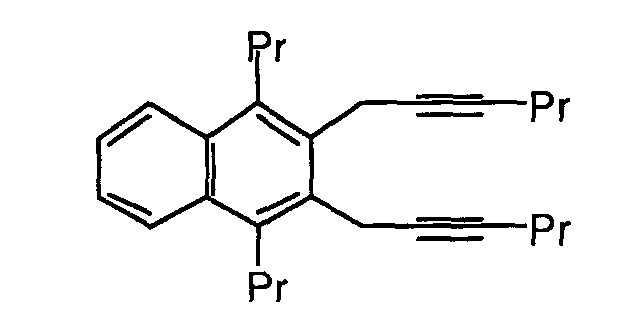
- N,N'-Dimethylpropyleneurea (DMPU) and 1-pentynyl lithium were added to a THF solution of 2,3-bis(bromomethyl)-1,4-dipropylnaphthalene obtained in Reference Compound 3.
- the reaction mixture was stirred at room temperature for an hour.
- the reaction was terminated by adding 3N hydrochloric acid.
- the mixture was extracted with ether.
- the extract was washed with sodium hydrogencarbonate aqueous solution and brine, followed by drying over anhydrous magnesium sulfate.
- the extract was concentrated under reduced pressure and by column chromatography (ethyl acetate/hexane, 1/50) using silica gel, 1.661 g (4.787 mmol) of the title compound was obtained as a white solid.
- the isolation yield was 93%.
- reaction mixture was extracted with ether and the extract was washed with sodium hydrogencarbonate aqueous solution and brine, followed by drying over anhydrous magnesium sulfate.
- the extract was concentrated under reduced pressure and the residue was subjected to column chromatography (ethyl acetate/hexane, 1/10) using silica gel to give the title compound.
- DMAD dimethylacetylene dicarboxylate
- CuCl 3.96 g, 40.0 mmol
- DMAD dimethylacetylene dicarboxylate
- 3N HCl was added for hydrolysis and the mixture was extracted with hexane. Then, the extract was washed with sodium hydrogencarbonate aqueous solution and brine in this order. After the extract was dried over anhydrous magnesium sulfate, column chromatography was performed using silica gel as the packing material to give the title compound (4.917 g) as light yellow oil.
- the GC yield was 82% and the isolation yield was 74%.
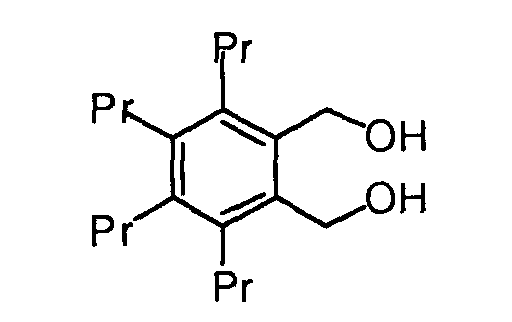
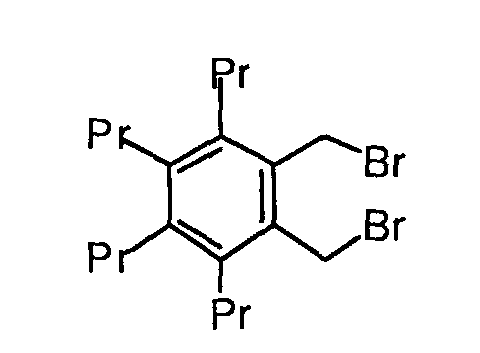
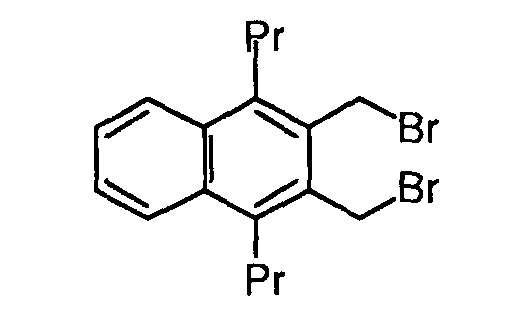
- Tribromophosphine (0.54 ml, 5.70 mmol) was dropwise added at room temperature to 20 ml of a chloroform solution of 1,2-bis(hydroxymethyl)-3,4,5,6-tetrapropylbenzene (1.75 g, 5.70 mmol) obtained in Reference Compound 8. After stirring for an hour, the mixture was treated with water followed by extracting with chloroform. Subsequently, the extract was washed with sodium hydrogencarbonate aqueous solution and brine, followed by drying over anhydrous magnesium sulfate. Column chromatography was performed using silica gel as the packing material to give the title compound (1.866 g) as a white solid. The GC yield was 100% and the isolation yield was 87%.
- n-Butyl lithium (9.7 ml, 15.56 mmol, 1.6 M) was added to a 30 ml THF solution of 1-pentyne (1.67 ml, 17.12 mmol) at -78°C, and the mixture was stirred at room temperature for an hour.
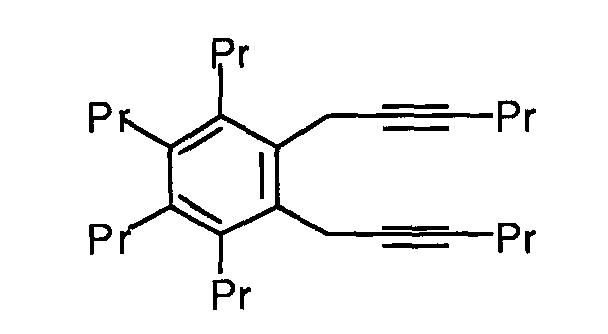
- 1,2-Bis(bromomethyl)-3,4,5,6-tetrapropylbenzene (1.68 g, 3.89 mmol) obtained in Reference Compound 9 and DMPU (1.9 ml, 15.56 mmol) were added to the mixture at room temperature. After stirring for an hour, 3N HCl was added to terminate the reaction. The reaction mixture was extracted with hexane.
- n-Butyl lithium (3.0 ml, 4.8 mmol, 1.6 mol/l) was added to a solution of Cp 2 ZrCl 2 (0.702 g, 2.4 mmol) in THF (20 ml) at -78°C. After the mixture was stirred for an hour, 1,2-bis(2-hexynyl)-3,4,5,6-tetrapropylbenzene (0.813 g, 2.0 mmol) obtained in Reference Compound 10 was added thereto. A cooling bath was withdrawn and the mixture was stirred for an hour.
- Tetraiodobenzene (1.16 g, 2.0 mmol), DMPU (0.73 ml, 6.0 mmol) and CuCl (0.416 g, 4.2 mmol) were added to the mixture. After the mixture was stirred at 50°C for an hour, 3N HCl was added thereto to terminate the reaction, followed by extraction with chloroform Next, the mixture was washed with sodium hydrogencarbonate aqueous solution and brine. After the pressure was reduced, column chromatography was performed using silica gel as the packing material to give the title compound (0.477 g) as a pink solid. The isolation yield was 33%.
- 4,10-Tetradodecadiyne (9.14 g, 48.03 mmol) was added at -78°C to a 200 ml THF solution of bis( ⁇ 5 -cyclopentadienyl)dibutylzirconium, which was prepared from bis( ⁇ 5 -cyclopentadienyl)dichlorozirconium (16.849 g, 57.64 mmol) and n-butyl lithium (75.8 ml, 115.3 mmol, 1.52 M). After elevating to room temperature, the reaction mixture was stirred for an hour.
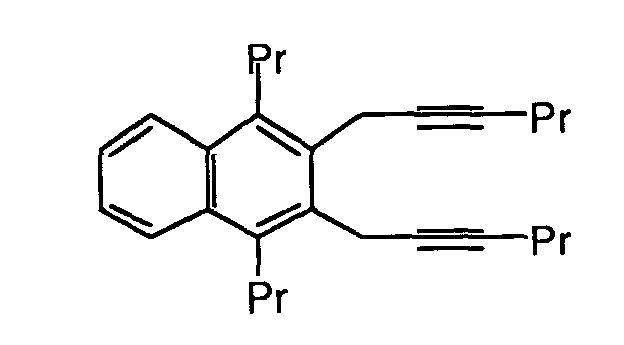
- Tribromophosphine (0.04 ml, 0.42 mmol) was dropwise added at room temperature to a 5 ml chloroform solution of 2,3-bis(hydroxymethyl)-1,4-dipropylnaphthalene (0.109 g, 0.40 mmol) obtained in Reference Compound 14. After stirring for an hour, the mixture was treated with water followed by extracting with chloroform. The extract was washed with sodium hydrogencarbonate aqueous solution and brine, followed by drying over anhydrous magnesium sulfate. Column chromatography was performed using silica gel as the packing material to give the title compound (0.115 g) as a white solid. The isolation yield was 72%.
- n-Butyl lithium (7.6 ml, 19.1 mmol, 2.52 M) was added to a 30 ml THF solution of 1-pentyne (2.05 ml, 21.06 mmol) at -78°C, and the mixture was stirred at room temperature for an hour.
- 2,3-Bis(bromomethyl)-1,4-dipropylnaphthalene (1.91 g, 4.79 mmol) obtained in Reference Compound 15 and DMPU (2.3 ml, 19.1 mmol) were added to the mixture at room temperature. After stirring for an hour, the mixture was treated with 3N HCl and extracted with hexane.
- n-Butyl lithium (0.75 ml, 1.2 mmol, 1.6 mol/l) was added at -78°C to a solution of bis( ⁇ 5 -cyclopentadienyl)dichlorozirconium (0.175 g, 0.6 mmol) in THF (25 ml). After stirring the solution for an hour, 4,10-tetradodecadiyne (0.095 ml, 0.5 mmol) was added to the solution. A cooling bath was withdrawn and the mixture was stirred for an hour.
- Tetraiodobenzene (0.582 g, 1.0 mmol), DMPU (0.18 ml, 1.5 mmol) and CuCl (0.104 g, 1.1 mmol) were added to the mixture. After stirring at 50°C for an hour, 3N hydrochloric acid was added to terminate the reaction. Next, the mixture was extracted with ether followed by washing with sodium hydrogencarbonate aqueous solution and brine. After concentrating under reduced pressure, the residue was subjected to column chromatography using silica gel as the packing material to give the title compound (0.148 g) as a colorless solid. The isolation yield was 57%.
- 1,8-Bis(p-bromophenyl)-1,7-octadiyne (0.191 g, 0.459 mmol) was added at -78°C to a THF solution of bis( ⁇ 5 -cyclopentadienyl)dibutylzirconium, which was prepared from bis( ⁇ 5 -cyclopentadienyl)dichlorozirconium (0.161 g, 0.551 mmol) and n-butyl lithium (0.7 ml, 1.6 M, 1.1 mmol). The mixture was then allowed to stand at room temperature for an hour.
- the title compound was purchased from Aldrich, Inc. and used as it was.
- the title compound was purchased from Exciton, Inc. and used as it was.
- the title compound was purchased from Aldrich, Inc. and used as it was.
- a glass substrate of 130 nm thick having an ITO transparent electrode was washed by ultrasonication using acetone, a substrate detergent, distilled water and isopropyl alcohol in this order. The substrate was further washed by UV/ozone and then fixed on a holder of deposition device. A deposition tank was depressurized to about 10 -6 Torr. After TPD [N,N'-bis(3-methylphenyl)-N,N'-diphenylbenzidine] was deposited onto the ITO transparent electrode in a film thickness of about 30 nm, the compounds listed in TABLE 1, which were prepared as described above, and Alq.
- [tris(8-hydroxyquinolinato]aluminum] were deposited thereon in a weight ratio of 1 : 100 in a film thickness of about 40 nm. Then, Alq. alone was further deposited in a film thickness of about 20 nm. Next, a patterned mask (luminescent area was 5 mm x 5 mm) was applied onto the organic thin film, and magnesium and silver were co-deposited (weight ratio of 10 : 1) in a film thickness of about 150 nm to make the cathode. Thus, the organic EL element was prepared. A direct current voltage was applied to the organic EL element using Model 2400 source meter manufactured by KEITHLEY, Inc. to emit light.
- An ITO transparent electrode was washed and fixed on a substrate holder of deposition device in the same manner as used in EXAMPLE 1.
- a deposition tank was depressurized to about 10 -6 Torr.
- TPD N,N'-bis(3-methylphenyl)-N,N'-diphenylbenzidine
- the compounds shown in TABLE 2 prepared as described above and Alq. [tris(8-hydroxyquinolinato]aluminum] were deposited in this order in a film thickness of about 30nm, 40 nm and 60 nm, respectively.
- the cathode was deposited in the same manner as used in EXAMPLE 1, and evaluation was carried out. The results are shown in TABLE 2.
- the materials for organic electroluminescent elements and the organic electroluminescent elements which are excellent in stability, durability, luminance and luminance efficiency.
Landscapes
- Chemical & Material Sciences (AREA)
- Organic Chemistry (AREA)
- Engineering & Computer Science (AREA)
- Materials Engineering (AREA)
- Chemical Kinetics & Catalysis (AREA)
- Physics & Mathematics (AREA)
- Spectroscopy & Molecular Physics (AREA)
- Electroluminescent Light Sources (AREA)
- Organic Low-Molecular-Weight Compounds And Preparation Thereof (AREA)
Abstract

Description

A1 and A2, which may be the same or different, independently represents hydrogen atom; a halogen atom; a C1-C40 hydrocarbon group which may optionally be substituted; a C1-C40 alkoxy group which may optionally be substituted; a C6-C40 aryloxy group which may optionally be substituted; a C7-C40 alkylaryloxy group which may optionally be substituted; a C2-C40 alkoxycarbonyl group which may optionally be substituted; a C7-C40 aryloxycarbonyl group which may optionally be substituted; cyano group (-CN); carbamoyl group (-C(=O)NH2); a haloformyl group (-C(=O)-X, wherein X represents a halogen atom); formyl group (-C(=O)-H); isocyano group; isocyanate group; thiocyanate group or thioisocyanate group; provided that A1 and A2 may be cross-bridged with each other to form a ring shown by formula: -C(=O)-B-C(=O)- (wherein B is oxygen atom or a group shown by formula -N(B1)-(wherein B1 is hydrogen atom, a C1-C40 hydrocarbon group or a halogen atom));
n is an integer of at least 1;
provided that, the case wherein R1, R2, R3, R4, R5, R6, R7, R8, R9, R10, A1 and A2 are all hydrogen atoms is excluded,
the case wherein R7 and A1 are methoxy groups or A2 and R6 are methoxy groups is excluded,
when n is 1;
at least R1, R2, R4 and R9 are groups other than hydrogen atom, or at least R3, R5, R8 and R10 are groups other than hydrogen atom,
the case wherein R3 and R10 or R4 and R9 are an aryl group which may optionally be substituted is excluded; and,
when n is 2, the formula (I) described above is a pentacene derivative represented by formula (Ia) below:

when n is 1, the following cases are excluded:
- the case of the pentacene derivative represented by the formula (Ia) above wherein, in the formula (Ia),
- R1, R2, R3, R4, R5a, R5b, R6, R7, R8a, R8b, R9, R10, A1 and A2 are all methyl groups; or R1, R2, R3, R4, R5a, R5b, R8a, R8b, R9 and R10 are all hydrogen atoms and at least one of R6, R7, A1 and A2 is an aryl group; or when at most 6 of R1, R2, R3, R4, R5a, R5b, R6, R7, R8a, R8b, R9, R10, A1 and A2 are groups other than hydrogen atom, any one of the groups other than hydrogen atom is methoxy group;
- the case of the pentacene derivative represented by formula (Ib) below:

the case of the pentacene derivative represented by formula (Ic):
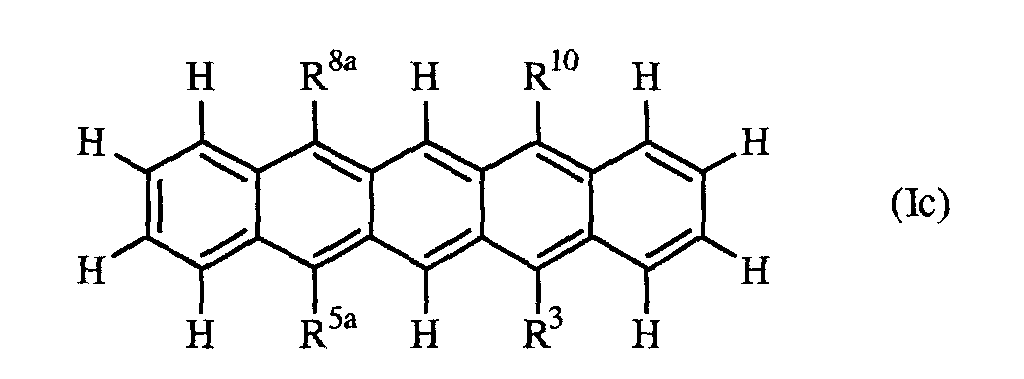
the case of the pentacene derivative represented by formula (Id) below:









represents a single bond or a double bond], in the presence of a dehydrogenation reagent.




M represents a metal belonging to the Group III to Group V or a lanthanide metal;
L1 and L2, which may be the same or different, independently represents an anionic ligand, provided that L1 and L2 may be cross-bridged with each other; and,
Y1 and Y2, which may be the same or different, independently represents an leaving group].





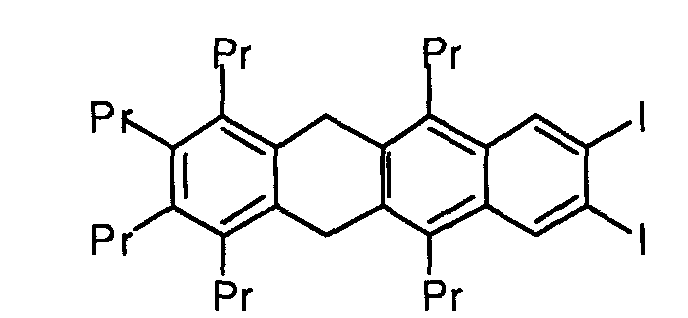



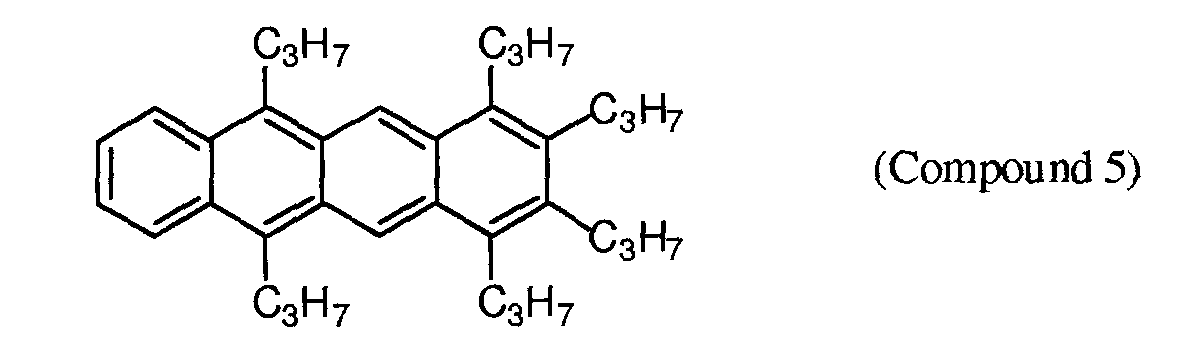

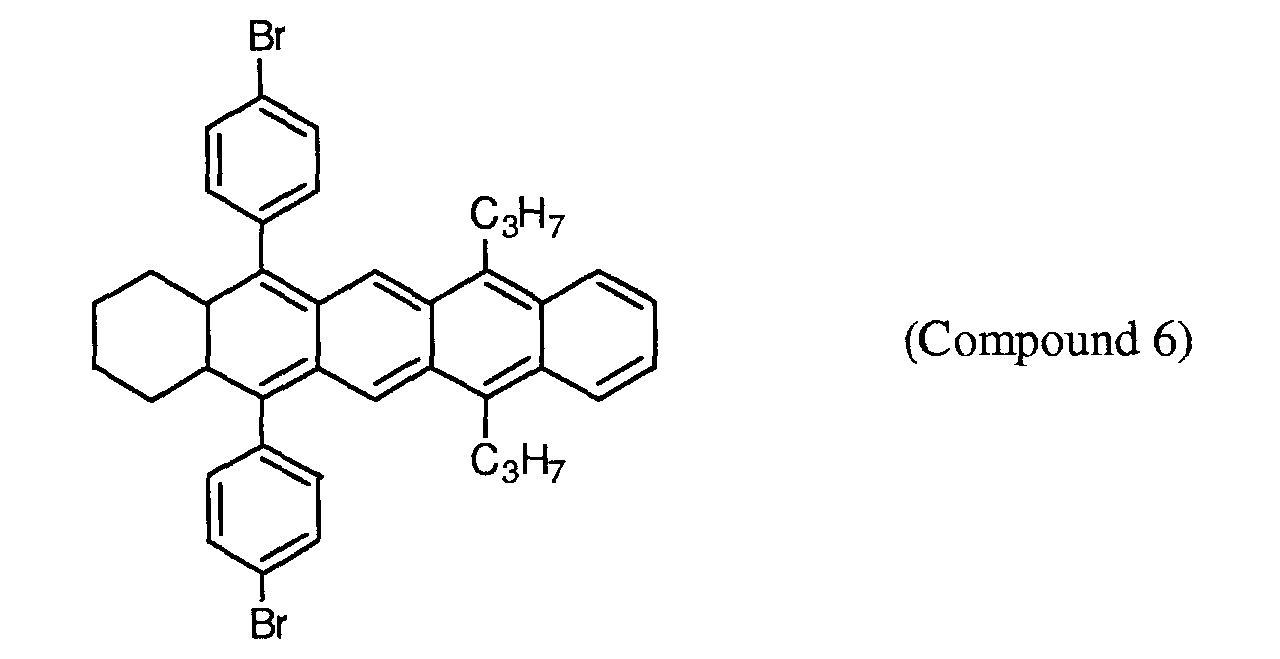


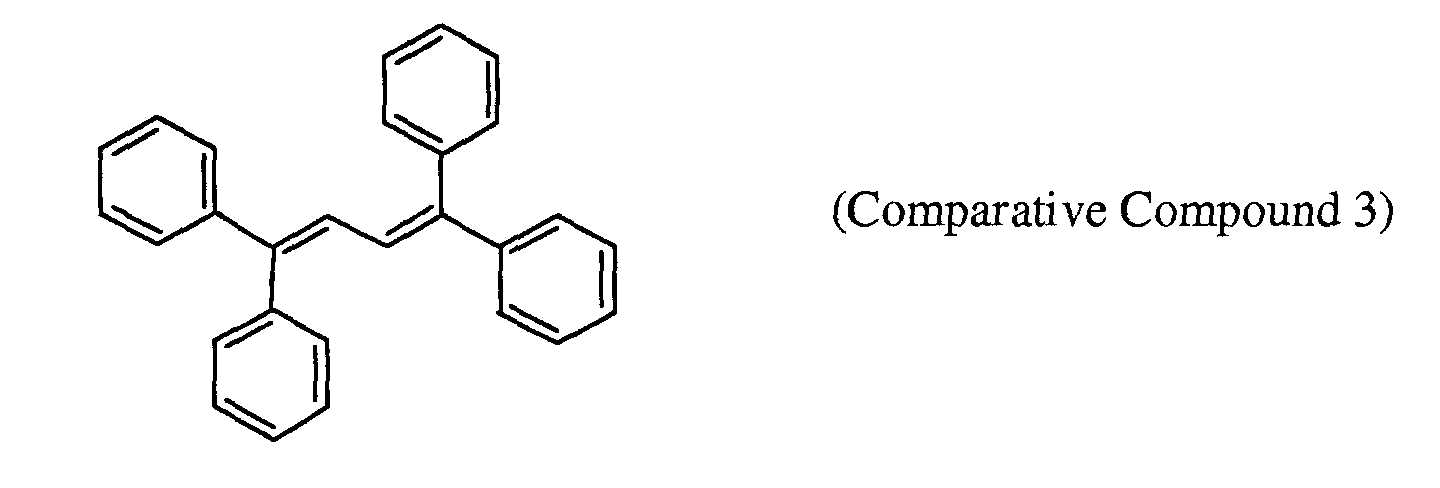
| Maximum Luminance (cd/m2) | Driving Voltage (V) | Luminescent Wavelength (nm) | |
| Compound 1 of the Present Invention | 2100 | 11 | 520 |
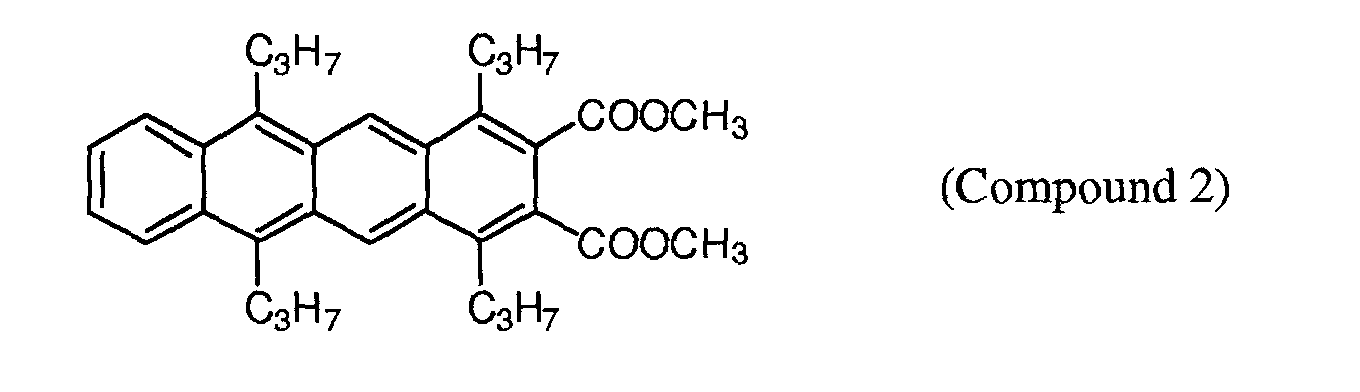
| Compound 2 of the Present Invention | 2000 | 12 | 525 |
| Compound 4 of the Present Invention | 2600 | 13 | 520 |
| Compound 5 of the Present Invention | 2700 | 13 | 520 |
| Compound 6 of the Present Invention | 2800 | 14 | 525 |
| Comparative Compound 1 | 1400 | 14 | 600 |
| Comparative Compound 2 | 320 | 15 | 570 |
| Maximum Luminance (cd/m2) | Driving Voltage (V) | |
| Compound 1 of the Present Invention | 2400 | 12 |
| Compound 2 of the Present Invention | 2200 | 11 |
| Compound 4 of the Present Invention | 2800 | 13 |
| Compound of the Present Invention 5 | 3000 | 13 |
| Compound of the Present Invention 6 | 3200 | 12 |
| Comparative Compound 1 | 1100 | 13 |
| Maximum Luminance (cd/m2) | Driving Voltage (V) | Luminescent Wavelength (nm) | |
| Compound 1 of the Present Invention | 1200 | 15 | 515 |
| Compound 2 of the Present Invention | 1100 | 16 | 525 |
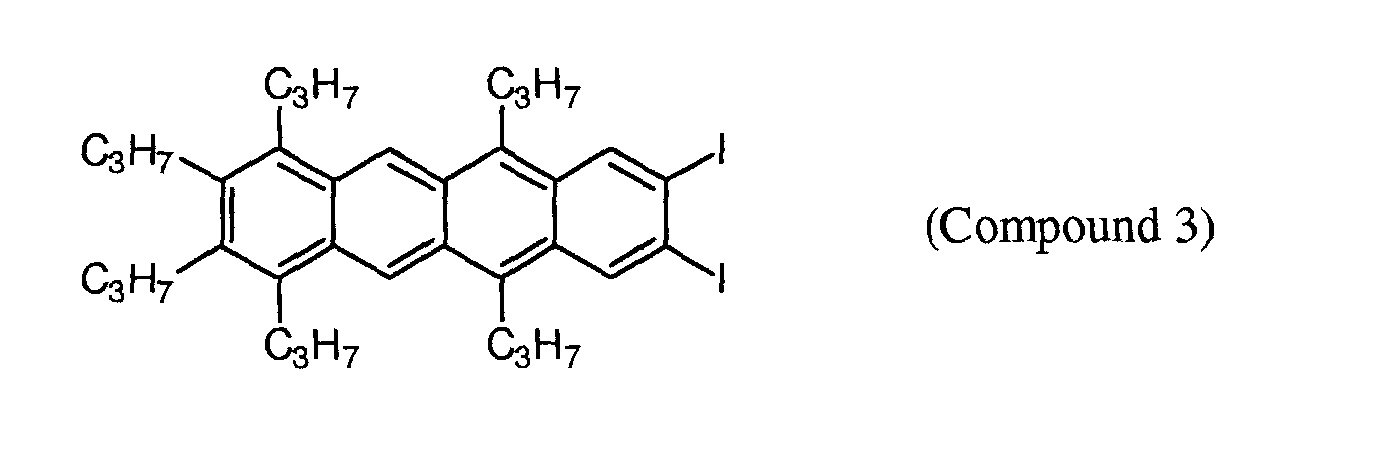
| Compound 3 of the Present Invention | 1200 | 16 | 540 |
| Compound 4 of the Present Invention | 1300 | 17 | 520 |
| Compound 5 of the Present Invention | 1400 | 16 | 520 |
| Compound 6 of the Present Invention | 1100 | 16 | 530 |
| Comparative Compound 1 | 700 | 16 | 600 |
| Comparative Compound 3 | 680 | 16 | 480 |
Claims (26)
- A material for organic electroluminescent element selected from a polyacene derivative represented by general formula (I) below:[wherein R1, R2, R3, R4, R5, R6, R7, R8, R9 and R10, which may be the same or different, independently represents hydrogen atom; a C1-C40 hydrocarbon group which may optionally be substituted; a C1-C40 alkoxy group which may optionally be substituted, a C6-C40 aryloxy group which may optionally be substituted; an amino group which may optionally be substituted, hydroxy group, or a silyl group which may optionally be substituted; provided that R6 and R7 may be cross-bridged with one another to form a C4-C40 saturated or unsaturated ring, and the saturated or unsaturated ring may be intervened by oxygen atom, sulfur atom or a group shown by formula: -N(R11)- (wherein R11 is hydrogen atom or a hydrocarbon group) and may optionally be substituted;

A1 and A2, which may be the same or different, independently represents hydrogen atom; a halogen atom; a C1-C40 hydrocarbon group which may optionally be substituted; a C1-C40 alkoxy group which may optionally be substituted; a C6-C40 aryloxy group which may optionally be substituted; a C7-C40 alkylaryloxy group which may optionally be substituted; a C2-C40 alkoxycarbonyl group which may optionally be substituted; a C7-C40 aryloxycarbonyl group which may optionally be substituted; cyano group (-CN); carbamoyl group (-C(=O)NH2); a halo formyl group (-C(=O)-X, wherein X represents a halogen atom); formyl group (-C(=O)-H); isocyano group; isocyanate group; thiocyanate group or thioisocyanate group; provided that A1 and A2 may be cross-bridged with each other to form a ring shown by formula: -C(=O)-B-C(=O)- (wherein B is oxygen atom or a group shown by formula -N(B1)- (wherein B1 is hydrogen atom, a C1-C40 hydrocarbon group or a halogen atom));
n is an integer of at least 1;
provided that, the case wherein R1, R2, R3, R4, R5, R6, R7, R8, R9, R10, A1 and A2 are all hydrogen atoms is excluded,
the case wherein R7 and A1 are methoxy groups or A2 and R6 are methoxy groups is excluded,
when n is 1;
at least R1, R2, R4 and R9 are groups other than hydrogen atom, or at least R3, R5, R8 and R10 are groups other than hydrogen atom,
the case wherein R3 and R10 or R4 and R9 are an aryl group which may optionally be substituted is excluded; and
when n is 2, the formula (I) above is a pentacene derivative represented by formula (Ia) below:(wherein A1 and A2 have the same significance as described above,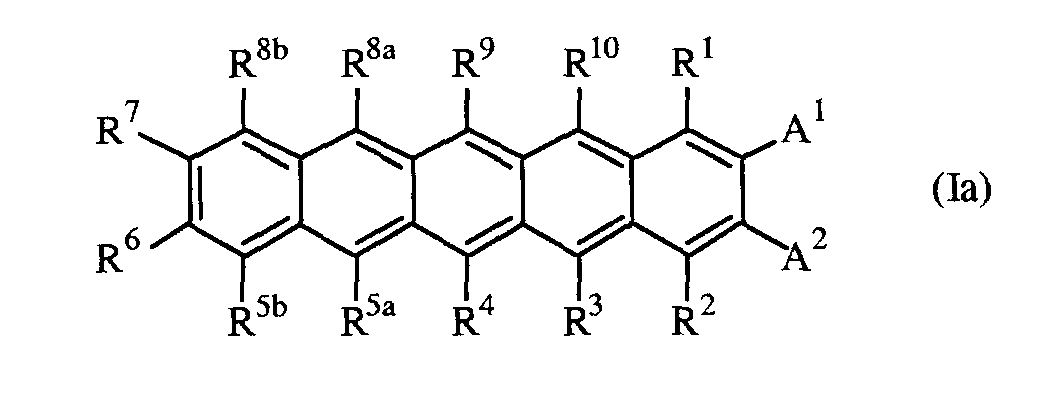
R1, R2, R3, R4, R5a, R5b, R6, R7, R8a, R8b, R9 and R10, which may be the same or different, independently represents hydrogen atom; a C1-C40 hydrocarbon group which may optionally be substituted; a C1-C40 alkoxy group which may optionally be substituted; a C6-C40 aryloxy group which may optionally be substituted; an amino group which may optionally be substituted; a hydroxy group; or a silyl group which may optionally be substituted; provided that R6 and R7 maybe cross-bridged with each other to form a C4-C40 saturated or unsaturated ring, and the saturated or unsaturated ring may be intervened by oxygen atom, sulfur atom or a group represented by formula: -N(R11)- (wherein R11 is hydrogen atom or a hydrocarbon group) and may optionally be substituted) and;
the case in which at least one of R1, R2, R3, R4, R5a, R5b, R6, R7, R8a, R8b, R9, R10, A1 and A2 is a diarylamine group is excluded). - The material for organic electroluminescent element as claimed in claim 1, which is represented by general formula (I) wherein n is 1 or 2;
when n is 1, the case wherein R1, R2, R3, R4, R5, R6, R7, R8, R9, R10, A1 and A2 are all methyl groups, the case wherein R3, R4, R9 and R10 are all aryl groups and R1, R2, R5, R6, R7, R8, A1 and A2 are all hydrogen atoms, the case wherein R1, R2, R4 and R9 are all alkoxy groups or aryloxy groups and R3, R5, R6, R7, R8, R10, A1 and A2 are all hydrogen atoms, and the case wherein R3, R5, R8 and R10 are all alkoxy groups or aryloxy groups and R1, R2, R4, R6, R7, R9, A1 and A2 are all hydrogen atoms, are excluded;
when n is 2, the polyacene derivative is a pentacene derivative represented by the formula (Ia) above and the following cases are excluded:[wherein R1, R2, R5b and R8b are all alkoxy groups or aryloxy groups];the case that in the formula (Ia); R1, R2, R3, R4, R5a, R5b, R6, R7, R8a, R8b, R9, R10, A1 and A2 are all methyl groups; or R1, R2, R3, R4, R5a, R5b, R8a, R8b, R9 and R10 are all hydrogen atoms and at least one of R6, R7, A1 and A2 is an aryl group; or when at most 6 of R1, R2, R3, R4, R5a, R5b, R6, R7, R8a, R8b, R9, R10, A1 and A2 are groups other than hydrogen atom, any one of the groups other than hydrogen atom is methoxy group;the case of a pentacene derivative represented by formula (Ib) below:
the case of a pentacene derivative represented by formula (Ic):[wherein at least 2 of R3, R5a, R8a and R10 are aryl groups or arylalkynyl groups, or at least one of R3, R5a, R8a and R10 is an arylalkenyl group, or R3, R5a, R8a and R10 are all alkoxy groups or aryloxy groups]; and,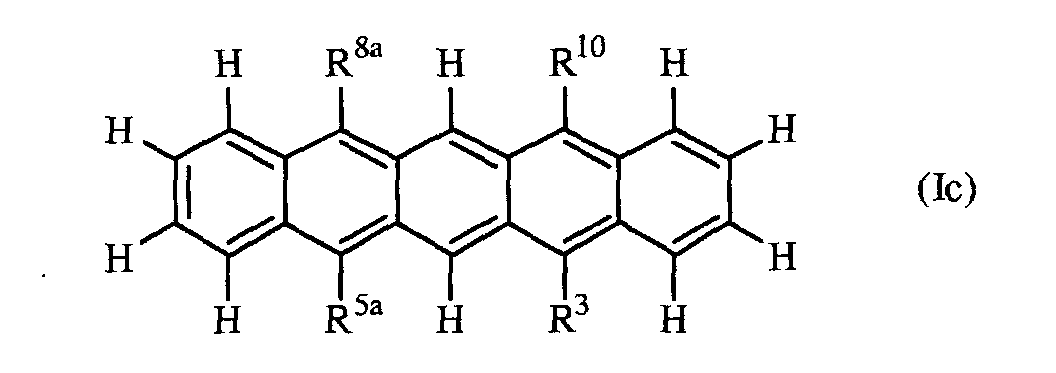
the case of a pentacene derivative represented by formula (Id) below:[wherein R4 and R9 are hydrogen atom, a hydrocarbon group, an alkoxy group, an aryloxy group, or a halogen atom or hydroxy group].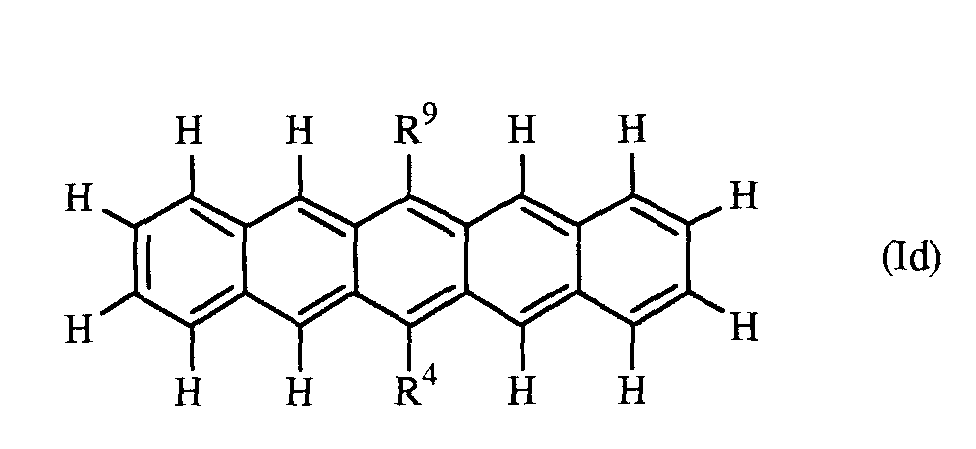
- The material for organic electroluminescent element as claimed in claim 1 or 2, wherein at least 5 of R1, R2, R3, R4, R5, R6, R7, R8, R9, R10, A1 and A2 are groups other than hydrogen atom.
- The material for organic electroluminescent element as claimed in claim 1 or 2, wherein at least 6 of R1, R2, R3, R4, R5, R6, R7, R8, R9, R10, A1 and A2 are groups other than hydrogen atom.
- The material for organic electroluminescent element as claimed in claim 1 or 2, wherein the polyacene derivative is a pentacene derivative represented by the formula (Ia) above; and,
at least 5 of R1, R2, R3, R4, R5a, R5b, R6, R7, R8a, R8b, R9, R10, A1 and A2 are groups other than hydrogen atom. - The material for organic electroluminescent element as claimed in claim 5, wherein at least 6 of R1, R2, R3, R4, R5a, R5b, R6, R7, R8a, R8b, R9, R10, A1 and A2 are groups other than hydrogen atom.
- The material for organic electroluminescent element as claimed in claim 5, wherein at least 7 of R1, R2, R3, R4, R5a, R5b, R6, R7, R8a, R8b, R9, R10, A1 and A2 are groups other than hydrogen atom.
- The material for organic electroluminescent element as claimed in claim 5, wherein at least 8 of R1, R2, R3, R4, R5a, R5b, R6, R7, R8a, R8b, R9, R10, A1 and A2 are groups other than hydrogen atom.
- The material for organic electroluminescent element as claimed in claim 5, wherein at least 9 of R1, R2, R3, R4, R5a, R5b, R6, R7, R8a, R8b, R9, R10, A1 and A2 are groups other than hydrogen atom.
- The material for organic electroluminescent element as claimed in claim 5, wherein at least 10 of R1, R2, R3, R4, R5a, R5b, R6, R7, R8a, R8b, R9, R10, A1 and A2 are groups other than hydrogen atom.
- The material for organic electroluminescent element as claimed in any one of claims 1 to 4, wherein any combination of R1 and R2, R3 and R10, R4 and R9, R5 and R8, R6 and R7 as well as A1 and A2 is the same substituent.
- The material for organic electroluminescent element as claimed in any one of claims 5 to 10, wherein any combination of R1 and R2, R3 and R10, R4 and R9, R5a and R8a, R5b and R8b, R6 and R7 as well as A1 and A2 is the same substituent.
- The material for organic electroluminescent element as claimed in any one of claims 1 to 4, wherein any one of R1, R2, R3, R4, R5, R6, R7, R8, R9 and R10 is a C1-C40 hydrocarbon group which may optionally be substituted; a C1-C40 alkoxy group which may optionally be substituted, or a C6-C40 aryloxy group which may optionally be substituted.
- The material for organic electroluminescent element as claimed in any one of claims 5 to 10, wherein any one of R1, R2, R3, R4, R5a, R5b, R6, R7, R8a, R8b, R9 and R10 is a C1-C40 hydrocarbon group which may optionally be substituted; a C1-C40 alkoxy group which may optionally be substituted, or a C6-C40 aryloxy group which may optionally be substituted.
- The material for organic electroluminescent element as claimed in claim 1, wherein R1, R2, R4 and R9, which may be the same or different, independently represents a C1-C40 alkyl group which may optionally be substituted or a C6-C18 aryl group which may optionally be substituted;
A1 and A2, which may be the same or different, independently represents a C2-C40 alkoxycarbonyl group which may optionally be substituted; and,
n is 1. - The material for organic electroluminescent element as claimed in claim 1, wherein A1, A2, R1, R2, R4 and R9, which may be the same or different, independently represents a C1-C40 alkyl group which may optionally be substituted or a C6-C18 aryl group which may optionally be substituted; and,
n is 1. - The material for organic electroluminescent element as claimed in claim 1, wherein R3, R5, R6, R7, R8 and R10, which may be the same or different, independently represents a C1-C40 alkyl group which may optionally be substituted or a C6-C18 aryl group which may optionally be substituted;
A1 and A2, which may be the same or different, independently represents a halogen atom; and,
n is 1. - The material for organic electroluminescent element as claimed in claim 1 or 2, wherein, when the polyacene derivative is a pentacene derivative represented by the formula (Ia) above, A1 and A2 represent a C2-C40 alkoxycarbonyl group which may optionally be substituted, and, R1, R2, R4, R5b, R6, R7, R8b and R9 represent a C1-C40 alkyl group which may optionally be substituted or a C6-C18 aryl group which may optionally be substituted.
- The material for organic electroluminescent element as claimed in claim 1 or 2, wherein, when the polyacene derivative is a pentacene derivative represented by the formula (Ia) above, A1, A2, R1, R2, R4, R5b, R6, R7, R8b and R9 represent a C1-C40 alkyl group which may optionally be substituted or a C6-C18 aryl group which may optionally be substituted.
- The material for organic electroluminescent element as claimed in claim 1 or 2, wherein, when the polyacene derivative is a pentacene derivative represented by the formula (Ia) above, A1 and A2 represent a halogen atom, and, R3, R5a, R8a and R10 represent a C1-C40 alkyl group which may optionally be substituted or a C6-C18 aryl group which may optionally be substituted.
- An organic electroluminescent element comprising a pair of electrodes and at least one layer containing at least one of the polyacene derivative as claimed in any one of Claims 1 to 20, sandwiched between the electrodes.
- The organic electroluminescent element as claimed in claim 21, wherein the layer containing at least one of the polyacene derivative is a luminescent layer.
- The organic electroluminescent element as claimed in claim 21, wherein the layer containing at least one of the polyacene derivative is a hole injection transport layer.
- The organic electroluminescent element as claimed in claim 21, wherein the layer containing at least one of the polyacene derivative is an electron injection transport layer.
- The organic electroluminescent element as claimed in any one of claims 21 to 24, which further contains at least one of a polycyclic aromatic compound, a luminescent organic metal-complex or a triarylamine derivative.
- The organic electroluminescent element as claimed in claims 21 to 25, wherein 0.1 to 40% by weight of the polyacene derivative as claimed in any one of claims 1 to 20 is contained in at least one layer.
Applications Claiming Priority (3)
| Application Number | Priority Date | Filing Date | Title |
|---|---|---|---|
| JP2002085642 | 2002-03-26 | ||
| JP2002085642A JP4188616B2 (en) | 2002-03-26 | 2002-03-26 | Functional thin film |
| PCT/JP2003/003670 WO2003080762A1 (en) | 2002-03-26 | 2003-03-26 | Functional thin film |
Publications (2)
| Publication Number | Publication Date |
|---|---|
| EP1493796A1 true EP1493796A1 (en) | 2005-01-05 |
| EP1493796A4 EP1493796A4 (en) | 2010-03-10 |
Family
ID=28449261
Family Applications (1)
| Application Number | Title | Priority Date | Filing Date |
|---|---|---|---|
| EP03712954A Withdrawn EP1493796A4 (en) | 2002-03-26 | 2003-03-26 | FUNCTIONAL THIN FILM |
Country Status (9)
| Country | Link |
|---|---|
| US (1) | US20050240061A1 (en) |
| EP (1) | EP1493796A4 (en) |
| JP (1) | JP4188616B2 (en) |
| KR (1) | KR100960212B1 (en) |
| CN (1) | CN100387681C (en) |
| AU (1) | AU2003221150A1 (en) |
| CA (1) | CA2480553C (en) |
| TW (1) | TWI312364B (en) |
| WO (1) | WO2003080762A1 (en) |
Cited By (2)
| Publication number | Priority date | Publication date | Assignee | Title |
|---|---|---|---|---|
| EP1763087A4 (en) * | 2004-06-01 | 2010-04-21 | Japan Science & Tech Agency | MATERIALS FOR PHOTOELECTRIC CONVERSION DEVICES AND PHOTOELECTRIC CONVERSION DEVICES |
| CN104247074A (en) * | 2012-04-23 | 2014-12-24 | 索尼公司 | Organic electroluminescence unit, method of manufacturing organic electroluminescence unit, and electronic apparatus |
Families Citing this family (13)
| Publication number | Priority date | Publication date | Assignee | Title |
|---|---|---|---|---|
| JP2005158520A (en) * | 2003-11-26 | 2005-06-16 | Kyocera Corp | Organic electroluminescence device |
| DE102004018145A1 (en) * | 2004-04-08 | 2005-10-27 | Basf Ag | Use of metallocene complexes of metals of the 4th subgroup of the periodic table as triplet emitters in organic light emitting diodes (OLEDs) |
| US20080207823A1 (en) * | 2004-12-29 | 2008-08-28 | E.I. Du Pont De Nemours And Company | Active Compositions And Methods |
| JP4787954B2 (en) * | 2005-03-08 | 2011-10-05 | 国立大学法人北海道大学 | Process for producing acenes by isomerization of exocyclic dienes |
| JP4787953B2 (en) * | 2005-03-08 | 2011-10-05 | 国立大学法人北海道大学 | Method for producing acenes |
| KR20080024136A (en) * | 2005-05-21 | 2008-03-17 | 메르크 파텐트 게엠베하 | Oligomeric Polyacene and Semiconductor Blends |
| JP2007055939A (en) * | 2005-08-24 | 2007-03-08 | Asahi Kasei Corp | Polyacene compound, method for producing the same, and organic semiconductor device |
| JP4992027B2 (en) * | 2006-03-10 | 2012-08-08 | 国立大学法人北海道大学 | Aromatizing agent |
| US20080241588A1 (en) * | 2007-03-09 | 2008-10-02 | Idemitsu Kosan Co., Ltd. | Organic electroluminescence device and display |
| JP2009001784A (en) * | 2007-05-18 | 2009-01-08 | Semiconductor Energy Lab Co Ltd | Material for organic device, and light-emitting element, light-emitting device, electronic device, field effect transistor and semiconductor device each using material for organic device |
| US20090236979A1 (en) * | 2008-03-24 | 2009-09-24 | Air Products And Chemicals, Inc. | Organic Electroluminescent Device and the Method of Making |
| JP6923837B2 (en) * | 2015-06-29 | 2021-08-25 | 国立研究開発法人理化学研究所 | Method for high polarization of nuclear spin by dynamic nuclear polarization using soluble pentacene |
| CN105137639B (en) * | 2015-10-20 | 2018-06-05 | 京东方科技集团股份有限公司 | The thining method and display device of a kind of display panel |
Family Cites Families (23)
| Publication number | Priority date | Publication date | Assignee | Title |
|---|---|---|---|---|
| US4775820A (en) * | 1984-07-31 | 1988-10-04 | Canon Kabushiki Kaisha | Multilayer electroluminescent device |
| US5077142A (en) * | 1989-04-20 | 1991-12-31 | Ricoh Company, Ltd. | Electroluminescent devices |
| JP3069139B2 (en) * | 1990-03-16 | 2000-07-24 | 旭化成工業株式会社 | Dispersion type electroluminescent device |
| JP3196230B2 (en) * | 1991-05-13 | 2001-08-06 | 三菱化学株式会社 | Organic electroluminescent device |
| JPH06330032A (en) * | 1993-05-18 | 1994-11-29 | Mitsubishi Kasei Corp | Organic electroluminescent device |
| JP3712760B2 (en) * | 1995-05-17 | 2005-11-02 | Tdk株式会社 | Organic EL device |
| JPH1036832A (en) * | 1996-07-30 | 1998-02-10 | Mitsubishi Chem Corp | Organic electroluminescent device |
| US5989737A (en) * | 1997-02-27 | 1999-11-23 | Xerox Corporation | Organic electroluminescent devices |
| WO1999057221A1 (en) * | 1998-05-01 | 1999-11-11 | Tdk Corporation | Compounds for organic el element and organic el element |
| US6699594B1 (en) * | 1998-06-08 | 2004-03-02 | Nec Corporation | Organic electroluminescent device |
| JP2000021571A (en) * | 1998-07-03 | 2000-01-21 | Asahi Glass Co Ltd | Organic electroluminescence device |
| JP3993333B2 (en) * | 1999-03-19 | 2007-10-17 | Tdk株式会社 | Organic EL device |
| JP2001131434A (en) * | 1999-11-08 | 2001-05-15 | Chemiprokasei Kaisha Ltd | Photo-denaturable luminescent organic dye and multi-color organic EL device using the same |
| USH2084H1 (en) * | 1999-12-16 | 2003-10-07 | The United States Of America As Represented By The Secretary Of The Navy | Pentacene derivatives as red emitters in organic light emitting devices |
| CA2401487C (en) * | 2000-02-29 | 2011-06-21 | Japan Science And Technology Agency | Polyacene derivatives and process of producing thereof |
| JP3978976B2 (en) * | 2000-04-17 | 2007-09-19 | 三菱化学株式会社 | Organic electroluminescence device |
| JP2002093581A (en) * | 2000-09-14 | 2002-03-29 | Denso Corp | Organic EL device |
| JP2002097465A (en) * | 2000-09-25 | 2002-04-02 | Toyo Ink Mfg Co Ltd | Organic electroluminescent device material and organic electroluminescent device using the same |
| JP2002167578A (en) * | 2000-09-25 | 2002-06-11 | Toyo Ink Mfg Co Ltd | Organic electroluminescent device material and organic electroluminescent device using the same |
| JP2002124385A (en) * | 2000-10-19 | 2002-04-26 | Idemitsu Kosan Co Ltd | Organic electroluminescence device |
| JP4036682B2 (en) * | 2001-06-06 | 2008-01-23 | 三洋電機株式会社 | Organic electroluminescence device and light emitting material |
| JP4871464B2 (en) * | 2001-09-28 | 2012-02-08 | キヤノン株式会社 | Organic light emitting device |
| JP2003109764A (en) * | 2001-09-28 | 2003-04-11 | Canon Inc | Organic light emitting device |
-
2002
- 2002-03-26 JP JP2002085642A patent/JP4188616B2/en not_active Expired - Fee Related
-
2003
- 2003-03-17 TW TW092105749A patent/TWI312364B/en not_active IP Right Cessation
- 2003-03-26 AU AU2003221150A patent/AU2003221150A1/en not_active Abandoned
- 2003-03-26 CN CNB03806233XA patent/CN100387681C/en not_active Expired - Fee Related
- 2003-03-26 US US10/508,658 patent/US20050240061A1/en not_active Abandoned
- 2003-03-26 WO PCT/JP2003/003670 patent/WO2003080762A1/en not_active Ceased
- 2003-03-26 EP EP03712954A patent/EP1493796A4/en not_active Withdrawn
- 2003-03-26 CA CA2480553A patent/CA2480553C/en not_active Expired - Fee Related
- 2003-03-26 KR KR1020047014735A patent/KR100960212B1/en not_active Expired - Fee Related
Cited By (4)
| Publication number | Priority date | Publication date | Assignee | Title |
|---|---|---|---|---|
| EP1763087A4 (en) * | 2004-06-01 | 2010-04-21 | Japan Science & Tech Agency | MATERIALS FOR PHOTOELECTRIC CONVERSION DEVICES AND PHOTOELECTRIC CONVERSION DEVICES |
| AU2005249096B2 (en) * | 2004-06-01 | 2011-08-25 | Adeka Corporation | Materials for photoelectric conversion devices and photoelectric conversion devices |
| US8022295B2 (en) | 2004-06-01 | 2011-09-20 | Japan Science And Technology Agency | Photoelectric conversion devices |
| CN104247074A (en) * | 2012-04-23 | 2014-12-24 | 索尼公司 | Organic electroluminescence unit, method of manufacturing organic electroluminescence unit, and electronic apparatus |
Also Published As
| Publication number | Publication date |
|---|---|
| CA2480553A1 (en) | 2003-10-02 |
| JP2003277742A (en) | 2003-10-02 |
| US20050240061A1 (en) | 2005-10-27 |
| CA2480553C (en) | 2010-05-18 |
| TWI312364B (en) | 2009-07-21 |
| KR20040104524A (en) | 2004-12-10 |
| CN100387681C (en) | 2008-05-14 |
| EP1493796A4 (en) | 2010-03-10 |
| KR100960212B1 (en) | 2010-05-27 |
| JP4188616B2 (en) | 2008-11-26 |
| TW200305631A (en) | 2003-11-01 |
| WO2003080762A1 (en) | 2003-10-02 |
| CN1643106A (en) | 2005-07-20 |
| AU2003221150A1 (en) | 2003-10-08 |
Similar Documents
| Publication | Publication Date | Title |
|---|---|---|
| JP3816969B2 (en) | Organic EL device | |
| KR101031719B1 (en) | Material for organic electroluminescent device and organic electroluminescent device using same | |
| KR101148460B1 (en) | Material for Luminescent Element and Luminescent Element | |
| KR100831510B1 (en) | New Arylamine Compounds and Organic Electroluminescent Devices | |
| KR100934068B1 (en) | Novel styryl compounds and organic electroluminescent devices | |
| JP4843889B2 (en) | Light emitting element | |
| EP1623970A1 (en) | Arylamine compound and organic electroluminescence device containing the same | |
| KR20080097211A (en) | Aromatic Amine Derivatives and Organic Electroluminescent Devices Using The Same | |
| KR20010093121A (en) | Organic electroluminescent element | |
| JP2004095221A (en) | Light emitting element | |
| CA2480553C (en) | Polyacene derivatives as materials for organic electroluminescent elements | |
| KR20080068862A (en) | Aromatic Amine Derivatives and Organic Electroluminescent Devices Using The Same | |
| KR20090097862A (en) | Arylamine compounds and electronic devices | |
| JP4432313B2 (en) | Tetraphenylmethane derivative and light emitting device including the same | |
| JP2003336043A (en) | Light emitting device material and light emitting device using the same | |
| JP4000893B2 (en) | Pyromethene metal complex, light emitting device material and light emitting device using the same | |
| JP3642606B2 (en) | Organic EL device | |
| CN117917204A (en) | Organic Light Emitting Diodes | |
| JP2004203828A (en) | Phosphine oxide compound, light emitting device material and light emitting device using the same | |
| JP4373477B2 (en) | Material for organic electroluminescence device and organic electroluminescence device using the same | |
| JP4640764B2 (en) | Materials for organic electroluminescence devices using methine compounds | |
| JP4578175B2 (en) | Material for organic electroluminescence device comprising methine compound, organic electroluminescence device using the same, and novel methine compound | |
| JP4259845B2 (en) | Novel methine compound and functional thin film using the same | |
| JP2006269834A (en) | Organic electroluminescence device | |
| JP2011243931A (en) | Organic light-emitting element |
Legal Events
| Date | Code | Title | Description |
|---|---|---|---|
| PUAI | Public reference made under article 153(3) epc to a published international application that has entered the european phase |
Free format text: ORIGINAL CODE: 0009012 |
|
| 17P | Request for examination filed |
Effective date: 20040924 |
|
| AK | Designated contracting states |
Kind code of ref document: A1 Designated state(s): AT BE BG CH CY CZ DE DK EE ES FI FR GB GR HU IE IT LI LU MC NL PT RO SE SI SK TR |
|
| RAP1 | Party data changed (applicant data changed or rights of an application transferred) |
Owner name: JAPAN SCIENCE AND TECHNOLOGY AGENCY Owner name: ADEKA CORPORATION |
|
| A4 | Supplementary search report drawn up and despatched |
Effective date: 20100205 |
|
| 17Q | First examination report despatched |
Effective date: 20101201 |
|
| STAA | Information on the status of an ep patent application or granted ep patent |
Free format text: STATUS: THE APPLICATION IS DEEMED TO BE WITHDRAWN |
|
| 18D | Application deemed to be withdrawn |
Effective date: 20130725 |