EP1481834A2 - Air intake system and forklift equipped with it - Google Patents
Air intake system and forklift equipped with it Download PDFInfo
- Publication number
- EP1481834A2 EP1481834A2 EP20040012557 EP04012557A EP1481834A2 EP 1481834 A2 EP1481834 A2 EP 1481834A2 EP 20040012557 EP20040012557 EP 20040012557 EP 04012557 A EP04012557 A EP 04012557A EP 1481834 A2 EP1481834 A2 EP 1481834A2
- Authority
- EP
- European Patent Office
- Prior art keywords
- air intake
- silencer
- intake system
- expansion
- space
- Prior art date
- Legal status (The legal status is an assumption and is not a legal conclusion. Google has not performed a legal analysis and makes no representation as to the accuracy of the status listed.)
- Granted
Links
Images







Classifications
-
- B—PERFORMING OPERATIONS; TRANSPORTING
- B60—VEHICLES IN GENERAL
- B60K—ARRANGEMENT OR MOUNTING OF PROPULSION UNITS OR OF TRANSMISSIONS IN VEHICLES; ARRANGEMENT OR MOUNTING OF PLURAL DIVERSE PRIME-MOVERS IN VEHICLES; AUXILIARY DRIVES FOR VEHICLES; INSTRUMENTATION OR DASHBOARDS FOR VEHICLES; ARRANGEMENTS IN CONNECTION WITH COOLING, AIR INTAKE, GAS EXHAUST OR FUEL SUPPLY OF PROPULSION UNITS IN VEHICLES
- B60K13/00—Arrangement in connection with combustion air intake or gas exhaust of propulsion units
- B60K13/02—Arrangement in connection with combustion air intake or gas exhaust of propulsion units concerning intake
-
- F—MECHANICAL ENGINEERING; LIGHTING; HEATING; WEAPONS; BLASTING
- F02—COMBUSTION ENGINES; HOT-GAS OR COMBUSTION-PRODUCT ENGINE PLANTS
- F02M—SUPPLYING COMBUSTION ENGINES IN GENERAL WITH COMBUSTIBLE MIXTURES OR CONSTITUENTS THEREOF
- F02M35/00—Combustion-air cleaners, air intakes, intake silencers, or induction systems specially adapted for, or arranged on, internal-combustion engines
- F02M35/12—Intake silencers ; Sound modulation, transmission or amplification
-
- B—PERFORMING OPERATIONS; TRANSPORTING
- B60—VEHICLES IN GENERAL
- B60K—ARRANGEMENT OR MOUNTING OF PROPULSION UNITS OR OF TRANSMISSIONS IN VEHICLES; ARRANGEMENT OR MOUNTING OF PLURAL DIVERSE PRIME-MOVERS IN VEHICLES; AUXILIARY DRIVES FOR VEHICLES; INSTRUMENTATION OR DASHBOARDS FOR VEHICLES; ARRANGEMENTS IN CONNECTION WITH COOLING, AIR INTAKE, GAS EXHAUST OR FUEL SUPPLY OF PROPULSION UNITS IN VEHICLES
- B60K13/00—Arrangement in connection with combustion air intake or gas exhaust of propulsion units
- B60K13/06—Arrangement in connection with combustion air intake or gas exhaust of propulsion units using structural parts of the vehicle as ducts, e.g. frame parts
-
- B—PERFORMING OPERATIONS; TRANSPORTING
- B66—HOISTING; LIFTING; HAULING
- B66F—HOISTING, LIFTING, HAULING OR PUSHING, NOT OTHERWISE PROVIDED FOR, e.g. DEVICES WHICH APPLY A LIFTING OR PUSHING FORCE DIRECTLY TO THE SURFACE OF A LOAD
- B66F9/00—Devices for lifting or lowering bulky or heavy goods for loading or unloading purposes
- B66F9/06—Devices for lifting or lowering bulky or heavy goods for loading or unloading purposes movable, with their loads, on wheels or the like, e.g. fork-lift trucks
- B66F9/075—Constructional features or details
- B66F9/07595—Cooling arrangements for device or operator
-
- F—MECHANICAL ENGINEERING; LIGHTING; HEATING; WEAPONS; BLASTING
- F02—COMBUSTION ENGINES; HOT-GAS OR COMBUSTION-PRODUCT ENGINE PLANTS
- F02M—SUPPLYING COMBUSTION ENGINES IN GENERAL WITH COMBUSTIBLE MIXTURES OR CONSTITUENTS THEREOF
- F02M35/00—Combustion-air cleaners, air intakes, intake silencers, or induction systems specially adapted for, or arranged on, internal-combustion engines
- F02M35/02—Air cleaners
- F02M35/04—Air cleaners specially arranged with respect to engine, to intake system or specially adapted to vehicle; Mounting thereon ; Combinations with other devices
-
- F—MECHANICAL ENGINEERING; LIGHTING; HEATING; WEAPONS; BLASTING
- F02—COMBUSTION ENGINES; HOT-GAS OR COMBUSTION-PRODUCT ENGINE PLANTS
- F02M—SUPPLYING COMBUSTION ENGINES IN GENERAL WITH COMBUSTIBLE MIXTURES OR CONSTITUENTS THEREOF
- F02M35/00—Combustion-air cleaners, air intakes, intake silencers, or induction systems specially adapted for, or arranged on, internal-combustion engines
- F02M35/10—Air intakes; Induction systems
-
- F—MECHANICAL ENGINEERING; LIGHTING; HEATING; WEAPONS; BLASTING
- F02—COMBUSTION ENGINES; HOT-GAS OR COMBUSTION-PRODUCT ENGINE PLANTS
- F02M—SUPPLYING COMBUSTION ENGINES IN GENERAL WITH COMBUSTIBLE MIXTURES OR CONSTITUENTS THEREOF
- F02M35/00—Combustion-air cleaners, air intakes, intake silencers, or induction systems specially adapted for, or arranged on, internal-combustion engines
- F02M35/10—Air intakes; Induction systems
- F02M35/10091—Air intakes; Induction systems characterised by details of intake ducts: shapes; connections; arrangements
- F02M35/10137—Flexible ducts, e.g. bellows or hoses
-
- F—MECHANICAL ENGINEERING; LIGHTING; HEATING; WEAPONS; BLASTING
- F02—COMBUSTION ENGINES; HOT-GAS OR COMBUSTION-PRODUCT ENGINE PLANTS
- F02M—SUPPLYING COMBUSTION ENGINES IN GENERAL WITH COMBUSTIBLE MIXTURES OR CONSTITUENTS THEREOF
- F02M35/00—Combustion-air cleaners, air intakes, intake silencers, or induction systems specially adapted for, or arranged on, internal-combustion engines
- F02M35/10—Air intakes; Induction systems
- F02M35/10091—Air intakes; Induction systems characterised by details of intake ducts: shapes; connections; arrangements
- F02M35/10144—Connections of intake ducts to each other or to another device
-
- F—MECHANICAL ENGINEERING; LIGHTING; HEATING; WEAPONS; BLASTING
- F02—COMBUSTION ENGINES; HOT-GAS OR COMBUSTION-PRODUCT ENGINE PLANTS
- F02M—SUPPLYING COMBUSTION ENGINES IN GENERAL WITH COMBUSTIBLE MIXTURES OR CONSTITUENTS THEREOF
- F02M35/00—Combustion-air cleaners, air intakes, intake silencers, or induction systems specially adapted for, or arranged on, internal-combustion engines
- F02M35/12—Intake silencers ; Sound modulation, transmission or amplification
- F02M35/1255—Intake silencers ; Sound modulation, transmission or amplification using resonance
- F02M35/1266—Intake silencers ; Sound modulation, transmission or amplification using resonance comprising multiple chambers or compartments
-
- F—MECHANICAL ENGINEERING; LIGHTING; HEATING; WEAPONS; BLASTING
- F02—COMBUSTION ENGINES; HOT-GAS OR COMBUSTION-PRODUCT ENGINE PLANTS
- F02M—SUPPLYING COMBUSTION ENGINES IN GENERAL WITH COMBUSTIBLE MIXTURES OR CONSTITUENTS THEREOF
- F02M35/00—Combustion-air cleaners, air intakes, intake silencers, or induction systems specially adapted for, or arranged on, internal-combustion engines
- F02M35/14—Combined air cleaners and silencers
-
- F—MECHANICAL ENGINEERING; LIGHTING; HEATING; WEAPONS; BLASTING
- F02—COMBUSTION ENGINES; HOT-GAS OR COMBUSTION-PRODUCT ENGINE PLANTS
- F02M—SUPPLYING COMBUSTION ENGINES IN GENERAL WITH COMBUSTIBLE MIXTURES OR CONSTITUENTS THEREOF
- F02M35/00—Combustion-air cleaners, air intakes, intake silencers, or induction systems specially adapted for, or arranged on, internal-combustion engines
- F02M35/16—Combustion-air cleaners, air intakes, intake silencers, or induction systems specially adapted for, or arranged on, internal-combustion engines characterised by use in vehicles
- F02M35/162—Motorcycles; All-terrain vehicles, e.g. quads, snowmobiles; Small vehicles, e.g. forklifts
-
- B—PERFORMING OPERATIONS; TRANSPORTING
- B60—VEHICLES IN GENERAL
- B60Y—INDEXING SCHEME RELATING TO ASPECTS CROSS-CUTTING VEHICLE TECHNOLOGY
- B60Y2200/00—Type of vehicle
- B60Y2200/10—Road Vehicles
- B60Y2200/15—Fork lift trucks, Industrial trucks
Definitions
- This invention relates to an air intake system for supplying air to an engine of a forklift, and a forklift equipped with the air intake system.
- the air intake system is useful when applied in realizing a forklift in which the air intake system is in a compact configuration and an intake noise is markedly reduced.
- an engine-powered forklift whose vehicle runs by using an engine, such as a diesel engine or a gasoline engine, as a power source and which does cargo handling work by a hydraulic device
- the engine is installed at the center of the vehicle, and an air intake system for supplying air to the engine is disposed in a side portion of the vehicle.
- FIG. 11 is an exploded perspective view showing a configuration example of a conventional air intake system (non-patent document 1; Toyota Forklift Parts Catalog 1999.01 Catalog No. 5G121-991, TOYOTA MOTOR CORP./TOYODA AUTOMATIC LOOM WORKS, LTD.).
- air intake system 1 of a forklift illustrated in this drawing, air is taken in through an air intake port 3 provided in an upper portion of a rear pillar 2, and flows downward through a passageway within the rear pillar 2. Then, the air flows through a hose-shaped duct 4, an expansion silencer 5, a hose-shaped duct 6, and an air cleaner 7 in this sequence. After purification by the air cleaner 7, the air is supplied to a combustion chamber of an engine (not shown) via a hose-shaped duct 8. An intake noise generated at this time is reduced by the expansion silencer 5.
- FIG. 12 is an exploded perspective view showing another configuration example of a conventional air intake system (non-patent document 2; PARTS CATALOG NISSAN FORKLIFT MODEL D02 (S) SERIES MAY 2000 ISSUE Pub. No. CF-420-S) .
- air intake system 11 of a forklift illustrated in this drawing, air is taken in through an air intake port (not shown) provided in an upper portion of a rear pillar 12, and flows downward through a passageway within the rear pillar 12. Then, the air flows through a hose-shaped duct 13 and an air cleaner 14 in this sequence. After purification by the air cleaner 14, the air is supplied to a combustion chamber of an engine (not shown) via a hose-shaped duct 15.
- Aresonance silencer 16 is also connected to the rear pillar 12.
- the air intake system of FIG. 11 is configured to use the hose-shaped ducts 4 and 6, and does not effectively use the space below the air cleaner 7, thus making it difficult to achieve a compact configuration.
- the air intake system has many seams, etc.
- the air intake system of FIG. 12 is also configured to use the hose-shaped duct 13, and does not allow the effective use of the space below the air cleaner 14, thus posing difficulty in achieving a compact configuration.
- the present invention has been accomplished in view of the above-described circumstances. Its object is to provide an air intake system capable of achieving an overall compact configuration and further decreasing an intake noise, and a forklift equipped with the air intake system.
- an air intake system for supplying air to an engine of a forklift, comprising: a tower provided on a top surface of a body frame, the tower having a space interiorly; a pillar mounted on the tower, the pillar having a passageway interiorly; an air intake port provided in the pillar, the air intake port communicating with the passageway, the passageway and the space within the tower being connected together; an expansion silencer connected to the space of the tower; and an air cleaner connected to the expansion silencer.
- a hose-shaped duct as in the earlier technologies is unnecessary, the entire device can be rendered compact, and the number of components can be decreased.
- the air cleaner may be placed above the expansion silencer. According to this aspect, the space below the air cleaner can be used effectively, the space occupied by these members can be decreased, and equipment can be installed in a limited space.
- a resonance silencer may be connected to the expansion silencer.
- the two types of silencers are used to attenuate the intake noise.
- noise reduction can take place over a broad frequency range.
- the space of the tower may be an expansion chamber.
- the intake noise is attenuated by the two expansion silencers.
- the noise reducing effect is enhanced.
- a resonance chamber may be provided within the expansion silencer. According to this aspect, the degree of freedom to combine the expansion silencer and the resonance silencer is raised. Thus, better noise reduction characteristics can be obtained.
- the expansion silencer may be made of resin. According to this aspect, the expansion silencer can become lightweight and its production is easy.
- a reinforcement rib may be formed on an outer peripheral surface of the expansion silencer. According to this aspect, the strength of the expansion silencer made of resin increases. This can also decrease noise escape due to vibrations of the outer peripheral surface of the silencer.
- a working oil tank may be constituted in a side portion of the body frame, a top surface of the working oil tankmaybe rendered lower in height than an upper end of a side plate forming a side wall of the working oil tank, whereby a space is formed above the top surface of the working oil tank, and the expansion silencer may be provided in the space.
- the space accommodating the expansion silencer can be increased, with the existing layout unchanged.
- An upsized expansion silencer having a better noise reducing effect can be installed.
- a base bracket maybe mounted to an underside of the air cleaner, a support bracket may be mounted on an upper portion of the side plate, and the base bracket may be mounted on the support bracket, whereby the air cleaner is supported above the expansion silencer.
- the air cleaner can be accommodated in a narrow space.
- the operation for mounting the air cleaner may be an operation performed from the outside only, and thus is easy to perform.
- a forklift equipped with the air intake system according to any one of the first to ninth aspects is provided.
- the forklift according to this aspect is a forklift in which the air intake system is compact in configuration and whose intake noise is markedly reduced.
- FIG. 1 is a general configuration drawing of a forklift equipped with an air intake system according to an embodiment of the present invention
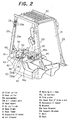
- FIG. 2 is a perspective view showing the configuration of the air intake system and an engine portion
- FIG. 3 is a side view showing the configuration of the air intake system
- FIG. 4 is a plan view showing the configuration of the air intake system
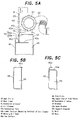
- FIG. 5A is a front view showing the configuration of the air intake system
- FIG. 5B is an explanation drawing showing a state before a top surface of a working fluid tank is lowered
- FIG. 1 is a general configuration drawing of a forklift equipped with an air intake system according to an embodiment of the present invention
- FIG. 2 is a perspective view showing the configuration of the air intake system and an engine portion
- FIG. 3 is a side view showing the configuration of the air intake system
- FIG. 4 is a plan view showing the configuration of the air intake system
- FIG. 5A is a front view showing the configuration of the air intake system
- FIG. 5B is an explanation drawing showing
- FIG. 5C is an explanation drawing showing a state after the top surface of the working fluid tank is lowered;
- FIG. 6 is a rear view showing the configuration of the air intake system;
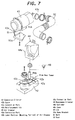
- FIG. 7 is an exploded perspective view showing the configuration of the air intake system;
- FIG. 8 is an explanation drawing showing the intake noise reducing effect of a silencer or silencers of the air intake system;
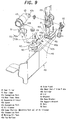
- FIG. 9 is an exploded perspective view showing another configuration of the air intake system according to the embodiment of the present invention;
- FIG. 10 is an exploded perspective view showing still another configuration of the air intake system according to the embodiment of the present invention;
- FIG. 11 is an exploded perspective view showing the configuration of a conventional air intake system; and
- FIG. 12 is an exploded perspective view showing another configuration of a conventional air intake system.
- a forklift 21 has a hoisting/lowering mast 22 provided in a front portion of a vehicle, the hoisting/loweringmast 22 being expanded and contracted vertically by a hydraulic cylinder (not shown) .
- a cargo placed on a fork 24 is raised or lowered, together with the fork 24, by the hoisting/lowering mast 22.
- An engine 35 such as a diesel engine or a gasoline engine, is installed at the center of the vehicle.
- the engine 35 acts as a power source for performing, for example, travel of the vehicle (forklift) and cargo handling work by a hydraulic device such as the hydraulic cylinder.
- a hydraulic device such as the hydraulic cylinder.
- the engine 35 is covered with an engine cover 26.
- a counterweight 27 for adjusting a weight balance between the front and rear portions of the vehicle is installed on the rear portion of the vehicle.
- the driver' s seat 25 is provided within a driver' s cab 31 defined by a front pillar 28 provided ahead of the driver's seat 25, a rear pillar 29 provided behind the driver's seat 25, and a head guard 30 composed of these pillars 28 and 29 and a ceiling portion.
- Various operating instruments and display instruments such as a steering handle 32, and an operating lever (not shown) for operating the hoisting/lowering mast 22, are provided within the driver's cab 31.
- front wheels 33 are driving wheels rotationally driven by the engine 35, while rear wheels 34 are steering wheels steered by the operation of the steering handle 32 by the operator.
- An air intake system for supplying air to the engine 35 is disposed in a side portion of the vehicle (beside the engine). Normally, the air intake system is also covered with the engine cover 26.
- FIG. 2 shows a state where the engine 35, air intake system 36, etc. are exposed, with a description of the engine cover 26 being omitted.
- a rear tower 41 of a trapezoidal shape when viewed sideways is provided on the top surface of a body frame 40.
- the rear tower 41 also constitutes a part of the body frame 40, and the rear pillar 29 is attached to the side surface of the rear tower 41 by bolts or the like.
- a passageway 29a for air is present within the rear pillar 29, and an air intake port 29b (see FIG. 2) communicating with the passageway 29a is formed in an upper portion of the rear pillar 29.
- a louver 39 (see FIG. 2) is mounted on the air intake port 29b.
- the reason why the air intake port 29b is provided in the upper portion of the pillar 29 is that because of this layout, the position of the air intake port 29b is rendered high to take in as clean air as possible.
- a connection port (air outlet) 29c communicating with the passageway 29a is formed in a side surface of a lower end portion of the rear pillar 29, and the lower end surface of the rear pillar 29 is closed.
- a connection port (air inlet) 41a is formed in a side surface of the rear tower 41 so as to align with the position of the connection port 29c of the rear pillar 29.
- the connection port 41a communicates with a space 41b defined within the rear tower 41.
- the passageway 29a of the rear pillar 29 and the space 41b of the rear tower 41 are connected with each other by attaching the lower end portion of the rear pillar 29 to the rear tower 41, with the connection ports 29c and 41a in alignment.
- the space 41b of the rear tower 41 is formed as an expansion chamber fully expanded in comparison with the passageway 29a of the rear pillar 29.
- the rear tower 41 functions not only as a body frame structure, but also as an expansion silencer.
- An expansion silencer 42 is mounted on the front side of the rear tower 41.
- a connection port (air outlet) 41c communicating with the space (expansion chamber) 41b is formed in a side surface of the rear tower 41.
- a connection port (air inlet) 42a communicating with an expansion chamber 42b of the expansion silencer 42 protrudes on a rear surface of the expansion silencer 42.
- the expansion silencer 42 (expansion chamber 42b) is connected to the space 41b of the rear tower 41 by mounting the expansion silencer 42 to the rear tower 41 while inserting one of the connection ports, 42a, into the other connection port 41c (see FIG. 3) .
- the expansion silencer 42 is made of resin, and reinforcement ribs 42d are formed on the outer peripheral surface of the expansion silencer 42.
- An air cleaner 43 is connected to the expansion silencer 42. That is, the expansion silencer 42 functions not only as a silencer, but also as a duct for coupling the rear tower 41 and the air cleaner 43 together. Thus, a hose-shaped duct, as used in the earlier technologies, is not required.
- the air cleaner 43 is placed above the expansion silencer 42. That is, the space below the air cleaner 43 is effectively used to dispose the expansion silencer 42.
- a connection port (air outlet) 42c communicating with the expansion chamber 42b is provided in a top surface of the expansion silencer 42, while a connection port (air inlet) 43a of the air cleaner 43 is directed downward. By connecting these connection ports 42c and 43a, the expansion chamber 42b of the expansion silencer 42 is connected to the interior of the air cleaner 43.
- a resonance silencer 48 is also connected to the expansion silencer 42.
- the resonance silencer 48 is fixed to the rear tower 41 by bolts or the like, is mounted on the top surface of the expansion silencer 42, and is located behind the air cleaner 43.
- the resonance silencer 48 is alsomade of resin.
- the resonance silencer 48 comprises a cylinder 48b (see FIGS. 3 and 7) formed on the top surface of the expansion silencer 42, and a case 48c mounted on the top surface of the expansion silencer 42 so as to cover the cylinder 48b.
- the cylinder 48b communicates with the expansion chamber 42b of the expansion silencer 42.
- the noise reducing characteristics of the resonance silencer 48 are determined by the length of the cylinder 48b, the volume of the interior of the case 48c (resonance chamber) , and so on.
- the resonance silencer 48 is structured to be divided into the cylinder 48b formed in the expansion silencer 42 and the case 48c detachably mounted on the expansion silencer 42, whereby the resonance silencer 48 can be added, where necessary.
- a working oil tank 45 is constituted which comprises a body frame structure, such as a side plate 46, constituting the body frame 40.
- a working oil to be supplied to the hydraulic cylinder of the hoisting/loweringmast 22, etc. is stored within the working oil tank 45.
- a top surface 45a of the working oil tank 45 is rendered lower than the upper end 46a of the side plate 46 forming the side wall of the working oil tank 45, whereby a space is formed above the top surface 45a of the working oil tank 45, and the expansion silencer 42 of a large size is provided in this space.
- FIG. 5B a conventional structure has been such that the upper end 46a of the side plate 46 is the top surface 45a of the working oil tank 45.
- the top surface 45a of the working oil tank is lowered relative to the upper end 46a of the side plate, whereby a space for disposing the expansion silencer 42 is secured above the top surface 45a, as shown in FIG. 5C.
- FIG. 3 an upper end portion of the side plate 46 is shown partially broken away, and the upper end position of the side plate 46 is the position of a double-dotted chain line.
- the volume of the working oil tank 45 is slightly decreased by lowering the top surface 45a of the working oil tank, but is still sufficient for storing a required amount of the working oil.
- the air cleaner 43 is supported by a bracket 50 of an inverted-L-shape when viewed from front, as shown in FIG. 5A.
- the bracket 50 is separated at a bend into a base bracket 50a and a support bracket 50b.
- the base bracket 50a is attached to a lower portion (mounting portion) 43b of the air cleaner 43 by bolts or the like, while the support bracket 50b is attached to an upper portion of the side plate 46 by welding or the like.
- An outer end portion of the base bracket 50a is attached to an upper end portion of the support bracket 50b by bolts 51 to support the air cleaner 43 above the expansion silencer 42.
- a hose-shaped duct 52 is connected to a connection port (air outlet) 43c of the air cleaner 43.
- a resonance chamber may be provided within the expansion silencer 42 as well.
- the expansion silencer 42 may be divided at the position of a dashed dotted line 60 so that one of the divisions (the rear division) will be used as an expansion chamber, and the other division (the front division) will be used as a resonance chamber (resonance silencer) .
- the resonance silencer in this case may be configured to comprise a cylinder formed in the expansion silencer 42 (the portion on the expansion chamber side) and a case detachably mounted on the expansion silencer 42 (the portion on the expansion chamber side) so as to cover the cylinder, as in the case of the aforementioned resonance silencer 48.
- the configuration of the air intake system 36 may be a configuration as shown in FIG. 9 or 10.
- FIG. 9 shows a state where no resonance silencer 48 is provided
- FIG. 10 shows a state where the resonance silencer 48 is provided.
- An air intake system 36 as shown in FIG. 9 or 10 has a rear tower base 41d of a rectangular parallelopipedal shape provided under a rear tower 41, and a connection port (air outlet) 41c is formed in a front surface of the rear tower base 41d.
- the connection port 41c and a connection port (air inlet) 42a of an expansion silencer 42 are connected together, whereby the expansion silencer 42 (expansion chamber 42b) is connected to a space 41b of the rear tower 41.
- Other features are the same as in the aforementioned air intake system 36, so that their explanations are omitted hereinbelow.
- the rear tower 41 having the space 41b inside is provided on the top surface of the body frame 40, the rear pillar 29 having the passageway 29a inside is attached to the tower 41, the air intake port 29b communicating with the passageway 29a is provided in the pillar 29, the passageway 29a and the space 41b within the tower 41 are connected together, the expansion silencer 42 is connected to the space 41b of the tower 41, and the expansion silencer 42 is connected to the air cleaner 43.
- ahose-shapedduct as in the earlier technologies is unnecessary, the entire device can be rendered compact, and the number of components can be decreased.
- the air cleaner 43 is placed above the expansion silencer 42.
- the space below the air cleaner 43 can be used effectively, the space occupied by these members can be decreased, and equipment can be installed in a limited space.
- the resonance silencer 48 is connected to the expansion silencer 42, and these two types of silencers, 42 and 48, are used to attenuate the intake noise.
- noise reduction can take place over a broad frequency range.
- FIG. 8 if sound pressure level characteristics show a solid-line profile without a silencer, for example, the characteristics as indicated by a dashed dotted line are obtained when there is only the expansion silencer 42 showing a noise reducing effect over a relatively broad frequency range, whereas the characteristics as indicated by a dotted line appear when the resonance silencer 48 showing a noise reducing effect over a relatively narrow frequency range is provided in addition to the expansion silencer, whereby noise reduction characteristics are improved.
- the space 41b of the rear tower 41 serves as an expansion chamber, so that the intake noise is attenuated by the two expansion silencers.
- the noise reducing effect is enhanced.
- a resonance chamber is provided within the expansion silencer 42, the degree of freedom to combine the expansion silencer and the resonance silencer is raised. This is effective, for example, if there are a plurality of frequency ranges where the intake noise level peaks. Thus, better noise reduction characteristics can be obtained.
- the expansion silencer 42 is made of resin. Thus, it can become lightweight and its production is easy.
- the reinforcement ribs 42d are formed on the outer peripheral surface of the expansion silencer 42, so that the strength of the expansion silencer 42 made of resin increases. This can also decrease noise escape due to vibrations of the outer peripheral surface of the silencer.
- the top surface 45a of the working oil tank 45 is rendered lower in height than the upper end 46a of the side plate 46 forming the side wall of the working oil tank 45 constituted in the side portion of the body frame 40.
- the space is formed above the top surface 45a of the working oil tank, and the expansion silencer 42 is provided in this space.
- the space accommodating the expansion silencer can be increased, with the existing layout unchanged.
- An upsized expansion silencer 42 having a better noise reducing effect can be installed.
- the base bracket 50a is mounted to the underside of the air cleaner 43, the support bracket 50b is mounted to the upper portion of the side plate 46, and the base bracket 50a is attached to the support bracket 50b to support the air cleaner 43 above the expansion silencer 42.
- the air cleaner 43 can be accommodated in a narrow space.
- the operation for mounting the air cleaner 43 may be an operation performed from the outside, and thus is easy to perform.
- the base bracket 50a and the support bracket 50b are integral, it is necessary to mount the air cleaner 43 to the base bracket 50a which has been mounted on the side plate 46 together with the support bracket 50b.
- the air cleaner 43 has to be mounted, by bolts, from inside (below) the base bracket 50b.
- This mounting work is very difficult to do.
- the base bracket 50a and the support bracket 50b are separated from each other.
- the steps to take may be only to mount the base bracket 50a to the air cleaner 43, and then mount the base bracket 50a on the support bracket 50b.
- the combination of the base bracket 50a and the air cleaner 43 can be mounted on the support bracket 50b from outside. This makes mounting work very easy.
- the forklift 21 equipped with the above-described air intake system 36 of the engine 35 is a forklift in which the air intake system is compact in configuration and whose intake noise is markedly reduced.
Landscapes
- Engineering & Computer Science (AREA)
- Mechanical Engineering (AREA)
- Combustion & Propulsion (AREA)
- Chemical & Material Sciences (AREA)
- General Engineering & Computer Science (AREA)
- Transportation (AREA)
- Structural Engineering (AREA)
- Civil Engineering (AREA)
- Life Sciences & Earth Sciences (AREA)
- Geology (AREA)
- Cooling, Air Intake And Gas Exhaust, And Fuel Tank Arrangements In Propulsion Units (AREA)
- Forklifts And Lifting Vehicles (AREA)
- Exhaust Silencers (AREA)
Abstract
Description
- This invention relates to an air intake system for supplying air to an engine of a forklift, and a forklift equipped with the air intake system. The air intake system is useful when applied in realizing a forklift in which the air intake system is in a compact configuration and an intake noise is markedly reduced.
- In an engine-powered forklift, whose vehicle runs by using an engine, such as a diesel engine or a gasoline engine, as a power source and which does cargo handling work by a hydraulic device, the engine is installed at the center of the vehicle, and an air intake system for supplying air to the engine is disposed in a side portion of the vehicle.
- FIG. 11 is an exploded perspective view showing a configuration example of a conventional air intake system (
non-patent document 1; Toyota Forklift Parts Catalog 1999.01 Catalog No. 5G121-991, TOYOTA MOTOR CORP./TOYODA AUTOMATIC LOOM WORKS, LTD.). In anair intake system 1 of a forklift, illustrated in this drawing, air is taken in through anair intake port 3 provided in an upper portion of arear pillar 2, and flows downward through a passageway within therear pillar 2. Then, the air flows through a hose-shaped duct 4, anexpansion silencer 5, a hose-shaped duct 6, and anair cleaner 7 in this sequence. After purification by theair cleaner 7, the air is supplied to a combustion chamber of an engine (not shown) via a hose-shaped duct 8. An intake noise generated at this time is reduced by theexpansion silencer 5. - FIG. 12 is an exploded perspective view showing another configuration example of a conventional air intake system (non-patent
document 2; PARTS CATALOG NISSAN FORKLIFT MODEL D02 (S) SERIES MAY 2000 ISSUE Pub. No. CF-420-S) . In anair intake system 11 of a forklift, illustrated in this drawing, air is taken in through an air intake port (not shown) provided in an upper portion of arear pillar 12, and flows downward through a passageway within therear pillar 12. Then, the air flows through a hose-shaped duct 13 and anair cleaner 14 in this sequence. After purification by theair cleaner 14, the air is supplied to a combustion chamber of an engine (not shown) via a hose-shaped duct 15.Aresonance silencer 16 is also connected to therear pillar 12. - With a forklift, it is desired to minimize a noise level at the ears of an operator who operates the forklift. The European CEN standards, for example, obligate vehicles to have a label attached thereto which explicitly describes a noise level (dB) at the ears of the operator. An intake noise generated by the air intake system contributes highly to the above noise level.
- Thus, it is important to decrease the intake noise. Upsizing a silencer or increasing the number or types of the silencers for this purpose, however, results in the upsizing of the air intake system, if it has the configuration of the above-mentioned conventional
air intake system - In detail, the air intake system of FIG. 11 is configured to use the hose-
shaped ducts air cleaner 7, thus making it difficult to achieve a compact configuration. Moreover, the air intake system has many seams, etc. The air intake system of FIG. 12 is also configured to use the hose-shaped duct 13, and does not allow the effective use of the space below theair cleaner 14, thus posing difficulty in achieving a compact configuration. - The present invention has been accomplished in view of the above-described circumstances. Its object is to provide an air intake system capable of achieving an overall compact configuration and further decreasing an intake noise, and a forklift equipped with the air intake system.
- In a first aspect of the present invention for attaining the above object, there is provided an air intake system for supplying air to an engine of a forklift, comprising: a tower provided on a top surface of a body frame, the tower having a space interiorly; a pillar mounted on the tower, the pillar having a passageway interiorly; an air intake port provided in the pillar, the air intake port communicating with the passageway, the passageway and the space within the tower being connected together; an expansion silencer connected to the space of the tower; and an air cleaner connected to the expansion silencer.
- According to this aspect, a hose-shaped duct as in the earlier technologies is unnecessary, the entire device can be rendered compact, and the number of components can be decreased.
- In a second aspect of the invention, the air cleaner may be placed above the expansion silencer. According to this aspect, the space below the air cleaner can be used effectively, the space occupied by these members can be decreased, and equipment can be installed in a limited space.
- In a third aspect of the invention, a resonance silencer may be connected to the expansion silencer. According to this aspect, the two types of silencers are used to attenuate the intake noise. Thus, noise reduction can take place over a broad frequency range.
- In a fourth aspect of the invention, the space of the tower may be an expansion chamber. According to this aspect, the intake noise is attenuated by the two expansion silencers. Thus, the noise reducing effect is enhanced.
- In a fifth aspect of the invention, a resonance chamber may be provided within the expansion silencer. According to this aspect, the degree of freedom to combine the expansion silencer and the resonance silencer is raised. Thus, better noise reduction characteristics can be obtained.
- In a sixth aspect of the invention, the expansion silencer may be made of resin. According to this aspect, the expansion silencer can become lightweight and its production is easy.
- In a seventh aspect of the invention, a reinforcement rib may be formed on an outer peripheral surface of the expansion silencer. According to this aspect, the strength of the expansion silencer made of resin increases. This can also decrease noise escape due to vibrations of the outer peripheral surface of the silencer.
- In an eighth aspect of the invention, a working oil tank may be constituted in a side portion of the body frame, a top surface of the working oil tankmaybe rendered lower in height than an upper end of a side plate forming a side wall of the working oil tank, whereby a space is formed above the top surface of the working oil tank, and the expansion silencer may be provided in the space. According to this aspect, the space accommodating the expansion silencer can be increased, with the existing layout unchanged. An upsized expansion silencer having a better noise reducing effect can be installed.
- In a ninth aspect of the invention, a base bracket maybe mounted to an underside of the air cleaner, a support bracket may be mounted on an upper portion of the side plate, and the base bracket may be mounted on the support bracket, whereby the air cleaner is supported above the expansion silencer. According to this aspect, the air cleaner can be accommodated in a narrow space. Moreover, the operation for mounting the air cleaner may be an operation performed from the outside only, and thus is easy to perform.
- The features of the first to ninth aspects may be combined arbitrarily.
- In a tenth aspect of the invention, there is provided a forklift equipped with the air intake system according to any one of the first to ninth aspects. The forklift according to this aspect is a forklift in which the air intake system is compact in configuration and whose intake noise is markedly reduced.
- The present invention will become more fully understood from the detailed description given hereinbelow and the accompanying drawings which are given by way of illustration only, and thus are not limitative of the present invention, and wherein:
FIG. 1 is a general configuration drawing of a forklift equipped with an air intake system according to an embodiment of the present invention; FIG. 2 is a perspective view showing the configuration of the air intake system and an engine portion; FIG. 3 is a side view showing the configuration of the air intake system; FIG. 4 is a plan view showing the configuration of the air intake system; FIG. 5A is a front view showing the configuration of the air intake system, FIG. 5B is an explanation drawing showing a state before a top surface of a working fluid tank is lowered, and FIG. 5C is an explanation drawing showing a state after the top surface of the working fluid tank is lowered; FIG. 6 is a rear view showing the configuration of the air intake system; FIG. 7 is an exploded perspective view showing the configuration of the air intake system; FIG. 8 is an explanation drawing showing the intake noise reducing effect of a silencer or silencers of the air intake system; FIG. 9 is an exploded perspective view showing another configuration of the air intake system according to the embodiment of the present invention; FIG. 10 is an exploded perspective view showing still another configuration of the air intake system according to the embodiment of the present invention; FIG. 11 is an exploded perspective view showing the configuration of a conventional air intake system; and FIG. 12 is an exploded perspective view showing another configuration of a conventional air intake system. - An embodiment of the present invention will now be described in detail with reference to the accompanying drawings, which in no way limit the invention.
- As shown in FIG. 1, a
forklift 21 has a hoisting/loweringmast 22 provided in a front portion of a vehicle, the hoisting/loweringmast 22 being expanded and contracted vertically by a hydraulic cylinder (not shown) . A cargo placed on afork 24 is raised or lowered, together with thefork 24, by the hoisting/loweringmast 22. - An
engine 35, such as a diesel engine or a gasoline engine, is installed at the center of the vehicle. Theengine 35 acts as a power source for performing, for example, travel of the vehicle (forklift) and cargo handling work by a hydraulic device such as the hydraulic cylinder. Normally, theengine 35 is covered with anengine cover 26. A driver'sseat 25, where an operator sits, is attached to the top surface of theengine cover 26. Acounterweight 27 for adjusting a weight balance between the front and rear portions of the vehicle is installed on the rear portion of the vehicle. - The driver' s
seat 25 is provided within a driver' scab 31 defined by afront pillar 28 provided ahead of the driver'sseat 25, arear pillar 29 provided behind the driver'sseat 25, and ahead guard 30 composed of thesepillars - Various operating instruments and display instruments, such as a
steering handle 32, and an operating lever (not shown) for operating the hoisting/loweringmast 22, are provided within the driver'scab 31. In theforklift 21,front wheels 33 are driving wheels rotationally driven by theengine 35, whilerear wheels 34 are steering wheels steered by the operation of the steering handle 32 by the operator. - An air intake system (see FIG. 2) for supplying air to the
engine 35 is disposed in a side portion of the vehicle (beside the engine). Normally, the air intake system is also covered with theengine cover 26. - The configuration of the air intake system will be described in detail by reference to FIGS. 2 to 7. FIG. 2 shows a state where the
engine 35,air intake system 36, etc. are exposed, with a description of theengine cover 26 being omitted. - A
rear tower 41 of a trapezoidal shape when viewed sideways is provided on the top surface of abody frame 40. Therear tower 41 also constitutes a part of thebody frame 40, and therear pillar 29 is attached to the side surface of therear tower 41 by bolts or the like. Apassageway 29a for air is present within therear pillar 29, and anair intake port 29b (see FIG. 2) communicating with thepassageway 29a is formed in an upper portion of therear pillar 29. A louver 39 (see FIG. 2) is mounted on theair intake port 29b. The reason why theair intake port 29b is provided in the upper portion of thepillar 29 is that because of this layout, the position of theair intake port 29b is rendered high to take in as clean air as possible. - A connection port (air outlet) 29c communicating with the
passageway 29a is formed in a side surface of a lower end portion of therear pillar 29, and the lower end surface of therear pillar 29 is closed. A connection port (air inlet) 41a is formed in a side surface of therear tower 41 so as to align with the position of theconnection port 29c of therear pillar 29. Theconnection port 41a communicates with aspace 41b defined within therear tower 41. Hence, thepassageway 29a of therear pillar 29 and thespace 41b of therear tower 41 are connected with each other by attaching the lower end portion of therear pillar 29 to therear tower 41, with theconnection ports space 41b of therear tower 41 is formed as an expansion chamber fully expanded in comparison with thepassageway 29a of therear pillar 29. Thus, therear tower 41 functions not only as a body frame structure, but also as an expansion silencer. - An
expansion silencer 42 is mounted on the front side of therear tower 41. A connection port (air outlet) 41c communicating with the space (expansion chamber) 41b is formed in a side surface of therear tower 41. In alignment with the position of theconnection port 41c, a connection port (air inlet) 42a communicating with anexpansion chamber 42b of theexpansion silencer 42 protrudes on a rear surface of theexpansion silencer 42. Thus, the expansion silencer 42 (expansion chamber 42b) is connected to thespace 41b of therear tower 41 by mounting theexpansion silencer 42 to therear tower 41 while inserting one of the connection ports, 42a, into theother connection port 41c (see FIG. 3) . Theexpansion silencer 42 is made of resin, andreinforcement ribs 42d are formed on the outer peripheral surface of theexpansion silencer 42. - An
air cleaner 43 is connected to theexpansion silencer 42. That is, theexpansion silencer 42 functions not only as a silencer, but also as a duct for coupling therear tower 41 and theair cleaner 43 together. Thus, a hose-shaped duct, as used in the earlier technologies, is not required. - The
air cleaner 43 is placed above theexpansion silencer 42. That is, the space below theair cleaner 43 is effectively used to dispose theexpansion silencer 42. A connection port (air outlet) 42c communicating with theexpansion chamber 42b is provided in a top surface of theexpansion silencer 42, while a connection port (air inlet) 43a of theair cleaner 43 is directed downward. By connecting theseconnection ports expansion chamber 42b of theexpansion silencer 42 is connected to the interior of theair cleaner 43. - A
resonance silencer 48 is also connected to theexpansion silencer 42. Theresonance silencer 48 is fixed to therear tower 41 by bolts or the like, is mounted on the top surface of theexpansion silencer 42, and is located behind theair cleaner 43. Theresonance silencer 48 is alsomade of resin. Theresonance silencer 48 comprises acylinder 48b (see FIGS. 3 and 7) formed on the top surface of theexpansion silencer 42, and acase 48c mounted on the top surface of theexpansion silencer 42 so as to cover thecylinder 48b. Thecylinder 48b communicates with theexpansion chamber 42b of theexpansion silencer 42. The noise reducing characteristics of theresonance silencer 48 are determined by the length of thecylinder 48b, the volume of the interior of thecase 48c (resonance chamber) , and so on. - In the case of the forklift requiring no
resonance silencer 48, an opening at the upper end of the cylinder48b can be closed with a lid 49 (see FIG. 7), without mounting thecase 48c. That is, theresonance silencer 48 is structured to be divided into thecylinder 48b formed in theexpansion silencer 42 and thecase 48c detachably mounted on theexpansion silencer 42, whereby theresonance silencer 48 can be added, where necessary. - In a side portion of the
body frame 40, a workingoil tank 45 is constituted which comprises a body frame structure, such as aside plate 46, constituting thebody frame 40. A working oil to be supplied to the hydraulic cylinder of the hoisting/loweringmast 22, etc. is stored within the workingoil tank 45. As shown in FIG. 5A, atop surface 45a of the workingoil tank 45 is rendered lower than theupper end 46a of theside plate 46 forming the side wall of the workingoil tank 45, whereby a space is formed above thetop surface 45a of the workingoil tank 45, and theexpansion silencer 42 of a large size is provided in this space. - As shown in FIG. 5B, a conventional structure has been such that the
upper end 46a of theside plate 46 is thetop surface 45a of the workingoil tank 45. According to the present embodiment, on the other hand, thetop surface 45a of the working oil tank is lowered relative to theupper end 46a of the side plate, whereby a space for disposing theexpansion silencer 42 is secured above thetop surface 45a, as shown in FIG. 5C. In FIG. 3, an upper end portion of theside plate 46 is shown partially broken away, and the upper end position of theside plate 46 is the position of a double-dotted chain line. The volume of the workingoil tank 45 is slightly decreased by lowering thetop surface 45a of the working oil tank, but is still sufficient for storing a required amount of the working oil. - To place the
air cleaner 43 above theexpansion silencer 42, theair cleaner 43 is supported by abracket 50 of an inverted-L-shape when viewed from front, as shown in FIG. 5A. Thebracket 50 is separated at a bend into abase bracket 50a and asupport bracket 50b. - The
base bracket 50a is attached to a lower portion (mounting portion) 43b of theair cleaner 43 by bolts or the like, while thesupport bracket 50b is attached to an upper portion of theside plate 46 by welding or the like. An outer end portion of thebase bracket 50a is attached to an upper end portion of thesupport bracket 50b bybolts 51 to support theair cleaner 43 above theexpansion silencer 42. A hose-shapedduct 52 is connected to a connection port (air outlet) 43c of theair cleaner 43. - As shown by arrowed dashed dotted lines in FIG. 3, air flows in the
air intake system 36 of the above-described configuration as follows: Air is taken in through theair intake port 29b, and flows downward through thepassageway 29a within therear pillar 29. Then, the air flows through the space (expansion chamber) 41b of therear tower 41, theexpansion chamber 42b of theexpansion silencer 42, and theair cleaner 43 in this sequence. The air is purified in theair cleaner 43, and is then supplied to a combustion chamber of theengine 35 via theduct 52. At this time, an intake noise is reduced by therear tower 41 as an expansion silencer, theexpansion silencer 42 and theresonance silencer 48. - A resonance chamber (resonance silencer) may be provided within the
expansion silencer 42 as well. For example, theexpansion silencer 42 may be divided at the position of a dasheddotted line 60 so that one of the divisions (the rear division) will be used as an expansion chamber, and the other division (the front division) will be used as a resonance chamber (resonance silencer) . The resonance silencer in this case may be configured to comprise a cylinder formed in the expansion silencer 42 (the portion on the expansion chamber side) and a case detachably mounted on the expansion silencer 42 (the portion on the expansion chamber side) so as to cover the cylinder, as in the case of theaforementioned resonance silencer 48. - The configuration of the
air intake system 36 may be a configuration as shown in FIG. 9 or 10. In these drawings, the same parts as in the aforementionedair intake system 36 are assigned the same numerals as used therein. FIG. 9 shows a state where noresonance silencer 48 is provided, while FIG. 10 shows a state where theresonance silencer 48 is provided. - An
air intake system 36 as shown in FIG. 9 or 10 has arear tower base 41d of a rectangular parallelopipedal shape provided under arear tower 41, and a connection port (air outlet) 41c is formed in a front surface of therear tower base 41d. Theconnection port 41c and a connection port (air inlet) 42a of anexpansion silencer 42 are connected together, whereby the expansion silencer 42 (expansion chamber 42b) is connected to aspace 41b of therear tower 41. Other features are the same as in the aforementionedair intake system 36, so that their explanations are omitted hereinbelow. - In the
air intake system 36 of the present embodiment, as described above, therear tower 41 having thespace 41b inside is provided on the top surface of thebody frame 40, therear pillar 29 having thepassageway 29a inside is attached to thetower 41, theair intake port 29b communicating with thepassageway 29a is provided in thepillar 29, thepassageway 29a and thespace 41b within thetower 41 are connected together, theexpansion silencer 42 is connected to thespace 41b of thetower 41, and theexpansion silencer 42 is connected to theair cleaner 43. Thus, ahose-shapedduct as in the earlier technologies is unnecessary, the entire device can be rendered compact, and the number of components can be decreased. - The
air cleaner 43 is placed above theexpansion silencer 42. Thus, the space below theair cleaner 43 can be used effectively, the space occupied by these members can be decreased, and equipment can be installed in a limited space. - The
resonance silencer 48 is connected to theexpansion silencer 42, and these two types of silencers, 42 and 48, are used to attenuate the intake noise. Thus, noise reduction can take place over a broad frequency range. As illustrated in FIG. 8, if sound pressure level characteristics show a solid-line profile without a silencer, for example, the characteristics as indicated by a dashed dotted line are obtained when there is only theexpansion silencer 42 showing a noise reducing effect over a relatively broad frequency range, whereas the characteristics as indicated by a dotted line appear when theresonance silencer 48 showing a noise reducing effect over a relatively narrow frequency range is provided in addition to the expansion silencer, whereby noise reduction characteristics are improved. - Furthermore, the
space 41b of therear tower 41 serves as an expansion chamber, so that the intake noise is attenuated by the two expansion silencers. Thus, the noise reducing effect is enhanced. - If a resonance chamber is provided within the
expansion silencer 42, the degree of freedom to combine the expansion silencer and the resonance silencer is raised. This is effective, for example, if there are a plurality of frequency ranges where the intake noise level peaks. Thus, better noise reduction characteristics can be obtained. - The
expansion silencer 42 is made of resin. Thus, it can become lightweight and its production is easy. - The
reinforcement ribs 42d are formed on the outer peripheral surface of theexpansion silencer 42, so that the strength of theexpansion silencer 42 made of resin increases. This can also decrease noise escape due to vibrations of the outer peripheral surface of the silencer. - The
top surface 45a of the workingoil tank 45 is rendered lower in height than theupper end 46a of theside plate 46 forming the side wall of the workingoil tank 45 constituted in the side portion of thebody frame 40. By this measure, the space is formed above thetop surface 45a of the working oil tank, and theexpansion silencer 42 is provided in this space. As a result, the space accommodating the expansion silencer can be increased, with the existing layout unchanged. An upsizedexpansion silencer 42 having a better noise reducing effect can be installed. - The
base bracket 50a is mounted to the underside of theair cleaner 43, thesupport bracket 50b is mounted to the upper portion of theside plate 46, and thebase bracket 50a is attached to thesupport bracket 50b to support theair cleaner 43 above theexpansion silencer 42. Thus, theair cleaner 43 can be accommodated in a narrow space. Moreover, the operation for mounting theair cleaner 43 may be an operation performed from the outside, and thus is easy to perform. - In detail, if the
base bracket 50a and thesupport bracket 50b are integral, it is necessary to mount theair cleaner 43 to thebase bracket 50a which has been mounted on theside plate 46 together with thesupport bracket 50b. For this purpose, theair cleaner 43 has to be mounted, by bolts, from inside (below) thebase bracket 50b. This mounting work is very difficult to do. According to the present embodiment, by contrast, thebase bracket 50a and thesupport bracket 50b are separated from each other. Thus, the steps to take may be only to mount thebase bracket 50a to theair cleaner 43, and then mount thebase bracket 50a on thesupport bracket 50b. Thus, the combination of thebase bracket 50a and theair cleaner 43 can be mounted on thesupport bracket 50b from outside. This makes mounting work very easy. - The
forklift 21 equipped with the above-describedair intake system 36 of theengine 35 is a forklift in which the air intake system is compact in configuration and whose intake noise is markedly reduced. - While the present invention has been described by the above embodiment, it is to be understood that the invention is not limited thereby, but may be varied or modified in many other ways. Such variations or modifications are not to be regarded as a departure from the scope of the invention, and all such variations and modifications as would be obvious to one skilled in the art are intended to be included within the scope of the appended claims.
Claims (10)
- An air intake system for supplying air to an engine of a forklift, characterized by:a tower (41) provided on a top surface of a body frame (40), said tower (41) having a space (41b) interiorly;a pillar (29) mounted on said tower (41), said pillar (29) having a passageway (29a) interiorly;an air intake port (29b) provided in said pillar (29), said air intake port (29b) communicating with said passageway (29a), said passageway (29a) and said space (41b) within said tower (41) being connected together;an expansion silencer (42) connected to said space (41b) of said tower (41); andan air cleaner (43) connected to said expansion silencer (42).
- The air intake system according to claim 1,
characterized in that said air cleaner (43) is placed above said expansion silencer (42). - The air intake system according to claim 1 or 2,
characterized in that a resonance silencer (48) is connected to said expansion silencer (42). - The air intake system according to any of the preceding claims,
characterized in that said space (41b) of said tower (41) is an expansion chamber. - The air intake system according to any of the preceding claims,
characterized in that a resonance chamber is provided within said expansion silencer (42). - The air intake system according to any of the preceding claims,
characterized in that said expansion silencer (42) is made of resin. - The air intake system according to claim 6,
characterized in that a reinforcement rib (42d)is formed on an outer peripheral surface of said expansion silencer (42). - The air intake system according to any of the preceding claims,
characterized in that a working oil tank (45) is constituted in a side portion of said body frame (40), a top surface (45a) of said working oil tank (45) is rendered lower in height than an upper end (46a) of a side plate (46) forming a side wall of said working oil tank (45),whereby a space is formed above said top surface (45a) of said working oil tank (45), and said expansion silencer (42) is provided in said space. - The air intake system according to claim 8,
characterized in that a base bracket (50a) is mounted to an underside of said air cleaner (43) a support bracket (50b) is mounted on an upper portion of said side plate (46), and said base bracket (50a) is mounted on said support bracket (50b), whereby said air cleaner (43) is supported above said expansion silencer (42). - A forklift equipped with the air intake system according to any one of claims 1 to 9.
Applications Claiming Priority (2)
| Application Number | Priority Date | Filing Date | Title |
|---|---|---|---|
| JP2003154599A JP2004353610A (en) | 2003-05-30 | 2003-05-30 | Air supply device and forklift equipped with the same |
| JP2003154599 | 2003-05-30 |
Publications (3)
| Publication Number | Publication Date |
|---|---|
| EP1481834A2 true EP1481834A2 (en) | 2004-12-01 |
| EP1481834A3 EP1481834A3 (en) | 2006-04-12 |
| EP1481834B1 EP1481834B1 (en) | 2009-01-14 |
Family
ID=33128316
Family Applications (1)
| Application Number | Title | Priority Date | Filing Date |
|---|---|---|---|
| EP04012557A Expired - Lifetime EP1481834B1 (en) | 2003-05-30 | 2004-05-27 | Air intake system and forklift equipped with it |
Country Status (9)
| Country | Link |
|---|---|
| US (1) | US7152564B2 (en) |
| EP (1) | EP1481834B1 (en) |
| JP (1) | JP2004353610A (en) |
| KR (1) | KR100592210B1 (en) |
| CN (2) | CN1323226C (en) |
| CA (1) | CA2466830C (en) |
| DE (1) | DE602004019012D1 (en) |
| ES (1) | ES2320760T3 (en) |
| TW (1) | TWI282774B (en) |
Cited By (8)
| Publication number | Priority date | Publication date | Assignee | Title |
|---|---|---|---|---|
| FR2913464A1 (en) * | 2007-03-08 | 2008-09-12 | Peugeot Citroen Automobiles Sa | Noise filtering device for motor vehicle, has secondary volume opening in inner volume in upstream of filter via tube, and constituted by interior of structural/functional unit, where filter is formed of enclosure delimiting inner volume |
| WO2018118508A3 (en) * | 2016-12-22 | 2018-08-02 | Polaris Industries Inc. | Air intake system for utility vehicle |
| US12172518B2 (en) | 2019-04-30 | 2024-12-24 | Polaris Industries Inc. | Vehicle |
| US12187127B2 (en) | 2020-05-15 | 2025-01-07 | Polaris Industries Inc. | Off-road vehicle |
| US12385429B2 (en) | 2022-06-13 | 2025-08-12 | Polaris Industries Inc. | Powertrain for a utility vehicle |
| US12384464B2 (en) | 2020-05-15 | 2025-08-12 | Polaris Industries Inc. | Off-road vehicle |
| EP4682374A1 (en) * | 2024-07-16 | 2026-01-21 | Doosan Bobcat Korea Co., Ltd. | Forklift noise reduction device and method of reducing noise |
| US12552246B2 (en) | 2015-05-15 | 2026-02-17 | Polaris Industries Inc. | Utility vehicle |
Families Citing this family (11)
| Publication number | Priority date | Publication date | Assignee | Title |
|---|---|---|---|---|
| JP2009293543A (en) * | 2008-06-06 | 2009-12-17 | Komatsu Utility Co Ltd | Work vehicle and air duct |
| CN103101858A (en) * | 2012-11-12 | 2013-05-15 | 无锡市洪成造纸机械有限公司 | Integral type top protection frame |
| CN103101859A (en) * | 2012-11-13 | 2013-05-15 | 无锡市洪成造纸机械有限公司 | Forklift overhead guard structure |
| WO2017135921A1 (en) | 2016-02-01 | 2017-08-10 | Cummins Inc. | Accessory support brackets with airflow passages |
| CN106150794B (en) * | 2016-08-19 | 2019-02-01 | 安徽合力股份有限公司 | Forklift steering room overhead guard with noise-reducing structure |
| CN107827035A (en) * | 2017-11-15 | 2018-03-23 | 宁波如意股份有限公司 | A kind of counter weight construction of electri forklift |
| CN107989724A (en) * | 2017-12-13 | 2018-05-04 | 安徽合力股份有限公司 | A kind of forklift engine gas handling system with muffler |
| CN108361132B (en) * | 2018-01-18 | 2023-07-21 | 安徽合力股份有限公司 | Fork truck engine air intake system with amortization branch pipe |
| CN112318876B (en) * | 2020-10-12 | 2022-07-22 | 李冉 | 3D prints silencing device |
| USD1065253S1 (en) * | 2021-03-17 | 2025-03-04 | No Limit Enterprises, Inc. | Open air intake |
| US12247537B2 (en) * | 2022-08-31 | 2025-03-11 | Doosan Bobcat North America, Inc. | Air intake system for power machines |
Family Cites Families (18)
| Publication number | Priority date | Publication date | Assignee | Title |
|---|---|---|---|---|
| US4020915A (en) | 1975-09-02 | 1977-05-03 | Towmotor Corporation | Exhaust system for lift trucks |
| JPS549317A (en) * | 1977-06-23 | 1979-01-24 | Honda Motor Co Ltd | Suction noise muffler for internal combustion engine |
| US4378945A (en) | 1981-01-29 | 1983-04-05 | Paccar Inc. | Bellows-type spring seal |
| US5424494A (en) * | 1992-12-10 | 1995-06-13 | Siemens Automotive Limited | Noise-attenuating internal combustion engine air intake system |
| US5572966A (en) * | 1994-09-30 | 1996-11-12 | Siemens Electric Limited | Method and composite resonator for tuning an engine air induction system |
| JPH08135532A (en) | 1994-11-07 | 1996-05-28 | Toyo Umpanki Co Ltd | Intake noise reducing device |
| JP2895407B2 (en) * | 1994-12-01 | 1999-05-24 | 本田技研工業株式会社 | Intake silencer |
| JPH08177661A (en) * | 1994-12-21 | 1996-07-12 | Toyo Umpanki Co Ltd | Intake air noise reducing device |
| SE502899C2 (en) | 1994-12-30 | 1996-02-12 | Scania Cv Ab | Duct device and vehicle |
| CN2276563Y (en) | 1996-09-26 | 1998-03-18 | 北京轻型汽车有限公司 | Intake muffler |
| US5865863A (en) | 1997-05-08 | 1999-02-02 | Siemens Electric Limited | Combined air cleaner-resonator |
| JP3420471B2 (en) | 1997-07-22 | 2003-06-23 | 本田技研工業株式会社 | Intake silencer |
| US6098586A (en) | 1997-08-27 | 2000-08-08 | Siemens Canada Limited | Integrated intake manifold and air cleaner system |
| DE19835104A1 (en) | 1998-08-04 | 2000-02-10 | Man Nutzfahrzeuge Ag | Air intake system for a diesel engine in a truck |
| JP2000257521A (en) * | 1999-03-05 | 2000-09-19 | Suzuki Motor Corp | Engine intake silencer |
| US6530984B2 (en) | 2000-05-19 | 2003-03-11 | Siemens Vdo Automotive Inc. | Air cleaner resonator mounting system and cover |
| JP2002061546A (en) * | 2000-08-17 | 2002-02-28 | Aichi Mach Ind Co Ltd | Muffler in engine intake system |
| CN2484409Y (en) * | 2001-05-17 | 2002-04-03 | 上海拖拉机内燃机公司 | Air-inlet silencer of tractor |
-
2003
- 2003-05-30 JP JP2003154599A patent/JP2004353610A/en active Pending
-
2004
- 2004-05-11 CA CA002466830A patent/CA2466830C/en not_active Expired - Fee Related
- 2004-05-12 TW TW093113354A patent/TWI282774B/en active
- 2004-05-20 US US10/849,013 patent/US7152564B2/en not_active Expired - Fee Related
- 2004-05-25 CN CNB2004100458618A patent/CN1323226C/en not_active Expired - Fee Related
- 2004-05-25 CN CNA2006101605702A patent/CN1966294A/en active Pending
- 2004-05-27 DE DE602004019012T patent/DE602004019012D1/en not_active Expired - Fee Related
- 2004-05-27 EP EP04012557A patent/EP1481834B1/en not_active Expired - Lifetime
- 2004-05-27 ES ES04012557T patent/ES2320760T3/en not_active Expired - Lifetime
- 2004-05-29 KR KR1020040038697A patent/KR100592210B1/en not_active Expired - Fee Related
Non-Patent Citations (2)
| Title |
|---|
| No-patent document 1; Toyota Forklift Parts Catalog 1999.01 Catalog no. 5G121-991, Toyota Motor Corp./TOYODA AUTOMATIC LOOM WORKS,LTD. |
| no-patent document 2; PARTS CATALOG NISSAN FORKLIFT MODEL D02(S)SERIES MAY 2000ISSUE Pub. No. CF-420-s |
Cited By (11)
| Publication number | Priority date | Publication date | Assignee | Title |
|---|---|---|---|---|
| FR2913464A1 (en) * | 2007-03-08 | 2008-09-12 | Peugeot Citroen Automobiles Sa | Noise filtering device for motor vehicle, has secondary volume opening in inner volume in upstream of filter via tube, and constituted by interior of structural/functional unit, where filter is formed of enclosure delimiting inner volume |
| US12552246B2 (en) | 2015-05-15 | 2026-02-17 | Polaris Industries Inc. | Utility vehicle |
| WO2018118508A3 (en) * | 2016-12-22 | 2018-08-02 | Polaris Industries Inc. | Air intake system for utility vehicle |
| US11173808B2 (en) | 2016-12-22 | 2021-11-16 | Polaris Industies Inc. | Vehicle |
| US12208706B2 (en) | 2016-12-22 | 2025-01-28 | Polaris Industries Inc. | Vehicle |
| US12172518B2 (en) | 2019-04-30 | 2024-12-24 | Polaris Industries Inc. | Vehicle |
| US12187127B2 (en) | 2020-05-15 | 2025-01-07 | Polaris Industries Inc. | Off-road vehicle |
| US12337690B2 (en) | 2020-05-15 | 2025-06-24 | Polaris Industries Inc. | Off-road vehicle |
| US12384464B2 (en) | 2020-05-15 | 2025-08-12 | Polaris Industries Inc. | Off-road vehicle |
| US12385429B2 (en) | 2022-06-13 | 2025-08-12 | Polaris Industries Inc. | Powertrain for a utility vehicle |
| EP4682374A1 (en) * | 2024-07-16 | 2026-01-21 | Doosan Bobcat Korea Co., Ltd. | Forklift noise reduction device and method of reducing noise |
Also Published As
| Publication number | Publication date |
|---|---|
| CN1323226C (en) | 2007-06-27 |
| ES2320760T3 (en) | 2009-05-28 |
| CA2466830C (en) | 2007-08-28 |
| EP1481834A3 (en) | 2006-04-12 |
| US7152564B2 (en) | 2006-12-26 |
| US20050022772A1 (en) | 2005-02-03 |
| CN1966294A (en) | 2007-05-23 |
| DE602004019012D1 (en) | 2009-03-05 |
| KR20040103471A (en) | 2004-12-08 |
| EP1481834B1 (en) | 2009-01-14 |
| CA2466830A1 (en) | 2004-11-30 |
| CN1572710A (en) | 2005-02-02 |
| TWI282774B (en) | 2007-06-21 |
| JP2004353610A (en) | 2004-12-16 |
| KR100592210B1 (en) | 2006-06-23 |
| TW200503944A (en) | 2005-02-01 |
Similar Documents
| Publication | Publication Date | Title |
|---|---|---|
| EP1481834B1 (en) | Air intake system and forklift equipped with it | |
| JP5624692B1 (en) | Bulldozer | |
| US9453327B2 (en) | Construction machine | |
| EP2333260B1 (en) | Engine device | |
| KR20140005274A (en) | Construction machine | |
| JP4953191B2 (en) | Construction machinery | |
| KR20170107363A (en) | Construction machine | |
| KR20160140589A (en) | Working vehicle | |
| JP2010216389A (en) | Engine device to be mounted on work vehicle | |
| JP2006199102A (en) | Body front structure | |
| JP2511365Y2 (en) | Work vehicle engine intake system | |
| JP2017226287A (en) | Working machine | |
| CN1644884A (en) | Exhaust-gas muffler | |
| JP6580524B2 (en) | Working machine | |
| JP2017226286A (en) | Working machine | |
| JP6672087B2 (en) | Work machine | |
| JP6580525B2 (en) | Working machine | |
| JP6636398B2 (en) | Work machine | |
| TWI323762B (en) | ||
| JP5698420B1 (en) | Bulldozer | |
| JP6984691B2 (en) | Tractor | |
| JP7355510B2 (en) | Filter mounting body and work vehicle | |
| JP4462573B2 (en) | Cooling mechanism for work vehicle equipped with vertical engine | |
| CN116804399A (en) | Construction machine | |
| JPH08156609A (en) | Internal combustion engine layout for the vehicle |
Legal Events
| Date | Code | Title | Description |
|---|---|---|---|
| PUAI | Public reference made under article 153(3) epc to a published international application that has entered the european phase |
Free format text: ORIGINAL CODE: 0009012 |
|
| 17P | Request for examination filed |
Effective date: 20040527 |
|
| AK | Designated contracting states |
Kind code of ref document: A2 Designated state(s): AT BE BG CH CY CZ DE DK EE ES FI FR GB GR HU IE IT LI LU MC NL PL PT RO SE SI SK TR |
|
| AX | Request for extension of the european patent |
Extension state: AL HR LT LV MK |
|
| PUAL | Search report despatched |
Free format text: ORIGINAL CODE: 0009013 |
|
| AK | Designated contracting states |
Kind code of ref document: A3 Designated state(s): AT BE BG CH CY CZ DE DK EE ES FI FR GB GR HU IE IT LI LU MC NL PL PT RO SE SI SK TR |
|
| AX | Request for extension of the european patent |
Extension state: AL HR LT LV MK |
|
| 17Q | First examination report despatched |
Effective date: 20061010 |
|
| AKX | Designation fees paid |
Designated state(s): DE ES FR GB IT |
|
| GRAP | Despatch of communication of intention to grant a patent |
Free format text: ORIGINAL CODE: EPIDOSNIGR1 |
|
| GRAS | Grant fee paid |
Free format text: ORIGINAL CODE: EPIDOSNIGR3 |
|
| GRAA | (expected) grant |
Free format text: ORIGINAL CODE: 0009210 |
|
| AK | Designated contracting states |
Kind code of ref document: B1 Designated state(s): DE ES FR GB IT |
|
| REG | Reference to a national code |
Ref country code: GB Ref legal event code: FG4D |
|
| REF | Corresponds to: |
Ref document number: 602004019012 Country of ref document: DE Date of ref document: 20090305 Kind code of ref document: P |
|
| REG | Reference to a national code |
Ref country code: ES Ref legal event code: FG2A Ref document number: 2320760 Country of ref document: ES Kind code of ref document: T3 |
|
| PLBE | No opposition filed within time limit |
Free format text: ORIGINAL CODE: 0009261 |
|
| STAA | Information on the status of an ep patent application or granted ep patent |
Free format text: STATUS: NO OPPOSITION FILED WITHIN TIME LIMIT |
|
| 26N | No opposition filed |
Effective date: 20091015 |
|
| GBPC | Gb: european patent ceased through non-payment of renewal fee |
Effective date: 20090527 |
|
| REG | Reference to a national code |
Ref country code: FR Ref legal event code: ST Effective date: 20100129 |
|
| PG25 | Lapsed in a contracting state [announced via postgrant information from national office to epo] |
Ref country code: FR Free format text: LAPSE BECAUSE OF NON-PAYMENT OF DUE FEES Effective date: 20090602 |
|
| PG25 | Lapsed in a contracting state [announced via postgrant information from national office to epo] |
Ref country code: GB Free format text: LAPSE BECAUSE OF NON-PAYMENT OF DUE FEES Effective date: 20090527 |
|
| PG25 | Lapsed in a contracting state [announced via postgrant information from national office to epo] |
Ref country code: DE Free format text: LAPSE BECAUSE OF NON-PAYMENT OF DUE FEES Effective date: 20091201 |
|
| REG | Reference to a national code |
Ref country code: ES Ref legal event code: FD2A Effective date: 20090528 |
|
| PG25 | Lapsed in a contracting state [announced via postgrant information from national office to epo] |
Ref country code: ES Free format text: LAPSE BECAUSE OF NON-PAYMENT OF DUE FEES Effective date: 20090528 |
|
| PG25 | Lapsed in a contracting state [announced via postgrant information from national office to epo] |
Ref country code: IT Free format text: LAPSE BECAUSE OF NON-PAYMENT OF DUE FEES Effective date: 20090527 |