EP1480071A1 - Method for producing liquid crystal display cell and sealing agent for liquid crystal display cell - Google Patents
Method for producing liquid crystal display cell and sealing agent for liquid crystal display cell Download PDFInfo
- Publication number
- EP1480071A1 EP1480071A1 EP03703106A EP03703106A EP1480071A1 EP 1480071 A1 EP1480071 A1 EP 1480071A1 EP 03703106 A EP03703106 A EP 03703106A EP 03703106 A EP03703106 A EP 03703106A EP 1480071 A1 EP1480071 A1 EP 1480071A1
- Authority
- EP
- European Patent Office
- Prior art keywords
- liquid crystal
- mass
- crystal display
- cured
- sealing
- Prior art date
- Legal status (The legal status is an assumption and is not a legal conclusion. Google has not performed a legal analysis and makes no representation as to the accuracy of the status listed.)
- Withdrawn
Links
Classifications
-
- G—PHYSICS
- G02—OPTICS
- G02F—OPTICAL DEVICES OR ARRANGEMENTS FOR THE CONTROL OF LIGHT BY MODIFICATION OF THE OPTICAL PROPERTIES OF THE MEDIA OF THE ELEMENTS INVOLVED THEREIN; NON-LINEAR OPTICS; FREQUENCY-CHANGING OF LIGHT; OPTICAL LOGIC ELEMENTS; OPTICAL ANALOGUE/DIGITAL CONVERTERS
- G02F1/00—Devices or arrangements for the control of the intensity, colour, phase, polarisation or direction of light arriving from an independent light source, e.g. switching, gating or modulating; Non-linear optics
- G02F1/01—Devices or arrangements for the control of the intensity, colour, phase, polarisation or direction of light arriving from an independent light source, e.g. switching, gating or modulating; Non-linear optics for the control of the intensity, phase, polarisation or colour
- G02F1/13—Devices or arrangements for the control of the intensity, colour, phase, polarisation or direction of light arriving from an independent light source, e.g. switching, gating or modulating; Non-linear optics for the control of the intensity, phase, polarisation or colour based on liquid crystals, e.g. single liquid crystal display cells
- G02F1/133—Constructional arrangements; Operation of liquid crystal cells; Circuit arrangements
- G02F1/1333—Constructional arrangements; Manufacturing methods
- G02F1/1339—Gaskets; Spacers; Sealing of cells
-
- G—PHYSICS
- G02—OPTICS
- G02F—OPTICAL DEVICES OR ARRANGEMENTS FOR THE CONTROL OF LIGHT BY MODIFICATION OF THE OPTICAL PROPERTIES OF THE MEDIA OF THE ELEMENTS INVOLVED THEREIN; NON-LINEAR OPTICS; FREQUENCY-CHANGING OF LIGHT; OPTICAL LOGIC ELEMENTS; OPTICAL ANALOGUE/DIGITAL CONVERTERS
- G02F1/00—Devices or arrangements for the control of the intensity, colour, phase, polarisation or direction of light arriving from an independent light source, e.g. switching, gating or modulating; Non-linear optics
- G02F1/01—Devices or arrangements for the control of the intensity, colour, phase, polarisation or direction of light arriving from an independent light source, e.g. switching, gating or modulating; Non-linear optics for the control of the intensity, phase, polarisation or colour
- G02F1/13—Devices or arrangements for the control of the intensity, colour, phase, polarisation or direction of light arriving from an independent light source, e.g. switching, gating or modulating; Non-linear optics for the control of the intensity, phase, polarisation or colour based on liquid crystals, e.g. single liquid crystal display cells
- G02F1/133—Constructional arrangements; Operation of liquid crystal cells; Circuit arrangements
- G02F1/1333—Constructional arrangements; Manufacturing methods
- G02F1/1337—Surface-induced orientation of the liquid crystal molecules, e.g. by alignment layers
-
- G—PHYSICS
- G02—OPTICS
- G02F—OPTICAL DEVICES OR ARRANGEMENTS FOR THE CONTROL OF LIGHT BY MODIFICATION OF THE OPTICAL PROPERTIES OF THE MEDIA OF THE ELEMENTS INVOLVED THEREIN; NON-LINEAR OPTICS; FREQUENCY-CHANGING OF LIGHT; OPTICAL LOGIC ELEMENTS; OPTICAL ANALOGUE/DIGITAL CONVERTERS
- G02F1/00—Devices or arrangements for the control of the intensity, colour, phase, polarisation or direction of light arriving from an independent light source, e.g. switching, gating or modulating; Non-linear optics
- G02F1/01—Devices or arrangements for the control of the intensity, colour, phase, polarisation or direction of light arriving from an independent light source, e.g. switching, gating or modulating; Non-linear optics for the control of the intensity, phase, polarisation or colour
- G02F1/13—Devices or arrangements for the control of the intensity, colour, phase, polarisation or direction of light arriving from an independent light source, e.g. switching, gating or modulating; Non-linear optics for the control of the intensity, phase, polarisation or colour based on liquid crystals, e.g. single liquid crystal display cells
- G02F1/133—Constructional arrangements; Operation of liquid crystal cells; Circuit arrangements
- G02F1/1333—Constructional arrangements; Manufacturing methods
- G02F1/1341—Filling or closing of cells
-
- G—PHYSICS
- G02—OPTICS
- G02F—OPTICAL DEVICES OR ARRANGEMENTS FOR THE CONTROL OF LIGHT BY MODIFICATION OF THE OPTICAL PROPERTIES OF THE MEDIA OF THE ELEMENTS INVOLVED THEREIN; NON-LINEAR OPTICS; FREQUENCY-CHANGING OF LIGHT; OPTICAL LOGIC ELEMENTS; OPTICAL ANALOGUE/DIGITAL CONVERTERS
- G02F1/00—Devices or arrangements for the control of the intensity, colour, phase, polarisation or direction of light arriving from an independent light source, e.g. switching, gating or modulating; Non-linear optics
- G02F1/01—Devices or arrangements for the control of the intensity, colour, phase, polarisation or direction of light arriving from an independent light source, e.g. switching, gating or modulating; Non-linear optics for the control of the intensity, phase, polarisation or colour
- G02F1/13—Devices or arrangements for the control of the intensity, colour, phase, polarisation or direction of light arriving from an independent light source, e.g. switching, gating or modulating; Non-linear optics for the control of the intensity, phase, polarisation or colour based on liquid crystals, e.g. single liquid crystal display cells
- G02F1/133—Constructional arrangements; Operation of liquid crystal cells; Circuit arrangements
- G02F1/1333—Constructional arrangements; Manufacturing methods
- G02F1/1341—Filling or closing of cells
- G02F1/13415—Drop filling process
-
- G—PHYSICS
- G02—OPTICS
- G02F—OPTICAL DEVICES OR ARRANGEMENTS FOR THE CONTROL OF LIGHT BY MODIFICATION OF THE OPTICAL PROPERTIES OF THE MEDIA OF THE ELEMENTS INVOLVED THEREIN; NON-LINEAR OPTICS; FREQUENCY-CHANGING OF LIGHT; OPTICAL LOGIC ELEMENTS; OPTICAL ANALOGUE/DIGITAL CONVERTERS
- G02F2202/00—Materials and properties
- G02F2202/02—Materials and properties organic material
- G02F2202/022—Materials and properties organic material polymeric
- G02F2202/023—Materials and properties organic material polymeric curable
Definitions
- the present invention relates to a novel method for producing liquid crystal display cells and to a sealing agent for liquid crystal display cells.
- Liquid crystal display cells are widely used as display elements which consume low energy, and there has been progress in the enlargement of the size of the elements together with the improvement of their performance.
- a method in which a so-called empty cell is formed by sticking a transparent liquid crystal display cell substrate (hereinafter, referred to as substrate) with a sealing agent for liquid crystal display cell (hereinafter, sealing agent) and then a liquid crystal-forming compound is injected into this empty cell under vacuum, is used.
- substrate transparent liquid crystal display cell substrate
- sealing agent a sealing agent for liquid crystal display cell
- a method in which a liquid crystal-forming compound is laminated on a transparent substrate, a sealing agent is applied to the peripheral portion of the substrate, and then the substrate is stuck with the other substrate under vacuum by evacuation of air, and the sealing agent is heated or photocured to form a liquid crystal display cell.
- thermosetting sealing agent such as single liquid epoxy resin compositions are disclosed in Japanese Unexamined Patent Application Publication Nos. 2001-064483 and 2001-100224.
- photocuring sealing agent are disclosed in Japanese Unexamined Patent Application Publication No. 6-160872.
- an acrylate resin composition which can be cured by a two liquid-unmixed contact and can seal the liquid crystal has not yet been made.
- a liquid crystal-dropping and sealing method as disclosed in Japanese Unexamined Patent Application Publication No. 2001-133794 and No. 9-5759 is a good method that can be applied to even large-sized liquid crystal display cells.
- the light does not always pass through the portion required to form elements such as black matrix or electrode, whereby the sealing agent is not sufficiently cured, or it takes long time to cure the sealing agent. So thus, problems such as photo-degradation of the liquid crystal occur additionally.
- thermosetting method since the liquid crystal display cell is subject to a high temperature for sufficient curing, problems such as the distortion of the cell in addition to thermal deterioration of the liquid crystal are caused. And there has been a problem in that the liquid crystal is contaminated with the conventional sealing agent. Further, in both methods as described above, there has been a problem in that large amount of energy should be consumed by heating the whole portion or by irradiating light over the whole portion.
- an object of the present invention is to provide a novel method for producing a liquid crystal display cell capable of efficiently provide the large or small liquid crystal display element having sufficient high reliability and high quality within a given time without any particular difference from the conventional liquid crystal-dropping and sealing method, which does not substantially require photocuring or thermosetting process and satisfying so called high productivity, little energy and high quality durability, and a novel sealing agent which can be suitably used of said method.
- the present inventors examine the problems in earnest, and then the inventors found that a liquid crystal display cell with excellent performance and without the above problems could be produced by a specific method, and thus the present invention has been completed.
- the present invention relates to a method for producing a liquid crystal display cell comprising processes of applying a sealing agent to a sealing portion of at least one liquid crystal display cell substrate, dropping liquid crystal on the substrate, and bonding substrates to each other under vacuum, wherein the sealing agent comprising a material to be cured and a curing agent is applied to the sealing portion without mixing the material to be cured and the curing agent, and then the substrates are bonded to each other under vacuum at room temperature to cure the sealing agent.
- the present invention also relates to a sealing agent for a liquid crystal display cell wherein the material to be cured comprises a) a radically polymerizable resin and b) an organic peroxide, and the curing agent comprises a) a radically polymerizable resin and c) a decomposition accelerator.
- the material to be cured and a curing agent are prepared, respectively, and the sealing agent is evenly applied to the sealing portion of at least one liquid crystal display cell substrate in a frame pattern without premixing each of them. Then, liquid crystal is dropped on the inner side of the sealing portion of the substrate, and then transferred to the vacuum chamber, and the air is evacuated so as to reach a vacuum in a range of 0.1 to 50 Pa, the pair of substrates are bonded to each other, and then the sealing agent is cured at room temperature without applying the external energy.
- the substrate examples include glass substrates such as quartz and plastic substrates.
- Cell fabrication can involve any combination thereof.
- the combination may include glass/glass combination, plastic/glass combination or plastic/plastic combination.
- the present invention shall not be restricted by any known pretreatment process or post-treatment process for the substrate.
- the pretreatment processes include a transparent electrode, an alignment film, color element, a thin film transistor element, a protective film for thin film transistor element, black matrix, the in-plane coating of the gap controller, etc.
- the kinds of the plastic substrate are not particularly restricted. For example, polycarbonate, polyetherketone, polyester, polyethersulfone, etc., can be mentioned.
- the two-components sealing agent applied to the substrate is used in the mass ratio with the material to be cured: the curing agent in a range from (3:1) to (1:3), preferably, in a range from (1.1:1) to (1:1.1).
- the range from (3:1) to (1:3) is used, the curing reliability of the sealing agent can be assured, and thus is preferred.
- the method for applying the sealing agent comprising a material to be cured and a curing agent on a pair of substrates may include the coating methods (a) or (b) as follows:
- the coating amount of the sealing agent comprising a material to be cured and a curing agent is in a range of 0.5 to 5 mm, preferably 0.5 to 2 mm, more preferably 0.7 to 1.2 mm of the resulting sealing width after the cell fabrication. It is preferable that the resulting sealing width be 0.5 to 5 mm, because the generation of sealing pass during cell fabrication can be inhibited reproducibly.
- the liquid crystal may be optionally selected depending on the purpose of the liquid crystal display element, and a nematic liquid crystal and a ferroelectric liquid crystal, etc. may be mentioned as a preferred example.
- the dropping amount of the liquid crystal per one cell when the theoretical amount of the sealing volume of the celled liquid crystal as 100, is 95 to 110 volume%, preferably 97 to 105 volume% and more preferably 99 to 102 volume%.
- a dropping amount controlled to 95 to 110 volume% can secure the homogenization of display quality and the stable production of the liquid crystal display.
- the dropping position in the seal frame shall not be restricted, and the dropping may be one drop or multi-drops such as two or more drops.
- the dropping number and the dropping position may be optionally selected, and shall not be specially restricted.
- the substrates are inserted into the vacuum chamber, and the air is evacuated to reach a vacuum in a range of 0.1 to 50 Pa, the pair of substrates is bonding to each other with a good accuracy, and then the sealing agent is cured at room temperature without adding external energy.
- the upper and the lower sides of the two facing substrates are located horizontally without contacting each other, the substrate on which the liquid crystal has been dropped is inserted at the downward portion without reversing, and then the substrates are fixed.
- the vacuum degree during bonding is in a range of 1 to 50 Pa, preferably in a range of 1 to 10 Pa. It is preferable that when the degree is 50 Pa or less, a liquid crystal display cell having a high quality be produced without the entry of a bubble void.
- a device capable of maintaining initially the two facing substrates in non-contact under the vacuum chamber, evacuating air to reach a vacuum, and bonding precisely the substrate is used.
- the present invention shall not be limited to the above operating mechanism of the device or the specification thereof and the like.
- the general method for banding the substrates under vacuum includes, for examples, the method for sealing cell under vacuum as disclosed in Japanese Unexamined Patent Application Publication No. 8-190099 [the title of the invention: A method for producing liquid crystal display device and a device for producing liquid crystal display device] and the like.
- the above external energy is one that is provided from the outside, including the compulsory heating from the outside, the compulsory irradiation of the visible light, the compulsory irradiation of UV light, the compulsory irradiation of the electron beam and the like, and promotes curing. Therefore, the meaning of the description that external energy is not added, is that any especially strong irradiation of the energy such as heating and light from the outside are not needed. Also, the involvement of extremely slight heat conduction or heat radiation, or extremely poor leakage of illumination light source the lightening, from the device or environment used are inevitably involved in the process of operation, and thus, it is not included in the description of external energy.
- the sealing agent is cured at the substantially same time that the laminated cell is formed under vacuum, without adding the external energy.
- the method accompanied by the compulsory heating from the outside is entirely denied or excluded.
- the heating-incubation process at 100°C or less, or the photoirradiation-incubation process may be used together.
- sealing agent for the liquid crystal display cell (hereinafter, sealing agent) according to the present invention is a two-components sealing agent comprising a material to be cured and a curing agent, which can be cured by the contact of the two-liquid at room temperature.
- a base resin As a base resin, a) a radically polymerizable resin is used, and in the material to be cured, a compound which generates the radical which is decomposed by the accelerator, for example b) an organic peroxide, is included; and in the curing agent, as a compound which promotes the curing, c) a decomposition accelerator is presented, which accelerates the decomposition reaction of b) an organic peroxide.
- the material to be cured comprises a) 30 to 94.4 mass% of a radically polymerizable resin having a polystyrene-reduced number average molecular weight of 300 to 10000, as a radically polymerizable resin, b) 0.5 to 10 mass% of an organic peroxide having a 10 hour-half life temperature at least 120°C, e) 5 to 50 mass% of an inorganic filler and f) 0.1 to 5 mass% of a silane coupling agent, and the curing agent comprises a) 30 to 94.4 mass% of a radically polymerizable resin having a polystyrene-reduced number average molecular weight of 300 to 10000, as a radically polymerizable resin, c) 0.5 to 10 mass% of a decomposition accelerator for the organic peroxide, e) 5 to 50 mass% of an inorganic filler and f) 0.1 to 5 mass% of a silane coupling agent, and the
- the radically polymerizable resin be an acrylate resin having a polystyrene-reduced number average molecular weight of 300 to 10000, or allyl resin and d) a polyvalent mercapto compound.
- the sealing agent wherein the material to be cured and the curing agent be each independently combined with 5 to 25 mass% of g) a liquid rubber and/or h) a rubber fine particle, based on the total amount.
- a composition comprising an acrylate resin a-1) having a polystyrene-reduced number average molecular weight in a range of 300 to 10000, which is determined by means of a gel permeation chromatography, and/or a-2) an allyl resin and d) a polyvalent mercapto compound, is used.
- a two-components sealing agent comprising a-1) acrylate resin is preferred since it has a rapid curing speed and a high sealing property of the liquid crystal. It is preferable that by controlling a) radically polymerizable resin to have the number average molecular weight of 300 or more, the radically curable two-components sealing agent having a low generation of outgas be obtained. Radically curable two-components sealing agent which is produced by controlling its number average molecular weight within 10000 or less, is preferably used as it is good at noncontaminating the liquid crystal and the handling work stability of the sealing agent.
- This resin means methacrylate and/or polyvalent acrylate, having two or more radically polymerizable unsaturated groups in one molecule (hereinafter, referred to merely as polyvalent (meth)acrylate), and the resin incompatible with the liquid crystal can be selectively used.
- the polyvalent (meth)acrylates include, 1,3-butyleneglycol diacrylate, 1,3-butyleneglycol dimethacrylate, 1,4-butanediol diacrylate, 1,4-butanediol dimethacrylate, 1,5-pentanediol diacrylate, 1,5-pentanediol dimethacrylate, 3-methyl-1,5-pentanediol diacrylate, 3-methyl-1,5-pentanediol dimethacrylate, 1,6-hexanediol diacrylate, 1,6-hexanediol dimethacrylate, neopentylglycol diacrylate, neopentylglycol dimethacrylate, pentaerythritol triacrylate, pentaerythritol trimethacrylate, pentaerythritol tetraacrylate, pentaerythritol t
- the polyvalent (meth)acrylates preferably include at least one (meth)acrylate selected from dipentaerythritol tetramethacrylate, dipentaerythritol hexamethacrylate, polyurethane polyvalent acrylate, polyurethane polyvalent methacrylate, bisphenol A type and/or bisphenol F type epoxy diacrylate ester, the same type epoxy dimethacrylate ester, novolac epoxy polyvalent acrylate, novolac epoxy polyvalent methacrylate, cresol novolac epoxy polyvalent acrylate, cresol novolac epoxy polyvalent methacrylate and the like.
- Polyvalent (meth)acrylate in view of the incompatibility(prevention from contamination to the liquid crystal) with the liquid crystal, has the polystyrene-reduced number-average molecular weight in a range of 300 to 8000, preferably in a range of 350 to 5000, which is determined by a gel permeation chromatography.
- the amount of a-1) acrylate resin in the material to be cured and the curing agent is in a range of 30 to 94.4 mass%, preferably, 40 to 85 mass%. If the amount is 94.4 mass% or less, the radically curing activity can be substantially obtained. And if the amount is 30 mass% or more, the sealing suitability of the liquid crystal can be substantially assured.
- an amount of 0.1 to 10 mass% of radically polymerizable monomer having poor volatility may be used in the material to be cured or the curing agent.
- the radically polymerizable monomer having high volatility If the radically polymerizable monomer having high volatility is contained therein, it often causes the dryness of the plate or plugging in the screen printing, plugging in the dispenser coating, and the like. Boiling of the sealing agent during the cell fabrication under vacuum often tends to take place, resulting in the undesired phenomena such as sealing pass, sealing distortion, the distortion of the orientation of the liquid crystal, or the contamination of the liquid crystal by the outgas. Accordingly, it is preferable to use the radically polymerizable monomer having poor volatility as a radically polymerizable monomer to be used together.
- radically polymerizable monomer having poor volatility those having an excellent incompatibility with the liquid crystal are used.
- examples thereof are acrylic acid, methacrylic acid and alkyl ester derivatives thereof, unsaturated dicarboxylic acids represented by maleic anhydride, maleic acid, itaconic anhydride, itaconic acid, fumaric acid and the like, and monoesters or diesters derived from said dicarboxylic acids and one of the primary to tertiary alkyl alcohols represented by the carbon atoms having an integer of from 1 to 6 in the alkyl group, aromatic unsaturated monomers represented by styrene, vinyltoluene, vinylphenol, isopropenylphenol, ⁇ -methylstyrene, p-methylstyrene and the like, radically polymerizable amides represented by acrylamide or methacrylamide and the like, or derivatives thereof, N-methylacrylamide or the derivatives thereof, N-hydroxymethylacrylamides, N-hydroxy
- the alkyl substituents include, methyl, ethyl, propyl, butyl, amyl, 2-ethylhexyl, octyl, nonyl, dodecyl, hexadecyl, octadecyl, cyclohexyl, benzyl, methoxyethyl, butoxyethyl, phenoxyethyl, nonylphenoxyethyl, tetrahydrofurfuryl, glycidyl, 2-hydroxyethyl, 2-hydroxypropyl, 3-chloro-2-hydroxypropyl, dimethylaminoethyl, diethylaminoethyl, nonylphenoxyethyltetrahydrofurfuryl, caprolactone modified tetrahydrofurfuryl, isobornyl, dicyclopent
- the method for determining the kinds and the proportions of the polyvalent (meth)acrylate in the curing agent or the material to be cured, i.e., a-1) acrylate resins shall not be specifically restricted, but any proper combinations of solvent extract fractionation, NMR spectral identification, gas chromatography, distillation separation and the like, may be mentioned as appropriate.
- the method for determining the kinds and the proportions of the polyvalent (meth)acrylate in the sealing agent for example, any combination of pyrolysis gas chromatography-mass spectrometry, solid NMR methods, may be mentioned as appropriate.
- Examples thereof are at least one resin selected from polyvalent allyl carbonate compounds, polyvalent allyl phthalate compounds, and polyvalent allyl ether compounds, having an excellent incompatibility with the liquid crystal. It is preferable to use those purified so as to have a high purity by water-washing.
- the polyvalent allyl carbonate compounds include diallyl carbonate compounds represented by the following general formula (1): R-OCO-[-O-R 1 -OCO-] n -O-R wherein, R is an allyl group, R 1 is a divalent aliphatic group or an aromatic group, and n is an integer of from 1 to 9.
- the examples of the preferred diallylcarbonate compounds include polyethleneglycol diallylcarbonate, polypropyleneglycol diallylcarbonate.
- polyvalent allylphthalate compounds includes diallylphthalate oligomer.
- polyvalent allyl ether compounds include at least one compound selected from neopentylglycol diallylether, trimethylolpropanediallyl ether, pentaerythritol triallylether, pentaerythritol tetraallylether and the like.
- the amount of the composition comprising a-2) allyl resin and d) the polyvalent mercapto compounds in the material to be cured and the curing agent is in a range of 30 to 94.4 mass%, preferably, 40 to 85 mass%.
- the radically curing activity can be substantially obtained at 94.4 mass% or less.
- the sealing suitability of the liquid crystal can be substantially assured at 30 mass% or more.
- composition of a-2) allyl resin and d) the polyvalent mercapto compounds is described in the column for explanation about the component d) as shown below.
- molecular weight means the number-average molecular weight of the entire composition comprising the component d).
- the material having a low degree of influence on the liquid crystal can be selected among the known materials. It is preferable to use at least one peroxide selected from dialkyl peroxides and hydroperoxides, having a 10 hour-half life temperature of at least 120°C or higher since the pot life-suitability of the material to be cured can be substantially secured.
- the specific example of the b) organic peroxide includes preferably cumene hydroperoxide.
- the amount of b) organic peroxide in the material to be cured is in a range of 0.5 to 10 mass%, preferably, 1 to 5 mass%. If the amount is 0.5 mass% or more, the radically curing activity can be substantially obtained. If the amount is 10 mass% or less, the pot life-suitability and the sealing suitability of the liquid crystal can be substantially assured.
- the known materials which generate active radicals when thermally decomposing for example, at least one material selected from disulfide compounds, tetrasulfide compounds, benzoin and their derivatives, and azo compounds and the like, may be used in the material to be cured as described above, together with b) organic peroxides, within a range which does not cause damage to the working effects.
- materials having a low adverse influence on the liquid crystal and having an excellent effectiveness of prevention from contamination to the liquid crystal can be selected among known materials.
- Examples thereof are at least one agent selected from thiourea derivatives, mercaptobenzimidazoline, transition metal organic complexes, amine compounds, phosphate and/or phosphite compounds, L-ascorbic acid, toluidine derivatives, aniline derivatives and the like.
- Preferred examples thereof include thiourea derivatives and/or mercaptobezimidazoline, and the like.
- Thiourea derivatives include, for example, N,N'-dimethylthiourea, tetramethylthiourea, N,N'-diethylthiourea, N,N'-dibutylthiourea, benzoylthiourea, acetylthiourea, ethylenethiourea, N,N'-diethylenethiourea, N,N'-diphenylthiourea, N,N'-dilaurylthiourea and the like.
- Preferred examples include tetramethylthiourea or benzoylthiourea.
- Transition metal organic complexes include, for example, cobalt naphthenate, vanadium naphthenate, copper naphthenate, iron naphthenate, manganese naphthenate, cobalt stearate, vanadium stearate, copper stearate, iron stearate and manganese stearate and the like.
- Amine compounds include, for example, primary to tertiary alkylamines or alkylene diamines represented by the carbon atoms having an integer of from 1 to 18 in the alkyl group or the alkylene group, diethanolamine, triethanolamine, dimethylbenzylamine, trisdimethylaminomethylphenol, trisdiethylaminomethylphenol, 1,8-diazabicyclo(5,4,0)-undecene-7,1,8-diazabicyclo(5,4,0)-undecene-7,1,5-diazabicyclo(4,3,0)-nonene-5,6-dibutylamino-1,8-diazabicyclo(5,4,0)-undecene-7,2-methylimidazole, 2-ethyl-4-methylimidazole and the like.
- Phosphate and phosphite compounds include, for example, methacryl phosphate, dimethcryl phosphate, monoalkylacidophosphate, dialkylphosphate, trialkylphosphate, dialkylphosphite, trialkylphosphite and the like.
- the toluidine derivatives include, for example, N,N-dimethyl-p-toluidine, N,N-diethyl-p-toluidine and the like.
- Aniline derivatives include, for example, N,N-dimethylaniline, N,N-diethylaniline and the like.
- c) decomposition accelerator at least one of the above mentioned components may be used.
- the amount of c) decomposition accelerator in the curing agent is in a range of 0.5 to 10 mass%, preferably, 1 to 5 mass%. If the amount is 0.5 mass% or more, the radically curing activity at room temperature can be substantially obtained. If the amount is 10 mass% or less, the pot life-suitability and the sealing suitability of the liquid crystal can be substantially assured.
- polyvalent mercapto compounds which are essential when a-2) allyl resin is used as a base resin materials having excellent effectiveness of prevention from contamination to the liquid crystal-forming compound, can be used.
- At least one compound selected from bifunctional mercapto compounds, trifunctional mercapto compounds and tetrafunctional mercapto compounds, may be included, for example, it is preferable to use the compounds purified by water-washing.
- Bifunctional mercapto compounds include, for example, ethylene glycol dimercaptopropionate, polyoxyethylene glycol dimercaptopropionate, propylene glycol dimercaptopropionate, polypropylene glycol dimercaptopropionate, tetramethylene glycol dimercaptopropionate, polyoxytetramethylene glycol dimercaptopropionate, neopentyl glycol dimercaptopropionate and the like.
- Trifunctional mercapto compounds include, for example, glycerine trimercaptopropionate, trimethylolpropane trimercaptopropionate, trismercaptoisocyanurate and the like.
- Tetrafunctional mercapto compounds include, for example, pentaerythritol tetrakis(2-mercaptoacetonate), pentaerythritol tetrakis(3-mercaptopropionate), pentaerythritol tetrakis(2-mercaptoisopropionate) and the like.
- Polyvalent mercapto compounds in the material to be cured and the curing agent of which the base resin is allyl resin, respectively, contain mercapto group, per mole of ally group in the allyl resin, preferably in an amount of 0.3 to 1.1 moles, more preferably, 0.35 to 1 moles. If the amount is 0.3 to 1.5 moles, the rapid cure activity at room temperature and the sealing reliability to the substrate of the sealing agent can be substantially assured.
- the inorganic filler may be any one as long as it can be used as an inorganic filler in the electronic material field.
- Examples thereof are silica and/or alumina having high purity, or titanium oxide, wherein a total content of alkali metals which is determined by an atomic absorption spectrometry of the decomposition products under a wet condition is 50 ppm or less, preferably 30 ppm or less and more preferably 15 ppm or less.
- the filler has preferably a particle diameter at 99 mass% (d 99 ) obtained on a weight integration curve of 5 ⁇ m or less, which is determined by a particle size-measuring instrument using laser having a wavelength of 632.8 nm, and it has more preferably a weight average particle diameter (d 50 ) falling in a range of 0.005 to 1 ⁇ m, which is shown by a value at 50 mass% on the weight integration curve.
- the use of the inorganic filler having d 99 of 5 ⁇ m or less can substantially assure the narrow-gap property in the liquid crystal display cell.
- inorganic filler is used in a range of 5 to 50 mass%, preferably 7 to 45 mass%, more preferably 10 to 40 mass%. If the content is 5 mass% or more, it is possible to elevate the coating workability of the sealing agent in screen printing or dispenser coating and is preferred. And, if the content is 50 mass% or less, it is possible to substantially secure the fluidity of the sealing agent and also secure screen printing workability or dispenser coating workability having a little coating distortion.
- the filler may be used after modified by grafting with f) a silane coupling agent as described below.
- Trialkoxysilane compounds or methyldialkoxysilane compounds or a partially hydrolyzated oligomers comprising 2 to 5 molecules of said silane compounds can be given as examples thereof.
- glycidoxy silanes represented by gamma-glycidoxypropyltrimethoxysilane and gamma-glycidoxypropyltriethoxysilane aminosilanes represented by N-phenyl-gamma-aminopropyltrimethoxysilane, N-phenyl-gamma-aminopropyltriethoxysilane, N-phenyl-gamma-aminopropylmethyldimethoxysilane, N-phenyl-gamma-aminopropylmethyldiethoxysilane and the like, mercaptosilanes represented by gamma-aminopropyltrimethoxysilane and gamma-mercaptopropyltriethoxys
- At least one selected from gamma-glycidoxypropyltrimethoxysilane, gamma-glycidoxypropyltriethoxysilane, N-phenyl-gamma-aminopropyltrimethoxysilane and gamma-isocyanatopropyltriethoxysilane is more preferred.
- silane coupling agent is used in a range of 0.1 to 5 mass%. If the amount is 0.1 mass% or more, it is possible to assure the adhesive property of the sealing agent to the celled substrate. And, even the amount controlled to 5 mass% or more does not lead remarkable working effects superior to this, and 0.5 to 3mass% is preferred.
- the rubber may have at least one functional group selected from isocyanato, epoxy, vinyl, carboxyl, hydroxyl, amino, acryloyl and the like. They are represented by liquid polybutadiene, liquid acrylonitrile-butadiene copolymer resin, liquid polyisoprene, liquid polybutene, liquid polyethylenepropylene rubber, liquid butyl rubber, liquid polyisobutylene, liquid chloroprene and the like.
- a silicone rubber fine particle ⁇ a silicone-acrylic rubber fine particle, an acrylic rubber fine particle or a polyolefin rubber fine particle and the like, each having a softening point of -30°C or lower and a primary particle diameter in range of 0.1 to 3 ⁇ m, may be mentioned.
- Liquid rubber and/or h) rubber fine particle are each independently presented in a range of 1 to 25 mass%, preferably 2 to 25 mass%, more preferably 5 to 20 mass%, based on the total amount of the material to be cured or the curing agent. If the amount is 1 to 25 mass%, it is possible to assure the adhesive property of the sealing agent to the substrate, and elevate the adhesive durability-reliability after the water resistant test for the liquid crystal display cell at 60 to 80°C.
- a sealing agent which comprises a material to be cured comprising a-1) acrylate resin and b) organic peroxide, and a curing agent comprising a-1) acrylate resin and c) decomposition accelerator.
- a sealing agent in a combination form, which comprises a material to be cured comprising a-2) allyl resin, d) polyvalent mercapto compound and b) organic peroxide, and a curing agent comprising a-2) allyl resin, d) polyvalent mercapto compound and c) decomposition accelerator for organic peroxide.
- the incorporation of g) liquid rubber, h) rubber fine particle is preferred.
- the method for determining the kinds and the proportions of a) radically polymerizable resin, b) organic peroxide, c) decomposition accelerator, and d) polyvalent mercapto compounds in the sealing agent shall not be specially restricted, but any combinations of solvent extract fractionation, NMR spectral identification, infrared spectrometry, element analysis, liquid chromatography and the like, may be made.
- any proper combinations of pyrolysis gas chromatography-mass spectrometry, solid NMR methods and the like may be mentioned as appropriates.
- the sealing agent of the present invention it is more preferable to contain the following i) gap-forming controller, j) conductive beads, k) photopolymerization initiator, l) an acrylpolymer fine particle having a high softening point, m) wax, n) radically polymerizable inhibitor and the like into the material to be cured and the curing agent, if necessary.
- the term means a substance which controls optionally and accurately a gap width of a liquid crystal display cell to a width of, for example, 3 to 7 ⁇ m.
- examples thereof are vertically and horizontally symmetric inorganic particles or thermosetting polymer particles such as spherical or rugby ball particles and cylindrical fibers which are not deformed, dissolved or swollen depending on a base resin.
- the organic gap-forming controller includes thermosetting polystyrene spherical particles, other phenol resin based thermosetting particles and benzoguanamine resin based thermosetting particles and the like.
- Novel metal particle, novel metal alloy particle, lower metal particle, lower metal ally particle, other metal coating-like organic particle and metal coating-like insulating inorganic particle and the like may be included.
- the brand name "Micropal AU series" from Sekisui Fine Chemicals Co., Ltd. is commercially available and can be preferably used.
- Methylesterpolymer polymethacrylate can be mentioned as an example.
- waxes examples thereof are animal based naturally occurring wax, plant based naturally occurring wax, mineral material based naturally occurring wax, petroleum based wax, synthetic hydrocarbon based wax, modified wax, hydrogenated wax and the like.
- waxes wax having a melting point between 30°C and 150°C is preferred. Paraffin wax, carnauva wax, microcrystalline wax are more preferred.
- Examples thereof are polyvalent phenol compounds represented by hydroquinone, methylhydroquinone, t-butylhydroquinone, hydroquinonemethylether, di-t-butyl-p-cresol, t-butylcatechol and the like, and phosphorous compounds and the like represented by phenothiazine, diphenylisodecylphosphate.
- the radically polymerizable resin used in the material to be cured or the curing agent, respectively is an acrylate resin having polystyrene-reduced number-average molecular weight of 300 to 10000, and more preferably a highly purified acrylate resin having the resistivity of a range of 10 7 to 10 15 ⁇ cm.
- a) a radically polymerizable resin, e) an inorganic filler and f) a silane coupling agent, and if necessary, g) a liquid rubber, h) a rubber fine particle in the material to be cured are mixed in the material to be cured, stirred mechanically and then kneaded by using three-roller made of ceramic until particles of 5 ⁇ m or more, preferably, of 3 ⁇ m or more derived from the solid raw material are not observed. And then, b) organic peroxide is added to the resulting roll-kneaded material at room temperature and mixed them.
- the curing agent can be adjusted by mixing a) the radically polymerizable resin, c) a decomposition accelerator, e) an inorganic filler and f) a silane coupling agent, and if necessary, g) a liquid rubber, h) a rubber fine particle, by stirring mechanically and then kneading by using three-roller made of ceramic until the maximum particles of 5 ⁇ m, preferably, the particles of 3 ⁇ m or more derived from the solid raw material are not observed.
- the adjustment of the sealing agent is generally performed at room temperature, and even when heating is performed, it is adjusted to be a temperature of not greater than 40°C. Heating at 40°C or less assures the storage stability and the coating workability of the sealing agent and it is a preferable embodiment.
- the material to be cured and the curing agent used as the sealing agent are separately stored in a syringe for dispenser coating or a plastic vessel which can shield the light and can be airtight.
- the storage temperature is generally in a range of -40°C to 0°C, preferably -20°C to -10°C.
- the range of -40°C to 0°C is preferred since this range provides a long storage stability.
- the change rate of the resistivity of the liquid crystal which resultes from the contact of 10 mass parts of the liquid crystal for 24 hours on the basis of 1 mass parts of the material to be cured and the curing agent, is in a range of 0.1 to 10 times, preferably 0.5 to 5 times, more preferably 0.8 to 2 times taking the resistivity of the original liquid crystal as 1, whereby an effectiveness of prevention from contamination to the liquid crystal becomes excellent.
- the most preferred sealing agent used in the method for producing liquid crystal display cell of the present invention is one in which the material to be cured or the curing agent have E type viscosity value at 25°C in a range of 50 to 500 Pa ⁇ s, respectively, and the difference in the viscosity between two liquids is within 10 Pa ⁇ s.
- the liquid crystal display element obtained according to the method for producing liquid crystal display cell of the present invention using the sealing agent of the present invention include, for example, a TN type (Twisted Nematic) liquid crystal element or an STN type (Super Twisted Nematic) liquid crystal element which are proposed by M. Schadt and W. Helfrich, or a ferroelectric type liquid crystal element proposed by N. A. Clark and S.T. Lagerwall or a liquid display crystal element in which a thin film transistor (TFT) is provided on each pixel.
- TFT thin film transistor
- Percentage and part in the example mean mass% and mass part (weight part), respectively.
- the methods of the evaluation done in the example and the comparative examples are as follows.
- the material to be cured and the curing agent in the two-components sealing agent stored in a sealed polyethylene-made vessel (including the dispenser vessel) at the freezing point or lower are each taken out and left to stand at 25°C for 2 hours.
- the liquid having the temperature of 25°C is used, and in the case of the dispenser coating, five continuous lines of 300 mm were drawn on the glass substrate at 50 mm/sec of the coating line velocity, and the coating suitability was evaluated by the resulting coating appearance as follows:
- the viscosity of the material to be cured and the curing agent in each of the examples was determined at 25°C by using an E type viscometer, and the difference in the viscosity between the material to be cured and the curing agent was calculated.
- the material to be cured and the curing agent in each of the examples were mixed in a mass ratio of 1:1 and the resulting sealing agent was sealed in a brown bottle in a mass ratio of the liquid crystal: the sealing agent of 1:10, and the resistivity of the liquid of the liquid crystal layer after leaving it stand in contact at room temperature for 2 hours was determined, and the change rate to the resistivity of the liquid crystal before the contamination was determined.
- the presence or absence of the generation of sealing pass was evaluated with a magnifying glass, and a polarizing plate was stuck on both the front side and the rear side, and the white light was irradiated from the rear side to observe the color in the vicinity of the sealing agent in the liquid crystal display cell, and judge the non-bleeding property of the sealing agent.
- the liquid crystal display cell in the respective examples was taken out after leaving it standing for 500 hours and 1000 hours, respectively under the environment of 65°C/RH 95%, and a polarizing plate was stuck on both the front side and the rear side, and the white light was irradiated from the rear side to observe the color in the vicinity of the sealing agent in the liquid crystal display cell, and the evaluation of the display quality durability was made by the size of the uneven display as shown below:
- the particle diameter of the dispersed rubber particle was determined by a method in which a portion of the above composition was quickly cured at a low temperature in the presence of a photocuring catalyst and a breaking face morphology of the cured matter thereof was observed under an electron microscope to determine a particle diameter of the dispersed rubber particle.
- the softening point temperature of the micro cross-linking type acryl rubber fine particle which was determined by subjecting the above cured epoxydimethacrylate resin composition product to TBA (Torosinal Grade Analyzer) was -42°C.
- Adeca EP 4023S as bifunctional plastic epoxy resins, 9.4 g of methacrylic acid, 0.4 g of triethanolamine, 100 g of toluene were added into a 2000 ml four neck flask equipped with a stirrer, a gas inlet tube, a thermometer and a cooling tube was charged with, and were reacted at 120°C for 1 hour while introducing air to introduce a double bond to the resin.
- the polystyrene-reduced number-average molecular weight of the epoxy dimethacrylate component showing a sea phase of the rubber fine particle containing-plastic epoxydimethacrylate was 4550. Also, the resistivity thereof was 3 ⁇ 10 9 ⁇ cm, resultining in it having a good electrical insulating property.
- the particle diameter of the dispersed rubber particle was measured by a method in which the portion of the above composition was quickly cured at a low temperature in the presence of a photocuring catalyst and a breaking face morphology of the cured product thereof was observed under an electron microscope.
- the content of the micro cross-linking type acryl rubber fine particle which was calculated from the amounts of the charged monomers and the residual monomers was 32.2 mass%.
- the softening point temperature of the micro cross-linking type acryl rubber fine particle which was determined by subjecting the above cured epoxydimethacrylate resin composition product to TBA was -51°C.
- the removal of the solvent was completed at 80°C under high vacuum to obtain epoxymonomethacrylate whose one methacrylate group is incorporated on an average in one molecule.
- the polystyrene-reduced number average molecular weight of the above epoxymonomethacrylate was 460.
- the resistivity thereof was 2 ⁇ 10 10 ⁇ cm, showing a good electrical insulating property.
- Triethylene glycol diallylcarbonate was used as a polyvalent allylcarbonate, of which the reduced number-average molecular weight was 320 and the resistivity was 8 ⁇ 10 8 ⁇ cm
- diallylphthalate was used as a polyvalent allylphthalate, of which the reduced number-average molecular weight was 245 and the resistivity was 7 ⁇ 10 9 ⁇ cm
- pentaerythritol triallyl ether was used as a polyvalent allylether, of which the reduced number-average molecular weight was 257 and the resistivity was 4 ⁇ 10 7 ⁇ cm.
- Cumene hydroperoxide a product manufactured by Mitsui Chemicals, Inc.
- Dimethylthiourea tetramethylthiourea, dibutylthiourea, benzoylthiourea, acetylthiourea, ethylenethiourea, diethylenethiourea, and mercaptobenzimidazoline, as a reagent.
- amorphous silica a product of a brand name "MU-120" (average primary particle size determined by observation under an electron microscope is 0.07 ⁇ m) manufactured by Shin-Etsu Chemical Co., Ltd.; as an amorphous alumina, high purity alumina powder of a brand name "AL-2 (abbreviated name)" produced by the dry-surface treatment using gamma-methacrylolypropyltrimethoxysilane as f) silane coupling agent (6 mass%/(an amorphous alumina + f) silane coupling agent), of which d 50 is 0.2 ⁇ m are prepared, respectively.
- MU-120 average primary particle size determined by observation under an electron microscope is 0.07 ⁇ m
- A-2 abbreviated name
- Gamma-isocyanatopropyltriethoxysilane (brand name Y-9030; a product manufactured by Nihon Unika Co., Ltd.) was used.
- epoxydimethacrylate (A1) and 40 parts of PO modified bisphenol A type epoxydimethacrylate (A5), as a) radically polymerizable resin, 1 part of titanium white and 2 parts of an amorphous silica, MU-120, and 50 parts of an amorphous alumina, AL-2, as e) inorganic filler, and 2 parts of Y-9030 as f) silane coupling agent were pre-mixed by using a Dalton mixer and then kneaded by using a ceramic-made three roll mill until particles of the solid materials were pulverized to 3 ⁇ m or less, and then, 5 parts of cumene hydroperoxide as b) organic peroxide was added on the basis of 100 mass parts of the kneaded product and stirred, and finally, the resulting material was subjected to vacuum degassing treatment to obtain a material to be cured.
- a composition comprising 60 parts of epoxydimethacrylate (A1) and 40 parts of PO modified bisphenol A type epoxydimethacrylate (A5), as a) radically polymerizable resin, 1 part of titanium white and 2 parts of an amorphous silica, MU-120, and 50 parts of an amorphous alumina, AL-2, as e) inorganic filler, 2 parts of Y-9030 as f) silane coupling agent and 9 parts of tetramethylthiourea as c) decomposition accelerator was pre-mixed by using a Dalton mixer. Then, it was kneaded by using a ceramic-made three roll mill until the solid materials were pulverized to 3 ⁇ m or less, and then, said composition was subjected to vacuum degassing treatment to obtain a curing agent.
- the material to be cured comprises a) component 61.44 mass%, b) component 4.77 mass%, e) component 32.56 mass% and f) component 1.23 mass%.
- the curing agent comprises a) component 60.98 mass%, c) component 5.49 mass%, e) component 32.31% and f) component 1.22 mass%.
- the sealing portion of the front substrate was masked, 4.5 ⁇ m of spherical silica particles as a gap-forming controller were sprayed and heated at 120°C for 30 minutes.
- the material to be cured and the curing agent are evenly applied to the sealing portion of the substrate on the rear side and on the sealing portion of the substrate on the front side, respectively, in a frame pattern with width of 0.25 ⁇ 0.02 mm.
- the substrate on the rear side was located downward and the substrate on the front side was located upward, and 2 drops of the liquid crystal RC 4087, manufactured by Chisso Corporation in the calculated theoretical amount were dropped on around the central portion in the sealing frame of the substrate on the rear side, thereafter the air was evacuated to reach a vacuum degree of 50 Pa, and then the pair of substrates were slowly laminated for 10 seconds, and the liquid crystal was sealed thereto. Thereafter, it was pressed for 5 seconds until the width of gap was up to 4.5 ⁇ m, and was left to stand for 10 minutes, and the substrates to be paired were tentatively stuck.
- the sealing width reached around 1 mm of the width, and the sealing portion within 0.8 mm of the width thereof was positioned in a shielded situation due to the black matrix.
- the curing and incubating process at room temperature for 2 to 4 hours provided three sets of glass-made liquid crystal display cell (W1). It was clearly shown that in the resulting cell, no sealing pass nor the bleeding of the sealing agent was generated, and also no leakage of the liquid crystal was generated.
- glass-made liquid crystal display cell (W1-2) was obtained in the same manner as described above, except that the material to be cured and the curing agent are evenly applied to the sealing portion of the substrate on the rear side and on the sealing portion of the substrate on the front side, respectively, in a frame pattern under the screen printing conditions using a 450 mesh screen. It was shown that in the resulting cell, no sealing pass nor the bleeding of the sealing agent was generated at all, and also no leakage of the liquid crystal was generated at all. Also, the display quality of W1-2 in a finished form was ⁇ .
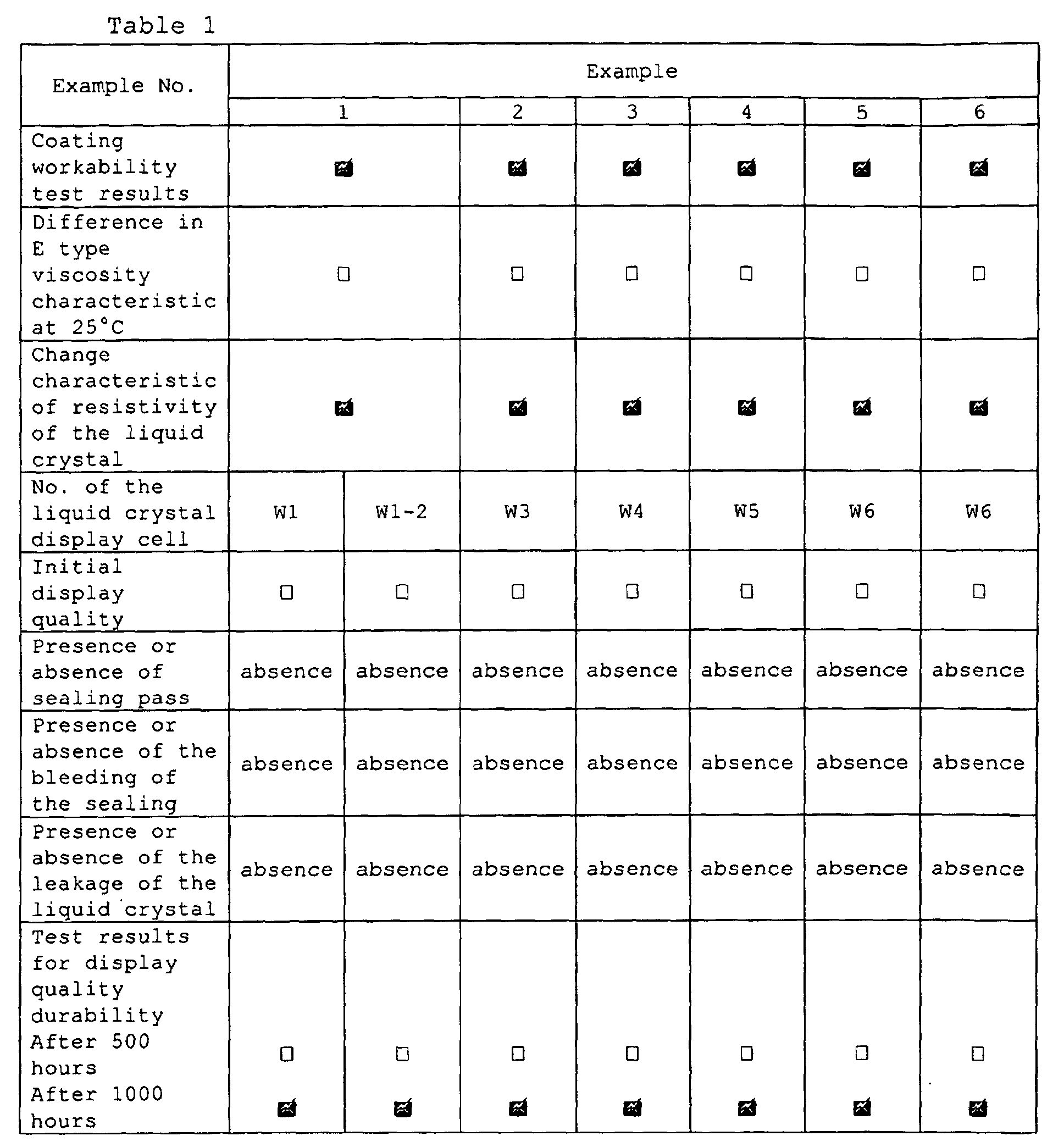
- the material to be cured and the curing agent were each obtained in the same manner as in Example 1, except that 70 parts of rubber fine particle containing-epoxydimethacrylate (A2) and 30 parts of PO modified bisphenol A type epoxydimethacrylate (A5) were used as a) radically polymerizable resin. Coating workability test results, the difference in E type viscosity characteristic and change characteristic of resistivity to the liquid crystal RC 4087, manufactured by Chisso Corporation, for each of the material to be cured and the curing agent, are shown in Table 1.
- the material to be cured comprises 48.78 mass% of a) component, 4.77 mass% of b) component, 32.56 mass% of e) component, 1.23 mass% of f) component, and 12.66 mass% of h) component.
- the curing agent comprises 48.39 mass% of a) component, 5.49 mass% of c) component, 32.31% of e) component, 1.22 mass% of f) component, and 12.59 mas s% of h) component.
- liquid crystal display cell was also produced in the same manner as described in Example 1 following the operations that separate cylindrical syringes of 20 ml made of opaque polyethylene were charged with 10 ml of each of the material to be cured and the curing agent, and the contents in the syringes were further degassed and set in a dispenser coating machine. Three sets of glass-made liquid crystal display cell (W2) were obtained. It was clearly shown that in the resulting cell, no sealing pass nor bleeding of the sealing agent was generated at all, and also no leakage of the liquid crystal was observed at all.
- the material to be cured and the curing agent were each obtained in the same manner as in Example 1, except that 50 parts of epoxydimethacrylate (A1) and 50 parts of rubber fine particle-containing plastic epoxydimethacrylate (A5) were used as a) radically polymerizable resin. Coating workability test results, the difference in E type viscosity characteristic and change characteristic of resistivity to the liquid crystal RC 4087, manufactured by Chisso Corporation, for each of the material to be cured and the curing agent are shown in Table 1.
- the material to be cured comprises 51.55 mass% of a) component, 4.77 mass% of b) component, 32.56 mass% of e) component, 1.23 mass% of f) component, and 9.87 mass% of h) component.
- the curing agent comprises 51.16 mass% of a) component, 5.49 mass% of c) component, 32.31% of e) component, 1.22 mass% of f) component and 9.82 mass% of h) component.
- the liquid crystal display cell was produced in the same manner as described in Example 1 following the operations that separate cylindrical syringes of 20 ml made of opaque polyethylene were charged with 10 ml of each of the material to be cured and the curing agent, and the contents in the syringes were further degassed and set in a dispenser coating machine, except that the 3 Volt-driving liquid crystal for TFT element, manufactured by Chisso Corporation was substituted for the liquid crystal RC 4087 manufactured by Chisso Corporation used in the Example 1. Three sets of liquid crystal display cell (W3) were obtained. It was clearly shown that in the resulting cell, no sealing pass nor the bleeding of the sealing agent was generated at all, and also no leakage of the liquid crystal was observed at all. The initial display quality and the display quality durability test results as to the obtained W3 cell are shown in Table 1.
- the material to be cured and the curing agent were each obtained in the same manner as described in Example 1, except that as a) radically polymerizable resin, 40 parts of epoxydimethacrylate (A1), 50 parts of rubber fine particle containing-plastic epoxydimethacrylate (A3) and 5 parts of trimethylolpropanetriacrylate (A6), as radically polymerizable monomer having poor volatility, 7 parts of 2-hydroxypropyl methacrylate (reagent ⁇ special grade) and 3 parts of methacrylic acid (reagent ⁇ special grade)were used.
- Coating workability test results the difference in E type viscosity characteristic at 20°C and change characteristic of resistivity to the liquid crystal RC 4087, manufactured by Chisso Corporation, for each of the material to be cured and the curing agent are shown in Table 1.
- the material to be cured comprises 51.54 mass% of a) component comprising radically polymerizable monomer having a poor volatibility, 4.77 mass% of b) component, 32.56 mass% of e) component, 1.23 mass% of f) component and 9.9 mass% of h) component.
- the curing agent comprises 51.16 mass% of a) component comprising radically polymerizable monomer having poor volatility, 5.49 mass% of c) component, 32.31% of e) component, 1.22 mass% of f) component, and 9.82 mass% of h) component.
- the liquid crystal display cell was produced in the same manner as described in Example 1 following the operations that separate cylindrical syringes of 20 ml made of opaque polyethylene were charged with 10 ml of each of the material to be cured and the curing agent, and the contents in the syringes were further degassed and set in a dispenser coating machine. Three sets of liquid crystal display cell (W4) were obtained. It was clearly shown that in the resulting cell, no sealing pass nor the bleeding of the sealing agent was generated at all, and also no leakage of the liquid crystal was observed at all. The initial display quality and the display quality durability test results as to the obtained W4 cell are shown in Table 1.
- radically polymerizable resin 50 parts of epoxydimethacrylate (A1), 30 parts of PO modified bisphenol A type epoxydimethacrylate (A5), and 5 parts of trimethylolpropanetriacrylate (A6), as radically polymerizable monomer with poor volatility, 7 parts of 2-hydroxyethylacrylate (reagent ⁇ special grade) and 3 parts of methacrylic acid (reagent ⁇ special grade), as h) and i) components, 10 parts of core-shell-like fine particle, F-351, manufactured by Nippon Zeon Co., Ltd.
- core part is h
- shell part is i)high softening point-acryl fine particle, and the weight ratio of core phase: shell phase is 1:1
- inorganic filler 1 part of titanium white and 2 parts of an amorphous silica, MU-120, and 50 parts of an amorphous alumina, AL-2, and as f) silane coupling agent, 2 parts of Y-9030 were pre-mixed by using a Dalton mixer.
- composition comprising as a) radically polymerizable resin, 50 parts of epoxydimethacrylate (A1), 30 parts of PO modified bisphenol A type epoxydimethacrylate (A5), and 5 parts of trimethylolpropanetriacrylate (A6), as radically polymerizable monomer having poor volatility, 7 parts of 2-hydroxyethylacrylate (reagent ⁇ special grade) and 3 parts of methacrylic acid (reagent ⁇ special grade), as h) and i) components, 10 parts of core-shell-like fine particle, F-351, manufactured by Nippon Zeon Co., Ltd.
- inorganic filler 1 part of titanium white, 2 parts of an amorphous silica, MU-120, and 50 parts of an amorphous alumina of AL-2, as f) silane coupling agent, 2 parts of Y-9030, and as c) decomposition accelerator, 9 parts of tetramethylthiourea were pre-mixed by using a Dalton mixer, and then, were kneaded by using a ceramic-made three roll mill until the solid materials were pulverized to 3 ⁇ m or less. Finally, the above composition was subjected to vacuum degassing treatment to obtain a curing agent.
- the material to be cured comprises a) 55.30 mass% of component comprising radically polymerizable monomer with poor volatility, 4.77 mass% of b) component, 32.56 mass% of e) component, 1.23 mass% of f) component, 3.07 mass% of h) component, and 3.07 mass% of i) high softening point-acryl fine particle.
- the curing agent comprises 54.88 mass% of a) component comprising radically polymerizable monomer having poor volatility, 5.49 mass% of c) component, 32.31% of e) component, 1.22 mass% of f) component, 3.05 mass% of h) component and 3.05 mass% of i) high softening point-acryl fine particle.
- liquid crystal display cell was produced in the same manner as described in Example 1 following the operations that separate cylindrical syringes of 20 ml made of opaque polyethylene were charged with 10 ml of each of the material to be cured and the curing agent, and the contents in the syringes were further degassed and set in a dispenser coating machine. Three sets of liquid crystal display cell (W5) were obtained. It was clearly shown that in the resulting cell, no sealing pass nor the bleeding of the sealing agent was generated at all, and also no leakage of the liquid crystal was observed at all.
- the material to be cured and the curing agent constituting the acrylate two-components sealing agent were each obtained in the same manner as described in Example 2, except that as c) decomposition accelerator, 1 part of dimethylthiourea, 1 part of dibutylthiourea, 1 part of acetylthiourea and 6 parts of benzoylthiourea were used.
- liquid crystal display cell was produced in the same manner as described in Example 1 following the operations that separate cylindrical syringes of 20 ml made of opaque polyethylene were charged with 10 ml of each of the material to be cured and the curing agent, and the contents in the syringes were further degassed and set in a dispenser coating machine. Three sets of liquid crystal display cell (W6) were obtained. It was clearly shown that in the resulting cell, no sealing pass nor the bleeding of the sealing agent was generated at all, and also no leakage of the liquid crystal was observed at all. The initial display quality and the display quality durability test results as to the obtained W6 cell are shown in Table 1.
- the material to be cured and the curing agent were each obtained in the same manner as described in Example 2, except that as c) decomposition accelerator, 2 part of ethylenethiourea, 2 part of diethylenethiourea and 5 parts of mercaptobenzimidazole were used.
- the liquid crystal display cell was produced in the same manner as described in Example 1 following the operations that separate cylindrical syringes of 20 ml made of opaque polyethylene were charged with 10 ml of each of the material to be cured and the curing agent, and the contents in the syringes were further degassed and set in a dispenser coating machine. Three sets of liquid crystal display cell (W7) were obtained. It was clearly shown that in the resulting cell, no sealing pass nor the bleeding of the sealing agent was generated at all, and also no leakage of the liquid crystal was observed at all. The initial display quality and the display quality durability test results as to the obtained W7 cell are shown in Table 2.
- the material to be cured comprises 45.46 mass% of a) radically polymerizable resin represented by the sum of the allyl type resin and the polyvalent mercapto compound, 9.09 mass% of b) organic peroxide, 44.55 mass% of e) inorganic filler, and 0.9 mass% of f) silane coupling agent.
- the curing agent comprises 43.48 mass% of a) component represented by the sum of the allyl type resin and the polyvalent mercapto compound, 13.04 mass% of c) component, e) component 42.61%, and 0.87 mass% of f) component.
- liquid crystal display cell (W8) three sets of the liquid crystal display cell (W8) were produced in the same manner as described in Example 1 following the operations that separate cylindrical syringe of 20 ml made of opaque polyethylene were charged with 10 ml of each of the material to be cured and the curing agent, and the contents in the syringes were further degassed and set in a dispenser coating machine (Short Master: manufactured by Musashi Engineering Co., Ltd.) except that the glass substrate was replaced with the plastic substrate comprising the polycarbonate substrate as a base, having the same size as the former, manufactured by Teijin Corporation and that the first setting time for the gel-forming was changed to 60 minutes. It was clearly shown that in the resulting cell, sealing pass or the bleeding of the sealing agent was not generated, and also the leakage of the liquid crystal was not generated.
- a one-component sealing agent was charged into cylindrical syringes of 20 ml made of opaque polyethylene by 10 ml, and the contents was set in a dispenser coating machine (Short Master: manufactured by Musashi Engineering Co., Ltd.). Then, the pretreatment which is required to provide transparent electrodes, an alignment film and a black matrix was completed. Three sets of two sheets of facing glass substrates for the liquid crystal display element cleaned by completion of the pretreatment were used. The size of the substrates was 1 inch. Then the sealing portion of the front substrate was masked, 4.5 ⁇ m of spherical silica particles as a gap-forming controller were sprayed and heated at 120°C for 30 minutes to perform the surface treatment of the front substrate.
- one-component sealing agents were each evenly applied in a frame pattern at a width of 0.3 ⁇ 0.02 mm as the width of the line of the uncured sealing agent line.
- the substrate on the rear side was located downward and the substrate in the front side was located upward, and 2 drops of the liquid crystal RC 4087, manufactured by Chisso Corporation in the calculated theoretical amount were dropped around the central portion in the sealing frame of the substrate in the rear side, thereafter the air was evacuated to reach the vacuum degree of 10 Pa, the facing substrates were slowly bonded for 10 seconds, and the liquid crystal was sealed thereto. Thereafter, it was subjected to pressure for 5 seconds until the width of gap was 4.5 ⁇ m, thereby the sealed width reached 1 mm. The sealing portion within 0.75 mm of the width thereof was left in a shielded situation due to the black matrix.
- radically polymerizable resin 70 parts of epoxymonomethacrylate (A4) and 28 parts of PO modified phenol A type epoxydimethacrylate (A5), as e) inorganic filler, 5 parts of an amorphous silica, MU-120 and 45 parts of talc having an average particle diameter (d 50 ) of 1 ⁇ m, which is determined by the weight integration curve, and as f) silane coupling agent, 2 parts of Y-9030 (brand name; a product manufactured by Nihon Unika Co., Ltd.) were pre-mixed by using a Dalton mixer and then kneaded by using a ceramic-made three roll mill until the solid materials were pulverized to 3 ⁇ m or less.
- Y-9030 brand name; a product manufactured by Nihon Unika Co., Ltd.
- a one-component sealing agent was charged into cylindrical syringes of 20 ml made of opaque polyethylene by 10 ml, and the contents was set in a dispenser coating machine (Short Master: manufactured by Musashi Engineering Co., Ltd.). Then, the pretreatment which is required to provide transparent electrodes, an alignment film and a black matrix was completed. Three sets of two sheets of facing glass substrates for the liquid crystal display element cleaned by completion of the pretreatment were used. The size of the substrates was 1 inch. And then the sealing portion of the front substrate was masked, 4.5 ⁇ m of spherical silica particles as a gap-forming controller were sprayed and heated at 120°C for 30 minutes to perform the surface treatment of the front substrate.
- one-component sealing agents were each evenly applied in a frame pattern at a width of 0.3 ⁇ 0.02 mm as the line-width of the uncured sealing agent.
- the substrate on the rear side was located downward and the substrate in the front side was located upward, and the liquid crystal RC 4087, manufactured by Chisso Corporation in the calculated theoretical amount was added dropwise on the central portion in the sealing frame of the substrate on the rear side, thereafter the air was evacuated to reach a vacuum of 10 Pa, and then the facing substrates were slowly bonded for 10 seconds, and the liquid crystal was sealed thereto. Thereafter, it was subjected to pressure for 5 seconds until the width of gap was up to 4.5 ⁇ m, thereby the sealed width reached 1 mm. The sealing portion within 0.75 mm of the width thereof was left in a shielded situation by the black matrix.
- thermosetting was initiated immediately after the evacuation was broken at 100°C for 60 minutes to produce three sets of liquid crystal display cell (X2) for the comparison.
- X2 liquid crystal display cell
- the initial display quality test results as to the obtained X2 are shown in Table 2, however the display quality durability test was not performed.
- Comparative example 1 based on Japanese Unexamined Patent Application Publication Nos. 5-295087 and 9-57591 and the like, is a comparative synthetic example of the liquid crystal-dropping sealing method wherein a single-liquid sealing agent having both photocuring and the thermosetting properties was used. With a photocuring process alone, only liquid crystal display cell with little practibility could be obtained. And even when light and heat were used together, the initial display quality and the display quality durability thereof were very poor, which are assumed to be a lack of curability in the light-shield part.
- Comparative example 2 is a comparative synthetic example on the conventional liquid crystal-dropping sealing method wherein a single-liquid sealing agent having the photocuring property was used. Even when the curing process was performed by means of the large amount of UV light, the degree of curing of the sealing agent was poor and the leakage of sealing of the liquid crystal frequently occurred.
- liquid crystal display cell (Examples 1 to 7) of the present invention
- the sealing agent comprising a material to be cured and a curing agent of the present invention does not contaminate the liquid crystal at all, does not cure until the substrates are laminated, and was cured at room temperature within a short time.
- the liquid crystal display cells produced by the method for producing the liquid crystal display cell according to the present invention are homogenous and have a good display quality and durability.
- the sealing agent of the present invention does not need photoirradiation or long-term heating and curing process, under high temperature exceeding 100°C, and further, it can avoid thermal deterioration or deterioration due to photo-decomposition to the maximum.
Landscapes
- Physics & Mathematics (AREA)
- Nonlinear Science (AREA)
- Mathematical Physics (AREA)
- Chemical & Material Sciences (AREA)
- Crystallography & Structural Chemistry (AREA)
- General Physics & Mathematics (AREA)
- Optics & Photonics (AREA)
- Spectroscopy & Molecular Physics (AREA)
- Liquid Crystal (AREA)
- Sealing Material Composition (AREA)
Abstract
Description


diallylphthalate was used as a polyvalent allylphthalate, of which the reduced number-average molecular weight was 245 and the resistivity was 7 × 10⁹Ω·cm,
pentaerythritol triallyl ether was used as a polyvalent allylether, of which the reduced number-average molecular weight was 257 and the resistivity was 4 × 10⁷Ω·cm.

Claims (6)
- A method for producing a liquid crystal display cell comprising processes of applying a sealing agent to a sealing portion of at least one liquid crystal display cell substrate, dropping liquid crystal on the substrate, and bonding substrates to each other under vacuum, wherein the sealing agent comprising a material to be cured and a curing agent is applied to the sealing portion without mixing the material to be cured and the curing agent, and then the substrates are bonded to each other under vacuum at room temperature to cure the sealing agent.
- A sealing agent for a liquid crystal display cell wherein the material to be cured comprises a) a radically polymerizable resin and b) an organic peroxide, and the curing agent comprises a) a radically polymerizable resin and c) a decomposition accelerator.
- The sealing agent for a liquid crystal display cell according to claim 2, wherein the material to be cured comprises a) 30 to 94.4 mass% of a radically polymerizable resin having polystyrene-reduced number-average molecular weight of 300 to 10000, as a radically polymerizable resin, b) 0.5 to 10 mass% of an organic peroxide having a 10 hour-half life temperature of at least 120°C, e) 5 to 50 mass% of an inorganic filler and f) 0.1 to 5 mass% of a silane coupling agent, and the curing agent comprises a) 30 to 94.4 mass% of a radically polymerizable resin having polystyrene-reduced number-average molecular weight of 300 to 10000, as a radically polymerizable resin, c) 0.5 to 10 mass% of a decomposition accelerator, e) 5 to 50 mass% of an inorganic filler and f) 0.1 to 5 mass% of a silane coupling agent, and the mass ratio of the curing agent: the material to be cured is in a range from (3:1) to (1:3).
- The sealing agent for a liquid crystal display cell according to claim 3, wherein a) the radically polymerizable resin is an acrylate resin having polystyrene-reduced number-average molecular weight of 300 to 10000.
- The sealing agent for a liquid crystal display cell according to claim 3, wherein a) the radically polymerizable resin is an allyl resin having polystyrene-reduced number-average molecular weight of 300 to 10000, and d) a polyvalent mercapto compound.
- The sealing agent for a liquid crystal display cell according to claim 4, wherein the material to be cured and the curing agent are each independently compounded with 5 to 25 mass% of g) a liquid rubber and/or h) a rubber fine particulate, based on the total amount.
Applications Claiming Priority (3)
| Application Number | Priority Date | Filing Date | Title |
|---|---|---|---|
| JP2002026430 | 2002-02-04 | ||
| JP2002026430 | 2002-02-04 | ||
| PCT/JP2003/000958 WO2003073158A1 (en) | 2002-02-04 | 2003-01-31 | Method for producing liquid crystal display cell and sealing agent for liquid crystal display cell |
Publications (2)
| Publication Number | Publication Date |
|---|---|
| EP1480071A1 true EP1480071A1 (en) | 2004-11-24 |
| EP1480071A4 EP1480071A4 (en) | 2005-08-17 |
Family
ID=27764245
Family Applications (1)
| Application Number | Title | Priority Date | Filing Date |
|---|---|---|---|
| EP03703106A Withdrawn EP1480071A4 (en) | 2002-02-04 | 2003-01-31 | Method for producing liquid crystal display cell and sealing agent for liquid crystal display cell |
Country Status (7)
| Country | Link |
|---|---|
| US (2) | US20050143513A1 (en) |
| EP (1) | EP1480071A4 (en) |
| JP (1) | JP4007961B2 (en) |
| KR (1) | KR100714241B1 (en) |
| CN (1) | CN1304892C (en) |
| TW (1) | TW200303439A (en) |
| WO (1) | WO2003073158A1 (en) |
Cited By (1)
| Publication number | Priority date | Publication date | Assignee | Title |
|---|---|---|---|---|
| EP2680064A1 (en) * | 2012-06-29 | 2014-01-01 | InnoLux Corporation | Liquid-crystal display |
Families Citing this family (28)
| Publication number | Priority date | Publication date | Assignee | Title |
|---|---|---|---|---|
| JP4532883B2 (en) * | 2003-06-04 | 2010-08-25 | 積水化学工業株式会社 | Photocurable resin composition, liquid crystal display element sealing agent, liquid crystal display element sealing agent, liquid crystal display element vertical conduction material, and liquid crystal display device |
| JP4190472B2 (en) * | 2004-07-28 | 2008-12-03 | シャープ株式会社 | Manufacturing method and manufacturing apparatus of liquid crystal display element |
| KR100673765B1 (en) * | 2006-01-20 | 2007-01-24 | 삼성에스디아이 주식회사 | Organic light emitting display device and manufacturing method |
| US20090236036A1 (en) * | 2006-06-26 | 2009-09-24 | Hidenori Miyakawa | Heat curable resin composition, and mounting method and reparing process for circuit board using the heat curable composition |
| US8088245B2 (en) * | 2007-04-11 | 2012-01-03 | Dow Global Technologies Llc | Structural epoxy resins containing core-shell rubbers |
| EP2222740B1 (en) * | 2007-12-21 | 2017-10-11 | Rolic AG | Functionalized photoreactive compounds |
| JP5257941B2 (en) * | 2009-04-28 | 2013-08-07 | 日本化薬株式会社 | Liquid crystal sealant and liquid crystal display cell using the same |
| KR101134635B1 (en) * | 2009-10-12 | 2012-04-09 | 금호석유화학 주식회사 | Sealant composition for liquid crystal display device |
| KR101220047B1 (en) * | 2009-10-12 | 2013-01-08 | 금호석유화학 주식회사 | Sealant composition for liquid crystal display device |
| JP5184492B2 (en) | 2009-11-19 | 2013-04-17 | 株式会社ジャパンディスプレイイースト | Liquid crystal display device and manufacturing method thereof |
| TWI396006B (en) | 2010-04-29 | 2013-05-11 | Au Optronics Corp | Liquid crystal display panel |
| JP2012051856A (en) * | 2010-09-03 | 2012-03-15 | Gc Corp | Polymerizable composition |
| KR101486689B1 (en) * | 2011-03-28 | 2015-01-26 | 미쓰이 가가쿠 가부시키가이샤 | Liquid crystal sealing agent, method for producing liquid crystal display device using same, and liquid crystal display panel |
| JP5993725B2 (en) * | 2012-05-18 | 2016-09-14 | 協立化学産業株式会社 | Optical component manufacturing method, adhesive composition kit, and coating composition |
| JP6040337B1 (en) * | 2012-05-18 | 2016-12-07 | 協立化学産業株式会社 | Optical component manufacturing method, adhesive composition kit, and coating composition |
| JP6227923B2 (en) * | 2012-08-03 | 2017-11-08 | 協立化学産業株式会社 | Method for producing laminated film, adhesive composition kit and reaction initiator composition |
| CN102981301B (en) * | 2012-11-29 | 2015-01-14 | 京东方科技集团股份有限公司 | A method of manufacturing a display device |
| CN104570451B (en) * | 2012-11-29 | 2017-05-24 | 京东方科技集团股份有限公司 | Method for manufacturing display equipment |
| CN103087641A (en) * | 2013-01-23 | 2013-05-08 | 深圳市华星光电技术有限公司 | Frame plastic material, liquid crystal panel and corresponding liquid crystal displayer |
| CN103064208B (en) * | 2013-01-23 | 2015-06-10 | 深圳市华星光电技术有限公司 | Polymer stable vertical alignment liquid crystal display panel and liquid crystal display |
| WO2014192881A1 (en) * | 2013-05-31 | 2014-12-04 | 積水化学工業株式会社 | Sealing agent for liquid crystal display elements, vertically conducting material, liquid crystal display element and production method of sealing agent for liquid crystal display element |
| KR20140146425A (en) * | 2013-06-17 | 2014-12-26 | 삼성디스플레이 주식회사 | Liquid crystal display and method for manufacturing the same |
| CN104076550A (en) * | 2014-06-17 | 2014-10-01 | 京东方科技集团股份有限公司 | Color film array substrate, display device and method for manufacturing color film array substrate |
| CN106415381B (en) * | 2014-09-24 | 2020-09-25 | 积水化学工业株式会社 | Liquid crystal display element sealing compound, vertical conduction material, and liquid crystal display element |
| US20200269323A1 (en) * | 2016-06-02 | 2020-08-27 | The Regents Of The University Of California | Synthesis of ultra-thin metal nanowires using organic free radicals |
| JP6837781B2 (en) * | 2016-08-31 | 2021-03-03 | 日本化薬株式会社 | Liquid crystal sealant and liquid crystal display cell using it |
| JP7035728B2 (en) * | 2018-03-30 | 2022-03-15 | 日油株式会社 | A liquid crystal panel encapsulant resin composition and a film liquid crystal panel whose ends are sealed with the liquid crystal panel encapsulant resin composition. |
| JP7525843B2 (en) * | 2020-04-24 | 2024-07-31 | 株式会社デンソー | Waterproof case for cars |
Family Cites Families (30)
| Publication number | Priority date | Publication date | Assignee | Title |
|---|---|---|---|---|
| US3557249A (en) * | 1968-12-30 | 1971-01-19 | Hooker Chemical Corp | Thermosetting allyl resins |
| JPS5528018A (en) * | 1978-08-17 | 1980-02-28 | Mitsubishi Electric Corp | Liquid crystal display element |
| GB2037784B (en) * | 1978-11-06 | 1983-01-06 | Bostik Ltd | Adhesives:activators |
| US4401537A (en) * | 1978-12-26 | 1983-08-30 | Minnesota Mining And Manufacturing Company | Liquid crystal display and photopolymerizable sealant therefor |
| JPS55116773A (en) * | 1979-03-05 | 1980-09-08 | Mitsubishi Electric Corp | Bonding method |
| JPS6019789B2 (en) * | 1979-07-23 | 1985-05-17 | 電気化学工業株式会社 | two-component adhesive |
| JPS62207320A (en) | 1986-03-07 | 1987-09-11 | Hitachi Ltd | Theromosetting resin composition and semiconductor device coated or sealed therewith |
| US5115083A (en) * | 1989-11-06 | 1992-05-19 | The Lubrizol Corporation | Curable aminoplast compositions and catalysts for curing same |
| JP3200481B2 (en) * | 1992-11-18 | 2001-08-20 | ナミックス株式会社 | Liquid crystal display panel sealing material and liquid crystal display panel using the same |
| JPH0713173A (en) | 1993-06-22 | 1995-01-17 | Three Bond Co Ltd | Sealing agent for liquid crystal |
| US5596024A (en) * | 1993-06-22 | 1997-01-21 | Three Bond Co., Ltd. | Sealing composition for liquid crystal |
| KR0163981B1 (en) * | 1993-06-29 | 1999-01-15 | 사또오 아키오 | Resin Composition for Film Liquid Crystal Cell Encapsulation |
| US5515188A (en) * | 1994-06-03 | 1996-05-07 | Motorola, Inc. | Method of manufacturing a liquid crystal display device in which a vacuum reservoir attached to the LCD is placed in a conformable container or bag |
| US5631332A (en) * | 1995-01-17 | 1997-05-20 | Mitsui Toatsu Chemicals, Inc. | Curing agents for epoxy resins comprising bis(aminomethyl)bicyclo[2.2.1]heptane adducts |
| US6001203A (en) * | 1995-03-01 | 1999-12-14 | Matsushita Electric Industrial Co., Ltd. | Production process of liquid crystal display panel, seal material for liquid crystal cell and liquid crystal display |
| US5898041A (en) * | 1995-03-01 | 1999-04-27 | Matsushita Electric Industrial Co., Ltd. | Production process of liquid crystal display panel, seal material for liquid crystal cell and liquid crystal display |
| JP2846842B2 (en) * | 1995-06-22 | 1999-01-13 | 松下電器産業株式会社 | Liquid crystal sealing material and liquid crystal display device |
| JPH09143433A (en) * | 1995-11-20 | 1997-06-03 | Toyo Ink Mfg Co Ltd | Bonding method |
| US5902838A (en) * | 1996-10-01 | 1999-05-11 | Loctite Corporation | Process for the assembly of glass devices subjected to high temperatures, compositions therefor and novel polymers for rheological control of such compositions |
| JPH1149983A (en) * | 1997-08-07 | 1999-02-23 | Denki Kagaku Kogyo Kk | Curable emulsion |
| JPH11133438A (en) * | 1997-10-24 | 1999-05-21 | Matsushita Electric Ind Co Ltd | Liquid crystal display device and its manufacturing method |
| JPH11143395A (en) * | 1997-11-11 | 1999-05-28 | Oputeku:Kk | Display devices and adhesives and solid particles |
| US6219126B1 (en) * | 1998-11-20 | 2001-04-17 | International Business Machines Corporation | Panel assembly for liquid crystal displays having a barrier fillet and an adhesive fillet in the periphery |
| KR100414698B1 (en) * | 1999-04-01 | 2004-01-13 | 미쯔이카가쿠 가부시기가이샤 | Sealing material composition for liquid crystal |
| JP2001029969A (en) * | 1999-07-19 | 2001-02-06 | Sumitomo Metal Mining Co Ltd | Treatment of organic chlorine compounds in wastewater |
| JP2001064483A (en) * | 1999-08-27 | 2001-03-13 | Sumitomo Bakelite Co Ltd | Sealing material composition for liquid crystal display device |
| JP2001100224A (en) | 1999-09-28 | 2001-04-13 | Mitsui Chemicals Inc | Sealing material composition for liquid crystal display cell |
| JP3583326B2 (en) | 1999-11-01 | 2004-11-04 | 協立化学産業株式会社 | Sealant for dripping method of LCD panel |
| TWI298412B (en) * | 2000-06-21 | 2008-07-01 | Mitsui Chemicals Inc | |
| JP2002031808A (en) * | 2000-07-14 | 2002-01-31 | Sumitomo Bakelite Co Ltd | Sealing material for plastic film liquid crystal display device and plastic film liquid crystal display device |
-
2003
- 2003-01-28 TW TW092101855A patent/TW200303439A/en not_active IP Right Cessation
- 2003-01-31 US US10/502,715 patent/US20050143513A1/en not_active Abandoned
- 2003-01-31 EP EP03703106A patent/EP1480071A4/en not_active Withdrawn
- 2003-01-31 CN CNB038016818A patent/CN1304892C/en not_active Expired - Lifetime
- 2003-01-31 KR KR1020047006613A patent/KR100714241B1/en not_active Expired - Lifetime
- 2003-01-31 JP JP2003571788A patent/JP4007961B2/en not_active Expired - Lifetime
- 2003-01-31 WO PCT/JP2003/000958 patent/WO2003073158A1/en not_active Ceased
-
2007
- 2007-04-03 US US11/730,702 patent/US7903230B2/en not_active Expired - Fee Related
Cited By (2)
| Publication number | Priority date | Publication date | Assignee | Title |
|---|---|---|---|---|
| EP2680064A1 (en) * | 2012-06-29 | 2014-01-01 | InnoLux Corporation | Liquid-crystal display |
| US9285637B2 (en) | 2012-06-29 | 2016-03-15 | Innolux Corporation | Liquid-crystal display |
Also Published As
| Publication number | Publication date |
|---|---|
| US20070179221A1 (en) | 2007-08-02 |
| CN1596382A (en) | 2005-03-16 |
| JP4007961B2 (en) | 2007-11-14 |
| CN1304892C (en) | 2007-03-14 |
| KR100714241B1 (en) | 2007-05-02 |
| US20050143513A1 (en) | 2005-06-30 |
| EP1480071A4 (en) | 2005-08-17 |
| JPWO2003073158A1 (en) | 2005-06-23 |
| US7903230B2 (en) | 2011-03-08 |
| KR20040060962A (en) | 2004-07-06 |
| WO2003073158A1 (en) | 2003-09-04 |
| TWI299809B (en) | 2008-08-11 |
| TW200303439A (en) | 2003-09-01 |
Similar Documents
| Publication | Publication Date | Title |
|---|---|---|
| US7903230B2 (en) | Method for producing liquid crystal display cell and sealing agent for liquid crystal display cell | |
| US11614647B2 (en) | Method for producing image display apparatus | |
| JP4490282B2 (en) | Liquid crystal sealant and liquid crystal display cell using the same | |
| JP5298605B2 (en) | Manufacturing method of image display device | |
| JP5651177B2 (en) | Liquid crystal sealant and liquid crystal display cell using the same | |
| HK1209494A1 (en) | A method for manufacturing an image display device | |
| CN101454713B (en) | Liquid crystal sealing agent and liquid crystal display cell using the same | |
| JP5268235B2 (en) | Liquid crystal sealant and liquid crystal display cell using the same | |
| KR20160018480A (en) | Sealing agent for liquid crystal dropping methods, vertically conducting material, and liquid crystal display element | |
| JP6643574B2 (en) | Photocurable resin composition | |
| JP4052858B2 (en) | Liquid crystal sealing resin composition and liquid crystal display element | |
| JP2007010769A (en) | Liquid crystal sealing agent and liquid crystal display cell using same | |
| KR20100118518A (en) | Sealant for liquid crystal, and liquid crystal displaycell made with the same | |
| JP5748273B2 (en) | Liquid crystal sealant and liquid crystal display cell using the same | |
| JP2007334174A (en) | Liquid crystal sealing agent and liquid crystal display cell using the same | |
| JP2011038079A (en) | Resin composition for forming gap of optically displaying device, and cured material of the same | |
| TW201930536A (en) | Sealing agent for displays | |
| JP5395968B2 (en) | Liquid crystal dropping method sealing agent, vertical conduction material, and liquid crystal display element | |
| JP2005115255A (en) | Liquid crystal sealing agent and liquid crystal display cell using the same | |
| JPWO2014010731A1 (en) | Liquid crystal sealant and liquid crystal display cell using the same | |
| JP2016206474A (en) | Liquid crystal sealant and liquid crystal display cell using the same | |
| JP5182834B2 (en) | Liquid crystal sealant and liquid crystal display cell using the same | |
| JP5369204B2 (en) | Liquid crystal dropping method sealing agent, vertical conduction material, and liquid crystal display device | |
| KR20080016468A (en) | Sealing agent resin composition | |
| JP2018040947A (en) | Liquid crystal sealing agent and liquid crystal display cell using the same |
Legal Events
| Date | Code | Title | Description |
|---|---|---|---|
| PUAI | Public reference made under article 153(3) epc to a published international application that has entered the european phase |
Free format text: ORIGINAL CODE: 0009012 |
|
| 17P | Request for examination filed |
Effective date: 20040726 |
|
| AK | Designated contracting states |
Kind code of ref document: A1 Designated state(s): AT BE BG CH CY CZ DE DK EE ES FI FR GB GR HU IE IT LI LU MC NL PT SE SI SK TR |
|
| AX | Request for extension of the european patent |
Extension state: AL LT LV MK RO |
|
| RAP1 | Party data changed (applicant data changed or rights of an application transferred) |
Owner name: MITSUI CHEMICALS, INC. |
|
| A4 | Supplementary search report drawn up and despatched |
Effective date: 20050706 |
|
| REG | Reference to a national code |
Ref country code: DE Ref legal event code: 8566 |
|
| STAA | Information on the status of an ep patent application or granted ep patent |
Free format text: STATUS: THE APPLICATION IS DEEMED TO BE WITHDRAWN |
|
| 18D | Application deemed to be withdrawn |
Effective date: 20050802 |