EP1475685B1 - Thermostatisches Arbeitselement - Google Patents
Thermostatisches Arbeitselement Download PDFInfo
- Publication number
- EP1475685B1 EP1475685B1 EP20040009776 EP04009776A EP1475685B1 EP 1475685 B1 EP1475685 B1 EP 1475685B1 EP 20040009776 EP20040009776 EP 20040009776 EP 04009776 A EP04009776 A EP 04009776A EP 1475685 B1 EP1475685 B1 EP 1475685B1
- Authority
- EP
- European Patent Office
- Prior art keywords
- expansion material
- expanded graphite
- working element
- housing
- wax
- Prior art date
- Legal status (The legal status is an assumption and is not a legal conclusion. Google has not performed a legal analysis and makes no representation as to the accuracy of the status listed.)
- Expired - Lifetime
Links
- OKTJSMMVPCPJKN-UHFFFAOYSA-N Carbon Chemical compound [C] OKTJSMMVPCPJKN-UHFFFAOYSA-N 0.000 claims description 35
- 229910002804 graphite Inorganic materials 0.000 claims description 32
- 239000010439 graphite Substances 0.000 claims description 32
- 239000000463 material Substances 0.000 claims description 29
- 238000002844 melting Methods 0.000 claims description 8
- 230000008018 melting Effects 0.000 claims description 8
- 239000000843 powder Substances 0.000 claims description 8
- 239000000654 additive Substances 0.000 claims description 5
- 230000000996 additive effect Effects 0.000 claims description 4
- 230000001419 dependent effect Effects 0.000 claims description 3
- 238000000034 method Methods 0.000 claims 3
- 239000002245 particle Substances 0.000 claims 2
- 238000004519 manufacturing process Methods 0.000 claims 1
- 230000004044 response Effects 0.000 description 11
- 230000006872 improvement Effects 0.000 description 5
- 239000012528 membrane Substances 0.000 description 3
- 230000035484 reaction time Effects 0.000 description 3
- 230000008859 change Effects 0.000 description 2
- 229910052751 metal Inorganic materials 0.000 description 2
- 239000002184 metal Substances 0.000 description 2
- 150000002739 metals Chemical class 0.000 description 2
- 239000000203 mixture Substances 0.000 description 2
- RYGMFSIKBFXOCR-UHFFFAOYSA-N Copper Chemical compound [Cu] RYGMFSIKBFXOCR-UHFFFAOYSA-N 0.000 description 1
- 230000002776 aggregation Effects 0.000 description 1
- 238000004220 aggregation Methods 0.000 description 1
- 229910052782 aluminium Inorganic materials 0.000 description 1
- XAGFODPZIPBFFR-UHFFFAOYSA-N aluminium Chemical compound [Al] XAGFODPZIPBFFR-UHFFFAOYSA-N 0.000 description 1
- 239000011248 coating agent Substances 0.000 description 1
- 238000000576 coating method Methods 0.000 description 1
- 150000001875 compounds Chemical class 0.000 description 1
- 239000004020 conductor Substances 0.000 description 1
- 229910052802 copper Inorganic materials 0.000 description 1
- 239000010949 copper Substances 0.000 description 1
- 230000002349 favourable effect Effects 0.000 description 1
- 239000006260 foam Substances 0.000 description 1
- 239000011888 foil Substances 0.000 description 1
- 238000010438 heat treatment Methods 0.000 description 1
- 239000007788 liquid Substances 0.000 description 1
- 229910044991 metal oxide Inorganic materials 0.000 description 1
- 150000004706 metal oxides Chemical class 0.000 description 1
- 238000000465 moulding Methods 0.000 description 1
- -1 other foams Chemical compound 0.000 description 1
- 239000003566 sealing material Substances 0.000 description 1
- 238000005204 segregation Methods 0.000 description 1
- 239000007787 solid Substances 0.000 description 1
- 239000000126 substance Substances 0.000 description 1
- 230000002459 sustained effect Effects 0.000 description 1
Images
Classifications
-
- G—PHYSICS
- G05—CONTROLLING; REGULATING
- G05D—SYSTEMS FOR CONTROLLING OR REGULATING NON-ELECTRIC VARIABLES
- G05D23/00—Control of temperature
- G05D23/01—Control of temperature without auxiliary power
- G05D23/02—Control of temperature without auxiliary power with sensing element expanding and contracting in response to changes of temperature
- G05D23/021—Control of temperature without auxiliary power with sensing element expanding and contracting in response to changes of temperature the sensing element being a non-metallic solid, e.g. elastomer, paste
Definitions
- the invention relates to a thermostatic working element with a housing containing a mixed with an additive expansion material, the volume of which is temperature-dependent and which serves as a means for expelling a working piston from the housing.
- thermostatic working elements In the case of thermostatic working elements, a wax mixture is usually used as the expansion material, since it offers favorable properties when its state of aggregation changes due to a change in temperature. On the one hand, a nearly linear characteristic curve is obtained, while on the other hand relatively large actuating forces are made available.
- a problem of these thermostatic working elements is that they react only relatively slowly to temperature changes, ie have relatively long response times. There have been many attempts to improve the response time, but they were not very successful. It is known to add powdery materials such as metal oxides or metals, for example aluminum or copper, to the expansion material in order to improve the thermal conductivity and thus the response time. Although the addition of these substances leads to a certain improvement in the Response time, however, this improvement is usually not of sustained duration. The additives and the wax may segregate after a relatively short period of use, so that there is no longer an improvement in the response time thereafter.
- a thermostatic working element is for example from GB 507 501 known.
- the thermostatic working element has a housing containing an expanding material.
- the wax is added a finely divided solid, which is a good heat conductor, such as graphite.
- the invention has for its object to improve the response time of a thermostatic working element of the type mentioned above and to maintain for the longest possible service life.
- Expanded graphite has a very high thermal conductivity, so that the response time is significantly improved.
- expanded graphite has a density which is substantially more similar to the density of a wax, in particular a wax compound, than the metals commonly used. This leads to the risk of segregation being significantly lower. The response time therefore remains virtually unchanged at the reduced value for a plurality of cycles.
- Expanded graphite like other foams, has elastic properties, so that it has hitherto been used essentially as a sealing material or as a coating material. It has been shown that with a thorough mixing of the expansion material with the expanded graphite, the influence of the elasticity of the expanded graphite can largely be ruled out, so that the thermostatic working element continues to perform largely an adjusting movement with a linear characteristic.
- expanded graphite flakes are added to the expansion material. It is sufficient to improve the response time or reaction time already a weight of 25%.
- the expanded material powder of expanded graphite is added.
- a significant improvement in the response time is achieved when the weight fraction of the powder is about 50%.
- the weight fraction of the powder is about 50%.
- mixing with the wax is easier. Processing preferably takes place when the expansion material has a temperature which is only slightly below its melting point, for example only 2 ° to 5 °.
- mixing with liquid wax is also advantageous because of the relatively small differences in density.
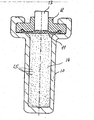
- the drawing shows an axial section through a thermostatic working element, the wax is a wax, which is admixed as an additive expanded graphite.
- the thermostatic working element has a tubular, closed on one side metallic housing 10, the open edge is closed by a rubber-elastic membrane 11.
- the membrane is clamped by means of a guide member 12, which by means of a flanged edge of the housing 10 is held.
- the guide member 12 carries a working piston which is supported on the diaphragm 11.
- the expansion material 14 changes its volume as a function of the temperature, wherein in particular during and after the state of aggregate change a substantially linear characteristic is present with which the working piston 13 is expelled from the housing.
- Degraded graphite usually has a flake-like shape, the flake size is of the order of 1 mm. Expanding increases the specific volume of graphite to over 300 times.
- the expanded graphite flakes are mixed with the wax (wax) before the wax is filled into the housing 10 as possible without air or gas inclusions. It is expedient to cool the wax during mixing to a temperature which is about 30 ° to about 40 ° below its melting temperature.
- the expansion material is heated above its melting temperature before or after mixing, so that it is partially absorbed by the expanded graphite. To obtain a substantial improvement in response time or reaction time, it is sufficient that the flake-form expanded graphite has a weight fraction of about 25%.
- the expanded graphite flakes are first pressed into a foil (rolled), which is then ground to powder.
- grain sizes of less than 1 mm and in particular less than 500 ⁇ are the Wax added.
- the mixing can be carried out at temperatures which are slightly below the melting temperature of the expansion material, which will usually be in the order of between 20 ° and 50 °.
- the mixing of the expanded graphite powder with the expanding material can therefore be carried out almost at room temperature, especially in air-conditioned rooms. This mixing can be carried out, for example, in an extruding mixer to which wax and powdery expanded graphite are added. It is also possible to produce moldings which correspond to the interior of the housing 10, and which are inserted into the housing.
- thermostatic working element shown in the drawing is to be understood only as an example.
- the invention is suitable for any type of thermostatic working elements, e.g. for working elements in which the working piston protrudes into a bag-shaped membrane or for elements with rubber inserts.
Landscapes
- Physics & Mathematics (AREA)
- General Physics & Mathematics (AREA)
- Engineering & Computer Science (AREA)
- Automation & Control Theory (AREA)
- Carbon And Carbon Compounds (AREA)
- Lubricants (AREA)
- Resistance Heating (AREA)
- Compositions Of Macromolecular Compounds (AREA)
Description
- Die Erfindung betrifft ein thermostatisches Arbeitselement mit einem Gehäuse, das einen mit einem Zusatzstoff vermischten Dehnstoff enthält, dessen Volumen temperaturabhängig ist und der als Mittel zum Austreiben eines Arbeitskolbens aus dem Gehäuse dient.
- Bei thermostatischen Arbeitselementen wird als Dehnstoff üblicherweise eine Wachsmischung eingesetzt, da diese günstige Eigenschaften bietet, wenn sich aufgrund einer Temperaturänderung ihr Aggregatzustand ändert. Es wird einerseits eine nahezu lineare Kennlinie erhalten, während andererseits relativ große Stellkräfte zur Verfügung gestellt werden. Ein Problem dieser thermostatischen Arbeitselemente ist, dass sie nur relativ träge auf Temperaturänderungen reagieren, d.h. relativ lange Ansprechzeiten aufweisen. Es hat schon vielfältige Versuche gegeben, die Ansprechzeit zu verbessern, die aber nicht allzu erfolgreich waren. Es ist bekannt, dem Dehnstoff pulverförmige Materialien wie Metalloxide oder Metalle, beispielsweise Aluminium oder Kupfer zuzugeben, um die Wärmeleitfähigkeit und damit die Ansprechzeit zu verbessern. Das Zugeben dieser Stoffe führt zwar zu einer gewissen Verbesserung der Ansprechzeit, jedoch ist diese Verbesserung üblicherweise nicht von anhaltender Dauer. Die Zusatzstoffe und der Dehnstoff entmischen sich möglicherweise nach relativ kurzer Gebrauchszeit, so dass danach keine Verbesserung der Ansprechzeit mehr gegeben ist.
- Ein thermostatisches Arbeitselement ist beispielsweise aus der
GB 507 501 - Der Erfindung liegt die Aufgabe zugrunde, die Ansprechzeit eines thermostatischen Arbeitselementes der eingangs genannten Art zu verbessern und für eine möglichst lange Gebrauchsdauer aufrecht zu erhalten.
- Diese Aufgabe wird dadurch gelöst, dass dem Dehnstoff expandiertes Graphit zugegeben ist.
- Expandiertes Graphit hat eine sehr hohe Wärmeleitfähigkeit, so dass die Ansprechzeit wesentlich verbessert wird. Darüber hinaus hat expandiertes Graphit eine Dichte, die der Dichte eines Dehnstoffes, insbesondere eine Wachsmischung, wesentlich ähnlicher ist als die üblicherweise verwendeten Metalle. Dies führt dazu, dass die Gefahr einer Entmischung wesentlich geringer ist. Die Ansprechzeit bleibt deshalb für eine Vielzahl von Zyklen praktisch unverändert auf dem verringerten Wert.
- Expandiertes Graphit hat, wie andere Schaumstoffe auch, elastische Eigenschaften, so dass es bisher im wesentlichen als Dichtungsmaterial oder auch als Beschichtungsmaterial verwendet worden ist. Es hat sich gezeigt, dass bei einer sorgfältigen Vermischung des Dehnstoffes mit dem expandierten Graphit der Einfluss der Elastizität des expandierten Graphits weitgehend ausschließen lässt, so dass das thermostatische Arbeitselement weiterhin weitgehend eine Stellbewegung mit linearer Kennlinie durchführt.
- Bei einer ersten Ausführungsform sind dem Dehnstoff expandierte Graphitflocken zugegeben. Dabei genügt für eine Verbesserung der Ansprechzeit oder Reaktionszeit bereits ein Gewichtsanteil von 25%. Bevorzugt wird ein Verarbeiten von Dehnstoff und Graphitflocken durchgeführt, wenn der Dehnstoff eine Temperatur von etwa 30° bis etwa 40° unter seinem Schmelzpunkt aufweist. Der Dehnstoff "verklebt" das expandierte Graphit und dämpft die Elastizität des expandierten Graphits. Vor oder nach dem Vermischen wird eine Erwärmung auf eine oberhalb der Schmelztemperatur des Dehnstoffs liegende Temperatur vorgenommen, so dass das expandierte Graphit den Dehnstoff aufsaugt.
- Bei einer anderen Ausführungsform wird vorgesehen, dass dem Dehnstoff Pulver aus expandiertem Graphit zugegeben wird. In diesem Fall wird eine entscheidende Verbesserung der Ansprechzeit erreicht, wenn der Gewichtsanteil des Pulvers etwa 50% beträgt. Das ist zwar ein höherer Gewichtsanteil als er für expandierte Graphitflocken benötigt wird, jedoch ist das Vermischen mit dem Dehnstoff einfacher. Ein Verarbeiten erfolgt bevorzugt, wenn der Dehnstoff eine Temperatur aufweist, die nur geringfügig unter seinem Schmelzpunkt liegt, beispielsweise nur 2° bis 5°. Jedoch ist auch ein Vermischen mit flüssigem Dehnstoff wegen der relativ geringen Unterschiede bezüglich der Dichte vorteilhaft.
- Weitere Merkmale und Vorteile der Erfindung ergeben sich aus der nachfolgenden Beschreibung des in der Zeichnung dargestellten Ausführungsbeispiels und den Unteransprüchen.
- Die Zeichnung zeigt einen Axialschnitt durch ein thermostatisches Arbeitselement, dessen Dehnstoff ein Wachs ist, dem als Zusatzstoff expandiertes Graphit zugemischt ist.
- Das thermostatische Arbeitselement besitzt ein rohrförmiges, einseitig geschlossenes metallisches Gehäuse 10, dessen offener Rand mittels einer gummielastischen Membrane 11 verschlossen ist. Die Membrane ist mittels eines Führungsteils 12 eingespannt, das mittels eines Bördelrandes des Gehäuses 10 gehalten ist. Das Führungsteil 12 führt einen Arbeitskolben, der auf der Membran 11 abgestützt ist.
- In das Gehäuse 10 ist ein Dehnstoff, eine Wachsmischung, möglichst ohne Gas- oder Lufteinschlüsse eingefüllt. Der Dehnstoff 14 ändert sein Volumen in Abhängigkeit der Temperatur, wobei insbesondere bei und nach der Aggregatszustandsänderung eine weitgehend lineare Kennlinie vorhanden ist, mit der der Arbeitskolben 13 aus dem Gehäuse ausgetrieben wird.
- Um die Reaktionszeit zu verkürzen, mit welcher der Dehnstoff 14 auf Temperaturänderungen anspricht, ist dem Dehnstoff 14 expandiertes Graphit 15 zugegeben worden.
- Abgebautes Graphit hat meist eine flockenförmige Gestalt, wobei die Flockengröße in der Größenordnung von 1 mm liegt. Durch Expandieren wird das spezifische Volumen des Graphits auf das über 300-fache vergrößert. Die expandierten Graphitflocken werden mit dem Dehnstoff (Wachs) vermischt, bevor der Dehnstoff in das Gehäuse 10 möglichst ohne Luft- oder Gaseinschlüsse eingefüllt wird. Es ist zweckmäßig, den Dehnstoff während des Vermischens auf eine Temperatur abzukühlen, die etwa 30° bis etwa 40° unter seiner Schmelztemperatur liegt. Zweckmäßig wird der Dehnstoff vor oder nach dem Vermischen über seine Schmelztemperatur erwärmt, damit er teilweise von dem expandierten Graphit aufgesaugt wird. Um eine wesentliche Verbesserung der Ansprechzeit oder Reaktionszeit zu erhalten, genügt es, dass das flockenförmige, expandierte Graphit einen Gewichtsanteil von etwa 25% hat.
- Um expandiertes Graphit in Pulverform zu erhalten, werden die expandierten Graphitflocken zunächst zu einer Folie gepresst (gewalzt), die dann zu Pulver gemahlen wird. Zweckmäßigerweise werden Korngrößen von weniger als 1 mm und insbesondere weniger als 500 µ dem Dehnstoff zugegeben. Das Vermischen kann bei Temperaturen erfolgen, die geringfügig unter der Schmelztemperatur des Dehnstoffes liegen, die üblicherweise in der Größenordnung zwischen 20° und 50° sein wird. Das Vermischen des Pulvers aus expandiertem Graphit mit dem Dehnstoff kann deshalb nahezu bei Raumtemperatur durchgeführt werden, insbesondere in klimatisierten Räumen. Dieses Mischen kann beispielsweise in einem Extrudiermischer durchgeführt werden, dem Wachs und pulverförmiges expandiertes Graphit zugegeben werden. Dabei ist es auch möglich, Formkörper zu erzeugen, die dem Innenraum des Gehäuses 10 entsprechen, und die in das Gehäuse eingesteckt werden.
- Das in der Zeichnung dargestellte thermostatische Arbeitselement ist nur als ein Beispiel zu verstehen. Die Erfindung ist für jede Bauart von thermostatischen Arbeitselementen geeignet, z.B. für Arbeitselemente, bei denen der Arbeitskolben in eine sackförmige Membrane ragt oder für Elemente mit Gummieinsatz.
Claims (10)
- Thermostatisches Arbeitselement mit einem Gehäuse, das einen mit Zusatzstoff vermischten Dehnstoff enthält, dessen Volumen temperaturabhängig ist und der als Mittel zum Austreiben eines Arbeitskolbens aus dem Gehäuse dient, dadurch gekennzeichnet, dass dem Dehnstoff (14) expandiertes Graphit (15) zugegeben ist.
- Thermostatisches Arbeitselement, dadurch gekennzeichnet, dass expandierte Graphitflocken dem Dehnstoff (14) zugegeben sind.
- Thermostatisches Arbeitselement nach Anspruch 2, dadurch gekennzeichnet, dass die expandierten Graphitflocken einen Gewichtsanteil von etwa 25% haben.
- Thermostatisches Arbeitselement nach Anspruch 1, dadurch gekennzeichnet, dass dem Dehnstoff (14) ein Pulver aus expandiertem Graphit (15) zugegeben ist.
- Thermostatisches Arbeitselement nach Anspruch 4, dadurch gekennzeichnet, dass das Pulver einen Gewichtsanteil von etwa 50% aufweist.
- Thermostatisches Arbeitselement nach Anspruch 4 oder 5, dadurch gekennzeichnet, dass das Pulver aus Partikeln mit einer Korngröße von weniger als 1 mm und vorzugsweise weniger als 500 µ besteht.
- Verfahren zum Herstellen eines thermostatischen Arbeitselementes, das ein Gehäuse aufweist, in das ein Dehnstoff und ein Zusatzstoff eingegeben werden, dadurch gekennzeichnet, dass dem Dehnstoff expandiertes Graphit zugemischt wird, wobei bei der Verarbeitung die Temperatur des Dehnstoffes unter seiner Schmelztemperatur gehalten wird.
- Verfahren nach Anspruch 7, dadurch gekennzeichnet, dass expandierte Graphitflocken mit dem Dehnstoff verarbeitet werden, wenn der Dehnstoff eine Temperatur von etwa 30° bis etwa 40° unter seinem Schmelzpunkt aufweist.
- Verfahren nach Anspruch 7, dadurch gekennzeichnet, dass expandiertes Graphit als Pulver mit dem Dehnstoff vermischt wird.
- Verfahren nach einem der Ansprüche 7 bis 9, dadurch gekennzeichnet, dass in das Gehäuse einsetzbare Körper aus Dehnstoff und untergemischtem expandiertem Graphit hergestellt werden.
Priority Applications (1)
| Application Number | Priority Date | Filing Date | Title |
|---|---|---|---|
| EP10183641A EP2280328A1 (de) | 2003-05-09 | 2004-04-24 | Thermostatisches Arbeitselement |
Applications Claiming Priority (2)
| Application Number | Priority Date | Filing Date | Title |
|---|---|---|---|
| DE10322358 | 2003-05-09 | ||
| DE2003122358 DE10322358B4 (de) | 2003-05-09 | 2003-05-09 | Thermostatisches Arbeitselement |
Related Child Applications (1)
| Application Number | Title | Priority Date | Filing Date |
|---|---|---|---|
| EP10183641A Division-Into EP2280328A1 (de) | 2003-05-09 | 2004-04-24 | Thermostatisches Arbeitselement |
Publications (3)
| Publication Number | Publication Date |
|---|---|
| EP1475685A2 EP1475685A2 (de) | 2004-11-10 |
| EP1475685A3 EP1475685A3 (de) | 2006-01-11 |
| EP1475685B1 true EP1475685B1 (de) | 2014-11-12 |
Family
ID=32981332
Family Applications (2)
| Application Number | Title | Priority Date | Filing Date |
|---|---|---|---|
| EP20040009776 Expired - Lifetime EP1475685B1 (de) | 2003-05-09 | 2004-04-24 | Thermostatisches Arbeitselement |
| EP10183641A Withdrawn EP2280328A1 (de) | 2003-05-09 | 2004-04-24 | Thermostatisches Arbeitselement |
Family Applications After (1)
| Application Number | Title | Priority Date | Filing Date |
|---|---|---|---|
| EP10183641A Withdrawn EP2280328A1 (de) | 2003-05-09 | 2004-04-24 | Thermostatisches Arbeitselement |
Country Status (2)
| Country | Link |
|---|---|
| EP (2) | EP1475685B1 (de) |
| DE (1) | DE10322358B4 (de) |
Cited By (1)
| Publication number | Priority date | Publication date | Assignee | Title |
|---|---|---|---|---|
| DE102015105866B3 (de) * | 2015-04-17 | 2016-09-29 | Otto Egelhof Gmbh & Co. Kg | Temperaturfühler und Verfahren zu dessen Herstellung sowie ein thermostatisches Stellelement mit einem solchen Temperaturfühler |
Families Citing this family (8)
| Publication number | Priority date | Publication date | Assignee | Title |
|---|---|---|---|---|
| FR2904063B1 (fr) * | 2006-07-19 | 2008-10-17 | Vernet Sa | Element thermostatique a reponse rapide,ainsi que cartouche et robinet equipes d'un tel element |
| DE102010008496A1 (de) * | 2010-02-18 | 2011-08-18 | Gustav Wahler GmbH u. Co. KG, 73730 | Thermostatische Arbeitselement und Verfahren zum Herstellen eines thermostatischen Arbeitselements |
| CN101886715B (zh) * | 2010-06-13 | 2012-01-18 | 无锡智能自控工程有限公司 | 薄膜执行机构的火警防护装置 |
| CN103195973B (zh) * | 2012-01-06 | 2016-04-13 | 贵州大学 | 水箱水温的自适应控制方法及装置 |
| DE102013208416A1 (de) * | 2013-05-07 | 2014-11-13 | Behr Thermot-Tronik Gmbh | Thermostat |
| DE102014208355A1 (de) * | 2014-05-05 | 2015-11-05 | Behr Thermot-Tronik Gmbh | Wachsdehnstoff |
| DE102018103165A1 (de) | 2018-02-13 | 2019-08-14 | Otto Egelhof Gmbh & Co. Kg | Thermostatisches Arbeitselement |
| DE102020107422A1 (de) * | 2020-03-18 | 2021-09-23 | Grohe Ag | Dehnstoffelement für ein Thermostatmischventil |
Family Cites Families (10)
| Publication number | Priority date | Publication date | Assignee | Title |
|---|---|---|---|---|
| US2259846A (en) * | 1937-06-17 | 1941-10-21 | Vernay Patents Company | Temperature responsive element |
| GB887317A (en) * | 1958-01-03 | 1962-01-17 | Earl L Pressel | Improvements in and relating to thermostatic elements |
| FR1281056A (fr) * | 1961-02-16 | 1962-01-08 | Standard Thomson Corp | Appareil de commande ou moteur thermique |
| DE7603481U1 (de) * | 1976-02-07 | 1976-06-03 | Behr-Thomson Dehnstoffregler Gmbh, 7014 Kornwestheim | Thermostatisches arbeitselement |
| DE3109133C2 (de) * | 1981-03-11 | 1991-03-28 | Behr-Thomson Dehnstoffregler Gmbh, 7014 Kornwestheim | Elektrisches Schaltgerät mit einem thermostatischen Arbeitselement als Betätigungselement und mit einem als Mikroschalter ausgebildeten Schaltelement |
| JPS61127612A (ja) | 1984-11-26 | 1986-06-14 | Agency Of Ind Science & Technol | 導電性黒鉛材料の製造方法 |
| JPH0496987A (ja) * | 1990-08-14 | 1992-03-30 | Lion Corp | 蓄熱剤組成物 |
| GB9102385D0 (en) * | 1991-02-04 | 1991-03-20 | Raychem Ltd | Temperature sensor |
| US6287694B1 (en) * | 1998-03-13 | 2001-09-11 | Superior Graphite Co. | Method for expanding lamellar forms of graphite and resultant product |
| JPH11293235A (ja) * | 1998-04-13 | 1999-10-26 | Ntc Kogyo Kk | 膨張材・蓄熱材用のワックス |
-
2003
- 2003-05-09 DE DE2003122358 patent/DE10322358B4/de not_active Expired - Lifetime
-
2004
- 2004-04-24 EP EP20040009776 patent/EP1475685B1/de not_active Expired - Lifetime
- 2004-04-24 EP EP10183641A patent/EP2280328A1/de not_active Withdrawn
Cited By (1)
| Publication number | Priority date | Publication date | Assignee | Title |
|---|---|---|---|---|
| DE102015105866B3 (de) * | 2015-04-17 | 2016-09-29 | Otto Egelhof Gmbh & Co. Kg | Temperaturfühler und Verfahren zu dessen Herstellung sowie ein thermostatisches Stellelement mit einem solchen Temperaturfühler |
Also Published As
| Publication number | Publication date |
|---|---|
| DE10322358A1 (de) | 2004-11-25 |
| EP2280328A1 (de) | 2011-02-02 |
| EP1475685A2 (de) | 2004-11-10 |
| EP1475685A3 (de) | 2006-01-11 |
| DE10322358B4 (de) | 2014-12-31 |
Similar Documents
| Publication | Publication Date | Title |
|---|---|---|
| DE69532541T2 (de) | Hochfester hochverschleissfester gesinteter Diamantkörper | |
| DE2402518A1 (de) | Abriebsbestaendiges sinterkarbid | |
| DE2437522A1 (de) | Schleifverbundkoerper | |
| DE10322358B4 (de) | Thermostatisches Arbeitselement | |
| DE2709278C3 (de) | Sinter-Tränkwerkstoff für elektrische Kontaktstücke und Verfahren zu seiner Herstellung | |
| DE19614006A1 (de) | Verfahren zur Herstellung von Granulat und Formteilen aus Hartmetall- oder Cermet-Materialien | |
| AT406350B (de) | Poröser metallischer werkstoff mit anisotropen eigenschaften | |
| CH697776B1 (de) | Tonartige Zusammensetzung zur Formung von Edelmetallen und Verfahren zur Herstellung von Edelmetallsintern. | |
| EP2061842B1 (de) | Mischung zur herstellung von gesinterten formteilen umfassend carnaubawachs | |
| EP2427284B1 (de) | Pulvermetallurgisches verfahren zur herstellung von metallschaum | |
| DE1483282A1 (de) | Verfahren zur Herstellung von duktilen,dispersionsmodifizierten Knetmetallen bzw. Knetlegierungen | |
| DE2436588C2 (de) | Verfahren zum Herstellen von dispersionsverfestigten Werkstoffen aus Metall- bzw. Legierungspulver | |
| DE1295855B (de) | Hochtemperaturfeste Werkstoffe und Formteile in Dispersionsform | |
| DE2826544A1 (de) | Ueberharter mischwerkstoff | |
| DE1956676A1 (de) | Masse aus abnutzungsbestaendigen Materialien,die mit elektrisch leitenden Nitriden und Metallen verbunden sind | |
| DE19752805C2 (de) | Dispersionsverfestigter Kupferwerkstoff | |
| EP0693564B1 (de) | Verfahren zur Herstellung von Körpern aus intermetallischen Phasen aus pulverförmigen, duktilen Komponenten | |
| DE112006000635T5 (de) | Cermet auf TiCN-Basis und Schneidwerkzeug und Verfahren zur Herstellung eines geschnittenen Gegenstandes unter Verwendung desselben | |
| AT233269B (de) | Verfahren zur Herstellung von dünnen Blechen aus Pulvern von normalerweise spröden, schwer verformbaren Materialien | |
| DE19733698C1 (de) | Verfahren zur Herstellung von keramischen Bauteilen | |
| DE1286702B (de) | Verfahren zum Ermitteln der guenstigsten Mahl- und Sinterbedingungen fuer Metall-, Oxyd- und Hartstoffpulver oder Mischungen derselben | |
| DE3809737A1 (de) | Verfahren zum herstellen von formteilen aus metallteilchen und daraus hergestelltes dichtungselement | |
| AT164497B (de) | Verfahren zur Herstellung von Leichtmetallkörpern | |
| DE2012383C3 (de) | Gleitla gerelement | |
| DE112023000216T5 (de) | Pulvermetallurgisches Gegenstück zu Aluminiumknetlegierung 6063 |
Legal Events
| Date | Code | Title | Description |
|---|---|---|---|
| PUAI | Public reference made under article 153(3) epc to a published international application that has entered the european phase |
Free format text: ORIGINAL CODE: 0009012 |
|
| AK | Designated contracting states |
Kind code of ref document: A2 Designated state(s): AT BE BG CH CY CZ DE DK EE ES FI FR GB GR HU IE IT LI LU MC NL PL PT RO SE SI SK TR |
|
| AX | Request for extension of the european patent |
Extension state: AL HR LT LV MK |
|
| PUAL | Search report despatched |
Free format text: ORIGINAL CODE: 0009013 |
|
| AK | Designated contracting states |
Kind code of ref document: A3 Designated state(s): AT BE BG CH CY CZ DE DK EE ES FI FR GB GR HU IE IT LI LU MC NL PL PT RO SE SI SK TR |
|
| AX | Request for extension of the european patent |
Extension state: AL HR LT LV MK |
|
| RIC1 | Information provided on ipc code assigned before grant |
Ipc: G01K 5/44 20060101ALI20051121BHEP Ipc: G05D 23/02 20060101AFI20040727BHEP |
|
| 17P | Request for examination filed |
Effective date: 20060202 |
|
| AKX | Designation fees paid |
Designated state(s): AT BE BG CH CY CZ DE DK EE ES FI FR GB GR HU IE IT LI LU MC NL PL PT RO SE SI SK TR |
|
| TPAC | Observations filed by third parties |
Free format text: ORIGINAL CODE: EPIDOSNTIPA |
|
| TPAC | Observations filed by third parties |
Free format text: ORIGINAL CODE: EPIDOSNTIPA |
|
| GRAP | Despatch of communication of intention to grant a patent |
Free format text: ORIGINAL CODE: EPIDOSNIGR1 |
|
| INTG | Intention to grant announced |
Effective date: 20140527 |
|
| GRAS | Grant fee paid |
Free format text: ORIGINAL CODE: EPIDOSNIGR3 |
|
| GRAA | (expected) grant |
Free format text: ORIGINAL CODE: 0009210 |
|
| AK | Designated contracting states |
Kind code of ref document: B1 Designated state(s): AT BE BG CH CY CZ DE DK EE ES FI FR GB GR HU IE IT LI LU MC NL PL PT RO SE SI SK TR |
|
| REG | Reference to a national code |
Ref country code: GB Ref legal event code: FG4D Free format text: NOT ENGLISH |
|
| RIN1 | Information on inventor provided before grant (corrected) |
Inventor name: WILLERS, EIKE Inventor name: BUSCHATZ, IMMANUEL |
|
| REG | Reference to a national code |
Ref country code: CH Ref legal event code: EP |
|
| REG | Reference to a national code |
Ref country code: AT Ref legal event code: REF Ref document number: 696110 Country of ref document: AT Kind code of ref document: T Effective date: 20141115 |
|
| REG | Reference to a national code |
Ref country code: DE Ref legal event code: R081 Ref document number: 502004014759 Country of ref document: DE Owner name: MAHLE INTERNATIONAL GMBH, DE Free format text: FORMER OWNER: BEHR THERMOT-TRONIK GMBH, 70806 KORNWESTHEIM, DE |
|
| REG | Reference to a national code |
Ref country code: IE Ref legal event code: FG4D Free format text: LANGUAGE OF EP DOCUMENT: GERMAN |
|
| REG | Reference to a national code |
Ref country code: DE Ref legal event code: R096 Ref document number: 502004014759 Country of ref document: DE Effective date: 20141224 |
|
| REG | Reference to a national code |
Ref country code: NL Ref legal event code: VDEP Effective date: 20141112 |
|
| PG25 | Lapsed in a contracting state [announced via postgrant information from national office to epo] |
Ref country code: FI Free format text: LAPSE BECAUSE OF FAILURE TO SUBMIT A TRANSLATION OF THE DESCRIPTION OR TO PAY THE FEE WITHIN THE PRESCRIBED TIME-LIMIT Effective date: 20141112 Ref country code: PT Free format text: LAPSE BECAUSE OF FAILURE TO SUBMIT A TRANSLATION OF THE DESCRIPTION OR TO PAY THE FEE WITHIN THE PRESCRIBED TIME-LIMIT Effective date: 20150312 Ref country code: NL Free format text: LAPSE BECAUSE OF FAILURE TO SUBMIT A TRANSLATION OF THE DESCRIPTION OR TO PAY THE FEE WITHIN THE PRESCRIBED TIME-LIMIT Effective date: 20141112 Ref country code: ES Free format text: LAPSE BECAUSE OF FAILURE TO SUBMIT A TRANSLATION OF THE DESCRIPTION OR TO PAY THE FEE WITHIN THE PRESCRIBED TIME-LIMIT Effective date: 20141112 |
|
| PG25 | Lapsed in a contracting state [announced via postgrant information from national office to epo] |
Ref country code: CY Free format text: LAPSE BECAUSE OF FAILURE TO SUBMIT A TRANSLATION OF THE DESCRIPTION OR TO PAY THE FEE WITHIN THE PRESCRIBED TIME-LIMIT Effective date: 20141112 Ref country code: GR Free format text: LAPSE BECAUSE OF FAILURE TO SUBMIT A TRANSLATION OF THE DESCRIPTION OR TO PAY THE FEE WITHIN THE PRESCRIBED TIME-LIMIT Effective date: 20150213 Ref country code: PL Free format text: LAPSE BECAUSE OF FAILURE TO SUBMIT A TRANSLATION OF THE DESCRIPTION OR TO PAY THE FEE WITHIN THE PRESCRIBED TIME-LIMIT Effective date: 20141112 Ref country code: SE Free format text: LAPSE BECAUSE OF FAILURE TO SUBMIT A TRANSLATION OF THE DESCRIPTION OR TO PAY THE FEE WITHIN THE PRESCRIBED TIME-LIMIT Effective date: 20141112 |
|
| PG25 | Lapsed in a contracting state [announced via postgrant information from national office to epo] |
Ref country code: RO Free format text: LAPSE BECAUSE OF FAILURE TO SUBMIT A TRANSLATION OF THE DESCRIPTION OR TO PAY THE FEE WITHIN THE PRESCRIBED TIME-LIMIT Effective date: 20141112 Ref country code: SK Free format text: LAPSE BECAUSE OF FAILURE TO SUBMIT A TRANSLATION OF THE DESCRIPTION OR TO PAY THE FEE WITHIN THE PRESCRIBED TIME-LIMIT Effective date: 20141112 Ref country code: EE Free format text: LAPSE BECAUSE OF FAILURE TO SUBMIT A TRANSLATION OF THE DESCRIPTION OR TO PAY THE FEE WITHIN THE PRESCRIBED TIME-LIMIT Effective date: 20141112 Ref country code: DK Free format text: LAPSE BECAUSE OF FAILURE TO SUBMIT A TRANSLATION OF THE DESCRIPTION OR TO PAY THE FEE WITHIN THE PRESCRIBED TIME-LIMIT Effective date: 20141112 Ref country code: CZ Free format text: LAPSE BECAUSE OF FAILURE TO SUBMIT A TRANSLATION OF THE DESCRIPTION OR TO PAY THE FEE WITHIN THE PRESCRIBED TIME-LIMIT Effective date: 20141112 |
|
| REG | Reference to a national code |
Ref country code: DE Ref legal event code: R097 Ref document number: 502004014759 Country of ref document: DE |
|
| REG | Reference to a national code |
Ref country code: DE Ref legal event code: R082 Ref document number: 502004014759 Country of ref document: DE Representative=s name: GRAUEL, ANDREAS, DIPL.-PHYS. DR. RER. NAT., DE Ref country code: DE Ref legal event code: R081 Ref document number: 502004014759 Country of ref document: DE Owner name: MAHLE INTERNATIONAL GMBH, DE Free format text: FORMER OWNER: BEHR THERMOT-TRONIK GMBH, 70806 KORNWESTHEIM, DE |
|
| PLBE | No opposition filed within time limit |
Free format text: ORIGINAL CODE: 0009261 |
|
| STAA | Information on the status of an ep patent application or granted ep patent |
Free format text: STATUS: NO OPPOSITION FILED WITHIN TIME LIMIT |
|
| 26N | No opposition filed |
Effective date: 20150813 |
|
| PG25 | Lapsed in a contracting state [announced via postgrant information from national office to epo] |
Ref country code: MC Free format text: LAPSE BECAUSE OF FAILURE TO SUBMIT A TRANSLATION OF THE DESCRIPTION OR TO PAY THE FEE WITHIN THE PRESCRIBED TIME-LIMIT Effective date: 20141112 Ref country code: LU Free format text: LAPSE BECAUSE OF FAILURE TO SUBMIT A TRANSLATION OF THE DESCRIPTION OR TO PAY THE FEE WITHIN THE PRESCRIBED TIME-LIMIT Effective date: 20150424 |
|
| REG | Reference to a national code |
Ref country code: CH Ref legal event code: PL |
|
| PG25 | Lapsed in a contracting state [announced via postgrant information from national office to epo] |
Ref country code: IT Free format text: LAPSE BECAUSE OF FAILURE TO SUBMIT A TRANSLATION OF THE DESCRIPTION OR TO PAY THE FEE WITHIN THE PRESCRIBED TIME-LIMIT Effective date: 20141112 |
|
| REG | Reference to a national code |
Ref country code: IE Ref legal event code: MM4A |
|
| PG25 | Lapsed in a contracting state [announced via postgrant information from national office to epo] |
Ref country code: LI Free format text: LAPSE BECAUSE OF NON-PAYMENT OF DUE FEES Effective date: 20150430 Ref country code: CH Free format text: LAPSE BECAUSE OF NON-PAYMENT OF DUE FEES Effective date: 20150430 |
|
| PG25 | Lapsed in a contracting state [announced via postgrant information from national office to epo] |
Ref country code: SI Free format text: LAPSE BECAUSE OF FAILURE TO SUBMIT A TRANSLATION OF THE DESCRIPTION OR TO PAY THE FEE WITHIN THE PRESCRIBED TIME-LIMIT Effective date: 20141112 |
|
| REG | Reference to a national code |
Ref country code: FR Ref legal event code: PLFP Year of fee payment: 13 |
|
| PG25 | Lapsed in a contracting state [announced via postgrant information from national office to epo] |
Ref country code: IE Free format text: LAPSE BECAUSE OF NON-PAYMENT OF DUE FEES Effective date: 20150424 |
|
| REG | Reference to a national code |
Ref country code: AT Ref legal event code: MM01 Ref document number: 696110 Country of ref document: AT Kind code of ref document: T Effective date: 20150424 |
|
| PG25 | Lapsed in a contracting state [announced via postgrant information from national office to epo] |
Ref country code: AT Free format text: LAPSE BECAUSE OF NON-PAYMENT OF DUE FEES Effective date: 20150424 |
|
| REG | Reference to a national code |
Ref country code: FR Ref legal event code: PLFP Year of fee payment: 14 |
|
| PG25 | Lapsed in a contracting state [announced via postgrant information from national office to epo] |
Ref country code: HU Free format text: LAPSE BECAUSE OF FAILURE TO SUBMIT A TRANSLATION OF THE DESCRIPTION OR TO PAY THE FEE WITHIN THE PRESCRIBED TIME-LIMIT; INVALID AB INITIO Effective date: 20040424 Ref country code: BG Free format text: LAPSE BECAUSE OF FAILURE TO SUBMIT A TRANSLATION OF THE DESCRIPTION OR TO PAY THE FEE WITHIN THE PRESCRIBED TIME-LIMIT Effective date: 20141112 |
|
| PG25 | Lapsed in a contracting state [announced via postgrant information from national office to epo] |
Ref country code: BE Free format text: LAPSE BECAUSE OF NON-PAYMENT OF DUE FEES Effective date: 20150430 |
|
| PG25 | Lapsed in a contracting state [announced via postgrant information from national office to epo] |
Ref country code: TR Free format text: LAPSE BECAUSE OF FAILURE TO SUBMIT A TRANSLATION OF THE DESCRIPTION OR TO PAY THE FEE WITHIN THE PRESCRIBED TIME-LIMIT Effective date: 20141112 |
|
| REG | Reference to a national code |
Ref country code: FR Ref legal event code: PLFP Year of fee payment: 15 |
|
| PGFP | Annual fee paid to national office [announced via postgrant information from national office to epo] |
Ref country code: FR Payment date: 20230420 Year of fee payment: 20 Ref country code: DE Payment date: 20230420 Year of fee payment: 20 |
|
| PGFP | Annual fee paid to national office [announced via postgrant information from national office to epo] |
Ref country code: GB Payment date: 20230419 Year of fee payment: 20 |
|
| REG | Reference to a national code |
Ref country code: DE Ref legal event code: R071 Ref document number: 502004014759 Country of ref document: DE |
|
| REG | Reference to a national code |
Ref country code: GB Ref legal event code: PE20 Expiry date: 20240423 |
|
| PG25 | Lapsed in a contracting state [announced via postgrant information from national office to epo] |
Ref country code: GB Free format text: LAPSE BECAUSE OF EXPIRATION OF PROTECTION Effective date: 20240423 |
|
| PG25 | Lapsed in a contracting state [announced via postgrant information from national office to epo] |
Ref country code: GB Free format text: LAPSE BECAUSE OF EXPIRATION OF PROTECTION Effective date: 20240423 |