EP1475637A1 - Verfahren zur Prüfung der Hautverträglichkeit von Substanzen - Google Patents
Verfahren zur Prüfung der Hautverträglichkeit von Substanzen Download PDFInfo
- Publication number
- EP1475637A1 EP1475637A1 EP03010495A EP03010495A EP1475637A1 EP 1475637 A1 EP1475637 A1 EP 1475637A1 EP 03010495 A EP03010495 A EP 03010495A EP 03010495 A EP03010495 A EP 03010495A EP 1475637 A1 EP1475637 A1 EP 1475637A1
- Authority
- EP
- European Patent Office
- Prior art keywords
- skin
- remission
- substance
- substances
- metod
- Prior art date
- Legal status (The legal status is an assumption and is not a legal conclusion. Google has not performed a legal analysis and makes no representation as to the accuracy of the status listed.)
- Withdrawn
Links
- 239000000126 substance Substances 0.000 title claims abstract description 21
- 238000000034 method Methods 0.000 claims abstract description 13
- 238000002360 preparation method Methods 0.000 claims description 9
- 239000003086 colorant Substances 0.000 claims description 5
- 239000002537 cosmetic Substances 0.000 claims description 5
- 238000012360 testing method Methods 0.000 claims description 5
- 239000000118 hair dye Substances 0.000 claims description 3
- 239000000843 powder Substances 0.000 claims description 3
- 206010015150 Erythema Diseases 0.000 description 7
- 231100000321 erythema Toxicity 0.000 description 6
- 239000000975 dye Substances 0.000 description 5
- 239000000203 mixture Substances 0.000 description 5
- 230000005855 radiation Effects 0.000 description 5
- CDAWCLOXVUBKRW-UHFFFAOYSA-N 2-aminophenol Chemical compound NC1=CC=CC=C1O CDAWCLOXVUBKRW-UHFFFAOYSA-N 0.000 description 4
- NLXLAEXVIDQMFP-UHFFFAOYSA-N Ammonium chloride Substances [NH4+].[Cl-] NLXLAEXVIDQMFP-UHFFFAOYSA-N 0.000 description 4
- VHUUQVKOLVNVRT-UHFFFAOYSA-N Ammonium hydroxide Chemical compound [NH4+].[OH-] VHUUQVKOLVNVRT-UHFFFAOYSA-N 0.000 description 4
- 235000011114 ammonium hydroxide Nutrition 0.000 description 4
- 230000004054 inflammatory process Effects 0.000 description 4
- 239000000049 pigment Substances 0.000 description 4
- 238000000985 reflectance spectrum Methods 0.000 description 4
- PLIKAWJENQZMHA-UHFFFAOYSA-N 4-aminophenol Chemical class NC1=CC=C(O)C=C1 PLIKAWJENQZMHA-UHFFFAOYSA-N 0.000 description 3
- 206010061218 Inflammation Diseases 0.000 description 3
- 230000005284 excitation Effects 0.000 description 3
- 238000002474 experimental method Methods 0.000 description 3
- KJCVRFUGPWSIIH-UHFFFAOYSA-N 1-naphthol Chemical compound C1=CC=C2C(O)=CC=CC2=C1 KJCVRFUGPWSIIH-UHFFFAOYSA-N 0.000 description 2
- 229910000530 Gallium indium arsenide Inorganic materials 0.000 description 2
- GWEVSGVZZGPLCZ-UHFFFAOYSA-N Titan oxide Chemical compound O=[Ti]=O GWEVSGVZZGPLCZ-UHFFFAOYSA-N 0.000 description 2
- TZCXTZWJZNENPQ-UHFFFAOYSA-L barium sulfate Chemical compound [Ba+2].[O-]S([O-])(=O)=O TZCXTZWJZNENPQ-UHFFFAOYSA-L 0.000 description 2
- GGNQRNBDZQJCCN-UHFFFAOYSA-N benzene-1,2,4-triol Chemical compound OC1=CC=C(O)C(O)=C1 GGNQRNBDZQJCCN-UHFFFAOYSA-N 0.000 description 2
- 238000004040 coloring Methods 0.000 description 2
- 238000001514 detection method Methods 0.000 description 2
- 239000002243 precursor Substances 0.000 description 2
- GHMLBKRAJCXXBS-UHFFFAOYSA-N resorcinol Chemical compound OC1=CC=CC(O)=C1 GHMLBKRAJCXXBS-UHFFFAOYSA-N 0.000 description 2
- 230000000007 visual effect Effects 0.000 description 2
- 229910052724 xenon Inorganic materials 0.000 description 2
- FHNFHKCVQCLJFQ-UHFFFAOYSA-N xenon atom Chemical compound [Xe] FHNFHKCVQCLJFQ-UHFFFAOYSA-N 0.000 description 2
- CBCKQZAAMUWICA-UHFFFAOYSA-N 1,4-phenylenediamine Chemical compound NC1=CC=C(N)C=C1 CBCKQZAAMUWICA-UHFFFAOYSA-N 0.000 description 1
- OQWWMUWGSBRNMA-UHFFFAOYSA-N 1-(2,4-diaminophenoxy)ethanol Chemical compound CC(O)OC1=CC=C(N)C=C1N OQWWMUWGSBRNMA-UHFFFAOYSA-N 0.000 description 1
- IYNWDOLJDNUWPD-UHFFFAOYSA-N 1-(2,5-diaminophenyl)ethane-1,2-diol Chemical compound NC1=CC=C(N)C(C(O)CO)=C1 IYNWDOLJDNUWPD-UHFFFAOYSA-N 0.000 description 1
- 229940113489 2,4-diaminophenoxyethanol Drugs 0.000 description 1
- RBUQOUQQUQCSAU-UHFFFAOYSA-N 2-(4-aminoanilino)ethanol Chemical compound NC1=CC=C(NCCO)C=C1 RBUQOUQQUQCSAU-UHFFFAOYSA-N 0.000 description 1
- XXAGRMCFQRKKEE-UHFFFAOYSA-N 2-(ethylamino)-4-methylphenol Chemical compound CCNC1=CC(C)=CC=C1O XXAGRMCFQRKKEE-UHFFFAOYSA-N 0.000 description 1
- ISCYHXYLVTWDJT-UHFFFAOYSA-N 2-[4-amino-n-(2-hydroxyethyl)anilino]ethanol Chemical compound NC1=CC=C(N(CCO)CCO)C=C1 ISCYHXYLVTWDJT-UHFFFAOYSA-N 0.000 description 1
- HCPJEHJGFKWRFM-UHFFFAOYSA-N 2-amino-5-methylphenol Chemical compound CC1=CC=C(N)C(O)=C1 HCPJEHJGFKWRFM-UHFFFAOYSA-N 0.000 description 1
- ALQKEYVDQYGZDN-UHFFFAOYSA-N 2-amino-6-methylphenol Chemical compound CC1=CC=CC(N)=C1O ALQKEYVDQYGZDN-UHFFFAOYSA-N 0.000 description 1
- BMTSZVZQNMNPCT-UHFFFAOYSA-N 2-aminopyridin-3-ol Chemical compound NC1=NC=CC=C1O BMTSZVZQNMNPCT-UHFFFAOYSA-N 0.000 description 1
- SWZVJOLLQTWFCW-UHFFFAOYSA-N 2-chlorobenzene-1,3-diol Chemical compound OC1=CC=CC(O)=C1Cl SWZVJOLLQTWFCW-UHFFFAOYSA-N 0.000 description 1
- OBCSAIDCZQSFQH-UHFFFAOYSA-N 2-methyl-1,4-phenylenediamine Chemical compound CC1=CC(N)=CC=C1N OBCSAIDCZQSFQH-UHFFFAOYSA-N 0.000 description 1
- ZTMADXFOCUXMJE-UHFFFAOYSA-N 2-methylbenzene-1,3-diol Chemical compound CC1=C(O)C=CC=C1O ZTMADXFOCUXMJE-UHFFFAOYSA-N 0.000 description 1
- SRJCJJKWVSSELL-UHFFFAOYSA-N 2-methylnaphthalen-1-ol Chemical compound C1=CC=CC2=C(O)C(C)=CC=C21 SRJCJJKWVSSELL-UHFFFAOYSA-N 0.000 description 1
- XOAXOKSJNVLLHZ-UHFFFAOYSA-N 2-methylpyrazole-3,4-diamine Chemical compound CN1N=CC(N)=C1N XOAXOKSJNVLLHZ-UHFFFAOYSA-N 0.000 description 1
- CWLKGDAVCFYWJK-UHFFFAOYSA-N 3-aminophenol Chemical compound NC1=CC=CC(O)=C1 CWLKGDAVCFYWJK-UHFFFAOYSA-N 0.000 description 1
- 229940018563 3-aminophenol Drugs 0.000 description 1
- RGKJLNMYCNSVKZ-UHFFFAOYSA-N 4-amino-2-(methoxymethyl)phenol Chemical compound COCC1=CC(N)=CC=C1O RGKJLNMYCNSVKZ-UHFFFAOYSA-N 0.000 description 1
- JQVAPEJNIZULEK-UHFFFAOYSA-N 4-chlorobenzene-1,3-diol Chemical compound OC1=CC=C(Cl)C(O)=C1 JQVAPEJNIZULEK-UHFFFAOYSA-N 0.000 description 1
- QGNGOGOOPUYKMC-UHFFFAOYSA-N 4-hydroxy-6-methylaniline Chemical compound CC1=CC(O)=CC=C1N QGNGOGOOPUYKMC-UHFFFAOYSA-N 0.000 description 1
- ZFIQGRISGKSVAG-UHFFFAOYSA-N 4-methylaminophenol Chemical compound CNC1=CC=C(O)C=C1 ZFIQGRISGKSVAG-UHFFFAOYSA-N 0.000 description 1
- XCJRRZLPXALCIP-UHFFFAOYSA-N 4-n-(2-methoxyethyl)benzene-1,4-diamine Chemical compound COCCNC1=CC=C(N)C=C1 XCJRRZLPXALCIP-UHFFFAOYSA-N 0.000 description 1
- DBFYESDCPWWCHN-UHFFFAOYSA-N 5-amino-2-methylphenol Chemical compound CC1=CC=C(N)C=C1O DBFYESDCPWWCHN-UHFFFAOYSA-N 0.000 description 1
- 0 C[C@]1*CCC1 Chemical compound C[C@]1*CCC1 0.000 description 1
- 102000011782 Keratins Human genes 0.000 description 1
- 108010076876 Keratins Proteins 0.000 description 1
- 238000010521 absorption reaction Methods 0.000 description 1
- 239000004480 active ingredient Substances 0.000 description 1
- PNEYBMLMFCGWSK-UHFFFAOYSA-N aluminium oxide Inorganic materials [O-2].[O-2].[O-2].[Al+3].[Al+3] PNEYBMLMFCGWSK-UHFFFAOYSA-N 0.000 description 1
- 230000015572 biosynthetic process Effects 0.000 description 1
- 230000000052 comparative effect Effects 0.000 description 1
- 230000002596 correlated effect Effects 0.000 description 1
- 230000000875 corresponding effect Effects 0.000 description 1
- 230000001419 dependent effect Effects 0.000 description 1
- 239000000982 direct dye Substances 0.000 description 1
- 239000000835 fiber Substances 0.000 description 1
- 125000000623 heterocyclic group Chemical group 0.000 description 1
- 230000006698 induction Effects 0.000 description 1
- UQSXHKLRYXJYBZ-UHFFFAOYSA-N iron oxide Inorganic materials [Fe]=O UQSXHKLRYXJYBZ-UHFFFAOYSA-N 0.000 description 1
- 235000013980 iron oxide Nutrition 0.000 description 1
- VBMVTYDPPZVILR-UHFFFAOYSA-N iron(2+);oxygen(2-) Chemical class [O-2].[Fe+2] VBMVTYDPPZVILR-UHFFFAOYSA-N 0.000 description 1
- 238000005259 measurement Methods 0.000 description 1
- 239000010445 mica Substances 0.000 description 1
- 229910052618 mica group Inorganic materials 0.000 description 1
- BKEFUBHXUTWQED-UHFFFAOYSA-N n-(4-amino-3-hydroxyphenyl)acetamide Chemical compound CC(=O)NC1=CC=C(N)C(O)=C1 BKEFUBHXUTWQED-UHFFFAOYSA-N 0.000 description 1
- 239000012860 organic pigment Substances 0.000 description 1
- 230000003647 oxidation Effects 0.000 description 1
- 238000007254 oxidation reaction Methods 0.000 description 1
- 150000004989 p-phenylenediamines Chemical class 0.000 description 1
- 239000001024 permanent hair color Substances 0.000 description 1
- PZRKPUQWIFJRKZ-UHFFFAOYSA-N pyrimidine-2,4,5,6-tetramine Chemical compound NC1=NC(N)=C(N)C(N)=N1 PZRKPUQWIFJRKZ-UHFFFAOYSA-N 0.000 description 1
- 238000011002 quantification Methods 0.000 description 1
- 238000001055 reflectance spectroscopy Methods 0.000 description 1
- 230000035945 sensitivity Effects 0.000 description 1
- 230000003595 spectral effect Effects 0.000 description 1
- 238000001228 spectrum Methods 0.000 description 1
- 230000001360 synchronised effect Effects 0.000 description 1
- 239000004408 titanium dioxide Substances 0.000 description 1
- 238000011144 upstream manufacturing Methods 0.000 description 1
Images

Classifications
-
- A—HUMAN NECESSITIES
- A61—MEDICAL OR VETERINARY SCIENCE; HYGIENE
- A61B—DIAGNOSIS; SURGERY; IDENTIFICATION
- A61B5/00—Measuring for diagnostic purposes; Identification of persons
- A61B5/0059—Measuring for diagnostic purposes; Identification of persons using light, e.g. diagnosis by transillumination, diascopy, fluorescence
-
- A—HUMAN NECESSITIES
- A61—MEDICAL OR VETERINARY SCIENCE; HYGIENE
- A61B—DIAGNOSIS; SURGERY; IDENTIFICATION
- A61B5/00—Measuring for diagnostic purposes; Identification of persons
- A61B5/44—Detecting, measuring or recording for evaluating the integumentary system, e.g. skin, hair or nails
- A61B5/441—Skin evaluation, e.g. for skin disorder diagnosis
- A61B5/445—Evaluating skin irritation or skin trauma, e.g. rash, eczema, wound, bed sore
-
- G—PHYSICS
- G01—MEASURING; TESTING
- G01N—INVESTIGATING OR ANALYSING MATERIALS BY DETERMINING THEIR CHEMICAL OR PHYSICAL PROPERTIES
- G01N21/00—Investigating or analysing materials by the use of optical means, i.e. using sub-millimetre waves, infrared, visible or ultraviolet light
- G01N21/17—Systems in which incident light is modified in accordance with the properties of the material investigated
- G01N21/25—Colour; Spectral properties, i.e. comparison of effect of material on the light at two or more different wavelengths or wavelength bands
- G01N21/31—Investigating relative effect of material at wavelengths characteristic of specific elements or molecules, e.g. atomic absorption spectrometry
- G01N21/35—Investigating relative effect of material at wavelengths characteristic of specific elements or molecules, e.g. atomic absorption spectrometry using infrared light
- G01N21/359—Investigating relative effect of material at wavelengths characteristic of specific elements or molecules, e.g. atomic absorption spectrometry using infrared light using near infrared light
-
- G—PHYSICS
- G01—MEASURING; TESTING
- G01N—INVESTIGATING OR ANALYSING MATERIALS BY DETERMINING THEIR CHEMICAL OR PHYSICAL PROPERTIES
- G01N21/00—Investigating or analysing materials by the use of optical means, i.e. using sub-millimetre waves, infrared, visible or ultraviolet light
- G01N21/17—Systems in which incident light is modified in accordance with the properties of the material investigated
- G01N21/47—Scattering, i.e. diffuse reflection
- G01N21/49—Scattering, i.e. diffuse reflection within a body or fluid
Definitions
- the present invention relates to a method for testing skin compatibility a substance or a mixture of substances.
- the skin tolerance of natural and / or synthetic substances is an important one Prerequisite for their use as an active ingredient and / or auxiliary in externally applicable pharmaceutical or cosmetic preparations.
- the skin tolerance a substance can e.g. B. Check by placing the substance on a district the skin, possibly under occlusive conditions, and after a Time period examined the district for the occurrence of inflammatory reactions. Inflammatory reactions are associated with redness of the skin, which is visual or can be determined by reflectance spectroscopy. This procedure fails however, if the substance to be examined is colored and / or the skin stains or in a mixture with substances that are colored and / or stain the skin, because the color change of the skin caused by inflammatory processes covers or falsifies the intrinsic color of the substance or the coloring of the skin becomes.
- the invention therefore relates to a method for testing the skin tolerance of a skin Substance in which the substance is allowed to act on a region of the skin, and the remission of the district at at least one wavelength in the range from 1000 to 1400 nm, preferably 1100 to 1200 nm, in particular about 1150 nm, determined.
- the term “substance” is also intended to include substance mixtures in the present case.
- Untreated skin areas can determine the presence and / or degree inflammatory reactions and in this way statements about skin tolerance to meet.
- the substance is healthy, i. H. not pre-treated or previously damaged, Skin applied.
- the invention is suitable Procedure especially for testing the skin tolerance of substances that are part of it a colorant-containing preparation, usually a pharmaceutical or cosmetic preparation.
- the colorants can be pigments, Dyes commonly used to dye keratin fibers, e.g. B. the hair, are used, such as direct dyes, oxidation dyes or dye precursors, Act couplers or their mixtures.
- Pigments are e.g. B. iron oxides, titanium dioxide, Alumina, mica or organic pigments.
- the usual dye precursors include p-phenylenediamine derivatives, such as p-toluenediamine, p-phenylenediamine, N-2-methoxyethyl-p-phenylenediamine, N, N-bis (2-hydroxyethyl) -p-phenylenediamine, 2-hydroxyethyl-p-phenylenediamine, 1- (2,5-diaminophenyl) ethane-1,2-diol; p-aminophenol derivatives, such as p-aminophenol, p-methylaminophenol, 3-methyl-p-aminophenol and 2-methoxymethyl-p-aminophenol; ortho developers, such as o-aminophenol, 1,2,4-trihydroxybenzene, 2-ethylamino-p-cresol, 5-methyl-2-aminophenol, 6-methyl-2-aminophenol and 2-amino-5-acetaminophenol and heterocyclic derivatives such as 2,4,5
- Suitable couplers include, for example, o-aminophenol, Resorcinol, 2-chlororesorcinol, 3-aminophenol, 2,4-diaminophenoxyethanol, 1-naphthol, 2-methyl-1-naphthol, 4-chlororesorcinol, 2-methylresorcinol, 5-amino-2-methylphenol, 2-amino-3-hydroxypyridine and mixtures thereof.
- the pharmaceutical or cosmetic preparation it can be e.g. B. a Hair dye, a lipstick, an eyeliner, a mascara, an eyeshadow, apply a foundation, powder or makeup.
- an irradiation head in which the ends of flexible light guides for the remission-stimulating radiation and the remission signal emitted by the skin are arranged.
- the ends of the light guides are expediently in the radiation head arranged that the radiation reflected directly from the skin surface does not get into the beam path for the remitted light.
- the other ends of the light guides are with a source for the excitation radiation, z. B. a xenon arc lamp, or the NIR detector for the remission radiation connected.
- An InGaAs diode for example, is suitable as an NIR detector a spectral sensitivity in the range of 800 to 1700 nm.
- an adjustable monochromator which consists of filters out a specific wavelength from the light supplied by the light source. It is also expedient to improve the signal quality in front of the detector a monochromator arranged with the monochromator in the excitation beam path is synchronized. The detected signal is then dependent on the exciting wavelength recorded. This is suitably used for calibration Spectrum of barium sulfate recorded that for reference with 100% remission serves.
- Suitable measuring arrangements are e.g. B. in M. Brandt, M. Rohr and A. Schrader, IFSCC Magazine, Vol. 3, No. 1 (2000), 5-11, and the literature cited therein.
- 1 shows the reflectance spectrum of skin in the range from 1060 to 1240 nm 5-, 10-, 20- and 30-minute exposure to ammonia solution. The difference is shown the measured remission for remission before the application of the ammonia solution. The measured values are mean values from 10 test subjects.
- Fig. 2 shows a corresponding reflectance spectrum, the skin before application the ammonia solution was colored with Titian red.
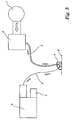
- Fig. 3 shows schematically the structure of a measuring arrangement used for remission measurement is suitable in the context of the method according to the invention.
- Fig. 3 comprises a suitable arrangement for measuring the reflectance the skin surface an excitation beam path, which from a light source 1, for. B. a xenon arc lamp, a monochromator 2 and a light-guiding light guide 3 exists, the end of which opens into a measuring head 4. Introduces from measuring head 4 light-dissipating light guide 5 to the monochromator 6, the a photodiode 7, z. B. one InGaAs diode, is connected upstream. The measuring head 4 is placed on the skin surface 8.
- a light source 1 for. B. a xenon arc lamp, a monochromator 2 and a light-guiding light guide 3 exists, the end of which opens into a measuring head 4.
- a photodiode 7 Introduces from measuring head 4 light-dissipating light guide 5 to the monochromator 6, the a photodiode 7, z. B. one InGaAs diode, is connected upstream.
- the measuring head 4 is placed
- reflectance spectra were obtained of the treated skin areas in the wavelength range from 1060 to 1240 nm recorded.
- the measuring head used was about 4.3 x 3.0 x 3.5 cm in size.
- the holes for the light-guiding or the light-guiding light guide were like this arranged that the exit axes of the light guide included an angle of 45 °.
- the mean values of the remission are in Fig. 1 depending on the wavelength shown.
Landscapes
- Health & Medical Sciences (AREA)
- Life Sciences & Earth Sciences (AREA)
- Physics & Mathematics (AREA)
- Pathology (AREA)
- General Health & Medical Sciences (AREA)
- Molecular Biology (AREA)
- Public Health (AREA)
- Biomedical Technology (AREA)
- Heart & Thoracic Surgery (AREA)
- Medical Informatics (AREA)
- Biophysics (AREA)
- Surgery (AREA)
- Animal Behavior & Ethology (AREA)
- Spectroscopy & Molecular Physics (AREA)
- Engineering & Computer Science (AREA)
- Veterinary Medicine (AREA)
- Chemical & Material Sciences (AREA)
- Analytical Chemistry (AREA)
- Biochemistry (AREA)
- General Physics & Mathematics (AREA)
- Immunology (AREA)
- Dermatology (AREA)
- Measuring And Recording Apparatus For Diagnosis (AREA)
Abstract
Description
Claims (5)
- Verfahren zur Prüfung der Hautverträglichkeit einer Substanz, bei dem man die Substanz auf einen Bezirk der Haut einwirken lässt, und die Remission des Bezirks bei wenigstens einer Wellenlänge im Bereich von 1000 bis 1400 nm bestimmt.
- Verfahren nach Anspruch 1, bei dem man die Remission bei etwa 1150 nm bestimmt.
- Verfahren nach Anspruch 1 oder 2, bei dem die Substanz Bestandteil einer Farbmittel enthaltenden Zubereitung ist.
- Verfahren nach Anspruch 3, bei dem die Zubereitung eine pharmazeutische oder kosmetische Zubereitung ist.
- Verfahren nach Anspruch 4, bei dem die Zubereitung unter einem Haarfärbemittel, einem Lippenstift, einem Lidstrich, einer Wimperntusche, einem Lidschatten, einer Grundierung, einem Puder und einem Makeup ausgewählt ist.
Priority Applications (1)
| Application Number | Priority Date | Filing Date | Title |
|---|---|---|---|
| EP03010495A EP1475637A1 (de) | 2003-05-09 | 2003-05-09 | Verfahren zur Prüfung der Hautverträglichkeit von Substanzen |
Applications Claiming Priority (1)
| Application Number | Priority Date | Filing Date | Title |
|---|---|---|---|
| EP03010495A EP1475637A1 (de) | 2003-05-09 | 2003-05-09 | Verfahren zur Prüfung der Hautverträglichkeit von Substanzen |
Publications (1)
| Publication Number | Publication Date |
|---|---|
| EP1475637A1 true EP1475637A1 (de) | 2004-11-10 |
Family
ID=32981859
Family Applications (1)
| Application Number | Title | Priority Date | Filing Date |
|---|---|---|---|
| EP03010495A Withdrawn EP1475637A1 (de) | 2003-05-09 | 2003-05-09 | Verfahren zur Prüfung der Hautverträglichkeit von Substanzen |
Country Status (1)
| Country | Link |
|---|---|
| EP (1) | EP1475637A1 (de) |
Citations (4)
| Publication number | Priority date | Publication date | Assignee | Title |
|---|---|---|---|---|
| JPH08233733A (ja) * | 1995-02-23 | 1996-09-13 | Daikin Ind Ltd | 肌の化粧品残度検出方法およびその装置 |
| DE10065146A1 (de) * | 2000-12-22 | 2002-07-11 | Karsten Koenig | Verfahren und Anordnung zur nicht-invasiven dreidimensionalen optischen Untersuchung und Therapie der Haut |
| WO2002057726A2 (en) * | 2000-11-15 | 2002-07-25 | Rutgers, The State University Of New Jersey | Apparatus and method for measuring spatially varying bidirectional reflectance distribution function |
| US20030060693A1 (en) * | 1999-07-22 | 2003-03-27 | Monfre Stephen L. | Apparatus and method for quantification of tissue hydration using diffuse reflectance spectroscopy |
-
2003
- 2003-05-09 EP EP03010495A patent/EP1475637A1/de not_active Withdrawn
Patent Citations (4)
| Publication number | Priority date | Publication date | Assignee | Title |
|---|---|---|---|---|
| JPH08233733A (ja) * | 1995-02-23 | 1996-09-13 | Daikin Ind Ltd | 肌の化粧品残度検出方法およびその装置 |
| US20030060693A1 (en) * | 1999-07-22 | 2003-03-27 | Monfre Stephen L. | Apparatus and method for quantification of tissue hydration using diffuse reflectance spectroscopy |
| WO2002057726A2 (en) * | 2000-11-15 | 2002-07-25 | Rutgers, The State University Of New Jersey | Apparatus and method for measuring spatially varying bidirectional reflectance distribution function |
| DE10065146A1 (de) * | 2000-12-22 | 2002-07-11 | Karsten Koenig | Verfahren und Anordnung zur nicht-invasiven dreidimensionalen optischen Untersuchung und Therapie der Haut |
Non-Patent Citations (3)
| Title |
|---|
| BRANDT M, ROHR M, SCHRADER A: "Influence of VIS/NIR Radiation on the Characteristics of Sunscreens and Human Skin", IFSCC MAGAZINE, vol. 4, no. 1, 2001, pages 15 - 19, XP001150085 * |
| PATENT ABSTRACTS OF JAPAN vol. 1997, no. 01 31 January 1997 (1997-01-31) * |
| ROHR M ET AL: "THE MULTIFUNCTIONAL EFFECTS OF AHA", PARFUMERIE UND KOSMETIK, HUETHIG, HEIDELBERG, DE, vol. 77, no. 12, 1996, pages 762 - 767, XP000870034, ISSN: 0031-1952 * |
Similar Documents
| Publication | Publication Date | Title |
|---|---|---|
| EP0835093B1 (de) | Haarfärbemittel mit mindestens einem pflegestoff | |
| EP0642783B1 (de) | Mittel zum gleichzeitigen Färben und Aufhellen von menschlichen Haaren | |
| EP0806198B1 (de) | Färbemittel | |
| DE3031709C2 (de) | ||
| WO1980000303A1 (fr) | Preparation permettant la coloration de cheveux | |
| DE102004020644A1 (de) | Verfahren zur Bestimmung eines UVA- und UVB-Strahlung erfassenden integralen Sonnenschutzfaktors | |
| DE69725843T2 (de) | Mittel zur verwendung in der phototherapeutischen behandlung proliferativer hautstörungen | |
| DE3132885C2 (de) | ||
| DE68904942T2 (de) | Mindestens eine doppelte und eine einfache farbbase enthaltendes oxidationsfaerbemittel und verfahren zur faerbung mit diesem mittel. | |
| DE602004003608T2 (de) | Zusammensetzung zum Färben von menschlichen Keratinfasern, enthaltend einen Fluoreszenzfarbstoff und ein Polyol, Verfahren und Verwendung | |
| DE4318576A1 (de) | Hautfärbende Zubereitung | |
| DE60105504T2 (de) | Zusammensetzung zum Färben der Haut, die mindestens ein UV-Filter und ein in 3-Stellung unsubstituiertes Flavyliumsalz enthält | |
| EP0727203A1 (de) | Oxidationshaarfärbemittel | |
| WO1980000417A1 (fr) | Preparation permettant la coloration des cheveux | |
| EP0877631B1 (de) | Konjugat aus albumin und einem xanthen-farbstoff zur unterscheidung von krankhaftem und gesundem gewebe | |
| EP1727518B1 (de) | Verwendung von mitteln zur kosmetischen behandlung von menschlichen haaren | |
| EP1475637A1 (de) | Verfahren zur Prüfung der Hautverträglichkeit von Substanzen | |
| DE102022205252A1 (de) | Zweistufiges Färbeverfahren zur verbesserten Haarfärbung mit Naturfarbstoffen | |
| DE69403891T2 (de) | Paraphenylenediaminederivat und 2-methyl-5-aminophenol enthaltende Oxydationsfärbezusammensetzung und Färbeverfahren mit dieser Zusammensetzung | |
| DE3028202A1 (de) | Mittel zur faerbung von haaren | |
| AT392000B (de) | Faerbemittel fuer keratinische fasern, insbesondere menschliche haare, und verfahren zur faerbung keratinischer fasern unter verwendung dieser mittel | |
| DE60211461T2 (de) | Hautfärbemittel, die einen Sorghum-Extrakt enthalten, und ihre Verwendungen | |
| DE1617835A1 (de) | Verfahren zum Faerben von lebenden Haaren | |
| US20160327472A1 (en) | Method for the Quality Control of a Cosmetic Composition with Dyeing Properties | |
| DE2840830C2 (de) |
Legal Events
| Date | Code | Title | Description |
|---|---|---|---|
| PUAI | Public reference made under article 153(3) epc to a published international application that has entered the european phase |
Free format text: ORIGINAL CODE: 0009012 |
|
| AK | Designated contracting states |
Kind code of ref document: A1 Designated state(s): AT BE BG CH CY CZ DE DK EE ES FI FR GB GR HU IE IT LI LU MC NL PT RO SE SI SK TR |
|
| AX | Request for extension of the european patent |
Extension state: AL LT LV MK |
|
| 17P | Request for examination filed |
Effective date: 20041129 |
|
| AKX | Designation fees paid |
Designated state(s): AT BE BG CH CY CZ DE DK EE ES FI FR GB GR HU IE IT LI LU MC NL PT RO SE SI SK TR |
|
| STAA | Information on the status of an ep patent application or granted ep patent |
Free format text: STATUS: THE APPLICATION IS DEEMED TO BE WITHDRAWN |
|
| 18D | Application deemed to be withdrawn |
Effective date: 20081202 |