EP1472929B1 - Sound generating mechanism for a fishing reel - Google Patents
Sound generating mechanism for a fishing reel Download PDFInfo
- Publication number
- EP1472929B1 EP1472929B1 EP04252021A EP04252021A EP1472929B1 EP 1472929 B1 EP1472929 B1 EP 1472929B1 EP 04252021 A EP04252021 A EP 04252021A EP 04252021 A EP04252021 A EP 04252021A EP 1472929 B1 EP1472929 B1 EP 1472929B1
- Authority
- EP
- European Patent Office
- Prior art keywords
- knob
- sounding
- engagement
- mounting portion
- drag
- Prior art date
- Legal status (The legal status is an assumption and is not a legal conclusion. Google has not performed a legal analysis and makes no representation as to the accuracy of the status listed.)
- Expired - Lifetime
Links
- 230000007246 mechanism Effects 0.000 title claims abstract description 160
- 230000002093 peripheral effect Effects 0.000 claims description 77
- 238000009987 spinning Methods 0.000 claims description 36
- 238000005266 casting Methods 0.000 claims description 22
- 230000009977 dual effect Effects 0.000 claims description 7
- 230000000717 retained effect Effects 0.000 description 14
- 229920003002 synthetic resin Polymers 0.000 description 9
- 239000000057 synthetic resin Substances 0.000 description 9
- 230000004308 accommodation Effects 0.000 description 6
- 239000000463 material Substances 0.000 description 5
- 239000010410 layer Substances 0.000 description 4
- 238000000034 method Methods 0.000 description 4
- 229910052782 aluminium Inorganic materials 0.000 description 3
- XAGFODPZIPBFFR-UHFFFAOYSA-N aluminium Chemical compound [Al] XAGFODPZIPBFFR-UHFFFAOYSA-N 0.000 description 3
- 238000005452 bending Methods 0.000 description 3
- 239000003814 drug Substances 0.000 description 3
- 229940079593 drug Drugs 0.000 description 3
- 230000000694 effects Effects 0.000 description 3
- 230000001105 regulatory effect Effects 0.000 description 3
- 239000002344 surface layer Substances 0.000 description 3
- 238000004804 winding Methods 0.000 description 3
- 241000251468 Actinopterygii Species 0.000 description 2
- 229910000838 Al alloy Inorganic materials 0.000 description 2
- 208000012661 Dyskinesia Diseases 0.000 description 2
- 229920000122 acrylonitrile butadiene styrene Polymers 0.000 description 2
- 238000007747 plating Methods 0.000 description 2
- 238000003825 pressing Methods 0.000 description 2
- 230000008569 process Effects 0.000 description 2
- 230000008878 coupling Effects 0.000 description 1
- 238000010168 coupling process Methods 0.000 description 1
- 238000005859 coupling reaction Methods 0.000 description 1
- 238000012423 maintenance Methods 0.000 description 1
- 229910052751 metal Inorganic materials 0.000 description 1
- 239000002184 metal Substances 0.000 description 1
- 238000012986 modification Methods 0.000 description 1
- 230000004048 modification Effects 0.000 description 1
- 230000004044 response Effects 0.000 description 1
Images







Classifications
-
- B—PERFORMING OPERATIONS; TRANSPORTING
- B65—CONVEYING; PACKING; STORING; HANDLING THIN OR FILAMENTARY MATERIAL
- B65B—MACHINES, APPARATUS OR DEVICES FOR, OR METHODS OF, PACKAGING ARTICLES OR MATERIALS; UNPACKING
- B65B23/00—Packaging fragile or shock-sensitive articles other than bottles; Unpacking eggs
- B65B23/02—Packaging or unpacking eggs
- B65B23/06—Arranging, feeding, or orientating the eggs to be packed; Removing eggs from trays or cartons
-
- A—HUMAN NECESSITIES
- A01—AGRICULTURE; FORESTRY; ANIMAL HUSBANDRY; HUNTING; TRAPPING; FISHING
- A01K—ANIMAL HUSBANDRY; AVICULTURE; APICULTURE; PISCICULTURE; FISHING; REARING OR BREEDING ANIMALS, NOT OTHERWISE PROVIDED FOR; NEW BREEDS OF ANIMALS
- A01K89/00—Reels
- A01K89/01—Reels with pick-up, i.e. with the guiding member rotating and the spool not rotating during normal retrieval of the line
-
- B—PERFORMING OPERATIONS; TRANSPORTING
- B65—CONVEYING; PACKING; STORING; HANDLING THIN OR FILAMENTARY MATERIAL
- B65B—MACHINES, APPARATUS OR DEVICES FOR, OR METHODS OF, PACKAGING ARTICLES OR MATERIALS; UNPACKING
- B65B35/00—Supplying, feeding, arranging or orientating articles to be packaged
- B65B35/30—Arranging and feeding articles in groups
- B65B35/44—Arranging and feeding articles in groups by endless belts or chains
-
- B—PERFORMING OPERATIONS; TRANSPORTING
- B65—CONVEYING; PACKING; STORING; HANDLING THIN OR FILAMENTARY MATERIAL
- B65G—TRANSPORT OR STORAGE DEVICES, e.g. CONVEYORS FOR LOADING OR TIPPING, SHOP CONVEYOR SYSTEMS OR PNEUMATIC TUBE CONVEYORS
- B65G17/00—Conveyors having an endless traction element, e.g. a chain, transmitting movement to a continuous or substantially-continuous load-carrying surface or to a series of individual load-carriers; Endless-chain conveyors in which the chains form the load-carrying surface
- B65G17/12—Conveyors having an endless traction element, e.g. a chain, transmitting movement to a continuous or substantially-continuous load-carrying surface or to a series of individual load-carriers; Endless-chain conveyors in which the chains form the load-carrying surface comprising a series of individual load-carriers fixed, or normally fixed, relative to traction element
-
- B—PERFORMING OPERATIONS; TRANSPORTING
- B65—CONVEYING; PACKING; STORING; HANDLING THIN OR FILAMENTARY MATERIAL
- B65G—TRANSPORT OR STORAGE DEVICES, e.g. CONVEYORS FOR LOADING OR TIPPING, SHOP CONVEYOR SYSTEMS OR PNEUMATIC TUBE CONVEYORS
- B65G17/00—Conveyors having an endless traction element, e.g. a chain, transmitting movement to a continuous or substantially-continuous load-carrying surface or to a series of individual load-carriers; Endless-chain conveyors in which the chains form the load-carrying surface
- B65G17/30—Details; Auxiliary devices
- B65G17/32—Individual load-carriers
-
- B—PERFORMING OPERATIONS; TRANSPORTING
- B65—CONVEYING; PACKING; STORING; HANDLING THIN OR FILAMENTARY MATERIAL
- B65G—TRANSPORT OR STORAGE DEVICES, e.g. CONVEYORS FOR LOADING OR TIPPING, SHOP CONVEYOR SYSTEMS OR PNEUMATIC TUBE CONVEYORS
- B65G2201/00—Indexing codes relating to handling devices, e.g. conveyors, characterised by the type of product or load being conveyed or handled
- B65G2201/02—Articles
- B65G2201/0202—Agricultural and processed food products
- B65G2201/0208—Eggs
-
- B—PERFORMING OPERATIONS; TRANSPORTING
- B65—CONVEYING; PACKING; STORING; HANDLING THIN OR FILAMENTARY MATERIAL
- B65G—TRANSPORT OR STORAGE DEVICES, e.g. CONVEYORS FOR LOADING OR TIPPING, SHOP CONVEYOR SYSTEMS OR PNEUMATIC TUBE CONVEYORS
- B65G2207/00—Indexing codes relating to constructional details, configuration and additional features of a handling device, e.g. Conveyors
- B65G2207/42—Soft elements to prevent damage to articles, e.g. bristles, foam
-
- B—PERFORMING OPERATIONS; TRANSPORTING
- B65—CONVEYING; PACKING; STORING; HANDLING THIN OR FILAMENTARY MATERIAL
- B65G—TRANSPORT OR STORAGE DEVICES, e.g. CONVEYORS FOR LOADING OR TIPPING, SHOP CONVEYOR SYSTEMS OR PNEUMATIC TUBE CONVEYORS
- B65G2812/00—Indexing codes relating to the kind or type of conveyors
- B65G2812/02—Belt or chain conveyors
- B65G2812/02267—Conveyors having endless traction elements
- B65G2812/02415—Conveyors having endless traction elements with load-carrying surfaces supported by traction means
- B65G2812/02613—Conveyors having endless traction elements with load-carrying surfaces supported by traction means the load-carrying surfaces being separated from each other, e.g. individual load carriers
- B65G2812/02673—Conveyors having endless traction elements with load-carrying surfaces supported by traction means the load-carrying surfaces being separated from each other, e.g. individual load carriers the load-carriers being arranged above, between or beside the traction means
- B65G2812/02683—Conveyors having endless traction elements with load-carrying surfaces supported by traction means the load-carrying surfaces being separated from each other, e.g. individual load carriers the load-carriers being arranged above, between or beside the traction means and fixed or non-movably linked to the traction means
- B65G2812/02762—Load-carriers
Definitions
- the present invention relates to a sound generating mechanism. More particularly the present invention relates to a sound generating mechanism for a fishing reel that is disposed between a tubular knob mounting portion that is arranged on a reel unit of the fishing reel and a closed end tubular knob member that is rotatively mounted on the knob mounting portion, the sound generating mechanism generating sound by the relative rotation of the knob mounting portion and the knob member.
- a rear drag sound generating mechanism is disposed between a tubular knob mounting portion that is arranged on a rear portion of a reel unit of the spinning reel, and a closed end tubular member that is rotatively mounted on the knob mounting portion.
- a sounding leaf is mounted on the reel unit with this type of sound generating mechanism.
- the sounding leaf is formed into an approximate L-shape, and includes a vertical portion and a horizontal portion.
- the vertical portion of the sounding leaf is mounted on an upper portion of a rear end wall of the reel unit.
- the horizontal portion of the sounding leaf is disposed along an upper surface of the knob mounting portion on the rear portion of the reel unit.
- the tip of the horizontal portion engages with corrugated portions formed on an inner peripheral surface of the knob member. In this way, when the knob member is rotated relative to the knob mounting portion, the tip of the horizontal portion will repeatedly strike the corrugated portions of the knob member to generate sound. See, for example, Figures 1 and 2 of Japanese Utility Model No. H02-5739 .
- the sounding pin and the urging means may fall off of the knob member depending on the posture of the knob member at the time the sounding pin and the urging means are mounted on the knob mounting portion. For example, when the bottom portion of the knob member is in a downward posture, it will be difficult for the sounding pin and the urging means disposed on the knob member to fall off if the knob member is mounted to the knob mounting portion from below. However, if the bottom portion of the knob member is not placed in a downward posture, there will be times in which the sounding pin and the urging means will fall off therefrom. In addition, if one attempts to remove the knob member from the knob mounting portion for maintenance or the like, the sounding pin may fall off the knob member due to the urging force of the urging means.
- An object of the present invention is to obtain good crisp clicking sounds in a sound generating mechanism for a fishing reel, while keeping the sounding pin from falling off when the knob member is attached or removed.
- a sound generating mechanism for a fishing reel is disposed between a tubular knob mounting portion that is arranged on a reel unit of the fishing reel and a closed end tubular knob member that is rotatively mounted on the knob mounting portion.
- the sound generating mechanism generates sounds by a relative rotation between the knob mounting portion and the knob member, and includes a sounding member, a retaining member, a sounding pin, and urging means.
- the sounding member is adapted to be rotatively mounted to an engagement portion of the knob member and be non-rotative with respect to the knob mounting portion.
- the sounding member has a disk portion that is formed into a ring shape and a plurality of sounding concavities that are formed circumferentially apart on the disk portion.
- the retaining member is arranged in order to prevent the sounding member from falling out.
- the mounting recess is adapted to be mounted to the knob member such that the sounding member is sandwiched between the retaining member and the engagement portion of the knob member.
- the sounding pin is mounted to the engagement portion of the knob member at a position opposite at least one of the plurality of sounding concavities.
- the sounding pin is mounted so as to be movable toward and away from the plurality of sounding concavities.
- the urging means is mounted to the engagement portion of the knob member for urging the sounding pin toward the plurality of sounding concavities.
- the sound generating mechanism for a fishing reel is disposed between a tubular knob mounting portion that is arranged on a reel unit of the fishing reel, and a closed end tubular member that is rotatively mounted on the knob mounting portion.
- the sounding pin and the urging means are mounted in the engagement portion of the knob member.
- the sounding member is rotatively mounted on the engagement portion of the knob member.
- the urging means urges the sounding pin toward the sounding concavities of the sounding member, and engages the sounding pin toward the sounding concavities.
- the retaining member is disposed on the knob member in order to prevent the sounding member from falling out. Then, the sounding member is non-rotatively mounted on the knob mounting portion.
- a sound generating mechanism for a fishing reel according to the second aspect of the present invention is the sound generating mechanism for a fishing reel as set forth in the first aspect, in which the sounding pin and the urging means are adapted to be mounted in a mounting recess formed on the engagement portion of the knob member.
- a sound generating mechanism for a fishing reel is the sound generating mechanism for a fishing reel as set forth in the first or second aspect, in which the sounding pin has a smooth convex head portion, a mounting portion that is connected to the head portion and has a diameter that is larger than a diameter of the head portion, and a shaft portion that is connected to the mounting portion and has a diameter that is smaller than the diameter of the mounting portion.
- the urging means is disposed on the outer periphery of the shaft portion, and one end of the urging means is brought into contact with the engagement portion at one end is with the mounting portion at the other end. In this way, the sounding pin is urged toward the sounding concavities. Because the head portion of the sounding pin has a diameter that is smaller than that of the mounting portion, the gaps between the sounding concavities can be reduced, and the sound generating gaps can produce short precise clicking sounds.
- a sound generating mechanism for a fishing reel according to the fourth aspect of the present invention is the sound generating mechanism for a fishing reel disclosed in any of the first through third aspects, the retaining member is adapted to be mounted on an inner peripheral surface of the knob member.
- the retaining member is mounted so that it can urge the inner peripheral surface of the knob member in the radially outward direction, and thus the retaining member can be easily mounted on the inner peripheral surface of the knob member. Accordingly, the removal of the sounding member from the knob member can be restricted by the retaining member.
- a sound generating mechanism for a fishing reel according to the fifth aspect of the present invention is the sound generating mechanism for a fishing reel disclosed in any of the first through fourth aspects, in which the retaining member is mounted in an annular engagement groove that has a diameter larger than an outer diameter of the sounding member and is formed in the inner peripheral surface of the knob member.
- the engagement groove is formed in the inner peripheral surface of the knob member, and the retaining member is mounted in the engagement groove.
- the retaining member can be easily positioned and mounted on the knob member. The removal of the sounding member from the knob member can be reliably restricted by the retaining member.
- a sound generating mechanism for a fishing reel according to the sixth aspect of the present invention is the sound generating mechanism for a fishing reel disclosed in any of the first through fifth aspects, in which the retaining member is a C-shaped retaining ring, and an inner diameter of the C-shaped retaining ring is smaller than an outer diameter of the sounding member.
- the retaining member is a C-shaped retaining ring, and thus the retaining member can be easily mounted on the knob member.
- the inner diameter of the C-shaped retaining ring is smaller than the outer diameter of the sounding member, and thus the sounding member will not fall off of the knob member.
- a sound generating mechanism for a fishing reel as set forth in the seventh aspect is the sound generating mechanism for a fishing reel disclosed in any of inventions the first through sixth aspects, in which a plurality of engagement recesses are formed circumferentially apart in the knob mounting member, and the sounding member has a plurality of protruding portions that are integrally formed on the disk portion and project toward the engagement recesses of the knob mounting member.
- the plurality of protruding portions non-rotatively engages with the engagement recesses of the knob mounting member.
- the engagement recesses formed in the knob mounting portion and the protruding portions of the sounding member engage with each other, and thus the sounding member can be easily positioned and non-rotatively mounted on the knob mounting portion.
- a sound generating mechanism for a fishing reel as set forth in the eighth aspect is the sound generating mechanism for a fishing reel disclosed in any of the first through seventh aspects, in which the urging means includes a coil spring that is disposed on the outer periphery of the sounding pin.
- the coil spring is disposed on the outer periphery of the sounding pin, and one end of the coil spring is brought into contact with the engagement of the knob member when the coil spring is in the compressed state.
- the sounding pin is urged toward the sounding concavities of the sounding member and engages with the sounding concavities due to the urging force of the coil spring.
- this type of urging means is employed, the jerkiness of the sounding pin can be reduced due to the coil spring, and thus the sounding pin will easily engage with the sounding concavities.
- a sound generating mechanism for a fishing reel as set forth in the ninth aspect is the sound generating mechanism for a fishing reel as set forth in the eighth aspect, in which an end portion of the coil spring is engaged with a bottom portion of the mounting recess formed on the engagement portion of the knob member.
- an end portion of the coil spring is engaged with the bottom portion of the mounting recess, and thus it will be difficult for the coil spring itself to fall out of the mounting recess due to the urging force of the coil spring.
- the fishing reel may be a spinning reel that includes a drag mechanism.
- the knob mounting portion is arranged on a rear portion of the reel unit and accommodates the rear drag mechanism, and drag of the drag mechanism is adjusted when the knob member rotates relative to the knob mounting portion.
- the knob mounting portion that serves to accommodate the rear drag mechanism is arranged on the rear portion of the reel unit, and first and second knob members are adjustment members of the rear drag mechanism and are mounted on the knob mounting portion.
- the sound generating mechanism of, for instance, the fist aspect of the present invention may be arranged on the portion between the knob mounting portion and the knob member, such that the sound generating mechanism can generate sounds by a relative rotation between the knob mounting portion and the knob member. In such case, good crisp clicking sounds can be obtained when the knob member is rotated. Also, it will be difficult for the sounding member and the sounding pin to fall out from the knob member when one attempts to mount and remove the knob member to and from the knob mounting portion.
- the fishing reel may be a dual bearing reel that has a control mechanism for braking the spool.
- the reel unit includes a frame and two side covers that are mounted to both sides of the frame.
- the knob mounting portion that accommodates the casting control mechanism is arranged to project from one of the side covers of the reel unit. Breaking force of the casting control mechanism is adjusted when the knob member rotates relative to the knob mounting portion.
- the knob mounting portion that accommodates a rotational shaft end of the spool is arranged to project from a side surface of the reel unit.
- First and second knob members are adjustment members of the casting control mechanism and are mounted on the knob mounting portion.
- the sound generating mechanism of, for example, the first aspect of the present invention may be is arranged between the knob mounting portion and the knob member, such that the sound generating mechanism can generates sounds by a relative rotation between the knob mounting portion and he knob member. In such case of, good crisp clicking sounds can be obtained when the knob member is rotated. Also, it will be difficult for the sounding member and the sounding pin to fall out from the knob member when one attempts to mount and remove the knob member to and from the knob mounting portion.
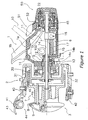
- Figure 1 shows a spinning reel according to an embodiment of the present invention.
- Figure 1 shows a spinning reel according to a first embodiment of the invention.
- the spinning reel primarily includes a reel unit 1 that rotatively supports a handle 10, a rotor 2, a spool 3, a first drag knob 50, and a second drag knob 51.
- the reel unit 1 includes a reel body 1a, and a rod attachment leg 1b that extends diagonally upward and forward from the reel body 1a.
- An accommodation space is formed in the interior of the reel body 1a.
- a rotor drive mechanism 5 that rotates the rotor 2 in conjunction with the rotation of the handle 10, and an oscillating mechanism 6 that moves the spool 3 back and forth to uniformly wind fishing line are arranged inside the accommodation space.
- a knob mounting portion 52 is formed into a tubular shape and is integrally with the rear portion of the reel body 1a as a one-piece unitary member, with members such as a second pressure member 25 being disposed in a slit formed in between the knob mounting portion 52 and the reel body 1a.
- a first female threaded portion 52a is formed on the rear inner peripheral surface of the knob mounting portion 52.
- a plurality of engagement recesses 52b that are formed circumferentially apart from each other at a fixed distance are arranged on a rear end surface of the knob mounting portion 52.
- first and third engagement grooves 52c, 52d are formed in the outer peripheral surface of the knob mounting portion 52.
- the rotor 2 is rotatively supported on a front portion of the reel unit 1.
- the rotor 2 includes a rotor cylindrical portion 30, and a first rotor arm 31 and a second rotor arm 32.
- the first and second rotor arms 31, 32 are arranged at mutually opposing positions of the rotor cylindrical portion 30.
- the rotor cylindrical portion 30 and the first and second rotor arms 31, 32 are, for example, made of an aluminum alloy, and are integrally formed as a one-piece unitary unit.
- the first and second rotor arms 31, 32 are connected to the upper circumferential surface of the rotor cylindrical portion 30 and spread outward in the circumferential direction.
- the first and second rotor arms 31, 32 project outward from the rotor cylindrical portion 30 and then curve and extend forward.
- a first bail support member 40 is pivotably mounted to the front end of the first rotor arm 31.
- a line roller 41 for guiding fishing line to the spool 3 is mounted to the front end of the first bail support member 40.
- a second bail support member 42 is pivotably mounted to the front end of the second rotor arm 32.
- a bail 43 that is a wire member curved into an approximate U-shape is fixedly held between the line roller 41 and the second bail support member 42.
- the first bail support member 40, the second bail support member 42, the line roller 41, and the bail 43 form a bail arm 44 that guides the fishing line onto the spool 3.
- the bail arm 44 can pivot between a line-guiding posture shown in Figure 1 and a line-releasing posture which is a position opposite the line-guiding posture.
- the rotor 2 is a conventional component that is well known in the art. Accordingly, its structure and function will not be discussed or illustrated in detail herein.
- the rotor drive mechanism 5 includes a face gear 11 and a pinion gear 12.
- the face gear 11 rotates together with a handle shaft 10a that is connected to the handle 10, and the pinion gear 12 meshes with the face gear 11.
- the pinion gear 12 is formed into a tubular shape, and a front portion of the pinion gear 12 extends toward the spool 3 and passes through the center of the rotor 2.
- the middle and the rear end portions of the pinion gear 12 in the axial direction are rotatively supported by the reel unit 1 via bearings 14a, 14b, respectively.
- a spool shaft 14 passes through the center of the pinion gear 12, and slidably moves forward and backward along the rotational axis of the pinion gear 12.
- Chamfered portions 13 that are chamfered in a parallel manner with a predetermined length are formed on the front portion of the pinion gear 12. The chamfered portions 13 serve to non-rotatively connect the rotor 2 with the pinion gear 12.
- the rotor drive mechanism 5 is a conventional component that is well known in the art. Accordingly, its structure and function will not be discussed or illustrated in detail herein.
- the spool 3 winds fishing line around the outer peripheral surface thereof as the handle 10 rotates, and is mounted on the front portion of the rotor 2 as shown in Figure 1, so that the spool 3 can be shifted front and rear.
- the spool 3 includes a spool unit 7, a brim 8, and a brim fixing member 9.
- the spool unit 7 includes a bobbin portion 4a and a skirt portion 4b.
- the bobbin portion 4a is formed into a tubular shape so that the fishing line can be wound around the outer periphery thereof.
- the skirt portion 4b is formed such that its diameter is larger than the outer diameter of the bobbin portion 4a, and is integrally formed as a one-piece unitary member with the rear portion of the bobbin portion 4a.
- the brim 8 is mounted on the front portion of the bobbin portion 4a, and is fixedly coupled to the spool unit 7 by the bobbin fixing member 9.
- the spool 3 is a conventional component that is well known in the art. Accordingly, its structure and function will not be discussed or illustrated in detail herein.
- the oscillating mechanism 6 is a device that causes the spool shaft 14 connected to the spool 3 to move front and rear, and causes the spool 3 to move accordingly.
- the oscillating mechanism 6 includes a worm 15 disposed below and parallel to the spool shaft 14, a slider 16 that moves front and rear along the worm 15, a guide shaft 17 that is disposed below the worm 15, and an intermediate gear (not shown in the figures) that is fixedly coupled to the front end of the worm 15.
- the slider 16 is non-rotatively mounted to the spool shaft 14, and the guide shaft 17 is disposed in parallel with the spool shaft 14.
- the oscillating mechanism 6 is a conventional component that is well known in the art. Accordingly, its structure and function will not be discussed or illustrated in detail herein.
- the rear drag mechanism 45 is a mechanism that causes a drag force to be applied to the spool 3. As shown in Figure 3, the rear drag mechanism 45 is housed inside the knob mounting portion 52 and includes a cylindrical bush 18, first and second friction engagement portions 19, 20 that include a plurality of friction plates 19a, 20a, a coil spring 21, a first pressure member 22 for urging the friction plates 19a of the first friction engagement portion 19, and a second pressure member 25 for urging the friction plates 20a of the second friction engagement portion 20.
- the bush 18 is formed into a cylindrical shape, and inserted around the outer periphery of the rear portion of the spool shaft 14.
- the spool shaft 14 is non-rotative and slidable with respect to the bush 18.
- a first flange portion 23 is arranged on the outer peripheral surface of the rear portion of the bush 18, and a second flange portion 24 is arranged on the outer peripheral surface of the front portion of the bush 18.
- the friction plates 19a, 20a of the first and second friction engagement portions 19, 20 are respectively disposed on the first and second flange portions 23, 24.
- the coil spring 21 is disposed on the rear portion of the first friction engagement portion 19.
- the first pressure member 22 is connected in series with the rear portion of the coil spring 21.
- a front portion 22a of the first pressure member 22 is formed into a cylindrical shape, and a first male threaded portion 22b is arranged on the outer peripheral surface of the front portion 22a.
- a rear portion 22c of the first pressure member 22 is formed into a closed-end tubular shape having a diameter that is smaller than that of the front portion 22a of the first pressure member 22.
- the outer peripheral surface of the rear portion 22c has two chamfered portions that are parallel to each other.
- the first male threaded portion 22b of the first pressure member 22 is rotatively mounted on the first female threaded portion 52a formed in the inner peripheral surface of the knob mounting member 52.
- the first pressure member 22 rotates in this state, the first pressure member 22 rotates in the interior of the knob mounting portion 52 while moving frontward and rearward, and compresses and decompresses the coil spring 21 accordingly.
- the second pressure member 25 is disposed on the rear portion of the second friction engagement portion 20.
- the rear drag mechanism 45 structured as described above will adjust the drag force via the first drag knob 50 and the second drag knob 51.
- the first drag knob 50 includes a first knob member 55, a second knob member 56, and a ring member 57.
- the first knob member 55 is, for example, made of a synthetic resin, and is formed into a tubular shape.
- the first knob member 55 includes a first tubular portion 55a, a second tubular portion 55b, and a third tubular portion 55c.
- the first to third tubular portions 55a, 55b, 55c are formed integrally as a one-piece unitary member.
- An annular second engagement groove 55d is arranged on the inner peripheral surface of the first tubular portion 55a.
- a first engagement member (an example of a retaining member) 58a is disposed in the second engagement groove 55d and the first engagement groove 52c of the knob mounting portion 52.
- an O-ring is employed as the first engagement member 58a.
- the second tubular portion 55b is integrally formed with the rear end of the first tubular portion 55a, and the outer diameter of the second tubular portion 55b is smaller than the outer diameter of the first tubular portion 55a.
- the third tubular portion 55c is integrally formed with the rear end of the second tubular portion 55b, and the outer diameter of the third tubular portion 55c is smaller than the outer diameter of the second tubular portion 55c.
- a second male threaded portion 55e is arranged on the outer peripheral surface of the third tubular portion 55c.
- a second engagement member (an example of a retaining member) 58b is disposed on the rear portion of the washer 55f, in the third engagement groove 52d which is formed in the knob mounting portion 52.
- a C-shaped retaining ring is employed as the second engagement member 58b.
- first knob member 55 As described above is regulated with respect to the knob mounting portion 52 by the first engagement member 58a.
- the rear portion of the first knob member 55 is positioned by the second engagement member 58b via the washer 55f. In this way, the first knob member 55 is rotatively mounted on the knob mounting portion 52 and non-movable in the axial direction.
- the second knob member 56 is, for example, made of a synthetic resin, and is formed into a closed-end tubular shape. First and second engagement portions 56e, 56f are provided on the closed end portion of the second knob member 56.
- the first engagement portion 56e is formed into an oval-shaped recessed shape at the central portion thereof.
- the rear portion 22c of the first pressure member 22 has two chamfered portions that are parallel to each other on the outer peripheral surface thereof, and is engaged with the first engagement portion 56e.
- the rear portion 22c of the first pressure member 22 is non-rotative within the first engagement portion 56e and can slide forward and backward therein.
- the second engagement portion 56f is a toroidal recessed portion formed in the closed end portion of the second knob member 56.
- a sounding member 61 (described below) is engaged with the second engagement portion 56f.
- An annular engagement groove 56b and a second female threaded portion 56d are arranged on the inner peripheral surface of the second knob member 56.
- the engagement groove 56b is formed on the closed end side of the second knob member 56, and has a diameter that is larger than the outer diameter of the sounding mechanism 61 described below.
- the second female threaded portion 56d is formed on the open side of the second knob member 56.
- the second knob member 56 is non-rotatively connected to the first knob member 55 by screwing the second female threaded portion 56d with the second male threaded portion 55e of the first knob member 55.
- the ring member 57 is, for example, made of aluminum, and is formed into a ring shape. The ring member 57 is disposed such that the inner peripheral surface thereof is in contact with the outer peripheral surface of the second tubular portion 55b, and is interposed between the first knob member 55 and the second knob member 56.
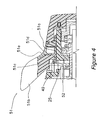
- the second drag knob 51 includes a cylindrical portion 51a that is formed into a cylindrical shape, and a lever portion 51b that projects outward in the radial direction on the outer peripheral surface of the cylindrical portion 51a and is integrally formed with the cylindrical portion 51a.
- the inner peripheral surface of the cylindrical portion 51a of the second drag knob 51 is rotatively mounted on the outer peripheral surface of the knob mounting member 52.
- An engagement member 49 that serves to transmit the movement of the second drag knob 51 to the second pressure member 25 is mounted on the front end portion of the cylindrical portion 51a.
- the second drag knob 51 is connected to the second pressure member 25 via the engagement member 49.
- first component unit 51c is made of a synthetic resin.
- second component unit 51d arranged on the surface layer side of the first component unit 51c is made of ABS resin, and the plate layer 51e is plated on the surface layer side of the second component unit 51d.
- the rear drag mechanism 45 is a conventional component that is well known in the art. Accordingly, its structure and function will not be discussed or illustrated in further detail herein.
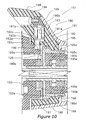
- the rear drag sound generating mechanism 60 is disposed between the knob mounting portion 52 and the second knob member 56, and generates sound by relative rotation between the knob mounting portion 52 and the first drag knob 50.
- the rear drag sound generating mechanism 60 includes a sounding member 61, a retaining member 62, a mounting recess 63, a sounding pin 64, and a coil spring (an example of urging means) 65.
- the sounding member 61 is formed to have a diameter that is smaller than that of the engagement groove 56b, and includes a disk portion 61a that is formed into a ring shape, a plurality of sounding concavities 61b that are disposed circumferentially apart in one surface or the first surface of the disk portion 61a, and engagement portions 61c that are integrally formed with another surface or the second surface of the disk portion 61a.
- the disk portion 61a of the sounding member 61 fits into the second engagement portion 56f of the second knob member 56. In this state, the sounding member 61 is rotative with respect to the second knob member 56.
- the engagement portions 61c are formed to project toward the engagement recesses 52b of the knob mounting portion 52.
- the engagement portions 61c are mounted so that they can be inserted into the engagement recesses 52b formed in the rear end surface of the knob mounting portion 52.
- the retaining member 62 is arranged in order to prevent the sounding member 61 from falling out.
- the retaining member 62 is, for example, a C-shaped retaining ring, and is disposed in the engagement groove 56b.
- the inner diameter of the C-shaped retaining ring 62 is formed to be smaller than the outer diameter of the disk portion 61a, such that the retaining member 62 and the second engagement portion 56f sandwich the disk portion 61a.
- the mounting recess 63 is formed in the closed end of the second knob member 56, in a position opposite from at least one of the plurality of sounding concavities 61b.
- the sounding pin 64 is mounted so that it can move both toward and away from the mounting recess 63.
- the sounding pin 64 includes a head portion 64a, a mounting portion 64b that is connected to the head portion 64a, and a shaft portion 64c that is connected to the mounting portion 64b.
- the head portion 64a is formed such that its front end has a smooth convex shape.
- the front end of the head portion 64a generates a clicking sound by repeatedly striking the sounding concavities 61b.
- the mounting portion 64b is formed to have a diameter that is larger than that of the head portion 64a and smaller than the inner diameter of the mounting recess 63.
- the shaft portion 64c is a shaft shaped component that is formed to have a diameter that is smaller than that of the mounting portion 64b.
- the coil spring 65 is disposed around the outer periphery of the shaft portion 64c.
- the shaft portion 64c to have a diameter that is smaller than that of the mounting portion 64b, the front end of the coil spring 65 can be brought into contact with the step portion between the mounting portion 64b and the shaft portion 64c.
- the base end of the coil spring 65 is mounted on the closed end of the mounting recess 63.
- the coil spring 65 is accommodated in the mounting recess 63 in the compressed state, and urges the sounding pin 64 toward the sounding concavities 61b.
- the bail 43 When the spinning reel described above is to be used, the bail 43 will be pushed over to the line releasing side when the fishing line is to be reeled out. Then, when the fishing rod is cast, fishing line is reeled out from the spool 3. When the fishing line is to be retrieved, the bail 43 is returned to the line winding side.
- this rotational force is transmitted to the pinion gear 12 via the handle shaft 10a and the face gear 11. Then, the rotational force transmitted to the pinion gear 12 rotates the rotor 2, which is coupled to the front portion of the pinion gear 12.
- the rotational force transmitted to the pinion gear 12 simultaneously rotates the worm 15 via the intermediate gear (not shown in the figures) that is meshed with the pinion gear 12.
- the slider 16 that meshes with the spiral grooves of the worm 15 is guided by the guide shaft 17 and moves forward and backward.
- the slider 16 moves, the slider 16, the spool shaft 14, and the spool 3 will reciprocate forward and backward.
- the fishing line guided from the bail 43 and the line roller 41 is uniformly wound forward and backward around the outer periphery of the spool 3 by the rotation of the rotor 2 and the forward and backward movement of the spool 3.
- the first drag knob 50 When the first drag knob 50 is tightened, the first pressure member 22 inserted into the first engagement portion 56e of the second knob member 56 will rotate while moving forward, and the coil spring 21 connected to the first pressure member 22 will be pushed inward. When this occurs, the surfaces of the plurality of friction plates 19a of the first friction engagement portion 19 will draw near to each other, and the first flange portion 23 of the bush 18 will be interposed between the plurality of the friction plates 19a. Thus, by interposing the first flange portion 23 of the bush 18 between the friction plates 19a, it will be difficult for the spool shaft 14 (that is non-rotative with respect to the bush 18) to rotate, and the drag force applied to the spool 3 will strengthen.
- the sounding pin 64 and the coil spring 65 are first disposed in the mounting recess 63 of the second knob member 56. Then, with the head portion 64a of the sounding pin 64 in a state in which it is in contact with one of the sounding concavities 61b of the sounding member 61, the sounding member 61 is mounted on the second knob member 56.
- the retaining member 62 is mounted on the engagement groove 56b formed in the second knob member 56 to retain the sounding member 61.
- the second engagement groove 55d of the first knob member 55 is brought into contact with the first engagement member 58a disposed on the knob mounting portion 52.
- the washer 55f is disposed on the rear end surface of the first knob member 55.
- the second engagement member 58b is mounted in the third engagement groove 52d of the knob mounting portion 52, which is to the rear of the washer 55f, such that the first knob member 55 is positioned on the knob mounting portion 52.
- the second female threaded portion 56d of the second knob member 56 is screwed onto the second male threaded portion 55e of the first knob member 55 to non-rotatively connect the first knob member 55 to the second knob member 56.
- the engagement portions 61c of the sounding member 61 are engaged with the engagement recesses 52b of the knob mounting portion 52 to non-rotatively couple the sounding member 61 to the knob mounting portion 52.
- the rear drag sound generating mechanism 60 can be disposed between the knob mounting portion 52 and the second knob member 56, and the first drag knob 50 will be rotatively mounted to the knob mounting portion 52.
- the first drag knob 50 When the first drag knob 50 is rotated, the first drag knob 50 will rotate relative to the knob mounting portion 52.
- the second knob member 56 that is non-rotatively coupled to the first knob member 55 will rotate relative to the sounding member 61 that is non-rotatively mounted to the knob mounting portion 52.
- the sounding pin 64 disposed in the mounting recess 63 of the second knob member 56 will be urged by the coil spring 65 and repeatedly strike the plurality of sounding concavities 61b formed in the sounding member 61 to generate clicking sounds.
- good crisp clicking sounds can be obtained when the first drag knob 50 is rotated because the sounding pin 64 mounted in the mounting recess 63 of the second knob member 56 contacts the sounding concavities 61b of the sounding member 61 by the coil spring 65.
- the sounding member 61 and the coil spring 65 are not likely to fall out from the second knob member 56 because the sounding member 61 is mounted to the second knob member 56 with the sounding pin 64 engaged with one of the sounding concavities 61b of the sounding member 61, and the sounding member 61 is retained with the retaining member 62.
- the sounding pin 64 is not likely to fall off of the second knob member 56 because the sounding member 61 retained by the retaining member 62 prevents the sounding pin 64 from falling off the second knob member 56.
- first drag knob 50 since the second knob member 56 is coupled to the first knob member 55, once the rear drag sound generating mechanism 60 is disposed on the second knob member 56, it will become easier to mount the second knob member 56 and the rear drug sound generating mechanism 60 to the first knob member 55 and to remove the second knob member 56 and the rear drug sound generating mechanism 60 from the first knob member 55.
- the design of the first drag knob 50 can be improved by installing the ring member 57 between the first knob member 55 and the second knob member 56.
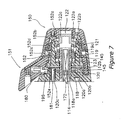
- Figure 6 shows a spinning reel according to a second embodiment of the present invention.
- the spinning reel primarily includes a reel unit 101 that rotatively supports a handle 110, a rotor 102, a spool 103, a first drag knob 150, and a second drag knob 151.
- the reel unit 101 includes a reel body 101a, and a rod attachment leg 101b that extends diagonally upward and forward from the reel body 101a.
- An accommodation space is formed in the interior of the reel body 101a.
- a rotor drive mechanism 105 that rotates the rotor 102 in conjunction with the rotation of the handle 110, and an oscillating mechanism 106 that moves the spool 103 back and forth to uniformly wind fishing line, are arranged in the accommodation space.
- a knob mounting portion 152 is formed into a tubular shape with a slit in which members such as the pressure member 25 are disposed, and is integrally formed with the rear portion of the reel body 101a as a one-piece unitary member.
- a plurality of first engagement recesses 152b are formed circumferentially apart by a predetermined distance in the rear end surface of the knob mounting portion 152.
- a first female threaded portion 152a is formed on the rear portion of the inner peripheral surface of the knob mounting portion 152
- a third male threaded portion 152e is formed on the central portion of the outer peripheral surface of the knob mounting portion 152.
- An annular first annular groove 152c and an annular second annular groove 152d are formed in a predetermined spaced relationship in the rear portion of the third male threaded portion 152e.
- second engagement recesses 152f are formed in the axial direction from the rear end of the knob mounting portion 152 past the second annular groove 152d.
- the second engagement recesses 152f are formed in a predetermined spaced relationship in the circumferential direction, and the depths thereof are deeper than the depth of the second annular groove 152d.
- a positioning recess 196 is arranged on the upper portion of the knob mounting member 152 and front of the third male threaded portion 152e in order to position the second drag knob 151 in the rotational direction. Both side surfaces of the positioning recess 196 in the rotational direction are formed in fan-shape, tapering from the bottom portion of the positioning recess 196 to the opening thereof.
- a second mounting recess 172 of a second rear drag sound mechanism 170 (to be described later) is arranged in a side portion of the knob mounting portion 152 and forward of the third male threaded portion 152e in order to mount a second sounding pin 173 and a second coil spring 174 described below.
- the rotor 102 is rotatively supported on the front of the reel unit 101.
- the rotor 102 includes a rotor cylindrical portion 130, and a first rotor arm 131 and a second rotor arm 132.
- the first and second rotor arms 131, 132 are arranged on mutually opposing positions of the rotor cylindrical portion 130.
- the rotor cylindrical portion 130 and the first and second rotor arms 131, 132 are, for example, made of an aluminum alloy, and are integrally formed with the rotor cylindrical portion 130 as a one-piece unitary unit.
- the first and second rotor arms 131, 132 are coupled to the rotor cylindrical portion 130 at the upper circumferential surface of the rotor cylindrical portion 130 and spread outward in the circumferential direction.
- the first and second rotor arms 131, 132 project outward from the rotor cylindrical portion 130, curve and then extend forward.
- a first bail support member 140 is pivotably mounted to the tip of the first rotor arm 131.
- a line roller 141 for guiding fishing line to the spool 103 is mounted to the front end of the first bail support member 140.
- a second bail support member 142 is pivotably mounted to the front end of the second rotor arm 132.
- a bail 143 that is a wire member curved into an approximate U-shape is fixedly held between the line roller 141 and the second bail support member 142.
- the first bail support member 140, the second bail support member 142, the line roller 141, and the bail 143 form a bail arm 144 that guides the fishing line onto the spool 103.
- the bail arm 144 can pivot between a line-guiding posture shown in Figure 6 and a line-releasing posture which is a flipped posture from the line-guiding posture.
- the rotor 102 is a conventional component that is well known in the art. Accordingly, its structure and function will not be discussed or illustrated in detail herein.
- the rotor drive mechanism 105 includes a face gear 111 and a pinion gear 112.
- the face gear 111 rotates together with a handle shaft 110a that is coupled to the handle 110, and the pinion gear 112 meshes with the face gear 111.
- the pinion gear 112 is formed in a tubular shape, and a central portion and a rear end portion thereof in the axial direction are rotatively supported on the reel unit 101 via bearings 114a and 114b.
- a front portion of the pinion gear 112 passes through the center portion of the rotor 102 and extends toward the spool 103.
- a spool shaft 114 passes through the inner peripheral portion of the pinion gear 112, and slidably moves forward and backward along the rotational axis of the pinion gear 112.
- the rotor drive mechanism 105 is a conventional component that is well known in the art. Accordingly, its structure and function will not be discussed or illustrated in detail herein.
- the spool 103 winds fishing line around the outer peripheral surface thereof, and as shown in Figure 6, is mounted on the front portion of the rotor 102 so that the spool 103 can be shifted back and forth.
- the spool 103 is composed of a spool unit 107, a brim 108, and a brim fixing member 109.
- the spool unit 107 includes a bobbin 104a and a skirt portion 104b.
- the bobbin 104a is formed into a tubular shape and fishing line is wound around the outer periphery thereof.
- the skirt portion 104b is formed such that the diameter thereof is larger than the outer diameter of the bobbin 104a, and is formed to be integral with the rear portion of the bobbin portion 104a.
- the brim 108 is mounted on the front portion of the bobbin portion 104a, and is fixedly coupled to the spool unit 107 by means of the bobbin fixing member 109.
- the spool 103 is a conventional component that is well known in the art. Accordingly, its structure and function will not be discussed or illustrated in detail herein.
- the oscillating mechanism 106 is a device that causes the spool shaft 114 which is connected to the spool 103 to move forward and backward, and accordingly causes the spool 103 to move in the same direction.
- the oscillating mechanism 106 includes a worm 115 disposed below and parallel to the spool shaft 114, a slider 116 that moves back and forth along the worm 115, a guide shaft (not shown in the figures) that is disposed parallel to the spool shaft, and an intermediate gear (not shown in the figures) that is fixedly coupled to the front end of the worm 115.
- the slider 116 is non-rotatively mounted to the spool shaft 114.
- the oscillating mechanism 106 is a conventional component that is well known in the art. Accordingly, its structure and function will not be discussed or illustrated in detail herein.
- the rear drag mechanism 145 is a mechanism that causes a drag force to be applied to the spool 103.
- the rear drag mechanism 145 is composed of a cylindrical first bush 118, first and second friction engagement portions 119, 120 that include a plurality of friction plates 119a, 120a, a coil spring 121 and a first pressure member 122 for urging the friction plates 119a of the first friction engagement portion 119, and a second pressure member 125 for urging the friction plates 120a of the second friction engagement portion 120.
- the first bush 118 is formed in a tubular shape in which the outer peripheral surface thereof has mutually parallel chamfered portions.
- a second bush 118a is non-rotatively and non-slidably fitted into the front portion of the inner periphery of the first bush 118.
- the second bush 118a is also formed in a tubular shape in which the outer peripheral surface thereof has chamfered portions that are parallel to each other.
- the second bush 118a is, for example, made of a synthetic resin that is highly slidable, and the spool shaft 114 is non-rotatively and slidably fitted into the inner periphery of the second bush 118a.
- a flange portion 123 is arranged on the outer peripheral surface of the rear portion of the first bush 118.
- the friction plates 119a of the first friction engagement portion 119 are disposed to the front and rear of the flange portion 123.
- the coil spring 121 is disposed on the rear portion of the first friction engagement portion 119.
- the first pressure member 122 is connected in series with the rear portion of the coil spring 121.
- a front portion 122a of the first pressure member 122 is formed into a cylindrical shape, and a first male threaded portion 122b is arranged on the outer peripheral surface thereof.
- a rear portion 122c of the first pressure member 122 is formed into a closed-end tubular shape having a diameter that is smaller than the front portion 122a of the first pressure member 122, and the outer peripheral surface thereof has chamfered portions that are parallel to each other.
- a plate member 120b non-rotatively mounted on the outer periphery of the first bush 118 is interposed between the friction plates 120a of the second friction engagement portion 120.
- Projections 120c that engage with a sounding spring 181 (described below) are formed circumferentially apart by a predetermined space on the outer peripheral surface of the plate member 120b.
- the second pressure member 125 is disposed on the rear portion of the second friction engagement portion 120, and engages with an engagement portion 195b of the second drag knob 151 (described below).
- the first male threaded portion 122b of the first pressure member 122 is rotatively mounted on the first female threaded portion 152a formed in the inner peripheral surface of the knob mounting member 152.
- the second pressure member 125 is rotatively mounted on the outer periphery of the first bush 118. When the second pressure member 125 presses on the friction plates 120a of the second friction engagement portion 120, both surfaces of the plate member 120b are pressed by the friction plate 120a.
- the first drag knob 150 includes a first knob member 155, a second knob member 156, and a ring member 157.
- the first knob member 155 is, for example, made of a synthetic resin, and is formed into a tubular shape.
- the first knob member 155 includes a first tubular portion 155a, a second tubular portion 155b, and a third tubular portion 155c.
- the first to third tubular portions 155a, 155b, 155c are formed integrally with each other as a one-piece unitary unit.
- An annular third annular groove 155d is arranged in the front portion of the inner peripheral surface of the first tubular portion 155a.
- a first engagement member 158a is fitted in the third engagement groove 155d and the first annular groove 152c of the knob mounting portion 152.
- an O-ring is employed as the first engagement member 158a.
- the second tubular portion 155b is integrally formed with the rear end of the first tubular portion 155a, and the outer diameter of the second tubular portion 155b is smaller than the outer diameter of the first tubular portion 155a.
- the third tubular portion 155c is integrally formed with the rear end of the second tubular portion 155b, and the outer diameter of the third tubular portion 155c is smaller than the outer diameter of the second tubular portion 155b.
- a second male threaded portion 155e is arranged on the outer peripheral surface of the third tubular portion 155c.
- a retaining engagement surface (an example of retaining engagement portion) 155g is arranged on the rear end of the third tubular portion 155c.
- the retaining engagement surface 155g is formed in a planar shape that is substantially perpendicular to the rotational axis.
- a washer 159 is disposed on the rear end of the retaining engagement surface 155g.
- the washer 159 includes a circular portion 159a and projections 159b.
- the circular portion 159a is brought into contact with the retaining engagement surface 155g.
- the projections 159b are formed so that they project inward from the inner peripheral surface of the circular portion 159a and can engage with the plurality of second engagement recesses 152f.
- the washer 159 is positioned by the second engagement member (an example of retaining member) 158b.
- the second engagement member 158b is brought into contact with the rear surface of the washer 159 while being inserted into the second annular groove 152d formed in the knob mounting portion 152.
- a C-shaped retaining ring is employed as the second engagement member 158b.
- the outer diameter of the second engagement member 158b is larger than the inner diameter of the circular portion 159a of the washer 159.
- the second engagement member 158b Since the outer diameter of the second engagement member 158b is larger than the inner diameter of the circular portion 159a of the washer 159, the second engagement member 158b can be brought into contact not only with the projections of the washer 159, but also with the circular portion 159a of the washer 159. In this way, the second engagement member 158b can stably retain its posture while reliably retaining the retaining engagement portion rearward via the washer 159. Also, the second engagement member 158b is a C-shaped retaining ring, and thus the second engagement member 158b can be easily mounted on the second annular groove 152d. Note that the rotation of the retaining engagement surface 155g is not transmitted to the C-shaped ring by the washer 159.
- the depth of the plurality of second engagement recesses 152f is greater than the depth of the second annular groove 152d.
- the second knob member 156 is, for example, made of a synthetic resin, and is formed into a closed-end tubular shape.
- First and second engagement portions 156e, 156f are provided on the closed end portion of the second knob member 156.
- the first engagement portion 156e is an oval-shaped hole formed in the central bottom portion of the second knob member 156.
- the rear portion 122c of the first pressure member 122 is chamfered in parallel on the outer peripheral surface thereof and is engaged with the first engagement portion 156e.
- the rear portion 122c of the first pressure member 122 is non-rotative in the first engagement portion 156e and can slide forward and backward therein.
- the second engagement portion 156f is formed in a toroidal recessed shape in the closed end portion of the second knob member 156.
- a sounding member 161 (described below) is engaged with the second engagement portion 156f.
- a first mounting recess 163 is formed in the bottom portion of the second engagement portion 156f that is formed in a toroidal recessed shape, and a first sounding pin 164 and a first coil spring (an example of urging means) 165 (described below) are disposed in the first mounting recess 163.
- An annular fourth annular groove 156b and a second female threaded portion 156d are formed on the inner peripheral surface of the second knob member 156.
- the fourth annular groove 156b is formed on the closed end side of the second knob member 156, and has a diameter that is larger than the outer diameter of the sounding mechanism 161 described below.
- the second female threaded portion 156d is formed on the open side of the second knob member 156.
- the second knob member 156 is threadedly coupled to the first knob member 155 by screwing the second female threaded portion 156d together with the second male threaded portion 155e of the first knob member 155. When this occurs, the ring member 157 will be disposed between the first knob member 155 and the second knob member 156.
- the ring member 157 is, for example, made of aluminum. Note that the design of the first drag knob 150 can be improved by installing the ring member 157 between the first knob member 155 and the second knob member 156.
- the second drag knob 151 includes a first lever member c, a second lever member 191, a positioning pin 192 and a fourth coil spring 193, a fixing member 194, and a tubular member 195.
- the first lever member 190 is formed in a tubular shape, and includes a first lever portion 190a that projects radially outward from the outer peripheral surface thereof.
- the first lever portion 190a includes an accommodation portion that opens in the forward direction.
- a second lever, portion 191a (described below) can be accommodated in this accommodation portion.
- first engagement projections 190b are formed circumferentially apart by a predetermined space on the first lever member 190, projecting toward the inner peripheral portion thereof.
- the second lever member 191 is formed in a tubular shape, and includes a second lever portion 191a that projects radially outward from the outer peripheral surface. Second engagement recesses 191c are formed circumferentially apart by a predetermined space on the inner peripheral surface of the second lever member 191.
- a fourth mounting recess 191b is formed in the second lever portion 191a, and the fourth mounting recess 191b is disposed such that the opening therein is pointing in the forward direction.
- a positioning pin 192 and a fourth coil spring 193 are mounted in the fourth mounting recess 191b.
- the positioning pin 192 includes a fourth head portion 192a, a fourth mounting portion 192b, and a fourth shaft portion 192c.
- the fourth head portion 192a and the fourth mounting portion 192b are integrally formed as a one-piece unitary member in a shape that resembles an upside down L.
- the fourth head portion 192a corresponds to a downward pointing portion
- the fourth mounting portion 192b corresponds to a sideways pointing portion.
- the fourth head portion 192a is formed into a rectangular column shape, and both side surfaces of the tip portion of the fourth head portion 192a are tapered.
- the rear end of the fourth mounting portion 192b is in contact with the lower side surface of the fourth mounting recess 191b.
- the fourth shaft portion 192c is a shaft shaped portion that is connected to the fourth mounting portion 192b, and the fourth coil spring 193 is disposed around the outer periphery of the fourth shaft portion 192c.
- the outer end of the fourth coil spring 193 is brought into contact with the upper side surface of the fourth mounting recess 191b, and the inner end of the fourth coil spring 193 is brought into contact with the step portion between the fourth mounting portion 192b and the fourth shaft portion 192c.
- the fourth coil spring 193 is stored in the fourth mounting recess 191b in the compressed state, and urges the positioning pin 192 toward the positioning recess 196.
- the positioning pin 192 and the fourth coil spring 193 are disposed in the fourth mounting recess 191b, the positioning pin 192 will arrive at a position opposite the positioning recess 196 formed in the upper portion of the knob mounting member as the second drag knob 151 is pivoted, and the head portion 192a of the positioning pin 192 will engage with the positioning recess 196.
- the fixing member 194 serves to prevent the positioning pin 192 and the fourth coil spring 193 from falling out from the fourth mounting recess 191b, and is, for example, fixedly coupled to the lever member 191 by a bolt. This allows the second drag knob 151 to be assembled sequentially in the forward direction.
- the outer diameter of the front portion of the tubular member 195 is formed to be larger than the outer diameter of the central portion thereof, and a step portion between the front portion and the central portion is formed into a tapered shape.
- Second engagement projections 195a are formed circumferentially apart by a predetermined space on the outer peripheral surface of the front portion of the tubular member 195.
- An engagement portion 195b that serves to transmit the movement of the second drag knob 151 to the second pressure member 125 is formed on the inner peripheral rim of the tubular member 195.
- first engagement recesses 195c that are groove shaped and extend to the rear end of the tubular member 195 are formed circumferentially apart by a predetermined space on the outer peripheral surface of the rear portion of the tubular member 195.
- a groove portion 195d that is at a right angle with respect to the first engagement recesses 195c is formed in the side walls of the first engagement recesses 195c.
- the tapered step portion and the central portion of the tubular member 195 are brought into contact with the inner peripheral surface of the second lever member 191, and the second engagement projections 195a are engaged with the second engagement recesses 191c of the second lever member 191.
- the first engagement projections 190b of the first lever member 190 are engaged with the first engagement recesses 195c of the tubular member 195.
- a third engagement member 198 is brought into contact with the rear surface of the first engagement projections 190b of the first lever member 190.
- the third engagement member 198 is, for example, a C-shaped retaining ring, and is engaged with the groove portion 195d.
- a third female threaded portion 195e is arranged on the inner peripheral surface of the tubular member 195, and by screwing the third female threaded portion 195e onto the third male threaded portion 152e of the knob mounting portion 152, the tubular member 195 will be rotatively mounted to the knob mounting portion 152.
- the material employed for the first lever member 190 and the fixing member 194 is different from the material employed for the second lever member 191.
- the first lever member 190 and the fixing member 194 are made from ABS resin
- the second lever member 191 is made from a synthetic resin.
- a metal plate layer 199 is plated onto the surface layer side of the first lever member 190 and the fixing member 194.
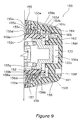
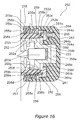
- a rear drag sounding mechanism includes a first rear drag sound generating mechanism 160 (a sound generating mechanism used when the first drag knob 150 is operated), a second rear drag sound generating mechanism 170 (a sound generating mechanism used when the second drag knob 151 is operated), and a third rear drag sound producing mechanism 180 (a sound producing mechanism used when the rear drag mechanism 145 is operated).
- the first rear drag sound generating mechanism 160 is disposed between the knob mounting portion 152 and the second knob member 156, and generates sound through relative rotation of the knob mounting portion 152 and the first drag knob 150.
- the first rear drag sound generating mechanism 160 includes a sounding member 161, a retaining member 162, a first mounting recess 163, a first sounding pin 164, and a first coil spring 165.
- the sounding member 161 includes a disk portion 161a that is formed into a ring shape, a plurality of sounding concavities 161b that are formed circumferentially apart in one surface of the disk portion 161a, and engagement portions 161c that are integrally formed with the other surface of the disk portion 161a.
- the disk portion 161a of the sounding member 161 is engaged with the second engagement portion 156f of the second knob member 156, and can rotate with respect to the second knob member 156.
- the outer diameter of the disk portion 161a is formed to be smaller than the inner diameter of the fourth annular groove 156b.
- the engagement portion 161c is formed to project toward the first engagement recesses 152b formed in the rear end surface of the knob mounting portion 152, and engages with the first engagement recesses 152b.
- the retaining member 162 is arranged in order to prevent the sounding member 161 from falling out.
- the retaining member 162 is, for example, a C-shaped retaining ring, and is disposed in the fourth annular groove 156b.
- the inner diameter of the retaining member 162 is formed to be smaller than the outer diameter of the disk portion 161a of the sounding member 161, such that the retaining member 162 and the second engagement portion 156f sandwich the disk portion 161a..
- the first mounting recess 163 is formed in the closed end of the second knob member 156, in a position opposite one of the plurality of sounding concavities 161b.
- the first sounding pin 164 is mounted in the first mounting recess 163 so that it can move forward and backward, and engages with the first sounding concavities 161b of the sounding member 161.
- the first sounding pin 164 includes a first head portion 164a, a first mounting portion 164b that is connected to the first head portion 164a, and a first shaft portion 164c that is connected to the first mounting portion 164b.
- the first head portion 164a is formed such that the front end thereof is a smooth convex shape. The front end of the front head portion 164a generates a clicking sound by repeatedly striking the first sounding concavities 161b.
- the first mounting portion 164b is formed to have a diameter that is larger than that of the first head portion 164a and smaller than the inner diameter of the first mounting recesses 163.
- the first shaft portion 164c is a shaft shaped component that is formed to have a diameter that is smaller than that of the first mounting portion 164b, and the first coil spring 165 can be disposed around the outer periphery of the first shaft portion 164c.
- the front end of the first coil spring 165 can be brought into contact with a step portion between the first mounting portion 164b and the first shaft portion 164c.
- the first coil spring 165 is disposed on the outer periphery of the first shaft portion 164c of the first sounding pin 164.
- the base end of the first coil spring 165 is brought into contact with the bottom portion of the first mounting recess 163, and the front end of the first coil spring 165 is brought into contact with the step portion between the first mounting portion 164b and the first shaft portion 164c.
- the first coil spring 165 is accommodated in the first mounting recess 163 in the compressed state, and urges the first sounding pin 164 toward the first sounding concavities 161b.
- the second rear drag sound generating mechanism 170 is disposed between the knob mounting portion 152 and the second drag knob 151, and generates sound when the second drag knob 151 is pivoted.
- the second rear drag sound generating mechanism 170 includes second sounding concavities 171, a second mounting recess 172, a second sounding pin 173, and a second coil spring 174 (an example of urging means).
- the second sounding concavities 171 are formed circumferentially apart in a pivot range of an inner peripheral surface of the second lever member 191.
- the second sounding concavities 171 are formed into groove shapes that extend in the axial direction.
- the second sounding pin 173 can engage in the second sounding concavities 171 even if the second drag knob 151 moves in the axial direction with respect to the knob mounting portion 152.
- the second sounding pin 173 can stably engage in the second sounding concavities 171 in response the movement of the second drag knob 151 in the axial direction and the circumferential direction. This allows good crisp clicking sounds and a modulated clicking feeling to be stably obtained.
- the second mounting recess 172 is formed in the outer peripheral side surface of the knob mounting portion 152 so as to oppose the second sounding concavities 171.
- An engagement hole 172a is formed in the bottom portion of the second mounting recess 172.
- the second sounding pin 173 is mounted in the second mounting recess 172 such that it can move in and out therefrom, and engages with the second sounding concavities 171.
- the second sounding pin 173 includes a second head portion 173a, a second mounting portion 173b that is connected to the second head portion 173a, and a second shaft portion 173c that is connected to the second mounting portion 173b.
- the second head portion 173a is formed such that the front end thereof is a smooth convex shape. The front end of the second head portion 173a generates a clicking sound by repeatedly striking the second sounding concavities 171.
- the front end of the second head portion 173a of the second sounding pin 173 is formed in a smooth convex shape, and thus the second sounding pin 173 generates clicking sounds with little resistance.
- the second mounting portion 173b is formed to have a diameter that is larger than that of the second head portion 173a and smaller than the inner diameter of the second mounting recesses 172.
- the second shaft portion 173c is a shaft shaped component that is formed to have a diameter that is smaller than that of the second mounting portion 173b, and the second coil spring 174 can be disposed around the outer periphery thereof.
- the second shaft portion 173c is slidably engaged in the axial direction in the engagement hole 172a formed in the second mounting recess 172.
- the second sounding pin 173 will be stable in the axial direction inside the second mounting recesses 172 and can slide therein. This allows the second head portion 173a of the second sounding pin 173 to engage the second sounding concavities 171 reliably, and allows good crisp clicking sounds and a modulated clicking feeling to be stably obtained.
- the second coil spring 174 is disposed on the outer periphery of the second shaft portion 173c of the second sounding pin 173.
- the base end of the second coil spring 174 is brought into contact with the bottom portion of the second mounting recess 172, and the front end of the second coil spring 174 is brought into contact with the step portion between the second mounting portion 173b and the second shaft portion 173c.
- the second coil spring 174 is accommodated in the second mounting recess 172 in the compressed state, and urges the second sounding pin 173 toward the second sounding concavities 171.
- this type of the second coil spring 174 is employed, jerkiness of the second sounding pin 173 inside the second mounting recess 172 can be reduced due to the second coil spring 174.
- the second sounding pin 173 to be smoothly engaged in the second sounding concavities 171 by the urging force of the second coil spring 174, and allows good crisp clicking sounds and a modulated clicking feeling to be obtained.
- the outer peripheral surface of the second mounting portion 173b moves in the axial direction along the inner peripheral surface of the second mounting recess 172. Because the second head portion 173a of the second mounting portion 173b has a diameter that is smaller than that of the second mounting portion 173b, the gaps between the second sounding concavities 171, which are formed opposite the second head portion 173a, can be reduced. In this way, good crisp clicking sounds can be produced with short sound generating gaps.
- the clicking feeling generated when the second drag knob 151 is pivoted can also be made to have a fine modulation.
- the outer peripheral surface of the second mounting portion 173b to move in the axial direction of the second shaft portion 173c within the inner peripheral surface of the second mounting recess 172, the movement of the second sounding pin 173 will be stable, and thus even if the gaps between the second sounding concavities 171 are reduced, the clicking sounds and the clicking feeling will be clearly noticed.
- the second sounding pin 173 can repeatedly strike the second sounding concavities 171 and generate sounds when the second drag knob 151 is pivoted.
- the second coil spring 174 continuously urges the second sounding pin 173 toward the second sounding concavities 171 such that the second coil spring 174 can reliably engage with the second sounding concavities 171.
- the second sounding pin 173 can be reliably brought into contact with the second sounding concavities 171 and produce sounds, and good crisp clicking sounds and a modulated clicking feeling can be obtained.
- the third rear drag sound generating mechanism 180 generates sound when the rear drag mechanism 145 is operated.
- the third rear drag sound generating mechanism 180 includes a sounding spring 181, and projections 120c that are formed on the outer peripheral surface of the plate member 120b.
- the sounding spring 181 is, for example, a plate spring that is formed into an approximate L shape, and is fixedly coupled at one end thereof to the reel body 101a. The other end of the sounding spring 181 engages with the projection 120c. In this way, when the rear drag mechanism 145 is operated, the spool shaft 114 and the first bush 118 rotate together with the plate member 120b, and the projections 120c of the plate member 120b repeatedly strike the other end of the sounding spring 181 and generate sound.
- the bail 143 When the spinning reel described above is to be used, the bail 143 will be pushed over to the line releasing side when the fishing line is to be reeled out. Then, when the fishing rod is cast, fishing line is reeled out from the spool 103. When the fishing line is to be retrieved, the bail 143 is returned to the line retrieving side.
- the handle 110 When the handle 110 is rotated in the line winding direction in this state, the rotational force is transmitted to the pinion gear 112 via the handle shaft 110a and the face gear 111. The rotational force transmitted to the pinion gear 112 rotates the rotor 102 coupled to the front portion of the pinion gear 112.
- the rotational force transmitted to the pinion gear 112 simultaneously rotates the worm 115 via the intermediate gear (not shown in the figures) that meshes with the pinion gear 112.
- the slider 116 that meshes with the spiral grooves of the worm 115 is guided by the guide shaft (not shown in the figures) and moves forward and backward.
- the spool shaft 114 and the spool 103 also reciprocatingly move forward and backward together with the slider 116.
- Fishing line that is guided from the bail 143 and the line roller 141 is uniformly wound around the outer periphery of the spool 103 forward and backward due to the rotation of the rotor 102 and the forward and backward movement of the spool 103.
- the rear drag mechanism 145 When a spinning reel that operates in the above-described manner is used, if a fish is hooked and pulls on the fishing line with a force that exceeds a predetermined drag force, the rear drag mechanism 145 will be activated and the spool shaft 114 and the spool 103 will rotate relative to each other. When this occurs, the projections 120c of the plate member 120b in the third rear drag sound generating mechanism 180 will repeatedly strike the end of the sounding spring 181 and generates sound.
- the drag force of the rear drag mechanism 145 will be set to a predetermined level.
- the first drag knob 150 is tightened, the first pressure member 122 inserted into the first engagement portion 156e of the second knob member 156 will rotate while moving forward, and the coil spring 121 coupled to the first pressure member 122 will be pushed inward. Then, the pressing force applied to the plurality of friction plates 119a of the first friction engagement portion 119 will greatly increase. When this occurs, both surfaces of the flange portion 123 of the first bush 118 are interposed between the friction plates 119a, and the pressure applied to both surfaces of the flange portion 123 greatly increases.
- the first sounding pin 164 and the first coil spring 165 are placed in the first mounting recess 163 of the second knob member 156. Then, while the first head portion 164a of the first sounding pin 164 is in contact with one of the first sounding concavities 161b of the sounding member 161, the sounding member 161 is mounted on the second engagement portion 156f of the second knob member 156. Next, the retaining member 162 is mounted on the fourth annular groove 156b formed in the second knob member 156 to retain the sounding member 161.
- the ring member 157 is first mounted on the first knob member 155, and then the third annular groove 155d of the first knob member 155 is brought into contact with the first engagement member 158a disposed in the knob mounting portion 152. Then, the washer 159 is disposed on the rear end surface of the first knob member 155. The second engagement member 158b is mounted in the second annular groove 152d of the knob mounting portion 152 that is to the rear of the washer 159, and the position of the first knob member 155 is determined relative to the knob mounting portion 152.
- the second female threaded portion 156d of the second knob member 156 is screwed onto the second male threaded portion 155e of the first knob member 155 to non-rotatively couple the first knob member 155 to the second knob member 156.
- the engagement portions 161c of the sounding member 161 are engaged with the first engagement recesses 152b of the knob mounting portion 152 to non-rotatively couple the sounding member 161 to the knob mounting portion 152.
- the first knob member 155 When the first drag knob 150 is rotated, the first knob member 155 will rotate relative to the knob mounting portion 152 in a state in which the knob mounting portion 152 is not movable in the axial direction.
- the second knob member 156 which is non-rotatively coupled to the first knob member 155 will rotate relative to the sounding member 161 which is non-rotatively mounted to the knob mounting portion 152.
- the first sounding pin 164 which disposed in the first mounting recess 163 of the second knob member 156 will be urged by the first coil spring 165, and repeatedly strike the plurality of sounding concavities 161b formed in the sounding member 161 to generate clicking sounds.
- the first drag knob 150 is not movable in the axial direction with respect to the knob mounting portion 152, and thus it will be difficult for a height difference between the first drag knob 150 and the second drag knob 151 to develop.
- the outer shape of the first drag knob 150 and the second drag knob 151 can be formed such that they smoothly connect together.
- good crisp clicking sounds can be obtained when the first drag knob 150 is rotated because the first sounding pin 164 mounted in the first mounting recess 163 of the second knob member 156 engages with the sounding concavities 161b of the sounding member 161 by the urging force of the first coil spring 165.
- first drag knob 150 by connecting the second knob member 156 to the first knob member 155, after the rear drag sound generating mechanism 160 is disposed on the second knob member 156, it will become easier for the second knob member 156 to be mounted to the first knob member 155 and to be removed from the first knob member 155, together with the rear drug sound generating mechanism 160.
- the design of the first drag knob 150 can be improved by installing the ring member 157 between the first knob member 155 and the second knob member 156.
- the second sounding pin 173 and the second coil spring 174 are placed in the second mounting recess 172 formed in the knob mounting portion 152.
- the second coil spring 174 is disposed around the outer periphery of the second shaft portion 173c of the second sounding pin 173, and the second shaft portion 173c of the second sounding pin 173 engages with the engagement hole 172a formed in the bottom portion of the second mounting recess 172.
- the second head portion 173a of the second sounding pin 173 will be in a state in which it can be brought into contact with the second sounding concavities 171 formed in the second lever member 191.
- the second drag knob 151 will be assembled.
- the second lever member 191 is first placed in the first lever member 190.
- the positioning pin 192 and the fourth coil spring 193 are placed in the fourth mounting recess 191b of the second lever member 191.
- the fixing member 194 is fixedly coupled to the second lever member 191 by a bolt so that the positioning pin 192 and the fourth coil spring 193 will not fall out from the fourth mounting recess 191b.
- the second engagement recesses 191c of the second lever member 191 and the first engagement projections 190b of the first lever member 190 are respectively engaged with the second engagement projections 195a and the first engagement recesses 195c of the tubular member 195.
- the third engagement member 198 is inserted into the groove 195d formed in the side wall portions of the first engagement recesses 195c of the tubular member 195.
- the third male threaded portion 152e formed on the knob mounting portion 152 is screwed together with the third female threaded portion 195e arranged on the inner peripheral surface of the tubular member 195.
- the second head portion 173a of the second sounding pin 173 of the second rear drag sound generating mechanism 170 will be brought into contact with the second sounding concavities 171 formed in the second lever member 191.
- the second drag knob 151 is pivotably mounted on the knob mounting portion 152, and the second rear drag sound generating mechanism 170 will be disposed between the second drag knob 151 and the knob mounting portion 152.
- the second sounding pin 173 and the second coil spring 174 are employed to produce sounds.
- the second sounding pin 173 is disposed in the second mounting recess 172 of the knob mounting portion 152, and engages with the second sounding concavities 171 of the second drag knob 151 by the second coil spring 174. When this occurs, the second sounding pin 173 repeatedly strikes the second sounding concavities 171 to generate sounds as the second drag knob 151 is pivoted.
- the second coil spring 174 continuously urges the second sounding pin 173 toward the sounding concavities 171, and thus regardless of the size of gap between the second sounding concavities 171, the second sounding pin 173 can be reliably brought into contact with the second sounding concavities 171 to generate sounds, and good clear clicking sounds and a modulated clicking feeling can be obtained.
- the retaining structure is employed herein.
- the ring member 157 is disposed on the first knob member 155. Then, the third annular groove 155d of the first knob member 155 is engaged with the first engagement member 158a disposed in the first annular groove 152c of the knob mounting portion 152. Next, the washer 159 is disposed in the rear portion of the third tubular portion 155c of the first knob member 155. When this occurs, the projections 159b of the washer 159 engage with the second engagement recesses 152f from the rear end of the knob mounting portion 152, and the front surface of the circular portion 159a of the washer 159 is brought into contact with the retaining engagement surface 155g of the first knob member 155.
- the second engagement member 158b is brought into contact with the rear surface of the washer 159 while being engaged with the second annular groove 152d. Rearward movement of the first knob member 155 can be regulated via the washer 159 due to the second engagement member 158b. Thus, after the rearward movement of the first knob member 155 is regulated, the second knob member 156 is connected to the first knob member 155. In this way, the first drag knob 150 is retained with respect to the knob mounting portion 152.
- the first drag knob 150 is retained by bringing the retaining engagement surface 155g into contact with the front surface of the second engagement member 158b.
- the second engagement member 158b must retain the first drag knob 150 in the rotated state, and thus it may be difficult to produce torsion in the second engagement member 158b and difficult to stably maintain the posture of the second engagement member 158b.
- the circular portion 159a of the washer 159 is brought into contact with the retaining engagement surface 155g, and the projections 159b of the washer 159 are engaged with the plurality of second engagement recesses 152f formed in the knob mounting portion 152.
- the washer 159 in contact with the retaining engagement surface 155g will regulate rotation with respect to the knob mounting portion 152 even if the retaining engagement surface 155g rotates.
- the retaining engagement surface 155g and the second engagement member 158b are disposed such that the washer 159 that is not rotative relative to the knob mounting portion 152 is interposed therebetween, the rotation of the retaining engagement surface 155g will not be transmitted to the second engagement member 158b by the washer 159 even if the retaining engagement surface 155g is rotated. This allows the posture of the second engagement member 158b to be stably maintained.
- the second sounding pin 173 and the second coil spring 174 are placed in the second mounting recess 172 formed on the outer peripheral side of the knob mounting portion 152, and the second sounding concavities 171 are formed on the inner peripheral side surface of the second drag knob 151.
- the second sounding pin 173 repeatedly strikes the second sounding concavities 171 to generate sounds.
- the good clear clicking sounds and modulated clicking feeling can be obtained. So long as these effects can be obtained, the position in which the second sounding concavities 171, the second mounting recess 172, the second sounding pin 173, and the second coil spring 174 are disposed is not limited to those of the aforementioned embodiment.
- the second sounding concavities 171, the second mounting recess 172, the second sounding pin 173, and the second coil spring 174 may be disposed in any location.
- the second mounting recess 172 can be formed on the inner peripheral side surface of the second drag knob 151, and the second sounding pin 173 and the second coil spring 174 can be placed in the second mounting recess 172.
- the second sounding concavities 171 can be formed on the outer peripheral side of the knob mounting portion 152.
- a sounding pin mounted in a mounting recess of the knob member is engaged with sounding concavities of a sounding member by an urging means.
- the sounding member is mounted to the knob member in a state in which the sounding pin is engaged with one of the sounding concavities of the sounding member, and the sounding member is retained by a retaining member, it will be difficult for the sounding member and the urging means to fall out from the knob member regardless of the posture of the knob member when one attempts to mount the knob member to a knob mounting portion.
- the sounding pin even when one attempts to remove the knob member from the knob mounting portion, it will be difficult for the sounding pin to fall out from the knob member because the sounding member retained by the retaining member restricts the removal of the sounding pin from the knob member.
Landscapes
- Engineering & Computer Science (AREA)
- Mechanical Engineering (AREA)
- Life Sciences & Earth Sciences (AREA)
- Environmental Sciences (AREA)
- Animal Husbandry (AREA)
- Biodiversity & Conservation Biology (AREA)
- Mechanical Control Devices (AREA)
- Golf Clubs (AREA)
Applications Claiming Priority (6)
| Application Number | Priority Date | Filing Date | Title |
|---|---|---|---|
| JP2003111447 | 2003-04-16 | ||
| JP2003111447A JP4149841B2 (ja) | 2003-04-16 | 2003-04-16 | スピニングリールのリアドラグ発音機構 |
| JP2003137379A JP2004337067A (ja) | 2003-05-15 | 2003-05-15 | スピニングリールのリアドラグ発音機構 |
| JP2003137379 | 2003-05-15 | ||
| JP2003154603A JP4163994B2 (ja) | 2003-05-30 | 2003-05-30 | 釣用リールの制動調整つまみの抜け止め構造 |
| JP2003154603 | 2003-05-30 |
Publications (2)
| Publication Number | Publication Date |
|---|---|
| EP1472929A1 EP1472929A1 (en) | 2004-11-03 |
| EP1472929B1 true EP1472929B1 (en) | 2007-12-12 |
Family
ID=32995632
Family Applications (1)
| Application Number | Title | Priority Date | Filing Date |
|---|---|---|---|
| EP04252021A Expired - Lifetime EP1472929B1 (en) | 2003-04-16 | 2004-04-03 | Sound generating mechanism for a fishing reel |
Country Status (9)
| Country | Link |
|---|---|
| US (1) | US6957788B2 (enExample) |
| EP (1) | EP1472929B1 (enExample) |
| KR (1) | KR101012809B1 (enExample) |
| CN (1) | CN100448350C (enExample) |
| AT (1) | ATE380468T1 (enExample) |
| DE (1) | DE602004010567T2 (enExample) |
| MY (1) | MY127516A (enExample) |
| SG (1) | SG114660A1 (enExample) |
| TW (1) | TW200507747A (enExample) |
Families Citing this family (14)
| Publication number | Priority date | Publication date | Assignee | Title |
|---|---|---|---|---|
| SG118339A1 (en) * | 2004-06-09 | 2006-01-27 | Shimano Kk | Spinning-reel sounding mechanism |
| JP5184759B2 (ja) * | 2006-05-26 | 2013-04-17 | シマノコンポネンツ マレーシア エスディーエヌ.ビーエッチディー. | スピニングリールのドラグ装置 |
| US7757989B1 (en) * | 2009-06-30 | 2010-07-20 | Electric Fishing Reel Systems, Inc. | Teaser reel with alarm |
| JP6134133B2 (ja) * | 2012-12-04 | 2017-05-24 | 株式会社シマノ | ドラグつまみ、及びこれを用いた釣り用リール |
| JP5995321B2 (ja) * | 2013-02-28 | 2016-09-21 | グローブライド株式会社 | 魚釣用スピニングリール |
| JP2014226071A (ja) * | 2013-05-21 | 2014-12-08 | 株式会社シマノ | スピニングリール |
| JP6198539B2 (ja) * | 2013-09-13 | 2017-09-20 | 株式会社シマノ | 両軸受けリール |
| EP2853159B1 (en) * | 2013-09-27 | 2017-04-05 | Globeride, Inc. | Fishing spinning reel |
| JP6389370B2 (ja) * | 2014-03-28 | 2018-09-12 | グローブライド株式会社 | 魚釣用スピニングリール |
| CN204811579U (zh) * | 2015-08-17 | 2015-12-02 | 王夕仁 | 可示力的鱼线轮调力旋钮 |
| JP6688603B2 (ja) * | 2015-12-14 | 2020-04-28 | 株式会社シマノ | スピニングリールのロータ、及びスピニングリール |
| DK3589151T3 (da) * | 2017-03-01 | 2023-07-24 | Boa Tech Inc | Rullebaseret lukkesystem |
| JP7088670B2 (ja) * | 2017-12-27 | 2022-06-21 | 株式会社シマノ | ドラグつまみ、及び釣り用リール |
| WO2021207163A1 (en) * | 2020-04-06 | 2021-10-14 | Pure Fishing, Inc. | Pull to turn lever drag preset knob |
Family Cites Families (13)
| Publication number | Priority date | Publication date | Assignee | Title |
|---|---|---|---|---|
| JPS5923966U (ja) * | 1982-08-05 | 1984-02-14 | リョービ株式会社 | 魚釣用リ−ルのドラグ調整機構 |
| JPS60168375U (ja) * | 1984-04-18 | 1985-11-08 | 株式会社シマノ | スピニングリ−ル |
| US4634074A (en) * | 1984-11-22 | 1987-01-06 | Kabushiki Kaisha Ohmori Seisakusho | Spinning type fishing reel with line untwisting capability |
| JPH0441831Y2 (enExample) * | 1987-02-20 | 1992-10-01 | ||
| JPH025739U (enExample) | 1988-06-22 | 1990-01-16 | ||
| US4988057A (en) * | 1989-02-10 | 1991-01-29 | Shimano Industrial Company Limited | Drag device for a spinning reel |
| GB8914508D0 (en) * | 1989-06-23 | 1989-08-09 | British American Tobacco Co | Improvements relating to the making of smoking articles |
| JPH0367576U (enExample) * | 1989-11-06 | 1991-07-02 | ||
| JPH0449966U (enExample) * | 1990-09-03 | 1992-04-27 | ||
| JP3392237B2 (ja) * | 1994-11-11 | 2003-03-31 | 株式会社シマノ | スピニングリール |
| JP3439137B2 (ja) * | 1998-11-04 | 2003-08-25 | 株式会社シマノ | スピニングリールのスプール |
| US6688545B2 (en) | 2002-01-22 | 2004-02-10 | Shimano Inc. | Fishing-reel sounding device |
| US6578785B1 (en) * | 2002-01-25 | 2003-06-17 | Eugene Hong | Fly fishing reel with a positioning unit |
-
2004
- 2004-03-12 SG SG200401569A patent/SG114660A1/en unknown
- 2004-03-23 TW TW093107803A patent/TW200507747A/zh not_active IP Right Cessation
- 2004-03-25 MY MYPI20041076A patent/MY127516A/en unknown
- 2004-03-30 US US10/811,964 patent/US6957788B2/en not_active Expired - Lifetime
- 2004-04-03 EP EP04252021A patent/EP1472929B1/en not_active Expired - Lifetime
- 2004-04-03 DE DE602004010567T patent/DE602004010567T2/de not_active Expired - Lifetime
- 2004-04-03 AT AT04252021T patent/ATE380468T1/de not_active IP Right Cessation
- 2004-04-09 KR KR1020040024587A patent/KR101012809B1/ko not_active Expired - Fee Related
- 2004-04-16 CN CNB2004100368734A patent/CN100448350C/zh not_active Expired - Fee Related
Also Published As
| Publication number | Publication date |
|---|---|
| MY127516A (en) | 2006-12-29 |
| KR101012809B1 (ko) | 2011-02-08 |
| EP1472929A1 (en) | 2004-11-03 |
| SG114660A1 (en) | 2005-09-28 |
| DE602004010567T2 (de) | 2008-12-11 |
| CN100448350C (zh) | 2009-01-07 |
| KR20040090441A (ko) | 2004-10-25 |
| US20040206840A1 (en) | 2004-10-21 |
| TW200507747A (en) | 2005-03-01 |
| US6957788B2 (en) | 2005-10-25 |
| CN1537423A (zh) | 2004-10-20 |
| ATE380468T1 (de) | 2007-12-15 |
| TWI308482B (enExample) | 2009-04-11 |
| DE602004010567D1 (de) | 2008-01-24 |
Similar Documents
| Publication | Publication Date | Title |
|---|---|---|
| EP1472929A1 (en) | Sound generating mechanism for a fishing reel | |
| EP1527681B1 (en) | Spinning reel sounding mechanism | |
| KR101722477B1 (ko) | 듀얼 베어링 릴의 드래그 사운드 발생 장치 | |
| US8113456B2 (en) | Dual-bearing reel speed-change operation mechanism | |
| EP2036432B1 (en) | Reel unit of spinning reel | |
| EP1506707B1 (en) | Rear drag operation structure for a spinning reel | |
| EP1516531B1 (en) | Rotor for spinning reel | |
| EP1859678B1 (en) | Drag device for spinning reel | |
| EP1712127B1 (en) | Spinning reel drag mechanism | |
| US6978957B2 (en) | Spool support structure for a spinning reel | |
| KR101940640B1 (ko) | 스피닝 릴 및 스피닝 릴의 드래그 전환 장치 | |
| EP1393627B1 (en) | Rotor braking device for spinning reel | |
| JP4163994B2 (ja) | 釣用リールの制動調整つまみの抜け止め構造 | |
| JP3569372B2 (ja) | 釣用リールの発音機構 | |
| US6971599B2 (en) | Spinning reel rotor braking device | |
| JP4627680B2 (ja) | スピニングリール | |
| EP1597966B1 (en) | Brake operation structure for fishing reel spool | |
| JP2006296203A5 (enExample) | ||
| JP2004337067A (ja) | スピニングリールのリアドラグ発音機構 | |
| JP2006296204A (ja) | スピニングリールのドラグ機構 | |
| JP2006296204A5 (enExample) |
Legal Events
| Date | Code | Title | Description |
|---|---|---|---|
| PUAI | Public reference made under article 153(3) epc to a published international application that has entered the european phase |
Free format text: ORIGINAL CODE: 0009012 |
|
| AK | Designated contracting states |
Kind code of ref document: A1 Designated state(s): AT BE BG CH CY CZ DE DK EE ES FI FR GB GR HU IE IT LI LU MC NL PL PT RO SE SI SK TR |
|
| AX | Request for extension of the european patent |
Extension state: AL HR LT LV MK |
|
| 17P | Request for examination filed |
Effective date: 20041020 |
|
| AKX | Designation fees paid |
Designated state(s): AT BE BG CH CY CZ DE DK EE ES FI FR GB GR HU IE IT LI LU MC NL PL PT RO SE SI SK TR |
|
| RAP1 | Party data changed (applicant data changed or rights of an application transferred) |
Owner name: SHIMANO INC. |
|
| GRAP | Despatch of communication of intention to grant a patent |
Free format text: ORIGINAL CODE: EPIDOSNIGR1 |
|
| GRAS | Grant fee paid |
Free format text: ORIGINAL CODE: EPIDOSNIGR3 |
|
| GRAA | (expected) grant |
Free format text: ORIGINAL CODE: 0009210 |
|
| AK | Designated contracting states |
Kind code of ref document: B1 Designated state(s): AT BE BG CH CY CZ DE DK EE ES FI FR GB GR HU IE IT LI LU MC NL PL PT RO SE SI SK TR |
|
| REG | Reference to a national code |
Ref country code: GB Ref legal event code: FG4D |
|
| REG | Reference to a national code |
Ref country code: CH Ref legal event code: EP |
|
| REG | Reference to a national code |
Ref country code: IE Ref legal event code: FG4D |
|
| REF | Corresponds to: |
Ref document number: 602004010567 Country of ref document: DE Date of ref document: 20080124 Kind code of ref document: P |
|
| PG25 | Lapsed in a contracting state [announced via postgrant information from national office to epo] |
Ref country code: CH Free format text: LAPSE BECAUSE OF FAILURE TO SUBMIT A TRANSLATION OF THE DESCRIPTION OR TO PAY THE FEE WITHIN THE PRESCRIBED TIME-LIMIT Effective date: 20071212 Ref country code: SE Free format text: LAPSE BECAUSE OF FAILURE TO SUBMIT A TRANSLATION OF THE DESCRIPTION OR TO PAY THE FEE WITHIN THE PRESCRIBED TIME-LIMIT Effective date: 20080312 Ref country code: LI Free format text: LAPSE BECAUSE OF FAILURE TO SUBMIT A TRANSLATION OF THE DESCRIPTION OR TO PAY THE FEE WITHIN THE PRESCRIBED TIME-LIMIT Effective date: 20071212 |
|
| PG25 | Lapsed in a contracting state [announced via postgrant information from national office to epo] |
Ref country code: SI Free format text: LAPSE BECAUSE OF FAILURE TO SUBMIT A TRANSLATION OF THE DESCRIPTION OR TO PAY THE FEE WITHIN THE PRESCRIBED TIME-LIMIT Effective date: 20071212 Ref country code: NL Free format text: LAPSE BECAUSE OF FAILURE TO SUBMIT A TRANSLATION OF THE DESCRIPTION OR TO PAY THE FEE WITHIN THE PRESCRIBED TIME-LIMIT Effective date: 20071212 Ref country code: FI Free format text: LAPSE BECAUSE OF FAILURE TO SUBMIT A TRANSLATION OF THE DESCRIPTION OR TO PAY THE FEE WITHIN THE PRESCRIBED TIME-LIMIT Effective date: 20071212 Ref country code: PL Free format text: LAPSE BECAUSE OF FAILURE TO SUBMIT A TRANSLATION OF THE DESCRIPTION OR TO PAY THE FEE WITHIN THE PRESCRIBED TIME-LIMIT Effective date: 20071212 |
|
| NLV1 | Nl: lapsed or annulled due to failure to fulfill the requirements of art. 29p and 29m of the patents act | ||
| REG | Reference to a national code |
Ref country code: CH Ref legal event code: PL |
|
| PG25 | Lapsed in a contracting state [announced via postgrant information from national office to epo] |
Ref country code: AT Free format text: LAPSE BECAUSE OF FAILURE TO SUBMIT A TRANSLATION OF THE DESCRIPTION OR TO PAY THE FEE WITHIN THE PRESCRIBED TIME-LIMIT Effective date: 20071212 |
|
| PG25 | Lapsed in a contracting state [announced via postgrant information from national office to epo] |
Ref country code: CZ Free format text: LAPSE BECAUSE OF FAILURE TO SUBMIT A TRANSLATION OF THE DESCRIPTION OR TO PAY THE FEE WITHIN THE PRESCRIBED TIME-LIMIT Effective date: 20071212 Ref country code: ES Free format text: LAPSE BECAUSE OF FAILURE TO SUBMIT A TRANSLATION OF THE DESCRIPTION OR TO PAY THE FEE WITHIN THE PRESCRIBED TIME-LIMIT Effective date: 20080323 |
|
| PG25 | Lapsed in a contracting state [announced via postgrant information from national office to epo] |
Ref country code: RO Free format text: LAPSE BECAUSE OF FAILURE TO SUBMIT A TRANSLATION OF THE DESCRIPTION OR TO PAY THE FEE WITHIN THE PRESCRIBED TIME-LIMIT Effective date: 20071212 Ref country code: BE Free format text: LAPSE BECAUSE OF FAILURE TO SUBMIT A TRANSLATION OF THE DESCRIPTION OR TO PAY THE FEE WITHIN THE PRESCRIBED TIME-LIMIT Effective date: 20071212 Ref country code: SK Free format text: LAPSE BECAUSE OF FAILURE TO SUBMIT A TRANSLATION OF THE DESCRIPTION OR TO PAY THE FEE WITHIN THE PRESCRIBED TIME-LIMIT Effective date: 20071212 |
|
| EN | Fr: translation not filed | ||
| PG25 | Lapsed in a contracting state [announced via postgrant information from national office to epo] |
Ref country code: PT Free format text: LAPSE BECAUSE OF FAILURE TO SUBMIT A TRANSLATION OF THE DESCRIPTION OR TO PAY THE FEE WITHIN THE PRESCRIBED TIME-LIMIT Effective date: 20080512 |
|
| PLBE | No opposition filed within time limit |
Free format text: ORIGINAL CODE: 0009261 |
|
| STAA | Information on the status of an ep patent application or granted ep patent |
Free format text: STATUS: NO OPPOSITION FILED WITHIN TIME LIMIT |
|
| PG25 | Lapsed in a contracting state [announced via postgrant information from national office to epo] |
Ref country code: FR Free format text: LAPSE BECAUSE OF FAILURE TO SUBMIT A TRANSLATION OF THE DESCRIPTION OR TO PAY THE FEE WITHIN THE PRESCRIBED TIME-LIMIT Effective date: 20080926 Ref country code: DK Free format text: LAPSE BECAUSE OF FAILURE TO SUBMIT A TRANSLATION OF THE DESCRIPTION OR TO PAY THE FEE WITHIN THE PRESCRIBED TIME-LIMIT Effective date: 20071212 |
|
| 26N | No opposition filed |
Effective date: 20080915 |
|
| PG25 | Lapsed in a contracting state [announced via postgrant information from national office to epo] |
Ref country code: MC Free format text: LAPSE BECAUSE OF NON-PAYMENT OF DUE FEES Effective date: 20080430 |
|
| PG25 | Lapsed in a contracting state [announced via postgrant information from national office to epo] |
Ref country code: GR Free format text: LAPSE BECAUSE OF FAILURE TO SUBMIT A TRANSLATION OF THE DESCRIPTION OR TO PAY THE FEE WITHIN THE PRESCRIBED TIME-LIMIT Effective date: 20080313 Ref country code: EE Free format text: LAPSE BECAUSE OF FAILURE TO SUBMIT A TRANSLATION OF THE DESCRIPTION OR TO PAY THE FEE WITHIN THE PRESCRIBED TIME-LIMIT Effective date: 20071212 |
|
| PG25 | Lapsed in a contracting state [announced via postgrant information from national office to epo] |
Ref country code: IE Free format text: LAPSE BECAUSE OF NON-PAYMENT OF DUE FEES Effective date: 20080403 Ref country code: BG Free format text: LAPSE BECAUSE OF FAILURE TO SUBMIT A TRANSLATION OF THE DESCRIPTION OR TO PAY THE FEE WITHIN THE PRESCRIBED TIME-LIMIT Effective date: 20080312 |
|
| PG25 | Lapsed in a contracting state [announced via postgrant information from national office to epo] |
Ref country code: CY Free format text: LAPSE BECAUSE OF FAILURE TO SUBMIT A TRANSLATION OF THE DESCRIPTION OR TO PAY THE FEE WITHIN THE PRESCRIBED TIME-LIMIT Effective date: 20071212 |
|
| PG25 | Lapsed in a contracting state [announced via postgrant information from national office to epo] |
Ref country code: HU Free format text: LAPSE BECAUSE OF FAILURE TO SUBMIT A TRANSLATION OF THE DESCRIPTION OR TO PAY THE FEE WITHIN THE PRESCRIBED TIME-LIMIT Effective date: 20080613 Ref country code: LU Free format text: LAPSE BECAUSE OF NON-PAYMENT OF DUE FEES Effective date: 20080403 |
|
| PG25 | Lapsed in a contracting state [announced via postgrant information from national office to epo] |
Ref country code: TR Free format text: LAPSE BECAUSE OF FAILURE TO SUBMIT A TRANSLATION OF THE DESCRIPTION OR TO PAY THE FEE WITHIN THE PRESCRIBED TIME-LIMIT Effective date: 20071212 |
|
| PGFP | Annual fee paid to national office [announced via postgrant information from national office to epo] |
Ref country code: IT Payment date: 20100417 Year of fee payment: 7 |
|
| PG25 | Lapsed in a contracting state [announced via postgrant information from national office to epo] |
Ref country code: IT Free format text: LAPSE BECAUSE OF NON-PAYMENT OF DUE FEES Effective date: 20110403 |
|
| PGFP | Annual fee paid to national office [announced via postgrant information from national office to epo] |
Ref country code: GB Payment date: 20140402 Year of fee payment: 11 |
|
| PGFP | Annual fee paid to national office [announced via postgrant information from national office to epo] |
Ref country code: DE Payment date: 20140430 Year of fee payment: 11 |
|
| REG | Reference to a national code |
Ref country code: DE Ref legal event code: R119 Ref document number: 602004010567 Country of ref document: DE |
|
| GBPC | Gb: european patent ceased through non-payment of renewal fee |
Effective date: 20150403 |
|
| PG25 | Lapsed in a contracting state [announced via postgrant information from national office to epo] |
Ref country code: GB Free format text: LAPSE BECAUSE OF NON-PAYMENT OF DUE FEES Effective date: 20150403 Ref country code: DE Free format text: LAPSE BECAUSE OF NON-PAYMENT OF DUE FEES Effective date: 20151103 |