EP1469181A2 - Verfahren und Vorrichtung zum sicheren Betreiben eines Verbrennungsmotors im Schiebebetrieb - Google Patents
Verfahren und Vorrichtung zum sicheren Betreiben eines Verbrennungsmotors im Schiebebetrieb Download PDFInfo
- Publication number
- EP1469181A2 EP1469181A2 EP04101216A EP04101216A EP1469181A2 EP 1469181 A2 EP1469181 A2 EP 1469181A2 EP 04101216 A EP04101216 A EP 04101216A EP 04101216 A EP04101216 A EP 04101216A EP 1469181 A2 EP1469181 A2 EP 1469181A2
- Authority
- EP
- European Patent Office
- Prior art keywords
- control signal
- threshold value
- internal combustion
- combustion engine
- threshold
- Prior art date
- Legal status (The legal status is an assumption and is not a legal conclusion. Google has not performed a legal analysis and makes no representation as to the accuracy of the status listed.)
- Withdrawn
Links
Images


Classifications
-
- F—MECHANICAL ENGINEERING; LIGHTING; HEATING; WEAPONS; BLASTING
- F02—COMBUSTION ENGINES; HOT-GAS OR COMBUSTION-PRODUCT ENGINE PLANTS
- F02D—CONTROLLING COMBUSTION ENGINES
- F02D41/00—Electrical control of supply of combustible mixture or its constituents
- F02D41/22—Safety or indicating devices for abnormal conditions
- F02D41/221—Safety or indicating devices for abnormal conditions relating to the failure of actuators or electrically driven elements
-
- F—MECHANICAL ENGINEERING; LIGHTING; HEATING; WEAPONS; BLASTING
- F02—COMBUSTION ENGINES; HOT-GAS OR COMBUSTION-PRODUCT ENGINE PLANTS
- F02D—CONTROLLING COMBUSTION ENGINES
- F02D11/00—Arrangements for, or adaptations to, non-automatic engine control initiation means, e.g. operator initiated
- F02D11/06—Arrangements for, or adaptations to, non-automatic engine control initiation means, e.g. operator initiated characterised by non-mechanical control linkages, e.g. fluid control linkages or by control linkages with power drive or assistance
- F02D11/10—Arrangements for, or adaptations to, non-automatic engine control initiation means, e.g. operator initiated characterised by non-mechanical control linkages, e.g. fluid control linkages or by control linkages with power drive or assistance of the electric type
- F02D11/107—Safety-related aspects
-
- F—MECHANICAL ENGINEERING; LIGHTING; HEATING; WEAPONS; BLASTING
- F02—COMBUSTION ENGINES; HOT-GAS OR COMBUSTION-PRODUCT ENGINE PLANTS
- F02D—CONTROLLING COMBUSTION ENGINES
- F02D41/00—Electrical control of supply of combustible mixture or its constituents
- F02D41/02—Circuit arrangements for generating control signals
- F02D41/04—Introducing corrections for particular operating conditions
- F02D41/12—Introducing corrections for particular operating conditions for deceleration
-
- F—MECHANICAL ENGINEERING; LIGHTING; HEATING; WEAPONS; BLASTING
- F02—COMBUSTION ENGINES; HOT-GAS OR COMBUSTION-PRODUCT ENGINE PLANTS
- F02D—CONTROLLING COMBUSTION ENGINES
- F02D41/00—Electrical control of supply of combustible mixture or its constituents
- F02D41/02—Circuit arrangements for generating control signals
- F02D41/14—Introducing closed-loop corrections
- F02D41/1497—With detection of the mechanical response of the engine
-
- Y—GENERAL TAGGING OF NEW TECHNOLOGICAL DEVELOPMENTS; GENERAL TAGGING OF CROSS-SECTIONAL TECHNOLOGIES SPANNING OVER SEVERAL SECTIONS OF THE IPC; TECHNICAL SUBJECTS COVERED BY FORMER USPC CROSS-REFERENCE ART COLLECTIONS [XRACs] AND DIGESTS
- Y02—TECHNOLOGIES OR APPLICATIONS FOR MITIGATION OR ADAPTATION AGAINST CLIMATE CHANGE
- Y02T—CLIMATE CHANGE MITIGATION TECHNOLOGIES RELATED TO TRANSPORTATION
- Y02T10/00—Road transport of goods or passengers
- Y02T10/10—Internal combustion engine [ICE] based vehicles
- Y02T10/40—Engine management systems
Definitions
- the invention relates to a method for operating an internal combustion engine in pushing operation, comprising the steps of: detecting a transition to pushing operation; after the detection of the transition, enabling monitoring of a control signal for a power actuator of the internal combustion engine when predetermined enabling conditions are met, after the release, comparing a control signal for a power actuator of the internal combustion engine with a threshold value, and Triggering an error response when the control signal exceeds the threshold.
- the invention further relates to a device for Operating an internal combustion engine with at least one Detector that detects transitions to push operation, a control unit that monitors a Control signal for a power actuator Internal combustion engine in the presence of at least one releases predetermined release condition and that, after the release, a control signal for a Power actuator of the internal combustion engine with one Compares threshold and then an error response triggers when the drive signal exceeds the threshold exceeds.
- Push operation occurs, for example, when braking or at a downhill run of a motor vehicle when the driver no torque requests.
- the transition to the Push operation can be done, for example, by a Driver request transmitter, for example an accelerator pedal transmitter be recorded.
- Both air-metering come as a power actuator Actuators, such as a throttle valve or variable valve control, as well as fuel metering Actuators, typically an injection system, into question.
- the final stage of the Power actuator can be deactivated.
- the above-mentioned DE 33 01 742 relates to an electronic Diesel control system for a diesel engine (EDC).
- EDC diesel engine
- the present invention also relates to EDC systems but not limited to that. Rather, it can also Gasoline engines with E-gas (electronically controlled Throttle valve) or with a variable valve control, which serves as a power actuator.
- the in following control period mentioned several times first on a pulse width with which an injection valve is controlled to open. Instead of the activation period, but the amount of each drive signal is one Power actuator can be used accordingly.
- the torque generated is essential for diesel engines determined by the fuel injection quantity. This applies analog for gasoline engines with direct injection in the Shifts. Fuel metering errors can occur in in these cases to an undesirable torque generation to lead. Especially in push mode, one can be undesirable generated motor torque must be safety-critical, because there is insufficient engine braking or even can lead to undesired acceleration.
- the control signal duration is included compared to a fixed threshold.
- the value of the Threshold determines the sensitivity of the Error detection. If it is small, the sensitivity is with the real mistake to be discovered, big. However, leads a high sensitivity also to the risk of being regular Torque requirements of the bucking function and / or the idle controller can be rated as an error.
- the object of the invention is specifying a procedure that will maintain the Safety function in modern motor vehicles under Avoiding the disadvantages mentioned.
- the drive trains become more elastic
- Comfort functions such as bucking damping are restricted Need to become.
- This task is performed both in a process and in a device of the type mentioned resolved that the threshold in a transition phase from reduced from an initial value to an end value becomes.
- the task is completely solved by these features.
- the reduction in the threshold allows it initially with a comparatively insensitive error detection to start and their sensitivity with increasing time interval from the start of the transition to the Push operation to increase. This will add up a consistently high monitoring quality without significantly high false detections and without restrictions reached by comfort functions.
- control signal is a Control time for at least one injection valve is.
- This configuration enables a less complex Monitoring an injector assembly as Power actuator.
- the value of the control signal at the release is detected and the threshold by Enlargement of the detected control signal is formed.
- This feature is used in the threshold value formation automatically adjust the speed of the Control signal to the reduced torque request considered. If the control signal duration drops quickly, there is a small control signal duration at the Release and thus a small, adjusted threshold. With a slow descent, the result is accordingly larger, adjusted threshold.
- the threshold value is continuous is reduced.
- a steady reduction enables a constant tracking of the threshold to that at the transition to Push operation becomes shorter control duration.
- the threshold value is reduced linearly in sections.
- This feature makes the Driving time, a curved, possibly only time-consuming process to be reproduced follows through computationally easy to master straight line sections approximated.
- the predetermined Release conditions at least waiting for a waiting time range from 500 ms to 900 ms.
- This time period corresponds to a typical time period, in the a bucking function even greater torques and thus requests driving times from an error not by a simple threshold comparison can be distinguished.
- the threshold value is reduced is completed after 1400 to 3000 ms.
- This configuration ensures that the Sensitivity of error detection with decreasing Threshold rises after this period is maximum, making reliable detection of unwanted Controls of the power actuator is guaranteed.
- control device has at least one controls the preferred configurations mentioned.
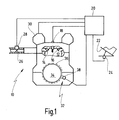
- the number 10 in FIG. 1 denotes the overall view a highly schematically illustrated internal combustion engine with at least one combustion chamber 12.
- a filling of the Combustion chamber 12 is an inlet valve 14 and Exhaust valve 16 replaced.
- To an air filling of the Combustion chamber 12 is fuel via an injection valve 18 metered, the time of metering and the metered amount controlled by a control unit 20 become.
- the injection valve 18 as Power actuator used.
- the measured amount determines very much that generated by the internal combustion engine 10 Torque.
- the control of the power actuator takes place depending on, among other things Driver request made via an accelerator pedal 22 by one Accelerator pedal sensor 24 is detected and sent to control unit 20 is forwarded.
- Such a way of power control is for one Typical diesel engine.
- a comparable performance control about the amount of metered fuel is also done with a gasoline engine with direct injection in operation with stratified combustion chamber filling.
- spark ignition occurs on the gasoline engine Filling the combustion chamber, for example with a spark plug.
- a gasoline engine with direct injection which in Homogeneous operation, i.e. with homogeneous mixture distribution in the Combustion chamber 12 is operated, the setting of desired torque depending on the driver's request about the amount of filling of the combustion chamber 12.
- the Internal combustion engine 10 also has a speed sensor system 32 on, for example with a sensor wheel 34 ferromagnetic markings 36 and an inductive sensor 38 can exist.
- Step 40 represents a Main program for controlling the internal combustion engine 12, which, as well as the following program steps, in the control unit 20 expires.
- the main program 40 becomes one Step 42 queries whether the internal combustion engine 10 in the Push mode should be operated and whether the conditions for enabling the monitoring of the control duration of a Injector 18 are present. If the answer is no Query in step 42 will loop the steps 40 and 42 run through periodically, if necessary, until the release conditions are met.
- the Release condition can consist, for example, that a waiting time between triggering the push operation and the release of the monitoring has expired.
- a detection takes place in step 44 the current actuation period AS_akt.
- a Threshold value SW by mathematically increasing the Control period AS_akt formed. This can be done that the control duration AS_akt with a factor> 1 is multiplied or by an offset d to that current value for the control period AS_akt is added.
- the threshold value thus formed serves as an input value for a loop of steps 48, 50, 54 and 56 in which continuously an updated value for the control duration compared to a continuously adjusted threshold becomes. In other words: as part of the first option the threshold is practically online in operation educated.
- Offline determination of the possible operating status in Connection with the determination of an offset can for example, a threshold map Operating parameters of the internal combustion engine speed and the time since thrust monitoring was activated can be addressed. In other words: the threshold is done by offline evaluation of the possible operating states established.
- step 48 For the comparison with the threshold value is first in the step 48 again a current value AS_akt for the Control duration determined. This value is then in the Step 50 with the current value for the Threshold compared. The first time the mentioned loop from steps 48, 50, 54 and 56 this is the value that was determined in step 46.
- the Comparison in step 50 can be that of checking is whether the control period AS_akt the threshold SW exceeds. If this is not the case, the Step 54 checks whether the internal combustion engine 10 is still in Push operation is to be operated. If this is denied, there is a branch to the main control program of the internal combustion engine (step 40).
- step 54 is affirmed and the threshold value is reduced in step 56 SW, in which this threshold SW after a predetermined Relation as a function of time as SW (t) newly formed becomes. With this newly formed, reduced threshold is branched back to step 48. Then will in step 48 the current activation duration is recorded and in Step 50 compared to the reduced threshold.
- FIG. 3 shows temporal profiles of a control signal for a power actuator 18; 28; 30 of the internal combustion engine 10 and a threshold value SW for monitoring the Control signal AS in connection with the transition to Push operation of the internal combustion engine 10.
- a transition occurs corresponding signal from the accelerator pedal sensor 24 is triggered.
- Accelerator pedal sensor 24 thus provides an example of one Detector for detecting such transitions.
- the control duration AS to avoid hard load changes an excitation of vibrations of the drive train avoid, for example after a time function 63 gradually reduced.
- the time course 63 Control vibrations of a bucking function or one Idle control function overlaid.
- This overlay leads to an oscillating course of the control signal AS, as shown in Figure 4.
- a maximum threshold SW_0 for a possible Monitoring of the control signal AS chosen because that Control signal AS only gradually drops.
- the performance determining Actuator can no longer be controlled, otherwise one It is possible to exceed the reduced threshold would.
- the threshold is from Time t_1 so small that there is certainly no torque increasing Injection takes place.
- the number 58 represents the overall course of the State-of-the-art threshold value SW. This The course has an initially increased level 60, the abruptly to a target value 62 at time t_1 is reduced.
- Figure 4 shows the situation in the context of a Embodiment of the invention.
- the major intervention of one Comfort function as it is in the maximum of 75 Signal waveform 74 represents for unwanted triggering an error reaction by exceeding the Lead threshold 62 in Figure 3.
- this value is a Offset d added to a start value of Threshold value SW at the time t_1 of the release of the Define monitoring. Then the Threshold value SW steadily reduced until it becomes one Time t_3 reaches a final value 72, which is the target value 62 from FIG. 3 can correspond.
- the threshold value SW in the example of the figure 4 ramped, d. H. linear in sections, reduced. For this, it becomes, starting from the start value SW_t_1 at the time t_1 linearly with increasing time until time t_2 a first slope reduced. Then takes off a further reduction with a time t_2 reduced slope.
- the slopes and the Number of sections in a given Internal combustion engine 10 are expected to be adjusted.
- the above is for a drive period of an injection valve 18 described entirely analogous to monitoring other power actuators, such as throttle valves or a variable valve control can be applied.
- the throttle valve actuator would be a specific one Throttle valve opening angle of a control duration of a Injector 18 correspond, since both sizes in their in each respective technical environment Determine the torque of the internal combustion engine 10.
- At a variable valve control would be the Control duration or the valve lift the appropriate criterion.
Landscapes
- Engineering & Computer Science (AREA)
- Chemical & Material Sciences (AREA)
- Combustion & Propulsion (AREA)
- Mechanical Engineering (AREA)
- General Engineering & Computer Science (AREA)
- Electrical Control Of Air Or Fuel Supplied To Internal-Combustion Engine (AREA)
- Combined Controls Of Internal Combustion Engines (AREA)
- Output Control And Ontrol Of Special Type Engine (AREA)
Abstract
nach dem Detektieren des Übergangs, Freigeben einer Überwachung eines Ansteuersignals für ein Leistungsstellglied (18; 28; 30) des Verbrennungsmotors (10) dann, wenn vorbestimmte Freigabebedingungen erfüllt sind,
nach der Freigabe, Vergleichen eines Ansteuersignals für das Leistungsstellglied (18; 28; 30) des Verbrennungsmotors (10) mit einem Schwellenwert, und
Auslösen einer Fehlerreaktion dann, wenn das Ansteuersignal den Schwellenwert überschreitet. Das Verfahren zeichnet sich dadurch aus,
dass der Schwellenwert in einer Übergangsphase von einem anfänglichen Wert an bis zu einem Endwert reduziert wird. Die Erfindung betrifft ferner eine Vorrichtung zur Durchführung des Verfahrens.
Description
nach dem Detektieren des Übergangs, Freigeben einer Überwachung eines Ansteuersignals für ein Leistungsstellglied des Verbrennungsmotors dann, wenn vorbestimmte Freigabebedingungen erfüllt sind,
nach der Freigabe, Vergleichen eines Ansteuersignals für ein Leistungsstellglied des Verbrennungsmotors mit einem Schwellenwert, und
Auslösen einer Fehlerreaktion dann, wenn das Ansteuersignal den Schwellenwert überschreitet.
- Fig. 1
- schematisch einen Verbrennungsmotor mit Stellgliedern, Sensorik und einem Steuergerät;
- Fig. 2
- ein Flussdiagramm als Ausführungsbeispiel eines erfindungsgemäßen Verfahrens;
- Fig. 3
- den zeitlichen Verlauf verschiedener Größen nach dem Stand der Technik, und
- Fig. 4
- den zeitlichen Verlauf vergleichbarer Größen nach einem Ausführungsbeispiel der Erfindung.
Claims (10)
- Verfahren zum Betreiben eines Verbrennungsmotors (10) im Schiebebetrieb mit den Schritten:dadurch gekennzeichnet, dassDetektieren eines Übergangs in den Schiebebetrieb;nach dem Detektieren des Übergangs, Freigeben einer Überwachung eines Ansteuersignals für ein Leistungsstellglied (18; 28; 30) des Verbrennungsmotors (10) dann, wenn vorbestimmte Freigabebedingungen erfüllt sind,nach der Freigabe, Vergleichen eines Ansteuersignals für das Leistungsstellglied (18; 28; 30) des Verbrennungsmotors (10) mit einem Schwellenwert, undAuslösen einer Fehlerreaktion dann, wenn das Ansteuersignal den Schwellenwert überschreitet,
der Schwellenwert in einer Übergangsphase von einem anfänglichen Wert an bis zu einem Endwert reduziert wird. - Verfahren nach Anspruch 1, dadurch gekennzeichnet, dass das Ansteuersignal eine Ansteuerdauer für ein Einspritzventil (18) ist.
- Verfahren nach Anspruch 2, dadurch gekennzeichnet, dass der Wert des Ansteuersignals bei der Freigabe erfasst wird und der Schwellenwert durch Vergrößerung des erfassten Ansteuersignals gebildet wird.
- Verfahren nach Anspruch 3, dadurch gekennzeichnet, dass die Vergrößerung durch additive Verknüpfung des erfassten Ansteuersignals mit einem vorbestimmten Abstand oder durch multiplikative Verknüpfung mit einem vorbestimmten Faktor oder durch Bestimmung des Schwellenwertes durch Offline-Bewertung der möglichen Betriebszustände erzielt wird.
- Verfahren nach wenigstens einem der Ansprüche 1 bis 4, dadurch gekennzeichnet, dass der Schwellenwert stetig reduziert wird.
- Verfahren nach wenigstens einem der Ansprüche 1 bis 5, dadurch gekennzeichnet, dass der Schwellenwert abschnittsweise linear reduziert wird.
- Verfahren nach wenigstens einem der vorhergehenden Ansprüche, dadurch gekennzeichnet, dass die vorbestimmten Freigabebedingungen wenigstens das Abwarten einer Wartezeit von 500 ms bis 900 ms umfassen.
- Verfahren nach wenigstens einem der vorhergehenden Ansprüche, dadurch gekennzeichnet, dass das Reduzieren des Schwellenwertes nach 1400 bis 3000 ms abgeschlossen ist.
- Vorrichtung zum Betreiben eines Verbrennungsmotors (10) mit wenigstens einem Detektor (24), der Übergänge in den Schiebebetrieb detektiert, einem Steuergerät (20), das eine Überwachung eines Ansteuersignals für ein Leistungsstellglied (18; 28; 30) des Verbrennungsmotors (10) beim Vorliegen wenigstens einer vorbestimmten Freigabebedingung freigibt und das, nach der Freigabe, ein Ansteuersignal für das Leistungsstellglied (18; 28; 30) des Verbrennungsmotors (10) mit einem Schwellenwert vergleicht und eine Fehlerreaktion dann auslöst, wenn das Ansteuersignal den Schwellenwert überschreitet,
dadurch gekennzeichnet, dass
das Steuergerät (20) den Schwellenwert in einer Übergangsphase von einem anfänglichen Wert an bis zu einem Endwert reduziert. - Vorrichtung nach Anspruch 9, dadurch gekennzeichnet, dass das Steuergerät (20) wenigstens eines der Verfahren nach den Ansprüchen 2 bis 8 steuert.
Applications Claiming Priority (2)
| Application Number | Priority Date | Filing Date | Title |
|---|---|---|---|
| DE2003117648 DE10317648A1 (de) | 2003-04-17 | 2003-04-17 | Verfahren und Vorrichtung zum sicheren Betreiben eines Verbrennunsmotors im Schiebebetrieb |
| DE10317648 | 2003-04-17 |
Publications (2)
| Publication Number | Publication Date |
|---|---|
| EP1469181A2 true EP1469181A2 (de) | 2004-10-20 |
| EP1469181A3 EP1469181A3 (de) | 2006-11-22 |
Family
ID=32892386
Family Applications (1)
| Application Number | Title | Priority Date | Filing Date |
|---|---|---|---|
| EP04101216A Withdrawn EP1469181A3 (de) | 2003-04-17 | 2004-03-24 | Verfahren und Vorrichtung zum sicheren Betreiben eines Verbrennungsmotors im Schiebebetrieb |
Country Status (3)
| Country | Link |
|---|---|
| EP (1) | EP1469181A3 (de) |
| JP (1) | JP2004316656A (de) |
| DE (1) | DE10317648A1 (de) |
Families Citing this family (1)
| Publication number | Priority date | Publication date | Assignee | Title |
|---|---|---|---|---|
| DE102006039706B4 (de) | 2006-08-24 | 2018-05-30 | Robert Bosch Gmbh | Verfahren zum Betreiben einer Brennkraftmaschine im Schiebebetrieb |
Citations (2)
| Publication number | Priority date | Publication date | Assignee | Title |
|---|---|---|---|---|
| DE3301742A1 (de) | 1983-01-20 | 1984-07-26 | Robert Bosch Gmbh, 7000 Stuttgart | Sicherheitseinrichtung fuer eine brennkraftmaschine mit selbstzuendung |
| DE19537787A1 (de) | 1995-10-11 | 1997-04-17 | Bosch Gmbh Robert | Verfahren und Vorrichtung zur Steuerung einer Brennkraftmaschine |
Family Cites Families (3)
| Publication number | Priority date | Publication date | Assignee | Title |
|---|---|---|---|---|
| JP3405163B2 (ja) * | 1997-12-17 | 2003-05-12 | トヨタ自動車株式会社 | 内燃機関の燃料噴射量制御装置 |
| DE19836845B4 (de) * | 1998-08-14 | 2009-04-09 | Robert Bosch Gmbh | Verfahren und Vorrichtung zur Steuerung einer Antriebseinheit eines Kraftfahrzeugs |
| JP3864671B2 (ja) * | 2000-06-12 | 2007-01-10 | 日産自動車株式会社 | ディーゼルエンジンの燃料噴射制御装置 |
-
2003
- 2003-04-17 DE DE2003117648 patent/DE10317648A1/de not_active Ceased
-
2004
- 2004-03-24 EP EP04101216A patent/EP1469181A3/de not_active Withdrawn
- 2004-04-14 JP JP2004119302A patent/JP2004316656A/ja active Pending
Patent Citations (2)
| Publication number | Priority date | Publication date | Assignee | Title |
|---|---|---|---|---|
| DE3301742A1 (de) | 1983-01-20 | 1984-07-26 | Robert Bosch Gmbh, 7000 Stuttgart | Sicherheitseinrichtung fuer eine brennkraftmaschine mit selbstzuendung |
| DE19537787A1 (de) | 1995-10-11 | 1997-04-17 | Bosch Gmbh Robert | Verfahren und Vorrichtung zur Steuerung einer Brennkraftmaschine |
Also Published As
| Publication number | Publication date |
|---|---|
| DE10317648A1 (de) | 2004-11-25 |
| JP2004316656A (ja) | 2004-11-11 |
| EP1469181A3 (de) | 2006-11-22 |
Similar Documents
| Publication | Publication Date | Title |
|---|---|---|
| DE10029303B4 (de) | Steuergerät und Verfahren für eine Brennkraftmaschine, die in einem Motorfahrzeug installiert ist | |
| WO2002008595A1 (de) | Verfahren und vorrichtung zur steuerung einer antriebseinheit | |
| DE68918537T2 (de) | Mehrfach-Rückführungs-Regelungsverfahren und -system zur Steuerung von Radschlupf. | |
| DE19501299B4 (de) | Verfahren und Vorrichtung zur Steuerung einer Brennkraftmaschine eines Fahrzeugs | |
| DE19836845B4 (de) | Verfahren und Vorrichtung zur Steuerung einer Antriebseinheit eines Kraftfahrzeugs | |
| EP1613852B1 (de) | Verfahren zum betreiben eines verbrennungsmotors mit einer drehmoment berwachung | |
| DE102004021426B4 (de) | Verfahren und Vorrichtung zur Schaffung von Sicherheit für eine elektronisch gesteuerte Zylinderzuschaltung und -abschaltung | |
| DE102013001043B3 (de) | Verfahren zum Betreiben einer Brennkraftmaschine sowie entsprechende Brennkraftmaschine | |
| DE10024704A1 (de) | Verfahren und Vorrichtung zur Steuerung der Antriebseinheit eines Fahrzeugs | |
| EP0130341A2 (de) | Verfahren und Vorrichtung zur Steuerung des Schubbetriebs einer Brennkraftmaschine | |
| DE4417802B4 (de) | Vorrichtung zur Regelung der Motorleistung oder der Fahrgeschwindigkeit eines Fahrzeugs | |
| DE10340816A1 (de) | Verfahren und Vorrichtung zum Betreiben einer Brennkraftmaschine | |
| EP1785605B1 (de) | Verfahren zur Regeneration eines Dieselpartikelfilters und entsprechende Getriebesteuerung | |
| DE102004037773B4 (de) | Verfahren zur Begrenzung der Drehzahl von Brennkraftmaschinen | |
| DE102010033853B4 (de) | Verfahren zur Anfahrunterstützung eines Fahrzeugs | |
| WO1991008922A1 (de) | System zur elektronischen steuerung und/oder regelung der leistung einer brennkraftmaschine eines kraftfahrzeugs | |
| DE10039784B4 (de) | Verfahren und Vorrichtung zum Betreiben einer Brennkraftmaschine | |
| DE4234970C2 (de) | Vorrichtung und Verfahren zum Steuern einer Brennkraftmaschine | |
| DE19506082A1 (de) | Verfahren und Vorrichtung zur Steuerung der Antriebseinheit eines Fahrzeugs | |
| EP1268997A1 (de) | Verfahren und vorrichtung zur steuerung der antriebseinheit eines fahrzeugs | |
| DE4028809A1 (de) | System zur steuerung eines kraftfahrzeugs | |
| DE10058354B4 (de) | Verfahren und Vorrichtung zur Steuerung der Antriebseinheit eines Fahrzeugs | |
| EP1469181A2 (de) | Verfahren und Vorrichtung zum sicheren Betreiben eines Verbrennungsmotors im Schiebebetrieb | |
| EP1633965B1 (de) | Verfahren und vorrichtung zum betreiben eines verbrennungsmotors | |
| EP1439293A1 (de) | Regelung einer Brennkraftmaschine mit Bremskraftverstärker |
Legal Events
| Date | Code | Title | Description |
|---|---|---|---|
| PUAI | Public reference made under article 153(3) epc to a published international application that has entered the european phase |
Free format text: ORIGINAL CODE: 0009012 |
|
| AK | Designated contracting states |
Kind code of ref document: A2 Designated state(s): AT BE BG CH CY CZ DE DK EE ES FI FR GB GR HU IE IT LI LU MC NL PL PT RO SE SI SK TR |
|
| AX | Request for extension of the european patent |
Extension state: AL LT LV MK |
|
| PUAL | Search report despatched |
Free format text: ORIGINAL CODE: 0009013 |
|
| AK | Designated contracting states |
Kind code of ref document: A3 Designated state(s): AT BE BG CH CY CZ DE DK EE ES FI FR GB GR HU IE IT LI LU MC NL PL PT RO SE SI SK TR |
|
| AX | Request for extension of the european patent |
Extension state: AL LT LV MK |
|
| AKX | Designation fees paid | ||
| STAA | Information on the status of an ep patent application or granted ep patent |
Free format text: STATUS: THE APPLICATION IS DEEMED TO BE WITHDRAWN |
|
| 18D | Application deemed to be withdrawn |
Effective date: 20070523 |
|
| REG | Reference to a national code |
Ref country code: DE Ref legal event code: 8566 |