EP1469019A1 - Zusammensetzungen und ihre Verwendung als Additiv zur Verbesserung der Kaltfliesseigenschaften von Mitteldestillaten, sowie Brennstofföl enthaltend diese Zusammensetzungen - Google Patents
Zusammensetzungen und ihre Verwendung als Additiv zur Verbesserung der Kaltfliesseigenschaften von Mitteldestillaten, sowie Brennstofföl enthaltend diese Zusammensetzungen Download PDFInfo
- Publication number
- EP1469019A1 EP1469019A1 EP04016616A EP04016616A EP1469019A1 EP 1469019 A1 EP1469019 A1 EP 1469019A1 EP 04016616 A EP04016616 A EP 04016616A EP 04016616 A EP04016616 A EP 04016616A EP 1469019 A1 EP1469019 A1 EP 1469019A1
- Authority
- EP
- European Patent Office
- Prior art keywords
- mol
- alkyl
- weight
- structural units
- composition according
- Prior art date
- Legal status (The legal status is an assumption and is not a legal conclusion. Google has not performed a legal analysis and makes no representation as to the accuracy of the status listed.)
- Granted
Links
Classifications
-
- C—CHEMISTRY; METALLURGY
- C08—ORGANIC MACROMOLECULAR COMPOUNDS; THEIR PREPARATION OR CHEMICAL WORKING-UP; COMPOSITIONS BASED THEREON
- C08F—MACROMOLECULAR COMPOUNDS OBTAINED BY REACTIONS ONLY INVOLVING CARBON-TO-CARBON UNSATURATED BONDS
- C08F210/00—Copolymers of unsaturated aliphatic hydrocarbons having only one carbon-to-carbon double bond
-
- C—CHEMISTRY; METALLURGY
- C10—PETROLEUM, GAS OR COKE INDUSTRIES; TECHNICAL GASES CONTAINING CARBON MONOXIDE; FUELS; LUBRICANTS; PEAT
- C10L—FUELS NOT OTHERWISE PROVIDED FOR; NATURAL GAS; SYNTHETIC NATURAL GAS OBTAINED BY PROCESSES NOT COVERED BY SUBCLASSES C10G OR C10K; LIQUIFIED PETROLEUM GAS; USE OF ADDITIVES TO FUELS OR FIRES; FIRE-LIGHTERS
- C10L1/00—Liquid carbonaceous fuels
- C10L1/10—Liquid carbonaceous fuels containing additives
- C10L1/14—Organic compounds
- C10L1/146—Macromolecular compounds according to different macromolecular groups, mixtures thereof
-
- C—CHEMISTRY; METALLURGY
- C08—ORGANIC MACROMOLECULAR COMPOUNDS; THEIR PREPARATION OR CHEMICAL WORKING-UP; COMPOSITIONS BASED THEREON
- C08F—MACROMOLECULAR COMPOUNDS OBTAINED BY REACTIONS ONLY INVOLVING CARBON-TO-CARBON UNSATURATED BONDS
- C08F255/00—Macromolecular compounds obtained by polymerising monomers on to polymers of hydrocarbons as defined in group C08F10/00
-
- C—CHEMISTRY; METALLURGY
- C08—ORGANIC MACROMOLECULAR COMPOUNDS; THEIR PREPARATION OR CHEMICAL WORKING-UP; COMPOSITIONS BASED THEREON
- C08F—MACROMOLECULAR COMPOUNDS OBTAINED BY REACTIONS ONLY INVOLVING CARBON-TO-CARBON UNSATURATED BONDS
- C08F255/00—Macromolecular compounds obtained by polymerising monomers on to polymers of hydrocarbons as defined in group C08F10/00
- C08F255/08—Macromolecular compounds obtained by polymerising monomers on to polymers of hydrocarbons as defined in group C08F10/00 on to polymers of olefins having four or more carbon atoms
- C08F255/10—Macromolecular compounds obtained by polymerising monomers on to polymers of hydrocarbons as defined in group C08F10/00 on to polymers of olefins having four or more carbon atoms on to butene polymers
-
- C—CHEMISTRY; METALLURGY
- C08—ORGANIC MACROMOLECULAR COMPOUNDS; THEIR PREPARATION OR CHEMICAL WORKING-UP; COMPOSITIONS BASED THEREON
- C08L—COMPOSITIONS OF MACROMOLECULAR COMPOUNDS
- C08L51/00—Compositions of graft polymers in which the grafted component is obtained by reactions only involving carbon-to-carbon unsaturated bonds; Compositions of derivatives of such polymers
- C08L51/003—Compositions of graft polymers in which the grafted component is obtained by reactions only involving carbon-to-carbon unsaturated bonds; Compositions of derivatives of such polymers grafted on to macromolecular compounds obtained by reactions only involving unsaturated carbon-to-carbon bonds
-
- C—CHEMISTRY; METALLURGY
- C08—ORGANIC MACROMOLECULAR COMPOUNDS; THEIR PREPARATION OR CHEMICAL WORKING-UP; COMPOSITIONS BASED THEREON
- C08L—COMPOSITIONS OF MACROMOLECULAR COMPOUNDS
- C08L51/00—Compositions of graft polymers in which the grafted component is obtained by reactions only involving carbon-to-carbon unsaturated bonds; Compositions of derivatives of such polymers
- C08L51/06—Compositions of graft polymers in which the grafted component is obtained by reactions only involving carbon-to-carbon unsaturated bonds; Compositions of derivatives of such polymers grafted on to homopolymers or copolymers of aliphatic hydrocarbons containing only one carbon-to-carbon double bond
-
- C—CHEMISTRY; METALLURGY
- C10—PETROLEUM, GAS OR COKE INDUSTRIES; TECHNICAL GASES CONTAINING CARBON MONOXIDE; FUELS; LUBRICANTS; PEAT
- C10L—FUELS NOT OTHERWISE PROVIDED FOR; NATURAL GAS; SYNTHETIC NATURAL GAS OBTAINED BY PROCESSES NOT COVERED BY SUBCLASSES C10G OR C10K; LIQUIFIED PETROLEUM GAS; USE OF ADDITIVES TO FUELS OR FIRES; FIRE-LIGHTERS
- C10L1/00—Liquid carbonaceous fuels
- C10L1/10—Liquid carbonaceous fuels containing additives
- C10L1/14—Organic compounds
- C10L1/18—Organic compounds containing oxygen
- C10L1/192—Macromolecular compounds
- C10L1/195—Macromolecular compounds obtained by reactions involving only carbon-to-carbon unsaturated bonds
- C10L1/196—Macromolecular compounds obtained by reactions involving only carbon-to-carbon unsaturated bonds derived from monomers containing a carbon-to-carbon unsaturated bond and a carboxyl group or salts, anhydrides or esters thereof homo- or copolymers of compounds having one or more unsaturated aliphatic radicals each having one carbon bond to carbon double bond, and at least one being terminated by a carboxyl radical or of salts, anhydrides or esters thereof
- C10L1/1966—Macromolecular compounds obtained by reactions involving only carbon-to-carbon unsaturated bonds derived from monomers containing a carbon-to-carbon unsaturated bond and a carboxyl group or salts, anhydrides or esters thereof homo- or copolymers of compounds having one or more unsaturated aliphatic radicals each having one carbon bond to carbon double bond, and at least one being terminated by a carboxyl radical or of salts, anhydrides or esters thereof poly-carboxylic
-
- C—CHEMISTRY; METALLURGY
- C08—ORGANIC MACROMOLECULAR COMPOUNDS; THEIR PREPARATION OR CHEMICAL WORKING-UP; COMPOSITIONS BASED THEREON
- C08F—MACROMOLECULAR COMPOUNDS OBTAINED BY REACTIONS ONLY INVOLVING CARBON-TO-CARBON UNSATURATED BONDS
- C08F222/00—Copolymers of compounds having one or more unsaturated aliphatic radicals, each having only one carbon-to-carbon double bond, and at least one being terminated by a carboxyl radical and containing at least one other carboxyl radical in the molecule; Salts, anhydrides, esters, amides, imides, or nitriles thereof
- C08F222/10—Esters
- C08F222/12—Esters of phenols or saturated alcohols
- C08F222/14—Esters having no free carboxylic acid groups, e.g. dialkyl maleates or fumarates
- C08F222/145—Esters having no free carboxylic acid groups, e.g. dialkyl maleates or fumarates the ester chains containing seven or more carbon atoms
-
- C—CHEMISTRY; METALLURGY
- C10—PETROLEUM, GAS OR COKE INDUSTRIES; TECHNICAL GASES CONTAINING CARBON MONOXIDE; FUELS; LUBRICANTS; PEAT
- C10L—FUELS NOT OTHERWISE PROVIDED FOR; NATURAL GAS; SYNTHETIC NATURAL GAS OBTAINED BY PROCESSES NOT COVERED BY SUBCLASSES C10G OR C10K; LIQUIFIED PETROLEUM GAS; USE OF ADDITIVES TO FUELS OR FIRES; FIRE-LIGHTERS
- C10L1/00—Liquid carbonaceous fuels
- C10L1/10—Liquid carbonaceous fuels containing additives
- C10L1/14—Organic compounds
- C10L1/18—Organic compounds containing oxygen
- C10L1/192—Macromolecular compounds
- C10L1/195—Macromolecular compounds obtained by reactions involving only carbon-to-carbon unsaturated bonds
- C10L1/196—Macromolecular compounds obtained by reactions involving only carbon-to-carbon unsaturated bonds derived from monomers containing a carbon-to-carbon unsaturated bond and a carboxyl group or salts, anhydrides or esters thereof homo- or copolymers of compounds having one or more unsaturated aliphatic radicals each having one carbon bond to carbon double bond, and at least one being terminated by a carboxyl radical or of salts, anhydrides or esters thereof
- C10L1/1963—Macromolecular compounds obtained by reactions involving only carbon-to-carbon unsaturated bonds derived from monomers containing a carbon-to-carbon unsaturated bond and a carboxyl group or salts, anhydrides or esters thereof homo- or copolymers of compounds having one or more unsaturated aliphatic radicals each having one carbon bond to carbon double bond, and at least one being terminated by a carboxyl radical or of salts, anhydrides or esters thereof mono-carboxylic
-
- C—CHEMISTRY; METALLURGY
- C10—PETROLEUM, GAS OR COKE INDUSTRIES; TECHNICAL GASES CONTAINING CARBON MONOXIDE; FUELS; LUBRICANTS; PEAT
- C10L—FUELS NOT OTHERWISE PROVIDED FOR; NATURAL GAS; SYNTHETIC NATURAL GAS OBTAINED BY PROCESSES NOT COVERED BY SUBCLASSES C10G OR C10K; LIQUIFIED PETROLEUM GAS; USE OF ADDITIVES TO FUELS OR FIRES; FIRE-LIGHTERS
- C10L1/00—Liquid carbonaceous fuels
- C10L1/10—Liquid carbonaceous fuels containing additives
- C10L1/14—Organic compounds
- C10L1/18—Organic compounds containing oxygen
- C10L1/192—Macromolecular compounds
- C10L1/195—Macromolecular compounds obtained by reactions involving only carbon-to-carbon unsaturated bonds
- C10L1/197—Macromolecular compounds obtained by reactions involving only carbon-to-carbon unsaturated bonds derived from monomers containing a carbon-to-carbon unsaturated bond and an acyloxy group of a saturated carboxylic or carbonic acid
- C10L1/1973—Macromolecular compounds obtained by reactions involving only carbon-to-carbon unsaturated bonds derived from monomers containing a carbon-to-carbon unsaturated bond and an acyloxy group of a saturated carboxylic or carbonic acid mono-carboxylic
-
- C—CHEMISTRY; METALLURGY
- C10—PETROLEUM, GAS OR COKE INDUSTRIES; TECHNICAL GASES CONTAINING CARBON MONOXIDE; FUELS; LUBRICANTS; PEAT
- C10L—FUELS NOT OTHERWISE PROVIDED FOR; NATURAL GAS; SYNTHETIC NATURAL GAS OBTAINED BY PROCESSES NOT COVERED BY SUBCLASSES C10G OR C10K; LIQUIFIED PETROLEUM GAS; USE OF ADDITIVES TO FUELS OR FIRES; FIRE-LIGHTERS
- C10L1/00—Liquid carbonaceous fuels
- C10L1/10—Liquid carbonaceous fuels containing additives
- C10L1/14—Organic compounds
- C10L1/18—Organic compounds containing oxygen
- C10L1/192—Macromolecular compounds
- C10L1/198—Macromolecular compounds obtained otherwise than by reactions involving only carbon-to-carbon unsaturated bonds homo- or copolymers of compounds having one or more unsaturated aliphatic radicals, each having only one carbon to carbon double bond, and at least one being terminated by an acyloxy radical of a saturated carboxylic acid, of carbonic acid
- C10L1/1985—Macromolecular compounds obtained otherwise than by reactions involving only carbon-to-carbon unsaturated bonds homo- or copolymers of compounds having one or more unsaturated aliphatic radicals, each having only one carbon to carbon double bond, and at least one being terminated by an acyloxy radical of a saturated carboxylic acid, of carbonic acid polyethers, e.g. di- polygylcols and derivatives; ethers - esters
Definitions
- the present invention relates to copolymers containing structural units of Olefins, modified maleic anhydride and polyolefins, and their Use as an additive to fuel oils to improve their Cold flow properties.
- Crude oils and middle distillates obtained by distilling crude oils such as gas oil, Diesel oil or heating oil contain different ones depending on the origin of the crude oils Amounts of n-paraffins which, when the temperature is lowered, become platelet-shaped Crystallize crystals and partially agglomerate with the inclusion of oil. This leads to a deterioration in the flow properties of these oils or distillates, which means, for example, during extraction, transport, storage and / or use of mineral oils and mineral oil distillates. With mineral oils, this crystallization phenomenon can occur during transport Pipelines, especially in winter, to build up deposits on the pipe walls Individual cases, e.g. if a pipeline is at a standstill, even to completely block it to lead.
- the flow and cold behavior of mineral oils and mineral oil distillates is under other by specifying the cloud point (determined according to ISO 3015), the pour point (determined according to ISO 3016) and the cold filter plugging point (CFPP; determined according to EN 116). These parameters are measured in ° C.
- Typical flow improvers for crude oils and middle distillates are copolymers of Ethylene with carboxylic acid esters of vinyl alcohol. So you bet after the DE-A-11 47 799 petroleum distillate fuels with a boiling point between about 120 and 400 ° C oil-soluble copolymers of ethylene and Vinyl acetate with a molecular weight between about 1,000 and 3,000. Copolymers which contain about 60 to 99% by weight of ethylene and about are preferred Contain 1 to 40 wt .-% vinyl acetate. They are particularly effective when passed through radical polymerization in an inert solvent at temperatures of about 70 to 130 ° C and pressures of 35 to 2,100 atü (DE-A-19 14 756).
- comb polymers which are derived from ethylenically unsaturated monomers with longer (for example C 8 -C 30 ), preferably linear, alkyl radicals. These are mainly used in high-boiling, paraffin-rich mineral oils, optionally in combination with ethylene copolymers to improve the cold flow properties (eg GB-A-1 469 016 and EP-A-0 214 786).
- comb polymers with C 12 -C 14 -alkyl radicals are also used in narrowly cut distillates with, for example, 90-20% distillation ranges from ⁇ 100 ° C. and boiling ends of about 340-370 ° C.
- copolymers of maleic anhydride (MA) and ⁇ -olefins esterified with long-chain fatty alcohols are used for the treatment of crude oils.
- EP-A-0 719 290 discloses a copolymer of a monoethylenically unsaturated Carboxylic acid with 4 to 6 carbon atoms, an oligomer of propene or a branched ⁇ -olefin having 4 to 10 carbon atoms and another monoethylenically unsaturated compound with the compounds mentioned is copolymerizable. By reaction with an amine, it becomes oil-soluble Receive reaction products that are additives for lubricating oils and fuels suitable. The document does not disclose a composition of one Maleic acid ester, a polyolefin and an ⁇ -olefin.
- WO-90/03359 discloses copolymers of polyolefins which have more than 32 C atoms have, and olefinically unsaturated carboxylic acids or derivatives. The in However, esters listed in the document are not specified.
- DE-A-20 50 071 discloses copolymers esterified with fatty alcohols from a ethylenically unsaturated dicarboxylic acid or its derivatives with an ⁇ -olefin with at least 20 carbon atoms.
- the document discloses, for example no polyolefins as a comonomer for the copolymers.
- Preferred production process for the copolymers is according to e.g. DE-A-2 050 071 and EP-A-214 786 solvent-free bulk polymerization, from MSA and ⁇ -olefins, high-molecular copolymers are formed and subsequent ones Esterification.
- the copolymers of MSA and ⁇ -olefins as an intermediate for the Additives made from it by esterification with fatty alcohols however increased rigidity due to their high molecular weights. This is noticeable in such high viscosities and solidification points that the Polymers can only be handled at elevated temperatures. For this reason they are processed, formulated and stored at an elevated temperature, or at the end of their manufacturing process, there must be a solution from them immediately a suitable solvent.
- the object underlying the present invention was therefore to an effective cold flow improver for mineral oils (crude oils and middle distillates) Based on esterified dicarboxylic acids and linear ⁇ -olefins, but still at lower temperatures can be found.
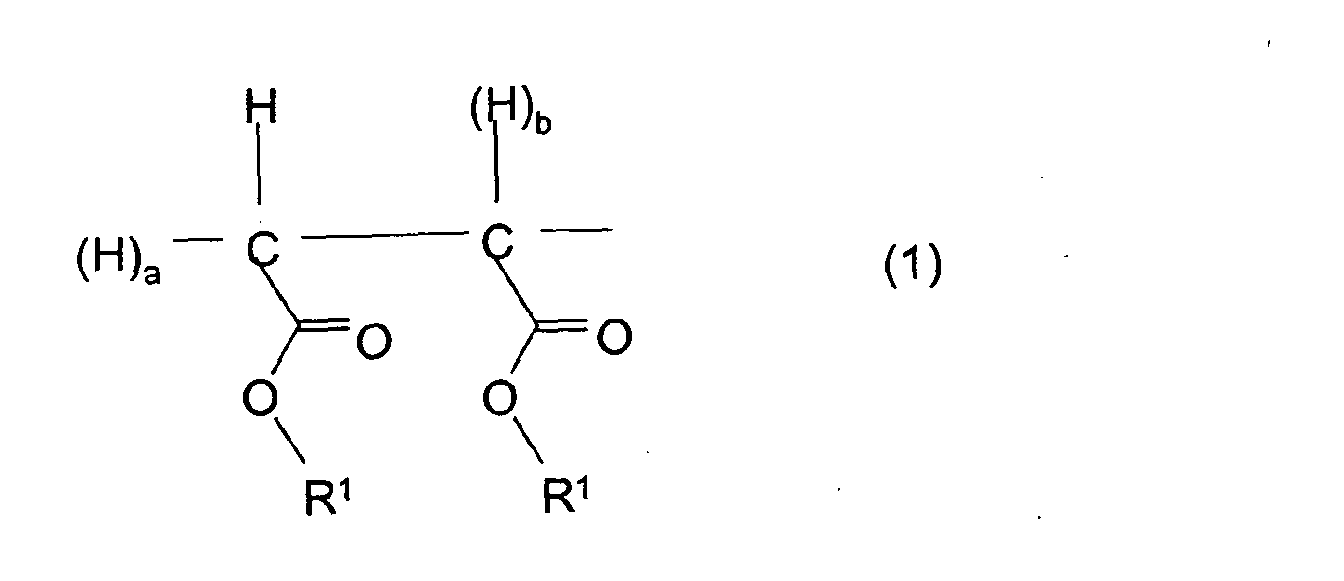
- the structural units of the compounds on which Formula 1 is based are esters of maleic, fumaric or itaconic acid.
- the preferred chain lengths for the radical R 1 depend on the intended use of the copolymers. If the copolymer is to be used as a cold flow improver for middle distillates, R 1 is an alkyl radical of preferably 10 to 24, in particular 12 to 20, carbon atoms.
- R 1 -OH the use of alcohol mixtures, for example of dodecanol and tetradecanol or tetradecanol and hexadecanol in a ratio of 1:10 to 10: 1, in particular 3: 1 to 1: 3, has proven particularly useful.
- the additive can be adapted to the oil to be treated by varying the alcohol component. For example, by adding, for example, 15% by weight of behenyl alcohol to the above-mentioned mixtures, the effectiveness in oils with an extremely high boiling point of> 390 ° C., in particular> 410 ° C., can be optimized.
- R 1 radicals of 16 to 40, preferably 16 to 30, carbon atoms have proven to be particularly suitable.
- the R 1 radicals can be linear or branched, and the branching can comprise a secondary or tertiary carbon atom. Linear radicals R 1 are preferred.
- R 1 is branched, it preferably has this branch in the 2 position. It is possible to use different radicals R 1 , ie to use mixtures of different alcohols in the preparation of the maleic, itaconic and / or fumaric esters.
- Preferred alcohols R 1 -OH are, for example, 1-decanol, 1-dodecanol, 1-tridecanol, isotridecanol, 1-tetradecanol, 1-hexadecanol, 1-octadecanol, eicosanol, docosanol, tetracosanol, their mixtures, and naturally occurring mixtures such as coconut fatty alcohol , Tallow fatty alcohol and behenyl alcohol.
- the alcohols can be of natural as well as synthetic origin.
- the radicals R 1 are alkoxyalkyl radicals of the formula 3 - (OA) x ⁇ R 3 wherein A is a C 2 -C 4 alkylene radical, x is an integer from 1 to 100 and R 3 is a C 1 -C 30 alkyl radical.
- the (OA) unit is preferably an ethoxy or propoxy unit. If alkoxylated units of the formula (3) are used for R 1 , this is preferably done in a mixture with radicals R 1 which are not alkoxylated. The proportion of alkoxylated radicals R 1 preferably does not exceed 20 mol% (based on all radicals R 1 ).
- R 3 can be linear or branched. If R 3 is branched, the branch is preferably in the 2 position. R 3 is preferably linear.
- the structural units of formula 2 are derived from ⁇ -olefins. These ⁇ -olefins have from 10 to 50, preferably 12 to 40 carbon atoms.
- the carbon chain of the ⁇ -olefins can be straight-chain or branched, preferably it is straight-chain.
- suitable olefins are 1-dodecene, 1-tetradecene, 1-tridecene, 1-hexadecene, 1-heptadecene, 1-octadecene, 1-nonadecene, 1-eicosen, 1-hemicosen, 1-docosen, 1-tetracosen, 1 -Hexacoses, 1-octacoses etc.
- olefin fractions such as C 20 -C 24 or C 30+ olefin
- C 20 -C 24 or C 30+ olefin are also suitable.
- the selection of the olefin depends on the intended use. While short-chain olefins in the C 14 -C 22 range deliver the best results in middle distillates, crude and residual oils require long-chain olefins such as C 20 -C 24 or C 30+ olefin fractions.
- the structural units mentioned under C) are derived from polyolefins which can be derived from monoolefins having 3, 4 or 5 carbon atoms.
- Particularly preferred monoolefins as the main body of the polyolefins are propylene and isobutylene, from which polypropylene and polyisobutylene are formed as polyolefins.
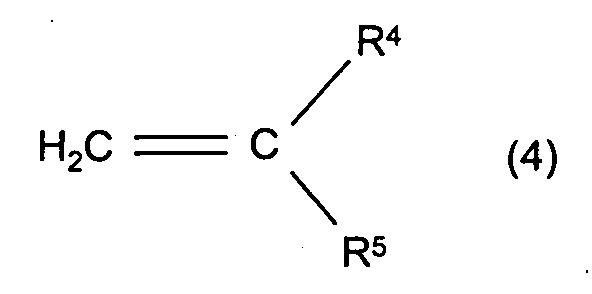
- the polyolefins preferably have an alkylvinylidene content of at least 50 mol%, in particular at least 70 mol%, especially at least 75%.
- Alkyl vinylidene content means the content of structural units in the polyolefins based on compounds of the formula 4 decrease in which R 4 or R 5 is methyl or ethyl and the other group is an oligomer of the C 3 -C 5 olefin.
- the number of carbon atoms of the polyolefin is between 35 and 350. In a preferred embodiment of the invention, the number of carbon atoms is between 45 and 250. In a further preferred embodiment of the invention, the proportion of structural units C) is 1 to 20 mol%, in particular 2 to 15 mol%.
- the polyolefins on which the structural units C) are based are ionic Polymerization accessible and available as commercial products (e.g. ®Ultravis, ®Napvis, ®Hyvis, ®Glissopal) (Polyisobutenes from BP, BASF with different Alkyl vinylidene contents and molecular weights).
- the average molecular weight of the copolymers according to the invention is in generally between 1,500 and 200,000 g / mol, in particular between 2,000 and 100,000 g / mol (GPC against polystyrene standards in THF).
- the copolymers according to the invention are preferably produced at Temperatures between 50 and 220 ° C, especially 100 to 190 ° C, especially 130 to 170 ° C.
- the preferred manufacturing process is solvent-free Bulk polymerization, however, it is also possible to carry out the polymerization in the presence aprotic solvents such as toluene, xylene or solvent mixtures such as kerosene or solvent naphtha.
- Polymerization in is particularly preferred less moderating, aliphatic or isoaliphatic solvents.
- In the Solution polymerization can raise the temperature by the boiling point of the solvent or set particularly easily by working under negative or positive pressure become.
- radical initiators Radar chain starter
- This class of substances includes e.g. Oxygen, Hydroperoxides, peroxides and azo compounds such as cumene hydroperoxide, t-butyl hydroperoxide, dilauroyl peroxide, dibenzoyl peroxide, bis (2-ethylhexyl) peroxide carbonate, t-butyl perpivalate, t-butyl permaleinate, t-butyl perbenzoate, dicumyl peroxide, t-Butylcumyl peroxide, di- (t-butyl) peroxide, 2,2'-azobis (2-methylpropanonitrile) or 2,2'-azobis (2-methylbutyronitrile).
- the initiators are used individually or as a mixture from two or more substances in amounts of 0.01 to 20 wt .-%, preferably 0.05 to 10 wt .-%, based on the monomer mixture, used.
- the copolymers can be obtained by copolymerizing polyolefin (component C) and ⁇ -olefin (component B) with either itaconic or maleic anhydride or Maleic, fumaric, itaconic esters can be produced. Will one Copolymerization carried out with anhydrides, so the resulting copolymer esterified after manufacture. This esterification is carried out, for example, by Reaction with 1.5 to 2.5 mol alcohol per mol anhydride at 50 to 300, especially 120 - 250 ° C.
- the water of reaction can by means of an inert gas stream distilled off or discharged by means of azeotropic distillation. copolymers with acid numbers less than 50, especially less than 30, especially less than 20 mg KOH / g are preferred
- Another object of the invention is the use of the invention Copolymers as an additive for fuel oils to improve the Cold flow properties of these fuel oils.
- Another object of the invention are fuel oils that the contain copolymers according to the invention.
- the copolymers according to the invention are mineral oils or mineral oil distillates Form of solutions or dispersions added. These solutions or Dispersions preferably contain 1 to 90, in particular 5 to 80% by weight of the Mixtures. Suitable solvents or dispersing agents are aliphatic and / or aromatic hydrocarbons or hydrocarbon mixtures, e.g.
- Gasoline fractions, kerosene, decane, pentadecane, toluene, xylene, ethylbenzene or commercial solvent mixtures such as Solvent Naphtha, ®Shellsol AB, ®Solvesso 150, ®Solvesso 200, ®Exxsol, ®ISOPAR and ®Shellsol D types as well as aliphatic or aromatic alcohols, ethers and / or esters.
- the specified Solvent mixtures contain different amounts of aliphatic and / or aromatic hydrocarbons.
- the aliphatics can be straight-chain (n-paraffins) or be branched (iso-paraffins).
- Aromatic hydrocarbons can be mono-, be di- or polycyclic and optionally one or more substituents wear.
- copolymers according to the invention in their rheological Properties improved mineral oils or mineral oil distillates contain 0.001 to 2, preferably 0.005 to 0.5% by weight of the copolymers, based on the distillate.
- Copolymers also together with one or more oil-soluble co-additives are used, which alone have the cold flow properties of crude oils, Improve lubricating oils or fuel oils.
- oil-soluble co-additives are Vinyl ester-containing copolymers or terpolymers of ethylene, alkylphenol-aldehyde resins and polar compounds that cause paraffin dispersion (Paraffin dispersants).
- Copolymers according to the invention Mixtures of the copolymers according to the invention with copolymers which contain 10 to 40% by weight of vinyl acetate and 60 to 90% by weight of ethylene have proven to be outstanding.
- Copolymers of ethylene with one or more C 1 -C 30 -alkyl vinyl esters, C 1 -C 30 -alkyl (meth) acrylates and / or olefins are also suitable as flow improvers.
- Suitable olefins are, for example, propene, isobutylene, diisobutylene, 4-methylpentene and nobornene.
- mixtures of different flow improvers with different quantitative (eg comonomer content) and / or qualitative composition (type of copolymers / terpolymers, molecular weight, degree of branching) can also be used.
- the copolymers according to the invention in a mixture with ethylene / vinyl acetate / vinyl neononanoate terpolymers or ethylene-vinyl acetate / neodecanoic acid vinyl ester terpolymers to improve the flowability of Mineral oils or mineral oil distillates.
- the terpolymers of Besides contain neononanoic acid vinyl ester or the neodecanoic acid vinyl ester Ethylene 10 to 35% by weight of vinyl acetate and 1 to 25% by weight of the respective Neo compound.
- the copolymers according to the invention with terpolymers used in addition to ethylene 10-35% by weight vinyl ester and 0.5 to 20% by weight olefins such as e.g. diisobutylene, Contain witches, 4-methylpentene and / or norbornene.
- the mixing ratio of the copolymers according to the invention with the above described ethylene / vinyl acetate copolymers or the terpolymers Ethylene, vinyl acetate and the vinyl esters of neononanoic or neodecanoic acid or from ethylene, vinylidene and olefins (in parts by weight) is 20: 1 to 1:20, preferably 10: 1 to 1:10.
- the mixtures of the copolymers according to the invention with the copolymers mentioned are in particular to improve the Flowability of middle distillates suitable.
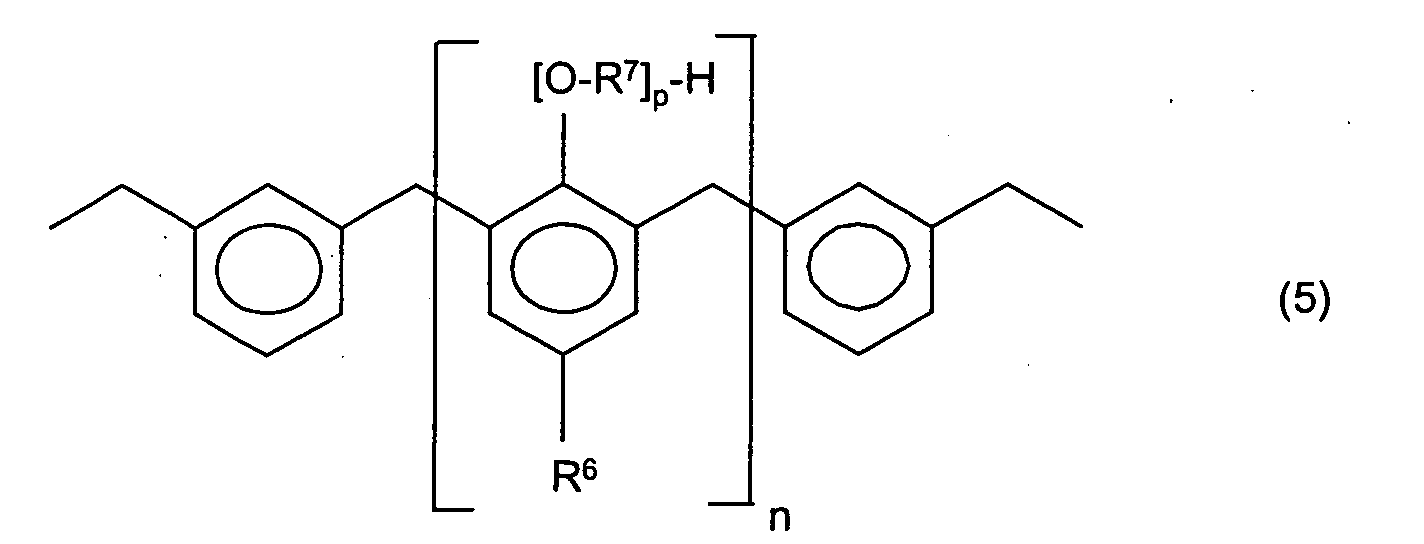
- the copolymers according to the invention can also be used in a mixture with alkylphenol-formaldehyde resins.
- these alkylphenol-formaldehyde resins are those of the formula 5 wherein R 6 is C 4 -C 50 alkyl or alkenyl, R 7 is ethoxy and / or propoxy, n is a number from 5 to 100 and p is a number from 0 to 50.
- Paraffin dispersants reduce the size of the paraffin crystals and ensure that the paraffin particles do not settle, but remain dispersed colloidally with a clearly reduced tendency to sedimentation.
- Oil-soluble polar compounds with ionic or polar groups for example amine salts and / or amides, which have been found to be suitable as paraffin dispersants, can be obtained by reacting aliphatic or aromatic amines, preferably long-chain aliphatic amines, with aliphatic or aromatic mono-, di-, tri- or tetracarboxylic acids or the like Anhydrides can be obtained.
- paraffin dispersants are copolymers of maleic anhydride and ⁇ , ⁇ -unsaturated compounds which can optionally be reacted with primary monoalkylamines and / or aliphatic alcohols, the reaction products of alkenyl spirobislactones with amines and reaction products of terpolymers based on ⁇ , ⁇ -unsaturated dicarboxylic acid Unsaturated compounds and polyoxyalkylene ethers of lower unsaturated alcohols. Alkylphenol-formaldehyde resins are also suitable as paraffin dispersants.
- the mixing ratio (in parts by weight) of the copolymers Paraffin dispersants are in each case 1:10 to 20: 1, preferably 1: 1 to 10: 1.
- copolymers according to the invention are suitable for the cold flow properties of crude oils, distillate oils or fuel oils as well as lubricating oils.
- the oils can be of mineral, animal or vegetable origin.
- middle distillates are mineral oils that can be obtained by distillation of crude oil and in the range of 120 to 500 ° C. boil such as kerosene, jet fuel, diesel and heating oil. You can share alcoholic fuels such as Ethanol and methanol, or too Biofuels, e.g. Rapeseed oil or rapeseed acid methyl ester.
- the Fuels according to the invention preferably contain less than 350 ppm and especially less than 200 ppm sulfur.
- Your GC determined content n-paraffins, which have chain lengths of 18 carbon atoms or more with at least 8 area%, preferably with more than 10 area%. Your 95% distillation point is preferably above 350 ° C, in particular above 370 ° C, especially above 380 ° C.
- the copolymers can be used alone or together with other additives used, for example with dewaxing aids, Improving conductivity, defoaming agents, dispersing agents, Corrosion inhibitors, antioxidants, lubricity additives, dehazers or Sludge inhibitors.
- the additive components can the oils to be added together as a concentrate mixture in suitable solvents or separately be added.
- the poly (olefins) used are commercial products (®Ultravis) from BP Chemicals.
- the C 20/24 olefin used is a mixture of 1-olefins containing as main components 2% C 18 , 48% C 20 , 36% C 22 and 7% C 24 .
- the mixture of olefin and poly (isobutylene) given in the table is placed in a round-bottom flask with stirrer, internal thermometer, reflux condenser, gas inlet tube and two metering funnels at 150-160 ° C. while passing nitrogen through and stirring.
- Melted maleic anhydride and a solution of di-tert-butyl peroxide in kerosene are continuously added from separate templates in such a way that the maximum temperature given in Table 1 is maintained, which takes about 1-1.5 hours.
- the mixture is subsequently reacted at 150 ° C. for 2 hours and then bottled.
- the molecular weight was determined by means of gel permeation chromatography in THF against poly (styrene) standards and RI detection.
- the MSA co- or terpolymer is dissolved in equal parts by weight of solvent naphtha in a three-necked flask with a stirrer, internal thermometer and water separator. After adding the stated amounts of behenyl alcohol (native fatty alcohol, containing 2% octadecanol, 63% eicosanol, 31% docosan as main components), tetradecanol, hexadecanol and / or alkoxylated behenyl alcohol per mole of copolymerized maleic anhydride is refluxed for 12 hours (approx. 220 ° C) cooked. It is diluted to 50% polymer content with solvent naphtha and filled.
- 0.5 mol of fumaric acid dibehenyl ester, 0.05 mol of poly (isobutylene) with a molecular weight of 800 and 0.45 mol of C 20/24 olefin are heated to 140 ° C. in a multi-necked flask while stirring and passing nitrogen through.
- a solution of di-tert-butyl peroxide in kerosene is added so that the reaction temperature does not exceed 150 ° C.
- the mixture is stirred at 140 ° C for 2 hours, diluted with the same amount of solvent naphtha and filled.
- the esterified polymers were tested for their effectiveness as pour point depressants in a residual oil with an inherent pour point of 45 ° C.
- the measurements are carried out based on ISO 3016 using a Herzog MC 850 pour point automat from Herzog. Effectiveness of the esterified terpolymers as pour point depressants example 660 ppm 1200 ppm E1 + 36 ° C + 30 ° C E2 + 36 ° C + 30 ° C E3 + 33 ° C + 30 ° C E16 + 33 ° C + 30 ° C E4 (see) + 36 ° C + 33 ° C E5 (See) + 45 ° C + 36 ° C
- the terpolymers according to the invention are furthermore suitable as co-additives (comb polymers) to ethylene copolymers in middle distillates, in particular in middle distillates with high boiling ends (> 370 ° C., in particular> 380 ° C.) and / or high cloud point> 0 ° C. Characterization of the test oils The boiling data are determined in accordance with ASTM D-86, the CFPP value in accordance with EN 116 and the cloud point in accordance with ISO 3015.
- Test oil 1 Test oil 2 Initial boiling point [° C] 179 155 20% [° C] 242 212 90% [° 365 390 95% [° C] 388 402 Cloud Point [° C] + 4.4 + 13 CFPP [° C] - 2nd + 11 CFPP effectiveness in test oil 1
- the CFPP value is measured in accordance with EN 116. 4 parts by weight of a commercially available ethylene-vinyl acetate copolymer with a vinyl acetate content of 28% by weight and a melt viscosity of 320 mPas measured at 140 ° C. per part by weight of the ester according to the invention are used as flow improvers.
- the effectiveness of the terpolymers according to the invention is superior to the corresponding copolymers with polyolefin fractions in the olefin mixture of ⁇ 30 mol%.
- CFPP effectiveness in test oil 2 The CFPP value is measured in accordance with EN 116. Two parts by weight of a mixture of two commercially available ethylene / vinyl ester copolymers (terpolymer with 31% by weight of vinyl acetate, 9% by weight) are used as flow improvers. Vinyl neononanoic acid ester and a melt viscosity V 140 of 230 mPas measured at 140 ° C.
Landscapes
- Chemical & Material Sciences (AREA)
- Chemical Kinetics & Catalysis (AREA)
- Organic Chemistry (AREA)
- Health & Medical Sciences (AREA)
- Medicinal Chemistry (AREA)
- Polymers & Plastics (AREA)
- Oil, Petroleum & Natural Gas (AREA)
- General Chemical & Material Sciences (AREA)
- Engineering & Computer Science (AREA)
- Emergency Medicine (AREA)
- Addition Polymer Or Copolymer, Post-Treatments, Or Chemical Modifications (AREA)
- Liquid Carbonaceous Fuels (AREA)
- Macromonomer-Based Addition Polymer (AREA)
- Transition And Organic Metals Composition Catalysts For Addition Polymerization (AREA)
Abstract
Description

- a) R1 einen Alkyl- oder Alkenylrest mit 10 bis 40 Kohlenstoffatomen oder einen Alkoxyalkylrest mit 1 bis 100 Alkoxyeinheiten und 1 bis 30 Kohlenstoffatomen im Alkylrest, und
- b) R2 einen Alkylrest mit 10 bis 50 Kohlenstoffatomen bedeutet,
- c) der Alkylvinylidengehalt der den Struktureinheiten C) zugrundeliegenden Polyolefine mindestens 50 mol-% beträgt, und
- d) die Zahl der Kohlenstoffatome der den Struktureinheiten C) zugrunde liegenden Polyolefinmoleküle zwischen 35 und 350 beträgt.
| Herstellungsbeispiele Polymerisation | ||||||
| Beispiel | Mol MSA | Olefin | Poly(olefin) | Tmax | ||
| mol | Kettenlänge | mol | Mw | |||
| P1 | 1,0 | 0,9 | C20/24 | 0,1 | 800 | 160 °C |
| P2 | 1,0 | 0,9 | C20/24 | 0,1 | 1300 | 160 °C |
| P3 | 1,0 | 0,95 | C20/24 | 0,05 | 1300 | 160 °C |
| P4 | 1,0 | 0,9 | C18 | 0,1 | 800 | 170 °C |
| P5 | 1,0 | 0,8 | C18 | 0,2 | 800 | 170 °C |
| P6 | 1,0 | 0,7 | C18 | 0,3 | 800 | 170 °C |
| P7 | 1,0 | 0,9 | C18 | 0,1 | 1300 | 170 °C |
| P8 | 1,0 | 0,8 | C18 | 0,2 | 1300 | 170 °C |
| P9 | 1,0 | 0,7 | C18 | 0,3 | 1300 | 160 °C |
| P10 (Vgl.) | 1,0 | 1,0 | C20/24 | ― | 160 °C | |
| P11 (Vgl.) | 1,0 | 1,0 | C20/24 | ― | 190 °C | |
| P12 (Vgl.) | 1,0 | 1,0 | C18 | ― | 170 °C |
| Viskositätsverhalten der MSA-Olefin-Co- und Terpolymere Die Bestimmung der Viskosität erfolgt gemäß ISO 3219 (B) mit einem Rotationsviskosimeter (Haake RV 20) mit Platte-Kegel-Meßsystem. Die Bestimmung des Molekulargewichts erfolgte mittels Gelpermeationschromatographie in THF gegen Poly(styrol)-Standards und RI-Detektion. | ||||
| Beispiel | Mw | V160 | V140 | V120 |
| P1 | 5.900 | 2,38 Pas | 14,08 Pas | >30 Pas |
| P2 | 8.100 | 1,10 Pas | 3,38 Pas | 25 Pas |
| P3 | 5.850 | 2,79 Pas | 13,20 Pas | >30 Pas |
| P4 | 5.530 | 2,15 Pas | 9,35 Pas | >30 Pas |
| P5 | 5.620 | 0,69 Pas | 1,28 Pas | 5,32 Pas |
| P6 | 5.900 | 0,36 Pas | 0,71 Pas | 2,96 Pas |
| P7 | 5.860 | 1,12 Pas | 3,56 Pas | 25 Pas |
| P8 | 7.030 | 0,55 Pas | 0,89 Pas | 2,85 Pas |
| P9 | 6.410 | 0,27 Pas | 0,35 Pas | 0,69 Pas |
| P10 (Vgl.) | 6.050 | 4,69 Pas | 29,27 Pas | > 50 Pas |
| P11 (Vgl.) | 3.990 | 0,17 Pas | 0,36 Pas | 1,18 Pas |
| P12 (Vgl.) | 5.460 | 4,39 Pas | 24,84 Pas | > 50 Pas |
| Herstellbeispiele Veresterung | |||
| Beispiel | Polymer | Alkohol | Säurezahl |
| E1 | P1 | 1,6 mol Behenylalkohol | 14 |
| E2 | P2 | 1,6 mol Behenylalkohol | 13 |
| E3 | P3 | 1,6 mol Behenylalkohol | 14 |
| E4 (Vgl.) | P10 | 1,6 mol Behenylalkohol | 15 |
| E5 (Vgl.) | P11 | 1,6 mol Behenylalkohol | 15 |
| E6 | P4 | 2 mol Tetradecanol | 15 |
| E7 | P4 | 1,6 mol Tetradecanol | 13 |
| E8 | P5 | 2 mol Tetradecanol | 13 |
| E9 | P6 | 2 mol Tetradecanol | 16 |
| E10 | P7 | 2 mol Tetradecanol | 15 |
| E11 | P8 | 2 mol Tetradecanol | 18 |
| E12 (Vgl.) | P12 | 2 mol Tetradecanol | 15 |
| E13 | P4 | 1 mol Tetradecanol + 1 mol Hexadecanol | 17 |
| E 14 | P4 | 1,8 mol Tetradecanol + 0,2 mol Behenylalkohol x 12 EO | 16 |
| E 15 | P4 | 1,5 mol Tetradecanol 0,5 mol Behenylalkohol | 15 |
| Wirksamkeit der veresterten Terpolymere als Pour Point Depressant | ||
| Beispiel | 660 ppm | 1200 ppm |
| E1 | + 36 °C | + 30 °C |
| E2 | + 36 °C | + 30 °C |
| E3 | + 33 °C | + 30 °C |
| E16 | + 33 °C | + 30 °C |
| E4 (Vgl.) | + 36 °C | + 33 °C |
| E5 (Vgl.) | + 45 °C | + 36 °C |
| Charakterisierung der Testöle Die Bestimmung der Siedekenndaten erfolgt gemäß ASTM D-86, die Bestimmung des CFPP-Werts gemäß EN 116 und die Bestimmung des Cloud Points gemäß ISO 3015. | ||
| Testöl 1 | Testöl 2 | |
| Siedebeginn [°C] | 179 | 155 |
| 20 % [°C] | 242 | 212 |
| 90 % [° | 365 | 390 |
| 95% [°C] | 388 | 402 |
| Cloud Point [°C] | + 4,4 | + 13 |
| CFPP [°C] | - 2 | + 11 |
| CFPP-Wirksamkeit in Testöl 1 Die Messung des CFPP-Werts erfolgt gemäß EN 116. Als Fließverbesserer werden 4 Gewichtsteile eines handelsüblichen Ethylen-Vinylacetat-Copolymer mit einem Vinylacetatgehalt von 28 Gew.-% und einer bei 140°C gemessenen Schmelzviskosität von 320 mPas pro Gewichtsteil des erfindungsgemäßen Esters verwendet. | ||||
| Beispiel | 100 ppm | 200 ppm | 300 ppm | 400 ppm |
| E6 | -12 | -15 | -18 | -18 |
| E7 | -13 | -14 | -15 | -18 |
| E8 | -10 | -16 | -16 | -19 |
| E9 | -6 | -5 | -8 | -12 |
| E10 | -12 | -16 | 16 | -19 |
| E11 | -5 | -14 | -16 | -17 |
| E12 (Vgl.) | -8 | -14 | -15 | -17 |
| E13 | -10 | -12 | -14 | -17 |
| E14 | -12 | -13 | -15 | -16 |
| E15 | -12 | -15 | -17 | -17 |
| CFPP-Wirksamkeit in Testöl 2 Die Messung des CFPP-Werts erfolgt gemäß EN 116. Als Fließverbesserer werden 2 Gewichtsteile einer Mischung zweier handelsüblichger Ethylen-Vinylester-Copolymere (Terpolymer mit 31 Gew.-% Vinylacetat, 9 Gew.-% Neononansäurevinylester und einer bei 140°C gemessenen Schmelzviskosität V140 von 230 mPas und Ethylen-4-Methylpenten-Vinylacetat-Terpolymer mit 24 % Vinylacetat und V140 von 300 mPas) im Verhältnis 3:1 pro Gewichtsteil des erfindungsgemäßen Esters verwendet. | ||||
| Beispiel | 300 ppm | 500 ppm | 600 ppm | 1.000 ppm |
| E6 | +2 | +2 | -2 | -6 |
| E11 (Vgl.) | +3 | +4 | +2 | -2 |
| E12 | +2 | -1 | -2 | -5 |
| E13 | +5 | +3 | -1 | -6 |
| Muster | 2 Tage | 7 Tage | 14 Tage |
| E6 | homogen | 1 % Sediment | 3 % Sediment |
| E7 | homogen | homogen | 0,5 % Sediment |
| E8 | homogen | homogen | homogen |
| E9 | homogen | homogen | 1 % Sediment |
| E10 | homogen | homogen | homogen |
| E11 (Vgl.) | 2 % Sediment | 6 % Sediment | 10 % Sediment |
Claims (12)
- Zusammensetzung, enthaltendwobei das Mischungsverhältnis α:β zwischen 20:1 und 1:20 nach Gewichtsteilen beträgt.α) Copolymere, enthaltendA) 45 bis 54 mol-% bivalente Struktureinheiten der Formel 1worin a, b = 0 oder 1 und a + b = 1 sind,
 B) 35 bis 53 mol-% bivalente Struktureinheiten der Formel 2C) 1 bis 25 mol-% bivalente Struktureinheiten, die sich von Polyolefinen ableiten, wobei die Polyolefine aus Monoolefinen mit 3 bis 5 Kohlenstoffatomen ableitbar sind,
dadurch gekennzeichnet, daßa) R1 einen Alkyl- oder Alkenylrest mit 10 bis 40 Kohlenstoffatomen oder einen Alkoxyalkylrest mit 1 bis 100 Alkoxyeinheiten und 1 bis 30 Kohlenstoffatomen im Alkylrest, undb) R2 einen Alkylrest mit 10 bis 50 Kohlenstoffatomen bedeutet,c) der Alkylvinylidengehalt der den Struktureinheiten C) zugrundeliegenden Polyolefine mindestens 50 mol-% beträgt, undd) die Zahl der Kohlenstoffatome der den Struktureinheiten C) zugrunde liegenden Polyolefinmoleküle zwischen 35 und 350 beträgt, undβ) Copolymerisate, die 10 bis 40 Gew.-% Vinylacetat und 60 bis 90 Gew.-% Ethylen enthalten, - Zusammensetzung nach Anspruch 1, dadurch gekennzeichnet, daß R1 einen Rest der Formel 3 bedeutet
- Zusammensetzung nach Anspruch 1 und/oder 2, dadurch gekennzeichnet, daß die bivalenten Struktureinheiten, die sich von Polyolefinen ableiten, sich von Polypropylen oder Polyisobutylen ableiten.
- Zusammensetzung nach Anspruch 3, dadurch gekennzeichnet, daß das Polypropylen oder Polyisobutylen mindestens 50 mol-% Alkylvinylideneinheiten enthält.
- Zusammensetzung nach einem oder mehreren der Ansprüche 1 bis 4, dadurch gekennzeichnet, daß die Molekülmasse des Bestandteils α) zwischen 5000 und 200.000 Einheiten beträgt.
- Zusammensetzung nach einem oder mehreren der Ansprüche 1 bis 5, dadurch gekennzeichnet, daß sie als Bestandteil β) Ethylen/Vinylacetat/Neononansäurevinylester-Terpolymerisate oder Ethylen-Vinylacetat/Neodecansäurevinylester-Terpolymerisate enthält, die außer Ethylen 10 bis 35 Gew.-% Vinylacetat und 1 bis 25 Gew.-% der jeweiligen Neoverbindung enthalten.
- Zusammensetzung nach einem oder mehreren der Ansprüche 1 bis 6, dadurch gekennzeichnet, daß sie als Bestandteil β) Terpolymere enthält, die neben Ethylen 10 - 35 Gew.-% Vinylester und 0,5 bis 20 Gew.-% Olefine enthalten.
- Zusammensetzung nach Anspruch 7, dadurch gekennzeichnet, daß das Olefin Diisobutylen, Hexen, 4-Methylpenten und/oder Norbornen ist.
- Verwendung einer Zusammensetzung nach einem oder mehreren der Ansprüche 1 bis 8 zur Verbesserung der Kaltfließeigenschaften von Brennstoffölen, Rohölen und Destillatölen.
- Verwendung nach Anspruch 9, dadurch gekennzeichnet, daß als Bestandteil α) ein Copolymer mit R1 = C10-C24-Alkyl als Kaltfließverbesserer verwendet wird.
- Verwendung nach Anspruch 9, dadurch gekennzeichnet, daß als Bestandteil α) ein Copolymer mit R1 = C16-C40-Alkyl als pour point depressant verwendet wird.
- Brennstofföl, enthaltend 0,001 bis 2 Gew.-% einer Zusammensetzung nach einem oder mehreren der Ansprüche 1 bis 8.
Applications Claiming Priority (3)
| Application Number | Priority Date | Filing Date | Title |
|---|---|---|---|
| DE19901803A DE19901803B4 (de) | 1999-01-19 | 1999-01-19 | Copolymere und ihre Verwendung als Additiv zur Verbesserung der Kaltfließeigenschaften von Mitteldestillaten |
| DE19901803 | 1999-01-19 | ||
| EP00100333A EP1022293B1 (de) | 1999-01-19 | 2000-01-07 | Copolymere und ihre Verwendung als Additiv zur Verbesserung der Kaltfliesseigenschaften von Mitteldestillaten |
Related Parent Applications (1)
| Application Number | Title | Priority Date | Filing Date |
|---|---|---|---|
| EP00100333A Division EP1022293B1 (de) | 1999-01-19 | 2000-01-07 | Copolymere und ihre Verwendung als Additiv zur Verbesserung der Kaltfliesseigenschaften von Mitteldestillaten |
Publications (3)
| Publication Number | Publication Date |
|---|---|
| EP1469019A1 true EP1469019A1 (de) | 2004-10-20 |
| EP1469019B1 EP1469019B1 (de) | 2006-02-15 |
| EP1469019B8 EP1469019B8 (de) | 2006-07-05 |
Family
ID=7894637
Family Applications (2)
| Application Number | Title | Priority Date | Filing Date |
|---|---|---|---|
| EP04016616A Expired - Lifetime EP1469019B8 (de) | 1999-01-19 | 2000-01-07 | Zusammensetzungen und ihre Verwendung als Additiv zur Verbesserung der Kaltfliesseigenschaften von Mitteldestillaten, sowie Brennstofföl enthaltend diese Zusammensetzungen |
| EP00100333A Expired - Lifetime EP1022293B1 (de) | 1999-01-19 | 2000-01-07 | Copolymere und ihre Verwendung als Additiv zur Verbesserung der Kaltfliesseigenschaften von Mitteldestillaten |
Family Applications After (1)
| Application Number | Title | Priority Date | Filing Date |
|---|---|---|---|
| EP00100333A Expired - Lifetime EP1022293B1 (de) | 1999-01-19 | 2000-01-07 | Copolymere und ihre Verwendung als Additiv zur Verbesserung der Kaltfliesseigenschaften von Mitteldestillaten |
Country Status (12)
| Country | Link |
|---|---|
| US (1) | US6458174B1 (de) |
| EP (2) | EP1469019B8 (de) |
| JP (1) | JP4647054B2 (de) |
| KR (1) | KR100585025B1 (de) |
| AR (1) | AR023729A1 (de) |
| AT (2) | ATE317864T1 (de) |
| BR (1) | BR0000122B1 (de) |
| CA (1) | CA2296229C (de) |
| DE (3) | DE19901803B4 (de) |
| ES (2) | ES2256810T3 (de) |
| NO (1) | NO996306L (de) |
| PT (1) | PT1022293E (de) |
Families Citing this family (17)
| Publication number | Priority date | Publication date | Assignee | Title |
|---|---|---|---|---|
| DE10245737C5 (de) * | 2002-10-01 | 2011-12-08 | Clariant Produkte (Deutschland) Gmbh | Verfahren zur Herstellung von Additivmischungen für Mineralöle und Mineralöldestillate |
| US7256242B2 (en) * | 2003-06-27 | 2007-08-14 | Chevron Oronite Company, Llc | Esterified copolymers of polyalkenes/unsaturated acidic reagents useful as lubricant and fuel additives |
| AR045605A1 (es) * | 2003-09-26 | 2005-11-02 | Basf Ag | Dispersiones acuosas de copolimerizados, su preparacion y uso |
| DE10345094A1 (de) * | 2003-09-26 | 2005-04-21 | Basf Ag | Wässrige Dispersionen von Copolymerisaten, ihre Herstellung und Verwendung |
| DE10349851B4 (de) * | 2003-10-25 | 2008-06-19 | Clariant Produkte (Deutschland) Gmbh | Kaltfließverbesserer für Brennstofföle pflanzlichen oder tierischen Ursprungs |
| EP1746147B1 (de) * | 2005-07-22 | 2016-02-24 | Basf Se | Copolymere auf Basis von Olefinen und Estern von ethylenisch ungesättigten Carbonsäuren zur Erniedrigung des CP-Werts von Brennstoffölen und Schmierstoffen |
| EP1746146A1 (de) * | 2005-07-22 | 2007-01-24 | Basf Aktiengesellschaft | Copolymere auf Basis von Olefinen und Estern von ethylenisch ungesättigten Carbonsäuren zur Erniedrigung des CP-Werts von Brennstoffölen und Schmierstoffen |
| US8821594B2 (en) * | 2006-09-12 | 2014-09-02 | Innospec Fuel Specialities Llc | Synergistic additive composition for petroleum fuels |
| WO2008054368A2 (en) * | 2006-09-12 | 2008-05-08 | Innospec Fuel Specialties Llc | Synergistic additive composition for petroleum fuels |
| US8931682B2 (en) | 2007-06-04 | 2015-01-13 | Ethicon Endo-Surgery, Inc. | Robotically-controlled shaft based rotary drive systems for surgical instruments |
| ATE542842T1 (de) * | 2009-12-21 | 2012-02-15 | Infineum Int Ltd | Polymer und polymerzusammensetzungen |
| WO2012072536A2 (de) * | 2010-11-30 | 2012-06-07 | Basf Se | Herstellung von derivaten von isobutencopolymerisaten |
| US9562117B2 (en) | 2010-11-30 | 2017-02-07 | Basf Se | Preparation of derivatives of isobutene copolymers |
| US8790424B2 (en) | 2011-03-30 | 2014-07-29 | Basf Se | Copolymer and use thereof for improving the cold flow properties of middle distillate fuels |
| CA2830308A1 (en) * | 2011-03-30 | 2012-10-04 | Basf Se | Copolymer and use thereof for improving the cold flow properties of middle distillate fuels |
| US20130212931A1 (en) * | 2012-02-16 | 2013-08-22 | Baker Hughes Incorporated | Biofuel having improved cold flow properties |
| WO2016020144A1 (de) | 2014-08-07 | 2016-02-11 | Clariant International Ltd | Additive für schwefelarmen marinediesel |
Citations (3)
| Publication number | Priority date | Publication date | Assignee | Title |
|---|---|---|---|---|
| DE4330971A1 (de) * | 1993-09-13 | 1995-03-16 | Basf Ag | Copolymerisate sowie deren Reaktionsprodukte mit Aminen als Kraftstoff- und Schmierstoffadditiv |
| DE19508656A1 (de) * | 1995-03-13 | 1996-09-19 | Basf Ag | Copolymerisate aus ungesättigten Dicarbonsäuren oder deren Anhydriden und vinylterminierten Oligoolefinen sowie deren Umsetzungsprodukte mit nucleophilen Agentien |
| US5733993A (en) * | 1996-11-14 | 1998-03-31 | Ethyl Corporation | Polymeric dispersants via novel terpolymers |
Family Cites Families (17)
| Publication number | Priority date | Publication date | Assignee | Title |
|---|---|---|---|---|
| US2542542A (en) | 1948-08-02 | 1951-02-20 | Standard Oil Dev Co | Lubricating oil additives |
| US3048479A (en) | 1959-08-03 | 1962-08-07 | Exxon Research Engineering Co | Ethylene-vinyl ester pour depressant for middle distillates |
| DE1914756C3 (de) | 1968-04-01 | 1985-05-15 | Exxon Research and Engineering Co., Linden, N.J. | Verwendung von Ethylen-Vinylacetat- Mischpolymerisaten für Erdöl-Destillate |
| US3531440A (en) * | 1969-02-10 | 1970-09-29 | Chevron Res | Ester modified polymers as fuel dispersants |
| GB1317899A (en) | 1969-10-14 | 1973-05-23 | Exxon Research Engineering Co | Liquid hydrocarbon compositions |
| CA1021158A (en) | 1973-10-31 | 1977-11-22 | Exxon Research And Engineering Company | Low pour point gas fuel from waxy crudes polymers to improve cold flow properties |
| US3966428A (en) | 1973-10-31 | 1976-06-29 | Exxon Research And Engineering Company | Ethylene backbone polymers in combination with ester polymers having long alkyl side chains are low viscosity distillate fuel cold flow improvers |
| US4613679A (en) * | 1977-08-01 | 1986-09-23 | Eastman Kodak Company | Emulsifiable modified polymers |
| DE3136931A1 (de) * | 1981-09-17 | 1983-04-07 | Akzo Gmbh, 5600 Wuppertal | Copolymere aus (alpha)-(beta)-ungesaettigten dicarbonsaeureestern, verfahren zu deren herstellung sowie deren verwendung als gleitmittel fuer die kunststoffverarbeitung |
| EP0153177B1 (de) | 1984-02-21 | 1991-11-06 | Exxon Research And Engineering Company | Mitteldestillat-Zusammensetzungen mit Fliesseigenschaften bei Kälte |
| GB8521393D0 (en) * | 1985-08-28 | 1985-10-02 | Exxon Chemical Patents Inc | Middle distillate compositions |
| KR900701720A (ko) | 1988-09-29 | 1990-12-04 | 원본미기재 | 교체되는 폴리알킬렌과 호박산 그룹을 갖는 신규 중합 분산제 |
| CA2004535A1 (en) * | 1988-12-08 | 1990-06-08 | Toru Tagawa | Liquid separating agent |
| JPH05271331A (ja) * | 1992-03-24 | 1993-10-19 | Nippon Oil Co Ltd | 高分子化合物の製造方法 |
| DE19508655A1 (de) * | 1995-03-13 | 1996-09-19 | Basf Ag | Wäßrige Lösungen oder wäßrige Dispersionen von Copolymerisaten aus monoethylenisch ungesättigten Dicarbonsäuren oder deren Anhydriden und verzweigtkettigen Oligomeren oder Polymeren |
| US5616153A (en) * | 1995-10-03 | 1997-04-01 | Ethyl Corporation | Copolymer dispersants via vinyl terminated propene polymers |
| US5792729A (en) * | 1996-08-20 | 1998-08-11 | Chevron Chemical Corporation | Dispersant terpolymers |
-
1999
- 1999-01-19 DE DE19901803A patent/DE19901803B4/de not_active Expired - Fee Related
- 1999-12-17 NO NO996306A patent/NO996306L/no not_active Application Discontinuation
-
2000
- 2000-01-07 EP EP04016616A patent/EP1469019B8/de not_active Expired - Lifetime
- 2000-01-07 AT AT04016616T patent/ATE317864T1/de not_active IP Right Cessation
- 2000-01-07 AT AT00100333T patent/ATE273332T1/de not_active IP Right Cessation
- 2000-01-07 DE DE50007329T patent/DE50007329D1/de not_active Expired - Lifetime
- 2000-01-07 ES ES04016616T patent/ES2256810T3/es not_active Expired - Lifetime
- 2000-01-07 DE DE50012241T patent/DE50012241D1/de not_active Expired - Fee Related
- 2000-01-07 PT PT00100333T patent/PT1022293E/pt unknown
- 2000-01-07 ES ES00100333T patent/ES2226614T3/es not_active Expired - Lifetime
- 2000-01-07 EP EP00100333A patent/EP1022293B1/de not_active Expired - Lifetime
- 2000-01-17 KR KR1020000001979A patent/KR100585025B1/ko not_active Expired - Lifetime
- 2000-01-17 AR ARP000100202A patent/AR023729A1/es active IP Right Grant
- 2000-01-18 JP JP2000009439A patent/JP4647054B2/ja not_active Expired - Lifetime
- 2000-01-18 CA CA002296229A patent/CA2296229C/en not_active Expired - Fee Related
- 2000-01-19 US US09/487,066 patent/US6458174B1/en not_active Expired - Lifetime
- 2000-01-19 BR BRPI0000122-8A patent/BR0000122B1/pt not_active IP Right Cessation
Patent Citations (3)
| Publication number | Priority date | Publication date | Assignee | Title |
|---|---|---|---|---|
| DE4330971A1 (de) * | 1993-09-13 | 1995-03-16 | Basf Ag | Copolymerisate sowie deren Reaktionsprodukte mit Aminen als Kraftstoff- und Schmierstoffadditiv |
| DE19508656A1 (de) * | 1995-03-13 | 1996-09-19 | Basf Ag | Copolymerisate aus ungesättigten Dicarbonsäuren oder deren Anhydriden und vinylterminierten Oligoolefinen sowie deren Umsetzungsprodukte mit nucleophilen Agentien |
| US5733993A (en) * | 1996-11-14 | 1998-03-31 | Ethyl Corporation | Polymeric dispersants via novel terpolymers |
Also Published As
| Publication number | Publication date |
|---|---|
| JP4647054B2 (ja) | 2011-03-09 |
| ATE317864T1 (de) | 2006-03-15 |
| DE50007329D1 (de) | 2004-09-16 |
| BR0000122B1 (pt) | 2009-01-13 |
| ES2226614T3 (es) | 2005-04-01 |
| EP1022293B1 (de) | 2004-08-11 |
| US6458174B1 (en) | 2002-10-01 |
| BR0000122A (pt) | 2000-08-15 |
| DE19901803B4 (de) | 2005-04-07 |
| NO996306L (no) | 2000-07-20 |
| DE19901803A1 (de) | 2000-07-20 |
| KR100585025B1 (ko) | 2006-06-01 |
| CA2296229C (en) | 2008-09-30 |
| CA2296229A1 (en) | 2000-07-19 |
| KR20000053509A (ko) | 2000-08-25 |
| PT1022293E (pt) | 2004-11-30 |
| NO996306D0 (no) | 1999-12-17 |
| DE50012241D1 (de) | 2006-04-20 |
| ATE273332T1 (de) | 2004-08-15 |
| EP1469019B1 (de) | 2006-02-15 |
| EP1022293A3 (de) | 2002-11-13 |
| ES2256810T3 (es) | 2006-07-16 |
| AR023729A1 (es) | 2002-09-04 |
| EP1022293A2 (de) | 2000-07-26 |
| JP2000212230A (ja) | 2000-08-02 |
| EP1469019B8 (de) | 2006-07-05 |
Similar Documents
| Publication | Publication Date | Title |
|---|---|---|
| EP0922716B1 (de) | Verfahren zur Herstellung von Ethylen-Terpolymeren und deren Verwendung als Zusatz zu Mineralöl und Mineralöldestillaten | |
| EP1146108B1 (de) | Copolymermischungen und ihre Verwendung als Additiv zur Verbesserung der Kaltfliesseigenschaften von Mitteldestillaten | |
| EP1541664B1 (de) | Brennstofföle aus Mitteldestillaten und Ölen pflanzlichen oder tierischen Ursprungs mit verbesserten Kälteeigenschaften | |
| EP1022293B1 (de) | Copolymere und ihre Verwendung als Additiv zur Verbesserung der Kaltfliesseigenschaften von Mitteldestillaten | |
| EP1433836B1 (de) | Brennstofföle mit verbesserten Kälteeigenschaften | |
| EP3464399B1 (de) | Copolymerisat und seine verwendung zur verminderung der kristallisation von paraffinkristallen in kraftstoffen | |
| EP1541663A1 (de) | Brennstofföle aus Mitteldestillaten und Ölen pflanzlichen oder tierischen Ursprungs mit verbesserten Kälteeigenschaften | |
| EP0931825B1 (de) | Verfahren und Produkt zur Verbesserung der Kalfflie$eigenschaften von Brennstoffölen | |
| EP1209216B1 (de) | Fettsäuremischungen verbesserter Kältestabilität, welche Kammpolymere enthalten, sowie deren Verwendung in Brennstoffölen | |
| EP1134275B1 (de) | Copolymermischungen und ihre Verwendung als Additiv zur Verbesserung der Kaltfliesseigenschaften von Mitteldestillaten | |
| EP0890589B1 (de) | Lösungen oder Dispersionen auf Basis von Copolymere von Olefinen und ungesättigten Carbonsäureestern und ihre Verwendung als Mineralöladditive | |
| DE19927561C1 (de) | Verwendung hydroxylgruppenhaltiger Copolymere zur Herstellung von Brennstoffölen mit verbesserter Schmierwirkung | |
| EP0892012B1 (de) | Fliessverbesserer für Mineralöle | |
| EP0890633B1 (de) | Verwendung von Copolymeren aus Ethylen und ungesättigten Carbonsäureestern in Mitteldestillaten zur Verbesserung der Kaltfliesseigenschaften | |
| DE19927560C2 (de) | Brennstoffölzusammensetzung |
Legal Events
| Date | Code | Title | Description |
|---|---|---|---|
| PUAI | Public reference made under article 153(3) epc to a published international application that has entered the european phase |
Free format text: ORIGINAL CODE: 0009012 |
|
| AC | Divisional application: reference to earlier application |
Ref document number: 1022293 Country of ref document: EP Kind code of ref document: P |
|
| AK | Designated contracting states |
Kind code of ref document: A1 Designated state(s): AT BE DE ES FR GB GR IT NL PT |
|
| 17P | Request for examination filed |
Effective date: 20050420 |
|
| AKX | Designation fees paid |
Designated state(s): AT BE DE ES FR GB GR IT NL PT |
|
| GRAP | Despatch of communication of intention to grant a patent |
Free format text: ORIGINAL CODE: EPIDOSNIGR1 |
|
| GRAS | Grant fee paid |
Free format text: ORIGINAL CODE: EPIDOSNIGR3 |
|
| GRAA | (expected) grant |
Free format text: ORIGINAL CODE: 0009210 |
|
| AC | Divisional application: reference to earlier application |
Ref document number: 1022293 Country of ref document: EP Kind code of ref document: P |
|
| AK | Designated contracting states |
Kind code of ref document: B1 Designated state(s): AT BE DE ES FR GB GR IT NL |
|
| PG25 | Lapsed in a contracting state [announced via postgrant information from national office to epo] |
Ref country code: IT Free format text: LAPSE BECAUSE OF FAILURE TO SUBMIT A TRANSLATION OF THE DESCRIPTION OR TO PAY THE FEE WITHIN THE PRESCRIBED TIME-LIMIT;WARNING: LAPSES OF ITALIAN PATENTS WITH EFFECTIVE DATE BEFORE 2007 MAY HAVE OCCURRED AT ANY TIME BEFORE 2007. THE CORRECT EFFECTIVE DATE MAY BE DIFFERENT FROM THE ONE RECORDED. Effective date: 20060215 |
|
| REG | Reference to a national code |
Ref country code: GB Ref legal event code: FG4D Free format text: NOT ENGLISH |
|
| RAP2 | Party data changed (patent owner data changed or rights of a patent transferred) |
Owner name: CLARIANT PRODUKTE (DEUTSCHLAND) GMBH |
|
| REF | Corresponds to: |
Ref document number: 50012241 Country of ref document: DE Date of ref document: 20060420 Kind code of ref document: P |
|
| NLT2 | Nl: modifications (of names), taken from the european patent patent bulletin |
Owner name: CLARIANT PRODUKTE (DEUTSCHLAND) GMBH Effective date: 20060315 |
|
| GBT | Gb: translation of ep patent filed (gb section 77(6)(a)/1977) |
Effective date: 20060508 |
|
| REG | Reference to a national code |
Ref country code: GR Ref legal event code: EP Ref document number: 20060401304 Country of ref document: GR |
|
| REG | Reference to a national code |
Ref country code: ES Ref legal event code: FG2A Ref document number: 2256810 Country of ref document: ES Kind code of ref document: T3 |
|
| ET | Fr: translation filed | ||
| PLBE | No opposition filed within time limit |
Free format text: ORIGINAL CODE: 0009261 |
|
| STAA | Information on the status of an ep patent application or granted ep patent |
Free format text: STATUS: NO OPPOSITION FILED WITHIN TIME LIMIT |
|
| 26N | No opposition filed |
Effective date: 20061116 |
|
| BECN | Be: change of holder's name |
Owner name: *CLARIANT PRODUKTE DEUTSCHLAND G.M.B.H. Effective date: 20060215 |
|
| PG25 | Lapsed in a contracting state [announced via postgrant information from national office to epo] |
Ref country code: GR Free format text: LAPSE BECAUSE OF FAILURE TO SUBMIT A TRANSLATION OF THE DESCRIPTION OR TO PAY THE FEE WITHIN THE PRESCRIBED TIME-LIMIT Effective date: 20060516 |
|
| PGFP | Annual fee paid to national office [announced via postgrant information from national office to epo] |
Ref country code: NL Payment date: 20071217 Year of fee payment: 9 |
|
| PGFP | Annual fee paid to national office [announced via postgrant information from national office to epo] |
Ref country code: ES Payment date: 20081217 Year of fee payment: 10 |
|
| PGFP | Annual fee paid to national office [announced via postgrant information from national office to epo] |
Ref country code: IT Payment date: 20081223 Year of fee payment: 10 |
|
| PGFP | Annual fee paid to national office [announced via postgrant information from national office to epo] |
Ref country code: FR Payment date: 20081215 Year of fee payment: 10 Ref country code: AT Payment date: 20081215 Year of fee payment: 10 |
|
| PGFP | Annual fee paid to national office [announced via postgrant information from national office to epo] |
Ref country code: DE Payment date: 20081212 Year of fee payment: 10 |
|
| PGFP | Annual fee paid to national office [announced via postgrant information from national office to epo] |
Ref country code: GB Payment date: 20081203 Year of fee payment: 10 Ref country code: GR Payment date: 20081120 Year of fee payment: 10 |
|
| PGFP | Annual fee paid to national office [announced via postgrant information from national office to epo] |
Ref country code: BE Payment date: 20090119 Year of fee payment: 10 |
|
| NLV4 | Nl: lapsed or anulled due to non-payment of the annual fee |
Effective date: 20090801 |
|
| PG25 | Lapsed in a contracting state [announced via postgrant information from national office to epo] |
Ref country code: NL Free format text: LAPSE BECAUSE OF NON-PAYMENT OF DUE FEES Effective date: 20090801 |
|
| BERE | Be: lapsed |
Owner name: *CLARIANT PRODUKTE DEUTSCHLAND G.M.B.H. Effective date: 20100131 |
|
| GBPC | Gb: european patent ceased through non-payment of renewal fee |
Effective date: 20100107 |
|
| REG | Reference to a national code |
Ref country code: FR Ref legal event code: ST Effective date: 20100930 |
|
| PG25 | Lapsed in a contracting state [announced via postgrant information from national office to epo] |
Ref country code: FR Free format text: LAPSE BECAUSE OF NON-PAYMENT OF DUE FEES Effective date: 20100201 |
|
| PG25 | Lapsed in a contracting state [announced via postgrant information from national office to epo] |
Ref country code: DE Free format text: LAPSE BECAUSE OF NON-PAYMENT OF DUE FEES Effective date: 20100803 Ref country code: AT Free format text: LAPSE BECAUSE OF NON-PAYMENT OF DUE FEES Effective date: 20100107 |
|
| PG25 | Lapsed in a contracting state [announced via postgrant information from national office to epo] |
Ref country code: GB Free format text: LAPSE BECAUSE OF NON-PAYMENT OF DUE FEES Effective date: 20100107 |
|
| PG25 | Lapsed in a contracting state [announced via postgrant information from national office to epo] |
Ref country code: BE Free format text: LAPSE BECAUSE OF NON-PAYMENT OF DUE FEES Effective date: 20100131 |
|
| PG25 | Lapsed in a contracting state [announced via postgrant information from national office to epo] |
Ref country code: IT Free format text: LAPSE BECAUSE OF NON-PAYMENT OF DUE FEES Effective date: 20100107 |
|
| REG | Reference to a national code |
Ref country code: ES Ref legal event code: FD2A Effective date: 20110408 |
|
| PG25 | Lapsed in a contracting state [announced via postgrant information from national office to epo] |
Ref country code: ES Free format text: LAPSE BECAUSE OF NON-PAYMENT OF DUE FEES Effective date: 20110328 |
|
| PG25 | Lapsed in a contracting state [announced via postgrant information from national office to epo] |
Ref country code: ES Free format text: LAPSE BECAUSE OF NON-PAYMENT OF DUE FEES Effective date: 20100108 |