EP1465658B1 - ORALE VAKZINIERUNG MIT DEM TUMOR-ANTIGEN-MIMOTOP Gln-Met-Trp-Ala-Pro-Gln-Trp-Gly-Pro-Asp - Google Patents
ORALE VAKZINIERUNG MIT DEM TUMOR-ANTIGEN-MIMOTOP Gln-Met-Trp-Ala-Pro-Gln-Trp-Gly-Pro-Asp Download PDFInfo
- Publication number
- EP1465658B1 EP1465658B1 EP03708059A EP03708059A EP1465658B1 EP 1465658 B1 EP1465658 B1 EP 1465658B1 EP 03708059 A EP03708059 A EP 03708059A EP 03708059 A EP03708059 A EP 03708059A EP 1465658 B1 EP1465658 B1 EP 1465658B1
- Authority
- EP
- European Patent Office
- Prior art keywords
- antigen
- gastric acid
- drug according
- pro
- gln
- Prior art date
- Legal status (The legal status is an assumption and is not a legal conclusion. Google has not performed a legal analysis and makes no representation as to the accuracy of the status listed.)
- Expired - Lifetime
Links
Images

Classifications
-
- A—HUMAN NECESSITIES
- A61—MEDICAL OR VETERINARY SCIENCE; HYGIENE
- A61K—PREPARATIONS FOR MEDICAL, DENTAL OR TOILETRY PURPOSES
- A61K39/00—Medicinal preparations containing antigens or antibodies
- A61K39/35—Allergens
-
- A—HUMAN NECESSITIES
- A61—MEDICAL OR VETERINARY SCIENCE; HYGIENE
- A61K—PREPARATIONS FOR MEDICAL, DENTAL OR TOILETRY PURPOSES
- A61K39/00—Medicinal preparations containing antigens or antibodies
-
- A—HUMAN NECESSITIES
- A61—MEDICAL OR VETERINARY SCIENCE; HYGIENE
- A61P—SPECIFIC THERAPEUTIC ACTIVITY OF CHEMICAL COMPOUNDS OR MEDICINAL PREPARATIONS
- A61P37/00—Drugs for immunological or allergic disorders
-
- A—HUMAN NECESSITIES
- A61—MEDICAL OR VETERINARY SCIENCE; HYGIENE
- A61K—PREPARATIONS FOR MEDICAL, DENTAL OR TOILETRY PURPOSES
- A61K39/00—Medicinal preparations containing antigens or antibodies
- A61K2039/54—Medicinal preparations containing antigens or antibodies characterised by the route of administration
- A61K2039/541—Mucosal route
- A61K2039/542—Mucosal route oral/gastrointestinal
Definitions
- the present invention relates to a medicament for oral vaccination according to claim 1.
- US-A-4,171,353 describes oral immunization of animals using, i.a. Tumor cells and a choline ester as adjuvant and a gastric acid reducing substance
- Eur. J. Immunol. 2000, 30, 128-135 describes an oral anti-IgE immunization by means of phage display for the treatment of allergies.
- an object of the present invention to provide an anti-tumor vaccine, by means of which it is possible to avoid vaccination by parenteral route and thereby increase the acceptance in the patients.
- the invention is based on the finding that parenteral administration can be bypassed if suitable conditions prevail in the stomach area which do not impair the effectiveness of the vaccine when taken up via the gastrointestinal tract and thus enable the formation of antibodies.
- the present invention relates to medicaments according to claim 1.
- these medicaments make it possible for the antigenically active substance according to claim 1 to be taken simultaneously with the gastric acid-reducing substance, it being possible for both phases to be present together or separately.
- the combination preparation can also be applied in such a way that the antigenically active substance according to claim 1 is administered separately and after application of a suitable dose of gastric acid-reducing substance. It is important that the gastric acid at the time of application, that is, at the time when the vaccine enters the stomach, compared to the "normal gastric acid content" is reduced. In this way, it is possible that a vaccine which is traditionally parenterally administered can also be administered orally and can exert its effect in the form of the generation of an immune response.
- immunoglobulins of the groups IgE and IgG1 are produced as an immune response.
- the reduced acidity also results in a non-activation of the gastric proteases, because pepsinogens are only cleaved by the low pH in the stomach to the active pepsins.
- vaccination according to the present invention is contemplated, for example, in the veterinary field.
- the medicaments according to the invention are therefore preferably used for the vaccination of animals, in particular mammals.
- the pharmaceutical compositions according to the invention are particularly preferably used for vaccinating humans.
- cancer antigens namely mimotopes of these antigens.
- the antigenically active substance is so-called cancer or tumor antigen mimotope with the sequence defined in claim 1.
- cancer or tumor antigen mimotope are substances of natural or synthetic origin that produce an immune response against cancer or tumors.
- the cancer or tumor antigen mimotope is a peptide having the amino acid sequence Gln Met Trp Ala Pro Gln Trp Gly Pro Asp (Sequence Number 1), which occurs in various cancers such as breast cancer, for example, the mimotope is one of the HER2-neu antigen.
- the cancer or tumor antigen mimotopes may or may not be coupled to a carrier.
- the antigenic substance in the stomach may be delivered simultaneously or with a time delay compared to the gastric acid-reducing substance. It is important only that the gastric environment is adjusted in such a way that the antigenic substance can exert its effect on the generation of an immune response. Pathophysiologically or iatrogenically induced, some individuals may have reduced gastric acidity for different reasons. For the vaccination according to the invention, however, it is necessary to influence the acidity in a targeted and controlled manner. In particular, the adjustment of the pH of the stomach to a pH in the range of 4 to 7, preferably from 4.3 to 6.5, more preferably from 4.8 to 6. In these pH ranges, pepsinogens are not converted to the active protease.
- the mimotope therefore remains conformationally intact under hypoacid conditions, with conformational epitopes possibly responsible for the Induction of IgE antibodies are crucial. An increased rate of absorption of the mimotope through the stomach wall has not yet been established, but is not excluded.
- the gastric acid-reducing substance preferably consists of a gastric acid-inhibiting and / or gastric acid-binding substance. This ensures that the way in which gastric acid is reduced can be based on different mechanisms of action. By such means, the gastric acid concentration can be adjusted to the needs of the vaccine according to the invention.
- gastric acid reducing agents are those which belong to the active ingredient families of the antacids, H 2 receptor antagonists or proton pump inhibitors.
- antacids ie basic agents
- H 2 receptor antagonists inhibit histamine H 2 receptors competitively and reversibly, wherein the gastric acid formation is reduced.
- Proton pump inhibitors reduce gastric acid by directly affecting acid secretion.
- antacids include the following active ingredients: sodium bicarbonate, calcium carbonate, magnesium carbonate, magnesium hydroxide and magnesium hydroxide gel, magnesium silicate, aluminum phosphate, aluminum hydroxide and aluminum hydroxide gel, hydrotalcites, Magaldrate, dihydroaluminum sodium carbonate, magnesium aluminate hydrate, aminoacetic acid and bismuth salts , Carbenoxolone and sucralate (aluminum hydroxide and sucrose sulfate) are to be mentioned as protective substances via the mucosa.
- H 2 receptor blockers which may be mentioned by way of example are: cimetidine, ranitidine, oxmetidine, famotidine, roxatidine and nizatidine.
- proton pump inhibitors examples include: omezaprol, lansoprazole, pantoprazole and rabeprazole. Since anticholinergics include an inhibition of saliva u. Cause gastric juice secretion, representatives of this class can be used, such as pirenzepine.
- gastric acid reducing agents from the agents ranitidine hydrochloride and aluminum sucrose-hydrogen sulfate selected. Both agents are suitable for the medicaments according to the invention and are generally well tolerated.
- Antigen-effective substances are preferably natural or synthetic antigen mimotopes.
- cancer or tumor antigen mimotopes are preferred.
- these are peptides which may be coupled to a carrier.
- the natural or synthetic antigens or antigen mimotopes or mixtures thereof used after oral administration in conjunction with the gastric acid-reducing substance cause an immune response related to the formation of immunoglobulins.
- the immunoglobulins IgE and IgG1 are formed.
- the antigen mimotope is conjugated to a carrier.
- Suitable carriers are molecules to which one or more antigen mimotopes can be chemically bound.
- the antigen mimotope is conjugated to an immunogenic carrier.
- Such carriers may be macromolecules of any kind capable of immunostimulating. However, it is important that a chosen carrier be compatible with animals, and in particular humans, that is non-toxic, and that it does not present any hazards to, for example, a phage or phage particle of possibly contained toxins or the possibility of infection of intestinal bacteria and does not trigger serum or food allergies. Conjugation with a carrier has the consequence that the immunogenicity of the vaccine is increased.
- carriers include keyhole limpet hemocyanin (KLH), tetanus toxoid (TT), albumin-binding protein (ABP) or bovine serum albumin (BSA).
- KLH keyhole limpet hemocyanin
- TT tetanus toxoid
- ABSP albumin-binding protein
- BSA bovine serum albumin
- the peptide or its functional variant is conjugated to keyhole limpet hemocyanin (KLH) or tetanus toxoid (TT).
- the carrier consists of a multimer of the amino acid lysine.
- This polylysine is preferably as a dendrimer, i. as a polymer having multiple branches, which provides a plurality of functional groups, in particular amino groups, so that a plurality of peptides can be bound to the carrier.
- This purely synthetic variant is termed “multiple antigenic peptide” (MAP) and also leads to an increase in immunogenicity without using an immunogenic carrier.
- MAP multiple antigenic peptide
- the conjugation of the peptides to the carrier material can be carried out in any desired manner, for example by genetic engineering or chemical means, ie the linking of carrier and a functional group on the peptide takes place by means of a chemical reaction. Preferably, the linkage is found at one end of the peptide.
- the coupling of the protein carrier molecule with the peptide or its variant can be prepared so that a coding for the entire sequence of the conjugate DNA or RNA sequence is incorporated into an expression system, of which the total conjugate is then expressed.
- this form of conjugation can only be used in the event that the total conjugate is a protein molecule.
- the peptide is conjugated via a linker with a carrier.
- This linker serves as a spacer to the carrier, but also to an improved coupling to the same.
- the linker is added to the peptide sequence or synthesized with it.
- linker for example, pentameric glycine, which is linked to the C-terminus of the peptide is suitable.
- a C-terminal cysteine can be introduced.
- the peptide with linker can be coupled to the carrier via a disulfide bridge.
- the motif GPGPG is suitable as a linker, which can also be extended by a cysteine residue to the motif GPGPGC in order to achieve a disulfide bond to the carrier protein.
- the drugs contain tumor antigen mimotopes as monomers, dimers, trimers or oligomers conjugated to the macromolecular carrier. Again, increased immunogenicity is produced. Furthermore, it is preferred that the monomeric, dimeric, trimeric or oligomeric tumor antigen mimotopes are simply or multiply linked to the macromolecular carrier. This achieves an increase in immunogenicity.
- the medicaments have the antigenically active substance according to claim 1, which causes an anti-tumor effect. Especially in the field of cancer therapy and cancer prevention vaccinations and especially the advantage of a possible oral vaccination for patients are desired.
- the antigen used was caviar extract. Reference is made to the work of Untersmayr E, Schöll I, Förster-Waldl E, Walter F, Riemer A, Boltz-Nitulescu G, Scheiner O, Jensen-Jarolim E.J Allergy and Immuno for reference to the caviar extract used. 2002; 109 (6): 1034-5.
- the antigen contained therein has a molecular weight of 118 kDa.
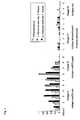
- FIG. Fig. 1 shows the IgE increases in the various mouse groups against the antigen, measured by ELISA (scale: OD values at 405/450 nm).
- the groups A and B were administered according to the invention, the antigen in conjunction with a gastric acid reducing agent orally, while for comparison, group C immunized according to a standard scheme for IgE induction and Group D, the antigen without gastric acid reducing agent was administered orally.
- Group 1 (see Figure 2, x-axis) was assayed by Zantac (amount, active ingredient see Example 1) i.m. pretreated one hour before feeding, group 2 with omeprazole i.m. (11.6 microg per mouse, Losec, AstraZeneca Co.) 2 hours prior to feeding, group three received only parvalbumin fed without pretreatment.
- mice were treated on day 0 and 28. Sera were collected on day 0 (first pillars each), on day 28 (second pillars each) and day 42 (third pillars each) and tested by ELISA. ELISA plates were coated with recombinant parvalbumin. Mouse sera were diluted 1:10 and incubated overnight. After washing, bound mouse IgE was detected by means of a peroxidase-labeled anti-mouse rat IgE antibody detected 1: 1000 (PharMingen). The color reaction was effected by substrate addition and is directly proportional to the amount of specific IgE antibody. The color signal was read in an ELISA reader at 405/450 nm ( Figure 2, y-axis).
Landscapes
- Health & Medical Sciences (AREA)
- Life Sciences & Earth Sciences (AREA)
- Pharmacology & Pharmacy (AREA)
- Veterinary Medicine (AREA)
- Immunology (AREA)
- Chemical & Material Sciences (AREA)
- Public Health (AREA)
- General Health & Medical Sciences (AREA)
- Medicinal Chemistry (AREA)
- Animal Behavior & Ethology (AREA)
- Epidemiology (AREA)
- Microbiology (AREA)
- Mycology (AREA)
- Chemical Kinetics & Catalysis (AREA)
- Organic Chemistry (AREA)
- Bioinformatics & Cheminformatics (AREA)
- General Chemical & Material Sciences (AREA)
- Nuclear Medicine, Radiotherapy & Molecular Imaging (AREA)
- Engineering & Computer Science (AREA)
- Medicines Containing Antibodies Or Antigens For Use As Internal Diagnostic Agents (AREA)
- Medicines That Contain Protein Lipid Enzymes And Other Medicines (AREA)
- Peptides Or Proteins (AREA)
- Medicines Containing Plant Substances (AREA)
- Materials For Photolithography (AREA)
- Coloring Foods And Improving Nutritive Qualities (AREA)
Description
- Die vorliegende Erfindung betrifft ein Arzneimittel zur oralen Vakzinierung gemäß Anspruch 1.
- In der Medizin ist es häufig erwünscht, dass Krankheiten nicht nur symptomatisch bekämpft werden, sondern ihr Entstehen von vorne herein verhindert wird. Im Bereich der Infektionskrankheiten, neuerdings aber auch im Bereich der Krebserkrankungen wird daher der Weg der Vakzinierung eingeschlagen. Mittels dieser Methode wird der Körper dazu befähigt, mit Hilfe seines Immunsystems auf krankheitserregende Substanzen, auch Antigene genannt, zu reagieren. Dieses auch als aktive Immunisierung bekannte Verfahren funktioniert dadurch, dass dem Immunsystem ein mit einer Krankheit assoziiertes Antigen präsentiert wird, worauf das Immunsystem mit der Bildung entsprechender spezifischer Antikörper gegen besagte Antigene reagiert. Diese sogenannten Antigene bestehen häufig aus Peptiden oder Proteinen, dass heißt Aminosäuresequenzen, welche häufig parenteral, das heißt unter Umgehung des Magen-Darm-Traktes verabreicht werden. Dies geschieht meist mittels Injektion oder Infusion, was von den Patienten häufig als unangenehm empfunden wird.
- US-A-4,171,353 beschreibt die orale Immunisierung von Tieren mittels u.a. Tumorzellen und einem Cholinester als Adjuvans sowie einer Magensäure reduzierenden Substanz, Eur. J. Immunol. 2000, 30, 128-135 beschreibt eine orale anti-IgE Immunisierung mittels Phagendisplay zur Behandlung von Allergien.
- Dem gemäß ist es Aufgabe der vorliegenden Erfindung, eine Anti-Tumor-Vakzine zur Verfügung zu stellen, mit Hilfe derer es möglich ist, eine Impfung auf parenteralem Wege zu vermeiden und die Akzeptanz bei den Patienten dadurch zu steigern.
- Der Erfindung liegt die Erkenntnis zugrunde, dass eine parenterale Applikation dann umgangen werden kann, wenn im Magenbereich geeignete Bedingungen herrschen, die die Wirksamkeit des Impfstoffes bei Aufnahme über den Magen-Darm-Trakt nicht beeinträchtigen und somit die Bildung von Antikörpern ermöglichen.
- Gegenstand der vorliegenden Erfindung sind Arzneimittel gemäß Anspruch 1.
- Durch diese Arzneimittel wird zum einen ermöglicht, dass die als Antigen wirksame Substanz gemäß Anspruch 1 gleichzeitig mit der magensäure-reduzierenden Substanz eingenommen werden kann, wobei beide Phasen zusammen oder getrennt vorliegen können. Zum anderen kann das Kombinationspräparat auch in der Weise appliziert werden, dass die als Antigen wirksame Substanz gemäß Anspruch 1 getrennt und nach der Applikation einer geeigneten Dosis an magensäurereduzierender Substanz verabreicht wird. Dabei ist es wichtig, dass die Magensäure zum Zeitpunkt der Applikation, das heißt zu dem Zeitpunkt, an dem der Impfstoff in den Magen gelangt, im Vergleich zum "normalen Magensäuregehalt" reduziert ist. Auf diese Weise wird es ermöglicht, dass eine traditionell parenteral zu verabreichende Vakzine auch oral appliziert werden kann und ihre Wirkung in Form der Erzeugung einer Immunantwort entfalten kann. Insbesondere werden als Immunantwort Immunglobuline der Gruppen IgE und IgG1 erzeugt. Des weiteren hat die reduzierte Azidität auch eine Nicht-Aktivierung der Magen-Proteasen zur Folge, denn Pepsinogene werden erst durch den niedrigen pH im Magen zu den aktiven Pepsinen gespalten.
- Da beispielsweise Tiere sowohl Tumoren entwickeln können, als auch in der Lage sind, IgE zu produzieren, ist beispielsweise im veterinärmedizinischen Bereich an eine Vakzinierung gemäß der vorliegenden Erfindung zu denken. Bevorzugterweise dienen die erfindungsgemäßen Arzneimittel daher zur Vakzinierung von Tieren, insbesondere Säugetieren. Besonders bevorzugt dienen die erfindungsgemäßen Arnzeimittel zur Vakzinierung von Menschen.
- Beispiele für solche Substanzen sind Krebsantigene, nämlich Mimotope dieser Antigene.
- Es handelt sich bei der als Antigen wirksamen Substanz um sogenannte Krebs- oder Tumorantigen-Mimotope mit der im Anspruch 1 definierten Sequenz. Dieses sind Substanzen natürlicher oder synthetischer Herkunft, die eine Immunantwort gegen Krebs bzw. Tumoren erzeugen. Es handelt sich bei den Krebs- oder Tumorantigen-Mimotopen um ein Peptid mit der Aminosäuresequenz Gln Met Trp Ala Pro Gln Trp Gly Pro Asp (Sequenznummer 1), das bei verschiedenen Krebsarten wie beispielsweise Brustkrebs auftritt, beispielsweise handelt es sich bei dem Mimotop um eines des HER2-neu Antigens.
- Die Krebs- oder Tumorantigen-Mimotope können, müssen aber nicht, an einen Träger gekoppelt sein.
- Bei einer gleichzeitigen Gabe von Arzneimitteln, die eine als Antigen wirksame Substanz gemäß Anspruch 1 und eine magensäurereduzierende Substanz umfassen, kann die als Antigen wirksame Substanz im Magen gleichzeitig oder mit zeitlicher Verzögerung im Vergleich zur magensäurereduzierenden Substanz abgegeben werden. Wichtig ist dabei nur, dass das Magenmilieu in der Weise eingestellt ist, dass die als Antigen wirksame Substanz ihre Wirkung bezüglich der Erzeugung einer Immunantwort entfalten kann. Pathophysiologisch oder iatrogen induziert können manche Individuen aus unterschiedlichen Gründen eine reduzierte Magensäure haben. Für die erfindungsgemäße Vakzinierung ist es jedoch notwendig, gezielt und kontrolliert den Säuregehalt zu beeinflussen. Insbesondere eignet sich die Einstellung des pH-Wertes des Magens auf einen pH-Wert im Bereich von 4 bis 7, bevorzugt von 4,3 bis 6,5, besonders bevorzugt von 4,8 bis 6. In diesem pH-Bereichen werden Pepsinogene nicht zur aktiven Protease konvertiert.
- Das Mimotop bleibt daher unter hypoaziden Bedingungen konformationell intakt, wobei Konformationsepitope möglicherweise für die Induktion von IgE Antikörpern ausschlaggebend sind. Eine erhöhte Resorptionsrate des Mimotop durch die Magenwand konnte bisher noch nicht festgestellt werden, wird aber nicht ausgeschlossen.
- Bevorzugt besteht die magensäurereduzierende Substanz aus einer die Magensäurebildung inhibierenden und/oder die Magensäure bindenden Substanz. Damit wird gewährleistet, dass die Art und Weise wie es zur Magensäurereduktion kommt auf unterschiedlichen Wirkmechanismen beruhen kann. Durch solche Mittel kann die Magensäurekonzentration auf die Bedürfnisse der erfindungsgemäßen Vakzinierung eingestellt werden.
- Bevorzugt werden als magensäurereduzierende Mittel solche ausgewählt, die den Wirkstofffamilien der Antazida, H2-Rezeptor-Antagonisten oder Protonenpumpeninhibitoren angehören. Durch das Verabreichen von Antazida, d.h. basischen Mitteln, wird vorhandene Magensäure reduziert. H2-Rezeptor-Antagonisten inhibieren hingegen Histamin H2-Rezeptoren kompetitiv und reversiv, wobei die Magensäurebildung vermindert wird. Protonenpumpeninhibitoren reduzieren ihrerseits die Magensäure durch direkte Beeinflussung der Säuresekretion.
- Als Beispiele für Antazida seien folgende Wirkstoffe genannt: Natriumhydrogencarbonat, Calciumcarbonat, Magnesiumcarbonat, Magnesiumhydroxid und Magnesiumhydroxid-Gel, Magnesiumsilikat, Aluminiumphosphat, Aluminiumhydroxid und Aluminiumhydroxid-Gel, Hydrotalcite, Magaldrate, Dihydro-Aluminium-Natriumcarbonat, Magnesium-Aluminathydrat, Aminoessigsäure sowie Wismuth-Salze. Als protektiv über die Schleimhaut wirksame Substanzen seien Carbenoxolon und Sucralat (Aluminiumhydroxid und Saccharosesulfat) zu nennen. Als Beispiele für H2-Rezeptorblocker seien exemplarisch genannt: Cimetidin, Ranitidin, Oxmetidin, Famotidin, Roxatidin und Nizatidin. Als Beispiele für Protonenpumpeninhibitoren seien genannt: Omezaprol, Lansoprazol, Pantoprazol und Rabeprazol. Da Anticholinergika u.a. eine Hemmung der Speichel- u. Magensaftabsonderung bewirken, können auch Vertreter dieser Klasse verwandt werden, so z.B. Pirenzepin.
- Besonders bevorzugt werden solche magensäurereduzierenden Mittel aus den Mitteln Ranitidin-Hydrochlorid und Aluminium-Saccharose-Hydrogen-Sulfat ausgewählt. Beide Mittel sind für die erfindungsgemäßen Arzneimittel geeignet und im allgemeinen gut verträglich.
- Als Antigen wirksame Substanzen werden vorzugsweise natürliche oder synthetische Antigen-Mimotope verwendet. Wie bereits erwähnt, werden Krebs- oder Tumorantigen-Mimotope bevorzugt. Besonders bevorzugt handelt es sich dabei um Peptide, die an einen Träger gekoppelt sein können. Die verwendeten natürlichen oder synthetischen Antigene bzw. Antigen-Mimotope oder Gemische davon bewirken nach der oralen Einnahme in Zusammenhang mit der magensäure-reduzierenden Substanz eine Immunantwort, die sich auf die Bildung von Immunglobulinen bezieht. Bevorzugt werden die Immunglobuline IgE und IgG1 gebildet.
- In einer bevorzugten Ausführungsform wird das Antigen-Mimotop mit einem Träger konjugiert.
- Als Träger eignen sich Moleküle, an die chemisch eines oder mehrere Antigen-Mimotope gebunden werden können.
- Bevorzugt wird das Antigen-Mimotop mit einem immunogenen Träger konjugiert.
- Solche Träger können Makromoleküle aller Art sein, die in der Lage sind immunstimmulierend zu wirken. Es ist jedoch von Bedeutung, dass ein gewählter Träger für Tiere und insbesondere für Menschen verträglich, d.h. nicht toxisch ist und keine Gefahren etwa eines Phagen oder Phagenpartikels bezüglich eventuell enthaltener Toxine oder der Möglichkeit der Infektion etwa von Darmbakterien in sich birgt, sowie nicht giftig ist und keine Serumkrankheiten oder Lebensmittelallergien auslöst. Die Konjugation mit einem Träger hat zur Folge, dass die Immunogenität der Vakzine erhöht wird. Als Beispiele von Trägern wären zu nennen Keyhole-Limpet-Hemocyanin (KLH), Tetanustoxoid (TT), Albumin-bindendes Protein (ABP) oder Rinderserumalbumin (BSA). Bevorzugt wird das Peptid oder dessen funktionelle Variante an Keyhole-Limpet-Hemocyanin (KLH) oder Tetanustoxoid (TT) konjugiert.
- Bei einer weiteren bevorzugten Ausführungsform besteht der Träger aus einem Multimeren der Aminosäure Lysin. Dieses Polylysin ist bevorzugterweise als Dendrimer, d.h. als Polymer mit mehreren Verzweigungen aufgebaut, welches mehrere funktionelle Gruppen, insbesondere Aminogruppen, zur Verfügung stellt, so dass mehrere Peptide an den Träger gebunden werden können. Diese rein synthetische Variante wird als "multiple antigenic peptide" bezeichnet (MAP) und führt ebenfalls zur Erhöhung der Immunogenität ohne einen immunogenen Träger zu benutzen. Dies ist den Schriften von Tam JP, PNAS 1988; 85: 5409-13: "Synthetic peptide vaccine design: synthesis and properties of a highdensity multiple antigenic peptide" sowie von Olszewska W. et al. Virology 2000; 20: 98 - 105: "Protection against measles virus-induced encephalitis by anti-mimotope antibodies: the role of antibody affinity" nachzulesen.
- Die Konjugation der Peptide an das Trägermaterial kann auf beliebige Weise erfolgen, beispielsweise auf gentechnologischem oder chemischem Weg, das heißt die Verknüpfung von Träger und einer funktionellen Gruppe am Peptid erfolgt durch eine chemische Reaktion. Bevorzugt findet sich die Verknüpfung an einem Ende des Peptides. Auf gentechnologischem Weg kann die Kopplung des Proteinträgermoleküls mit dem Peptid oder dessen Variante so hergestellt werden, dass eine für die Gesamtsequenz des Konjugates kodierende DNA- oder RNA-Sequenz in ein Expressionssystem eingebaut wird, von dem das Gesamtkonjugat dann exprimiert wird. Diese Form der Konjugation kann selbstverständlich nur für den Fall angewendet werden, dass auch das Gesamtkonjugat ein Proteinmolekül ist.
- In einer weiteren bevorzugten Ausführungsform wird das Peptid über einen Linker mit einem Träger konjugiert. Dieser Linker dient zum einen als Abstandshalter zum Träger, aber auch zu einer verbesserten Kopplung an denselben. Vorzugsweise wird der Linker an die Peptidsequenz angefügt beziehungsweise mit ihr synthetisiert.
- Als Linker eignet sich beispielsweise pentameres Glycin, das mit dem C-Terminus des Peptides verknüpft ist. Um die Kopplungsreaktion an ein Trägerprotein zu erleichtern, kann ein C-terminales Cystein eingeführt werden. Damit lässt sich das Peptid mit Linker über eine Disulfidbrücke an den Träger koppeln. Weiterhin eignet sich als Linker das Motiv GPGPG, welches ebenfalls durch einen Cysteinrest zum Motiv GPGPGC erweitert werden kann, um eine Disulfidbrückenbindung zum Trägerprotein zu erzielen.
- Es ist weiterhin möglich, dass die Arzneimittel Tumor-Antigen-Mimotope als Monomere, Dimere, Trimere oder Oligomere enthalten, welche mit dem makromolekularen Träger konjugiert sind. Auch hier wird eine erhöhte Immunogenität erzeugt. Weiterhin ist bevorzugt, dass die monomeren, dimeren, trimeren oder oligomeren Tumor-Antigen-Mimotope einfach oder mehrfach an den makromolekularen Träger gebunden sind. Dadurch wird eine Steigerung der Immunogenität erzielt.
- In Bezug auf die Einsetzbarkeit der als Antigen fungierenden Substanzen in den erfindungsgemäßen Arzneimitteln sind zahlreiche Möglichkeiten denkbar.
- Die Arzneimittel besitzen die als Antigen wirksame Substanz gemäß Anspruch 1, die eine antitumorale Wirkung auslöst. Gerade im Bereich der Krebstherapie und Krebsvorsorge sind Vakzinierungen und insbesondere der Vorteil einer möglichen oralen Vakzinierung für die Patienten erwünscht.
- Nachstehend sind Beispiele einer oralen Vakzinierung erläutert die zum Verständnis der Erfindung beitragen. Zur Erklärung zeigen:
- Figur 1:
- Ein Balkendiagramm, mit dem IgE-Anstieg in verschiedenen Mausgruppen gegen als Antigen verwendeten Kaviar-Extrakt (Beispiel 1), gemessen im ELISA (Scala: OD-Werte), und
- Figur 2:
- Ein Balkendiagramm, mit dem IgE-Anstieg in verschiedenen Mausgruppen gegen als Antigen verwendete Fischallergen Parvalbumin (Beispiel 2), gemessen im ELISA (Scala: OD-Werte).
- Vier Gruppen (A bis D) zu je fünf Balb/c Mäusen wurden in folgender Weise behandelt:
- Gruppe A:
- Orale Gabe von Zantac (ULSAL®, Wirkstoff: 20 microg Ranitidin pro Maus, einmalige Gabe pro Maus eine Stunde vor der Fütterung i.m. mit Antigen) und Antigen (2 mg Kaviar Protein Extrakt pro Maus),
- Gruppe B:
- Orale Gabe einer Mischung von Ulcogant (Wirkstoff: 2 mg Sucralfat pro Maus)und Antigen (2 mg Kaviar Protein Extrakt pro Maus),
- Gruppe C:
- Vergleichsbeispiel mit intraperitonealer Gabe von Kaviar Antigen (2 mg) und Aluminiumhydroxid als Adjuvans,
- Gruppe D:
- Vergleichsbeispiel mit oraler Gabe des Antigens (2 mg).
- Als Antigen wurde Kaviar-Extrakt verwendet. Als Referenz bezüglich des verwendeten Kaviar-Extraktes wird auf die Arbeit von Untersmayr E, Schöll I, Förster-Waldl E, Walter F, Riemer A, Boltz-Nitulescu G, Scheiner O, Jensen-Jarolim E. J Allergy and Immun. 2002; 109 (6): 1034-5 Bezug genommen. Das darin enthaltene Antigen weist ein Molekulargewicht von 118 kDa auf.
- Die erhaltenen Resultate sind in Figur 1 wiedergegeben. Fig. 1 zeigt die IgE-Anstiege in den verschiedenen Mausgruppen gegen das Antigen, gemessen im ELISA (Skala: OD-Werte bei 405/450 nm). Den Gruppen A und B wurde erfindungsgemäß das Antigen in Verbindung mit einem magensäurereduzierenden Mittel oral verabreicht, während zum Vergleich Gruppe C nach einem Standardschema für IgE-Induktion immunisiert wurde und Gruppe D das Antigen ohne magensäurereduzierendes Mittel oral verabreicht wurde.
- Die Befunde gemäß der vorliegenden Erfindung machen deutlich, dass eine Hypoazidität des Magens (durch Antazida-Behandlung) bei gleichzeitiger erstmaligen Einnahme eines Antigens zu einer IgE Induktion spezifisch gegen dieses neue Antigen führt.
- Gängige Präparate, welche die Magensäurebildung inhibieren (Zantac® [Ranitidin-Hydrochlorid, GlaxoSmithKline]) oder welche die Magensäure binden und neutralisieren (Ulcogant® [Aluminium-Saccharose-Hydrogensulfat, Merck]), bewirken eine nachhaltige Induktion von IgE und auch IgG Antikörpern gegen ein gleichzeitig oder zeitlich verzögert gefüttertes neues Nahrungsmittel, in diesem Fall Kaviar-Extrakt, jedoch nicht gegen die tägliche Diät der Mäuse, gegen welche sie weiter tolerant blieben. Die erzielten IgE-Werte sind auch im Vergleich zu einer traditionellen Allergisierung auf intraperitonealem Weg mit Al(OH)3 als Adjuvans hoch.
- 5-Wochen alte weibliche Balb/c Mäuse (n = 8 pro Gruppe) wurden durch intragastrale Fütterungen mit jeweils 250 microg/Maus rekombinanten Parvalbumin (Fischallergen, siehe Swoboda et al., J. of Immunology 2002; 168: 4576-84), behandelt. Gruppe 1 (siehe Fig. 2, x-Achse) wurde durch Zantac (Menge, Wirkstoff sh. Beispiel 1) i.m. eine Stunde vor der Fütterung vorbehandelt, Gruppe 2 mit Omeprazol i.m. (11,6 microg pro Maus, Losec, Fa. AstraZeneca) 2 Stunden vor der Fütterung, Gruppe drei erhielt nur Parvalbumin gefüttert ohne Vorbehandlung.
- Die Tiere wurden am Tag 0 und 28 behandelt. Seren wurden am Tag 0 (jeweils erste Säulen), am Tag 28 (jeweils zweite Säule) und Tag 42 (jeweils dritte Säule) abgenommen und im ELISA getestet. Dazu wurden ELISA Platten mit recombinantem Parvalbumin beschichtet. Mausseren wurden 1:10 verdünnt und darauf über Nacht inkubiert. Nach Waschen wurde gebundenes Maus IgE mittels eines Peroxidase-markierten Rat anti-Maus IgE Antikörpers 1:1000 detektiert (PharMingen). Die Farbreaktion wurde durch Substratzugabe bewirkt und ist der Menge der spezifischen IgE Antikörper direkt proportional. Das Farbsignal wurde in einem ELISA Reader bei 405/450 nm gelesen (Fig. 2, y-Achse).
- Fig. 2 zeigt die erhaltenen Resultate, wobei die im Diagramm dargestellten Werte die Mittelwerte der Mausgruppen (n = 8) sind. Es kann aus dem Beispiel des rekombinantes Parvalbumin gefolgert werden, dass Vorbehandlungen mit Antazida zu einer schnellen IgE Induktion gegen neue Nahrungs-Antigene führt.
- Aufgrund der vermehrten Literaturberichte, welche auf eine anti-Tumorwirkung von IgE Antikörpern hinweisen (Reali, E.; Greiner, J.W.; Corti, A.; Gould, H.J., Bottazzoli, F.; Paganelli, G.; Schlom, J.; Siccardi, A.G.; Cancer Res., 2001; 61(14): 5517-22; Kershaw, M.H., Darcy, P.K.; Trapani, J.A.; MacGregor, D.; Smyth, m.J.; Oncol. Res., 1998, 10(3), 133-42; Neuchrist, C.; Kornfehl, J.; Grasl, M.; Lassmann, H.; Kraft, D.; Ehrenberger, K.; Scheiner, O.; Int. Archs. Allergy Immunol., 1994, 104: 97-100; Nagy, E.; Berczi, I.; Sehon, A.H.; Cancer Immunol. Immunother. 1991; 34(1): 63-9), kann aufgrund der Resultate der Beispiele 1 und 2 auch mit einem positiven Effekt einer Vakzinierung durch orale Applikation von Tumor-Antigen-Mimotop gemäß Anspruch 1 gerechnet werden.
Claims (9)
- Arzneimittel, enthaltend eine als Tumorantigen wirksame Substanz und eine magensäurereduzierende Substanz als Kombinationspräparat zur gemeinsamen oder getrennten, gleichzeitigen oder zeitlich versetzten oralen Anwendung zur Vakzinierung gegen Krebs bzw. Tumoren, wobei das Tumorantigen als wirksame Substanz ein Antigen-Mimotop ist, das die Aminosäuresequenz Seq. 1: Gln Met Trp Ala Pro Gln Trp Gly Pro Asp hat.
- Arzneimittel gemäß Anspruch 1, dadurch gekennzeichnet, dass das Antigen-Mimotope im Magen gleichzeitig oder mit zeitlicher Verzögerung im Vergleich zur magensäurereduzierenden Substanz freigesetzt wird.
- Arzneimittel gemäß Anspruch 1 oder 2, dadurch gekennzeichnet, dass die magensäurereduzierende Substanz die Magensäurebildung inhibiert und/oder Magensäure bindet.
- Arzneimittel gemäß Anspruch 3, dadurch gekennzeichnet, dass das magensäurereduzierende Mittel aus Mitteln der Wirkstofffamilien der Antazida, H2-Rezeptor-Antagonisten und/oder Protonenpumpeninhibitoren ausgewählt werden.
- Arzneimittel gemäß einem der vorstehenden Ansprüche, dadurch gekennzeichnet, dass der pH-Wert des Magens auf einen pH-Wert im Bereich von 4 bis 7 hinaufgesetzt wird.
- Arzneimittel gemäß einem der vorstehenden Ansprüche, dadurch gekennzeichnet, dass die Antigen-Mimotope an einen Träger gekoppelt sind.
- Arzneimittel gemäß einem der vorstehenden Ansprüche, dadurch gekennzeichnet, dass die Antigen-Mimotope als Monomere, Dimere, Trimere oder Oligomere mit dem Träger konjugiert sind.
- Arzneimittel gemäß einem der vorstehenden Ansprüche, dadurch gekennzeichnet, dass die monomeren, dimeren, trimeren oder oligomeren Antigen-Mimotope einfach oder mehrfach an den Träger gebunden sind.
- Arzneimittel nach einem der vorstehenden Ansprüche, dadurch gekennzeichnet, dass die Antigen-Mimotop eine antitumorale Wirkung auslösen.
Priority Applications (1)
| Application Number | Priority Date | Filing Date | Title |
|---|---|---|---|
| EP03708059A EP1465658B1 (de) | 2002-01-15 | 2003-01-15 | ORALE VAKZINIERUNG MIT DEM TUMOR-ANTIGEN-MIMOTOP Gln-Met-Trp-Ala-Pro-Gln-Trp-Gly-Pro-Asp |
Applications Claiming Priority (6)
| Application Number | Priority Date | Filing Date | Title |
|---|---|---|---|
| EP02000901A EP1327450B1 (de) | 2002-01-15 | 2002-01-15 | Orale Vakzinierung mit nackten Tumor-Antigen-Mimotopen |
| EP02000901 | 2002-01-15 | ||
| DE10259053 | 2002-12-17 | ||
| DE10259053A DE10259053A1 (de) | 2002-12-17 | 2002-12-17 | Antigen-Mimotope und Vakzine gegen Krebserkrankungen |
| EP03708059A EP1465658B1 (de) | 2002-01-15 | 2003-01-15 | ORALE VAKZINIERUNG MIT DEM TUMOR-ANTIGEN-MIMOTOP Gln-Met-Trp-Ala-Pro-Gln-Trp-Gly-Pro-Asp |
| PCT/EP2003/000369 WO2003059380A2 (de) | 2002-01-15 | 2003-01-15 | Orale vakzinierung |
Publications (2)
| Publication Number | Publication Date |
|---|---|
| EP1465658A2 EP1465658A2 (de) | 2004-10-13 |
| EP1465658B1 true EP1465658B1 (de) | 2007-05-02 |
Family
ID=26011230
Family Applications (1)
| Application Number | Title | Priority Date | Filing Date |
|---|---|---|---|
| EP03708059A Expired - Lifetime EP1465658B1 (de) | 2002-01-15 | 2003-01-15 | ORALE VAKZINIERUNG MIT DEM TUMOR-ANTIGEN-MIMOTOP Gln-Met-Trp-Ala-Pro-Gln-Trp-Gly-Pro-Asp |
Country Status (9)
| Country | Link |
|---|---|
| US (2) | US20050226894A1 (de) |
| EP (1) | EP1465658B1 (de) |
| AT (1) | ATE361097T1 (de) |
| AU (1) | AU2003212215B9 (de) |
| CA (1) | CA2473416A1 (de) |
| DE (1) | DE50307169D1 (de) |
| ES (1) | ES2286409T3 (de) |
| IL (2) | IL162857A0 (de) |
| WO (1) | WO2003059380A2 (de) |
Families Citing this family (1)
| Publication number | Priority date | Publication date | Assignee | Title |
|---|---|---|---|---|
| JP6967457B2 (ja) * | 2016-02-02 | 2021-11-17 | 日東電工株式会社 | 免疫誘導促進用組成物及びワクチン医薬組成物 |
Citations (4)
| Publication number | Priority date | Publication date | Assignee | Title |
|---|---|---|---|---|
| US471353A (en) * | 1892-03-22 | Can-testing machine | ||
| WO1999007869A1 (en) * | 1997-08-05 | 1999-02-18 | University Of Florida | Live recombinant vaccine comprising inefficiently or non-replicating virus |
| WO2001008495A1 (en) * | 1999-08-03 | 2001-02-08 | Merck & Co., Inc. | Rotavirus vaccine formulations |
| EP1327450A1 (de) * | 2002-01-15 | 2003-07-16 | Bio Life Science Forschungs- und Entwicklungsges.m.b.H. | Orale Vakzinierung |
Family Cites Families (8)
| Publication number | Priority date | Publication date | Assignee | Title |
|---|---|---|---|---|
| KR19990008155A (ko) * | 1995-04-28 | 1999-01-25 | 랜스 고든 | 다가, 재조합 우레아제 백신 |
| US5840332A (en) * | 1996-01-18 | 1998-11-24 | Perio Products Ltd. | Gastrointestinal drug delivery system |
| SE9600648D0 (sv) * | 1996-02-21 | 1996-02-21 | Bror Morein | Receptorbimdande enhet |
| CA2245497C (en) * | 1996-03-01 | 2009-02-24 | Novartis Ag | Peptide immunogens for vaccination against and treatment of allergy |
| EP0980204A4 (de) * | 1997-04-01 | 2005-06-15 | Merieux Oravax | 76 kDA, 32 kDa UND 50 kDa HELICOBACTER POLYPEPTIDE UND KORRESPONDIERENDE POLYNUCLEOTID-MOLEKÜLE |
| GB0020089D0 (en) * | 2000-08-15 | 2000-10-04 | Smithkline Beecham Biolog | Vaccine Composition |
| US6497859B1 (en) * | 2000-11-17 | 2002-12-24 | Noville Inc. | Cooling agents, pharmaceutical compositions having cooling agents and processes for making and using same |
| BRPI0207447B1 (pt) * | 2001-02-21 | 2015-09-22 | Id Biomedical Corp | polipeptídeo recombinante isolado, seu uso e processo de produção, vetor de expressão, célula hospedeira microbiana transgênica, composição farmacêutica, uso da dita composição, métodos de detecção e kit |
-
2003
- 2003-01-15 DE DE50307169T patent/DE50307169D1/de not_active Expired - Lifetime
- 2003-01-15 EP EP03708059A patent/EP1465658B1/de not_active Expired - Lifetime
- 2003-01-15 WO PCT/EP2003/000369 patent/WO2003059380A2/de not_active Ceased
- 2003-01-15 US US10/501,402 patent/US20050226894A1/en not_active Abandoned
- 2003-01-15 CA CA002473416A patent/CA2473416A1/en not_active Abandoned
- 2003-01-15 AU AU2003212215A patent/AU2003212215B9/en not_active Ceased
- 2003-01-15 ES ES03708059T patent/ES2286409T3/es not_active Expired - Lifetime
- 2003-01-15 IL IL16285703A patent/IL162857A0/xx active IP Right Grant
- 2003-01-15 AT AT03708059T patent/ATE361097T1/de active
-
2004
- 2004-07-05 IL IL162857A patent/IL162857A/en not_active IP Right Cessation
-
2010
- 2010-02-01 US US12/656,491 patent/US20100183684A1/en not_active Abandoned
Patent Citations (4)
| Publication number | Priority date | Publication date | Assignee | Title |
|---|---|---|---|---|
| US471353A (en) * | 1892-03-22 | Can-testing machine | ||
| WO1999007869A1 (en) * | 1997-08-05 | 1999-02-18 | University Of Florida | Live recombinant vaccine comprising inefficiently or non-replicating virus |
| WO2001008495A1 (en) * | 1999-08-03 | 2001-02-08 | Merck & Co., Inc. | Rotavirus vaccine formulations |
| EP1327450A1 (de) * | 2002-01-15 | 2003-07-16 | Bio Life Science Forschungs- und Entwicklungsges.m.b.H. | Orale Vakzinierung |
Non-Patent Citations (5)
| Title |
|---|
| [online] 24 October 2005 (2005-10-24), "Gastric Acid inhibitors", retrieved from WWW.SURGERYENCYCLOPEDIA.COM/FI-LA/G ASTRIC-ACID-INHIBITORS.HTML * |
| GANGLBERGER E. ET AL: "Monovalent fusion proteins of IgE mimotopes are safe for therapy of type I allergy", THE FASEB JOURNAL, vol. 15, November 2001 (2001-11-01), pages 2524 - 2526 * |
| Hochschule für angewandte Wissenschaften Hamburg, Fakultät Life Science, Studiengang Ökotrophologie, Anatomie/Physiologie, Klausur im SS2005 am 29.6.2005, Prof. Dr. Lorenz * |
| LAHEIJ R.J. ET AL: "Medical biology pneumonia and gastric-acid suppressive drugs", J AM MED ASSOC, vol. 292, 2004, pages 1955, Retrieved from the Internet <URL:http://scienceweek.com/2004/sc041217-2 .htm>> * |
| ZUERCHER A.W. ET AL: "Oral anti-IgE immunization with epitope-displaying phage", EUROPEAN JOURNAL OF IMMUNOLOGY, vol. 30, no. 30, pages 128 - 135, XP000916384, DOI: doi:10.1002/1521-4141(200001)30:1<128::AID-IMMU128>3.3.CO;2-O * |
Also Published As
| Publication number | Publication date |
|---|---|
| ATE361097T1 (de) | 2007-05-15 |
| WO2003059380A3 (de) | 2004-01-22 |
| ES2286409T3 (es) | 2007-12-01 |
| IL162857A0 (en) | 2005-11-20 |
| AU2003212215B2 (en) | 2007-10-11 |
| US20100183684A1 (en) | 2010-07-22 |
| AU2003212215A1 (en) | 2003-07-30 |
| US20050226894A1 (en) | 2005-10-13 |
| CA2473416A1 (en) | 2003-07-24 |
| WO2003059380A2 (de) | 2003-07-24 |
| AU2003212215B9 (en) | 2008-02-21 |
| EP1465658A2 (de) | 2004-10-13 |
| IL162857A (en) | 2011-03-31 |
| DE50307169D1 (de) | 2007-06-14 |
Similar Documents
| Publication | Publication Date | Title |
|---|---|---|
| DE68917126T2 (de) | T-zellen-epitope als träger für einen konjugierten impfstoff. | |
| DE3650082T2 (de) | Orale impfstoffe. | |
| DE69334066T2 (de) | Impfstoffzusammensetzungen für mukosale Abgabe | |
| DE69231232T2 (de) | Verfahren zur Immunoneutralisierung von nichtkastrierten männlichen Haustieren gegen LMRH und Peptide dafür | |
| DE69934179T2 (de) | Zusammensetzung enthaltend ein Antigen, ein TH-1 induzierendes Adjuvans und eine im Wasser schwer lösliche Aminosäure zur Verwendung in der Immunisierung | |
| DE3200813A1 (de) | "synthetischer impfstoff gegen virusinfektionen" | |
| DE69231663T2 (de) | Polysaccharid-protein-konjugate | |
| DE202008006598U1 (de) | Allergie-Impfstoff-Formulierung zur mucosalen Verabreichung | |
| JPH10503495A (ja) | Quinoaサポニン組成物とその使用方法 | |
| US20150306211A1 (en) | Process for producing an allergen extract | |
| EP0363835A1 (de) | Verwendung von Zink- oder Eisenhydroxid zur Adjuvierung von Antigenlösungen und auf diese Weise adjuvierte Antigenlösungen | |
| DE69420970T2 (de) | Impfstoff zubereitungen | |
| DE69535422T2 (de) | Vakzin für einen nicht typisierbaren Haemophilus influenzae Stamm | |
| DE69829567T2 (de) | Angiotensinderivate | |
| WO2003059380A2 (de) | Orale vakzinierung | |
| US9345746B2 (en) | Immunogenic Escherichia coli heat stable enterotoxin | |
| JPS60231618A (ja) | 胃腸潰瘍の治癒促進用製剤組成物 | |
| DE2710455C2 (de) | N-Acetylmuramyl-L-alanyl-D-glutaminsäure-alpha-methylamid, Verfahren zu seiner Herstellung und diese Verbindung enthaltende Arzneimittel | |
| EP1327450B1 (de) | Orale Vakzinierung mit nackten Tumor-Antigen-Mimotopen | |
| EP1506012A1 (de) | Verwendung eines impfstoffes zur aktiven immunisierung gegen krebs | |
| DE2710457A1 (de) | 2-(2-acetamido-2-desoxy-3-0-d-glucopyranosyl)-d-propionyl-l-seryl-isoglutamin, 2-(2-acetamido-2-desoxy-3-0- d-glucopyranosyl)-d-propionyl-l-seryl- d-glutaminsaeure, die amid- und ester- derivate dieser verbindungen, verfahren zu ihrer herstellung und diese verbindungen als wirkstoffe enthaltende arzneimittel | |
| EP2723374B1 (de) | Rekombinantes mistellektin und dessen verwendung als adjuvans | |
| EP1260213A2 (de) | Darreichungsform von immunologischen Wirkstoffen | |
| Norman et al. | 503 Two-year study of clinical results after discontinuation of ragweed allergoid immunotherapy | |
| JPS60500770A (ja) | 免疫原性組成物 |
Legal Events
| Date | Code | Title | Description |
|---|---|---|---|
| PUAI | Public reference made under article 153(3) epc to a published international application that has entered the european phase |
Free format text: ORIGINAL CODE: 0009012 |
|
| AK | Designated contracting states |
Kind code of ref document: A2 Designated state(s): AT BE BG CH CY CZ DE DK EE ES FI FR GB GR HU IE IT LI LU MC NL PT SE SI SK TR |
|
| AX | Request for extension of the european patent |
Extension state: AL LT LV MK RO |
|
| 17P | Request for examination filed |
Effective date: 20040629 |
|
| GRAP | Despatch of communication of intention to grant a patent |
Free format text: ORIGINAL CODE: EPIDOSNIGR1 |
|
| RTI1 | Title (correction) |
Free format text: ORAL VACCINATION WITH THE TUMOR ANTIGEN MIMOTOPE GLN-MET-TRP-ALA-PRO-GLN-TRP-GLY-PRO-ASP |
|
| GRAS | Grant fee paid |
Free format text: ORIGINAL CODE: EPIDOSNIGR3 |
|
| GRAA | (expected) grant |
Free format text: ORIGINAL CODE: 0009210 |
|
| AK | Designated contracting states |
Kind code of ref document: B1 Designated state(s): AT BE BG CH CY CZ DE DK EE ES FI FR GB GR HU IE IT LI LU MC NL PT SE SI SK TR |
|
| PG25 | Lapsed in a contracting state [announced via postgrant information from national office to epo] |
Ref country code: FI Free format text: LAPSE BECAUSE OF FAILURE TO SUBMIT A TRANSLATION OF THE DESCRIPTION OR TO PAY THE FEE WITHIN THE PRESCRIBED TIME-LIMIT Effective date: 20070502 |
|
| REG | Reference to a national code |
Ref country code: GB Ref legal event code: FG4D Free format text: NOT ENGLISH |
|
| REG | Reference to a national code |
Ref country code: CH Ref legal event code: EP |
|
| REG | Reference to a national code |
Ref country code: IE Ref legal event code: FG4D Free format text: LANGUAGE OF EP DOCUMENT: GERMAN |
|
| REF | Corresponds to: |
Ref document number: 50307169 Country of ref document: DE Date of ref document: 20070614 Kind code of ref document: P |
|
| PG25 | Lapsed in a contracting state [announced via postgrant information from national office to epo] |
Ref country code: SE Free format text: LAPSE BECAUSE OF FAILURE TO SUBMIT A TRANSLATION OF THE DESCRIPTION OR TO PAY THE FEE WITHIN THE PRESCRIBED TIME-LIMIT Effective date: 20070802 |
|
| GBT | Gb: translation of ep patent filed (gb section 77(6)(a)/1977) |
Effective date: 20070809 |
|
| ET | Fr: translation filed | ||
| REG | Reference to a national code |
Ref country code: CH Ref legal event code: NV Representative=s name: E. BLUM & CO. AG PATENT- UND MARKENANWAELTE VSP |
|
| REG | Reference to a national code |
Ref country code: ES Ref legal event code: FG2A Ref document number: 2286409 Country of ref document: ES Kind code of ref document: T3 |
|
| REG | Reference to a national code |
Ref country code: IE Ref legal event code: FD4D |
|
| PG25 | Lapsed in a contracting state [announced via postgrant information from national office to epo] |
Ref country code: PT Free format text: LAPSE BECAUSE OF FAILURE TO SUBMIT A TRANSLATION OF THE DESCRIPTION OR TO PAY THE FEE WITHIN THE PRESCRIBED TIME-LIMIT Effective date: 20071002 Ref country code: IE Free format text: LAPSE BECAUSE OF FAILURE TO SUBMIT A TRANSLATION OF THE DESCRIPTION OR TO PAY THE FEE WITHIN THE PRESCRIBED TIME-LIMIT Effective date: 20070502 Ref country code: BG Free format text: LAPSE BECAUSE OF FAILURE TO SUBMIT A TRANSLATION OF THE DESCRIPTION OR TO PAY THE FEE WITHIN THE PRESCRIBED TIME-LIMIT Effective date: 20070802 Ref country code: SI Free format text: LAPSE BECAUSE OF FAILURE TO SUBMIT A TRANSLATION OF THE DESCRIPTION OR TO PAY THE FEE WITHIN THE PRESCRIBED TIME-LIMIT Effective date: 20070502 Ref country code: DK Free format text: LAPSE BECAUSE OF FAILURE TO SUBMIT A TRANSLATION OF THE DESCRIPTION OR TO PAY THE FEE WITHIN THE PRESCRIBED TIME-LIMIT Effective date: 20070502 Ref country code: CZ Free format text: LAPSE BECAUSE OF FAILURE TO SUBMIT A TRANSLATION OF THE DESCRIPTION OR TO PAY THE FEE WITHIN THE PRESCRIBED TIME-LIMIT Effective date: 20070502 |
|
| PG25 | Lapsed in a contracting state [announced via postgrant information from national office to epo] |
Ref country code: SK Free format text: LAPSE BECAUSE OF FAILURE TO SUBMIT A TRANSLATION OF THE DESCRIPTION OR TO PAY THE FEE WITHIN THE PRESCRIBED TIME-LIMIT Effective date: 20070502 |
|
| PLBE | No opposition filed within time limit |
Free format text: ORIGINAL CODE: 0009261 |
|
| STAA | Information on the status of an ep patent application or granted ep patent |
Free format text: STATUS: NO OPPOSITION FILED WITHIN TIME LIMIT |
|
| 26N | No opposition filed |
Effective date: 20080205 |
|
| PG25 | Lapsed in a contracting state [announced via postgrant information from national office to epo] |
Ref country code: GR Free format text: LAPSE BECAUSE OF FAILURE TO SUBMIT A TRANSLATION OF THE DESCRIPTION OR TO PAY THE FEE WITHIN THE PRESCRIBED TIME-LIMIT Effective date: 20070803 |
|
| BERE | Be: lapsed |
Owner name: BIO LIFE SCIENCE FORSCHUNGS- UND ENTWICKLUNGSGES. Effective date: 20080131 |
|
| PG25 | Lapsed in a contracting state [announced via postgrant information from national office to epo] |
Ref country code: MC Free format text: LAPSE BECAUSE OF NON-PAYMENT OF DUE FEES Effective date: 20080131 |
|
| PG25 | Lapsed in a contracting state [announced via postgrant information from national office to epo] |
Ref country code: EE Free format text: LAPSE BECAUSE OF FAILURE TO SUBMIT A TRANSLATION OF THE DESCRIPTION OR TO PAY THE FEE WITHIN THE PRESCRIBED TIME-LIMIT Effective date: 20070502 |
|
| PG25 | Lapsed in a contracting state [announced via postgrant information from national office to epo] |
Ref country code: BE Free format text: LAPSE BECAUSE OF NON-PAYMENT OF DUE FEES Effective date: 20080131 |
|
| PG25 | Lapsed in a contracting state [announced via postgrant information from national office to epo] |
Ref country code: CY Free format text: LAPSE BECAUSE OF FAILURE TO SUBMIT A TRANSLATION OF THE DESCRIPTION OR TO PAY THE FEE WITHIN THE PRESCRIBED TIME-LIMIT Effective date: 20070502 |
|
| PG25 | Lapsed in a contracting state [announced via postgrant information from national office to epo] |
Ref country code: LU Free format text: LAPSE BECAUSE OF NON-PAYMENT OF DUE FEES Effective date: 20080115 Ref country code: HU Free format text: LAPSE BECAUSE OF FAILURE TO SUBMIT A TRANSLATION OF THE DESCRIPTION OR TO PAY THE FEE WITHIN THE PRESCRIBED TIME-LIMIT Effective date: 20071103 |
|
| PG25 | Lapsed in a contracting state [announced via postgrant information from national office to epo] |
Ref country code: TR Free format text: LAPSE BECAUSE OF FAILURE TO SUBMIT A TRANSLATION OF THE DESCRIPTION OR TO PAY THE FEE WITHIN THE PRESCRIBED TIME-LIMIT Effective date: 20070502 |
|
| PGFP | Annual fee paid to national office [announced via postgrant information from national office to epo] |
Ref country code: DE Payment date: 20110225 Year of fee payment: 9 Ref country code: CH Payment date: 20110125 Year of fee payment: 9 Ref country code: AT Payment date: 20110120 Year of fee payment: 9 Ref country code: FR Payment date: 20110201 Year of fee payment: 9 Ref country code: NL Payment date: 20110119 Year of fee payment: 9 Ref country code: IT Payment date: 20110126 Year of fee payment: 9 |
|
| PGFP | Annual fee paid to national office [announced via postgrant information from national office to epo] |
Ref country code: GB Payment date: 20110121 Year of fee payment: 9 Ref country code: ES Payment date: 20110121 Year of fee payment: 9 |
|
| REG | Reference to a national code |
Ref country code: NL Ref legal event code: V1 Effective date: 20120801 |
|
| REG | Reference to a national code |
Ref country code: CH Ref legal event code: PL |
|
| GBPC | Gb: european patent ceased through non-payment of renewal fee |
Effective date: 20120115 |
|
| REG | Reference to a national code |
Ref country code: FR Ref legal event code: ST Effective date: 20120928 |
|
| PG25 | Lapsed in a contracting state [announced via postgrant information from national office to epo] |
Ref country code: GB Free format text: LAPSE BECAUSE OF NON-PAYMENT OF DUE FEES Effective date: 20120115 Ref country code: DE Free format text: LAPSE BECAUSE OF NON-PAYMENT OF DUE FEES Effective date: 20120801 Ref country code: LI Free format text: LAPSE BECAUSE OF NON-PAYMENT OF DUE FEES Effective date: 20120131 Ref country code: CH Free format text: LAPSE BECAUSE OF NON-PAYMENT OF DUE FEES Effective date: 20120131 |
|
| REG | Reference to a national code |
Ref country code: DE Ref legal event code: R119 Ref document number: 50307169 Country of ref document: DE Effective date: 20120801 |
|
| PG25 | Lapsed in a contracting state [announced via postgrant information from national office to epo] |
Ref country code: IT Free format text: LAPSE BECAUSE OF NON-PAYMENT OF DUE FEES Effective date: 20120115 |
|
| REG | Reference to a national code |
Ref country code: AT Ref legal event code: MM01 Ref document number: 361097 Country of ref document: AT Kind code of ref document: T Effective date: 20120115 |
|
| PG25 | Lapsed in a contracting state [announced via postgrant information from national office to epo] |
Ref country code: FR Free format text: LAPSE BECAUSE OF NON-PAYMENT OF DUE FEES Effective date: 20120131 |
|
| PG25 | Lapsed in a contracting state [announced via postgrant information from national office to epo] |
Ref country code: NL Free format text: LAPSE BECAUSE OF NON-PAYMENT OF DUE FEES Effective date: 20120801 Ref country code: AT Free format text: LAPSE BECAUSE OF NON-PAYMENT OF DUE FEES Effective date: 20120115 |
|
| REG | Reference to a national code |
Ref country code: ES Ref legal event code: FD2A Effective date: 20131023 |
|
| PG25 | Lapsed in a contracting state [announced via postgrant information from national office to epo] |
Ref country code: ES Free format text: LAPSE BECAUSE OF NON-PAYMENT OF DUE FEES Effective date: 20120116 |